1. Introduction
Ogive forebodies represent a class of standardized reference configurations extensively employed in experimental aerodynamics for the systematic investigation of complex three-dimensional separated flows. Owing to their geometrically simple yet aerodynamically rich structure, these configurations are frequently utilized as validation models for turbulence modeling strategies, assessment of numerical methodologies, and calibration of aerodynamic force and moment measurement systems in wind tunnel environments. Their inherent capability to exhibit nonlinear aerodynamic response and vortex asymmetry makes them particularly attractive for aerodynamic investigations. In addition, their sensitivity to the Reynolds number (Equation (1)), which in this investigation corresponds to the Reynolds number expected in practical operating conditions, renders them especially suitable for controlled laboratory studies, where repeatability and methodological rigor are essential.
The Reynolds number is defined as:
where
is the characteristic flow velocity,
is the characteristic length (reference length) and
is the kinematic viscosity of air at flight altitude.
In addition to their established role as reference test models, ogive forebodies equipped with canard control surfaces possess direct engineering relevance in practical aerospace applications. The interaction between forebody-generated vortices and canard-induced flow structures further intensifies the complexity of the resulting aerodynamic load distribution.
Analytical approaches, which rely extensively on empirical correlations and simplifying assumptions, retain value primarily for preliminary sizing and rapid sensitivity estimates. However, for configurations involving strong interactions between forebody vortices, canard circulation, and local separation effects, analytical formulations become inadequate due to their limited capability to capture turbulence, viscous coupling, and three-dimensional flow structures [
1]. In contrast, RANS computational fluid dynamics has become a standard tool for predicting aerodynamic loads over a broad range of operating conditions [
2,
3,
4,
5]. Modern turbulence closures, such as the SST
k-ω model [
6,
7], offer robust performance for attached and mildly separated flows and, when combined with appropriately generated meshes, are capable of reproducing experimental trends with high fidelity. Numerous studies have demonstrated that carefully executed CFD simulations can differ from high-quality wind tunnel measurements by only a few percent [
8,
9,
10]. Nonetheless, CFD accuracy is strongly affected by geometric representation: small geometric discontinuities-such as hinge gaps, junction recesses or local discontinuities-may induce secondary vortices and separation bubbles whose omission can lead to under- or overprediction of aerodynamic coefficients.
Despite the inherent limitations of numerical models, wind tunnel experiments [
11,
12] continue to represent the fundamental approach for the validation of computational methods.
Subsonic wind tunnels provide controlled free-stream conditions, allowing repeatable measurements of forces, surface pressures and flow-visualization patterns [
13,
14]. Despite their reliability, wind tunnel experiments involve significant operational cost, strict mechanical constraints and precise instrumentation requirements. For small-scale tunnels, additional challenges such as wall interference, blockage and model support effects must also be considered [
15]. However, despite these inherent limitations, small-scale wind tunnels offer significant practical advantages. Their relatively simple design, ease of operation and lower construction and maintenance costs make them particularly attractive for routine testing and preliminary design. Moreover, the reduced operational expenses enable rapid exaction of multiple experiments, which is especially valuable during preliminary stages. In early-phase analyses, such facilities provide cost-effective and timely insight into aerodynamic trends, allowing for informed design decision before proceeding to more complex and expensive large-scale experimental investigation.
The existing literature provides differing conclusions on the impact of geometric simplifications on the agreement between CFD predictions and experimental measurements. Some studies indicate that omitting small geometric features results in negligible differences in predicted aerodynamic forces [
8], whereas others show that such simplifications can significantly affect lift gradients, stall onset, and vortex interaction mechanisms, particularly for low-aspect-ratio surfaces [
9].
A review of the literature on canard aerodynamics shows that combining numerical simulations with experimental validation is essential for accurate prediction of aerodynamic coefficients. CFD studies indicate that, when appropriate turbulence models such as the Spalart–Allmaras model are used together with well-refined computational meshes, lift, drag and moment coefficients can be reliably predicted and validated with wind-tunnel measurements [
16]. Subsequent work has focused on systematic optimization of numerical parameters using orthogonal design methodologies. These studies considered parameters such as mesh resolution,
y+ values and computational domain size, enabling more efficient and accurate evaluation of aerodynamic performance across different flow regimes [
17]. At the same time, research into nonlinear aerodynamic effects of canard-controlled configurations has highlighted the strong coupling between forebody-canard interactions and rotational motion, which can generate pronounced nonlinear forces and moments. Among these effects are Magnus-type phenomena that may significantly influence vehicle stability and control [
18]. Additional studies have examined the influence of tail and stabilizer configurations, showing that canard-induced lateral forces and rolling moments are highly sensitive to angle of attack, flow regime, and tail geometry. Grid-fin configurations were found to offer limited roll-control effectiveness at subsonic and transonic speeds, while their performance improves at low supersonic Mach numbers [
19].
The aerodynamic behavior of ogive bodies equipped with all-moving canards remains insufficiently documented in the open literature, particularly with regard to the influence of geometric simplifications introduced during CFD model preparation. Despite the widespread use of Reynolds-averaged Navier–Stokes (RANS) approaches in practical aerodynamic design, the sensitivity of predicted loads to localized geometric features such as junction gaps has not been systematically quantified for this class of configurations. This gap in knowledge introduces uncertainty in the reliability, transferability, and engineering applicability of numerical predictions, especially when simplified geometries are routinely employed to reduce modeling effort and computational expense.
To address this deficiency, the present study provides a comprehensive and rigorously integrated experimental-numerical investigation of the lift characteristics of an ogive body with all-moving canards. The geometry of the canards is specifically designed for the purposes of this investigation. In particular, the canards employ a specially developed rhomboid airfoil profile. This airfoil is designed for this configuration in order to ensure an appropriate geometric arrangement and to optimize the aerodynamic interaction with the ogive body. Due to the developmental nature of the project, additional details beyond those presented here are not disclosed.
Wind tunnel measurements were carried out in the subsonic facility of the Vlatacom Institute [
20] under controlled free-stream conditions, and were directly coupled with corresponding RANS simulations performed for two carefully defined geometric configurations: (a) a high-fidelity model that explicitly resolves the physical gap at the canard-ogive junction, thereby preserving the local flow topology, and (b) a deliberately simplified model in which the gap is removed to reflect common engineering practice.
The primary objective of this work is to quantitatively determine the extent to which this geometric simplification alters predicted aerodynamic loads and to critically assess the suitability of the simplified representation for engineering-oriented design and analysis. Secondary objectives include detailed qualitative flow-field examination aimed at identifying the governing physical mechanisms such as shear-layer development, vortex formation, and pressure redistribution-as well as the experimental validation of the developed wind tunnel methodology.
The results unambiguously demonstrate that the gap-resolved configuration achieves substantially improved agreement with experimental measurements, with deviations remaining below 10% throughout the investigated range of angles of attack. Beyond mere numerical agreement, the study highlights the pronounced sensitivity of aerodynamic load prediction to seemingly minor geometric details. These findings emphasize that localized geometric fidelity can decisively influence global aerodynamic behavior, thereby underscoring the necessity of carefully justified modeling assumptions in CFD-based design workflows. Consequently, the present work contributes not only validated data but also a clarified methodological framework for assessing geometric simplifications in applied aerodynamic analysis.
2. Experimental Setup
As discussed in the Introduction, the experimental setup is based on a geometric model of an ogive body equipped with all-moving canards. The model was investigated at full-scale rather than as a geometrically scaled representation, allowing the aerodynamic characteristics to be examined at Reynolds numbers representative of practical operating conditions.
Tests were performed in the subsonic wind tunnel of the Vlatacom Institute [
20]. In addition to a wide range of applications, this tunnel was specifically designed for the aerodynamic characterization of canard configuration. The dimensions of the test section (H250 mm × W300 mm × L600 mm) were selected to minimize parasitic wall effects, primarily those associated with boundary-layer growth along the tunnel walls, which can affect measurement accuracy [
21]. The resulting test-section geometry ensures a uniform and stable flow field while preventing flow choking and the formation of local recirculation zones. Such effects may otherwise introduce nonlinear distortions of the flow field and complicate the interpretation of experimental data.
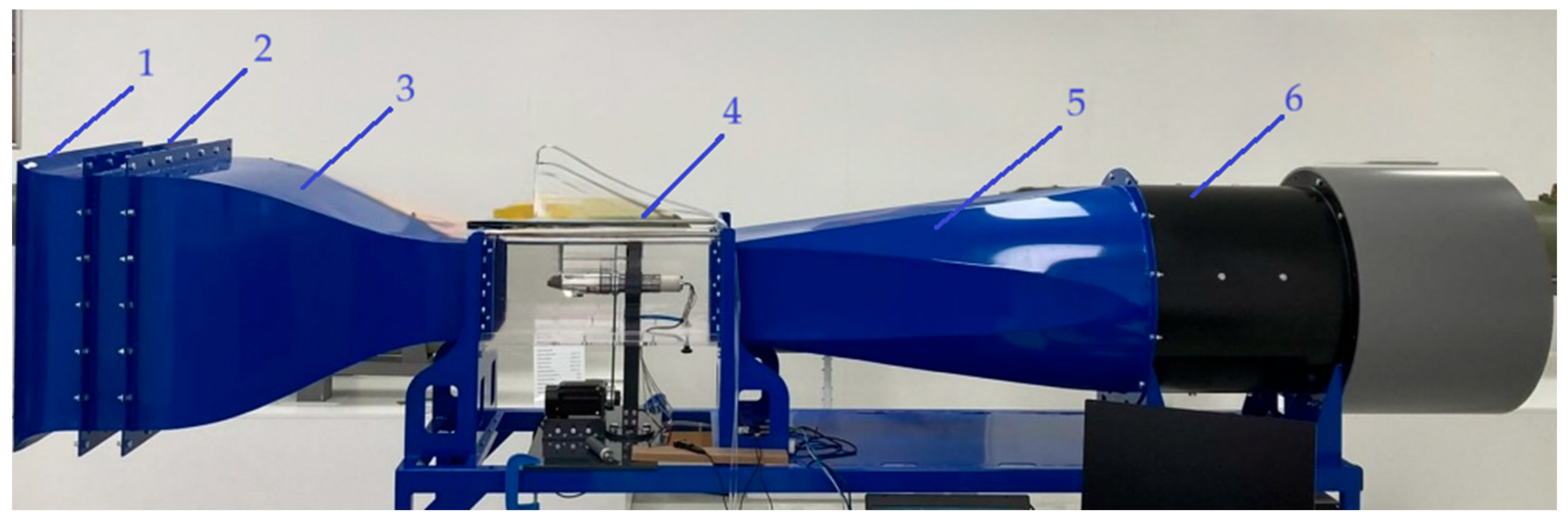
The wind tunnel system consists of an inlet, a settling chamber, a nozzle, the test section, a model mounting system, a frequency converter used to control the rotational speed of the drive unit and thereby regulate the free-stream velocity, a diffuser, a drive unit, and a Pitot–Prandtl tube (
Figure 1 and
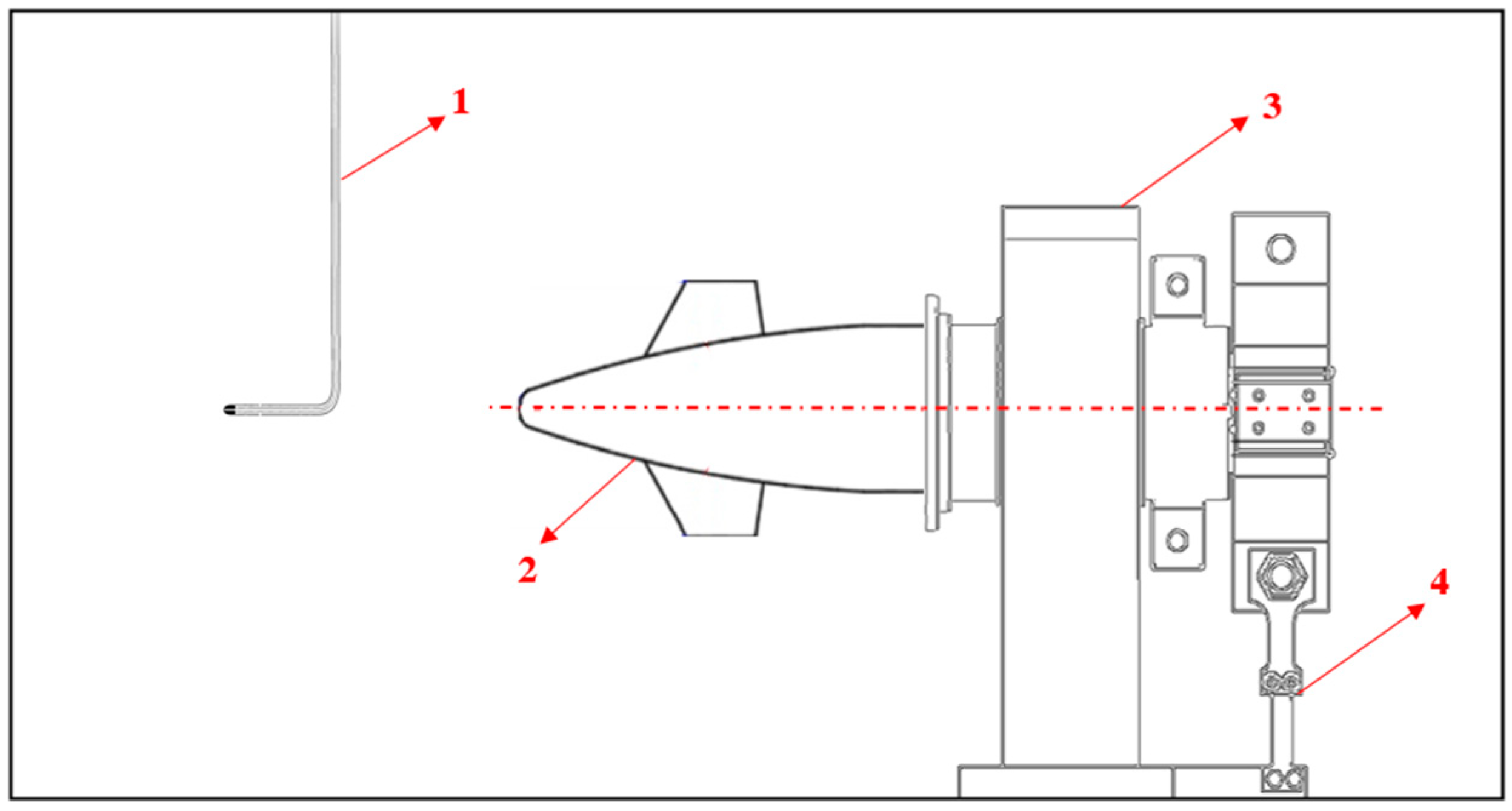
Table 1). The configuration and layout of the experimental apparatus surrounding the model in the wind-tunnel test section is illustrated schematically in
Figure 2 (
Table 2). The schematic provides a simplified representation of the experimental arrangement, including the model support, the aerodynamic balance, and the load cell used for force measurement. Presenting the setup in schematic form improves the clarity of the experimental configuration and highlights the relationship between the model, the mounting system, and the measurement components.
The measurement system plays a key role in wind tunnel testing, as its primary purpose is to acquire relevant data on the flow field and the aerodynamic forces acting on the model. The free stream velocity was determined using a Pitot–Prandtl tube and maintained at a nominal value of 32 m/s during the experiments. Aerodynamic forces acting on the ogive body and the canards were measured using a custom aerodynamic balance. The combination of the Pitot–Prandtl tube and the aerodynamic balance forms a coherent system that provides reliable experimental data.
The Pitot–Prandtl tube was installed in the test section upstream of the model so as to minimize its potential influence on the flow impinging on the canards. Velocity and temperature readings during the tests were obtained from an anemometer connected to the Pitot–Prandtl tube.
2.1. Aerodynamic Balance Concept
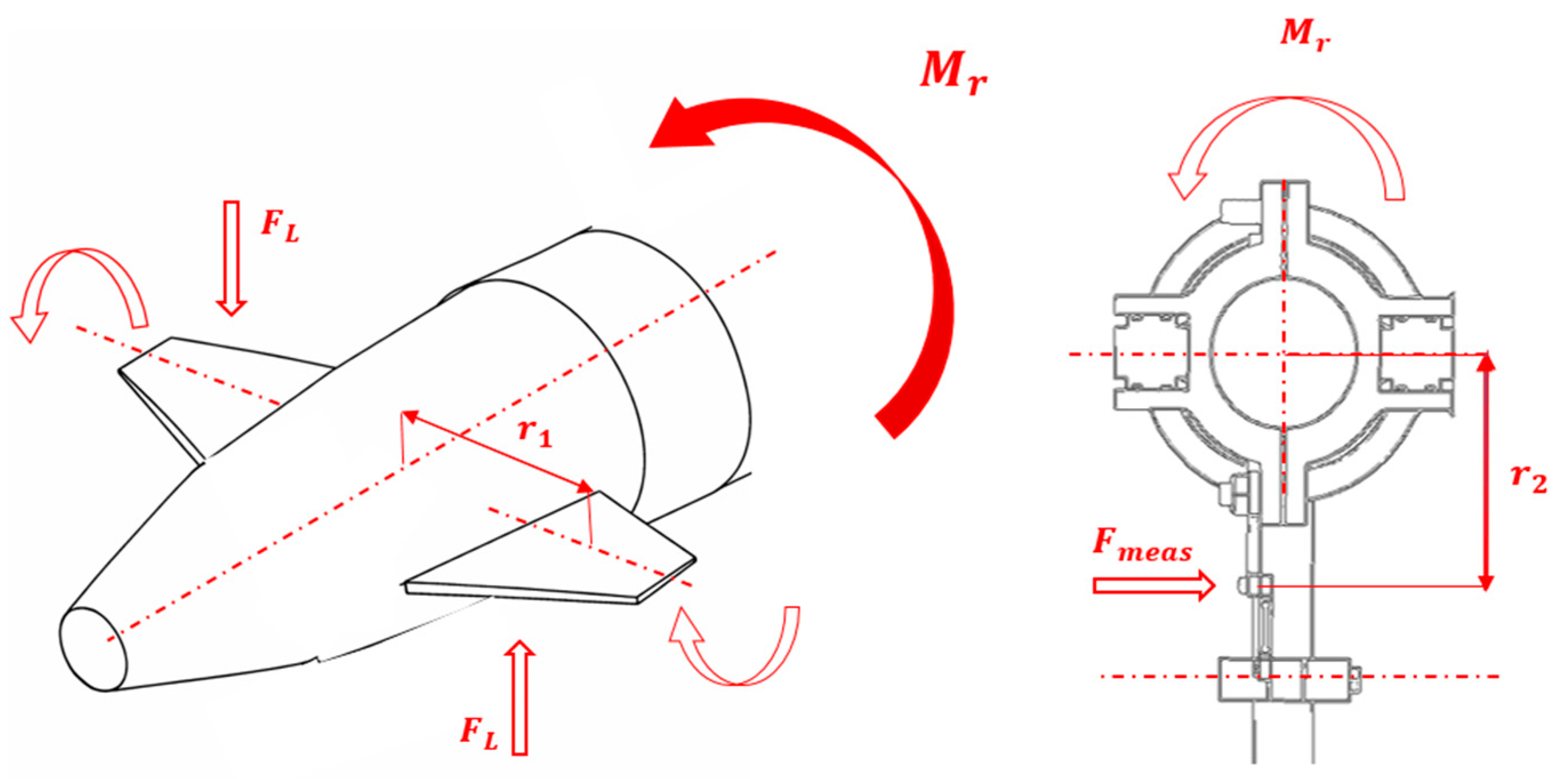
For the purposes of this study, a one-component aerodynamic balance was designed to measure the rolling moment about the longitudinal axis of the ogive body, generated by the magnitude and spatial distribution of lift forces acting on the canard surfaces (
Figure 3 and
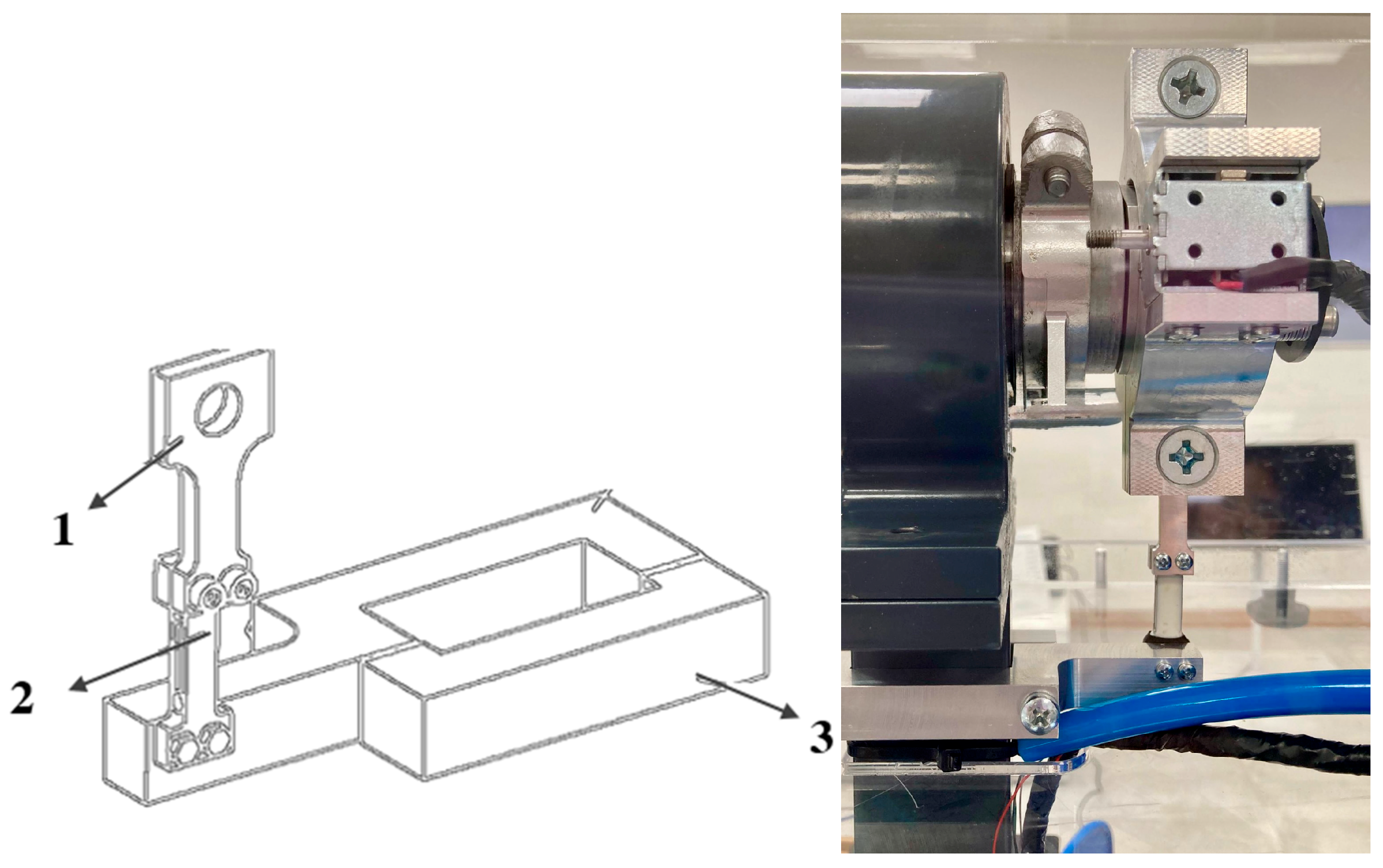
Table 3). The balance consists of a beam-type load cell with overall dimensions of 35 mm × 12 mm × 4 mm, two clamp elements used to secure the balance to the model support in the wind-tunnel test section, and a connecting link that mechanically transmits the loads from the tested model to the sensing element (
Appendix A).
The primary objective of the experiment is to determine the rolling moment induced by the canards for prescribed deflection angles. From the measured rolling moment, the corresponding lift forces acting on the canards are subsequently reconstructed (
Figure 3).
When the canards are deflected, aerodynamic lift forces are generated on both surfaces. Due to their symmetric arrangement, these forces produce a rolling moment about the longitudinal axis of the model. The model is mounted on a support equipped with bearings, allowing it to rotate under the action of the aerodynamic moment.
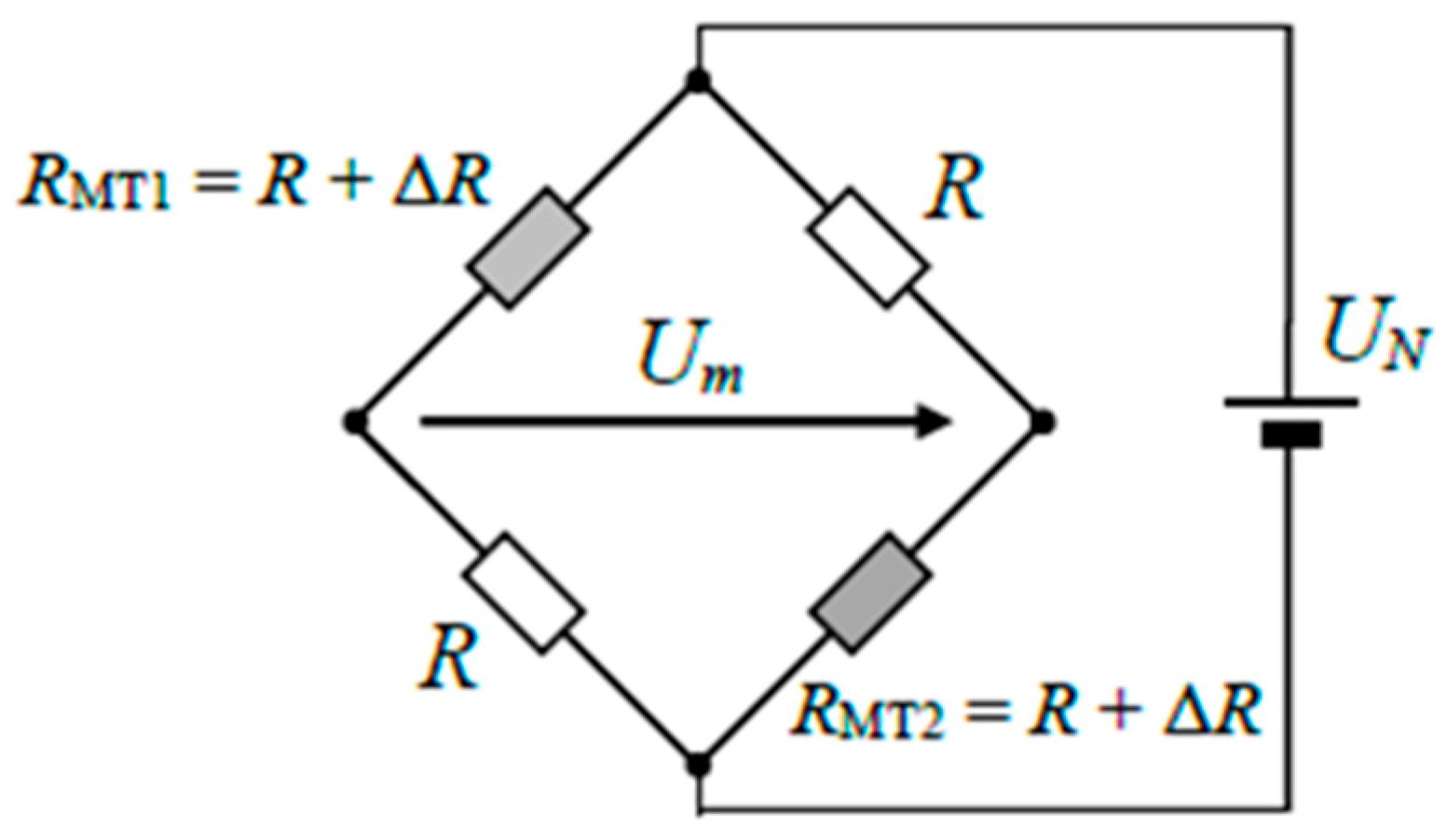
The aerodynamic balance itself is fixed to the supporting structure, and the rotation of the model is mechanically transmitted to the load cell through a connecting element. The employed load cell is a beam-type strain-gauge sensor, operating on the principle of bending deformation induced by the applied load. In this way, the rolling moment is converted into a force acting on the load cell. The magnitude of this force depends on the applied moment and the effective lever arm of the balance (
Figure 4).
Assuming symmetric loading of the two canards, the rolling moment
(2) can be expressed as:
where
(3) is the lift force generated by a single canard and
is the perpendicular distance between the line of action of the lift force and the longitudinal axis of the model, and
is force measured by the load cell. Although the position of the center of pressure may vary with the angle of attack, this variation is assumed to be small and is therefore neglected.
From this relation, the lift force acting on a single canard can be obtained as:
In the present analysis, the lever arm is the effective lever arm of the balance, defined as the perpendicular distance between the line of action of the measured force and the axis of rotation.
The canards were deflected symmetrically in opposite directions in order to generate a pure rolling moment about the longitudinal axis.
During the design phase, particular attention was devoted to defining the expected load range, required sensitivity, and mechanical stiffness of the balance in order to ensure accurate detection of low-magnitude forces. Additional considerations included minimizing parasitic load paths, reducing cross-sensitivity to non-target force components, and ensuring linear elastic behavior of the sensing structure within the operational envelope.
Geometric constraints imposed by the model support and bearing system, as well as the need to mechanically isolate the sensing element from direct aerodynamic loading, were incorporated into the balance layout. The final configuration positioned the balance assembly downstream of the model support within the test section, where it was shielded from direct free-stream exposure. This arrangement minimizes aerodynamic interference acting on the balance itself while maintaining sufficient mechanical stability and reliable force transmission during testing.
2.2. Procedure and Data Acquisition
During the experiments, the canards were deflected to prescribed angles, causing the entire assembly to rotate under the action of the aerodynamic loads. The resulting moments and forces were transmitted to the aerodynamic balance and recorded by the force transducer.
The measured rolling moment corresponds to the combined contribution of all canards. Based on this measurement, the lift force was first reconstructed for the full canard configuration. Subsequently, the lift generated by a single canard was determined for each deflection angle. In the present configuration, the canard deflection angle directly defines the local angle of attack experienced by the canard.
Force and moment data were acquired at a sampling rate of 80 Hz under a Reynolds number of 7.8 × 10
4 [
22]. For each canard deflection angle, the wind tunnel was operated for approximately 60 s. Since a finite start-up time is required for the tunnel to reach the prescribed free-stream velocity, the initial transient phase was excluded from the analysis. Only the portion of the signal corresponding to the steady flow regime was considered.
From this steady-state segment, 300 consecutive samples of the load cell output were extracted and used to determine the mean value and the standard deviation of the measured signal. The lift force corresponding to each deflection angle was obtained by averaging these samples.
During the design of the wind tunnel, particular attention was devoted to the dimensions of the test section in order to minimize wall interference and blockage effects on the tested model. The cross-sectional dimensions of the test section were selected to ensure undisturbed flow conditions and to avoid choking phenomena that could alter the free-stream velocity. The characteristic dimensions of the tested models are significantly smaller than those of the test section. The resulting blockage ratio, defined as (4):
where
represents the frontal area of the model and
the cross-sectional area of the test section, was designed to be approximately 5%. Such a value is commonly considered acceptable for subsonic wind-tunnel experiments, ensuring that blockage and wall interference effects remain limited and do not significantly influence the measured aerodynamic forces [
23]. Therefore, no blockage correction was applied in the present study, as its influence on the measured results is considered negligible [
24].
To minimize the influence of hysteresis, bearing friction, and run-to-run variability, each measurement was conducted independently. The wind tunnel was shut down after each test point and restarted for the subsequent deflection angle. In addition, four repeated runs were performed for each angle, and the final lift values were obtained as the mean of the repeated measurements [
25].
3. Numerical Analysis
Wind tunnel experiments were conducted in parallel with numerical simulations of the model, which were performed using the ANSYS Fluent 18.2 software package. This approach enabled a direct comparison between experimental and computational results. The software enables precise modeling and simulation of fluid behavior through the application of advanced discretization techniques and differential equation solvers [
11].
In the subsequent numerical analyses, two types of geometries will be examined. A detailed analysis will identify the advantages and limitations of the applied methods both in geometry preparation and in the numerical computation itself.
3.1. Model Geometry
The reliability of numerical results depends on the quality of geometry preparation. Accurate representation of the real model is essential, and unnecessary elements must be removed without compromising key features.
The original canard and ogive geometry includes gaps at the canard and body interface to allow canard rotation, which complicates mesh generation and increases computational complexity. To assess the impact of these gaps, two geometric configurations were analyzed: one including the gaps and one in which they were removed. The gapless configuration was obtained by extrapolating the canard surfaces into the ogive body, which simplifies mesh generation and numerical analysis but neglects flow phenomena in the canard root region that must be considered when interpreting the results.
The geometry including the gaps (less than 1 mm) was explicitly modeled to assess their influence on numerical simulations. Compared to the gapless configuration, this model provides a more accurate geometric representation of the physical system. However, the increased geometric complexity introduces challenges in mesh generation. In addition, turbulent flow within the gap region may significantly influence the predicted aerodynamic loads.
3.2. Computational Domain and Mesh
In the context of computational fluid dynamics, the computational domain is defined as a control volume-a spatial region occupied by the fluid in which discretization and numerical solution of the governing equations describing fluid behavior are performed. The numerical simulation is based on solving the Navier–Stokes equations, which are discretized using the finite volume method (FVM).
Considering that the objective of the simulation is to obtain the aerodynamic characteristics of the canards and to compare the results with wind tunnel tests, defining identical initial conditions is a necessary step in the analysis. The test was conducted in a wind tunnel under free stream conditions, corresponding to a Reynolds number of Re = and Mach number of M = 0.09. Therefore, the computational domain is defined as a free atmosphere region. To satisfy this condition, the domain must be created so that its boundaries are sufficiently far from the investigated model. The domain consists of an inlet, an outlet and walls.
The output of the numerical simulations is the lift force. Therefore, all effects acting on the canard must be included in the defined initial conditions. The obtained force values and coefficients directly depend on the nature of the flow occurring around the canards. The shape of the leading-edge guide directs and prepares the incoming flow toward the canard.
A preliminary mesh study was performed to determine the optimal grid configuration. The analysis was initially conducted using a relatively coarse grid with a reduced number of elements (approximately 1.2 million cells) in order to assess the overall flow behavior and numerical stability. Subsequently, a series of progressively refined meshes was generated to evaluate the influence of grid resolution on the numerical results, i.e., a grid independence study was performed. Based on this assessment, convergence of the solution with respect to mesh refinement was achieved, leading to the selection of a finer grid for the final simulations.
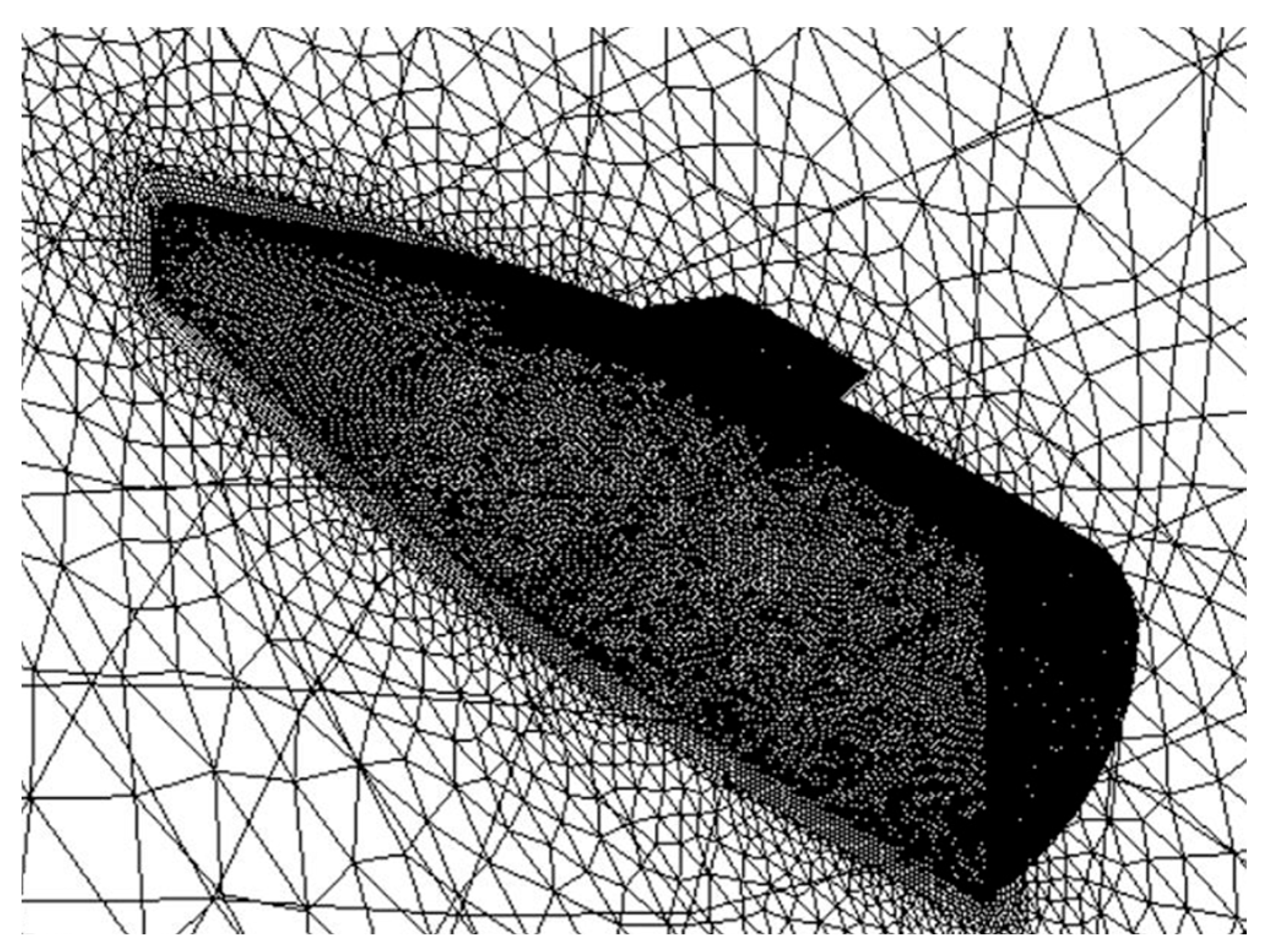
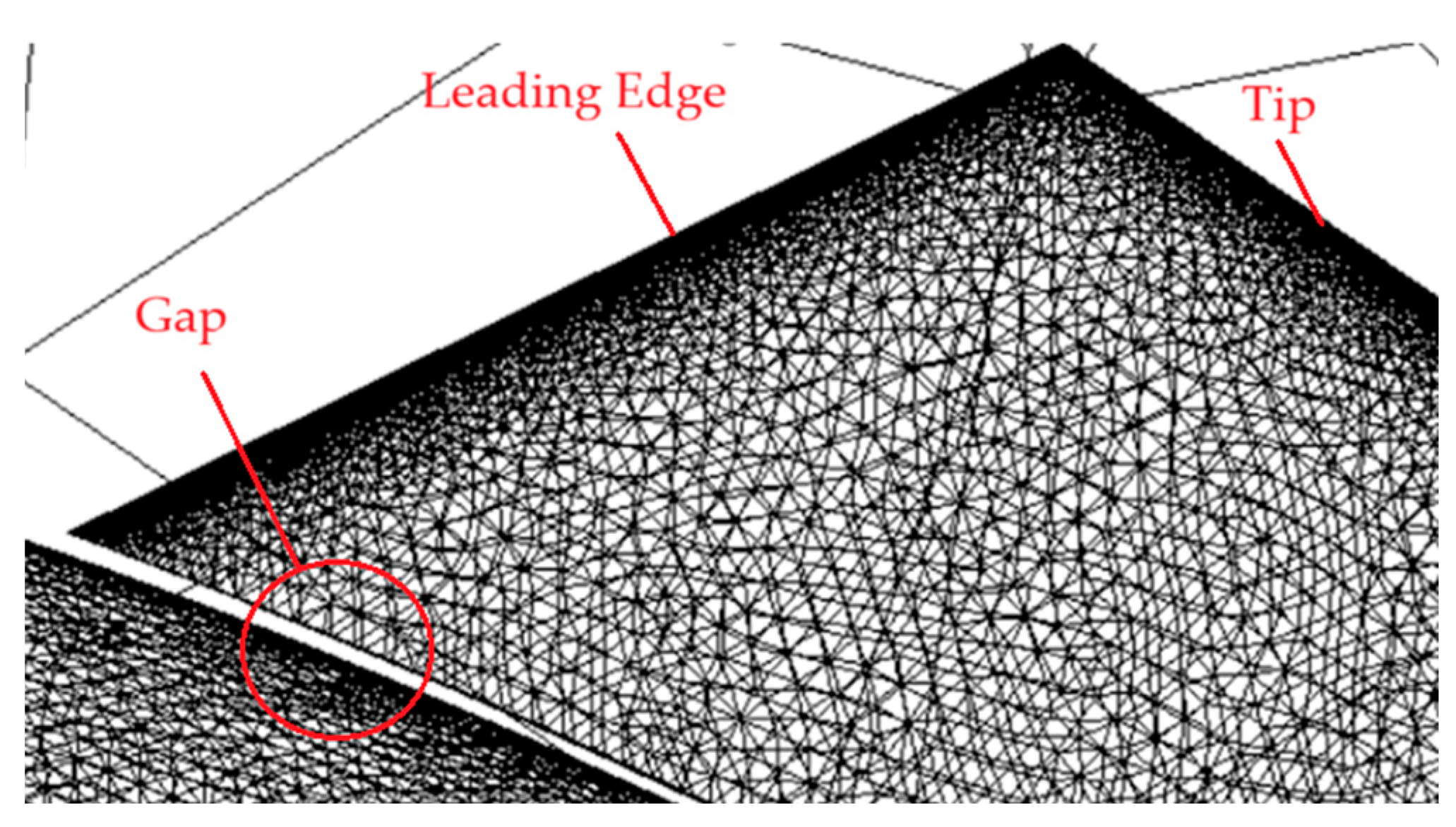
A hexahedral mesh was initially considered and demonstrated satisfactory performance. However, the final grid was defined as an unstructured mesh composed of triangular elements due to its superior capability to conform to the non-standard geometry of the model. Additional local mesh refinement was applied in critical regions of the configuration. Particular attention was devoted to mesh refinement near the canard leading edge and the canard tip. In these regions, strong flow gradients and vortex structures are expected. The applied refinement therefore ensures numerical accuracy and solution stability in the subsequent simulations (
Figure 5 and
Figure 6) [
11].
In addition, a boundary layer mesh was introduced along the solid surfaces of the model. Several layers of prismatic cells were generated in the near-wall region to properly capture the boundary-layer development following the recommendations for the dimensionless wall distance. This refinement enables accurate resolution of the near-wall velocity gradients and contributes to improved numerical stability and solution accuracy. The dimensionless wall distance (y+) was maintained below 5 across all relevant surfaces, ensuring adequate resolution of the boundary layer.
Identical meshing parameters were applied to both geometric configurations (with and without the gap) to ensure comparability of the numerical results. Due to the additional geometric detail introduced by the canard-body gap, the gap configuration contains a higher number of mesh elements than the gapless configuration. Specifically, the gapless mesh consists 1,772,139 elements, whereas the mesh including the gap (
Figure 6) contains approximately 2,117,315 elements. The smallest element size is approximately 5 × 10
−5 m, while the largest is 3.5 × 10
−2 m, providing adequate resolution of the flow features near the body and the canard-body gap.
3.3. Numerical Computation Algorithm
Numerical simulations were performed using boundary conditions consistent with those applied in the experimental tests, ensuring direct comparability and validation of the numerical approach. The inlet velocity was prescribed as 32 m/s (M = 0.09), while the inlet pressure was set to 101,325 Pa.
To reduce computational cost without compromising solution accuracy, the numerical model was solved under symmetry boundary conditions. Although the free-stream velocity is relatively low, a density-based implicit solver was employed due to the model’s complex geometry, which induces local flow accelerations, strong pressure gradients, and pronounced vortical structures. Furthermore, the density-based formulation was intentionally adopted to perform verification at a representative Mach number. This provides confidence in the solver’s applicability to simulations at a higher Mach number. These flow features may result in localized compressibility effects and numerical instabilities.
The numerical simulations were carried out using a steady-state, density-based solver. A standard RANS formulation was adopted as a computationally efficient and widely used approach for aerodynamic simulations [
6,
7,
26,
27]. This approach provides enhanced numerical stability and accuracy in capturing averaged flow phenomena of interest, particularly when coupled with the k-ω SST turbulence model, which was selected for its well-established reliability in predicting boundary layer behavior, separated flows, and vortex dominated flow structures as well as its computational efficiency [
1,
2,
27]. Despite its main limitations of overlooking smaller scale turbulence structures appearing near the walls and missing a part of the turbulence spectrum, this turbulence model is still one of the most widely employed for its ability to quite accurately reproduce mean values of flow quantities, particularly on courser meshes and when computational resources are limited. It has been tested and proven many times, principally for simulating flows around streamlined bodies [
1,
2,
6,
7,
26,
27], which also corresponds to the current case.
A velocity inlet boundary condition was prescribed at the domain inlet, symmetry boundary conditions were applied on the fuselage symmetry plane, and a pressure outlet condition was imposed at the domain exit. The flow was modeled as steady and viscous, and the ideal-gas equation of state was employed.
Second-order discretization schemes were used for all transport equations in order to improve numerical accuracy and solution robustness. Gradient reconstruction was performed using the Green-Gauss scheme. Sea-level pressure and temperature were adopted as reference flow conditions for the definition of the boundary parameters.
Convergence was assumed when the normalized residuals for all governing equations fell below a threshold value of 10−6, including continuity, velocity components in the x-, y-, and z-directions, energy, turbulent kinetic energy (k), and specific dissipation rate (ω). Furthermore, the behavior of lift force was monitored, and its stabilization indicated a fully converged and reliable solution.
The primary objective of the analysis was to accurately determine the lift force as a function of the canard deflection angle, while simultaneously establishing a computational scheme that can be applied in subsequent analyses.
4. Results and Discussion
4.1. Experimental Results
For data protection purposes, the lift coefficient (Cl) values were scaled by a factor k.
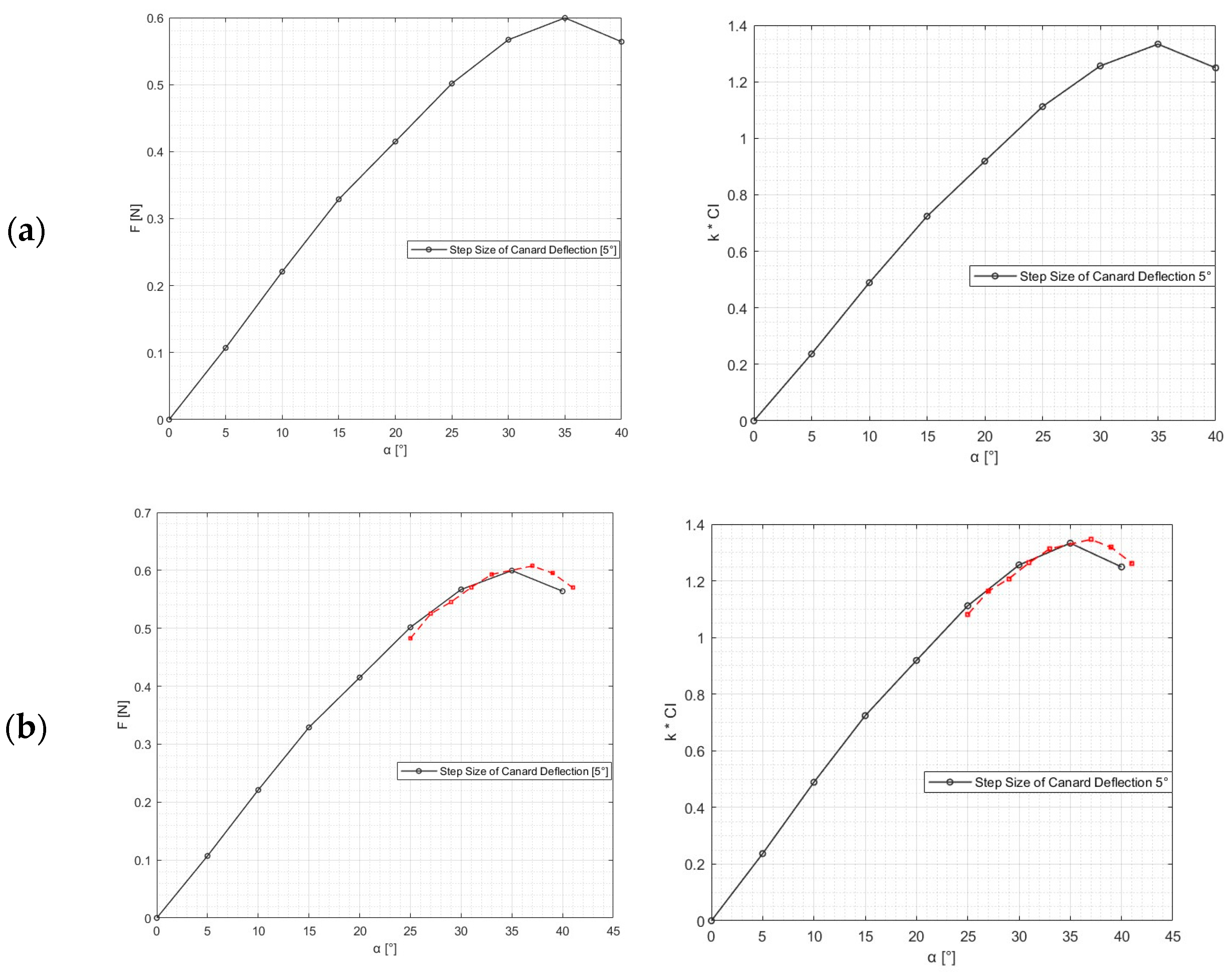
Lift characteristics were evaluated for AoA ranging from 0° to 40°, with an increment of 5° in the positive direction. For each angle, 300 samples were acquired and subsequently processed. The resulting lift per canard over the entire AoA range is summarized in
Table 4.
The corresponding lift curve follows the expected aerodynamic behavior. At zero AoA, the canard generates no lift, which is consistent with symmetric airfoil theory. The lift curve exhibits a well-defined linear region up to the onset of stall, beyond which the lift gradient decreases and the aerodynamic force is reduced. Stall occurs between 30° and 40° of canard deflection.
Because the flow in the vicinity of stall is highly turbulent and the interpolation of the lift curve in this region is inherently uncertain, additional wind tunnel tests were performed using a finer angular increment of 2° in the critical range (
Table 5). The refined measurements are consistent with the overall trend of the original lift curve (
Figure 7) but also demonstrate how difficult it is to achieve experimental repeatability near the stall region. Similarly, RANS-based turbulence models also still struggle with accurately simulating this complex and unresolved flow phenomena.
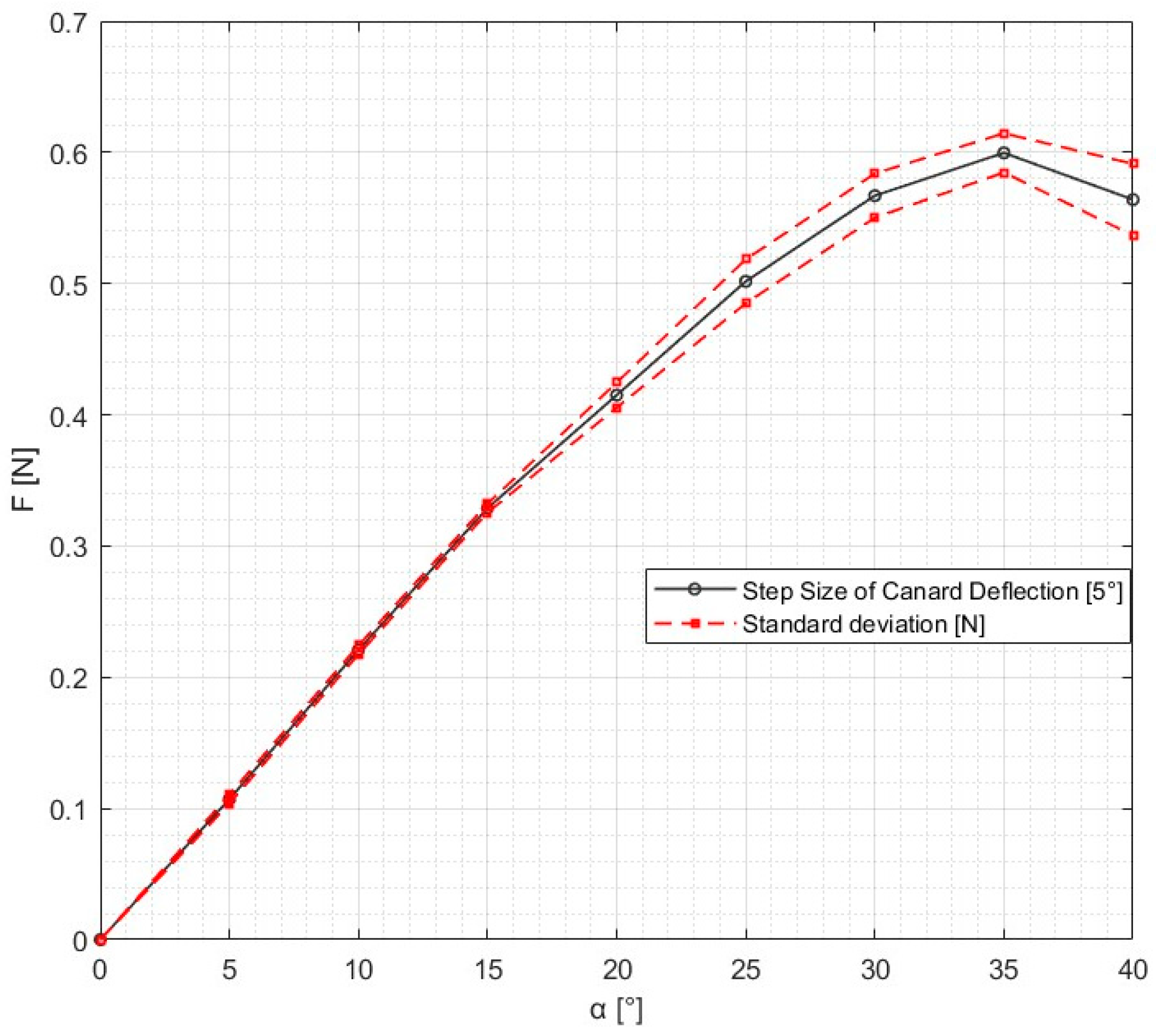
To evaluate the reliability of the measurements, a statistical analysis of the recorded data was performed. For each angle of attack, a series of samples was acquired and used to determine the mean value and standard deviation of the measured lift force. The obtained standard deviation was used as an estimate of the measurement variability, and the corresponding error bars (
) are presented in the lift curves. The standard deviation (
Table 6,
Figure 8) increases with increasing angle of attack, which is expected due to the growing unsteadiness of the flow and the onset of separation at higher incidence angles. Calibration tests performed using laboratory weights showed that the systematic error of the aerodynamic balance remains below approximately 0.3% (
Table 7). The observed measurement scatter is therefore primarily associated with flow fluctuations and experimental conditions rather than with the accuracy of the measurement system.
4.2. Numerical Results
4.2.1. Gapless Geometry
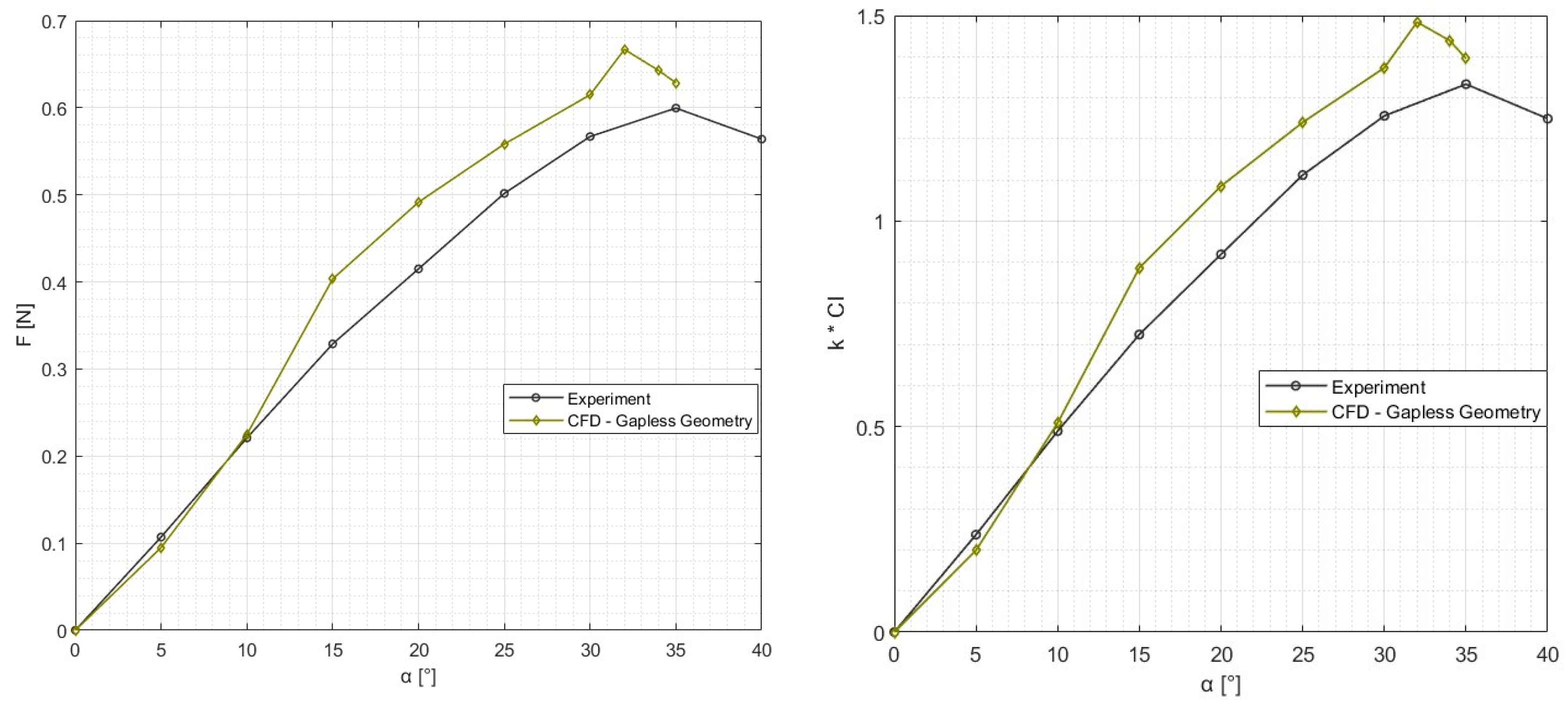
Within the CFD analysis, the gapless geometry was analyzed first. The resulting data are presented in tabular form (
Table 8), while the comparison with experimental measurements is shown in
Figure 9.
Both methods yield a zero-lift AoA (α = 0°), as expected for a symmetric airfoil. However, the lift gradient predicted by the CFD simulations is higher than that obtained from the experimental measurements. The most probable main sources of discrepancies between the two sets of data (experimental vs. numerical) are the mediumly fine computational mesh and the employed turbulence model (largely due to the limited available computational resources) but also the complexity of interaction between the canard and the body. In this case, wind tunnel blockage effects and measurement uncertainties are less influential since the wind tunnel was specifically designed for the considered geometry and measurements were performed with great care.
The higher lift gradient and increased maximum lift values predicted by the numerical simulations also result from an effective increase in the aerodynamic wetted geometry with increasing canard deflection. As the canard deflection angle increases, the difference in effective surface area between the experimental canard configuration and the gapless numerical model becomes more pronounced.
Consequently, as canard shape deviates from planar, the resulting lift curve deviates from the standard linear behavior. However, this deviation is physically justified, as it can be attributed to the additional effective canard geometry in the root section and the enhanced aerodynamic interference between the canard and the ogive body. This geometric feature is described in detail in
Section 3.1 (Model Geometry).
The absolute error (5) across the entire range of canard angles does not exceed 0.08 N, while the relative error (6) remains below 20% (
Table 9).
Table 9.
Experimental vs. CFD Error-Geometry Without Gap.
Table 9.
Experimental vs. CFD Error-Geometry Without Gap.
| AoA [°] | Absolute Error [N] | Relative Error [%] |
|---|
| 0 | / | / |
| 5 | 0.011 | 12.30 |
| 10 | 0.004 | 1.75 |
| 15 | 0.077 | 18.99 |
| 20 | 0.077 | 15.58 |
| 25 | 0.057 | 10.13 |
| 30 | 0.048 | 7.75 |
| 35 | 0.026 | 4.19 |
4.2.2. Geometry with a Gap
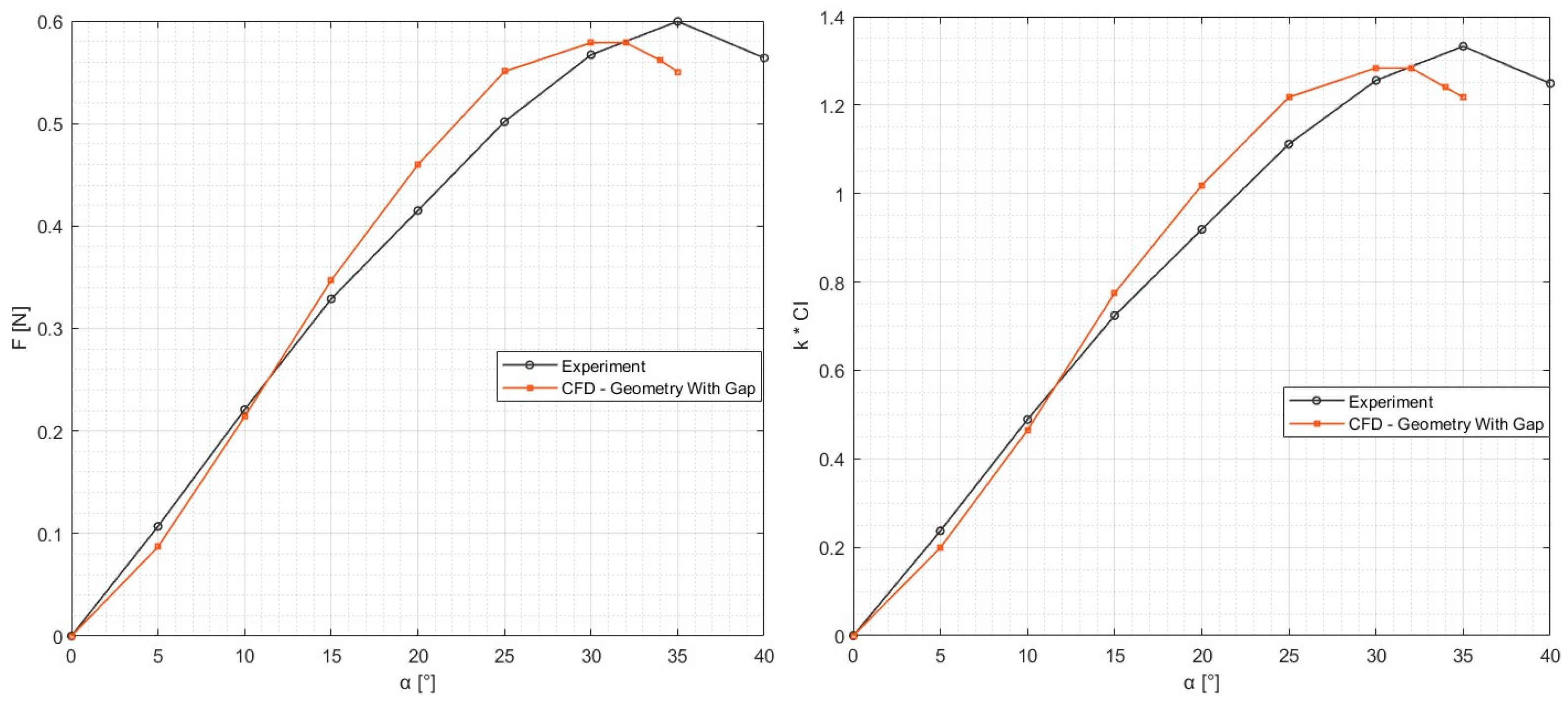
The numerical results obtained for the geometry with a gap indicate a zero-lift AoA at . The lift curve exhibits a linear region followed by a reduction in lift gradient, which is characteristic of numerically predicted pre-stall and post-stall behavior.
Compared to the experimental data, the lift gradient predicted by the numerical simulations is higher, whereas both the critical AoA and the maximum lift force are lower. Stall onset occurs at a critical AoA
α = 32° (
Table 10). Again, some of these discrepancies between experimental and numerical results can be attributed to the relatively standard numerical setup that was employed.
Across the evaluated range of canard deflection angles, the absolute error does not exceed 0.05 N (
Table 11). The relative error remains below 10%, except at an AoA of
α = 5°. At such small AoA, the resulting aerodynamic forces are very low; consequently, an absolute deviation of approximately 0.02 N corresponds to a relative error of about 20%, which is not representative of the overall accuracy level of the measurements. It should be emphasized that the observed trend exhibits considerably more physically realistic behavior compared to the gapless geometry (
Figure 10). This improvement is reflected not only in the numerical results and the increased accuracy of the predicted lift values but also in the more faithful representation of the underlying physical mechanisms and flow phenomena. The existence of the gap between the canard and the body enables additional flow in the canard root section that additionally energizes the boundary layer and ensures smoother flow behavior through the inspected range of AoAs.
4.3. Flow Visualization
Flow visualization is an essential step in the verification of CFD results and plays a central role in the validation of numerical simulations. It provides not only a qualitative assessment of the simulation accuracy but also helps identify potential issues, such as errors in model preparation or incorrect specification of boundary and initial conditions. In this study, flow-field visualization is of particular importance, as no experimental flow visualization was performed and only force and moment measurements were available. Consequently, it provides the only direct insight into the dominant flow structures.
In simulations tracking lift variation with AoA at a given velocity, particular attention is paid to detecting stall. Numerical prediction of stall is challenging due to the complex flow behavior: abrupt pressure changes occur, laminar flow transitions to turbulence, and flow separation and vortex formation develop. Accurately capturing these phenomena requires advanced turbulence models and highly refined computational meshes.
Flow visualization is therefore essential for the assessment of CFD results. Flow patterns around both the gapless geometry and the geometry with a gap were analyzed at canard deflection angles of 10° and 32°.
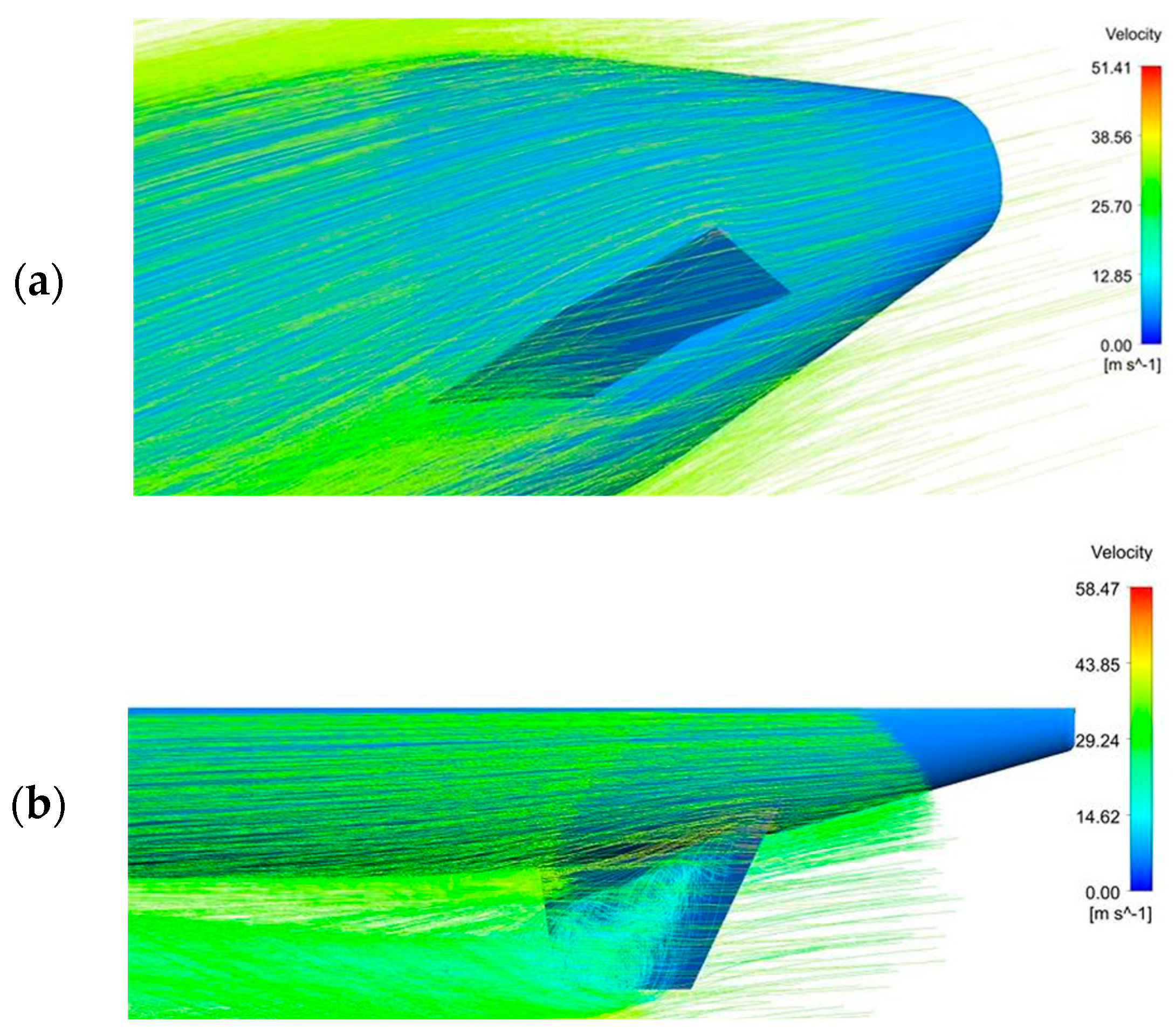
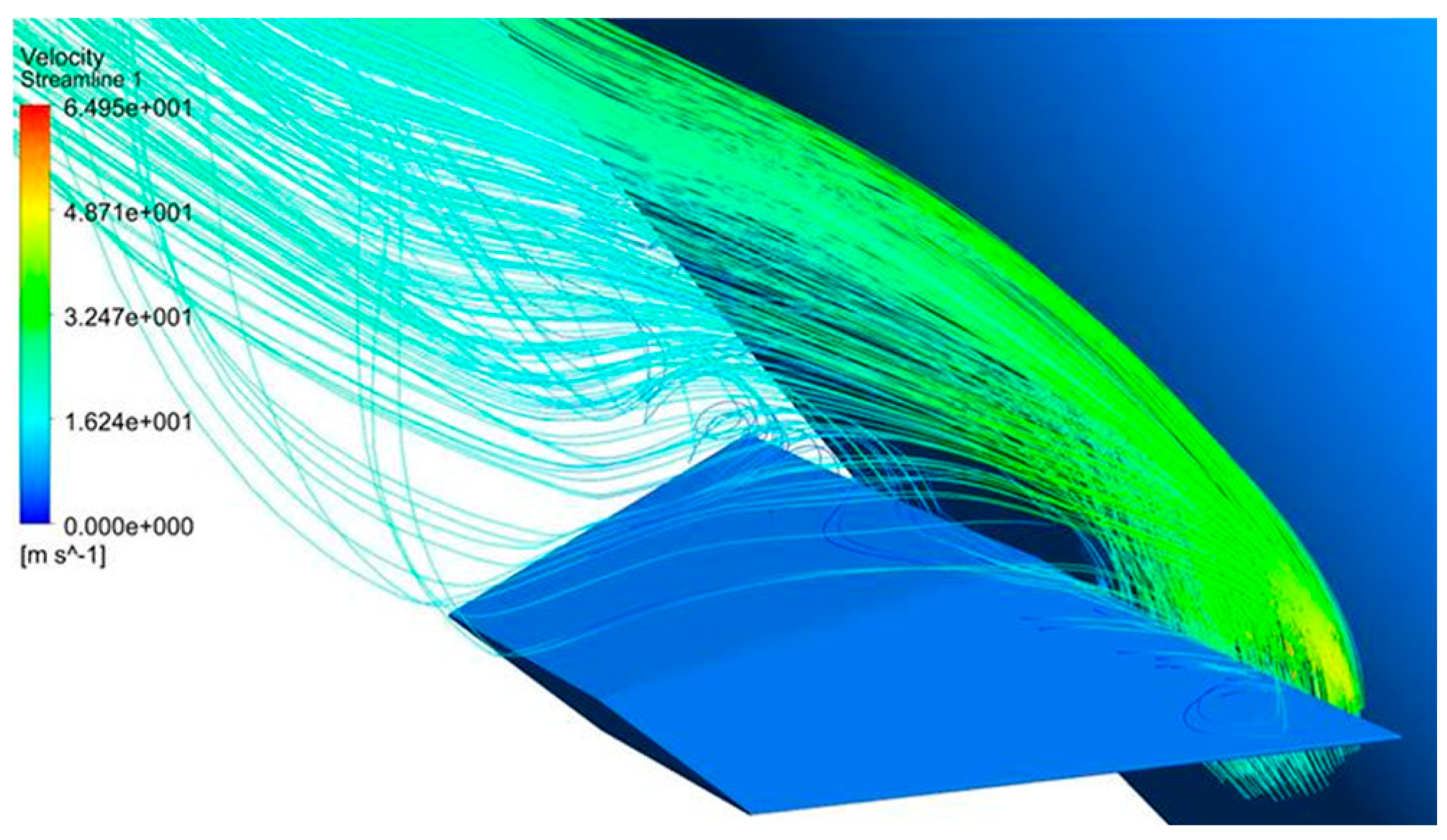
For the gapless geometry at a canard deflection angle of 10° (
Figure 11a), the flow field remains largely attached. The streamlines are directed from the leading edge toward the canard surfaces, indicating that flow interaction in the canard root region contributes to the aerodynamic forces acting on the canard and should not be neglected. Minor vortex formation is observed near the canard tips.
At much higher canard deflection angles (
Figure 11b), flow separation develops on the upper surface of the canard, consistent with stall onset. The extent of separation increases from the canard root toward the tip. At larger deflections, vortex formation becomes more pronounced, particularly for short-span canards, where the separated flow rolls up into strong tip vortices at the canard ends. Due to the canard − body interaction, the flow separation starts early on in the root section and spreads diagonally towards the tip following the geometrical features of the canard and the zones of adverse pressure gradients.
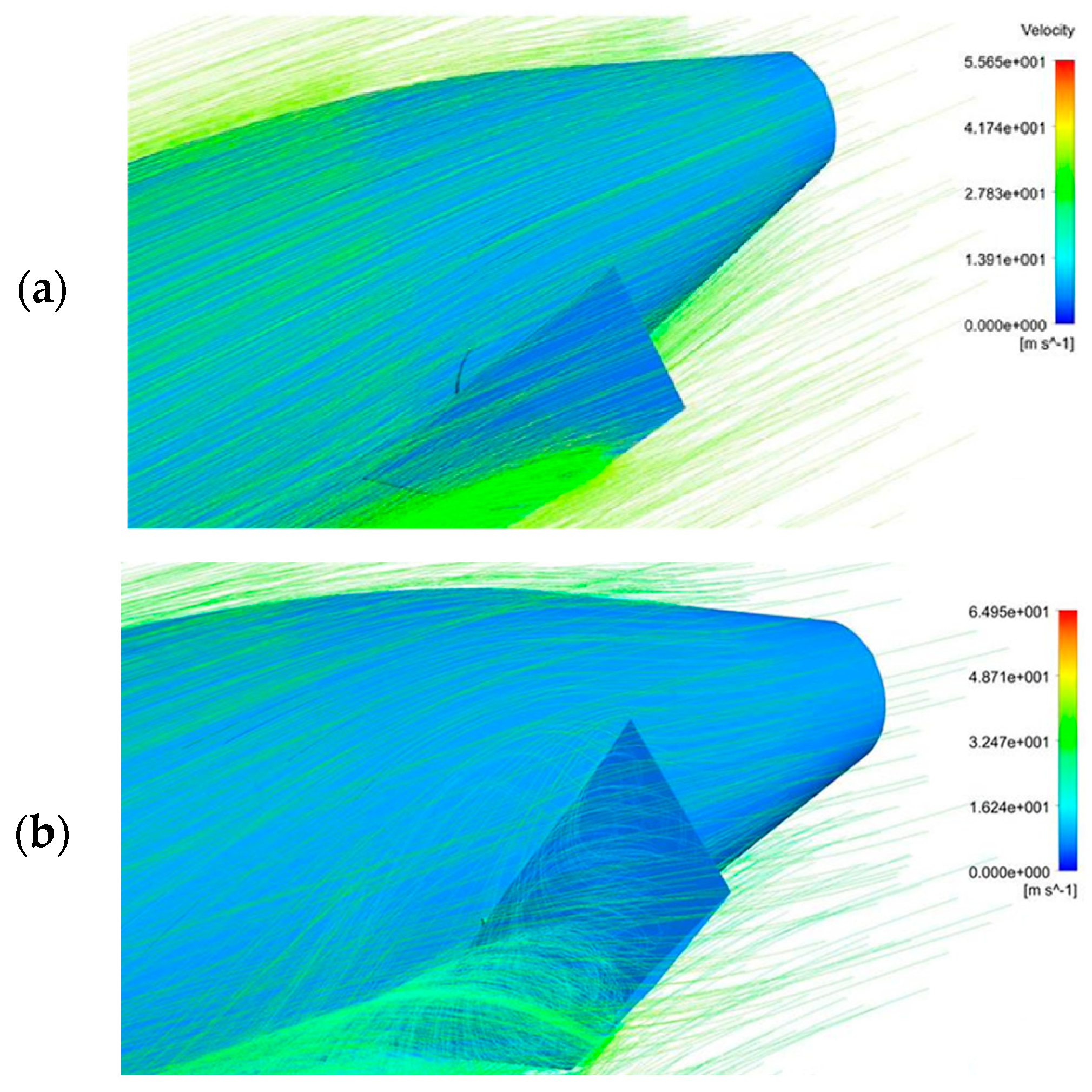
The flow visualization (
Figure 12a) for a canard deflection of 10° shows smooth, uniform flow with no significant negative influence from the presence of the gap (rather, the flow near the root is fully attached), and only minor tip vortex formation at the canard tips.
At a much larger deflection angle of 32° (
Figure 12b and
Figure 13), clear flow separation effects are observed on the upper surface of the canard. Separation is most pronounced at the aft part of the canard tip and gradually decreases toward the root.
In this high AoA regime, the presence of the gap has a significant impact since it enables that additional flow streaks pass through it and energize the boundary layer near the intersection between the canard and the body. This additional leakage stabilizes the flow near the canard root that remains almost fully attached even at high deflection angles. Also, when
Figure 11b and
Figure 12b are compared, it can be observed that both the shape and the direction of the formed vortices are completely different. This is also caused by the discernible overflow of streamlines from the lower to the upper canard surface in the case with the gap.
In addition to the clear visualization of the high-speed leakage through the gap at higher deflection angle (that energizes the boundary layer across the fore part of the canard) presented in
Figure 13, a rare phenomenon is also observed: vortices form both at the root and tip of the canard, rotating in opposite directions. These counter-rotating vortices separating from both ends of the canard influence the massive flow separation that happens solely in the aft part of the upper surface of the canard. Also, since they are not present in the case without the gap, there, the separation has a completely different, diagonal shape and starts sooner (
Figure 11b).
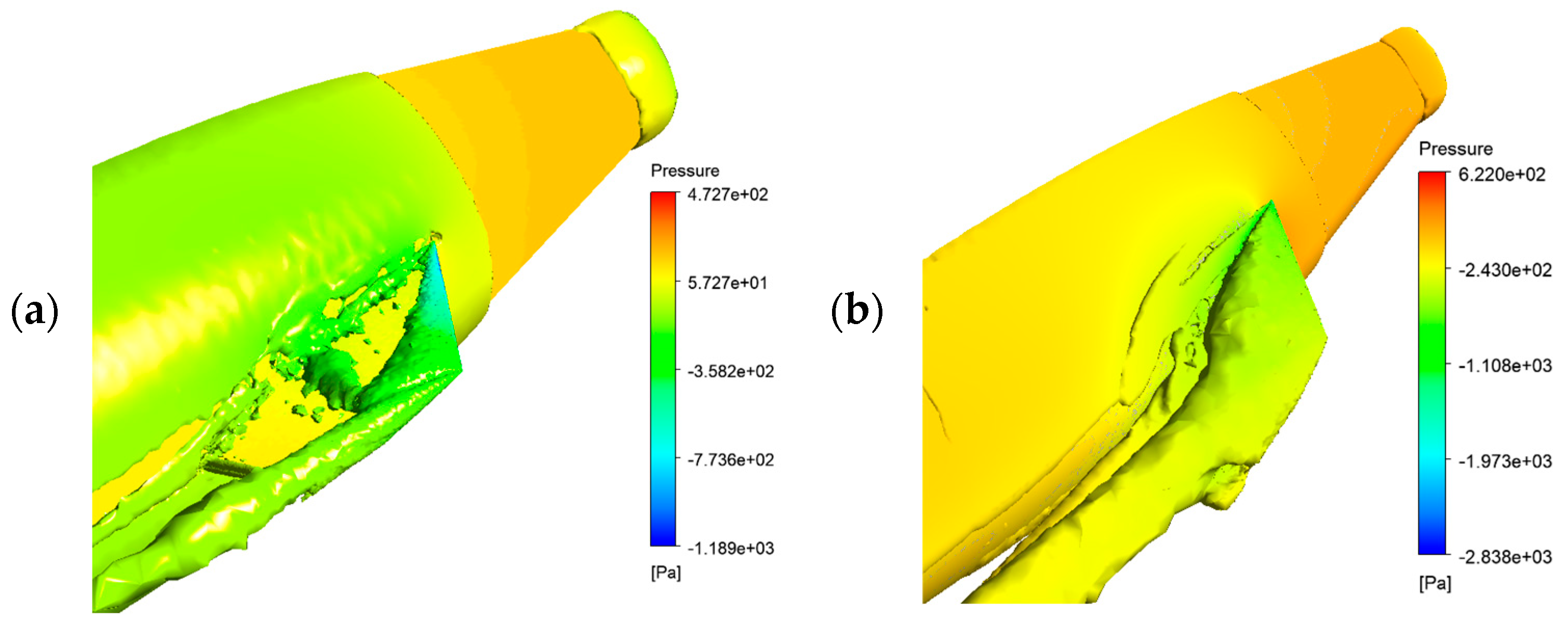
A detailed analysis of the flow field, conducted using pressure contours and vorticity visualization via the Q-criterion, provides deeper insight into the physical phenomena governing the behavior of the lift curve.
At a deflection angle of 10° (
Figure 14a), the flow remains stable and attached, with no indications of separation. The pressure contours exhibit a uniform distribution, while the Q-criterion identifies coherent vortical structures that facilitate boundary layer energization, thereby maintaining a linear increase in the lift coefficient.
In contrast, at a deflection angle of 32° (
Figure 14b), a drastic shift in flow topology is observed. The pressure contours reveal steep gradients and regions of high turbulence, which are direct consequences of massive flow separation. The disorganization of vortical structures in the Q-criterion field confirms the loss of aerodynamic stability. This flow behavior fully correlates with the lift curve graphic (
Figure 15), where a distinct lift breakdown (stall) is observed, validating the visual evidence of performance deterioration at high deflection angles.
4.4. Comparative Analysis of Results for All Three Cases
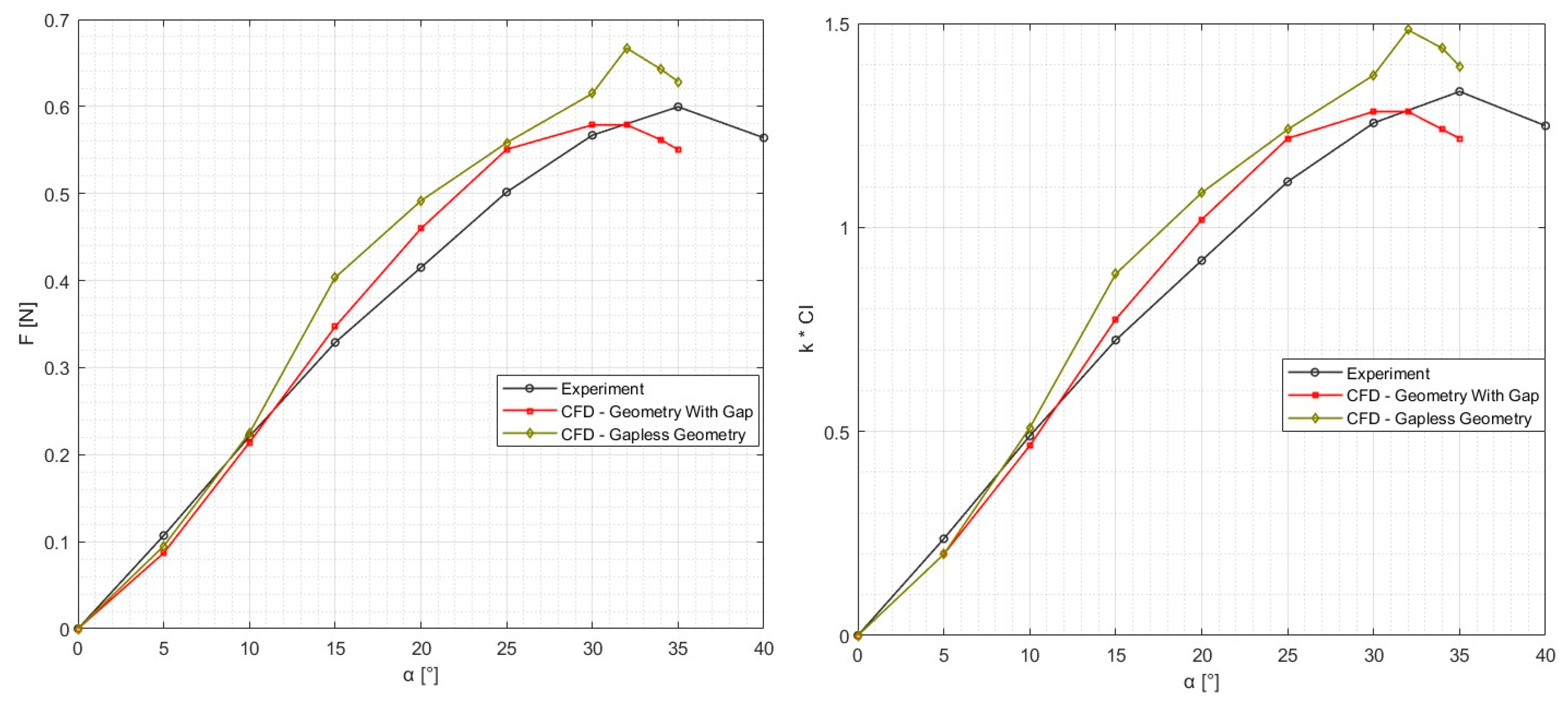
The lift curves corresponding to all three cases, experimental measurements, CFD with gapless geometry, and CFD with a gapped geometry are presented in
Figure 15. A clear distinction is evident between the gapless and gapped configurations.
For the gapless geometry, a pronounced peak appears at the critical AoA, representing a deviation from the typical lift curve behavior. This effect may be partially attributed to the increase in exposed surface area resulting from the elimination of the gap. As the canard deflection angle increases, the effective canard area interacting with the flow also increases.
However, the observed behavior is also likely to result from the more complex aerodynamic mechanisms. Significant factors may include the absence of leakage flow as well as the interaction between the canard and the curved surface of the ogive body. This interaction can lead to nonlinear flow behavior, particularly because the canard employs a non-conventional rhomboid airfoil profile. Such aerodynamic effects are expected to intensify with increasing angle of attack. Consequently, these combined phenomena may contribute to the pronounced peak observed in the lift characteristics.
In contrast, the geometry including the gap exhibits a smoother lift curve progression and follows the experimental trend more closely over the entire range of AoA.
A comparison of the two numerical configurations demonstrates that the gapless geometry produces a nonstandard lift response and exhibits reduced correspondence with experimental data relative to the gapped configuration. Eliminating the gap does not simplify the numerical analysis nor lead to a reduction in computational cost. For the geometry with a gap, the lift curve follows the expected aerodynamic trend for this type of configuration, as the relevant flow phenomena are properly captured. Difference in the critical AoA relative to the experimental results is approximately 3°, while the maximum lift force on the canard differs by less than 0.03 N.
Additionally, a quantitative comparison reinforces these findings. In the linear region (
α ≈ 0°–15°), all cases exhibit similar lift curve slopes, with CFD showing a slight overprediction. Unsurprisingly, due to low Re and low aspect-ratio of the canards, these lift curve-slopes are much lower than for an ideally thin airfoil, approximately amounting to a mere third of the theoretical value 2
π rad
−1. At higher angles of attack, differences between the lift curves become significant. The experiment indicates stall at
α ≈ 35°, while the gapped configuration predicts slightly earlier stall (
α ≈ 30–32°), with a deviation of ~10–15%. In contrast, the gapless model delays stall and substantially overpredicts the maximum lift (up to Cl ≈ 1.5). Including the gap reduces this overprediction from ~15–20% to ~5–10% at
α ≈ 30°, resulting in markedly improved agreement with experimental data, particularly in the nonlinear and near-stall regime (
Figure 15).
5. Conclusions
This study assessed the influence of geometric gap representation at the canard and body interface on the aerodynamic lift characteristics of an ogive body with all moving canards using a combined experimental and numerical approach. Wind tunnel measurements were employed to validate RANS based CFD simulations performed for two geometric configurations: a gapless model and a model including the physical gap.
The results demonstrate that geometric simplification through gap removal leads to noticeable deviations in the predicted lift characteristics. The gapless configuration exhibits a nonstandard lift response, including an artificial peak near the critical AoA. This behavior partially results from the effective increase in exposed aerodynamic surface area with increasing canard deflection and leads to reduced correspondence with experimental measurements. Also, the absence of the leakage flow between the canard and the body produces early separation near the canard root that propagates diagonally towards the tip.
In contrast, the geometry including the gap produces lift curves that follow the expected aerodynamic trend and show substantially improved correspondence with experimental data. The difference in the critical AoA relative to the experimental results remains within approximately 3°, while the maximum lift force differs by less than 0.03 N across the investigated range of canard deflection angles. When flow field is analyzed in detail, it becomes apparent that additional flow through the gap has numerous benefits, particularly at higher deflection angles, since it energizes and stabilizes the flow near the canard root. Flow separation is less pronounced and more localized (to the aft part of the upper canard surface).
Although inclusion of the gap introduces additional geometric complexity, it does not result in a meaningful increase in computational cost. The marginal increase in simulation time is negligible when compared to the substantial improvement in predictive accuracy. In particular, resolving the gap enables a more faithful representation of the local flow physics, including shear layer development, pressure distribution and vortex formation. This leads to more reliable force and moment prediction, thereby enhancing the overall robustness and physical credibility of the numerical mode. Consequently, the inclusion of the gap represents a justified modeling refinement with a highly favorable accuracy-to-cost ratio. Consequently, omission of the gap cannot be justified as a means of reducing computational effort, as it directly compromises the reliability of the numerical results.
This comprehensive, combined experimental and numerical analysis confirms that accurate representation of the canard and body gap is essential for reliable prediction of aerodynamic loads in similar configurations. Retaining this geometric feature in CFD models is therefore recommended for engineering-level analyses where accurate lift prediction is required.
The scientific contributions of this study are threefold. First, it demonstrates the critical role of geometric gap representation in enhancing the predictive capability of CFD models in addition to actually quantifying the gap effects (between a canard and an ogive body) at low Reynolds and Mach numbers. Second, it provides several different quantitative comparisons of the numerical results against experimental data, supporting the reliability of the findings. Third, it offers an efficient and accessible framework for integrating experimental and numerical methods to improve the aerodynamic analysis of canard-ogive configurations, ensuring reproducibility and robustness of the results while keeping the necessary resources minimal.
Finally, the close correspondence between wind tunnel measurements and CFD predictions highlights the complementary roles of experimental testing and numerical simulation. Their combined use provides a robust and reliable framework for the aerodynamic analysis of canard controlled configurations under realistic flow conditions [
28].