1. Introduction
In recent modern warfare, the strategic value of fixed-wing loitering munitions is rising sharply [
1]. Loitering munitions are weapon systems that combine the characteristics of Unmanned Aerial Vehicles (UAVs), which perform long-endurance surveillance and reconnaissance, with the advantages of precision-guided missiles that immediately strike high-value targets upon identification. These systems have proven effective in anti-armor and anti-radar operations due to their operational flexibility and cost-effectiveness [
2,
3]. Furthermore, research into intelligence technology, which operates multiple loitering munitions simultaneously to maximize task success rates, is actively underway [
4,
5].
Meanwhile, extensive research has been conducted on cooperative control of multiple UAVs, encompassing formation flight, path following, and distributed coordination strategies [
6,
7]. However, these studies primarily focus on maintaining coordinated flight patterns or trajectory tracking performance and do not address the problem of selecting the most suitable UAV for target engagement in multi-agent scenarios.
To operate multiple loitering munitions efficiently, task assignment technology that selects the UAV best suited for a specific target is essential [
8,
9]. Recent studies have addressed the multi-UAV task assignment problem using various optimization-based frameworks, including genetic algorithms [
10], swarm intelligence, and game-theoretic approaches [
11,
12]. These methods focus on optimizing the global assignment of multiple UAVs to targets, and are often extended to encompass path planning and resource allocation. In these frameworks, evaluation criteria such as cost functions or reward functions are employed for decision-making, and the quality of the final assignment outcome depends critically on the reliability of the underlying evaluation metric. Traditional research on UAV task assignment has primarily adopted methods that define cost functions based on the relative distance between the UAV and the target to minimize this value [
13,
14,
15].
However, for fixed-wing UAVs subject to minimum turning radius constraints, spatial proximity to the target does not guarantee interception feasibility [
16,
17]. A munition positioned close to the target but with an adverse heading angle may require a turning maneuver that exceeds its kinematic limits, resulting in mission failure despite a short initial range. This fundamental limitation of distance-based metrics for constrained-maneuverability platforms is empirically demonstrated through Monte Carlo analysis in
Section 3.
Meanwhile, defining cost functions based on the execution time of each task and minimizing them has been utilized as a rational indicator to shorten the overall operation completion time [
18,
19,
20,
21,
22]. However, an indicator based on the total task execution time of fixed-wing loitering munitions merely evaluates the temporal efficiency required for each UAV to travel to the task location and perform assigned tasks. It does not guarantee the kinematic feasibility of whether the specific UAV can actually intercept the target.
Furthermore, existing studies on task assignment that set total task execution time as a cost function formulate the problem under the assumption that each UAV’s capability to perform the assigned task is already satisfied. In such approaches, the evaluation of task feasibility itself is not conducted, and in the majority of studies, targets are set as fixed locations [
18,
19,
20]. In other words, the task is considered successfully executed once the UAV reaches the designated location, and changes in the target’s position over time or its maneuvers are excluded from consideration. Consequently, these approaches have distinct limitations in responding to changes in the engagement environment or maneuvering targets such as tanks.
Therefore, this study proposes a new task assignment metric based on the prediction of capturability in relative velocity space. Various studies have been conducted regarding capturability analysis [
16,
23,
24,
25,
26]. However, since those studies are limited to specific guidance laws or allow only restricted analysis of capturability, they are not suitable for direct use as a task assignment evaluation metric. Meanwhile, ref. [
27] proposed a data-driven capturability analysis framework based on Gaussian Process Regression; however, their approach considers only relative positional geometry, which limits its applicability to scenarios involving maneuvering targets.
In contrast, the present work adopts the GPR-based capturability prediction framework proposed in the authors’ previous study [
17], which operates in the relative velocity space and thereby inherently accounts for the kinematic constraints of both the interceptor and the target. While the previous study focused on developing the prediction framework itself, the present work addresses a distinct problem: leveraging the predicted capturability as a decision-making metric for task assignment among multiple loitering munitions. The comprehensive comparison between these existing approaches and the proposed framework is summarized in
Table 1. The key contribution of this study lies in the proposed robustness-centric ranking algorithm based on the Maximum Inscribed Circle (MIC), which is original to this work.
This method takes the velocity vector components of the interceptor and the target as inputs and predicts the probability of interception success under those conditions. As this study assumes the operation of a single type of loitering munition, computational efficiency is secured by applying a single pre-trained GPR model commonly to all munitions. Notably, the proposed method ensures robustness by selecting the final interceptor from the initially screened candidates based on the radius of the maximum inscribed circle centered on the state variables of the capture region. This maximizes the probability of remaining within the capture region even amidst sudden target maneuvers or changes in the battlefield environment.
The structure of this paper is as follows.
Section 2 describes in detail the GPR based capturability prediction model and the two-stage task assignment technique utilizing it.
Section 3 verifies the performance and validity of the proposed task assignment through numerical simulations across various engagement scenarios. Finally,
Section 4 provides conclusions and suggests future research directions.
2. Capturability Based Ranking for Task Assignment
This section defines the engagement geometry for the multi-UAV task assignment problem and introduces the capturability-based ranking methodology. We first establish the kinematic equations governing the relative motion between the loitering munitions and the target. Subsequently, we describe the Gaussian Process Regression (GPR)-based capturability analysis framework, which utilizes relative velocity components to predict interception success. Finally, we propose a robustness-centric assignment algorithm that prioritizes interceptors based on the safety margin within the capture region.
2.1. Engagement Kinematics
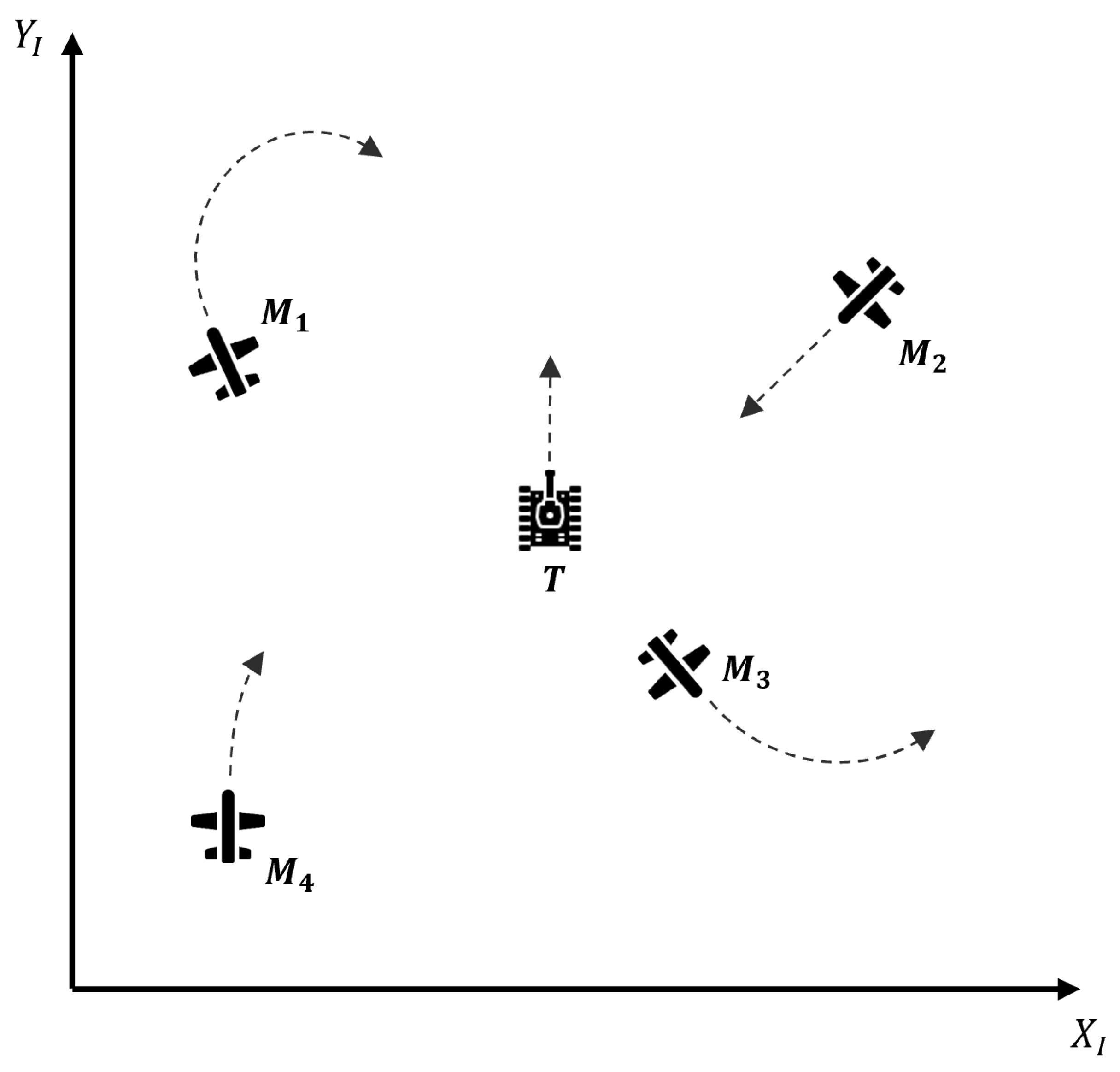
As illustrated in
Figure 1, we consider an engagement scenario where a swarm of
N homogeneous fixed-wing loitering munitions, indexed by
(
), attempts to intercept a single ground target, denoted by
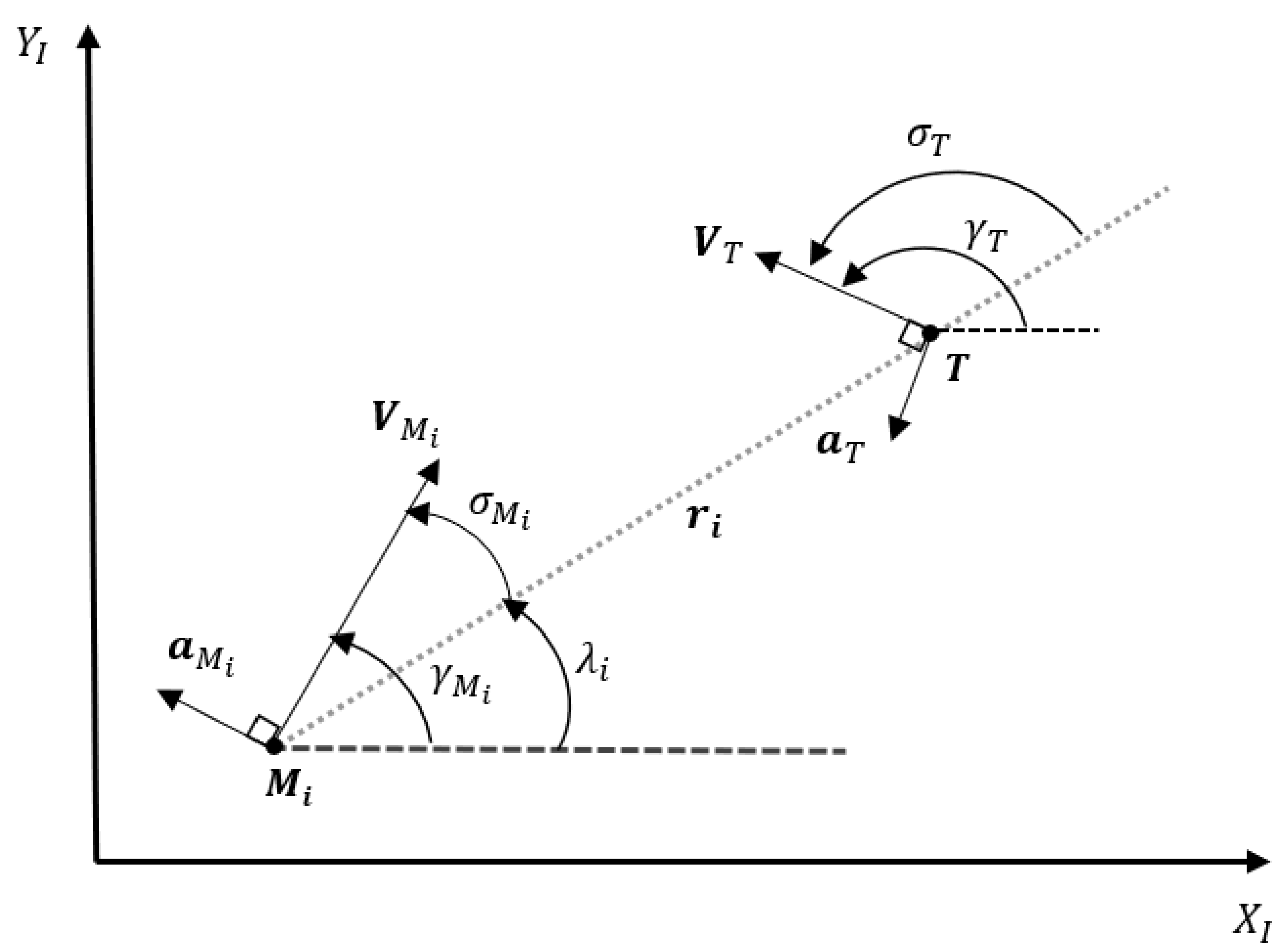
T. The planar geometry of this engagement is depicted in
Figure 2.
The relative position of the i-th munition with respect to the target is characterized by the range and the line-of-sight (LOS) angle . Both the munition and the target are assumed to maintain constant speeds, and , respectively. Their heading directions are defined by the flight path angles and .
To facilitate the kinematic analysis, the angular geometry is expressed relative to the LOS. The lead angle of the munition, , and the aspect angle of the target, , are defined as and , respectively.
By decomposing the velocity vectors into components parallel and perpendicular to the LOS, the relative dynamics are governed by the closing velocity
and the transverse velocity
. These components are derived as follows:
In this context,
and
represent the relative velocity components parallel and perpendicular to the line-of-sight (LOS), respectively, and are defined by the following equations:
These relative velocity components (), combined with the relative distance , form the state space used to evaluate the kinematic feasibility of interception. Unlike traditional approaches that rely solely on minimizing , this formulation accounts for the heading alignment and turn capabilities required for fixed-wing guidance.
2.2. Capturability Analysis Overview
To evaluate the feasibility of interception for each loitering munition, we adopt the GPR-based capturability analysis technique proposed in our previous work [
17]. This framework serves as a computationally efficient model for determining whether a successful intercept is kinematically possible under given initial conditions.
The training dataset is generated through nonlinear engagement simulations using randomly sampled initial relative velocity conditions (
,
). The terminal miss distances from these simulations are discretized using a sigmoid function to classify interception success or failure (
5).
For the GPR configuration, a linear basis as shown in (
6) is adopted for the mean function. Given the discretized nature of the target variable, a Matérn 3/2 kernel as shown in (
7) is selected as the covariance function.
Because the miss-distance values are discretized by (
5), the covariance function is chosen as a Matérn 3/2 kernel, given by
Based on previous studies, it is known that the generalization capability of this GPR framework achieves a boundary estimation accuracy of 95.62% and an overall predictive reliability exceeding 99%. It is also reported that the model maintains predictive validity even in the presence of sensor measurement noise. However, the specific capture region boundary estimated by the GPR model is inherently dependent on the nominal engagement parameters defined during training, specifically the munition speed (), target speed (), and the munition’s maximum lateral acceleration limit ().
Remark 1. Minor variations in target speed or sudden target maneuvers during an engagement do not require model retraining. The robustness metric proposed in this study (the Maximum Inscribed Circle, MIC) specifically absorbs these dynamic uncertainties by prioritizing munitions with state variables deeply embedded within the capture region.
Remark 2. If the physical specifications of the loitering munition (e.g., maximum turn radius, nominal cruise speed) or the expected class of target speed change significantly, the kinematic limits of the engagement are altered. Under such substantial parameter shifts, the model requires retraining. Because the framework employs a boundary-biased sampling strategy, retraining is highly efficient, typically achieving convergence with approximately 500 samples.
The core concept relies on mapping the capture region, defined as the set of initial states from which a guidance law can successfully intercept the target, onto the relative velocity space . This approach enables a more effective capturability analysis for maneuvering targets by directly incorporating the kinematic constraints inherent in the relative velocity domain, rather than relying solely on positional geometry.
The GPR-based capturability prediction framework,
, takes the relative velocity vector
and the relative range
r as inputs to approximate the predicted probability of success,
, and the capture region boundary,
.
Here, denotes the predicted probability of interception success, and represents the boundary of the feasible capture region. Given the assumption of a homogeneous fleet of munitions, this surrogate model framework is universally applied to all N munitions.
2.3. Robustness-Based Priority Determination
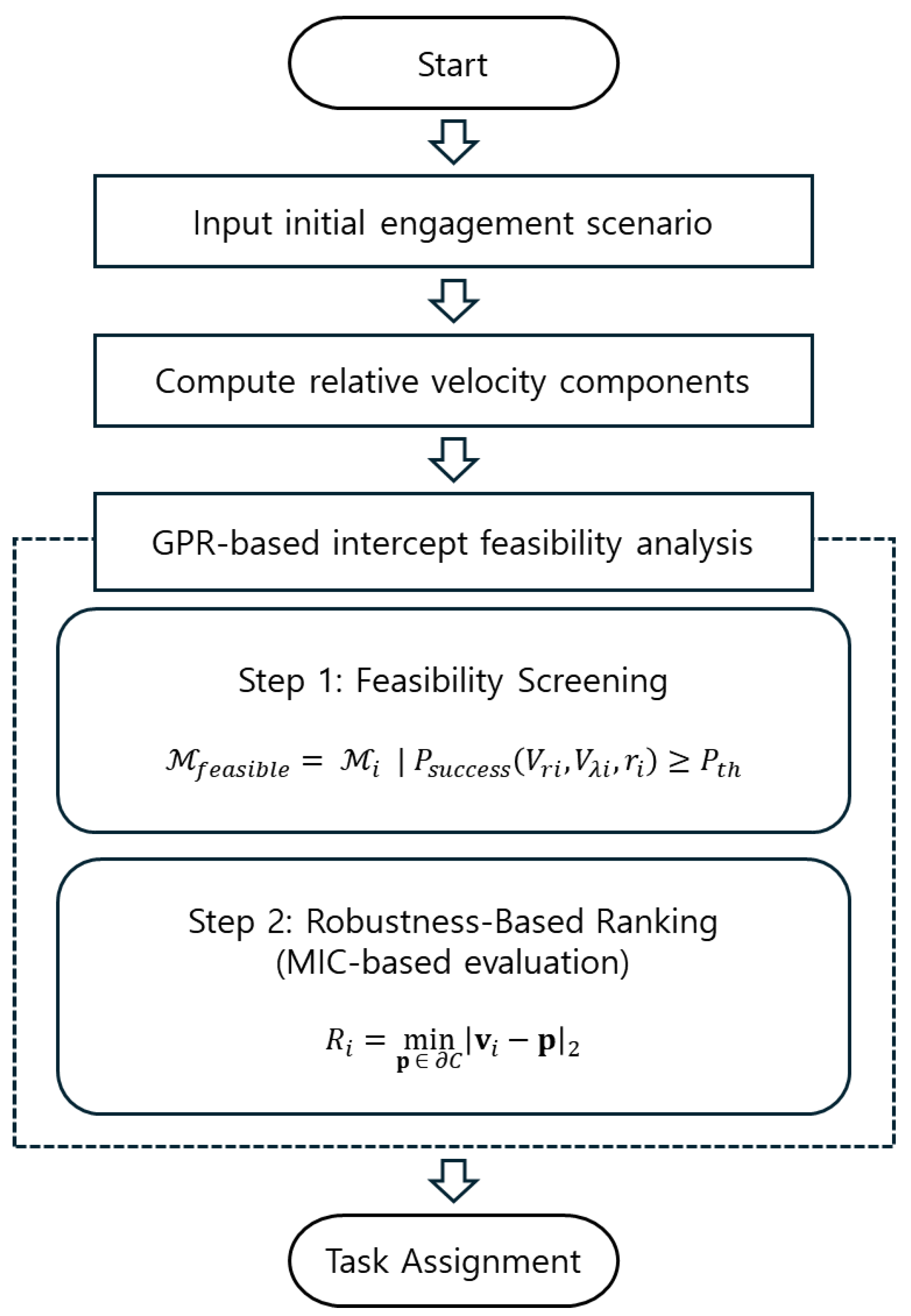
Conventional assignment metrics, such as Time-to-Go () or Euclidean distance, often fail to account for the sensitivity of fixed-wing UAVs to terminal geometry. A munition might be close to the target but in a geometric condition where the required lateral acceleration exceeds its physical limits. Furthermore, target maneuvers can introduce disturbances that shift the relative velocity state outside the capture region. To address this, we propose a two-stage assignment strategy that prioritizes robustness, defined here as the ability to maintain capturability despite disturbances.
First, we evaluate the interception probability for all
N munitions using the pre-trained GPR model. The feasible UAV set
is defined as the collection of scenarios
where the predicted intercept probability
, conditioned on the relative velocities and range, is greater than or equal to 0.5:
Here, represents the predictive probability derived from the capturability prediction framework. The threshold of 0.5 is selected because it corresponds to the boundary level set where the latent regression surface of the discretized miss distance intersects the permissible miss distance criterion. Therefore, if , the engagement is analytically classified as a feasible interception (1); otherwise, it is regarded as a failure (0) and excluded from the task assignment process. independently evaluates the kinematic feasibility of each individual UAV–target pair
Among the feasible candidates, simply selecting the one with the highest probability is insufficient because multiple candidates may theoretically have
. Instead, we quantify the safety margin by calculating the minimum distance from the current state to the capture region boundary. Let
represent the boundary of the feasible capture region obtained from the capturability prediction framework in the
space for a fixed range
r. The robustness metric
for the
i-th munition is defined as the minimum Euclidean distance from its current state
to any point on
. Mathematically, this is expressed as:
where
represents the current relative velocity state. A larger
implies that the munition’s state is deep inside the capture region. This signifies that even if the target performs an evasive maneuver, causing the state vector
to shift, the munition remains highly likely to stay within the capture region. Consequently, the optimal munition
is selected by maximizing this robustness margin:
Remark 3. The capture region boundary is derived from the GPR-based capturability prediction framework through the following procedure. First, engagement simulations are conducted for initial conditions sampled in the space, and the resulting terminal miss distances are discretized into binary labels (success/failure) using a sigmoid function. A GPR model is then trained with as inputs and the discretized miss distance as the output. The boundary is defined as the set of points where the GPR posterior mean equals the feasibility threshold of 0.5, which is extracted numerically via contour computation on a discretized grid in the space. This boundary delineates the feasible capture region from the infeasible region. To enhance boundary accuracy, a boundary-biased sampling strategy is employed: additional training samples are iteratively collected near the current estimated boundary, and the GPR model is retrained at each iteration. The robustness metric in (10) is then computed as the minimum Euclidean distance from the current state to the nearest point on this numerically extracted boundary . The complete two-stage procedure is summarized in Algorithm 1.
| Algorithm 1 Capturability-Based Task Assignment |
- Require:
N munitions with states - Require:
Pre-trained GPR model , Capture region boundary - Ensure:
Optimal munition - 1:
Stage 1: Feasibility Screening - 2:
for
to N do - 3:
Compute relative velocity components and range from engagement geometry - 4:
- 5:
end for - 6:
- 7:
Stage 2: Robustness-Based Ranking - 8:
if
then - 9:
{Fallback: select largest margin} - 10:
else - 11:
for each do - 12:
- 13:
{MIC radius} - 14:
end for - 15:
- 16:
end if - 17:
return
|
Figure 3 illustrates the proposed task assignment framework, integrating the capturability-based feasibility screening and the robustness metric computation for assignment priority determination. This ranking method ensures that the assigned munition not only has the capability to intercept but also possesses the highest resilience against kinematic uncertainties and target maneuvers.
3. Simulation Results
This section presents the results of Monte Carlo simulations conducted to evaluate the proposed task assignment strategy under various engagement conditions. The simulation parameters are summarized in
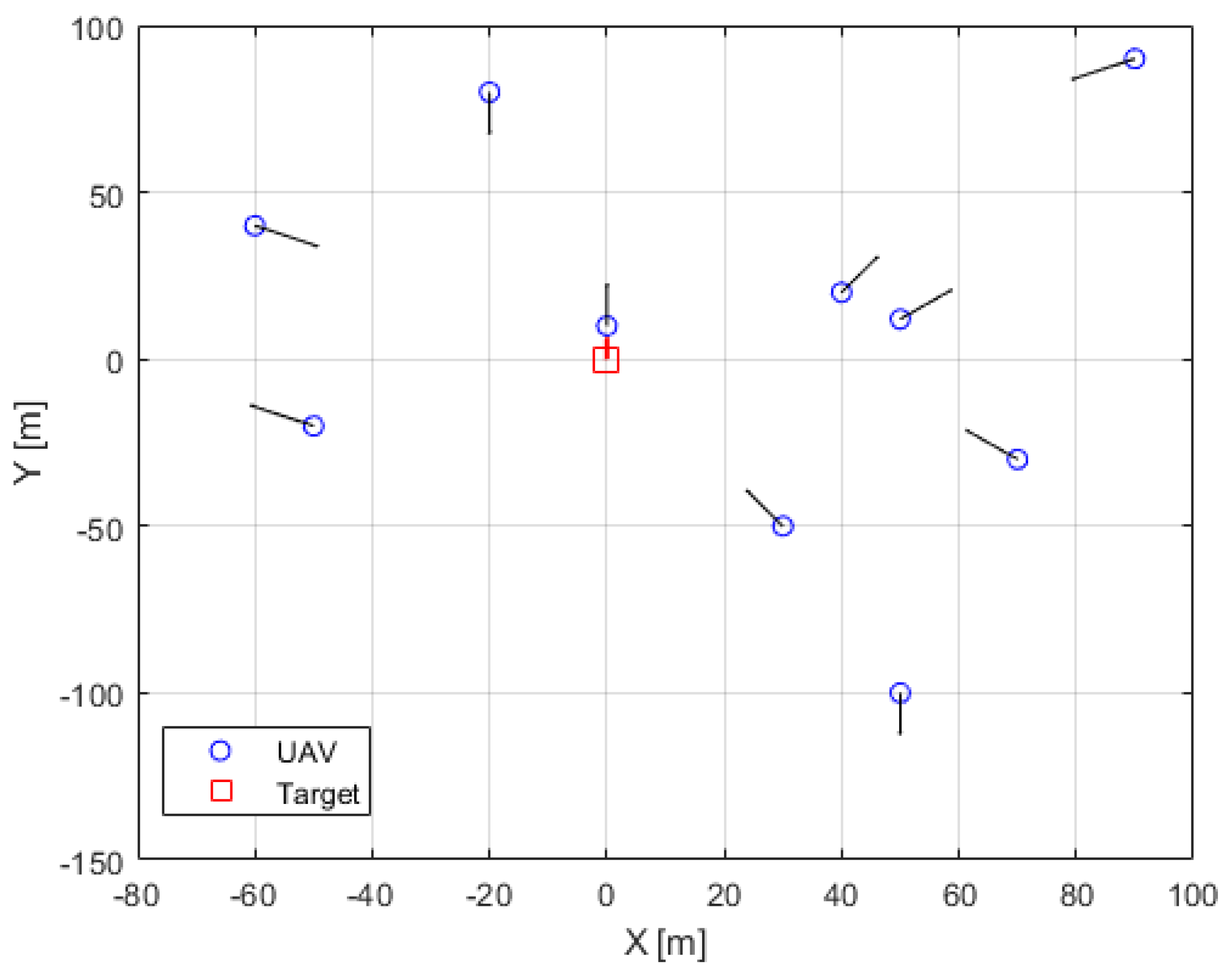
Table 2. As illustrated in
Figure 4, the engagement involves a ground target (tank) traveling due north at a constant speed of
m/s from the origin, and
fixed-wing loitering munitions, each traveling at
m/s. The initial positions and heading angles of the munitions are independently sampled from uniform distributions over
m and
, respectively.
Each munition is guided by pure proportional navigation (PN) with a navigation constant of . The lateral acceleration command is subject to a saturation limit of g, reflecting the turning capability constraint of fixed-wing platforms. A successful interception is defined as the relative range decreasing below m. For the target, a minimum turn radius of m is assumed, corresponding to a maximum lateral acceleration of m/s2. All simulations were performed in MATLAB R2024a.
Four target maneuvering scenarios are considered to evaluate robustness across diverse operational conditions. Scenario 1 assumes a constant-velocity target as a baseline. Scenario 2 introduces random maneuvering, where the target alternates between left and right turns at maximum lateral acceleration. Scenario 3 models a sudden battlefield change: the target performs an emergency brake at a random time (uniformly sampled between 2 and 10 s) and reverses its heading to travel south. Scenario 4 represents the most adversarial condition: upon detecting the approaching munition within a 10 m range, the target immediately reverses its heading direction.
3.1. Limitations of Conventional Distance-Based Assignment
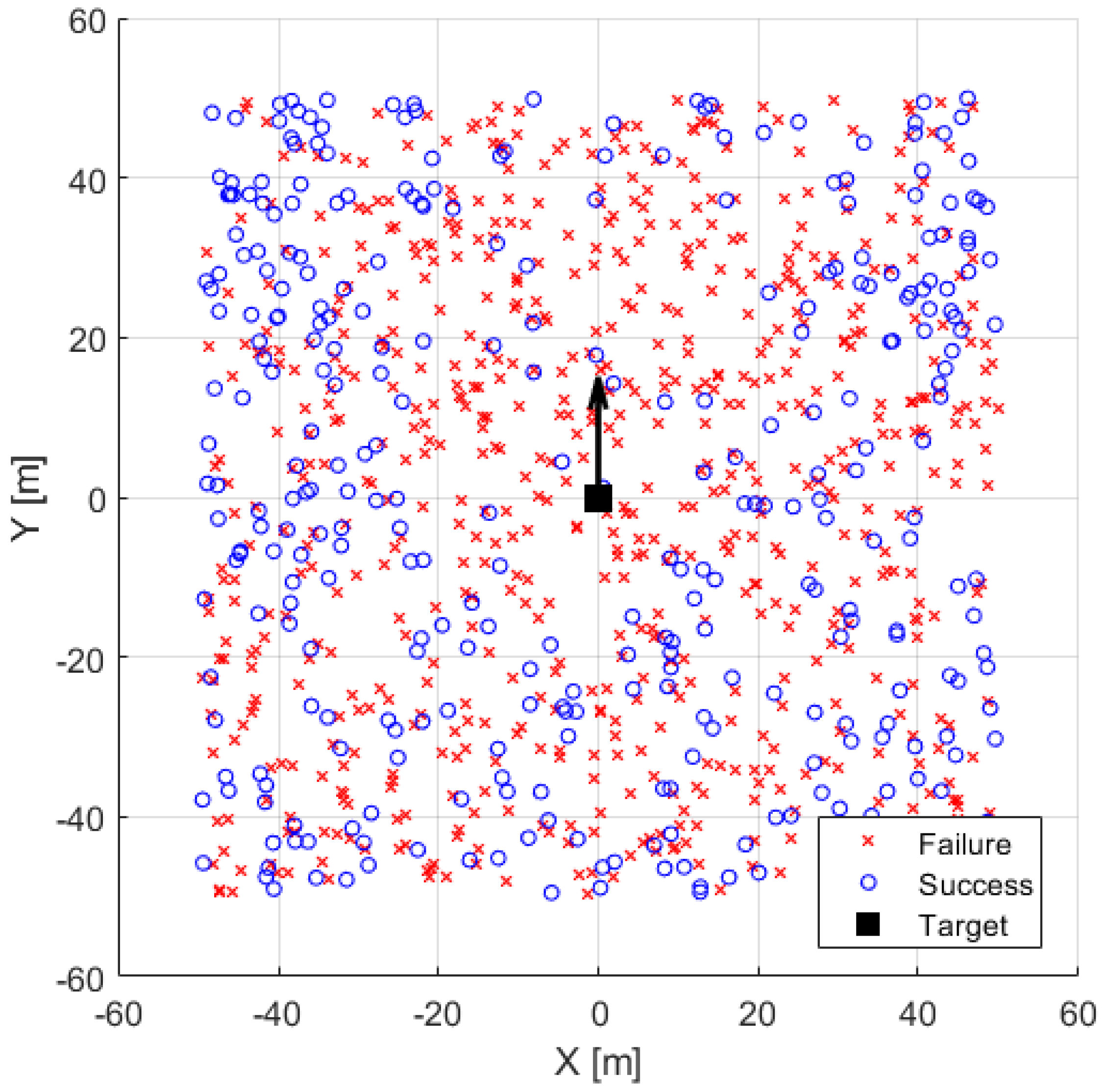
To empirically validate the limitation of distance-based task assignment for fixed-wing munitions, a Monte Carlo simulation was conducted under Scenario 1 conditions. To obtain a statistically sufficient sample for correlation analysis, 1000 independent engagement scenarios were generated, each with a single UAV randomly initialized from a uniform distribution within the operational domain. The overall interception success rate was observed to be 33.0%.
Figure 5 illustrates the spatial distribution of interception successes and failures relative to the initial positions of the UAVs. As indicated in the figure, successful and failed attempts are distributed throughout the operational space without a clear dependence on the relative range to the target.
To quantify this observation, a logistic regression analysis was performed between relative distance and interception outcome. The analysis yielded a regression coefficient with a p-value less than . Notably, the positive sign of indicates that greater distance is associated with a higher probability of interception success. This counterintuitive result arises because munitions deployed at very close range to the target are more likely to face adverse heading angles that require turning maneuvers exceeding their kinematic limits. In contrast, munitions deployed at moderate distances have a wider range of feasible approach geometries. This finding directly contradicts the fundamental assumption of distance-based assignment strategies, which prioritize the nearest UAV under the premise that proximity implies higher interception likelihood. The result empirically demonstrates that, for fixed-wing platforms with turning radius constraints, minimizing relative distance can in fact degrade task assignment performance.
These findings motivate the investigation of alternative metrics that incorporate kinematic geometry. In the following subsection, the predictive capability of time-to-go () is examined as a candidate metric before introducing the proposed capturability-based approach.
3.2. Comparative Evaluation of Time-to-Go as an Assignment Metric
The preceding analysis confirmed that relative distance is not a reliable predictor of interception success for fixed-wing platforms. This motivates the consideration of metrics that incorporate velocity information. Time-to-go (
), defined as the estimated time remaining until interception, has been widely adopted as a task assignment criterion because it accounts for both distance and closing velocity [
18,
19,
21].
To evaluate the predictive capability of
, the same Monte Carlo framework described in
Section 3.1 was employed. For each of the 1000 engagement scenarios,
was approximated as the relative distance divided by the closing velocity (
).
A logistic regression of against interception outcome yielded with a p-value of (), indicating that does not exhibit statistically significant predictive power for interception success. This result holds even when the analysis includes all scenarios, encompassing cases where is negative or undefined due to non-closing geometry (approximately 50.9% of scenarios).
This finding reveals that, in the compact deployment domain considered here ( m), the variation in among scenarios is insufficient to discriminate between successful and failed interceptions. The dominant factor determining interception outcome is not temporal proximity but rather the geometric alignment between the munition’s heading and the collision course, which does not capture. This limitation is precisely what the proposed capturability-based metric is designed to address, as demonstrated in the following subsections.
3.3. Capturability-Based Assignment: Statistical Validation
To assess whether the proposed capturability metric overcomes the discriminative limitations identified in the preceding analyses, the same Monte Carlo framework was employed with the GPR-based capturability prediction model. For each of the 1000 engagement scenarios, the predicted capturability status (
: feasible;
: infeasible) and the Maximum Inscribed Circle (MIC) radius
were computed using the method described in
Section 2. Of the 1000 scenarios, 425 (42.5%) were classified as feasible.
A logistic regression of MIC radius against interception outcome over all 1000 scenarios yielded with . The negative coefficient for the full dataset reflects the inclusion of infeasible candidates, where a large MIC value does not guarantee interception success because the state lies outside the capture region.
Critically, when the analysis was restricted to the 425 feasible candidates (), the regression yielded with . The sign reversal to a positive coefficient confirms that, among UAVs already classified as kinematically capable of interception, a larger MIC radius is strongly associated with a higher probability of successful interception. This demonstrates that the two-stage screening process is essential: feasibility classification isolates the relevant candidate pool, and the MIC metric then provides a statistically powerful ranking within that pool.
This result stands in sharp contrast to the
analysis in
Section 3.2, where no statistically significant predictive power was observed (
). While
fails to discriminate among candidates in the compact deployment domain, the MIC metric provides a continuous, fine-grained ranking capability with overwhelming statistical significance (
) within the feasible subset.
Table 3 summarizes the comparative logistic regression results across all three metrics.
3.4. Ranking-Based Interception Success Rate Comparison
To evaluate the practical impact of each metric in a multi-UAV task assignment context, the 1000 Monte Carlo scenarios were partitioned into 100 groups of 10 UAVs each, simulating 100 independent task assignment decisions. For each group, the three assignment strategies selected a single UAV according to their respective ranking criteria:
Distance-based: the UAV with the shortest relative distance to the target.
-based: the UAV with the smallest positive value; if no UAV has a positive , the nearest UAV is selected as a fallback.
Capturability-based (proposed): the UAV with the largest MIC radius among feasible candidates (); if no candidate is feasible, the UAV with the largest MIC is selected.
The interception success rate for each strategy under Scenario 1 (constant-velocity target) is summarized in
Table 4.
The distance-based strategy achieved a success rate of only 18%, consistent with the finding that proximity to the target is counterproductive for fixed-wing platforms under tight deployment conditions. The -based strategy improved to 58% by incorporating velocity information but still failed in nearly half of all assignment decisions due to its inability to account for the geometric feasibility of the terminal maneuver.
The proposed capturability-based strategy achieved a 93% success rate, representing a 35 percentage point improvement over -based assignment and a 75 percentage point improvement over distance-based assignment. The remaining 7% failure rate is attributable to cases where no feasible candidate existed within the group or the GPR model’s boundary estimation contained minor inaccuracies near the capture region boundary.
Remark 4. The proposed capturability-based metric and the aforementioned optimization frameworks (e.g., genetic algorithms, reinforcement learning, game-theoretic methods) operate at fundamentally different levels of the task assignment pipeline. While these frameworks solve the combinatorial problem of optimally pairing multiple UAVs with multiple targets, the proposed metric addresses the prerequisite evaluation of individual UAV–target engagement feasibility and robustness. As demonstrated by the ranking analysis, the quality of assignment outcomes depends critically on the reliability of this underlying evaluation metric. The proposed MIC-based criterion can therefore be integrated as a cost function component within any of these optimization frameworks.
Remark 5. The computational cost of the proposed task assignment algorithm is summarized in Table 5 and is divided into an offline phase and an online phase. The offline phase encompasses the GPR model training and the capture region boundary extraction via grid-based prediction and contour extraction. This phase is performed once prior to deployment and requires approximately 1.2 s on a standard desktop (Intel Core i7, MATLAB R2024a) for a 500 × 500 evaluation grid. The online phase, which is executed at each assignment decision point, involves only the GPR prediction for each candidate UAV and the MIC distance calculation against the pre-extracted boundary. For a single UAV, this inference requires 0.14 ± 0.04 ms. For a fleet of 10 munitions, the complete assignment pipeline, comprising feasibility screening, MIC-based ranking, and final selection, is completed in 1.76 ± 0.47 ms. These results confirm that the proposed method is computationally suitable for real-time task assignment applications. 3.5. Performance Under Target Maneuvering Uncertainty
The preceding analysis assumed a target moving at a constant velocity (Scenario 1). However, in realistic battlefield environments, targets exhibit irregular maneuvers. To evaluate the robustness of the proposed method under such conditions, the ranking-based comparison was extended to Scenarios 2–4.
In Scenario 2, the target performs random alternating turns at maximum lateral acceleration, constrained by a minimum turn radius of 15 m. In Scenario 3, the target executes an emergency brake at a random time between 2 and 10 s after the engagement begins, followed by a heading reversal to travel south. This scenario models a sudden and unpredictable change in the battlefield environment. In Scenario 4, the target detects the approaching munition when the relative range decreases below 10 m and immediately reverses its heading direction. This represents the most stringent test condition, as the evasive maneuver occurs at close range during the terminal phase of the engagement.
Table 6 summarizes the interception success rates for all four scenarios.
The proposed capturability-based strategy consistently achieved the highest success rate across all four scenarios. Under Scenario 2 (random maneuvering), the MIC-based strategy experienced a moderate decrease from 93% to 86%, reflecting the increased difficulty of intercepting a continuously maneuvering target. Nevertheless, this represents a 28 percentage point advantage over the -based approach (58%) and a 68 percentage point advantage over the distance-based approach (18%).
Notably, the distance-based and -based strategies exhibited nearly identical performance across all four scenarios, indicating that these conventional metrics are insensitive to target maneuvering conditions. This is expected, as both metrics are computed from the initial engagement geometry and do not account for future target behavior. In contrast, the MIC metric indirectly captures robustness against target maneuvers by quantifying how deeply the munition’s state is embedded within the capture region.
Under Scenarios 3 and 4, which model sudden heading reversals, the proposed strategy maintained a 93% success rate, identical to the constant-velocity baseline. This demonstrates that the safety margin quantified by the MIC metric is sufficient to absorb the kinematic perturbations introduced by abrupt target maneuvers, including terminal-phase evasive actions.
Remark 6. It is acknowledged that is a critical metric for time-sensitive missions. However, the comparative analysis across all four scenarios demonstrates that minimizing without assessing the geometric capturability can lead to mission failure for fixed-wing munitions, particularly under maneuvering target conditions. Therefore, the proposed capturability-based metric should be considered a necessary condition for screening candidates, while can serve as a secondary metric for final selection among feasible candidates.
4. Conclusions
This study proposed a novel task assignment metric for multiple fixed-wing loitering munitions, addressing the limitations of conventional assignment metrics that rely on relative distance or estimated time-to-go. While fixed-wing UAVs offer various advantages, their limited maneuverability and turn radius constraints make simple spatial proximity an insufficient indicator of interception success.
The core contribution of this work is the introduction of a robustness-centric ranking algorithm. By calculating the radius of the Maximum Inscribed Circle (MIC) within the predicted capture region, the proposed method quantifies the safety margin available to each UAV against target maneuvers and engagement uncertainties. Monte Carlo simulations with 1000 engagement scenarios demonstrated that the proposed strategy achieved a 93% interception success rate under constant-velocity target conditions, compared to 58% for time-to-go-based and 18% for distance-based assignment.
The statistical analysis revealed that relative distance exhibits a positive regression coefficient with interception outcome, indicating that closer proximity to the target is counterproductively associated with lower success rates for fixed-wing platforms. This result directly contradicts the fundamental assumption of distance-based assignment and empirically validates the necessity of incorporating kinematic geometry into the evaluation metric. Furthermore, time-to-go was found to lack statistically significant predictive power () in the deployment conditions considered, whereas the MIC metric maintained overwhelming significance () within the feasible candidate subset.
The robustness of the proposed method was further validated across four target maneuvering scenarios, including random alternating maneuvers, emergency heading reversals, and terminal-phase evasive actions. The capturability-based strategy consistently outperformed conventional approaches across all scenarios, maintaining success rates between 86% and 93%, while conventional metrics remained below 60% regardless of the maneuvering condition.
The proposed capturability metric and time-to-go are not mutually exclusive; rather, they serve complementary roles. The capturability-based screening ensures kinematic feasibility, while time-to-go can serve as a secondary criterion for final selection among feasible candidates in time-sensitive missions. Future research will focus on developing a composite cost function that integrates the robustness of the capturability analysis with the temporal efficiency of time-to-go, extending the framework to handle heterogeneous swarms and three-dimensional engagement scenarios, and validating the algorithm on embedded hardware platforms for real-time deployment.