Article

Momentum Envelope Design for Roof-Array Control Moment Gyroscope Arrays

1
Department of Aerospace Engineering, Inha University, Incheon 21999, Republic of Korea
2
Aerospace Systems Research Institute, Inha University, Incheon 21999, Republic of Korea
3
Department of Aerospace Engineering, Chosun University, Gwangju 61452, Republic of Korea
4
Department of Aerospace Engineering, Pusan National University, Busan 46241, Republic of Korea
*
Author to whom correspondence should be addressed.
Aerospace 2026, 13(4), 323; https://doi.org/10.3390/aerospace13040323
Submission received: 8 February 2026 / Revised: 28 March 2026 / Accepted: 28 March 2026 / Published: 31 March 2026
(This article belongs to the Section Astronautics & Space Science)

Abstract

This paper proposes a momentum envelope design strategy for a satellite equipped with control moment gyroscopes (CMGs). The objective is to improve spacecraft maneuverability while preserving singularity-free operation of a roof-array CMG assembly. To this end, the three-axis angular momentum components are optimally redistributed according to a prescribed eigen-axis maneuver condition so that the achievable rotational speed is maximized within the feasible angular momentum region. The optimization problem is formulated analytically and solved with a low-complexity numerical procedure. Numerical examples show that the proposed method improves the achievable rotational speed compared with the previous fixed-envelope design approach, while additional attitude control simulations confirm that the designed envelope avoids near-singular operation. The proposed method therefore provides a maneuver-dependent extension of the previous singularity-free momentum envelope design framework.

1. Introduction

The benefit of control moment gyroscopes (CMGs) with a high torque–power ratio over reaction wheels (RWs) has promoted their various applications in space missions [1,2]. These include reconnaissance missions where high attitude maneuverability is much appreciated as an increasing number of targets must be observed over the same period of time. The French Pleiades constellation is a well-known example that provides a high slew speed of reaching 3.4°/s at maximum [3]. The CMG-installed earth observation satellites include, but are not limited to, SPOT-5/6, the WorldView Series [4], and COSMO-SkyMed Second Generation [5]. In addition, studies and the development of CMGs dedicated to small-scale satellites have also continued over the past decades [6,7].
Despite several advantages and its space heritage, the use of CMGs inherits a problem known as geometric singularity, where desired torque commands cannot be produced at certain gimbal angles [8]. Many researchers have proposed CMG steering laws aimed at singularity avoidance and escape. Traditionally, the studies have generally been categorized into a singularity robust inverse (SR-inverse) method [9,10] and a null motion-based method [11,12]. The former augments a full-rank matrix to keep the pseudo-inverse matrix always in existence during the conversion of a desired torque to a gimbal rate command. The latter applies null motion to steer gimbals to the desired location outside the singularity regions. However, both approaches have drawbacks: the SR-inverse methods yield torque errors and the null motion-based methods cannot guarantee escape from the elliptic internal singularity [13,14].
Recently, studies on CMG-based spacecraft attitude control have expanded beyond classical singularity-avoidance steering laws. The recent works have considered robust steering against perturbations [15], optimization-based steering [16], and global-search-based steering approaches [17]. Furthermore, data-driven methods such as deep reinforcement learning have been explored for CMG steering and angular momentum control [18,19]. However, most of these studies mainly focus on optimizing performance or rejecting perturbations, whereas relatively less attention has been paid to the analytical design of the CMG angular momentum envelope itself. In particular, the analytical investigation of singularity-free conditions together with the corresponding allowable angular momentum envelope have rarely been addressed. Motivated by this gap, the present study focuses on the design of a singularity-free angular momentum envelope for a roof-array CMG system under a prescribed maneuver condition.
A different approach to modifying the CMG steering law was proposed in [20] to address the singularity problem for a roof-array CMG configuration. It retains the original, simple pseudo-inverse steering logic instead of adding artificial terms to prevent singularity. This simple structure is enabled by constraining the CMG momentum envelope within a so-called feasible angular momentum (FAM) region, in which the CMGs are free of the singularity issue. Another benefit of [20] is its usefulness in attitude control system design by providing the minimum torque and maximum angular momentum that can be produced by the CMG assembly, i.e., the agility performance can easily be predicted. However, because the designed envelope in [20] is fixed independently of the commanded maneuver direction, it can be conservative from the viewpoint of maneuverability. This means that the previous approach cannot fully utilize the inherent characteristics of the total angular momentum space for the given CMG layout.
Motivated by this limitation, this paper proposes a new method for CMG-based attitude control of satellites by optimally adjusting the CMG momentum envelope according to the prescribed eigen-axis maneuver condition. Specifically, it aims to maximize the rotational speed of the spacecraft along the eigen-axis of the maneuvering condition. While the previous study [20] constructs a fixed angular momentum envelope that guarantees singularity-free operation, the present study does not assume that the fixed envelope is always the best choice for maneuver performance. Instead, the available momentum capacity is redistributed according to the prescribed maneuver direction so that the achievable eigen-axis rotational speed can be maximized while preserving the singularity-free characteristic. Therefore, the main contribution of this paper lies in extending the feasible envelope concept of [20] into a maneuver-dependent envelope design framework.
The proposed method not only increases maneuverability by the optimal momentum envelope design but also preserves the original benefit of the previous method, which is the singularity-free property [20]. Moreover, it is well known that, in RW-based attitude control, once RWs are installed and their layout (i.e., configuration) is determined, their momentum envelope cannot be altered [21]. On the other hand, the proposed scheme fully takes advantage of a unique feature of CMG-based attitude control (i.e., movable rotational axes of wheels), adding flexibility to momentum envelope design.
The remainder of the paper is constructed as follows. In the next section, a few background topics on singularity, torque/momentum equations of a CMG assembly, and the previous method for singularity-free momentum design are briefly reviewed. In Section 3, the limitation of the previous method on maneuverability improvement is analyzed, and an optimal satellite reorientation problem to determine the maximal angular momentum envelope of CMGs is defined. Section 4 proposes a new approach of effective momentum envelope design that maximizes the maneuvering rotational speed for an eigen-axis attitude control problem. Also, the benefit of the proposed technique is highlighted. Then, several numerical examples are applied to demonstrate the performance of the proposed method in Section 5. Finally, the conclusion of the paper is provided in Section 6.

2. Background

This section introduces a brief overview on CMG properties (e.g., singularity) and the momentum space design strategy proposed in [20].

2.1. CMG Configuration and Singularity

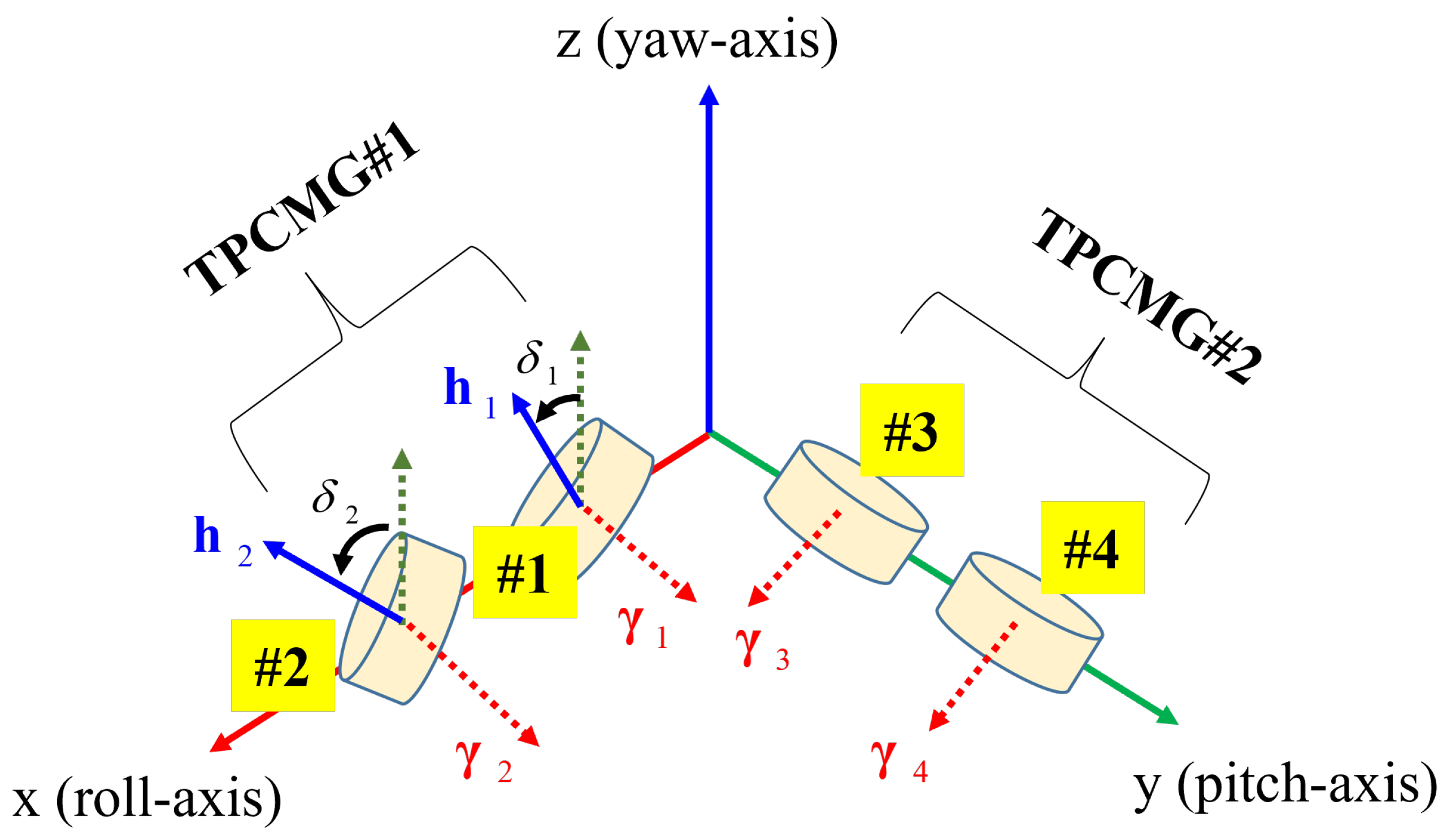
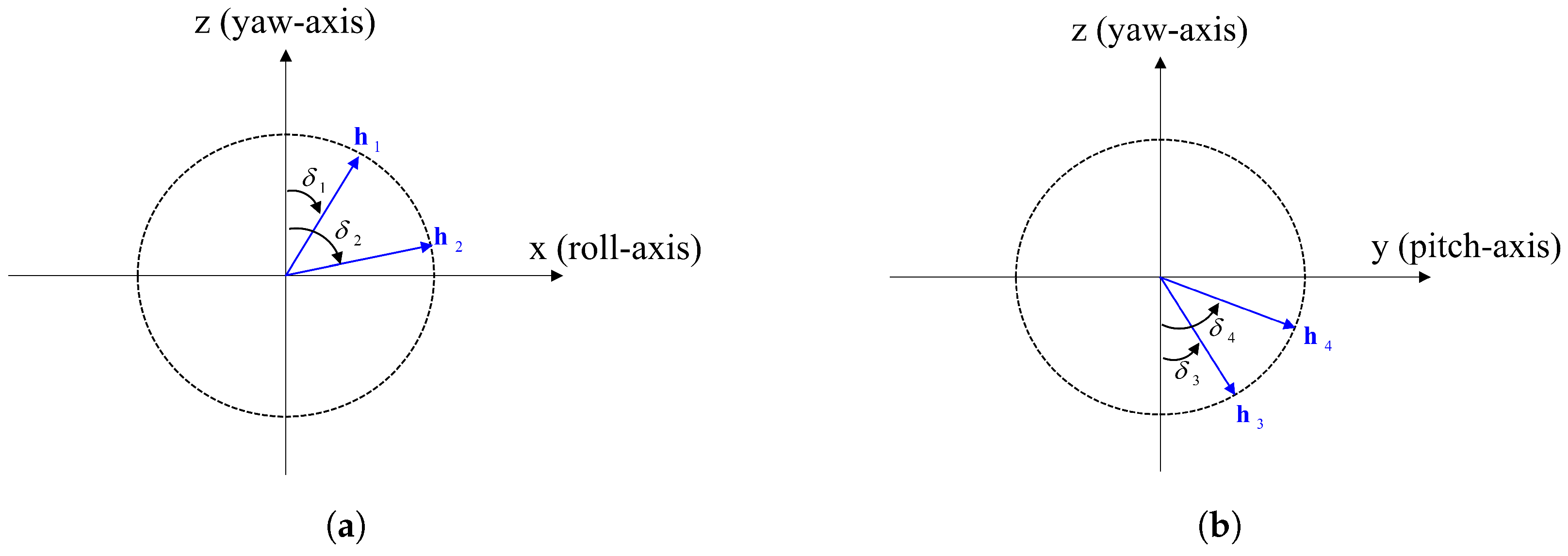
There are in general two types of CMG configurations, which are pyramidal and roof-type [13,22]. Figure 1 shows a roof-type CMG configuration assumed throughout this paper where γ k , k { 1 , 2 , 3 , 4 } denotes the gimbal direction, h k means the constant-speed wheel momentum direction, and δ k is the gimbal angle. Two pairs of CMGs (TPCMGs) are installed: one with CMG#1 and CMG#2 and the other with CMG#3 and CMG#4. The pairs are referred to as TPCMG#1 and TPCMG#2 in this paper. Each pair is dedicated to controlling the attitude in the roll (x)–yaw (z) plane and pitch (y)–yaw (z) plane, respectively. Figure 2 defines the origins of the gimbal angles and their direction. Note that at the origin the first pair of CMGs points toward the positive z-axis while the other points toward the negative z-axis; hence, the net momentum of the CMG assembly becomes null at the origin.
The total angular momentum of the roof-type CMG arrays in the body referenced frame is
h = h 1 + h 2 + h 3 + h 4 = h s i n δ 1 0 c o s δ 1 + h s i n δ 2 0 c o s δ 2 + h 0 s i n δ 3 c o s δ 3 + h 0 s i n δ 4 c o s δ 4
where h is the angular momentum of a CMG (assumed to be identical between the CMGs). The torque vector generated by gimbal rotation can be obtained by
τ = d h d t = A ( δ ) δ ˙ τ x τ y τ z = h c o s δ 1 c o s δ 2 0 0 0 0 c o s δ 3 c o s δ 4 s i n δ 1 s i n δ 2 s i n δ 3 s i n δ 4 δ ˙ 1 δ ˙ 2 δ ˙ 3 δ ˙ 4
where τ x , τ y , and τ z describe the torque vector components in the body referenced frame, δ = [ δ 1 , δ 2 , δ 3 , δ 4 ] T is the gimbal angle vector, and δ ˙ is the gimbal rate vector. A ( δ ) τ / δ is the Jacobian matrix.
A geometric singularity of the CMG arrays occurs when a desired torque vector cannot be produced at certain gimbal angles. It is analogous to the condition when the rank of the Jacobian matrix A ( δ ) is less than 3. There are in general two types of the singularity conditions, which are external singularity and internal singularity [20]. The external singularity occurs at the maximum angular momentum when the gimbal angles of a TPCMG are the same, e.g., δ 1 = δ 2 for TPCMG#1. It is also called the 2H singularity where H stands for the angular momentum of a single CMG. On the other hand, the internal singularity known as 0H singularity, which occurs when the momentum axes become anti-parallel within a TPCMG. In summary, the external singularity is associated with the boundary of the reachable angular-momentum space, whereas the internal singularity occurs within the reachable region and is generally more difficult to handle during maneuver execution. While in general the internal singularity surfaces are more irregular and complicated than the external singularity case, they merge into a simple set of two rings in the roof-array configuration [20].

2.2. Previous Method

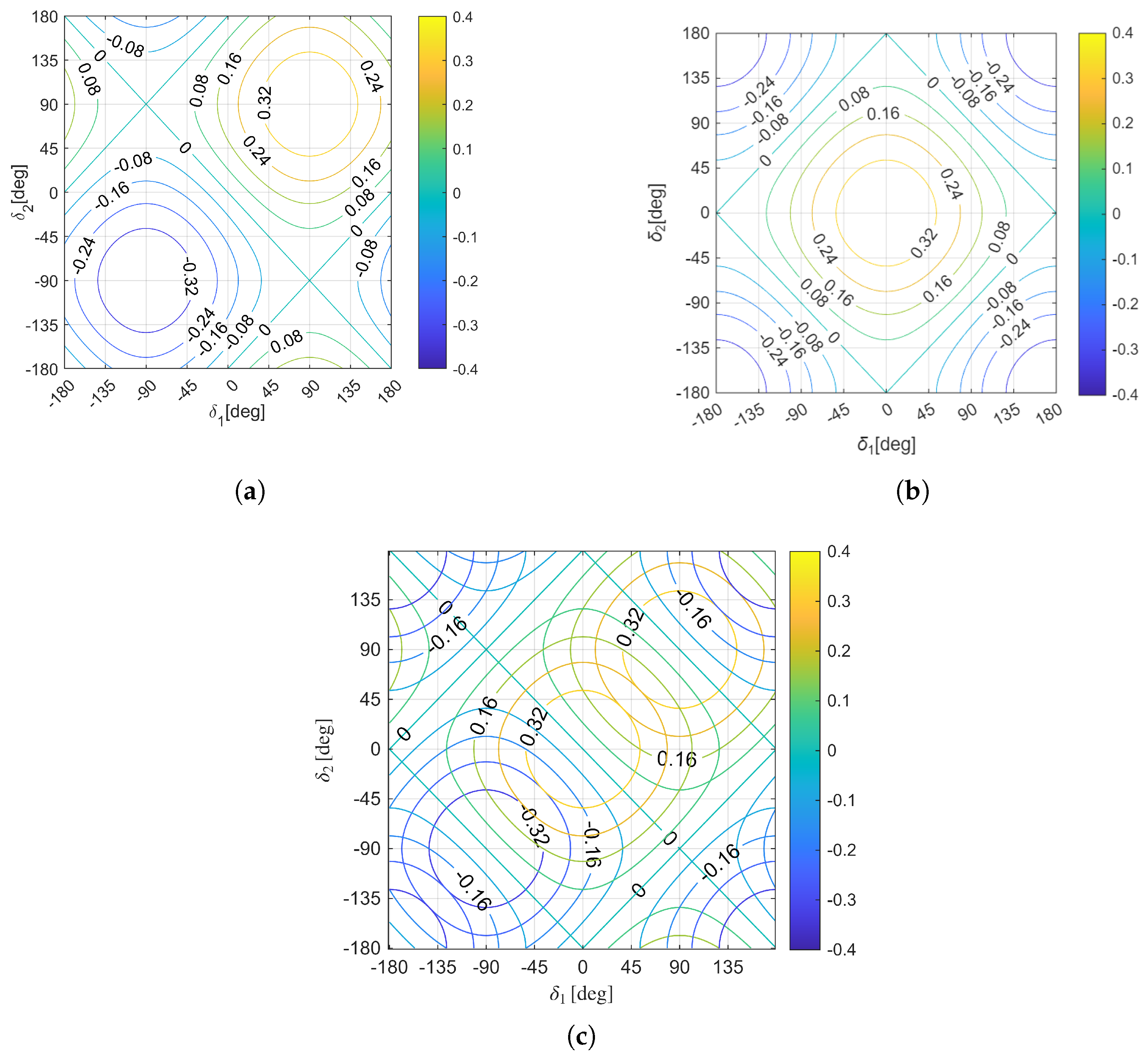
A design strategy of singularity-free CMG momentum envelope proposed in [20] is introduced. It is based on a 2D chart constructed by the contours of CMG momentum on the gimbal angle plane. Figure 3 shows contour lines of x-axis and z-axis momentum components of TPCMG#1. The last figure Figure 3c is simply an integrated chart with the roll and yaw momentum components. Note that the angular momentum of each CMG h is assumed as 0.2 Nms . The angular momentum at certain gimbal angles can be obtained by Equation (1). For example, the x-axis momentum h x becomes maximum at ( δ 1 , δ 2 ) = ( 90 , 90 ) ° and minimum at ( δ 1 , δ 2 ) = ( 90 , 90 ) °, while it becomes zero at δ 2 = δ 1 .
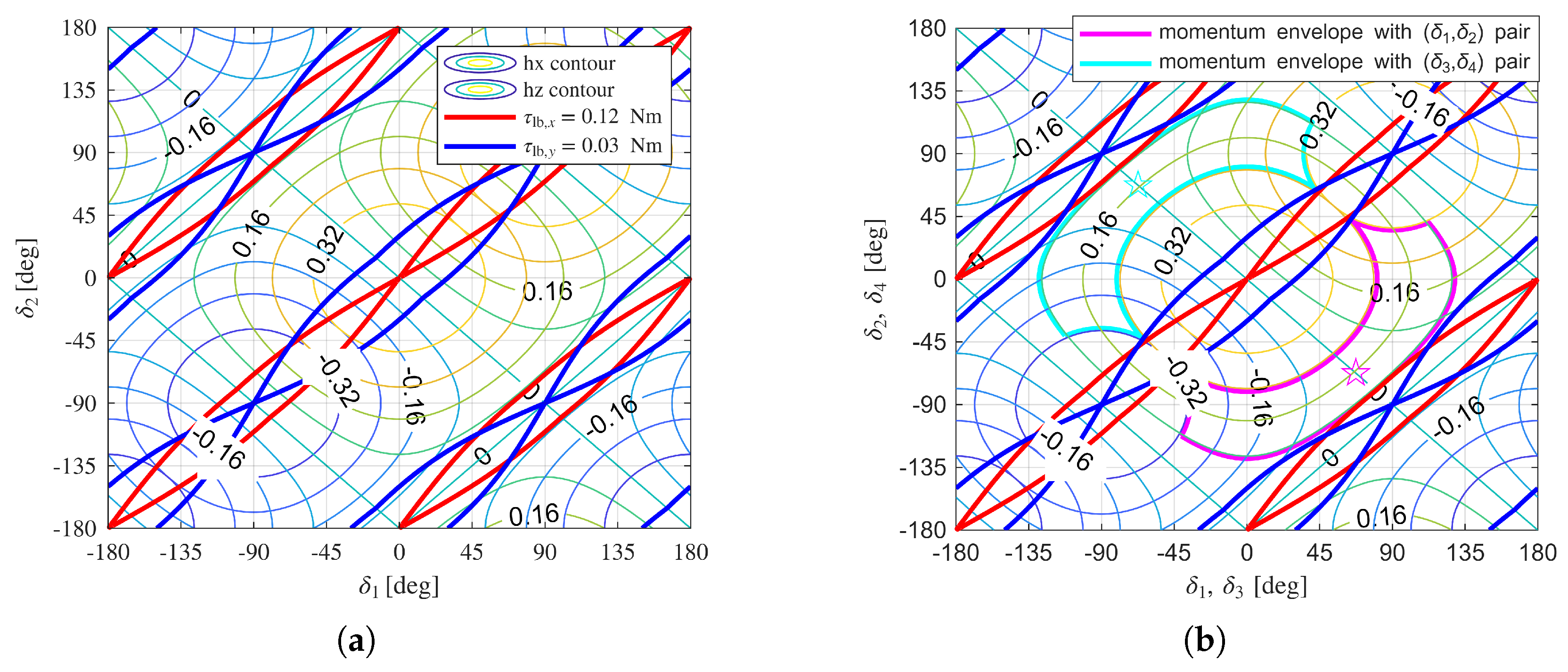
The next step before configuring a singularity-free momentum space is to describe the singularity surfaces in the gimbal plane. The singularity surfaces here are defined as regions where desired torques are not producible due to the gimbal rate limit. Figure 4a shows the momentum contours overlaid with the singularity lines in thick solid lines. Two user-defined input variables were used to determine the singularity lines, which are δ ˙ max = [ δ ˙ m a x , x , δ ˙ m a x , z ] T and τ lb = [ τ l b , x , τ l b , z ] T . First, δ ˙ m a x , x is the maximum gimbal rate allocated to x-axis control while δ ˙ m a x , z = δ ˙ m a x δ ˙ m a x , x is assigned for z-axis maneuver. (Note that δ ˙ m a x is the maximum gimbal rate assumed identical for every CMG.) Second, τ l b , x and τ l b , z are the lower bounds of the maximum torque along the x-axis and z-axis guaranteed at all times. In Figure 4a, the red thick line corresponds to the gimbal angles at which the x-axis’s maximum torque becomes τ l b , x while the blue thick lines denote the z-axis torque’s singularity with τ l b , z . Outside the singularity surface, for example at ( δ 1 , δ 2 ) = ( 45 , 45 ) °, the maximum available torques become larger than τ l b , x and τ l b , z , i.e., τ m a x , x > τ l b , x and τ m a x , z > τ l b , z . Note that in this example, τ l b , x is set to 0.12 Nm , τ l b , z is 0.03 Nm , δ ˙ m a x , x is 1.55 rad / s , and δ ˙ m a x , z is 0.45 rad / s .
The last step is to determine an operational momentum envelope free of singularity. In Figure 4b, an example of the operational momentum spaces is illustrated in purple (for TPCMG#1) and mint (for TPCMG#2) boundary lines. Note that here we assume that the lower bounds of torque and the gimbal rate limits between the pitch and yaw axes are the same, in other words, τ l b , y = τ l b , x and δ ˙ m a x , y = δ ˙ m a x , x , which will be applied throughout the paper. This makes the x-axis and y-axis torque singularity lines overlap, enabling simpler design of the momentum space. In Figure 4b, based on the momentum envelope described, we can easily obtain the angular momentum envelope of a CMG assembly, Δ h m a x . The x-axis maximum momentum solely depends on TPCMG#1 on the XZ plane while the y-axis momentum only depends on TPCMG#2. On the other hand, the yaw-axis (i.e., z-axis) momentum is the sum of the two TPCMGs’ z-axis angular momentum.
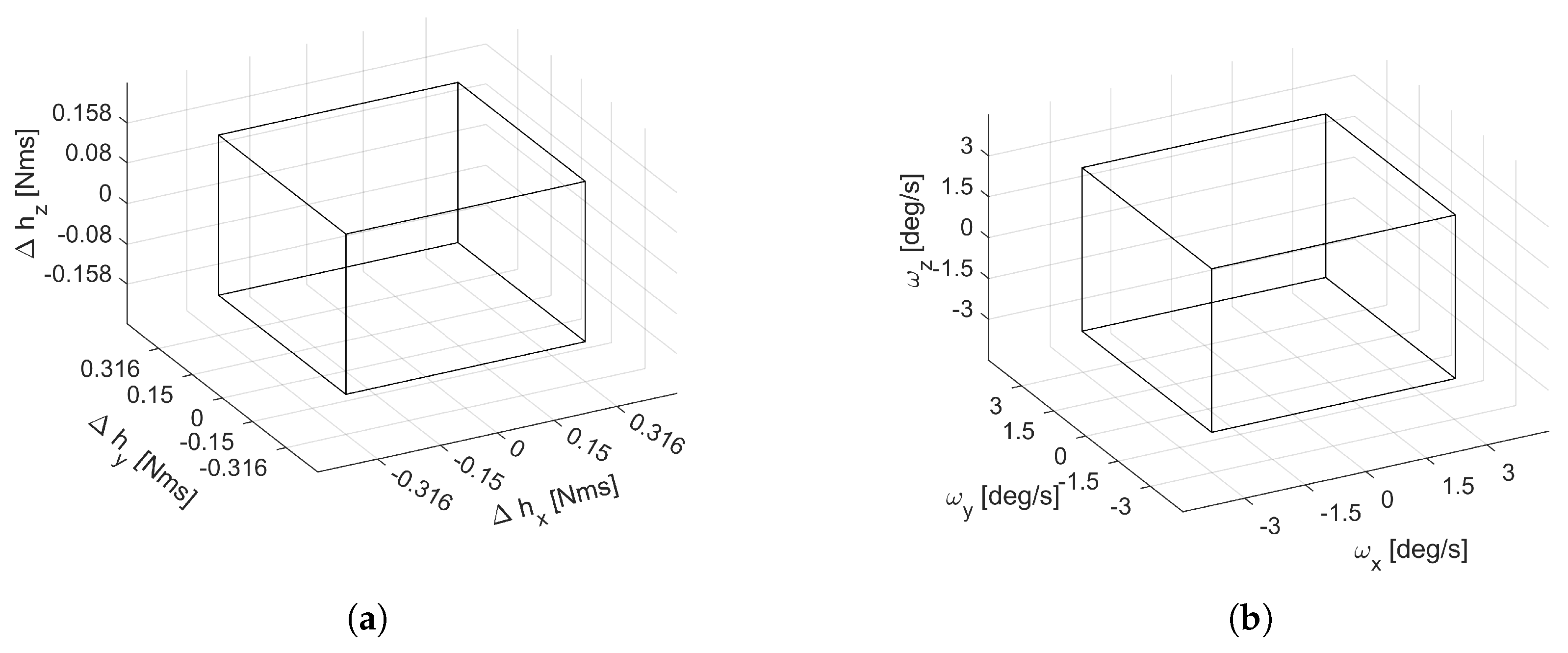
Figure 5 shows the envelopes of the CMG assembly angular momentum and body angular rate, both in the body referenced frame. In this example, Δ h m a x is [ 0.316 , 0.316 , 0.158 ] Nms and ω m a x is [ 3.0 , 3.0 , 3.0 ] °/s with the satellite moment of inertia (MOI) of J = diag ( [ 6 , 6 , 3 ] ) kg m 2 . Note that the CMG assembly angular momentum is equivalent to the body angular momentum in this paper since a zero momentum-biased satellite is assumed. For spacecraft with nonzero bias momentum, the envelope should be reformulated accordingly. Meanwhile, bias-induced gyroscopic torques and external perturbations are more directly handled by the closed-loop steering/control system.

2.3. Eigen-Axis Attitude Maneuver

In this paper, a rest-to-rest attitude maneuver along the eigen-axis is considered. In other words, the spacecraft is assumed to be stationary at the initial and final times, and the rotation axis is inertially fixed during the maneuver. The eigen-axis maneuver enables a minimum angle rotation and is widely adopted in spacecraft attitude control problems [23]. For a given eigen-axis (unit) vector ϵ = [ ϵ x , ϵ y , ϵ z ] T , we can obtain the maximum angular speed along the eigen-axis, ω e i g , by
ω e i g = m i n Δ h x J x x | ϵ x | , Δ h y J y y | ϵ y | , Δ h z J z z | ϵ z | = m i n ω m a x , x | ϵ x | , ω m a x , y | ϵ y | , ω m a x , z | ϵ z | = m i n ω ^ x , ω ^ y , ω ^ z
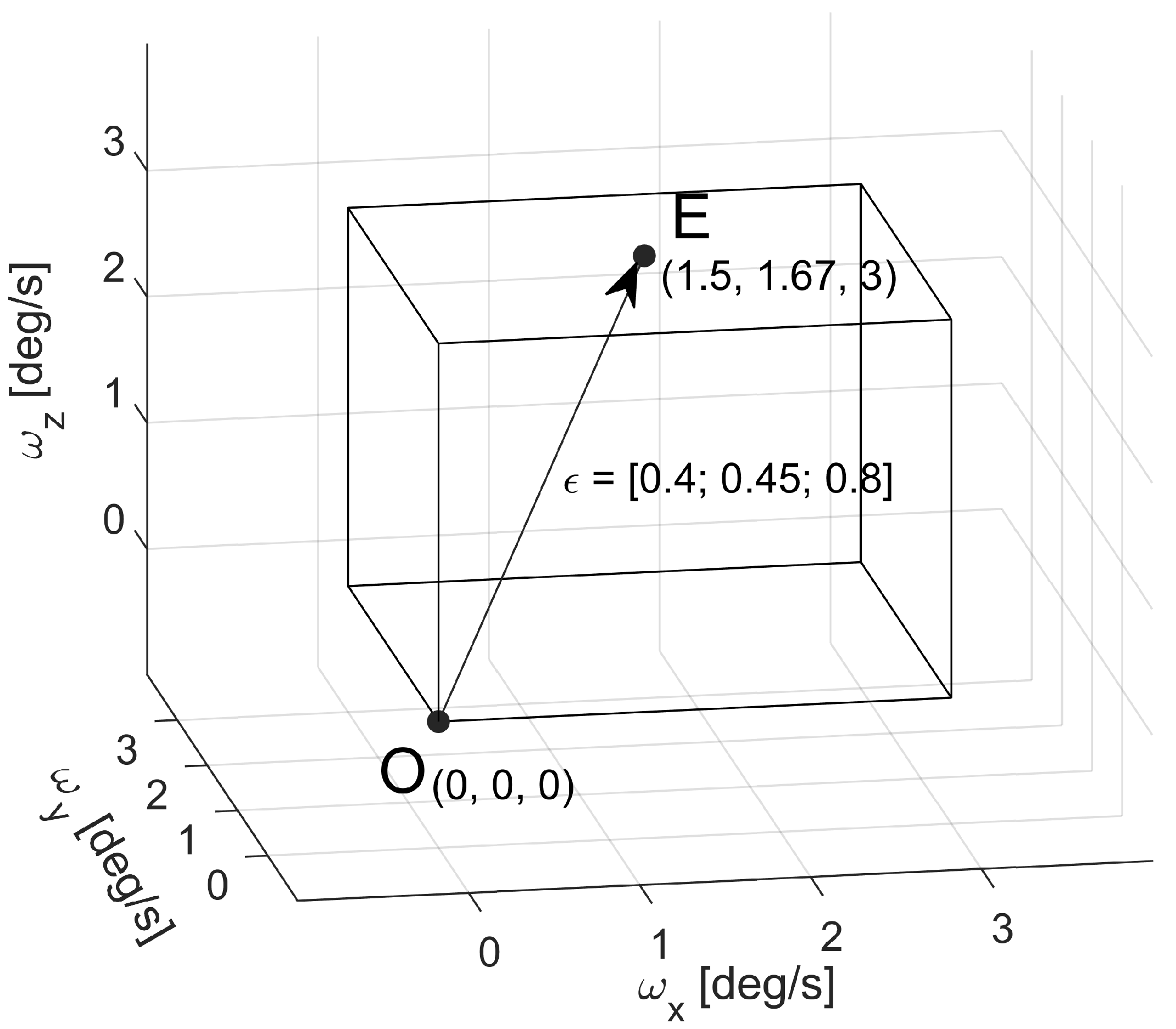
Here, Δ h = ( Δ h x , Δ h y , Δ h z ) and ω max = ( ω max , x , ω max , y , ω max , z ) denote the component-wise upper bounds of the CMG angular momentum and body angular velocity, respectively. J = diag ( J x x , J y y , J z z ) contains the diagonal elements of the satellite MOI tensor. Note that ω e i g is the minimum of ( ω ^ x , ω ^ y , ω ^ z ) defined in Equation (3). Figure 6 shows an example of the maximum angular rate vector for the given eigen-axis ϵ = [ 0.4 , 0.45 , 0.8 ] T . The ray O E denotes the maximum rate vector ω e i g = ω e i g ϵ parallel to ϵ . The maximum angular speed ω e i g in this example is 3.75 °/s.

3. Problem Definition

3.1. Problem Formulation

In this paper, the boundary conditions of a rest-to-rest maneuver problem are defined with the initial conditions at time t 0 and the final conditions at time t f by
q ( t 0 ) = q 0 , ω ( t 0 ) = 0 3 × 1
q ( t f ) = q f , ω ( t f ) = 0 3 × 1
where q = q 1 q 2 q 3 q 4 T = q v T q 4 T R 4 × 1 is the quaternion where the first three elements comprise the quaternion vector. q 0 and q f are the initial and final quaternions. The initial quaternion error from the final desired quaternion, q e ( t 0 ) , can be obtained by
q e ( t 0 ) = q f q 0 1
where q 0 1 is the quaternion inverse of q 0 , and ⊗ stands for quaternion multiplication. The eigen-axis (i.e., the rotation axis) ϵ can then be obtained by the following relationship:
q e = ϵ s i n ( θ / 2 ) c o s ( θ / 2 )
where θ is the rotation angle along the eigen-axis.
This paper seeks to increase maneuverability (i.e., to reduce the maneuvering time) of the attitude control problem defined in Equations (4) and (5) for a satellite installed with a roof-type CMG array depicted in Figure 1. The objective function J is defined by
J = ω e i g ( Δ h )
where ω e i g is the angular speed along ϵ , defined in Equation (3), which is a function of the CMG net momentum Δ h . The problem goal is to maximize J by finding the optimal solution Δ h * such that:
Δ h * argmax Δ h ω e i g ( Δ h ) .
Note that there exist constraints on Δ h imposed by the hardware limits of the CMGs (e.g., maximum gimbal rates) and the torque singularity depicted in Figure 4.

3.2. Limitation of the Previous Method

The previous study [20] has a limitation on improving maneuverability since it assumes that the CMG momentum space Δ h is fixed regardless of the boundary conditions of attitude control problems. For example, let us assume that the attitude maneuver mostly requires roll-axis control (i.e., ϵ x 1 ) while the CMG momentum space is designed weighing more on the yaw-axis than the off-yaw-axes ( Δ h z Δ h x , Δ h y ). Then, the roll-axis angular momentum Δ h x will be saturated early during the maneuver. Unfortunately, in this case, most of the maneuverability along the yaw-axis Δ h z will be left unused. In the next section, we propose an effective way of adjusting the CMG momentum envelope Δ h to fully use the available CMG momentum space, resulting in an improvement of the maneuvering performance.

4. Proposed Method

In this section, a new method of designing the CMG momentum envelope is proposed, aimed at improving the maneuverability about the given rotation axis. A simple two-dimensional attitude control problem is first examined and then extended to a general three-dimensional attitude reorientation problem.

4.1. Two-Dimensional Problem

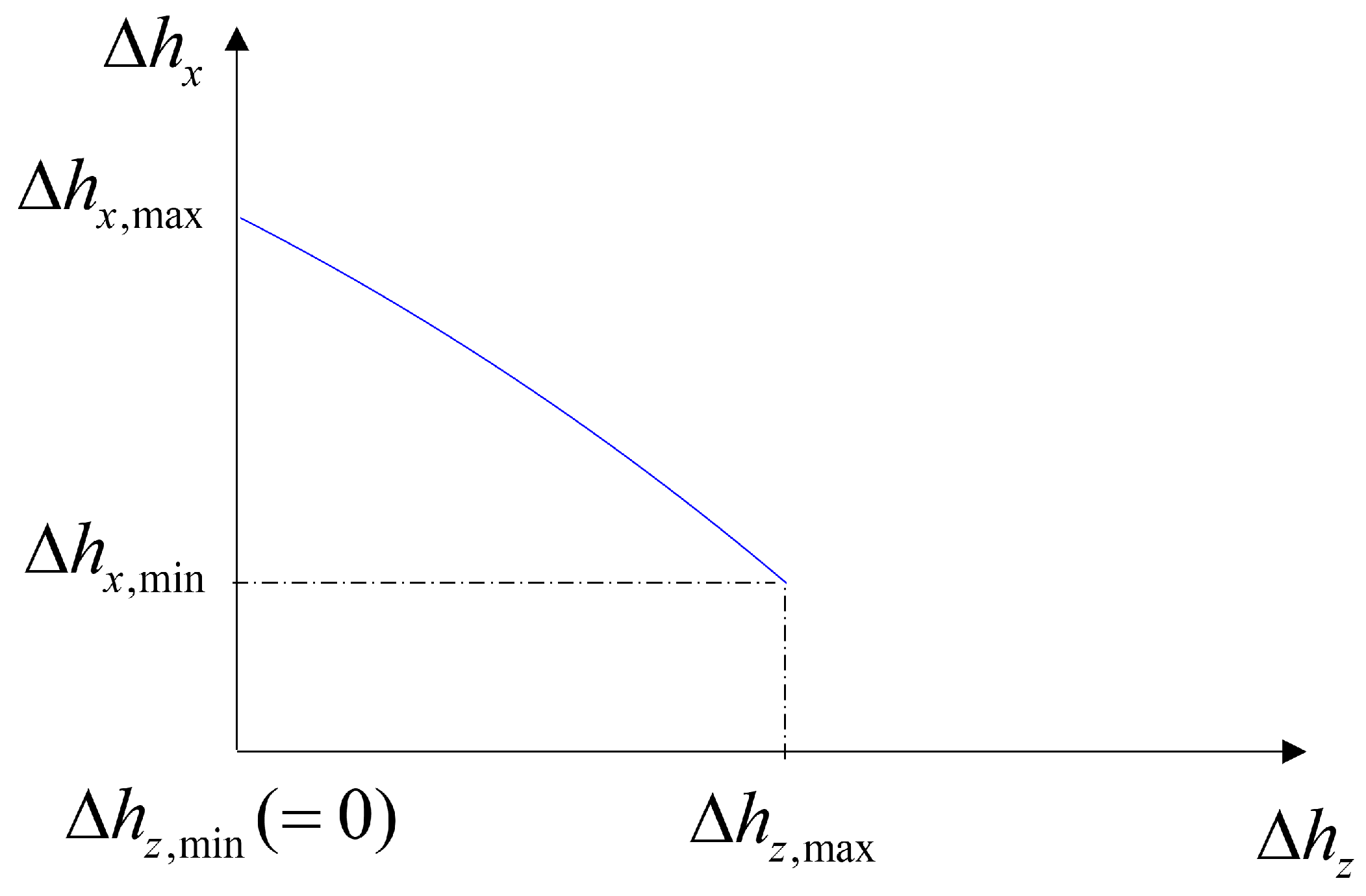
We assume that the rotation axis lies in the roll–yaw plane (i.e., XZ plane) such that only TPCMG#1 is sufficient for attitude maneuvering. Figure 7 introduces two designs of the CMG momentum envelope; one is to maximize the use of x-axis angular momentum (i.e., Δ h x ) and the other is to maximize the use of z-axis angular momentum (i.e., Δ h z ), respectively. It is assumed in this section that the gimbal angles at the start and the end of maneuvering are fixed, described as Point O in Figure 7, equivalent to the previous method. The corresponding gimbal angles will be called the nominal gimbal angles hereafter. Figure 8 shows the relationship between Δ h x and Δ h z from various CMG momentum spaces, including the two extreme cases at Δ h z = 0 and Δ h z = Δ h z , m a x described in Figure 7. Δ h x for the given Δ h z can easily be found by a numerical method.
In the following, the optimal solution of Δ h x and Δ h z for maximizing ω e i g in Equation (3) is derived. The optimal problem can be defined by
max ω e i g = max min Δ h x J x x | ϵ x | Δ h z J z z | ϵ z | max min ω ^ x ω ^ z
while Δ h x = Δ h x ( Δ h z )
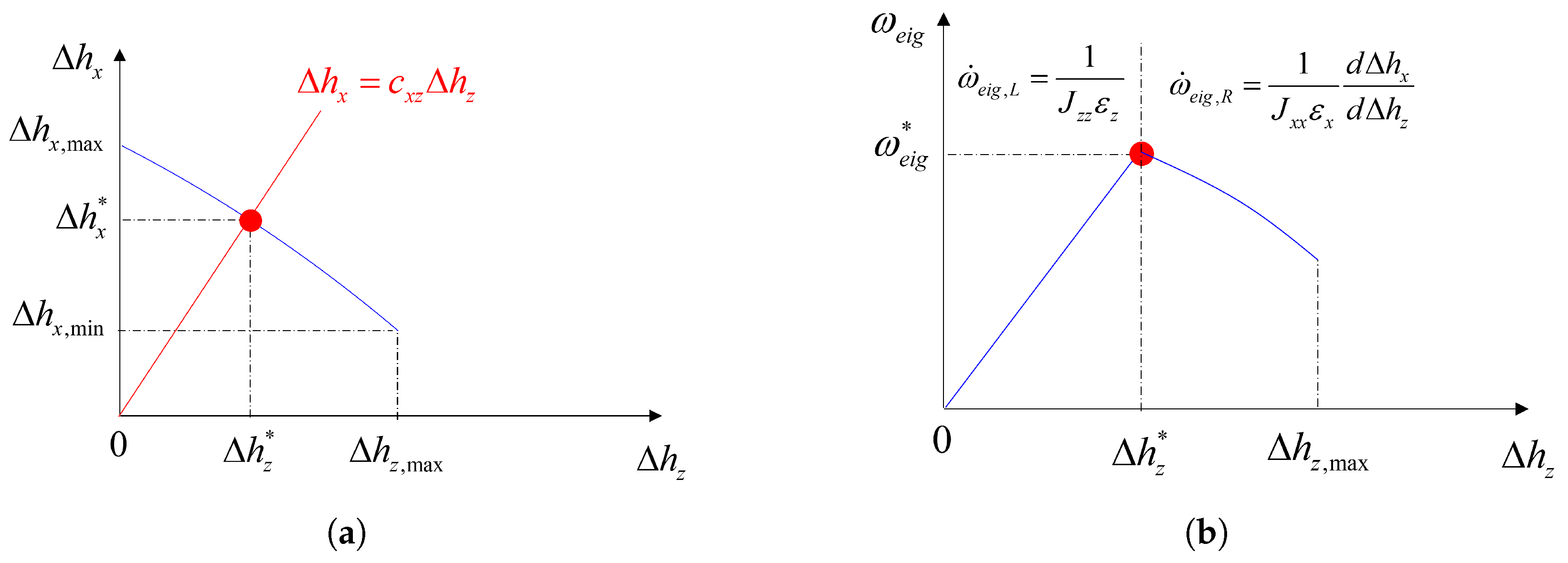
Note that ω e i g becomes a function of Δ h z because Δ h x is determined by Δ h z . Figure 9b illustrates the variation of ω e i g with Δ h z . In the figure, we can see that the sign of the slope of ω e i g changes at certain Δ h z denoted as Δ h z * in the figure. This is caused by the minimum function applied in Equation (10). In detail, when Δ h z is small, ω e i g is governed by the z-axis rotational speed, i.e., ω e i g = ω ^ z , and increases with Δ h z . However, when Δ h z increases up to the point at ω ^ z = ω ^ x , then ω e i g becomes ω ^ x afterwards, and decreases until Δ h z arrives at Δ h z , m a x . As a result, the optimal condition of ω e i g is obtained by
ω e i g = ω e i g * when ω ^ x = ω ^ z
On the other hand, the optimal solution can also be described in the Δ h z Δ h x plane in Figure 9a. It is located at an intersection of the Δ h x ( Δ h z ) curve and a linear function with the slope of c x z :
c x z J x x | ϵ x | J z z | ϵ z | .
It should be noted that the condition of Δ h x = c x z Δ h z is equivalent to the ω ^ x = ω ^ z condition, which can easily be derived by Equations (10) and (13). The optimal solution Δ h * = Δ h x * Δ h z * T can then be obtained by solving the following equation:
g = Δ h x ( Δ h z ) c x z Δ h z = 0
In Equation (14), the g function is monotonically decreasing so the optimal solution Δ h z * is unique if exists and can easily be found by a simple numerical root-finding method such as the Newton–Raphson method within a small number of iterations.
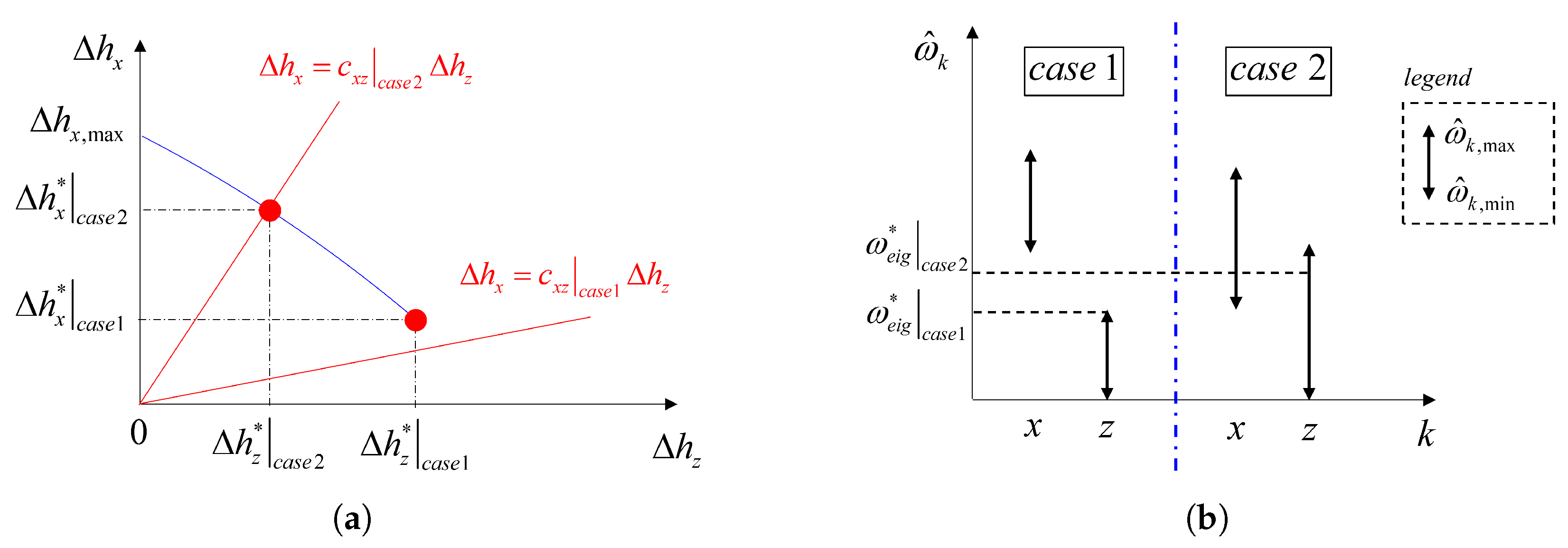
However, the intersection point in Figure 9a may not exist when c x z is smaller than Δ h z , m a x Δ h x , m i n . This case will be referred to Case 1 in this paper and depicted in Figure 10a. To sum up, the two cases can be defined by:
Case 1 if 0 c x z < c x z , c r i t Case 2 if c x z c x z , c r i t
where
c x z , c r i t = Δ h z , m a x Δ h x , m i n .
For Case 1, the optimal solution Δ h * is always [ Δ h x , m i n , Δ h z , m a x ] T regardless of c x z unlike Case 2. This is because in Case 1, ω e i g is always ω ^ z ; therefore, it increases until Δ h z reaches Δ h z , m a x .
At this point, we introduce a helpful chart to characterize ω ^ k , k = x , z in Figure 10b. It helps to visualize the classification of the two cases thanks to the ranges of ω ^ x and ω ^ z represented by the two-sided arrows. The boundaries of ω ^ k are obtained by [ Δ h x , m i n , Δ h x , m a x ] and [ Δ h z , m i n , Δ h z , m a x ] that can be seen in Figure 8. It should be noted, however, that ω ^ x and ω ^ z (i.e., ω ^ x and ω ^ z ) are dependent on each other. For example, ω ^ x is maximized with the minimum value of ω ^ z and vice versa. We can see on the left half of Figure 10b that in Case 1 ω ^ z < ω ^ x always holds, which is analogous to the c x z < c x z , c r i t condition. On the other hand, in Case 2, ω ^ x and ω ^ z overlap and ω e i g becomes optimal when ω ^ x = ω ^ z , which was mathematically formulated in Equation (12).

4.2. Three-Dimensional Problem

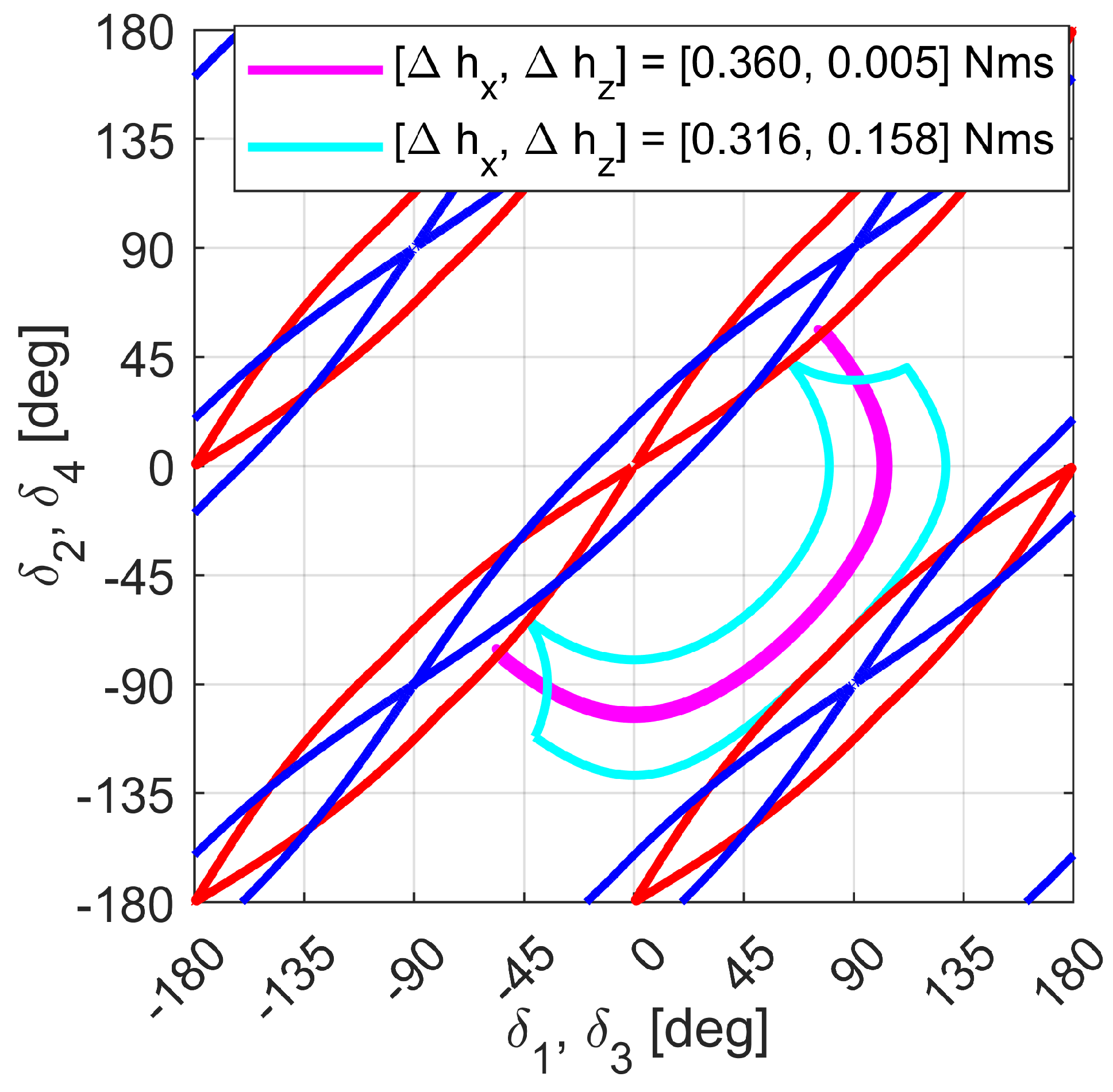
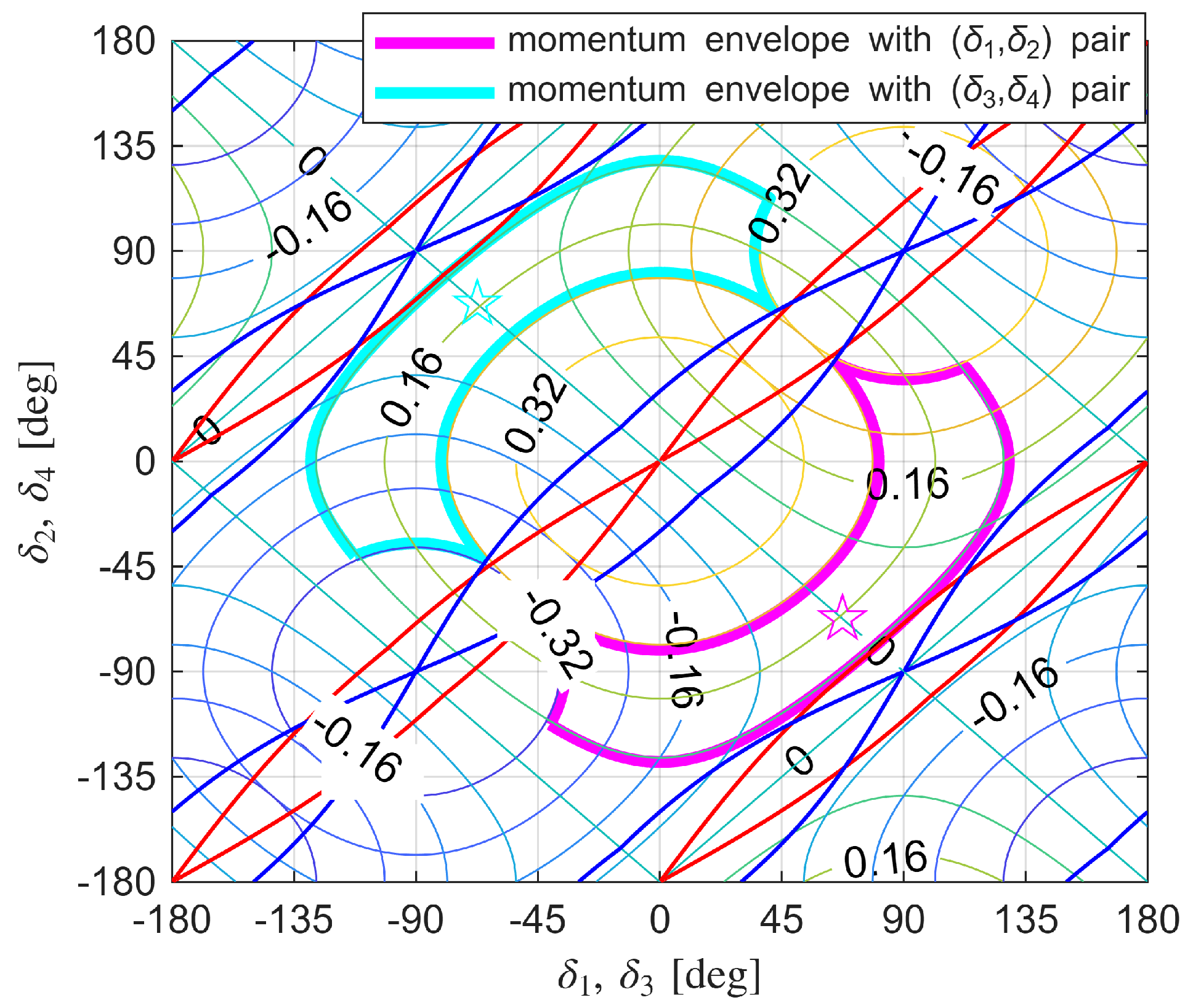
In a general three-dimensional attitude maneuvering problem, a full roof-array CMG configuration (i.e., four CMGs compared to the two CMGs in the previous section) is employed. Figure 11 represents an example of the momentum envelopes of the two TPCMGs on the gimbal plane, colored in cyan and purple, combined with the singularity lines (blue and red). Note that the figure shows only a single example of the possible momentum envelopes, which is to be optimized throughout this section to maximize ω e i g .
The main difference of design of CMG momentum envelopes in the 3D problem from that of the 2D problem is the increased number of optimal variables. Now, momentum envelopes of two TPCMGs rather than a single TPCMG need to simultaneously be designed. In detail, Δ h x and Δ h z of TPCMG1 and Δ h y and Δ h z of TPCMG2, depicted separately in Figure 11 are considered together. This results in greater number of solution cases: seven instead of two in the previous 2D problem. The seven cases may be interpreted as different combinations of active momentum bounds in the three-axis momentum space, depending on which axis-wise momentum capacities become dominant in limiting the achievable rotational speed for a prescribed maneuver direction.
The proposed method of optimal design of CMG momentum space is introduced as follows. First, the ranges of ω ^ k for k = x , y , z are obtained by Equation (3) with the rotation axis ϵ and the minimum and the maximum values of angular momenta of each TPCMG: Δ h x , m i n , Δ h x , m a x , Δ h z 12 , m i n , Δ h z 12 , m a x of TPCMG1 and Δ h y , m i n , Δ h y , m a x , Δ h z 34 , m i n , Δ h z 34 , m a x of TPCMG2 such that:
ω ^ x , m i n = Δ h x , m i n J x x | ϵ x | , ω ^ x , m a x = Δ h x , m a x J x x | ϵ x | ,
ω ^ y , m i n = Δ h y , m i n J y y | ϵ y | , ω ^ y , m a x = Δ h y , m a x J y y | ϵ y | ,
ω ^ z , m i n = 0 = Δ h z 12 , m i n + Δ h z 34 , m i n J z z | ϵ z | , ω ^ z , m a x = ω ^ z 12 , m a x + ω ^ z 34 , m a x ,
ω ^ z 12 , m a x = Δ h z 12 , m a x J z z | ϵ z | , ω ^ z 34 , m a x = Δ h z 34 , m a x J z z | ϵ z | .
Note that the only variables here are ϵ x , ϵ y , and ϵ z decided by the rotation axis ϵ .
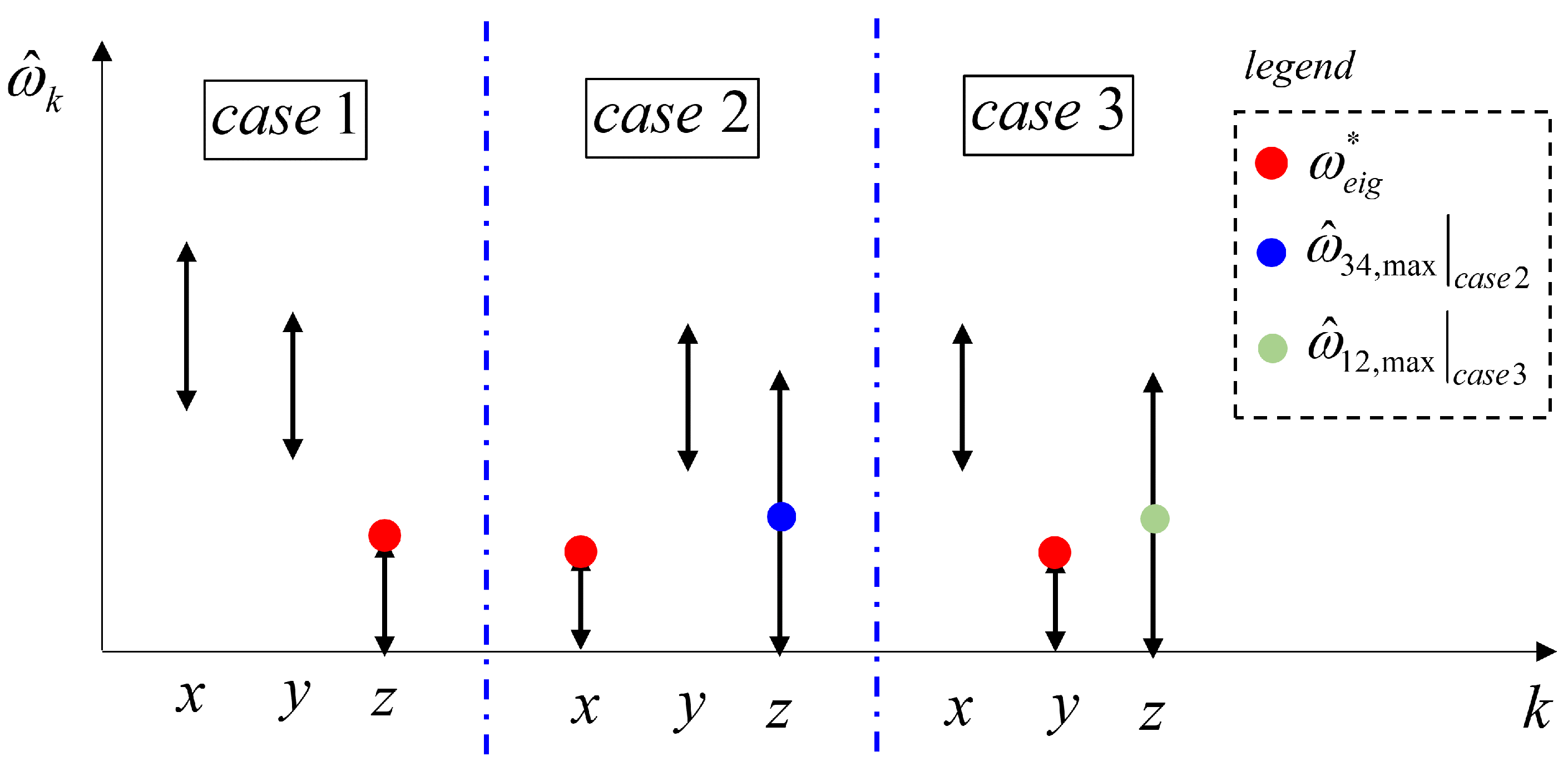
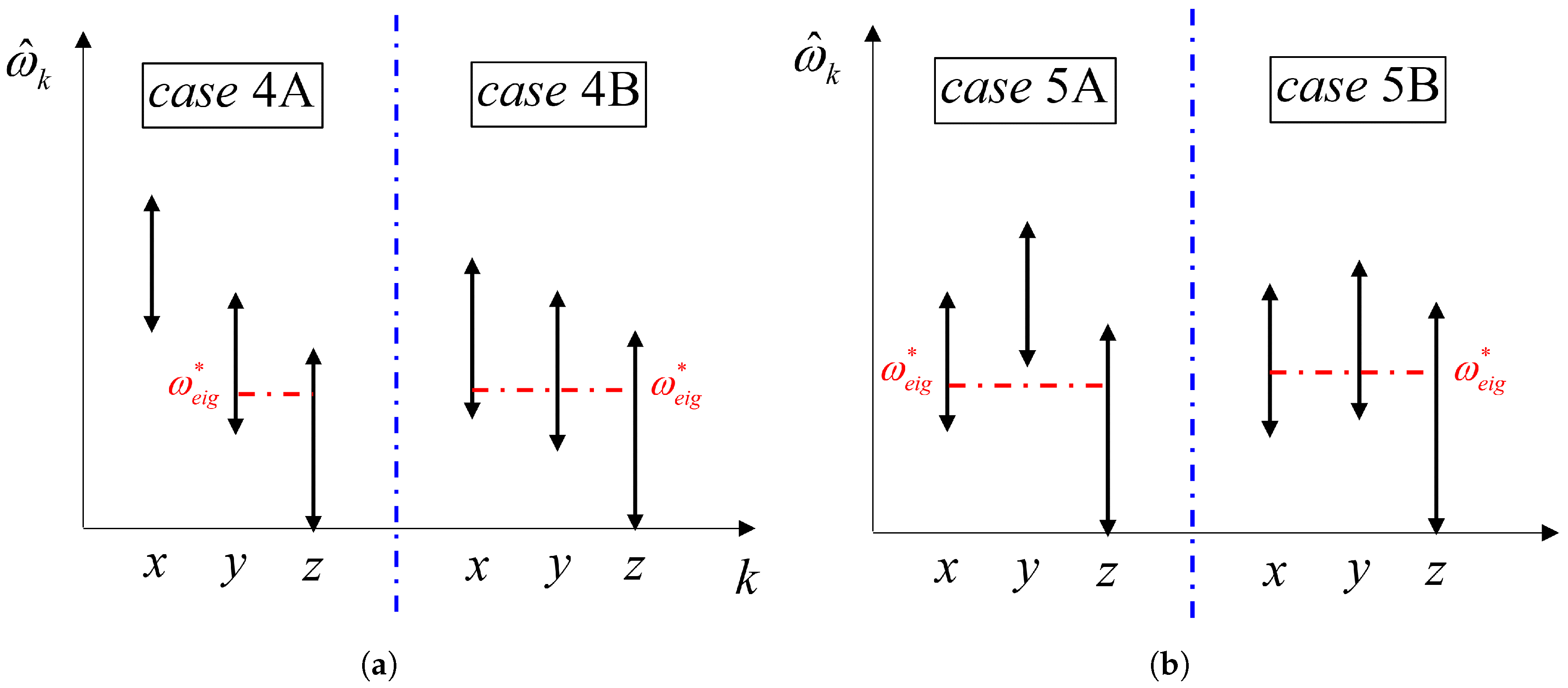
Second, we classify the problem into seven cases depending on the set of ω ^ k boundaries, summarized in Table 1. The solution cases are complete, i.e., they cover all possible combinations of ϵ . We first filter the problem into the first three cases (i.e., Cases 1, 2, and 3), then if it is not any of the cases, we compare ω ^ x , m i n with ω ^ y , m i n and divide into Cases 4 and 5. The procedure of the next division to Cases 4A, 4B, 5A, and 5B is presented in the next paragraph. Before that, we introduce Figure 12 and Figure 13, which visualize the seven cases on the ω ^ k charts. They illustrate the possible ranges of ω ^ k and the optimal solution ω e i g * of each case.
Finally, we find the optimal CMG momentum envelope Δ h * and corresponding maximum rotation speed ω e i g * for each case. For the first three cases from Case 1 to 3, the optimal problems are simple because the maximum values of ω ^ k of the three axes are ω e i g * with k = z for Case 1, k = x for Case 2, and k = y for Case 3. This can be graphically confirmed in Figure 12. On the other hand, if the problem falls in Case 4, we first find ω e i g * assuming Δ h x * = Δ h x , m i n or equivalently ω ^ x * = ω ^ x , m i n , which means we fix the momentum envelope of TPCMG1 and optimize ω e i g by designing the TPCMG2 momentum envelope. This particular solution, ω e i g * , is denoted by ω ^ y or equivalently ω ^ z in Table 1 and can easily be found by solving the following equation:
Δ h y c y z Δ h z = 0
where
Δ h z = Δ h z 12 , m a x + Δ h z 34 ,
c y z J y y | ϵ y | J z z | ϵ z | .
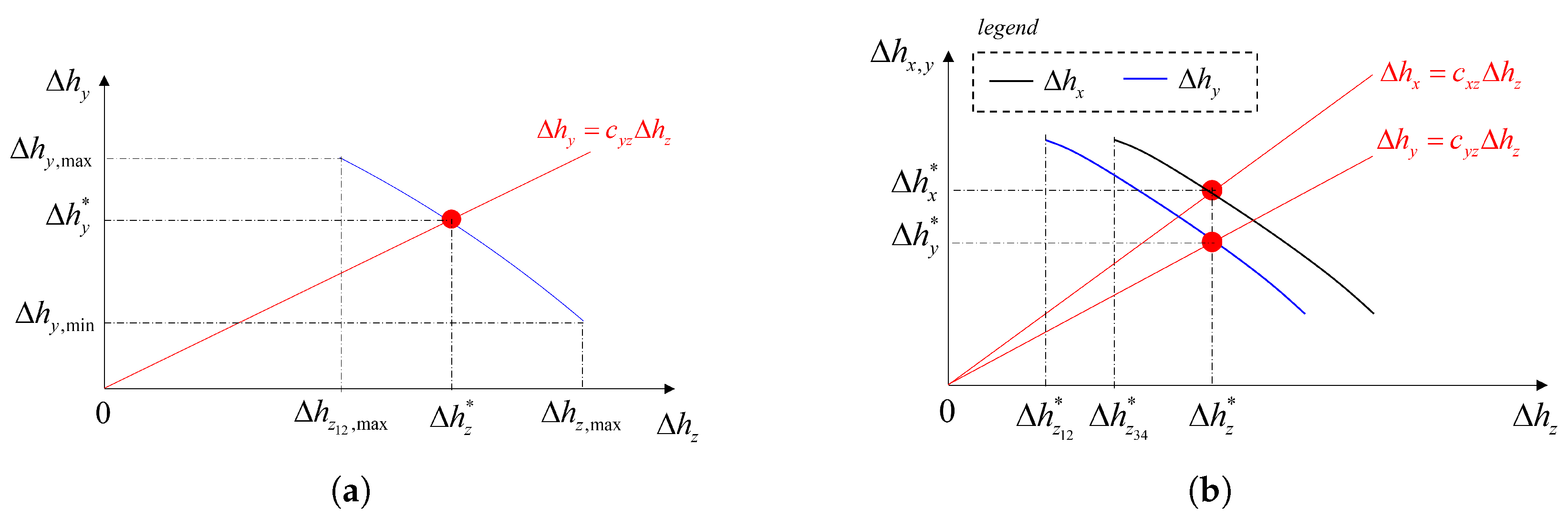
Note that the only variable in Equation (20) is Δ h z 34 since Δ h y is a function of Δ h z 34 for the TPCMG2 similar to Figure 8 of TPCMG1. Then, if ω ^ x , m i n is larger than ω ^ y , the assumption of Δ h x * = Δ h x , m i n becomes valid, which is denoted as Case 4A. The optimal solutions on the ω ^ k and Δ h * charts are presented in Figure 13a and Figure 14a. On the contrary, if ω ^ x , m i n ω ^ y , the problem falls into Case 4B, and Δ h x * is no longer Δ h x , m i n . We can find the optimal solution Δ h * by solving the following simultaneous equations:
Δ h x c x z ( Δ h z 12 + Δ h z 34 ) = 0 Δ h y c y z ( Δ h z 12 + Δ h z 34 ) = 0
with two variables: Δ h z 12 and Δ h z 34 . Figure 14b shows Δ h * along with the Δ h x and Δ h y curves versus Δ h z .
Next, Cases 5A and 5B consider the ω ^ x , m i n ω ^ y , m i n condition while their optimal solutions can similarly be derived with Cases 4A and 4B, respectively. In Case 5A, Δ h y * becomes Δ h y , m i n and ω ^ x or ω ^ z , obtained by solving
Δ h x c x z ( Δ h z 12 + Δ h z 34 , m a x ) = 0 ,
becomes ω e i g * , which is similar to Case 4A in Equation (20). Lastly, the equations for optimal solution of Case 5B are equivalent to that of Case 4B given in Equation (23).

5. Numerical Examples

5.1. Simulation Conditions

Numerical studies are provided to demonstrate the performance of the proposed method of CMG momentum envelope design. The diagonal elements of the satellite moments of inertia are set to [ J x x , J y y , J z z ] = [ 6 , 6 , 3 ] kg m 2 while the off-diagonal elements are zero. The selected inertia values are used only for representative numerical demonstration; although the inertia matrix affects the mapping from angular momentum to angular velocity and thus the resulting angular velocity envelope, the proposed momentum envelope design framework is not restricted to these specific values.
For a CMG, the angular momentum h is 0.2 Nms , the maximum gimbal speed δ ˙ m a x is 2 rad / s , and the maximum torque τ m a x is 0.4 Nm . The user-defined inputs used to draw the singularity lines, the blue and the red solid lines in Figure 4a, are τ l b = [ 0.12 , 0.12 , 0.06 ] T Nm for the lower bounds on the maximum torque and δ ˙ m a x = [ 1.55 , 1.55 , 0.45 ] T rad / s for the maximum gimbal rates allocated to each axis. The initial gimbal angles are assumed to be δ = [ 67 , 67 , 67 , 67 ] T deg. Note that the proposed method does not require modification of the initial gimbal angles between maneuvers, because the designed momentum envelope for a prescribed maneuver direction is determined under a fixed initial gimbal configuration rather than through physical reconfiguration of the CMG assembly.
The variable in this simulation is the eigen-axis unit vector ϵ = [ ϵ x , ϵ y , ϵ z ] T . Each vector component ranges from 1 to 1 but the vector must satisfy the norm constraint | | ϵ | | 2 = 1 .

5.2. Numerical Results

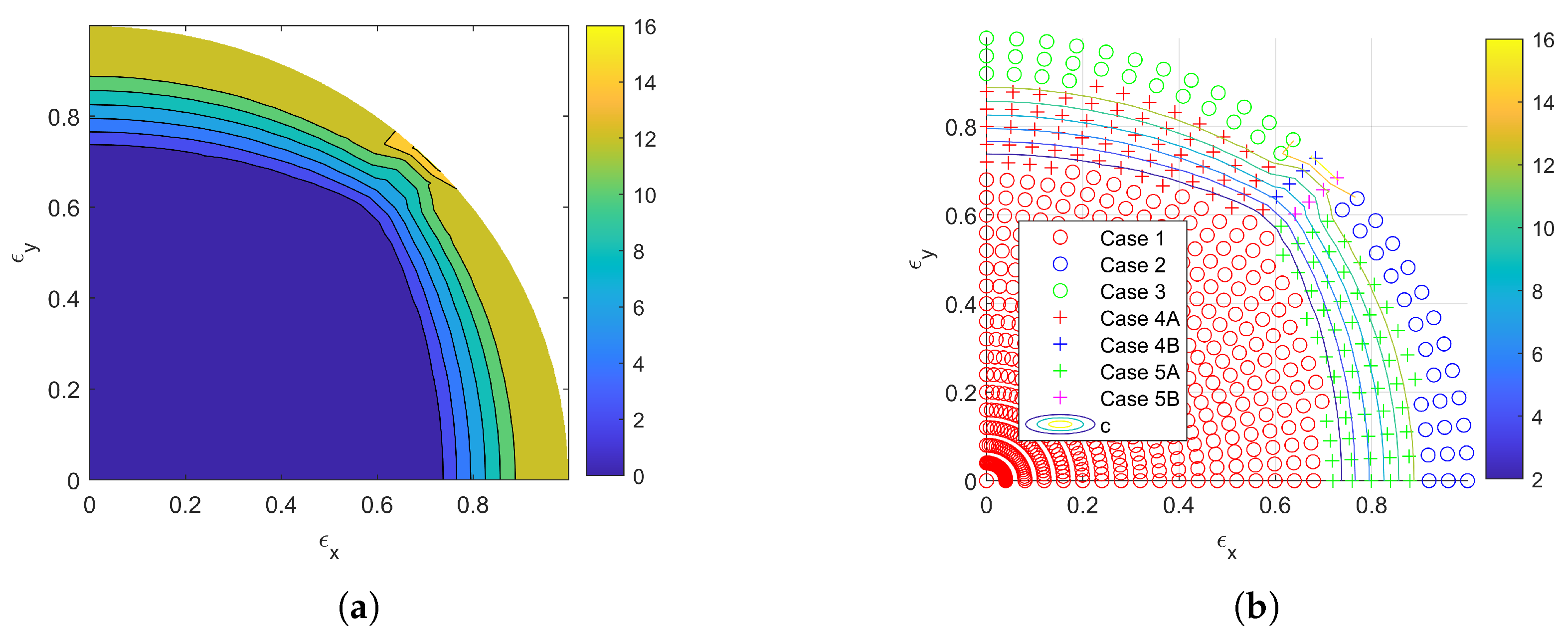
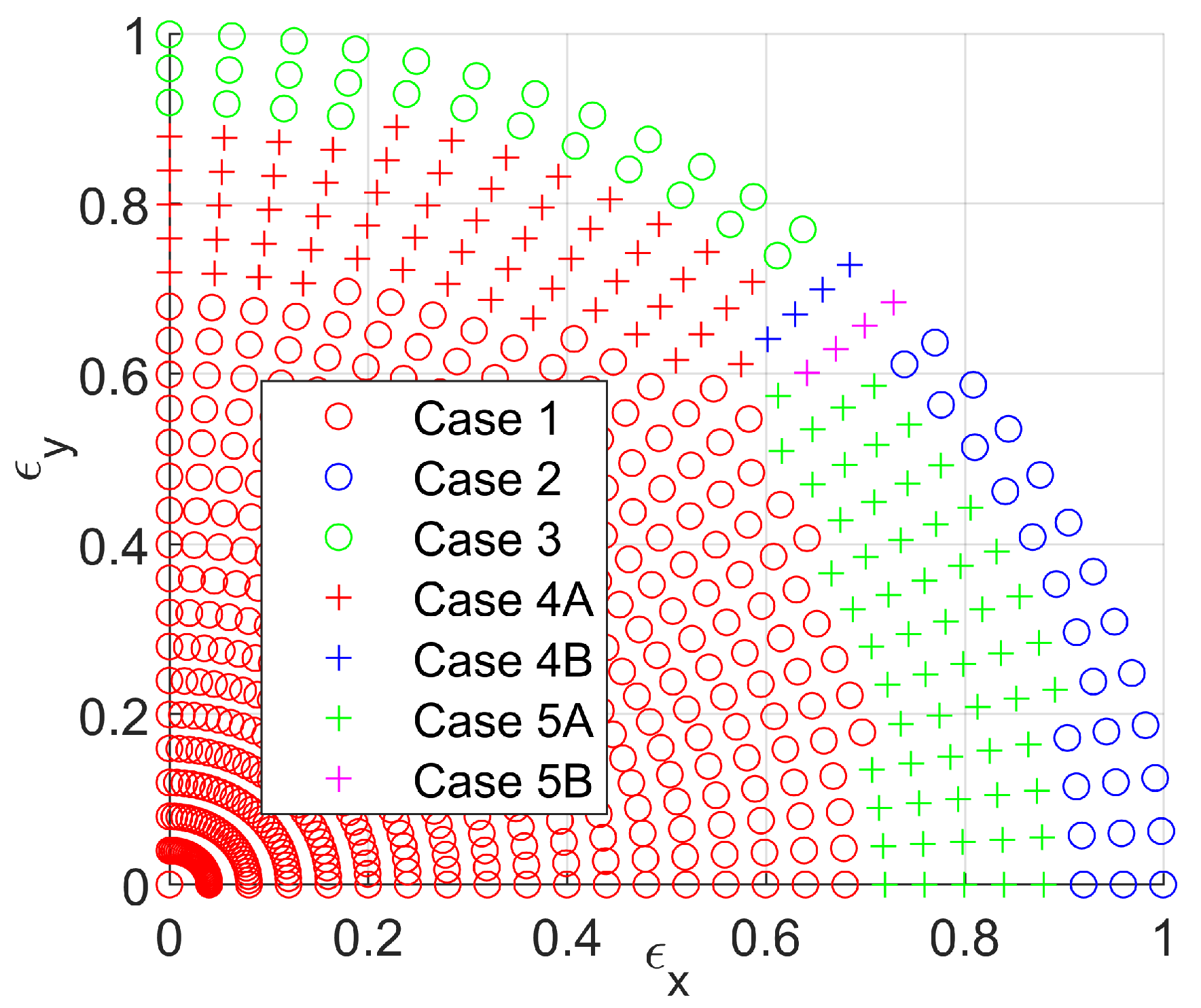
For the given rotation axis ϵ , the proposed method aims to design the CMG momentum envelopes Δ h that maximize the rotation speed ω e i g , formulated in Equation (8). Following the three steps in Section 4.2, we first calculate the boundary values of Δ h . They are [ Δ h x , m i n , Δ h x , m a x ] = [ 0.316 , 0.360 ] Nms , [ Δ h y , m i n , Δ h y , m a x ] = [ 0.316 , 0.360 ] Nms , and [ Δ h z 12 , m a x , Δ h z 34 , m a x , Δ h z , m a x ] = [ 0.079 , 0.079 , 0.158 ] Nms . Next, we obtain the boundary values of ω ^ k , k = x , y , z , and then classify the problem into the seven cases in Table 1. Figure 15 shows 676 samples of ϵ on the ϵ x ϵ y plane with the labels on their relevant cases. The samples shown in the figure are not intended to provide uniform coverage of the unit sphere. Rather, they are plotted on the ϵ x ϵ y plane to visualize the categorization of the solution cases and the directional trends of the proposed method under the unit-norm constraint | ϵ | 2 = 1 . Accordingly, the present sampling is used for illustrative case classification rather than for a statistical all-direction performance evaluation.
In the following, case studies are provided for each solution case on the design of Δ h and its optimal solution ω e i g * .

5.2.1. Case Studies

First, Case 1 in Table 2 refers to the condition when the rotation axis is close to the z-axis, in other words, when the z-axis component of ϵ , ϵ z , is more dominant than the off-yaw-axes: ϵ x and ϵ y . This relationship can be seen in Figure 15 where the samples in the left lower area comprise Case 1. For example, the sample with ϵ = [ 0.2 , 0.4 , 0.894 ] T is classified into Case 1 since ω ^ z , m a x is smaller than ω ^ x , m i n and ω ^ y , m i n . The boundary values of ω ^ k are summarized in Table 2. Next, the optimal solutions, ω e i g * and Δ h * , can be found according to Table 1, resulting in ω e i g * = 3.36 °/s and Δ h * = [ 0.316 , 0.316 , 0.158 ] T Nms , respectively. Meanwhile, for Case 1, the rotation speeds ω e i g of the previous and the proposed methods are the same. This is because the previous method sets (and sticks to) Δ h z = Δ h z , m a x , Δ h x = Δ h x , m i n , and Δ h y = Δ h y , m i n , which is the optimal condition of the proposed method in Table 1. Hence, there is no improvement on maneuverability (i.e., increase of ω e i g ) when ϵ corresponds to Case 1.
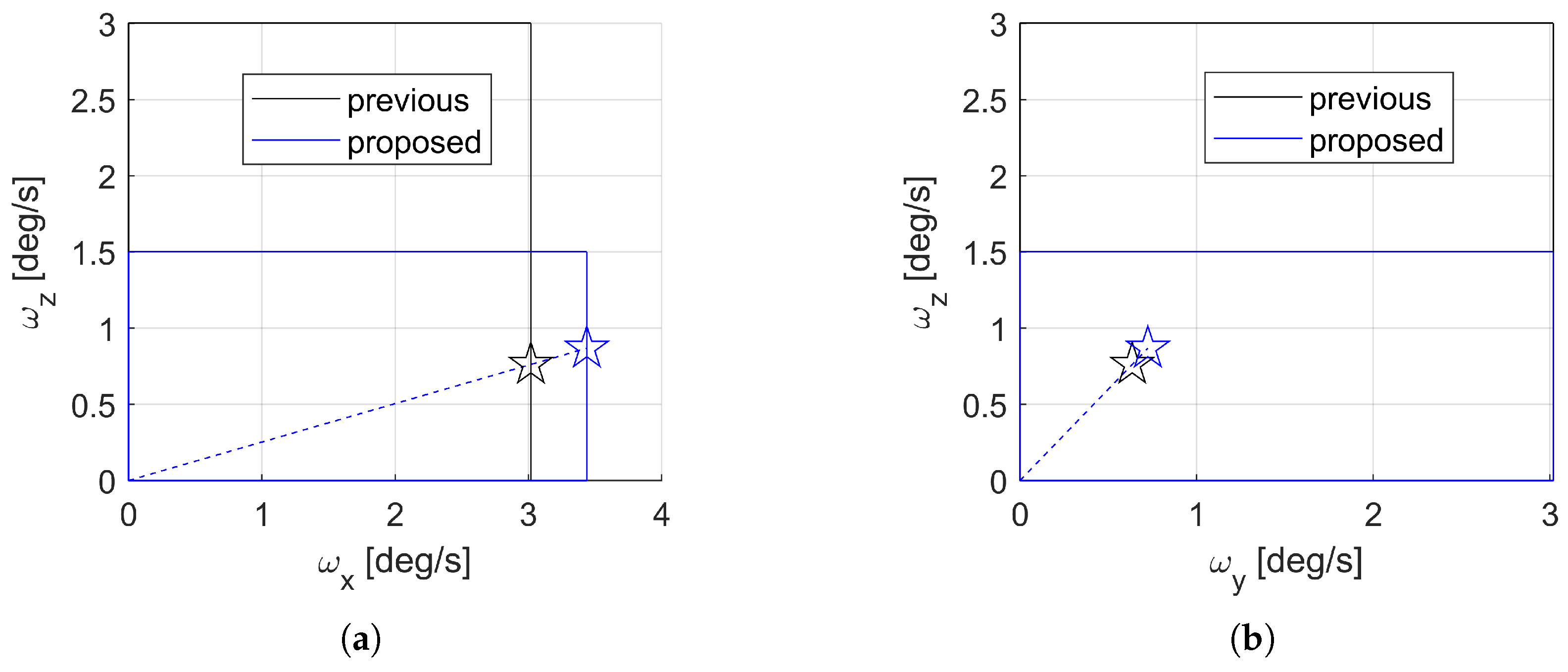
Second, the Case 2 sample with ϵ = [ 0.95 , 0.2 , 0.24 ] T is investigated. The rotation axis is almost parallel to the x-axis so it can be predicted that the concentration of the CMG assembly momentum on the x-axis Δ h x will be beneficial for increasing ω e i g . This insight is analogous to the proposed solution of Case 2 in Table 1. The optimal solution is ω e i g * = 3.62 °/s with Δ h * = [ 0.360 , 0.316 , 0.079 ] T Nms . It is greater than the solution with the previous method, 3.18 °/s, by 13.9 percent. The advantage of the proposed solution can be seen on the angular rate envelopes in Figure 16. The left figure shows the extension of ω e i g by the pentagon markers along with the maximum angular rates ω m a x * obtained by Δ h * .
Third, Case 4A is considered with the ϵ = [ 0.09 , 0.82 , 0.57 ] T condition. With this sample, ω ^ y = ω ^ z = 3.97 °/s, which is smaller than ω ^ x = 33.54 °/s in Table 2, and conforms to the Case 4A condition in Table 1. The optimal solution ω e i g * becomes 3.97 °/s, which is equivalent to ω ^ y and larger than that of the previous method by 7.9 percent. The corresponding CMG momentum sizes are [ 0.316 , 0.341 , 0.118 ] T Nms .
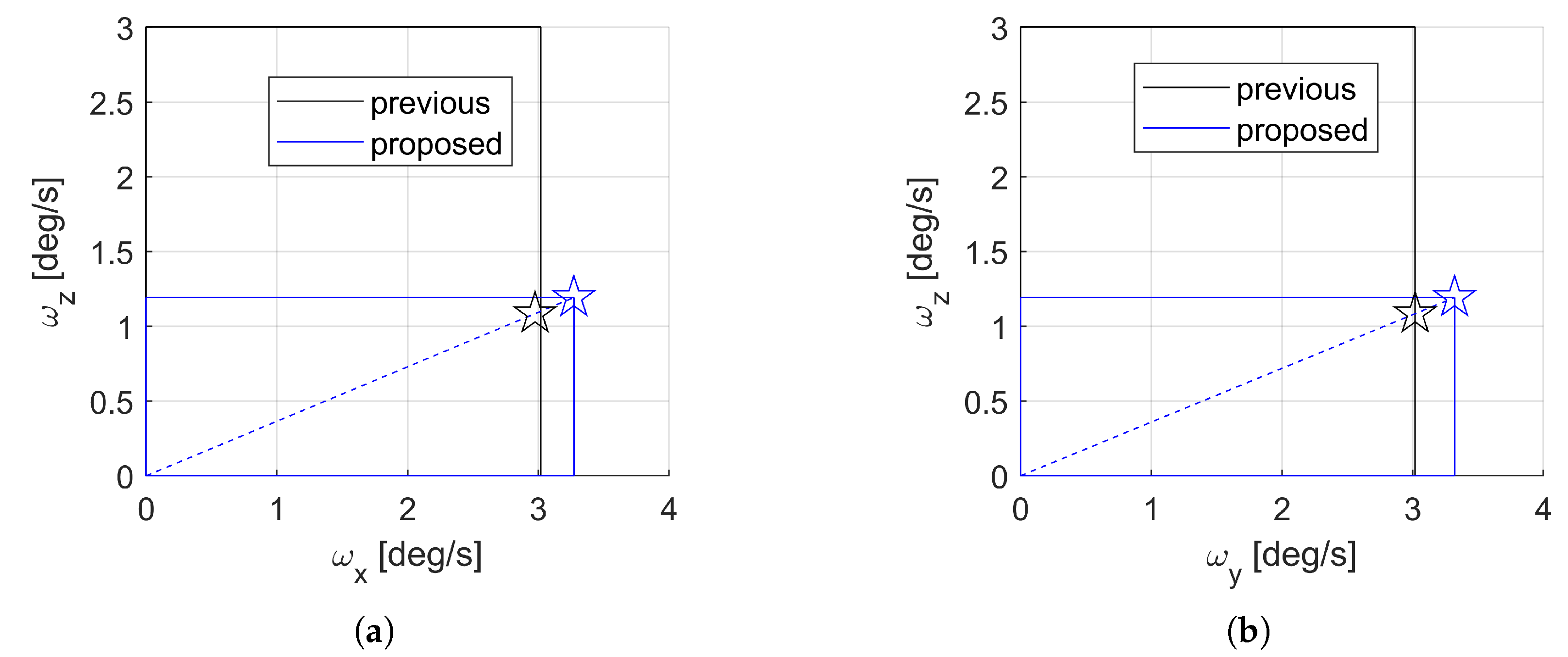
Finally, the Case 4B condition can be generated with ϵ = [ 0.68 , 0.69 , 0.25 ] T . In this case, ω ^ y = ω ^ z = 5.05 °/s becomes larger than ω ^ x = 4.44 °/s. Thus, all CMG momentum components need to be designed together from Equation (23). The equation leads to the solution of optimal CMG momentum Δ h * = [ 0.343 , 0.348 , 0.062 ] T Nms while Δ h z * comes from Δ h z 12 * = 0.036 Nms and Δ h z 34 * = 0.026 Nms . The corresponding rotation speed ω e i g * is 4.81 °/s, which is about 10.0 percent larger than 4.37 °/s of the previous method. Figure 17 again shows ω m a x * of the previous and the proposed methods with the allowable angular rates.

5.2.2. Integrated Analysis

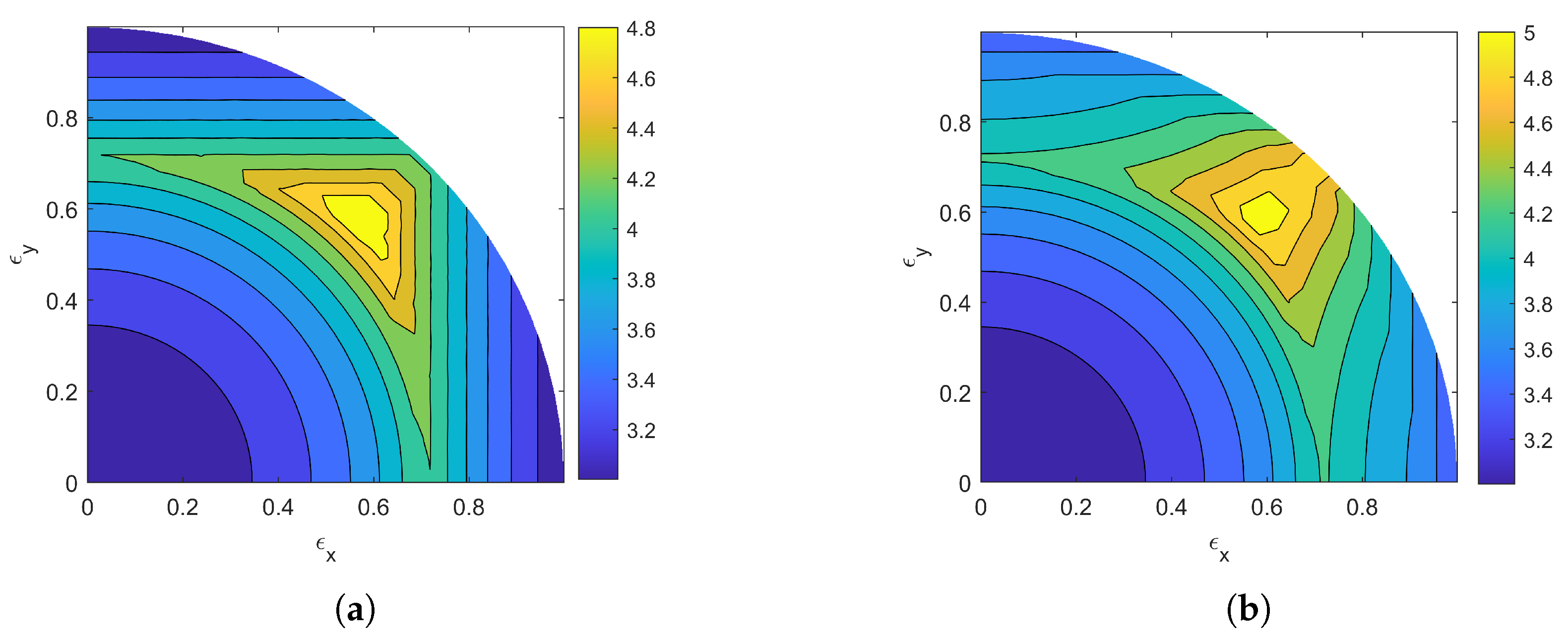
Figure 18 shows the contours of rotation speeds of 676 samples spread over ϵ x and ϵ y . The difference between the previous and the proposed methods can easily be seen in Figure 19a. The improvement of ω e i g from the proposed method is enhanced with larger ϵ x and ϵ y , for which the modification of the CMG momentum envelopes becomes more beneficial. In detail, allocation of marginal Δ h z onto Δ h x and/or Δ h y is effective for improving maneuverability. Figure 19b shows in which case and how much increase of ω e i g occurs by adding the case markers. It can again be confirmed, aside from the conditions under which the z-axis maneuver is dominant (i.e., Case 1), the proposed method can aid in more agile maneuvers by effectively utilizing the CMG momentum space.

5.2.3. Attitude Control Performance Comparison with Various Steering Laws

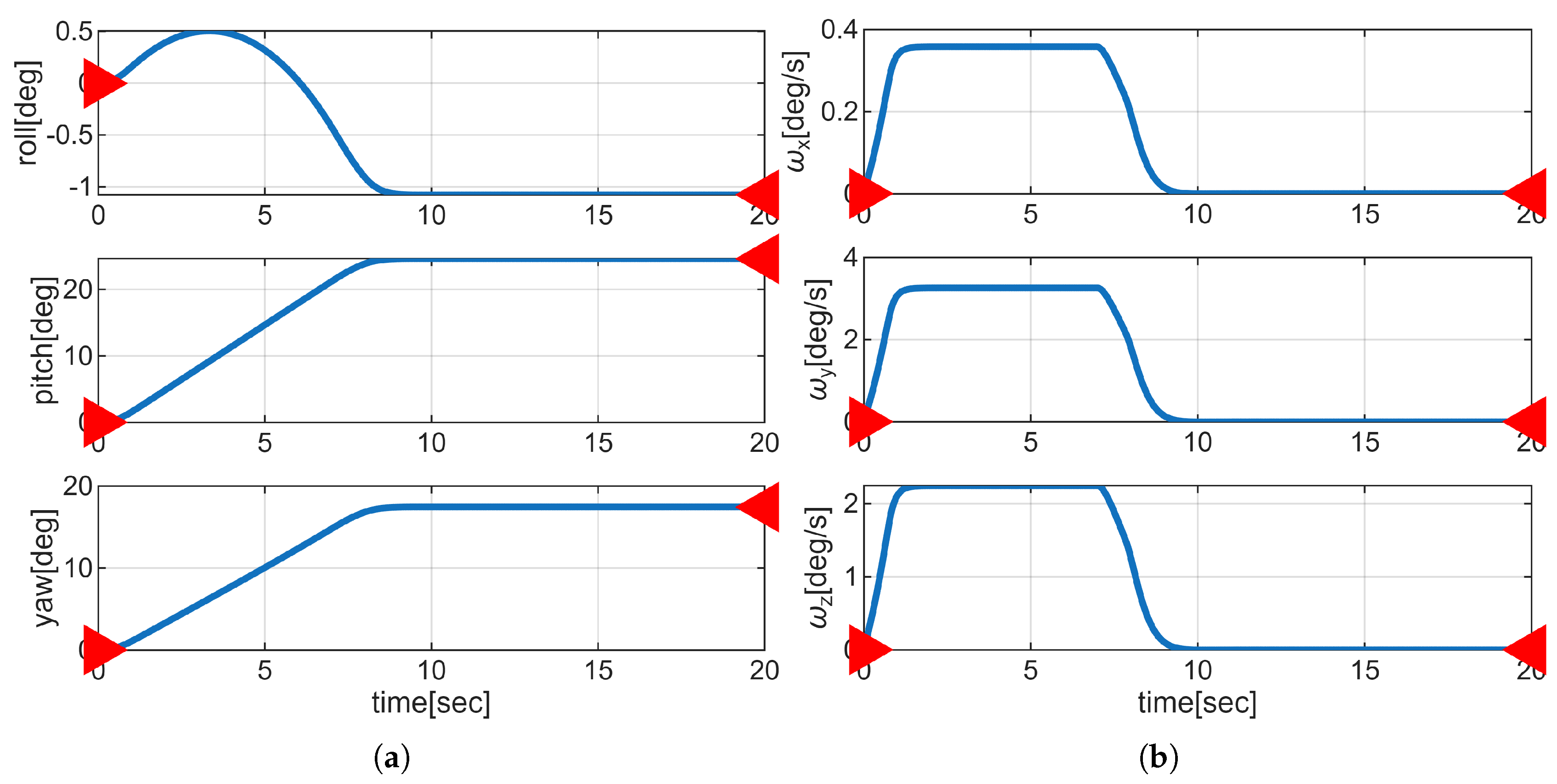
To further examine the practical significance of the proposed envelope design beyond the comparison with [20], additional simulations are conducted using representative conventional CMG steering laws. First, the proposed steering logic is applied to a rest-to-rest reorientation maneuver. The rotation axis is set to ϵ = [ 0.09 , 0.82 , 0.57 ] T , which corresponds to Case 4A in Table 2. The rotation angle is 30°. The maximum angular momentum and angular velocity components obtained by solving Equation (9) are h * = [ 0.32 , 0.34 , 0.12 ] T Nms and ω * = [ 0.36 , 3.26 , 2.25 ] °/s, respectively.
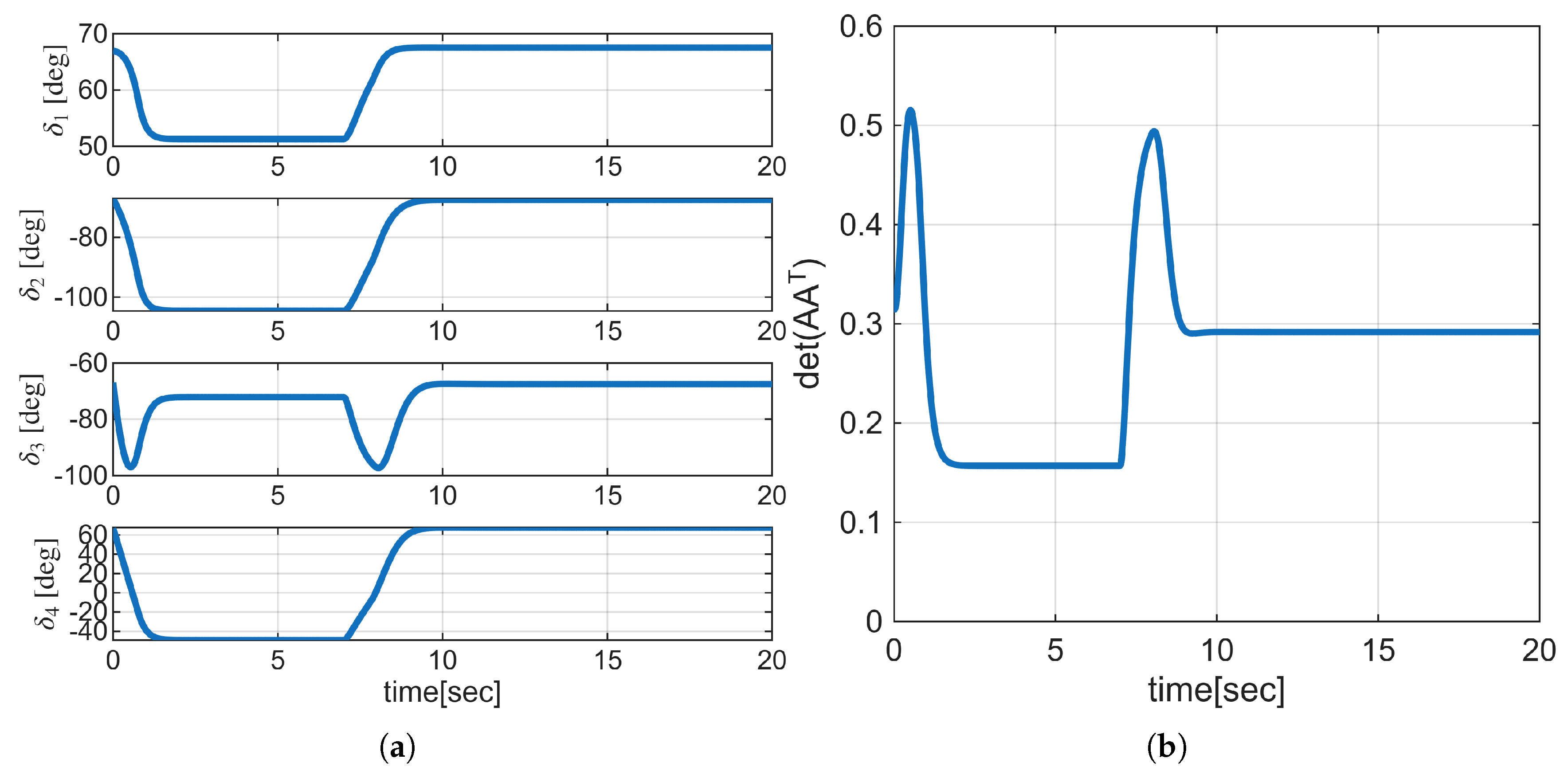
Figure 20 shows the histories of the satellite attitude and angular velocity. As shown in Figure 20b, the angular velocity components remain bounded by ω * , thereby keeping the gimbal angles within the singularity-free region. In Figure 20a, the Euler parameters vary smoothly and converge to the desired attitude at approximately 8.9 s. Figure 20 also presents the histories of the gimbal angles and the singularity index. The gimbal angles evolve smoothly, indicating that the gimbal commands generated within the designed CMG envelope are not abrupt and are readily trackable. In addition, the singularity index remains well above zero throughout the maneuver, implying that sufficient torque capability is maintained for compensating possible perturbation torques.
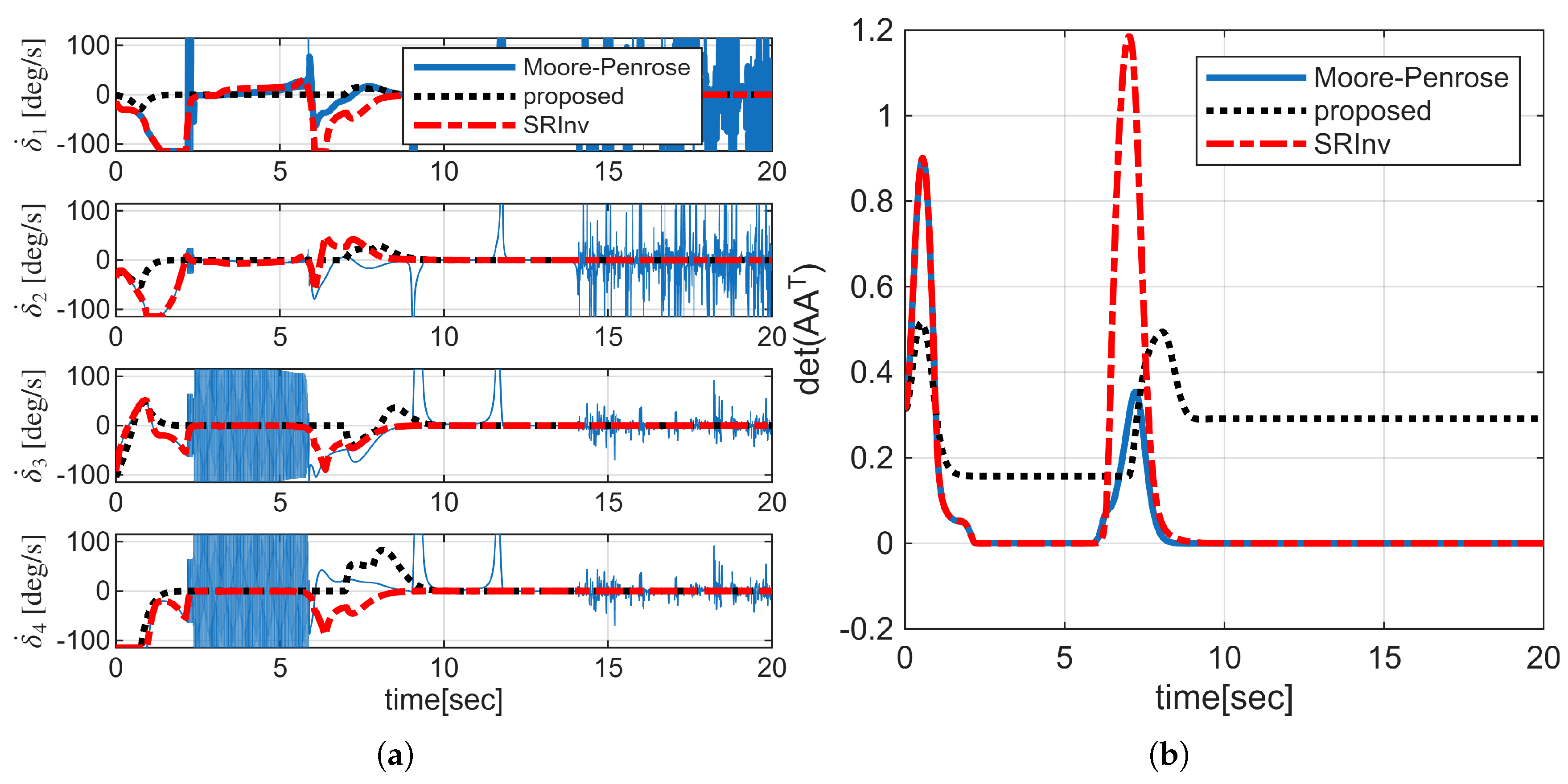
For further performance comparison, two well-known CMG steering laws are applied under the same simulation condition: the Moore–Penrose steering law (i.e., the simple pseudo-inverse law) [11] and the singularity robust inverse law [10]. Figure 21 presents the gimbal angles and singularity indices during the maneuver. A notable observation in Figure 22 is that the Moore–Penrose law exhibits chattering as the system approaches a near-singular condition. This behavior is confirmed in Figure 22b, where det A A T approaches zero during the maneuver. Similarly, under the singularity robust inverse law, det A A T also remains close to zero, although severe chattering is not observed as in the Moore–Penrose case. This is because a scalar multiple of the identity matrix is added within the inverse operator [10], which regularizes the inversion near singularity at the expense of torque command accuracy. By contrast, with the proposed method, chattering does not occur, and the gimbal geometry remains sufficiently separated from the singular condition.

6. Conclusions

This paper proposed a strategy for optimal momentum envelope design of a roof-array CMG assembly for improving spacecraft maneuverability. The momentum envelope that maximizes the eigen-axis rotation speed while ensuring singularity avoidance was determined. The optimization problem was formulated to maximize the eigen-axis rotation speed, which was then rearranged as a max-min problem in terms of three-axis momentum components. Since momentum sizes along the three axes are dependent on each other, the rotation speed was maximized by optimally exchanging the momentum between each axis. The cost function is a monotonic function and a standard Newton–Raphson method was able to obtain the numerical solution within a few iterations. The characteristic of low computational burden can enable its on-board use and even instant computation if optimal momentum envelopes for various rotation axes are precomputed and converted into a look-up table offline then searching for corresponding indices and performing interpolation onboard.
Future work may proceed in several directions. First, since the present study focused on eigen-axis rest-to-rest maneuvers, it would be meaningful to extend the proposed framework to more general attitude maneuver conditions. Second, incorporating practical factors such as actuator limitations and closed-loop steering/control strategies would further enhance the applicability of the method. Finally, the maneuver-dependent momentum envelope design concept may be extended to other CMG configurations or broader momentum exchange actuator systems.

Author Contributions

Conceptualization, S.-H.M. and H.L.; methodology, S.-H.M.; software, S.-H.M. and D.-H.C.; validation, S.-H.M.; formal analysis, S.-H.M.; investigation, S.-H.M.; writing—original draft preparation, S.-H.M.; writing—review and editing, S.-H.M. and H.L.; visualization, S.-H.M. All authors have read and agreed to the published version of the manuscript.

Funding

This research received no external funding.

Data Availability Statement

The data presented in this study are available on request from the corresponding author. The data are not publicly available due to privacy restrictions.

Conflicts of Interest

The authors declare no conflicts of interest.

References

  1. Votel, R.; Sinclair, D. Comparison of Control Moment Gyros and Reaction Wheels for Small Earth-Observing Satellites. In Proceedings of the 26th AIAA/USU Conference on Small Satellites, North Logan, UT, USA, 13–16 August 2012. [Google Scholar]
  2. Peck, M. Low-Power, High-Agility Space Robotics. In Proceedings of the AIAA Guidance, Navigation, and Control Conference and Exhibit, San Francisco, CA, USA, 15–18 August 2005. [Google Scholar] [CrossRef]
  3. Gleyzes, M.A.; Perret, L.; Kubik, P. Pleiades System Architecture and Main Performances. Int. Arch. Photogramm. Remote Sens. Spat. Inf. Sci. 2012, XXXIX-B1, 537–542. [Google Scholar] [CrossRef]
  4. Anderson, N.T.; Marchisio, G.B. WorldView-2 and the evolution of the DigitalGlobe remote sensing satellite constellation: Introductory paper for the special session on WorldView-2. In Proceedings of the Algorithms and Technologies for Multispectral, Hyperspectral, and Ultraspectral Imagery XVIII; Shen, S.S., Lewis, P.E., Eds.; International Society for Optics and Photonics; SPIE: Bellingham, WA, USA, 2012; Volume 8390, p. 83900L. [Google Scholar] [CrossRef]
  5. Votel, R.; Sinclair, D. COSMO Second Generation: State of art technologies and system innovations for Earth Observation servicing excellence. In Proceedings of the 1st Workshop Nazionale, Roma, Italy, 16–20 September 2017. [Google Scholar]
  6. Gaude, A.; Lappas, V. Design and Structural Analysis of a Control Moment Gyroscope (CMG) Actuator for CubeSats. Aerospace 2020, 7, 55. [Google Scholar] [CrossRef]
  7. Lappas, V.; Steyn, W.; Underwood, C. Attitude control for small satellites using control moment gyros. Acta Astronaut. 2002, 51, 101–111. [Google Scholar] [CrossRef]
  8. Wie, B. Singularity Analysis and Visualization for Single-Gimbal Control Moment Gyro Systems. J. Guid. Control Dyn. 2004, 27, 271–282. [Google Scholar] [CrossRef]
  9. Nakamura, Y.; Hanafusa, H. Inverse kinematic solutions with singularity robustness for robot manipulator control. J. Dyn. Syst. Meas. Control. 1986, 108, 163–171. [Google Scholar] [CrossRef]
  10. Wie, B.; Bailey, D.; Heiberg, C. Singularity robust steering logic for redundant single- gimbal control moment gyros. AIAA Guid. Navig. Control Conf. Exhib. 2000, 24, 865–872. [Google Scholar] [CrossRef]
  11. Bedrossian, N.S.; Paradise, J.; Bergmann, E.V.; Rowell, D. Steering law design for redundant single-gimbal control moment gyroscopes. J. Guid. Control Dyn. 1990, 13, 1083–1089. [Google Scholar] [CrossRef]
  12. Leeghim, H.; Lee, C.Y.; Jin, J.; Kim, D. A Singularity-free Steering Law of Roof Array of Control Moment Gyros for Agile Spacecraft Maneuver. Int. J. Control Autom. Syst. 2020, 18, 1679–1690. [Google Scholar] [CrossRef]
  13. Wie, B. Singularity Escape/Avoidance Steering Logic for Control Moment Gyro Systems. J. Guid. Control Dyn. 2005, 28, 948–956. [Google Scholar] [CrossRef]
  14. Wu, Y.; Zheng, M.; He, M.; Zhang, D.; He, W.; Hua, B.; Chen, Z.; Wang, F. Cooperative Game Theory-Based Optimal Angular Momentum Management of Hybrid Attitude Control Actuator. IEEE Access 2018, 7, 6853–6865. [Google Scholar] [CrossRef]
  15. Leeghim, H.; Kim, D. Singularity-robust control moment gyro allocation strategy for spacecraft attitude control in the presence of disturbances. Aerosp. Sci. Technol. 2021, 119, 107178. [Google Scholar] [CrossRef]
  16. Geshnizjani, R.; Kornienko, A.; Ziegler, T.; Löhr, J.; Fichter, W. Torque Optimal Steering of Control Moment Gyroscopes for Agile Spacecraft. J. Guid. Control Dyn. 2021, 44, 629–640. [Google Scholar] [CrossRef]
  17. Papakonstantinou, C.; Lappas, V.J.; Schaub, H.; Kostopoulos, V. Global Steering for Control Moment Gyroscope Clusters Using Heuristic Variable Search Techniques. J. Spacecr. Rocket. 2021, 58, 972–983. [Google Scholar] [CrossRef]
  18. Che, X.; Wu, J.; Kang, G.; Hong, Y. Angular Momentum Control Strategy of Control Moment Gyroscope Array Based on Deep Reinforcement Learning in Spacecraft Attitude Control System. Aerospace 2025, 12, 134. [Google Scholar] [CrossRef]
  19. Oghim, S.; Park, J.; Bang, H.; Leeghim, H. Deep reinforcement learning-based attitude control for spacecraft using control moment gyros. Adv. Space Res. 2025, 75, 1129–1144. [Google Scholar] [CrossRef]
  20. Leeghim, H.; Jin, J.; Mok, S.H. Feasible angular momentum of spacecraft installed with control moment gyros. Adv. Space Res. 2018, 61, 466–477. [Google Scholar] [CrossRef]
  21. Markley, F.L.; Reynolds, R.G.; Liu, F.X.; Lebsock, K.L. Maximum torque and momentum envelopes for reaction-wheel arrays. J. Guid. Control Dyn. 2010, 33, 1606–1614. [Google Scholar] [CrossRef]
  22. Yoshikawa, T. A Steering Law for a Roof-Type Configuration for a Single-Gimbal Control Moment Gyro System; Technical Report NASA TM X-64907; National Aeronautics and Space Administration (NASA), George C. Marshall Space Flight Center, Marshall Space Flight Center: Huntsville, AL, USA, 1974.
  23. Steyn, W.H. Near-minimum-time eigenaxis rotation maneuvers using reaction wheels. J. Guid. Control Dyn. 1995, 18, 1184–1189. [Google Scholar] [CrossRef]
Figure 1. CMG roof-array configuration.
Aerospace 13 00323 g001
Figure 2. Gimbal angle definition. (a) TPCMG#1: CMG#1 and CMG#2. (b) TPCMG#2: CMG#3 and CMG#4.
Aerospace 13 00323 g002
Figure 3. Angular momentum contours of TPCMG#1 on the XZ plane [Nms]. (a) x-axis momentum. (b) z-axis momentum. (c) x-axis and z-axis momentum.
Aerospace 13 00323 g003
Figure 4. Momentum envelope design with singularity visualization on the gimbal space [Nms]. The star symbols mean the initial/nominal gimbal positions. (a) Singularity lines of a TPCMG. (b) Singularity lines and momentum space envelopes of a full, roof-array configuration.
Aerospace 13 00323 g004
Figure 5. Envelopes of CMG’s (and also body) angular momentum and body angular rate. (a) Angular momentum envelope. (b) Angular rate envelope.
Aerospace 13 00323 g005
Figure 6. An example of the maximum angular rate vector in the body referenced frame.
Aerospace 13 00323 g006
Figure 7. Two extreme designs of CMG momentum envelopes for the 2D problem.
Aerospace 13 00323 g007
Figure 8. Δ h z vs. Δ h x .
Aerospace 13 00323 g008
Figure 9. X-axis angular momentum and rotation speed over Δ h z . (a) Δ h z vs. Δ h x . (b) Δ h z vs. ω e i g .
Aerospace 13 00323 g009
Figure 10. General solution in 2D maneuvering problems. (a) Δ h z vs. Δ h x . (b) ω ^ k .
Aerospace 13 00323 g010
Figure 11. An example of momentum envelopes of two TPCMGs in 3D problems [Nms].
Aerospace 13 00323 g011
Figure 12. ω ^ k for a set of maneuvering problems: Cases 1, 2, and 3.
Aerospace 13 00323 g012
Figure 13. ω ^ k for a set of maneuvering problems: Cases 4A, 4B, 5A, and 5B. (a) Case 4A and 4B. (b) Cases 5A and 5B.
Aerospace 13 00323 g013
Figure 14. Optimal solutions of CMG momentum envelopes on the Δ h planes. (a) Case 4A. (b) Case 4B.
Aerospace 13 00323 g014
Figure 15. Samples and their categorization.
Aerospace 13 00323 g015
Figure 16. Optimal rotation speed with angular rate boundaries for Case 2. (a) Roll–yaw plane. (b) Pitch–yaw plane.
Aerospace 13 00323 g016
Figure 17. Optimal rotation speed with angular rate boundaries for Case 4B. (a) Roll–yaw plane. (b) Pitch–yaw plane.
Aerospace 13 00323 g017
Figure 18. Optimal rotation speed contours [deg/s]. (a) Previous method. (b) Proposed method.
Aerospace 13 00323 g018
Figure 19. Increase of maximum rotation speed [%]. (a) Without a case classification overlay. (b) With a case classification overlay.
Aerospace 13 00323 g019
Figure 20. Satellite attitude and angular velocity. (a) Attitude. (b) Angular velocity.
Aerospace 13 00323 g020
Figure 21. Gimbal angle and singularity index [%]. (a) Gimbal angle. (b) Singularity index.
Aerospace 13 00323 g021
Figure 22. Comparison of gimbal rates and singularity indices. (a) Gimbal rate. (b) Singularity index.
Aerospace 13 00323 g022
Table 1. Conditions of solution cases and their optimal solutions. Here, the superscripts † and ‡ denote intermediate candidate solutions associated with the equality conditions used in the Case 4 and Case 5 analyses, respectively.
CaseCondition on ω ^ k ω e i g * Δ h *
Case 1 ω ^ z , m a x < ω ^ x , m i n , ω ^ z , m a x < ω ^ y , m i n Δ h z , m a x J z z | ϵ z | [ Δ h x , m i n , Δ h y , m i n , Δ h z , m a x ] T
Case 2 ω ^ x , m a x < ω ^ y , m i n , ω ^ x , m a x < ω ^ z 34 , m a x Δ h x , m a x J x x | ϵ x | [ Δ h x , m a x , Δ h y , m i n , Δ h z 34 , m a x ] T
Case 3 ω ^ y , m a x < ω ^ x , m i n , ω ^ y , m a x < ω ^ z 12 , m a x Δ h y , m a x J y y | ϵ y | [ Δ h x , m i n , Δ h y , m a x , Δ h z 12 , m a x ] T
Case 4A ω ^ x , m i n > ω ^ y , m i n , ω ^ x , m i n > ω ^ y = ω ^ z ω ^ y = ω ^ z [ Δ h x , m i n , Δ h y , Δ h z ] T
Case 4B ω ^ x , m i n > ω ^ y , m i n , ω ^ x , m i n ω ^ y = ω ^ z Equation (3)Equation (23)
Case 5A ω ^ y , m i n ω ^ x , m i n , ω ^ y , m i n > ω ^ x = ω ^ z ω ^ x = ω ^ z [ Δ h x , Δ h y , m i n , Δ h z ] T
Case 5B ω ^ y , m i n ω ^ x , m i n , ω ^ y , m i n ω ^ x = ω ^ z Equation (3)Equation (23)
Table 2. Representative samples for each solution case.
Cases ϵ ω ^ x [ °/s] ω ^ y [ °/s] ω ^ z [ °/s]
ϵ x ϵ y ϵ z ω ^ x , m i n ω ^ x , m a x ω ^ y , m i n ω ^ y , m a x ω ^ z 12 , m a x ω ^ z 34 , m a x ω ^ z , m a x
Case 10.200.400.8915.0917.197.558.601.681.683.36
Case 20.950.200.243.183.6215.0917.196.266.2612.52
Case 30.200.950.2415.0917.193.183.626.266.2612.52
Case 4A0.090.820.5733.5438.203.684.192.662.665.31
Case 4B0.680.690.254.445.064.374.986.056.0512.11
Case 5A0.820.090.573.684.1933.5438.202.662.665.31
Case 5B0.690.680.254.374.984.445.066.056.0512.11
Disclaimer/Publisher’s Note: The statements, opinions and data contained in all publications are solely those of the individual author(s) and contributor(s) and not of MDPI and/or the editor(s). MDPI and/or the editor(s) disclaim responsibility for any injury to people or property resulting from any ideas, methods, instructions or products referred to in the content.