
Review

Detonation Waves on Enhancing Aerospace Propulsion Systems Performances: A Review

by
Năvligu Bogdan-Cătălin
1,2,
Cican Grigore
1,2,*,
Nicoară Răzvan Edmond
1 and
Sîrbu Theodor-Mihnea
1,2
1
COMOTI—Romanian Research & Development Institute for Gas Turbines, 061126 Bucharest, Romania
2
Faculty of Aerospace Science, National University of Science and Technology Politehnica Bucharest, 060042 Bucharest, Romania
*
Author to whom correspondence should be addressed.
Aerospace 2026, 13(3), 259; https://doi.org/10.3390/aerospace13030259
Submission received: 10 February 2026 / Revised: 9 March 2026 / Accepted: 10 March 2026 / Published: 11 March 2026
(This article belongs to the Special Issue Space Propulsion: Advances and Challenges (4th Edition))

Abstract

Detonation-based combustion has re-emerged as a promising pathway for enhancing the efficiency and compactness of future aerospace propulsion systems, motivated by the intrinsic pressure-gain characteristics of detonative heat release. This review provides a comprehensive synthesis of the physical foundations, technological progress, and practical limitations associated with pulse detonation engines, rotating detonation engines, and standing or oblique detonation wave concepts. By tracing the evolution from early theoretical models and laboratory-scale demonstrations to engine-relevant configurations, this article highlights how detonation physics, ignition mechanisms, wave stability, and flow–structure interactions collectively govern propulsion performance. Particular attention is paid to recent experimental and numerical studies, with the review focusing on their technological impact and on the feasibility of integrating detonation-based propulsion concepts into practical aerospace systems. The analysis evaluates these approaches’ potential to enhance system-level performance compared to conventional propulsion technologies, while highlighting key challenges associated with scalability, operability, and compatibility with existing aerospace architectures. The review further identifies emerging design strategies, including geometry tailoring, adaptive flow control, and hybrid architectures, as key enablers for extending operability and system integration. Overall, the findings indicate that future progress in detonation-based propulsion will depend less on demonstrating detonation itself and more on achieving robust, controllable, and scalable implementations suitable for realistic aerospace applications.

1. Introduction

The continuous pursuit of higher efficiency in propulsion systems has gradually led researchers from conventional deflagrative combustion toward pressure-gain concepts based on detonation [1]. Traditional Brayton-cycle engines, whether air-breathing or rocket-based, rely on combustion processes that occur at nearly constant pressure. Although robust and well understood, such cycles are inherently limited by the thermodynamic losses associated with isobaric heat addition [2,3]. As new flight regimes began to demand higher specific impulses and compactness, especially for hypersonic and space applications, the idea of converting chemical energy through pressure-gain combustion emerged as a compelling alternative [4]. For this specific context, the Zeldovich cycle [5] converts the constant-pressure heat addition to a near-constant-volume approach that more concretely characterises the impact of the detonation process by facilitating higher limits of pressure and temperature spikes than the Brayton representation, as discussed by Jacobs and Fickett [6].
For more than half a century, the dream of achieving efficient flight beyond the speed of sound has continuously pushed the boundaries of propulsion science. The ramjet and, later, the scramjet engines marked the first great leap beyond turbojet technology, enabling sustained operation at supersonic and even hypersonic speeds without moving parts [7]. Their principle was simple: let the incoming air compress itself, inject fuel, and burn it while the flow continues downstream. Yet, as flight velocity increased, so did the shortcomings of these cycles.
In a ramjet, combustion occurs after the airflow is slowed to subsonic speeds inside the combustor. This process introduces significant total-pressure losses, meaning that a large fraction of the mechanical energy of the incoming air is dissipated as heat before it can be converted into thrust [8]. The scramjet, or supersonic combustion ramjet, was conceived to overcome this by allowing combustion to proceed while the flow remains supersonic. Although this avoided the costly deceleration process, it came at the price of unstable flames, limited mixing times, and inefficient heat release [9]. At very high Mach numbers, where residence times are shorter than microseconds, achieving complete combustion before the nozzle expansion becomes nearly impossible [10,11].
These challenges gradually revealed a fundamental limitation shared by all conventional engines: combustion at nearly constant pressure. In both gas turbines and air-breathing engines, the chemical energy is released in an isobaric process, which—according to thermodynamic theory—inevitably leads to entropy growth and energy loss. To move beyond this limit, engineers and scientists began to imagine engines in which combustion occurs through pressure-gain processes, compressing the gas while releasing heat rather than expanding it. This theoretical description is physically observed when thermal energy is produced at a very rapid frequency in a controlled domain, where the manifestation of this energy overcomes the conditions for gaining volume, and the expansion occurs in terms of pressure.
A more tangible solution emerged in the mid-20th century in the form of the pulse detonation engine (PDE), the first system to demonstrate a cyclic detonation-based mode of combustion that is capable of producing measurable pressure gain. Each operating cycle consists of mixture filling, detonation initiation, and blowdown through a nozzle, resulting in the generation of impulsive thrust [12]. While this architecture proved the feasibility of pressure-gain combustion, its pulsed nature limited the steady performance required for practical applications [13,14].
To achieve a continuous mode of operation, the rotating detonation engine (RDE) was introduced, in which one or more detonation fronts propagate azimuthally within an annular chamber continuously supplied with propellant [15,16]. This configuration maintains a nearly steady flow while preserving the thermodynamic benefits of detonation [17], offering a compact and potentially more efficient alternative to conventional combustors.
In parallel, extensive research in high-speed aerothermodynamics led to the standing or oblique detonation wave (ODW) engine concept, where a detonation front is stabilised over a wedge or ramp in a supersonic flow [18]. This configuration relies on externally compressed high-enthalpy streams to sustain a stationary coupled shock-reaction front [19,20], representing a distinct approach to achieving pressure gain in air-breathing and closed-cycle propulsion systems.
Beyond these engine architectures, ongoing studies continue to focus on the structure and stability of detonation waves themselves, examining cell patterns, induction zones, reaction-front coupling, and the influence of chemical kinetics [21,22]. These investigations aim to deepen our understanding of detonation formation and control, forming the physical foundation for all detonation-based propulsion concepts that are currently under exploration.

2. Fundamentals of Detonation Physics

2.1. Theoretical Efforts

The understanding of detonation physics began over a century ago, driven by the need to explain supersonic combustion phenomena in reactive gases. Early theoretical developments can be traced back to the work of Michelson [23], who applied the Rankine theory to reactive gaseous mixtures and derived relations linking detonation velocity, pressure, and heat release, while also identifying the existence of a limiting detonation velocity corresponding to a special propagation regime. The historical priority and significance of Michelson’s contribution have been documented in chronological reviews of early detonation research of Dabora and Manson [24].
Building on these early concepts, Chapman [25] and Jouguet [26] later developed the theoretical framework that became known as the Chapman–Jouguet (CJ) model, which describes the steady propagation of detonation waves under the condition that the flow at the end of the reaction zone reaches sonic velocity relative to the wave. In this idealised one-dimensional view, detonation is treated as a discontinuity across which conservation laws apply, predicting a unique post-shock state where the flow becomes sonic relative to the shock front. This thermodynamic model assumes instantaneous chemical reactions and provides the minimum propagation velocity needed to sustain detonation, offering valuable predictions for performance estimation. The CJ model was later refined by Zeldovich, von Neumann, and Döring in the 1940s through the ZND model [27,28,29], which resolves the internal structure of the detonation wave. It separates the process into a shock-induced compression (von Neumann spike) followed by a finite-length reaction zone where chemical energy is released. The ZND model introduces induction delay and finite-rate chemistry, linking detonation speed to both thermodynamics and kinetics. Despite its one-dimensional assumptions, ZND remains central in predicting reaction zone thickness and understanding how flow conditions influence propagation. In reality, detonation waves are far from being one-dimensional. A substantial body of experimental work, including recent studies [30,31], has shown that these waves exhibit intricate cellular structures shaped by the interaction of transverse waves and triple points moving along the front. These features play a crucial role in shaping local ignition behaviour, pressure distribution, and combustion completeness, making the detonation front a highly dynamic and spatially non-uniform phenomenon. Detonation cell size, in particular, has proven to be a reliable metric for gauging mixture sensitivity, often linked to the minimum tube diameter and run-up distance required for stable propagation [32].
Beyond the idealised steady one-dimensional descriptions (CJ/ZND), practical gaseous detonations are intrinsically unsteady and multi-dimensional, with a leading shock–reaction complex whose front structure is governed by triple points and transverse waves that sweep along the front and generate a characteristic cellular detonation pattern [33]. Classic treatments also emphasise that this unsteadiness is tightly linked to stability limits and near-limit propagation: as detonability margins narrow, the front can reorganise into simplified regimes (e.g., single-spin modes in round tubes), and macroscopic descriptors such as cell size and the onset of instability become central for interpreting how detonations persist or fail under non-ideal conditions [33]. A complementary, propulsion-relevant perspective is provided by Kuhl et al., which collects experimental, theoretical, and computational studies spanning initiation/transmission, non-ideal and boundary effects, and configurations where confinement and wall/geometry effects strongly influence propagation (e.g., quasi-detonations in rough tubes, limit criteria in tubes, and layered-detonation computations) [34]. A modern research-level synthesis includes dedicated chapters on detonation instability and multi-scaled cellular detonations, bridging classical diagnostics with contemporary theoretical and numerical frameworks for unsteady detonation dynamics [35].
Rotating detonation is a distinct, propulsion-oriented manifestation of unsteady detonation in which one or multiple detonation fronts propagate azimuthally in annular/curvilinear geometries under continuous injection, so that the mean throughflow can remain quasi-steady even though the detonation front is inherently unsteady [36]. The classical research begins with early work on “stationary detonation” and early studies of continuous detonation in annular channels, which helped establish annular confinement as a practical host for sustained detonative wave motion [37,38]. In parallel, other studies explicitly addressed the feasibility of a rotating-detonation-wave rocket motor, linking continuous detonation-wave dynamics to rocket-chamber concepts, while subsequent performance-oriented analyses developed cycle-level interpretations that are useful for propulsion evaluation [39,40]. Later demonstrations extended continuous/rotating detonation beyond fuel–oxygen systems, reporting continuous detonation combustion of fuel–air mixtures in a disk-shaped chamber with plane radial eddying flow, exciting a rotating detonation wave while burning hydrogen, methane, and sprayed liquid fuels (kerosene and diesel fuel) in air [41]. It is important to distinguish rotating detonation from spin detonation: although both can exhibit azimuthal wave motion, “single-spin” modes arise as near-limit quasi-1D detonation behaviour in ducts, whereas rotating detonation pertains to continuously fed annular architectures used in engine concepts [33,36].
Several theoretical and computational studies from the late 1990s and early 2000s explored aspects of shock-induced combustion [11], detonation-based propulsion feasibility [42], ram acceleration mechanisms [43], high-temperature gas dynamics [44], and hypersonic wave phenomena [45,46]. Within this framework, the work of Pratt et al. [47] stands out for its theoretical analysis of standing oblique detonation waves, providing early yet still relevant insights into the geometric organisation and structural regimes characteristic of ODWs.
Building on earlier work, recent research has expanded the theoretical frameworks and classification schemes for oblique detonation waves (ODWs). For example, a quasi-2D model was used in [48] to capture near-limit detonation dynamics and the decay of transverse wave activity. This approach offered insight into how multi-wave cellular structures simplify to a single-wave front under marginal conditions (Figure 1).
Geometric effects on ODW initiation have also been studied; for instance, one study [49] examined detonation initiation behind a conical shock and found that three-dimensional flow curvature can generate multiple discrete ignition sites along the detonation front. Another study [50] extended detonation shock dynamics theory to curved annular channels. This analysis predicted how front curvature influences propagation, in a manner consistent with the multi-point initiation phenomena observed in conical flows. Further broadening the spectrum of observed ODW structures, a novel “tongue-shaped” detonation [51] in an elliptical chamber was elucidated, along with its formation mechanism. Recently, the effects of flow divergence have been examined by an ODW interacting with an expansion corner [52]. That study showed that the resulting Prandtl–Meyer expansion can either attenuate the detonation or produce a reconfigured wave system further downstream. Furthermore, innovative strategies for ODW initiation have been explored. For instance, using a co-flow hot jet significantly shortened the initiation distance [53]. In contrast, imposing thermal non-equilibrium (e.g., vibrational excitation of molecules) delayed ignition and thereby shifted the boundary between smooth and abrupt initiation regimes [54]. Among these contributions, the analytical criterion proposed by Shi et al. [55] stands out as particularly significant. It predicts the transition between abrupt and smooth ODW initiation purely from geometric and reaction length-scale ratios, surpassing earlier empirical criteria [56] in both scope and clarity. On the practical side, Zheng et al. [57] developed a revised oblique detonation engine model that incorporates realistic loss factors and validated it through simulations. Meanwhile, Cao et al. [58] provided a rare experimental validation of detonation propagation in a curved, expanding channel. Together, these results provide strong support for the emerging theoretical constructs of ODW behaviour. Complementing these theoretical advancements, a recent study proposed a hybrid physics-informed and data-driven framework for classifying oblique detonation modes in hydrogen–air mixtures under varying flight conditions [59]. The model was trained to predict the boundaries between four distinct ODW regimes as a function of flight Mach number, altitude, and equivalence ratio (ϕ, the ratio of actual to stoichiometric fuel–oxidizer proportions, which critically influences ignition and wave stability). Notably, the output captured a clear 3D transition surface that delineates operational domains, offering a valuable predictive tool for engine designers.

2.2. Numerical Simulation Efforts

Numerical investigations have played a central role in establishing the physical foundations of oblique detonation waves. Early simulations in the early 2000s demonstrated that wedge-induced detonations are inherently unsteady and may exhibit cellular or oscillatory front structures under certain conditions [60]. These studies also introduced a practical geometric requirement for detonation initiation, namely that the characteristic wedge length must exceed the chemical induction length to sustain a stable ODW. A particularly influential contribution from this period provided a systematic parametric mapping of inflow Mach number, thermodynamic state, and wedge angle, clearly identifying the transition from an oblique shock to a wedge-anchored detonation and defining the conditions under which a steady ODW can exist [61]. These two works have since served as a reference framework for most subsequent numerical studies.
In the following years, numerical models were extended to more complex configurations. Simulations conducted in confined wedge-shaped channels showed that ODWs can be stabilised within bounded combustor geometries, where shock reflections from walls significantly modify the local compression and ignition process [62]. Later investigations focused on lower-inflow Mach number regimes, where combined analytical and numerical approaches revealed that an attached ODW may propagate upstream along the wedge surface as the Mach number decreases or wedge angle increases [63]. In this regime, the detonation exhibits a remarkably short induction region and enhanced stability, a behaviour linked to the influence of the Chapman–Jouguet detonation structure embedded within the oblique wave. Further numerical work demonstrated that multiple initiation structures may arise as the Mach number increases, ranging from prompt Mach-reflection-type transitions to alternative wave configurations at higher speeds [64].
Advances in computational capability enabled the inclusion of more detailed chemical kinetics and increasingly realistic flow scenarios. High-resolution simulations examining the role of chemical reactivity showed that ODW initiation can occur through two distinct modes: an abrupt transition characterised by a multi-wave Mach reflection, and a smooth shock-to-detonation transition in which the oblique shock gradually evolves into a detonative front [65]. By varying activation energy and heat-release parameters, these studies mapped the boundaries between the two regimes and demonstrated that kinetic timescales play a decisive role in determining initiation behaviour. Around the same time, numerical investigations incorporating geometric discontinuities such as expansion corners revealed new detonation-flow interactions. In these cases, the ODW was found to develop a post-expansion recirculation zone resembling a gaseous wedge of reacting flow, accompanied by upstream-propagating transverse detonations along the detonation surface [66]. These features were associated with destabilising mechanisms related to thermal choking and amplification of surface perturbations.
Subsequent simulations examined the influence of detailed reaction mechanisms on ODW structure and stability. Multi-step chemical models showed that reaction kinetics can significantly alter induction length, front curvature, and surface stability limits [67]. In confined combustor-like configurations, numerical studies further revealed the coexistence of oblique and localised normal detonation modes, indicating that portions of the flow may transition into near-normal detonation while the overall structure remains oblique [68]. Similar initiation mechanisms were later confirmed for hydrocarbon fuels, although higher Mach numbers or longer initiation distances were generally required due to reduced chemical reactivity [69].
More recent numerical efforts have shifted toward engine-relevant, multi-physics conditions. Studies incorporating viscous effects, boundary layers, and unsteady inflow demonstrated that shock–boundary layer interactions can delay or suppress detonation onset and introduce additional stability constraints [70,71]. In such cases, the coupling between the combustion front and flow non-uniformities governs whether a sustained ODW can be maintained. The most recent simulations integrate detailed chemistry, complex geometries, and time-dependent inflow perturbations within a unified framework, representing the current frontier of predictive ODW modelling [72]. Collectively, these numerical developments reflect a steady progression from idealised configurations toward realistic propulsion environments, significantly refining the understanding of wedge-stabilised oblique detonations and their applicability to detonation-based engines.

3. Ignition Criteria and Detonation Initiation

Ignition and detonation initiation in detonation-based propulsion systems are governed by a limited number of recurring physical mechanisms, despite the diversity of experimental configurations and ignition concepts explored in the literature. Across different geometries, fuels, and operating conditions, initiation can be broadly interpreted as the establishment of sufficient coupling between chemical energy release and compressive wave dynamics within a finite spatial and temporal window.
One major class of initiation mechanisms involves direct ignition in confined or semi-confined combustors, where the challenge lies in achieving sufficiently rapid heat release before flow expansion or losses decouple the reaction from the compression field. Experimental studies in laboratory-scale hydrogen systems have shown that ignition success is highly sensitive to local mixture composition, residence time, and igniter placement, even before detonative coupling [73]. Similar sensitivities are observed in obstructed and confined channels, where flame acceleration promoted by geometric confinement plays a dominant role in shortening the path toward detonation [74,75]. In such configurations, detonation initiation emerges from the competition between flame acceleration and loss mechanisms rather than from ignition energy alone.
A second major initiation pathway is shock-assisted or shock-amplified initiation, where compressive waves actively participate in driving the transition toward detonation. Shock-focusing strategies, including converging and toroidal shock systems, demonstrate that properly structured compression can generate localised regions of extreme pressure and temperature capable of triggering rapid detonation onset with relatively low ignition energy [76]. Closely related phenomena are observed in high-speed wedge flows, where oblique shocks interact with reactive mixtures and may evolve into detonations depending on inflow Mach number, mixture reactivity, and geometric scale [77]. In these cases, the initiation mode may range from abrupt shock-induced detonation to more gradual shock-to-detonation transition, highlighting that initiation is not binary but structurally diverse.
A third mechanism, which is particularly relevant to oblique detonation configurations, involves boundary-layer- and geometry-mediated initiation. Investigations of wedge-stabilised flows have shown that viscous boundary layers significantly alter local thermodynamic conditions upstream of the shock system, thereby shifting ignition limits and modifying initiation behaviour [78]. Channel curvature, expansion, and flow divergence further influence the dominant initiation pathway by reshaping shock interactions and local ignition sites [74]. These effects demonstrate that initiation criteria derived from inviscid theory alone are insufficient and must be extended to account for near-wall transport and geometric complexity.
More recent work has emphasised engine-relevant initiation strategies and operability, where initiation must be reliable under imperfect mixing and transient conditions. Injection-driven and downstream ignition approaches have been shown to promote rapid detonation initiation by enhancing flame–shock interaction in regions with a favourable equivalence ratio, even when the upstream mixture remains highly non-uniform [79]. In this context, experimental studies on oblique detonation initiation have provided valuable insight into the physical thresholds governing shock-induced ignition. Recent experiments employing hyper-velocity projectiles to generate strong, well-controlled shock systems demonstrated that detonation onset depends primarily on the combined effect of shock strength and initial thermodynamic conditions, rather than on a single critical parameter [80]. These experiments revealed a clear separation between regimes where shock compression leads only to transient ignition and those where sustained detonation is established, highlighting the existence of a practical initiation boundary in pressure–Mach space (Figure 2).
The resulting initiation maps illustrate that detonation can be triggered well below the ideal Chapman–Jouguet limit when sufficient local compression is achieved over a finite spatial scale. This behaviour is consistent with the common understanding that detonation initiation requires not only high post-shock temperature and pressure, but also adequate confinement of energy deposition to allow chemical energy release to couple with the compressive wave. Within this framework, semi-empirical initiation concepts, such as those commonly attributed to Lee theory, describe the transition between non-detonative and detonative regimes by balancing shock strength against characteristic reaction and dissipation timescales. The experimental initiation boundaries reported by Shang et al. provide direct visual evidence of this coupling mechanism, demonstrating how variations in pressure and shock Mach number shift the onset of detonation across distinct operational regimes [80].
Finally, initiation robustness and recovery have emerged as important aspects of practical operation. Studies involving inert gas plugs and mixture stratification demonstrate that detonation propagation can be interrupted locally and that successful re-initiation depends on the interaction between residual shocks and reactive pockets downstream [81]. These findings reinforce the view that detonation initiation must be treated as a dynamic process, sensitive to local flow history and spatial non-uniformities.
In particular, detailed insight into the transient initiation process has been provided by time-resolved Schlieren visualisations of non-premixed continuous rotating detonation waves [82]. The Schlieren sequences clearly resolve the successive stages leading from initial ignition to the establishment of a self-sustained detonation structure. These stages include the formation of a leading shock induced by a pre-detonator (superior to the spark plug initiation case), the subsequent appearance of localised reaction zones, and the generation of secondary compression waves originating from exothermic heat release. As the process evolves, interactions between reflected shock waves and the developing reaction front intensify local compression, eventually enabling shock–reaction coupling. The measurements further reveal that insufficient fuel supply or local mixture depletion can temporarily decouple the reaction zone from the shock system, resulting in isolated shock propagation without sustained combustion. Such observations highlight the inherently unsteady and intermittent nature of detonation initiation in non-premixed configurations, demonstrating the critical role of wave interactions and mixing-controlled energy release in achieving a stable rotating detonation regime.

4. Current Advances in Detonation Waves Application

4.1. Pulse Detonation Engine

Initial studies of pulse detonation engines laid the groundwork for understanding cyclic detonation-based propulsion under confined and highly unsteady conditions. Numerical studies of non-reactive pulse detonation chambers revealed that complex internal flow phenomena, such as pressure oscillations, shock reflections, and transient supersonic regions, may arise even before ignition occurs, thereby influencing subsequent ignition processes and wave development [83]. In parallel, early experimental and diagnostic efforts contributed to clarifying how detonation initiation depends on the coupling between deposited energy and compressive wave dynamics rather than on ignition strength alone. Time-resolved Schlieren measurements and engine tests have demonstrated that nanosecond repetitively pulsed discharges can generate favourable ignition environments by producing localised plasma kernels that promote rapid coupling between shocks and chemical reactions [84]. Together with other early studies in the field, these contributions provided useful insights that supported later engine-oriented investigations and encouraged systematic efforts aimed at improving repeatability, reducing initiation length scales, and stabilising cyclic detonation operation.
As research progressed, more activity has been focused on configurations and operating conditions relevant to practical engine implementation, with particular attention given to injection strategies, fuel preparation, and operability under realistic constraints. A comprehensive synthesis of deflagration-to-detonation transition methods in pulse detonation engines reflects this evolution by organising and contextualising modern initiation strategies developed across experimental and numerical studies, including approaches aimed at shortening transition length and enhancing operational robustness [85]. Experiments employing easily ionised seed additives have demonstrated that such additions can influence detonation development and increase the electrical conductivity of the reacting flow [86]. For liquid-fuelled pulse detonation engines, the role of injector and atomiser geometry is central, as spray characteristics directly control vaporisation, mixing, ignition delay, and the establishment of detonation within each cycle [87], as shown in Figure 3.
Complementary investigations demonstrated that inlet air temperature strongly influences detonation initiation behaviour, with elevated inlet temperatures leading to shorter ignition delays and reduced initiation distances in liquid-fuelled combustors [88]. Beyond conventional straight-tube geometries, fan-shaped pulse detonation combustors have been examined through combined numerical and experimental approaches, revealing that tailored chamber expansion can alter wave structure and operating characteristics, thereby supporting more uniform detonation behaviour across the combustor cross-section [89]. Taken together, these studies reflect a broader trend toward expanding the fuel and operating envelopes of PDEs, encompassing liquid fuels, mixture conditioning, and approaches that move beyond idealised premixed gaseous operation [85,86,87,88,89]. Pronounced pressure spikes are observed at specific measurement locations, resulting from transient wave superposition and locally overdriven detonation near the spoilers; this behaviour is important, as it confirms the formation of strong compression–reaction coupling and highlights the role of plasma-assisted ignition in accelerating the DDT process.
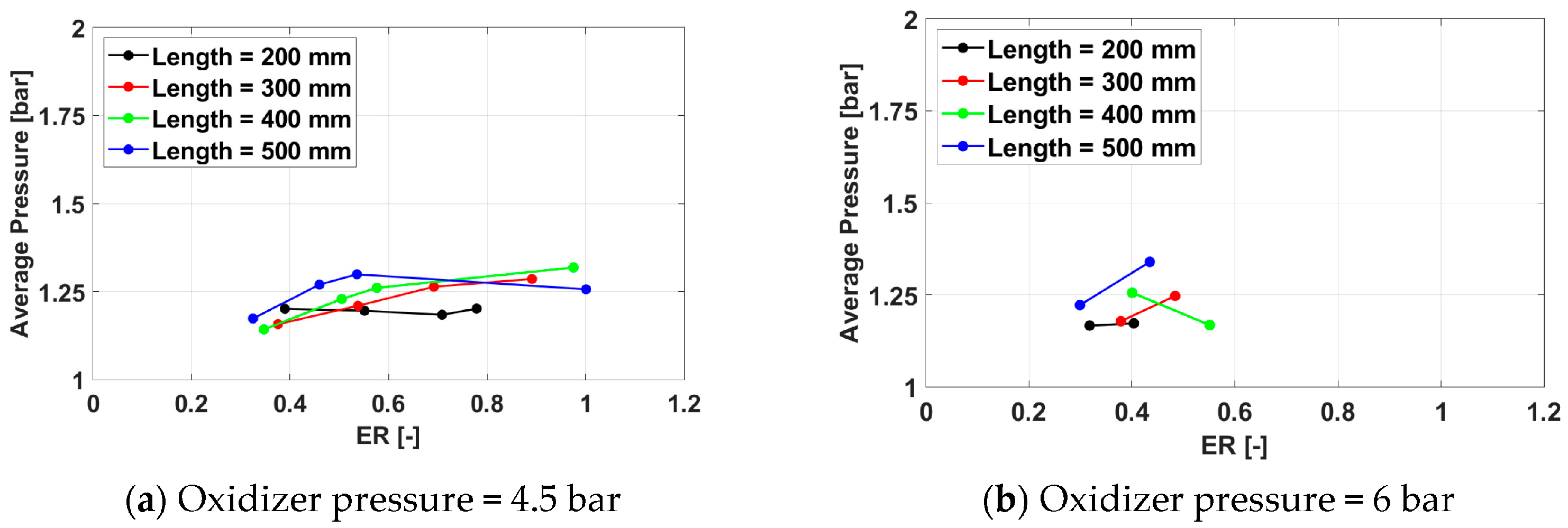
Earlier numerical investigations have already identified important limitations of pulse detonation engines, showing that despite the high instantaneous pressure rise associated with detonation, the cycle-averaged pressure gain may remain relatively small due to blowdown losses, flow recovery periods and non-uniform detonation propagation along the chamber. Numerical studies also emphasised the importance of the interaction between the detonation chamber and the intake and exhaust system, which strongly affects the overall engine performance and operability [90,91]. A recent work confirmed once again that for PDE operation, although local pressure peaks can reach very high values, cycle-averaged measurements reported in the literature indicate average chamber pressures to the order of 1.15–1.33 bar, depending on the equivalence ratio, chamber length, frequency and operating pressure. This confirms that the effective pressure gain of PDEs remains modest once pulsating operation and blowdown losses are taken into account [92] (Figure 4).
A few of the most impactful studies are those that explicitly connect detonative combustion processes with propulsion-level performance and system integration considerations. Performance analyses of hybrid pulse detonation engines operating with liquid hydrogen have provided system-level insight into achievable gains in specific impulse and thermal efficiency when detonative combustion is properly matched with downstream expansion devices and overall engine architecture [93]. This line of work is particularly notable for linking chamber-scale detonation physics with global cycle behaviour, enabling more direct comparison with conventional propulsion concepts. Earlier and complementary investigations have also highlighted the importance of the interaction between the detonation chamber and downstream expansion devices. Experimental and numerical studies on unsteady nozzle operation have demonstrated that the nozzle geometry and expansion ratio significantly influence thrust generation and specific impulse in pulse detonation engines, emphasising the strong coupling between chamber processes and exhaust system performance [94].
In addition, experimental studies addressing filling and discharge hardware have clarified how inlet-valve geometry affects thrust generation in air-breathing pulse detonation engines [95], while investigations of valveless configurations have characterised exhaust plume temperature and structure, contributing to a more realistic assessment of thermal loading and exhaust behaviour under cyclic detonative operation [96]. Together, these studies indicate that current pulse detonation engine research is increasingly oriented toward operability, integration, and performance scalability, rather than toward detonation demonstration alone.
Based on the studies that report quantitative relevant parameters [97,98,99], the typical operating characteristics of pulse detonation engines are summarised in Table 1. The presented ranges were derived from representative experimental and numerical investigations and provide an approximate quantitative characterisation of typical PDE operating regimes.
Only a limited number of studies in the available literature report complete sets of quantitative performance parameters such as the total mass-flow rate, operating frequency, geometric dimensions, and specific impulse. As a result, Table 1 provides discrete data points corresponding to particular engine configurations rather than continuous performance ranges. The currently available data remain insufficient to establish a fully generalised quantitative overview.

4.2. Rotating Detonation Engine

Early investigations of rotating detonation engines demonstrated that one or several detonation fronts can be sustained while propagating azimuthally within annular combustors. These studies also made clear that stable operation depends on effective fuel–air mixing, the interaction between injection and the detonation front, and losses associated with near-wall regions. The main outcomes of this foundational body of work, together with the recurring design challenges it revealed, are now synthesised in a recent review study that organises RDE development around combustor geometries, injection and ignition strategies, dominant loss mechanisms, and potential applications in both air-breathing and rocket propulsion systems [100]. As a result, contemporary RDE research is no longer focused on demonstrating the existence of rotating detonations, but rather on ensuring their sustained, repeatable operation under realistic conditions involving inflow non-uniformities, throttling, thermal loads, and system-level integration constraints.
In recent years, the scope of RDE research has expanded markedly toward engine-relevant operating regimes and practical fuels, with increasing amounts of attention being paid to scalability, robustness, and controllability. Within rocket-based configurations, pulsed operation has emerged as a key research direction: spinning pulsed detonation modes and pulse-operated RDRE experiments have been employed to examine transient start-up behaviour, cycle-to-cycle repeatability, and mode persistence beyond steady continuous operation [101,102]. Complementary work has addressed the influence of nozzle and combustor coupling during pulsed operation, highlighting how downstream components can significantly alter wave dynamics and overall propulsion performance [103]. Additional studies have focused on non-ideal and real-gas effects, including upstream pressure behaviour in methane-fuelled engines with oxygen-enriched air [104], the role of characteristic chamber dimensions on detonation stability and thrust generation [105], and the impact of imposed swirl as a potential control mechanism, despite the associated reductions in thrust and efficiency at high swirl intensity [106]. Beyond these parametric trends, recent experimental investigations have highlighted the coupling between rotating detonation waves and tangential combustion instabilities in coreless disk-shaped RDRE configurations, demonstrating that azimuthal acoustic–detonative interactions can play a governing role in mode stability and combustion dynamics [107]. In parallel, high-resolution numerical simulations employing parallel adaptive mesh refinement have resolved fine-scale detonation structures and shock–reaction interactions with unprecedented fidelity, providing detailed insight into wave stabilisation mechanisms that are difficult to access experimentally [108]. In air-breathing directions, both numerical and experimental efforts have extended RDE concepts into ramjet-based configurations, targeting improved mixing and detonation propagation within integrated flow paths [109], as well as liquid hydrocarbon operation, such as kerosene-fuelled rotating detonation ramjet combustors, where performance sensitivity to inlet temperature, mass flow rate, and combustor length has been documented using a pulse detonation rocket [110,111]. At the same time, practical considerations, including low mass-flow operation in compact devices and advanced thermal management approaches, have more frequently been treated as primary design constraints rather than secondary effects [112,113]. In particular, recent studies have investigated dedicated cooling strategies for rotating detonation combustors, including film-cooling configurations for hydrocarbon-fuelled operation, demonstrating the importance of thermal management for achieving stable and sustained RDE operation under realistic thermal loads [113]. More recent concepts have also explored system-level hybridisation, for instance by embedding rotating detonation modules within broader propulsion architectures that operate intermittently [114] and by systematically quantifying wave behaviour and performance under deliberately non-ideal inflow conditions [115].
Among recent high-impact contributions, the combined experimental and numerical investigation of disk-shaped rotating detonation rocket engines offers a particularly valuable insight into the mechanisms governing wave number formation as an emergent property of the coupled flow field and chamber geometry [116]. By resolving the transient processes leading to detonation establishment and relating the modal structure to the confinement scale and injector-driven coupling, this work clarifies the physical basis for transitions between single- and multi-wave regimes, enabling a more physics-based interpretation of stability and performance trends beyond purely empirical adjustments.
A further influential and strongly parametric contribution is provided by an extensive experimental investigation of a modular rotating detonation rocket engine focusing on the coupled effects of nozzle contraction and chamber length on wave dynamics and propulsion performance [117]. Based on nearly 300 hot-fire tests with gaseous methane and oxygen, the study systematically explores a wide range of equivalence ratios (ϕ ≈ 0.5–2.5). This broad sweep enables direct interpretation of the measured specific impulse trends as a function of mixture composition, as illustrated in Figure 5, which summarises the dependence of a particular impulse on equivalence ratio for different nozzle contraction ratios. The results show that increasing throat constriction produces a consistent and nearly linear improvement in thrust and specific impulse under otherwise comparable conditions, with reported performance gains reaching approximately 27% relative to a straight-annulus exit configuration. At the same time, stronger nozzle contraction is associated with increasingly complex wave behaviour, including a higher prevalence of counter-propagating detonation fronts and elevated unsteadiness. Importantly, shortened (half-length) chamber configurations achieve comparable global performance while exhibiting reduced counter-propagation tendencies, indicating that practical design margins exist to preserve performance while improving operability. The authors further attribute these trends to interactions between nozzle throat geometry and injector pressure recovery, emphasising that throat–injector coupling plays a central role in shaping both modal dynamics and overall engine performance [117]. Although local pressure peaks are comparable to CJ values, the azimuthally averaged pressure rise is significantly reduced due to expansion and losses. RDE averages a pressure gain ratio under 2, depending on operating fuel and conditions.
Beyond rocket applications, rotating/continuous detonation combustors have been studied in air-breathing propulsion, where inlet/combustor/nozzle coupling becomes central. Wind-tunnel experiments on a ramjet-type model with an expanding annular combustor demonstrated sustained detonation-based hydrogen combustion in short-duration facilities at freestream Mach numbers 5–8, reporting both continuous-detonation and longitudinally pulsating regimes with kHz-class characteristic frequencies [118]. Complementing these tests, three-dimensional numerical simulations of a ramjet power plant with a continuous-detonation annular combustor explicitly included a supersonic intake and outlet nozzle and treated finite-rate mixing, chemistry, and viscous effects; the study showed feasible operation at Mach 5 (20 km altitude) and reported propulsion-level metrics while highlighting internal-flow features that are important for integration, such as regions of subsonic products coexisting with supersonic outlet flow and a single azimuthally travelling detonation wave in the annulus [119].
A parallel literature stream focuses on integration with gas-turbine architectures (turbojet/turbofan) rather than standalone rocket thrusters. A dedicated propulsion-oriented synthesis discusses rotating detonation combustors from fundamentals to demonstrators and, importantly, describes a large-scale air-breathing demonstrator whose explicit purpose is to show feasibility of integrating an RDE into a turbojet and to address system issues (stable operating range, wall thermo-mechanical loads, vibration environment, and integration of compressor and turbine) using representative test facilities [120]. In the same spirit, a thermodynamic and system analysis of a turbojet equipped with a rotating detonation combustor developed time-resolved component models (including supersonic turbine treatment) to identify operating regimes where a pressure-gain combustor can outperform a conventional constant-pressure combustor and to guide cycle-level design trade-offs [121]. An earlier review article explicitly frames rotating detonation as applicable across turbine, ramjet, and rocket engines and discusses turbofan-style integration concepts alongside advantages and constraints, reinforcing the claim that non-rocket implementations are a long-standing research direction [122].
The quantitative characteristics of rotating detonation engines identified in the available literature are summarised in Table 2 [102,111,119,123]. The values presented were extracted from representative experimental and numerical studies that report consistent performance and geometric parameters, providing a quantitative overview of typical operating conditions for laboratory-scale RDE configurations.
A direct comparison between the quantitative parameters reported for pulse detonation engines and rotating detonation engines should be treated with caution. The available data correspond to different experimental configurations, operating conditions, and geometric scales, which strongly influence the resulting performance parameters. In particular, the specific impulse values reported for certain PDE configurations may appear higher than those obtained for the RDE demonstrators considered in Table 2; however, such differences do not necessarily reflect the intrinsic performance potential of the two concepts.
The limited number of studies providing complete quantitative datasets and the significant variability in injector design, chamber geometry, and operating conditions make a consistent performance comparison difficult. Consequently, the values presented should be interpreted as configuration-dependent performance indicators rather than as a direct measure of the relative efficiency of PDE and RDE propulsion concepts.

4.3. Standing Oblique Detonation Engine

The concept of sustaining detonative combustion in a continuous hypersonic flow through shock–reaction coupling rather than cyclic ignition has motivated sustained interest in oblique and standing detonation engines over the past two decades. Early analytical, numerical, and experimental efforts clarified the fundamental structure of oblique detonation waves, including the emergence of multi-wave systems, the sensitivity of wave steadiness to shock reflections, and the interaction between detonation fronts and expansion regions [124,125,126]. These studies established that geometric compression, typically generated by wedges, struts, or similar flow-deflecting elements, can in principle maintain a coupled shock–reaction system, while also revealing the intrinsic constraints of such concepts, namely narrow operability windows, strong dependence on inflow Mach number and mixture reactivity, and the challenge of reliable detonation initiation without excessive total pressure losses [125,127].
More recent investigations have progressively shifted from phenomenological descriptions toward configuration-driven stabilisation and initiation strategies relevant to engine-scale applications. A wide range of experimental and numerical studies have demonstrated that oblique detonations can be initiated and sustained using carefully designed wedge, double-wedge, and strut-based configurations in hypersonic flows, for both hydrogen–air and hydrocarbon mixtures [128,129,130]. In particular, vertically arranged strut configurations have been shown to provide favourable shock structures for detonation initiation and anchoring, highlighting the importance of three-dimensional flow organisation in practical ODE layouts [131]. The role of shock reflection upstream of expansion corners and the interaction of multiple oblique shocks have also been identified as key mechanisms governing the steadiness and morphology of the resulting wave complexes [128]. In parallel, forced and assisted initiation approaches, including on-wedge trips and internal injection strategies, have enabled controlled detonation onset in less reactive fuels such as kerosene, thereby extending ODE concepts beyond idealised hydrogen-based systems [132,133]. Complementary numerical studies have further quantified the influence of geometric configuration and operating Mach number on flow-field structure and propulsive performance over a wide speed range [134,135,136]. It should be noted, however, that some of these numerical investigations rely on inviscid or simplified modelling approaches, such as Euler-based formulations or quasi-one-dimensional approximations, which may not fully capture the non-uniform flow structure upstream of the oblique detonation. In practical ODE configurations, viscous and turbulent effects play an important role in determining the boundary-layer development and shock–boundary-layer interaction, and therefore more complete modelling approaches, such as RANS-based simulations, are generally required for accurate performance prediction.
The experimental demonstration of stabilised detonative combustion for hypersonic propulsion has represented a significant step toward practical realisation. High-profile work has shown that standing normal and oblique detonation structures can be established and maintained in controlled hypersonic environments, providing direct experimental validation (Figure 6) of long-standing pressure-gain combustion concepts [137]. The latest named work has reported an average pressure gain peak of 2.7 times the baseline [137] (Figure 7), which is significantly higher than that reported for the previous concepts. These advances have been synthesised in a recent literature review, which frames standing oblique detonation engines as a distinct propulsion class positioned between rotating detonation devices and conventional scramjet architectures, offering unique advantages in thrust density and flow-path compactness, but also stringent requirements for inflow conditioning and stability control [126]. Together, these studies indicate that while standing and oblique detonation engines remain constrained by demanding operating conditions, continued progress in geometric tailoring, initiation control, and thermal management is steadily narrowing the gap between fundamental demonstrations and viable hypersonic propulsion systems.
Quantitative parameters reported for standing and oblique detonation engine configurations are summarised in Table 3 [131,137]. The data were extracted from representative experimental and numerical investigations in which the operating conditions and geometric characteristics are sufficiently defined to allow a quantitative description of typical SODE demonstrators.
The available literature on standing and oblique detonation engines remains primarily focused on the demonstration of stable detonation wave structures and on the identification of geometric configurations capable of sustaining oblique detonation. As a result, only a limited number of studies report consistent quantitative parameters, and experimental investigations rarely include direct measurements of global propulsion performance such as thrust or total specific impulse. Consequently, a direct quantitative evaluation of propulsion efficiency based on experimental data is currently not possible for SODE configurations.
Most available studies concentrate on flow-field characterisation, detonation stabilisation, and inlet–wedge interaction mechanisms rather than on integrated propulsion performance. This explains the absence of experimentally validated thrust and specific impulse data in the open literature and limits the possibility of a direct comparison with PDE and RDE concepts.
Recent analytical and numerical investigations have attempted to estimate the performance potential of oblique detonation propulsion systems [136]. For example, one-dimensional theoretical models predict relatively high fuel-based specific impulse values for hydrogen–air mixtures; however, these estimates are based on simplified assumptions and refer to fuel-specific impulse rather than total specific impulse. Consequently, such results provide only an indication of the theoretical performance potential and cannot be directly compared with experimentally derived values reported for previous configurations.

5. Comparative Analysis of Detonation-Based Propulsion Concepts

Table 4 provides a qualitative comparison between pulse detonation engines (PDEs), rotating detonation engines (RDEs), and standing oblique detonation engines (SODEs), based on the literature discussed in the earlier chapters, focusing on attributes that are relevant for aerospace propulsion applications. The qualitative levels reported in the table do not represent absolute performance limits, but rather summarise recurring trends observed across experimental and numerical investigations. The intent is to support a system-level interpretation of these concepts, rather than a point-by-point performance ranking.
The efficiency classification reflects how detonative combustion is realised within the core flow. Standing detonation engines are associated with high theoretical efficiency, as they represent the only configuration in which the entire main flow undergoes a continuous, stationary detonation process. In this case, chemical energy release is permanently coupled to a stabilised shock structure, with no cyclic interruption. Pulse detonation engines, on the other hand, operate in a fundamentally intermittent mode. Detonation occurs only during a fraction of the operating cycle, followed by purge and refill phases that reduce the time-averaged efficiency, despite the overall thermodynamic efficiency of each detonation event. Rotating detonation engines occupy an intermediate position. Although detonation is sustained continuously within an annular combustor, the local flow field experiences periodic pressure and velocity fluctuations as rotating detonation fronts sweep past a given azimuthal location. The work of Xu et al. indicate that appropriate injector configuration and equivalence ratio selection can enhance the stability and performance of rotating detonation engines by expanding the practically usable operating window, rather than removing the intrinsic regime-dependent constraints associated with detonative combustion [138]. Although RDEs are currently undergoing significant optimisation, the resulting pressure gain is still established in a quasi-steady manner instead of as a fully stationary process, leading to efficiency levels that are substantial but not maximal.
Geometric complexity and compactness are closely related to the underlying combustor architecture. PDE configurations are geometrically simple at the chamber level, typically consisting of straight tubes with ignition and timing hardware. This leads to low geometric complexity, but only moderate compactness when auxiliary systems such as valves, purge lines, and ignition devices are considered. RDEs employ annular combustors with carefully designed injector arrangements and cooling strategies, which increase geometric complexity but allow for very compact axial layouts and short overall engine length. Standing detonation engines are compact in principle, as detonation stabilisation relies on localised flow deflection rather than long combustion chambers. However, the need for precisely tailored wedges, struts, or nozzle contours, together with strict inflow alignment requirements, results in medium-to-high geometric complexity in practical realisations.
Thrust unsteadiness and acoustic or structural loading represent another major point of differentiation. PDEs are characterised by strong thrust oscillations and intense acoustic loading due to repetitive detonation events, justifying their classification as high in thrust unsteadiness and very high in acoustic and structural loads. RDEs substantially reduce thrust unsteadiness by eliminating purge cycles but still exhibit elevated acoustic levels and fluctuating pressure fields associated with rotating detonation fronts. In standing detonation engines, thrust is inherently steady as long as the detonation remains anchored. No cyclic combustion occurs, and the dominant loads arise from steady shock–reaction interactions rather than impulsive events. Consequently, thrust unsteadiness is very low, while acoustic and structural loads are considered moderate.
Wave stability and operating window stability are treated as separate attributes in Table 1 to distinguish local robustness from global operability. In PDEs, detonation initiation and propagation can be repeatable once appropriate conditions are established, resulting in medium wave stability. However, the overall operating window is limited by cycle timing, mixture preparation, and ignition constraints. RDEs demonstrate medium-to-high wave stability, as rotating detonation fronts can persist over a relatively wide range of operating conditions once established, with a corresponding medium-to-high operating window stability. Standing detonation engines exhibit high local wave stability when detonation anchoring is successful, as demonstrated in several experimental studies. At the same time, their global operating window remains narrow, since relatively small deviations in inflow Mach number, pressure, or equivalence ratio may lead to detonation failure or transition to deflagration. This sensitivity motivates the low classification for operating window stability.
Integration potential reflects the ease with which each concept can be incorporated into practical propulsion systems. PDEs are rated low in this regard due to their inherent unsteadiness and the system-level complexity associated with valves, ignition systems, and structural fatigue. RDEs exhibit the highest integration potential, as their continuous operation, compactness, and compatibility with both rocket and air-breathing architectures have been demonstrated in recent experimental and numerical studies. Standing detonation engines currently offer limited-to-moderate integration potential. Although mechanically simple in principle, their strict inflow requirements and narrow operating window impose significant constraints on vehicle design and mission flexibility.
Another important limitation concerns thrust throttling capability. Detonation-based propulsion systems typically operate within relatively narrow stability windows defined by mixture composition, inlet total pressure, and flow conditions. Numerical operability studies of rotating detonation combustors based on experimentally derived configurations indicate that stable operation can be maintained only within a limited range of inlet and back-pressure conditions, indicating a finite but constrained throttling capability [139].
In pulse detonation engines, thrust modulation can be achieved primarily through variation of the operating frequency or duty cycle of the detonation cycle. In such systems, the time-averaged thrust scales approximately with the detonation repetition rate, allowing relatively straightforward throttling through control of valve timing or ignition rate [140]. In addition, partial filling of the detonation tube provides an alternative throttling mechanism by reducing the energy released per cycle while maintaining stable detonation propagation [141]. However, stable operation remains limited to a finite range of operating conditions, since incomplete filling or excessive repetition rates may reduce detonation intensity and overall propulsion efficiency.
For standing or oblique detonation engines, throttling capability is fundamentally constrained by the narrow stability region defined by inflow Mach number, mixture reactivity, and flow-deflection angle. The existence of a limited Mach-deflection parameter space allowing sustained detonation implies that only restricted variations in operating conditions can be tolerated without detonation failure or transition to deflagration. In principle, limited throttling could be achieved either through controlled variation of inflow conditions or through geometric adjustment of the compression angle relative to the inflow parameters. However, no systematic experimental demonstrations of controllable throttling in standing detonation engines have been reported to date, and practical throttling capability therefore remains uncertain and is expected to be more limited than in rotating detonation configurations.
Although detonative combustion produces extremely high local pressure peaks immediately behind the detonation front, the pressure gain that can be exploited at the system level is substantially reduced once temporal averaging, geometric expansion, and loss mechanisms are considered. By examining the upper-end values reported in recent experimental and numerical studies, realistic maximum bounds for the average pressure gain per cycle can be identified for each detonation concept, rather than relying on instantaneous CJ-level pressures. In this context, pulse detonation engines remain limited by their inherently pulsating operation, including filling and blowdown losses, leading to maximum average pressure gains below 1.5. Rotating detonation engines benefit from quasi-continuous operation and azimuthal averaging, enabling higher effective pressure gains, though expansion and centrifugal-to-axial flow turning constrain the maximum average values to below two. Standing or oblique detonation concepts provide the most favourable conditions for sustained pressure gain, and the highest values reported in the literature indicate that average pressure gains approaching, but not exceeding, approximately 2.7 may be achieved under carefully controlled operating conditions (Table 5).
Overall, the comparison summarised in Table 4 and Table 5 indicates that the three detonation-based propulsion concepts differ less in their fundamental thermodynamic potential than in their current level of development, operational robustness, and degree of optimisation. Pulse detonation engines have played an essential role in establishing the feasibility of detonation-based propulsion, yet their intrinsically unsteady operation continues to limit practical integration. Rotating detonation engines currently represent the most advanced and widely explored configuration, benefiting from sustained community attention, systematic optimisation efforts, and growing experimental maturity. Standing oblique detonation engines, while often characterised by narrow operating windows, should not be viewed as intrinsically disadvantaged, but rather as comparatively underexplored. Their fully continuous detonative nature and conceptual simplicity suggest significant untapped potential, particularly if future research efforts are directed toward stabilisation strategies, adaptive geometries, and flow–structure coupling aimed at extending operability. In this context, the present dominance of RDEs reflects the distribution of research focus rather than a fundamental limitation of standing detonation concepts, which remain a promising avenue for future advancement in high-speed aerospace propulsion.

6. Impact on Current Dominant Aerospace Propulsion Systems

The discussion in this section does not aim to propose a direct replacement for existing propulsion systems, but rather to assess where and how detonation-based combustion concepts could provide tangible performance benefits when integrated into current aerospace propulsion architectures.
Detonation-based combustion concepts have attracted sustained attention due to their potential to increase thermodynamic efficiency through pressure-gain processes. However, their transition from laboratory-scale demonstrators to industrial propulsion systems has been significantly constrained by practical engineering limitations rather than by fundamental physical barriers. The primary obstacles include severe thermal and mechanical loading associated with repetitive shock structures, limited durability of current high-temperature materials under combined creep–fatigue regimes, and the difficulty of achieving stable and controllable operation over a wide range of operating conditions. In addition, the inherently unsteady nature of detonation introduces strong spatial and temporal non-uniformities in pressure and temperature, complicating aerodynamic matching with compressors, turbines, and exhaust nozzles. From an industrial perspective, the moderate efficiency gains reported to date remain a critical factor: experimental and system-level studies typically indicate net cycle efficiency improvements to the order of 3–8% once realistic losses, finite-rate chemistry, and integration effects are accounted for [142]. While non-negligible, such improvements are often insufficient to offset the substantial redesign effort, certification burden, and reliability risks associated with introducing an entirely new combustion architecture. Acoustic emissions, structural vibration, and the absence of long-duration endurance data further contribute to the reluctance of engine manufacturers to implement these concepts in operational platforms.
A substantial body of literature has established that the principal challenges associated with detonation-based propulsion are related to the ability to maintain robust detonation behaviour under realistic operating conditions. Although detonative combustion can be generated reliably in controlled laboratory environments, stable operation must be preserved in the presence of inflow non-uniformities, transient boundary conditions, and unavoidable perturbations introduced by injection systems and structural constraints. Under such conditions, relatively small variations in thermodynamic or mixture parameters may lead to significant changes in wave structure, including mode transitions, multi-wave interactions, or local detonation extinction [143,144,145]. These limitations have been recognised in the detonation-propulsion literature for more than a decade and continue to define the practical operating envelope of current experimental systems.
Closely related to these stability considerations is the issue of controllability. Unlike conventional deflagrative combustors, where combustion intensity can be adjusted over wide operating ranges, detonative combustion typically remains confined to restricted parameter domains determined by mixture reactivity and flow-field organisation. As a consequence, maintaining stable detonation while simultaneously adjusting operating conditions requires precise regulation of injection parameters and thermodynamic states, which increases system complexity and places stringent requirements on control strategies [144,146]. While recent research has made significant progress in improving detonation stability, particularly for rotating detonation configurations, these fundamental constraints continue to limit controllable operation over wide operating ranges.
These stability and controllability constraints ultimately manifest at the propulsion-system level, where detonation-based combustors must operate in combination with compressors, turbines, injectors, and nozzles designed for comparatively steady flow conditions. System-level analyses consistently identify component matching and operability across the flight envelope as key challenges for practical implementation, indicating that propulsion-system integration rather than detonation feasibility itself represents the principal barrier to widespread adoption of detonative combustion technologies [144,145,147].
In addition to the challenges discussed above, extremely high local heat fluxes represent one of the primary engineering limitations of detonation-based propulsion systems. The rapid pressure and temperature rise associated with detonative combustion produces localised heat transfer rates significantly exceeding those encountered in conventional deflagrative combustors. Recent numerical and experimental investigations of rotating detonation combustors have reported strongly non-uniform wall heat loads with pronounced peaks associated with the passage of detonation fronts [148,149]. Peak instantaneous heat fluxes on combustor walls have been reported on the order of 2–5 MW/m2, while time-averaged values typically lie in the range of 0.5–1.5 MW/m2 under representative operating conditions [148]. Fundamental analyses of convective transport in detonation waves further confirm the inherently intense thermal environment characteristic of detonation-driven flows [150]. Similar aerodynamic heating levels have also been identified in numerical studies of oblique detonation configurations, indicating that severe thermal loading represents a general feature of detonation-based propulsion concepts rather than a configuration-specific limitation [151].
The strict geometric and flow requirements necessary for detonation stabilisation further complicate the implementation of effective cooling strategies. Techniques based on secondary injection or porous-wall transpiration introduce additional flow interactions that are difficult to control in high-speed reactive environments. Because detonative combustion is highly sensitive to perturbations in mixture composition, temperature, and flow uniformity, disturbances introduced by cooling flows may affect wave stability or detonation anchoring. Consequently, the simultaneous optimisation of thermal management and detonation stability remains a major challenge for practical detonation engine design.
Within this context, rotating detonation engines currently represent the most mature and practically viable form of pressure-gain combustion among the detonation-based concepts. Their compatibility with subsonic inlet conditions allows integration downstream of conventional compressors and upstream of turbines, enabling either an increase in overall cycle efficiency or a reduction in the required pressure ratio of the high-pressure compressor, thereby improving compactness and reducing turbine work. In rocket propulsion, RDEs provide a direct increase in chamber total pressure and improved nozzle expansion efficiency, leading to a higher specific impulse for identical propellant combinations.
Importantly, RDE technology has recently progressed beyond conceptual and ground-test stages toward flight demonstration. In May 2025, Venus Aerospace successfully conducted a flight test of a rotating detonation rocket engine (RDRE) on a small launch vehicle, demonstrating the viability of detonation-based propulsion in a real flight environment and marking one of the first instances of a detonation engine operating in an atmospheric launch context. This milestone indicates that RDE-derived systems are not merely theoretical constructs but are rapidly approaching practical implementation, particularly for applications where limited operational lifetime is acceptable and performance gains are prioritised. In addition to commercial RDRE flight, recent research has documented an actual space flight experiment (Figure 8) in which a rotating detonation engine (DES2) was operated in an atmospheric flight environment after separation from a sounding rocket (S-520-34), providing further evidence that detonation-based propulsion can be exercised beyond ground testing and into realistic aerospace conditions [152]. The results suggest that, in realistic propulsion systems, detonation combustion tends to achieve a near-ideal but not dramatically higher performance compared to conventional deflagrative combustion, highlighting the importance of full system integration when evaluating efficiency gains [152].
The most realistic near-term applications are therefore found in expendable systems such as short-range ballistic missiles, tactical rockets, small launchers and loitering munitions (kamikaze UAVs), where performance benefits such as increased range, endurance, or payload fraction can be directly exploited without stringent requirements for long-term durability. In these platforms, tolerance for reduced service life enables operation closer to material and thermal limits, making the performance benefits of detonation-based combustion practically exploitable. As experience with RDRE demonstrations grows, these systems may serve as operational testbeds for evaluating material degradation, structural fatigue, and combustion stability under realistic conditions, thereby supporting further technology maturation toward more demanding applications.
Compared to rotating detonation engines, flight demonstrations of pulse detonation propulsion systems remain relatively limited. The first flight demonstration of an air-breathing pulse detonation engine was carried out by the U.S. Air Force Research Laboratory in 2008, when a small experimental aircraft powered by a multi-tube pulse detonation engine achieved sustained flight. This milestone demonstrated the feasibility of pulse detonation propulsion beyond laboratory-scale testing and remains one of the few examples of a self-propelled PDE-powered aircraft.
Subsequent work focused primarily on flight validation of pulse detonation rocket configurations. The rotary-valved pulse detonation rocket Todoroki II [153] demonstrated stable operation under conditions representative of free vertical flight, achieving a thrust-to-weight ratio greater than two and sustained engine operation for approximately 1200 ms during flight tests and reaching 9.7 m altitude.
One more recent work has investigated the application of air-breathing pulse detonation propulsion to small UAV demonstrators, where a kerosene-fuelled pulse detonation engine was integrated into a lightweight airframe and tested under realistic flight conditions [154]. The propulsion system employed a valved air-breathing configuration with repeated detonation cycles, allowing the evaluation of engine operation under representative aerodynamic inflow and vibration environments. Flight tests were conducted using a catapult-launched platform to assess engine operability and propulsion-system behaviour during sustained airborne operation.
Pulse detonation engines, although extensively studied, remain largely confined to academic research. From a physical standpoint, PDEs can indeed operate as standalone propulsion devices, producing thrust directly through repetitive detonation cycles and exhaust expansion. However, their intrinsically intermittent mode of operation introduces severe cyclic mechanical loading, low time-averaged thrust density for a given engine volume, and pronounced pressure and velocity fluctuations at the exhaust. These characteristics lead to inefficient coupling with turbomachinery, strong vibration levels, and significant structural fatigue, while also complicating flow conditioning and nozzle optimisation. Consequently, most of the theoretical pressure-gain benefits are offset by system-level losses and mechanical complexity, rendering PDE-based architectures unattractive for practical aerospace propulsion systems despite their conceptual simplicity.
Standing detonation engines operate in a fundamentally different regime, relying on supersonic inflow and producing supersonic exhaust, which renders them incompatible with conventional turbomachinery architectures. Their natural domain is therefore limited to rockets and hypersonic propulsion systems, where direct conversion of chemical energy into kinetic energy via convergent–divergent nozzles is consistent with the overall system layout. While experimental studies have demonstrated the feasibility of sustaining standing detonation waves in laboratory configurations, thus far, no integrated, long-duration, thrust-controlled propulsion system has been demonstrated, and the technological readiness level remains low. Nevertheless, from a more speculative long-term perspective, the emergence of efficient and structurally robust supersonic turbines, together with reliable detonation control strategies, could enable SDE-based cycles to outperform RDE configurations even in turbine-assisted propulsion systems. Such a development would, however, require a paradigm shift in turbomachinery design and materials technology, extending far beyond the current industrial state of the art.

7. Future Directions

Looking ahead, research on detonation-based propulsion should progressively move away from isolated demonstrations of detonation feasibility and place greater emphasis on operability, robustness, and system-level performance. For pulse detonation engines, one of the main unresolved issues remains the difficulty of sustaining high repetition rates without sacrificing efficiency or detonation reliability, particularly under air-breathing conditions and with practical fuels. Further progress in rapid filling and purging strategies, low-energy and repeatable initiation methods, and a clearer understanding of the coupling between combustion dynamics, acoustics, and structural response is therefore required. In rotating detonation engines, future work is expected to focus more on mode stability and control across a wide operating range, including the sensitivity of the detonation process to injector design, equivalence ratio, and downstream back-pressure. At the same time, it is essential to distinguish between local pressure-gain effects at the detonation front and the net performance of the complete system once losses related to injection, mixing, wall friction, and exhaust expansion are taken into account. For standing and oblique detonation wave configurations, practical implementation is still largely limited by the narrowness of the standing window. A particularly promising direction in this area is the development of design maps or scaling relations that link inflow conditions, such as Mach number, total pressure and temperature, and mixture reactivity, to the required wedge angle or effective ramp geometry. Such relations could enable adaptive or multi-segment wedge designs capable of maintaining shock–reaction coupling over a significantly broader operating envelope. In parallel, further attention should be given to confinement effects, interactions with expansion waves and boundary layers, and the influence of mixture non-uniformities, together with the development of diagnostics that are able to unambiguously distinguish detonation from shock-induced combustion under engine-relevant conditions.
Beyond these more established detonation-based concepts, recent work has also pointed toward the ram-rotor detonation engine as a novel and conceptually different approach [155]. The central idea of the ram-rotor concept is to integrate ram compression, detonative heat release, and rotor-based energy extraction within a single device (Figure 9). By organising the detonation process inside rotating passages, the wave can become quasi-stationary in an appropriate rotating frame of reference, allowing the pressure rise associated with detonative combustion to be converted directly into shaft work. In this sense, the ram-rotor detonation engine seeks to combine the thermodynamic advantages of pressure-gain combustion with the energy conversion mechanisms typical of turbomachinery. Although investigations of this concept are still in a preliminary stage, they reflect a broader trend toward hybrid architectures in which detonation is no longer treated solely as a thrust-producing mechanism, but rather as an integral element of a more comprehensive energy conversion cycle.

8. Conclusions

This review has explored detonation-based combustion as a possible route for improving the performance of future aerospace propulsion systems, focusing on pulse detonation engines, rotating detonation engines, and standing or oblique detonation wave configurations. Taken together, these concepts clearly show the intrinsic advantages of detonative combustion, namely extremely fast heat release, compact combustion regions, and the potential for pressure-gain operation, which fundamentally differentiate them from conventional deflagration-based approaches. At the same time, the analysis makes it evident that the main obstacles to practical implementation are no longer rooted in the basic feasibility of detonation itself, but rather in issues related to stability, controllability, and integration within realistic propulsion systems.
In pulse detonation engines, the primary difficulty has shifted toward maintaining reliable, high-frequency operation under realistic boundary conditions while avoiding excessive efficiency losses and structural penalties. For rotating detonation engines, sustained detonation has been convincingly demonstrated in numerous configurations, yet challenges remain in terms of achieving robust mode control and translating local pressure gains into meaningful improvements at the system level. Standing and oblique detonation wave concepts offer an appealing framework for continuous detonation-based propulsion, but their applicability is still restricted by narrow operating windows and a strong sensitivity to inflow conditions, geometry, and confinement effects within the combustor.
One of the central conclusions of this review is that further progress in detonation-based propulsion will become increasingly dependent on design strategies that explicitly account for geometry, flow variability, and overall system behaviour. Concepts such as adaptive or segmented geometries for oblique detonation stabilisation, improved experimental diagnostics that are capable of clearly distinguishing detonation from shock-induced combustion, and hybrid configurations that integrate detonation into broader energy-conversion cycles are likely to play an important role. The emergence of concepts such as the ram-rotor detonation engine illustrates this evolution, pointing toward propulsion architectures in which detonation is coupled directly with mechanical power extraction rather than treated solely as a thrust-generating mechanism.
Detonation-based propulsion should be regarded not simply as an alternative combustion mode, but as a flexible and extensible framework that can be adapted to a range of propulsion and power-generation concepts. Continued advances in experimental methods, modelling approaches, and system-level integration will ultimately determine whether these ideas can mature from laboratory-scale demonstrations into viable technologies for future aerospace applications.

Author Contributions

Conceptualization, N.B.-C.; methodology, N.B.-C. and N.R.E.; investigation, N.B.-C.; formal analysis, N.B.-C.; data curation, N.B.-C. and S.T.-M.; writing—original draft preparation, N.B.-C. and S.T.-M.; visualisation, N.B.-C.; writing—review and editing, S.T.-M., N.R.E., and C.G.; validation, N.R.E. and C.G.; supervision, C.G.; project administration, N.R.E.; resources, N.R.E. and C.G. All authors have read and agreed to the published version of the manuscript.

Funding

The activity has been carried out under the Increase rocket engine performance by the use of standing detonation waves project, funded by the European Space Agency (contract number: 4000146461). The views expressed in the paper can in no way be taken to reflect the official opinion of the European Space Agency.

Data Availability Statement

The original contributions presented in this study are included in the article. Further inquiries can be directed to the corresponding author.

Conflicts of Interest

The authors declare no conflicts of interest.

Abbreviations

The following abbreviations are used in this manuscript:
CJChapman–Jouguet.
DDTDeflagration-to-Detonation Transition.
DTDetonation Transition.
ODWOblique Detonation Wave.
PDEPulse Detonation Engine.
PGCPressure-Gain Combustion.
PMPrandtl–Meyer.
RDERotating Detonation Engine.
SDTShock-to-Detonation Transition.
TSTransverse Shock.
ZNDZeldovich–von Neumann–Döring.
SODEStanding Oblique Detonation Engine.
RDRERotating Detonation Rocket Engine.
UAVUnmanned Aerial Vehicle.
SDESteady Detonation Engine.

References

  1. Dunlap, R.; Brehm, R.L.; Nicholls, J.A. Preliminary study of the application of steady-state detonative combustion to a reaction engine. Jet Propuls. 1957, 28, 451–456. [Google Scholar] [CrossRef]
  2. Meherwan, P.M. Theoretical and Actual Cycle Analyses. In Gas Turbine Engineering Handbook, 4th ed.; Meherwan, P.M., Ed.; Butterworth-Heinemann: Oxford, UK, 2012; pp. 89–137. [Google Scholar] [CrossRef]
  3. Invernizzi, C.M.; Di Marcoberardino, G. An Overview of Real Gas Brayton Power Cycles: Working Fluids Selection and Thermodynamic Implications. Energies 2023, 16, 3989. [Google Scholar] [CrossRef]
  4. Urzay, J. Supersonic Combustion in Air-Breathing Propulsion Systems for Hypersonic Flight. Annu. Rev. Fluid Mech. 2018, 50, 593–627. [Google Scholar] [CrossRef]
  5. Zeldovich, Y.B. To the Question of Energy Use of Detonation Combustion. J. Propuls. Power 2006, 22, 588–592. [Google Scholar] [CrossRef]
  6. Wintenberger, E.; Shepherd, J.E. Thermodynamic Cycle Analysis for Propagating Detonations. J. Propuls. Power 2006, 22, 694–698. [Google Scholar] [CrossRef]
  7. Krishnan, S.; Philmon, G. Solid Fuel Ramjet Combustor Design. Prog. Aerosp. Sci. 1998, 34, 219–256. [Google Scholar] [CrossRef]
  8. Inamura, T.; Takahashi, M.; Kumakawa, A. Combustion Characteristics of a Liquid-Fueled Ramjet Combustor. J. Propuls. Power 2001, 17, 860–868. [Google Scholar] [CrossRef]
  9. Vanyai, T.; Grieve, S.; Street, O.; Denman, Z.; McIntyre, T.; Veeraragavan, A.; Wheatley, V.; Smart, M. Fundamental Scramjet Combustion Experiments Using Hydrocarbon Fuel. J. Propuls. Power 2019, 35, 953–963. [Google Scholar] [CrossRef]
  10. Thomas, A.N. Some Fundamental Aspects of Ramjet Propulsion. J. Jet Propuls. 1957, 27, 381–385. [Google Scholar] [CrossRef]
  11. Rubins, P.M.; Bauer, R.C. Review of shock-induced supersonic combustion research and hypersonic applications. J. Propuls. Power 1994, 10, 593–601. [Google Scholar] [CrossRef]
  12. Cojocea, A.V.; Cuciuc, T.; Porumbel, I.; Gall, M.; Gherman, B.; Crunţeanu, D.E. Experimental Investigations of Hydrogen Fuelled Pulsed Detonation Combustor. In Proceedings of the ASME Turbo Expo 2022: Turbomachinery Technical Conference and Expositio, 3B: Combustion, Fuels, and Emissions, Rotterdam, The Netherlands, 13–17 June 2022. [Google Scholar] [CrossRef]
  13. Roy, G.D.; Frolov, S.M.; Borisov, A.A.; Netzer, D.W. Pulse detonation propulsion: Challenges, current status, and future perspective. Prog. Energy Combust. Sci. 2004, 30, 545–672. [Google Scholar] [CrossRef]
  14. Feng, Z.; Zhang, Q.; Zhang, Y.; Ma, P.; Fan, W. Experimental research on the characteristics of high-frequency pulse detonation waves in a high pressure chamber. Aerosp. Sci. Technol. 2025, 164, 110449. [Google Scholar] [CrossRef]
  15. Han, H.-S.; Lee, E.S.; Choi, J.-Y. Experimental Investigation of Detonation Propagation Modes and Thrust Performance in a Small Rotating Detonation Engine Using C2H4/O2 Propellant. Energies 2021, 14, 1381. [Google Scholar] [CrossRef]
  16. Zhang, B.; Song, Y.; Wen, Q.; Miao, Y.; Huang, M.; Wang, Z.; Tian, X.; Wang, B.; Wen, H.; Shi, Y.; et al. The ignition and self-sustaining combustion of the rotating detonation fueled by solid propellant. Aerosp. Sci. Technol. 2025, 159, 109955. [Google Scholar] [CrossRef]
  17. Li, X.; Li, J.; Jin, W.; Qin, Q.; Yao, Q.; Yuan, L. Design and ignition characteristics of kerosene/oxygen pre-detonator and kerosene/air hot-jet schemes under rotating detonation engine. Acta Astronaut. 2025, 235, 421–434. [Google Scholar] [CrossRef]
  18. Desbordes, D.; Hamada, L.; Guerraud, C. Supersonic H2-air combustions behind oblique shock waves. Shock Waves 1995, 4, 339–345. [Google Scholar] [CrossRef]
  19. Lin, Z.; Zhang, J.; Zhou, J. Design of high-enthalpy premixed supersonic heater and experimental study of oblique detonation. In Proceedings of the 43rd AIAA/ASME/SAE/ASEE Joint Propulsion Conference & Exhibit, Cincinnati, OH, USA, 8–11 July 2007; Volume 2007, p. 5009. [Google Scholar] [CrossRef]
  20. Zhang, Z.; Wen, C.; Yuan, C.; Liu, Y.; Han, G.; Wang, C.; Jiang, Z. An experimental study of formation of stabilized oblique detonation waves in a combustor. Combust. Flame 2022, 237, 111868. [Google Scholar] [CrossRef]
  21. Zangene, F.; Radulescu, M.I. The critical conditions for the re-ignition and detonation formation from Mach reflections of curved decaying shocks. Proc. Combust. Inst. 2024, 40, 105774. [Google Scholar] [CrossRef]
  22. Wen, Q.; Zhang, Y.; Xu, S.; Fan, W.; Wen, H.; Wang, B. Numerical investigation on effects of transverse inhomogeneity on detonation waves. Combust. Flame 2026, 283, 114574. [Google Scholar] [CrossRef]
  23. Michelson, W. Über die normale Entzündungsgeschwindigkeit explosiver Gasgemische. Ann. Phys. Chem. 1889, 269, 1–24. [Google Scholar] [CrossRef]
  24. Dabora, E.K.; Manson, N. Chronology of Early Research on Detonation Waves. In Dynamics of Detonations and Explosions: Detonations; Kuhl, A.L., Ed.; Academic Press: Boston, MA, USA, 1991; Volume 1, pp. 3–28. [Google Scholar]
  25. Chapman, D.L. On the rate of explosion in gases. Philos. Mag. 1889, 47, 90–104. [Google Scholar] [CrossRef]
  26. Jouguet, E. On the propagation of chemical reactions in gases. J. Mathématiques Pures Appliquées 1905, 1, 347–425. (In French) [Google Scholar]
  27. Zel’dovich, Y.B. On the theory of the propagation of detonation in gaseous systems. J. Exp. Theor. Phys. 1950, 10, 542–568. [Google Scholar]
  28. Neumann, J.V. Theory of detonation waves. In Aberdeen Proving Ground, Maryland: Office of Scientific Research and Development; Report No. 549, Ballistic Research Laboratory File No. X-122; Ballistic Research Laboratory: Chandigarh, India, 1942. [Google Scholar]
  29. Döring, W. On the detonation process in gases. Ann. Phys. 1943, 43, 421–436. [Google Scholar] [CrossRef]
  30. Zhang, D.; Dong, G.; Li, B. Morphological evolutions and transverse dynamics of strong transverse wave structure in detonations near critical propagation state. J. Fluid Mech. 2025, 1007, A12. [Google Scholar] [CrossRef]
  31. Robyn, C.; Liliana, B.; Rachel, H.; Kareem, A. A digital soot foil method for the analysis of cellular structures in detonation waves. Appl. Energy Combust. Sci. 2025, 24, 100372. [Google Scholar] [CrossRef]
  32. Jimmy, V.; Andrew, J.H.; Robert, A.S. Formation of transverse waves in oblique detonations. Proc. Combust. Inst. 2013, 34, 1913–1920. [Google Scholar] [CrossRef]
  33. Fickett, W.; Davis, W.C. Detonation: Theory and Experiment; Dover Publications: Mineola, NY, USA, 2000. [Google Scholar]
  34. Kuhl, A.L.; Leyer, J.-C.; Borisov, A.A.; Sirignano, W.A. (Eds.) Dynamics of Detonations and Explosions: Detonations; Progress in Astronautics and Aeronautics; AIAA: Washington, DC, USA, 1991; Volume 133. [Google Scholar]
  35. Zhang, F. (Ed.) Shock Wave Science and Technology Reference Library. In Detonation Dynamics; Springer: Berlin/Heidelberg, Germany, 2012; Volume 6. [Google Scholar]
  36. Hishida, M.; Fujiwara, T.; Wolanski, P. Fundamentals of rotating detonations. Shock Waves 2009, 19, 1–10. [Google Scholar] [CrossRef]
  37. Voitsekhovskii, B.V. Stationary detonation. Dokl. USSR Acad. Sci. 1959, 129, 1254–1256. [Google Scholar]
  38. Mikhailov, V.V.; Topchiyan, M.E. Study of continuous detonation in an annular channel. Combust. Explos. Shock Waves 1965, 1, 12–14. [Google Scholar] [CrossRef]
  39. Nicholls, J.A.; Cullen, R.E. The Possibility of a Rotating Detonation Wave Rocket Motor; Technical Report AFRPL-TDR-64-113; DTIC: Fort Belvoir, VA, USA, 1964.
  40. Adamson, T.S.; Olsson, G.R. Performance analysis of a rotating detonation waves rocket engine. Astronaut. Acta 1967, 13, 405–415. [Google Scholar]
  41. Bykovskii, F.A.; Mitrofanov, V.V.; Vedernikov, E.F. Continuous detonation combustion of fuel–air mixtures. Combust. Explos. Shock Waves 1997, 33, 344–353. [Google Scholar] [CrossRef]
  42. Lu, F.K. Prospects for Detonations in Propulsion. In Proceedings of the 9th International Symposium on Experimental and Computational Aerothermodynamics of Internal Flows (ISAIF9), Gyeongju, Republic of Korea, 8–11 September 2009. [Google Scholar]
  43. Kobiera, A.; Wolanski, P. Simulation of Ram Accelerator with PETN layer. In Proceedings of the 21st International Congress of Theoretical and Applied Mechanics; Paper FM 3S-12843; Warsaw University of Technology: Warsaw, Poland, 2004. [Google Scholar]
  44. Anderson, J.D. Hypersonic and High Temperature Gas Dynamics; McGraw-Hill Book Company: New York, NY, USA, 1989. [Google Scholar]
  45. John, J.B.; Russell, M.C. Fifty years of hypersonics: Where we’ve been, where we’re going. Prog. Aerosp. Sci. 2003, 39, 511–536. [Google Scholar] [CrossRef]
  46. Bertin, J.; Cummings, R. Critical Hypersonic Aerothermodynamic Phenomena. Aerosp. Eng. 2006, 38, 129–157. [Google Scholar] [CrossRef]
  47. Pratt, D.T.; Humphrey, J.A.C.; Glenn, D.E. Morphology of Standing Oblique Detonation Waves. J. Propuls. Power 1991, 7, 837–845. [Google Scholar] [CrossRef]
  48. Smith, J.; Schmitt, C.; Xiao, Q.; Maxwell, B. On the nature of transverse waves in marginal hydrogen detonation simulations using boundary layer loss modeling and detailed chemistry. Combust. Flame 2024, 268, 113598. [Google Scholar] [CrossRef]
  49. Yang, Z.; Wang, C.; Cao, D.; Cheng, J.; Zhang, B. Unveiling detonation onset dynamics in thenarrow channel: Synchronized multi-modal optical diagnostics. Combust. Flame 2026, 283, 114551. [Google Scholar] [CrossRef]
  50. Tang, K.; Dong, G.; Pan, Z.; Gui, M. Enhanced detonation shock dynamics prediction for curvature-driven detonation propagation in annular channels. Combust. Flame 2025, 281, 114456. [Google Scholar] [CrossRef]
  51. Niu, S.; Yang, P.; Zhang, Z.; Teng, H. Three-dimensional morphology and formation mechanism of tongue-shaped oblique detonation waves in elliptical flow channels. Combust. Flame 2025, 282, 114468. [Google Scholar] [CrossRef]
  52. Wang, Y.; Li, S.; Xie, S.; Zhang, H. Wedge-stabilized oblique detonation in n-dodecane spray considering flight altitude effects. Fuel 2026, 405, 136730. [Google Scholar] [CrossRef]
  53. Qin, Q.; Zhang, X. Study on the Initiation Characteristics of the Oblique Detonation Wave by a Co-flow Hot Jet. Acta Astronaut. 2022, 177, 86–95. [Google Scholar] [CrossRef]
  54. Wu, Y.; Rao, S.; Zheng, P.; Wang, H.; Yang, Q.; Chen, B.; Xu, X. Initiation characteristics of oblique detonation waves with thermal non-equilibrium. Combust. Flame 2026, 283, 114540. [Google Scholar] [CrossRef]
  55. Shi, X.; Xie, H.; Zhou, L.; Zhang, Y. A theoretical criterion on the initiation type of oblique detonation waves. Acta Astronaut. 2022, 190, 342–348. [Google Scholar] [CrossRef]
  56. Jiang, Z.; Zhang, Z.; Liu, Y.; Wang, C.; Luo, C. The criteria for hypersonic air-breathing propulsion and its experimental verification. Chin. J. Aeronaut. 2021, 34, 94–104. [Google Scholar] [CrossRef]
  57. Zheng, P.; Wu, Y.; Xu, X.; Chen, B. A revised theoretical model for oblique detonation engines. Acta Astronaut. 2025, 234, 588–600. [Google Scholar] [CrossRef]
  58. Cao, L.; Wang, K.; Fan, W. Experimental study on the propagation characteristics of detonation waves in a curved channel with the axial expansion influenced by the dilution ratio. Combust. Flame 2026, 283, 114547. [Google Scholar] [CrossRef]
  59. Ma, J.; Lyu, Z.; Zhang, B. Physics-based and data-driven prediction method for features and type boundaries of oblique detonation wave systems in hydrogen-air mixtures. Aerosp. Sci. Technol. 2025, 159, 109954. [Google Scholar] [CrossRef]
  60. Papalexandris, M.V. A Numerical Study of Wedge-Induced Detonations. Combust. Flame 2000, 120, 526–538. [Google Scholar] [CrossRef]
  61. Figueira, D.S.L.; Deshaies, B. Stabilization of an Oblique Detonation Wave by a Wedge: A Parametric Numerical Study. Combust. Flame 2000, 121, 152–166l. [Google Scholar] [CrossRef]
  62. Fan, H.Y.; Lu, F.K. Numerical modelling of oblique shock and detonation waves induced in a wedged channel. Proc. Inst. Mech. Eng. J. Aerosp. Eng. 2008, 222, 687–703. [Google Scholar] [CrossRef]
  63. Liu, Y.; Wu, D.; Yao, S.; Wang, J. Analytical and Numerical Investigations of Wedge-Induced Oblique Detonation Waves at Low Inflow Mach Number. Combust. Sci. Technol. 2015, 187, 843–856. [Google Scholar] [CrossRef]
  64. Liu, Y.; Han, X.; Yao, S.; Wang, J. A numerical investigation of the prompt oblique detonation wave sustained by a finite-length wedge. Shock Waves 2016, 26, 729–739. [Google Scholar] [CrossRef]
  65. Yan, C.; Teng, H.H.; Mi, X.C.; Ng, H.D. The Effect of Chemical Reactivity on the Formation of Gaseous Oblique Detonation Waves. Aerospace 2019, 6, 62. [Google Scholar] [CrossRef]
  66. Wang, K.; Teng, H.; Yang, P.; Ng, H.D. Numerical investigation of flow structures resulting from the interaction between an oblique detonation wave and an upper expansion corner. J. Fluid Mech. 2020, 903, A28. [Google Scholar] [CrossRef]
  67. Zhang, Z.; Wen, C.; Zhang, W.; Liu, Y.; Jiang, Z. Formation of stabilized oblique detonation waves in a combustor. Combust. Flame 2021, 223, 423–436. [Google Scholar] [CrossRef]
  68. Zhang, W.; Yang, P.; Jiang, Z.; Liu, Y. Numerical investigation on the space-time correlation between oblique detonation and normal detonation propagation. Chin. J. Theor. Appl. Mech. 2021, 53, 2069–2078. [Google Scholar] [CrossRef]
  69. Yang, P.; Li, H.; Chen, Z.; Wang, C.; Teng, H. Numerical investigation on movement of triple points on oblique detonation surfaces. Phys. Fluids 2022, 34, 066113. [Google Scholar] [CrossRef]
  70. Wang, A.; Lu, Y.; Tu, S.; Niu, S. Stabilized pattern of viscous oblique detonation waves in unsteady inflow. Aerosp. Sci. Technol. 2025, 165, 110465. [Google Scholar] [CrossRef]
  71. Du, W.; Niu, S.; Yang, P.; Teng, H. Destabilization mechanism of oblique detonation induced by the recirculation zone in a channel flow. Combust. Flame 2025, 280, 114401. [Google Scholar] [CrossRef]
  72. Ching, E.J.; Johnson, R.F. Effect of ozone sensitization on the reflection patterns and stabilization of standing detonation waves induced by curved ramps. Aerosp. Sci. Technol. 2026, 168, 110820. [Google Scholar] [CrossRef]
  73. Cojocea, A.V.; Gall, M.; Porumbel, I.; Cuciuc, T.; Botu, M. Experimental Investigations of Hydrogen Ignition in Lab Scale Combustor. In Proceedings of the 10th International Conference on ENERGY and ENVIRONMENT (CIEM), Bucharest, Romania, 14–15 October 2021; pp. 1–5. [Google Scholar] [CrossRef]
  74. Pan, Z.; Zhang, Z.; Zhang, P.; Zhu, M. Experimental investigation and comparison of flame acceleration, hot spot ignition, and initiation of detonation in curved and straight channels. Combust. Flame 2022, 242, 112154. [Google Scholar] [CrossRef]
  75. Yifan, S.; Yuxiang, L.; Jingfei, Z. Detonation effect of hydrogen-oxygen mixtures at various initial pressures and hydrogen concentrations in obstructed channels. Int. J. Hydrogen Energy 2024, 95, 773–783. [Google Scholar] [CrossRef]
  76. Chen, X.; Zhao, N.; Zheng, H.; Jia, X.; Pan, M.; Sun, Y. Effect of ignition parameters on detonation initiation using toroidal shock wave focusing. Aerosp. Sci. Technol. 2021, 109, 106421. [Google Scholar] [CrossRef]
  77. Guo, H.; Xu, Y.; Zheng, H.; Zhang, H. Ignition limit and shock-to-detonation transition mode of n-heptane/air mixture in high-speed wedge flows. Proc. Combust. Inst. 2023, 39, 4771–4780. [Google Scholar] [CrossRef]
  78. Bachman, C.L.; Goodwin, G.B. Ignition criteria and the effect of boundary layers on wedge-stabilized oblique detonation waves. Combust. Flame 2021, 223, 271–283. [Google Scholar] [CrossRef]
  79. Wang, X.; Cai, X.; Hong, R.; Liu, H.; Zhao, W. Investigation of rapid detonation initiation under injection mixing conditions with downstream low-energy ignition strategies. Aerosp. Sci. Technol. 2025, 162, 110178. [Google Scholar] [CrossRef]
  80. Shang, J.; Hu, G.; Wang, Q.; Xiang, G.; Zhao, W. Progress of Experimental Studies on Oblique Detonation Waves Induced by Hyper-Velocity Projectiles. Aerospace 2024, 11, 715. [Google Scholar] [CrossRef]
  81. Zhang, S.; Zhao, M.; Pan, J.; Zhu, Y. Effects of inert gas plugs on detonation wave behaviors: Propagation and Re-initiation. Int. J. Hydrogen Energy 2025, 175, 151498. [Google Scholar] [CrossRef]
  82. Fan, W.; Peng, H.; Liu, S.; Sun, M.; Yuan, X.; Zhang, H.; Liu, W. Initiation process of non-premixed continuous rotating detonation wave through Schlieren visualization. Combust. Flame 2024, 265, 113437. [Google Scholar] [CrossRef]
  83. Porumbel, I.; Cuciuc, T.; Cuciumita, C.; Hritcu, E.; Florin, G.F. Large Eddy Simulation of Non-Reactive Flow in a Pulse Detonation Chamber. In Advances in Applied and Pure Mathematics Chapter: Proceedings of the 7th International Conference on Finite Differences, Finite Elements, Finite Volumes, Boundary Elements (F-and-B ’14); WSEAS: Quantico, VA, USA, 2014. [Google Scholar]
  84. Joseph, K.L.; Peng, G.; Timothy, O.; Sang, H.W.; Christopher, A.S.; John, L.H.; Frederick, S.; Yiguang, J. Schlieren imaging and pulsed detonation engine testing of ignition by a nanosecond repetitively pulsed discharge. Combust. Flame 2015, 162, 2496–2507. [Google Scholar] [CrossRef]
  85. Wang, Z.; Qin, W.; Wei, L.; Zhang, Z.; Hui, Y. Advances on Deflagration to Detonation Transition Methods in Pulse Detonation Engines. Energies 2025, 18, 2109. [Google Scholar] [CrossRef]
  86. Lin, L.; Hu, S.-A.; Hu, Y.-B.; Xu, G.-J.; Jiao, H.-Y.; Weng, C.-S. Experimental study on the detonation process of a pulse detonation engine with ionized seeds. Def. Technol. 2020, 16, 178–187. [Google Scholar] [CrossRef]
  87. Oh, Y.; Choi, M.H.; Park, S. Experimental Investigation of Pulse Detonation Combustion Characteristics via Atomizer Geometry. Aerospace 2024, 11, 776. [Google Scholar] [CrossRef]
  88. Tan, W.; Zheng, L.; Lu, J.; Wang, L.; Zhou, D. Experimental Investigations on Detonation Initiation Characteristics of a Liquid-Fueled Pulse Detonation Combustor at Different Inlet Air Temperatures. Energies 2022, 15, 9102. [Google Scholar] [CrossRef]
  89. Peng, C.; Zheng, L.; Lu, J.; Luo, Z.; Zhang, J.; Huang, K. Numerical and experimental investigation on the operating characteristics of fan-shaped pulse detonation combustor. Aerosp. Sci. Technol. 2024, 155, 2024. [Google Scholar] [CrossRef]
  90. Vlasenko, V.V.; Shiryaeva, A.A. Numerical studies of the valveless-scheme pulse detonation engine in TsAGI. In Transient Combustion and Detonation Phenomena: Fundamentals and Applications; Roy, G.D., Frolov, S.M., Eds.; Torus Press: Moscow, Russia, 2014; pp. 375–383. [Google Scholar]
  91. Vlasenko, V.V.; Shiryaeva, A.A. Numerical study of operation process in a model device with pulsed chamber in a duct. In Transient Combustion and Detonation Phenomena: Fundamentals and Applications; Roy, G.D., Frolov, S.M., Eds.; Torus Press: Moscow, Russia, 2014; pp. 384–393. [Google Scholar]
  92. Bogoi, A.; Cuciuc, T.; Cojocea, A.V.; Gall, M.; Porumbel, I.; Hrițcu, C.E. Experimental Pressure Gain Analysis of Pulsed Detonation Engine. Aerospace 2024, 11, 465. [Google Scholar] [CrossRef]
  93. Luo, S.; Sun, Y.; Song, J.; Liu, J. Performance analysis of a hybrid pulse detonation engine using liquid hydrogen as fuel. Int. J. Hydrogen Energy 2022, 47, 21537–21551. [Google Scholar] [CrossRef]
  94. Owens, Z.C.; Hanson, R.K. Unsteady nozzle design for pulse detonation engines. In Proceedings of the 41st AIAA/ASME/SAE/ASEE Joint Propulsion Conference and Exhibit, Tucson, AZ, USA, 10–13 July 2005. AIAA Paper 2005–3649. [Google Scholar] [CrossRef]
  95. Chen, W.; Fan, W.; Luo, F.; Tang, G.; Long, Y. Effect of inlet-valve structures on thrust of air-breathing pulse detonation engines. Propuls. Power Res. 2021, 10, 332–346. [Google Scholar] [CrossRef]
  96. Wang, Z.; Qin, W.; Huang, J.; Wei, L.; Wang, Y.; Zhang, L.; Liu, Z. Experimental study on the temperature and structure of the exhaust plume in valveless pulse detonation engines. Aerosp. Sci. Technol. 2021, 117, 106907. [Google Scholar] [CrossRef]
  97. Cojocea, A.V.; Porumbel, I.; Gall, M.; Cuciuc, T. Experimental Thrust and Specific Impulse Analysis of Pulsed Detonation Combustor. Appl. Sci. 2024, 14, 5999. [Google Scholar] [CrossRef]
  98. Li, J.-L.; Fan, W.; Yan, C.-J.; Tu, H.-Y.; Xie, K.-C. Performance enhancement of a pulse detonation rocket engine. Proc. Combust. Inst. 2011, 33, 2243–2254. [Google Scholar] [CrossRef]
  99. Matsuoka, K.; Yageta, J.; Nakamichi, T.; Kasahara, J.; Yajima, T.; Kojima, T. An Inflow-Driven Valve System for Pulse Detonation Engines. J. Propuls. Power 2011, 27, 597–608. [Google Scholar] [CrossRef][Green Version]
  100. Qin, X.; Yang, Q.; Wang, H.; Xu, X.; Haidn, O. Research progress in rotating detonation propulsion technology. Acta Astronaut. 2025, 236, 522–546. [Google Scholar] [CrossRef]
  101. Shen, D.; Ma, J.Z.; Sheng, Z.; Rong, G.; Wu, K.; Zhang, Y.; Wang, J. Spinning pulsed detonation in rotating detonation engine. Aerosp. Sci. Technol. 2022, 126, 2022. [Google Scholar] [CrossRef]
  102. Zhou, S.; Ma, Y.; Liu, F.; Hu, N. Experimental investigation on pulse operation characteristics of rotating detonation rocket engine. Fuel 2023, 354, 129408. [Google Scholar] [CrossRef]
  103. Liu, G.; Wang, Z.; Ruan, Y.; Zhong, Z.; Wang, R.; Zhou, S.; Hu, N. Experimental study on effects of nozzles and combustors on the rotating detonation rocket engine in pulse operation. Results Eng. 2025, 27, 129408. [Google Scholar] [CrossRef]
  104. Liu, P.; Wang, Y.; Zhang, X.; Li, Y.; Ma, J.Z.; Wang, J.-P. Experimental study on upstream pressure characteristics of rotating detonation engine with methane and oxygen-enriched air. Aerosp. Sci. Technol. 2024, 153, 109431. [Google Scholar] [CrossRef]
  105. Zhu, Y.; Wang, K.; Fan, W.; Li, G.; Huang, K.; Shen, R. Studies on wave propagation stabilities and the propulsive performance of rotating detonations under different chamber characteristic dimensions. Acta Astronaut. 2025, 235, 628–638. [Google Scholar] [CrossRef]
  106. Silva, J.C.; Brójo, F. Effects of Swirl Injection on Detonation Wave Dynamics and Rotating Detonation Engine Performance. Aerosp. Sci. Technol. 2025, 168, 111159. [Google Scholar] [CrossRef]
  107. Lee, K.-H.; Sung, B.-K.; Mo, G.-U.; Choi, S.-W.; Jo, M.-S.; Jo, S.-H.; Choi, J.-Y. Experimental investigation of the combustion dynamics in a coreless Disk-RDRE and relevance to tangential combustion instability. Combust. Flame 2026, 283, 114557. [Google Scholar] [CrossRef]
  108. Peng, H.; Deiterding, R. High-resolution numerical simulation of rotating detonation waves with parallel adaptive mesh refinement. Appl. Energy Combust. Sci. 2025, 21, 100316. [Google Scholar] [CrossRef]
  109. Chen, Y.; Liu, S.; Peng, H.; Liu, S.; Fan, W.; Liu, W. Numerical investigation of mixing enhancement mechanism and propagation characteristics of rotating detonation waves in a ramjet-based engine. Chin. J. Aeronaut. 2025, 38, 103543. [Google Scholar] [CrossRef]
  110. Meng, H.; Wei, W.; Li, B.; Tang, Y.; Weng, C.; Zheng, Q. Characteristics of rotating detonation ramjet engine fueled by liquid kerosene with different combustor lengths. Fuel 2026, 405, 136543. [Google Scholar] [CrossRef]
  111. Li, X.; Jin, W.; Li, J.; Yao, Q.; Qin, Q.; Yuan, L. Effects of inlet air temperature and mass flow rate on the performance of a liquid kerosene/air rotating detonation ramjet combustor. Acta Astronaut. 2026, 238, 495–516. [Google Scholar] [CrossRef]
  112. Peter, K.K.; Marc, D.P.; Frederick, R.S.; Jonathan, J.W.; Brian, C.S. Low mass-flow operation of small-scale rotating detonation engine. Appl. Therm. Eng. 2024, 241, 122352. [Google Scholar] [CrossRef]
  113. Meng, B.; Xia, Z.; Ma, H.; Pan, X.; Ying, Z.; Dai, C.; Zhou, S.; Zhou, C. Numerical investigation of a two-phase non-premixed n-decane/air rotating detonation combustor with inlet-integrated slot film cooling. Appl. Therm. Eng. 2025, 281, 128620. [Google Scholar] [CrossRef]
  114. Mohamad, A.; Viktor, P.; Ivan, C. Features of the detonation mode and propulsion efficiency of a new jet system concept—The hybrid rotating detonation engine (HRDE). Aerosp. Sci. Technol. 2026, 168, 110889. [Google Scholar] [CrossRef]
  115. Hu, J.; Zhang, B. Propulsion performance and detonation wave dynamics in a rotating detonation combustor: Effects of nonideal inflow conditions. Aerosp. Sci. Technol. 2026, 168, 110857. [Google Scholar] [CrossRef]
  116. Mohammedniyasdeen, N.; Keon-Hyeong, L.; Bu-Kyeng, S.; Jeong-Yeol, C. Combined experimental and numerical analysis of flow-field evolution and wave number formulation in disk-shaped rotating detonation rocket engines. Combust. Flame 2025, 282, 114515. [Google Scholar] [CrossRef]
  117. Bennewitz, J.W.; Bigler, B.R.; Ross, M.C.; Danczyk, S.A.; Hargus, W.A., Jr.; Smith, R.D. Performance of a Rotating Detonation Rocket Engine with Various Convergent Nozzles and Chamber Lengths. Energies 2021, 14, 2037. [Google Scholar] [CrossRef]
  118. Frolov, S.M.; Zvegintsev, V.I.; Ivanov, V.S.; Aksenov, V.S.; Shamshin, I.O.; Vnuchkov, D.A.; Nalivaichenko, D.G.; Berlin, A.A.; Fomin, V.M. Continuous Detonation Combustion of Hydrogen: Results of Wind Tunnel Experiments. Combust. Explos. Shock Waves 2018, 54, 357–363. [Google Scholar] [CrossRef]
  119. Dubrovskii, A.V.; Ivanov, V.S.; Zangiev, A.E.; Frolov, S.M. Three-dimensional numerical simulation of the characteristics of a ramjet power plant with a continuous-detonation combustor in supersonic flight. Russ. J. Phys. Chem. B 2016, 10, 469–482. [Google Scholar] [CrossRef]
  120. Le Naour, B.; Davidenko, D.; Gaillard, T.; Vidal, P. Rotating detonation combustors for propulsion: Some fundamental, numerical and experimental aspects. Front. Aerosp. Eng. 2023, 2, 1152429. [Google Scholar] [CrossRef]
  121. Sousa, J.; Paniagua, G.; Collado Morata, E. Thermodynamic analysis of a gas turbine engine with a rotating detonation combustor. Appl. Energy 2017, 195, 247–256. [Google Scholar] [CrossRef]
  122. Wolański, P. Detonation engines. J. KONES Powertrain Transp. 2011, 18, 515–521. [Google Scholar]
  123. Smith, R.D.; Stanley, S.B. Experimental Investigation of Rotating Detonation Rocket Engines for Space Propulsion. J. Propuls. Power 2021, 37, 463–473. [Google Scholar] [CrossRef]
  124. Li, H.; Li, J.; Xiong, C.; Fan, W.; Zhao, L.; Han, W. Investigation of Hot Jet on Active Control of Oblique Detonation Waves. Chin. J. Aeronaut. 2020, 33, 861–869. [Google Scholar] [CrossRef]
  125. Teng, H.; Jiang, Z. Progress in multi-wave structure and stability of oblique detonations. Adv. Mech. 2020, 50, 202002. [Google Scholar] [CrossRef]
  126. Wang, K.; Yang, P.; Teng, H. Steadiness of wave complex induced by oblique detonation wave reflection before an expansion corner. Aero. Sci. Technol. 2021, 112, 106592. [Google Scholar] [CrossRef]
  127. Zonglin, J. Standing oblique detonation for hypersonic propulsion: A review. Prog. Aerosp. Sci. 2023, 143, 100955. [Google Scholar] [CrossRef]
  128. Teng, H.; Zhang, Y.; Yang, P.; Jiang, Z. Oblique detonation wave triggered by a double wedge in hypersonic flow. Chin. J. Aeronaut. 2022, 35, 176–184. [Google Scholar] [CrossRef]
  129. Xiang, G.; Zhang, Y.; Gao, X.; Li, H.; Huang, X. Oblique detonation waves induced by two symmetrical wedges in hydrogen-air mixtures. Fuel 2021, 295, 120615. [Google Scholar] [CrossRef]
  130. Kazuya, I.; Naoki, H.; Shinichi, M.; Tetsuro, O. Experimental visualization of sphere-induced oblique detonation in a non-uniform mixture. Combust. Flame 2022, 244, 112253. [Google Scholar] [CrossRef]
  131. Liu, Y.; Qin, Q.; Li, J.; Yuan, M. Experimental study on the initiation of oblique detonation engine based on vertically arranged strut configuration. Aerosp. Sci. Technol. 2026, 168, 111100. [Google Scholar] [CrossRef]
  132. Han, X.; Liu, Y.; Zhang, Z.; Zhang, W.; Yuan, C.; Han, G.; Jiang, Z. Experimental demonstration of forced initiation of kerosene oblique detonation by an on-wedge trip in an ODE model. Combust. Flame 2023, 258, 111100. [Google Scholar] [CrossRef]
  133. Zhang, J.; He, G.; Liu, Y.; Qin, F.; Wei, X.; Zhu, S. Mixing and initiating mechanism of internal injection oblique detonation engine. Chin. J. Aeronaut. 2025, 39, 103614. [Google Scholar] [CrossRef]
  134. Yan, H.; Han, X.; Zhang, T.; Shi, C.; You, Y. Investigation on the effect of geometric configuration on the flow field morphology and propulsive performance of oblique detonation combustor. Aerosp. Sci. Technol. 2025, 162, 110227. [Google Scholar] [CrossRef]
  135. Yang, W.; Fang, C.; Yu, M.; Elena, V.M.; Evgeniya, I.S. Numerical study on flow and combustion properties of oblique detonation engine in a wide speed range. Acta Astronaut. 2025, 226, 637–647. [Google Scholar] [CrossRef]
  136. Han, X.; Qiu, R.; You, Y. A quasi-one-dimensional analytical study on the propulsive performance of an oblique detonation engine utilizing different inlets. Aerosp. Sci. Technol. 2025, 167, 110670. [Google Scholar] [CrossRef]
  137. Rosato, D.A.; Thornton, M.; Sosa, J.; Bachman, C.; Goodwin, G.B.; Ahmed, K.A. Stabilized detonation for hypersonic propulsion. Proc. Natl. Acad. Sci. USA 2021, 18, 118. [Google Scholar] [CrossRef] [PubMed]
  138. Xu, X.; Han, Q.; Zhang, Y. Numerical Investigation of the Effect of Equivalent Ratio on Detonation Characteristics and Performance of CH4/O2 Rotating Detonation Rocket Engine. Aerospace 2025, 12, 68. [Google Scholar] [CrossRef]
  139. Braun, J.; Paniagua, G. Rotating detonation combustor operability and aero-thermal performance with an integrated diverging nozzle. Appl. Therm. Eng. 2024, 249, 123126. [Google Scholar] [CrossRef]
  140. Cooper, M.; Jackson, S.; Austin, J.; Shepherd, J. Thrust Measurement of a Multi-Cycle Partially Filled Pulse Detonation Rocket Engine. J. Propuls. Power 2009, 25, 1176–1185. [Google Scholar] [CrossRef]
  141. Ma, F.; Choi, J.-Y.; Yang, V. Propulsive Performance of Airbreathing Pulse Detonation Engines. J. Propuls. Power 2006, 22, 1188–1203. [Google Scholar] [CrossRef]
  142. Rankin, B.A.; Fotia, M.L.; Paxson, D.E.; Hoke, J.L. Performance potential of pressure-gain combustion for gas turbine cycles. J. Eng. Gas Turbines Power 2020, 142, 031011. [Google Scholar] [CrossRef]
  143. Kailasanath, K. Review of Propulsion Applications of Detonation Waves. AIAA J. 2000, 38, 1698–1708. [Google Scholar] [CrossRef]
  144. Lu, F.K.; Braun, E.M. Rotating Detonation Wave Propulsion: Experimental Challenges, Modeling, and Engine Concepts. J. Propuls. Power 2014, 30, 1125–1142. [Google Scholar] [CrossRef]
  145. Bennewitz, J.W.; Burr, J.R.; Bigler, B.R.; Burke, R.F.; Lemcherfi, A.; Mundt, T.; Rezzag, T.; Plaehn, E.W.; Sosa, J.; Walters, I.V.; et al. Experimental validation of rotating detonation for rocket propulsion. Sci. Rep. 2023, 13, 14204. [Google Scholar] [CrossRef]
  146. Wolański, P. Detonative propulsion. Proc. Combust. Inst. 2013, 34, 125–158. [Google Scholar] [CrossRef]
  147. Braun, E.M.; Lu, F.K.; Wilson, D.R.; Camberos, J.A. Airbreathing rotating detonation wave engine cycle analysis. Aerosp. Sci. Technol. 2013, 27, 201–208. [Google Scholar] [CrossRef]
  148. Hou, Y.; Cheng, M.; Sheng, Z.; Wang, J. Unsteady conjugate heat transfer simulation of wall heat loads for rotating detonation combustor. Int. J. Heat Mass Transf. 2024, 221, 125081. [Google Scholar] [CrossRef]
  149. Shi, Y.; Zhang, Y.; Wen, H.; Wang, B. Comprehensive analysis method of acquiring wall heat fluxes in rotating detonation combustors. Exp. Therm. Fluid Sci. 2024, 152, 111120. [Google Scholar] [CrossRef]
  150. Liu, Y. Convective Flux Analysis on the Instability of One-Dimensional Detonation. Aerospace 2025, 12, 1024. [Google Scholar] [CrossRef]
  151. Yang, F.; Lin, M.; Hu, Z.; Han, G. Numerical Study on the Aerodynamic Heating Characteristics of the Cantilevered Injection System for Oblique Detonation Engine Inlets. Aerospace 2023, 10, 897. [Google Scholar] [CrossRef]
  152. Tomoki, S.; Ken, M.; Noboru, I.; Masaaki, Y.; Koichi, M.; Yuichiro, I.; Kotaro, N.; Yamato, S.; Ryoto, I.; Sota, S.; et al. Space Flight of Liquid Rotating Detonation Engine Using Sounding Rocket S-520-34. J. Spacecr. Rocket. 2025, 1–18. [Google Scholar] [CrossRef]
  153. Matsuoka, K.; Morozumi, T.; Takagi, S.; Kasahara, J.; Matsuo, A.; Funaki, I. Flight Validation of a Rotary-Valved Four-Cylinder Pulse Detonation Rocket. J. Propuls. Power 2016, 32, 383–391. [Google Scholar] [CrossRef]
  154. Sergey, F.; Viktor, A.; Vladislav, I.; Igor, S. Catapult Launching Tests of an Unmanned Aerial Vehicle with a Ramjet Pulse Detonation Engine. In Proceedings of the EUCASS, Madrid, Spain, 1–4 July 2019. [Google Scholar] [CrossRef]
  155. Wen, H.; Wang, B. Primary investigation on Ram-Rotor Detonation Engine. Chin. J. Aeronaut. 2024, 37, 66–80. [Google Scholar] [CrossRef]
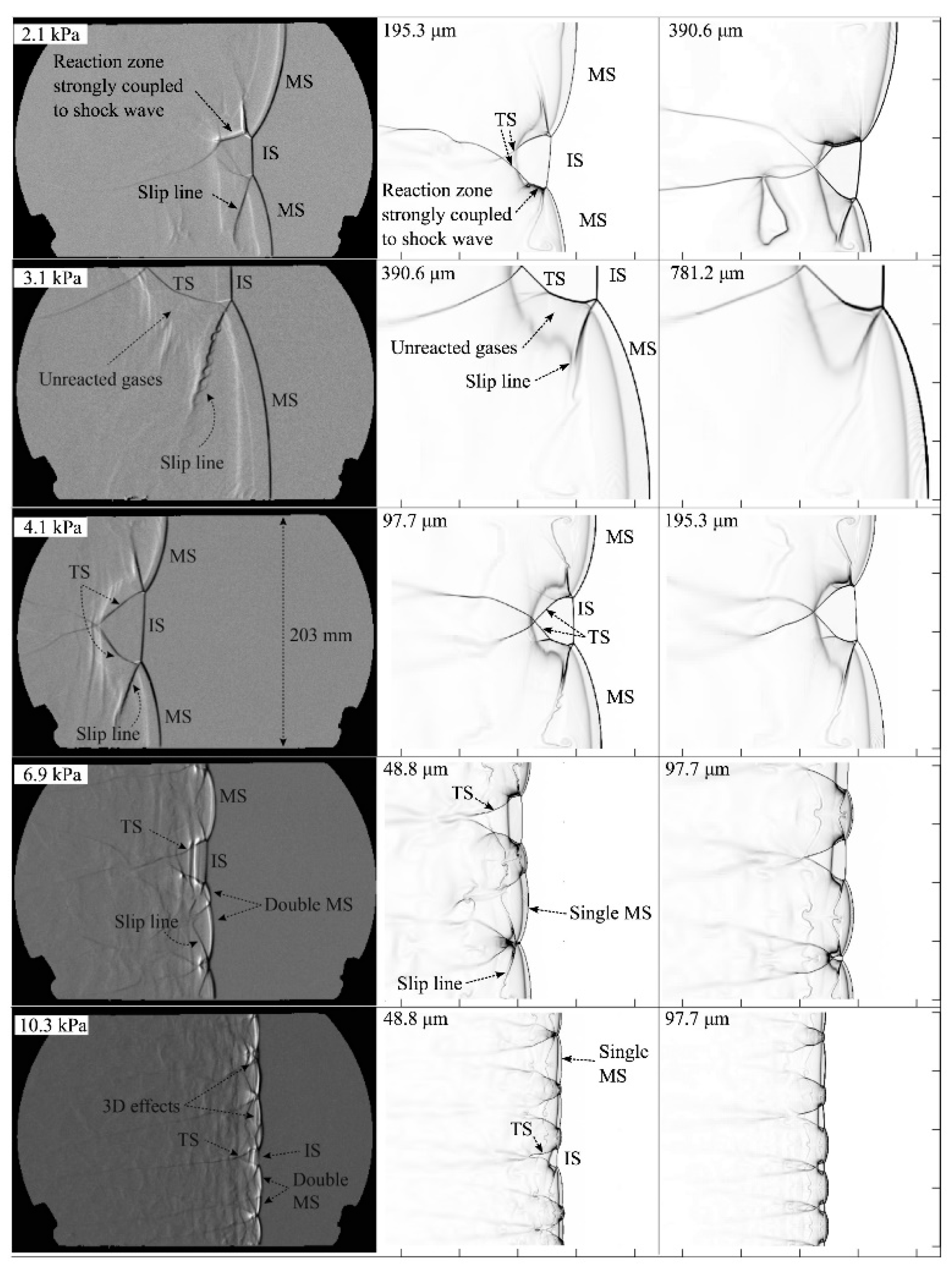
Figure 1. Experimental (left) and numerical (middle and right) Schlieren visualisations of ODW structure at increasing initial pressures. The images illustrate the evolution of TS (transverse shock), IS (incident shock), MS (Mach stem), and slip line features. The transition from strongly coupled detonation fronts to single-shock configurations becomes evident at higher pressures. (Reprinted with permission from [48]).
Aerospace 13 00259 g001
Figure 2. Representative detonation initiation map showing the transition between non-detonative and detonative regimes as a function of shock Mach number and initial pressure, based on shock-induced oblique detonation experiments. (Reprinted with permission from [80]).
Aerospace 13 00259 g002
Figure 3. A valveless two-phase pulse detonation combustor test system (reprinted with permission from [87]).
Aerospace 13 00259 g003
Figure 4. Average cycle pressure gain ratio for a frequency of 100 Hz with H2/air mixture (reprinted with permission from [92]).
Aerospace 13 00259 g004
Figure 5. Effect of nozzle contraction ratio on rotating detonation rocket engine performance and exhaust behaviour. (Reprinted with permission from [117]).
Aerospace 13 00259 g005
Figure 6. Experimental configuration for stabilising a standing normal detonation in a hypersonic flow with secondary fuel injection. (Reprinted with permission from [137]).
Aerospace 13 00259 g006
Figure 7. Stabilised ODW average pressure ratio over time (reprinted with permission from [137]).
Aerospace 13 00259 g007
Figure 8. Flight test of a rotating detonation rocket engine (RDRE) demonstrator developed by Venus Aerospace during a successful launch campaign (frame extracted from flight video, 2025).
Aerospace 13 00259 g008
Figure 9. Schematic representation of the ram-rotor detonation engine concept (Reprinted with permission from [155]).
Aerospace 13 00259 g009
Table 1. Quantitative parameters of pulse detonation engines (PDEs).
MixtureEquivalence RatioTotal Mass Flow [g/s]Tube Diameter [mm]Tube Length [m]Cycle Frequency [Hz]Isp [s]
H2/O20.05–0.2250150.2–0.5100–3506–79
Kerosene/O2135300.855–15123–271
Ethylene/O21–1.35.4–6.1841.516.7–37.8279
Table 2. Quantitative parameters of rotating detonation engines (RDEs).
MixtureEquivalence RatioTotal Mass Flow [g/s]Outer Diameter [mm]Channel Length [mm]Channel Width [mm]Isp [s]
CH4/O20.5–2.5122–45476.276.22–5100–250
H2/N2 + O20.4–1.26260100474.7
Ethylene/N2 + O20.3–1.4200727515–24101–122
Table 3. Quantitative parameters of standing oblique detonation engine (SODE).
MixtureEquivalence RatioTotal Mass Flow [g/s]Inlet Mach NumberConcept Length [mm]Wedge Angle
H2/Air0.5–2.5-4.472830
H2/Air0.2520468025–35
Table 4. Qualitative comparison of detonation-based propulsion concepts.
ConceptEfficiencyGeometry ComplexityCompactnessThrust Unsteadiness
PDELowLowMediumHigh
RDEMediumMediumHighLow
SODEMedium–HighMedium–HighHighVery Low
ConceptAcoustic and structural loadsIntegration potentialWave stabilityOperating window stability
PDEVery HighLowMediumMedium
RDEHighHighMedium–HighMedium–High
SODEMediumLow–MediumHigh (local)Low
Table 5. Maximum average pressure gain ratio per cycle (based on literature upper bounds).
ConceptMaximum Average Pressure Gain Ratio per Cycle
PDE<1.5
RDE<2
SODE<2.7
Disclaimer/Publisher’s Note: The statements, opinions and data contained in all publications are solely those of the individual author(s) and contributor(s) and not of MDPI and/or the editor(s). MDPI and/or the editor(s) disclaim responsibility for any injury to people or property resulting from any ideas, methods, instructions or products referred to in the content.