
Complex Illumination-Aware 3D Gaussian Reconstruction for Uncooperative Space Objects


Abstract
1. Introduction
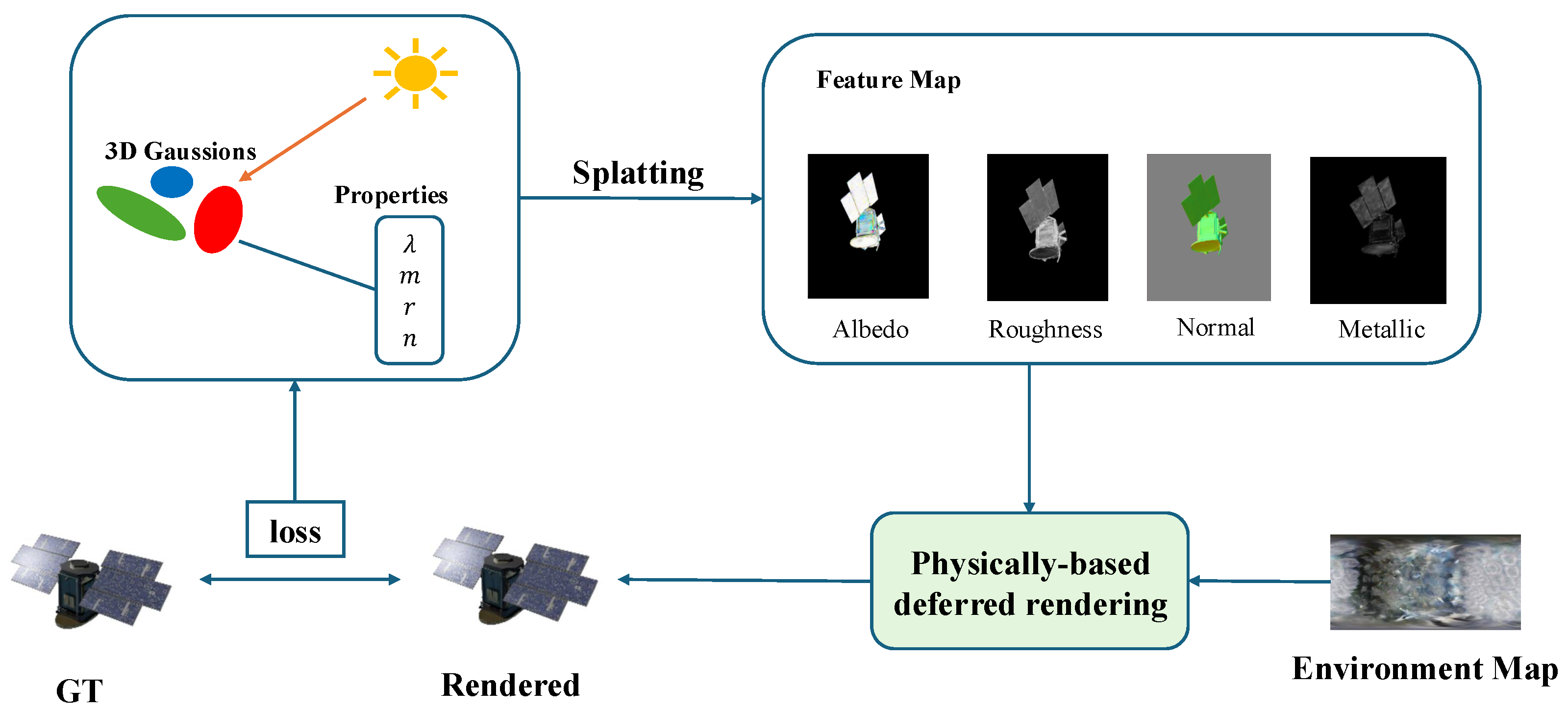
- We propose a physically consistent reconstruction approach specifically tailored for non-cooperative space targets. By decoupling geometry from material properties within the 3DGS framework, our method effectively mitigates geometric artifacts caused by intense specular reflections.
- We establish a robust PBR neural rendering scheme for 3DGS. By incorporating a microfacet BRDF model, we enable explicit Gaussian representations to accurately simulate complex light–material interactions on highly reflective surfaces.
- We introduce a solar orientation initialization strategy as a directional physical prior. This approach leverages the known sun direction in space to provide a deterministic constraint for light-source modeling, significantly improving optimization stability and convergence.
- We design an efficient deferred rendering pipeline. This architecture allows for the high-fidelity integration of complex shading and PBR attributes while preserving the real-time rendering advantages of the 3DGS paradigm.
2. Related Work
2.1. Classical Geometric 3D Reconstruction
2.2. Advances in Neural Implicit Fields and Volume Rendering
2.3. 3D Gaussian Splatting and Its Space Applications
3. Method
3.1. System Overview
3.2. Physically Based Deferred Rendering
3.2.1. Microfacet BRDF Modeling
3.2.2. Lighting Discretization and Outgoing Radiance
3.2.3. Deferred Rendering and Gaussian Blending
3.2.4. Parameter Constraints and Differentiable Optimization
3.3. Sunlight Direction Initialization
3.4. Loss Function
4. Experiments
4.1. Dataset and Experimental Setup
4.1.1. Dataset
4.1.2. Baselines
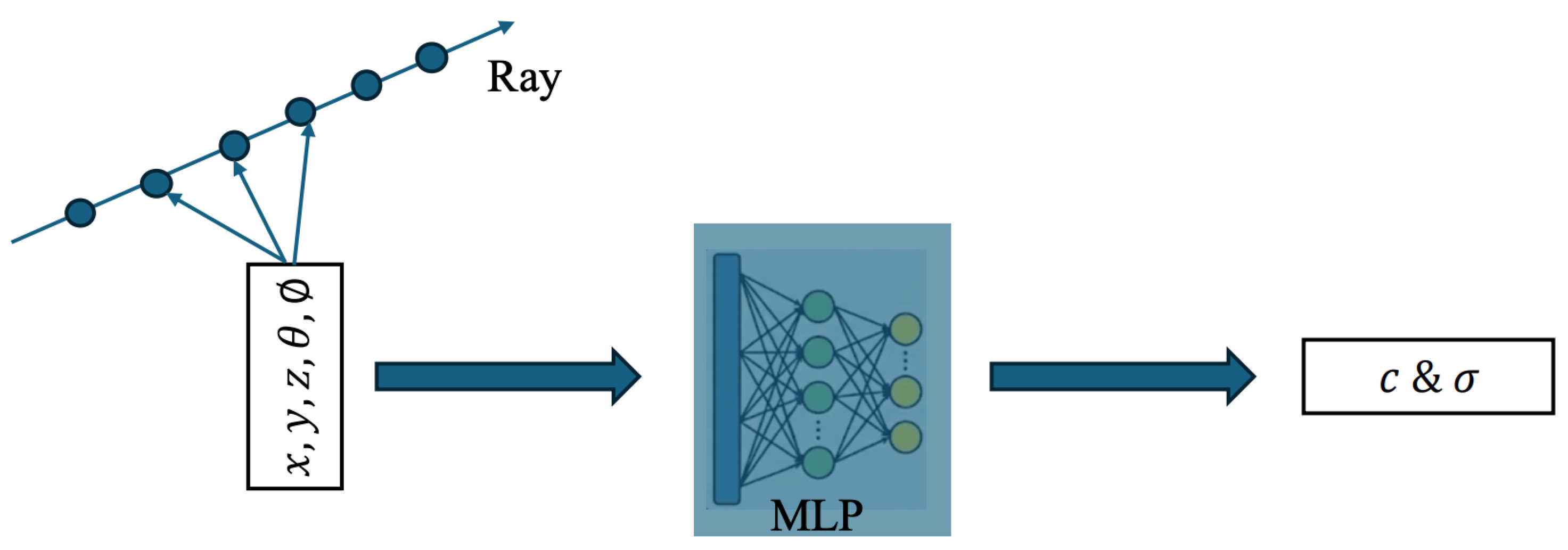
- NeRF [5]: As a pioneering work based on implicit neural representation, NeRF utilizes MLP to map spatial coordinates and viewing directions to volume density and color, synthesizing novel view images through differentiable volume rendering techniques. Although it established high-quality standards for continuous scene representation, its computational cost is extremely high due to expensive viewing ray sampling during training and inference, resulting in slow speeds.
- Instant-NGP [22]: This method introduces a hybrid architecture combining multi-resolution hash encoding with tiny MLPs. By leveraging the advantages of GPU parallel computing, Instant-NGP greatly alleviates the memory access bottleneck of neural networks, increasing training and inference speeds by several orders of magnitude while maintaining high reconstruction quality. It is a representative of fast neural reconstruction frameworks.
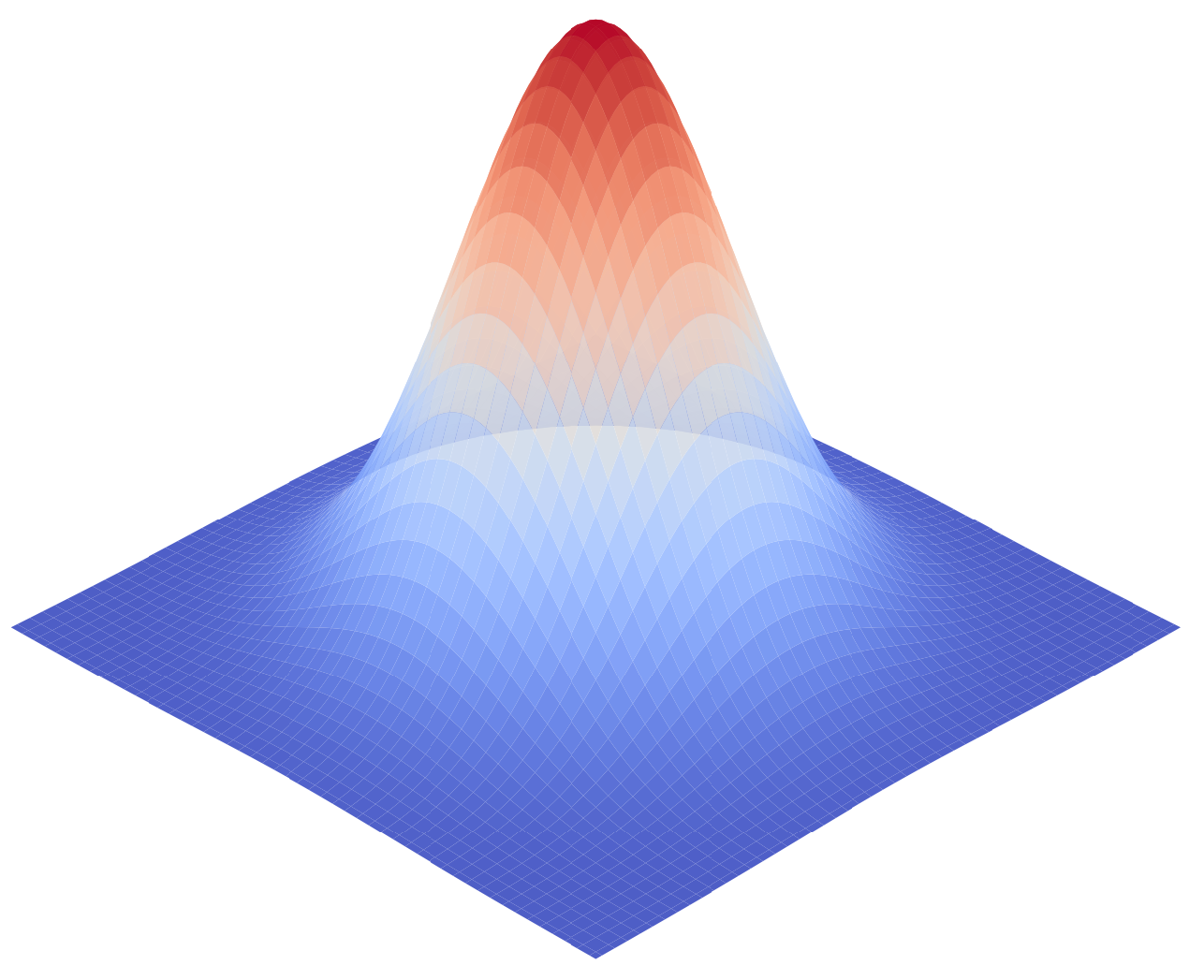
- 3DGS [6]: This is a real-time rendering method based on explicit representation. Unlike implicit fields, 3DGS uses a set of anisotropic 3D Gaussian ellipsoids to represent the scene, combined with an efficient differentiable rasterization pipeline, achieving real-time rendering frame rates and photorealistic synthesis quality. It is currently the mainstream solution balancing reconstruction quality and rendering speed and also the primary baseline for improvement in this paper.
- GaussianShader [24]: This method integrates a simplified physically based rendering pipeline into the 3DGS framework to handle reflective surfaces. It serves as a representative baseline for PBR-enhanced 3DGS methods, allowing us to evaluate the effectiveness of our space-specific material and lighting modeling compared with general-purpose PBR extensions.
4.1.3. Evaluation Metrics
4.1.4. Implementation Details
4.2. Results and Analysis
4.2.1. Quantitative Evaluation
4.2.2. Qualitative Comparison
4.3. Ablation Study and Analysis
5. Discussion and Limitations
5.1. The Scarcity of Non-Cooperative Space Target Datasets
5.2. Dilemma of SfM-Based Pose Estimation and Feature Matching
5.3. Model Limitations and Efficacy Analysis
6. Conclusion and Future Work
Author Contributions
Funding
Data Availability Statement
Conflicts of Interest
Abbreviations
| OOS | On-Orbit Servicing |
| ADR | Active Debris Removal |
| HDR | High Dynamic Range |
| MLI | Multi-layer Insulation |
| NeRF | Neural Radiance Fields |
| 3DGS | 3D Gaussian Splatting |
| BRDF | Bidirectional Reflectance Distribution Function |
| PBR | Physically Based Rendering |
| MVS | Multiview Stereo |
| LEO | Low Earth Orbit |
| SfM | Structure from motion |
| RPO | Rendezvous and Proximity Operations |
| MLP | Multi-layer Perceptron |
References
- Gu, Y.; Li, Z.; Liu, H.; Luo, Q.; Liu, H.; Wu, G. Multi-objective early warning mission planning by multiple satellites using a critical task aggregation-based NSGA-II algorithm. Adv. Space Res. 2025, in press. [Google Scholar] [CrossRef] [Scilit]
- Flores-Abad, A.; Ma, O.; Pham, K.; Ulrich, S. A review of space robotics technologies for on-orbit servicing. Prog. Aerosp. Sci. 2014, 68, 1–26. [Google Scholar] [CrossRef] [Scilit]
- Park, T.H.; D’Amico, S. Robust multi-task learning and online refinement for spacecraft pose estimation across domain gap. Adv. Space Res. 2024, 73, 5726–5740. [Google Scholar] [CrossRef] [Scilit]
- Rangelov, D.; Waanders, S.; Waanders, K.; van Keulen, M.; Miltchev, R. Three-Dimensional Reconstruction Techniques and the Impact of Lighting Conditions on Reconstruction Quality: A Comprehensive Review. Lights 2025, 1, 1. [Google Scholar] [CrossRef] [Scilit]
- Mildenhall, B.; Srinivasan, P.P.; Tancik, M.; Barron, J.T.; Ramamoorthi, R.; Ng, R. NeRF: Representing scenes as neural radiance fields for view synthesis. Commun. ACM 2021, 65, 99–106. [Google Scholar] [CrossRef] [Scilit]
- Kerbl, B.; Kopanas, G.; Leimkuehler, T.; Drettakis, G. 3D Gaussian Splatting for Real-Time Radiance Field Rendering. ACM Trans. Graph. 2023, 42, 1–14. [Google Scholar] [CrossRef] [Scilit]
- Cook, R.L.; Torrance, K.E. A reflectance model for computer graphics. SIGGRAPH Comput. Graph. 1981, 15, 307–316. [Google Scholar] [CrossRef] [Scilit]
- Burley, B.; Studios, W.D.A. Physically-based shading at disney. In Proceedings of the ACM Siggraph; Association for Computing Machinery: New York, NY, USA, 2012; Volume 2012, pp. 1–7. [Google Scholar]
- Saito, T.; Takahashi, T. Comprehensible rendering of 3-D shapes. In Proceedings of the 17th Annual Conference on Computer Graphics and Interactive Techniques; SIGGRAPH ’90; Association for Computing Machinery: New York, NY, USA, 1990; pp. 197–206. [Google Scholar] [CrossRef] [Scilit]
- Roberts, L.G. Machine Perception of Three-Dimensional Solids. Ph.D. Thesis, Massachusetts Institute of Technology, Cambridge, MA, USA, 1963. [Google Scholar]
- Longuet-Higgins, H.C. A computer algorithm for reconstructing a scene from two projections. Nature 1981, 293, 133–135. [Google Scholar] [CrossRef] [Scilit]
- Hartley, R.; Zisserman, A. Multiple View Geometry in Computer Vision; Cambridge University Press: Cambridge, UK, 2003. [Google Scholar]
- Levoy, M.; Pulli, K.; Curless, B.; Rusinkiewicz, S.; Koller, D.; Pereira, L.; Ginzton, M.; Anderson, S.; Davis, J.; Ginsberg, J.; et al. The digital Michelangelo project: 3D scanning of large statues. In Proceedings of the 27th Annual Conference on Computer Graphics and Interactive Techniques; SIGGRAPH ’00; Association for Computing Machinery: New York, NY, USA, 2000; pp. 131–144. [Google Scholar] [CrossRef] [Scilit]
- Friend, R.B. Orbital Express program summary and mission overview. In Proceedings of the Sensors and Systems for Space Applications II; SPIE: Bellingham, WA, USA, 2008; Volume 6958, pp. 11–21. [Google Scholar] [CrossRef] [Scilit]
- Forshaw, J.L.; Aglietti, G.S.; Navarathinam, N.; Kadhem, H.; Salmon, T.; Pisseloup, A.; Joffre, E.; Chabot, T.; Retat, I.; Axthelm, R.; et al. RemoveDEBRIS: An in-orbit active debris removal demonstration mission. Acta Astronaut. 2016, 127, 448–463. [Google Scholar] [CrossRef] [Scilit]
- Biesbroek, R.; Aziz, S.; Wolahan, A.; Cipolla, S.; Richard-noca, M.; Piguet, L. The ClearSpace-1 mission: ESA and ClearSpace team up to remove debris. In Proceedings of the 8th European Conference on Space Debris; ESA Space Debris Office: Darmstadt, Germany, 2021. [Google Scholar]
- Choy, C.B.; Xu, D.; Gwak, J.; Chen, K.; Savarese, S. 3D-R2N2: A Unified Approach for Single and Multi-view 3D Object Reconstruction. In Proceedings of the Computer Vision—ECCV 2016, Honolulu, HI, USA, 11–14 October 2016; Leibe, B., Matas, J., Sebe, N., Welling, M., Eds.; Springer: Cham, Switzerland, 2016; pp. 628–644. [Google Scholar] [CrossRef] [Scilit]
- Charles, R.Q.; Su, H.; Kaichun, M.; Guibas, L.J. PointNet: Deep Learning on Point Sets for 3D Classification and Segmentation. In Proceedings of the 2017 IEEE Conference on Computer Vision and Pattern Recognition (CVPR); IEEE: Piscataway, NJ, USA, 2017; pp. 77–85. [Google Scholar] [CrossRef] [Scilit]
- Artzy, E.; Frieder, G.; Herman, G.T. The theory, design, implementation and evaluation of a three-dimensional surface detection algorithm. Comput. Graph. Image Process. 1981, 15, 1–24. [Google Scholar] [CrossRef] [Scilit]
- Barron, J.T.; Mildenhall, B.; Verbin, D.; Srinivasan, P.P.; Hedman, P. Mip-NeRF 360: Unbounded Anti-Aliased Neural Radiance Fields. In Proceedings of the 2022 IEEE/CVF Conference on Computer Vision and Pattern Recognition (CVPR), New Orleans, LA, USA, 21–26 July 2022; IEEE: Piscataway, NJ, USA, 2022; pp. 5460–5469. [Google Scholar] [CrossRef] [Scilit]
- Verbin, D.; Hedman, P.; Mildenhall, B.; Zickler, T.; Barron, J.T.; Srinivasan, P.P. Ref-NeRF: Structured View-Dependent Appearance for Neural Radiance Fields. IEEE Trans. Pattern Anal. Mach. Intell. 2025, 47, 9426–9437. [Google Scholar] [CrossRef] [Scilit] [PubMed]
- Müller, T.; Evans, A.; Schied, C.; Keller, A. Instant neural graphics primitives with a multiresolution hash encoding. ACM Trans. Graph. (TOG) 2022, 41, 102. [Google Scholar] [CrossRef] [Scilit]
- Forray, C.; Delporte, P.; Delaygue, N.; Genin, F.; Derksen, D. Joint attitude estimation and 3D neural reconstruction of non-cooperative space objects. arXiv 2025, arXiv:2506.20638. [Google Scholar] [CrossRef] [Scilit]
- Jiang, Y.; Tu, J.; Liu, Y.; Gao, X.; Long, X.; Wang, W.; Ma, Y. GaussianShader: 3D Gaussian Splatting with Shading Functions for Reflective Surfaces. In Proceedings of the 2024 IEEE/CVF Conference on Computer Vision and Pattern Recognition (CVPR); IEEE: Piscataway, NJ, USA, 2024; pp. 5322–5332. [Google Scholar] [CrossRef] [Scilit]
- Rother, C.; Kolmogorov, V.; Blake, A. “GrabCut”: Interactive foreground extraction using iterated graph cuts. ACM Trans. Graph. 2004, 23, 309–314. [Google Scholar] [CrossRef] [Scilit]
- Park, T.H.; Märtens, M.; Lecuyer, G.; Izzo, D.; D’Amico, S. SPEED+: Next-Generation Dataset for Spacecraft Pose Estimation across Domain Gap. In Proceedings of the 2022 IEEE Aerospace Conference (AERO); IEEE: Piscataway, NJ, USA, 2022; pp. 1–15. [Google Scholar] [CrossRef] [Scilit]
- Park, T.H.; D’Amico, S. SHIRT: Satellite Hardware-In-the-Loop Rendezvous Trajectories Dataset. Stanford Digital Repository. 2022. Available online: https://purl.stanford.edu/zq716br5462 (accessed on 31 January 2026).
- Rathinam, A.; Qadadri, H.; Aouada, D. SPADES: A Realistic Spacecraft Pose Estimation Dataset using Event Sensing. In Proceedings of the 2024 IEEE International Conference on Robotics and Automation (ICRA); IEEE: Piscataway, NJ, USA, 2024; pp. 11760–11766. [Google Scholar] [CrossRef] [Scilit]
- Proença, P.F.; Gao, Y. Deep Learning for Spacecraft Pose Estimation from Photorealistic Rendering. In Proceedings of the 2020 IEEE International Conference on Robotics and Automation (ICRA); IEEE: Piscataway, NJ, USA, 2020; pp. 6007–6013. [Google Scholar] [CrossRef] [Scilit]
- Issitt, A.; Mahendrakar, T.; Alvarez, A.; White, R.T.; Sizemore, A. On Optimal Observation Orbits for Learning Gaussian Splatting-Based 3D Models of Unknown Resident Space Objects. In Proceedings of the AIAA SCITECH 2025 Forum; American Institute for Aeronautics and Astronautics (AIAA): Reston, VA, USA, 2025; p. 1780. [Google Scholar] [CrossRef] [Scilit]



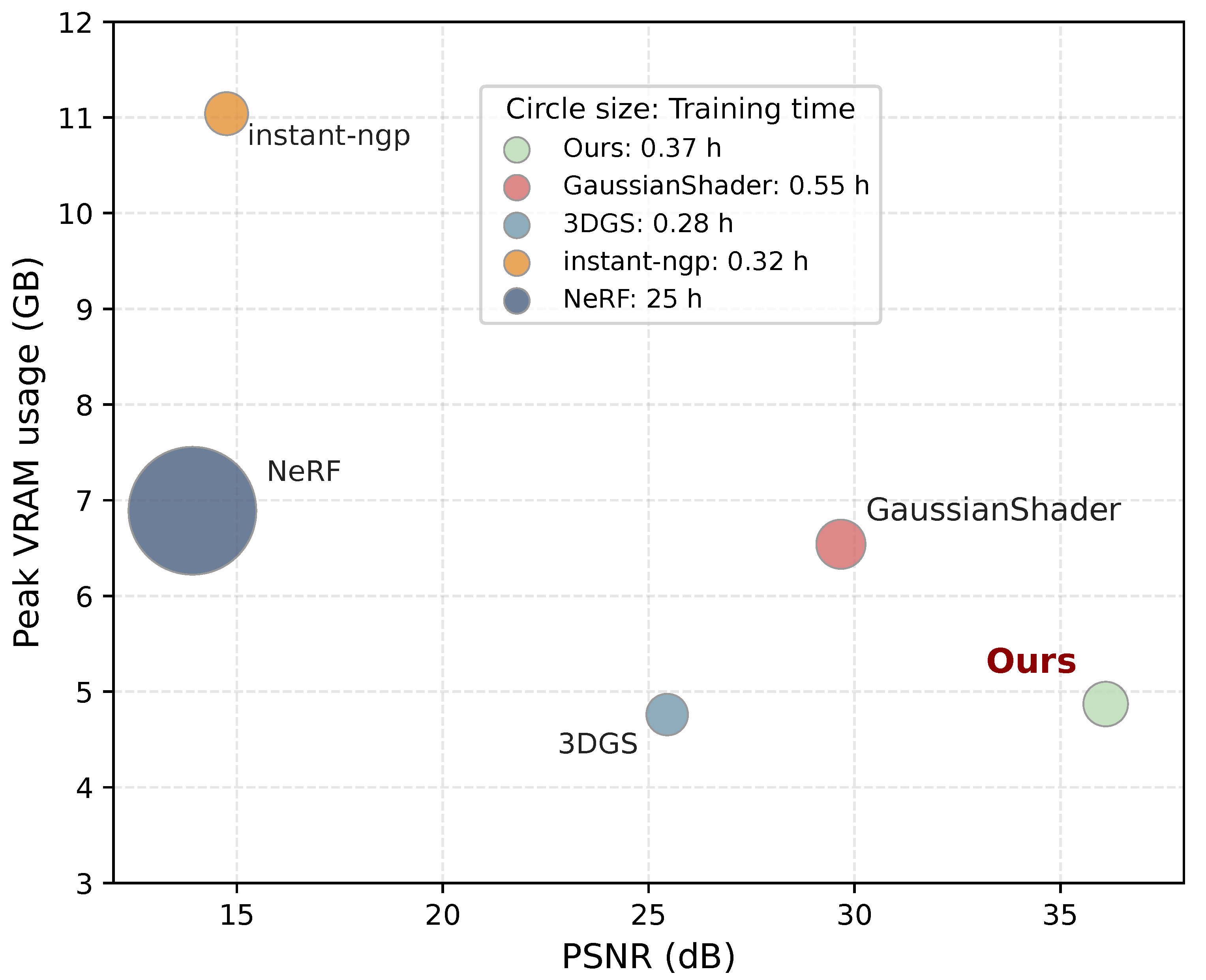
| Algorithm | PSNR ↑ | SSIM ↑ | LPIPS ↓ | Memory ↓ | Time ↓ |
|---|---|---|---|---|---|
| Average results (avg) | |||||
| NeRF | 13.92 | 0.910 | 0.1900 | 7051 MiB | 25 h |
| Instant-ngp | 14.75 | 0.870 | 0.2200 | 11,301 MiB | 19 min |
| 3DGS | 25.45 | 0.947 | 0.0766 | 4760 MiB | 17 min |
| GaussianShader | 29.67 | 0.967 | 0.0457 | 6541 MiB | 33 min |
| Space-Gaussian | 36.10 | 0.980 | 0.0170 | 4989 MiB | 22 min |
| Results for cubesat | |||||
| NeRF | 11.71 | 0.875 | 0.3137 | 8367 MiB | 26 h |
| Instant-ngp | 11.43 | 0.751 | 0.4190 | 11,315 MiB | 20 min |
| 3DGS | 34.23 | 0.978 | 0.0466 | 2835 MiB | 18 min |
| GaussianShader | 33.89 | 0.981 | 0.0460 | 6389MiB | 39 min |
| Space-Gaussian | 36.63 | 0.985 | 0.0257 | 5387 MiB | 22.85 min |
| Results for starlink | |||||
| NeRF | 15.50 | 0.916 | 0.1566 | 6388 MiB | 26 h |
| Instant-ngp | 17.10 | 0.914 | 0.1195 | 11,851 MiB | 18 min |
| 3DGS | 17.44 | 0.945 | 0.1051 | 6319 MiB | 19 min |
| GaussianShader | 26.38 | 0.967 | 0.0596 | 6766 MiB | 29 min |
| Space-Gaussian | 37.33 | 0.987 | 0.0134 | 5931 MiB | 30.23 min |
| Results for Sentinel-6 | |||||
| NeRF | 14.56 | 0.948 | 0.1005 | 6400 MiB | 24 h |
| Instant-ngp | 15.72 | 0.937 | 0.1160 | 10,739 MiB | 18 min |
| 3DGS | 24.67 | 0.918 | 0.0510 | 5127 MiB | 14 min |
| GaussianShader | 28.75 | 0.952 | 0.0315 | 6467 MiB | 31 min |
| Space-Gaussian | 34.36 | 0.982 | 0.0129 | 4329 MiB | 21.23 min |
| Method | PSNR ↑ | SSIM ↑ | LPIPS ↓ |
|---|---|---|---|
| w/o BRDF | 32.12 | 0.952 | 0.645 |
| w/o Material Opt. | 34.89 | 0.976 | 0.172 |
| w/o Solar Orientation Init. | 29.45 | 0.967 | 0.298 |
| w/o Deferred Shading | 34.10 | 0.960 | 0.023 |
| Full Model (Ours) | 36.10 | 0.980 | 0.017 |
Disclaimer/Publisher’s Note: The statements, opinions and data contained in all publications are solely those of the individual author(s) and contributor(s) and not of MDPI and/or the editor(s). MDPI and/or the editor(s) disclaim responsibility for any injury to people or property resulting from any ideas, methods, instructions or products referred to in the content. |
© 2026 by the authors. Licensee MDPI, Basel, Switzerland. This article is an open access article distributed under the terms and conditions of the Creative Commons Attribution (CC BY) license.
Share and Cite
Qu, Z.; Zhang, Z.; Xun, R.; Zhou, J.; Chang, L. Complex Illumination-Aware 3D Gaussian Reconstruction for Uncooperative Space Objects. Aerospace 2026, 13, 258. https://doi.org/10.3390/aerospace13030258
Qu Z, Zhang Z, Xun R, Zhou J, Chang L. Complex Illumination-Aware 3D Gaussian Reconstruction for Uncooperative Space Objects. Aerospace. 2026; 13(3):258. https://doi.org/10.3390/aerospace13030258
Chicago/Turabian StyleQu, Ziang, Zhang Zhang, Ruiqi Xun, Junlan Zhou, and Liang Chang. 2026. "Complex Illumination-Aware 3D Gaussian Reconstruction for Uncooperative Space Objects" Aerospace 13, no. 3: 258. https://doi.org/10.3390/aerospace13030258
APA StyleQu, Z., Zhang, Z., Xun, R., Zhou, J., & Chang, L. (2026). Complex Illumination-Aware 3D Gaussian Reconstruction for Uncooperative Space Objects. Aerospace, 13(3), 258. https://doi.org/10.3390/aerospace13030258