
Abstract
Hydrogen peroxide (H2O2) is a dense, storable oxidizer, but its suitability for high-energy upper stages is limited. This study evaluates liquid hydrogen–hydrogen peroxide (LH2/H2O2) as an alternate propellant using KSLV-II as the reference vehicle. Propulsion performance was analyzed with NASA CEA and RPA, while staging and MER methods assessed system-level effects. The results show that the specific impulse decreases from 465 s (LH2/LOX) to 372~382 s with H2O2, but structural efficiency improves as the coefficient drops from 0.162 to 0.099~0.102. The payload capacity increases compared with Jet A-1/LOX yet remains below that of LOX. These findings clarify both the advantages and limitations of H2O2 as an upper-stage oxidizer.
1. Introduction
Given the rapid advancements in South Korea’s space development sector, highlighted by the success of the Nuri (Korea Space Launch Vehicle-II, KSLV-II), there has been burgeoning interest in furthering research on rocket technology. This momentum stems from the achievements of both the Naro (KSLV-I) and Nuri rockets, which have catalyzed various projects ranging from lunar exploration vehicles to the study of new rocket technologies [1,2]. The technological foundation laid by the Nuri rocket, in particular, has fostered research into the conceptual design of large geostationary orbit launch vehicles, enhancements to Nuri rocket performance, and the development of high-performance small launch vehicles [3,4,5,6,7]. Previous studies by this research group have also demonstrated that the performance of launch vehicles can be significantly enhanced by employing a liquid hydrogen–liquid oxygen propellant combination [8].
The LH2/LOX propellant combination is well known for its exceptionally high specific impulse and has therefore become the de facto standard for high-energy upper stages. In such stages, where final orbital insertion is performed, small gains in specific impulse translate directly into increased payload capacity or extended mission flexibility. However, the advantages of LH2/LOX in terms of propulsion performance come with notable system-level penalties. The very low density of liquid hydrogen requires large propellant tank volumes, which increases the structural mass of the vehicle. Moreover, hydrogen’s low molecular weight and propensity for leakage and material embrittlement demand specialized sealing technologies, careful material selection, and stringent ground-handling procedures. As a result, LH2-fueled stages often suffer from relatively high structural coefficients, which can offset part of the benefits provided by the high specific impulse.
Hydrogen peroxide (H2O2) has a long history of use as both an oxidizer and a monopropellant, with applications dating back to the mid-20th century [9]. It has been used, for example, as the oxidizer in the British Black Arrow launch vehicle [10] and as a monopropellant in the attitude-control thrusters of the Soyuz spacecraft [11]. In recent years, there has been renewed interest in high-test peroxide (HTP) as a green propellant owing to its benign decomposition products, relatively simple handling compared with cryogenic oxidizers, and its demonstrated applicability in monopropellant, bipropellant, and hybrid propulsion systems [12,13,14,15,16,17]. Advances in purification and stabilization techniques have enabled the production of high-concentration HTP suitable for demanding space applications, leading to new development programs in reaction-control systems, small launch vehicles, and hybrid rocket demonstrators.
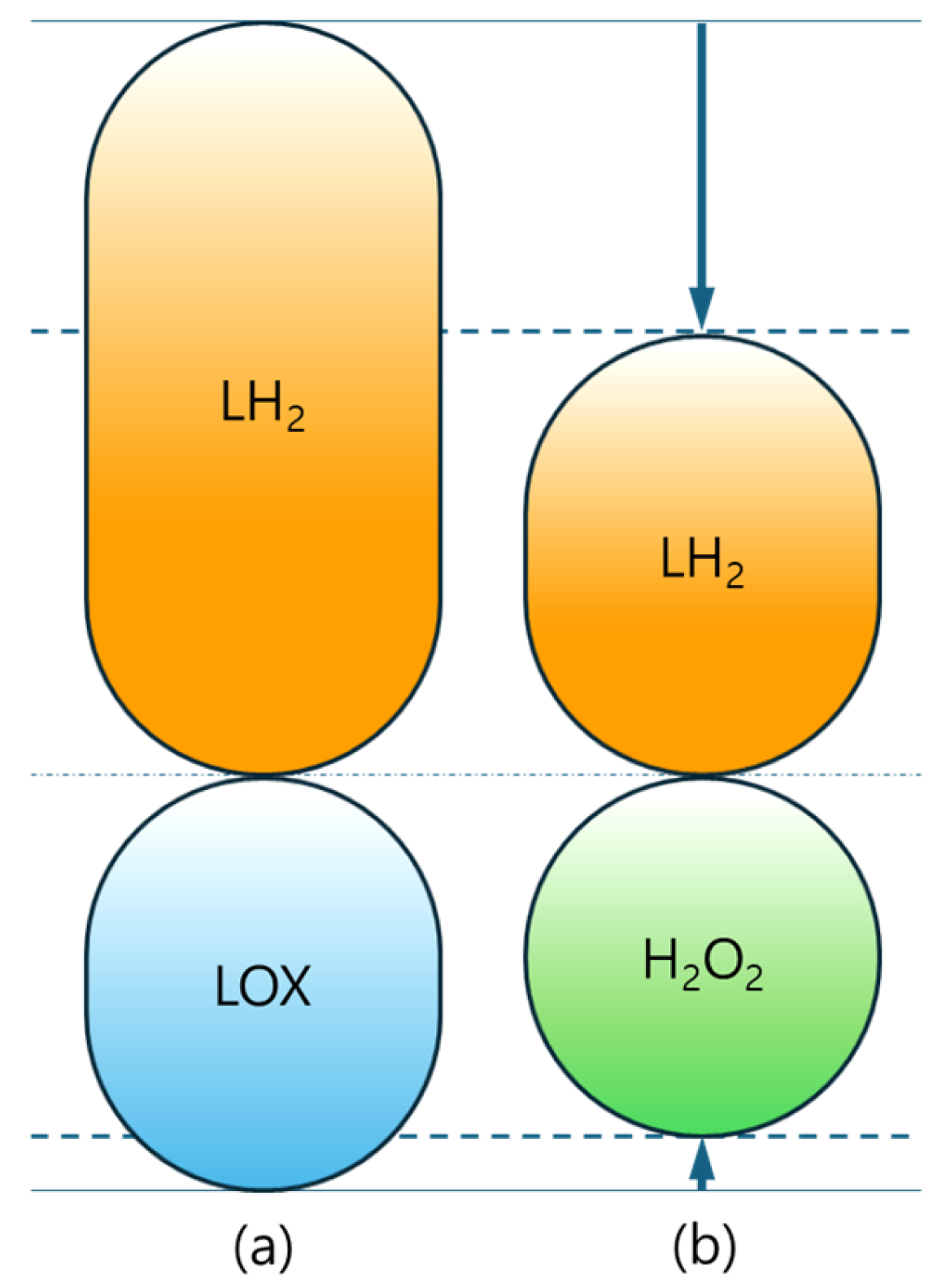
From a basic chemical standpoint, the potential structural advantages of combining liquid hydrogen with hydrogen peroxide can be illustrated through the stoichiometric reactions summarized in Equations (1) and (2). Equation (1) represents the reaction between liquid hydrogen and liquid oxygen, whereas Equation (2) describes the reaction when hydrogen peroxide is used as the oxidizer. Comparing these two reactions shows that, for a given amount of oxygen provided by the oxidizer, the LH2/H2O2 system requires only half as much hydrogen as the LH2/LOX system. When this reduction in required hydrogen mass is considered together with the higher density of concentrated hydrogen peroxide relative to liquid oxygen, the required tank volume is expected to decrease. A simple conceptual tank-sizing schematic, summarized in Figure 1 for a representative upper-stage mission, illustrates that replacing LOX with H2O2 can substantially reduce the total propellant volume and the corresponding tank mass. Although this illustrative estimate does not account for all design constraints, it provides a useful physical basis for examining LH2/H2O2 at the launch-vehicle system level.
Figure 1.
Schematic of liquid-hydrogen-fueled launch vehicle tank: (a) combination of liquid oxygen–liquid hydrogen and (b) combination of hydrogen peroxide–liquid hydrogen.
At the same time, the use of hydrogen peroxide in high-energy upper stages presents important challenges. The vacuum specific impulse achievable with LH2/H2O2 is significantly lower than that of LH2/LOX under similar chamber conditions, which directly impacts payload performance in orbital insertion missions [18]. High-concentration HTP must also be carefully purified, stabilized, and handled to prevent undesired exothermic decomposition in the presence of contaminants or excessive thermal loads, and its compatibility with structural and propulsion materials must be thoroughly verified [19,20]. While modern production and stabilization methods can provide high-concentration HTP with excellent storage stability, these requirements still impose non-negligible constraints on system design and operations. Consequently, the historical use of hydrogen peroxide has been concentrated in lower-energy applications such as attitude control or smaller propulsion systems, and its potential as an oxidizer for large upper stages remains underexplored.
Previous studies on hydrogen peroxide propulsion have not examined the liquid hydrogen/hydrogen peroxide (LH2/H2O2) propellant combination from a system-level launch-vehicle perspective. In particular, the trade-offs between LH2/H2O2 and the conventional LH2/LOX combination in terms of structural coefficient, stage mass, and payload capability have not been quantified for realistic launch-vehicle configurations. The objective of the present work is therefore to investigate the performance characteristics of an LH2/H2O2 upper stage and to compare them with those of an LH2/LOX reference stage, using the KSLV-II architecture as a representative baseline. By conducting a consistent system-level analysis under identical mission and geometric constraints, this study aims to provide a balanced assessment of the potential and limitations of hydrogen peroxide as an oxidizer for high-energy upper-stage applications and to clarify the conditions under which LH2/H2O2 may offer net benefits at the vehicle level.
2. Applicability of Liquid Hydrogen/Hydrogen Peroxide Combination
This section evaluates whether the structural coefficient benefits of replacing liquid oxygen with hydrogen peroxide (95~100%) can offset the loss in specific impulse when applied to an upper stage. In other words, we ask if the reduction in LH2 tank volume and mass can compensate for the performance penalty, thereby informing system-level feasibility. To facilitate a direct comparison of propulsion performance and overall launch-vehicle efficiency, an upper stage utilizing an LH2/H2O2 propellant combination was considered. The KSLV-II was selected as the reference vehicle due to its publicly available specifications [21]. While most liquid hydrogen upper-stage engines are based on the expander cycle, the HM7B adopts a gas-generator cycle, which is identical to the propulsion cycle of the KSLV-II third stage. This correspondence in cycle makes the HM7B a particularly suitable benchmark, as it enables a more straightforward substitution of oxidizers while minimizing performance discrepancies attributable to dissimilar engine cycles. The HM7B was selected as a comparative benchmark primarily based on its cycle topology (gas-generator) rather than on exact propellant matching. This selection intends to evaluate system-level effects for a gas-generator-type upper-stage architecture similar to that of the KSLV-II third stage. It is acknowledged that the HM7B operates with an LH2/LOX propellant combination, and therefore, the comparison is not one-to-one in terms of propellant chemistry. This limitation and its implications for performance interpretation are discussed in Section 3. In this study, both the LH2/LOX and LH2/H2O2 configurations were analyzed under the same gas-generator cycle assumption to ensure a consistent basis for comparison. The specific characteristics and performance metrics of the HM7B engine are detailed in the referenced data sources [22] and summarized in Table 1.
Table 1.
HM7B engine specification.
2.1. Propulsion Performance
For the analysis of propulsion performance changes due to different oxidizers, three key parameters were examined: adiabatic temperature, enthalpy of reaction, and specific impulse. These were calculated using NASA’s Chemical Equilibrium Application (CEA, also called CEA2) code [23] and Rocket Propulsion Analysis (RPA, v2.3.2) software [24], with a combustion chamber pressure of 40 bar.
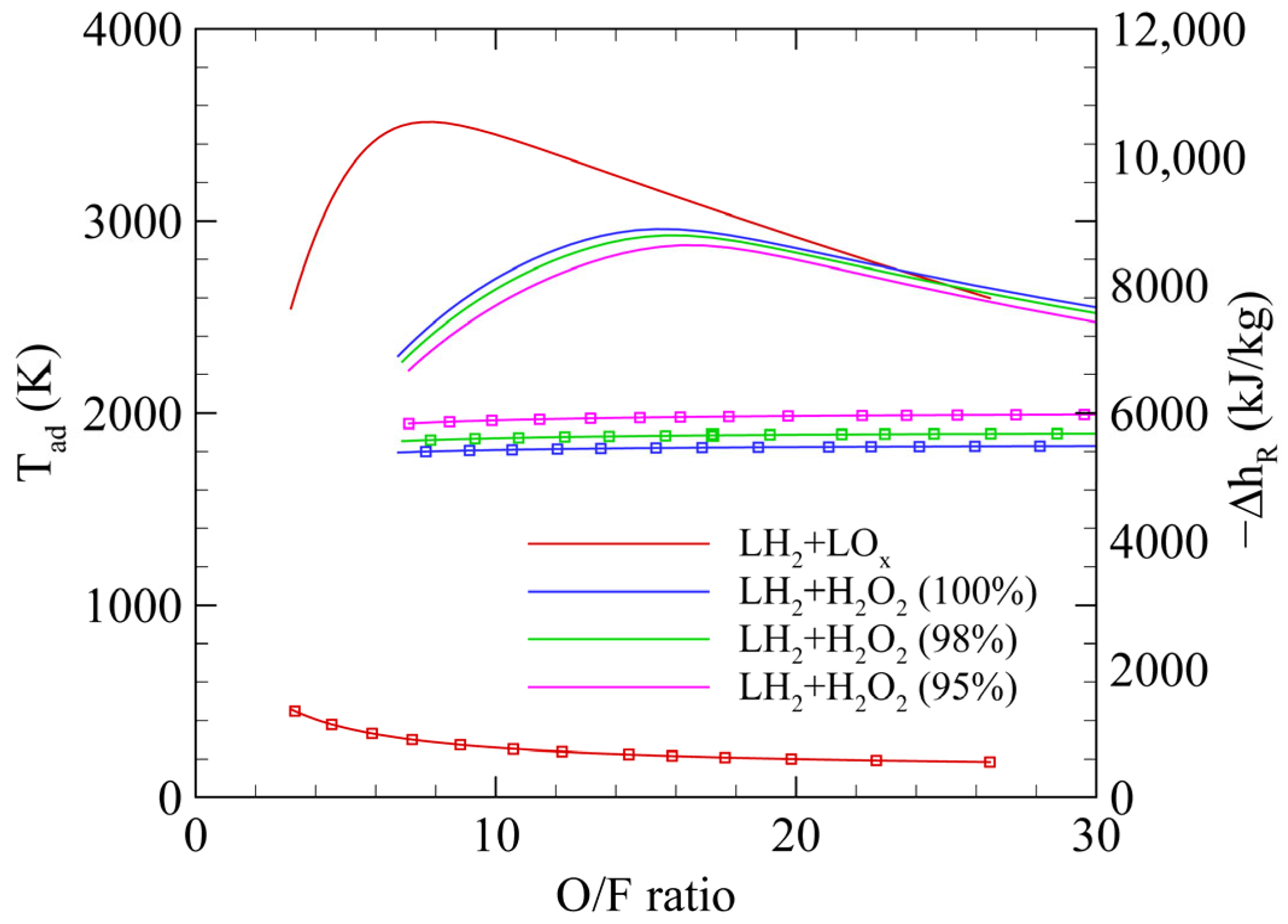
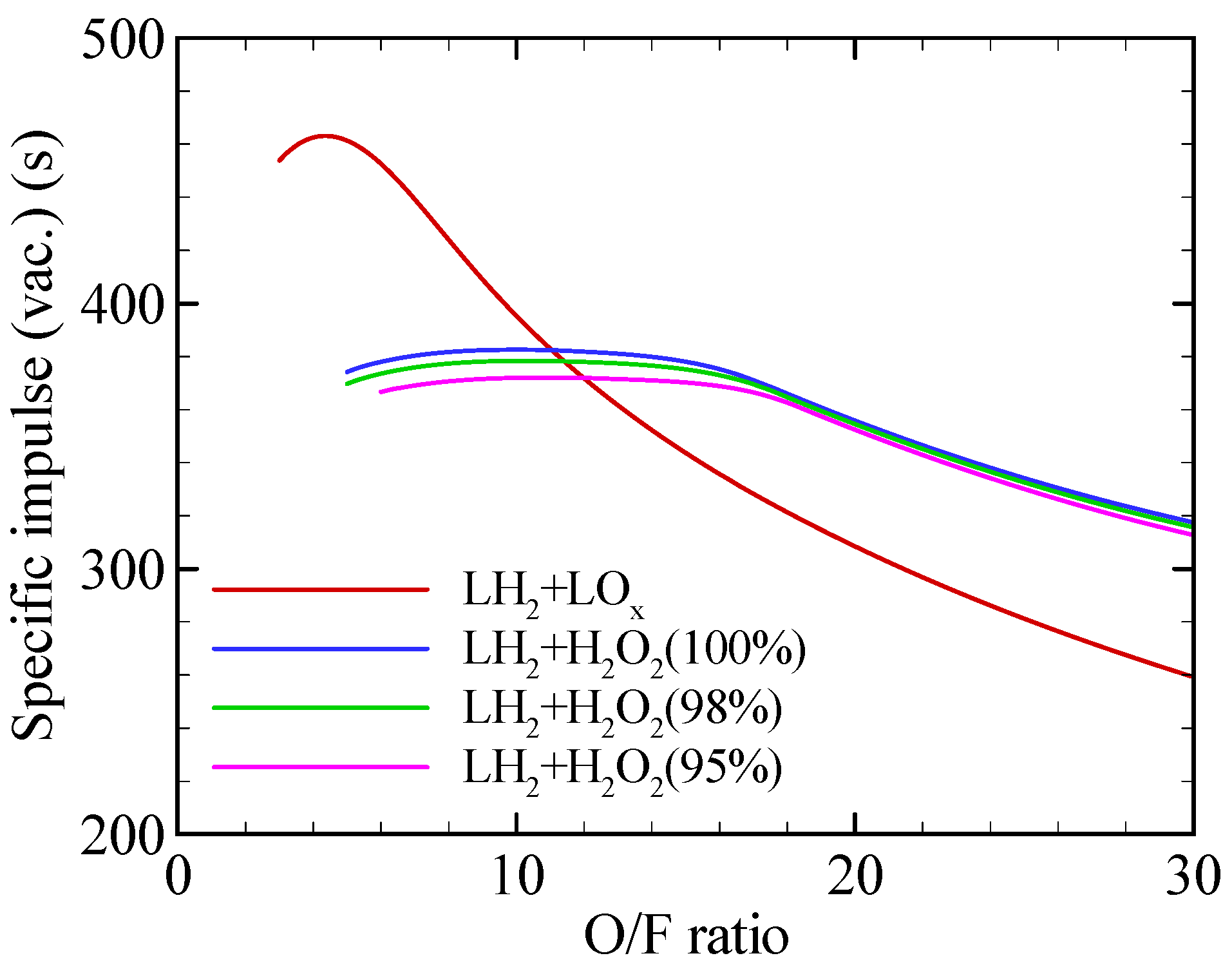
The adiabatic flame temperature is critical for understanding the combustion reaction rate and represents the temperature achieved under adiabatic conditions, where no heat is lost to the surroundings. According to Figure 2, the adiabatic temperature reaches its peak at the stoichiometric condition (equivalence ratio of 1) when the oxidizer is liquid oxygen. This parameter is therefore essential for characterizing the combustion process and its influence on propulsion performance. Specific impulse, a key measure of engine efficiency, is highest under fuel-rich conditions, as indicated in Figure 3. These parameters provide a comparative basis for evaluating how oxidizer choice impacts propulsion efficiency and rocket engine performance.
Figure 2.
Adiabatic flame temperature and enthalpy of reaction at p = 40 bar (line: adiabatic temperature, symbols: enthalpy of reaction (negative values)).
Figure 3.
Specific impulse (vacuum) at p = 40 bar.
At the oxidizer-to-fuel (O/F) ratio corresponding to maximum performance, the LH2/LOX combination yields a vacuum specific impulse approximately 83.3~93.5 s higher than that of LH2/H2O2 at a chamber pressure of 40 bar. This difference originates from the partially oxidized state of hydrogen peroxide, which reduces the enthalpy of reaction and, consequently, the achievable specific impulse. Furthermore, while the stoichiometric molar ratio of hydrogen to oxidizer decreases from 2:1 with O2 to 1:1 with H2O2, the stoichiometric O/F ratio by mass increases from about 8 to nearly 17. Consequently, although hydrogen peroxide requires a larger oxidizer mass and tank volume, the significant reduction in LH2 tank volume, owing to its extremely low density, may still lead to improvements in the structural coefficient.
To make this comparison more explicit, Table 2 summarizes, for each oxidizer, the O/F ratio at which the vacuum specific impulse reaches its maximum, together with the corresponding adiabatic flame temperature, enthalpy of reaction, and vacuum specific impulse at a chamber pressure of 40 bar. Under these optimum conditions, all propulsion performance parameters attain their highest value when liquid oxygen is used as the oxidizer. For the LH2/H2O2 combinations, the reduced specific impulse is directly related to the lower magnitude of the enthalpy of reaction, which results from the partially oxidized nature of hydrogen peroxide compared with liquid oxygen. The O/F ratios adopted in the subsequent system-level analysis are based on these optimum conditions in Table 2. Therefore, although LH2/H2O2 exhibits a clear penalty in thermochemical performance relative to LH2/LOX, it also offers the possibility of reducing LH2 tank volume and structural mass due to the higher oxidizer density and lower hydrogen requirement. It is thus necessary to examine whether the potential structural-coefficient benefit of LH2/H2O2 can compensate for this loss in specific impulse. This trade-off is investigated in the launch-vehicle performance analysis presented in Section 3.
Table 2.
Propulsion parameters at the O/F ratio corresponding to the maximum vacuum specific impulse for each oxidizer (p = 40 bar).
Beyond thermochemical performance, the use of high-concentration H2O2 (95~100%) imposes strict demands on purity control, stabilizer formulation, temperature management, and material compatibility. Modern production and stabilization methods can provide high-concentration HTP with very good storage stability [17,25], but undesired exothermic decomposition may still occur in the presence of contaminants, excessive thermal loads, or incompatible materials [18,19,20]. These practical requirements must be weighed against the potential density-related advantages when evaluating LH2/H2O2 for upper-stage propulsion.
2.2. Methodology of Launch-Vehicle Performance Calculation
For the launch-vehicle performance analysis, we utilized KSLV-II specifications, focusing on a 700 km target orbit and a 1.5 t payload. Given the significance of specific impulse in upper stages, modifications were limited to the 3rd stage to evaluate the impact of propellant changes without altering its physical dimensions.
Performance estimates were derived using Tsiolkovsky’s rocket equation (Equation (3)) and the Mass Estimating Relation (MER) method introduced by Ref. [26]. The rocket equation determines the theoretical velocity increment () based on propellant mass, rocket mass, and exhaust velocity. At the same time, MER provides empirical estimates of subsystem and structural masses as functions of design parameters and propellant choice. The MER was developed through regression analysis of collected tank volume and mass data from various liquid propellant systems, making it an empirically based method widely used for preliminary sizing of liquid propulsion systems.
This analysis, therefore, assesses whether the structural coefficient advantages and mass savings associated with hydrogen peroxide can compensate for reductions in specific impulse and propulsion efficiency. Staging calculations were performed using the same methodology as in Jo et al. [4] to determine the mass distribution across vehicle stages, ensuring that the cumulative requirement for orbit injection was satisfied while accounting for gravity, drag, and steering losses.
For a 700 km circular orbit, the orbital velocity calculated using the vis-viva equation is 7504.3 m/s. However, orbit injection requires additional to overcome velocity losses from gravity, drag, and steering, which depend on flight path angle, burn time, vehicle aerodynamics, and thrust vector control. In this study, the velocity loss values reported for KSLV-II by Roh et al. [21] were adopted as practical references. Considering these factors, the total velocity increment (Equation (4)) required for payload injection into a 700 km orbit is 10,904.3 m/s. The required for the upper stage was determined by subtracting the combined contributions of the first and second stages from the total mission requirement, as expressed in Equation (5), yielding approximately 4622 m/s.
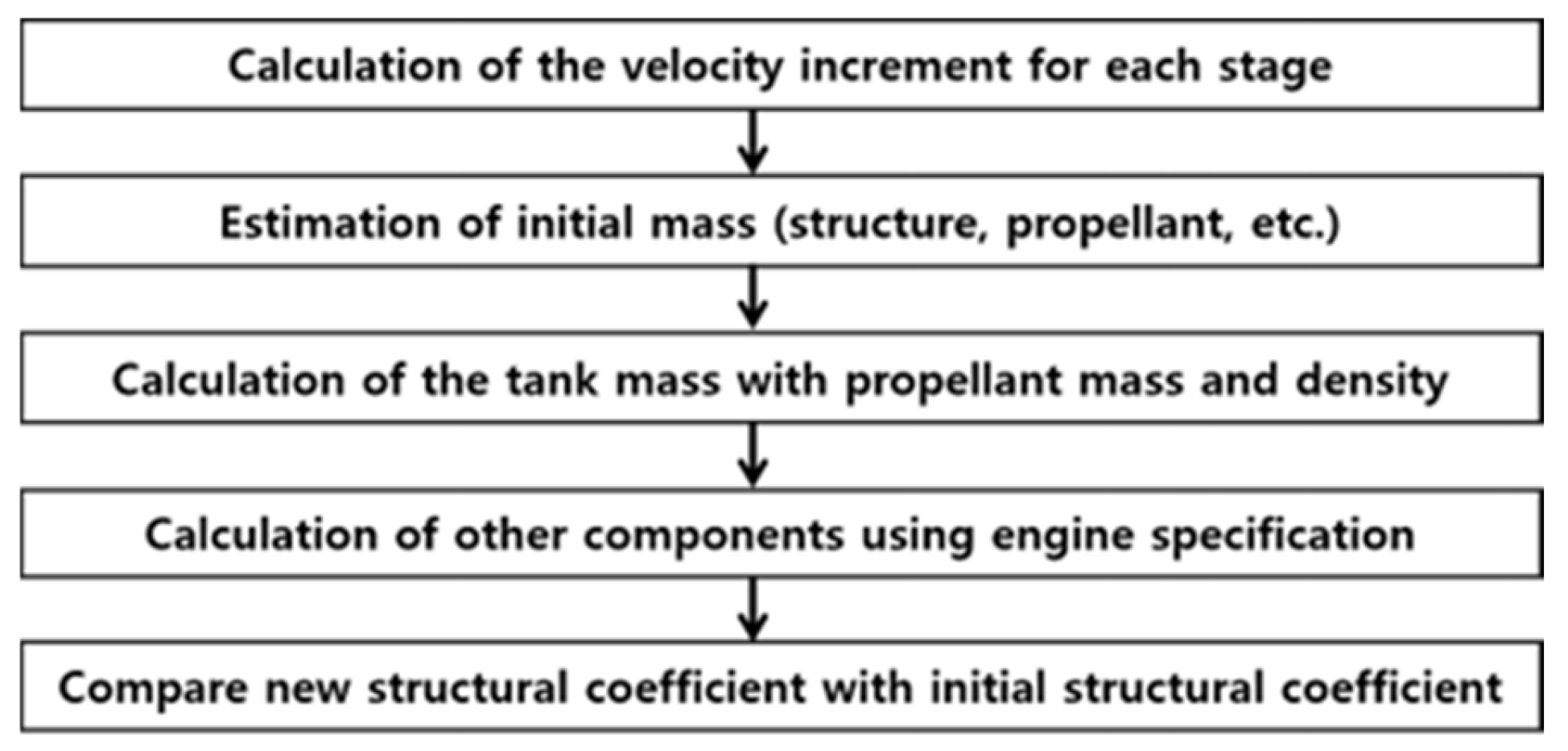
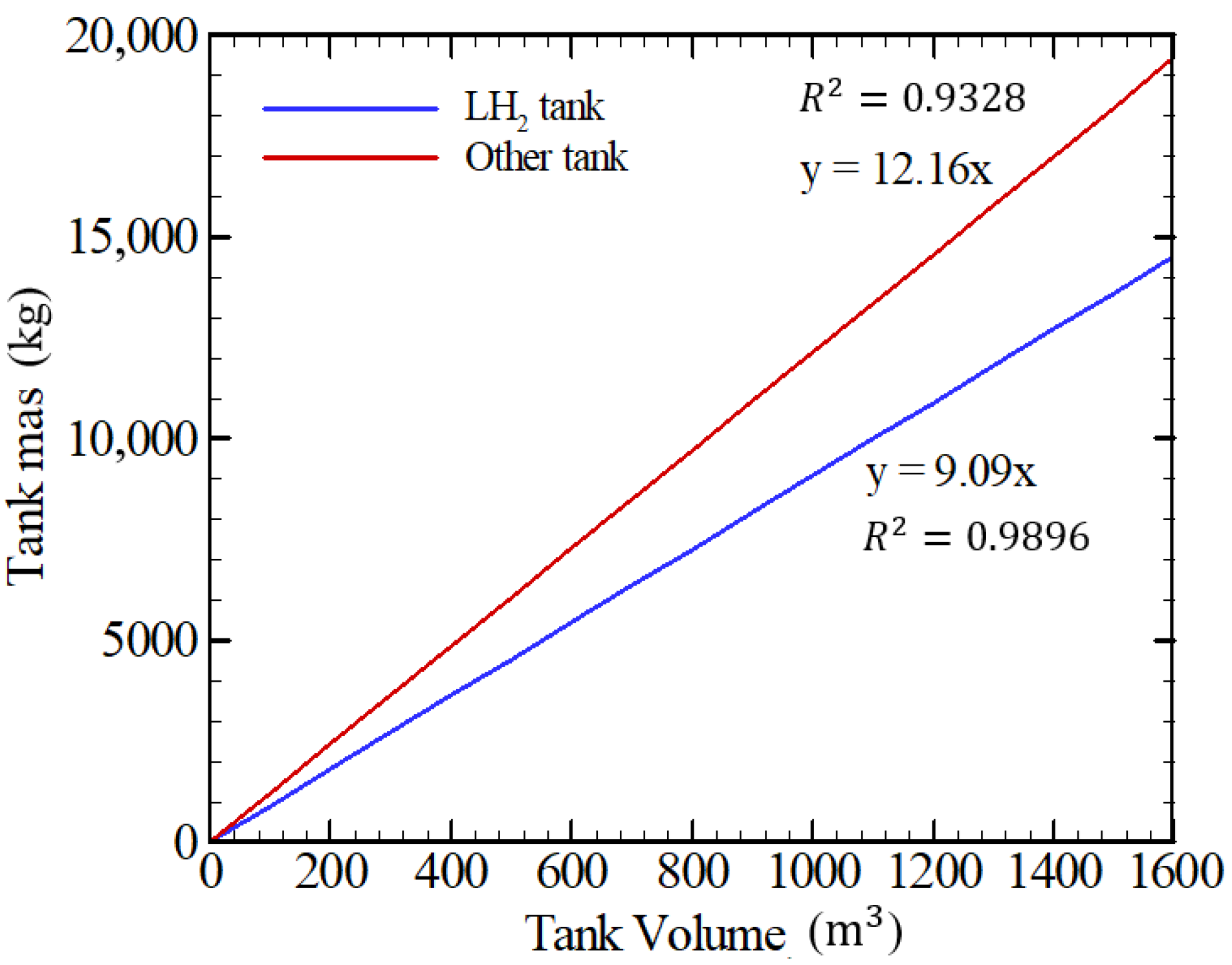
The overall process of the MER calculation is illustrated in Figure 4. The MER calculation estimates component masses based on engine specifications such as thrust, specific impulse, nozzle expansion ratio, combustion chamber pressure, O/F ratio, and propellant density. The initial structural coefficient of the upper stage was set at 0.143, consistent with the third stage of the KSLV-II. Equations (6) and (7) present the regression-based relationships used to estimate the oxidizer and fuel tank masses, derived from empirical correlations in the MER. The regression data are also shown in Figure 5.
Figure 4.
Process of MER calculation.
Figure 5.
Empirical correlation between tank mass and volume for the LH2 tank (R2 = 0.9896) and other propellant tanks (R2 = 0.9328), adapted from reference [26].
This study evaluates the effect of oxidizer choice on structural mass and upper-stage length using MER calculations, providing preliminary insight into system-level trade-offs. Nevertheless, as the MER relies on empirical correlations that cannot fully capture structural stresses or subsystem integration complexities, its results should be regarded as approximate and supplemented with high-fidelity simulations in future studies.
3. System-Level Impact of Oxidizer Change for the Upper Stage
3.1. System-Level Results of Liquid Hydrogen/Hydrogen Peroxide Upper Stage
Table 3 summarizes the staging and MER results for the third stage of KSLV-II with different oxidizers, including the corresponding cylindrical-equivalent tank heights obtained from the MER-based volume and the known stage diameter. Replacing liquid oxygen with hydrogen peroxide decreases the specific impulse from 465.5 s to 372~382 s but simultaneously reduces the structural coefficient from 0.162 to 0.099~0.102 due to reduced LH2 tank volume. This trade-off indicates that, while structural efficiency improves, propulsion performance is significantly degraded when hydrogen peroxide is used as the oxidizer.
Table 3.
Staging and MER results of the 3rd stage of KSLV-II.
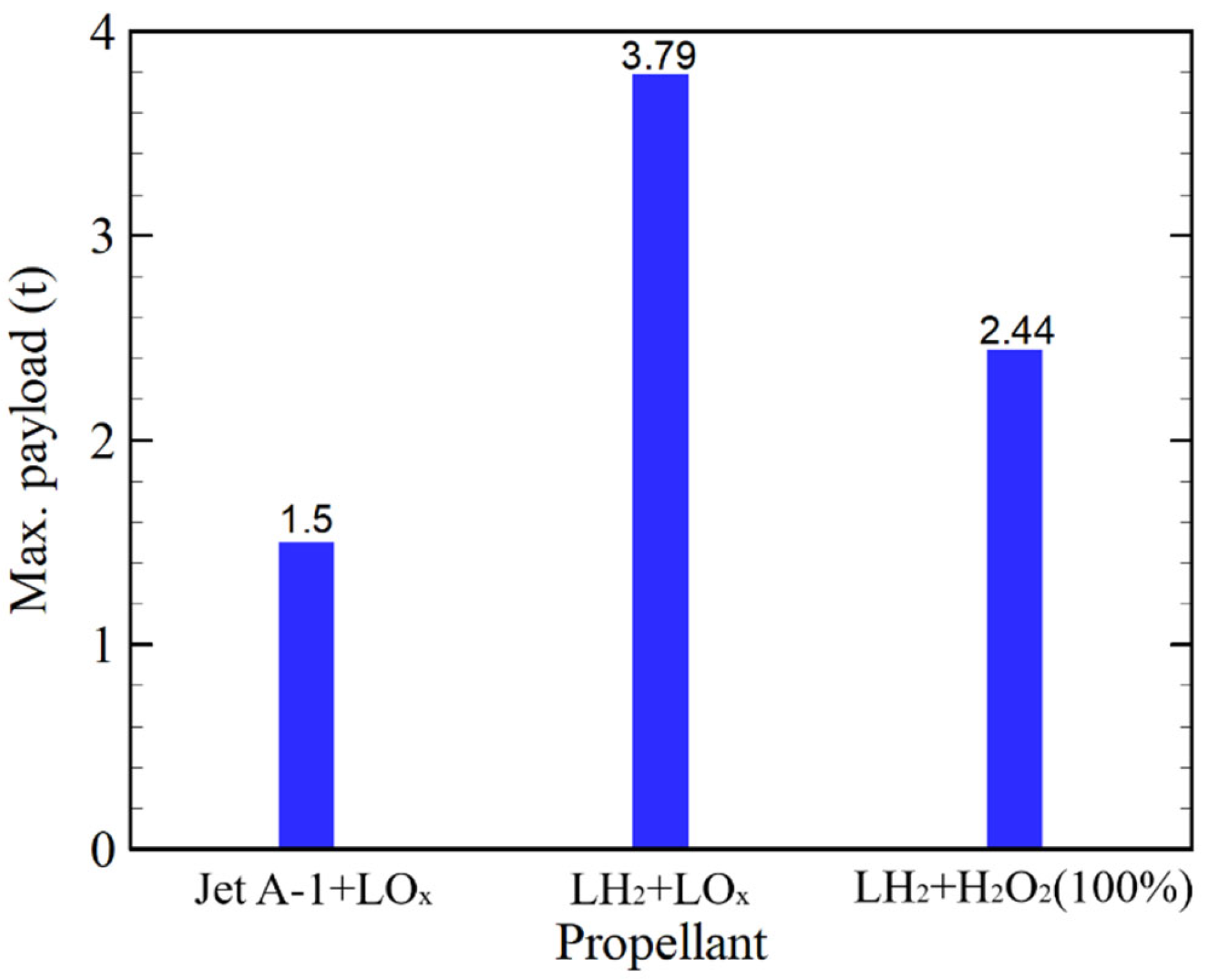
For a performance comparison, this study calculated the payload capacity for a 700 km orbit injection using each propellant combination. This was conducted by determining the payload mass that satisfies the total velocity increment requirement of 10,904.3 m/s, consistent with the staging calculation methodology described in Section 2.2. Figure 6 presents the results, directly comparing the different propellant combinations.
Figure 6.
Comparison of transport capacities.
To benchmark transport capacity differences for KSLV-II, this study also analyzed the Jet A-1/LOX propellant combination used in its third stage. This configuration represents the current baseline of the KSLV-II and therefore provides a consistent reference for assessing performance improvements achieved by adopting other propellant combinations. This comparison offers a clear basis for evaluating the system-level impact of replacing LOX with hydrogen peroxide, particularly in terms of payload transport capacity and stage efficiency. The findings highlight trade-offs and benefits of alternative oxidizers, informing future launch vehicle and propulsion system decisions.
Figure 6 compares the payload capacity for the Jet A-1/LOX baseline, the LH2/LOX and LH2/H2O2 upper-stage options, and a kerosene/LOX reference corresponding to the baseline KSLV-II configuration reported by Korea Aerospace Research Institute (KARI) [26]. KSLV-II is designed to place approximately 1.5 t of payload into a 700 km orbit, and this design point is taken as the performance baseline for the present comparison. The main third-stage parameters of this reference (stage mass, vacuum specific impulse, and structural coefficient) are summarized in Refs. [4,21,27].
For each propellant combination, the payload mass in Figure 6 is obtained by iteratively adjusting the stage masses so that the total vehicle velocity increment satisfies the fixed mission requirement of 10,904.3 m/s defined in Section 2.2. In this way, the payload mass directly reflects the combined effect of upper-stage specific impulse and structural coefficient on system-level performance, rather than considering these parameters separately. From the classical rocket equation combined with the definition of structural coefficient, it is well known that, for a given required velocity increment, the payload mass fraction increases with effective exhaust velocity (or specific impulse) and decreases with structural coefficient. In this relationship, specific impulse enters through an exponential term, whereas the structural coefficient appears in a linear term, so changes in specific impulse generally have a stronger influence on payload fraction than comparable changes in structural coefficient. This qualitative behavior explains why the improvements in structural coefficient obtained with LH2/H2O2 cannot fully compensate for the loss in specific impulse, and why the resulting payload capacity in Figure 6 remains significantly lower than that of the LH2/LOX case, even though it clearly exceeds the Jet A-1/LOX baseline. A more detailed parametric sensitivity study of payload dependence on uncertainties in specific impulse, MER parameters, and losses is left for future work.
As shown in Figure 6, the LH2/LOX combination achieves a payload capacity of 3.79 t, representing a 253% increase relative to the Jet A-1/LOX baseline. The LH2/H2O2 combination achieves 2.44 t (163% of baseline), which, while exceeding the current KSLV-II performance, remains substantially lower than the LOX-based combination. This confirms that hydrogen peroxide cannot match liquid oxygen in terms of payload fraction and transport capacity, even though it offers improvements over the Jet A-1/LOX system. Maintaining the same payload mass with a liquid-hydrogen-fueled upper stage also provides additional velocity increment margin, enabling access to sun-synchronous and geosynchronous orbits. However, the adoption of liquid hydrogen inevitably requires a larger tank volume, increasing vehicle length and affecting the slenderness ratio.
The slenderness ratio, defined as the ratio of length to diameter, is a critical design parameter influencing aerodynamic drag, stability, and structural loads. For space launch vehicles, values between 12 and 15 are generally regarded as optimal [21]. MER calculations show that, with LH2/LOX, the upper stage length increases from 5.5 m to 9.69 m, raising the slenderness ratio from 14.4 to 15.7. This approaches the upper limit and elevates bending moment risks. In contrast, LH2/H2O2 results in an upper-stage length of 7.29 m and a slenderness ratio of 14.9, which remains comfortably within the optimal range. This indicates that hydrogen peroxide offers structural benefits by mitigating excessive vehicle length and bending stresses.
Although the overall stage length and slenderness ratio differ between the oxidizer options, the individual tank heights in Table 3 vary only modestly for a fixed stage diameter. Any insulation or thermal protection mass would scale approximately with the wetted tank area, and thus with tank height for a given diameter. As a result, the differences in insulation mass between the cases would be small compared with the total stage mass and would not change the qualitative trends in structural coefficient and payload capacity discussed in this study.
Nevertheless, these structural advantages must be weighed against the well-documented disadvantages of hydrogen peroxide as an upper-stage oxidizer, including its lower payload fraction, limited thermal stability at concentrations above 90%, and material compatibility issues such as corrosion. Without addressing these inherent challenges, hydrogen peroxide cannot be considered a fully competitive alternative to liquid oxygen, even though it provides structural efficiency gains.
3.2. Implications and Context with Previous Studies
Recent developments on high-test peroxide (HTP) provide important context for the present system-level study. First, several works have systematically documented the thermochemical properties, storability, and safety aspects of 98%-class HTP, as well as modern purification and stabilization methods that enable long-term storage under controlled conditions [20,25,28]. Building on this foundation, a series of experimental programs has demonstrated the feasibility of high-concentration HTP in monopropellant thrusters, bipropellant engines, and catalyst beds, including lab-scale gas-generator and decomposition-bed tests relevant to upper-stage applications [11,16,17,19,29]. In parallel, recent studies on hypergolic and hybrid propulsion configurations have explored hydrogen peroxide as an oxidizer for solid or hybrid systems and reviewed its role within broader hybrid-rocket technology trends [14,15,30,31]. These prior efforts collectively show that 95~100% HTP is a technically mature oxidizer with ongoing research activity in thrusters, catalysts, and advanced hybrid concepts, motivating a complementary system-level assessment such as the one performed in this work.
At the same time, these studies also highlight important practical limitations associated with high-concentration HTP. The literature consistently emphasizes the sensitivity of HTP to impurities and elevated temperatures, the need for strict control of stabilizer formulation and thermal management, and material compatibility issues such as corrosion, erosion, or catalyst degradation [20,25,28,29,30]. As a result, the design of tanks, feed systems, and catalyst beds for HTP often require specialized materials and additional thermal-control hardware. These requirements introduce derivative mass and operational complexity that are not captured by simple MER-based structural estimates and may partially offset the structural-coefficient benefits inferred from propellant density alone.
The present work is complementary to these prior efforts in that it does not focus on thruster- or catalyst-level behavior but instead examines how the use of HTP as an oxidizer, in combination with liquid hydrogen, affects upper-stage performance at the launch-vehicle level. Using a common KSLV-II–class architecture and a fixed mission ΔV requirement, this study quantifies how the lower specific impulse of LH2/H2O2 competes with its improved structural coefficient in terms of stage mass, payload capacity to a 700 km orbit, and geometric constraints such as stage length and slenderness ratio. The results show that, although LH2/H2O2 can significantly reduce the structural coefficient and mitigate excessive vehicle length relative to LH2/LOX, the thermochemical penalty in specific impulse prevents it from matching the payload performance of the LH2/LOX upper stage. In this sense, the present analysis extends the existing HTP literature by translating the well-documented propellant- and subsystem-level characteristics of high-concentration hydrogen peroxide into explicit, quantitative implications for launch-vehicle design.
Finally, it should be emphasized that the present comparison is based on staging and conceptual design and does not explicitly include the additional mass and complexity associated with HTP-specific hardware, such as dedicated thermal-control systems. A more detailed assessment of these derivative-mass contributions, together with life-cycle cost and operational-risk considerations, would be a valuable extension of the current work. Such studies could help determine more precisely under which technological and programmatic conditions LH2/H2O2 might become competitive with LH2/LOX at the system level, and when its advantages in density and storability are outweighed by performance and operational penalties.
4. Conclusions
This study analyzed the system-level trade-offs associated with employing hydrogen peroxide as an oxidizer in comparison with the conventional Jet A-1/LOX and LH2/LOX propellant combinations for the KSLV-II upper stage. The results demonstrate that hydrogen peroxide reduces the structural coefficient owing to the smaller LH2 tank volume, thereby enhancing structural efficiency. At the same time, its use as an oxidizer leads to significantly lower specific impulse and propulsion performance compared with liquid oxygen.
The payload capacity analysis for a 700 km orbit shows that LH2/LOX offers the highest performance, achieving a 253% increase over Jet A-1/LOX. The LH2/H2O2 configuration, while surpassing the Jet A-1/LOX baseline with a 163% increase, remains substantially inferior to LH2/LOX in both payload fraction and overall transport capability. This indicates that hydrogen peroxide cannot be considered a fully competitive alternative to liquid oxygen as a high-energy oxidizer, even though it provides measurable improvements over hydrocarbon-based systems.
Vehicle geometry and aerodynamics are also affected by propellant choice. While the LH2/LOX upper stage lengthens the vehicle beyond the optimal slenderness ratio, increasing bending moment risks, LH2/H2O2 achieves a more balanced configuration that remains within the preferred range. This structural benefit highlights the importance of considering propellant effects not only on performance but also on vehicle design integrity.
These findings align with classical and recent studies that document hydrogen peroxide’s disadvantages, including its lower performance relative to LOX, long-term decomposition and stability concerns, and material compatibility issues. The present study advances this understanding by quantifying, with KSLV-II reference data, the system-level trade-offs between structural efficiency and payload capacity for 95~100% H2O2, thereby clarifying both the potential and the limitations of its application as an upper-stage oxidizer.
When evaluating propellant options for future space transportation systems, the system-level assessments presented in this study should be coupled with experimental verification, decomposition stability analyses, and material compatibility investigations. Through such integrated evaluations, the suitability of hydrogen peroxide as an effective oxidizer for next-generation upper-stage propulsion can be comprehensively assessed and determined.
Author Contributions
Conceptualization, J.-Y.C.; methodology, M.-S.J.; validation, M.-S.J.; investigation, M.-S.J.; writing—original draft preparation, M.-S.J.; writing—review and editing, M.-S.J.; supervision, J.-Y.C.; project administration, J.-Y.C.; funding acquisition, J.-Y.C. All authors have read and agreed to the published version of the manuscript.
Funding
This research was supported by funding from Korean government (KASA, Korea Aerospace Administration), grant number RS-2022-NR067081. The publication of this paper was supported by the DRONE ERC of BK21 FOUR of NRF funded by the Ministry of Education (MOE), the Republic of Korea government (MOE).
Data Availability Statement
The original contributions presented in this study are included in the article. Further inquiries can be directed to the corresponding author.
Conflicts of Interest
The authors declare no conflicts of interest.
References
- Yang, W.-S.; Kim, S.-Y.; Choi, J.-Y. Conceptual Design of a Launch Vehicle for Lunar Exploration by Combining Naro-1 and KSLV-II. J. Korean Soc. Aeronaut. Space Sci. 2014, 42, 654–660. [Google Scholar]
- Oh, J.; Jo, M.-S.; Kang, S.-Y.; Choi, J.-Y. Optimizing Systems Engineering Procedure for the Development of a Sounding Rocket. Int. J. Aeronaut. Space Sci. 2025. [Google Scholar] [CrossRef]
- Jo, M.-S.; Kim, J.-E.; Choi, J.-Y. Staging and Injection Performance Analysis of Small Launch Vehicle Based on KSLV-II. J. Korean Soc. Aeronaut. Space Sci. 2021, 49, 155–166. [Google Scholar] [CrossRef]
- Jo, M.-S.; Cho, D.-H.; Choi, J.-Y. Performance Analysis of Small Launch Vehicles Using Algebraic Model: Case Studies Based on KSLV-II 2nd and 3rd Stage. Int. J. Aeronaut. Space Sci. 2025, 26, 2885–2897. [Google Scholar] [CrossRef]
- Kim, H.-S.; Yang, S.-M.; Choi, J.-Y. Analysis of Orbit Injection Performance of KSLV-II by Weight Reduction. J. Korean Soc. Prop. Eng. 2018, 22, 141–151. [Google Scholar]
- Hong, M.; Yang, S.-M.; Kim, H.-S.; Yoon, Y.; Choi, J.-Y. Comparison of the Mission Performance of Korean GEO Launch Vehicles for Several Propulsion Options. J. Korean Soc. Prop. Eng. 2017, 21, 60–71. [Google Scholar]
- Kim, H.-S.; Oh, S.; Choi, J.-Y. Quasi-1D analysis and performance estimation of a sub-scale RBCC engine with chemical equilibrium. Aerosp. Sci. Technol. 2017, 69, 39–47. [Google Scholar] [CrossRef]
- Jo, M.-S.; Kim, J.-E.; Choi, J.-Y. Comparison of Upper-Stage Engine Options for Small Launch Vehicle Based on KSLV-II. In Proceedings of the AIAA Propulsion and Energy Forum, Virtual Event, 9–11 August 2021. [Google Scholar]
- Ventura, M.; Mullens, P. The Use of Hydrogen Peroxide for Propulsion and Power. In Proceedings of the 35th AIAA/ASME/SAE/ASEE Joint Propulsion Conference and Exhibit, Los Angeles, CA, USA, 20–24 June 1999. [Google Scholar]
- Skyrora. The History of the UK Black Arrow Rocket Programme; Skyrora: Glasgow, UK, 2024; Available online: https://skyrora.com/the-history-of-the-uk-black-arrow-rocket-programme/ (accessed on 28 October 2025).
- Pasini, A.; Torre, L.; Romeo, L.; Cervone, A.; d’Agostino, L. Testing and Characterization of a Hydrogen Peroxide Monopropellant Thruster. J. Propuls. Power 2008, 24, 507–515. [Google Scholar] [CrossRef]
- Ventura, M.; Wernimont, E.; Heister, S.; Yuan, S. Rocket Grade Hydrogen Peroxide (RGHP) for Use in Propulsion and Power Devices—Historical Discussion of Hazards. In Proceedings of the 43rd AIAA/ASME/SAE/ASEE Joint Propulsion Conference & Exhibit, Cincinnati, OH, USA, 8–11 July 2007; American Institute of Aeronautics and Astronautics: Reston, VA, USA, 2007. AIAA 2007-5468. [Google Scholar]
- Musker, A.J. Highly Stabilised Hydrogen Peroxide as a Rocket Propellant. In Proceedings of the 39th AIAA/ASME/SAE/ASEE Joint Propulsion Conference & Exhibit, Huntsville, AL, USA, 20–23 July 2003; American Institute of Aeronautics and Astronautics: Reston, VA, USA, 2003. AIAA 2003-4619. [Google Scholar]
- Florczuk, W.; Rarata, G.P. Performance Evaluation of the Hypergolic Green Propellants Based on the HTP for a Future Next Generation Spacecrafts. In Proceedings of the 53rd AIAA/SAE/ASEE Joint Propulsion Conference, Atlanta, GA, USA, 10–12 July 2017. AIAA 2017-4849. [Google Scholar]
- Okninski, A.; Surmacz, P.; Bartkowiak, B.; Mayer, T.; Sobczak, K.; Pakosz, M.; Kaniewski, D.; Matyszewski, J.; Rarata, G.; Wolanski, P. Development of Green Storable Hybrid Rocket Propulsion Technology Using 98% Hydrogen Peroxide as Oxidizer. Aerospace 2021, 8, 234. [Google Scholar] [CrossRef]
- Kang, H.; Jang, D.; Kwon, S. Demonstration of 500 N Scale Bipropellant Thruster Using Non-Toxic Hypergolic Fuel and Hydrogen Peroxide. Aerosp. Sci. Technol. 2016, 49, 209–214. [Google Scholar] [CrossRef]
- Okninski, A.; Surmacz, P.; Sobczak, K.; Florczuk, W.; Cieslinski, D.; Gorgeri, A.; Bartkowiak, B.; Kublik, D.; Ranachowski, M.; Gut, Z.; et al. Development of Green Bipropellant Thrusters and Engines Using 98% Hydrogen Peroxide as Oxidizer. Aerospace 2025, 12, 879. [Google Scholar] [CrossRef]
- Sutton, G.P.; Biblarz, O. Rocket Propulsion Elements, 9th ed.; Wiley: Hoboken, NJ, USA, 2017. [Google Scholar]
- Lund, G.K.; Starrett, W.D.; Jensen, K.C. Development and Lab-Scale Testing of a Gas Generator Hybrid Fuel in Support of the Hydrogen Peroxide Hybrid Upper Stage Program. In Proceedings of the 37th AIAA/ASME/SAE/ASEE Joint Propulsion Conference and Exhibit, Salt Lake City, UT, USA, 8–11 July 2001. [Google Scholar]
- Rarata, G.; Rokicka, K.; Surmacz, P. Hydrogen Peroxide as a High Energy Compound Optimal for Propulsive Applications. Cent. Eur. J. Energ. Mater. 2016, 13, 778–790. [Google Scholar] [CrossRef] [PubMed]
- Roh, W.R.; Cho, S.B.; Sun, B.C.; Choi, K.S.; Jung, D.W.; Park, C.S.; Oh, J.S.; Park, T.H. Mission and System Design Status of Korea Space Launch Vehicle-II Succeeding Naro Launch Vehicle. In Proceedings of the Korean Society for Aeronautical and Space Sciences Fall Conference, Jeju, Republic of Korea, 22–23 November 2012. [Google Scholar]
- Stark, R.; Génin, C.; Schneider, D.; Fromm, C. Ariane 5 Performance Optimization Using Dual-Bell Nozzle Extension. J. Spacecr. Rocket. 2016, 53, 743–750. [Google Scholar] [CrossRef]
- Gordon, S.; McBride, B.J. Computer Program for Calculation of Complex Chemical Equilibrium Compositions and Applications; NASA Reference Publication 1311; NASA: Cleveland, OH, USA, 1996.
- Ponomarenko, A. RPA—Tool for Rocket Propulsion Analysis. In Proceedings of the Space Propulsion Conference, Cologne, Germany, 19–22 May 2014. [Google Scholar]
- Ventura, M. Long Term Storability of Hydrogen Peroxide. In Proceedings of the 41st AIAA/ASME/SAE/ASEE Joint Propulsion Conference & Exhibit, Tucson, AZ, USA, 10–13 July 2005. [Google Scholar]
- Akin, D.L. Mass Estimating Relations; University of Maryland: College Park, MD, USA, 2016. [Google Scholar]
- Ko, J.H.; Cho, S.Y. Space Launch Vehicle Development in Korea Aerospace Research Institute. In Proceedings of the SpaceOps 2016 Conference, Dajeon, Republic of Korea, 16–20 May 2016. [Google Scholar]
- Kopacz, W.; Okninski, A.; Kasztankiewicz, A.; Nowakowski, P.; Rarata, G.; Maksimowski, P. Hydrogen Peroxide—A Promising Oxidizer for Rocket Propulsion and Its Application in Solid Rocket Propellants. FirePhysChem 2022, 2, 56–66. [Google Scholar] [CrossRef]
- Parzybut, A.; Surmacz, P.; Gut, Z. Impact of Hydrogen Peroxide Concentration on Manganese Oxide and Platinum Catalyst Bed Performance. Aerospace 2023, 10, 556. [Google Scholar] [CrossRef]
- Castaneda, D.A.; Natan, B. Hypergolic Ignition of Hydrogen Peroxide with Various Solid Fuels. Fuel 2022, 316, 123432. [Google Scholar] [CrossRef]
- Wei, S.-S.; Li, M.-C.; Lai, A.; Chou, T.-H.; Wu, J.-S. A Review of Recent Developments in Hybrid Rocket Propulsion and Its Applications. Aerospace 2024, 11, 739. [Google Scholar] [CrossRef]
Disclaimer/Publisher’s Note: The statements, opinions and data contained in all publications are solely those of the individual author(s) and contributor(s) and not of MDPI and/or the editor(s). MDPI and/or the editor(s) disclaim responsibility for any injury to people or property resulting from any ideas, methods, instructions or products referred to in the content. |
© 2025 by the authors. Licensee MDPI, Basel, Switzerland. This article is an open access article distributed under the terms and conditions of the Creative Commons Attribution (CC BY) license.