Constraint-Aware Payload Layer Fusion Control for Dual-Quadrotor Cooperative Slung-Load Transportation

 , , , , and
Abstract
1. Introduction
- Payload-Layer Dynamic Formulation: Compared with conventional vehicle-centric cascaded control strategies that treat cable tension as an external disturbance, our formulation derives an explicit payload-layer forward dynamic model via d’Alembert’s principle. This modeling perspective exposes the rigid-body coupling structure directly at the load level and enables analytical tension reconstruction, providing a more transparent foundation for constraint enforcement.
- Feasibility-Preserving Constrained Tracking: While many existing methods handle actuator or tension limits through penalty shaping or post hoc saturation, our framework integrates a Dynamic Extension Algorithm (DEA) with a convex QP-based projection layer. This structure separates nominal high-order tracking design from physical feasibility enforcement, enabling strict constraint satisfaction even during aggressive tracking transients.
- Constraint-Aware Adaptive Gain Regulation: In contrast to fixed-gain robust designs that require conservative tuning, the proposed adaptive module dynamically adjusts tracking aggressiveness based on constraint activation conditions. This reduces manual tuning effort and improves performance consistency under varying payload parameters.
2. Dynamics of the Dual-Quadrotor Slung Load System
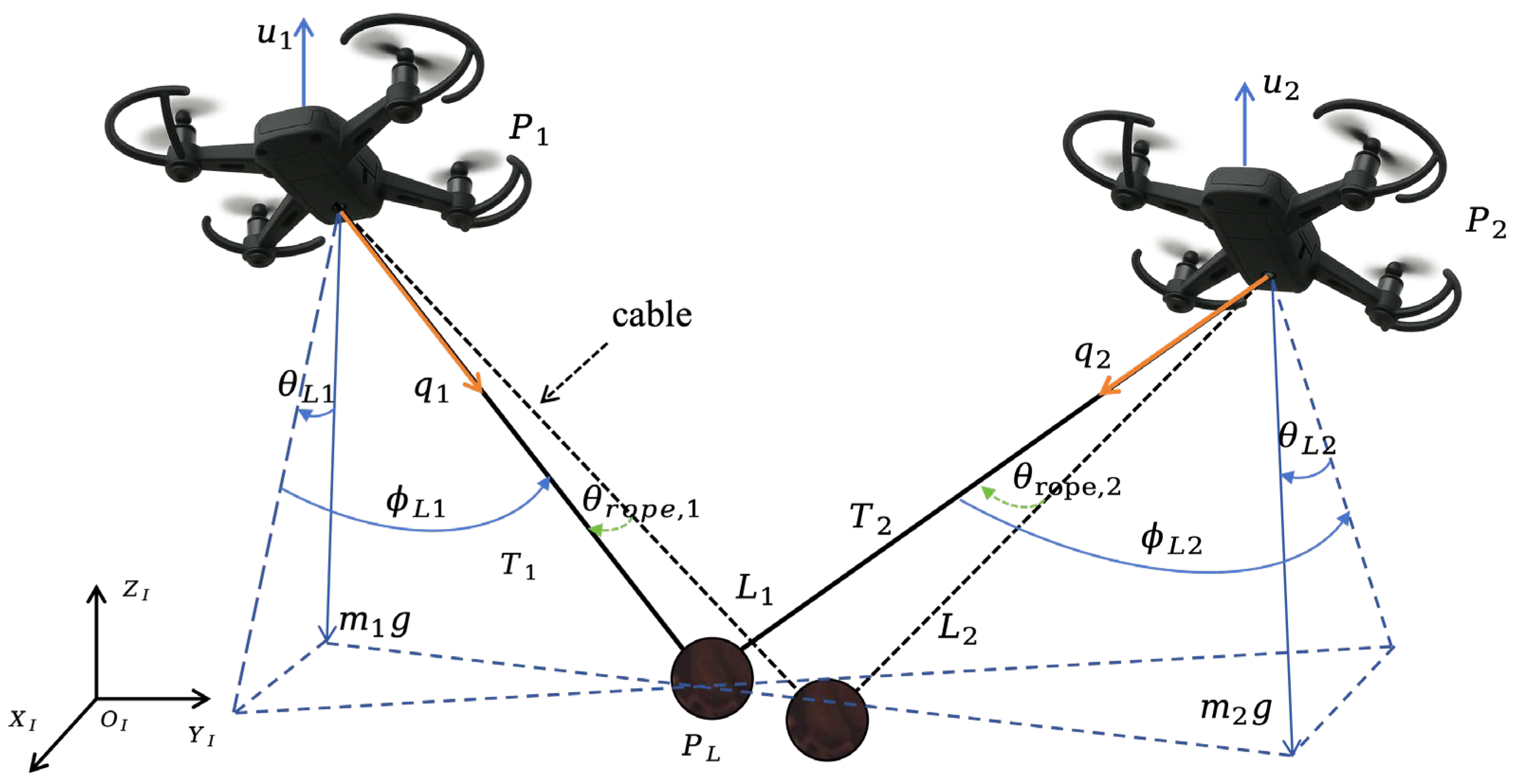
2.1. System Description and Coordinate Definitions
2.2. Payload Layer Dynamics and Tension Reconstruction
2.3. Unified State Space Model and Control Input Decomposition
3. Controller Design
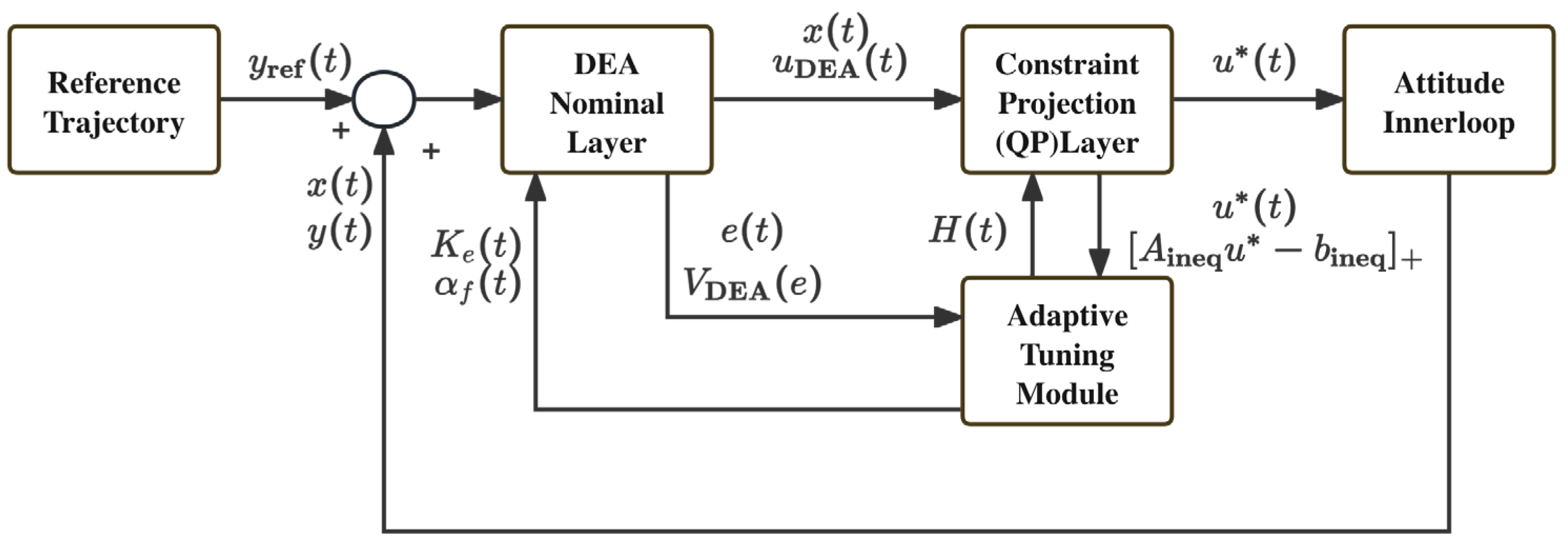
3.1. Control Architecture
3.2. Nominal Control and Constraint Projection Design
3.2.1. DEA Layer: Dynamic Extension and Energy Consistent Control
- (a)
- Payload layer model and input decomposition
- (b)
- Dynamic extension and flat output selection
- (c)
- Linear error dynamics and nominal DEA control law
3.2.2. Constraint Projection (QP) Layer: Constrained Optimal Correction
- (a)
- Constrained optimization problem
- (b)
- Properties and implementation
3.3. Adaptive Tuning Module
- (a)
- Energy residual and constraint-activation measures
- (b)
- Slow-timescale update laws with projection
4. Stability and Optimality Analysis
4.1. Composite Lyapunov Function and Main Result
- The QP layer is always feasible or soft constraints of the form (37) are used so that a feasible solution exists at all times.
- The weighting matrix is bounded and there exists a constant such that for all
- The DEA gain matrix always belongs to an admissible set that guarantees the Hurwitz property of
- Switching of the active constraint set satisfies a minimum dwell time condition, or high frequency switching is avoided by hysteresis or filtering strategies.
- The aggregate disturbance is bounded.
4.2. Minimal Deviation Optimality and Continuity of the QP
5. Simulation Experiments
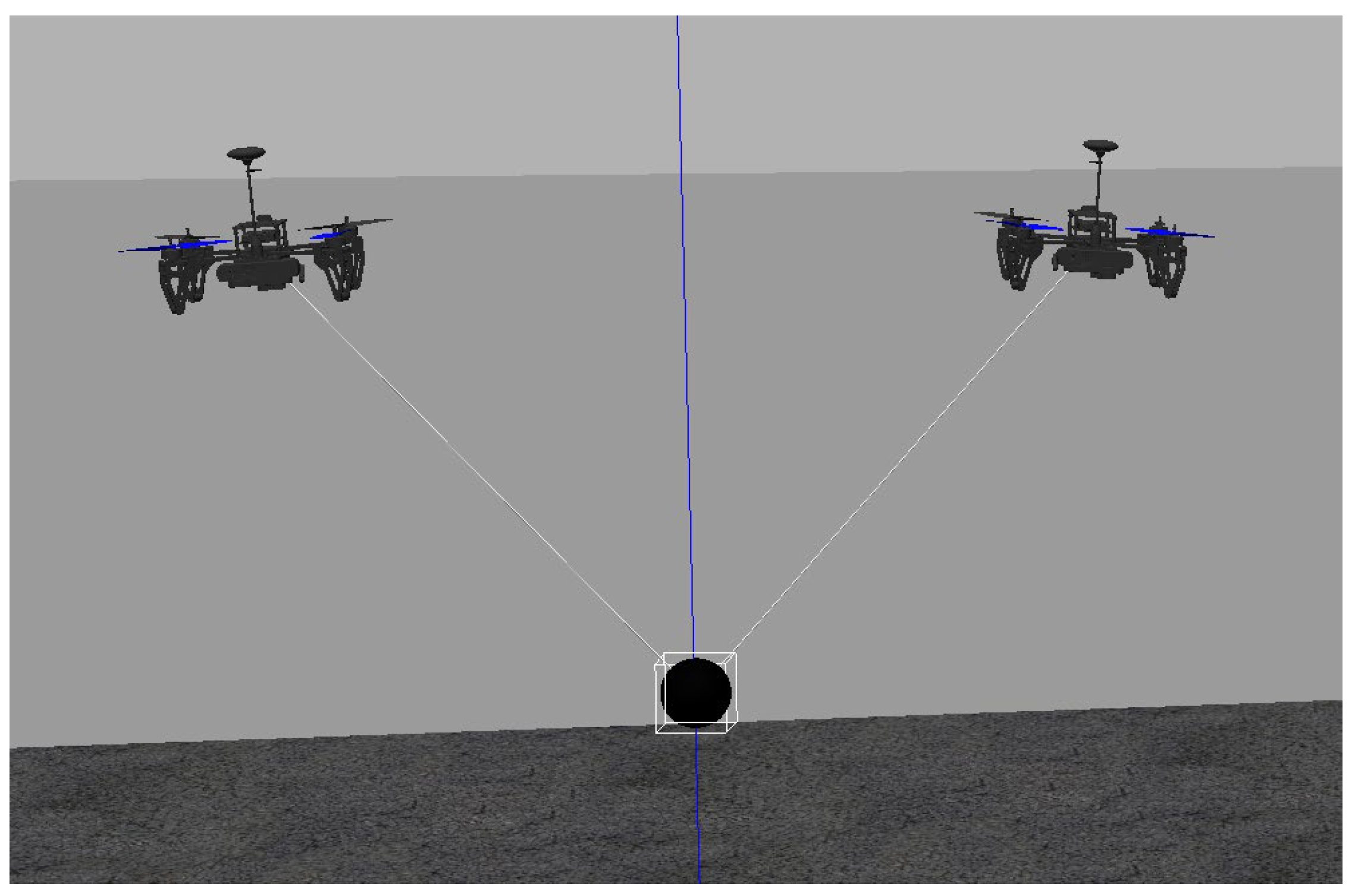
5.1. Simulation Platform
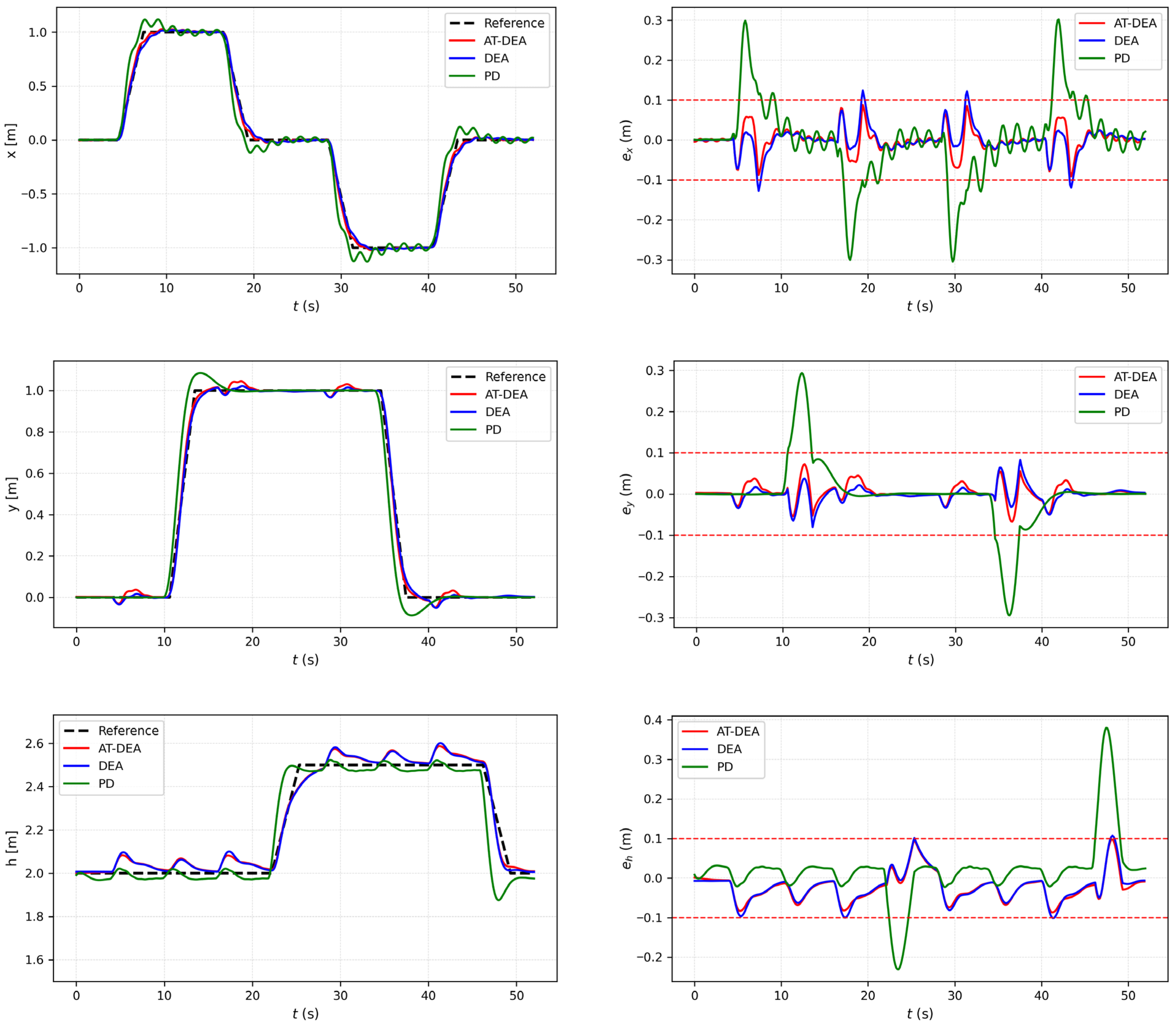
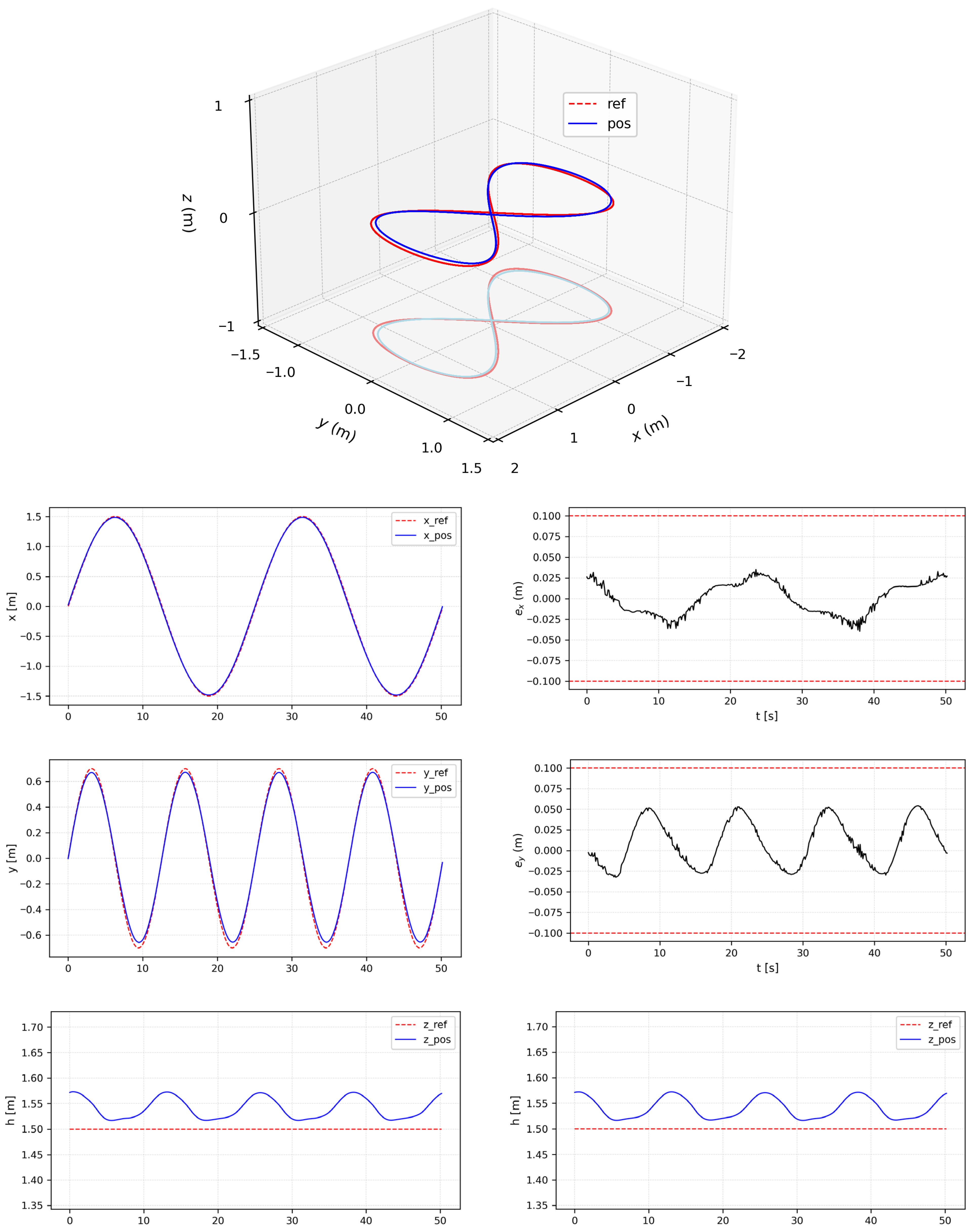
5.2. Payload Trajectory-Tracking Experiments
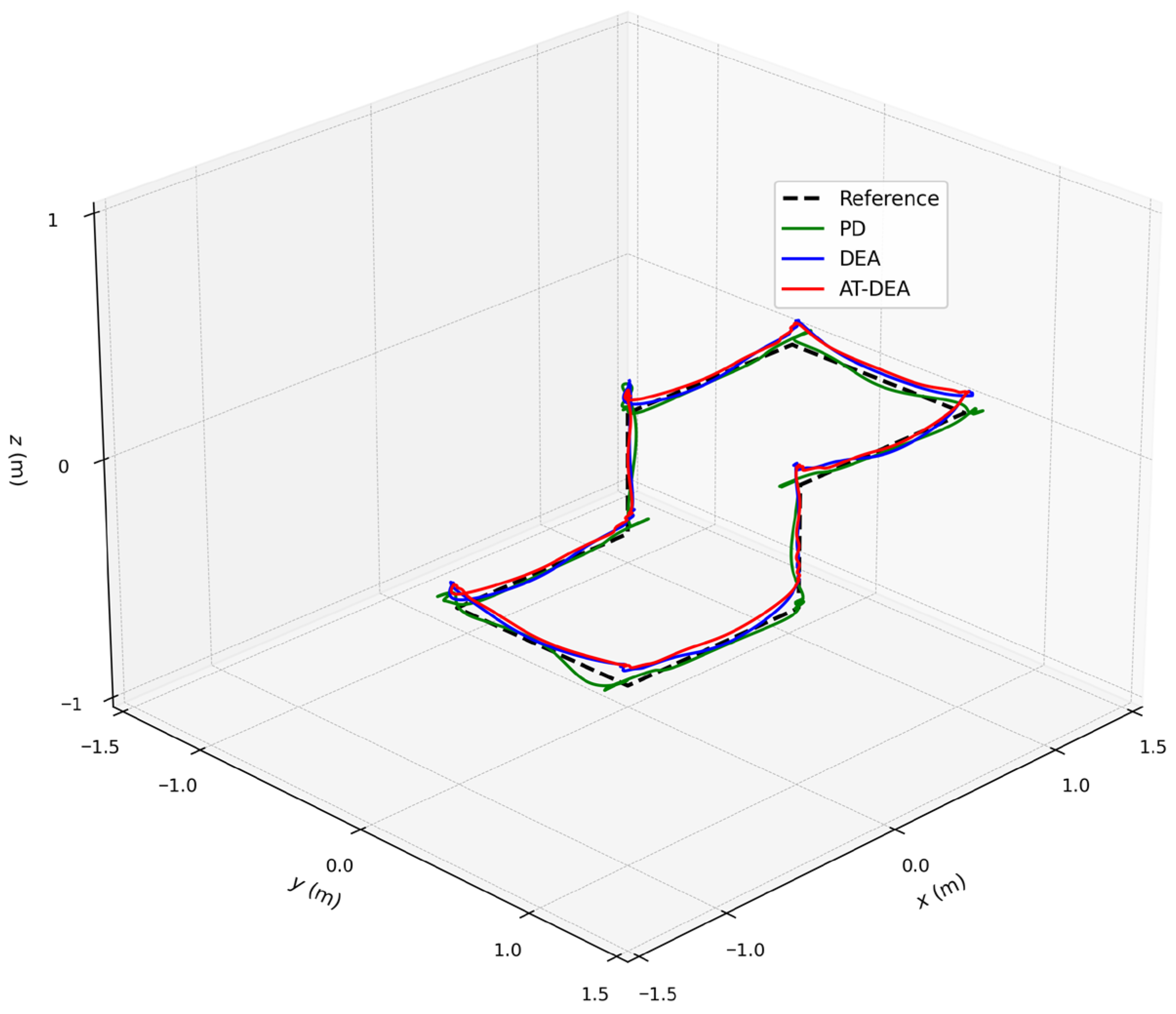
5.2.1. Step-Rectangular Waypoint Sequence (Staircase Profile)
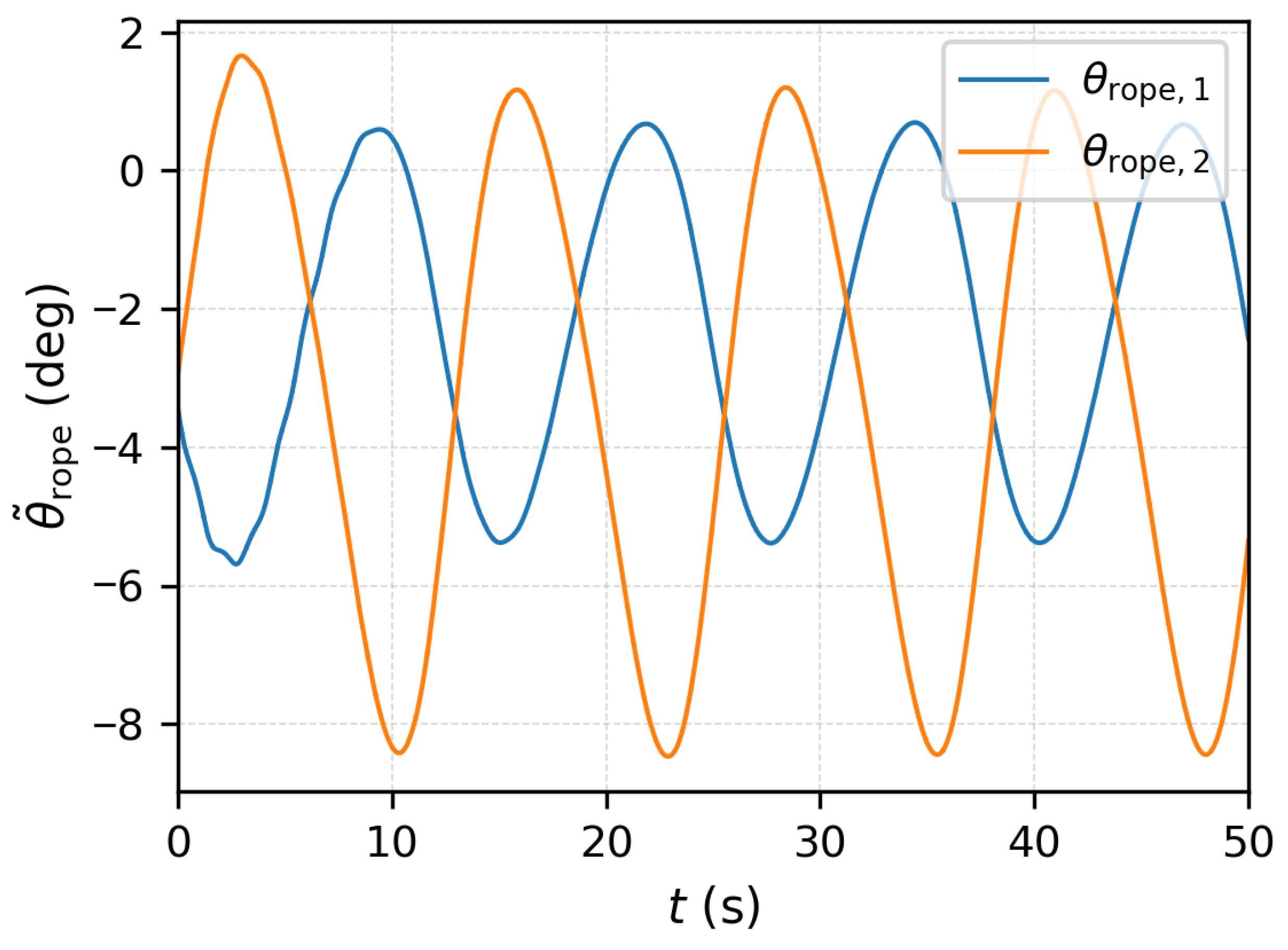
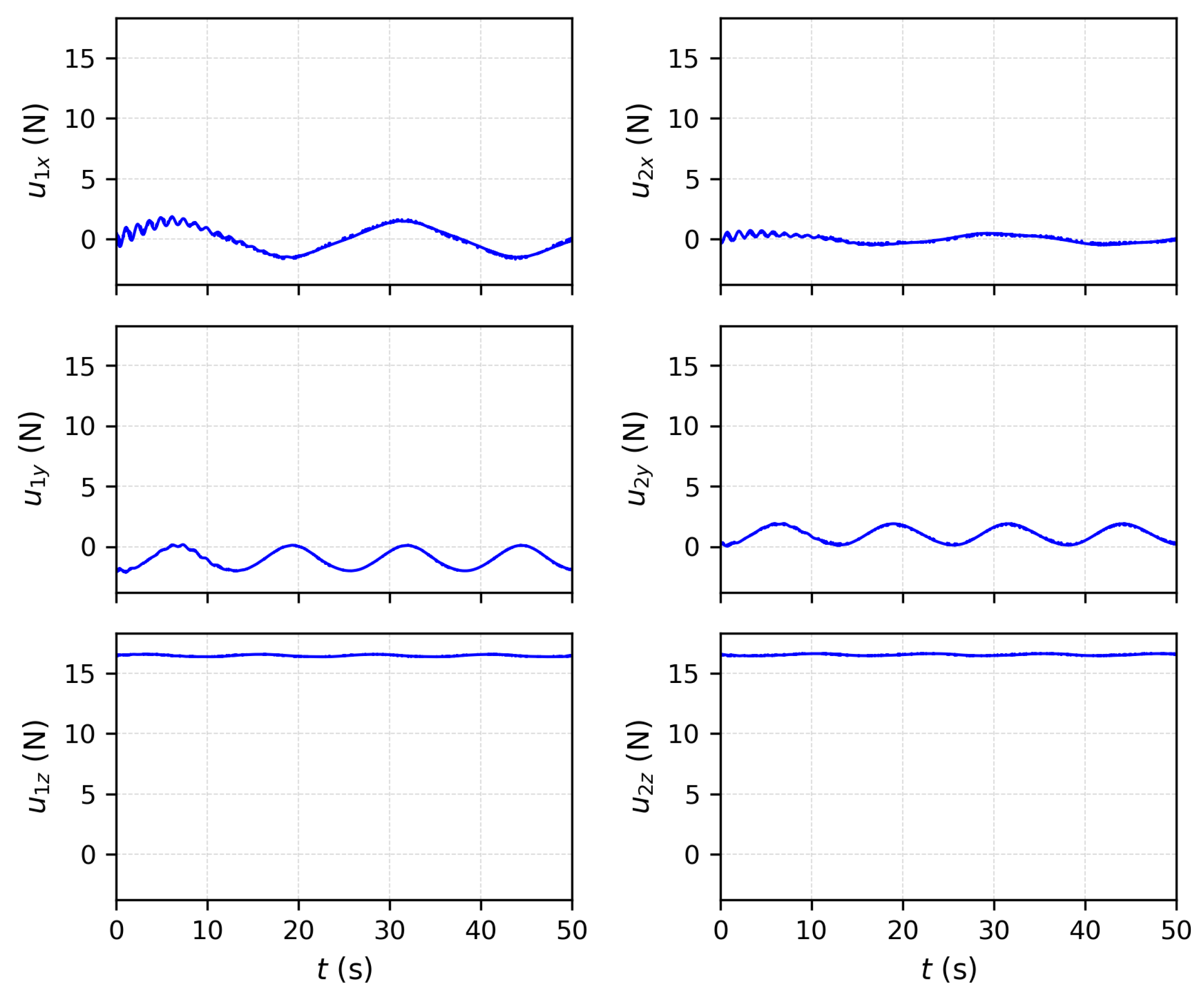
5.2.2. Figure-Eight Trajectory
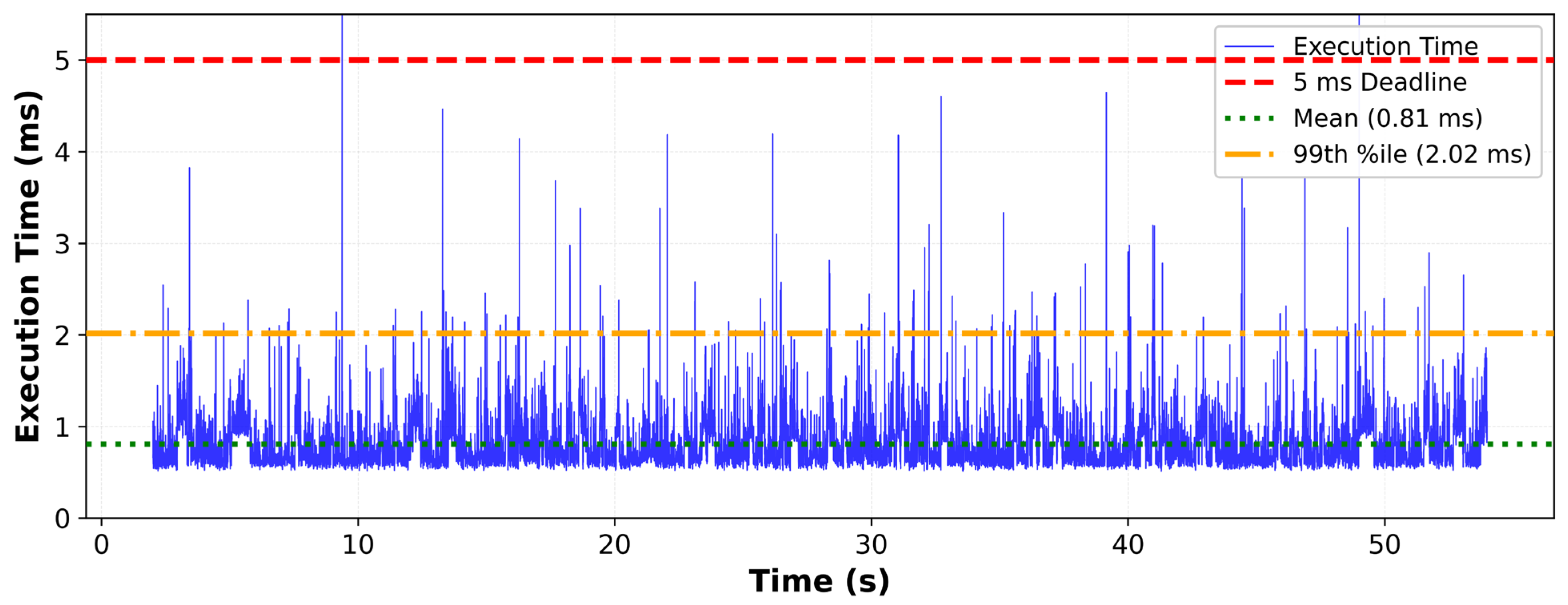
5.3. Real-Time Computational Performance
6. Conclusions
Author Contributions
Funding
Data Availability Statement
Conflicts of Interest
Appendix A
Appendix A.1. Basic Dynamics and Geometric Constraints of the Payload and UAVs
Appendix A.2. Explicit Forward Dynamics at the Payload Layer
Appendix B. Proof of Theorem 1
Appendix B.1. Frozen Parameters and Fixed Active Set
Appendix B.2. Slowly Time Varying Gains and
Appendix B.3. Constraint Switching and Practical Exponential Stability
References
- Wang, X.; Zhang, X.; Lu, Y.; Zhang, H.; Li, Z.; Zhao, P.; Wang, X. Target Trajectory Prediction-Based UAV Swarm Cooperative for Bird-Driving Strategy at Airport. Electronics 2024, 13, 3868. [Google Scholar] [CrossRef]
- Sivakumar, M.; Tyj, N.M. A Literature Survey of Unmanned Aerial Vehicle Usage for Civil Applications. J. Aerosp. Technol. Manag. 2021, 13, e4021. [Google Scholar] [CrossRef]
- Lin, H.; Song, Z.; Liu, C.; Qi, S.; Zhang, H.; Yang, S. Autonomous Suspended-Payload UAV with Self-Sensing and Anti-Swing for Outdoor Transportation. Aerospace 2025, 12, 1016. [Google Scholar] [CrossRef]
- Estevez, J.; Garate, G.; Lopez-Guede, J.M.; Larrea, M. Review of Aerial Transportation of Suspended-Cable Payloads with Quadrotors. Drones 2024, 8, 35. [Google Scholar] [CrossRef]
- Yang, S.; Xian, B. Energy-Based Nonlinear Adaptive Control Design for the Quadrotor UAV System with a Suspended Payload. IEEE Trans. Ind. Electron. 2020, 67, 2054–2064. [Google Scholar] [CrossRef]
- Lv, Z.-Y.; Li, S.; Wu, Y.; Wang, Q.-G. Adaptive Control for a Quadrotor Transporting a Cable-Suspended Payload with Unknown Mass in the Presence of Rotor Downwash. IEEE Trans. Veh. Technol. 2021, 70, 8505–8518. [Google Scholar] [CrossRef]
- Al Lawati, M.; Jiang, Z.; Lynch, A.F. Output Tracking Dynamic Feedback Linearization of a Multirotor Suspended Load System with Disturbance Robustness. J. Intell. Robot. Syst. 2023, 108, 82. [Google Scholar] [CrossRef]
- Al-Dhaifallah, M.; Al-Qahtani, F.M.; Elferik, S.; Saif, A.-W.A. Quadrotor Robust Fractional-Order Sliding Mode Control in Unmanned Aerial Vehicles for Eliminating External Disturbances. Aerospace 2023, 10, 665. [Google Scholar] [CrossRef]
- Liu, Y.; Zhang, F.; Huang, P.; Zhang, X. Analysis, Planning and Control for Cooperative Transportation of Tethered Multi-Rotor UAVs. Aerosp. Sci. Technol. 2021, 113, 106673. [Google Scholar] [CrossRef]
- Mohammadi, K.; Sirouspour, S.; Grivani, A. Control of Multiple Quad-Copters with a Cable-Suspended Payload Subject to Disturbances. IEEE/ASME Trans. Mechatron. 2020, 25, 1709–1718. [Google Scholar] [CrossRef]
- Petitti, A.; Sanalitro, D.; Tognon, M.; Milella, A.; Cortés, J.; Franchi, A. Inertial Estimation and Energy-Efficient Control of a Cable-Suspended Load with a Team of UAVs. In Proceedings of the 2020 International Conference on Unmanned Aircraft Systems (ICUAS), Athens, Greece, 1–4 September 2020; pp. 158–165. [Google Scholar]
- Wang, H.; Li, H.; Zhou, B.; Gao, F.; Shen, S. Impact-Aware Planning and Control for Aerial Robots with Suspended Payloads. IEEE Trans. Robot. 2024, 40, 2478–2497. [Google Scholar] [CrossRef]
- De Angelis, E.L.; Giulietti, F. An Improved Method for Swing State Estimation in Multirotor Slung Load Applications. Drones 2023, 7, 654. [Google Scholar] [CrossRef]
- Liang, X.; Zhang, Z.; Yu, H.; Wang, Y.; Fang, Y.; Han, J. Antiswing Control for Aerial Transportation of the Suspended Cargo by Dual Quadrotor UAVs. IEEE/ASME Trans. Mechatron. 2022, 27, 5159–5172. [Google Scholar] [CrossRef]
- Wang, E.; Sun, J.; Liang, Y.; Zhou, B.; Jiang, F.; Zhu, Y. Modeling, Guidance, and Robust Cooperative Control of Two Quadrotors Carrying a “Y”-Shaped-Cable-Suspended Payload. Drones 2024, 8, 103. [Google Scholar] [CrossRef]
- Chen, X.; Fan, Y.; Wang, G.; Mu, D. Coordinated Control of Quadrotor Suspension Systems Based on Consistency Theory. Aerospace 2023, 10, 913. [Google Scholar] [CrossRef]
- Li, G.; Loianno, G. Nonlinear Model Predictive Control for Cooperative Transportation and Manipulation of Cable Suspended Payloads with Multiple Quadrotors. In Proceedings of the 2023 IEEE/RSJ International Conference on Intelligent Robots and Systems (IROS), Detroit, MI, USA, 1–5 October 2023; pp. 5034–5041. [Google Scholar]
- Hanover, D.; Foehn, P.; Sun, S.; Kaufmann, E.; Scaramuzza, D. Performance, Precision, and Payloads: Adaptive Nonlinear MPC for Quadrotors. IEEE Robot. Autom. Lett. 2022, 7, 690–697. [Google Scholar] [CrossRef]
- Wahba, K.; Hönig, W. Efficient Optimization-Based Cable Force Allocation for Geometric Control of a Multirotor Team Transporting a Payload. IEEE Robot. Autom. Lett. 2024, 9, 3688–3695. [Google Scholar] [CrossRef]
- Al Lawati, M.; Zhang, Z.; Yan, E.; Lynch, A.F. Nonlinear Control of a Multi-Drone Slung Load System. In Proceedings of the 2025 American Control Conference (ACC), Denver, CO, USA, 8–10 July 2025; pp. 1989–1996. [Google Scholar]
- Muthusamy, P.K.; Garratt, M.; Pota, H.; Muthusamy, R. Real-Time Adaptive Intelligent Control System for Quadcopter Unmanned Aerial Vehicles with Payload Uncertainties. IEEE Trans. Ind. Electron. 2022, 69, 1641–1653. [Google Scholar] [CrossRef]
- Qin, T.; Li, P.; Shen, S. VINS-Mono: A Robust and Versatile Monocular Visual-Inertial State Estimator. IEEE Trans. Robot. 2018, 34, 1004–1020. [Google Scholar] [CrossRef]
- Li, G.; Ge, R.; Loianno, G. Cooperative Transportation of Cable Suspended Payloads with MAVs Using Monocular Vision and Inertial Sensing. IEEE Robot. Autom. Lett. 2021, 6, 5316–5323. [Google Scholar] [CrossRef]
- Boyd, S.; Vandenberghe, L. Convex Optimization; Cambridge University Press: Cambridge, UK, 2004. [Google Scholar]
- Bauschke, H.H.; Combettes, P.L. Correction to: Convex Analysis and Monotone Operator Theory in Hilbert Spaces. In Convex Analysis and Monotone Operator Theory in Hilbert Spaces; Bauschke, H.H., Combettes, P.L., Eds.; Springer International Publishing: Cham, Switzerland, 2017; pp. C1–C4. [Google Scholar]
- Liberzon, D. Switching in Systems and Control; Systems & Control: Foundations & Applications; Birkhäuser: Boston, MA, USA, 2003. [Google Scholar]



| Parameters | Value |
|---|---|
| M | 1.5 kg |
| g | 9.81 m/s2 |
| 1 m | |
| Ix | 1.98 × 10⁻² kgm2 |
| Iy | 1.98 × 10⁻² kgm2 |
| Iz | 3.55 × 10⁻² kgm2 |
| Component Position | PD | DEA | AT-DEA | |||
|---|---|---|---|---|---|---|
| RMSE | RMSE | RMSE | ||||
| x (m) | 0.077 | 0.271 | 0.093 | 0.255 | 0.029 | 0.094 |
| y (m) | 0.042 | 0.177 | 0.074 | 0.281 | 0.021 | 0.071 |
| z (m) | 0.061 | 0.312 | 0.045 | 0.155 | 0.042 | 0.097 |
| Metric | Mean | Median | 99th% | WCET | Violations |
|---|---|---|---|---|---|
| Controller Exec (μs) | 808.46 | 696.31 | 2018.66 | 7954.05 | 0.02% |
| QP Solver (μs) | 481.04 | 434.78 | 1062.99 | 7791.67 | 0.02% |
| QP Iterations | 53.32 | 50 | - | 325 | - |
| QP/Total Ratio | 59.5% | - | - | - | - |
| 200 Hz Deadline (μs) | 5000 | 5000 | 5000 | 5000 | - |
| Computational Margin | 84% | 84% | 60% | −59% |
Disclaimer/Publisher’s Note: The statements, opinions and data contained in all publications are solely those of the individual author(s) and contributor(s) and not of MDPI and/or the editor(s). MDPI and/or the editor(s) disclaim responsibility for any injury to people or property resulting from any ideas, methods, instructions or products referred to in the content. |
© 2026 by the authors. Licensee MDPI, Basel, Switzerland. This article is an open access article distributed under the terms and conditions of the Creative Commons Attribution (CC BY) license.
Share and Cite
Wang, X.; Zhao, P.; Wang, X.; Tan, W.; Zhang, H.; Zeng, J.; Tang, S. Constraint-Aware Payload Layer Fusion Control for Dual-Quadrotor Cooperative Slung-Load Transportation. Aerospace 2026, 13, 250. https://doi.org/10.3390/aerospace13030250
Wang X, Zhao P, Wang X, Tan W, Zhang H, Zeng J, Tang S. Constraint-Aware Payload Layer Fusion Control for Dual-Quadrotor Cooperative Slung-Load Transportation. Aerospace. 2026; 13(3):250. https://doi.org/10.3390/aerospace13030250
Chicago/Turabian StyleWang, Xi, Pengliang Zhao, Xing Wang, Weihua Tan, Hongqiang Zhang, Jiwen Zeng, and Shasha Tang. 2026. "Constraint-Aware Payload Layer Fusion Control for Dual-Quadrotor Cooperative Slung-Load Transportation" Aerospace 13, no. 3: 250. https://doi.org/10.3390/aerospace13030250
APA StyleWang, X., Zhao, P., Wang, X., Tan, W., Zhang, H., Zeng, J., & Tang, S. (2026). Constraint-Aware Payload Layer Fusion Control for Dual-Quadrotor Cooperative Slung-Load Transportation. Aerospace, 13(3), 250. https://doi.org/10.3390/aerospace13030250