Article

Assessment of the Coupling and Coordination Ability of Airport Agglomerations

1
College of Aeronautical Engineering, Air Force Engineering University, Xi’an 710038, China
2
Engineering Design Research Institute, Air Force Research Institute, Beijing 100071, China
*
Authors to whom correspondence should be addressed.
Aerospace 2026, 13(3), 239; https://doi.org/10.3390/aerospace13030239
Submission received: 23 January 2026 / Revised: 27 February 2026 / Accepted: 2 March 2026 / Published: 4 March 2026
(This article belongs to the Special Issue Next-Generation Airport Operations and Management)

Abstract

Airport agglomeration coupling coordination is a key indicator of healthy regional aviation development. This study constructs an evaluation index system from three dimensions—airport production, infrastructure construction, and network support—and assesses the coupling coordination capability of China’s four major airport agglomerations using the entropy weight method and a coupling coordination model. Furthermore, an Airport Consistency Index is innovatively introduced as the reciprocal of the coefficient of variation, and an overall coordination degree is developed under the framework of “balanced average level + consistency correction.” By incorporating the inverse coefficient of variation, the proposed index explicitly assesses airport agglomeration dispersion in coordination performance, thereby mitigating the risk that a strong performance at leading airports masks structural imbalances within the system. This refinement enhances the diagnostic precision of the overall coordination assessment by integrating both average development level and internal convergence. Based on calculations for 2020–2024, the overall coordination ranking is Beijing–Tianjin–Hebei, Guangdong–Hong Kong–Macao Greater Bay Area, Yangtze River Delta, and Chengdu–Chongqing. The Beijing–Tianjin–Hebei agglomeration shows strong and stable coordination with limited sensitivity to external conditions, whereas the Yangtze River Delta is more environmentally sensitive due to its large number of airports. The Greater Bay Area demonstrates solid coordination with substantial synergy potential, while Chengdu–Chongqing exhibits relatively weak coordination and considerable room for improvement. The proposed model effectively evaluates the overall coordination degree of airport agglomerations and supports targeted development recommendations.

1. Introduction

With deepening economic globalization, sustained economic growth in China, and accelerating regional integration, air transport demand has expanded rapidly, particularly in major urban agglomerations, making the coordinated development of airport agglomerations a critical issue for optimizing modern aviation systems. Meanwhile, the global aviation landscape is undergoing structural transformation. Intercontinental traffic between east and west, traditionally concentrated at major European hubs such as London Heathrow, Paris Charles de Gaulle, Frankfurt, and Amsterdam, has increasingly been reconfigured by the rapid rise in Gulf hubs, including Dubai and Doha. Backed by large-scale infrastructure investment and efficient hub-and-spoke networks, these emerging centers have reshaped international transfer flows and intensified competitive pressure on European gateways [1]. Moreover, policy simulations suggest that under open-skies regimes and political stabilization, cross-regional passenger demand in the Middle East could expand by more than 50%, with potential gateway functions concentrating in cities such as Cairo, Tehran, and Istanbul, indicating a pronounced eastward shift in the center of gravity of global transit traffic [2]. Against this backdrop, China’s four major airport agglomerations—Beijing–Tianjin–Hebei, the Yangtze River Delta, the Guangdong–Hong Kong–Macao Greater Bay Area, and Chengdu–Chongqing—have assumed increasingly strategic roles, highlighting the need for a systematic evaluation of intra-agglomeration coordination and operational synergy.
The airport agglomeration refers to a spatial cluster within a specific geographic region, centered around one or more major airports, with interconnected airports and cities linked through ground transportation based on aviation demand [3]. Bonnefoy [4] suggested that multi-airport systems (MAS) will be the optimal solution for meeting future global air transport demands. This model effectively alleviates congestion issues at core airports within multi-airport regions. Several studies have confirmed that developing multi-airport systems helps improve the sustainable competitiveness of airports and their regions [5,6]. However, airport agglomerations are still in the developmental phase and face a range of challenges. First, there is a lack of unified top-level planning and coordination. For example, at the national level, airports within an agglomeration are designated as comprehensive hubs or regional hubs. However, within specific agglomerations, there is still overlap in the functional roles of different airports, leading to homogeneous competition. Second, there is insufficient alignment with regional development strategies, and the density of airports does not match demand. In terms of layout and structure, some regions have densely constructed or expanded airports, but the population, economic growth, and aviation demand have not kept pace. This results in a situation of “too many airports, too few flights, and low occupancy rates.” In some cases, the concept of airport agglomerations was introduced first, with industries and urban functions added later, leading to airport agglomerations failing to truly integrate into regional industrial layouts, thus limiting passenger and cargo support. Third, the division of functions among airports within the agglomeration is unclear, and there is a lack of collaborative management mechanisms. Although a hierarchical system linking hubs, trunk lines, and feeders has been established, in practice, there is a misalignment between the strategies of airlines and airport agglomerations. Airlines schedule flight networks based on factors such as profitability and timing. When a hub airport becomes saturated, capacity is often not naturally redirected to other airports within the agglomeration but instead transferred to other regional or international hubs. Specialized airports for cargo and general aviation continue to compete in the passenger transport market, preventing the development of true specialization and scale effects. For instance, in the Yangtze River Delta airport cluster, competition among neighboring airports for overlapping catchment areas and transport markets has been empirically observed, especially where airport density is high, leading to competitive pressure and functional overlap between nodes within the same cluster. Additionally, studies on route network structures in this region have shown a high degree of homogenization in airport network portfolios, indicating similarities in service functions and a lack of differentiated specialization among member airports [7]. Furthermore, the spatial distribution of airports and city clusters within the region exhibits mismatches and underdeveloped functional coordination, further underlining structural challenges in achieving balanced agglomeration [8].
In conclusion, these issues not only impact the overall functionality of airport agglomerations but also constrain the efficient operation of regional logistics systems to some extent. Therefore, it is necessary to reassess the operational model of the airport agglomeration logistics system from a systemic perspective and objectively evaluate its overall effectiveness and development potential. Currently, there are three primary methods for evaluating logistics systems: subjective weighting methods [9], objective weighting methods [10], and combined subjective–objective weighting methods [11]. Subjective weighting methods, such as the Analytic Hierarchy Process (AHP) [12], fuzzy evaluation [13], and the Delphi method [14], are widely used in evaluations. However, due to the subjectivity inherent in these methods, scholars have begun to adopt objective approaches, such as principal component analysis [15], the entropy method [16], factor analysis [17], and inter-indicator correlation analysis [18], to reduce the level of subjectivity in the evaluations. These objective methods vary in the factors they consider, and the appropriate method must be chosen based on the characteristics of the data being analyzed. Each method has its strengths and weaknesses, and it is through the integrated use of multiple methods that more reliable evaluation results can be obtained.
To date, many scholars focusing on multi-airport systems have either concentrated on individual indicators or specific aspects, lacking systematic and global evaluations of coordination. For instance, Zhu Limin [19] conducted an in-depth analysis of the spatial effects and driving mechanisms of air passenger location entropy on passenger throughput in the multi-airport system of the Yangtze River Delta region in China. Felix Pot [20] introduced the concept of spatial heterogeneity, exploring its potential role across various types of airports in Europe to determine the causal relationship between air connectivity and regional development. Other studies focus on the relationships between overall airport group indicators, neglecting the coupling and coordination between individual airports within the agglomeration. For example, Yang Lu Yuan [7] provided a global evaluation of the coupling and coordination relationship between China’s four major airport agglomerations and their corresponding city clusters. Yang Xin Xuan [21] used the entropy weight method and coupling coordination degree evaluation model to assess the aviation logistics competitiveness of Chinese airport agglomerations and the degree of coupling and coordination between their subsystems. Some research merely compares the importance of individual airports without adopting a group-oriented perspective. For example, Liu Lei [22] developed an evaluation system that includes attributes such as employee wage levels, airport node degree, city GDP, annual passenger throughput, airport service levels, annual takeoffs and landings, and average land prices. He then used the TOPSIS method based on the coefficient of variation to determine the importance ranking of airports, ultimately identifying a set of candidate hub airports. In this paper, based on the entropy weight method and coupling coordination degree model, the functions and benefits of airports are broken down into eight key indicators, establishing a coordination development evaluation system for airports. This study evaluates the coupling coordination degree and its trends for each airport in China’s four major airport agglomerations from 2020 to 2024. Furthermore, an innovative Airport Consistency Index is introduced, which is integrated with the coupling degree. A model for assessing the overall coordination degree of airport agglomerations is proposed, evaluating their coupling and coordination abilities from 2020 to 2024. This research provides a systematic evaluation of the coupling and coordination ability of airport agglomerations, from micro to macro levels, and aims to offer a theoretical basis for the resource allocation and operational management of airport agglomerations.
Current research on airport agglomerations often focuses on their impact on overall air transportation, with many studies concentrating on a single indicator or aspect, lacking a systematic and global collaborative evaluation. Some studies examine the relationships between the overall indicators of airport agglomerations but overlook the coupling and coordination between different airports within the agglomeration. Although some research has proposed partial and global analyses of airport agglomerations, existing studies still lack comprehensive, multi-perspective collaborative evaluation, particularly in terms of the coordination between airports within the same agglomeration. While many evaluation methods, such as the Analytic Hierarchy Process (AHP) [12], fuzzy evaluation [13], and Delphi methods [14], are widely applied, they are highly subjective and fail to provide objective results. Although researchers have begun to adopt more objective methods, such as principal component analysis [15] and entropy methods [16], these techniques still require further optimization to address practical issues. Some studies [21] focus on comparing the importance of individual airports but lack an in-depth analysis of cooperation and coupling within the airport agglomeration. “The lack of integration in airport internal consistency” and “the insufficient connection between micro-airport performance and macro-cluster coordination” remain as research gaps. Building on these insights, this paper proposes a novel approach. It begins by examining the airports within an agglomeration and establishes an evaluation system for the coupling and coordination of airports (or agglomerations). Using the entropy weight method and coupling coordination degree model, this paper evaluates the coordination abilities of individual airports. Furthermore, it creatively introduces the inverse of the coefficient of variation in airport coupling coordination degree as an Airport Consistency Index. By applying the concept of “balanced average level + consistency adjustment,” a formula for calculating the overall coordination degree of the airport agglomeration is proposed. This study establishes an evaluation model for the coupling and coordination degree of airport agglomerations and assesses the overall coordination degree of China’s four major airport agglomerations from 2020 to 2024.

2. Materials and Methods

2.1. Coupling Coordination Evaluation

Coupling coordination evaluation is a comprehensive analytical approach used to examine and assess the interactions and coordination levels among the various components within a system. This methodology is particularly valuable when analyzing systems involving multiple factors, subsystems, or systems [23]. The primary objective is to quantify the degree of coupling between a system’s components in order to evaluate the overall synergy or coordination state of the system. Coupling degree refers to the extent of interaction and influence between the subsystems or elements within the system. A high coupling degree indicates that the components are strongly interconnected, with a high level of mutual influence [24]. Conversely, a low coupling degree suggests that the components are relatively independent, lacking coordination and cooperation. Coordination degree measures the alignment and coordinated functioning of the subsystems or components. A high coordination degree signifies that the subsystems operate in unison or exhibit effective coordination, enhancing their ability to achieve the system’s overall objectives. In contrast, a low coordination degree indicates poor collaboration, which can result in inefficiency or even conflict among the components. The coupling coordination degree is the combined metric that integrates both the coupling and coordination degrees. It represents the overall coordination state of the system, offering a more holistic evaluation. In practical terms, the coupling coordination degree is typically assessed by analyzing both the coupling and coordination levels, providing insights into the coordination between different components and the overall efficiency of the system’s operation. A high coupling coordination degree indicates that the subsystems not only rely on each other but also work together harmoniously, driving the overall system’s development. A low coupling coordination degree, on the other hand, suggests an imbalance or lack of coordination between the subsystems, which may lead to reduced system efficiency and effectiveness [25]. The coefficient of variation ( C V ) is a statistical measure used to assess the relative dispersion of a set of data. Unlike other indicators that reflect dispersion, the C V eliminates the impact of units and scale, making it easier to compare indicators with different units or magnitudes. Moreover, the C V emphasizes “the size of the variation relative to the overall level” rather than the absolute difference, reflecting the relative variability of the indicator. In the evaluation of airport agglomerations, the research goal often extends beyond merely assessing the development level of the agglomeration. It also considers whether the airports are coordinated, balanced, and whether they form a cohesive whole.
C V = σ μ
Here, σ denotes the standard deviation of airport-level coupling coordination degrees within the agglomeration, and μ denotes their mean value. Compared with absolute dispersion measures, the CV captures relative variability by normalizing dispersion with respect to the mean level, thereby eliminating scale effects and enabling cross-agglomeration comparability.
In this context, introducing the inverse of the coefficient of variation ( 1 C V ) as the “Airport Consistency Index” offers a clear advantage. Since the C V measures variability, its inverse naturally serves as a measure of “consistency” or “convergence.” Specifically, the smaller the C V , the higher the 1 C V , and the larger the C V , the lower the 1 C V . This alignment of direction simplifies the evaluation process, eliminating the need for additional transformations of positive or negative indicators, making the method more straightforward and intuitive. As airport agglomerations are complex systems with numerous factors influencing their collaborative development, this study builds on the traditional coupling coordination model by incorporating the inverse of the C V as the Airport Consistency Index. This approach establishes a method for calculating the overall coordination degree of an airport agglomeration, thereby enabling an assessment of its overall coordination capability.

2.2. The Construction of the Evaluation System

The coordinated development of an airport (or airport agglomeration) is influenced by a variety of factors, which are interrelated and interconnected. To accurately and objectively evaluate the coupling and coordination abilities of airports and airport agglomerations, it is essential to first clarify the functions and output benefits of both individual airports and the entire agglomeration. A clear framework must be established for this purpose.
This study fully considers the factors influencing the collaborative development capacity of airport agglomerations and their corresponding output benefits. The functions of an airport are divided into three major subsystems: the airport production subsystem, the airport infrastructure subsystem, and the airport network support subsystem. The overall operational status of an airport agglomeration is not solely determined by the capacity of individual airports, but rather by the combined effects of production activity organization, infrastructure provision levels, and network coordination efficiency. By distinguishing between subsystems, this approach helps to avoid the mixing of indicators, improving the internal consistency of the evaluation structure. It also allows for a clearer identification of structural bottlenecks encountered during the development of airport agglomerations. This distinction enables the identification of whether the bottleneck is caused by inefficiencies in production organization, limited infrastructure capacity, or failures in network coordination mechanisms. This ensures that the evaluation does not remain at a superficial level.
Compared to evaluating a single airport, the core of airport agglomeration evaluation is not based on size or quantity, but on the relationship and structure between internal system components. The network support subsystem emphasizes the overall operational capacity formed by the interconnections between airports through route structures, operational coordination, and regional resource allocation. This division allows the evaluation framework to reflect the organizational structure and level of coordination within the airport agglomeration, rather than simply summing the capacities of individual airports. On this basis, eight key indicators were identified as having the greatest impact on the performance of each subsystem: passenger throughput, cargo and mail throughput, takeoff and landing movements, gate positions, terminal area, the number of runways, the number of destinations, and the GDP of the airport’s city/region. The coordinated development capacity evaluation indicators for airports (or airport agglomerations) are outlined in Table 1.
The airport production subsystem reflects the core functions of an airport, particularly passenger throughput and cargo/mail throughput. These two indicators effectively measure the airport’s transportation capacity and market demand. Research shows [26,27] that passenger throughput is a key indicator for assessing an airport’s transportation capacity and passenger flow demand, while cargo/mail throughput is closely related to economic growth and the demand for air cargo services. Infrastructure construction is an important standard for evaluating the level of airport development, particularly the number of gates, terminal area, and runway quantity. Existing studies have shown that [28] the scale of airport infrastructure directly affects its carrying capacity and operational efficiency. For example, an increase in the number of runways and terminal area can significantly enhance an airport’s throughput capacity and optimize passenger flow. The network support subsystem reflects the economic vitality of the airport’s region and the extent of its route network. Regional/urban GDP is selected as one of the representative indicators for this subsystem, as economic development is closely tied to aviation demand [29,30]. Additionally, the number of destinations is an important indicator of airport connectivity, directly reflecting the diversity of the airport’s route network and international competitiveness [31].
Multiple production, infrastructure, and connectivity indicators collectively influence the overall performance of the airport system. Adopting a unified indicator system allows for a comprehensive assessment of different performance dimensions. On this basis, assigning equal weights to each subsystem helps to fully reflect the synergistic effects across various dimensions, thereby providing a solid foundation for coupling coordination analysis.

2.3. Airport Coupling and Coordination Evaluation

Building upon the assessment indicators for the collaborative development capacity of airports (or airport agglomerations), this study evaluates the coordination capacity of airport agglomerations. To emphasize the development status of individual airports within the agglomeration and the coupling and coordination relationships between them, this paper first employs the entropy weight method to rank the capacities of the three major subsystems at the key airports of China’s four major airport agglomerations from 2020 to 2024. This results in scores for each airport across the three subsystems over the years. Based on these scores, a coupling coordination analysis is then conducted to evaluate the coupling and coordination capabilities of the airport production subsystem, airport infrastructure subsystem, and airport network support subsystem for each airport. This process yields the coupling and coordination abilities of the three subsystems at the major airports in China’s four major airport agglomerations.

2.4. Coupling and Coordination Evaluation of Airport Agglomerations

Building upon the coupling and coordination values of the three subsystems at the major airports of China’s four major airport agglomerations, this study introduces the inverse of the coefficient of variation ( C V ) as the consistency index (I) for airport coupling development. Traditional coupling coordination degree models primarily focus on “interaction strength” (C) and “overall level” (T), often overlooking internal consistency—specifically, the balance in the distribution of airport indicators within the agglomeration. This aspect is particularly important in the evaluation of airport agglomerations: if one airport’s coordinated development capability far exceeds that of others, even with a high coupling degree, it could result in a “Matthew effect,” undermining the sustainable coordination of the entire agglomeration.
This study creatively integrates the inverse of the coefficient of variation (1/CV) as the consistency index (I) into the coordination degree calculation. This fusion of statistical methods and coordination models enhances both the sensitivity and practicality of the evaluation approach. After deriving the airport agglomeration consistency index, a novel method is proposed to calculate the overall coordination degree of the airport agglomeration D g , as shown in Equation (1).
D g = a μ + 1 a min I g max I , 1
The variable a represents the proportion index, with a value range of (0.5, 1). In this study, the proportion parameter a is fixed at 0.5 to ensure symmetric weighting between mean development level and internal consistency. This specification reflects the analytical objective of treating structural balance and aggregate performance as equally fundamental dimensions of agglomeration coordination, rather than prioritizing one over the other. Accordingly, a is not interpreted as a tunable parameter but as a normative baseline for structural evaluation, ensuring comparability across agglomerations and over time. The maximum value of M A X I corresponds to the highest consistency index among the four major airport agglomerations for the given year.
This formula calculates the overall coordination degree of the airport agglomeration D g using the concept of “balanced average level + consistency adjustment.” It is not based on arbitrary weighting but derives from a statistical aggregation model, ensuring that the overall coordination degree of the airport agglomeration is closely tied to the coordination degree of the airports within it. This approach addresses the issue in previous coupling and coordination analyses, where the overall evaluation of the agglomeration often overlooked the individual capabilities of the airports. The model framework for this study is shown in Figure 1.

3. Results

3.1. Entropy Weight Method Calculation Process

The entropy weight method is a weight assignment technique based on information entropy theory which is widely used in multi-criteria decision analysis. The fundamental concept behind this method is to determine the weights of indicators based on their entropy values, which reflect the uncertainty or disorder of the information provided by the indicators. The greater the information content, the lower the entropy value and the higher the weight; conversely, the smaller the information content, the higher the entropy value and the lower the weight. Through this approach, the entropy weight method effectively addresses the issue of subjective weight determination and objectively reflects the importance of each indicator. It is commonly used in multi-criteria comprehensive evaluations [32].
(1) To avoid the impact of different units of measurement on the results, the data is first normalized and standardized using the range method:
z i j = x i j x j min x j max x j min
In the formula, x i j represents the value of the j - t h indicator for the i - t h airport, while x j min and x j max refer to the minimum and maximum values of the j - t h indicator, respectively.
The standardized matrix Z is obtained using the entropy weight method as follows:
Z = z 11 z 12 z 1 n z 21 z 22 z 2 n . . . . . . . . . z m 1 z m 2 z m n
Since the later calculations require the use of ln z , when z = 0, ln z is set to 0 to satisfy the calculation conditions.
(2) Calculate the proportion p i j of each value relative to the sum of the column as follows:
p i j = z i j / i = 1 m z i j ,   j = 1 , 2 , n
The proportion matrix p is obtained as follows:
P = p 11 p 12 p 1 n p 21 p 22 p 2 n . . . . . . . . . p m 1 p m 2 p m n
(3) Use the obtained proportion matrix to calculate the corresponding entropy value for each indicator. In the entropy calculation, when the standardized proportion z equals zero, the term zlnz is defined as zero. This treatment follows the limit property lim(z→0+)zlnz = 0, ensuring mathematical continuity rather than imposing an arbitrary numerical substitution. Because zero proportions correspond to boundary observations rather than systematic truncation, this adjustment does not distort entropy magnitude but preserves the theoretical consistency of the entropy formulation.
E j = 1 ln n i = 1 m p i j ln P i j ( j = 1 , 2 , , n )
where n is the number of indicators and m is the number of objects. The entropy value E is a vector of length n.
(4) Calculation of the coefficient of variation is completed as follows:
G j = 1 E j
(5) Calculation of the weights is completed as follows:
ω j = G j j = 1 n G j
(6) Sum the weighted standardized matrix row by row to obtain the comprehensive score for each object.
F i = j = 1 n ω j z i j

3.2. Calculation of the Coupling Coordination Degree

The coupling degree formulation follows the generalized multi-system interaction model derived from systems theory. For n subsystems, the coupling term is constructed as the normalized product of subsystem development levels, expressed in multiplicative form to capture joint interaction intensity. In the three-subsystem case, the cubic root (1/3 power) serves as a normalization operator ensuring dimensional consistency and bounding the coupling degree within [0, 1]. More generally, if extended to n subsystems, the formula would adopt the 1/n power to maintain comparability and scale invariance. Here, Ui represents the standardized composite development level of subsystem i, derived from entropy-weighted aggregation.
(1) Calculate the coupling degree C as follows:
C = i = 1 3 U i 1 3 i = 1 3 U i 3 1 3
where 3 represents the number of subsystems (airport production subsystem, airport infrastructure subsystem, and airport network support subsystem), and U i represents the values of each subsystem, namely, the comprehensive score obtained by entropy weight method, with the distribution range being 0 , 1 after standardization. The coupling degree C is also within the range 0 , 1 . A higher C value indicates a smaller degree of dispersion between subsystems, meaning a higher coupling degree; conversely, a lower C value indicates weaker coupling between subsystems.
(2) Calculate the comprehensive coordination index T for each airport as follows:
T = i = 1 n a i × U i , i = 1 n a i = 1
where a i denotes the weight assigned to the i - t h subsystem. In this study, airport production, infrastructure provision, and network support are considered equally important to the coordinated development of an airport and its associated agglomeration. Accordingly, equal weights are adopted in the calculation of the comprehensive coordination index T.
(3) Calculate the coupling coordination degree D for each airport as follows:
D = C × T
(4) Airport Coupling–Coordination Assessment:
The computed coupling coordination degrees are classified according to the criteria defined in Table 2, and the year-by-year coupling–coordination performance of the major airports in China’s four airport agglomerations is then evaluated accordingly.
(5) Calculate the airport agglomeration consistency index I:
Using the airport-level coupling coordination degree D, the airport agglomeration consistency index I is calculated using Equation (1).
I = 1 C V
The Airport Consistency Index is defined as the reciprocal of CV (I = 1/CV), such that lower dispersion corresponds to higher internal consistency.
(6) Overall Coordination Degree of the Airport Agglomeration D g :
The overall coordination degree of an airport agglomeration, D g , is computed by combining the previously derived mean coordination level of the agglomeration with its consistency index I. The specific calculation method is shown in Equation (2).

4. Empirical Analysis

4.1. Data Sources

This study compiles data for 46 airports within China’s four major airport agglomerations—Beijing–Tianjin–Hebei, the Yangtze River Delta, Chengdu–Chongqing, and the Guangdong–Hong Kong–Macao Greater Bay Area—covering the period 2020–2024. The dataset includes passenger throughput, cargo and mail throughput, aircraft movements (takeoffs and landings), gate positions, terminal floor area, the number of runways, the number of served destinations, and the GDP of the airport’s host city/region. All data are sourced from the National Bureau of Statistics of China and the Statistical Bulletin on the Production of China’s Civil Transport Airports.

4.2. Data Processing Results

4.2.1. Computing the Entropy Values of the Indicators for the Three Subsystems for Each Airport over the Period 2020–2024

Using Equations (1) and (2), the standardized indicator matrices are first derived for each airport and each year. Equations (3) and (4) are then applied to obtain the proportion matrices for the three subsystems. Based on these results, the entropy value of each indicator is computed using Equation (5). The corresponding results are reported in Table 3.

4.2.2. Computing the Divergence Coefficients and Corresponding Weights of the Indicators for the Three Subsystems for Each Airport over the Period 2020–2024

Using the entropy values, the divergence coefficient and the corresponding weight of each indicator are calculated according to Equations (6) and (7). The results are reported in Table 4 and Table 5, respectively.

4.2.3. Computing the Composite Scores of Each Airport for the Period 2020–2024

Using the derived weights and the standardized indicator values, the composite score of each airport is computed according to Equation (8). Taking 2021 as an example, the results are presented in Table 6.

4.2.4. Calculating the Coupling Degree C

Using the composite subsystem scores of the major airports in China’s four airport agglomerations for 2020–2024, the coupling degree (C) for each airport in each year is calculated according to Equation (9). The results are reported in Table 7.

4.2.5. Calculating the Comprehensive Coordination Index T for Each Airport

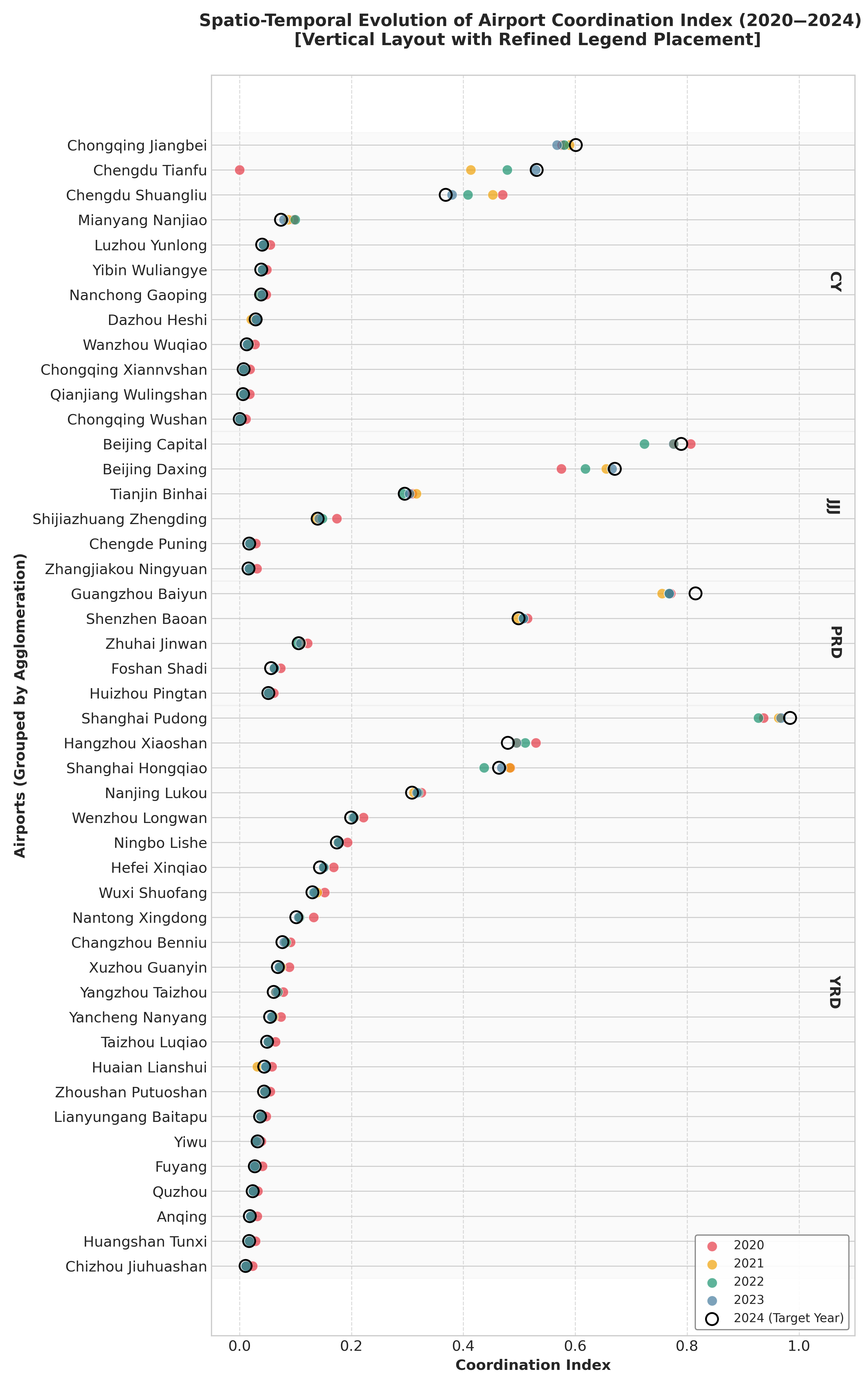
Using the composite subsystem scores of the major airports in China’s four airport agglomerations for 2020–2024, the comprehensive coordination index T for each airport in each year is calculated according to Equation (10). The results are reported in Figure 2.

4.3. Results Analysis

4.3.1. Evaluation of Airport Coupling and Coordination Performance

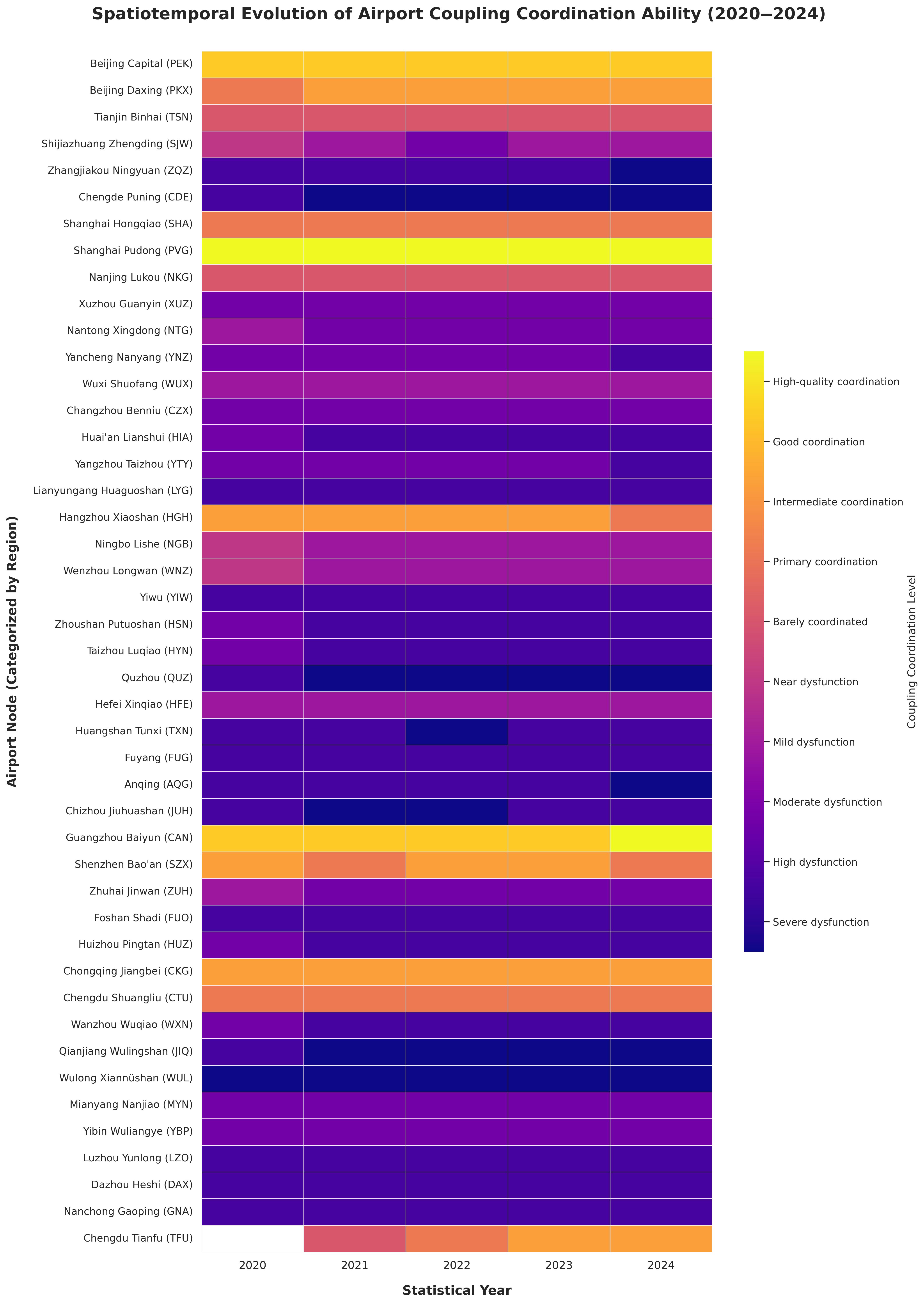
Using the coupling degree C and the comprehensive coordination index T of the major airports in China’s four airport agglomerations for 2020–2024, the coupling coordination degree D for each airport in each year is calculated according to Equation (11). The resulting values are then classified based on the criteria in Table 1 to evaluate each airport’s coupling–coordination performance. The results are presented in Figure 3.
Using the ratio of airports at mild maladjustment or above to the total number of airports within each agglomeration as the evaluation metric, the coupling–coordination performance of China’s four major airport agglomerations is summarized in Table 8.
Table 8 shows clear differences in coupling–coordination performance across China’s four major airport agglomerations. The Beijing–Tianjin–Hebei (BTH) agglomeration exhibits the strongest and most stable performance. The share of airports reaching at least the “mild maladjustment” threshold remains constant at 4/6 throughout 2020–2024, indicating that most airports in the group maintain relatively high and persistent coordination. Overall, the pattern suggests broadly balanced development with multiple airports performing well, implying that functional positioning and inter-airport coordination mechanisms are comparatively effective and support stable operations. The Yangtze River Delta (YRD) agglomeration also performs at a relatively high level. Although the ratio declines slightly in 2021 (from 9/30 to 8/30) and then remains unchanged, the absolute number of airports above the threshold stays large. This indicates generally sound inter-airport coordination within the agglomeration, with a modest downward shift in recent years. Such changes may reflect external disturbances (e.g., shifts in route networks or intensified competition for traffic and resources), rather than a structural breakdown in coordination. In contrast, the Guangdong–Hong Kong–Macao Greater Bay Area (GBA) shows pronounced volatility. The ratio drops from 3/5 in 2020 to 1/5 in 2022–2023, before partially recovering to 2/5 in 2024. This trajectory suggests a substantial deterioration in coordination during the study period, followed by limited improvement. The decline is plausibly associated with major shocks such as the COVID-19 pandemic, which likely weakened inter-airport complementarities and disrupted regional demand patterns. The Chengdu–Chongqing (CY) agglomeration records a low but relatively stable ratio, increasing from 2/11 in 2020 to 3/11 from 2021 onward. This indicates that while a small subset of airports has improved, overall coordination remains weak. The results imply that coordination and resource allocation mechanisms may have strengthened in parts of the system, but the agglomeration as a whole still requires further institutional and operational refinement to enhance system-wide synergy. Taken together, BTH has the highest share of airports with a comparatively stronger coupling–coordination performance, while CY has the lowest. YRD maintains the largest absolute number of better-performing airports with relatively stable levels over time, whereas GBA exhibits the greatest interannual fluctuations. From a trend perspective, aside from the consistently high performance observed in BTH, the other three agglomerations show substantial room for improvement in strengthening inter-airport coordination and system-level cohesion.

4.3.2. Evaluation of Airport Agglomeration Coupling–Coordination Performance

Based on the airport-level coupling coordination degree D, the airport agglomeration consistency index I is computed using Equations (12) and (13), with the results reported in Table 9. Building on these values, the overall coupling–coordination degree of each airport agglomeration is then calculated using Equation (14), as presented in Table 10.
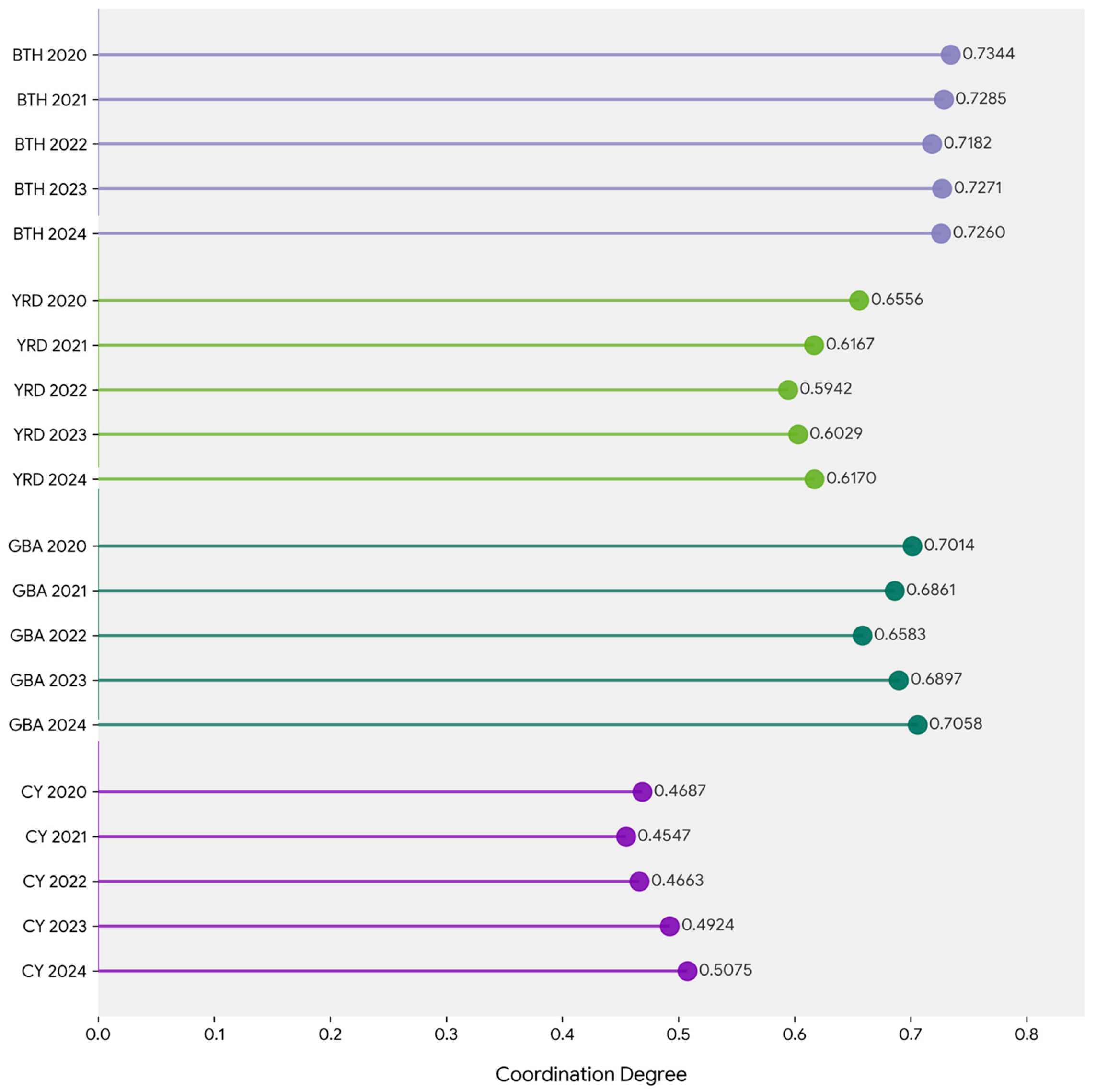
Based on the values reported in Table 10, the temporal evolution of the overall coupling–coordination degree for China’s four major airport agglomerations is plotted, as shown in Figure 4.
Table 10 and Figure 4 indicate that, over 2020–2024, the overall coordination degree of all four airport agglomerations follows a “decline–recovery” pattern, plausibly associated with exogenous shocks such as the COVID-19 pandemic. For the Beijing–Tianjin–Hebei agglomeration, the overall coordination degree decreases only slightly from 2020 to 2021 (−0.0059) and then remains broadly stable, with limited interannual fluctuations. This suggests a relatively strong and resilient coupling–coordination performance at the agglomeration level. In contrast, the Yangtze River Delta agglomeration exhibits more pronounced variation and appears more sensitive to changes in the external environment. In particular, the overall coordination degree drops sharply from 2021 to 2022 (−0.0389) and then gradually rebounds; however, by 2024 it still does not return to the 2020 level.
This pattern can be attributed to the relatively large number of airports with weak coupling–coordination performances within the agglomeration, which exerts a persistent drag on the system-level outcome. The Guangdong–Hong Kong–Macao Greater Bay Area (GBA) agglomeration shows noticeable year-to-year fluctuations, with a marked increase from 2022 to 2023 (+0.0313). This rebound suggests a relatively strong capacity for system-level recovery following external disruptions. The Chengdu–Chongqing (CY) agglomeration exhibits a sustained upward trend over the study period, with a clear rebound from 2022 to 2023 and continued growth thereafter. Nevertheless, its overall coordination degree remains the lowest among the four agglomerations throughout 2020–2024. This reflects the comparatively late development stage of the CY system: while the core hub(s) display an acceptable coupling–coordination performance, many secondary airports remain weak, limiting system-wide synergy. The relatively muted sensitivity of the CY agglomeration to pandemic-related shocks is closely linked to the commissioning of Chengdu Tianfu International Airport in 2021. The emergence of this high-capacity hub substantially strengthened the agglomeration’s coordination potential and helped reverse the earlier deterioration in overall performance.

5. Conclusions

This study develops an evaluation framework for coupling–coordination performance at both the airport and airport agglomeration levels from three dimensions: airport production, airport infrastructure development, and airport network support. It further introduces, in an innovative manner, the inverse of the coefficient of variation as an Airport Consistency Index, and on this basis proposes a method for calculating the overall coordination degree of an airport agglomeration. The main findings are summarized as follows:
(1) China’s four major airport agglomerations demonstrate significant variations in collaborative efficiency. The Beijing–Tianjin–Hebei agglomeration stands out for its highly efficient and stable coordination, characterized by well-balanced system operations and multiple strong nodes. The Yangtze River Delta agglomeration, though featuring numerous airports and strong coordination, has experienced a decline, likely due to intensified competition for resources and flight network adjustments, reflecting a pattern of relatively balanced development among strong nodes. The Guangdong–Hong Kong–Macao Greater Bay Area has seen a sharp reduction in high-performing airports, likely due to disruptions from the COVID-19 pandemic and other emergencies, resulting in weaker nodes but overall balance. Conversely, the Chengdu–Chongqing agglomeration has a lower coordination level, with concentrated highlights but a weak overall performance, indicating that further optimization is needed to improve collective coordination across the region.
(2) The divergence across China’s four airport agglomerations stems from the interplay between the internal foundation for inter-airport coordination and the consistency of development within each agglomeration, which together define distinct coordination structures. The Beijing–Tianjin–Hebei agglomeration remains highly stable with a strong coordination base, while the Yangtze River Delta exhibits moderate stability, and the Guangdong–Hong Kong–Macao Greater Bay Area shows significant volatility but resilience. The Chengdu–Chongqing agglomeration is comparatively low in coordination. The consistency index highlights varying levels of development, with Beijing–Tianjin–Hebei displaying the highest consistency and Chengdu–Chongqing the lowest. The ability to recover from external shocks differs, with Beijing–Tianjin–Hebei characterized by high consistency and coordination, the Yangtze River Delta constrained by a dominant hub but a weak tail, the Greater Bay Area showing episodic volatility with resilient recovery, and Chengdu–Chongqing evolving from a low baseline with significant internal gaps. This typology informs differentiated governance and policy strategies for each agglomeration.
(3) The overall coordination performance of the four major airport agglomerations ranks as follows: Beijing–Tianjin–Hebei, Guangdong–Hong Kong–Macao Greater Bay Area, Yangtze River Delta, Chengdu–Chongqing. The Beijing–Tianjin–Hebei agglomeration demonstrates a strong system-level coordination capability, with low sensitivity to external disturbances and a stable high level of performance with minimal fluctuations. The Yangtze River Delta, characterized by a large number of airports, is more sensitive to external environmental changes, showing a decline and subsequent recovery in its overall coordination level, but still has not returned to the 2020 level by 2024. In contrast, the Guangdong–Hong Kong–Macao Greater Bay Area shows strong recovery potential with a significant V-shaped recovery trajectory. Lastly, the Chengdu–Chongqing agglomeration has a relatively weak overall coordination capacity, with substantial room for improvement, and exhibits a low baseline but steady upward trend during the study period.
(4) Traditional coupling–coordination metrics primarily focus on the overall system performance and the intensity of interactions between subsystems. However, as a multi-agent complex system, the coordination quality of an airport agglomeration depends not only on the overall system development level but also on the dispersion and convergence of coordination performance across its member airports. In this context, this study innovatively decomposes the coordination outcomes at the agglomeration level into two identifiable structural components—average development level and internal consistency—allowing for a more precise diagnostic evaluation of the coordination state. The model introduces a coordination index and, based on the aggregation logic of “average level + consistency adjustment,” constructs a coordination degree index for the agglomeration level. This approach not only assesses the average development level of the agglomeration but also reflects the internal balance of coordination by examining the dispersion of airport-level coordination outcomes. Furthermore, the model effectively avoids the risk of leading airports’ strong performance masking internal disparities, which could otherwise constrain the agglomeration’s structural cohesion.
Despite the contributions of this framework, it is still in the preliminary stage of conceptualizing agglomeration coordination, focusing on the collaborative development between constituent airports. Future research can expand the time dimension and sample coverage, conduct robustness and uncertainty tests, and explore parameter settings for agglomerations of different sizes and development stages to enhance the model’s explanatory power, reliability, and stability. Moreover, future studies could integrate causal inference strategies or quasi-experimental designs to explore the driving mechanisms behind coordination dynamics, further improving the applicability of the framework in multi-airport system governance.
Building on the above findings, to enhance the coupling–coordination performance of airport agglomerations and to reduce disparities in coordinated development among member airports, the following recommendations are proposed for China’s four major airport agglomerations:
1.
Beijing–Tianjin–Hebei (BTH) Airport Agglomeration
The Beijing–Tianjin–Hebei (BTH) airport agglomeration shows high and stable coordination, underpinned by mature infrastructure, operations, and connectivity. Moving forward, policy should focus on strengthening lower-performing airports and optimizing structure over scale. The coordination degree remains steady with limited fluctuations, and four out of six airports maintain at least “mild maladjustment,” reflecting BTH’s strong coordination foundation. Future efforts should prioritize cross-airport integration and resource coordination rather than single-airport expansion. Specialization and clearer functional positioning are needed to improve coordination and system stability.
2.
Yangtze River Delta (YRD) Airport Agglomeration
The Yangtze River Delta (YRD) airport agglomeration, with many airports and a strong coupling–coordination performance, has seen a recent decline in coordination. Governance should prioritize coordinated development with tiered, differentiated management and resilient mechanisms to enhance system stability and shock resistance. Empirically, YRD’s coordination is sensitive to external fluctuations and recovers slowly, due to a significant share of lower-performing airports. A tiered governance framework, integrating functional positioning, resource allocation, and network organization, should reduce competition. Strengthening intra-agglomeration mechanisms for network adjustments and capacity redistribution can mitigate volatility. Promoting differentiated business development at lower-performing airports will gradually improve coordination and reduce disparities.
3.
Guangdong–Hong Kong–Macao Greater Bay Area (GBA) Airport Agglomeration
The Guangdong–Hong Kong–Macao Greater Bay Area (GBA) airport agglomeration shows a V-shaped recovery in coordination, though the share of airports with “mild maladjustment” fluctuates, indicating vulnerability to external shocks but also resilience. Policy should focus on reducing structural volatility while stabilizing recovery. Key actions include: first, strengthening cross-airport route specialization and coordinated resource allocation to reduce competition; second, improving network efficiency and connectivity, particularly via information sharing and data-driven scheduling; third, fostering a coherent hub hierarchy, where primary hubs enable specialized traffic at secondary hubs for sustained stability. Integrating clearer functional differentiation with digital tools will enhance resilience and reduce fluctuations.
4.
Chengdu–Chongqing (CY) Airport Agglomeration
We recommend strengthening foundational capacity and coordinated upgrading to raise system-level performance. Although the Chengdu–Chongqing (CY) airport agglomeration shows a sustained increase in overall coordination degree, its absolute level remains the lowest among the four major agglomerations throughout the study period. Meanwhile, the share of airports reaching at least the “mild maladjustment” threshold remains persistently low, indicating that the internal coordination structure is still immature and that the spillover effects from core hubs have not been effectively transmitted to medium- and small-sized airports. Accordingly, while continuing to leverage the driving role of core airports, policy and resource allocation should be further reoriented toward mid-tier and lower-tier airports. In parallel, clearer pathways for specialized development should be defined for these airports, together with coordination-oriented performance constraints (e.g., linked targets in capacity allocation, network connectivity, and operational collaboration). Such measures can facilitate convergence in coordination performance within the agglomeration, thereby improving the overall coordination degree, system stability, and collaborative resilience.

Author Contributions

Conceptualization, Y.S. and X.C.; methodology, Y.S.; validation, Y.S.; formal analysis, Z.C.; investigation, L.L.; resources, X.C.; data curation, J.X.; writing—original draft preparation, Y.S.; writing—review and editing, Y.S.; visualization, Z.D.; supervision, X.C.; project administration, X.C.; funding acquisition, L.L. All authors have read and agreed to the published version of the manuscript.

Funding

This research received no external funding.

Data Availability Statement

The original contributions presented in this study are included in the article and Appendix A. Further inquiries can be directed to the corresponding author.

Conflicts of Interest

The authors declare that the research was conducted in the absence of any commercial or financial relationships that could be construed as a potential conflict of interest.

Appendix A

Table A1. Coordination index of major airports of four major airport agglomerations in China from 2020 to 2024.
Airport20202021202220232024
PEK0.806080.776190.723380.775710.78944
PKX0.574960.655050.618120.665640.67074
TSN0.308740.315810.291750.303550.29516
SJW0.173920.137620.148030.142330.13957
ZQZ0.031180.018540.017990.017140.01595
CDE0.029100.018970.018710.017930.01722
SHA0.484170.482980.436920.468500.46381
PVG0.936340.963510.927240.967530.98400
NKG0.324950.311370.319220.317040.30827
XUZ0.089110.074160.071610.070880.06849
NTG0.132220.106260.107140.105540.10137
YNZ0.074080.060410.058310.057530.05458
WUX0.151790.138770.131770.133240.13022
CZX0.090960.082160.082610.079590.07654
HIA0.057920.031560.046330.047290.04406
YTY0.078130.064340.068310.064590.06100
LYG0.047660.039180.037220.038370.03664
HGH0.529440.495630.510400.494950.47952
NGB0.193070.175100.176140.176990.17391
WNZ0.221190.205100.202880.204440.19941
YIW0.038790.030270.028300.031660.03222
HSN0.054740.044050.045330.045210.04370
HYN0.063850.051790.051620.051210.04917
JUZ0.032540.023710.023850.024170.02345
HFE0.168150.151200.151190.149970.14369
TXN0.028650.018080.016700.017480.01710
FUG0.040880.029420.026870.026740.02723
AQG0.031660.021260.020140.019740.01835
JUH0.023370.011750.011280.011360.01076
CAN0.770580.755280.767450.767740.81500
SZX0.514600.497320.506780.507340.49867
ZUH0.121500.110040.102040.108910.10558
FUO0.073550.062430.061930.061890.05632
HUZ0.061010.052400.051130.051680.05141
CKG0.576230.589710.580450.567520.60101
CTU0.469910.452500.408000.379600.36844
WXN0.027240.016480.014680.014100.01283
JIQ0.018130.007210.005970.007700.00619
WSK0.011250.001260.000660.000340.00028
CQW0.018540.007460.007460.007330.00722
MIG0.096430.086940.099440.078950.07400
YBP0.048830.040350.040830.040860.03869
LZO0.054840.044520.043020.042530.04036
DAX0.030130.020430.030390.029240.02877
NAO0.047350.038530.037920.040430.03848
TFU--0.413170.478140.529170.53103
Table A2. Coupling–coordination performance of major airports in China’s four airport agglomerations (2020–2024).
Airport20202021202220232024
PEKGood coordinationGood coordinationGood coordinationGood coordinationGood coordination
PKXPrimary coordinationIntermediate coordinationIntermediate coordinationIntermediate coordinationIntermediate coordination
TSNBarely coordinatedBarely coordinatedBarely coordinatedBarely coordinatedBarely coordinated
SJWOn the verge of maladjustmentMild maladjustmentMild maladjustmentMild maladjustmentMild maladjustment
ZQZHigh maladjustmentHigh maladjustmentHigh maladjustmentHigh maladjustmentSevere maladjustment
CDEHigh maladjustmentSevere maladjustmentSevere maladjustmentSevere maladjustmentSevere maladjustment
SHAPrimary coordinationPrimary coordinationPrimary coordinationPrimary coordinationPrimary coordination
PVGHigh-quality coordinationHigh-quality coordinationHigh-quality coordinationHigh-quality coordinationHigh-quality coordination
NKGBarely coordinatedBarely coordinatedBarely coordinatedBarely coordinatedBarely coordinated
XUZModerate maladjustmentModerate maladjustmentModerate maladjustmentModerate maladjustmentModerate maladjustment
NTGMild maladjustmentModerate maladjustmentModerate maladjustmentModerate maladjustmentModerate maladjustment
YNZModerate maladjustmentModerate maladjustmentHigh maladjustmentHigh maladjustmentHigh maladjustment
WUXMild maladjustmentMild maladjustmentMild maladjustmentMild maladjustmentMild maladjustment
CZXModerate maladjustmentModerate maladjustmentModerate maladjustmentModerate maladjustmentModerate maladjustment
HIAModerate maladjustmentHigh maladjustmentHigh maladjustmentHigh maladjustmentHigh maladjustment
YTYModerate maladjustmentModerate maladjustmentModerate maladjustmentModerate maladjustmentHigh maladjustment
LYGHigh maladjustmentHigh maladjustmentHigh maladjustmentHigh maladjustmentHigh maladjustment
HGHIntermediate coordinationIntermediate coordinationIntermediate coordinationIntermediate coordinationPrimary coordination
NGBOn the verge of maladjustmentMild maladjustmentMild maladjustmentMild maladjustmentMild maladjustment
WNZOn the verge of maladjustmentMild maladjustmentMild maladjustmentMild maladjustmentMild maladjustment
YIWHigh maladjustmentHigh maladjustmentHigh maladjustmentHigh maladjustmentHigh maladjustment
HSNModerate maladjustmentHigh maladjustmentHigh maladjustmentHigh maladjustmentHigh maladjustment
HYNModerate maladjustmentHigh maladjustmentHigh maladjustmentHigh maladjustmentHigh maladjustment
JUZHigh maladjustmentSevere maladjustmentSevere maladjustmentSevere maladjustmentSevere maladjustment
HFEMild maladjustmentMild maladjustmentMild maladjustmentMild maladjustmentMild maladjustment
TXNHigh maladjustmentHigh maladjustmentSevere maladjustmentHigh maladjustmentHigh maladjustment
FUGHigh maladjustmentHigh maladjustmentHigh maladjustmentHigh maladjustmentHigh maladjustment
AQGHigh maladjustmentHigh maladjustmentHigh maladjustmentHigh maladjustmentSevere maladjustment
JUHHigh maladjustmentSevere maladjustmentSevere maladjustmentSevere maladjustmentSevere maladjustment
CANGood coordinationGood coordinationGood coordinationGood coordinationHigh-quality coordination
SZXIntermediate coordinationPrimary coordinationIntermediate coordinationIntermediate coordinationPrimary coordination
ZUHMild maladjustmentModerate maladjustmentModerate maladjustmentModerate maladjustmentModerate maladjustment
FUOHigh maladjustmentHigh maladjustmentHigh maladjustmentHigh maladjustmentHigh maladjustment
HUZModerate maladjustmentHigh maladjustmentHigh maladjustmentHigh maladjustmentHigh maladjustment
CKGIntermediate coordinationIntermediate coordinationIntermediate coordinationIntermediate coordinationIntermediate coordination
CTUPrimary coordinationPrimary coordinationPrimary coordinationPrimary coordinationPrimary coordination
WXNHigh maladjustmentHigh maladjustmentHigh maladjustmentHigh maladjustmentHigh maladjustment
JIQHigh maladjustmentSevere maladjustmentSevere maladjustmentSevere maladjustmentSevere maladjustment
WSKSevere maladjustmentSevere maladjustmentSevere maladjustmentSevere maladjustmentSevere maladjustment
CQWSevere maladjustmentSevere maladjustmentSevere maladjustmentSevere maladjustmentSevere maladjustment
MIGModerate maladjustmentModerate maladjustmentModerate maladjustmentModerate maladjustmentModerate maladjustment
YBPHigh maladjustmentHigh maladjustmentHigh maladjustmentHigh maladjustmentHigh maladjustment
LZOModerate maladjustmentHigh maladjustmentHigh maladjustmentHigh maladjustmentHigh maladjustment
DAXHigh maladjustmentSevere maladjustmentHigh maladjustmentHigh maladjustmentHigh maladjustment
NAOHigh maladjustmentHigh maladjustmentHigh maladjustmentHigh maladjustmentHigh maladjustment
TFU--Barely coordinatedPrimary coordinationIntermediate coordinationIntermediate coordination

References

  1. Logothetis, M.; Miyoshi, C. Network performance and competitive impact of the single hub—A case study on Turkish Airlines and Emirates. J. Air Transp. Manag. 2018, 69, 215–223. [Google Scholar] [CrossRef]
  2. Dursun, M.E.; O’Connell, J.F.; Lei, Z.; Warnock-Smith, D. The transformation of a legacy carrier—A case study of Turkish Airlines. J. Air Transp. Manag. 2014, 40, 106–118. [Google Scholar] [CrossRef]
  3. NDRC (National Development and Reform Commission). Opinions on Promoting the Integration of Hub Airports with Rail Transit; NDRC: Beijing, China, 2020. Available online: https://www.ndrc.gov.cn (accessed on 17 April 2020).
  4. Bonnefoy, P.A. Scalability of the Air Transportation System and Development of Multi-Airport Systems: A Worldwide Perspective. Ph.D. Thesis, Massachusetts Institute of Technology, Cambridge, MA, USA, 2008. [Google Scholar]
  5. Fuellhart, K.; O’Connor, K.; Woltemade, C. Route-Level Passenger Variation Within Three Multi-Airport Regions in the USA. J. Transp. Geogr. 2013, 31, 171–180. [Google Scholar] [CrossRef]
  6. Murata, T.; Kasatani, N. Airport Selection from Multiple Airports Using a Social Awareness Approach: A Case Study in the Kinki Region, Japan. In Proceedings of the 2014 IEEE 6th International Conference on Awareness Science and Technology (iCAST), Paris, France, 29–31 October 2014; IEEE: Paris, France, 2014; pp. 1–7. [Google Scholar]
  7. Wang, X.; Li, Y.; Wang, L.; Zhu, Z.; Zhang, X.; Wang, D.; Que, Y. Study on the Relationship between Airport Clusters and Regional Coordinated Development—Taking the Airport Clusters in the Yangtze River Delta as an Example. Mod. Manag. 2022, 12, 449–462. [Google Scholar] [CrossRef]
  8. Mou, Y.Y. Optimization of Route Network Based on Airport Group in Yangtze River Delta. Master’s Thesis, Nanjing University of Aeronautics and Astronautics, Nanjing, China, 2021. [Google Scholar]
  9. Göçer, A.; Özpeynirci, Ö.; Semiz, M. Logistics Performance Index-Driven Policy Development: An Application to Turkey. Transp. Policy 2022, 124, 20–32. [Google Scholar] [CrossRef]
  10. Cheng, X.; Van Damme, S.; Li, L.; Uyttenhove, P. Evaluation of Cultural Ecosystem Services: A Review of Methods. Ecosyst. Serv. 2019, 37, 100925. [Google Scholar] [CrossRef]
  11. Bao, D.; Zhang, X.; Gu, J. Evaluation Method for Green Ecological Airports in China Based on Combination Weighting. Promet—Traffic Transp. 2018, 30, 419–428. [Google Scholar] [CrossRef]
  12. Park, S.U.; Lee, J.D. Analyzing Factors That Influence the Efficiency of Airport Passenger Terminals Using the Analytic Hierarchy Process: A Case Study of Juanda Airport, Surabaya, Indonesia. KSCE J. Civ. Eng. 2020, 24, 3856–3865. [Google Scholar] [CrossRef]
  13. He, P.; Fu, Q. Collaborative Development Modes of Ocean Logistics Companies Based on Fuzzy Comprehensive Evaluation. J. Coast. Res. 2019, 94, 712–716. [Google Scholar] [CrossRef]
  14. Zielske, M.; Held, T. Application of Agile Methods in Traditional Logistics Companies and Logistics Startups: Results from a German Delphi Study. J. Syst. Softw. 2021, 177, 110950. [Google Scholar] [CrossRef]
  15. Wan, F.J. Study on Logistics Capability Evaluation of the Wuhan City Circle Based on Principal Component Analysis. Adv. Mater. Res. 2014, 850, 994–997. [Google Scholar] [CrossRef]
  16. Zhang, Z.; David, J. An Entropy-Based Approach for Assessing the Operation of Production Logistics. Expert Syst. Appl. 2019, 119, 118–127. [Google Scholar] [CrossRef]
  17. Yang, Y.; Bao, W.; Wang, Y.; Liu, Y. Measurement of Urban–Rural Integration Level and Its Spatial Differentiation in China in the New Century. Habitat Int. 2021, 117, 102420. [Google Scholar] [CrossRef]
  18. Singh, S.P.; Adhikari, A.; Majumdar, A.; Bisi, A. Does Service Quality Influence the Operational and Financial Performance of Third-Party Logistics Service Providers? A Mixed MCDM–Text Mining-Based Investigation. Transp. Res. Part E 2022, 157, 102558. [Google Scholar] [CrossRef]
  19. Wei, M.; Zhu, L.; Xu, S.; Zhang, Y. Spatial Effects of Air Passenger Location Entropy on Airports’ Passenger Throughputs: A Case Study of the Multi-Airport System in the Yangtze River Delta Region, China. Sustainability 2025, 17, 8002. [Google Scholar] [CrossRef]
  20. Pot, F.; Koster, S. Spatial and Airport Heterogeneity in Linking Airports to Regional Economic Growth: A European Analysis. In Airports and Regional Development; Yu, C., Peoples, J., Eds.; Advances in Airline Economics; Emerald Publishing Limited: Bingley, UK, 2025; Volume 12, ISBN 978-1-83608-800-4. [Google Scholar] [CrossRef]
  21. Yang, X.; Yan, Y. Coordinated Development between Regional Urban Agglomerations and Airport Clusters in China. Compr. Transp. 2023, 45, 17–20. [Google Scholar] [CrossRef]
  22. Liu, L. Air Route Network Planning and Design Under Uncertain Environments. Master’s Thesis, Nanjing University of Aeronautics and Astronautics, Nanjing, China, 2017. [Google Scholar]
  23. Dong, Q.; Zhong, K.; Liao, Y.; Xiong, R.; Wang, F.; Pang, M. Coupling Coordination Degree of Environment, Energy, and Economic Growth in Resource-Based Provinces of China. Resour. Policy 2023, 81, 103308. [Google Scholar] [CrossRef]
  24. Huang, J.; Li, F. Coupling Coordination Degree Measurement and Spatial Distribution Between Economic Development and Ecological Environment of Countries along the Belt and Road. Pol. J. Environ. Stud. 2021, 30, 3615–3626. [Google Scholar] [CrossRef]
  25. Yang, C.; Zeng, W.; Yang, X. Coupling Coordination Evaluation and Sustainable Development Pattern of the Geo-Ecological Environment and Urbanization in Chongqing Municipality, China. Sustain. Cities Soc. 2020, 61, 102271. [Google Scholar] [CrossRef]
  26. Zhu, Y.; Tian, D.; Yan, F. Effectiveness of the Entropy Weight Method in Decision-Making. Math. Probl. Eng. 2020, 2020, 3564835. [Google Scholar] [CrossRef]
  27. Feng, J.; Wu, C.-L.; Zhu, J. Airport Route Development Strategy Planning and Performance Measurement with a Dynamic Performance Management Framework. PLoS ONE 2022, 17, e0271452. [Google Scholar] [CrossRef]
  28. Alsalous, O. Airport Performance Metrics Analysis: Application to Terminal Airspace, Deicing, and Throughput. Doctoral Dissertation, Virginia Tech, Blacksburg, Virginia, 2022. [Google Scholar]
  29. Chen, K.; Bansal, P.; Anderson, R.J.; Findlay, N.S.; Graham, D.J. Understanding the Capacity of Airport Runway Systems. Transp. Res. Part C Emerg. Technol. 2025, 173, 104998. [Google Scholar] [CrossRef]
  30. Sun, X.; Wandelt, S.; Zhang, A. On the Relationship Between Air Connectivity and Economic Development: A Comparative Analysis for 2000–2019. Transp. Econ. Manag. 2024, 2, 310–321. [Google Scholar] [CrossRef]
  31. Chen, X.; Xuan, C.; Qiu, R. Understanding Spatial Spillover Effects of Airports on Economic Development: New evidence from China’s hub airports. Transp. Res. Part A 2020, 143, 48–60. [Google Scholar] [CrossRef]
  32. Wong, J.-T.; Wang, Y.-C. Airport Connectivity: Definition, Measurement, and Application. East. Asia Soc. Transp. Stud. 2017, 12, 922–938. [Google Scholar] [CrossRef]
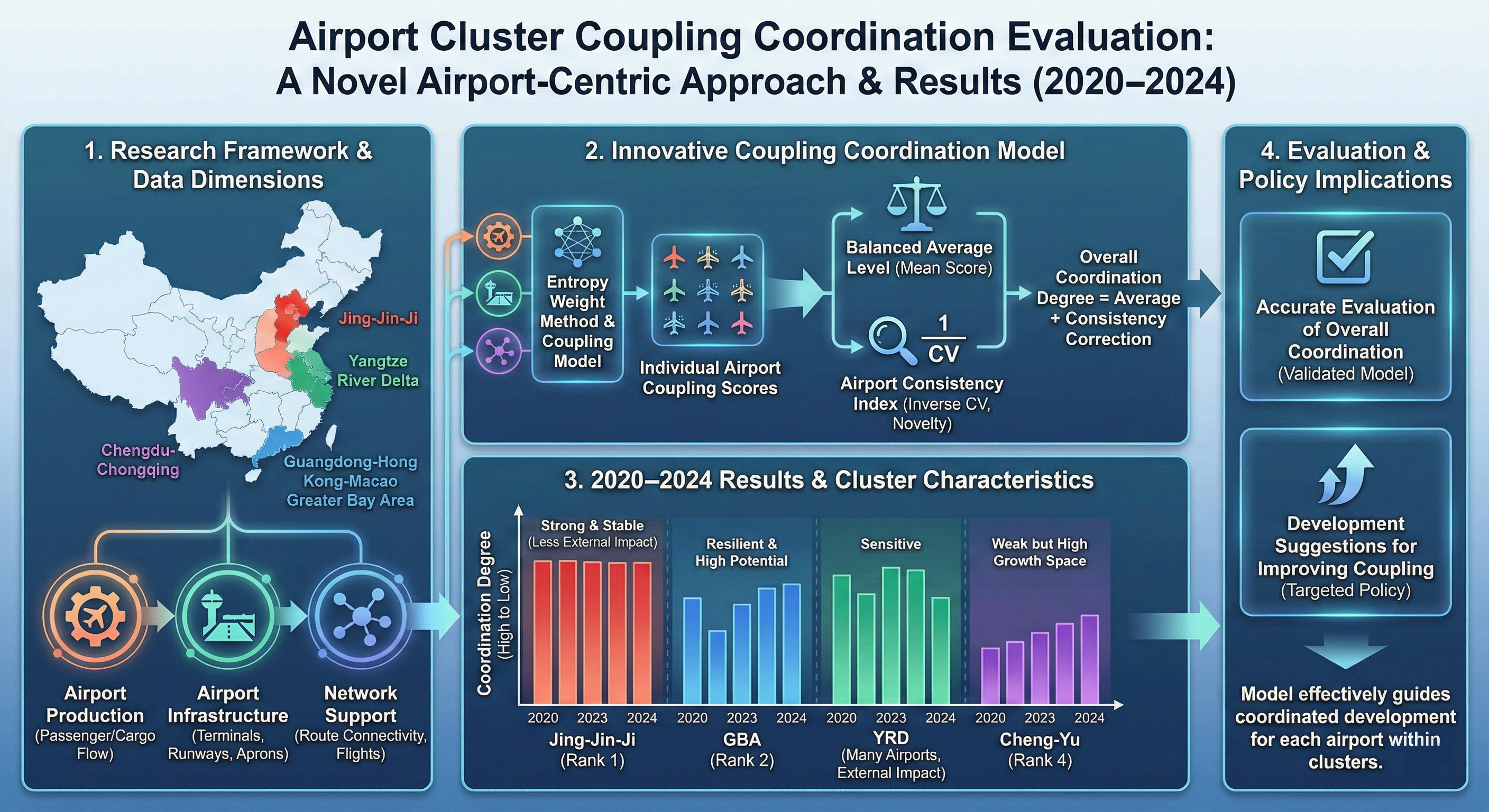
Figure 1. Airport agglomeration coupling coordination model.
Aerospace 13 00239 g001
Figure 2. Coordination index of major airports of four major airport agglomerations in China from 2020 to 2024.
Aerospace 13 00239 g002
Figure 3. Coupling–coordination performance of major airports in China’s four airport agglomerations (2020–2024). Note: Chengdu Tianfu International Airport (TFU) commenced operations on 27 June 2021; therefore, its coupling–coordination performance cannot be evaluated for 2020.
Aerospace 13 00239 g003
Figure 4. Overall coordination degree of four major airport agglomeration in China from 2020 to 2024.
Aerospace 13 00239 g004
Table 1. Evaluation index of airport (group) coordinated development ability.
Primary IndexSecondary Index
the airport production subsystempassenger throughput
cargo and mail throughput
takeoff and landing movements
the airport infrastructure subsystemgate positions
terminal area
number of runways
the airport network support subsystemnumber of destinations
the GDP of the airport’s city/region
Table 2. Coupling coordination evaluation standard.
Start (Inclusive)End (Exclusive)LevelCoupling–Coordination Category
00.11Severe dysfunction
0.10.22High dysfunction
0.20.33Moderate dysfunction
0.30.44Mild dysfunction
0.40.55Near dysfunction
0.50.66Barely coordinated
0.60.77Primary coordination
0.70.88Intermediate coordination
0.80.99Good coordination
0.9110High-quality coordination
Table 3. From 2020 to 2024, the corresponding entropy values of the three subsystems of the four major airport agglomerations in China.
YearProduction SubsystemInfrastructure SubsystemNetwork Support
Subsystem
Evaluation IndicatorPassenger Throughput (X1)Cargo & Mail Throughput (X2)Aircraft Movements (X3)Gate
Positions (X4)
Terminal Floor Area (X5)Number of Runways (X6)Number of Served
Destinations (X7)
City/Region GDP (X8)
20200.769980.587940.805850.781560.720780.960690.885410.85046
20210.784290.587120.813240.773810.730310.623950.878990.85251
20220.796180.586880.820580.769750.731330.623950.879830.85652
20230.783030.609270.815360.773990.7350.623950.879830.85568
20240.772770.613740.806830.774360.733860.617910.879120.85159
Table 4. The corresponding difference coefficient of the three subsystems of the four major airport agglomerations in China from 2020 to 2024.
YearProduction SubsystemInfrastructure SubsystemNetwork Support
Subsystem
Evaluation IndicatorPassenger Throughput (X1)Cargo & Mail Throughput (X2)Aircraft Movements (X3)Gate
Positions (X4)
Terminal Floor Area (X5)Number of Runways (X6)Number of Served
Destinations (X7)
City/Region GDP (X8)
20200.230020.412060.194150.218440.279220.039310.114590.14954
20210.215710.412880.186760.226190.269690.376050.121010.14749
20220.203820.413120.179420.230250.268670.376050.120170.14348
20230.216970.390730.184640.226010.2650.376050.120170.14432
20240.227230.386260.193170.225640.266140.382090.879120.85159
Table 5. From 2020 to 2024, the corresponding weights of the three subsystems of the four major airport agglomerations in China.
YearProduction SubsystemInfrastructure SubsystemNetwork Support Subsystem
Evaluation IndicatorPassenger Throughput (X1)Cargo & Mail Throughput (X2)Aircraft Movements (X3)Gate
Positions (X4)
Terminal Floor Area (X5)Number of Runways (X6)Number of Served
Destinations (X7)
City/Region GDP (X8)
20200.275070.492760.232170.40680.519980.073210.433840.56616
20210.264560.506390.229060.259410.30930.431280.450680.54932
20220.255940.518760.22530.263150.307060.429780.455780.54422
20230.273830.493130.233030.260660.305630.43370.454340.54566
20240.281690.478840.239470.258210.304560.437230.448870.55113
Table 6. Comprehensive scores of major airports of the four major airport agglomerations in China in 2021 (excerpt).
SubsystemProduction SubsystemInfrastructure SubsystemNetwork Support Subsystem
Airport
IATA0.581010.831830.91572
PEK0.321510.819560.82409
PKX0.202960.313930.43055
TSN0.079920.092620.24033
SJW0.005290.010940.03939
ZQZ0.00290.001910.05209
CDE0.412970.350130.68583
SHA0.938880.951641
PVG0.263310.321610.3492
NKG0.03640.024130.16195
XUZ0.039940.070480.20837
NTG0.02420.019810.13723
YNZ0.108530.044660.26313
WUX0.053220.018790.17448
CZX0.030790.003840.06006
HIA0.038410.012640.14197
YTY0.018060.004680.0948
LYG0.451690.504710.5305
HGH0.125090.06970.33051
NGB0.120380.068590.42632
WNZ0.02260.004490.06373
YIW0.023740.016960.09144
HSN0.017060.015430.12289
HYN0.006520.000910.06371
Table 7. Coupling degree of major airports of major airport agglomerations in China from 2020 to 2024 (excerpt).
Airport20202021202220232024
IATA0.973580.981810.947270.982320.98778
PEK0.840720.917570.84530.932890.93855
PKX0.940080.954970.891370.93540.92766
TSN0.946770.880440.906370.889530.88993
SJW0.763450.709870.728580.665630.56999
ZQZ0.606670.348390.320450.263530.2422
CDE0.955260.958360.927280.953030.94877
SHA0.998740.999630.996960.999720.99973
PVG0.996390.993140.997030.997330.99684
NKG0.813970.70390.676190.668870.67367
XUZ0.809170.787750.808230.80420.80929
NTG0.773410.668220.610190.600690.59149
YNZ0.875970.781460.758440.766660.78204
WUX0.797770.68010.664680.644010.64922
CZX0.805550.608970.450140.450730.44543
HIA0.829160.637260.644190.628220.63109
YTY0.720890.510730.445450.45380.44896
LYG0.988410.997770.999550.997380.99505
HGH0.898340.812690.8050.808040.81014
NGB0.828820.741690.728820.729530.72245
WNZ0.865280.615420.569260.580040.57916
YIW0.828150.755270.732430.75320.74912
HSN0.693230.61520.615560.622970.62157
HYN0.636350.304910.155370.00010.1604
Table 8. Airport coupling coordination of four major airport agglomerations in China from 2020 to 2024.
Airport Agglomeration
Year
Beijing–Tianjin–HebeiYangtze River DeltaGuangdong–Hong Kong–Macao Greater Bay AreaChengdu–Chongqing
20204/69/303/52/11
20214/68/302/53/11
20224/68/301/53/11
20234/68/301/53/11
20244/68/302/53/11
Table 9. Consistency index of four major airport agglomerations in China from 2020 to 2024.
Airport Agglomeration
Year
Beijing–Tianjin–HebeiYangtze River DeltaGuangdong–Hong Kong–Macao Greater Bay AreaChengdu–Chongqing
20201.5698915271.5362634021.4750421841.067618652
20211.3739274131.2859744231.2933965210.918216027
20221.4115513061.2668487411.2548003160.953427599
20231.3430076011.2293410191.2733389340.970191712
20241.3106866711.2381624081.2765832780.983587414
Table 10. Overall coordination degree of four major airport agglomerations in China from 2020 to 2024.
Airport Agglomeration
Year
Beijing–Tianjin–HebeiYangtze River DeltaGuangdong–Hong Kong–Macao Greater Bay AreaChengdu–Chongqing
20200.7344016670.6556364050.7013821150.468704433
20210.728460.6167116920.6860771780.454672818
20220.71823250.5941962530.6583236310.466316241
20230.7270983330.6028983820.6896584450.492351958
20240.7260091670.6170037030.7057782570.507501696
Disclaimer/Publisher’s Note: The statements, opinions and data contained in all publications are solely those of the individual author(s) and contributor(s) and not of MDPI and/or the editor(s). MDPI and/or the editor(s) disclaim responsibility for any injury to people or property resulting from any ideas, methods, instructions or products referred to in the content.