
Article

DBO-PSO: Mechanism Modeling Method for the E-ECS of B787 Aircraft Based on Adaptive Hybrid Optimization


1
Tianjin Key Laboratory for Advanced Signal Processing, Civil Aviation University of China, Tianjin 300300, China
2
College of Safety Science and Engineering, Civil Aviation University of China, Tianjin 300300, China
3
Engineering Division, Aircraft Maintenance and Engineering Corporation, Beijing 100621, China
*
Author to whom correspondence should be addressed.
Aerospace 2026, 13(2), 195; https://doi.org/10.3390/aerospace13020195
Submission received: 17 December 2025 / Revised: 6 February 2026 / Accepted: 16 February 2026 / Published: 18 February 2026
(This article belongs to the Special Issue AI, Machine Learning and Automation for Air Traffic Control (ATC))

Abstract

In view of the highly coupled, time-varying, and susceptible to differences in aircraft configuration of the Boeing 787 Electric Environmental Control System (E-ECS), a simplified mechanism model based on effectiveness-number of transfer units is proposed. Firstly, considering the influence of differences in aircraft configuration, part number, and optional components, a heat conduction correction coefficient is introduced to adjust the calculation process of heat exchange efficiency. Secondly, the steady-state characteristic equation of the electric compressor/turbine is established by utilizing the principle of isentropic work. Then, the outlet temperature value of the water removal component is calculated by using secondary heat recovery technology. Finally, to solve the problem of easily getting stuck in local optima during high-dimensional parameter identification, an adaptive hybrid optimization algorithm combining Dung Beetle Optimization (DBO) with mutation operator and Particle Swarm Optimization (PSO) is proposed. The experimental results show that the proposed mechanism model can achieve dynamic representation of the outlet temperature of each component of E-ECS under different aircraft stages. The DBO-PSO algorithm has a fast convergence speed and a low probability of falling into local optima. The temperature values calculated by the model have high computational accuracy, which can provide reliable data support for component level E-ECS health monitoring and early fault warning.

1. Introduction

As a core component of the aircraft environmental control system (ECS), the aircraft air conditioning system is regarded as playing a crucial and indispensable role in ensuring the safe and efficient operation of the aircraft, as well as the comfortable experience of passengers and crew members [1]. During the flight of an aircraft, there is a significant difference in the environment inside and outside the cabin. The temperature and pressure of the external atmospheric environment change significantly with altitude. However, the aircraft’s air conditioning system, through a series of processes such as heat exchange, compression, cooling, and dehumidification, can automatically adjust and control the environmental parameters such as temperature, humidity, and pressure inside the cabin according to different flight phases and environmental conditions, thus creating a suitable environment inside the aircraft [2]. It possesses notable characteristics such as high efficiency, stability, and adaptability. From the perspective of aviation safety, suitable environmental conditions are crucial for maintaining the normal operation of aircraft equipment and the physiological state of personnel. For example, electronic equipment may experience performance degradation or even malfunction in excessively high or low temperature environments, which can affect the stable operation of key systems such as the aircraft’s flight control system and communication system [3]. Unsuitable temperature and humidity conditions can also have a negative impact on the physical function and work efficiency of on-board personnel, which increases the risk of human operational errors and thus threatens aviation safety [4]. Therefore, the reliability and performance of aircraft air conditioning systems are directly related to aviation safety and flight quality.
The core function of the aircraft air-conditioning system’s ECS is that the introduced outside air is processed to meet the specific requirements of the internal environment of the aircraft [5]. Its basic operating principle is that the outside ram air is introduced into the system. After a series of processing procedures such as compression, cooling, and dehumidification are gone through in sequence, the air is delivered to the interior of the cabin. The ECS is featured with remarkable characteristics such as high efficiency, stability, and adaptability. The operating parameters can be automatically adjusted according to different flight phases of the aircraft and environmental conditions, and a stable environment inside the cabin is ensured.
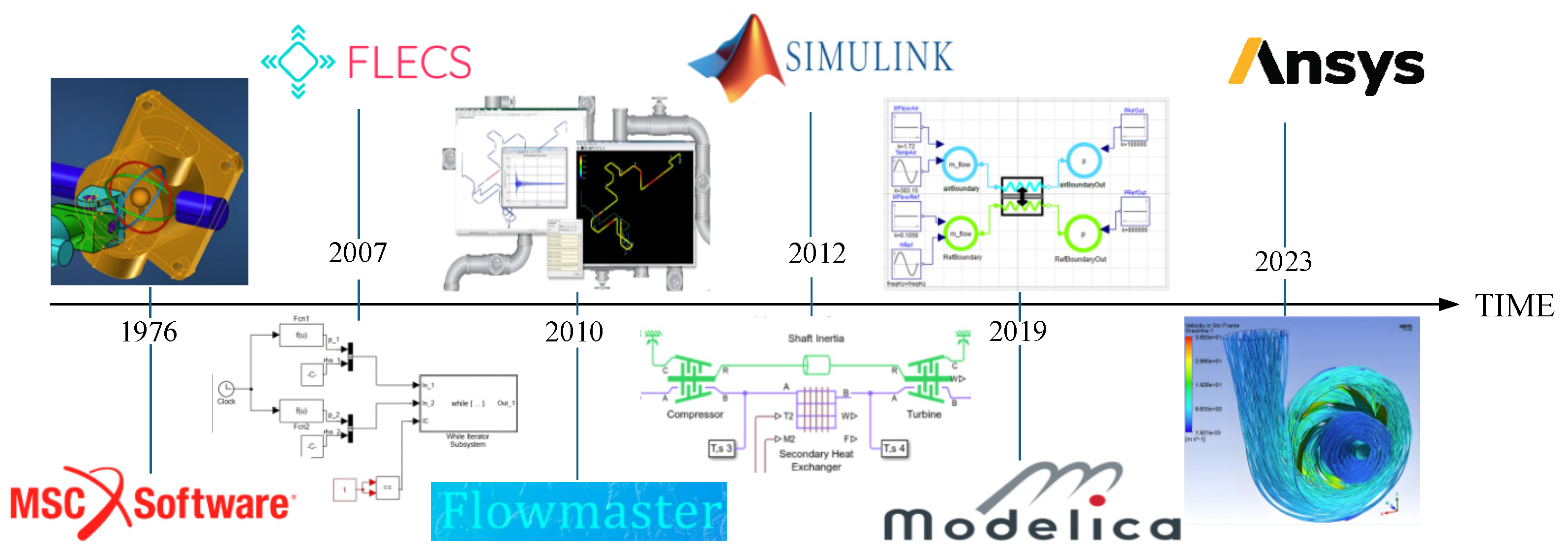
In the research of the ECS, the exploration of its mechanism models has been continuously evolved. In 1976, Boeing developed the Easy5 software (v1.x) platform for nonlinear and linear analysis of aircraft ECS. Subsequently, Hoffman Corporation [6] used Easy5 to simulate the ECS of the F-14F fighter jet, while Gulfstream Aerospace Corporation [7] applied it to the model development of the G500 and G550 passenger planes. In 2001, Vargas et al. [8] established a distributed parameter model that clearly explained the processes of air flow and heat transfer, which can accurately represent the internal physics. A lumped-parameter model based on the first law of thermodynamics and the law of conservation of mass was proposed by Pérez-Grande et al. [9], which simplifies the entire ECS system into multiple modules with different functions and characterizes the dynamic characteristics of the system by establishing energy and mass transfer equations between modules.
In 2007, Airbus collaborated with Hamburg University of Applied Sciences and other institutions to develop a functional model library for ECS. A simulation framework was constructed using MATLAB/Simulink software (R2007), and the model accuracy was verified in the test flight data of the Airbus A340-600 aircraft model. In 2009, Saab Group in Sweden collaborated with Linköping University to develop an ECS model for the JAS39 fighter jet using Easy5, and then implemented the S-ECS system on the Dymola simulation platform using Modelica language. In 2010, a team from Peking University [10] used Flowmaster thermal fluid simulation software to establish an aircraft ECS model, further expanding the diversity of the toolchain. In 2014, Philip Jordan et al. [11] used comparative theory analysis to develop the TTECCS library in Modelica, providing reusable components for PACK system development. In 2016, the AUS work first used the exergy method to quantify the impact of bleed air and electric power extraction on engine Specific Fuel Consumption (SFC), but only provided a single indicator of fuel mass [12]. In 2019, Poudel [13] used Open Modelica to conduct baseline modeling of the A320 air conditioning system and combined it with NTU method for thermodynamic analysis. In the same year, Shu et al. [14] established mathematical models of key components based on mechanism modeling methods, and linked them in MATLAB/Simulink according to the gas flow sequence to complete dynamic performance analysis. The commonly used ECS mechanism model development platform is shown in Figure 1.
Compared with the traditional ECS, the electrification of the Boeing 787 ECS refers to the replacement of engine bleed air energy with electric power as the driving energy. This system can be called an electric environmental control system (E-ECS) [15]. The innovation of the Boeing 787 E-ECS compared to conventional engine bleed air systems is reflected in the cabin air compressor (CAC), which is driven by an internal electric motor to compress ram air using a titanium compressor rotor. The air cycle machine (ACM) is also a unique innovation. In the ACM, although the four-wheel coaxial arrangement of “compressor, high-pressure turbine, low-pressure turbine, and cooling fan” is still retained, the power source of the cooling fan is no longer the coaxial mechanical power drive from the turbine, but rather motor-driven, so that the working state of the cooling fan can be flexibly adjusted according to different actual operating conditions.
In the study of E-ECS, the development of its system architectures and modeling approaches has continuously advanced. In 2019, The multi-physics coupling modeling method was applied to the modeling of E-ECS by Devadurgam et al. [16]. The interaction between multiple physical fields such as electrical, thermal, and fluid mechanics is considered in the modeling process, which can more comprehensively describe the operating characteristics of E-ECS, but at the same time, it also brings about the problems of high model complexity and computational cost. In 2022, Ablanque et al. [17] used a combination of steady-state and transient calculations to model and simulate heat exchangers, which are the core components of E-ECS. Lu et al. [18] proposed a modular modeling closed air conditioning system based on conservation laws. This system utilizes the design concept of electric compressor in E-ECS and combines it with engine bleed air as a mixed hot bleed air source to improve the energy efficiency of ECS. However, its coverage of applicable working conditions is limited.
In 2023, Planès et al. [19] developed a set of parametric models for the electric environment control system using ANSYS Fluent software (2023 R1), which is suitable for the preliminary design stage of the aircraft. Taking the CeRAS reference aircraft as an example, they used the model to minimize the overall fuel consumption of the aircraft through multidisciplinary design analysis and optimization. In 2023, A modeling solution based on the bond graph theory was proposed by He Zhongze et al. [20], which abstracts the E-ECS system into multiple subsystems with different energy forms. By describing the energy transfer and conversion relationships between subsystems through bond graphs, a dynamic model of E-ECS is established. However, during the construction of this model, the nonlinear characteristics of the system and external interference factors are not fully considered, which resulted in a certain degree of impact on the accuracy and reliability of the model in practical applications. In the same year, the dynamic characteristics and physical processes of the E-ECS are described by Fioriti M. et al. [21], and they applied the dynamic model to a turboprop regional plane carrying 80 passengers [22]. In 2024, Adachi et al. [23] proposed a novel electric environmental control system aimed at aircraft energy recovery, which can achieve a very high energy recovery rate under ideal conditions. However, the model design is too ideal and does not consider the impact of changes in heat exchanger efficiency, lacking validation with real data. In 2025, Celikel et al. [24] built a virtual demonstration system for E-ECS, focusing on verifying the integration and operational status of E-ECS in the entire aircraft air system, without involving simulation data quality assessment and component performance analysis. Based on the above analysis, these models can provide theoretical support for the design and optimization of E-ECS, but there is still room for improvement in terms of computational efficiency and applicability in different operating scenarios.
A simplified mechanism model of E-ECS based on effectiveness-number of transfer units is proposed for the electric environment control system of B787 aircraft. According to data characteristics, the DBO-PSO optimization algorithm is used to adaptively adjust the parameter settings of the mechanism model, which enables the model to characterize the dynamic changes in the outlet temperature of various components of the air conditioning system in E-ECS. The contributions of the paper are as follows.
(1) Considering the characteristics of E-ECS electric drive and focusing on the physical working process of E-ECS under different aircraft configurations and flight phases, a heat conduction correction coefficient is introduced based on the ε-NTU method to adjust the calculation process of heat exchange efficiency, which improving the adaptability of the model to actual operating conditions and different aircraft configurations.
(2) An adaptive hybrid optimization algorithm combining Dung Beetle Optimization with mutation operator and Particle Swarm Optimization is proposed. Generate random bias perturbations through mutation operators to maintain population diversity and avoid premature convergence through periodic global resampling. The proposed method solves the problem of optimization algorithms easily getting stuck in local optima in high-dimensional parameter identification, and has significant advantages in convergence speed and algorithm efficiency.
(3) The proposed mechanism model can accurately calculate the outlet temperature values of each component during different flight phase such as ground and cruise, thereby expanding the observable data dimension of E-ECS. This has potential application value in component level health monitoring and early fault detection of E-ECS.
The rest of the paper is organized as follows: Section 2 introduces the mechanical model of aircraft air conditioning systems based on the number of effective conversion units, Section 3 introduces the DBO-PSO hybrid optimization algorithm, Section 4 illustrates the experimental setup, relevant metrics, the results and the discussion regarding the underlying studies, Section 5 concludes the study.

2. Mechanistic Model of Aircraft Air-Conditioning System Based on Effectiveness-Number of Transfer Units

The Pressurization and Air Conditioning Kit (PACK) is the core component of ECS [25], which is based on the reverse Brayton cycle system for air circulation and cooling. There are currently five types of PACK components used in civil aviation transport aircraft [26], as shown in Table 1. The differences in aerodynamic shape, cabin volume, range load, and other aspects among different aircraft models directly lead to significant differences in boundary conditions such as heat load distribution, flow parameter range, and installation space constraints. For example, the three wheel high-pressure water removal system remains the main choice for ECS systems in medium-sized aircraft, such as Airbus A320 and Boeing 737MAX, as well as COMAC’s C919 aircraft. Twin-aisle aircraft such as Boeing 777, Boeing 787, and Airbus A380 tend to use four-wheel high-pressure water removal systems.
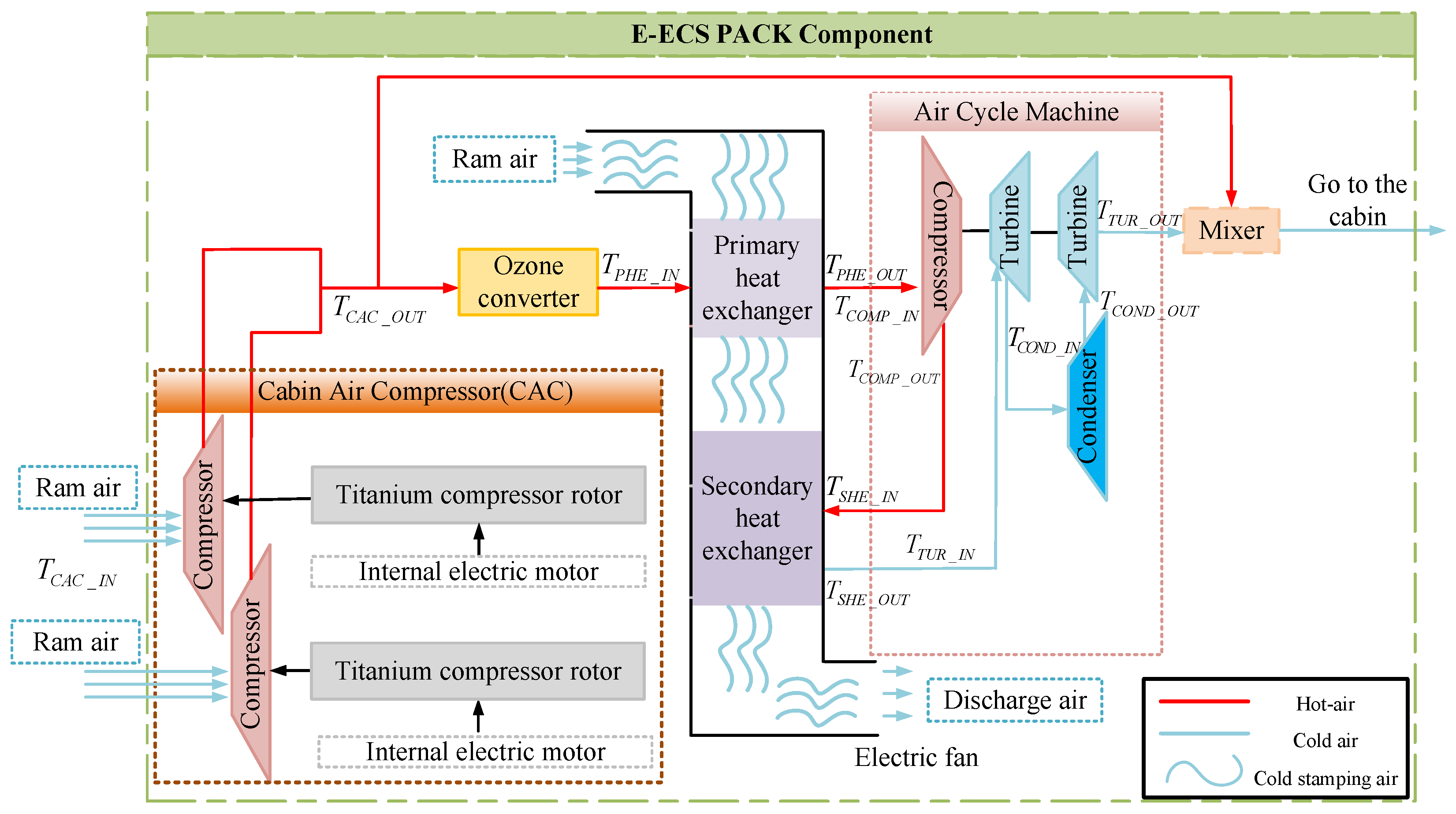
As shown in Table 1, the E-ECS of the Boeing 787 aircraft adopts a four-wheel high-pressure water removal system architecture design [27], which completes core operations such as pressure regulation, temperature control, and humidity management before the airflow enters the fuselage environmental control pipeline through the front-end air conditioning unit. The E-ECS adopts a modular design with dual PACK components, and its topology covers subsystems such as air compression, heat exchange, and circulation control. The specific functional implementation principle and air heat transfer path are detailed in the pneumatic coupling model in Figure 2.
In this section, when a mechanistic model of the E-ECS is constructed, the primary task is to establish simulation models based on heat transfer and aerodynamic principles for key components in the E-ECS [28] These models aim to determine the quantitative relationship between component input and output temperatures, and comprehensively consider factors such as component working principles, mechanical dimensions, environmental conditions, system configuration, and measured data when modeling [29]. By integrating these component models, a complete E-ECS simulation model can be constructed. In order to simplify the analysis process, the model is further decomposed into a temperature model, and PACK in the environmental control system is selected as the research object.
When conducting research and analysis on E-ECS, the temperature parameters of each component in the system are key indicators for evaluating its performance and operating status. The inlet and outlet temperatures of each key component in the E-ECS system are also labeled in Figure 2. These temperature data can intuitively reflect the heat exchange situation, energy loss degree, and overall thermal management efficiency of the system at different links. The relevant parameters and their physical meanings are presented in detail in Table 2, as follows:

2.1. Heat Exchanger

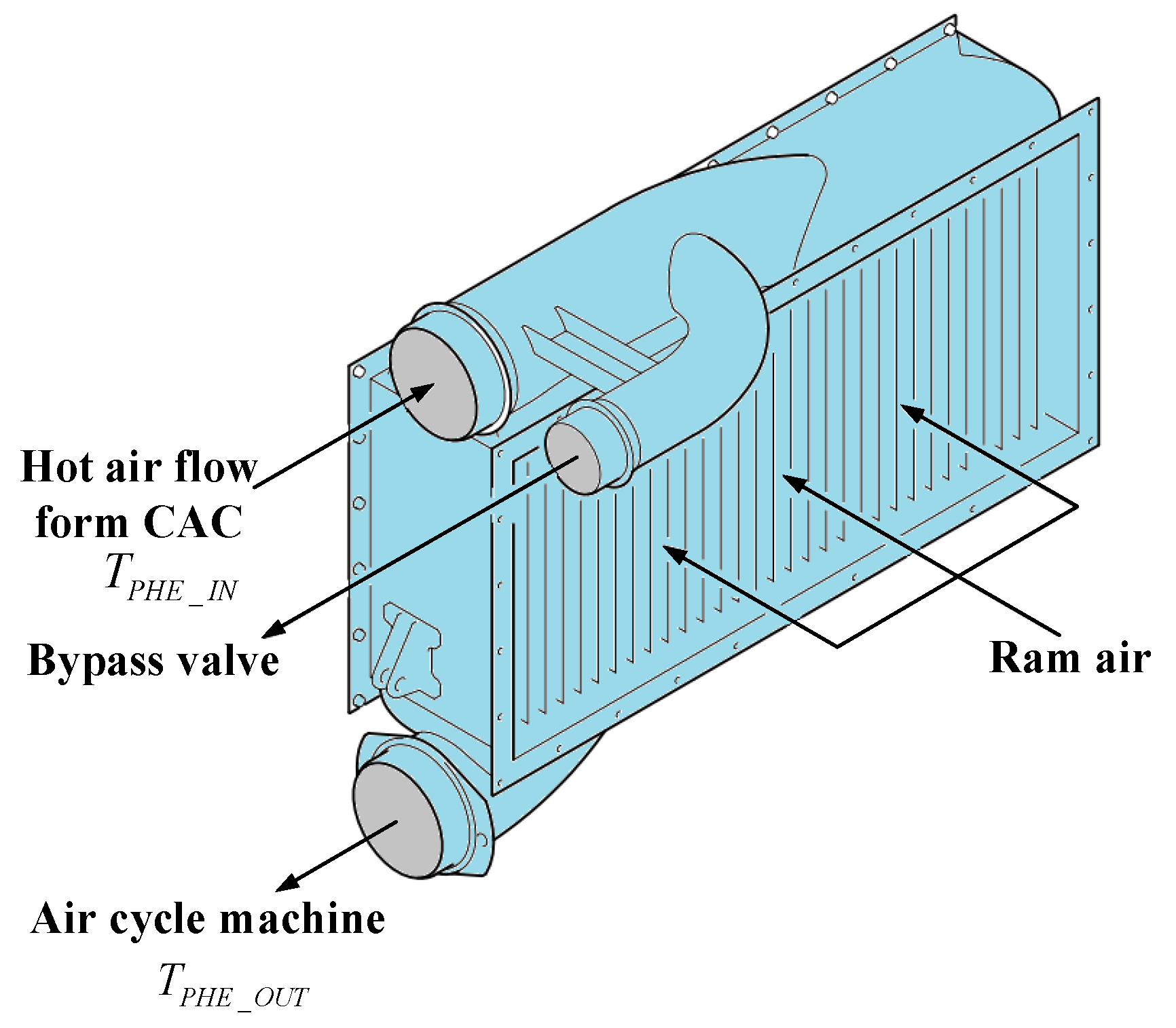
In E-ECS, the heat transferred from the upstream hot air in the hot-side channel of the heat exchanger to the cold outside air—driven by the electrically driven cooling fan—is equal to the heat exchange between the hot air and the heat exchanger core. The heat exchanger is shown in Figure 3.
Based on the forced convection theory, this heat transfer amount can be calculated by the following formula:
Q = h h A Δ T
In the formula, Q represents the heat loss of the hot-air flow, with the unit of watt (W); h h represents the heat transfer coefficient on the hot-air side, with the unit of watt per square meter per kelvin (W/(m2⋅K)); A represents the heat transfer area on the hot-air side of the heat exchanger, with the unit (m2); and Δ T represents the temperature difference between the hot-air flow and the primary heat exchanger core, with the unit of kelvin (K).
In an ideal scenario, the effective contact area of the heat exchanger is equal to the heat transfer area A on the hot air side of the heat exchanger, the temperature T H E _ I N will change to T H E _ O U T , and the temperature will become, with the Reynolds number in the heat exchanger calculated as:
R e = ρ V D μ
In the formula, ρ represents the density of the hot air, with the unit of kilograms per cubic meter (kg/m3); D represents the hydraulic diameter of the pipe, with the unit of meters (m); and μ represents the dynamic viscosity, with the unit of kilograms per meter-secondary (kg/(m⋅s)); V represents the flow velocity of the hot air, with the unit of meters per secondary (m/s), which is calculated by the following equation [16]:
V = m ˙ ρ 1 A 1
In the formula, m ˙ represents the mass flow rate of each pipe, with the unit of kilograms per secondary (kg/s); ρ 1 represents the density of the hot air in the pipe, with the unit of kilograms per cubic meter (kg/m3); and A 1 represents the internal cross-sectional area of the pipe, with the unit of square meters (m2). m ˙ can be expressed as Q 2 / 33 , because the PHE has 33 pipes and the total inlet mass flow rate is Q 2 [3].
The cross-sectional are A 1 of each pipe is approximately 0.002 m2, and the perimeter P of the cross-section is approximately 0.54 m. The hydraulic diameter D H can be calculated as 0.015 m. μ represents the dynamic viscosity, which is determined by the temperature of the air flow and can be expressed according to the Sutherland formula as follows:
μ = μ 0 T T c 1.5 T c + T s T + T s
In the formula, μ 0 is the viscosity coefficient at 0 °C under 1 atmosphere, T is the input temperature parameter, and T s is the Sutherland constant which is related to the properties of the gas, T c = 273.16 K .
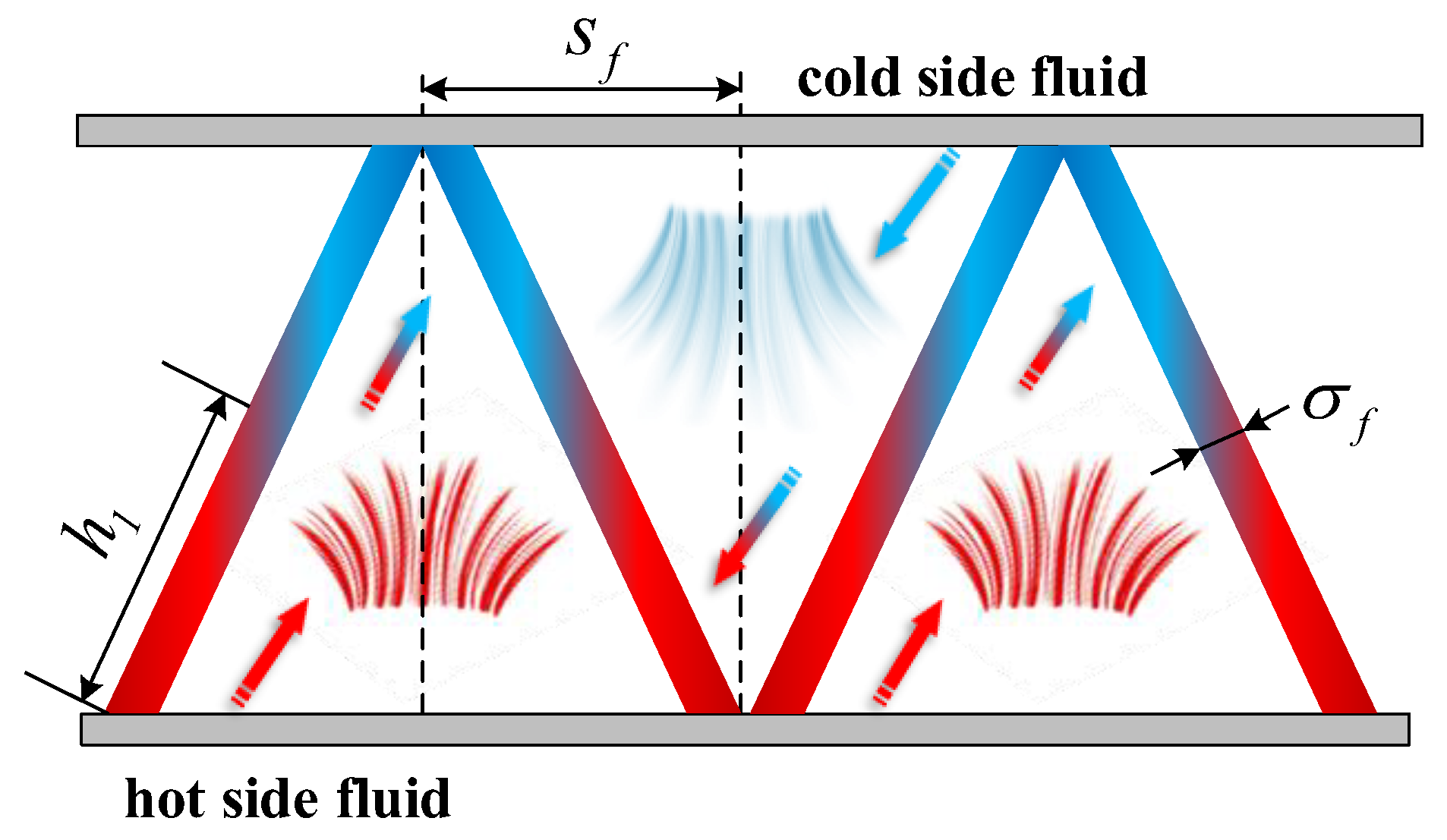
The heat exchanger is a cross flow heat exchanger, which consists of four parts: air inlet and exhaust pipes, pipelines, and fins. The basic unit structure is shown in Figure 4.
As shown in Figure 4, arrows of different colors respectively represent the hot side fluid and the cold side fluid, with red indicating higher temperatures and blue indicating lower temperatures. The hot side fluid and cold side fluid flow through different channels of the fins and undergo heat transfer. The process of the arrow color changing from blue to red or from red to blue is the process of heat exchange. Based on the definition of the calculation of the heat transfer area on the hot-air side of the heat exchanger, it is calculated by the following equation:
A = A p + A f = 2 N 1 L 1 L 2 ( s f σ f ) + 2 h 1 / s f
In the formula, A p is the primary heat-transfer area, with the unit (m2). A f is the secondary heat-transfer area, measured with the unit (m2). N 1 is the number of times the hot air circulates. L 1 is the length of the primary heat exchanger, which is 0.18 m. L 2 is the width of the primary heat exchanger, which is 0.18 m. h 1 is the fin height, with the unit (m). s f is the fin pitch, with the unit (m). For the primary heat exchanger of the Boeing 787 aircraft, the length and width are 0.27 m and 0.25 m respectively [16].
The energy conversion equation for two fluids with arbitrary flow arrangements is expressed as:
q = C h t i n t o u t = C c t c o t c i
In the formula, C h represents the heat capacity of the hot side fluid, with the unit (J/(K·s)), t i n and t o u t represents the inlet and outlet temperatures of the hot side fluid, with the unit (K); C c is the heat capacity of the cold side fluid, with the unit (J/(K·s)), t c i and t c o for the inlet and outlet temperatures of the cold side fluid, with the unit (K). Formula (6) can further derive the heat transfer rate equation based on the parameters of the heat exchanger, expressed as:
q = U A Δ t m = Δ t m R 0
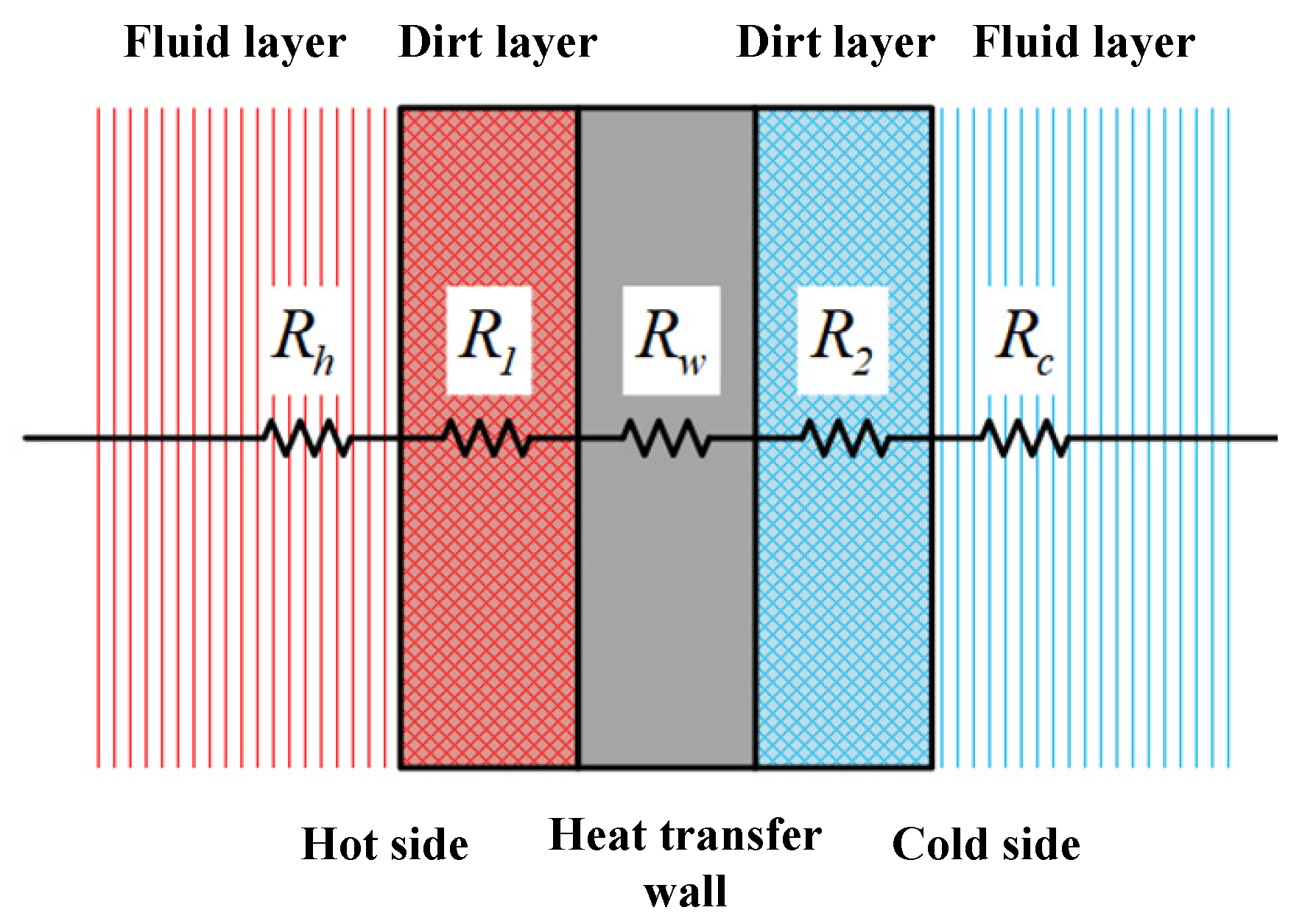
In the formula, U is the total heat transfer coefficient of the heat exchanger, with the unit (W/(m2·K)), Δ t m is the average temperature difference between cold and hot fluids, with the unit (K), R 0 and is the total thermal resistance, with the unit (K/W). To further calculate the total thermal resistance, it is necessary to further divide the surface of the heat exchanger based on the size of the heat exchange impedance at different levels. The surface of the heat exchanger can be divided into fluid layer, fouling layer, and heat transfer wall, which R 0 can be further expressed as:
R 0 = R h + R 1 + R w + R 2 + R c
In the formula, R h is the thermal resistance of the hot fluid, with the unit (K/W), R 1 is the thermal resistance of the fouling on the hot fluid side, with the unit (K/W), R w is the thermal resistance of the heat transfer wall of the heat exchanger, with the unit (K/W) R 2 is the thermal resistance of the fouling on the cold fluid side, with the unit (K/W), and R c is the thermal resistance of the cold fluid, with the unit (K/W). The relationship between each part is shown in Figure 5.
Formula (8) can also be further represented by the various parameters of the heat exchanger as follows:
R 0 = 1 η 0 h A H + R fh η 0 A H + R w + R fc η 0 A C + 1 η 0 h A C
In the formula, η 0 is the efficiency of the heat transfer surface, h is the thermal film coefficient of the fluid, H and C subscripts are the hot fluid side and the cold fluid side. The total energy balance of a heat exchanger is expressed as:
Q h = m h C p h t i n t o u t = m c C p c t c o t c i = Q c
In the formula, m h is the flow rate of the hot side fluid, with the unit (kg/s), m c is the flow rate of the cold side fluid, with the unit (kg/s), C p h is the specific heat capacity of the hot side fluid air, with the unit (J/(kg·K)), and C p c is the specific heat capacity of the cold side fluid air, with the unit (J/(kg·K)). According to the definition of heat capacity, the heat capacity C h of the hot side fluid, with the unit (W/K) and the heat capacity C c of the cold side fluid, with the unit (W/K), can be expressed as:
C h = m h C p h
C c = m c C p c
The NTU (Number of Transfer Units) method is an effective tool for analyzing the performance of heat exchangers. The number of heat transfer units (NTU) is defined as the product of the heat transfer coefficient U and the heat transfer area on the hot-air side of the heat exchanger A of a heat exchanger divided by the minimum heat capacity flow rate C min . Its calculation formula is [30]:
N T U = U · A C min
In the formula, U is the total heat transfer coefficient of the heat exchanger, with the unit(W/(m2·K)), which comprehensively considers the influence of various thermal resistances during the heat exchange process. C min is the smaller heat capacity flow rate in cold and hot fluids. The calculation formula for heat capacity flow rate C is C = m ˙ c p , where m ˙ is the mass flow rate of the fluid, with the unit (kg/s), and c p is the specific heat capacity at constant pressure of the fluid, with the unit (kg/s).
Due to factors such as external environment and changes in aircraft configuration, it is not possible to directly obtain the thermal conductivity. It is also affected by the NTU correction coefficient. The specific calculation process for the thermal conductivity N T U μ 1 of the primary heat exchanger and the thermal conductivity N T U μ 2 of the secondary heat exchanger is as follows:
N T U μ 1 = N T U P μ 1 = U P A P C P min μ 1
N T U μ 2 = N T U S μ 2 = U S A S C S min μ 2
The heat capacity ratio C r is defined as the ratio of the minimum heat capacity flow rate C min , with the unit (K/W), to the maximum heat capacity flow rate C max , with the unit (K/W), and the formula is as follows:
C r = C min C max
The efficiency ε represents the ratio of the actual heat transfer of the heat exchanger to the maximum possible heat transfer, Different types of heat exchangers have different relationships between their efficiency ε and NTU and C r . Assume that, the subscript P represents the primary heat exchanger, and the subscript S represents the secondary heat exchanger, For counter current heat exchangers:
When C P r 1   or   C S r 1 ,
ε P = 1 exp [ N T U P ( 1 C P r ) ] 1 C P r exp [ N T U P ( 1 C P r ) ] ε S = 1 exp [ N T U S ( 1 C S r ) ] 1 C S r exp [ N T U S ( 1 C S r ) ]
When C P r = 1   or   C S r = 1 ,
ε P = N T U P 1 + N T U P ε S = N T U S 1 + N T U S
After obtaining the efficiency, the actual heat transfer can be calculated as:
Q P = ε P q P max = ε P C P min ( T P h , i n T P c , i n ) Q S = ε S q S max = ε S C S min ( T S h , i n T S c , i n )
In the equation, q max is the maximum possible heat transfer, with the unit (W), T h , i n is the inlet temperature of the hot fluid, with the unit (K), and T c , i n is the inlet temperature of the cold fluid, with the unit (K).

2.2. Compressor

In E-ECS, the high-temperature and high-pressure air compressed by CAC will be further compressed by the compressor in ACM after passing through the primary heat exchanger, in order to achieve a higher expansion ratio in the downstream turbine and ensure that the air temperature at the outlet reaches a sufficiently low level. The energy source of the compressor is the expansion work of high-temperature and high-pressure air in the ACM turbine. Assuming there is no increase or loss of heat during the compression process, and all the energy of the compressor is used to compress the airflow, the entire working process can be regarded as an adiabatic process.
Based on this assumption, the temperature difference between the inlet and outlet of the compressor can be described by the following formula:
T C O M P _ O U T = T C O M P _ I N P C O M P _ O U T P C O M P _ I N γ 1 γ
In the equation, γ is the gas constant, P C O M P _ I N is the inlet pressure of the compressor, with the unit (Pa), P C O M P _ O U T is the outlet pressure of the compressor, with the unit (Pa), P C O M P _ O U T P C O M P _ I N is the compression ratio of the compressor, T C O M P _ O U T is the outlet temperature of the compressor based on the isentropic process, with the unit (K), and T C O M P _ I N is the inlet temperature of the compressor, with the unit (K).
The temperature difference between the inlet and outlet of the compressor can be:
Δ T s = T C O M P _ O U T T C O M P _ I N = T C O M P _ I N P C O M P _ O U T P C O M P _ I N γ 1 γ 1
The literature generally adopts the approach of establishing initial values using “isentropic + adiabatic” when optimizing the objective function, entropy production analysis, or rapid scheme comparison, and then introducing efficiency coefficients for correction, proving that this assumption is a simplified benchmark accepted by the industry. The definition of the isentropic efficiency of the compressor η c is as follows:
η c = h 2 s h 1 h 2 a h 1
In the formula, h 2 s is the enthalpy of the outlet in the isentropic process, with the unit (kJ/kg); h 2 a is the enthalpy of the outlet in the actual process, with the unit (kJ/kg); and h 1 is the enthalpy at the inlet, with the unit (kJ/kg).
The actual outlet temperature of the compressor is obtained as follows [21]:
T C O M P _ O U T = T C O M P _ I N + 1 η c Δ T s       = T C O M P _ I N 1 + 1 η c P C O M P _ O U T P C O M P _ I N γ 1 γ 1
In this formula, the isentropic efficiency of the compressor η c (dimensionless, ranging from 0 to 1, which varies slightly under different operating conditions, as shown in Table 3), used to quantify the degree to which the actual compression process deviates from the ideal isentropic process. Δ T s represents the isentropic temperature rise, with the unit (K), which is the minimum theoretical temperature rise required to reach the outlet pressure from the inlet state under ideal adiabatic compression conditions. γ is the specific heat ratio (adiabatic index) of the working fluid, usually taken as 1.4 for ambient temperature air, and around 1.33 for high-temperature gas.

2.3. Turbine

After the air passes through the turbine, its temperature decreases due to the expansion effect. Meanwhile, the expansion of the air generates mechanical work, which drives the fan and the compressor through the shaft. This process not only improves the overall efficiency of the system but also plays a crucial role in temperature regulation.
The relationship between the turbine inlet temperature T T U R _ I N and the outlet temperature T T U R _ O U T is as follows:
T T U R _ O U T = T T U R _ I N Δ T        = T T U R _ I N η t Δ T s        = T T U R _ I N 1 η t 1 P T U R _ O U T P T U R _ I N γ 1 γ
In the formula, T T U R _ O U T is the turbine outlet temperature, with the unit (K), T T U R _ I N is the turbine inlet temperature, with the unit (K), η t is the turbine efficiency, which is 0.75 for an axial turbine, T T U R _ I N is the turbine inlet pressure, with the unit (Pa), T T U R _ O U T is the turbine outlet pressure, with the unit (Pa), and P T U R _ O U T P T U R _ I N is the reciprocal of the turbine expansion ratio, which is 1 π t .
Since the cabin altitude is maintained at around 6000 feet during cruising [31], the cabin pressure value can be defined as 0.08 MPa. For the calculation, theoretically, all downstream equipment, including condensers, mixing tubes, and pipes, should be considered.

2.4. Condenser

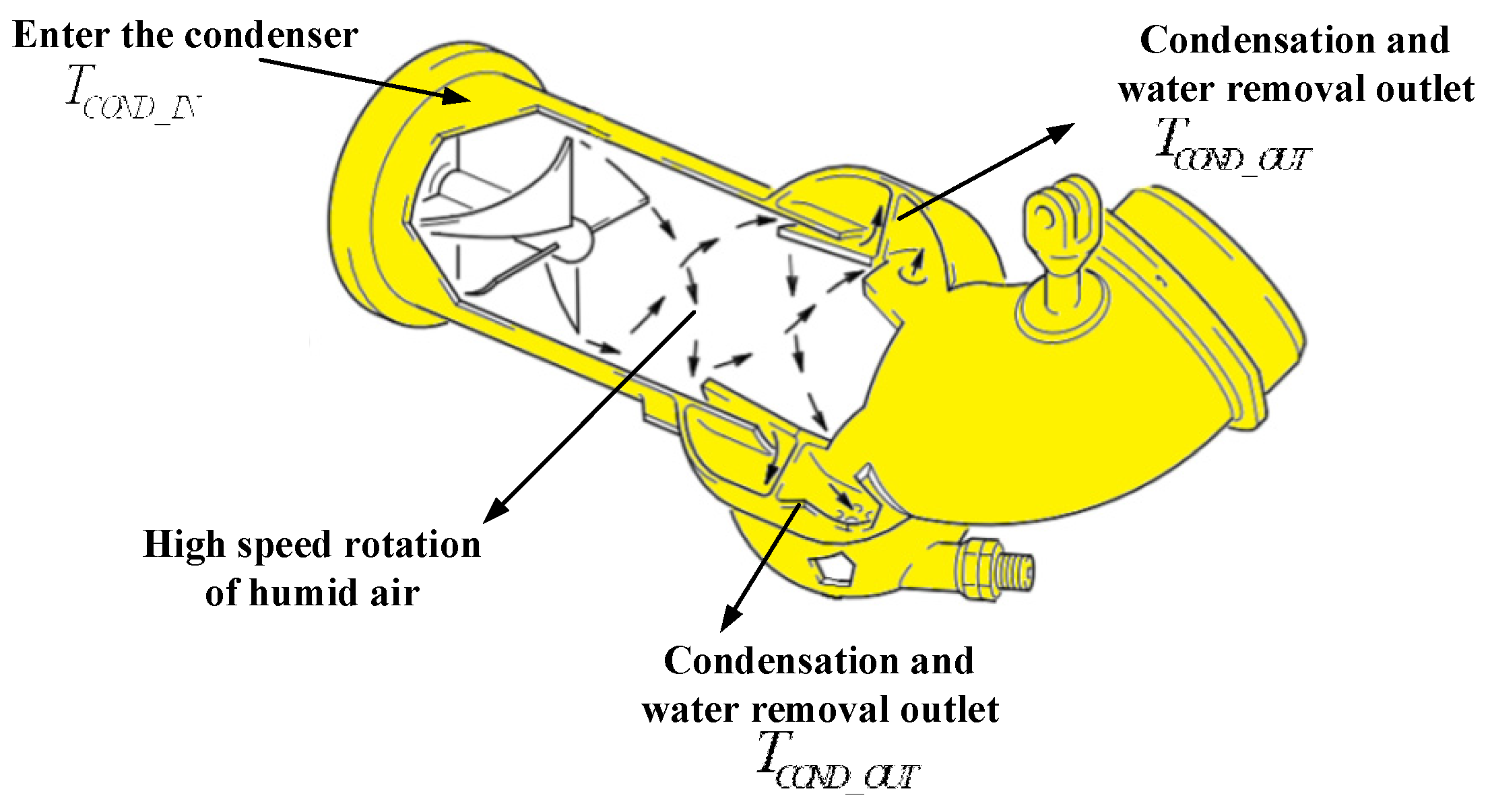
The condenser in the water removal module plays a crucial role in the airflow treatment process. In high-humidity environments, the air contains more water vapor, which can cause human discomfort and, more critically, poses a risk to downstream components: if not removed, the water vapor may freeze in the turbine—whose ambient temperature is below the freezing point—and damage the turbine blades. Therefore, the condenser not only ensures passenger comfort but also guarantees the safe operation of the entire component. Through this process, the airflow reaches a state conducive to condensation, causing water vapor in the air to condense. Subsequently, the condensed water is effectively separated and removed by a water separator located downstream of the condenser. The water separator (condenser and water separator) is shown in Figure 6.
Therefore, the condensed water is removed by the water separator downstream of the condenser. The total heat flux exchanged in the condenser is calculated as follows [21]:
q ˙ C O N D = q ˙ s e n + q ˙ l a t
In the formula, q ˙ s e n represents the sensible heat of the condenser, with the unit (W), q ˙ l a t and represents the latent heat of the condenser, with the unit (W), q ˙ s e n can be calculated by [21]:
q ˙ s e n = m ˙ A C M c p , C O N D ( T C O N D _ O U T T C O N D _ I N )
c p , C O N D = ( c p , 5 + c p , 6 2 )
In the formula, m ˙ A C M represents the mass flow rate of ACM, with the unit (kg/s), c p , C O N D is the average specific heat of the air in the condenser at constant pressure, with the unit (J/(kg·K)), c p , 5 is the specific heat at constant pressure of the air entering the condenser, with the unit (J/(kg·K)), c p , 6 is the specific heat at constant pressure of the air at the condenser outlet, with the unit (J/(kg·K)), and T C O N D _ O U T is the temperature of the air at the condenser outlet, with the unit (K), and T C O N D _ I N is the temperature of the air at the condenser in, with the unit (K).
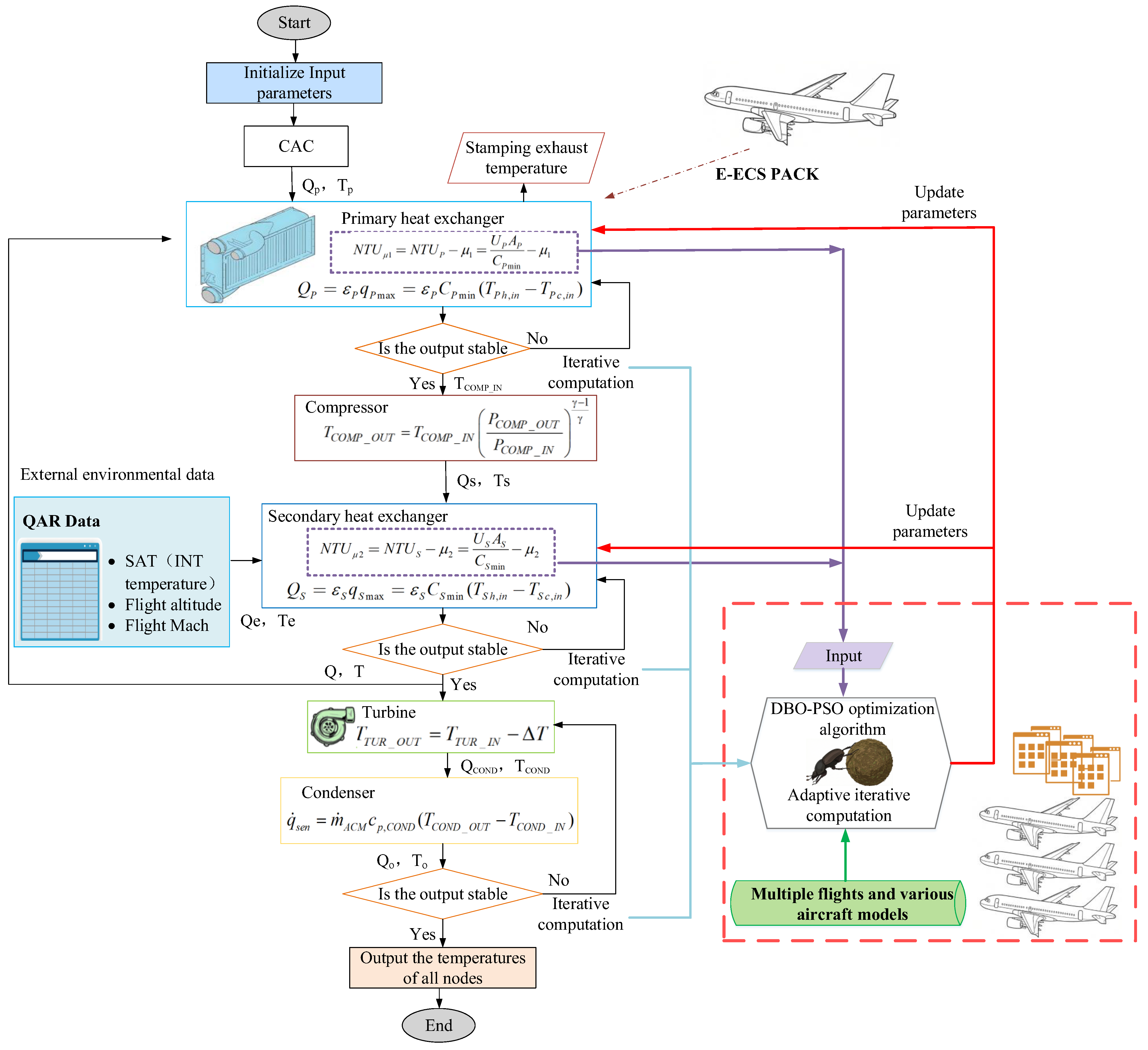
The previous content has already clarified the thermodynamic roles and mathematical descriptions of each subcomponent. In order to visually demonstrate the energy-temperature paths, a schematic diagram of the thermal coupling network of a PCAK key component is shown in Figure 7.
As shown in Figure 7, the Quick Access Recorde (QAR) data of the aircraft can provide the model with more realistic environmental scenarios for system operation, including the aircraft’s ambient temperature, flight altitude, and Mach. According to the trend of the PACK component gas path, model the mechanism of key components in sequence and calculate the input and output temperatures of key nodes. Considering the influence of differences in aircraft configuration, part number, and optional components, the heat conduction correction coefficient is calculation by DBO-PSO optimization algorithm. it can be clearly revealing the data interface and iteration sequence between the optimization engine and the mechanism guardian, providing a roadmap for subsequent convergence analysis and engineering deployment.

3. DBO-PSO Hybrid Optimization Algorithm

3.1. Algorithm Principle

A key challenge in the simulation calculation process of the above mechanism model is how to accurately obtain the thermal conductivity coefficient N T U μ 1 and N T U μ 2 affected by factors such as the changing external environment and aircraft configuration. To address this issue, the Dung Beetle Optimization (DBO) algorithm is introduced in this paper to achieve the dynamic adjustment of the thermal conductivity correction coefficient N T U μ 1 and N T U μ 2 .
The DBO is a new-type heuristic optimization algorithm proposed by Xue J K et al. [32] in 2023. The inspiration for this model comes from the behaviors of dung beetles in nature, such as ball-rolling, dancing, foraging, stealing, and reproduction. When a dung beetle individual is rolling a dung ball (ball-rolling behavior), it mainly relies on the sun for navigation (the probability of this situation occurring is 0.9 (denoted as δ )). The intensity of sunlight will indirectly affect the ball-rolling path of the dung beetle individual. The position update of the dung beetle individual during the ball-rolling process can be expressed as:
x i ( t + 1 ) = x i ( t ) + α k k x i ( t 1 ) + b Δ x
In the formula, t denotes the current iteration number. x i ( t ) represents the position of the i -th dung beetle individual in the t -th generation, and this individual is referred to as the leader. α is a natural coefficient that can take a value of either −1 or 1. When α = 1 , it means that the dung beetle individual deviates from its original ball-rolling direction, while when α = 1 , it indicates no deviation; k k ( 0 , 0.2 ] ; b ( 0 , 1 ) ; Δ x = x i ( t ) X ω is used to simulate the change in light intensity. A larger (smaller) value of Δ x implies a weaker (stronger) light source, represents the global worst position of the current dung beetle individual [33].
When a dung beetle individual encounters an obstacle and cannot move forward during the ball-rolling process, it will perform a dance behavior to obtain a new ball-rolling path (the probability δ of this situation occurring is 0.1). The direction of the new ball-rolling path will be determined by the tangent function value within the domain. At this time, the position update of the dung beetle individual is expressed as:
x i ( t + 1 ) = x i ( t ) + tan θ x i ( t ) x i ( t 1 )
In the formula, θ 0 , π represents the deflection angle. When θ takes the values of 0, π / 2 , or π , the position of the dung-beetle individual will not be updated.
To provide a safe habitat for the offspring dung-beetle individuals, the dung balls are rolled by the dung-beetle individuals to a safe location for hiding. Meanwhile, female dung-beetle individuals will use this location as an oviposition site to rear their offspring. When female dung-beetle individuals select a suitable oviposition site, a boundary selection strategy is employed. Let L b and U b denote the lower and upper boundaries of the optimization problem, respectively. Then, the boundaries of the oviposition area can be defined as follows:
L b = max ( 1 R ) X , L b U b = min ( 1 + R ) X , U b
In the formula, R = 1 t / T max , where T max is the maximum number of iterations; X represents the local optimal position of the current dung-beetle individual; L b and U b represent the lower and upper boundaries of the egg-laying area of female dung-beetles, respectively.
There are many egg balls distributed around the local optimal position. Each female dung-beetle individual will choose and only choose one egg ball for egg-laying. The position update method of the egg balls is shown as:
B i ( t + 1 ) = X + b 1 ( B i ( t ) L b ) + b 2 ( B i ( t ) U b )
In the formula, B i ( t ) represents the position of the i -th egg ball in the t -th generation, which is called the leader; b 1 and b 2 are two random numbers within the range of (0, 1).
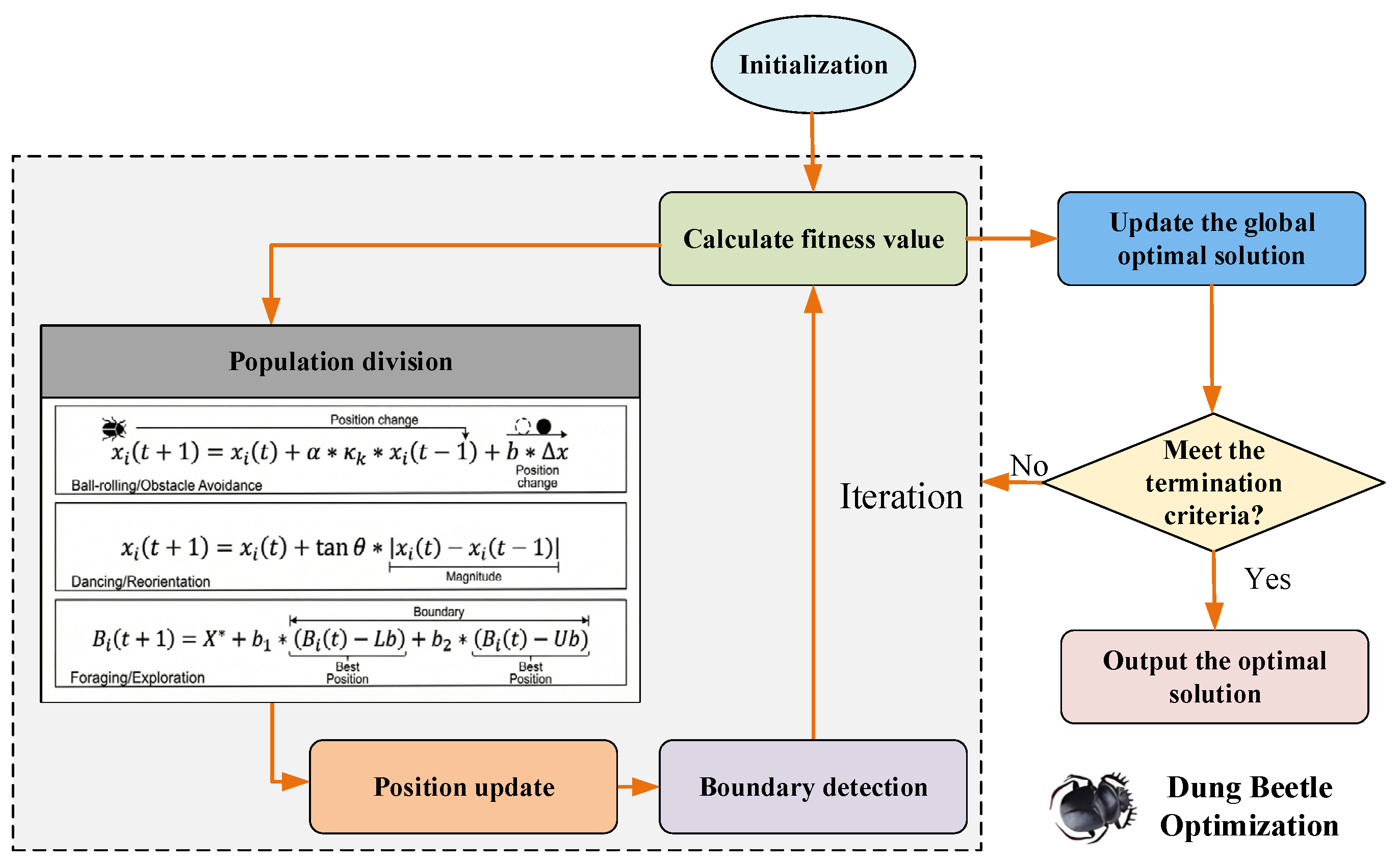
The flowchart shown in Figure 8 fully maps the modeling and optimization logic of Equations (28)–(31): the “ball rolling” stage corresponds to the position update of Equation (28). The black dot (•) represents the current position of a dung beetle (search agent) in the search space. The “ b Δ x ” denotes the position increment, where b is the step size coefficient and Δ x is the position change vector. The arrow indicates the direction of movement from the current position to the updated position. When an obstacle is detected, the “dancing” behavior is triggered, and its steering mechanism is determined by tan θ in Equation (29). The boundary of the spawning area is dynamically generated by Equation (30). Ultimately, the position of the next generation individual (egg ball) is iterated in the “Position update” step using the random offset strategy of Equation (31).
The DBO algorithm demonstrates strong global optimization ability and potential for engineering applications. However, similar to most heuristic algorithms, DBO still has certain limitations in balancing global exploration and local exploitation capabilities, as well as improving optimization accuracy and convergence efficiency [34]. To further enhance the algorithm’s performance, a global optimization mechanism can be introduced to optimize local solutions. There are two innovative points have been proposed:
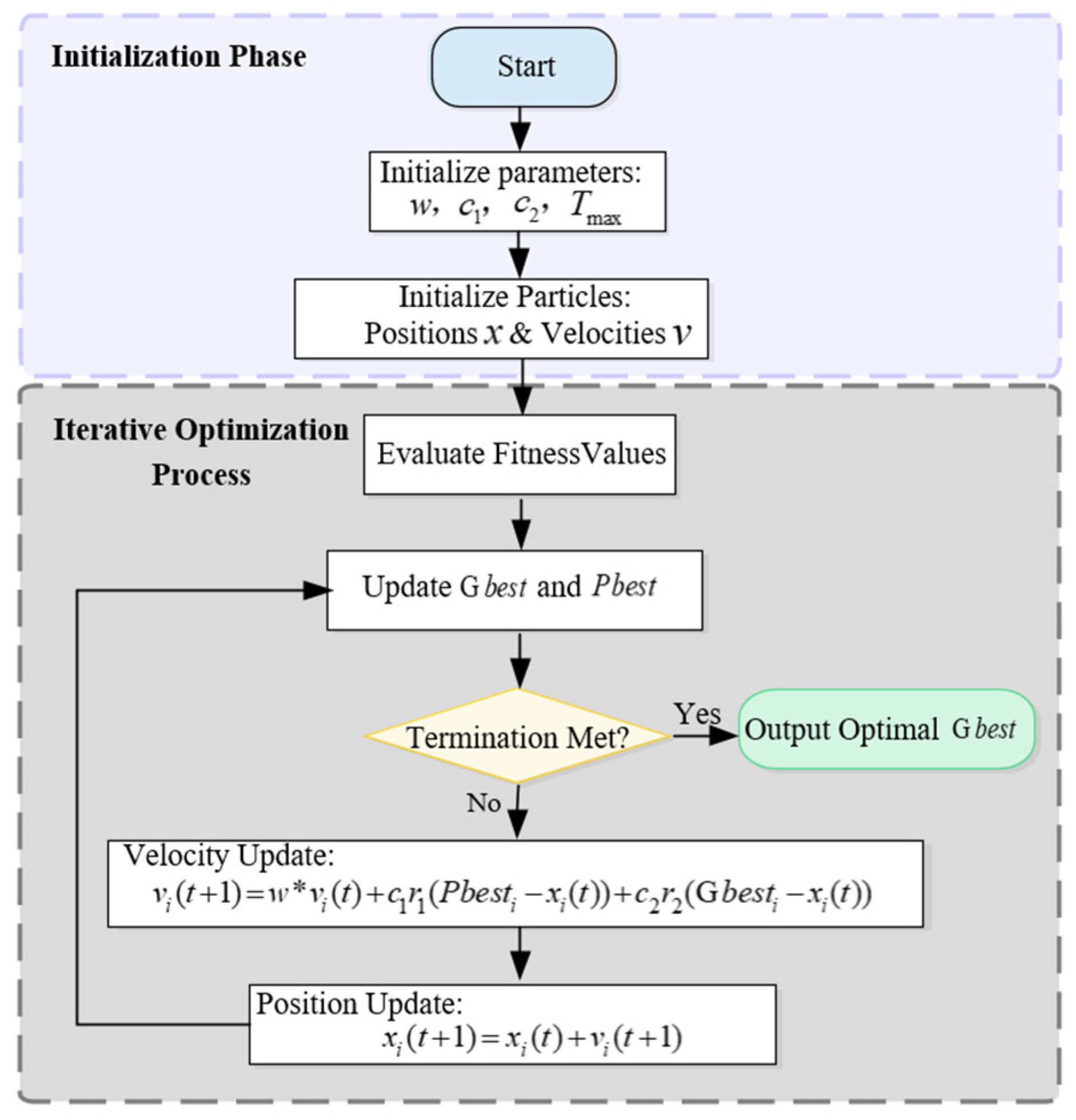
First, the Particle Swarm Optimization (PSO) algorithm is used to globally optimize a portion of the solutions in each iteration. The core concept of PSO algorithm [35] is to regard each individual in the population as a particle, which searches for the optimal solution in a multi-dimensional space. Each particle initializes its own position and velocity and continuously updates them during the iteration process until the optimal solution is found. In each iteration, the particle adjusts its moving direction based on its own position, the best position of the entire group ( G b e s t ) and its own historical best position ( P b e s t ) to find the next better position [36]. The fitness value of a particle represents the distance between the particle and the real solution. The fitness value is used to determine whether the particle has found the real solution. The update formulas for the velocity and position of the particle in each iteration are affected by many factors, and the calculation formulas are as follows:
v i ( t + 1 ) = w * v i ( t ) + c 1 r 1 ( P b e s t i x i ( t ) )       + c 2 r 2 ( G b e s t i x i ( t ) )
x i ( t + 1 ) = x i ( t ) + v i ( t + 1 )
where, x i ( t + 1 ) and v i ( t + 1 ) represent the position and velocity of particle i at the t + 1 -th iteration, and x i ( t ) and v i ( t ) represent the position and velocity of particle i at the t -th iteration; w is the inertia weight, c 1 and c 2 are the individual and global acceleration factors respectively, r 1 and r 2 are random numbers following a normal distribution between 0 and 1, P b e s t i represents the individual extreme position of particle i , and G b e s t i represents the global extreme position.
The above factors jointly influence the velocity update of the particles, enabling the particles to effectively search for the optimal solution to the problem [37]. The above three parts all demonstrate the PSO’s maintenance of exploration and exploitation capabilities.
The flowchart shown in Figure 9 corresponds one-to-one with Equations (32) and (33): the “Speed update” node directly implements the velocity composition of Equation (32) (including the inertia term w * v i ( t ) , the individual cognition term c 1 r 1 ( P b e s t i x i ( t ) ) , and the social guidance term c 2 r 2 ( G b e s t i x i ( t ) ) ; the “Location update” node then performs the position iteration of Equation (33), superimposing the updated velocity onto the current position; the “Calculate fitness value” step in the figure evaluates the distance between the particle and the true solution using the new position, thereby driving the dynamic replacement of P b e s t i and G b e s t i , fully presenting the balance mechanism between exploration and exploitation in PSO [38].
Secondly, a mutation operator is employed in the DBO algorithm. By introducing random deviations and perturbations during the iteration process using the Differential Evolution (DE) algorithm [37], individuals are modified, enhancing the diversity of the population. When updating individual positions, a small amount of random mutation is introduced, adding random deviations to the original positions, thereby enabling the algorithm to explore a larger solution space and avoid getting stuck in local optima.
The DE algorithm searches for the global optimal solution by iteratively evolving the individuals (solutions) in the population. For each target vector x i g , the mutation operation generates a corresponding mutant vector v i g + 1 . The mutant vector is generated in the following way:
v i g + 1 = x r 1 g + F * ( x r 2 g x r 3 g )
In the formula, r 1 , r 2 , and r 3 are distinct indices randomly selected from { 1 , 2 , , N } , and F is the differential weight [39].

3.2. Steps and Implementation of the DBO-PSO Hybrid Optimization Algorithm

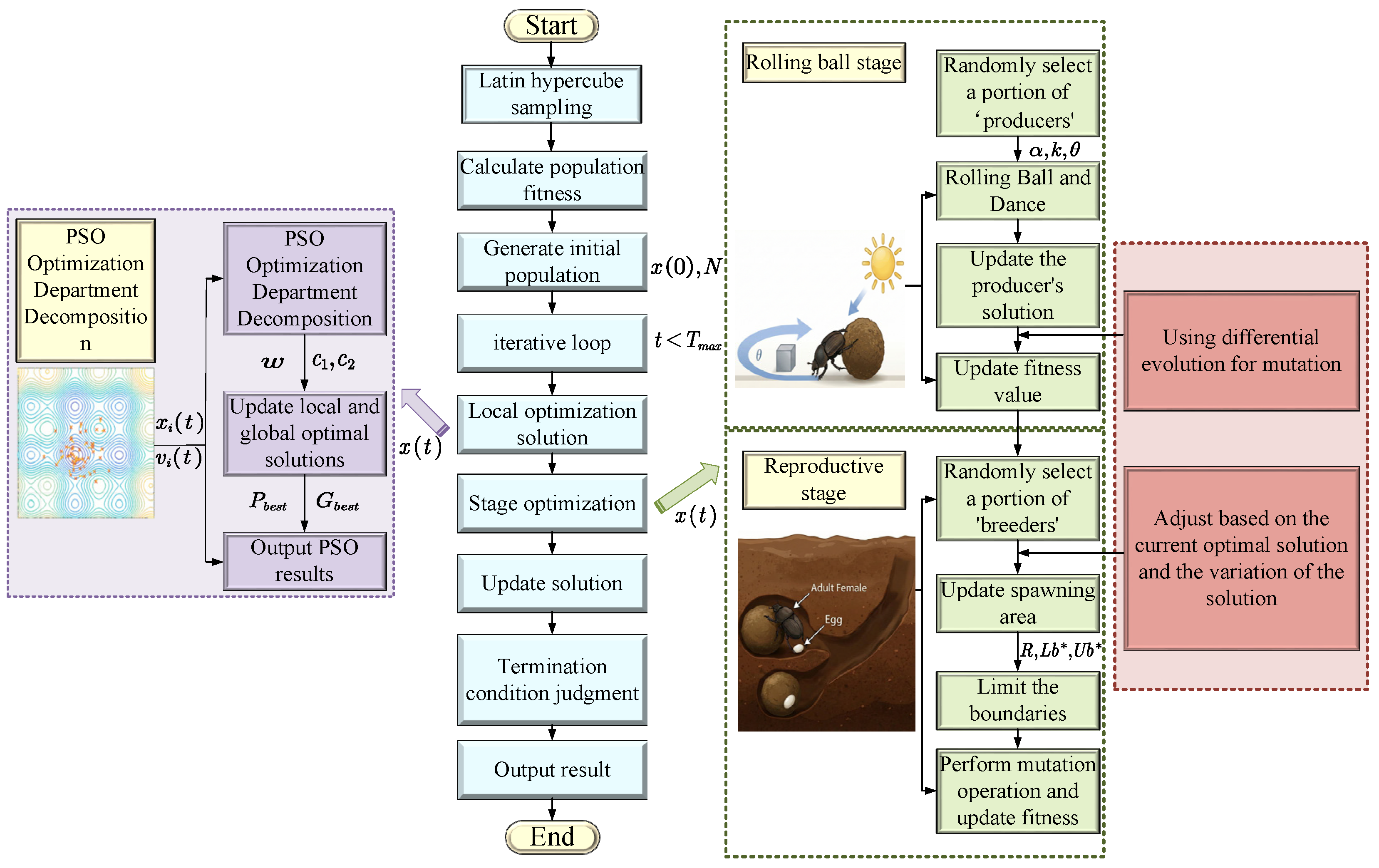
To enhance the global optimization capability and convergence accuracy of the thermal conductivity correction coefficient of the E-ECS system, a hybrid optimization framework is proposed, which integrates local exploration of “beetle rolling ball and reproduction” and global collaboration of “Particle Swarm Optimization—Differential Evolution”. The specific optimization process is shown in Figure 10, which can be summarized as “domain partitioning-collaboration-refinement”. The specific implementation steps are as follows:
Step 1: A uniformly distributed initial population is constructed in the solution space through Latin hypercube sampling;
Step 2: The population is divided into two subgroups: producers and breeders, each responsible for global exploration and local mining tasks;
Step 3: In the iterative main loop, the producer subgroup adopts a differential evolution strategy to globally search the solution space and update individual and global optima in real-time;
Step 4: The breeder subgroup introduces a “rolling ball” strategy to perform refined searches within local neighborhoods to avoid premature convergence;
Step 5: After each generation, the population is reorganized and mutated based on fitness values, and the search area boundaries are dynamically adjusted;
Step 6: When the termination condition (such as the maximum number of iterations or convergence threshold) is met, output the current global optimal solution as the optimal thermal conductivity correction coefficient for the E-ECS system.

4. Experimental Results and Analysis

4.1. Construction of a Single Flight Cycle Mechanism Model Under Different Conditions

According to reference [21], there are four operating conditions listed, including: ground high temperature condition, ground low temperature condition, cruise FL250 (25,000 feet) condition, and cruise FL430 (43,000 feet) condition. Table 3 shows the input parameters required for the mechanism model under four different operating conditions, including the isentropic efficiency of ACM compressor, the isentropic efficiency of ACM turbine and cabin air temperature.
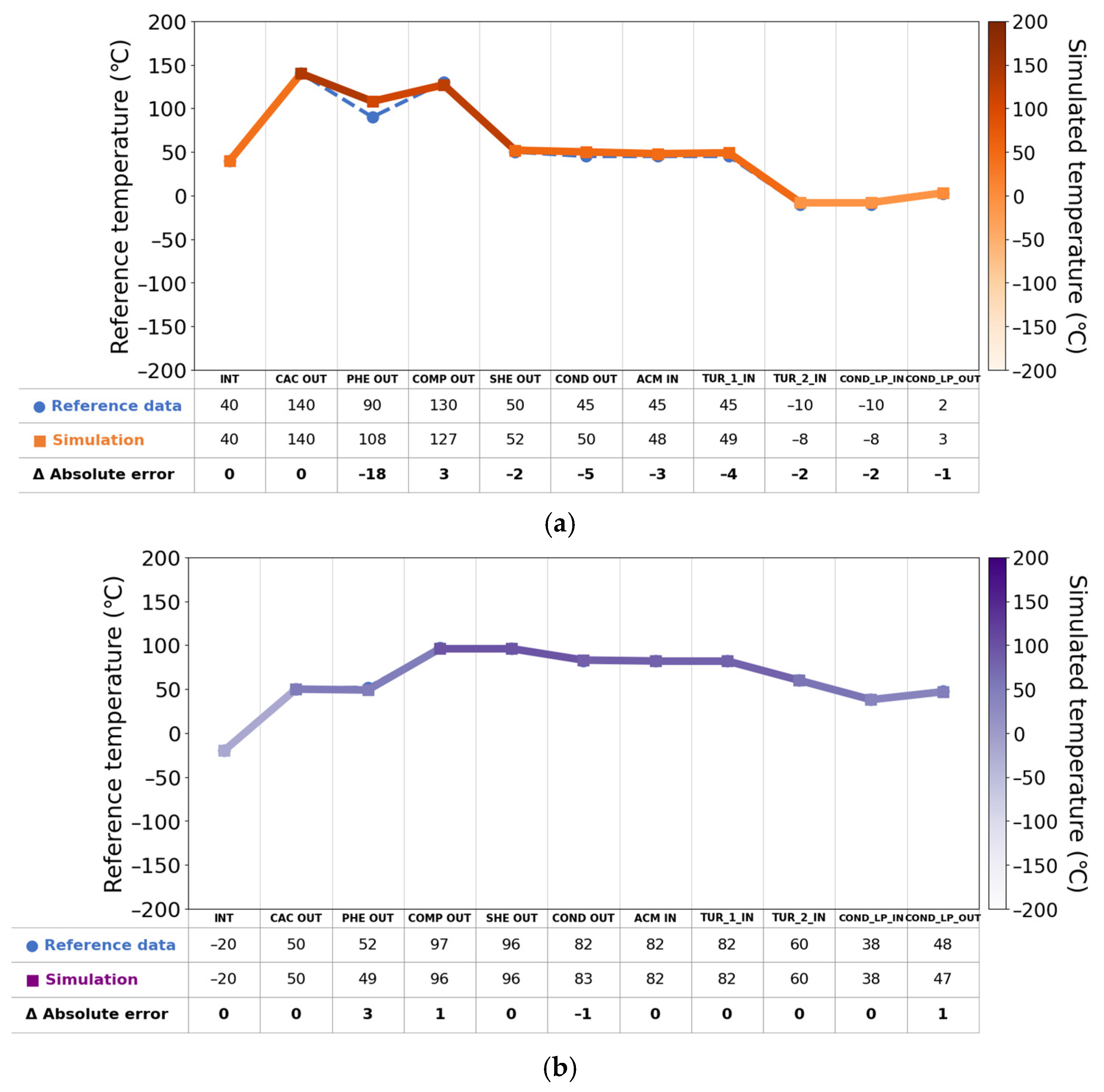
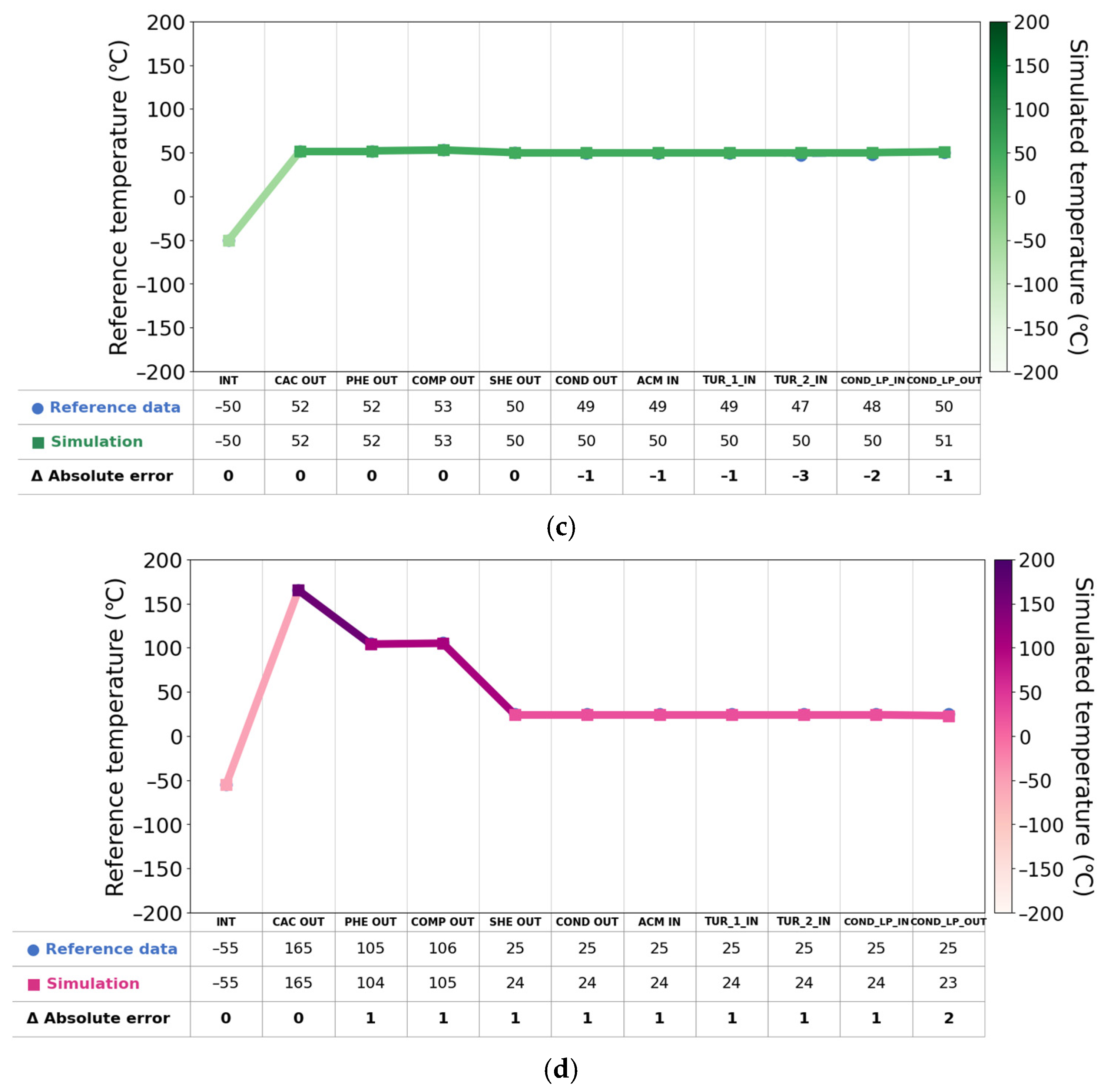
The mass flow benchmark values for the above four operating conditions are given in Table 4, which measured by PACK air flow rate [21]. The mechanism modeling results under different operating conditions are shown in Figure 11.
In Figure 11, the blue dashed line represents the output temperature data of each component of the E-ECS under the four operating conditions mentioned by Fioriti et al. [21], while the yellow, purple, green, and pink solid lines correspond to the simulation data of the E-ECS model proposed in this paper under different external environmental conditions.
(1) Operating condition model 1, this operating condition is defined under ground high-temperature environment with the E-ECS inlet temperature maintained at 40 °C. In the coordinate system, the abscissa denotes the axial position of target components, while the ordinate represents the corresponding outlet temperature. This scenario is designed to maximize the temperature differential across the heat exchanger. Since there is no need for the cabin to be pressurized at this time, the outlet pressure of the E-ECS is synchronized with the external air pressure. This phenomenon clearly indicates that the E-ECS system is op-erated in a non-pressurized mode under this working condition. It is noteworthy that slight discrepancies are observed in the primary heat ex-changer output section, attributable to the inherent difficulty in precisely determining its heat transfer coefficient. This limitation precisely establishes the necessity and theoretical basis for subsequent mechanism-based optimization modeling.
(2) Operating condition model 2, under low temperature conditions on the ground, the inlet temperature of E-ECS is −20 °C. Under this condition, the temperature of the air entering the Component Air Handling Unit is made equal to the air temperature at the outlet of the low-pressure end of the condenser. To have the air temperature increased, a dedicated compressor is activated by the E-ECS system to pressurize the air, thereby having the air temperature effectively regulated [40].
(3) Operating condition model 3, when cruising under FL250 conditions (25,000 feet), the inlet temperature of E-ECS is −50 °C. Under this working condition, the temperature change characteristics of the E-ECS system are comprehensively and meticulously presented. At this time, the air-conditioning pack is operated at an idle speed, resulting in extremely small variations in the air pressure and temperature inside the air cycle machine being caused. Consistent with the previously observed situation, due to the absence of secondary airflow, the air must be pressurized by using a dedicated compressor to increase its pressure and temperature, ensuring the normal operation of the system.
(4) Operating condition model 4, when cruising under FL430 conditions (43,000 feet), the inlet temperature of E-ECS is −55 °C. Under this condition, although the air cycle machineis run at an idle speed, unlike other operating conditions, the secondary air flow is not zero, and there is a significant temperature difference between the inlet and outlet of the heat exchanger. At this cruising altitude, a relatively high air pressure needs to be maintained by the system, and the air temperature is too high to be directly sent to the passenger cabin. Therefore, in order to have the air temperature brought into a range suitable for the cabin environment, the air needs to be cooled by relying on the heat exchanger, so as to ensure the comfort and safety inside the cabin.

4.2. Optimization Performance Analysis of DBO-PSO Algorithm

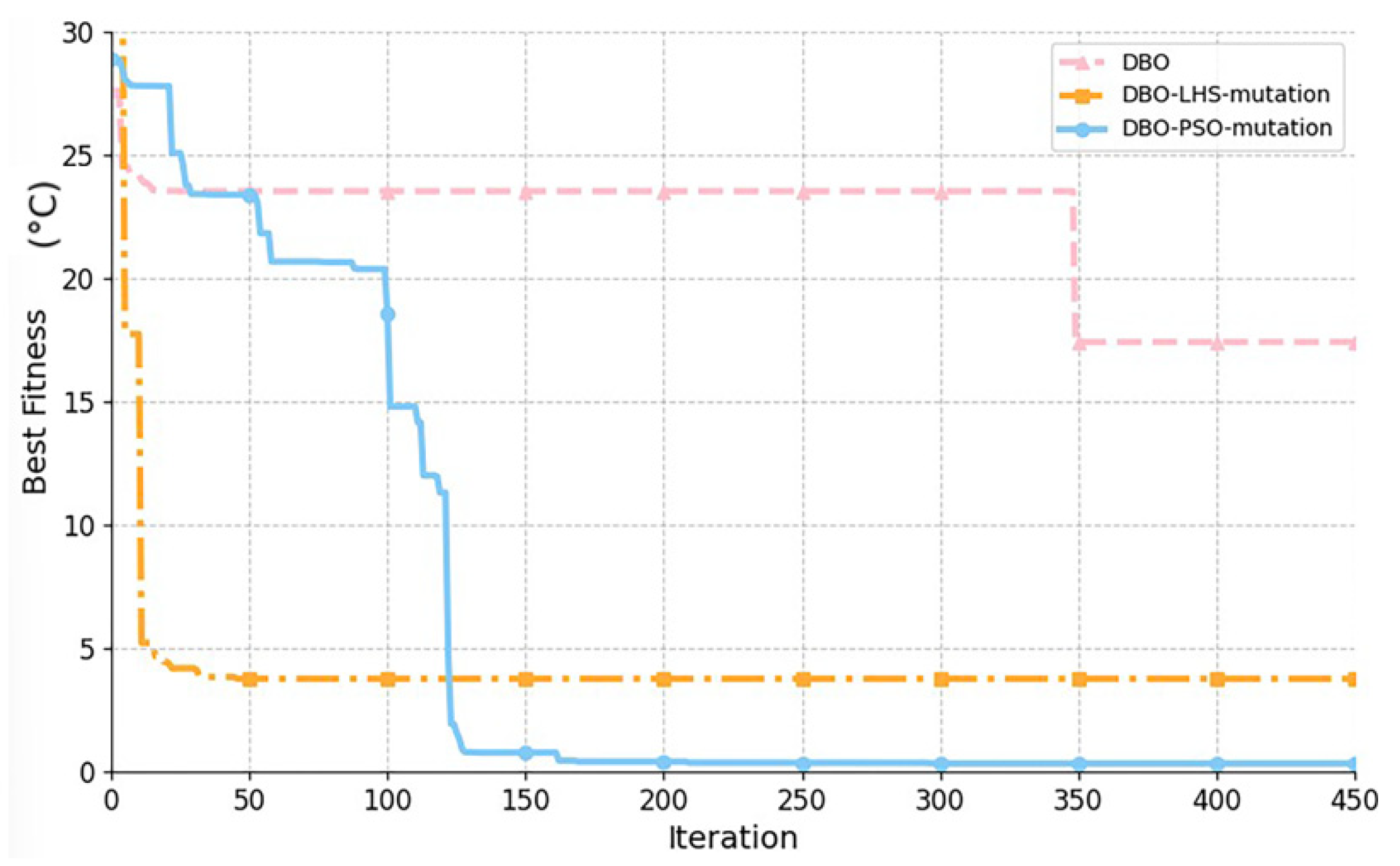
To demonstrate the advantages of the improved algorithm, the convergence and iteration accuracy of DBO, DBO-LHS mutation, and the improved DBO-PSO mutation were compared.
Figure 12 compares the convergence curves of three optimization algorithms in different iteration stages during the modeling of the E-ECS mechanism model. It can be observed that the two improved curves of DBO-LHS mutation and DBO-PSO mutation proposed rapidly decrease within 0–50 iterations, with the objective function value decreasing from 25.33 to around 5.33, and the decreasing slope being significantly greater than that of traditional DBO method; After 150 iterations, the objective function value of the improved curve of the DBO-PSO method converges smoothly to 0.33, while the traditional DBO method converges to 17.66 after 350 iterations. This result validates the effectiveness of the “rolling ball” local refinement strategy in early rapid convergence and differential global synergy in later fine search, with an overall iteration efficiency improvement of about 35%.
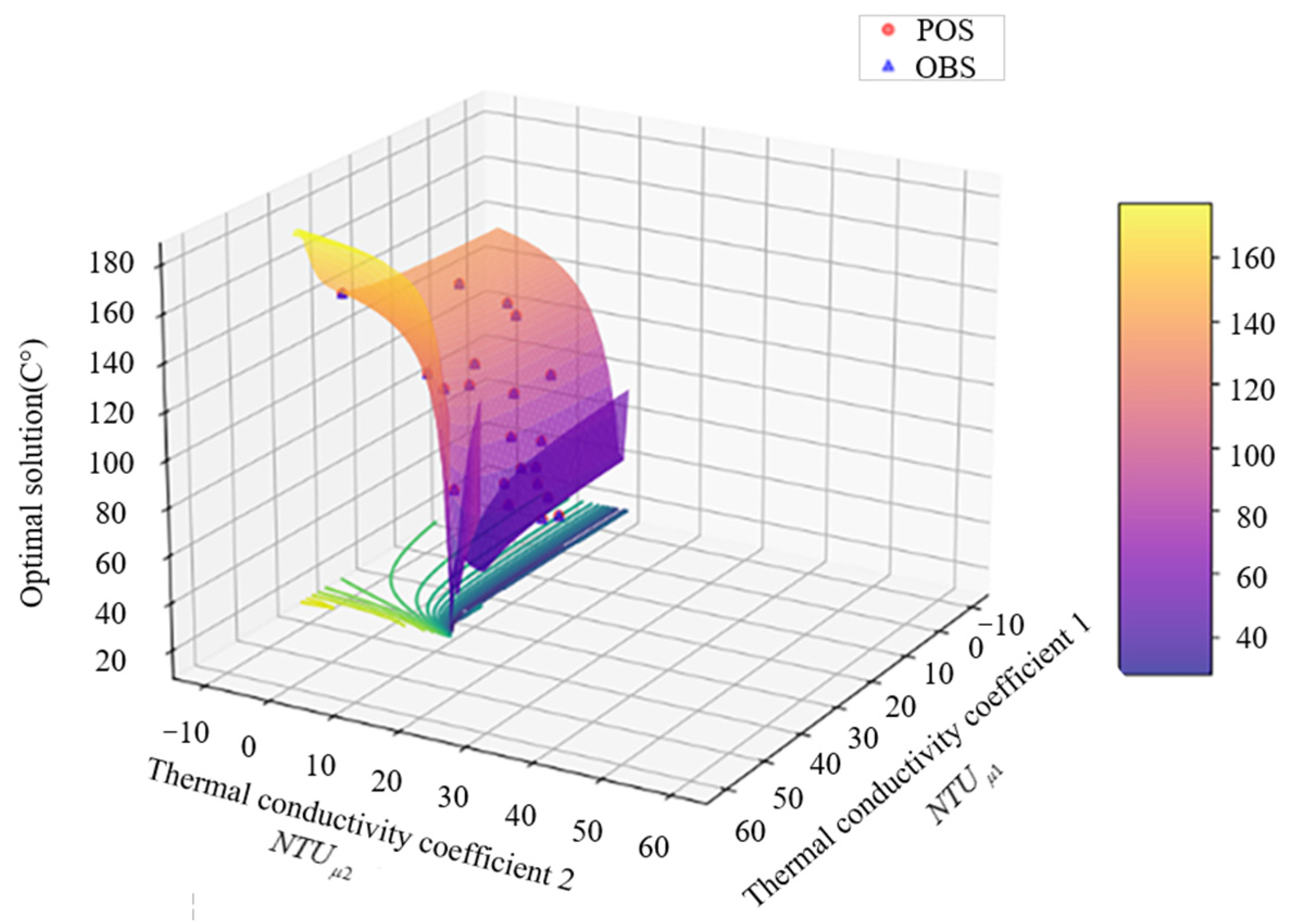
Figure 13 shows the thermal maps of the distribution changes of the optimal solution in the two-dimensional parameter space of thermal conductivity before and after the optimization algorithm improvement. The Z-axis coordinate “Optimal solution (°C)” in Figure 13 represents the actual value of the optimal temperature solution obtained by the algorithm when searching in the three-dimensional solution space (key parameters of E-ECS such as thermal conductivity coefficient 1, thermal conductivity coefficient 2, NTU, etc.). The chromaticity bar represents the distribution gradient of fitness values in the three-dimensional objective function space, while the blue curve on the horizontal projection represents the projection of the optimized trajectories of each particle in the two-dimensional decision variable space. The optimal solution region (blue area) of the traditional DBO method is relatively scattered and has multiple local extremum values; After introducing LHS initialization and PSO mutation mechanism, the optimal solution is concentrated in a narrow “canyon” of 30–40, and the objective function value decreases from 180 to around 120, with smoother contour lines. This phenomenon indicates that the proposed DBO-PSO algorithm not only significantly compresses the feasible region, but also enhances the global robustness and local accuracy of the algorithm in high-dimensional and multimodal problems.

4.3. Comparison Results Between the Single Flight Cycle Mechanism Model Data and the Real Data

To conduct an in-depth exploration of the operating characteristics of the E-ECS, the real QAR data and related parameters are accurately input into a pre-established computational model in this paper, such as: INT temperature, flight altitude, flight Mach. By using real operating parameters as input values for theoretical model operating conditions, it is possible to accurately achieve digital mapping of the operating status of E-ECS under different altitude and temperature environmental conditions.
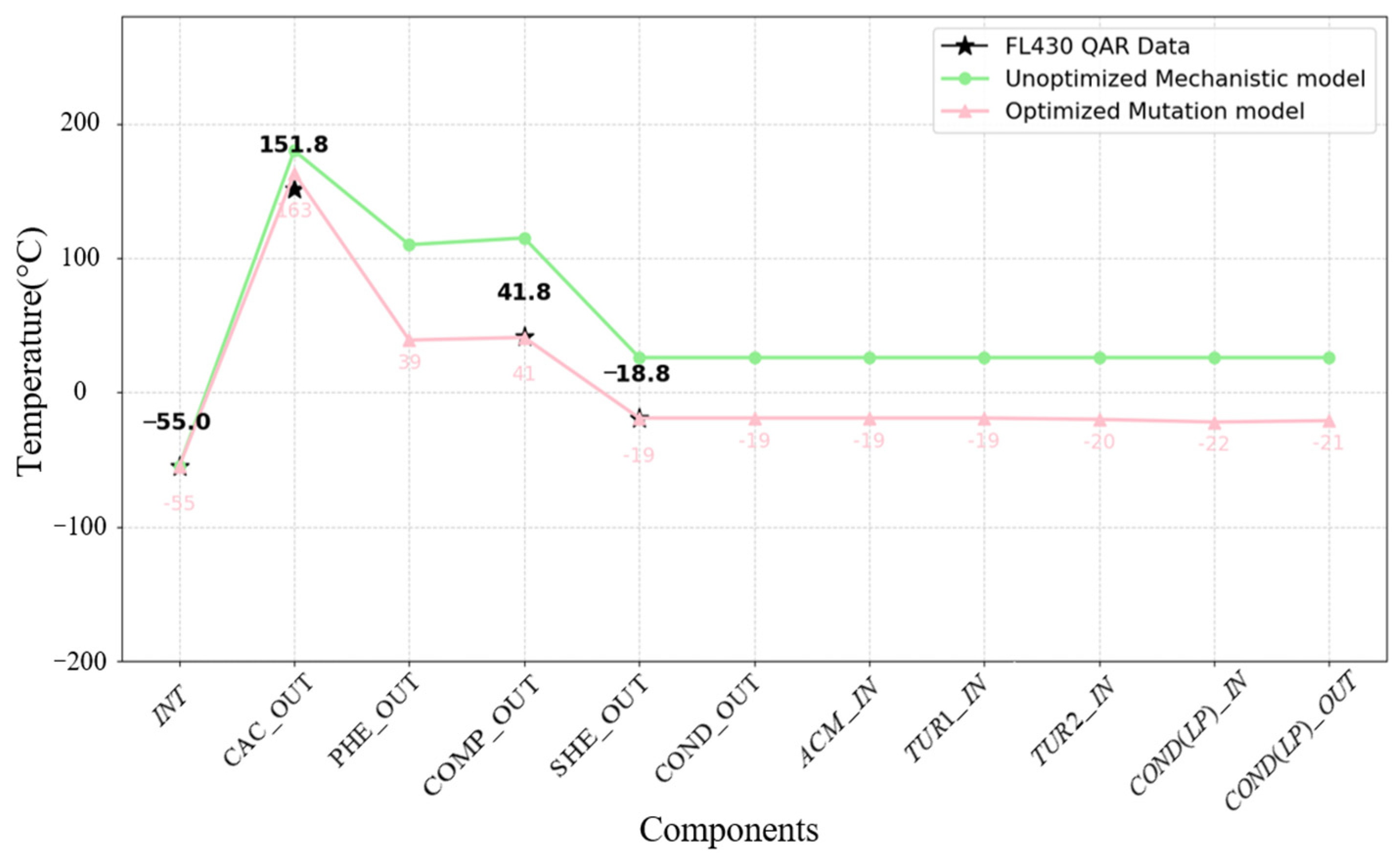
Specifically, the single flight cycle data of the B-XXX1 aircraft of a certain airline’s Boeing 787-9 model under the cruise FL430 operating mode on 21 December 2023 was taken as the test target and compared in detail with the mechanism model data calculated through optimization algorithms. The results are shown in Figure 14.
Figure 14 shows the temperature distribution comparison of key components in the E-ECS, where the black star markings represent real flight QAR data, the green solid line represents the simulation results of the unoptimized mechanism model, and the pink solid line represents the simulation results of the optimized mechanism model using the PSO-DBO Mutation algorithm. From the figure, it can be seen that at the “SAT” position, the three types of data are basically consistent; After “CAC-OUT”, the unoptimized model (green line) showed significant deviation from the real data (black dot), especially at key nodes such as “PHE-OUT”, “COMP-OUT”, and “SHE-OUT”, where there was a positive deviation of approximately 60–80 °C. In contrast, the optimized model (powder line) achieved a high degree of consistency between the predicted temperature values of each component node and the real QAR data, especially at “PHE-OUT”, “COMP-OUT”, and “SHE-OUT”, achieving accurate tracking of the real values. Furthermore, at the outlet of the condenser, turbine, and low-pressure condenser, the optimized model successfully corrected the systematic high temperature deviation of the unoptimized model, keeping its temperature level synchronized with the real data (approximately −18 °C to −21 °C).
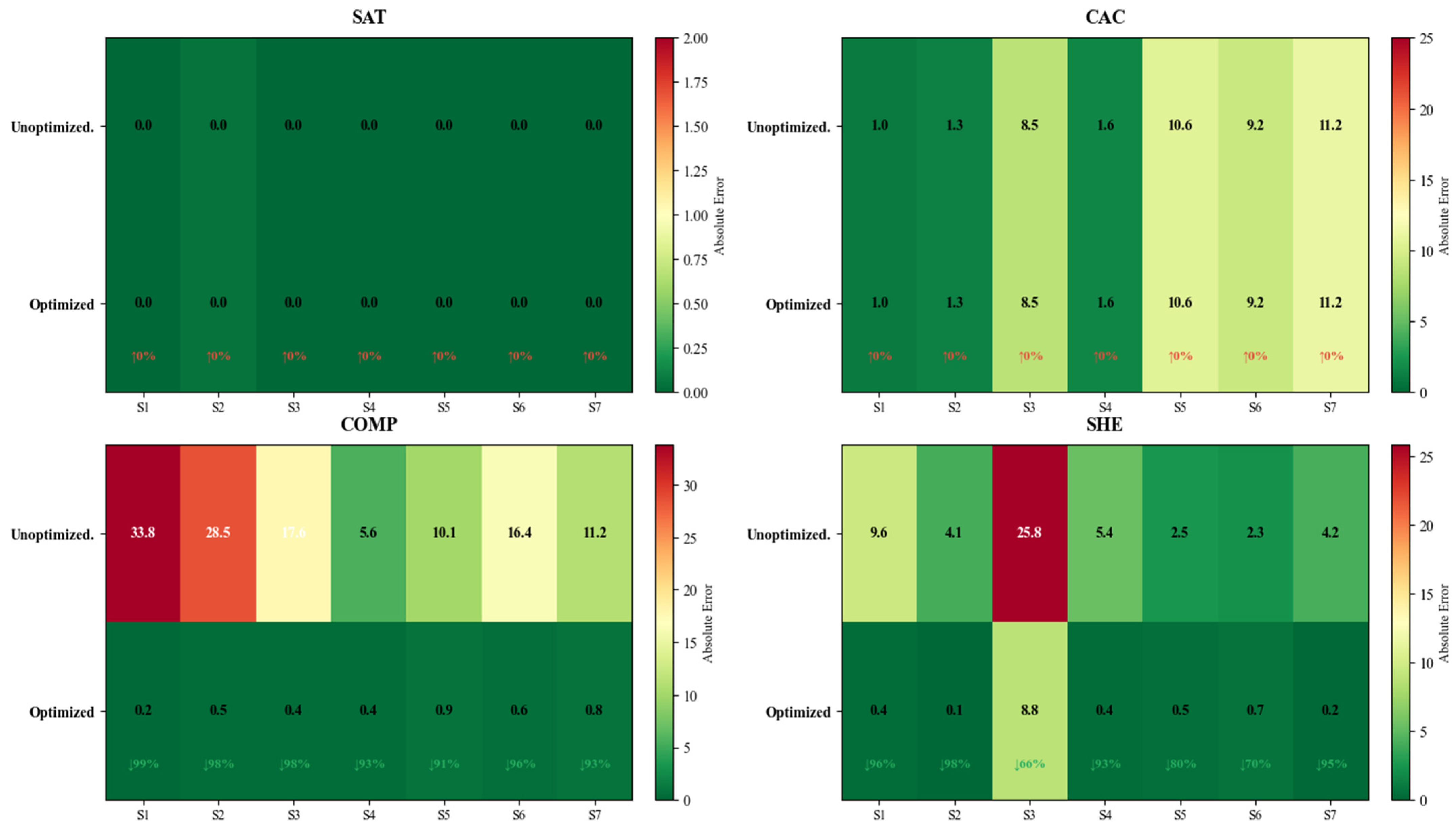
To comprehensively verify the multi condition adaptability and dimensional specificity of the optimization algorithm, the paper constructed an error heatmap covering four key dimensions: SAT, CAC, COMP, and SHE based on seven independent experimental samples (S1–S7), As shown in Figure 15.
Figure 15 adopts a faceted layout, with the horizontal axis representing seven independent experimental samples (S1 to S7) and the vertical axis representing the prediction results of the unoptimized model and the optimized model, respectively. The color of the color block is mapped by the color scale, representing the size of the absolute error. Deep red represents high error, deep green represents low error, and the color code on the right indicates the specific error value. The values marked within the color block represent the absolute error values of each sample in that dimension, while the percentage mark at the bottom represents the error reduction rate relative to the unoptimized model (The green and downward arrows indicate a decrease, while the red and upward arrows indicate an increase).
The results showed that in the Figure 15, the optimized mechanism model exhibited differentiated error suppression ability for different dimensions: in the “SAT” dimension, the absolute prediction errors of all samples converged to 0.0, achieving 100% error elimination; In the “COMP” dimension, the optimization effect is particularly significant. Taking the S1 sample as an example, the absolute error decreased from 33.8 to 0.2, with an error reduction rate of 99%. The remaining samples also achieved error reduction of 91–98%; In the “SHE” dimension, except for the S3 sample (where the error decreased from 25.8 to 8.8, a 66% reduction), the error reduction rates for all other samples were between 70% and 98%. The “CAC” dimension is strongly constrained by physical mechanisms, and the unoptimized model already has good predictive stability, with consistent errors before and after optimization, further demonstrating the intelligent selective optimization characteristics of the algorithm.
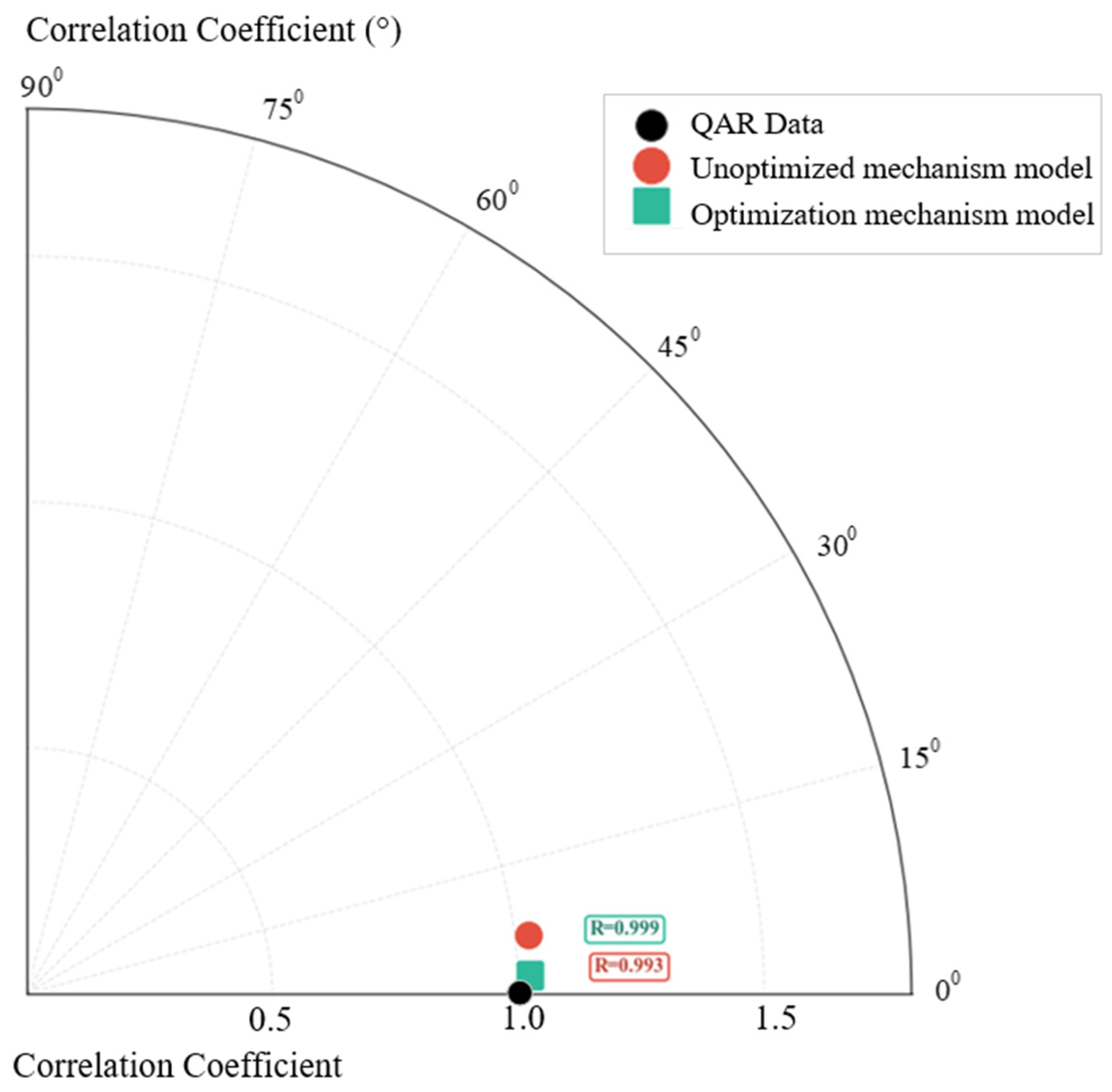
To further evaluate the overall performance of the model from a statistical perspective, this study used Taylor Diagram to quantitatively compare the unoptimized and optimized mechanism models (As shown in Figure 16). This graph adopts a polar coordinate system single graph layout, where the horizontal azimuth angle (Azimuth) represents the Pearson correlation coefficient (R), and the closer it is to the right 0°, the higher the correlation; Radial distance represents normalized standard deviation (STD), and the dashed arc at a value of 1.0 indicates that the fluctuation amplitude is consistent with the real data; The geometric distance between the discrete points in the figure and the reference point (REF, QAR Data, marked as black dots) represents the root mean square error (RMSD) at the center. In the figure, the unoptimized mechanism model is marked with red dots, and the optimization mechanism model is marked with green squares. Specific correlation coefficient values (R) are labeled next to each point.
Figure 16 comprehensively characterizes the approximation degree between the model and the real QAR Data through three statistical measures: correlation co-efficient (Azimuth), normalized standard deviation (Radial), and root mean square error at the center (RMSD), which is the geometric distance from the reference point. The results showed that the Pearson correlation coefficient (R) of the optimized model increased from 0.993 to 0.999, significantly closer to the reference point (REF) compared to the unoptimized model, and its geometric distance in polar coordinates was significantly shortened, indicating that optimization not only greatly improved the correlation between the model and real data, but also effectively reduced the overall RMSD. In addition, the normalized standard deviation of the optimized model approaches 1.0, indicating that it achieves a high degree of consistency between the predicted and observed values while maintaining the inherent variability characteristics of the data. This comprehensive statistical evidence confirms that the optimization mechanism model has achieved systematic improvements in overall accuracy, correlation, and dispersion dimensions, and has excellent generalization performance and engineering reliability.

4.4. The Ablation Experiment of DBO-PSO Optimization Method

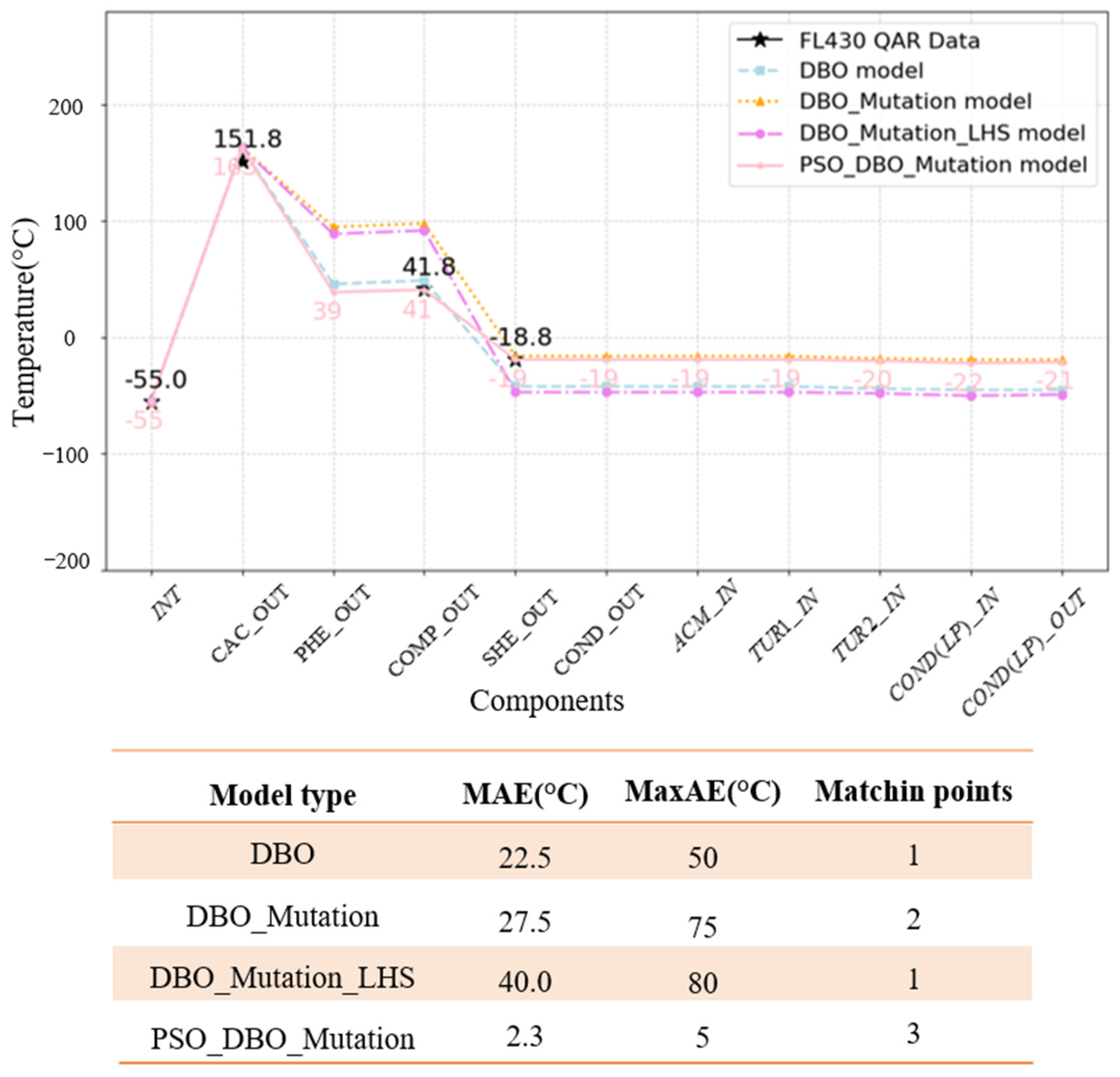
To further verify the improvement effect of the proposed optimization strategy on the accuracy of the mechanism model of the electric environment control system. The QAR measurement data under the cruising condition of flight altitude FL430 mentioned in the previous experiment was used as a benchmark to compare and analyze the performance of the standard beetle optimization algorithm (DBO) and its three improved variants (DBO_Mutation, DBO_Mutation_LHS, PSO_DBO_Mutation) in predicting the temperature of key thermodynamic nodes. Figure 17 shows the temperature distribution comparison and error statistics of each model at the outlet of typical E-ECS components, including compressor “CAC”, primary heat exchanger “PHE”, secondary heat exchanger “SHE”, condenser “COND”, and turbine “TUR”.
In Figure 17, the black dots represent the actual QAR data of the aircraft, the pink solid lines represent the calculation results of the DBO-PSO optimization mechanism model, and the other solid lines are comparison graphs of ablation experiments. Compared to the standard DBO method and its two inter-mediate improved versions, the proposed method (PSO_DBO_Mutation) that integrates particle swarm initialization and mutation strategies significantly outperforms the overall temperature tracking accuracy. Specifically, from the line distribution, it can be seen that the model is highly consistent with QAR measured data in both the high temperature range of “CAC-OUT” (151.8 °C) and the low temperature range of “SHE-OUT” (−55 °C to −18.8 °C), effectively overcoming the 41.8 °C deviation of standard DBO near the compressor outlet (COMP-OUT) and the temperature underestimation problem caused by DBO-Mutation method at the condenser outlet. Further quantification of the error statistics table shows that the average absolute error (MAE) of the proposed method has decreased to 2.3 °C, and the maximum absolute error (MaxAE) is only 5 °C, and it has reached the optimal level in all three key matching points. Compared with the standard DBO method (MAE 22.5 °C, MaxAE 50 °C), the accuracy has been improved by nearly an order of magnitude, fully verifying the robustness and engineering applicability of the proposed hybrid optimization strategy in E-ECS multi condition parameter identification.

4.5. Comparison Results Between Multi Flight Cycle Mechanism Model Data and Real QAR Data

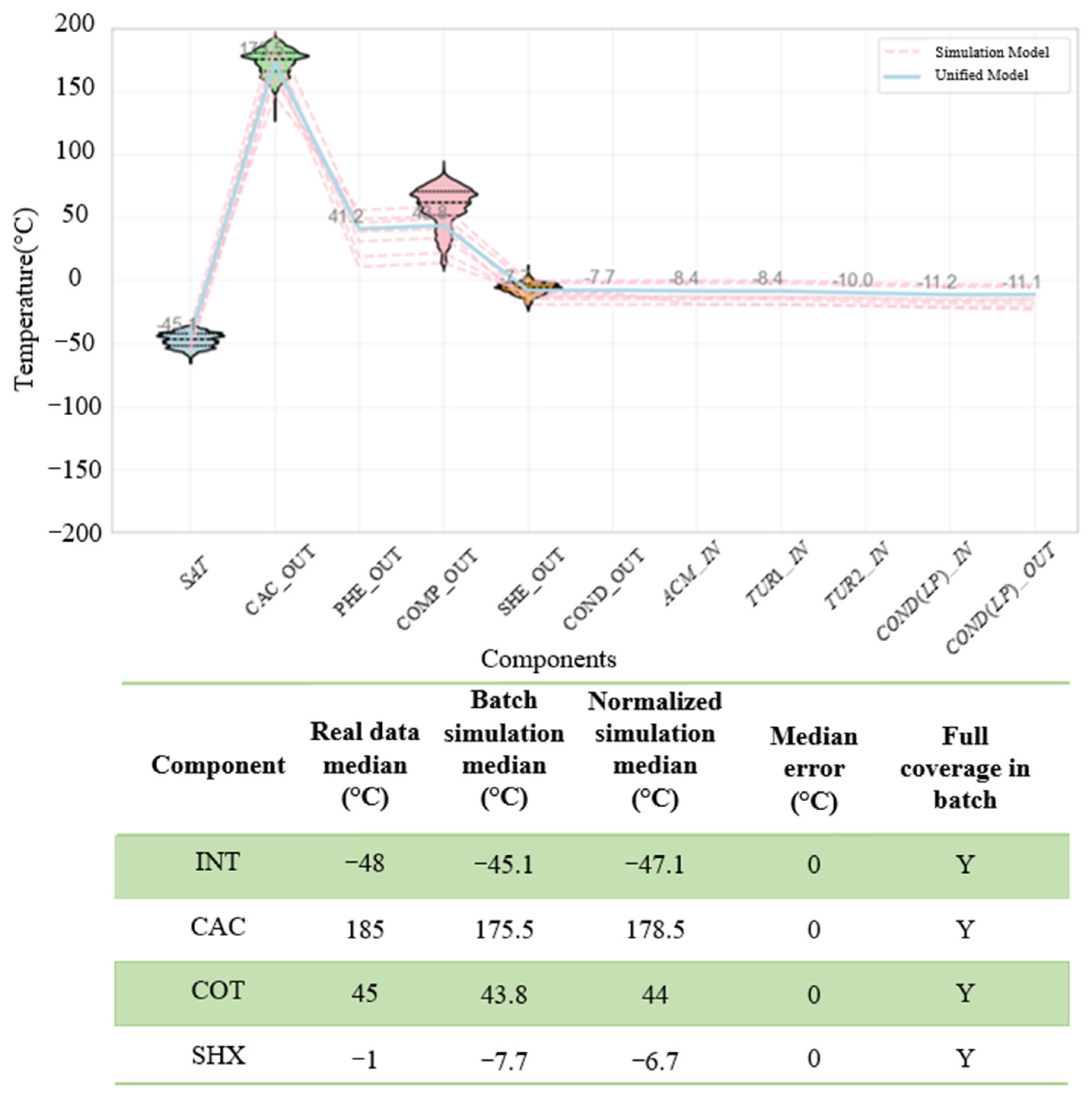
Four Boeing 787-9 aircrafts from a certain airline were used as test objects, and QAR flight data was accumulated for 549 complete flight cycles (a total of 4362 flight hours) from 2 February 2023 to 31 January 2024. The four core QAR record data directly related to E-ECS are—Int Temperature (°C), CAC Outlet Temperature (°C), Compressor Outlet Temperature (°C), and Secondary Heat Exchanger Outlet Temperature SHX (°C). These data are used for subsequent visualization analysis, as shown in Table 5.
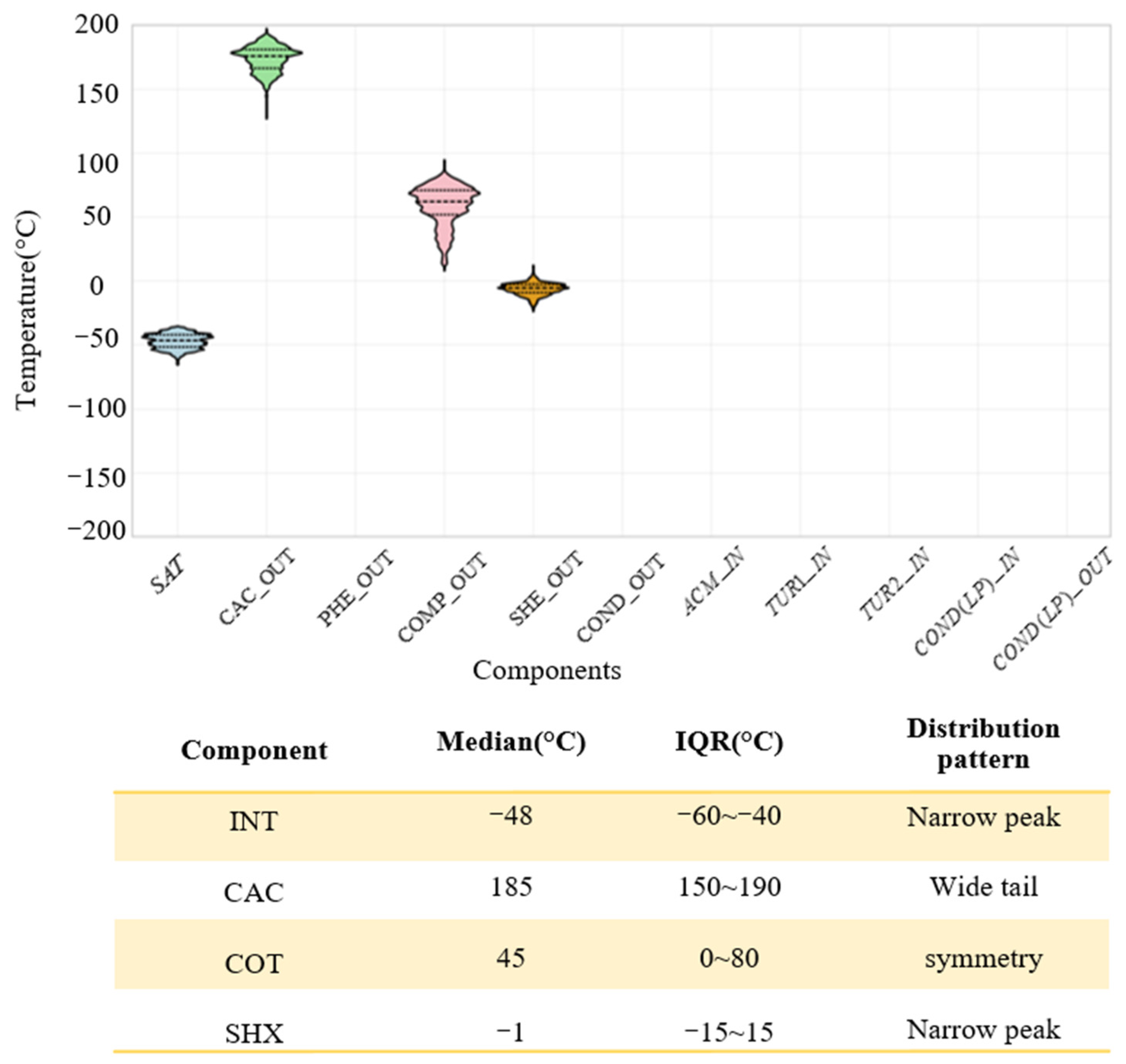
To balance distribution morphology and extreme value recognition, this paper uses Gaussian kernel density estimation (bandwidth = 0.05 σ) to generate violin plots, which intuitively display the operational data status of each key component. The results of these scatter plots are detailed in Figure 18.
As shown in Figure 18, the temperature distribution characteristics of different components (INT, CAC, COT, SHX) were analyzed through violin plots. The results show that the temperature range of the “INT” component is concentrated between −60 °C and −40 °C, and the distribution of data points is relatively concentrated, which indicates that its temperature changes are small and it has high stability. In contrast, the temperature range of the “CAC” component is between 150 °C and 190 °C, with a wide distribution of data points and significant temperature fluctuations. The data points in the middle are dense, with fewer at both ends and an approximate normal distribution. The temperature range of the “COT” component is from 0 °C to 80 °C. Although certain temperature changes are also shown, its distribution is slightly more concentrated compared to the “CAC” component. Finally, the temperature range of the “SHX” component is between −15 °C and 15 °C, with data points highly concentrated around the midpoint, which shows minimal temperature changes and high stability. The comparison between the mechanism model based on DBO-PSO optimization algorithm and QAR data is shown in Figure 19.
As shown in Figure 19, the fluctuation range of the constructed model is almost completely consistent with the data distribution of the QAR, which fully verifies the accuracy and reliability of the model. To further enhance the applicability and generalization ability of the model, normalization fitting was performed on the established model, aiming to achieve coordinated analysis and model construction of multiple flight cycle data. Through the above-mentioned processing steps, it can be ensured that the model can better adapt to data fluctuations under different flight conditions, improving the robustness of the model. Finally, a mechanism model based on the DBO-PSO optimization algorithm is constructed. The baseline established from multiple single-flight cycles is represented by the pink dotted line, and the baseline after the fitting and normalization process is represented by the blue solid line. It can be clearly observed from the figure that the normalized model for multi flight cycle fitting is in the median region of QAR data, indicating that the optimized model not only performs well in a single flight cycle, but also demonstrates high stability and accuracy in the comprehensive analysis of multiple flight cycles.
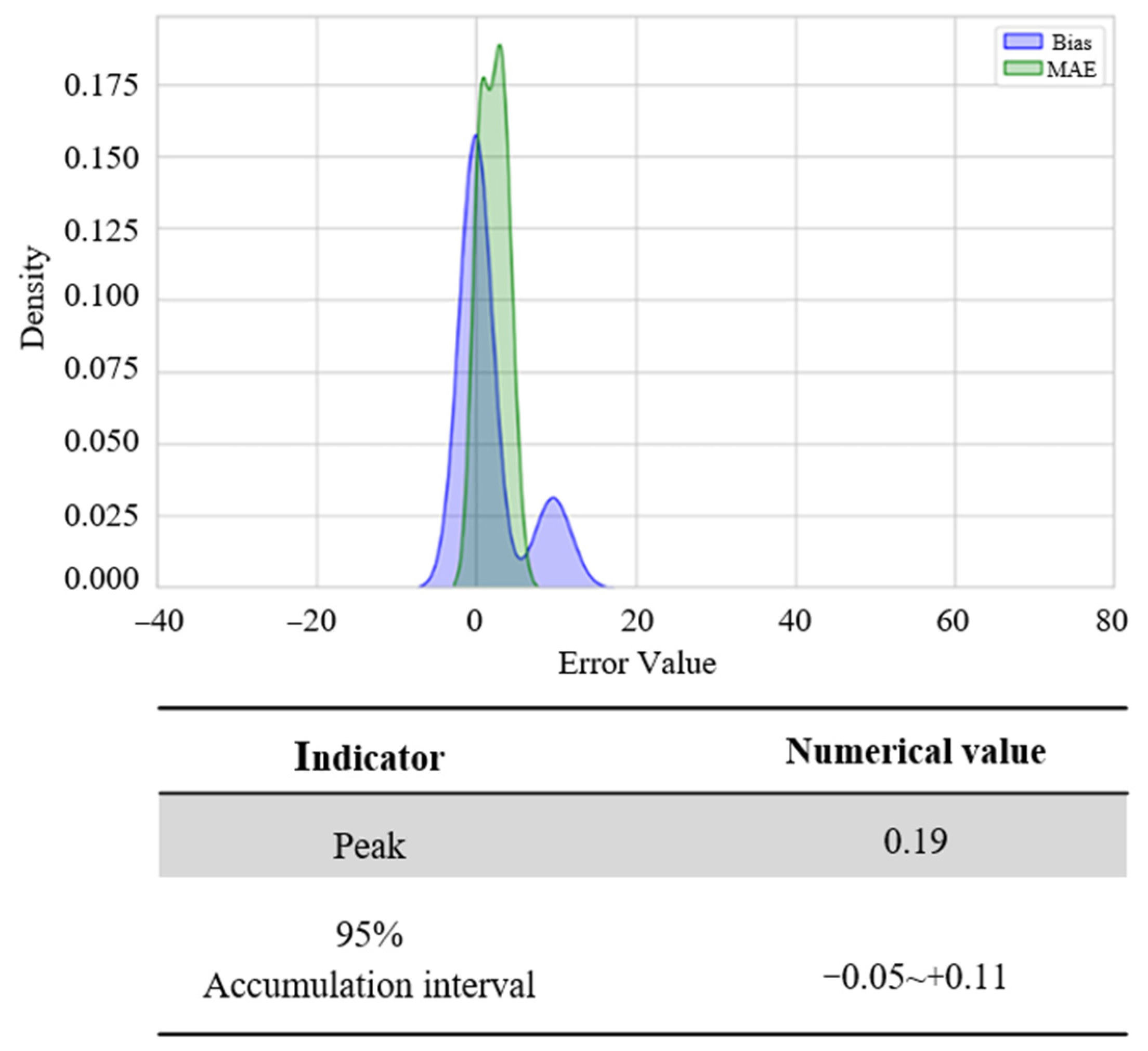
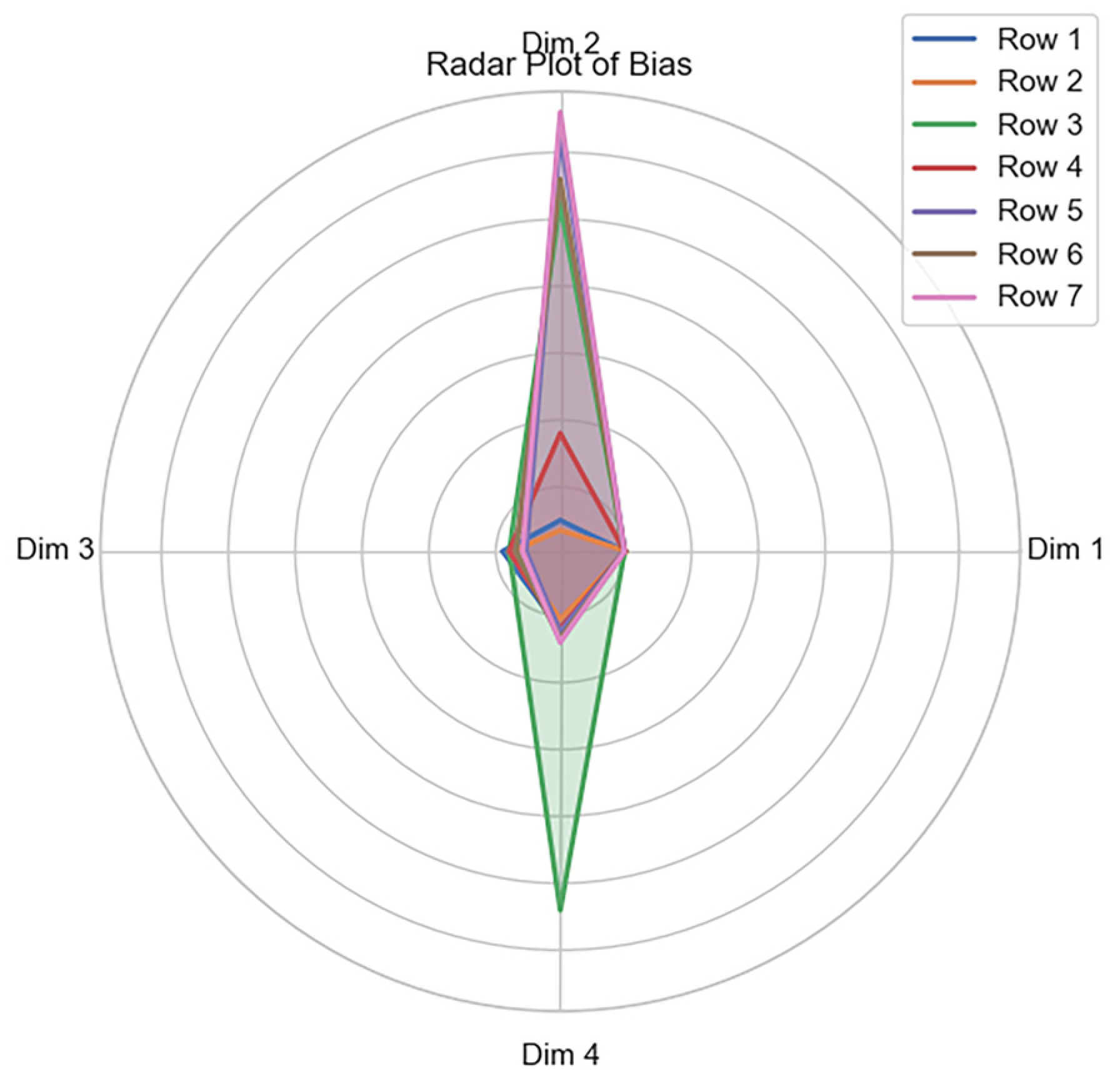
The data coverage and modeling data bias statistics of the mechanism model are shown in Table 6. According to the data statistics presented in Table 6 of this paper, it is clearly shown that 100% has been reached by the coverage rate of the relevant data. Meanwhile, after in-depth analysis of the experimental values and the modeled values, it is found that significant divergence is not shown by the deviations of both from the center value of the range. The data distribution status is specifically shown in Figure 20.
According to the statistical results in Table 6, the coverage rate of all sample data has reached 100%. After further comparing the real QAR data with the modeling values, it was found that both had small deviations from the center value of the range, and there was no significant deviation phenomenon. The overall error distribution was relatively concentrated. The error distribution diagram shown in Figure 20 also confirms this conclusion: the error values are mostly concentrated around 0, with a small fluctuation range. The horizontal axis in Figure 20 represents the error value, and the vertical axis represents the frequency of error occurrence. The distribution pattern is approximately symmetrical, with the peak located near 0, indicating that the systematic deviation (Bias) between the predicted results of the model and the real QAR data is extremely low. Meanwhile, from the statistical distribution of mean absolute error (MAE), it can be seen that the MAE values between the temperature calculation data of the proposed mechanism model and the real QAR data are mostly concentrated around 0 value, and the overall deviation of the model is relatively small.
The multidimensional deviation radar chart in Figure 21 further provides a detailed view of the deviation of each row in different dimensions. Specifically, relatively small deviations are shown in the Dim 1 (INT) and Dim 3 (SHX) dimensions, which indicates that relatively stable and accurate predictions in these two dimensions are made by the model. In the Dim 2 (CAC) and Dim 4 (COT) dimensions, although there are fluctuations within the normal range, this kind of fluctuation is consistent with the inherent data fluctuations of CAC and COT in the QAR data. The fact that the model’s predictions in these dimensions conform to the inherent characteristics of the real QAR data is confirmed by this finding, and the accuracy of the experiment is well verified.

5. Conclusions

Considering the high coupling, time-varying, and differences in aircraft configuration, part number, and optional equipment of the Boeing 787 E-ECS model, an E-ECS mechanism modeling method based on the DBO-PSO optimization algorithm is constructed in this paper. Firstly, at the component level, the ε-NTU method is used to model the fluid thermodynamics of the plate fin primary/secondary heat exchanger. The fin efficiency correction factor and dynamic fouling coefficient are introduced, coupled with the steady-state characteristic curve of the electric compressor/turbine. Based on the conservation of mass and energy, a set of differential-algebraic equations is established, and the outlet temperature is taken as the state variable. The configuration operating condition dual-dimensional adaptive parameterization modeling is achieved by explicitly parameterizing the heat conduction correction coefficient; Secondly, to solve the issue of easily getting stuck in local optima in high-dimensional parameter identification, a collaborative optimization algorithm combining DBO and PSO is proposed. The DBO method uses random bias and random disturbance to maintain population diversity, while the PSO method periodically resamples the elite solution set globally to form a dynamic equilibrium mechanism. After carefully comparing the predicted component outlet temperature data of the model with the real QAR data of a certain airline’s Boeing 787 aircraft, it was found that the predicted values of the model were highly consistent with the actual measured values, with high prediction accuracy and reliability. This not only verified the effectiveness of the model, but also provided theoretical basis and technical support for its practical engineering application promotion. Finally, after a detailed comparison between the component outlet temperature data predicted by the proposed model and the real QAR data of a Boeing 787 aircraft from an airline company, it was found that the calculated values of the mechanism model were highly consistent with the actual flight record data, with high prediction accuracy and reliability. This not only verified the effectiveness of the model, but also provided theoretical basis and technical support for its practical engineering application promotion.
The simplified mathematical model proposed by this research institute innovatively expands the data dimensions of aircraft air conditioning systems, constructs a comprehensive and multi-dimensional high-quality data foundation, breaks through the data limitations in traditional performance evaluation, and its innovation is reflected in the use of efficient model simplification and data fusion methods, achieving deep characterization and high-precision evaluation of system operating characteristics under different operating conditions. This work not only provides a more reliable analysis tool for the performance evaluation and optimization design of aircraft air conditioning systems, but also contributes important methods to the health monitoring of key components in E-ECS. Based on the comparison of data such as component outlet temperature, an adaptive model can be built for real-time analysis to achieve early warning and prevention of faults, significantly improving system reliability and safety. At the application level, this method provides a scalable and easy to implement scientific solution for intelligent operation and maintenance of aircraft air conditioning systems, as well as state monitoring, fault diagnosis, and health management of complex electromechanical systems.
The proposed model can generate health temperature data for each key component of the PACK component under normal working conditions, as well as fault data in the event of performance degradation or component failure. It has important engineering practical significance and broad application prospects.

Author Contributions

Conceptualization, Y.H. and Z.B.; methodology, Y.H.; software, Z.B.; validation, T.M., L.Z. and R.W.; formal analysis, Z.B.; investigation, F.C.; re-sources, T.M.; data curation, Z.B.; writing—original draft preparation, Z.B.; writing—review and editing, Y.H.; visualization, Z.B. and F.C.; supervision, L.Z. and R.W. All authors have read and agreed to the published version of the manuscript.

Funding

This research was funded by the Open Fund of Tianjin Key Laboratory for Advanced Signal Processing, Civil Aviation University of China under Grant 2025ASP-TJ02, the Key Project of the Ministry of Industry and Information Technology (No. TC240HE75-15/5-15), and the Graduate Research Innovation Project of Civil Aviation University of China under Grant 2024YJSKC02008.

Data Availability Statement

The data that support the findings of this study are available from the corresponding author upon reasonable request.

Conflicts of Interest

Author Tong Mu was employed by the company Aircraft Maintenance and Engineering Corporation. The remaining authors declare that the research was conducted in the absence of any commercial or financial relationships that could be construed as a potential conflict of interest.

References

  1. Luo, Y.; Zhao, H.; Xiong, B. Research on air conditioning performance monitoring and trend prediction of A320 aircraft based on big data analysis. In Proceedings of the 2021 IEEE 3rd International Conference on Civil Aviation Safety and Information Technology (ICCASIT), Changsha, China, 20–22 October 2021; pp. 375–379. [Google Scholar]
  2. Duan, Z.D.; Sun, H.R.; Wu, C.Y.; Hu, H.T. Multi-objective optimization of the aircraft environment control system based on component-level parameter decomposition. Energy 2022, 245, 123330. [Google Scholar] [CrossRef]
  3. Boeing Company. 787 Training Student Lab Notebook: Air Conditioning Systems—ECS Book 1 of 5; Boeing Company: Crystal City, VA, USA, 2010; pp. 1–623. [Google Scholar]
  4. Mäkelä, L.; Aaltonen, J.; Koskinen, K.T.; Mäentausta, K. Model-Based Fault Identification of Fighter Aircraft’s Environmental Control System. In Proceedings of the Aerospace Europe 6th CEAS Conference, Bucharest, Romania, 16–20 October 2017; Volume 265, pp. 1–7. [Google Scholar]
  5. Liebherr-Aerospace. A319/A320/A321 Environmental Control System-Familiarization Training; Liebherr-Aerospace: Toulouse, France, 2004. [Google Scholar]
  6. Burroughs, J.D.; Hammond, R.A. Control analysis and design features of EASY5. In Proceedings of the 1983 American Control Conference, San Francisco, CA, USA, 22–24 June 1983; pp. 58–63. [Google Scholar]
  7. Hoffman, G.L. Environmental control system simulation using EASY5, as applied to the F-14. In Proceedings of the Intersociety Conference on Environmental Systems, San Francisco, CA, USA, 15–17 July 1985; SAE Technical Paper 851817. pp. 1–8. [Google Scholar]
  8. Vargas, J.V.C.; Bejan, A. Integrative thermodynamic optimization of the environmental control system of an aircraft. Int. J. Heat Mass Transf. 2001, 44, 3907–3917. [Google Scholar] [CrossRef]
  9. Pérez-Grande, I.; Leo, T.J. Optimization of a commercial aircraft environmental control system. Appl. Therm. Eng. 2002, 22, 1885–1904. [Google Scholar] [CrossRef]
  10. Tu, Y.; Lin, G. Dynamic simulation of humid air environmental control system. In Proceedings of the 40th International Conference on Environmental Systems, Barcelona, Spain, 11–15 July 2010; pp. 1–10. [Google Scholar]
  11. Jordan, P.; Schmitz, G. A modelica library for scalable modelling of aircraft environmental control systems. In Proceedings of the 10th International Modelica Conference, Lund, Sweden, 10–12 March 2014; pp. 599–608. [Google Scholar]
  12. Jiang, H.; Dong, S.; Zhang, H. Energy efficiency analysis of electric and conventional environmental control system on commercial aircraft. In Proceedings of the 2016 IEEE/CSAA International Conference on Aircraft Utility Systems (AUS), Beijing, China, 10–12 October 2016; pp. 1–8. [Google Scholar]
  13. Poudel, S. Modelling of a Generic Aircraft Environmental Control System in Modelica. Master‘s Thesis, Linköping University, Linköping, Sweden, 2019. [Google Scholar]
  14. Shu, Y.; Li, Y.J.; Cao, Y.Y.; Hu, J.D. Modeling and simulation research on aircraft air conditioning system. Aeronaut. Comput. Tech. 2019, 49, 72–75. [Google Scholar]
  15. Moir, I.; Seabridge, A. Aircraft Systems: Mechanical, Electrical, and Avionics Subsystems Integration, 3rd ed.; John Wiley & Sons: Chichester, UK, 2011. [Google Scholar]
  16. Devadurgam, H.; Rajagopal, S.; Munjulury, R.C. Analytical design and estimation of conventional and electrical aircraft environmental control systems. Int. J. Sustain. Aviat. 2019, 5, 1–14. [Google Scholar]
  17. Ablanque, N.; Torras, S.; Oliet, C.; Rigola, J. Heat exchangers modelling and calibration for complete ECS architectures simulations. In Proceedings of the 9th European Conference for Aeronautics and Space Sciences (EUCASS), Lille, France, 27 June–1 July 2022; pp. 1–11. [Google Scholar]
  18. Lu, Q.; Zhu, G.; Zhang, D. Study on performance of closed air circulation system driven by electric compressor. Int. J. Aeronaut. Space Sci. 2023, 24, 294–302. [Google Scholar] [CrossRef]
  19. Planès, T.; Delbecq, S.; Pommier-Budinger, V.; Bénard, E. Modeling and design optimization of an electric environmental control system for commercial passenger aircraft. Aerospace 2023, 10, 260. [Google Scholar] [CrossRef]
  20. He, Z.; Zhang, J.; Zheng, F.; Jin, X. Energy-efficiency-oriented optimal control for electrical environmental control system based on advanced neural network. Appl. Therm. Eng. 2023, 219, 119635. [Google Scholar] [CrossRef]
  21. Fioriti, M.; Di Fede, F. A design model for electric environmental control system in aircraft conceptual and preliminary Design. Int. Rev. Aerosp. Eng. 2023, 16, 58–72. [Google Scholar] [CrossRef]
  22. Fioriti, M.; Pavan, G.; Caggese, S. Static and dynamic models for the electric environmental control system in initial design. In Proceedings of the AIAA Aviation Forum and ASCEND, Las Vegas, Nevada, 29 July–2 August 2024; pp. 1–17. [Google Scholar]
  23. Adachi, T.; Takahashi, K.; Ishii, S. Thermodynamic analysis of a new electric environmental control system with energy recovery turbine. J. Therm. Sci. Technol. 2024, 19, 23-00295. [Google Scholar] [CrossRef]
  24. Celikel, G.; Proelss, K.; Riedel, J.; Schmidt, S.A.; Zandstra, S.J.; Gantus, R.A.; Hankache, W.; Michou, A.; Sanchez, F.; Michaelsen, B. A virtual demonstration of an electrical environmental control system. Eng. Proc. 2025, 90, 1–9. [Google Scholar]
  25. Han, Y.F.; Wu, Y.Z.; Zhong, L.L.; Bai, Z.X.; Gan, L.Z.; Wu, R.B. Baseline modeling method for aircraft air conditioning system based on improved MSET. China Saf. Sci. J. 2025, 35, 88–95. [Google Scholar]
  26. Peng, X. Aircraft Environmental Control Systems Modeling for Configuration Selection. Master’s Thesis, Cranfield University, Cranfield, UK, 2013. [Google Scholar]
  27. Hamilton Sundstrand. B787 cabin air conditioning and temperature control system. Syst. Compon. Descr. Oper. Fam. Train. 2010, 21-00-00, 1–226. [Google Scholar]
  28. Vargas, J.V.C.; Bejan, A. Thermodynamic optimization of finned crossflow heat exchangers for aircraft environmental control systems. Int. J. Heat Fluid Flow 2001, 22, 657–665. [Google Scholar] [CrossRef]
  29. Patricelli, L. Innovative Solutions for the Thermal Control of Aeronautic Vehicles. Master’s Thesis, Politecnico di Torino, Turin, Italy, 2013. [Google Scholar]
  30. Bergman, T.L. Fundamentals of Heat and Mass Transfer; John Wiley & Sons: Hoboken, NJ, USA, 2011. [Google Scholar]
  31. Nelson, T. 787 Systems and Performance. Boeing Commercial Airplanes Flight Operations Engineering Report. 2005. Available online: https://myhres.com/Boeing-787-Systems-and-Performance.pdf (accessed on 1 January 2005).
  32. Xue, J.; Shen, B. Dung beetle optimizer: A new meta-heuristic algorithm for global optimization. J. Supercomput. 2023, 79, 7305–7336. [Google Scholar] [CrossRef]
  33. Zilong, W.; Peng, S. A multi-Strategy dung beetle optimization algorithm for optimizing constrained engineering problems. IEEE Access 2023, 11, 98805–98817. [Google Scholar] [CrossRef]
  34. Morales-Castañeda, B.; Zaldívar, D.; Cuevas, E.; Fausto, F.; Rodríguez, A. A better balance in metaheuristic algorithms: Does it exist? Swarm Evol. Comput. 2020, 54, 100671. [Google Scholar] [CrossRef]
  35. Wang, C.B. Research on Optimal Operation of a Combined Cooling, Heating and Power Microgrid Based on an Improved Particle Swarm Algorithm. Master’s Thesis, China University of Mining and Technology, Xuzhou, China, 2022. [Google Scholar]
  36. Xiao, Y.Z. Research on Feature Selection Method Based on Improved Particle Swarm Optimization Algorithm. Master’s Thesis, Jilin University, Changchun, China, 2022. [Google Scholar]
  37. Tian, G.; Ren, Y.; Zhou, M. Dual-objective scheduling of rescue vehicles to distinguish forest fires via differential evolution and particle swarm optimization combined algorithm. IEEE Trans. Intell. Transp. Syst. 2016, 17, 3009–3021. [Google Scholar] [CrossRef]
  38. Wilke, D.N. Analysis of Particle Swarm Optimization Algorithm. Master’s Thesis, University of Pretoria, Pretoria, South Africa, 2005. [Google Scholar]
  39. Price, K.V. Differential Evolution. In Handbook of Optimization: From Classical to Modern Approach, 1st ed.; Springer: Berlin/Heidelberg, Germany, 2013; pp. 187–214. [Google Scholar]
  40. Liu, S.; Wang, K.; Wang, L.; Hu, W. Research on air-sending characteristics simulation of air-conditioning system of air-conditioning support equipment for airplane. In Proceedings of the 2019 2nd International Conference on Safety Produce Informatization (IICSPI), Chongqing, China, 28–30 November 2019; pp. 656–658. [Google Scholar]
Figure 1. Development platform for the ECS mechanism model.
Aerospace 13 00195 g001
Figure 2. Structure and schematic diagram of E-ECS.
Aerospace 13 00195 g002
Figure 3. Heat exchanger diagram.
Aerospace 13 00195 g003
Figure 4. Basic structural unit of heat exchanger.
Aerospace 13 00195 g004
Figure 5. Thermal resistance relationship diagram of each part of the heat exchanger.
Aerospace 13 00195 g005
Figure 6. Diagram of water separator (condenser and water separator).
Aerospace 13 00195 g006
Figure 7. Physics—Optimization Interaction Diagram.
Aerospace 13 00195 g007
Figure 8. Flowchart of Dung Beetle Optimization algorithm.
Aerospace 13 00195 g008
Figure 9. Particle Swarm Optimization Algorithm Flowchart.
Aerospace 13 00195 g009
Figure 10. Flow chart of the DBO-PSO optimization algorithm.
Aerospace 13 00195 g010
Figure 11. (a) E-ECS-Ground high temperature (Operating condition model 1); (b) E-ECS-Ground low temperature (Operating condition model 2); (c) E-ECS-FL250 (Operating condition model 3); (d) E-ECS-FL430 (Operating condition model 4).
Aerospace 13 00195 g011aAerospace 13 00195 g011b
Figure 12. Comparison diagram of convergence and accuracy of the improved algorithm.
Aerospace 13 00195 g012
Figure 13. Three-dimensional diagram of the optimization process of the DBO-PSO algorithm.
Aerospace 13 00195 g013
Figure 14. Multidimensional quantitative evaluation of model fidelity and bias statistics under a single flight cycle.
Aerospace 13 00195 g014
Figure 15. Multidimensional error heatmap.
Aerospace 13 00195 g015
Figure 16. Taylor diagram.
Aerospace 13 00195 g016
Figure 17. Experimental results of ablation optimization algorithm.
Aerospace 13 00195 g017
Figure 18. Violin diagram of component QAR data.
Aerospace 13 00195 g018
Figure 19. Comparison diagram between the mechanism model based on the DBO-PSO optimization algorithm and QAR data.
Aerospace 13 00195 g019
Figure 20. Deviation distribution diagram.
Aerospace 13 00195 g020
Figure 21. Multidimensional Deviation Radar Chart.
Aerospace 13 00195 g021
Table 1. Classification of PACK for civil aviation transport aircraft.
Classification of PACKClassic Aircraft Models
Low-pressure
water removal system
Two-wheelB727, B737-300, B737-500
Three-wheelA310, B747-400, B737-600
High-pressure
water removal system
Two-wheelB737-400
Three-wheelA320, A330, B737MAX, C919
Four-wheelA380, B777, B787, MD12
Table 2. Parameter statistics table.
NumberComponentParameterPhysical Eaning
1CAC T C A C _ I N CAC inlet temperature
2 T C A C _ O U T CAC outlet temperature
3Primary heat exchanger T P H E _ I N Primary heat exchanger inlet temperature
4 T P H E _ O U T Primary heat exchanger outlet temperature
5Compressor T C O M P _ I N Compressor inlet temperature
6 T C O M P _ O U T Compressor outlet temperature
7Secondary heat exchanger T S H E _ I N Secondary heat exchanger inlet temperature
8 T S H E _ O U T Secondary heat exchanger outlet temperature
9Condenser T C O N D _ I N Condenser inlet temperature
10 T C O N D _ O U T Condenser outlet temperature
11Turbine T T U R _ I N Turbine inlet temperature
12 T T U R _ O U T Turbine outlet temperature
Table 3. Input parameters of the E-ECS model for the B787 aircraft.
Input ParameterMeasurement UnitGround High Temperature (Ground)Ground Low Temperature (Ground)FL250
(Cruise)
FL430
(Cruise)
isentropic efficiency of ACM compressor-0.770.70.750.75
isentropic efficiency of ACM turbine-0.80.70.750.75
cabin air temperature°C27212125
Table 4. Airflow of a single PACK for the B787 aircraft.
Environmental ConditionPACK Air Flow Ratio [kg/s]
ground high temperature0.92
ground low temperature0.78
FL2500.48
FL4300.44
Table 5. QAR Data Source Table.
Aircraft
Type
Aircraft FleetRecord Time RangeEffective Flight CycleFlight
Segment
Time of FlightData Dimension
B787-9B-XXX12 February 2023–31 January 2024549172843,2624
B-XXX2
B-XXX3
B-XXX4
Table 6. Statistical Table of Mechanism Model Data Coverage and Deviation.
NUMMechanism Model DataReal QAR DataReal Data RangeDeviationMean Absolute ErrorScope Compliance RateAbnormal Value Ratio
1[−43, 187, 59, 0][−43, 188, 59.2, −0.4](−60, −40), (150, 190),
(0, 80), (−15, 15)
[0, −1, −0.2, 0.4]0.4100%0%
2[−45, 183, 34, −13][−45.05, 184.3, 34.5, −13.1](−60, −40), (150, 190),
(0, 80), (−15, 15)
[0.05, −1.3, −0.5, 0.1]0.4875100%0%
3[−50, 173, 14, −10][−50, 164.5, 14.4, −18.8](−60, −40),(150, 190),
(0, 80), (−15, 15)
[0, 8.5, −0.4, 8.8]4.425100%0%
4[−56, 161, 49, −15][−56, 159.4, 49.4, −15.4](−60, −40), (150, 190),
(0, 80), (−15, 15)
[0, 1.6, −0.4, 0.4]0.6100%0%
5[−38, 197, 51, −2][−38, 186.4, 51.9, −2.5](−60, −40), (150, 190),
(0, 80), (−15, 15)
[0, 10.6, −0.9, 0.5]3100%0%
6[−44, 185, 22, −12][−44, 175.8, 22.6, −12.7](−60, −40), (150, 190),
(0, 80), (−15, 15)
[0, 9.2, −0.6, 0.7]2.625100%0%
7[−55, 163, 41, −19][−55, 151.8, 41.8, −18.8](−60, −40), (150, 190),
(0, 80), (−15, 15)
[0, 11.2, −0.8, −0.2]3.05100%0%
Disclaimer/Publisher’s Note: The statements, opinions and data contained in all publications are solely those of the individual author(s) and contributor(s) and not of MDPI and/or the editor(s). MDPI and/or the editor(s) disclaim responsibility for any injury to people or property resulting from any ideas, methods, instructions or products referred to in the content.