1. Introduction
Recent years have renewed attention to the resilience of global air transport systems, not primarily because of the frequency of aviation accidents—which remain rare and are typically resolved within short operational timeframes—but due to the massive scale and structural complexity of contemporary air transport networks (ATNs). Global air transportation supports an unprecedented volume of passenger mobility and time-sensitive cargo flows, forming critical infrastructure for international supply chains. These networks facilitate the movement of industrially essential goods, such as semiconductors and precision equipment, via dedicated cargo aircraft or the lower-deck holds of passenger flights, and enable the rapid distribution of vaccines, medical supplies, perishable goods, and e-commerce products. Despite their apparent operational robustness, the structural sensitivity of ATNs to geopolitical pressures, regulatory fragmentation, and strategic disruptions remains insufficiently understood. Geopolitical shocks rarely manifest as abrupt network collapse; instead, they tend to induce more subtle yet persistent forms of structural degradation, including longer routings, increased operating costs, and heightened dependence on a limited number of intermediary hubs. These dynamics highlight the critical role of strategic hubs and inter-regional dependencies in maintaining global connectivity, underscoring the need for a systematic analysis of ATNs under geopolitical stress.
To systematically analyze ATNs, this study draws on complex network science, which seeks to elucidate the structural properties and dynamics of large-scale interconnected systems. Foundational studies have identified universal features such as small-world [
1] and scale-free properties [
2], which have informed analyses of transportation systems, including urban street networks [
3] and intercity railway networks [
4]. In the context of ATNs, research over the past two decades has examined a wide range of structural and operational aspects (reviewed in
Section 2). Prior studies can be broadly categorized into small-world characteristics [
5], heavy-tailed degree distributions [
6], weighted and multiplex network representations for assessing vulnerability and efficiency [
7,
8,
9,
10], and the effects of dynamic passenger flows and connection planning under demand uncertainty [
11,
12,
13,
14,
15]. More recently, studies on COVID-19 have highlighted ATN sensitivity to disruptions and the consequences of mobility restrictions on network performance and epidemic propagation [
16,
17,
18].
However, despite advances in ATN modeling and analysis, most studies have largely overlooked the influence of geopolitical and geoeconomic factors on network structure, flow patterns, and resilience, particularly regarding industrial cargo transportation and strategic supply chains. Existing research has primarily focused on operational efficiency, capacity constraints, and disruption propagation, while treating geopolitical conditions as exogenous or static. Geoeconomics provides a complementary lens by conceptualizing the strategic use of economic instruments to achieve geopolitical objectives [
19]. Subsequent formulations emphasize how states employ economic tools to promote national interests, generate favorable geopolitical outcomes, and shape strategies through the economic actions of other actors [
20]. From a network perspective, geoeconomic interactions involve multiple heterogeneous actors—including governments, firms, international organizations, and civil society—whose decisions jointly shape the topology, connectivity, and functional dependencies of global transportation systems. Recent developments in geoeconomic theory further highlight the role of structural power in systems characterized by asymmetric interdependence [
21]. Control over critical nodes and chokepoints in global networks—often described as “weaponized interdependence”—constitutes a mechanism of strategic influence, with measurable impacts on network flows and robustness [
22,
23]. In the context of ATNs, this implies that states or firms controlling key hubs or international cargo corridors can strategically influence global connectivity and the distribution of essential goods, potentially reshaping supply chains under geopolitical pressure. Such influence is manifested primarily through inter-continental and inter-regional connections, rather than through domestic traffic volumes, which—while operationally essential—are not the primary locus of geopolitical interaction between different countries. Integrating these insights with network science provides a foundation for systematically examining how strategic and political-economic forces reshape ATN topology, reroute cargo flows, and alter resilience under both acute shocks and long-term structural transformations.
Importantly, in this study, geo-strategic “control” does not refer to the ability of a single state or firm to unilaterally disrupt or terminate global air transport flows. Rather, it denotes the capacity to exert strategic influence on network performance by shaping efficiency, cost structures, and redundancy through the concentration of critical hubs, airspace access, and international cargo corridors. Recent disruptions, such as the closure of Russian airspace on EU–Asia routes, illustrate this distinction clearly: while global connectivity was preserved through rerouting and increased reliance on Middle Eastern gateways, these adjustments entailed longer transit times, higher operating costs, and increased dependency on a limited set of intermediary nodes. From a geoeconomic perspective, such outcomes reflect structural vulnerability and influence, rather than absolute control.
Building on this framework, this study proposes a network-based approach that combines complex network analysis with geoeconomic insights. Using empirical flight trajectory data, we analyze global ATNs in 2019 and 2023—years marked by major geopolitical and economic transformations, including the COVID-19 pandemic, Russia’s invasion of Ukraine, and the rising role of emerging economies such as India. Our analysis evaluates network connectivity, intermediary roles, and vulnerability across multiple regions, considering both passenger and cargo flows. This study is the first to systematically link ATN topology with geoeconomic strategy, providing insights into how strategic hubs and inter-regional dependencies shape global connectivity, cargo distribution, and resilience under geopolitical stress. By combining quantitative network science with a geoeconomic perspective, we introduce the concept of Geoeconomics in Air Transport as a tool to interpret the structure, robustness, and strategic importance of global air transport systems.
This study makes three interrelated contributions to the literature on ATNs. First, we introduce Geoeconomics in Air Transport as an interpretive framework that systematically links standard complex network metrics to geoeconomic mechanisms such as strategic interdependence, institutional constraints, and geopolitical leverage. Rather than proposing new network measures, the novelty of this contribution lies in reinterpreting well-established metrics—such as degree, betweenness, closeness, PageRank, and robustness—as indicators of strategic economic positioning within global aviation networks. Second, the paper offers a comparative, cross-scale empirical analysis of global, regional, and inter-regional air transport networks using a unified methodological framework. This enables consistent comparison of intermediary roles, vulnerability, and resilience across spatial scales that are typically examined in isolation. Third, we embed robustness analysis based on targeted node removal within a geoeconomic perspective, interpreting structural fragility not only as a topological property, but as an indicator of concentrated intermediary dependence with strategic implications. Together, these contributions clarify how air transport connectivity reflects broader geoeconomic structures rather than purely operational or infrastructural considerations.
The paper is structured as follows.
Section 2 presents the theoretical framework of
Geoeconomics in Air Transport, integrating insights from complex network science with geoeconomic analysis.
Section 3 details the modeling of ATNs and the methods used to evaluate their structural properties, including the construction of networks for global, regional, and inter-regional analyses, as well as the metrics employed to assess connectivity, vulnerability, and robustness.
Section 4 applies the methodology to examine structural transformations in ATNs between 2019 and 2023, providing a comparative analysis of global network trends and regional characteristics, including hub roles and supply chain implications.
Section 5 interprets these findings from a geoeconomic perspective, discussing network resilience, structural changes, and strategic implications for global aviation supply chains. Finally,
Section 6 summarizes the key findings and concludes the paper.
2. Theoretical Framework: A Synthesis of Network Science and Geoeconomics Analysis
2.1. Complex Network Perspectives on Air Transport Systems
Complex network science provides a framework for analyzing the structure and dynamics of large-scale interconnected systems, with applications across mathematics, physics, biology, economics, and epidemiology. Foundational studies have identified key features of real-world networks. One is the small-world property, which combines short average path lengths with high clustering [
1]. Another is the scale-free distribution, in which a few highly connected nodes dominate overall connectivity [
2]. These concepts have been applied to transportation systems, including urban street networks [
3] and intercity railway networks [
4], providing tools to assess connectivity, efficiency, and vulnerability.
Over the past two decades, these principles have been extended to air transport networks (ATNs). ATNs exhibit small-world characteristics, enabling rapid connections between distant airports while maintaining clustered regional hubs [
5]. Their degree distribution is often heavy-tailed, reflecting the presence of a few highly connected hub airports [
6]. Weighted networks, where links are scaled by seat capacity or flight frequency, allow evaluation of vulnerability and resilience [
7,
8]. Multiplex network representations—treating each airline’s network as a separate layer and interlayer airports as connectors—enable assessment of interdependencies and overall system robustness [
9,
10]. Network metrics such as centrality, community structure, and clustering have further enhanced understanding of ATN topology [
24,
25].
Recent research has incorporated passenger flows and actual travel paths to better reflect operational realities. In Europe, dynamic network analysis using monthly passenger flow data has tracked connectivity changes over time [
11]. In the United States, memory effects in travel paths significantly affect community detection and network structure [
12]. Monte Carlo simulations combined with gravity models have been applied to reconstruct origin-destination passenger flows [
13]. In China, intercity air travel is highly concentrated at a few major airports, resulting in skewed network centrality and hub dependency [
14]. Connection planning models for low-cost carriers have been developed to optimize routes under demand uncertainty [
15]. The COVID-19 pandemic further highlighted ATN sensitivity to disruptions: reductions in passenger mobility strongly influenced infection spread in China, illustrating the network’s dual role in transport and public health [
16]. Strategies such as limiting hypermobility while strengthening local connectivity have been proposed to mitigate epidemic risks [
17]. Broader reviews have outlined future directions for integrating epidemiological and network analyses in ATNs [
17,
18].
Collectively, these studies provide a robust foundation for analyzing ATNs using complex network science. They inform our understanding of connectivity, robustness, vulnerability, and interdependencies, forming the basis for integrating network-based analysis with geoeconomic perspectives in the present study.
2.2. Conceptualization of the Proposed Methodology
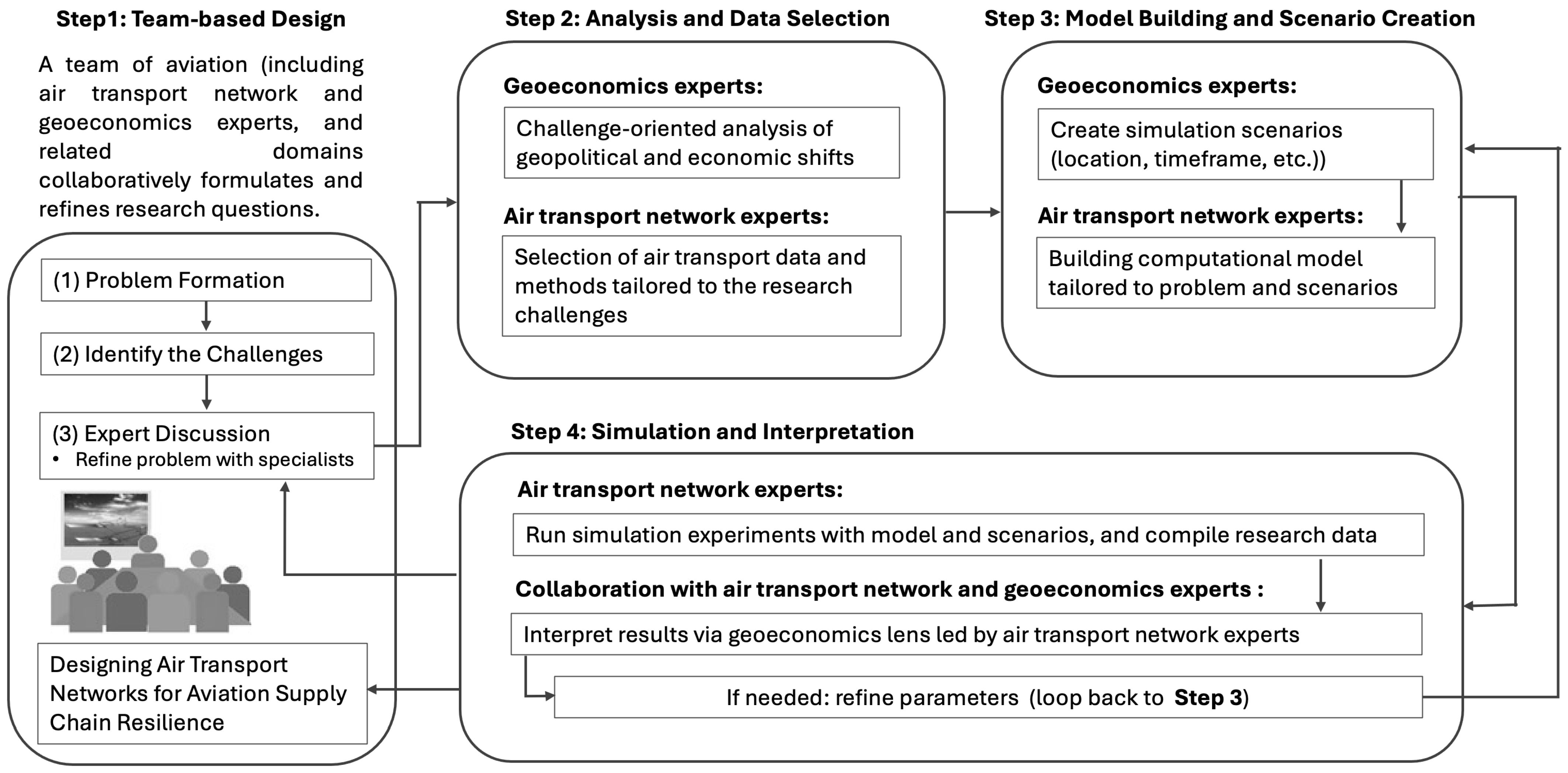
The following framework presents a systematic, stepwise approach for analyzing ATNs, integrating qualitative expert assessment with quantitative network simulation. The framework is designed to be iterative, allowing refinement and re-simulation based on new insights.
Figure 1 illustrates the theoretical framework of
Geoeconomics in Air Transport.
An interdisciplinary team—including specialists in ATNs, geoeconomics, and related domains—formulates and iteratively refines the research questions through structured deliberation. This process involves:
- (1)
Problem Formulation: Identify key issues arising from shifts in air transport supply chains, including passenger flows, cargo logistics, and the impacts of geopolitical and economic developments.
- (2)
Challenge Definition: Define specific research questions or challenges that guide subsequent analyses.
- (3)
Expert Discussion: Convene domain specialists to discuss and refine the problem, ensuring a clear analytical focus.
Geoeconomics and ATN experts jointly assess the problem and select appropriate datasets. The geoeconomics expert evaluates how geopolitical and economic shifts may influence global ATNs, while the ATN expert identifies datasets that characterize network structure and function. Relevant air transport data are then prepared to address the defined challenge.
The geoeconomics expert specifies simulation scenarios, including timeframes, geographic coverage, and conditions aligned with research objectives. The ATN expert constructs a mathematical model of the network and implements it within the simulation framework.
The ATN experts conduct simulation experiments using the constructed models and defined scenarios. Results are analyzed jointly by ATN and geoeconomics experts, interpreting outcomes in terms of structural network metrics and geoeconomic implications. If findings are inconclusive or require further investigation, the process loops back to Step 3, allowing refinement of models, scenarios, or parameters. Once fully interpreted, insights are communicated to aviation stakeholders to inform strategies that enhance the resilience and robustness of ATNs.
2.3. Illustrative Application Using the Present Case Study
This paper primarily focuses on the fourth stage of the theoretical framework of Geoeconomics in Air Transport introduced in the previous section—Step 4: Simulation and Interpretation. This stage constitutes the core analytical component of the framework. Using the scenarios and datasets formulated in the preceding steps, ATN experts conduct simulations in close collaboration with geoeconomics specialists to generate insights that address the defined research questions.
As a case study, the proposed methodology is applied to analyze global, regional, and inter-regional air transport connectivity before and after the COVID-19 pandemic. The objectives are threefold:
- (1)
Demonstrate how the framework captures structural changes in ATNs across these periods,
- (2)
Assess whether the results align with established geoeconomic knowledge,
- (3)
Explore whether the analysis reveals new insights into connectivity and network dynamics.
Quantitative analyses investigate both global and regional air connectivity, as well as the interactions between these levels, followed by interpretation of findings from a geoeconomic perspective. The analysis utilizes one week of air traffic data from October 2019, representing pre-pandemic conditions, and October 2023, representing the post-pandemic recovery phase. The dataset, obtained from FlightRadar24, includes four-dimensional flight trajectories (time, latitude, longitude, and altitude) along with metadata such as origin and destination airports and call signs.
The analytical procedure consists of two main steps:
- (1)
Extract flights traversing the Flight Information Regions (FIRs) of the target areas using latitude–longitude trajectory data and corresponding call signs.
- (2)
Construct and simulate air transport networks based on origin–destination information associated with the extracted call signs.
We intentionally adopt a snapshot-based approach and treat one-week networks as approximations of a quasi-stationary state of the global air transport network. The aim is to capture persistent structural characteristics, rather than short-term scheduling variability. A representative one-week period in October is selected as a benchmark because it lies outside major holiday seasons and peak travel months, and typically reflects stabilized airline schedules following summer timetable adjustments. October 2019 represents a pre-pandemic baseline unaffected by COVID-19–related restrictions, while October 2023 captures a post-pandemic regime shaped by recovery dynamics and ongoing geopolitical and institutional constraints.
For regional-level analyses, six regions are defined: the United States, Europe, the Middle East, the ASEAN region, China, and Japan. This enables a detailed assessment of regional connectivity patterns and interdependencies within the global air transport system. By combining quantitative ATN analysis with geoeconomic interpretation, this case study illustrates how structural changes, hub roles, and inter-regional dependencies can be systematically evaluated under varying geopolitical and economic conditions.
3. Air Transportation Network Modeling and Topological Analysis Method
3.1. Construction of Air Transportation Network Models for Global, Regional, and Inter-Regional Analysis
A total of 26 ATN models were constructed for 2019 and 2023, covering global, regional, and inter-regional networks (
Table 1). While regional ATN models include both domestic and internationally connected flights, this inclusion is intended to preserve the operational connectivity structure of regional networks, rather than to emphasize domestic volumes themselves. In particular, large domestic markets such as the United States are modeled in full to ensure an accurate representation of network structure. Within the scope of the present network-based analysis, U.S. domestic traffic appears to play a limited role in shaping inter-regional connectivity, as the domestic market largely functions as a self-contained system. Consequently, its influence on the inter-continental structure examined here is less pronounced than that of cross-border flows. The geopolitical and geoeconomic interpretation in this study therefore focuses primarily on inter-regional and inter-continental linkages, which constitute the main channels of strategic interaction in global ATNs.
ATNs are modeled as graphs in which nodes represent airports and links represent direct air transport connections. Each node corresponds to a civil airport serving as an origin, destination, or intermediate transfer point for passenger and cargo flows.
Global ATN Models: Two global-scale models (Global 2019 and Global 2023) were constructed to capture worldwide connectivity before and after the COVID-19 pandemic. These models provide a baseline for assessing large-scale structural changes in the global ATN.
Regional ATN Models: Regional models were developed for six target regions: the United States, Europe, the Middle East, ASEAN, China, and Japan. Separate models for 2019 and 2023 allow analysis of changes in internal network structure and regional connectivity over time. Regional nodes include all airports appearing as departure or arrival points in flights traversing the Flight Information Regions (FIRs) of the target region. Links represent direct connections between these airports. This FIR-based definition captures both domestic and internationally connected flights operationally associated with each region.
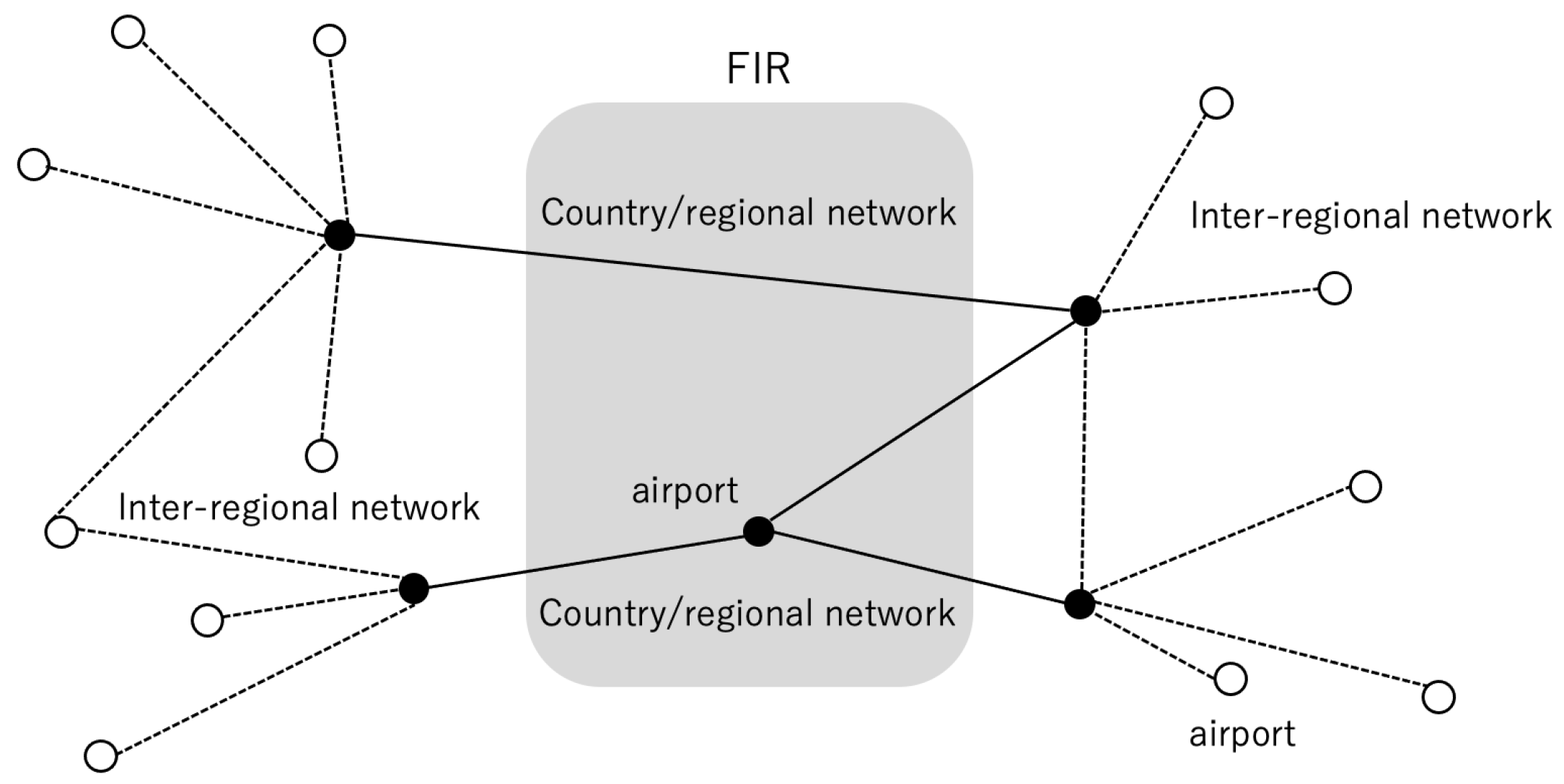
Inter-regional ATN Models: Inter-regional networks explicitly represent connectivity between each region and the global network.
Figure 2 illustrates the conceptual relationship between the regional and inter-regional network models, showing how regional ATNs are extended to capture connectivity with the global network.Each inter-regional model extends its corresponding regional network by adding links connecting regional airports to the rest of the world. For example, the Japan–Global model captures:
- (1)
Flights departing from Japan connecting domestically or internationally,
- (2)
Flights arriving in Japan from abroad and continuing domestically or internationally,
- (3)
Flights passing through Japan en route to other countries.
Figure 2.
Air Transport Network Models and Their Inter-Regional Extensions (FIR-Based).
Figure 2.
Air Transport Network Models and Their Inter-Regional Extensions (FIR-Based).
Inter-regional networks for the United States, Europe, the Middle East, ASEAN, and China were constructed analogously. These models enable systematic comparison of regional–global connectivity and its evolution between the pre-pandemic and post-pandemic periods.
To emphasize structural connectivity rather than traffic intensity, all ATNs in this study are modeled as unweighted and directed graphs, where links indicate the existence of scheduled flights between airports during the observation period. This binary representation is deliberately chosen to isolate topological properties such as intermediary positioning, accessibility, and robustness, which constitute the structural backbone of both passenger and cargo transport. While weighted representations based on flight frequency, seat capacity, or cargo volume would capture economic scale effects more directly, such data are not globally consistent and would reduce cross-regional comparability. Accordingly, the present analysis interprets centrality and robustness metrics as indicators of structural potential rather than realized throughput.
3.2. Topological Metrics and Analytical Approach
Although all 26 ATN models are evaluated using a consistent set of topological metrics, the analytical emphasis differs by scale. Global and regional models are used to establish structural baselines and internal network characteristics, whereas inter-regional models serve as the primary basis for geopolitical and geoeconomic interpretation. This distinction ensures that the assessment of network resilience and strategic vulnerability is driven by inter-continental connectivity patterns rather than by the absolute scale of domestic traffic within large aviation markets.
To identify ATN characteristics that are both structurally meaningful and interpretable from a geoeconomic perspective, ATN models are evaluated through three complementary analytical lenses: (1) network functionality, (2) nodal importance, and (3) structural robustness. These dimensions jointly capture how ATNs sustain connectivity and enable passenger and cargo flows, forming a foundation for geoeconomic interpretation.
The size of the largest connected component (LCC) measures the set of mutually reachable airports within an ATN and reflects its effective operational scale. A larger LCC indicates greater capacity for passenger, cargo, and information propagation, making it a fundamental metric for assessing network functionality across models.
To evaluate network structure from multiple perspectives, we employ four standard centrality measures—degree, betweenness, closeness, and PageRank (see
Appendix A for formal mathematical definitions). These measures capture distinct functional roles of airports within the network. Four centrality measures—degree, betweenness, closeness, and PageRank—are used to evaluate node importance [
26,
27].
Degree: direct connectivity; reflects major origins/destinations.
Betweenness: intermediary function; identifies potential chokepoints.
Closeness: efficiency of access; ease of redistribution.
PageRank: structural influence from connections to highly connected nodes.
By examining these complementary centrality measures, this study captures multiple dimensions of airport importance, linking quantitative network analysis to geoeconomic interpretation.
From a geoeconomic perspective, network centrality measures capture more than structural prominence. High degree centrality reflects extensive connectivity that may amplify economic exposure, while high betweenness centrality indicates intermediary positions that can translate into strategic leverage arising from asymmetric dependence. High closeness centrality reflects relative proximity to all other nodes in the network and can be interpreted as an indicator of potential efficiency in accessing markets, information, and time-sensitive flows, which is particularly relevant for hubs engaged in high-value or perishable cargo transport. PageRank centrality captures not only the number of connections but also their quality, highlighting nodes that are embedded within influential subnetworks; from a geoeconomic standpoint, high PageRank reflects structural prestige and systemic importance arising from preferential attachment to already central actors. In this study, such metrics are therefore interpreted not only as descriptors of network topology, but as proxies for geoeconomic roles shaped by institutional arrangements, state involvement, and regulatory environments.
Robustness is assessed by sequentially removing nodes in descending order of centrality and evaluating the resulting decline in LCC size. Let
be the initial LCC size, and
the size after removing node
i:
The progressive loss of connectivity as nodes are removed is characterized by
, where
is the node removal rate. Integrating over
q gives the cumulative robustness measure:
The critical removal rate , defined in this study as the rate at which the LCC falls to 50% of its initial size (i.e., ), represents a tipping point from an integrated to a fragmented network structure. From a geoeconomic perspective, the 50% threshold is used as a practical and interpretable benchmark to indicate a transition from a largely integrated network toward a more fragmented regime, where alternative routing options diminish and dependence on remaining intermediaries increases. This operational threshold is adopted in the present analysis as a meaningful indicator of structural vulnerability specific to our framework.Targeted node removal guided by the four centrality measures adopted in this study—degree, betweenness, closeness, and PageRank—is more realistic than random failure. This approach reflects the empirical reality that disruptions—caused by geopolitical stress, regulatory actions, or infrastructure bottlenecks—rarely occur at random, and thus it provides a geoeconomically meaningful assessment of ATN vulnerability.
Within the proposed geoeconomic framework, robustness analysis is interpreted as an indicator of systemic vulnerability stemming from concentrated intermediation. Targeted node removal simulates the disruption of strategically important hubs and allows us to assess how dependence on a limited set of intermediaries may translate into fragility in air transport and associated supply-chain networks, beyond purely operational disruptions.
4. Comparative Analysis of Air Transportation Network Topology Before and After COVID-19 (2019 vs. 2023)
4.1. Global Air Transportation Network Topological Trends
While network-based indicators such as degree, betweenness, closeness, and PageRank provide rigorous quantitative insights, their implications may not always be immediately intuitive to readers unfamiliar with network analysis. In the context of global air transport, high centrality does not simply reflect geographical position but emerges from a combination of airline hub-and-spoke strategies, alliance structures, overflight permissions, and historical traffic concentration. Consequently, some airports appear disproportionately prominent, while others with strong regional or political visibility may rank lower within specific subnetworks. In the following sections, we therefore complement the quantitative results with operational and geopolitical interpretations to clarify the mechanisms underlying these patterns.
Between late 2019 and early 2020, COVID-19 triggered unprecedented global disruption in air transportation.
Table 2 and
Table 3 present the top ten airports ranked by four centrality measures for 2019 and 2023, derived from trajectory-based origin–destination data. The pre-pandemic ATN included an average of 2642 airports per day, expanding to 2857 in 2023, indicating a full recovery and 8% of growth beyond the 2019 baseline.
In 2019, U.S. airports—Dallas/Fort Worth International Airport (KDFW), Chicago O’Hare International Airport (KORD), and Hartsfield–Jackson Atlanta International Airport (KATL)—dominated centrality across metrics, highlighting a U.S.-centered global ATN. Europe (Frankfurt Airport (EDDF), Paris Charles de Gaulle Airport (LFPG), Amsterdam Schiphol Airport (EHAM), London Heathrow Airport (EGLL)) served as a secondary core, while Middle Eastern airports (Istanbul Airport (LTFM), Dubai International Airport (OMDB)) were emerging intercontinental transfer points. Notably, no Asian airports appeared within the top ten.
By 2023, although U.S. airports remained prominent, Middle Eastern hubs—LTFM, OMDB, and Hamad International Airport (OTHH)—gained relative importance, especially in betweenness and PageRank, reflecting their growing intermediary roles. This shift aligns with geoeconomic factors such as avoidance of Russian and Ukrainian airspace, illustrating how geopolitical stress reshapes network topology. Asian airports continue to be regionally significant but do not function as dominant global intermediaries.
Overall, the global ATN has expanded while redistributing centrality from a primarily U.S.-centered configuration toward a more distributed system with strategically located Middle Eastern hubs, highlighting the interplay between network structure and geoeconomic context.
4.2. The United States’ Network Expansion and Structural Features
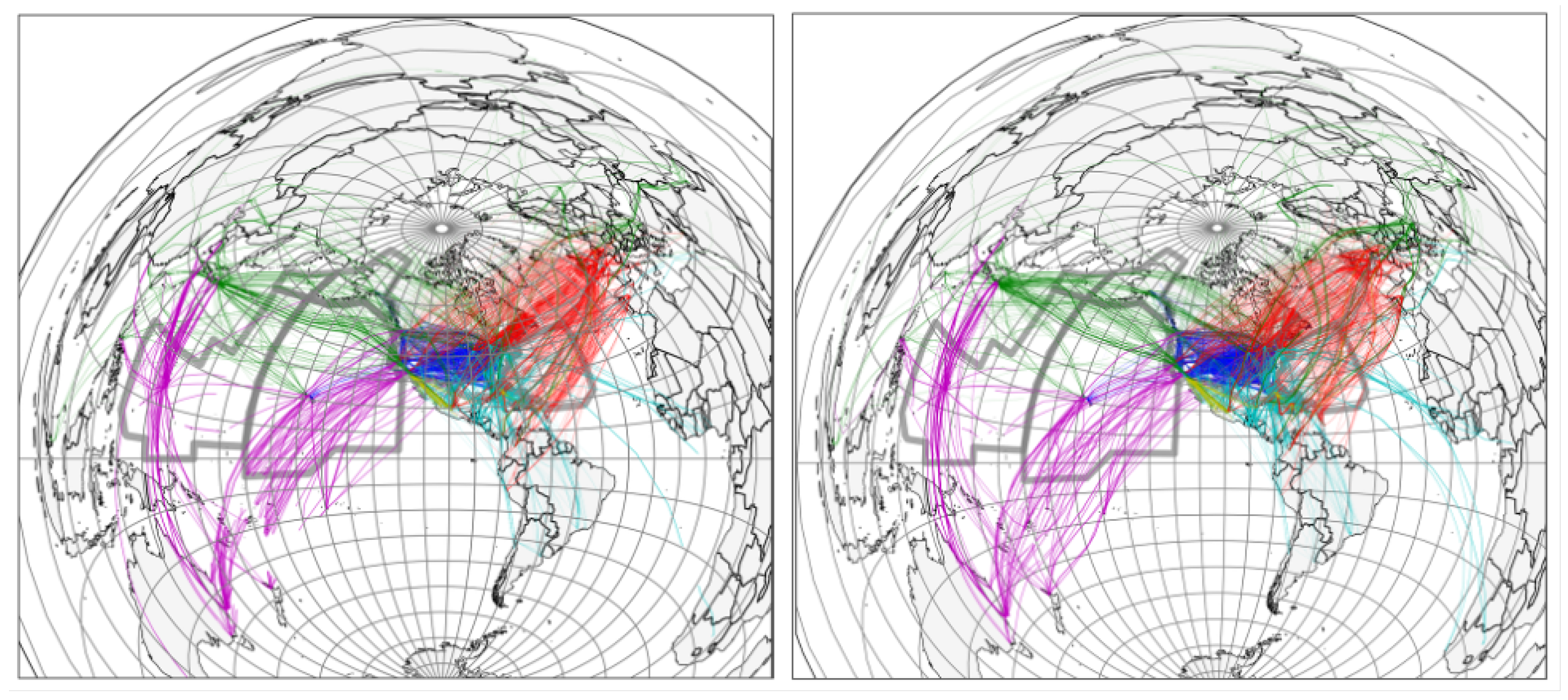
Figure 3 illustrates the structure of the United States–centered ATN for representative days in October 2019 and October 2023. The U.S. ATN exhibits a dense mesh of domestic connections, with the underlying geographic surface nearly obscured in the network visualization. The network expanded substantially from 2019 to 2023, comprising an average of 1068 airports per day in 2023, a more than 12% increase relative to 2019. This growth reflects a widening set of destinations associated with flights departing from, arriving in, or overflying the United States, indicating a strengthening of U.S.-centered connectivity within the global ATN.
Approximately 93% of flights in the U.S. FIR were arrival/departure flight of domestic airports, with overflights accounting for the remaining 7%. This composition highlights the United States’ dual role as a dense internal market and a pivotal anchor for intercontinental flows.
Table 4 and
Table 5 summarize airport rankings in the US–Global models. In both 2019 and 2023, U.S. hubs dominated the top positions across all centrality measures. Dallas/Fort Worth International Airport (KDFW), Hartsfield–Jackson Atlanta International Airport (KATL), Chicago O’Hare International Airport (KORD), Denver International Airport (KDEN), and Charlotte Douglas International Airport (KCLT) consistently appeared as the most important nodes, indicating high structural stability in the core U.S. ATN despite the COVID-19 shock. The dominance of U.S. airports such as KDFW, KATL, and KORD across all centrality measures reflects the hub-centric operational strategies of major U.S. legacy carriers. These airports function as primary consolidation nodes within highly optimized hub-and-spoke systems, enabling them to achieve disproportionately high intermediary roles in both domestic and global connectivity.
The scale of U.S. connectivity with the global ATN also increased. The 2023 US–Global network encompassed an average of 2299 airports per day, over 6% more than in 2019, representing more than 80% of the global ATN’s nodes. While Western European airports continued to feature prominently, Eurasian hubs—most notably Istanbul Airport (LTFM)—rose in relative importance by 2023, signaling an incremental diversification of intermediary pathways rather than a displacement of established transatlantic structures.
Taken together, the U.S.-centered ATN is characterized by structural stability rooted in large domestic market scale, highly optimized hub-and-spoke carrier strategies, and a comparatively permissive regulatory environment. These factors sustain high centrality and robustness within the global network, while allowing emerging intermediary hubs to complement—but not fundamentally alter—the United States’ long-standing geoeconomic position as a primary anchor of global air transport connectivity.
4.3. Europe’s Connectivity Patterns via the Middle East
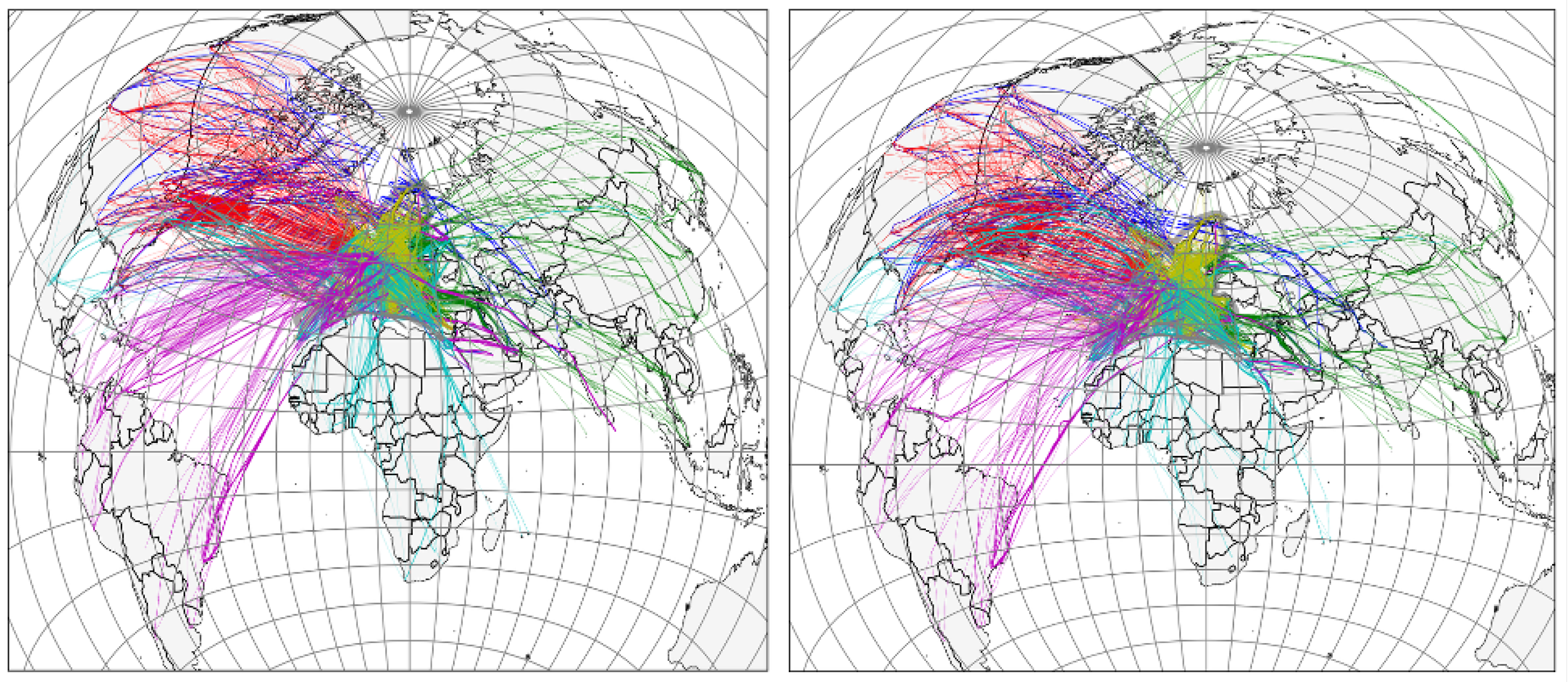
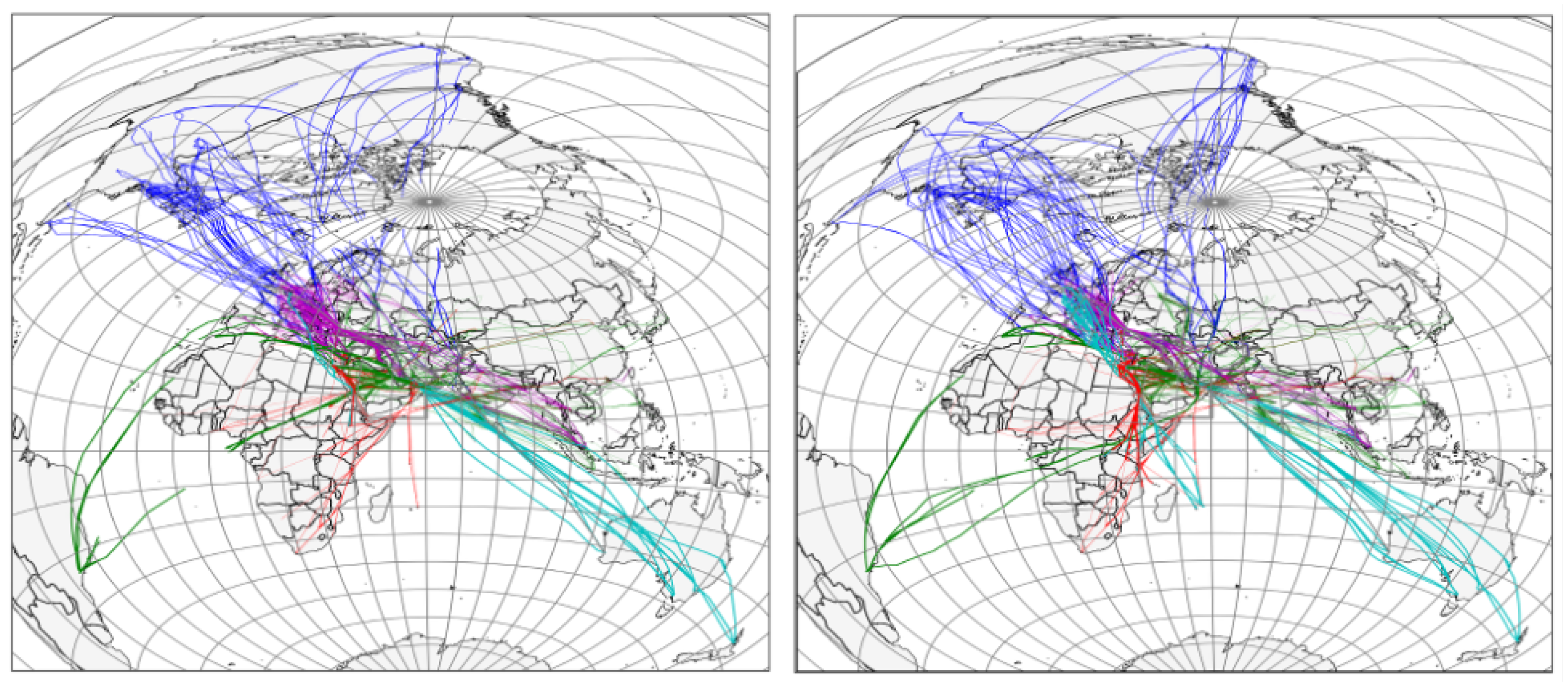
Figure 4 depicts the structure of the Europe-centered ATN based on flight trajectories for representative days in October 2019 and October 2023. Similar to the United States, the European ATN exhibits a dense mesh of intra-continental connections, with the underlying geographic map largely obscured by the concentration of network links. However, the number of airports included in the largest connected component decreased by approximately 5%, reaching an average of 525 airports per day in 2023, roughly half the scale of the U.S. ATN, indicating a post-pandemic weakening of intra-European connectivity.
In 2019, Amsterdam Airport Schiphol (EHAM) ranked first across all centrality metrics, reflecting its dominance within Europe. By 2023, Frankfurt Airport (EDDF) had overtaken EHAM in several measures, signaling a partial reordering of the European hub hierarchy. Notably, Istanbul Airport (LTFM) emerged consistently among the top-ranked nodes, underscoring the growing influence of extra-European hubs on Europe-centered connectivity.
Geopolitical disruptions are clearly reflected in changes to intermediary roles. Sheremetyevo International Airport (UUEE) in Moscow, which previously a moderate intermediary between Europe and the global network, fell outside the top 30 by 2023, reflecting geopolitical fragmentation following Russia’s invasion of Ukraine. Connectivity with East Asia also weakened: several East Asian airports—including Beijing Capital International Airport (ZBAA), Hong Kong International Airport (VHHH), and Narita International Airport (RJAA)—dropped in rank, with Incheon International Airport (RKSI) and Tokyo International Airport (RJTT) only marginally retaining upper-tier positions. Overall, Europe–East Asia connectivity became less prominent within the network structure.
Table 6 and
Table 7 summarize airport importance in the Europe–Global ATN. Despite the contraction of intra-European connectivity, the Europe–Global network expanded slightly by about 2%, averaging 1939 airports per day in 2023—roughly 84% of the U.S.–Global network. While connections with the eastern United States remained stable, the mediation structure shifted: EHAM and Paris Charles de Gaulle Airport (LFPG) declined in relative importance, whereas Istanbul Airport (LTFM), Dubai International Airport (OMDB), and Hamad International Airport (OTHH) emerged as key intermediaries linking Europe to the global ATN.
Taken together, from a geoeconomic perspective, Europe’s global connectivity is increasingly routed through Middle Eastern hubs rather than being internally anchored. Intra-European cohesion weakened post-pandemic, but access to global passenger and cargo flows has been maintained, and in some respects enhanced, via strategically positioned extra-European intermediaries. London Heathrow Airport (EGLL) continues to serve as a critical transatlantic gateway, linking Europe with the United States while interfacing with Middle Eastern transit routes. Overall, the European ATN is shifting from a densely integrated internal network toward a more geopolitically contingent structure shaped by external intermediary hubs.
4.4. Structural Shifts in Middle Eastern Air Transportation Networks
In defining Middle Eastern controlled airspace, Turkish airspace is treated separately. While Turkey is culturally and geographically linked to the Middle East, it is operationally part of EUROCONTROL, and Turkish airports are excluded from the regional airspace model to maintain institutional consistency. Nevertheless, airports such as Istanbul Airport (LTFM) function as exogenous but critical intermediaries, mediating flows between Europe, the Middle East, and Asia.
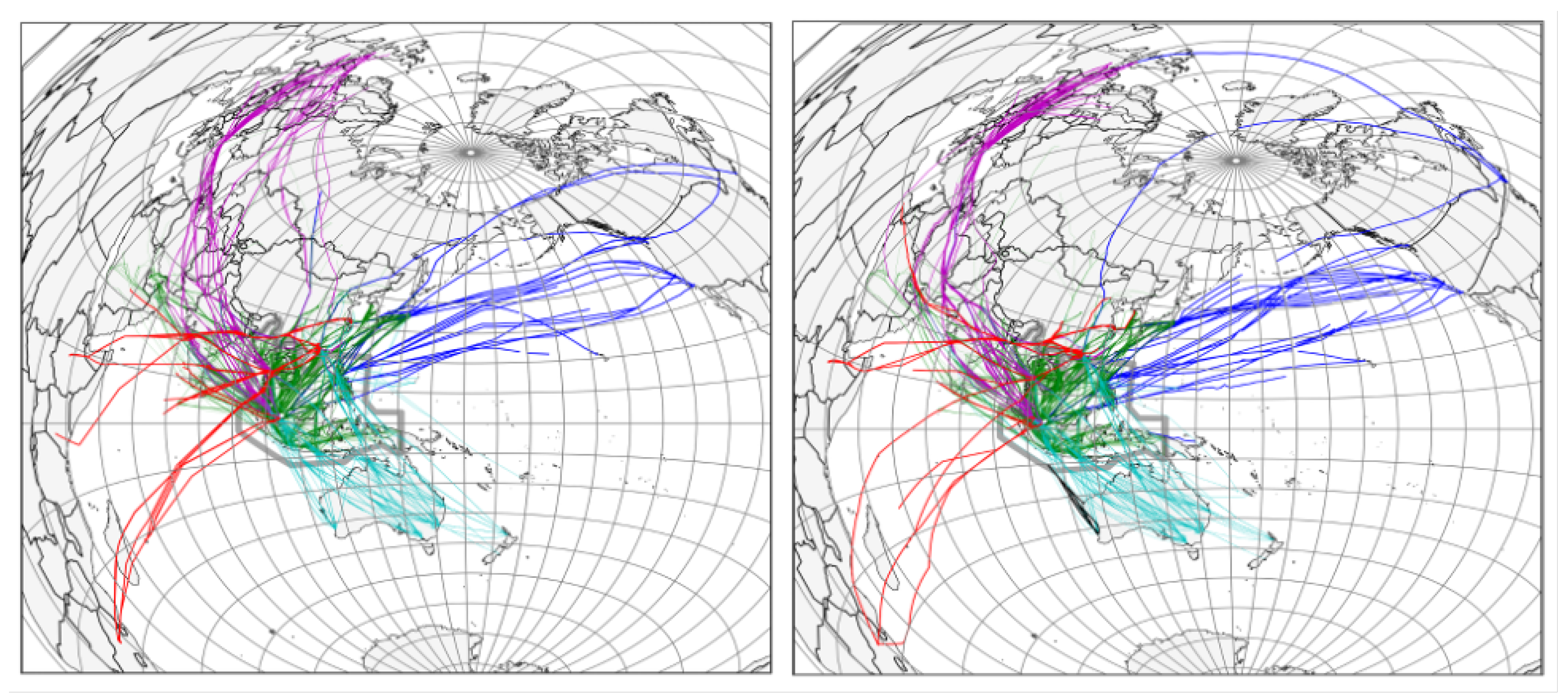
Figure 5 shows the Middle Eastern ATN for representative days in October 2019 and October 2023. The largest connected component expanded slightly by about 1%, reaching an average of 317 airports per day in 2023. A defining feature of this network is the high share of overflights, which increased from roughly 65% in 2019 to 75% in 2023, reflecting the region’s role as a global transit corridor.
Across both years, LTFM ranked first across all centrality measures, underscoring its role as a supra-regional hub despite lying outside formally defined Middle Eastern airspace. Dubai International Airport (OMDB) and Hamad International Airport (OTHH) consistently occupied top-tier positions, confirming their importance as core transit hubs. Other Turkish airports, including Antalya Airport (LTAI) and Sabiha Gökçen International Airport (LTFJ), also rank highly, illustrating the network’s dependence on peripheral nodes.
European hubs increasingly interface with the Middle East. Frankfurt Airport (EDDF) strengthened its position between 2019 and 2023, entering the top 20 across multiple metrics. London Heathrow Airport (EGLL), Amsterdam Airport Schiphol (EHAM), and Paris Charles de Gaulle Airport (LFPG) also appear within the top 20, mediated largely by Turkish gateways. By contrast, Ben Gurion International Airport (LLBG), previously ranked within the top six, declined significantly by 2023, likely reflecting regional instability, including the 7 October 2023 Hamas attack.
Because overflight traffic dominates, the Middle Eastern ATN primarily captures structural transit flows rather than intra-regional connectivity. Major hubs such as Dubai (OMDB), Doha (OTHH), and Istanbul (LTFM) function primarily as international transit points, reflecting airline routing strategies and overflight permissions. This pattern is further reinforced by the relatively underdeveloped regional air transport networks across parts of the Middle East and Africa, which limits dense intra-regional connectivity and concentrates transit through a small number of global hubs. Turkish airports, though formally excluded, emerge as indispensable external hubs anchoring Middle Eastern airspace in the global network. This intermediary prominence is further shaped by geoeconomic factors, including strong state involvement in hub carrier development, coordinated hub-oriented infrastructure investment, selective liberalization of air service agreements, and sustained policy support for long-haul transit operations—features that characterize Gulf hub strategies and are partially echoed in Turkey’s aviation development.
Table 8 and
Table 9 summarize airport importance in the Middle East–Global ATN. Between 2019 and 2023, this network expanded by roughly 20%, highlighting the growing reliance of global air transport on Middle Eastern corridors. European, North American, and Middle Eastern hubs remain central, while East Asian nodes such as Incheon International Airport (RKSI) and Shanghai Pudong International Airport (ZSPD) moved into the top ten. Conversely, Sheremetyevo International Airport (UUEE) dropped out entirely following Russia’s invasion of Ukraine, as many long-haul routes were rerouted to avoid Russian airspace.
Taken together, these patterns indicate that the Middle Eastern ATN derives its structural prominence not from internal market integration but from its function as a geoeconomic intermediary under conditions of constrained global routing. State-backed carrier strategies, coordinated hub-and-spoke development, liberal air service agreements, and sustained policy support for long-haul transit operations collectively elevate the betweenness and PageRank centrality of a small number of hubs. At the same time, geopolitical disruptions and airspace restrictions—most notably following Russia’s invasion of Ukraine—have amplified the region’s role as a global hinge connecting Europe, Asia, and the others. The Middle Eastern ATN thus exemplifies a form of functional resilience rooted in transit dominance rather than network density, positioning the region as a critical mediator in the evolving architecture of global air transport and supply chains.
4.5. Structural Marginality of ASEAN and India in Global Air Connectivity
Figure 6 illustrates the structure of the ASEAN regional air transport for representative days in October 2019 and October 2023. The scale of the ATN traversing ASEAN-controlled airspace contracted by approximately 13% over this period, reaching an average of 246 airports per day in 2023. Despite ASEAN’s extensive geographic coverage, including major portions of the South China Sea and adjacent Indian Ocean airspace, overflight-only traffic accounted for only about 6.5% of total flights. This contrasts sharply with regions such as the Middle East, indicating that the ASEAN ATN is structurally oriented toward origin–destination traffic rather than functioning as a global transit corridor.
Within the regional network, major Southeast Asian airports—including Singapore Changi Airport (WSSS), Soekarno–Hatta International Airport (WIII), Kuala Lumpur International Airport (WMKK), Suvarnabhumi Airport (VTBS), and Ninoy Aquino International Airport (RPLL)—consistently occupied central positions in both 2019 and 2023. Strong and persistent linkages with East Asian hubs such as Hong Kong International Airport (VHHH), Guangzhou Baiyun International Airport (ZGGG), Taiwan Taoyuan International Airport (RCTP), and Incheon International Airport (RKSI) further characterize the ASEAN ATN as a regionally cohesive but externally coupled system. From a geoeconomic perspective, this configuration reflects ASEAN’s role as an integrated production and consumption space embedded within East Asian manufacturing, logistics, and supply-chain networks.
The ASEAN–Global ATN experienced a more moderate contraction of approximately 3% in 2023 relative to 2019, resulting in an average of 1354 airports per day. As shown in
Table 10 and
Table 11, ASEAN’s global connectivity in both periods was mediated primarily through European and Middle Eastern hubs. Notably, the importance of Middle Eastern airports increased further in 2023, indicating a growing reliance on westward long-haul corridors routed via that region.
Several Chinese and Southeast Asian airports, including VHHH, Beijing Capital International Airport (ZBAA), and VTBS, declined in relative importance in 2023. Sheremetyevo International Airport (UUEE), which ranked within the top ten in 2019, lost its intermediary role by 2023, consistent with the reconfiguration of global air routes following widespread avoidance of Russian airspace. Conversely, Sydney Kingsford Smith Airport (YSSY) and Indira Gandhi International Airport (VIDP) gained modest prominence as intermediary nodes, indicating limited diversification of ASEAN’s external linkages toward Australia and South Asia. However, these shifts did not offset the overall contraction of the ASEAN–Global network nor alter ASEAN’s peripheral position within the global ATN.
Taken together, the ASEAN ATN exhibits a form of structural marginality that is not rooted in low traffic volumes but in network function and governance. ASEAN air connectivity is optimized for regional origin–destination demand and integration into East Asian production networks, rather than for long-haul transit or intercontinental mediation. Fragmented regulatory regimes, the absence of a unified ASEAN-wide hub strategy, and limited state-backed development of global transfer hubs constrain the region’s ability to translate economic scale into network centrality. As a result, ASEAN’s integration into global value chains is increasingly mediated by extra-regional hubs—most prominently in the Middle East—rather than by direct intercontinental connectivity.
India, despite rapid economic growth and favorable geography, remains similarly peripheral in topological terms. The persistent marginality of Indian airports highlights a broader geoeconomic tension between economic expansion and aviation-network centrality, underscoring that market size alone is insufficient to generate global intermediary power without coordinated regulatory, infrastructural, and carrier-level strategies.
4.6. China’s Selective Connectivity Strategy
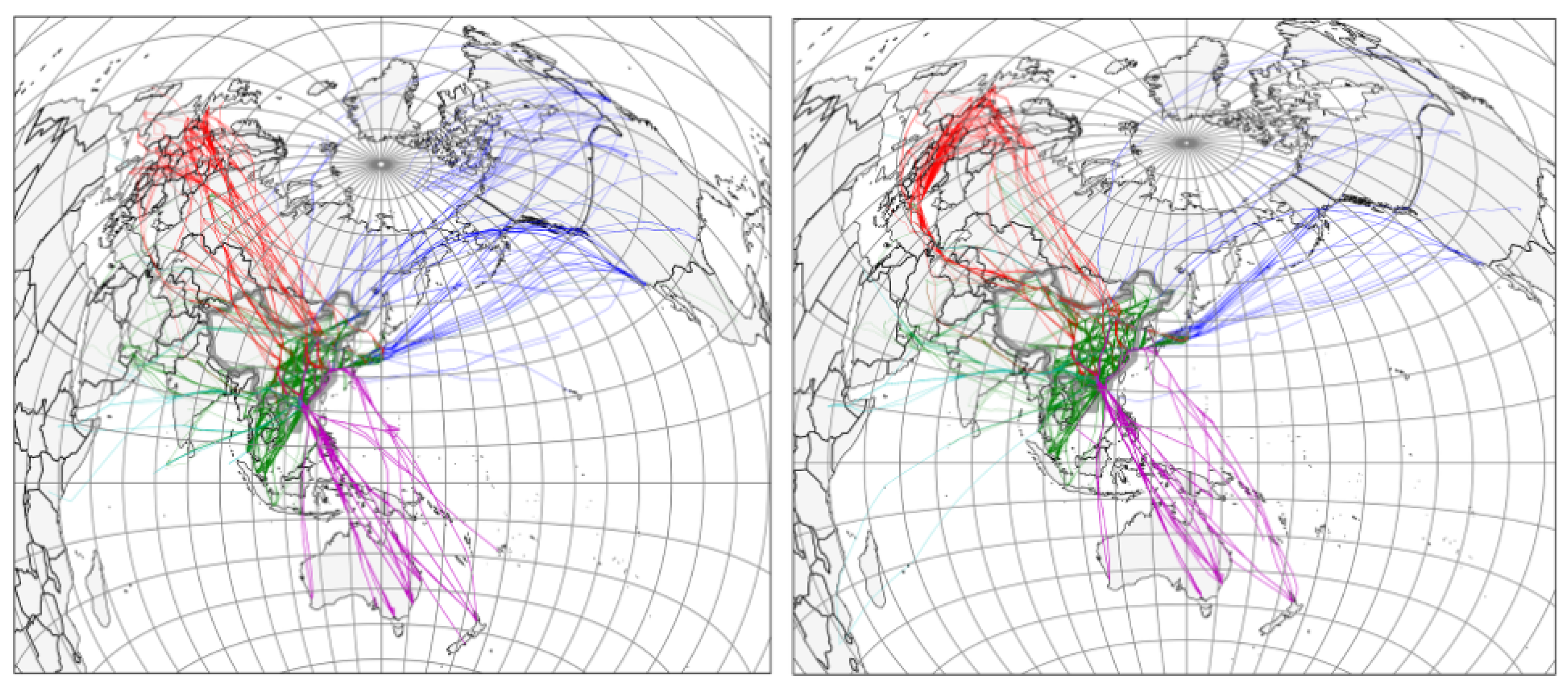
Figure 7 illustrates the structure of the China ATN through flight trajectories for representative days in October 2019 and October 2023. The scale of the ATN traversing the Chinese FIR expanded modestly by approximately 2% in the post-pandemic period, reaching an average of 258 airports per day in 2023. Despite this increase, the overall size of the China ATN remains limited, corresponding to only about 24% of the scale of the U.S. network. This persistent gap highlights the comparatively constrained spatial footprint of China-centered air transport connectivity.
In 2019, international gateway airports located at the periphery of mainland China—most notably Hong Kong International Airport (VHHH), Incheon International Airport (RKSI), and Taiwan Taoyuan International Airport (RCTP)—ranked highly across all centrality measures, reflecting their function as primary interfaces between China and the regional and global ATN. By 2023, the internal structure of the Chinese ATN became more strongly centered on Shanghai Pudong International Airport (ZSPD) and Guangzhou Baiyun International Airport (ZGGG), while international connectivity was increasingly maintained through a limited set of external gateways, including VHHH, RKSI, and RCTP. This configuration indicates a shift toward a hybrid network structure characterized by a reinforced domestic backbone combined with selectively preserved international access points.
The China–Global ATN further underscores this selective connectivity pattern. Between 2019 and 2023, the China–Global network contracted by approximately 9%, declining to an average of 1503 airports per day in 2023.
Table 12 and
Table 13 summarize the corresponding rankings of airport importance. Quantitatively, this contraction signals a relative weakening of China’s integration into the global ATN during the post-pandemic period. In 2019, China’s global connectivity was mediated through a relatively distributed set of hubs across North America, the Middle East, Europe, and East Asia, forming a multi-centered mediation structure. By 2023, however, several U.S. hubs—notably Dallas/Fort Worth International Airport (KDFW) and Hartsfield–Jackson Atlanta International Airport (KATL)—had fallen out of the upper tier of the China–Global network, and the relative importance of VHHH also declined. In contrast, Middle Eastern hubs, particularly Istanbul Airport (LTFM), emerged as dominant intermediary nodes, while European hubs such as Frankfurt Airport (EDDF), Amsterdam Airport Schiphol (EHAM), and Paris Charles de Gaulle Airport (LFPG) increased their relative prominence.
Geopolitical fragmentation further reshaped this mediation structure. In 2019, Sheremetyevo International Airport (UUEE) ranked ninth in PageRank, indicating a non-negligible intermediary role in China’s global connectivity. By 2023, UUEE disappeared from the upper rankings, consistent with the large-scale avoidance of Russian airspace. Instead, Toronto Pearson International Airport (CYYZ) entered the top ten in PageRank, suggesting a partial reconfiguration of trans-Pacific and trans-Atlantic routing patterns.
Overall, the China-centered ATN exhibits a form of selective connectivity that differs fundamentally from both the U.S. expansionary model and the Middle Eastern transit-oriented model. Rather than maximizing intermediary centrality within the global network, China’s air transport system prioritizes a strong domestic backbone while maintaining relatively limited international gateways. This configuration can be interpreted as the outcome of multiple, overlapping factors. On the one hand, it reflects long-standing regulatory controls, state-led aviation policy, and a preference for maintaining controllability and systemic resilience under conditions of geopolitical uncertainty. On the other hand, pandemic-era border restrictions, prolonged international travel controls, airline financial constraints, and the gradual resumption of bilateral aviation agreements have likely reinforced this inward-oriented structure, particularly during the study period.
As a result, major Chinese airports retain high domestic accessibility but exhibit a reduced intermediary role in the global ATN. From a geoeconomic perspective, this pattern should therefore be understood not solely as a deliberate strategic reconfiguration, but as a constrained adaptation in which policy intent and external shocks jointly shape network outcomes. The increasing mediation of China’s global air connectivity through external hubs—especially in the Middle East and Europe—highlights how structural constraints and strategic preferences interact in reconfiguring China’s position within the global ATN.
4.7. Japan’s Retreat in Both Domestic and Global Connectivity
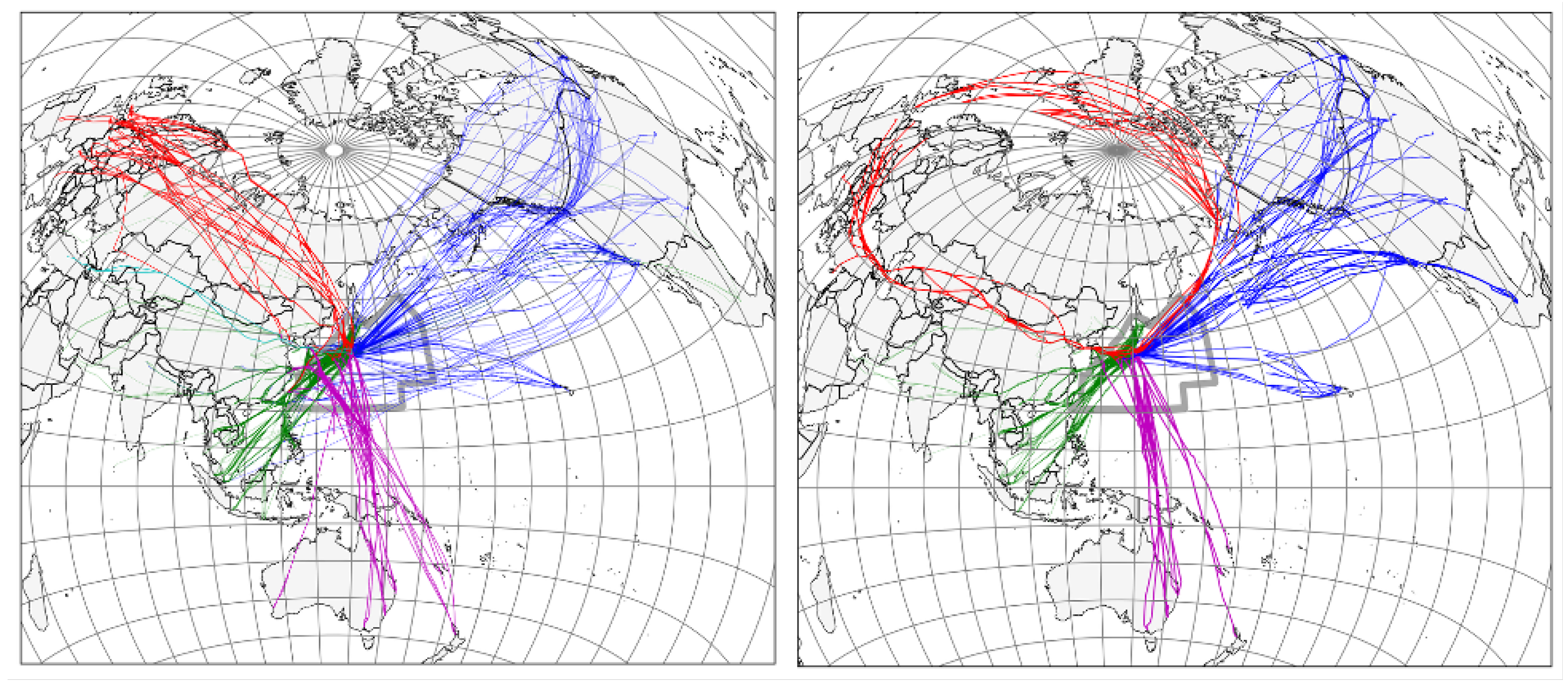
Figure 8 compares the structure of the Japan ATN based on flight trajectories observed on representative days in October 2019 and October 2023. A salient structural constraint shaping the post-pandemic configuration is the continued avoidance of Russian airspace, which has altered long-haul routing patterns across Eurasia. Between 2019 and 2023, the scale of the ATN traversing the Japanese (Fukuoka) FIR, defined as the maximum number of airports included in the daily network, declined by approximately 5% to an average of 136 airports per day. This level corresponds to only about 13% of the U.S. ATN and roughly 53% of the Chinese ATN over the same period, underscoring the relatively limited spatial footprint of air traffic associated with Japanese airspace.
Across both years, Tokyo International Airport (Haneda, RJTT), Narita International Airport (RJAA), Incheon International Airport (RKSI), and Kansai International Airport (RJBB) consistently ranked highly across centrality measures, reflecting their enduring roles within Northeast Asian connectivity. In 2023, however, Gimhae International Airport (Busan, RKPK) and Ted Stevens Anchorage International Airport (PANC) entered the top-ten rankings, while Shanghai Pudong International Airport (ZSPD) and Hong Kong International Airport (VHHH) exited. This shift is consistent with the delayed recovery of air services between Japan and China, as well as with a partial reconfiguration of trans-Pacific and Northeast Asian routing that favors alternative intermediate nodes.
The Japan–Global network, capturing connectivity between Japan and the rest of the world, contracted by approximately 8% from 2019 to 2023, declining to an average of 1404 airports per day. In relative terms, this scale amounts to about 61% of that observed for the United States and approximately 93% of China, indicating a weakening of Japan’s integration into the global ATN.
Table 14 and
Table 15 summarize changes in airport importance across centrality measures. In the Japan–Global 2019 network, connectivity was strongly mediated by major U.S. hubs, including Dallas Fort Worth International Airport (KDFW), Chicago O’Hare International Airport (KORD), and Los Angeles International Airport (KLAX). RJAA functioned as Japan’s primary global gateway, ranking first in Closeness centrality and anchoring trans-Pacific and trans-Atlantic connections. By 2023, this structure had shifted markedly. The relative importance of U.S. hubs had declined, and RJAA fell to fourteenth in Closeness centrality. In contrast, RKSI ranked first in Closeness, effectively assuming the role of Japan’s principal access point to the global ATN. Given that overflights within the Japanese FIR accounted for roughly 10% of total traffic in both years, this shift cannot be explained by changes in overflight volume alone. Rather, it reflects a contraction of U.S.-origin services linked to RJAA and a growing reliance on connectivity mediated via RKSI.
At the same time, Istanbul Airport (LTFM) emerged as a key intermediary in 2023, ranking first in Betweenness and second in both Degree and PageRank. This rise mirrors a broader geoeconomic reorientation of global air transport toward Eurasian transit hubs in the Middle East, driven by the need to bypass Russian airspace following the invasion of Ukraine. From this perspective, Japan’s long-haul connectivity has become increasingly dependent on external transit nodes rather than domestically anchored gateways.
Taken together, the Japan-centered ATN illustrates a contraction in both domestic scale and global intermediary function. Unlike the selective connectivity observed in China or the transit-oriented expansion of the Middle East, Japan’s network evolution is characterized by a decline in gateway centrality without a compensating increase in intermediary roles. This pattern emerges from a combination of structural constraints and policy-mediated adjustments rather than from a single, clearly articulated strategic reorientation. Pandemic-era border controls, prolonged bilateral aviation negotiations, and airline-level financial pressures significantly reduced international connectivity during the study period. In parallel, the redeployment of U.S. carrier services from RJAA to RJTT, together with geopolitical constraints affecting Eurasian overflight and routing, further limited Japan’s capacity to function as an intercontinental connector. These factors collectively constrained Japan’s ability to leverage its geographic position within the global ATN.
From a geoeconomic perspective, Japan’s diminished centrality should therefore be interpreted as a constrained adaptation rather than a deliberate withdrawal from intermediary roles. The resulting erosion of gateway and connector functions has implications for Japan’s position within air transport–dependent supply chains, highlighting how external shocks and structural limitations can reshape geoeconomic roles even in advanced aviation markets.
5. Discussion: Geoeconomic Perspectives on Air Transport Networks and Novel Insights
5.1. Structural Change and Robustness of Air Transport Networks
This subsection examines structural change and robustness in global and regional ATNs from a geoeconomic perspective, focusing on how post–COVID-19 reconfiguration has altered not only connectivity patterns but also the vulnerability of air transport supply chains. While the robustness analysis in this subsection is conducted on regional ATN models, these results are not interpreted as direct measures of geopolitical interaction at the domestic scale. Rather, regional robustness is examined to characterize the internal structural conditions—such as hub substitutability and redundancy—that shape each region’s capacity to sustain and support inter-continental and inter-regional connectivity. Accordingly, the geoeconomic implications discussed here are understood as conditional factors influencing global and inter-regional network resilience, rather than as outcomes driven by domestic traffic volumes. Building on the network definitions introduced in
Section 4, the analysis integrates topological characteristics with robustness indicators to capture dimensions of systemic risk that cannot be identified through centrality measures alone. It should be noted that topological fragmentation does not necessarily imply the immediate failure of essential air transport functions, as prioritized or high-capacity corridors may continue to operate. The robustness analysis therefore captures structural vulnerability and redundancy loss, rather than traffic-level continuity.
Beyond identifying structural shifts based on Degree, Betweenness, Closeness, and PageRank centrality, we evaluate network robustness through a targeted node-removal analysis. For each regional ATN in 2023, airports are sequentially removed in descending order of importance according to each centrality metric, and the critical removal rate —defined as the fraction of removed nodes at which the LCC collapses abruptly—is calculated. This framework enables an evaluation of whether post-pandemic recovery has been achieved through diversified connectivity structures or through renewed dependence on a limited number of strategic hub airports. From a geoeconomic perspective, the latter implies efficiency gains accompanied by reduced redundancy, increasing exposure to node-specific shocks that may propagate across global supply chains.
Table 16 reports the size of the LCC and the corresponding values of
for major regional air transport networkATNs in 2023. The global network exhibits the largest LCC, comprising 2857 airports, followed by the United States with 1068 airports. Europe occupies an intermediate position, while China, ASEAN, the Middle East, and Japan form comparatively smaller networks. These differences suggest varying degrees of spatial concentration and hub dependence across regions.
Despite its scale, the global network exhibits low robustness under Betweenness- and Closeness-based removal, with values of approximately 2–3%. This indicates strong reliance on a small number of airports that mediate intercontinental connectivity, highlighting the geoeconomic importance—and fragility—of transcontinental transit hubs.
The U.S. network displays consistently high robustness across all centrality measures, with values ranging from approximately 5% to 10%. This reflects a distributed hub-and-spoke configuration in which multiple major hubs perform partially substitutable functions, allowing the network to maintain connectivity even when individual airports experience disruptions. The European network, although smaller in scale, demonstrates similarly high robustness, particularly in Closeness and Betweenness, supported by dense regional connectivity and abundant alternative routing options.
China also exhibits relatively high robustness, reaching for Closeness, comparable to Europe. This robustness appears to be sustained primarily through a dense domestic trunk network, indicating an inward-oriented resilience that is less dependent on international intermediary functions.
In contrast, the Middle East, ASEAN, and Japan all record low values of , generally below 5%. In the Middle East, extreme concentration on a small number of super-hub airports increases the risk of rapid network fragmentation. ASEAN’s vulnerability reflects structural dependence on external hubs for long-haul connectivity, while Japan’s limited hub differentiation constrains its capacity to absorb targeted disruptions.
Overall, these results demonstrate that robustness in ATNs is not determined solely by network size but depends critically on the distribution of intermediary functions and the degree of hub substitutability. From a geoeconomic perspective, post-pandemic re-centralization has enhanced efficiency in some regions while simultaneously increasing exposure to strategic disruption. This underscores the importance of incorporating structural robustness, captured by , into assessments of air transport resilience in an era characterized by geopolitical fragmentation and recurrent global shocks.
5.2. Geoeconomic Implications of the Reconfiguration of Air Transport Supply Chains
This subsection synthesizes the results of
Section 4.1,
Section 4.2,
Section 4.3 and
Section 5.1 to examine how the post-pandemic reconfiguration of ATNs has reshaped air transport–based supply chains from a geoeconomic perspective. By comparing 2019 and 2023, the analysis captures the combined effects of the COVID-19 shock and subsequent geopolitical disruptions.
At the global scale, the ATN expanded by approximately 8% between 2019 and 2023, indicating a quantitative recovery of air transport connectivity. This recovery, however, was accompanied by a qualitative transformation in network structure. Rather than reverting to its pre-pandemic configuration, the global ATN experienced a redistribution of intermediary functions, altering the spatial allocation of connectivity, control, and vulnerability within air transport supply chains.
A central structural shift is the relative decline of the United States as the dominant global intermediary and the concurrent rise of Middle Eastern hubs, most notably Istanbul Airport (LTFM) and Dubai International Airport (OMDB). This does not imply an absolute weakening of the U.S. ATN. The U.S. network remains exceptionally dense, particularly in its domestic segment, where tightly meshed connectivity produces high internal robustness. A similar pattern characterizes Europe, where dense intra-regional links sustain a resilient internal structure. In contrast, non-Western regions continue to exhibit more hub-dependent and spatially uneven connectivity.
This asymmetry defines a persistent feature of the global ATN. Western regions maintain large-scale, internally robust networks, while their connections with non-Western regions rely on a limited number of high-centrality hubs. Notably, neither Japanese nor Chinese airports occupy dominant intermediary positions within the global ATN core. This structural imbalance implies that non-Western regions face higher dependency per international route, embedding systemic vulnerabilities in which disruptions at a small number of nodes can propagate disproportionately large shocks through air transport–dependent supply chains.
Within the Western bloc, the United States retains a uniquely resilient ATN, supported by dense domestic connectivity and strong transatlantic linkages. These patterns reflect not only economic exchanges but also long-standing transnational social ties associated with migration and diasporic communities, often conceptualized as “global householding”. Although U.S. immigration began to decline in 2025 for the first time since 1970 [
28], recent trends toward immigration restriction suggest a potential long-term erosion of these social foundations, with implications for the resilience of U.S.-centered air transport supply chains.
In Europe, the reconfiguration of intermediary roles is more pronounced. By 2023, LTFM emerges as the primary Middle Eastern hub penetrating the U.S.–global ATN, while Middle Eastern airports more broadly strengthen their intermediary presence across Europe. Traditional European hubs face structural constraints, including congestion, slot scarcity, labor disputes, and organizational rigidity, limiting strategic flexibility. In contrast, Middle Eastern carriers have expanded by leveraging geographical centrality, available hub capacity, state support, and open-skies policies. As a result, major European hubs such as London Heathrow Airport (EGLL), Frankfurt Airport (EDDF), Amsterdam Airport Schiphol (EHAM), and Paris Charles de Gaulle Airport (LFPG) increasingly compete with Middle Eastern hubs in intercontinental transfer markets.
EGLL exhibits a distinctive post-pandemic trajectory. Its intermediary centrality increased within both global and Western ATNs, closely associated with the reinforcement of air links between the United Kingdom following Brexit. Growing connectivity with India, Singapore, and Gulf hubs, particularly OMDB, reflects how historical, institutional, and linguistic ties facilitated the selective reconstruction of EGLL-centered air transport supply chains. Paradoxically, while competition among EU airports became increasingly inward-oriented, EGLL—now institutionally external to the EU—recovered its role as a major air cargo hub. This outcome suggests that institutional autonomy, rather than bloc membership alone, can enhance network adaptability and supply chain resilience.
Non-Western regions exhibit divergent trajectories. China expanded its domestic ATN while reducing international connectivity, indicating an inward-oriented restructuring of air transport supply chains. The China–global ATN shifted toward a more centralized Eurasian configuration, with LTFM emerging as a dominant intermediary. Although major Chinese airports retain high accessibility, their intermediary influence declined, signaling a strategic reorientation toward domestic consolidation rather than global brokerage.
Between 2019 and 2023, the Middle East consolidated its position as the core of global ATN restructuring. This process was reinforced by widespread avoidance of Russian airspace in 2023, which redirected Europe–East Asia traffic toward Middle Eastern corridors. As a result, the region effectively emerged as a new aerial passageway linking Europe and Asia. Istanbul (LTFM) and Turkish domestic airports play a critical functional role in this structure, reflecting network positioning rather than formal geopolitical classification.
In contrast, the ATNs of ASEAN countries and India remain limited in scale and structurally fragile. Despite India’s strong macroeconomic growth—with 6.5% GDP growth and its emergence as the world’s fourth-largest economy in 2025—its air transport connectivity remains underdeveloped, as reflected in its low ranking in economic complexity [
29]. This mismatch highlights a lag in air transport supply chain infrastructure. Japan presents an even starker case: both domestic and international ATN scales contracted. Whereas Narita International Airport (RJAA) functioned as a key intermediary between Asia and the United States in 2019, this role had largely shifted to Incheon International Airport (RKSI) by 2023.
Looking ahead, projected growth in Asia–Pacific air transport demand underscores the strategic importance of strengthening ATN-based supply chains. Enhancing network scale, throughput capacity, and institutional flexibility—while integrating passenger and cargo operations under both normal and disrupted conditions—will be essential for diversifying global supply chains and improving economic security. From a geoeconomic perspective, ATN configuration emerges not merely as a technical outcome, but as a central arena of strategic competition shaped by historical network structures, institutional choices, and geopolitical constraints [
30]. While air transport networks exhibit weekly and seasonal variability, the present study deliberately focuses on representative weekly snapshots in order to balance analytical scope, data resolution, and reproducibility.
6. Conclusions
This study has demonstrated that the evolution of global air transport networks before and after the COVID-19 pandemic can be meaningfully interpreted through a geoeconomic lens. By introducing Geoeconomics in Air Transport as an analytical framework, we have shown how standard network metrics can be linked to strategic interdependence, institutional constraints, and geopolitical positioning, rather than being treated solely as indicators of operational efficiency. The proposed framework provides a transparent and reproducible basis for interpreting structural changes in air transport systems across time and regions.
The contributions of this paper are threefold: (1) the conceptual integration of complex network analysis with geoeconomic interpretation, (2) a unified cross-scale empirical comparison of global and regional air transport networks, and (3) a geoeconomic assessment of robustness and vulnerability based on targeted node removal. Taken together, these contributions indicate that network size alone is an insufficient proxy for resilience, and that the concentration of intermediary functions constitutes a critical source of systemic vulnerability.
The empirical results demonstrate that post-pandemic recovery in global air transport has been quantitatively positive but structurally uneven. While North American and European ATNs remain large-scale, densely meshed, and internally robust, many regions outside these cores exhibit heightened dependence on a limited number of hub airports. Most notably, intermediary functions within the global ATN have shifted toward the Middle East, reflecting not only pandemic-induced restructuring but also persistent geopolitical constraints on airspace usage and route allocation.
These findings carry important implications for aviation policy and economic security. They suggest that strategies focused solely on traffic growth or hub expansion may inadvertently increase systemic vulnerability by reinforcing intermediary concentration. From a policy perspective, enhancing resilience requires diversification of gateway functions, preservation of alternative routing options, and investment in network redundancy rather than scale alone. Similarly, airline alliance strategies and bilateral aviation agreements should be evaluated not only in terms of market access but also with respect to their effects on intermediary dependence and exposure to geopolitical shocks. Viewed through a geoeconomic lens, air transport infrastructure thus constitutes a form of strategic economic infrastructure whose configuration directly shapes the robustness of global supply chains.
The core contribution of this study lies in showing that resilience and vulnerability in air transport systems cannot be inferred from traffic volumes or network size alone. Instead, they emerge from the spatial distribution of intermediary roles, the concentration of connectivity, and the robustness of network topology. These structural properties are, in turn, shaped by geopolitical conditions, institutional flexibility, and historical network configurations. Through a geoeconomic interpretation of network centrality and robustness, this study demonstrates that ATNs function not merely as transportation systems, but as mechanisms through which strategic economic interdependence is organized and contested. By framing air transport connectivity as a geoeconomic resource, the proposed analytical framework provides a reproducible and scalable approach for assessing how air transport–based supply chains respond to pandemics, geopolitical shocks, and airspace constraints. As global uncertainty intensifies, such network-based geoeconomic analysis becomes essential for understanding where systemic vulnerabilities concentrate and how economic security can be enhanced through diversification of intermediary functions.
Future research may extend this framework by incorporating weighted and multilayer networks, cargo-specific flows, and longer temporal horizons. The unweighted framework adopted here may partially obscure the prominence of cargo-specialized hubs such as Anchorage or Leipzig, whose strategic importance derives from high-capacity freight operations rather than dense passenger connectivity. Incorporating weighted or multilayer networks would allow future studies to disentangle structural centrality from traffic intensity and to more explicitly assess cargo-driven geoeconomic influence. Such extensions would further clarify the dynamic interaction between air transport infrastructure, geopolitical change, and the evolving architecture of global supply chains, reinforcing the relevance of Geoeconomics in Air Transport as a foundation for both academic inquiry and policy-oriented analysis. In this context, exploratory analyses using October 2024 data suggest that, while ongoing geopolitical developments influence specific routes and regional balances, the overarching structural patterns identified in this study remain qualitatively consistent and are not driven by short-term scheduling artifacts.