


Abstract
Normal shock pressure ratios in equilibrium air for Mach numbers up to 30 and altitudes to 300,000 feet are shown to be correlated by a simple power law which provides an accuracy of ±2%, thereby permitting direct calculation of corresponding enthalpy ratios accurate to ±1% without iteration; a slight change in power-law coefficients extends this capability to Mach 65. Temperature, density, and compressibility may be then found directly from tables for high temperature air. For Mach numbers up to at least 6, a linear approximation for specific heat provides direct solutions for post-shock state variables, while a complementary logarithmic model of the equation of state enables direct solutions for Mach numbers up to about 12. This approach, which provides accuracy within ±3% for all relevant variables in the practical flight corridor of vehicles at these low to moderate hypersonic Mach numbers, should prove useful in design and analysis because the algebraic solutions obtained need neither iteration or interpolation.
1. Introduction
Successful design of aerospace flight vehicles depends upon accurate prediction of the gas dynamic flow field over the body. Of major importance for hypersonic flight within the Earth’s atmosphere is the thermodynamic state of the air flow. Air is not a particularly simple gas, being a mixture of gases of moderate complexity including monatomic, diatomic, and triatomic components. The equation of state for air in chemical equilibrium under a broad range of conditions pertinent to aerospace applications is often presented on a Mollier chart [1] in the form p(h,s), ρ(h,s), or T(h,s). Another method of presenting thermodynamic data for high temperatures is in the form of tables [2,3]. A basic problem of interest for hypersonic flight vehicles is the state of the high-temperature air in the stagnation region behind the bow shock and this case is discussed here.
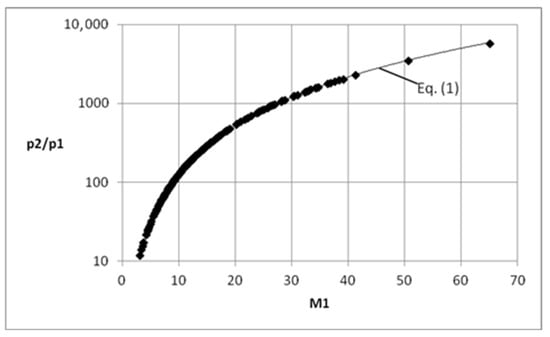
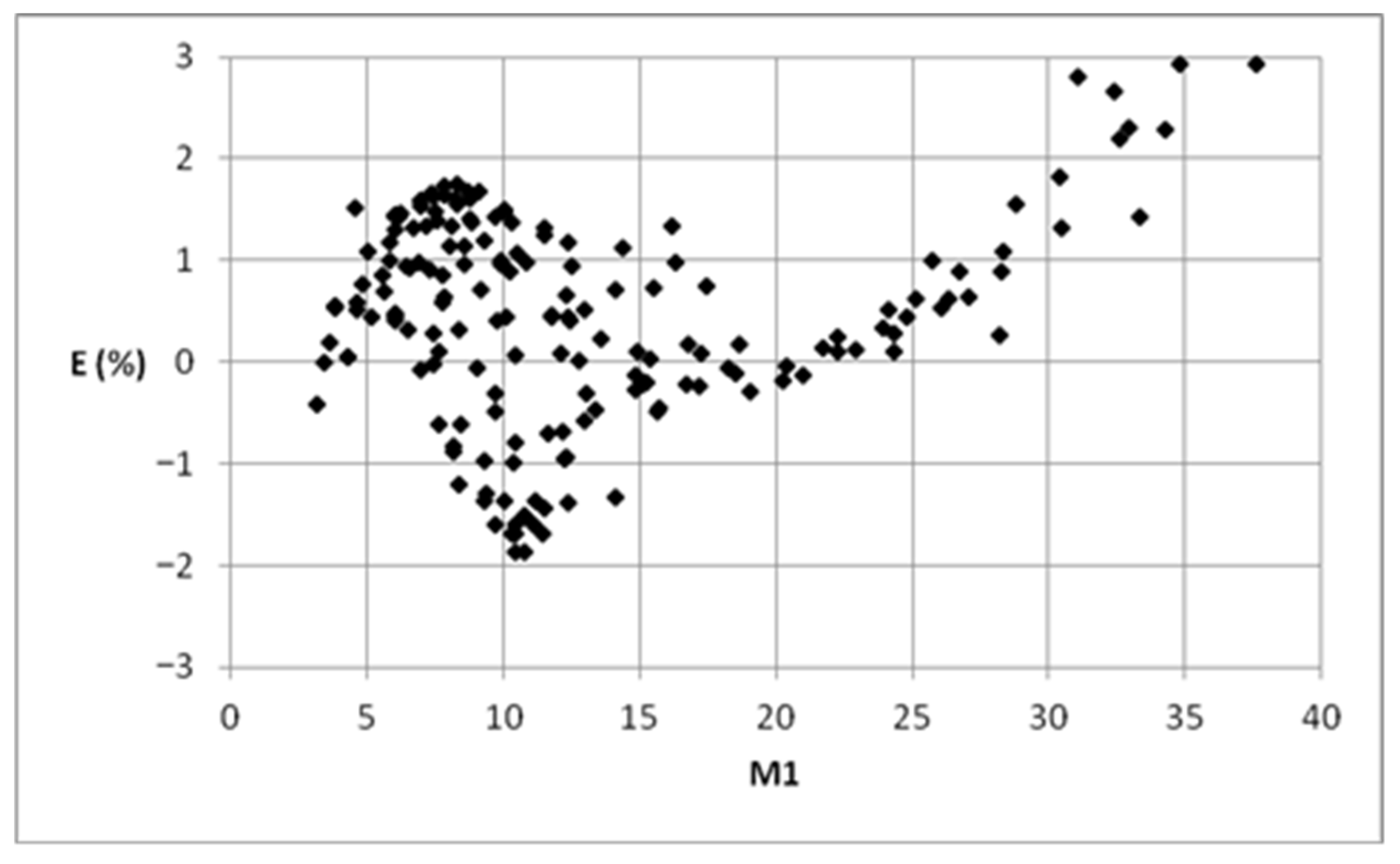
The velocity in the conservation equations for one-dimensional flow through a shock wave may be eliminated to form the Hugoniot equation relating state properties of the gas behind the shock. In the case of a perfect gas with constant composition and specific heats, the ratios of pressure, temperature, and density across the shock may be calculated directly in terms of upstream Mach number and the constant ratio of specific heats. However, if the gas is not perfect, the Hugoniot equation must be solved iteratively for each state condition and this becomes computationally cumbersome, especially for exploratory or preliminary design studies. Detailed calculations for properties across normal shocks in real air have been carried out by several authors, with results presented as tables and charts for specified flight speeds and altitudes [4,5,6,7,8]. NASA tabulations are most convenient because they are readily available online. Reviewing the results of three such reports [6,7,8] revealed 588 cases carried out for three different model atmospheres covering Mach number and altitude ranges of 3 < M1 < 65 and 36 kft < z < 299 kft. Extracting 187 representative cases and plotting the calculated values of pressure ratio across a normal shock resulted in the plot shown in Figure 1. The results indicate an astonishing insensitivity of p2/p1 to chemistry, altitude, and atmosphere model, with the data being well-correlated by Mach number alone according to the following relation:
Figure 1.
Calculated pressure ratios across a normal shock in equilibrium air for 183 cases in the Mach number and altitude ranges 3 < M1 < 65 and 36 kft < z < 300 kft [1,2,3].
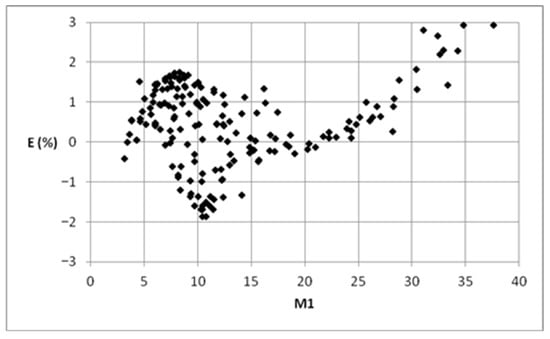
The accuracy of this simple power law correlation is shown in Figure 2, where the error between the calculations and the predictions of Equation (1) remain within ±2% up to M1 = 30. Beyond that, at altitudes above 250,000 ft, the error grows approximately linearly to about 6% at M1 = 65. Introducing a slightly altered power law, p2/p1 = 1.174 M12.033, at M1 = 30 will keep the error within the original bounds to M1 = 65.
Figure 2.
Error between the results of Equation (1) and the calculated values in Figure 1.
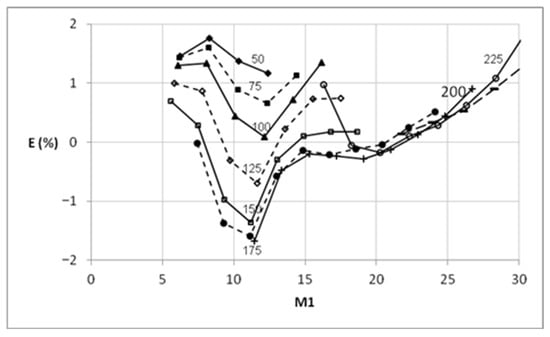
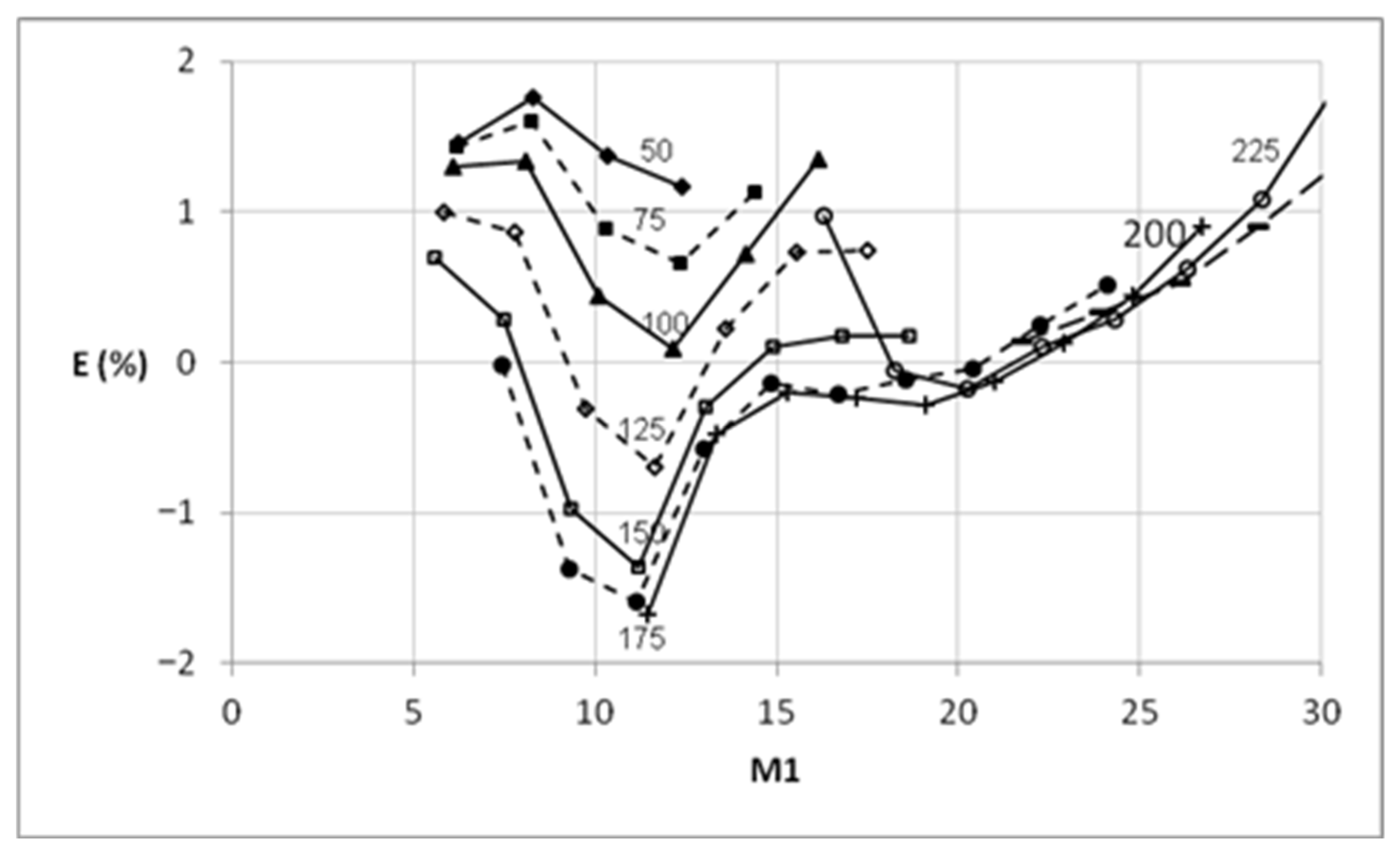
The apparent scatter in Figure 2 is not random but systematic, reflecting the real but subtle effects of chemistry, altitude, and atmospheric model. This is illustrated in Figure 3 for a subset of the total data appearing in Figure 2. Altitude dependence is clear and consistent, but the underlying causes are chemical effects. Although the error in the predicted pressure ratio is very small, it is highly variable. The variation of the error data points with M1, shown in Figure 3, is quite similar to the behavior of the corresponding values of the isentropic exponent data points, with both having local minima occurring around M1 = 10 and local maxima around M1 = 30.
Figure 3.
Variation of error in p2/p1 illustrating effect of altitude (kft), the values of which are denoted by the numbers indicated on the curves.
It will be demonstrated that the value of the correlation of Equation (1) is that it obviates the need for iterative solution of the Hugoniot equation. The enthalpy ratio may be found from the energy equation; this, together with the pressure ratio correlation, permits direct entry into thermodynamic charts [1] or tables [2,3] to determine the other state variables by interpolation. This approach reduces some of the computation necessary to determine post-shock and stagnation conditions at all hypersonic speeds.
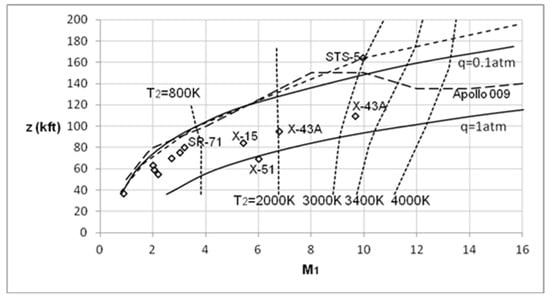
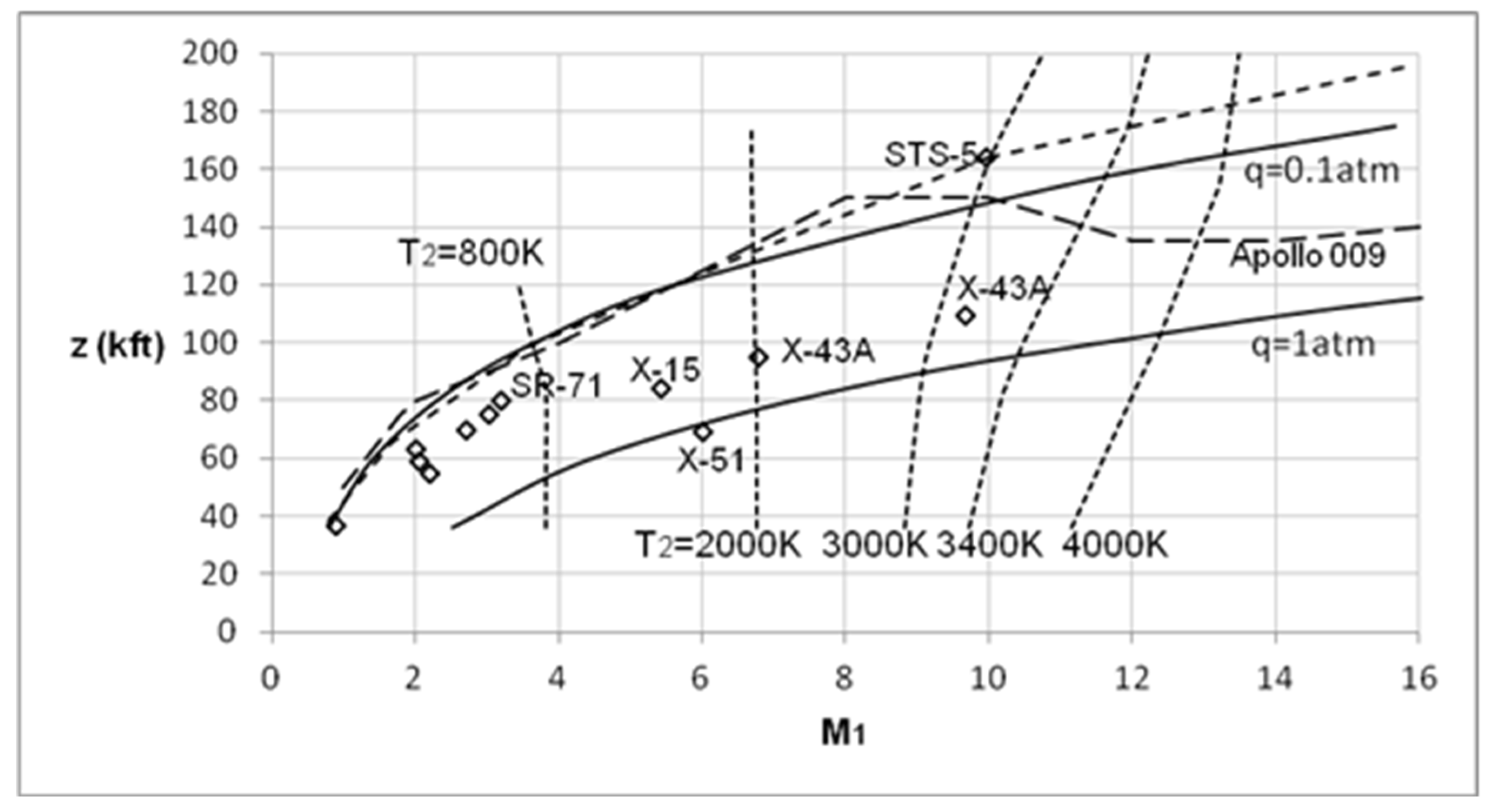
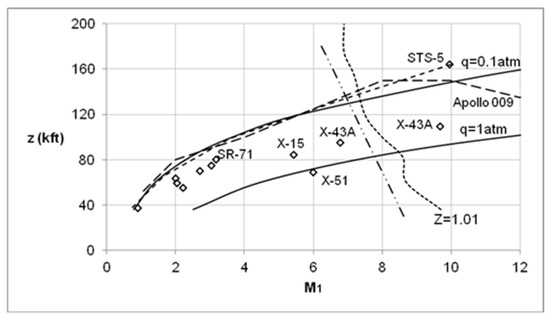
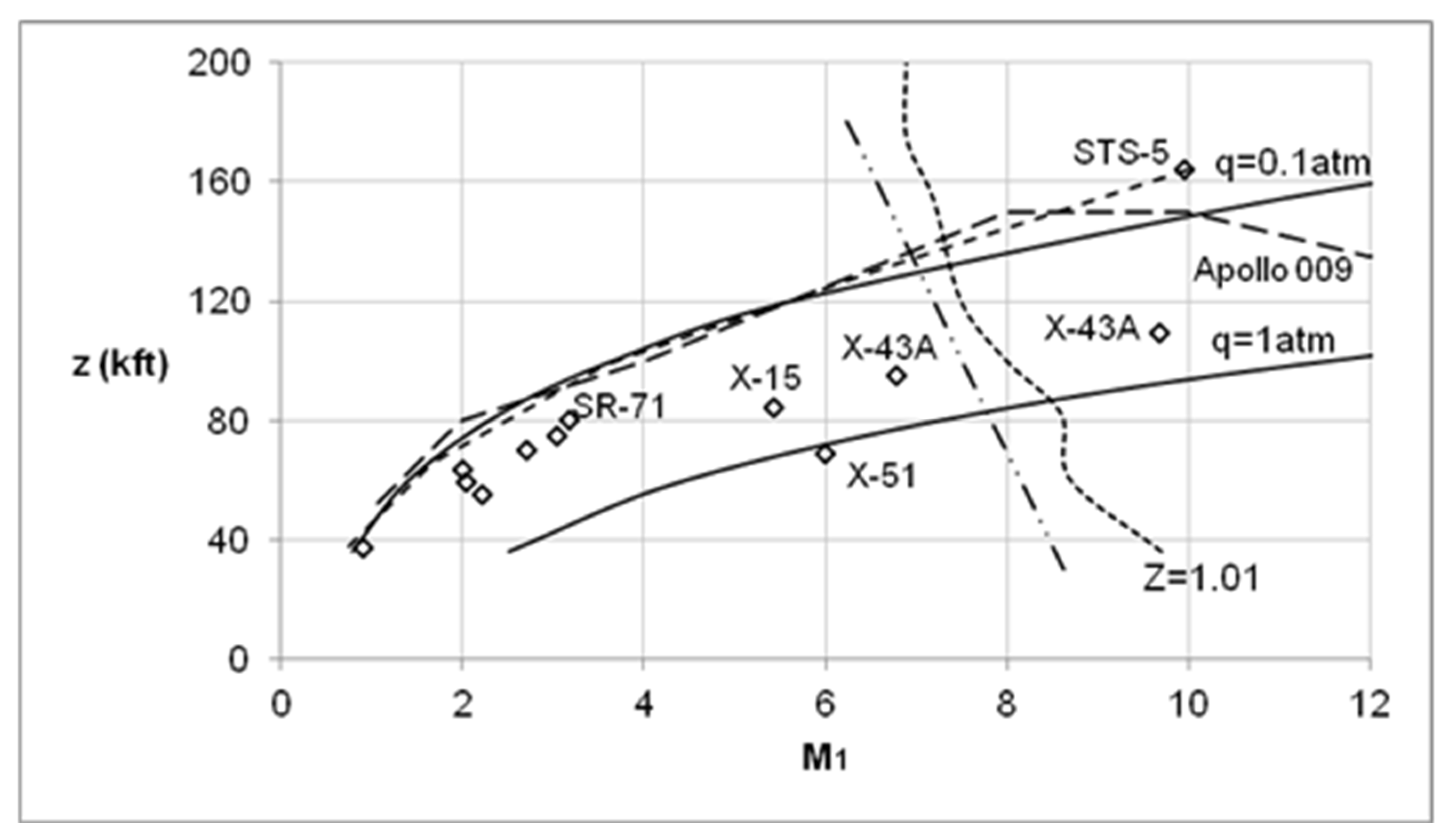
Additional simplifications of practical utility may be made by narrowing the flight envelope considered. A practical flight corridor is illustrated in Figure 4 in which the operating states for several hypersonic vehicles are shown. The corridor may be conveniently divided into three regimes: T < 800 K, where cp is approximately constant, 800 K < T2 < 2000 K where cp = cp(T), and 2000 K < T2 < 4000 K, where cp = cp(p,T). The first regime admits use of the classical normal shock relations [9] for a gas with constant γ.
Figure 4.
Shown here is a typical flight corridor, within which the operational states of several vehicles are shown as data symbols with the hypersonic vehicles identified. Solid lines depict dynamic pressure boundaries, dotted lines represent the loci of temperatures behind normal shocks, and dashed lines denote some vehicle trajectories.
In the second regime, the low hypersonic speed range, 4 < M < 6.5, further computational simplifications are possible. In this speed range, the maximum stagnation temperature is around 2000 K and, for flight in the practical dynamic pressure corridor of 0.1 atm < q < 1 atm, the pressure behind the shock is about twice the dynamic pressure, but cp is relatively insensitive to the pressure. Therefore, using the pressure correlation of Equation (1) coupled to a model for cp, which varies linearly with temperature, yields direct algebraic relations for computing the pressure, temperature, and density ratios behind a normal shock. These relations provide results within ±3% of the exact results for flight Mach numbers at least up to M1 = 6, and as high as 7 or 8 within the practical flight corridor, depending on the altitude.
One may then move on to moderate hypersonic Mach numbers, 8 < M1 < 12, where the temperature behind the shock is in the range 2000 K < T2 < 4000 K, by recognizing that the state equation for equilibrium air may be approximated by a relation of the form T = Tr(p)ln[h/hr(p)] for pressures behind the shock 0.04 < p2 < 10 atm. Once again, using Equation (1) for the pressure ratio and logarithmic approximation to the state equation yields algebraic solutions for the state of the gas behind the shock, which maintain an accuracy of ±3%.
2. Normal Shock Relations
2.1. The Hugoniot Equation
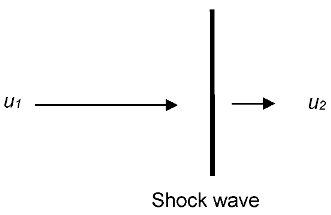
Regions of isentropic flow may be separated by discontinuities within which the entropy jumps. These are called shock waves, and the applicable one-dimensional flow equations may be rewritten for a streamline crossing a discontinuity. The shock is shown as a line normal to the flow in the sketch below, where subscript 1 denotes conditions upstream of the discontinuity and subscript 2 denotes conditions downstream.
Then, the changes, or jumps, in the flow variables across the shock wave are given by
Eliminating the velocity in the enthalpy jump equation yields
This last equation, often called the Hugoniot equation, relates thermodynamic state properties alone across a normal shock.
2.2. Constant Specific Heat
The jump conditions across a normal shock for an ideal gas with constant cp and γ may be found by using the perfect gas equation of state in the form ρ2/ρ1 = (p2/p1)(T1/T2) = 1/ε Substituting for p2/p1 and T2/T1 = h2/h1 from the momentum and energy equations, respectively, leads to a quadratic equation for ε. Solving for ε leads to the classical normal shock relations for air with γ = 1.4 as listed below [9]:
The standard atmospheric temperature in the stratosphere (35,000 ft to 85,000 ft altitude) is T1~217 K and the equation for T2/T1 shows that at M1 = 6 the temperature ratio T2/T1 = 7.94, yielding T2 = 1723 K for ideal air with γ = 1.4. However, real gas analysis using an equilibrium Mollier chart would show the actual value for air to be about 1600 K, an over-prediction of about 8%. At M1 = 10 the error would grow to about 36%. Obviously, real gas effects are important for accurate temperature predictions in hypersonic flows. It is interesting to note that, at this same flight condition of M1 = 10, the predicted pressure ratio for air with γ = 1.4 is p2/p1 = 116.5, while the real gas value is about 124, an under-prediction of about 6%. Therefore, gas imperfections seem not nearly as important in predicting pressures as they are for temperature in high-speed flight. We will use this observation in developing some simple engineering expressions for shock waves in hypersonic flight.
2.3. Variable Specific Heat
Note that the pressure, enthalpy, and velocity jumps are functions only of upstream conditions and the density ratio ε = ρ1/ρ2, a ratio that becomes much smaller than unity as the gas is compressed through the adiabatic shock wave. Therefore the pressure and enthalpy jumps depend primarily on the upstream values of momentum and energy per unit volume, the downstream effect arising solely from the density change. Hypersonic analyses show that for air in chemical equilibrium, ε decreases from 1/4 to about 1/20 as M increases from supersonic flight speeds (M = 3) to lunar return speeds (M = 36) and beyond.
Calculating the jump conditions across a normal shock is complicated by the variability of air properties at temperatures in excess of about 500 K. To satisfy the Hugoniot equation, iteration must be employed because the enthalpy is generally a function of temperature and pressure and, in addition, the state equation must account for the change in molecular weight due to chemical reactions. The enthalpy ratio across the shock may be written in terms of the pressure ratio by combining the energy and momentum equations to yield
As discussed in the introduction, the formulation of Equation (1) yields errors within ±2% for M1 < 30. Using the pressure ratio approximation of Equation (1) in Equation (2) yields accuracy within ±1% compared to the full computational results [6,7,8], better than that of the p2/p1 approximation itself. If the temperature ratio across the shock is sought, one must resort to the equation of state described, for example, by a Mollier chart [1] or tabulated values [2,3]. Entering the chart or table with the calculated values of h2 and p2, interpolation determines the corresponding T2, as well as other properties, like the compressibility behind the shock Z2. Here Z = W/W0 is the compressibility function and W0 is the molecular weight of the air at standard conditions; of course the upstream atmospheric air compressibility Z1 = 1. The density ratio may then be calculated from the equation of state
Huber [7] points out that at 300,000 ft altitude and above, the atmospheric air composition changes because photo-dissociation causes atomic oxygen to be present, changing the upstream enthalpy h1 to an extent dependent upon the degree of dissociation. Under those conditions, although the pressure correlation of Equation (1) is still accurate to within the previously stated error, the enthalpy calculation, which assumes constant air composition, is no longer applicable.
3. Simplification for Low Hypersonic Mach Numbers
For T ≤ 2000 K the effects of pressure on cp are negligible and no significant degree of chemical reactions is possible so that Z2 = 1. Then, T2/T1 may be accurately calculated using a reasonable approximation for cp = cp(T), Because cp is not particularly sensitive to pressure for T < 2000 K, this approach yields quite acceptable results even up to M1 = 8 or higher, if the pressure behind the shock is high enough, such as around one atmosphere or greater. For the temperature range 200 K ≤ T ≤ 2000 K, an acceptable linear approximation for the variation of cp (in kJ/kg-K) is given by
Using the approximation of Equation (4) in the enthalpy jump equation yields the following result for temperature:
The pressure jump equation may be written as
The equation of state, recalling that no dissociation is likely, requires that
Combining these equations leads to a quadratic equation for T2 in terms of initial quantities and the pressure ratio p2/p1 with the solution
Ordinarily, this equation would have to be solved iteratively, by first choosing p2/p1, then solving for T2/T1 and then comparing the result to the temperature ratio obtained from combining the pressure jump and state equations. However, using Equation (1) for the pressure ratio p2/p1 across the shock permits a direct solution for T2/T1.
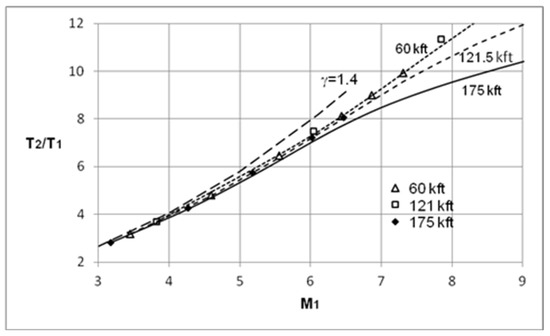
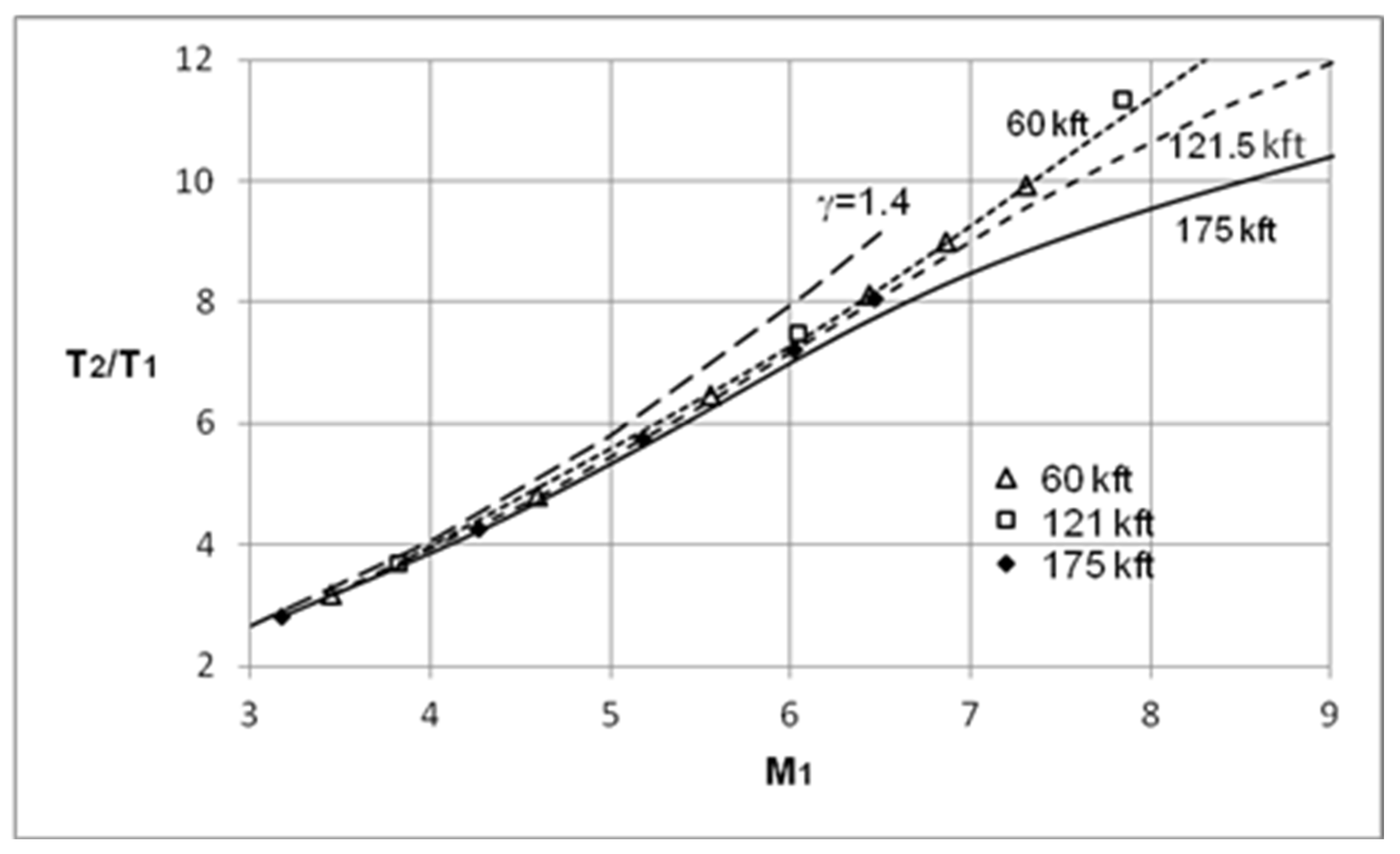
Figure 5 compares the temperature ratios across normal shocks as a function of flight Mach number and altitude as calculated by Huber [7] using the Hugoniot relation, by the linear cp model described above, and by the constant γ = 1.4 model. Because the cp model is independent of pressure, the calculated values show little variation with altitude, and that variation is caused by the relatively small changes in upstream temperature with altitude. For clarity, only three altitudes covering the range of practical conditions are illustrated here. Note that up to M1 = 6, the results obtained using the linear cp approximation agree well with Huber’s results for altitudes up to 175 kft. Beyond M1 = 6 the approximate results remain in agreement with Huber’s results to higher Mach numbers with departures starting at M1 = 6.5, 7.5, and 8.5 at altitudes of 175, 121, and 60 kft, respectively. These departures, signifying increasing prediction errors, arise as a result of T2 increasing beyond the limiting value of about 2000 K. Equation (5) shows that at a given value of M1, T2 depends solely on the upstream temperature T1, which varies with altitude according to the atmospheric model used. The higher T1, the lower the value of M1 at which T2 will reach 2000 K, the upper limit for accurate predictions using the linear cp model of Equation (4). All recent atmospheric models show rising temperatures as altitude increases from 36 kft to a maximum value in the range 150 kft < z < 175 kft, with subsequent decrease thereafter.
Figure 5.
Normal shock temperature ratios according to the linear cp approximation (data symbols) compared to the exact result [7] (curves) for a range of altitudes. The γ = 1.4 case is shown for reference.
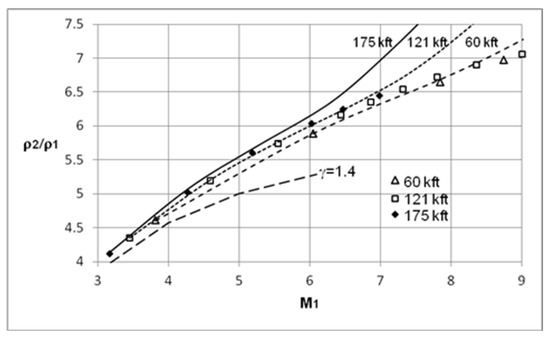
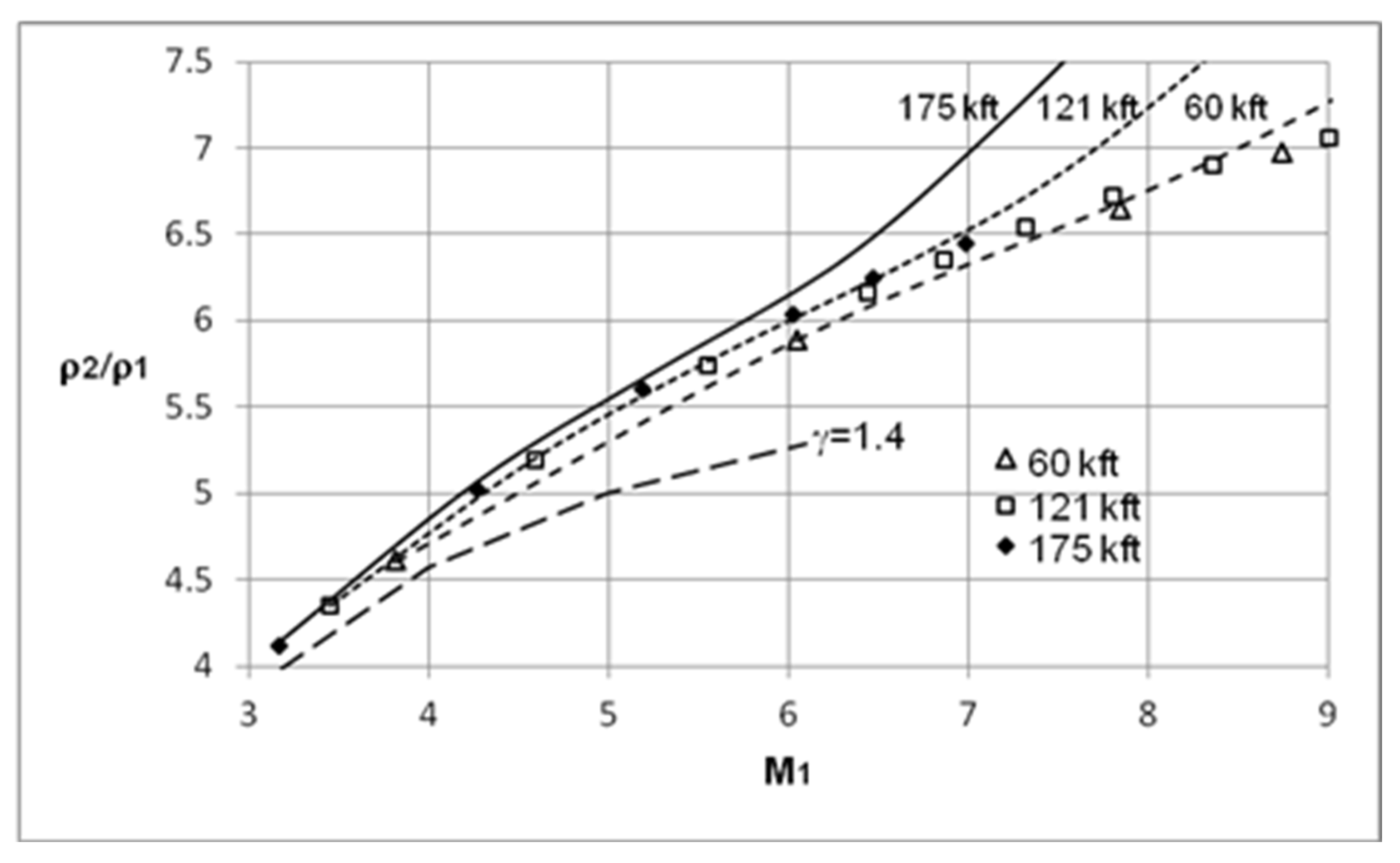
Similar behavior is observed when using the state equation for the normal shock density ratios, as illustrated in Figure 6. Recall that beyond 2000 K chemical effects will come into play, Z2 will increase beyond unity, and the density ratio will be increasingly underestimated, as can be seen in Figure 6.
Figure 6.
Normal shock density ratios according to the linear cp approximation (data symbols) compared to the exact result [7] (solid lines) for a range of altitudes. The γ = 1.4 case is shown for reference.
A note on errors: in the region of applicability of the linear cp model, temperature ratios tend to be over-predicted, while density ratios tend to be under-predicted. Thus the errors in the density and temperature ratios tend to offset one another, reflecting the relative accuracy of the pressure ratios. For the linear cp model, the range in M1 and altitude for which errors in the normal shock ratios of temperature and density are within ±3% of the exact Hugoniot results lies to the left of dashed line given by M = 9.1 − z/63, as shown in Figure 7. The compressibility in this region of applicability is Z2 < 1.01. Beyond the limit of applicability of the linear cp model, denoted by the dashed line, increasing temperature behind the shock initiates oxygen dissociation, as indicated by the dotted lines of constant Z2, and a different approach is needed.
Figure 7.
A typical flight corridor with vehicles shown as data symbols; the hypersonic vehicles are identified. Dashed lines denote trajectories while the dotted curve is the locus of points where Z = 1.01. In the region to the left of the dash-dot line, calculation errors are within ±3%.
4. Simplification for Moderate Hypersonic Mach Numbers
The previous section outlined a method for direct calculation of flow properties behind a normal shock applicable to low hypersonic Mach numbers up to at least 6, and up to as much as 7 or 8, depending upon the altitude. At higher Mach numbers, T2 increases beyond 2000 K, introducing chemical effects in the state equation caused by oxygen dissociation. In the interval 2000 K < T < 4000 K, where oxygen dissociation takes place while the nitrogen is unaffected, the equation of state may be modeled as
The coefficients in Equation (6), which complete the model for a pressure range of 0.04 atm < p2 < 10 atm, and an enthalpy range of 1800 kJ/kg < h2 < h*, are as follows:
Here, Tr is in K, p is in atmospheres, hr is in kJ/kg. For practical application of this model equation of state, the limiting value of the enthalpy is h*, and is given by
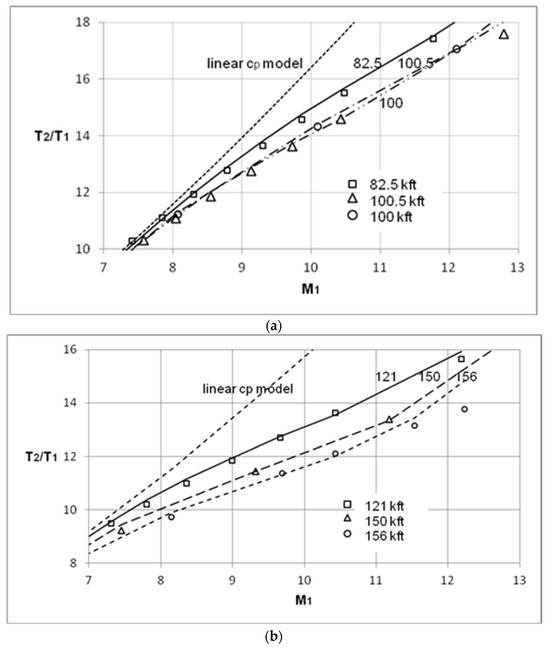
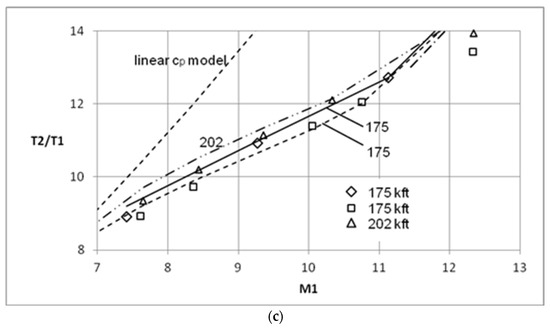
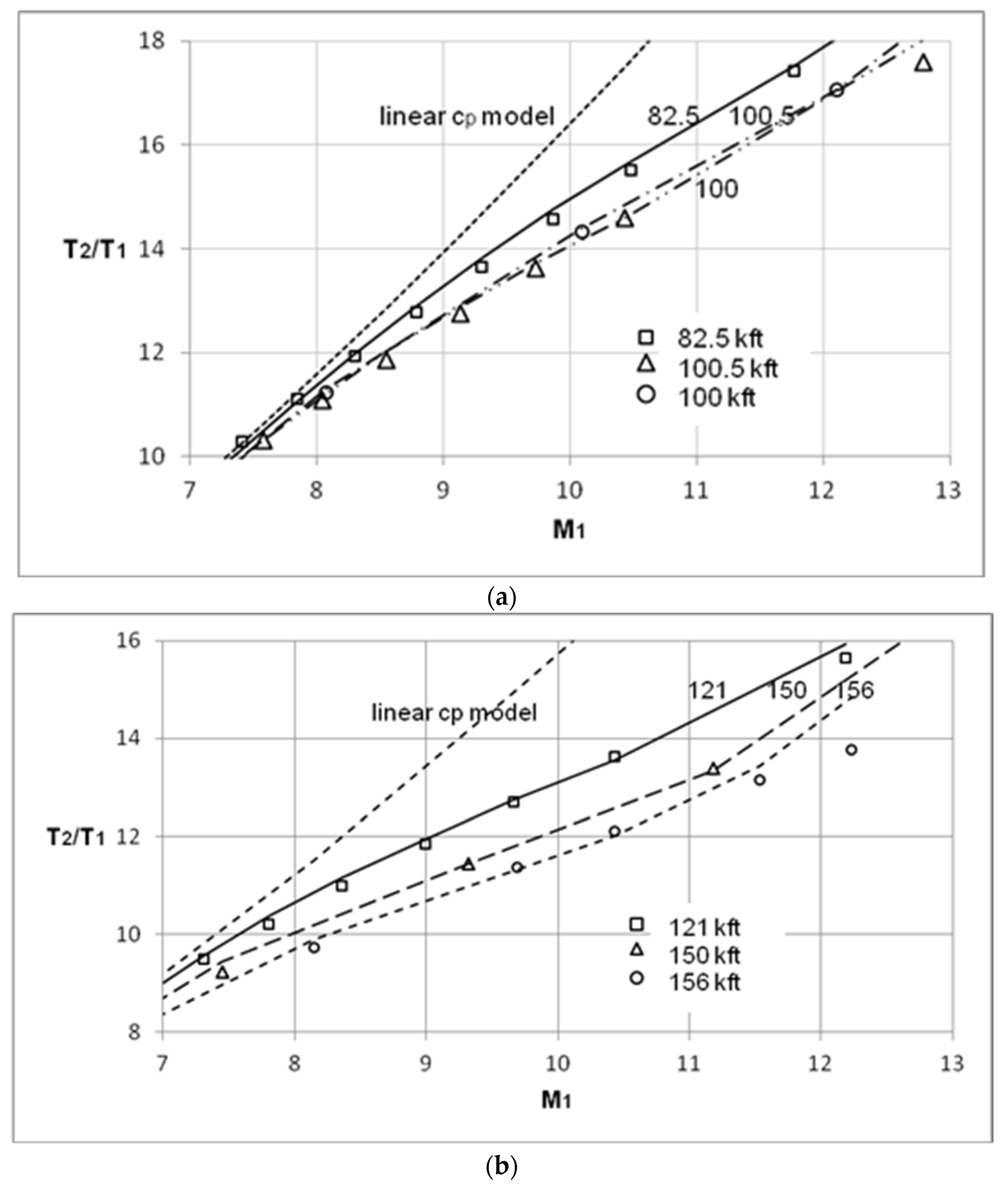
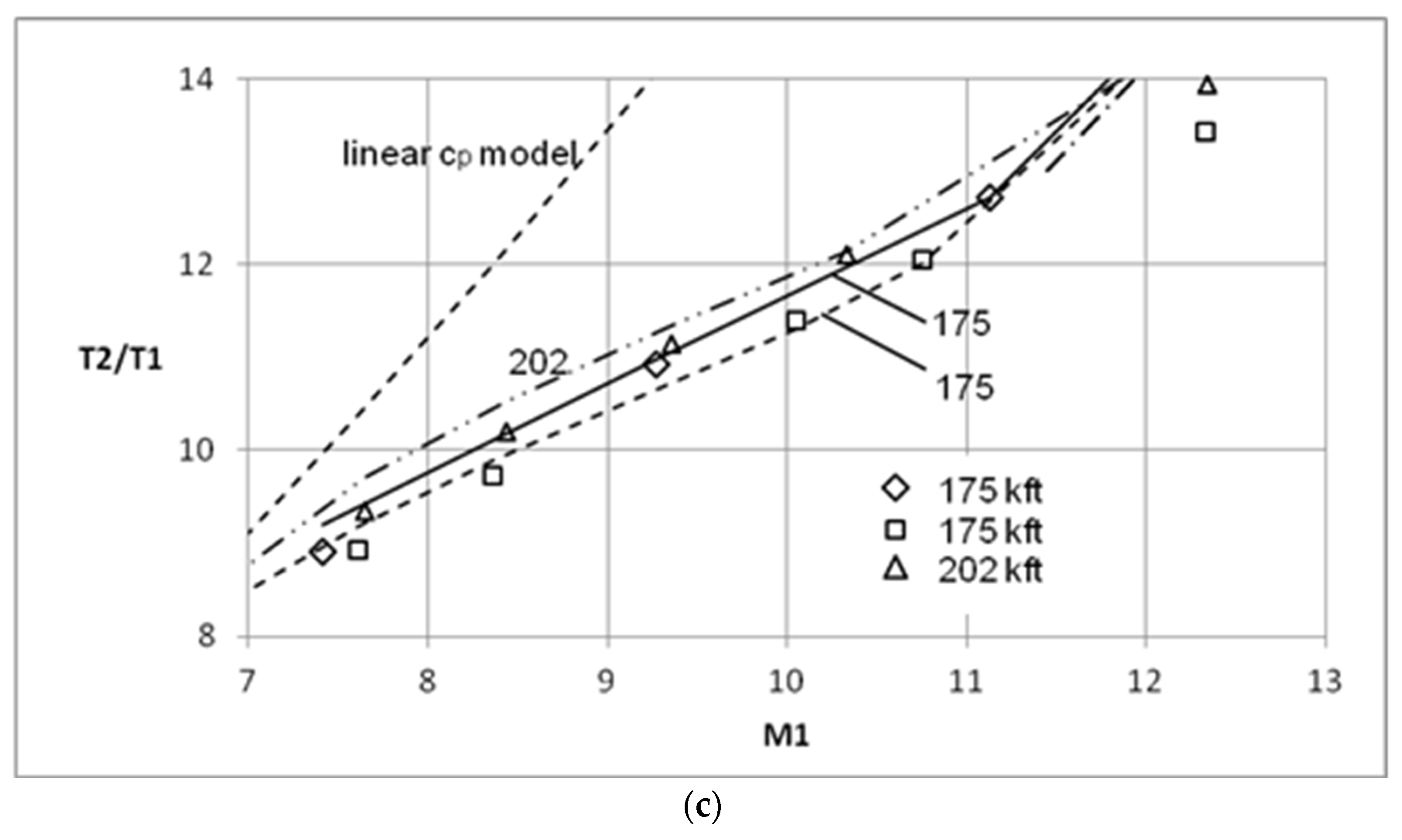
For a given flight condition, the pressure p2 may be found from Equation (1), and used to calculate the coefficients Tr and hr. As before, the enthalpy h2 may be calculated from Equation (2). If the calculated values of p2 and h2 are within the range of applicability, Equation (6) may be used to calculate the corresponding temperature behind the shock, T2, at the specified values of M1 and z. Typical results are shown for practical flight conditions: 7 < M1 < 12 and 80 kft < z < 160 kft in Figure 8a–c.
Figure 8.
(a) Normal shock temperature ratio as a function of flight Mach number for z = 82.5 kft, 100 kft, and 100.5 kft. Curves represent exact results and data symbols denote calculations according to the model state equation, Equation (6). (b) Normal shock temperature ratio as a function of flight Mach number for z = 121 kft, 150 kft, and 156 kft. Curves represent exact results and data symbols denote calculations according to the model state equation, Equation (6). (c) Normal shock temperature ratio as a function of flight Mach number for z = 175 kft and 202 kft. Curves represent exact results and data symbols denote calculations according to the model state equation, Equation (6). Exact results are taken from References [7,8].
The density ratio ρ2/ρ1 may be found from Equation (3) once the compressibility function behind the shock, Z2, is known; the compressibility upstream of the shock is, of course, Z1 = 1. Hansen [3] presents a simple method based on the fact that in the temperature interval of interest, 2000 K < T < 4000 K, the only chemical activity is pure oxygen dissociation. Under this assumption, Hansen [3] shows that we may take the compressibility to be given by
In Equation (10), the quantity ζO represents the fraction of dissociated oxygen molecules. Hansen’s analytical result for ζO, which involves p measured in atmospheres and the pressure-independent equilibrium constant Kp,O, is given as follows:
From tabulated values given by Hansen [3], the following approximation to the equilibrium constant is suggested:
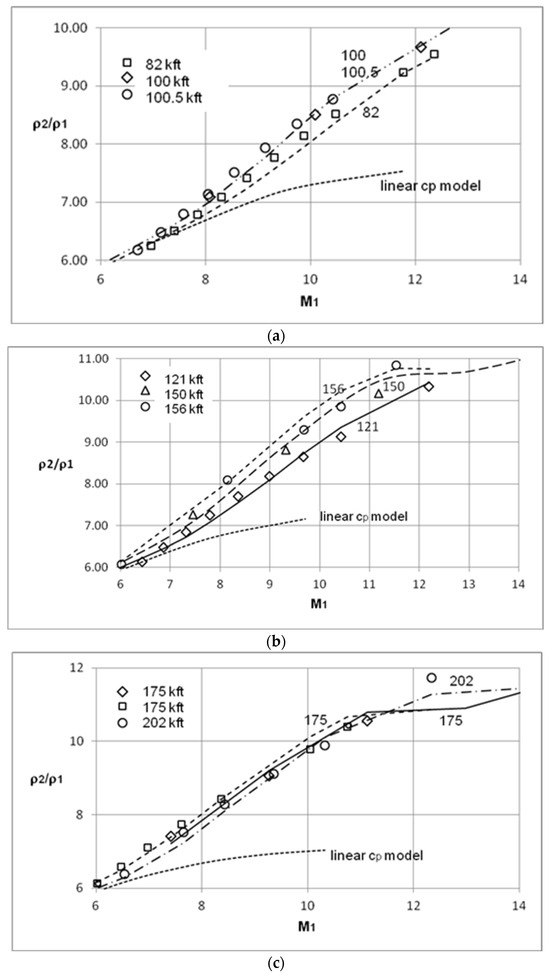
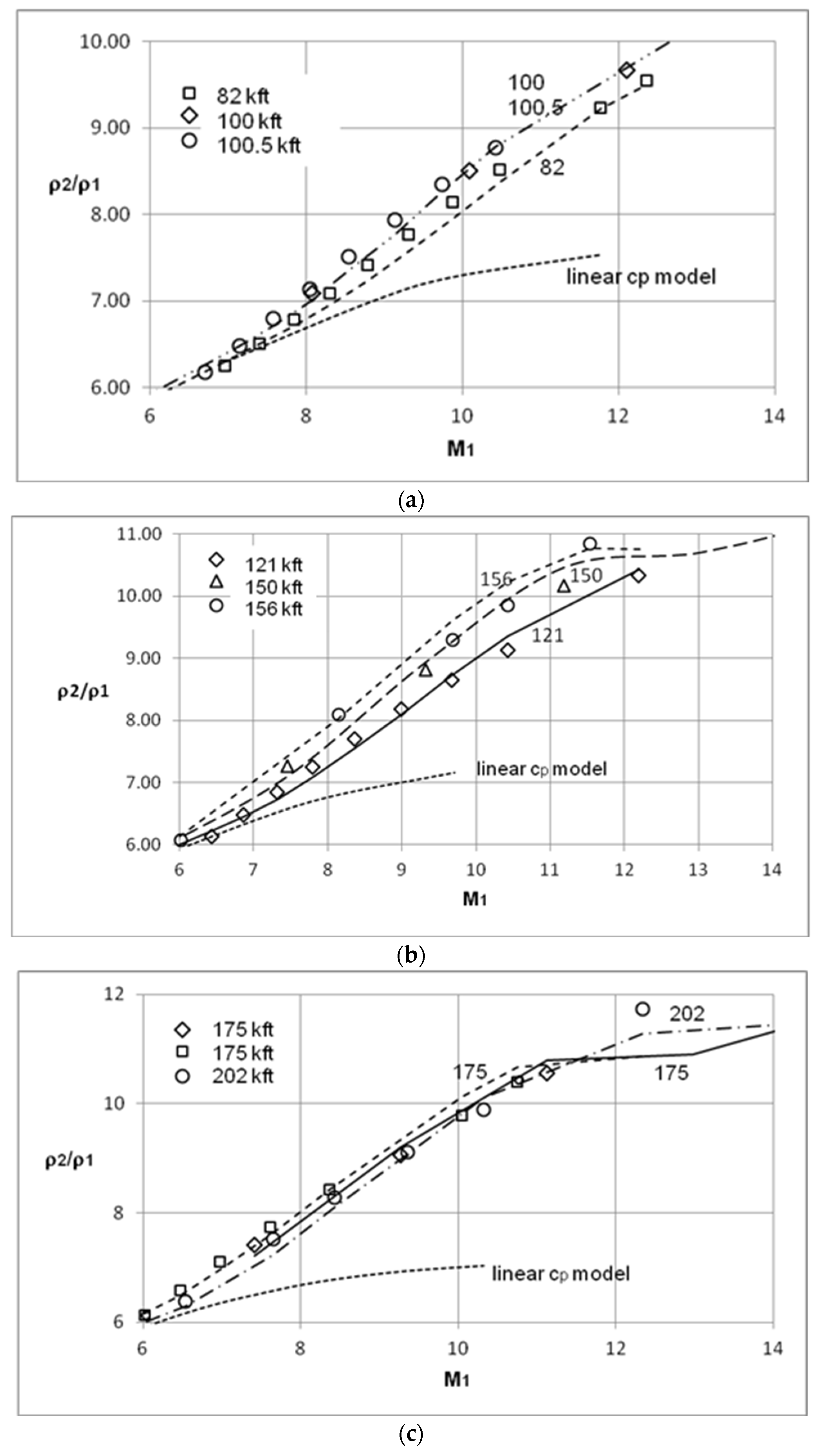
Knowing p and T at any point in the flow, we may find ζO from Equation (11), and using this value in Equation (10) we may determine Z. Then, applying the equation of state in the form of Equation (3), the density ratio ρ2/ρ1 may be found. Normal shock density ratio results are presented in Figure 9 for the same conditions as the temperature ratio cases previously shown in Figure 8.
Figure 9.
(a) Normal shock density ratio as a function of flight Mach number for z = 82.5 kft, 100 kft, and 100.5 kft. Curves represent exact results and data symbols denote calculations according to the model state equation, Equation (6). (b) Normal shock density ratio as a function of flight Mach number for z = 121 kft. 150 kft, and 156 kft. Curves represent exact results and data symbols denote calculations according to the model state equation, Equation (6). (c) Normal shock density ratio as a function of flight Mach number for z = 175 kft and 202 kft. Curves represent exact results and data symbols denote calculations according to the model state equation, Equation (6). Exact results are taken from References [7,8].
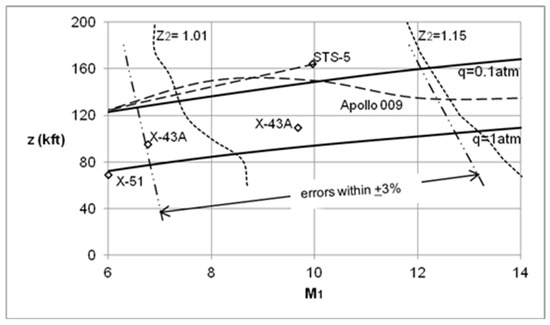
The selected results shown in Figure 8 and Figure 9 are representative of the 187 cases treated in the present study. The difference between the exact results and the approximate log-law equation of state are generally within ±3%, with several individual cases outside that range, but still within ±4%. The region of applicability of the log-law state equation is illustrated with a typical hypersonic vehicle flight corridor in Figure 10. The left-hand dash-dot line, defined by M1 = 7.2 − z/200, denotes the lower limit for applicability of the log-law, which extends to the right-hand dash-dot line defined by M = 14 − z/83. The altitude range of applicability is approximately given by the extent of the limit lines. Note that the lower limit of applicability of the log-law model overlaps the upper limit of the linear cp model shown in Figure 7.
Figure 10.
Segment of the typical flight corridor showing the region of applicability of the log-law equation of state with +3% accuracy. Dotted lines describe the indicated value of the compressibility function behind the shock. Symbols identify vehicles and dashed lines show vehicle trajectories.
5. Stagnation Conditions
5.1. Stagnation Temperature Range: Tt2 < 2000 K
In this temperature range, we estimate the stagnation temperature behind the shock by applying the linear cp approximation of Equation (4) to the enthalpy difference
This is a quadratic equation for Tt2, and using the enthalpy jump equation to determine u12ε2/2 leads to the following solution:
Obviously, this formulation depends upon the previously calculated values of T2/T1 and h2/h1, which have the accuracy limitations described previously. However, the accuracy of the values of Tt obtained using this equation are within the limits obtained for T2 itself and Equation (14) should apply to the flight corridor where M1 ≤ 9.1 − z/63 as shown in Figure 7.
5.2. Stagnation Temperature Range 2000 K < Tt2 < 4000 K
In this temperature regime we apply the log-law equation of state, Equation (6), to find
The stagnation pressure pt2 is not known at this point, but the difference between p2 and pt2 is small enough that replacing pt2 with p2 in Equation (15) yields negligible error in Tt2.
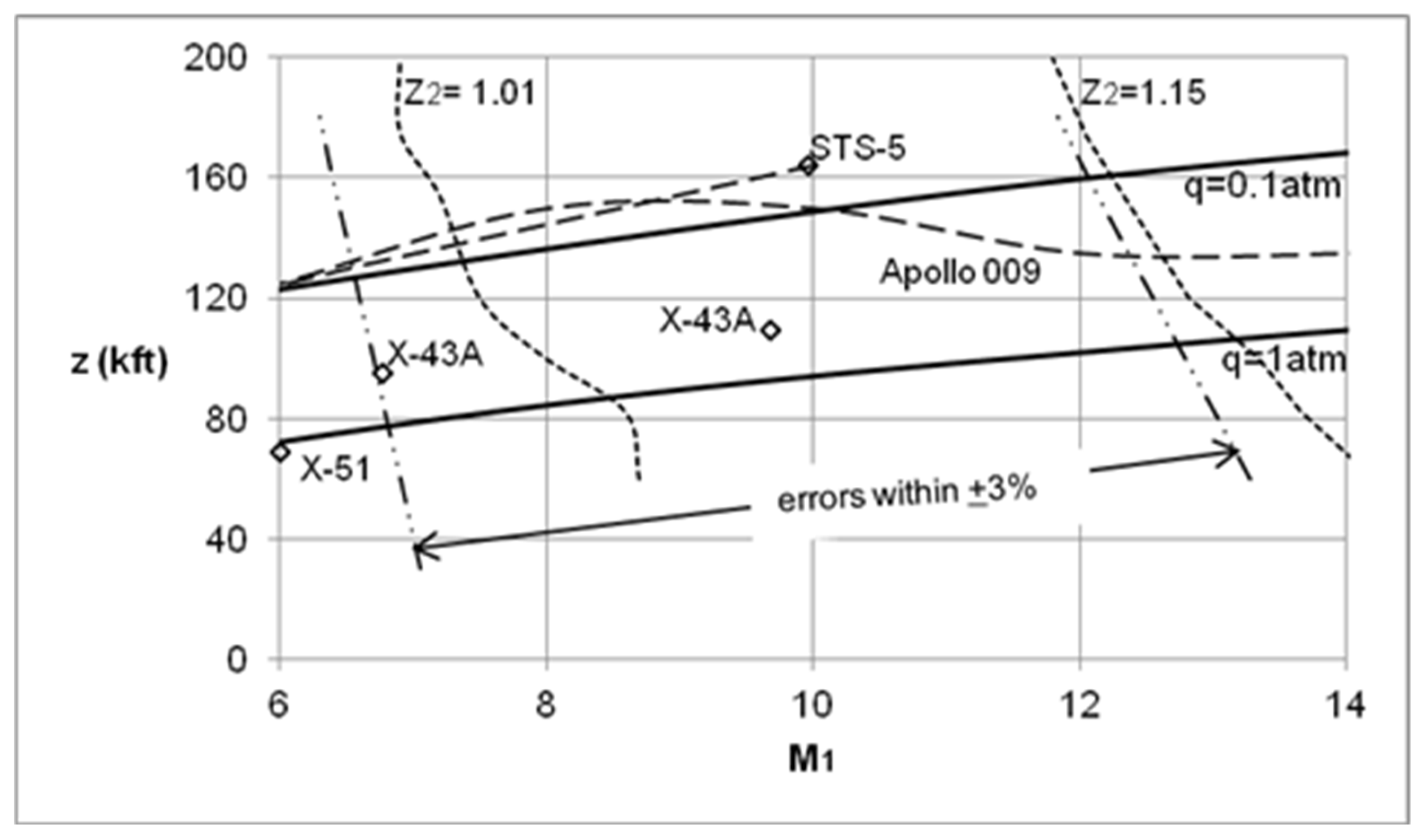
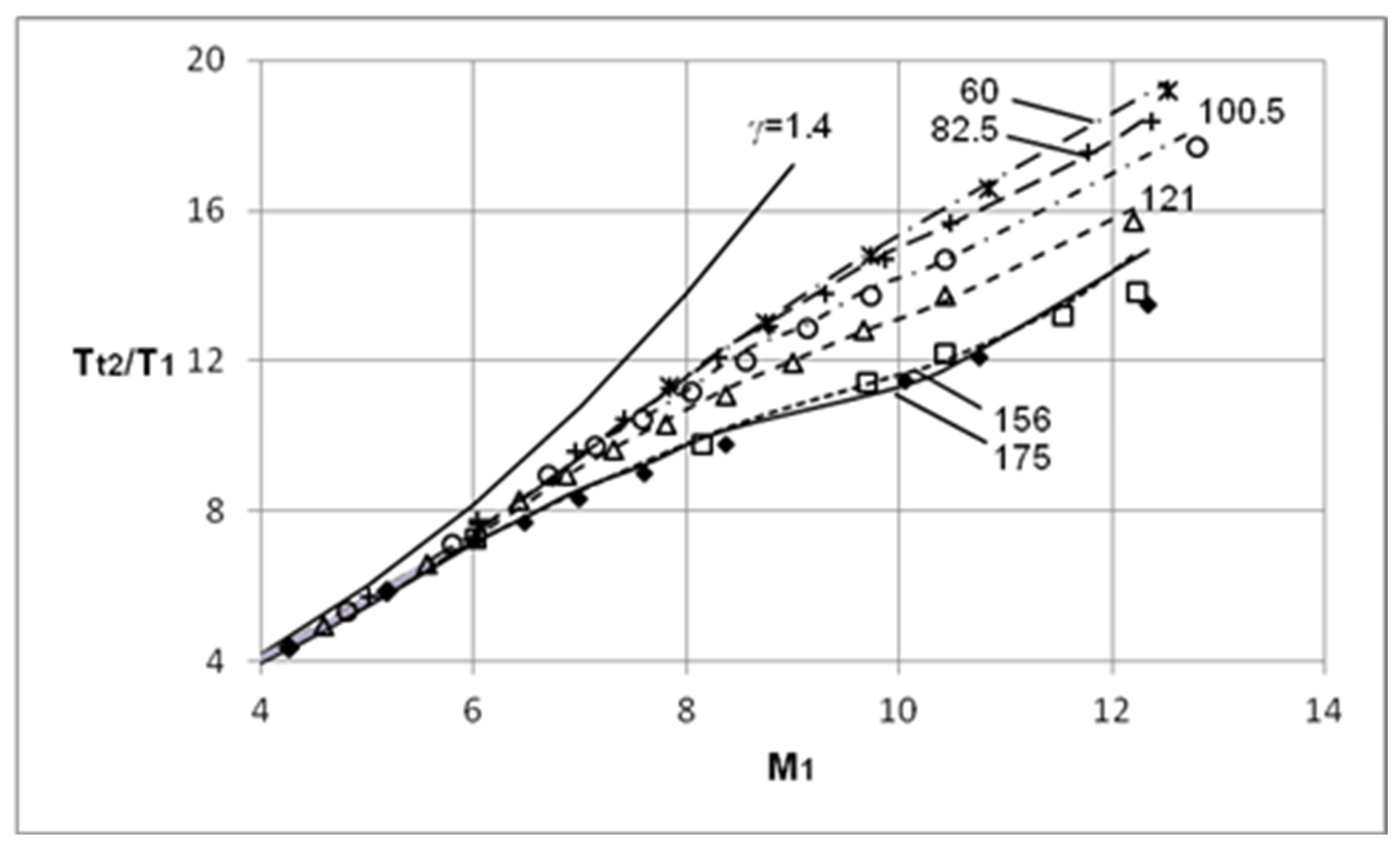
Results for the stagnation temperature ratio behind the shock are shown in Figure 11. The values of Tt used for comparison here are largely Huber’s [7] results, which are reported only for selected flight conditions, and only for Tt2 > 2000 K. These are supplemented by values calculated directly from the known stagnation enthalpy using Hansen’s [3] tables. The linear cp model may be safely applied up to M1 = 6 for any of the altitudes considered here. Beyond M1 = 6 and up to M1 = 12 the log-law equation of state gives satisfactory results for all altitudes considered. Results for constant γ =1.4 are shown to illustrate the increasing over-prediction of stagnation temperature.
Figure 11.
Stagnation temperature ratio as a function of M1 according to Equation (14) or Equation (15), according to their range of applicability (data symbols), compared to Huber’s [7] results or calculated using Hansen’s [3] tables (solid and dashed curves). Numbers on curves denote altitude in kft.
5.3. Stagnation Pressure for Tt2 < 2000 K
Along the stagnation streamline, the flow behind the shock is isentropic, and in the temperature range of interest Z1 = Z2 = 1, we have
Using the linear cp model of Equation (4) in the isentropic relation above, noting that in the temperature range of interest Z = 1, yields
5.4. Stagnation Pressure for 2000 K < T < 4000 K
However, for higher Mach numbers, where the linear cp model is no longer valid, the log-law equation of state must be applied, but then the entropy equation becomes cumbersome to apply. The stagnation pressure ratio on a streamline downstream of the shock is given by the isentropic relation
Additional adiabatic compression of the gas between the shock and the stagnation point is relatively small in hypersonic flight and a common hypersonic flow assumption, one followed by Huber [7], is that the density in the shock layer remains essentially constant. Under this assumption, the one-dimensional momentum relation becomes
Note that expanding the isentropic relation, Equation (17), yields
Thus, we see that up to O(M22) the constant density assumption, Equation (18), and the isentropic relation, Equation (19), are identical. Therefore, for small values of M2 (typically, M2 < 0.4 for M1 > 6) the constant density assumption is acceptable. The stagnation to static pressure ratio relation in Equation (18) may be put in terms of free stream variables and the shock pressure ratio p2/p1 as follows:
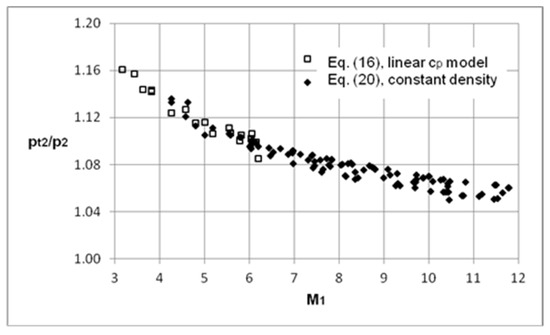
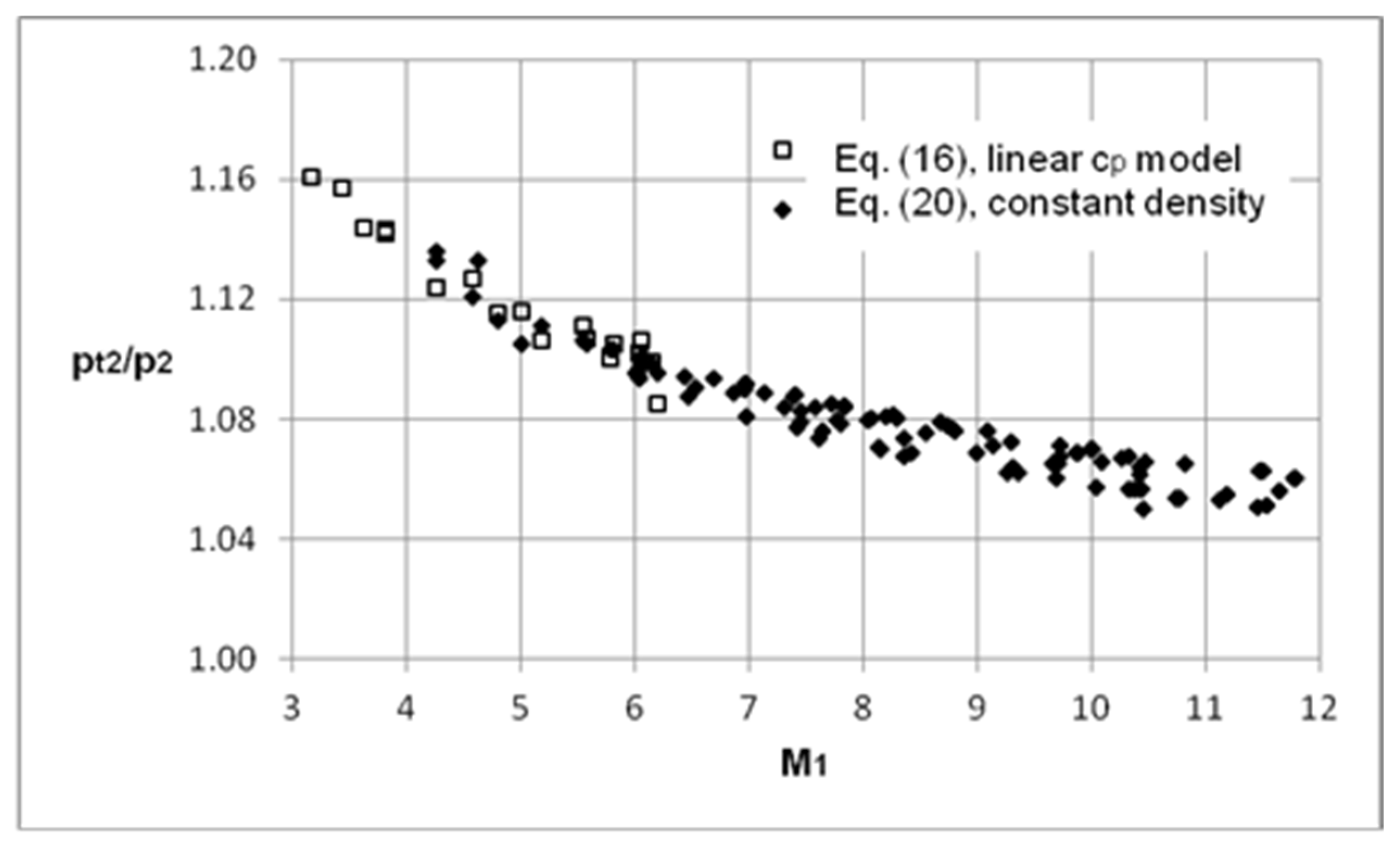
The stagnation to static pressure ratio behind the shock is shown as a function of M1 over an altitude range of 36 kft to 200 kft in Figure 12. The open square symbols denote the stagnation pressure ratio according to the constant entropy assumption, Equation (16), while the closed diamond symbols denote the stagnation pressure ratio according to the constant density shock layer assumption, Equation (20). The stagnation to static pressure ratio behind the shock is seen to be approaching unity as M1 increases, with only a slight dependence on altitude. Therefore, the stagnation and static pressures behind the shock are quite close, as are the stagnation and static temperatures. However, Figure 12 does show that assuming p2 and pt2 are equal is inconsistent with our effort to maintain an accuracy of ±3% and Equation (16) or Equation (20) should be used to more accurately determine the stagnation pressure.
Figure 12.
Stagnation to static pressure ratio behind the shock as a function of M1 for four altitudes between 36 kft and 200 kft.
5.5. Comparing Pressure Ratios Across the Shock
The ratio of stagnation pressure behind the shock to the upstream static pressure within the constant density shock layer approximation may be found by multiplying Equation (20) through by the shock pressure ratio to obtain
For constant gas properties this ratio is given by the Rayleigh pitot formula,
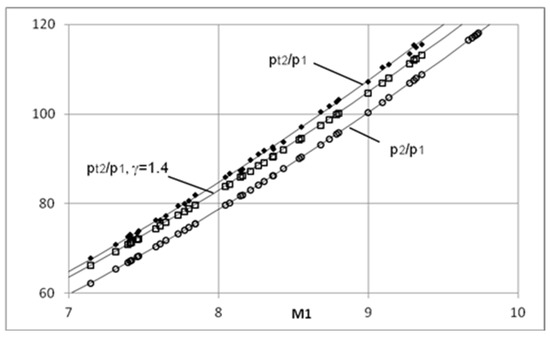
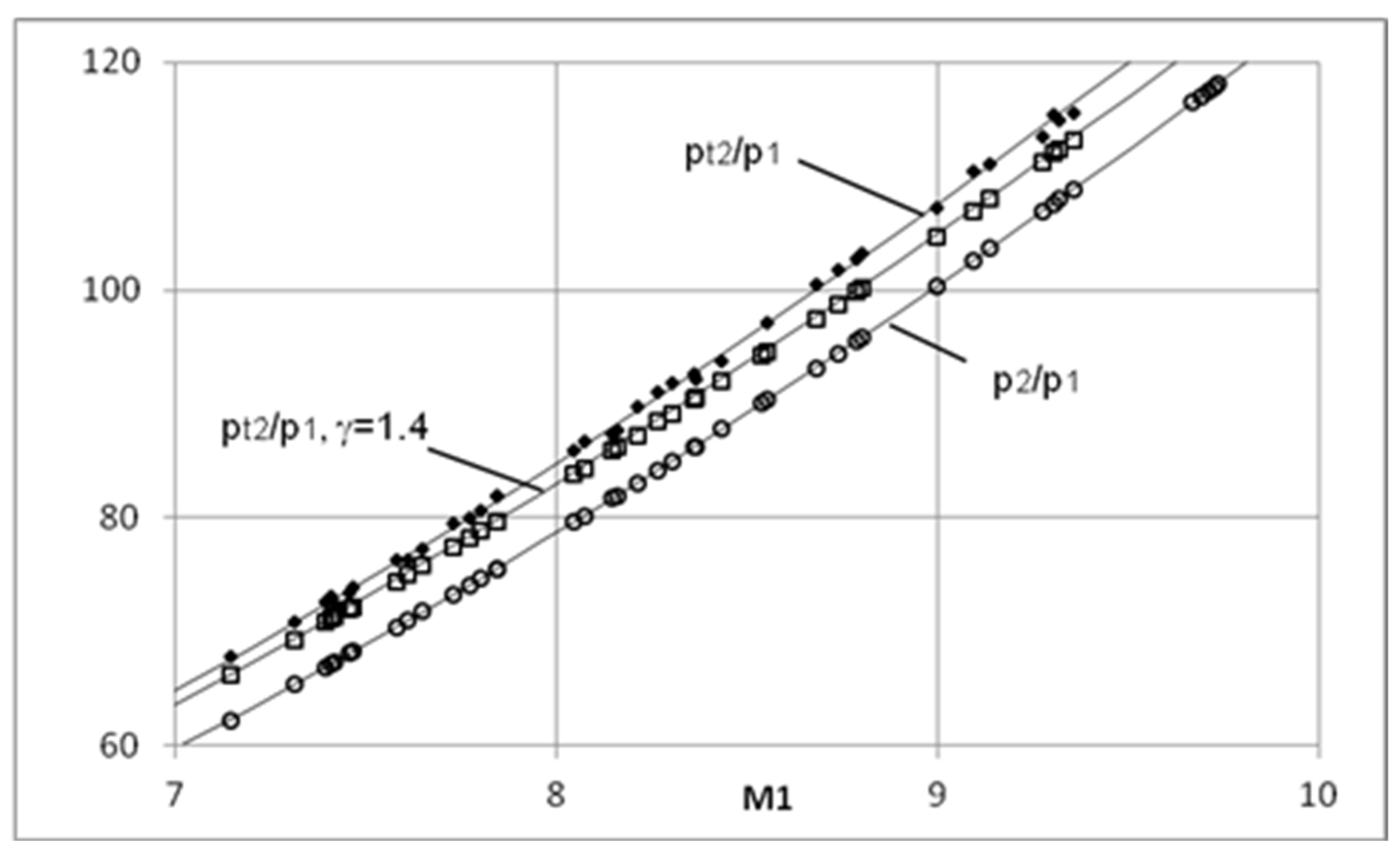
A comparison of the shock static pressure ratio p2/p1, the stagnation to static pressure ratio across the shock pt2/p1 according to the constant density shock layer assumption, and the Rayleigh pitot formula for γ = 1.4 is shown for a small segment of the Mach number range in Figure 13 for illustrative purposes. It is clear that the Rayleigh pitot formula under-predicts the constant density shock layer solution, Equation (21), throughout the Mach number range. However, the error is less than 1% for M1 = 3, growing to about 10% at M = 35, in keeping with the premise that the pressure field is relatively insensitive to gas chemistry.
Figure 13.
Comparisons of the shock pressure ratio p2/p1 (open circles), the stagnation to static pressure ratio across the shock pt2/p1 according to the constant density shock layer assumption (closed diamonds), and pt2/p1 for constant γ = 1.4 (the Rayleigh pitot formula) are shown for a small segment of the full Mach number range.
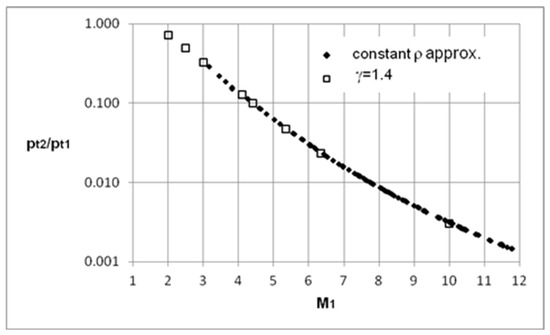
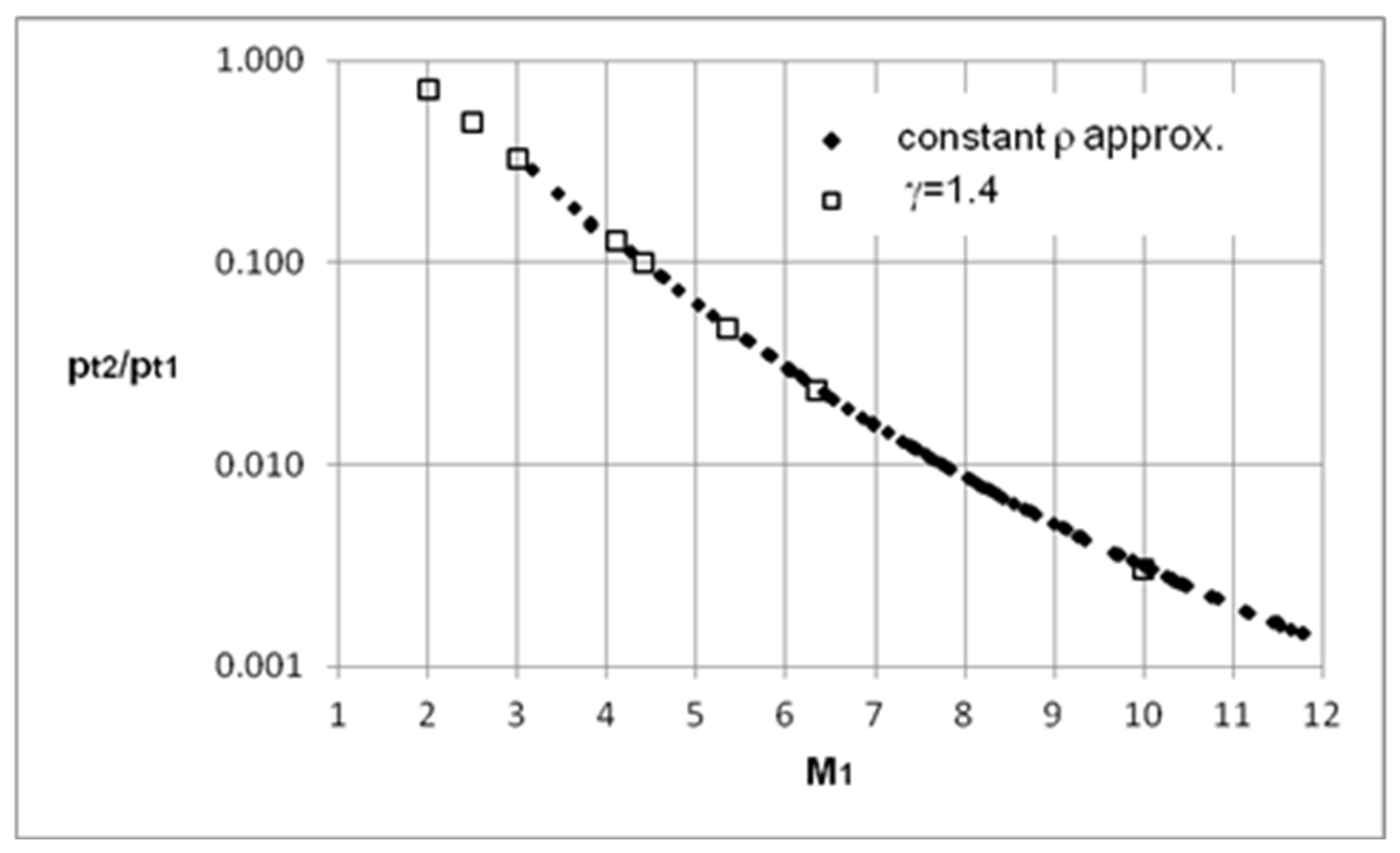
It should be noted that the normal shock stagnation pressure recovery is very low and, within the constant density shock layer, approximation is given by
This result is compared to the constant γ = 1.4 result in Figure 14 where the stagnation pressure recovery appears to be independent of the real gas behavior of the air, even to higher Mach numbers than considered here. The stagnation pressure drop across the shock is indicative of the great increase in entropy produced.
Figure 14.
Stagnation presssure recovery according to the constant density shock layer approximation and for constant γ = 1.4.
5.6. Stagnation Point Pressure Coefficient
An important starting point for the study of hypersonic flows over blunt bodies is the stagnation pressure coefficient, given by
Using Equation (21) in Equation (24) yields
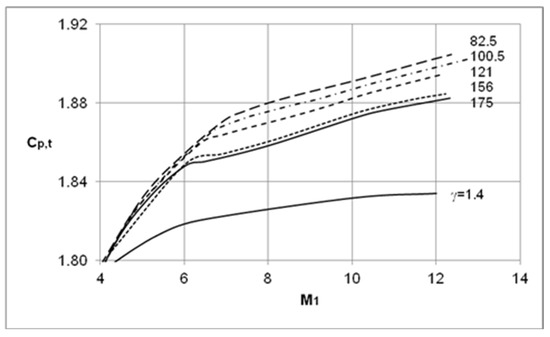
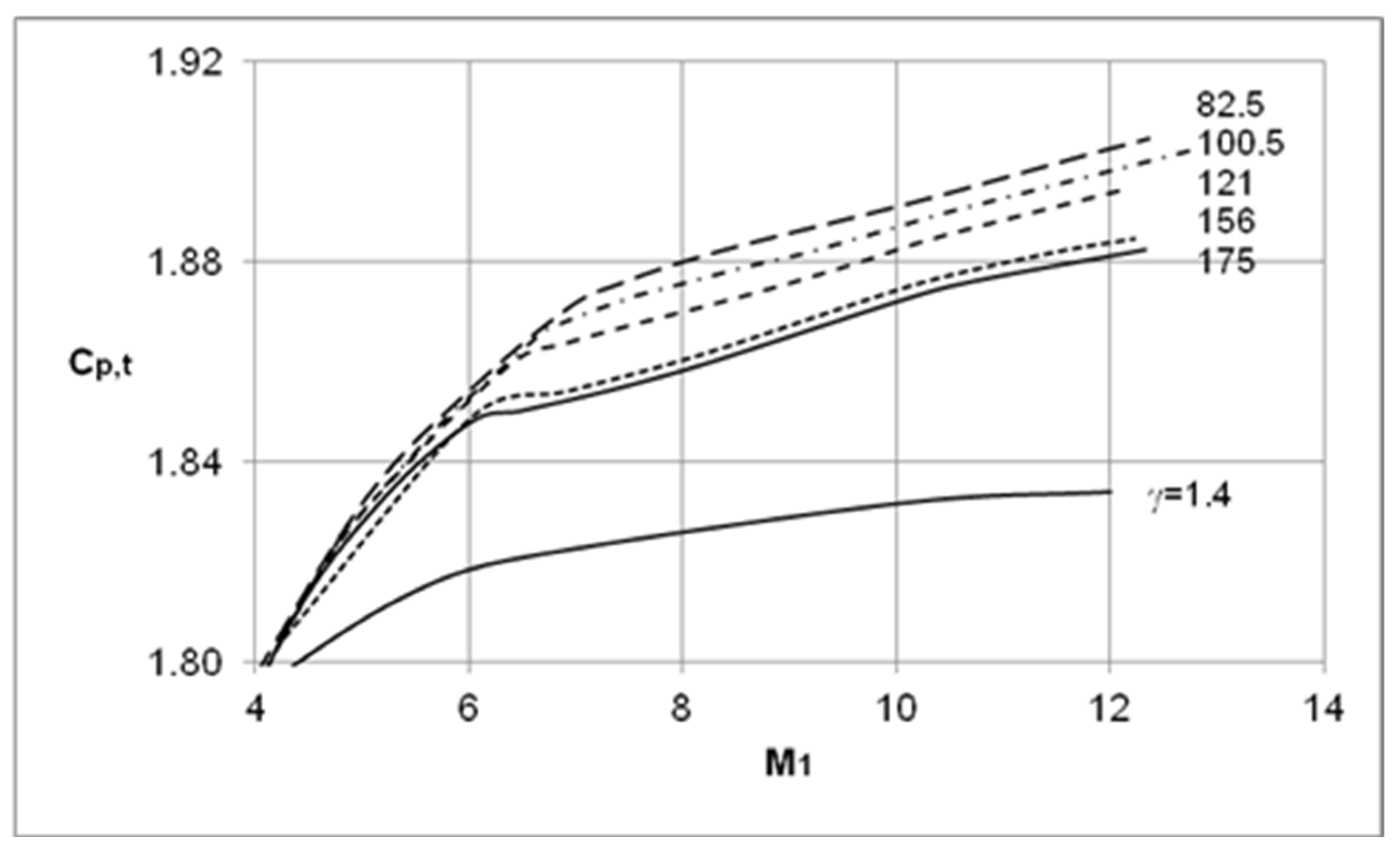
The stagnation pressure coefficients Cp,t calculated using the linear cp approach for low hypersonic Mach numbers and the log-law equation of state for moderate Mach numbers are shown in Figure 15. Also shown in that figure is the stagnation point pressure coefficient calculated assuming that γ = 1.4. The stagnation pressure coefficient is quite accurate even at high Mach numbers because the first term on the right-hand side of Equation (25), which depends on the shock pressure ratio, is O(1) while the second term, which depends upon the resulting density ratio, is O(10−1), making the errors in the second term relatively unimportant.
Figure 15.
Stagnation pressure coefficients according to Equation (25) using present approximations and those evaluated using γ = 1.4. Numbers denote altitude in kft.
6. Conclusions
Evaluation of reported calculations [6,7,8] of normal shock waves in equilibrium air for Mach numbers up to 65 and altitudes up to 300,000 feet showed that a simple Mach number power-law correlation for the pressure ratio across the shock provides results accurate to within ±2% up to Mach 30, and a slight change in the coefficients extended this capability to Mach 65. Using this simplification in the shock Hugoniot relation permits direct calculation of the enthalpy ratio across the shock to an accuracy of ±1% without iteration. The corresponding temperature, density, and compressibility may then be found directly by interpolation in charts or tables for high temperature air.
To facilitate calculation of normal shocks at low hypersonic Mach numbers, a simple linear approximation for the specific heat of air was introduced, providing algebraic solutions for all variables for Mach numbers up to at least 6, and as much as 8, depending on the altitude. To extend the possibility of closed-form solutions to moderate hypersonic Mach numbers, a complementary logarithmic model of the equation of state was proposed, which permits direct solutions for Mach numbers up to about 12. Both models were shown to provide results accurate to within ±3% for all relevant variables.
This approach should prove useful for hypersonic vehicle design and analysis because of the reduced dependence on iteration of thermodynamic state variables or simultaneous chemical equilibrium calculations. For Mach numbers up to about 12 and practical altitude ranges of 60 kft < z < 175 kft, the proposed method yields algebraic solutions with no need for iteration or interpolation.
Funding
This research received no external funding.
Data Availability Statement
Data are contained within the article.
Conflicts of Interest
The author declares no conflict of interest.
Nomenclature
| a | sound speed |
| cp | specific heat at constant pressure (kJ/kg-K) |
| Cp | pressure coefficient, Equation (24) |
| h | enthalpy (kJ/kg) |
| KpO | equilibrium constant, Equation (12) |
| M | Mach number |
| p | pressure (atm) |
| q | dynamic pressure (atm) |
| R | gas constant for air at standard conditions, 0.287 kJ/kg-K |
| T | temperature (K) |
| s | entropy |
| u | velocity |
| W | molecular weight |
| W0 | molecular weight of air at standard conditions, 28.966, kg/kg-mole |
| z | altitude (kft) |
| Z | compressibility, W0/W |
| γ | ratio of specific heats |
| δ | flow deflection angle |
| ε | density ratio, ρ1/ρ2 |
| θ | shock wave angle |
| ρ | density |
| ζO | fraction of dissociated oxygen molecules |
| Subscripts | |
| 1 | conditions upstream of normal shock |
| 2 | conditions downstream of normal shock |
| r | reference conditions |
| t | stagnation conditions |
References
- Powell, E.S. Development and Assessment of a Computer-Based Equation of State for Equilibrium Air; AEDC-TR-13-T-19; Defense Technical Information Center: Fort Belvoir, VA, USA, 2013. [Google Scholar]
- Hilsenrath, J.; Berckett, C.W. Thermodynamic Properties of Argon-Free Air to 15,000K; U.S. National Bureau of Standards Report 3991; U.S. Department of Commerce: Washington, DC, USA, 1955.
- Hansen, C.F. Approximations for the Thermodynamic and Transport Properties of High-Temperature Air; NASA TR R-50; NASA Technical Reports: Washington, DC, USA, 1959. [Google Scholar]
- Feldman, S. Hypersonic Gas Dynamic Charts for Equilibrium Air; AVCO-Everett Research Laboratory Research Report 40; AVCO-Everett Research Laboratory: Everett, MA, USA, 1957. [Google Scholar]
- Witliff, C.E.; Curtis, J.T. Normal Shock Wave Parameters in Equilibrium Air; Cornell Aeronautical Laboratory Report CAL-111; Cornell Aeronautical Laboratory, Inc.: Buffalo, NY, USA, 1961. [Google Scholar]
- Huber, P.W. Tables and Graphs of Normal-Shock Parameters at Hypersonic Mach Numbers and Selected Altitudes; NACA TN 4352; National Advisory Committee for Aeronautics: Washington, DC, USA, 1958. [Google Scholar]
- Huber, P.W. Hypersonic Shock-Heated Flow Parameters for Velocities to 46,000 Feet per Second and Altitudes to 323,000 Feet; NASA TR R-163; National Aeronautics and Space Administration: Washington, DC, USA, 1963. [Google Scholar]
- Hunt, J.L.; Souders, S.W. Normal and Oblique Shock Flow Parameters in Equilibrium Air Including Attached-Shock Solutions for Surfaces at Angles of Attack, Sweep, and Dihedral; NASA SP-3093; National Aeronautics and Space Administration: Washington, DC, USA, 1975. [Google Scholar]
- Ames Research Staff. Equations, Tables, and Charts for Compressible Flow; NACA Report 1135; National Advisory Committee for Aeronautics: Washington, DC, USA, 1953. [Google Scholar]
Disclaimer/Publisher’s Note: The statements, opinions and data contained in all publications are solely those of the individual author(s) and contributor(s) and not of MDPI and/or the editor(s). MDPI and/or the editor(s) disclaim responsibility for any injury to people or property resulting from any ideas, methods, instructions or products referred to in the content. |
© 2026 by the author. Licensee MDPI, Basel, Switzerland. This article is an open access article distributed under the terms and conditions of the Creative Commons Attribution (CC BY) license.