Article

Numerical Analysis of Shock Control Bumps for Delaying Transonic Buffet Boundary on a Swept Wing


1
College of Aerospace Engineering, Nanjing University of Aeronautics and Astronautics, Nanjing 210016, China
2
Shanghai Aircraft Design and Research Institute, Shanghai 201210, China
*
Author to whom correspondence should be addressed.
Aerospace 2026, 13(1), 98; https://doi.org/10.3390/aerospace13010098
Submission received: 25 November 2025 / Revised: 13 January 2026 / Accepted: 15 January 2026 / Published: 19 January 2026
(This article belongs to the Special Issue Advancing Fluid Dynamics in Aerospace Applications)

Abstract

Transonic shock buffet is a complex flow phenomenon characterized by self-sustained shock oscillations, which severely limits the flight envelope of modern civil aircraft. While Shock Control Bumps (SCBs) have been widely studied for drag reduction, their potential for delaying the buffet boundary on swept wings has yet to be fully explored. This study employs numerical analysis to investigate the efficacy of three-dimensional (3D) contour SCBs in delaying the buffet boundary of the NASA Common Research Model (CRM) wing. The buffet boundary is identified using both the lift-curve slope change and trailing-edge pressure divergence criteria. The results reveal that 3D SCBs generate streamwise vortices that energize the boundary layer, thereby not only weakening local shock strength but, more critically, suppressing the spanwise expansion of shock-induced separation. Collectively, the reduction in shock strength and the containment of spanwise separation delay the buffet boundary, thereby improving the aerodynamic efficiency of the wing. Two configurations, designed at different lift conditions (SCB-L at C L = 0.460 and SCB-H at C L = 0.507 ), demonstrate a trade-off between buffet delay and off-design drag reduction. The SCB-H configuration achieves a buffet boundary lift coefficient improvement of 6.3% but exhibits limited drag reduction at lower angles of attack, whereas the SCB-L offers a balanced improvement of 4.0%, with a broader effective drag-reduction range. These results demonstrate that effective suppression of spanwise flow is key to delaying swept-wing buffet and establish a solid reference framework for the buffet-oriented design of SCBs.

1. Introduction

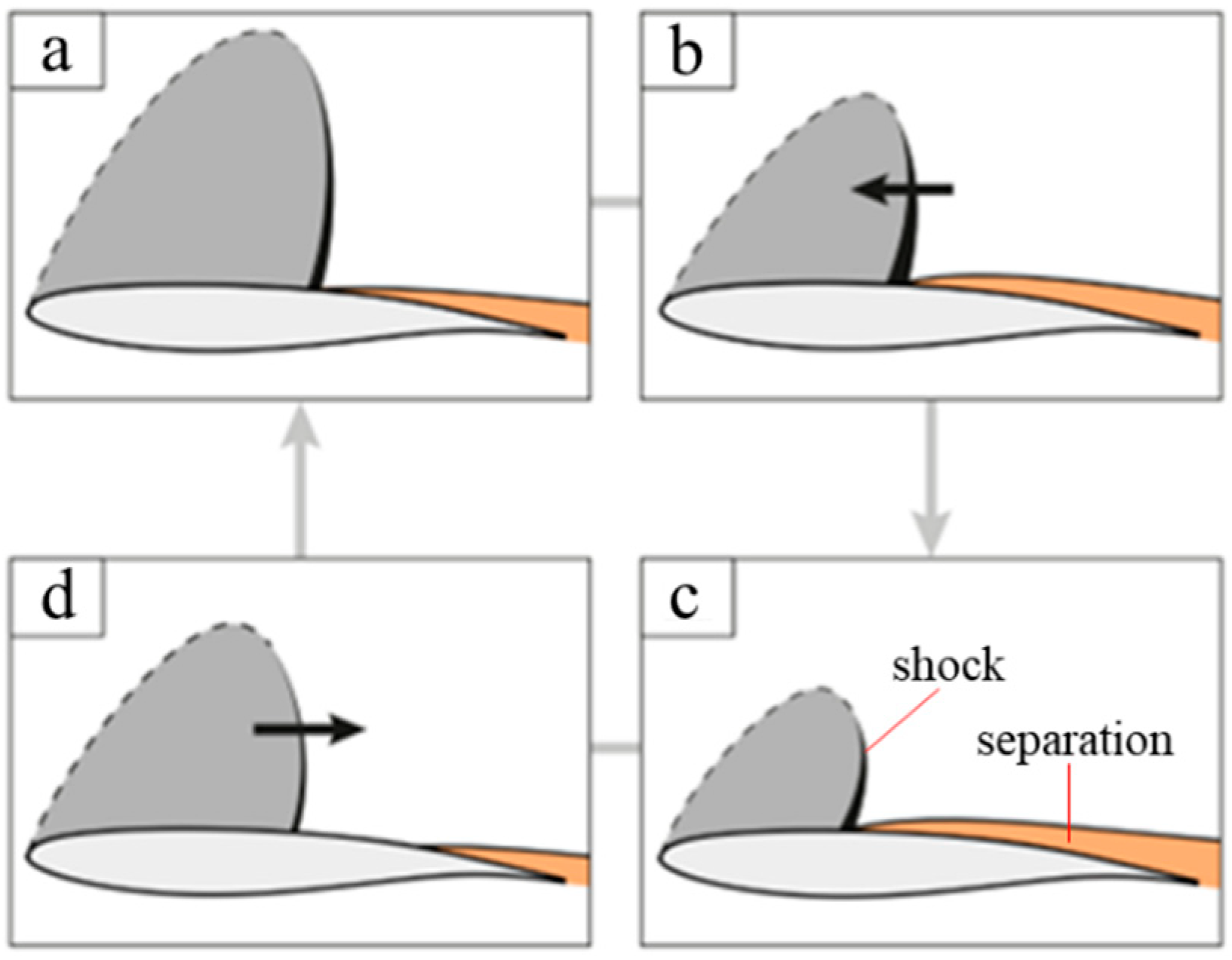
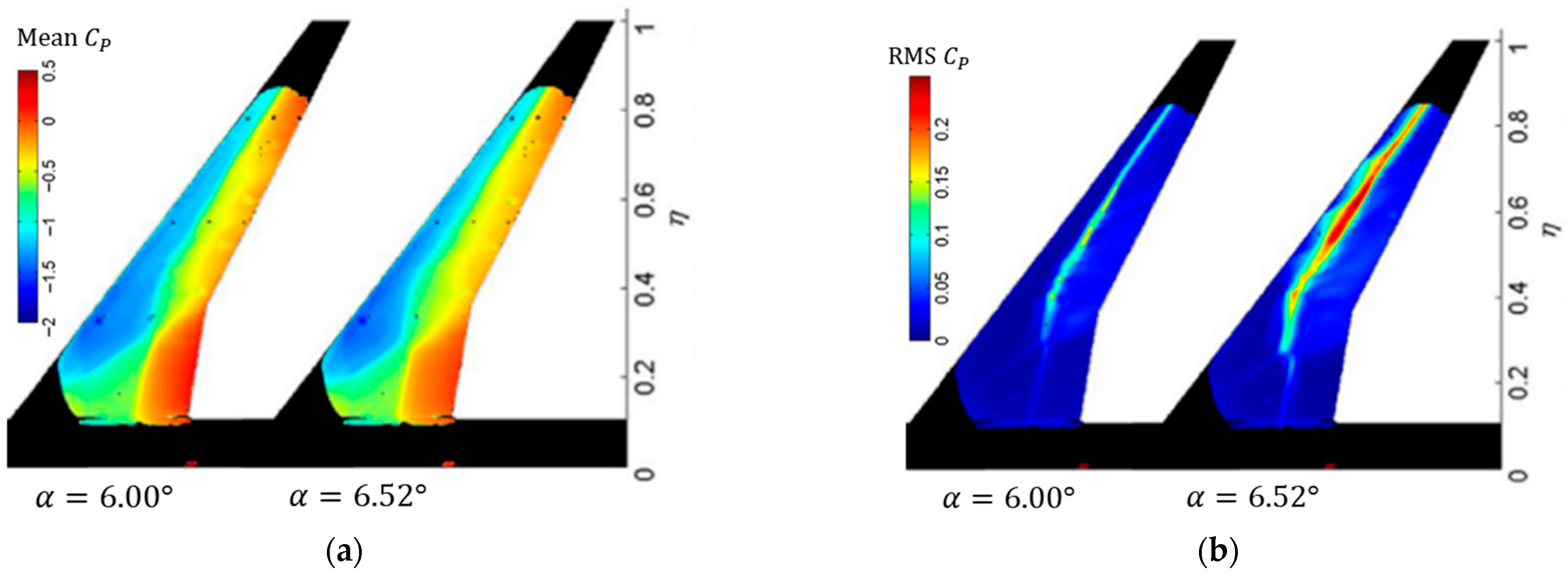
Modern civil aircraft extensively employ supercritical wings to reduce cruise drag and enhance flight efficiency [1]. However, when flight conditions deviate from the design point, specifically at higher Mach numbers or lift coefficients, the aerodynamic performance of the aircraft gradually deteriorates. Initially, regions of local supersonic flow terminate in a shock wave, causing a rapid increase in wave drag, known as drag divergence. As the shock strength intensifies further, the adverse pressure gradient across the shock induces boundary layer separation. Detailed studies by Crouch et al. [2] and Lee et al. [3] have elucidated that this interaction leads to a self-sustained feedback loop between the shock wave motion and the separated shear layer, known as transonic buffet. A schematic of this physical mechanism is illustrated in Figure 1 [4]. The cycle initiates when the shock strength intensifies, creating a strong adverse pressure gradient that induces a separation bubble at the shock foot (Figure 1a). The growth of the separation bubble thickens the effective boundary layer, emitting pressure waves that propagate upstream. These disturbances force the shock wave to move upstream (Figure 1b). As the shock moves forward into a region of lower local Mach number, its strength decreases. Consequently, the shock-induced separation is suppressed and the flow tends to reattach (Figure 1c). With the flow reattached, the flow accelerates again, and the shock wave moves downstream (Figure 1d) to restart the cycle. On swept wings, this phenomenon is further complicated by the spanwise drift of the boundary layer, leading to highly three-dimensional separation patterns as observed in the experimental work of Sugioka et al. [5]. As demonstrated in Figure 2, Sugioka et al.’s experimental data [5] reveal the progression of 3D shock buffet on the NASA Common Research Model. The results indicate a marked proliferation of shock buffet amplitude and coverage in the mid-to-outboard wing regions as the angle of attack rises. The self-sustained motion of the shock wave induces large-amplitude fluctuations in aerodynamic loads, posing severe risks to structural fatigue and flight safety. Consequently, delaying the buffet boundary to expand the operational envelope remains a critical challenge in aerodynamic design.
To mitigate transonic buffet, various active and passive flow control strategies have been proposed, such as vortex generators, suction, and trailing edge deflection [6]. Among these, the Shock Control Bump (SCB) has emerged as a promising passive device due to its structural simplicity and minimal viscous drag penalty [7,8]. For 2D configurations, Qin et al. [9] demonstrated that SCBs mitigate wave drag primarily through the formation of a lambda-shock structure. In the 3D context, Ogawa et al. [10] and Deng et al. [8] revealed that 3D bumps generate streamwise vortices. These vortices induce a downwash of high-momentum fluid into the boundary layer, re-energizing it and thereby suppressing shock-induced separation more effectively than 2D bumps.
Current research on SCBs has focused primarily on parametric design and optimization for drag reduction in steady cruise conditions [7,8,11,12]. Tian et al. [13] also explored multi-objective optimization for drag reduction on supercritical wings. While several studies using Unsteady RANS (URANS) have explored SCB effects on buffet suppression, they are largely limited to two-dimensional airfoils or isolated three-dimensional wing sections [14,15]. Mayer et al. [12,16] conducted comprehensive numerical optimizations of SCBs on wing–body configurations, focusing on buffet load alleviation. The potential of 3D contour SCBs for modifying the buffet boundary on three-dimensional swept wings has not been fully exploited [17,18]. Specifically, the underlying flow mechanisms governing the interaction between 3D SCB-induced vortices and the inherent spanwise instability of swept-wing buffet remain insufficiently understood. Furthermore, design criteria optimized for drag reduction may not necessarily yield the best performance for buffet delay, implying a need for a trade-off analysis.
This study aims to investigate the efficacy of 3D contour SCBs in delaying the buffet boundary of the NASA Common Research Model (CRM) wing using Reynolds-Averaged Navier–Stokes (RANS) simulations. First, the methods of determining the buffet boundary for the wing are assessed. Building on an adaptive parameterization technique, two typical 3D contour SCB configurations are then designed specifically for flow conditions near the buffet boundary. The aerodynamic performance and buffet-boundary effect of these configurations are subsequently evaluated in detail. Finally, the local shock strength, associated separation pattern, and the streamwise vortices generated by the contour SCBs are examined to elucidate the flow mechanisms through which the SCBs influence the buffet behavior of the swept wing.

2. Numerical Method

2.1. Numerical Setup

The numerical simulations were performed using the commercial CFD solver ANSYS Fluent (Version 2022 R1) based on the cell-centered finite volume method [19]. Viscous and diffusive fluxes are discretized with a second-order upwind scheme, while spatial convective fluxes are computed using a second-order upwind Roe scheme. Gradients required for convective and dissipative terms are evaluated using the least-squares cell-based method. Given its superior accuracy in shock-capturing applications [17], the k–ω SST turbulence model is selected for fully turbulent flow simulations.
The model investigated is the NASA Common Research Model (CRM) [20]. The CRM wing features a quarter-chord sweep angle of Λ c / 4 = 35 ° , a reference mean aerodynamic chord of c = 7.0 m, a semi-span of b = 26.3 m, and a reference area of S = 191.84 m2. These geometric parameters are used to nondimensionalize the aerodynamic force coefficients. In addition, the reference point for the pitching moment coefficient ( C M y ) is taken at the quarter-chord point of the mean aerodynamic chord of the wing. Transonic experimental data for the CRM wing are available from Edward et al. [21], corresponding to a free-stream Mach number M = 0.85 and a chord-based Reynolds number R e c = 5 × 10 6 .
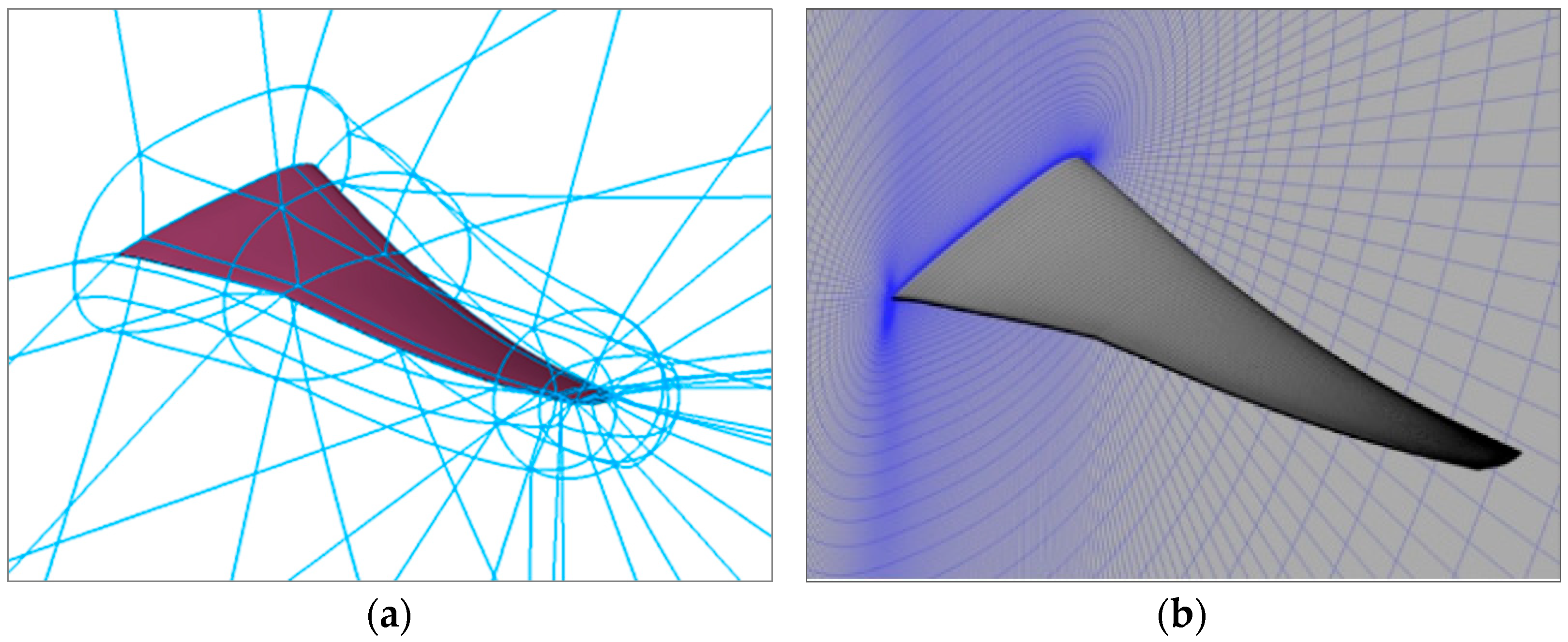
The computational grid, shown in Figure 3, employs an O-type topology, with the far-field boundary located approximately 50 semi-spans from the wing. The first-layer wall-normal resolution maintains an average y + < 1 , with a growth rate of 1.2. The computational domain and boundary conditions were defined as follows [22]: A pressure far-field boundary condition was applied to the outer boundary, where the freestream Mach number, static pressure, and temperature were specified. A no-slip wall condition was enforced on the wing surface, and a symmetry boundary condition was applied at the root plane (y = 0). The convergence criteria required the root-mean-square (RMS) residuals for the continuity, momentum, and energy equations to drop below 10−5. Additionally, the solution was considered converged when the oscillations in drag coefficients were less than 0.1% over the last 500 iterations.

2.2. Grid Convergence Study

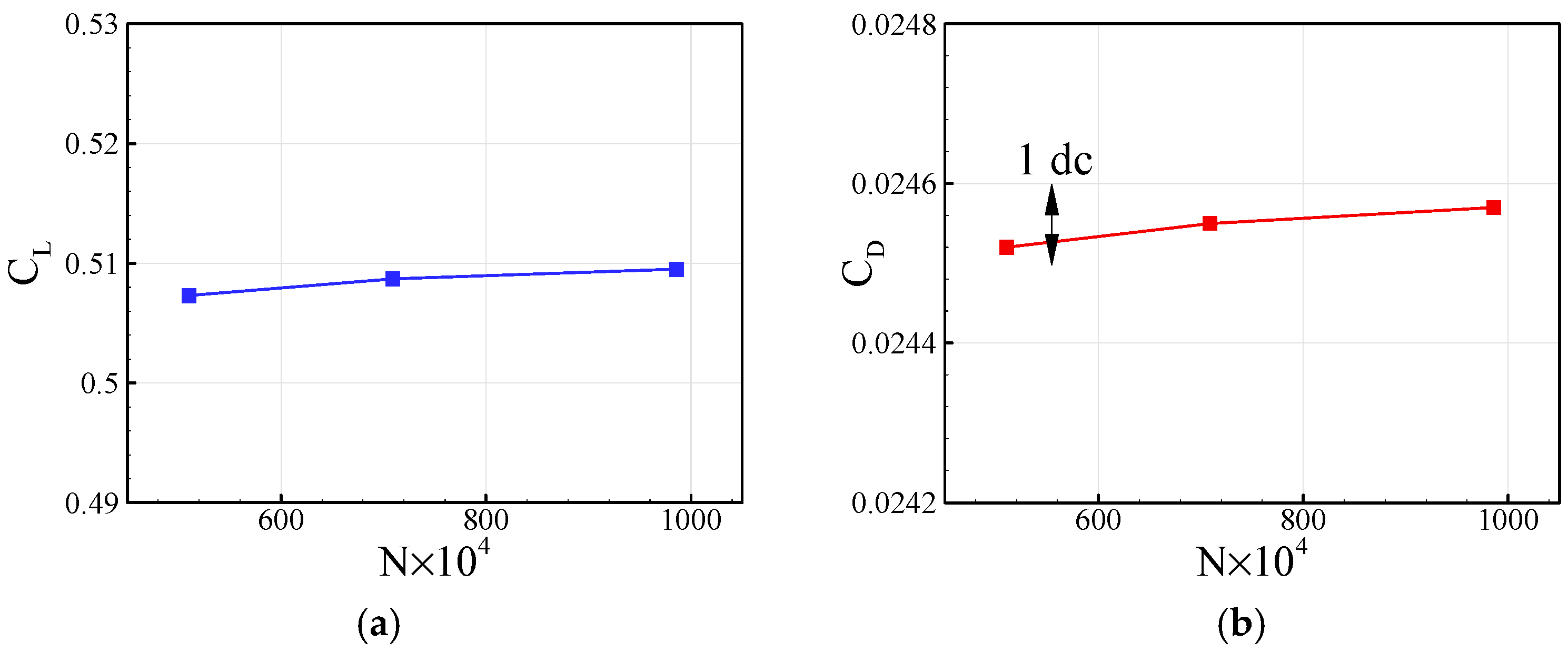
Firstly, a grid independence study was conducted using meshes of different densities. The specific mesh parameters are listed in Table 1. The three meshes provide different resolutions of the shock-wave position on the upper surface of the wing. The total mesh count of L3 is 9.86 million, and the resolution near the shock region is finer than 0.5% of the chord. Aerodynamic characteristics of the CRM wing were computed under the conditions of M = 0.85 , α = 3.5 ° , and R e c = 5 × 10 6 using these three meshes, and the comparisons of lift and drag coefficients are shown in Figure 4. It can be seen that, as the mesh size increases, the discrepancies in aerodynamic forces gradually decrease. The difference in lift coefficient between meshes L2 and L3 is very small, while the drag coefficient difference remains within 0.5 counts (1 drag count corresponds to C D = 10 4 ). This indicates that mesh L3 provides sufficient accuracy for wing aerodynamic prediction. Subsequent research was conducted based on the L3 grid.
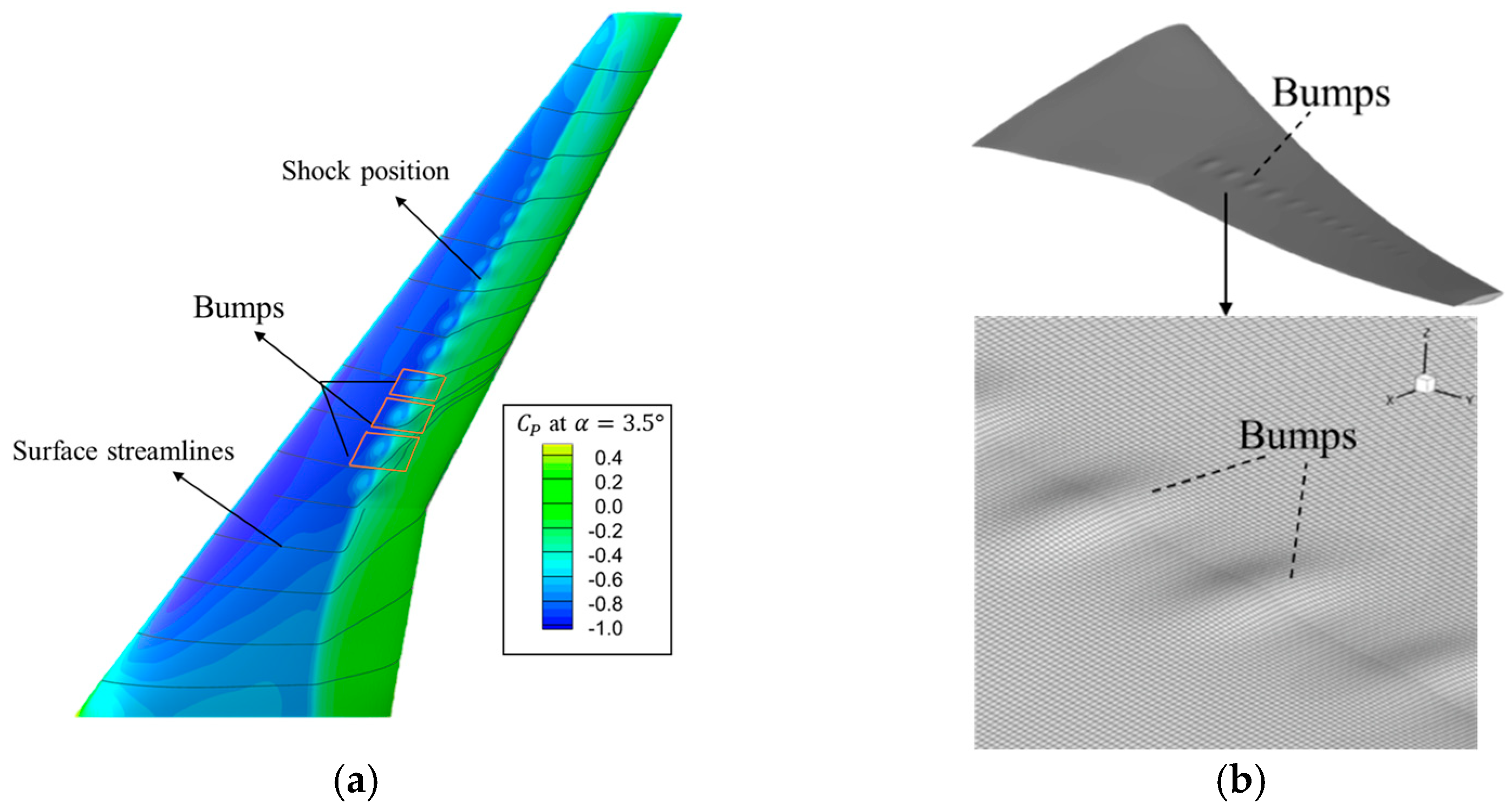
In addition, the spatial distribution of the three-dimensional contour bumps is shown in Figure 5a. The bumps are typically arranged from the mid-span to the outer-span region of the wing, where the shock intensity and flow separation are relatively strong. In this region, the bumps have the potential to significantly improve the aerodynamic performance of the wing.
To accurately capture the geometric features of the bumps and the associated complex flow structures, a localized grid refinement strategy was employed, as shown in Figure 5b. Table 2 presents a quantitative comparison between the baseline and the refined SCB grids. As shown in the table, the grid resolution over the bump geometry is significantly enhanced. Specifically, the spanwise spacing is refined to Δ y / b = 0.0014, ensuring approximately 40 grid nodes across the width of each bump [8]. The streamwise spacing is similarly refined to resolve the curvature of the bump crest. This resolution is sufficient to capture the intricate 3D flow separations and vortices generated by the SCBs. To investigate the aerodynamic effects of the SCB configurations, a distance-based dynamic mesh algorithm [23] was employed to generate the computational grids for the SCB cases, starting from the baseline mesh. Previous studies [22] have demonstrated that this approach can ensure a satisfactory mesh quality for the bump-modified configurations.

2.3. Numerical Validation

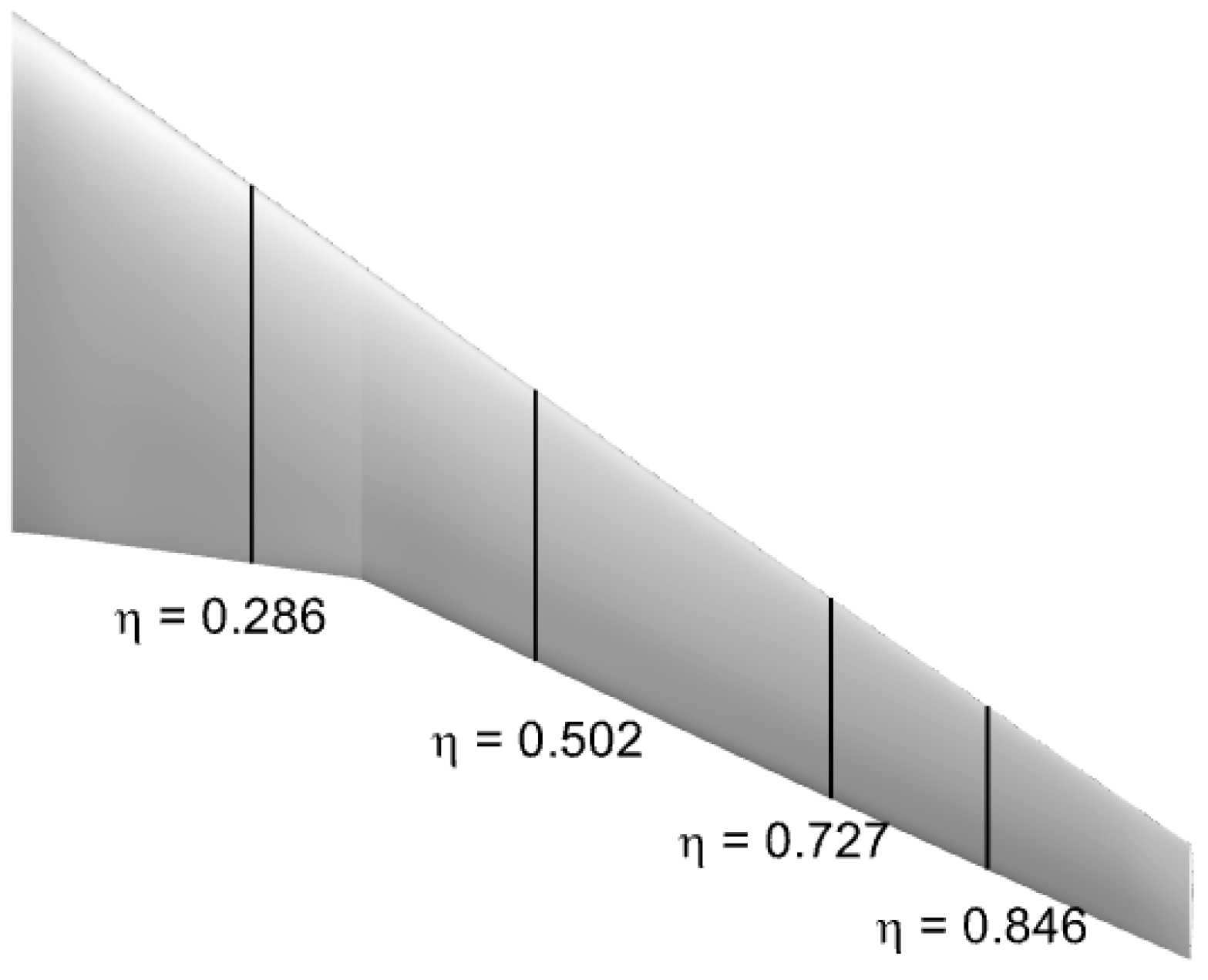
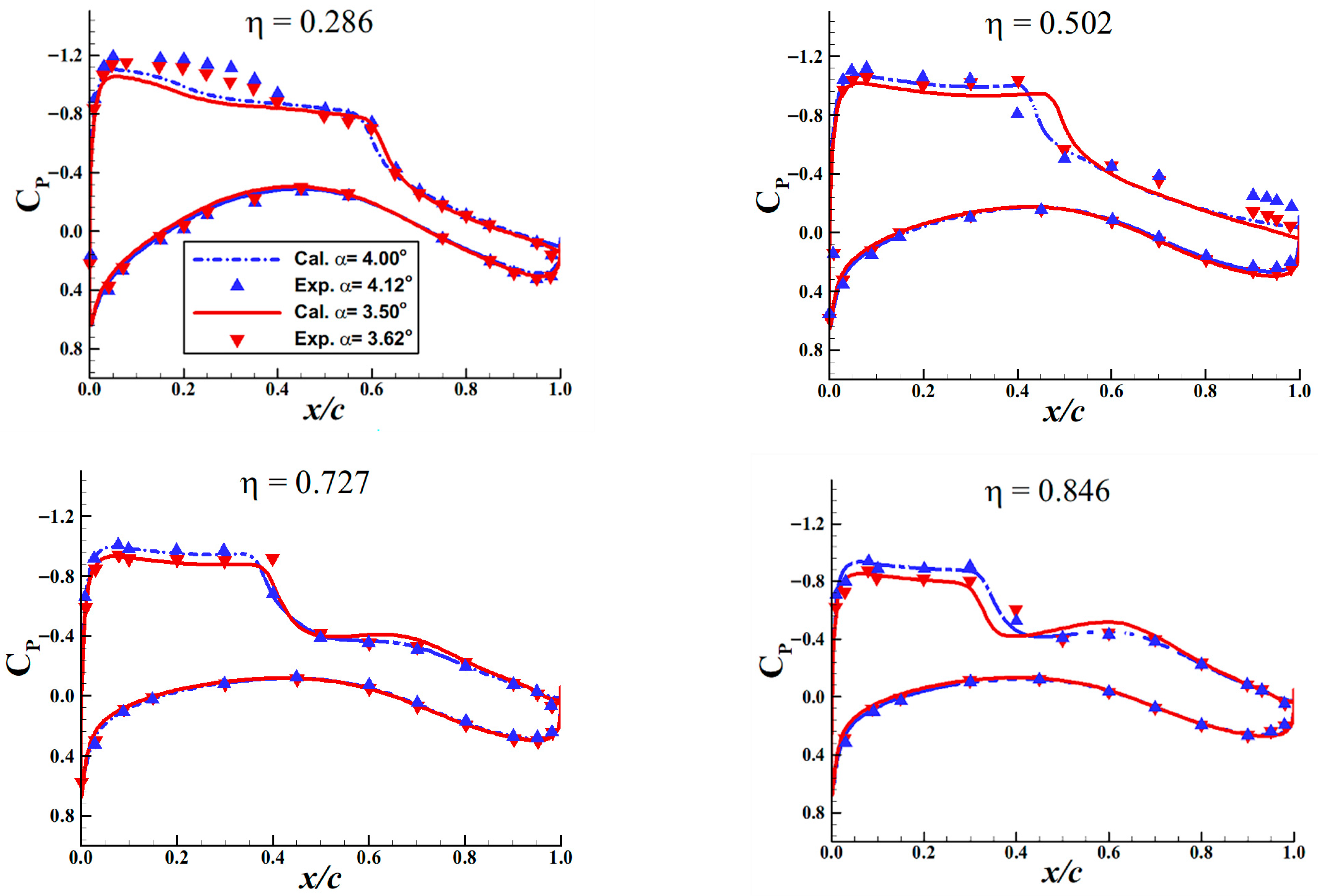
Figure 6 shows the spanwise locations on the wing surface used for validation, as defined in the experimental study [24]. Figure 7 compares the computed pressure coefficient ( C P ) distributions at these spanwise locations on the wing surface with the experimental data [24] at α = 3.5 ° and 4.0 ° , at M = 0.85 , and R e c = 5 × 10 6 . These specific angles of attack were selected for validation because they represent critical high-lift conditions near the buffet boundary [5], characterized by strong shock wave, and corresponds to the availability of high-fidelity experimental data.
As shown in Figure 7, at the inboard section η = 0.286 , certain discrepancies exist between the computed and experimental surface pressure distributions on the upper wing surface, primarily because the simulation does not account for fuselage effects. Nevertheless, the numerical results successfully capture the shock location (around x / c 0.6 ), and the shock position exhibits only minor variation with angle of attack. At the mid-span section η = 0.502 , the simulation reasonably reproduces the upstream movement of the shock with increasing angle of attack, indicating a tendency toward shock buffet in this region [25]. At the outboard section η = 0.727 , the numerical predictions also show good agreement with the experimental data, and the shock location changes only slightly as the angle of attack increases. At the far outboard section η = 0.846 , the shock moves downstream with increasing angle of attack, and the simulation exhibits a trend consistent with the experimental observations. However, a noticeable discrepancy in shock location is observed between the CFD and experimental results at high angles of attack. This is primarily attributed to static aeroelastic effects [20]. The wind tunnel model undergoes aeroelastic twisting (washout) under high aerodynamic loads, reducing the local effective angle of attack at the tip, whereas the current RANS simulations employ a rigid mesh that does not account for this load-dependent deformation. Despite these local deviations, the present simulation method successfully captures the key aerodynamic characteristics near the buffet boundary, providing a reliable basis for the subsequent analysis.

2.4. Determination of the Buffet Boundary

The buffet boundary in this study is defined under prescribed Mach and Reynolds numbers, which determine the aerodynamic similarity of the flow. Mach number primarily controls shock characteristics and strongly affects buffet onset, while Reynolds number influences viscous effects and boundary-layer separation. Generally, Reynolds number is fixed to match experimental conditions, and the buffet boundary is determined as the critical state within the (Ma, α) space where flow separation and unsteady pressure amplification become significant. In this study, numerical simulations were conducted at a fixed Mach number of M = 0.85. A total of 10 discrete angles of attack were simulated, ranging from α = 1 ° to 4.25 ° . To accurately capture the buffet onset, the angle of attack was increased in increments of Δ α = 0.5 ° for the linear region and refined to Δ α = 0.25 ° near the buffet boundary ( α > 2.75 ° ).
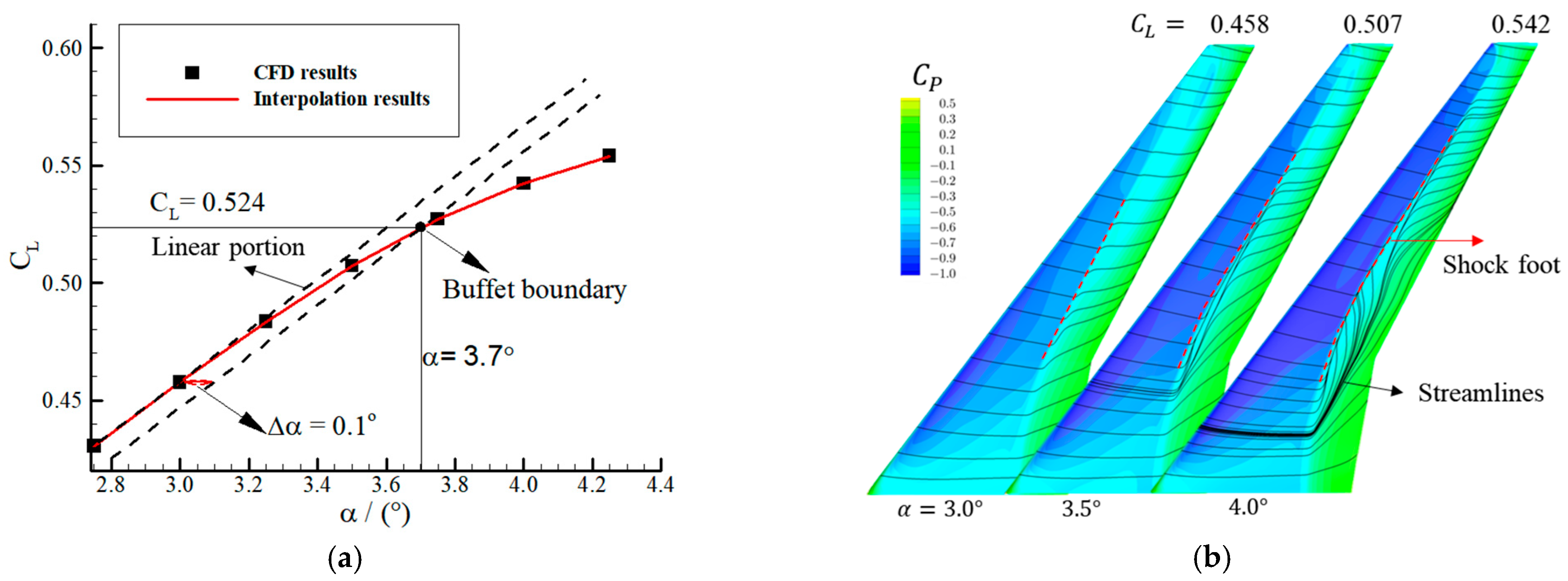
Generally, transonic buffet is accompanied by shock-induced flow separation, which causes the wing lift to deviate from linear behavior [26]. In engineering practice, a commonly used identification method is to monitor the change in slope of the lift curve ( C L α ) . Specifically, a linear regression using the Least Squares Method is performed on the lift data within the attached-flow range ( α = 2 ° ~ 3 ° for this study). To precisely identify the intersection point, a Cubic Spline Interpolation method was used to construct a continuous lift curve from the discrete CFD results. The linear portion of the lift curve is then shifted by an offset Δ α = 0.1 ° ; the intersection between this offset line and the original lift curve defines the buffet boundary [26] at the flow condition of M = 0.85 and R e c = 5 × 10 6 .
Figure 8 presents the variation in the lift coefficient and the corresponding pressure distributions at representative flow conditions. In Figure 8a, the buffet onset is identified by shifting the linear portion of the lift curve by Δ α = 0.1 ° . The intersection with the actual lift curve yields α b = 3.7 ° or C L , b = 0.524 , which defines the buffet boundary of the CRM wing at M = 0.85 and R e c = 5 × 10 6 . To assess the reliability of this boundary, an uncertainty analysis was conducted based on the grid convergence study (Section 2.2). The discretization error in the lift coefficient was estimated to be less than 0.2% (comparing L2 and L3 grids). Consequently, the uncertainty in the determined buffet onset angle α b is estimated to be within ± 0.02 ° . This narrow error range confirms that the obtained buffet limitations are numerically robust and independent of grid resolution. As shown in Figure 8b, the flow separation induced by the shock on the wing surface intensifies near this condition, resulting in a noticeable reduction in the lift-curve slope.
In addition, the variation in the trailing-edge pressure coefficient, C P , t e , also provides an effective indicator of buffet boundary [27]. Under the attached-flow conditions, the trailing-edge pressure varies nearly linearly with flight conditions. As the flow approaches the buffet boundary, however, the trailing-edge pressure within the separated-flow region exhibits a divergent trend.
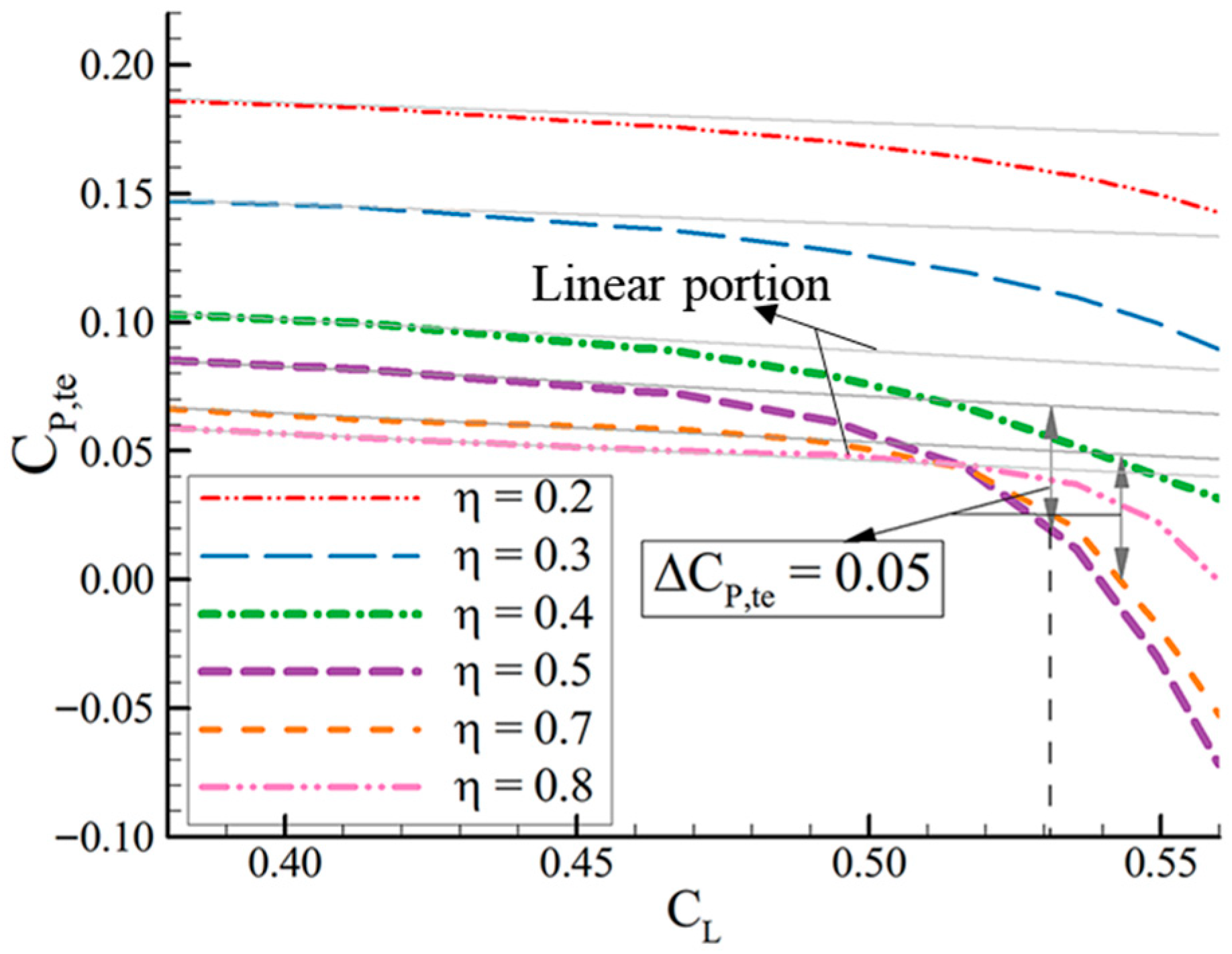
The trailing-edge pressure coefficient C P , t e is extracted at the streamwise position x / c = 0.99 for each spanwise location. To quantify the divergence, a linear fit is first applied to the C P , t e C L curve in the steady-flow regime ( α < 3.0 ° ). The deviation Δ C P , t e is then calculated as the absolute difference between the CFD-computed C P and the extrapolated linear value at the corresponding lift coefficient. In practice, when the change in trailing-edge pressure Δ C P , t e exceeds a prescribed threshold (e.g., 0.05), the wing is considered to have reached the buffet boundary [27,28].
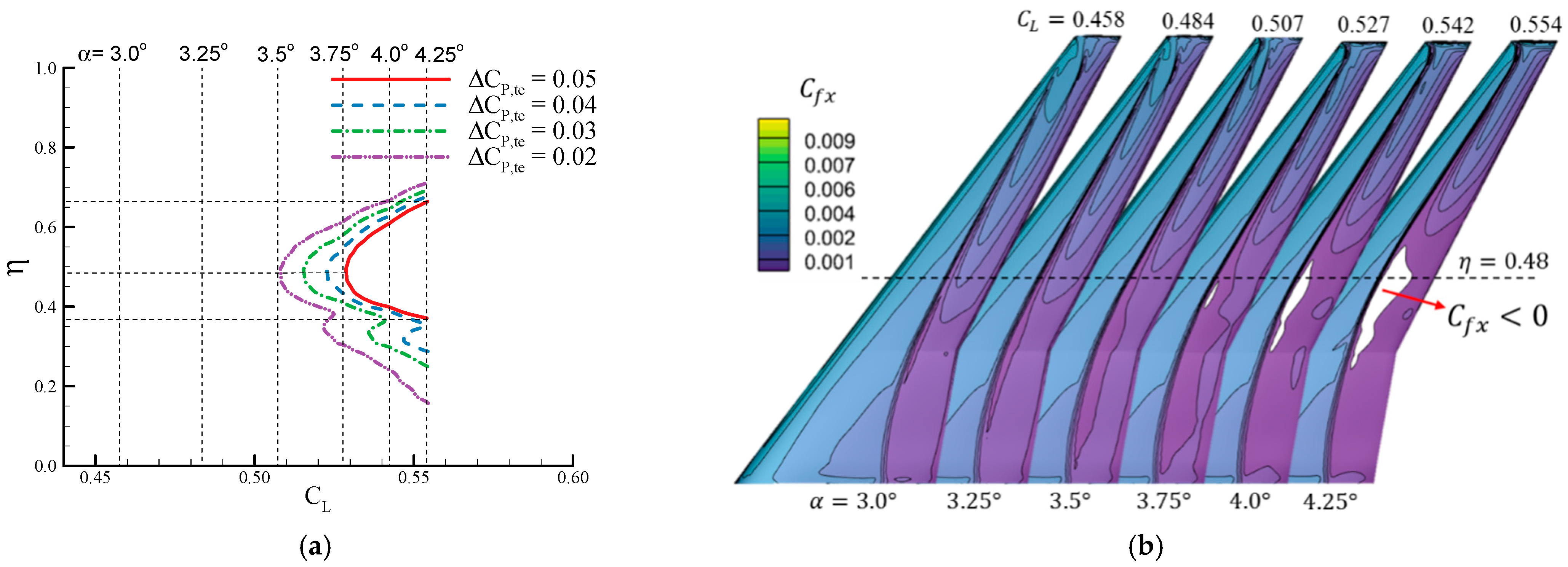
Figure 9 shows the variation in the trailing-edge pressure with lift at different spanwise locations of the wing. It can be seen that, for angles of attack in the range α = 2.75 ° 3.0 ° , C P , t e varies essentially linearly across the span, which is consistent with the behavior of the C L α curve. As the angle of attack increases, the trailing-edge pressure at both the inboard region ( η < 0.3 ) and the outboard region ( η > 0.8 ) continues to vary linearly, indicating that the buffet threshold is not reached in these areas over the considered lift conditions. Near the mid-span ( η 0.5 ), however, the trailing-edge pressure exhibits the most pronounced variation with lift. At C L = 0.53 (corresponding to α 3.8 ° ), the change in trailing-edge pressure reaches Δ C P , t e = 0.05 , indicating that the wing first reaches the buffet boundary at this spanwise location.
Furthermore, Figure 10 presents the contour map of the trailing-edge pressure variation Δ C P , t e ( C L , η ) . As shown in Figure 10a, the mid-span region of the wing ( η = 0.48 ) first reaches the buffet threshold of Δ C P , t e = 0.05 at C L = 0.528 ( α 3.75 ° ), indicating that this operating condition ( C L , b = 0.528 , α b 3.75 ° ) corresponds to the buffet boundary identified by the trailing-edge pressure criterion. As the angle of attack increases, the region where Δ C P , t e = 0.05 is exceeded gradually expands. At α = 4.0 ° , the entire spanwise range of η = 0.4 0.6 reaches the buffet threshold, implying a growing buffet-affected region. Figure 10b shows the surface x-component skin-friction coefficient C f x contours. Near the buffet boundary, localized flow separation first appears in the mid-span region ( η = 0.4 0.5 ). Below the buffet boundary, no flow separation is observed on the wing surface. As the angle of attack exceeds the buffet boundary, the separation region around the mid-span expands further. The spanwise growth of separated flow induces spanwise shock movement, giving rise to a three-dimensional shock buffet phenomenon [25]. This observation highlights that suppressing spanwise flow separation is crucial for effective buffet control.
Under similar flow conditions ( M = 0.85 , R e c = 5 × 10 6 ), Sugioka et al. [5] measured the root strain variations with the angle of attack on the CRM wing. Based on their analysis, the buffet phenomenon is categorized into three distinct regimes. In the first regime ( α = 3.7 ° 4.7 ° ), the buffet amplitude remains small, indicating that the difference between steady and unsteady results is minimal. In the second regime ( α = 4.7 ° 6.0 ° ), the buffet amplitude increases moderately, with shock oscillations primarily maintained within the outboard region. In the third regime ( α > 6.0 ° ), the buffet amplitude reaches a high level, characterized by large-scale shock oscillations in the outer wing.
As illustrated in Figure 8, the buffet boundary determined in this study ( α b 3.7 ° ) aligns closely with the lower limit of the first buffet regime identified by Sugioka et al. [5]. Figure 10 further confirms this, showing that, at the buffet onset, the flow separation is localized consistent with the first regime. Consequently, the present steady RANS simulation accurately captures the critical transition point into the first buffet regime, providing a reliable baseline for investigating the effect of 3D SCBs on expanding the buffet boundary.
In summary, the buffet boundaries determined using the two criteria are essentially consistent. Moreover, the trailing-edge pressure-based method provides clearer insight into the specific spanwise location where buffet is first triggered.

3. Shock Control Bump for Buffet Suppression

3.1. Design of 3D SCB Configurations

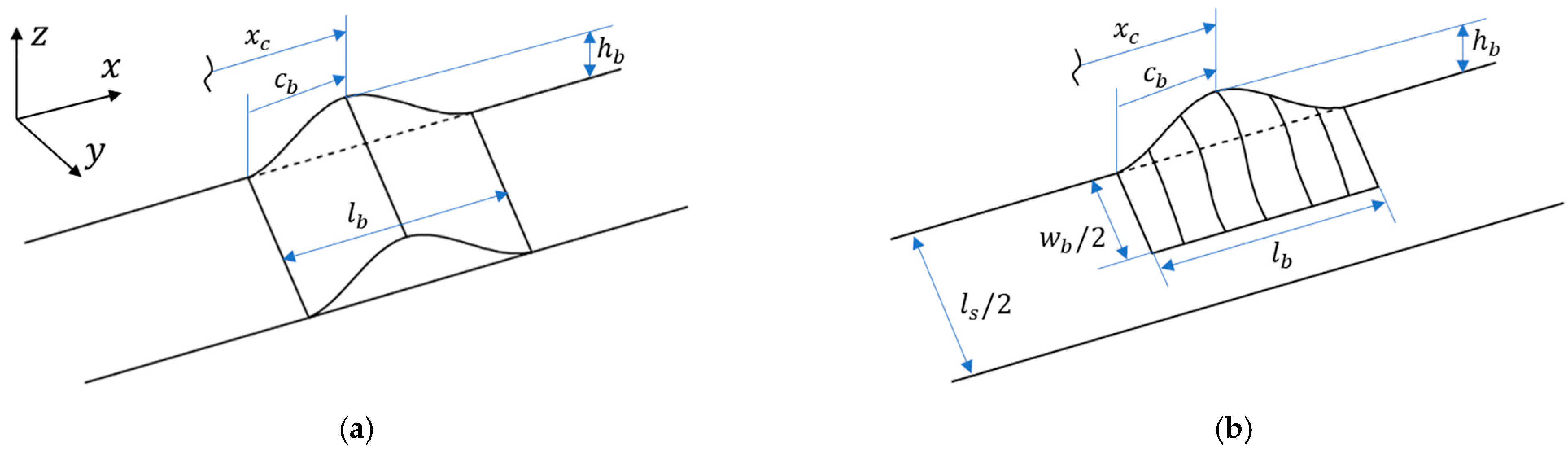
Following the parameterization approaches proposed by Qin et al. [7] and Deng et al. [8], a two-dimensional (2D) contour bump is defined using four geometric parameters (Figure 11a): the bump length l b , crest location x c (measured from the local leading edge), relative crest position c b , and bump height h b . To construct a three-dimensional (3D) contour SCB, the height of the 2D bump is gradually tapered in the spanwise direction through a weighting function W ( x , y ) , while the chordwise length and crest position remain unchanged. The 3D bump introduces two additional spanwise parameters (Figure 11b), the total spanwise coverage l s , which determines the number of bumps per unit wing span, and the relative bump width w b , which defines the effective spanwise extent. The chordwise–spanwise variation in bump height, W ( x , y ) , is expressed as:
W ( x , y c r e s t ) = h b ; W ( x , y e n d ) = 0
where y crest denotes the spanwise location of the maximum bump height (i.e., the symmetry plane shown in Figure 11b) and y end = y crest + w b / 2 represents the outer boundary where the bump height reduces to zero. The full 3D bump geometry is then defined as:
W x , y = h b · cos 4 ( π / 2 · y b )
Here, y b is the non-dimensional local spanwise coordinate:
1 y b = ( y y c r e s t ) / w b 1
It is important to note that the use of the fourth-power cosine function in Equation (2) ensures strict geometric continuity at the bump boundaries ( y b = ± 1 ). At these edges, both the bump height function and its first derivative with respect to the spanwise coordinate vanish ( W / y = 0 ). This mathematical property guarantees that the bump surface is tangent to the wing surface, ensuring a smooth geometric transition without any sharp discontinuities that could introduce spurious flow disturbances.
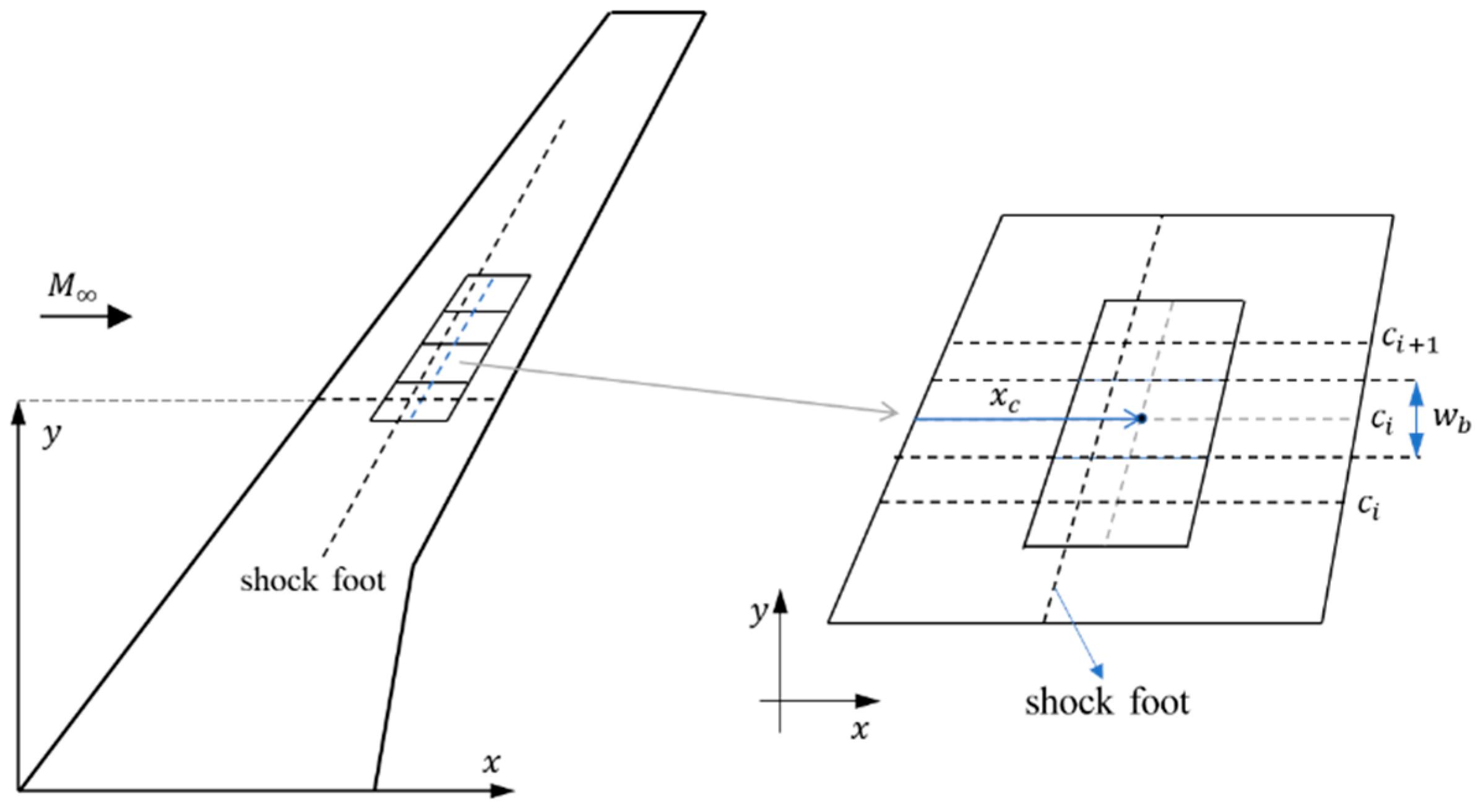
As shown in Figure 12, an array of 3D SCBs is distributed along the wing surface to maximize the attenuation of the local shock strength. Each bump is oriented according to the local streamline direction. Following ref. [8], the optimal aspect ratio is chosen as w b / l b = 2 / 3 . The crest position x c is set relative to the shock foot at the design condition, typically located at x s = 0.06 0.09 [22]. The bump height is determined based on the local shock intensity, often characterized by the local Mach number M s h .
Bumps were designed at two design points below the buffet boundary ( α d p = 3.0 ° and α d p = 3.5 ° ). Since the region of high shock intensity is situated between η = 0.3 and 0.8, the bumps are concentrated in this area. The aspect ratio is fixed at l b = 0.34 , w b = 0.22 . The specific design steps are as follows:
Determine the relative crest position based on the shock foot location at the design point:
x c , i = x s , i + x s h , i ( α d p ) x s , i = x s , i [ M s h , i ( α d p ) ]
Determine the local bump height via interpolation based on the local shock intensity at the design point:
h b , i = h b , i ( M s h , i ( α d p ) )
In this study, the shock foot location ( x s , i ) is defined as the chordwise coordinate where the streamwise gradient of the pressure coefficient reaches its maximum value within the shock region. In cases where multiple shocks (e.g., a lambda shock structure) are present, the design targets the primary recompression shock (the downstream branch), as this shock imposes the strongest adverse pressure gradient and is the dominant factor inducing boundary layer separation. The shock strength ( M s h ) is then quantified by the pressure jump across the shock, expressed as Δ C P . This approach is widely adopted because the surface pressure jump is directly related to the normal Mach number and thus to the strength of the shock–boundary layer interaction [7,8].
Then, an iterative engineering design strategy was employed to determine the SCB parameters. First, the initial bump parameters were estimated following the empirical correlations proposed by Deng et al. [8] based on the local shock location and shock intensity distribution. Then, several candidate bump configurations were generated around this initial estimate, and their aerodynamic performance was evaluated using RANS simulations. Based on the observed effects on shock weakening, separation suppression, and drag characteristics, the bump parameters were iteratively refined until no further significant improvement was achieved. This process may be regarded as an engineering-oriented tuning procedure.
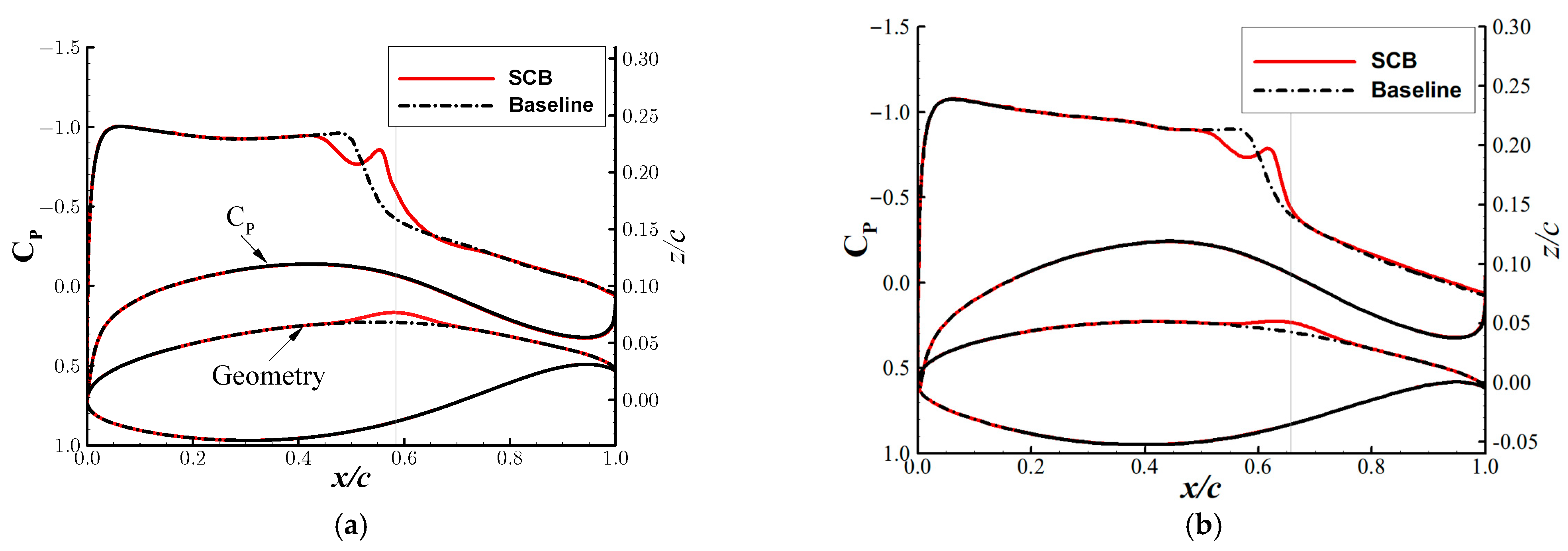
Based on the above design process, Figure 13 presents the bump parameters designed at two representative spanwise locations of the wing under the design condition α d p = 3.5 ° , together with their effects on the local flow field. As shown in Figure 13, the bump geometry varies with the local shock position and strength, and the parameters are adjusted adaptively through the design process. For example, for SCB 1 at η = 0.330 , the bump is positioned downstream accordingly to align with the shock location. For SCB 5 at η = 0.514 , where the shock is stronger, the resulting bump exhibits the larger height.
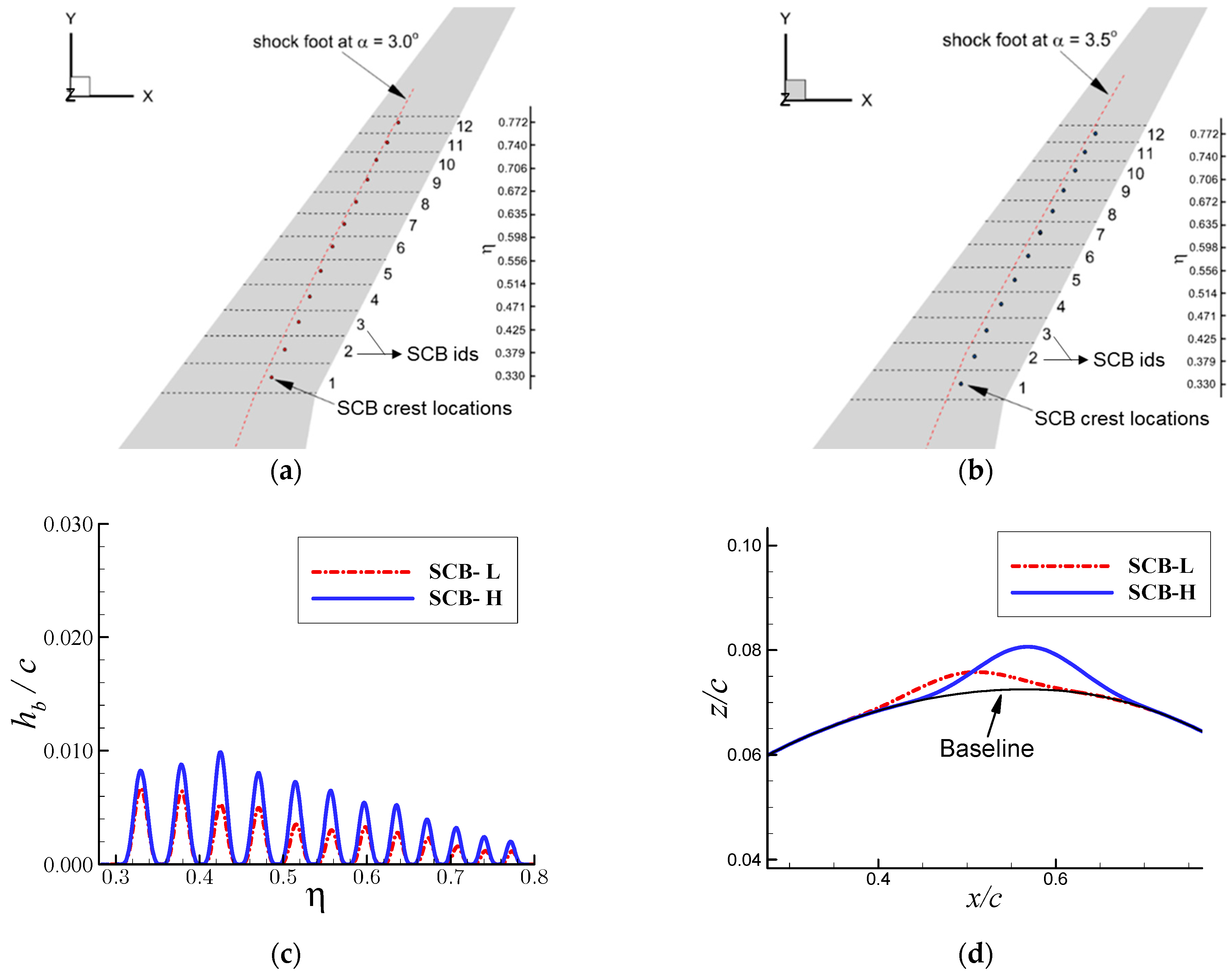
To investigate the influence of bump geometry on performance, two distinct configurations representing different design strategies were developed: SCB-L and SCB-H. Figure 14 presents the two configurations designed at the two design conditions, α d p = 3.0 ° and α d p = 3.5 ° , denoted as SCB-L and SCB-H, respectively. Figure 14a,b show the spanwise distribution of the two bump layouts. Consistent with the shock locations at the corresponding design points, SCB-H is positioned further downstream than SCB-L in the outer-wing region. Figure 14c shows the spanwise variation of the bump crest height for both configurations. Because the shock is stronger at α = 3.5 ° , SCB-H exhibits noticeably larger bump heights, particularly on the outer wing. Figure 14d compares the chordwise bump profiles at No. 6 bump, illustrating that SCB-H features a larger crest height and is located further downstream compared to SCB-L.

3.2. Aerodynamic Performance of SCB Configurations

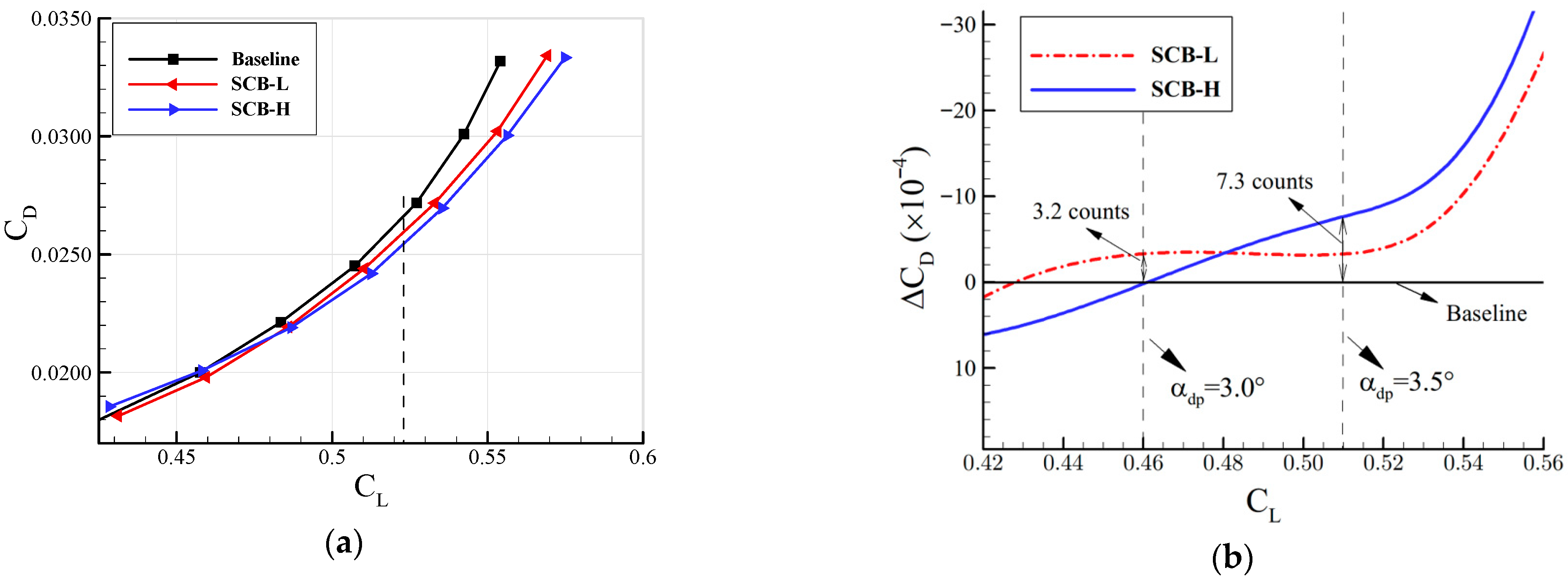
This section analyzes the aerodynamic performance of the two SCB configurations. Figure 15a presents the variation in drag coefficient with lift coefficient for different SCB configurations. It can be seen that, as the lift coefficient increases, the drag growth rate of the baseline wing also increases, which may lead to drag divergence under high-lift conditions. Both bump configurations reduce the drag in the high-lift regime, and the SCB-H configuration exhibits a more pronounced drag-reduction effect. This indicates that the bumps are able to alleviate, to a certain extent, the onset of drag divergence.
Figure 15b presents the drag reduction effects of SCB-L and SCB-H at different lift conditions, quantified as the drag difference between the bumped and baseline wings ( Δ C D = C D , S C B C D , B a s e l i n e ). At the design condition of α d p = 3.0 ° ( C L = 0.460 ), SCB-L achieves a drag reduction of 3.3 counts, while SCB-H, being located further downstream, provides only limited drag reduction at this condition. For the design condition α d p = 3.5 ° ( C L = 0.507 ), SCB-L yields a reduction of 3.2 counts, while SCB-H shows a much stronger drag-reduction effect of 7.3 counts.
In addition, Figure 15b highlights the effective drag-reduction ranges of the two SCB configurations. SCB-L provides drag reduction for C L > 0.427, whereas SCB-H becomes effective only for C L > 0.461, corresponding to a lift coefficient shift of Δ C L = 0.034. This indicates that the upstream-located SCB-L yields larger drag reduction at lower lift conditions and offers drag reduction over a broader operational lift range. In contrast, the downstream-located SCB-H performs better at higher lift conditions but offers limited drag-reduction capability at lower lift conditions, resulting in a narrower effective lift range.
Table 3 summarizes the contributions of pressure drag and skin-friction drag at the two design points. It can be seen that both bump configurations induce only minor variations in skin-friction drag across conditions, indicating that the drag-reduction benefits primarily originate from reductions in pressure drag.
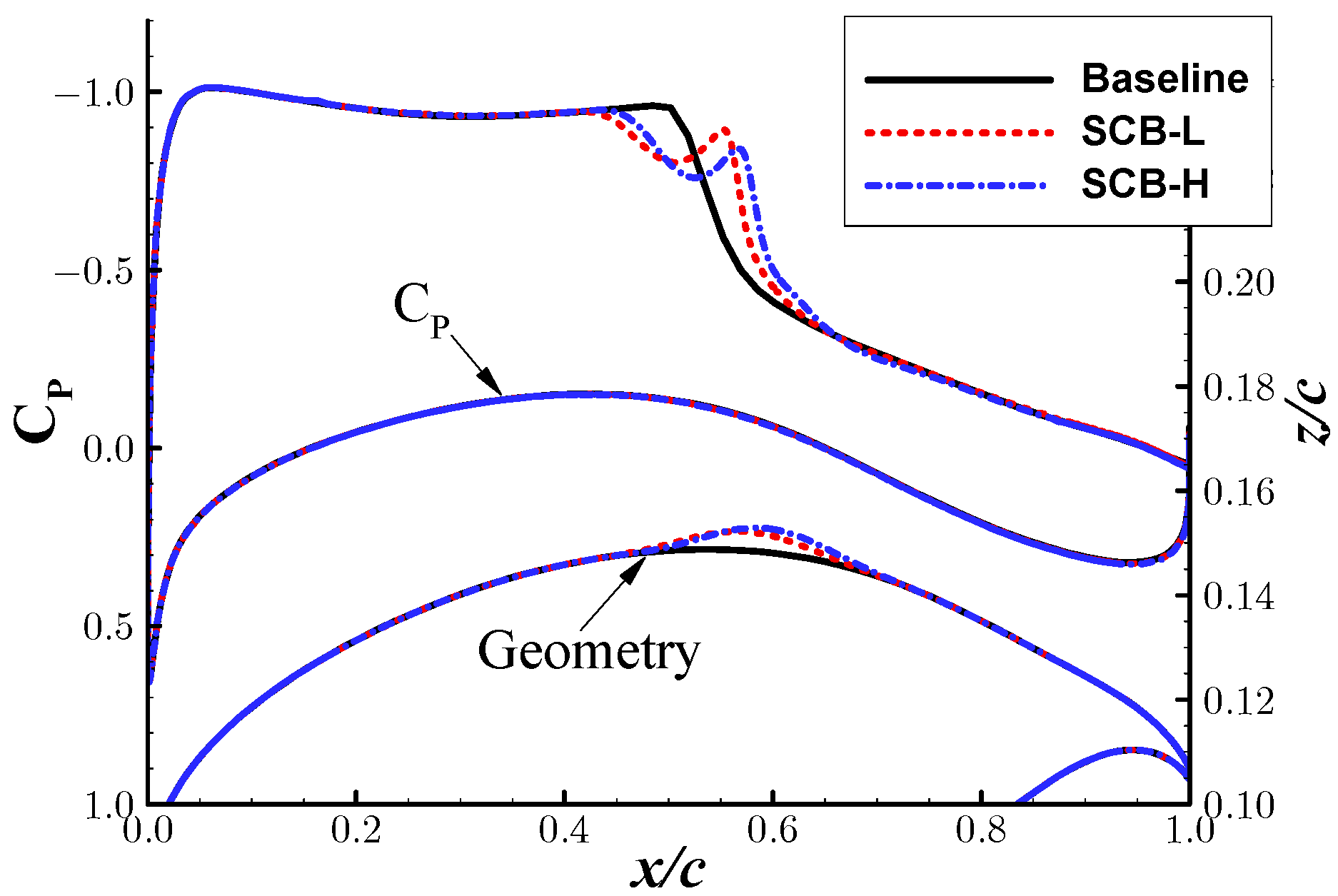
Figure 16 presents the pressure coefficient distributions at the spanwise station of η = 0.48 corresponding to α = 3.5°. This spanwise station is where the buffet boundary (defined by Δ C p t e = 0.05 ) is first reached, and the shock intensity is relatively strong. It can be seen that, with the application of the bumps, the flow decelerates earlier in the vicinity of the shock, thereby reducing the local pressure gradient, weakening the shock strength, and consequently achieving drag reduction. Meanwhile, the shock position is shifted downstream, which increases the lift coefficient and thus significantly improves the aerodynamic performance of the wing. Among the two configurations, the SCB-H configuration exhibits a stronger capability in alleviating the adverse pressure gradient of the shock, leading to a more pronounced drag reduction effect under this condition.

3.3. Buffet Boundary of SCB Configurations

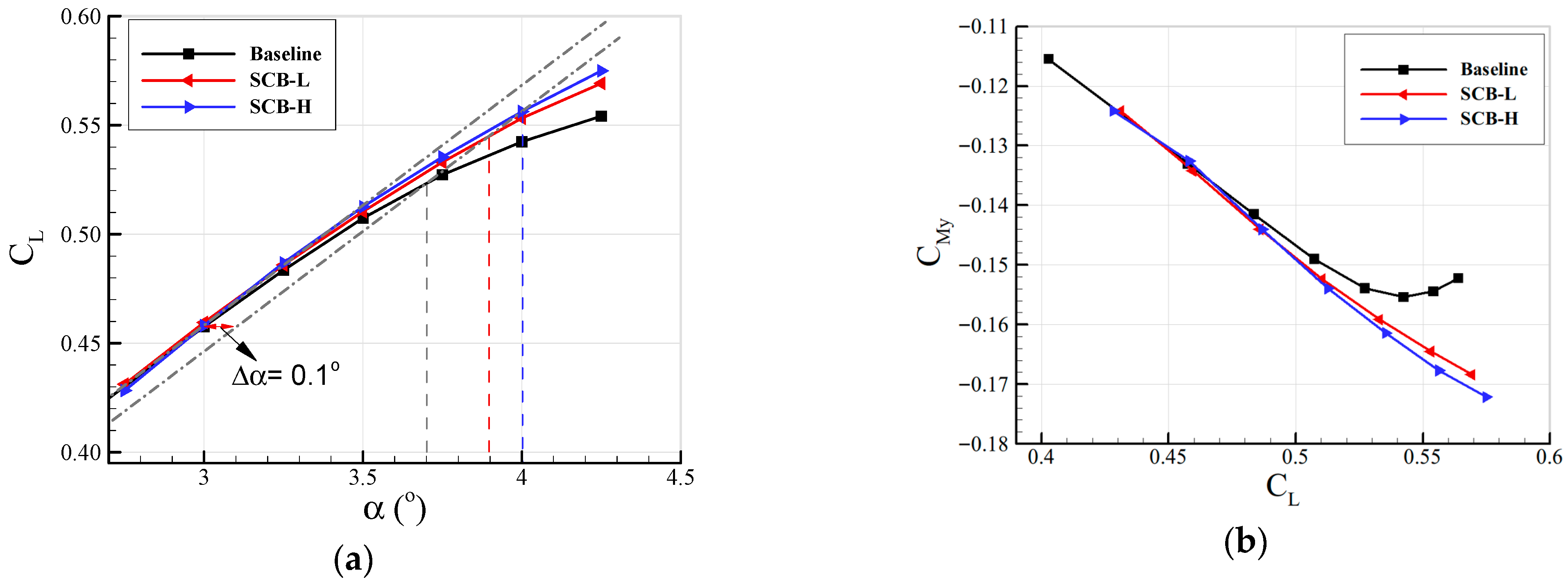
Subsequently, the characteristics of the lift and pitch moment of the two SCB configurations are examined. Figure 17a compares the variation in lift coefficient with angle of attack for different SCB configurations. In the low-angle-of-attack linear regime, the SCB configurations show little difference from the baseline wing. As the angle of attack increases into the nonlinear region, the baseline configuration experiences a rapid reduction in lift-curve slope due to the expansion of shock-induced separation. In contrast, the SCB configurations effectively delay the rapid lift degradation near the buffet boundary, thereby postponing the onset of buffet to a higher lift level.
Figure 17b presents the comparison of pitching moment coefficients with angle of attack. Near the buffet boundary, the baseline wing exhibits a premature forward shift of the aerodynamic center caused by shock-induced separated flow, leading to a pitch-break that severely degrades longitudinal stability. With the application of SCBs, the nonlinear pitching-moment behavior is noticeably postponed, resulting in a wider linear range of the pitching moment curve. This helps maintain a relatively stable aerodynamic center and preserves control characteristics, thereby significantly enhancing aircraft safety in the vicinity of the buffet boundary.
Table 4 summarizes the quantitative improvement of the wing buffet boundary achieved by different SCB configurations. The buffet boundary is determined using the lift-curve-based method. SCB-L increases the buffet-boundary lift coefficient from the baseline value of 0.524 to 0.545, corresponding to an overall improvement of 4.0%. SCB-H further increases the boundary to 0.557, achieving a larger improvement of 6.3%.
These results reveal an inherent trade-off between buffet-boundary enhancement and the effective drag-reduction range. The downstream-located SCB-H provides a more substantial delay of the buffet boundary but leads to a noticeable degradation in drag reduction at lower lift conditions. In contrast, the upstream-located SCB-L offers a broader drag-reduction range and has a much milder impact on low-lift aerodynamic characteristics. Therefore, in practical applications, the SCB parameters must be carefully selected around the design condition to achieve a balance between buffet characteristics and overall aerodynamic performance.
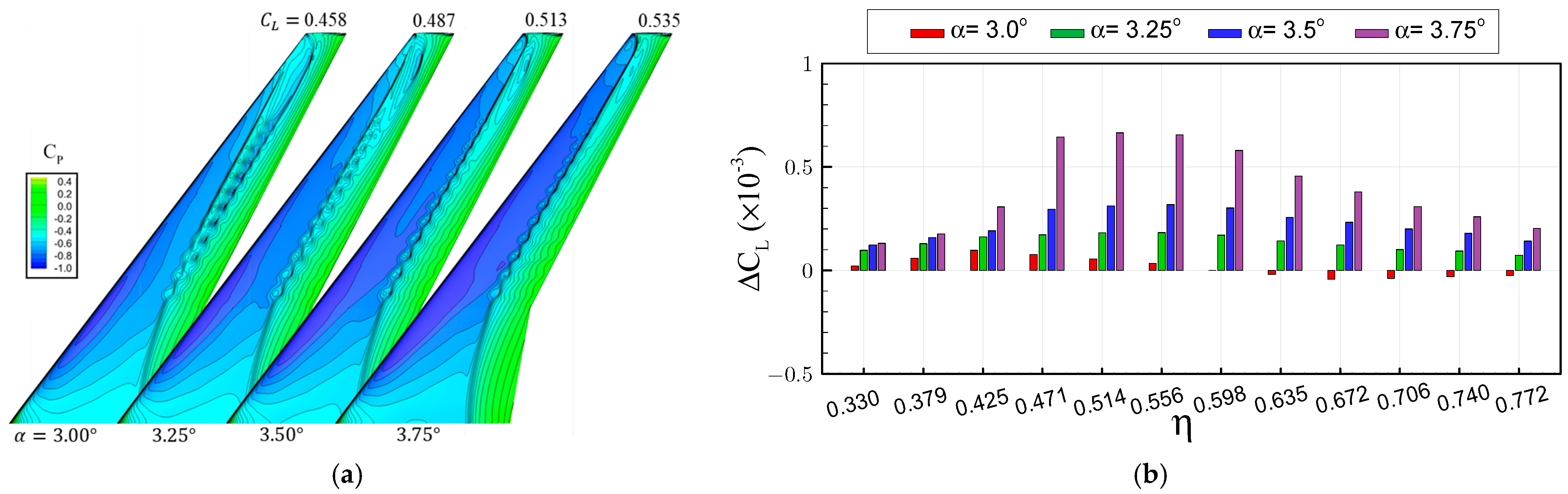
Figure 18 illustrates the influence of the SCB-H configuration at different spanwise locations on the local sectional lift of the wing. As shown in Figure 18a, near the buffet boundary, the SCBs delay the shock position of the baseline wing, thereby enhancing the local lift across different operating conditions. Figure 18b further illustrates the variation in the influence of the SCB-H configuration on the sectional lift at different spanwise stations under various angles of attack. The effect is particularly pronounced at bump locations 4–6 near the buffet boundary. This region corresponds to the strong shock on the wing and marks the initial onset of shock-induced flow separation ( η = 0.48 ). In this critical area, the SCBs simultaneously weaken the local shock and shift it downstream, leading to a substantial improvement in the overall aerodynamic performance.
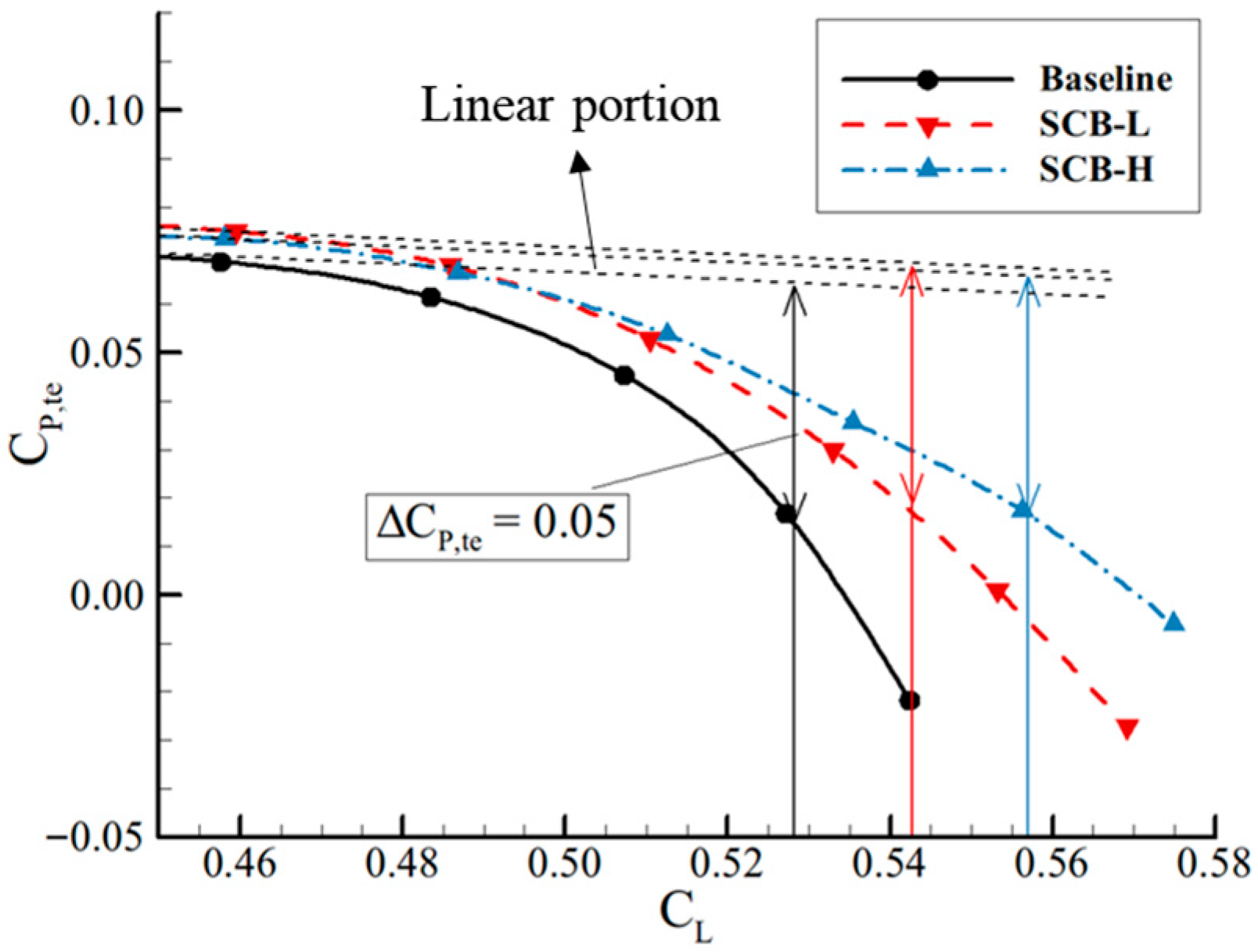
Figure 19 shows the trailing-edge pressure evolution at η = 0.48 , the spanwise location where the pressure divergence is most evident. Bumps 4–5 are located near this region. Compared with the baseline, both SCB configurations reduce the rate of trailing-edge pressure divergence, delaying the lift coefficient at which the buffet threshold is reached. Moreover, SCB-H exhibits a noticeably smoother pressure-divergence trend, resulting in a more significant improvement in the buffet boundary.
For SCB-H, the downstream positioning of the crest better coincides with the rearward movement of the shock wave near the buffet boundary, thereby maximizing its shock-control capability at higher angles of attack. Meanwhile, the increased bump height introduces stronger pre-compression upstream of the shock, effectively weakening the intensified shock structure [8,13]. In contrast, SCB-L features a lower and more forward profile, which helps minimize drag penalties under cruise conditions but provides reduced effectiveness in controlling the shock dynamics as the flow approaches buffet boundary.
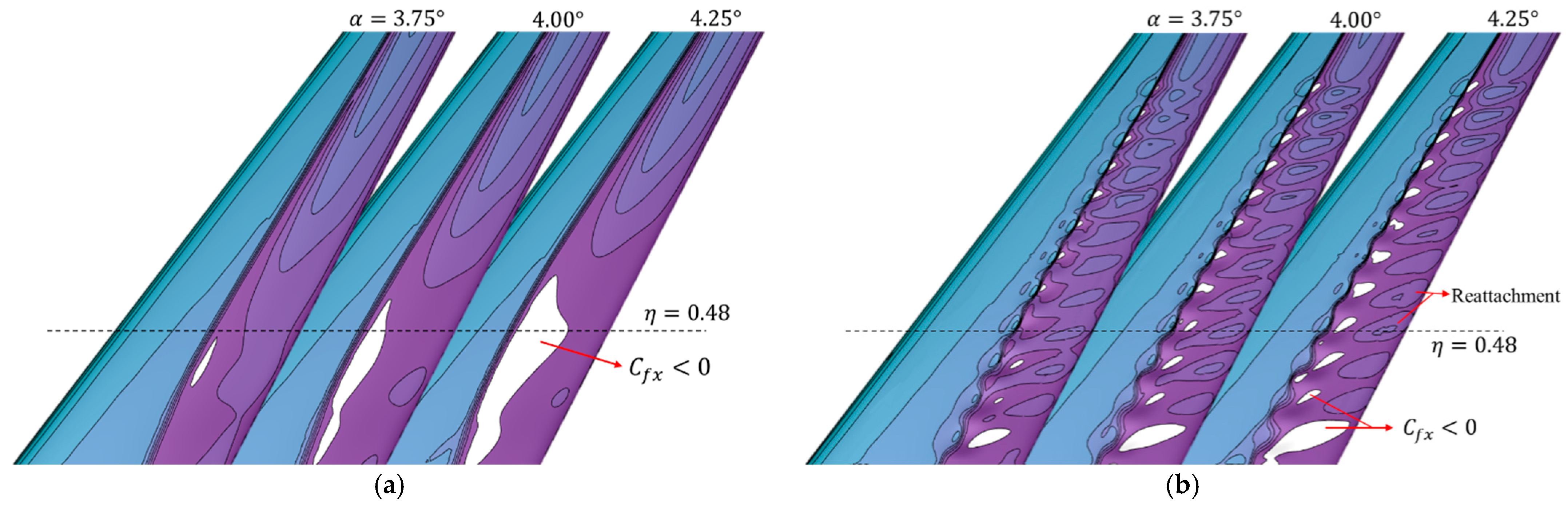
Figure 20 compares the surface x-component skin-friction coefficient C f x of the baseline wing and the SCB configurations near the buffet boundary, highlighting the evolution of flow separation regions (where C f x < 0 ) with increasing angle of attack. In the baseline wing, a flow separation region first appears in the mid-span area when the buffet boundary is reached. As the angle of attack further increases, the separated region gradually enlarges in both the spanwise and chordwise directions, leading to a deterioration of aerodynamic performance. As the separation zone grows, the shock–boundary layer interaction intensifies significantly, increasing the instability of the chordwise and spanwise flow [29]. This enhancement of flow instability results in stronger buffet, posing potential adverse effects on aircraft safety.
Figure 20b indicates that the three-dimensional contour SCBs can partially suppress the flow separation under buffet-boundary conditions and effectively inhibit the spanwise expansion of the separated region. In particular, near the region with a stronger shock wave (around η = 0.48 ), the SCB configurations reduce the extent of the shock-induced separation zone and even promote flow reattachment near the trailing edge, thereby enhancing the stability of the flow and restraining the spanwise growth of separation.
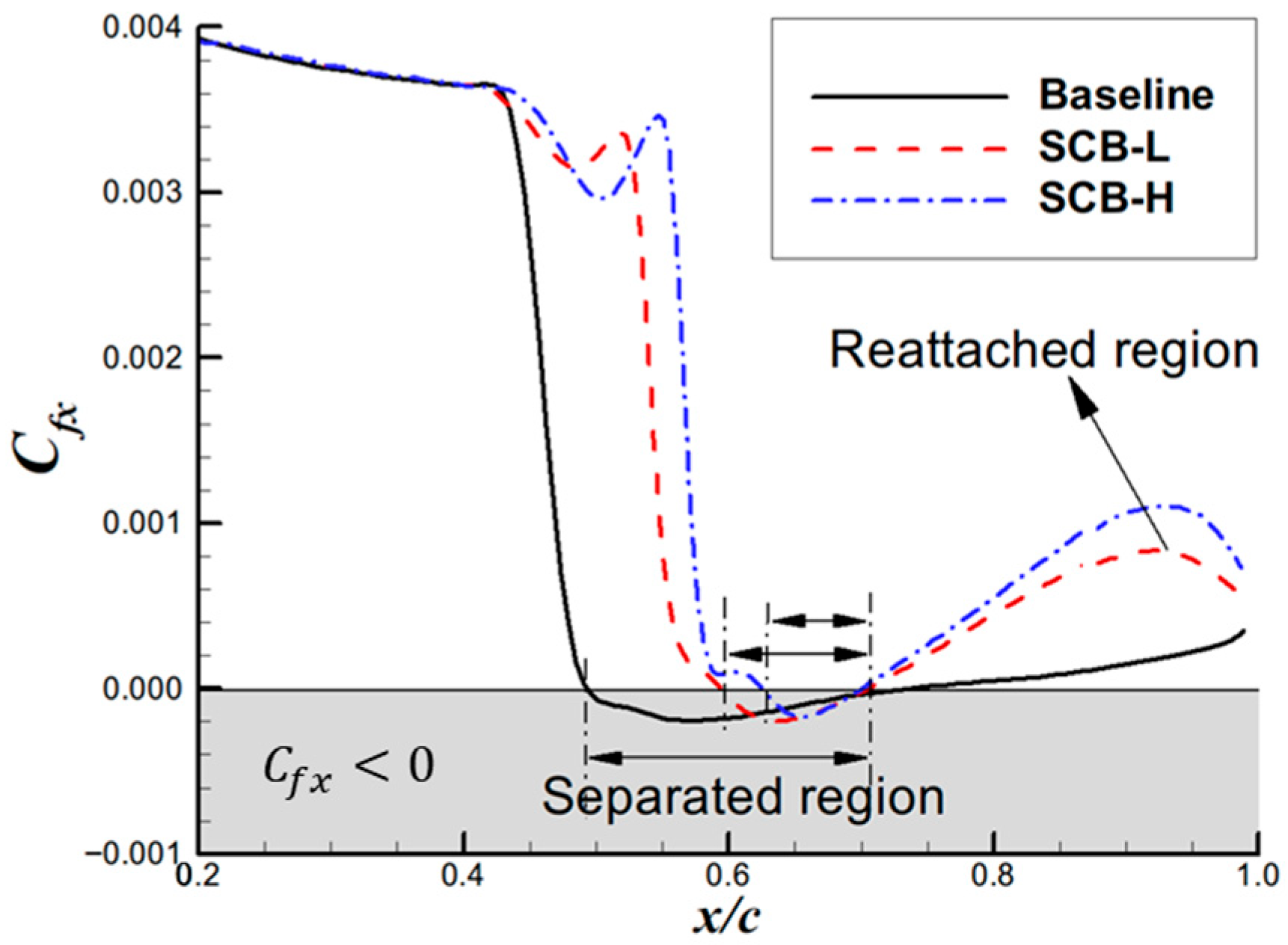
Figure 21 illustrates the chordwise distribution of the skin friction coefficient at the spanwise station η = 0.48 , where the shock intensity is significant. While the baseline wing exhibits a separation region extending approximately 0.2 c, both bump configurations delay the onset of separation downstream. Consequently, the extent of the separation bubble is reduced to less than 0.1 c, representing a reduction of 50%. Furthermore, in the trailing edge region, the reattachment area caused by the bumps is further away from the separation zone compared to the baseline wing. This significantly enhances flow stability at the trailing edge and mitigates shock–boundary layer interaction, thereby delaying the buffet boundary.
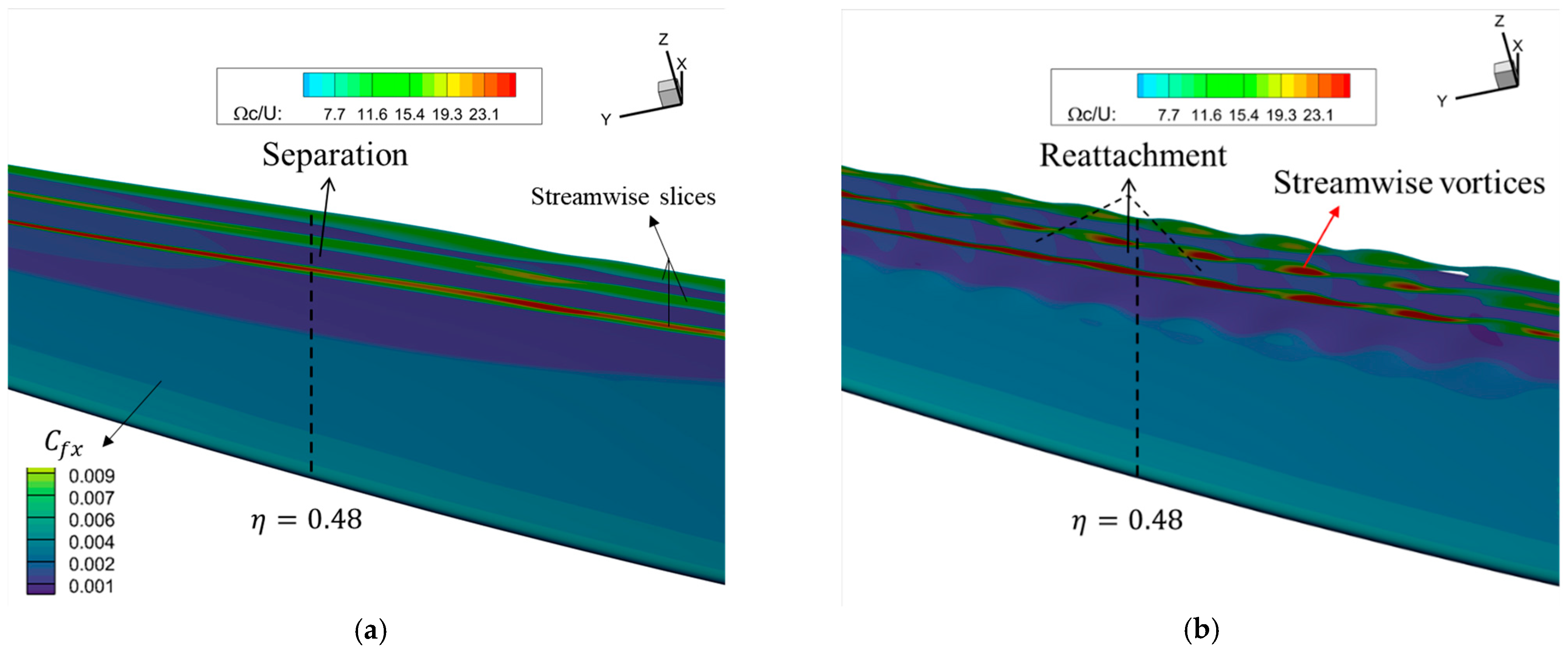
To deeply investigate the flow mechanism governing the suppression of spanwise flow by SCBs, the evolution of vortical structures at three cross-sections downstream of the trailing edge is analyzed under high-buffet-intensity conditions ( α = 4.0 ° ), as illustrated in Figure 22. The streamwise vortices are non-dimensionalized using the quantity Ω c / U , where Ω is the streamwise vorticity magnitude and U represents the freestream velocity. In Figure 22, the wing surface is colored by the distribution of the surface x-component skin-friction coefficient C f x .
For the baseline configuration (Figure 22a), the flow field exhibits a relatively uniform spanwise distribution of separated vortices. Critically, the vorticity strength near the boundary layer at the trailing edge is relatively weak. As the angle of attack increases, this low-momentum fluid is unable to withstand the adverse spanwise pressure gradient, leading to a rapid deterioration in the stability of the local separation region. The resulting instability promotes the spanwise expansion of the separation cells, which serves as a precursor to fully developed buffet.
In contrast, for the SCB configuration (Figure 22b), the spanwise variation in bump height generates pairs of strong streamwise vortices. These vortices effectively energize the boundary layer immediately downstream of the shock, transporting high-momentum fluid toward the near-wall region. The enhanced near-wall momentum enables the boundary layer to remain attached over a longer distance near the trailing edge, despite the presence of the adverse spanwise pressure gradient. As a result, the spanwise growth of the separation zone is significantly inhibited, thereby delaying the buffet boundary of the wing.
In summary, three-dimensional contour SCBs not only enhance aerodynamic performance under high-lift conditions but also effectively delay the buffet boundary of a swept wing. Consequently, this configuration holds broad application prospects for improving flight safety of modern civil aircraft near the buffet boundary.

4. Conclusions

This study employs numerical simulations to investigate the aerodynamic effects of 3D contour SCBs on the transonic buffet boundary of a swept wing. The main conclusions summarized are as follows:
  • The buffet boundaries determined by the lift-curve slope criterion and the trailing-edge pressure divergence method are consistent. The analysis confirms that buffet onset on the CRM wing is initiated by localized flow separation in the mid-span region (η = 0.48), which subsequently expands spanwise.
  • A distinct trade-off exists between the magnitude of buffet-boundary delay and the effective drag-reduction range. The downstream-located configuration (SCB-H) maximizes shock control at high-lift conditions, increasing the buffet boundary lift coefficient by 6.3%. However, this comes at the cost of reduced aerodynamic performance at lower lift coefficients. Conversely, the upstream-located configuration (SCB-L) yields a smaller buffet-boundary delay (4.0%) but maintains drag reduction over a wider operational range.
  • The buffet-delaying capability of 3D contour SCBs is not solely attributed to the weakening of shock intensity. The spanwise variation in SCB height generates strong streamwise vortices that produce a favorable downwash, entraining high-momentum fluid toward the near-wall region and promoting downstream flow reattachment. This energy replenishment of the boundary layer effectively suppresses the spanwise growth of the shock-induced separation region, which constitutes the primary mechanism responsible for delaying the buffet boundary on swept wings.
For practical applications, SCB parameters must be carefully optimized to balance the requirement for expanding the flight envelope (buffet delay) with the need for efficient cruise performance (drag reduction). Future work should employ unsteady methods (URANS or DES) to further investigate the dynamic interaction between 3D contour SCBs and shock oscillations in the deep buffet regime.

Author Contributions

Conceptualization, S.Z. and F.D.; methodology, S.Z.; software, S.Z.; validation, Z.N., F.D. and S.Z.; investigation, F.D.; resources, S.Z.; data curation, S.Z.; writing—original draft preparation, S.Z.; writing—review and editing, Z.N. and F.D.; visualization, S.Z.; supervision, Z.N.; project administration, F.D.; funding acquisition, F.D. All authors have read and agreed to the published version of the manuscript.

Funding

This work was supported by the National Natural Science Foundation of China (No. U25A6007).

Institutional Review Board Statement

Not applicable.

Data Availability Statement

Some or all data, models, or codes that support the findings of this study are available from the corresponding author upon reasonable request.

Conflicts of Interest

The authors declare no conflicts of interest.

Nomenclature

bWing semi-span length
cMean aerodynamic chord length
C L Lift coefficient
C D Drag coefficient
C p Pressure coefficient
C f x x-component of skin friction coefficient
C M y Pitching moment coefficient
hbBump height
lbBump length
M Freestream Mach number
pPressure
q 0 Dynamic pressure
RecReynolds number based on the airfoil chord length
S Reference area
U Freestream velocity
xsDistance between the bump crest and the mean shock location
xshMean shock location
αFreestream angle of attack
Λ c / 4 Quarter-chord sweep angle
Ω Intensity of streamwise vorticity

References

  1. Li, R.; Deng, K.; Zhang, Y.; Chen, H. Pressure Distribution Guided Supercritical Wing Optimization. Chin. J. Aeronaut. 2018, 31, 1842–1854. [Google Scholar] [CrossRef]
  2. Crouch, J.D.; Garbaruk, A.; Magidov, D.; Travin, A. Origin of Transonic Buffet on Aerofoils. J. Fluid Mech. 2009, 628, 357–369. [Google Scholar] [CrossRef]
  3. Lee, B. Self-Sustained Shock Oscillations on Airfoils at Transonic Speeds. Prog. Aerosp. Sci. 2001, 37, 147–196. [Google Scholar] [CrossRef]
  4. Jacquin, L.; Molton, P.; Deck, S.; Maury, B.; Soulevant, D. Experimental Study of Shock Oscillation over a Transonic Supercritical Profile. AIAA J. 2009, 47, 1985–1994. [Google Scholar] [CrossRef]
  5. Sugioka, Y.; Koike, S.; Nakakita, K.; Numata, D.; Nonomura, T.; Asai, K. Experimental Analysis of Transonic Buffet on a 3D Swept Wing Using Fast-Response Pressure-Sensitive Paint. Exp. Fluids 2018, 59, 108. [Google Scholar]
  6. Gao, C.; Zhang, W.; Ye, Z. Numerical Study on Closed-Loop Control of Transonic Buffet Suppression by Trailing Edge Flap. Comput. Fluids 2016, 132, 32–45. [Google Scholar] [CrossRef]
  7. Qin, N.; Wong, W.; Le Moigne, A. Three-Dimensional Contour Bumps for Transonic Wing Drag Reduction. Proc. Inst. Mech. Eng. Part G J. Aerosp. Eng. 2008, 222, 619–629. [Google Scholar] [CrossRef]
  8. Deng, F.; Qin, N. Quantitative Comparison of 2D and 3D Shock Control Bumps for Drag Reduction on Transonic Wings. Proc. Inst. Mech. Eng. Part G J. Aerosp. Eng. 2019, 233, 2344–2359. [Google Scholar] [CrossRef]
  9. Caruana, D.; Mignosi, A.; Corrège, M.; Le Pourhiet, A.; Rodde, A. Buffet and Buffeting Control in Transonic Flow. Aerosp. Sci. Technol. 2005, 9, 605–616. [Google Scholar] [CrossRef]
  10. Ogawa, H.; Babinsky, H.; Pätzold, M.; Lutz, T. Shock-Wave/Boundary-Layer Interaction Control Using Three-Dimensional Bumps for Transonic Wings. AIAA J. 2008, 46, 1442–1452. [Google Scholar] [CrossRef]
  11. Tian, Y.; Liu, P.; Li, Z. Multi-Objective Optimization of Shock Control Bump on a Supercritical Wing. Sci. China Technol. Sci. 2014, 57, 192–202. [Google Scholar] [CrossRef]
  12. Mayer, R.; Lutz, T.; Krämer, E. Toward Numerical Optimization of Buffet Alleviating Three-Dimensional Shock Control Bumps. In Proceedings of the 6th European Conference for Aerospace Sciences, Krakow, Poland, 29 June–3 July 2015; EUCASS Association: Paris, France, 2015; pp. 1–12. [Google Scholar]
  13. Tian, Y.; Gao, S.; Liu, P.; Wang, J. Transonic Buffet Control Research with Two Types of Shock Control Bump Based on RAE2822 Airfoil. Chin. J. Aeronaut. 2017, 30, 1681–1696. [Google Scholar] [CrossRef]
  14. Bogdanski, S.; Nübler, K.; Lutz, T.; Krämer, E. Numerical Investigation of the Influence of Shock Control Bumps on the Buffet Characteristics of a Transonic Airfoil. In Notes on Numerical Fluid Mechanics and Multidisciplinary Design; Springer: Berlin/Heidelberg, Germany, 2014; pp. 23–32. [Google Scholar]
  15. Bogdanski, S.; Gansel, P.; Lutz, T.; Krämer, E. Impact of 3D Shock Control Bumps on Transonic Buffet. In High Performance Computing in Science and Engineering ‘14; Springer International Publishing: Cham, Switzerland, 2015; pp. 447–461. ISBN 9783319108100. [Google Scholar]
  16. Mayer, R.; Lutz, T.; Krämer, E.; Dandois, J. Control of Transonic Buffet by Shock Control Bumps on Wing-Body Configuration. J. Aircr. 2019, 56, 556–568. [Google Scholar] [CrossRef]
  17. Geoghegan, J.A.; Giannelis, N.F.; Vio, G.A. Parametric Study of Active Shock Control Bumps for Transonic Shock Buffet Alleviation. In Proceedings of the AIAA Scitech 2020 Forum, Orlando, FL, USA, 6–10 January 2020; p. 1989. [Google Scholar]
  18. Geoghegan, J.A.; Giannelis, N.F.; Vio, G.A. A Numerical Study on Transonic Shock Buffet Alleviation Through Oscillating Shock Control Bumps. In Proceedings of the 2018 AIAA Aerospace Sciences Meeting, Kissimmee, FL, USA, 8–12 January 2018; p. 1787. [Google Scholar]
  19. Giannelis, N.F.; Levinski, O.; Vio, G.A. Influence of Mach Number and Angle of Attack on the Two-Dimensional Transonic Buffet Phenomenon. Aerosp. Sci. Technol. 2018, 78, 89–101. [Google Scholar] [CrossRef]
  20. Keye, S.; Brodersen, O.; Rivers, M.B. Investigation of Aeroelastic Effects on the NASA Common Research Model. J. Aircr. 2014, 51, 1323–1330. [Google Scholar] [CrossRef]
  21. Balakrishna, S.; Acheson, M. Analysis of NASA Common Research Model Dynamic Data. In Proceedings of the 49th AIAA Aerospace Sciences Meeting including the New Horizons Forum and Aerospace Exposition, Orlando, FL, USA, 4–7 January 2011; American Institute of Aeronautics and Astronautics: Reston, VA, USA, 2011. [Google Scholar]
  22. Zhang, S.; Deng, F.; Qin, N. Cooperation of Trailing-Edge Flap and Shock Control Bump for Robust Buffet Control and Drag Reduction. Aerospace 2022, 9, 657. [Google Scholar] [CrossRef]
  23. Moigne, A.L.; Qin, N. Variable-Fidelity Aerodynamic Optimization for Turbulent Flows Using a Discrete Adjoint Formulation. AIAA J. 2004, 42, 1281–1292. [Google Scholar] [CrossRef]
  24. Tinoco, E.N.; Brodersen, O.P.; Keye, S.; Laflin, K.R.; Feltrop, E.; Vassberg, J.C.; Mani, M.; Rider, B.; Wahls, R.A.; Morrison, J.H.; et al. Summary Data from the Sixth AIAA CFD Drag Prediction Workshop: CRM Cases. J. Aircr. 2018, 55, 1352–1379. [Google Scholar] [CrossRef]
  25. Apetrei, R.M.; Ciobaca, V.; Curiel-Sosa, J.L.; Qin, N. Unsteady Shock Front Waviness in Shock-Buffet of Transonic Aircraft. Adv. Aerodyn. 2020, 2, 9. [Google Scholar] [CrossRef]
  26. Pearcey, H.; Holder, D. Simple Methods for the Prediction of Wing Buffeting Resulting from Bubble Type Separation; National Physical Laboratory (NPL): Teddington, UK, 1962.
  27. Chung, I.; Lee, D.; Reu, T. Prediction of Transonic Buffet Onset for an Airfoil with Shock Induced Separation Bubble Using Steady Navier-Stokes Solver. In Proceedings of the 20th AIAA Applied Aerodynamics Conference, St. Louis, MO, USA, 24–26 June 2002; p. 2934. [Google Scholar]
  28. Lawson, S.; Greenwell, D.; Quinn, M.K. Characterisation of Buffet on a Civil Aircraft Wing. In Proceedings of the 54th AIAA Aerospace Sciences Meeting, San Diego, CA, USA, 4–8 January 2016; p. 1309. [Google Scholar]
  29. Crouch, J.; Garbaruk, A.; Strelets, M. Global Instability in the Onset of Transonic-Wing Buffet. J. Fluid Mech. 2019, 881, 3–22. [Google Scholar] [CrossRef]
Figure 1. Schematic diagram of the buffet cycle with varying shock location and boundary layer state [4]. (a) Shock at the intermediate position. (b) Upstream movement of the shock. (c) Shock at the most upstream position. (d) Downstream movement of the shock.
Aerospace 13 00098 g001
Figure 2. Mean and RMS values of C P as measured using fast-response pressure-sensitive paint in the experimental work at M = 0.85 and R e c = 1.54 × 10 6 [5]. (a) Mean C P . (b) RMS C P .
Aerospace 13 00098 g002
Figure 3. Computational grid. (a) Mesh topology. (b) Near-wall mesh.
Aerospace 13 00098 g003
Figure 4. Comparison of aerodynamic coefficients using different meshes. (a) Lift coefficient. (b) Drag coefficient.
Aerospace 13 00098 g004
Figure 5. SCB locations and mesh refinement. (a) Example of SCB arrangement. (b) Near-wall mesh refinement over bumps.
Aerospace 13 00098 g005
Figure 6. Spanwise locations of slices for numerical validation.
Aerospace 13 00098 g006
Figure 7. Comparison of C P distributions at different spanwise locations with experimental data at α = 3.5 ° and 4.0 ° ( M = 0.85 and R e c = 5 × 10 6 ).
Aerospace 13 00098 g007
Figure 8. Buffet boundary and C P distribution. (a) Lift curve and buffet boundary. (b) C P distribution and surface streamlines.
Aerospace 13 00098 g008
Figure 9. C P , t e variation with lift at different spanwise locations.
Aerospace 13 00098 g009
Figure 10. Determination of the wing buffet boundary based on trailing-edge pressure fluctuations. (a) Distribution of Δ C P , t e . (b) Distribution of skin-friction coefficient C f x .
Aerospace 13 00098 g010
Figure 11. Definition of 3D contour SCB on the wing section. (a) Two-dimensional SCB. (b) Three-dimensional contour SCB.
Aerospace 13 00098 g011
Figure 12. Spatial arrangement of the 3D SCB on a swept wing.
Aerospace 13 00098 g012
Figure 13. Determination of SCB parameters at different spanwise locations on the wing. (a) SCB at η = 0.330 . (b) SCB at η = 0.514 .
Aerospace 13 00098 g013
Figure 14. Comparison of different SCB designs: (a) SCB crest locations of SCB-L; (b) SCB crest locations of SCB-H; (c) crest height distribution; (d) chordwise shape at No. 6 bump ( η = 0.556 ).
Aerospace 13 00098 g014
Figure 15. Drag-reduction performance comparison of the two SCB designs at different lift conditions. (a) C D C L . (b) Δ C D C L .
Aerospace 13 00098 g015
Figure 16. Pressure coefficient distributions at η = 0.48 corresponding to α = 3.5°.
Aerospace 13 00098 g016
Figure 17. Effects of SCB configurations on wing lift and pitching moment. (a) Lift coefficient. (b) Pitching moment coefficient.
Aerospace 13 00098 g017
Figure 18. Effect of the SCB-H on wing aerodynamic performance at different angles of attack. (a) C P distribution on the upper surface of the wing. (b) Variation in sectional lift at different conditions.
Aerospace 13 00098 g018
Figure 19. Trailing-edge pressure variation at η = 0.48 .
Aerospace 13 00098 g019
Figure 20. Surface C f x distribution near the buffet boundary for different configurations. (a) Baseline. (b) SCB-H.
Aerospace 13 00098 g020
Figure 21. Surface C f x distribution of η = 0.48 at α = 4.25 ° for different configurations.
Aerospace 13 00098 g021
Figure 22. Surface C f x distribution and streamwise vortex behind shock at α = 4.0 ° . (a) Baseline. (b) SCB-H.
Aerospace 13 00098 g022
Table 1. The details of the computational grids.
GridShock ResolutionFirst Layer/m y m a x + Cell Count
L11.7%c1.5 × 10−61.05.10 million
L21.0%c1.2 × 10−60.77.09 million
L30.5%c1.0 × 10−60.69.86 million
Table 2. Comparison of grid parameters between the baseline and SCB configurations.
Grid ParameterBaseline GridSCB Grid
Cell count9.86 million40.52 million
Streamwise spacing ( Δ x / c )0.005 (Shock region)0.002 (Bump region)
Spanwise spacing ( Δ y / b )0.010.0014 (Over Bumps)
Table 3. Drag-reduction effect of two SCB configurations at the design points.
Conf.Change in Pressure Drag (Counts)Change in Friction Drag (Counts)
α d p = 3.0 ° α d p = 3.5 ° α d p = 3.0 ° α d p = 3.5 °
SCB-L−3.45−3.30+0.13+0.13
SCB-H+0.26−7.58+0.02+0.29
Table 4. Buffet boundaries of the two SCB configurations.
Criteria/Conf.BaselineSCB-LSCB-H
α b 3.73.94.0
C L , b 0.5240.5450.557
Disclaimer/Publisher’s Note: The statements, opinions and data contained in all publications are solely those of the individual author(s) and contributor(s) and not of MDPI and/or the editor(s). MDPI and/or the editor(s) disclaim responsibility for any injury to people or property resulting from any ideas, methods, instructions or products referred to in the content.