1. Introduction
The continuous growth of global air traffic presents significant operational challenges for airports. According to the International Air Transport Association (IATA), the number of passengers is projected to rise at an average annual rate of 3.8 percent, resulting in over four billion additional journeys in 2043 compared to 2023 [
1]. This sustained increase highlights the urgent need to operate existing runway infrastructure with maximum efficiency.
Among the constraints impacting airport capacity, runway throughput is critical [
2]. Studies have examined the factors affecting runway capacity and consistently found that arrivals tend to be more constrained than departures. In this context, the separation between consecutive arrivals emerges as a key determinant of runway throughput, governed by applicable regulatory minimum separation and the precision with which they are applied. Conversely, because for aircraft operating on the same runway a landing aircraft will not normally be permitted to cross the runway threshold on its final approach until the preceding aircraft has fully vacated the runway [
3], the time the leader aircraft remains on the runway before clearing the runway, known as Runway Occupancy Time (ROT), also becomes a fundamental factor when assessing runway throughput.
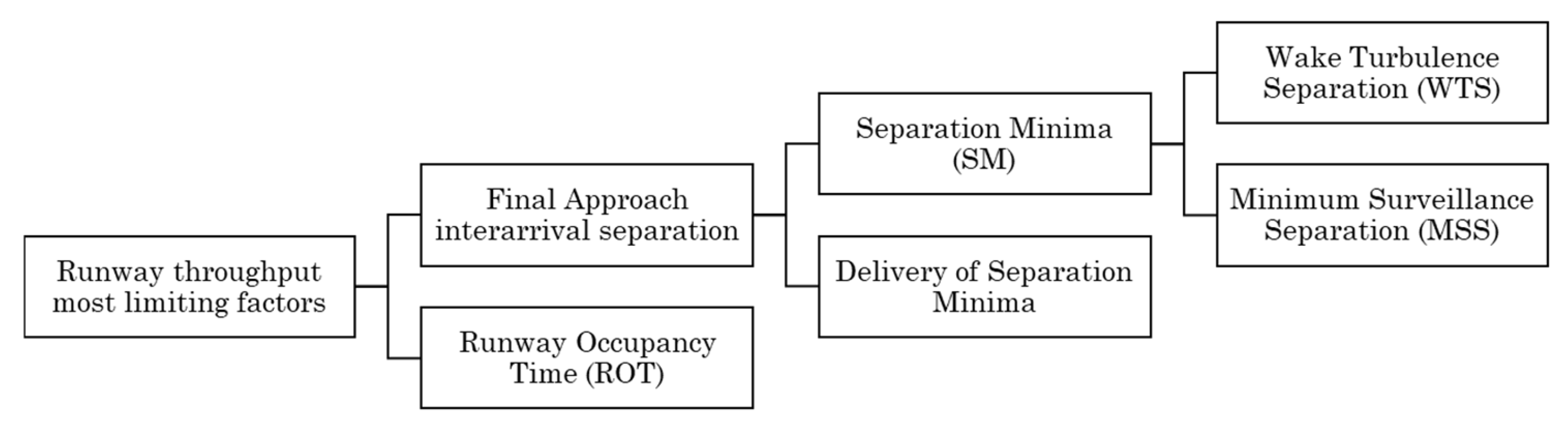
Consequently, and consistent with recent studies, the factors that constrain runway throughput are, on one hand, the separation between consecutive arrivals and, on the other, runway occupancy time [
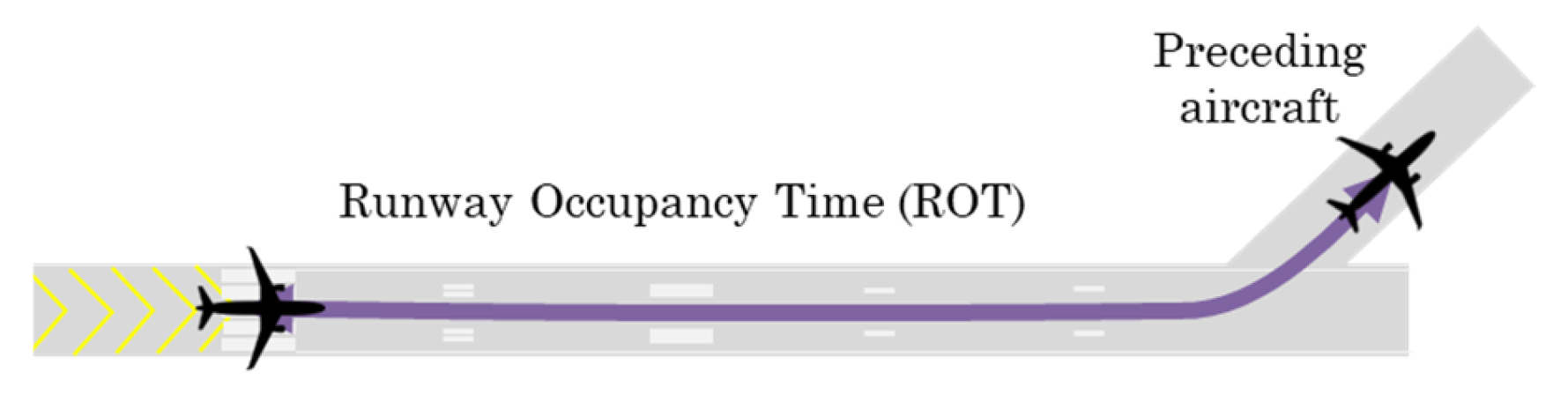
4], as schematised in
Figure 1.
Regarding the Final Approach interarrival separation, the runway throughput in peak periods is directly linked to the applicable regulatory minimum separation, hereafter SM (Separation Minima), that is, the minimum longitudinal separation applied between successive traffic on final approach. In addition to the spacing rules, the actual separation also depends on the accuracy with which the Approach and Aerodrome Air Traffic Control Officers (ATCOs) can deliver those minima [
4].
On final approach, SM is defined by the most restrictive value between Minimum Surveillance Separation (MSS, also known as Minimum Radar Separation, MRS) and Wake Turbulence Separation (WTS).
WTS minima are determined by the sequence’s aircraft categories, which group aircraft by wingspan and weight so that those within the same category generate similar wake turbulence levels. The International Civil Aviation Organization (ICAO) standard categorisation divides aircraft into four groups; however, this scheme can be overly broad and conservative, prompting more refined recategorisation initiatives. On this basis, ICAO, EUROCONTROL, and the FAA have all developed enhanced schemes. One example is the RECAT-EU program, which expands to six categories, allowing finer adjustments of separation minima [
5]. Similarly, RECAT-EU-PWS (Pair-wise Separation) further reduces required separations between specific aircraft pairs [
6,
7]. Additionally, projects such as SESAR’s time-based separation (TBS) for arrivals concept were developed as a way to permanently provide arrival capacity resilience to headwind conditions on final approach, which appear when using distance-based separation, ultimately leading to an increase in the arrival rate [
8,
9].
MSS minima are defined and agreed with the local regulator, generally at a national level, as a function of the surveillance system performance, local procedures and potential impact on runway spacing. These values define the minimum distance that must be met between aircraft pairs, typically ranging from 3 to more than 5.0 nautical miles (NM) [
10]. ICAO PANS-ATM Doc 4444 allows reducing MSS to 2.5 NM under specific conditions, including demonstrating that average ROT does not exceed 50 s [
3]. As a result, this reduced MSS is currently implemented at only a limited number of European airports. Additionally, SESAR has proposed further conditions to reduce separation to 2.0 NM to boost operational efficiency [
11].
The fact that several regulatory separation minima schemes may be applied, some of them increasingly complex and specifying different minima for each particular leader–following aircraft pair, means that multiple customisations of separation will not be manageable by the ATCO without dedicated system support that accounts for which separation values must be applied as a function of aircraft characteristics [
12]. Air Traffic Control (ATC) support tools for arrivals are being developed precisely to help ATCOs apply separation minima with higher precision, and deployments are already underway [
10,
13].
As previously mentioned, the second major factor constraining runway throughput is ROT, generally defined as the time elapsed between the moment the aircraft is observed to overfly the runway threshold and the moment it has fully vacated the runway [
14]. Since a landing clearance cannot be issued until the preceding aircraft has completely vacated the runway (except in specific cases where reduced spacing is permitted once the preceding aircraft passes a designated runway point), ROT directly constrains the timing at which the following aircraft can be cleared to land [
3]. ROT is especially critical in segregated landing-only operations or in mixed-mode operations where arrivals and departures share a single or intersecting runway [
15].
With ROT now understood to be a relevant throughput limiter, some high-density airports employ specialised High-Intensity Runway Operations (HIROs) procedures to reduce ROT. These procedures designate Rapid Exit Taxiways (RETs) for use by specific aircraft types, emphasise prompt runway vacating at maximum safe speed, and recommend adjusting taxi speed when RET use is uncertain to avoid excessive runway occupancy durations. To reduce ROT, novel strategies are currently under development, such as those explored in the ROCAT project, which seeks to optimise ROT spacing by defining individual ROT distance thresholds per leader aircraft type and landing runway [
10,
14].
This evolving context motivates the central research question of this paper. The objective of this study is to identify operational scenarios in which ROT becomes the limiting factor for runway throughput, compared with aircraft separation on final approach. The analysis is carried out within a RECAT-EU wake turbulence separation scheme and focusses on airports operating under HIROs.
Although this study focusses on a single use case, Barcelona International Airport, the insights obtained are applicable to other high-demand airports. The methodology developed for quantifying the probability that a given arrival aircraft sequence becomes ROT limited can be directly transferred to other environments and should pay particular attention to the aircraft sequences identified here as potentially constrained by runway occupancy time.
The remainder of this paper is structured as follows.
Section 2 reviews the existing research on ROT and final approach separation.
Section 3 describes the methodology used in this study to determine the operational situations in which ROT becomes the limiting factor for runway throughput.
Section 4 presents the results.
Section 5 discusses the implications of these findings.
Section 6 concludes the paper.
2. Literature Review
Airport capacity studies have long recognised that runway throughput is a binding constraint at many major airports. Capacity studies conducted from the early 2000s to the present consistently indicate that, at congested airports, airside capacity, most notably runway capacity, fails to keep pace with demand, with arrival operations typically representing the most constrained component of the system [
16,
17].
Within this broader context, early operational analyses already identified the joint role of final approach spacing and ROT. Koenig (1978) [
18], Weiss & Barrer (1984) [
19], and Pavlin et al. (2005) [
20] used direct visual observations from control towers to detect patterns associated with prolonged runway occupancy. Despite the limitations of manual timing and observer bias, they showed that extended ROT systematically reduces achievable landing rates. These studies established ROT as a recognised capacity driver, but they pre-date modern surveillance systems and do not quantify how ROT interacts with specific separation schemes.
Building on this foundation, subsequent studies focussed on understanding ROT and identifying techniques to reduce it in order to improve runway throughput. Early empirical analyses such as Ruhl (1988) [
21] quantified how airport layout, aircraft type, and airline procedures contribute to ROT variability, demonstrating that ROT is shaped by structural and behavioural factors rather than by randomness alone. Lee et al. (1999) [
22] reinforced this by showing that key operational parameters strongly determine ROT, laying the groundwork for systematic modelling. Faridan & Adiliawijaya (2023) [
23] provided category-specific baseline ROT values using observational methods, whereas Kumar & Kicinger (2009) [
24], using detailed surface surveillance data, revealed systematic occupancy patterns across aircraft types and runways. Meijers & Hansman (2019) [
25] extended this research by exploiting large surveillance datasets to identify the primary determinants of ROT and to develop predictive models assessing how different exit configurations influence occupancy. Complementing these insights, Maltinti et al. (2024) [
26] demonstrated that optimised taxiway layout design can directly shorten ROT and increase runway capacity, while Lim et al. (2020) [
27] used causal inference techniques to show that procedural adjustments, particularly to final approach speed, can yield measurable, repeatable reductions in occupancy time. However, despite the depth of research on ROT and its mitigation, existing studies did not identify the circumstances under which reducing ROT is truly needed. Operationally, ROT reduction is only meaningful when it is more restrictive than final approach spacing.
Thus, given the central role of final approach spacing in limiting runway throughput, a significant body of research has aimed at reducing approach separation minima, most prominently through reductions in wake turbulence separations, which remain the main constraint governing applied separations. Examples of these recent research lines include Hallock & Holzäpfel (2018) [
28], who show that improved wake vortex characterisation enables progressively tighter separations, and Holzäpfel, Strauss & Schwarz (2021) [
29], who propose dynamically adjusted minima based on aircraft pairing and weather. Slischka et al. (2023) [
30] demonstrate that a 2.5 NM spacing scheme can raise arrival throughput by over 10% under favourable traffic mixes, while Nana et al. (2024) [
31] show that machine-learning-based wake vortex detection can further support real-time, locally adapted separation reductions. Taken together, these studies aim to enable tighter final approach spacing to increase landing rates, yet they assess separation reduction independently from runway occupancy constraints. None examine whether the runway can be vacated in time for these reduced spacings to be applied safely. The unaddressed interaction between reduced approach separations and the leader aircraft’s runway occupancy time is, therefore, a critical gap.
A final line of research focusses on supporting ATCOs in the real-time delivery of arrival separation. Several authors have examined the operational conditions under which controllers are unable to apply arrival spacing at the prescribed regulatory separation minima, with the objective of addressing inefficient spacing between arriving aircraft. Andrews & Robinson (2001) [
32] already warned that imprecise application of separation during approach operations can significantly reduce runway capacity. Ren & John-Paul B. (2007) [
33] analysed, using stochastic models, the sensitivity of various uncertainty factors, such as pilot actions, aircraft weight, and wind conditions, that lead to applied arrival spacing exceeding the prescribed separation minima. Subsequently, Szurgyi (2008) [
34] and Herrema (2015) [
35] focussed on analysing additional spacing margins introduced in practice and on assessing their impact on arrival capacity, with the aim of mitigating their negative effects. Building on this body of research, Louie et al. (2023) [
36] analysed surveillance data to identify inefficient arrival separations arising from traffic flow guidance strategies and quantified their impact on capacity, delays, and traffic dynamics in high-density terminal airspace. In this context, it is increasingly recognised that inefficient separation application and the resulting spacing margins depend not only on external uncertainties but also on whether the leader aircraft has vacated the runway, thereby directly linking separation delivery to runway occupancy time. Within this stream, several studies demonstrate that ROT prediction can enable tighter yet safe spacing. Chow et al. (2021) [
37] built an interpretable decision-tree model to guide spacing based on predicted ROT, while Dai & Hansen (2020) [
38] introduced the concept of a runway occupancy buffer and showed it can be forecast accurately through regression. Machine-learning approaches by Gao et al. (2023) [
39], Herrema et al. (2017) [
40], and Martínez et al. (2018) [
41] further demonstrated that data-driven ROT prediction can reduce unnecessary controller-applied buffers. Subsequent studies by Meijers & Hansman (2019) [
25], Mirmohammadsadeghi (2020) [
42], and Nguyen et al. (2020) [
43] developed transferable ROT prediction models across airports, and Stempfel et al. (2020) [
44] and Woo et al. (2022) [
45] illustrated their integration into operational decision support. Building on these advances, recent several initiatives are now incorporating separation delivery support systems that exploit such predictions, including tools integrating dynamic separation minima together with aircraft-type-specific ROT prediction models [
10,
12,
13].
As shown, current initiatives aimed at improving runway throughput, and therefore airport capacity, are primarily focussed on mitigating the most limiting mechanism either by reducing final approach spacing or by reducing ROT. However, the literature examining the interaction between these two constraints remains limited. Most studies address ROT and final approach separation independently, and therefore do not establish under which operational conditions ROT becomes the actual capacity-limiting factor instead of arrival spacing. Very few studies have explicitly examined when this switch occurs.
Kolos-Lakatos [
46] showed that, under certain FAA (Federal Aviation Administration) RECAT categories and under 2.5 NM MSS, ROT becomes binding, but this study predates RECAT-EU, and therefore does not reflect the significantly more permissive WTS reductions that now apply to several sequences. Furthermore, its conclusions are reported at a highly aggregated level, which makes them difficult to directly transfer to present-day European high-density operations.
EUROCONTROL’s ROCAT project (2023) also acknowledged that ROT could become binding under HIRO and RECAT-Pair-Wise [
14]. However, its methodological focus was not on the specific leader–following aircraft pair, but rather on the ICAO PANS-ATM Doc 4444 requirement that average ROT must not exceed 50 s in order to apply a 2.5 NM radar separation reduction [
3].
Hu, Mirmohammadsadeghi, & Trani (2019) [
15] used Monte Carlo simulation on several U.S. airports and showed that the probability of go-around increases markedly when wake turbulence separations are reduced (RECAT-I vs. RECAT-II), concluding that ROT becomes critical under tighter separations. However, this study did not quantify, for current European RECAT-EU operations, which specific leader–following pairs are actually ROT limited.
A key novelty of this study lies in explicitly determining for which leader–following aircraft performance combinations runway occupancy time becomes the binding constraint, and for which combinations final approach spacing remains dominant. Existing studies largely treat ROT and separation independently, and most were conducted before the widespread deployment of RECAT-EU, meaning they do not reflect the contemporary European separation environment in which wake turbulence minima have been significantly reduced. This leaves a critical gap: identifying, based on contemporary European operations, when it is more beneficial to target ROT reduction, and when it is more beneficial to focus on reducing final approach spacing, either by lowering regulatory separation minima or by improving ATCO delivery precision.
This paper addresses that gap by analysing current European operations with 2.5 NM MSS and HIROs, introducing a unified temporal framework and reporting probabilities by RECAT-EU sequence and by governing criterion (MSS vs. WTS), thereby transforming qualitative claims into actionable, policy-relevant estimates.
3. Methodology
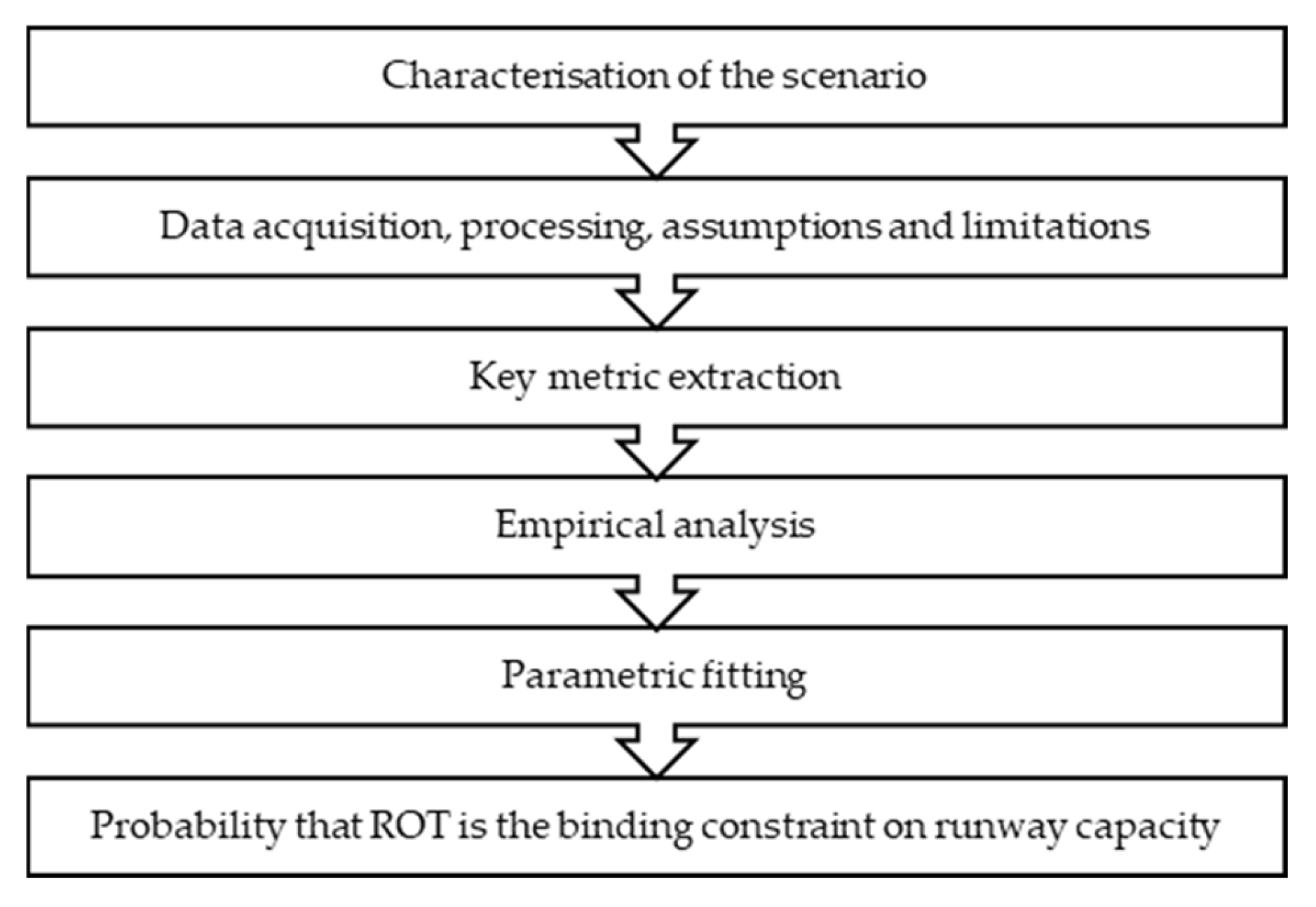
The methodology adopted in this study comprises six sequential stages designed to quantify the conditions under which ROT becomes the limiting factor for runway capacity. First, the operational scenario is characterised. Second, surveillance data are acquired and processed, and a set of filtering criteria is applied to retain only operationally relevant observations for the analysis and to discard erroneous or inconsistent data records. This stage also defines the study scope and addresses the operational assumptions and inherent limitations associated with data availability, traffic representativeness, and operational pressure conditions. Third, key operational metrics are extracted from surveillance trajectory data, namely the preceding aircraft’s ROT, the applicable separation minima, and the actual separation between a pair of arrivals, using established and refined measurement techniques. Fourth, an empirical analysis of arrival sequences is conducted based on these metrics, enabling a sequence-wise characterisation of operational behaviour. Fifth, the empirical distributions of ROT and aircraft separations in final approach are fitted to parametric models, and their statistical properties and potential interdependence are assessed using statistical tests. Finally, these results are combined to compute the probability that ROT constitutes the binding constraint on runway throughput. A block diagram of this workflow is shown in
Figure 2.
This analysis focusses on pairs of arriving aircraft during final approach, defined as two aircraft landing sequentially on the same runway. For consistency, the first aircraft in the sequence is termed the “preceding aircraft,” and the second the “succeeding aircraft.” For each pair, we record the preceding aircraft’s ROT and the succeeding aircraft’s separation at the moment the preceding aircraft crosses the threshold. The ROT concept is graphically illustrated in
Figure 3.
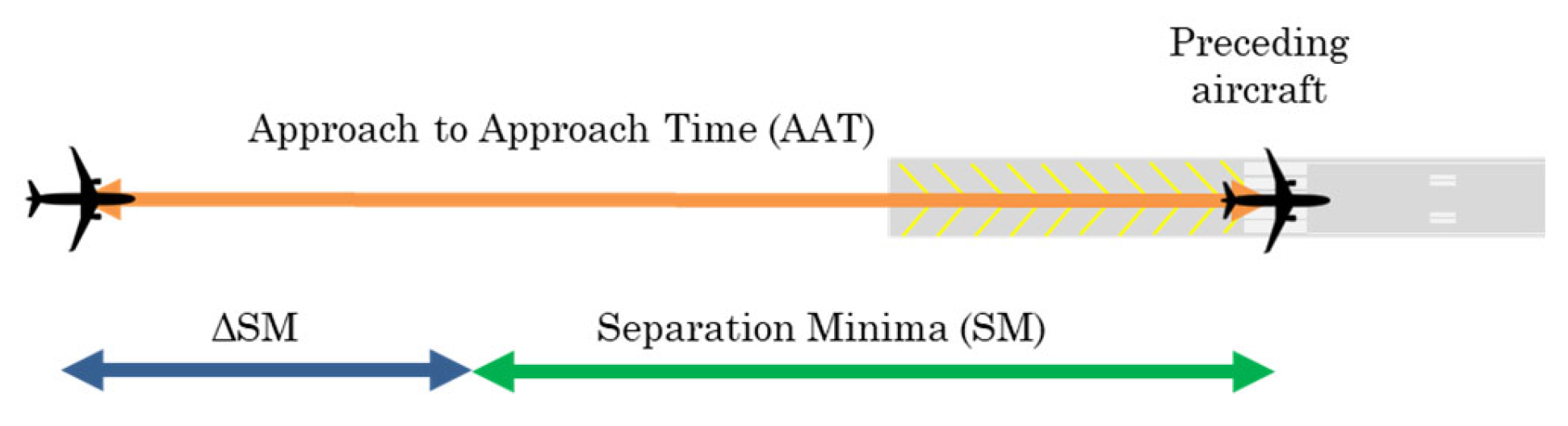
The actual separation between a pair of arrivals is defined as the time interval between the preceding aircraft and the succeeding aircraft crossing the threshold. In this study, separation is expressed in seconds to enable direct comparison with ROT and is referred to as the Approach-to-Approach Time (AAT).
The difference between AAT and SM, denoted ΔSM, should be interpreted as the operational margin or accuracy in the delivery of SM that emerges in practice when applying SM, largely reflecting, among other factors, procedural complexity, controller training and experience, and pilot reaction times to ATC instructions. Thus, ΔSM captures the operational variability involved when air traffic controllers manage SM under real-time operations. ΔSM also varies with aircraft type, traffic mix, operational environment, and local control procedures.
Figure 4 illustrates the relationship among AAT, SM, and the ΔSM.
In the timeline representation, the preceding aircraft crosses the threshold at t = 0 and remains on the runway until t = ROT, while the succeeding aircraft crosses at t = AAT.
4. Results
4.1. Characterisation of the Scenario
For the analysis of operational scenarios in which ROT becomes the limiting factor for runway capacity, an airport was selected that meets a set of operational conditions allowing clear observation and analysis of this constraint.
The study was conducted within the RECAT-EU WTS scheme, which classifies aircraft based on two key parameters: wingspan and certificated Maximum Take-Off Weight (MTOW) [
47]. Briefly, this classification is as follows:
Super Heavy (A): aircraft types with MTOW of 100,000 kg or more and wingspan between 72 m (meters) and 80 m;
Upper Heavy (B): aircraft types with MTOW of 100,000 kg or more and wingspan of 60 m to 72 m;
Lower Heavy (C): aircraft types with MTOW of 100,000 kg or more and wingspan under 52 m;
Upper Medium (D): aircraft types with MTOW between 15,000 kg and 100,000 kg with wingspan above 32 m;
Lower Medium (E): aircraft types with MTOW between 15,000 kg and 100,000 kg with wingspan above 32 m with wingspan below 32 m;
Light (F) aircraft types with MTOW of 15,000 kg or less (without wingspan restriction).
Aircraft types with MTOW of 100,000 kg or more and wingspan between 52 m and 60 m are included in one of the above categories on the basis of specific analyses. It is worth noting that, at the time of this study, fewer than ten European airports implemented RECAT-EU.
The scenario must feature reduced surveillance separation of 2.5 NM, which currently represents the lowest permitted MSS that is only applicable under certain operational conditions.
Additionally, the airport must exhibit high traffic volume to generate sufficient runway occupancy pressure, understood as aircraft in the air awaiting landing clearance, thereby fostering situations in which ROT management becomes a critical runway capacity constraint.
Moreover, the airport must have HIRO procedures in place, which require aircraft to vacate the runway as quickly as possible to reduce ROT and minimise the likelihood of go-arounds.
Josep Tarradellas Barcelona-El Prat Airport (BCN) meets all of these criteria and was selected as the case study to validate the operational conditions.
The minimum separations, in nautical miles, applicable between these aircraft categories for the described scenario are presented in
Table 1, where MSS/WTS in brackets indicates sequences in which, respectively, surveillance or wake turbulence separation govern.
For this analysis, only sequential arrivals on the same runway (RWY 24R) at Josep Tarradellas Barcelona-El Prat Airport (BCN) were considered.
4.2. Data Acquisition, Processing, Assumptions, and Limitations
This study is based on the analysis of Automatic Dependent Surveillance–Broadcast (ADS-B) trajectory data for arriving aircraft recorded at the selected airport. The raw data include 3D positioning, timestamp, ground speed, and positioning quality indicators.
Surveillance data for the full calendar years 2023 and 2024 were analysed, comprising 334,389 approach trajectories, of which 112,080 met the study criteria. Records were discarded if they failed any of the following conditions:
- ▪
The approach was not conducted to runway 24R at Barcelona Airport.
- ▪
The arrival pair did not satisfy the operational pressure criterion, defined as the succeeding aircraft being within SM + 3 NM of the preceding aircraft when it crossed the threshold.
- ▪
Either aircraft type was not listed in the EASA database for RECAT-EU categorisation.
- ▪
Data records contained errors such as empty fields, format inconsistencies, or other anomalies.
- ▪
The sample size for any given category pair sequence was fewer than five observations, a minimum required to ensure basic representativeness without excluding operationally relevant but rare sequences.
Note that BCN airport has three runways, two parallel and one crossing, and this study only considers approaches to runway 24R, which is the runway that typically exhibits capacity constraints. In addition, overflight trajectories not resulting in an effective landing on that runway are excluded.
The cutoff SM + 3 NM for operational pressure criterion was selected because the additional margin that emerges in practice from controller delivery precision and sequencing variability is typically around 1 NM (as shown later in this paper) and never exceeds 3 NM. Therefore, when the actual interarrival spacing exceeds SM + 3 NM, the sequence is considered not to be operationally constrained.
A minor data coverage limitation also exists due to the filtering criterion that excluded sequences with fewer than five observations. This threshold was necessary to preserve basic statistical representativeness per sequence, but it implies that the results do not extend to extremely rare sequence combinations, even if such combinations may occasionally appear in real operations.
Table 2 summarises the distribution of aircraft across RECAT-EU categories for the valid approaches in this study.
As shown, 96.6 percent of arrivals fall into the Upper Medium (D) category, with minimal representation of Super Heavy (A), Upper Heavy (B), and Lower Heavy (C) categories. The traffic mix, after filtering out records that failed to satisfy the aforementioned conditions, remained effectively constant between 2023 and 2024.
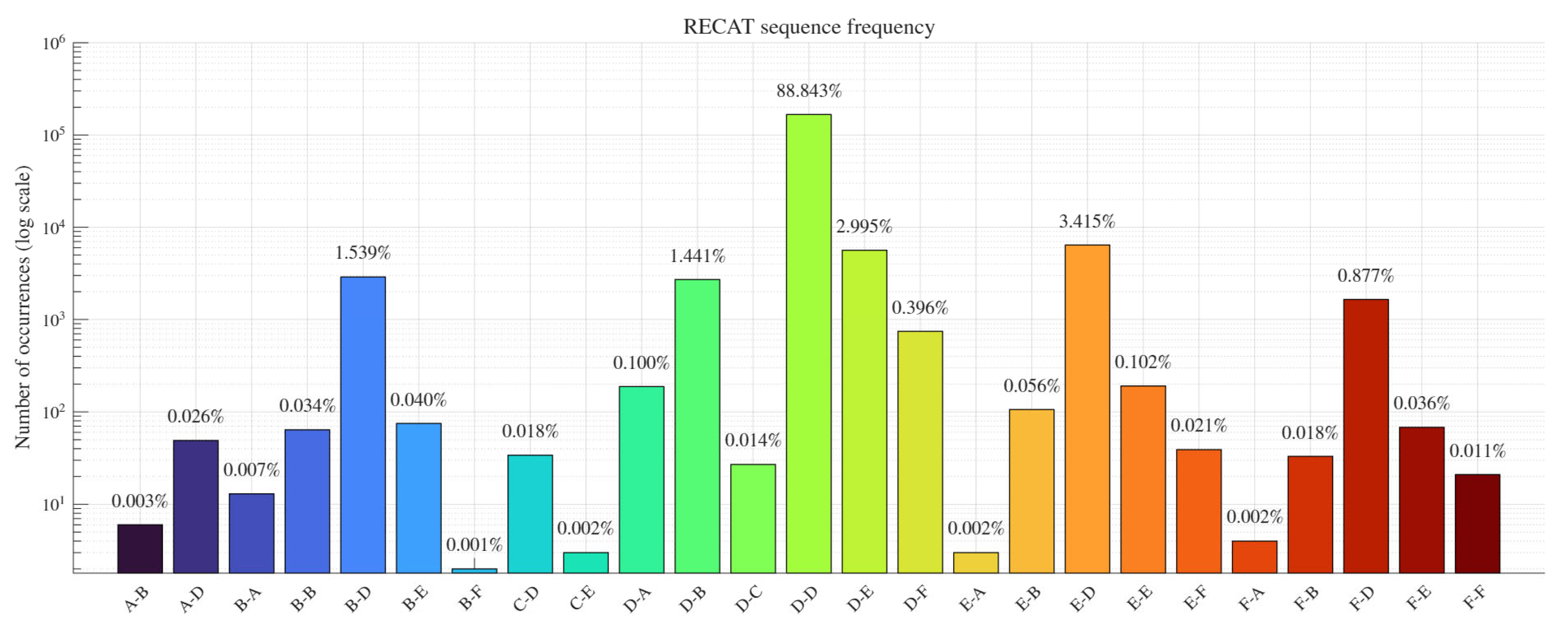
Figure 5 illustrates the distribution of arrival sequences, which is dominated by D–D pairs, accounting for 92.14 percent of cases. The remaining combinations (“Others,”\~7.86 percent) are detailed on the right of the figure: the most frequent are E–D (\~2.60 percent), D–E (\~2.60 percent), D–B (\~1.74 percent), and F–D (\~0.48 percent), while all other sequences contribute less than 0.2 percent each.
4.3. Key Metric Extraction
In order to determine the scenarios in which ROT acts as the limiting factor for runway operational capacity, the ROT calculated for the preceding aircraft is compared with the distance of the succeeding aircraft from the threshold. To this end, a statistical analysis has been developed based on the comparison of three key metrics: the preceding aircraft’s ROT, the SM, and the AAT.
From the ADS-B trajectory data, ROT is quantified using the polygon method, which has been employed in numerous prior studies [
15,
23,
24,
25,
37,
46]. This method defines a polygon around the runway edges and measures the elapsed time from the moment the aircraft first enters that polygon until it exits. In this study, a refined version of the polygon method was implemented to improve measurement accuracy. The aircraft is treated as a point representing the ADS-B antenna location (typically situated in the forward third of the airframe).
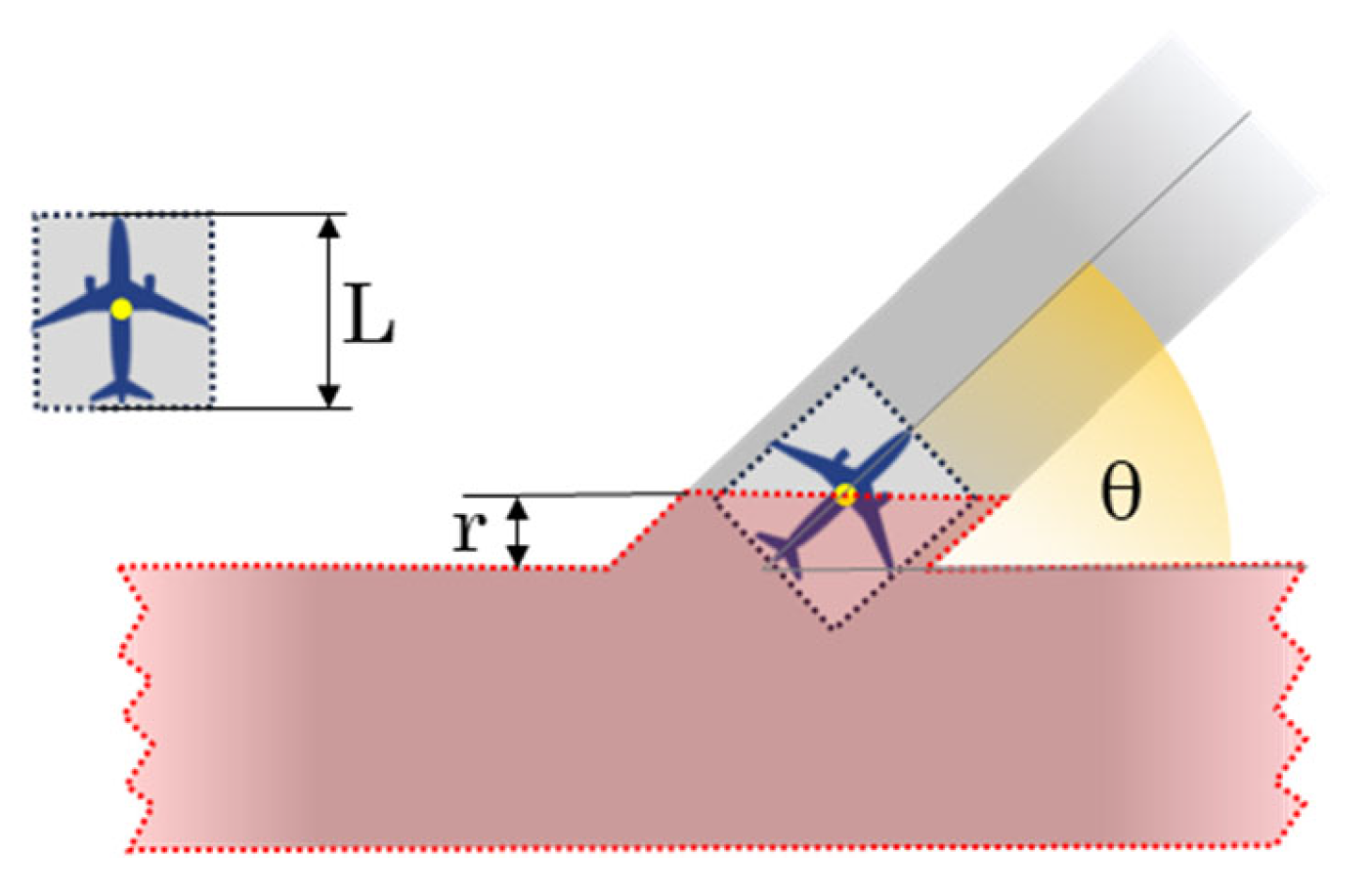
To ensure that the moment this point leaves the polygon coincides with the moment the aircraft has fully vacated the runway, the polygon geometryis adjusted using two parameters: the average aircraft length for each RECAT-EU category (L, see
Figure 6) and the exit–taxiway angle relative to the runway centreline (θ). Average L is computed as the arithmetic mean of the fuselage lengths of all aircraft belonging to each RECAT-EU category observed in the use case. In any case, deviations below 6 m lead to ROT differences of less than 1 s, which is smaller than the resolution of the ADS-B tracks used in this study.
In particular, at each runway exit the polygon extends a distance
r (
Figure 6), computed from these parameters as
Therefore, a dedicated polygon was defined for each RECAT-EU category using its corresponding average aircraft length (L). This approach ensures that polygon egress time accurately represents the moment when the entire fuselage clears the runway.
Approach trajectories are isolated by cross-referencing ADS-B data with EUROCONTROL’s Demand Data Repository. Outliers (i.e., ROT measurements below 30 s or above 100 s) are discarded, these thresholds being established from the operational characteristics of the study airport.
The SM is determined according to the RECAT-EU category combinations in
Table 1. Initially expressed in distance (NM), SM values are converted to time units (seconds, s) by dividing by the succeeding aircraft’s actual ground speed (GS) during final approach, also extracted from ADS-B data, as follows:
The used for the conversion corresponds to the succeeding aircraft’s average ground speed measured along the final approach segment from the Final Approach Point (FAP) to the threshold.
The AAT is calculated as the time difference between two consecutive aircraft when the preceding aircraft crosses the threshold.
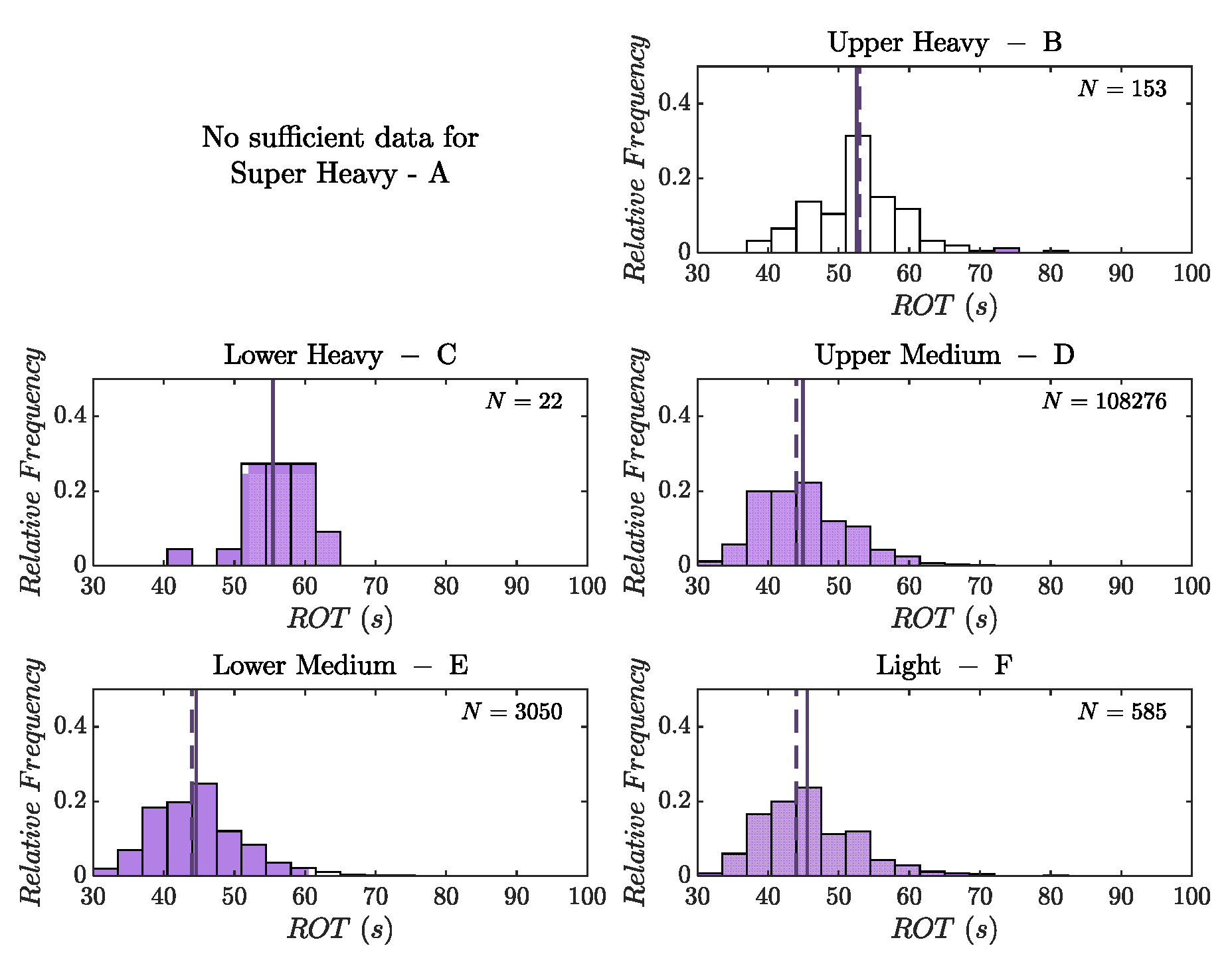
The histograms of ROT by RECAT-EU category (A–F) are shown in
Figure 7, excluding Super Heavy (A) due to insufficient sample size. Each subplot marks the mean (solid vertical line) and median (dashed vertical line) of ROT. The Upper Medium (D) category stands out, with its distribution clearly below the ICAO 50 s threshold for a 2.5 NM reduced separation, showing a mean of 44.9 s and a median near 44 s. This indicates a shorter ROT compared to other airports [
23,
24,
25,
37,
39,
46]
The numerical ROT values for each RECAT-EU category are listed in
Table 3. Categories B and C (Upper Heavy and Lower Heavy, respectively) exhibit significantly higher ROTs (B: μ = 52.5 s; C: μ = 55.5 s). This pattern matches findings from other studies [
24,
46] and is attributed to these aircraft requiring longer exit taxiways due to their braking performance. Light aircraft (Category F) also show a slightly elevated ROT (μ = 45.5 s), as they taxi at lower speeds before reaching the exit. In contrast, Categories D and E (Upper Medium and Lower Medium, respectively), comprising almost 97 percent of operations in the analysed scenario, recorded the lowest ROT values (D: μ = 44.9 s; E: μ = 44.6 s).
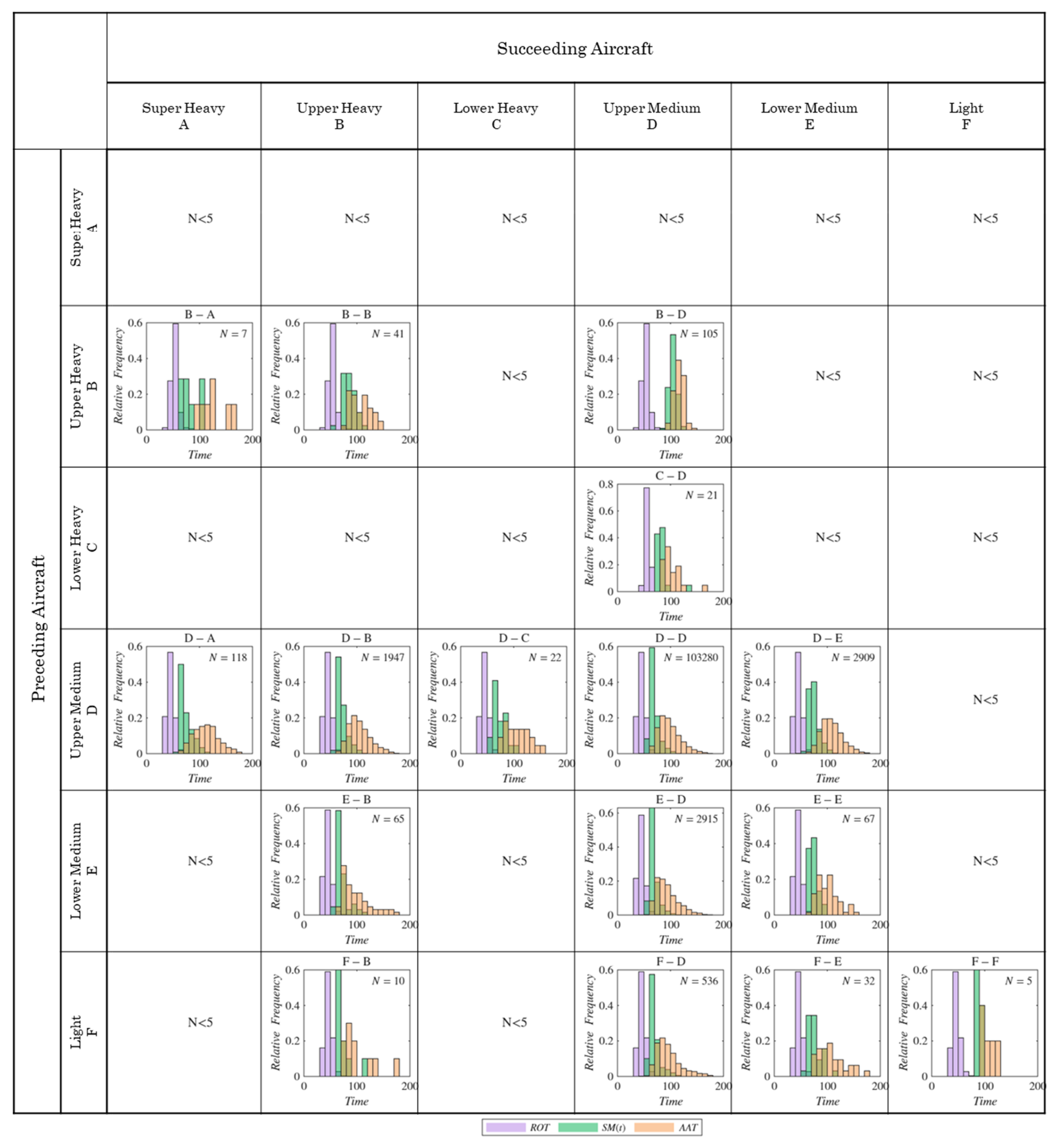
The histograms of the metrics ROT, SM, and AAT for each sequence are shown in
Figure 8, with ROT in purple bars, SM in green bars and AAT in orange bars. Each subplot displays the sample size (N) in the top-right corner. Cells without graphical representation, marked with the indication N < 5, correspond to sequences with fewer than five observations.
The numerical values of the statistical metrics corresponding to
Figure 8 are listed in
Table 4, all expressed in seconds.
The ΔSM data, expressed in nautical miles and calculated for each aircraft sequence relative to the SM, are summarised in
Table 5. It can be seen that, where the reduced 2.5 NM SM is applied, the ΔSM is approximately 1.0 NM. Conversely, when the governing separation corresponds to the WTS values, the ΔSM is significantly lower, ranging from 0.5 NM to 0.7 NM.
4.4. Empirical Analysis
To count how many times ROT exceeds AAT or SM in each sequence, the following procedure is applied. Let
be a given sequence and let
denote the set of indices of all flights belonging to that sequence. For each flight
we have three values:
, which is the actual ROT recorded for that flight;
, which is the actual AAT (i.e., the actual separation in seconds); and
, which is the theoretical SM (the recategorisation separation in seconds). First, we construct the indicator vector
, which equals 1 if flight
’s ROT exceeds its own AAT, or 0 otherwise. We then sum all those ones over the
flights in the following sequence:
Analogously, to count the occurrences in which a flight’s ROT exceeds its SM, we define
and sum it over all flights in the sequence:
In this way, the values
and
represent the actual number of flights in sequence
for which ROT exceeds AAT or SM, respectively. These counts are then stored in the results table alongside the other statistics. For each RECAT-EU category pair in sequence, the number of flights where ROT > AAT and where ROT > SM is reported, together with the corresponding relative frequencies, calculated as the ratio of those counts to the total number of flights in each sequence (
Table 6).
First, it is clear that ROT almost never exceeds AAT across all sequences: all “Count (ROT > AAT)” entries are zero except in the D–D sequence, which records 5 cases out of 103,280 observations. That event in D–D corresponds to a relative frequency of 4.84 × 10⁻⁵, confirming that in the vast majority of instances the actual interarrival interval (AAT) is sufficient to accommodate runway exit time.
In contrast, when comparing ROT with the regulatory minimum separation SM, several sequences exhibit cases where ROT does exceed SM. In this analysis, without considering the ΔSM, it becomes clear that the number of events in which ROT becomes the binding constraint increases significantly. Notably, the D–D sequence shows 620 out of 103,280 cases where ROT > SM, indicating that without the ΔSM, 620 of those 103,280 approaches would have resulted in go-arounds, corresponding to a relative frequency of 6.00 × 10⁻³.
Considering all sequences together, the relative frequency that ROT exceeds AAT is on the order of 10−5, whereas the same metric in which ROT exceeds SM rises to the order of 10−3. This indicates that, on a global scale, the likelihood of ROT > AAT is two orders of magnitude lower than that of ROT > SM. These findings highlight the critical role of the ΔSM in preventing the succeeding aircraft from reaching the threshold before the runway has been fully vacated.
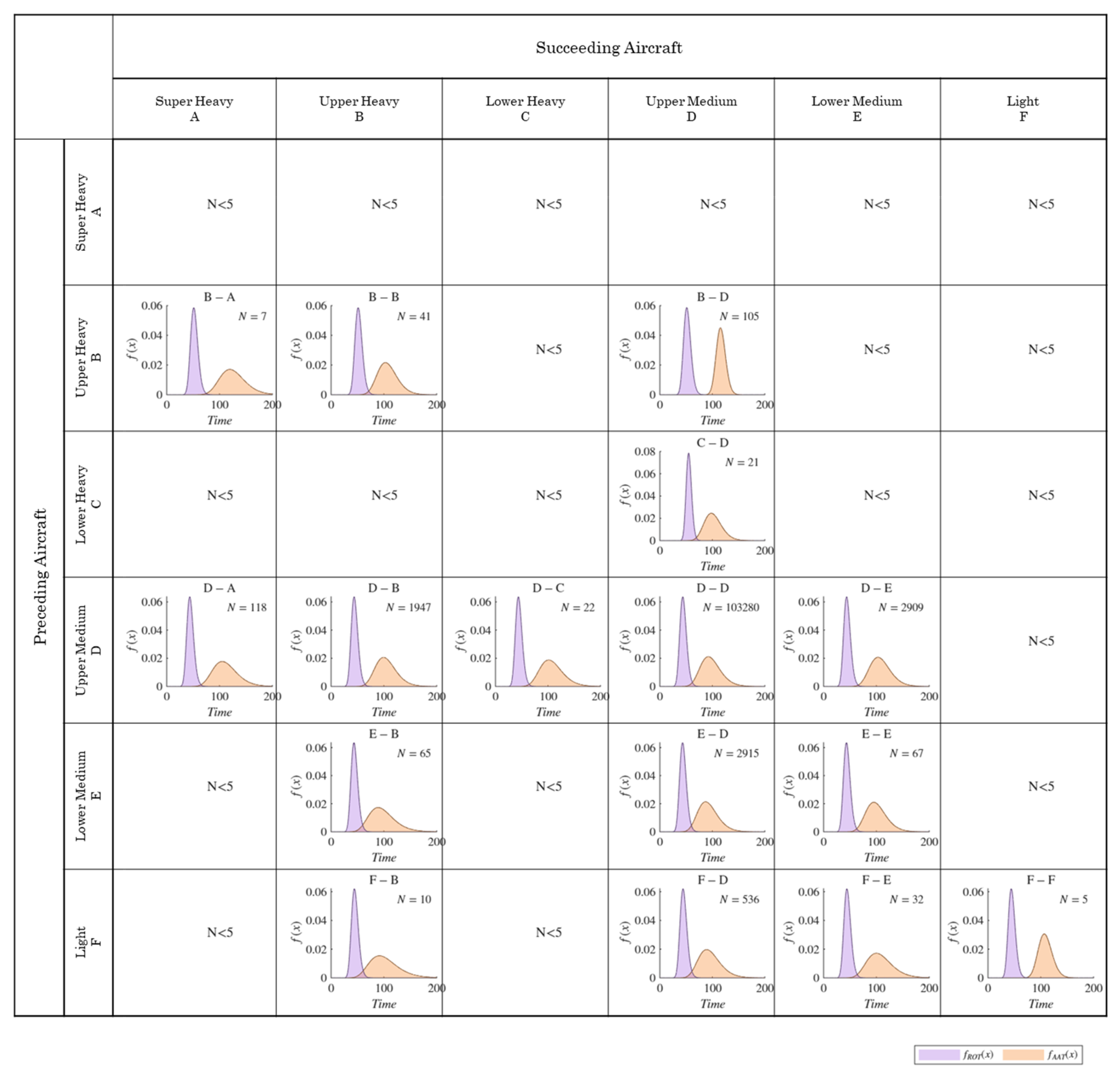
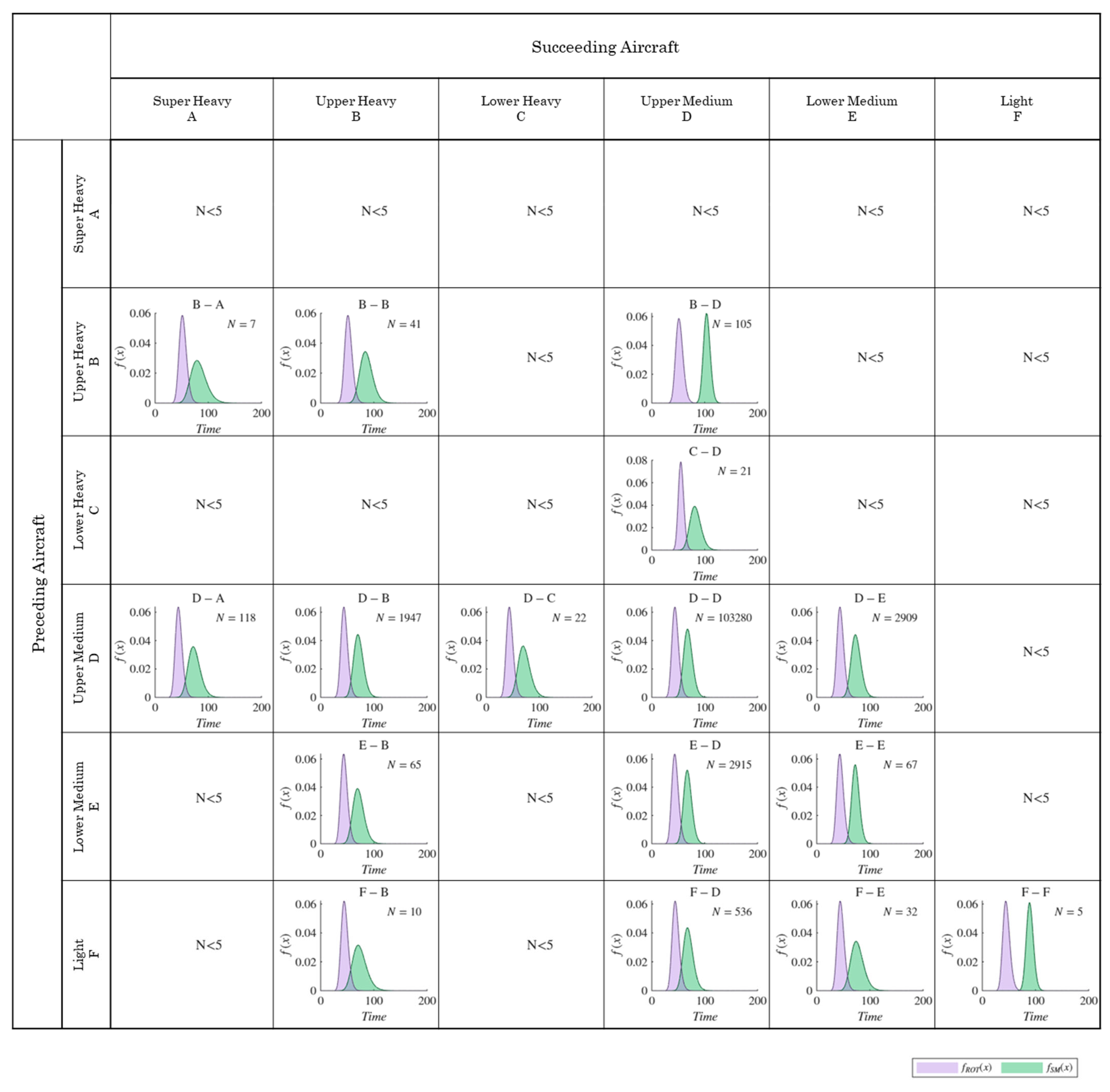
4.5. Parametric Fitting
For each aircraft sequence under the RECAT-EU framework, statistical distributions of ROT, SM, and AAT were generated. During exploratory analysis, several distribution families were evaluated to model the ROT, AAT, and SM values in each sequence. Candidate distributions considered included log-normal, gamma, Weibull, and exponential. were fitted using maximum likelihood estimation, and goodness-of-fit metrics were compared. Model comparison was performed using Akaike Information Criterion (AIC) and Bayesian Information Criterion (BIC). In all sequences, the log-normal distribution consistently achieved the lowest AIC/BIC values and was, therefore, selected as the best fitting family.
Figure 9 depicts the fitted distributions of ROT (in purple) and AAT (in orange) for each RECAT-EU sequence.
Figure 10 similarly shows the distributions of ROT alongside those of SM (in green), representing the case where there is no ΔSM.
4.6. Probability That ROT Is the Binding Constraint on Runway Capacity
Before defining the methodology used to calculate the probability that ROT becomes the binding constraint on runway capacity (distinguishing by RECAT-EU sequence), the existence or absence of dependence between ROT and SM, and between ROT and AAT, is first assessed. To test this assumption, empirical dependency was evaluated for each RECAT-EU preceding–succeeding aircraft sequence. For every sequence, paired samples (ROT, AAT) and (ROT, SM) were extracted, and non-parametric Spearman rank correlation tests were applied. The Spearman formulation was selected because it is robust to distributional shape and does not require linearity. For each sequence, the test returns a Spearman ρ and an associated
p-value; the null hypothesis is independence (ρ = 0). Independence is considered not rejected when
p ≥ 0.05. The results of these tests are presented in
Table 7.
It is emphasised that the methodology defined in this section is only applicable for probability calculations within a given aircraft sequence. It would not be applicable when pooling all observations from all sequences into a single dataset, because in that case dependence would be expected: both SM and AAT are defined as sequence-dependent quantities under RECAT-EU. For this reason, all independence testing is performed sequence-wise, and the subsequent probabilistic derivation of the likelihood that ROT becomes the operative constraint is carried out at the sequence level rather than over a global mixture.
The results show that, for most RECAT-EU sequences, no statistically significant dependence is detected between ROT and AAT nor between ROT and SM (p ≥ 0.05). Only a small number of high-N sequences (mainly D–B, D–D, D–E, E–D, and F–D) show statistical significance dependency, but always with very small correlation magnitudes (|ρ| < 0.15), indicating negligible dependence in operational terms. Therefore, these results support the assumption that, within a given RECAT-EU sequence, ROT can be treated as marginally independent from both AAT and SM.
This assumption is operationally justified: the ROT of the preceding aircraft is completed before the following aircraft reaches the threshold, and therefore ROT is not conditioned by the separation that the following aircraft will eventually receive. Operationally, the leader cannot “anticipate” nor exploit the following aircraft’s category or assigned separation. Although SM may appear conditioned by the preceding aircraft in some wake turbulence regimes, RECAT-EU defines SM at the sequence level; consequently, within a fixed RECAT-EU sequence, SM does not carry additional category information beyond that sequence itself. Therefore, ROT, AAT, and SM can be treated as marginally independent within a given sequence.
Then, since independence is assumed between ROT and AAT, both variables are modelled marginally. The probability of interest is defined as
where
This value reflects the probability that the succeeding aircraft reaches the threshold before the preceding aircraft has fully vacated the runway, which would result in simultaneous runway occupancy and a corresponding safety violation.
Analogously, to evaluate the same probability when ΔSM is nullified, ROT is compared with the regulatory separation minima (SM). Under an independence assumption
where
For the numerical evaluation of these integrals, we use standard adaptive quadrature with a robust fallback based on composite trapezoidal integration. This ensures stable and accurate estimates across the support of the fitted distributions without relying on sequence-specific tuning.
Comparing
against
allows us to quantify the controller’s role in reducing the likelihood that the succeeding aircraft will require a go-around. The results of these probabilities are presented in
Table 8. Sequences governed by the MSS criterion, with reduced separation to 2.5 NM, exhibit higher probabilities that ROT becomes the binding constraint. For example, in the B–A sequence under MSS, the probability that ROT exceeds SM is 2.15 × 10
−2, whereas in any WTS-governed sequence, such as B–B or B–D, this probability is substantially lower (4.62 × 10
−3 and 9.76 × 10
−7, respectively). Consistently, all MSS combinations yield P(ROT > SM) values well above those for WTS: D–D reaches 1.05 × 10
−2, D–C 1.22 × 10
−2, and F–B 1.82 × 10
−2, while the only WTS pairing in category F–F barely attains 1.15 × 10
−5. This finding aligns with [
46], who showed that in reduced separation MSS scenarios ROT can supplant SM as the primary bottleneck. In contrast, WTS-governed sequences (for example, any pairing with Light—F) maintain an effectively zero probability of ROT > SM, confirming that wake turbulence separation remains the dominant constraint in those cases.
The results show that, in the current scenario when WTS criteria apply, ROT rarely becomes the limiting factor, so wake turbulence separation remains the dominant constraint. Conversely, in reduced minima MSS scenarios, ROT more frequently emerges as a bottleneck, underscoring that, if ΔSM is nullified, the succeeding aircraft may reach the threshold before the runway is fully vacated.
5. Discussion
This study has examined when runway occupancy time (ROT) becomes the binding constraint on arrival throughput within a RECAT-EU and 2.5 NM MSS environment, using operational data from a single European high-density runway. It must be acknowledged that this is a single-airport case study, and therefore the magnitude of the observed effects reflects the specific runway and taxiway geometry, the availability and position of RETs, and the traffic mix of Barcelona. Airports with different exit layouts, different RET placement strategies, or more heterogeneous mixes may exhibit distinct sensitivities. Nevertheless, the analytical mechanism identified here is general, since any environment where separations are reduced and aircraft is sufficiently concentrated will tend to evolve towards a regime where ROT increasingly governs arrival throughput.
The probability calculated in this study, comparing ROT with SM or with AAT, represents the likelihood that the following aircraft reaches the threshold before the preceding aircraft has vacated the runway. This would imply simultaneous runway occupancy and a corresponding safety infringement.
The observed probability of ROT exceeding SM in sequences under a 2.5 NM minimum separation is not negligible, particularly given the current trend towards further reductions in separation minima. In fact, MSS values of 2 NM have already been proposed, which would almost inevitably make ROT the dominant capacity-limiting factor.
Although ATCOs currently require an additional margin to accommodate ROT variability and other uncertainties associated with aircraft separation delivery, the trend is clearly toward reducing this margin and applying spacing closer to the minima. The key implication, therefore, lies in what would occur if arrival spacing converges toward the regulatory minima, whether enabled by improved surveillance precision, decision support tools, sequencing automation, or dynamic delivery concepts, where ROT would increasingly become the performance ceiling on runway arrival capacity.
This is particularly relevant because most capacity enhancement concepts being developed today are precisely aiming to reduce SM. Both wake turbulence-based minima and surveillance-based minima are trending downward in multiple projects and trials. Under such regimes, ROT becomes comparatively more determinant than SM in governing arrival throughput.
Under MSS, ROT should be considered a primary candidate driver in capacity planning, whereas under WTS it remains secondary. As reduced minima initiatives transition into operational practice, the threshold where ROT becomes dominant will appear earlier and more frequently.
From an airport management perspective, the implications are direct. To materialise capacity gains from reduced approach separations, ROT variability must be managed proactively. This reinforces the relevance of ROT-oriented measures, such as adaptable exit layouts, tactical speed control to reach designated RETs, and systematic ROT performance monitoring, if the system is to extract the benefit of reduced minima without compromising safety.
6. Conclusions
This study examined the operational scenarios in which runway occupancy time (ROT) may become the limiting factor for runway capacity, using Barcelona international Airport (BCN) as a case study selected for its representative operational conditions. The analysis was conducted in a high-density traffic environment, operating under RECAT-EU, with reduced surveillance separation of 2.5 NM on final approach and HIROs procedures in force.
Results show that, in sequences where reduced surveillance minima apply, the likelihood that ROT becomes capacity limiting increases by roughly an order of magnitude relative to wake turbulence-governed sequences. In other words, when SM is driven by WTS, ROT is seldom the binding constraint and there remains headroom to reduce WTS further, whereas under reduced MSS conditions ROT emerges far more frequently as the bottleneck.
In conclusion, should the trend toward reduced final approach separation continue, ROT will increasingly become the new performance ceiling for arrival management. Under these conditions, the practical headroom for absorbing ROT variability shrinks as controller-applied margins reduce, and the relative weight of ROT in throughput limitation increases. Therefore, there is a strategic need to anticipate this transition by further developing procedures and tools that can safely reduce ROT, and by integrating ROT constraints explicitly into future separation reduction programmes.




 ,
,