Article

Influence of YSZ Thermal Barrier Coating on Aerothermal Performance of an Annular Combustor

1
College of Mechanical Engineering, Taiyuan University of Technology, Taiyuan 030024, China
2
ZJU-UIUC Institute, Zhejiang University, Haining 314400, China
3
School of Aeronautics and Astronautics, Zhejiang University, Hangzhou 310007, China
4
Hunan Aviation Powerplant Research Institute, Zhuzhou 412002, China
*
Author to whom correspondence should be addressed.
Aerospace 2025, 12(12), 1035; https://doi.org/10.3390/aerospace12121035
Submission received: 20 October 2025 / Revised: 14 November 2025 / Accepted: 20 November 2025 / Published: 21 November 2025
(This article belongs to the Section Aeronautics)

Abstract

Based on a realistic three-dimensional geometric model, this study numerically investigates the influence of yttria-stabilized zirconia (YSZ) thermal barrier coatings (TBCs) on the aerothermal performance of an annular combustor by employing a conjugate heat transfer (CHT) and non-premixed reactive flow coupling approach. Considering the inner and outer liners, double-wall exhaust bends, and the full configuration of cooling holes, two cases—with and without the TBCs—were analyzed. The results reveal that the application of TBCs markedly modifies the near-wall flow structures and heat transfer characteristics. The cooling air mass flow rate decreases from 0.1211 kg/s to 0.1023 kg/s, corresponding to a 15.5% reduction in cooling load. The main recirculation zone becomes more compact, with enhanced vortex intensity, smoother velocity distribution, and improved flame stability. The high-temperature core region extends further downstream, and the peak temperature increases by approximately 80–100 K, indicating more complete combustion and greater heat retention. The outlet temperature distribution factor (OTDF) decreases from 57.34% to 44.48%, leading to a 22.4% improvement in temperature uniformity. The average wall temperatures of the inner liner, outer liner, and exhaust bend decrease by 3.7%, 8.8%, and 7.5%, respectively, with local peak reductions exceeding 250 K. The study demonstrates that the YSZ TBCs enhances the combustor’s thermal protection capability, flow stability, and temperature uniformity through a coupled mechanism of “thermal insulation–flow reconstruction–energy redistribution.” It should be noted that this study considers only the effect of the ceramic top coat of the TBCs, excluding the metallic bond coat and the thermally grown oxide (TGO) layer.

1. Introduction

As the development of aeroengines advances toward higher thrust-to-weight ratios and reduced emissions, the inlet gas temperature and heat flux density of combustors continue to rise. The annular combustor has been widely adopted owing to its axial compactness and superior temperature uniformity. However, the coupled interactions among strong swirl, recirculation zones, and multiple jet injections induce three-dimensional nonuniformities in flow and heat transfer within the combustor, which can generate steep wall temperature gradients and localized hot spots, leading to thermal fatigue and crack formation. These phenomena constitute a major bottleneck that limits the combustor’s lifetime and reliability [1,2,3]. In engineering applications, film cooling, impingement cooling, and their hybrid configurations remain the primary strategies for suppressing combustor wall temperatures. Inclined multi-hole film cooling configurations enhance the wall adherence of the coolant film and improve near-wall heat transfer performance. Both numerical simulations and experimental results have demonstrated that such designs can substantially reduce peak temperatures in high-temperature regions and mitigate near-wall temperature gradients [4,5,6]. Building upon this, the combination of impingement cooling and film cooling with multi-inclined holes further suppresses hot spots within the cavity and recirculation core regions, effectively balancing cooling air consumption and overall cooling uniformity [7,8,9]. Geometric parameters, including the hole diameter and arrangement, have a direct impact on outlet temperature uniformity and total pressure loss. Recent conjugate heat transfer (CHT) and reacting-flow coupled studies have revealed that enlarging the hole diameter leads to a locally fuel-rich equivalence ratio in the primary recirculation zone (PRZ), promoting the downstream migration of hot spots and exacerbating the OTDF. In contrast, appropriately designed small-hole arrays can achieve superior outlet temperature uniformity under lower total pressure loss [10,11,12]. Under reacting-flow conditions, the vortex structures and flame stabilization can in turn influence the coverage and uniformity of the cooling film, necessitating a coordinated optimization between the cooling and combustion processes [6,9,13].
In addition to structural cooling, the introduction of thermal barrier coatings (TBCs) as a passive thermal protection technology has significantly enhanced the thermal safety margin of annular combustors [14,15]. Typically composed of yttria-stabilized zirconia (YSZ), TBCs possess a thermal conductivity of approximately 1 W/(m·K) [16], which is substantially lower than that of nickel-based superalloy substrates (10–12 W/(m·K)), the thermal conductivity is reduced by approximately a factor of 10–12. This effectively lowers the substrate temperature by 150–300 K and mitigates both thermal oxidation and thermal stress [17,18,19,20]. Lima [19] et al.’s thermal-gradient experiments on Air Plasma Spray (APS) yttria-stabilized zirconia (YSZ) demonstrate a clear correlation between coating thickness and the temperature drop (ΔT): under fixed backside cooling and a coating surface temperature of approximately 1300 °C, a thickness of 260 µm yields ΔT ≈ 280 K, whereas 460 µm yields ΔT ≈ 465 K. More importantly, the application of thermal barrier coatings (TBC) alters the wall thermal boundary conditions. The elevated wall temperature reduces the density of the near-wall cooling film, enhances its adherence, and modifies both shear and turbulence intensities. Consequently, the flow field exhibits a more concentrated recirculation zone, a smoother main-flow velocity profile, and a more stable combustion core, thereby promoting the coupled interactions among the flow, combustion, and heat transfer fields. These effects collectively improve the outlet temperature uniformity, with the radial temperature difference reduced by approximately 20–25% [17,18,19,20]. However, from a materials service perspective, TBCs operating in high-temperature environments are susceptible to CMAS (calcium–magnesium–alumino–silicate) corrosion, sintering-induced pore closure, and cracking of the thermally grown oxide (TGO) layer, which collectively lead to performance degradation [21]. Recent experimental results indicate that laser-glazed and nano-modified YSZ surfaces effectively hinder molten-salt/CMAS penetration, reduce TGO growth and surface roughness, and consequently enhance hot-corrosion and CMAS resistance (e.g., ≈55% thinner TGO after hot-corrosion exposure and >40% lower V/Na diffusion in laser-glazed YSZ; nano-layer modifications decrease porosity and crack density while suppressing the tetragonal-to-monoclinic phase transformation) [22,23,24]. Therefore, practical applications necessitate multi-field coupled evaluations based on realistic three-dimensional geometries and actual operating conditions, in order to determine the optimal combination of parameters—including coating thickness, thermal conductivity, and cooling air mass flow rate—and to quantitatively define the boundary conditions for lifetime benefits [25,26,27].
In recent years, owing to the advancement of experimental diagnostics and computational techniques, substantial progress has been made in areas such as particle image velocimetry (PIV) visualization under cold and hot conditions, two-phase and non-premixed reacting flow simulations, conjugate heat transfer (CHT) analysis, and flow–structure coupled lifetime evaluation of annular combustors. PIV experiments have revealed the effects of pressure loss and combustion heat release on the position, scale, and peak velocity of the recirculation zone [1,28]. Reacting flow simulations incorporating evaporation–mixing–recirculation coupling have shown good agreement with test-bench results in terms of total pressure loss, outlet temperature, and ignition limits, successfully identifying hot-spot and coke-prone regions [2,27]. Flow–structure coupling studies oriented toward service reliability have further revealed that the regions exhibiting steep temperature gradients and peak equivalent strain downstream of the mixing and main combustion holes coincide, identifying them as life-sensitive zones that should be mitigated through coordinated optimization of TBCs and cooling structures [25,26,27]. In addition, recently proposed integrated inclined or spiral combustor configurations, while shortening the axial length, may deteriorate outlet temperature uniformity and recirculation intensity, thereby also necessitating coordinated optimization between TBCs and cooling designs [29]. High-temperature fuels, when employed as thermal management media, can modify flame morphology and the distribution of radiation and soot particles, thereby introducing new disturbances to wall heat flux and coolant-film stability [30,31]. These findings further underscore the importance of closed-loop evaluations integrating thermal, flow, combustion, and material interactions.
Although recent studies have advanced the understanding of TBCs in combustion chambers, they often focus on simplified geometries or isolated effects. For example, experimental investigations have quantified the degradation of TBCs in turbine blades, showing a reduction in cooling efficiency due to the TGO layer [32]. CHT analyses in recirculating combustors provide wall temperature predictions but typically neglect comprehensive structural details [33]. In contrast, this study stands out by integrating a real three-dimensional annular recirculating combustor model, including double-wall exhaust bends, a complete cooling hole configuration, and coupling CHT with non-premixed reactive flow, providing guidance for the optimization of high-performance aerospace engine designs.
Building upon the above, this study investigates an annular combustor and establishes a conjugate heat transfer (CHT) and non-premixed reacting flow coupled model incorporating the TBC layer, metallic liner, and double-wall exhaust bend, under realistic three-dimensional geometry and representative service conditions. Two structural configurations—with and without TBCs—are comparatively analyzed. The study specifically aims to address the following key questions:
(1)
How TBCs affect the scale and intensity of the recirculation zone, the coupling between primary jet injection and recirculation, and the main-flow velocity spectrum.
(2)
To what extent and through what mechanisms TBCs improve the combustion core structure, near-wall temperature gradients, and outlet temperature uniformity OTDF.
(3)
How the temperature drop and thermal inertia matching between the TBC layer and the metallic substrate contribute to the potential mitigation of thermally induced fatigue-sensitive regions.

2. Numerical Method

2.1. Computational Model

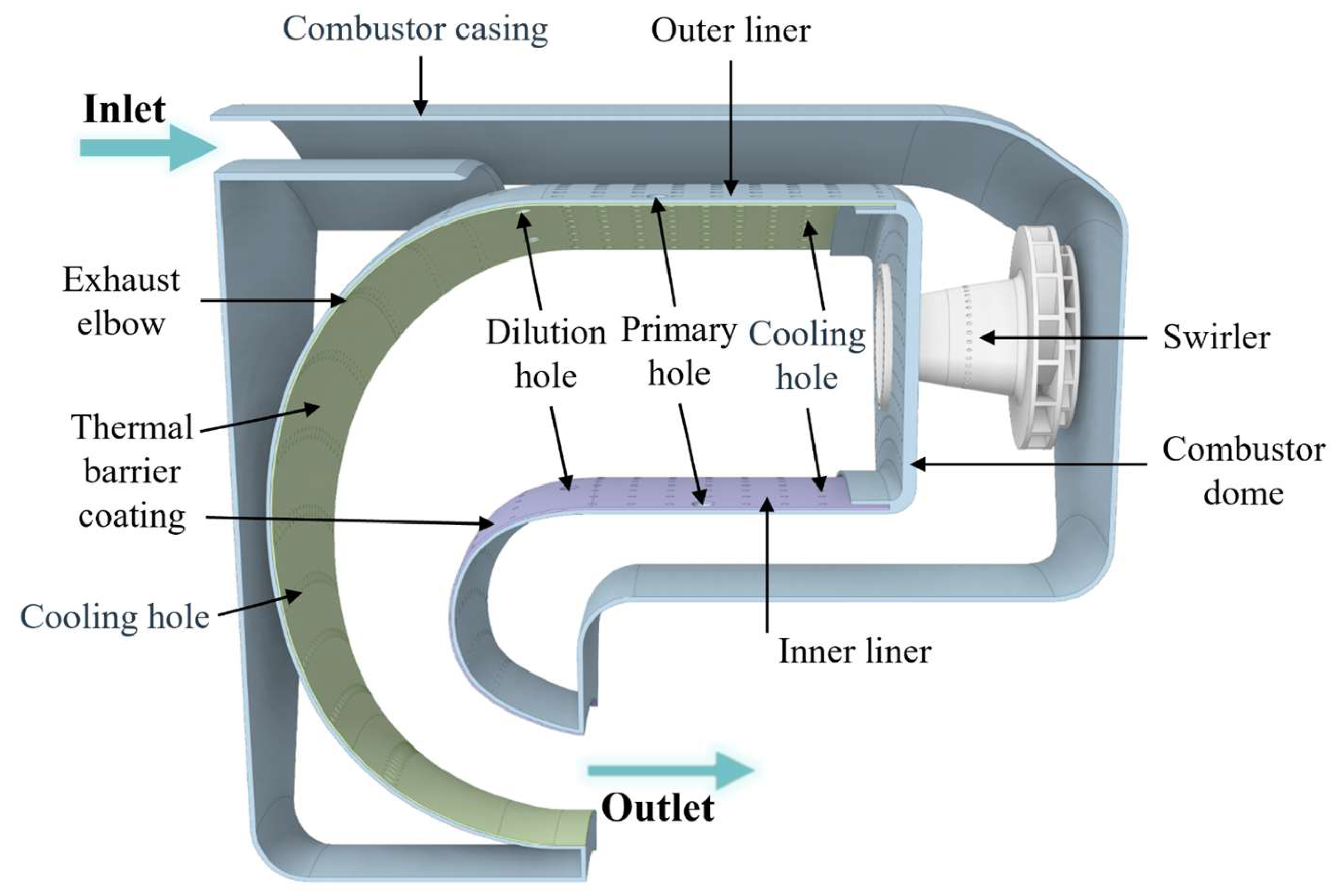
The annular combustor investigated in this study exhibits circumferential periodicity, with twelve uniformly distributed heads along the axial direction. Accordingly, one-twelfth of the full annular geometry was adopted as the computational domain for numerical simulation, as illustrated in Figure 1. The geometric model comprises a swirler, combustion dome, combustion liner, and combustor casing. The inner and outer liners each contain two primary holes, four dilution holes, and several cooling holes. The exhaust elbow adopts a double-wall configuration, with different numbers of cooling holes distributed on each wall to protect the liner from excessive thermal loads. A 0.4 mm TBC layer is applied to the surfaces of the inner and outer liners and the exhaust elbow. A TBC with a thickness of 0.4 mm is the standard application for YSZ in combustors, optimizing thermal insulation while mitigating risks such as excessive thermal stress or delamination.

2.2. Boundary Conditions

In this study, GH3536 was selected as the solid material of the combustor. The properties of GH3536 are derived from the Fluent material library. This nickel–iron–chromium-based superalloy is widely used in aeroengine components due to its excellent high-temperature strength and oxidation resistance. The TBC material is zirconia (ZrO2) stabilized with YSZ, specifically 7–8 wt.% Y2O3-stabilized ZrO2 (7YSZ). The use of plasma spray deposition to apply TBC [16]. The detailed thermophysical properties of the combustor and TBC materials are listed in Table 1.
To enhance the extrapolation capability of the numerical predictions to practical operating conditions, four representative service cases were selected, as listed in Table 2, based on the system load and thermo–flow coupling characteristics, to approximate the realistic flow field of the annular combustor. A velocity-inlet boundary condition was applied at the inlet, a pressure-outlet (free-flow) condition at the outlet, and a no-slip condition at all solid walls. The circumferential side walls of the combustor were defined as periodic boundaries corresponding to a rotational angle of 30°. Subsequently, the simulation results under the design point condition and the maximum continuous condition are discussed and analyzed in detail.

2.3. Computational Meshing

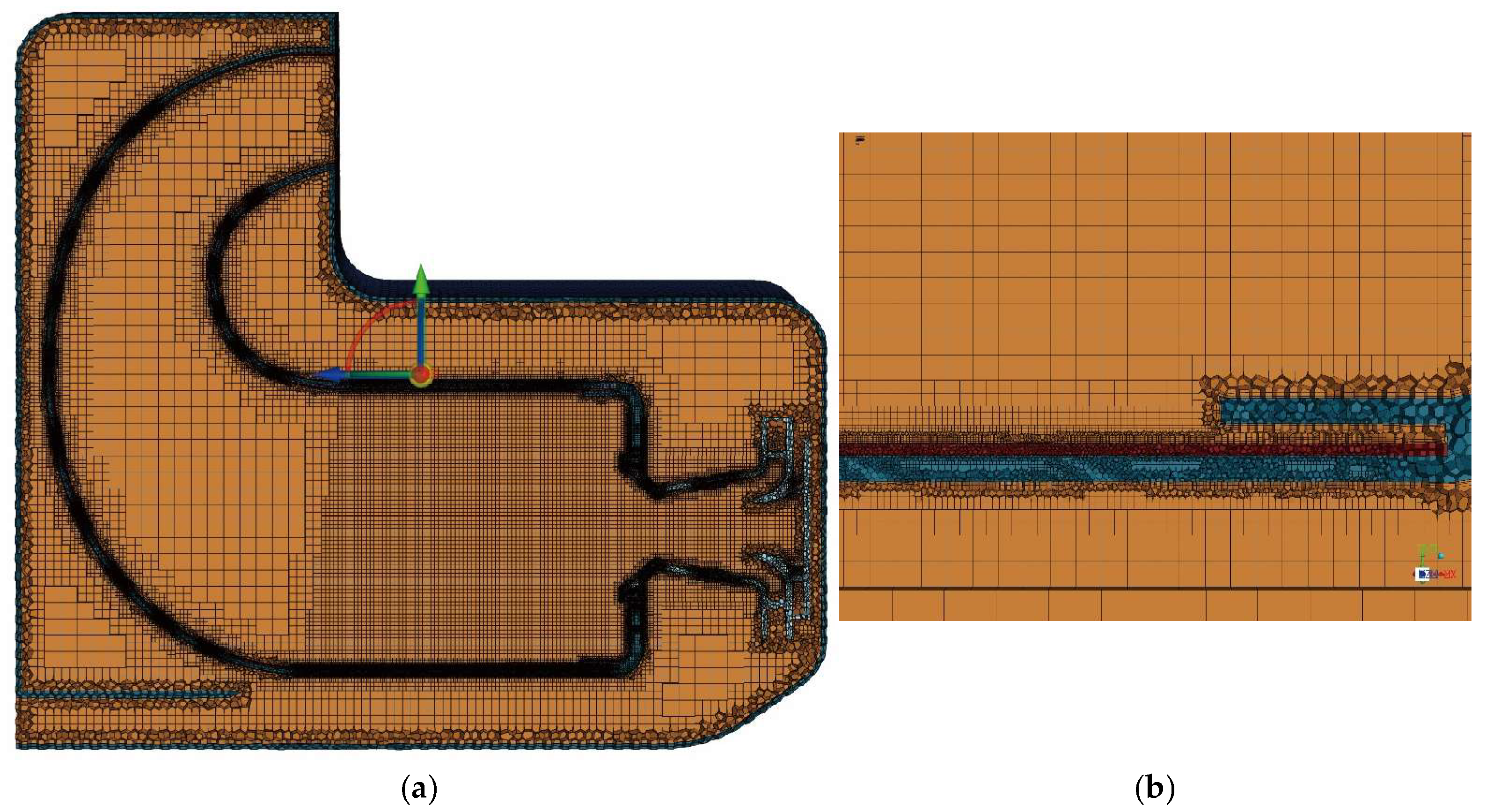
Due to the geometric complexity of the combustor, a hybrid meshing strategy combining polyhedral and hex-core elements was employed to discretize the computational domain, ensuring a balance between numerical accuracy and computational efficiency. Local mesh refinement was applied to the swirler, primary holes, and cooling holes to accurately resolve high-resolution flow structures. The total number of mesh elements is 24.7 million, with 14.5 million in the fluid region, 10.2 million in the solid region, 3.5 million in the TBCs, and 6.7 million in the combustor structure. Through mesh quality assessment in ANSYS Fluent 2023 R1, the maximum skewness is 0.8968, with an average of 0.0245; the minimum orthogonal quality is 0.1507, with an average of 0.9121. These metrics confirm the excellent mesh integrity, with low skewness minimizing numerical errors, and high orthogonal quality ensuring accurate capture of swirl and cooling flows. The y+ values of the first layer mesh remain within the range of 30–50, which is compatible with the enhanced wall function method. The mesh generation is illustrated in Figure 2. The complete fluid–solid coupled mesh is presented in Figure 2a, while the enlarged views of the combustor and TBC layers are provided in Figure 2b, where the blue region represents the combustor, the red region represents the thermal barrier coatings, and the orange region represents the fluid region.
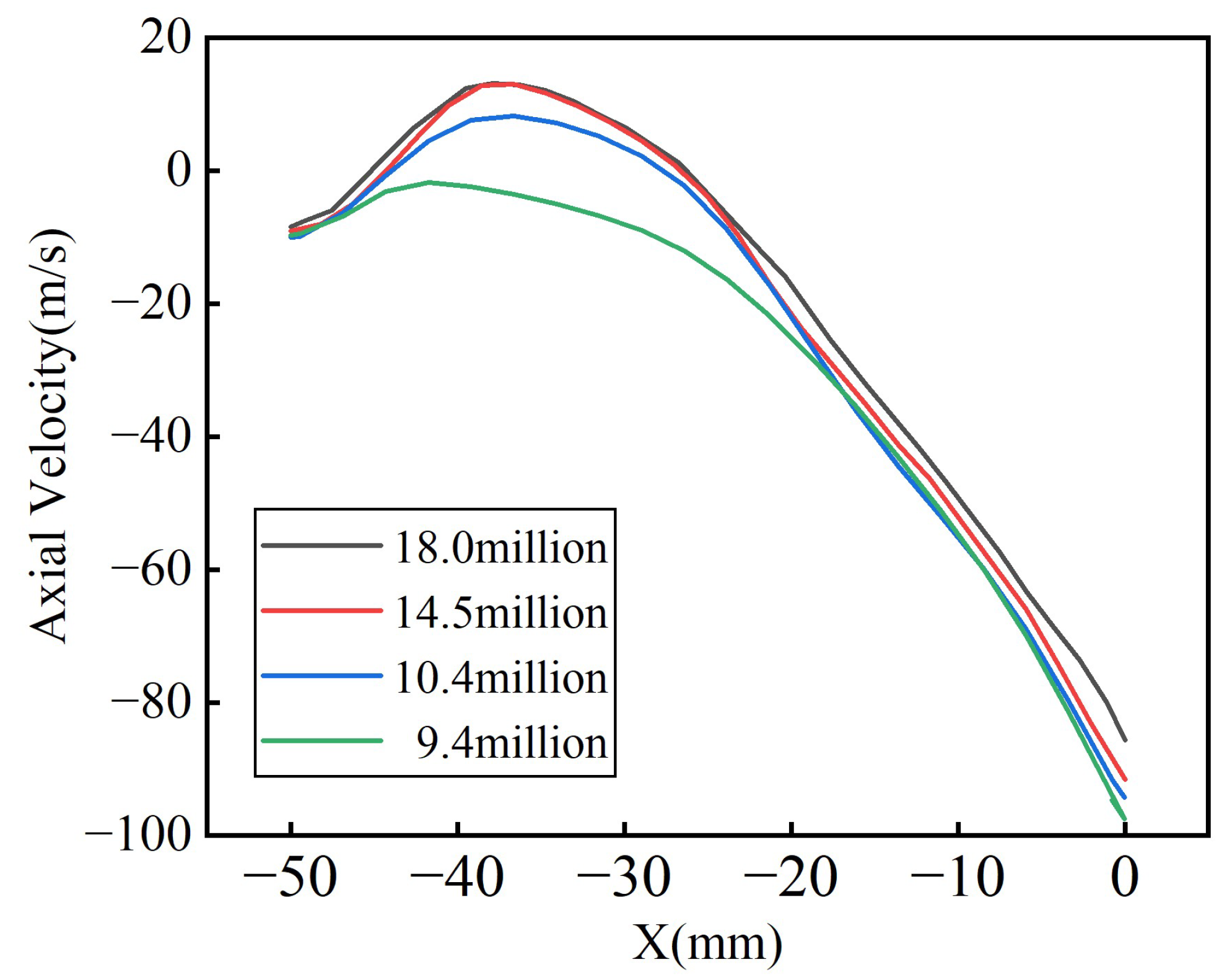
When the mesh resolution is insufficient, the simulation results may vary with the mesh size, leading to significant numerical errors. Considering that the full fluid–solid coupled mesh contains an excessively large number of elements, the fluid domain alone was adopted for the grid independence study. Mesh independence is studied by comparing the axial velocity distribution at the swirl exit, wall-averaged temperature, and outlet-averaged temperature, as shown in Figure 3 and Table 3. It can be seen that, except for the mesh with 9.4 million cells, the axial velocity at the outlet shows negligible variation between the 0 mm and −30 mm stages for the remaining mesh sizes. When the mesh size exceeds 14.5 million cells, the axial velocity at the outlet shows almost no change between the −30 mm and −50 mm stages, with the wall-averaged temperature variation being <2.5% and the outlet-averaged temperature variation being <1%. Therefore, the mesh with 14.5 million cells was selected as the baseline for subsequent simulations.

2.4. Calculation Method

The combustion process within the combustor was numerically simulated using the ANSYS Fluent software package. The Realizable k-ε turbulence model with the enhanced wall function is used to simulate turbulent flow in the combustor, as it performs excellently in capturing swirl and recirculation in the annular combustor, consistent with experimental data for similar configurations. Comparative studies indicate that it outperforms the SST k–ω model in strong swirl, although SST may better handle separation. The Reynolds Stress Model (RSM) provides anisotropy but at a higher computational cost [35,36]. The non-premixed combustion model is used, which accurately describes the fuel-air mixing and chemical reaction coupling. The flamelet model provides similar predictions in gas turbine applications but requires additional tabulation. We use the discrete ordinates (DO) model [36] with the gray gas assumption, excluding soot involvement, as this approach balances computational efficiency and prediction accuracy in combustion chamber simulations, effectively capturing radiation heat flux trends and positions. Non-gray gas modeling and soot effects, although more accurate for spectral radiation and particulate contributions, are omitted here due to their high computational cost and minimal impact on the overall aero-thermal coupling in this steady-state analysis, especially for the low-soot fuels simulated [37]. The Lagrangian discrete phase model (DPM) with a stochastic particle tracking approach was employed to simulate fuel motion and atomization in the two-phase flow field. The semi-implicit pressure-linked equation (SIMPLE) algorithm combined with second-order upwind discretization was used to iteratively solve the governing equations, ensuring improved numerical accuracy and stability.
The numerical approach employed in this study was established based on the validation results of similar combustor configurations reported by Zhang Yukun [2] and Zhang Jiaxiang [18]. Zhang Yukun [2] compared the numerically predicted total pressure loss, mass flow rate, and outlet temperature with corresponding test-bench data, as summarized in Table 4. The relative errors of total pressure loss, mass flow rate, and outlet temperature were 0.5%, 0.1%, and 1.7%, respectively. Overall, the numerical predictions showed good agreement with the experimental measurements, indicating that computational accuracy satisfied engineering application requirements. Zhang Jiaxiang [18] further validated the reliability of the numerical simulations by comparing cold-flow experimental data obtained from particle image velocimetry (PIV) measurements with numerical predictions. In summary, the numerical method adopted in this study is validated as accurate and reliable, and can be effectively applied for numerical prediction of annular combustors.

3. Results and Discussion

3.1. Flow Field Structure and Aerodynamic Characteristics

To quantify the reduction in cooling air demand of the annular combustor after applying TBCs, a cooling load reduction rate was introduced, as defined in Equation (1). This parameter characterizes the extent to which TBCs alleviate the thermal load on the cooling system:
Δ m ˙ c o o l   =   m ˙ c o o l , n o T B C   m ˙ c o o l , T B C   m ˙ c o o l , n o T B C   × 100 %
where m ˙ c o o l , n o T B C and m ˙ c o o l , T B C represent the cooling air mass flow rates without and with TBCs, respectively.
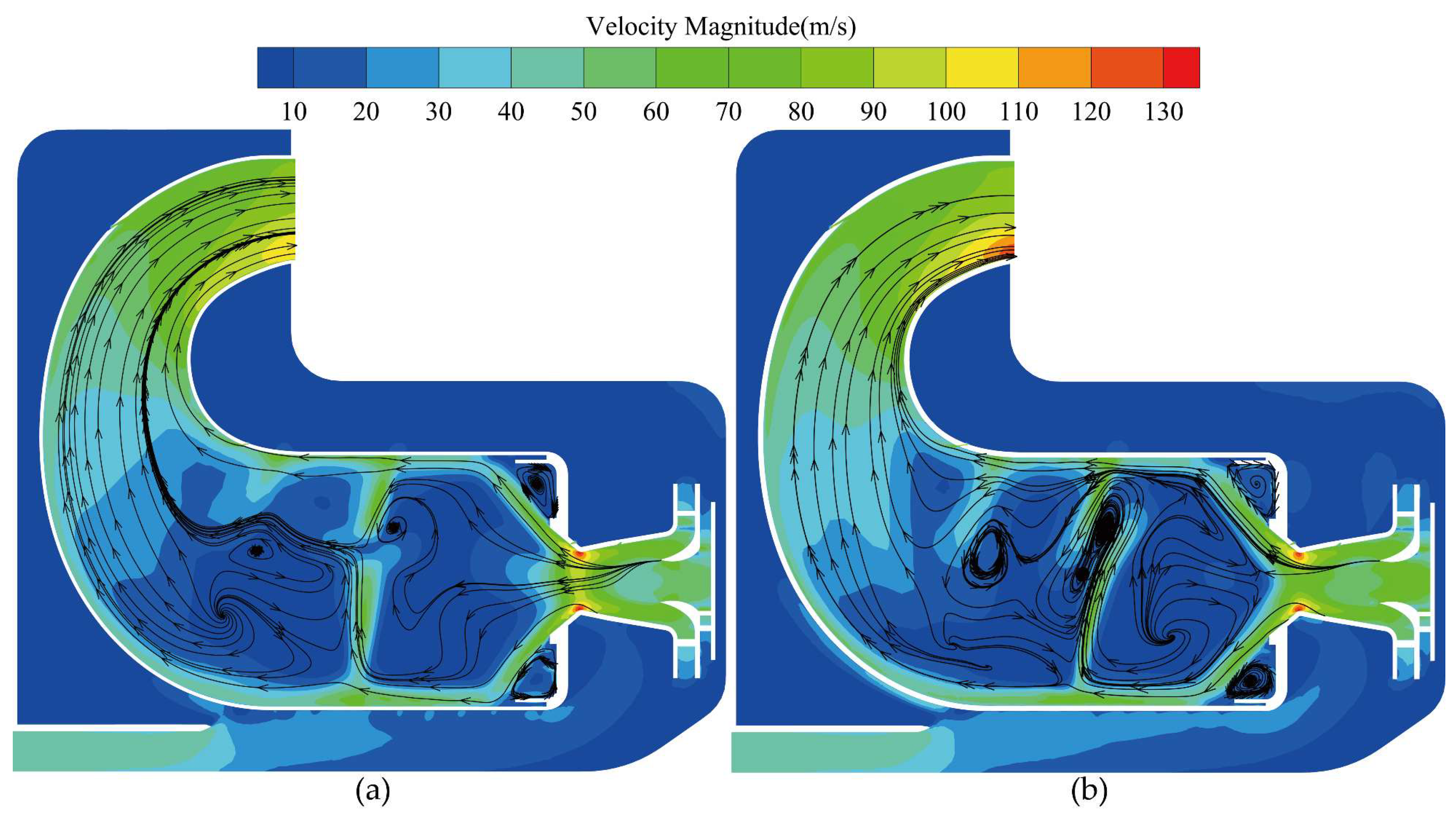
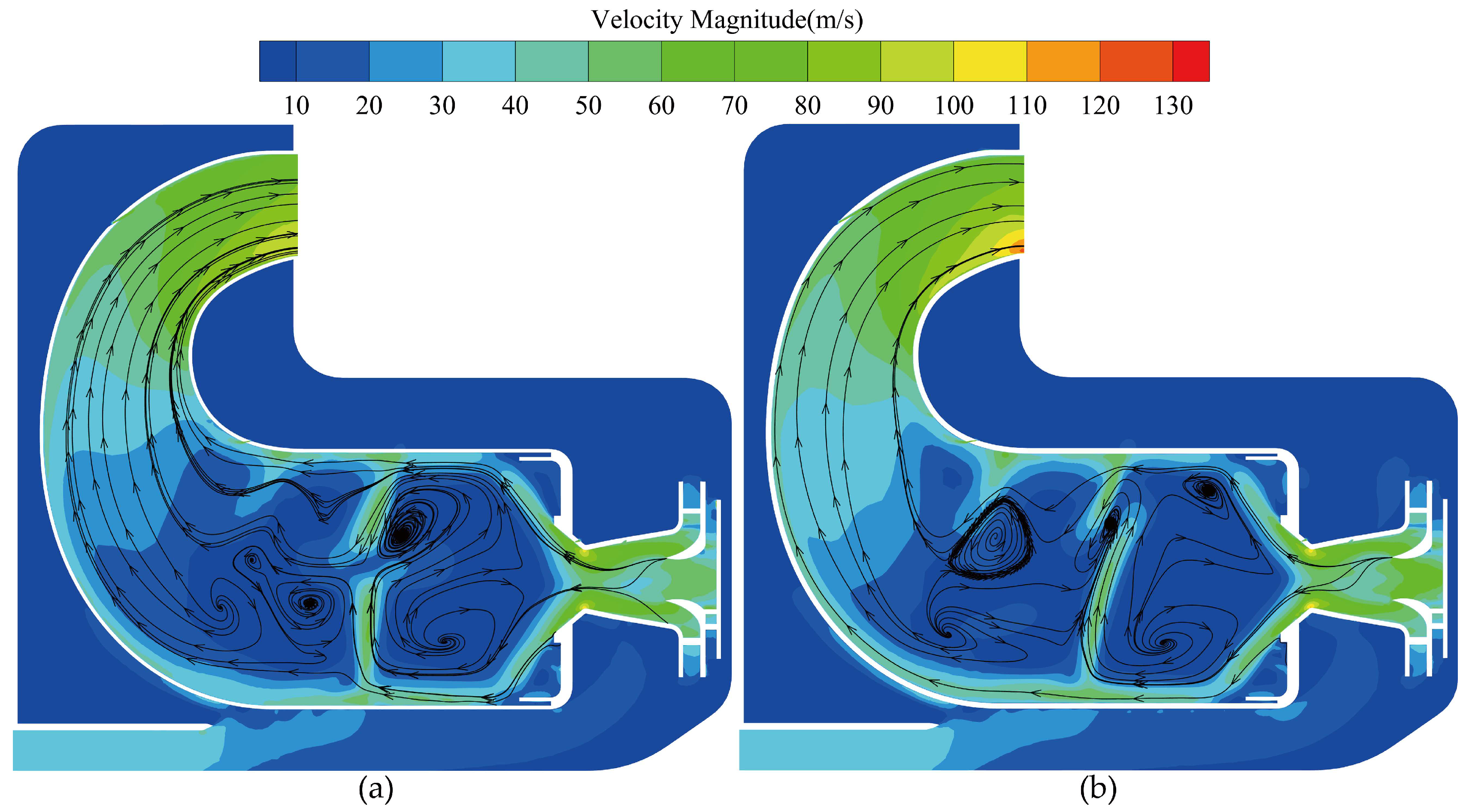
Table 5 presents the cooling load reduction rate of the annular combustor under the design point condition and the maximum continuous condition, respectively. Figure 4 and Figure 5 shows the velocity distributions across the central cross-section of the annular combustor under the design-point condition and the maximum continuous condition, respectively: (a) combustor without TBCs and (b) combustor with TBCs. The overall flow field of the combustor exhibits a typical annular combustor flow pattern, consisting of the mainstream region, the primary-jet recirculation zone, and the dilution mixing region.
The introduction of TBCs significantly alters the flow characteristics in the near-wall region. In the annular combustor without TBCs, the main recirculation zone is relatively wide, and two large-scale counter-rotating vortices are formed near the combustor dome. These vortices promote fuel atomization and air–fuel mixing, thereby maintaining flame stability. However, due to the high thermal conductivity of the GH3536 alloy wall (11.684 W/m·K), the wall temperature remains relatively low, resulting in a pronounced temperature difference between the cooling film and the mainstream flow. Consequently, the cooling film exhibits poor adherence, leading to the formation of a distinct low-velocity region (<30 m/s) near the wall. In this region, a local “cold-film isolation layer” develops, which weakens turbulent diffusion and heat transfer in the near-wall zone.
When the wall is coated with a YSZ thermal barrier coating (thermal conductivity of only 1.04 W/m·K, approximately one order of magnitude lower than that of GH3536), the thermal boundary condition of the combustor wall is significantly altered. Owing to the low thermal conductivity of the TBC, the wall temperature rises more rapidly, leading to a decrease in the cooling-film density and a marked improvement in its attachment capability. The resulting flow-field characteristics can be summarized as follows:
(1)
The extent of the recirculation zone slightly decreases, while the core vortex intensity increases, resulting in a more stable recirculation structure.
(2)
The interaction between the primary jet and the main recirculation flow is enhanced, forming a stronger flow coupling.
(3)
The mainstream velocity distribution becomes smoother, with the peak velocity increasing by approximately 5–10 m/s, indicating enhanced energy concentration in the main flow.
The thermal insulation effect of TBCs effectively reduces the wall heat flux density, thereby decreasing the demand for cooling air. As shown in Table 5, under the desig point condition, the mass flow rate of cooling air in the combustor decreases from 0.1211 kg/s to 0.1023 kg/s with TBCs, corresponding to a reduction of approximately 15.52% in cooling load. Under the maximum continuous condition, the mass flow rate of cooling air in the combustor likewise decreases from 0.1132 kg/s to 0.0912 kg/s with TBCs, with the cooling load reduced by approximately 19.43%. The reduced cooling air can be redistributed to the primary combustion zone to participate in fuel–air mixing and combustion, leading to a more complete and stable flame. As illustrated in Figure 4, the mainstream streamlines in the combustor with TBCs become smoother, the boundaries of the recirculation zone are more distinct, and the low-speed cold-film layer is markedly weakened. The overall flow organization becomes more coherent, and the aerodynamic field exhibits a more compact and efficient pattern. In summary, TBCs indirectly optimize the internal flow structure and energy distribution of the combustor by altering wall heat conduction and cooling-air flow behavior. This achieves a dual improvement—reducing the cooling load while enhancing combustion organization—thereby providing a solid foundation for improved flame stability and temperature uniformity.

3.2. Temperature Field Distribution and Combustion Characteristics

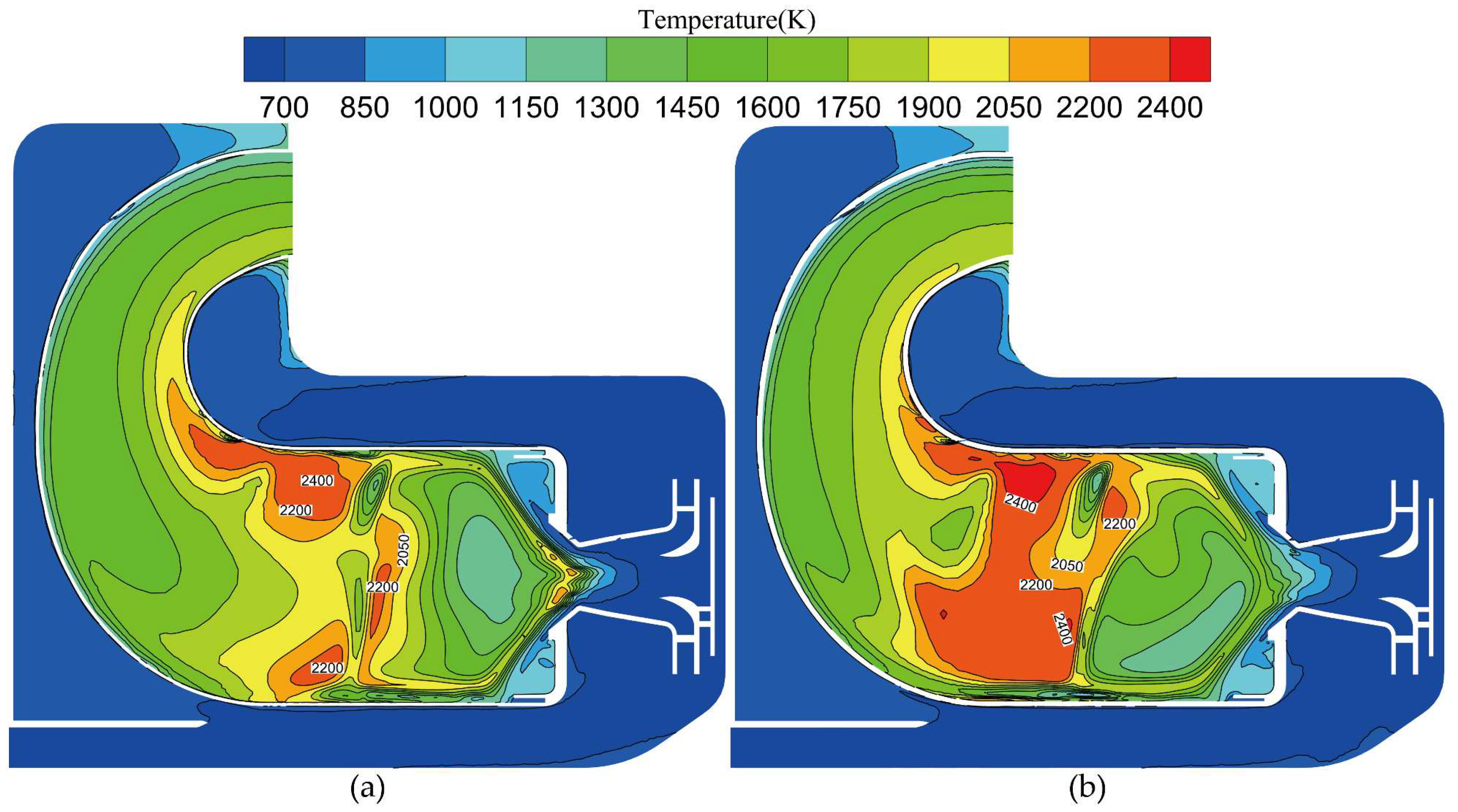
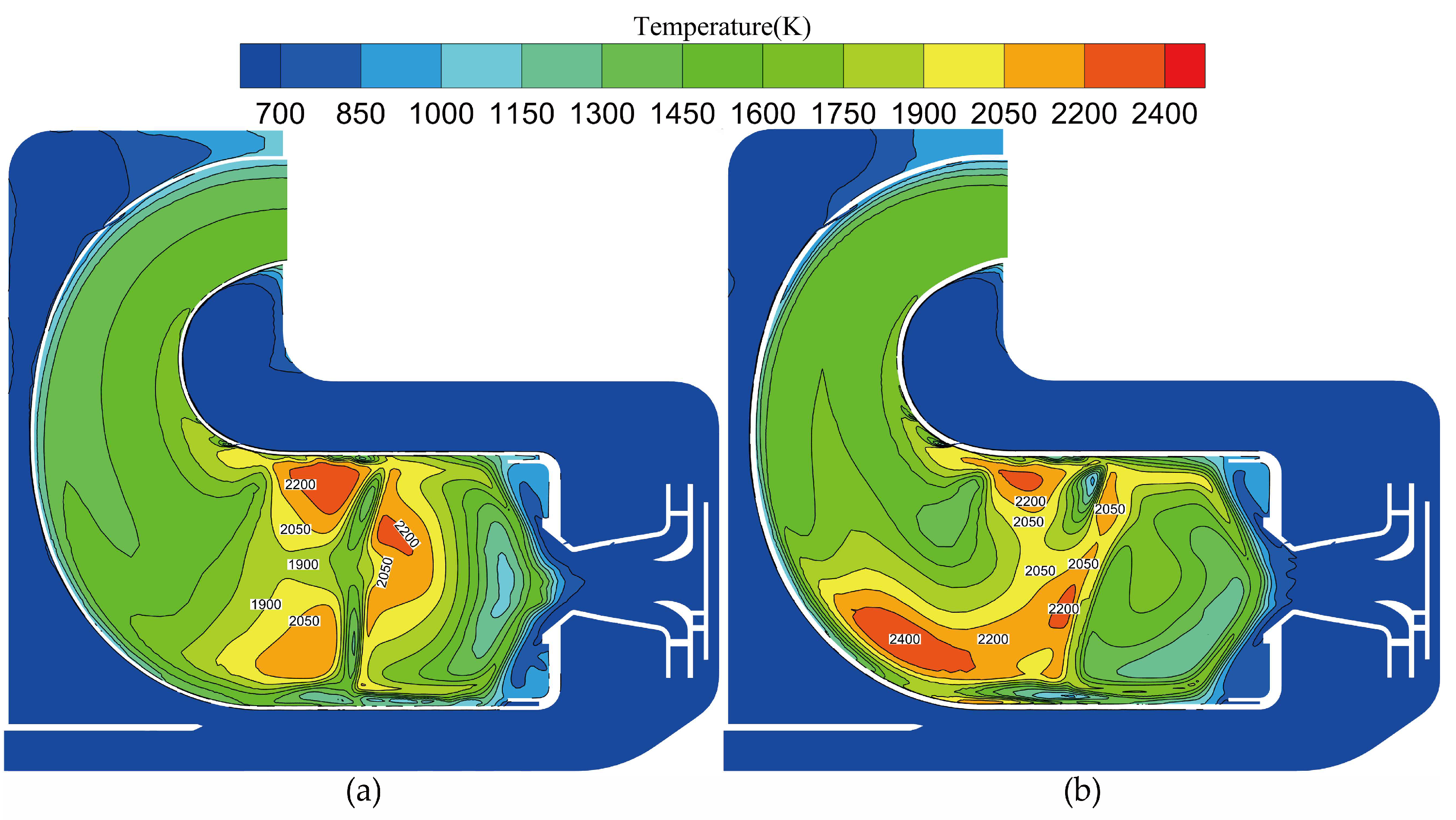
Figure 6 and Figure 7 shows the temperature distributions on the central cross-section of the annular combustor under the design-point condition and the maximum continuous condition, respectively: (a) combustor without TBCs and (b) combustor with TBCs. Overall, both cases exhibit a typical “high-temperature core + cooling ring” pattern; however, the application of TBCs significantly modifies the temperature field and flame thermal structure in the primary combustion zone.
In the combustor without TBCs, the maximum temperature reaches approximately 2400 K. The high-temperature region is primarily concentrated near the junction between the primary and dilution zones, forming a typical “flame tongue” structure along the central axis of the combustor. This region exhibits intense combustion and concentrated heat release, leading to pronounced local temperature peaks and steep temperature gradients near the leading edge of the dilution zone, indicating incomplete fuel–air mixing. In addition, the near-wall temperature distribution is highly non-uniform, with a large temperature difference between the hot gas and the cooling film, which may induce local thermal stress concentration.
In the combustor with TBCs, the temperature field becomes noticeably smoother, the high-temperature flame core shifts slightly downstream, and the high-temperature region expands significantly. The maximum temperature remains approximately 2400 K, but the isotherms become more continuous, and the 2300 K and 2200 K regions extend further downstream, indicating more sustained combustion reactions and more uniform heat release. The thermal insulation effect of TBCs markedly reduces wall heat losses and elevates the gas temperature near the wall, thereby promoting heat redistribution and retention within the primary combustion zone. The low thermal conductivity (1.04 W/m·K) and moderate specific heat capacity (418 J/kg·K) of YSZ lower the wall heat flux by approximately one order of magnitude, thus reducing the fraction of combustion heat dissipated through structural components.
From an energy balance perspective, the insulation provided by TBCs reduces wall conductive heat loss by approximately an order of magnitude, retaining more thermal energy in the combustion gases. This additional heat primarily contributes to improving combustion efficiency, as evidenced by an 80–100 K increase in peak temperature and the downstream extension of the high-temperature core, indicating more complete fuel oxidation and reduced unburned hydrocarbons. Additionally, the increased gas temperature may enhance radiative heat transfer, with a potential 5–10% increase in wall heat flux due to the larger emitting volume. However, the DO radiation model shows that this effect is mitigated by overall temperature uniformity, with net energy redistribution favoring stable flame propagation rather than significant radiative enhancement.
Meanwhile, the wall temperature rise weakens the temperature gradient between the cooling film and the high-temperature mainstream gas, enhancing film attachment and markedly suppressing film-flow disturbances. As a result, the mixing between the cooling air and the hot gas becomes more stable, the temperature field exhibits improved uniformity, and the number of local high-temperature clusters is considerably reduced. Overall, the combustor with TBCs exhibits remarkable improvements in flame morphology, temperature gradients, and combustion stability. It can be concluded that TBCs enhance the uniformity of combustion organization and thermal stability through a coupled mechanism of “thermal insulation–energy redistribution–flame restructuring”, thereby providing a dual benefit of improved combustion efficiency and reduced wall heat load.

3.3. Outlet Temperature Distribution

To quantitatively evaluate the uniformity of the temperature field at the combustor outlet, the outlet temperature distribution factor (OTDF) was introduced as a quantitative indicator, and its definition is given as follows:
O T D F =   T o u t l e t , max   T o u t l e t , a v e T o u t l e t , a v e T i n l e t , a v e   × 100 %
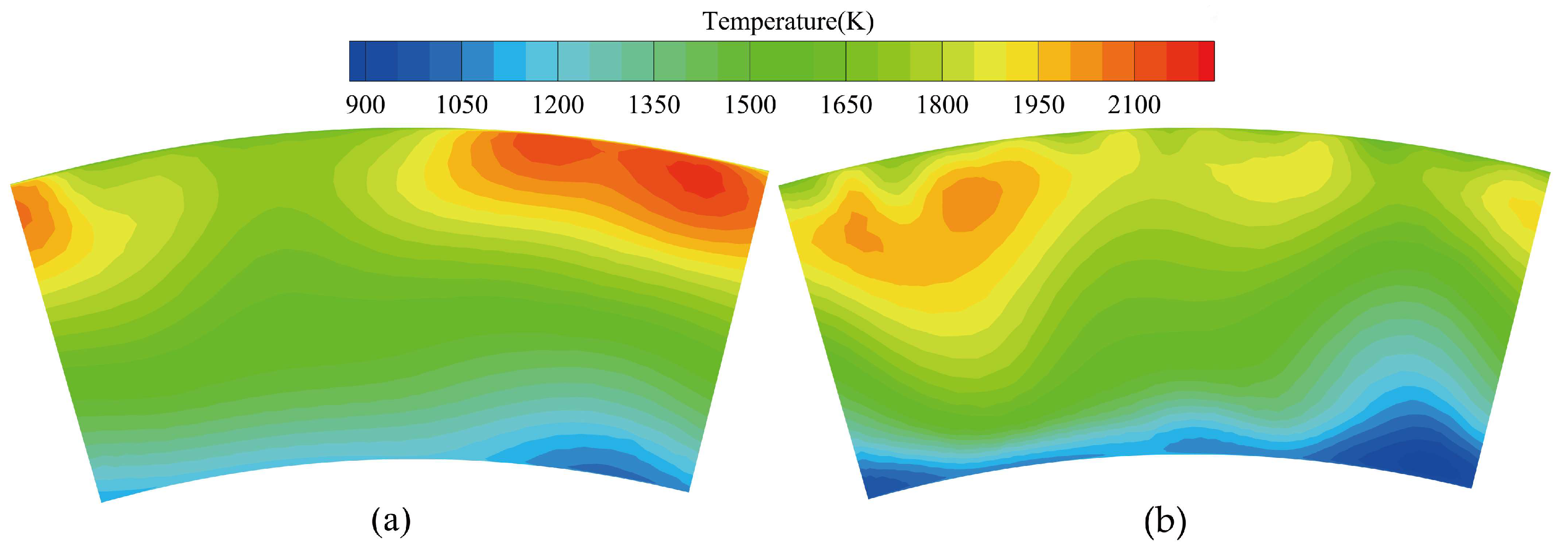
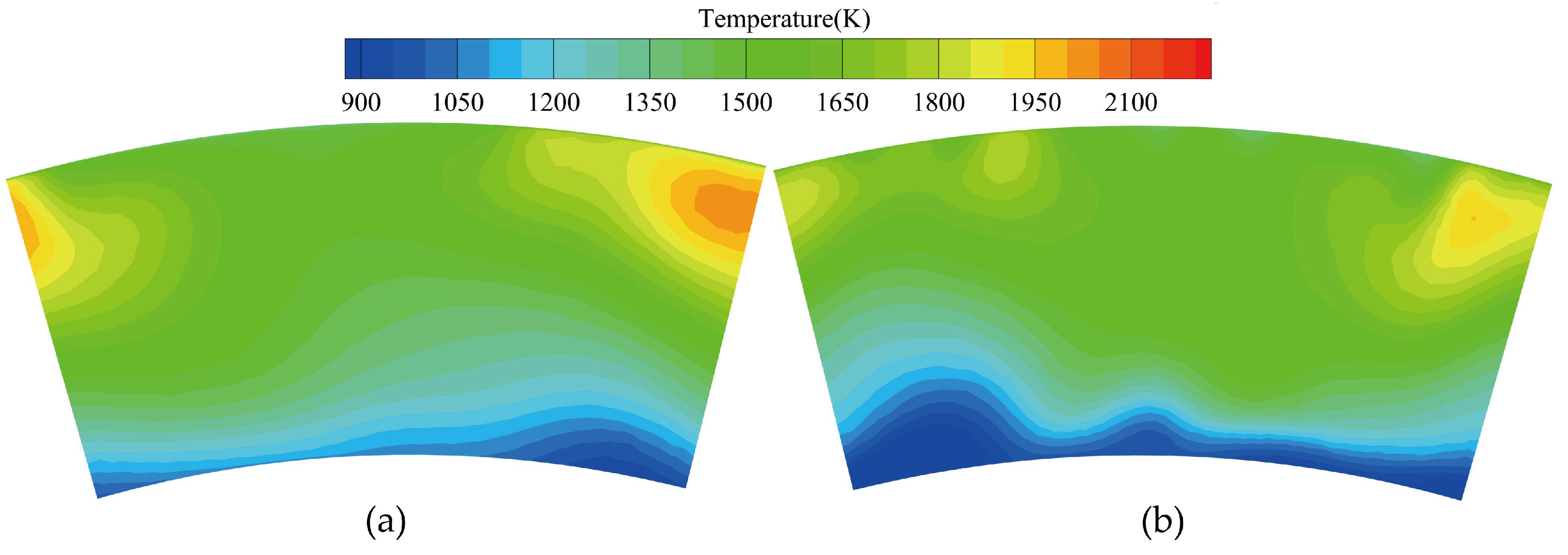
where T i n l e t , a v e , T o u t l e t , a v e and T o u t l e t , max represent the area-averaged inlet temperature, the area-averaged outlet temperature, and the maximum outlet temperature of the combustor, respectively. A smaller OTDF value indicates a more uniform outlet temperature distribution. Table 6 presents the OTDF results for the annular combustor without and with TBCs under the design point condition and the maximum continuous condition, respectively. Figure 8 and Figure 9 shows the temperature distributions at the outlet section of the annular combustor under the design-point condition and the maximum continuous condition, respectively: (a) combustor without TBCs and (b) combustor with TBCs.
As shown in Table 6, the OTDF of the combustor without TBCs under the design point condition is 57.34%, whereas that of the combustor with TBCs decreases to 44.48%, corresponding to an improvement of approximately 22.4% in outlet temperature uniformity. The OTDF of the combustor without TBCs under the maximum continuous condition is 59.04%, whereas that of the combustor with TBCs decreases to 49.16%, corresponding to an improvement of approximately 20.1% in outlet temperature uniformity. These results demonstrate that the application of TBCs effectively improves the outlet temperature distribution of the combustor and significantly reduces thermal non-uniformity. As an industrial benchmark, the OTDF for annular combustors in aeroengines typically falls within the range of 25–40% in order to ensure uniform turbine inlet conditions and extend component life. The OTDF values obtained in this study are relatively high, which may be attributed to simplifications such as steady-state modeling and high-load operating conditions that amplify temperature gradients. Nevertheless, the OTDF of the combustor with TBCs is reduced by more than 20%, highlighting its role in enhancing temperature uniformity through energy redistribution.
As shown in Figure 8 and Figure 9, for the combustor without TBCs, the temperature in the upper region of the outlet cross-section is approximately 2000 K, whereas the temperature in the lower near-wall region is about 1050 K, resulting in a pronounced radial temperature gradient and a highly non-uniform temperature distribution. After applying TBCs, the high-temperature region at the outlet expands radially, the temperature in the low-temperature region increases significantly, and the overall temperature field becomes smoother, indicating more complete combustion and a more balanced thermal distribution. The improvement in outlet temperature uniformity can be explained in terms of the underlying energy transfer mechanisms:
(1)
Wall insulation effect—TBCs significantly reduce wall heat flux density, weaken heat transfer to structural components, and allow more thermal energy to be retained within the mainstream hot gas.
(2)
Film attachment and turbulence enhancement effect—the rise in wall temperature decreases the density of the cooling film and enhances its attachment, improving near-wall flow continuity and promoting more uniform turbulent mixing, which facilitates heat exchange between high- and low-temperature gases.
The homogenization of the outlet temperature field not only improves combustion efficiency but also plays an essential role in enhancing the service life and operational safety of the downstream high-pressure turbine. The reduced temperature gradient effectively alleviates thermal stress concentration and mitigates material fatigue damage in turbine blades, thereby improving the overall reliability and longevity of the engine system.

3.4. Wall Temperature Distribution and Thermal Protection Performance

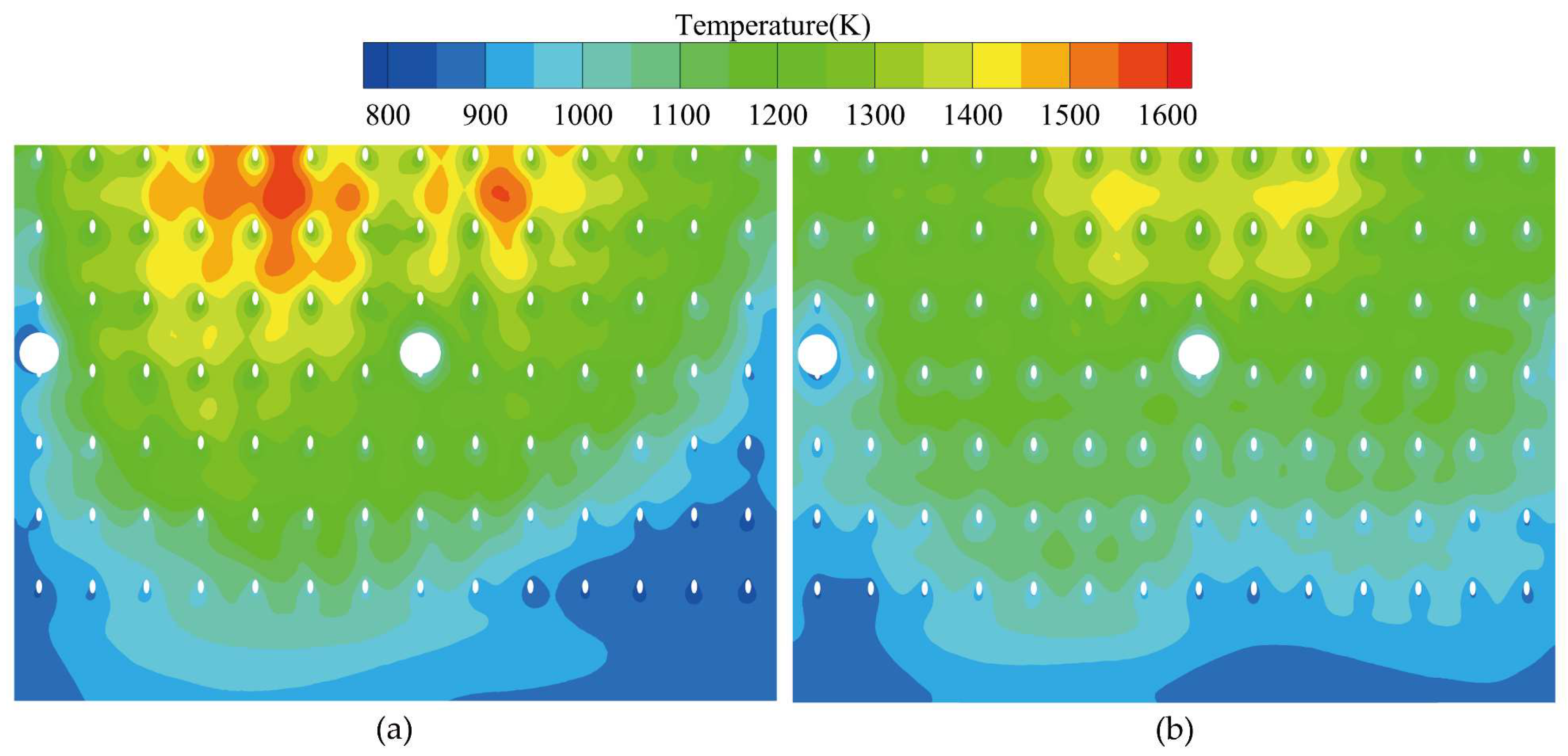
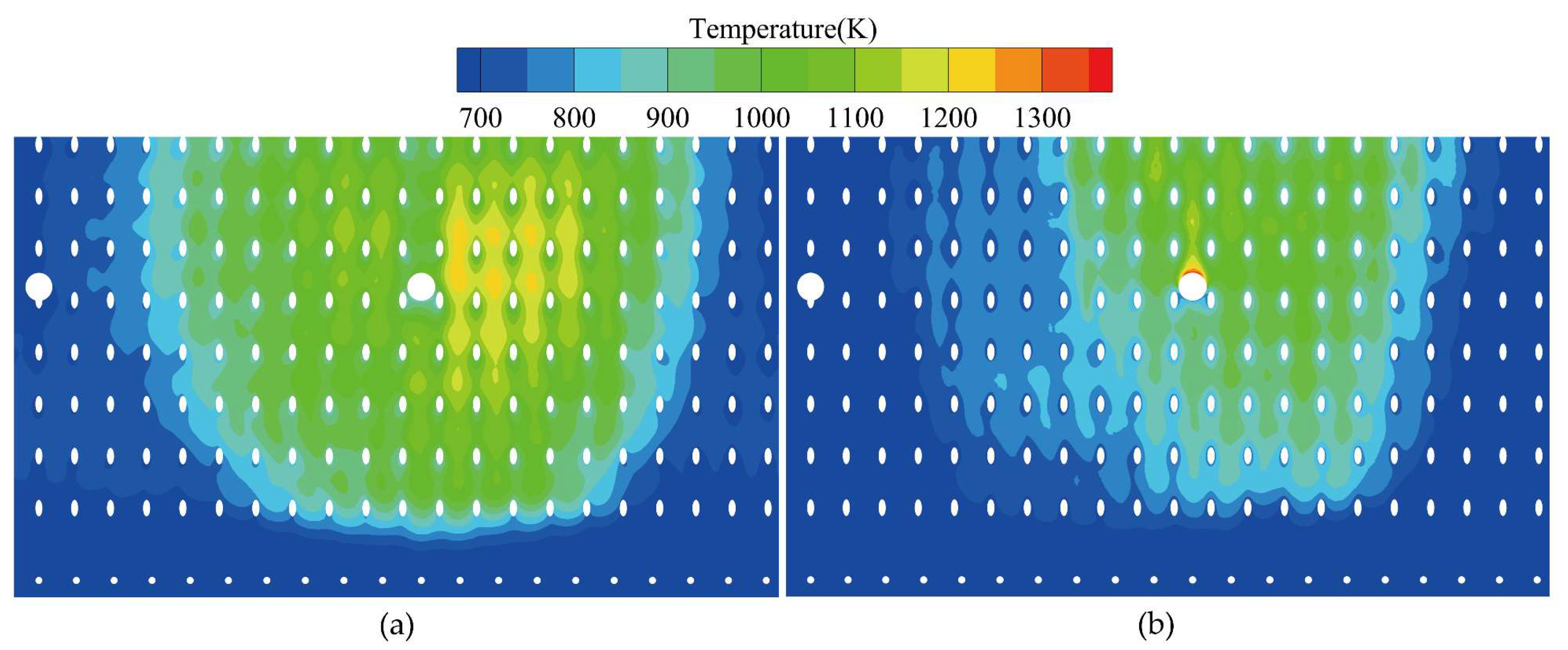
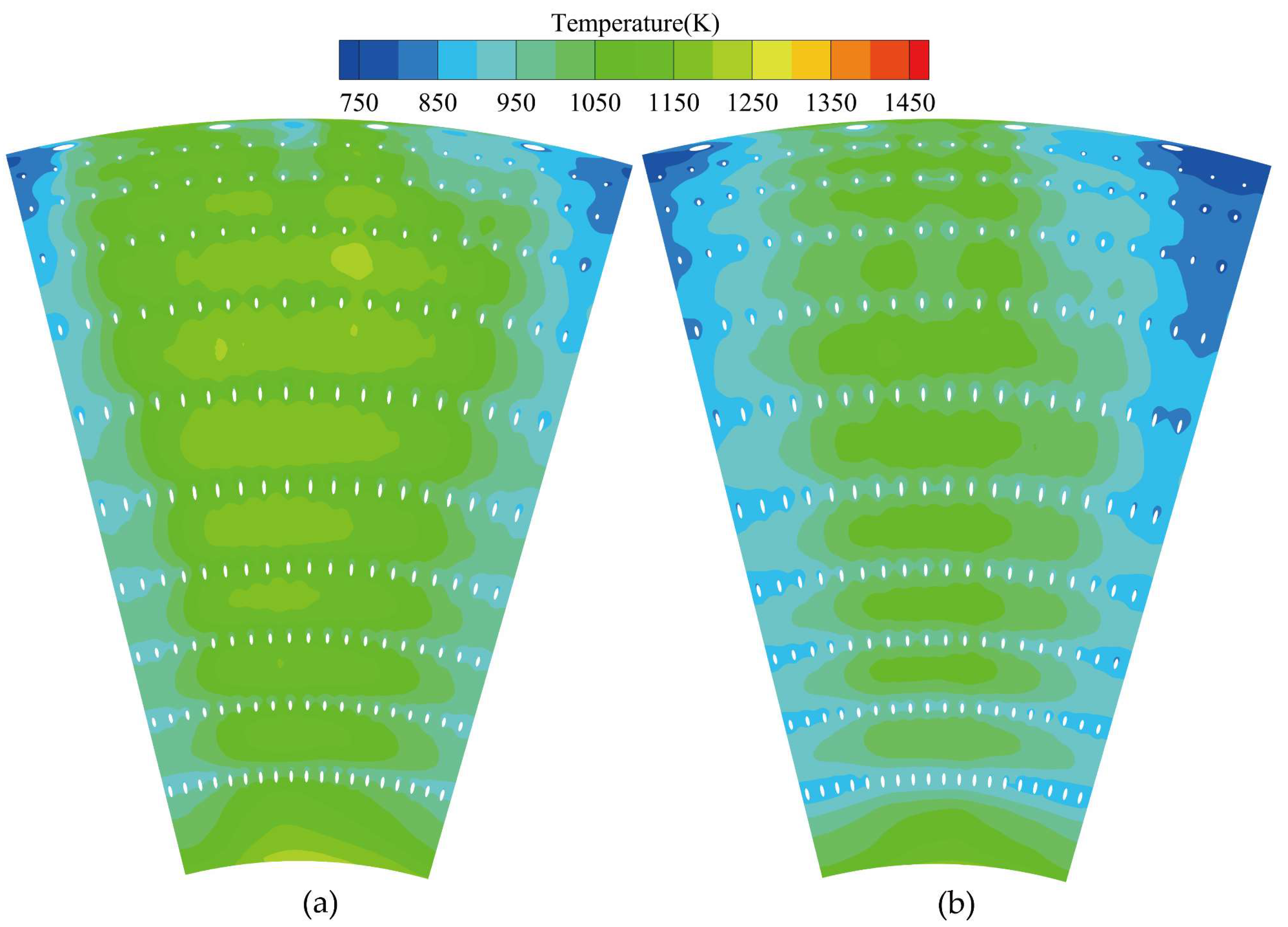
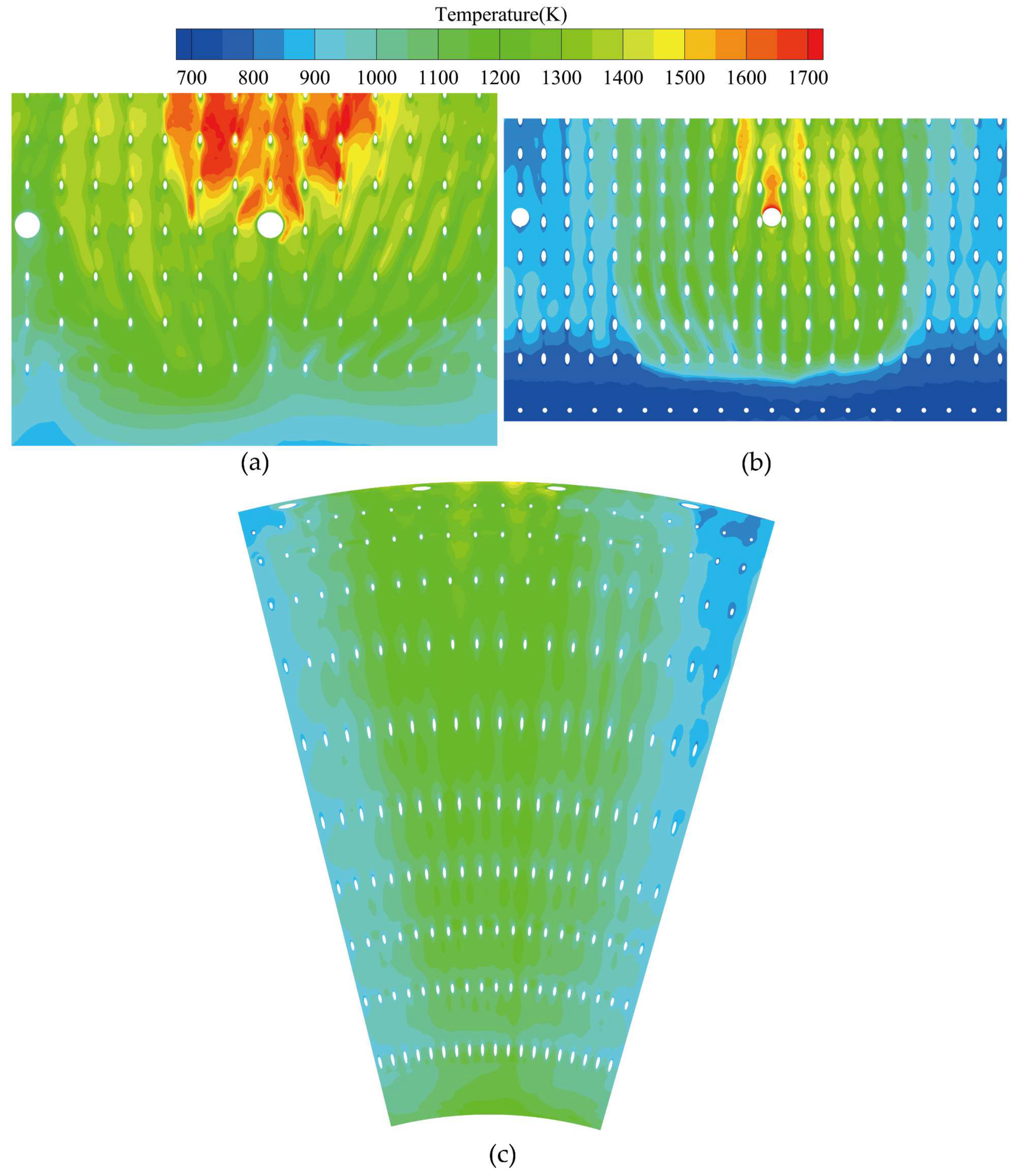
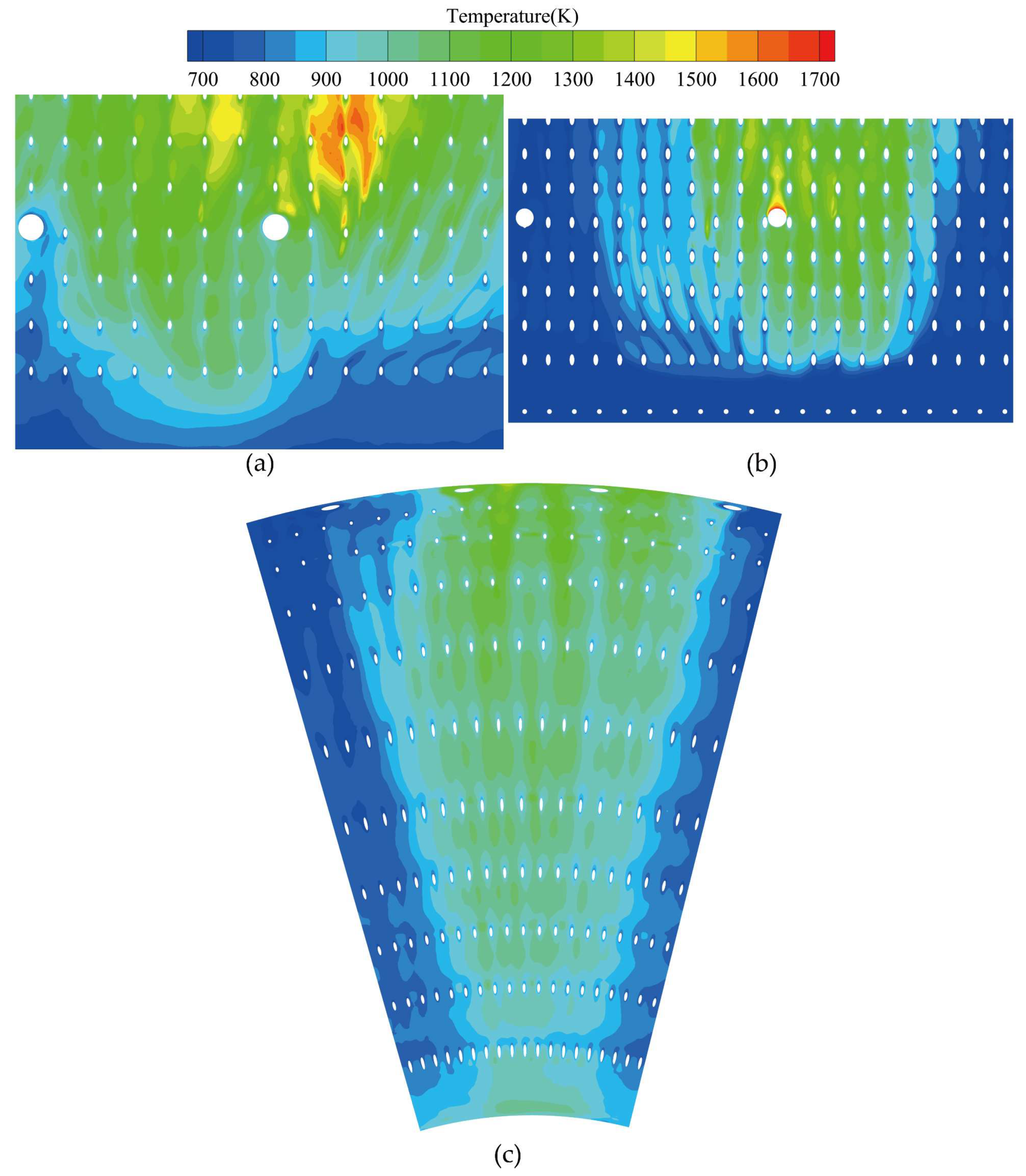
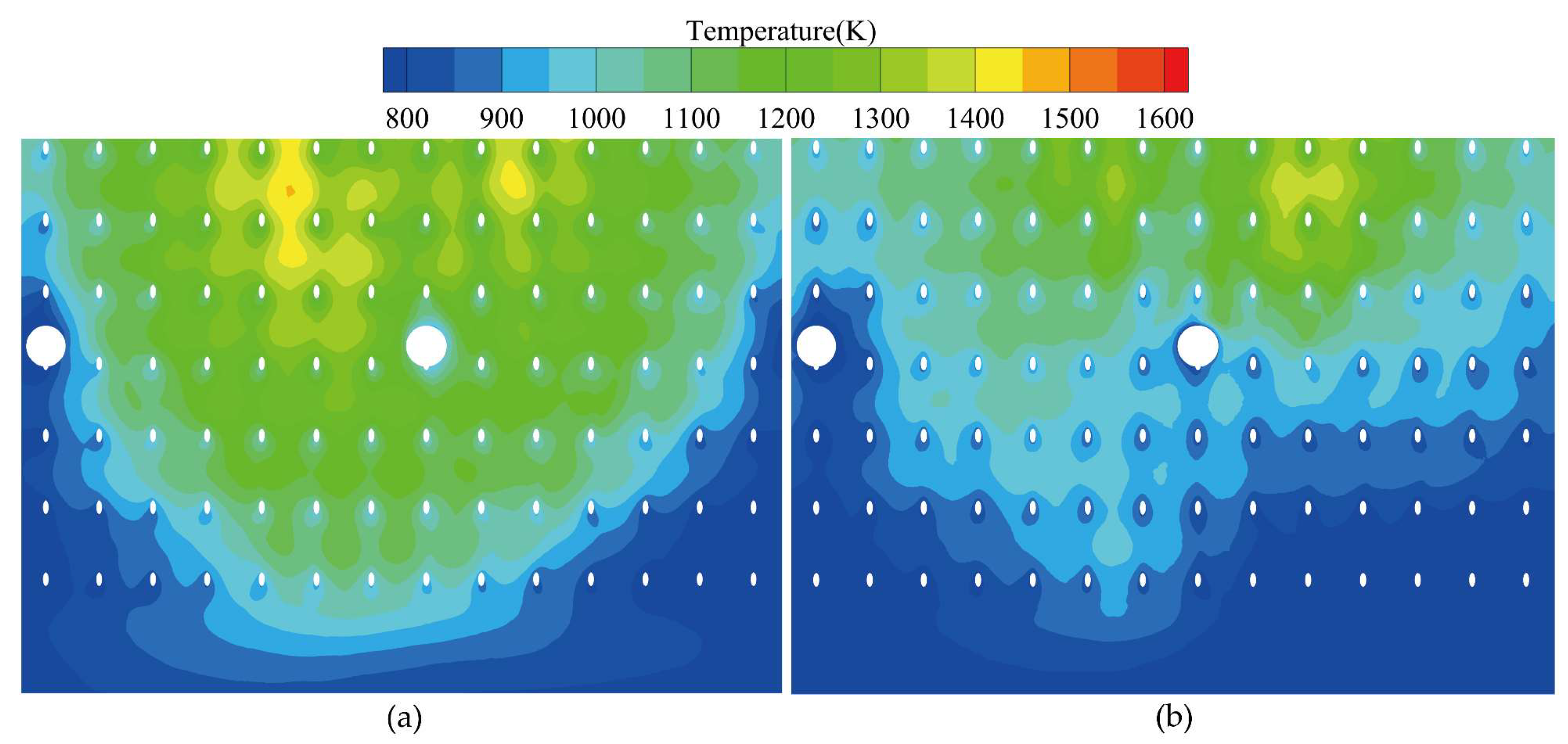
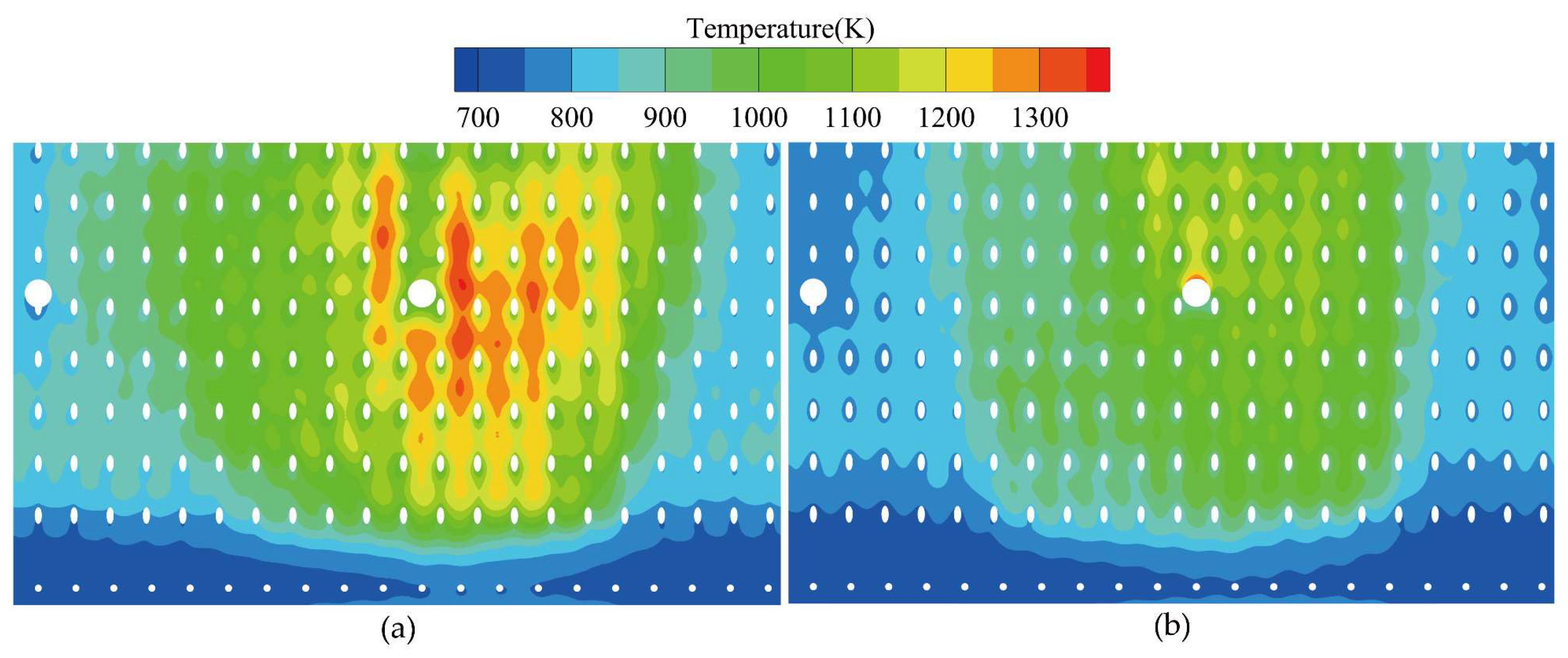
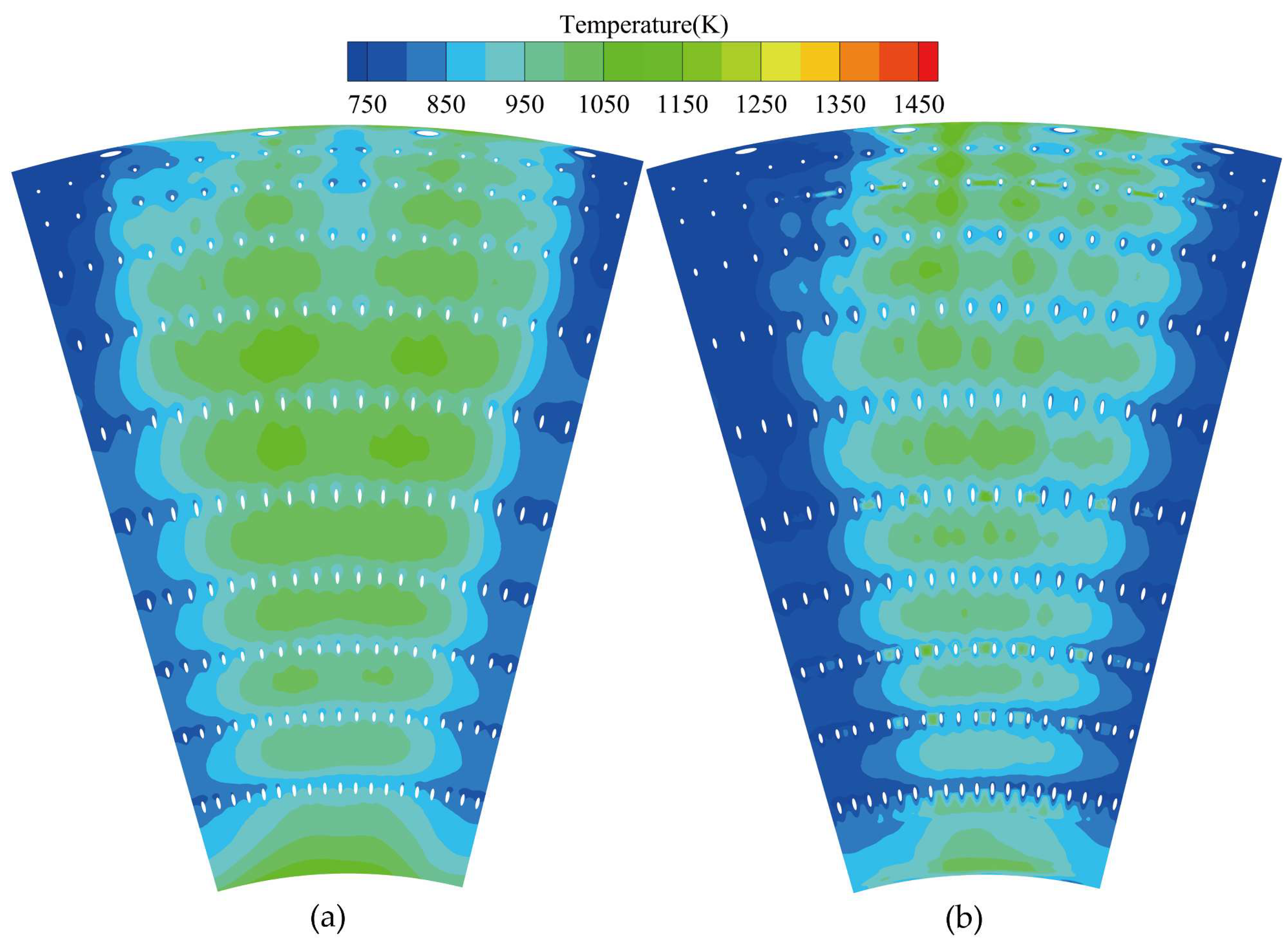
Figure 10, Figure 11, Figure 12, Figure 13, Figure 14 and Figure 15 present the wall temperature distributions of the inner liner, outer liner, and exhaust elbow of the annular combustor under the design-point condition and the maximum continuous condition, respectively: (a) combustor without TBCs and (b) combustor with TBCs. As shown in the figures, for the combustor without TBCs, the high-temperature regions are primarily concentrated downstream of the primary holes, near the intersection of the dilution holes, and at the bend of the exhaust elbow. The wall temperature distribution exhibits a distinctly non-uniform pattern. The local wall temperature exceeds 1500 K, particularly in regions of high heat flux where thermal hot spots develop, which are prone to material oxidation and thermal fatigue failure. After applying TBCs, the overall wall temperature level is significantly reduced, and the temperature field becomes more uniform. With the application of TBC, the local temperature reduction in the annular combustor exceeds 250 K, primarily occurring downstream of the primary holes and at the exhaust elbow.
Under the design point condition, the average wall temperatures of the inner liner, outer liner, and exhaust elbow in the combustor with TBCs decreased to 1098.08 K, 884.44 K, and 971.34 K, respectively, corresponding to reductions of 3.69%, 8.81%, and 7.51% compared with the case without TBCs. Under the maximum continuous condition, the average wall temperatures of the inner liner, outer liner, and exhaust elbow in the combustor with TBCs decreased to 922.69 K, 752.45 K, and 846.49 K, corresponding to reductions of 13.79%, 13.61%, and 9.38% relative to the case without TBCs. This indicates that the TBCs exhibit excellent thermal insulation performance across all regions. The outer liner exhibits the most pronounced cooling effect, as it is subjected to the highest heat flux and the strongest radiative influence, making the thermal insulation effect of the coating particularly evident in this region.
Table 7 quantitatively summarizes the thermal insulation efficiency of the annular combustor under the design-point condition and the maximum continuous condition, respectively. The thermal insulation efficiency is defined as the relative reduction in the average wall temperature between the combustor with and without TBCs, and its expression is given as follows:
η T B C   = T w a l l , n o T B C   T w a l l , T B C T w a l l , n o T B C       × 100 %
where T w a l l , n o T B C and T w a l l , T B C represent the wall temperatures of the annular combustor without and with TBCs, respectively.
Under the design point condition, the average insulation efficiencies of the inner liner, outer liner, and exhaust elbow are 3.69%, 8.81%, and 7.51%, respectively, with a maximum insulation efficiency of 9.01%. Under the maximum continuous condition, the average insulation efficiencies of the inner liner, outer liner, and exhaust elbow are 13.79%, 13.61%, and 9.38%, respectively, with a maximum insulation efficiency of 13.79%. These results indicate that TBCs effectively reduce the thermal load of combustor structural components and improve the distribution of local high-temperature regions.
Figure 16 and Figure 17 shows the temperature distributions of the TBC surface in the combustor with TBCs under the design-point condition and the maximum continuous condition, respectively: (a) inner liner, (b) outer liner, and (c) exhaust elbow. It can be observed that the surface temperature of the TBC is generally higher than that of the metallic substrate, and distinct temperature peaks occur in the regions downstream of the primary holes.
According to the data in Table 8, under the design point condition, the average TBCs surface temperatures of the inner liner, outer liner, and exhaust elbow are 1224 K, 992 K, and 1050 K, respectively, with corresponding peak temperatures of 1747 K, 1737 K, and 1469 K. Under the maximum continuous condition, the average TBCs surface temperatures of the inner liner, outer liner, and exhaust elbow are 1031 K, 851 K, and 932 K, respectively, with corresponding peak temperatures of 1664 K, 1693 K, and 1405 K, indicating pronounced temperature gradients.These results indicate that TBCs exhibit excellent thermal drop performance under high-temperature conditions: the surface temperature of the coating remains within 1500–1700 K, whereas the metal interface temperature stays below 1100 K, suggesting that approximately 90% of the total temperature drop occurs within the coating layer. This is consistent with the thermal conductivity of GH3536 being an order of magnitude lower than that of YSZ.
This temperature gradient phenomenon can be explained based on the heat conduction mechanism. The thermal conductivity of the GH3536 alloy is 11.684 W/(m·K), whereas that of YSZ is only 1.04 W/(m·K), which is approximately 11 times lower than that of GH3536. According to the one-dimensional steady-state heat conduction theory, under the same heat flux density, the TBC layer is responsible for the majority of the temperature drop. Combining this with the numerical results, the temperature difference across the TBC layer can reach 400–600 K, effectively preventing heat transfer to the metallic substrate and significantly reducing wall thermal stress and structural temperature rise.
In addition, the GH3536 substrate possesses a high density (8219.9 kg/m3) and specific heat capacity (485 J/kg·K), leading to substantial thermal inertia. When combined with TBCs, it forms a “low thermal conductivity–high heat capacity” composite system that effectively smooths temperature fluctuations during thermal cycling. As a result, wall temperature variations become more stable, and the risk of thermal fatigue is significantly reduced. Overall, the application of TBCs not only reduces wall heat flux density and peak temperature but also improves temperature field uniformity, thereby enhancing the thermal safety margin and service reliability of the combustor structure.


4. Conclusions

In this study, based on numerical simulations of an annular combustor, the thermal protection and aero–thermal coupling effects of zirconia (ZrO2)-based YSZ thermal barrier coatings (TBCs) were systematically investigated. By comparing the flow field, temperature field, wall temperature, and outlet temperature distributions under conditions with and without TBCs, the following conclusions can be drawn:
(1)
TBCs significantly enhance the thermal protection performance of the combustor. The thermal conductivity of YSZ is approximately one-eleventh that of the GH3536 alloy, which greatly reduces the wall heat conduction capability. As a result, TBCs effectively decrease wall heat flux density and structural thermal stress, thereby improving the thermal safety margin and structural reliability of the combustor.
(2)
TBCs modify the flow and combustion organization of the combustor, resulting in a more stable aerodynamic structure and a significant reduction in cooling load. The main recirculation zone slightly contracts while the vortex intensity increases; the interaction between the primary jet and the recirculation flow becomes stronger, the high-temperature region expands, and the combustion reaction becomes more uniform. By altering the wall thermal boundary conditions, TBCs enhance cooling-film adhesion and improve the mixing process, leading to more concentrated and stable combustion.
(3)
TBCs effectively improve the outlet temperature distribution of the combustor, enhancing the uniformity of the temperature field and overall engineering adaptability. The outlet temperature uniformity is improved by more than 20%. The high-temperature region at the outlet expands radially, the temperature in the low-temperature region rises significantly, and the overall temperature gradient decreases. TBCs reduce wall heat loss and improve the combustion heat distribution through a coupled mechanism of “thermal insulation–flow reconstruction–energy redistribution.” This mechanism alleviates turbine inlet temperature differences, reduces blade thermal stress and fatigue risk, and ensures the safe operation of high-load combustors.
Although the steady-state assumption in this study is applicable to thermal balance analysis under typical operating conditions, it neglects transient thermal cycles (e.g., during startup/shutdown), which may lead to an underestimation of thermal fatigue damage risk. Additionally, the current model assumes constant representative thermal conductivity for the YSZ coating. While this simplification aids the analysis, it may not accurately capture the full behavior under varying conditions. A parametric sensitivity analysis of the YSZ thermal conductivity and other coating parameters, such as thickness, would provide more reliable quantitative guidance for optimized design, and future work should consider this direction.
Furthermore, this study focuses only on the thermal performance of the YSZ coating and neglects the metallic bond coat and thermally grown oxide (TGO) layer, which are crucial in practical systems. While this simplification helps isolate the primary insulating mechanism, it may overestimate the insulation performance and overlook degradation mechanisms such as oxidation-induced spallation. Therefore, the ~90% temperature drop across the coating and the cooling load reduction percentages should be interpreted in this context.
Introducing a more comprehensive model, including a multi-layer TBC system along with transient thermal cycling analysis, will help more accurately assess the long-term reliability of the system. These coatings significantly influence thermal conduction, interfacial stress distribution, and coating lifetime degradation. Therefore, future work will extend to multi-layer structural modeling (including the bond coat, TGO layer, and top ceramic layer) and incorporate thermal aging mechanisms, aiming for a more precise evaluation of coating lifespan and reliability.

Author Contributions

Conceptualization, J.C. and Q.Z.; methodology, L.W.; software, Q.Z.; validation, Z.Z. and Q.Z.; formal analysis, Z.Z.; investigation, Z.Z. and L.W.; resources, F.L.; data curation, R.W.; writing—original draft preparation, Z.Z.; writing—review and editing, J.C. and F.L.; visualization, R.W.; supervision, J.C. and L.W.; project administration, J.C. and L.W.; funding acquisition, J.C. and F.L. All authors have read and agreed to the published version of the manuscript.

Funding

This research received no external funding.

Data Availability Statement

Data are contained within the article.

Conflicts of Interest

The authors declare no conflicts of interest.

Abbreviations

The following abbreviations are used in this manuscript:
APSAir plasma spray
CHTConjugate heat transfer
CMASCalcium-magnesium-alumino-silicate
CPSpecific heat capacity
DODiscrete ordinates
DPMDiscrete phase model
kThermal conductivity
m ˙ c o o l , n o T B C The cooling air mass flow rates without TBCs
m ˙ c o o l , T B C The cooling air mass flow rates with TBCs
OTDFOutlet temperature distribution factor
PIVParticle image velocimetry
PRZPrimary recirculation zone
RSMReynolds stress model
T a v e Average temperature
TBCThermal barrier coating
TBCsThermal barrier coatings
TGOThermally grown oxide
T i n l e t , a v e The area-averaged inlet temperature
T max Maximum temperature
T o u t l e t , a v e The area-averaged outlet temperature
T o u t l e t , max The maximum outlet temperature
T w a l l , n o T B C The wall temperatures of the annular combustor without TBCs
T w a l l , T B C The wall temperatures of the annular combustor with TBCs
YSZYttria-stabilized zirconia
ZrO2Zirconia
Δ m ˙ c o o l   Cooling load reduction
η T B C Thermal insulation efficiency
ρDensity

References

  1. Zhai, W.; Hu, G.; Peng, J.; Jin, W.; Tang, C.; Li, J. Experiment on flow characteristics of a reverse-flow combustor. Aerosp. Power 2019, 34, 2081–2090. [Google Scholar]
  2. Zhang, Y.; Zhang, Y.; Li, A. Numerical study on combustion characteristics of small-scale reverse-flow combustor. Propuls. Technol. 2019, 40, 1354–1362. [Google Scholar]
  3. Cinque, G.; Colantuoni, S.; Cirillo, L.; Martino, P.D. Experimental and computational results from an advanced reverse-flow gas turbine combustor. In Proceedings of the Joint Propulsion Conference & Exhibit, San Diego, CA, USA, 10–12 July 1995. [Google Scholar] [CrossRef]
  4. Yang, F.; Ji, H.; Zheng, M.; Zhang, B.; Hu, Y. Study on high-temperature regions of annular flame tube and flow field of near-wall regions. Aviat. Comput. Technol. 2012, 42, 87–90. [Google Scholar]
  5. Ji, Y.; Ge, B.; Chi, Z.; Zang, S. Overall cooling effectiveness of effusion-cooled annular combustor liner at reacting flow conditions. Appl. Therm. Eng. 2018, 130, 877–888. [Google Scholar] [CrossRef]
  6. Yang, W.; Peng, J.; Cao, J.; Song, S. Experimental study on cooling effectiveness of compound cooling configurations in a reverse-flow combustor. Nanjing Univ. Aeronaut. Astronaut. 2012, 44, 707–711. [Google Scholar]
  7. Zhang, J.; Sun, Y.; Wang, L.; He, X. Cooling structure optimization of flame liner in a mixed-flow trapped vortex combustor. Eng. Thermophys. 2022, 43, 1013–1020. [Google Scholar]
  8. Sun, J.; Zhao, N.; Luo, S.; Zheng, H. Effects of combustor wall cooling structure on combustor performances. Appl. Therm. Eng. 2025, 259, 124920. [Google Scholar] [CrossRef]
  9. Corporan, E.; Williams, V.; Stouffer, S.; Hendershott, T.; Monfort, J. High-temperature fuel impacts on combustion characteristics of a swirl-stabilized combustor. Fuel 2023, 335, 126993. [Google Scholar] [CrossRef]
  10. Pang, L.; Zhao, N.; Xu, H.; Li, Z.; Zheng, H.; Yang, R. Numerical simulations on the effect of cooling hole diameter on the outlet temperature distribution for a gas turbine combustor. Appl. Therm. Eng. 2023, 234, 121308. [Google Scholar] [CrossRef]
  11. Ji, Y.; Ge, B.; Zang, S. Conjugate heat transfer characteristics of effusion cooling under realistic swirl flow in a three-sector gas turbine model combustor. Appl. Therm. Eng. 2022, 213, 118735. [Google Scholar] [CrossRef]
  12. Kim, K.M.; Yun, N.; Jeon, Y.H.; Lee, D.H.; Cho, H.H.; Kang, S.-H. Conjugated heat transfer and temperature distributions in a gas turbine combustion liner under base-load operation. Mech. Sci. Technol. 2010, 24, 1939–1946. [Google Scholar] [CrossRef]
  13. Lu, H.; Liu, F.; Wang, Y.; Fan, X.; Liu, C.; Xu, G. The effect of different reaction mechanisms on combustion simulation of a reverse-flow combustor. Therm. Sci. 2020, 29, 793–812. [Google Scholar] [CrossRef]
  14. Vagge, S.; Ghogare, S.B. Thermal barrier coatings: Review. Mater. Today Proc. 2021, 56, 1201–1216. [Google Scholar] [CrossRef]
  15. Muthusamy, J.; Panithasan, M.S.; Venkadesan, G.; Mariappan, M. Computational and experimental analysis of yttria-stabilized zirconia thermal barrier coated pistons: Impact on temperature distribution, microstructure, CRDI engine performance, emissions, and energy balance. Appl. Therm. Eng. 2025, 267, 125731. [Google Scholar] [CrossRef]
  16. Feuerstein, A.; Knapp, J.; Taylor, T.; Ashary, A.; Bolcavage, A.; Hitchman, N. Technical and Economical Aspects of Current Thermal Barrier Coating Systems for Gas Turbine Engines by Thermal Spray and EBPVD: A Review. J. Therm. Spray Technol. 2008, 17, 199–213. [Google Scholar] [CrossRef]
  17. Nagabandi, K.; Pujari, A.K.; Iyer, D.S. Thermo-mechanical assessment of gas turbine combustor tile using locally varying thermal barrier coating thickness. Appl. Therm. Eng. 2020, 179, 115657. [Google Scholar] [CrossRef]
  18. Zhang, J.; Cai, Z.; Zhai, W.; Yan, Y. Numerical study on wall temperature of a reverse-flow combustor. Aerosp. Power 2025, 40, 352–360. [Google Scholar]
  19. Lima, R.S. Perspectives on Thermal Gradients in Porous ZrO2-7–8 wt.% Y2O3 (YSZ) Thermal Barrier Coatings (TBCs) Manufactured by Air Plasma Spray (APS). Coatings 2020, 10, 812. [Google Scholar] [CrossRef]
  20. Dai, H.; Zhang, J.; Ren, Y.; Liu, N.; Wu, B.; Ding, K.; Lin, J. Failure mechanism of thermal barrier coatings of an ex-service aero-engine combustor. Surf. Coat. Technol. 2019, 380, 125030. [Google Scholar] [CrossRef]
  21. Nair, R.B.; Brabazon, D. Calcia–magnesia–alumino–silicate (CMAS) corrosion attack on thermally sprayed thermal barrier coatings: A comprehensive review. npj Mater. Degrad. 2024, 8, 44. [Google Scholar] [CrossRef]
  22. Özçeli̇k, A.; EKER, A.A.; Karabaş, M.; Avci, A.; Küçükyildirim, B.O. Enhanced CMAS and Hot Corrosion Degradation of YSZ Thermal Barrier Coating with Nano Powders. Surf. Coat. Technol. 2024, 481, 130624. [Google Scholar] [CrossRef]
  23. Avcı, A.; Karabaş, M.; Eker, A.A.; Akman, E.; Aslan, C. Hot Corrosion and CMAS Degradation of Laser-Glazed YSZ Coating with Optimum Parameter. Proc. Inst. Mech. Eng. Part. L J. Mater. Des. Appl. 2023, 237, 2322–2334. [Google Scholar] [CrossRef]
  24. Avcı, A.; Karabaş, M.; Eker, A.A.; Akman, E.; Aslan, C. Improvement of CMAS Resistance of Laser-Glazed and Nano-Modified YSZ Thermal Barrier Coatings. Ceram. Int. 2024, 50, 9985–9999. [Google Scholar] [CrossRef]
  25. Zhang, J.; Dai, H.; Lu, X.; Wang, J.; Ma, L.; Sun, Y. Research on the thermal fatigue of aero-engine combustor under fluid–structure interaction. J. Xi’an Jiaotong Univ. 2018, 52, 149–156. [Google Scholar]
  26. Zhang, J.; Dai, H.; Lin, J.; Yuan, Y.; Liu, Z.; Sun, Y.; Ding, K. Cracking analysis of an aero-engine combustor. Eng. Fail. Anal. 2020, 115, 104640. [Google Scholar] [CrossRef]
  27. Jin, Y.; Zhang, P.; Zhang, T.; Li, J.; Yan, Y. Conjugate heat transfer simulation of wall temperature in a reverse-flow combustor. Appl. Therm. Eng. 2025, 265, 125585. [Google Scholar] [CrossRef]
  28. Zeng, Q. Study on Flow and Combustion Characteristics of Low-Emission Reverse-Flow Combustor for Turboshaft Engine. Ph.D. Thesis, Zhejiang University, Zhejiang, China, 2024. [Google Scholar]
  29. Huang, B.; Li, W.; Yang, X.; Liu, Y.; Yan, Y. Numerical and experimental study of the combustion performance of an integrated inclined combustor. Fuel 2025, 381, 133348. [Google Scholar] [CrossRef]
  30. Cai, Z.; Li, J.; Tang, W.; Tang, Z.; Jin, W. Study on flow, flame, and ignition/extinction processes in a reverse-flow combustor. J. Nanjing Univ. Aeronaut. Astronaut. 2022, 54, 644–653. [Google Scholar]
  31. Jiang, P.; Xiong, S.; Xu, W.; Du, Z.; He, X. Experimental study on the combustion performance of a turboshaft engine annular combustor. Energy Inst. 2023, 111, 101412. [Google Scholar] [CrossRef]
  32. Chen, Y.; Feng, Q.; Zheng, Y.; Ding, X. Formation of hole-edge cracks in a combustor liner of an aero-engine. Eng. Fail. Anal. 2015, 55, 148–156. [Google Scholar] [CrossRef]
  33. Yang, Y.; Liu, A.; Wang, X.; Xi, L.; Zeng, W. Influence of structure on the combustion characteristics of a small aero-gas turbine engine combustor. Fuel 2022, 321, 124018. [Google Scholar] [CrossRef]
  34. Song, X.; Liu, F.; Yan, Y.; Wang, W.; Wang, Y.; Sun, W.; Cui, J. Influence of surface roughness of thermal barrier coating on the cooling performance of a film-cooled turbine vane. Case Stud. Therm. Eng. 2025, 65, 105698. [Google Scholar] [CrossRef]
  35. Feng, Y.; Li, X.; Ren, X.; Gu, C.; Lv, X.; Li, S.; Wang, Z. Influence of the turbulence model on the numerical predictions of cold turbulent flow in a heavy-duty gas turbine DLN combustor. Int. J. Therm. Sci. 2024, 196, 108735. [Google Scholar] [CrossRef]
  36. An, Y.; Shen, S.; Fu, X.; Wang, Y.; Pei, Y.; Zhang, Y.; Chen, C. Effects of inlet air holes on swirl flow characteristics and outlet temperature distribution in an axial swirl combustor. Case Stud. Therm. Eng. 2024, 61, 105085. [Google Scholar] [CrossRef]
  37. Wang, P.; Fan, F.; Li, Q. Accuracy evaluation of the gray gas radiation model in CFD simulation. Case Stud. Therm. Eng. 2014, 3, 51–58. [Google Scholar] [CrossRef]
Figure 1. Three-dimensional geometric model of the annular combustor.
Aerospace 12 01035 g001
Figure 2. Mesh generation of the annular combustor: (a) complete fluid–solid coupled mesh; (b) enlarged views of the combustor and TBC layers.
Aerospace 12 01035 g002
Figure 3. Grid independence verification based on the axial velocity distribution at the swirler outlet.
Aerospace 12 01035 g003
Figure 4. Velocity distributions across the central cross-section of the annular combustor under the design point condition: (a) without TBCs; (b) with TBCs.
Aerospace 12 01035 g004
Figure 5. Velocity distributions across the central cross-section of the annular combustor under the maximum continuous condition: (a) without TBCs; (b) with TBCs.
Aerospace 12 01035 g005
Figure 6. Temperature distributions on the central cross-section of the annular combustor under the design point condition: (a) without TBCs; (b) with TBCs.
Aerospace 12 01035 g006
Figure 7. Temperature distributions on the central cross-section of the annular combustor under the maximum continuous condition: (a) without TBCs; (b) with TBCs.
Aerospace 12 01035 g007
Figure 8. Temperature distributions at the outlet section of the annular combustor under the design point condition: (a) without TBCs; (b) with TBCs.
Aerospace 12 01035 g008
Figure 9. Temperature distributions at the outlet section of the annular combustor under the maximum continuous condition: (a) without TBCs; (b) with TBCs.
Aerospace 12 01035 g009
Figure 10. Wall temperature distributions of the inner liner of the annular combustor under the design point condition: (a) without TBCs; (b) with TBCs.
Aerospace 12 01035 g010
Figure 11. Wall temperature distributions of the inner liner of the annular combustor under the maximum continuous condition: (a) without TBCs; (b) with TBCs.
Aerospace 12 01035 g011
Figure 12. Wall temperature distributions of the outer liner of the annular combustor under the design point condition: (a) without TBCs; (b) with TBCs.
Aerospace 12 01035 g012
Figure 13. Wall temperature distributions of the outer liner of the annular combustor under the maximum continuous condition: (a) without TBCs; (b) with TBCs.
Aerospace 12 01035 g013
Figure 14. Wall temperature distributions of the exhaust elbow of the annular combustor under the design point condition: (a) without TBCs; (b) with TBCs.
Aerospace 12 01035 g014
Figure 15. Wall temperature distributions of the exhaust elbow of the annular combustor under the maximum continuous condition: (a) without TBCs; (b) with TBCs.
Aerospace 12 01035 g015
Figure 16. Temperature distributions of the TBC surface in the annular combustor with TBCs under the design point condition: (a) inner liner; (b) outer liner; (c) exhaust elbow.
Aerospace 12 01035 g016
Figure 17. Temperature distributions of the TBC surface in the annular combustor with TBCs under the maximum continuous condition: (a) inner liner; (b) outer liner; (c) exhaust elbow.
Aerospace 12 01035 g017
Table 1. Thermophysical properties of the combustor and TBC materials.
GH3536TBC: ZrO2(YSZ) [16,34]
ρ (kg/m3)8219.95500
CP (J/kg·K)485.21418
k (W/m·K)11.6841.04
Table 2. Representative operating cases for the annular combustor.
Operating ConditionDesign PointTakeoff ConditionGround IdleMaximum Continuous
Inlet total pressure (Pa)1,522,3581,468,425572,6841,381,267
Inlet total temperature (K)685682528575
Air mass flow rate (kg/s)4.3694.271.9834.076
Fuel mass flow rate (kg/s)0.102640.096640.027170.08844
Table 3. Mesh independence validation based on wall-averaged temperature and outlet-averaged temperature.
Mesh Cell Count18.0 Million14.5 Million10.4 Million9.4 Million
T a v e (K)Inner liner1379.33781372.35911418.48751447.9491
Outer liner955.88739951.39514975.16513984.91308
Exhaust elbow1131.25871159.64011178.86741200.4109
Outlet1611.07861599.2061600.45491598.458
Table 4. Calculation result error [2].
ParameterCalculation ResultExperimental DataError/%
Total pressure loss (%)4.0240.5
Flow rates (kg/s)2.021.990.1
Outlet temperature(K)1262.181241.11.7
Table 5. Cooling load reduction rate of the annular combustor.
m ˙ c o o l , n o T B C (kg/s) m ˙ c o o l , T B C (kg/s) Δ m ˙ c o o l   (%)
Design point0.12110.102315.52
Maximum continuous0.11320.091219.43
Table 6. OTDF results for the annular combustor.
T i n l e t , a v e  (K) T o u t l e t , a v e  (K) T o u t l e t , max  (K)OTDF (%)
Design pointWithout TBCs685.011633.522177.4257.34
With TBCs6851625.052043.2344.48
Maximum continuousWithout TBCs5751499.092044.6459.04
With TBCs5751462.131898.2249.16
Table 7. Thermal insulation efficiency of the annular combustor.
Inner LinerOuter LinerExhaust Elbow
T w a l l , n o T B C T w a l l , T B C T w a l l , n o T B C T w a l l , T B C T w a l l , n o T B C T w a l l , T B C
Design point T a v e (K)1140.161098.08969.84884.441050.20971.34
η T B C (%)3.698.817.51
T max (K)1580.411437.981347.051322.601227.121171.64
η T B C (%)9.011.824.52
Maximum continuous T a v e (K)1049.90922.69854.83752.45925.89846.49
η T B C (%)13.7913.619.38
T max (K)1455.001356.591231.561226.251108.591054.55
η T B C (%)7.250.435.12
Table 8. Temperatures of the TBC surface in the annular combustor with TBCs.
Inner LinerOuter LinerExhaust Elbow
Design point T a v e (K)1224.1992.511049.63
T max (K)1746.751736.791469.54
Maximum continuous T a v e (K)1031.08850.53932.46
T max (K)1663.551693.181404.94
Disclaimer/Publisher’s Note: The statements, opinions and data contained in all publications are solely those of the individual author(s) and contributor(s) and not of MDPI and/or the editor(s). MDPI and/or the editor(s) disclaim responsibility for any injury to people or property resulting from any ideas, methods, instructions or products referred to in the content.