Article

A Homogenization-Enabled Analytical Solution Framework for Free Vibration of Lattice Sandwich Panels

1
AVIC Shenyang Aircraft Design and Research Institute, Shenyang 110035, China
2
Key Laboratory of Digital Twin for Aircraft Structural Strength, Shenyang 110035, China
3
State Key Laboratory of Structural Analysis, Optimization and CAE Software for Industrial Equipment, School of Mechanics and Aerospace Engineering, and International Research Center for Computational Mechanics, Dalian University of Technology, Dalian 116024, China
*
Author to whom correspondence should be addressed.
Aerospace 2025, 12(12), 1034; https://doi.org/10.3390/aerospace12121034
Submission received: 11 October 2025 / Revised: 19 November 2025 / Accepted: 20 November 2025 / Published: 21 November 2025
(This article belongs to the Special Issue Mechanics of Advanced Aerospace Materials and Structures)

Abstract

Lightweight lattice sandwich panels combine high stiffness-to-weight ratios with tailored vibration performance, making them ideal for aerospace structures. However, exact dynamic analysis of these structures remains computationally intensive and is frequently constrained by simplified boundary condition assumptions. This study proposes a novel solution framework that combines the asymptotic homogenization method (AHM) with the finite integral transform (FIT) method. The framework (1) uses the AHM to model a periodic lattice sandwich panel as an equivalent orthotropic thin plate, and (2) derives analytical natural frequency and mode shape solutions under non-Lévy-type boundary conditions via the FIT method. Comprehensive experimental and numerical validation demonstrates the accuracy and reliability of the AHM when applied to equivalent property prediction of lattice sandwich structures. All FIT-based analytical results achieve convergence to 5 significant digits within 15 terms, and demonstrate a maximum error of less than 1% when compared with the results from the finite element method-based equivalent model.

1. Introduction

Lattice structures [1] are ordered porous materials composed of one or more structural units arranged in space in a specific manner (forming periodic truss structures), endowing them with unique physical and mechanical properties. Characterized by high porosity, excellent energy absorption capacity, and outstanding impact resistance, lattice structures have become an ideal choice for key components (such as sandwich panels for aircraft) in the aerospace field [2,3,4,5,6,7]. Lightweight lattice structures are often subjected to complex and variable loads during service. Their vibration characteristics directly determine the safety, reliability, and service life of the equipment. Free vibration analysis, as the foundation of structural dynamic response, not only provides a crucial theoretical basis for predicting structural behavior under dynamic loads but also serves as a vital prerequisite for guiding vibration and noise reduction design in aerospace equipment.
Currently, significant progress has been made in the study of vibration characteristics of lattice and sandwich structures. Yin et al. [8] experimentally investigated the vibration and impact dynamic responses of composite hollow-cone lattice structures. Wu et al. [9] employed the spectral element method to analyze the dynamic behavior of periodic piezoelectric lattices. Tran et al. [10] studied the linear and nonlinear dynamic characteristics of honeycomb piezoelectric lattice sandwich panels based on the first-order shear deformation theory. Kang et al. [11] further considered the coupling effects of honeycomb-corrugated composite cores, revealing the significant influence of core configuration on the vibration characteristics of lattice sandwich panels. Recent advancements further demonstrate the extensive research into the structural stability and design optimization of lattice composite shells [12,13,14,15], underscoring the critical importance of performance prediction and tailoring for these advanced material systems. However, conventional high-fidelity numerical simulations that incorporate the actual lattice structure still face challenges of excessively high computational costs, making them difficult to apply to large-scale parametric analysis and engineering optimization design.
To overcome this bottleneck, equivalent modeling methods for periodic lattice structures have become key to dynamic analysis. Among these, some classical methods (such as the self-consistent method [16,17,18], generalized self-consistent method [19,20], and Mori-Tanaka method [21,22,23] exhibit limitations in predicting the equivalent stiffness of such structures. For example, the representative volume element method [24], which relies on periodic assumptions and boundary conditions, is general but computationally expensive. In contrast, the asymptotic homogenization method (AHM) [25,26], leveraging its rigorous mathematical foundation, avoids the need for repeated microscopic-scale computations during macroscopic analysis, significantly improving computational efficiency while maintaining accuracy. Dong et al. [27] utilized a voxel model and the AHM to solve for the equivalent moduli of three-dimensional periodic materials. However, the complex and time-consuming integral operations involved in the traditional AHM remain complex. Cheng et al. [24] proposed a numerical implementation of AHM, which cleverly leverages commercial finite element software to obtain unit information, greatly reducing computational complexity. Subsequently, Cai [28] and Yi [29] extended the numerical implementation of AHM to solve the equivalent moduli of periodic beam structures and periodic plate structures, respectively.
Analytical methods represent the optimal approach for efficiently analyzing the free vibration of periodic lattice sandwich panels after their homogenization into equivalent homogeneous plates. Classical methodologies, particularly the Navier and Lévy methods, continue to attract considerable attention from researchers and have recently been applied to solve free vibration problems in various types of sandwich panels [30,31,32,33,34]. Further developments in analytical techniques have been made, such as the symplectic superposition method proposed by Li and colleagues for addressing plate [35,36,37,38] and shell [39,40,41] problems under non-Lévy-type boundary conditions. However, these methods still face challenges such as limited applicability to specific boundary conditions or cumbersome derivation processes. The Finite Integral Transform (FIT) method serves as an efficient mathematical tool for solving complex boundary value problems involving high-order partial differential equations, with a broad range of applications. In recent years, the FIT method has been extended to address bending [42,43,44,45,46], free vibration [47,48,49,50], and buckling [51,52,53] problems of plates and shells, demonstrating its advantages in straightforward derivation and strong applicability in engineering practices.
Despite the progress mentioned above, a streamlined and high-precision solution framework for free vibration analysis of periodic lattice sandwich panels remains challenging, particularly under practical boundary conditions. To address this gap, this study proposes a homogenization-enabled analytical solution framework that effectively integrates the AHM and the FIT method. The AHM accurately predicts the equivalent mechanical properties of the periodic lattice core and represents the complex microstructure as an equivalent orthotropic thin plate. This crucial step facilitates the subsequent application of the FIT method, which provides a versatile approach for solving the governing differential equations of vibration under generalized boundary conditions. The combination of these two methods establishes an effective foundation for obtaining analytical solutions for free vibration of lattice sandwich panels beyond conventional Lévy-type boundary constraints.
This paper employs the AHM to predict the equivalent mechanical properties of periodic lattice sandwich structures and establishes a macroscopic equivalent orthotropic thin plate model. The accuracy and reliability of the AHM in predicting the effective properties of lattice sandwich structures are validated through experimental measurements and numerical simulations. Furthermore, by combining the FIT method, new analytical solutions for free vibration of equivalent orthotropic rectangular thin plates under non-Lévy-type boundary conditions are systematically derived, obtaining high-precision natural frequencies and mode shapes. This approach effectively overcomes the issues of high computational costs in conventional high-fidelity numerical simulations, providing a reliable solution framework for efficient and accurate dynamic analysis of complex lattice sandwich structures.

2. Materials and Methods

2.1. Fundamental Theory

For the periodic lattice sandwich panel structure, the smallest periodic cell was denoted as Y . In the cell Y , the coordinates y 1 , y 2 , and y 3 formed an orthogonal Cartesian coordinate system, where y 1 and y 2 lay in the mid-plane of the panel, and y 3 was perpendicular to the mid-plane. To ensure the accuracy of homogenization results, the thickness δ of the periodic panel structure and the dimensions of the unit cell needed to be much smaller than the width of the macroscopic plate and shell structures. The domain of the micro-unit cell was defined as:
Y = y 1 , y 2 , y 3 δ h 1 / 2 y 1 δ h 1 / 2 , δ h 2 / 2 y 2 δ h 2 / 2 ,     y 3 y 3 y 3 +
where y 3 ± = ± δ / 2 ± δ Φ ± y 1 / δ h 1 , y 2 / δ h 2 , δ was the thickness of the plate-shell, δ h 1 and δ h 2 represented the dimensions of the unit cell in the mid-plane direction, and Φ ± was a function related to the lattice form of the upper and lower surfaces.
To more efficiently solve for the equivalent stiffness of periodic plate structures, Cai et al. [21] proposed a novel AHM that utilizes the finite element method (FEM) to predict the equivalent stiffness of periodic plate structures. The AHM relied on rigorous mathematical derivation. Compared with traditional solution methods, it was easier to implement for achieving high-precision expressions of equivalent stiffnesses. Based on this method, this paper equivalently modeled the periodic lattice sandwich panel structure as a homogeneous rectangular thin plate. Its constitutive equation was
N 11 N 22 N 12 M 11 M 22 M 12 = A 11 A 12 A 16 A 12 A 22 A 26 A 16 A 26 A 66 B 11 B 12 B 16 B 12 B 22 B 26 B 16 B 26 B 66 B 11 B 12 B 16 B 12 B 22 B 26 B 16 B 26 B 66 D 11 D 12 D 16 D 12 D 22 D 26 D 16 D 26 D 66 ε 11 ε 22 2 ε 12 γ 11 γ 22 2 γ 12
Herein, the coordinate system of the equivalently homogenized plate was denoted as O x 1 x 2 x 3 . The tractions and bending moments in the x 1 -direction were N 11 and M 11 , respectively, while those in the x 2 -direction are N 22 and M 22 . N 12 represented the in-plane shear force, and M 12 denoted the twisting moment. A 11 and A 22 were the extensional stiffnesses, A 66 was the in-plane shear stiffness, D 11 and D 22 were the bending stiffnesses, and D 66 was the torsional rigidity. The remaining terms represented coupling stiffnesses.
Based on the AHM, solving the equivalent stiffness matrix for a periodic lattice core sandwich panel structure could be divided into three steps. The first step involved applying nodal displacement fields χ α and χ * α equivalent to unit strain fields ε α and ε * α , and performing a static analysis to obtain equivalent nodal reaction force vectors f α and f * α . The unit strain fields included three in-plane strains and three bending strains, specifically:
ε 1 = 1 0 0 0 0 0 T ,   ε 2 = 0 1 0 0 0 0 T ,   ε 3 = 0 0 0 0 0 1 T ε * 1 = z 0 0 0 0 0 T ,   ε * 2 = 0 z 0 0 0 0 T ,   ε * 3 = 0 0 0 0 0 z T
where ε * α = z ε α and z = y 3 / δ , the equivalent nodal displacement fields were:
χ 1 = x 0 0 T , χ 2 = 0 y 0 T , χ 3 = y / 2 x / 2 0 T χ * 1 = z x 0 x 2 / 2 T ,   χ * 2 = 0 z y y 2 / 2 T ,   χ * 3 = z y / 2 z x / 2 x y / 2 T
These equivalent nodal displacement fields, as defined in Equation (4), were applied to all nodes of the unit cell model in ABAQUS/Standard. The unit cell was modeled as a full solid structure and discretized using eight-node linear brick elements (C3D8R). All components were assigned the material properties of TA15 titanium alloy (Elastic Modulus 96 GPa, Poisson’s ratio 0.39, Density 4429 kg/m3). A structured grid technique was employed during meshing to ensure element quality and periodicity. After performing a static analysis for each displacement field, the corresponding nodal reaction forces f α and f * α were directly extracted from the ABAQUS/CAE 2021 output database by querying the reaction forces at the constrained nodes.
The second step involved solving the equilibrium equations under periodic boundary conditions within the plane to obtain the characteristic displacement fields χ ¯ α and χ ¯ * α . Using ABAQUS, nodal forces were applied to each node, and then periodic boundary conditions were imposed using the “Equation” constraint function. Specifically, for corresponding node pairs on opposite boundaries, their displacement difference was constrained to equal the relative displacement generated by the macroscopic unit strain field. The characteristic displacement fields χ ¯ α and χ ¯ * α could then be obtained through static analysis.
The third step involved solving for the strain energy of the unit cell, which yielded the equivalent modulus. After obtaining the characteristic displacement fields χ ¯ α and χ ¯ * α in the previous step, these fields were reloaded onto the unit cell. Through static analysis, the corresponding nodal reaction forces f ¯ α and f ¯ * α could be obtained. These forces were then substituted into Equation (5) to calculate the equivalent stiffnesses.
D α β = 1 Y χ α + χ ¯ α T f β + f ¯ β ,   D α β * = 1 Y χ * α + χ ¯ * α T f * β + f ¯ * β
This numerical implementation, leveraging commercial FEM software (ABAQUS/CAE 2021), provides a robust and precise pathway for the homogenization of periodic lattice structures, significantly improving computational efficiency while maintaining accuracy.

2.2. Test Validation

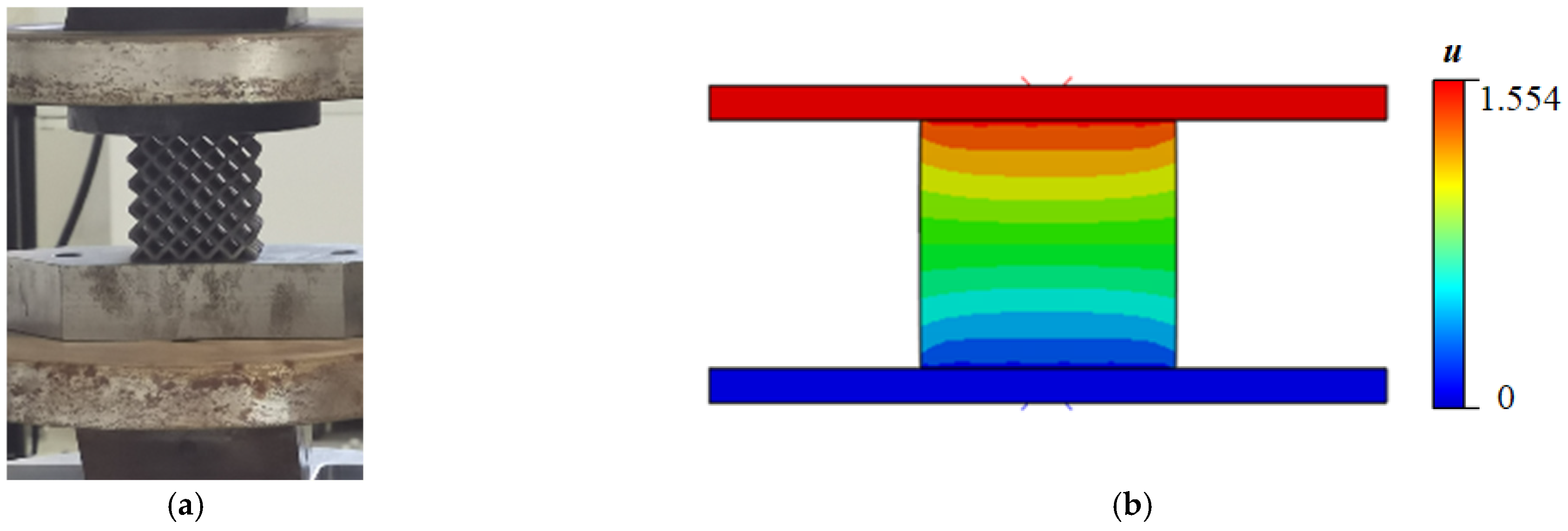
To verify the accuracy of the Asymptotic Homogenization Method (AHM), this study conducted test validation of mechanical properties on periodic microstructures. This section presents a quasi-static compression test investigation on 3D-printed lattice structures. Based on the principle of uniform sampling experimental design, two sizes of lattice cube specimens were fabricated with dimensions of 50 mm × 50 mm × 50 mm and 75 mm × 75 mm × 75 mm, respectively. The tested cubic specimens featured a body-centered cubic (BCC) lattice topology and were manufactured from TA15 titanium alloy using Selective Laser Melting (SLM) technology. Before testing, the two sizes of specimens were labeled as Specimen 1 and Specimen 2. To ensure the reliability of the results, three repeated tests were performed for each specimen type. Taking Specimen 1 as an example, the three repeated tests were labeled Specimen 1-1, 1-2, and 1-3. The testing process is shown in Figure 1a, while Figure 1b displays the corresponding calculation results obtained using AHM, with this visualization corresponding to macroscopic compression deformation conditions.
Statistical analysis of the elastic modulus data in Table 1 demonstrates good agreement between the experimental results and AHM predictions. The relative error between the average elastic modulus of Specimen 2 (779 MPa) and the AHM prediction (762 MPa) is 2.23%, while that of Specimen 1 is 0.79%. This difference mainly originates from inherent size effects in the uniform sampling experimental design with different specimen sizes—as the specimen size increases from 50 mm to 75 mm, structural boundary effects gradually diminish, making Specimen 2’s test results closer to the material’s true equivalent properties. To further assess accuracy, we calculated the 95% confidence intervals for each specimen group: the confidence interval for Specimen 1 is [687 MPa, 849 MPa], and for Specimen 2 is [755 MPa, 803 MPa]. The AHM prediction falls within these intervals, indicating no significant difference between experiments and predictions at a 95% confidence level. All measured elastic modulus values are within a reasonable range of AHM predictions, verifying the method’s reliability.

2.3. Error Analysis

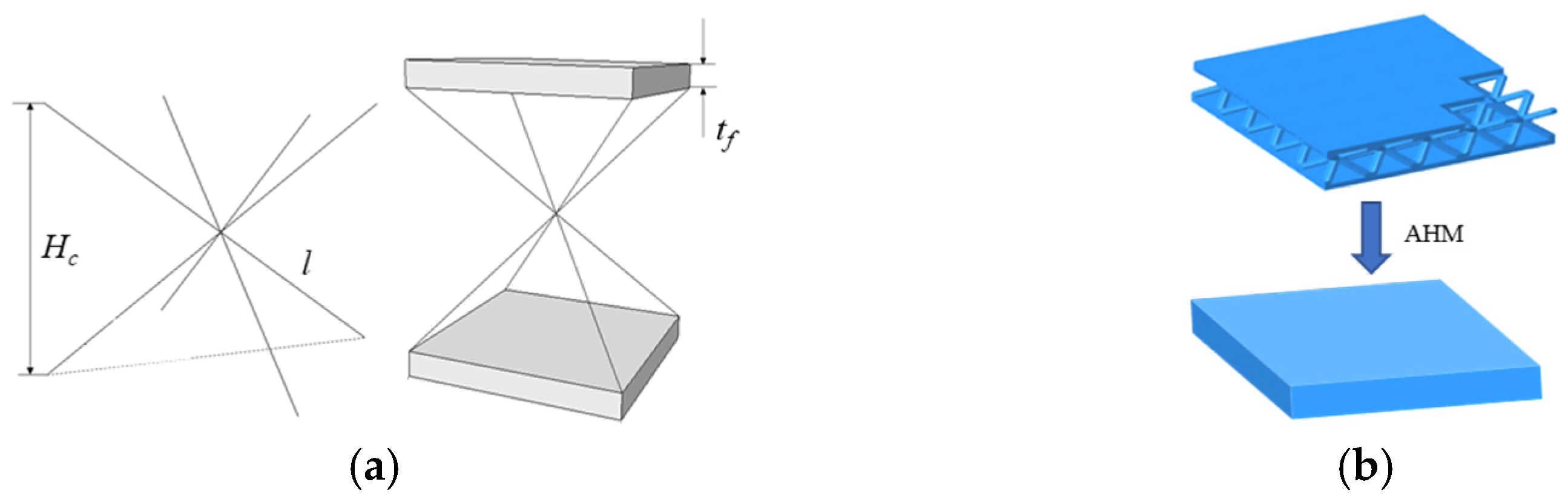
Consider a sandwich panel with macroscopic in-plane dimensions of 200 mm × 200 mm, as shown in Figure 2. The smallest cell of the core layer (i.e., the in-plane dimensions of the lattice unit cell) is 1 mm × 1 mm. The number of unit cell arrangements along both in-plane directions of the panel is 200. The core height ( H c ) considers 0.9 mm, 1.0 mm, and 1.1 mm. The face sheet thickness ( t f ) considers 0.4 mm, 0.5 mm, 0.6 mm, and 0.7 mm. The member radius (r) is 0.1 mm. Both the lattice core and face sheets are made of TA15 titanium alloy, with an elastic modulus of 96 GPa, a Poisson’s ratio of 0.39, and a density of 4429 kg/m3.
Based on the AHM, the equivalent stiffness matrix of the homogenized rectangular thin plate is given by Equation (5), which is also a symmetric matrix. For the present problem, all elements in the coupling stiffness matrix B H c t f are zero. When H c is 0.9 mm, and t f is 0.4 mm, 0.5 mm, 0.6 mm, and 0.7 mm, respectively, the A H c t f and D H c t f in the equivalent stiffness matrix of the periodic lattice sandwich panel are:
A 0.9 0.4 = 94397 38142 0 38142 94402 0 0 0 30295 D 0.9 0.4 = 39625 15418 0 15418 39623 0 0 0 12181 A 0.9 0.5 = 117020 46950 0 46950 117020 0 0 0 37200 D 0.9 0.5 = 57960 22560 0 22560 57960 0 0 0 17780 A 0.9 0.6 = 139630 55760 0 55760 139640 0 0 0 44100 D 0.9 0.6 = 82560 32170 0 32170 82560 0 0 0 25300 A 0.9 0.7 = 162250 64580 0 64580 162260 0 0 0 51000 D 0.9 0.7 = 110260 42960 0 42960 110260 0 0 0 33760
When H c is 1.0 mm, and t f is 0.4 mm, 0.5 mm, 0.6 mm, and 0.7 mm, respectively, the A H c t f and D H c t f in the equivalent stiffness matrix of the periodic lattice sandwich panel are:
A 1.0 0.4 = 93663 37520 0 37520 93660 0 0 0 30099 D 1.0 0.4 = 45658 17743 0 17743 45667 0 0 0 14057 A 1.0 0.5 = 116240 46300 0 46300 116240 0 0 0 36990 D 1.0 0.5 = 66050 25680 0 25680 66060 0 0 0 20280 A 1.0 0.6 = 138820 55090 0 55090 138820 0 0 0 43890 D 1.0 0.6 = 90970 35370 0 35370 90970 0 0 0 27890 A 1.0 0.7 = 161400 63870 0 63870 161400 0 0 0 50780 D 1.0 0.7 = 120850 46990 0 46990 120850 0 0 0 37010
When H c is 1.1 mm, and t f is 0.4 mm, 0.5 mm, 0.6 mm, and 0.7 mm, respectively, the A H c t f and D H c t f in the equivalent stiffness matrix of the periodic lattice sandwich panel are:
A 1.1 0.4 = 93273 37238 0 37238 93273 0 0 0 29911 D 1.1 0.4 = 52175 20255 0 20255 52189 0 0 0 16070 A 1.1 0.5 = 115830 46010 0 46010 115830 0 0 0 36800 D 1.1 0.5 = 74750 29030 0 29030 74770 0 0 0 22970 A 1.1 0.6 = 138390 54770 0 54770 138390 0 0 0 43690 D 1.1 0.6 = 102060 39650 0 39650 102080 0 0 0 31310 A 1.1 0.7 = 160950 63540 0 63540 160950 0 0 0 50580 D 1.1 0.7 = 134570 52280 0 52280 134580 0 0 0 41230
From Equations (6)–(8), the subscript denotes the core height of the lattice sandwich panel’s unit cell, while the superscript denotes the thickness of the upper and lower face sheets in the sandwich panel.
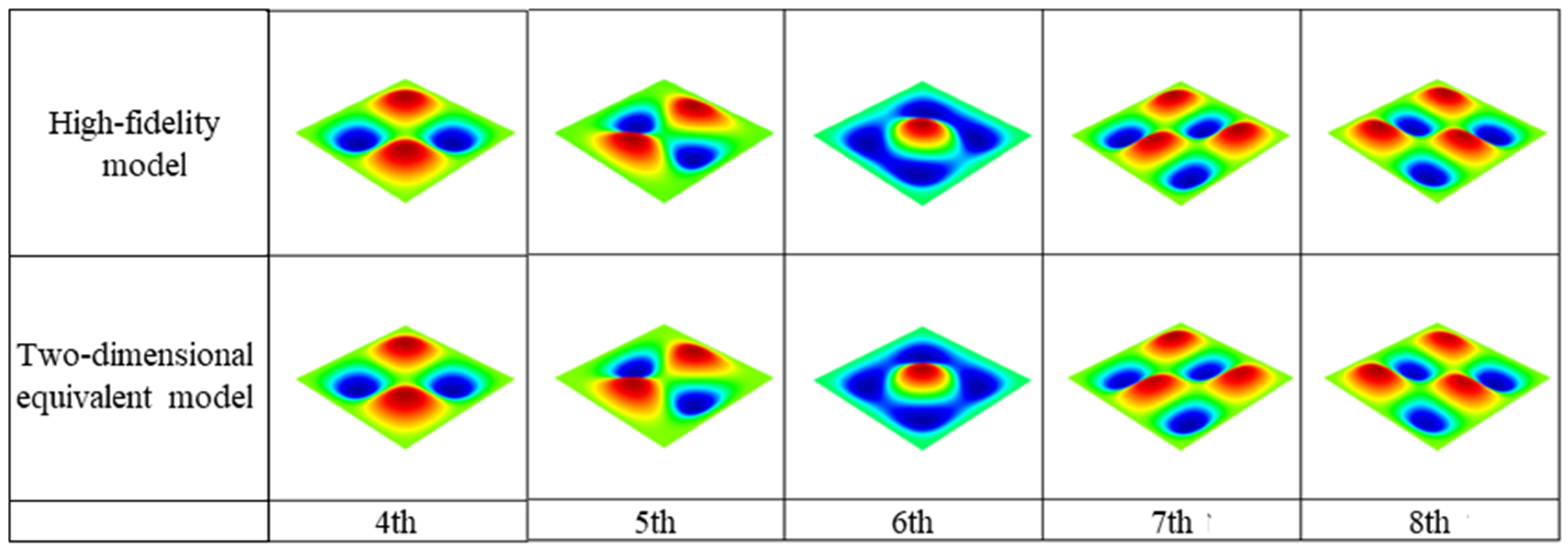
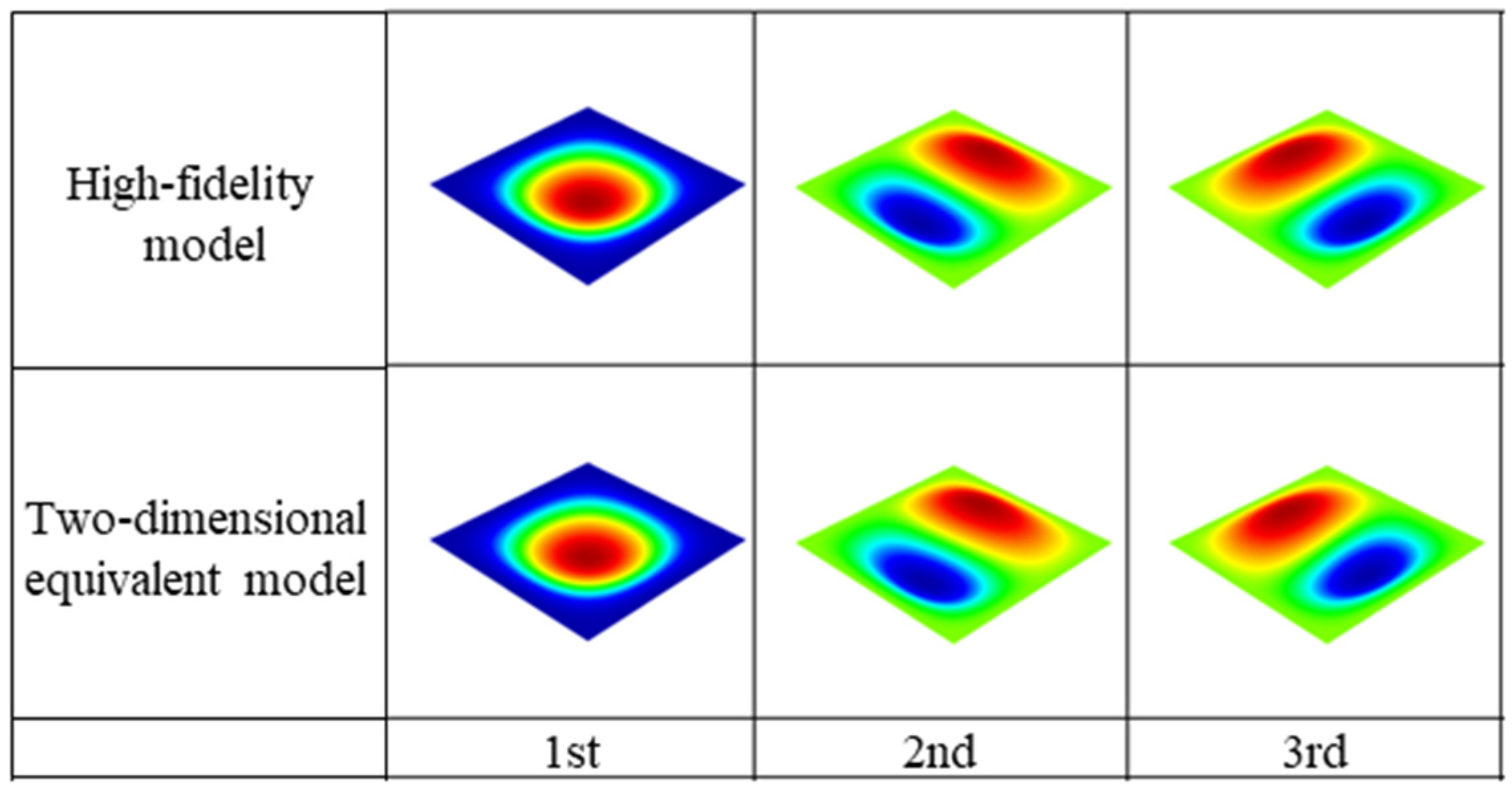
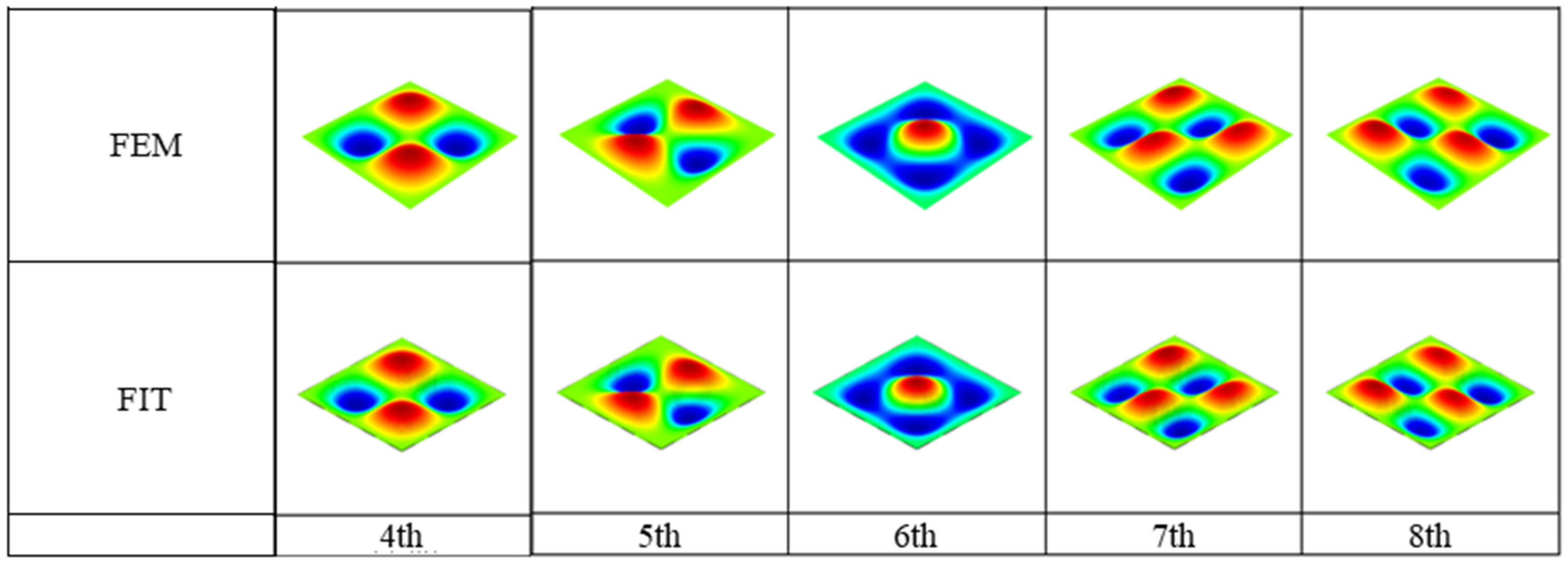
After obtaining the macroscopic equivalent mechanical properties, the equivalent stiffness matrix is input into the equivalent model using ABAQUS for analysis and calculation, and the calculation results are compared with those of the FEM-based high-fidelity model that incorporates the actual lattice structure. The free vibration problem of a periodic lattice sandwich panel under CCCC boundary conditions is considered, where “C” denotes a clamped edge. Both the high-fidelity model and the two-dimensional equivalent model were treated as eigenvalue problems to extract the natural frequencies and corresponding mode shapes. Specifically, the *FREQUENCY procedure in ABAQUS was used to solve the generalized eigenvalue problem formed by the system’s stiffness matrices. In the high-fidelity model, the upper and lower face sheets of the sandwich panel adopt S8R shell elements, and the core rods of the lattice core adopt B32 beam elements. The approximate global size of the shell element mesh is set to 1 mm, and the approximate global size of the beam element mesh is set to 0.1 mm. The rectangular thin plate adopts S8R shell elements, and the approximate global size of the mesh is set to 1 mm. The first eight natural frequencies calculated by the equivalent model and the high-fidelity model are compared. Table 2, Table 3 and Table 4 show the comparisons of the first three natural frequencies when H c is 0.9 mm, 1.0 mm, and 1.1 mm, respectively, while the results for the fourth to eighth modes are provided in Appendix A, Table A1, Table A2 and Table A3. It can be seen from the tables that under different geometric parameter conditions, the maximum relative error between the first eight natural frequencies of the two-dimensional equivalent model and the high-fidelity model is 6.041%, and the errors of the first three frequencies are all less than 5%, meeting the engineering requirements. For the free vibration problem of the sandwich panel, the vibration modes of the plate are also very critical. Figure 3 shows the comparison of the first three vibration modes between the equivalent model and the high-fidelity model, and the comparisons for the fourth to eighth modes are presented in Appendix A, Figure A1. It can be seen from the figure that the first eight modes of the equivalent model and the high-fidelity model are in good agreement, further illustrating the correctness of the AHM. Furthermore, both the high-fidelity model and the two-dimensional equivalent model consistently capture the identical natural frequencies of the 2nd/3rd and 7th/8th mode pairs, which arise from the structural and material symmetry of the system, as evidenced by the results in Table 2, Table 3, Table 4, Table A1, Table A2 and Table A3. This phenomenon involves mode pairs with orthogonal deformation shapes, which are clearly distinguishable in Figure 3 and Figure A1. The subsequent free vibration problems of the sandwich panels in this paper are based on the AHM.


3. FIT Solution for Free Vibration of a Lattice Sandwich Panel

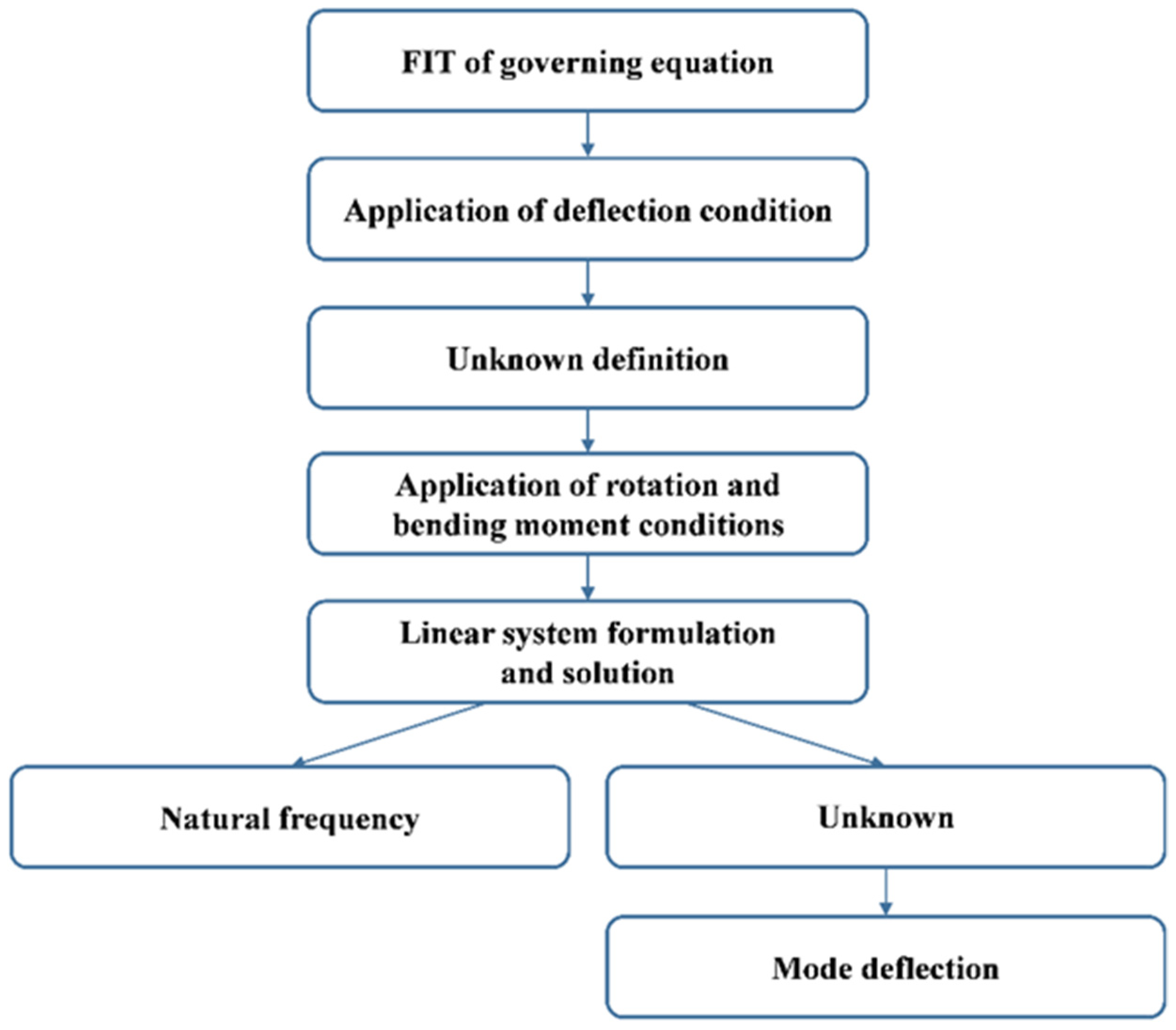
Comprehensive experimental and numerical validation demonstrated the accuracy and reliability of the AHM when applied to equivalent property prediction of lattice sandwich structures. Following equivalent modelling using the AHM, the lattice sandwich panel could be transformed into either isotropic or orthotropic plates. To enhance generality, the subsequent analysis uniformly adopted the orthotropic thin plate model. The FIT method was successfully developed for analytical free vibration analysis of periodic lattice sandwich panels, which offered a clear solution strategy and straightforward calculations. The solution process did not require pre-assumed displacement functions; instead, it directly yielded analytical solutions from the fundamental equations of the rectangular plate. These solutions exactly satisfied both the fundamental equations and the boundary conditions. The theoretical solution process was briefly introduced as follows. (A detailed flowchart of the solution procedure is provided in Appendix A, Figure A2.)

3.1. Governing Equations for Free Vibration of an Orthotropic Thin Plate

The governing equations for the free vibration problem of an orthotropic thin plate were as follows:
D 1 4 W x 4 + 2 D 3 4 W x 2 y 2 + D 2 4 W y 4 + ρ h 2 W t 2 = 0
It is known that the deflection of a plate at any time during free vibration could be expressed as:
W x , y , t = w x , y sin ω t + θ
where w x , y was the mode shape function, ω was the natural frequency, and θ was the initial phase. The governing Equation (9) could be rewritten as
D 1 4 w x 4 + 2 D 3 4 w x 2 y 2 + D 2 4 w y 4 ρ h ω 2 w = 0

3.2. FIT Solution for Free Vibration of an Equivalent Lattice Sandwich Panel

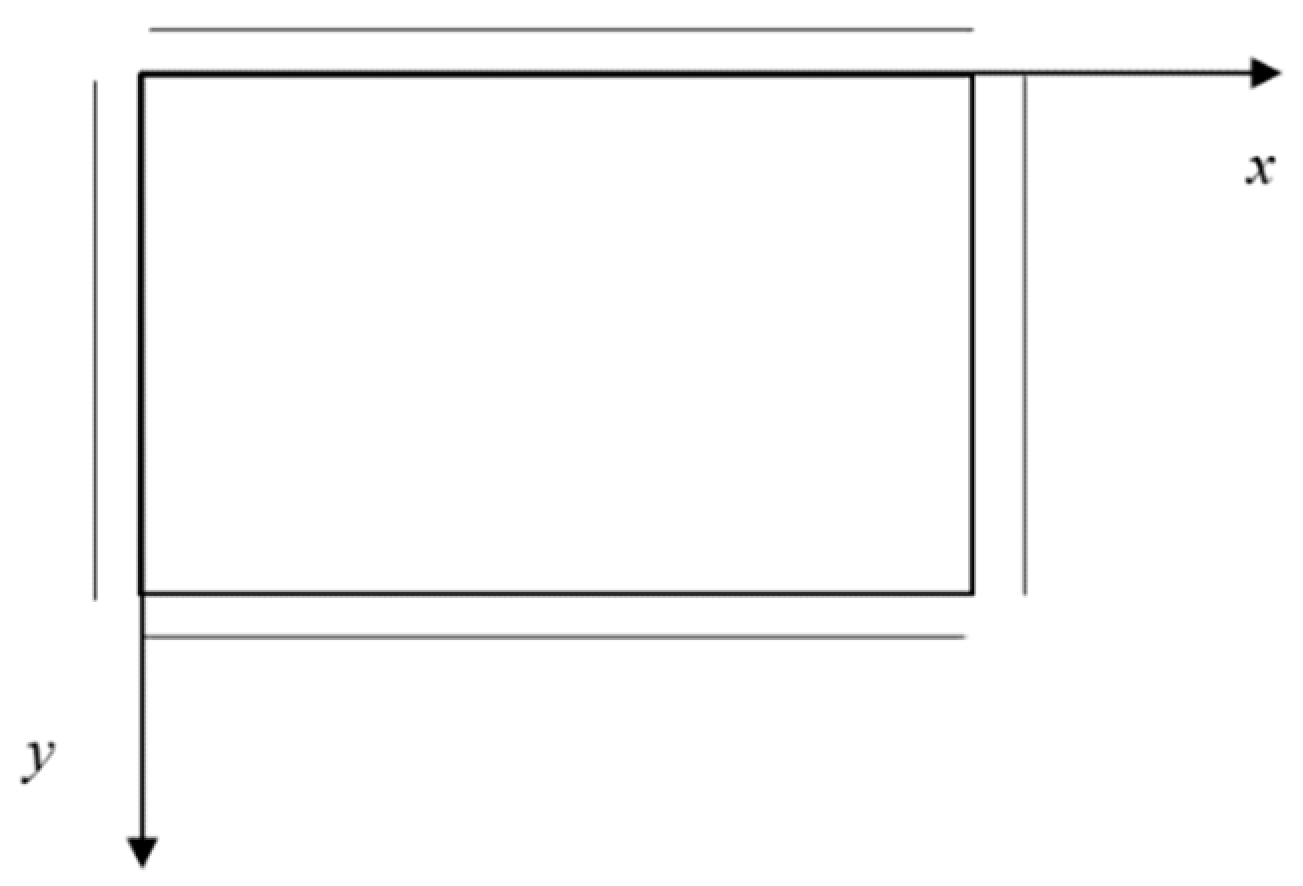
For a periodic lattice sandwich panel, an equivalent model was established as a homogeneous orthotropic rectangular thin plate using the AHM. This study considered representative non-Lévy-type boundary conditions, including CCCC and CCSS configurations, where “S” denoted a simply supported edge. A schematic diagram of an equivalently homogenized orthotropic rectangular thin plate under CCCC boundary conditions is shown in Figure 4. The corresponding boundary conditions could be expressed as:
w x = 0 , a = 0 , w y = 0 , b = 0
w x x = 0 , a = 0 , w y y = 0 , b = 0
To solve Equation (11), a two-dimensional FIT of w x , y within 0 x a and 0 y b was defined as:
w m n = 0 a 0 b w x , y sin α m x sin β n y d x d y m , n = 1 , 2 ,
Its inverse transform was:
w x , y = 4 a b m = 1 n = 1 w m n sin α m x sin β n y
where a and b were the lengths of the plate in the x and y directions, respectively, α m = m π / a , β n = n π / b .
The transformed partial derivatives of w and their higher orders were defined as follows:
0 a 0 b 4 w x 4 sin α m x sin β n y d x d y = α m 0 b 1 m 2 w x 2 x = a 2 w x 2 x = 0 sin β n y d y + α m 3 0 b 1 m w x = a w x = 0 sin β n y dy + α m 4 w m n
0 a 0 b 4 w y 4 sin α m x sin β n y d x d y = β n 0 a 1 n 2 w y 2 y = b 2 w y 2 y = 0 sin α m x d x + β n 3 0 a 1 n w y = b w y = 0 sin α m x dx + β n 4 w m n
0 a 0 b 4 w x 2 y 2 sin α m x sin β n y d x d y = α m 2 β n 0 a 1 n w y = b w y = 0 sin α m x d x α m 0 b 1 m 2 w y 2 x = a 2 w y 2 x = 0 sin β n y d y + α m 2 β n 2 w m n = α m 2 β n 0 a 1 n w y = b w y = 0 sin α m x d x α m β n 1 n w x = 0 y = b w x = 0 y = 0 + β n 0 b w x = 0 sin β n y d y + 1 m α m β n 1 n w x = a y = b w x = a y = 0 + β n 0 b w x = a sin β n y d y + α m 2 β n 2 w m n
0 a 0 b ρ h ω 2 w sin α m x sin β n y d x d y = ρ h ω 2 w m n
Substituting Equations (16)–(19) into Equation (11) yielded an equation in terms of m and n , as
D 1 α m 0 b 1 m 2 w x 2 x = a 2 w x 2 x = 0 sin β n y d y D 2 β n 0 a 1 n 2 w y 2 y = b 2 w y 2 y = 0 sin α m x d x 2 D 3 α m β n 1 n w x = 0 y = b w x = 0 y = 0 + α m D 1 α m 2 + 2 D 3 β n 2 0 b 1 m w x = a w x = 0 sin β n y d y + 1 m 2 D 3 α m β n 1 n w x = a y = b w x = a y = 0 + β n D 2 β n 2 + 2 D 3 α m 2 0 a 1 n w y = b w y = 0 sin α m x d x + D 1 α m 4 + 2 D 3 α m 2 β n 2 + D 2 β n 4 ρ h ω 2 w m n = 0
Substituting Equation (12) into the above equation gave
D 1 α m 4 + 2 D 3 α m 2 β n 2 + D 2 β n 4 ρ h ω 2 w m n D 1 α m 0 b 1 m 2 w x 2 x = a 2 w x 2 x = 0 sin β n y d y D 2 β n 0 a 1 n 2 w y 2 y = b 2 w y 2 y = 0 sin α m x d x = 0
For notational convenience, let:
I m = 0 a 2 W y 2 y = b sin α m x d x , J m = 0 a 2 W y 2 y = 0 sin α m x d x K n = 0 b 2 W x 2 x = a sin β n y d y , L n = 0 b 2 W x 2 x = 0 sin β n y d y H m n = 1 D 1 α m 4 + 2 D 3 α m 2 β n 2 + D 2 β n 4 ρ h ω 2
Then, Equation (21) could be expressed as:
w m n = H m n 1 n β n D 2 I m β n D 2 J m + 1 m α m D 1 K n α m D 1 L n
The above equation was substituted into the remaining boundary conditions, namely, Equation (13), and utilizing the orthogonality of the trigonometric function system led to a homogeneous system of linear equations:
m = 1 H m n α m 1 n β n D 2 I m β n D 2 J m + 1 m α m D 1 K n α m D 1 L n = 0 ,   n = 1 , 2 , m = 1 1 m H m n α m 1 n β n D 2 I m β n D 2 J m + 1 m α m D 1 K n α m D 1 L n = 0 ,   n = 1 , 2 , m = 1 H m n β n 1 n β n D 2 I m β n D 2 J m + 1 m α m D 1 K n α m D 1 L n = 0 ,   m = 1 , 2 , m = 1 1 n H m n β n 1 n β n D 2 I m β n D 2 J m + 1 m α m D 1 K n α m D 1 L n = 0 ,   m = 1 , 2 ,
For non-trivial solutions of the undetermined constants I m , J m , K n , and L n to exist, the determinant of the coefficient matrix for this homogeneous system of linear equations had to be set to zero. When m and n were taken as a finite number of terms, the natural frequencies of each order were obtained. Substituting each natural frequency back into Equation (24) yielded the solutions for the undetermined constants I m , J m , K n , and L n . Finally, substituting these into Equation (15) provided the deflection expression Equation (25) for the mode shapes of each order.
w x , y = 4 a b m = 1 n = 1 H m n 1 n β n D 2 I m β n D 2 J m + 1 m α m D 1 K n α m D 1 L n sin α m x sin β n y
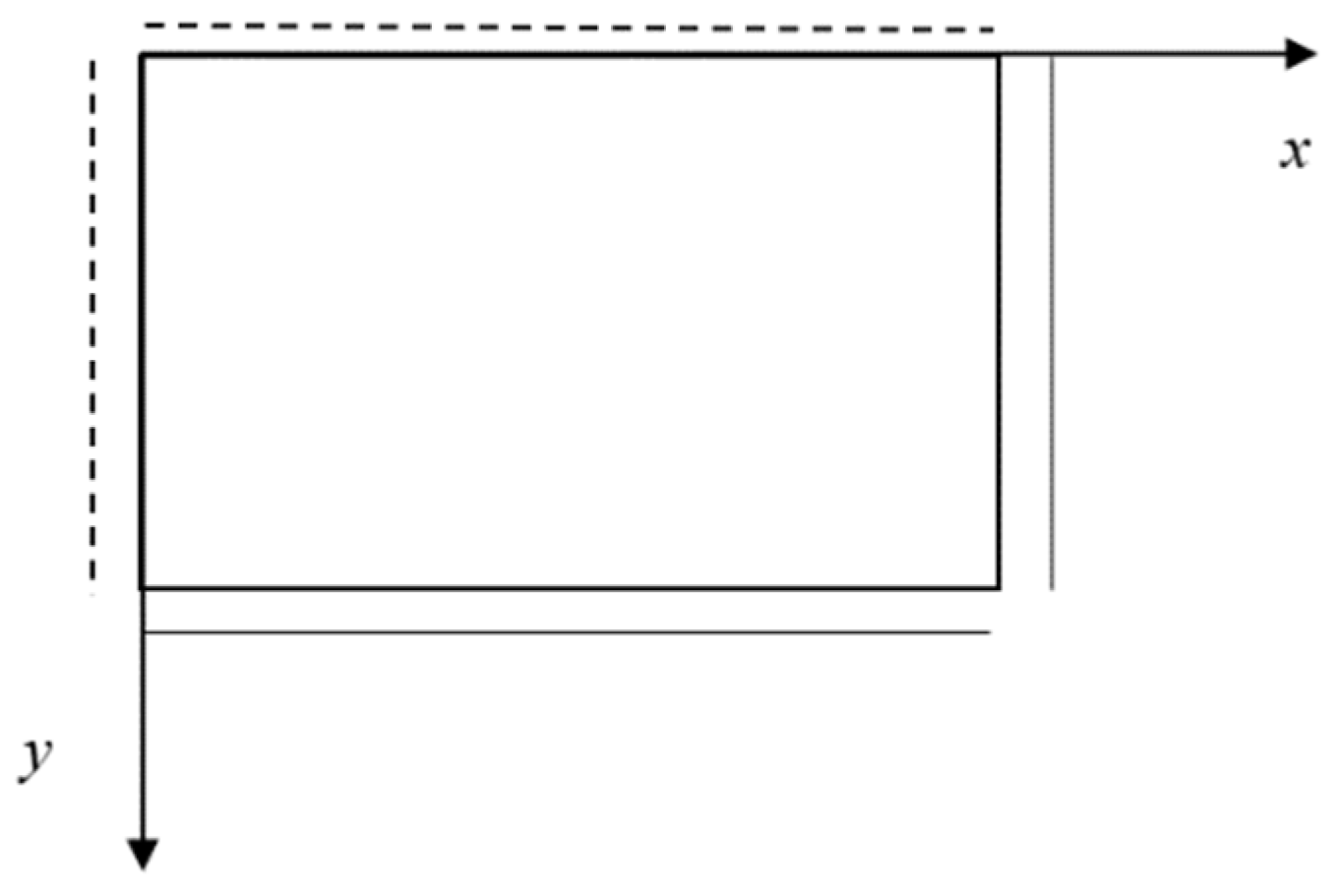
A schematic diagram of an equivalently homogenized orthotropic rectangular thin plate under CCSS boundary conditions was presented in Figure 5, in which the edges at x = 0 and y = 0 were simply supported, while the edges at x = a and y = b were clamped. The corresponding boundary conditions could be expressed as:
W x = 0 , a = 0 , W y = 0 , b = 0
W x x = a = 0 , W y y = b = 0
2 W x 2 + μ 2 2 W y 2 x = 0 = 0 , 2 W y 2 + μ 1 2 W x 2 y = 0 = 0
By referencing the solution procedure for the free vibration problem of a CCCC rectangular thin plate, the same expression as given in Equation (21) could be obtained. Similarly, let I m , J m , K n , and L n be the expressions defined in Equation (22). Taking the partial derivatives of Equation (26) led to
2 W x 2 y = 0 = 0 ,   2 W x 2 y = b = 0 2 W y 2 x = 0 = 0 ,   2 W y 2 x = a = 0
The substitution of Equation (29) into Equation (28) revealed that J m and L n were zero. Consequently, Equation (21) could be expressed as:
w m n = H m n 1 n β n D 2 I m + 1 m α m D 1 K n
where H m n = 1 / D 1 α m 4 + 2 D 3 α m 2 β n 2 + D 2 β n 4 ρ h ω 2 .
Substituting Equation (30) into the Equation (27) yielded a homogeneous system of linear equations for the undetermined constants I m and K n :
m = 1 1 m H m n α m 1 n β n D 2 I m + 1 m α m D 1 K n = 0 n = 1 , 2 ,
m = 1 1 n H m n β n 1 n β n D 2 I m + 1 m α m D 1 K n = 0 m = 1 , 2 ,
Similar to the free vibration problem of a CCCC rectangular thin plate, the natural frequencies of each order were obtained by setting the determinant of the coefficient matrix to zero. Subsequently, substituting each natural frequency into Equations (31) and (32) yielded solutions for the undetermined constants I m and K n . Finally, substituting these constants into Equation (15) provided the deflection expression Equation (33) for the mode shapes of each order.
W x , y = 4 a b m = 1 n = 1 H m n 1 n β n D 2 I m + 1 m α m D 1 K n sin α m x sin β n y

3.3. Typical Results and Discussion

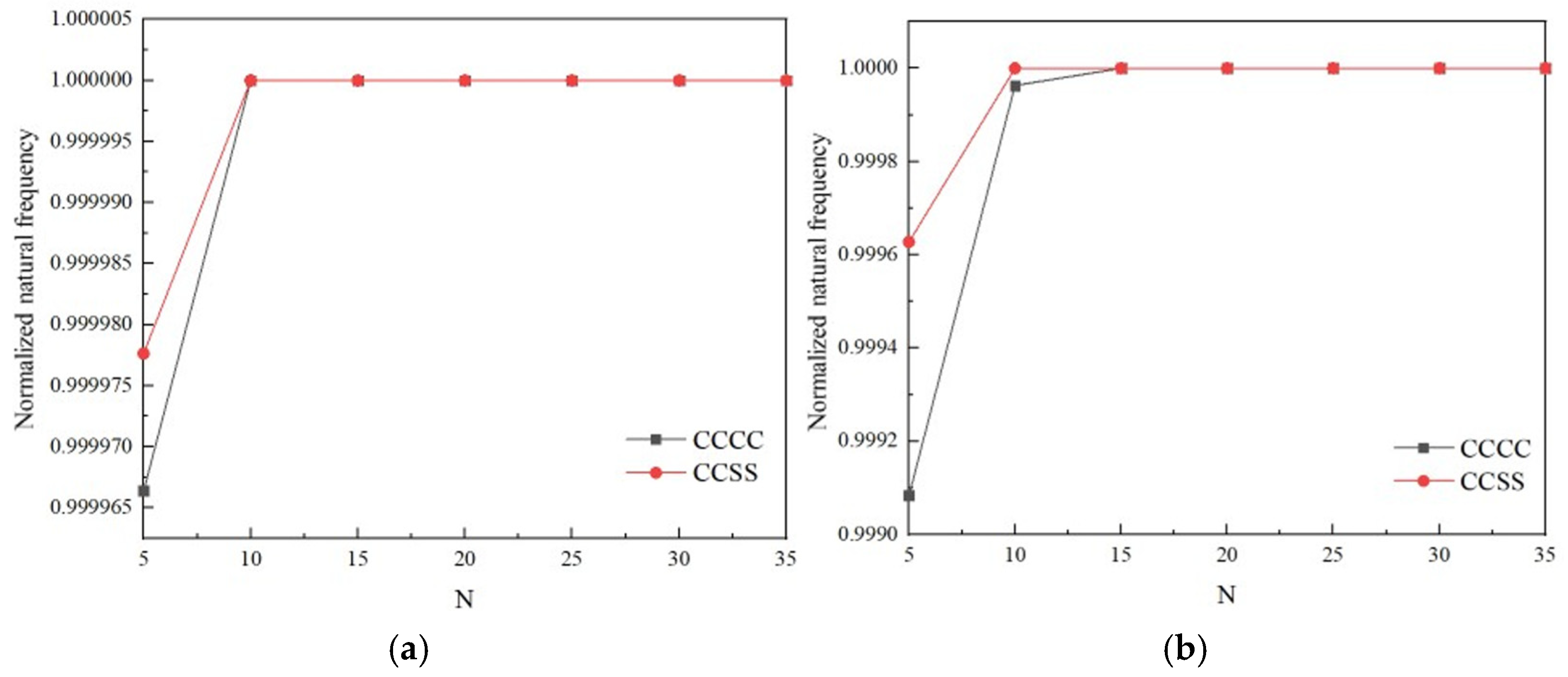
This section provides the FIT-based analytical free vibration solutions of lattice sandwich panels under CCCC and CCSS boundary conditions. First, a convergence study of the analytical solution is conducted. Taking H c = 1 mm and t f = 0.7 mm as an example, Figure 6 presents the convergence analysis for the first and eighth normalized natural frequencies of lattice sandwich panels under CCCC and CCSS boundary conditions, respectively. The figure shows that all the analytical solutions for the free vibration of the lattice sandwich panel converge with 15 terms. All values are normalized relative to the converged solutions using N = 25 terms—a number consistently applied in subsequent analyses to ensure convergence to five significant digits.
Table 5, Table 6 and Table 7 present the first three natural frequencies of lattice sandwich panels under CCCC boundary conditions, while Table 8, Table 9 and Table 10 provide the corresponding first three frequencies under CCSS boundary conditions, considering various values of core height ( H c ) and face sheet thickness ( t f ). The results for the fourth to eighth modes under both boundary conditions are given in Appendix A, Table A4, Table A5 and Table A6 (CCCC) and Table A7, Table A8 and Table A9 (CCSS). Table 5, Table 6 and Table 7 presented the first eight natural frequencies of lattice sandwich panels under CCCC boundary conditions, and Table 8, Table 9 and Table 10 provided corresponding results under CCSS boundary conditions, considering various values of core height ( H c ) and face sheet thickness ( t f ). The results from the FEM-based equivalent model are presented for validation. The data demonstrate that the relative error between the present analytical solutions and the FEM results remains below 1%, which verifies the correctness of the proposed solution framework. Furthermore, the relative error in the frequency results generally increases with increasing H c and t f .
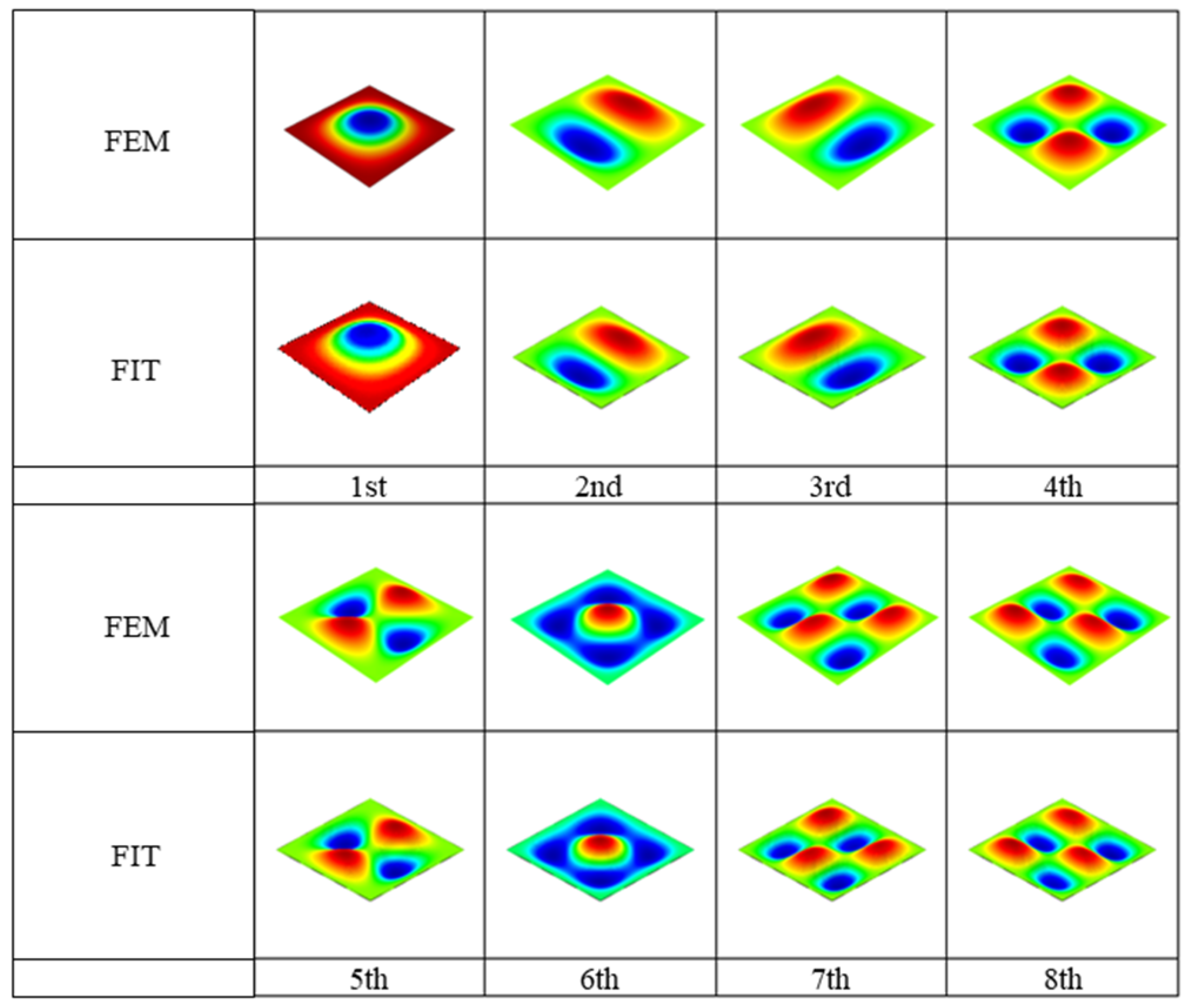
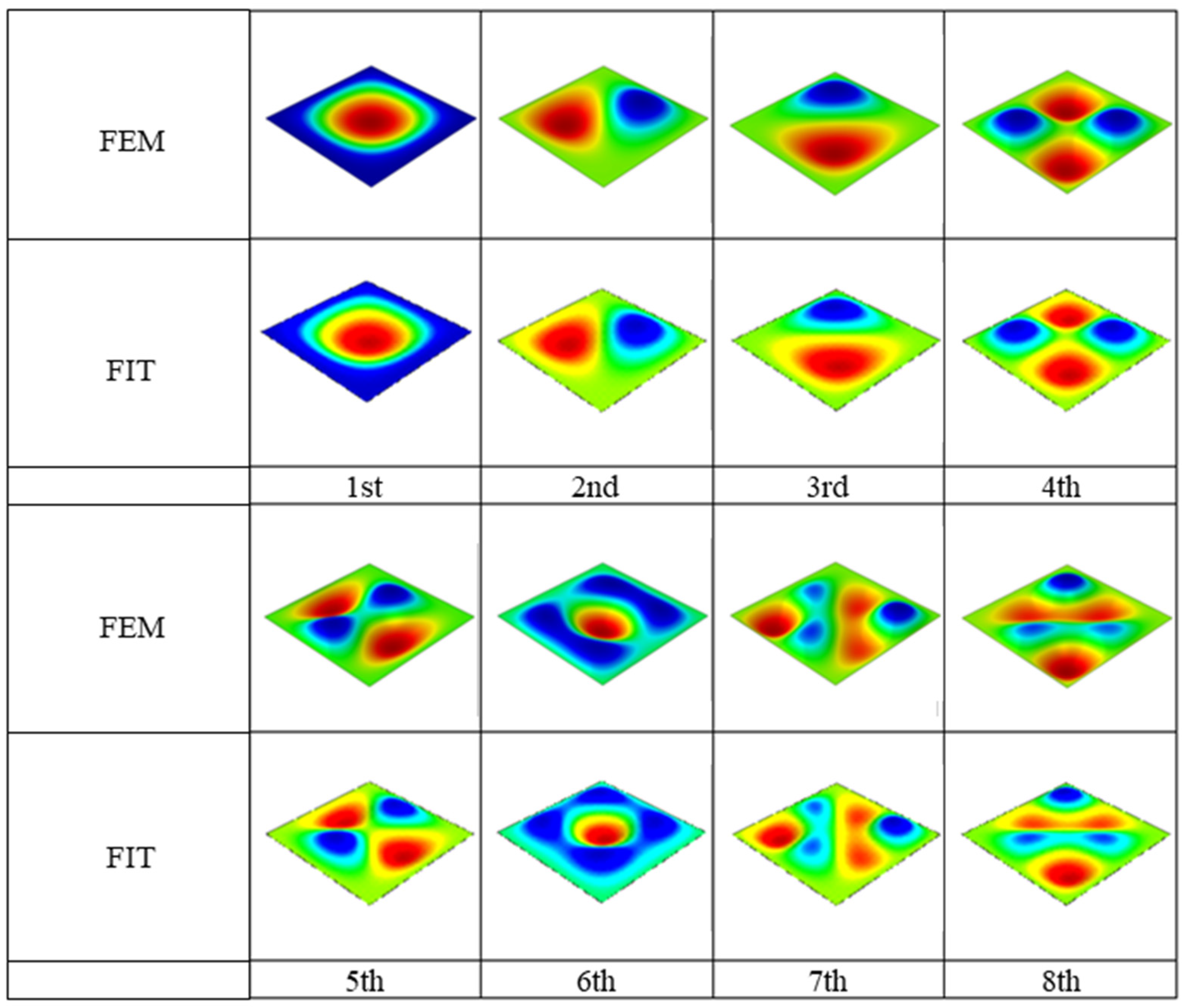
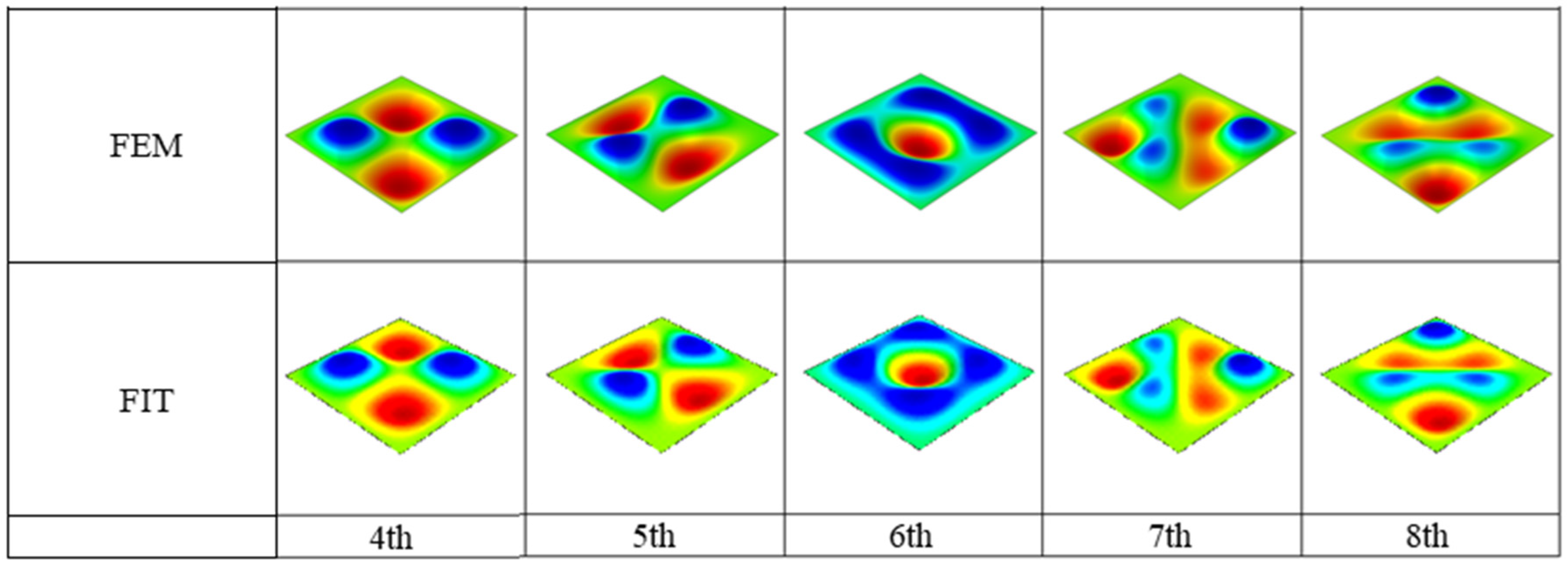
Figure 7 and Figure 8 plot the first three free vibration modes of a lattice sandwich panel under CCCC and CCSS boundary conditions, respectively. The corresponding fourth to eighth modes are provided in Appendix A, Figure A3 (CCCC) and Figure A4 (CCSS). The accompanying FEM-based results demonstrated excellent agreement with the FIT-based results, further validating the correctness of the present methodology. A comparable frequency coincidence is evident in Table 5, Table 6, Table 7, Table A4, Table A5 and Table A6 for the 2nd/3rd and 7th/8th mode pairs. These pairs display orthogonal mode shapes, as illustrated in Figure 7 and Figure A3, in agreement with the trends identified in Table 2, Table 3, Table 4, Table A1, Table A2 and Table A3, Figure 3 and Figure A1.

4. Conclusions

This study presented a novel solution framework for investigating the free vibration behavior of periodic lattice sandwich panels. The framework utilized the AHM to equivalize these panels as homogeneous orthotropic rectangular plates and employed the FIT to obtain analytical free vibration solutions. The key findings were as follows: (1) The AHM enabled high-precision homogenization of periodic lattice sandwich panels into equivalent homogeneous orthotropic rectangular plates. Compared with static compression tests on 3D-printed lattice structures, the errors in elastic modulus and equivalent strain were within 3% and 6%, respectively. Furthermore, the maximum relative error between the first eight natural frequencies of the FEM-based equivalent model and the FEM-based high-fidelity model was 6.041%, with the errors of the first three frequencies all below 5%. (2) Analytical solutions for natural frequencies and mode shapes of orthotropic rectangular thin plates under CCCC and CCSS boundary conditions were obtained. The equivalent model drastically reduced analysis time compared to high-fidelity simulations, enabling rapid parametric studies and design optimization. All natural frequencies converged to five significant digits within 15 series terms, with a maximum discrepancy of less than 1% compared with the results from the FEM-based equivalent model. The frequency error generally increased with larger core height H c and face sheet thickness t f . The proposed framework demonstrated rapid convergence and sufficient accuracy, thereby offering valuable guidance for the engineering design of sandwich panels. Future work will explore extensions of this framework to more complex scenarios, such as coupled thermal-mechanical environments and multiphase material systems.

Author Contributions

Conceptualization, D.A. and Q.H.; methodology, Q.H. and Y.C.; software, T.T.; validation, Y.C. and S.X.; formal analysis, Q.H. and C.G.; investigation, C.G.; resources, D.A.; data curation, S.X.; writing—original draft preparation, Q.H.; writing—review and editing, D.A. and C.G.; visualization, Y.C. All authors have read and agreed to the published version of the manuscript.

Funding

This research was funded by the National Natural Science Foundation of China (grant 12372067), the Natural Science Foundation for Distinguished Young Scholars of Liaoning Province (grant 2025JH6/101100005), and the Project for Distinguished Young Scientific and Technological Talents of Dalian (grant 2024RJ005).

Data Availability Statement

Data is available from DLR at reasonable request.

Conflicts of Interest

The authors declare that they have no known competing financial interests or personal relationships that could have appeared to influence the work reported in this paper.

Abbreviations

The following abbreviations are used in this manuscript:
AHMAsymptotic Homogenization Method
FITFinite Integral Transform
FEMFinite Element Method

Appendix A

Figure A1. Comparison of the fourth to eighth modes of lattice sandwich panels under CCCC boundary conditions. The color gradient from blue to red represents the variation in the magnitude of the mode shape.
Aerospace 12 01034 g0a1
Figure A2. Solution procedure of the FIT for free vibration of a lattice sandwich panel.
Aerospace 12 01034 g0a2
Figure A3. The fourth to eighth free vibration modes of a lattice sandwich panel under CCCC boundary conditions. The color gradient from blue to red represents the variation in the magnitude of the mode shape.
Aerospace 12 01034 g0a3
Figure A4. The fourth to eighth free vibration modes of a lattice sandwich panel under CCSS boundary conditions. The color gradient from blue to red represents the variation in the magnitude of the mode shape.
Aerospace 12 01034 g0a4
Table A1. The fourth to eighth natural frequencies of lattice sandwich panels with H c = 0.9 mm under CCCC boundary conditions (Hz).
Method t f (mm)Mode
4th5th6th7th8th
High-fidelity model0.41257.01523.71531.61902.71902.7
0.51383.41676.21685.12090.72090.7
0.61505.21822.81832.62271.12271.1
0.71623.91965.51976.32446.62446.6
Two-dimensional
equivalent model
0.41304.11584.61592.41985.61985.6
0.51435.51744.31753.02184.82184.8
0.61582.01922.01931.72406.82406.8
0.71706.12072.52083.22594.42594.4
Relative error0.43.747%3.997%3.970%4.357%4.357%
0.53.766%4.063%4.029%4.501%4.501%
0.65.102%5.442%5.408%5.975%5.975%
0.75.062%5.444%5.409%6.041%6.041%
Table A2. The fourth to eighth natural frequencies of lattice sandwich panels with H c = 1.0 mm under CCCC boundary conditions (Hz).
Method t f (mm)Mode
4th5th6th7th8th
High-fidelity model0.41343.41627.91636.52031.92031.9
0.51470.41781.01790.62220.12220.1
0.61592.01927.21937.72399.72399.7
0.71710.12069.02080.52573.52573.5
Two-dimensional
equivalent model
0.41394.61694.31702.72122.92122.9
0.51525.41853.31862.62321.22321.2
0.61653.72009.12019.42515.42515.4
0.71779.52161.62172.92705.42705.4
Relative error0.43.811%4.079%4.045%4.479%4.479%
0.53.740%4.060%4.021%4.554%4.554%
0.63.876%4.250%4.216%4.821%4.821%
0.74.058%4.476%4.441%5.125%5.125%
Table A3. The fourth to eighth natural frequencies of lattice sandwich panels with H c = 1.1 mm under CCCC boundary conditions (Hz).
Method t f (mm)Mode
4th5th6th7th8th
High-fidelity model0.41428.31730.31739.52158.42158.4
0.51555.91883.81894.12346.92346.9
0.61677.32029.52040.72525.32525.3
0.71794.72170.12182.42697.32697.3
Two-dimensional
equivalent model
0.41484.31803.31812.32259.12259.1
0.51615.11962.31972.22457.22457.2
0.61744.32119.12130.12652.62652.6
0.71872.82274.12288.52846.22846.2
Relative error0.43.921%4.219%4.185%4.665%4.665%
0.53.805%4.167%4.123%4.700%4.700%
0.63.995%4.415%4.381%5.041%5.041%
0.74.352%4.792%4.862%5.520%5.520%
Table A4. The fourth to eighth natural frequencies of lattice sandwich panels with H c = 0.9 mm under CCCC boundary conditions (Hz).
Method t f (mm)Mode
4th5th6th7th8th
FEM0.41304.11584.41592.41985.61985.6
0.51435.51744.31753.02184.82184.8
0.61582.01922.01931.72406.82406.8
0.71706.12072.52083.22594.42594.4
FIT0.41307.01589.11596.71992.81992.8
0.51440.01750.91759.22195.72195.7
0.61588.31931.21940.32421.72421.7
0.71714.62084.82094.72614.32614.3
Relative error0.40.22%0.30%0.27%0.36%0.36%
0.50.31%0.38%0.35%0.50%0.50%
0.60.40%0.48%0.45%0.62%0.62%
0.70.50%0.59%0.55%077%0.77%
Table A5. The fourth to eighth natural frequencies of lattice sandwich panels with H c = 1.0 mm under CCCC boundary conditions (Hz).
Method t f (mm)Mode
4th5th6th7th8th
FEM0.41394.61694.31702.72122.92122.9
0.51525.41853.31862.62321.22321.2
0.61653.72009.12019.42515.42515.4
0.71779.52161.62172.92705.42705.4
FIT0.41397.91699.81707.82131.52131.5
0.51530.81861.31870.22334.12334.1
0.61661.22019.82029.42532.82532.8
0.71789.42175.72186.02728.32728.3
Relative error0.40.24%0.32%0.30%0.41%0.41%
0.50.35%0.43%0.41%0.56%0.56%
0.60.45%0.53%0.50%0.69%0.69%
0.70.56%0.65%0.60%0.85%0.85%
Table A6. The fourth to eighth natural frequencies of lattice sandwich panels with H c = 1.1 mm under CCCC boundary conditions (Hz).
Method t f (mm)Mode
4th5th6th7th8th
FEM0.41484.31803.31812.32259.12259.1
0.51615.11962.31972.22457.22457.2
0.61744.32119.12130.12652.62652.6
0.71872.82274.12288.52846.22846.2
FIT0.41488.31809.61818.22269.32269.3
0.51621.61971.71981.02472.42472.4
0.61753.22131.72141.82673.12673.1
0.71882.22288.62299.52869.92869.9
Relative error0.40.27%0.35%0.33%0.45%0.45%
0.50.40%0.48%0.45%0.62%0.62%
0.60.51%0.59%0.55%0.77%0.77%
0.70.50%0.64%0.48%0.83%0.83%
Table A7. The fourth to eighth natural frequencies of lattice sandwich panels with H c = 0.9 mm under CCSS boundary conditions (Hz).
Method t f (mm)Mode
4th5th6th7th8th
FEM0.41118.21380.01382.11754.41758.0
0.51230.71519.11521.61930.61934.6
0.61356.11674.11677.02126.82131.3
0.71462.61805.51808.92293.12298.0
FIT0.41121.21383.61385.41760.71764.3
0.51235.41524.41526.41939.91943.9
0.61362.51681.31683.52139.62144.0
0.71470.91815.01817.42309.82314.5
Relative error0.40.27%0.26%0.24%0.36%0.36%
0.50.38%0.35%0.32%0.48%0.48%
0.60.47%0.43%0.39%0.60%0.60%
0.70.57%0.53%0.47%0.73%0.72%
Table A8. The fourth to eighth natural frequencies of lattice sandwich panels with H c = 1.0 mm under CCSS boundary conditions (Hz).
Method t f (mm)Mode
4th5th6th7th8th
FEM0.41195.81475.71478.01876.11879.9
0.51307.91614.31617.12051.52055.7
0.61417.91750.11753.32223.32227.9
0.71525.71883.31887.02391.72396.8
FIT0.41199.41480.01481.91883.41887.3
0.51313.31620.51622.62062.22066.5
0.61425.11758.51760.72237.82242.4
0.71535.01894.21896.62410.52415.4
Relative error0.40.30%0.29%0.26%0.39%0.39%
0.50.41%0.38%0.34%0.52%0.53%
0.60.51%0.48%0.42%0.65%0.65%
0.70.61%0.58%0.51%0.79%0.78%
Table A9. The fourth to eighth natural frequencies of lattice sandwich panels with H c =1.1 mm under CCSS boundary conditions (Hz).
Method t f (mm)Mode
4th5th6th7th8th
FEM0.41272.81570.61573.11996.52000.6
0.51385.21709.61712.62172.32176.8
0.61496.01846.41849.92345.42350.3
0.71604.31980.11984.22514.42519.8
FIT0.41276.91575.71577.72005.22009.3
0.51391.31716.81719.02184.72189.2
0.61504.11856.01858.42361.92366.8
0.71614.71992.51995.12535.62540.8
Relative error0.40.32%0.32%0.29%0.44%0.43%
0.50.44%0.42%0.37%0.57%0.57%
0.60.54%0.52%0.46%0.70%0.70%
0.70.65%0.63%0.55%0.84%0.83%

References

  1. Evans, A.G.; Hutchinson, J.W.; Fleck, N.A.; Ashby, M.F.; Wadley, H.N.G. The topological design of multifunctional cellular metals. Prog. Mater. Sci. 2001, 46, 309–327. [Google Scholar] [CrossRef]
  2. Zhang, Y.; Zhou, Y. Investigation of bird-strike resistance of composite sandwich curved plates with lattice/foam cores. Thin-Walled Struct. 2023, 182, 110203. [Google Scholar] [CrossRef]
  3. Liu, J.; Xu, M.; Zhang, R.; Zhang, X.; Xi, W. Progress of porous/lattice structures applied in thermal management technology of aerospace applications. Aerospace 2022, 9, 827. [Google Scholar] [CrossRef]
  4. Xiao, H.; Guo, H.; Li, C.; Xie, D.; Xie, C.; Liu, R. Design and analysis of thermal protection and load-bearing integrated structure of the telescopic wing. Adv. Mech. Eng. 2023, 15, 16878132231193865. [Google Scholar] [CrossRef]
  5. Xiao, T.; Lu, L.; Peng, W.; Yue, Z.; Yang, X.; Lu, T.J.; Sundén, B. Numerical study of heat transfer and load-bearing performances of corrugated sandwich structure with open-cell metal foam. Int. J. Heat Mass Transf. 2023, 215, 124517. [Google Scholar] [CrossRef]
  6. Cao, Z.; Yao, G. Parametric vibration stability analysis of a pyramid lattice sandwich plate subjected to pulsatile external airflow. Acta Mech. Solida Sin. 2023, 36, 95–104. [Google Scholar] [CrossRef]
  7. Chai, Y.; Li, F.; Zhang, C. A new method for suppressing nonlinear flutter and thermal buckling of composite lattice sandwich beams. Acta Mech. 2022, 233, 121–136. [Google Scholar] [CrossRef]
  8. Yin, S.; Wu, L.; Yang, J.; Ma, L.; Nutt, S. Damping and low-velocity impact behavior of filled composite pyramidal lattice structures. J. Compos. Mater. 2014, 48, 1789–1800. [Google Scholar] [CrossRef]
  9. Wu, Z.; Li, F.; Zhang, C. Vibration properties of piezoelectric square lattice structures. Mech. Res. Commun. 2014, 62, 123–131. [Google Scholar] [CrossRef]
  10. Tran, H.; Vu, V.; Nguyen, V.; Tran, M.-T. Free vibration and nonlinear dynamic response of sandwich plates with auxetic honeycomb core and piezoelectric face sheets. Thin-Walled Struct. 2023, 191, 111141. [Google Scholar] [CrossRef]
  11. Kang, R.; Shen, C.; Lu, T.J. A three-dimensional theoretical model of free vibration for multifunctional sandwich plates with honeycomb-corrugated hybrid cores. Compos. Struct. 2022, 298, 115990. [Google Scholar] [CrossRef]
  12. Akbari Alashti, R.; Latifi Rostami, S.A.; Rahimi, G.H. Buckling analysis of composite lattice cylindrical shells with ribs defects. Int. J. Eng.-Trans. A Basics 2013, 26, 411–420. [Google Scholar] [CrossRef]
  13. Yazdi, M.S.; Latifi Rostami, S.A.; Kolahdooz, A. Optimization of geometrical parameters in a specific composite lattice structure using neural networks and ABC algorithm. J. Mech. Sci. Technol. 2016, 30, 1763–1771. [Google Scholar] [CrossRef]
  14. Latifi Rostami, S.A.; Kolahdooz, A.; Lim, H.J. Structural stability and design optimization of anisogrid conical lattice composite shells. Structures 2025, 79, 109504. [Google Scholar] [CrossRef]
  15. Latifi Rostami, S.A.; Kolahdooz, A.; Lim, H.J. Buckling and structural stability of conical lattice composite shells with openings: A finite element approach. Int. J. Struct. Stab. Dyn. 2026, 2650359. [Google Scholar] [CrossRef]
  16. Hershey, A.V. The elasticity of an isotropic aggregate of anisotropic cubic crystals. J. Appl. Mech. 1954, 21, 236–240. [Google Scholar] [CrossRef]
  17. Hill, R. A self-consistent mechanics of composite materials. J. Mech. Phys. Solids 1965, 13, 213–222. [Google Scholar] [CrossRef]
  18. Wang, F.; Wang, Z.; Zhang, D.; Wang, Z. Statistical damage constitutive model based on self-consistent Eshelby method for natural gas hydrate sediments. Energy Sci. Eng. 2021, 9, 2079–2098. [Google Scholar] [CrossRef]
  19. Christensen, R.M.; Lo, K.H. Solutions for effective shear properties in three phase sphere and cylinder models. J. Mech. Phys. Solids 1979, 27, 315–330. [Google Scholar] [CrossRef]
  20. Qi, D.; Sun, Q.; Zhang, S.; Wang, Y.; Zhou, X. Buckling Analysis of a Composite Honeycomb Reinforced Sandwich Embedded with Viscoelastic Damping Material. Appl. Sci. 2022, 12, 10366. [Google Scholar] [CrossRef]
  21. Mori, T.; Tanaka, K. Average stress in matrix and average elastic energy of materials with misfitting inclusions. Acta Metall. 1973, 21, 571–574. [Google Scholar] [CrossRef]
  22. Benveniste, Y. A new approach to the application of mori-tanaka theory in composite-materials. Mech. Mater. 1987, 6, 147–157. [Google Scholar] [CrossRef]
  23. Li, R.; Li, L.; Jiang, Y. A physics-based nonlocal theory for particle-reinforced polymer composites. Int. J. Mech. Sci. 2025, 285, 109800. [Google Scholar] [CrossRef]
  24. Paley, M.; Aboudi, J. Micromechanical analysis of composites by the generalized cells model. Mech. Mater. 1992, 14, 127–139. [Google Scholar] [CrossRef]
  25. Cheng, G.; Cai, Y.; Xu, L. Novel implementation of homogenization method to predict effective properties of periodic materials. Acta Mech. Sin. 2013, 29, 550–556. [Google Scholar] [CrossRef]
  26. Ghosh, S.; Lee, K.; Moorthy, S. Two scale analysis of heterogeneous elastic-plastic materials with asymptotic homogenization and Voronoi cell finite element model. Comput. Methods Appl. Mech. Eng. 1996, 132, 63–116. [Google Scholar] [CrossRef]
  27. Dong, G.; Tang, Y.; Zhao, Y. A 149 line homogenization code for three-dimensional cellular materials written in MATLAB. J. Eng. Mater. Technol. 2019, 141, 011005. [Google Scholar] [CrossRef]
  28. Cai, Y.; Xu, L.; Cheng, G. Novel numerical implementation of asymptotic homogenization method for periodic plate structures. Int. J. Solids Struct. 2014, 51, 284–292. [Google Scholar] [CrossRef]
  29. Yi, S.; Xu, L.; Cheng, G.; Cai, Y. FEM formulation of homogenization method for effective properties of periodic heterogeneous beam and size effect of basic cell in thickness direction. Comput. Struct. 2015, 156, 1–11. [Google Scholar] [CrossRef]
  30. Trinh, L.C.; Vo, T.P.; Thai, H.-T.; Nguyen, T.-K.; Keerthan, P. State-space levy solution for size-dependent static, free vibration and buckling behaviours of functionally graded sandwich plates. Compos. Part B Eng. 2018, 149, 144–164. [Google Scholar] [CrossRef]
  31. Kumar Sah, S.; Ghosh, A. Influence of porosity distribution on free vibration and buckling analysis of multi-directional functionally graded sandwich plates. Compos. Struct. 2022, 279, 114795. [Google Scholar] [CrossRef]
  32. Rai, S.; Gupta, A. Dynamic response of sandwich functionally graded nanoplate under thermal environments and elastic foundations using dynamic stiffness method. Sci. Rep. 2024, 14, 21689. [Google Scholar] [CrossRef] [PubMed]
  33. Wang, H.; Liu, K.; Li, M. Static Bending, Free Vibration Responses and Multi-Objective Optimization of Pyramidal Lattice Sandwich Plates. Int. J. Struct. Stab. Dyn. 2024, 25, 2550222. [Google Scholar] [CrossRef]
  34. Li, W.; Liu, W.; Liang, R.; Li, D. A Novel Analytical Method for Coupled In-Plane and Out-of-Plane Vibrations of Sandwich Plates with Arbitrary Boundary Conditions. Int. J. Struct. Stab. Dyn. 2024, 25, 2550024. [Google Scholar] [CrossRef]
  35. Li, R.; Zhong, Y.; Tian, B. On new symplectic superposition method for exact bending solutions of rectangular cantilever thin plates. Mech. Res. Commun. 2011, 38, 111–116. [Google Scholar] [CrossRef]
  36. Wang, B.; Li, P.; Li, R. Symplectic superposition method for new analytic buckling solutions of rectangular thin plates. Int. J. Mech. Sci. 2016, 119, 432–441. [Google Scholar] [CrossRef]
  37. Hu, Z.; Shi, Y.; Guo, C.; Du, J.; Li, R. New analytical solutions for free vibration of cracked functionally graded rectangular plates. AIAA J. 2024, 62, 3960–3977. [Google Scholar] [CrossRef]
  38. Ni, Z.; Hu, Z.; Xu, D.; Qiao, B.; Chen, Y.; Li, R. Elastoplastic buckling of thick rectangular plates: Hamiltonian system-based new analytical solutions. Int. J. Solids Struct. 2025, 319, 113470. [Google Scholar] [CrossRef]
  39. Li, R.; Zhou, C.; Zheng, X. On new analytic free vibration solutions of doubly curved shallow shells by the symplectic superposition method within the hamiltonian-system framework. J. Vib. Acoust. 2021, 143, 011002. [Google Scholar] [CrossRef]
  40. Zheng, X.; Ni, Z.; Xu, D.; Wang, Z.; Liu, M.; Li, Y.; Du, J.; Li, R. New analytic buckling solutions of non-lévy-type cylindrical panels within the symplectic framework. Appl. Math. Model. 2021, 98, 398–415. [Google Scholar] [CrossRef]
  41. Shi, Y.; An, D.; Tan, T.; Chen, G.; Yang, D.; Li, R. Free vibration of rotationally restrained stepped open cylindrical shells: New analytical solutions. J. Vib. Acoust. 2025, 147, 051002. [Google Scholar] [CrossRef]
  42. Tian, B.; Zhong, Y.; Li, R. Analytic bending solutions of rectangular cantilever thin plates. Arch. Civ. Mech. Eng. 2011, 11, 1043–1052. [Google Scholar] [CrossRef]
  43. Tian, B.; Li, R.; Zhong, Y. Integral transform solutions to the bending problems of moderately thick rectangular plates with all edges free resting on elastic foundations. Appl. Math. Model. 2015, 39, 128–136. [Google Scholar] [CrossRef]
  44. Zhang, J.; Zhou, C.; Ullah, S.; Zhong, Y.; Li, R. Two-dimensional generalized finite integral transform method for new analytic bending solutions of orthotropic rectangular thin foundation plates. Appl. Math. Lett. 2019, 92, 8–14. [Google Scholar] [CrossRef]
  45. Li, R.; Zhong, Y.; Tian, B.; Liu, Y. On the finite integral transform method for exact bending solutions of fully clamped orthotropic rectangular thin plates. Appl. Math. Lett. 2009, 22, 1821–1827. [Google Scholar] [CrossRef]
  46. An, D.; Xu, D.; Ni, Z.; Su, Y.; Wang, B.; Li, R. Finite integral transform method for analytical solutions of static problems of cylindrical shell panels. Eur. J. Mech.-A/Solids 2020, 83, 104033. [Google Scholar] [CrossRef]
  47. Zhang, J.; Ullah, S.; Zhong, Y. Accurate free vibration solutions of orthotropic rectangular thin plates by straightforward finite integral transform method. Arch. Appl. Mech. 2020, 90, 353–368. [Google Scholar] [CrossRef]
  48. Chen, Y.; An, D.; Zhou, C.; Li, Y.; Xu, J.; Li, R. Analytical free vibration solutions of rectangular edge-cracked plates by the finite integral transform method. Int. J. Mech. Sci. 2023, 243, 108032. [Google Scholar] [CrossRef]
  49. An, D.; Xu, J.; Chen, Y.; Wang, C.; Wang, B.; Li, R. Straightforward free vibration solutions of open cylindrical shells by the finite integral transform method. Int. J. Struct. Stab. Dyn. 2024, 24, 2450097. [Google Scholar] [CrossRef]
  50. Zhang, J.; Du, Y.; Zhao, Q.; Lu, J.; Abbasi, T.U.R.; Ullah, S.; Chen, W. Free vibration solutions of functionally graded plates with various boundary conditions using unified finite integral transform approach. Eng. Struct. 2025, 341, 120788. [Google Scholar] [CrossRef]
  51. Ullah, S.; Zhong, Y.; Zhang, J. Analytical buckling solutions of rectangular thin plates by straightforward generalized integral transform method. Int. J. Mech. Sci. 2019, 152, 535–544. [Google Scholar] [CrossRef]
  52. Chen, L.; Chen, Y.; Fu, Y.; Xu, J.; An, D.; Li, J.; Ren, M.; Li, R. A Finite Integral Transform-Based Generalized Eigenvalue Formulation for Buckling of Orthotropic Rectangular Plates with Rotational Restraints. Int. J. Struct. Stab. Dyn. 2024, 24, 2650032. [Google Scholar] [CrossRef]
  53. Ullah, S.; Zhang, J.; Bo, H.; Zhang, J.; Javed, M.F.; Chen, W. Buckling behavior of orthotropic thin plates using analytical and machine learning methods. Eng. Struct. 2025, 324, 119376. [Google Scholar] [CrossRef]
Figure 1. (a) Quasi-static compression test process of 3D-printed lattice structures under uniaxial compression, (b) The equivalent continuum model and its displacement contour obtained from the AHM calculation under uniaxial compression.
Aerospace 12 01034 g001
Figure 2. Schematic of the BCC lattice sandwich panel and its equivalent model: (a) unit cell configuration showing geometric parameters, (b) periodic macroscopic structure and its homogenized equivalent plate representation through AHM.
Aerospace 12 01034 g002
Figure 3. Comparison of the first three modes of lattice sandwich panels under CCCC boundary conditions. The color gradient from blue to red represents the variation in the magnitude of the mode shape.
Aerospace 12 01034 g003
Figure 4. Schematic diagram of an equivalently homogenized orthotropic rectangular thin plate under CCCC boundary conditions.
Aerospace 12 01034 g004
Figure 5. Schematic diagram of an equivalently homogenized orthotropic rectangular thin plate under CCSS boundary conditions.
Aerospace 12 01034 g005
Figure 6. Convergence of the first and eighth normalized natural frequencies of lattice sandwich panels under CCCC and CCSS boundary conditions: (a) the first natural frequency, (b) the eighth natural frequency.
Aerospace 12 01034 g006
Figure 7. First eight free vibration modes of a lattice sandwich panel under CCCC boundary conditions. The color gradient from blue to red represents the variation in the magnitude of the mode shape.
Aerospace 12 01034 g007
Figure 8. First eight free vibration modes of a lattice sandwich panel under CCSS boundary conditions. The color gradient from blue to red represents the variation in the magnitude of the mode shape.
Aerospace 12 01034 g008
Table 1. Comparison of equivalent elastic modulus.
Equivalent Modulus (MPa)
Specimen 1-1802
Specimen 1-2737
Specimen 1-3766
The average of Specimen 1768
Specimen 2-1768
Specimen 2-2785
Specimen 2-3784
The average of Specimen 2779
AHM 762
Table 2. First three natural frequencies of lattice sandwich panels with H c = 0.9 mm under CCCC boundary conditions (Hz).
Method t f (mm)Mode
1st2nd3rd
High-fidelity model0.4422.43856.69856.69
0.5466.11944.07944.07
0.6508.371028.41028.4
0.7549.771110.71110.7
Two-dimensional
equivalent model
0.4434.30884.81884.81
0.5478.30974.20974.20
0.6527.361073.81073.8
0.7569.061158.31158.3
Relative error0.42.810%3.282%3.282%
0.52.615%3.192%3.192%
0.63.735%4.415%4.415%
0.73.509%4.286%4.286%
Table 3. First three natural frequencies of lattice sandwich panels with H c = 1.0 mm under CCCC boundary conditions (Hz).
Method t f (mm)Mode
1st2nd3rd
High-fidelity model0.4451.98916.06916.06
0.5496.111004.11004.1
0.6538.581088.51088.5
0.7580.031170.71170.7
Two-dimensional
equivalent model
0.4464.50946.22946.22
0.5508.371035.31035.3
0.6551.441122.61122.6
0.7593.721208.31208.3
Relative error0.42.770%3.292%3.292%
0.52.471%3.107%3.107%
0.62.388%3.133%3.133%
0.72.360%3.212%3.212%
Table 4. First three natural frequencies of lattice sandwich panels with H c = 1.1 mm under CCCC boundary conditions (Hz).
Method t f (mm)Mode
1st2nd3rd
High-fidelity model0.4481.16974.55974.55
0.5525.781063.31063.3
0.6568.461147.81147.8
0.7609.971229.81229.8
Two-dimensional
equivalent model
0.4494.521007.21007.2
0.5538.411096.31096.3
0.6581.831184.31184.3
0.7624.671270.91270.9
Relative error0.42.777%3.350%3.350%
0.52.402%3.104%3.104%
0.62.352%3.180%3.180%
0.72.410%3.342%3.342%
Table 5. First three natural frequencies of lattice sandwich panels with H c = 0.9 mm under CCCC boundary conditions (Hz).
Method t f (mm)Mode
1st2nd3rd
FEM0.4434.30884.81884.81
0.5478.30974.20974.20
0.6527.361073.81073.8
0.7569.061158.31158.3
FIT0.4434.61886.40886.40
0.5478.85976.65976.65
0.6528.151077.21077.2
0.7570.151162.91162.9
Relative error0.40.07%0.18%0.18%
0.50.11%0.25%0.25%
0.60.15%0.32%0.32%
0.70.19%0.40%0.40%
Table 6. First three natural frequencies of lattice sandwich panels with H c = 1.0 mm under CCCC boundary conditions (Hz).
Method t f (mm)Mode
1st2nd3rd
FEM0.4464.50946.22946.22
0.5508.371035.31035.3
0.6551.441122.61122.6
0.7593.721208.31208.3
FIT0.4464.86948.10948.10
0.5509.051038.21038.2
0.6552.381126.61126.6
0.7595.011213.61213.6
Relative error0.40.08%0.20%0.20%
0.50.13%0.28%0.28%
0.60.17%0.36%0.36%
0.70.22%0.44%0.44%
Table 7. First three natural frequencies of lattice sandwich panels with H c = 1.1 mm under CCCC boundary conditions (Hz).
Method t f (mm)Mode
1st2nd3rd
FEM0.4494.521007.21007.2
0.5538.411096.31096.3
0.6581.831184.31184.3
0.7624.671270.91270.9
FIT0.4494.911009.41009.4
0.5539.221099.81099.8
0.6582.981189.01189.0
0.7625.901276.61276.6
Relative error0.40.08%0.22%0.22%
0.50.15%0.32%0.32%
0.60.20%0.40%0.40%
0.70.20%0.45%0.45%
Table 8. First three natural frequencies of lattice sandwich panels with H c = 0.9 mm under CCSS boundary conditions (Hz).
Method t f (mm)Mode
1st2nd3rd
FEM0.4326.26729.88732.80
0.5359.25803.65806.85
0.6396.02885.84889.37
0.7427.30955.68959.49
FIT0.4326.75731.16734.15
0.5360.01805.58808.88
0.6397.07888.51892.15
0.7428.65959.18963.10
Relative error0.40.15%0.18%0.18%
0.50.21%0.24%0.25%
0.60.27%0.30%0.31%
0.70.32%0.37%0.38%
Table 9. First three natural frequencies of lattice sandwich panels with H c = 1.0 mm under CCSS boundary conditions (Hz).
Method t f (mm)Mode
1st2nd3rd
FEM0.4348.97780.64783.75
0.5381.85854.15857.56
0.6414.13926.26929.95
0.7445.84997.061001.0
FIT0.4349.52782.12785.31
0.5382.71856.38859.88
0.6415.29929.28933.08
0.7447.341001.01005.1
Relative error0.40.16%0.19%0.20%
0.50.23%0.26%0.27%
0.60.28%0.33%0.34%
0.70.34%0.40%0.41%
Table 10. First three natural frequencies of lattice sandwich panels with H c = 1.1 mm under CCSS boundary conditions (Hz).
Method t f (mm)Mode
1st2nd3rd
FEM0.4371.49830.94834.26
0.5404.48904.69908.30
0.6437.04977.40981.30
0.7468.911048.51052.7
FIT0.4372.13832.70836.11
0.5405.44907.25910.96
0.6438.33980.85984.86
0.7470.561053.01057.3
Relative error0.40.17%0.21%0.22%
0.50.24%0.28%0.29%
0.60.30%0.35%0.36%
0.70.35%0.43%0.44%
Disclaimer/Publisher’s Note: The statements, opinions and data contained in all publications are solely those of the individual author(s) and contributor(s) and not of MDPI and/or the editor(s). MDPI and/or the editor(s) disclaim responsibility for any injury to people or property resulting from any ideas, methods, instructions or products referred to in the content.