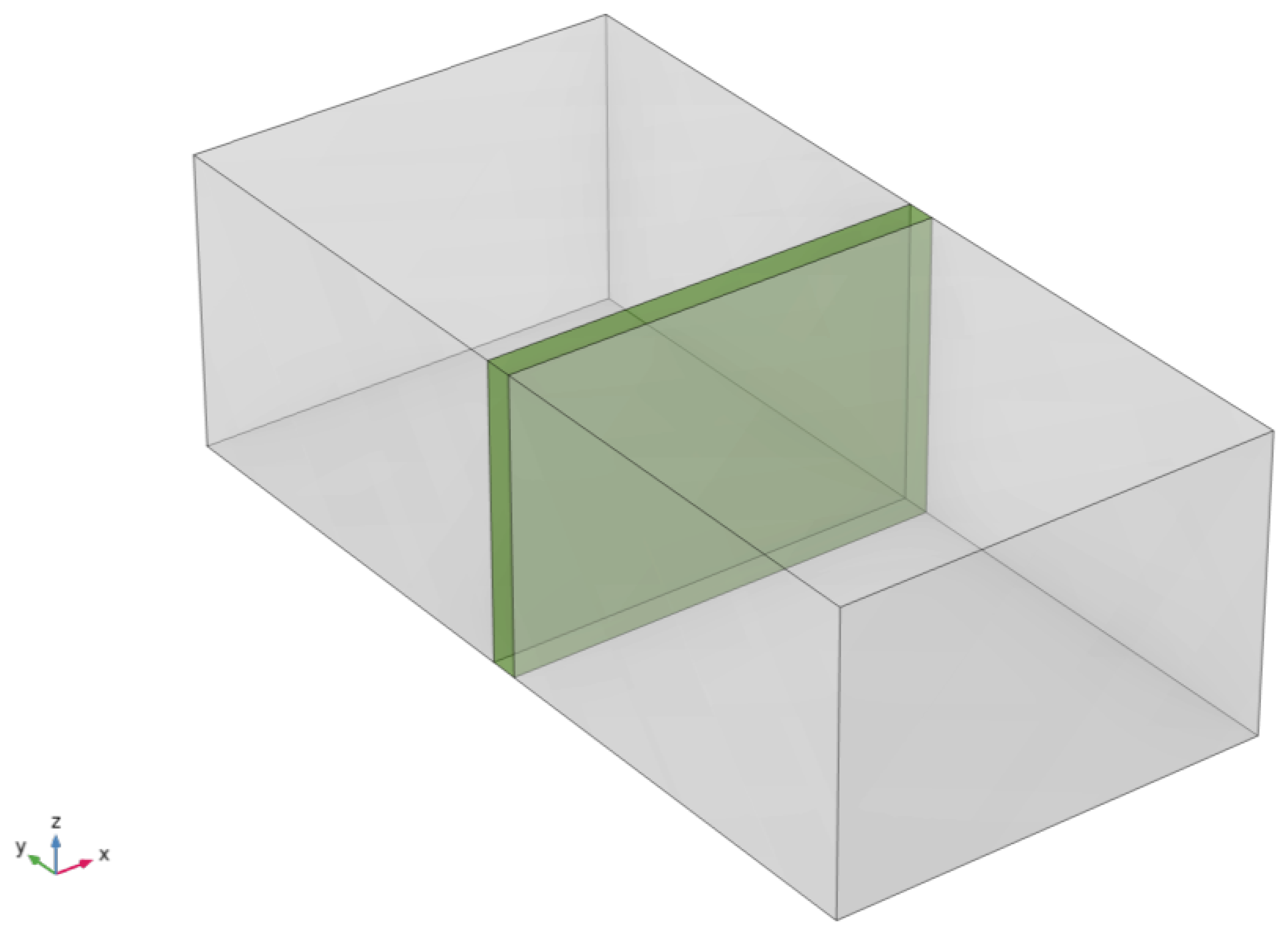
Figure 1.
Schematic of the model domains; the aluminum plate is green, while the air volumes are gray.
Figure 1.
Schematic of the model domains; the aluminum plate is green, while the air volumes are gray.
Figure 2.
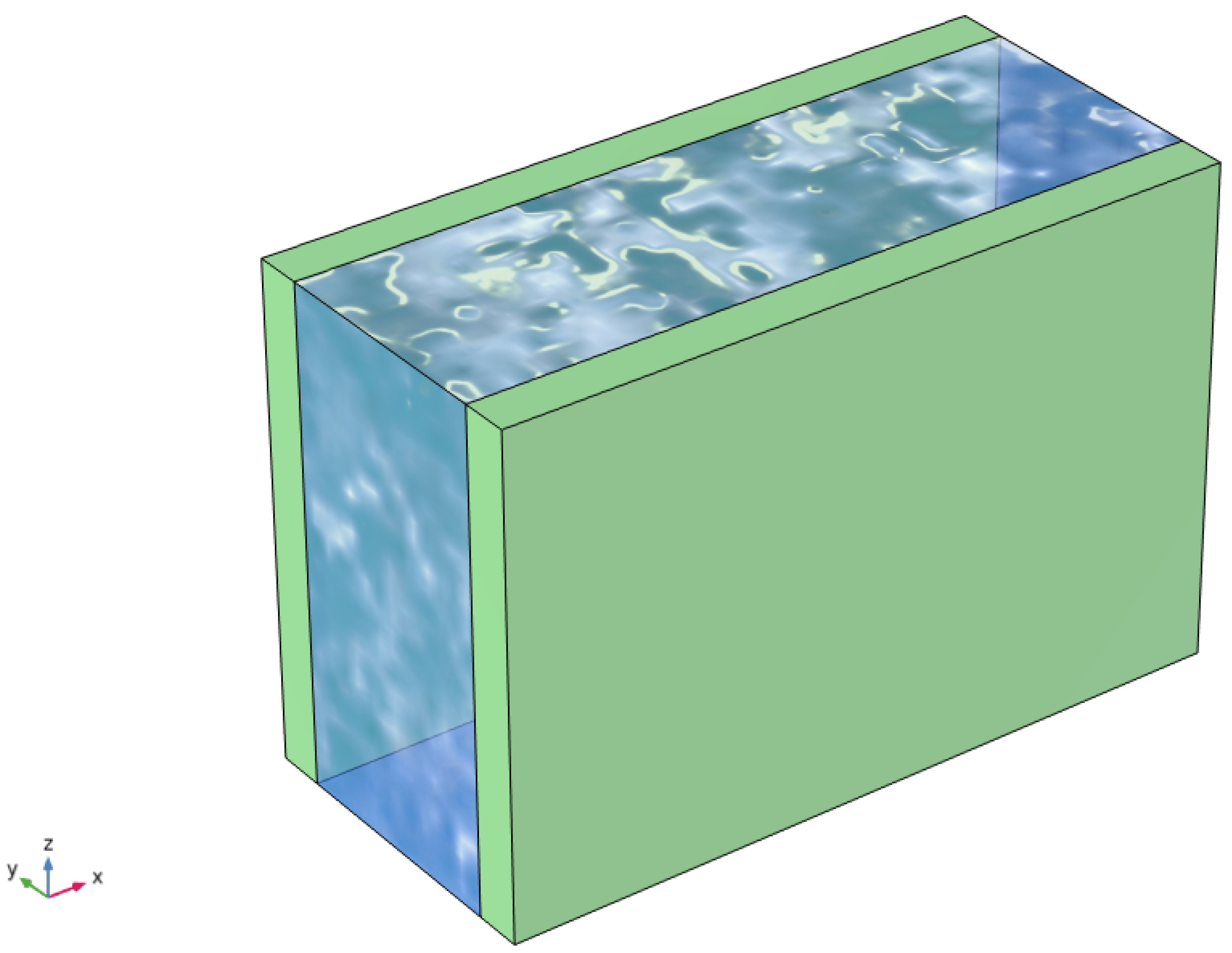
Schematic of the sandwich-like model domains; the aluminum plates are green, while the water volume is represented with a realistic texture.
Figure 2.
Schematic of the sandwich-like model domains; the aluminum plates are green, while the water volume is represented with a realistic texture.
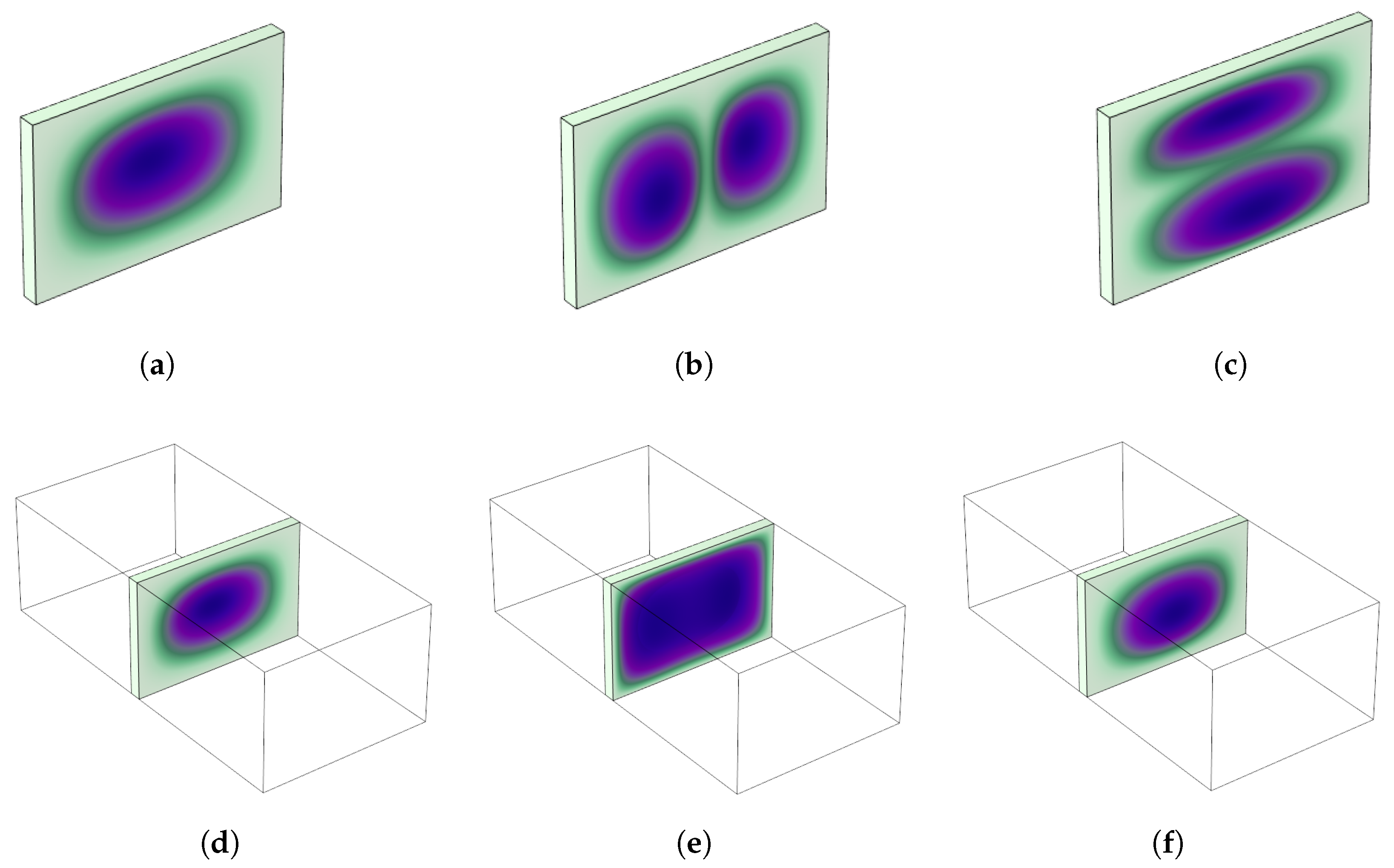
Figure 3.
Comparison of the first three non-rigid modal shapes between in vacuo (displacement) and coupled (displacement–pressure) models. Deformation of the structure is scaled to enhance visual comparison across all subfigures. Aluminum material, clamped structural and pressure-release fluid boundary conditions. (a) 1st modal shape of the in vacuo model, 6306 Hz. (b) 2nd modal shape of the in vacuo model, 9485 Hz. (c) 3rd modal shape of the in vacuo model, 14,430 Hz. (d) 1st modal shape of the coupled model, 2139 Hz. (e) 2nd modal shape of the coupled model, 2139 Hz. (f) 3rd modal shape of the coupled model, 2681 Hz.
Figure 3.
Comparison of the first three non-rigid modal shapes between in vacuo (displacement) and coupled (displacement–pressure) models. Deformation of the structure is scaled to enhance visual comparison across all subfigures. Aluminum material, clamped structural and pressure-release fluid boundary conditions. (a) 1st modal shape of the in vacuo model, 6306 Hz. (b) 2nd modal shape of the in vacuo model, 9485 Hz. (c) 3rd modal shape of the in vacuo model, 14,430 Hz. (d) 1st modal shape of the coupled model, 2139 Hz. (e) 2nd modal shape of the coupled model, 2139 Hz. (f) 3rd modal shape of the coupled model, 2681 Hz.
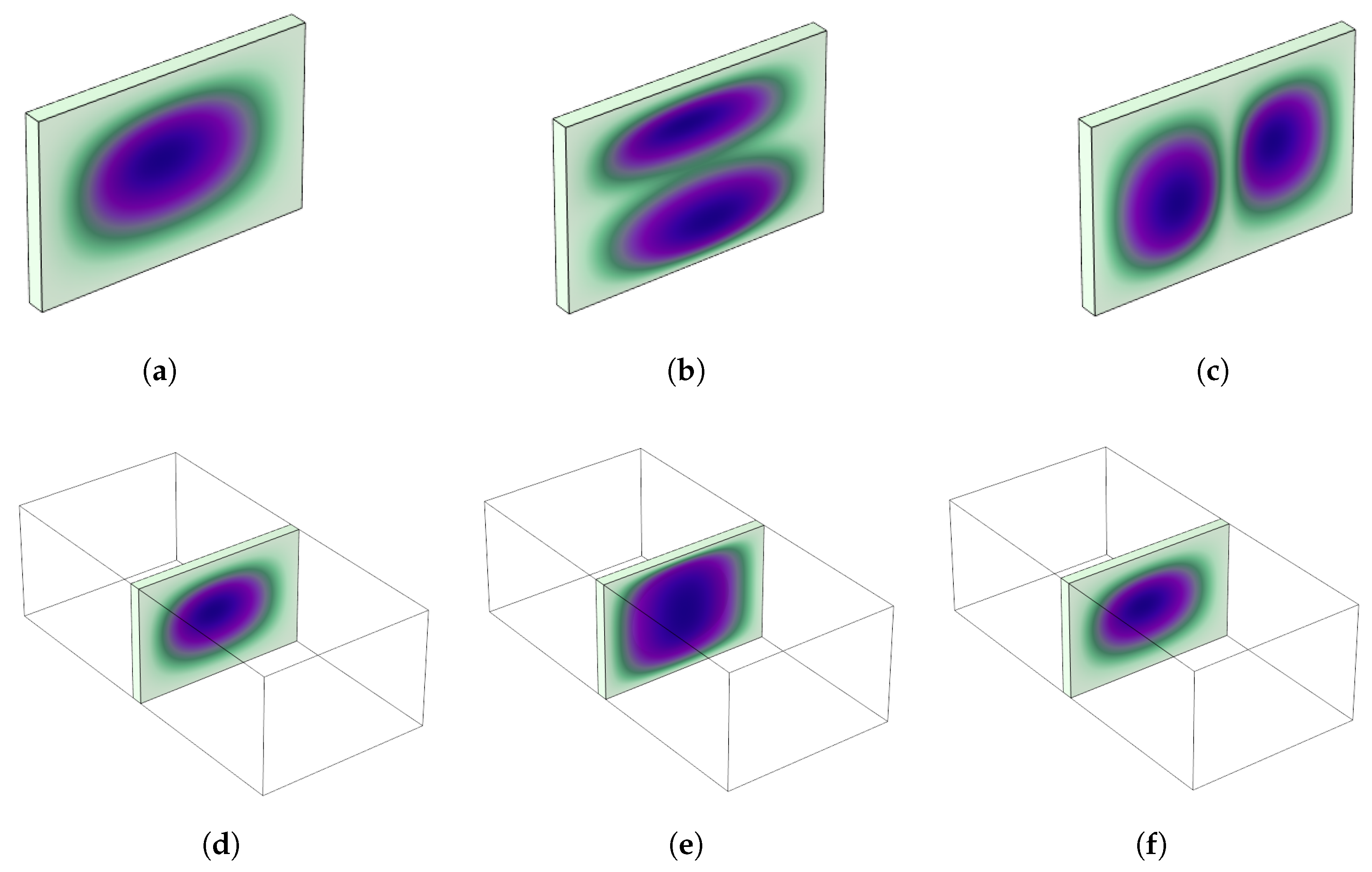
Figure 4.
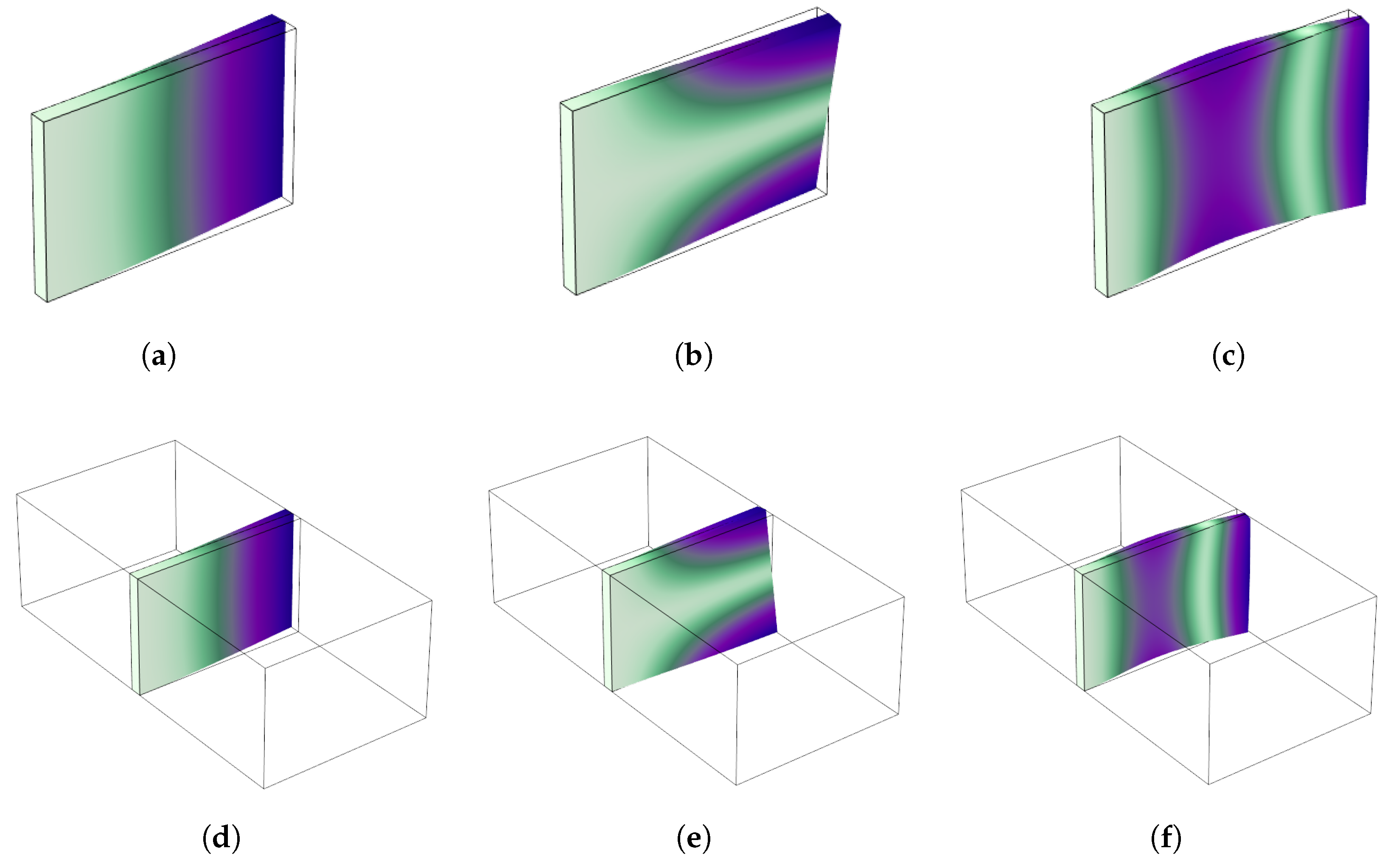
Comparison of the first three non-rigid modal shapes between in vacuo (displacement) and coupled (displacement–pressure) models. Deformation of the structure is scaled to enhance visual comparison across all subfigures. Aluminum material, cantilever structural and pressure-release fluid boundary conditions. (a) 1st modal shape of the in vacuo model, 378 Hz. (b) 2nd modal shape of the in vacuo model, 1214 Hz. (c) 3rd modal shape of the in vacuo model, 2303 Hz. (d) 1st modal shape of the coupled model, 378 Hz. (e) 2nd modal shape of the coupled model, 1214 Hz. (f) 3rd modal shape of the coupled model, 2137 Hz.
Figure 4.
Comparison of the first three non-rigid modal shapes between in vacuo (displacement) and coupled (displacement–pressure) models. Deformation of the structure is scaled to enhance visual comparison across all subfigures. Aluminum material, cantilever structural and pressure-release fluid boundary conditions. (a) 1st modal shape of the in vacuo model, 378 Hz. (b) 2nd modal shape of the in vacuo model, 1214 Hz. (c) 3rd modal shape of the in vacuo model, 2303 Hz. (d) 1st modal shape of the coupled model, 378 Hz. (e) 2nd modal shape of the coupled model, 1214 Hz. (f) 3rd modal shape of the coupled model, 2137 Hz.
Figure 5.
Comparison of the first three non-rigid modal shapes between in vacuo (displacement) and coupled (displacement–pressure) models. Deformation of the structure is scaled to enhance visual comparison across all subfigures. Aluminum material, clamped structural and rigid fluid boundary conditions. (a) 1st modal shape of the in vacuo model, 6306 Hz. (b) 2nd modal shape of the in vacuo model, 9485 Hz. (c) 3rd modal shape of the in vacuo model, 14,430 Hz. (d) 3rd modal shape of the coupled model, 1143 Hz. (e) 4th modal shape of the coupled model, 1143 Hz. (f) 5th modal shape of the coupled model, 1143 Hz.
Figure 5.
Comparison of the first three non-rigid modal shapes between in vacuo (displacement) and coupled (displacement–pressure) models. Deformation of the structure is scaled to enhance visual comparison across all subfigures. Aluminum material, clamped structural and rigid fluid boundary conditions. (a) 1st modal shape of the in vacuo model, 6306 Hz. (b) 2nd modal shape of the in vacuo model, 9485 Hz. (c) 3rd modal shape of the in vacuo model, 14,430 Hz. (d) 3rd modal shape of the coupled model, 1143 Hz. (e) 4th modal shape of the coupled model, 1143 Hz. (f) 5th modal shape of the coupled model, 1143 Hz.
Figure 6.
Comparison of the first three non-rigid modal shapes between in vacuo (displacement) and coupled (displacement–pressure) models. Deformation of the structure is scaled to enhance visual comparison across all subfigures. Unidirectional carbon fiber material, clamped structural and pressure-release fluid boundary conditions. (a) 1st modal shape of the in vacuo model, 4349 Hz. (b) 2nd modal shape of the in vacuo model, 7437 Hz. (c) 3rd modal shape of the in vacuo model, 8540 Hz. (d) 1st modal shape of the coupled model, 2139 Hz. (e) 2nd modal shape of the coupled model, 2139 Hz. (f) 3rd modal shape of the coupled model, 2681 Hz.
Figure 6.
Comparison of the first three non-rigid modal shapes between in vacuo (displacement) and coupled (displacement–pressure) models. Deformation of the structure is scaled to enhance visual comparison across all subfigures. Unidirectional carbon fiber material, clamped structural and pressure-release fluid boundary conditions. (a) 1st modal shape of the in vacuo model, 4349 Hz. (b) 2nd modal shape of the in vacuo model, 7437 Hz. (c) 3rd modal shape of the in vacuo model, 8540 Hz. (d) 1st modal shape of the coupled model, 2139 Hz. (e) 2nd modal shape of the coupled model, 2139 Hz. (f) 3rd modal shape of the coupled model, 2681 Hz.
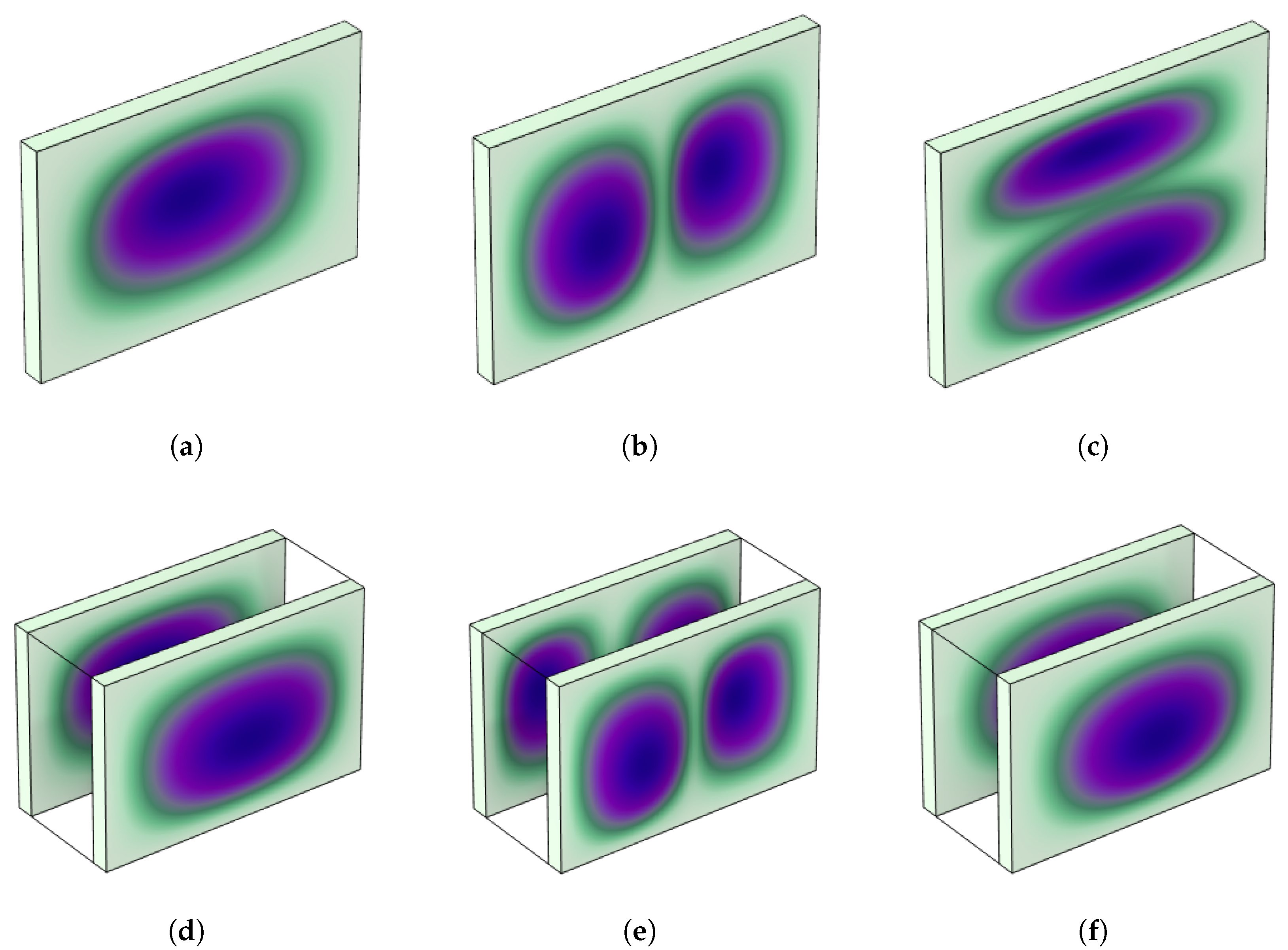
Figure 7.
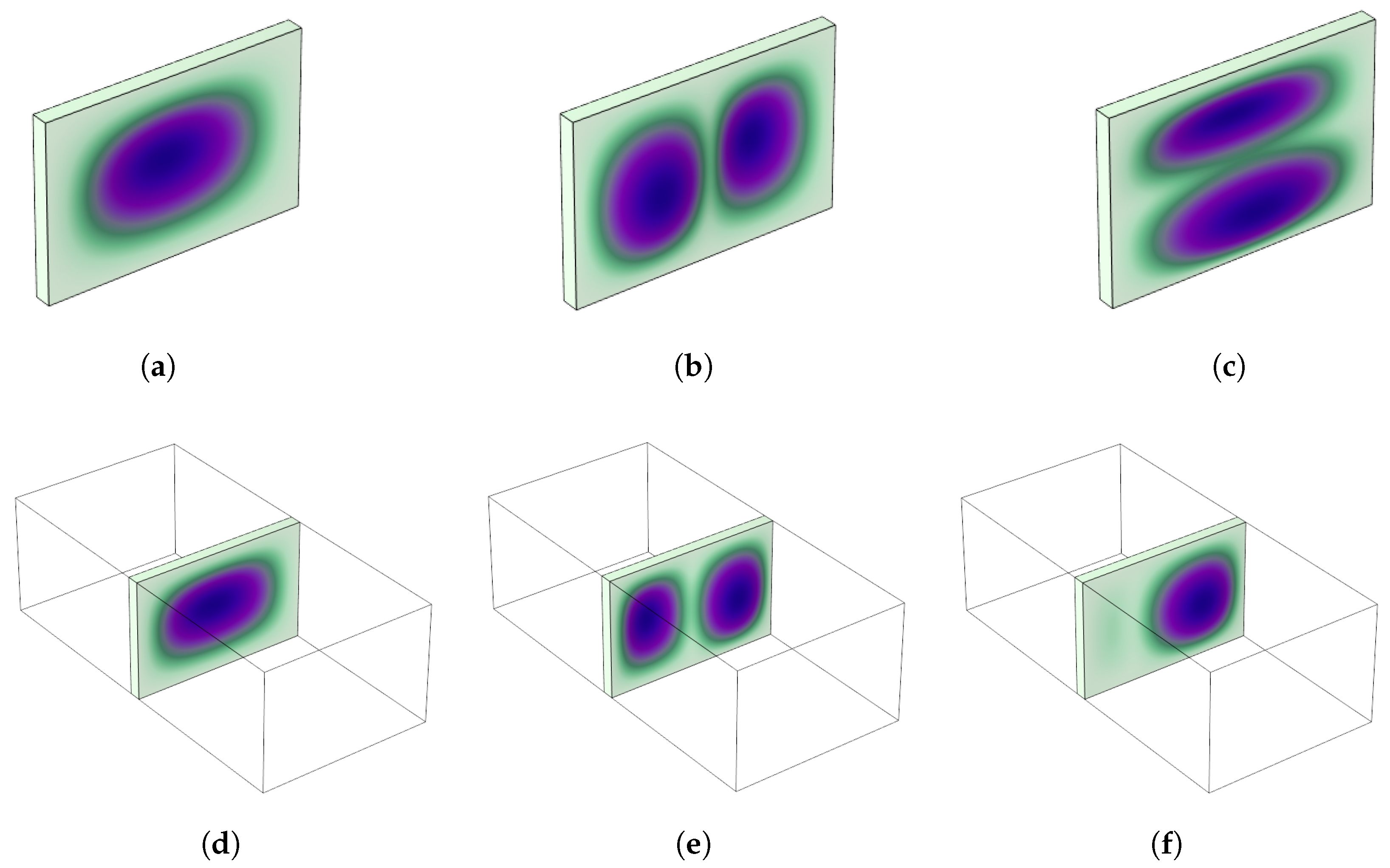
Comparison of the first three non-rigid modal shapes between in vacuo (displacement) and coupled (displacement–pressure) models. Deformation of the structure is scaled to enhance visual comparison across all subfigures. Aluminum structures with clamped boundary conditions, internal water with rigid fluid boundary conditions. (a) 1st modal shape of the in vacuo model, 6306 Hz. (b) 2nd modal shape of the in vacuo model, 9485 Hz. (c) 3rd modal shape of the in vacuo model, 14,430 Hz. (d) 2nd modal shape of the coupled model, 3982 Hz. (e) 3rd modal shape of the coupled model, 4704 Hz. (f) 4th modal shape of the coupled model, 6561 Hz.
Figure 7.
Comparison of the first three non-rigid modal shapes between in vacuo (displacement) and coupled (displacement–pressure) models. Deformation of the structure is scaled to enhance visual comparison across all subfigures. Aluminum structures with clamped boundary conditions, internal water with rigid fluid boundary conditions. (a) 1st modal shape of the in vacuo model, 6306 Hz. (b) 2nd modal shape of the in vacuo model, 9485 Hz. (c) 3rd modal shape of the in vacuo model, 14,430 Hz. (d) 2nd modal shape of the coupled model, 3982 Hz. (e) 3rd modal shape of the coupled model, 4704 Hz. (f) 4th modal shape of the coupled model, 6561 Hz.
Table 1.
Material properties of the structure (aluminum) and the fluid (air).
Table 1.
Material properties of the structure (aluminum) and the fluid (air).
| Property | Aluminum | Air |
|---|
| Young’s Modulus, E | 70 GPa | – |
| Poisson’s ratio, | 0.33 | – |
| Density, | 2700 kg/ | kg/ |
| Speed of sound, c | – | 343 m/s |
Table 2.
Mesh convergence analysis for the Comsol in vacuo structural model. Aluminum material, clamped structural and pressure-release fluid boundary conditions. The average frequency shifts between subsequent mesh refinements are equal to −14.34%, −3.32%, and −0.67%, respectively.
Table 2.
Mesh convergence analysis for the Comsol in vacuo structural model. Aluminum material, clamped structural and pressure-release fluid boundary conditions. The average frequency shifts between subsequent mesh refinements are equal to −14.34%, −3.32%, and −0.67%, respectively.
| Cross-section elements (number) | 12 | 40 | 150 | 600 |
| Cross-section elements (max. dim. [mm]) | 40 | 20 | 10 | 5 |
| Aspect ratio (cross-section/thickness) | 4 | 2 | 1 | 0.5 |
| Degrees of Freedom | 579 | 1647 | 5565 | 21,015 |
| Eigenfrequencies [Hz] | 7081 | 6436 | 6285 | 6239 |
| 11,128 | 9632 | 9432 | 9373 |
| 18,496 | 14,858 | 14,310 | 14,188 |
| 19,121 | 14,930 | 14,472 | 14,381 |
| 21,448 | 17,513 | 16,902 | 16,777 |
| 23,623 | 21,759 | 20,940 | 20,791 |
| 27,775 | 21,909 | 21,173 | 21,033 |
| 27,990 | 23,423 | 23,365 | 23,347 |
| 28,761 | 26,919 | 25,002 | 24,741 |
| 30,893 | 28,039 | 26,898 | 26,717 |
Table 3.
Mesh convergence analysis for the Comsol coupled fluid–structure model. Aluminum material, clamped structural and pressure-release fluid boundary conditions. The average frequency shifts between subsequent mesh refinements are equal to −0.10%, −0.01%, and 0.00%, respectively.
Table 3.
Mesh convergence analysis for the Comsol coupled fluid–structure model. Aluminum material, clamped structural and pressure-release fluid boundary conditions. The average frequency shifts between subsequent mesh refinements are equal to −0.10%, −0.01%, and 0.00%, respectively.
| Cross-section elements (number) | 12 | 40 | 150 | 600 |
| Cross-section elements (max. dim. [mm]) | 40 | 20 | 10 | 5 |
| Aspect ratio (cross-section/thickness) | 4 | 2 | 1 | 0.5 |
| Degrees of Freedom | 8265 | 24,461 | 84,987 | 326,137 |
| Eigenfrequencies [Hz] | 2141 | 2140 | 2140 | 2140 |
| 2142 | 2140 | 2140 | 2140 |
| 2684 | 2683 | 2683 | 2683 |
| 2684 | 2683 | 2683 | 2683 |
| 2924 | 2917 | 2917 | 2917 |
| 2924 | 2917 | 2917 | 2917 |
| 3342 | 3336 | 3335 | 3335 |
| 3342 | 3336 | 3335 | 3335 |
| 3527 | 3526 | 3526 | 3526 |
| 3527 | 3526 | 3526 | 3526 |
Table 4.
Mesh convergence analysis for the CUF LE4B3 in vacuo structural model (LE4/LE9/LE16 denote bilinear/biquadratic/bicubic quadrilateral cross-section elements; B3 denotes quadratic 1D thickness interpolation). Aluminum material, clamped structural and pressure-release fluid boundary conditions. The average frequency shifts between subsequent mesh refinements are equal to −18.85%, −8.78%, and −2.89%, respectively.
Table 4.
Mesh convergence analysis for the CUF LE4B3 in vacuo structural model (LE4/LE9/LE16 denote bilinear/biquadratic/bicubic quadrilateral cross-section elements; B3 denotes quadratic 1D thickness interpolation). Aluminum material, clamped structural and pressure-release fluid boundary conditions. The average frequency shifts between subsequent mesh refinements are equal to −18.85%, −8.78%, and −2.89%, respectively.
| Cross-section elements (number) | 40 | 150 | 600 | 2400 |
| Cross-section elements (max. dim. [mm]) | 20 | 10 | 5 | 2.5 |
| Aspect ratio (cross-section/thickness) | 2 | 1 | 0.5 | 0.25 |
| Degrees of Freedom | 486 | 1584 | 5859 | 22,509 |
| Eigenfrequencies [Hz] | 9425 | 7220 | 6533 | 6337 |
| 13,688 | 10,741 | 9794 | 9530 |
| 22,235 | 16,861 | 15,059 | 14,519 |
| 23,845 | 17,028 | 15,143 | 14,679 |
| 24,017 | 19,556 | 17,661 | 17,144 |
| 26,179 | 23,563 | 22,095 | 21,324 |
| 29,711 | 24,285 | 22,124 | 21,507 |
| 31,829 | 25,176 | 23,407 | 23,360 |
| 32,485 | 28,649 | 26,645 | 25,498 |
| 34,865 | 30,949 | 28,203 | 27,391 |
Table 5.
Mesh convergence analysis for the CUF LE4B3 coupled fluid–structure model (LE4/LE9/LE16 denote bilinear/biquadratic/bicubic quadrilateral cross-section elements; B3 denotes quadratic 1D thickness interpolation). Aluminum material, clamped structural and pressure-release fluid boundary conditions. The average frequency shifts between subsequent mesh refinements are equal to −0.92%, −0.25%, and −0.07%, respectively.
Table 5.
Mesh convergence analysis for the CUF LE4B3 coupled fluid–structure model (LE4/LE9/LE16 denote bilinear/biquadratic/bicubic quadrilateral cross-section elements; B3 denotes quadratic 1D thickness interpolation). Aluminum material, clamped structural and pressure-release fluid boundary conditions. The average frequency shifts between subsequent mesh refinements are equal to −0.92%, −0.25%, and −0.07%, respectively.
| Cross-section elements (number) | 40 | 150 | 600 | 2400 |
| Cross-section elements (max. dim. [mm]) | 20 | 10 | 5 | 2.5 |
| Aspect ratio (cross-section/thickness) | 2 | 1 | 0.5 | 0.25 |
| Degrees of Freedom | 3834 | 12,496 | 46,221 | 177,571 |
| Eigenfrequencies [Hz] | 2166 | 2146 | 2141 | 2139 |
| 2703 | 2687 | 2683 | 2682 |
| 2703 | 2687 | 2683 | 2682 |
| 2978 | 2932 | 2919 | 2916 |
| 2978 | 2932 | 2919 | 2916 |
| 3389 | 3348 | 3337 | 3334 |
| 3389 | 3349 | 3337 | 3334 |
| 3540 | 3528 | 3525 | 3524 |
| 3540 | 3528 | 3525 | 3524 |
Table 6.
Mesh convergence analysis for the CUF LE9B3 in vacuo structural model (LE4/LE9/LE16 denote bilinear/biquadratic/bicubic quadrilateral cross-section elements; B3 denotes quadratic 1D thickness interpolation). Aluminum material, clamped structural and pressure-release fluid boundary conditions. The average frequency shifts between subsequent mesh refinements are equal to −11.97% and −2.65%, respectively.
Table 6.
Mesh convergence analysis for the CUF LE9B3 in vacuo structural model (LE4/LE9/LE16 denote bilinear/biquadratic/bicubic quadrilateral cross-section elements; B3 denotes quadratic 1D thickness interpolation). Aluminum material, clamped structural and pressure-release fluid boundary conditions. The average frequency shifts between subsequent mesh refinements are equal to −11.97% and −2.65%, respectively.
| Cross-section elements (number) | 12 | 40 | 150 |
| Cross-section elements (max. dim. [mm]) | 40 | 20 | 10 |
| Aspect ratio (cross-section/thickness) | 4 | 2 | 1 |
| Degrees of Freedom | 567 | 1683 | 5859 |
| Eigenfrequencies [Hz] | 6915 | 6425 | 6306 |
| 10,615 | 9638 | 9485 |
| 18,355 | 14,901 | 14,430 |
| 18,674 | 14,959 | 14,592 |
| 20,692 | 17,547 | 17,063 |
| 23,582 | 21,865 | 21,173 |
| 26,248 | 21,925 | 21,409 |
| 26,255 | 23,417 | 23,362 |
| 28,705 | 27,011 | 25,318 |
| 30,789 | 28,003 | 27,249 |
Table 7.
Mesh convergence analysis for the CUF LE9B3 coupled fluid–structure model (LE4/LE9/LE16 denote bilinear/biquadratic/bicubic quadrilateral cross-section elements; B3 denotes quadratic 1D thickness interpolation). Aluminum material, clamped structural and pressure-release fluid boundary conditions. The average frequency shifts between subsequent mesh refinements are equal to −0.10% and −0.01%, respectively.
Table 7.
Mesh convergence analysis for the CUF LE9B3 coupled fluid–structure model (LE4/LE9/LE16 denote bilinear/biquadratic/bicubic quadrilateral cross-section elements; B3 denotes quadratic 1D thickness interpolation). Aluminum material, clamped structural and pressure-release fluid boundary conditions. The average frequency shifts between subsequent mesh refinements are equal to −0.10% and −0.01%, respectively.
| Cross-section elements (number) | 12 | 40 | 150 |
| Cross-section elements (max. dim. [mm]) | 40 | 20 | 10 |
| Aspect ratio (cross-section/thickness) | 4 | 2 | 1 |
| Degrees of Freedom | 4473 | 13,277 | 46,221 |
| Eigenfrequencies [Hz] | 2140 | 2139 | 2139 |
| 2140 | 2139 | 2139 |
| 2682 | 2681 | 2681 |
| 2682 | 2681 | 2681 |
| 2922 | 2915 | 2915 |
| 2922 | 2916 | 2915 |
| 3340 | 3334 | 3333 |
| 3340 | 3334 | 3333 |
| 3525 | 3524 | 3524 |
| 3525 | 3524 | 3524 |
Table 8.
Mesh convergence analysis for the CUF LE16B3 in vacuo structural model (LE4/LE9/LE16 denote bilinear/biquadratic/bicubic quadrilateral cross-section elements; B3 denotes quadratic 1D thickness interpolation). Aluminum material, clamped structural and pressure-release fluid boundary conditions. The average frequency shifts between subsequent mesh refinements are equal to −1.74% and −0.37%, respectively.
Table 8.
Mesh convergence analysis for the CUF LE16B3 in vacuo structural model (LE4/LE9/LE16 denote bilinear/biquadratic/bicubic quadrilateral cross-section elements; B3 denotes quadratic 1D thickness interpolation). Aluminum material, clamped structural and pressure-release fluid boundary conditions. The average frequency shifts between subsequent mesh refinements are equal to −1.74% and −0.37%, respectively.
| Cross-section elements (number) | 12 | 40 | 150 |
| Cross-section elements (max. dim. [mm]) | 40 | 20 | 10 |
| Aspect ratio (cross-section/thickness) | 4 | 2 | 1 |
| Degrees of Freedom | 1170 | 3600 | 12,834 |
| Eigenfrequencies [Hz] | 6361 | 6306 | 6276 |
| 9564 | 9482 | 9447 |
| 14,582 | 14,418 | 14,348 |
| 14,747 | 14,578 | 14,531 |
| 17,222 | 17,052 | 16,982 |
| 21,618 | 21,133 | 21,066 |
| 22,026 | 21,394 | 21,321 |
| 23,414 | 23,361 | 23,346 |
| 26,407 | 25,273 | 25,131 |
| 27,983 | 27,216 | 27,132 |
Table 9.
Mesh convergence analysis for the CUF LE16B3 coupled fluid–structure model (LE4/LE9/LE16 denote bilinear/biquadratic/bicubic quadrilateral cross-section elements; B3 denotes quadratic 1D thickness interpolation). Aluminum material, clamped structural and pressure-release fluid boundary conditions. The average frequency shift between subsequent mesh refinements is 0.00%.
Table 9.
Mesh convergence analysis for the CUF LE16B3 coupled fluid–structure model (LE4/LE9/LE16 denote bilinear/biquadratic/bicubic quadrilateral cross-section elements; B3 denotes quadratic 1D thickness interpolation). Aluminum material, clamped structural and pressure-release fluid boundary conditions. The average frequency shift between subsequent mesh refinements is 0.00%.
| Cross-section elements (number) | 12 | 40 | 150 |
| Cross-section elements (max. dim. [mm]) | 40 | 20 | 10 |
| Aspect ratio (cross-section/thickness) | 4 | 2 | 1 |
| Degrees of Freedom | 9230 | 28,400 | 101,246 |
| Eigenfrequencies [Hz] | 2139 | 2139 | 2139 |
| 2139 | 2139 | 2139 |
| 2681 | 2681 | 2681 |
| 2681 | 2681 | 2681 |
| 2915 | 2915 | 2915 |
| 2915 | 2915 | 2915 |
| 3333 | 3333 | 3333 |
| 3333 | 3333 | 3333 |
| 3524 | 3524 | 3524 |
| 3524 | 3524 | 3524 |
Table 10.
Comparison of eigenfrequencies between Comsol and CUF, concerning the coupled (displacement–pressure) model. Aluminum material, clamped structural and pressure-release fluid boundary conditions. The average frequency shifts compared to Comsol Multiphysics 6.2 are equal to −0.04%, −0.06%, and −0.06%, respectively.
Table 10.
Comparison of eigenfrequencies between Comsol and CUF, concerning the coupled (displacement–pressure) model. Aluminum material, clamped structural and pressure-release fluid boundary conditions. The average frequency shifts compared to Comsol Multiphysics 6.2 are equal to −0.04%, −0.06%, and −0.06%, respectively.
| Approach | Comsol | LE4B3 | LE9B3 | LE16B3 |
| Degrees of Freedom | 84,987 | 177,571 | 46,221 | 28,400 |
| Eigenfrequencies [Hz] | 2140 | 2139 | 2139 | 2139 |
| 2140 | 2139 | 2139 | 2139 |
| 2683 | 2682 | 2681 | 2681 |
| 2683 | 2682 | 2681 | 2681 |
| 2917 | 2916 | 2915 | 2915 |
| 2917 | 2916 | 2915 | 2915 |
| 3335 | 3334 | 3333 | 3333 |
| 3335 | 3334 | 3333 | 3333 |
| 3526 | 3524 | 3524 | 3524 |
| 3526 | 3524 | 3524 | 3524 |
Table 11.
Comparison of eigenfrequencies between Comsol and CUF, concerning the coupled (displacement–pressure) model. Aluminum material, cantilever structural and pressure-release fluid boundary conditions. The average frequency shifts compared to Comsol Multiphysics 6.2 are equal to 0.22%, −0.01%, and −0.01%, respectively.
Table 11.
Comparison of eigenfrequencies between Comsol and CUF, concerning the coupled (displacement–pressure) model. Aluminum material, cantilever structural and pressure-release fluid boundary conditions. The average frequency shifts compared to Comsol Multiphysics 6.2 are equal to 0.22%, −0.01%, and −0.01%, respectively.
| Approach | Comsol | LE4B3 | LE9B3 | LE16B3 |
| Degrees of Freedom | 84,987 | 177,571 | 46,221 | 28,400 |
| Eigenfrequencies [Hz] | 378 | 382 | 378 | 378 |
| 1211 | 1215 | 1214 | 1214 |
| 2139 | 2138 | 2137 | 2137 |
| 2140 | 2139 | 2139 | 2139 |
| 2302 | 2327 | 2303 | 2303 |
| 2683 | 2682 | 2681 | 2681 |
| 2684 | 2683 | 2683 | 2683 |
| 2865 | 2862 | 2863 | 2863 |
| 2917 | 2916 | 2915 | 2915 |
| 2917 | 2916 | 2915 | 2915 |
Table 12.
Comparison of eigenfrequencies between Comsol and CUF, concerning the coupled (displacement–pressure) model. Aluminum material, clamped structural and rigid fluid boundary conditions. The average frequency shifts compared to Comsol Multiphysics 6.2 are all equal to −0.07%.
Table 12.
Comparison of eigenfrequencies between Comsol and CUF, concerning the coupled (displacement–pressure) model. Aluminum material, clamped structural and rigid fluid boundary conditions. The average frequency shifts compared to Comsol Multiphysics 6.2 are all equal to −0.07%.
| Approach | Comsol | LE4B3 | LE9B3 | LE16B3 |
| Degrees of Freedom | 84,987 | 177,571 | 46,221 | 28,400 |
| Eigenfrequencies [Hz] | 0 | 0 | 0 | 0 |
| 0 | 0 | 0 | 0 |
| 1144 | 1143 | 1143 | 1143 |
| 1144 | 1143 | 1143 | 1143 |
| 1144 | 1143 | 1143 | 1143 |
| 1144 | 1144 | 1143 | 1143 |
| 1618 | 1617 | 1617 | 1617 |
| 1618 | 1617 | 1617 | 1617 |
| 1716 | 1715 | 1715 | 1715 |
| 1716 | 1716 | 1715 | 1715 |
Table 13.
Comparison of eigenfrequencies between Comsol and CUF, concerning the coupled (displacement–pressure) model. Unidirectional carbon fiber material, clamped structural and pressure-release fluid boundary conditions. The average frequency shifts compared to Comsol Multiphysics 6.2 are equal to −0.04%, −0.06%, and −0.06%, respectively.
Table 13.
Comparison of eigenfrequencies between Comsol and CUF, concerning the coupled (displacement–pressure) model. Unidirectional carbon fiber material, clamped structural and pressure-release fluid boundary conditions. The average frequency shifts compared to Comsol Multiphysics 6.2 are equal to −0.04%, −0.06%, and −0.06%, respectively.
| Approach | Comsol | LE4B3 | LE9B3 | LE16B3 |
| Degrees of Freedom | 84,987 | 177,571 | 46,221 | 28,400 |
| Eigenfrequencies [Hz] | 2140 | 2139 | 2139 | 2139 |
| 2140 | 2139 | 2139 | 2139 |
| 2682 | 2681 | 2681 | 2681 |
| 2683 | 2682 | 2681 | 2681 |
| 2917 | 2916 | 2915 | 2915 |
| 2917 | 2916 | 2915 | 2915 |
| 3335 | 3334 | 3333 | 3333 |
| 3335 | 3334 | 3333 | 3333 |
| 3524 | 3523 | 3523 | 3523 |
| 3526 | 3524 | 3524 | 3524 |
Table 14.
Material properties of the unidirectional carbon fiber structure, modeled as an equivalent orthotropic layer.
Table 14.
Material properties of the unidirectional carbon fiber structure, modeled as an equivalent orthotropic layer.
| Young Modulus [Pa] |
|---|
| | |
| | |
| Shear Modulus [Pa] |
| | |
| | |
| Poisson Ratio |
| | |
| 0.3 | 0.3 | 0.39 |
Table 15.
Comparison of eigenfrequencies between Comsol and CUF, concerning the coupled (displacement–pressure) multi-layered model. Aluminum structures with clamped boundary conditions, internal water with rigid fluid boundary conditions. The average frequency shifts compared to Comsol Multiphysics 6.2 are equal to −1.01%, 0.00%, and 0.33%, respectively.
Table 15.
Comparison of eigenfrequencies between Comsol and CUF, concerning the coupled (displacement–pressure) multi-layered model. Aluminum structures with clamped boundary conditions, internal water with rigid fluid boundary conditions. The average frequency shifts compared to Comsol Multiphysics 6.2 are equal to −1.01%, 0.00%, and 0.33%, respectively.
| Approach | Comsol | LE4B3 | LE9B3 | LE16B3 |
| Degrees of Freedom | 24,801 | 72,529 | 18,879 | 11,600 |
| Eigenfrequencies [Hz] | 0 | 0 | 0 | 0 |
| 3973 | 3996 | 3982 | 3982 |
| 4687 | 4741 | 4704 | 4704 |
| 6507 | 6418 | 6561 | 6521 |
| 6581 | 7092 | 6595 | 6593 |
| 7179 | 8085 | 7206 | 7217 |
| 8217 | 8085 | 8241 | 8234 |
| 9138 | 8605 | 9001 | 9171 |
| 9899 | 9130 | 9685 | 9928 |
| 10,699 | 9130 | 10,846 | 10,766 |
Table 16.
Comparison of eigenfrequencies between in vacuo (displacement) and coupled (displacement–pressure) CUF LE9B3 models. Aluminum material, clamped structural and pressure-release fluid boundary conditions. Multiple (nearly) coincident frequencies stem from geometric symmetries yielding mode multiplicities.
Table 16.
Comparison of eigenfrequencies between in vacuo (displacement) and coupled (displacement–pressure) CUF LE9B3 models. Aluminum material, clamped structural and pressure-release fluid boundary conditions. Multiple (nearly) coincident frequencies stem from geometric symmetries yielding mode multiplicities.
| | In Vacuo | Coupled |
|---|
| Degrees of Freedom | 5859 | 46,221 |
| Eigenfrequencies [Hz] | 6306 | 2139 |
| 9485 | 2139 |
| 14,430 | 2681 |
| 14,592 | 2681 |
| 17,063 | 2915 |
| 21,173 | 2915 |
| 21,409 | 3333 |
| 23,362 | 3333 |
| 25,318 | 3524 |
| 27,249 | 3524 |
Table 17.
Comparison of eigenfrequencies between in vacuo (displacement) and coupled (displacement–pressure) CUF LE9B3 models. Aluminum material, cantilever structural and pressure-release fluid boundary conditions. Multiple (nearly) coincident frequencies stem from geometric symmetries yielding mode multiplicities.
Table 17.
Comparison of eigenfrequencies between in vacuo (displacement) and coupled (displacement–pressure) CUF LE9B3 models. Aluminum material, cantilever structural and pressure-release fluid boundary conditions. Multiple (nearly) coincident frequencies stem from geometric symmetries yielding mode multiplicities.
| | In Vacuo | Coupled |
|---|
| Degrees of Freedom | 5859 | 46,221 |
| Eigenfrequencies [Hz] | 378 | 378 |
| 1214 | 1214 |
| 2303 | 2137 |
| 2863 | 2139 |
| 4047 | 2303 |
| 5589 | 2681 |
| 6451 | 2683 |
| 8088 | 2863 |
| 8560 | 2915 |
| 8564 | 2915 |
Table 18.
Comparison of eigenfrequencies between in vacuo (displacement) and coupled (displacement–pressure) CUF LE9B3 models. Aluminum material, clamped structural and rigid fluid boundary conditions. Multiple (nearly) coincident frequencies stem from geometric symmetries yielding mode multiplicities.
Table 18.
Comparison of eigenfrequencies between in vacuo (displacement) and coupled (displacement–pressure) CUF LE9B3 models. Aluminum material, clamped structural and rigid fluid boundary conditions. Multiple (nearly) coincident frequencies stem from geometric symmetries yielding mode multiplicities.
| | In Vacuo | Coupled |
|---|
| Degrees of Freedom | 5859 | 46,221 |
| Eigenfrequencies [Hz] | 6306 | 0 |
| 9485 | 0 |
| 14,430 | 1143 |
| 14,592 | 1143 |
| 17,063 | 1143 |
| 21,173 | 1143 |
| 21,409 | 1617 |
| 23,362 | 1617 |
| 25,318 | 1715 |
| 27,249 | 1715 |
Table 19.
Comparison of eigenfrequencies between in vacuo (displacement) and coupled (displacement–pressure) CUF LE9B3 models. Unidirectional carbon fiber material, clamped structural and pressure-release fluid boundary conditions. Multiple (nearly) coincident frequencies stem from geometric symmetries yielding mode multiplicities.
Table 19.
Comparison of eigenfrequencies between in vacuo (displacement) and coupled (displacement–pressure) CUF LE9B3 models. Unidirectional carbon fiber material, clamped structural and pressure-release fluid boundary conditions. Multiple (nearly) coincident frequencies stem from geometric symmetries yielding mode multiplicities.
| | In Vacuo | Coupled |
|---|
| Degrees of Freedom | 5859 | 46,221 |
| Eigenfrequencies [Hz] | 4349 | 2139 |
| 7437 | 2139 |
| 8540 | 2681 |
| 10,681 | 2681 |
| 12,259 | 2915 |
| 13,837 | 2915 |
| 13,875 | 3333 |
| 14,648 | 3333 |
| 15,396 | 3523 |
| 17,077 | 3524 |
Table 20.
Comparison of eigenfrequencies between in vacuo (displacement) and coupled (displacement–pressure) CUF LE9B3 models. Aluminum structures with clamped boundary conditions, internal water with rigid fluid boundary conditions. Multiple (nearly) coincident frequencies stem from geometric symmetries yielding mode multiplicities.
Table 20.
Comparison of eigenfrequencies between in vacuo (displacement) and coupled (displacement–pressure) CUF LE9B3 models. Aluminum structures with clamped boundary conditions, internal water with rigid fluid boundary conditions. Multiple (nearly) coincident frequencies stem from geometric symmetries yielding mode multiplicities.
| | In Vacuo | Coupled |
|---|
| Degrees of Freedom | 5859 | 18,879 |
| Eigenfrequencies [Hz] | 6306 | 0 |
| 9485 | 3982 |
| 14,430 | 4704 |
| 14,592 | 6561 |
| 17,063 | 6595 |
| 21,173 | 7206 |
| 21,409 | 8241 |
| 23,362 | 9001 |
| 25,318 | 9685 |
| 27,249 | 10,846 |