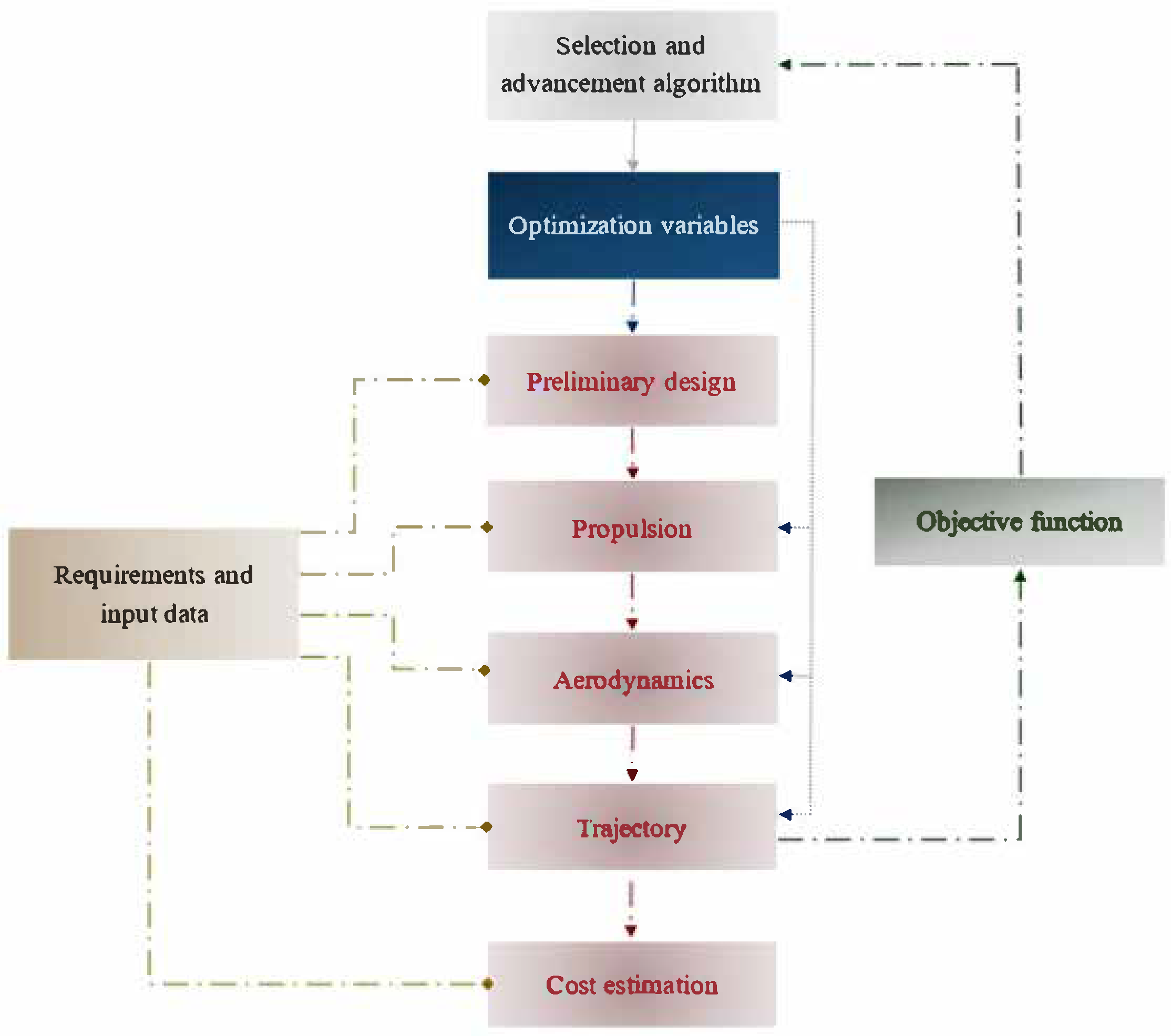
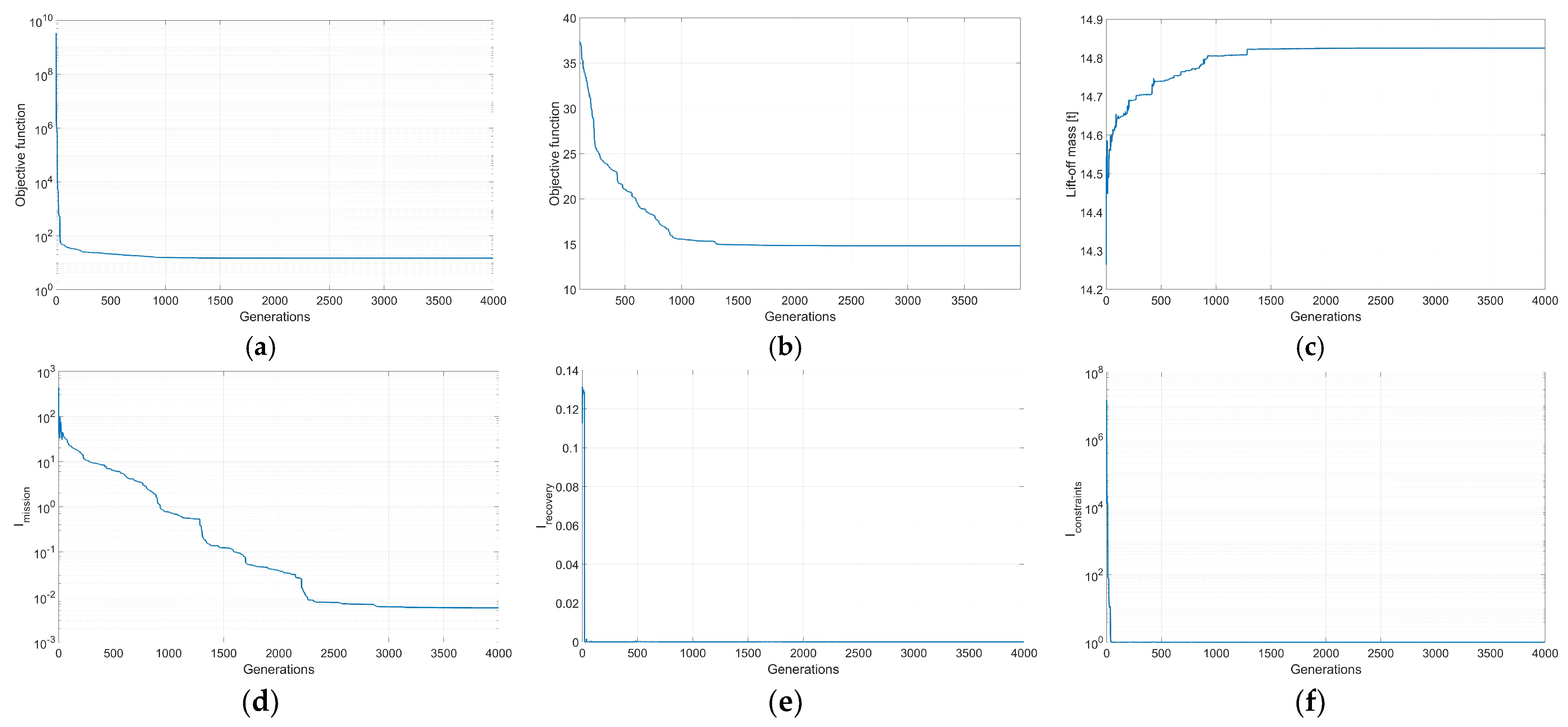
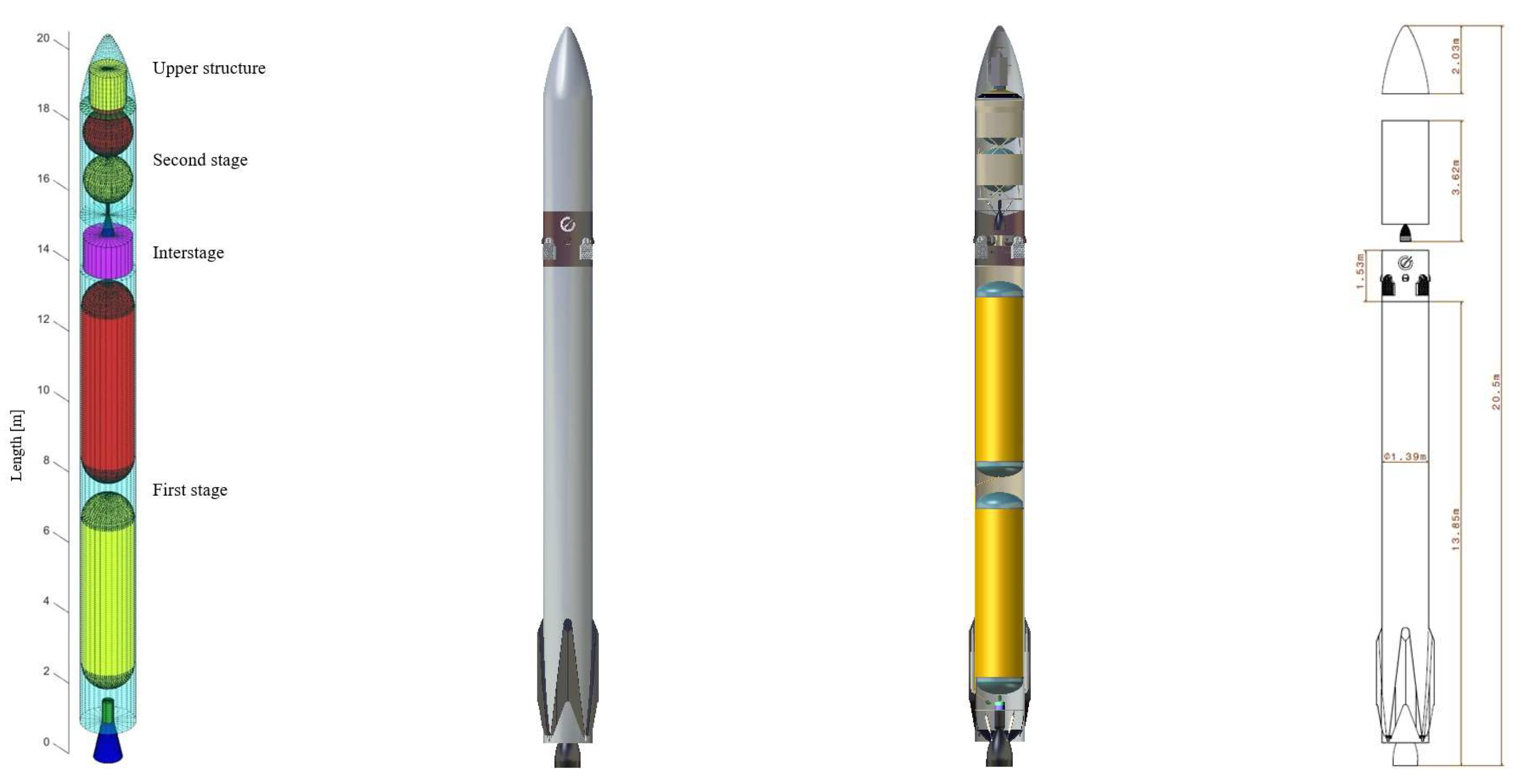
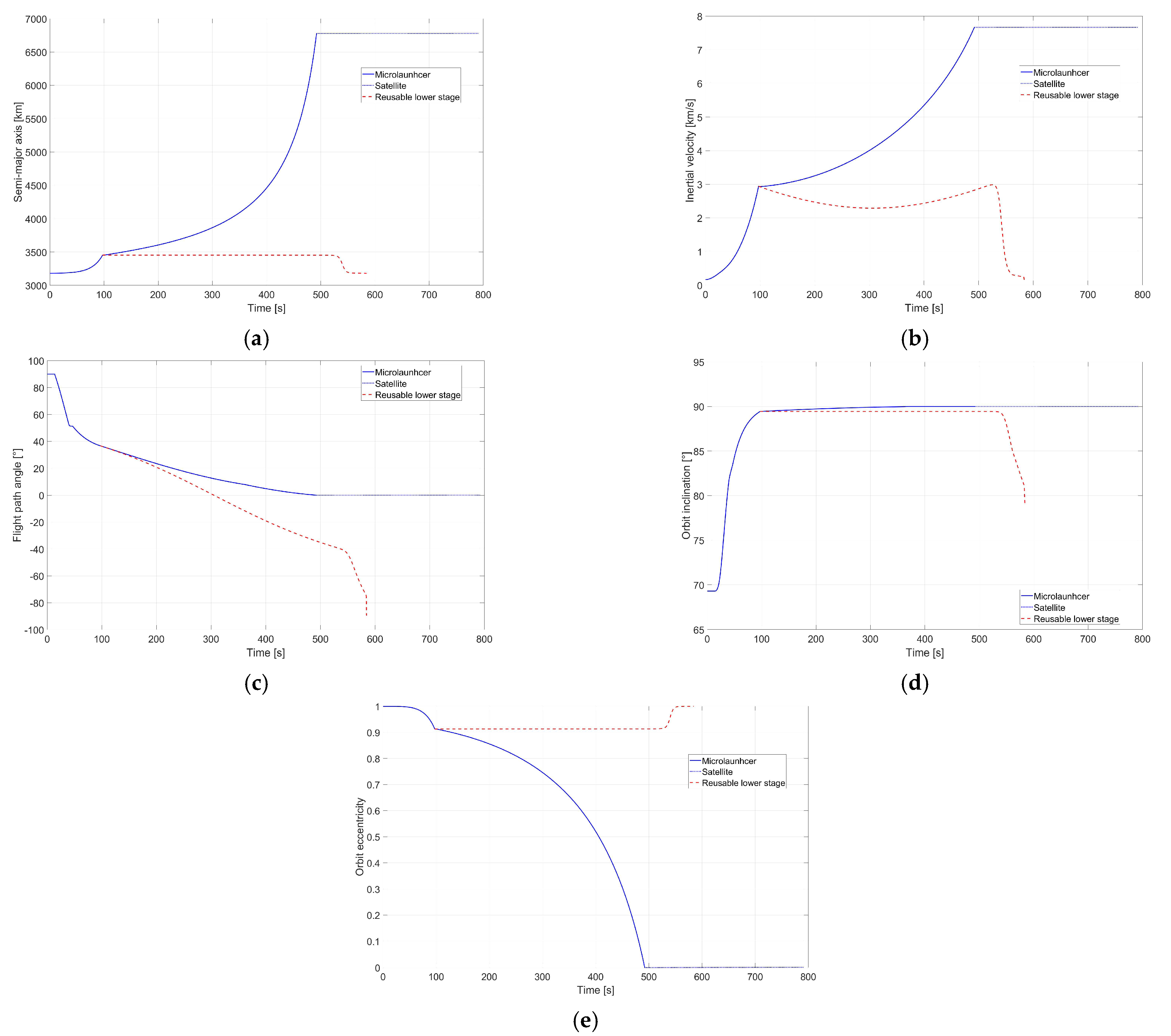
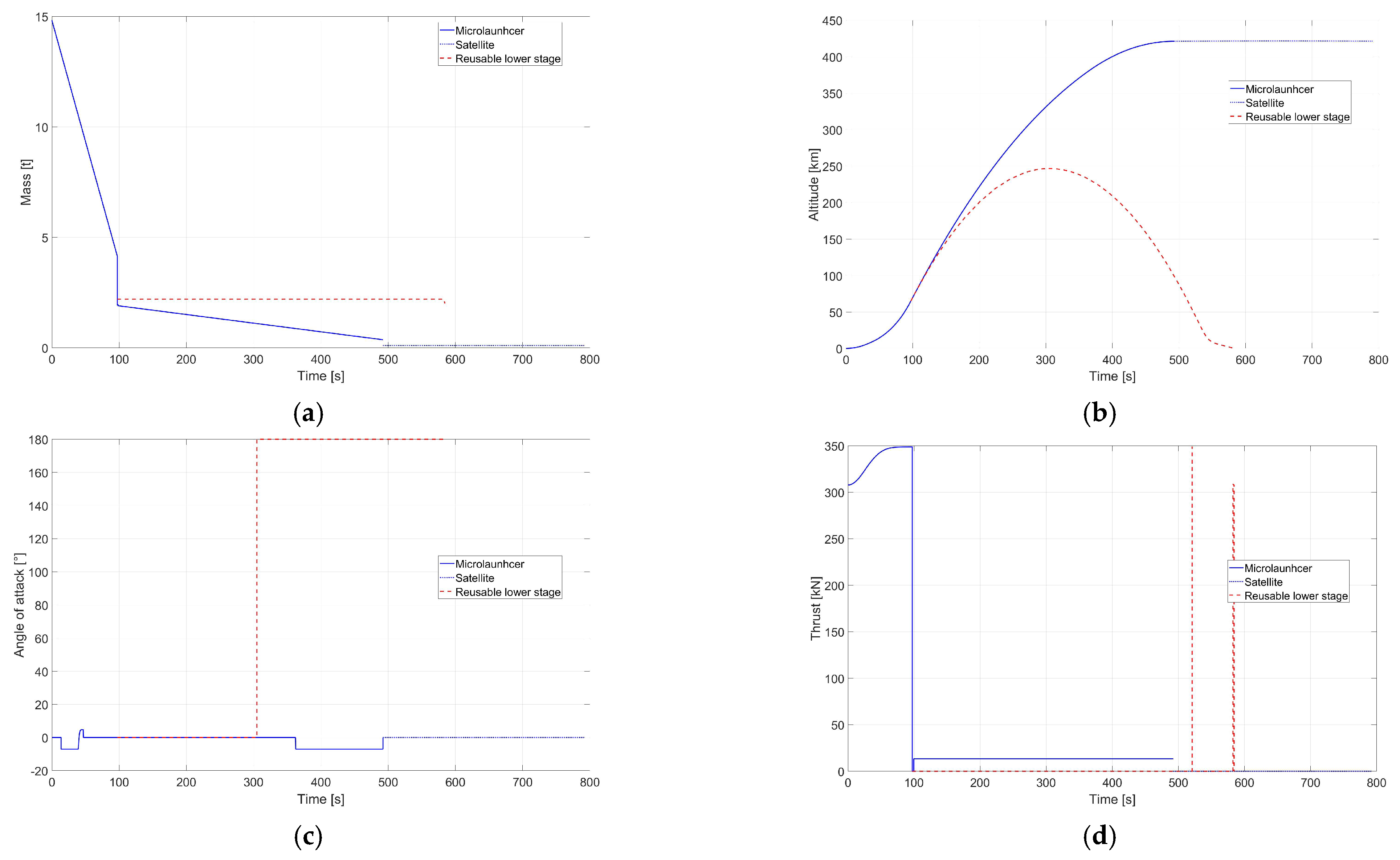
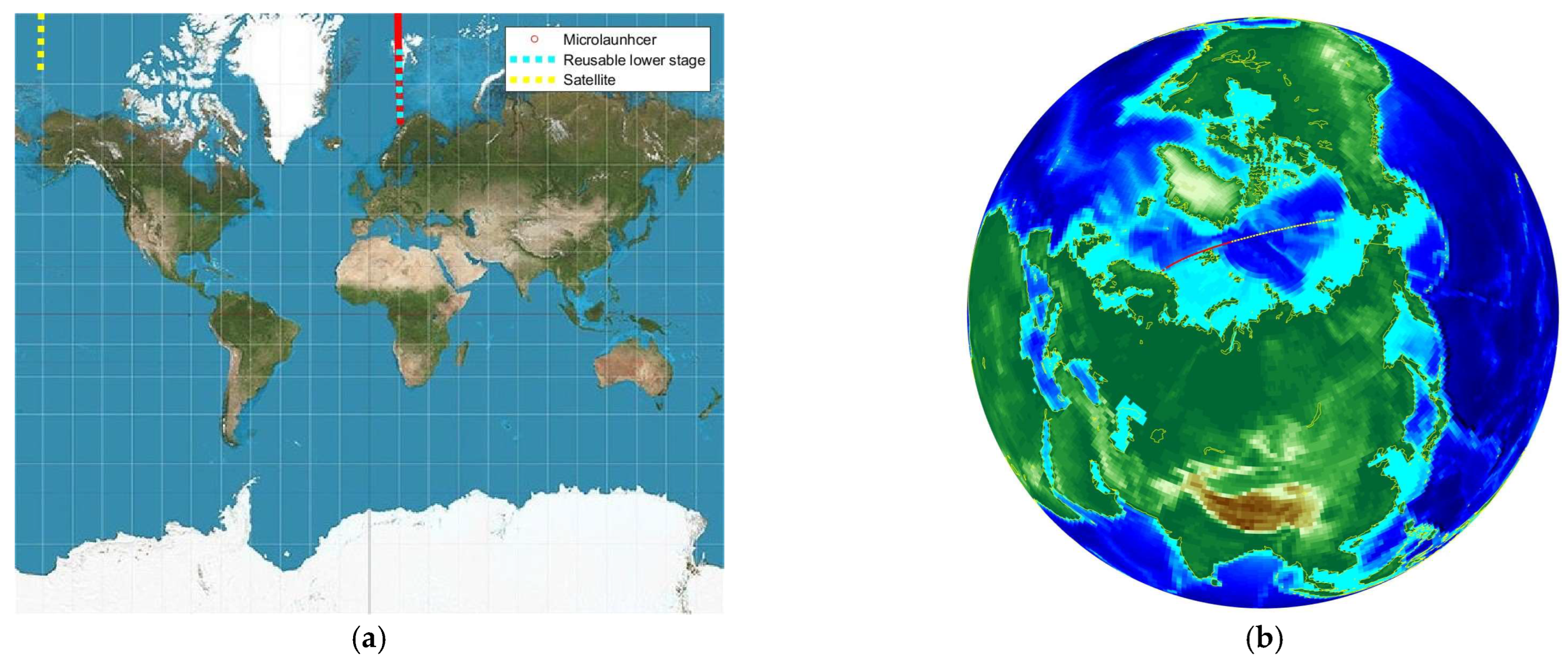
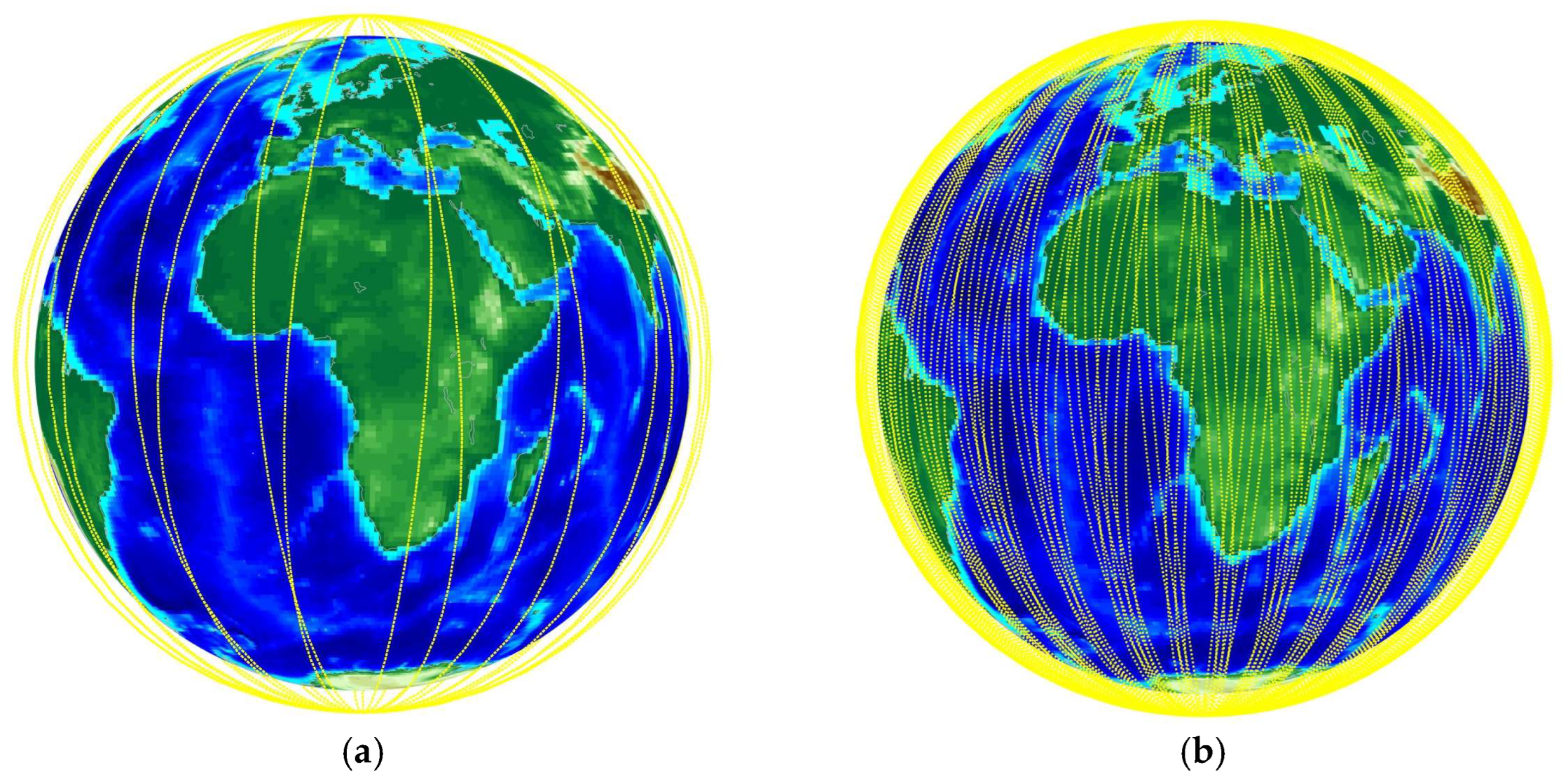
A short explanation of how the developed MDO tool works will now be given to provide the reader a better understanding of the optimization process that occurs over time. The most important mathematical models used in each of the MDO main modules will be detailed in the following sections.
The optimization of the partially reusable microlauncher is performed by obtaining an optimization variable vector, following the use of the solution selection and advancement algorithm based on the evaluation of an imposed objective function. The solution is considered optimal upon convergence of the MDO algorithm, when the objective function has not improved after a specified number of iterations. It is important to state the fact that no optimization method can find the “optimal” result for complex problems such as the one analyzed in this paper (microlauncher optimization), the realistic objective of the MDO tool being to generate a microlauncher with very high performances which are close to the optimal ones (but which cannot be rigorously demonstrated mathematically).
Within the Preliminary design module, the microlauncher is sized both globally and at the level of major assemblies and subassemblies. At the same time, its mass estimate is also made, based on the breakdown scheme implemented. Within the Propulsion module, the propulsive performances of the liquid propellant rocket engines are determined. Within the Aerodynamics module, the aerodynamic characteristics of the small launcher and the recoverable first stage configurations are determined.
Within the Trajectory module, the evolution of the microlauncher and its lower stage is simulated. The flight simulator is based on a simplified three degrees of freedom dynamic model (3DOF), the developed Matlab code being additionally capable of optimizing the launcher’s ascent trajectory and the lower stage’s recovery trajectory. Within the Cost Estimation module, a list of preliminary costs is generated for the development, production and operation of the small space launch vehicle, ending with obtaining a total cost per launch and a total price per launch valid for the considered operational lifetime.
The mathematical models developed for each main module are independent; thus, five individual computational codes are developed (one for each main module of the MDO), which are then integrated within the final MDO tool. The order in which the modules are assessed is very important, mainly because input data for latter modules are derived as output data from previous modules. Along with the five main modules listed above, within the architecture of the developed multidisciplinary optimization algorithm, the following secondary modules are also needed:
2.1. Preliminary Design Module
The estimation of the dimensions and masses of the main components of the microlauncher starting from a reduced number of input data and optimization variables is performed in the first main module of the MDO algorithm (block scheme described in
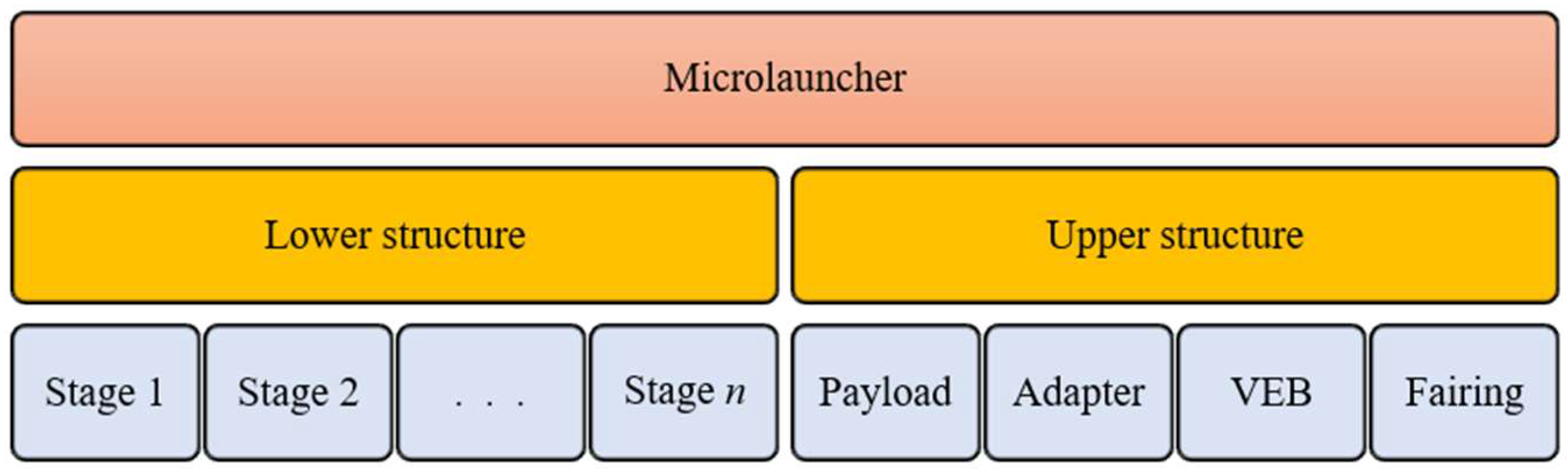
Figure 1). In this module, a bottom-up strategy is implemented, the masses and dimensions of the major components of the launcher being individually computed, so that by summing all of the subassemblies, one can obtain the mass and dimensions of each stage, of the upper structure and finally of the entire microlauncher.
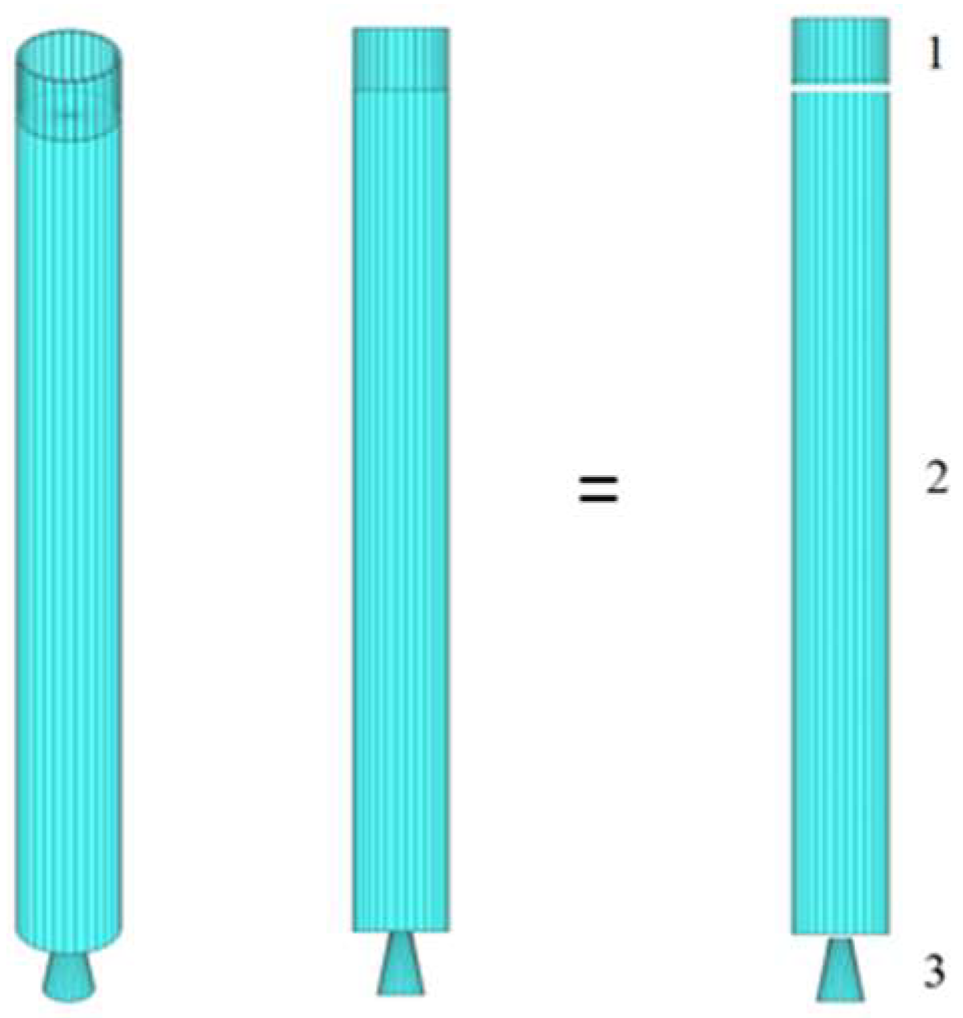
The breakdown scheme of an n-stage launcher can be observed in
Figure 2 [
16,
17]. Here, the existence of two independent structures is observed, namely a lower structure made up of
n stages and an upper structure dedicated to the satellite and avionics.
As mentioned in the Introduction Section of this paper, of great interest are microlauncher configurations with a two-stage architecture, and thus
n = 2 for the scheme presented in
Figure 2. In this case, the first stage can be referred to as the lower stage (which will be recovered), while the second stage can be referred to as the upper stage (which will not be recovered).
To be implemented in the MDO algorithm, the mathematical model used for the launcher preliminary design (sizing and weight assessments) must be
Robust, so that it can be used regardless of the selected optimization variables;
Fast, so that it does not require a high computational time;
Accurate, so that the results correspond to a correct estimate of the size and mass of the launcher constructive solution.
Therefore, analytical and semi-empirical, closed-relation models are preferred, which offer a high-accuracy first estimation after a very low computational time.
The upper structure is mandatory regardless of the type of microlauncher (reusable or expendable) or stage number and consists of the following components [
16,
17,
18]:
The payload mass and its dimensions are considered input data, being defined before running the multidisciplinary optimization algorithm. Thus, only the last three components need to be sized accordingly, with the aid of simplified mathematical models.
If the specifications of the adapter used are not known prior to the microlauncher design, a semi-empirical mathematical model is implemented, where the payload adapter mass is dependent on the payload mass [
18] and its height is based on the maximum diameter of the payload and a structural complexity factor [
16,
17].
The avionics and additional electrical power systems (EPS) are located in the VEB area, which is integrated either inside the payload adapter or inside the upper stage. For microlaunchers, using an architecture where the payload adapter houses the VEB is feasible, the additional length of the VEB area being this way negligible. However, the VEB mass cannot be neglected and is approximated according to [
19] based on a formulation dependent on the dry mass value of the launch vehicle.
The fairing geometry is defined based on several predefined input data (such as fineness ratio, preferred fairing profile, tip bluntness ratio) taking also into consideration the interior space necessary to safely house the payload. Based on the results of works [
16,
17], one can use a simplified relation to estimate the fairing mass, which is computed based on the lateral surface area of the fairing.
For the classical, expendable launcher concept, both stages will have the same type of internal components (more details in paper [
17]), while for the case of a partially reusable microlauncher, things are completely different, the two stages having distinct architectures. First, the upper stage is not recovered, arriving together with the satellite in the target orbit and then being de-orbited, disintegrating during the destructive reentry into the atmosphere [
20]. Thus, the number of internal components of the expendable stage is reduced. For the case of the lower stage, since it is subject to the recovery process, its internal architecture is different compared to an expendable stage, requiring new critical assemblies without which the stage recovery could not be carried out safely [
10].
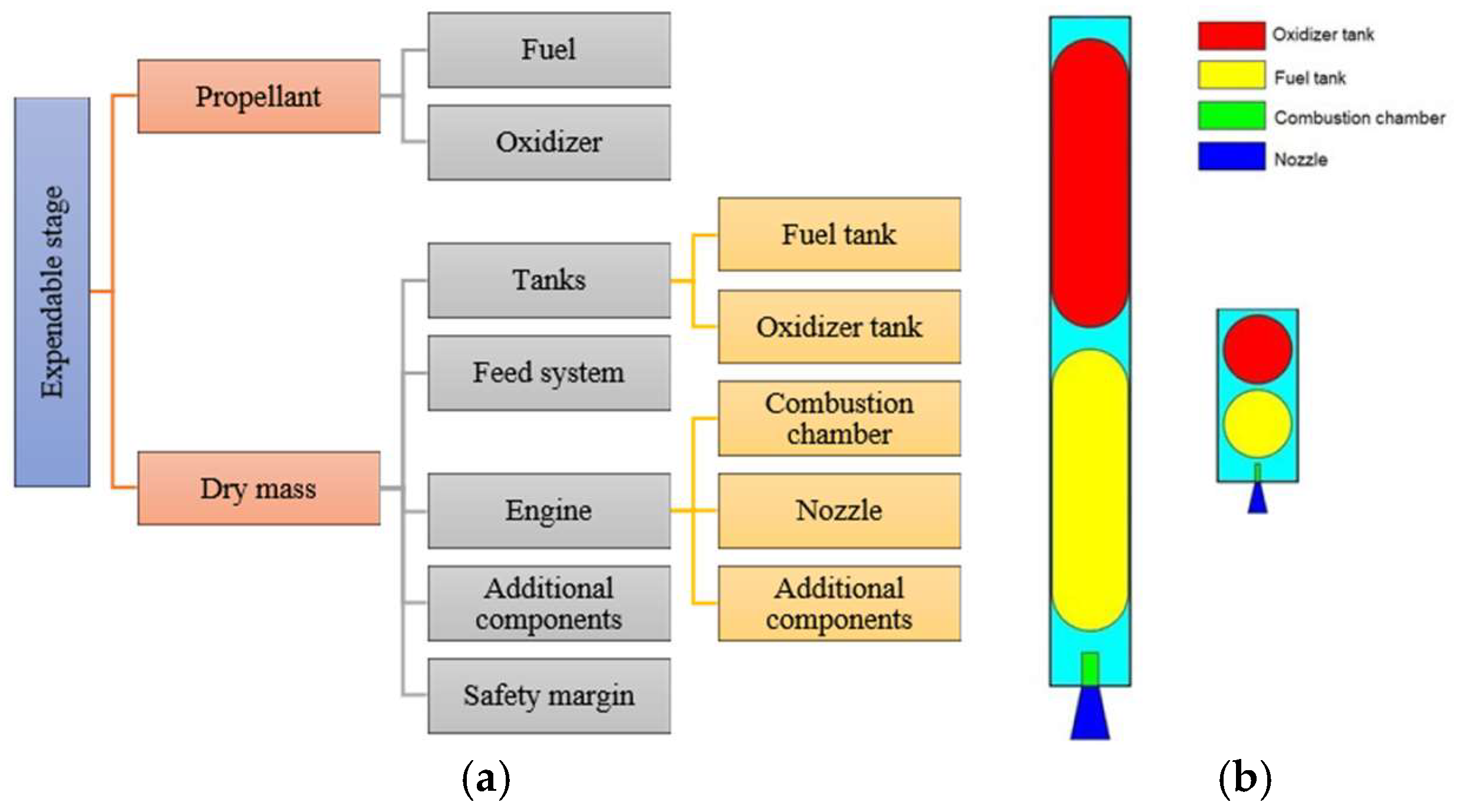
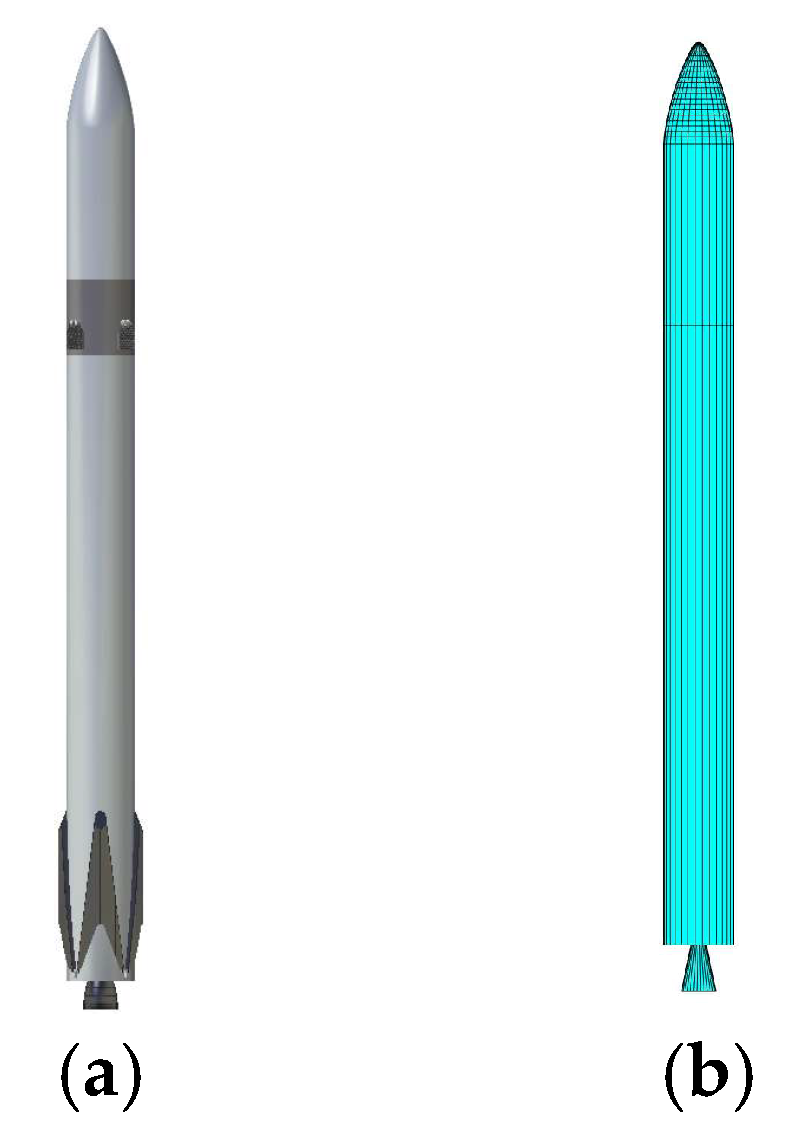
In the case of the lower structure, the dimensions and masses of each stage are computed individually, their contributions being summed up at the end to obtain the final constructive solution of the microlauncher. For an expendable stage which incorporates a liquid propellant rocket engine, the breakdown scheme used in the Preliminary design module is presented in
Figure 3a. Additionally, a simplified graphical representation of the main components modeled in the MDO tool is presented in
Figure 3b.
Many mathematical models from the literature are implemented in this subpart of the Preliminary design module to asses each individual component depicted in
Figure 3a. The propellant (fuel and oxidizer) masses are computed using the following relations:
where
is the total stage propellant mass (considered an optimization variable) and the optimal mixture ratio between oxidizer and fuel
is estimated according to the model detailed in
Section 2.2 through the following approximation:
where
is the combustion chamber pressure (considered an optimization variable),
is the exhaust pressure (considered an optimization variable) and (
,
,
,
,
) are the approximation model coefficients, dependent on the oxidizer–fuel pair used [
21].
The sizing of individual stage components is performed using analytical and semi-empirical mathematical models available in the literature [
1,
15,
16,
17,
18,
19,
22], a short overview being given here for each main component.
For the tanks (both oxidizer and fuel tanks use a 2000 series aluminum alloy as material [
23]), the mathematical model computes the following data: required volume [
15], operating pressure [
22], tank thickness [
17], tank shape [
17], lateral surface area [
17] and finally its mass [
1]. Regarding the shape of the fuel/oxidizer tanks, two possible scenarios occur. For the sizing of a large tank (typical for launcher lower stages which are more elongated), the output geometry is that of a cylindrical tank with spherical caps at the ends. If the length of the tank is not large enough to allow the use of a cylindrical portion and spherical end caps, then the output geometry of the tank is spherical (typical for launcher upper stages which do not have high length/diameter ratios).
The main role of the feed system is to increase the propellant pressure from the existing value in the tanks to the required value in the combustion chamber. The usual constructive solution of the feed system is the one based on centrifugal turbopumps, being implemented on most small, medium and large launchers. Based on existing works [
15,
17,
22], a semi-empirical model has been implemented, modeling the fuel and oxidizer turbopumps separately. This mathematical model is detailed in [
17] and computes the following data: mass flow rate, turbopump power requirement and finally its mass.
The liquid propellant rocket engine is a highly complex assembly. Depending on the combustion chamber pressure, the mass of the main subassemblies (combustion chamber
and nozzle
) is increased by a correction factor
between 2.5 and 5 (according to [
15,
22]) to include the mass of any additional components (injector, ablative shield, etc.). The final mass of the engine assembly can be estimated using
with the correction factor
having the following form [
15]:
For the sizing of the combustion chamber, the model presented in [
15,
22] is implemented, where the following data are computed: critical area of the nozzle and corresponding diameter, the length of the combustion chamber (which is based on the characteristic length
, for which a conservative value was used
[
17,
24]), the combustion chamber cross-sectional area and its corresponding diameter, the thickness of the combustion chamber wall (a cost-effective solution of stainless steel is implemented as a preliminary material) and, finally, its mass.
For a liquid propellant rocket engine, different types of nozzles can be used, depending on the requirements of the launcher mission: conical nozzle, bell nozzle (partial, total or double), multi-position nozzle, aerospike, etc. Details regarding the constructive solutions, advantages and disadvantages of each type of nozzle are presented in [
22,
25,
26,
27,
28,
29]. For the case of microlaunchers, the primary selection criterion is most often its costs. From the list of nozzles mentioned above, the simplest technical architecture which has an associated low cost corresponds to the conical nozzle, being implemented in the current paper. The sizing process of the conical nozzle is presented in detail in [
17] and computes the following data: the nozzle expansion ratio, the cross-sectional area, the length of the nozzle (a nozzle half-angle value of 15° is used [
15,
17]), the thickness of the nozzle (material similar to the combustion chamber) and, finally, its mass.
The mass of any additional components inside an expendable launcher stage (Thrust Vector Control System, internal pipes, exterior shell, actuators, etc.) is computed using
An extra dry mass of 5% has been implemented inside the Preliminary design module of the MDO algorithm for an expendable stage as a safety margin, together with a 10% length safety margin. These are used only in the preliminary stages of design [
16].
Within the lower structure of a partially reusable microlauncher, the integration of at least one reusable stage is necessary. Since the microlauncher concept investigated in this work is based on a two-stage architecture, the lower stage (first stage) is the one that is subject to the recovery process.
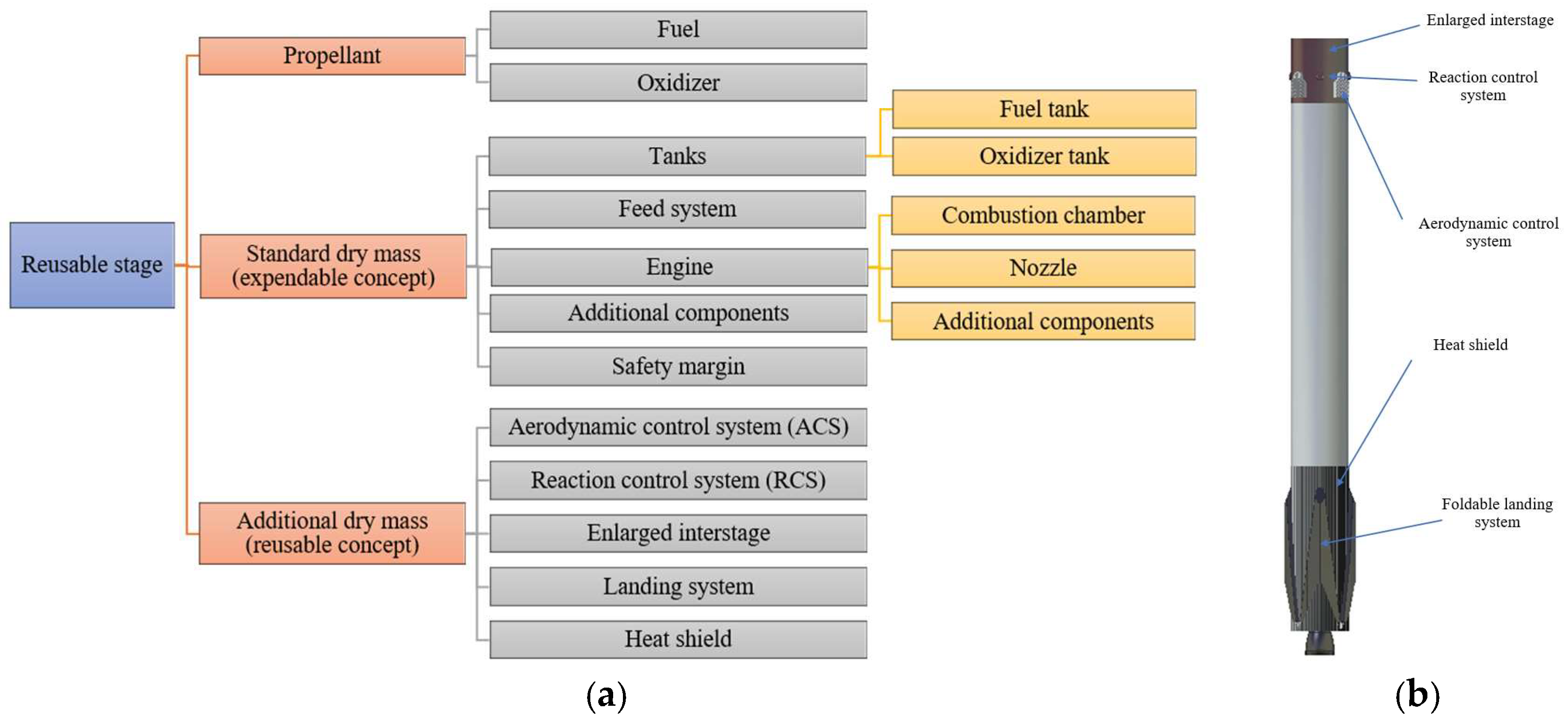
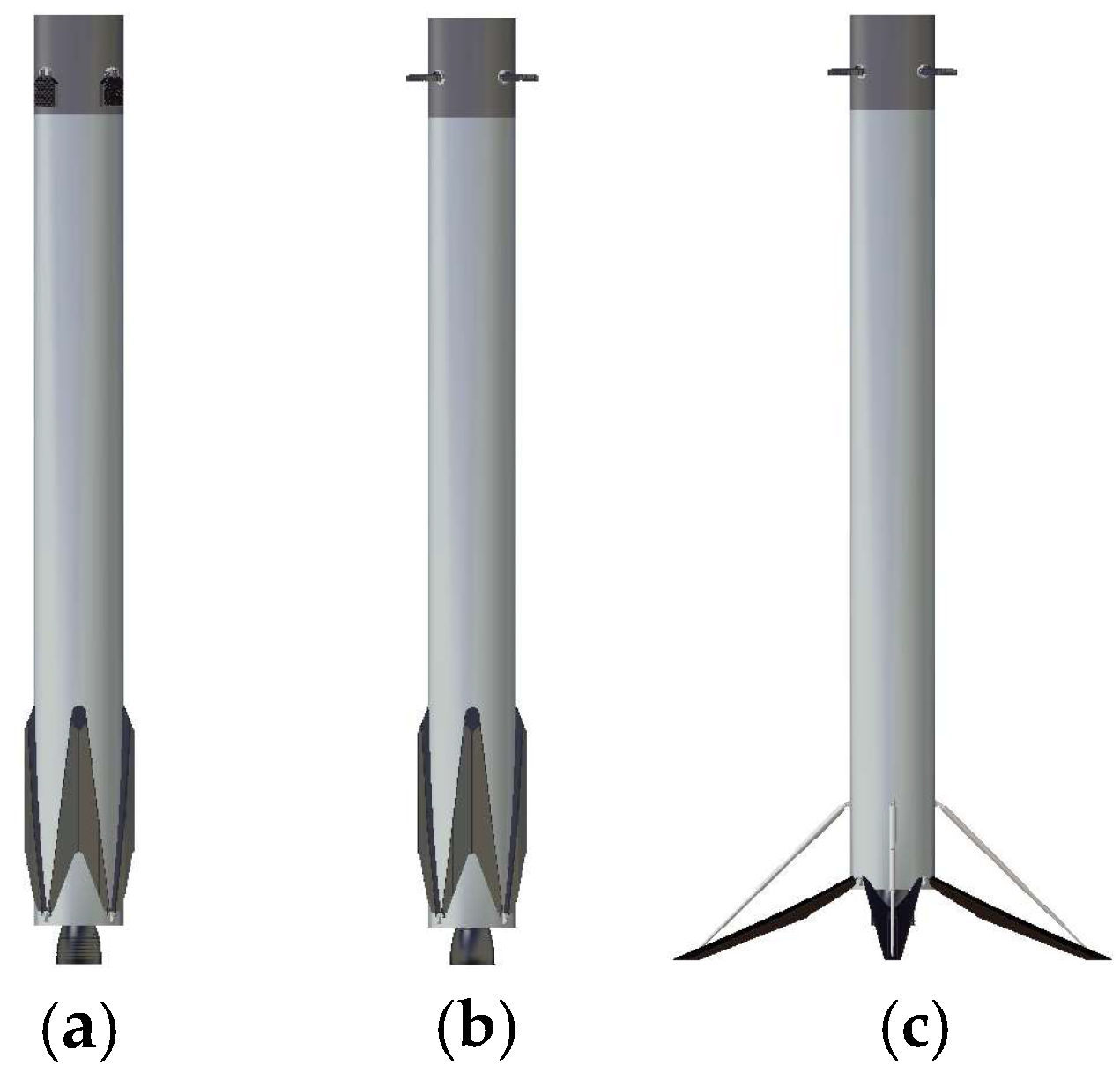
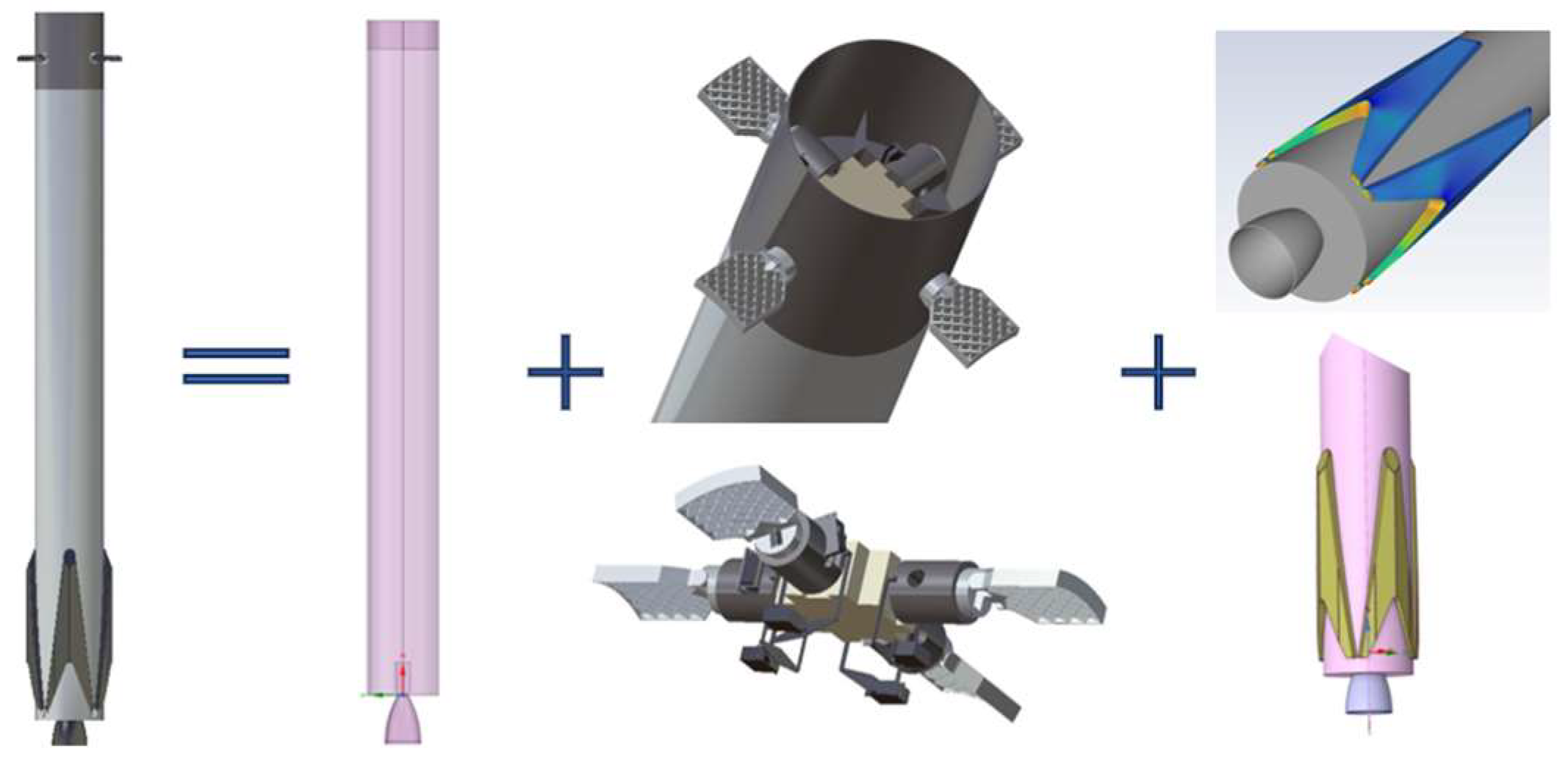
The complexity of a reusable stage is much higher than an expendable one, additional systems being necessary to successfully recover the stage. The breakdown scheme used in the Preliminary design module for a reusable microlauncher stage is shown in
Figure 4a.
Besides all of the components associated with a standard, expendable stage mentioned earlier in
Figure 3, the architecture of a reusable microlauncher stage must contain a reusable concept dry mass contribution; the following five additional systems (shown in
Figure 4b) needs to be integrated, as each one of them has a specific task to accomplish:
An aerodynamic control system (ACS) is needed to modify the attitude of the first stage at low altitudes (a grid fin-based system is implemented);
An extra-atmospheric control system is needed to change the attitude of the first stage at high altitudes (a cold gas thruster-based Reaction Control System (RCS) is implemented);
An enlarged interstage (which is used to include the new RCS and ACS);
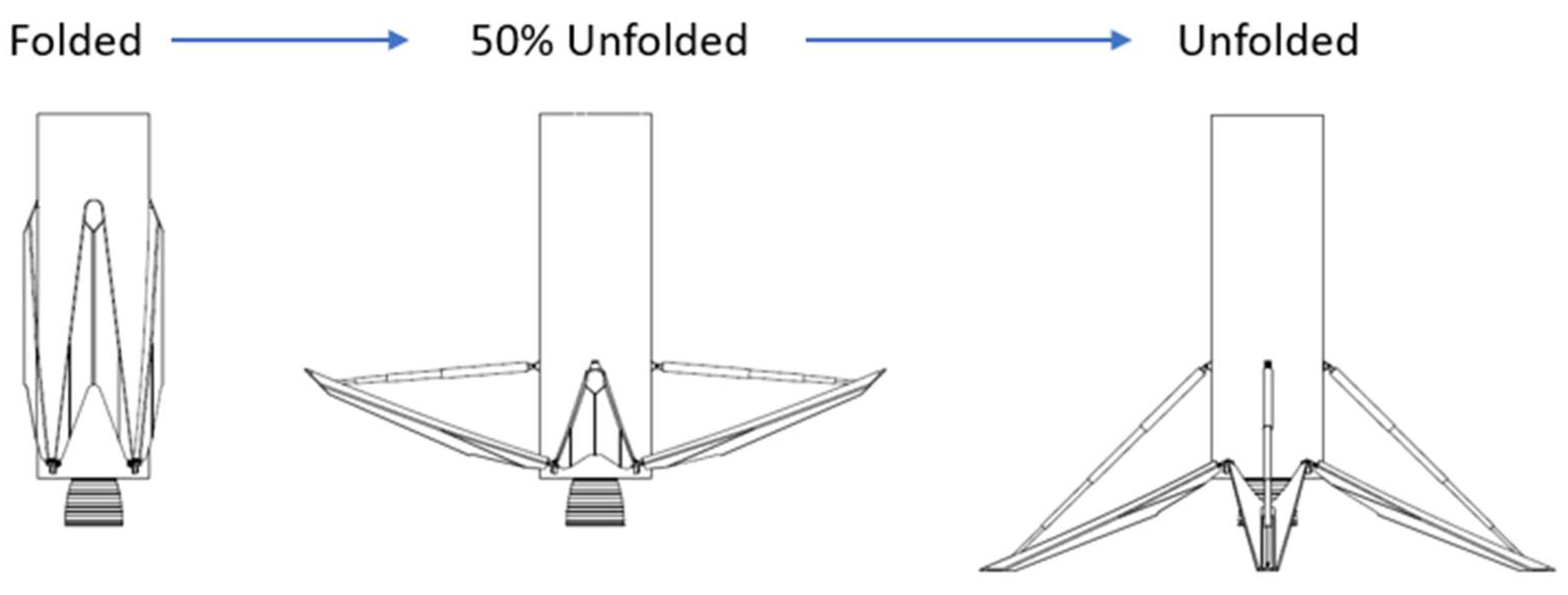
A landing system is needed to safely land the first stage (a foldable system is envisioned to reduce its aerodynamic impact during the ascent phase of the microlauncher);
A heat shield placed on the bottom part of the first stage is needed such that the reentry phase does not thermally damage it.
The first major system required for lower-stage recovery is the aerodynamic control system (ACS), which is essential for guiding the lower stage to the landing site at low altitudes, where the Earth’s atmosphere is dense. Grid fins are preferred over conventional (planar) fins, as they are very efficient for the typical flight profiles of space launchers [
30,
31,
32]. Thus, a solution based on four grid fins positioned in an X configuration has been implemented in the MDO algorithm, similar to the Falcon 9 launch vehicle [
33].
Based on internal sizing studies realized in INCAS, simple formulas can be used to preliminary estimate the dimensions and total mass of the ACS. For the ACS height computation, the following relation is proposed:
where
is the outer diameter of the stage (considered an optimization variable) and
is a scale factor (the value 0.65 is used).
To estimate the mass of the aerodynamic control system
[kg], the following relation is proposed:
where
a = 77.1 [kg/m],
is measured in [m] and the exponent
is dependent on the size of the launch vehicle. For launchers with
, a value of
has provided excellent results, while for bigger launchers a value of
is more realistic. An intermediary value of
is suggested to be used as a preliminary value, being subject to further investigations during advanced phases of microlauncher design.
The second major system required for lower-stage recovery is the extra-atmospheric reaction control system (RCS), which is primarily used to change the attitude of the lower stage after separation from the microlauncher assembly at very high altitudes. The most common solution for such a control method is that of a system based on cold gas thrusters; for the current paper a solution based on nitrogen is implemented, which is readily available on the market (and easily storable) [
34]. The architecture of the implemented RCS is based on a constructive solution with four gas expulsion zones, of which two zones have three thrusters (for roll and pitch control) and the other two simpler zones have only one thruster each (for yaw motion).
Based on internal sizing studies realized in INCAS, simple formulas can be used to preliminary estimate the dimensions and total mass of the RCS. For the RCS mass computation, the following relation is proposed:
where
is the pressurized gas (nitrogen),
is the mass of the gas tank(s) and
is a scale factor which includes the contribution of auxiliary RCS components such as valves, circuits, nozzles, sensors, actuators, connecting supports and other smaller parts (the value of
is proposed for a reusable first stage).
The mass of the pressurized gas can be approximated using
where
is the impulse generated by the RCS,
is the specific impulse of the gas used and
is the standard gravitational acceleration [
35].
A sensitive parameter of the proposed model is that of estimating the required first-stage impulse needed to be generated by the RCS (
). This total impulse can be split into pre-programmed impulses
and impulses required for any unwanted rotation correction
(various major and minor perturbations during the trajectory propagation). Thus, one can write
The RCS impulses required for both wanted and unwanted stage rotations are modeled as follows:
where
is the moment of inertia of the lower stage with respect to the relevant axis and
and
[rad/s] are angular velocities.
The moment of inertia for the lower stage can be precisely computed only after all the internal components are placed in the correct positions and cannot be estimated with a high degree of accuracy at this point in the design. However, if we use an engineering assumption, namely that the mass of the stage is uniformly distributed over the shape of a cylinder, we can express the term
as being one of the following, depending on the relevant rotation axis:
where
is the mass of the stage (which changes over time when fuel or pressurized gas is consumed; conservatively one can use the maximum mass of the recovery configuration, that from the moment of stage separation),
is the radius of the stage (external) and
is the length of the stage (with interstage).
The most important RCS maneuver needed to recover the first stage is the flip-over maneuver, which needs two RCS pitch impulses, one at the start and one at the end of the maneuver (details in
Section 2.4.2). Since the completion time of the flip-over maneuver is not a strictly imposed criterion, one can imagine using a low-intensity rotation movement, in the order of 5–10°/s (or around 0.1 rad/s), so that the rotation is performed within a range of 10–30 s (at least for the case of rotation at the apogee of the trajectory, when we are in an extra-atmospheric area and the aerodynamic impact is reduced, so the stage is not prone to accelerated destabilization due to the rapid change in attitude). This assumption is considered valid, as a more realistic way to estimate the impulse requirement for the RCS sizing is not available in the early phases, such as that of the multidisciplinary pre-sizing/optimization of a reusable microlauncher.
To be conservative and not underestimate the mass of the RCS, we will impose stricter requirements related to the number of impulses generated by the RCS during the entire flight profile. The final first-stage impulse needed to be generated by the RCS (
) can be estimated using
where
is the number of RCS impulses considered for pitch rotations (set as
to be conservative),
is the number of RCS impulses considered for yaw rotations (set as
),
is the number of RCS impulses considered for roll rotations (set as
),
is the programmed angular rate for the pitch rotations (
),
is the angular rate used to nullify any perturbation on the yaw axis (
) and
is the angular rate used to nullify any perturbation on the roll axis (
).
Having now access to the amount of pressurized cold gas required (computed with Equations (9)–(13)) we can proceed to evaluate the mass of the tank(s) required for the RCS. The mass of the RCS tank is approximated using similar relations to that used for the oxidizer and fuel tanks, the main difference being the material used for the tank (Ti-6Al-4V [
36]) and tank pressure (around 240 bar [
37]).
Regarding the space requirement for the RCS within the interstage, it was observed that there is no need to create a separate area above or below the ACS, as the RCS components can be integrated alongside those of the aerodynamic control system, so that a dedicated RCS height no longer needs to be defined. This will result in no additional changes to the adapter height (in addition to its increase for the integration of the ACS).
The third major system needed for first-stage recovery is an enlarged interstage. The interstage is usually a cylindrical structure (if the joined stages are of the same diameter, otherwise frustoconical if the lower stage has a larger diameter) that connects two consecutive stages of a launch vehicle. This interstage provides protection for certain components during flight, including auxiliary parts such as cable connectors, pipes, and fasteners, but also critical components such as the upper-stage posterior part of the engine/nozzle. In the case of a reusable stage concept, in addition to the components listed above, we need the interstage to also house all the additional components of the ACS and RCS.
Since the architecture considered in this paper is that of a two-stage constant-diameter microlauncher, the shape of our interstage is cylindrical and thus a simple mathematical model can be imagined to estimate its mass. The basic formula for the adapter mass
is given by
where
is the density of the material used,
is the volume of the interstage and
is a correction coefficient that is used to include the mass of any auxiliary components that appear (a value of
is proposed).
The volume for a thin-walled cylinder shell is computed as the difference between the volume of the outer and inner cylinders to account for the wall thickness, as follows:
where
is the height of the interstage,
is the outer radius of the interstage and
is the inner radius of the interstage.
To compute the outer and inner radius of the interstage, an engineering hypothesis can be used, namely that of the existence of a constant adapter wall thickness
:
For the Falcon 9 launcher, the average shell thickness is approximately 4–5 mm [
33]. The outer radius of the adapter is equal to the outer radius of the stage, being indirectly one of the optimization variables of the developed MDO algorithm (here the outer diameter of the stage is optimized, detailed in
Section 2.6.2).
Since, in reality, an adapter concept also presents some additional stiffening elements [
38], it is expected that using only a constant average shell thickness will underestimate the total mass of the adapter. According to [
38], for an optimized interstage structure of a small launcher, the shell mass represents only 40% of the total interstage mass, the rest being associated with ribs, laminates and skin reinforcements.
Therefore, a correction factor will be applied to the average thickness to include the contribution of additional stiffening elements for the interstage structure. Taking into account the above information, an average thickness (
) of 10 mm (4 mm × 2.5 correction factor) is used to estimate the mass of the adapter for a reusable space launcher. A carbon-based composite material will be used as baseline (
≈ 1750 kg/m
3 [
39]).
Since the expendable launcher stage concept already contained an adapter-type component (integrated in the additional components section of the list depicted in
Figure 3), it is important to note that the introduction of the reusability concept from the perspective of the interstage height is reduced to
For the expendable microlauncher concept, the interstage height
is equal to the length of the upper-stage nozzle. The remainder interstage height which is needed to house the ACS and RCS is computed with
where
represents a safety margin implemented to avoid collision between the ACS components and the upper-stage nozzle (a value of
= 1.1 is proposed) and
is the height of the ACS (computed with Equation (6)).
The fourth major system needed to successfully recover the first stage of a reusable microlauncher is a landing gear system and based on internal studies in INCAS (where the materials used were aerospace grade aluminum (7000 series) and a carbon fiber-reinforced polymer (CFRP)); the following estimate is proposed for the height of the landing system:
where
is the outer diameter of the stage (it is considered an optimization variable) and
is a scale factor (the value 2.5 is used).
To estimate the mass of a foldable landing system
for a reusable lower-stage concept, the following formula (power type) is proposed:
where
[kg/m],
is measured in [m] and the exponent
is dependent on the size of the launch vehicle. For launchers with
, a value of
has provided excellent results, while for bigger launchers, a value of
is more realistic. An intermediary value of
is suggested to be used as a preliminary value, being subject to further investigations during advanced phases of microlauncher design.
The fifth and last major system needed for first-stage recovery is the heat shield, which is essential in protecting the lower stage from the extreme temperatures generated during atmospheric reentry. Computing the weight of the heat shield involves determining several critical factors, such as the type of material used, the shield surface area and the thickness required for adequate thermal protection.
The basic formula used to estimate the mass of the heat shield
is
where
is the density of the material used for the heat shield and
Vheat_shield is the volume of the entire heat shield required.
The volume of the heat shield
depends on the thickness of the material and the surface on which it is applied. If the thickness of the heat shield is considered uniform, the formula simplifies drastically, taking the following form:
where
is now the average thickness of the heat shield and
is the total area of the vehicle to be covered (exposed to a critical thermal load).
The total surface area covered with a heat shield
is computed as
where
is the radius of the lower stage,
is the height of the heat shield,
is a correction factor for the area of the stage base occupied by the nozzle (considered 0.5) and
is a correction factor necessary for the leg coating (considered 1.1).
The definition of
was based on CFD results obtained from the reentry analysis of a similar reusable lower-stage concept, the simulations being carried out for three external flow regimes (subsonic, supersonic and hypersonic up to Mach 10) [
40]. It was found that a heat shield height of approximately 30–35% of the lower-stage length is necessary, since the thermal load arising during reentry is concentrated in this area.
The thickness of the thermal shield
can vary depending on the reentry altitude and associated Mach number, with the paper [
41] suggesting a value of 1 mm for an insulating material based on carbon fiber and 15 mm for an ablative cork-type material (for example PICA-X). For this paper, the use of a carbon fiber-based material (
≈ 1750 kg/m
3) [
39] with a conservative thickness of 1.5 mm is proposed.
2.2. Propulsion Module
The second main MDO module that is called during an optimization loop (details in
Figure 1) is the Propulsion module in which the liquid propellant rocket engines’ performances are estimated. It is important to mention the fact that regardless of the type of stage used (expendable or reusable), the methodology for estimating the propulsive performance of the engines remains the same.
During the propulsive assessment, the main output is related to the thrust curves of the engines. Because there is no major difference between the methodology used for estimating the engine performance during the main mission (microlauncher ascent flight) and recovery mission (first-stage ascent and descent flight), the mathematical models used in the developed MDO are identical and briefly presented below (more details can be obtained from papers [
1,
21]).
The thrust (
) generated by the rocket engine is computed using the following simple, analytical model:
where
is the propellant mass flow rate (derived from an optimization variable),
is the standard gravitational acceleration [
35] and
is the specific impulse.
It is possible to use different engine regimes by modifying the propellant mass flow rate because the thrust generated by the engine is directly proportional to the quantity of propellant that is ignited in the combustion chamber. Nevertheless, in this paper, the engine throttle setting was set to 100%, meaning that the mass flow rate is constant.
The specific impulse is the most important parameter associated with a rocket engine combustion efficiency. The accurate modeling of the specific impulse is a difficult process, but also necessary in obtaining accurate propulsive characteristics of the launch vehicle. This specific impulse is strictly dependent on the oxidizer and fuel pair, their mixture ratio, and also on the atmospheric operating conditions. According to [
15,
22,
28], the specific impulse can be approximated using
where
is the nozzle efficiency (considered 98% [
21]),
is the propellant characteristic velocity,
is the isentropic coefficient of the exhaust gas,
is the pressure in the combustion chamber,
is the exhaust pressure,
is the atmospheric pressure and
is the nozzle expansion ratio (obtained in the Preliminary design module).
The last term in Equation (25) represents the altitude impact on the specific impulse. At low altitudes, the atmospheric pressure is high and the thrust generated by the engine is significantly lower compared to that generated after leaving the atmosphere.
The propellant characteristic velocity can be approximated using [
1,
42]
where
is the combustion efficiency (98% for the LOX/methane pair [
21]),
is the exhaust gas constant and
is the flame temperature.
For the exhaust gas constant, the following relation is used:
where
is the universal gas constant [
43] and
is the gas molecular weight.
Based on the model presented above, the following four propulsive parameters are needed to obtain the propulsive characteristics of a liquid propellant rocket engine:
The optimal oxidizer/fuel mixture ratio (Rm);
The flame temperature (Tf);
The gas molecular weight ();
The isentropic coefficient of the exhaust gases ().
The term does not explicitly appear in the mathematical model, but is needed because the other three parameters ( and ) are computed based on it.
The four propulsive parameters of interest can be approximated in multiple ways. The simplest way is by calling classical combustion charts [
44]. These combustion curves were generated following a thermochemical equilibrium analysis with the help of the STANJAN program [
45,
46] but other similar ones can be used [
47,
48,
49,
50]. The thermochemical reaction constants required for the analysis are taken from the JANAF databases [
51]. With this approach, the only necessary input data needed to assess the propulsive parameters of interest are the combustion chamber pressure (
) and exhaust pressure (
), these being among the optimization variables used within the MDO algorithm (
Section 2.6.2).
While the typical approach seems to be directly calling the combustion charts and interpolating the data, this is not practical in terms of computational time required in the context of the MDO algorithm (in the order of multiple million function calls). Thus, the need arises for a simpler model that does not require multidimensional interpolation of the data.
In [
1,
21], nonlinear approximation functions are developed for multiple oxidizer/fuel pairs that provide accurate results for the pressure range of interest, making possible the implementation of four combustion surfaces, one for each propulsive parameter. The approximation functions (used in the current MDO) have the following definition:
where
,
is associated with the combustion chamber pressure (
),
is associated with either the exhaust pressure (
) or the optimal mixture ratio (
) and
are the model coefficients.
For the determination of approximation model coefficients
several nonlinear regressions were performed using the Trust-Region [
52,
53,
54,
55,
56,
57] and Levenberg–Marquardt [
58,
59,
60,
61] algorithms, which minimize the sum of residual squares. The influence of extreme values (usually occurring at the boundaries) is minimized using the robust LAR and Bisquare methods [
62,
63]. The developed approximation model is valid for combustion pressure values in the range of 10–250 atm and exhaust pressure values in the range 0.1–1 atm, being in line with most of the current rocket engines in use.
Finally, the values of the coefficients
necessary for Equation (28) are presented in
Table 1 [
1,
21] for the LOX/methane pair. An average error of 1.3% was observed between the results obtained with the current propulsive model (sea-level and vacuum specific impulse/thrust) and experimental results [
64,
65,
66] for the LOX/methane pair.
2.4. Trajectory Module
In the last main module of the MDO algorithm (block scheme presented in
Figure 1) entitled Trajectory module, the microlauncher evolution is simulated (by integrating the equations of motion) during its main mission (ascent towards the target orbit), along with the generation of the reference recovery trajectory for the lower stage towards the landing location (which is different from the launch site in the case of a downrange recovery).
As the MDO tool used is based on an iterative process, during the launcher optimization, the durations of the key evolution phases will constantly change (along with other parameters closely related to the control schemes). To write the full set of equations of motion specific to the case of a microlauncher (a variable mass body), the theorems of impulse and kinetic momentum must be applied. This corresponds to using a complex dynamic model with six degrees of freedom (6DOF), a model which is detailed in [
1,
93] and for the case of a guided launch vehicle consists of 21 differential equations.
However, the engineering approach is to introduce assumptions to simplify the system of equations. In preliminary design activities, when the technical information of the microlauncher is not entirely defined, but also in the case of trajectory optimization applications (which require a large number of successive evaluations), it is more appropriate to use a simplified dynamic model with three degrees of freedom (3DOF). Here, the dynamic model describes only the translational motion of the launcher, as the launcher is now considered to be a point of variable mass. Thus, only the dynamic and kinematic translational equations describing the velocity and position are needed (six equations).
Many different 3DOF implementations are used in the literature; in this paper, a null bank angle
model is implemented as detailed in [
94]. In this model, the GNC system ensures that the launcher central body axis is aligned with the thrust vector. Between the velocity vector and the launcher body frame, two aerodynamic angles exist (
) that can be non-zero, while the third aerodynamic angle (bank angle) is always zero
.
The six equations of motion are written in the quasi-velocity frame [
94]. The origin of this frame is in the launch vehicle center of mass (participating in the diurnal rotation). The
x axis is along the velocity vector, with the
y axis in the vertical plane (up direction), and the
z axis completes the right trihedron. The other main coordinate system needed for this 3DOF dynamic model is the body frame, in which the forces acting on the launcher are usually written. Further details on all of the coordinate systems of interest for a launch vehicle trajectory assessment (Earth frame, local frame, start frame, Geographical Mobile Frame, Geocentric Spherical Frame, quasi-velocity frame, and body frame) are given in papers [
1,
95]. The final system of differential equations integrated inside the Trajectory module of the MDO is
where
is the vehicle velocity (relative to the atmosphere),
is the flight path angle (FPA),
is the path track angle,
is the geocentric latitude,
is the geocentric longitude (relative),
is the distance between Earth and the vehicle center of mass,
are the applied force components,
is the instantaneous mass of the vehicle,
are the gravitational acceleration components and
is the angular velocity of the Earth.
The gravitational model used is the J2 model [
95], where the components of gravitational acceleration (radial
and polar
) are computed as functions of the current radius
and the geocentric latitude
. During the integration of the system of Equation (48), the current radius or distance from the vehicle (launcher or first stage depending on the evolution phase)
is computed using [
95]
where
is Earth’s radius,
is the altitude of the vehicle,
is Earth’s semimajor axis and
is Earth’s flattening coefficient (being computed using the WGS-84 database [
96]).
Depending on the altitude
, the atmospheric data necessary to estimate the aerodynamic and thrust forces are extracted from the US76 standard atmosphere [
97,
98,
99].
2.4.1. Main Mission
For the case of a reusable microlauncher, two distinct missions are performed, the main mission (which is that of inserting the payload into the predefined orbit) and the lower-stage recovery mission. The equations of motions described with the aid of the system (48) are identical for both missions, but differences appear when defining some of the terms. It is of great importance to highlight the way in which the external forces acting on the vehicle (microlauncher or first stage) are computed, this being closely related to the type of evolution phase which the vehicle is in. Interestingly, the main mission is the same for both an expendable and a reusable microlauncher; thus, the way in which the external forces are computed in this paper is similar to that of a classical launcher.
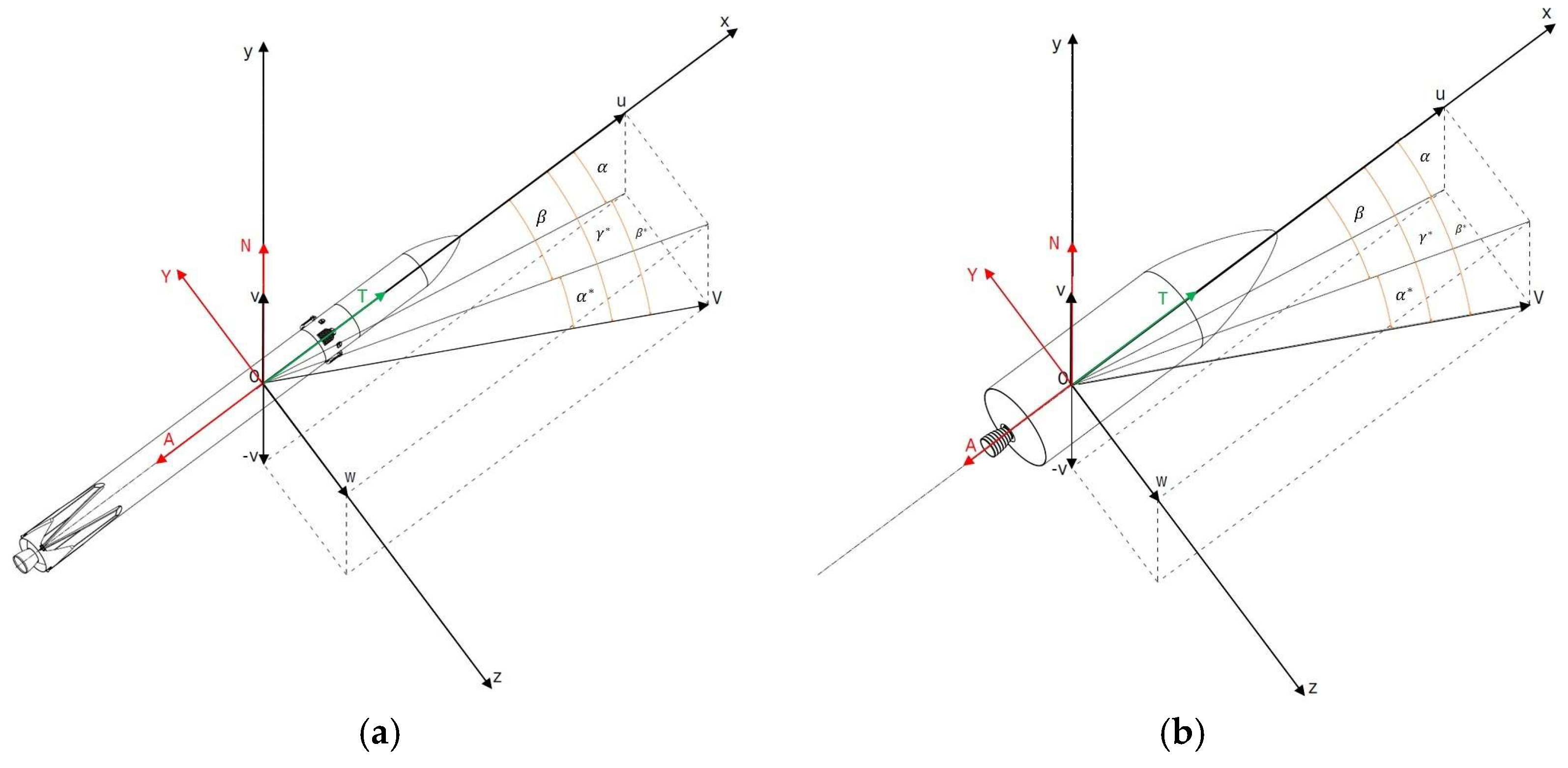
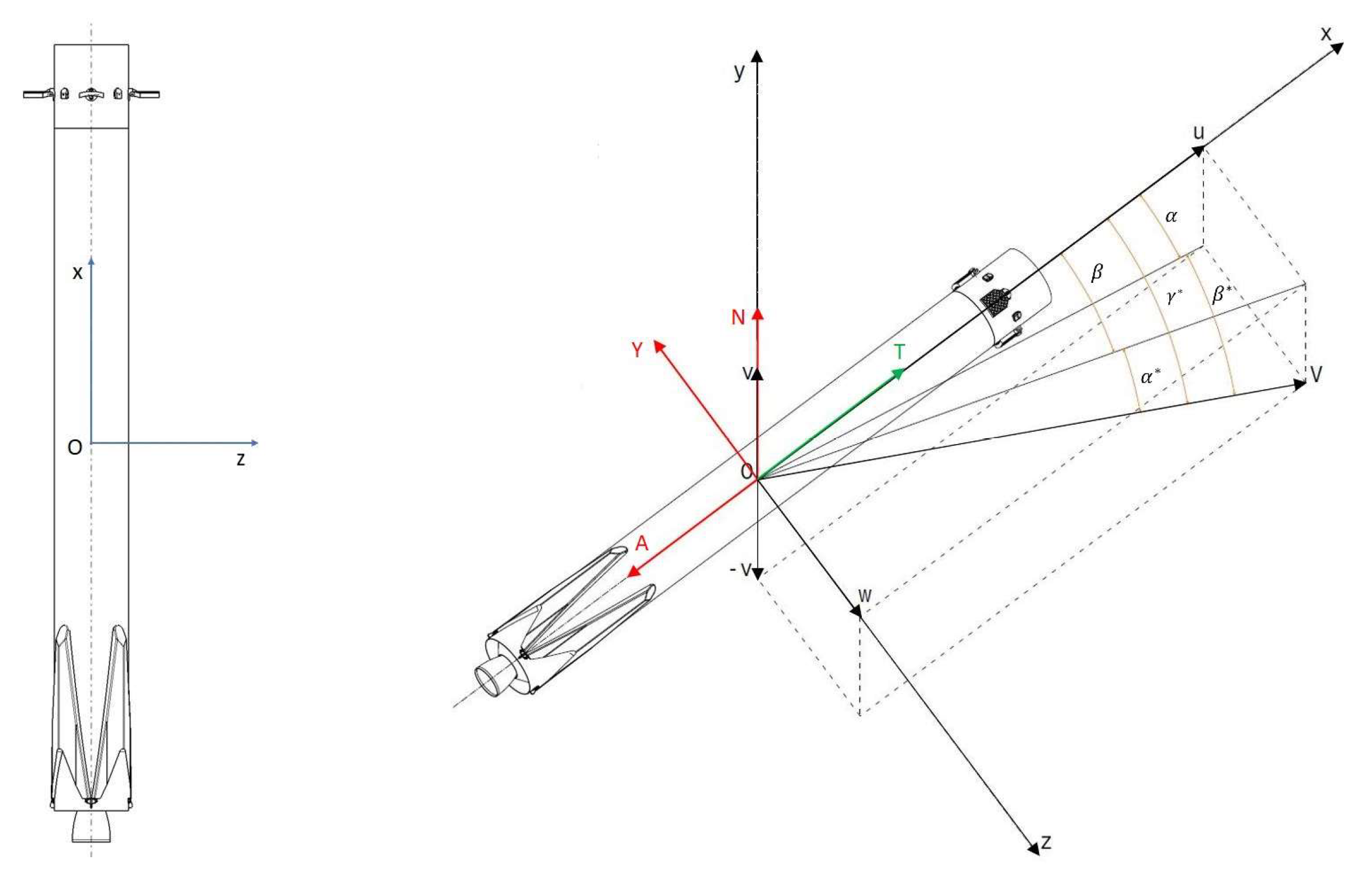
First, the aerodynamic and propulsive forces, which are necessary to obtain the projections of the applied force
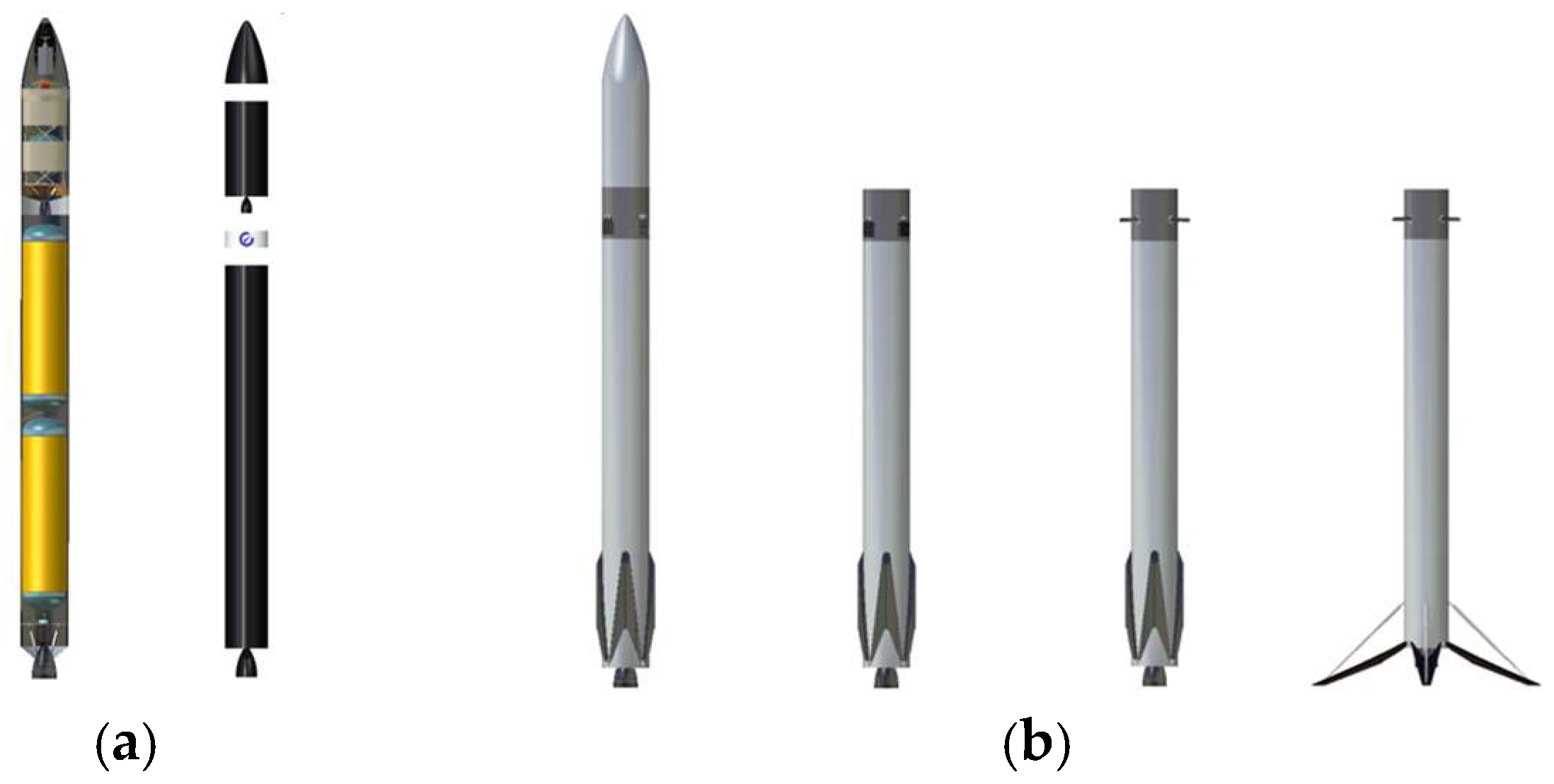
are detailed for the case of the microlauncher main mission. The two forces are initially evaluated in the body frame (detailed in
Figure 13); then, using the appropriate transformation matrix (details in [
94,
95]), their projections in the quasi-velocity frame are computed. As the microlauncher configuration changes over time (details in
Table 2), so does the body frame (
Figure 13a vs. b).
Since one of the assumptions of the 3DOF model used is that the thrust vector is along the launcher central axis, the definition of the propulsive force is very simple. In the body frame, the propulsive force
has the components
,
,
defined by
where
is the engine thrust (computed inside the Propulsion module).
Similar, according to
Figure 13, the aerodynamic force
has three components
,
,
that can be defined by
where
is the dynamic pressure,
is the reference area and
,
and
are the aerodynamic coefficients (computed inside the Aerodynamics module).
Additional attention must be given to the computation procedure for the aero forces because the aero contribution of the ACS and landing system must also be added on top of the “clean configuration” aero database. After computing the two external forces acting on the launcher (propulsion and aerodynamic) in the body frame, their projection in the quasi-velocity frame is realized with the aid of the rotation matrix
, with the particularity
[
1,
94,
95].
The orientation of the thrust vector relative to the velocity vector is described by the aerodynamic angles
and
, which can be viewed as control parameters of the system with which the trajectory flight path angle
and the track angle
can be controlled through feedback loop schemes, such as
where the reference target angles are
and
(both optimization variables, details in
Section 2.6.2) and
is a setting parameter.
For the orbital insertion maneuver, the system control parameters
and
are computed differently (with an increase in orbital performance) using [
1,
16]
where
represents the target orbit inclination,
and
are tuning/setting parameters and
is the command of the orbit-related reference system obtained by imposing the optimal maneuver condition (decrease in orbital eccentricity in minimum time). The parameter
is computed as follows [
1,
16]:
where
is current orbit eccentricity and
is the true anomaly. The correlations between the position and velocity vectors and the six classical orbital parameters are given in [
1].
The way in which the trajectory is generated and optimized inside the Trajectory module of the MDO algorithm is closely related to the altitude of the target orbit and the mass of the satellite, the main mission profile being slightly different depending on the chosen insertion method. For the case of microlaunchers (expendable or reusable), the use of a direct ascent to orbit (DATO) trajectory for the main mission is preferred due do the low altitudes associated (mainly Low Earth Orbit), together with the reduced complexity of the upper-stage engine which does not require consecutive restarts [
16]. Thus, the main mission profile implemented in this paper is that of a DATO trajectory.
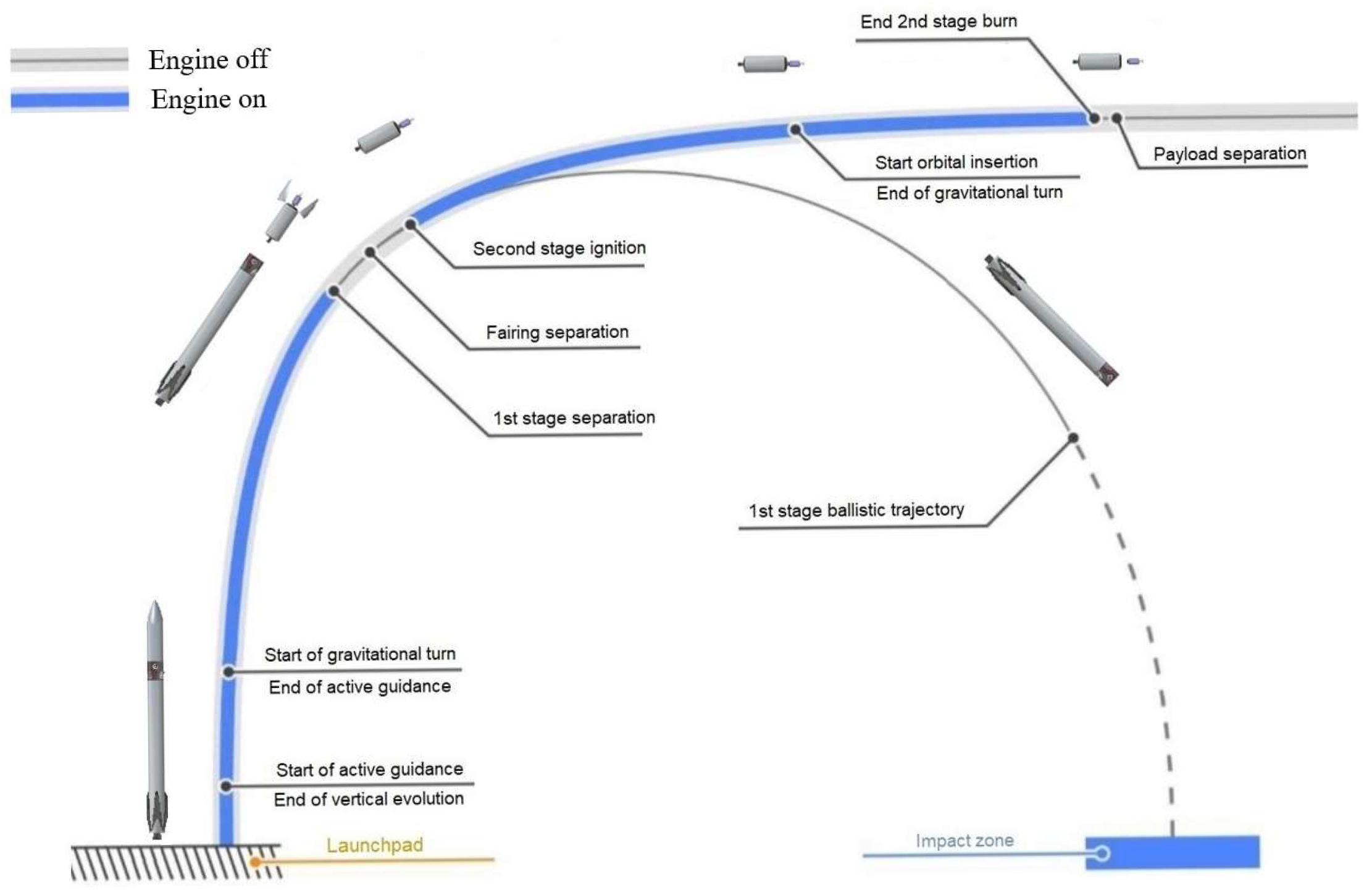
Multiple flight phases occur during the main mission of the launcher, each one having a particular impact on the system of Equation (48). The order in which they appear for a two-stage microlauncher concept [
94] is presented in
Figure 14 and mentioned next:
Vertical flight is the period right after launch, when the flight path angle is . The aerodynamic angles are both null.
Active guidance (primary): The launcher is actively tilted towards the imposed flight path angle . For a short period of time, the flight path angle is maintained constant such that the velocity vector aligns with the thrust vector. A path track angle is also imposed if the launch direction cannot allow the payload to be inserted into an orbit of certain inclination.
Gravity turn (primary): The normal load factor is zero as no applied lateral forces act on the launcher. The flight path angle decreases naturally due to the gravitational acceleration. The aerodynamic angles are both null.
First-stage separation (start of coast period): After the first-stage main mission propellant is used, the lower stage is separated to decrease the launcher mass. For an expendable launcher, the separated stage will follow a ballistic trajectory (as in
Figure 14). For a reusable first stage, this moment corresponds to the start of the recovery mission.
Fairing jettison: The fairing is separated from the microlauncher at an imposed condition (associated with either altitude, dynamic pressure or thermal heat flux [
94]), preferably in the coast period to limit any dynamic instabilities upon the launcher.
Second-stage ignition (end of coast period): At the end of the coast phase, the second-stage engine is ignited and starts to generate thrust.
Gravity turn (secondary): The gravity turn is continued for the new microlauncher configuration (without stage 1 and fairing).
Active guidance (orbital insertion): The flight path angle approaches the value (for a circular target orbit). The aerodynamic angles are computed based on Equation (53) and can be non-zero.
Payload separation: After the second-stage engine consumes all of the main mission propellant, the payload is separated and inserted into orbit.
2.4.2. Recovery Mission
As presented in
Figure 14, the main mission of the microlauncher does not include any computations related to the trajectory of the first stage after separation. In the case of an expendable launch vehicle, the lower stage usually follows a ballistic trajectory towards the ocean and is destroyed during atmospheric reentry and at impact. It is now of interest to present the recovery mission envisioned for the first stage in the case of a partially reusable microlauncher.
As methods of possible recovery, one can observe the rise of autonomous landing techniques versus more traditional methods, such as with the aid of parachutes in either an aerial capture recovery (RocketLab) or water splashdown recovery (PLD Space). In the current paper an autonomous landing is investigated as a baseline approach.
Two distinct mission profiles can be used for the recovery mission of the microlauncher lower stage, one in which the autonomous landing is performed at a secondary location (usually a barge in the ocean) and another one in which the first stage returns to the launch site (or in the close vicinity of it). Both mission profiles have been successfully performed by a launch vehicle (albeit not of small dimensions), in the case of the Falcon 9 launcher developed and operated by SpaceX [
33].
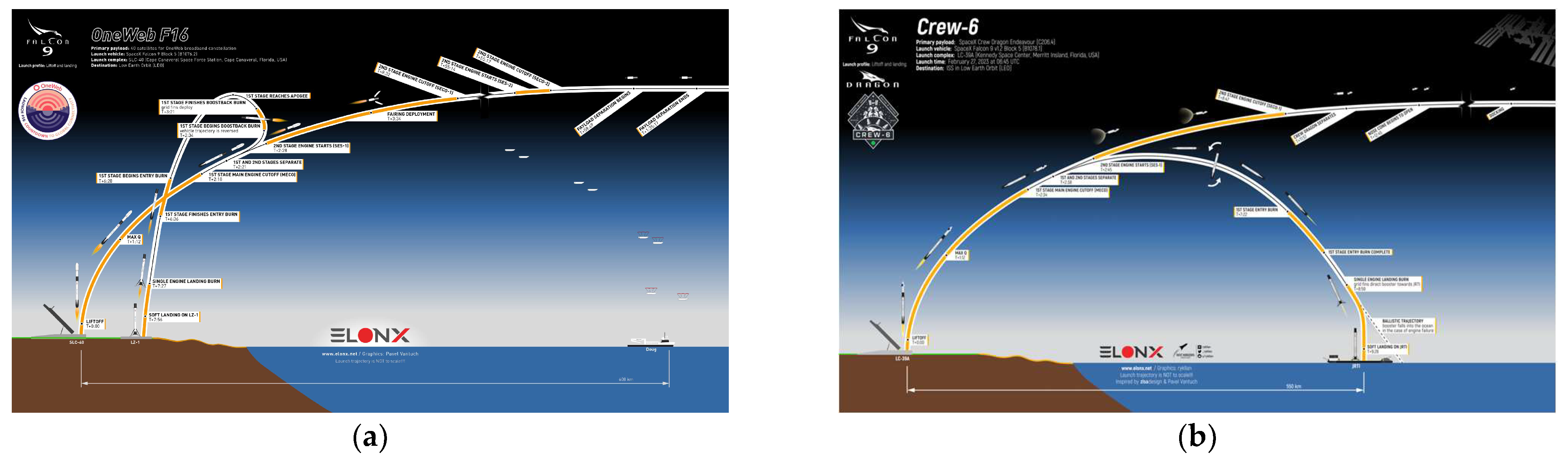
Figure 15a shows a representation of the reference trajectory (not to scale [
100]) used for the successful completion of the OneWeb F16 mission (with a return to launch site recovery), while
Figure 15b shows the same representation but now for the Crew-6 mission (with a downrange secondary location landing and recovery).
It can be easily seen that the complexity of the return to launch site recovery mission is much higher than that associated with the downrange recovery of the first stage. Both recovery missions are of course of interest, but as a starting point, the somewhat easier one will be implemented inside the MDO tool (secondary location recovery).
Regardless of the recovery mission profile, a stage flip-over maneuver is required, where the aerodynamic angle of attack increases rapidly from 0° to 180°. This flip-over maneuver after the lower stage has been separated from the microlauncher assembly is performed by an extra-atmospheric control system based on cold gas thrusters (RCS).
In the case of a stage downrange recovery (usually at a barge), after the flip-over maneuver, the lower stage has a (temporary) ballistic evolution towards the landing zone, which is briefly interrupted for the reentry burn, followed by an actively controlled evolution, through the activation of the aerodynamic control system (grid fin-based ACS), engine ignition for landing burn and deployment of landing gear.
Similar to the breakdown of the main mission trajectory into smaller flight phases, it is now of interest to explicitly mention critical events and evolution phases that occur during the recovery mission of the first stage. These are presented in
Table 4.
The start of the recovery mission corresponds to the first-stage separation which is performed after the first-stage propellant reserved for the main mission is burned. This moment is considered T0 and will be used as a reference point in the propagation of the recovery trajectory (where the first stage has a certain altitude, velocity, orientation, etc.).
After stage separation, the first ballistic evolution occurs, where the equations of motion are similar to the ones used in the gravity turn phases of the main mission. The flight path angle decreases naturally due to the gravitational acceleration, and the aerodynamic angles are both null.
The third flight phase corresponds to the flip-over maneuver of the first stage, a maneuver which is performed using the RCS at the apogee of the ballistic trajectory. After this moment, the RCS is considered to be in use only for small corrections. The angle of attack increases from 0° to 180°, while the sideslip angle is null.
The next important phase is the deployment of the aerodynamic control system (ACS), performed right after the flip-over maneuver is finalized. From this moment, the ACS is capable of modifying the attitude of the lower stage, but realistically is not activated (non-zero deflection angles) at high altitude because of the low performance.
The fifth flight phase corresponds to the second ballistic evolution, where the first stage continues its gravity turn. The flight path angle decreases naturally due to the gravitational acceleration. A value of is desired at stage touchdown.
The next phase of the recovery mission is the reentry burn, in which the rocket engine is restarted at a target altitude
(optimization variable, details in
Section 2.6.2) to slow down the lower stage. This maneuver is performed in a more rarefied atmosphere to limit the thermal load and protect the structural integrity of the reusable stage. The rocket engine is shut down at the completion of the reentry maneuver, when the amount of propellant available for this maneuver is consumed.
The seventh recovery mission phase is the aerodynamic guidance flight and corresponds to the period immediately following the reentry maneuver. The evolution can be seen as a semi-ballistic one, the rocket engine being turned off, the only method of changing the launcher’s attitude being by using the ACS.
The next milestone is the landing maneuver which is performed when the stage altitude drops below a preset threshold . At the start of the maneuver, the rocket engine is restarted. The maneuver is considered complete after the available propellant is consumed. During the last portion of the maneuver (a few seconds), the landing system is deployed. RCS and ACS allow small corrections for the stage attitude.
The final recovery mission phase (number 9) corresponds to stage touchdown and engine shutdown. When the altitude of the lower stage hits zero, the stage is considered to have landed. It is checked whether the vertical velocity of the stage at the moment of touchdown is below a critical threshold
. If a soft touchdown is realized (
) then the recovery mission is considered successful; otherwise, the landing maneuver has caused stage structural damage (how the violation of set constraints impacts the overall objection function is detailed in
Section 2.6.3).
Since the dynamic model used in the Trajectory module of the MDO is based on a 3DOF formulation and the studied configuration is approximated as a material point of variable mass, the system of differential Equation (48) can also be used for the case of a stage recovery mission. However, the major difference between studying a microlauncher configuration and a lower-stage configuration is given by the type (and magnitude) of applied force components
. For an easier definition of the applied forces, it is best to graphically represent the new body frame (previously presented in
Figure 13 for the microlauncher case) now for the lower-stage case. This is achieved in
Figure 16.
Since one of the assumptions of the 3DOF dynamic model used is that the thrust vector is along the vehicle central axis (either launcher or first stage), the propulsive force is computed exactly the same as for the microlauncher case defined in Equation (50).
In order to compute the aerodynamic force in the body frame
for the lower-stage case, we use a similar procedure to the one described for the microlauncher case (
Section 2.4.1). Equation (51) is still valid, but only for the flight phases where the ACS is not deployed (first-stage “clean configuration” + landing system contribution).
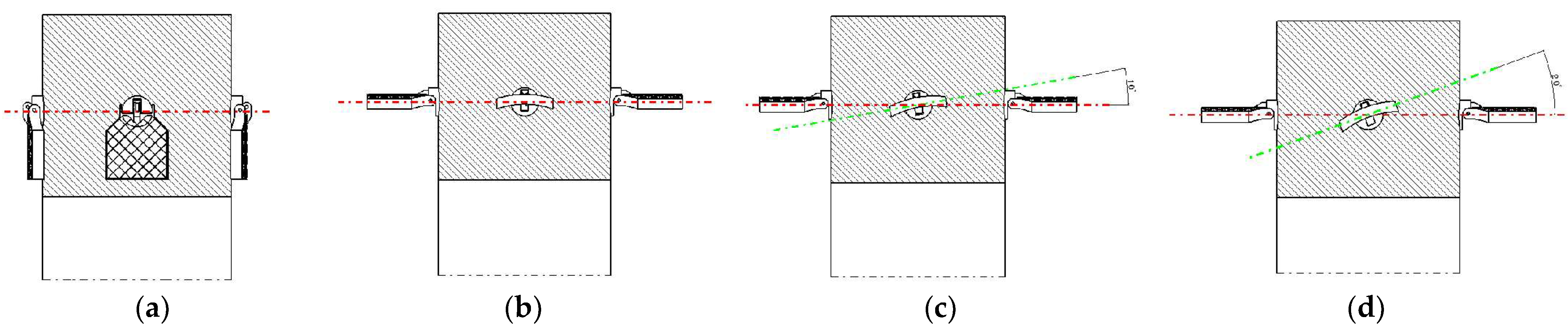
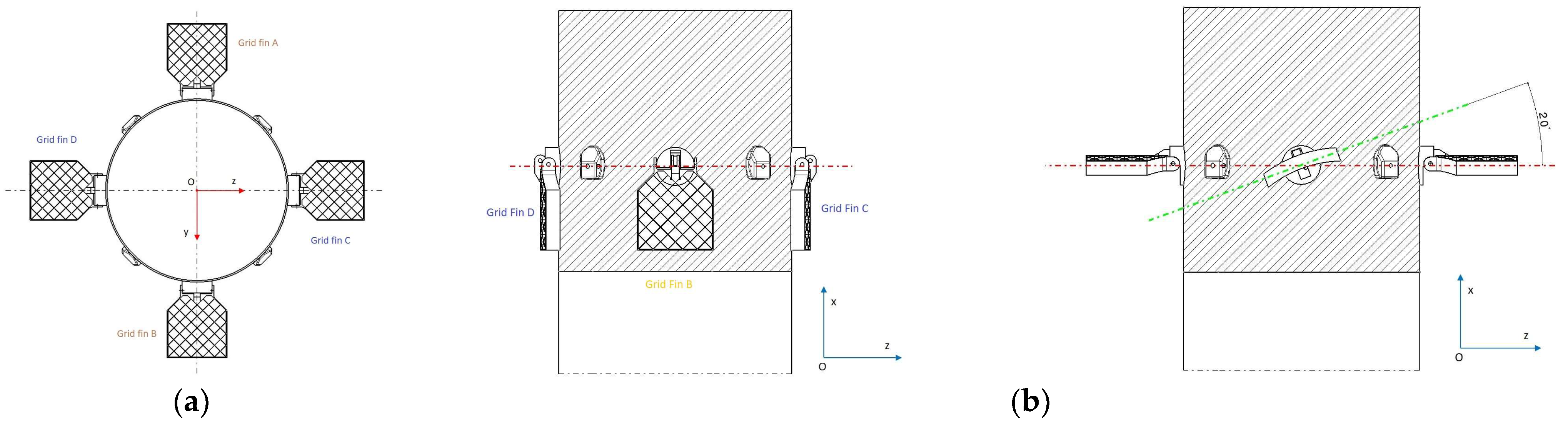
Additionally, one must express the aerodynamic forces generated by the grid-fin-based aerodynamic control system (ACS), noted with
. The grid fins are numbered as shown in
Figure 17a, while angle convention is shown in
Figure 17b.
In the body frame, the aerodynamic force given by the ACS (
) has the components
,
,
defined by
By using the sign convention from
Figure 17, grid fin contributions are written as
where
is the dynamic pressure,
is the reference area and
are the aerodynamic coefficients in the body frame (computed based on the data from [
68]).
The way in which the control is achieved during the recovery mission is directly related to the flight phases presented in
Table 4. When the engine is on, full-throttle setting is considered and no additional control scheme dependent on the aerodynamic angles is used during reentry or landing burns (like Equations (52) and (53) for the microlauncher).
For this paper, it was considered that the RCS manages to rotate the lower stage to predefined values instantaneously, the rotational dynamics of the lower stage not being simulated (because of the 3DOF environment); thus, the attitude variation is treated as a sudden change in the angle of attack (for example, the angle of attack increases from 0° to 180° during the flip-over maneuver instantaneously).
The ACS is deployed (but not activated) after the flip-over maneuver, the first stage angle of attack being approximately 180° for the rest of the descent trajectory. At the moment, no control laws are implemented for the active aero phases of the recovery mission (as it was observed later that a successful landing and recovery of the first stage from a secondary location can be achieved without active aero control, the grid fin being considered to be at a constant 0° deflection angle). This is mainly because the landing location (or downrange) was not imposed before the mission definition, but rather defined after trajectory optimization and used as reference for any real-world application.




 ,
,