1. Introduction
In recent years, heterogeneous constellations [
1], including SpaceX’s Starlink, have developed rapidly. The heterogeneous constellations are composed of several sub-constellations at different orbital altitudes. The heterogeneous constellations provide network services to the whole world. Also, they can be used as measurement and control terminals to effectively alleviate shortages of ground-based measuring and control resources [
2]. As a transmission bridge between satellites in the constellations, an inter-satellite link is one of the key technologies in space-based information networks [
3].
Inter-satellite link technology is essential for improving the accuracy, efficiency, and autonomous capability of a multi-satellite system, such as a global navigation system. After the construction of inter-satellite links throughout the entire constellation, high-accuracy orbital parameters can be autonomously broadcast in the system. Chen et al. [
4] and Li et al. [
5] proposed efficient measuring methods for multi-layer constellations using an inter-satellite link. Lin et al. improved the navigation accuracy by updating the ephemeris frequently [
6]. The ephemeris can be injected using the inter-satellite link of the constellation. Meanwhile, inter-satellite link technology can improve autonomous navigation performance with respect to user terminals in complex environments. Lin et al. [
7], Fernandez [
8], and Zhang et al. [
9] studied completely autonomous navigation technologies. Traditional ground infrastructures can be replaced by inter-satellite links, which further reduce the operation cost. Moreover, the inter-satellite link can be employed in other applications. Xie et al. estimated the yaw angle of a satellite using an inter-satellite link [
10]. Without introducing new parameters, the estimation accuracy can be improved by adding redundant observations. Zhang et al. eliminated the effect of empirical weight on the fusion data processing, thereby increasing the orbit determination accuracy [
11]. Kur et al. [
12] and Michalak et al. [
13] studied high-precision clock synchronous correction methods. According to previous studies, a precondition for employing an inter-satellite link is that the link equipment of the constellations is in a consistent state, which guarantees continuity and reliability. Therefore, high-confidence verifications of the performance of an inter-satellite link should be conducted. However, current studies do not involve an efficient in-orbit test method for the performance of a constellation’s inter-satellite link, especially when the constellation is still under construction. This restricts the rapid iteration and further development of the inter-satellite link technology for mega-constellations.
In practical missions, the in-orbit test of an inter-satellite link’s performance concentrates on the pointing and tracking abilities of a satellite in an operation state. Typical inter-satellite link transmission mainly involves microwave and laser equipment, which are widely used for data projection and relay [
14,
15]. The microwave beam is wide, but the transmission rate is low [
16,
17,
18]. Laser beams show high-speed and strong anti-interference ability, enabling efficient and accurate transmissions between satellites. The test methods for this equipment have been studied. Schlicht et al. completed the test of orbit determination for the Galileo spacecraft based on two-way laser inter-satellite links [
19,
20]. The results show that the orbit determination efficiency via an inter-satellite link is related to the visibility of the other satellites in the constellation. Scheinfeild et al. analyzed multiple search methods, such as scan/gaze and scan/scan [
21]. The influences of a satellite’s structural vibration on the inter-satellite links were studied. A compensatory method was then developed to eliminate deviations between the pointing vectors of the transmitter and the receiver telescope. To achieve high-accuracy signal capture and tracking, both the microwave and laser in the above research required the altitude of the satellite to calculate the inter-satellite link pointing angle [
21,
22]. In-orbit tests are carried out accordingly [
23]. Teng et al. studied the method of calculating the pointing angles of transmission devices based on the topology architecture and routing of the constellation and the ephemeris of the satellite. The solutions for the pointing angles are uploaded to the spaceborne computer and executed. By comparing the in-orbit results and the calculation results, the performance of the pointing and tracking are validated. The review by Lin et al. carried out recapture studies on inter-satellite laser links, considering a pointing error model of multipoint link terminals [
24]. The results showed that subsequent research on inter-satellite links should optimize the scanning capture parameters of inter-satellite laser links.
Current studies on the in-orbit test methods for inter-satellite links’ performance highlight constellations that have been constructed. However, the construction of mega-constellations always takes several years [
25,
26]. During the construction of the constellation, due to the loose distribution of the satellites, the distance and visibility between satellites might not satisfy the constraints for establishing an inter-satellite link [
27]. Meanwhile, an inter-satellite link’s performance should be tested in advance so that the construction of the constellation can be more flexible and confident. Therefore, the test method for a single satellite’s pointing and tracking abilities has potential in practical missions.
In this paper, a ground-station-based high-confidence test method for inter-satellite link pointing and tracking performances with respect to a single satellite is developed. During the construction of the constellation, due to the insufficiency of inter-satellite linking resources, the pointing and tracking abilities of the in-orbit satellite cannot be tested immediately. The ground station has the ability to construct a link with the in-orbit satellite, which can be employed to simulate the inter-satellite transmission. The test for a single satellite’s pointing and tracking abilities involves using multiple ground stations. The contributions of this paper are summarized as follows: (1) A practical mission scenario for testing an inter-satellite link’s performance is established. A local satellite and a target satellite are introduced as a signal projector and receiver, respectively. The motion of the beam of the local satellite during the tracking is described by the rotation angle and the off-axis angle. (2) A virtual target satellite for testing an inter-satellite link is proposed. The signal-receiving process of the virtual satellite is simulated by two ground stations. The orbit of the virtual satellite is analytically derived. The time difference between two transmissions with different ground stations is solved based on a Newton–Raphson method. (3) A test method for inter-satellite link pointing and tracking is proposed. Based on the virtual target satellite, the corresponding rotation angles, and off-axis angles with respect to the ground stations are obtained. During the inter-satellite link test, considering the time difference between ground stations receiving the signals from the local satellite, the inter-satellite link pointing and tracking abilities are evaluated.
The rest of this paper is organized as follows:
Section 2 presents the models of pointing vectors and pointing angles for establishing an inter-satellite link. In
Section 3, the design method for a virtual target satellite via two ground stations is developed. The test method for inter-satellite link pointing and tracking is provided. The design of the virtual satellite and the test method for its pointing and tracking abilities are validated through numerical simulations in
Section 4. Finally,
Section 5 draws a conclusion of this paper.
3. Inter-Satellite Links Pointing and Tracking in-Orbit Test Method
3.1. Test Method for Single Satellite’s Inter-Satellite Link Pointing and Tracking
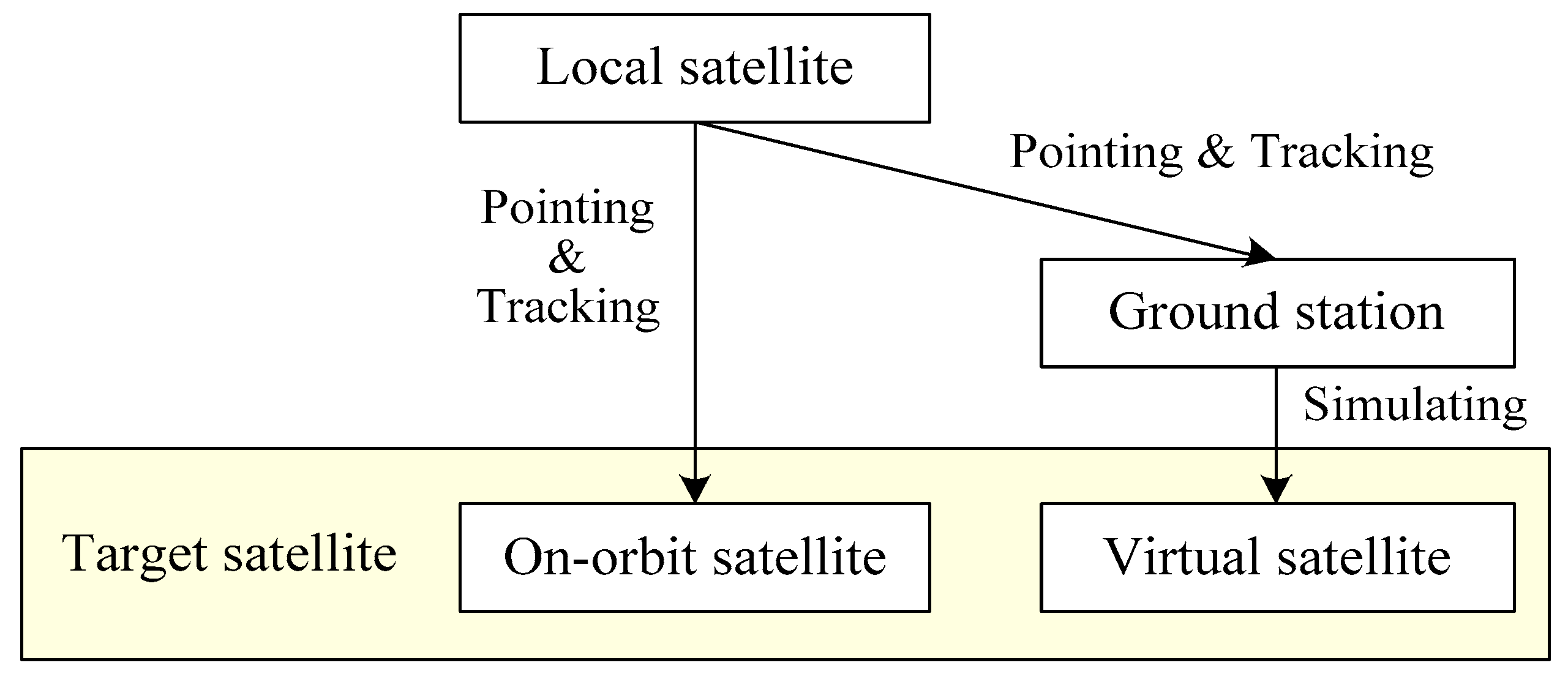
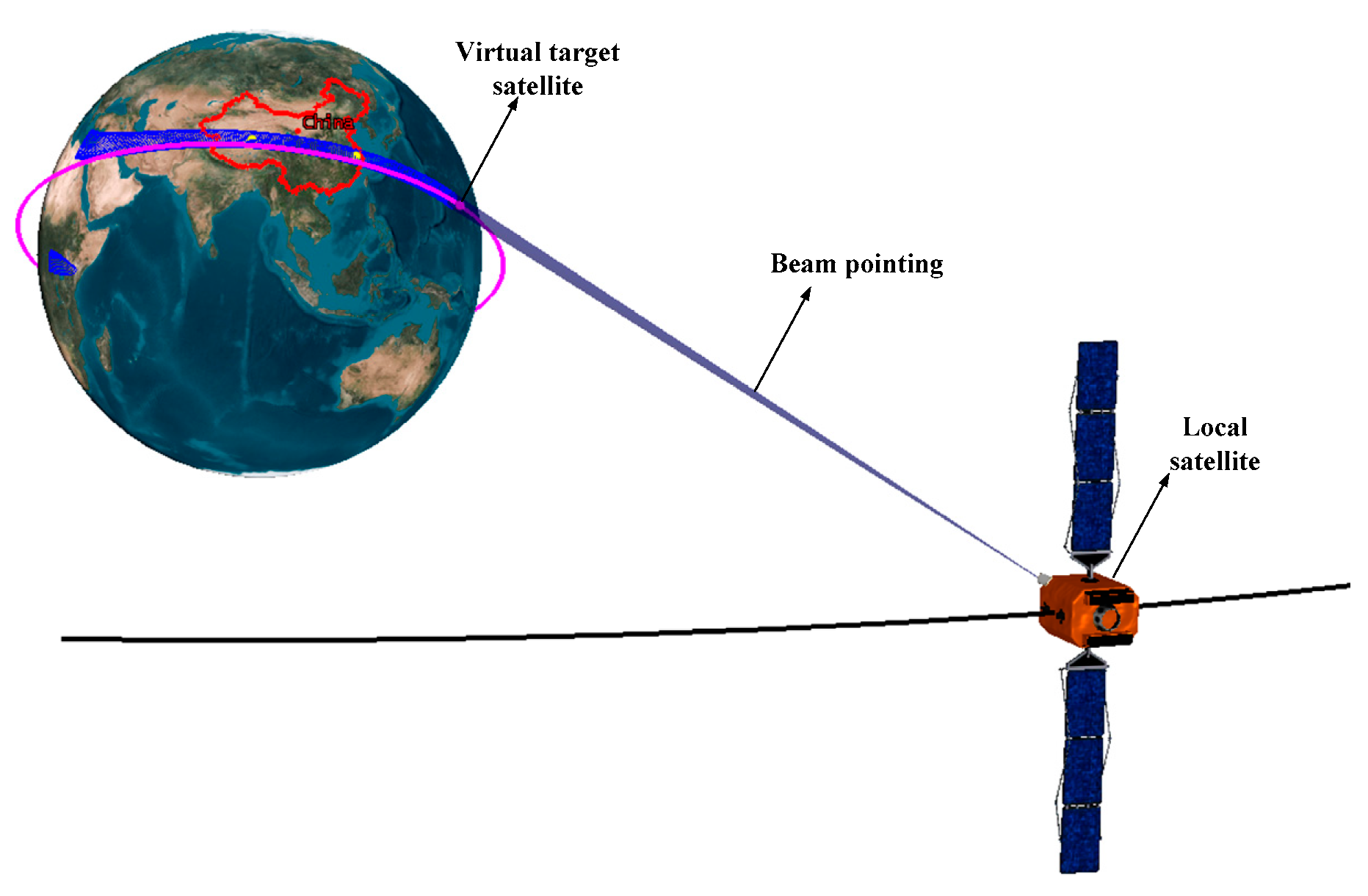
In order to validate the performance of the inter-satellite link in the current test method, the local satellite points and tracks an in-orbit target satellite. However, during the construction of the constellation, the distribution of the satellites might not satisfy the constraints for testing the inter-satellite link. In the present paper, an indirect test method for inter-satellite link pointing and tracking based on ground stations and a virtual satellite is developed. This indirect test process is shown in
Figure 2.
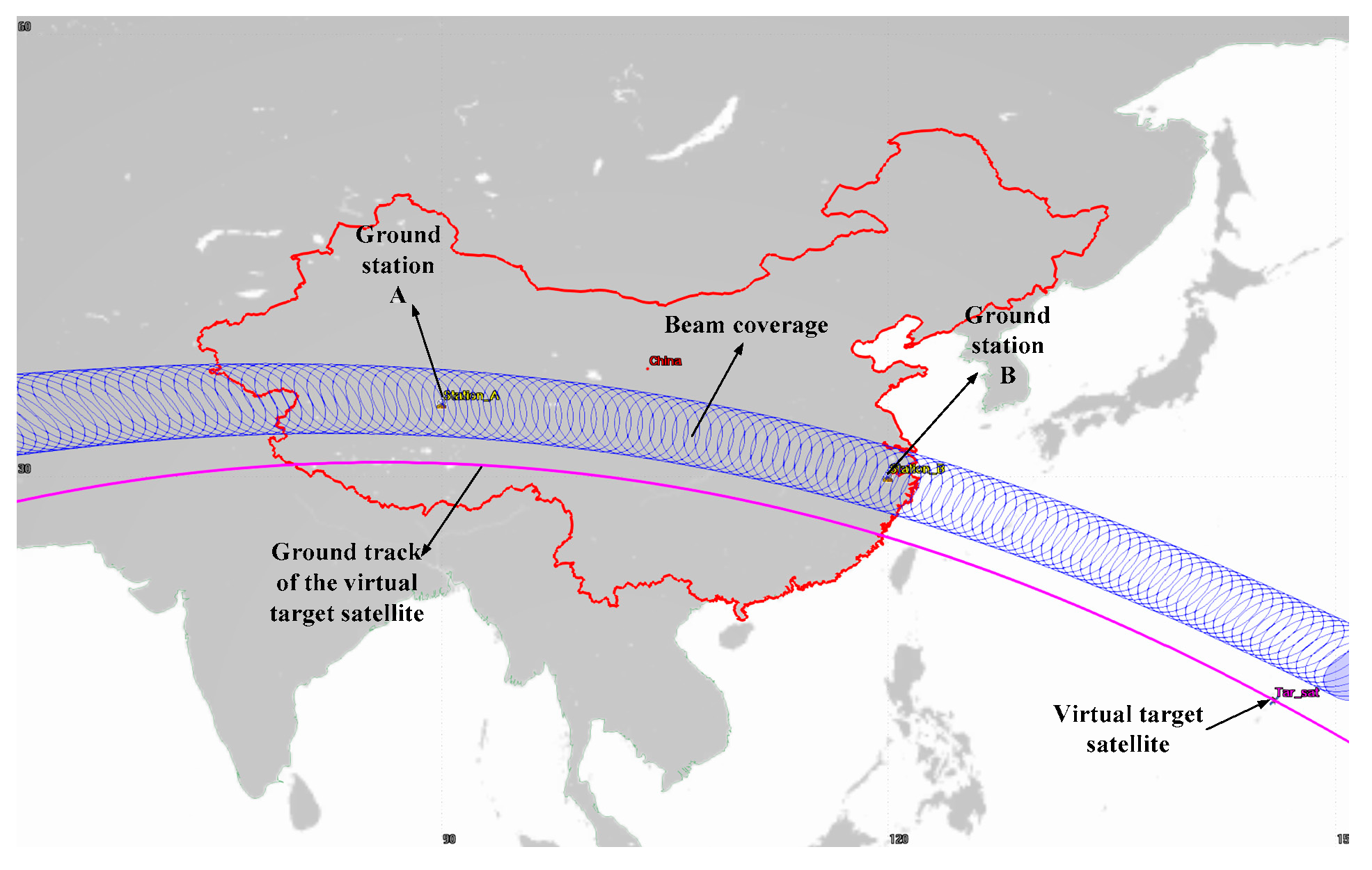
Due to the lack of an in-orbit target satellite, the ground stations are introduced to simulate the positions of the virtual target satellite. The ground stations have capacities for receiving signals from the local satellite and calculating the time difference in signal reception between the two ground stations. Therefore, by pointing and tracking two ground stations, the local satellite indirectly validates the process of tracking the target satellite. In this situation, the corresponding orbit of the virtual target satellite is generated according to the visibilities between the local satellite and the ground stations. A detailed design method for the virtual satellite is provided in
Section 3.2.
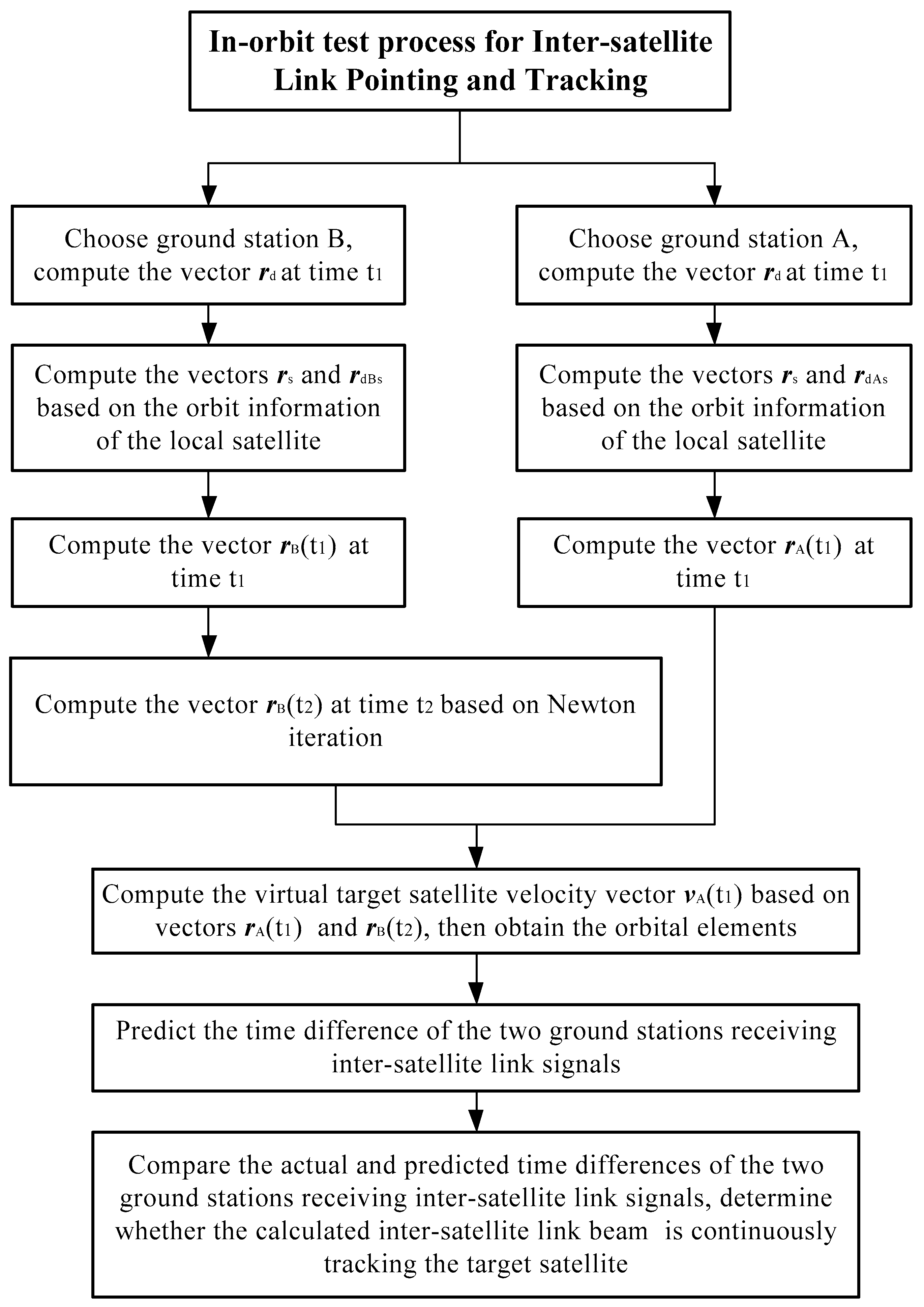
Based on the ground station and the virtual satellite, the basic flow of the indirect test method is shown in
Figure 3. The test method for inter-satellite link pointing and tracking is divided into the following steps:
- (1)
Choose two ground stations: A and B. Set time t1 when the local satellite points to ground station A, according to practical requirements. Then, propagate the positions of the ground stations rd at time t1;
- (2)
Calculate the position of the local satellite rs and the relative positions between the local satellite and the ground stations rdAs, rdBs. The positions rA(t1) and rB(t1) of the virtual target satellites with respect to ground stations A and B, respectively, are obtained at time t1;
- (3)
Calculate the time
t2 when the local satellite points to ground station B and the corresponding position
rB(
t2) of the virtual target satellite, based on a Newton iteration method. The time difference between pointing to ground stations A and B is obtained. A detailed method is provided in
Section 3.3;
- (4)
Calculate the velocity of the virtual target satellite
vA. The orbit of the virtual target satellite is obtained. A detailed calculation method is provided in
Section 3.4;
- (5)
Predict the time difference between two ground stations receiving the signals from the local satellite. Then, the pointing and tracking of the local satellite with respect to the ground stations is executed in-orbit. The actual time difference is also obtained. By comparing the actual time difference and predicted time difference, the inter-satellite link pointing and tracking abilities of the local satellite are verified.
Moreover, in order to test the inter-satellite link pointing and tracking performance, the virtual satellite should be similar to a practical satellite. Therefore, taking a practical constellation as a reference, the orbital altitude h0 of the virtual target satellite is set the same as the practical satellite to establish the inter-satellite link. The eccentricity is set as 0. Other orbital elements, including the right ascension of the ascending node, the argument of perigee, and the true anomaly, are solved by iterating steps (3)–(4). The orbital period of the virtual target satellite is denoted as . The angular velocity can be obtained as .
While tracking the virtual target satellite, when the beam points to the virtual target satellite and ground station simultaneously, the single local satellite transmits signals to ground stations A and B. In this situation, a high-confidence test for a single satellite’s inter-satellite link pointing and tracking can be executed. Note that in practical missions, for inter-satellite links with larger beam angles, the time needed for constructing a link to the ground station is longer; for laser inter-satellite links, the link-construction time is shorter. The proposed method can test both kinds of link pointing.
3.2. Virtual Target Satellite Based on Ground Stations
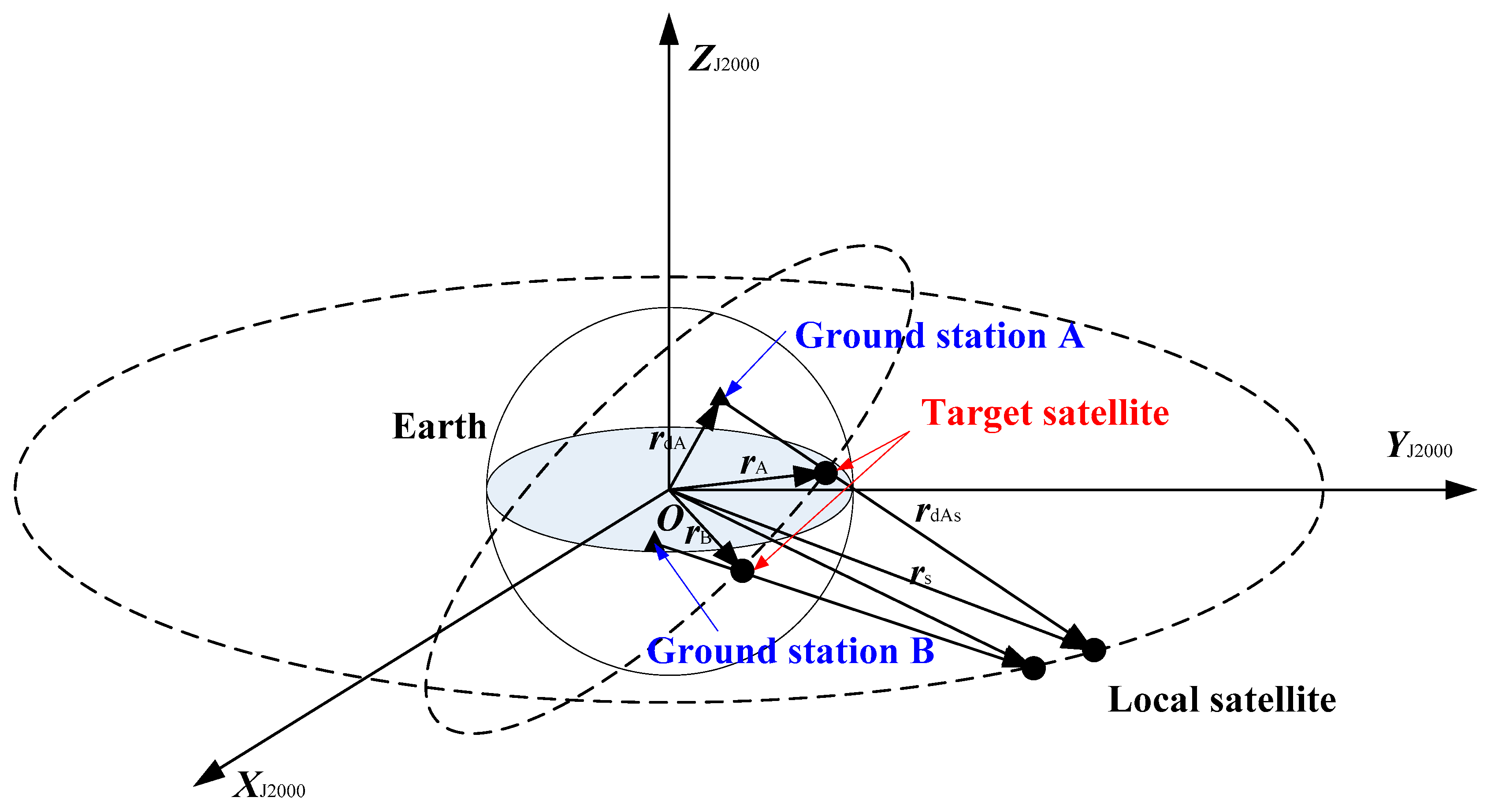
In the present paper, the inter-satellite link pointing and tracking performance is tested using a virtual target satellite. A practical way to generate a virtual target satellite is by simulating the signal-receiving process and forming a virtual orbit around two ground stations. The geometry of the inter-satellite link via the virtual satellite is shown in
Figure 4.
In
Figure 4, the ground stations are defined as A and B to simulate the virtual target satellite orbit. Taking ground station A as an example, the position vector of ground station A
in the Earth-fixed coordinate system is given as follows:
where
, and
denote the longitude, latitude, and altitude of the ground station, respectively, and
is the oblateness of the Earth.
is denoted as follows:
where
is the radius of the Earth, and
km.
Then, the position vector of the ground station
in the J2000 geocentric inertial frame at time
is obtained as follows:
where
defines the transformation from the Earth-fixed coordinate frame to the J2000 geocentric frame.
Meanwhile, the position vector of the local satellite in the J2000 geocentric frame at time
is shown as follows:
where
,
,
,
,
, and
represent the semi-major axis, eccentricity, inclination, right ascension of ascending node, argument of perigee, and true anomaly of the local satellite, respectively;
represents the argument of latitude,
; and
represents the geocentric distance of the local satellite,
,
.
The relative position
from the ground station A to the local satellite in the J2000 geocentric frame at time
can be calculated as follows:
Then, as shown in
Figure 4, in order to simulate the position of the virtual target satellite using a ground station, the local satellite should be simultaneously linked to the ground station and the virtual satellite. In this situation, the local satellite, the virtual target satellite, and the ground station should be triple-collinear as follows:
where
denotes the orbital altitude of the virtual target satellite;
denotes the position vector of the virtual satellite in the J2000 geocentric frame at time
; and
.
In addition, it should be emphasized that in practical missions, the beam of the local satellite’s antenna is a cone with a small angle. In this situation, the ground station can still receive the signal from the local satellite for an extended period.
To solve Equation (14), the parameters are defined as follows:
The solution of Equation (14) can be derived as:
According to the geometry, the space vector pointing from the geocentric to the virtual target satellite at time
in the J2000 coordinate system is obtained as follows:
For the ground station B, the same algorithm is used:
where
represents the position vector of station B in the J2000 geocentric frame at time
; and
represents the relative position vector from the ground station B to the local satellite.
3.3. Time Difference in Tracking Based on Newton–Raphson Method
According to the test process for a single satellite’s inter-satellite link pointing and tracking, the local satellite first points to ground station A at time t1 and then points to ground station B at time t2. Since the maneuvers of the antenna and the altitude of the satellite are not instantaneous, the time difference Δt between the local satellite points to ground station A and to ground station B should be considered, Δt = t2 − t1. The Newton–Raphson method is employed to calculate the time when the local satellite points to the ground station B t2 and the time difference Δt. Then, the position vector of the virtual target satellite at time is propagated.
The Newton–Raphson method is a typical root-finding algorithm that solves the next value using current values. The main steps of the Newton–Raphson method are as follows:
- (1)
Determine the iteration variable;
- (2)
Establish an iterative relationship by recursion or by working backward;
- (3)
Set a fixed number of loops to end the iterative process to achieve control of the iterative process.
Based on the Newton–Raphson method, an iterative method to solve the position vector
of the virtual satellite at time
and the time difference Δ
t =
t2 −
t1 is developed. The initial time of t2 is set as the time
t1. In this situation, the position of the virtual target satellite is obtained as
rB(
t1). The time difference
of the virtual target satellite from
to
can be calculated as follows:
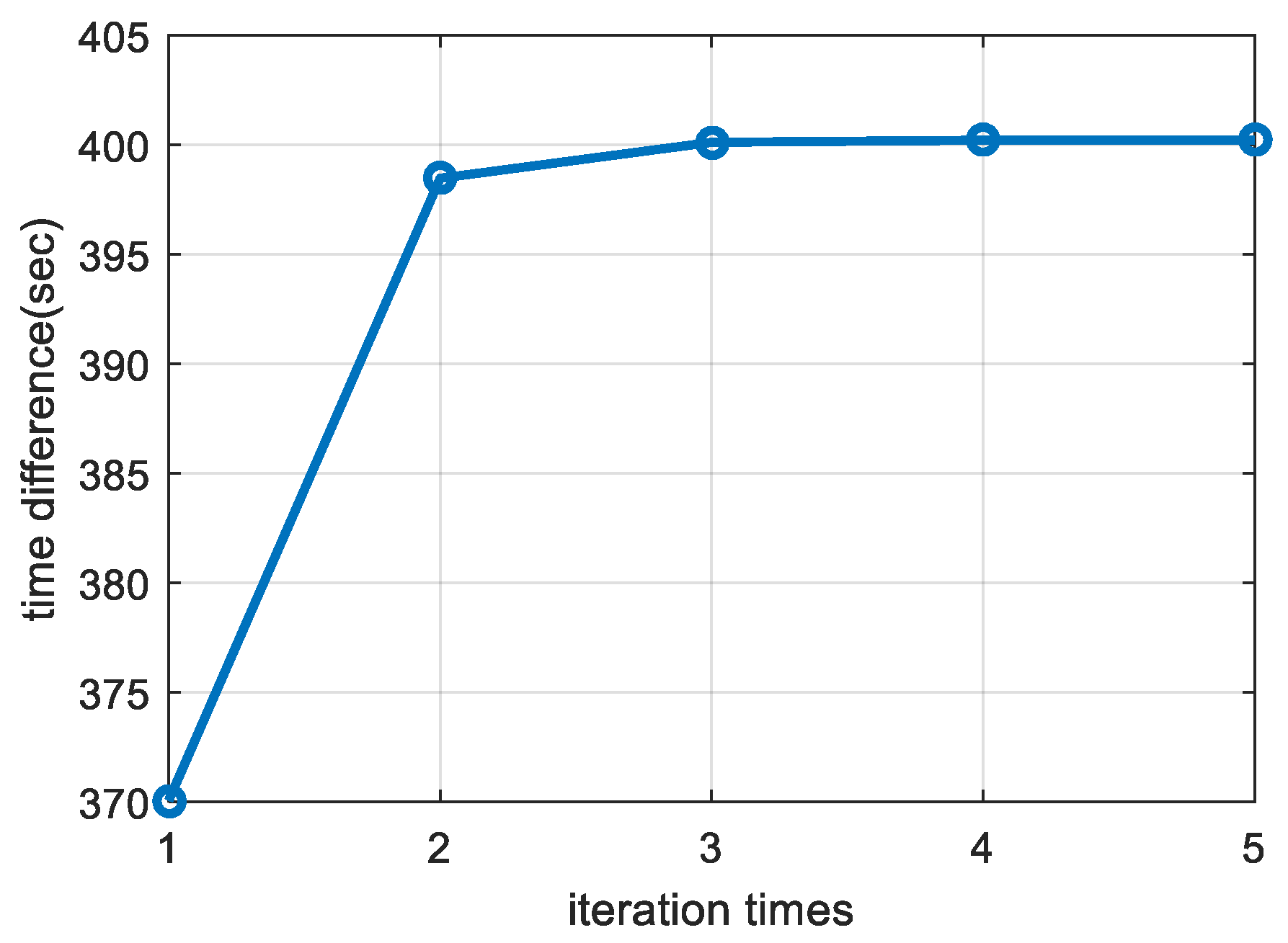
Subsequently, a new position is obtained using the time difference . Based on the Newton–Raphson method, the position of the virtual satellite is iteratively updated from to until the time difference converges at a fixed value. Meanwhile, considering both the computation efficiency and position accuracy, a fixed number of loops is set as five. After five iterations, the convergence error of time t2 is about 10−5–10−7 s (based on the altitudes of local and target satellites), which is observable in practical missions.
3.4. Characterization of Virtual Target Satellite Orbit Based on Double Vectors
In order to solve the orbital parameters of the virtual target satellite, a characterization method is provided using the position and velocity at a particular moment.
For circular orbits, based on the orbital altitude and angular velocity, the norm of flight velocity of the virtual target satellite is given as follows:
The direction of the velocity vector
of the virtual target satellite at time
in the J2000 is obtained using the cross product of position vectors
and
. The angular momentum vector
is denoted as:
According to triangulation theory, the position vectors of the ground stations
rA(
t) and
rB(
t) should be non-collinear. The velocity vector of the virtual target satellite at time
is obtained as
Using the satellite position vector and the velocity vector at the time , the orbital parameters of the virtual target satellite orbits can be obtained.
5. Conclusions
The test method for a single satellite’s pointing and tracking abilities with respect to the inter-satellite link is studied. The proposed method is available for multiple types of transmission equipment, such as microwaves and lasers. The rotation angle and off-axis angle for the inter-satellite link pointing and tracking of local and target satellites are derived. The virtual target satellite is simulated by two ground stations. The orbit of the virtual satellite is obtained according to the desired orbital altitude. The time difference between the two ground stations’ pointings is solved through several iterations. The pointing and tracking abilities of the local satellite are evaluated by comparing the actual time differences between the ground stations receiving the signals to the theoretical time difference, which achieves an independently in-orbit test of inter-satellite performance.
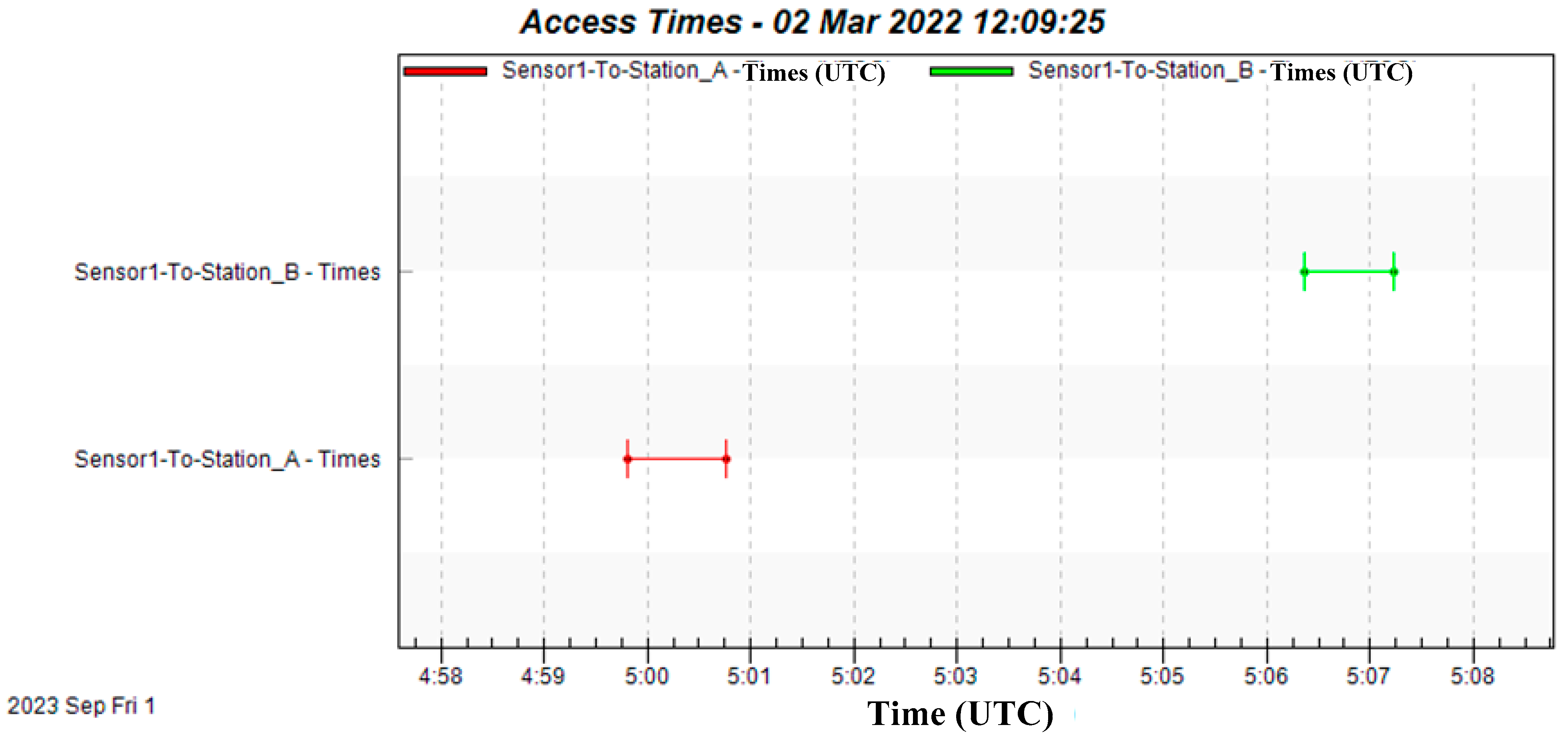
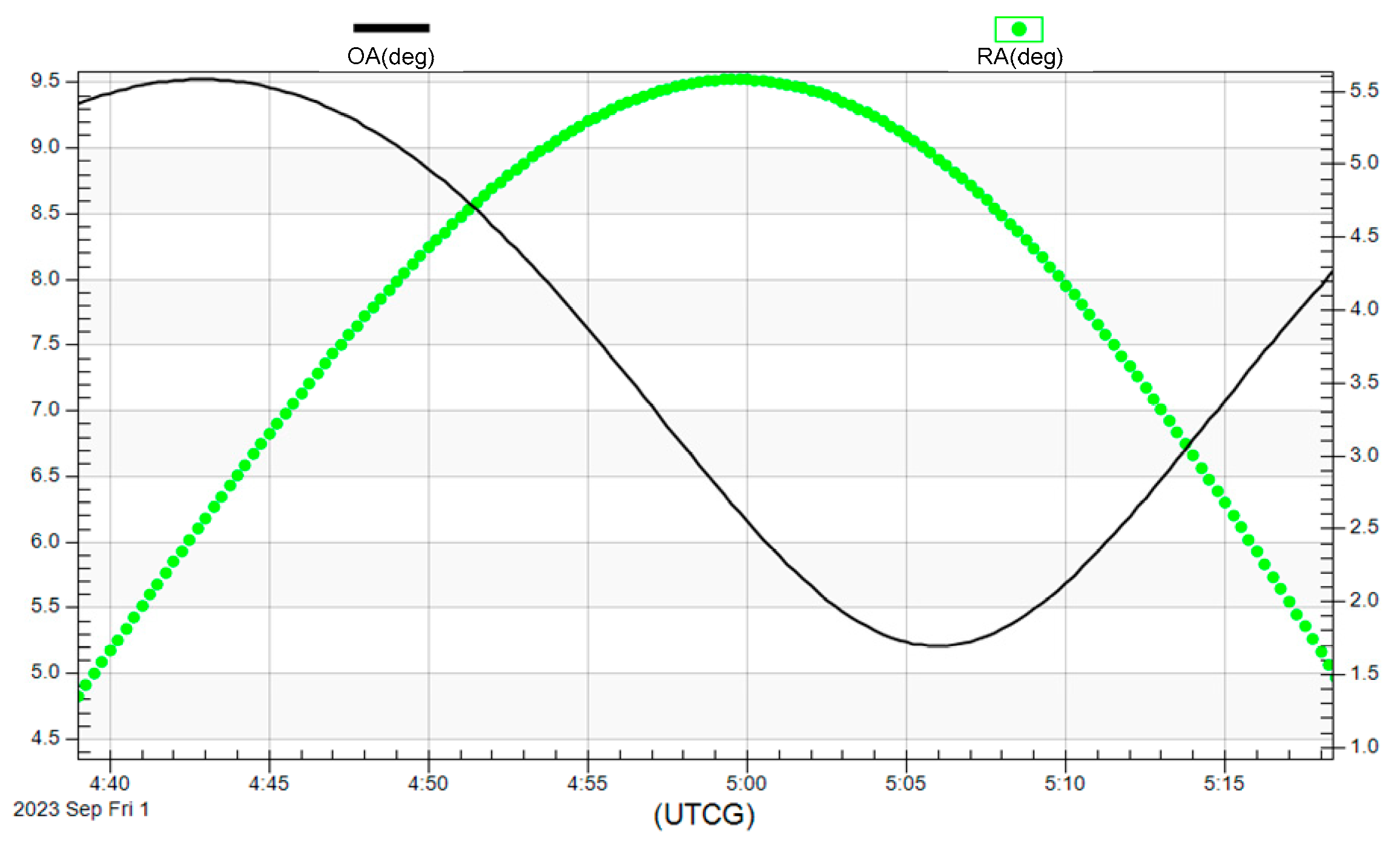
According to the simulation results, the final error in the time difference in the virtual target satellite is 5 ms, which suggests that two ground stations can simulate the motion of a virtual target satellite. The time windows for establishing links with ground stations A and B are about 56.9 s and 52.8 s, respectively. The off-axis angle and rotation angle for pointing to station A are about 6.6° and 5.2°, while those for pointing to station B are about 5.2° and 5.0°, respectively. Considering a 0.3° half-beam angle, the time difference is about 390 s, which approximates the theoretical value of 400 s. These results demonstrate that the pointing and tracking abilities of the satellite satisfy the demands for establishing an inter-satellite link.