
Article

Potential Impacts of Climate Change on the Richness and Distribution of Endemic Anurans from the Montane Cloud Forest of Mexico

by
Claudia Ballesteros-Barrera
1,*,
Oscar Tapia-Pérez
1,
Adrián Leyte-Manrique
2,
Angélica Martínez-Bernal
1,
Rocío Zárate-Hernández
1,
Bárbara Vargas-Miranda
1,
Matías Martínez-Coronel
1 and
Selene Ortiz-Burgos
3
1
División de Ciencias Biológicas y de la Salud, Universidad Autónoma Metropolitana, Unidad Iztapalapa, Avenida Ferrocarril San Rafael Atlixco, Número 186, Colonia Leyes de Reforma 1 A Sección, Ciudad de Mexico CP 09340, Mexico
2
Laboratorio de Biología, Tecnológico Nacional de Mexico, Campus Salvatierra, Calle Manuel Gómez Morin No. 300, Comunidad de Janicho, Salvatierra CP 38966, Mexico
3
Facultad de Ciencias, Universidad Nacional Autónoma de México, Avenida Universidad 3000, Circuito Exterior S/N, Ciudad de Mexico CP 04510, Mexico
*
Author to whom correspondence should be addressed.
Climate 2026, 14(6), 114; https://doi.org/10.3390/cli14060114
Submission received: 19 April 2026 / Revised: 19 May 2026 / Accepted: 21 May 2026 / Published: 29 May 2026
(This article belongs to the Special Issue Ecological Modeling for Adaptation to Climate Change)

Abstract

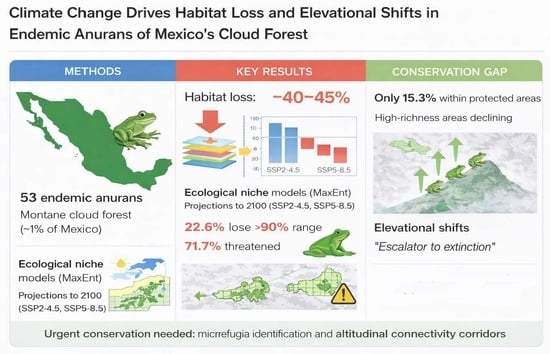
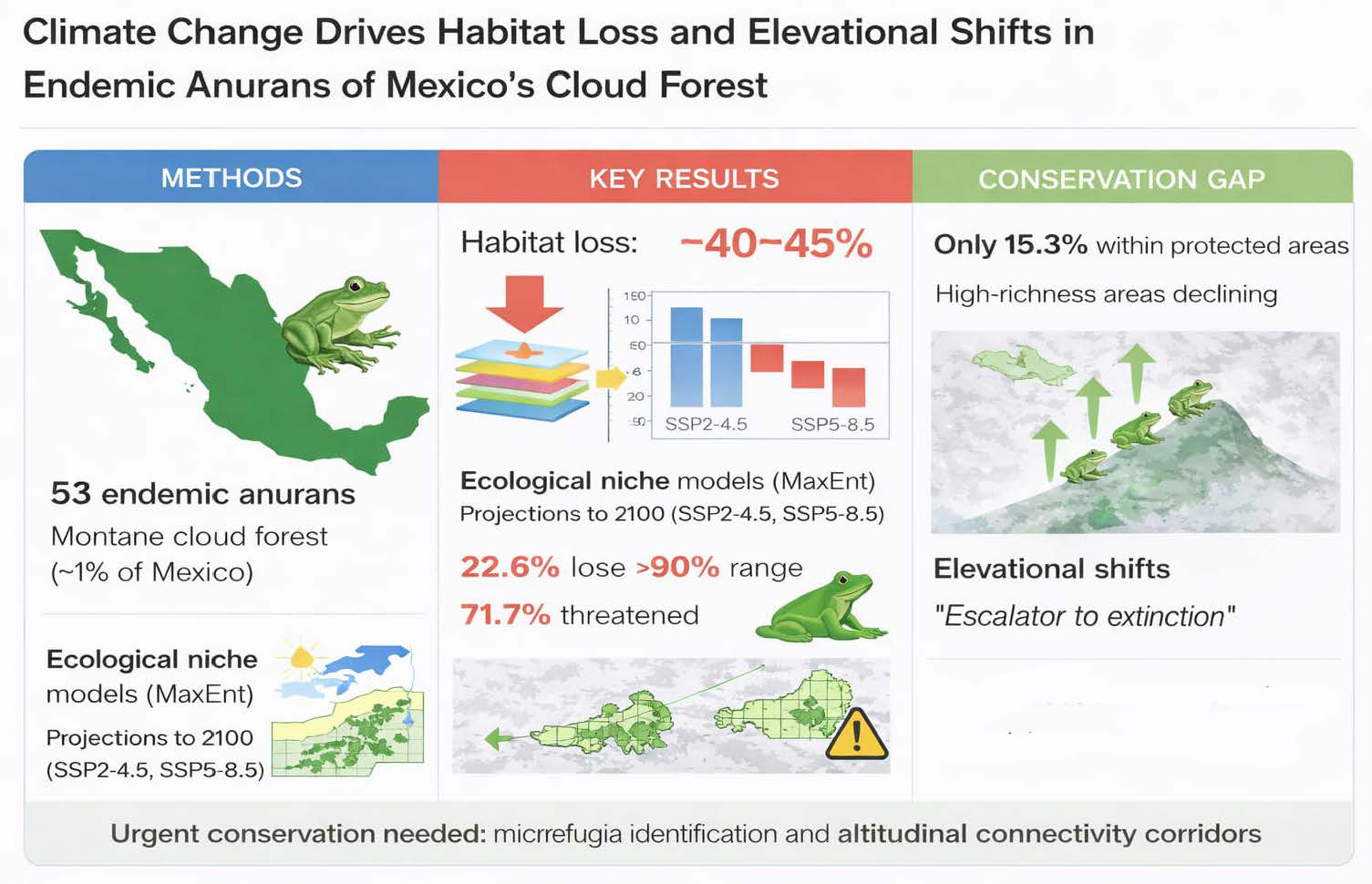
Climate change threatens global biodiversity, with amphibians from climatically stable and geographically restricted ecosystems such as Mexico’s montane cloud forest (CF) being particularly vulnerable. This study evaluated the potential impacts of climate scenarios on the distribution and richness of 53 endemic anuran species. We used ecological niche models (MaxEnt) to project current and future distributions (year 2100) under the SSP2-4.5 and SSP5-8.5 scenarios, and assessed species representativeness within federal Protected Natural Areas (PNAs). The results indicate that 71.7% of species already fall into an IUCN threat category. Widespread habitat contraction is observed under the climate projections, with average losses of 40.3% (SSP2-4.5) and 45.5% (SSP5-8.5). Twelve species (22.6%) could lose over 90% of their current distribution, suggesting a high risk of functional extinction. Only 15.3% of occurrence records currently fall within PNAs, and key reserves such as Los Tuxtlas and La Sepultura are projected to experience significant richness declines. These patterns are consistent with an “escalator to extinction” process driven by altitudinal compression of climatic niches. Adaptive conservation strategies are urgently needed, including the identification of climate microrefugia and the establishment of connectivity corridors to enhance the long-term persistence of endemic anurans under climate change.

Graphical Abstract

1. Introduction

Climate change constitutes one of the major threats to global biodiversity in the 21st century. Persistent imbalances in temperature, humidity, and precipitation cycles alter the geographic distributions of species, the structure of biotic communities, and ecosystem functioning [1,2], placing the biosphere in an imminent scenario of drastic and unprecedented changes [3]. Although shifts toward higher latitudes and elevations as species track their optimal climatic niches have been documented [4,5], those with limited dispersal capacity or that inhabit isolated ecosystems, such as mountain systems, face severe range contractions and an increased risk of extinction [3,6].
The particular sensitivity of amphibians to environmental change is rooted in their fundamental physiology. Unlike most terrestrial vertebrates, amphibians regulate body temperature and water balance almost entirely through behavioral and passive mechanisms, making their activity budgets, reproductive cycles, and metabolic rates tightly coupled to ambient thermal and hydric conditions [7,8,9,10]. The absence of a waterproof integument—a shared trait across the class—means that even moderate shifts in atmospheric humidity or substratum moisture can translate directly into physiological stress or desiccation risk. Moreover, their reproductive strategy, anchored to aquatic or highly humid microenvironments and lacking protective embryonic membranes, amplifies their exposure to drought episodes and thermal extremes [7]. These attributes collectively explain why amphibians function as early-warning indicators of ecosystem change [11,12,13] and why their population trends tend to precede broader biodiversity signals under climatic perturbation. This susceptibility is further increased by their limited dispersal capacity and strong site fidelity, which constrain their ability to migrate to areas with more favorable climatic conditions [14,15]. According to AmphibiaWeb [16], the class Amphibia comprises approximately 9000 species distributed across three orders: Anura (7954 species), Caudata (829 species), and Gymnophiona (231 species). Mexico possesses an exceptional fraction of global amphibian diversity: its 430 described species—distributed across 16 families and 58 genera—place it among the five most species-rich nations, while its 291 endemic taxa (65% of national species) position it third globally in exclusive richness [17,18]. Within this assemblage, anurans represent the dominant component, with 270 species across 37 genera and 11 families, of which 62.2% are exclusive to the country [18]. This extraordinary endemism, however, entails heightened conservation risk. Current assessments indicate that nearly four out of ten amphibian species globally are threatened with extinction [19,20], and a non-trivial fraction—approximately one in five—may already be functionally lost or on the verge of disappearing [21]. Long-term projections underscore the scale of the challenge: modeling exercises have estimated that, under ongoing climate trajectories, the occupancy area of endemic amphibians could shrink by nearly two-thirds before the end of this century, with a disproportionate share of taxa losing more than half of their accessible habitat [22,23,24,25,26].
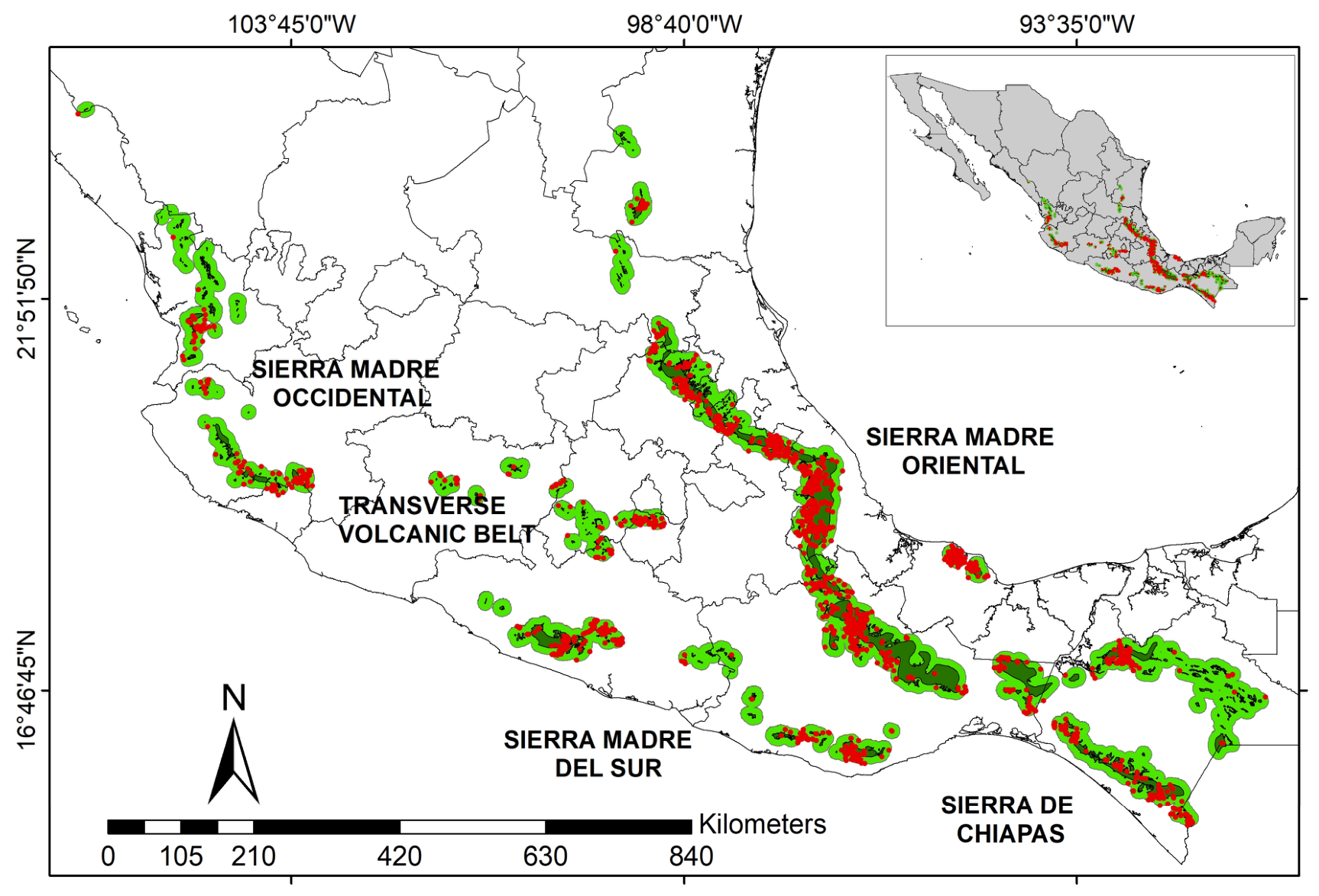
Due to its complex orography and geographic location, Mexico is particularly vulnerable to climate change, recording a warming rate of 3.2 °C per century that exceeds the global average of 2 °C. Projections under the high emissions scenario (SSP5-8.5) suggest increases between 3.8 °C and 5.4 °C by the end of the 21st century, along with significant reductions in annual precipitation [27]. An ecosystem that is highly vulnerable to these climatic transformations is the montane cloud forest (CF), which occupies approximately 1% of the national territory in Mexico (Figure 1) but possesses some of the highest densities of biological diversity per unit area [28,29,30]. Approximately 23% of Mesoamerican vertebrate species have been documented in the CF [31,32]; in particular, about 231 amphibian species having been recorded in this ecosystem, of which 118 (51.08%) are endemic to Mexico [33]. Many of these species have distribution ranges restricted to a single mountain range or isolated fragments and are included in risk categories of the Norma Oficial Mexicana NOM-059-SEMARNAT-2010 [34] or IUCN Red List [35].
Although the CF provides refugia for these anurans, their persistence is constrained by very narrow tolerance ranges to temperature and humidity fluctuations, as well as by their limited capacity to disperse among vegetation patches [36,37,38]. Thus, the montane CF constitutes a critical refuge for endemic amphibians in Mexico, harboring species with both Nearctic and Neotropical affinities [28,30]. However, recent estimates depict a critical outlook for this ecosystem in Mexico: by 2080, up to 68% of its current extent is projected to be lost due to climate change. The situation is even more alarming for protected areas, as it is estimated that more than 90% will become climatically unsuitable to support this ecosystem within the same period [29].
Ecological niche modeling has been widely performed to assess the climatic vulnerability of amphibians in tropical and temperate regions [38,39,40], which has proven essential for anticipating changes in species distributions and guiding conservation strategies. However, endemic anuran assemblages in the Mexican CF have received limited attention in this type of study, representing a significant knowledge gap given the high levels of endemism and the projected climatic vulnerability of this ecosystem. This study evaluates the potential effects of climate change on the distribution of endemic anurans associated with the CF of Mexico. Specifically, it aims to (1) model the current distribution of these species and project it to the year 2100 under the SSP2-4.5 and SSP5-8.5 scenarios, and (2) quantify changes in potential species richness by comparing current conditions with future climate scenarios.

2. Materials and Methods

2.1. Study Area

The CF is characterized by a specific hydrothermic regime, where fog and high atmospheric humidity determine its structural and environmental complexity [41,42]. It has a mixed physiognomic origin, with tropical and temperate elements. It develops on steep slopes and protected ravines, with stable temperatures between 12 and 23 °C and precipitation of up to 6000 mm annually [30]. In Mexico, the CF is discontinuously distributed in an “archipelago” pattern along the Sierra Madre Oriental, the Sierra Madre del Sur, the Transverse Volcanic Belt, and the mountains of Sierra de Chiapas (Figure 1). The CF in Mexico occupies a wide altitudinal range, from approximately 400 to 2700 masl (and exceptionally up to 3100 m), though its core distribution and highest species richness occur between 1000 and 2500 masl [41,42].

2.2. Species Records and Occurrence Data

To select the endemic anuran species of Mexico whose distribution is associated with the CF, the work of Montiel-Canales and Goyenechea Mayer Goyenechea [43,44] was taken as a reference. Occurrence data were compiled from three complementary sources: (a) The published scientific literature provided georeferenced records from taxonomic and ecological studies not digitized elsewhere, (b) the Global Biodiversity Information Facility (GBIF. Occurrence Download. Available on line: https://doi.org/10.15468/dl.fsv2ww, (accessed on 9 April 2023)) offered broad geographic coverage through aggregated global data, and (c) the National Biodiversity Information System of Mexico (SNIB Occurrence Download. Available on line: https://www.snib.mx/descargasSNIBmx/SNIBEjemplares202105_20220401_121008.zip, (accessed on 1 April 2022)) contributed unique Mexican records from CONABIO and local collections, essential for endemic taxa. This combination maximized representativeness and minimized institutional biases. All records underwent quality control to remove duplicates, imprecise localities, and taxonomic inconsistencies. Records obtained between 1970 and 2020 were selected, subjecting each data point to an exhaustive review to detect taxonomic or geographic errors. This process included discarding duplicates, records impossible to georeference, and points located outside the known distribution. Taxonomic validation and synonymy resolution were carried out following the AmphibiaWeb repository [16] (University of California, Berkeley, CA, USA; https://amphibiaweb.org/, (accessed on 26 January 2026)). Localities with incomplete coordinates were systematically georeferenced by analyzing the locality descriptions provided by collectors and georeferencing them using Google Earth (Google LLC, Mountain View, CA, USA).
To reduce sampling bias and spatial autocorrelation, spatial rarefaction was applied using the “Spatially rarefy occurrence data” tool [45], integrated in SDMToolbox for ArcMap 10.4.1 (ESRI, Redlands, CA, USA) [46], with a Euclidean distance of 1 km. This procedure ensured that each record corresponded to a unique cell, consistent with the resolution of the environmental variables [47]. All localities were verified to match the known geographic distribution of each taxon. The analysis was restricted to species with a minimum of five records to ensure modeling robustness [48,49]. The final dataset was divided into two groups: species with 5–14 records and species with 15 or more records.

2.3. Environmental Data and Determination of the Accessible Area (M)

We obtained 19 environmental variables (Table 1) from the WorldClim database (http://www.worldclim.org/ (accessed on 26 January 2026)), derived from global climatic records interpolated to a spatial resolution of approximately 1 km2. This set of variables includes monthly information on precipitation, mean temperature, seasonality, and climatic extremes, which have been widely used in ecological niche modeling studies. For future projections, CMIP6 climate projections from the CMCC-ESM2 model were used under two Shared Socioeconomic Pathways (SSPs): SSP4.5, representing a moderate emission stabilization scenario, and SSP5-8.5, a high emissions scenario without mitigation measures. Both scenarios were projected to the year 2100 (2081–2100 period).
For each species, we defined the accessible geographic region (M) following the BAM framework [50,51], which represents the portion of geographic space that a taxon can potentially reach given its dispersal ability. The M was constructed by generating a minimum convex polygon enclosing all occurrence points, followed by the addition of a 30 km buffer zone to account for dispersal limitations and ensure that peripheral ecological gradients were represented during model calibration. All environmental layers—both present and future—were subsequently clipped to this individualized region to ensure that MaxEnt training was conducted exclusively on environments with realistic accessibility for each taxon, thereby minimizing the risk of niche inflation [51].
Variable selection followed a sequential two-stage protocol aimed at maximizing predictive relevance while minimizing redundancy. In the first stage, a Jackknife regularization analysis implemented within MaxEnt v.3.4.4 (American Museum of Natural History, New York, NY, USA) [52] was performed to rank the 19 WorldClim bioclimatic predictors based on their individual contribution to model gain. In the second stage, pairwise Pearson correlations were calculated among all variables; whenever two variables exceeded an absolute correlation threshold of |r| = 0.85, only the predictor with the higher regularized training gain from the preceding stage was retained. This procedure ensured that the final variable set was both ecologically informative and statistically independent.

2.4. Species Distribution Modeling

Modeling was performed using the ENMeval package [53] implemented in RStudio v. 2024.04.2 (Posit Software, PBC, Boston, MA, USA) with R v. 4.3.3 (R Core Team, Vienna, Austria) [54], which allows for systematic evaluation of MaxEnt parameter combinations. Different validation protocols were applied according to sample size.
For species with 5–14 records, Jackknife (“leave-one-out”) cross-validation was used, following Shcheglovitova and Anderson [55]. Linear (L) and quadratic (LQ) features were evaluated with regularization multipliers from 2 to 4. Binary maps were generated using the Minimum Training Presence (MTP) threshold.
For species with ≥15 records, random k-fold cross-validation was applied, using 5 or 10 partitions depending on the volume of data. Linear (L), quadratic (LQ), hinge (H), and their combinations (LQH, LQHP) were evaluated, with regularization multipliers from 0.5 to 4 (0.5 increments). Binary maps were generated using the 10th percentile training presence threshold.
For both groups, the optimal model was selected using the corrected Akaike Information Criterion (AICc) [56]. Diagnostic accuracy was evaluated with the area under the ROC curve (AUC). The selected models were projected onto current and future conditions (2100: SSP2-4.5 and SSP5-8.5) in cloglog format and binarized using the group-specific thresholds. For models run outside ENMeval, the following parameters were used: maximum iterations = 500, convergence threshold = 0.00001, and 10 replicates [57]. Binary models were clipped with a potential vegetation map of the CF [58] with a 30 km buffer, in order to include peripheral areas of ecological transition which may be relevant for future dispersals [40]. This procedure was applied to both current and future scenarios (SSP2-4.5 and SSP5-8.5).

2.5. Richness, Turnover, and Vulnerability

The binary predictions (presence/absence) for all species were summed to generate richness maps under each climate scenario. The value of each pixel corresponds to the number of species present in that cell. The change in richness was calculated as the difference between future and current richness per cell. Species turnover was estimated using the following formula:
Turnover = R f u t u r e R p r e s e n t R f u t u r e + R p r e s e n t
where Rpresent and Rfuture denote the species richness in a given cell for the current and future periods, respectively.
Potential climate refugia were identified as regions where conditions remain suitable in both the present and future scenarios. For each species, the following were calculated: (1) current and future suitable area (km2), (2) habitat loss area (suitable in the present, not in the future), (3) habitat gain area (not suitable in the present, suitable in the future), (4) stable habitat area (suitable in both periods), and (5) net percentage change in suitable area. Biodiversity hotspots were defined as the top 10% of cells with the highest current richness (90th percentile). All spatial calculations were performed in R using the terra package [59].

2.6. Diversity Indices and Assemblage Structure Analysis

To capture projected changes in assemblage structure beyond species richness, five sets of complementary metrics were calculated from the potential distribution areas (km2) of the 53 species under current conditions and each future scenario, treating distributional area as a proxy for each species’ relative dominance within the assemblage.
Alpha diversity indices: The Shannon–Wiener index (H’ = −Σpi ln pi), the Simpson index (1−D = 1−Σpi2), and Pielou’s evenness (J = H’/ln S) were calculated, where pi represents the proportion of the total assemblage area attributed to species i and S is the number of species with area > 0. A dominance index was additionally computed as the maximum pi value at each scenario. Together, these metrics allow evaluation of changes not only in species number but also in the evenness of area distribution across species, reflecting potential homogenization or increasing dominance within the assemblage.
Habitat stability index: For each species, the stability index was calculated as the proportion of current area maintained as stable refugia (Si = stable refugia area/present area). The assemblage mean is reported as an aggregate measure of the persistence of current habitat under each climate scenario.
Beta diversity (Baselga decomposition): Compositional dissimilarity between the present and each projected future assemblage was quantified using the Baselga [60] framework. Based on species presence/absence (area > 0), we estimated the Sørensen dissimilarity (βSOR), the species replacement (turnover) component (βSIM, based on the Simpson index), and the nestedness component (βNES = βSOR − βSIM). This decomposition determines whether projected compositional changes are driven by active species replacement or by the ordered impoverishment of the assemblage, with contrasting conservation implications.
Rarity-weighted vulnerability index: An assemblage-level vulnerability index was calculated weighting each species’ proportional habitat loss by the inverse of its current area (1/Ai), so that rare species contribute disproportionately to the global index:
VI = i 1 A i · L i A i i 1 A i
where Li is the area of projected habitat loss and Ai the current area of species i. The index ranges from 0 (no rarity-weighted loss) to 1 (complete rarity-weighted loss). All indices were computed in Python 3.12 using NumPy 1.26 and pandas 2.2.

2.7. Assessment of Species Representativeness in Protected Natural Areas

The representativeness of endemic anurans in federal Protected Natural Areas (PAs) was evaluated through a spatial intersection between the 786 cleaned records and the Mexico PA layer [61], using R [54] with the sf and tidyverse packages [62,63]. A spatial join (st_join) was applied to identify records within each PA. For each PA with at least one record, the species richness, taxonomic composition, and total number of records were calculated. To assess the impacts of climate change on species richness within federal Protected Natural Areas (PAs), we calculated the absolute difference in mean richness between current and future scenarios (SSP2-4.5 and SSP5-8.5) for each PA. Mean richness values were extracted from continuous richness rasters using the extract function from the terra package [59] in R [54]. The absolute difference was computed as |mean richness_future–mean richness_current|, which quantifies the magnitude of change per PA. Signed differences were also examined, in order to distinguish between potential richness gains and losses. This approach allowed us to identify the Pas that are most vulnerable to climate-driven richness alterations under moderate versus high emissions scenarios.

3. Results

3.1. Species and Model Performance

After spatial rarefaction at 1 km and filtering for a minimum of 5 unique records, the final dataset comprised 786 records corresponding to 53 endemic anuran species across 15 genera. The genus Craugastor was the most representative (242 records), followed by Exerodonta (116) and Plectrohyla (101). The species with the highest number of records were E. sumichrasti (n = 62), Eleutherodactylus angustidigitorum (n = 49), and Craugastor rhodopis (n = 47) (see Table S1 in the Supplementary Materials). Regarding conservation status (Table S1 in the Supplementary Materials), 38 of the 53 species (71.7%) fall into a threat category according to the IUCN Red List [35]: 35.8% are Critically Endangered (CR), 24.53% are Endangered (EN), 11.32% are Vulnerable (VU), and 28.3% are of Least Concern (LC). According to NOM-059-SEMARNAT-2010 [63], 38 taxa (71.7%) are listed as Threatened (A) and the remaining 15 as Subject to Special Protection (Pr).
Spatial analysis revealed a heterogeneous distribution of richness among Mexican states. Oaxaca presented the highest species richness (29 species, 13 genera), while Veracruz recorded the highest accumulated abundance (n = 214) and high diversity (21 species, 10 genera). Other states with notable contributions were Guerrero (13 species, 88 records), Chiapas (11 species, 119 records), and Puebla and Hidalgo (9 species each). In contrast, Michoacán, México, Morelos, San Luis Potosí, Tamaulipas, Colima, and Jalisco presented between 1 and 2 species, indicating either a highly restricted geographic distribution or a historical sampling deficit.
The models showed high predictive performance. For species with 5–14 records, the average AUC Ratio was 1.572 (range: 1.0–1.98), with Craugastor megalotympanum and Incilius cavifrons obtaining the highest values (1.98 and 1.97, respectively). Most optimal models presented ΔAICc = 0, indicating an adequate balance between complexity and fit. The number of bioclimatic variables per model ranged from 3 to 6. The variables with the highest selection frequency were mean annual temperature (Bio1), present in 52 of 53 species (98.1%); isothermality (Bio3) and mean diurnal temperature range (Bio2), both in 48 species (90.5%); annual precipitation (Bio12), in 42 species (79.2%); and precipitation seasonality (Bio15), in 34 species (64.1%) (see Table S1 in the Supplementary Materials).

3.2. Changes in Assemblage Diversity Structure

Diversity indices computed from projected distributional areas showed a consistent, stepwise reduction in assemblage diversity under both climate scenarios (Table 2). Species richness declined from 53 species in the present to 52 under SSP2-4.5 (loss of Incilius cavifrons) and to 50 under SSP5-8.5 (additional losses of Craugastor megalotympanum and C. omiltemanus).
The Shannon index declined from H’ = 3.105 in the present to H’ = 2.883 under SSP2-4.5 and H’ = 2.830 under SSP5-8.5, equivalent to reductions of 7.2% and 8.8%, respectively. Pielou’s evenness showed a parallel decline (from J = 0.782 to J = 0.730 and J = 0.723), indicating that future assemblages will be structurally less equitable, with a more uneven distribution of habitat area across species. This loss of evenness is reflected in the increase in the dominance index, which rose from 0.238 in the present to 0.296–0.299 under future scenarios, driven primarily by the growing relative dominance of Eleutherodactylus nitidus (Δpi = +0.061 under SSP5-8.5), whose potential distribution (196,489 km2) remains stable while total assemblage area contracts.
The mean assemblage stability index—reflecting the proportion of each species’ current area that will remain as stable climatic refugia—was 0.597 ± 0.336 under SSP2-4.5 and 0.545 ± 0.399 under SSP5-8.5, indicating that, on average, fewer than 60% of current suitable habitats will remain climatically adequate in the future. The greater dispersion under SSP5-8.5 (±0.399 vs. ±0.336) reflects the increasing polarization of the assemblage between a core of 10 highly stable species (stability index = 1.0) and a growing set of taxa whose stable habitat collapses to near-zero values.
The Baselga decomposition revealed that all projected compositional dissimilarity between current and future assemblages was attributable to the nestedness component (βNES = βSOR = 0.0095 under SSP2-4.5; βNES = βSOR = 0.0291 under SSP5-8.5), with a replacement component of βSIM = 0 under both scenarios. This indicates that projected future assemblages are strictly nested subsets of the current assemblage: no new species colonize projected future areas, and species losses are non-random, following an ordered pattern in which species with the smallest ranges are eliminated first.
The rarity-weighted vulnerability index reached values of 0.819 under SSP2-4.5 and 0.845 under SSP5-8.5, substantially higher than the unweighted mean net change (40.3% and 45.5%, respectively), demonstrating that the rarest species—which contribute disproportionately to regional endemism—are also those facing the greatest proportional habitat loss.

3.3. Species Vulnerability and Changes in Richness

Regarding the assembly-level response under the SSP2-4.5 scenario, average habitat loss was 40.3%, with a mean retention of 59.7% and average gains of 4.6%. Under SSP5-8.5, the average loss increased to 45.5%, retention fell to 54.5%, and potential gains averaged 10.9%, although they were geographically restricted (see Table S2 in the Supplementary Materials).
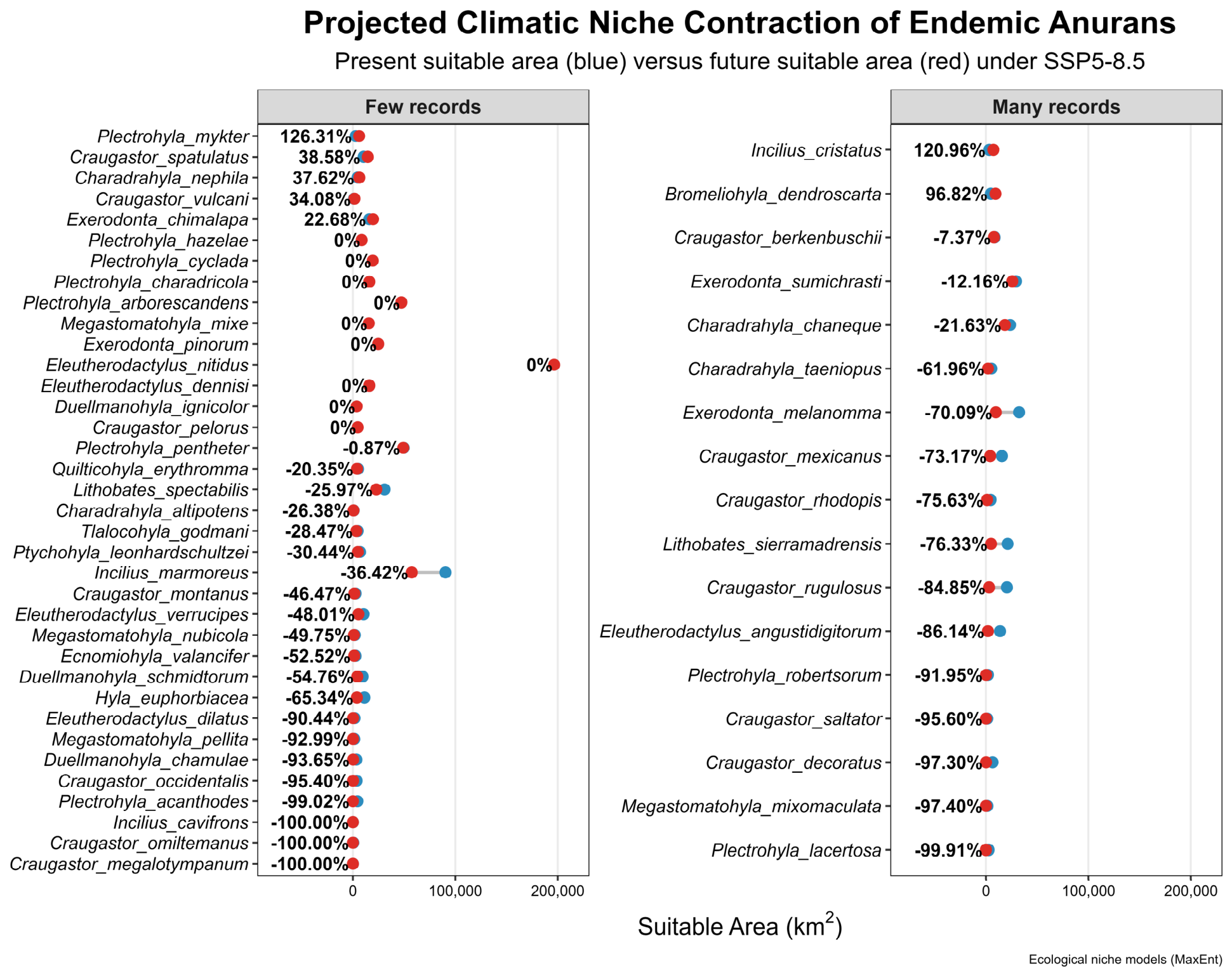
Regarding species with near-total loss (>90%), 12 species (22.6% of the total) were identified with loss exceeding 90% in at least one scenario. Four species were found to disappear completely under SSP5-8.5: Craugastor omiltemanus (−99% in SSP2-4.5; −100% in SSP5-8.5), C. megalotympanum (−97.9% in SSP2-4.5; −100% in SSP5-8.5), Incilius cavifrons (−100% in both scenarios), and Megastomatohyla mixomaculata (no retention under SSP5-8.5, with a 2.6% gain). Other species with critical losses include Plectrohyla lacertosa (−99.9% in both scenarios; reduction from 2641 km2 to 2.5 km2), P. acanthodes (−99% in SSP5-8.5; 44 km2 remaining), C. decoratus (−94.5% in SSP2-4.5; −98.7% in SSP5-8.5), C. saltator (−95.6% in SSP5-8.5), C. occidentalis (−95.4% in SSP5-8.5), Duellmanohyla chamulae (−93.7% in SSP5-8.5), Megastomatohyla pellita (−93% in SSP5-8.5), and P. robertsorum (−91.9% in SSP5-8.5).
Regarding species with severe loss (50–90%), 17 species with substantial geographic range reduction were determined. The most affected are Eleutherodactylus angustidigitorum (−86.14%), C. rugulosus (−84.91%), Lithobates sierramadrensis (−79.22%), C. rhodopis (−76.63%), C. mexicanus (−75.90%), and Exerodonta melanomma (−70.26%). At the lower boundary of this category are Hyla euphorbiacea (−65.34%), C. montanus (−61.03%), D. schmidtorum (−54.76%), and Ecnomiohyla valancifer (−52.52%).
Regarding species with moderate changes or stability, 10 species showed no net change in either scenario, retaining 100% of their habitat with neither gains nor losses: C. pelorus, D. ignicolor, Eleutherodactylus dennisi, E. nitidus, Exerodonta pinorum, Megastomatohyla mixe, Plectrohyla arborescandens, P. charadricola, P. cyclada, and P. hazelae. Exerodonta chimalapa lost only 0.8% under SSP2-4.5 and gained 22.7% under SSP5-8.5. P. pentheter (current area: 49,567 km2) retained more than 97% of its habitat in both scenarios, Exerodonta sumichrasti retained between 73% and 75% of its area, Quilticohyla erythromma retained 80–88%, and Lithobates spectabilis retained 74–80.6%.
Regarding species with habitat gain, three species were found to have projected net expansions, namely, Plectrohyla mykter (+126.31%), Incilius cristatus (+121.13%), and Bromeliohyla dendroscarta (+97.2%). The effective occupation of these areas will depend on each species’ dispersal capacity and the availability of conserved vegetation (Figure 2).
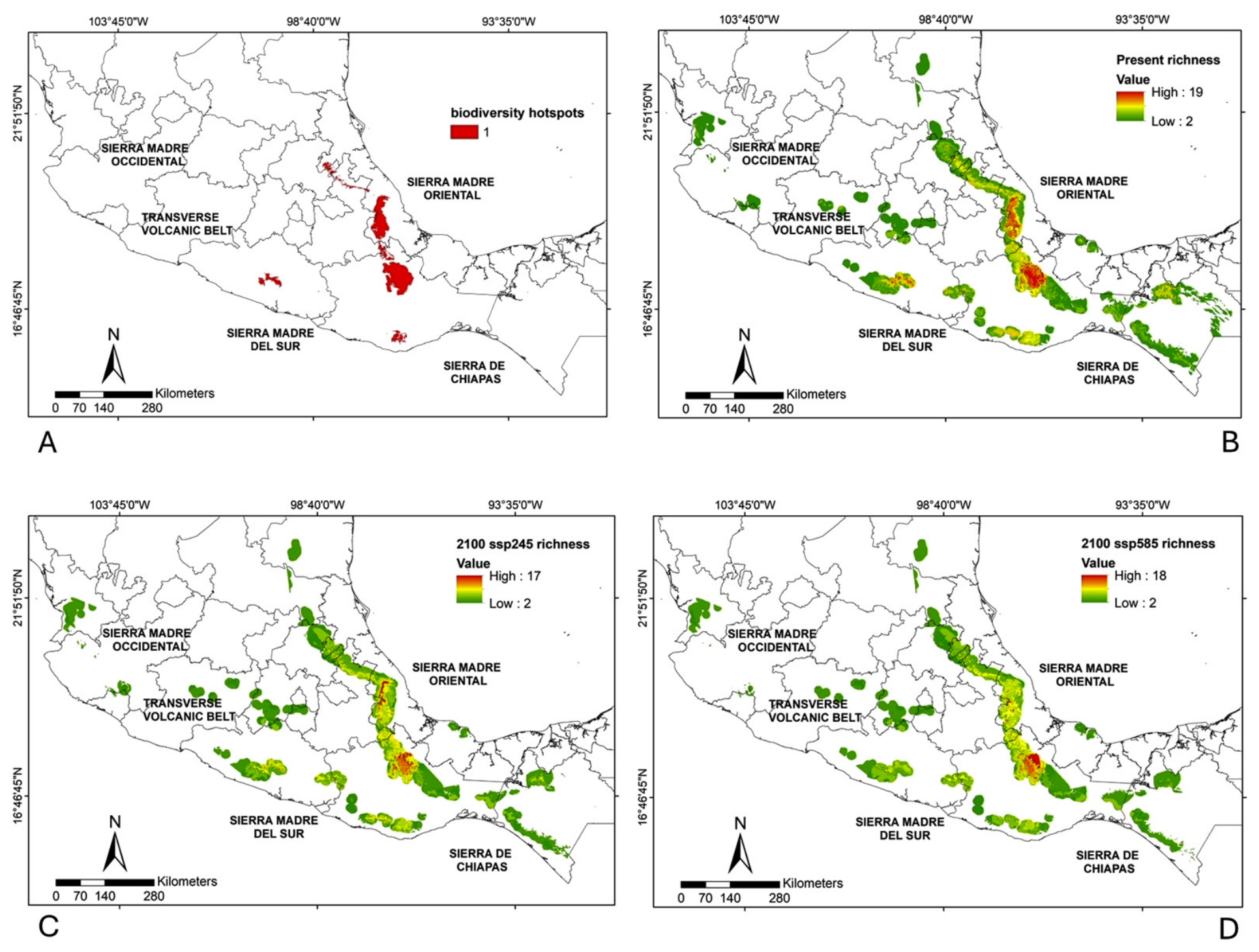
Current biodiversity hotspots (top 10% of cells with highest species richness) were identified primarily in three regions: the Sierra Madre Oriental (central Veracruz and northern Puebla), the Sierra Norte de Oaxaca, and the Sierra de Chiapas. These hotspots contained between 14 and 18 species per cell under current conditions, representing the most diverse areas for endemic anurans. Notably, these hotspots coincided exactly with the regions of highest current richness described above (Figure 3A,B).
Under the SSP2-4.5 scenario, the spatial pattern of richness change showed a net reduction across most of the distribution range of endemic anurans. The highest losses (4–8 species per cell) were concentrated in the low-altitude peripheries of the Sierra Madre Oriental and transition zones of the Transverse Volcanic Belt. Gains were rare and limited to 1–2 species per cell, occurring mostly at higher elevations in Oaxaca and Chiapas. The mean regional richness decreased from 3.9 species per cell (current) to 3.34 under SSP2-4.5, representing an average loss of 0.56 species per cell (−18%), while maximum richness declined from 18 to 16 species per cell (Figure 3C).
The geographic extent of biodiversity hotspots contracted and remained in the same general regions, but with reduced species numbers (12–16 species per cell). The most affected hotspots were those at lower elevations within the Sierra Madre Oriental, particularly in the transition zones toward the Gulf of Mexico coastal plain. This contraction aligned with the observed richness losses of 4–8 species per cell in the low-altitude peripheries of this mountain range.
Under the SSP5-8.5 scenario (high emissions, no mitigation), the richness losses intensified markedly. Areas experiencing losses of 4–8 species expanded considerably, and current diversity cores recorded losses exceeding 10 species per cell. Maximum richness reached 17 species per cell, but this value was restricted to very small refugial areas. Gains were virtually null (≤1 species per cell), indicating a process of assemblage homogenization, particularly on slopes facing the Gulf of Mexico. Mean richness fell to 3.0 species per cell—a reduction of 0.9 species (−23%) relative to current conditions (Figure 3D).
Hotspot areas shrank to isolated patches restricted to the highest elevations of the Sierra Madre del Sur (in Guerrero and Oaxaca) and the Chiapas Highlands. Most current hotspot cells fell below the top 10% threshold, indicating that areas currently harboring the highest diversity will no longer be climatically suitable for maintaining those assemblages. This pattern corresponded with the observed losses, exceeding 10 species per cell in current diversity cores.
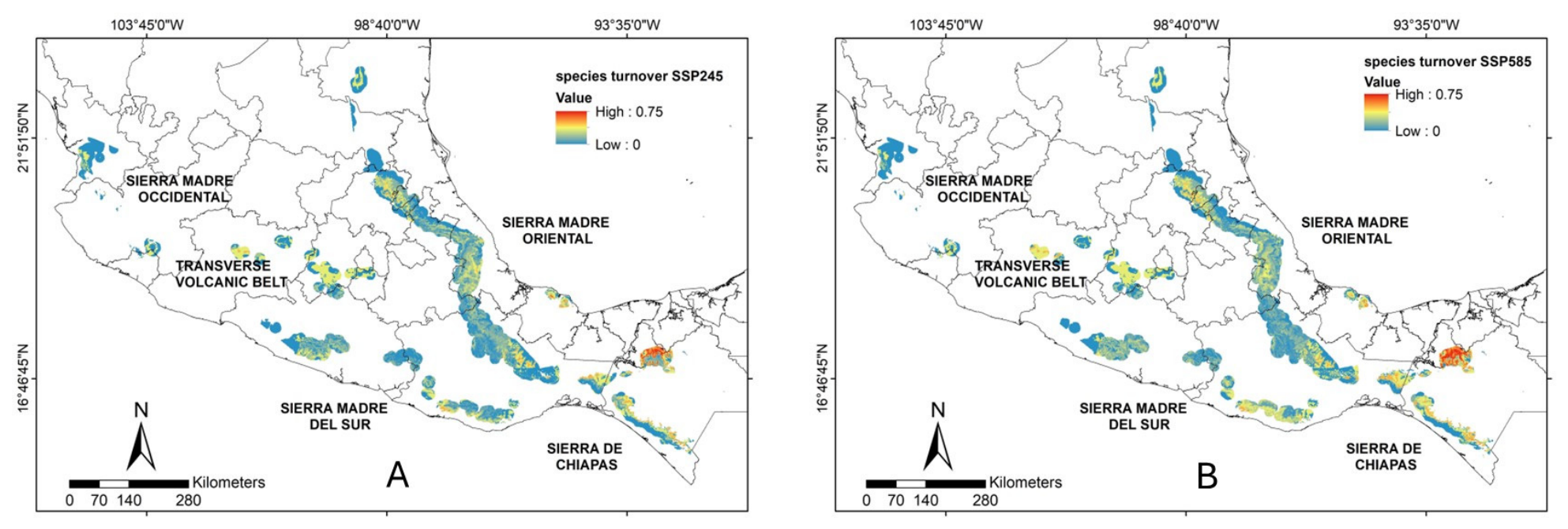
Species turnover ranged from 0 (no change in species composition) to 0.7 (complete or near-complete species replacement) across the study area. Under SSP2-4.5 (Figure 4A), turnover values showed moderate spatial variation. Higher turnover values (0.4–0.6) were concentrated in the Sierra Madre Oriental (particularly in Veracruz and Puebla) and the transition zones of the Transverse Volcanic Belt. These areas correspond to regions where both species losses (4–8 species per cell) and limited gains (1–2 species per cell) were occurring, indicating ongoing compositional reorganization. Lower turnover values (0.1–0.3) predominated in the Chiapas Highlands and the western Sierra Madre del Sur (Guerrero and western Oaxaca), suggesting more stable assemblages in these regions under moderate warming. The mean turnover value under SSP2-4.5 was 0.32 ± 0.14 (SD).
Under SSP5-8.5 (Figure 4B), turnover values increased markedly across the entire study area. High turnover values (0.5–0.7) expanded considerably, covering extensive areas of the Sierra Madre del Sur (Guerrero and Oaxaca), the Sierra Madre Oriental, and the Chiapas Highlands. The highest turnover values (>0.65) were observed on the Pacific slopes of Oaxaca and Guerrero, where lowland-adapted species are projected to expand upward while highland species are lost. In these high-turnover areas, current diversity cores recorded losses exceeding 10 species per cell, while gains remained virtually null (≤1 species per cell). The mean turnover value under SSP5-8.5 increased to 0.48 ± 0.16 (SD), representing a 50% increase relative to SSP2-4.5. Low turnover values (<0.2) under SSP5-8.5 were restricted to very small, isolated high-elevation patches in the Sierra Madre del Sur and Chiapas Highlands—the same areas identified as refugial biodiversity hotspots under this scenario. These low-turnover areas correspond to cells where both current and future richness remain relatively stable, suggesting that they may function as climatic refugia.
Only five federal Protected Natural Areas (PAs) contain records of endemic anurans, encompassing 120 records (15.3% of the total). The “Los Tuxtlas” Biosphere Reserve (Veracruz) presented the highest richness, with 6 species (C. megalotympanum, C. rugulosus, C. vulcani, E. valancifer, Hyla euphorbiacea, and I. cavifrons) and 47 records. The “La Sepultura” Biosphere Reserve (Chiapas) recorded 5 species (C. rugulosus, Duellmanohyla schmidtorum, Exerodonta chimalapa, E. sumichrasti, and Plectrohyla lacertosa) and 41 records. The La Concordia Flora and Fauna Protection Area (Chiapas) and the Río Necaxa Flora and Fauna Protection Zone (Puebla) presented 3 species each, with 26 and 4 records, respectively. The “Corredor Biológico Chichinautzin” Flora and Fauna Protection Area (Morelos/State of Mexico) harbored 2 species (Eleutherodactylus nitidus and Lithobates spectabilis) with 2 records.
Under the projected climate scenarios, the PAs with the highest current richness are expected to experience the most severe reductions (Table 3). “Río Necaxa” showed the greatest absolute loss under SSP5-8.5 (Δ = −1.37 species per cell), followed by “Los Tuxtlas” (Δ = −1.18) and “La Sepultura” (Δ = −1.12). “La Concordia” exhibited a notable and scenario-independent decline, with virtually identical losses under both pathways (Δ = −0.90 and −0.92, respectively), suggesting that its thermal suitability threshold may already be near the tipping point under moderate warming. In contrast, “Bosencheve,” “Valle de Bravo,” and “Mariposa Monarca” showed modest but consistent projected gains across both scenarios, likely reflecting their higher elevational range and greater thermal buffering capacity. Notably, “Montes Azules” (Chiapas) returned no future richness values under either scenario, indicating complete loss of climatic suitability for the modeled assemblage within this reserve by 2100.

4. Discussion

The 786 cleaned records, corresponding to 53 species and 15 genera, represent a significant proportion of the Mexican herpetofauna, consistent with the recognition of Mexico as a global center of amphibian diversity and endemism [30,64]. The conservation status of this assemblage is critical, with the combination of IUCN categories (71.7% at risk) and NOM-059 (100% under legal protection) confirming its vulnerability. The high incidence of species in CR and EN categories (60.3% combined) reflects the global trend of amphibian declines driven by habitat loss and fragmentation, climate change, and emerging diseases such as chytridiomycosis [22,26,65]. Mexico ranks second worldwide in terms of its number of threatened amphibians [11,66], which underscores the need to continuously update risk assessments as new information becomes available.
The marked spatial heterogeneity of the records is consistent with the previous literature. Oaxaca is home to 29 of the 53 analyzed species—a result coherent with studies positioning this state as the most diverse for amphibians in Mexico, particularly in the Sierra Madre de Oaxaca and the Sierra Norte [30,44]. The high frequency of records in Veracruz (n = 214, 21 species) reflects both the topographic complexity of the Sierra Madre Oriental and a well-established tradition of herpetological research in the region [67,68]. Low richness in Michoacán, Morelos, San Luis Potosí, and Jalisco (1–2 species) can be attributed to two non-exclusive factors: historical sampling bias concentrated in easily accessible areas or near research centers [69,70], and/or genuinely restricted distributions of endemic species. Given the high microendemism of the group, the absence of records in states with reduced CF cover is expected [71,72]. This highlights the need for targeted sampling strategies to fill information gaps [73].
Regarding model performance, the AUC Ratio values (mean 1.572) and the selection of models with ΔAICc = 0 indicate satisfactory performance and an adequate balance between fit and complexity, which is especially relevant for species with few records [48,56]. The robustness of these models allows us to infer potential distributions in unsampled sites and project climate change impacts on a solid empirical basis [68,74].
Mean annual temperature (Bio1) was the most frequently selected variable (98.1% of models), followed by isothermality (Bio3) and mean diurnal range (Bio2), indicating that the persistence of these species depends not only on average thermal values, but also on the stability of conditions at diurnal and seasonal scales. This pattern is consistent with the ectothermic physiology of amphibians, whose metabolic rates, reproduction, and behavior are sensitive to thermal variations within narrow margins [26,75]. Increases in thermal variability or maximum temperatures can push organisms beyond their physiological tolerance limits [20].
The models project a generalized reduction in climatically suitable areas for CF anurans, which intensifies with the severity of the climate scenario. The calculated mean habitat loss—namely, 40.3% under SSP2-4.5 and 45.5% under SSP5-8.5—is consistent with global projections for Neotropical ectotherms and montane systems [20,68,76]. A total of 22.6% of species showed contractions exceeding 90% in at least one scenario, suggesting an elevated extinction risk that may approach functional extinction thresholds in the most restricted taxa, although whether this translates into actual population collapse will depend on demographic resilience, microhabitat availability, and evolutionary responses not captured by the current modeling framework [73]. The heterogeneous response among species is not random, reflecting differences in the niche breadth, distribution range, and altitudinal position of each taxon [4,5,76]. The most vulnerable species are those with narrow physiological requirements, high dependence on specialized habitats, and low dispersal capacity [22,40]. The projected range expansions for species such as I. cristatus and P. mykter must be interpreted with caution, as their realization depends on landscape connectivity, availability of conserved habitat, and dispersal capacity—factors which are not fully captured by ecological niche models [74]. The low vagility of many anurans [3,6] may preclude successful colonization of projected suitable areas, particularly when these areas are isolated by unsuitable lowlands or degraded habitats.
The projected suitability maps provide evidence for altitudinal compression; in particular, the models project a reduction in climatic suitability at lower elevations, particularly in the Sierra Madre Oriental, while gains at higher elevations are insufficient to compensate for losses at mid-elevations. These patterns are consistent with the dynamics described by the ‘escalator to extinction’ hypothesis [30,77], which predicts progressive upslope displacement of specialist species as lower-elevation habitats become thermally unsuitable; however, empirically confirming this process would require longitudinal demographic and movement data beyond the scope of the present study. The concentration of species losses in low-altitude peripheries of the Sierra Madre Oriental and transition zones of the Transverse Volcanic Belt is consistent with this phenomenon [78]. Species track their thermal niches upward as temperatures rise; however, available areas decrease with elevation, leading to range compression and eventual extirpation of populations at lower range edges. Recent studies have documented that CF plants in Mesoamerica migrate at rates of 1.8–2.7 m/year [77]; for anurans, with lower dispersal capacity and greater dependence on humid microclimates, such displacement may generate population bottlenecks and geographic isolation.
The simultaneous decline in the Shannon, Simpson, and Pielou evenness indices, combined with the increase in dominance, describes a process of projected biotic homogenization of Mexico’s cloud forest anuran assemblage. This pattern—in which a few broadly distributed and climatically resilient species capture an increasing share of total habitat while rare species become locally extinct—is consistent with the biotic homogenization phenomenon documented globally as a consequence of climate change and habitat loss [78,79]. The central role of Eleutherodactylus nitidus in this process—whose relative dominance increases by more than six percentage points under SSP5-8.5 while its distributional area remains intact—illustrates how generalist species, rather than montane specialists, are likely to define the future structure of cloud forest assemblages.
The most ecologically significant result of the beta diversity analysis is that all projected compositional dissimilarity corresponds to the nestedness component (βNES = βSOR; βSIM = 0), with a complete absence of turnover. This indicates that future assemblages will be perfectly nested subsets of the current assemblage, with no new species colonizing to replace those that are lost. This pattern of pure nestedness—in contrast to the active turnover that would characterize systems with high colonization capacity or warming-favored species replacing displaced ones—reflects the limited vagility of tropical montane anurans and their dependence on narrowly defined microclimatic conditions [37,80]. The conservation implication is direct: since no functional replacement of lost species by new colonizers is expected, each projected local extinction, if realized, could represent a long-term reduction in the assemblage’s functional and phylogenetic diversity, given the absence of new colonizers in our projections; however, evolutionary rescue, behavioral plasticity, or microhabitat persistence could partially buffer these outcomes under conditions not considered in the present framework.
The contrast between the rarity-weighted vulnerability index (0.82–0.85) and the unweighted mean habitat loss (40.3–45.5%) quantitatively confirms that the distribution of risk within the assemblage is markedly asymmetric: the species that contribute most to regional endemism—precisely those with the most restricted distributions—are also those facing the most severe proportional habitat losses. This rarity bias in risk distribution has been documented across multiple taxonomic groups under climate change [81,82], and in the context of Mexico’s cloud forest it is particularly concerning given that 100% of the analyzed species are listed under NOM-059, yet current protection frameworks do not differentiate by projected vulnerability. The near-stability of the index across scenarios (Δ = 0.027 between SSP2-4.5 and SSP5-8.5) suggests that this bias is a robust property of the assemblage, insensitive to the magnitude of climate forcing within the range of scenarios considered, reinforcing the urgency of adopting conservation measures regardless of which scenario ultimately materializes.
Our results demonstrate a clear and consistent pattern of climate-driven richness loss for endemic anurans in the Mexican CF. The reduction in mean richness from 3.9 to 3.0 species per cell (−23%) under SSP5-8.5, coupled with the near-absence of projected gains, indicates that amphibian communities will become both poorer and more homogeneous. The contraction of biodiversity hotspots to isolated high-elevation patches under SSP5-8.5 represents one of the most concerning findings of this study. Current hotspots in the Sierra Madre Oriental—which harbor up to 18 species per cell—are projected to largely disappear, with only the highest peaks retaining moderate richness. The fact that no new hotspots emerged under future scenarios confirms that any gains will be insufficient to offset losses, as upslope gains rarely compensate for downslope losses [77].
At the community scale, the reduction in mean richness and the erosion of diversity peaks in the hotspots of the Sierra Madre del Sur and the Sierra Madre Oriental indicate a process of biotic homogenization: future communities will not only be poorer in richness but will also differ in composition, favoring lowland generalist species over montane specialists [83]. This process is more pronounced in Oaxaca and Veracruz, which are recognized as centers of historical stability and high diversity [65,69,75]. The persistence of hotspots in the highest elevations of the Sierra Madre del Sur and Chiapas Highlands suggests that these areas may function as climatic refugia; however, their small spatial extent and isolation from other CF fragments raise concerns about long-term population viability [75]. The fact that maximum richness (17 species per cell) was restricted to “very small refugial areas” under SSP5-8.5 underscores the vulnerability of these remaining hotspots.
The direct correspondence between richness loss and hotspot contraction has clear conservation implications. Current protected areas (PAs) in the Sierra Madre Oriental—which contain many of the hotspots projected to disappear under SSP5-8.5—are insufficient to safeguard the region’s anuran diversity under future climate scenarios. Our results suggest that the identification and strengthened protection of high-elevation refugia in the Sierra Norte de Oaxaca and the Chiapas Highlands warrants priority attention in future conservation planning, and our findings underscore the importance of incorporating climate projections into continuous reassessments of threat categories, as a complement to existing risk evaluation frameworks [75,84]. Furthermore, the absence of new hotspots under future scenarios indicates that conservation strategies cannot rely on the emergence of novel high-diversity areas to compensate for losses. Instead, efforts must focus on preserving the remaining refugial patches and maintaining connectivity between them to facilitate metapopulation dynamics and altitudinal migration.
The lack of correspondence between areas with high future climatic suitability and the current PA network limits their effectiveness [70]. The remaining CF remnants in the Sierra Madre Oriental and the Sierra Madre del Sur, particularly in Oaxaca and Veracruz, should be prioritized as critical refugia [44]. Complementary strategies are required, including the establishment of biological corridors, restoration of degraded habitats, and payment for environmental service schemes on private and community lands [85,86]. Finally, the mismatch between current conservation status and projected climate vulnerability highlights a systemic gap in risk assessment frameworks, with species currently classified as ‘Least Concern’ potentially facing habitat losses exceeding 80%. It is imperative to conduct continuous reassessment of threat categories incorporating climate projections, in order to guide effective and adaptive conservation planning in the Mexican CF.
Climate change is projected to drive a generalized contraction in the distribution of endemic anurans associated with the montane cloud forest of Mexico, with stronger impacts under the high emissions scenario (SSP5-8.5). A considerable proportion of species may experience severe habitat loss, with several taxa approaching thresholds of functional extinction. These patterns are consistent with an altitudinal compression of climatic suitability, reflecting an “escalator to extinction” dynamic that disproportionately affects microendemic species with limited dispersal capacity.

5. Conclusions

A central contribution of this study is the integration of species-level ecological niche models with spatial analyses of richness patterns and representativeness within protected areas. This approach reveals a critical conservation gap: current biodiversity hotspots—particularly in Oaxaca and Veracruz—coincide with areas of high future vulnerability and are insufficiently covered by existing protected areas. Additionally, the identification of both highly vulnerable species and those with potential for resilience or expansion provides a more nuanced basis for conservation prioritization. These findings underscore the need to transition from static conservation frameworks to dynamic strategies that incorporate climate projections. Priority actions include the identification and protection of climatic microrefugia, the establishment of altitudinal and landscape connectivity corridors, and the implementation of adaptive management approaches aimed at maintaining ecological processes under changing conditions.
Nevertheless, this study has certain limitations. The projections presented here carry the inherent limitations of correlative approaches to distributional modeling. Ecological niche models capture statistical associations between occurrence data and climate layers but lack mechanistic representations of dispersal dynamics, interspecific competition, mutualistic dependencies, or evolutionary responses to novel thermal regimes [74]. Consequently, the realized distributions in 2100 will not necessarily converge with the suitable areas identified here: a species may fail to colonize climatically appropriate patches due to landscape fragmentation or low vagility, while others may persist beyond their projected suitable range through microhabitat buffering or behavioral plasticity. Land-use change—excluded from the current projections—is expected to further erode the accessibility of climatically suitable areas, particularly along the lower elevational margins of the cloud forest, where agricultural and urban expansion is most intense. It is critical to note that the projections presented here are based exclusively on climatic variables and do not incorporate the impact of land-use change, which is among the principal drivers of cloud forest loss in Mexico and throughout Mesoamerica [28,29]. Deforestation, agricultural expansion, cattle ranching, and urban growth are already reducing the extent and connectivity of cloud forest remnants at rates that may equal or exceed climate-driven losses in the short to medium term. Our estimates of future habitat availability should therefore be regarded as optimistic upper bounds: the actual area of accessible, high-quality habitat in 2100 is likely to be substantially smaller than our projections indicate, particularly in lowland transition zones where climatic and land-use pressures coincide most intensely. Moreover, additional anthropogenic stressors not incorporated into our framework—including emerging infectious diseases (notably chytridiomycosis, already responsible for major amphibian population declines in Mexico), chemical pollution, invasive species, and commercial overexploitation—interact synergistically with climate change to erode population viability. Their omission likely leads to an underestimation of extinction risk for the most vulnerable taxa, and the vulnerability rankings presented here should be interpreted in this broader multi-threat context. These caveats notwithstanding, SDMs under multiple emission scenarios remain the most widely validated tool for anticipating climate-driven range shifts at regional scales [55,74], and the consistency of our patterns across both SSP scenarios provides confidence in the general direction of the projected changes.

Supplementary Materials

The following supporting information can be downloaded at: https://www.mdpi.com/article/10.3390/cli14060114/s1, Table S1. Species occurrence data summary, selected environmental predictors, and evaluation metrics for MaxEnt ecological niche models of endemic Mexican Anurans. For each species, the table reports conservation status categories under the IUCN Red List and Mexico’s NOM-059-SEMARNAT-2010 regulations, initial versus clean filtered occurrence records used for modeling, the specific set of WorldClim bioclimatic variables selected, optimized model parameters (regularization multipliers and feature classes), Akaike Information Criterion metrics (AIC and Delta AICc), and model validation thresholds (partial ROC AUC ratios and omission rates). Data source compiled in verbatim file “Table S1.csv”. Table S2. Projected changes in climatic suitability area (km2), spatial conservation dynamics, and percentage shifts for endemic Mexican Anurans under current conditions and future climate change scenarios (SSP2-4.5 and SSP5-8.5) for the year 2070. Quantified parameters include baseline present-day suitable habitat area, projected future suitable area, stable climatic refugia (overlapping continuous presence), absolute habitat loss, absolute habitat expansion (gain), net percentage change in suitability range, habitat retention rates, and directional percentages of spatial contraction and expansion. Data source compiled in verbatim file “Table S2.csv”.

Author Contributions

C.B.-B. conceived, designed, planned, and performed analyses, and led the writing; O.T.-P. conceived, designed, planned, and performed analyses; A.L.-M. contributed records, revised taxonomy, reviewed drafts of the paper, and contributed to the data analyses; R.Z.-H., A.M.-B., B.V.-M. and S.O.-B. reviewed drafts of the paper and contributed to the data analyses; M.M.-C. contributed records and revised taxonomy. All authors have read and agreed to the published version of the manuscript.

Funding

This study was supported by two distinct funding sources: (1) institutional funding from the Universidad Autónoma Metropolitana (UAM) under the research project “Environmental diversity, biological diversity and climate change: implications for conservation” (Project No. 143.05.028); and (2) postgraduate financial and academic support from the Graduate Master’s Degree in Biology program of the Universidad Autónoma Metropolitana (UAM-Iztapalapa) in conjunction with the National Council for Humanities, Sciences and Technologies (CONAHCYT, Mexico), which granted a master’s scholarship to Oscar Tapia Pérez (Scholarship No. 592795).

Data Availability Statement

The original contributions presented in this study are included in the article and its Supplementary Materials (Tables S1 and S2). Further inquiries can be directed to the corresponding author.

Acknowledgments

The authors would like to thank the Universidad Autónoma Metropolitana, Iztapalapa, for the financial support provided through the Divisional project “Environmental diversity, biological diversity, and climate change: implications for conservation” (Project No. 143.05.028). Additionally, special thanks are extended to the National Council for Humanities, Sciences and Technologies (CONAHCYT, Mexico) for the academic and financial support provided to the postgraduate students involved in this research through their respective graduate fellowships.

Conflicts of Interest

The authors declare no conflicts of interest.

Abbreviations

The following abbreviations are used in this manuscript:
CFCloud Forest

References

  1. Parmesan, C. Ecological and evolutionary responses to recent climate change. Annu. Rev. Ecol. Evol. Syst. 2006, 37, 637–669. [Google Scholar] [CrossRef]
  2. Bellard, C.; Bertelsmeier, C.; Leadley, P.; Thuiller, W.; Courchamp, F. Impacts of climate change on the future of biodiversity. Ecol. Lett. 2012, 15, 365–377. [Google Scholar] [CrossRef]
  3. Pandit, J.; Sharma, A.K. A comprehensive review of climate change’s imprint on ecosystems. J. Water Clim. Change 2023, 14, 4273–4284. [Google Scholar] [CrossRef]
  4. Parmesan, C.; Yohe, G. A globally coherent fingerprint of climate change impacts across natural systems. Nature 2003, 421, 37–42. [Google Scholar] [CrossRef]
  5. Pecl, G.T.; Araújo, M.B.; Bell, J.D.; Blanchard, J.; Bonebrake, T.C.; Chen, I.C.; Clark, T.D.; Colwell, R.K.; Danielsen, F.; Evengård, B.; et al. Biodiversity redistribution under climate change: Impacts on ecosystems and human well-being. Science 2017, 355, eaai9214. [Google Scholar] [CrossRef]
  6. Urban, M.C. Accelerating extinction risk from climate change. Science 2015, 348, 571–573. [Google Scholar] [CrossRef] [PubMed]
  7. Duellman, W.E.; Trueb, L. Biology of Amphibians; The Johns Hopkins University Press: Baltimore, MD, USA, 1994. [Google Scholar]
  8. Wells, K.D. The Ecology and Behavior of Amphibians; University of Chicago Press: Chicago, IL, USA, 2007. [Google Scholar]
  9. Blaustein, A.R.; Walls, S.C.; Bancroft, B.A.; Lawler, J.J.; Searle, C.L.; Gervasi, S.S. Direct and indirect effects of climate change on amphibian populations. Diversity 2010, 2, 281–313. [Google Scholar] [CrossRef]
  10. Duarte, H.; Tejedo, M.; Katzenberger, M.; Marangoni, F.; Baldo, D.; Beltrán, J.F.; Álvarez-Villanueva, A.; Nicieza, A.G. Can amphibians take the heat? Vulnerability to climate warming in subtropical and temperate larval amphibian communities. Glob. Change Biol. 2012, 18, 412–421. [Google Scholar] [CrossRef]
  11. Stuart, S.N.; Chanson, J.S.; Cox, N.A.; Young, B.E.; Rodrigues, A.S.L.; Fischman, D.L.; Waller, R.W. Status and trends of amphibian declines and extinctions worldwide. Science 2004, 306, 1783–1786. [Google Scholar] [CrossRef]
  12. Hof, C.; Araújo, M.B.; Jetz, W.; Rahbek, C. Additive threats from pathogens, climate and land-use change for global amphibian diversity. Nature 2011, 480, 516–519. [Google Scholar] [CrossRef]
  13. Li, Y.; Cohen, J.M.; Rohr, J.R. Review and synthesis of the effects of climate change on amphibians. Integr. Zool. 2013, 8, 145–161. [Google Scholar] [CrossRef] [PubMed]
  14. Blaustein, A.R.; Belden, L.K.; Olson, D.H.; Green, D.M.; Root, T.L.; Kiesecker, J.M. Amphibian breeding and climate change. Conserv. Biol. 2003, 17, 1454–1461. [Google Scholar] [CrossRef]
  15. Catenazzi, A. State of the world’s amphibians. Annu. Rev. Environ. Resour. 2015, 40, 91–119. [Google Scholar] [CrossRef]
  16. University of California. AmphibiaWeb; University of California: Berkeley, CA, USA, 2024; Available online: https://amphibiaweb.org (accessed on 5 January 2026).
  17. Balderas-Valdivia, C.J.; González-Hernández, A. Inventario de la herpetofauna de México 2021. Herpetol. Mex. 2021, 2, 10–71. [Google Scholar] [CrossRef]
  18. Ramírez-Bautista, A.; Torres-Hernández, L.A.; Cruz-Elizalde, R.; Berriozabal-Islas, C.; Hernández-Salinas, U.; Wilson, L.D.; Leyte-Manrique, A.; Morales-Martínez, D.M. An updated list of the Mexican herpetofauna: With a summary of historical and contemporary studies. ZooKeys 2023, 1166, 287–306. [Google Scholar] [CrossRef]
  19. Abarca-Alvarado, J.G. Endangered amphibians: Threats and effective conservation strategies. Biocenosis 2021, 32, 133–145. [Google Scholar] [CrossRef]
  20. Pottier, P.; Kearney, M.R.; Wu, N.C.; Gunderson, A.R.; Rej, J.E.; Rivera-Villanueva, A.N.; Pollo, P.; Burke, S.; Drobniak, S.M.; Nakagawa, S. Vulnerability of amphibians to global warming. Nature 2025, 639, 954–961. [Google Scholar] [CrossRef]
  21. Ceballos, G.; Ehrlich, P.R.; Raven, P.H. Vertebrates on the brink as indicators of biological annihilation and the sixth mass extinction. Proc. Natl. Acad. Sci. USA 2020, 117, 13596–13602. [Google Scholar] [CrossRef] [PubMed]
  22. Wake, D.B.; Vredenburg, V.T. Are we in the midst of the sixth mass extinction? A view from the world of amphibians. Proc. Natl. Acad. Sci. USA 2008, 105, 11466–11473. [Google Scholar] [CrossRef]
  23. Barnosky, A.D.; Matzke, N.; Tomiya, S.; Wogan, G.O.U.; Swartz, B.; Quental, T.B.; Marshall, C.; McGuire, J.L.; Lindsey, E.L.; Maguire, K.C.; et al. Approaching a state shift in Earth’s biosphere. Nature 2012, 486, 52–58. [Google Scholar] [CrossRef]
  24. Araújo, M.B.; Thuiller, W.; Pearson, R.G. Climate warming and the decline of amphibians and reptiles in Europe. J. Biogeogr. 2006, 33, 1712–1728. [Google Scholar] [CrossRef]
  25. García, A.; Ortega-Huerta, M.A.; Martínez-Meyer, E. Potential distributional changes and conservation priorities of endemic amphibians in western Mexico as a result of climate change. Environ. Conserv. 2013, 47, 1–12. [Google Scholar] [CrossRef]
  26. Ochoa-Ochoa, L.; Rodríguez, P.; Mora, F.; Flores-Villela, O.; Whittaker, R. Climate change and amphibian diversity patterns in Mexico. Biol. Conserv. 2012, 150, 94–102. [Google Scholar] [CrossRef]
  27. Estrada-Porrúa, F.; Zavala-Hidalgo, J.; Martínez-Arroyo, A.; Raga, G.; Gay-García, C. Estado y Perspectivas del Cambio Climático en México: Un Punto de Partida; Programa de Investigación en Cambio Climático, Universidad Nacional Autónoma de México: Mexico City, Mexico, 2023; Available online: https://cambioclimatico.unam.mx/estado-y-perspectivas-del-cambio-climatico-en-mexico/ (accessed on 19 February 2026).
  28. Toledo-Aceves, T.; Meave, J.A.; González-Espinosa, M.; Ramírez-Marcial, N. Tropical montane cloud forests: Current threats and opportunities for their conservation and sustainable management in Mexico. J. Environ. Manag. 2011, 92, 974–981. [Google Scholar] [CrossRef] [PubMed]
  29. Ponce-Reyes, R.; Reynoso-Rosales, V.H.; Watson, J.E.M.; VanDerWal, J.; Fuller, R.A.; Pressey, R.L.; Possingham, H.P. Vulnerability of cloud forest reserves in Mexico to climate change. Nat. Clim. Change 2012, 2, 448–452. [Google Scholar] [CrossRef]
  30. Gual-Díaz, M.; Rendón-Correa, A. (Eds.) Bosques Mesófilos de Montaña de México: Diversidad, Ecología y Manejo; CONABIO: Mexico City, Mexico, 2014.
  31. Flores-Villela, O.; Gerez, P. Biodiversidad y Conservación en México: Vertebrados, Vegetación y Uso del Suelo; UNAM-CONABIO: Mexico City, Mexico, 1994. [Google Scholar]
  32. Almazán-Núñez, R.C.; Alvarez-Alvarez, E.A.; Ruiz-Gutiérrez, F.; Toribio-Jiménez, S. Biological survey of a cloud forest in southwestern Mexico: Plants, amphibians, reptiles, birds, and mammals. Biota Neotrop. 2018, 18, e20170444. [Google Scholar] [CrossRef]
  33. Cruz-Elizalde, R.; Ochoa-Ochoa, L.M.; Flores-Villela, O.A.; Velasco, J.A. Taxonomic distinctiveness and phylogenetic variability of amphibians and reptiles in the cloud forest of Mexico. Community Ecol. 2022, 23, 87–102. [Google Scholar] [CrossRef]
  34. NOM-059-SEMARNAT-2010; Norma Oficial Mexicana, Protección Ambiental—Especies Nativas de México de Flora y Fauna Silvestres—Categorías de Riesgo y Especificaciones para su Inclusión, Exclusión o Cambio—Lista de Especies en Riesgo. Diario Oficial de la Federación; SEMARNAT: Mexico City, Mexico, 2010.
  35. IUCN. The IUCN Red List of Threatened Species; Version 2022-2; IUCN: Gland, Switzerland, 2022; Available online: https://www.iucnredlist.org (accessed on 3 January 2026).
  36. Cruz-Elizalde, R.; Ochoa-Ochoa, L.M.; Flores-Villela, O.A. La importancia de los endemismos de vertebrados en el bosque mesófilo de montaña en México. Cuad. Biodivers. 2022, 63, 30–39. [Google Scholar] [CrossRef]
  37. Chen, I.C.; Hill, J.K.; Ohlemüller, R.; Roy, D.B.; Thomas, C.D. Rapid range shifts of species associated with high levels of climate warming. Science 2011, 333, 1024–1026. [Google Scholar] [CrossRef]
  38. Lawler, J.J.; Shafer, S.L.; Bancroft, B.A.; Blaustein, A.R. Projected climate impacts for the amphibians of the Western Hemisphere. Conserv. Biol. 2010, 24, 38–47. [Google Scholar] [CrossRef]
  39. Foden, W.B.; Butchart, S.H.M.; Stuart, S.N.; Vié, J.C.; Akçakaya, H.R.; Angulo, A.; DeVantier, L.M.; Gutsche, A.; Turak, E.; Cao, L.; et al. Identifying the world’s most climate change vulnerable species: A systematic trait-based assessment of all birds, amphibians and corals. PLoS ONE 2013, 8, e65427. [Google Scholar] [CrossRef]
  40. Ballesteros-Barrera, C.; Tapia-Pérez, O.; Zárate-Hernández, R.; Leyte-Manrique, A.; Martínez-Bernal, A.; Vargas-Miranda, B.; Sigala-Rodríguez, J.J. The potential effect of climate change on the distribution of endemic anurans from Mexico’s tropical dry forest. Diversity 2022, 14, 650. [Google Scholar] [CrossRef]
  41. Rzedowski, J. Vegetación de México; Limusa: Mexico City, Mexico, 1978. [Google Scholar]
  42. Challenger, A. Utilización y Conservación de los Ecosistemas Terrestres de México: Pasado, Presente y Futuro; CONABIO-UNAM-Agrupación Sierra Madre: Mexico City, Mexico, 1998. [Google Scholar]
  43. González-Espinosa, M.; Meave, J.A.; Lorea-Hernández, F.G.; Ibarra-Manríquez, G.; Newton, A.C. The Red List of Mexican Cloud Forest Trees; Fauna & Flora International: Cambridge, UK, 2011. [Google Scholar]
  44. Montiel Canales, G.; Goyenechea Mayer-Goyenechea, I. Amphibian areas of endemism: A conservation priority in the threatened Mexican cloud forest. Vertebr. Zool. 2022, 72, 235–244. [Google Scholar] [CrossRef]
  45. Brown, J.L. SDMtoolbox: A python-based GIS toolkit for landscape genetic, biogeographic and species distribution model analyses. Methods Ecol. Evol. 2014, 5, 694–700. [Google Scholar] [CrossRef]
  46. ESRI. ArcGIS Desktop: Release 10; Environmental Systems Research Institute: Redlands, CA, USA, 2016. [Google Scholar]
  47. Saha, A.; Rahman, S.; Alam, S. Modeling current and future potential distributions of desert locust Schistocerca gregaria under climate change scenarios using MaxEnt. J. Asia-Pac. Biodivers. 2021, 14, 399–409. [Google Scholar] [CrossRef]
  48. Pearson, R.G.; Raxworthy, C.J.; Nakamura, M.; Peterson, A.T. Predicting species distributions from small numbers of occurrence records: A test case using cryptic geckos in Madagascar. J. Biogeogr. 2007, 34, 102–117. [Google Scholar] [CrossRef]
  49. Vasconcelos, T.S.; Rodríguez, M.Á.; Hawkins, B.A. Species distribution modelling as a macroecological tool: A case study using New World amphibians. Ecography 2012, 35, 539–548. [Google Scholar] [CrossRef]
  50. Barve, N.; Barve, V.; Jiménez-Valverde, A.; Lira-Noriega, A.; Maher, S.P.; Peterson, A.T.; Soberón, J.; Villalobos, F. The crucial role of the accessible area in ecological niche modeling and species distribution modeling. Ecol. Model. 2011, 222, 1810–1819. [Google Scholar] [CrossRef]
  51. Peterson, A.T.; Soberón, J.; Pearson, R.G.; Anderson, R.P.; Martínez-Meyer, E.; Nakamura, M.; Araújo, M.B. Ecological Niches and Geographic Distributions; Princeton University Press: Princeton, NJ, USA, 2011. [Google Scholar]
  52. Phillips, S.J.; Dudík, M. Modeling of species distributions with Maxent: New extensions and a comprehensive evaluation. Ecography 2008, 31, 161–175. [Google Scholar] [CrossRef]
  53. Muscarella, R.; Galante, P.J.; Soley-Guardia, M.; Boria, R.A.; Kass, J.M.; Uriarte, M.; Anderson, R.P. ENMeval: An R package for conducting spatially independent evaluations and estimating optimal model complexity for Maxent ecological niche models. Methods Ecol. Evol. 2014, 5, 1198–1205. [Google Scholar] [CrossRef]
  54. R Core Team. R: A Language and Environment for Statistical Computing; R Foundation for Statistical Computing: Vienna, Austria, 2024; Available online: https://www.R-project.org/ (accessed on 7 November 2025).
  55. Shcheglovitova, M.; Anderson, R.P. Estimating optimal complexity for ecological niche models: A jackknife approach for species with small sample sizes. Ecol. Model. 2013, 269, 9–17. [Google Scholar] [CrossRef]
  56. Warren, D.L.; Seifert, S.N. Ecological niche modeling in Maxent: The importance of model complexity and the performance of model selection criteria. Ecol. Appl. 2011, 21, 335–342. [Google Scholar] [CrossRef]
  57. Phillips, S.J.; Anderson, R.P.; Schapire, R.E. Maximum entropy modeling of species geographic distributions. Ecol. Model. 2006, 190, 231–259. [Google Scholar] [CrossRef]
  58. Rzedowski, J. Vegetación Potencial. IV.8.2. In Atlas Nacional de México; Vol. II, Escala 1:4,000,000; Instituto de Geografía, UNAM: Mexico City, Mexico, 1990; Available online: http://www.conabio.gob.mx/informacion/gis/?vns=gis_root/usv/otras/vpr4mgw (accessed on 1 January 2026).
  59. Hijmans, R.J. Terra: Spatial Data Analysis, R Package Version 1.7-29; R Foundation for Statistical Computing: Vienna, Austria, 2023. Available online: https://CRAN.R-project.org/package=terra (accessed on 1 January 2026).
  60. Baselga, A. Partitioning the turnover and nestedness components of beta diversity. Glob. Ecol. Biogeogr. 2010, 19, 134–143. [Google Scholar] [CrossRef]
  61. CONANP (Comisión Nacional de Áreas Naturales Protegidas). Áreas Naturales Protegidas Federales de México, Septiembre 2024 [Shapefile]; CONANP: Mexico City, Mexico, 2024. Available online: http://geoportal.conabio.gob.mx/metadatos/doc/html/anpsp2024gw.html (accessed on 1 January 2026).
  62. Pebesma, E. Simple features for R: Standardized support for spatial vector data. R J. 2018, 10, 439–446. [Google Scholar] [CrossRef]
  63. Wickham, H.; Averick, M.; Bryan, J.; Chang, W.; McGowan, L.D.; François, R.; Grolemund, G.; Hayes, A.; Henry, L.; Hester, J.; et al. Welcome to the tidyverse. J. Open Source Softw. 2019, 4, 1686. [Google Scholar] [CrossRef]
  64. Ochoa-Ochoa, L.; Flores-Villela, O. Áreas de Diversidad y Endemismo de la Herpetofauna Mexicana; UNAM-CONABIO: Mexico City, Mexico, 2006. [Google Scholar]
  65. Luedtke, J.A.; Chanson, J.; Neam, K.; Hobin, L.; Maciel, A.O.; Catenazzi, A.; Borzée, A.; Hamidy, A.; Aowphol, A.; Auth, D.; et al. Ongoing declines for the world’s amphibians in the face of emerging threats. Nature 2023, 622, 308–314. [Google Scholar] [CrossRef]
  66. Frías-Álvarez, P.; Zúñiga-Vega, J.J.; Flores-Villela, O. A general assessment of the conservation status and decline of amphibians in Mexico. Biol. Conserv. 2010, 19, 3699–3742. [Google Scholar] [CrossRef]
  67. Flores-Villela, O.; Canseco-Márquez, L. Nuevas especies y cambios taxonómicos para la herpetofauna de México. Acta Zool. Mex. (n.s.) 2004, 20, 115–144. [Google Scholar] [CrossRef]
  68. Jiménez-García, D.; Peterson, A.T. Climate change impact on the distribution of amphibians in Mexico. Rev. Mex. Biodivers. 2019, 90, e902841. [Google Scholar] [CrossRef]
  69. Yang, W.; Ma, K.; Kreft, H. Geographical sampling bias in a large distributional database and its effects on species richness–environment models. J. Biogeogr. 2013, 40, 1415–1426. [Google Scholar] [CrossRef]
  70. Quintero-Vallejo, D.E.; Ochoa-Ochoa, L.M. Priorización y distribución de los anfibios en las áreas naturales protegidas de México. Rev. Mex. Biodivers. 2022, 93, e933939. [Google Scholar] [CrossRef]
  71. Parra-Olea, G.; Flores-Villela, O.; Mendoza-Almeralla, C. Biodiversidad de anfibios en México. Rev. Mex. Biodivers. 2014, 85, S460–S466. [Google Scholar] [CrossRef]
  72. Rovito, S.M.; Parra-Olea, G.; Recuero, E.; Wake, D.B. Diversification and biogeographical history of Neotropical plethodontid salamanders. Zool. J. Linn. Soc. 2015, 175, 167–188. [Google Scholar] [CrossRef]
  73. Ochoa-Ochoa, L.M.; Campbell, J.A.; Flores-Villela, O.A. Patterns of richness and endemism of the Mexican herpetofauna, a matter of spatial scale? Biol. J. Linn. Soc. 2014, 111, 305–316. [Google Scholar] [CrossRef]
  74. Hijmans, R.; Graham, C. The ability of climate envelope models to predict the effect of climate change on species distributions. Glob. Change Biol. 2006, 12, 2272–2281. [Google Scholar] [CrossRef]
  75. Bolom-Huet, R.; Caloca-Peña, L.; Falconi-Briones, F.A.; Sunny, A. Climate-driven erosion of richness and evolutionary diversity and conservation shortfall in a salamander hotspot. Biodivers. Conserv. 2026, 35, 1–29. [Google Scholar] [CrossRef]
  76. Walther, G.R.; Post, E.; Convey, P.; Menzel, A.; Parmesan, C.; Beebee, T.J.C.; Fromentin, J.M.; Hoegh-Guldberg, O.; Bairlein, F. Ecological responses to recent climate change. Nature 2002, 416, 389–395. [Google Scholar] [CrossRef]
  77. Ramírez-Barahona, S.; Cuervo-Robayo, Á.P.; Feeley, K.J.; Ortiz-Rodríguez, A.E.; Vásquez-Aguilar, A.A.; Ornelas, J.F.; Rodríguez-Correa, H. Upslope plant species shifts in Mesoamerican cloud forests driven by climate and land use change. Science 2025, 387, 1058–1063. [Google Scholar] [CrossRef] [PubMed]
  78. Olden, J.D.; Poff, N.L.; Douglas, M.R.; Douglas, M.E.; Fausch, K.D. Ecological and evolutionary consequences of biotic homogenization. Trends Ecol. Evol. 2004, 19, 18–24. [Google Scholar] [CrossRef]
  79. Clavel, J.; Julliard, R.; Devictor, V. Worldwide decline of specialist species: Toward a global functional homogenization? Front. Ecol. Environ. 2011, 9, 222–228. [Google Scholar] [CrossRef]
  80. Colwell, R.K.; Brehm, G.; Cardelús, C.L.; Gilman, A.C.; Longino, J.T. Global warming, elevational range shifts, and lowland biotic attrition in the wet tropics. Science 2002, 322, 258–261. [Google Scholar] [CrossRef]
  81. Thomas, C.D.; Cameron, A.; Green, R.E.; Bakkenes, M.; Beaumont, L.J.; Collingham, Y.C.; Erasmus, B.F.N.; Ferreira de Siqueira, M.; Grainger, A.; Hannah, L.; et al. Extinction risk from climate change. Nature 2004, 427, 145–148. [Google Scholar] [CrossRef] [PubMed]
  82. Thuiller, W.; Lavorel, S.; Araújo, M.B.; Sykes, M.T.; Prentice, I.C. Climate change threats to plant diversity in Europe. Proc. Natl. Acad. Sci. USA 2005, 102, 8245–8250. [Google Scholar] [CrossRef] [PubMed]
  83. Menéndez-Guerrero, P.A.; Green, D.M.; Davies, T.J. Climate change and the future of Neotropical anurans biodiversity. Ecography 2020, 43, 222–235. [Google Scholar] [CrossRef]
  84. Guo, F.; Lenoir, J.; Bonebrake, T.C. Land-use change interacts with climate to determine elevational species redistribution. Nat. Commun. 2018, 9, 1–7. [Google Scholar] [CrossRef]
  85. Smith, M.A.; Green, D.M. Dispersal and the metapopulation paradigm in amphibian ecology and conservation: Are all amphibian populations metapopulations? Ecography 2005, 28, 110–128. [Google Scholar] [CrossRef]
  86. Díaz-García, J.M.; Oropeza-Sánchez, M.T.; Aguilar-López, J.L. Servicios ecosistémicos de los anfibios en México: Un análisis de diversidad, distribución y conservación. Etnobiología 2019, 17, 49–60. [Google Scholar]
Figure 1. Distribution of cloud forest in Mexico (dark green areas) and calibration area (light green). Red dots indicate the locality records used to evaluate model performance. The names of the main mountain ranges of Mexico are shown.
Climate 14 00114 g001
Figure 2. Changes in suitable climatic area (km2) for endemic anuran species of the Mexican montane cloud forest under the SSP5-8.5 scenario. The dumbbell plot compares current (blue) and future (red) distributions. Species are grouped by data availability (“Many records” and “Few records”; see Methods for model calibration criteria) and ordered by percentage change in area.
Climate 14 00114 g002
Figure 3. Predicted hotspots of endemic anurans in the Mexican Cloud Forest under current scenario (A). Species richness at present (B) and under future climate scenarios (SSP2-4.5 (C) and SSP5-8.5 (D)) for the 2081–2100 period. Warmer colors indicate higher species richness per cell (~1 km2).
Climate 14 00114 g003
Figure 4. Projected species turnover under (A) SSP2-4.5 and (B) SSP5-8.5 for the 2081–2100 period. Turnover ranges from 0 (no change) to 1 (complete replacement). Low turnover (in blue) is restricted to isolated high-elevation refugia under SSP5-8.5.
Climate 14 00114 g004
Table 1. Environmental variables used to model the potential distribution.
CodeBioclimatic Variables
Bio 1Annual mean temperature (°C)
Bio 2Mean diurnal range (mean of monthly (max temp–min temp)) (°C)
Bio 3Isothermality ((BIO2/BIO7) × 100) (°C)
Bio 4Temperature seasonality (standard deviation × 100) (°C)
Bio 5Maximum temperature of warmest month (°C)
Bio 6Minimum temperature of coldest month (°C)
Bio 7Temperature Annual Range (BIO5-BIO6)
Bio 8Mean temperature of wettest quarter (°C)
Bio 9Mean temperature of driest quarter (°C)
Bio 10Mean temperature of warmest quarter (°C)
Bio 11Mean temperature of coldest quarter (°C)
Bio 12Annual precipitation (mm)
Bio 13Precipitation of wettest month (mm)
Bio 14Precipitation of driest month (mm)
Bio 15Precipitation seasonality (standard deviation × 100)
Bio 16Precipitation of wettest quarter (mm)
Bio 17Precipitation of driest quarter (mm)
Bio 18Precipitation of warmest quarter (mm)
Bio 19Precipitation of coldest quarter (mm)
Table 2. Diversity indices of the endemic cloud forest (bosque mesófilo de montaña, BMM) anuran assemblage of Mexico, calculated from projected potential distribution areas (km2) under current conditions and two future climate change scenarios (SSP2-4.5 and SSP5-8.5). Δ = absolute change relative to the present—indicates that the index is not applicable for the current scenario. Bold and italic text denote the main ecological components evaluated: alpha diversity, habitat stability, and beta diversity.
IndexPresentSSP2-4.5SSP5-8.5ΔSSP2-4.5ΔSSP5-8.5
Alpha diversity
Species richness (S)535250−1−3
Shannon (H′)3.10492.88272.8300−0.2222−0.2749
Simpson (1 − D)0.91330.88450.8816−0.0288−0.0317
Pielou’s evenness (J)0.78200.72960.7234−0.0524−0.0586
Dominance (max pi)0.23790.29640.2990+0.0585+0.0611
Habitat stability
Mean stability index1.0000.5970.545−0.403−0.455
Beta diversity (Baselga decomposition)
βSOR (Sørensen dissimilarity)0.00950.0291
βSIM (turnover component)0.00000.0000
βNES (nestedness component)0.00950.0291
Rarity-weighted vulnerability
Rarity-weighted vulnerability index0.81860.8451
Note: Species richness treated as count; all other indices computed using distributional area as a proxy for relative dominance, Beta diversity decomposition follows Baselga [60]. The rarity-weighted vulnerability index weights proportional habitat loss by the inverse of current species area (1/Ai).
Table 3. Projected changes in mean species richness (species per cell) within federal Protected Natural Areas (PAs) under two climate change scenarios (SSP2-4.5 and SSP5-8.5) for the period 2081–2100. Δ = absolute difference between future and current mean richness—indicates data not available or not applicable for that scenario. Mean richness values were extracted from continuous richness rasters using the terra package in R.
Protected Natural AreaState(s)Current RichnessSSP2-4.5SSP5-8.5ΔSSP2-4.5ΔSSP5-8.5
Richness loss expected
Río NecaxaPuebla6.095.354.72−0.74−1.37
La SepulturaChiapas4.173.593.05−0.58−1.12
La ConcordiaChiapas3.662.762.74−0.90−0.92
Los TuxtlasVeracruz3.622.792.44−0.83−1.18
Richness gain expected
Sierra de
Manantlán
Jalisco
Colima
2.763.00+0.24
BosencheveMéxico
Michoacán
2.583.003.00+0.42+0.42
Valle de
Bravo
México+0.76+0.82
Mariposa MonarcaMéxico
Michoacán
2.032.662.75+0.63+0.72
Complete loss of climatic suitability
Montes
Azules
Chiapas00Complete loss
Disclaimer/Publisher’s Note: The statements, opinions and data contained in all publications are solely those of the individual author(s) and contributor(s) and not of MDPI and/or the editor(s). MDPI and/or the editor(s) disclaim responsibility for any injury to people or property resulting from any ideas, methods, instructions or products referred to in the content.