Article

A Global Multi-Hazard Framework for Projecting Climate Migration Flows to 2100 Along Shared Socioeconomic Pathways (SSPs)


by
Zachary M. Hirsch
1,
Danielle N. Medgyesi
2,
Jasmina M. Buresch
1 and
Jeremy R. Porter
1,2,3,*
1
First Street, New York, NY 10017, USA
2
Mailman School of Public Health, Columbia University, New York, NY 10032, USA
3
City University of New York, New York, NY 10016, USA
*
Author to whom correspondence should be addressed.
Climate 2026, 14(4), 81; https://doi.org/10.3390/cli14040081
Submission received: 27 January 2026 / Revised: 20 March 2026 / Accepted: 27 March 2026 / Published: 2 April 2026

Abstract

Climate-induced migration is increasingly recognized as a major demographic consequence of environmental change, yet projections vary widely due to differences in spatial scale, hazard coverage, and modeling approaches. This study introduces the First Street Global Climate Migration Model (FS-GCMM), a globally consistent, multi-hazard framework that estimates climate-driven population redistribution at a 12.5 km resolution across all countries through 2100. The model integrates high-resolution global climate hazard datasets, including flood (GloFAS), wind (IBTrACS and ERA5), drought (ERA5), wildfire (Global Fire Atlas), and extreme heat and cold (ERA5-LAND) datasets, with gridded population data from NASA SEDAC’s Gridded Population of the World (GPWv4) and Shared Socioeconomic Pathway (SSP) projections. To identify climate-related migration effects, we applied within-country propensity score matching to construct balanced samples of exposed and unexposed grid cells with similar socioeconomic, demographic, geographic, and governance characteristics. Hazard-specific impacts on annualized population change from 2000 to 2020 were then estimated using mixed-effects ridge regression with country-level random effects to account for cross-national heterogeneity and multicollinearity. These empirically derived coefficients were applied to SSP1-2.6, SSP2-4.5, and SSP5-8.5 scenarios to project future climate-driven outmigration, which was subsequently redistributed using a spatial attractiveness framework incorporating economic opportunity, population density, climate safety, and geographic proximity. Results indicate statistically significant negative effects of all modeled hazards on population retention globally, with approximately 199.5 million people projected to experience climate-driven displacement by 2055 under SSP2-4.5.

1. Introduction

1.1. Migration in a Changing Climate

Climate change is increasing the frequency, intensity, and spatial extent of extreme weather and climate-related hazards, including heatwaves, flooding, drought, cyclones, and wildfire [1]. The global mean temperature has already risen by approximately 1.1 °C above pre-industrial levels, contributing to measurable changes in hazard exposure across continents [1]. These hazards affect ecosystems, infrastructure, public health, and economic systems, thereby altering the environmental and socioeconomic conditions that shape human settlement patterns [1].
Climate-induced migration refers to the movement of people influenced directly or indirectly by environmental change, including both sudden-onset events (e.g., floods and storms) and slow-onset processes (e.g., drought, land degradation, and sea-level rise) [2]. In 2022 alone, 32.6 million disaster displacements were recorded globally, the majority associated with weather-related hazards [3]. However, not all climate-related mobility is immediate or disaster-driven. Gradual declines in agricultural productivity, water availability, or habitability may contribute to longer-term migration decisions shaped by economic opportunity, social networks, and governance conditions [4,5]. Estimates of future climate-related migration vary widely—from tens of millions to more than one billion by the mid-century—depending on hazard assumptions, demographic scenarios, and modeling methods [4,6].
Climate migration is global in scope but highly uneven in its spatial expression. Vulnerability depends on exposure, sensitivity, and adaptive capacity, which vary substantially across regions and income groups [1]. Sub-Saharan Africa, for example, has been projected to host up to 86 million internal climate migrants by 2050 under certain development pathways [7]. Empirical studies document climate-linked migration responses in South Asia and Central America associated with temperature increases and agricultural stress [8,9]. In low-lying Pacific Island contexts, sea-level rise and saltwater intrusion are already prompting adaptation planning and relocation discussions [10]. In Latin America’s Dry Corridor, prolonged drought has been associated with increased migration, including cross-border movement [11]. Conversely, limited financial and social resources may constrain migration in highly exposed regions, producing “trapped populations” unable to relocate [12].
Despite the growing literature, significant methodological gaps remain. Many projections focus on single hazards, operate at coarse spatial scales, restrict analysis to internal migration, or lack explicit identification strategies separating climate effects from socioeconomic confounders [5,13]. Existing global assessments often rely on scenario-based assumptions rather than empirically estimated hazard–population relationships at fine spatial resolution [6,7]. Furthermore, outcomes depend heavily on socioeconomic development trajectories. The Shared Socioeconomic Pathways (SSPs) provide structured narratives and quantitative projections describing alternative futures characterized by varying demographic growth, inequality, governance capacity, and emissions trajectories [14,15,16]. These SSPs are widely used in climate impact modeling to examine how development pathways interact with climate risk [1].

1.2. Comparison with Existing Climate Migration Modeling Literature

A growing body of literature has sought to model climate-induced migration, yet approaches vary widely in terms of spatial scale, methodological design, and the treatment of environmental versus socioeconomic drivers. Early global estimates [17] were widely criticized for limited methodological transparency, prompting the development of more rigorous quantitative models that integrate climate, demographic, and economic variables [18]. Recent reviews highlight that contemporary modeling approaches fall into several broad categories, including gravity-based models, econometric regressions, and agent-based simulations, each with trade-offs in spatial resolution, causal inference, and behavioral realism [18]. However, despite these advances, the literature continues to face key challenges related to the measurement of migration outcomes, integration of heterogeneous datasets, and identification of causal relationships between climate hazards and mobility [19,20].
The World Bank’s Groundswell framework represents one of the most influential recent efforts to project climate migration at scale. Groundswell employs a modified gravity model combined with scenario-based assumptions to estimate internal migration driven primarily by slow-onset climate stressors such as water scarcity, crop productivity decline, and sea-level rise [7]. While this approach provides valuable regional projections and highlights the importance of development pathways in shaping migration outcomes, it operates at relatively coarse spatial resolution and relies on stylized relationships between environmental change and mobility [6,7] In contrast, the FS-GCMM advances this literature by explicitly estimating empirical relationships between multi-hazard exposure and population change at fine spatial resolution (12.5 km), allowing for a more granular representation of both hazard heterogeneity and localized migration responses. By incorporating multiple hazards—including flood, wind, drought, wildfire, and temperature extremes—the model also addresses a key limitation identified in prior research: the tendency to focus on a narrow subset of climate drivers [19,20,21].
Beyond large-scale projection models, a substantial body of empirical literature has examined the relationship between climate variability and migration using econometric approaches. Meta-analyses suggest that climatic factors generally have a statistically significant but context-dependent effect on migration, with outcomes highly sensitive to methodological choices, spatial scale, and socioeconomic conditions [22]. Importantly, this literature emphasizes that climate is rarely an isolated driver; instead, migration decisions emerge from the interaction of environmental stressors with economic opportunities, governance structures, and social networks [5,23] The FS-GCMM contributes to this debate by embedding climate effects within a broader socioeconomic framework through propensity score matching and mixed-effects regression, thereby isolating hazard-specific impacts while controlling for confounding factors. This approach directly addresses a key gap identified in prior studies: the difficulty of distinguishing climate-driven migration from underlying demographic and economic trends [19].
Finally, the model engages with ongoing theoretical debates regarding the relative importance of environmental versus economic drivers of migration. While some strands of the literature frame climate change as a primary causal factor, others emphasize its role as a contextual amplifier that interacts with pre-existing vulnerabilities and opportunities [20,24]. The results of this study align with the latter perspective, demonstrating that although climate hazards exert consistently negative effects on population retention, migration outcomes are strongly mediated by economic attractiveness and spatial proximity. This finding is consistent with emerging evidence that migration is shaped by constrained decision-making processes operating within regional systems rather than global optimization [23]. By integrating empirically derived hazard effects with a spatial attractiveness framework, the FS-GCMM provides a more unified representation of these interacting drivers, advancing current modeling efforts toward a more behaviorally and spatially realistic understanding of climate mobility.

1.3. Purpose Statement

To contribute to our understanding of the impact of climate on observed migration trends, this study developed the First Street Global Climate Migration Model (FS-GCMM), a globally consistent, multi-hazard framework estimating climate-driven population redistribution at a 12.5 km resolution across all countries through 2100. The study area is global and operationalized by converting global administrative boundaries into a standardized 12.5 km tile grid, enabling consistent spatial analysis across regions [25]. The model integrated observed gridded population data from NASA SEDAC’s Gridded Population of the World (GPWv4) [26] and SSP-based population projections [27,28]. Climate hazard exposure inputs included global flood (GloFAS), wind (IBTrACS; ERA5), drought (ERA5), wildfire (Global Fire Atlas), and extreme temperature datasets (ERA5-LAND) [29,30,31].
Methodologically, the analysis estimated historical relationships between hazard exposure and annualized population change from 2000 to 2020 using within-country propensity score matching to construct balanced exposed and unexposed samples, thereby mitigating confounding from socioeconomic and geographic factors [32]. Hazard effects were then quantified using mixed-effects ridge regression, which addressed multicollinearity among hazards and covariates while incorporating country-level random effects to account for cross-national heterogeneity [33]. The resulting hazard coefficients were applied to SSP1-2.6, SSP2-4.5, and SSP5-8.5 population trajectories to estimate climate-driven outmigration through the mid- and late-century. Migrants were redistributed using a spatial attractiveness framework that incorporated economic opportunity, population density, relative climate safety, and geographic proximity, subject to destination capacity constraints to prevent implausible growth [34].
This study addresses four research questions:
  • What is the empirically estimated relationship between multi-hazard climate exposure and population change at the global scale?
  • How do these relationships vary across regions with differing socioeconomic conditions?
  • Where are likely destination regions under spatially constrained redistribution dynamics?
By combining global coverage, multi-hazard integration, causal identification techniques, and fine-resolution gridded analysis, this study advances the understanding of climate-driven migration beyond scenario-based estimates toward empirically grounded, spatially explicit projections.

2. Methods and Materials

2.1. Framework

The First Street Global Climate Migration Model (FS-GCMM) analyzed population mobility in response to multiple climate hazards using data from 2000 to 2024. The framework integrated gridded population distributions, socioeconomic indicators, and amenity characteristics at global and national resolutions with high-resolution climate hazard datasets, including flood, tropical cyclone and extratropical winds, extreme heat and cold, wildfire, and drought. Historical, current, and forward-looking hazard projections were incorporated to construct a spatially consistent modeling framework capable of estimating climate-driven population redistribution under alternative future scenarios.
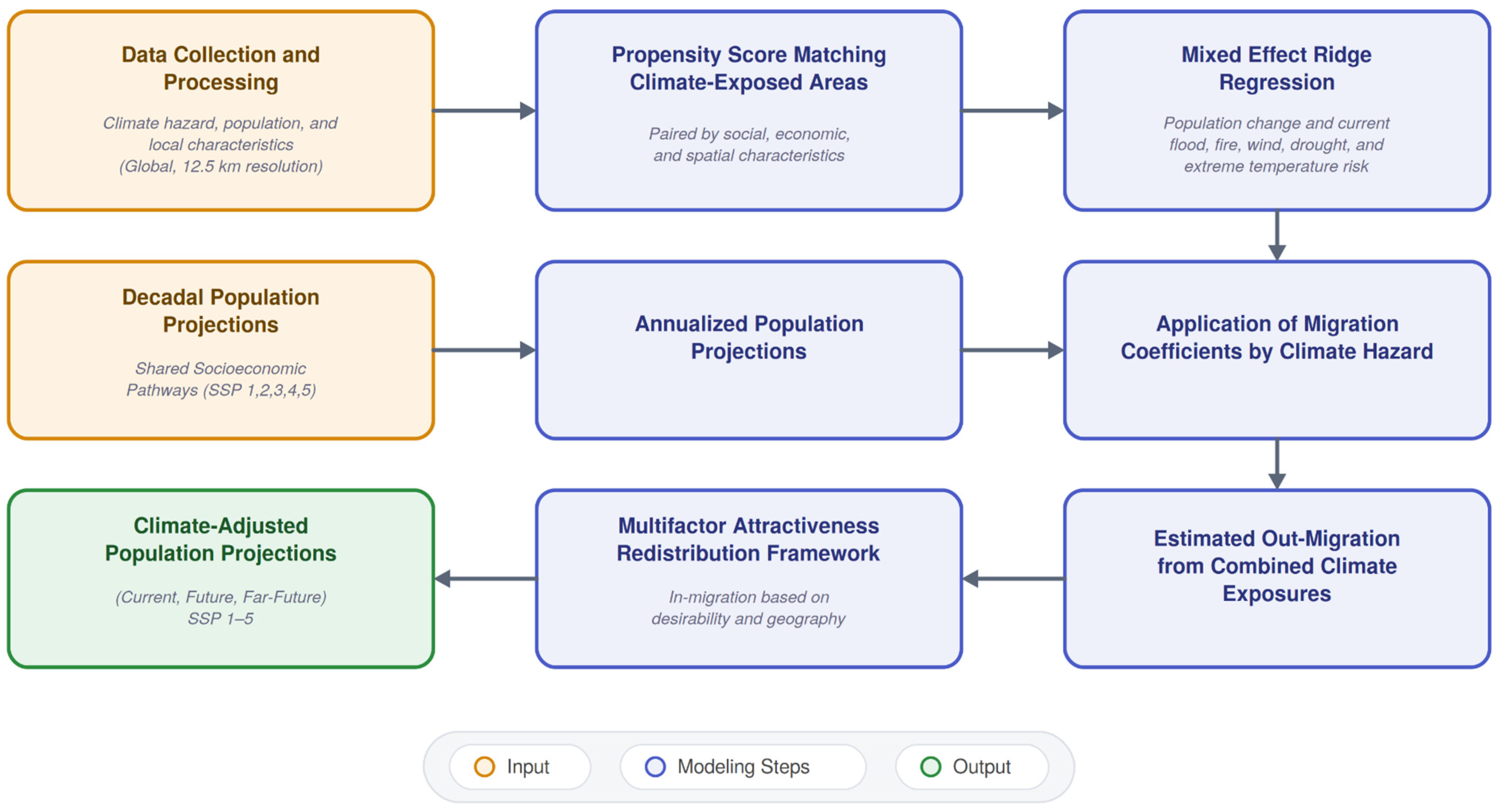
Causal relationships between climate exposure and population change were identified using within-country propensity score matching to construct comparable grid cells with similar socioeconomic and geographic characteristics but differing levels of historical hazard exposure. This matching process reduced confounding from non-climate drivers of migration. The relationship between annualized population change (2000–2020) and projected climate risk was then estimated using mixed-effects ridge regression, which accounted for multicollinearity among hazards and incorporated country-level random effects to capture cross-national heterogeneity. The resulting hazard-specific coefficients were applied to project climate-induced migration under three Shared Socioeconomic Pathways: SSP1 (sustainability-focused), SSP2 (middle-of-the-road), and SSP5 (fossil fuel-intensive development). See the general process presented in Figure 1.
Projected outmigration was subsequently redistributed using a multifactor attractiveness framework that incorporated economic opportunity, population density, relative climate safety, and geographic proximity as drivers of destination choice. Migration flows were constrained by saturation thresholds and long-term growth capacity to ensure demographic plausibility. By combining empirically estimated hazard effects with spatially constrained redistribution dynamics, the model captured both climate-related push factors and destination pull forces, providing a globally consistent assessment of how combined climate risks may reshape population distributions under future climate pathways.

2.2. Data Sources

2.2.1. Study Area and Resolution

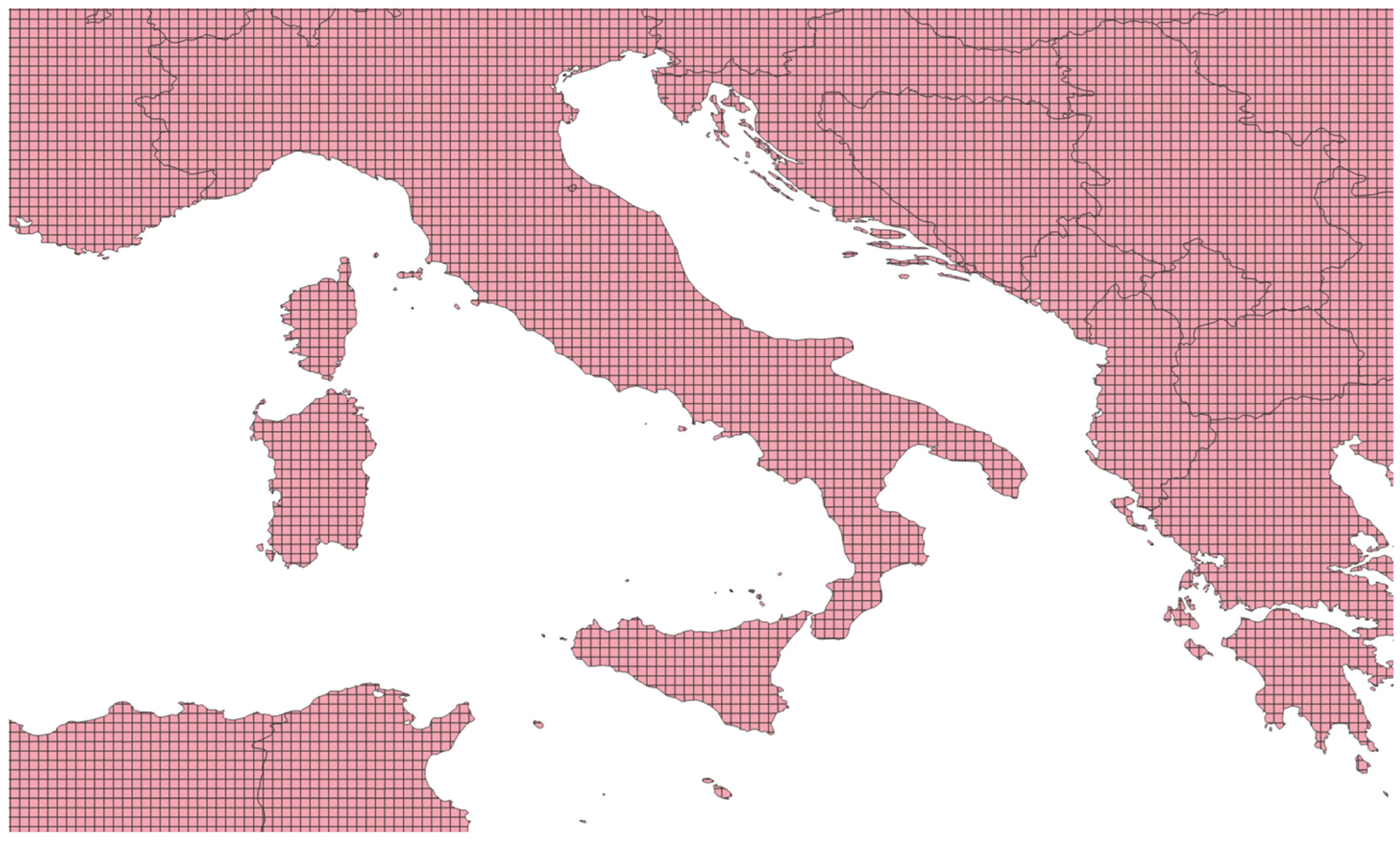
The global climate migration model was built on an underlying global gridded dataset based on administrative boundaries from Natural Earth, a public-domain repository of high-resolution geopolitical data at a 10 m resolution [25]. These boundaries were converted into standardized 12.5 km resolution grid cells, which served as the geographic foundation of our analysis (sample presented in Figure 2). Each grid cell was linked to its corresponding political unit using unique identifiers, such as ISO country codes or first-level administrative codes, to ensure consistent spatial referencing across all components of the analysis.

2.2.2. Climate Data

The historical climate exposure data used in this study spanned multiple hazard types and were derived from globally recognized reanalysis and observational datasets. These data were selected to ensure consistent spatial coverage, methodological rigor, and comparability across hazards. For each hazard, we identified a metric that captured an aspect of extreme exposure relevant to risk assessment, and we relied on established international datasets that provide multi-decadal historical records. Historic climate data are summarized in Table 1.
Flood exposure was characterized using the maximum return period derived from the Global Flood Awareness System (GloFAS) reanalysis streamflow dataset, covering the period 1990–2023. GloFAS integrates hydrological modeling with meteorological reanalysis inputs to provide consistent, gridded estimates of river discharge and flood hazard globally. Wind exposure was measured as maximum wind speed using data from the International Best Track Archive for Climate Stewardship (IBTrACS) in combination with the ERA5 reanalysis, spanning 1980–2023. IBTrACS provides globally consolidated tropical cyclone track data, while ERA5 offers high-resolution atmospheric reanalysis, enabling robust estimation of historical extreme wind conditions.
Drought was represented by the maximum duration of consecutive dry months based on ERA5 reanalysis data over the 1950–2014 period. This metric captures prolonged moisture deficits and provides a standardized measure of drought persistence. Wildfire exposure was quantified using mean burn probability from the Global Fire Atlas dataset for 2003–2022. The Global Fire Atlas derives fire behavior characteristics from satellite observations, enabling spatially explicit assessment of wildfire likelihood and recurrence.
Temperature extremes were evaluated using ERA5-LAND reanalysis data for 1995–2014. Extreme heat was defined as the annual number of days with a heat index exceeding 90 °F, while extreme cold was defined as the annual number of days with wind chill below –30 °F. ERA5-LAND provides enhanced land-surface resolution relative to standard ERA5, improving representation of near-surface temperature conditions relevant to human exposure.
Together, these datasets provide multi-hazard coverage, with temporal records ranging from the mid-20th century to 2023, depending on hazard type. The varying historical windows reflect differences in data availability and observational maturity across hazards, while maintaining sufficient duration to characterize long-term climate variability and extremes.

2.2.3. Population Data

Population data was obtained from NASA SEDAC’s Gridded Population of the World, Version 4 (GPWv4), which provides population counts at a 1 km resolution by disaggregating census and population register data [26]. Population data covered the years 2000 and 2020, and aggregated population was counted for our 12.5 km analysis grid using an exact area-weighted summation approach (Baston, 2023). These data were used in the development of the dependent variable in the models that follow as the annualized percentage population change at the tile from 2000 to 2020. The calculation (Equation (1)) involves first determining the percentage change over the 20-year period, then annualizing this value, where
p o p u l a t i o n   c h a n g e   ( % ) = ( P o p u l a t i o n 2020 P o p u l a t i o n 2000 )   P o p u l a t i o n 2000 ( 100 20 )
where
p o p u l a t i o n   c h a n g e is the annualized percentage change;
P o p u l a t i o n 2020 is the population value at a tile in 2020;
P o p u l a t i o n 2000 is the population value at a tile in 2000.
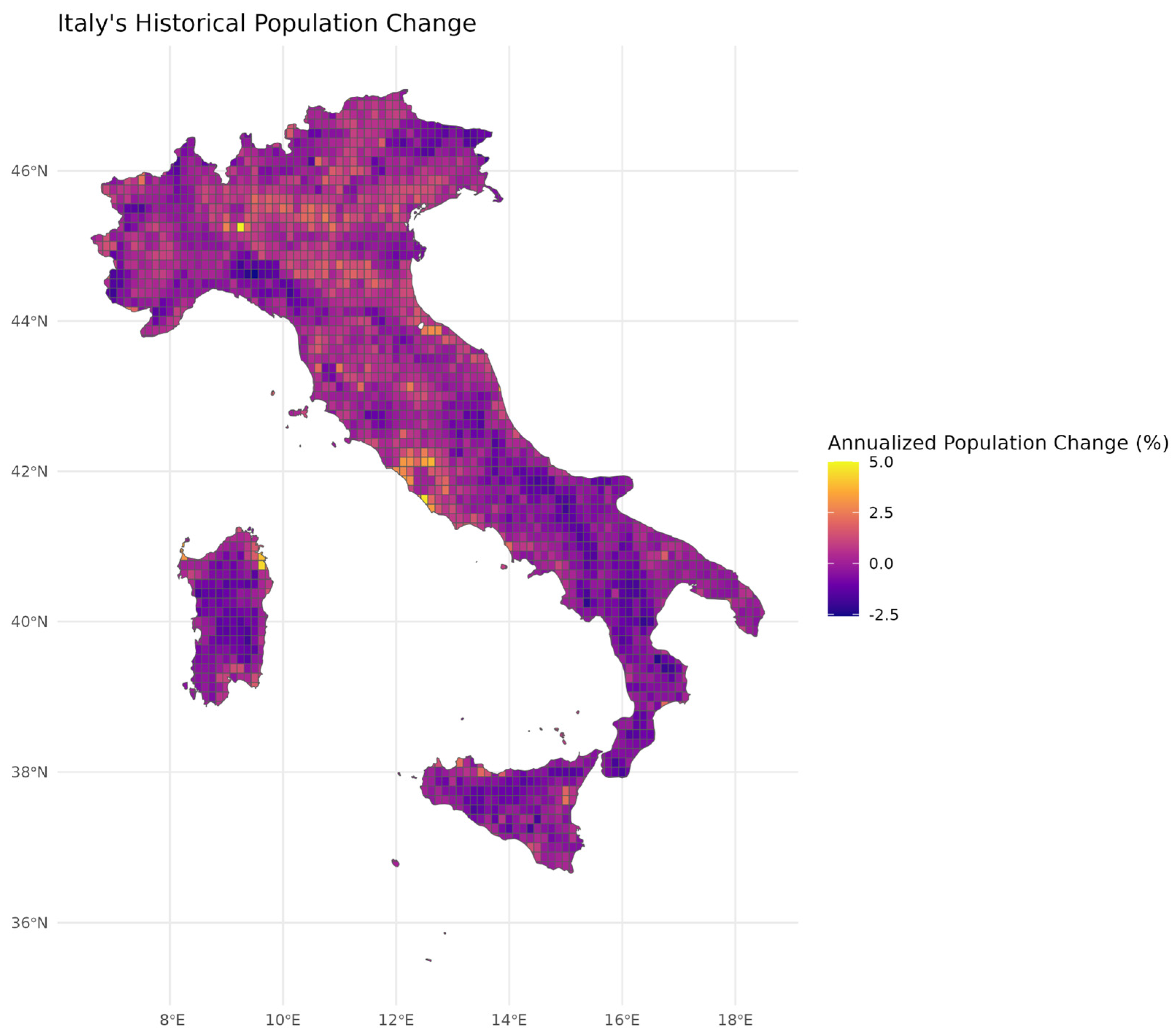
The division by 20 converted the change over the 20-year historic period to an annual rate. The multiplication by 100 expressed the result as a percentage. Figure 3 illustrates an example of the resulting historical population change mapped for Italy.

2.2.4. Covariate Data

The study incorporated a set of governance, socioeconomic, demographic, and environmental covariates at both national and subnational resolutions. Variables were grouped below by spatial resolution to clarify scale and data harmonization procedures. The full list of variables detailing the data source, resolution, and time period is provided in Table 2.
National governance and equality indicators for 2023 included measures of local democracy, local rights, gender equality, social group equality, economic equality, political equality, and political representation, all drawn from the Global State of Democracy (GSoD) Indices [44]. These indicators provide standardized cross-national metrics of institutional quality and inclusive governance. Additional national socioeconomic indicators included universal healthcare coverage [40], gross national income (GNI) per capita in purchasing power parity (PPP)–adjusted constant 2021 international dollars [41], unemployment as a percentage of the labor force based on ILO modelled estimates [41], household debt as a percentage of GDP [42], and the Price Level Index (PPP-based relative cost of goods and services) from the International Comparison Program [41]. National demographic structure was further characterized by the share of international migrants in the total population [43]. With the exception of healthcare coverage (2019) and the Price Level Index (2021), national indicators primarily reflected 2023 conditions, ensuring temporal alignment with the most recent governance and macroeconomic data.
Subnational covariates were harmonized primarily at a 1 km spatial resolution to support fine-scale exposure analysis. Economic activity was represented by the gridded gross domestic product for 2020 [45]. Urban structure was captured using the Urban–Rural Catchment Areas (URCAs) classification at a 1 km resolution [46]. Socioeconomic vulnerability was measured using the Global Gridded Relative Deprivation Index [35], while population density (persons per km2) was derived from NASA SEDAC [28]. Demographic composition was further characterized by median age from WorldPop [37].
Additional spatial controls included elevation (meters above mean sea level) from the European Centre for Medium-Range Weather Forecasts [38] and distance to coastline (km) from the NASA Ocean Biology Processing Group [39]. The Human Development Index (HDI), capturing health, education, and income dimensions, was included at a 11.1 km resolution for 2021 [36] Most subnational variables reflected conditions circa 2020, providing temporal consistency with gridded socioeconomic and population datasets.
Together, these national and subnational covariates provided multi-scalar controls capturing governance quality, macroeconomic context, demographic structure, spatial development patterns, and baseline vulnerability conditions relevant to this study’s analytical framework.

2.2.5. Limitations of Gridded and Downscaled Socioeconomic Data

While the use of high-resolution (1 km) gridded socioeconomic datasets enabled spatially explicit modeling, these products introduced important sources of uncertainty. In particular, gridded GDP estimates were not derived directly from subnational income or production accounts but instead relied on statistical downscaling approaches that allocated national economic output based on proxies such as population density, urbanicity, and nighttime lights [45]. As a result, these data may have underrepresented regions where economic output was weakly correlated with population concentration or urban form, such as extractive or resource-dependent economies. For example, mining-intensive regions, including parts of northern Chile, Australia, and southern Africa, may generate high economic output despite relatively low population density, a pattern that gridded GDP products do not fully capture.
To mitigate this limitation, GDP was used in the FS-GCMM as a relative attractiveness signal rather than a direct measure of local income or productivity. All socioeconomic variables were standardized within the modeling framework, preserving relative contrasts while limiting the influence of absolute misestimation at fine spatial scales. Nevertheless, uncertainty in gridded GDP remained a source of potential bias in the attractiveness index, particularly in regions where economic activity was decoupled from settlement patterns.

2.3. Statistical Analysis

2.3.1. Propensity Score Matching

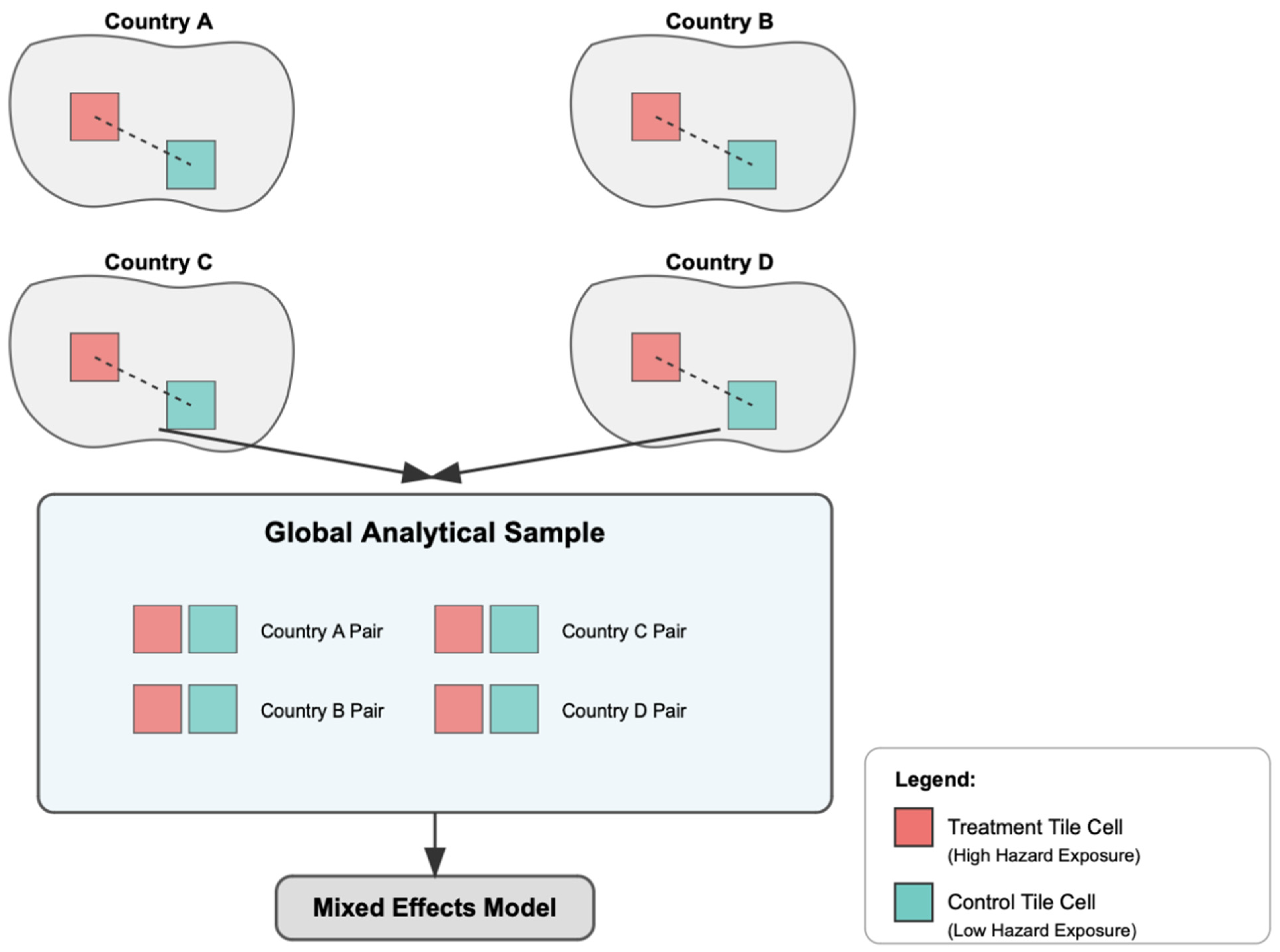
We applied propensity score matching (PSM), a causal inference technique, to identify grid cells with comparable community profiles matching on socioeconomic, geographic, and governance characteristics. This approach helped control for confounding factors that influenced population movement, enabling clearer estimation of climate hazard-driven migration (Figure 4).
Matching was conducted separately within each country to preserve context. Historical exposure thresholds were defined as at least twice the country-specific median for each climate hazard (three times for fire; see Table 3). Propensity scores, representing the likelihood of exposure given all community characteristics (Equation (2)), were calculated for each grid cell. Exposed cells were then matched to unexposed counterparts using nearest-neighbor matching based on the smallest difference in propensity scores. The resulting matched pairs were pooled globally to form the analytical sample used in our mixed effects ridge models.
P ( Y = 1 | X ) = 1 1 + e ( β 0 + β 1 x 1 + β 2 x 2 + + β k x k )  
where
P ( Y   =   1 | X ) is the probability of climate exposure given the covariates;
β represents the coefficients estimated in the logistic regression;
X represents the covariates used in the matching process.
Table 3. Exposure thresholds for propensity score matching by climate hazard.
HazardWithin-Country Exposure Threshold
Flood1 times the mean historic return period
Wind2 times the median historic wind speed
Drought2 times the median historic maximum number of months in drought
Wildfires3 times the median historic burn probability
Extreme Heat2 times the historic number of days reaching or exceeding 90 °F
Extreme Cold2 times the historic number of days at or below −30 °F
For flood risk, areas were classified as treated based on the upper distribution of maximum return periods calculated from GloFAS reanalysis streamflow data (1990–2023). Wind treatment status was assigned using maximum wind speed derived from IBTrACS and ERA5 (1980–2023), capturing exposure to extreme tropical cyclones and severe wind events. Drought-affected areas were identified based on the maximum duration of consecutive dry months from ERA5 (1950–2014), reflecting prolonged moisture deficits. Wildfire treatment groups were defined using mean burn probability from the Global Fire Atlas dataset (2003–2022), while extreme heat and extreme cold exposure were classified using thresholds based on the annual number of days exceeding 90 °F heat index and falling below −30 °F wind chill, respectively, from ERA5-LAND (1995–2014).
For each hazard, threshold values were systematically evaluated through sensitivity analyses to identify cut-points that most effectively distinguished areas experiencing substantively high exposure from those with comparatively moderate or low exposure. This process involved iteratively varying percentile- and distribution-based thresholds to optimize the composition of treatment groups while maintaining sufficient sample size and overlap with control units. The objective was to isolate areas that met the unique condition of being significantly impacted by a given hazard, rather than relying on arbitrary or externally imposed cutoffs.
Sensitivity analyses are particularly important in propensity score matching frameworks because treatment assignment definitions directly influence covariate balance, common support, and model stability. Small changes in threshold selection can alter the distribution of treated and control units, potentially affecting estimated treatment effects. By testing multiple plausible thresholds and confirming robustness of results across specifications, the analysis reduces the risk that findings are driven by idiosyncratic cutoff choices and strengthens causal interpretability.

2.3.2. Mixed Effects Ridge Regression

The global climate migration model employed ridge regression (L2 regularization) within a mixed-effects framework that includes country-level random intercepts. Ridge regression was selected due to the high dimensionality and multicollinearity among climate hazards, socioeconomic conditions, governance indicators, and spatial variables across countries. By imposing a penalty on the squared magnitude of coefficients, ridge stabilized parameter estimates without eliminating theoretically relevant predictors, thereby reducing variance inflation while preserving the full hazard structure. This was particularly important given correlated hazards (e.g., heat and drought) and cross-country covariance among economic and institutional variables.
The regularization parameter (λ) was selected using cross-validation to minimize out-of-sample prediction error, ensuring that the degree of shrinkage balanced bias and variance. Robustness was assessed through λ-path diagnostics, examination of coefficient stability across penalty ranges, and validation of predictive performance under alternative specifications. Together with country-level random effects, ridge regularization mitigated overfitting, enhanced coefficient stability, and improved generalizability of estimated hazard–migration relationships across diverse climatic and socioeconomic contexts.

2.3.3. Population Projections Under Shared Socioeconomic Pathways

Global population projections were obtained from NASA SEDAC’s Shared Socioeconomic Pathways (Revision 1) dataset, which provides 1 km resolution projections at ten-year intervals from 2020 to 2100 [27,28]. These projections are demographically driven and do not incorporate local climate impacts, an important gap our model addressed by estimating deviations driven by climate-related risks.
Population counts were aggregated to our 12.5 km analysis grid using an exact-area-weighted summation approach. Annual population values were linearly interpolated between decadal estimates for each SSP from 2025 to 2100 (years 0–75). We evaluated climate impacts across three SSP-RCP (Representative Concentration Pathway) scenarios: SSP1-RCP2.6, SSP2-RCP4.5, and SSP5-RCP8.5 [14,15,16]. SSP-RCPs are integrated scenarios that combine socioeconomic development narratives (SSPs) with greenhouse gas concentration trajectories (RCPs), where the first scenario represents a sustainable, low-emissions future; the second reflects a continuation of current trends; and the third depicts fossil-fueled development. Table 4 summarizes the narrative and quantitative differences across the selected SSP-RCP scenarios.

2.4. Climate Migration Model Implementation

2.4.1. Identifying Outmigrants

The first step in the climate migration model was identifying the potential movers from a location that can be linked to climate risk. This group was referred to as outmigrants. For each grid cell, the number of outmigrants was calculated by summing the product of each hazard’s risk level and its corresponding coefficient, estimating the proportion of the population expected to relocate, and then multiplying this proportion by the population to obtain the outmigrant count (Equation (3)).
O u t m i g r a n t s t = P o p u l a t i o n t × i   ( H a z a r d   R i s k t , i × H a z a r d   C o e f f i c i e n t i )
where
  • O u t m i g r a n t s t : Estimated number of climate outmigrants leaving tile t ;
  • P o p u l a t i o n t : Total population in tile t ;
  • H a z a r d   R i s k t , i : Intensity of climate hazard i in tile t ;
  • H a z a r d   C o e f f i c i e n t i : Regression effect of hazard i on population change;
  • The summation i combines the effect across all hazards i .
This approach captured cumulative climate pressure across hazards, including flood, fire, wind, drought, and temperature extremes. This process was repeated for each time step and SSP scenario.

2.4.2. Scoring Area Attractiveness

The outmigrants estimated from the section above were next redistributed to new locations based on an attractiveness score that captured economic, demographic, and environmental conditions. Attractiveness was calculated as a weighted sum of normalized (z-score) factors (Equation (4)):
A t t r a c t i v e n e s s   =   W 1 ( G D P )   + W 2 ( P o p u l a t i o n   D e n s i t y )   +   W 3 ( C l i m a t e   R i s k )  
where
  • Weights W 1 ,   W 2 ,   W 3 vary by time period and SSP scenario;
  • GDP Factor represents the time-varying GDP of the grid cell;
  • Population Density Factor represents the time-varying density of the grid cell;
  • Climate Risk Factor represents the time-varying hazard risk of the grid cell.
While GDP and Density metrics were positively weighted (more GDP and density made an area more attractive), Climate risk was inversely weighted, so lower-risk areas were more attractive. Weight values varied by time period and were based on empirical research [47,48,49]; full details are provided in the Supplementary Materials (Item S1). To incorporate geographic context, we then applied a spatial lag, averaging attractiveness values across each tile’s K-nearest neighbors (K = 5). Final attractiveness was calculated via Equation (5) as the weighted combination of local and neighborhood scores:
F i n a l   A t t r a c t i v e n e s s   =   ( ( 1 S )   ×   A t t r a c t i v e n e s s )   +   ( S   ×   S p a t i a l   A t t r a c t i v e n e s s )
where
  • S is the spatial weight parameter (default 0.7);
  • A t t r a c t i v e n e s s is computed as in Equation (4);
  • S p a t i a l   a t t r a c t i v e n e s s is the spatial lag of D i r e c t   A t t r a c t i v e n e s s .
Essentially, the attractiveness score took into account the attractiveness in the local area, as well as the neighboring cells. A distribution weight was then calculated for each destination grid cell based on its relative attractiveness, normalized across all potential destinations to form a probability distribution (Item S1). These weights were then applied to the pool of outmigrants in the surrounding region, allocating migrants proportionally to more attractive nearby locations.

2.4.3. Migration Capacity Constraints

Following the initial allocation of migration flows, a set of migration capacity constraints was applied to prevent implausible population growth and ensure spatial realism in projected settlement patterns (see Supplementary Materials Item S2). First, the base growth rate declined over time to reflect adaptation saturation, recognizing that the ability of destinations to absorb migrants diminished as infrastructure, labor markets, and housing systems approached capacity. Growth potential was also adjusted based on initial population size, with smaller settlements permitted relatively higher proportional growth, consistent with empirical evidence suggesting greater expansion potential in less densely populated areas. In contrast, a cumulative migration adjustment reduced growth rates in locations that had already experienced substantial in-migration, preventing compounding growth in saturated destinations.
Additional safeguards further constrained unrealistic expansion. A population threshold graduation rule limited rapid growth in near-zero population cells, ensuring that development primarily extended outward from already populated areas rather than generating isolated, high-growth enclaves. Lifetime growth limited the capped total population expansion to between 5× and 15× the baseline population, depending on the time horizon, thereby bounding long-run growth trajectories within plausible ranges. Finally, to maintain conservation of the total population, a balancing step reconciled aggregate out- and in-migration flows. If discrepancies arose, adjustments were made by scaling back allocations to less attractive destinations or reallocating flows toward high-attractiveness locations with remaining capacity. Together, these constraints preserved demographic consistency while preventing extreme or spatially unrealistic migration outcomes.

3. Results

3.1. Multi-Hazard Climate Exposure and Population Change

All climate hazards modeled demonstrated statistically significant negative effects on population retention at the tile level. The universality of negative effects across diverse hazard types, from acute events like floods and wildfires to chronic stressors such as drought and temperature extremes, indicates that climate risk represents a fundamental driver of population redistribution that transcends specific hazard characteristics. These results demonstrate the consistent role that environmental stressors play in shaping demographic patterns, with climate risk functioning as an amplification effect in areas already experiencing other push factors. The significant negative coefficients related to the impact of climate risk on observed historic population change patterns are presented in Table 5.
This pattern is particularly significant as it indicates that communities already experiencing population decline due to economic factors, lack of opportunities, or other stressors face additional pressure from climate risks, potentially accelerating outmigration and contributing to a cycle of community decline and reduced resilience.

3.2. Forecasted Global Patterns of Climate-Specific Impacts over Time

Following the identification of historic relationships between each climate hazard and population change, the derived coefficients were applied to future population projections across all Shared Socioeconomic Pathways (SSPs 1-2.6, 2-4.5, and 5-8.5) extending to the year 2100. Climate-adjusted population projections were generated by applying the regression coefficients to future scenarios, enabling quantification of climate risk impacts on population dynamics over the projection period.
The spatial analysis revealed distinct patterns in hazard coverage globally (Table 6). Drought risk affected the largest proportion of tiles globally, impacting 56.69% of all current tiles, with coverage declining to 53.92% by 2100. Tropical and extratropical winds represented the second most widespread hazard, affecting approximately 50% of tiles throughout the projection period. Extreme heat impacts showed an increasing trend, rising from 40.21% of current tiles to 42.58% by 2100. Flood risk affected approximately 28–29% of tiles, with relatively stable coverage over time. Wildfire demonstrated an increasing spatial footprint, expanding from 16.12% of current tiles to 19.21% by 2100. Extreme cold showed the smallest and declining impact, decreasing from 10.43% of current tiles to 6.46% by 2100, consistent with projected global warming trends.

Population Loss Projections by Socioeconomic Status

The spatial analysis of projected climate-induced population losses revealed distinct patterns reflecting the complex interplay between demographic concentration, economic development, and environmental vulnerability. Under the SSP2-4.5 scenario, approximately 199.5 million people were projected to experience climate-driven displacement by 2055.

3.3. Global Migration Flow Analysis

3.3.1. Destination Hierarchies and Regional Results

The analysis of global climate migration patterns revealed net climate migration flows calculated as the difference between climate in-migrants and out-migrants, isolated from baseline demographic trends. Countries exhibiting positive net flows emerged as climate migration destinations, while negative values indicated origins experiencing sustained population losses due to environmental degradation.
The migration destination hierarchy revealed a pronounced preference for large developing economies with substantial territorial extent and economic dynamism. Pakistan and India dominated net in-migration flows, receiving 6.1 million climate migrants each by 2055, suggesting the emergence of South Asian regional migration systems. Egypt’s position as the third-largest destination (4.2 million net in-migrants) indicated similar regional consolidation patterns across North Africa and the Middle East.
This regional clustering pattern reflected “proximate destination preference,” where climate migrants prioritized cultural and linguistic familiarity, established migration networks, and reduced transaction costs over optimal climate safety. Brazil’s and Indonesia’s prominent positions (2.9 and 2.4 million respectively) further support this regional systems hypothesis.

3.3.2. Temporal Evolution of Climate Migration Flows

The temporal evolution between 2055 and 2100 revealed significant reconfigurations in global destination hierarchies. India strengthened its position as the primary destination (9.5 million by 2100), while several developed economies experienced dramatic reversals. The United States transitioned from a net destination (2.3 million in-migrants) to experiencing substantial net outflows, representing a 3.9 million person reversal, the largest directional change observed globally.
This developed country reversal pattern extended across multiple high-income nations: the United Kingdom, Germany, Japan, and France all shifted toward net outflows by 2100. Countries experiencing consistent net outflows throughout both projection periods included the Philippines (5.2–5.3 million), Nigeria, Madagascar, and Mozambique, exhibiting common characteristics of acute climate vulnerability combined with limited adaptive capacity.

3.3.3. Climate Migration Propensity by Economic Class and Urban–Rural Areas

The data in Table 7 presents the projected migration flows by economic class and urban–rural designation for 2055, demonstrating substantial heterogeneity in climate impacts across different community types and development levels. Urban areas consistently experienced larger absolute population losses across all climate hazards and economic classes, with total urban losses reaching approximately 103.8 million people compared to 95.7 million in rural areas by 2055. This pattern reflects the fundamental relationship between population density and absolute migration potential: urban centers, by virtue of their larger population bases, possess greater capacity for substantial outmigration.
BRIC countries (Brazil, Russia, India, China) exhibited the highest absolute losses across both urban and rural designations, with combined losses exceeding 45 million people across all hazards. This pattern underscores the particular vulnerability of rapidly industrializing nations that face intense climate exposure while managing large-scale urbanization and economic transition.
G7 nations showed substantial absolute impacts, particularly in urban areas (35.2 million projected migrants), reflecting their large urban populations and exposure to climate hazards despite high adaptive capacity. Non-G7 developed regions demonstrated more moderate impacts (12.6 million urban, 8.8 million rural), potentially indicating the effectiveness of advanced infrastructure and early warning systems in reducing displacement.
The three emerging economic categories revealed distinct vulnerability profiles. MIKT countries (Mexico, Indonesia, Turkey, South Korea) showed intermediate impacts (18.9 million total), while G20 emerging economies experienced substantial losses (58.2 million total), reflecting their diverse geography and varying exposure to multiple climate hazards.

3.4. Regional Case Study: Italy

3.4.1. Spatial Distribution of Climate-Driven Outmigration Candidates

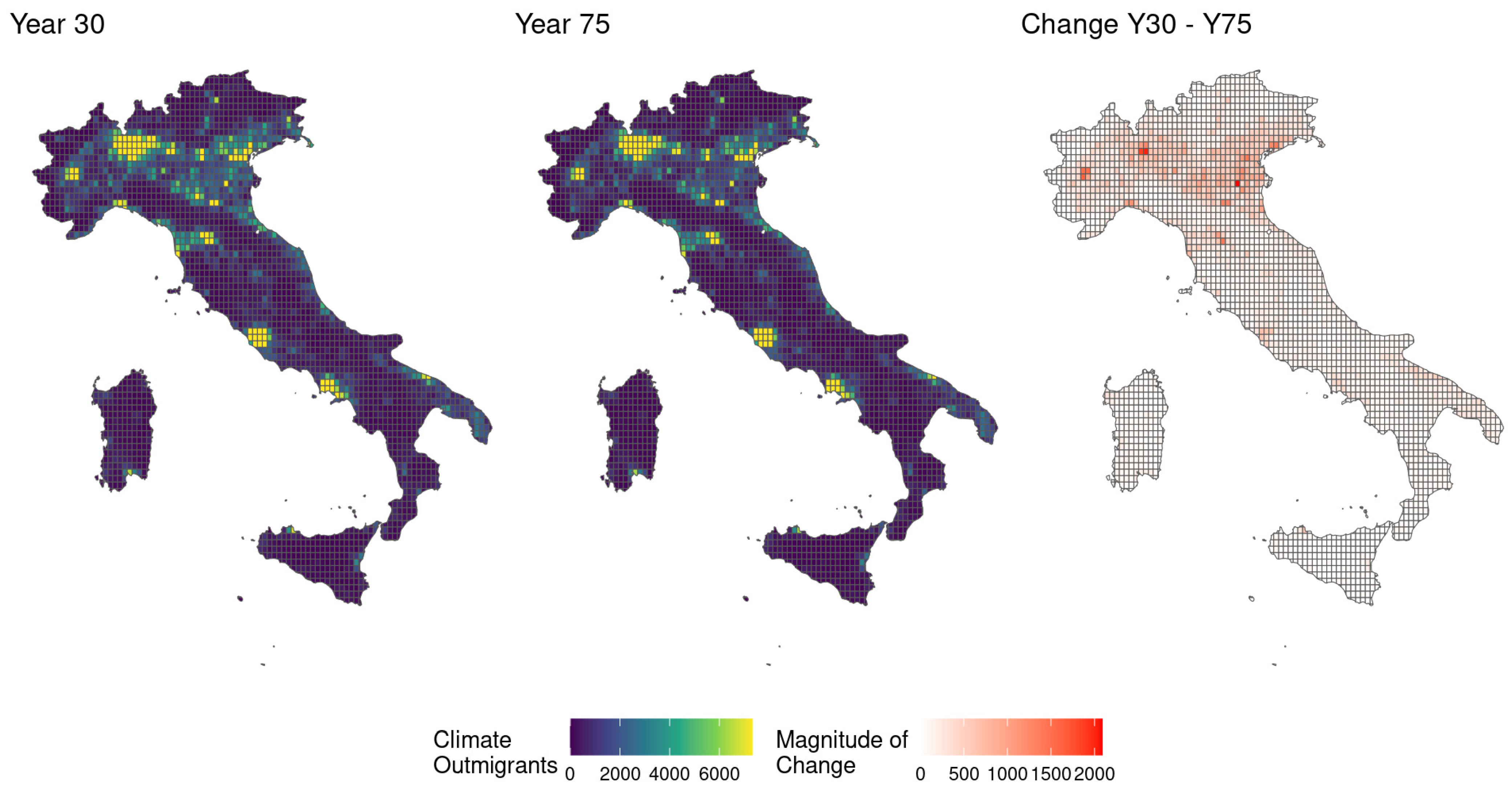
The results from Figure 5 show Italy’s climate-driven outmigration, concentrated in the Po Valley region (northern Italy), which faces severe flooding risks from rivers and sea level rise, plus extreme heat stress in the valley’s basin. Major metropolitan areas like Milan and Turin appear highly vulnerable, along with the Venice region. The pattern intensified modestly from Year 30 to Year 75 but remained geographically stable, suggesting that these northern urban and agricultural areas will experience sustained climate pressure from combined heat and flood hazards, while southern Italy shows lower but persistent outmigration levels.

3.4.2. Spatial Distribution of Population Redistribution Dynamics

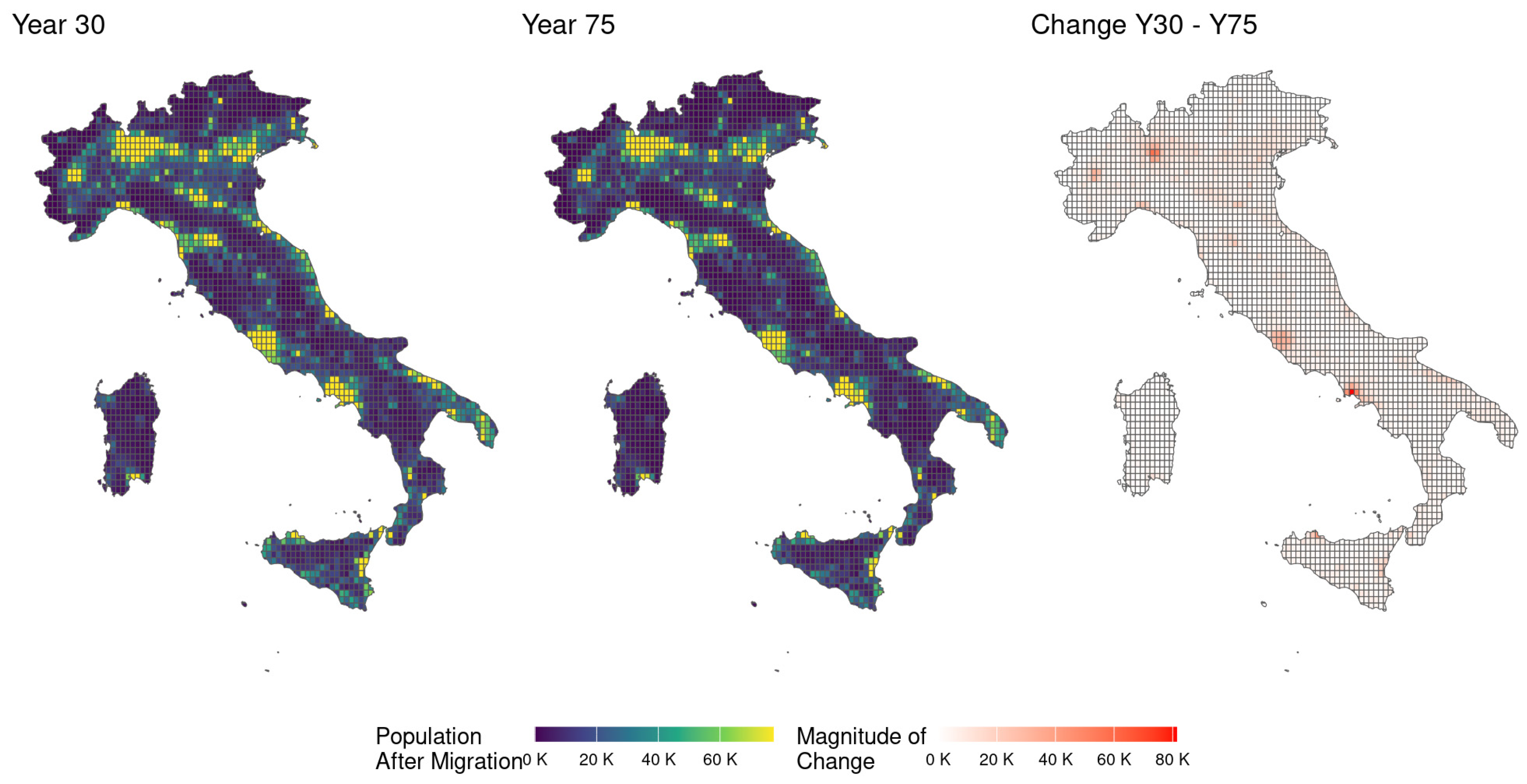
The visualization in Figure 6 reveals Italy’s net population distribution after accounting for climate migration, showing that northern Italy’s major urban centers and the Po Valley maintained the highest populations in both time periods despite climate risks. These regions likely serve as climate migration destinations due to strong economic pull factors: industrial hubs like Milan and Turin, agricultural productivity, and better infrastructure resilience. The relatively modest changes between Year 30 and Year 75 suggest that Italy’s established economic geography largely determines where climate migrants relocate, with northern cities absorbing displaced populations from more vulnerable areas despite facing their own climate challenges.

4. Discussion

4.1. Key Findings and Global Implications

Our findings reveal that climate migration has the potential to fundamentally reshape global population distributions, with all climate hazards demonstrating statistically significant negative effects on population retention. The projected displacement of 199.5 million people by 2055 under the SSP2-4.5 scenario represents an unprecedented demographic transition that challenges existing frameworks for understanding human mobility.
The emergence of large developing economies as primary climate migration destinations, particularly Pakistan, India, and Egypt, fundamentally challenges simplistic climate migration models that assume displacement toward climatically optimal locations. Instead, our results demonstrate that economic opportunity, cultural familiarity, and established migration networks often outweigh absolute climate safety in destination selection decisions. This pattern of “bounded rationality” in migration decisions, where migrants optimize within familiar geographical and cultural zones rather than pursuing global optimization strategies, has profound implications for international migration governance.

4.2. Comparison with Existing Literature and Models

Our global estimate of 199.5 million climate migrants by 2055 falls within the range of existing projections but provides greater spatial specificity and hazard differentiation than previous models. While the World Bank’s Groundswell reports project up to 216 million internal climate migrants by 2050 across six major regions [7], our multi-hazard approach reveals how different environmental stressors contribute to total displacement patterns.
The finding that wind-related hazards dominate migration projections (156.8 million migrants) aligns with IDMC observations about weather-related disasters but extends this to long-term displacement patterns rather than acute displacement events. Our identification of drought as the most spatially extensive hazard (affecting 56.69% of global areas) provides new insights into the geographic scope of slow-onset climate impacts.
The reversal of developed countries from net destinations to source regions by 2100 represents a novel finding that contrasts with traditional migration theories emphasizing income differentials as primary drivers. This suggests that climate pressures may eventually override economic advantages in migration decision-making, particularly as climate impacts intensify in currently temperate regions.

4.3. Policy Implications and Governance Challenges

It should be noted that the results of this analysis hold development constant and isolate the impact of growing climate risk. Adaptation investments and targeted policy interventions can meaningfully alter the negative redistribution effects often associated with climate-driven migration, particularly for areas facing elevated physical risk. Without intervention, high-risk regions may experience declining property values, shrinking tax bases, and capital flight, reinforcing cycles of disinvestment and out-migration. However, proactive investments in resilient infrastructure, such as flood defenses, wildfire mitigation, water management systems, and heat-resilient urban design, can reduce expected damages, stabilize insurance markets, and preserve economic productivity.
Complementary policy tools, including risk-informed land-use planning, updated building codes, climate risk disclosure requirements, and subsidized resilience retrofits for vulnerable households, can further mitigate losses while protecting lower-income residents from displacement. In some cases, well-designed adaptation strategies may even attract capital by increasing investor confidence and lowering long-term uncertainty, partially offsetting climate-related outflows. By reducing physical and financial risk, these interventions can dampen destabilizing redistribution dynamics and create a more orderly adjustment process, benefiting both origin and destination regions in a climate-constrained future.

4.4. Limitations and Future Research

While the model represented in this manuscript provides a globally consistent and empirically grounded framework for estimating climate-driven migration, several data-related and conceptual limitations should be acknowledged to appropriately contextualize the results. First, the model relies on gridded and downscaled datasets for both environmental and socioeconomic variables, many of which are derived from secondary sources and statistical interpolation. Although these datasets enable global coverage at relatively fine spatial resolution, they introduce uncertainty related to measurement error, temporal misalignment, and spatial smoothing. For example, gridded population, GDP, and deprivation indices are constructed using proxy variables and allocation algorithms that may not fully capture localized heterogeneity, particularly in regions with limited census infrastructure or rapidly changing economic conditions. As a result, estimates at the tile level should be interpreted as approximations of relative spatial patterns rather than precise representations of local conditions.
Second, the climate hazard inputs themselves are subject to limitations in both observational coverage and model-based reconstruction. While reanalysis datasets such as ERA5 and GloFAS provide globally consistent hazard estimates, they may underrepresent extreme events in data-sparse regions or fail to fully capture localized microclimates and compound hazard interactions. Additionally, differences in temporal coverage across hazards (e.g., drought vs. wildfire vs. temperature extremes) introduce inconsistencies in historical exposure measurement that may influence estimated relationships. The model treats hazards independently in the estimation stage, which, while necessary for tractability, may not fully reflect the cascading and interacting nature of real-world climate risks.
Third, the identification of climate-driven migration effects is constrained by the use of population change as a proxy for mobility. While this approach allows for global coverage in the absence of consistent migration flow data, it does not distinguish between different forms of mobility (e.g., internal vs. international migration, temporary vs. permanent relocation) or isolate migration from other demographic processes such as natural population growth or decline. Although the use of propensity score matching and mixed-effects regression helps control for confounding socioeconomic and geographic factors, residual confounding may persist, particularly in regions where governance, conflict, or policy interventions play a significant role in shaping migration outcomes but are not fully captured in available datasets.
Fourth, the model assumes relatively stable relationships between climate hazards and migration behavior over time and applies historically estimated coefficients to future scenarios. This assumption may not hold under conditions of structural change, including technological adaptation, infrastructure investment, policy shifts, or nonlinear climate impacts. For example, improvements in early warning systems, climate adaptation infrastructure, or economic diversification could reduce the sensitivity of populations to hazard exposure, while extreme or unprecedented climate events could produce nonlinear responses not reflected in historical data. As such, projections should be interpreted as conditional on current relationships persisting rather than deterministic forecasts of future migration outcomes.
Finally, the scope of generalization of the current model should be carefully considered. While the model provides global coverage and enables cross-country comparison, its outputs are most robust at aggregated spatial scales, such as regional patterns, national totals, or broad urban–rural trends, rather than at the level of individual grid cells. The integration of national-level socioeconomic variables with subnational spatial data further reinforces this limitation, as local-level estimates reflect the spatial allocation of broader structural conditions rather than fully observed local dynamics. Consequently, the results are best interpreted as identifying relative patterns of climate-driven population redistribution and potential hotspots of migration pressure, rather than precise predictions of movement at specific locations.
Taken together, these limitations highlight important avenues for future research, including the integration of improved subnational socioeconomic data, the incorporation of dynamic adaptation processes, and the development of models that explicitly account for hazard interactions and policy constraints. Expanding the availability of high-resolution migration flow data and longitudinal datasets would further enhance the ability to disentangle climate effects from other drivers of mobility. Despite these constraints, the model represents a significant step toward a more empirically grounded and spatially explicit understanding of climate migration, providing a transparent framework that can be refined as data availability and methodological approaches continue to evolve.

5. Conclusions

This study advances the climate migration literature by introducing a globally consistent, multi-hazard modeling framework that integrates empirical hazard–migration relationships with Shared Socioeconomic Pathway (SSP) population projections up to 2100. By combining propensity score matching, mixed-effects ridge regression, and an attractiveness-based redistribution model, the First Street Global Climate Migration Model (FS-GCMM) isolates the independent contribution of climate risk to observed population change and translates those relationships into forward-looking spatial projections. Unlike single-hazard or regionally constrained models, this framework captures the cumulative and interacting pressures of flood, wind, drought, wildfire, and temperature extremes within a harmonized global grid.
The results underscore the structural role of climate risk in shaping demographic change. All modeled hazards demonstrate statistically significant negative effects on population retention, and under SSP2-4.5, nearly 199.5 million people are projected to experience climate-driven displacement by 2055. Importantly, the model reveals that migration patterns are not determined solely by climatic safety. Instead, economic opportunity, infrastructure, and existing settlement systems strongly mediate redistribution outcomes, often directing flows toward economically dynamic, but still climate-exposed, regions. This finding challenges simplified narratives of linear displacement toward “climate-optimal” locations and highlights the bounded, context-dependent nature of migration decision-making.
The implications are profound. Climate migration is not a peripheral outcome of environmental change; it is a central mechanism through which climate risk will restructure economic geography, urban systems, and regional development trajectories throughout the 21st century. While the model holds development pathways constant to isolate climate effects, the findings make clear that adaptation investments, governance capacity, and risk-informed planning can meaningfully alter projected outcomes. Proactive resilience strategies—ranging from infrastructure hardening and land-use reform to economic diversification and social protection—have the potential to dampen destabilizing outmigration while supporting orderly redistribution where mobility is adaptive. As such, climate migration must be treated not only as a humanitarian concern but as a core component of long-term development and economic planning in a climate-constrained future.

Supplementary Materials

The following supporting information can be downloaded at https://www.mdpi.com/article/10.3390/cli14040081/s1, Item S1. Supplemental details on the attractiveness score for the redistribution framework; Item S2. Supplemental details on migration capacity constraints, excess redistribution, and balance verification within the redistribution framework; Item S3. Cross-Scenario Comparison.

Author Contributions

Conceptualization, Z.M.H., D.N.M., J.M.B. and J.R.P.; methodology, Z.M.H., D.N.M. and J.R.P.; validation, Z.M.H. and D.N.M.; formal analysis, Z.M.H.; data curation, Z.M.H.; writing—original draft preparation, Z.M.H.; writing—review and editing, Z.M.H., J.M.B. and J.R.P.; visualization, Z.M.H.; supervision, J.R.P.; project administration, J.R.P. All authors have read and agreed to the published version of the manuscript.

Funding

This research received no external funding.

Data Availability Statement

The data presented in this study are available on request from the corresponding author due to sharing restrictions.

Conflicts of Interest

The authors declare no conflict of interest.

References

  1. Intergovernmental Panel on Climate Change. Sixth Assessment Report: Synthesis Report; Intergovernmental Panel on Climate Change: Geneva, Switzerland, 2023. [Google Scholar]
  2. International Organization for Migration (IOM). Discussion Note: Migration and the Environment. 2007. Available online: https://environmentalmigration.iom.int/sites/g/files/tmzbdl1411/files/MC_INF_288.pdf (accessed on 30 July 2025).
  3. Internal Displacement Monitoring Centre (IDMC). Internal Displacement and Food Security. 2023. Available online: https://api.internal-displacement.org/sites/default/files/publications/documents/IDMC_GRID_2023_Global_Report_on_Internal_Displacement_LR.pdf (accessed on 30 July 2025).
  4. Ionesco, D.; Mokhnacheva, D.; Gemenne, F. The Atlas of Environmental Migration (First); Routledge: Abingdon, UK, 2017; Available online: https://www.routledge.com/The-Atlas-of-Environmental-Migration/Ionesco-Mokhnacheva-Gemenne/p/book/9781138022065 (accessed on 30 July 2025).
  5. Hoffmann, R.; Dimitrova, A.; Muttarak, R.; Crespo Cuaresma, J.; Peisker, J. A meta-analysis of country-level studies on environmental change and migration. Nat. Clim. Change 2020, 10, 904–912. [Google Scholar] [CrossRef]
  6. Rigaud, K.K.; De Sherbinin, A.; Jones, B.; Bergmann, J.; Clement, V.; Ober, K.; Schewe, J.; Adamo, S.; McCusker, B.; Heuser, S.; et al. Groundswell; World Bank: Washington, DC, USA, 2018. [Google Scholar] [CrossRef]
  7. Clement, V.; Jones, B.; Schewe, J. Groundswell Part 2: Acting on Internal Climate Migration; World Bank: Washington, DC, USA, 2021; Available online: https://openknowledge.worldbank.org/entities/publication/2c9150df-52c3-58ed-9075-d78ea56c3267 (accessed on 30 July 2025).
  8. Mueller, V.; Gray, C.; Kosec, K. Heat stress increases long-term human migration in rural Pakistan. Nat. Clim. Change 2014, 4, 182–185. [Google Scholar] [CrossRef] [PubMed]
  9. Nawrotzki, R.J.; DeWaard, J. Climate shocks and the timing of migration from Mexico. Popul. Environ. 2016, 38, 72–100. [Google Scholar] [CrossRef] [PubMed]
  10. Campbell, J.R. Migration and climate change in the Pacific. In Handbook of Migration and Globalisation; Triandafyllidou, A., Ed.; Edward Elgar Publishing: Cheltenham, UK, 2018. [Google Scholar] [CrossRef]
  11. Cantor, D.J. Cross-Border Displacement, Climate Change and Disasters: Latin America and the Caribbean; UN High Commissioner for Refugees (UNHCR): Geneva, Switzerland, 2018; Available online: https://www.refworld.org/reference/research/unhcr/2018/en/148285 (accessed on 30 July 2025).
  12. Abel, G.J.; Brottrager, M.; Crespo Cuaresma, J.; Muttarak, R. Climate, conflict and forced migration. Glob. Environ. Change 2019, 54, 239–249. [Google Scholar] [CrossRef]
  13. Fussell, E.; Hunter, L.M.; Gray, C.L. Measuring the environmental dimensions of human migration: The demographer’s toolkit. Glob. Environ. Change 2014, 28, 182–191. [Google Scholar] [CrossRef]
  14. O’Neill, B.C.; Kriegler, E.; Riahi, K.; Ebi, K.L.; Hallegatte, S.; Carter, T.R.; Mathur, R.; van Vuuren, D.P. A new scenario framework for climate change research: The concept of shared socioeconomic pathways. Clim. Change 2014, 122, 387–400. [Google Scholar] [CrossRef]
  15. O’Neill, B.C.; Kriegler, E.; Ebi, K.L.; Kemp-Benedict, E.; Riahi, K.; Rothman, D.S.; Van Ruijven, B.J.; Van Vuuren, D.P.; Birkmann, J.; Kok, K.; et al. The roads ahead: Narratives for shared socioeconomic pathways. Glob. Environ. Change 2017, 42, 169–180. [Google Scholar] [CrossRef]
  16. van Vuuren, D.P.; Edmonds, J.; Kainuma, M.; Riahi, K.; Thomson, A.; Hibbard, K.; Hurtt, G.C.; Kram, T.; Krey, V.; Lamarque, J.-F.; et al. The representative concentration pathways: An overview. Clim. Change 2011, 109, 5. [Google Scholar] [CrossRef]
  17. Myers, N. Environmental refugees: A growing phenomenon. Philos. Trans. R. Soc. B 2002, 357, 609–613. [Google Scholar] [CrossRef]
  18. Schewel, K.; Dickerson, S.; Madson, B.; Nagle Alverio, G. How well can we predict climate migration? A review of forecasting models. Front. Clim. 2024, 5, 1189125. [Google Scholar] [CrossRef]
  19. Hoffmann, R.; Šedová, B.; Vinke, K. Improving the evidence base: A methodological review of the quantitative climate migration literature. Glob. Environ. Change 2021, 71, 102367. [Google Scholar] [CrossRef]
  20. Piguet, E.; Kaenzig, R.; Guélat, J. The uneven geography of research on environmental migration. Popul. Environ. 2018, 39, 357–383. [Google Scholar] [CrossRef]
  21. Ghosh, R.C.; Orchiston, C. A systematic review of climate migration research. SN Soc. Sci. 2022, 2, 41. [Google Scholar] [CrossRef]
  22. Beine, M.; Jeusette, L. A meta-analysis of the literature on climate change and migration. J. Demogr. Econ. 2021, 87, 181–218. [Google Scholar] [CrossRef]
  23. Cattaneo, C.; Beine, M.; Fröhlich, C.J.; Kniveton, D.; Martinez-Zarzoso, I.; Mastrorillo, M.; Millock, K.; Piguet, E.; Schraven, B. Human migration in the era of climate change. Rev. Environ. Econ. Policy 2019, 13, 189–206. [Google Scholar] [CrossRef]
  24. Black, R.; Bennett, S.R.G.; Thomas, S.M.; Beddington, J.R. Migration as adaptation. Nature 2011, 478, 447–449. [Google Scholar] [CrossRef]
  25. Kelso, N.V. Natural Earth Vector Dataset. Available online: https://github.com/nvkelso/natural-earth-vector (accessed on 22 April 2022).
  26. Doxsey-Whitfield, E.; MacManus, K.; Adamo, S.B.; Pistolesi, L.; Squires, J.; Borkovska, O.; Baptista, S.R. Taking Advantage of the Improved Availability of Census Data: A First Look at the Gridded Population of the World, Version 4. Pap. Appl. Geogr. 2015, 1, 226–234. [Google Scholar] [CrossRef]
  27. Gao, J. Downscaling Global Spatial Population Projections from 1/8-Degree to 1-km Grid Cells (p. 2082 KB) [Application/pdf]; UCAR/NCAR: Boulder, CO, USA, 2017. [Google Scholar] [CrossRef]
  28. Jones, B.; O’Neill, B.C.; Gao, J. Global 1-km Downscaled Population Base Year and Projection Grids for the Shared Socioeconomic Pathways (SSPs), Revision 01 (Version 1.01) [Dataset]; NASA Socioeconomic Data and Applications Center (SEDAC): Palisades, NY, USA, 2020. [CrossRef]
  29. Hersbach, H.; Bell, B.; Berrisford, P.; Hirahara, S.; Horányi, A.; Muñoz-Sabater, J.; Nicolas, J.; Peubey, C.; Radu, R.; Schepers, D.; et al. The ERA5 global reanalysis. Q. J. R. Meteorol. Soc. 2020, 146, 1999–2049. [Google Scholar] [CrossRef]
  30. National Oceanic and Atmospheric Administration (NOAA). IBTrACS Tropical Cyclone Database [Dataset]. 2023. Available online: https://www.ncei.noaa.gov/products/international-best-track-archive (accessed on 30 July 2025).
  31. Andela, N.; Morton, D.C.; Giglio, L.; Paugam, R.; Chen, Y.; Hantson, S.; Van Der Werf, G.R.; Randerson, J.T. The Global Fire Atlas of individual fire size, duration, speed and direction. Earth Syst. Sci. Data 2019, 11, 529–552. [Google Scholar] [CrossRef]
  32. Rosenbaum, P.R.; Rubin, D.B. The central role of the propensity score. Biometrika 1983, 70, 41–55. [Google Scholar] [CrossRef]
  33. Hoerl, A.E.; Kennard, R.W. Ridge regression. Technometrics 1970, 12, 55–67. [Google Scholar] [CrossRef]
  34. Cressie, N. Statistics for Spatial Data; Wiley: Hoboken, NJ, USA, 1993. [Google Scholar]
  35. Center for International Earth Science Information Network (CIESIN). Global Gridded Relative Deprivation Index (GRDI), Version 1 [Dataset]; NASA Socioeconomic Data and Applications Center (SEDAC): Palisades, NY, USA, 2022. [CrossRef]
  36. Sherman, L.; Proctor, J.; Druckenmiller, H.; Tapia, H.; Hsiang, S.M. Global High-Resolution Estimates of the United Nations Human Development Index Using Satellite Imagery and Machine-Learning; National Bureau of Economic Research: Cambridge, MA, USA, 2023. [Google Scholar]
  37. Pezzulo, C.; Hornby, G.M.; Sorichetta, A.; Gaughan, A.E.; Linard, C.; Bird, T.J.; Kerr, D.; Lloyd, C.T.; Tatem, A.J. Sub-national mapping of population pyramids and dependency ratios in Africa and Asia. Sci. Data 2017, 4, 170089. [Google Scholar] [CrossRef]
  38. European Research Area. ERA5: Climate and Weather Data—Elevation Data [Dataset]. 2024. Available online: https://www.ecmwf.int/en/forecasts/datasets (accessed on 30 July 2025).
  39. NASA. Distance to the Nearest Coast [Dataset]. 2009. Available online: https://oceancolor.gsfc.nasa.gov/resources/docs/distfromcoast/ (accessed on 30 July 2025).
  40. World Health Organization. Universal Health Coverage Service Coverage Index. 2025. Available online: https://data.who.int/indicators/i/3805B1E/9A706FD (accessed on 30 July 2025).
  41. World Bank. GNI per Capita, PPP (Constant 2021 International $). 2025. Available online: https://data.worldbank.org/indicator/NY.GNP.PCAP.PP.KD (accessed on 30 July 2025).
  42. International Monetary Fund (IMF). Household Debt, Loans and Debt Securities. 2025. Available online: https://www.imf.org/external/datamapper/HH_LS@GDD/SWE (accessed on 30 July 2025).
  43. United Nations (UN). International Migration Stock. 2025. Available online: https://www.un.org/development/desa/pd/content/international-migrant-stock (accessed on 30 July 2025).
  44. International IDEA. Global State of Democracy Indices. 2025. Available online: https://www.idea.int/data-tools/tools/global-state-democracy-indices (accessed on 30 July 2025).
  45. Wang, T.; Sun, F. Global gridded GDP data set consistent with the shared socioeconomic pathways. Sci. Data 2022, 9, 221. [Google Scholar] [CrossRef]
  46. Cattaneo, C.; Massetti, E. Migration and Climate Change in Rural Africa (SSRN Scholarly Paper 2596600). Social Science Research Network. 2015. Available online: https://ssrn.com/abstract=2596600 (accessed on 30 July 2025).
  47. Feng, S.; Krueger, A.B.; Oppenheimer, M. Linkages among climate change, crop yields and Mexico–US cross-border migration. Proc. Natl. Acad. Sci. USA 2010, 107, 14257–14262. [Google Scholar] [CrossRef]
  48. Henry, S.; Boyle, P.; Lambin, E.F. Modelling inter-provincial migration in Burkina Faso, West Africa: The role of socio-demographic and environmental factors. Appl. Geogr. 2003, 23, 115–136. [Google Scholar] [CrossRef]
  49. Call, M.A.; Gray, C.; Yunus, M.; Emch, M. Disruption, not displacement: Environmental variability and temporary migration in Bangladesh. Glob. Environ. Change 2017, 46, 157–165. [Google Scholar] [CrossRef]
Figure 1. First Street Global Climate Migration Model (FS-GCMM) framework detailing the input data, modeling steps, and output.
Climate 14 00081 g001
Figure 2. Visualization of the tile grid (12.5 km resolution) used in the First Street Global Climate Migration Model.
Climate 14 00081 g002
Figure 3. Visualization of the historical population change grids in Italy used in the First Street Global Climate Migration Model.
Climate 14 00081 g003
Figure 4. Visualization of propensity score matching (PSM) to form the analytical sample for the Global Climate Migration Model. Within each country, grid cells exposed to climate hazards were paired with unexposed counterparts with similar socioeconomic, amenity, and geographic profiles, forming a balanced analytical sample for our mixed-effects model to estimate the relationship between climate hazards and population change.
Climate 14 00081 g004
Figure 5. Count of persons projected to outmigrate in year 30 and 75 across Italy in SSP2.
Climate 14 00081 g005
Figure 6. Count of persons in years 30 and 75 accounting for climate migration and redistribution across Italy in SSP2.
Climate 14 00081 g006
Table 1. Historical Climate Exposure Data values, time periods, and sources.
HazardValuesHistorical TimeSource
FloodMax return period1990–2023GloFAS reanalysis streamflow data
WindMax wind speed1980–2023IBTrACS and ERA5
DroughtMax duration of consecutive months1950–2014ERA5
WildfiresMean burn probability2003–2022Global Fire Atlas dataset
Extreme HeatNumber of days > 90 °F heat index1995–2014ERA5-LAND
Extreme ColdNumber of days ≤ −30 °F wind chill1995–2014ERA5-LAND
Table 2. Social, economic, political, demographic, and geographic variables used for the Global Climate Migration Model.
VariableResolutionTime PeriodSource
Poverty (Deprivation Index)1 km2020Global Gridded Relative Deprivation Index [35]
Human Development Index (metric of health, education, income)11.1 km2021MOSAIKS, United Nations Development Programme (UNDP) [36]
Median age (years)1 km2020WorldPop Hub Age and Sex Structures [37]
Population Density (persons per km2)1 km2020NASA SEDAC [28]
Elevation (height above mean sea level in meters)1 km2024European Centre for Medium-Range Weather Forecasts [38]
Distance to Coastline (linear distance to nearest coastline, km)1 km2009NASA Ocean Biology Processing Group [39]
National variables
Universal Healthcare Coverage IndexNational2019Summary metric of service coverage [40]
Income (gross national income per capita)National2023GNI per capita, purchasing power parity (PPP), constant 2021 dollars [41]
Unemployment (% of labor force)National2023Percentage of the labor force based on modeled International Labour Organization (ILO) estimates [41]
Debt-to-income (% of gross domestic product)National2023Household debt, loans, and debt securities as a percent of GDP [42]
Price Living Index (relative cost of goods and services, PPP)National2021International Comparison Program (ICP) [41]
Nativity (% international migrant stock)National2020International Migrant Stock as a Percentage of the Total Population [43]
Political equalityNational2023Global State of Democracy (GSoD) Indices [44]
Political representationNational2023Global State of Democracy (GSoD) Indices [44]
Local democracy National2023Global State of Democracy (GSoD) Indices [44]
Local rightsNational2023Global State of Democracy (GSoD) Indices [44]
Gender equalityNational2023Global State of Democracy (GSoD) Indices [44]
Social group equalityNational2023Global State of Democracy (GSoD) Indices [44]
Economic equalityNational2023Global State of Democracy (GSoD) Indices [44]
Downscale variables
Gross domestic product1 km2020Tsinghua University, Beijing
National Natural Science Foundation of China
[45]
Urbanicity, urban–rural catchment areas (URCAs)1 km2015United States, Food and Agriculture Organization
[46]
Table 4. Shared Socioeconomic Pathway (SSP)-Representative Concentration Pathway (RCP) narratives and parameters.
SSP-RCPNarrativeGlobal Mean Temperature Increase by 2100CO2 Emissions by 2100Population by 2100
SSP1-RCP2.6Sustainability1.6 °C (0.9–2.3 °C)Net negative7 billion
SSP2-RCP4.5Middle of the Road2.4 °C (1.7–3.2 °C)Reduced but not zero9 billion
SSP5-RCP8.5Fossil-fueled Development4.3 °C (3.2–5.4 °C)Continued steep rise7 billion
Table 5. Coefficient estimates from the mixed-effects ridge regression models.
Climate HazardCoefficient EstimateMetric Applied to
Flood−12.10236Annualized Expectation of Flood Depth in Year
Wildfire−0.2033429Burn Probability of the Area of Interest
TC and ETC Winds−0.001192016Annualized Expectation of Wind Speed in Year
Extreme Heat−0.00002713158Annualized Expectation of Hottest Day in Year
Extreme Cold−0.001457477Annualized Expectation of Coldest Day in Year
Drought−0.001031445Number of Weeks in Moderate Drought in Year
Table 6. Count and percentage of tiles with non-zero negative climate impact by hazard type and time period (SSP2-4.5).
Climate HazardCurrent (Y0)Year 30Year 75
Flood301,640 (28.84%)303,571 (29.02%)292,173 (27.93%)
TC and ETC Winds527,266 (50.41%)530,780 (50.74%)518,907 (49.61%)
Drought592,959 (56.69%)581,747 (55.61%)564,000 (53.92%)
Extreme Heat420,577 (40.21%)442,530 (42.31%)445,448 (42.58%)
Extreme Cold109,131 (10.43%)87,562 (8.37%)67,538 (6.46%)
Wildfire168,631 (16.12%)192,517 (18.40%)200,980 (19.21%)
Table 7. Climate migration impact summary by economic region (year 2055, SSP2-4.5).
Economic RegionTotal Migrants% GlobalPrimary Hazard ProfileSecondary ConcernsUrban
Emerging: BRIC−142.3 million38.1%Wind + Drought (77%)Heat (12%), Flood (11%)64%
Least Developed−57.2 million15.3%Drought (51%)Wind (25%), Heat (16%)41%
Emerging: G20−58.2 million15.6%Drought + Wind (71%)Heat (17%), Flood (11%)58%
Developed: G7−49.4 million13.2%Wind (65%)Drought (24%), Flood (8%)71%
Developing−26.1 million7.0%Drought (55%)Wind (21%), Heat (17%)43%
Developed: Non-G7−21.4 million5.7%Wind (53%)Drought (36%), Flood (8%)59%
Emerging: MIKT−18.9 million5.1%Multi-Hazard ExposureWind (42%), Drought (27%),
Heat (16%)
69%
Disclaimer/Publisher’s Note: The statements, opinions and data contained in all publications are solely those of the individual author(s) and contributor(s) and not of MDPI and/or the editor(s). MDPI and/or the editor(s) disclaim responsibility for any injury to people or property resulting from any ideas, methods, instructions or products referred to in the content.