
Article

Ethiopia Rift Valley Meso-Climate and Response to the Indian Ocean Dipole

1
Geography Department, University of Zululand, KwaDlangezwa 3886, South Africa
2
Physics Department, University of Puerto Rico Mayagüez, Mayagüez, PR 00681, USA
Climate 2026, 14(4), 80; https://doi.org/10.3390/cli14040080
Submission received: 5 January 2026 / Revised: 19 January 2026 / Accepted: 26 January 2026 / Published: 2 April 2026

Abstract

This study of the Ethiopian Rift Valley meso-climate (5° N–9° N, 37° E–40° E) employed space–time statistical methods over the period 1981–2025. Links between weather conditions at Hawassa (7.1° N, 38.5° E, 1700 m) and the Indian Ocean Dipole (IOD) were uncovered, among 3–4 yr oscillations and a weak upward trend. Seasonal anomalies of local dewpoint temperature (Td) and IOD cross-correlated at R = 0.61 over the four-decade study. Mean annual cycling revealed a narrow range for Td from April to October, in contrast with bi-modal rainfall and asymmetric runoff. Diurnal cycle analysis indicated that evening rainfall was driven by midday heat (0.6 mm/h) and moisture fluxes (0.1 mm/h). A case study revealed how shallow cloud bands extend westward from cool, forested highlands to the warm Rift Valley. Composite differences between warm and cool IOD events exhibited contrasting effects for zonal and meridional airflows, which explains why the equatorial trough and its associated rainfall are confined to the southeastern escarpment of Ethiopia. While earlier studies had anticipated drying trends, wetter conditions during the warm IOD events of 2019 and 2023 resulted in rising lake levels (1.8 m) and crop yields (4 T/ha). These findings enhance our understanding of regional climate dynamics to support adaptive management.

1. Introduction

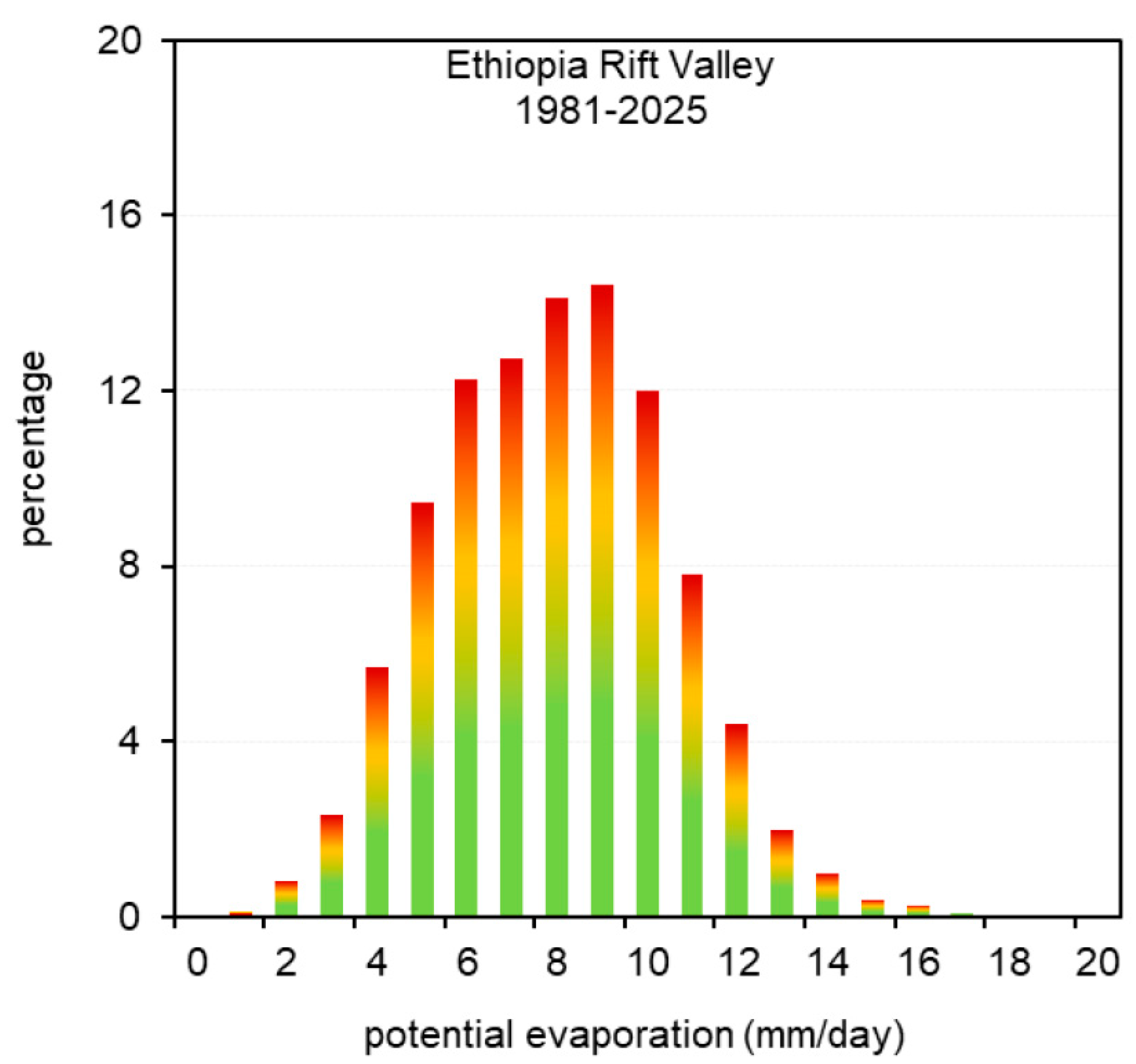
The climate of Ethiopia’s Rift Valley is semi-arid and suffers from excessive potential evaporation, according to local measurements (cf. Appendix A, Figure A1). Yet the nearby forested highlands stimulate orographic clouds, pulsed by the advance and retreat of the equatorial trough and nearby monsoons [1,2,3]. Seasonal airflows are channeled into low-level wind jets that diverge over the Turkana valley and Somali coast, contributing to widespread subsidence [4,5]. Year-to-year climate variations are modulated by the Indian Ocean Dipole (IOD) and Pacific El Niño Southern Oscillation (ENSO) and their slowly undulating ocean thermoclines and coupled atmospheric circulations [6,7,8,9,10,11,12,13].
Past research found increasing dry spells over the Rift Valley related to cooling of the east Pacific and west Indian Ocean, and subsequent zonal overturning circulations and diverging low-level jets [14,15,16,17,18]. Amplified by climate change, these led to socio-economic stress [19,20,21,22,23,24]. Yet in 2019 and 2023, a dramatic warming of the west Indian Ocean brought wet spells that filled lakes [25] and stimulated crop yields [26], suggesting a need for further study leading to adaptive management.
In this research, Hawassa (7.1° N, 38.5° E) is adopted as a sentinel site, at the highest point of the Ethiopian Rift Valley (1700 m) that extends from southern Africa to the Middle East. Agriculture underpins the local economy and provides two-thirds of employment. Crop farming is prominent at higher elevations and near streamflows, with major inputs from maize, plantain, bean, potato, sorghum, wheat, barley, and minor inputs from coffee, cabbage, cotton, tomato, pepper, and avocado [27,28,29]. Yields average 1–3 T/ha [26], just enough to meet local demand from a population of 500 K growing at 5%. Livestock grazing is common at lower elevations, but sparse vegetation limits its local economic contribution compared with crops (30 vs. 70%).
Research questions to be addressed here include (i) what new technology can reveal the Rift Valley meso-climate, (ii) how do the surrounding highlands affect the moisture flux, (iii) how does the IOD alter the regional circulation, (iv) what characteristics of Pacific ENSO promote IOD influence, and (v) how are climatic volatility and trends affecting key resources? In Section 2, the data and methods are given, while Section 3 covers statistical outcomes at the local and regional scale, contributing to a better understanding of persistent climatic anomalies.

2. Data and Methods

2.1. Data

Weather conditions in Ethiopia’s Rift Valley are described by atmospheric reanalysis products from CFS2, ERA5, and MERRA2 [30,31,32] in the period 1981–2025. The data include air and dewpoint temperature (Td), evapotranspiration, potential evaporation (p.evap), rainfall and runoff, humidity, dust and smoke concentration, wind velocity, and vertical motion. Sunshine, cloudiness, and surface conditions are described by multi-satellite net incoming solar (Qs) and outgoing longwave radiation (OLR), vegetation color fraction, and surface infrared temperature [33,34,35,36]. Rainfall is derived from CHIRPS3 and GPM satellite-gauge interpolation [37,38], as recommended by [39]. The IOD is represented by 100 m depth-averaged sea temperatures [40], distinct from the traditional surface-only index. Temporal analyses require hourly, daily, and monthly intervals, while spatial analyses require 1, 10, and 25 km resolution to reflect processes within the Rift Valley 4° S–15° N, 30° E–50° E. Intercomparison of atmospheric parameters from various sources indicates close agreement, lending confidence to statistical inferences. Most temporal records span Jan 1981–Nov 2025 and focus on Hawassa: 7.1° N, 38.5° E, elv. 1700 m.

2.2. Methods of Analysis

Long-term averages were mapped to identify mesoscale features of the rainfall, low-level wind, surface temperature, vegetation color, and net Qs. The mean annual cycle of 20 and 80 percentiles for Hawassa rainfall, runoff, p.evap, and Td were calculated, and help define early and late wet seasons: Mar–Jun and Jul–Oct. An east–west slice through Hawassa was analyzed for vegetation color fraction and zonal circulation, and diurnal cycles of rainfall, zonal wind, evapotranspiration, and potential evaporation were analyzed from hourly datasets. These quantify local air–land interactions and the role of forested highlands near the Rift Valley.
The Indian Ocean Dipole (IOD) was derived by Empirical Orthogonal Function (EOF) analysis of NODC 1–100 m depth-averaged sea temperatures [41] in the area 15° S–5° N, 35° E–120° E over the period 1981–2025, cf. [42]. The leading time score (PC-1) of seasonal anomalies was analyzed for trend (R2 variance) and wavelet spectra. A variety of seasonal anomaly time series were cross-correlated to understand inter-annual influence (Table 1), including the traditional D.M.I. based on SST [43]. These records have ~60 degrees of freedom, so R > |0.25| achieves 95% confidence. Lag correlations were calculated over the period 1981–2025 between Hawassa Td, rainfall, and the IOD time score. The Hawassa Td record was regressed onto global surface temperatures to identify Pacific ENSO contribution to IOD forcing. The +IOD onset of 2019 was analyzed for meridional shifts of the equatorial trough via a Hovmoller plot of satellite net OLR, and maps and sections of the atmospheric circulation in April and October.
The IOD was ranked, and regional atmospheric thermodynamic and circulation composites were analyzed by subtracting cool from warm seasons (Table 2). Differences were mapped over the area 4° S–15° N, 30° E–50° E, and as height sections through Hawassa, to identify the zonal and meridional circulation, and humidity. The wet spell of 4–5 Oct 2019 was analyzed for low-level winds and satellite net OLR, Hysplit ensemble back-trajectories, Cloudsat reflectivity, and hourly CFS2 evapotranspiration, to reveal a cloud band from the forested highlands during warm-phase IOD.
In addition to reanalysis estimates, measurements of local A-pan evaporation and Rift Valley lake levels from satellite altimetry are presented. The methodology is unique in considering the Rift Valley meso-climate response to the Indian Ocean Dipole. The IOD employed here differs from earlier studies, which subtracted SST in the east and west areas. Here, an EOF analysis of upper ocean temperatures better captures Indian Ocean thermocline variability linking Pacific ENSO and the global circulation to African climate.

3. Results

3.1. Study Area and Climatology

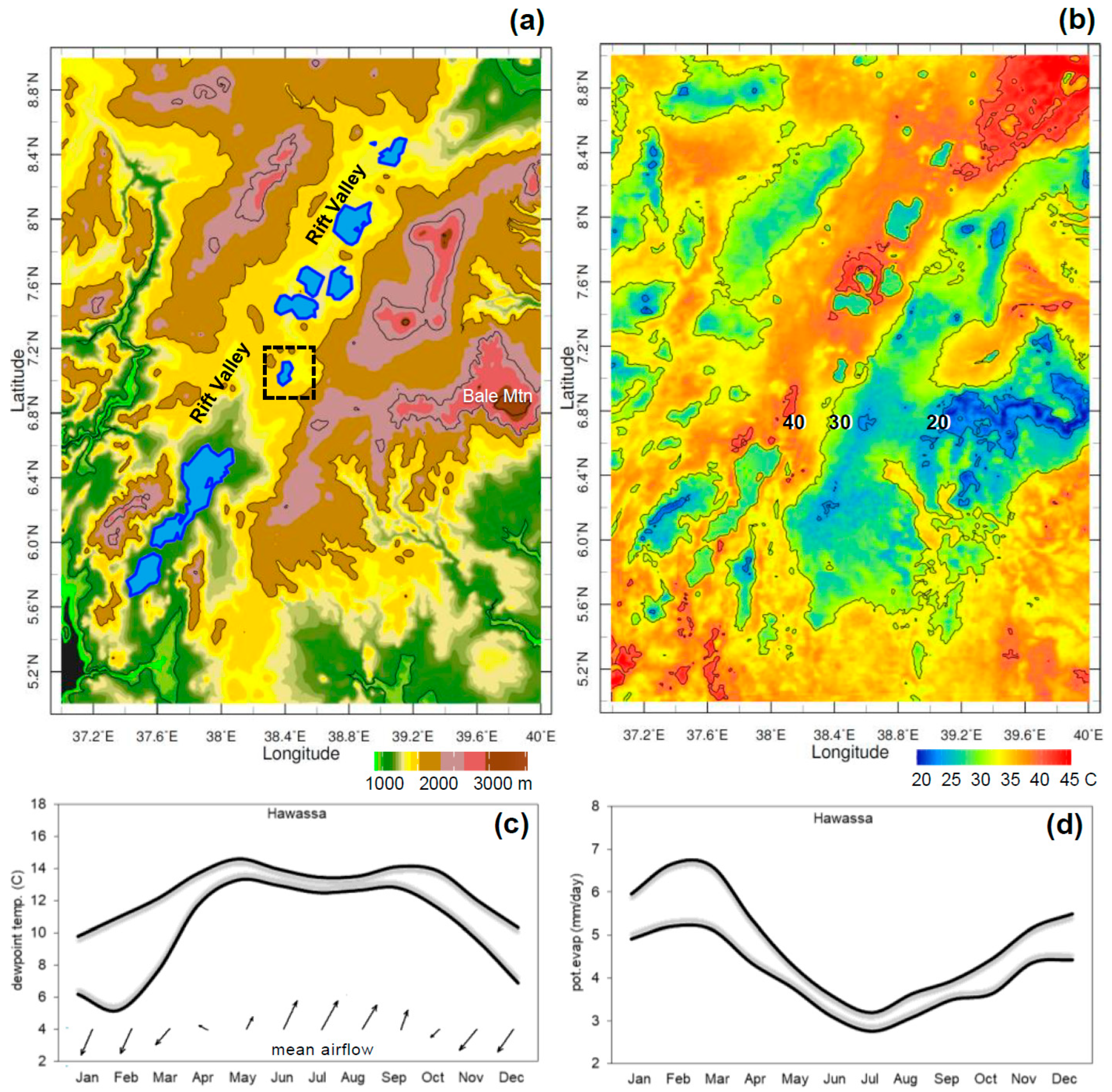
The study area elevation (Figure 1a) illustrates the NE-aligned Rift Valley elv. of ~1500 m with major and minor highlands rising to ~3000 m to the northwest and southeast. The 1 km resolution satellite infrared daytime land surface temperature climatology (Figure 1b) reveals great detail: values of ~40 °C in the Rift Valley contrast with ~20 °C in the highlands, consistent with sharp gradients found by [2]. The Rift Valley lakes remain below 30 °C throughout the year. Mean annual cycles for dewpoint temperature and potential evaporation (Figure 1c,d) indicate very dry weather in Dec–Feb, a broad plateau of warm humid conditions in Mar–Nov cresting in July. Small differences between the upper and lower percentiles in May–Sep suggest dependable weather between the bi-modal peaks; thus, there is a limited response to inter-annual fluctuations then. Farmers tend to plant and harvest crops in May and October [29], taking advantage of high Td and low p.evap.
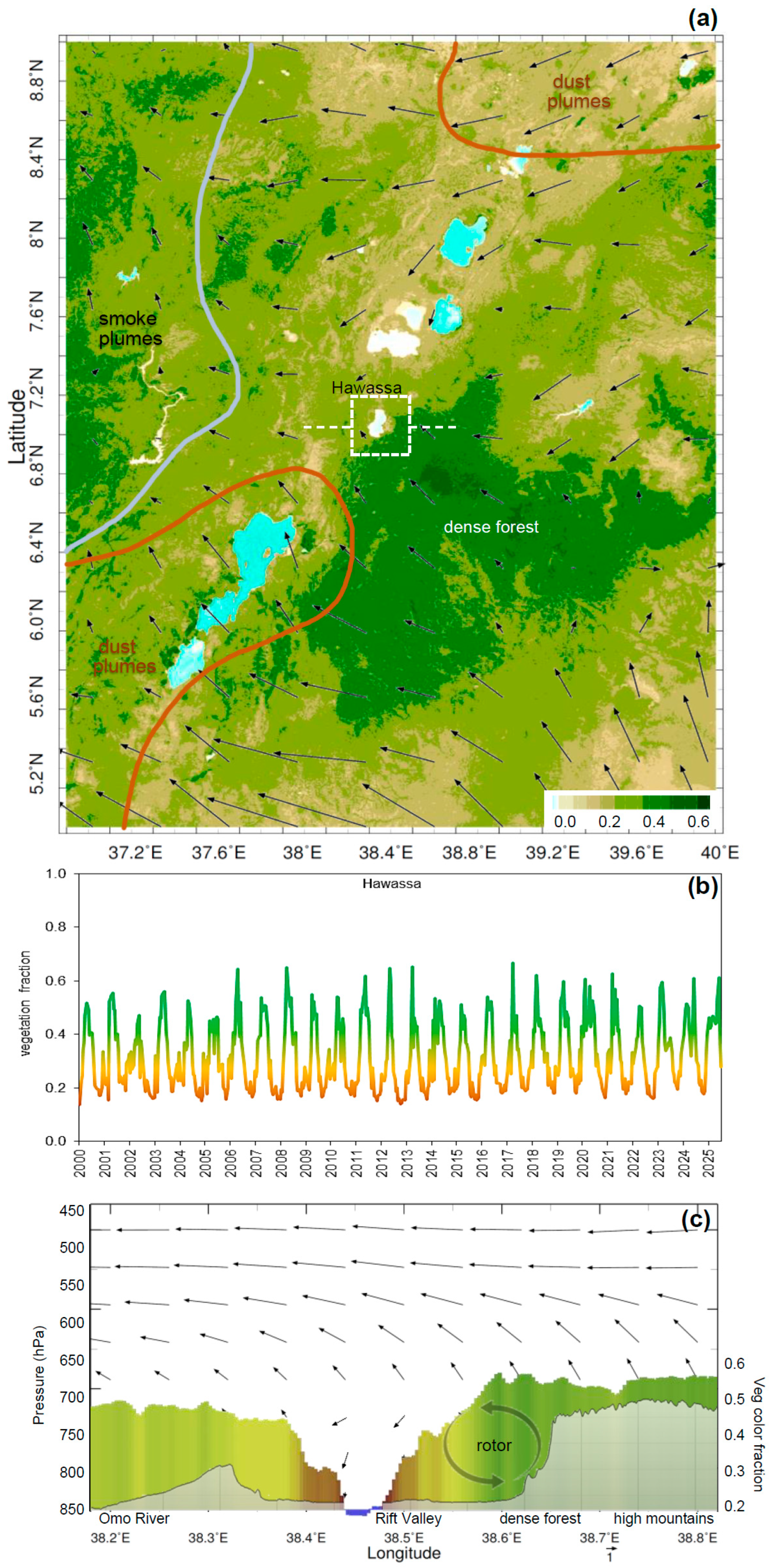
The 1 km resolution satellite vegetation color map (Figure 2a) offers valuable insights: mean values of ~0.3 in the Rift Valley contrast with ~0.5 in the forested highlands, cf. [2]. The vegetation time series at Hawassa (Figure 2b) exhibits large seasonal amplitude (0.2–0.6) and intra-seasonal noise from dry and wet spells. The average airflow is from the southeast and provides a conveyor of transpiration from upstream highlands (Figure 2c). These include the impenetrable Bale Mountains National Park, a moist tropical forest covering ~600 K ha on the edge of a 3000 m escarpment [44]. Easterlies increase with height and suggest a lee-side rotor with subsidence over the Rift Valley (Figure 2c). Green vegetation ‘overshoots’ the highlands by ~15 km, while brown landscapes spread west of the Rift Valley. Hawassa straddles opposing channeled airflows and is sensitive to shifts of the equatorial trough. Another point of interest is that satellite-measured dust plumes often penetrate the lowlands and inhibit convection, whereas smoke emissions tend to occur in the northwest and magnify greenhouse warming.
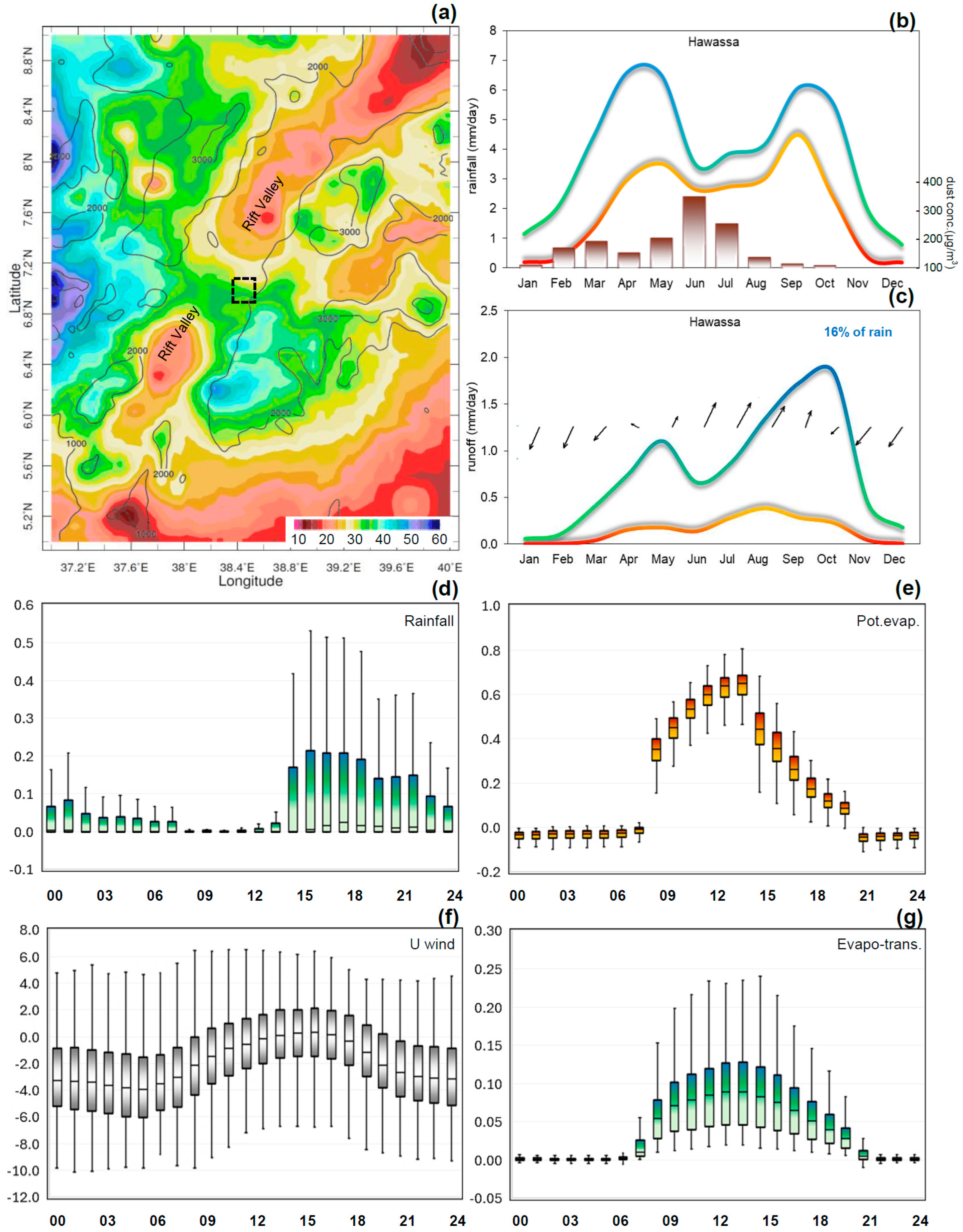
The 5 km resolution rainfall climatology (Figure 3a) reveals a moist axis at 7° N intersecting the dry Rift Valley, linking the major and minor highlands. The southeastern lowlands experience dry weather from divergent Turkana and Somali Jets, while wet conditions spill into the Omo Valley from the Congo. The mean annual cycle of Hawassa rainfall and runoff is presented in Figure 3b,c. The bi-modal climate is symmetric for rainfall with crests in Apr and Oct, cf. [23]. Unlike Td and p.evap, rainfall exhibits a large spread of 20 and 80 percentiles, indicative of climatic volatility. Runoff is asymmetric and significantly higher in Oct than in Apr, with an overall conversion rate of 16%. Ref. [45] notes the Jun–Jul dip in rainfall corresponds with subsidence from divergent low-level jets and dusty conditions (cf. Figure 3b).

3.2. Diurnal Cycling and Cross-Correlations

Mean diurnal cycling at Hawassa is analyzed in Figure 3d–g via hourly box-whisker plots. Rainfall is absent during the morning, and peaks in the evening > 0.1 mm/h, following a daytime influx of heat, 0.6 mm/h, and moisture, 0.1 mm/h, within the Rift Valley. Surface winds shift from nocturnal easterly to diurnal westerly, alternately feeding the rotor (cf. Figure 2c). The diurnal cycle analysis reveals that potential evaporation far exceeds evapotranspiration, and that convective clouds take ~6 h to build up and rain. The case study offers further insights in Section 3.4 below.
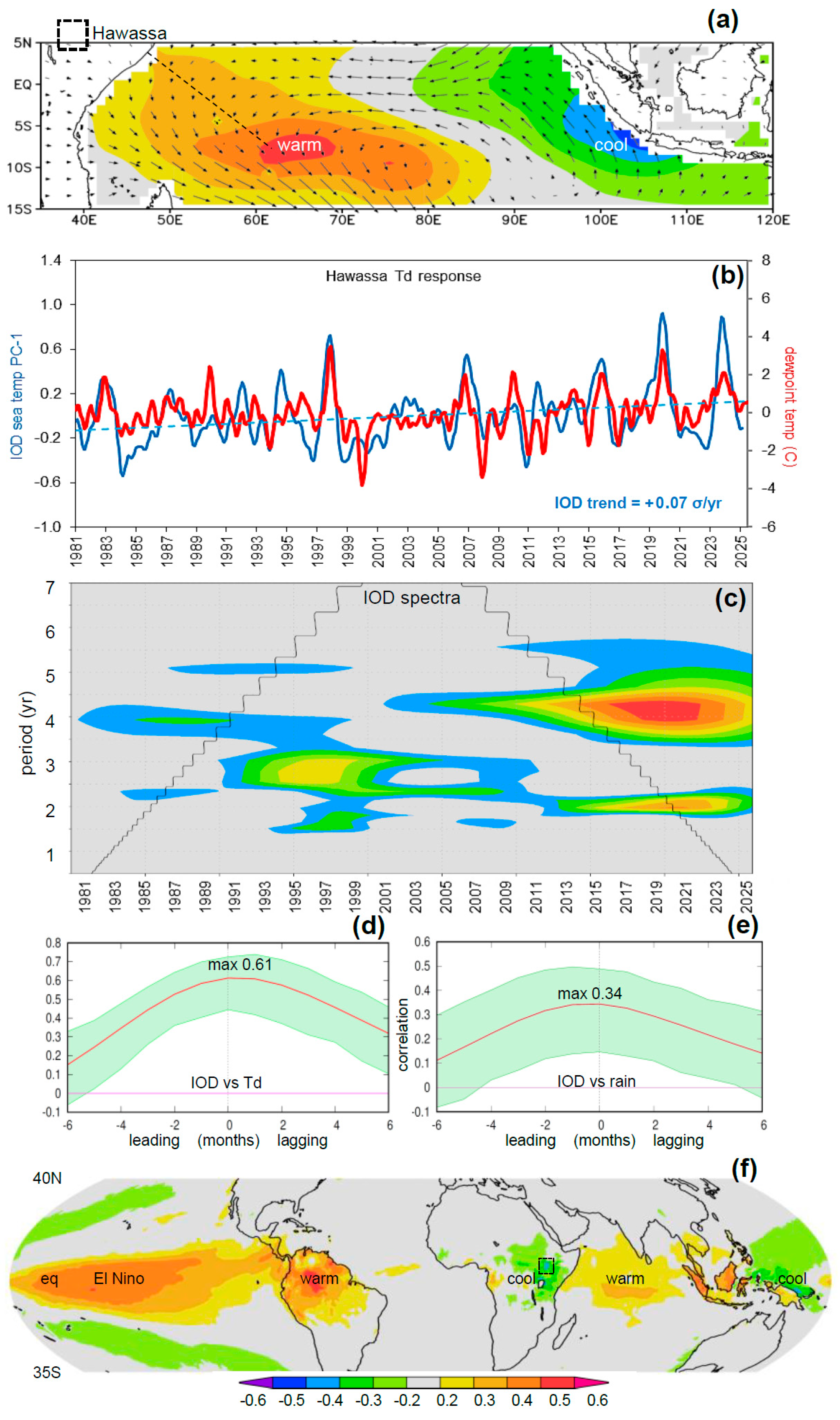
Table 1 lists the pair-wise cross-correlation values for the seasonal anomaly time series 1981–2025 at Hawassa. Many of these confirm feedback in the ERA5 reanalysis. Among the independent parameters, we find that net OLR associates better with p.evap than rain, and the IOD (from 1–100 m sea temperatures) [42] is best correlated with Td anomalies (R = 0.61), net Qs (R = −0.43), and many other time series. In contrast, the traditional D.M.I. index (from SST) [43] appears unrelated to Rift Valley parameters and of little value. Except for the D.M.I., R values exceed expectations, indicating local climate sensitivity to environmental conditions and the IOD.
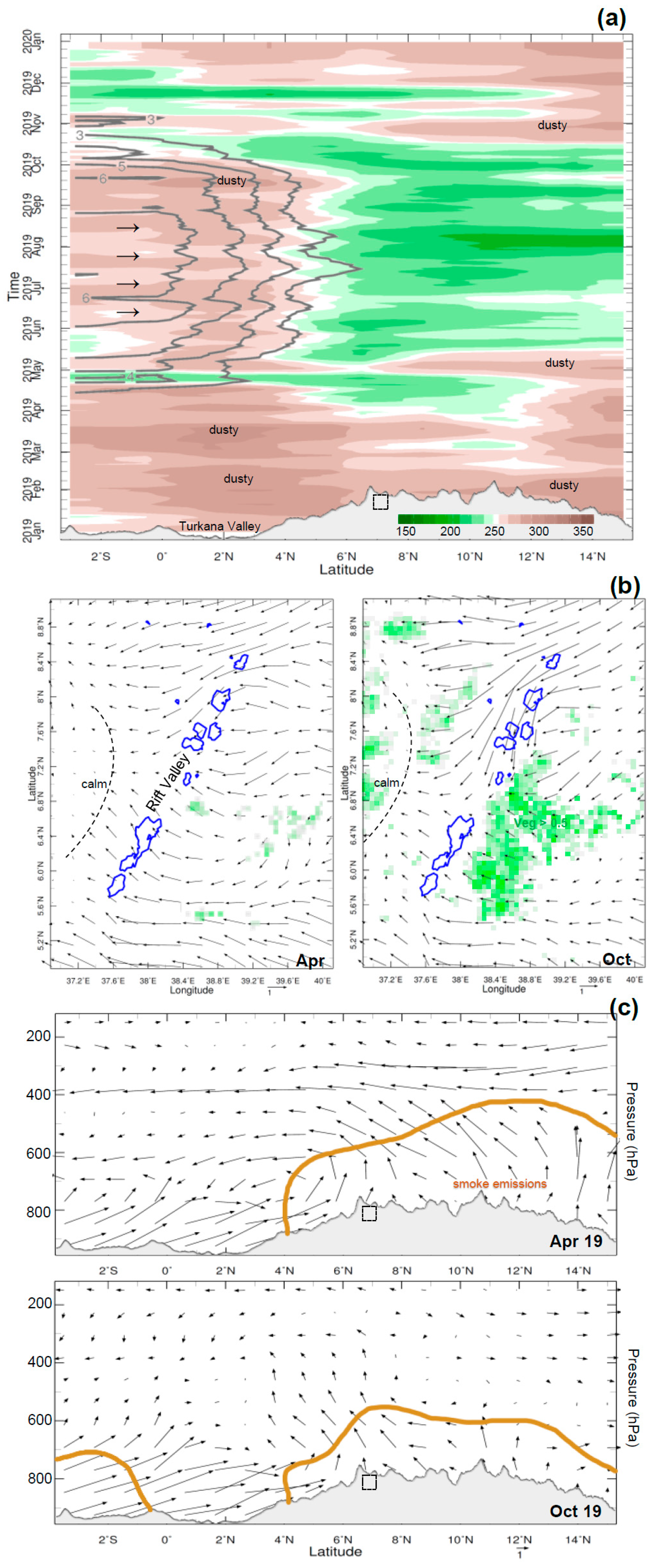
The meridional march of convection is analyzed in Figure 4a via a Hovmoller plot, Jan–Dec 2019. The equatorial trough (net OLR < 190 W/m2) advanced in April and retreated in October, supported by a shallow meridional circulation funneled into the Rift Valley (Figure 4b,c). Southerly winds of ~5 m/s in the 925–700 hPa layer ascended the vegetated escarpment. Upward motions over Hawassa joined upper-level northerly winds, completing an overturning cell supporting frequent wet spells in 2019. The shallow orographic convection was underpinned by downstream slowing of easterly winds (−∂U/∂x) that limit inland penetration of moisture.
Table 1. Pair-wise cross-correlation of seasonal anomaly time series at Hawassa, 1981–2025. With ~60 degrees of freedom, R > |0.25| achieves 95% confidence. The IO dipole and Tdew records are plotted in Figure 5b, and the net Qs in Figure 8c. Most parameters derive from ERA5 except rain, net OLR, and IO dipole; note that positive vertical motion at 500 hPa (+W500) refers to upward. D.M.I. refers to the traditional index from SST. Parentheses denote insignificance.
HawassaRainp.evapnet Qsevap-trW 500V WindU windRH 700net OLRIO dipoleD.M.I.
p.evap−0.75
net Qs−0.720.90
evap-tr0.58−0.73−0.47
W 5000.78−0.70−0.67−0.62
V wind0.42−0.59−0.690.280.53
U wind0.44−0.48−0.56(0.23)(0.20)0.26
RH 7000.66−0.90−0.880.620.700.750.37
sat OLR−0.730.830.80−0.53−0.62−0.54−0.41−0.80
IO dipole0.34−0.30−0.43(0.19)0.34(0.18)(0.12)0.40−0.32
D.M.I.(0.17)(0.02)(−0.11)(−0.03)(0.16)(−0.03)(−0.06)(0.05)(−0.07)0.62
T dew0.69−0.76−0.790.650.740.650.320.86−0.690.610.28
Table 2. Seasons of warm (red) and cool (blue) IOD seasons used in composites: Figure 6.
Warm
Mar–Jun
ValueCool
Mar–Jun
ValueWarm
Jul–Oct
ValueCool
Jul–Oct
Value
20200.601996−0.2320190.521998−0.26
20240.561985−0.2920230.461985−0.29
20070.392000−0.2920150.422000−0.30
19980.321999−0.3519970.381996−0.32
20190.311984−0.5219940.361984−0.38

3.3. Inter-Annual IOD and Composites

To characterize multi-year climate forcing, the Indian Ocean Dipole was derived from sea temperature EOF analysis. The first mode loading pattern (Figure 5a) reveals warm and cool centers of action at 65° E and 105° E, cf. [46], connected by tropical easterly winds. The IOD PC-1 time score (Figure 5b) exhibits a weak upward trend of +0.07 σ/year since 1981 (claiming a modest 8% R2 variance) and wavelet spectral oscillations of 3–4 yr (Figure 5c) consistent with thermocline undulations from ocean Rossby waves [12]. Seasonal anomalies of Hawassa Td closely follow the IOD time score, with correlations of ~0.6, much higher than rainfall ~0.3 (Figure 5d,e) and relatively symmetric about zero. Regressing the filtered Td record onto global surface temperatures (Figure 5f), we note warmer tropical Indian and Pacific Oceans associated with El Nino. Positive values across the Amazon Basin and Maritime Continent indicate weak monsoons, while NE Africa experiences cool rainy weather. The meridional temperature gradient is diminished over the Arabian Sea, with consequences for the tropical easterly jet (TEJ) as seen below.
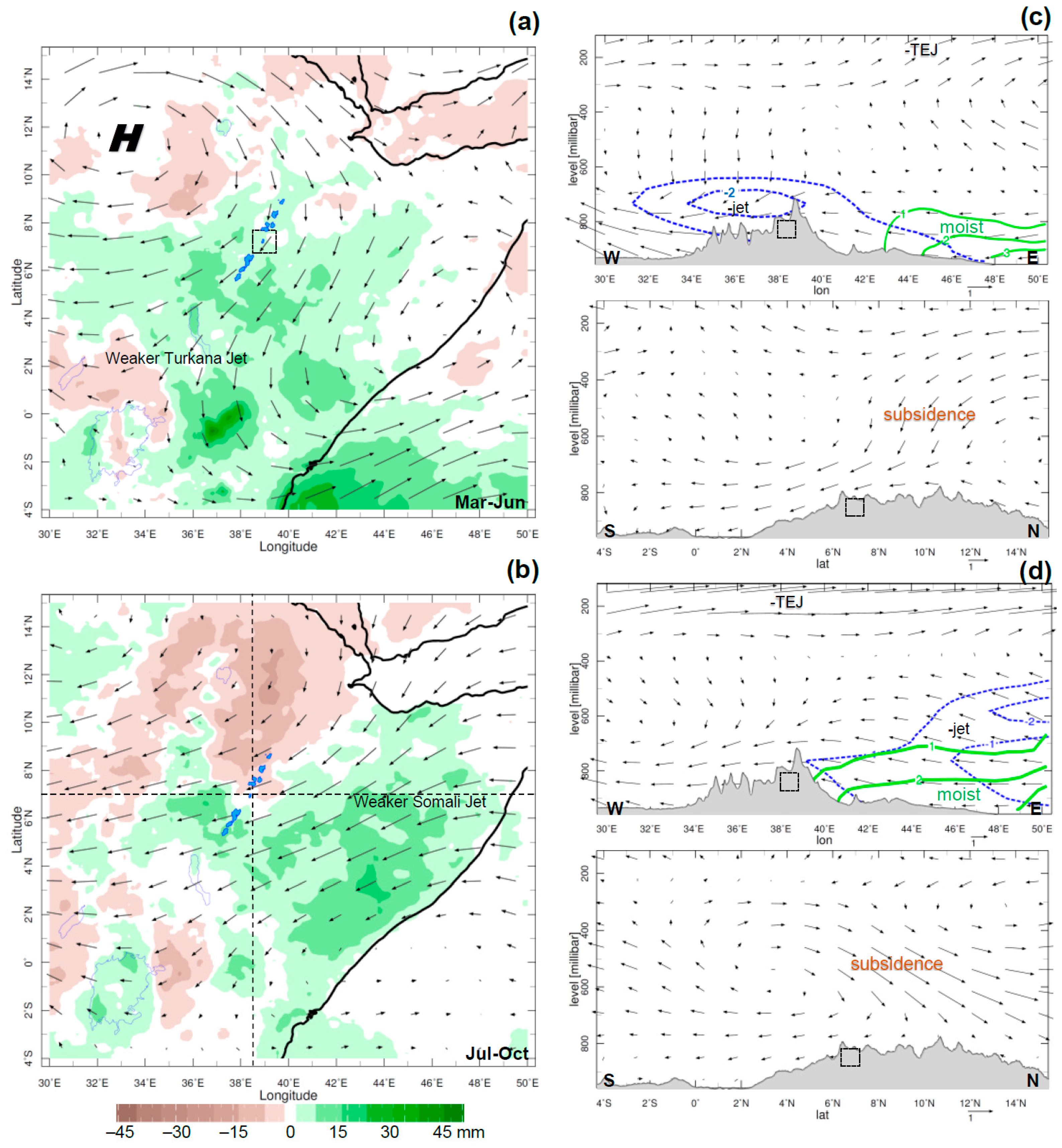
Regional composites are calculated from the five warmest minus the coolest IOD seasons (Table 2). Maps for early and late summer (Figure 6a,b) exhibit positive rainfall departures supported by northeasterly winds at 850 hPa. An anticyclone over the Nile Valley (12° N, 33° E) drives airflow toward the equatorial trough. Considering the height sections (Figure 6c,d), rising easterly winds advect humidity from the Indian Ocean [47], but sinking northerly winds limit inland penetration. The Turkana Jet weakens in Mar–Jun, the Somali Jet in Jul–Oct. The upper TEJ relaxes ~ 5 m/s in response to IOD (cf. Figure 6c,d) and shifts from 44°E to 38°E by Jul–Oct. The composites highlight rising easterlies over the escarpment as the primary response to warm-phase IOD. When that is accompanied by mid-ocean warming of the Pacific (cf. Figure 5f), rainfall spreads into the Rift Valley.

3.4. Case Study and Qs Trends

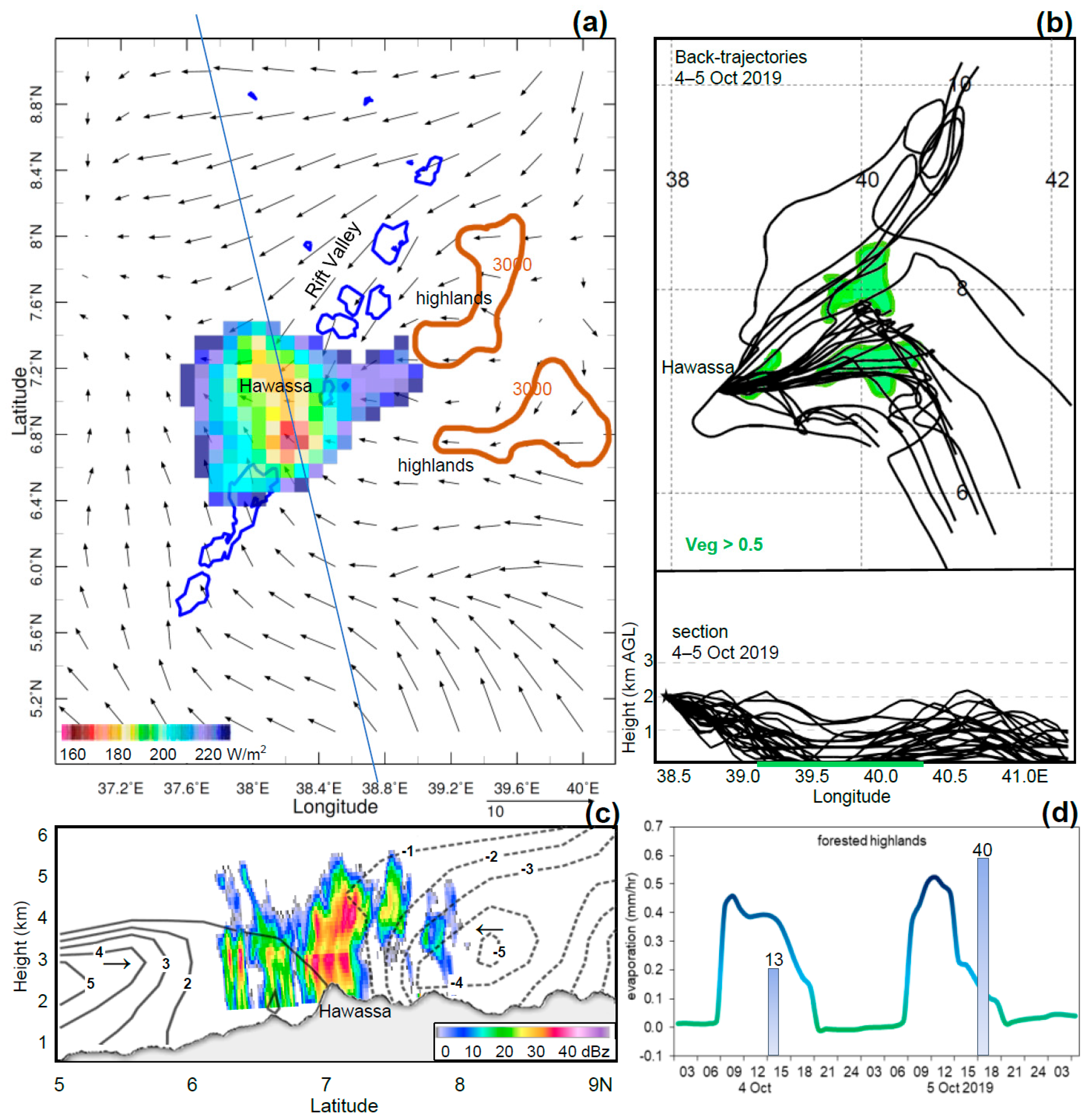
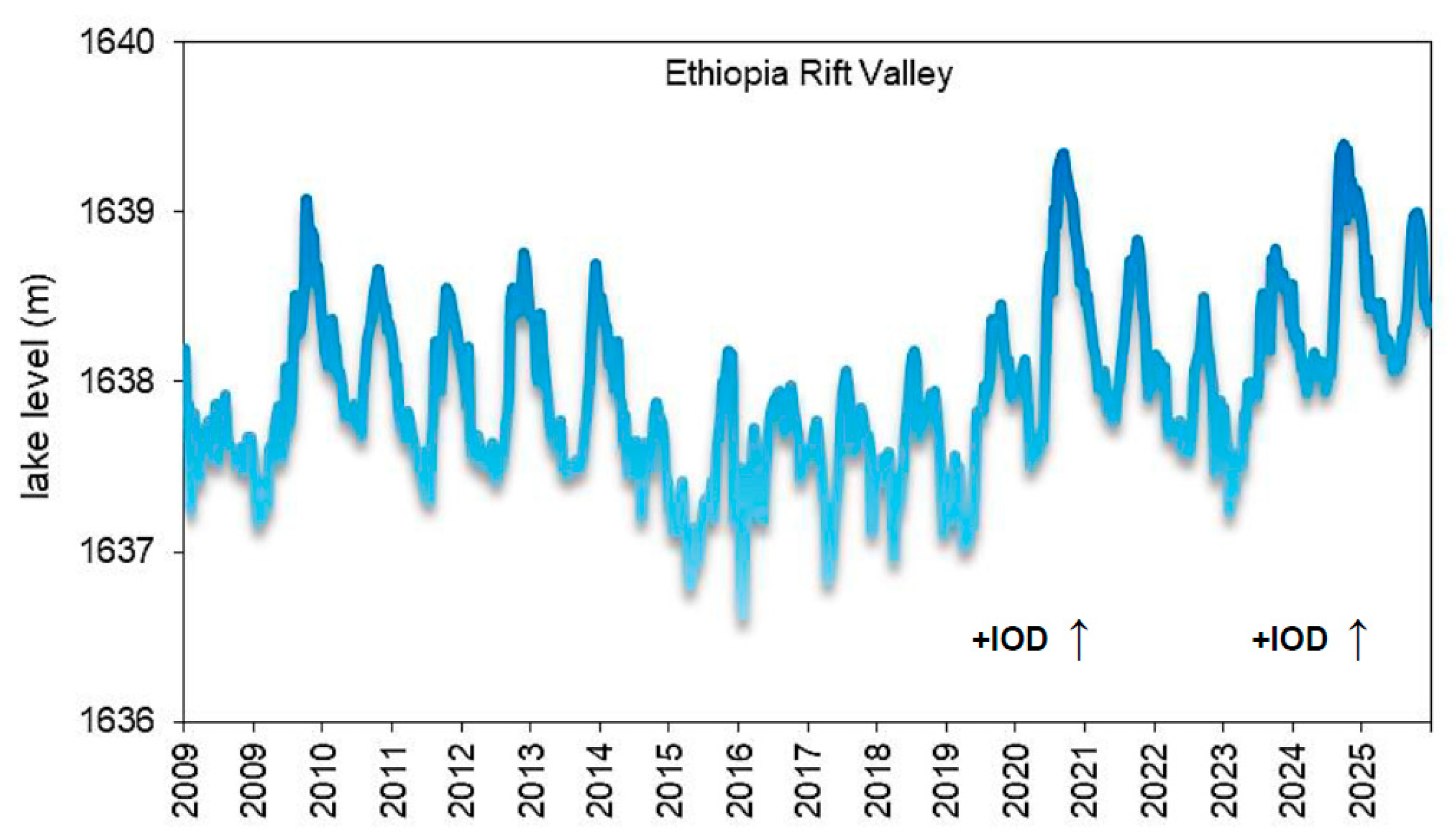
To deepen our understanding of processes leading to orographic rainfall during warm IOD, the case of 4–5 Oct 2019 is studied. The IOD had increased from neutral to strongly positive (1σ) by then, so incoming airflow was infused with additional moisture from a warm west Indian Ocean. Low-level winds (Figure 7a) converged over Hawassa from the northeast and southeast, after passing forested highlands characterized by a vegetation fraction > 0.5 at an elevation of 3000 m (Figure 7b). Net OLR values < 220 W/m2 indicate a leeward cloud-band over the Rift Valley. The height section of Cloudsat reflectivity (Figure 7c) revealed orographic development > 30 dBz from 2–5 km, confined by shallow meridional confluence of ±4 m/s on either side of Hawassa (below the freezing level). Evapotranspiration in the upstream highlands (Figure 7d) reached 0.5 mm/h, 5× greater than in the lowlands (cf. Figure 3g). Thus, a plume of humidity was advected at ~3 m/s and converged (−∂V/∂y) over the Rift Valley to support daily rainfall > 10 mm from 28 Sep to 12 Oct 2019 (177 mm total). Consequently, the vegetation fraction at Hawassa increased to 0.6 (cf. Figure 2b) and lake levels gradually rose by 1.8 m (Appendix A, Figure A1) cf. [25], due to pulses of streamflow > 50 m3/s. Similar weather conditions occurred during the +IOD event of 2023, contributing to localized flooding and widespread enhancement of food and water resources [26].
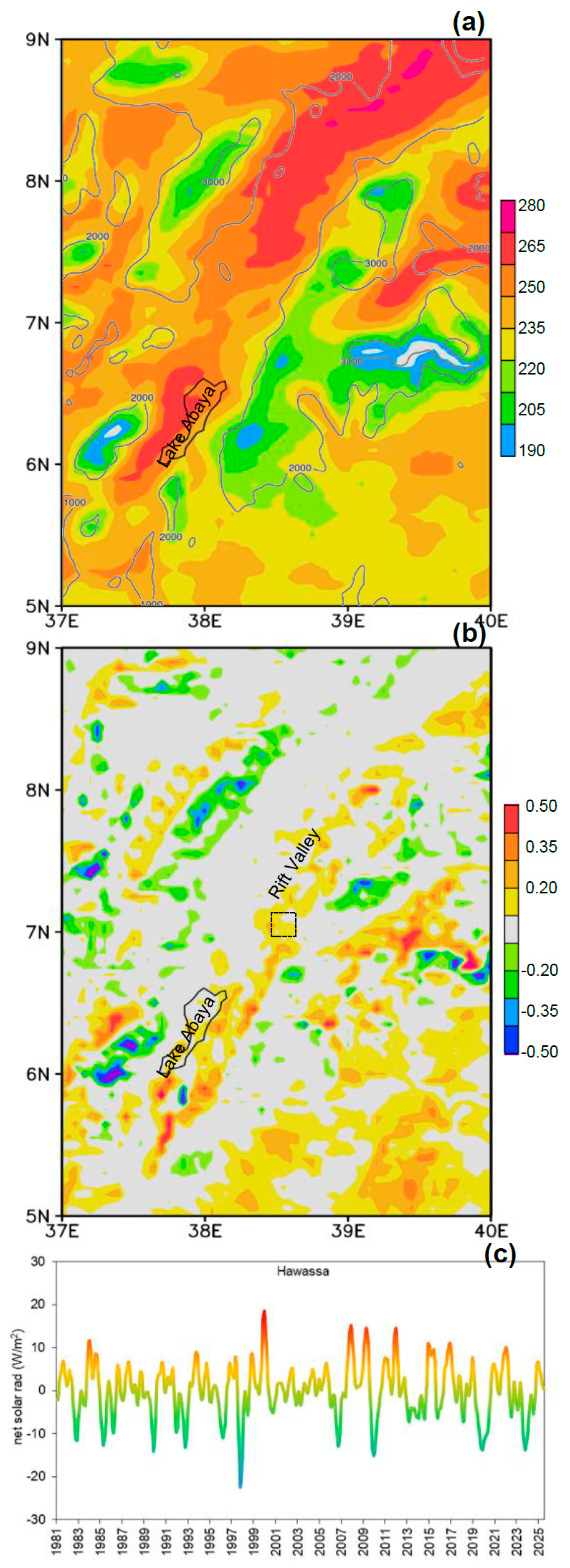
Statistical analyses had identified that solar radiation is sensitive to IOD (cf. Table 1). The map of long-term average net Qs (Figure 8a) reveals cloudy conditions over the highlands (190 W/m2) in contrast with sunny skies over the Rift Valley (280 W/m2). This drives excessive potential evaporation in dry spells (cf. Appendix A, Figure A2), especially during cool IOD events and divergent Turkana and Somali Jets, cf. [18]. The trend map for net Qs (Figure 8b) shows relatively moderate changes over 1981–2025, except for an upward trend of 0.2 W m−2/yr over the southeastern flank of the Rift Valley and adjoining highlands. The seasonal anomaly record of net Qs at Hawassa (Figure 8c) is dominated by inter-annual oscillations and noteworthy dips from warm IOD events in 1997, 2009, 2019, and 2023. There is no appreciable local trend, suggesting a stable but volatile climate aided by westward tilting of the Indian Ocean thermocline under tropical easterly winds.
Figure 8. (a) Long-term mean satellite net solar radiation (W/m2) with topography, and (b) linear trend 1981–2024 (/yr). (c) Seasonal anomalies of net Qs at Hawassa, dips/peaks correspond with +/−IOD.
Climate 14 00080 g008

4. Conclusions

This study of the Ethiopian Rift Valley meso-climate, 5° N–9° N, 37° E–40° E, utilized space–time statistics to uncover fluctuations of the water balance over four decades. The methodology differs from earlier studies, which employed a DMI derived from SST. Here, an EOF analysis of upper ocean temperatures better captures the thermocline variability [40] that modulates Rift Valley climate (Table 1). Seasonal anomalies of dewpoint temperature closely followed the IOD and mid-Pacific ENSO. The contrasting effects of rising zonal and sinking meridional airflows revealed how IOD confines the equatorial trough and its rainfall near the southeastern escarpment of Ethiopia.
Our focus on Hawassa (7.1° N, 38.5° E, elv. 1700 m) involved meteorological reanalysis, high-resolution satellite data, and an IOD derived from 100 m depth-averaged sea temperatures (15° S–5° N, 35° E–120° E). Its PC-1 time score oscillated at 3–4 years with a weak upward trend of +0.07 σ/yr (8% R2) likely due to the recent +IOD events. Correlations of IOD with seasonal anomalies of Td (0.61) and rainfall (0.34) were statistically significant, and much stronger than the traditional D.M.I. Mean annual cycles of 20 and 80 percentiles found a narrow range for Td from Apr to Oct compared with bi-modal rainfall and asymmetric runoff. Diurnal cycle analyses found that rainfall was confined to the evening (>0.1 mm/h), and that midday potential evaporation ~0.6 mm/h far exceeded evapotranspiration ~0.1 mm/h within the Rift Valley. Seasonal cycling of vegetation color fraction at Hawassa ranged from 0.2 to 0.6, and sharp daytime temperature gradients were noted between the 40 °C lowlands and 20 °C highlands to the east. Apart from a minor increase in net solar radiation (0.2 W m−2/yr), most other variables showed little trend over the 45 yr record.
Although earlier work had anticipated a gradual desiccation of the NE Africa landscape, warm IOD events in 2019 and 2023 restored hydrological resources (Appendix A, Figure A2) by a cascade of processes: (i) westward tilt of the Indian Ocean thermocline, (ii) diminished wind jets, (iii) advection of diurnal transpiration and humidity, (iv) downstream confluence of northeast and southeasterly airflow, and (v) evening rainfall from shallow clouds over the Rift Valley. Ref. [47] found a larger climatic response to warm than cool IOD events, indicative of non-linear coupling that deserves further consideration.
The findings contribute to our understanding of regional climate dynamics that support adaptive management strategies to ‘work with climate’: farming that anticipates abundant yields in warm IOD wet spells and minimizes potential evaporation (via mulch) in cool IOD dry spells. Ongoing research will refine our understanding of these relationships and explore ways to limit the effects of climate volatility. Such insights are critical for sustaining the Rift Valley environment and improving the resilience of local communities.

Funding

This research received no external funding.

Data Availability Statement

A spreadsheet is available by request.

Acknowledgments

Websites used for data extraction and analysis include APDRC Univ Hawaii, IRI Climate Library, KNMI Climate Explorer, NASA–Giovanni, NOAA Ready-Arl, and Cloudsat Univ Colorado. The SA Dept of Higher Education provided indirect support.

Conflicts of Interest

The author declares no conflict of interest.

Appendix A

Figure A1. Histogram of daily A-pan measurements.
Climate 14 00080 g0a1
Figure A2. Monthly lake level time series from satellite altimetry.
Climate 14 00080 g0a2

References

  1. Viste, E.; Sorteberg, A. Moisture transport into the Ethiopian highlands. Int. J. Climatol. 2013, 33, 249–263. [Google Scholar] [CrossRef]
  2. Wodaje, G.G.; Eshetu, Z.; Argaw, M. Temporal and spatial variability of rainfall distribution and evapo-transpiration across altitudinal gradient in the Bilate watershed Ethiopia. Afr. J. Environ. Sci. Technol. 2016, 10, 167–180. [Google Scholar]
  3. Jimma, T.B.; Demissie, T.; Diro, G.T.; Ture, K.; Terefe, T.; Solomon, D. Spatiotemporal variability of soil moisture over Ethiopia and its teleconnections with remote and local drivers. Theor. Appl. Climatol. 2023, 151, 1911–1929. [Google Scholar] [CrossRef]
  4. Nicholson, S.E. The Turkana low-level jet: Mean climatology and association with regional aridity. Int. J. Climatol. 2015, 36, 2598–2614. [Google Scholar] [CrossRef]
  5. Munday, C.; Washington, R.; Hart, N. African low-level jets and their importance for water vapor transport and rainfall. Geophys. Res. Lett. 2021, 48, e2020GL090999. [Google Scholar] [CrossRef]
  6. Yeshanew, A.; Jury, M.R. North African climate variability, part 1: Tropical thermocline–coupling. Theor. Appl. Climatol. 2007, 89, 25–36. [Google Scholar] [CrossRef]
  7. Yeshanew, A.; Jury, M.R. North African climate variability, part 2: Tropical circulation systems. Theor. Appl. Climatol. 2007, 89, 37–49. [Google Scholar] [CrossRef]
  8. Owiti, Z.; Ogallo, L.; Mutemi, J. Linkages between the Indian Ocean Dipole and East African rainfall anomalies. J. Kenya Meteo. Soc. 2008, 2, 3–17. [Google Scholar]
  9. Tierney, J.E.; Smerdon, J.E.; Anchukaitis, K.J.; Seager, R. Multidecadal variability in East African hydroclimate controlled by the Indian Ocean. Nature 2013, 493, 389–392. [Google Scholar] [CrossRef] [PubMed]
  10. Funk, C.; Hoell, A.; Shukla, S.; Blade, I.; Liebmann, B.; Roberts, J.B.; Robertson, F.R.; Husak, G. Predicting East African spring droughts using Pacific and Indian Ocean sea surface temperature indices. Hydrol. Earth Syst. Sci. 2014, 18, 4965–4978. [Google Scholar] [CrossRef]
  11. Camberlin, P. Climate of Eastern Africa, in Encyclopedia of Climate Science; Oxford University Press: Oxford, UK, 2018. [Google Scholar] [CrossRef]
  12. Jury, M.R. South Indian Ocean Rossby waves. Atmos. Ocean 2018, 56, 322–331. [Google Scholar] [CrossRef]
  13. Dubache, G.; Ogwang, B.A.; Ongoma, V.; Islam, A.R. The effect of Indian Ocean on Ethiopian seasonal rainfall. Meteorol. Atmos. Phys. 2019, 131, 1753–1761. [Google Scholar] [CrossRef]
  14. Hastenrath, S. Zonal circulations over the equatorial Indian Ocean. J. Clim. 2000, 13, 2746–2756. [Google Scholar] [CrossRef]
  15. Funk, C.; Fink, A.H.; Harrison, L.; Segele, Z.; Endris, H.S.; Galu, G.; Korecha, D.; Nicholson, S. Frequent but predictable droughts in East Africa driven by a Walker circulation intensification. Earth’s Future 2023, 11, e2022EF003454. [Google Scholar] [CrossRef]
  16. Jury, M.R.; Minda, T.T. Turkana low-level jet influence on southwest Ethiopia climate. J. Hydrometeorol. 2023, 24, 585–599. [Google Scholar] [CrossRef]
  17. Hoell, A.; Funk, C. Indo-Pacific sea surface temperature influences on failed consecutive rainy seasons over eastern Africa. Clim. Dyn. 2014, 43, 1645–1660. [Google Scholar] [CrossRef]
  18. Lyon, B. Seasonal drought in the Greater Horn of Africa and its recent increase during the March–May long rains. J. Clim. 2014, 27, 7953–7975. [Google Scholar] [CrossRef]
  19. Rowell, D.P.; Booth, B.B.B.; Nicholson, S.E.; Good, P. Reconciling past and future rainfall trends over East Africa. J. Clim. 2015, 28, 9768–9788. [Google Scholar] [CrossRef]
  20. Belay, A.; Demissie, T.; Recha, J.W.; Oludhe, C.; Osano, P.M.; Olaka, L.A.; Solomon, D.; Berhane, Z. Analysis of climate variability and trends in southern Ethiopia. Climate 2021, 9, 96. [Google Scholar] [CrossRef]
  21. Markos, D.; Worku, W.; Mamo, G. Spatio-temporal variability and rainfall trend affects seasonal calendar of maize production in southern central Rift Valley of Ethiopia. PLoS Clim. 2023, 2, e0000218. [Google Scholar] [CrossRef]
  22. Palmer, P.I.; Wainwright, C.M.; Dong, B.; Maidment, R.I.; Wheeler, K.G.; Gedney, N.; Hickman, J.E.; Madani, N.; Folwell, S.S.; Abdo, G.; et al. Drivers and impacts of Eastern African rainfall variability. Nat. Rev. Earth Environ. 2023, 4, 254–270. [Google Scholar] [CrossRef]
  23. Byrne, A.; Norris, K.; Chadwick, M.A.; Avery, S.; Olaka, L.; Tebbs, E.J. Rising lake levels in central East Africa are driven by increasing rainfall and land-use intensification. J. Hydrol. Reg. Stud. 2024, 56, 101999. [Google Scholar] [CrossRef]
  24. FAO. Statistical Data on Annual Crop Yields; FAO: Addis Ababa, Ethiopia, 2025; Available online: https://www.fao.org/faostat/en/#data/QCL (accessed on 1 November 2025).
  25. Geremu, T.; Abera, G.; Lemma, B.; Rasche, F. Exploring the relationship between agricultural land use and soil quality: Insight from southern Ethiopia agro-ecologies. Environ. Sustain. Indic. 2025, 27, 100724. [Google Scholar] [CrossRef]
  26. SIRARI. Sidama Region Agricultural Research Institute, Hawassa Ethiopia. 2025.
  27. USDA. Ethiopia Crop Production; USDA: Washington, DC, USA, 2025. Available online: https://ipad.fas.usda.gov/countrysummary/Default.aspx?id=ET (accessed on 1 November 2025).
  28. Saha, S.; Moorthi, S.; Wu, X.; Wang, J.; Nadiga, S.; Tripp, P.; Behringer, D.; Hou, Y.T.; Chuang, H.Y.; Iredell, M.; et al. The NCEP climate forecast system v2. J. Clim. 2014, 27, 2185–2208. [Google Scholar] [CrossRef]
  29. Hersbach, H.; Bell, B.; Berrisford, P.; Hirahara, S.; Horányi, A.; Muñoz-Sabater, J.; Nicolas, J.; Peubey, C.; Radu, R.; Schepers, D.; et al. The ERA5 global reanalysis. Q. J. R. Meteorol. Soc. 2020, 146, 1999–2049. [Google Scholar] [CrossRef]
  30. Gelaro, R.; McCarty, W.; Suárez, M.J.; Todling, R.; Molod, A.; Takacs, L.; Randles, C.A.; Darmenov, A.; Bosilovich, M.G.; Reichle, R.; et al. The modern-era retrospective analysis for research and applications v2 (Merra2). J. Clim. 2017, 30, 5419–5454. [Google Scholar] [CrossRef]
  31. Mueller, R.W.; Matsoukas, C.; Gratzki, A.; Behr, H.D.; Hollmann, R. The CM-SAF operational scheme for the satellite based retrieval of solar surface irradiance. Remote Sens. Environ. 2009, 113, 1012–1024. [Google Scholar] [CrossRef]
  32. Lee, H.-T. Climate algorithm theoretical basis document: Outgoing longwave radiation (OLR). NOAA’s climate data record program. Tech. Rep. 2014, 0526, 46. [Google Scholar]
  33. Pinzon, J.E.; Tucker, C.J. A non-stationary 1981–2012 AVHRR NDVI time series. Remote Sens. 2014, 6, 6929–6960. [Google Scholar] [CrossRef]
  34. Hulley, G.; Freepartner, R.; Malakar, N.; Sarkar, S. MODIS Land Surface Temperature and Emissivity Product v6; NASA-GSFC-JPL: Pasadena, CA, USA, 2016. [Google Scholar]
  35. Funk, C.; Peterson, P.; Landsfeld, M.; Pedreros, D.; Verdin, J.; Shukla, S.; Husak, G.; Rowland, J.; Harrison, L.; Hoell, A.; et al. The climate hazards infrared precipitation with stations—A new environmental record for monitoring extremes. Sci. Data 2015, 2, 150066. [Google Scholar] [CrossRef]
  36. Tan, J.; Huffman, G.J.; Bolvin, D.T.; Nelkin, E.J. IMERG v6: Changes to the morphing algorithm. J. Atmos. Ocean. Technol. 2019, 36, 2471–2482. [Google Scholar] [CrossRef]
  37. Tesfamariam, B.G.; Melgani, F.; Gessesse, B. Rainfall retrieval and drought monitoring skill of satellite rainfall estimates in the Ethiopian Rift Valley lakes basin. J. Appl. Remote Sens. 2019, 13, 014522. [Google Scholar] [CrossRef]
  38. Levitus, S.; Antonov, J.I.; Boyer, T.P.; Baranova, O.K.; Garcia, H.E.; Locarnini, R.A.; Mishonov, A.V.; Reagan, J.R.; Seidov, D.; Yarosh, E.S.; et al. World ocean heat content and thermosteric sea level change 1955–2010. Geophys. Res. Lett. 2012, 39, L10603. [Google Scholar] [CrossRef]
  39. Reagan, J.R.; Garcia, H.E.; Boyer, T.P.; García, H.E.; Locarnini, R.A.; Baranova, O.K.; Bouchard, C.; Cross, S.L.; Mishonov, A.V.; Paver, C.R.; et al. World Ocean Atlas Documentation. 2024. Available online: https://www.ncei.noaa.gov/products/world-ocean-atlas (accessed on 1 November 2025).
  40. Jury, M.R. Representing the Indian Ocean Dipole. Phys. Oceanogr. 2022, 29, 417–432. [Google Scholar]
  41. Saji, N.H.; Goswami, B.N.; Vinayachandran, P.N.; Yamagata, T. A dipole mode in the tropical Indian Ocean. Nature 1999, 401, 360–363. [Google Scholar] [CrossRef]
  42. IUCN. UNESCO World Heritage Site, Bale Mountain National Park, Evaluation Report; International Union for Conservation of Nature: Gland, Switzerland, 2023; pp. 124–133. Available online: https://whc.unesco.org/en/list/111/documents/ (accessed on 1 November 2025).
  43. Yang, W.; Seager, R.; Cane, M.A.; Lyon, B. The annual cycle of East African precipitation. J. Clim. 2015, 28, 2385–2404. [Google Scholar] [CrossRef]
  44. Behera, S.K.; Luo, J.J.; Masson, S.; Delecluse, P.; Gualdi, S.; Navarra, A.; Yamagata, T. Paramount impact of the Indian Ocean Dipole on the east African short rains: A CGCM study. J. Clim. 2005, 18, 4514–4530. [Google Scholar] [CrossRef]
  45. Weller, E.; Cai, W. Meridional variability of atmospheric convection associated with the Indian Ocean Dipole mode. Sci. Rep. 2014, 4, 3590. [Google Scholar] [CrossRef]
  46. Jury, M.R.; Huang, B. The Rossby wave as a key mechanism of Indian Ocean climate variability. Deep Sea Res. 2004, 51, 2123–2136. [Google Scholar] [CrossRef]
  47. MacLeod, D.; Kolstad, E.W.; Michaelides, K.; Singer, M.B. Sensitivity of rainfall extremes to unprecedented Indian Ocean Dipole events. Geophys. Res. Lett. 2024, 51, e2023GL105258. [Google Scholar] [CrossRef]
Figure 1. Ethiopia Rift Valley study area: (a) elevation (shaded) and blue lakes with Hawassa (dashed box), (b) long-term average satellite daytime land surface temperatures. Mean annual cycles 1981–2025 of 20 and 80 percentiles for (c) Hawassa Td and (d) ERA5 potential evaporation. Monthly average surface wind vectors (max 3 m/s) at Hawassa, inset in (c).
Climate 14 00080 g001
Figure 2. (a) Long-term average satellite vegetation color fraction and ERA5 surface winds (vector, largest 4 m/s), yellow outlines frequent dust plumes, (b) Temporal vegetation record at Hawassa. (c) Height section through Hawassa of average zonal circulation (vector, largest 6 m/s), overlying profiles of vegetation (color bars) and elevation > 1700 m (grey shaded), quantifying transpiration. Vertical motions are exaggerated ×20 in all height sections.
Climate 14 00080 g002
Figure 3. (a) Long-term average rainfall (mm/month) with smoothed topography. Mean annual cycle of (b) rainfall and dust concentration, and (c) runoff at Hawassa (mm/day) with monthly wind (vectors). Box-whisker plots representing the mean diurnal cycle from hourly data at Hawassa: (d) CHIRP-GPM rainfall (mm/h), (e) CFS2 potential evaporation (mm/h), (f) zonal wind (m/s), (g) CFS2 evapotranspiration (mm/h); all times local. In (b), bars refer to average dust concentration > 100 µg/m3 at Hawassa, detected by multi-satellite Merra2 reanalysis.
Climate 14 00080 g003
Figure 4. (a) Hovmoller plot through Hawassa (38.5E) of daily satellite net OLR (W/m2), near-surface meridional wind contours > 3 m/s, and dusty spells in 2019. Convection is indicated by green shading. (b) Maps of ERA5 near-surface airflow in April and October 2019 (m/s) with blue lakes, lee-side calm, green vegetation > 0.5, and (c) corresponding ERA5 height sections of the meridional circulation (vectors), with topographic profile, Hawassa box, and low-level smoke emissions (brown contour).
Climate 14 00080 g004
Figure 5. (a) Indian Ocean Dipole (PC-1) loading pattern from 100 m depth-averaged sea temperatures (shaded +2 to −2 °C) and surface winds (vector, largest 4 m/s) 1981–2025. (b) Filtered anomalies of IOD PC-1 time score and Hawassa Td, with IOD trend line, and (c) IOD wavelet spectra, shaded > 90% confidence with cone of validity. (d,e) Lag correlation of IOD with: Td and rainfall, where ‘leading’ refers to IOD preceding variable. (f) Point-to-field correlation of Hawassa Td and global surface temperature (35° S–40° N).
Climate 14 00080 g005
Figure 6. Regional composites of 5 warmest minus 5 coolest IOD: (a,b) differences of 850 wind vectors (largest 2 m/s) and monthly rainfall (shaded) in Mar–Jun and Jul–Oct season, Rift Valley lakes (blue) provide context. (c,d) Same warm minus cool IOD height sections through Hawassa (dashed lines in (b)), illustrating zonal and meridional circulation (vectors), and + specific humidity (green, g/kg) and −V wind (blue, m/s), with topographic profile and Hawassa box. Seasons are listed in Table 2.
Climate 14 00080 g006
Figure 7. Case of 4–5 Oct 2019: (a) low-level CFS2 winds (vectors) and satellite net OLR < 220 W/m2 (shaded), Rift Valley lakes and eastern highlands > 3000 m (outline). (b) 48 h Hysplit ensemble back-trajectory map and E-W height section of moist airflow arriving at Hawassa, underlying vegetation fraction > 0.5 (green), (c) N-S height section of Cloudsat reflectivity and CFS2 meridional wind (contours) along the line in (a), and (d) hourly CFS2 evapotranspiration in the upstream forested highlands and daily CHIRP-GPM rain (bars).
Climate 14 00080 g007
Disclaimer/Publisher’s Note: The statements, opinions and data contained in all publications are solely those of the individual author(s) and contributor(s) and not of MDPI and/or the editor(s). MDPI and/or the editor(s) disclaim responsibility for any injury to people or property resulting from any ideas, methods, instructions or products referred to in the content.