Review

Unveiling the Evolution of Adaptation Economics: A Systematic and Bibliometric Review of Collaborations, Methodologies, and Research Frontiers 2010–2023

by
María del Pilar Salazar-Vargas
1,*,
Yosune Miquelajauregui
2 and
Hilda Guerrero-Garcia-Rojas
3
1
Postgraduate Program in Sustainability Sciences, Postgraduate Unit, Universidad Nacional Autónoma de Mexico, Mexico City 04510, Mexico
2
Laboratorio Nacional de Ciencias de la Sostenibilidad, Instituto de Ecología, Universidad Nacional Autónoma de México, Mexico City 04510, Mexico
3
Economics Department, Universidad Michoacana de San Nicolas de Hidalgo, Morelia 58060, Mexico
*
Author to whom correspondence should be addressed.
Climate 2026, 14(3), 68; https://doi.org/10.3390/cli14030068
Submission received: 6 January 2026 / Revised: 16 February 2026 / Accepted: 25 February 2026 / Published: 13 March 2026
(This article belongs to the Special Issue Climate Change Adaptation Costs and Finance)

Abstract

Adaptation economics is critical for guiding decision-makers in reducing climate vulnerability, evaluating the most suitable action while allocating scarce financial, human, and technological resources. However, this economic evaluation faces significant methodological challenges due to diverse contexts, intangible impacts, and uncertainties. This research aims to characterize academic trends, gaps, and opportunities of collaboration in the economic evaluation of adaptation over the period 2010–2023. Fifty-eight articles were selected following the PRISMA framework and were analyzed using bibliometric analysis, supported by R-Bibliometrix. Additionally, a thematic review of abstracts was conducted to identify economic evaluation approaches. Articles were included if they applied an explicit economic method. This study uses Scopus-indexed literature and abstract-based classification, which may limit generalizability. Across this corpus, the results reveal that adaptation economics, although conceptually evolved, remains geographically concentrated and methodologically fragmented. At the geographical level, research production shows 14.78% annual growth, yet this remains concentrated in the Global North, with limited participation from Latin America, Africa, and South Asia. At the conceptual level, the studies demonstrate a significant thematic transformation, moving from topics linked to diagnosis and planning toward concepts of greater complexity, such as uncertainty. In contrast, and although six methodological approaches were identified, conventional efficiency-based methods (such as cost–benefit) dominate 44.8% of applications. This analysis provides a research agenda to advance more context-sensitive and methodologically diverse economic approaches for adaptation decision-making. Recommendations include fostering South–South and South–North collaboration and developing practical and simplified decision support tools, especially for vulnerable regions.

1. Introduction

Humanity is rapidly approaching the closing window of opportunity to secure a sustainable, climate-resilient future. Climate impacts on essential socio-environmental systems for human livelihoods are already severe and are expected to intensify. Multisector and multiscale measures to address the causes and consequences of this phenomenon are urgently needed [1].
Conventional climate change strategies have historically prioritized measures and finance aimed at reducing greenhouse gas emissions [2,3]. However, adaptation to climate change is one of the most urgent ways to tackle it, particularly for the most vulnerable regions in the Global South, such as Latin America and the Caribbean, Small Island Developing States, Africa, and South Asia, to mention a few [1].
Adaptation is the process of adjustment to the actual or projected climate and its effects. In human systems, the goal is to moderate damage or take advantage of opportunities; in natural systems, human intervention can facilitate their adjustments to the projected climate and its effects [3]. From the perspective of resilience, this concept also captures the capacity to learn, combine experience and knowledge, adjust its responses to changing external drivers and internal processes, and continue developing [4]. This process can occur in human systems at different scales and by different actors [5].
Making efficient decisions regarding the planning and implementation of adaptation requires information on its costs, benefits, vulnerability reduction, and other ancillary benefits or potential socio-environmental externalities to increase its success rate and prioritize actions, policies, and investments in this area [6,7].
Evaluating the economic, environmental, and social costs and benefits of adaptation plays an important role in the iterative learning and change process of adaptation, as it informs decision-makers, planners, and practitioners about the value, feasibility, and finance of interventions to reduce vulnerability and enhance adaptive capacity, which contributes to decision-making in the design, implementation, and evaluation of public policies and territorial actions in terms of what, when, and where to act, as well as allocating scarce financial and technological resources [2,7,8,9,10,11].
The lack of this economic, environmental, and social information can lead to serious consequences such as paralysis in decision-making [12] or a high probability of implementing a maladaptation measure that is an insufficient, excessive, or misguided intervention; this leads to poor adaptation or counterproductively exacerbating the vulnerabilities and impacts they seek to address, reducing incentives for adaptation and adaptive capacity [2,13,14,15].
At the same time, the international community and governments have begun to recognize the relevance of economic methodologies and metrics for evaluating adaptation actions to plan, review progress, evaluate results, and allocate funds [16], particularly in developing countries where political decisions are made under budgetary constraints.
The economic evaluation of climate adaptation poses a methodological challenge due to the socioeconomic and ecological complexities involved in the process, as well as the multiple approaches, concepts, territories, and attributes that characterize adaptation to climate change (Table 1).
Given the iterative nature of adaptation, its outcomes are often complex to assess, requiring further research and dialogue, complementary and transparent methods, and particular attention to nonmarket environmental and social goods, distributional factors, and the relative timing scale of costs and benefits [17,18,19].
Moreover, while the benefits and co-benefits of investing in appropriate adaptation measures often outweigh the investment and operational costs and are more cost-effective than inaction [20,21,22], developing economic appraisals of adaptation faces numerous methodological and practical challenges. These include knowledge gaps in identifying climate benefits; difficulties in comparing costs and benefits across different timeframes and sectors; constraints related to economic resources, timing, and human capacity; debates over discount rates; and considerations of distributive justice.
Additional challenges include scalability and replicability issues, as well as the complexity of addressing uncertainties in socioeconomic and ecological systems [8,23]. In particular, climate change generates conditions of deep uncertainty, which refers to a lack of knowledge or disagreement about the suitability of models, probability distributions, parameters, and alternative outcomes [24]. Those challenges underscore the need for research aimed at improving both the methodological and practical aspects of economic evaluations [21,25].
According to Markandya et al. [26], the standard practice of the economic analysis of climate change has historically focused on mitigation and, tangentially, on adaptation, which is why it is important to raise adaptation as a relevant analytical concept for economic analysis and public policy.
In this regard, adaptation economics seeks to apply economic principles, such as efficiency, equity, valuation, and decision-making, to inform adaptation planning [2]. In turn, welfare economics lays the foundation for this field, guiding decisions by assessing changes in social welfare and recognizing the distributional effects of adaptation measures [27].
Operationally, the economic evaluation of adaptation is understood in this research as one applied dimension of adaptation economics. The central purpose is to generate information on the costs, benefits, vulnerability reduction, co-benefits, and potential socio-environmental externalities of adaptation measures, such as local actions, investments, and public policies [28,29].
Likewise, traditional practice has focused on cost–benefit analysis (CBA) and cost-effectiveness analysis (CEA), which are based on cash flow (or results) in less investment and operating costs during the life of the project, discounting the value of money over time [30]. With these analyses, it is possible to know, under the same unit of measurement, the optimal point to invest and execute adaptation actions, that is, where both the observed damages and the disbursements in adaptation are minimized, and the savings concerning the losses and damage avoided are maximized [2,7].
Although these traditional approaches have been useful in informing conventional development interventions, they have significant limitations in estimating critical elements of adaptation, such as deep uncertainty [18,31].
In this regard, economic thinking on adaptation has evolved from a focus on cost–benefit analysis, focusing on the most efficient measures, toward more robust and plural support for decision-makers [2,8,32], which integrate analytical aspects to reduce the risk of maladaptive decisions.
A key expression of this evolution is the Decision-Making under Deep Uncertainty (DMDU) framework. This framework promotes the identification of measures that are more robust, flexible, and produce minimal regrets, that is, measures that function successfully across a range of scenarios, adapt to changes, avoid negative outcomes, and even yield benefits even without climate change [33,34,35].
Some of the adaptation assessment tools aligned with this framework include robust decision-making, real options, dynamic adaptive policy pathways, and distributional considerations in adaptation assessment, among others [6,23,35,36,37]. Other intermediate approaches include hybrid techniques such as CBA with probability functions, Monte Carlo analysis, or multicriteria analysis, which incorporates, in addition to optimization, other criteria of interest [38,39].
Despite progress in frameworks and economic methods for analyzing adaptation, there is a lack of consensus on the methodology for assessing the benefits of adaptation strategies [24]. To date, the literature still recognizes a range of technical barriers to using the richness of economic methodologies, such as the complexity of applying them as well as several limitations on time, resources, and capacity [8,23,31,40,41,42].
Consequently, this paper seeks to understand the status of the scientific production of economic evaluation for adaptation to climate change developed from 2010 to 2023 in order to reveal the main research patterns in collaboration networks, conceptual and methodological trends, and critical topics, and to identify research gaps—particularly regarding geographical representation and methodological diversity—as opportunities for continued research in adaptation economics. This research is based on a hybrid systematic and bibliometric analysis of the literature.

2. Materials and Methods

2.1. Review Design and Reporting Standard (PRISMA)

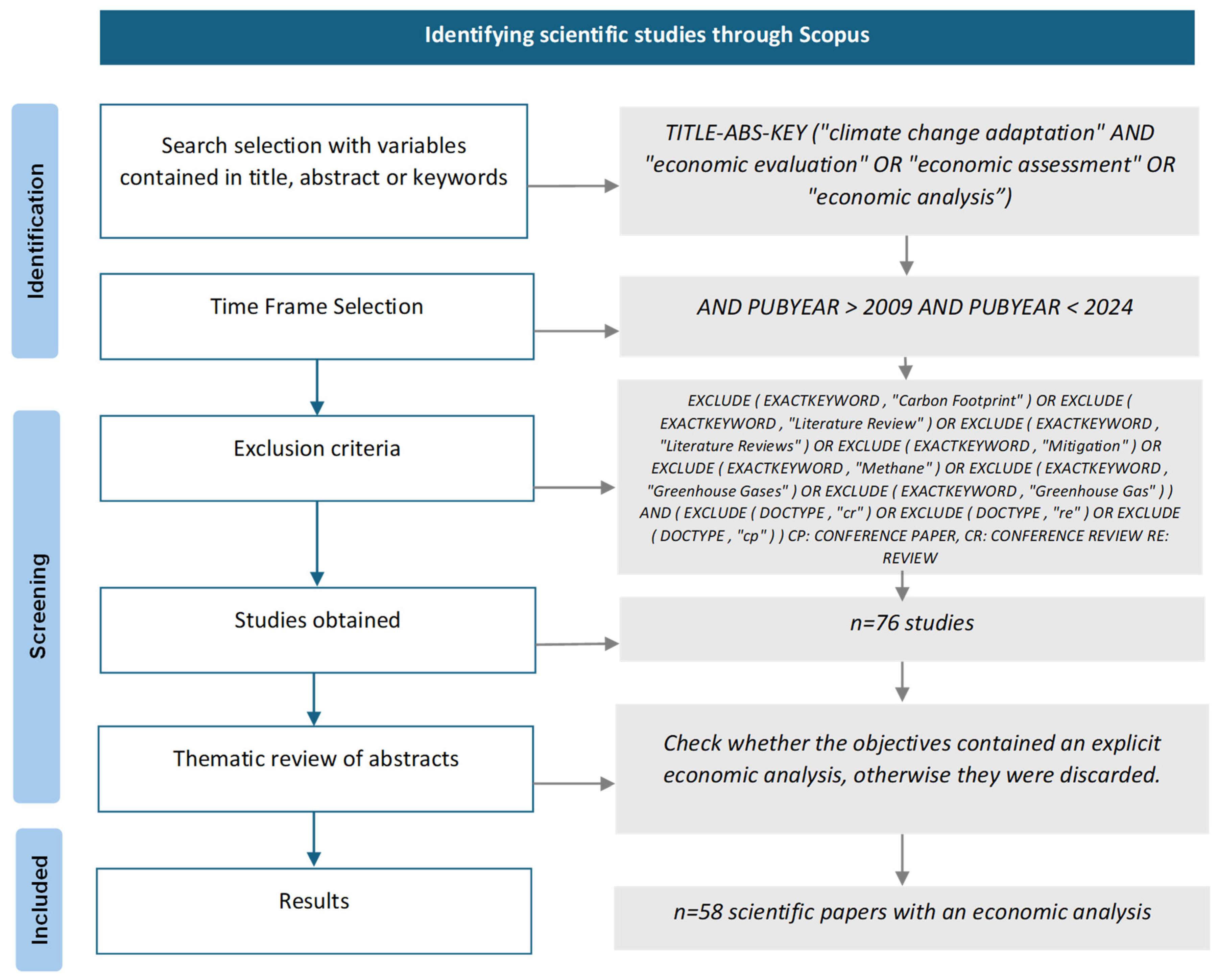
This study combines a systematic review protocol with bibliometric analysis to examine academic research on economic analyses of climate change adaptation published between 2010 and 2023. The review and selection process is reported following the Preferred Reporting Items for Systematic Reviews and Meta-Analyses (PRISMA) methodology to document the identification, screening, eligibility assessment, and final inclusion of studies (Figure 1). The protocol specifies the data source, search strategy, eligibility criteria, and analytical procedures to support transparency and reproducibility.

2.2. Bibliometric Analysis Framework

The study design integrates a systematic selection of publications with bibliometric techniques to characterize research performance, collaboration patterns, and thematic structures in adaptation economics. For the bibliometric component, the workflow follows the model proposed by Donthu et al. [43], which consists of four stages: (i) defining the aims and scope of the study; (ii) selecting bibliometrics techniques; (iii) collecting data through a systematic selection process, and (iv) conducting analyses and reporting results.
In line with this framework, three complementary techniques were applied. A performance analysis summarized the descriptive indicators of scientific production. A network analysis examined collaboration patterns among authors and countries. Science mapping explored conceptual structures through co-word analysis based on term co-occurrence. To visualize thematic proximity among terms, Multidimensional Scaling (MDS) was applied; terms positioned closer in the map co-occur more frequently across the analyzed papers [43,44,45]. In network outputs, link thickness represents the strength of co-occurrence or collaboration relationships, depending on the analysis.

2.3. Data Collection and Search Strategy

The database was sourced from Scopus to ensure transparency and reliability in document retrieval and to leverage its broad multidisciplinary coverage and standardized bibliographic metadata. In addition, Scopus provides consistent export functions and structured fields (e.g., authorship, affiliations, keywords, citations) that support bibliometric mapping and network analyses.
This study used the search engine Scopus due to its broad coverage of reliable, multidisciplinary, peer-reviewed literature and its robust data delivery capabilities for bibliometric analysis [46]. The systematic search was conducted in titles, abstracts, and keywords for the period 2010–2023 (Figure 1).
The search terms “climate change adaptation” AND “economic evaluation” OR “economic assessment” OR “economic analysis” were used to focus on papers published between 2010 and 2023.
The query syntax exactly executed was TITLE-ABS-KEY (“climate change adaptation” AND “economic evaluation” OR “economic assessment” OR “economic analysis”) AND PUBYEAR > 2009 AND PUBYEAR < 2024 AND (EXCLUDE (EXACTKEYWORD, “Carbon Footprint”) OR EXCLUDE (EXACTKEYWORD, “Literature Review”) OR EXCLUDE (EXACTKEYWORD, “Literature Reviews”) OR EXCLUDE (EXACTKEYWORD, “Mitigation”) OR EXCLUDE (EXACTKEYWORD, “Methane”) OR EXCLUDE (EXACTKEYWORD, “Greenhouse Gases”) OR EXCLUDE (EXACTKEYWORD, “Greenhouse Gas”)) AND (EXCLUDE (DOCTYPE, “cr”) OR EXCLUDE (DOCTYPE, “re”) OR EXCLUDE (DOCTYPE, “cp”)) CP: CONFERENCE PAPER, CR: CONFERENCE REVIEW RE: REVIEW. The date of the search was 29 December 2024. No language filter, article type, or subject area restrictions were applied.
To align the dataset with the scope of this manuscript, the search and subsequent filtering focused on peer-reviewed journal articles and excluded document types that fell outside this scope (e.g., literature reviews and conference materials). The resulting records were then processed in accordance with the PRISMA stages, as delineated in the study selection subsection (Figure 1).

2.4. Eligibility Criteria and Study Selection

In the eligibility phase, 76 papers were identified, each of which was subjected to a comprehensive examination of the abstracts to determine whether it included an explicit economic evaluation. In this protocol, if the abstract explicitly mentioned one or more methods, such as CBA, CEA, multicriteria analysis, real option analysis, stated preference valuation, portfolio analysis, or any other method involving the monetary estimation of adaptation costs and benefits, the paper was selected.
Those that did not meet this criterion were excluded (for instance, the paper “Contribution of homegarden agroforestry to adaptation strategy of climate change in Boloso Sore Woreda, Wolaita” was not considered because its abstract does not mention any economic method). After applying the eligibility criterion above, 58 scientific papers were selected that contained relevant economic evaluation in the context of climate change adaptation (further details are provided in the Supplementary Materials).
A single person conducted the screening, selection, and classification process. The query syntax, final list of studies, and classification of methods were examined and validated by the coauthors.

2.5. Data Analysis with Bibliometrics

The final corpus (n = 58) was analyzed using a two-layer strategy. First, bibliometric analyses were performed in R using the Bibliometrix package, an open-source tool for quantitative research in bibliometrics, to analyze the structures of adaptation economics knowledge such as collaboration networks and main analyzed topics and their tendencies.
To provide thematic detail from cited references, the analysis, when available, considered the “keyword plus” criterion, which was automatically extracted from the frequency of appearance in the titles of the references of the cited articles [47].
The bibliometric performance results include quantitative indicators, such as annual scientific output; most productive sources, countries, institutions, and authors; citation structure; collaboration patterns (co-authorship networks per author, institution, and country level); and the conceptual structure of the field (keyword co-occurrence, thematic maps).
Given the limited size of the corpus, stemming techniques were not applied to preserve the thematic nuances of the analyzed field. However, semantic filtering was performed for some generic concepts in some figures when these elements were not informative, as presented in the Section 3.
To complement the bibliometric analysis with methodological trends across the sample, the studies were grouped into six overarching approaches based on their main evaluation purpose: efficiency, preferences, robustness, multiple criteria, hybrid approaches (crossing approaches), and cross-cutting analytical tools (without an explicit approach) (see Section 3.6.1).
During the full text review, the type of adaptation measure assessed (e.g., primary production systems, flood protection, nature-based solutions, water management) and the geographical and temporal scope of each assessment were also extracted (see Section 3.6.2). The obtained variables are types of economic method and adaptation measure. Additionally, a cross-analysis was performed between these approaches and the type of adaptation measures they evaluate.

2.6. Potential Sources of Bias

Because the evidence base is limited to Scopus-indexed journals, the observed geographic distribution and journal or disciplinary visibility may be subject to unevenness across regions, languages, and disciplines, potentially influenced by these factors. Furthermore, the classification of economic evaluation methods relied on information available in abstracts, which may have not considered cases where methods are not explicitly named, potentially leading to conservative classification. These limitations were considered during the interpretation of the findings, discussion, and conclusions. Given the bibliometric approach of this study, whose purpose is mapping intellectual structure and evolution, and the relatively small corpus, neither a formal risk of bias assessment of individual studies nor a sensitivity analysis were conducted.

3. Results

3.1. Production and Collaboration

Scientific Dynamic

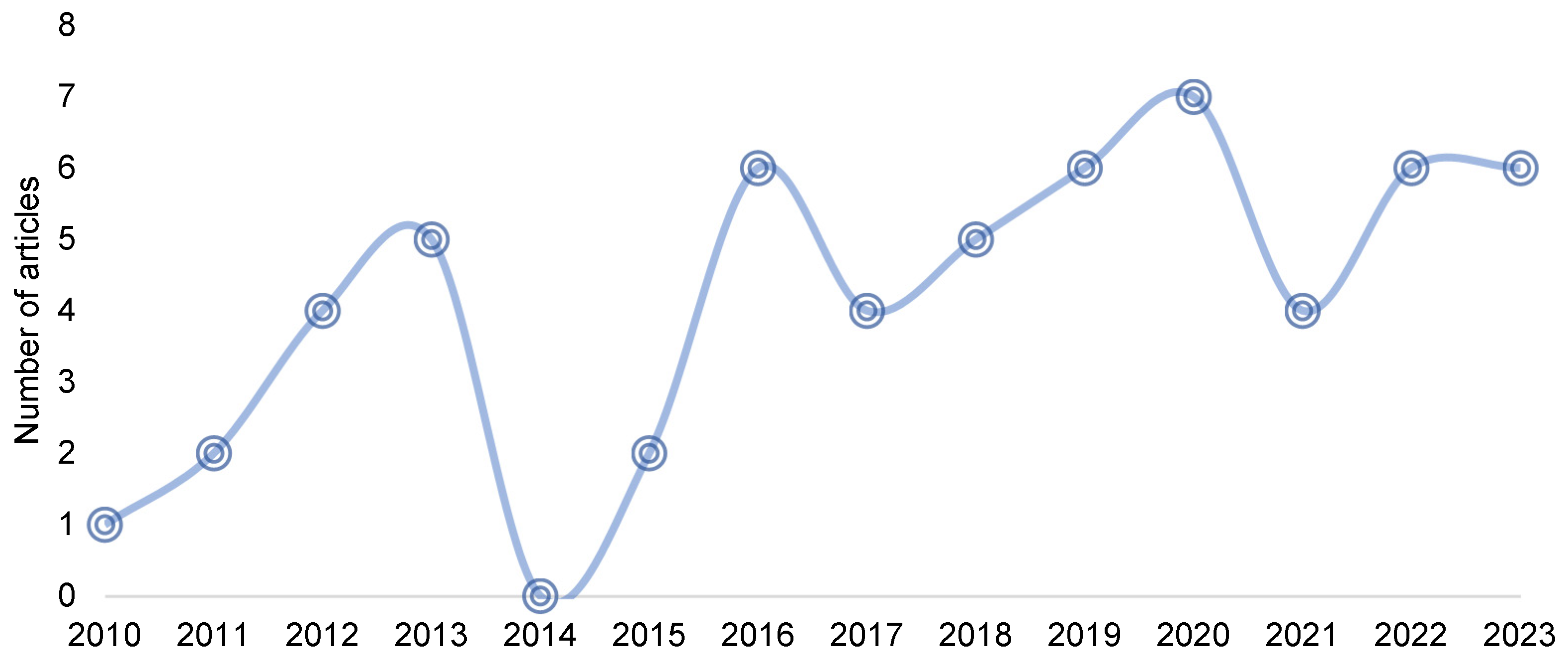
The final dataset integrates 58 articles published between 2010 and 2023, including 253 authorships and an average of 4.69 authors per document. Over the period analyzed, this field has shown an annual growth rate of 14.78 percent. No publications were identified in 2014. After 2015, there was a relevant growth in publication, which suggests growing interest and activity in the field, potentially driven by the relevance of the topics addressed in the Paris Agreement and the necessity for innovative solutions (Figure 2).

3.2. Institutions and Sources

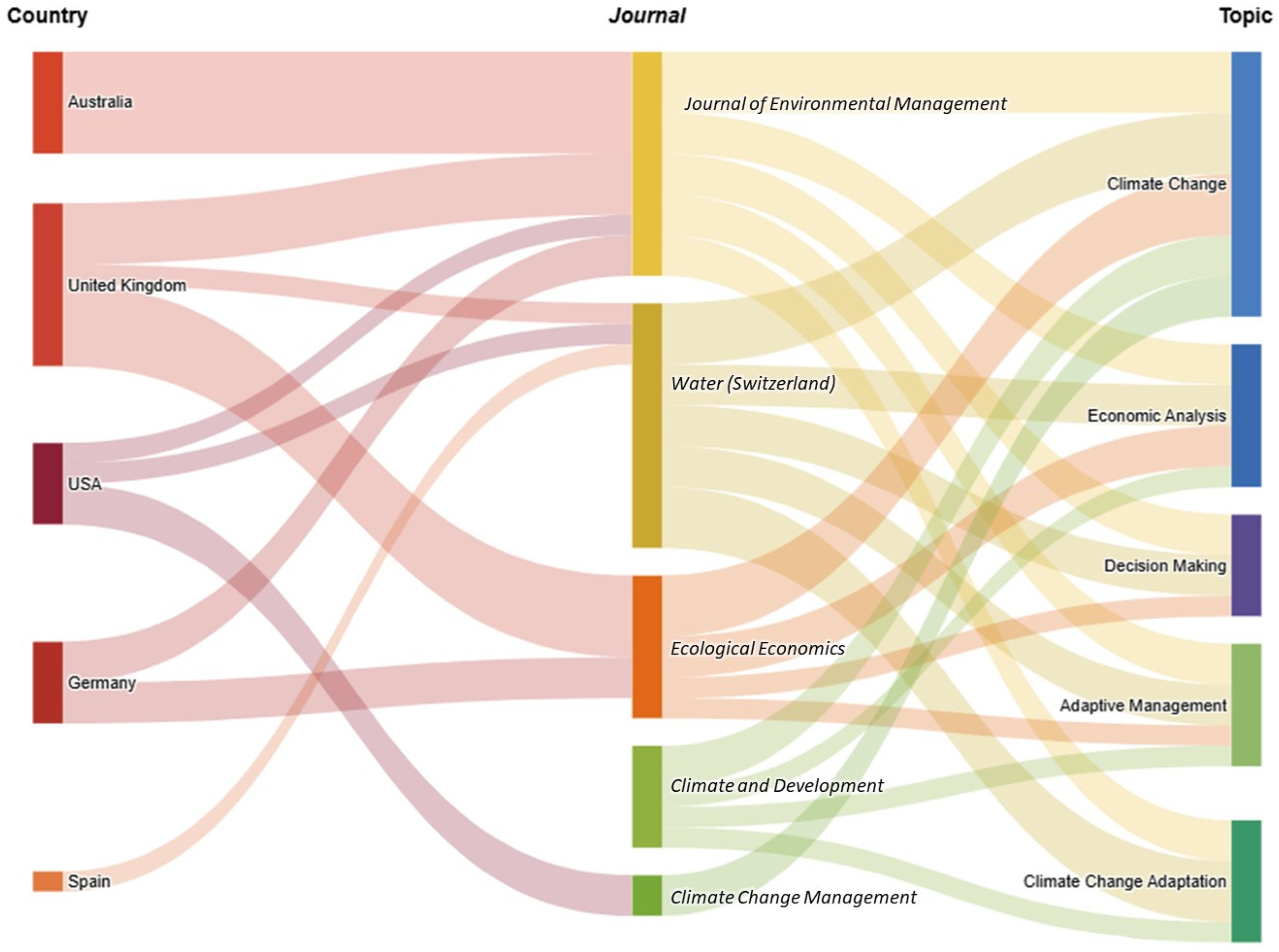
Among the literature reviewed, the leading institutions from which the authors were affiliated correspond to countries in the Global North. Considering the top five academic journals, the most prolific contributions come from the United Kingdom (UK) (eight articles), followed by Australia (five), Germany (four), USA (four), and Spain (one). Additionally, the economic evaluation of adaptation has been published by journals specializing in environmental management, water, ecological economics, and climate change, as well as in agricultural matters. Within the sample reviewed, there is a notable absence of more diverse disciplinary and interdisciplinary journals, such as economics, climate economics, decision sciences, and public policy. At the same time, there is a lack of journals with climate economics publications with focus on sectoral adaptation, such as ecosystems, risks, or population and communities (Figure 3).
The Journal of Environmental Management and Water channel the largest share of publications, connecting a significant wealth of conceptual knowledge, including keywords such as climate change, economic analysis, decision-making, adaptive management, and adaptation, with a limited set of countries of origin. Notably, half of the publications on adaptation economics in the Journal of Environmental Management come from just four countries in the Global North, flagging its influence in both thematic and geographical areas across the analyzed sample.

3.3. Authors

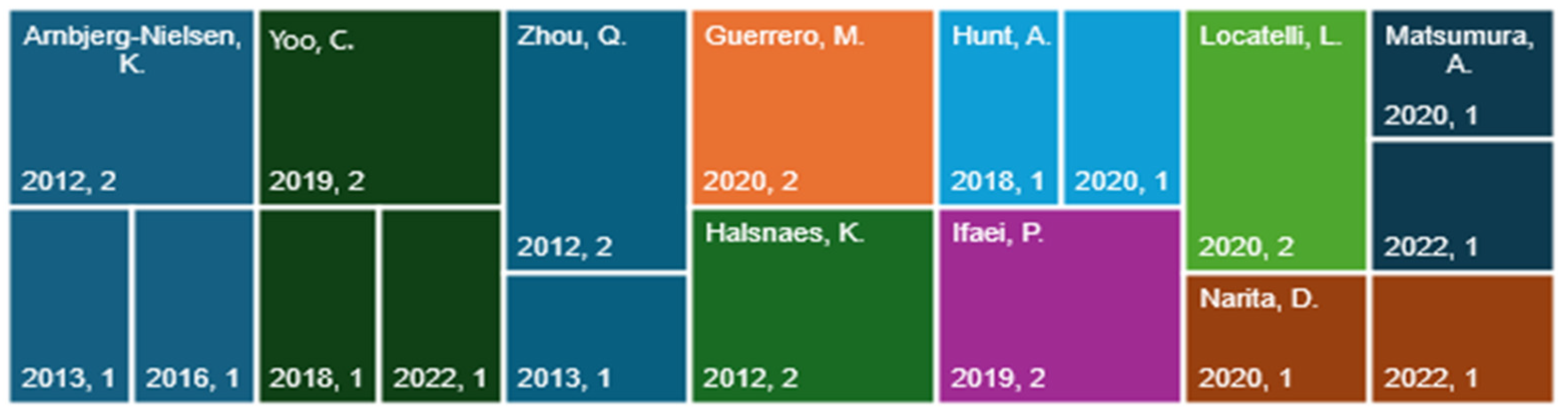
In terms of meaningful authors, Figure 4 highlights the concentration of productivity among a small group of researchers, led by authors such as Arnbjerg-Nielsen, K., Zhou, Q., and Halsnæs, K.
Within the reviewed corpus, adaptation economics research is a collaborative yet fragmented field. The 58 scientific articles were written by 253 authors, with an average of 4.67 co-authors per paper, and only one paper was single-authored. Furthermore, international co-authorship constitutes 34.48% of all co-authorship, indicating a significant level of collaboration.
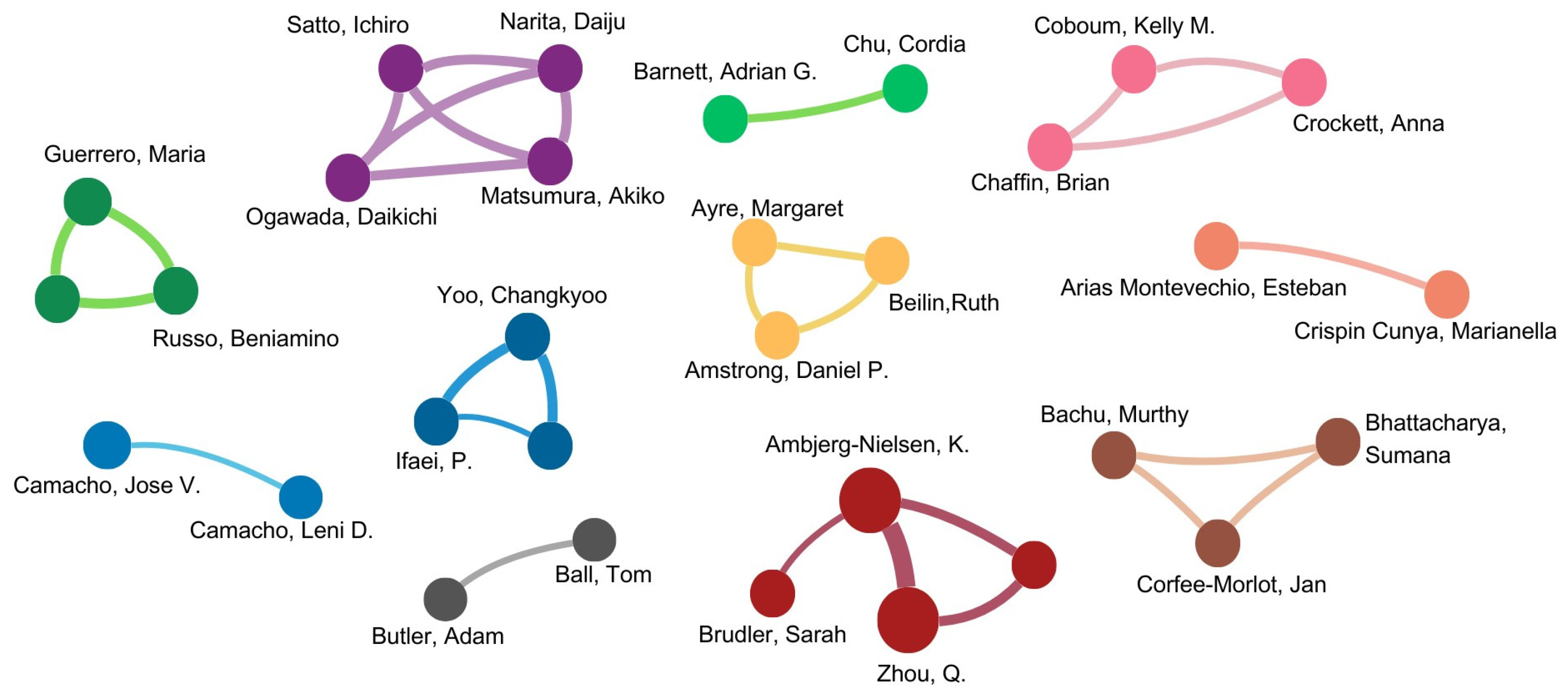
Regarding the collaborative research networks of the selected scientific articles, there is a considerable collaboration network of 30 authors within well-defined work groups but a lack of connectivity between groups (Figure 5). In the absence of ties between groups, almost any author accumulates a substantial number of collaborative links. The resulting network is fragmented into 11 isolated components (groups), which explains the relative uniformity in node size.
Several corresponding authors (including K. Arnbjerg-Nielsen, Yoo Changkyoo, Narita Daiju, and Matsumura Akiko) form one of the largest clusters of the in the network (with four nodes). Nevertheless, only K. Arnbjerg-Nielsen plays a central position of coordinator in disseminating knowledge (with a betweenness value of 2; the remaining 29 authors show a value of 0), although only in his own hub.

3.4. Countries

Regarding country references in the corpus, Denmark is the most prominent with 479 citations, underscoring its leading role in indexed adaptation economics research. In addition, the UK (260 citations), the United States of America (USA) (165), Australia (119), and Germany (105) also emerge as notable references in this field, consistently reflecting their status as notable participants in the scientific literature on climate change adaptation. Furthermore, South Korea, among the most frequently cited countries (152), has experienced accelerated growth in recent decades and has become a significant contributor to this field.
In terms of the countries of the corresponding authors, the USA leads, followed by Korea, Spain, Germany, and the Netherlands. The most prevalent type of collaboration among these countries, except for Spain, is single-country publications, indicating that, despite the existence of multilateral collaborations, many authors in these jurisdictions still mainly engage in projects within pairs from their own countries.
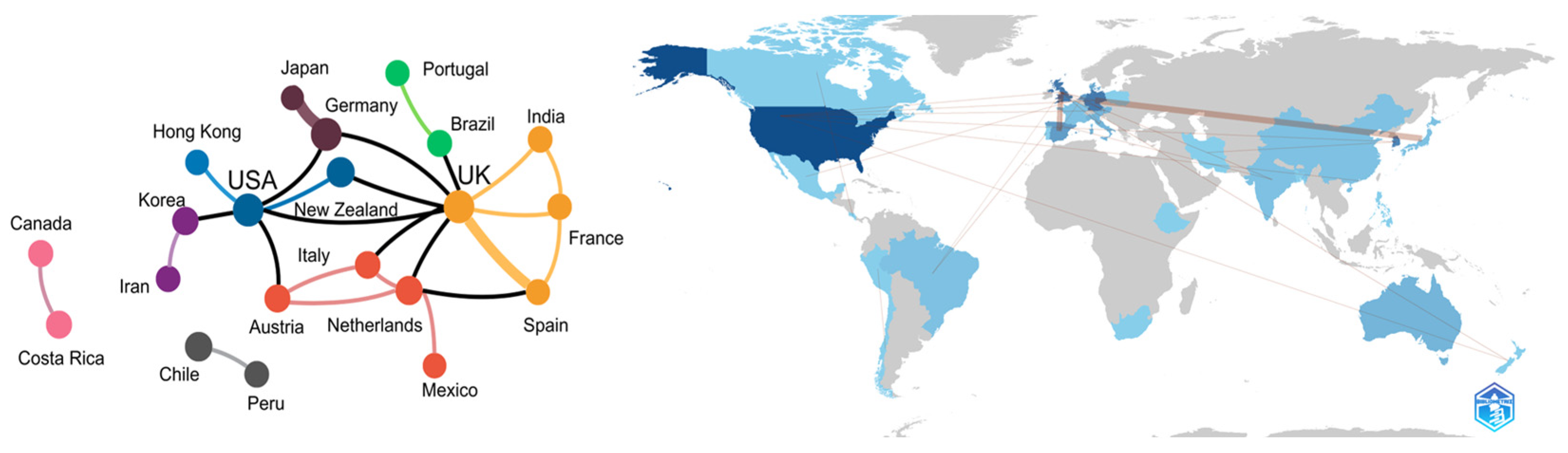
To further demonstrate multilateral project collaborations, Figure 6 illustrates these alliances.
Among the studies included in this analysis, the collaboration network contains 21 countries, where notable participation includes those between the UK and Spain and between Germany and Japan, as reflected by the thickness of their connecting edges. In particular, the UK acts as the main bridge node of collaboration, leading this network with the highest values in centrality indicators: 73.08 in betweenness, closeness of 0.042, and PageRank of 0.136. However, like the author network, this network is fragmented. Developing economies in Latin America, such as Mexico, Brazil, and Costa Rica, have established punctual relationships with developed nations. Chile and Peru, and Canada and Costa Rica, exhibit direct bilateral collaboration on adaptation economics in the region but remain isolated from other interregional collaborations.

3.5. Main Topics of Academic Interest

3.5.1. Conceptual Clusters

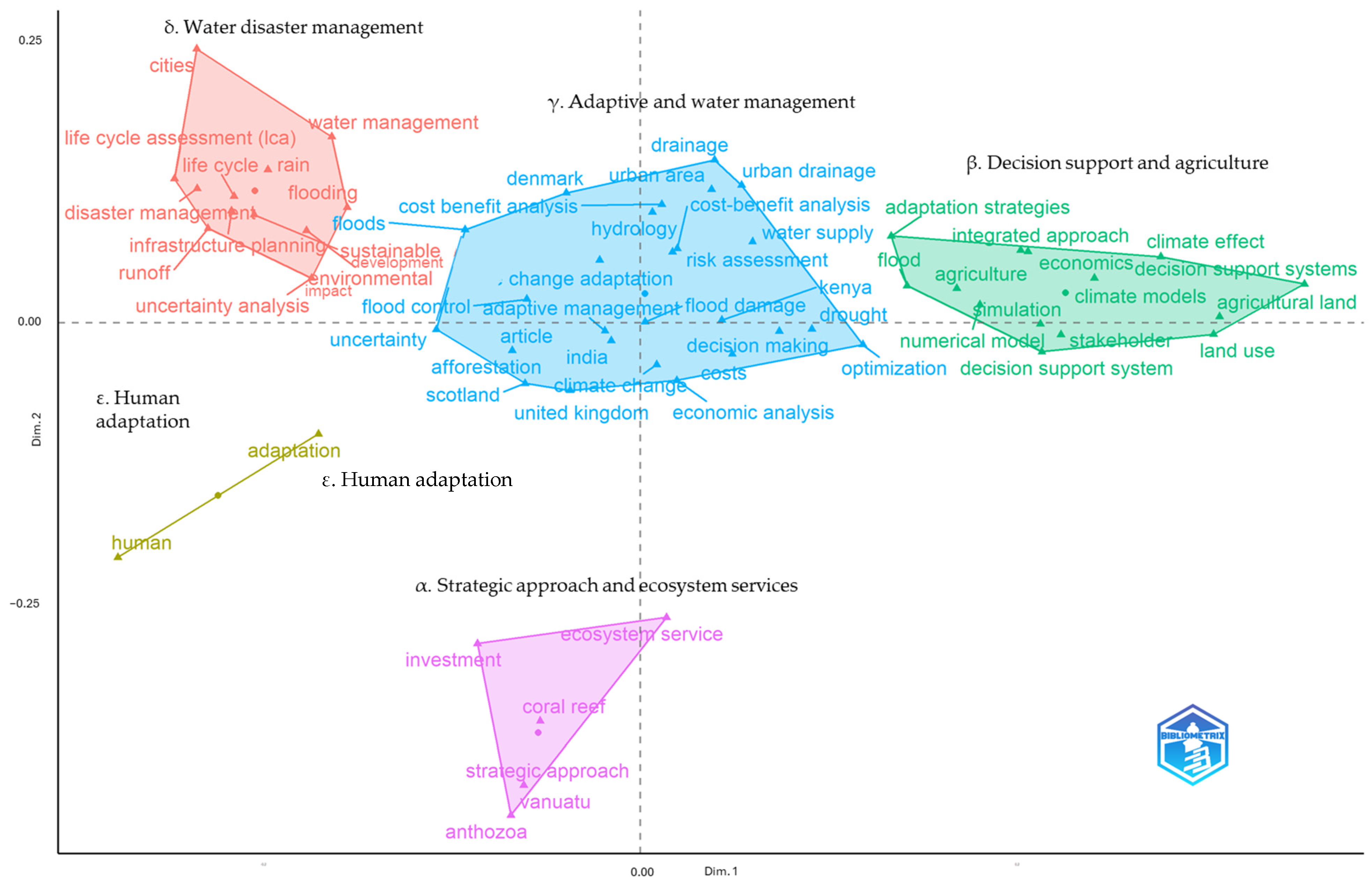
To visualize clusters of topics within the economic evaluation of adaptation, a multidimensional scaling (MDS) analysis was conducted using the “keywords plus” field (Figure 7).
Economic evaluation is strongly organized around five thematic clusters of water disaster management, adaptive and water management, agriculture, human adaptation, and ecosystem services. The red cluster (δ) focuses on water disaster management with methods such as uncertainty analysis and life cycle assessment. The blue cluster (γ), in the middle of the map, centers on adaptive and water management and contains shared topics such as water management, risk assessment, adaptive management, and decision-making. This cluster is mainly based on methods of optimization such as CBAs. The group of terms in green (β) consists of decision support systems for agriculture and land use, considering numerical models and integrated approaches. The olive cluster (ε) covers two distant concepts: human and adaptation. The pink cluster (α) brings together coral reefs, ecosystem services, investment, and a strategic approach, without an explicit mention of a methodology.
The adaptive and water management concept portrays the center of the research field, while the “human adaptation” theme (cluster ε) is isolated from the remaining clusters and is represented by only two distant concepts (“human” and “adaptation”). This separation suggests that, within the analyzed studies, human and social dimensions, such as social processes, institutions, and equity, are weakly integrated into the dominant thematic structures of adaptation economics. This gap flags an opportunity to integrate socioeconomic and distributional perspectives more systematically into adaptation evaluation.
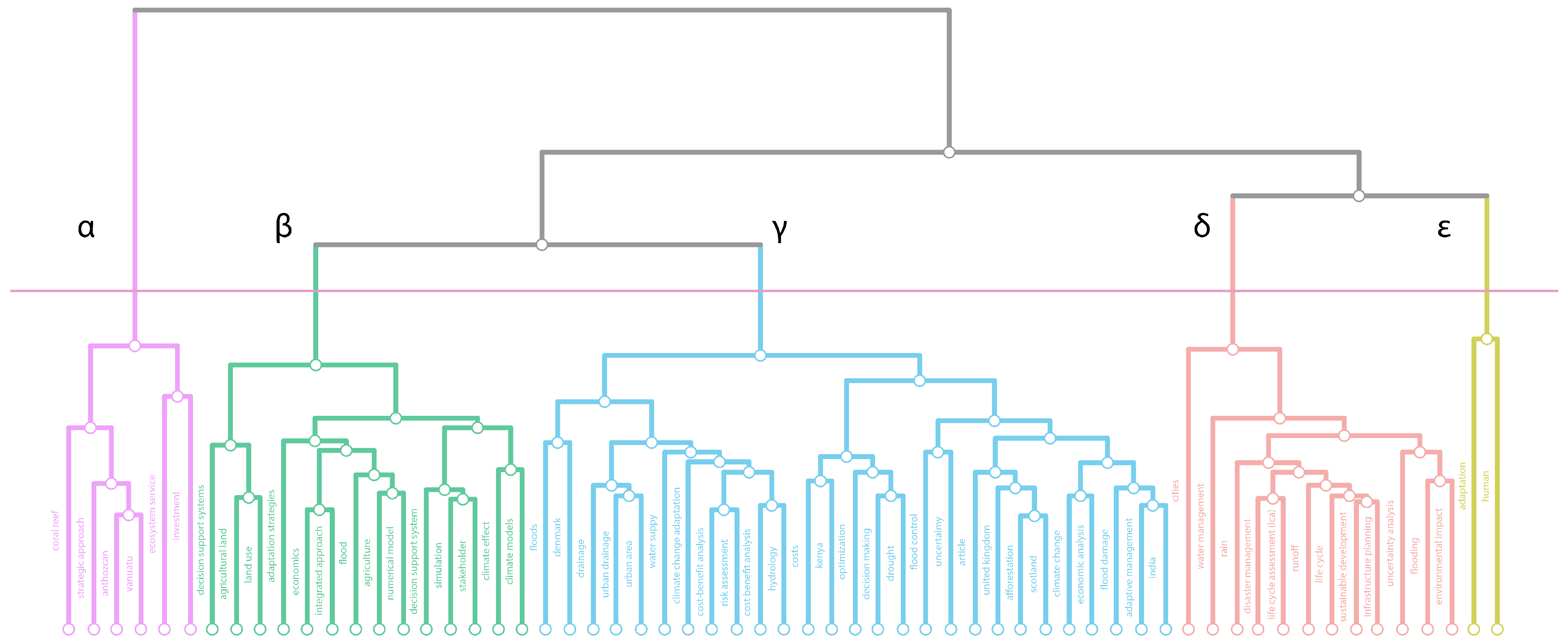
In terms of hierarchical structure, Figure 8 presents a hierarchical dendrogram of concept structures, showing the five clusters as a nested, organized tree. The clade ε is bifolius, the simplest branch in the sample, with two concepts; the rest of the branches are more complex, with the most leaves, mainly γ with 27 concepts.
Cluster α, related to ecosystem services, can be considered an independent grouping from the rest of the themes, as it stems from its own branch and is spatially distant from the remaining clusters, especially ε and δ, which refer to human adaptation and water disaster management, respectively. In other words, the distant themes have received little attention and collaboration in the reviewed literature.
In contrast, branches β, γ, δ and ε share root similarities since they come from the same branches. Namely, the themes of adaptive and water management share a common root with the decision support and agriculture branch, reflecting thematic proximity despite covering different sectors.

3.5.2. Thematic Evolution

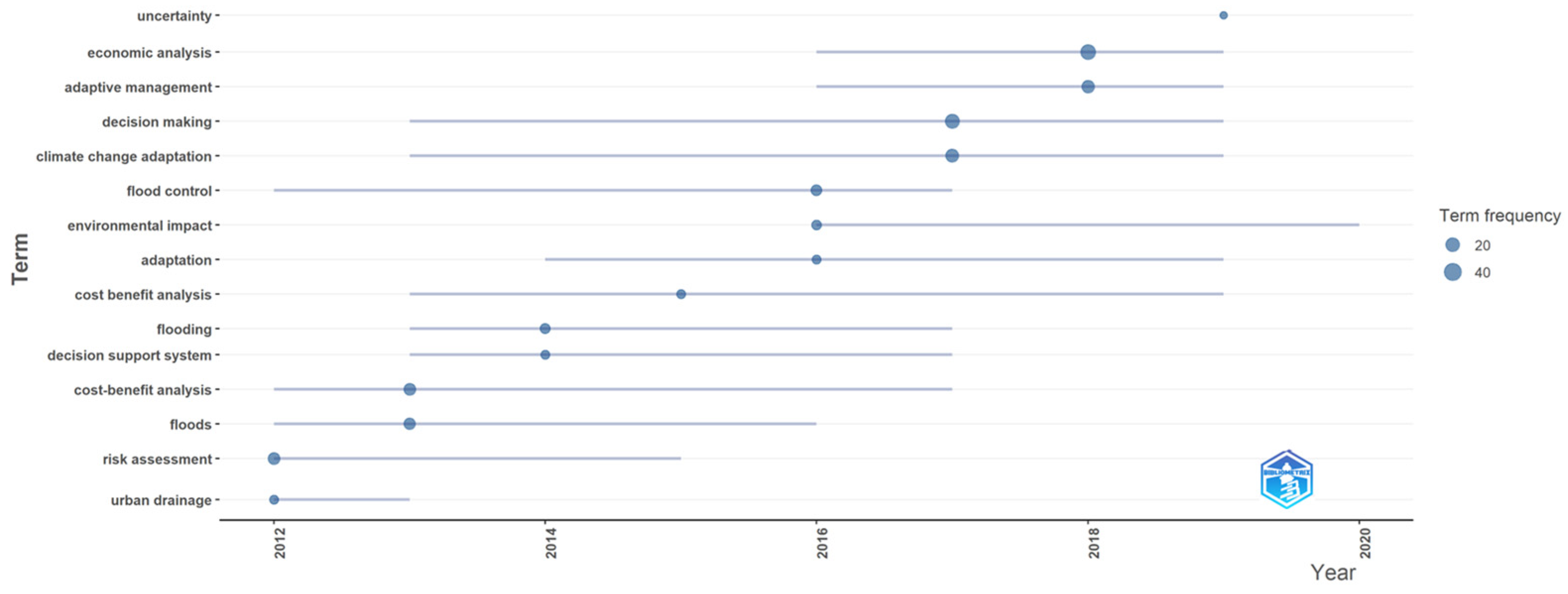
The temporal patterns of keywords plus use topics reveal a relevant shift in analytical frameworks in the sample analyzed (Figure 9). The use of approaches such as risk assessment and decision support systems has shifted toward decision-making and adaptive management, mainly after 2015, the year the Paris Agreement was signed. Despite this conceptual evolution, CBA has remained relatively constant throughout the period, while uncertainty has appeared as an incipient topic in recent years. Regarding sectoral focus, flood control and environmental impact are the most prominent topics during the timeline. This analysis identified those specific concepts that gained or lost relevance (appearing or disappearing) along the timeline.
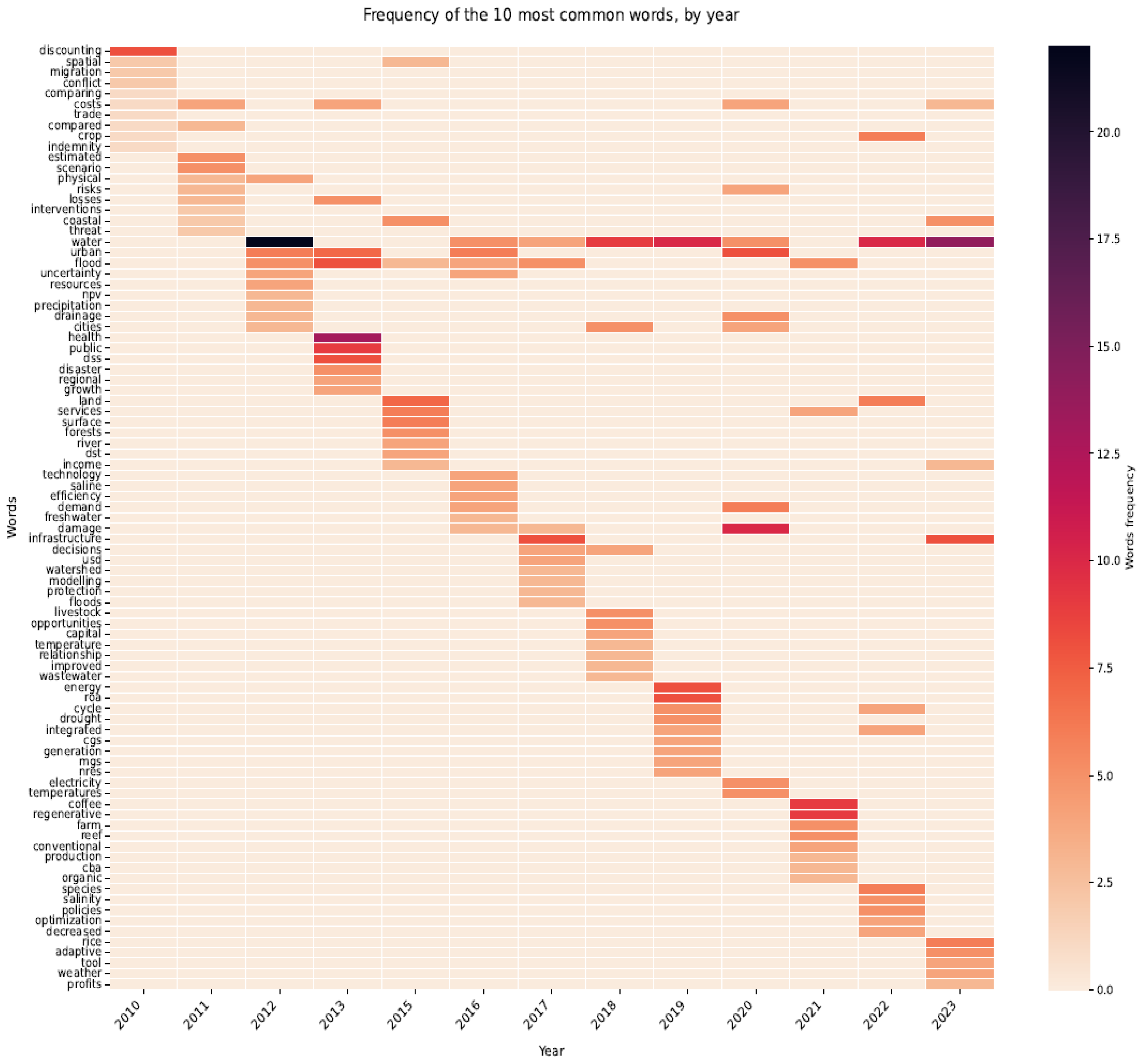
Complementing this temporal perspective, a frequency analysis of the 100 most frequently used words used in abstracts along the timeline was conducted (Figure 10). Terms such as “interventions,” “risk,” and “uncertainty” remain central, reflecting sustained focus on risk assessment and adaptive strategies. Recent increases in “precipitation,” “temperature,” and “coastal” suggest growing attention to specific impacts, while terms like “technologies” and “optimization” suggest a shift toward efficient, practical solutions.
This broader textual analysis of the concepts reveals a maturation of the field of study, moving from studies based on impact characterization to sectoral management and modeling, and then to more recent approaches focused on decision-making and productive transformations that address specific climate risks. Overall, the sample shows progress toward the consolidation of economic research on adaptation.
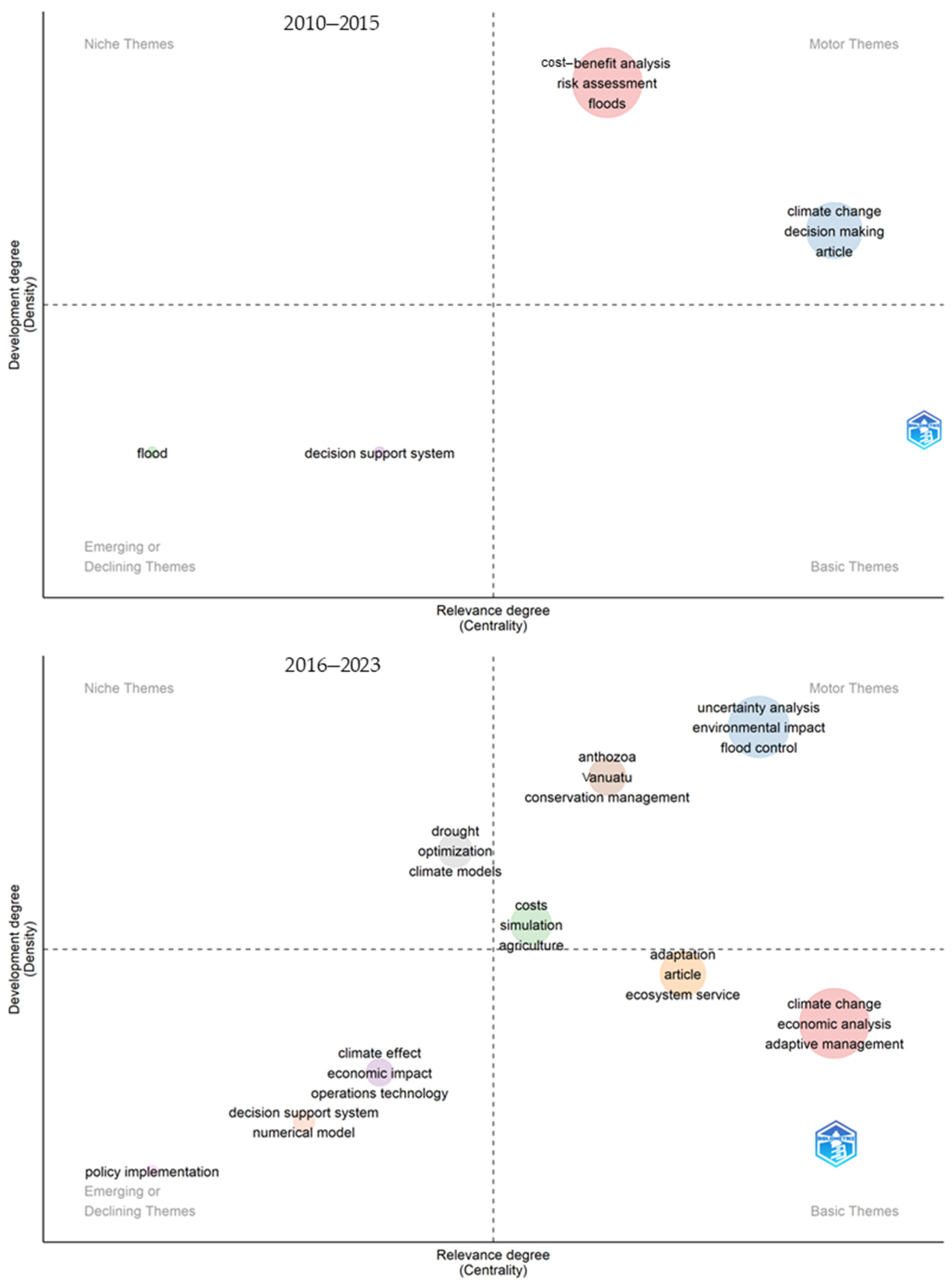
To identify the structural role each concept plays in the field, a longitudinal section, focusing on international sustainability and climate agendas as key milestones, reveals a notable thematic evolution in this field between the 2010–2015 and 2016–2023 time periods (Figure 11). In both periods, topics such as CBA, risk assessment, and flood control were essential to decision-making and the development of climate adaptation policies.
From 2010 to 2015, CBA (“cost–benefit analysis”), “risk assessment”, and “floods” were key Motor Themes central to policy planning and adaptation strategies. Emerging themes such as “decision support systems” indicate early-stage development. At the same time, the absence of Niche and Basic Themes suggests the field focuses on consolidating fundamental concepts rather than specialized or fragmented topics.
From 2016 to 2023, Motor Themes such as “uncertainty analysis”, “environmental impact”, and “flood control” gained prominence, reflecting advanced development and centrality in the climate adaptation literature and underscoring the need to address complex, multidimensional aspects to improve adaptation to climate change. Furthermore, the overarching concepts of “climate change,” “adaptation,” and “ecosystem services” continue to serve as pivotal foundations (Basic Themes), though there is scope for further methodological advancement. The emergence of specialized themes in the Niche Themes quadrant, such as “drought” and specific regional studies, underscores the increasing importance of local adaptation strategies by economic evaluation of adaptation.

3.6. Characterizing Economic Evaluation Approaches by Adaptation Types

3.6.1. Evolution of Economic Approaches

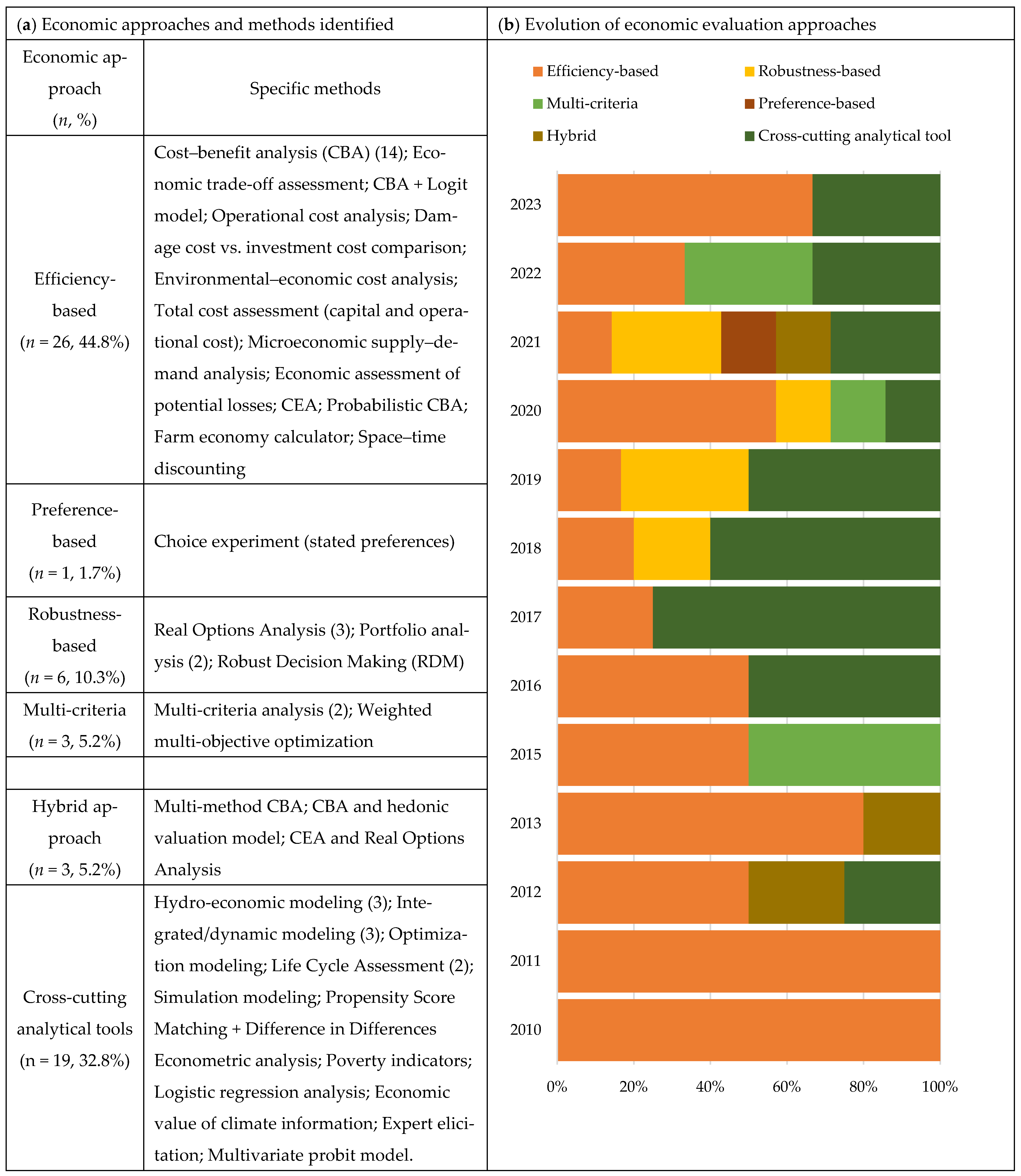
Based on the abstract review, it is possible to classify the different economic methodologies for adaptation into six specific economic approaches based on their main objective of evaluation: efficiency, preferences, robustness, multiple criteria, hybrid approach (crossing approaches), and cross-cutting analytical tools (without an explicit approach) (Figure 12):
  • Methods based on efficiency. Traditional and conventional economic procedures are widely known and understood by diverse audiences and use fundamental principles of profit maximization and cost minimization [8,17,38,49,50].
  • Methods based on preferences. The preferences are captured by stated or revealed preferences. For the case of stated preference, it is a method in environmental economics for estimating nonmarket values. This method uses surveys to ask individuals how much they value environmental good by measuring their willingness to pay to protect it or prevent damage [9].
  • Methods based on robustness. In contrast to the traditional optimization approach, this group of families of methodologies highlights strategies that are robust across multiple scenarios, explicitly account for uncertainty, and value flexibility and learning during adaptation implementation [8,41]. These methods remain scarce and may be computationally demanding [23].
  • Methods based on multi-criteria. Optimization processes are based on various criteria and/or objectives in a multidimensional manner, thereby capturing both quantitative and qualitative aspects [38,50].
  • Hybrid approach. Exercises in the joint application of analysis from the conventional approach, robustness, and multicriteria approaches [15].
  • (Cross-cutting analytical tools. These are instrumental approaches that do not explicitly mention a specific economic paradigm, for instance, 14 types of modeling, such as integrated and dynamic modeling, econometric and optimization modeling, and numeric and statistical analyses [31].
Studies have evaluated these adaptation measures economically using a wide range of methodological approaches, indicating that researchers are interested in exploring diverse methods to address the complex challenges associated with adaptation, climate change, and decision-making (Figure 12a,b). Nevertheless, conventional methods based on efficiency dominate economic evaluations accounting for 44.8% of the studies. At the beginning of the period, this efficiency focus was the dominant paradigm.
More diverse frameworks, such as robustness-based, multicriteria, preference-based, and hybrid approaches, are less common, comprising only 22.4% in total, although they have been gaining academic space over the years, particularly from 2018. Furthermore, robust decision-making, which allows for dealing with uncertainties and analyzing different impacts, respectively, has limited use of 10% in academic practice. Meanwhile, analytical tools, mainly from economic analysis included in integrated modeling without an explicit economic paradigm, represent 32.8%.

3.6.2. Adaptation Measures Evaluated by Economic Approaches

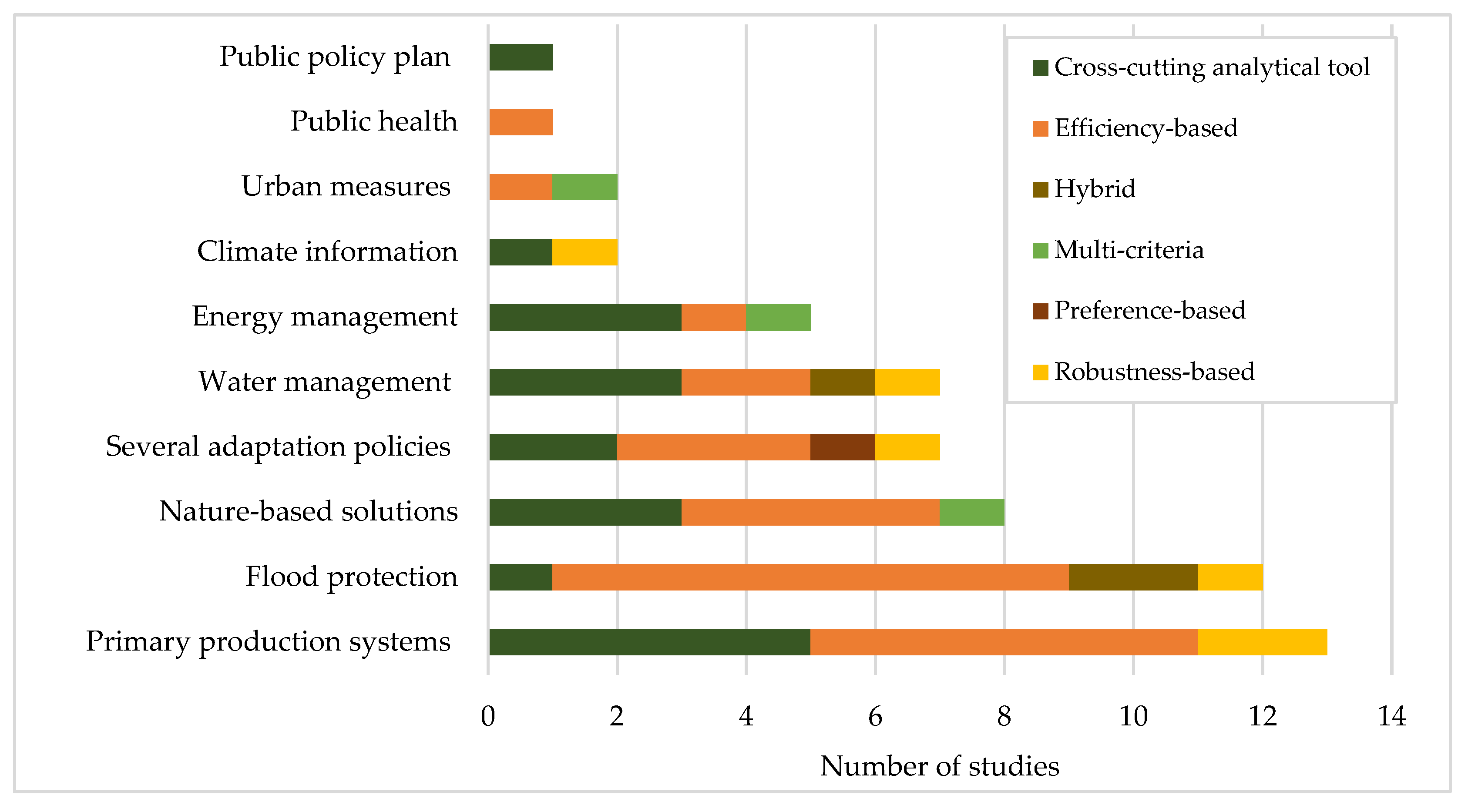
It is possible to identify that 57% percent of the analyzed studies assess measures in primary production systems, flood protection, and nature-based solutions (NbS) (Figure 13). The primary production system measures include innovative and regenerative agricultural and farming practices, such as the selection of crop varieties and livestock species, changes to the seasonal timetable, forest management, and new workforce skills. For its part, NbS refers to ecosystem-based adaptation, conservation strategies, green infrastructure, and coastal management measures.
Adaptive strategies in the primary sector and flood protection have only been evaluated using conventional approaches, cross-cutting analytical tools (mainly modeling), and, to a lesser extent, robust decision-making. Additionally, NbS has only been evaluated using efficiency and modeling approaches, with only one multi-criteria study. These approaches have analytical limitations for estimating the various ecosystem service co-benefits that NbS provides, while useful approaches such as preference-based ones are not being used.
Water management (supply, drainage, and treatment), and several other policies, represent 24%, encompassing a broader range of methods, including robust and hybrid approaches. Finally, measures linked to climate information, urban measures, public health, and policy plans occupy the remaining 19%, showing a limited number of studies and methodological diversity.
Based on the PRISMA framework, it is important to note that the Bibliometrix parameters were not modified to assess the stability of the resulting cluster structures. Due to the bibliometric focus of this review, a quantitative synthesis of the effect was not performed, nor was the certainty of the evidence assessed.

4. Discussion

The results indicate that journals specialized in environmental management, water, ecological economics, climate change, and agricultural matters make a significant contribution to advancing scientific knowledge by publishing most of the articles on adaptation economics in the analyzed sample. In contrast, journals from disciplines such as economics, decision sciences, public policy, and sectoral adaptation do not have predominant participation. This underrepresentation denotes an opportunity to include analyses of the economics of adaptation to other academic perspectives, particularly from social, political, economic, and multidisciplinary journals and special issues.
Simultaneously, this study highlights the fact that adaptation economics research is a collaborative field, with an average of 4.67 co-authors per scientific product and a considerable degree of collaboration in well-defined and localized hubs. Nevertheless, there is no connection between these work groups, which is consistent with the most prevalent type of collaboration being the single-country publication mode. While these collaborations are valuable, their tightness suggests untapped potential to include new voices and perspectives in the field. Moreover, although some notable partnerships exist, the collaborative network appears limited in scope. This limitation may indicate that many researchers are working in isolation, which is a potential drawback of the current research environment.
There is relatively limited academic production in this field; however, it has shown dynamic growth, with leading contributions from institutions and authors in Global North countries. The prevalence of collaborative endeavors among developed countries underscores the considerable influence that these nations have on the trajectory of global research and knowledge sharing, while indicating that they, with greater resources, tend to facilitate specialized studies in adaptation economics.
However, this concentration of partnerships in certain regions has led to the first potential research gap being identified: a geographical research imbalance resulting in a lack of diverse perspectives and approaches, particularly from underrepresented regions. Based on the literature reviewed, countries in Latin America, Africa, and South Asia face the most severe adaptation challenges yet appear minimally represented in the conventional indexed academic literature concerning the economic evaluation of adaptation. While some Latin American countries have established limited partnerships with Global North jurisdictions, only Chile and Peru exhibit a binational collaboration on adaptation economics in the region.
To address these shortcomings, deliberate efforts are also needed to enhance local research and knowledge generation to develop better-informed adaptation strategies in vulnerable regions, including to develop simplified but rigorous economic evaluation-suitable frameworks and local tools for environments with limited computing resources and to allocate finance to support these research developments.
At the same time, this geographical gap highlights the importance of fostering broader and more collaborative networks that integrate diverse knowledge, perspectives, and socioeconomic and geographical realities. Research networks could deliver more comprehensive and equitable solutions and facilitate the more effective management of climate challenges. Promoting a more inclusive collaborative environment could be key to driving innovation and knowledge generation in Global South regions.
Additionally, in terms of conceptual analysis, the results elucidate the multifaceted nature of economic evaluation of adaptation and emphasize the interconnectivity of these themes in addressing the challenges posed by climate change. Four clusters of topics were identified: α, strategic approach and ecosystem services; β, decision support and agriculture; γ, adaptive and water management; δ, water disaster management; and ε, human adaptation. Given the concurrence of terms, adaptive and water management were the most relevant topics. The last and most isolated topic was “human adaptation”. This second academic gap between human dimensions and other stronger clusters is an indicator of the structural disconnection of economic adaptation and social and human dimensions, also resulting in the lack of social and human sciences journals in the analyzed publications.
This gap offers an opportunity to develop economic analyses that evaluate human and social dimensions, considering, for example, hybrid approaches to adaptation, ecosystem-based adaptation measures that consider disaster risk reduction, or methods based on community participation.
Over time, the richness of concepts has led to the consolidation and diversification of economic research on adaptation in the analyzed sample. Adaptive management, climate change, and economic analysis became foundational topics. In contrast, other climate-related issues, such as uncertainty analysis, agriculture, droughts, and ecosystem service conservation, have also emerged as focal areas for economic evaluation. Other emerging themes, such as decision-support systems and numerical modeling, offer opportunities for future research that could reinforce the economic approach to climate adaptation in underdeveloped areas.
On the other hand, scholars have evaluated adaptation measures using a wide range of methodological approaches. Based on their main evaluation objective, it was possible to classify the economic methods applied in scientific articles into six approaches: (1) efficiency-based, (2) robustness-based, (3) multiple criteria, (4) preference-based, (5) hybrid approach, and (6) cross-cutting analytical tools.
Regarding the type of adaptation measures reported in the studies, 57% are related to primary production systems, flood protection, and NbS, followed by water and energy management and other measures, while the least frequent measures are those related to climate information, urban measures, public health, and policy plans. Only water management and other adaptation measures are evaluated based on diverse methods (robust, hybrid, efficiency), while the remaining eight types are mainly evaluated by the dominant approaches of efficiency and cross-cutting. NbS cases have been mainly evaluated through efficiency-based and model methods, limiting the suitable representation of diverse environmental and local co-benefits.
Although analytical frameworks have diversified, conventional analyses such as CBA have remained relatively constant, indicating an ongoing gap between the concepts and practice of economic evaluation for adaptation.
According to the sample, there is a persistent academic preference for conventional efficiency-based approaches to assess wicked problems such as adaptation, while adaptation economics studies include only marginally more pluralistic frameworks.
This result is remarkable given the various academic and gray literature criticisms of conventional approaches [7,8,26,49,51,52], particularly cost–benefit analysis.
Those conventional methods have inherent estimation bias. For instance, they do not cover important aspects of public decision-making and climate change, such as climate change uncertainties, the distributional effects of actions including non-monetary costs and benefits (such as ecosystem services), the robustness of results in the face of various uncertainties, and the flexibility to incorporate generated knowledge, to name a few.
Non-traditional methods offer several analytical advantages, such as better representation and understanding of climate change uncertainties. They also offer more robustness and flexibility with fewer regrets, provide better representation of qualitative aspects and non-market values, incorporate stakeholder subjectivity and preferences, offer the flexibility to incorporate new knowledge, and reduce the estimation bias inherent in conventional methods.
However, the complexity and resource-intensive nature of nontraditional approaches, as identified by Markandya et al. [39] and Narita et al. [23], limit their extended use. Furthermore, the development of analytical methods in resource-rich environments such as the Global North, not only limits the feasibility of their use in environments with greater climatic and socio-environmental vulnerabilities, but also limits the explicit incorporation of the diversity and richness of local perspectives, where adaptation regularly occurs.
To overcome these gaps, there is an opportunity for scholars, policy makers, and practitioners to explore new toolkits to overcome these gaps, including the establishment of guidelines, standards, best practices, simplified methods, and collaborative platforms to spread their use. Developing decision-making tools can, not only tackle the analytical limitation of traditional methods, but also can reduce the disagreement around methodological approaches and, consequently, the risk of maladaptation.
The scope of this discussion is limited to the corpus compiled from Scopus. Studies published outside this index, particularly in regional journals, book chapters, institutional series, and gray literature, are likely underrepresented, which may affect both geographic coverage and linguistic representation. Therefore, the thematic structures, major publications, and collaboration patterns identified in this article reflect the Scopus-indexed literature retrieved using the specified query and time, not a comprehensive inventory of research in adaptation economics.
Furthermore, since the objective was to map the intellectual structure and evolution of the academic field, no formal quality or risk of bias assessments were performed on individual studies. Additionally, although the screening, selection, and classification process, a single person performed, final list of studies and classification of methods were examined and validated by the coauthors

5. Conclusions

This research sought to review the academic progress of economic evaluation for climate change adaptation developed over the last decade to characterize trends, gaps and opportunities for future research and collaboration.
According to the literature analyzed, research on adaptation economics has grown dynamically but remains limited, dominated by Global North institutions, with few collaborations in Global South, such as Latin America. Publications are concentrated in environmental and climate-focused journals, while broader disciplines are less represented. Moreover, the collaboration network operates as disconnected clusters with no communication between them. This geographical concentration and network fragmentation favors the consolidation of well-established hubs, while underrepresenting the most climate-vulnerable regions in academic literature to inform decision making in adaptation. Those disconnected networks also limit the inclusion of more diverse and innovative perspectives.
At the conceptual level, the analyzed studies show five main conceptual clusters, from ecosystem services to human dimensions of adaptation. This last one, the most isolated concept, points out a third academic gap: that the social dimensions of climate adaptation, including equity and community agency, remain practically out of the economic evaluation scope of the sample analyzed.
Despite conceptual evolution and methodological diversity, there is a predominance of conventional economic methods. This limited inclusion of pluralistic approaches flags a methodological imbalance and an asymmetry between thematic diversification and methodological practice, which constrains the understanding of broader adaptation benefits. The persistent use of these approaches can be attributed to their accessibility and widespread familiarity, as well as the computational complexity and resource-intensive nature of other alternatives. As consequence, there is a systematic underestimation of critical attributes to adaptation, such as deep uncertainty, distributional effects, and non-monetary socioenvironmental values.
All of these gaps represent a fundamental opportunity for capacity building in the economic evaluation of adaptation. Considering more robust, flexible, and participatory methods for different adaptation types and geographic areas would provide more suitable evidence to inform decision making for climate adaptation.
Emerging themes such as decision support systems and uncertainty analysis represent opportunities to bridge this gap, particularly in underrepresented sectors and vulnerable regions where more context-sensitive economic frameworks are needed.
Furthermore, methodological approaches would have to be strengthened and designed ad hoc from the territories where adaptive processes are most urgent.
This research points out several avenues for participation, collaboration, and analytical improvements in methodologies for advancing economic evaluation of adaptation, particularly for the indexed sample analyzed.
Participation and collaboration:
  • It is advisable to establish North–South and South–South financing mechanisms to strengthen regional collaboration in adaptation economics, especially in regions underrepresented in the sample analyzed, such as Latin America, Africa, and South Asia—regions where adaptive processes are most urgent.
  • Given the notable absence of economics and public policy journals in this field, and the disconnection among isolated research centers, it is necessary to foster disciplinary and interdisciplinary dialogue.
    This dialogue can be promoted through cluster collaboration and the connection of thematic communities that currently operate independently, for example, through calls for special projects.
    An alternative is promoting special journal issues that incentivize inter-hub collaboration and connect adaptation economics with other disciplines, particularly decision science and public policy.
Analytical improvements in methodology for decision-making:
  • Strengthen the characterization of costs, benefits, and co-benefits, including non-market values and distributional effects, across diverse types of adaptation, sectors, and climate risks to improve the comparability and transparency of economic evaluations.
  • Promote research that integrates social dimensions from an intersectional perspective (considering variables such as gender, race, socioeconomic level, sexual orientation, among others), to promote the relevance of “human adaptation” and address the disconnection with the rest of the field.
  • Design specific methodological approaches from the territories where adaptation is most urgent, incorporating local knowledge and participatory processes to improve the relevance and applicability of economic evaluations.
  • Strengthening capacity for the economic evaluation of adaptation through more robust, innovative, and participatory methods for distinct types of adaptation and jurisdictions. This can be promoted through the development and dissemination of accessible tools and simplified guidelines for non-conventional economic methods adapted to data-scarce environments.
  • Diversify the sectors of interest in economic assessments to provide more information for decision-making in sectors vulnerable to climate change and that provide critical services to the population, such as health, energy, and education services.
  • Finally, future reviews of adaptation economics literature with larger corpus and individual quality assessments could broaden understanding of the evolution of the economics of adaptation.

Supplementary Materials

The following supporting information can be downloaded at: https://www.mdpi.com/article/10.3390/cli14030068/s1.

Author Contributions

Data collection, database preparation, materials, analysis, and manuscript writing, M.d.P.S.-V.; conceptualization, validation and writing, Y.M.; supervision, validation and writing, H.G.-G.-R. All authors have read and agreed to the published version of the manuscript.

Funding

This research was supported by Secretaría de Ciencia, Humanidades, Tecnología e Innovación (SECIHTI) through the postgraduate scholarship, CVU: 493503.

Data Availability Statement

The original data presented in the study are openly available in Zenodo at https://doi.org/10.5281/zenodo.18524103.

Acknowledgments

Special acknowledgments are extended to Gabriel Ramos Fernandez for his valuable review of the data and comments made to improve this paper. Secretaría de Ciencia, Humanidades, Tecnología e Innovación (SECIHTI) is also acknowledged for financial support through the postgraduate scholarship.

Conflicts of Interest

The authors declare no conflicts of interest.

Abbreviations

The following abbreviations are used in this manuscript:
CBACost–Benefit Analysis
CEACost-Effectiveness Analysis
DMDUDecision-Making Under Deep Uncertainty
IPCCIntergovernmental Panel on Climate Change
MDSMultidimensional Scaling
NbSNature-based Solutions
PRISMAPreferred Reporting Items for Systematic Reviews and Meta-Analyses
RDMRobust Decision Making

References

  1. Intergovernmental Panel on Climate Change (IPCC). Summary for Policymakers. In Climate Change 2022—Impacts, Adaptation and Vulnerability: Working Group II Contribution to the Sixth Assessment Report of the Intergovernmental Panel on Climate Change; Cambridge University Press: Cambridge, UK, 2023; pp. 1–34. ISBN 978-1-009-32584-4. [Google Scholar]
  2. Intergovernmental Panel on Climate Change (IPCC). Chapter 17. Economics of Adaptation. In Climate Change 2014: Synthesis Report. Contribution of Working Groups I, II and III to the Fifth Assessment Report of the Intergovernmental Panel on Climate Change; IPCC: Cambridge, UK; New York, NY, USA, 2014; pp. 1101–1131. [Google Scholar]
  3. Intergovernmental Panel on Climate Change (IPCC). Annex II: Glossary. In Climate Change 2022—Impacts, Adaptation and Vulnerability: Working Group II Contribution to the Sixth Assessment Report of the Intergovernmental Panel on Climate Change; Cambridge University Press: Cambridge, UK; New York, NY, USA, 2023; pp. 2897–2930. ISBN 978-1-009-32584-4. [Google Scholar]
  4. Folke, C.; Carpenter, S.R.; Walker, B.; Scheffer, M.; Chapin, T.; Rockström, J. Resilience Thinking: Integrating Resilience, Adaptability and Transformability. Ecol. Soc. 2010, 15, art20. [Google Scholar] [CrossRef]
  5. Berrang-Ford, L.; Ford, J.D.; Paterson, J. Are We Adapting to Climate Change? Glob. Environ. Change 2011, 21, 25–33. [Google Scholar] [CrossRef]
  6. Instituto Nacional de Ecología y Cambio Climático (INECC). Catálogo y Revisión de Metodologías de Análisis Económico Para la Adaptación al Cambio Climático [Catalog and Review of Economic Analysis Methodologies for Adaptation to Climate Change]; Instituto Nacional de Ecología y Cambio Climático (INECC): Mexico City, Mexico, 2020. Available online: https://www.gob.mx/cms/uploads/attachment/file/599904/74_2020_Catalogo_y_revision_de_metodologias_AEA_DEARN.pdf (accessed on 26 November 2024).
  7. United Nations Framework Convention on Climate Change (UNFCCC). Assessing the Costs and Benefits of Adaptation Options: An Overview of Approaches; UNFCCC: Bonn, Germany, 2011; Available online: https://unfccc.int/resource/docs/publications/pub_nwp_costs_benefits_adaptation.pdf (accessed on 10 January 2025).
  8. Watkiss, P. A Review of the Economics of Adaptation and Climate-Resilient Development; Centre for Climate Change Economics and Policy: London, UK, 2015; Available online: https://www.lse.ac.uk/granthaminstitute/wp-content/uploads/2015/09/Working-Paper-205-Watkiss.pdf (accessed on 20 January 2025).
  9. Watkiss, P.; Ventura, A.; Poulain, F. Decision-Making, and Economics of Adaptation to Climate Change in the Fisheries and Aquaculture Sector; FAO: Rome, Italy, 2019; Available online: https://www.fao.org/3/ca7229en/ca7229en.pdf (accessed on 25 January 2025).
  10. Bárcena, A.; Samaniego, J.; Galindo, L.M.; Ferrer Carbonell, J.; Alatorre, J.E.; Stockins, P.; Reyes, O.; Sánchez, L.; Mostacedo, J. La Economía del Cambio Climático en América Latina y El Caribe. Una Visión Gráfica [The Economics of Climate Change in Latin America and the Caribbean: A Graphic Overview]; CEPAL—Naciones Unidas: Santiago, Chile, 2018. [Google Scholar]
  11. Gunaratne, L.H.P. Economic Analysis of Climate Change Adaptations in Agriculture. In Agricultural Policy Analysis; Springer: Singapore, 2022; pp. 328–352. [Google Scholar] [CrossRef]
  12. UNESCO. Toma de Decisiones y Cambio Climático: Acercando la Ciencia y la Política en América Latina y El Caribe [Decision-Making and Climate Change: Bringing Science and Politics Closer in Latin America and the Caribbean]; UNESCO: Montevideo, Uruguay, 2016. [Google Scholar]
  13. Moure, M.; Jacobsen, J.B.; Smith-Hall, C. Uncertainty and Climate Change Adaptation: A Systematic Review of Research Approaches and People’s Decision-Making. Curr. Clim. Change Rep. 2023, 9, 1–26. [Google Scholar] [CrossRef]
  14. Noble, I.R.; Huq, S.; Anokhin, Y.A.; Carmin, J.; Goudou, D.; Lansigan, F.P.; Osman-Elasha, B.; Villamizar, A. Adaptation Needs and Options; Cambridge University Press: Cambridge, UK, 2014; pp. 833–868. [Google Scholar]
  15. Ranger, N. Adaptation: Decision-Making Under Uncertainty; UK Department for International Development: London, UK, 2013.
  16. Narita, D.; Sato, I.; Ogawada, D.; Matsumura, A. Integrating Economic Measures of Adaptation Effectiveness into Climate Change Interventions: A Case Study of Irrigation Development in Mwea, Kenya. PLoS ONE 2020, 15, e0243779. [Google Scholar] [CrossRef]
  17. Environmental Protection Agency (EPA). ADAPT: Quantifying the Costs and Benefits Associated with Climate Change Risks and Adaptation; University College Dublin: Dublin, Ireland, 2015. Available online: https://www.epa.ie/publications/research/climate-change/Research-Report-140-web-WITH-COVERS.pdf (accessed on 25 January 2025).
  18. Li, J.; Mullan, M.; Helgeson, J. Improving the Practice of Economic Analysis of Climate Change Adaptation. J. Benefit Cost Anal. 2014, 5, 445–467. [Google Scholar] [CrossRef]
  19. Siders, A.; Pierce, A.L. Deciding How to Make Climate Change Adaptation Decisions. Curr. Opin. Environ. Sustain. 2021, 52, 1–8. [Google Scholar] [CrossRef]
  20. Benayad, A.; Holm, L.; Maher, H.; Rhys, E.; Santamarta, S.; Zawadski, A.; Mohaddes, K. Why Investing in Climate Action Makes Good Economic Sense; Boston Consulting Group and University of Cambridge: Cambridge, UK, 2025. [Google Scholar]
  21. European Environment Agency (EEA). Assessing the Costs and Benefits of Climate Change Adaptation; European Environment Agency (EEA): Copenhagen, Denmark, 2023. [Google Scholar]
  22. United Nations Environment Programme (UNEP). Adaptation Gap Report 2023: Underfinanced. Underprepared. Inadequate Investment and Planning on Climate Adaptation Leaves World Exposed; United Nations Environment Programme: Nairobi, Kenya, 2023. [Google Scholar] [CrossRef]
  23. Narita, D.; Sato, I.; Ogawada, D.; Matsumura, A. Evaluating the Robustness of Project Performance under Deep Uncertainty of Climate Change: A Case Study of Irrigation Development in Kenya. Clim. Risk Manag. 2022, 36, 100426. [Google Scholar] [CrossRef]
  24. Bojórquez-Tapia, L.A.; Eakin, H.; Reed, P.M.; Miquelajauregui, Y.; Grave, I.; Merino-Benítez, T.; Molina-Pérez, E. Unveiling Uncertainties to Enhance Sustainability Transformations in Infrastructure Decision-Making. Curr. Opin. Environ. Sustain. 2022, 55, 101172. [Google Scholar] [CrossRef]
  25. Huang, C.; Barnett, A.G.; Xu, Z.; Chu, C.; Wang, X.; Turner, L.R.; Tong, S. Managing the Health Effects of Temperature in Response to Climate Change: Challenges Ahead. Environ. Health Perspect. 2013, 121, 415–419. [Google Scholar] [CrossRef]
  26. Markandya, A.; Galarraga, I.; Sainz de Murieta, E. Routledge Handbook of the Economics of Climate Change Adaptation, 1st ed.; Routledge: London, UK, 2014; ISBN 978-0-203-09520-1. [Google Scholar]
  27. Aligishiev, Z.; Bellon, M.; Massetti, E. Economic Principles for Integrating Adaptation to Climate Change into Fiscal Policy; Staff climate notes; International Monetary Fund: Washington, DC, USA, 2022; ISBN 978-1-5135-9273-2. [Google Scholar]
  28. Magallanes, J. Evaluación de Medidas de Adaptación [Evaluation of Adaptation Measures]; Instituto Mexicano de Tecnología del Agua (IMTA): Jiutepec, Mexico, 2015; Available online: https://www.gob.mx/imta/es/documentos/evaluacion-de-medidas-de-adaptacion (accessed on 10 February 2025).
  29. Instituto Nacional de Ecología y Cambio Climático (INECC). Análisis Económico de los Compromisos de País en ateria de Adaptación al Cambio Climático [Economic Analysis of Country Commitments Regarding Adaptation to Climate Change]; Instituto Nacional de Ecología y Cambio Climático (INECC): Mexico City, Mexico, 2022.
  30. Martello, M.V.; Whittle, A.J.; Oddo, P.C.; De Neufville, R. Real Options Analysis for Valuation of Climate Adaptation Pathways with Application to Transit Infrastructure. Risk Anal. 2024, 44, 1046–1066. [Google Scholar] [CrossRef] [PubMed]
  31. United Nations Framework Convention on Climate Change (UNFCCC). Methodologies for Assessing Adaptation Needs and Their Application; United Nations Framework Convention on Climate Change: Bonn, Germany, 2022; Available online: https://unfccc.int/sites/default/files/resource/J0160_Adaptation%20Needs%20Technical%20Report%20final.pdf (accessed on 15 February 2025).
  32. Wise, R.M.; Fazey, I.; Stafford Smith, M.; Park, S.E.; Eakin, H.C.; Archer Van Garderen, E.R.M.; Campbell, B. Reconceptualising Adaptation to Climate Change as Part of Pathways of Change and Response. Glob. Environ. Change 2014, 28, 325–336. [Google Scholar] [CrossRef]
  33. Haasnoot, M.; Kwakkel, J.H.; Walker, W.E.; Ter Maat, J. Dynamic Adaptive Policy Pathways: A Method for Crafting Robust Decisions for a Deeply Uncertain World. Glob. Environ. Change 2013, 23, 485–498. [Google Scholar] [CrossRef]
  34. Hallegatte, S. Strategies to Adapt to an Uncertain Climate Change. Glob. Environ. Change 2009, 19, 240–247. [Google Scholar] [CrossRef]
  35. Decision Making Under Deep Uncertainty: From Theory to Practice; Marchau, V.A.W.J., Walker, W.E., Bloemen, P.J.T.M., Popper, S.W., Eds.; Springer International Publishing: Cham, Switzerland, 2019; ISBN 978-3-030-05251-5. [Google Scholar]
  36. Gersonius, B.; Morselt, T.; Van Nieuwenhuijzen, L.; Ashley, R.; Zevenbergen, C. How the Failure to Account for Flexibility in the Economic Analysis of Flood Risk and Coastal Management Strategies Can Result in Maladaptive Decisions. J. Waterw. Port Coast. Ocean Eng. 2012, 138, 386–393. [Google Scholar] [CrossRef]
  37. Tröltzsch, J.; Rouillard, J.; Tarpey, J.; Lago, M.; Watkiss, P.; Hunt, A. The Economics of Climate Change Adaptation: Insights into Economic Assessment Methods; ECONADAPT: Bath, UK, 2016; Available online: https://econadapt.eu/sites/default/files/docs/Deliverable%2010-2.pdf (accessed on 26 November 2024).
  38. Climate Adapt (CA). European Environment Agency Conducting a Cost-Benefit Analysis of Adaptation Measures. Available online: https://climate-adapt.eea.europa.eu/en/knowledge/tools/urban-ast/step-4-2/index_html/ (accessed on 1 March 2025).
  39. Markandya, A.; Galarraga, I.; Sainz de Murieta, E. Incorporating Climate Change into Adaptation Programmes and Project Appraisal: Strategies for Uncertainty. In Routledge Handbook of the Economics of Climate Change Adaptation; Routledge: London, UK, 2014; pp. 104–120. [Google Scholar]
  40. Dittrich, R.; Butler, A.; Ball, T.; Wreford, A.; Moran, D. Making Real Options Analysis More Accessible for Climate Change Adaptation. An Application to Afforestation as a Flood Management Measure in the Scottish Borders. J. Environ. Manag. 2019, 245, 338–347. [Google Scholar] [CrossRef]
  41. European Investment Advisory Hub (EIAH). Climate Change Adaptation and Economics and Investment Decision Making in the Cities; European Investment Bank: Luxembourg, 2022; Available online: https://advisory.eib.org/files/publications/attachments/climate-change-adaptation-and-economics-and-investment-decision-making-in-the-cities.pdf (accessed on 15 March 2025).
  42. Van Der Pol, T.; Hinkel, J.; Merkens, J.; MacPherson, L.; Vafeidis, A.T.; Arns, A.; Dangendorf, S. Regional Economic Analysis of Flood Defence Heights at the German Baltic Sea Coast: A Multi-Method Cost-Benefit Approach for Flood Prevention. Clim. Risk Manag. 2021, 32, 100289. [Google Scholar] [CrossRef]
  43. Donthu, N.; Kumar, S.; Mukherjee, D.; Pandey, N.; Lim, W.M. How to Conduct a Bibliometric Analysis: An Overview and Guidelines. J. Bus. Res. 2021, 133, 285–296. [Google Scholar] [CrossRef]
  44. Franceschet, M.; Colavizza, G. TimeRank: A Dynamic Approach to Rate Scholars Using Citations. J. Informetr. 2017, 11, 959–975. [Google Scholar] [CrossRef]
  45. Borg, I.; Groenen, P.J. Modern Multidimensional Scaling: Theory and Applications; Springer Series in Statistics; Springer: New York, NY, USA, 2005; ISBN 978-0-387-25150-9. [Google Scholar]
  46. Baas, J.; Schotten, M.; Plume, A.; Côté, G.; Karimi, R. Scopus as a Curated, High-Quality Bibliometric Data Source for Academic Research in Quantitative Science Studies. Quant. Sci. Stud. 2020, 1, 377–386. [Google Scholar] [CrossRef]
  47. Perianes-Rodriguez, A.; Waltman, L.; Van Eck, N.J. Constructing Bibliometric Networks: A Comparison between Full and Fractional Counting. J. Informetr. 2016, 10, 1178–1195. [Google Scholar] [CrossRef]
  48. Tijssen, R.J.W.; Van Raan, A.F.J. Mapping Co-Word Structures: A Comparison of Multidimensional Scaling and Leximappe. Scientometrics 1989, 15, 283–295. [Google Scholar] [CrossRef]
  49. World Bank Economics of Adaptation to Climate Change; The International Bank for Reconstruction and Development: Washington, DC, USA, 2010; Available online: https://documents1.worldbank.org/curated/en/646291468171244256/pdf/702670ESW0P10800EACCSynthesisReport.pdf (accessed on 26 November 2024).
  50. Climate Adapt (CA). Economic Tools. Available online: https://climate-adapt.eea.europa.eu/en/knowledge/tools/economic-tools (accessed on 26 November 2024).
  51. Ackerman, F.; Stanton, E. Climate Economics, 1st ed.; Routledge: London, UK, 2013; ISBN 978-1-135-07405-0. [Google Scholar] [CrossRef]
  52. Markanday, A. The Economics of Climate Change Adaptation and Decision-Making in Cities: Barriers and Opportunities Across Scales. Ph.D. Thesis, Universidad del País Vasco, Leioa, Spain, 2020. Available online: https://addi.ehu.es/bitstream/handle/10810/49768/TESIS_MARKANDAY_AMBIKA.pdf (accessed on 26 November 2024).
Figure 1. PRISMA flow chart for literature review.
Climate 14 00068 g001
Figure 2. Scientific production of adaptation economics in analyzed corpus from 2010 to 2023.
Climate 14 00068 g002
Figure 3. Sankey diagram of relationships among countries, journals, and topics. It illustrates the distribution of studies by the next fields: keywords plus (left), journal titles (center), and corresponding author countries (right) from 2010 to 2023. The first five items by field were selected. Each node, identified by a color, constitutes a unique attribute. Flows connect attributes across the three branches. The width of flows represents the number of articles that share connected attributes.
Climate 14 00068 g003
Figure 4. Academic production of the top ten most prolific authors by number of articles from 2010 to 2023. The size of each part of the circle is proportional to the number of published papers.
Climate 14 00068 g004
Figure 5. Author collaboration network for the period 2010–2023. Co-occurrence was normalized using the strength of association. Community detection was performed using Louvain, with a repulsion factor of 0.25 and a minimum cluster size of five. Network built by full counting. Self-loops were excluded and isolated nodes were removed. Each node represents an author, and its size is proportional to the number of articles published in the sample. Links connect author pairs, and their thickness is proportional to the number of joint articles.
Climate 14 00068 g005
Figure 6. Collaboration network and map of countries for the 2010–2023 period. Community detection was performed using Louvain, with a repulsion factor of 0.25 and a minimum cluster size of five. Network built by full counting. Self-loops were excluded and isolated nodes were removed. Each node represents a country, and its size symbolizes the number of articles associated with each country. Edges connect countries that have co-authored one or more articles, and edge thickness represents the number of articles between each pair of countries. Thicker edges represent stronger relationships and vice versa.
Climate 14 00068 g006
Figure 7. Conceptual structure map of adaptation economics research using MDS. The keywords with a minimum frequency of three were included (number of terms used: 50). Cluster analysis identified five thematic clusters, which integrate semantically related keywords. Each point depicts a keyword, and each cluster is identified by a color. Proximity between terms reflects the degree of co-occurrence [48] across the reviewed articles.
Climate 14 00068 g007
Figure 8. Dendrogram of the hierarchical structure of keywords, based on hierarchical clustering of keywords plus co-occurrences (2010–2023). The height at which the clusters are connected reflects the distance or dissimilarity between them. Each cluster is represented by a color. The bottom section lists the keywords grouped by cluster. The methodological parameters are explained in Figure 7.
Climate 14 00068 g008
Figure 9. Trend topics from keywords plus (2010 to 2023). Note: The selection criterion was the minimum frequency of five mentions, showing a maximum of three keywords per year. The horizontal axis represents the publication year, and each line expresses a keyword that gained relevance along the period. Generic terms such as country names, “climate change” and “article” were excluded.
Climate 14 00068 g009
Figure 10. Heatmap of the 100 most frequently used keywords in abstracts (2010–2023). The intensity of color represents the frequency of words.
Climate 14 00068 g010
Figure 11. Longitudinal thematic map of keyword relevance from 2010 to 2015 and from 2016 to 2023. Walktap was performed as a cluster detector algorithm, with a repulsion factor of 0.5. Keywords were analyzed as unigrams without stemming. Up to 250 keywords were considered. Each keyword is classified into four quadrants based on their centrality (relevance of the field) and density (internal development). Motor Themes (high centrality, high density), Basic Themes (high centrality, low density), Niche Themes (low centrality, high density), and Emerging or Declining Themes (low centrality, low density) are shown. Each group is labeled with its three most relevant keywords. The cut-off point between the two periods corresponds to the adoption of the Paris Agreement and the Sustainable Development Goals, used as reference milestones for international sustainability and climate agendas.
Climate 14 00068 g011
Figure 12. (a) Economic approaches and methods identified and (b) evolution of economic evaluation approaches.
Climate 14 00068 g012
Figure 13. Economic evaluation approaches applied by adaptation type in academic production from 2010 to 2023, based on the thematic review of abstracts.
Climate 14 00068 g013
Table 1. Attributes of adaptation measures.
AttributesExamples
ApproachEcosystem-based adaptation, community-based adaptation, disaster-risk-reduction-based adaptation
TypologyPhysical, social, institutional
Time of implementationAnticipatory, initiative-taking, reactive
Time of analysisAddresses current or future vulnerability in the short, medium, or long term
Type of decisionAutonomous, spontaneous, planned
Impact approachVulnerability, risk, impacts
PerformanceCost, effectiveness, efficiency, feasibility, equity, relevance, robustness
Disclaimer/Publisher’s Note: The statements, opinions and data contained in all publications are solely those of the individual author(s) and contributor(s) and not of MDPI and/or the editor(s). MDPI and/or the editor(s) disclaim responsibility for any injury to people or property resulting from any ideas, methods, instructions or products referred to in the content.