
Article

Spatiotemporal Dynamics of the Alpine Treeline Ecotone in Response to Climate Warming Across the Eastern Slopes of the Canadian Rocky Mountains


1
Department of Geography and Environment, University of Lethbridge, Lethbridge, AB T1K 3M4, Canada
2
Department of Physics and Astronomy, University of Lethbridge, Lethbridge, AB T1K 3M4, Canada
3
Canadian Centre for Behavioural Neuroscience (CCBN), University of Lethbridge, Lethbridge, AB T1K 3M4, Canada
4
Agriculture and Agri-Food Canada Research and Development Centre, Lethbridge, AB T1J 4B1, Canada
*
Author to whom correspondence should be addressed.
Climate 2026, 14(3), 69; https://doi.org/10.3390/cli14030069
Submission received: 12 January 2026 / Revised: 10 March 2026 / Accepted: 11 March 2026 / Published: 13 March 2026

Abstract

Mountain ecosystems are susceptible to climate change, and alpine treeline ecotones (ATEs) represent one of the significant responsive indicators of climate-driven environmental change. This study examines long-term spatiotemporal dynamics of the ATE across the Eastern Slopes of the Canadian Rocky Mountains (ESCR) from 1984 to 2023, with the objective of assessing whether regional climate warming has influenced ATE extent and elevation across different aspects and watersheds. Multi-decadal Landsat imagery, ERA5-Land temperature data, and topographic variables were integrated within a Google Earth Engine (GEE) framework to map ATEs using the Alpine Treeline Ecotone Index (ATEI), a probabilistic approach designed to capture transitional vegetation zones. Temporal trends were evaluated using non-parametric statistics, correlation analyses, and watershed- and aspect-based comparisons. Results indicate that the total alpine treeline ecotone (ATE) area in the ESCR was approximately 13.3% larger in 2023 than in 1984. However, the temporal evolution of ATE extent and elevation was non-monotonic, and linear trend analyses did not detect statistically significant increasing or decreasing trends over the full study period. ATE elevation and expansion exhibited pronounced spatial heterogeneity, with greater changes occurring on north- and northwest-facing slopes and within selected watersheds. In contrast, summer (July–September) temperatures increased significantly (+2.84 °C), exceeding global land-only warming rates, and vegetation greenness (NDVI) showed a strong, statistically significant positive relationship with temperature. These findings show that while climate warming has clearly increased vegetation productivity, elevational ATE dynamics remain spatially heterogeneous and temporally non-synchronous with summer temperature trends.

1. Introduction

Mountain ecosystems are among the most sensitive environments to climate change, as relatively small shifts in temperature and precipitation can trigger pronounced ecological responses along steep environmental gradients [1,2,3]. One of the most climatically responsive features of these systems is the Alpine Treeline Ecotone (ATE), which represents the transitional zone between closed-canopy subalpine forests and alpine tundra where tree growth becomes increasingly constrained by harsh environmental conditions [4,5,6]. Rather than forming a sharp boundary, the ATE is characterized by gradual changes in vegetation structure, species composition, and canopy density, often including stunted or krummholz growth forms shaped by low temperatures, short growing seasons, strong winds, and soil limitations [7,8].
Globally, the position and structure of ATEs are controlled by a complex interaction of climatic, topographic, and biological factors. Cold air and soil temperatures limit growing-season length and snowpack persistence, while moisture availability imposes physiological constraints on tree establishment and growth near treelines [9,10,11,12]. In addition, in alpine environments, seedling growth and survival are also limited by solar radiation, wind exposure, and suitability of light [13,14,15]. The decline in soil nutrient availability with increasing elevation constrains tree growth and contributes to spatial variability in ATE responses to climate change, which cannot be attributed solely to rising temperatures [16,17]. Thus, because ATEs integrate climatic, topographic, and biological controls, their responses to warming are inherently complex. However, abiotic constraints alone do not fully explain observed ATE dynamics.
In addition to abiotic factors influencing ATE dynamics, biotic interactions play an important role. Seed dispersal limitations and low recruitment success at higher elevations result in time lags between climate suitability and vegetation response [18,19,20]. Furthermore, physiological tolerances specific to each species play a role in shaping transition zones. For example, Engelmann spruce (Picea engelmannii) and subalpine fir (Abies lasiocarpa), the most dominant conifers within the region, have physiological adaptations to the cold temperatures, short growing seasons, and limited nutrient availability found within that portion of the environment. As a result of these adaptations and physiological tolerances, these species are able to survive and persist near or immediately above the treeline [9,21,22]. Seedling establishment is also influenced by the types of interactions that occur between individual plants. Nurse plant effects enhance seedling survival while being exposed to extreme environmental stress, but they also limit seedling growth when they are exposed to less extreme environmental conditions through the competitive relationship of the plant growing directly next to it [22,23,24]. Biological influences are indirect but profound; numerous biotic and biological factors influence ATE stability/trends. The impact of grazing and browsing by large- and small-bodied herbivores inhibits regeneration (i.e., damage to young seedlings), whereas regeneration is already limited by restricted recruitment periods during periods of environmental instability [25,26]. Moreover, pathogens and insect pest infestations (e.g., mountain pine beetle (Dendroctonus ponderosae) and spruce beetle (Dendroctonus rufipennis)) cause tree mortality near the elevation upper limit of tree growth (i.e., ATE) and therefore may also have negative effects upon further tree growth to the upper limit, particularly when climate change creates favorable climatic conditions resulting in increased numbers of pests surviving at higher altitudes and moving northward into higher latitude ecosystems [27,28,29]. Ultimately, mycorrhizal relationships can influence ATE dynamics by enhancing seedling establishment, improving water and nutrient acquisition in nutrient-limited alpine soils, and, in some systems, facilitating belowground linkages among plants through shared fungal networks [21,30]. Therefore, these biotic constraints introduce time lags between climatic forcing and observable ATE change.
Climate change has emerged as a dominant driver of ATE shifts at global and regional scales [2,6,31]. A global synthesis reported that more than half of studied ATE sites worldwide exhibited upward movement over the past century, while recession was relatively rare [32]. Regional studies have similarly documented upward and poleward shifts in ATEs due to local topography, disturbance history, and methodological differences [33,34]. Consequently, ATE dynamics often exhibit spatial heterogeneity and nonlinear responses to climate forcing, complicating efforts to generalize ATE behavior across mountain regions [35]. As a result, ATE responses remain difficult to generalize across mountain regions.
The Eastern Slopes of the Canadian Rocky Mountains (ESCR) constitute a unique ecological region that offers valuable insights into how ATEs will respond to climate change. This area also provides water resources for the Canadian provinces of Alberta, Saskatchewan, and Manitoba. Therefore, the ESCR is an important hydrological zone where climate change, deglaciation, and forest disturbance all combine to create the most rapid changes to the alpine and subalpine landscapes [36,37]. Changes in ATE position and vegetation density directly influence hydrological processes by altering snow retention, snowmelt timing, evapotranspiration, soil moisture storage, and downstream water availability [25,38,39,40,41]. Thus, vegetation greening or browning (NDVI increase or decrease) in ATE zones further affects albedo, surface roughness, and energy balance, with important implications for watershed-scale water balance and hydrological modeling [33,42,43,44]. Moreover, vegetation greening or browning does not necessarily correspond to contemporaneous shifts in the ATE boundary, as changes in vegetation density and ecotone position often occur on different temporal scales. Despite its importance, long-term, region-wide assessments of ATE dynamics in the ESCR remain limited.
Previous research in the ESCR has documented evidence of ATE advance and increasing vegetation density in specific locations, particularly on north-facing slopes and in regions affected by glacier retreat [36,37,45]. However, these changes are not spatially uniform and are often constrained by soil properties, microclimatic conditions, and disturbance regimes such as wildfire and insect outbreaks [46,47,48]. Additionally, many earlier studies have focused on localized transects or site-specific analyses, limiting the ability to assess long-term, region-wide ATE dynamics across multiple watersheds and environmental gradients, as most research has concentrated on individual sites with varied methodologies and spatial scopes [49,50]. However, it is best to emphasize that remote sensing and field studies complement one another and can strengthen results when conducted simultaneously.
Although there is a growing body of literature on ATE dynamics, there still are several major gaps in prior studies. First, much of the available research is based on localized transects or short observational periods, thus limiting their ability to detect long-term, regional-scale ATE responses to climate change over multiple decades [33,36,51,52]. Second, while watershed-level processes exert a strong influence on the microclimate, spatial distribution of snow, and disturbance regimes, there is a paucity of comparative analysis of ATE dynamics across multiple watersheds within a single mountain system [37,53]. Third, although there is agreement that aspect-specific controls influence ATE position and change and play a key role in the amount and timing of solar radiation, moisture availability, and thermal regimes, these variables have been largely qualitatively identified as opposed to being systematically quantified at a regional scale [46,54]. Finally, many studies related to treeline and ecotone dynamics incorporate use of fixed vegetation thresholds or static elevation criteria, which simplifies the inherently transitional nature of ATEs while limiting their ability to determine whether gradual changes occur in the structure of ATEs prior to detectable ATE movement [5,50,55,56,57,58]. Collectively these limitations restrict our ability to resolve spatial heterogeneity, temporal lags, and nonlinear ecological responses within the ATE systems. Hence, to address these gaps, multi-decadal analyses of remote sensing, topography, and statistical validation are required.
However, recent advancements in remote sensing technologies and geospatial methodologies are addressing prior limitations in research and applications in this area. For example, the Landsat satellite archive, on a multi-decadal basis, when coupled with vegetation indices and digital elevation models, is enabling accurate and consistent monitoring of the seasonal and long-term dynamics in the distribution of vegetation across the landscape [59,60]. In this regard, the Alpine Treeline Ecotone Index (ATEI) is providing researchers with a methodology to identify and quantify ATEs as dynamic transition zones through the integration of vegetation gradients, elevation and spatial relationship and heterogeneity [35,56].
Accordingly, this study aims to address these gaps by posing the following research questions:
  • (Q1) How has the spatial extent of the ATE across the Eastern Slopes of the Canadian Rocky Mountains changed over the period 1984–2023?
  • (Q2) To what extent have ATE elevation and spatial distribution exhibited systematic variation across different slope aspects and major watersheds within the ESCR?
  • (Q3) How do long-term changes in summer (July–September) air temperature relate to observed variations in ATE extent, elevation, and vegetation greenness (NDVI) at regional scales?
  • (Q4) Can a probabilistic, spatially explicit mapping approach better capture gradual and heterogeneous ATE dynamics compared to traditional threshold-based ATE delineation methods?
Finally, this study expands our understanding of how vegetation and landscape respond to climate change in a mountain ecosystem.

2. Materials and Methods

In this study, multi-source geospatial, climate and remotely sensed datasets were used to quantify the dynamics of ATE on ESCR between 1984 and 2023. Two criteria were used to select the datasets to be included: long-term availability and spatial consistency.

2.1. Materials

2.1.1. Satellite Remote Sensing Data

The primary remote sensing dataset consisted of Landsat Surface Reflectance Tier 2 (Collection 2, Level 2) imagery acquired from Landsat 5 Thematic Mapper (TM) from 1984 to 2011 and Landsat 8 Operational Land Imager (OLI) for 2013–2023, and was calibrated by employing related regression coefficients [61]. These datasets provide atmospherically corrected surface reflectance products generated using the Landsat Ecosystem Disturbance Adaptive Processing System (LEDAPS), ensuring radiometric consistency suitable for long-term vegetation analysis [62]. Then, Landsat imagery was accessed and processed through the Google Earth Engine (GEE) cloud computing platform, enabling efficient handling of large temporal stacks and spatially extensive datasets [63].
To achieve temporal consistency while minimizing the effect of clouds on the imagery being processed, Landsat images were compiled into nine multi-year composites for nine different five-year periods from 1984 to 2023 using a Best Available Pixel (BAP) methodology [64]. Therefore, each composite represents an average of three or five years (e.g., 1984–1989, 1990–1995, 1996–1998, 1999–2002, 2003–2006, 2007–2011, 2013–2015, 2016–2020, and 2021–2023). For each of the five-year periods, all July, August, and September Landsat images for the years 1984 to 2023 were combined into one dataset, and then a median-based BAP scoring method was used to determine which pixel was of the highest overall quality at each pixel location. The criteria for selecting the BAP include the absence of cloud and shadow contamination; minimal atmospheric noise; and optimal sensor geometry. When the cloud-free images were sparse in any periods, we were allowed some flexibility with respect to the time frame of the five-year window (i.e., ±2 years) so that we could maintain the continuity of the spatial representation of the data while preserving the ability to compare the composites to one another. This overall approach helped ensure that every composite represents a common peak-growing-season condition, while also allowing for methodological consistency across all time periods.

2.1.2. Vegetation Index Data

Vegetation conditions were quantified using the Normalized Difference Vegetation Index (NDVI), calculated from Landsat red and near-infrared reflectance bands. NDVI was selected due to its robustness, widespread application, and suitability for assessing vegetation density and photosynthetic activity across regional to global scales [65]. For each composite period, maximum NDVI values were derived to represent peak vegetation productivity and enhance contrast between alpine tundra and closed-canopy forests.

2.1.3. Topographic Data

The topography data was obtained from the Shuttle Radar Topography Mission (SRTM) Digital Elevation Model (DEM) (30 m spatial resolution), which is consistent with Landsat data. The SRTM DEM covers nearly all the Earth’s land area with very few areas of missing data. Also, SRTM DEM has shown consistent accuracy in mountainous areas [66]. Elevation data was an essential element for determining the altitudinal gradient and for applying NDVI to evaluate ATE spatially.

2.1.4. Ancillary Spatial and Climate Data

To support regional stratification and provide an environmental context for the ATE analysis, additional datasets were used that included hydrology watershed boundaries, Natural Regions and Subregions, and administrative boundaries obtained from provincial geospatial repositories. Thus, these datasets helped us to delineate the ESCR and provided watershed-based comparisons of ATE dynamics across major drainage basins.
Moreover, to characterize the climatic background of vegetation change, near-surface air temperature data was collected from the ERA5-Land reanalysis dataset, produced by the European Centre for Medium-Range Weather Forecasts (ECMWF). ERA5-Land provides spatially and temporally consistent climate variables at high temporal resolution and has been widely used for land–atmosphere and ecohydrological studies. Monthly mean 2 m air temperature data was used to represent long-term thermal conditions across the ESCR and to support interpretation of vegetation and ATE dynamics under climate change [67,68]. All climate data, including summer monthly average temperature acquired from satellite surface analysis from 1984 to 2023, were accessed and processed within the GEE platform to ensure spatial alignment with satellite-derived vegetation and topographic datasets.

2.1.5. Study Area

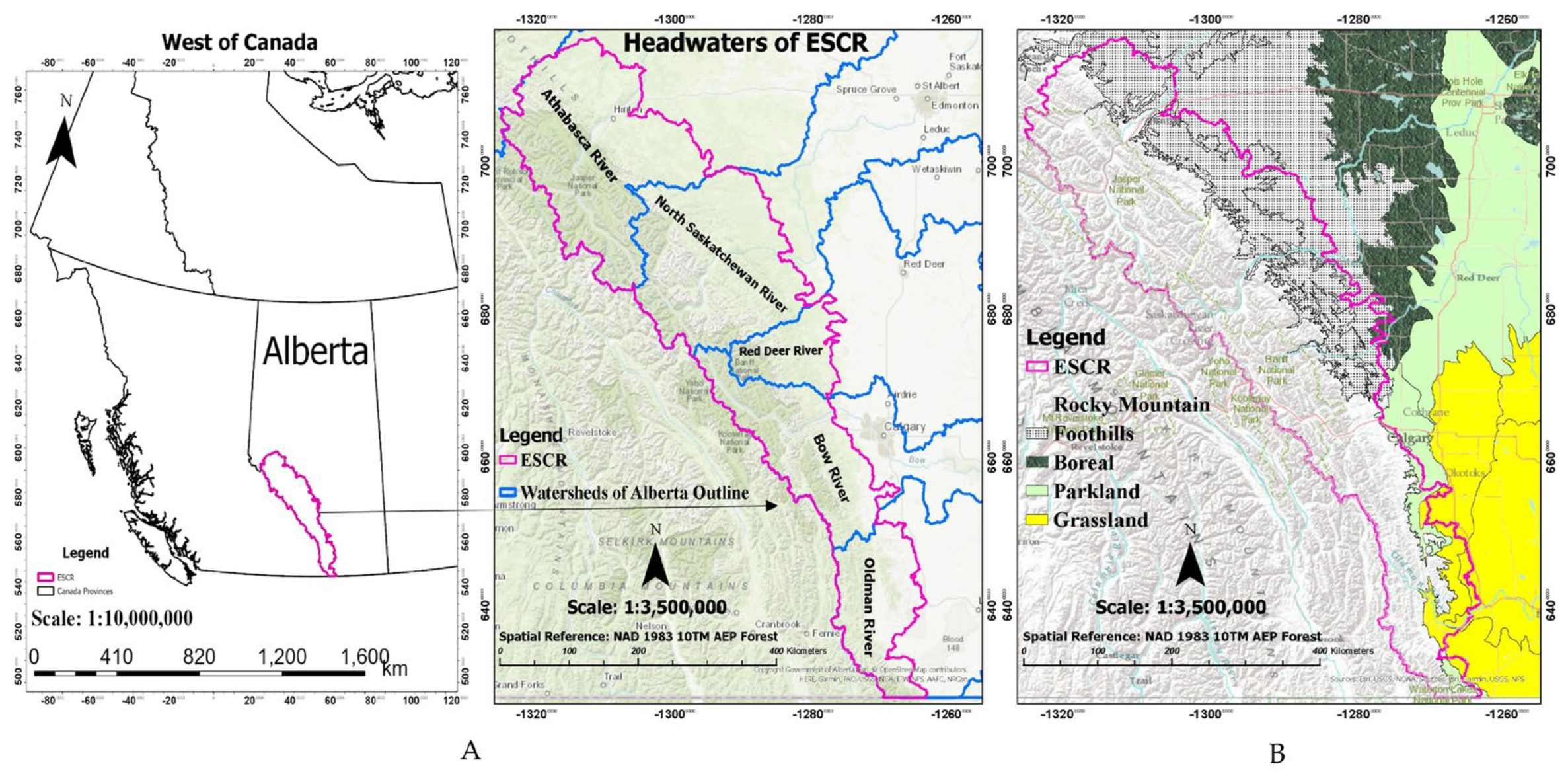
The research study area was on the Eastern Slopes of the Canadian Rocky Mountains, which encompasses a mountainous area roughly 61,159 square kilometers in western Canada. The ESCR includes the headwaters of several major river systems, namely Bow, Athabasca, Red Deer, Oldman, and North Saskatchewan watersheds, that provide important hydrology, ecosystem services, and water supply to Alberta, Saskatchewan, and Manitoba. The study area extends between approximately 48°59′56″ N and 53°58′44″ N at latitude and 119°02′23″ W and 113°30′29″ W at longitude, with elevations ranging from about 985 m to over 3710 m above sea level (Figure 1).
The eastern boundary of the ESCR was delineated using provincial hydrological datasets, watershed boundaries, and stream gauge station elevations, generally corresponding to elevations between 900 and 1200 m. The region is characterized by steep topographic gradients and complex terrain, with a predominance of north-, northeast-, and east-facing slopes. These slope orientations contribute to pronounced microclimatic contrasts, enhanced snow accumulation, and prolonged snow retention, all of which play important roles in shaping alpine and subalpine vegetation patterns.
Ecologically, the ESCR spans both the Rocky Mountain and Foothills Natural Regions of Alberta and supports diverse forest communities along pronounced elevation gradients. Lower and mid-elevation zones are dominated by mixed coniferous forests composed primarily of Engelmann spruce (Picea engelmannii), subalpine fir (Abies lasiocarpa), lodgepole pine (Pinus contorta), and trembling aspen (Populus tremuloides). At higher elevations, forest structure becomes increasingly fragmented, transitioning into alpine ecotones characterized by sparse tree cover, mosses and lichens, and krummholz formations, before giving way to alpine tundra [69,70].
The climate of the ESCR reflects a complex alpine–subalpine regime, marked by long, cold winters and short, relatively mild summers [71]. Climatic conditions are strongly influenced by orographic precipitation patterns, resulting in higher precipitation at windward slopes and comparatively drier conditions in leeward valleys and lower foothill regions [72]. Temperature and precipitation exhibit strong elevation dependence, with mean temperatures at higher elevations frequently dropping below −5 °C, while lower foothill areas may experience summer temperatures exceeding 20 °C. Annual precipitation across the region ranges from less than 300 mm in low-elevation areas to more than 4300 mm at higher elevations [73], with a substantial proportion falling as snow at high elevations [74]. The ESCR region experiences very short frost-free periods, typically less than 70–90 days, which strongly limit plant establishment and growth near and above the treeline. Over recent decades, regional climate studies have documented significant warming trends across the Canadian Rockies, accompanied by earlier snowmelt and lengthening growing seasons. These climatic changes provide an important environmental context for understanding recent and ongoing shifts in ATE across the ESCR [73]

2.2. Methods

Using a geospatial and remote-sensing approach, this research developed a methodology to quantify the extent of long-term changes in ATEs on the ESCR (1984–2023) and to compare these changes with climate changes. This included a structural design providing a means of capturing the gradual transitions of vegetation on complex mountainous terrain while also providing spatial consistency (throughout the entire region) as well as temporal consistency (over a forty-year time period). All analyses were conducted using GEE, supported by ArcGIS Pro 3.6, and Python (V3.9), to enable efficient processing of long-term satellite and topographic datasets.
Multi-temporal Landsat surface reflectance imagery was processed within the GEE platform to derive vegetation metrics representative of peak-growing-season conditions. To reduce seasonal variability and cloud contamination, analyses were restricted to summer months, and finally nine multi-year temporal composites were generated using a BAP-compositing approach. The composite images were produced by selecting the pixels with the highest BAP score for each pixel location, minimizing spectral band mixing from different observation times. For each composite period, maximum NDVI values were calculated to represent peak vegetation productivity and to enhance contrast between alpine tundra, ecotonal zones, and closed-canopy subalpine forests.
To add how terrain controls the distribution of vegetation, NDVI data was overlaid with elevation data taken from DEM 30 m. The elevation gradients, slope, and aspect layers were then used to define how terrain topology influences the dynamics of the ATEI. Only the areas that were above treeline elevations were included in this analysis, thus restricting our study to the alpine and subalpine transition zone (>1680 m).
ATE delineation was performed using the ATEI, a spatially explicit index designed to identify transitional vegetation zones rather than discrete treeline boundaries. The ATEI integrates three standardized components in GEE: (1) abrupt spatial changes in NDVI along elevation gradients, (2) intermediate NDVI values characteristic of ecotonal vegetation, and (3) spatial covariation between NDVI and elevation gradients.

2.2.1. Components of the Alpine Treeline Ecotone Index (ATEI)

The ATEI is a probabilistic framework designed to identify transitional vegetation zones rather than discrete treeline boundaries. The index integrates three complementary components that capture structural, elevational, and spatial characteristics of ecotonal vegetation.
NDVI–Elevation Gradient Component ( c 1 )
In this component, the greenness of vegetation is quantified along elevation gradients, reflecting the rapid decline in canopy density as one approach to detect the treeline. For each pixel, the local NDVI gradient with respect to elevation was calculated as
c 1 = Δ N D V I Δ z
where ΔNDVI represents the change in NDVI between adjacent elevation bands and Δz is the corresponding elevation difference. Large negative gradients indicate sharp transitions from closed-canopy forest to alpine vegetation, characteristic of the ATE.
Intermediate NDVI Component ( c 2 )
This component finds the pixel value that represents the midpoint where subalpine forests change into alpine tundra. NDVI values were compared to other NDVI values to create a normalized NDVI distribution; NDVI values were also modified so that the pixel values that are found in most ecotones are given greater weight than those values that are found in extreme subalpine forest classes or extreme alpine tundra classes.
c 2 = φ e Δ s N D V I b 2 2 c 2
In this case, φ represents the height of the peak of the Gaussian curve, e represents the base of the natural logarithm, Δ s NDVI represents the smoothed NDVI value, and b and c represent the predefined parameters (φ = 1, c = standard deviation of NDVI values, and b = median of NDVI values).
Spatial Covariation Component ( c 3 )
Local correlations between NDVI and elevation are represented by the spatial covariation component, reflecting coherent vegetation–topography relationships typical of ecotonal zones. This component increases spatial coherence and decreases the number of isolated pixels that are unlikely to exhibit actual spatial ATE structure.
c 3 = 1 cos θ n 2 n
where c 3 is the spatial covariation of NDVI and elevation, and θ is the angle between NDVI gradient direction and elevation. ‘n’ is potential ATEs and disturbed areas, which is a constant value (10). Based on sensitivity analyses and calibration, we set the exponent to n = 10, which provides steep angular selectivity when c 3 ≈ 0.5 at θ ≈ 150° and >0.9 by θ ≥ 170°, thereby emphasizing near-anti-parallel NDVI–elevation gradients characteristic of ATEs while suppressing oblique, noise-driven alignments.
Next, these components were combined using a binomial logistic regression model to generate a probabilistic estimate of ATE presence for each pixel.

2.2.2. Logistic Regression Integration of ATEI Components

The three ATEI standardized components ( c 1 , c 2 , and c 3 ) were modeled in a binomial logistic regression for the purpose of estimating the likelihood of any pixel within the designated area being a representative ATE pixel. The logistic model can be represented as
A T E I = ( e x ) ( e x + 1 )
x = b 0 + b 1 × c 1 + b 2 × c 2 + b 3 × c 3
where ATEI is a logistic function used to transform a linear combination of variables into a value between 0 and 1, e x is the exponential function, x is a linear combination of the components ( c 1 , c 2 and c 31 ), and b0, b1, b2, and b3 are intercept and fixed parameters (estimated from data), respectively. However, these values were empirically derived based on the training of field data within the study domain and are fixed parameters of the equation.
This probabilistic formulation allows ATEs to be represented as continuous transition zones rather than fixed boundaries, accommodating spatial heterogeneity, gradual vegetation change, and temporal variability inherent in mountain environments.
The use of this probabilistic system provides the ability to identify disparate and nonlinear responses of ATE pixels to environmental change, and the ability to feasibly monitor the interactions between these two spatially congruous environments over an area over extended periods of time. Also, the ATEI incorporates vegetation structure and topographic gradients directly into its modeling. In this, the ATEI has an advantage when compared to threshold-based methods; the ATEI improves upon traditional threshold-based approaches and supports climate-focused assessments of ATE sensitivity and change. The complete method and scripts are available through Remote Sensing, one of the MDPI journals, as well as GitHub [35].

2.2.3. Comparison with Traditional Threshold-Based Mapping

Traditional ATE mapping approaches commonly rely on fixed thresholds applied to vegetation indices (e.g., NDVI > 0.3–0.4) or predefined elevation limits to delineate forest boundaries [9,75]. Methods which are straightforward to implement, and computationally efficient, are based on an implicit assumption of abrupt transitions and spatial homogeneity at ATE; however, this is inconsistent with the gradual and heterogeneous nature of transitional zones [1,33]. Threshold-based approaches often mask mixed vegetation states, progressive thinning of canopies, and early stages of colonization near treelines. Additionally, fixed thresholds are sensitive to characteristics of sensors, variation (seasonal and interannual) and calibration specific to sites; therefore, they have limited robustness and reduced comparability across different areas and periods of time (decades) [55,60].

2.2.4. Validation and Accuracy Assessment

To select 386 validation pixels that would be characteristic of the different landscapes found within ATE, a stratified random sampling approach was taken. Stratifying was accomplished through examination of the mapped ATEI output and topographic factors that identify pixel locations. This resulted in stratifying by drawing samples from (i) the ATE class (target ecotone pixels), (ii) adjacent dense subalpine forest, and (iii) alpine tundra/non-forest pixels. Thus, samples were representative of the ATE as well as its two nearest bounding habitats. To minimize any spatial bias and to ensure a broad geographic representation of samples, further stratification of samples was conducted by the major watersheds and their aspect classes. Wherever possible, a minimum number of pixels per stratum were sampled per basin to decrease the likelihood of dominance by a single basin orientation. Additionally, the validation points across the ESCR will represent all aspects of elevation, terrain exposure, and vegetation types available there.
Temporal coverage of the validation was designed to reduce reliance on a single recent imagery window. As with most long-term remote-sensing analyses, classification uncertainty is expected to be higher for earlier composite periods due to lower image availability and the absence of contemporaneous high-resolution reference data, and these historical results should therefore be interpreted with appropriate caution. To some degree, historical high-resolution imagery was available within Google Earth (approximately 0.5 m spatial resolution); validation points were interpreted for multiple composite periods (early 2000s, mid-2010s, and 2021–2023) to represent early, middle, and late portions of the Landsat time series. For earlier composites where very-high-resolution reference imagery was unavailable, we treated validation as a structural plausibility assessment (forest–ecotone–tundra context at the mapped locations) and complemented it with temporal consistency checks across the Landsat composites.
Multi-decadal classification products were further analyzed for their temporal consistency by assessing the nine Landsat composite periods. In this way, we quantified class “flipping” (a pixel repeatedly changing its class over time in a way that is unlikely to be real ecological change), but instead reflects noise, compositing artifacts, or classification instability in stable reference environments (e.g., dense forest below tree line, alpine tundra above tree line). The presence of high-probability ATE pixels along the forest–alpine transition rather than isolated artifacts indicates that the mapped ATE transition represents continuous landscape changes over the 40-year period, rather than random composite noise.
Finally, the classification accuracy was verified through an independent evaluation of three validation rounds. The evaluation for each round was based on the evaluation of image data from Google Earth that was obtained from the three periods mentioned above, using the expertise of trained professionals who visually interpreted the images. The results of the validation focused on differentiating between ATEs and adjacent dense forest and alpine tundra based on canopy structure, vegetation density, surface texture, and elevation context. The overall classification accuracy was calculated by averaging the results of the three rounds; the final classification accuracy was 81.30%, with validation results of 81.86%, 79.07%, and 82.98% for the three validation rounds, respectively.

3. Results

3.1. ATEI Distribution over Time

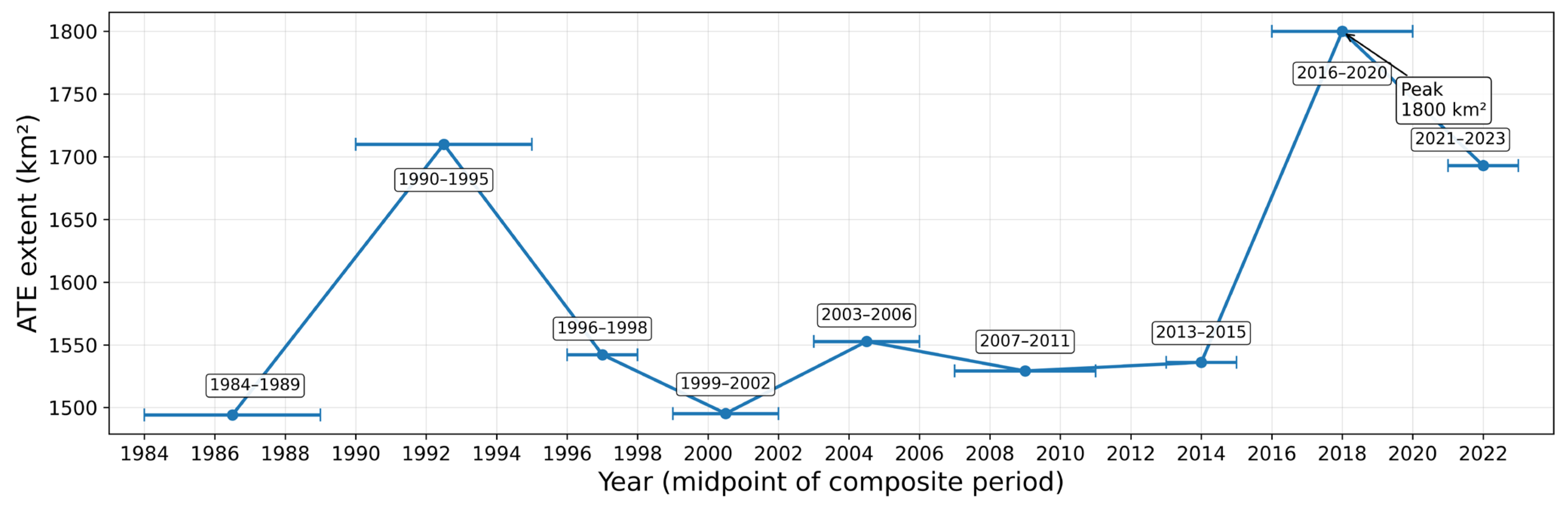
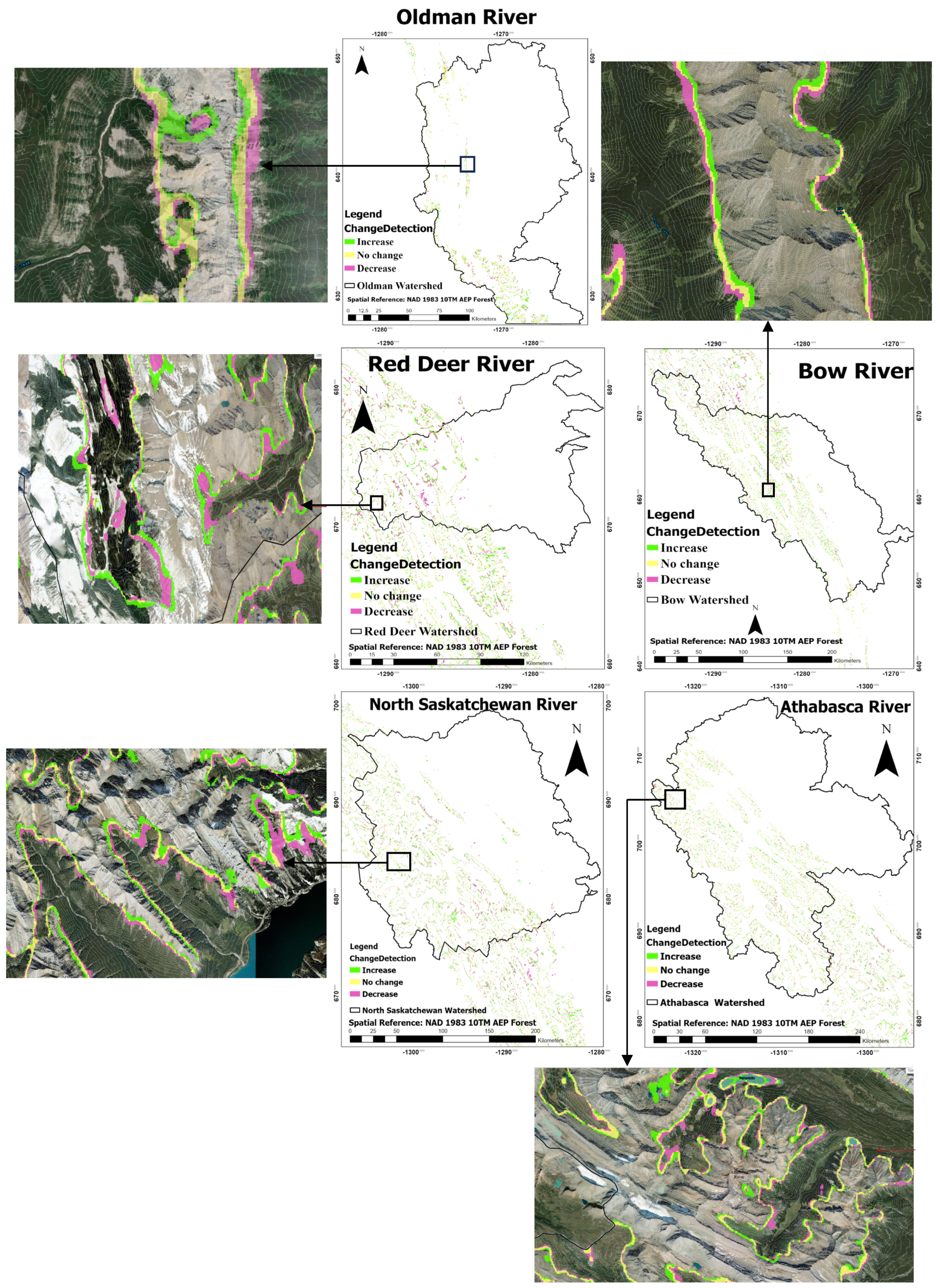
Using the ATEI threshold that delineates well-defined transition zones (ATEI ≥ 0.7, which was determined through sensitivity analysis and empirical calibration), we quantified temporal changes in ATE extent by counting the number of pixels meeting this criterion for each period across 1984–2023. At the beginning of the time period, the extent of land designated as ATE was around 1494 km2, while in 2023 it had expanded to approximately 1693 km2, resulting in an overall increase of 13.32% (Figure 2). This increase represents a net endpoint comparison rather than a monotonic trajectory, as ATE extent exhibited pronounced inter-period variability, including a marked decline during 1999–2002, indicating that the magnitude of net change is sensitive to the selected start and end years. We also conducted a Mann–Kendall statistical analysis on our dataset to obtain statistical results. The statistical model demonstrated that there has not been a statistically significant monotonic trend in the data (neither upward nor downward) (p-value > 0.05). Based on this test, there is no strong evidence of a monotonic trend (either increasing or decreasing) over time in the ATE distribution data. Moreover, this increase in ATE can be attributed to global warming and the lengthening of the growing season in this region [45,76]. However, the decline in ESCR areas can be attributed to increased wildfires and other disturbances (Figure 2).

3.2. Variation in Altitude Across Different Aspects

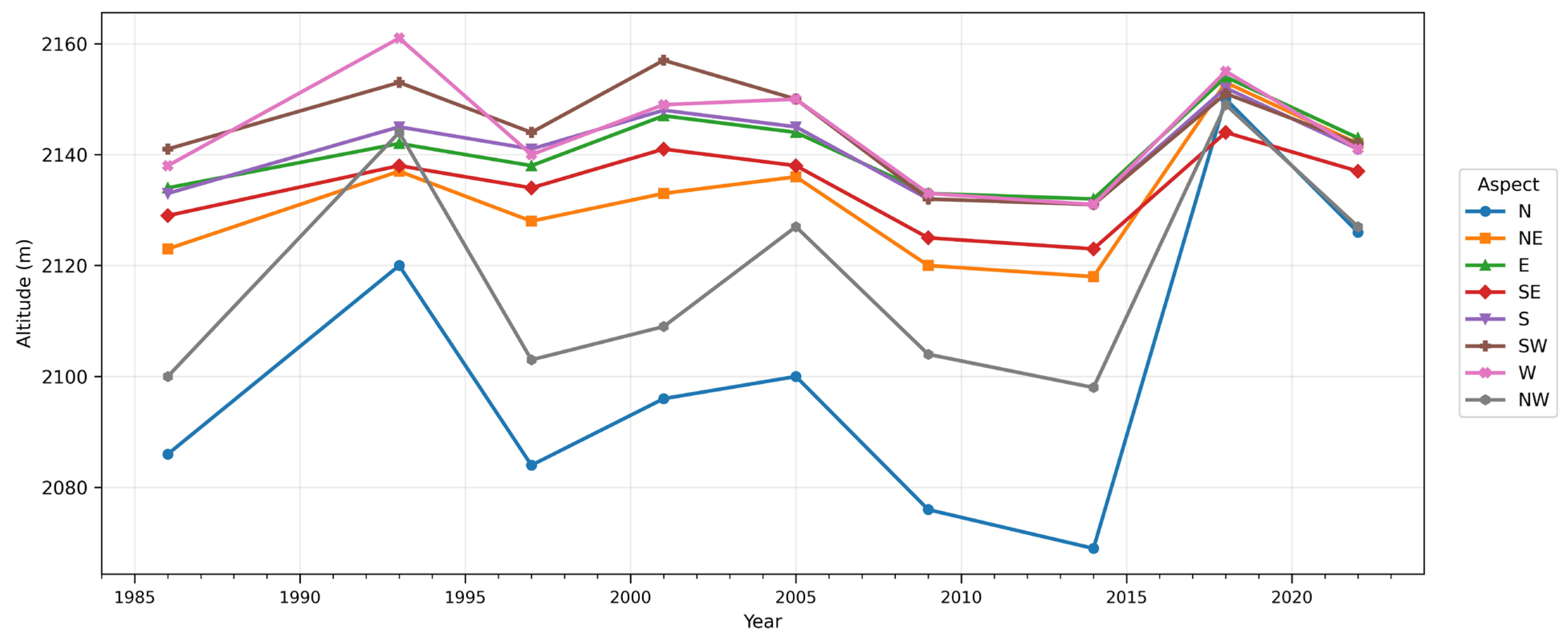
There are differences in the variation in ATE elevation between the aspect slopes (N, NE, E, SE, S, SW, W, NW), implying that the aspect types modulate the elevation position of the ecotone (ATE). Overall, the mean ATE elevations for each aspect were relatively consistent (i.e., 2067–2160 m); however, the northern aspects (N, NE, NW) consistently had the lowest elevation compared to the southern aspects (S, SE, SW). This trend was consistent with lower solar radiation and cooler/moist conditions on north-facing slopes compared to warmer and dry conditions on south-facing slopes. In addition to testing trends, each aspect experienced upward movement (i.e., increase) in elevation from 1984 to 2023. The largest net elevational differences over the study period were observed on north-facing slopes (~+40 m), followed by northwest-facing (~+27 m) and northeast-facing (~+18 m) aspects; however, Mann–Kendall tests indicated that these aspect-specific elevation changes did not exhibit statistically significant monotonic trends (p > 0.05). In other words, there is neither an increase nor a decrease in the monotonic trend. The time series of the average ATE elevation for 1984 to 2023 (shown in Figure 3) supports the idea of asymmetrical changes in elevation, with the E aspect showing a steady increase with little residual variance, whereas the N and SW aspects showed substantial fluctuations from year to year, suggesting that these aspects may be more responsive to microclimatic, snow, and/or vegetation dynamics.
In other world, Figure 3 shows a coherent short-term decline in mean ATE elevation across all aspects during the early 2000s (≈2000–2007), followed by a rapid rebound and net upward shift after ~2007, indicating a non-monotonic trajectory superimposed on longer-term warming.
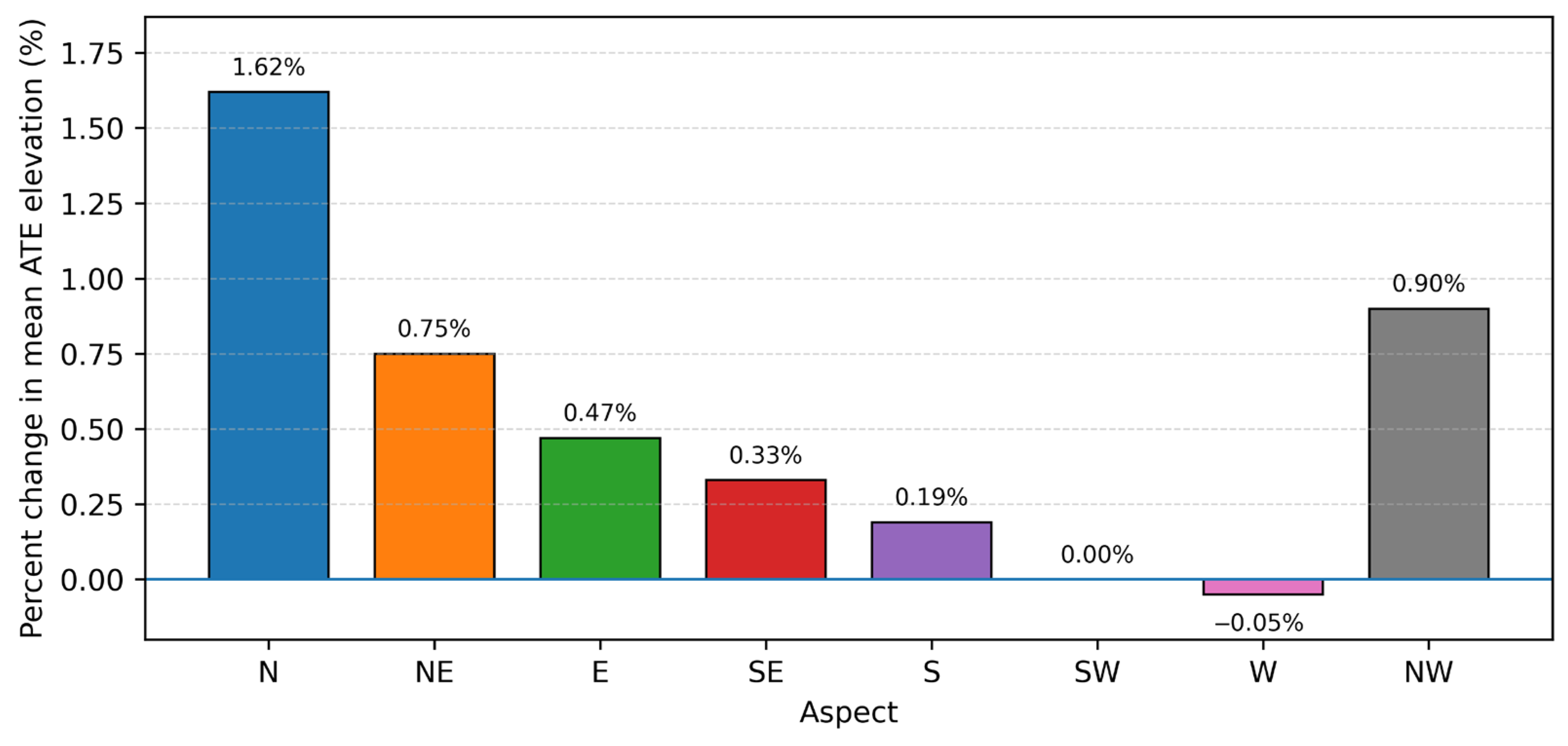
Also, the aspect-based percent-change plot shows a clear directional contrast in ATE elevation response over 1984–2023 (Figure 4). North-facing slopes experienced the strongest upward shift, with N exhibiting the largest increase (+1.62%) and NW also showing a pronounced rise (+0.90%), while NE increased moderately (+0.75%). In contrast, east- and south-facing aspects display smaller positive changes (E: +0.47%, SE: +0.33%, S: +0.19%), and the SW aspect shows essentially no net change (0.00%). The W aspect is the only direction with a slight negative change (−0.05%), indicating near-stability or minor lowering relative to the baseline period. Overall, the ranking of responses (largest to smallest) is N > NW > NE > E > SE > S > SW > W, suggesting that topographically driven microclimate differences among aspects strongly mediate where the ATE shifts upward most rapidly, with the greatest sensitivity occurring on northerly exposures and more muted responses on southerly and westerly slopes.

3.3. ATE Changes with Altitude in Different Watersheds

A comparison of ATE elevations at the watershed scale between 1984 and 2023 indicated a modest mean upslope shift (23.41 m), accompanied by substantial inter-watershed variability (SD = 25.41 m) across the ESCR (Table 1 and Figure 5). However, a one-sample t-test indicated that the mean watershed-level elevation change was not statistically distinguishable from zero at the 5% significance level (t = 2.06, p = 0.108). This lack of statistical significance reflects pronounced variability in both the magnitude and direction of ATE elevation changes among watersheds, rather than an absence of change at the regional scale.
The magnitude and direction of change varied significantly across basins. The Bow watershed experienced the most significant positive change, moving 65.79 m upward (+65.79 m; 2140.65 m to 2206.44 m; 1.69 m/yr), while the Red Deer watershed experienced almost no change (0.00 m to slightly negative change, at −1.30 m; 2207.48 m to 2206.18 m; −0.03 m/yr). Between these extremes were intermediate increases in the Oldman (+15.02 m), North Saskatchewan (+13.20 m), and Athabasca (+24.32 m) watersheds during the study period. These results collectively illustrate a high degree of spatial heterogeneity in ATE elevation responses across watersheds and support the identification of additional explanatory variables, such as climatic and environmental control factors, that must be considered to understand between-basin differences.

3.4. ATE Changes with Altitude in Different Aspects of Watersheds

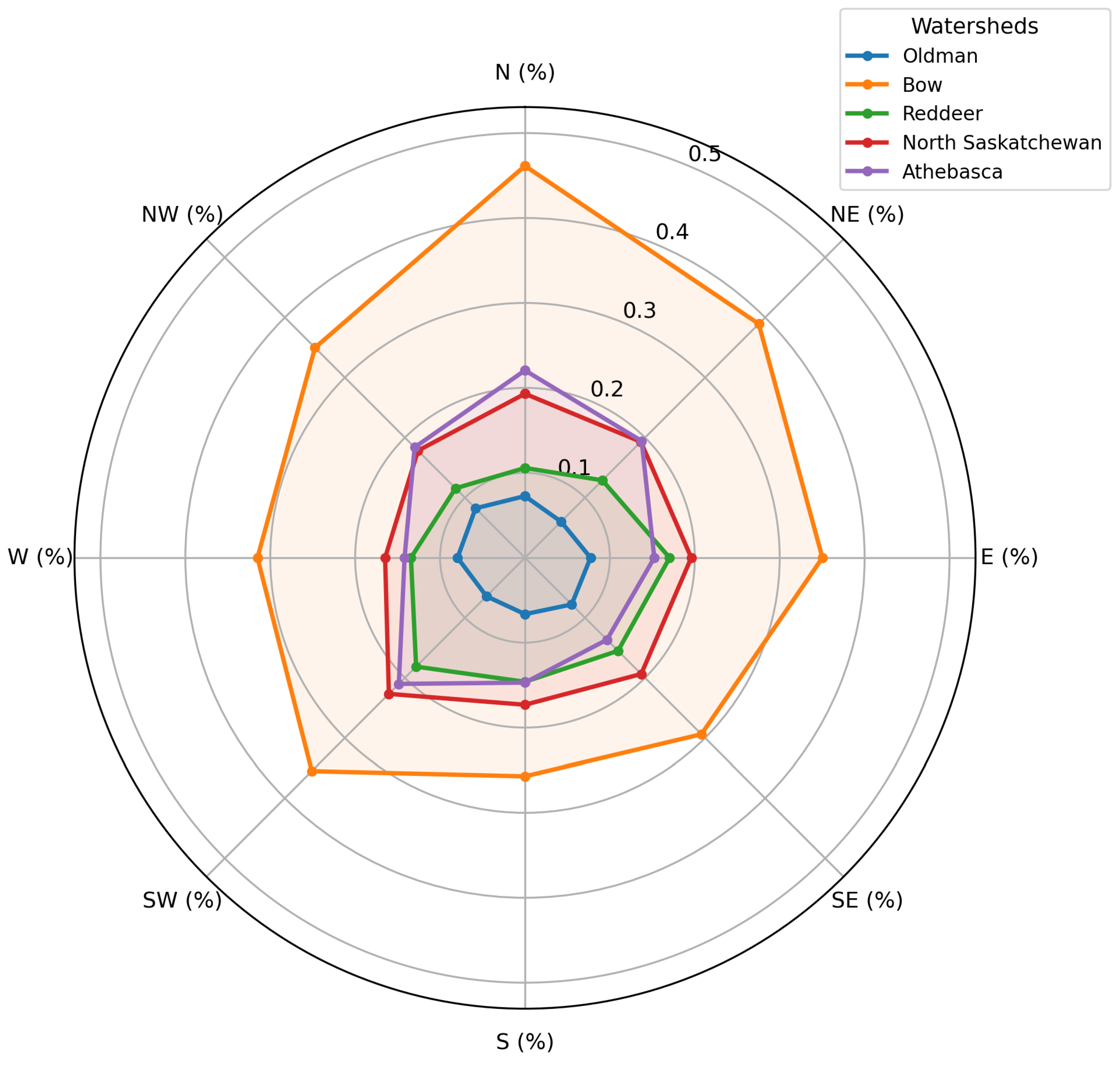
To measure the extent of expansion, the study computed the mean increase in the zone across watershed characteristics. Table 2 summarizes ATE expansion (km2) between 1984 and 2023 across eight aspects within five watersheds. Total ATE expansion varied markedly among watersheds, ranging from 54.88 km2 (Red Deer) to 264.00 km2 (Athabasca), with large expansions also observed in North Saskatchewan (258.55 km2) and Bow (246.25 km2), whereas Oldman showed comparatively limited expansion (66.00 km2). When normalized by watershed area, expansion intensity remained highest in Bow (0.0277 km2 km−2), followed by North Saskatchewan (0.0151 km2 km−2), Athabasca (0.0138 km2 km−2), Red Deer (0.0113 km2 km−2), and Oldman (0.0058 km2 km−2), indicating substantial spatial heterogeneity in ATE expansion across the ESCR.
Across aspects (pooled across watersheds), mean expansion tended to be higher on north-facing and southwest-facing aspects (N ≈ 25.85 km2, SW ≈ 25.24 km2) and lower on southerly aspects (S ≈ 18.99 km2) and west-facing aspects (W ≈ 19.71 km2), although aspect-related differences were less consistent than watershed-to-watershed contrasts.
Across five watersheds, significant spatial heterogeneity was observed in aspects that increased ATE zones, which may be related to environmental and ecological factors (Table 2 and Figure 6). In terms of total increase, the Athabasca watershed ranked first. In terms of total net increase in ATE area, the Athabasca watershed exhibited the largest expansion (≈264 km2). This pattern is consistent with, rather than definitive proof of, the predominance of north- and west-facing aspects within the watershed, which in this study showed comparatively larger increases in ATE elevation and extent. These aspects are widely recognized in alpine environments to favor ATE persistence and expansion due to reduced incoming solar radiation, enhanced snow retention, and lower evaporative demand, which together promote improved soil moisture availability and growing-season stability [1,75]. Similarly, the North Saskatchewan watershed (≈258.6 km2) displayed relatively uniform ATE increases across aspects, which may reflect a balance between slope gradients, aspect orientation, and microclimatic moderation inferred from the observed aspect-wise elevation patterns rather than direct measurements of soil moisture or radiation.
In contrast, the Bow watershed (≈246.3 km2) showed more pronounced increases on northern aspects, aligning with the aspect-based altitude results that indicate greater sensitivity of cooler, less solar-exposed slopes to recent climatic warming. The smaller and more evenly distributed increases observed in the Oldman (≈66 km2) and Red Deer (≈54.9 km2) watersheds likely reflect comparatively harsher edaphic and microclimatic conditions inferred from their aspect distributions, particularly on more solar-exposed aspects, where higher incoming radiation is known to increase evaporative losses and water stress in ATE environments. However, south-facing slopes are generally expected to experience higher evaporative demand and potential moisture stress in alpine environments; this does not preclude substantial ATE expansion where local topography, elevation range, and moisture redistribution favor growth. In the Red Deer watershed, the observed prominence of S and SW aspects likely reflects catchment-specific controls, including the distribution of ATE elevations and southwest-facing snow and wind redistribution patterns, rather than a uniform aspect-driven moisture limitation. Importantly, these interpretations are supported by the spatial patterns observed in the results and by established alpine treeline theory, but they should be viewed as mechanistic inferences rather than direct causal confirmation, as snowpack, soil moisture, and radiation were not explicitly quantified in this study.
In general, northern and northwestern aspects are expected to favor ATE expansion due to reduced solar radiation, cooler soil temperatures, and improved moisture retention; however, the observed prominence of southwest-facing expansion in the pooled results indicates that aspect effects are strongly modulated by catchment-specific topography, elevation range, and local moisture conditions rather than following a uniform directional pattern. Thus, variables such as water availability, temperature, soil characteristics, and sunlight exposure play a significant role in shaping ATE dynamics. Based on these findings, ATE expansion seems to be influenced by a complex interaction between these factors.

3.5. ATE Changes Relative to July–September (JAS) Isotherm Shifts

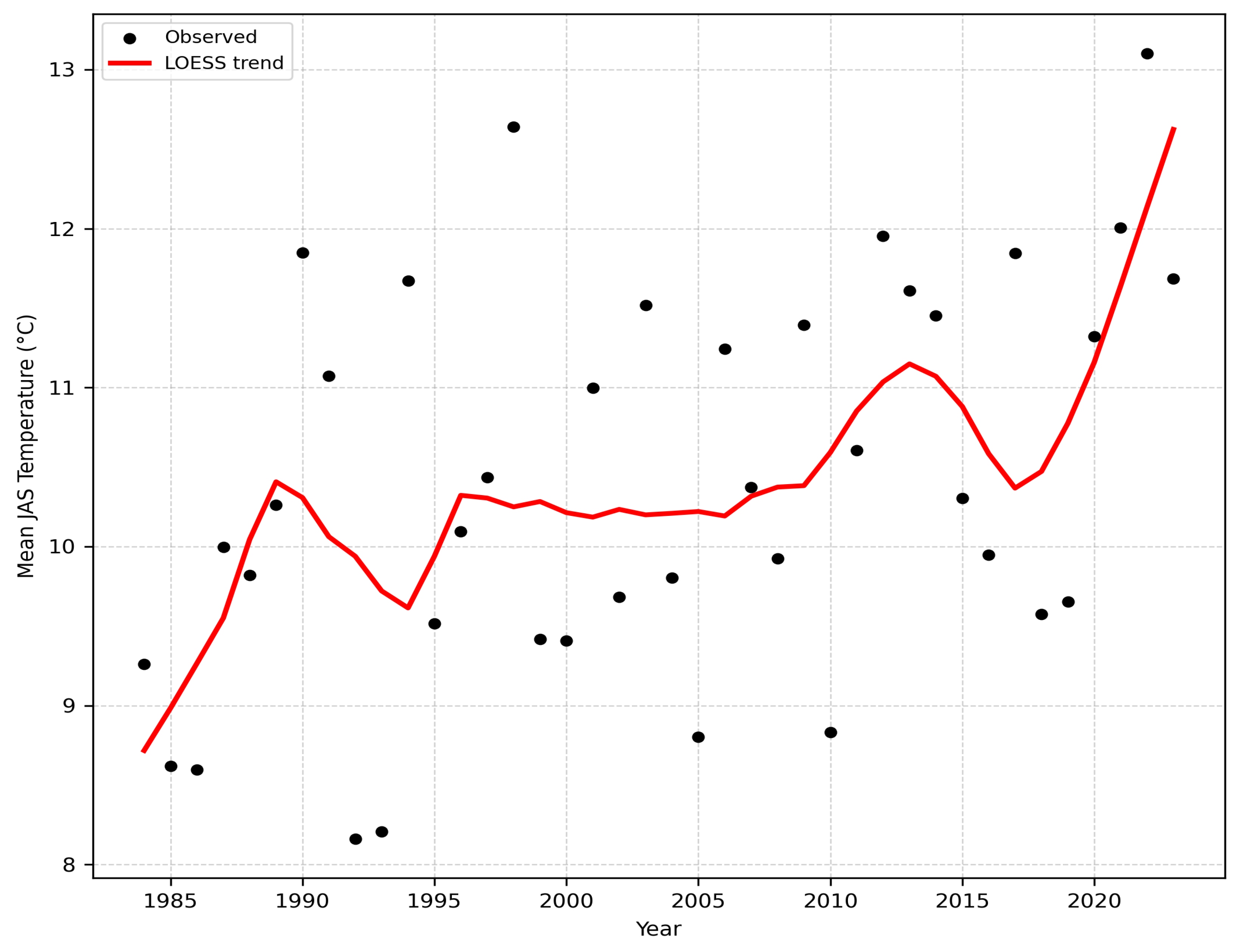
Figure 7 presents the results of a temperature trend analysis by Locally Estimated Scatterplot Smoothing (LOESS) for the July–September (JAS) period across the entire ESCR from 1984 to 2023. The graph indicates a moderate increase in mean July–September (JAS) temperature trend across the study area over the four-decade period (+2.1 °C), consistent with the LOESS-based warming trend. LOESS, represented by a green trendline, was applied to the data and reveals a clear long-term warming signal. To model non-linear trends in temperature, LOESS provides a flexible, non-parametric approach. By doing so, it can capture subtle variations and long-term climate signals in the ESCR dataset that might otherwise be oversimplified or misinterpreted by linear or polynomial models. The analysis estimates that the mean JAS temperature in the ESCR has increased at a rate of approximately +0.48 °C per decade, according to the raw data analysis. While the coefficient of determination (R2 = 0.336) suggests low explanatory power and interannual variability, the overall warming trend remains evident. To assess the statistical significance of this trend, a Mann–Kendall test was conducted using Python. The results indicate a statistically significant upward trend in mean JAS temperatures (Kendall’s tau = 0.313, p = 0.0045). This finding confirmed that the observed warming over the 1984–2023 period reflects a sustained climatic change rather than random variability. Thus, we can statistically and confidently conclude that the mean summer temperature in ESCR has increased significantly over 40 years.
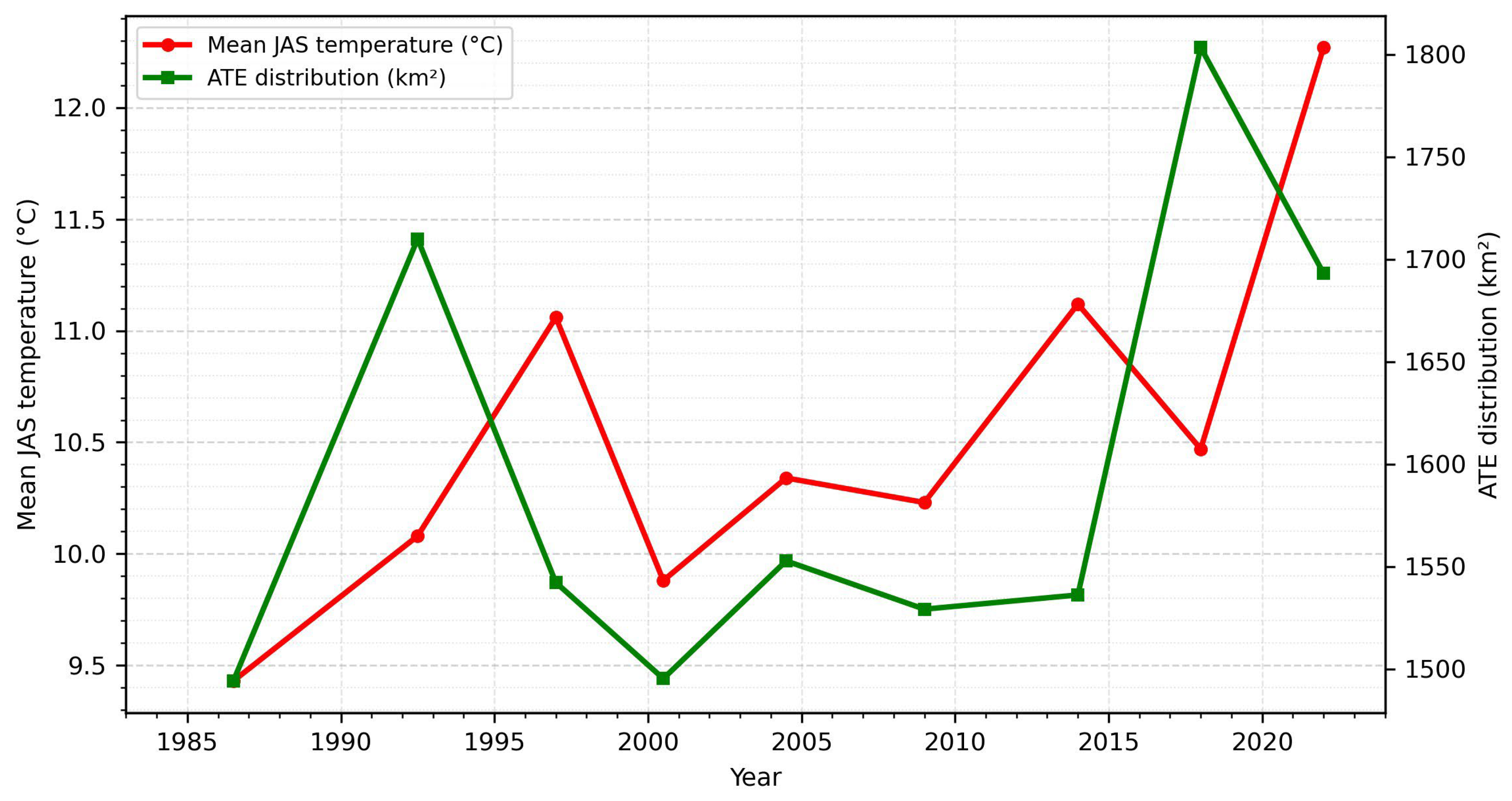
Figure 8 illustrates the co-evolution of mean July–September (JAS) temperature and ATE distribution across the ESCR. Because both variables constitute temporally ordered time series, conventional correlation tests that assume independent observations can overestimate association strength. Although rank-based correlation applied to the original series indicated a moderate positive association between temperature and ATE extent (Spearman ρ = 0.50), this relationship was not robust once temporal dependence and shared trends were accounted for. Regression analysis including time as a covariate, with heteroskedasticity- and autocorrelation-consistent (HAC) standard errors, showed that the apparent temperature–ATE association was not statistically significant (p = 0.941), indicating that co-trending rather than direct covariation explains much of the observed correspondence. To evaluate the ecologically relevant hypothesis that changes in temperature precede changes in ATE position, first-order differencing and lagged change analyses were applied. Interval-to-interval changes in ATE distribution (ΔATE) were not significantly related to concurrent temperature changes (ΔTemp; Spearman ρ = −0.45, p = 0.26; Kendall τ = −0.29, p = 0.40), nor to temperature changes in the preceding interval (ΔTemp_{t − 1} → ΔATE_t; Spearman ρ = −0.11, p = 0.82). Consistently, time-series regression models explicitly account for temporal autocorrelation, including models with contemporaneous (lag = 0) and one-interval lagged (lag = 1) temperature effects, indicating a slight positive influence of summer temperature on ATE extent; however, this effect was weak and not statistically significant within the available temporal data. In contrast, mean JAS temperature exhibited a strong long-term increasing trend (+0.22 °C per interval, R2 = 0.50), whereas ATE distribution showed a weaker and more variable upward trajectory (+18.3 km2 per interval, R2 = 0.20). Collectively, these results demonstrate pronounced regional warming over the study period, while indicating that ATE expansion at the spatial scale and temporal resolution analyzed here is not linearly or synchronously coupled to temperature change alone, consistent with ecological inertia and the moderating influence of additional biotic and abiotic constraints such as moisture availability, snow persistence, substrate development, and disturbance history.
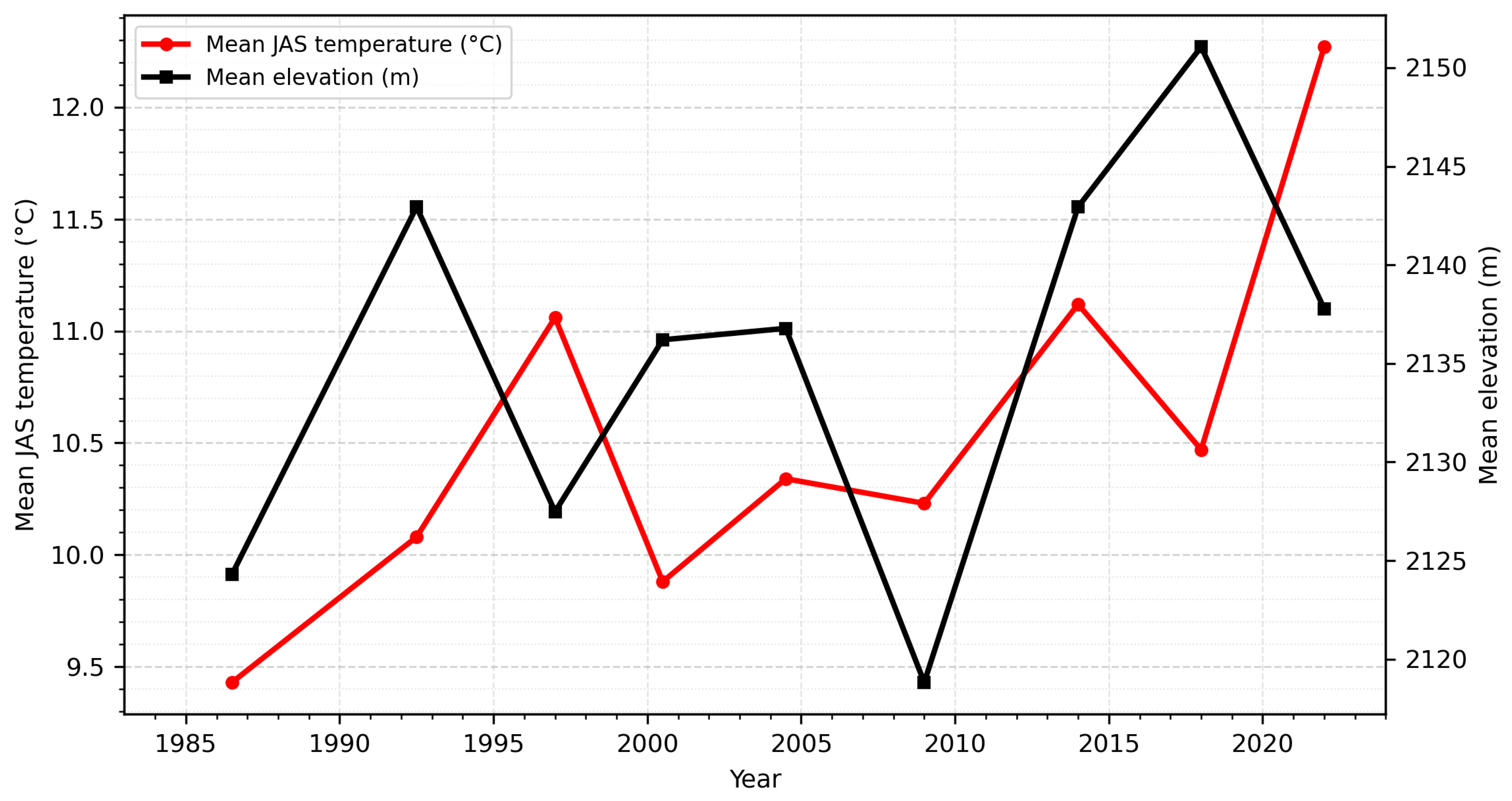
Figure 9 also illustrates the temporal evolution of mean July–September (JAS) temperature and the mean elevation of ATE across the ESCR from 1984 to 2023. A rank-based comparison of the two-time series yielded a moderate Spearman coefficient (ρ = 0.427); however, this association was not statistically significant (p = 0.252) and is interpreted cautiously given the temporal dependence of both variables and the limited number of observation intervals. To more robustly characterize long-term behavior, trends in each variable were therefore evaluated independently. Mann–Kendall analysis confirmed a strong and statistically significant increasing trend in mean JAS temperature (Kendall’s τ = 0.83, p = 0.00085), demonstrating a persistent and robust warming signal over the study period. In contrast, although the mean elevation of the ATE exhibited an upward tendency (Kendall’s τ = 0.44), this trend was not statistically significant at the 95% confidence level (p = 0.119). The decoupling between pronounced climatic warming and the absence of a statistically detectable elevational shift in ATE position suggests that ATE advance is not linearly or synchronously driven by temperature alone at the temporal scale examined here. Instead, the results are consistent with delayed, threshold-dependent, or spatially heterogeneous ecological responses, potentially constrained by additional factors such as snow persistence, moisture availability, substrate development, and disturbance history.
Moreover, to contextualize regional warming in the ESCR, we compared ESCR summer temperatures with the global land-only temperature time series for the same season (JAS: July–August–September) obtained from the Berkeley Earth data portal [77]. Based on global land-only anomaly records, mean July–September (JAS) temperature anomalies increased from +0.02 °C in 1984 to +1.48 °C in 2023, corresponding to a net anomaly change of +1.46 °C over this period. In parallel, our regional analysis shows that mean JAS air temperature in the ESCR increased from 9.43 °C in 1984 to 12.27 °C in 2023, representing an endpoint difference of +2.84 °C across the same four-decade span. Although direct quantitative comparison between raw regional temperature values and global anomaly datasets requires standardized anomaly-based trend analysis, both datasets consistently indicate substantial summer-season warming over the study period.

3.6. NDVI vs. Mean JAS Temperature Change

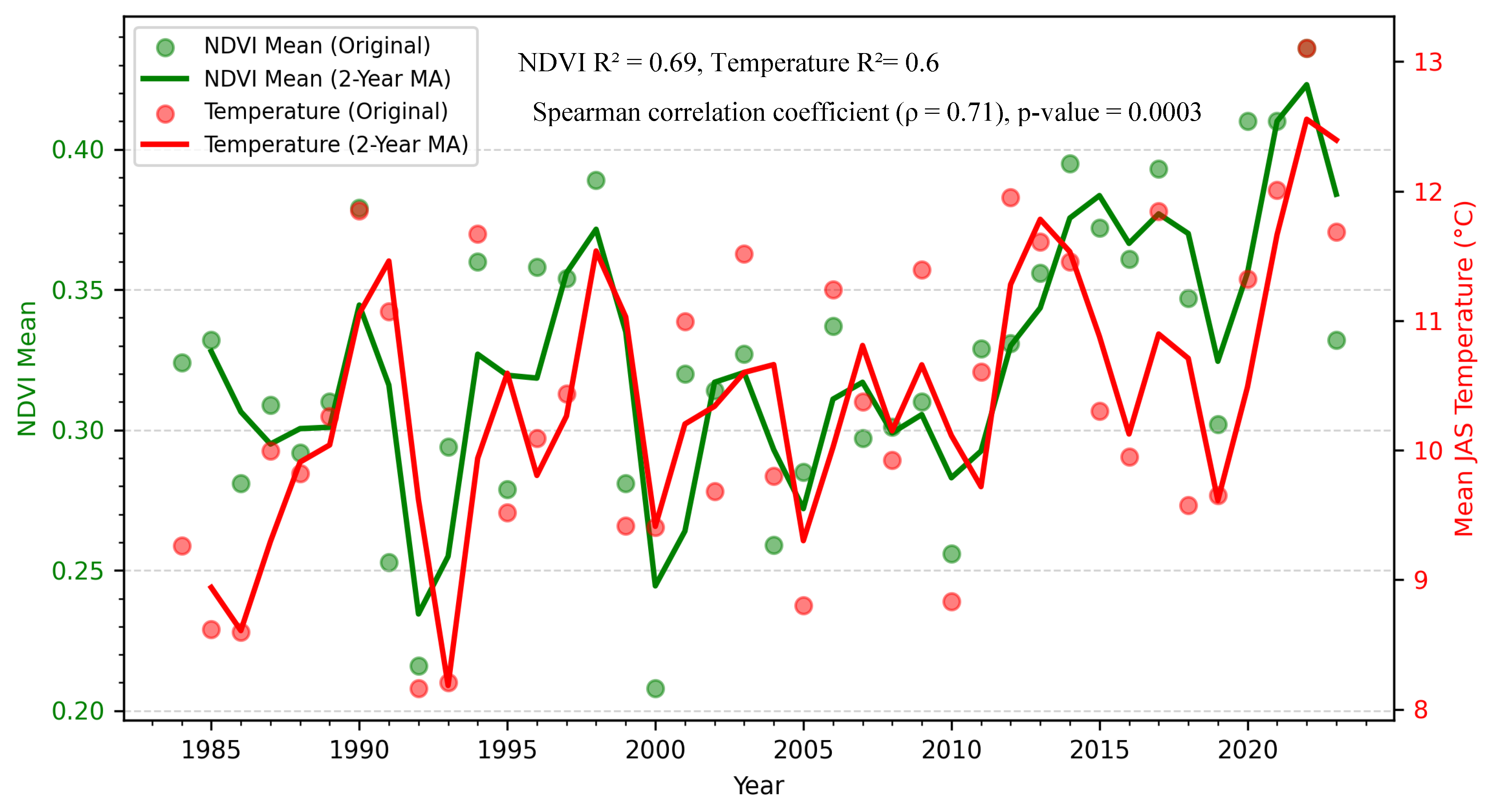
To better understand the relationship between increasing temperature and NDVI in the ESCR between 1984 and 2023, these two factors were compared using a plot (Figure 10). The study analyzed the long-term relationships between climatic warming and vegetation productivity (NDVI) in the ESCR. Both the NDVI and temperature were modeled using the moving average trend and the Spearman regression to account for nonlinear trends. The 2-year moving average trend was used to smooth any short-term variations in the NDVI or temperature data set to show longer term dynamics. Also, the moving average trend can help remove interannual variability to show meaningful patterns specific to climate–vegetative interactions, rather than temporal fluctuations. It suggested a better R2 than the linear or polynomial trend, so it was ideal for highlighting medium-range change in climate environmental shifts. As can be seen from the plot, the NDVI trend had a moderate increase over time and was statistically significant (p-value = 0.0003). The moving average curves clearly illustrate a rise in temperature and an increasing fluctuation in NDVI over the same period, particularly after 2015. According to statistical analysis, both NDVI moving averages and temperature moving averages exhibit strong goodness-of-fit (R2 = 0.69 and 0.60, respectively), indicating smoothing of short-term variations. Additionally, the Spearman correlation coefficient agreement (ρ = 0.71, p = 0.0003) confirms a significant positive monotonic relationship between temperature and NDVI. This indicates that increases in summer temperature are associated with increased vegetation activity and more greenness in the ESCR. Thus, these significant trends could support the theory that global warming has played a major role in changing vegetation productivity (NDVI) in the ESCR over the past forty years.

4. Discussion

4.1. Long-Term Changes in ATEI Distribution

The observed extension of the ATE by approximately 13.3 percent from 1984 to 2023 presents evidence of a continuing gradual reorganization in the distribution of high-elevation vegetation along the ESCR. Although the results of the Mann–Kendall test did not reveal a statistically significant monotonic trend, this is consistent with an increasing body of evidence that ATE exhibited nonlinear, spatially variable and temporally disparate responses to climate warming rather than demonstrating a consistent, continuous rate of response [32,33,34,35,45].
Previous global syntheses have shown that upward ATE dynamic advances occur in more than half of observed sites worldwide, yet the rate and consistency of change vary widely depending on local topography, climate variability, and disturbance regimes [32,34]. Similar to patterns reported in other mountainous regions, the ESCR exhibits periods of ATE expansion interspersed with localized reductions. In the absence of direct disturbance metrics, these reductions are documented as empirical observations rather than attributed to specific drivers. Disturbance processes such as wildfire, insect outbreaks, and extreme climate events are therefore discussed as plausible mechanisms supported by previous studies, rather than as demonstrated causes in this analysis [27,28,29,46,54]. These disturbances can reset vegetation structure and delay detectable ecotonal advancement despite favorable climatic conditions.
The conservative ATEI threshold (≥0.7) captures very clearly defined transition zones at ATEI and creates the possibility of under-capturing early-stage colonization and any subtle structural changes occurring prior to observable ATE migrating. These findings support prior studies that have suggested the way in which ATE will create densification and structural reconfiguration prior to observable spatial displacement occurring may be the first indication of the ATE dynamic occurring as climate change [33,35,51]. Therefore, the lack of a statistically significant monotonic trend does not provide evidence for a simple linear elevational shift, but instead aligns with prior research [32,33] showing that ATE often exhibits delayed, nonlinear, and spatially constrained responses to climate warming.

4.2. Aspect-Controlled Variation in ATE Elevation

Aspect-dependent differences in ATE elevation support the hypothesis that topographically mediated microclimates modulate ATE position and response to warming. In several catchments, lower ATE elevations on north-facing slopes relative to south-facing slopes are consistent with reduced solar radiation, cooler soil temperatures, prolonged snow retention, and higher soil moisture availability on shaded aspects [13,14,15,53].
In many of the ESCR watersheds, elevations were increasing more dramatically on the northern or northwesterly slope aspect, but this is not a universal pattern. The catchment area of the Red Deer River is an example of this, as the ATE was expanding along the southern aspects of the Red Deer River, and this indicates that any response occurring due to slope aspect in the ATE is not related solely to the slope aspect where the elevation was the greatest, but instead is primarily affected by the specific characteristics of the catchment’s topography and environmental factors, rather than any global directional pattern [9,11,19]. Moreover, previous studies across alpine environments have demonstrated that aspect can locally buffer or amplify climate warming, creating thermal refugia that slow vegetation change on cooler slopes while accelerating responses on warmer, drought-prone exposures [14,33,53].
However, the absence of statistically significant trends for individual aspects reinforces the concept that ATE advance is constrained by non-thermal factors, including wind exposure, soil development, snow abrasion, and seed dispersal limitations [9,11,19,20]. The pronounced year-to-year variability observed on certain aspects further suggests sensitivity to interannual snowpack dynamics and moisture variability, consistent with studies emphasizing snow–vegetation feedback as critical regulators of ATE [6,38,39,40]. These findings collectively indicate that aspect-specific ATE responses are likely to intensify under continued warming but will remain spatially uneven.
The rapid rise and fall of average ATE position across aspects between 2000 and 2007 and the subsequent rapid rise post-2007 reflect short-term climate variability, disturbance impacts, and composite sensitivity rather than a unidirectional ecological pulse. ATE position is sensitive to inter-annual climatic variance (e.g., growing season temperature and moisture conditions, duration of snowpack), where cooler growing seasons or extended periods of snow cover can reduce NDVI near upper limits of the forest, resulting in temporary down-slope displacement of the putative ecotone, particularly on aspects of the landscape with high levels of snow retention and microclimatic variability. Additionally, the existence of disturbance events, particularly episodic disturbances (e.g., wildfire, insects or geomorphology), can cause reductions in canopies and fragmentation of forest–tundra boundary areas, resulting in temporary reductions in ATEI-derived coordinates even if broader climatic forces are pushing the ATEI coordinate higher up. Therefore, the increase and upward shift after the year 2007 correspond with the prevalent regional warming trend and increased vegetative growth in all regions of ESCR, providing an opportunity for ecological transition zones to thicken and migrate toward higher elevation microsites.

4.3. Watershed-Scale Heterogeneity in ATE Elevation Change

The modest mean increasing trend in the altitude of ATE across ESCR watersheds and the large variability between watersheds show that regional geomorphology, hydrology and disturbance history play a major role in determining how ATE dynamics respond to changing climate. The Bow watershed showed a strong upward migration, whereas the Red Deer watershed had almost no movement. This illustrates that climate change does not always have the same effect on the altitudinal movement of ATE across all regions. Additionally, these catchment-specific differences indicate that local topographic, edaphic, and disturbance-related factors can substantially modulate ATE dynamics, leading to divergent responses among watersheds despite shared regional climate forcing.
Numerous studies have documented the inherent spatial heterogeneity of mountain systems, emphasizing the role of watershed hypsometry, precipitation gradients, and snow accumulation patterns in regulating ecological thresholds and vegetation dynamics [33,36,37,49]. For example, watersheds that are situated near the climatic ATE and have a wider elevation distribution will be more likely to display obvious signs of change than steep or otherwise restricted basins, even when they experience the same level of warming as wider elevation-based watersheds [34,45].
Additionally, basin-specific disturbance regimes, including wildfire and insect outbreaks, have been shown in other alpine systems to influence ATE dynamics by altering seed availability, soil structure, and canopy continuity [27,28,29,46,54]. However, because disturbance histories were not explicitly quantified for each catchment in this study, their role in explaining watershed-scale differences should be considered a plausible but unverified mechanism.

4.4. Impact of Interaction Between Watershed and Aspect Controls on ATE Expansion

The combined influence of watershed context and slope aspect on ATE expansion indicates that ATE dynamics in the ESCR emerge from nested spatial controls operating across multiple scales. Regional climatic and hydrological conditions provide a broad forcing, while basin-level topography and aspect modulate local energy and moisture balances that shape ecotonal structure. This pattern is consistent with landscape-level frameworks that emphasize cross-scale interactions rather than single-factor or threshold-based controls on ATE dynamics [33,35,51].
Across multiple watersheds, north- and northwest-facing slopes frequently exhibited greater ATE expansion, consistent with conditions of reduced evaporative demand, enhanced snow insulation, and improved moisture availability that can favor seedling establishment near the ATE [6,13,38]. However, this tendency was not uniform across all catchments or aspects, and individual aspect-specific trends were not statistically significant. Conversely, more limited expansion on south-facing slopes in several basins aligns with evidence that elevated soil temperatures, moisture limitation, and high evaporative stress can constrain recruitment despite regional warming [14,48]. Rather than demonstrating a statistically significant microclimatic effect, these results extend previous site-specific studies by highlighting the spatial organization and context-dependence of aspect-related ATE responses at a regional scale [37,53].

4.5. ATE Responses to Rising Summer Temperature Isotherms

The rise in summer temperatures (JAS) across the ESCR is statistically significant and provides the strongest evidence for interpreting the temporal shifts observed within vegetation. The magnitude of regional warming exceeds the global land-only average, consistent with documented elevation-dependent warming in mountain regions [31,34,75]. This amplified warming supports the working hypothesis that ATE dynamics in the ESCR are increasingly exposed to climatic conditions favorable for upslope expansion.
However, the moderate but not statistically significant relationship between elevation, ATE distribution, and temperature indicates a temporal separation between the effects of climate on ecological responses. Many studies have mentioned that ATE systems are generally characterized by the lagged ecological responses related to slow growth, episodic recruitment and biotic constraints [18,19,20,34]. In other words, even when warming occurs, there will be an increase in productivity, seedling survival and structural densification prior to the statistical identification of elevational shifts. Therefore, the lack of a significant elevational response despite strong warming trends is consistent with global findings that ATEs often “climb slowly despite rapid climate warming” [34]. These results reinforce the importance of long-term monitoring and caution against assuming immediate ATE displacement under ongoing climate change. Furthermore, the absence of statistically important ATE extents and elevations shows how Malanson et al. (2007) conceptualized ATE with respect to changes in climate. The ATE (or ecotonal boundary) does not necessarily provide a valid or reliable measure of climate change relative to the level of warming experienced in a region because local conditions (i.e., geomorphological features, soils, and legacies from disturbances and biotic feedback) can limit or delay structural reorganizations at the ATE. The spatially heterogeneous, non-monotonic ATE responses occurring within the ESCR are consistent and imply that the effects of climate change are modulated through the environmental resistance experienced by a locality, rather than simply expressed as a uniform linear elevational change. As a result, ATE advance is not linearly or synchronously driven by temperature alone at the temporal resolution analyzed here, reinforcing the hypothesis that ecotonal responses operate through delayed and threshold-dependent mechanisms rather than immediate climatic tracking.

4.6. NDVI Greening Is an Early Indicator of Climate Response

There is a statistically and highly significant correlation between NDVI and summer temperature, demonstrating that vegetation has responded to the increase in temperature induced by global warming, already taking place in the ESCR, even in areas where the position of the ATE has remained relatively stable. The increase in vegetation productivity in the alpine and subalpine biomes is a global phenomenon with similar patterns of increased greenness that have been observed throughout the world in many other areas of the Northern Hemisphere [31,59].
The increase in NDVI values indicates many ecological processes are occurring simultaneously. These processes include increases in photosynthetic activity, canopy densification in existing forests, shrub expansion above treelines, and longer growing seasons [33,42,59]. The increase in NDVI variability observed since 2015 may further indicate increasing climatic variability or disturbance–recovery cycles, as has been observed for ecosystems becoming more unstable due to climate change [3,37]. Thus, the results indicate that ecosystems functionally respond to climate change before structural changes occur and demonstrate that NDVI is a sensitive indicator of early climate change effects in alpine environments. Future research which incorporates NDVI with vegetation height, species composition and recruitment data will be critical in linking greening trends with long-term ATE dynamic migration patterns.

5. Conclusions

This study investigated multi-decadal ATE dynamics across the ESCR from 1984 to 2023 using Landsat time-series data and a probabilistic ATEI. By integrating vegetation greenness gradients, intermediate vegetation states, and spatial covariation with elevation, the approach enabled spatially explicit mapping of ATEs as transitional zones rather than fixed boundaries.
The results reveal a net ATE upward migration across the ESCR over the past four decades, accompanied by pronounced spatial heterogeneity. ATE responses varied systematically across watersheds and slope aspects, with stronger increases generally observed on cooler, less solar-exposed aspects and more moderate or balanced changes in other terrain settings. Temporally, ATE dynamics were non-monotonic, with short-term contractions interspersed within longer-term expansion trends, underscoring the importance of considering both long-term climate forcing and shorter-term variability when assessing ATE change.
Methodologically, this study demonstrates that probabilistic, gradient-based frameworks such as ATEI provide important advantages over traditional threshold-based mapping approaches by capturing gradual structural change, spatial heterogeneity, and transitional vegetation dynamics that precede discrete displacement. The results highlight the value of multi-decadal, region-wide analyses for improving understanding of ATE behavior in complex mountain environments.
Overall, several limitations should be acknowledged. Validation relied primarily on recent high-resolution imagery, and direct quantitative attribution of disturbance processes was beyond the scope of this study. Future work integrating snowpack, disturbance history, and extreme climate indicators would enable more explicit attribution of short-term ATE variability and further refine projections of ATE responses under continued climate change. Ultimately, since the analysis is based on multi-year composited observations, fine-scale annual lead–lag dynamics between temperature and ATE position cannot be fully resolved, which may obscure short-term causal sequencing despite robust long-term warming trends

Author Contributions

Writing—original draft, B.H.; writing, review and editing, D.L.J., L.S., H.S.R. and A.C. The authors have reviewed and edited the output and take full responsibility for the content of this publication. All authors have read and agreed to the published version of the manuscript.

Funding

This research was funded by the 2023–2024 Alberta Innovates Graduate Student Scholarship.

Data Availability Statement

The original contributions presented in the study are included in the article. Further inquiries can be directed to the corresponding author.

Conflicts of Interest

The authors declare no conflicts of interest, and the funders had no role in the design of the study; in the collection, analyses, or interpretation of data; in the writing of the manuscript; or in the decision to publish the results.

References

  1. Körner, C. Alpine Treelines; Springer: Basel, Switzerland, 2012; ISBN 978-3-0348-0395-3. [Google Scholar]
  2. Zhao, S.; Li, S.; Liu, Q.; Li, L.; Zhao, Y.; Du, M.; Yang, Z.; Hu, F.; Zhang, Z.; Guo, J. Response of Treeline Dynamics to Climate Change on the Northern Slope of Taibai Mountain, China. Dendrochronologia 2025, 94, 126402. [Google Scholar] [CrossRef]
  3. Oldfather, M.F.; Ennis, A.; Miller, B.W.; Clark-Wolf, K.; Rangwala, I.; Robe, H.; Littlefield, C. Climate Change Impacts and Adaptation in U.S. Rocky Mountain High-Elevation Ecosystems. Arct. Antarct. Alp. Res. 2025, 57, 2450089. [Google Scholar] [CrossRef]
  4. Kim, J.-W.; Lee, J.-S. Dynamics of Alpine Treelines: Positive Feedbacks and Global, Regional and Local Controls. J. Ecol. Environ. 2015, 38, 1–14. [Google Scholar] [CrossRef]
  5. Dandan, X.; Deshuai, A.; Jianqin, Z. Dynamics of the Alpine Treeline Ecotone under Global Warming: A Review. J. Resour. Ecol. 2022, 13, 476–482. [Google Scholar] [CrossRef]
  6. Haupt, S.; Gloy, J.; Farkas, L.; Schildt, K.; Trimborn, L.; Kruse, S. The Significant Role of Snow in Shaping Alpine Treeline Responses in Modelled Boreal Forests. Biogeosciences 2025, 22, 6811–6839. [Google Scholar] [CrossRef]
  7. Holtmeier, F.-K. Mountain Timberlines. Ecology, Patchiness and Dynamics; Advances in Global Change Research; Springer: Dordrecht, The Netherlands, 2009; Volume 36. [Google Scholar]
  8. Holtmeier, F.-K.; Broll, G. Sensitivity and Response of Northern Hemisphere Altitudinal and Polar Treelines to Environmental Change at Landscape and Local Scales. Glob. Ecol. Biogeogr. 2005, 14, 395–410. [Google Scholar] [CrossRef]
  9. Körner, C. A Re-Assessment of High Elevation Treeline Positions and Their Explanation. Oecologia 1998, 115, 445–459. [Google Scholar] [CrossRef]
  10. Kumar, S.; Khanduri, V.P. Impact of Climate Change on the Himalayan Alpine Treeline Vegetation. Heliyon 2024, 10, e40797. [Google Scholar] [CrossRef]
  11. Körner, C. The Cold Range Limit of Trees. Trends Ecol. Evol. 2021, 36, 979–989. [Google Scholar] [CrossRef]
  12. Palosse, A.; Piermattei, A.; Esper, J.; Reinig, F.; Verstege, A.; Torbenson, M.; Trnka, M.; Arosio, T.; Büntgen, U. Temperature-Induced Germination Pulses above the Alpine Tree Line. Arct. Antarct. Alp. Res. 2024, 56, 2362447. [Google Scholar] [CrossRef]
  13. Bader, M.Y.; van Geloof, I.; Rietkerk, M. High Solar Radiation Hinders Tree Regeneration above the Alpine Treeline in Northern Ecuador. Plant Ecol. 2007, 191, 33–45. [Google Scholar] [CrossRef]
  14. McIntire, E.J.B.; Piper, F.I.; Fajardo, A. Wind Exposure and Light Exposure, More than Elevation-related Temperature, Limit Tree Line Seedling Abundance on Three Continents. J. Ecol. 2016, 104, 1379–1390. [Google Scholar] [CrossRef]
  15. Chen, W.; Li, J.; Camarero, J.J.; Ding, H.; Fu, F.; Li, Y.; Zheng, X.; Li, X.; Shen, W.; Sigdel, S.R.; et al. Facilitation Drives Tree Seedling Survival at Alpine Treelines. J. Plant Ecol. 2024, 17, rtae033. [Google Scholar] [CrossRef]
  16. Müller, M.; Schickhoff, U.; Scholten, T.; Drollinger, S.; Böhner, J.; Chaudhary, R.P. How Do Soil Properties Affect Alpine Treelines? General Principles in a Global Perspective and Novel Findings from Rolwaling Himal, Nepal. Prog. Phys. Geogr. Earth Environ. 2016, 40, 135–160. [Google Scholar] [CrossRef]
  17. Kuželová, H.; Chuman, T.; Lange, J.; Tumajer, J.; Treml, V. Temperature and Nutrient Availability Influence Radial Growth of Picea Abies at Opposite Slopes in a Treeline Ecotone. Biogeosciences 2025, 22, 3807–3820. [Google Scholar] [CrossRef]
  18. Clark, J.S.; Fastie, C.; Hurtt, G.; Jackson, S.T.; Johnson, C.; King, G.A.; Lewis, M.; Lynch, J.; Pacala, S.; Prentice, C.; et al. Reid’s Paradox of Rapid Plant Migration. Bioscience 1998, 48, 13–24. [Google Scholar] [CrossRef]
  19. Germino, M.J.; Smith, W.K.; Resor, A.C. Conifer Seedling Distribution and Survival in an Alpine-Treeline Ecotone. Plant Ecol. 2002, 162, 157–168. [Google Scholar] [CrossRef]
  20. Smith, W.K.; Germino, M.J.; Hancock, T.E.; Johnson, D.M. Another Perspective on Altitudinal Limits of Alpine Timberlines. Tree Physiol. 2003, 23, 1101–1112. [Google Scholar] [CrossRef]
  21. Smith, W.K.; Germino, M.J.; Johnson, D.M.; Reinhardt, K. The Altitude of Alpine Treeline: A Bellwether of Climate Change Effects. Bot. Rev. 2009, 75, 163–190. [Google Scholar] [CrossRef]
  22. Hoch, G.; Körner, C. The Carbon Charging of Pines at the Climatic Treeline: A Global Comparison. Oecologia 2003, 135, 10–21. [Google Scholar] [CrossRef]
  23. Callaway, R.M.; Brooker, R.W.; Choler, P.; Kikvidze, Z.; Lortie, C.J.; Michalet, R.; Paolini, L.; Pugnaire, F.I.; Newingham, B.; Aschehoug, E.T.; et al. Positive Interactions among Alpine Plants Increase with Stress. Nature 2002, 417, 844–848. [Google Scholar] [CrossRef] [PubMed]
  24. Maestre, F.T.; Callaway, R.M.; Valladares, F.; Lortie, C.J. Refining the Stress-gradient Hypothesis for Competition and Facilitation in Plant Communities. J. Ecol. 2009, 97, 199–205. [Google Scholar] [CrossRef]
  25. Cairns, D.M. Development of a Physiologically Mechanistic Model for Use at the Alpine Treeline Ecotone. Phys. Geogr. 1994, 15, 104–124. [Google Scholar] [CrossRef]
  26. Speed, J.D.M.; Austrheim, G.; Hester, A.J.; Mysterud, A. Experimental Evidence for Herbivore Limitation of the Treeline. Ecology 2010, 91, 3414–3420. [Google Scholar] [CrossRef]
  27. Bentz, B.J.; Régnière, J.; Fettig, C.J.; Hansen, E.M.; Hayes, J.L.; Hicke, J.A.; Kelsey, R.G.; Negrón, J.F.; Seybold, S.J. Climate Change and Bark Beetles of the Western United States and Canada: Direct and Indirect Effects. Bioscience 2010, 60, 602–613. [Google Scholar] [CrossRef]
  28. Logan, J.A.; Regniere, J.; Powell, J.A. Assessing the Impacts of Global Warming on Forest Pest Dynamics. Front. Ecol. Environ. 2003, 1, 130–137. [Google Scholar] [CrossRef]
  29. Logan, J.A.; Macfarlane, W.W.; Willcox, L. Whitebark Pine Vulnerability to Climate-Driven Mountain Pine Beetle Disturbance in the Greater Yellowstone Ecosystem. Ecol. Appl. 2010, 20, 895–902. [Google Scholar] [CrossRef]
  30. Teste, F.P.; Simard, S.W.; Durall, D.M.; Guy, R.D.; Jones, M.D.; Schoonmaker, A.L. Access to Mycorrhizal Networks and Roots of Trees: Importance for Seedling Survival and Resource Transfer. Ecology 2009, 90, 2808–2822. [Google Scholar] [CrossRef]
  31. Zhang, Y.; An, C. Satellites Reveal Global Migration Patterns of Natural Mountain Treelines during Periods of Rapid Warming. Forests 2024, 15, 1780. [Google Scholar] [CrossRef]
  32. Harsch, M.A.; Hulme, P.E.; McGlone, M.S.; Duncan, R.P. Are Treelines Advancing? A Global Meta-analysis of Treeline Response to Climate Warming. Ecol. Lett. 2009, 12, 1040–1049. [Google Scholar] [CrossRef]
  33. Malanson, G.P.; Butler, D.R.; Fagre, D.B.; Walsh, S.J.; Tomback, D.F.; Daniels, L.D.; Resler, L.M.; Smith, W.K.; Weiss, D.J.; Peterson, D.L.; et al. Alpine Treeline of Western North America: Linking Organism-To-Landscape Dynamics. Phys. Geogr. 2007, 28, 378–396. [Google Scholar] [CrossRef]
  34. Lu, X.; Liang, E.; Wang, Y.; Babst, F.; Camarero, J.J. Mountain Treelines Climb Slowly despite Rapid Climate Warming. Glob. Ecol. Biogeogr. 2021, 30, 305–315. [Google Scholar] [CrossRef]
  35. Hooshyarkhah, B.; Johnson, D.L.; Spencer, L.; Ryait, H.S.; Chegoonian, A. Mapping Four Decades of Treeline Ecotone Migration: Remote Sensing of Alpine Ecotone Shifts on the Eastern Slopes of the Canadian Rocky Mountains. Remote Sens. 2025, 17, 4004. [Google Scholar] [CrossRef]
  36. Roush, W.M. A Substantial Upward Shift of the Alpine Treeline Ecotonein the Southern Canadian Rocky Mountains. Master’s Thesis, University of Victoria, Victoria, BC, Canada, 2010. [Google Scholar]
  37. Trant, A.; Higgs, E.; Starzomski, B.M. A Century of High Elevation Ecosystem Change in the Canadian Rocky Mountains. Sci. Rep. 2020, 10, 9698. [Google Scholar] [CrossRef]
  38. D’Eon, R.G. Snow Depth as a Function of Canopy Cover and Other Site Attributes in a Forested Ungulate Winter Range in Southeast British Columbia. J. Ecosyst. Manag. 2004, 3. [Google Scholar] [CrossRef]
  39. Pomeroy, J.W.; Essery, R.L.H. Turbulent Fluxes during Blowing Snow: Field Tests of Model Sublimation Predictions. Hydrol. Process. 1999, 13, 2963–2975. [Google Scholar] [CrossRef]
  40. Lundquist, J.D.; Lott, F. Using Inexpensive Temperature Sensors to Monitor the Duration and Heterogeneity of Snow-covered Areas. Water Resour. Res. 2008, 44, W00D16. [Google Scholar] [CrossRef]
  41. Davie, T.; Quinn, N.W. Fundamentals of Hydrology, 3rd ed.; Routledge: New York, NY, USA, 2019. [Google Scholar]
  42. Greenwood, S.; Jump, A.S. Consequences of Treeline Shifts for the Diversity and Function of High Altitude Ecosystems. Arct. Antarct. Alp. Res. 2014, 46, 829–840. [Google Scholar] [CrossRef]
  43. McVicar, T.R.; Li, L.; Van Niel, T.G.; Zhang, L.; Li, R.; Yang, Q.; Zhang, X.; Mu, X.; Wen, Z.; Liu, W.; et al. Developing a Decision Support Tool for China’s Re-Vegetation Program: Simulating Regional Impacts of Afforestation on Average Annual Streamflow in the Loess Plateau. For. Ecol. Manag. 2007, 251, 65–81. [Google Scholar] [CrossRef]
  44. Liptzin, D.; Sanford, R.L.; Seastedt, T.R. Spatial Patterns of Total and Available N and P at Alpine Treeline. Plant Soil 2013, 365, 127–140. [Google Scholar] [CrossRef]
  45. Davis, E.L.; Brown, R.; Daniels, L.; Kavanagh, T.; Gedalof, Z. Regional Variability in the Response of Alpine Treelines to Climate Change. Clim. Change 2020, 162, 1365–1384. [Google Scholar] [CrossRef]
  46. Brown, R. Response of Alpine Treeline Ecotones to 20th Century Climate Change: A Comparative Analysis from Kananaskis, Alberta, University of Guelph, 2013. Available online: https://atrium.lib.uoguelph.ca/bitstream/10214/5339/1/Brown_Robert_201301_MSc.pdf (accessed on 1 January 2026).
  47. Mccaffrey, D.R.; Hopkinson, C. Modelling Watershed-Scale Historic Change in the Alpine Treeline Ecotone Using Random Forest. Can. J. Remote Sens. J. Can. Télédétect. 2021, 46, 715–732. [Google Scholar] [CrossRef]
  48. Davis, E.L.; Hager, H.A.; Gedalof, Z. Soil Properties as Constraints to Seedling Regeneration beyond Alpine Treelines in the Canadian Rocky Mountains. Arct. Antarct. Alp. Res. 2018, 50, e1415625. [Google Scholar] [CrossRef]
  49. Corimanya, J.L.; Jiménez-García, D.; Li, X.; Peterson, A.T. Geographic Patterns of Upward Shifts in Treeline Vegetation across Western North America, 1984–2017. Biogeosciences 2025, 22, 5665–5681. [Google Scholar] [CrossRef]
  50. Purekhovsky, A.G.; Gunya, A.N.; Kolbowsky, E.Y.; Aleinikov, A.A. Methods Of Studying The Alpine Treeline: A Systematic Review. Geogr. Environ. Sustain. 2025, 18, 105–116. [Google Scholar] [CrossRef]
  51. Malanson, G.P. Complex Responses to Global Change at Alpine Treeline. Phys. Geogr. 2001, 22, 333–342. [Google Scholar] [CrossRef]
  52. Herrmann, P.B.; Nascimento, V.F.; Freitas, M.W.D.d.; Ometto, J.P. Fire in Highland Grasslands in the Atlantic Forest Biome, a Burned Areas Time Series Analysis and Its Correlation with the Legislation. Front. Remote Sens. 2023, 4, 1099430. [Google Scholar] [CrossRef]
  53. Scherrer, D.; Körner, C. Topographically Controlled Thermal-Habitat Differentiation Buffers Alpine Plant Diversity against Climate Warming. J. Biogeogr. 2011, 38, 406–416. [Google Scholar] [CrossRef]
  54. McCaffrey, D.; Hopkinson, C. Repeat Oblique Photography Shows Terrain and Fire-Exposure Controls on Century-Scale Canopy Cover Change in the Alpine Treeline Ecotone. Remote Sens. 2020, 12, 1569. [Google Scholar] [CrossRef]
  55. Camarero, J.J.; Gutiérrez, E.; Fortin, M.-J. Boundary Detection in Altitudinal Treeline Ecotones in the Spanish Central Pyrenees. Arct. Antarct. Alp. Res. 2000, 32, 117–126. [Google Scholar] [CrossRef]
  56. Wei, C.; Karger, D.N.; Wilson, A.M. Spatial Detection of Alpine Treeline Ecotones in the Western United States. Remote Sens. Environ. 2020, 240, 111672. [Google Scholar] [CrossRef]
  57. Carrieri, E.; Morresi, D.; Meloni, F.; Anselmetto, N.; Lingua, E.; Marzano, R.; Urbinati, C.; Vitali, A.; Garbarino, M. Very-High Resolution Aerial Imagery and Deep Learning Uncover the Fine-Scale Patterns of Elevational Treelines. Biogeosciences 2025, 22, 6393–6409. [Google Scholar] [CrossRef]
  58. Travers-Smith, H.; Coops, N.C.; Mulverhill, C.; Wulder, M.A.; Ignace, D.; Lantz, T.C. Mapping Vegetation Height and Identifying the Northern Forest Limit across Canada Using ICESat-2, Landsat Time Series and Topographic Data. Remote Sens. Environ. 2024, 305, 114097. [Google Scholar] [CrossRef]
  59. Olthof, I.; Pouliot, D. Treeline Vegetation Composition and Change in Canada’s Western Subarctic from AVHRR and Canopy Reflectance Modeling. Remote Sens. Environ. 2010, 114, 805–815. [Google Scholar] [CrossRef]
  60. Fissore, V.; Motta, R.; Palik, B.; Mondino, E.B. The Role of Spatial Data and Geomatic Approaches in Treeline Mapping: A Review of Methods and Limitations. Eur. J. Remote Sens. 2015, 48, 777–792. [Google Scholar] [CrossRef][Green Version]
  61. Berra, E.F.; Fontana, D.C.; Yin, F.; Breunig, F.M. Harmonized Landsat and Sentinel-2 Data with Google Earth Engine. Remote Sens. 2024, 16, 2695. [Google Scholar] [CrossRef]
  62. Masek, J.G.; Vermote, E.F.; Saleous, N.E.; Wolfe, R.; Hall, F.G.; Huemmrich, K.F.; Gao, F.; Kutler, J.; Lim, T.-K. A Landsat Surface Reflectance Dataset for North America, 1990–2000. IEEE Geosci. Remote Sens. Lett. 2006, 3, 68–72. [Google Scholar] [CrossRef]
  63. Gorelick, N.; Hancher, M.; Dixon, M.; Ilyushchenko, S.; Thau, D.; Moore, R. Google Earth Engine: Planetary-Scale Geospatial Analysis for Everyone. Remote Sens. Environ. 2017, 202, 18–27. [Google Scholar] [CrossRef]
  64. White, J.C.; Wulder, M.A.; Hobart, G.W.; Luther, J.E.; Hermosilla, T.; Griffiths, P.; Coops, N.C.; Hall, R.J.; Hostert, P.; Dyk, A.; et al. Pixel-Based Image Compositing for Large-Area Dense Time Series Applications and Science. Can. J. Remote Sens. 2014, 40, 192–212. [Google Scholar] [CrossRef]
  65. Yengoh, G.T.; Dent, D.; Olsson, L.; Tengberg, A.E.; Tucker, C.J., III. Use of the Normalized Difference Vegetation Index (NDVI) to Assess Land Degradation at Multiple Scales: Current Status, Future Trends, and Practical Considerations; Springer: Cham, Switzerland, 2016. [Google Scholar]
  66. Farr, T.G.; Rosen, P.A.; Caro, E.; Crippen, R.; Duren, R.; Hensley, S.; Kobrick, M.; Paller, M.; Rodriguez, E.; Roth, L.; et al. The Shuttle Radar Topography Mission. Rev. Geophys. 2007, 45, RG2004. [Google Scholar] [CrossRef]
  67. Copernicus Climate Change Service. ERA5-Land Monthly Averaged Data from 1950 to Present; Copernicus Climate Change Service (C3S) Climate Data Store (CDS); ECMWF, European Centre for Medium-Range Weather Forecasts: Reading, UK, 2022. [Google Scholar] [CrossRef]
  68. Melichar, M.; Didan, K.; Barreto-Muñoz, A.; Duberstein, J.N.; Jiménez Hernández, E.; Crimmins, T.; Li, H.; Traphagen, M.; Thomas, K.A.; Nagler, P.L. Random Forest Classification of Multitemporal Landsat 8 Spectral Data and Phenology Metrics for Land Cover Mapping in the Sonoran and Mojave Deserts. Remote Sens. 2023, 15, 1266. [Google Scholar] [CrossRef]
  69. Moss, E.H. Flora of Alberta: A Manual of Flowering Plants, Conifers, Ferns, and Fern Allies Found Growing Without Cultivation in the Province of Alberta, Canada, 2nd ed.; Packer, J.G., Ed.; University of Toronto Press: Toronto, ON, Canada, 1983. [Google Scholar]
  70. Parks, A. Natural Regions and Subregions of Alberta. A Framework for Alberta’s Parks. Alberta Tourism, Parks and Recreation, 1st ed.; Alberta Parks: Edmonton, AB, Canada, 2015; Volume 1, ISBN 978-1-4601-1362-2.
  71. Chaikowsky, C.L.A. Analysis of Alberta Temperature Observations and Estimates by Global Climate Models; Alberta Environment: Edmenton, AB, Canada, 2000.
  72. Hayhone, K.; Stoner, A. Alberta’s Climate Future; Alberta Environment and Parks: Edmenton, AB, Canada, 2019.
  73. Environment and Climate Change. Canada Canadian Climate Normals 1981–2010 Station Data. Available online: https://climate.weather.gc.ca/climate_normals/index_e.html (accessed on 1 January 2026).
  74. Environment and Climate Change. Canada Annual Data for Lethbridge. Available online: https://lethbridge.weatherstats.ca/charts/rain-yearly.html (accessed on 1 January 2026).
  75. Holtmeier, F.-K. Mountain Timberlines; Holtmeier, F.-K., Ed.; Springer: Dordrecht, The Netherlands, 2009; Volume 36, ISBN 978-1-4020-9704-1. [Google Scholar]
  76. Qian, B.; Gameda, S.; Zhang, X.; De Jong, R. Changing Growing Season Observed in Canada. Clim. Change 2012, 112, 339–353. [Google Scholar] [CrossRef]
  77. Rohde, R.; Muller, R.; Jacobsen, R.; Perlmutter, S.; Rosenfeld, A.; Wurtele, J.; Curry, J.; Wickham, C.; Mosher, S. Berkeley Earth Temperature Averaging Process. Geoinform. Geostat. Overv. 2013, 1, 1–13. [Google Scholar] [CrossRef]
Figure 1. (A): Spatial extent and watershed boundaries of the ESCR. (B): Natural Regions and ecological zones.
Climate 14 00069 g001
Figure 2. Changes in ATE extent over time in ESCR.
Climate 14 00069 g002
Figure 3. Illustration of temporal variability for aspects over time in ESCR.
Climate 14 00069 g003
Figure 4. Net change in mean alpine treeline ecotone (ATE) elevation between 1984 and 2023, summarized by slope aspect.
Climate 14 00069 g004
Figure 5. Changes in ATE pixels in five watersheds. Increased pixels indicate expansion of ATE, no change indicates no change over time, and decreased pixels indicate retreat of ATE due to environmental issues such as wildfire.
Climate 14 00069 g005
Figure 6. Changes in ATE expansion versus directional aspects for five watersheds of the ESCR between 1984 and 2023.
Climate 14 00069 g006
Figure 7. Mean JAS temperature analysis in ESCR (1984–2023) with warming trend based on the LOESS trend analysis.
Climate 14 00069 g007
Figure 8. Temporal evolution of mean July–September (JAS) temperature and ATE distribution across the ESCR from 1984 to 2023. The figure presents parallel time series of summer temperature (left axis) and ATE extent (right axis), illustrating long-term regional warming alongside a more variable ATE response. The visual comparison is descriptive; statistical relationships were evaluated using change-based and lag-aware time-series analyses to account for temporal dependence.
Climate 14 00069 g008
Figure 9. Temporal evolution of mean July–September (JAS) temperature and the mean elevation of ATE across the ESCR from 1984 to 2023. The figure presents parallel time series highlighting pronounced regional warming alongside a more variable elevational ATE dynamic response.
Climate 14 00069 g009
Figure 10. Relationship between NDVI and mean July–September (JAS) temperature in the ESCR (1984–2023).
Climate 14 00069 g010
Table 1. Statistical analysis of ATE changes based on the mean altitude in different watersheds.
WatershedsArea (km2)Mean of ATE Altitude 2023 (asl)Mean of ATE Altitude 1984 (asl)Change (m)Change Rate (m/Year)
Oldman11,377.162085.032070.01+15.020.39
Bow8883.662206.442140.65+65.791.69
Red Deer4825.362206.182207.48−1.3−0.03
North Saskatchewan17,027.272151.502138.30+13.20.34
Athabasca19,038.452094.442070.12+24.320.62
Table 2. Aggregated of ATE expansion (increase in ATE zone) by aspects in different watersheds from 1984 to 2023.
WatershedsWatershed Area (km2)N
(km2)
NE
(km2)
E
(km2)
SE
(km2)
S
(km2)
SW
(km2)
W
(km2)
NW
(km2)
Total Expansion
(km2)
Expansion Per Watershed Area (km2)
Oldman11,377.168.266.848.798.857.567.309.049.3666.000.0058
Bow8883.6640.9934.5931.1226.1122.8431.5427.9931.07246.250.0277
Red Deer4825.365.106.228.227.487.058.756.485.5854.880.0113
North Saskatchewan17,027.2732.8832.8733.3532.9729.4838.6028.0530.35258.550.0151
Athabasca19,038.4542.0037.0029.0026.0028.0040.0027.0035.00264.000.0138
Disclaimer/Publisher’s Note: The statements, opinions and data contained in all publications are solely those of the individual author(s) and contributor(s) and not of MDPI and/or the editor(s). MDPI and/or the editor(s) disclaim responsibility for any injury to people or property resulting from any ideas, methods, instructions or products referred to in the content.