
Communication

Declining Rainfall in Southern Coastal Australia Signals a Return to Drought, Low Dam Levels, Declining Stream Flows, and Catastrophic Bushfires


School of Mathematical and Physical Sciences, University of Technology Sydney, Ultimo, NSW 2007, Australia
*
Author to whom correspondence should be addressed.
Climate 2026, 14(2), 52; https://doi.org/10.3390/cli14020052
Submission received: 14 January 2026 / Revised: 5 February 2026 / Accepted: 5 February 2026 / Published: 10 February 2026

Abstract

Since early 2023, severe to exceptional drought has developed in southern coastal Australia, with dam levels falling as stream flows plummet. The wet season, April to September, reflects the most equatorward position of the mid-latitude westerly wind regime that brings rain-bearing systems to southern coastal Australia. Climatologically, an upper-level tropospheric split-jet is present in the Australia–New Zealand region. This is evident in the subtropical jet (STJ) location when the 1965 to 1995 u-component of the 250 hPa wind anomaly, relative to 1991 to 2020, is located above northern tropical Australia, and the weaker polar-front jet (PFJ) branch anomaly spans the mid-latitudes south of Australia. Permutation testing revealed a statistically significant decrease in the 2016 to 2025 wet season mean precipitation across southern Australia. Compared with the 1965 to 1995 u-component wind anomaly at 250 hPa, the 2006 to 2015 decadal anomaly still shows the split jet with the STJ branch over northern tropical Australia and the PFJ in the mid-latitudes of the Australia–New Zealand region. However, there is a dramatic change in position and structure of the STJ branch of the split jet, between the 1965 to 2015 and the 2016 to 2025 anomalies. The split jet structure has shifted approximately 10° poleward, causing rain-producing systems to track south of the Australian continent. The reduced precipitation can generate more frequent and intense droughts, with greatly reduced stream flows and dam levels. Historically, the low precipitation warm season follows from October to March when heatwaves, combined with pre-existing dry conditions, often create catastrophic bushfire conditions.

1. Introduction

1.1. Background

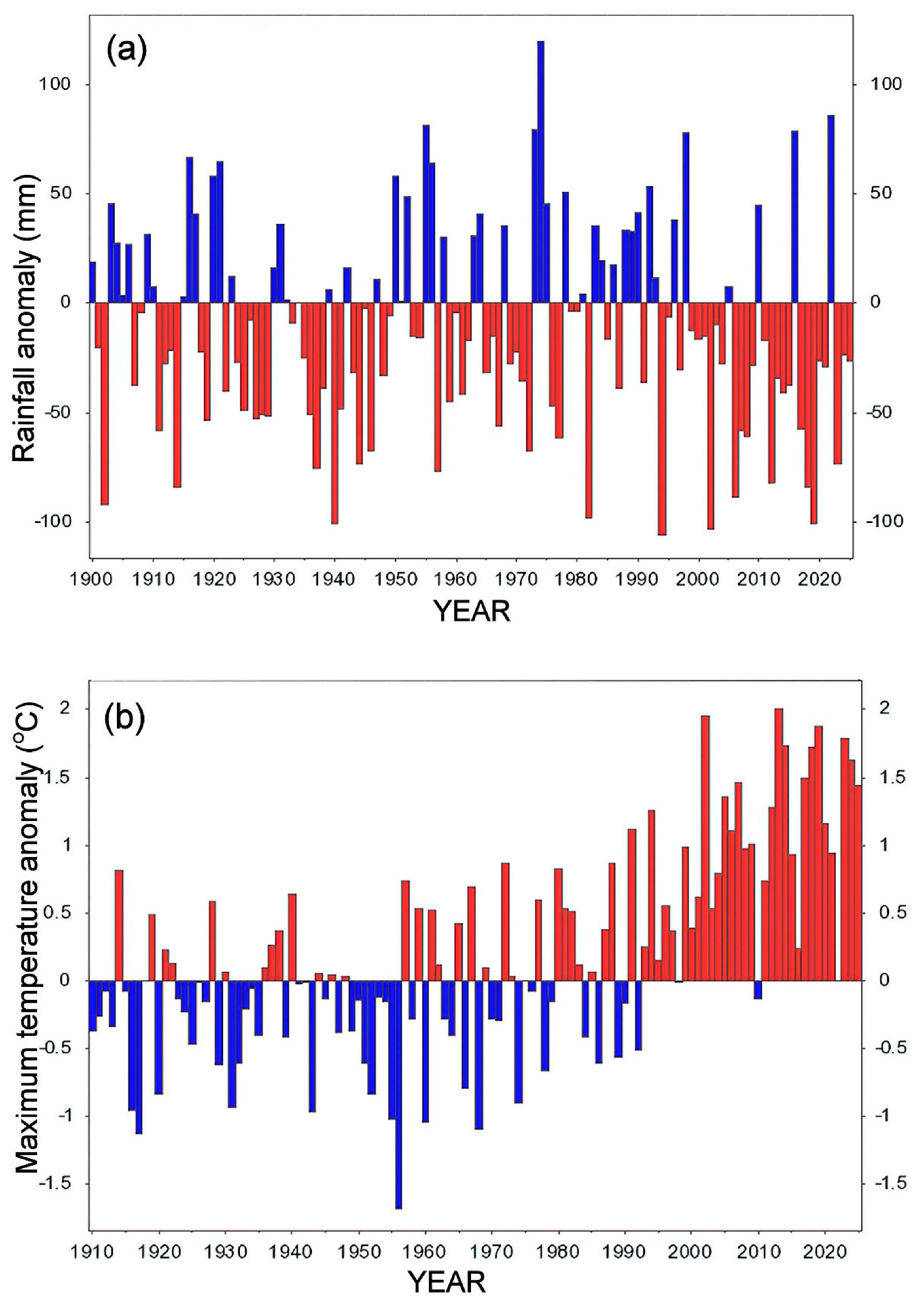
Southern coastal Australia is situated between 30° and 38° S and is the longest east–west mid-latitude coastline (4300 km) in the Southern Hemisphere (SH). It includes over 35%—around 9 million people—of Australia’s total population. The population is growing rapidly, with increasing urban water demand and the rising water requirements of industry and agriculture. Approximately 75% of the coastal region, west of Melbourne, experiences a Mediterranean climate dominated by cold frontal systems that produce cool-season (April to October) rainfall. Historically, this area has been devastated by droughts, particularly since the early 1990s. Figure 1a shows the cool-season (April to October) precipitation anomalies, relative to the 30-year period 1961–1990, since reliable records began in 1900. Figure 1b shows the corresponding cool season maximum temperature anomalies since 1910. Most notable are the decreasing precipitation and increasing maximum temperature anomalies since the early 1990s.
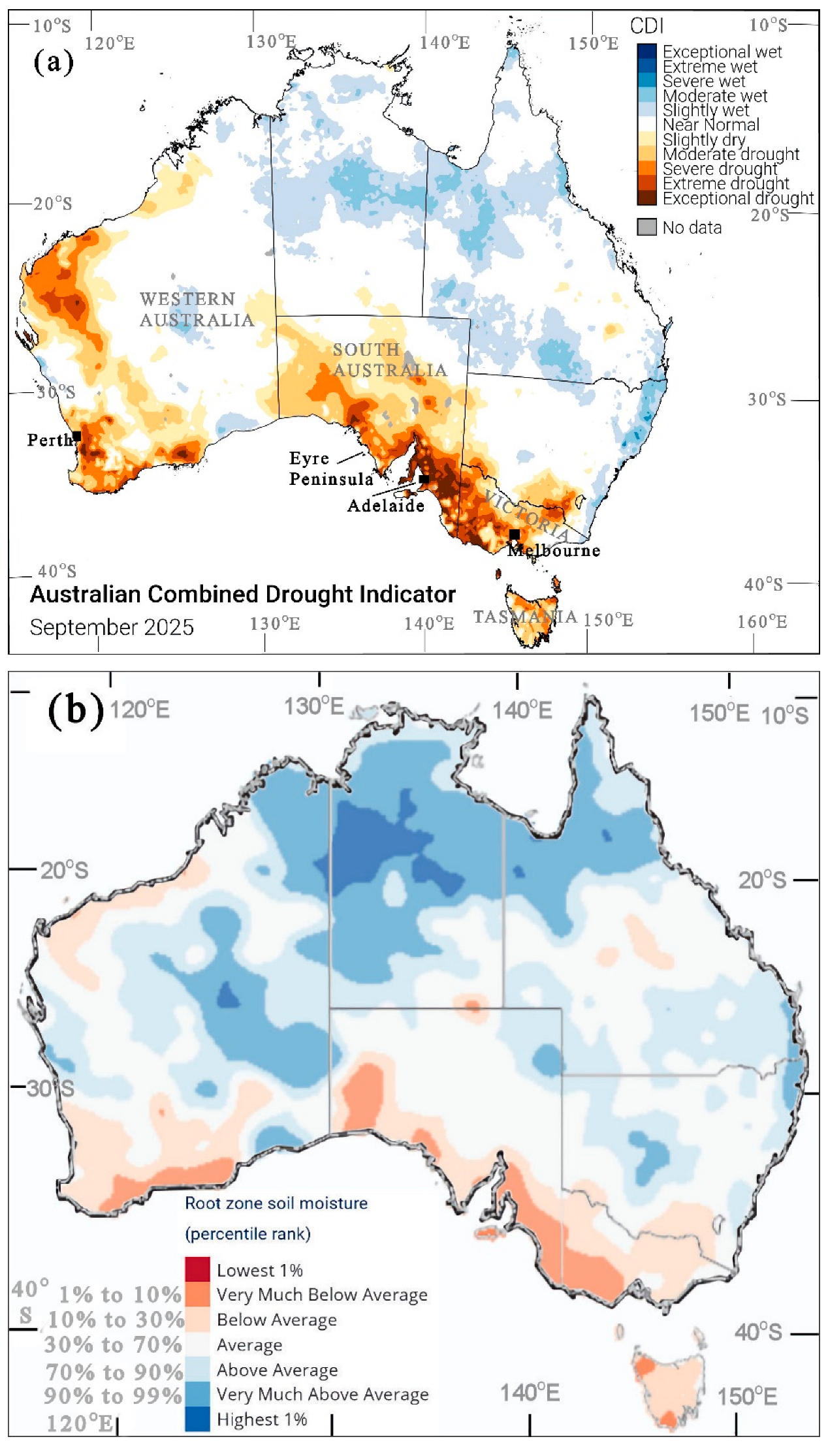
Over the two-year period since early 2023, almost all of southern coastal Australia has experienced serious to extreme rainfall deficiencies, leading to severe to exceptional drought conditions (Figure 2a). Most of southern Australia had already experienced a long-term decline in rainfall (e.g., [1,2]). Even Tasmania, which mostly lies poleward of 40° S, is also affected by drought. These persistent rainfall deficiencies have produced well-below-average soil moisture levels (Figure 2b), occurring on mostly flat land. Low stream-flow heights [2] have reduced water storages, leading to widespread reliance on transporting hay and purchasing extra feed for livestock. In some key farming regions, farmers have delayed or canceled planting their crops. Brief cool-season rainfall in July 2025 provided some local relief to several agricultural areas. However, the impact was short-lived, as in major cities—Adelaide and Melbourne—the July rainfall accounted for only 20–30% of the total rainfall received from January to September 2025.
Consequently, despite some areas of southern Australia temporarily showing limited improvement, the drought has continued. Because of the drought, the 2024 annual averaged sub-soil moisture was very low across southern coastal Australia and was spreading inland (Figure 2b). It has remained at similarly very low levels throughout 2025. In stark contrast, most of northern Australia was not suffering from drought conditions and root-zone soil moisture levels ranged from average to the highest one percentile.
Both Adelaide (35° S) and Perth (32° S) are located at lower latitudes than Melbourne (38° S) (see Figure 1a). In Adelaide, as of January 2025, the extremely dry conditions of the previous two years have resulted in reduced levels of water inflows to Adelaide’s reservoirs. Total reservoir levels dropped to 44% at the beginning of the dry warm season; this was the lowest recorded value in more than 20 years. Adelaide’s single desalination plant has quadrupled its output from January to the present, to meet demands. Perth, which has experienced a long-term rainfall decrease since 1970 [3], has routinely been operating two desalination plants since 2012, and currently is building a third plant, given its continuing rapidly increasing need for fresh water. Melbourne, which is by far the largest southern Australian coastal city, received just over 300 mm through September 2025, with winter and spring rainfall failing to produce the usual sharp increase in water storage levels during 2025. Melbourne’s desalination plant was initially activated for just 10 months in 2022, to increase the supply of fresh drinking water. However, the continuing dry conditions in 2024 and 2025 motivated the state government to again utilize the desalination plant in April 2025. As of September 2025, with the warm months approaching, Melbourne’s water storages were at approximately 74% capacity, the lowest since the Tinderbox Drought of 2017–2019 [4], at this time of the year. Given Melbourne’s rapidly increasing population, it is estimated that up to 65% of Melbourne’s water may need to come from manufactured sources, such as desalination and recycling. That percentage is an increase from 2020, when 25% of Melbourne’s water was desalinated and 10% recycled.
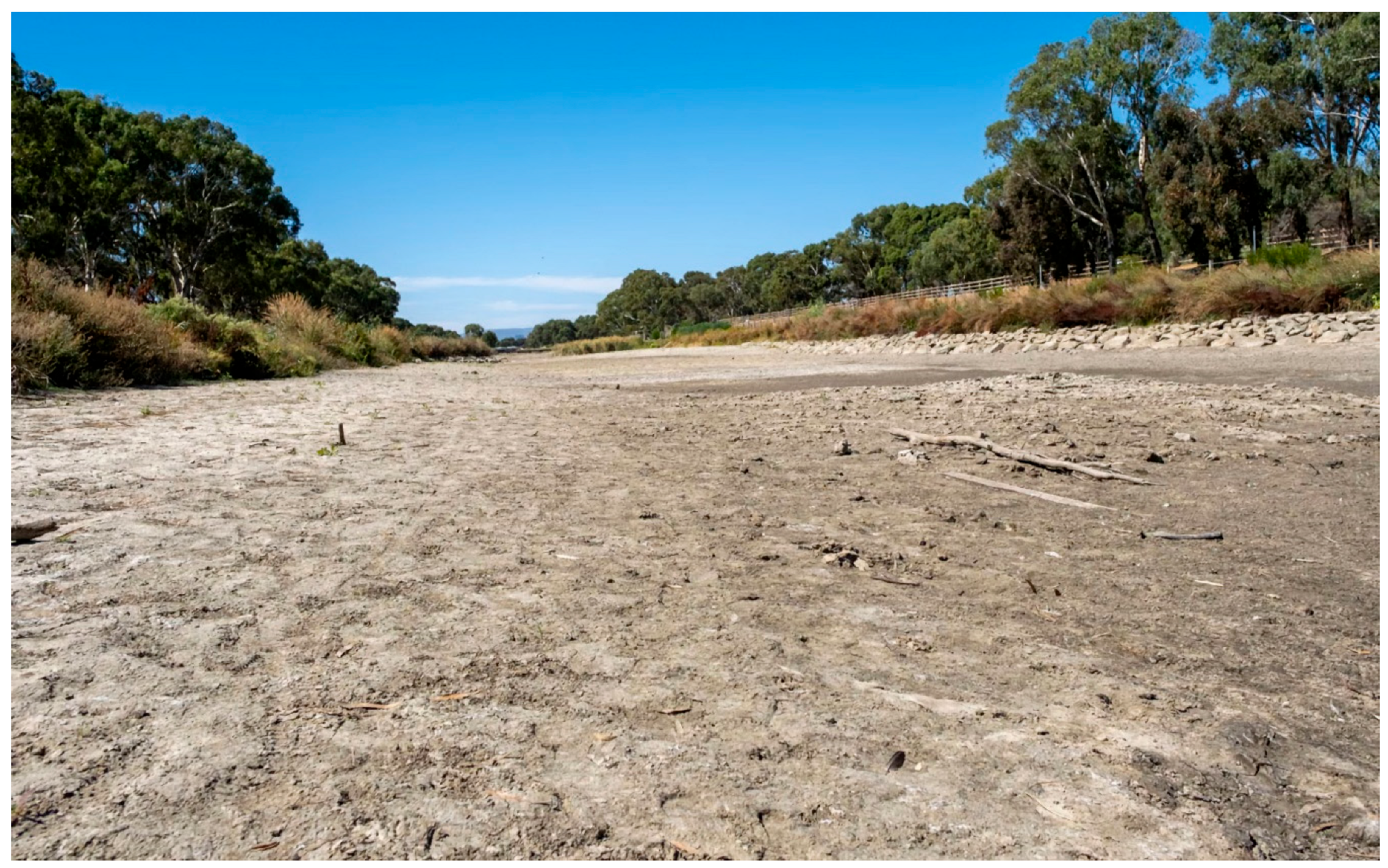
Notably, in the Eyre Peninsula, which is a vital food and energy production area west of Adelaide (Figure 2a), water availability is far worse because of the exceptional drought conditions over the past 24 months. Most of the region’s water is currently pumped from the Murray River and from groundwater aquifers. The aquifers were at historic lows in early 2025, having steadily declined since the 1960s. Decreased annual rainfall, greater evaporation rates, rapid urbanization, and a loss of native vegetation are all contributing factors. When groundwater levels drop below sea level, saltwater enters and pollutes the water, endangering the numerous fragile ecosystems located in the region. A solution currently being considered is the building of a desalination plant that has large filters to prevent bulky items and animals from being drawn into water pipes. Inflows into the Adelaide reservoirs over the last year or two have been their lowest in over 40 years. The normally free-flowing Breakout Creek had dried up by the end of the summer 2025 (Figure 3).
Drought has regularly occurred over the past 28 years since 1997, except for a total of just six years including the multiple La Niña years of 2010–2012 and 2020–2022, and the favorable rain-producing negative Indian Ocean Dipole (IOD) year of 2016. Catastrophic bushfires have occurred in southern Australia on multiple occasions since 1997. They happened in 2009 [5], near the end of the ‘Millennium Drought’ (1997–2009), and at the end of the ‘Tinderbox Drought’ (2017–2019) in 2019 [6], and in January 2026 during the current drought.

1.2. Drought Impacts on Perth, Adelaide, and Melbourne

As mentioned above, both Perth and Adelaide have typical ‘Mediterranean’ climates characterized by cool, wet winters and hot, dry summers. The cool-season precipitation of southern coastal Australia is dominated historically by a westerly wind regime, embedded with rain-bearing cold fronts. Melbourne, located farther south than both Perth and Adelaide, is also subject to winter westerly winds, but receives year-round precipitation from frontal and low-pressure systems. However, the cool-season westerly wind regime has contracted poleward since the 1990s, along with the polar and subtropical jet streams [7]. These atmospheric circulation changes have reduced the cool season rainfall because the frontal systems are now being steered poleward. Since the 1990s, and particularly in the last decade, northerly or northwesterly winds have dominated Melbourne’s cool-season weather. In the upper atmosphere, small circulations of cold air also direct north to northerly winds and destabilize the atmosphere because of changes in the jet streams. Thunderstorms or heavy showers can form ahead of the north to northwesterly winds over Melbourne, but they rapidly cease due to the following dry, westerly airflow. There are typically long periods of dry weather between the days before and after this type of rain event. Melbourne lies mostly in a rain shadow due to the high terrain to its west and north; when compared with Perth and Adelaide, Melbourne receives considerably less winter rainfall from both pre-frontal northerly winds and post-frontal westerly winds. However, the decreasing number of cool-season rainfall frontal systems is also affecting the cities of Adelaide and Perth as the westerlies move southward. In the Northern Hemisphere (NH), several studies have related decreased precipitation and increased drought to Arctic amplification involving large-scale tropospheric circulation changes [8,9,10,11,12], while for the SH, as far as the authors are aware, no studies have been published. In the NH, several studies using atmospheric re-analyses have revealed a poleward shift in the mid-latitude storm track [13,14,15,16,17,18], and recently observational analysis has shown that the winter North Pacific storm track has shifted substantially poleward [19]. Similar recent impacts on mid-latitude SH cool-season storm tracks, with associated reduced precipitation and increased drought, are presented in Section 3, indicating the dramatic changes in the Australian region’s circulations that have occurred in the recent decade.

2. Materials and Methods

To capture the wind structure and speed of the branches of the subtropical jet (STJ) and polar-front jet (PFJ) in the Southern Hemisphere (SH), composite monthly u-component anomalies at 250 hPa were derived from the reanalysis data sets provided by the website of the National Center for Environmental Prediction (NCEP) and the National Center for Atmospheric Research (NCAR), https://psl.noaa.gov/cgi-bin/data/composites/printpage.pl accessed on 12 October 2025, developed by [20]. The main April–September wet-season interval was selected to compare the pre- and post-1990 circulation anomalies and then to focus on the most recent decade 2016–2025.
Time series plots of annual cool-season (April to October) precipitation and maximum temperature anomalies were obtained from the Australian Bureau of Meteorology’s Climate Change website [https://www.bom.gov.au/cgi-bin/climate/change/timeseries.cgi, accessed on 12 October 2025]. The April-to-September raw data were used to generate these time series plots, and were downloaded for the years 1965 to 2025 from the same website. The data then were divided into two separate pairs of groupings. One pair was 1965 to 1994 and 1995 to 2005. The other pair was the two most recent decades: 2006 to 2015 and 2016 to 2025. The differences in the means between each pair were tested for statistical significance using a permutation without a replacement test to generate the p-values [21]. The number of resamples used to produce the p-values was set at 5000.

3. Results

3.1. p-Values for Testing Precipitation and Maximum Temperature Means

The permutation test results for southern Australia regarding the statistically significant differences in precipitation and maximum temperature means between 1965–1994 and 1995–2005 and the two most recent decades—2006 to 2015 and 2016 to 2025—are shown in Table 1.
Whereas precipitation and maximum temperature indicate high significance in precipitation decrease and maximum temperature increase pre- and post-1990s, there is no change in SH tropospheric circulation anomalies in the Australian region. However, the significant decrease in precipitation and increase in maximum temperature between 2006–2015 and 2016–2025 does show a dramatic change in the SH tropospheric circulation in the Australian region. This dramatic change is detailed and explained in Section 3.2.

3.2. Tropospheric Anomalies Between 2006–2015 and 2016–2025

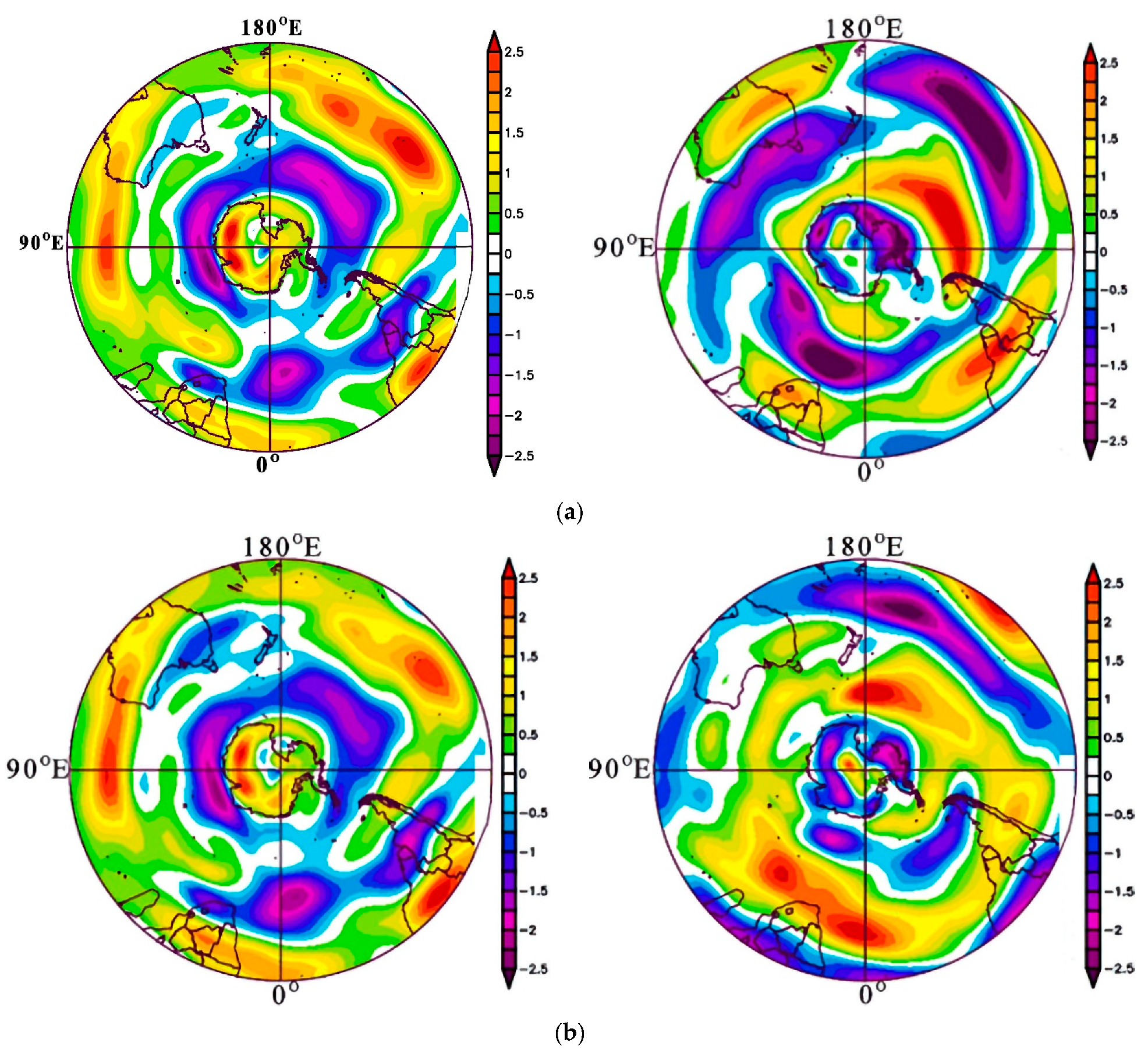
The dominant rain season for southern coastal Australia is April to September, reflecting the most equatorward position of the mid-latitude, zonal (or westerly) wind regime that brings the rain-bearing cool-season frontal systems. It is also the time when, climatologically, the well-known upper-level tropospheric split jet is present in the Australia–New Zealand region, between 90° E and 180° E [22]. This is evident from the STJ when the 1965 to 1995 u-component of the 250 hPa wind anomaly, relative to 1991 to 2020 climatology across northern tropical Australia, and the weaker PFJ branch anomaly, spans the mid-latitudes south of Australia (Figure 4a—left panel). From 1965–1994 to 1995–2005 in Figure 4a, the STJ is stronger than the PFJ. This allows dynamical interaction between the STJ and PFJ over southern Australia where cool season frontal and low-pressure rain systems usually dominate. From 1965–2015 to 2016–2025 (Figure 4b—left panel and right panel, respectively), in contrast, the contraction poleward of the split jet systems and the associated mid-latitude, moisture-laden rain systems in the Australian region are more likely to pass south of the continent; hence, precipitation over southern coastal Australia is greatly diminished. A previous study by the authors of this jet structure covering the 55 years from 1965 to 2020 shows that since the 1990s both branches have shifted poleward by approximately 5° latitude [7]. Compared with the 1965 to 1995 anomaly, the 2006 to 2015 decadal anomaly still shows the split jet with the STJ branch across northern tropical Australia and the PFJ positioned in the mid-latitudes of the Australia–New Zealand region (Figure 4a—right panel). However, there is a dramatic change in position and structure of the STJ branch of the split jet, when the 1965 to 2015 anomaly (Figure 4b; left panel) is compared with the 2016 to 2025 anomaly (Figure 4b; right panel). The split-jet structure present in Figure 4b (right panel) has shifted approximately 10° poleward and is reduced to a branch over the subtropical jet east Indian Ocean and another branch over southeast Australia between longitudes approximately 140° E to 170° E. This major change from 2016 is consistent with the largest increase in rate of global warming and is likely related to a rapid decrease in Antarctic Sea ice over the same period [23,24,25].
Consequently, regional atmospheric changes have affected southern Australia. First, the contraction polewards of the STJ and PFJ means that fewer cool-season frontal producing rain systems are affecting southern coastal Australia, leading to an April to September decrease in precipitation, including the cities of Perth, Adelaide, and Melbourne. Reference [26] identified that upper-level vortices (cut-off lows) have been dominated by those developing equatorward of a polar jet southwest of Western Australia since the 1990s, and are heading northeast over the Australian continent. Those developing south of the polar jet are captured in the westerlies between about 40–50° S. latitude. In both April-to-July and August-to-November the surface manifestation of the upper cut-off lows is mainly a low-pressure trough in the easterlies, which normally provides little low- to mid-level moisture in southern Australia, unless aided by favorable phase combinations of climate drivers such as the Indian Ocean Dipole (IOD), the El Niño-Southern Oscillation (ENSO), the southern annular mode (SAM) with teleconnections to phases of local and remote drivers such as the Atlantic Meridional Oscillation (AMO), the Pacific Meridional Mode (PMM), and the Tasman Sea SSTs. The IOD characterizes periodic, irregular oscillations in SSTs between the western and eastern tropical Indian Ocean. The SAM or Antarctic Oscillation describes the north–south movement of the westerly wind belt and associated storm systems in the SH, affecting rainfall and temperatures. The AMO is major system of ocean currents in the Atlantic that acts as a conveyor belt, transporting warm surface water from the tropics north Europe and sinking cold, dense water southward. The PMM is a dominant coupled-atmospheric pattern in the subtropical Pacific which acts as a key bridge linking extratropical climate variability to the tropical Pacific, often influencing the development of ENSO. Prior to the 1990s, there were few cut-off lows equatorward of the PFJ [26]; cut-off lows formed on the polar side of the STJ when a PFJ merged with the STJ, causing Rossby wave breaking. For example, numerous east coast lows (ECLs) have formed off the east coast since the 1990s and are usually captured by the westerlies south of Sydney [27]. In the most recent decade, 2016–2025, when an upper-level vortex developed on the equatorward side of the PFJ south of Western Australia, it usually moved northeast toward southeast Australia and interacted with the STJ, producing upper-level instability. However, rain does not occur until the upper-level vortex reaches a deep, moist layer below it, which has formed from onshore northeast winds directed over Australia’s east coast. Little or no rain occurs in southern coastal areas or southern inland areas until the combination of the upper-level instability and deep, moist layer results in heavy, southeast coastal and inland precipitation, typically in short, thunderstorm-type events. These events can persist for days due to slow movement of the upper vortex and the continued moist onshore flow underneath. An example is the Flash Drought (FD) in eastern inland Australia in November 2023, whereas, at that time, the coast experienced flooding [28]. Notably, the Australian region was not alone in receiving decreased precipitation and drought has occurred due to poleward contraction of the jet stream. Drought has been a feature of southern coastal Africa in recent years. One example is Cape Town’s critically low water storage event during the 2015–2017 drought [29]. The jet stream, previously located equatorward of the South African southern coast (Figure 4b; left panel), shifted poleward of the southern coast (Figure 4b; right panel), reducing the chance of cool-season rainfall.

4. Discussion

4.1. Climate Driver Attribution of Precipitation

Continued global warming (GW) and interaction with other climate drivers that have altered the Southern Hemisphere (SH) and regional atmospheric circulation can help explain how this now dramatic Melbourne drying and continued southern coastal drying further west has occurred over recent years. First, the persistent ocean warming in the southwest Pacific Ocean and around Australia represents part of the negative phase of the Pacific decadal oscillation (PDO), the leading mode of North Pacific sea-surface temperature (SST) variability [30] and the leading mode of basin-wide Pacific SST variability called the interdecadal Pacific oscillation (IPO). Briefly, the positive phase of the IPO characterizes a pattern of warm SST anomalies in the eastern Pacific Ocean and cold SST anomalies in the western Pacific Ocean, while the IPO negative phase reverses the SST anomaly pattern. The negative phase has been locked in for more than three decades and is associated with the long-term drought in southwestern USA. Historically, it changes phase every 15–30 years due to processes internally generated by the climate system [13,31,32]. Statistical and dynamic models that simulate these internal processes predicted that the large effects from the 2015 El Niño phenomenon reversed the sign of the locked-in negative phase of the PDO [33]. However, it remains unchanged, including the impact of drought on southwestern USA. Reference [30] isolated the anthropogenic influences from internally generated forcings of the PDO and found that, in observations, external forcing accounts for 53% of total multidecadal PDO amplitude, whereas in models, external forcing only accounts for 7% of total multidecadal PDO amplitude. They suggest this error may also affect low frequency modes of climate variability throughout the extratropical Northern Hemisphere (NH), and potentially globally [34,35,36]. The patterns of SST Pacific warming that are generated internally resemble those now externally generated by human emissions in the negative PDO phase and those generated externally by aerosol emissions in the positive PDO phase prior to the 1990s [30]. Second, negative-phase PDO-IPO results in an anomalous poleward shift in the subtropical high-pressure ridge in the Australia–New Zealand region [37]. When combined with the May-to-October anomalous 700 hPa high-pressure anomalies in the mid-latitudes of the Australia–New Zealand region since the 1990s [28], sources of atmospheric moisture have decreased along the southern Australian coast throughout the year. The cool-season months of April to September, when frontal and low-pressure systems provide most of the cool-season rainfall, have joined the normally drier warm season months of October to April. Until November 2025, a strong stratospheric warming event (SSW) was exacerbating the drying across southern Australia [38]. An SSW affects the SH low-level atmospheric circulation by extending the westerly winds from the high polar latitudes to the mid-latitudes, in addition to increasing their speed. The impact on southeast Australia is to enhance the drying [39]. The strong negative IOD is not producing the usual increase in spring rainfall as in past events of 2022 or 2016 because GW interaction with other climate drivers has diminished the impact of a negative IOD on increasing rainfall across southern Australia [40].

4.2. Reduced Stream Flows and Water Levels

In southern Australian near-coastal areas, the extensive river systems and dams are currently experiencing reduced water supplies [2], thereby continuing the inevitable, long-term impacts of GW, and currently are enhanced by the impact of the naturally occurring SSW event in late 2025. Consequently, soil and vegetation moisture levels in southern coastal areas and adjoining regions further north have been very low through spring. Sufficient soil moisture must be present in spring leading into summer to prevent moisture levels becoming too low. This cycle continues and progressively worsens, unless it is punctuated by several successive wet years such as in the double La Niñas of 2010–2012 and 2020–2022 when late spring to summer experienced extremely high rainfall totals, producing devastating floods in southeast inland Australia [41,42].

5. Conclusions

There was a dramatic change in position and structure of the STJ branch of the split jet when the 1965 to 2015 anomaly is compared with the 2016 to 2025 anomaly. The split jet structure has shifted approximately 10° poleward causing the cold frontal and low-pressure rain-producing systems and westerly zonal winds to track south of the Australian continent. Consequently, the reduction in cool-season precipitation exacerbates droughts by leading to more frequent and intense droughts, with major reductions in stream flows and dam levels. This study is the first to clearly show the link between increased drying of southern coastal Australia in the recent decade to detailed poleward contraction of the SH and Australian-region jet stream and tropospheric circulation changes. This contrasts with the numerous modeling studies, and a recent observational study pointing to poleward contraction of the NH mid-latitude storm tracks.
Notably, precipitation continues to decline in southern coastal Australia beyond 2025, with extreme drought developing during late 2025 and January 2026. Currently, the continuing combination of drought and record high temperatures has caused catastrophic bushfires in southern coastal Australia. Already, more than 430,000 ha. have been burnt in the state of Victoria and residents have claimed more than $200 million in losses from 3123 claims since 7 January 2026, according to the Insurance Council of Australia [43]. Those figures include property, motor, commercial and business interruption claims, with nearly a third of property losses estimated to be total losses. The affected regions depend on timely rainfall during their growing seasons, typically from winter through spring. The current drought also has devastated livestock numbers across southern South Australia, with farmers relying on donated feed being trucked in from other states. Both Adelaide and Melbourne planned incremental increases in water supplies from their desalination plants in 2025. With water demand further increasing for the planned construction of AI data centers, this combination of drought and high temperatures has continued through all of January 2026 and is projected to continue through February.

Author Contributions

Conceptualization, M.S. and L.L.; methodology, M.S. and L.L.; software, M.S.; validation, M.S. and L.L.; formal analysis, M.S.; investigation, M.S. and L.L.; resources, M.S.; data curation, M.S.; writing—original draft preparation, M.S. and L.L.; writing—review and editing, M.S. and L.L.; visualization, M.S.; supervision, L.L. All authors have read and agreed to the published version of the manuscript.

Funding

This research received no external funding.

Data Availability Statement

All data used or generated are available through the web links in the Section 2.

Acknowledgments

M.S. and L.L. acknowledge the University of Technology Sydney for encouraging their research.

Conflicts of Interest

The authors declare no conflicts of interest.

References

  1. BoM. Bureau of Meteorology, Southern Rainfall Decline. 2015. Available online: https://www.bom.gov.au/climate/updates/articles/a010-southern-rainfall-decline.shtml (accessed on 11 January 2026).
  2. CSIRO. Australia’s Changing Climate, State of the Climate 2024. 2024. Available online: https://www.csiro.au/en/research/environmental-impacts/climate-change/state-of-the-climate/australias-changing-climate (accessed on 11 January 2026).
  3. Zheng, Y.; Jong, L.M.; Phipps, S.J.; Roberts, J.L.; Moy, A.D.; Curran, M.A.J.; van Ommen, T.D. Extending and understanding the Southwest Western Australian rainfall record using a snowfall reconstruction from Law Dome, East Antarctica. Clim. Past. 2021, 17, 1973–1987. [Google Scholar] [CrossRef]
  4. Devanand, A.; Falster, G.M.; Gillett, Z.E.; Hobeichi, S.; Holgate, C.M.; Jin, C.; Mu, M.; Parker, T.; Rifai, S.W.; Rome, K.S.; et al. Australia’s Tinderbox Drought: An extreme natural event likely worsened by human-caused climate change. Sci. Adv. 2024, 10, eadj3460. [Google Scholar] [CrossRef]
  5. Australian Government; Bureau of Meteorology. Remembering Black Saturday: The Extraordinary Weather Behind Victoria’s 2009 Bushfires–7 February 2009. Available online: https://media.bom.gov.au/social/blog/2025/remembering-black-saturday-the-extraordinary-weather-behind-victorias-2009-bushfires/ (accessed on 4 February 2026).
  6. Climate Extremes. ARC Centre of Excellence. Australia’s Tinderbox Drought. Available online: https://climateextremes.org.au/wp-content/uploads/Australias-tinderbox-drought-Briefing-note.pdf (accessed on 4 February 2026).
  7. Speer, M.S.; Leslie, L.M.; Hartigan, J. Jet Stream Changes over Southeast Australia during the Early Cool Season in Response to Accelerated Global Warming. Climate 2022, 10, 84. [Google Scholar] [CrossRef]
  8. McEvoy, D.; Hatchett, B.J. Spring heat waves drive record western United States snow melt in 2021. Environ. Res. Lett. 2023, 18, 014007. [Google Scholar] [CrossRef]
  9. Qin, Y.; Abatzoglou, J.T.; Siebert, S.; Huning, L.S.; AghaKouchak, A.; Mankin, J.S.; Hong, C.; Tong, D.; Davis, S.J.; Mueller, N.D. Agricultural risks from changing snowmelt. Nat. Clim. Change 2020, 10, 459–465. [Google Scholar] [CrossRef]
  10. Yeşilköy, S.; Baydaroğlu, Ö.; Demir, I. Is snow drought a messenger for the upcoming severe drought period? A case study in the upper Mississippi river basin. Atmos. Res. 2024, 309, 107553. [Google Scholar] [CrossRef]
  11. Liang, Y.; Kirchmeier-Young, M.; Yu, B. Conditional attribution of cold extremes in Canada: The role of atmospheric circulation in a changing climate. Weather Clim. Extrem. 2025, 50, 100826. [Google Scholar] [CrossRef]
  12. Seager, R.; Liu, H.; Osborn, T.J.; Kushnir, Y.; Nakamura, J.; Wu, Y. Mediterranean drying by a positive North Atlantic Oscillation trend over the last 65 years is an extreme outlier in the CMIP6 multimodel ensemble. J. Clim. 2026, 39, 785–804. [Google Scholar] [CrossRef]
  13. IPCC. Climate Change 2021: The Physical Science Basis. Contribution of Working Group I to the Sixth Assessment Report of the Intergovernmental Panel on Climate Change; Masson-Delmotte, V., Panmao, Z., Pirani, A., Connors, S.L., Clotilde, P., Chen, Y., Goldfarb, L., Gromis, M.I., Matthews, J.B.R., Berger, S., et al., Eds.; Cambridge University Press: Cambridge, UK, 2021. [Google Scholar]
  14. Graham, N.E.; Diaz, H.F. Evidence for intensification of North Pacific winter cyclones since 1948. Bull. Am. Meteor. Soc. 2001, 82, 1869–1893. [Google Scholar] [CrossRef]
  15. Tilinina, N.; Gulev, S.K.; Rudeva, I.; Koltermann, P. Comparing cyclone life cycle characteristics and their interannual variability in different reanalyses. J. Clim. 2013, 26, 6419–6438. [Google Scholar] [CrossRef]
  16. Chang, E.K.M.; Yau, A.M.W. Northern Hemisphere winter storm track trends since 1959 derived from multiple reanalysis datasets. Clim. Dyn. 2016, 47, 1435–1454. [Google Scholar] [CrossRef]
  17. Wang, J.; Kim, H.; Chang, E.K.M. Changes in Northern Hemisphere winter storm tracks under the background of Arctic amplification. J. Clim. 2017, 30, 3705–3724. [Google Scholar] [CrossRef]
  18. Battalio, J.M.; Lora, J.M. Increases in the local eddy energetics of the extratropical atmosphere over the last four decades. J. Clim. 2024, 37, 3283–3304. [Google Scholar] [CrossRef]
  19. Chemke, R.; Yuval, J. Climate change shifts the North Pacific storm track polewards. Nature 2026, 649, 626–630. [Google Scholar] [CrossRef]
  20. Kalnay, E.; Kanamitsu, M.; Kistler, R.; Collins, W.; Deaven, D.; Gandin, L.; Iredell, M.; Saha, S.; White, G.; Woollen, J.; et al. The NCEP/NCAR 40-Year Reanalysis Project. Bull. Am. Meteorol. Soc. 1996, 77, 437–472. [Google Scholar] [CrossRef]
  21. Mielke, R.W.; Berry, K.J. Selected Permutation Studies. In Permutation Methods; Springer Series in Statistics; Springer: New York, NY, USA, 2001; pp. 341–383. [Google Scholar] [CrossRef]
  22. Bals-Elsholz, T.; Atallah, E.H.; Bosart, L.F.; Wasula, T.A.; Cempa, M.J.; Lupo, A.R. The wintertime Southern Hemisphere split jet: Structure, variability, and evolution. Int. J. Climatol. 2001, 14, 4191–4215. [Google Scholar] [CrossRef]
  23. Naughten, K.A.; Holland, P.R.; De Rydt, J. Unavoidable future increase in West Antarctic ice-shelf melting over the twenty-first century. Nat. Clim. Change 2023, 13, 1222–1228. [Google Scholar] [CrossRef]
  24. Shepherd, A.P.; Ivins, E.; Rignot, E.; Smith, B.; van den Broeke, M.; Velicogna, I.; Whitehouse, P.; Briggs, K.; Joughin, I.; Krinner, G.; et al. Mass Balance of the Antarctic Ice Sheet from 1992 to 2017. Nature 2018, 558, 219–222. [Google Scholar] [CrossRef]
  25. Paolo, F.S.; Fricker, H.A.; Padman, L. Volume loss from Antarctic ice shelves is accelerating. Science 2015, 348, 327–331. [Google Scholar] [CrossRef] [PubMed]
  26. Portmann, R.; Sprenger, M.; Wernli, H. The three-dimensional life cycles of potential vorticity cutoffs: A global and selected regional climatologies in ERA-Interim (1979–2018). Weather Clim. Dynam. 2021, 2, 507–534. [Google Scholar] [CrossRef]
  27. Speer, M.; Leslie, L.; Hartigan, J.; MacNamara, S. Changes in Frequency and Location of East Coast Low Pressure Systems Affecting Southeast Australia. Climate 2021, 9, 44. [Google Scholar] [CrossRef]
  28. Speer, M.; Hartigan, J.; Leslie, L.M. Machine Learning Identification of Attributes and Predictors for a Flash Drought in Eastern Australia. Climate 2024, 12, 49. [Google Scholar] [CrossRef]
  29. Richman, M.B.; Leslie, L.M. Machine Learning for Attribution of Heat and Drought in Southwestern Australia. Procedia Comput. Sci. 2020, 168, 3–10. [Google Scholar] [CrossRef]
  30. Klavans, J.M.; DiNezio, P.N.; Clement, A.C.; Deser, C.; Shanahan, T.M.; Cane, M.A. Human emissions drive recent trends in North Pacific climate variations. Nature 2025, 644, 684–692. [Google Scholar] [CrossRef] [PubMed]
  31. Newman, M.; Alexander, M.A.; Ault, T.R.; Cobb, K.M.; Deser, C.; Di Lorenzo, E.; Mantua, N.J.; Miller, A.J.; Minobe, S.; Nakamura, H.; et al. The Pacific decadal oscillation, revisited. J. Clim. 2016, 29, 4399–4427. [Google Scholar] [CrossRef]
  32. Latif, M.; Barnett, T.P. Causes of decadal climate variability over the North Pacific and North America. Science 1994, 266, 634–637. [Google Scholar] [CrossRef]
  33. Meehl, G.A.; Hu, A.; Teng, H. Initialized decadal prediction for transition to positive phase of the Interdecadal Pacific Oscillation. Nat. Commun. 2016, 7, 11718. [Google Scholar] [CrossRef]
  34. Klavans, J.M.; Cane, M.A.; Clement, A.C.; Murphy, L.N. NAO predictability from external forcing in the late 20th century. npj Clim. Atmos. Sci. 2021, 4, 22. [Google Scholar] [CrossRef]
  35. Scaife, A.A.; Smith, D.A. Signal-to-noise paradox in climate science. npj Clim. Atmos. Sci. 2018, 1, 28. [Google Scholar] [CrossRef]
  36. Eade, R.; Smith, D.; Scaife, A.; Wallace, E.; Dunstone, N.; Hermanson, L.; Robinson, N. Do seasonal-to-decadal climate predictions underestimate the predictability of the real world? Geophys. Res. Lett. 2014, 41, 5620–5628. [Google Scholar] [CrossRef]
  37. Salinger, M.J.; Mullan, A.B. New Zealand climate: Temperature and precipitation variations and their links with atmospheric circulation 1930–1994. Int. J. Climatol. 1999, 19, 1049–1071. [Google Scholar] [CrossRef]
  38. BoM. The Air Above Antarctica Is Suddenly Getting Warmer. 2025. Available online: https://www.bom.gov.au/climate/updates/articles/a035.shtml (accessed on 11 January 2026).
  39. BoM. Understanding the Southern Annular Mode. 2019. Available online: https://www.youtube.com/watch?v=KrhWsXCB3u8 (accessed on 11 January 2026).
  40. Speer, M.S.; Leslie, L.M. Drought attribution of climate drivers using machine learning techniques. Weather Clim. Extrem. 2025, 50, 10081. [Google Scholar] [CrossRef]
  41. BoM. Record-Breaking La Niña Events. 2012. Available online: https://www.bom.gov.au/climate/enso/history/La-Nina-2010-12.pdf (accessed on 11 January 2026).
  42. What Made Eastern Australia So Wet from 2020 to 2022? 2024. Available online: https://nesp2climate.com.au/resource/what-made-eastern-australia-so-wet-from-2020-to-2022/ (accessed on 11 January 2026).
  43. THENEWDAILY. Otway Bushfire Damage 2026. 2026. Available online: https://www.thenewdaily.com.au/news/state/vic/2026/01/28/otway-bushfire-damage (accessed on 1 February 2026).
Figure 1. (a) The April to October (cool season) rainfall anomaly (mm) for southern Australia from 1900 to 2025, and the (b) April to October maximum temperature for southern Australia from 1900 to 2025.
Climate 14 00052 g001
Figure 2. (a) Australian Combined Drought Indicator (CDI) for the 24 months ending September 2025. The CDI uses a combination of precipitation, soil moisture, evaporation and NDVI satellite data to produce a drought indicator tailored for Australia, and is available at https://nacp.org.au/drought_monitor (accessed on 12 October 2025). (b) Root-zone soil moisture map. Available at https://awo.bom.gov.au/products/historical/soilMoisture-rootZone/ (accessed on 12 October 2025).
Climate 14 00052 g002
Figure 3. Breakout Creek at the western end of Adelaide’s Torrens River in March 2025. It was one of many pools and waterways that dried up and left fish stranded. Photograph: Green Adelaide.
Climate 14 00052 g003
Figure 4. Southern Hemisphere tropospheric circulation anomalies. NCEP/NCAR Reanalysis 250 hPa u-component wind anomalies (ms−1) from April to September for (a) 1965–1995 (left panel), 2006–2015 (right panel), (b) 1965–2015 (left panel), and 2016–2025 (right panel).
Climate 14 00052 g004
Table 1. Differences in precipitation and maximum temperature means for the intervals, 1965–1994 and 1995–2005, and 2006–2015 and 2016–2025. p < 0.10 indicates significance and p < 0.05 indicates high significance.
Intervalp-Values for Differences in Precipitation Meansp-Values for Differences in Maximum Temperature Means
1965–1994 and 1995–20050.0170.011
2006–2015 and 2016–20250.0740.044
Disclaimer/Publisher’s Note: The statements, opinions and data contained in all publications are solely those of the individual author(s) and contributor(s) and not of MDPI and/or the editor(s). MDPI and/or the editor(s) disclaim responsibility for any injury to people or property resulting from any ideas, methods, instructions or products referred to in the content.