Article

Fuzzy Approach to Analysis of Investment Alternatives

Department of Mathematics and Computer Sciences, Faculty of Science and Technology, Jan Dlugosz University in Czestochowa, al. Armii Krajowej 13/15, 42-200 Czestochowa, Poland
*
Author to whom correspondence should be addressed.
Econometrics 2026, 14(2), 20; https://doi.org/10.3390/econometrics14020020
Submission received: 31 January 2026 / Revised: 25 March 2026 / Accepted: 8 April 2026 / Published: 13 April 2026

Abstract

With significant market unsureness, “static” methods fail to account for economic uncertainty, may be less precise and, accordingly, less helpful when selecting investment alternatives. Methods that take into account the current economic situation and allow for adapting the alternative selection to external uncertainty are becoming more relevant. One of such methods is the fuzzy set theory. This article addresses the mathematical framework of such an approach for the economic analysis of investment project selection. A step-by-step scheme for implementing the fuzzy set method for investment projects is presented. Studies performed on the example of three investment alternatives give grounds for asserting the compatibility and feasibility of using two methods (the fuzzy set method may be partly based on the results of pairwise comparisons of experts according to the Saaty method) and confirmation or refutation of previous intuitive decisions of investors based on a comprehensive analysis of the criterion composition and the use of mathematical grounded technique.

1. Introduction

The unstable economic environment, changing legal conditions, exchange rate fluctuations, and rapid technological development significantly complicate investment decision-making, particularly in the context of startup investments. Under such uncertainty, traditional “static” evaluation methods often fail to reflect dynamic market conditions, leading to less accurate and less reliable investment choices.
In such circumstances, decision-making approaches that incorporate uncertainty and allow flexibility in evaluating alternatives are gaining importance. In particular, methods based on fuzzy logic provide a structured way to model imprecision and incomplete information, which are inherent in real-world investment scenarios.
The groundbreaking studies by Saaty (1972, 1975, 1977, 1980, 1988) on the analytic hierarchy process and by Zadeh (1965, 1975), R. Bellman and Giertz (1973) and R. E. Bellman and Zadeh (1970, 1977) have led the foundations of using fuzzy sets in decision making when alternatives (goals and constraints) are stated imprecisely. Fuzzy sets and fuzzy logic are powerful mathematical tools for decision making in the absence of complete and precise information.
This approach has proven versatile in addressing complex decision-making problems across multiple domains. In financial and investment contexts, it has been used for capital budgeting (Graham & Harvey, 2001), portfolio selection (Belabbes et al., 2025; Derya et al., 2025; Mohseny-Tonekabony et al., 2025; Șerban, 2025; Watada, 2001), long-term savings decisions (Mugerman et al., 2014), and evaluating strengths and risks in investment analyses (Kaplan & Strömberg, 2004), optimal investment and employment (Bloom, 2009). In organizational and human-resource management, it has supported the measurement of organizational capital (Bozbura & Beskese, 2007), faculty selection (Smith & Bayazit, 2024) and candidate evaluation (Paudel et al., 2022). In engineering and technical applications, the method has guided sector selection (Akkaya et al., 2015), power engineering problem-solving (P. Y. Ekel et al., 2007), and programming task prioritization (Nishad & Singh, 2015). It has also been applied in service quality and infrastructure evaluation, including healthcare services (Büyüközkan et al., 2011), irrigation projects (Anagnostopoulos & Petalas, 2011), and general service assessment (Mikhailov & Tsvetinov, 2004). Finally, its scope extends to specialized areas such as weapon system evaluation (Cheng & Mon, 1994), higher education investment (Kahraman et al., 2013), banking product selection (Ishizaka & Nguyen, 2013), and sports analytics (Ballı & Korukoğlu, 2014), demonstrating its broad adaptability in complex, multi-criteria decision-making scenarios.
Several books are devoted to different applications of fuzzy sets approach to decision making (Aliev, 2018; Aliev & Huseynov, 2014; Bhushan & Rai, 2004; Borisov et al., 1990; P. Ekel et al., 2020; Kitainik, 1993; Saaty & Vargas, 2012); see also the review papers (Aliev et al., 2016; Dubois, 2011; Dymova et al., 2021; Kubler et al., 2016; Liu et al., 2020; Mardani et al., 2015; Vaidya & Kumar, 2006), where mathematical tools, methodologies and techniques of the decision-making practice are comprehensively discussed.
Analysis of priority vector based on pairwise comparison matrix with fuzzy elements still attracts the interest of researchers (Borisov et al., 1990; Greblikaitė & Daugėlienė, 2009; Innan & Inuiguchi, 2024, 2025; Kubler et al., 2018; Ramik, 2021, 2023; Siebert, 2019).
The present article addresses the mathematical framework of this approach for the economic analysis of investment project selection. A step-by-step scheme for implementing the fuzzy set method for investment projects is carried out. Studies performed on the example of three investment alternatives give grounds for asserting the compatibility and feasibility of using two methods (the fuzzy set method may be partly based on the results of pairwise comparisons of experts according to the Saaty method) and confirmation or refutation previous intuitive decisions of investors based on a comprehensive analysis of the criterion composition and the use of mathematical grounded technique.

2. Economic-Mathematical Model

The decision to invest in modern conditions is based on the choice of such an alternative that satisfies the conditions of fuzzy goals and fuzzy restrictions. Thus, the goals and limitations will be symmetric with respect to the solution, which allows it to be presented as a fusion of fuzzy goals and constraints. It is also necessary to distinguish between the notion of randomness and fuzziness. Randomness is associated with uncertainty as to the affiliation or non-existence of a particular object to a fuzzy set, while fuzziness (vagueness, blurriness) can be interpreted as belonging to classes that have different gradations of the degree of affiliation intermediate between complete affiliation and complete inactivity to this class. But the main difference in this approach is the mathematical tool used to solve such problems. The probability theory deals with the investigation of randomness; instead, to solve the problems of the theory of fuzzy sets, the apparatus of the theory of fuzzy sets should be used.
Simply put, in our case, we will deal with vague goals (the choice of investment project) and vague terms (choice according to individual criteria). The essence of the proposed fuzzy set theory can be applied as follows. Let X = { x 1 , x 2 , x k } be the set of investment projects/startups and G = { g 1 , g 2 , g n } be the set of criteria under which investment projects will be evaluated. The fuzzyness of sets is described by eigenvectors of the matrix of pairwise comparisons.
In the previous paper (Kyrylych & Povstenko, 2023), three investment alternatives were studied (production of LED traffic lights—the first investment alternative, manufacture of information–reference electronic terminals—the second investment alternative, and manufacture of rotor-reactive turbo-rotational heaters of liquids—the third investment alternative). In the process of evaluating investment alternatives, each of them is analyzed in terms of the degree to which particular groups of economic criteria are met. The following group of criteria were defined for choice of invetment alternatives: financial strength; product/service potential; marketing capability; organization potential; scientific and technical possibility; staff competence; evaluation of the governmental, international, economic and political situation; time potential; autonomy; ecological strength; social potential; information capability.
The selection of a team of experts for choosing the best investment alternative should be purposeful, balanced, and as small as possible, while still covering key perspectives: financial, market, risk, and operational. In practice, a team of 5–7 experts works best—this size helps avoid decision-making chaos while still providing a broad view of the situation. In the proposed example, synthetic data were used. To conduct such an analysis, the suggested composition of the expert team could include: 1. Financial/investment analyst. 2. Market and strategy expert (e.g., strategic consultant). 3. Risk specialist (risk manager). 4. Industry expert (domain expert). 5. Legal and regulatory expert. 6. Operational/technological expert. 7. Capital allocation expert/practitioner investor.
Experts are usually recruited from consulting and advisory firms, financial and investment institutions, academia (experts from universities in finance, economics, and technology), and independent industry experts (practitioners with operational experience). For collecting the expert opinions, the Delphi method is recommended.
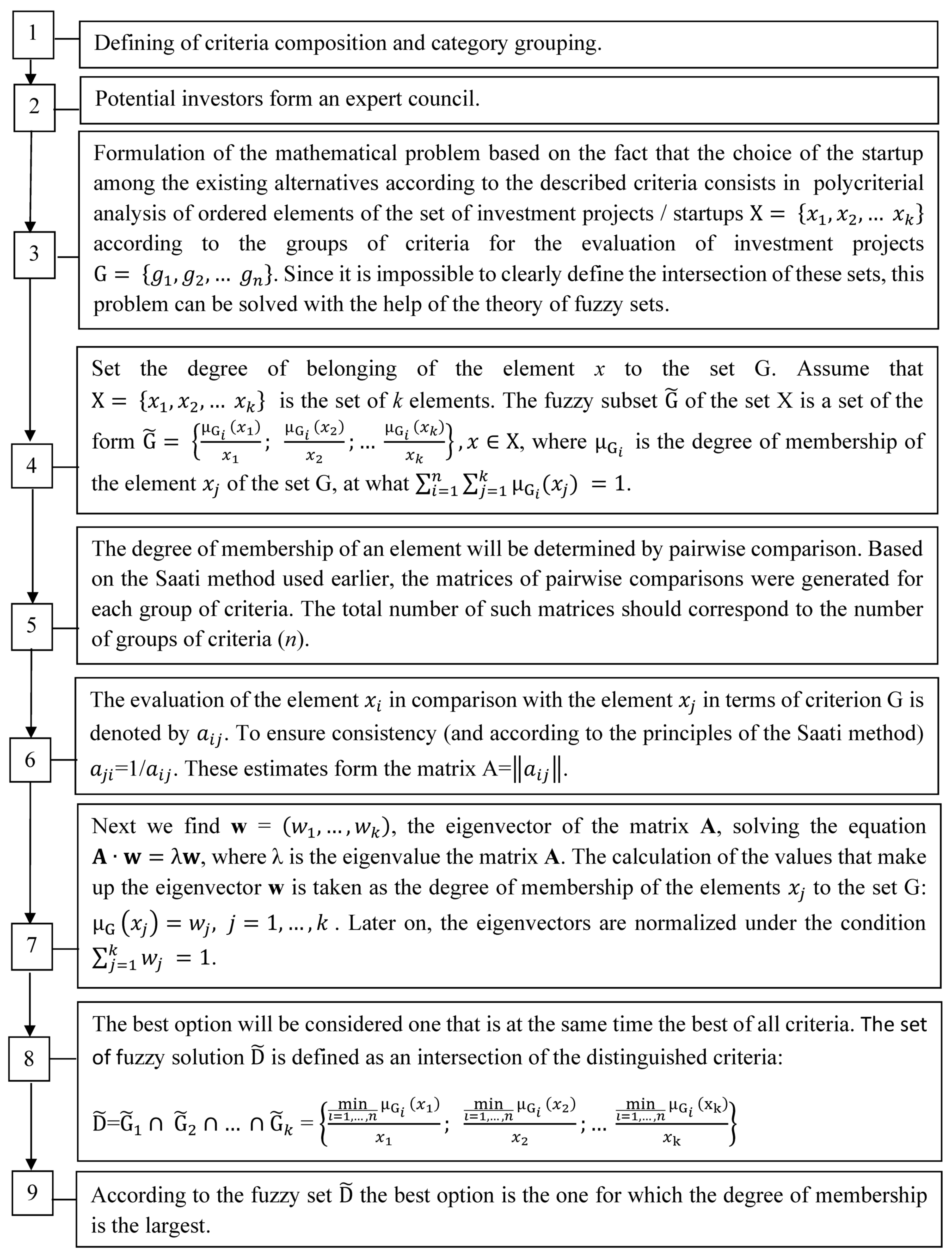
The mathematical apparatus for selecting optimal investment alternative based on the fuzzy set method can be presented in the form of the diagram shown in Figure 1.

3. Implementation of the Fuzzy Set Method

Relative importance coefficients necessary for decision making under uncertainty are determined based on the paired comparison procedure. Due to estimations of expert council of potential investors, the pairwise comparisons of investment alternatives have been made in each group of criteria (Kyrylych & Povstenko, 2023). Table 1 shows such comparison for the first group of criteria “Financial strength”.
For the matrix in Table 1, we calculate the eigenvectors A · w = λ w :
det 1 λ 1 / 3 1 3 1 λ 2 1 1 / 2 1 λ = λ 3 + 3 λ 2 + 1 / 6 = 0 ,
thus obtaining λ 1 = 0.01 + 0.23 i , λ 2 = 0.01 0.23 i , λ 3 = 3.02 , and choose the maximum value λ max = 3.02 .
Next, substituting the value λ max into the main diagonal of the matrix we obtain a system of linear equations
2.02 1 / 3 1 3 2.02 2 1 1 / 2 2.02 w 1 w 2 w 3 = 0 ,
under the constraint that (Borisov et al., 1990)
w 1 + w 2 + w 3 = 1 .
The solution has the form:
w 1 = 0.21 , w 2 = 0.55 , w 3 = 0.24 .
Similar calculations have been made for all other groups of criteria (see Appendix A). It should be emphasized that the inequality λ max k is always satisfied. The deviation of λ max from k ( λ max k ) can serve as a measure of coherence between judgments of experts. The closer the λ max to k, the judgments of experts are more agreed. To check consistency of expert judgments, the consistency ratio (CR)p was introduced (Saaty, 1980; Saaty & Vargas, 2012). This ratio is defined as the ratio (CI)p/(RI)p, where the consistency index (CI)p of matrices of alternatives is calculated as
( CI ) p = λ max ( p ) k k 1 , p = 1 , 2 , . . . , n ,
and (RI)p is the random consistency index. According to (Saaty, 1980; Saaty & Vargas, 2012), (RI)p = 0.52 for k = 3 . The consistency ratio should not exceed 0.1; when it is more than 0.2, the opinions of experts should be reviewed and, if necessary, experts should be changed.
The obtained results are summarized in Table 2.
In Table 3, we present the eigenvectors of all twelve matrices of pairwise comparisons for three investment alternatives.
In each column, the minimum value is choosen: 0.16; 0.14; 0.24. The best investment alternative (manufacture of rotor-reactive turbo-rotational heaters of liquids) corresponds to the maximum value of these options: 0.24. On the second place is the first alternative (production of LED traffic lights), and on the third place is the second alternative (manufacture of information–reference electronic terminals). These calculations were carried out under assumption that all groups of criteria have the same weight.
In the previous paper (Kyrylych & Povstenko, 2023), we have calculated the weights of groups of criteria (normalized vectors of geometric means) according to the formula
μ i = j = 1 n b i j n i = 1 n j = 1 n b i j n , i = 1 , 2 , . . . , n ,
where b i j are the elements of the matrix of pairwise comparisons for the complet of all groups of criteria, while
i = 1 n μ i = 1 .
If we assume that different groups of criteria have different weights, then the results given in Table 3 will be slightly changed taking into account the weight of each group of criteria. The weighted results are presented in Table 4.
In each column, the minimum value is choosen: 0.0077; 0.0076; 0.0106. The best investment alternative (manufacture of rotor-reactive turbo-rotational heaters of liquids) corresponds to the maximum value of these options: 0.0106. In the considered case, accounting for the weights of groups of criteria does not change the final choice.

4. Concluding Remarks

The fuzzy set method is a key tool for multi-criteria decision support under uncertainty based on the concept of fuzzy decision objectives. Its distinctive feature is its ability to model the vague, subjective, and qualitative assessments that dominate real-world economic and investment problems. Unlike classical decision-making methods, which assume precise input data and clearly defined preferences, the fuzzy set approach allows for the formal consideration of market uncertainty, forecast variability, and expert linguistic judgments. The selection of a compromise solution minimizes the risk of extremely unfavorable decision-making outcomes.
This approach is particularly important in investment analysis, where even a single, poorly fulfilled criterion can significantly reduce the attractiveness of the entire investment. This makes it an effective analytical tool in situations where financial data are incomplete and decisions must be made based on estimates, forecasts, and subjective preferences. Due to its flexibility, ability to model information ambiguity and emphasis on decision security, the fuzzy set method is widely used in the evaluation of investment alternatives, constituting a valuable complement to classical optimization methods.
The calculations made according to the fuzzy set method show that the best is the third investment project, on the second place—project number one, and on the third place—project number two. Comparing them with the results of (Kyrylych & Povstenko, 2023) obtained using the AHP Saaty method, it is easy to notice that in the AHP method we obtained a slightly different ranking: investment project 2, project 3 and project 1. The difference in the results obtained can be explained by the peculiarities of the methods used.
The fuzzy set method describes each group of criteria with a membership function, defining the degree to which a given alternative satisfies a given group of criteria. The summary decision is made by maximizing the minimum degree of satisfaction of all the groups of criteria. A significant advantage of this method is its good modeling of uncertainty and data fuzziness, and it is more dynamic and responsive to environmental changes. Each method excels at addressing a large number of specific criteria, confirming their reliability. The fuzzy set method seeks a “worst-case” compromise, while the AHP method aggregates weighted preferences. In a preference analysis conducted using the AHP method, a high-return alternative can be selected despite a high degree of risk, while the fuzzy set method is more likely to indicate a more stable but less profitable investment, thus protecting the investor from an extremely negative scenario. A distinctive feature of our method in practice is that it takes into account groups of criteria rather than only individual indicators, as is typically done in standard methods for evaluating investment alternatives.
The fuzzy approach is especially useful when data is imprecise, incomplete, or based on expert judgment. It effectively aggregates subjective opinions from multiple experts, making it suitable for complex investment decisions where quantitative data alone is insufficient providing a more holistic assessment. The method can be easily adjusted to different industries, project types, or strategic goals without requiring strict data conditions.

Author Contributions

Conceptualization, T.K. and Y.P.; methodology, T.K.; validation, Y.P.; formal analysis, T.K.; investigation, T.K. and Y.P.; writing—original draft preparation, T.K. and Y.P.; writing—review and editing, T.K. and Y.P.; supervision, Y.P. All authors have read and agreed to the published version of the manuscript.

Funding

This research received no external funding.

Institutional Review Board Statement

Not applicable.

Informed Consent Statement

Not applicable.

Data Availability Statement

Data are contained within the article.

Conflicts of Interest

The authors declare no conflicts of interest.

Nomenclature

The following notations are used in the paper:
A              the k × k matrix of pairwise comparisons for each group of criteria
a i j the element of the matrix A
B the n × n matrix of pairwise comparisons for the complet of all groups of criteria
b i j the element of the matrix B
D ˜ the set of fuzzy solutions
Gthe set of groups of criteria under which investment projects will be evaluated
G ˜ the fuzzy subset of the set X
g j the element of the set G
kthe number of projects
nthe number of groups of criteria
w the eigenvector of the matrix A
Xthe set of investment projects
x i the element of the set X
λ the eigenvalue of the matrix A
μ G x j the degree of the membership of the element x j to the set G
μ i the weight of each group of criteria

Appendix A

2. For the second group of criteria “Product/service potential”
A = 1 1 / 2 1 / 2 2 1 1 2 1 1
det 1 λ 1 / 2 1 / 2 2 1 λ 1 2 1 1 λ = λ 3 + 3 λ 2 = 0 ,
λ 1 = 0 , λ 2 = 0 , λ 3 = 3 with λ max = 3 .
Hence,
2 1 / 2 1 / 2 2 2 1 2 1 2 w 1 w 2 w 3 = 0 ,
and under the constraint (3)
w 1 = 0.2 , w 2 = 0.4 , w 3 = 0.4 .
3. For the group of criteria “Marketing capability”:
A = 1 1 / 2 1 / 2 2 1 1 2 1 1
det 1 λ 1 / 2 1 / 2 2 1 λ 1 2 1 1 λ = λ 3 + 3 λ 2 = 0 ,
λ 1 = 0 , λ 2 = 0 , λ 3 = 3 with λ max = 3 .
2 1 / 2 1 / 2 2 2 1 2 1 2 w 1 w 2 w 3 = 0 ,
and under the constraint (3)
w 1 = 0.2 , w 2 = 0.4 , w 3 = 0.4 .
4. For the group of criteria “Organization potential”:
A = 1 1 / 2 1 2 1 2 1 1 / 2 1
det 1 λ 1 / 2 1 2 1 λ 2 1 1 / 2 1 λ = λ 3 + 3 λ 2 = 0 ,
λ 1 = 0 , λ 2 = 0 , λ 3 = 3 with λ max = 3 .
2 1 / 2 1 2 2 2 1 1 / 2 2 w 1 w 2 w 3 = 0 ,
and under the constraint (3)
w 1 = 0.25 , w 2 = 0.5 , w 3 = 0.25 .
5. For the group of criteria “Scientific and technical possibility”:
A = 1 1 / 3 1 / 2 3 1 2 2 1 / 2 1
det 1 λ 1 / 3 1 / 2 3 1 λ 2 1 1 / 2 1 λ = λ 3 + 3 λ 2 + 1 / 12 = 0 ,
λ 1 = 0.005 + 0.166 i , λ 2 = 0.005 + 0.166 i , λ 3 = 3.01 with λ max = 3.01 .
2.01 1 / 3 1 / 2 3 2.01 2 1 1 / 2 2.01 w 1 w 2 w 3 = 0 ,
and under the constraint (3)
w 1 = 0.21 , w 2 = 0.55 , w 3 = 0.24 .
6. For the group of criteria “Staff competence”:
A = 1 1 / 2 1 / 2 2 1 1 / 2 2 2 1
det 1 λ 1 / 2 1 / 2 2 1 λ 1 / 2 2 2 1 λ = λ 3 + 3 λ 2 + 0.5 = 0 ,
λ 1 = 0.027 + 0.404 i , λ 2 = 0.027 + 0.404 i , λ 3 = 3.05 with λ max = 3.05 .
2.05 1 / 2 1 / 2 2 2.05 1 / 2 2 2 2.05 w 1 w 2 w 3 = 0 ,
and under the constraint (3)
w 1 = 0.20 , w 2 = 0.31 , w 3 = 0.49 .
7. For the group of criteria “Evaluation of the governmental, international, economic and political situation”:
A = 1 1 1 / 2 1 1 1 / 2 2 2 1
det 1 λ 1 1 / 2 1 1 λ 1 / 2 2 2 1 λ = λ 3 + 3 λ 2 = 0 ,
λ 1 = 0 , λ 2 = 0 , λ 3 = 3 with λ max = 3 .
2 1 1 / 2 1 2 1 / 2 2 2 2 w 1 w 2 w 3 = 0 ,
and under the constraint (3)
w 1 = 0.25 , w 2 = 0.25 , w 3 = 0.50 .
8. For the group of critera “Time potential”:
A = 1 3 3 1 / 3 1 1 / 2 1 / 3 2 1
det 1 λ 3 3 1 / 3 1 λ 1 / 2 1 / 3 2 1 λ = λ 3 + 3 λ 2 + 0.5 = 0 ,
λ 1 = 0.027 + 0.404 i , λ 2 = 0.027 + 0.404 i , λ 3 = 3.05 with λ max = 3.05 .
2.05 3 3 1 / 3 2.05 1 / 2 1 / 3 2 2.05 w 1 w 2 w 3 = 0 ,
and under the constraint (3)
w 1 = 0.59 , w 2 = 0.16 , w 3 = 0.25 .
9. For the group of criteria ”Autonomy”:
A = 1 1 / 2 1 / 3 2 1 1 / 2 3 2 1
det 1 λ 1 / 2 1 / 3 2 1 λ 1 / 2 3 2 1 λ = λ 3 + 3 λ 2 + 1 / 12 = 0 ,
λ 1 = 0.005 + 0.166 i , λ 2 = 0.005 + 0.166 i , λ 3 = 3.01 with λ max = 3.01 .
2.01 1 / 2 1 / 3 2 2.01 1 / 2 3 2 2.01 w 1 w 2 w 3 = 0 ,
and under the constraint (3)
w 1 = 0.16 , w 2 = 0.30 , w 3 = 0.54 .
10. For the group of criteria “Ecological strength”:
A = 1 1 / 2 1 2 1 2 1 1 / 2 1
det 1 λ 1 / 2 1 2 1 λ 2 1 1 / 2 1 λ = λ 3 + 3 λ 2 = 0 ,
λ 1 = 0 , λ 2 = 0 , λ 3 = 3 with λ max = 3 .
2 1 / 2 1 2 2 2 1 1 / 2 2 w 1 w 2 w 3 = 0 ,
and under the constraint (3)
w 1 = 0.25 , w 2 = 0.5 , w 3 = 0.25 .
11. For the group of criteria “Social potential”:
A = 1 1 1 1 1 1 1 1 1
det 1 λ 1 1 1 1 λ 1 1 1 1 λ = λ 3 + 3 λ 2 = 0 ,
λ 1 = 0 , λ 2 = 0 , λ 3 = 3 with λ max = 3 .
2 1 1 1 2 1 1 1 2 w 1 w 2 w 3 = 0 ,
and under the constraint (3)
w 1 = 1 / 3 , w 2 = 1 / 3 , w 3 = 1 / 3 .
12. For the group of criteria “Information capability”:
A = 1 3 1 / 2 1 / 3 1 1 / 2 2 3 1
det 1 λ 3 1 / 2 1 / 3 1 λ 1 / 3 2 3 1 λ = λ 3 + 3 λ 2 + 0.5 = 0 ,
λ 1 = 0.027 + 0.404 i , λ 2 = 0.027 + 0.404 i , λ 3 = 3.05 with λ max = 3.05 .
2.05 3 1 / 2 1 / 3 2.05 1 / 3 2 3 2.05 w 1 w 2 w 3 = 0 ,
and under the constraint (3)
w 1 = 0.33 , w 2 = 0.14 , w 3 = 0.53 .

References

  1. Akkaya, G., Turanoğlu, B., & Öztaş, S. (2015). An integrated fuzzy AHP and fuzzy MOORA approach to the problem of industrial engineering sector choosing. Expert Systems with Applications, 42, 9565–9573. [Google Scholar] [CrossRef]
  2. Aliev, R. A. (2018). Uncertain computation-based decision theory. World Scientific. [Google Scholar]
  3. Aliev, R. A., & Huseynov, O. H. (2014). Decision theory with imperfect information. World Scientific. [Google Scholar]
  4. Aliev, R. A., Pedrycz, W., Kreinovich, V., & Huseynov, O. H. (2016). The general theory of decisions. Information Sciences, 327, 125–148. [Google Scholar] [CrossRef]
  5. Anagnostopoulos, K. P., & Petalas, C. (2011). A fuzzy multicriteria benefit-cost approach for irrigation projects evaluation. Agricultural Water Management, 98, 1409–1416. [Google Scholar] [CrossRef]
  6. Ballı, S., & Korukoğlu, S. (2014). Development of a fuzzy decision support framework for complex multi-attribute decision problems: A case study for the selection of skilful basketball players. Expert Systems, 31, 56–69. [Google Scholar] [CrossRef]
  7. Belabbes, K., El Hachloufi, M., Guennoun, Z. E. A., & El Attar, A. (2025). Uncertain portfolio optimization problems: Systematic review. Statistics, Optimization & Information Computing, 13(3), 961–976. [Google Scholar] [CrossRef]
  8. Bellman, R., & Giertz, M. (1973). On the analytic formalism of the theory of fuzzy sets. Information Sciences, 5, 149–156. [Google Scholar] [CrossRef]
  9. Bellman, R. E., & Zadeh, L. A. (1970). Decision-making in a fuzzy environment. Management Science, 17, B141–B167. [Google Scholar] [CrossRef]
  10. Bellman, R. E., & Zadeh, L. A. (1977). Local and fuzzy logics. In J. M. Dunn, & G. Epstein (Eds.), Modern uses of multiple-valued logic (pp. 105–165). Reidel. [Google Scholar]
  11. Bhushan, N., & Rai, K. (2004). Strategic decision making: Applying the analytic hierarchy process. Springer. [Google Scholar]
  12. Bloom, N. (2009). The impact of uncertainty shocks. Econometrica, 77(3), 623–685. [Google Scholar] [CrossRef]
  13. Borisov, A. N., Krumberg, A. K., & Fedorov, I. P. (1990). Decision making based on fuzzy models. Examples of usage. Zinatne. (In Russian) [Google Scholar]
  14. Bozbura, F. T., & Beskese, A. (2007). Prioritization of organizational capital measurement indicators using fuzzy AHP. International Journal of Approximate Reasoning, 44, 124–147. [Google Scholar] [CrossRef]
  15. Büyüközkan, G., Çifçi, G., & Güleryüz, S. (2011). Strategic analysis of healthcare service quality using fuzzy ahp methodology. Expert Systems with Applications, 38, 9407–9424. [Google Scholar] [CrossRef]
  16. Cheng, C.-H., & Mon, D.-L. (1994). Evaluating weapon system by analytical hierarchy process based on fuzzy scales. Fuzzy Sets and Systems, 63, 1–10. [Google Scholar] [CrossRef]
  17. Derya, T., Kelce, M. G., & Atalay, K. D. (2025). Modeling portfolio selection under intuitionistic fuzzy environments. Mathematics, 13, 3303. [Google Scholar] [CrossRef]
  18. Dubois, D. (2011). The role of fuzzy sets in decision sciences: Old techniques and new directions. Fuzzy Sets and Systems, 184, 3–28. [Google Scholar] [CrossRef]
  19. Dymova, L., Kaczmarek, K., Sevastjanov, P., & Kulawik, J. (2021). A fuzzy multiple criteria decision making approach with a complete user friendly computer implementation. Entropy, 23, 203. [Google Scholar] [CrossRef]
  20. Ekel, P., Pedrycz, W., & Pereira, J., Jr. (2020). Multicriteria decision-making under conditions of uncertainty: A fuzzy set perspective. John Wiley & Sons. [Google Scholar]
  21. Ekel, P. Y., Menezes, M., & Schuffner Neto, F. H. (2007). Decision making in a fuzzy environment and its application to multicriteria power engineering problems. Nonlinear Analysis: Hybrid Systems, 1, 527–536. [Google Scholar] [CrossRef]
  22. Graham, J. R., & Harvey, C. R. (2001). The theory andpractice of corporate finance: Evidence from the field. Journal of Financial Economics, 60(2–3), 187–243. [Google Scholar] [CrossRef]
  23. Greblikaitė, J., & Daugėlienė, R. (2009). Cluster analysis of expression of entrepreneurship characteristics in the EU innovative projects for SME’s and KTU regional science park. European Integration Studies, 3, 184–189. [Google Scholar] [CrossRef]
  24. Innan, S., & Inuiguchi, M. (2024). Parameter-free interval priority weight estimation methods based on minimum conceivable ranges under a crisp pairwise comparison matrix. Journal of Advanced Computational Intelligence and Intelligent Informatics, 28(2), 333–351. [Google Scholar] [CrossRef]
  25. Innan, S., & Inuiguchi, M. (2025). Decision analysis using set of fuzzy priority weight vectors estimated from a fuzzy pairwise comparison matrix. Fuzzy Optimization and Decision Making, 24, 695–722. [Google Scholar] [CrossRef]
  26. Ishizaka, A., & Nguyen, N. H. (2013). Calibrated fuzzy AHP for current bank account selection. Expert Systems with Applications, 40, 3775–3783. [Google Scholar] [CrossRef]
  27. Kahraman, C., Suder, A., & Cebi, S. (2013). Fuzzy multi-criteria and multi-experts evaluation of government investments in higher education: The case of Turkey. Technological and Economic Development of Economy, 19, 549–569. [Google Scholar] [CrossRef][Green Version]
  28. Kaplan, S. N., & Strömberg, P. (2004). Characteristics, contracts, and actions: Evidence from venture capitalist analyses. The Journal of Finance, 59(5), 2177–2210. [Google Scholar] [CrossRef]
  29. Kitainik, L. (1993). Fuzzy decision procedures with binary relations: Towards a unified theory. Springer. [Google Scholar]
  30. Kubler, S., Derigent, W., Voisin, A., Robert, J., Le Traon, Y., & Herrera Viedma, E. (2018). Measuring inconsistency and deriving priorities from fuzzy pairwise comparison matrices using the knowledge-based consistency index. Knowledge-Based Systems, 162, 147–160. [Google Scholar] [CrossRef]
  31. Kubler, S., Robert, J., Derigent, W., Voisin, A., & Le Traon, Y. (2016). A state-of the-art survey & testbed of fuzzy AHP (FAHP) applications. Expert Systems with Applications, 65, 398–422. [Google Scholar] [CrossRef]
  32. Kyrylych, T., & Povstenko, Y. (2023). Multi-criteria analysis of startup investment alternatives using the hierarchy method. Entropy, 25, 723. [Google Scholar] [CrossRef]
  33. Liu, Y., Eckert, C. M., & Earl, C. (2020). A review of fuzzy AHP methods for decision-making with subjective judgements. Expert Systems with Applications, 161, 113738. [Google Scholar] [CrossRef]
  34. Mardani, A., Jusoh, A., & Zavadskas, E. K. (2015). Fuzzy multiple criteria decision-making techniques and applications—Two decades review from 1994 to 2014. Expert Systems with Applications, 42, 4126–4148. [Google Scholar] [CrossRef]
  35. Mikhailov, L., & Tsvetinov, P. (2004). Evaluation of services using a fuzzy analytic hierarchy process. Applied Soft Computing, 5, 23–33. [Google Scholar] [CrossRef]
  36. Mohseny-Tonekabony, N., Sadjadi, S. J., Mohammadi, E., Tamiz, M., & Jones, D. F. (2025). Robust, extended goal programming with uncertainty sets: An application to a multi-objective portfolio selection problem leveraging DEA. Annals of Operations Research, 346, 1497–1552. [Google Scholar] [CrossRef]
  37. Mugerman, Y., Sade, O., & Shayo, M. (2014). Long term savings decisions: Financial reform, peer effects andethnicity. Journal of Economic Behavior & Organization, 106, 235–253. [Google Scholar] [CrossRef]
  38. Nishad, A. K., & Singh, S. R. (2015). Goal programming for solving fractional programming problem in fuzzy environment. Applied Mathematics, 6, 2360–2374. [Google Scholar] [CrossRef]
  39. Paudel, G. P., Pahari, N. P., & Kumar, S. (2022). Application of fuzzy logic through Bellmen-Zadeh maximin method. Journal of Nepal Mathematical Society, 5, 41–47. [Google Scholar] [CrossRef]
  40. Ramík, J. (2021). Deriving priority vector from pairwise comparisons matrix with fuzzy elements. Fuzzy Sets and Systems, 422, 68–82. [Google Scholar] [CrossRef]
  41. Ramík, J. (2023). Deriving priority vector from pairwise comparisons matrix with fuzzy elements by solving optimization problem. OPSEARCH, 60, 1045–1062. [Google Scholar] [CrossRef]
  42. Saaty, T. L. (1972). An eigenvalue allocation model for prioritization and planning. University of Pennsylvania. [Google Scholar]
  43. Saaty, T. L. (1975). Hierarchies and priorities-eigenvalue analysis. University of Pennsylvania. [Google Scholar]
  44. Saaty, T. L. (1977). A scaling method for priorities in hierarchical structures. Journal of Mathematical Psychology, 15, 234–281. [Google Scholar] [CrossRef]
  45. Saaty, T. L. (1980). The analytical hierarchy process: Planning, priority setting, resource allocation. McGraw-Hill. [Google Scholar]
  46. Saaty, T. L. (1988). Multicriteria decision making: The analytical hierarchy process. RWS Publications. [Google Scholar]
  47. Saaty, T. L., & Vargas, L. G. (2012). Models, methods, concepts & applications of the analytic hierarchy process (2nd ed.). Springer. [Google Scholar]
  48. Siebert, J. (2019). Fuzzy eigenvector method for deriving normalized fuzzy priorities from fuzzy multiplicative pairwise comparison matrices. Fuzzy Optimization and Decision Making, 18, 175–197. [Google Scholar] [CrossRef]
  49. Smith, C., & Bayazit, O. (2024). Transitioning from an institutionally defined candidate search to the Analytic Hierarchy Process: Improving faculty selection. International Journal of the Analytic Hierarchy Process, 16(2), 1–19. [Google Scholar] [CrossRef]
  50. Șerban, F. (2025). Sustainable portfolio rebalancing under uncertainty: A multi-objective framework with interval analysis and behavioral strategies. Sustainability, 17, 5886. [Google Scholar] [CrossRef]
  51. Vaidya, O., & Kumar, S. (2006). Analytic hierarchy process: An overview of applications. European Journal of Operational Research, 169, 1–29. [Google Scholar] [CrossRef]
  52. Watada, J. (2001). Fuzzy portfolio model for decision making in investment. In Y. Yoshida (Ed.), Dynamical aspects in fuzzy decision making (pp. 141–162). Springer. [Google Scholar]
  53. Zadeh, L. A. (1965). Fuzzy sets. Information and Control, 8, 338–353. [Google Scholar] [CrossRef]
  54. Zadeh, L. A. (1975). The concept of a linguistic variable and its application to approximate reasoning—I. Information Sciences, 8, 199–249. [Google Scholar] [CrossRef]
Figure 1. The schematic representation of selecting optimal investment alternative.
Econometrics 14 00020 g001
Table 1. The matrix of pairwise comparisons for the group of criteria “Financial strength”.
The FirstThe SecondThe Third
StartupInvestmentInvestmentInvestment
AlternativeAlternativeAlternative
The first investment
alternative11/31
The second investment
alternative312
The third investment
alternative11/21
Table 2. Consistency indeces and consistency ratios of matrices of pairwise comparisons.
Group of Criteria(CI)(p)(CR)(p)
10.00910.0175
200
300
400
50.00460.0088
60.02680.0515
700
80.02680.0515
90.00460.0088
1000
1100
120.02680.0515
Table 3. Eigenvectors of matrices of pairwise comparisons.
Group of Criteria w 1 w 2 w 3
10.210.550.24
20.200.400.40
30.200.400.40
40.250.500.25
50.210.550.24
60.200.310.49
70.250.250.50
80.590.160.25
90.160.300.54
100.250.500.25
111/31/31/3
120.330.140.53
MIN0.160.140.24
Table 4. Weighted eigenvectors of matrices of pairwise comparisons.
Group of Criteria μ i Weighted w 1 Weighted w 2 Weighted w 3
10.18930.03980.10410.0454
20.08000.01600.03200.0320
30.09110.01820.03640.0364
40.04900.01220.02450.0122
50.10580.02220.05820.0254
60.12620.02560.03970.0628
70.06660.01670.01670.0333
80.09420.05560.01510.0236
90.04830.00770.01450.0261
100.04220.01060.02110.0106
110.05110.01700.01700.0170
120.05420.01790.00760.0287
MIN0.00770.00760.0106
Disclaimer/Publisher’s Note: The statements, opinions and data contained in all publications are solely those of the individual author(s) and contributor(s) and not of MDPI and/or the editor(s). MDPI and/or the editor(s) disclaim responsibility for any injury to people or property resulting from any ideas, methods, instructions or products referred to in the content.