Article

Navigating Extreme Market Fluctuations: Asset Allocation Strategies in Developed vs. Emerging Economies

by
Lumengo Bonga-Bonga
School of Economics, University of Johannesburg, Johannesburg 2006, South Africa
Econometrics 2026, 14(1), 16; https://doi.org/10.3390/econometrics14010016

Submission received: 22 October 2025 / Revised: 4 January 2026 / Accepted: 12 January 2026 / Published: 17 March 2026

Abstract

This paper examines how assets from emerging and developed stock markets can be efficiently allocated during periods of financial crisis by integrating traditional portfolio theory with Extreme Value Theory (EVT), using the Generalized Pareto Distribution (GPD) and Generalized Extreme Value (GEV) approaches to model tail risks. This study evaluates mean-variance portfolios constructed under each EVT framework and finds that portfolios based on GPD estimates consistently favour emerging market assets, which outperform both developed market and internationally diversified portfolios during extreme market conditions. In contrast, GEV-based portfolios indicate superior performance for developed market assets, highlighting the distinct behaviour of returns in the upper and lower tails of the distribution. These contrasting results reveal the unique nature of safe-haven characteristics associated with developed economies, the assets of which demonstrate greater stability and resilience during episodes of financial stress. By showing how tail-risk modelling alters optimal portfolio weights across market types, this paper contributes new evidence to the literature on crisis-informed asset allocation and offers practical insights for investors seeking robust diversification strategies under extreme market fluctuations.

1. Introduction

Periods of severe financial turbulence pose fundamental challenges for asset allocation, especially as global markets have become increasingly interconnected. Historical episodes—including the Asian Financial Crisis of 1997–1998, the dot-com collapse of 2001, the Global Financial Crisis of 2007–2009, and most recently the COVID-19 pandemic—demonstrate how crises propagate rapidly across borders and asset classes, eroding equity market value in both advanced and emerging economies (Corsetti et al., 1999; Junior & Franca, 2012; Cepoi, 2020). A recurring empirical observation is that correlations between international assets rise sharply during these episodes, undermining the effectiveness of traditional diversification strategies precisely when investors require protection the most (Longin & Solnik, 2001; Baur, 2012). These stylised facts have intensified the need for allocation frameworks that explicitly account for extreme market behaviour rather than relying solely on average conditions.
A substantial strand of research attempts to enrich the classical Markowitz mean-variance framework by incorporating higher moments of return distributions. Studies have introduced skewness (Briec et al., 2007), kurtosis (Naqvi et al., 2017), and related higher-moment metrics (Kshatriya & Prasanna, 2018), showing that fat-tailed and asymmetric return features materially affect optimal portfolio weights. While these models provide meaningful refinements, they remain limited in their ability to capture the most catastrophic tail events that dominate losses during crises. Higher-order polynomial approximations implicitly assume that extreme shocks are unusual deviations from the central distribution, which tends to underestimate both the probability and severity of tail outcomes. Recent market events have shown that such assumptions are often systematically violated.
For this reason, researchers have increasingly turned to Extreme Value Theory (EVT), a statistical framework designed to model the behaviour of the most extreme observations in a distribution. EVT has been applied to Value-at-Risk estimation (Lin & Ko, 2009), Conditional VaR optimization (Bedoui et al., 2023), and the measurement of systemic tail dependence (Mainik et al., 2015). However, these applications are typically narrow in scope, often embedded within hybrid econometric structures—such as GARCH-EVT or Copula-EVT frameworks—or focused on backtesting risk metrics rather than informing generalizable asset allocation rules. A notable gap in the literature is the absence of a portfolio optimization framework that integrates EVT directly into the mean-variance model in order to evaluate allocation strategies under conditions that resemble extreme market stress. Furthermore, little is known about how such an EVT-integrated approach performs across developed and emerging markets, which are known to exhibit markedly different tail behaviours, degrees of market resilience, and safe-haven properties (Bartram & Bodnar, 2012; Omoshoro-Jones & Bonga-Bonga, 2020; Min et al., 2016; Tachibana, 2022).
This paper seeks to fill these gaps by proposing an EVT–Mean-Variance Portfolio Allocation Method that systematically incorporates tail-risk modelling into portfolio selection. Rather than relying solely on historical crisis windows, the method uses EVT-fitted Generalized Pareto Distributions (GPDs) and Generalized Extreme Value (GEV) distributions to generate left-tail datasets that mimic crisis conditions. This integration provides a unified and tractable framework for evaluating portfolios when extreme losses dominate risk–return dynamics. Importantly, the framework is applied to both emerging and developed markets, enabling a direct comparison of their behaviour under simulated crisis conditions and shedding light on the long-standing debate regarding whether emerging markets offer higher risk-adjusted returns during stress periods or whether developed markets retain superior safe-haven characteristics.
The contributions of this study are threefold. First, it introduces a generalizable portfolio allocation framework that integrates EVT directly into mean-variance optimization, thereby capturing crisis-driven risk dynamics in a statistically rigorous manner. Second, it provides new comparative evidence on the performance of emerging versus developed market portfolios under extreme conditions, contributing to the international finance literature on diversification, resilience, and safe-haven behaviour. Third, it advances the methodological frontier by demonstrating how tail-based synthetic data can be used to systematically evaluate asset allocation strategies beyond historical crisis samples, offering investors and asset managers a robust tool for navigating extreme market fluctuations.
The rest of the paper proceeds as follows. Section 2 details the proposed EVT–mean-variance methodology. Section 3 presents the dataset and empirical findings. Section 4 concludes by discussing theoretical implications and practical guidance for portfolio management during periods of financial turmoil.

2. Methodology

In order to construct an efficient international portfolio by combining the mean-variance portfolio and EVT with stock market assets from developed and emerging economies, we use the following steps: first, we process each return series by applying an ARMA-GARCH model, which is designed to eliminate serial correlation, such as the following:
Y t = w + i = 1 p α i Y t i + ε t + j = 1 q β j ε t j     ε t ~ i . i . d ( 0 , 1 )
σ t 2 = w + i = 1 p a i ε t 1 2 + j = 1 q b j σ t 1 2 + i = 1 p γ ψ t i ε t 1 2
where Equation (1) is the mean equation expressed as an ARMA model and Equation (2) is the variance equation, expressed as a GJR-GARCH model. a ,   b ,   α , β   a n d   γ denote parameters,   γ shows the leverage effect in that if γ = 0 there is no evidence of asymmetric volatility. However, if γ 0 , there is asymmetry as γ < 0 negative shocks increase volatility if γ > 0 positive shocks increase volatility. ψ represents the parameter affected by these shocks.
Second, to fit the minimum extreme value, we utilize two methods: the Peak Over Threshold (POT) and the Block Maxima (Minima) Model (BMM). These approaches correspond to the General Pareto Distribution (GPD) and the Generalized Extreme Value (GEV) distribution, respectively. The mathematical expression for the GPD is as follows:
G   ξ , β = 1 1   +   ξ x β ,                               ξ 0 1 exp x β ,                             ξ = 0
where ξ is the shape parameter and β represents the scale parameter. When ξ < 0 , Equation (3) represents a pareto distribution of type 2. However, when ξ = 0 , the equation represents exponential distribution. The same equation represents a reparametrised type of pareto distribution when ξ > 0 . The general mathematical formula of GEV may be written as follows:
G   ξ   x = e x p ( ( 1 + ξ   x ) 1   ξ   ) ,                                     ξ 0                               exp e x ,                                               ξ = 0        
where ξ is the shape parameter. When ξ < 0 , Equation (4) represents the Weibull distribution. When ξ = 0 , the equation represents the Gumbel distribution and when ξ > 0 it represents the Frechet distribution. It is worth noting that ( 1 +   ξ   x ) , in Equation (4), is always positive.
Third, the fitted return series derived from these distributions are utilized to create various mean-variance portfolios. This process primarily aims at determining the weights of the optimal and tangent portfolios within the framework of mean-variance portfolio theory. It is crucial to understand that the optimal portfolio represents the most suitable portfolio for an individual investor, showing their risk tolerance and investment objectives. This portfolio is determined by identifying the point on the efficient frontier that offers either the highest expected return for a specified level of risk or the lowest risk for a predetermined level of expected return. In contrast, the tangent portfolio is acknowledged as the optimal combination of risky assets. This is because it yields the highest expected return for a specified level of risk among all the portfolios on the efficient frontier. The tangent portfolio is a theoretical construct in portfolio theory, employed to demonstrate market equilibrium (Tarrazo & Úbeda, 2012; Bonga-Bonga & Montshioa, 2024).
Last, we employed the Sharpe and Sortino ratios to evaluate the performance of each of the constructed portfolios. The superior model should produce higher Sharpe and/or Sortino ratios.

3. Data and Empirical Results

3.1. Data

The paper utilizes daily prices of key equity indices from five developed and five emerging markets. These include CAC 40 for France, S&P/TSX for Canada, the FTSE 100 for the United Kingdom, NIKKEI 225 for Japan, S&P500 for the United States, representing developed markets, and for emerging markets, the paper includes BOVESPA for Brazil, SHCOMP for China, S&P BSE SENSEX for India, IDX Composite for Indonesia and BIST 100 for Turkey. The analysis covers the period from August 1997 to August 2022. This timeframe was chosen due to the availability of consistent data, particularly at the beginning of the period. It encompasses various significant economic events, including the Dotcom crisis, Asian financial crisis, global financial crisis, and other notable financial and economic downturns.
Returns series are obtained as follows:
r t = P t / P t 1 100
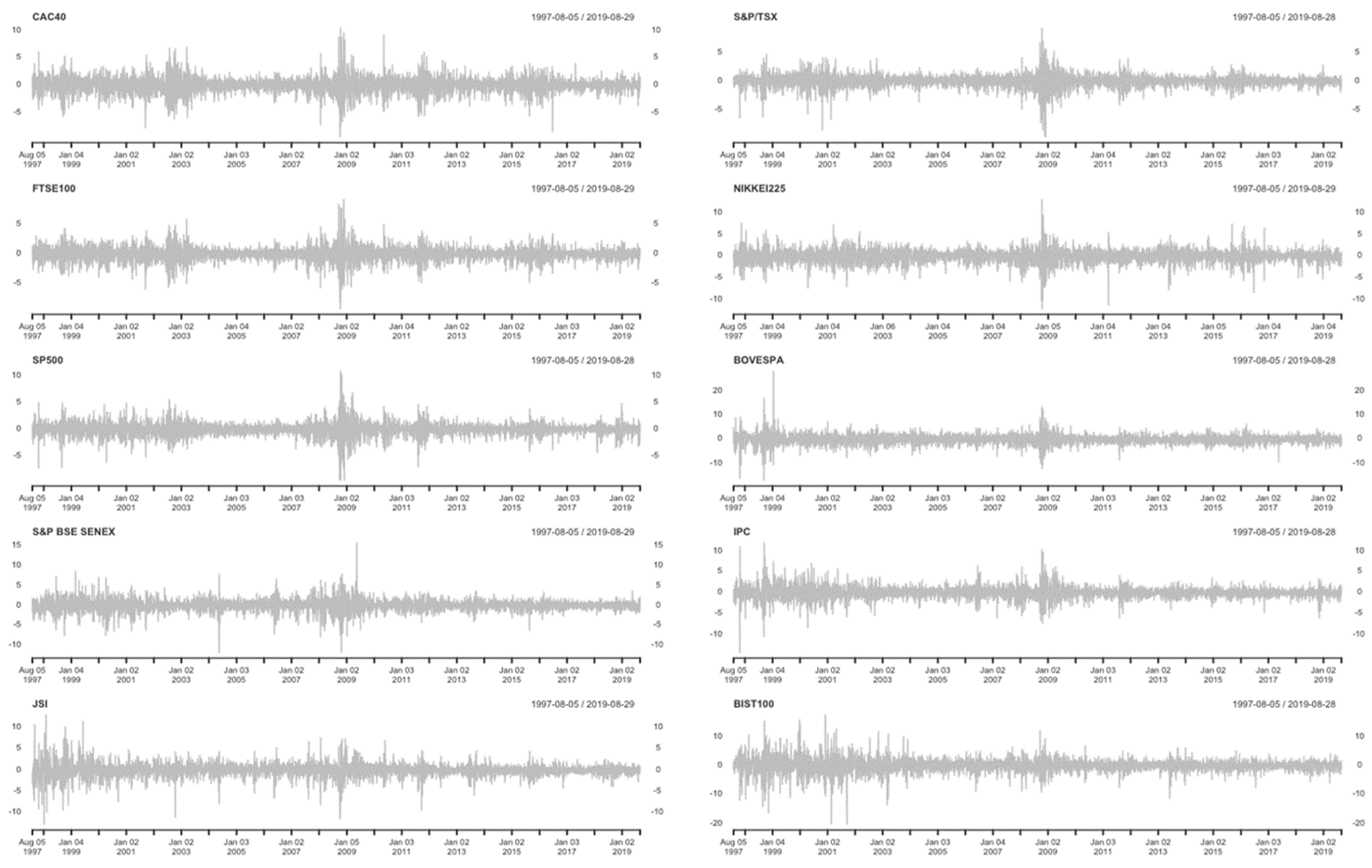
where r t is the rate of return, P are the closing prices. Descriptive statistics and the display of the equity returns series are reported in Table 1 and Figure 1, respectively.
Figure 1 displays the trend of equity return series for developed and emerging markets. From the figure, it can be deduced that all series depict volatility clustering and heteroscedasticity. Moreover, periods of crises are characterized by high volatility, translated by high spikes.
Table 1 presents the descriptive statistics for the returns of all the stock markets included in the study. The data in Table 1 reveal that all developed markets experienced a negative average return, each hovering close to zero. This indicates a general trend of minimal gains or slight losses in these markets over the study period. In contrast, among the emerging markets, only Brazil’s BOVESPA showed a negative mean return of −0.03. The remaining emerging markets recorded positive mean returns, with Turkey’s BIST 100 exhibiting the highest average return of 0.06, suggesting a more robust performance in these markets.
Furthermore, all markets displayed negative skewness, indicating a higher likelihood of witnessing negative returns rather than positive ones. This skewness suggests that investors in these markets may have experienced more frequent losses. Additionally, the kurtosis values for all markets exceeded 3, signifying the presence of leptokurtic distributions. Leptokurtic distributions are characterized by fatter tails and a higher peak compared to a normal distribution. This implies that during financial crises, these markets are prone to experiencing significant price drops, leading to extreme losses. Such behaviour underscores the higher risk associated with these markets, especially during periods of economic instability.
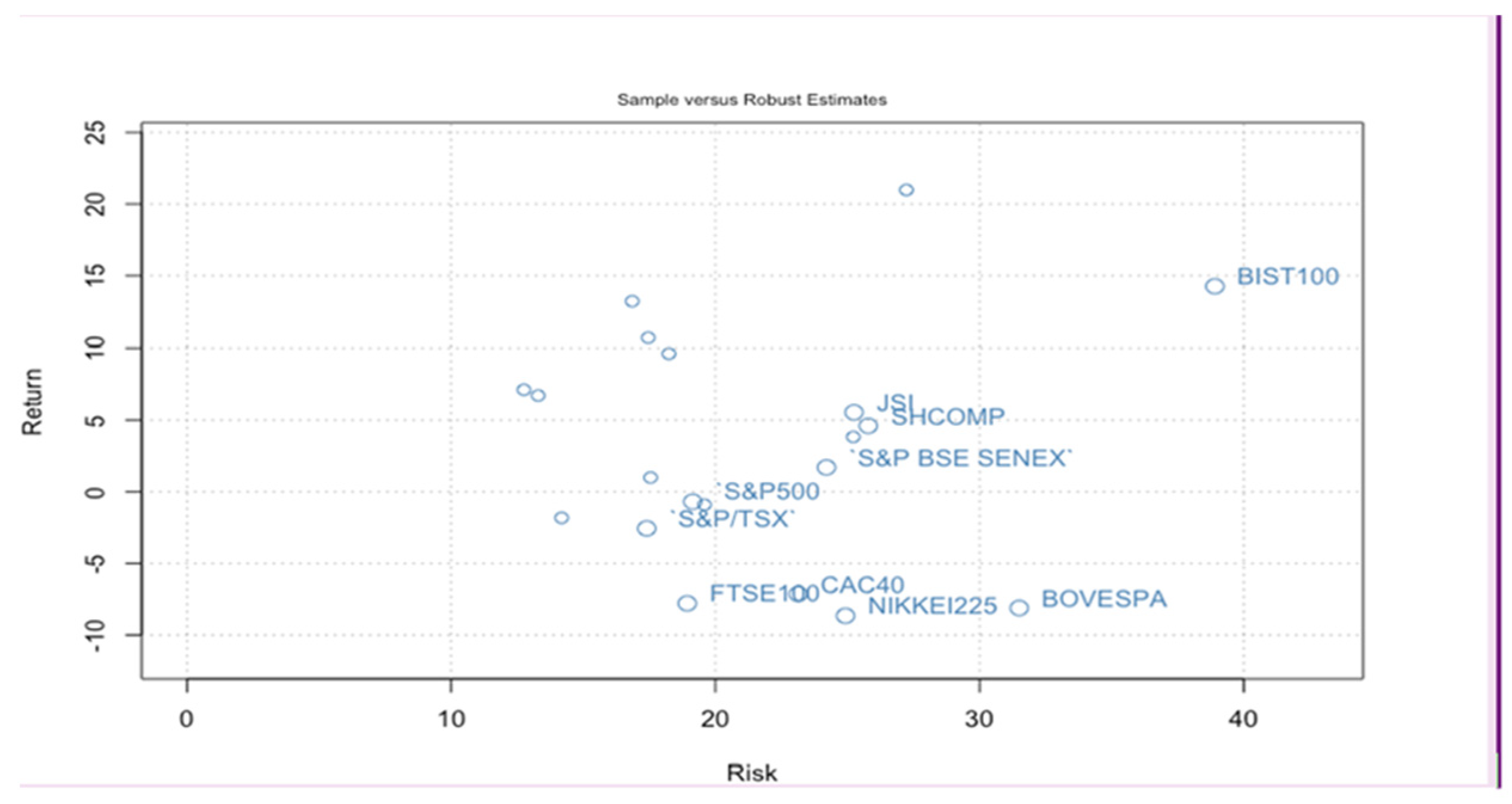
Figure 2 presents a risk–reward analysis of various emerging and developed stock markets. It reveals that Turkey’s BIST 100 index exhibits both the highest return and risk. The BOVESPA index, similar to the FTSE 100, CAC 40, and Nikkei 225, shows high risk but with negative returns. In contrast, the S&P/TSX and S&P 500 indices demonstrate moderate risk coupled with low returns. Meanwhile, the SHCOMP and JSE indices balance moderate risk with moderate returns. Generally, emerging market indices tend to be riskier but offer higher returns compared to their developed market counterparts. Furthermore, Figure 2 highlights that for a comparable level of risk, the South African stock market (JSI) yields a higher average return than the Japanese market (Nikkei 225), underscoring the potential for emerging market assets to surpass developed markets in balancing risk and return.
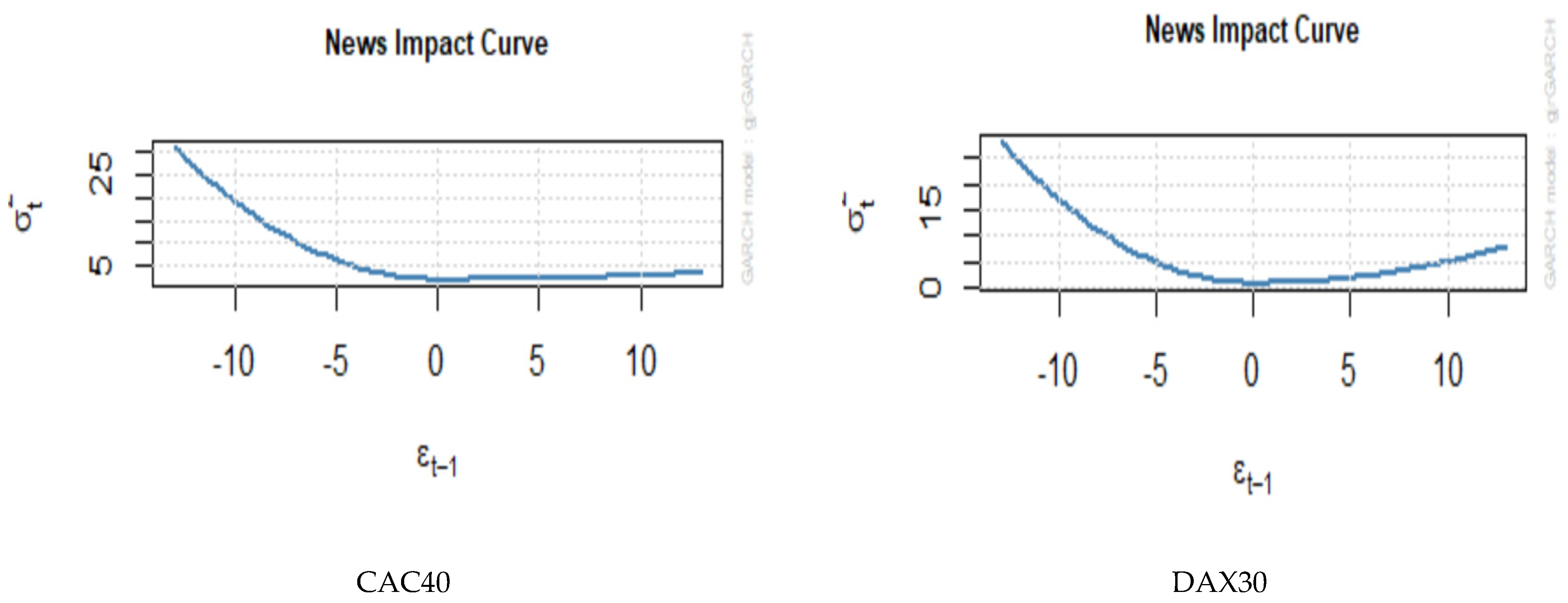
Regarding the steps for modelling the proposed EVT–Mean-Variance portfolio optimization approach, as detailed in Section 2, our empirical analysis begins by filtering the return series data using the ARMA(p,q)-GJR-GARCH (t,n) process. The orders of the mean and variance equations are determined based on the Akaike Information Criterion and vary for each specific stock market, as shown in Table A1 in the Appendix A. The choice of the asymmetric GARCH model for the variance equation is supported by the news impact curves obtained for all stock market series. For instance, Figure 3 illustrates the news impacts for the CAC 40 and DAX 30, demonstrating the asymmetric effects of volatility shocks and justifying the use of an asymmetric model.
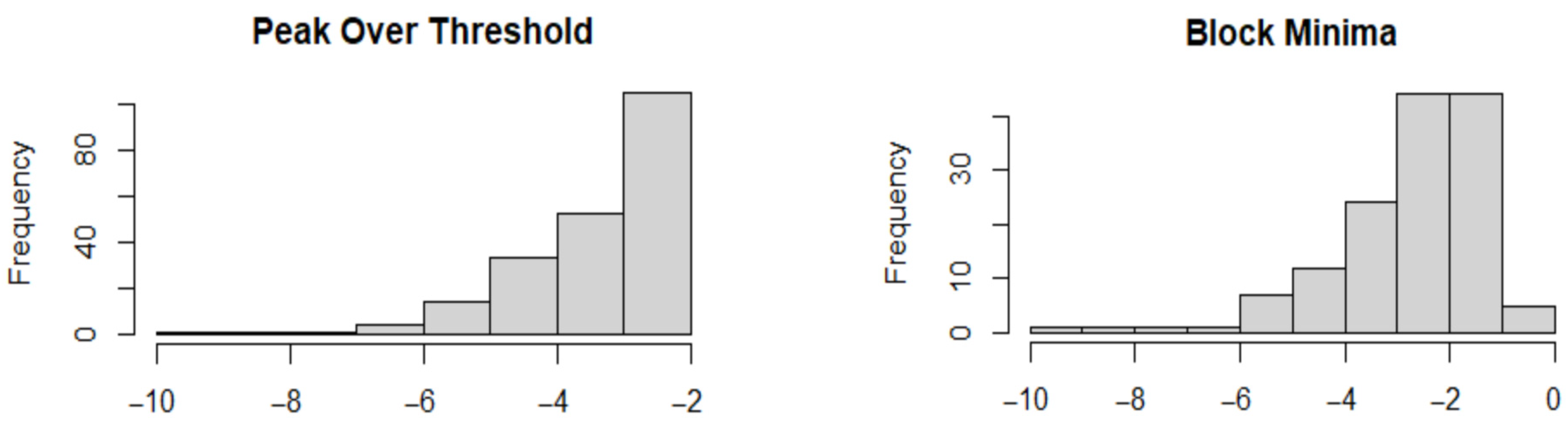
In the second step, we obtain the left tail of the distribution of the filtered returns from the POT and BMMs. For the POT method, we set the threshold by taking the 95th percentile of the filtered returns at the left tail (McNeil & Frey, 2000). Moreover, for the BMM method, following Gilli and Këllezi (2006), we set the block to 30 days and calculate the number of blocks needed to cover the entire dataset. We then extract the left tail of the distribution by computing the minimum value within each block. As a sample of the outcomes of this step, Figure 4 presents the histogram of the left tail returns of the CAC 401 obtained from the POT and BMM methods. The figure shows that the series comprises observations with lower returns, thus identifying the left tail of the distribution of the return series.
It is crucial to observe from Figure 4 that the frequencies of the Peaks Over Threshold (POT) distribution are notably higher than those of the Block Maxima method. This significant difference suggests that the Generalized Pareto Distribution (GPD), as applied in the POT approach, is particularly adept at capturing the magnitude and frequency of extreme deviations from the norm. The higher frequency in the POT distribution indicates its effectiveness in identifying and analyzing more extreme events that exceed a predefined threshold.
Conversely, the Block Maxima (Minima) approach, which encompasses all observations in identifying maxima/minima within designated blocks, seems especially beneficial when the focus is on understanding the overall behaviour of extremes. This method is inclusive of all extreme values within a block, providing a comprehensive view of the extremities, regardless of whether they surpass a specific threshold. This aspect makes the Block Maxima method valuable for analyzing the complete range of extreme behaviours in a dataset.
The choice between these two methods depends on the specific objectives of the analysis. If the interest lies in scrutinizing the most extreme deviations and their characteristics, the POT approach is more suitable. However, for a broader analysis that includes all extreme values within a dataset, the Block Maxima method is preferable.
This issue of selecting the appropriate method based on the research objectives and the nature of the data will be further discussed in the paper, highlighting the strengths and limitations of each approach in different contexts.
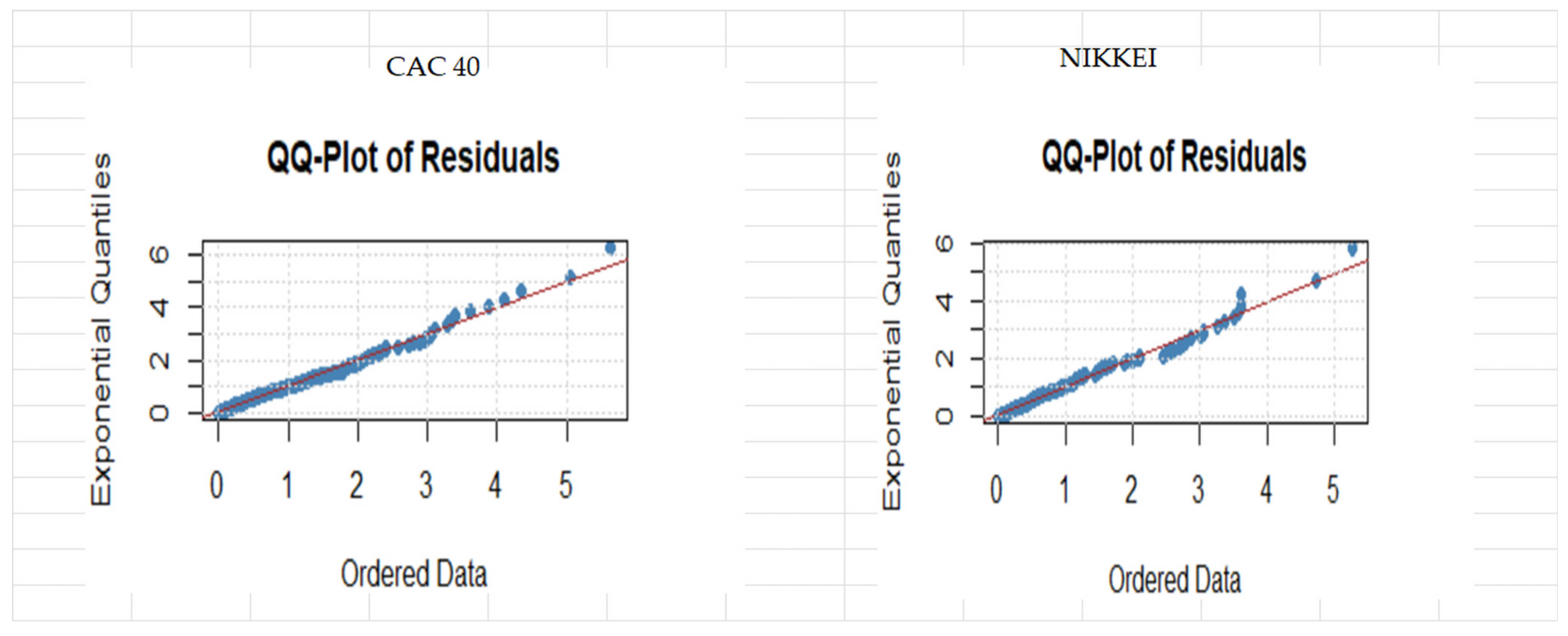
Thirdly, we applied the Generalized Pareto Distribution (GPD) and the Generalized Extreme Value (GEV) distributions to fit the left-tail returns obtained from the Peaks Over Threshold (POT) and Block Maxima Method (BMM), respectively. As an illustrative example, Figure 5 displays the Quantile–Quantile (QQ) plots for the residuals of the GPD model fits for the left tails of the CAC 40 and NIKKEI 225 series. These plots are particularly insightful as they demonstrate the GPD model’s accuracy in capturing extreme value behaviour in both series. This is evident from the alignment of the plotted points along a straight line in the QQ plots. Such an alignment suggests a good fit, indicating that the GPD model accurately represents the distribution of the extreme values in these series. Deviations from this straight line in the QQ plot would have been indicative of discrepancies between the observed and modelled quantiles, signalling a potential mismatch between the empirical data and the theoretical model.
The fitted returns series from these distributions are used for portfolio selection and construction.

3.2. Portfolio Selection and Construction

Having fitted the left-tail series from various Extreme Value Theory (EVT) distributions, these series are used for portfolio optimization based on mean-variance portfolio theory. Specifically, we will analyze the performance of the mean-variance–GPD portfolio, which incorporates series obtained from the POT method, and the mean-variance GEV portfolio, derived from series obtained using the BMM.
Our assessment will encompass three distinct types of investment portfolios: international portfolios, consisting of a blend of developed and emerging market assets, along with individual portfolios for developed and emerging economies. To evaluate the effectiveness of these portfolios, we will employ the Sharpe and Sortino ratios, fundamental metrics for gauging risk-adjusted returns. By employing these ratios, we aim to ascertain which portfolio exhibits superior performance amidst times of crisis among the international, developed, and emerging economies portfolios. This analysis will provide valuable insights into the comparative resilience and potential risk exposure of each portfolio type, aiding investors in making informed decisions during turbulent market conditions.

3.2.1. The Mean-Variance GPD Portfolio

Table 2 displays the outcomes from our mean-variance–GPD (Generalized Pareto Distribution) portfolio optimization analysis. This section of our study particularly concentrates on the allocation of weights in the tangent portfolio to various market indices and evaluates the performance through two primary indicators: the Sharpe and Sortino ratios. It is important to emphasize that the allocation decisions for the tangent portfolio are underpinned by its capability to provide the highest expected return for a given level of risk. Studies indicate that the tangent portfolio, with its optimal risk–return trade-off, is often favoured by investors who exhibit higher risk aversion (Bajeux-Besnainou et al., 2013; Mondello, 2023). This propensity for risk aversion tends to be more pronounced during periods of economic crisis, which is a central theme of this paper.
Table 2 reveals that in the case of the optimal portfolio, a significant portion, 66.3%, is allocated to developed market indices. Within this allocation, the S&P 500 and the FTSE 100 each receive substantial weights of 18.58% and 18.65%, respectively. This distribution reflects a preference for the stability and lower volatility often associated with developed market indices.
In contrast, the tangent portfolio, while still favouring developed markets, allocates a notable 44.94% to emerging markets. This allocation strategy indicates a more balanced approach, leveraging the potential higher returns from emerging markets while maintaining a substantial commitment to the more stable developed markets.
Notably, the tangent portfolio demonstrates a higher Sharpe ratio of 2.07773 compared to the optimal portfolio. The Sharpe ratio, a measure of risk-adjusted return, being higher for the tangent portfolio suggests that it offers a more favourable balance of return for each unit of risk taken. This is typically expected as the tangent portfolio is designed to lie on the efficient frontier, where the highest return per unit of risk is achieved.
The differences in portfolio composition and resulting Sharpe ratios underscore the distinct strategies and risk–return profiles of the optimal and tangent portfolios. The optimal portfolio tends to focus on minimizing risk for a given level of expected return, while the tangent portfolio aims to maximize returns for a given level of risk, as evidenced by its higher Sharpe ratio. This distinction is particularly relevant in the context of market turmoil, where the balance between risk and return becomes even more critical.
Table 3 presents the mean-variance portfolios based on the Generalized Pareto Distribution (GPD), exclusively consisting of indices from developed countries. The data in Table 3 indicates that the FTSE 100 and S&P 500 receive the most significant allocations among the various stock market assets. Additionally, the Sharpe Ratio and Sortino Ratio for this developed market portfolio stand at 2.288 and 2.3132, respectively, which are higher compared to those of the international portfolio.
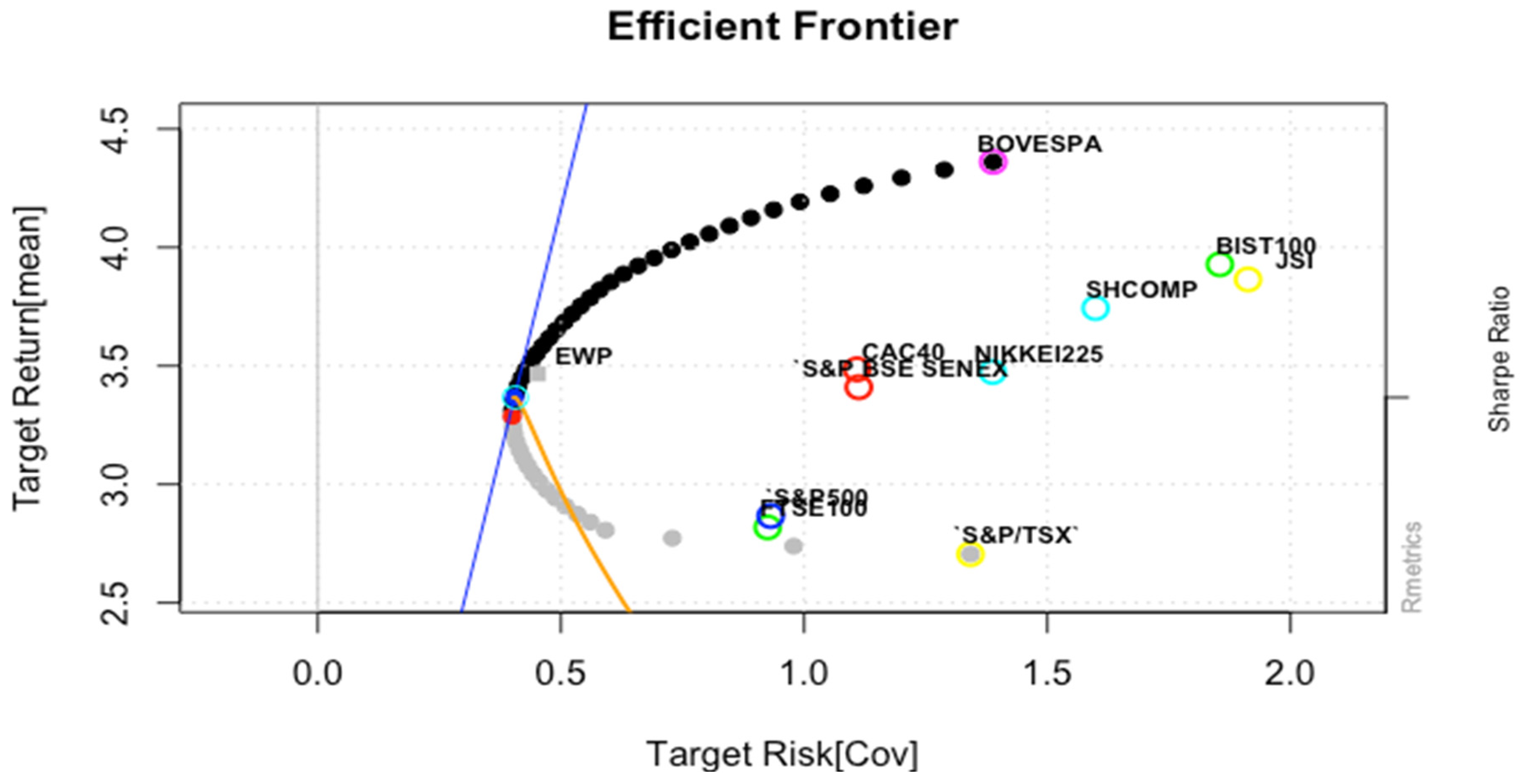
Figure 6 presents the efficient frontier for the Generalised Pareto Distribution portfolio. The figure shows that BOVESPA, representing the Brazilian stock market, lies on the efficient frontier relative to the other markets.
Table 4 presents the mean-variance GPD portfolios of emerging countries’ indices. In this portfolio, more weight is allocated to S$P BSE SENEX, with the lowest weight allocated to the JSE, the South African stock market. The Sharpe ratio for the optimal portfolio made of emerging market stocks is 2.336, which is higher than the Sharpe ratios of the international portfolio and developed market portfolio. However, the Sharpe ratio of the tangent portfolio for emerging markets is 2.294, which is lower than the Sharpe ratio of developed economies. The Sortino ratio confirms that the emerging market portfolio performs better than the developed market portfolio, both for efficient and tangent portfolios.
These findings indicate that for investors or asset managers with a high tolerance for risk, emerging market portfolios represent a more favourable investment option compared to international or developed market portfolios. This conclusion is drawn from the mean-variance GPD portfolio analysis. The superior investment potential of emerging market assets over international and developed market portfolios can be attributed to several factors. First, during crises, international portfolios might not offer better diversification opportunities due to the financial contagion observed between developed and emerging markets, as discussed in various studies (e.g., Boubaker et al., 2016; Baur, 2012). Second, despite their increased volatility, many emerging markets tend to decouple from developed economies during significant crises, as highlighted by Bonga-Bonga (2018). This decoupling suggests that emerging markets are often shielded from the adverse impacts of global crises, particularly those originating in developed economies. Consequently, they could present more advantageous investment opportunities during periods of crisis.

3.2.2. The Mean-Variance GEV Distribution Portfolio

Table 5 presents the composition of mean-variance portfolios under the GEV distribution for an international portfolio. The data in Table 5 reveal a higher allocation of weights to indices of developed markets relative to those of emerging markets within this portfolio. Furthermore, it is notable that the weights assigned to emerging markets in the GEV distribution scenario are lower than those in the GPD scenario. Additionally, when comparing the GEV and GPDs, the Sharpe ratios of both the optimal and tangent portfolios are lower in the case of the GEV distribution.
Table 6 and Table 7 detail the outcomes of the mean-variance portfolio analysis under the GEV distribution for developed and emerging economies, respectively. The results, particularly the Sharpe and Sortino ratios, clearly demonstrate that portfolios composed of assets from developed economies have superior performance compared to both international and emerging market portfolios. This finding is in stark contrast to the results observed under the GPD, where portfolios from emerging markets exhibited better performance than those from developed and international markets.
The empirical findings provide important insights into how emerging and developed markets behave under extreme conditions and, in doing so, directly address the central research question concerning the optimal allocation of assets during periods of severe financial stress. Contrary to conventional expectations, the international portfolio—dominated by developed market assets and often presumed to offer superior diversification—does not emerge as the best-performing strategy under extreme market fluctuations. This result challenges the long-standing view that combining developed and emerging market assets necessarily enhances portfolio efficiency; (Bartram & Bodnar, 2012). One plausible explanation is the heightened co-movement between markets during crises, a phenomenon widely documented in the contagion literature. When systemic shocks occur, correlations between developed and emerging markets tend to rise sharply (Longin & Solnik, 2001; Forbes & Rigobon, 2002), reducing the benefits of international diversification and causing mixed portfolios to inherit the vulnerabilities of both regions. The underperformance of the international portfolio in our results, therefore, reflects the empirical reality that diversification breaks down precisely when it is most needed.
A more striking result is the superior performance of portfolios composed exclusively of emerging market assets when the GPD-based EVT simulation (POT method) is applied. This finding speaks directly to the study’s aim of evaluating whether emerging markets can provide meaningful resilience under crisis conditions. The POT approach focuses only on returns exceeding a defined left-tail threshold, thereby isolating the most extreme losses. This threshold-based selection has practical implications: it mimics strategies such as stop-loss execution and tactical rebalancing, which help investors truncate tail losses and exploit occasional high-return rebounds that emerging markets may exhibit. Several studies note that emerging markets, despite being more volatile, periodically generate stronger upside corrections following deep drawdowns (Cevik et al., 2016; Mlachila & Sanya, 2016). Our results, therefore, suggest that when portfolio construction explicitly incorporates tail-risk mitigation mechanisms—as the POT approach does—emerging markets can outperform their developed counterparts by leveraging episodic but pronounced recovery bursts.
The contrasting outcome under the GEV-based simulation further deepens the understanding of asset behaviour across market types. Unlike the POT method, which concentrates on exceedances beyond a threshold, the GEV distribution models the minima extracted from broader blocks of observations. It, therefore, reflects the overall structure of extreme risk rather than isolated tail shocks. When this holistic modelling of extremes is applied, developed market portfolios outperform emerging markets. This is consistent with a broad empirical literature demonstrating that developed markets exhibit lower tail-risk severity due to stronger institutional quality, deeper market liquidity, and more credible macroeconomic stabilization mechanisms (Min et al., 2016; Tachibana, 2022; Gurdgiev & Petrovskiy, 2023). Emerging markets, by contrast, experience sharper crashes and more prolonged recoveries, driven by structural vulnerabilities, policy uncertainty, and susceptibility to external financial shocks (Roni et al., 2018; Bhowmik et al., 2022; Younis et al., 2023). As Mlachila and Sanya (2016) emphasize, these markets often lack robust shock-absorption mechanisms, leading to deeper left-tail losses that are fully captured by the GEV framework. The superior performance of developed markets under the GEV specification therefore reflects their comparatively milder extreme drawdowns and faster restoration of investor confidence during crises.
Taken together, these results directly answer the research question by revealing that the optimal asset allocation during crises critically depends on the type of extreme-value modelling employed. When the focus is on threshold-specific tail risk—which aligns with dynamic loss-limiting strategies—emerging markets may offer superior performance. However, when considering the general pattern of extreme losses across full blocks of time, developed markets provide stronger safe-haven characteristics. This duality underscores a key contribution of the study: different EVT approaches uncover fundamentally different risk–return profiles, and investors must therefore align their portfolio strategies with the specific nature of the extreme risks they seek to model.
In summary, the results demonstrate that emerging markets can outperform under selectively managed tail exposures (GPD/POT), whereas developed markets remain superior when the overall extreme risk landscape (GEV) is considered. This nuanced understanding advances the literature on crisis-period portfolio allocation and equips investors with clearer guidance on how EVT-based strategies can be tailored to different forms of extreme market behaviour.

4. Conclusions

This paper determines how assets from emerging and developed stock markets can be allocated efficiently during periods of financial crisis by integrating classical portfolio theory with Extreme Value Theory (EVT). To achieve this, the study proposes two complementary approaches, the mean-variance–GPD and mean-variance–GEV models, which incorporate tail-risk dynamics into portfolio construction. After filtering return series through an ARMA–GJR–GARCH process, extreme returns were modelled using the Peaks-over-Threshold method for the GPD and the Block Maxima (Minima) method for the GEV. Simulated return paths generated from these distributions were then used to construct portfolios, the performance of which was evaluated using Sharpe and Sortino ratios.
The empirical results demonstrate clear and meaningful differences between the two EVT frameworks. When extreme values were modelled through the GPD, portfolios composed exclusively of emerging market assets outperformed portfolios from developed markets and internationally diversified portfolios. This outcome reflects the ability of the POT method to isolate and manage threshold-specific tail risks, which may allow investors to benefit from the episodic but pronounced rebound behaviour often observed in emerging markets. In contrast, when the GEV-based approach was employed, developed market portfolios outperformed emerging market portfolios. This result stems from the GEV distribution’s wider focus on the overall extremal landscape rather than threshold exceedances alone, capturing the relatively milder and more stable extremal behaviour characteristic of developed markets. Taken together, these findings demonstrate that the optimal portfolio choice during crises is not universal but depends on the type of extreme risk investors seek to model.
This study offers important implications for both theory and practice. It shows that an EVT-integrated approach enables investors to design crisis-period portfolios that are better aligned with their specific risk-management objectives. Investors concerned with managing severe threshold-based tail events may find emerging market portfolios constructed under the GPD framework more attractive, while those seeking broader protection against fluctuations in the entire extreme range may prefer developed market portfolios derived from the GEV specification. More broadly, the findings reinforce the understanding that emerging markets remain particularly prone to deep tail losses and prolonged recovery periods, whereas developed markets display more moderate extremal behaviour that can support safer portfolio allocation during systemic stress.
Despite these contributions, this study has limitations that suggest avenues for further work. Future research could extend this framework by incorporating other asset classes, such as bonds, commodities, or volatility indices, to obtain a more holistic picture of safe-haven dynamics during crises.
Overall, the study provides a robust and theoretically grounded framework for integrating EVT into portfolio selection and offers new insights into how emerging and developed markets behave under extreme stress. By clarifying how different EVT approaches yield different optimal portfolios, the analysis equips investors and asset managers with practical guidance for navigating turbulent market conditions.

Funding

This research received no external funding.

Institutional Review Board Statement

Not applicable. This paper made use of secondary data.

Informed Consent Statement

Not applicable.

Data Availability Statement

These data were derived from the following resources available in the public domain: https://finance.yahoo.com/.

Acknowledgments

AI was used for text editing. While an earlier version of this study appeared as a working paper, the current manuscript constitutes a comprehensive overhaul, incorporating substantial revisions and significant improvements. See Bonga-Bonga and Montshioa (2024).

Conflicts of Interest

The author declares no conflicts of interest.

Appendix A

Table A1. Arima-GJR-GARCH estimation.
CAC 40S&P/TSXFTSE 100NIKKIE 225S&P 500BOVESPASHCOMPS&P BSE SENEXJSIBIST 100
ar10.157
(17.23)
1.270
(6.04)
0.233
(13.56)
−0.773
(−3.55)
2.276
(101.9)
1.285
(13.41)
0.994
(405.3)
−0.544
(−3.91)
1.050
(1044)
1.349
(16.94)
ar21.012
(31.55)
−0.645
(−4.4)
−0.250
(−9.9)
−0.341
(−2.02)
−2.426
(−44.2)
−0.823
(−4.59)
−0.983
(12)
−0.216
(−3830)
−0.897
(−9.39)
ar30.275
(6.18)
-0.263
(5.40)
1.375
(21.41)
0.104
(265)
ar4−0.859
(−88.08)
-−0.947
(−201)
−0.279
(−9.182)
- 0.986
(−2046)
ar5 - - -
ma1 −1.242
(−5.58)
−0.226
(−710)
0.749
(3.44)
−2.316
(−605)
−1.28
(−13.15)
−0.983
(−837)
0.610
(4.64)
−0.986
(−2316)
−1.329
(−14.54)
−0.169
(−59.27)
ma2−1.039
(−33.73)
0.144
(1297)
0.593
(3.78)
0.250
(4754)
-2.487
(129)
0.799
(4.29)
0.867
(7.86)
ma3−0.886
(−8.01)
-−0.279
(−217)
-−1.401
(−423)
- −0.11
(−2815)
ma40.886
(−538.5)
-0.942
(9623)
-0.245
(22.02)
- 0.502
(2014)
ma5 - -0.041
(3.72)
-

Note

1
Other figures can be obtained on request.

References

  1. Bajeux-Besnainou, I., Portait, R., & Tergny, G. (2013). Optimal portfolio allocations with tracking error volatility and stochastic hedging constraints. Quantitative Finance, 13(10), 1599–1612. [Google Scholar] [CrossRef]
  2. Bartram, S. M., & Bodnar, G. M. (2012). Crossing the lines: The conditional relation between exchange rate exposure and stock returns in emerging and developed markets. Journal of International Money and Finance, 31(4), 766–792. [Google Scholar] [CrossRef]
  3. Baur, D. G. (2012). Financial contagion and the real economy. Journal of Banking & Finance, 36(10), 2680–2692. [Google Scholar] [CrossRef]
  4. Bedoui, R., Benkraiem, R., Guesmi, K., & Kedidi, I. (2023). Portfolio optimization through hybrid deep learning and genetic algorithms vine Copula-GARCH-EVT-CVaR model. Technological Forecasting and Social Change, 197, 122887. [Google Scholar] [CrossRef]
  5. Bhowmik, R., Debnath, G. C., Debnath, N. C., & Wang, S. (2022). Emerging stock market reactions to shocks during various crisis periods. PLoS ONE, 17(9), e0272450. [Google Scholar] [CrossRef]
  6. Bonga-Bonga, L. (2018). Uncovering equity market contagion among BRICS countries: An application of the multivariate GARCH model. The Quarterly Review of Economics and Finance, 67, 36–44. [Google Scholar] [CrossRef]
  7. Bonga-Bonga, L., & Montshioa, K. (2024). Navigating extreme market fluctuations: Asset allocation strategies in developed vs. emerging economies (MPRA working paper no. 119910). University Library of Munich.
  8. Boubaker, S., Jouini, J., & Lahiani, A. (2016). Financial contagion between the US and selected developed and emerging countries: The case of the subprime crisis. The Quarterly Review of Economics and Finance, 61, 14–28. [Google Scholar] [CrossRef]
  9. Briec, W., Kerstens, K., & Jokung, O. (2007). Mean-variance-skewness Portfolio Performance gauging: A general shortage function and dual approach. Management Science, 53(1), 135–149. [Google Scholar] [CrossRef]
  10. Cepoi, C. O. (2020). Asymmetric dependence between stock market returns and news during COVID-19 financial turmoil. Finance Research Letters, 36, 101658. [Google Scholar] [CrossRef]
  11. Cevik, E. I., Kirci-Cevik, N., & Dibooglu, S. (2016). Global liquidity and financial stress: Evidence from major emerging economies. Emerging Markets Finance and Trade, 52(12), 2790–2807. [Google Scholar] [CrossRef]
  12. Corsetti, G., Pesenti, P., & Roubini, N. (1999). Paper tigers? A model of the Asian crisis. European Economic Review, 43(7), 1211–1236. [Google Scholar] [CrossRef]
  13. Forbes, K. J., & Rigobon, R. (2002). No contagion, only interdependence: Measuring stock market comovements. The Journal of Finance, 57(5), 2223–2261. [Google Scholar] [CrossRef]
  14. Gilli, M., & Këllezi, E. (2006). An application of extreme value theory for measuring financial risk. Computational Economics, 27(2), 207–228. [Google Scholar] [CrossRef]
  15. Gurdgiev, C., & Petrovskiy, A. (2023). Hedging and safe haven assets dynamics in developed and developing markets: Are different markets that much different? International Review of Financial Analysis, 92, 103059. [Google Scholar] [CrossRef]
  16. Junior, L. S., & Franca, I. D. P. (2012). Correlation of financial markets in times of crisis. Physica: A Statistical Mechanics and its Applications, 391(1–2), 187–208. [Google Scholar]
  17. Kshatriya, S., & Prasanna, P. K. (2018). Genetic algorithm-based portfolio optimization with higher moments in global stock markets. Journal of Risk, 20(4), 1–26. [Google Scholar] [CrossRef]
  18. Lin, P. C., & Ko, P. C. (2009). Portfolio value-at-risk forecasting with GA-based extreme value theory. Expert Systems with Applications, 36(2), 2503–2512. [Google Scholar] [CrossRef]
  19. Longin, F., & Solnik, B. (2001). Extreme correlation of international equity markets. The Journal of Finance, 56(2), 649–676. [Google Scholar] [CrossRef]
  20. Mainik, G., Mitov, G., & Rüschendorf, L. (2015). Portfolio optimization for heavy-tailed assets: Extreme risk index vs. Markowitz. Journal of Empirical Finance, 32, 115–134. [Google Scholar] [CrossRef]
  21. McNeil, A., & Frey, R. (2000). Estimation of tail-related risk measures for heteroscedastic financial time series: An extreme value approach. Journal of Empirical Finance, 7(3–4), 271–300. [Google Scholar] [CrossRef]
  22. Min, H. G., McDonald, J. A., & Shin, S. O. (2016). What makes a safe haven? Equity and currency returns for six OECD countries during the financial crisis. Annals of Economics and Finance, 17(2), 365–402. [Google Scholar]
  23. Mlachila, M., & Sanya, S. (2016). Post-crisis bank behavior: Lessons from Mercosur. International Journal of Emerging Markets, 11(4), 584–606. [Google Scholar] [CrossRef]
  24. Mondello, E. (2023). Optimal portfolio. In Applied fundamentals in finance: Portfolio management and investments (pp. 145–185). Springer Fachmedien. [Google Scholar]
  25. Naqvi, B., Mirza, N., Naqvi, W. A., & Rizvi, S. K. A. (2017). Portfolio optimisation with higher moments of risk at the Pakistan Stock Exchange. Economic Research-Ekonomska Istraživanja, 30(1), 1594–1610. [Google Scholar] [CrossRef]
  26. Omoshoro-Jones, O. S., & Bonga-Bonga, L. (2020). The emergence of regional business cycle in Africa—A reality or myth? A Bayesian dynamic factor model analysis. The World Economy, 43(1), 239–273. [Google Scholar] [CrossRef]
  27. Roni, B., Abbas, G., & Wang, S. (2018). Return and volatility spillovers effects: Study of Asian emerging stock markets. Journal of Systems Science and Information, 6(2), 97–119. [Google Scholar] [CrossRef]
  28. Tachibana, M. (2022). Safe haven assets for international stock markets: A regime-switching factor copula approach. Research in International Business and Finance, 60, 101591. [Google Scholar] [CrossRef]
  29. Tarrazo, M., & Úbeda, R. (2012). Minimum-variance versus tangent portfolios—A note. Journal of Asset Management, 13, 186–195. [Google Scholar] [CrossRef]
  30. Younis, I., Yousaf, I., Shah, W. U., & Longsheng, C. (2023). Risk transmission between equity market of China and its trading partners: New evidence from various financial crises. International Journal of Emerging Markets, 20(3), 1063–1096. [Google Scholar] [CrossRef]
Figure 1. Equity return series.
Econometrics 14 00016 g001
Figure 2. Risk reward plot.
Econometrics 14 00016 g002
Figure 3. News impact curves.
Econometrics 14 00016 g003
Figure 4. Histogram of the left tail of CAC 40 obtained for POT and BMMs.
Econometrics 14 00016 g004
Figure 5. QQ plot of the residuals of selected stock returns.
Econometrics 14 00016 g005
Figure 6. Efficient Portfolio Frontier for Generalized Pareto Distribution.
Econometrics 14 00016 g006
Table 1. Descriptive Statistics.
Stock MarketMeanStandard DeviationSkewnessKurtosis
Developed Markets Indices
CAC 40−0.031.46−0.293.57
S&P/TSX−0.011.1−0.558.18
FTSE 100−0.031.19−0.424.89
NIKKEI 225−0.031.57−0.445.88
S&P 5000.001.21−0.535.4
Emerging Markets Indices
BOVESPA−0.031.98−0.655.79
SCHOMP0.021.62−0.295.08
S&P BSE SENSEX0.011.52−0.444.69
JSE0.021.59−0.257.83
BIST 1000.062.45−0.217.7
Table 2. The mean-variance GPD for the International Portfolio.
Generalized Pareto Distributions
PortfolioOptimal Portfolio WeightsTangent Portfolio Weights
Developed Markets
CAC 400.12330.1311
S&P/TSX0.08440.0676
FTSE 1000.18650.1585
NIKKEI 2250.08360.0879
S&P 5000.18580.1614
Emerging Markets
BOVESPA0.07830.1366
SHOMP0.05860.0745
S&P BSE SENEX0.11850.1243
JSE0.04020.0551
BIST 1000.04070.0589
Expected Return ( E [ R ] ) 3.28733.3670
Risk ( C V a R )−2.6836−2.7534
Sharpe Ratio2.02802.077
Sortino Ratio (MAR = 0)3.13303.209
Table 3. The mean-variance GPD for developed countries’ portfolio weights.
Mean-Variance GPD
PortfolioOptimal Portfolio WeightsTangent Portfolio Weights
Developed Markets
CAC 400.18730.2168
S&P/TSX0.13040.1165
FTSE 1000.27920.2596
NIKKEI 2250.12520.1433
S&P 5000.27790.2637
Expected Return ( E [ R ] ) 3.0243.056
Risk ( C V a R )−2.349−2.379
Sharpe Ratio2.2882.313
Sortino Ratio (MAR = 0)3.3633.400
Table 4. The mean-variance GPD of emerging countries’ portfolio weights.
Mean-Variance
PortfolioOptimal Portfolio WeightsTangent Portfolio Weights
Emerging markets
BOVESPA0.22750.2626
SHCOMP0.16990.1670
S&P BSE SENEX0.35540.3166
JSE0.11860.1207
BIST 1000.12860.1332
Expected Return ( E [ R ] )3.80373.8393
Risk ( C V a R )−2.8993−2.9306
Sharpe Ratio2.33622.2942
Sortino Ratio (MAR = 0)3.52653.4633
Table 5. The mean variance GEV of international portfolio weights.
Stock Market IndexOptimal Portfolio WeightTangent Portfolio Weight
Developed Markets Indices
CAC 400.14490.1478
S&P/TSX0.1170.0919
FTSE 1000.18630.1566
NIKKEI 2250.10410.1191
S&P 5000.15080.1311
Emerging Markets Indices
BOVESPA0.06440.0907
S&P BSE SENEX0.07890.0789
IPC0.07290.0782
JSI0.05180.0581
BIST 1000.0290.0757
Expected Return (E[R])2.4492.5445
Risk (CVaR)−1.6088−1.6814
Sharpe Ratio1.58271.6447
Sortino Ratio (MAR = 0)2.39232.4855
Table 6. The mean-variance GEV of the developed market portfolio weights.
Mean Variance
PortfolioOptimal Portfolio WeightsTangent Portfolio Weights
Developed Markets Indices
CAC 400.2160.238
S&P/TSX0.1710.149
FTSE 1000.2810.256
NIKKEI 2250.1660.201
S&P 5000.1650.153
Expected Return ( E [ R ] ) 2.3272.3640
Risk ( C V a R )−1.2791−1.2946
Sharpe Ratio17591.787
Sortino Ratio (MAR = 0)2.5852.627
Table 7. Mean Variance GEV emerging markets portfolio weights.
PortfolioOptimal Portfolio WeightTangent Portfolio Weight
Emerging Markets Indices
BOVESPA0.2140.2551
S&P BSE SENEX0.26390.2219
IPC0.23590.2144
JSI0.18770.1737
BIST 1000.09840.1349
Expected Return (E[R])2.9213.014
Risk (CVaR)−1.6059−1.659
Sharpe Ratio1.83861.8919
Sortino Ratio (MAR = 0)2.77752.8577
Disclaimer/Publisher’s Note: The statements, opinions and data contained in all publications are solely those of the individual author(s) and contributor(s) and not of MDPI and/or the editor(s). MDPI and/or the editor(s) disclaim responsibility for any injury to people or property resulting from any ideas, methods, instructions or products referred to in the content.