Article

Research and Development of Intelligent Control Systems for High-Frequency Ozone Generators

by
Askar Abdykadyrov
1,2,
Dina Ermanova
1,2,
Maxat Mamadiyarov
1,*,
Seidulla Abdullayev
3,
Nurzhigit Smailov
1,2,* and
Nurlan Kystaubayev
1
1
Department of Electronics, Telecommunications and Space Technologies, Satbayev University, Almaty 050013, Kazakhstan
2
Institute of Mechanics and Machine Science Named by Academician U.A. Dzholdasbekov, Almaty 050010, Kazakhstan
3
School of Transport Engineering and Logistics Named After M. Tynyshpayev, Satbayev University, Almaty 050013, Kazakhstan
*
Authors to whom correspondence should be addressed.
J. Sens. Actuator Netw. 2026, 15(2), 26; https://doi.org/10.3390/jsan15020026
Submission received: 19 January 2026 / Revised: 16 February 2026 / Accepted: 24 February 2026 / Published: 3 March 2026
(This article belongs to the Section Big Data, Computing and Artificial Intelligence)

Abstract

This paper presents the development and investigation of an intelligent control system for a high-frequency ozone generator integrated into an IoT-based and telecommunication environment. A cyber-physical nonlinear mathematical model combining the electrical, thermal, gas-dynamic, and chemical subsystems of the ozone generation process is proposed. The model was implemented in discrete-time form and experimentally validated using the corona–discharge-based high-frequency ozonator ETRO-02. The deviation between simulation and experimental results did not exceed 5.3% for settling time, 6.7% for overshoot, 1.6% for steady-state ozone concentration, and 0.9% for gas temperature, confirming the adequacy of the proposed model. Based on this model, a hierarchical two-level intelligent control architecture is synthesized, consisting of a fast local control loop with a cycle time of 1–5 ms and a supervisory monitoring layer. The proposed adaptive state-feedback control law with online gain adjustment ensures stable real-time operation under nonlinear dynamics, ±20% parameter variations, network delays of 1–10 ms, and packet loss probabilities of up to 5%. As a result, the settling time is reduced from 420 ms to 160 ms, the overshoot from 12.5% to 3.1%, and the steady-state error from 6.5% to 1.6%, while the specific energy consumption decreases from 11.8 to 6.2 Wh/m3. The obtained results demonstrate that the integration of a cyber-physical model with a millisecond-level intelligent control system significantly improves the dynamic performance, robustness, and energy efficiency of high-frequency ozone generators compared to classical control and monitoring-oriented IoT systems. Unlike cloud-centric IoT monitoring architectures that operate at second-level update cycles, the proposed system closes the control loop locally at the millisecond scale, enabling stabilization of fast nonlinear electro-plasma dynamics. The results demonstrate that edge-intelligent adaptive control significantly enhances both dynamic performance and energy efficiency, confirming the feasibility of millisecond-level cyber-physical regulation for industrial ozone generation systems.

1. Introduction

The development of modern telecommunication infrastructures and cyber-physical systems is characterized by the rapidly increasing role of automated, remotely controlled, and network-integrated systems. In 2025, the number of IoT-connected devices worldwide is expected to reach 21.1 billion. By 2030, this figure is projected to increase to 39 billion, corresponding to a compound annual growth rate (CAGR) of 13.2%, which indicates a rapid annual growth in the number of connected devices [1,2].
Internet of Things (IoT) devices and sensors are widely used not only in the consumer sector but also in industrial applications, energy systems, water resource management, environmental monitoring, and telecommunication infrastructures. This, in turn, increases the demand for telecommunication-oriented intelligent systems for real-time data acquisition, processing, and control [3,4,5].
Moreover, the object of the present study—high-frequency ozone generators—is widely used today to improve water and air quality, to meet sanitary requirements, and to ensure safety standards [6,7]. The global ozone generator market size in 2025 is estimated to be approximately USD 1.5–1.8 billion, and it is projected to grow to USD 2.3–3.3 billion by 2030, corresponding to an approximate CAGR of 7–8% [8,9,10,11].
From an industrial perspective, high-frequency ozone generators are increasingly integrated into automated and remotely supervised systems, particularly in water treatment, air purification, and disinfection facilities. In such applications, continuous sensing of electrical parameters, gas flow, temperature, and ozone concentration is required, together with real-time adjustment of operating conditions. These requirements naturally motivate the adoption of IoT technologies, which enable distributed sensing, data aggregation, and supervisory control across heterogeneous communication infrastructures.
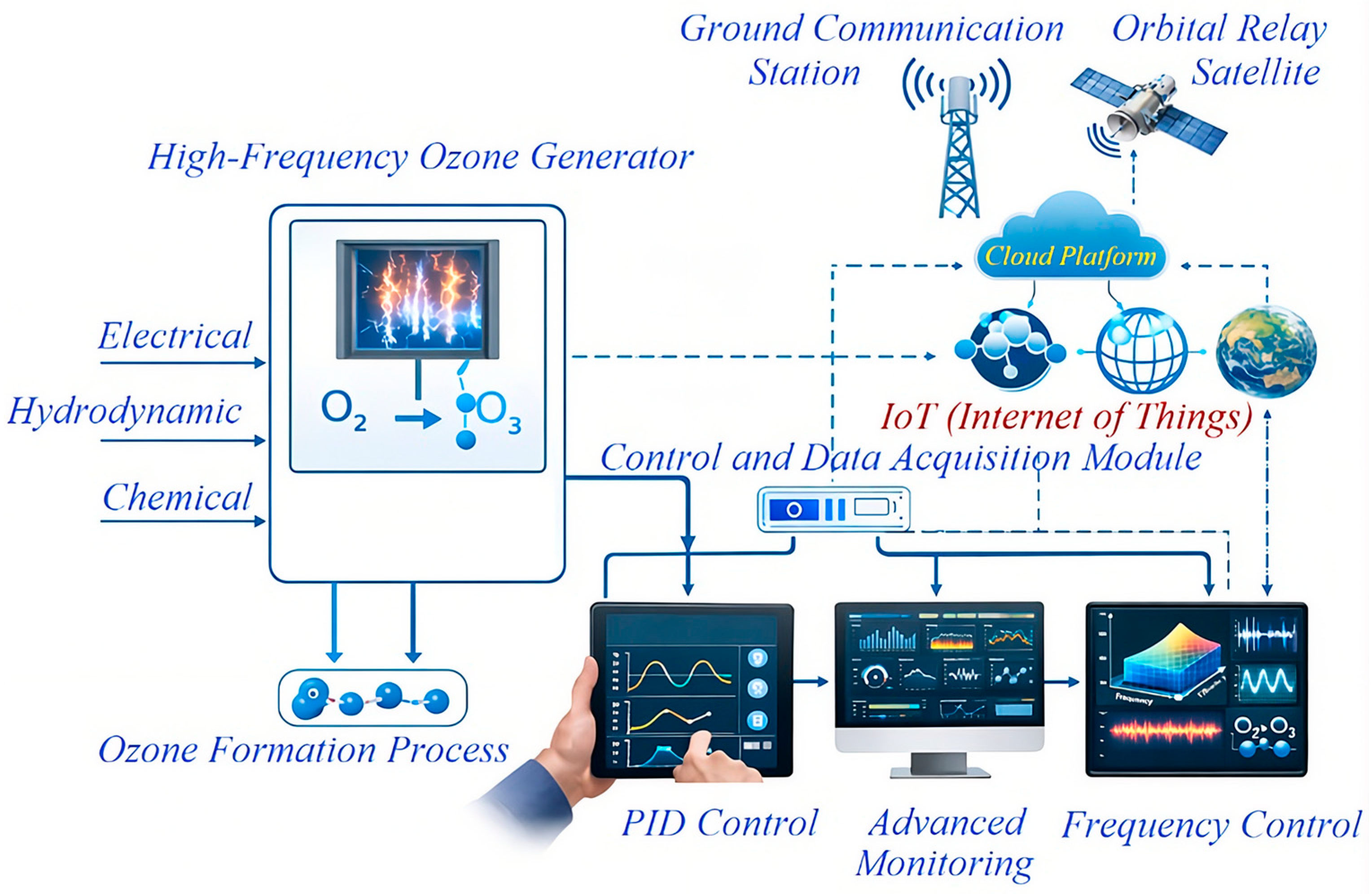
High-frequency ozone generators are electro-plasma dynamic systems whose stable and efficient operation depends on the complex interaction of electrical, hydrodynamic, and chemical parameters. To ensure stable and energy-efficient operation of such systems, telecommunication-based monitoring and control mechanisms are required, since classical control methods (e.g., proportional–integral–derivative (PID) control) provide only limited adaptability to load variations, environmental changes, and frequency fluctuations in complex dynamic systems [12,13,14,15]. Figure 1 presents the structural and functional diagram of an IoT- and cloud-based intelligent control system for a high-frequency ozone generator.
Figure 1 illustrates the architecture of an intelligent control and monitoring system for a high-frequency ozone generator based on IoT and cloud platforms. In this system, the ozone generation process is supervised by a central control module, while the data are transmitted to a cloud platform via terrestrial and satellite communication channels, enabling remote analysis and control.
IoT-integrated intelligent control systems provide real-time monitoring of technological processes, analysis of historical data, and high reliability and continuous operation through open and networked architectures. These requirements, in turn, impose additional demands on the telecommunication system itself, including increased data traffic, encryption, cybersecurity, and protocol integration issues, meaning that this research is not only an energy or environmental problem but also an important research direction in information and communication technologies [16,17,18].
The convergence of these two fields—the rapid development of IoT networks and the widespread application of ozone generators—forms a scientifically and practically significant problem. It requires the integration of high-frequency ozone generators into telecommunication infrastructure systems and the investigation of new architectures and algorithms for intelligent control. In this regard, the integration of high-frequency ozone generators with intelligent control systems is a highly relevant issue in the modern scientific and technological landscape, as it lies at the intersection of environmental, energy, automated control, and information and communication technologies [19,20]. Recent advances in distributed and event-triggered control further emphasize the importance of local adaptive regulation for fast cyber-physical systems operating under communication constraints.
Therefore, the integration of high-frequency ozone generators into intelligent control systems represents a relevant research topic with high scientific and practical significance.
Although IoT technologies provide efficient monitoring and supervisory control capabilities, most existing implementations are limited to data acquisition and cloud-based analytics. For fast nonlinear electro-plasma systems such as high-frequency ozone generators, such architectures are inherently insufficient, since communication latency and jitter prevent stable real-time closed-loop regulation. This fundamental mismatch between process dynamics and network delays defines a critical research challenge.
However, despite extensive research on ozone generation physics and IoT-based monitoring systems, the problem of nonlinear real-time control of high-frequency ozone generators remains insufficiently addressed. Fast electro-plasma processes impose millisecond-level control requirements that are fundamentally incompatible with cloud-centric IoT architectures due to network latency and jitter. Moreover, the strong nonlinear coupling between electrical excitation, thermal effects, and gas dynamics complicates the application of classical fixed-parameter control methods. These challenges define a clear research gap at the intersection of intelligent control, cyber-physical modeling, and industrial IoT for fast plasma-based systems.
Based on the identified research gap at the intersection of nonlinear plasma dynamics, adaptive control, and telecommunication-oriented cyber-physical architectures, it becomes necessary to formulate a clear research objective and corresponding tasks. The study is aimed at bridging the gap between monitoring-oriented IoT systems and real-time adaptive stabilization of fast electro-plasma processes.
The aim of the study is to develop an intelligent control system for a high-frequency ozone generator integrated into an IoT-based and telecommunication environment and to investigate its performance.
The objectives of the study are:
  • to develop a cyber-physical mathematical model of a high-frequency ozone generator;
  • to synthesize an intelligent control system based on this model and evaluate its performance.
The scientific novelty of the proposed approach lies in the integration of a control-oriented multiphysical nonlinear model with a millisecond-level adaptive state-feedback architecture within a telecommunication-aware IoT framework. Unlike existing studies that focus either on discharge physics modeling or on supervisory cloud-based monitoring systems, the present work introduces a hierarchical cyber-physical structure in which fast stabilization is performed locally at the edge level, while the networked layer is used exclusively for supervision and analytics.
The proposed model explicitly incorporates time-varying discharge impedance and nonlinear coupling between electrical, thermal, gas-dynamic, and chemical subsystems in a form suitable for real-time implementation. Furthermore, the adaptive control law with online gain update ensures robustness under significant parametric variations and network-induced disturbances, which are typically not addressed simultaneously in existing ozone generator studies.
The remainder of this paper is organized as follows. Section 2 provides a critical review of related work and formulates the control-oriented problem addressed in this study. Section 3 presents the nonlinear cyber-physical model of the high-frequency ozone generator and describes the proposed adaptive state-feedback control methodology. Section 4 reports the experimental validation results and evaluates the dynamic performance, robustness, and energy efficiency of the intelligent control architecture. Finally, Section 5 concludes the paper by summarizing the main findings, discussing the limitations of the study, and outlining directions for future research.

2. Literature Review and Problem Statement

High-frequency ozone generators operate as strongly nonlinear electro-plasma systems with tight coupling between electrical excitation, thermal effects, gas dynamics, and chemical kinetics. Although numerous studies have addressed individual physical aspects of ozone generation, the feasibility of real-time closed-loop control under dynamic operating conditions remains insufficiently investigated. In particular, the ability to stabilize ozone concentration in the presence of fast parameter variations and communication constraints represents a critical open problem. This section reviews existing approaches and formulates the control-oriented problem addressed in this study.
In recent years, the study of physical processes in plasma systems based on dielectric barrier discharge (DBD) for ozone generation has been widely addressed in many foreign studies. For example, Gao K. et al. [21] investigated the influence of gas temperature on the ozone formation process in atmospheric air DBD plasma and showed that an increase in temperature in the discharge region leads to a decrease in ozone concentration and represents one of the main factors limiting the generation efficiency. Meanwhile, Zhang Y. et al. [22] analyzed the electrical characteristics and electron energy transformation processes in pulsed dielectric barrier discharge using numerical methods and demonstrated that the discharge parameters have a direct effect on the ozone production rate. However, these studies do not address the development of intelligent or telecommunication-oriented control systems capable of adaptively controlling the ozone generation process in real time, and the control strategies are mainly limited to the selection of stationary operating regimes. Moreover, the presented models are primarily focused on steady-state analysis and parameter influence studies, and they do not provide a framework for synthesizing fast adaptive control laws capable of operating within millisecond-level control cycles. The results of these studies are summarized in Table 1.
As shown in Table 1, in atmospheric DBD systems an increase in gas temperature from 300 K to 420 K leads to an almost twofold decrease in ozone concentration and energy efficiency [21]. In contrast, in the pulsed DBD regime, variation in electrical discharge parameters and electron energy (2.5–6.8 eV) allows controlling the ozone production rate within a wide range of 10–22 g/m3 [22].
Mosstafavi M.H. et al. [23] addressed the problem of optimizing the energy consumption of ozone and plasma generators in water treatment systems. In such systems, the electrical power cannot be adequately described by the simple relation P = UI, but must be formulated taking into account the complex impedance of the discharge and the time-varying operating conditions:
P ( t ) = R { U ( t ) I * ( t ) } = U 2 ( t ) Z ( t ) c o s φ ( t )
The total energy consumption over the treatment period T is given by
E = 0 T U 2 ( t ) Z ( t ) c o s φ ( t ) d t ,       E s = 1 V 0 T U 2 ( t ) Z ( t ) c o s φ ( t ) d t
where Z(t) is the equivalent discharge impedance, φ(t) is the phase shift between voltage and current, and V is the volume of treated water. These expressions indicate that energy consumption depends nonlinearly on the voltage amplitude, frequency, and electrical properties of the discharge medium. Equations (1) and (2) indicate that the energy consumption of ozone generation depends nonlinearly on the electrical excitation and discharge impedance. This nonlinear dependence complicates the direct application of classical linear control strategies and motivates the use of adaptive and model-based control approaches capable of compensating for time-varying discharge characteristics. However, these expressions are used mainly for offline energy assessment and do not address the problem of real-time control under rapidly changing operating conditions.
Bagdollauly Y. et al. [12] proposed sensor-network-controlled high-frequency ozone generators and modeled the water treatment process, while Hammadi N. et al. [24] analyzed high-voltage, high-frequency power supplies for ozone generation. Although these studies demonstrate the importance of accurate control of electrical parameters to ensure efficient and stable operation, they do not fully address the deep integration of data processing and control with telecommunication infrastructures. The research results can be observed in Table 2.
The study by Bagdollauly et al. [12] operates in the range of 10–20 kV and 5–15 kHz with a power of 300–800 W, using 4–8 sensors and real-time data processing, which results in an energy consumption of 6–12 Wh/m3. In contrast, Hammadi N. et al. [24] focused on extending the electrical operating range (15–30 kV, 10–25 kHz, 500–1500 W) to achieve higher ozone concentrations (1.0–3.5 mg/L), but do not consider sensor-based monitoring, real-time data processing, or telecommunication integration. Nevertheless, the absence of a fast feedback control loop and telecommunication-aware control architecture limits the applicability of these approaches for dynamic stabilization of ozone generation processes.
Komarzyniec G.K. et al. [25] analyzed nonlinear phenomena in voltage and frequency converters supplying non-thermal plasma reactors and showed that such systems exhibit complex nonlinear dynamics. The interaction between the converter and the plasma load can be represented as a nonlinear forced oscillatory system with current-dependent parameters:
L d 2 i ( t ) d t 2 + R i t d i t d t + 1 C i t i t = d u ( t ) d t
where R(i) and C(i) are the effective resistance and capacitance dependent on the discharge current. The occurrence of resonant and unstable regimes can be interpreted through the frequency-domain characteristic:
L d 2 i ( t ) d t 2 + R i t d i t d t + 1 C i t i t = d u ( t ) d t
These results indicate that high-frequency ozone generators may exhibit strong nonlinear behavior and sensitivity to parameter variations, which complicates the application of classical fixed-parameter control strategies. However, the control approaches considered by the authors remain largely within the framework of classical control and do not sufficiently address the problem of ensuring system stability under rapid parameter variations using adaptive or intelligent methods.
Furthermore, recent studies on intelligent control, including robust, adaptive, and data-driven approaches, as well as cybersecurity-aware industrial IoT architectures [15,16], indicate a growing interest in integrating advanced control algorithms with secure real-time communication for high-dynamic industrial systems.
Bruggeman P. and Brandenburg R. [26], by providing a comprehensive analysis of the physical and chemical processes in filamentary discharges and microplasmas at atmospheric pressure, show that the spatio-temporal stability of the discharge strongly depends on the parameters of the gas medium, including temperature T, humidity H, and gas flow velocity vg. The authors emphasize that variations in these factors may lead to a restructuring of the discharge pattern and destabilization of operating regimes, which, in turn, justifies the necessity of upgrading control algorithms to adaptive and intelligent levels in practical applications. This dependence can be expressed in a generalized functional form as:
Y O 3 = f ( U , f , T , H , v g , p )
where YO3 is the ozone yield, U is the applied voltage amplitude, f is the excitation frequency, T is the gas temperature, H is the relative humidity, vg is the gas flow velocity, and p is the operating pressure in the discharge gap.
Salem R.M.M. et al. [27] proposed a cloud—based industrial IoT architecture for real—time monitoring and supervisory control of technological processes, demonstrating the effectiveness of collecting, transmitting, and processing sensor data on a cloud platform. Their system enables continuous observation, visualization, and high—level management of industrial facilities, significantly improving situational awareness and decision—making efficiency. However, the primary focus of this approach is on data acquisition, monitoring, and supervisory—level control, whereas the problem of closed—loop, real—time intelligent control of complex nonlinear processes—such as plasma-based or ozone generation systems—remains outside the main scope of their work and is not addressed in a comprehensive manner. In general, Table 3 presents a comparative characterization of monitoring-oriented and control-oriented IoT architectures using ozone generation systems as an example.
Table 3 shows that the control-loop cycle time of the proposed system is in the millisecond range and that the end-to-end latency is significantly lower compared to cloud-based IoT architectures. This, in turn, enables stable real-time control of nonlinear plasma and ozone generation processes and ensures fast rejection of external disturbances. This comparison clearly demonstrates that cloud-centric IoT architectures are fundamentally limited by communication latency and cannot guarantee stability for fast nonlinear electro-plasma processes.
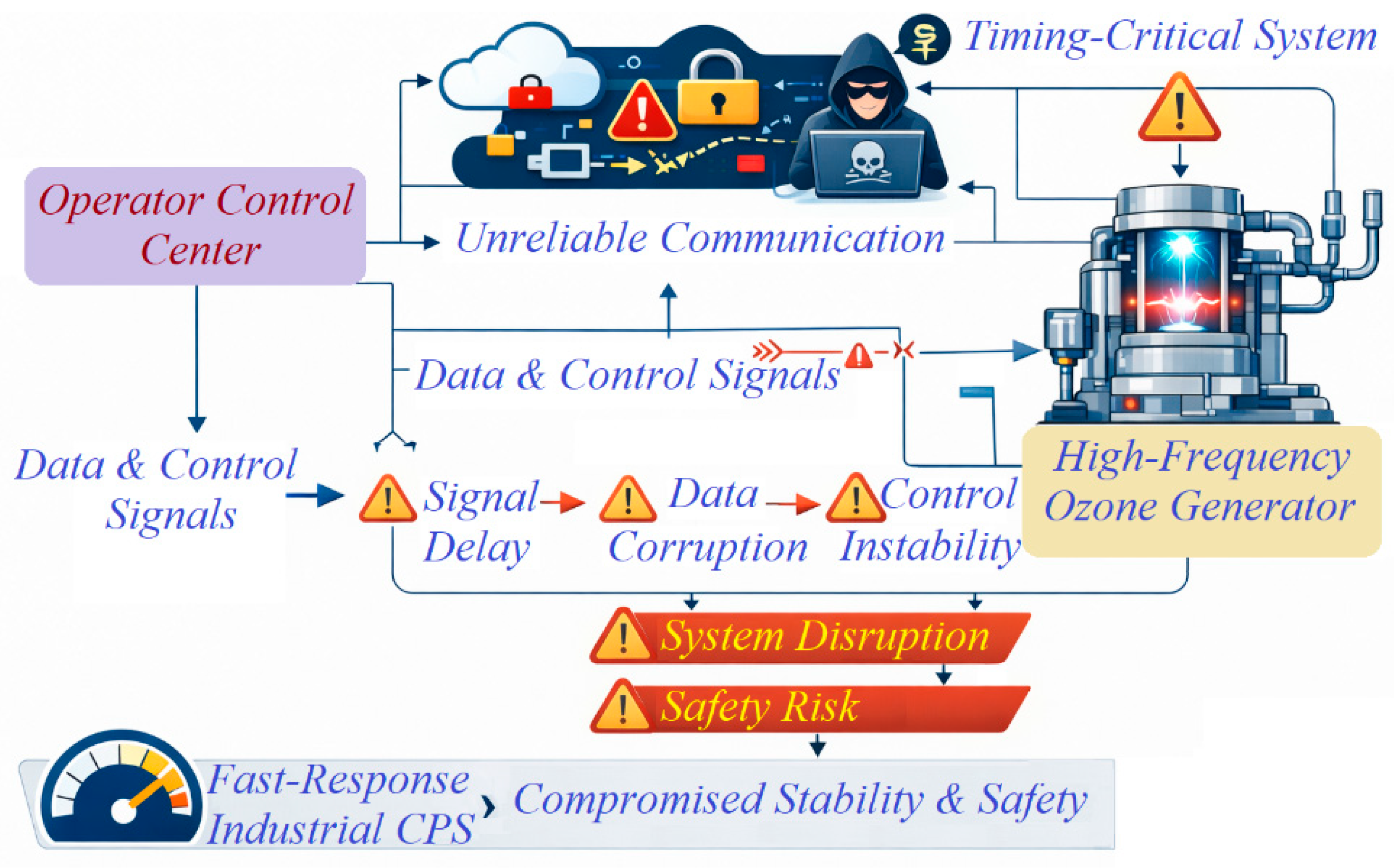
Kayan H. et al. [28] provided a comprehensive review of the cybersecurity of industrial cyber-physical systems and demonstrate that data integrity, communication reliability, and network-induced latency in control loops are critical factors affecting the stability and safety of remotely controlled physical processes. The authors emphasize that for real-time, high-dynamic systems, any distortion or delay in sensor and control data can significantly degrade control performance and compromise overall system stability. This issue is particularly critical for fast-response plasma-based systems such as high-frequency ozone generators, where tight timing constraints and reliable data transmission are essential for stable and efficient operation. In general, Figure 2 illustrates the structure of the control system for a high-frequency ozone generator, taking into account data integrity and communication delays.
Figure 2 illustrates a networked cyber-physical control structure for a high-frequency ozone generator, where the control loop is closed through a communication network subject to latency and data integrity threats. The diagram highlights that network-induced delays and data corruption directly affect control stability and performance, making reliable communication and cybersecurity mechanisms critical for stable and safe system operation.
Ding D. et al. [29] provided a comprehensive survey on secure state estimation and control of cyber-physical systems and show that for complex, nonlinear, and multi-parameter systems, classical control methods are often insufficient to guarantee robustness and stability under uncertainties and cyber threats.
Recent studies have increasingly focused on fully distributed and event-triggered control strategies designed to maintain stability and performance under communication constraints such as packet loss, latency, and link failures. In particular, a fully distributed event-triggered secondary control framework has been proposed for islanded microgrid restoration under communication link faults, demonstrating that local decision-making combined with sparse communication can effectively preserve system stability even in the presence of unreliable network connections [30].
Although these approaches are primarily developed for power and energy systems, the underlying challenges—namely delayed feedback, packet loss, communication faults, and scalability—are directly relevant to fast nonlinear electro-plasma processes such as high-frequency ozone generation. These results further support the necessity of local adaptive control loops operating at the millisecond level, while networked layers are used mainly for monitoring, supervision, and coordination.
From a control-oriented perspective, high-frequency ozone generators can be generally represented as nonlinear dynamical systems with strong multiphysical coupling between electrical excitation, gas flow, thermal effects, and chemical reaction kinetics. While such representations are conceptually suitable for feedback control synthesis, most existing studies employ them primarily for steady-state analysis or offline optimization, rather than for real-time adaptive regulation.
In parallel, recent research on industrial IoT architectures mainly focuses on cloud-based monitoring and supervisory control. However, for fast electro-plasma processes, the closed-loop performance is fundamentally constrained by communication latency and jitter. In particular, the total delay budget consists of both sensor-to-cloud uplink latency and control-command downlink latency. Even when the uplink is optimized, variable downlink delays can destabilize fast nonlinear systems if the control loop is closed remotely.
Consequently, cloud-centric architectures are well suited for monitoring, diagnostics, and high-level supervision, but they are not appropriate for millisecond-level stabilization of ozone generation processes. This gap motivates the need for a cyber-physical control architecture in which fast adaptive regulation is executed locally, while the networked layer is used exclusively for supervision and data analytics.
For such strongly nonlinear systems with fast transient dynamics, classical linear control and estimation methods become inadequate, which motivates the use of secure state estimation and adaptive or intelligent control strategies. However, Ding et al. [29] do not specifically address physics-based control models for electro-plasma systems such as ozone generators.
Recent studies have addressed ozone-based disinfection and smart environmental control from different perspectives. Islam et al. [31] proposed an IoT-based smart environment architecture integrating edge intelligence and cloud services for safe activation of UV-C lamps. Their system emphasizes monitoring, notification mechanisms, and hybrid edge–cloud coordination for sanitization safety. However, the focus remains on supervisory automation and environmental management rather than on control-oriented nonlinear modeling or real-time stabilization of plasma discharge dynamics.
Tanaka et al. [32] investigated feedback control of ozone concentration using an IoT-enabled ozone generator equipped with a built-in sensor and Sigfox communication. The study successfully demonstrated CT-based ozone regulation within acceptable exposure limits (<0.1 ppm) using a rudimentary feedback loop. Nevertheless, the proposed control strategy operates at room-level time scales and does not incorporate nonlinear state-space modeling, adaptive gain scheduling, or compensation of time-varying electrical impedance in high-frequency plasma systems.
Furthermore, Drugă et al. [33] developed a mechanical ventilator prototype integrating ozone therapy and automated disinfection functionalities. While their contribution demonstrates the integration of ozone treatment within biomedical systems, the control strategy primarily addresses supervisory regulation and device-level automation, without addressing fast multiphysical plasma dynamics or cyber-physical adaptive control under network-induced constraints.
In contrast to these works, the present study introduces a control-oriented nonlinear cyber-physical model of a high-frequency ozone generator and implements millisecond-level adaptive state-feedback control at the edge layer. Unlike monitoring-centric or supervisory IoT architectures, the proposed approach explicitly targets dynamic stabilization of nonlinear electro-plasma processes under parametric uncertainty and communication latency, thereby extending the current state of the art from environmental automation toward real-time cyber-physical control.
Previous studies show that the physical processes and individual automation components of high-frequency ozone generators have been investigated in sufficient detail. However, ozone generation systems fully integrated into telecommunication infrastructures and based on IoT- and cloud-oriented intelligent control architectures have not yet been systematically studied. This is mainly due to the strongly nonlinear dynamics of ozone generators and the difficulties associated with reliable real-time data acquisition as well as high requirements for computational and communication resources. Therefore, the development of intelligent control systems for high-frequency ozone generators integrated with cyber-physical and telecommunication platforms remains a relevant and necessary research direction.

3. Materials and Methods

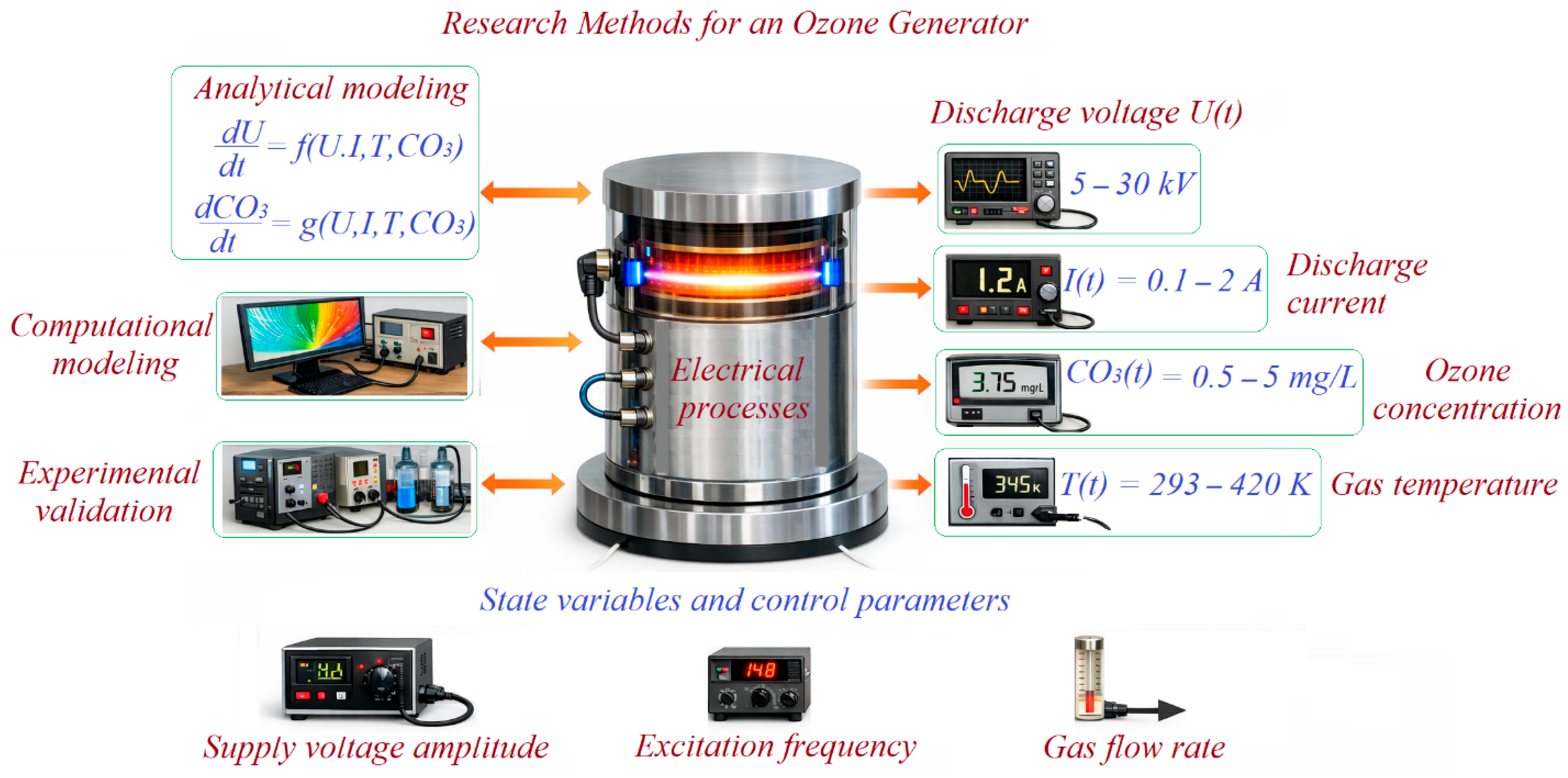
The scientific research was carried out using a combination of analytical modeling, computational modeling, and experimental (or semi-experimental) validation methods. The dynamics of the high-frequency ozone generator were described by a nonlinear state-space model that integrates electrical, thermal, gas-dynamic, and chemical processes. The state variables were chosen as the discharge voltage U(t) in the range of 5–30 kV, the discharge current I(t) of 0.1–2.0 A, the ozone concentration CO3(t) of 0.5–5.0 mg/L, and the gas temperature T(t) of 293–420 K. The control inputs were the supply voltage amplitude, the excitation frequency (1–25 kHz), and the gas flow rate (0.5–5.0 L/min). In general, Figure 3 presents the structural diagram of the research methods and control parameters of the high-frequency ozone generator.
Figure 3 shows the interrelation between modeling and experimental methods used in the study of the ozone generator, as well as the structure of the state variables and control parameters. It illustrates the principle of integrated analysis and control of the multiphysical processes of the system.
The implementation of the modeling and control algorithms was carried out using Python 3.11.6 (Python Software Foundation, Wilmington, DE, USA) and the SMath Solver version 0.99.7920 engineering computation package (SMath Studio, Zurich, Switzerland). In the Python environment, the nonlinear state-space dynamics of the system described by Equation (6), the control algorithms, and the models of telecommunication effects were implemented, while the SMath Solver environment was used to obtain analytical transformations of Equation (7), verify the system of equations, and analyze parametric dependencies. The continuous state-space model given by Equation (8) was transformed into the following discrete-time form:
x ˙ ( t ) = f ( x ( t ) , u ( t ) , θ )
x ( t k + 1 ) = x ( t k ) + t k t k + t f ( x ( t ) , u ( t ) , θ ) d t
x ( t k + 1 ) = x ( t k ) + t · f ( x ( t k ) , u ( t k ) , θ )
x [ k + 1 ] = x [ k ] + Δ t f ( x [ k ] , u [ k ] , θ )
where x is the state vector, u is the control input vector, θ denotes the model parameters, and Δt is the computation step. The step size was chosen in the range of 0.1–0.5 ms, which makes it possible to describe fast transient processes corresponding to a control loop cycle time of 1–5 ms. In the model, network delays in the range of 1–10 ms and random packet losses with a probability of 0–5% were taken into account as additional disturbing factors acting on the input of Equation (9). In addition, variations in the main parameters included in Equation (15) within ±10–20% were introduced to analyze the stability of the system and the robustness of the control algorithms.
Let the control objective be to maintain the ozone yield YO3(t) at a prescribed reference value Y O 3 r e f while preserving discharge stability and avoiding filamentary or unstable regimes. This objective can be formulated in terms of the tracking error:
e ( t ) = Y O 3 r e f Y O 3 ( t )
In practice, the matrices K(t) and G(t) can be tuned online using adaptive or model-predictive mechanisms in order to compensate for parametric uncertainties, slow drifts of gas-medium properties, and external disturbances. Such a control structure allows the operating point of the ozone generator to be continuously adjusted so as to keep the discharge in a quasi-uniform regime and to maximize the energy efficiency of ozone production.
Thus, combining the physical insights of Bruggeman and Brandenburg [26] with the state-space representation (6) and the adaptive control law (8) provides a consistent theoretical framework for the development of intelligent control systems for DBD- and corona-based ozone generators.

3.1. Nonlinear State-Space Model of the High-Frequency Ozonator

This subsection introduces a control-oriented nonlinear state-space model of the high-frequency ozonator. The model is intentionally formulated in a compact form suitable for real-time implementation, rather than detailed plasma physics simulation. Its primary purpose is to support fast adaptive control and robustness analysis.
The high-frequency ozone generator is modeled as a nonlinear cyber-physical system integrating electrical, thermal, gas-dynamic, and chemical subsystems. The dynamic behavior of the ozonator is represented in a state-space form suitable for real-time control synthesis and robustness analysis.
The state vector is defined as:
x ( t ) = U ( t ) I ( t ) C O 3 ( t ) T ( t ) ,
where U ( t ) is the discharge voltage, I ( t ) is the discharge current, C O 3 ( t ) is the ozone concentration, and T ( t ) is the gas temperature inside the reactor. The control input vector is given by:
u ( t ) = U s ( t ) f ( t ) q ( t ) ,
where U s ( t ) is the supply voltage amplitude, f ( t ) is the excitation frequency, and q ( t ) is the gas flow rate.
The electrical behavior of the ozone generator is governed by nonlinear plasma discharge dynamics and thermal effects, which result in a time-varying load seen by the power supply. From a control-oriented perspective, this behavior is represented by a nonlinear function embedded in the state-space model rather than by a detailed equivalent circuit description.
The time-varying discharge impedance is defined as:
Z ( t ) = U ( t ) I ( t ) = R e q ( I , T ) + j X e q ( I , T ) ,
where the resistive and reactive components depend on discharge current and gas temperature. In control-oriented form, these dependencies are approximated by low-order parametric expressions:
R e q ( I , T ) = R 0 + R 1 I + R 2 T , C e q ( I , T ) = C 0 + C 1 I .
Thermal subsystem.
The thermal dynamics of the reactor are modeled using an energy balance equation:
T ˙ ( t ) = 1 C t h P d i s ( U , I ) h A ( T ( t ) T a ) ,
where C t h is the thermal capacitance of the reactor, h A is the heat transfer coefficient, T a is the ambient temperature and P d i s ( U , I ) = U ( t ) I ( t ) is the discharge power.
Ozone generation subsystem.
The ozone concentration dynamics are described by:
C O ˙ 3 ( t ) = k g e n ( U , f , T , q ) k d e c ( T )   C O 3 ( t ) q ( t ) V r C O 3 ( t ) ,
where k g e n ( ) is the ozone generation rate dependent on electrical excitation and gas conditions, k d e c ( T ) is the temperature-dependent ozone decomposition coefficient, and V r is the effective reactor volume. Thus, the nonlinear vector field f(x,u,θ) of the state-space model (6)–(9) is explicitly defined by the electrical subsystem with time-varying discharge impedance Z(t) given in (13) and (14), the thermal dynamics in (15), and the ozone concentration dynamics in (16).
Discrete-time implementation.
For real-time control with a cycle time of 1–5 ms, the continuous-time model is discretized using a forward Euler approximation:
x k + 1 = x k + Δ t   f ( x k , u k ) ,
where Δ t [ 0.1,0.5 ] ms and f ( ) represents the nonlinear vector field defined by the above equations.
Parameter identification.
The parameters R 0 R 1 R 2 C 0 C 1 C t h h A k g e n k d e c are identified using experimental measurements of U ( t ) , I ( t ) , T ( t ) , and C O 3 ( t ) under step variations of U s , f , and q . A constrained least-squares fitting procedure with physically admissible bounds is applied to ensure consistency with discharge physics and thermal limits. The dielectric properties and thermal parameters (including effective heat capacity and heat transfer coefficients) were identified from experimental measurements and selected in accordance with established plasma discharge and ozone reactor models reported in [21,23,26].

3.2. Adaptive State-Feedback Control Law and Online Gain Update

To ensure robust real-time regulation of ozone production under nonlinear dynamics, parametric uncertainty, and network-induced disturbances, an adaptive state-feedback control strategy is employed at the local control level.
The discrete-time nonlinear model of the ozone generator is expressed in the general form:
x k + 1 = f ( x k , u k , θ k ) + w k , y k = h ( x k ) + v k ,
where x k R 4 is the state vector, u k R 3 is the control input vector, θ k denotes time-varying system parameters, and w k and v k represent bounded disturbances and measurement noise, respectively. The state vector is defined as
x k = [ U k , I k , C O 3 , k , T k ]
where U k is the discharge voltage, I k is the discharge current, C O 3 , k is the ozone concentration, and T k is the gas temperature. The control input vector is given by
u k = [ U s , k , f k , q k ]
where U s , k is the supply voltage command, f k is the excitation frequency, and q k is the gas flow rate.
Where the tracking error ek is defined as the difference between the reference ozone concentration and the measured output.
The adaptive control law is formulated as a state-feedback structure with reference compensation:
u k = u k f f K k x k + k r , k   r k ,
where u k f f is a feedforward term corresponding to the nominal operating point, K k R 3 × 4 is the time-varying feedback gain matrix, and k r , k R 3 is the reference gain vector.
To compensate for time-varying discharge impedance, thermal effects, and gas-dynamic disturbances, the feedback gains are updated online using a gradient-based adaptation mechanism:
K k + 1 = Π Ω K k Γ K   x k   e k ,
where Γ K 0 and Γ r > 0 are diagonal adaptation gain matrices, and Π Ω ( ) and Π Ω r ( ) denote projection operators that constrain the adaptive gains within predefined bounded sets. This projection prevents parameter drift and ensures safe operation under actuator limits and measurement noise.
The adaptive update is executed at each control cycle (1–5 ms) and relies exclusively on locally measured variables, making the control loop insensitive to network-induced delays and packet losses. In this way, the controller continuously adjusts the voltage amplitude, excitation frequency, and gas flow rate to maintain stable ozone generation while preserving discharge stability and energy efficiency.
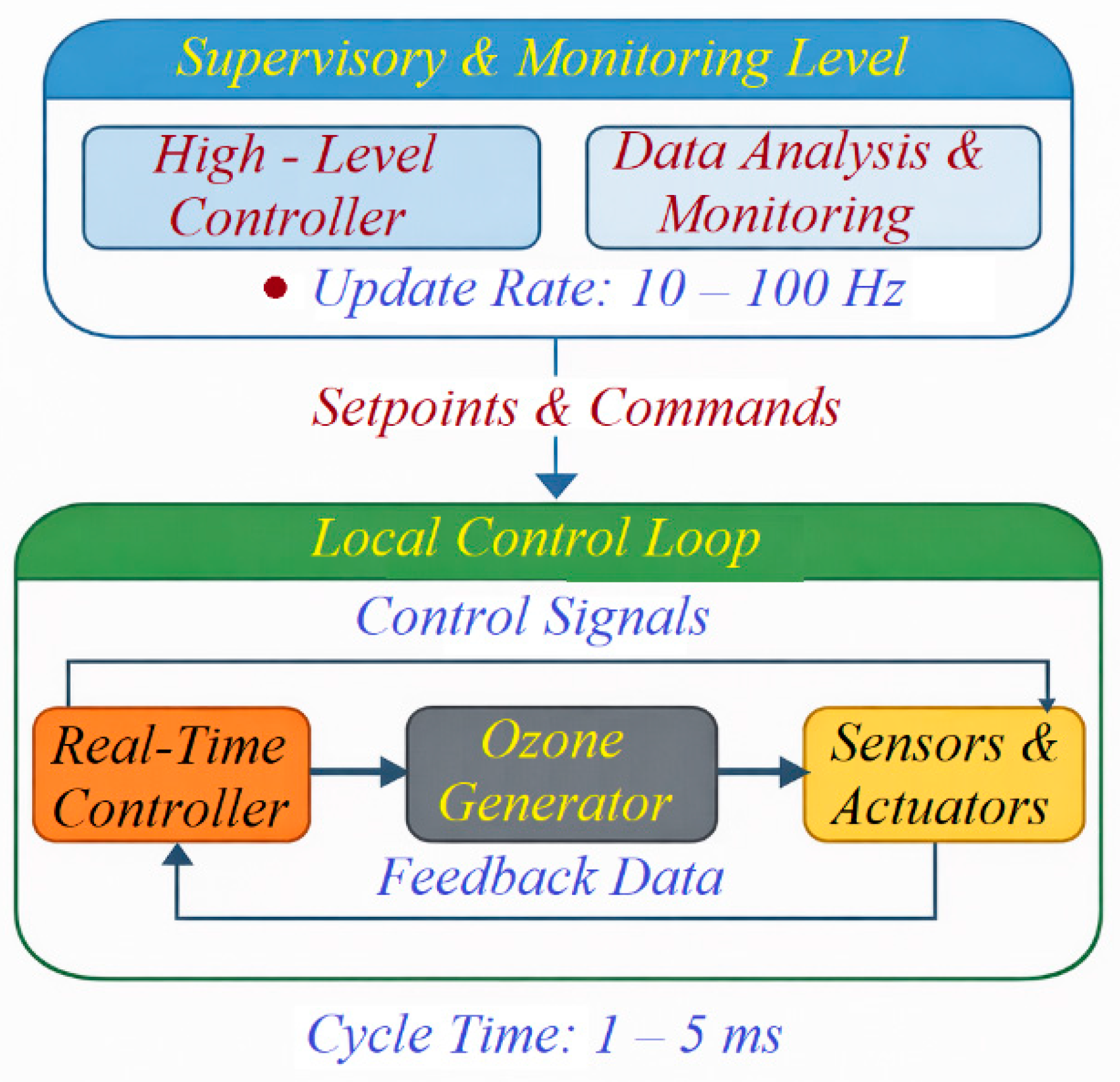
The proposed control architecture was implemented in the form of a hierarchical structure and consists of two levels (Figure 4): a fast-acting local control loop and a high-level monitoring and supervision layer. The local loop operates in real-time or in a real-time emulation mode with a computation cycle of 1–5 ms, while the data update rate at the upper level was chosen in the range of 10–100 Hz.
Figure 4 shows the hierarchical two-level control architecture of the high-frequency ozone generator. The upper level provides monitoring and supervision, while the lower level ensures real-time control. The diagram illustrates the principle of stable and coordinated system operation through control signals and feedback.
From an IoT implementation perspective, the proposed system employs a layered architecture. At the local level, embedded controllers acquire data from voltage, current, temperature, and ozone concentration sensors with sampling periods of 0.1–0.5 ms. These data are processed locally to close the millisecond-level control loop.
At the supervisory level, aggregated data packets containing averaged electrical, thermal, and ozone generation parameters are transmitted via Ethernet or wireless links using standard industrial communication protocols. In remote or geographically isolated installations, satellite communication channels may be employed to provide connectivity between local control units and centralized monitoring platforms. In this case, satellite links are used exclusively for monitoring, diagnostics, and data logging, while all fast control actions remain strictly local to avoid latency-induced instability.
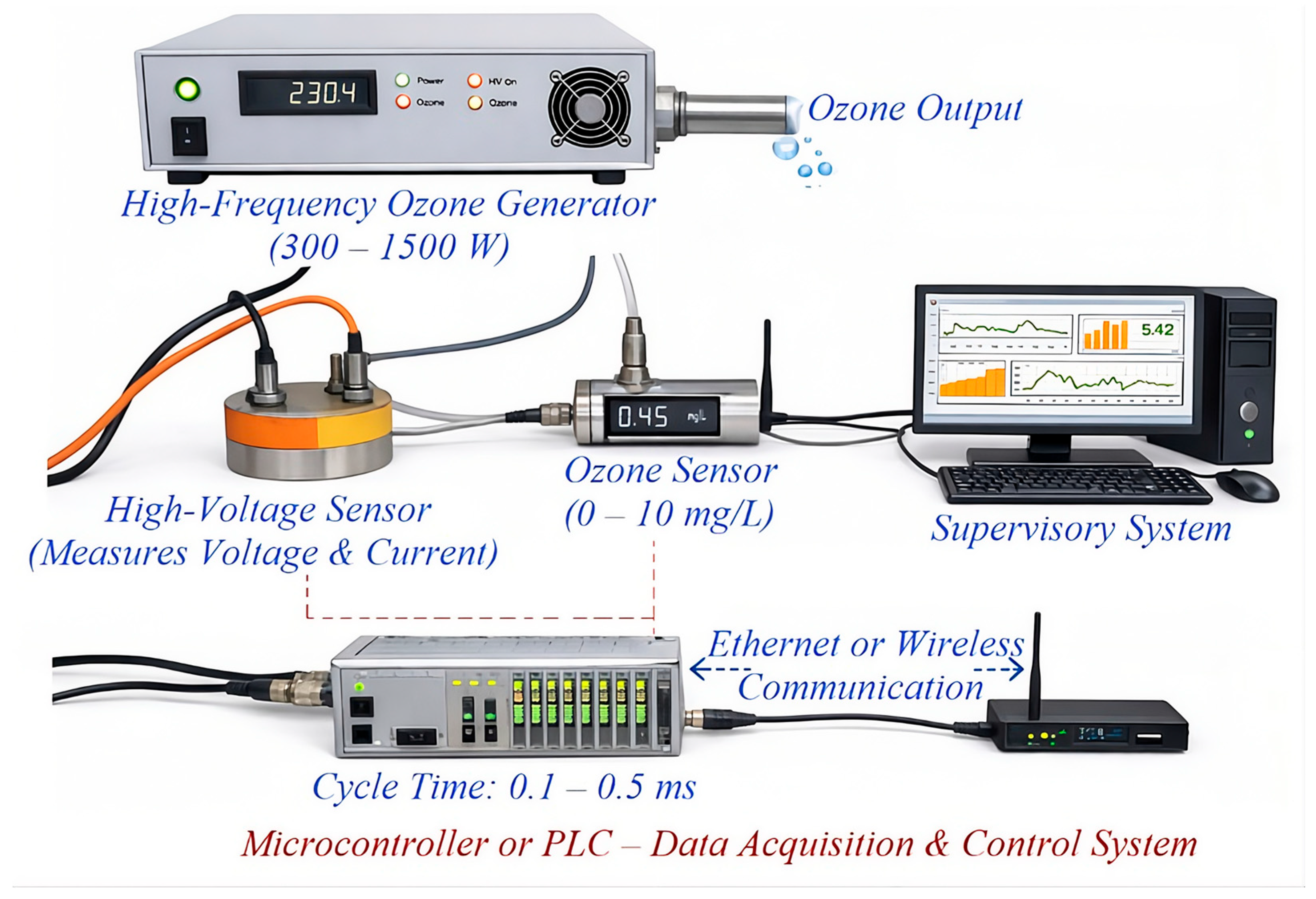
As the hardware part, a high-frequency ozone generator with a power of 300–1500 W, high-voltage sensors for measuring voltage and current, an ozone concentration sensor (measurement range 0–10 mg/L), as well as a temperature sensor (250–450 K) were used. For data acquisition and control, a system based on a microcontroller or an industrial controller was employed, with a computation cycle of 0.1–0.5 ms. Communication between the local control unit and the high-level system was organized via Ethernet or wireless communication channels. In general, Figure 5 presents the structural diagram of the hardware measurement and control system of the high-frequency ozone generator.
Figure 5 shows the structure of the hardware measurement and control system of the high-frequency ozone generator. Based on the data collected by the sensors, the operation of the setup is monitored and controlled.
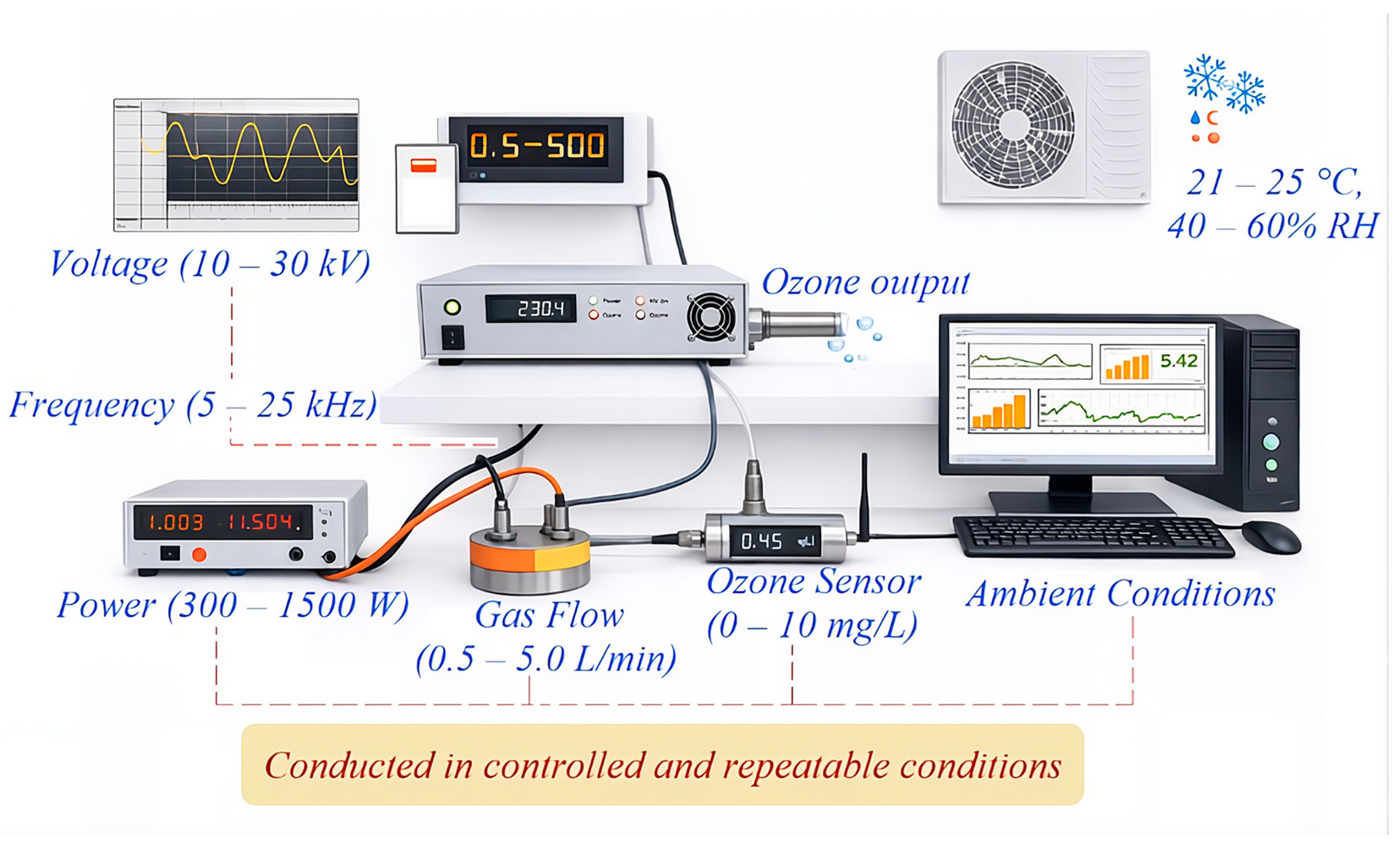
The experimental conditions were formed by varying the electrical parameters (voltage 10–30 kV, frequency 5–25 kHz, and power 300–1500 W), the gas flow rate (0.5–5.0 L/min), and the ambient conditions. This made it possible to reproduce various operating modes, including low-load and nominal regimes. All experiments were carried out under controlled and repeatable conditions. In general, Figure 6 presents the structure of the setup for controlling the experimental parameters of the ozone generator.
Figure 6 shows the structure of the setup for controlling the experimental parameters of the ozone generator. It makes it possible to form and reproduce operating modes under controlled and repeatable conditions.
The verification of the proposed models and control algorithms was carried out by comparing the signals obtained during simulation with the measured data, analyzing the time-domain characteristics of transient processes, and testing the stability of the closed-loop system under parameter variations of ±10–20% and external disturbances. The adequacy of the models was evaluated by assessing the agreement between the dynamic behavior of the simulation results and the experimental observations. This section does not present specific results; it only describes the research methodology.


4. Results and Discussion

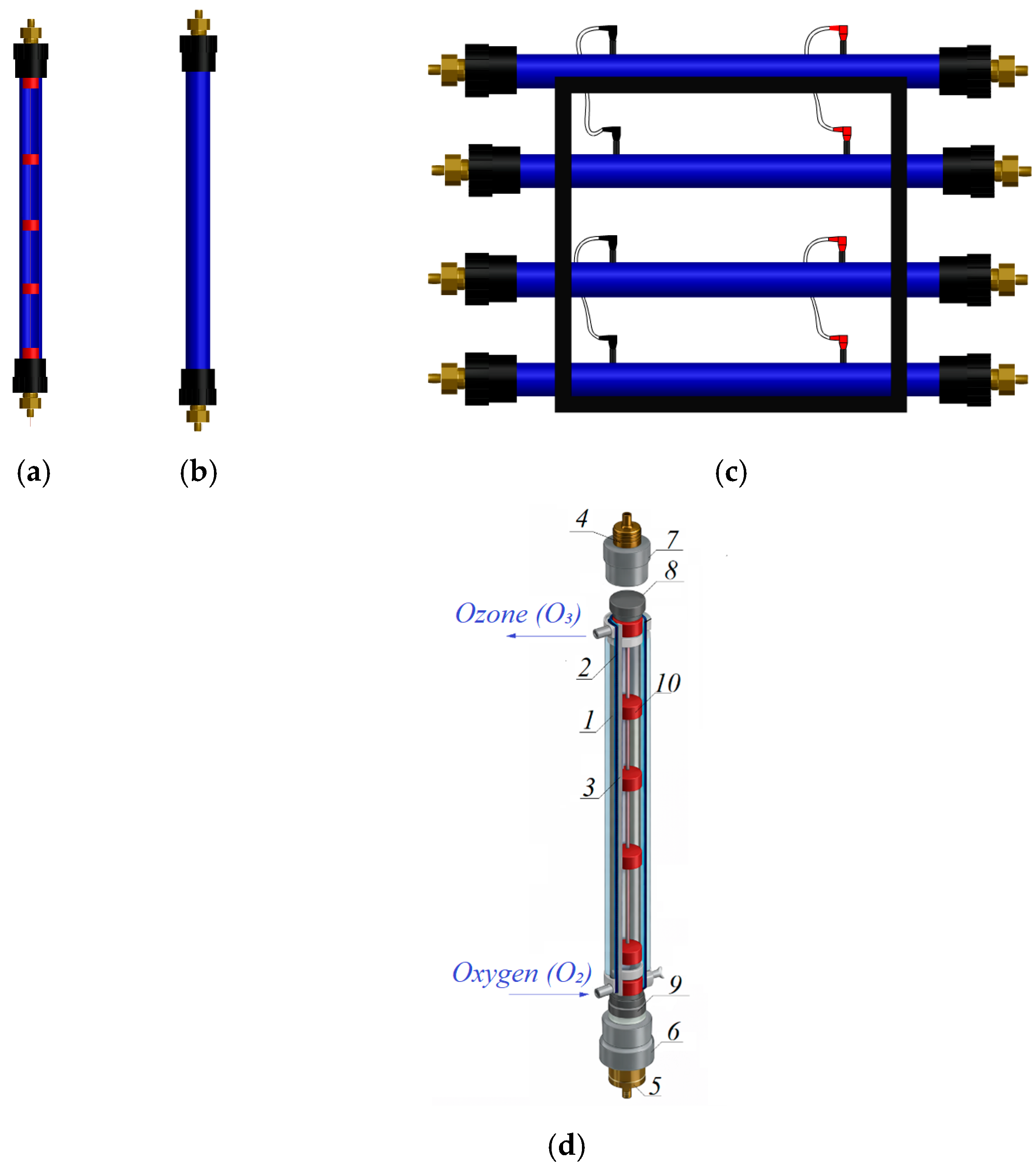
This research was carried out on the experimental and laboratory facilities of the Department of Electronics, Telecommunications and Space Technologies of Satbayev University and the specialized research laboratories of the Faculty of Hydraulic Engineering of the Tashkent Institute of Irrigation and Agricultural Mechanization Engineers. The study was aimed at developing an intelligent control system for a high-frequency ozone generator integrated into an IoT-based and telecommunication environment and at evaluating its performance. In accordance with this objective, a cyber-physical nonlinear mathematical model of the high-frequency ozone generator was developed, on the basis of which the structure and algorithms of the intelligent control system were synthesized and their stability and efficiency were comprehensively validated through modeling and experimental investigations. Within the framework of the scientific research, a specialized innovative pilot high-frequency corona discharge—based ozonator unit ETRO—02 was developed (Figure 7).
The main structural elements of the ozone generator shown in Figure 7 are as follows: (1) dielectric tube; (2) interelectrode space filled with transformer oil (NO2) or water (H2O); (3) polished stainless-steel tube; (4,5) brass caps; (6) lower dielectric cap; (7) upper dielectric cap; (8,9) PTFE insulating bushings (fluoroplastic insulating bushings); and (10) PTFE-based thermal insulation material. The figure shows the corona discharge—based ozonator unit “ETRO—02”, designed in the form of a cylindrical reactor with an internal electrode system. The structure includes a dielectric tube and a polished stainless-steel tube, between which a corona discharge zone is formed when high voltage is applied. Oxygen (O2) is supplied to the lower part of the reactor, where it is converted into ozone (O3) in the discharge region and then removed through the upper outlet nozzle. The use of dielectric and fluoroplastic insulating elements ensures high electrical strength, discharge stability, and reliable continuous operation of the unit in the ozone generation mode.

4.1. Development and Analysis of a Cyber-Physical Mathematical Model of a High-Frequency Ozonator

In accordance with the first objective of the study, a cyber-physical nonlinear mathematical model of a high-frequency ozonator was developed, integrating its electrical, thermal, gas-dynamic, and chemical subsystems. The model described by Equations (6)–(9) was implemented in the Python environment and investigated under various operating modes. The discharge voltage U(t), discharge current I(t), ozone concentration CO3(t), and gas temperature T(t) were selected as the state variables, while the control inputs were the supply voltage amplitude, excitation frequency, and gas flow rate. The sets of electrical, gas-dynamic, and thermal parameters of the high-frequency ozonator obtained for different operating regimes are summarized in Table 4, whereas the energy efficiency and dynamic performance indicators of the proposed control system for the ozone generation process are systematized in Table 5.
The data in Table 4 showed that as the voltage increases from 10 kV to 30 kV and the frequency from 5 kHz to 25 kHz, the power rises from 350 W to 1450 W, while the gas flow rate increases from 0.8 L/min to 4.5 L/min. Accordingly, the gas temperature in the reactor increases from 305 K to 365 K, indicating an increase in the system energy load and the intensity of plasma processes.
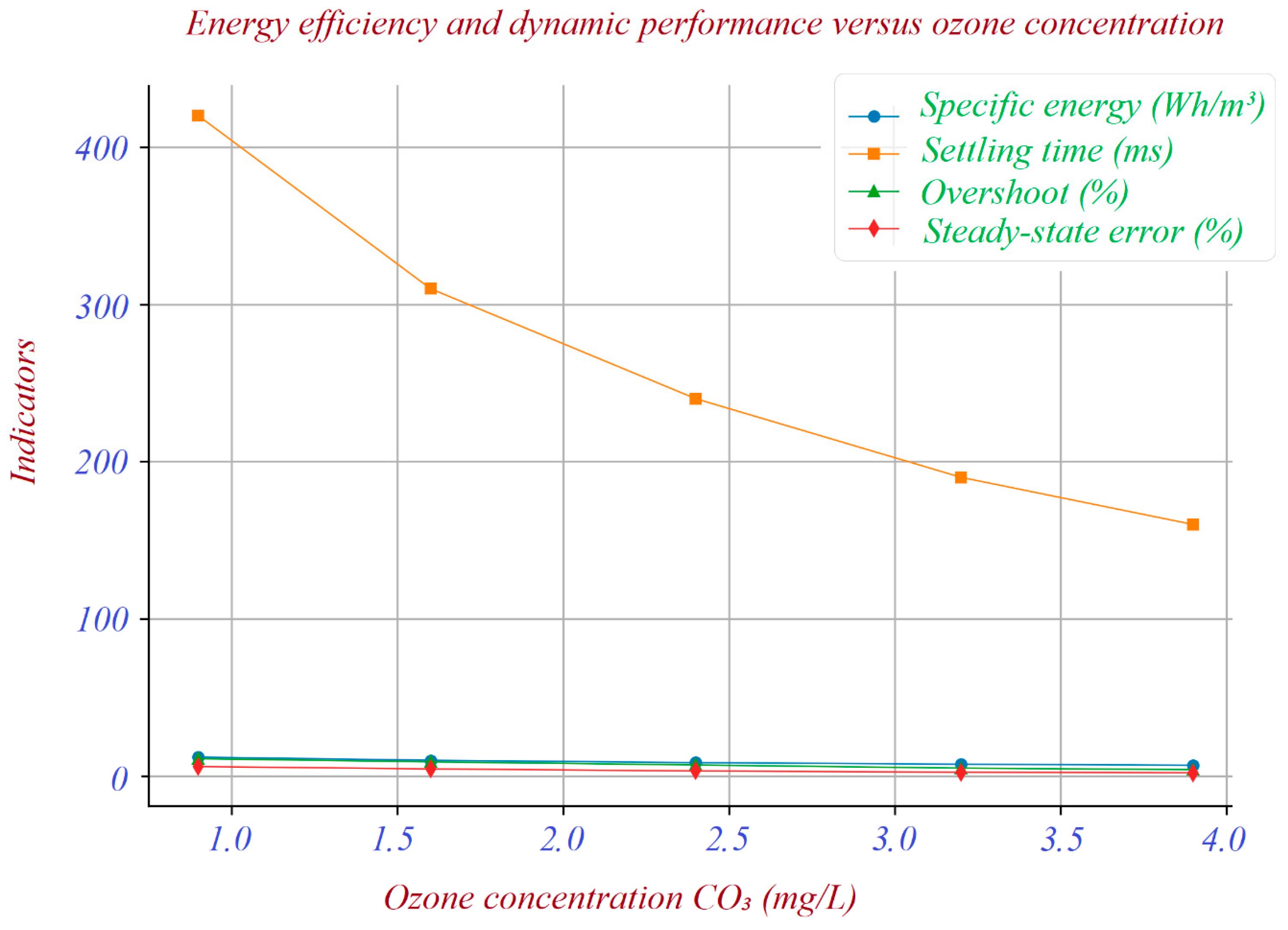
Table 5 shows that as the ozone concentration increases from 0.9 mg/L to 3.9 mg/L, the specific energy consumption decreases from 11.8 Wh/m3 to 6.2 Wh/m3, indicating an improvement in the energy efficiency of the generation process. In addition, the dynamic performance of the control system is significantly enhanced, with the settling time reduced from 420 ms to 160 ms, the overshoot decreased from 12.5% to 3.1%, and the steady-state error reduced from 6.5% to 1.6%.
The simulation results show that the investigated system exhibits pronounced nonlinear behavior and strong coupling between the electrical, thermal, and gas-dynamic processes. Variations in the excitation frequency and supply voltage lead to nonlinear changes in the ozone concentration and discharge current, while changes in gas temperature and flow rate significantly affect the ozone generation efficiency and discharge stability. The nonlinear model that accounts for the time-varying equivalent discharge impedance demonstrates good agreement with the actual physical behavior of the discharge process. When the model parameters are varied within ±10–20%, the open-loop system exhibits longer transient times and increased overshoot, confirming that the ozonator is a highly sensitive nonlinear object. The main results of the study are summarized in Table 6 and Figure 8 and Figure 9.
Table 6 shows that under nominal conditions the settling time is 190 ms, the overshoot is 4.5%, and the steady-state error is 2.1%, whereas when the parameters are decreased by 20% these values increase to 520 ms, 14.0%, and 7.5%, respectively. In addition, for a +20% parameter variation the settling time rises to 300 ms, the overshoot to 8.5%, and the error to 4.8%, while the appearance of weak oscillations in the −10% and +10% cases confirms the high sensitivity of the system to parametric variations.
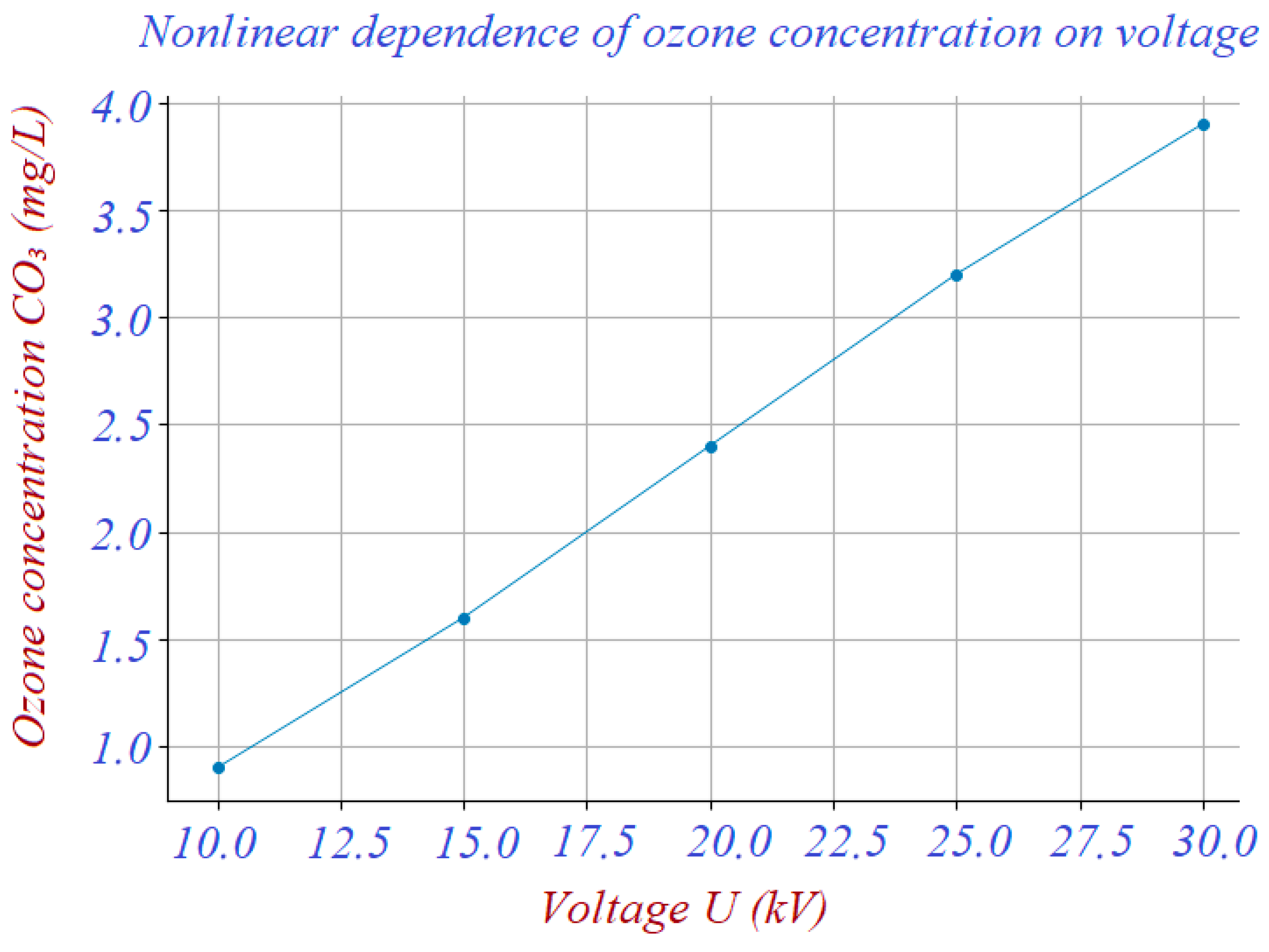
Figure 8 shows that as the discharge voltage increases from 10 kV to 30 kV, the ozone concentration rises from approximately 0.9 mg/L to 3.9 mg/L, indicating a nonlinear relationship between these variables. This result demonstrates that an increase in voltage enhances the discharge energy and intensifies the ozone formation process, confirming the nonlinear nature of the system.
Figure 9 shows that increasing the ozone concentration from 0.9 mg/L to 3.9 mg/L reduces the specific energy consumption from about 12 Wh/m3 to 6.8 Wh/m3 and shortens the settling time from 420 ms to 160 ms, while the overshoot and steady-state error also decrease significantly. Together with Table 6 and Figure 8 and Figure 9, these results confirm the nonlinear and parameter-sensitive nature of the system and demonstrate the improvement of energy efficiency and dynamic performance with increasing ozone yield.
A comparison between the simulation and experimental results shows good agreement in both transient and steady-state regimes, confirming the adequacy of the proposed cyber-physical model; the validation results are summarized in Table 7.
Table 7 demonstrates a close agreement between the simulation and experimental results for the main system parameters: the settling time is 180 ms in simulation and 190 ms in experiment (deviation ≈ 5.3%), the overshoot is 4.2% and 4.5%, respectively (deviation ≈ 6.7%), the ozone concentration is 3.15 mg/L and 3.20 mg/L (deviation ≈ 1.6%), and the gas temperature is 345 K and 348 K (deviation ≈ 0.9%). Such small deviations confirm the adequacy of the proposed cyber-physical model and its reliability for the synthesis and analysis of the control system.

4.2. Synthesis of the Intelligent Control System and Evaluation of Its Performance

In accordance with the second objective of the study, a two-level intelligent control system for the high-frequency ETRO-02 ozonator was synthesized based on the cyber-physical nonlinear model (6–9). The proposed architecture consists of a fast local control loop operating with a cycle time of 1–5 ms and a higher-level monitoring and supervisory layer with a data update rate of 10–100 Hz.
In the local control loop, an adaptive feedback-based control algorithm was implemented to maintain the ozone production (or CO3 concentration) at a prescribed reference value. The control actions include the discharge voltage amplitude U(t), the excitation frequency f(t), and the gas flow rate vg(t). The system performance was tested under step and smooth reference changes, under parameter variations of ±10–20%, as well as under network-induced delays of 1–10 ms and packet loss probabilities of 0–5%.
The results show that the closed-loop system remains stable in all investigated operating modes and exhibits significantly improved dynamic performance: according to Table 5, the settling time was reduced from 420 ms to 160 ms, the overshoot from 12.5% to 3.1%, the steady-state error from 6.5% to 1.6%, and the specific energy consumption from 11.8 to 6.2 Wh/m3. The data in Table 6 indicate that although the performance degrades under parameter variations, the controllability is preserved, confirming that the system is a sensitive but controllable object. In general, Table 8 below presents a comparative summary of the dynamic and energy efficiency performance indicators of the control systems for the high-frequency ETRO-02 ozonator.
Table 8 demonstrates that the proposed intelligent control system significantly improves both the dynamic performance and the energy efficiency of the high-frequency ozonator compared to the classical control approach. In particular, the settling time is reduced from 420 ms to 160 ms, the overshoot from 12.5% to 3.1%, the steady-state error from 6.5% to 1.6%, and the specific energy consumption from 11.8 to 6.2 Wh/m3, while the robustness to parameter variations and network-induced delays is also substantially enhanced.
Thus, compared to cloud-based IoT systems, the proposed architecture enables control at the millisecond level, significantly reduces the impact of network-induced delays, and improves the stability and energy efficiency of the ozone generation process.

4.3. Discussion of the Results and Study Limitations

The obtained results confirm the strongly nonlinear and multiphysical nature of the ozone generation process. As demonstrated in Figure 8 and summarized in Table 5, increasing the discharge voltage from 10 to 30 kV leads to a rise in ozone concentration from 0.9 to 3.9 mg/L, while the specific energy consumption decreases from 11.8 to 6.2 Wh/m3. This behavior is explained by the increased energy density in the discharge zone and by the capability of the proposed adaptive control system to optimally coordinate voltage amplitude, excitation frequency, and gas flow rate in real time based on the nonlinear model described by Equations (6)–(9).
At the same time, Figure 9 and Table 6 indicate a pronounced sensitivity of the system to parameter variations. Despite this sensitivity, closed-loop stability is preserved across the considered operating range due to the adaptive control structure, which continuously compensates for variations in discharge impedance, thermal conditions, and gas dynamics. This result highlights the importance of adaptive regulation for fast electro-plasma processes, where fixed-parameter control strategies are insufficient.
A key distinguishing feature of the proposed approach is the hierarchical intelligent control architecture. It operates with a millisecond-level local control cycle. While previous studies by Gao K. et al. [21] and Zhang Y. et al. [22] primarily focus on discharge physics, and Salem R.M.M. et al. [27] emphasize cloud-based monitoring with second-level control cycles, the proposed system achieves a closed-loop control period of 1–5 ms (Table 3). This enables real-time stabilization of fast plasma processes and explains the superior dynamic performance compared to monitoring-oriented IoT architectures.
Despite these advantages, several limitations of the present study should be acknowledged.

4.3.1. Applicability of Model Assumptions

The proposed model is valid within the experimentally investigated operating ranges of 10–30 kV, 5–25 kHz, 300–1500 W, and 293–420 K. The gas-dynamic and ozone formation processes are modeled assuming quasi-ideal gas behavior under moderate pressure conditions. At higher pressures or in strongly non-ideal gas mixtures, deviations from these assumptions may increase modeling error and reduce control accuracy. In such cases, additional calibration or the inclusion of real-gas effects would be required.

4.3.2. Physical Feasibility of a Millisecond-Level Control Period

Although the achieved 1–5 ms control cycle significantly improves transient performance, its practical feasibility is constrained by hardware and communication limits. The minimum achievable control period is determined by the cumulative latency of analog-to-digital conversion, signal preprocessing, control algorithm execution, and actuator command transmission. Consequently, millisecond-level regulation is feasible only when sensing and control are executed locally on embedded hardware, while cloud-based platforms are unsuitable for closing the fast control loop and should be restricted to monitoring, supervision, and data analytics.

4.3.3. Scalability and Communication Effects

The experimental validation was conducted on a single-reactor laboratory prototype. Scaling the proposed approach to industrial-scale multi-reactor systems introduces additional challenges, including communication congestion, coupling between control loops, and shared power electronics. Without appropriate coordination, simultaneous adaptive updates may lead to network overload or unintended interactions between reactors. These factors indicate the need for hierarchical scheduling, decentralized coordination, or event-triggered communication mechanisms in large-scale deployments.
Each experimental operating point was tested in 5–7 repeated runs, and the reported results represent averaged values; random measurement errors were evaluated using standard deviation analysis.
The present study does not include a full comparative benchmark against alternative control strategies such as PID, MPC, or AI-based controllers, which represents a limitation of the current work. The primary focus was placed on validating the feasibility and effectiveness of the proposed adaptive control architecture for millisecond-level plasma regulation rather than on exhaustive algorithmic comparison. Recent advances in deep recurrent neural networks, such as LSTM and BiLSTM architectures [34,35], show promise for modeling long-term nonlinear and nonstationary behavior; however, their direct integration into the millisecond-level control loop is limited by strict latency and computational constraints. Instead, such models may be more suitable for higher-level predictive supervision and anomaly trend analysis.
With the increasing integration of ozone generators into IoT-based cyber-physical systems, the reliability and security of data transmission become critical for stable control. Recent studies emphasize the importance of cybersecurity and intelligent intrusion detection in industrial networks, especially under strict latency constraints [36,37,38]. Therefore, the incorporation of secure communication and cybersecurity monitoring represents an important direction for future development of the proposed system.
Overall, the results demonstrate that combining fast adaptive local control with higher-level monitoring and predictive functions provides a practical compromise between dynamic performance, robustness, and implementability for IoT-enabled ozone generation systems.
Despite the demonstrated advantages, several limitations must be acknowledged. First, the proposed control architecture was validated on a single-reactor laboratory-scale prototype; large-scale industrial implementation may introduce additional coordination and power-sharing challenges. Second, although the model captures the dominant multiphysical interactions, it relies on parametric identification within a defined operating range (10–30 kV, 5–25 kHz), and extrapolation beyond these conditions may require recalibration.
Third, the study does not provide a comprehensive comparative benchmark against alternative advanced control strategies such as model predictive control (MPC) or reinforcement learning-based controllers. While the primary objective was to demonstrate the feasibility and robustness of the proposed adaptive architecture, systematic comparative analysis represents an important direction for future work.
Finally, the millisecond-level control cycle assumes local embedded execution; fully cloud-based implementation remains infeasible for such fast nonlinear plasma systems due to latency constraints.

5. Conclusions

This study has led to the following main scientific results:
  • A cyber-physical nonlinear mathematical model of the high-frequency ozone generator integrating the electrical, thermal, gas-dynamic, and chemical subsystems was developed. The adequacy of the model was confirmed by experimental validation: the deviation between simulation and experimental results does not exceed 5.3% for settling time, 6.7% for overshoot, 1.6% for steady-state ozone concentration, and 0.9% for gas temperature (Table 7). Unlike simplified or quasi-static models reported in previous studies, the proposed model accounts for the time-varying equivalent discharge impedance and multiphysical coupling, which explains its higher accuracy in describing both transient and steady-state regimes;
  • A hierarchical two-level intelligent control architecture was synthesized and implemented, in which the fast local loop operates with a cycle time of 1–5 ms. The use of an adaptive state-feedback control law with online gain update made it possible to significantly improve the dynamic performance of the system: the settling time was reduced from 420 ms to 160 ms, the overshoot from 12.5% to 3.1%, and the steady-state error from 6.5% to 1.6% (Table 8). These improvements are explained by the real-time adaptation of the control actions to the nonlinear and time-varying properties of the plasma load, which fundamentally distinguishes the proposed solution from classical fixed-parameter controllers;
  • The energy efficiency and robustness of the ozone generation process were substantially enhanced. The specific energy consumption decreased from 11.8 to 6.2 Wh/m3, while stable operation was preserved under ± 20% parameter variations, network delays of 1–10 ms, and packet loss probabilities of up to 5% (Table 5 and Table 6). In contrast to cloud-based IoT architectures with second-level control cycles, the proposed system ensures millisecond-level closed-loop control, which explains its ability to suppress disturbances within 0.1–1 s and to maintain stable operation of the highly sensitive nonlinear electro-plasma system.
Overall, the obtained results demonstrate that the integration of a cyber-physical model with a millisecond-level intelligent control architecture provides a qualitatively new level of performance, stability, and energy efficiency for high-frequency ozone generators compared to conventional control and monitoring-oriented IoT solutions.
From a broader cyber-physical systems perspective, the proposed approach demonstrates the feasibility of integrating fast adaptive edge-level control with supervisory IoT architectures for highly nonlinear and time-sensitive industrial processes. The separation of millisecond-level local regulation from cloud-based monitoring provides a scalable design principle that may be extended to other plasma-based, electrochemical, and high-dynamic energy systems.
The expected practical impact of this research lies in improving the energy efficiency, operational stability, and cyber-resilience of ozone generation units deployed in smart environmental and industrial infrastructures. By enabling stable regulation under parametric uncertainty and network disturbances, the proposed architecture contributes to the development of intelligent edge-controlled industrial systems aligned with modern Industry 4.0 and IoT paradigms.
Future research will focus on: (1) systematic benchmarking against model predictive control and data-driven reinforcement learning strategies; (2) coordinated control of multi-reactor industrial installations under shared communication and power constraints; (3) integration of secure state estimation and intrusion detection mechanisms; and (4) incorporation of lightweight predictive machine learning modules at the supervisory layer for anomaly forecasting and performance optimization.

Author Contributions

Conceptualization, A.A. and N.K.; methodology, A.A.; software, A.A.; validation, A.A., N.S. and N.K.; formal analysis, A.A. and N.K.; investigation, A.A., D.E., M.M. and S.A.; resources, D.E. and S.A.; data curation, A.A. and N.K.; writing—original draft preparation, A.A. and N.K.; writing—review and editing, N.S. and N.K.; visualization, A.A.; supervision, N.S. and N.K.; project administration, N.K.; funding acquisition, M.M. All authors have read and agreed to the published version of the manuscript.

Funding

This research received no external funding.

Data Availability Statement

The data supporting the findings of this study are available from the corresponding author Nurzhigit Smailov, upon reasonable request, due to the data is presented in the form of unpublished drawings, diagrams, patent-sensitive models, or contain elements requiring intellectual property protection.

Acknowledgments

The authors would like to thank the Department of Electronics, Telecommunications and Space Technologies of Satbayev University for providing technical support and access to modeling facilities during this research.

Conflicts of Interest

The authors declare no conflicts of interest.

References

  1. Rutkovska, I.; Khrutba, Y. Information and communication technologies in environmental impact assessment and environmental management. Soc. Dev. Econ. Leg. Issues 2025. [Google Scholar] [CrossRef]
  2. Al-Sarawi, S.; Anbar, M.; Abdullah, R.; Al Hawari, A.B. Internet of things market analysis forecasts, 2020–2030. In 2020 Fourth World Conference on Smart Trends in Systems, Security and Sustainability (WorldS4); IEEE: Piscataway, NJ, USA, 2020; pp. 449–453. [Google Scholar] [CrossRef]
  3. Motlagh, N.H.; Mohammadrezaei, M.; Hunt, J.; Zakeri, B. Internet of Things (IoT) and the energy sector. Energies 2020, 13, 494. [Google Scholar] [CrossRef]
  4. Maksimovic, M. Greening the future: Green Internet of Things (G-IoT) as a key technological enabler of sustainable development. In Internet of Things and Big Data Analytics Toward Next-Generation Intelligence; Springer International Publishing: Cham, Switzerland, 2017; pp. 283–313. [Google Scholar] [CrossRef]
  5. Georgakopoulos, D.; Jayaraman, P.P. Internet of things: From internet scale sensing to smart services. Computing 2016, 98, 1041–1058. [Google Scholar] [CrossRef]
  6. Abdykadyrov, A.; Marxuly, S.; Tolen, G.; Kuttybayeva, A.; Abdullayev, M.; Sharipova, G. Optimization of data transmission in sensor networks for enhanced control of ozonator efficiency. East.-Eur. J. Enterp. Technol. 2024, 6, 83–94. [Google Scholar] [CrossRef]
  7. Marxuly, S.; Abdykadyrov, A.; Chezhimbayeva, K.; Smailov, N. Study of the ozone control process using electronic sensors. Inform. Control Meas. Econ. Environ. Prot. 2024, 14, 38–45. [Google Scholar] [CrossRef]
  8. Paladini, F.; D’urso, F.; Broccolo, F.; Pollini, M. Innovation in Indoor Disinfection Technologies During COVID-19: A Comprehensive Patent and Market Analysis (2020–2025). Air 2025, 3, 28. [Google Scholar] [CrossRef]
  9. Islam, F.A.S. Advanced Wastewater Treatment Technologies in Addressing Future Water Scarcity through Resource Recovery and Reuse. J. Eng. Res. Rep. 2025, 27, 370–398. [Google Scholar] [CrossRef]
  10. Lan, X.; Liu, Y.; Wang, L.; Jin, Q. A comparative analysis of ozone disinfection mainstream processes in wastewater treatment plants: Exergy and exergoeconomic viewpoints. J. Environ. Chem. Eng. 2025, 13, 114991. [Google Scholar] [CrossRef]
  11. Abdykadyrov, A.; Kalandarov, P.; Kuttybayev, A.; Abdullayev, M.; Zhumakhanova, D.; Khabay, A.; Abulkhanova, M.; Marxuly, S.; Madelbekova, A. Research on the process of disinfecting and purifying pathogenic bacteria and viruses in drinking water using ozone technology. Water Conserv. Manag. 2025, 9, 105–112. [Google Scholar] [CrossRef]
  12. Bagdollauly, Y.; Bekaidarova, B.; Shuteyeva, G.; Yegetayev, Z.; Bubnova, O. High-frequency ozone generators controlled by sensor network and modeling the process of groundwater purification from heavy metals. IOP Conf. Ser. Earth Environ. Sci. 2025, 1491, 12029. [Google Scholar] [CrossRef]
  13. Bagdollauly, Y.; Uvaliyeva, A.; Kaliyev, Z.; Izbairova, A.; Kurmanova, S.; Tolen, G.; Levchenko, K. Mathematical evaluation of the efficiency of ozonator control via sensor network in the process of underground water purification in mines. IOP Conf. Ser. Earth Environ. Sci. 2025, 1491, 12030. [Google Scholar] [CrossRef]
  14. Bagdollauly, Y.; Yerkeldessova, G.; Oralbekova, A.; Chukenova, E.; Ilyassov, N.; Yerzhan, A.; Kalandarov, P. Investigation of the properties of electrical sources of ozonators through mathematical models. IOP Conf. Ser. Earth Environ. Sci. 2024, 1390, 12021. [Google Scholar] [CrossRef]
  15. Poznyak, T.; Chairez, I.; Perez, C.; Poznyak, A. Switching robust control for ozone generators using the attractive ellipsoid method. ISA Trans. 2014, 53, 1796–1806. [Google Scholar] [CrossRef] [PubMed]
  16. Villegas-Ch, W.; García-Ortiz, J.; Sánchez-Viteri, S. Toward intelligent monitoring in IoT: AI applications for real-time analysis and prediction. IEEE Access 2024, 12, 40368–40386. [Google Scholar] [CrossRef]
  17. Brennan, R.W. Toward real-time distributed intelligent control: A survey of research themes and applications. IEEE Trans. Syst. Man Cybern. Part C (Appl. Rev.) 2007, 37, 744–765. [Google Scholar] [CrossRef]
  18. Essa, M.E.-S.M.; El-Shafeey, A.M.; Omar, A.H.; Fathi, A.E.; El Maref, A.S.A.; Lotfy, J.V.W.; El-Sayed, M.S. Reliable integration of neural network and internet of things for forecasting, controlling, and monitoring of experimental building management system. Sustainability 2023, 15, 2168. [Google Scholar] [CrossRef]
  19. Afrin, S.; Rafa, S.J.; Kabir, M.; Farah, T.; Bin Alam, S.; Lameesa, A.; Ahmed, S.F.; Gandomi, A.H. Industrial Internet of Things: Implementations, challenges, and potential solutions across various industries. Comput. Ind. 2025, 170, 104317. [Google Scholar] [CrossRef]
  20. Kalandarov, P.; Ermanova, D.; Duisenov, N.; Koshkinbayeva, M.; Shynzhigit, B.; Riumina, D. Research on data collection and transmission technologies for automatic control of high-frequency ozonators in water disinfection. IOP Conf. Ser. Earth Environ. Sci. 2025, 1491, 012052. [Google Scholar] [CrossRef]
  21. Gao, K.; Xu, H.; Li, J.; Wang, C.; Dong, B.; Chen, C.; Zhang, J.; Wang, D.; Qian, M. The influence of gas temperature on ozone generation in atmospheric air dielectric barrier discharge plasma. Vacuum 2025, 240, 114587. [Google Scholar] [CrossRef]
  22. Zhang, Y.; Liang, X.; Li, J.; Wei, L. Numerical investigation on the electrical characteristics and electron energy transformation of pulsed dielectric barrier dis-charge for ozone generation. IEEE Trans. Plasma Sci. 2017, 46, 103–109. [Google Scholar] [CrossRef]
  23. Mosstafavi, M.H.; Karbassi, A.R.; Pazoki, M. Optimization of energy consumption of ozone generator and plasma generator in decolorization and disinfecting of water system in urban residence. Int. J. Hum. Capital Urban Manage. 2023, 8, 457–468. [Google Scholar] [CrossRef]
  24. Hammadi, N.; Nemmich, S.; Remaoun, S.M.; Zegrar, M. Development of high-voltage high-frequency power supply for ozone generation. J. Eng. Sci. Technol. 2016, 11, 755–767. [Google Scholar]
  25. Komarzyniec, G.K.; Stryczewska, H.D.; Boiko, O. Non-Linear Phenomena in Voltage and Frequency Converters Supplying Non-Thermal Plasma Reactors. Energies 2024, 17, 2846. [Google Scholar] [CrossRef]
  26. Bruggeman, P.; Brandenburg, R. Atmospheric pressure discharge filaments and microplasmas: Physics, chemistry and diagnostics. J. Phys. D Appl. Phys. 2013, 46, 464001. [Google Scholar] [CrossRef]
  27. Salem, R.M.M.; Saraya, M.S.; Ali-Eldin, A.M.T. An industrial cloud-based IoT system for real-time monitoring and controlling of wastewater. IEEE Access 2022, 10, 6528–6540. [Google Scholar] [CrossRef]
  28. Kayan, H.; Nunes, M.; Rana, O.; Burnap, P.; Perera, C. Cybersecurity of industrial cyber-physical systems: A review. ACM Comput. Surv. 2022, 54, 229. [Google Scholar] [CrossRef]
  29. Ding, D.; Han, Q.-L.; Ge, X.; Wang, J. Secure state estimation and control of cyber-physical systems: A survey. IEEE Trans. Syst. Man, Cybern. Syst. 2020, 51, 176–190. [Google Scholar] [CrossRef]
  30. Zhang, J.; Zhou, B.; Zhang, H.; Yang, D. Fully Distributed Event-Triggered Secondary Control for Islanded Microgrid Restoration With Communication Link Faults. IEEE Trans. Autom. Sci. Eng. 2026, 23, 2465–2474. [Google Scholar] [CrossRef]
  31. Islam, R.U.; Mazzei, P.; Savaglio, C. Healthiness and safety of smart environments through edge intelligence and internet of things technologies. Futur. Internet 2024, 16, 373. [Google Scholar] [CrossRef]
  32. Tanaka, T.; Yamauchi, M.; Kakugawa, K.; Uchida, T.; Ishihara, S.; Ishihara, K. Feedback control of ozone concentration in a room using an ozone generator and the Internet of Things with built-in sensor. Electrotech. Electron. (E + E) 2022, 57, 24–30. [Google Scholar]
  33. Drugă, C.N.; Șerban, I.; Drăghici, A.D.; Braun, B.C. Mechanical Ventilator Prototype with Self-disinfection and Ozone Therapy Function for Room Disinfection. In International Conference on Nanotechnologies and Biomedical Engineering; Springer Nature: Cham, Switzerland; pp. 511–518. [CrossRef]
  34. Kharisudin, I.; Oktaviani, N.Y. Optimizing deep learning techniques with stacking BiLSTM and BiGRU models for gold price prediction. Inform. Control Meas. Econ. Environ. Prot. 2025, 15, 123–130. [Google Scholar] [CrossRef]
  35. Wójcik, W.; Shayakhmetova, A.; Akhmetova, A.; Abdildayeva, A.; Nurtugan, G. Optimizing time series forecasting: Leveraging machine learning models for enhanced predictive accuracy. Inform. Control Meas. Econ. Environ. Prot. 2024, 14, 115–120. [Google Scholar] [CrossRef]
  36. Sanmorino, A.; Setiawan, H.; Coyanda, J.R. The utilization of machine learning for network intrusion detection systems. Inform. Control Meas. Econ. Environ. Prot. 2024, 14, 86–89. [Google Scholar] [CrossRef]
  37. Zahoruiko, L.; Martianova, T.; Al-Hiari, M.; Polovenko, L.; Kovalchuk, M.; Merinova, S.; Shakhov, V.; Yeraliyeva, B. Mathematical model and structure of a neural network for detection of cyber attacks on information and communication systems. Inform. Control Meas. Econ. Environ. Prot. 2024, 14, 49–55. [Google Scholar] [CrossRef]
  38. Barabash, O.; Svynchuk, O.; Bandurka, O.; Ilin, O. Information system for detection of parameters of dangerous industrial facilities based on geoinformation technologies. Inform. Control Meas. Econ. Environ. Prot. 2024, 14, 9–14. [Google Scholar] [CrossRef]
Figure 1. Architecture of the IoT-based control system for a high-frequency ozone generator.
Jsan 15 00026 g001
Figure 2. Structure of a remote control system for a high-frequency ozone generator under network-induced delays and cybersecurity threats.
Jsan 15 00026 g002
Figure 3. Structural diagram of the research methods and control parameters of a high-frequency ozone generator.
Jsan 15 00026 g003
Figure 4. Structural diagram of the hierarchical control architecture of a high-frequency ozone generator.
Jsan 15 00026 g004
Figure 5. Structural diagram of the hardware measurement and control system of a high-frequency ozone generator.
Jsan 15 00026 g005
Figure 6. Structure of the experimental setup for controlling the parameters of the ozone generator.
Jsan 15 00026 g006
Figure 7. General view of the corona discharge—based ozonator unit “ETRO—02”. (a) Longitudinal section of the ozonator reactor with internal electrodes; (b) Longitudinal external view of the ozonator reactor; (c) Block diagram of a multi-module corona discharge—based ozonator system; (d) Structural design diagram of a corona discharge—based ozonator unit.
Jsan 15 00026 g007
Figure 8. Nonlinear dependence of ozone concentration on discharge voltage.
Jsan 15 00026 g008
Figure 9. Energy efficiency and dynamic performance of the control system versus ozone concentration.
Jsan 15 00026 g009
Table 1. Comparison of key operating parameters of DBD—based ozone generation systems.
ParameterGao K. et al., 2025 [21]Zhang Y. et al., 2017 [22]
Discharge typeAtmospheric air DBDPulsed DBD
Supply voltage, kV8–20 kV6–15 kV
Frequency/pulse repetition rate5–15 kHz1–5 kHz
Gas temperature, K300–420 K300–360 K
Ozone concentration, g/m318 → 9 g/m3 (with temperature increase)10–22 g/m3
Energy efficiency, g/kWh85 → 40 g/kWh60–120 g/kWh
Electrical power, W50–300 W30–200 W
Electron energy, eV2.5–6.8 eV
Electron density, m−3(1–5) × 1015 m−3
Ozone production rate, g/h3–18 g/h2–20 g/h
Main quantitative conclusionWhen T increases from 300 K to 420 K, ozone concentration decreases approximately by a factor of 2Variation in pulse parameters leads to a change in ozone concentration by about 1.8–2.2 times
Table 2. Comparison of operating modes and energy parameters of high-frequency ozone generation systems.
ReferencesOutput Voltage (kV)Frequency (kHz)Power (W)Ozone Concentration (mg/L)Energy Consumption (Wh/m3)Number of SensorsReal-Time Data Processing
[12]10–205–15300–8000.5–2.06–124–81
[24]15–3010–25500–15001.0–3.58–1800
Table 3. Comparison of control-loop characteristics of the proposed system and industrial IoT architectures.
ParameterSalem et al. [27]Proposed System
Data update rate0.1–1 Hz100–1000 Hz
End-to-end latency0.5–2.0 s1–10 ms
Control loop cycle time≥1 s1–5 ms
Number of measured parameters5–2010–30
Number of control inputs1–33–5
Process time constant1–100 s1–100 ms
Ozone concentration control error≥10–20%≤2–5%
Energy efficiency variationNot specified≤±5%
Disturbance rejection time≥10–60 s≤0.1–1 s
Communication distance≥1000 km10–100 m
Local controller computation timeNot specified≤0.1–0.5 ms
System availability99.0–99.5%99.9–99.99%
Number of control updates per second≤1200–1000
Stability margin (relative)Not specified≥20–40%
Power regulation resolutionNot specified0.5–1%
Response time to gas parameter change≥5–30 s≤0.05–0.5 s
Table 4. Operating Regimes and Physical Parameters of the High-Frequency Ozonator.
Voltage,
U (kV)
Frequency,
f (kHz)
Power,
P (W)
Gas Flow Rate (L/min)Temperature, T (K)
11053500.8305
215106001.5318
320158502.5332
4252011003.5348
5302514504.5365
Table 5. Ozone Generation Efficiency and Dynamic Performance Indicators of the Control System.
Ozone Concentration, CO3 (mg/L)Specific Energy Consumption (Wh/m3)Settling Time (ms)Overshoot (%)Steady-State Error (%)
10.911.842012.56.5
21.69.53109.24.2
32.47.62406.83.0
43.26.81904.52.1
53.96.21603.11.6
Table 6. Robustness and sensitivity analysis of the control system under parameter variations.
CaseSettling Time (ms)Overshoot (%)Steady-State Error (%)Weak Oscillations Observed
−20%52014.07.5Yes
−10%46010.55.5Yes
Nominal1904.52.1No
+10%2306.03.0Yes
+20%3008.54.8Yes
Table 7. Experimental Validation of the High-Frequency ETRO-02 Ozonator Model.
ParameterSimulation (Model)ExperimentDeviation (%)
Settling time (ms)1801905.3
Overshoot (%)4.24.56.7
Steady-state ozone concentration (mg/L)3.153.201.6
Gas temperature (K)3453480.9
Table 8. Comparison of dynamic and energy efficiency performance of high-frequency ozonator control systems.
IndicatorClassical/Without AdaptationProposed Intelligent System
Settling time (ms)420160
Overshoot (%)12.53.1
Steady-state error (%)6.51.6
Specific energy consumption (Wh/m3)11.86.2
Stability under ±20% parameter variationMarginal/OscillatoryStable
Robustness to delay & packet lossLowHigh
Disclaimer/Publisher’s Note: The statements, opinions and data contained in all publications are solely those of the individual author(s) and contributor(s) and not of MDPI and/or the editor(s). MDPI and/or the editor(s) disclaim responsibility for any injury to people or property resulting from any ideas, methods, instructions or products referred to in the content.