1. Introduction and Literature Review
In recent years, a massive number of smart devices have been adopted by people for a wide range of applications aimed at enhancing human convenience. The pervasive use of these devices in everyday life has transformed the concept of an integrated cyber–physical world into a practical reality, now commonly referred to as the Internet of Things (IoT). In many cases, IoT solutions seek to reduce deployment costs by minimizing or eliminating the need for additional dedicated infrastructure. This could not be possible without incorporation of machine intelligence along with human wisdom. Machine intelligence could be used as means for accumulation of human wisdom which forms mobile crowdsensing. However, persistent co-operation of crowd is the vital part of every crowdsensing platform [
1].
Subjective assessment, mobility and scalability, integrated human wisdom and active data collection are superior specifications of crowdsensing [
2]. Crowdsensing utilizes inertial sensors of mobile devices to eliminate the use of traditional sensor networks and their requirements for massive deployment costs. Traditional sensor networks need to propagate sensor nodes to ensure coverage and connectivity [
3,
4] while mobile crowdsensing takes advantage of the availability of inertial sensors in smart devices and human mobility to provide unprecedented sensing coverage. Crowdsensing has been then exploited [
5] to resolve several challenges of indoor localization schemes since it has been quiet challenging to provide location services in indoor environments due to low penetration of GPS signals and massive deployment cost of traditional wireless sensors [
6,
7].
Considering the ascending importance of location awareness in indoor environments various indoor localization optimization schemes have been proposed previously [
8,
9,
10]. Gharghan et al. [
11] utilized a combination of ANN and PSO and proposed an artificial neural network reaching 0.022 m LE. Moreover, Wang et al. [
12] used PSO and presented a non-line of sight indoor localization approach for WSN with 1.87 m LE. Bee colony algorithm has been utilized in [
13] as an indoor localization method for mobile wireless sensor networks. In [
14] PSO incorporated extended kalman filter as localization scheme for co-operative WSN. Moreover node localization for WSN has been enhanced utilizing heuristic optimization approaches of [
15,
16].
All aforementioned studies indicated the effectiveness of meta-heuristics in context of localization accuracy optimization. Hereby, we have proposed to apply the Gray Wolf Optimizer (GWO) as a crowd-powered algorithm on contributors of an underlying crowdsensing system to optimize localization error and enhance the precision of indoor localization. In gray wolf optimizer, wolves follow a rigid social hierarchy in which alpha is responsible for making decisions. Alpha is the prominent wolf were his commands should be obeyed unconditionally. Previously GWO has been utilized in GWO-LPWSN [
17] for node localization difficulties in wireless sensor networks which was compared with PSO and MBA and the observations conveyed that GWO generates promising results in comparison with the PSO and MBA in terms of the quick convergence rate and success rate.
In this study, we have used the capability of GWO in task allocation to augment the localization precision of the crowdsensing indoor localization schemes to investigate the fact that applying crowd powered optimization algorithms on crowd powered localization schemes will improve the task allocation process without the need for an independent task allocation mechanism. GWO performs a significant task allocation capacity that reduces erroneous data collection and maximizes the task completion rate per contributor considering their current location, movement constraints and time budget [
18]. The rest of the paper is arranged as follows:
Section 2 represents crowdsensing and its applications as an extension of crowdsourcing.
Section 3 investigates how crowdsensing has been a promising solution for tackling indoor localization challenges.
Section 4 and
Section 5 respectively describes optimization methods that have been used for localization and concentrates on GWO as our proposed approach toward optimized task allocation for indoor localization scenarios.
2. From Crowdsourcing to Crowdsensing
The literature history of crowd-powered problem relies on significance of crowd wisdom and collective intelligence, that embraces the intention that the decision made by a group of people often conducts better outcomes in comparison with solitary decisions [
19].
Diversity of ideas, independence of thinking, decentralization and opinion aggregation are transcendent specifications of crowd wisdom that makes it intelligent. Investigations performed on crowd wisdom has steer to the advent of a concept recognized as crowdsourcing that has been first introduced by Jeff Howe in “The rise of crowd sourcing” [
20]. Crowdsourcing utilizes the cooperation of collective intelligence and crowds perspicuity in data collection, content creation and untangling complicated issues. Crowdsourcing’s intention is eliminating computational problems by utilizing human computation experience. Furthermore, crowdsensing has been introduced as an extension to crowdsourcing that enables cooperation of human and machine intelligence in a participatory manner [
21].
Crowdsourcing obtains service, idea and novel data from individuals [
22] while crowdsensing acquires them from devices or sensors and does not depend upon human input [
1]. User participation is the fundamental component of any crowd powered system regardless of crowdsensing or sourcing since it resolves reliability, inclusion and data quality [
23].
Mobile crowdsensing represents the ability of constant movement and sensing via sensor equipped devices. This approach requires participation of numerous users and provides plenty of advantages which indicates the proof that MCS has been adopted to subject variety of applications [
24]. Applications that have utilized the beneficence of crowdsensing can be discussed in one of following classifications [
25,
26].
Environment monitoring applications: That consider the critical requirements of today’s society to preserve nature and monitor environments determinant features such as noise pollution and air pollution.
Transportation and traffic planning applications: That consider the rising importance of transportation in humans life which requires active monitoring of road condition, traffic dynamics and public transportation plans.
Location service applications: That consider great demand of individuals for being localized indoor and outdoor.
Health-care monitoring applications: That consider personal well-being as imperative priority of society.
Public safety applications: That considers crime prevention and disaster relief as precedence of society’s safety.
Among aforementioned applications, this work concentrates on providing indoor localization services using mobile crowdsensing.
3. How Indoor Localization Leverages Crowdsensing
In recent years with emergence of new technologies for wireless sensors (such as a digital compass, camera, accelerometer, GPS, proximity sensor, gyroscope, etc.), phones and other smart devices have turned into important computational devices of our everyday lives [
27]. These devices have the storage capacity and ability of powerful smart devices [
28]. Therefore, smartphones are used not only as a communication device, but also for complex computations [
29]. The crowdsensing has become a promising way of utilizing smartphones to capture environmentally sensitive data. Compared to traditional static and synthetic data collection methods, data collection through smartphones far exceeds the traditional ones.
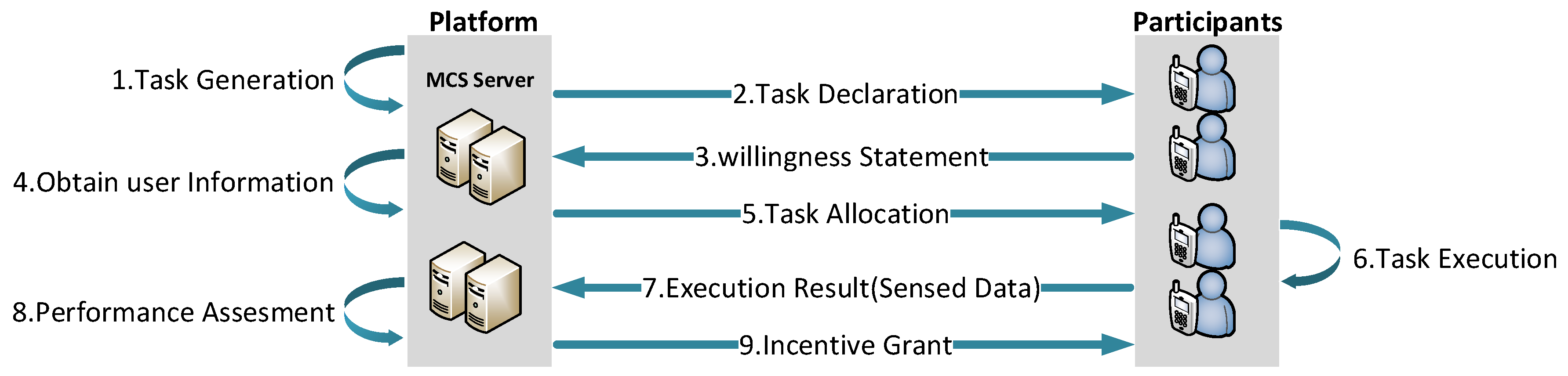
In many studies of the sensor population and the existing reference population, it is assumed that volunteers are not willing to send sensitive information to applicants without a reward; consequently, due to limited battery resources and CPUs, most smartphone users do not want to attend toll-free crowdsensing tasks. Incentive mechanism is one of the most important components of crowdsensing systems as it will ensure the participation of users. However, incentivizing approaches is not the focus of this research and we assume that all procedures prior to task allocation which is illustrated in
Figure 1 have been addressed. Accordingly, we will concentrate on task allocation mechanism and it’s significant role in performance of crowdsensing schemes.
Many efforts have been made to investigate the task allocation mechanism of crowdsensing systems [
30,
31]. The task allocation issue in crowd based systems is studied as an NP-hard problem. Problems that cannot be solved in traditional ways are considered as NP-hard problems. NP stands for Non deterministic polynomials which is the possibility of guessing the solution and then examining it. One of the features of NP-hard problems is that a simple algorithm (which may seem obvious at first glance) can be used to find useful solutions; however, the required time for finding a solution grows exponentially with the problem size. But in general, this method provides many possible solutions, while the absolute worst-case performance of the algorithm is bounded by a polynomial and the review of all solutions will be a very time consuming process. There are several methods for finding an immediate but near optimal solutions for a NP-Hard problem:
I. Approximate algorithms: Where an algorithm is presented to solve the problem and it is proved that the output magnitude is a factor of the optimal output value of the problem.
II. Huristic algorithms: Although these algorithms are fast and approximate, they do not have a positive predictive algorithm for the approximation coefficient or the magnitude of the algorithm. Many of these algorithms are empirically tested. Some of these algorithms use a “greedy method” to solve problems.
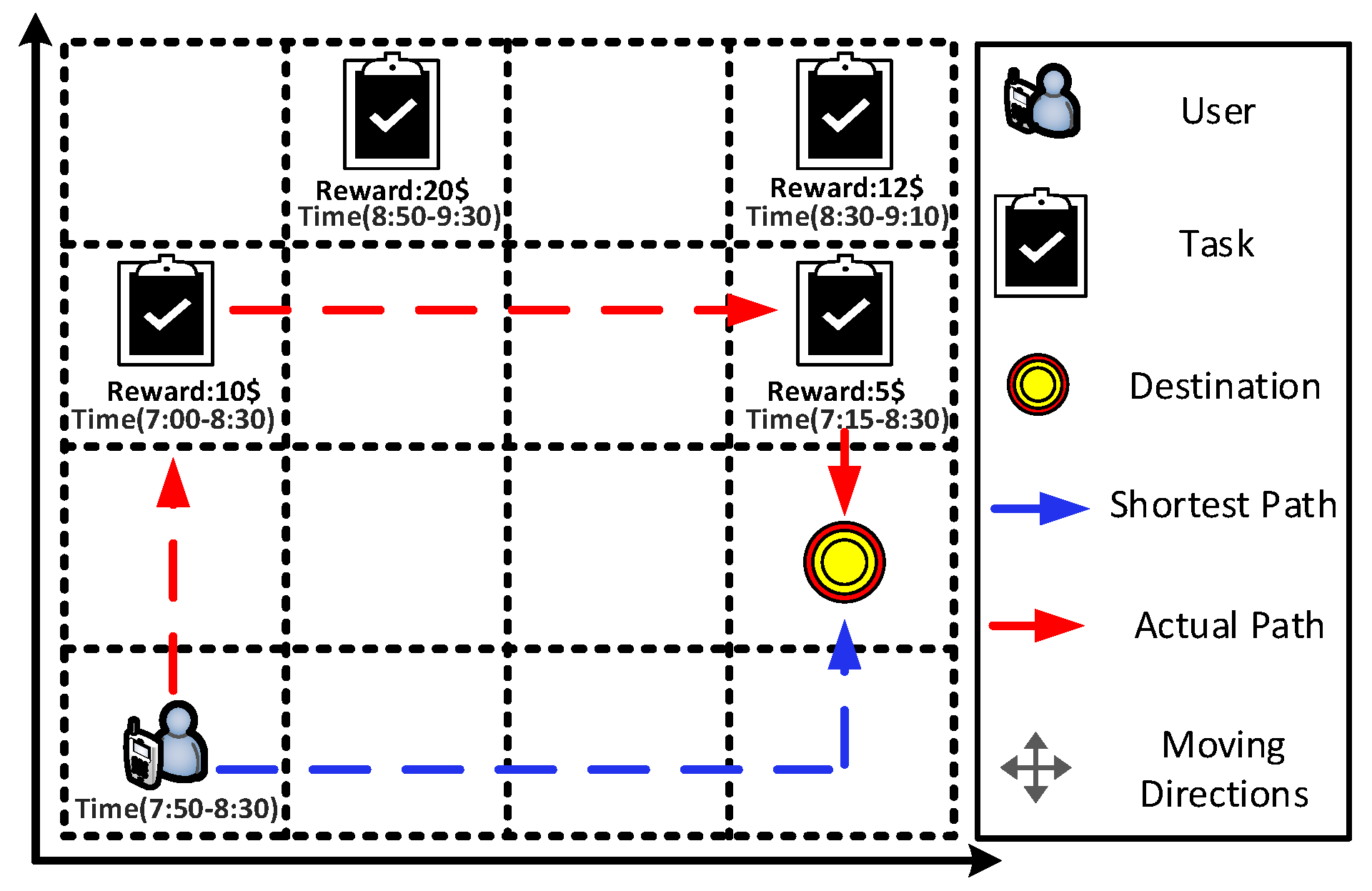
The efficiency of a crowdsourcing scheme is based on the precision of the data collected. However, in particular circumstances, it is difficult to guaranty data accuracy due to limited ability, an unreliable data source, and some uncontrollable mental factors. To select the participant, the relation between the number of active contributors and the number of tasks that must be performed on the MCS platform is an important element affecting the task completion rate. MCS tasks are largely location dependent, for example, selected participants should go to predefined locations to complete their tasks. The distance traveled is the initial cost to the participant. With regard to workplace solidarity, if we use our contributors to complete multiple tasks along their travel routes, the crowd based system will be more efficient as it has been able to make more effective use of available resources as illustrated in
Figure 2.
Indoor Localization Procedure
Location awareness is indispensable for a wide range of comprehensive mobile applications. For providing localization services in different environments, several approaches have been in introduced to facilitate the map generation process [
32]. However, expansion of satellites has mostly assisted the advent of global positioning system and outdoor localization procedure. In contrary, global positioning system is almost ineffectual in indoor environment due to weak penetration of signals and complex structures of the buildings [
33,
34]. Nevertheless, complicated indoor plans has elevated human confusion inside the buildings which indicates the significance of indoor localization as a substantial research direction. Different approaches that has been proposed for addressing indoor localization can be surveyed as fingerprint-based and model-based solutions [
35,
36].
Fingerprinting-based solutions: A massive number of indoor localization schemes are maintained in accordance with fingerprint matching which is the principal localization scheme [
37]. It functions based on collection of signatures in areas of interest, till construction of a fingerprint database. The localization will be accordingly performed by mapping the collected fingerprints. Researchers have proposed localization techniques that collect different signatures of the indoor environment and eliminate the mapping efforts. Most of the aforementioned techniques utilize RF signals as RADAR is an antecedent solution of this classification [
38]. Thereafter a stochastic description of the RSS was utilized in solutions such as Horus [
39] that approximates locations based on maximum likelihood. Respectively GSM, radio beacons, RFID, FM radio, ambient features and geomagnetism were utilized as fingerprints for indoor localization. However, all aforementioned techniques impose significant cost and effort on localization process since construction of the fingerprint database requires site survey process over the areas of interest.
Model-based solutions: Model-based solutions: This kind of localization schemes utilize geometrical models to characterize the relationship between signal transmitters and receivers. Time of Arrival (ToA), Time Difference of Arrival (TDoA), and Angel of Arrival (AoA) have been exploited for this purpose. Moreover, long distance path loss (LDPL) have been applied on RSS measurements in order to appraise RF propagation distance. For instance EZ is a model-based solution that exploits LPDL to model wireless propagation constraints then genetic algorithm will be accordingly applied to facilitate the localization procedure. Model-based solutions are usually dependent on additional infrastructure and hardware configuration abilities [
40].
4. Optimization
One of todays most important fields of research and development is the enhancement of search methods based on the principles of natural evolution. In evolutionary calculations, an abstraction of the basic concepts of natural evolution has been inspired by the search for an optimal solution concerning various issues. Researchers consider the desire for evolution as the most important factor in development of the mankind. Man always strives to evolve, so he thinks and he always strives to survive. This attempt on the road to evolution can be interpreted as a search problem. There are algorithms that can guarantee good answers at a certain distance from the optimal answer, which are called approximate algorithms. Other algorithms guarantee that they will produce a near optimal response with a certain probability, which are known as probabilistic algorithms.
Apart from two aforementioned categories, there are algorithms that do not assure to provide any answers but based on evidence and records. Their results, on average, have provided the best quality contrast and resolution time for the problems under consideration; these algorithms are called heuristic algorithms. The heuristics are benchmarks, techniques, or principles to decide between multiple policies and the most effective choice that attains the desired objectives. The heuristics result from the need for moderation between two requirements: the need to construct simple criteria and, at the same time, the ability to distinguish between best and worst choices. Most complex issues require an assessment of a large number of possible states for determining the exact answer which might take a lifetime. The heuristics will play an effective role in solving such problems using methods that require less evaluations and provides answers in acceptable time constraints.
Meta-Huristic optimization methods have become prevalent over the past two decades. For instance, the Genetic Algorithm, ACO and PSO are well-known among scientists in all areas of science with different tendencies. Here is a question why Meta-Huristics have become increasingly popular? There are four main reasons that can advocate reputation of Meta-Huristics including: simplicity, flexibility, unconditional mechanisms and staying away from local minima.
4.1. Gray Wolf Optimization
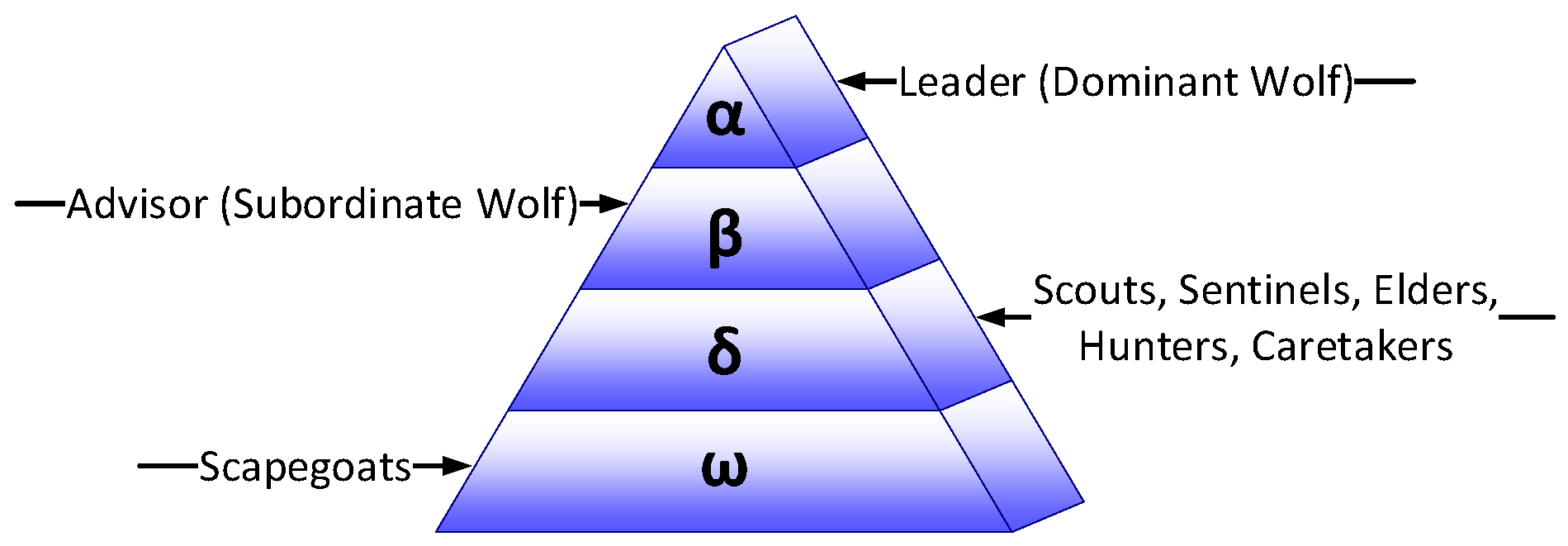
Gray wolves are predators at the top of the food chain that generally are more partial to live in a group which the size of each group alters from 5 to 12 wolves. Wolves follow a rigid social hierarchy which is illustrated in
Figure 3. Alpha is appointed as leader of the pack [
41]. Alpha’s decisions are commanded to the other members of the pack as Alpha is the dominant wolf in the pecking order [
42]. However, some democratic behaviors have also been recognized, in which Alpha has committed to decisions made by wolves from different classifications. Alpha is the unbeatable in terms of administrating and supervising the pack which indicates the fact that Alpha aint always the most potent wolf of the pack. Beta is the second level of gray wolf hierarchy which is strongly affiliated to the Alpha. Beta assists Alpha in decision making activities striving towards packs sake that consequently makes Bata the best candidate as the forthcoming Alpha. Beta acts as a discipliner in the pack and reinforces the Alpha’s orders and instructions throughout the pack. As an advisor Beta should always obey Alpha and return feedbacks from pack to notify Alpha about ongoing affairs. Omega is classified in the lowest level of gray wolf social hierarchy as it plays the role of scapegoat. Omega is always the surrender among other dominant wolves which may be considered that Omega is not a vital member in the pack however, investigations indicates that losing Omega in the pack causes internal fighting problems since all wolves vent the violence and frustrations using Omega. Omega makes the entire pack satisfied and maintains the dominance structures which indicates the importance of this category.
Delta wolves are the subordinate wolves that are not Alpha, Beta or Omega. Obedience of this category is restricted to Alpha and Beta since they dominate the Omega. Delta mainly watches the boundaries and protects the pack’s territory. Group hunting is an enthusiastic social activity in packs. As stated by Muro et al. [
44] Gray wolves pursue following stages during the hunting process:
Tracking, chasing, and approaching the prey.
Pursuing, encircling, and harassing the prey until it stops moving.
Attacking towards the prey.
Hereupon the social hierarchy of the gray wolves have been mathematically modeled. GWO considers Alpha () as the fittest solution so far. The second and third top solutions are recognized as Beta () and Delta (). Subsequently remaining solutions will be appraised as Omega () which is in charge of chasing the Alpha, Beta and Delta while they conduct the hunting procedure.
4.2. Encircling Prey
As gray wolves encircle prey throughout the hunt, the encircling behavior is mathematically modeled using the subsequent equations:
In aforementioned equations t specifies the iterations while and are the co-efficient vectors. and indicate the position vector of the gray wolf and position vector of the prey respectively.
4.3. Hunting
During the hunting process, Gray wolves identify the prey’s location and encircle it as the Alpha conducts the hunting procedure. This process has been mathematically simulated by considering the fact that the first 3 best solutions; the Alpha, Beta and Delta have better knowledge about the potential location of prey. Accordingly, 3 antecedent best solutions will be preserved and remaining search agents (Omega) are induced to update their positions conform to the Alpha, Beta and Delta. Subsequently following equations are proposed:
4.4. Attacking Prey
The hunting procedure terminates when prey stands still and stops moving. In the aforementioned mathematic model, “A” as a random value fluctuates between [−2a, 2a] intervals which indicates the impact of “a” on fluctuation ranges of “A” in which “a” reduces from 2 to 0 throughout the iterations. For instance, when the random values of “a” are in [−1, 1], the subsequent location of the search agent will be in any spot among its present position and the position of the prey.
4.5. Search for Prey
The searching process in gray wolf optimizer is carried on conforming the position of Alpha, Beta and Delta. During the hunting procedure Alpha, Beta and Delta consequently diverge and converge to search and attach the prey respectively. Hence, the divergence is mathematically modeled by applying A which possesses a random value between [1, −1] that induces the search agents to diverge. Consequently, the exploration in GWO is accentuated which empowers the global search.
5. Formulation of Crowdsensing Indoor Localization
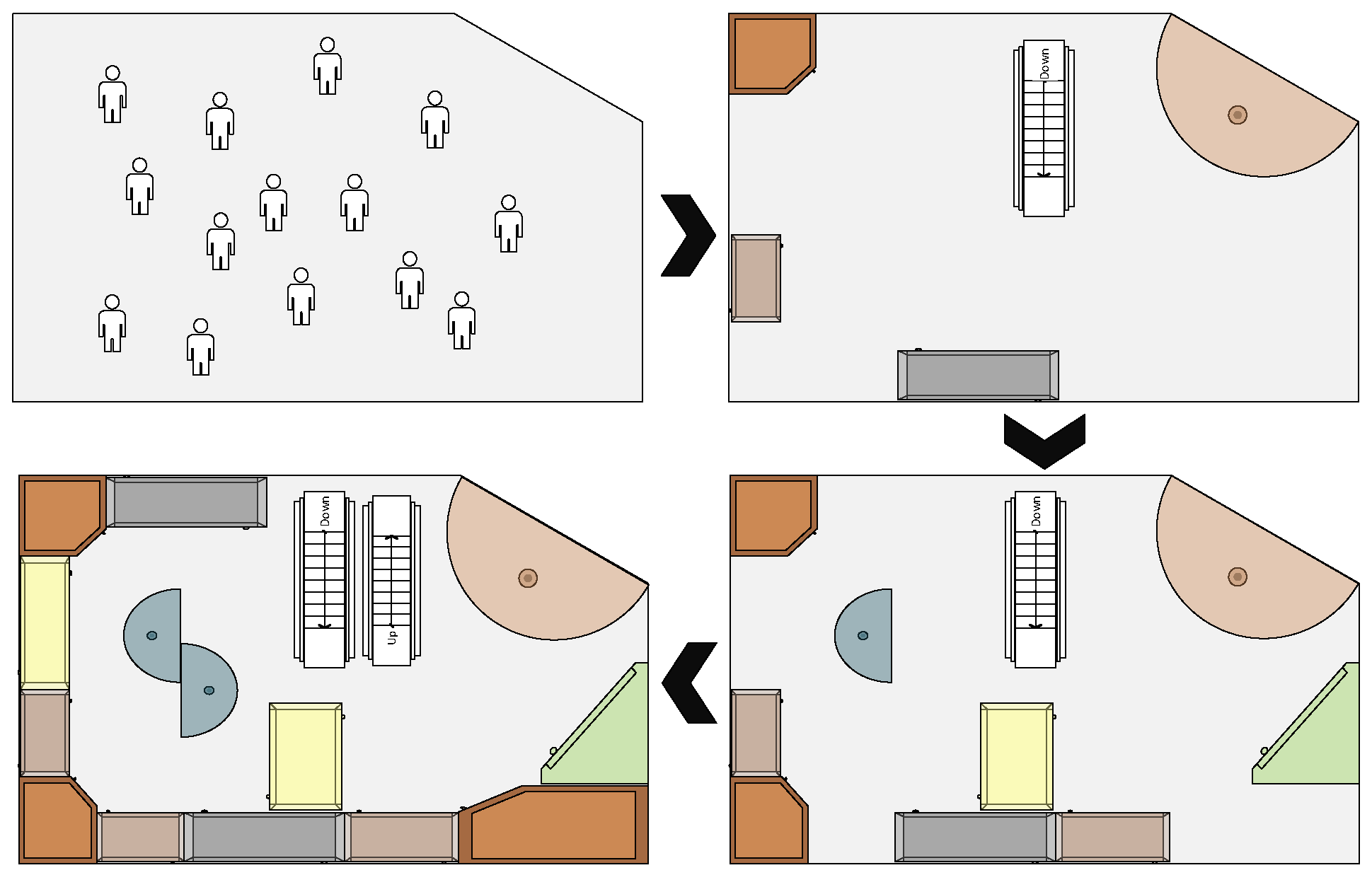
Consider a floor plan of a building where users are busy with everyday activities as illustrated in
Figure 4. A population-centric locational system is working properly and there is a platform in which the tasks and rewards are precisely defined. The platform should assign tasks to the contributors who register for data collection. These tasks include finding fingerprints and the coordinates of specific areas in that floor. Based on the gray wolf optimization algorithm, fingerprint that are meant to be collected will be considered as prey and users are simulated as gray wolf agents using MATLAB software, V. R2023b. Users that are located at a floor level of a building are displayed with
i and targets that require fingerprint collection for the localization process are illustrated as
j hence there are two possibilities for each node according to it’s demand for being localized.
Each contributor of the crowdsensing system has a level of demand or eagerness for completing particular tasks which is shown as
. Therefore contributer with zero amount of eagerness will not be considered in calculations. The greater the value of d, the more important the user will be since crowdsensing platform assigns more weight to that specific contributor. Another attribute of user is his/her location and its corresponding coordinates which is illustrated as
i and
i. In our proposed scheme localized user acts as anchor node. On the other hand, we want the most appropriate contributor to perform the localization process hence, the distance between each user and its corresponding target indicates the competence of that individual for the localization task. In this case norm of the connector vector between user and approximated target will be calculated using city block distance in Equations (8)–(10) or Euclidean distance considering the presence of obstacles which is demonstrated in Equations (11)–(13).
The purpose of proposed scheme is to incorporate the eagerness of contributors along with eliminating the intervals between users and targets so that each node will be localized by it’s closest match. Algorithm 1 illustrates the procedure of MCS localization during the presence of GWO.
| Algorithm 1 Pseudocode for the GWO algorithm |
Initialize the Gray Wolf population Xi (i = 1, 2, 3, ……, n)
Initialize co-efficient vectors a, A and C
Identify top3 solutions and rank them as followed:
Consider the first-best solution as
While (Iteration <= Max-Iteration)
Update the position of current search agents using Equations (2)–(4)
Evaluate the fitness Fiti for all search agents
Update co-efficient vectors a, A and C
Update , ,
Iteration = Iteraion + 1
EndWhile
Stop the process and return as the best agent so far.
|
6. Results and Discussion
As previously mentioned, how tasks are assigned to the contributors influences the results obtained in MCS localization schemes, hence, to optimize the task assignment procedure [
45,
46], the genetic algorithm and the gray wolf optimizer algorithm are implemented on this scenario utilizing MATLAB software to evaluate the results [
34,
47]. The purpose of this simulation is to investigate the intention of optimized task allocation method on precision of results obtained by crowd powered systems. The nature of the gray wolf algorithm intends to select the best candidate for task allocation and the task-allocation process is implicitly performed on this algorithm, while genetic algorithm randomly evaluates the population, selects parents and combines them to create a population of children on the basis of merit, the absolute value of the target function, or the rank of the parent selection.In order to simulate the mathematical behavior of gray wolf hunting, we suppose that Alpha, Beta and Delta are more apprised about the feasible location of the prey. So, three foremost solutions will be preserved and other search factors are obliged to update their positions on the authority of the best search agents locations.
Finally, the coordinates estimated by the participants are compared with the coordinates in the original map and the results are evaluated. The obtained coordinates with the principal coordinates represent the localization precision. As discussed earlier, gray wolves surround prey during the hunt and have the ability to detect the position of the pray.
Hunting operations are usually carried out by hunters(Alpha), while Beta and Delta can also be involved in hunting procedure. However, in an abstract search space, we do not have any idea of the optimal position (hunting). Based on the simulation of gray wolf hunting behavior, it is suggested that Alpha (the best candidate response) Beta and Delta are more apprised about the feasible location of the pray.
The final position will be the cause of a random location within a circle that is specified in terms of the location of the Alpha, Beta, and Delta in the search space. Accordingly, the beta-dataset will estimate the predator’s position, and the other agents positions will be randomly updated around the hunt. Every candidate’s response updates its distance from the pray. Undisclosed nodes and anchor nodes are randomly assigned to a communication range in which anchor nodes measure their position and share their coordinates with their neighbors because of the neighboring anchor node assistance in local nodes localization [
46]. Accordingly, the three best answers that have been acquired insofar will be preserved and other search factors will update their position utilizing the location of the best search agent to minimize the localization errors.
In this regards first, we start the optimization by simulating the genetic algorithm and creating the space of the problem according to the assumptions and parameter settings within
Table 1. The space will be the same for both the genetic algorithm and the gray wolf optimizer algorithm. In genetic algorithm, to tackle the MCS localization scenario, using the genetic algorithm, three selection methods of Tournament Selection, and RWS selection have been utilized individually. As in the general scheme of the genetic algorithm, chromosomes are first selected to be the next generation parents, and crossover will be applied on them respectively.There is a fundamental question about how parents will be chosen in this scheme and among various approaches for the selection phase we have applied Tournament and Roulette Wheel Selection (see
Table 2).
6.1. GA-Roulette Wheel Selection
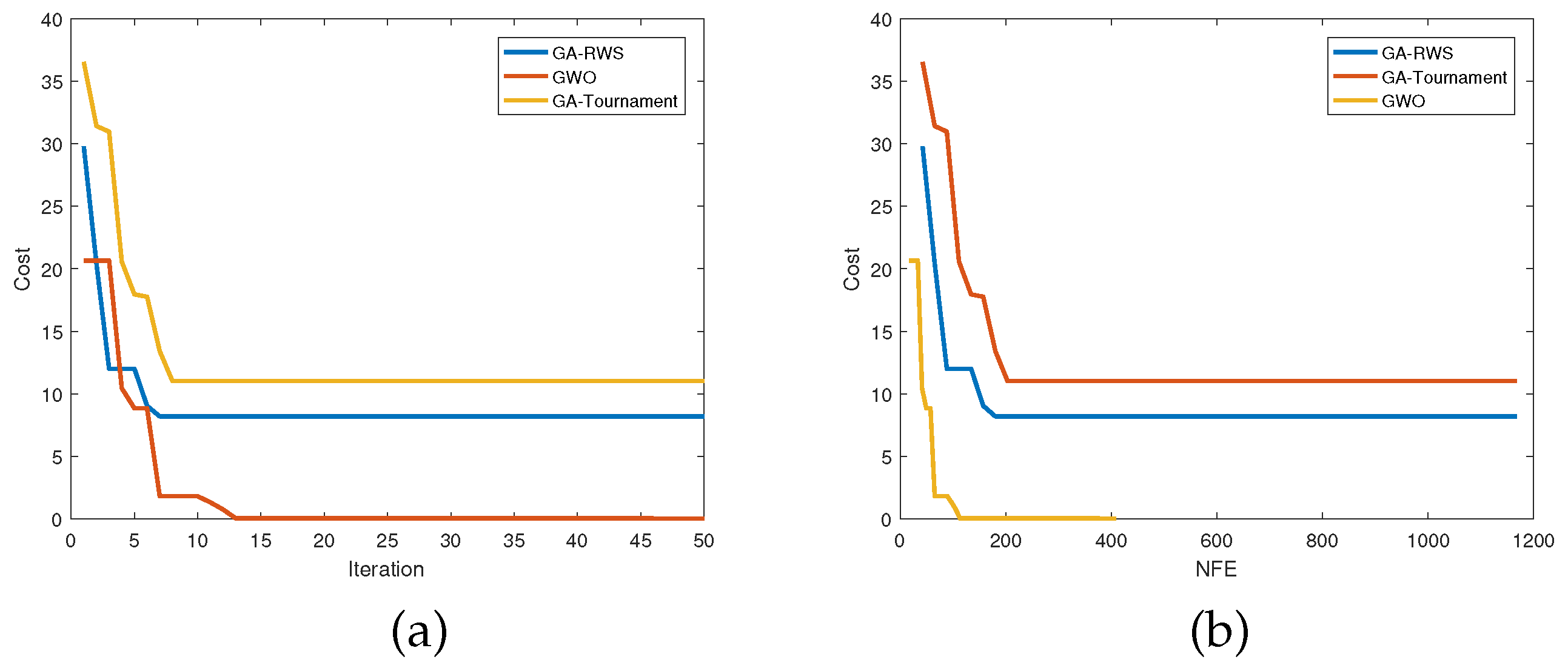
Figure 5a,b illustrates the results of implementing GA on cost function using RWS, Tournament and GWO. This diagram indicates the fact that although RWS has maintained competitive results in eliminating the Target-Contributor distance and its corespondent localization error, until almost 100 times of function evaluation there is no ultimate change in cost-function value. In
Figure 5a the aforementioned cost function has been evaluated by applying RWS in 50 iterations. The value of cost function declines per iteration and this trend is only extended until the eighth iteration.
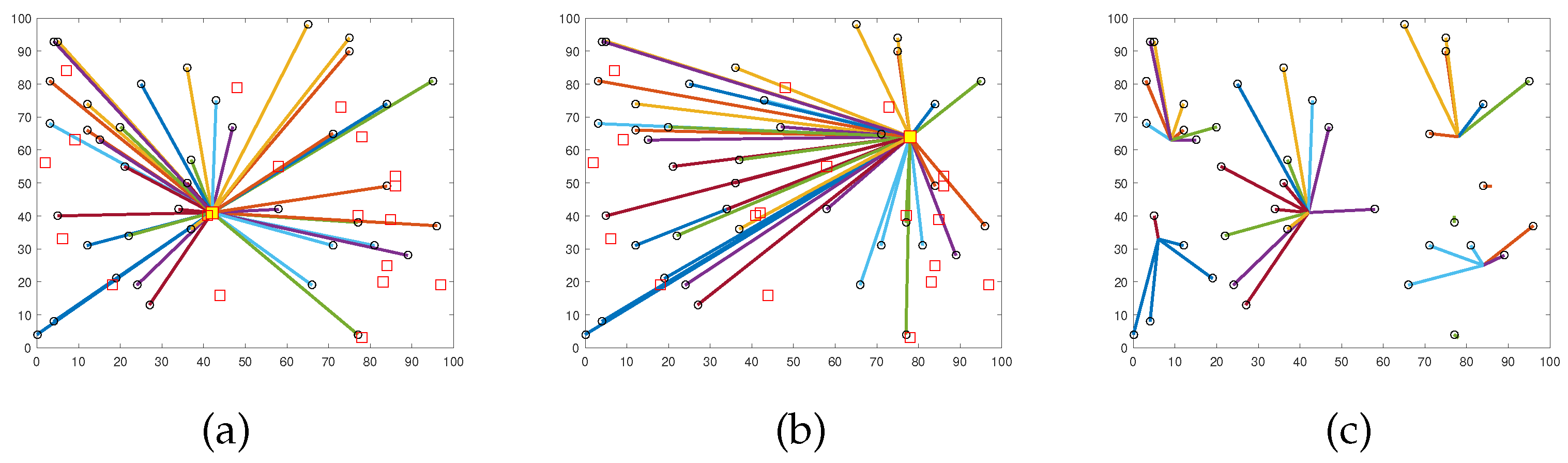
Figure 5b explains the obtained results as all users have been contributing in the fingerprint collection of specific node regardless of their locations and eagerness. Inadequacy of a task assignment for potential contributors and centralized competence for localization of single target despite of contributer-target distance in task allocation has resulted in aforementioned outcomes as illustrated in
Figure 6a.
6.2. GA-Tournament Selection
Figure 5 also illustrates the results of implementing GA on cost function though this time tournament selection has been utilized as sampling mechanism.
Figure 5b illustrates the value of cost function each time that it has been evaluated. The value of cost function constantly declines after each function evaluation however this value remains steady without alterations after the 200th function evaluation. The same trend happens while implementing GA in 50 iterations since no further changes occurs in cost function value after 6th iteration and afterwards it remains constant without further changes. There is no other reasons causing aforementioned results other than inadequacy of task assignment mechanism in implementation of GA owing to the fact that GA has allocated contributors to published tasks without consideration of Target-Contributor distance by accentuating the contributors willingness in task execution which is demonstrated in
Figure 6b.
6.3. GWO
Implementation results of GWO has been compared to GA and indicates that GWO has significantly declined the cost function (LE) value as illustrated in
Figure 5. GWO is a crowd-powered scheme that contains implicit task assignment mechanism which matches and updates the position of wolves according to the Alphas position. Hence, GWO performs task allocation in each zone based on competence of each contributor in case of eagerness and its corresponding location as illustrated in
Figure 6c. GWO has eliminated the cost function in only 450 function evaluations which is almost one third of the number of evaluations that has been performed in GA. GWO has reduced cost function to 0.01 in 12 iterations which qualifies GWO’s task assignment mechanism as a population-centric scheme as in
Figure 6c localization tasks have been performed by eligible contributors of their conforming zone.
7. Conclusions
Crowdsensing is the procedure of providing services, ideas and information from sensing devices using human wisdom. User participation in crowd-powered systems is a key factor as it insures the reliability and quality of the data collection process. The focus of this investigation is providing an optimized task allocation mechanism for crowdsensing indoor localization schemes since one of the main challenges of aforementioned schemes is involvement of users and then choosing the right person for performing the sensing task. We have applied the gray wolf optimizer algorithm to increase the localization precision by facilitating the task allocation procedure. Optimization is an important and decisive activity in structural designs that enables the possibility of developing sensible results and optimizing costs. Considering the population-driven nature of the GWO algorithm and its implicit task assignment mechanism we applied GWO an indoor localization crowdsensing scenario to evaluate the performance of this algorithm and apperceive how it effects localization precision. We have also applied genetic algorithm on same scenario to make a comparison between population centric optimization algorithms. As it was expected, the population-centric structure of the gray wolf algorithm could significantly increase the precision of fingerprint collection for localization systems in indoor environments in comparison with genetic algorithm. In this work we have utilized both optimization algorithms in behalf of crowdsensing task allocation mechanism. However, it is expected that implementation of GA on an underlying task allocation mechanism will maintain more competitive results. As future direction we are planning to tackle task allocation as a multi-objective issue to comprise other aspects of MSC platforms such as incentive grant and then compare the implementation of integrated optimization algorithms in presence of underlying task allocation approaches.
Author Contributions
B.L.: Conceptualization, methodology, validation, analysis, supervision, writing, review and editing. J.R.: Conceptualization, methodology, validation, supervision, review and editing. R.F.: Conceptualization, methodology, validation, supervision, review and editing. All authors have read and agreed to the published version of the manuscript.
Funding
This research received no external funding.
Data Availability Statement
Data is contained within the article.
Conflicts of Interest
The authors declare no conflicts of interest.
References
- Lashkari, B.; Rezazadeh, J.; Farahbakhsh, R.; Sandrasegaran, K. Crowdsourcing and Sensing for Indoor Localization in IoT: A Review. IEEE Sens. J. 2019, 19, 2408–2434. [Google Scholar] [CrossRef]
- Zhu, X.; An, J.; Yang, M.; Xiang, L.; Yang, Q.; Gui, X. A fair incentive mechanism for crowdsourcing in crowd sensing. IEEE Internet Things J. 2016, 3, 1364–1372. [Google Scholar] [CrossRef]
- Rezazadeh, J.; Moradi, M.; Sandrasegaran, K.; Farahbakhsh, R. Transmission Power Adjustment Scheme for Mobile Beacon-Assisted Sensor Localization. IEEE Trans. Ind. Inform. 2019, 15, 2859–2869. [Google Scholar] [CrossRef]
- Tinh, P.D.; Bui, H.H.; Nguyen, D.C. A genetic based indoor positioning algorithm using Wi-Fi received signal strength and motion data. IAES Int. J. Artif. Intell. 2023, 12, 328. [Google Scholar] [CrossRef]
- Wang, Y.; Zhao, C.; Xu, S. Method for spatial crowdsourcing task assignment based on integrating of genetic algorithm and ant colony optimization. IEEE Access 2020, 8, 68311–68319. [Google Scholar] [CrossRef]
- Kamilaris, A.; Pitsillides, A. Mobile phone computing and the internet of things: A survey. IEEE Internet Things J. 2016, 3, 885–898. [Google Scholar] [CrossRef]
- Rezazadeh, J.; Sandrasegaran, K.; Kong, X. A location-based smart shopping system with IoT technology. In Proceedings of the 2018 IEEE 4th World Forum on Internet of Things (WF-IoT), Singapore, 5–8 February 2018; pp. 748–753. [Google Scholar]
- Abdeddine, A.; Iraqi, Y.; Mekouar, L. An Efficient Task Allocation in Mobile Crowdsensing Environments. IEEE Trans. Netw. Serv. Manag. 2025, 22, 2323–2342. [Google Scholar] [CrossRef]
- Sattarian, M.; Rezazadeh, J.; Farahbakhsh, R.; Bagheri, A. Indoor navigation systems based on data mining techniques in internet of things: A survey. Wirel. Netw. 2019, 25, 1385–1402. [Google Scholar] [CrossRef]
- Rezazadeh, J.; Subramanian, R.; Sandrasegaran, K.; Kong, X.; Moradi, M.; Khodamoradi, F. Novel iBeacon Placement for Indoor Positioning in IoT. IEEE Sens. J. 2018, 18, 10240–10247. [Google Scholar] [CrossRef]
- Gharghan, S.K.; Nordin, R.; Ismail, M.; Ali, J.A. Accurate wireless sensor localization technique based on hybrid PSO-ANN algorithm for indoor and outdoor track cycling. IEEE Sens. J. 2016, 16, 529–541. [Google Scholar] [CrossRef]
- Wang, Y.; Wu, X.; Cheng, L. A Novel Non-Line-of-Sight Indoor Localization Method for Wireless Sensor Networks. J. Sens. 2018, 2018, 3715372. [Google Scholar] [CrossRef]
- Tseng, C.L.; Cheng, C.S.; Chen, C.W.; Wang, S.Y.; Wen, R.J. A localization method using the bee colony algorithm for mobile wireless sensor networks. In Proceedings of the 2016 International Automatic Control Conference (CACS), Taichung, Taiwan, 9–11 November 2016; pp. 194–199. [Google Scholar]
- Janapati, R.; Balaswamy, C.; Soundararajan, K. Localization of Cooperative WSN using Distributed PSO with Optimum References. Int. J. Electr. Comput. Eng. 2016, 6, 3094. [Google Scholar] [CrossRef]
- Shieh, C.S.; Sai, V.O.; Lin, Y.C.; Lee, T.F.; Nguyen, T.T.; Le, Q.D. Improved node localization for WSN using heuristic optimization approaches. In Proceedings of the 2016 International Conference on Networking and Network Applications (NaNA), Hakodate, Japan, 23–25 July 2016; pp. 95–98. [Google Scholar]
- Kulkarni, R.V.; Venayagamoorthy, G.K. Particle swarm optimization in wireless-sensor networks: A brief survey. IEEE Trans. Syst. Man Cybern. Part C Appl. Rev. 2011, 41, 262–267. [Google Scholar] [CrossRef]
- Rajakumar, R.; Amudhavel, J.; Dhavachelvan, P.; Vengattaraman, T. GWO-LPWSN: Grey wolf optimization algorithm for node localization problem in wireless sensor networks. J. Comput. Netw. Commun. 2017, 2017, 7348141. [Google Scholar] [CrossRef]
- Liu, J.; Shen, H.; Narman, H.S.; Chung, W.; Lin, Z. A Survey of Mobile Crowdsensing Techniques: A Critical Component for the Internet of Things. In Proceedings of the 25th International Conference on Computer Communication and Networks (ICCCN), Waikoloa, HI, USA, 1–4 August 2016. [Google Scholar]
- Guo, B.; Wang, Z.; Yu, Z.; Wang, Y.; Yen, N.Y.; Huang, R.; Zhou, X. Mobile crowd sensing and computing: The review of an emerging human-powered sensing paradigm. ACM Comput. Surv. CSUR 2015, 48, 7. [Google Scholar] [CrossRef]
- Howe, J. Crowdsourcing; Three Rivers Press: New York, NY, USA, 2009. [Google Scholar]
- Hossain, M.; Kauranen, I. Crowdsourcing: A comprehensive literature review. Strateg. Outsourcing Int. J. 2015, 8, 2–22. [Google Scholar] [CrossRef]
- Seo, J.; Zo, H. Crowdsourcing Motivation and Performance: A Social Identity Perspective. In Proceedings of the Pacific Asia Conference on Information Systems, Chiayi, Taiwan, 27 June–1 July 2016. [Google Scholar]
- Quinn, A.; Bederson, B. Human computation. In Proceedings of the 2011 Annual Conference on Human Factors in Computing Systems, Vancouver, BC, Canada, 7–12 May 2011. [Google Scholar]
- See, L.; Mooney, P.; Foody, G.; Bastin, L.; Comber, A.; Estima, J.; Fritz, S.; Kerle, N.; Jiang, B.; Laakso, M.; et al. Crowdsourcing, citizen science or volunteered geographic information? The current state of crowdsourced geographic information. ISPRS Int. J. Geo-Inf. 2016, 5, 55. [Google Scholar] [CrossRef]
- Kucherbaev, P.; Daniel, F.; Tranquillini, S.; Marchese, M. Crowdsourcing Processes: A Survey of Approaches and Opportunities. IEEE Internet Comput. 2015, 20, 50–56. [Google Scholar] [CrossRef]
- Guo, B.; Yu, Z.; Zhou, X.; Zhang, D. From participatory sensing to mobile crowd sensing. In Proceedings of the 2014 IEEE International Conference on Pervasive Computing and Communication Workshops (PERCOM WORKSHOPS), Budapest, Hungary, 24–28 March 2014; pp. 593–598. [Google Scholar]
- Radu, V.; Marina, M.K. HiMLoc: Indoor smartphone localization via activity aware Pedestrian Dead Reckoning with selective crowdsourced WiFi fingerprinting. In Proceedings of the International Conference on Indoor Positioning and Indoor Navigation, Montbeliard, France, 28–31 October 2013. [Google Scholar]
- Chatzimilioudis, G.; Konstantinidis, A.; Laoudias, C.; Zeinalipour-Yazti, D. Crowdsourcing with Smartphones. IEEE Internet Comput. 2012, 16, 36–44. [Google Scholar] [CrossRef]
- Maghdid, H.S.; Lami, I.A.; Ghafoor, K.Z.; Lloret, J. Seamless Outdoors-Indoors Localization Solutions on Smartphones. ACM Comput. Surv. 2016, 48, 1–34. [Google Scholar] [CrossRef]
- Li, C.; Chai, W.; Yang, X.; Li, Q. Crowdsourcing-Based Indoor Semantic Map Construction and Localization Using Graph Optimization. Sensors 2022, 22, 6263. [Google Scholar] [CrossRef] [PubMed]
- Zhao, Y.; Zhang, Z.; Feng, T.; Wong, W.C.; Garg, H.K. GraphIPS: Calibration-free and map-free indoor positioning using smartphone crowdsourced data. IEEE Internet Things J. 2020, 8, 393–406. [Google Scholar] [CrossRef]
- Chang, Q.; Van de Velde, S.; Wang, W.; Li, Q.; Hou, H.; Heidi, S. Wi-Fi Fingerprint Positioning Updated by Pedestrian Dead Reckoning for Mobile Phone Indoor Localization. In Lecture Notes in Electrical Engineering; Springer: Berlin/Heidelberg, Germany, 2015; pp. 729–739. [Google Scholar]
- Liu, H.; Darabi, H.; Banerjee, P.; Liu, J. Survey of Wireless Indoor Positioning Techniques and Systems. IEEE Trans. Syst. Man Cybern. Part C Appl. Rev. 2007, 7, 1067–1080. [Google Scholar] [CrossRef]
- Xiao, J.; Zhou, Z.; Yi, Y.; Ni, L.M. A survey on wireless indoor localization from the device perspective. ACM Comput. Surv. CSUR 2016, 49, 25. [Google Scholar] [CrossRef]
- Yassin, A.; Nasser, Y.; Awad, M.; Al-Dubai, A.; Liu, R.; Yuen, C.; Raulefs, R.; Aboutanios, E. Recent Advances in Indoor Localization: A Survey on Theoretical Approaches and Applications. IEEE Commun. Surv. Tutor. 2017, 19, 1327–1346. [Google Scholar] [CrossRef]
- He, S.; Chan, S. Wi-Fi Fingerprint-Based Indoor Positioning: Recent Advances and Comparisons. IEEE Commun. Surv. Tutor. 2016, 18, 466–490. [Google Scholar] [CrossRef]
- Yang, Z.; Wu, C.; Liu, Y. Locating in fingerprint space: Wireless indoor localization with little human intervention. In Proceedings of the 18th Annual International Conference on Mobile Computing and Networking—Mobicom, Istanbul, Turkey, 22–26 August 2012. [Google Scholar] [CrossRef]
- Shang, J.; Hu, X.; Gu, F.; Wang, D.; Yu, S. Improvement Schemes for Indoor Mobile Location Estimation: A Survey. Math. Probl. Eng. 2015, 15, 397298. [Google Scholar] [CrossRef]
- Youssef, M.; Agrawala, A. The Horus WLAN location determination system. In Proceedings of the 3rd International Conference on Mobile Systems, Applications, and Services, Seattle, WA, USA, 6–8 June 2005; pp. 205–218. [Google Scholar]
- Faragher, R.; Harle, R. SmartSLAM-an efficient smartphone indoor positioning system exploiting machine learning and opportunistic sensing. In Proceedings of the 26th International Technical Meeting of The Satellite Division of the Institute of Navigation (ION GNSS+ 2013), Nashville, TN, USA, 16–20 September 2013; Volume 13, pp. 1–14. [Google Scholar]
- Mirjalili, S.; Mirjalili, S.M.; Lewis, A. Grey wolf optimizer. Adv. Eng. Softw. 2014, 69, 46–61. [Google Scholar] [CrossRef]
- Mech, L.D. Alpha status, dominance, and division of labor in wolf packs. Can. J. Zool. 1999, 77, 1196–1203. [Google Scholar] [CrossRef]
- Kiani, F.; Seyyedabbasi, A.; Mekouar, L. Optimal characterization of a microwave transistor using grey wolf algorithms. Analog Integr. Circuits Signal Process. 2021, 109, 599–609. [Google Scholar] [CrossRef]
- Muro, C.; Escobedo, R.; Spector, L.; Coppinger, R. Wolf-pack (Canis lupus) hunting strategies emerge from simple rules in computational simulations. Behav. Processes 2011, 88, 192–197. [Google Scholar] [CrossRef] [PubMed]
- Bahl, P.; Padmanabhan, V.N. RADAR: An in-building RF-based user location and tracking system. In Proceedings of the IEEE INFOCOM 2000, Tel Aviv, Israel, 26–30 March 2000; Volume 2, pp. 775–784. [Google Scholar]
- Patwari, N.; Ash, J.; Kyperountas, S.; Hero, A.O.I.; Moses, R.; Correal, N. Locating the nodes: Cooperative localization in wireless sensor networks. IEEE Signal Process. Mag. 2005, 22, 54–69. [Google Scholar] [CrossRef]
- Rezazadeh, J.; Moradi, M.; Ismail, A.S.; Dutkiewicz, E. Superior path planning mechanism for mobile beacon-assisted localization in wireless sensor networks. IEEE Sens. J. 2014, 14, 3052–3064. [Google Scholar] [CrossRef]
| Disclaimer/Publisher’s Note: The statements, opinions and data contained in all publications are solely those of the individual author(s) and contributor(s) and not of MDPI and/or the editor(s). MDPI and/or the editor(s) disclaim responsibility for any injury to people or property resulting from any ideas, methods, instructions or products referred to in the content. |