
Article

Next Generation Intelligent Mobile Edge Networks for Improving Service Provisioning in Indonesian Festivals


School of Computer Science, The University of Nottingham, Nottingham NG8 1BB, UK
*
Author to whom correspondence should be addressed.
J. Sens. Actuator Netw. 2026, 15(1), 19; https://doi.org/10.3390/jsan15010019
Submission received: 15 December 2025 / Revised: 1 February 2026 / Accepted: 2 February 2026 / Published: 6 February 2026
(This article belongs to the Section Communications and Networking)

Abstract

Indonesia is a country of vast geographical and cultural diversity, hosting numerous cultural festivals annually, such as Sekaten, Labuhan, and the Lembah Baliem Festival. However, as the world’s largest archipelago country, Indonesia faces geographical challenges in terms of ensuring the reliability of communication networks, particularly in maintaining user experience in high-density, short-duration traffic burst environments, such as festivals. The nation’s network connectivity relies heavily on satellite networks and Palapa Ring, a national fibre-optic backbone network that comprises a combination of inland and underwater networks, connecting major and remote islands to the global internet. Although this solution can provide a baseline for broadband connectivity, an adaptive intelligent mobile edge-based solution is needed to complement the existing network infrastructure in order to meet the dynamic demands of localised and transient traffic surges across multiple temporary, geographically dispersed festival sites in both urban and rural areas. In this paper, we present a multimodal study that combines network connectivity measurements during a festival with an extensive user analysis of festival participants and organisers to investigate reliability gaps in user experience regarding network connectivity. Our findings show that internet connectivity was intermittently disrupted during the festival, and our user analysis revealed a gap between customer expectations and perceptions of network service quality and the provision of application services in a heterogeneous festival environment. To address this challenge, we propose a novel next-generation intelligent festival mobile edge framework, MobiFest, which integrates the multi-layer Cognitive Cache which has geospatial–temporal edge intelligence for localised service provisioning to improve the delivery of application services in both urban and rural festival environments. In our extensive experiments, we employ smart garbage as our use case and demonstrate how our complex, multimodal intelligent network protocol SmartGarbiC, designed based on MobiFest for garbage management services, outperforms state-of-the-art and benchmark protocols.

1. Introduction

Indonesia, the world’s largest archipelago [1], is a place of vast geographical and cultural diversity and hosts numerous cultural festivals annually, such as Sekaten [2], Labuhan [3], and the Lembah Baliem Festival [4]. These cultural festivals are held in various regions and thus diverse network connectivity landscapes [5], encompassing both densely populated urban areas and geographically remote rural regions. Despite efforts made to provide a baseline for broadband connectivity by deploying satellite Satria-1 [6] and Palapa Ring [7], a national fibre-optic backbone network, Indonesia is still facing challenges in terms of gaps in digital access and infrastructure due to its geographical situation [5,8].
The global proliferation of festivals has highlighted reliable and seamless digital connectivity as a key need. Ensuring a positive experience and digital connectivity for participants has become an integral part of modern festivals [9,10]. In an urban area environment [11,12], the sudden influx of a large flash crowd of festival participants causes network traffic congestion in the existing communication network infrastructure, which is having to serve a number of devices beyond its usual capacity. On the other hand, when a large temporary festival crowd gathers in rural or remote areas, the limited level or even complete lack of network infrastructure means that attendees have a constrained ability to connect, share data, or access essential application services [13,14,15]. In both urban and rural contexts, the surge of traffic overwhelms the current network capacity. As a result, the dynamically changing density at festivals poses a complex challenge for Indonesia’s network providers, such as Telkom (Jakarta, Indonesia), Telkomsel (Jakarta, Indonesia), XL (Jakarta, Indonesia), Indosat (Jakarta, Indonesia), and SmartFren (Jakarta, Indonesia), as well as festival organisers, as they work to maintain users’ experience and their ability to access essential application services during a festival. This emphasises the urgent need for an intelligent communication network solution that is capable of adapting to these conditions in order to facilitate the delivery of essential application services, particularly in a festival environment.
In order to tackle this challenge, we conducted a multimodal study that combined network connectivity measurements during the festival with an extensive user analysis of festival participants and organisers to investigate reliability gaps in user experience regarding network connectivity. We propose a novel intelligent festival mobile edge framework, MobiFest, which integrates the geospatial–temporal edge intelligence of multi-layer Cognitive Cache for localised service provisioning to improve the delivery of application services in both rural and urban areas. Over extensive experiments, we employ smart garbage as our example use case of application services and demonstrate that our proposed protocol SmartGarbiC, which is designed based on MobiFest to provide garbage management services, outperforms the state-of-the-art and benchmark protocols.

2. Related Works

2.1. Network Connectivity Challenges at Festivals

Network connectivity at festivals allows attendees to access and share content from application services and remain connected to online communities while on-site [9,10]. Connectivity allows access to real-time schedules, event descriptions, navigation tools, and event updates while also contributing to a sense of safety by enabling real-time alerts and emergency information during unexpected events [14]. Marques et al. [16] analysed human mobility and found that large-scale events in a Brazilian city trigger different mobility behaviour compared to a typical day and an observable surge in network workload (call volume, usage density) before and during the event, which then gradually decreases after the event ends. Existing studies capturing connectivity data using Bluetooth [17] and cellular networks [11,18] reveal that network performance degrades during festivals. In such cases, a congestion problem arises due to the fact that people can simultaneously connect to the mobile broadband or WiFi access points. While these studies highlight the need for more reliable network connectivity during festivals from a technical perspective, we believe that festival attendees’ and organisers’ perspectives are also essential to drive technology development in such dynamic environments. Therefore, in this study, we conducted a survey among festival attendees and organisers to gain insights into their perceptions and expectations of the network connectivity that they experience in festival environments.

2.2. Enabling Heterogeneous Service Provision in Festival Environments

As the festival only lasts a few days, deploying wired network coverage to the festival area is costly. Hence, wireless network deployment is more feasible. Companies such as Bytes Digitals (Clevedon, UK) [19] and Telcom (Manchester, UK) [20] offer access point solutions to provide temporary internet access by deploying Cell on Wheels (CoWs) (Vodafone, Glastonbury, UK) [21] to festival venues. However, this solution is applicable only to open and large festival venues with a high budget. Another possible solution is utilising Mobile Ad Hoc Networks (MANET) [22], as was achieved with the Public Access WiFi Service (PAWS) project [23]. This provides free public internet access by leveraging the existing internet connectivity in Aspley, an underserved community in Nottingham, supporting the feasibility of the cost-free deployment of wireless ad hoc networks.
Another feasible solution, mobile intelligent edge [24], is designed and leveraged to provide service provisioning in a dynamically changing density environment, such as festivals. The inclusion of Opportunistic Networks (OppNets) [25] in the mobile intelligent edge network architecture shows promise as a solution to complement the existing infrastructure in the urban area and could represent the primary communication network in rural areas. In opportunistic networks, a node discovers other nodes when they come within communication range through mobility [26]. There is no need to establish an end-to-end path since opportunistic networks operate using a store–carry-forward mechanism. Ego networks optimise forwarding using various metrics such as encounter history and social metrics to prevent the excessive replication that leads to network flooding. The store–carry-forward mechanism, which OppNets possesses, facilitates communication networks even in environments with limited and intermittent connectivity, such as festivals [11]. This is also emphasised by Shafiq et al. [18], who suggest that opportunistic network connection sharing will reduce the number of overall cellular connection requests, thereby reducing request congestion and connection failures. Mobile Opportunistic and Disconnection Tolerant Networking (MODiToNeS) [27] has been proposed to facilitate the development of distributed systems that enable real-time, multi-layered, multi-dimensional communication and has been deployed to enable real-time communication in an agricultural environment (in the UK) and in a smart city (in Valencia, Spain) [28,29,30]. Another study [31] also showed that intelligent edge environments are able to provide essential services in smart cities. Both studies support the feasibility of this work.
Building on these insights, in this study, we develop an intelligent mobile edge framework, MobiFest, built over a multi-layer Cognitive Cache [32], which is able to geospatially and temporally predict content demand and proactively cache data in the edge nodes near the application service’s content subscribers. This cross-layer caching also incorporate the congestion-aware mechanism of Congestion-Aware Forwarding Algorithm (CAFe) [33,34], adaptive replication control from Congestion-Aware Forwarding and Replication (CafRep) [35,36], and CafRepCache [37], which empowers Cognitive Cache’s node to proactively redistribute contents in festival environments to avoid congestion and storage hotspots while maintaining the number of content replications, to prevent unintentional network flooding.
Mobile edge studies have employed several approaches. UAV-assisted systems have effectively delivered content in dynamic environments [38]. However, at Indonesian festivals, reliance on UAVs only will be challenging, since UAV systems [38] are constrained by airspace restrictions over Indonesia’s heritage sites, where several of the festivals are held [39]. Joint computation offloading with personalised federated deep reinforcement learning in multi-edge smart communities is effective for personalised resource allocation [40] and collaborative caching, providing resilience through robust federated learning [41]. However, both of them assume stable connectivity in the network infrastructure [40,41], which is not always possible in a festival environment. MobiFest addresses these gaps by providing a heterogeneous and adaptable architecture of mobile intelligent edge nodes that are robust even in the presence of intermittent connectivity during the festival, in both urban and rural areas.
There are still limited studies available on mobile edge combined with opportunistic networks in Indonesia. Existing studies in urban areas mostly focus on cities such as Surabaya [42,43,44], Bandung [45,46], and Jakarta [47], without a specific focus on events such as cultural festivals in Indonesia. In rural areas, several studies [48,49,50,51,52,53,54] focus on message ferrying across multiple islands using ferries (as inter-island data mules), buses, and cars (as intra-island data mules). Our study will enrich the research on edge and opportunistic networks in Indonesia through a focus on facilitating service provisioning for Indonesian cultural festivals.

3. Identifying Network Connectivity Challenges and Complex Multimodal Service Requirements at Indonesian Festivals

In this section, we identify network connectivity challenges and complex multimodal service requirements at Indonesian festivals (in both urban and rural areas) in the Yogyakarta region, such as the Sekaten Festival [2], Indonesian Street Performance [55], Rasulan Kepek [56], and Rasulan Wiladeg [57]. We conduct a survey among festival participants and organisers to analyse their experiences related to network connectivity during festivals. We designed our survey instrument based on the SERVQUAL Framework [58,59] to suit the aim of this study. Our goal is to identify whether there is a gap in existing festival participant perceptions and expectations related to network reliability. We perform gap analysis on the reliability dimension in the SERVQUAL framework. Our findings, as shown in Figure 1, depict the overall average score for Perception (P) as 2.3 and the average score for Expectation (E) as 4.9, yielding an average reliability gap score of −2.66. The result shows a negative score, indicating that participants’ expectations are substantially higher than their actual perceptions. The consistently negative score for each question reflects the strong perceived need for reliability across all measured aspects. A low score in SERVQUAL (Perception) indicates a poor-to-moderate experience of using existing communication networks to access application services during the festival. The low variance in SERVQUAL (Expectation) results shows that respondents had similar high expectations. In this context, we can conclude that participants and organisers would like to have high network reliability during the festival.
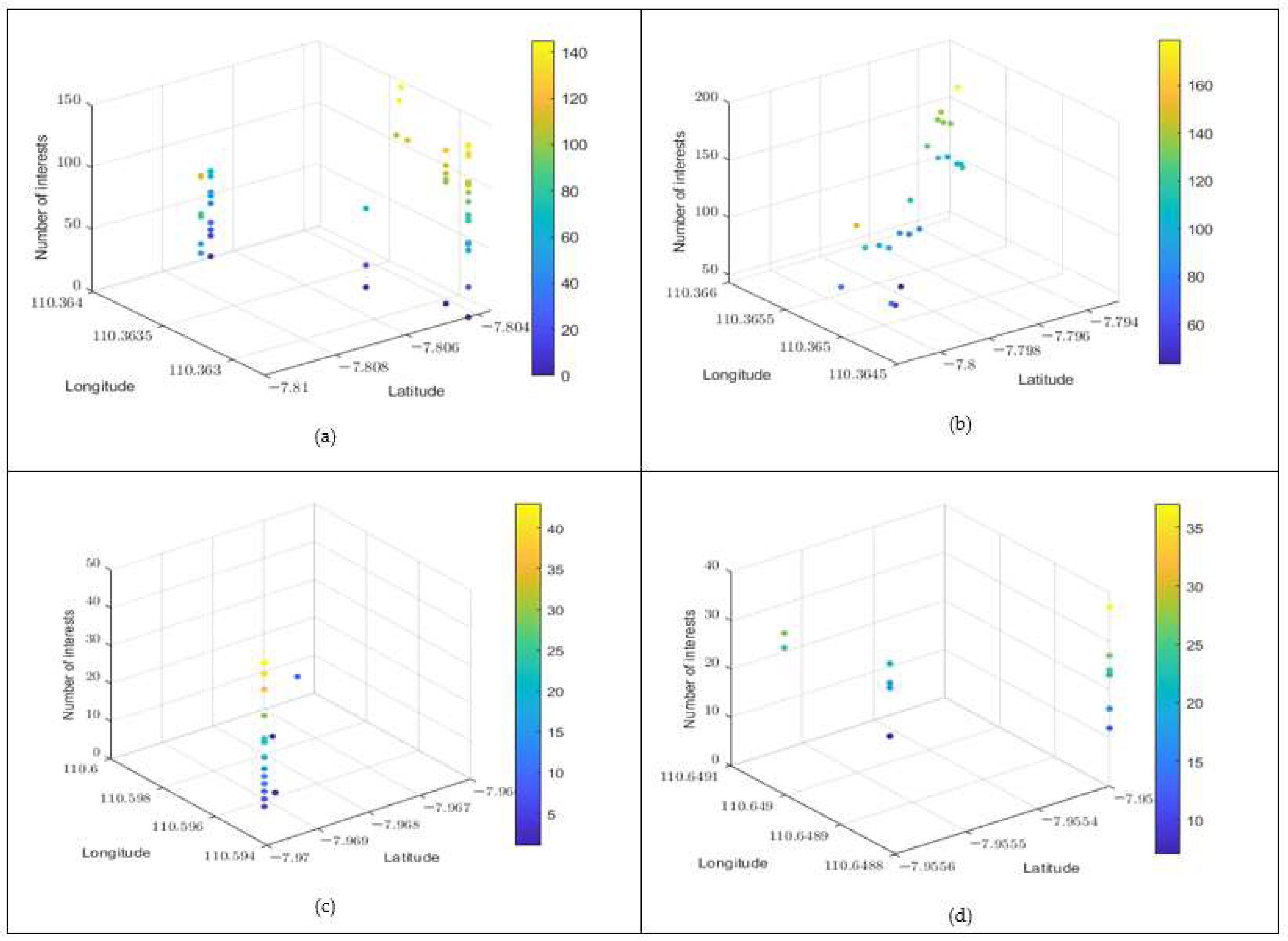
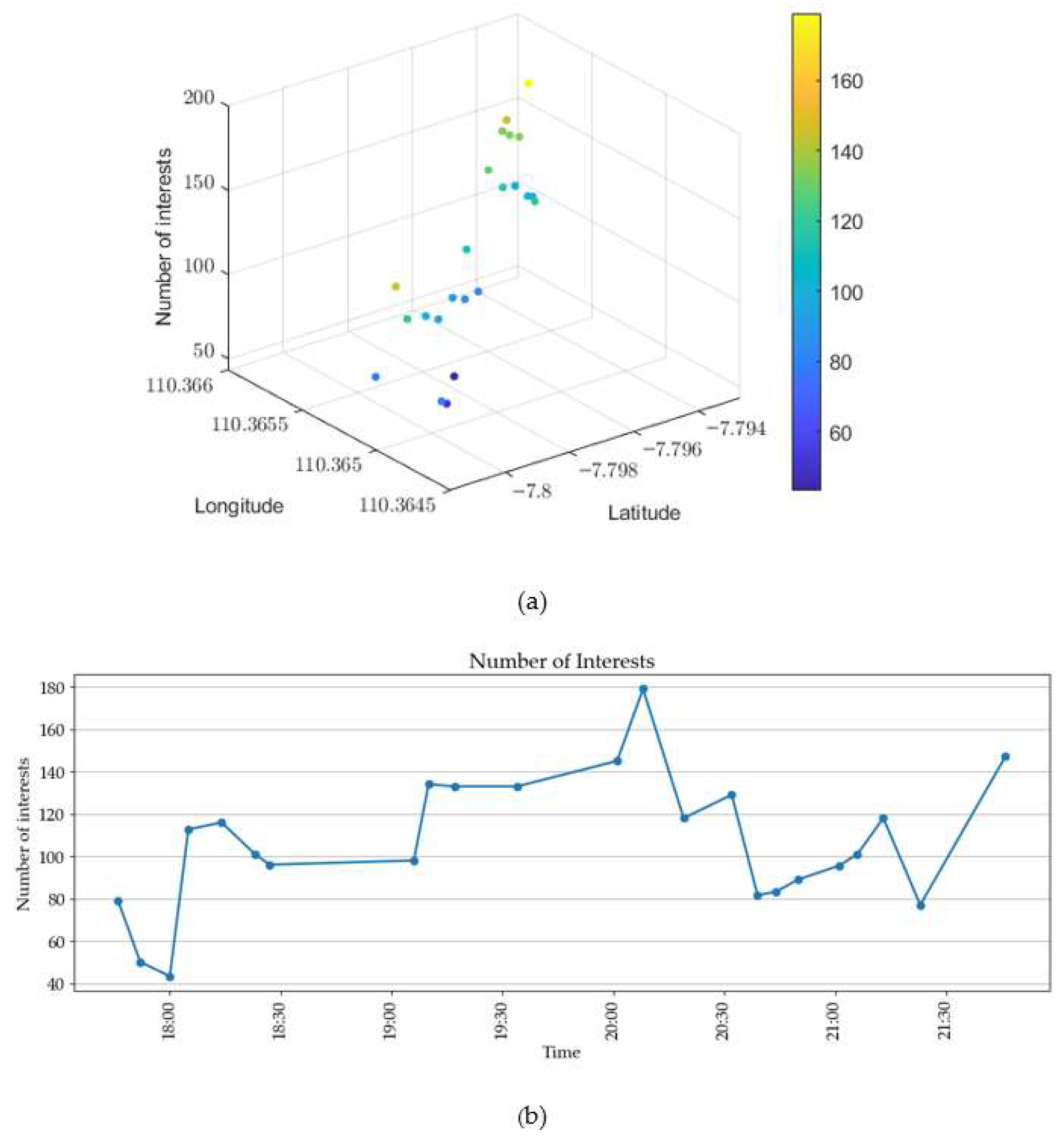
We also identify the dynamic content interest demands at different festivals in Indonesia, such as the Sekaten Festival, Malioboro Street Festival, Rasulan Kepek, and Rasulan Wiladeg. Figure 2 shows that there are different geospatial demand interest patterns at different festivals, which emphasises the need for predictive analytical content demand in order to be able to provision application services in the right place and at the right time at different festivals.
We present our multimodal analysis in the following subsection and provide a brief description of each festival to give more context.

3.1. Sekaten [2]

Sekaten [2] is a 7-day annual festival held at Karaton Ngayogyakarta Hadiningrat [60] on the 5th to 12th day of the Javanese month of Mulud or corresponding to Rabi’ul Awal in the Islamic Calendar. This event takes place to celebrate the birth of Prophet Mohammad and to commemorate the Walisongo’s use of Sekaten to spread Islam through cultural activities such as gamelan (traditional music instruments) and wayangan (a traditional shadow puppet show). The festival is held over multiple days and takes place in several places surrounding Karaton Ngayogyakarta Hadiningrat Royal Palace. There are several events during Sekaten, including multiple traditional processions, such as the following:
  • Miyos Gongso [61], held in Bangsal Ponconiti, starts from 19.30 and ends after midnight. At the start of the event, Utusan Dalem (the envoy of the Palace), represented by Sri Sultan HB X’s daughters and their husbands, spread udhik-udhik, which consists of rice, coins, seeds, and flowers and is distributed to the festival attendees as it is believed by the people to be a sign of abundance and a good luck charm. This event triggers festival participants to densely gather around Bangsal Ponconity. Afterwards, gamelan is played until midnight, and festival participants slowly disperse further away from Bangsal Ponconity. At midnight, there is a procession to move the sacred gamelan (Gamelan Kyai Guntur Madu and Gamelan Kyai Nagawilaga) from Bangsal Ponconiti to Pagongan Kidul and Pagongan Lor in Masjid Gedhe Yogyakarta (Grand Mosque of Yogyakarta in Karaton Ngayogygakarta Hadiningrat Complex). This event influences festival participants to move in two groups: one follows the walking procession, and another stays still on the roadside between Bangsal Ponconiti and Masjid Gedhe.
  • Gladi Resik Prajurit [62] is held on 31 August 2025 as a rehearsal for the great procession of Gerebeg on 5 September 2025, as the peak event in Sekaten. There are 14 bregada (Wirobrojo, Dhaeng, Patangpuluh, Jagakarya, Prawiratama, Nyutra, Ketanggung, Mantrijero, Bugis, Surakarsa, Langenkusuma, Jager, Suronata, and Sumoatmaja) that march from Kagungan Dalem Kamandungan to Kagungan Dalem Magangan, then to Pelataran Keben, and then to Tratag Pagelaran, before finishing in Kagungan Dalem Masjid Gedhe. Another three Bregada will follow a different route, as they are symbolised by Bregada from outside of the Mataram regions (Bregada Surakarsa will march from Kagungan Dalem Mangkubumen, Bregada Bugis will march from Kepatihan, and Bregada Pakualam will march from Kadipaten Pakualam). This event emphasises the movement of Bregada to Masjid Gedhe, which influences festival participants to stay on the roadside between the various Bregada origin places and Masjid Gedhe.
  • Numplak Wajik [63] is held in Panti Pareden Kilen in Kemagangan Complex, inside Karaton Ngayogyakarta Hadiningrat Royal Palace. This event marks the start of the Gunungan making, which will be used in the Garebeg Mulud procession on the 12th Rabi’ul Awal (the 7th day). In this event, Abdi Dalem Karaton will lead the prayer ritual, begin to make the foundation of the Gunungan, and then share the singgul (a mixture of dlingo bengle, rice flour, and turmeric) with all of the attendees. Before the procession starts, the mobility of festival participants is dispersed around Panti Pareden Kilen. However, when the procession starts, Gejog Lesung is played by Abdi Dalem Keparak, and the mobility of festival participants is dense near the fences of Panti Pareden Kilen. After Abdi Dalem shares singgul, the dense crowd of festival participants slowly disperses away from Panti Pareden Kilen.
  • Kondur Gongso [64] is held in Masjid Gedhe Yogyakarta (Yogyakarta Grand Mosque) the night before Gerebeg Mulud. This event is a procession returning Gamelan Sekati (Kanjeng Kiai Gunturmadu and Kanjeng Kiai Nagawilaga) to Bangsal Trajumas, Srimanganti Kompleks, in Karaton Ngayogyakarta Hadiningrat Royal Palace. The procession starts with Ngarso Dalem (Sultan of Yogyakarta) himself throwing udhik-udhik and being caught by the festival participants as a symbol of people meeting the King and the King sharing prosperity with them. This event triggers festival participants to gather densely near the Pagongan Kidul and Pagongan Lor. Afterwards, there is a reading of the Prophet Mohammad’s biography in Masjid Gede, during which time the festival participants are concentrated in the Masjid Gedhe yard. In this Dal Year (a special year celebrated every 8 years), Ngarso Dalem conducted Jejak Banon, a ceremony in which the Sultan kicks at the wall and then travels through the hole made. Therefore, it influenced festival participants to move from the Masjid Gedhe yard to the southern part of the Masjid Gedhe, where the wall is situated. Then, at midnight, the procession of returning the Gamelan Sekati took place from Pagongan Kidul and Pagongan Lor to the Royal Palace, which influenced participant movement from the Masjid Gedhe to the Royal Palace, and then the crowd slowly dispersed as the event ended.
  • Garebeg Mulud [65] is held on the 7th day of Sekaten or 12th Rabiul Awal. The event starts at 07.00 WIB, when the parade of Bregada (Karaton’s soldiers) enters the Kedaton Complex of Karaton’s Royal Palace. This event triggers festival participants to gather at the roadside between the Royal Palace and Masjid Gedhe. After confirming the readiness of all Bregada, Manggalayudha (the Military Commander) leads the procession of Bregada and Gunungan (various types of offerings made from various foods) to Masjid Agung Yogyakarta, then the marching begins, leading to further movement among festival participants from the Royal Palace to Masjid Gedhe. After prayers in Masjid Gedhe, the gunungan is shared with Pura Pakualaman, Kepatihan, and Ndalem Mangkubumen. This triggers the festival participants to move from Masjid Gedhe in three different directions (Pura Pakualaman, Kepatihan, and Ndalem Mangkubumen).
In between these events, the Gamelan Sekati consistently plays Rabi’ul Awal in the Masjid Gedhe three times a day (08.00–10.00 WIB, 14.00–17.00 WIB, and 20.00–23.00 WIB) from the 5th to the 12th, except for Thursday night until Friday afternoon [66]. During these designated periods, the festival participant will gather around Pagongan Kidul and Pagongan Lor. There are recurrent prayers in Masjid Gedhe during Sekaten, and there are unique delicacies that are only sold during this festival, such as Endog Abang and Nasi Gurih, which attract people to come to visit the Masjid Gedhe area during the period of Sekaten [67]. Food and drink venues influence festival participants to gather around the food and beverage area to enjoy the Sekaten delicacies.
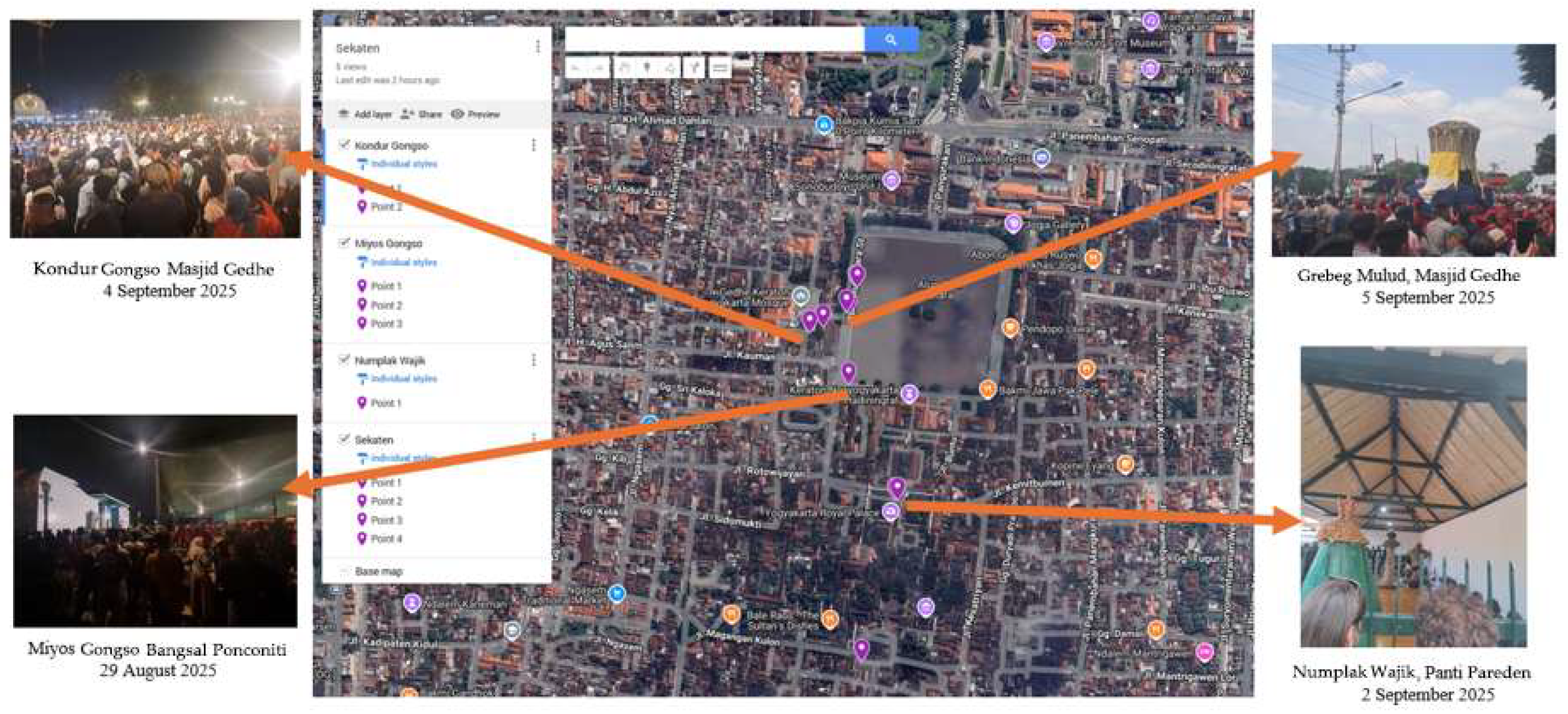
We conducted multiple observations at different points and times during the Sekaten Festival, as shown in Figure 3, with the aim of observing whether intermittent network connection is a persistent issue during the Sekaten Festival.
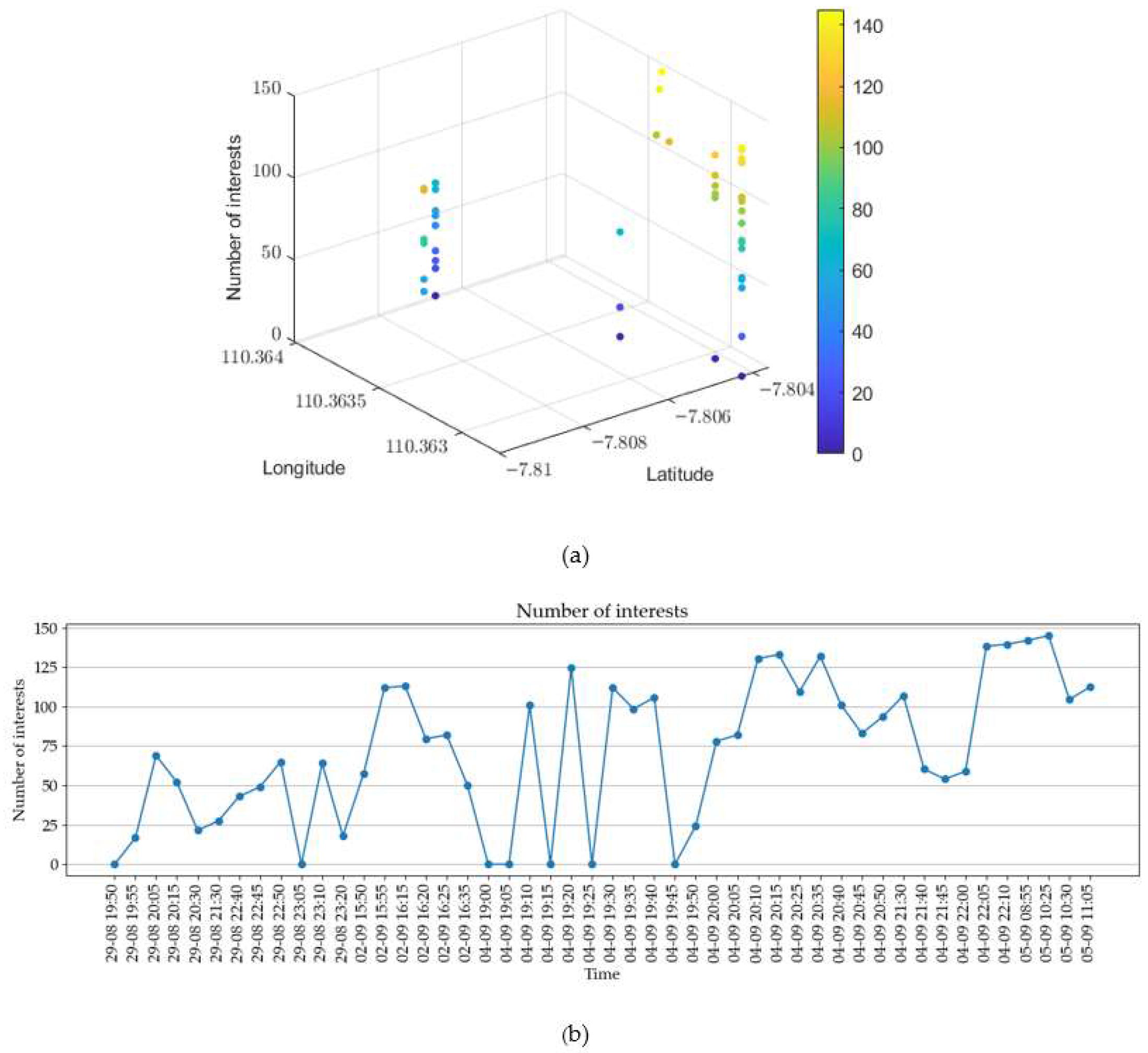
In Figure 4, we show the dynamicity of geospatial temporal content demand interest during the Sekaten Festival. Figure 4a shows that the demands are not uniformly requested in the area but are instead repeatedly concentrated in several popular areas during the 7-day festival. Similarly, Figure 4b shows the dynamicity of content requests over the course of the Sekaten Festival.
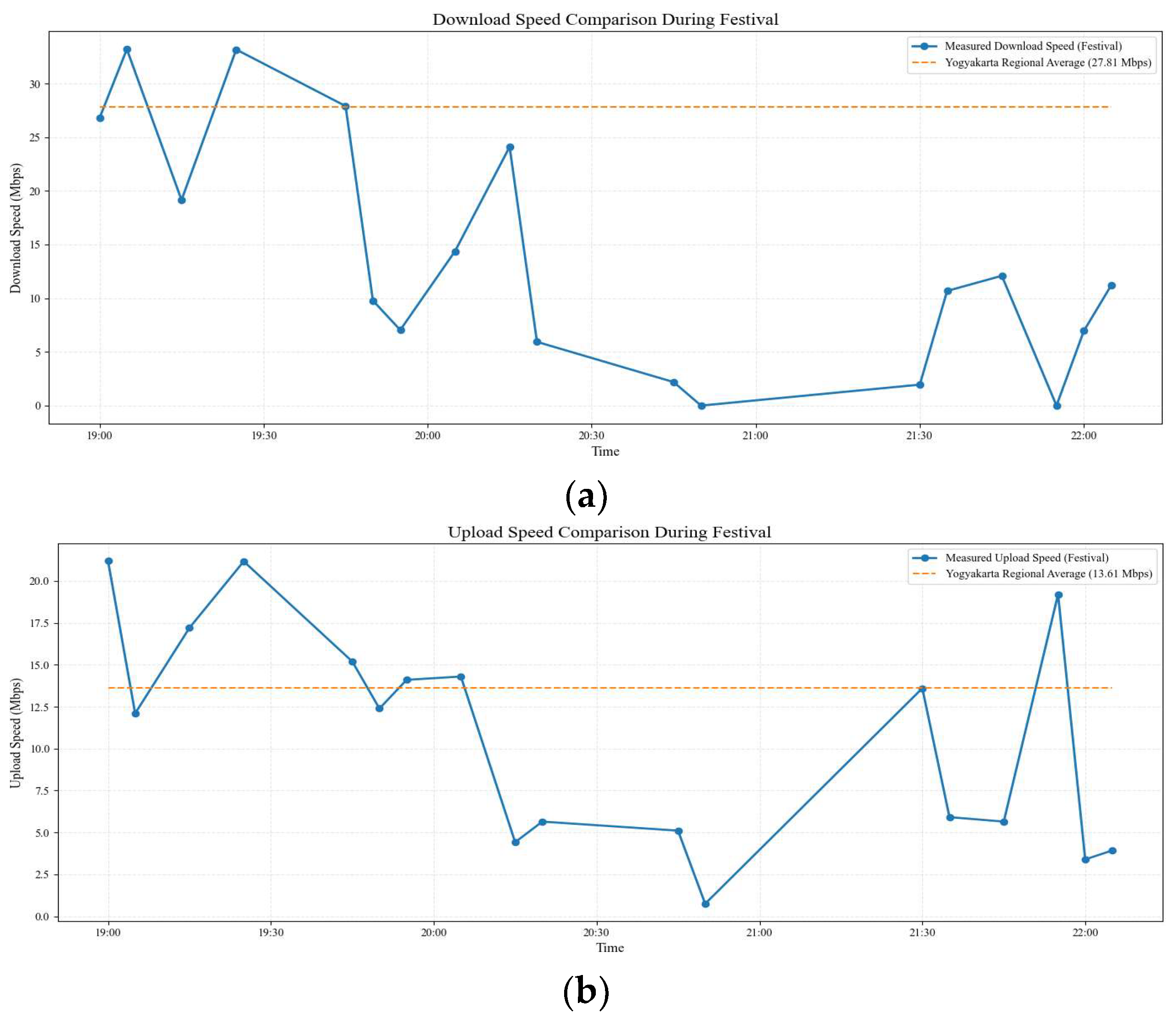
Figure 5 shows the network connectivity measured during the Sekaten Festival. The measured connectivity depicted with the blue line is compared with the red line, which depicts the baseline of the Yogyakarta Regional average download and upload speed [68]. At the beginning of the festival, the download speed is in the average download zone, but as the festival progresses, the download speeds plummet and stay below the average speed most of the time. Similarly, during the festival, the upload speed fluctuates, and the lowest speed is between 20:30 p.m. and 21:00 p.m., when Ngarso Dalem shares the udhik-udhik to be contested, due to the sudden dense crowd movement toward Pagongan Lor and Pagongan Kidul.

3.2. Indonesian Street Performance Festival [55]

The Indonesian Street Performance Festival 2025 [55] is a cultural festival in the form of a parade, marching from Bangsal Kepatihan (the northern part of Malioboro Street) towards Titik Nol Kilometer (the south part of Malioboro Street) in Yogyakarta. There are 28 delegation teams from various cities in Indonesia showcasing their local regional culture, such as clothing, dancing, and traditional music. This event influences the movement of festival participants from both ends of Malioboro Street, who will mostly gather at the roadside to be able to see the festival parades. On Titik Nol Kilometer, there is a stage at which each team will stop for approximately 5–10 min to demonstrate their community dance. This triggers a huge crowd of festival participants to gather on Titik Nol Kilometer.
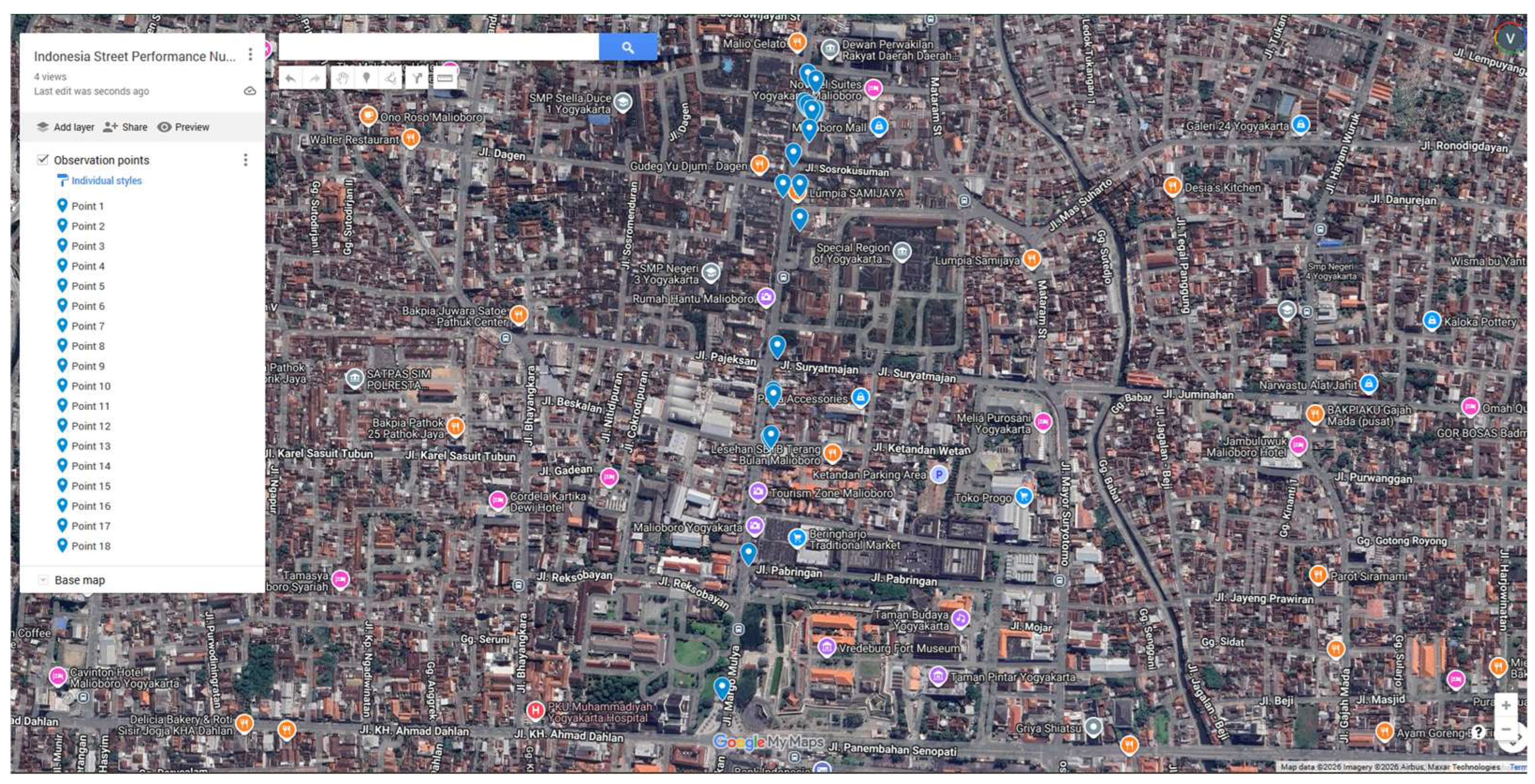
For our study, we analyse the network connectivity at several observation points, as depicted with blue markers in Figure 6. In Figure 7, we show how the dynamicity of geospatial temporal content requests demands during the Indonesian Street Performance Festival. Figure 7a shows that demands are not uniform across the areas but are instead concentrated in several popular areas. Similarly, Figure 7b shows the dynamicity of content requests over time during the Indonesian Street Performance Festival.
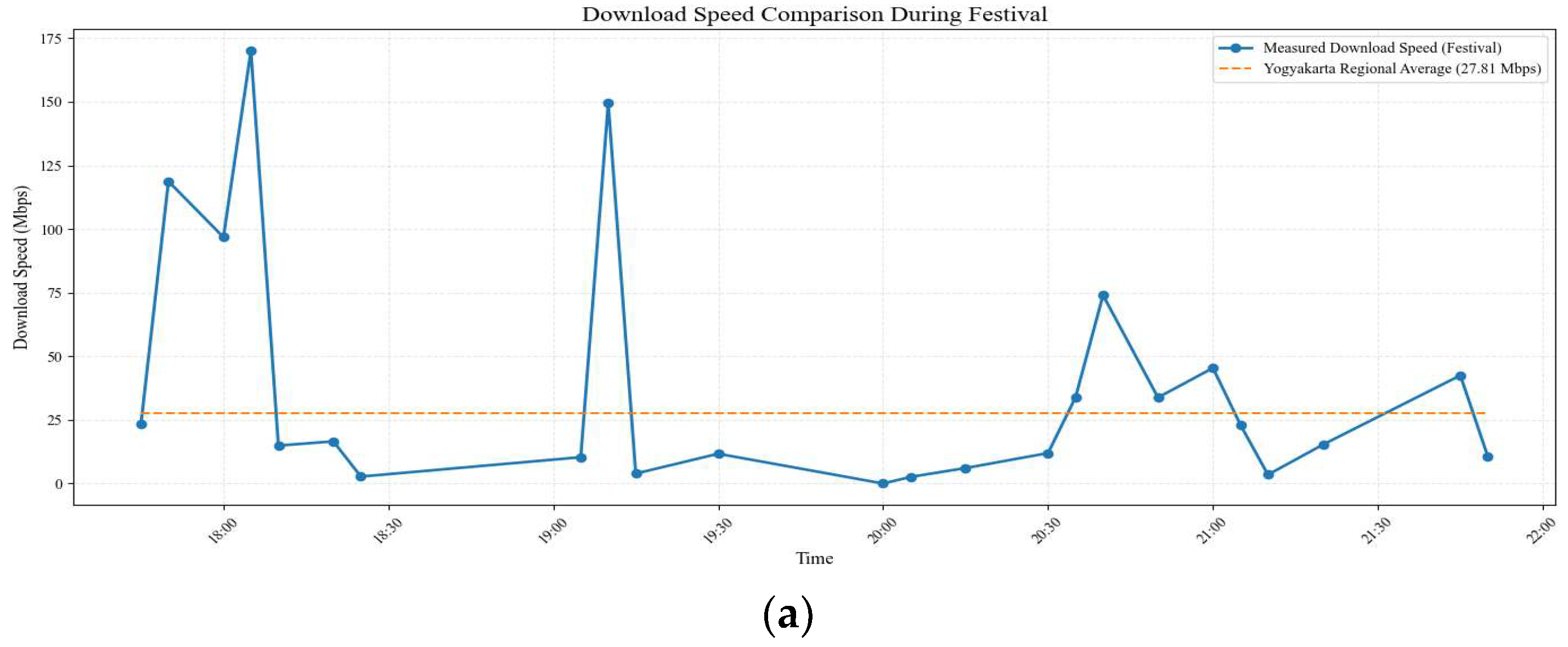
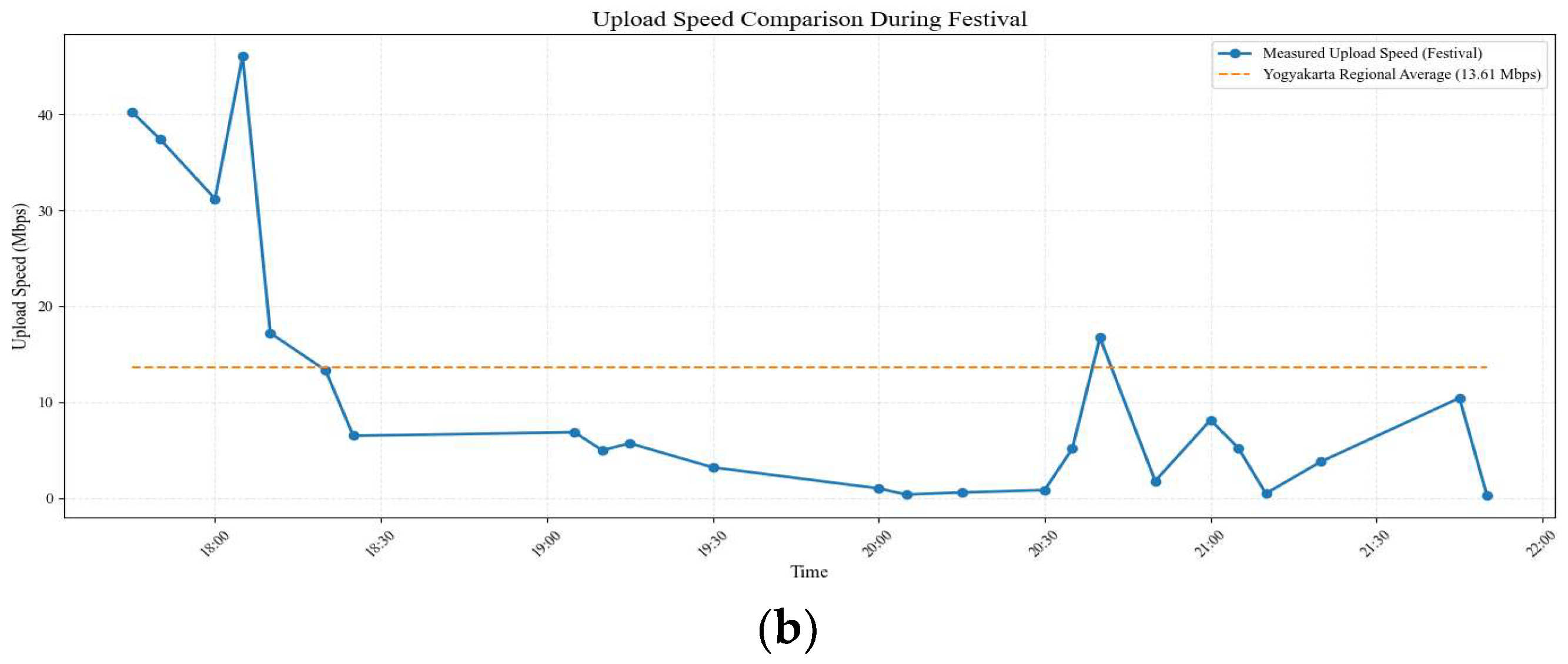
Figure 8 illustrates the network connectivity measured during the Sekaten Festival. The measured connectivity represented by the blue line is compared with the red line, which represents the baseline of the Yogyakarta Regional average download and upload speed [68]. The average download speed is relatively high on Malioboro Street, as it is a major shopping street located in the city centre. As the festival begins, download speeds decrease but eventually recover to baseline levels. However, the speed fluctuations exceed those during the Sekaten Festival, reflecting the speed variability affected by the current network traffic at the festival. Compared to the download performance, the upload speed consistently decreases as the festival progresses. This pattern might be attributed to a growing number of attendees uploading media content, causing uplink congestion and degrading the overall upload throughput.

3.3. Rasulan: Rasulan Kepek [56] and Rasulan Wiladeg [57]

Rasulan [56,57] is an annual Thanksgiving festival held in Gunungkidul Regency, Yogyakarta, Indonesia. This cultural tradition reflects farmers’ gratitude for the harvest season. Each subregion of the village presents its own Gunungan, an offering shaped like a small mountain constructed from agricultural produce, traditional foods, and decoration made from coconut leaves and flowers from the current harvest.
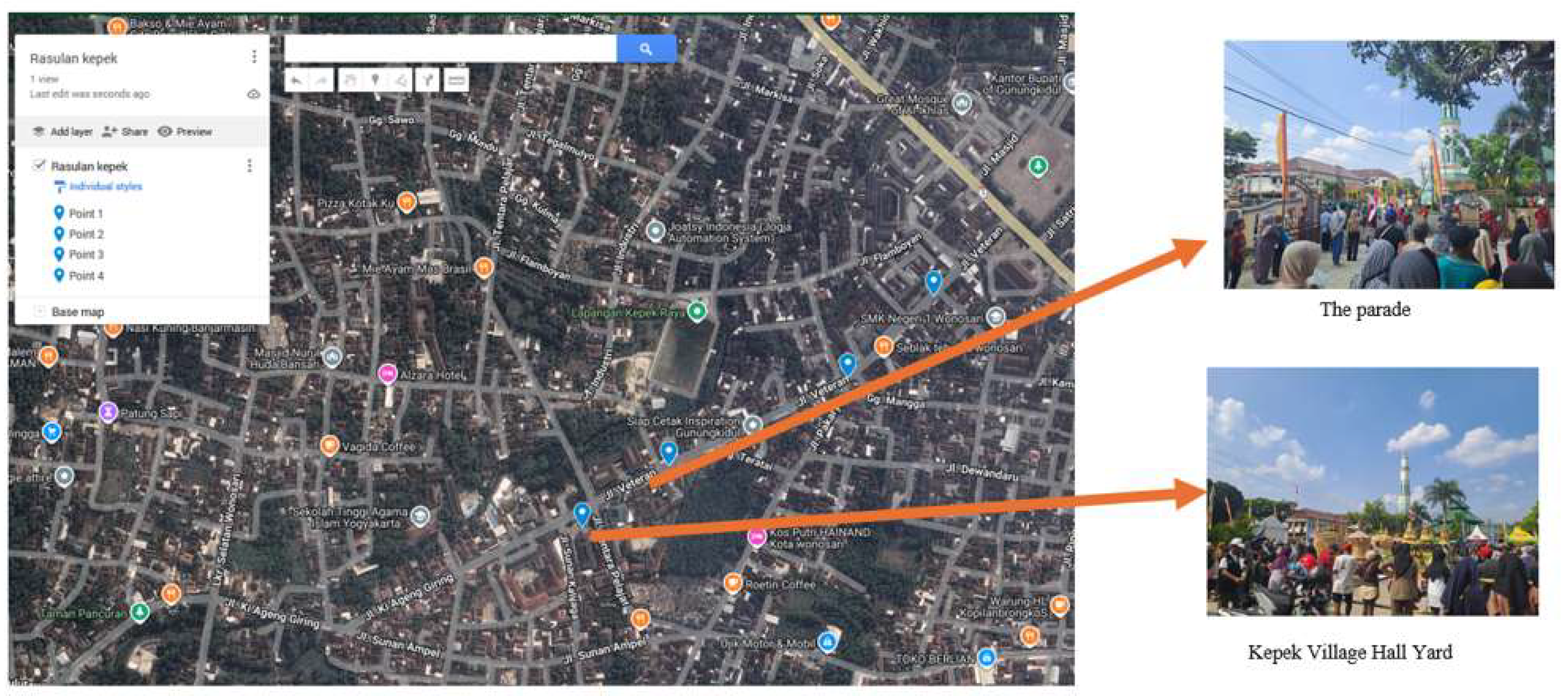
Rasulan Kepek [56] is the Rasulan that is held in Kepek Village, Gunungkidul, a suburban area of the Yogyakarta region. In Rasulan Kepek, the village members march in a parade from the front of SMP Negeri 2 Wonosari to the Kepek Village Hall Yard. This festival symbolises gratitude and community unity (as the creation of Gunungan requires collective effort) and is regarded as a source of blessing. This event triggers the movement of festival participants to Kepek Village Hall, and they also gather at the roadside between SMP Negeri 2 Wonosari and Kepek Village Hall. Approaching the end of the Rasulan, where the Gunungan and udhik-udhik are contested, festival participants gather densely around the centre of the Kepek Village Hall area.
In our study, we analyse network connectivity at several observation points, as depicted in Figure 9. Figure 10 shows the geospatial temporal dynamic of content demand interest during Rasulan Kepek. As depicted in Figure 10a, the application service interest demand is not uniform across the area but is instead concentrated around Kepek Village Hall Yard, where the majority of the ceremony takes place. Similarly, Figure 10b highlights the temporal dynamics of content requests over the course of Rasulan Kepek.
Rasulan Wiladeg [57] is the Rasulan conducted in Wiladeg Village, Karangmojo Gunungkidul, a suburban area of the Yogyakarta region. Similarly to Rasulan Kepek, the villagers march from each sub-village to the Wiladeg Village Hall. This festival symbolises gratitude for the harvest and community unity (as the creation of Gunungan requires collective effort) and is regarded as a source of blessing. This event triggers the movement of festival participants to Wiladeg Village Hall, and they also gather at the roadside between each sub-village and Wiladeg Village Hall. At the end of the Rasulan festival, the Gunungan is contested and dismantled by villagers, who bring home parts of it, believing that these items will bring good fortune and protection. Approaching the end of the festival, a dense crowd forms around the Village Hall where the Gunungan is contested. After the Gunungan is dismantled by the festival participants, they will slowly disperse from the Village Hall area.
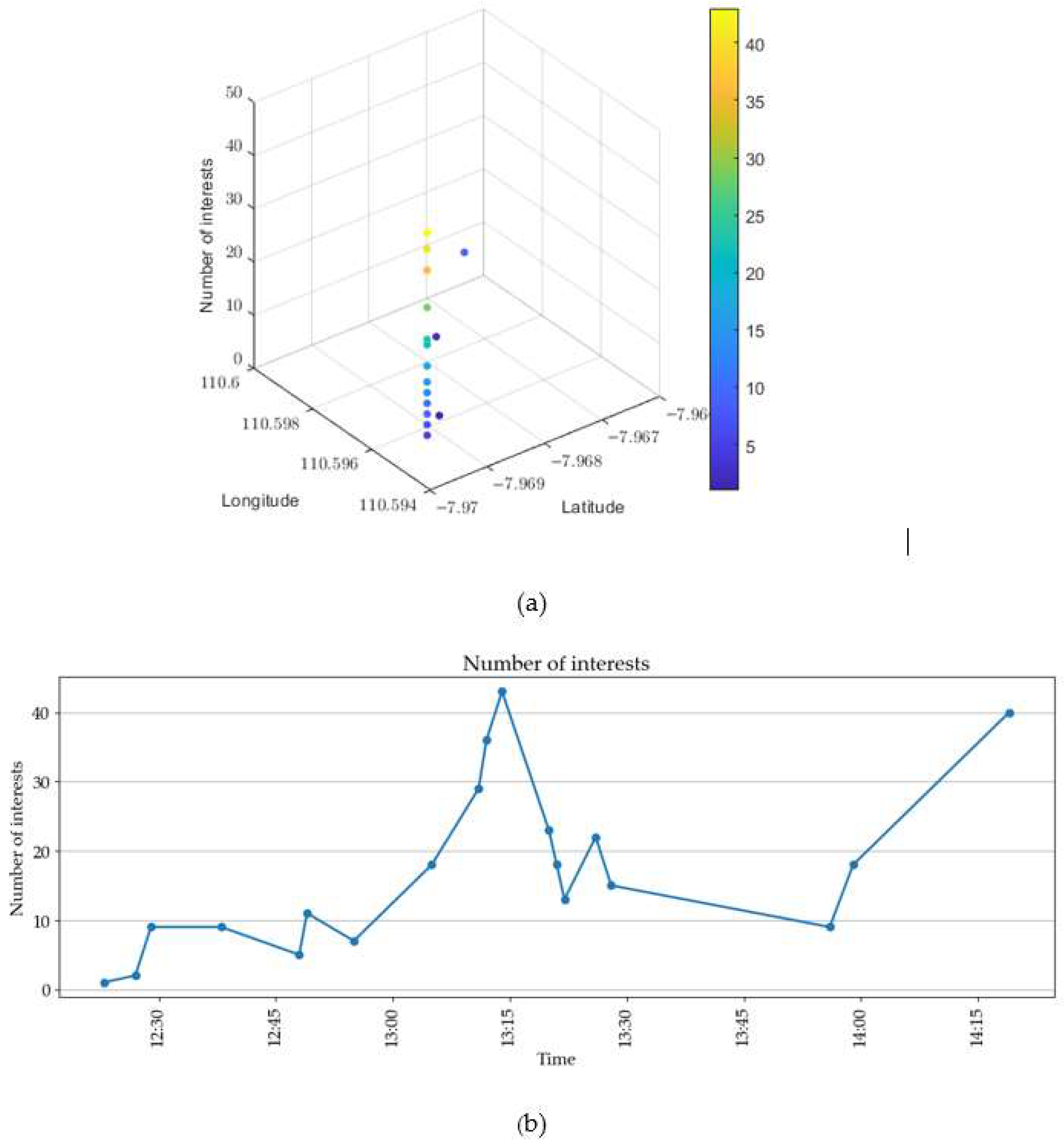
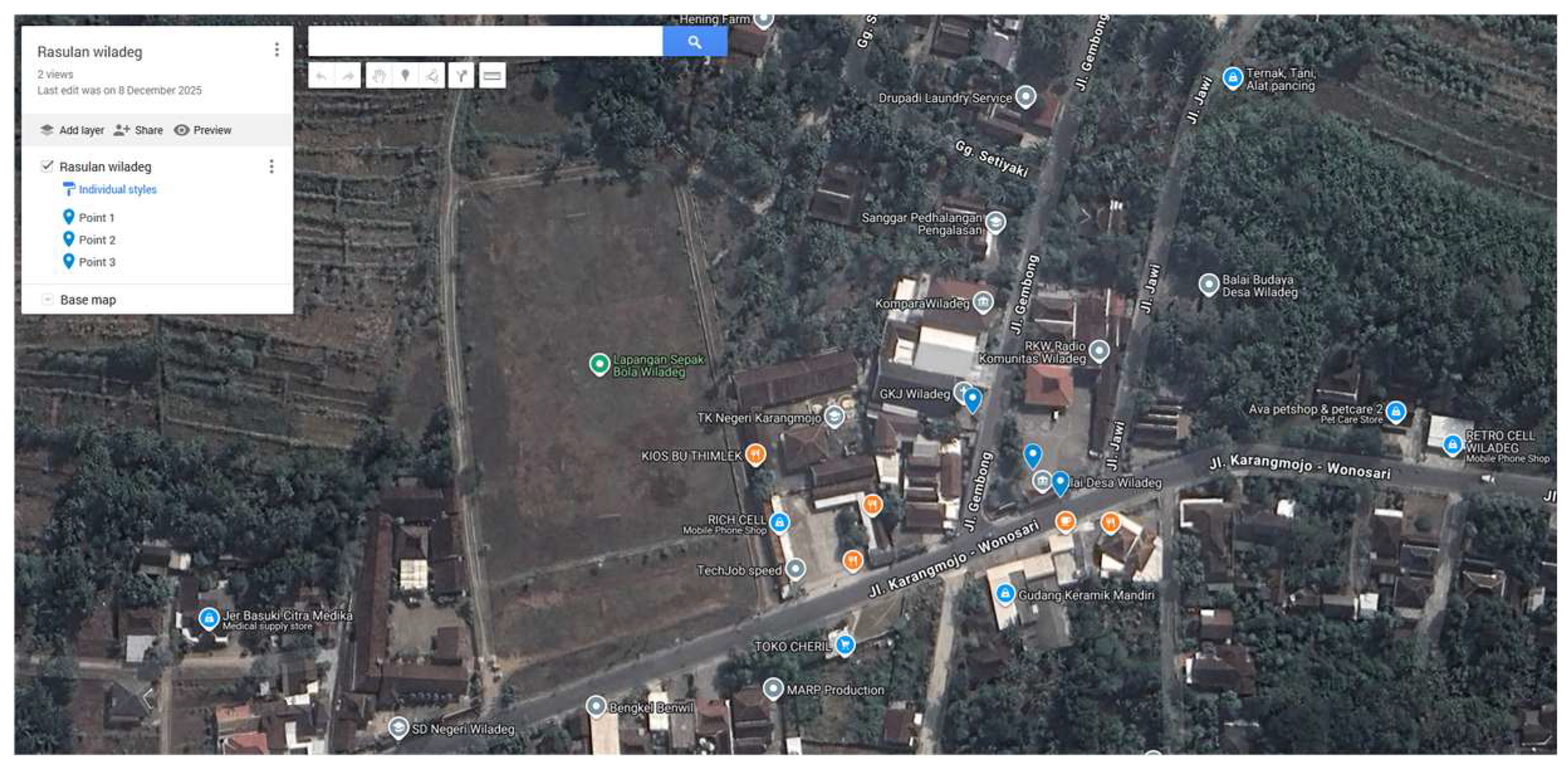
In this study, we analyse network connectivity at several observation points as depicted in Figure 11. In Figure 12, we show the dynamicity of geospatial temporal content demand interest during Rasulan Wiladeg. Figure 12a shows that the demands are not uniformly requested in the area but are segregated into three main places around Wiladeg Village Hall. Figure 12b shows the dynamicity of content requests over the course of Rasulan Wiladeg.
Similarly to the Indonesian festivals, we conducted a study to analyse service requirements for internet connectivity at two festivals in the United Kingdom: Download Festival and Splendour Festival.

3.4. Download Festival [69]

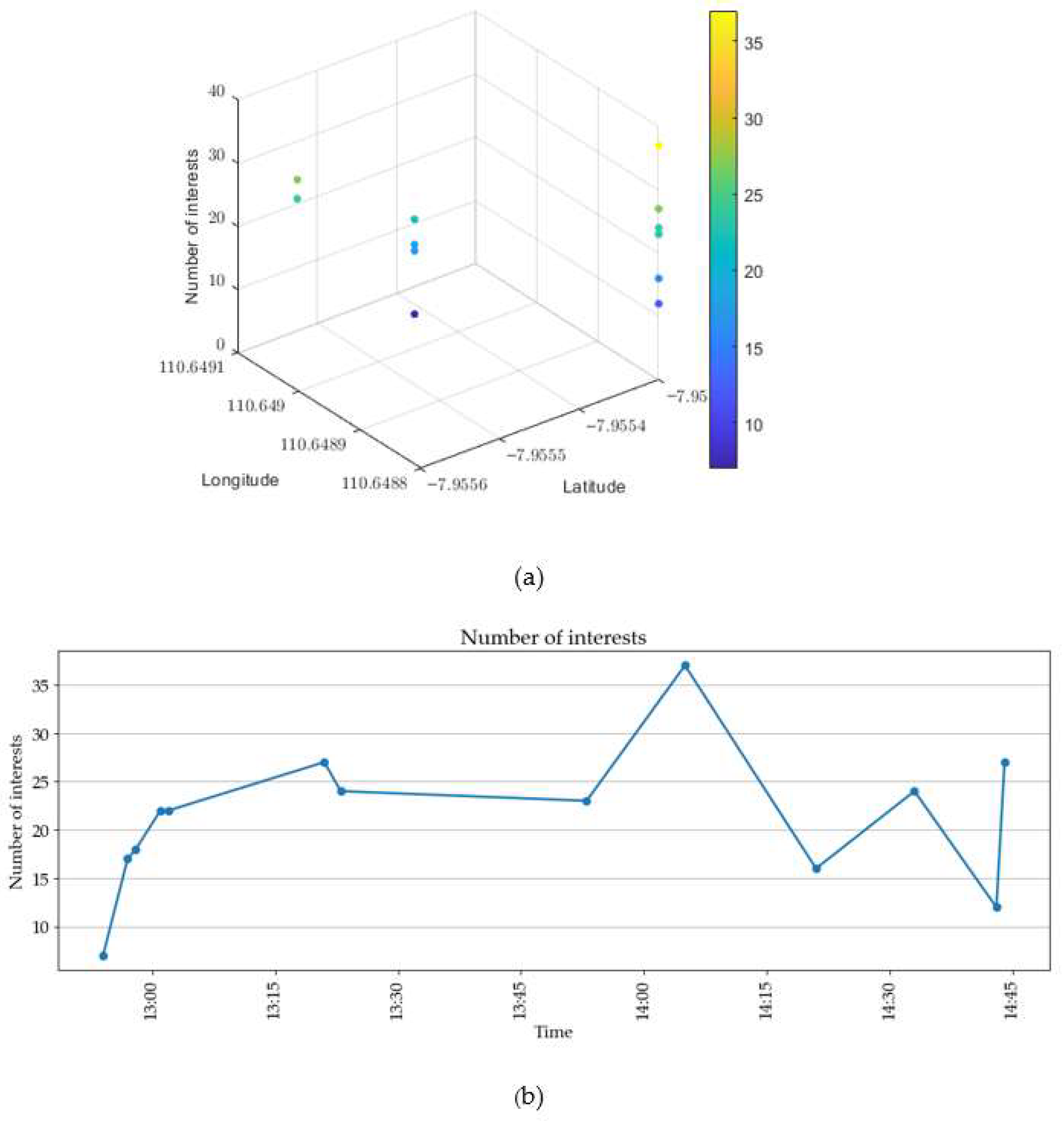
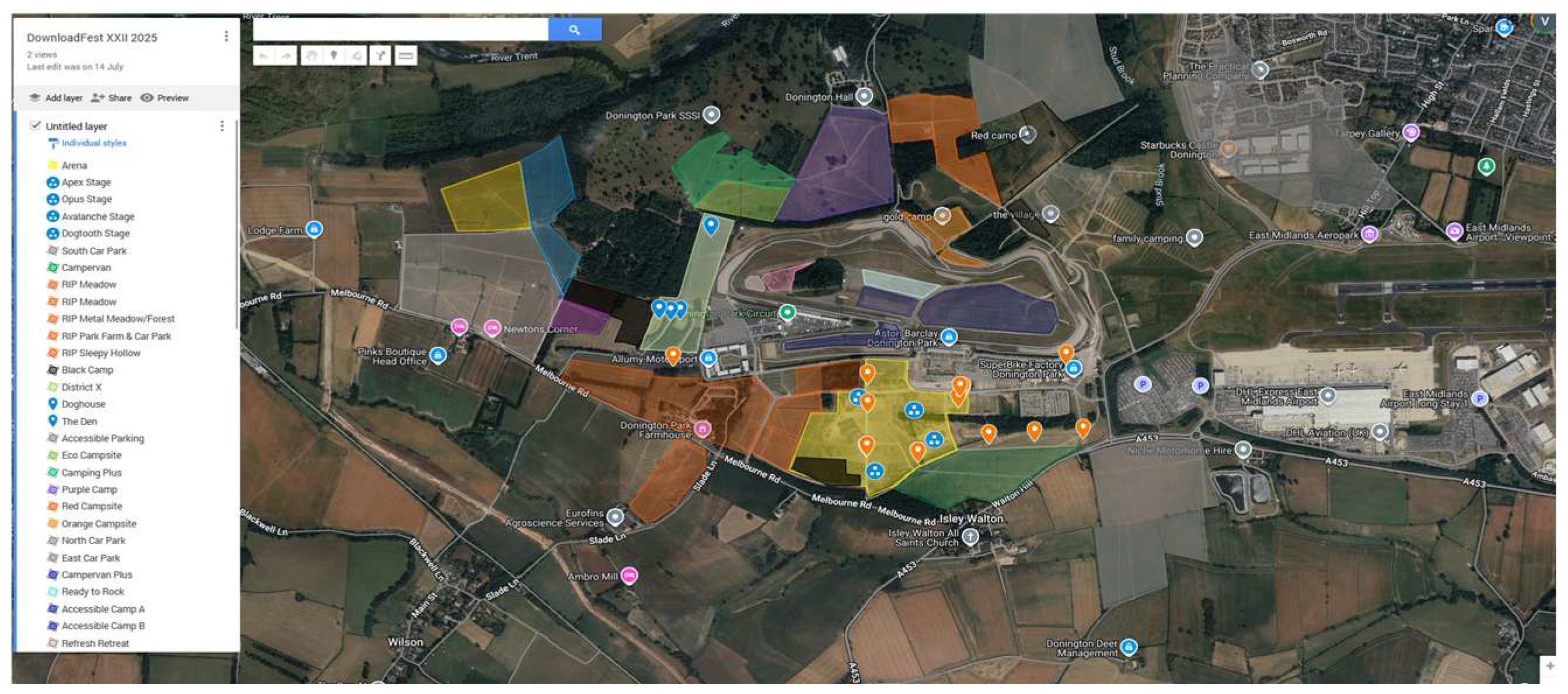
Download Festival [69] is an annual rock music festival held in Donington Park, Leicestershire, United Kingdom. This open-air festival attracts more than 70,000 attendees, with more than 100 bands playing on several stages scattered around the 900-acre festival space. In our study, we analyse the network connectivity at several observation points, as depicted in Figure 13.
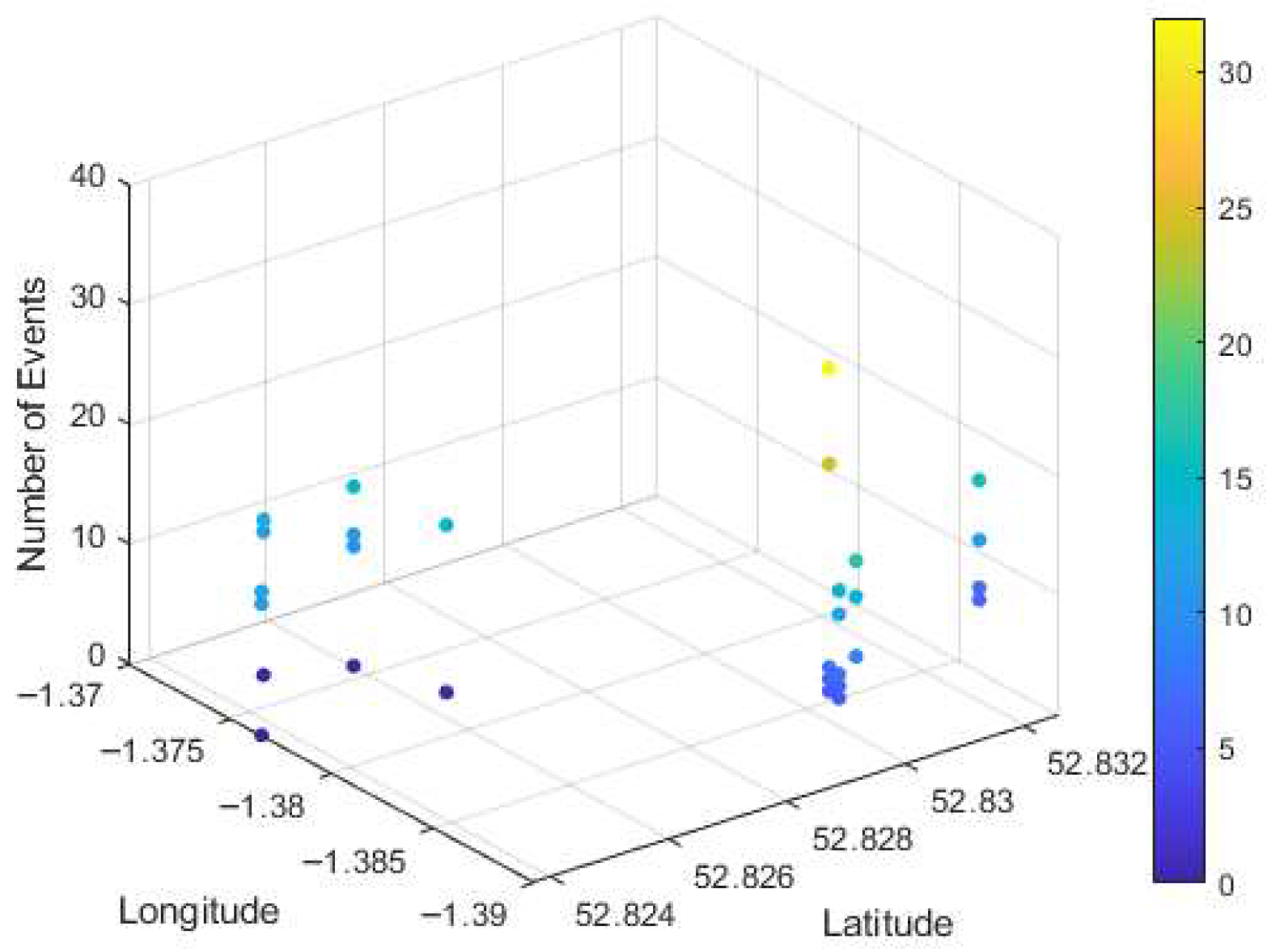
In Figure 14, we show the dynamicity of geospatial content demand interest during Download Festival. The demands are distributed non-uniformly across several points, which we can identify as the stages and festival facilities, such as food and drink venues and toilets.
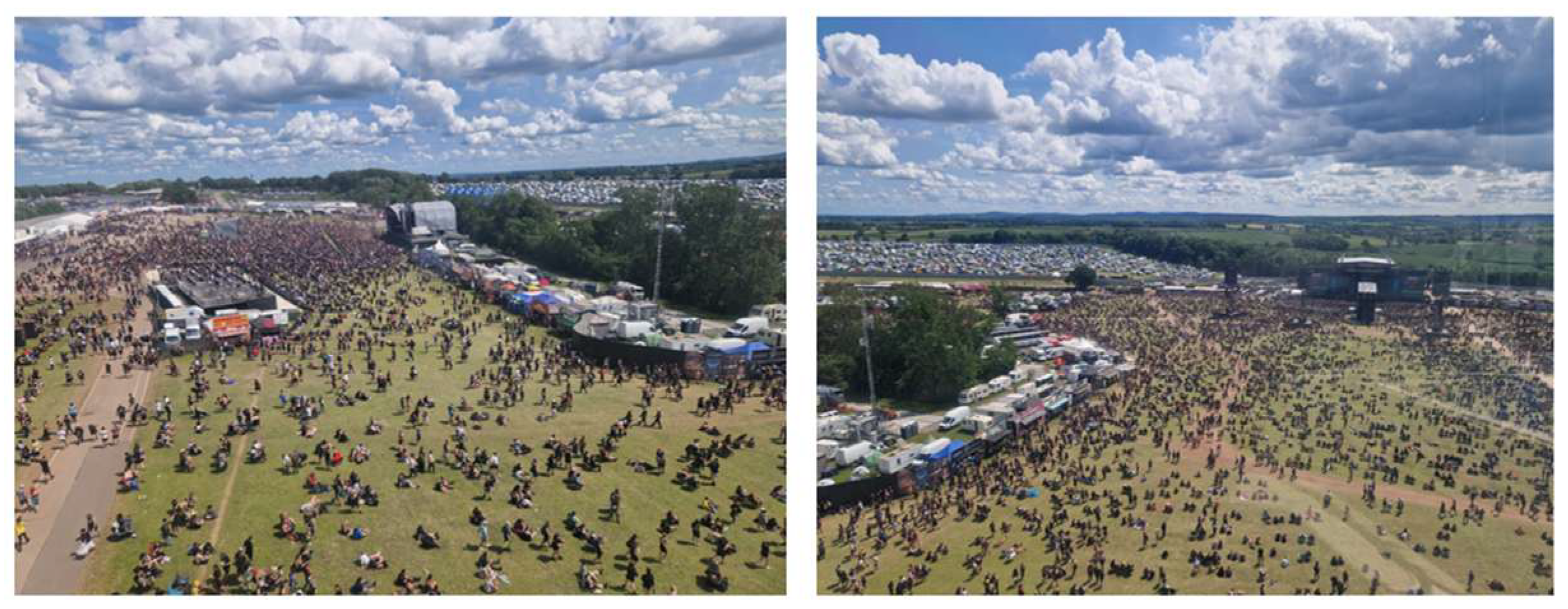
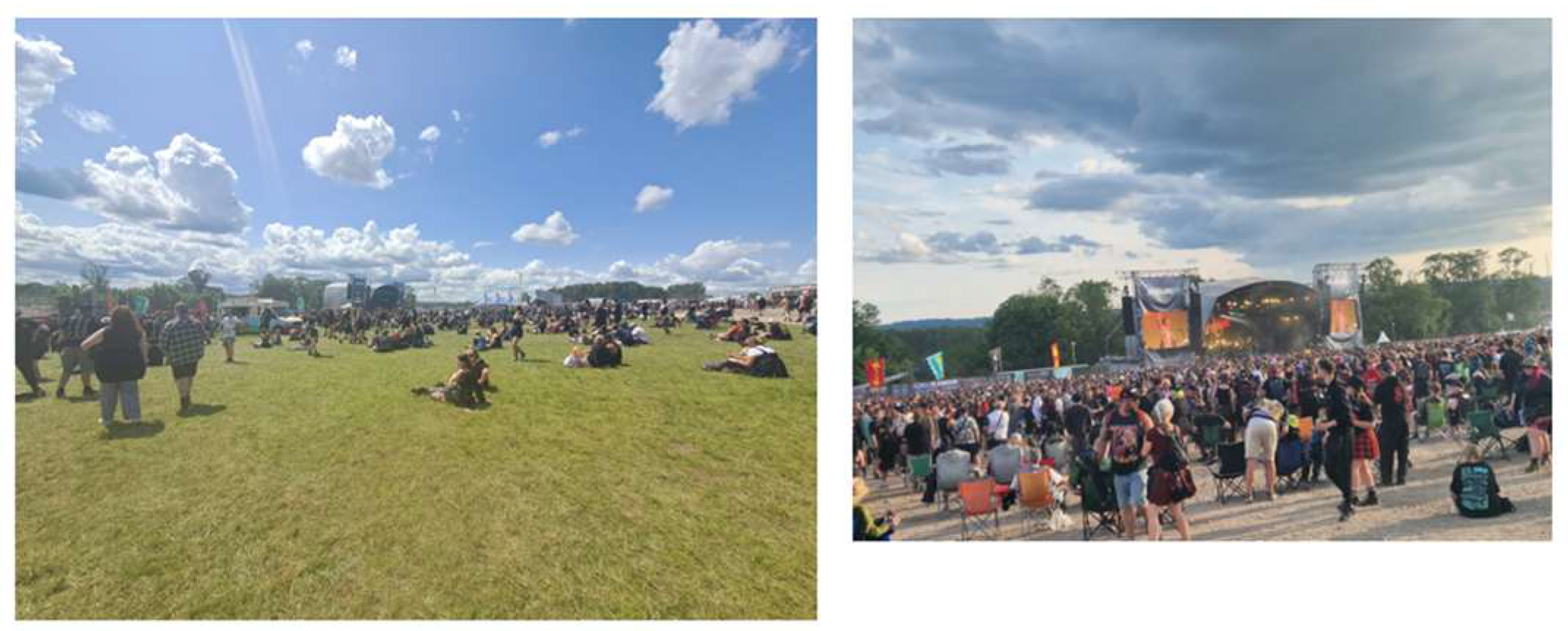
Figure 15 and Figure 16 both present the temporal dynamics of the crowd near the stages during and in between performances. We can see that during the performance, people swarm around the stage. This mobility affects communication networks around the stage, as the network traffic will also be congested.
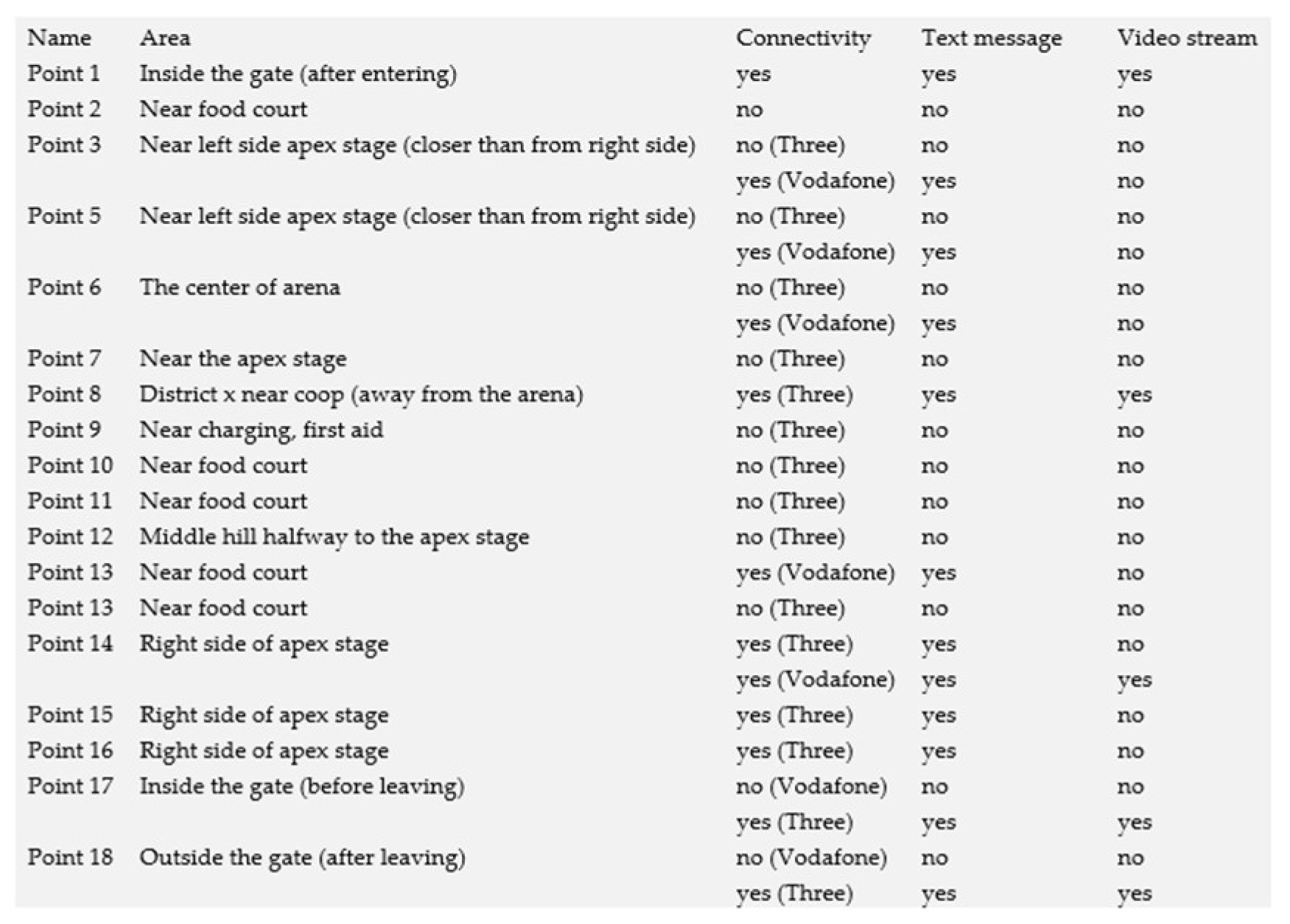
From our analysis, we found that festival attendee relies heavily on cellular network providers. We tested our connectivity measurement as illustrated in Figure 17 with two different cellular network providers (Three and Vodafone), and we found that Three does not work, but Vodafone works with limitations. At some point, the connectivity of Three is able to send messages, but cannot play video or send pictures. The connectivity of Vodafone is better but once we enter the area around the stage, the latency increases.
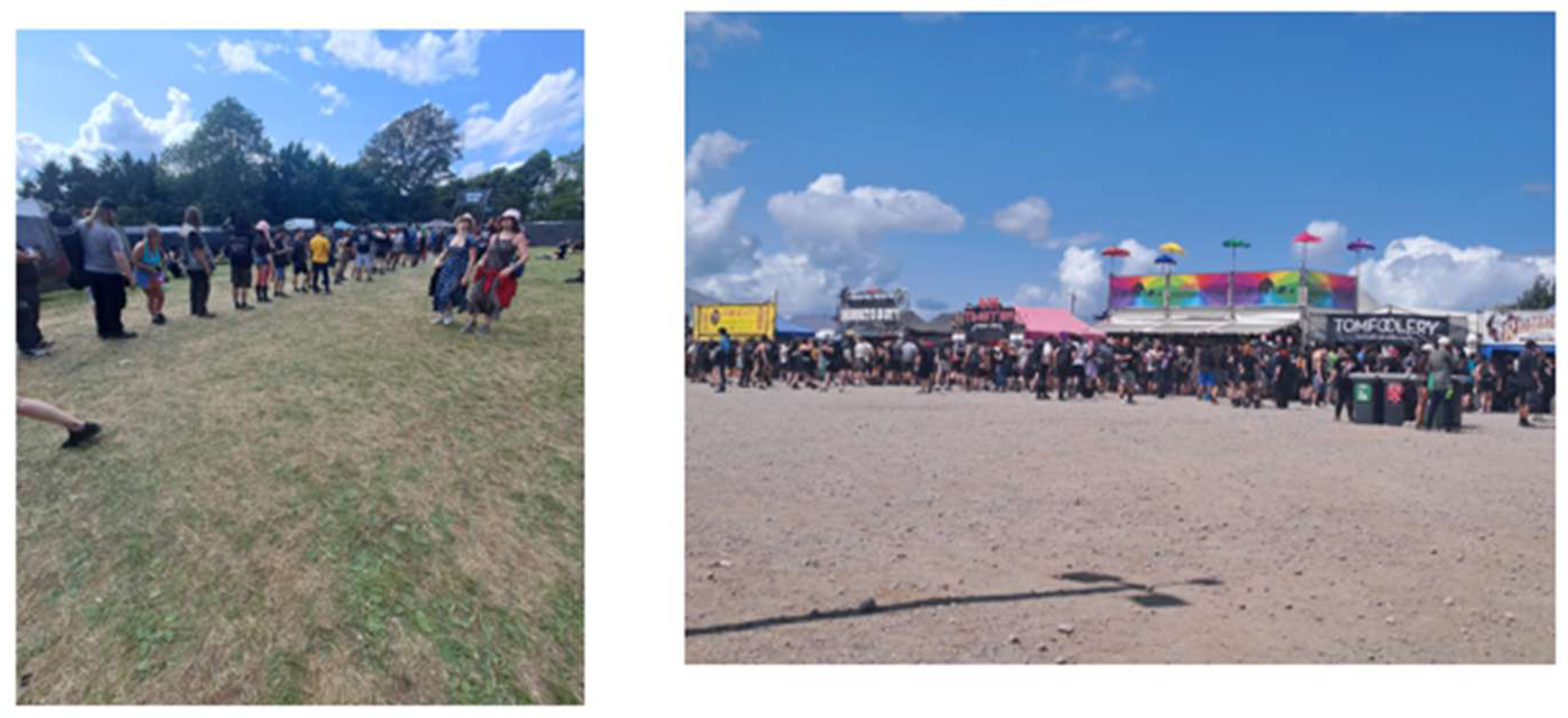
Festival organisers play an important role in deciding the type of services that will be available at the festival and how to access information about them. For example, as depicted in Figure 18, Download Festival organisers encourage reusable bottles or paper cups for drinks to promote sustainability, given the impacts of longer queues at the drinking water station, as well as at the food and drink booth.
The signage and mapping for facilities such as food and drink, toilets, and the merchandise booth are large and visible and available in multiple locations, making it easier for people to find them without searching for information on their phone. But for secluded facility locations outside the main arena, such as the Coop, merchandise super store, and merchandise click and collect, attendees need to find information on their phone (or ask volunteers).
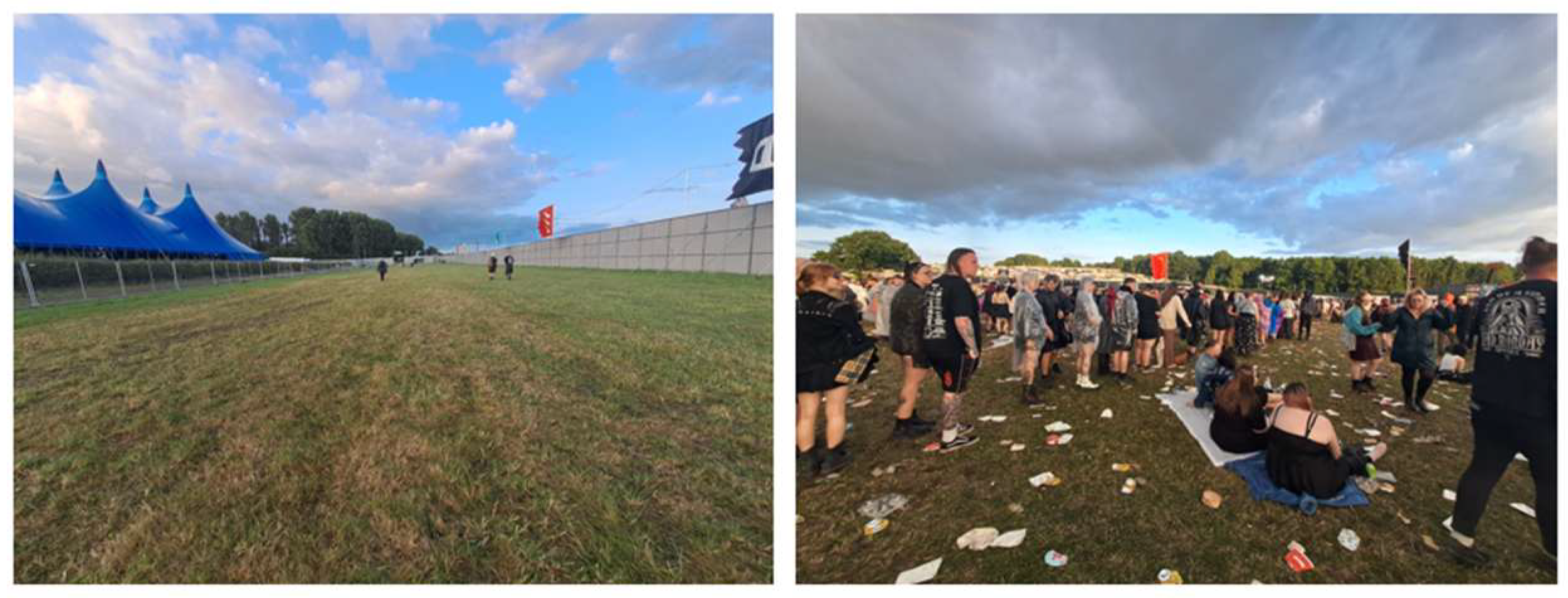
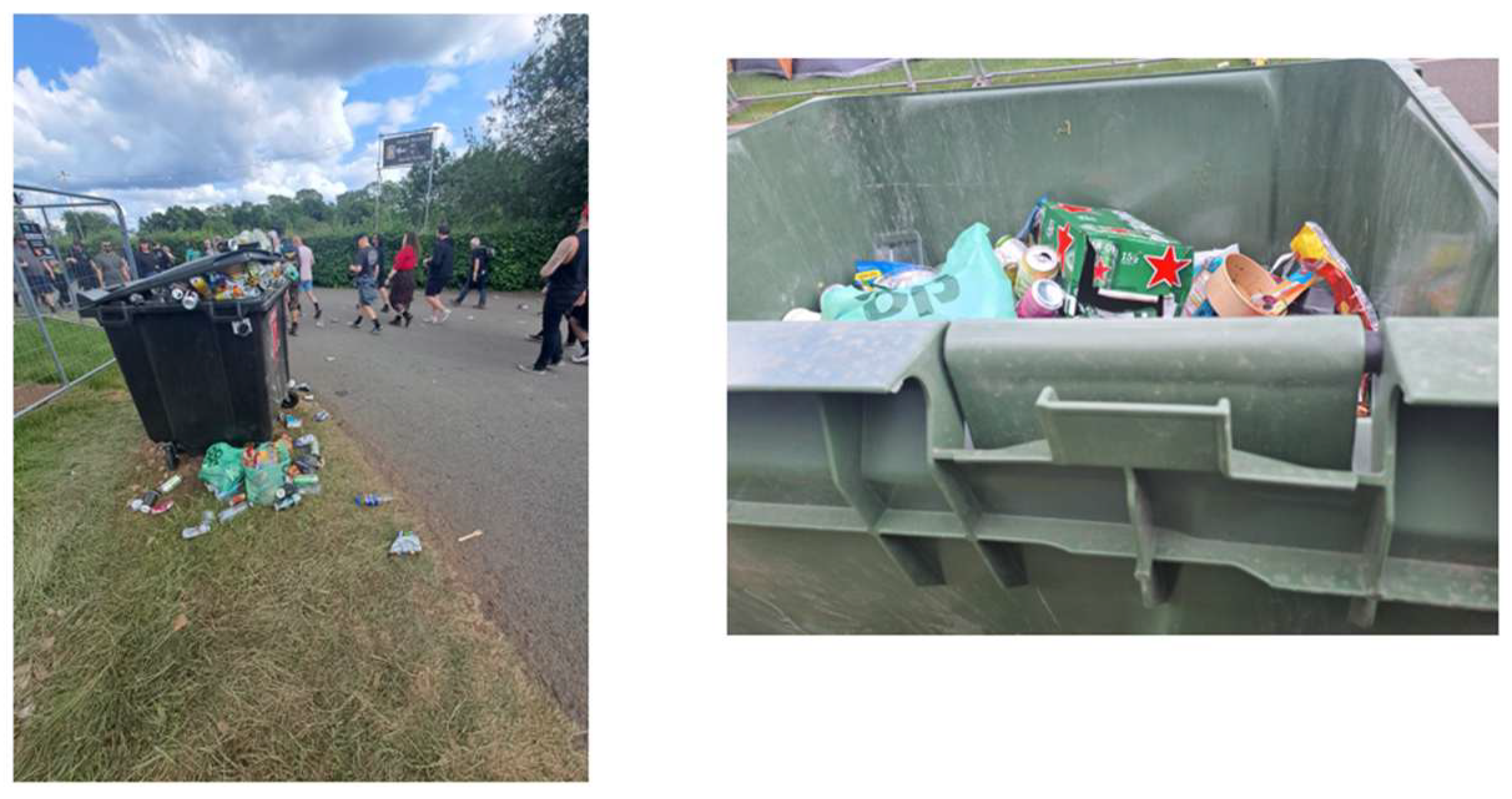
As depicted in Figure 18 and Figure 19, most garbage is generated near the food area and near the stage area. The festival organisers already facilitate multiple garbage collection points and have additional volunteers who regularly patrol the venue to collect small pieces of garbage. As illustrated in Figure 20, the fullness of the garbage bin is not uniform: from the walking spot in district X to the main area, six garbage bins are provided, but only the last one on the left and the last one on the right are full; the four middle garbage bins are only half-full.
The festival provides an app with maps, schedules of performances, and push notifications to convey updates. However, access to this information depends on the internet connectivity of each attendee because there is no digital information board.

3.5. Splendour Festival [70]

Splendour Festival [70] is an annual music festival in Wollaton Park, Nottingham, United Kingdom. Unlike Download Festival, which is focused on rock music performances, Splendour Festival is more of a family-friendly festival, as there is also a kids’ area and a funfair.
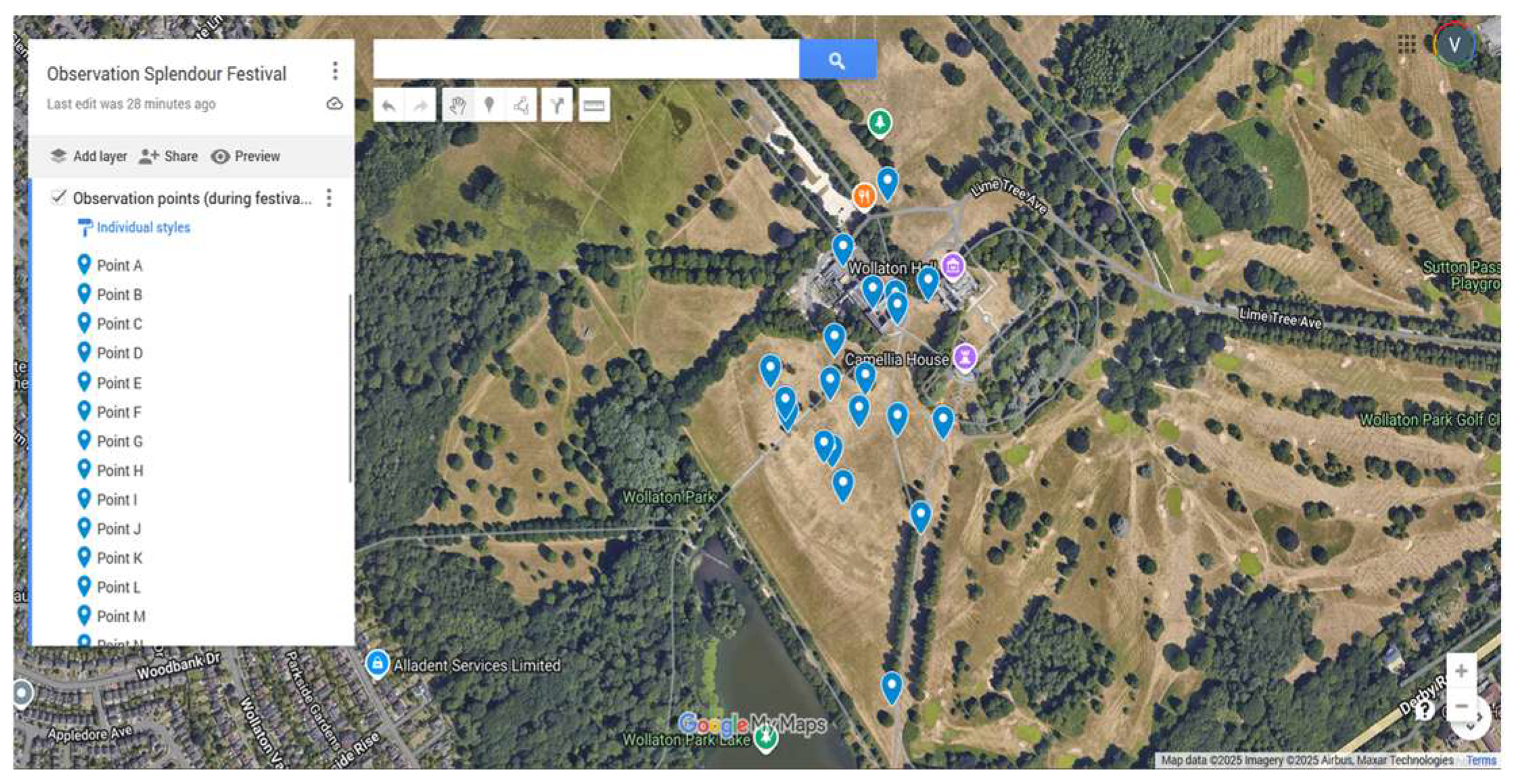
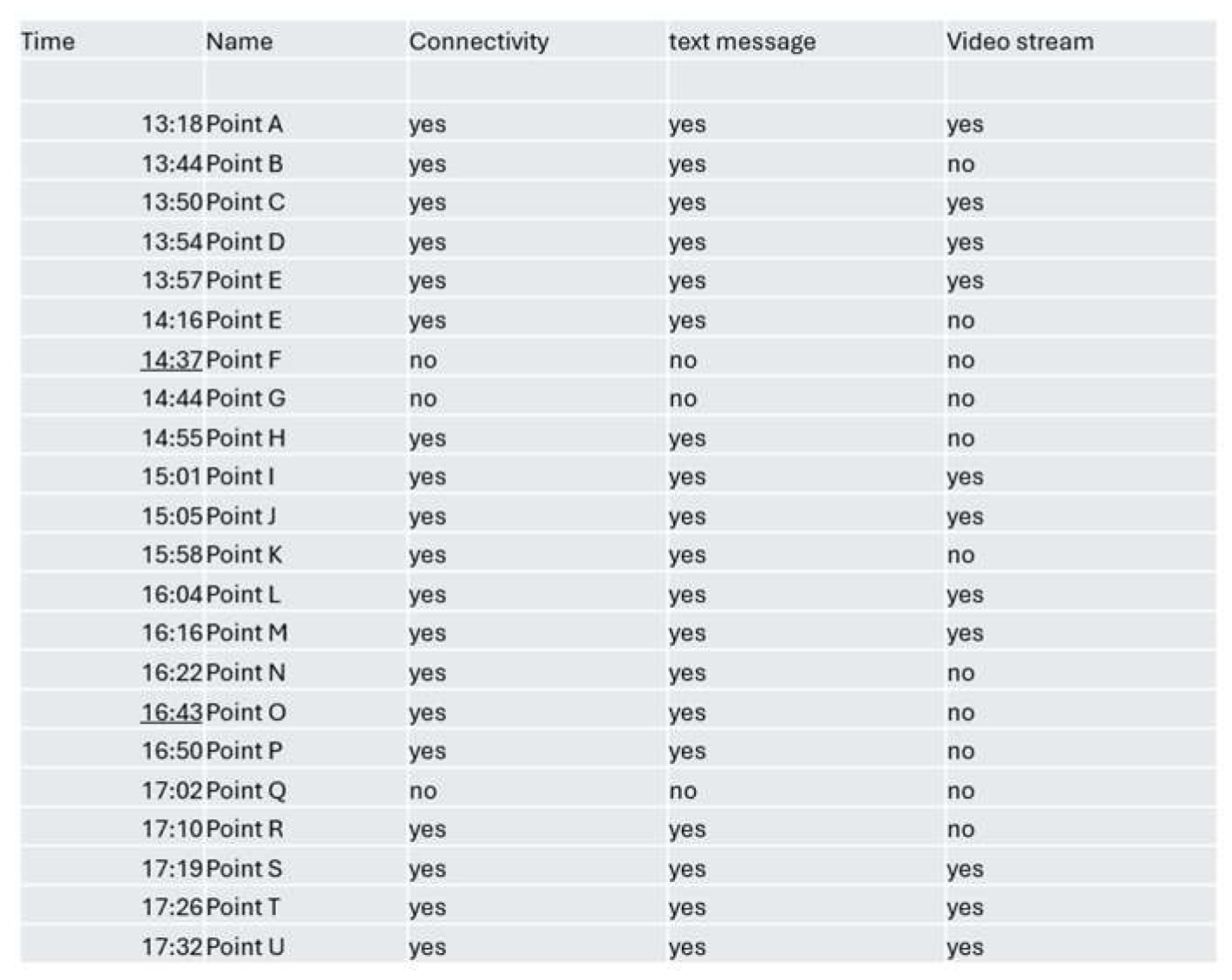
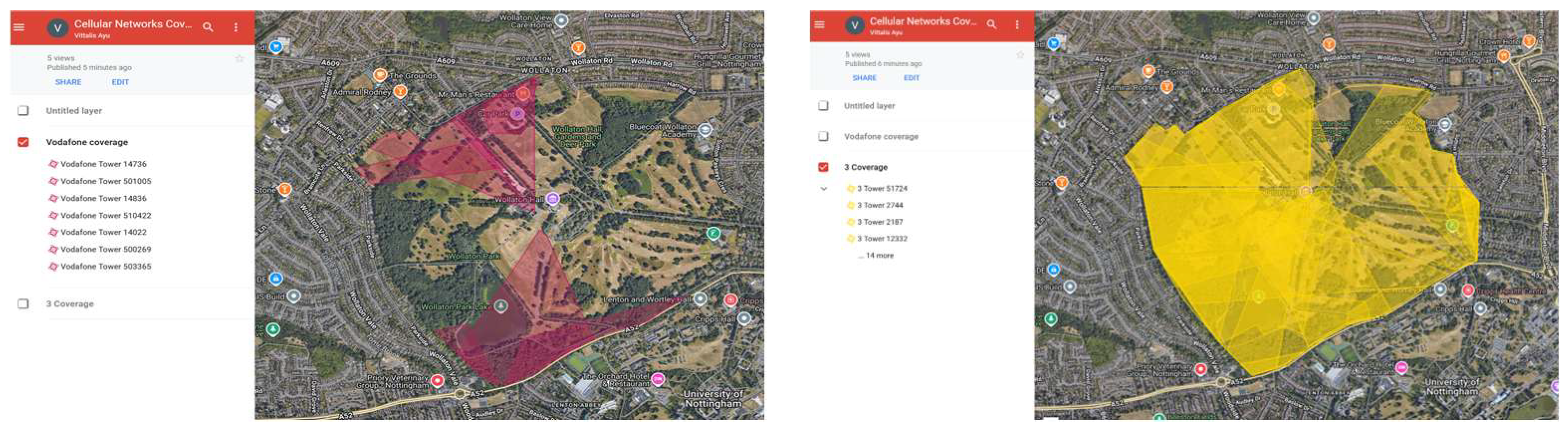
We observed the network connectivity within the Splendour Festival area, as illustrated in Figure 21. Figure 22 shows that cellular network provider Three (3) provided almost full coverage of internet connectivity to Wollaton Park, particularly the Splendour Festival Arena. However, as depicted in Figure 23, on festival days, connectivity is limited and video streaming is unreliable in several parts of the festival site.
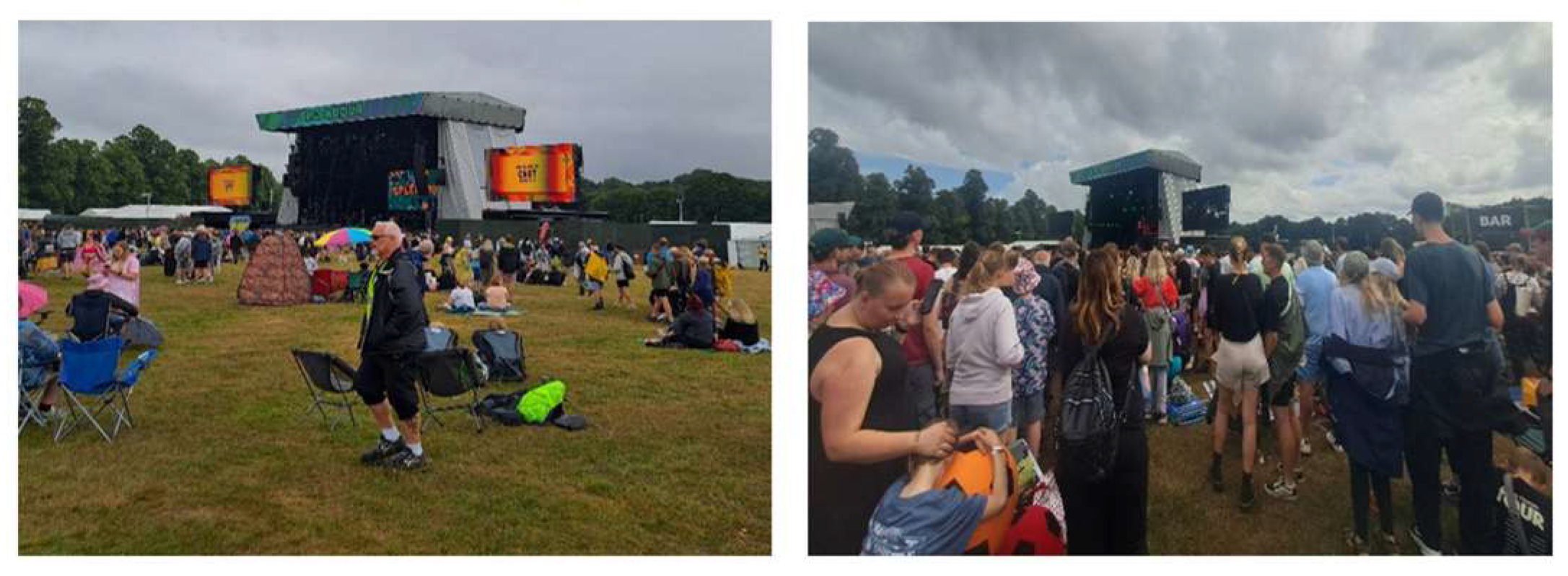
Figure 24 shows a visual view of the dynamically changing density of people near the stage before and during the performance. As expected, the crowd at the festival is dynamically changing, driven by the schedule of the performances.
Festival organisers play an important role in deciding the type of services that will be available at the festival and how to access information on them. Since the Splendour Festival is a family festival, the overall services that are provided comprise more family-friendly activities. The festival organisers did not provide a mobile app, but the festival attendees acquired the information from the website, on-site signage, or a volunteer.
From the festival analysis above, it can be concluded that festivals are environments that show dynamic changes in the density of geospatial–temporal dynamic interest demand for application services, which also differ for each festival. Therefore, to help reliable and scalable service provisioning in various festival environments, we need unified general festival frameworks, which will be explained in the following section.

4. Mobile Intelligent Edge for Festival Networks (MobiFest)

Our proposed framework, Mobile Intelligent Edge for Festival Networks (MobiFest), is intended to provide a complementary solution to the existing network infrastructure, facilitating application service provisioning at festivals in both urban and rural environments. MobiFest is designed to enhance network capacity and coverage by extending existing network edge infrastructure with opportunistic networks to improve service availability during dynamically changing service demand and to provide service provisioning for heterogeneous festival scenarios, utilising distributed intelligence at the network edge.
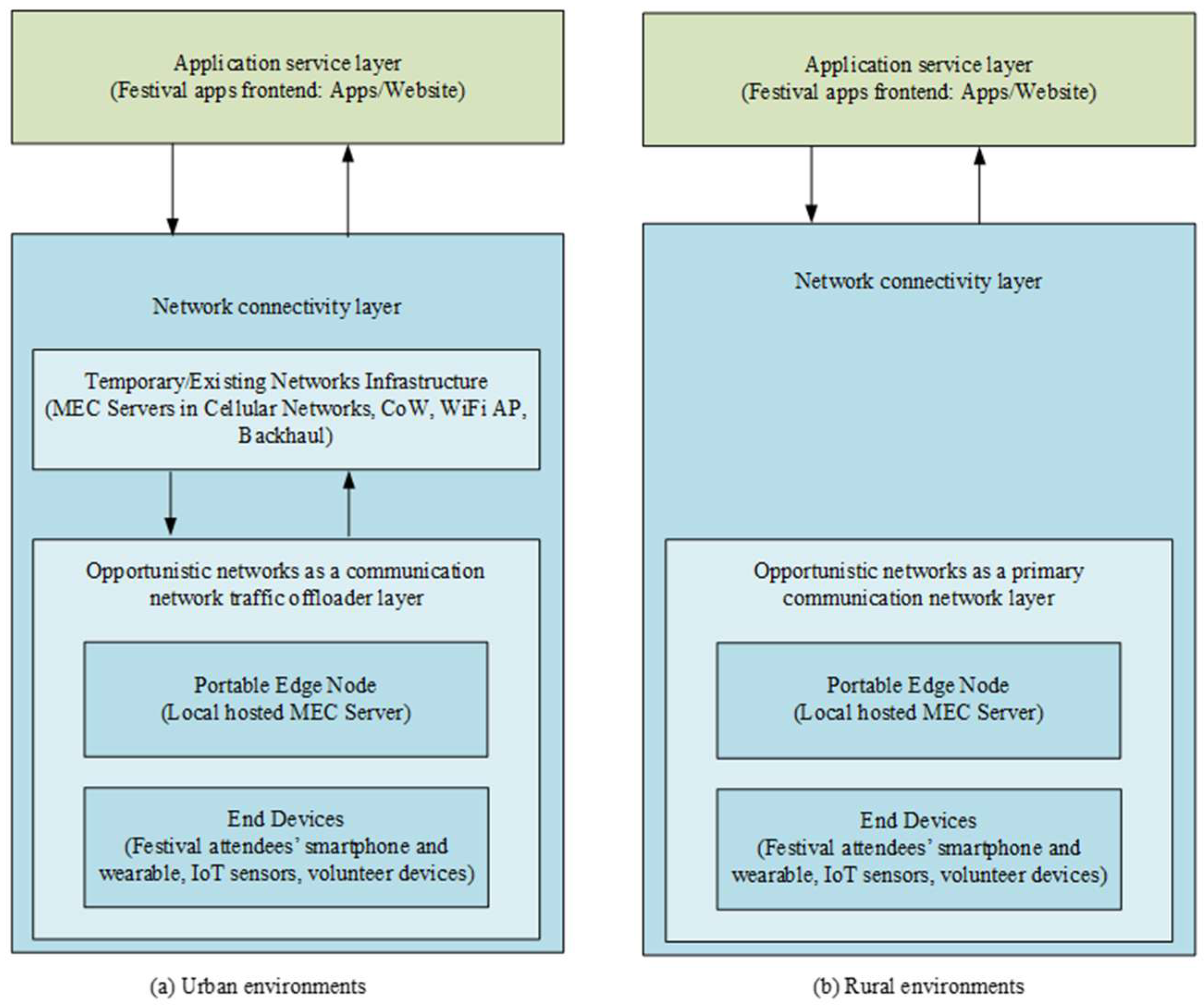
MobiFest’s layered architecture, as depicted in Figure 25, comprises the Application Layer and Network Layer.
  • Application service layer
This layer defines application services and requirements from festival organisers, festival participants, and other festival stakeholders, such as event-related services (festival event information and schedules, festival rules, etc.), emergency-related services (healthcare and safety), or facility-related services (availability of nearby parking, nearby garbage collection points, nearby food and drinks stands).
2.
Network connectivity layer
This layer defines how the network architecture is designed to support the provisioning of the required applications, even in heterogeneous and dynamic festival environments. The Network Layer supports two operational modes: opportunistic networks as the traffic offloader (in an urban environment) and opportunistic networks as the primary network connectivity (in a rural environment). At urban festivals, opportunistic networks assist the current infrastructure by offloading the traffic and extending the coverage of the networks, and edge nodes are able to occasionally synchronise with the core networks, whereas at a rural festival, opportunistic networks serve as the primary network connectivity.
The orchestration of MobiFest in two different environments is as follows:
1.
Urban Environments
In urban environments, the opportunistic network serves as a traffic offloader for the existing infrastructure. The portable edge nodes offload content requests from core network infrastructure such as cellular networks (Telkomsel, XL, Indosat). This reduces spikes of content requests to the core infrastructure during peak festival hours. The portable edge nodes have greater computational and storage capacity and can synchronise with the existing infrastructure to pre-fetch the content of application services. Nodes proactively predict content demand based on their local knowledge and observations of their ego networks. They will pre-fetch content to nodes in areas with predicted demand and redistribute requests to neighbouring nodes to avoid local congestion during the festival. This mechanism enables content retrieval via opportunistic networks, reducing reliance on core infrastructure and facilitating services in fragmented networks during periods of intermittent connectivity.
2.
Rural Environments
In rural environments, the opportunistic network serves as the primary network’s connectivity. The aim of this mode is to provide service availability in limited and sparse connectivity environments. The multi-layer Cognitive Cache [32] is employed to perform collaborative caching across the portable edge node and end devices. The content of application services is retrieved from neighbouring nodes within their ego networks or requested from portable edge nodes when it is not available nearby.
In the proposed architecture, Cognitive Cache [32] is deployed for its a multi-layer capability in the infrastructure layer, portable edge node layer, and end device layer. Cognitive Cache [32] will adaptively learn optimal caching policies by collaborating with nodes in these layers. Cognitive Cache [32] nodes consider their caching strategy alongside their neighbours’ caching behaviours. Cognitive Cache [32] maintains, and exchanges with other neighbour stages, its caching storage and the list of content popularity that it observes, so the edge may decide to cache high-, medium-, or low-popularity content. Cognitive Cache [32] uses multi-agent, independent DRL with RNNs and LSTM to capture the dynamics of content request patterns and adaptively apply its caching strategy while collaborating with neighbours. This system is adaptive to the spatial and temporal locality of dynamically changing content workloads and resource availability, thereby improving the reliability and scalability of content sharing, enhancing user quality of experience (QoE), and reducing operational costs in mobile social community networks.

5. Experimental Design Case Studies: Smart Garbage

5.1. Smart Garbage

Smart garbage in smart cities has been studied by various researchers, such as in [71,72,73,74,75,76,77,78,79,80,81,82,83,84,85,86,87,88,89,90,91], emphasising the necessity of finding the most optimal path to collect garbage as efficiently as possible. However, due to the dynamic density of people at mass events, the movement of large vehicles such as garbage trucks is restricted even though they are scheduled to empty the bins. Meanwhile, research in [71,75,77,81] was focused on designing sensors to report bin occupancy rates and detect different garbage types. In these studies [71,72,73,78,79,80,81,82,84,87,88,89,91], most of the sensor data is sent to and processed in the cloud, and then garbage prediction mechanisms, such as those in [71,72,73,74,75,76,77,78,80,84,87,88,89], are employed in the cloud based on the collected sensed data. Then, the results are disseminated to interested users. However, it is presumed that every sensor has good internet connectivity to the cloud, whereas dynamically changing-density environments such as mass events in a smart city are prone to congestion due to the sparseness or denseness of the networks and result in intermittent connectivity, thus leading to difficulty in maintaining stable connectivity to the remote cloud.

5.2. Smart GarBiC Q-Learning Model: States, Actions, and Rewards

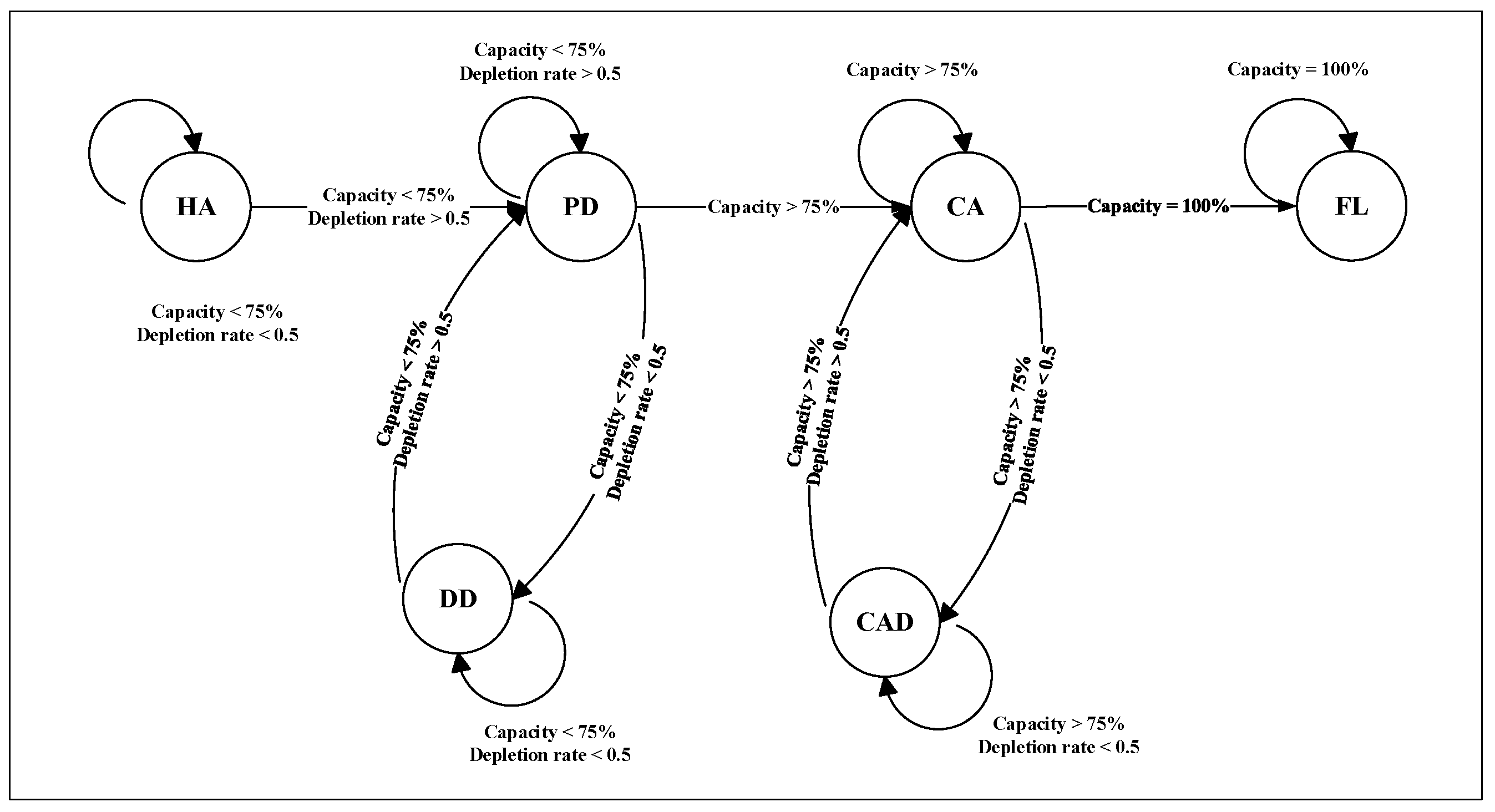
We build our SmartGarBiC algorithm based on the MobiFest framework and modify the heuristics to suit our case study of the garbage problem. As in [92], the SmartGarBiC node and its ego networks are able to monitor, analyse, and predict interest and availability for nearby garbage bins. Furthermore, by incorporating the congestion awareness proposed in previous work [35], the SmartGarBiC nodes adaptively predict and offload congestion from garbage interest requests in congested area to nearby areas that are less congested. The capacity level [92] reflects the current remaining capacity of the garbage bin with respect to the ability of nodes to receive garbage. We illustrate our SmartGarbiC reinforcement learning model in Figure 26, Table 1 and Table 2.
r i t = α g k G p i , k t u i , i , k t + β g k G n j N E i p j , k t u i , j , k t
A SmartGarBiC node receives rewards when it successfully serves a garbage interest g locally or forwards it to a neighbouring node that can serve it with low delay. The reward function comprises the predicted popularity of garbage interests in node i ( p i , k t ) with the beneficial utility value ( u i , i , k t ) when node i had the garbage space and also the predicted popularity of garbage interests in node j  ( p j , k t ) with the beneficial utility value ( u i , j , k t ) when node j has the garbage space to serve the garbage interest for node i.

5.3. Node and Ego Network Capacity Depletion Rate

We adopt availability heuristics, i.e., receptiveness and retentiveness as in [92,93,94], to measure the ability of the SmartGarBiC node to receive and retain garbage. We extend our heuristics to observe not only the node’s resources and availability but also the resources and availability of the ego networks. If the current node’s capacity is critical, then, based on the ego network’s information, the garbage interest will be forwarded so the garbage will be collected in the nearby, less congested region.
The decision on whether to accept garbage or not depends on the availability of the garbage node itself and how much interest there is in offloading the garbage. Each node collection point has a different rate of capacity depletion related to the dynamicity of the temporal and spatial characteristics of garbage interest due to the nature of human social mobility at mass events such as festivals. Therefore, we measure temporal locality characteristics by measuring garbage interest’s frequency, recency, and betweenness, which are essential to determine future availability and capacity depletion rates. We derived these metrices from CapRefCache [93] and SmartCharge [92] and tailored them to suit our cases.
Garbage Interest Frequency [92], denoted by ƒ−λ∆t, reflects the temporal characteristic of how much interest is generated during interval times ∆t. Meanwhile, Garbage Interest Recency [92] is measured to evaluate how recent the last garbage interest was.
I n t e r e s t   R e c e n c y = 2 ( t c u r r e n t T i m e t r e c e n t R e q )   +     +   ( t c u r r e n t T i m e t r e c e n t R e q f ) f 1 + e 2
Garbage Interest Betweenness [92] implies the fair observation of temporary request impulses compared to the regularity of the observed request pattern to avoid misleading predictions of the garbage interest’s trends.
I n t e r e s t   B e t w e e n e s s = 1 f Σ t = 1 f ( t r e c e n t R e q i     t r e c e n t R e q i 1 T a v e r a g e T i m e G a p ) 2
In addition, we capture the dynamicity of garbage interest spatial characteristics from a certain localised area with clusters of nodes that might have the same interest; for example, nodes located near the food court area might have more food-related garbage than those in the merchandising area.
The spatial heuristic is defined over the set of nodes S k and computed for every node pair, S 1 , S 2 S k   , using a combination of the additive formulation of the network and social metrics, including the clustering coefficient ( C C o e f S k ) [90], similarity S i m S 1 , S 2 [35], closeness ( C l o s e S 1 , S k ) [87], and tie strength ( T S S 1 , S 2 )   [91].
S p a t i a l H e u r i s t i c = S 1 , S 2 S k C C o e f S k + S i m S 1 , S 2 + C l o s e S 1 , S k + T S S 1 , S 2
C C o e f S k represents the clustering coefficient, which captures the local neighbourhood density. S i m S 1 , S 2 , C l o s e S 1 , S k , and T S S 1 , S 2   quantify the similarity, network closeness, and tie strength between nodes S 1 and S 2 , respectively.

5.4. Pseudocode

We present our proposed SmartGarBic pseudocode in Algorithm 1.
Algorithm 1. Smart GarBiC Pseudocode.
If node is in contact with peer then
  for garbage in garbageCollection do
    if garbage.size < peer.capacity then
      action = sendGarbage()
      peer.capacity--
    else if peer.capacity.isCritical() then
         node.isPriority()
         action = receiveGarbage()
         peer.capacity--
       else if node.egoNet.capacityHeuristics > node.capacityHeuristics then
            action = forwardGarbageInterest()
            action = rejectGarbage()
       else
          action = rejectGarbage()
  end for
node.update(capacityHeuristics, egoNet.capacityHeuristics)
node.actionHistory = {}
node.update(states, Qvalue, rewards, egoNet.states, egoNet.Qvalue, egoNets.rewards)
end if
In addition, Algorithm 2 depicted policies to represent three different scenarios of where garbage can be offloaded: only static point (scenario 1); static point and dynamic nodes (scenario 2); and static, dynamic, and volunteer (scenario 3).
Algorithm 2. Smart GarBiC Role’s Scenarios.
// Scenario 1: node only allowed to offload to binNode
  If peer == binNode then
    checkCapacity()
    chooseAction()
  else
    rejectGarbage()
// Scenario 2: node can offload to binNode and regularNode
  If peer == binNode or peer == regularNode then
    checkCapacity()
    chooseAction()
  else
    rejectGarbage()
// Scenario 3: node can offload to binNode, regularNode and volunteerNode.
  If peer == binNode or peer == volunterNode or peer == regularNode then
    checkCapacity()
    chooseAction()

5.5. Evaluation

We evaluate our SmartGarBiC protocol with extensive simulation experiments with an opportunistic-based network simulator, ONE Simulator [95]. We model the garbage interest request with dynamic temporal and spatial characteristics. In our experiments, we built our scenario based on the Indonesia Street Performance Festival [55], which takes place in an urban area of Malioboro, a central region of Yogyakarta City, Indonesia. We present the parameters for our experiments in Table 3 with a more detailed configuration file in the following repository: https://github.com/vit-ayuk/SmartGarBiC (accessed on 30 January 2026).
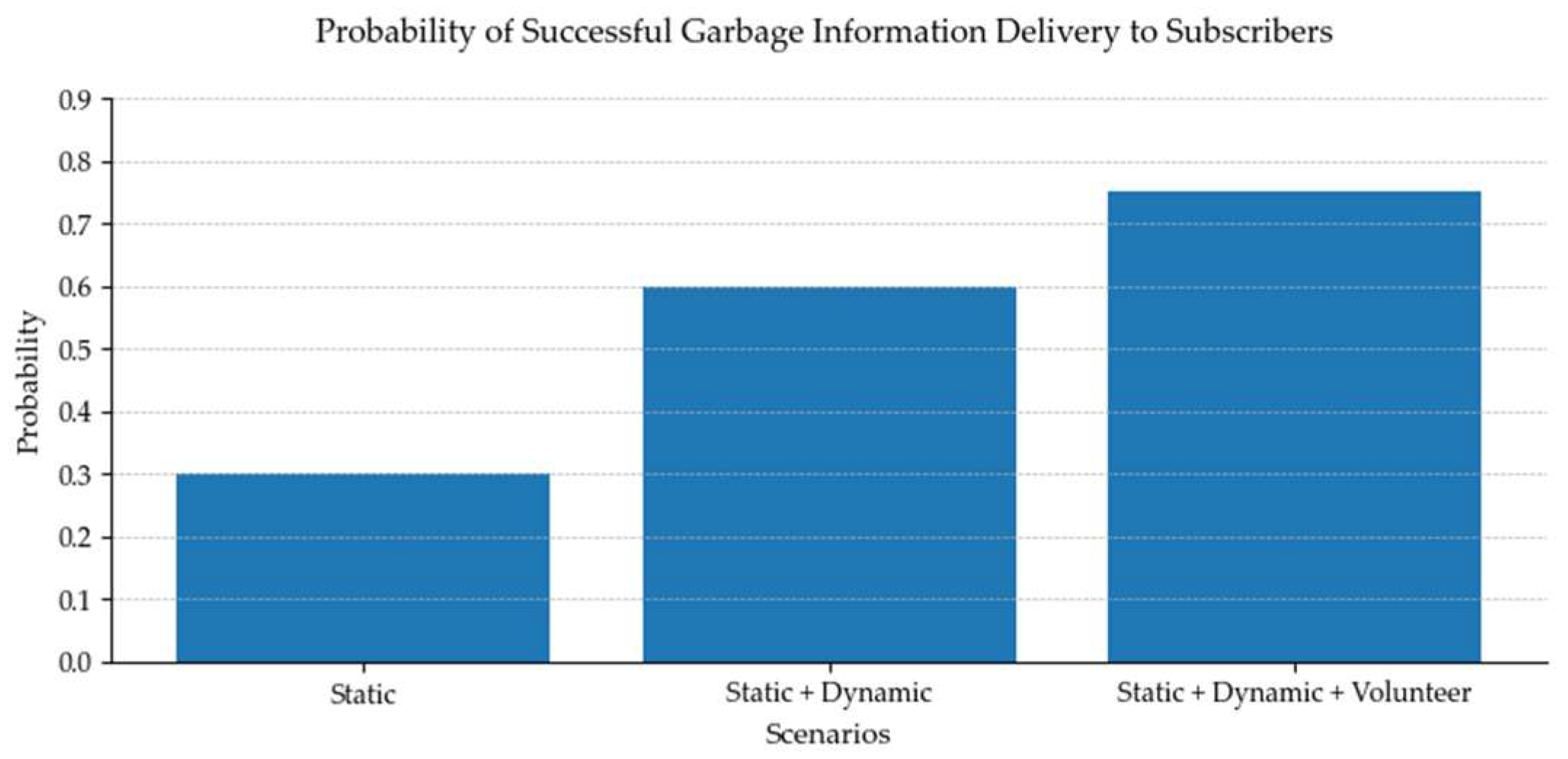
In addition, we examine three different scenarios to represent the offloading of garbage information. In the first scenario, the festival attendee can only exchange information such as the availability, types, and location of garbage points with the static garbage points scattered across the venues. In second scenario, festival attendees can exchange information with the static point and also utilise dynamic nodes such as other festival attendees as an opportunistic relay for the information. The last scenario assumes that volunteer nodes are added to the scenario, appointed by the festival organiser to serve as a moving information point with more mobility across the festival venue and larger storage to cache local data to provide information services.
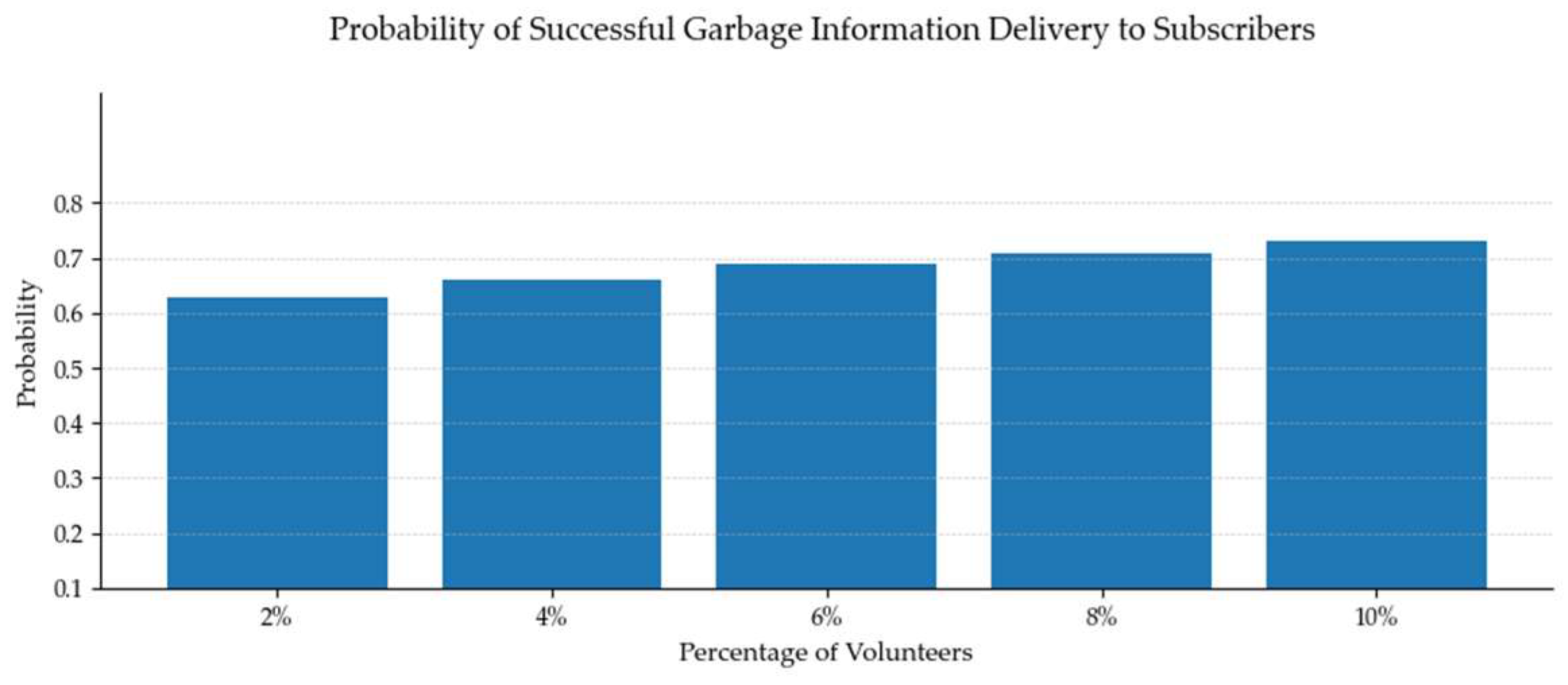
As illustrated in Figure 27, utilising another festival attendee to serve as an opportunistic data mule improves the success of information delivery, and volunteers provide more coverage and larger cache spaces, which further improves the delivery rate. Figure 28 shows that employing a higher percentage of volunteers as helpers increases the garbage point information received by subscribers.
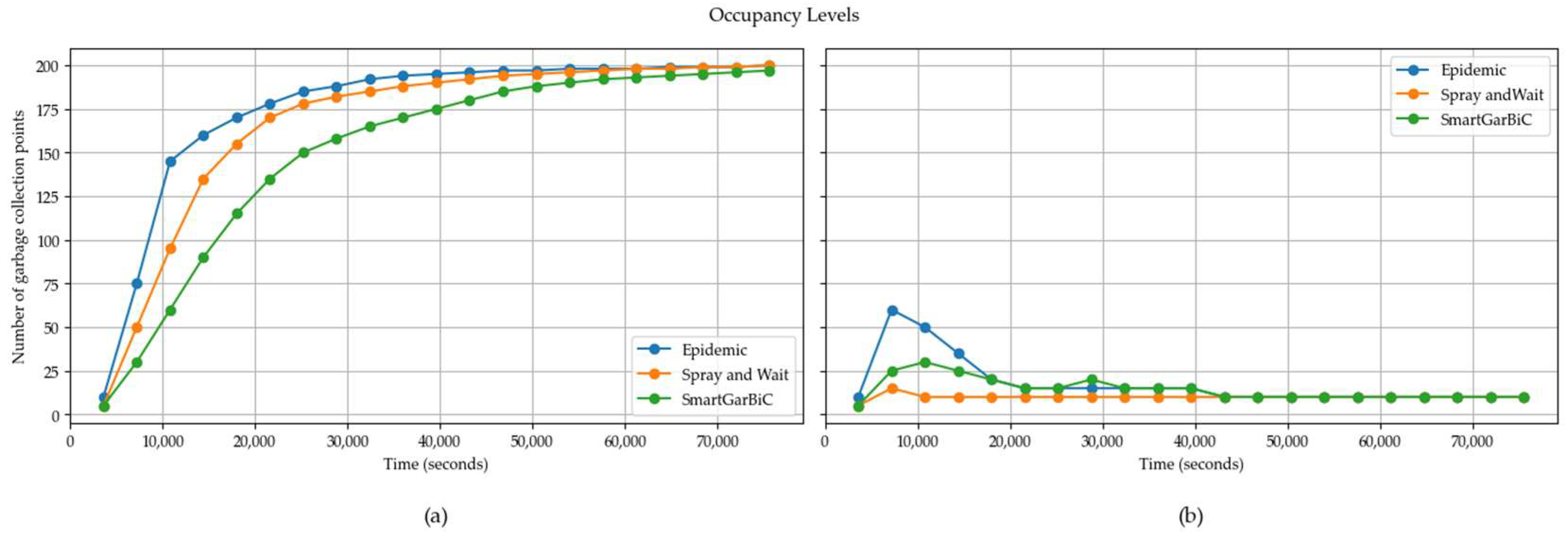
Furthermore, by increasing the number of participating volunteers, as depicted in Figure 28, the probability of the garbage information reaching subscribers also increases. Figure 29a shows that utilising SmartGarbiC leads to a slower increase in full occupancy of garbage points compared to other benchmark protocols, such as Epidemic and Spray and Wait. This outcome is attributed to SmartGarBiC’s predictive and adaptive capability, which enables it to serve the garbage interest not only individually but also in collaboration with neighbouring points. Similarly, Figure 29b presents the temporal evolution of nearly saturated garbage points over time. SmartGarBiC is able to mitigate surges in garbage point occupancy by distributing interest across multiple neighbouring nodes.

6. Conclusions

In this paper, we present a complex, multimodal, and multi-dimensional analysis of the challenges in maintaining network connectivity to ensure service provisioning at Indonesian festivals. Our findings show that there is indeed a gap in user expectations and user perceptions of the underlying network’s connectivity and ability to provide application services, such as access to event-, facility-, and safety-related information. The results show that participant expectations are substantially higher than perceptions, with the responses to questions consistently being negative, reflecting the strong perceived reliability need. The low variance in the SERVQUAL (Expectation) results indicates that respondents had similarly high expectations. In this context, we can conclude that during festivals, participants and organisers would like to have high network reliability. Our analysis also shows that geo-temporal–spatial content demand persists in festival environments, and the locality and dynamicity of user demands emphasise the need for a predictive analytical edge framework to dynamically avoid congestion and provide content at a nearer point to subscribers.
We propose MobiFest as a mobile edge intelligent framework to improve the scalability and reliability of service provisioning at festivals in both urban and rural areas. We conducted extensive experiments on our example use case of smart garbage. Our proposed protocol, SmartGarbiC, was designed based on MobiFest for smart garbage in rural areas. The results show that SmartGarbiC outperforms state-of-the-art and benchmark algorithms. In future works, we envisage integrating the proposed protocol into the ModiToNes [27] platform to enable distributed predictive analytics and real-time content processing, as well as into RasPiPCloud [28] to enable data gathering, storing and processing.

Author Contributions

Conceptualization, V.A. and M.R.; methodology, V.A. and M.R.; software, V.A.; validation, V.A. and M.R.; formal analysis, V.A. and M.R.; investigation, V.A. and M.R.; resources, V.A. and M.R.; data curation, V.A. and M.R.; writing—original draft preparation, V.A. and M.R.; writing—review and editing, V.A. and M.R.; visualisation, V.A. and M.R.; supervision, M.R.; project administration, V.A. and M.R.; funding acquisition, V.A. and M.R. All authors have read and agreed to the published version of the manuscript.

Funding

This research is funded by Indonesian Education Scholarship, Center for Higher Education Funding and Assessment, and Indonesian Endowment Fund for Education, under Grant ID: 3080/BPPT/BPI.LG/IV/2024.

Data Availability Statement

All data sets, configuration settings, and codes are available from the Nottingham Worktribe repository: https://github.com/vit-ayuk/SmartGarBiC (accessed on 30 January 2026).

Acknowledgments

We extend our gratitude to Karaton Ngayogyakarta Hadiningrat and Kundha Kabudayan Kabupaten Gunungkidul as institutional partners for data collection in this study.

Conflicts of Interest

The authors declare no conflicts of interest.

Abbreviations

The following abbreviations are used in this manuscript:
MANETMobile Ad Hoc Networks
PAWSPublic Access WiFi Service
OppNetsOpportunistic Networks
MODiToNeSMobile Opportunistic and Disconnection Tolerant Networking
CAFeCongestion-Aware Forwarding Algorithm
CafRepCongestion-Aware Forwarding and Replication
MobiFestMobile Intelligent Edge for Festival Networks
DRLDeep Reinforcement Learning
RNNRecurrent Neural Network
LSTM Long Short-Term Memory
MECMobile Edge Computing
IoTInternet of Things
CoWCell on Wheels
APAccess Points
WiFiWireless Fidelity

References

  1. Legge, J.D.; McDivitt, J.F.; Mohamad, G.S.; Wolters, O.W.; Leinbach, T.R.; Adam, A.W. Indonesia. Encyclopedia Britannica 2026. Available online: https://www.britannica.com/place/Indonesia (accessed on 3 November 2025).
  2. Redaksi, P.I. Festival Sekaten. Available online: https://pariwisataindonesia.id/headlines/festival-sekaten/ (accessed on 1 July 2025).
  3. Labuhan Parangkusumo Dan Labuhan Lawu, Doa Dan Tapak Tilas Leluhur Keraton. Available online: https://www.kratonjogja.id/peristiwa/1374-labuhan-parangkusumo-dan-labuhan-lawu-doa-dan-tapak-tilas-leluhur-keraton/ (accessed on 6 December 2025).
  4. Lembah Baliem Festival. Available online: https://www.adventurealternative.com/baliem-valley-festival/ (accessed on 7 March 2023).
  5. Standford Cyber Policy Center. Digital Technologies in Emerging Countries. Available online: https://cyber.fsi.stanford.edu/publication/digital-technologies-emerging-countries (accessed on 14 September 2025).
  6. Tanner, J. Indonesia’s SATRIA-1 Satellite Is Connected and Ready for 2024. Available online: https://developingtelecoms.com/telecom-technology/satellite-communications-networks/15942-indonesia-s-satria-1-satellite-is-connected-and-ready-for-2024.html (accessed on 6 December 2025).
  7. Medina, A.F. Indonesia’s Palapa Ring: Bringing Connectivity to the Archipelago. Available online: https://www.aseanbriefing.com/news/indonesias-palapa-ring-bringing-connectivity-archipelago/ (accessed on 6 December 2025).
  8. Indonesia Civil Society of Digital Transformation Task Force (ID-CSO DTTF). Three Main Challenges of Indonesia’s Digital Transformation. Available online: https://cnlearning.apc.org/resources/three-main-challenges-of-indonesias-digital-transformation/ (accessed on 7 December 2025).
  9. Chen, Z.; Yu, T. Festivals and Digitalisation: A Critique of the Literature. Tour. Crit. Pract. Theory 2025, 6, 2–17. [Google Scholar] [CrossRef]
  10. Lopes, J.M.; Massano-Cardoso, I.; Granadeiro, C. Festivals in Age of AI: Smarter Crowds, Happier Fans. Tour. Hosp. 2025, 6, 35. [Google Scholar] [CrossRef]
  11. Manole, A.-Ș.; Ciobanu, R.-I.; Dobre, C.; Purnichescu-Purtan, R. Opportunistic Network Algorithms for Internet Traffic Offloading in Music Festival Scenarios. Sensors 2021, 21, 3315. [Google Scholar] [CrossRef]
  12. Forde, E. Lost in a Crowd: Why Phone Signal Is Still so Scarce at UK Music Festivals. Available online: https://www.theguardian.com/music/2023/aug/25/why-phone-signal-is-still-so-scarce-at-uk-music-festivals (accessed on 13 October 2024).
  13. Vodafone UK. Vodafone Supports Drinks Service at Glastonbury through Network Slicing. Available online: https://www.vodafone.co.uk/newscentre/press-release/drinks-service-at-glastonbury-network-slicing/ (accessed on 29 April 2025).
  14. Richards, G.; Leal Londoño, M.d.P. Festival Cities and Tourism: Challenges and Prospects. J. Policy Res. Tour. Leis. Events 2022, 14, 219–228. [Google Scholar] [CrossRef]
  15. Randy, J. Festival Bajo Pasakayyang Di Morowali Terhambat Masalah Sinyal. Available online: https://travel.detik.com/travel-news/d-3077589/festival-bajo-pasakayyang-di-morowali-terhambat-masalah-sinyal (accessed on 27 October 2025).
  16. Marques-Neto, H.T.; Xavier, F.H.Z.; Xavier, W.Z.; Malab, C.H.S.; Ziviani, A.; Silveira, L.M.; Almeida, J.M. Understanding Human Mobility and Workload Dynamics Due to Different Large-Scale Events Using Mobile Phone Data. J. Netw. Syst. Manag. 2018, 26, 1079–1100. [Google Scholar] [CrossRef]
  17. Larsen, J.E.; Sapiezynski, P.; Stopczynski, A.; Mørup, M.; Theodorsen, R. Crowds, Bluetooth and Rock’n’Roll: Understanding Music Festival Participant Behavior. In Proceedings of the 1st ACM International Workshop on Personal Data Meets Distributed Multimedia (PDM ’13), Barcelona, Spain, 22 October 2013; pp. 11–18. [Google Scholar] [CrossRef]
  18. Shafiq, M.Z.; Ji, L.; Liu, A.X.; Pang, J.; Venkataraman, S.; Wang, J. A First Look at Cellular Network Performance during Crowded Events. ACM SIGMETRICS Perform. Eval. Rev. 2013, 41, 17–28. [Google Scholar] [CrossRef]
  19. Bytes Digital. Available online: https://www.bytesdigital.co.uk/ (accessed on 1 April 2023).
  20. Telcom. Available online: https://telcom.uk/event-internet (accessed on 1 April 2023).
  21. Ben Wood. Available online: https://www.ccsinsight.com/blog/keeping-festivals-connected/ (accessed on 6 December 2025).
  22. Hu, C.-C. P2P Data Dissemination for Real-Time Streaming Using Load-Balanced Clustering Infrastructure in MANETs with Large-Scale Stable Hosts. IEEE Syst. J. 2021, 15, 2492–2503. [Google Scholar] [CrossRef]
  23. Sathiaseelan, A.; Mortier, R.; Goulden, M.; Greiffenhagen, C.; Radenkovic, M.; Crowcroft, J.; McAuley, D. A Feasibility Study of an In-the-Wild Experimental Public Access WiFi Network. In Proceedings of the Fifth ACM Symposium on Computing for Development, San Jose, CA, USA, 5 December 2014; ACM: New York, NY, USA, 2014; pp. 33–42. [Google Scholar]
  24. Wang, X.; Han, Y.; Wang, C.; Zhao, Q.; Chen, X.; Chen, M. In-Edge AI: Intelligentizing Mobile Edge Computing, Caching and Communication by Federated Learning. IEEE Netw. 2019, 33, 156–165. [Google Scholar] [CrossRef]
  25. Chancay-Garcia, L.; Hernandez-Orallo, E.; Manzoni, P.; Calafate, C.T.; Cano, J.-C. Evaluating and Enhancing Information Dissemination in Urban Areas of Interest Using Opportunistic Networks. IEEE Access 2018, 6, 32514–32531. [Google Scholar] [CrossRef]
  26. Boldrini, C.; Passarella, A. Data Dissemination in Opportunistic Networks. In Mobile Ad Hoc Networking: Cutting Edge Directions, 2nd ed.; John Wiley & Sons, Ltd.: Hoboken, NJ, USA, 2013; pp. 453–490. [Google Scholar] [CrossRef]
  27. Radenkovic, M.; Crowcroft, J.; Rehmani, M.H. Towards Low Cost Prototyping of Mobile Opportunistic Disconnection Tolerant Networks and Systems. IEEE Access 2016, 4, 5309–5321. [Google Scholar] [CrossRef]
  28. Radenkovic, M.; Milic-Frayling, N. Demo: RasPiPCloud: A Light-Weight Mobile Personal Cloud. In Proceedings of the 10th ACM MobiCom Workshop on Challenged Networks, Paris, France, 11 September 2015; ACM: New York, NY, USA, 2015; pp. 57–58. [Google Scholar]
  29. Radenkovic, M.; Ha Huynh, V.S.; John, R.; Manzoni, P. Enabling Real-Time Communications and Services in Heterogeneous Networks of Drones and Vehicles. In Proceedings of the 2019 International Conference on Wireless and Mobile Computing, Networking and Communications (WiMob), Barcelona, Spain, 21–23 October 2019; IEEE: New York, NY, USA, 2019; pp. 1–6. [Google Scholar]
  30. Radenkovic, M.; Vu San, H.H. Low-Cost Mobile Personal Clouds. In Proceedings of the 2016 International Wireless Communications and Mobile Computing Conference (IWCMC), Paphos, Cyprus, 5–9 September 2016; IEEE: New York, NY, USA, 2016; pp. 836–841. [Google Scholar]
  31. Karthick, G.; Mapp, G.; Crowcroft, J. Building an Intelligent Edge Environment to Provide Essential Services for Smart Cities. In Proceedings of the 18th Workshop on Mobility in the Evolving Internet Architecture, Madrid, Spain, 6 October 2023; ACM: New York, NY, USA, 2023; pp. 13–18. [Google Scholar]
  32. Radenkovic, M.; Huynh, V.S.H. Cognitive Caching at the Edges for Mobile Social Community Networks: A Multi-Agent Deep Reinforcement Learning Approach. IEEE Access 2020, 8, 179561–179574. [Google Scholar] [CrossRef]
  33. Radenkovic, M.; Grundy, A. Congestion Aware Data Dissemination in Social Opportunistic Networks. ACM SIGMOBILE Mob. Comput. Commun. Rev. 2010, 14, 31–33. [Google Scholar] [CrossRef]
  34. Radenkovic, M.; Grundy, A. Congestion Aware Forwarding in Delay Tolerant and Social Opportunistic Networks. In Proceedings of the 2011 Eighth International Conference on Wireless On-Demand Network Systems and Services, Bardonecchia, Italy, 26–28 January 2011; IEEE: New York, NY, USA, 2011; pp. 60–67. [Google Scholar]
  35. Radenkovic, M.; Grundy, A. Efficient and Adaptive Congestion Control for Heterogeneous Delay-Tolerant Networks. Ad Hoc Netw. 2012, 10, 1322–1345. [Google Scholar] [CrossRef]
  36. Radenkovic, M.; Grundy, A. Framework for Utility Driven Congestion Control in Delay Tolerant Opportunistic Networks. In Proceedings of the 2011 7th International Wireless Communications and Mobile Computing Conference, Istanbul, Turkey, 4–8 July 2011; IEEE: New York, NY, USA, 2011; pp. 448–454. [Google Scholar]
  37. Radenkovic, M.; Huynh, V.S.H.; Manzoni, P. Adaptive Real-Time Predictive Collaborative Content Discovery and Retrieval in Mobile Disconnection Prone Networks. IEEE Access 2018, 6, 32188–32206. [Google Scholar] [CrossRef]
  38. Hao, H.; Xu, C.; Zhang, W.; Chen, X.; Yang, S.; Muntean, G.-M. Reliability-Aware Optimization of Task Offloading for UAV-Assisted Edge Computing. IEEE Trans. Comput. 2025, 74, 3832–3844. [Google Scholar] [CrossRef]
  39. Muhid, H.K. Brimob Polda DIY Tembak Drone Di Prosesi Grebeg Syawal, Ini 3 Zona Larangan Terbang Drone. Available online: https://www.tempo.co/politik/brimob-polda-diy-tembak-drone-di-prosesi-grebeg-syawal-ini-3-zona-larangan-terbang-drone-194897 (accessed on 2 December 2025).
  40. Chen, Z.; Xiong, B.; Chen, X.; Min, G.; Li, J. Joint Computation Offloading and Resource Allocation in Multi-Edge Smart Communities with Personalized Federated Deep Reinforcement Learning. IEEE Trans. Mob. Comput. 2024, 23, 11604–11619. [Google Scholar] [CrossRef]
  41. Chen, Z.; Liang, J.; Yu, Z.; Cheng, H.; Min, G.; Li, J. Resilient Collaborative Caching for Multi-Edge Systems with Robust Federated Deep Learning. IEEE Trans. Netw. 2025, 33, 654–669. [Google Scholar] [CrossRef]
  42. Agussalim; Putra, A.B. Implementation of Enhanced Spray Routing Protocol for VDTN on Surabaya Smart City Scenario. J. RESTI (Rekayasa Sist. Teknol. Inf.) 2023, 7, 914–921. [Google Scholar] [CrossRef]
  43. Agussalim; Tsuru, M.; Nur Cahyo, W.; Agung Brastama, P. Performance of Delay Tolerant Network Protocol in Smart City Scenario. J. Phys. Conf. Ser. 2020, 1569, 022056. [Google Scholar] [CrossRef]
  44. Agussalim; Susrama Mas Diyasa, I.G.; Mukaromah, S.; Najaf, A.R.E.; Rahmat, B.; Rahajoe, A.D. The Impact of Message Replication on VDTN Spray Protocol for Smart City. In Proceedings of the 2023 IEEE 9th Information Technology International Seminar (ITIS), Batu Malang, Indonesia, 18 October 2023; IEEE: New York, NY, USA, 2023; pp. 1–6. [Google Scholar]
  45. Abdillah, Y.A.; Wibowo, T.A.; Yovita, L.V. Analisis Performansi Router Maxprop pada Vehicular Ad Hoc Network Berbasis Delay Tolerant Network. e Proc. Eng. 2015, 2, 7050–7057. [Google Scholar]
  46. Negara, I.G.A.S.; Yovita, L.V.; Wibowo, T.A. Performance Analysis of Social-Aware Content-Based Opportunistic Routing Protocol on MANET Based on DTN. In Proceedings of the 2016 International Conference on Control, Electronics, Renewable Energy and Communications (ICCEREC), Bandung, Indonesia, 13–15 September 2016; IEEE: New York, NY, USA, 2016; pp. 47–53. [Google Scholar]
  47. Agussalim, A.; Mas Diyasa, I.G.S.; Saputro, E.A.; Idhom, M.; Sihananto, A.N.; Mukarromah, S. Exploring Store-Carry-Forward Networking on Emergency Alert Dissemination of Jakarta’s Integrated Rail System. In Proceedings of the 2024 IEEE 10th Information Technology International Seminar (ITIS), Surabaya, Indonesia, 6 November 2024; IEEE: New York, NY, USA, 2024; pp. 363–368. [Google Scholar]
  48. Agussalim; Tsuru, M. Comparison of DTN Routing Protocols in Realistic Scenario. In Proceedings of the 2014 International Conference on Intelligent Networking and Collaborative Systems, Salerno, Italy, 10–12 September 2014; IEEE: New York, NY, USA, 2014; pp. 400–405. [Google Scholar]
  49. Agussalim; Pratama, A.; Safitri, E.M.; Wibowo, N.C.; Putra, A.B. Message Time-to-Live Based Drop Policy Under Spray and Hop Distance Routing. In Proceedings of the 2020 6th Information Technology International Seminar (ITIS), Surabaya, Indonesia, 14 October 2020; IEEE: New York, NY, USA, 2020; pp. 75–80. [Google Scholar]
  50. Agussalim; Tsuru, M. Node Location Dependent Remaining-TTL Message Scheduling in DTNs. In Proceedings of the 2015 IEEE Asia Pacific Conference on Wireless and Mobile (APWiMob), Bandung, Indonesia, 27–29 August 2015; IEEE: New York, NY, USA, 2015; pp. 108–113. [Google Scholar]
  51. Agussalim; Tsuru, M. Spray and Hop Distance Routing Protocol in Multiple-Island DTN Scenarios. In Proceedings of the 11th International Conference on Future Internet Technologies, Nanjing, China, 15 June 2016; ACM: New York, NY, USA, 2016; pp. 49–55. [Google Scholar]
  52. Agussalim; Tsuru, M. Spray Router with Node Location Dependent Remaining-TTL Message Scheduling in DTNs. J. Inf. Process. 2016, 24, 647–659. [Google Scholar] [CrossRef][Green Version]
  53. Agussalim; Tsuru, M.; Lawi, A. The Impact of Message Transmission Scheduling in DTN Message Delivery across Multiple Islands. In Proceedings of the 2017 IEEE Asia Pacific Conference on Wireless and Mobile (APWiMob), Bandung, Indonesia, 28–29 November 2017; IEEE: New York, NY, USA, 2017; pp. 138–144. [Google Scholar]
  54. Tsiory, R.A.; Tsuru, M.; Agussalim. When Does Network Coding Benefit Store-Carry-and-Forwarding Networks in Practice? In Advances in Intelligent Networking and Collaborative Systems; Barolli, L., Woungang, I., Hussain, O.K., Eds.; Lecture Notes on Data Engineering and Communications Technologies; Springer International Publishing: Cham, Switzerland, 2018; Volume 8, pp. 434–444. ISBN 978-3-319-65635-9. [Google Scholar]
  55. Indonesian Street Performance “Nusantara Menari”. Available online: https://visitingjogja.jogjaprov.go.id/43146/indonesian-street-performance-nusantara-menari-6-agustus-2025/#:~:text=Saksikan%20pertunjukan%20delegasi%20anggota%20Jaringan%20Kota%20Pusaka,kolaborasi%20wastra%2C%20kriya%2C%20dan%20semangat%20ksatria%20budaya (accessed on 6 December 2025).
  56. Bayu Untoro. Kirab Budaya Kepek: Pesta Rakyat Penuh Warna Di Ulang Tahun Ke-116. Available online: https://mediacitraindonesia.com/kirab-budaya-kepek-pesta-rakyat-penuh-warna-di-ulang-tahun-ke-116/ (accessed on 6 December 2025).
  57. Media Wiladeg. Upacara Adat Bersih Kalurahan Wiladeg. Available online: https://www.youtube.com/watch?v=_FxWJ2F2Q2k (accessed on 7 December 2025).
  58. Ko, C.-H.; Chou, C.-M. Apply the SERVQUAL Instrument to Measure Service Quality for the Adaptation of ICT Technologies: A Case Study of Nursing Homes in Taiwan. Healthcare 2020, 8, 108. [Google Scholar] [CrossRef] [PubMed]
  59. Arli, D.; Van Esch, P.; Weaven, S. The Impact of SERVQUAL on Consumers’ Satisfaction, Loyalty, and Intention to Use Online Food Delivery Services. J. Promot. Manag. 2024, 30, 1159–1188. [Google Scholar] [CrossRef]
  60. Karaton Ngayogyakarta Hadiningrat Karaton Ngayogyakarta Hadiningrat. Available online: https://www.kratonjogja.id/en/ (accessed on 8 December 2025).
  61. Karaton Ngayogyakarta Hadiningrat. Miyos Gangsa Dal 1959: Tradisi Udhik-Udhik, Simbol Berkah Dan Doa Raja Bagi Kawula. Available online: https://www.kratonjogja.id/peristiwa/1425-miyos-gangsa-dal-1959-tradisi-udhik-udhik-simbol-berkah-dan-doa-raja-bagi-kawula/ (accessed on 7 December 2025).
  62. Karaton Ngayogyakarta Hadiningrat. Gladhi Resik Prajurit Dan Numplak Wajik: Menuju Garebeg Sawal 1958 Je/2025. Available online: https://www.kratonjogja.id/peristiwa/1382-gladhi-resik-prajurit-dan-numplak-wajik-menuju-garebeg-sawal-1958-je/2025/ (accessed on 7 December 2025).
  63. Karaton Ngayogyakarta Hadiningrat. Numplak Wajik. Available online: https://www.kratonjogja.id/hajad-dalem/16-numplak-wajik/ (accessed on 7 December 2025).
  64. Kondur Gangsa Tandai Berakhirnya Hajad Dalem Sekaten Dal 1959. Available online: https://www.kratonjogja.id/peristiwa/1429-kondur-gangsa-tandai-berakhirnya-hajad-dalem-sekaten-dal-1959/ (accessed on 6 December 2025).
  65. Garebeg Mulud Dal 1959, Keraton Yogyakarta Dorong Semangat Revitalisasi Budaya. Available online: https://www.kratonjogja.id/peristiwa/1431-garebeg-mulud-dal-1959-keraton-yogyakarta-dorong-semangat-revitalisasi-budaya/ (accessed on 6 December 2025).
  66. Arroisi, J.; Kamil, R.F.; Shalahudin, H.; Amrullah, K. Islamic Symbolism and Cultural Integration in The Sekaten Ceremony in Yogyakarta. Abrahamic Relig. J. Studi Agama-Agama 2025, 5, 190–201. [Google Scholar] [CrossRef]
  67. Endog Abang. Available online: https://budaya-indonesia.org/Endog-Abang (accessed on 6 December 2025).
  68. Ookla, LLC. Indonesia Speedtest Connectivity Report. Available online: https://www.ookla.com/research/reports/indonesia-speedtest-connectivity-report-h12024 (accessed on 8 December 2025).
  69. Download Festival. Available online: https://downloadfestival.co.uk/ (accessed on 7 December 2025).
  70. DHP Family Ltd. Splendour Festival. Available online: https://www.splendourfestival.com/ (accessed on 6 December 2025).
  71. Sheng, T.J.; Islam, M.S.; Misran, N.; Baharuddin, M.H.; Arshad, H.; Islam, M.R.; Chowdhury, M.E.H.; Rmili, H.; Islam, M.T. An Internet of Things Based Smart Waste Management System Using LoRa and Tensorflow Deep Learning Model. IEEE Access 2020, 8, 148793–148811. [Google Scholar] [CrossRef]
  72. Ghahramani, M.; Zhou, M.; Molter, A.; Pilla, F. IoT-Based Route Recommendation for an Intelligent Waste Management System. IEEE Internet Things J. 2022, 9, 11883–11892. [Google Scholar] [CrossRef]
  73. Bano, A.; Ud Din, I.; Al-Huqail, A.A. AIoT-Based Smart Bin for Real-Time Monitoring and Management of Solid Waste. Sci. Program. 2020, 2020, 6613263. [Google Scholar] [CrossRef]
  74. Anh Khoa, T.; Phuc, C.H.; Lam, P.D.; Nhu, L.M.B.; Trong, N.M.; Phuong, N.T.H.; Dung, N.V.; Tan-Y, N.; Nguyen, H.N.; Duc, D.N.M. Waste Management System Using IoT-Based Machine Learning in University. Wirel. Commun. Mob. Comput. 2020, 2020, 6138637. [Google Scholar] [CrossRef]
  75. Vishnu, S.; Ramson, S.R.J.; Senith, S.; Anagnostopoulos, T.; Abu-Mahfouz, A.M.; Fan, X.; Srinivasan, S.; Kirubaraj, A.A. IoT-Enabled Solid Waste Management in Smart Cities. Smart Cities 2021, 4, 1004–1017. [Google Scholar] [CrossRef]
  76. Chen, W.-E.; Wang, Y.-H.; Huang, P.-C.; Huang, Y.-Y.; Tsai, M.-Y. A Smart IoT System for Waste Management. In Proceedings of the 2018 1st International Cognitive Cities Conference (IC3), Okinawa, Japan, 7–9 August 2018; IEEE: New York, NY, USA, 2018; pp. 202–203. [Google Scholar]
  77. Catarinucci, L.; Colella, R.; Consalvo, S.I.; Patrono, L.; Rollo, C.; Sergi, I. IoT-Aware Waste Management System Based on Cloud Services and Ultra-Low-Power RFID Sensor-Tags. IEEE Sens. J. 2020, 20, 14873–14881. [Google Scholar] [CrossRef]
  78. Wang, Z.; Bao, Y.; Zheng, Z.; Zhou, X.; Ma, J.; Zhou, B. GENII: A Graph Neural Network-Based Model for Citywide Litter Prediction Leveraging Crowdsensing Data. In Proceedings of the 2022 IEEE Smartworld, Ubiquitous Intelligence & Computing, Scalable Computing & Communications, Digital Twin, Privacy Computing, Metaverse, Autonomous & Trusted Vehicles (SmartWorld/UIC/ScalCom/DigitalTwin/PriComp/Meta), Haikou, China, 15–18 December 2022; IEEE: New York, NY, USA, 2022; pp. 152–160. [Google Scholar]
  79. Paturi, M.; Puvvada, S.; Ponnuru, B.S.; Simhadri, M.; S.Egala, B.; Pradhan, A.K. Smart Solid Waste Management System Using Blockchain and IoT for Smart Cities. In Proceedings of the 2021 IEEE International Symposium on Smart Electronic Systems (iSES), Jaipur, India, 18–22 December 2021; IEEE: New York, NY, USA, 2021; pp. 456–459. [Google Scholar]
  80. Nair, G.S.; Devika, P.V.; Jyothisree, K.; Giriraj, N.; Sai Shibu, N.B. Architecture, Concept and Algorithm for Data Analytics Based Zero Touch Waste Management in Smart Cities. In Proceedings of the 2021 Second International Conference on Electronics and Sustainable Communication Systems (ICESC), Coimbatore, India, 4 August 2021; IEEE: New York, NY, USA, 2021; pp. 851–856. [Google Scholar]
  81. Arora, P.; Kaur, N.; Kavita. Smart E-Waste Management Using IoT. In Proceedings of the International Conference on Green Energy, Computing and Intelligent Technology (GEn-CITy 2023), Iskandar Puteri, Malaysia, 10–12 July 2023; Hybrid Conference. Institution of Engineering and Technology: London, UK, 2023; pp. 337–345. [Google Scholar]
  82. Fathima, A.J.; Raman, R.; Omkumar, S.; Omana, J. IoT-Based Intelligent System for Garbage Level Monitoring in Smart Cities. In Proceedings of the 2023 International Conference on IoT, Communication and Automation Technology (ICICAT), Gorakhpur, India, 23 June 2023; IEEE: New York, NY, USA, 2023; pp. 1–5. [Google Scholar]
  83. Shyam, G.K.; Manvi, S.S.; Bharti, P. Smart Waste Management Using Internet-of-Things (IoT). In Proceedings of the 2017 2nd International Conference on Computing and Communications Technologies (ICCCT), Chennai, India, 23–24 February 2017; IEEE: New York, NY, USA, 2017; pp. 199–203. [Google Scholar]
  84. Kasat, K.; Shaikh, N.; Rayabharapu, V.K.; Nayak, M.; Sayyad Liyakat, K.K. Implementation and Recognition of Waste Management System with Mobility Solution in Smart Cities Using Internet of Things. In Proceedings of the 2023 Second International Conference on Augmented Intelligence and Sustainable Systems (ICAISS), Trichy, India, 23 August 2023; IEEE: New York, NY, USA, 2023; pp. 1661–1665. [Google Scholar]
  85. Lu, J.-W.; Chang, N.-B.; Liao, L.; Liao, M.-Y. Smart and Green Urban Solid Waste Collection Systems: Advances, Challenges, and Perspectives. IEEE Syst. J. 2017, 11, 2804–2817. [Google Scholar] [CrossRef]
  86. Anagnostopoulos, T.; Zaslavsky, A.; Kolomvatsos, K.; Medvedev, A.; Amirian, P.; Morley, J.; Hadjieftymiades, S. Challenges and Opportunities of Waste Management in IoT-Enabled Smart Cities: A Survey. IEEE Trans. Sustain. Comput. 2017, 2, 275–289. [Google Scholar] [CrossRef]
  87. Ahmad, S.; Imran; Jamil, F.; Iqbal, N.; Kim, D. Optimal Route Recommendation for Waste Carrier Vehicles for Efficient Waste Collection: A Step Forward Towards Sustainable Cities. IEEE Access 2020, 8, 77875–77887. [Google Scholar] [CrossRef]
  88. Yang, Z.; Li, D. WasNet: A Neural Network-Based Garbage Collection Management System. IEEE Access 2020, 8, 103984–103993. [Google Scholar] [CrossRef]
  89. Ahmad, S.; Imran; Iqbal, N.; Jamil, F.; Kim, D. Optimal Policy-Making for Municipal Waste Management Based on Predictive Model Optimization. IEEE Access 2020, 8, 218458–218469. [Google Scholar] [CrossRef]
  90. Ahmad, R.W.; Salah, K.; Jayaraman, R.; Yaqoob, I.; Omar, M. Blockchain for Waste Management in Smart Cities: A Survey. IEEE Access 2021, 9, 131520–131541. [Google Scholar] [CrossRef]
  91. Sallang, N.C.A.; Islam, M.T.; Islam, M.S.; Arshad, H. A CNN-Based Smart Waste Management System Using TensorFlow Lite and LoRa-GPS Shield in Internet of Things Environment. IEEE Access 2021, 9, 153560–153574. [Google Scholar] [CrossRef]
  92. Radenkovic, M.; Ha Huynh, V.S. Energy-Aware Opportunistic Charging and Energy Distribution for Sustainable Vehicular Edge and Fog Networks. In Proceedings of the 2020 Fifth International Conference on Fog and Mobile Edge Computing (FMEC), Paris, France, 20–23 April 2020; IEEE: New York, NY, USA, 2020; pp. 5–12. [Google Scholar]
  93. Huynh, V.; Radenkovic, M. Interdependent Multi-Layer Spatial Temporal-Based Caching in Heterogeneous Mobile Edge and Fog Networks. In Proceedings of the 9th International Conference on Pervasive and Embedded Computing and Communication Systems, Vienna, Austria, 19–20 September 2019; SCITEPRESS-Science and Technology Publications: Montreal, QC, Canada, 2019; pp. 34–45. [Google Scholar]
  94. Huynh, V.S.H.; Radenkovic, M.; Wang, N. Distributed Spatial-Temporal Demand and Topology Aware Resource Provisioning for Edge Cloud Services. In Proceedings of the 2021 Sixth International Conference on Fog and Mobile Edge Computing (FMEC), Gandia, Spain, 6 December 2021; IEEE: New York, NY, USA, 2021; pp. 1–8. [Google Scholar]
  95. Keränen, A.; Ott, J.; Kärkkäinen, T. The ONE Simulator for DTN Protocol Evaluation. In Proceedings of the 2nd International Conference on Simulation Tools and Techniques, Brussels, Belgium, 3–6 March 2009; ICST (Institute for Computer Sciences, Social-Informatics and Telecommunications Engineering): Gent, Belgium, 2009. [Google Scholar]
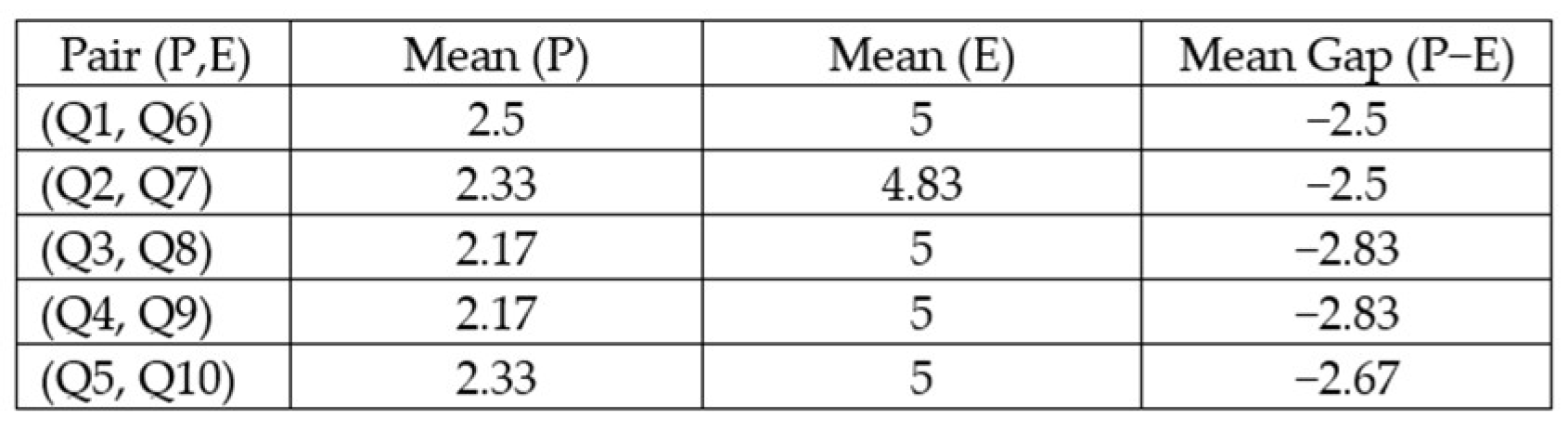
Figure 1. Gap analysis of survey conducted at Sekaten Festival with SERVQUAL framework.
Jsan 15 00019 g001
Figure 2. Geospatial interest demands at (a) Sekaten Festival [2], (b) Malioboro Street Festival [55], (c) Rasulan Kepek [56], (d) Rasulan Wiladeg [57].
Jsan 15 00019 g002
Figure 3. Observation points at several events during 7-day Sekaten Festival in Yogyakarta.
Jsan 15 00019 g003
Figure 4. Dynamic (a) geospatial and (b) temporal interest during the 7-day Sekaten Festival.
Jsan 15 00019 g004
Figure 5. Summary of (a) download and (b) upload speed comparison during Sekaten Festival.
Jsan 15 00019 g005
Figure 6. Observation points at Indonesian Street Performance Festival.
Jsan 15 00019 g006
Figure 7. Dynamic (a) geospatial and (b) temporal interest in Indonesian Street Performance Festival.
Jsan 15 00019 g007
Figure 8. Summary of (a) download and (b) upload comparison during Indonesian Street Performance Festival.
Jsan 15 00019 g008aJsan 15 00019 g008b
Figure 9. Observation points in Rasulan Kepek.
Jsan 15 00019 g009
Figure 10. Dynamic (a) geospatial and (b) temporal interest in Rasulan Kepek.
Jsan 15 00019 g010
Figure 11. Observation points during Rasulan Wiladeg.
Jsan 15 00019 g011
Figure 12. Dynamic (a) geospatial and (b) temporal interest in Rasulan Wiladeg.
Jsan 15 00019 g012
Figure 13. Observation points at Download Festival.
Jsan 15 00019 g013
Figure 14. Geospatial interest in Download Festival.
Jsan 15 00019 g014
Figure 15. Aerial view showing density of people near the Opus Stages (left) and Apex Stage (right).
Jsan 15 00019 g015
Figure 16. Crowd of people near the Opus Stage in between performances (left) and during a performance (right).
Jsan 15 00019 g016
Figure 17. Connectivity measurement at Download Festival.
Jsan 15 00019 g017
Figure 18. Crowd of people near drinking water refill (left) and food and drink booth (right).
Jsan 15 00019 g018
Figure 19. Garbage in different areas of the festival site.
Jsan 15 00019 g019
Figure 20. Garbage bin fullness in multiple areas of the festival site.
Jsan 15 00019 g020
Figure 21. Observation points during Splendour Festival.
Jsan 15 00019 g021
Figure 22. Cellular network coverage of Wollaton Park area by Vodafone (left) and 3 (right).
Jsan 15 00019 g022
Figure 23. Connectivity measurement for Splendour Festival.
Jsan 15 00019 g023
Figure 24. Crowd of people near stages before (left) and during a performance (right).
Jsan 15 00019 g024
Figure 25. Layered architectures of MobiFest, where opportunistic networks can serve different functions in (a) urban festival environment and (b) rural festival environment.
Jsan 15 00019 g025
Figure 26. SmartGarBiC reinforcement learning model.
Jsan 15 00019 g026
Figure 27. Probability nodes’ successfully delivery of garbage information to subscribers.
Jsan 15 00019 g027
Figure 28. Probability nodes successfully deliver information with varying percentages of volunteers.
Jsan 15 00019 g028
Figure 29. Temporal occupancy level of garbage points with (a) full occupancy and (b) nearly full.
Jsan 15 00019 g029
Table 1. Smart GarBiC node state space.
Node’s State Space
HAHigh availability
PDPotentially depleted
DDDecreased depletion
CACritical availability
CADCritical availability depleted
FLFull
Table 2. Smart GarBiC node action space.
Node’s Action Space
A0Receive garbage
A1Forward garbage interest
A2Increase garbage interest
A3Decrease garbage interest
A4Cache garbage interest
A5Drop garbage interest
A6Reject garbage
Table 3. Simulation parameters.
Simulation ParametersValues
Transmission interfaceBluetooth
Buffer sizes25 M, 50 M, 100 M
Message sizes128 kB–1 M
Node velocity0.5–1.5 km/h
Number of garbage static points8
Number of volunteers4, 8, 12, 16, 20
Disclaimer/Publisher’s Note: The statements, opinions and data contained in all publications are solely those of the individual author(s) and contributor(s) and not of MDPI and/or the editor(s). MDPI and/or the editor(s) disclaim responsibility for any injury to people or property resulting from any ideas, methods, instructions or products referred to in the content.