1. Introduction
Food security is a paramount global challenge, increasingly threatened by agricultural pest infestations [
1]. Recent data from China’s Crop Pest and Disease Monitoring Network projects that affected areas for major crops reached 3.84 billion acres in 2024, a significant increase from the previous year [
2]. This escalation endangers over 70% of cultivation zones and poses a substantial risk to annual yields. In response, modern integrated pest management strategies are shifting towards sustainable solutions that combine physical control with precision monitoring [
3,
4].
The Solar Insecticidal Lamp Internet of Things (SIL-IoT) has emerged as a key technology in this transition. By leveraging solar energy and IoT connectivity, SIL-IoT nodes autonomously attract and eliminate pests, reducing reliance on chemical pesticides and supporting biodiversity [
5]. However, the very strength of these systems—their deployment in open, uncontrolled fields—also constitutes their primary weakness. SIL-IoT devices operate in harsh, variable environmental conditions, including extreme temperatures, humidity, dust, and precipitation. These factors, combined with inherent challenges such as electromagnetic interference from high-voltage components and severe constraints on computational resources and energy, lead to frequent and diverse faults. Component failures, such as lure lamp degradation, sensor drift, or communication breakdowns, can silently undermine pest control efficacy and corrupt the sensor data crucial for monitoring and decision-making. Consequently, unreliable SIL-IoT nodes may create a false sense of security, leading to pest outbreaks, crop losses, and ultimately, a threat to food production [
6].
Therefore, robust and efficient fault detection (FD) is not merely a technical enhancement but a fundamental requirement for the reliable operation of SIL-IoT systems. While FD is a well-established field in industrial settings, its application in agriculture poses distinct, underexplored challenges. The dynamic natural environment, the resource-constrained nature of edge devices, the scarcity of labeled fault data, and the need for cost-effective maintenance differ profoundly from controlled industrial processes. Existing surveys on SIL-IoT have addressed specific aspects, such as wireless network issues and security. However, a comprehensive treatment that synthesizes recent advances, systematically analyzes these unique agricultural challenges, and evaluates modern countermeasures—particularly from the perspectives of artificial intelligence and edge computing is currently lacking.
To bridge this gap, this paper provides a comprehensive survey on FD for SIL-IoT. We review recent advances in SIL-IoT technology and existing FD research for outdoor IoT devices to establish the current state of the art. Building on this foundation, we systematically identify and analyze the key challenges specific to SIL-IoT FD. In response, we investigate and categorize promising countermeasures, including advanced signal processing for noisy environments, lightweight model design for edge deployment, and low-cost training strategies for data-scarce conditions. The practical value of these countermeasures is demonstrated through a dedicated case study on sensor fault diagnosis. Finally, we conclude by summarizing the insights from this survey and outlining directions for future research.
The main contributions of this work are as follows:
A synthesized review of recent SIL-IoT advancements and FD methods for outdoor IoT is presented, identifying their applicability and limitations.
The major challenges impeding effective FD in real-world SIL-IoT deployments are systematically outlined.
Targeted countermeasures, linking modern AI and edge-computing techniques, are investigated and organized to specific agricultural FD problems.
The discussed approaches are validated through a case study, providing concrete performance benchmarks.
The remainder of this paper is organized as follows:
Section 2 introduces the SIL-IoT system and summarizes related surveys.
Section 3 reviews recent advances in SIL-IoT.
Section 4 summarizes FD research for general outdoor IoT devices.
Section 5 analyzes the specific challenges of SIL-IoT FD.
Section 6 discusses potential countermeasures.
Section 7 presents a case study.
Section 8 concludes the paper.
2. SIL-IoT System and Related Surveys
2.1. SIL-IoT System
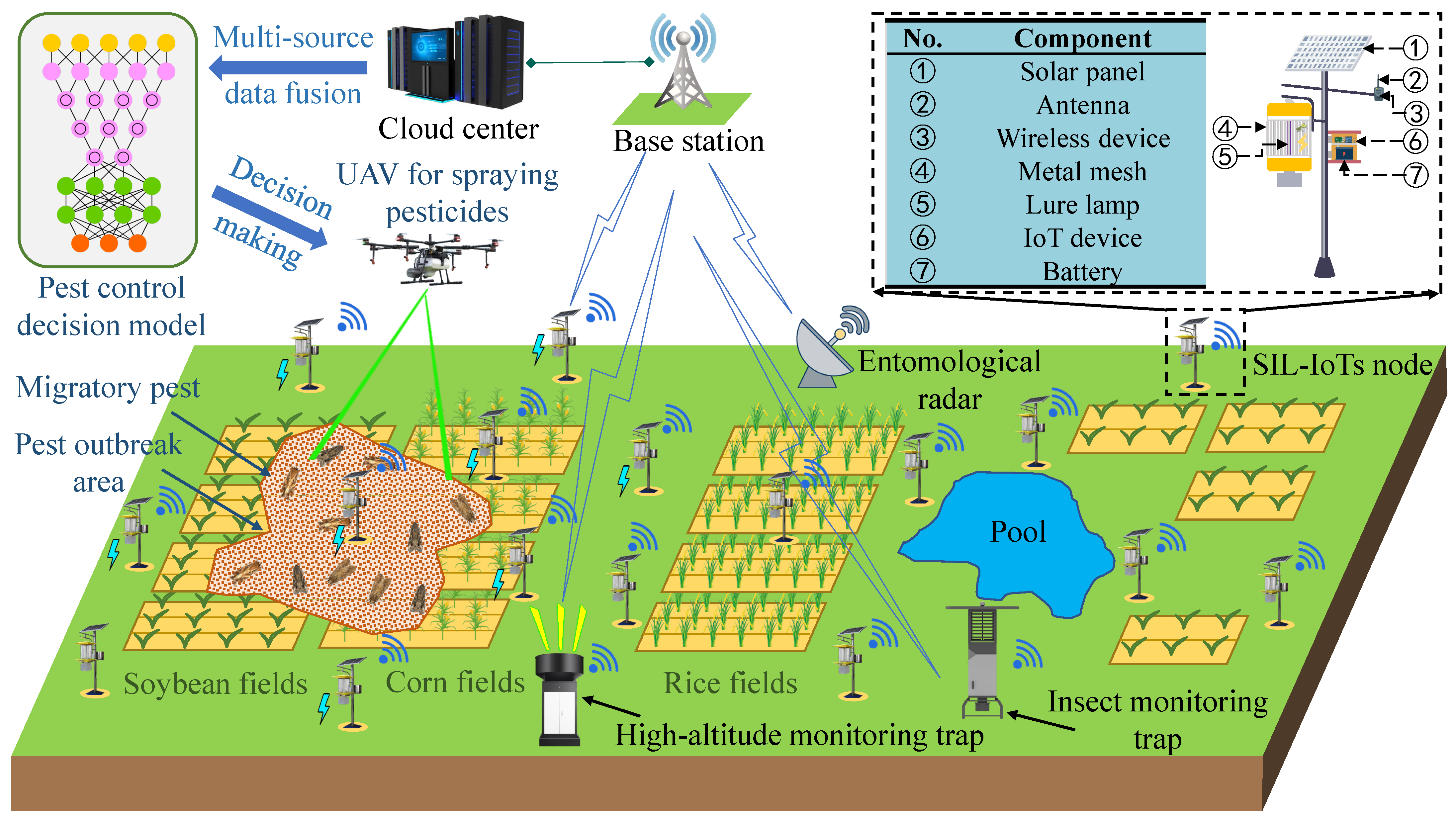
The SIL-IoT is an integrated system designed for autonomous pest control and field data collection. As illustrated in
Figure 1, a typical SIL-IoT node consists of several core components: a solar panel and battery for energy supply, a lure lamp to attract pests, a high-voltage metal mesh to eliminate them, and an IoT control module equipped with sensors and wireless communication capabilities. These nodes are deployed across agricultural fields and form a network that interacts with cloud-based decision centers, often integrated with other monitoring technologies such as entomological radar or Unmanned Aerial Vehicles (UAVs), to create a comprehensive pest management ecosystem.
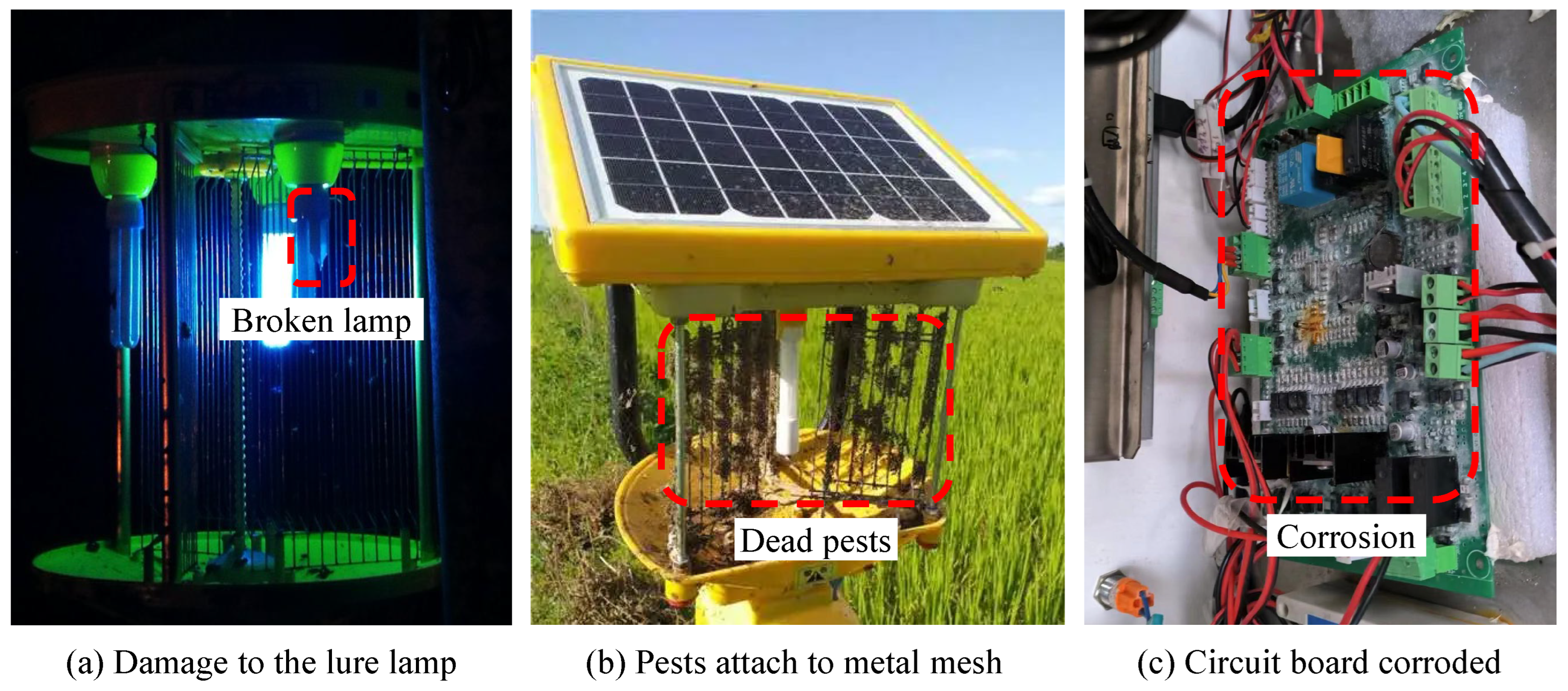
However, the harsh outdoor operating environment makes these nodes susceptible to various failures. Common fault modes include: lure lamp damage; reduced pest attraction; pest accumulation on the metal mesh, degrading insecticidal performance; and control board corrosion in humid conditions, disrupting operation and connectivity (as shown in
Figure 2). Such faults compromise the system’s primary function and lead to erroneous field data, resulting in misjudgments of pest conditions and control decisions. Since transmitting data in IoT networks consumes significantly more energy than local processing, performing FD on the device side is desirable to conserve energy. Yet, this is constrained by the nodes’ limited computational resources and battery capacity.
2.2. Related Surveys
As summarized in
Table 1, several surveys have explored aspects of SIL-IoT. Early work examined FD from a wireless sensor network perspective. Subsequent studies focused on specific issues such as electromagnetic interference in data transmission, the physical security of nodes, and maintenance using mobile crowd sensing. Others addressed energy-related topics such as photovoltaic monitoring or solar panel interference with communications. Recently, security and privacy challenges have also been discussed. As summarized in
Table 1, while these studies provide valuable insights into specific facets of SIL-IoT, they often exhibit limitations in either technical depth (e.g., partial coverage of advances and challenges) or practical grounding (e.g., lack of case studies). More critically, a comprehensive survey that systematically addresses FD in SIL-IoT by incorporating modern paradigms such as artificial intelligence and edge computing remains missing. This gap motivates our work to provide a holistic review focused specifically on FD, covering recent advances, unique challenges, actionable countermeasures, and supported by concrete evaluation.
3. Recent Advances in SIL-IoT
Beyond fault detection, active research in SIL-IoT spans several key directions that, in turn, influence FD requirements and system reliability. Understanding these advances is crucial for designing context-aware FD solutions.
Deployment strategies: Research has optimized the placement of SIL-IoT nodes to ensure coverage and connectivity while minimizing cost [
13]. Strategies based on partition structures, weighted deployment, and hole perception have been developed for complex farmland layouts. These strategies often result in networks with low redundancy and critical communication links, meaning a single node failure can disrupt network connectivity [
14].
Energy management strategies: Given their solar-powered nature, efficient energy use is critical [
15]. Research includes two-hop routing (data sent through two intermediate nodes to balance energy), intelligent on/off switching based on predicted pest activity and energy harvesting (solar energy collection), and even optimizing the operating schedule of lamps based on pest phototactic rhythms (tendencies of pests to move toward light) [
16]. These strategies highlight the need for FD methods to monitor the health of energy subsystems (solar panels, batteries) to prevent unexpected shutdowns.
Pest outbreak area positioning: A primary function of SIL-IoT is monitoring. Methods to estimate pest kill counts by analyzing discharge sounds (noises from insects hitting the electrified mesh), voltages (electrical signals indicating kills), or vibrations (physical movement from impacts) are being developed to create pest density heat maps (visual maps showing pest population densities) [
17,
18]. This underscores a key challenge for FD: faults like pest corpse accumulation on the metal mesh can directly interfere with these sensing mechanisms, leading to inaccurate pest estimates and mislocated outbreak zones.
Anti-electromagnetic interference strategies: The high-voltage discharge (sudden release of electrical energy) of the metal mesh can generate Electromagnetic Interference (EMI, a disturbance caused by electromagnetic radiation), corrupting data from nearby sensors [
19]. Studies recommend maintaining a minimum distance between the mesh and communication modules (devices facilitating data transfer) [
20]. This directly impacts FD, as EMI can cause transient (temporary) data anomalies that must be distinguished from persistent sensor faults.
Equipment maintenance plans: Crowdsensing-based maintenance task allocation aims to cut costs [
21]. For FD, minimizing false alarms is key to avoiding costly field visits.
Overall, these advancements show that the SIL-IoT research landscape operates under tight resource constraints, with low node redundancy, susceptibility to EMI, and high costs associated with false maintenance alerts. Recognizing these factors as key constraints sets the stage for our subsequent analysis of challenges and countermeasures for FD in SIL-IoT.
4. Fault Detection Research from Outdoor IoT Device to SIL-IoT
SIL-IoT systems exemplify resource-constrained outdoor IoT deployments. Their operational paradigm—autonomous, solar-powered, and operating in uncontrolled environments—reflects challenges common to many agricultural and remote-monitoring applications. Consequently, understanding FD for SIL-IoT requires a perspective grounded in broader outdoor IoT FD research. This chapter first synthesizes established FD strategy, method, and result description frameworks from general outdoor IoT scenarios, laying a basis for contextualizing and reviewing emerging SIL-IoT-focused FD research. This two-tiered approach enables mapping general techniques to specific applications, identifying gaps where SIL-IoT demands exceed general solutions, and systematically evaluating the current state of the art in SIL-IoT FD.
4.1. Fault Detection Strategy for Outdoor IoT Devices
FD strategies are primarily defined by the computational platform on which the detection logic is executed, resulting in a fundamental dichotomy between centralized and distributed approaches.
4.1.1. Centralized FD Method
In the centralized strategy, raw sensor data is transmitted from edge devices (sensors or processing units near the data source) to a powerful back-end server or cloud platform, where FD algorithms are executed. For instance, the literature [
22] employed anomaly detection based on data approximation (methods that estimate normal values to spot outliers) to identify faulty temperature and humidity readings from IoT farm sensors. Similarly, deep learning models have been deployed in the cloud (off-site, large-scale computing environment) to analyze infrared images of solar panels for hotspot fault diagnosis (identifying malfunctioning areas) [
23]. The primary advantage of this strategy is its ability to leverage substantial computational resources for running complex, high-accuracy models. However, it incurs high costs: transmitting large volumes of raw data consumes considerable energy from battery-powered devices and introduces communication latency (delay in data transfer). Furthermore, the final fault decision must be returned to the edge device, which delays the initiation of any local corrective action. This makes centralized strategies less suitable for faults that require immediate response or for environments with unreliable or expensive connectivity.
4.1.2. Distributed FD Method
The distributed strategy performs FD tasks either on the edge device itself or in collaboration with neighboring nodes (other nearby devices). This approach significantly reduces the need for data uplink transmission (sending data to central servers), conserving precious energy. A classic example is the use of a sliding window method (monitoring recent data points in sequence) on a sensor node to cache recent readings and identify abrupt changes indicative of a fault, potentially corroborated by votes from neighboring nodes [
24]. Other implementations deploy lightweight FD logic directly on microcontrollers (e.g., Arduino, MSP430) to diagnose sensor faults locally. The key benefit is rapid, autonomous response; a device can trigger a recovery procedure immediately upon detecting a fault [
25]. The trade-off lies in the complexity of the FD model that can be deployed, which is strictly bounded by the device’s limited memory, processing power, and energy budget [
26].
Strategy choice in agriculture depends on practical limits. Hybrid architectures are common—critical faults handled locally, less urgent ones sent to the cloud when possible.
4.2. FD Method for Outdoor IoT Device
Beyond detection location, FD approaches fall into three main families with distinct trade-offs, outlined in
Table 2.
4.2.1. Model-Based Method
Model-based methods create explicit models of normal system behavior, using expert knowledge or first principles. Faults are found by spotting residuals—differences between model predictions and actual sensor data. Common techniques: grey-box modeling [
30] and state observers [
31]. For example, a state observer flags large residuals in motor monitoring [
32]. Model-based methods are interpretable, computationally efficient, and work with small data [
33], but heavily depend on accurate system knowledge [
27]. They struggle with complex systems or unknown faults [
34].
4.2.2. Signal Analysis-Based Method
This approach treats the sensor data primarily as a signal. It employs techniques from signal processing—such as the Fourier transform, wavelet transform, or empirical mode decomposition—to extract features in the time, frequency, or time-frequency domain that are indicative of faults. For instance, ensemble empirical mode decomposition has been used to detect faults in wind turbine systems without complex parameter tuning [
35]. These methods are particularly powerful for analyzing periodic vibrations or identifying specific frequency signatures associated with component wear [
28]. The main challenges are the computational cost of real-time signal decomposition and the need for expert insight to correctly interpret the extracted features.
4.2.3. Data-Driven Method
With the proliferation of sensor data and advances in machine learning, data-driven methods have become increasingly prominent [
36,
37]. These methods do not require an explicit physical model. Instead, they learn the mapping between input data (sensor readings) and output states (normal/faulty) directly from historical datasets. Techniques range from traditional machine learning models such as Support Vector Machines (SVMs) and k-Nearest Neighbors (KNNs) to deep learning models such as Convolutional Neural Networks (CNNs) [
38,
39]. A CNN, for example, can automatically learn hierarchical features from multi-sensor time-series data or even images for fault classification [
29,
40]. The principal advantages are high accuracy, strong robustness to noise, and excellent generalization when trained on diverse and sufficient data. The drawbacks include high demand for labeled training data, “black-box” nature reducing interpretability, and significant computational requirements for model training and, to a lesser extent, inference.
4.2.4. Method Selection in Agricultural Scenarios
Agricultural applications present specific data challenges that influence method choice: severe class imbalance (few fault samples), absence of initial fault data for new deployments, and high environmental noise. Here, model-based methods are valuable when physical relationships are well-defined (e.g., photovoltaic I–V curves for solar panel FD). Data-driven methods promise high performance but require adaptation, such as transfer learning or techniques for handling imbalanced data, to be effective in practice.
4.3. Fault Detection Result Description for Outdoor IoT Devices
The output of an FD system can be described in two fundamental ways, each serving different purposes, as compared in
Table 3.
4.3.1. Quantitative Description
Quantitative methods provide a numerical estimate of the fault severity or the remaining useful life of a component [
41]. For example, a method might output “sensor bias = +2.5 °C” or “battery health = 73%”. This is invaluable for predictive maintenance and planning. However, generating such precise estimates typically requires more complex models and more detailed system knowledge.
4.3.2. Qualitative Description
Qualitative methods focus on identifying and classifying fault types. The output is categorical, e.g., “lure lamp failure”, “sensor stuck fault”, or “communication timeout” [
42]. This approach is generally simpler, faster, and requires fewer computational resources, making it well-suited for resource-constrained edge devices where the primary need is early and fast fault identification to trigger an alert or a basic recovery routine.
In agricultural settings, interpreting these results must be contextual. A quantitative voltage deviation may have different meanings at different times of day, depending on solar input. Qualitative fault priorities may change with the crop season, demanding adaptive interfaces for farm operators.
4.4. Fault Detection Research Specific to SIL-IoT
Building upon the general FD framework established above, this section focuses on its application and adaptation in SIL-IoT systems. Reflecting the system’s severe resource constraints, research has evolved along a trajectory that prioritizes lightweight, energy-efficient solutions.
4.4.1. Lightweight Rule-Based and Temporal Analysis Method
For faults detectable via device-internal state logic, extreme model simplification is key. A method using fault dictionaries and Boolean Sliding Windows (BSW) was proposed for temporal analysis [
43]. Deployed on an Arduino, it occupies only 92 Bytes of cache, consumes a mere 0.39% extra energy, and achieves an average accuracy of 99.15%. This demonstrates the effectiveness of rule-based approaches under extreme computational constraints.
4.4.2. Neighbor-Aided Distributed Diagnostic Method
To address faults requiring a broader context, distributed methods leverage data from neighboring nodes. A method for identifying faults was developed based on deviations in the working state, trend, and feature values between a target node and its neighbors [
15]. This approach reduces data transmission volume by 75% and achieves average F1-Scores (the harmonic mean of precision and recall) of 92.42% (one-hop) and 95.59% (two-hop), with an incremental energy overhead of only 0.27%, offering a viable solution for networks with low node density.
4.4.3. Lightweight Deep Learning for Complex Fault Discrimination
Distinguishing EMI-induced transient anomalies from genuine persistent sensor faults demands advanced feature extraction. A FD method, SA1D-CNN (Separable and Attention-based 1D-CNN), was designed to incorporate depthwise separable convolutions and a joint spatiotemporal attention mechanism [
44]. The quantized model is only 353 KB in size and achieves an average F1-score of 97.6% in classifying both transient EMI patterns and four types of persistent sensor faults, marking a significant step towards deploying compact yet powerful data-driven models on the edge.
4.5. Summary of Related Fault Detection Research
Research on FD for outdoor IoT devices, as synthesized in
Table 4, reveals a rich toolbox of strategies and methods. Model-based approaches offer efficiency and interpretability when strong prior knowledge constraints are imposed. Signal processing methods excel at extracting cyclic or transient fault signatures. Data-driven methods provide high accuracy and adaptability at the cost of data and computing resources. The choice among them, and between centralized and distributed strategies, hinges on a trade-off between accuracy, timeliness, energy consumption, and available computational resources.
Subsequently, we applied this framework to analyze FD research dedicated to SIL-IoT. The reviewed works—spanning lightweight rule-based systems, neighbor-assisted distributed diagnostics, and compact deep learning models—collectively illustrate the field’s dominant theme: the co-design of detection algorithms with stringent hardware and energy constraints. These SIL-IoT-specific methods effectively instantiate the broader concepts of distributed strategy and lightweight model design discussed in the general framework.
The synthesis reveals that while general outdoor IoT FD research provides a rich toolbox, SIL-IoT’s unique operational profile—characterized by extreme resource constraints, inherent EMI, and sparse deployment—pushes the boundaries of these techniques, particularly in model compression, energy-aware execution, and robustness to operational noise.e. This analysis sets the stage for the next chapter, where we will systematically distill the unique challenges that arise when applying and adapting these FD approaches to the demanding real-world context of SIL-IoT.
5. Challenges of Fault Detection in SIL-IoT
The general FD methodologies reviewed in the previous section provide a foundational toolkit. However, their effective application to SIL-IoT systems is impeded by a confluence of unique and often severe challenges. These challenges stem directly from the intrinsic characteristics of agricultural operations, the harsh deployment environments, and the specific design constraints of SIL-IoT nodes discussed in
Section 2 and
Section 3. Overcoming these hurdles is essential for developing practical and reliable FD solutions. This section systematically dissects the five primary challenge areas.
5.1. Complex and Harsh Operating Environment Adversely Affects Fault Detection Accuracy and Generalization
SIL-IoT nodes are deployed in open, uncontrolled fields, exposing them to a dynamic and punishing environment. This directly challenges the core assumptions of many FD models.
5.1.1. Electromagnetic Interference
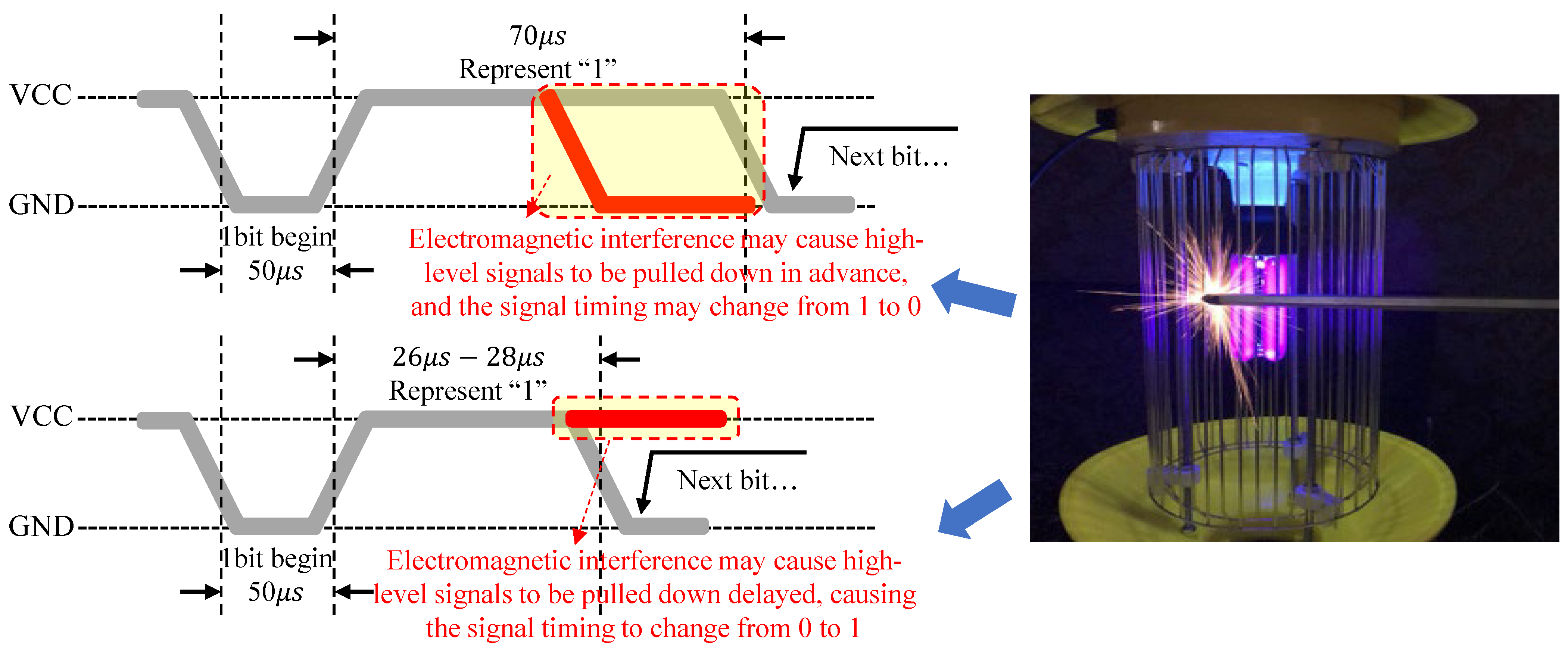
The fundamental operation of SIL-IoT—the high-voltage discharge from the metal mesh to kill pests—generates strong electromagnetic pulses [
20,
53]. As illustrated in
Figure 3, this EMI can couple into nearby low-voltage sensor and communication circuits, causing transient signal distortions, bit-flip errors in data acquisition, or even communication packet loss. These transient anomalies are not true sensor faults but can be easily misdiagnosed as such by conventional FD methods, leading to a high rate of false alarms. Distinguishing EMI-induced noise from genuine persistent sensor faults (e.g., drift, gain error) is a critical and difficult task.
5.1.2. Environmental Variability and Diversity
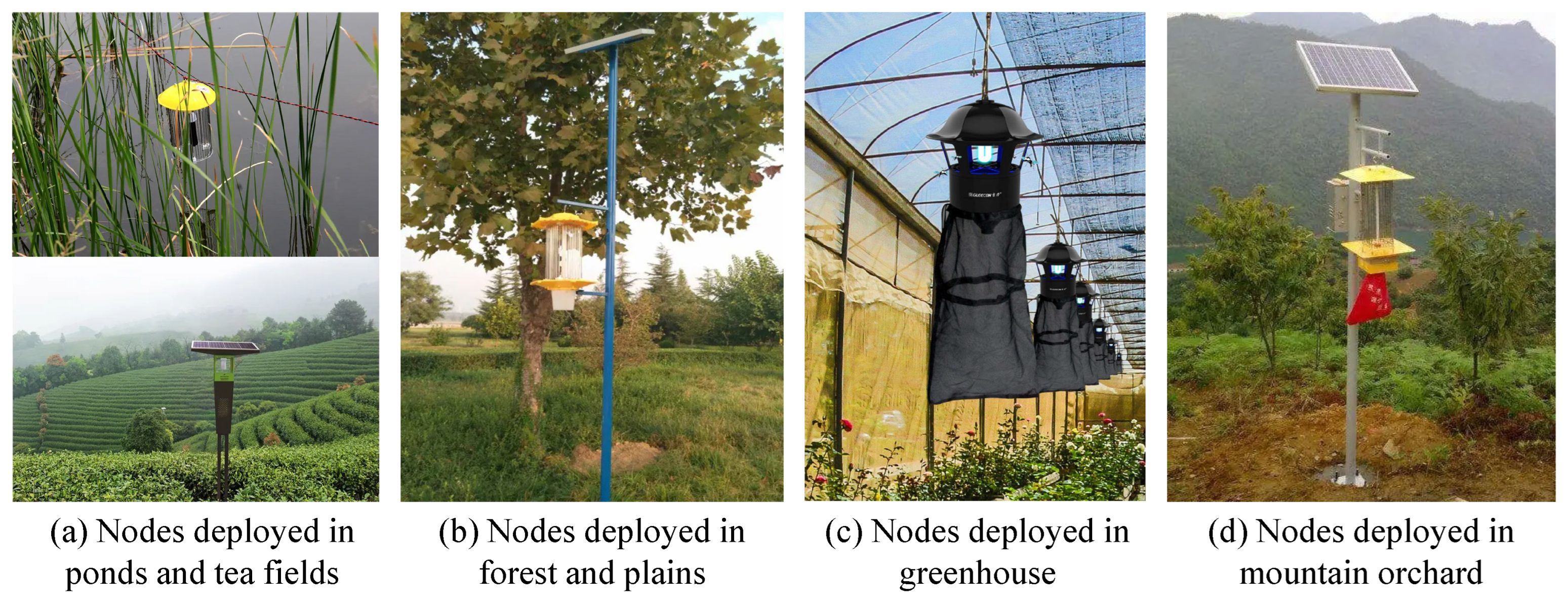
SIL-IoT networks are deployed across diverse agricultural scenarios, from humid rice paddies and dense tea gardens to arid plains and mountain orchards, as shown in
Figure 4. Environmental factors like humidity, temperature extremes, dust, shading, and corrosion rates vary dramatically between and even within these locations. This variability affects both the failure rate of components (e.g., faster corrosion in high humidity) and the baseline behavior of sensor data (e.g., solar panel output under partial shading). An FD model calibrated for nodes in a flat, sunny field may fail or generate false positives when applied to nodes in a shaded, humid forest edge. This demands FD methods with strong environmental adaptability and generalization across non-stationary conditions, a requirement far more stringent than in controlled industrial settings.
5.2. Severe Constraints on Computational Resources and Energy Limit Fault Detection Model Complexity
SIL-IoT nodes are quintessential resource-constrained edge devices.
Table 5 exemplifies a typical node configuration, featuring microcontrollers such as Arduinos or low-power system-on-chips with limited RAM, flash storage, and CPU capability [
43]. These nodes must simultaneously execute multiple essential tasks: energy harvesting management, pest counting, communication protocols, and the FD logic itself.
5.2.1. Computational Limitation
This multi-tasking environment leaves only a tiny fraction of computational resources for FD. Consequently, only FD algorithms with very low complexity—minimal parameters and simple operations—can be deployed on the device side for real-time analysis. Complex, high-accuracy models like deep neural networks are typically prohibitive unless heavily optimized and pruned.
5.2.2. Energy Limitation
Energy is the most critical constraint. Continuous operation of the lure lamp and the high-voltage mesh are the primary energy drains. During periods of low solar harvesting (e.g., prolonged cloudy weather), the battery reserve diminishes. In this context, the additional energy overhead of running an FD algorithm must be negligible. Computationally intensive FD methods can significantly shorten the device’s operational lifetime. Furthermore, if the FD logic itself necessitates frequent wireless communication (e.g., for collaborative diagnosis), the energy cost can become unsustainable.
5.3. Long-Tail Distribution of Fault Samples and Data Scarcity Increases Training Costs
Developing and maintaining accurate FD models, especially data-driven ones, is hampered by fundamental data challenges [
54]. While SIL-IoT nodes generate operational data, labeled fault data is extremely scarce. Most data is in “normal” operation. Inducing real faults for data collection is impractical and costly. Manually labeling potential faults in historical data requires domain expertise and is labor-intensive. This scarcity makes it difficult to train robust models in the first place.
Faults are rare events. Among the fault data that can be collected, different fault types occur at highly imbalanced frequency—a “long-tail” distribution. Common issues like temporary signal dropout may involve many samples, while critical but rare faults, such as specific sensor degradation modes, involve very few. This severe class imbalance biases models toward the majority (normal) class, resulting in poor detection rates for rare yet important faults.
Multiple faults can occur simultaneously (composite faults), creating new, unlabeled data patterns. Furthermore, environmental changes and component aging can cause the statistical properties of both normal and fault data to drift over time (concept drift). A model trained on data from new devices in the summer may become ineffective for aged devices in the winter. Continuously updating models with new labeled data is prohibitively expensive [
55].
5.4. Vulnerability to Cybersecurity Threats Compromises Fault Detection Integrity
The transition to smart agriculture expands the attack surface. SIL-IoT networks, often deployed over large areas with wireless links, are vulnerable to cyber threats that can directly sabotage the FD process. Malicious actors can spoof sensor readings, inject false data, or replay old data packets. For example, an attacker could feed false normal sensor readings to a node that is actually faulty, causing the FD system to miss the detection (false negative). Conversely, they could inject data patterns that mimic a fault, triggering false alarms (false positives) and unnecessary maintenance dispatch.
Implementing strong cryptographic defenses (encryption, continuous authentication) on resource-constrained nodes consumes additional computation and energy, exacerbating the challenges posed by limited computational resources and energy constraints. This creates a difficult trade-off between security robustness and operational efficiency, leaving many SIL-IoT deployments potentially vulnerable to attacks that could deceive or disable the FD system.
5.5. Network Instability and Asynchrony Hinder Real-Time and Collaborative Fault Detection
Reliable, low-latency communication is often assumed in FD system design, but field reality is different. Wireless signals in agricultural areas suffer from attenuation due to crops, terrain, and weather. This leads to packet loss, high latency, and intermittent connectivity. For centralized or collaborative distributed FD strategies, this instability means crucial fault signatures may not reach the decision point, or decisions may be delayed.
A fault requiring immediate action (e.g., a safety-critical electrical fault) might be detected locally, but if the alarm cannot be transmitted reliably to the cloud platform, remote operators remain unaware. This undermines the utility of real-time monitoring. Distributed FD methods that rely on data fusion or voting from neighboring nodes become less effective if communication links are asymmetric or unreliable. The “collaborative” aspect fails, reducing the detection accuracy and reliability of such schemes.
5.6. Summary of Related Challenges
The path to effective FD in SIL-IoT is obstructed by a multifaceted set of challenges. The harsh and variable environment introduces noise and demands unparalleled model generalization. The severe resource constraints of edge devices force a strict trade-off between the sophistication of the FD model and its feasible deployment. The scarcity and imbalance of fault data make model training costly and prone to poor performance on critical, rare faults. Emerging cybersecurity threats introduce a layer of adversarial risk that can directly manipulate FD outcomes. Finally, the inherent instability of field networks compromises the reliability of communication-dependent FD strategies. These challenges collectively highlight that simply transplanting existing FD solutions from industrial or general IoT contexts is insufficient. The next section, therefore, explores targeted countermeasures and research directions to address these specific SIL-IoT FD challenges.
6. Countermeasures for the Challenges
The formidable challenges outlined in
Section 5 necessitate innovative, tailored countermeasures that go beyond conventional FD approaches. Success in SIL-IoT FD requires a co-design philosophy, in which detection algorithms are developed with careful consideration of environmental adversities, hardware constraints, and operational realities. This section outlines key research directions and promising technical strategies for building robust, efficient, and practical FD systems for SIL-IoT.
6.1. Advanced Signal Processing for Noisy and Non-Stationary Environments
To combat the detrimental effects of EMI and environmental variability on signal integrity, advanced signal processing techniques are paramount [
56]. The goal is to separate the underlying fault signature from contaminating noise and irrelevant environmental fluctuations [
57].
The sensor signals in SIL-IoT are mixtures of true device states, fault impulses, EMI noise, and environmental artifacts [
58]. Techniques like Empirical Mode Decomposition (EMD) and its variants are promising due to their adaptability to non-stationary signals [
59]. They can adaptively decompose a signal into intrinsic mode functions, potentially isolating a fault-related component from EMI transients [
60].
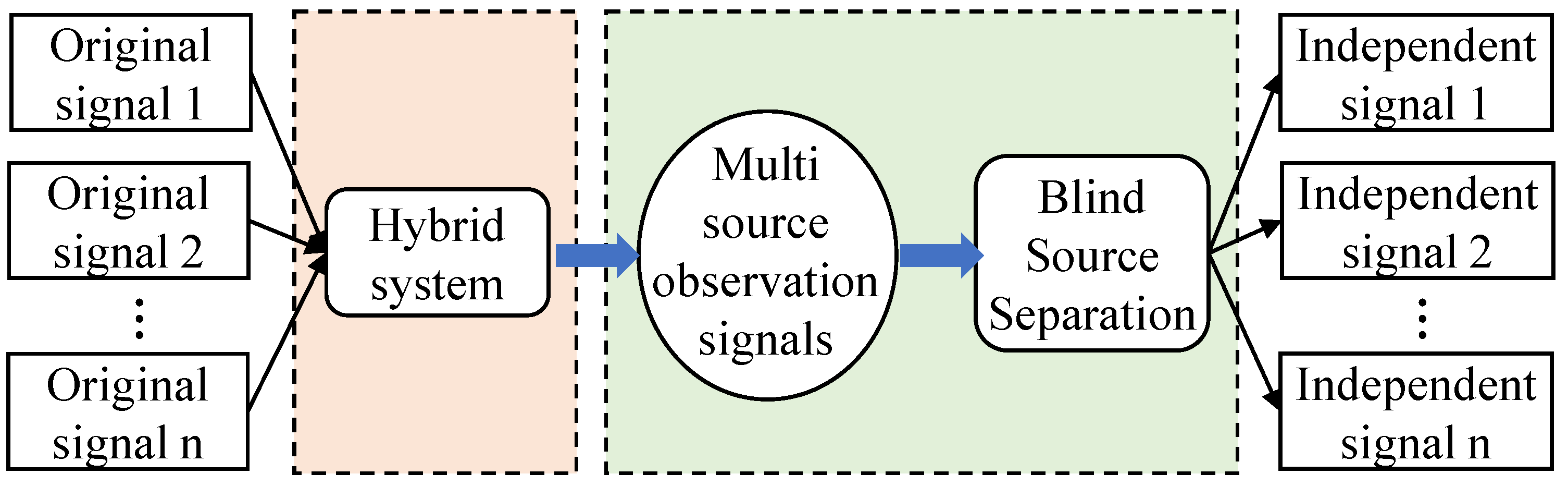
In many cases, the number of sensors is fewer than the number of source signals (fault, EMI, multiple environmental factors), creating an underdetermined separation problem [
61]. Sparse Component Analysis (SCA) methods, which model the mixture as a combination of low-rank (background) and sparse (fault/impulse) components, are particularly suitable [
62]. As illustrated in
Figure 5, BSS aims to recover independent source signals from observed mixtures with minimal prior knowledge, making it a powerful tool for extracting clean fault features from the complex signal soup of an agricultural field [
63].
6.2. Lightweight and Energy-Aware Fault Detection Model Design
Given the severe computational and energy constraints, FD models must be extremely efficient. The objective is to achieve high diagnostic accuracy with a minimal memory footprint and computational overhead.
6.2.1. Model Compression and Optimization
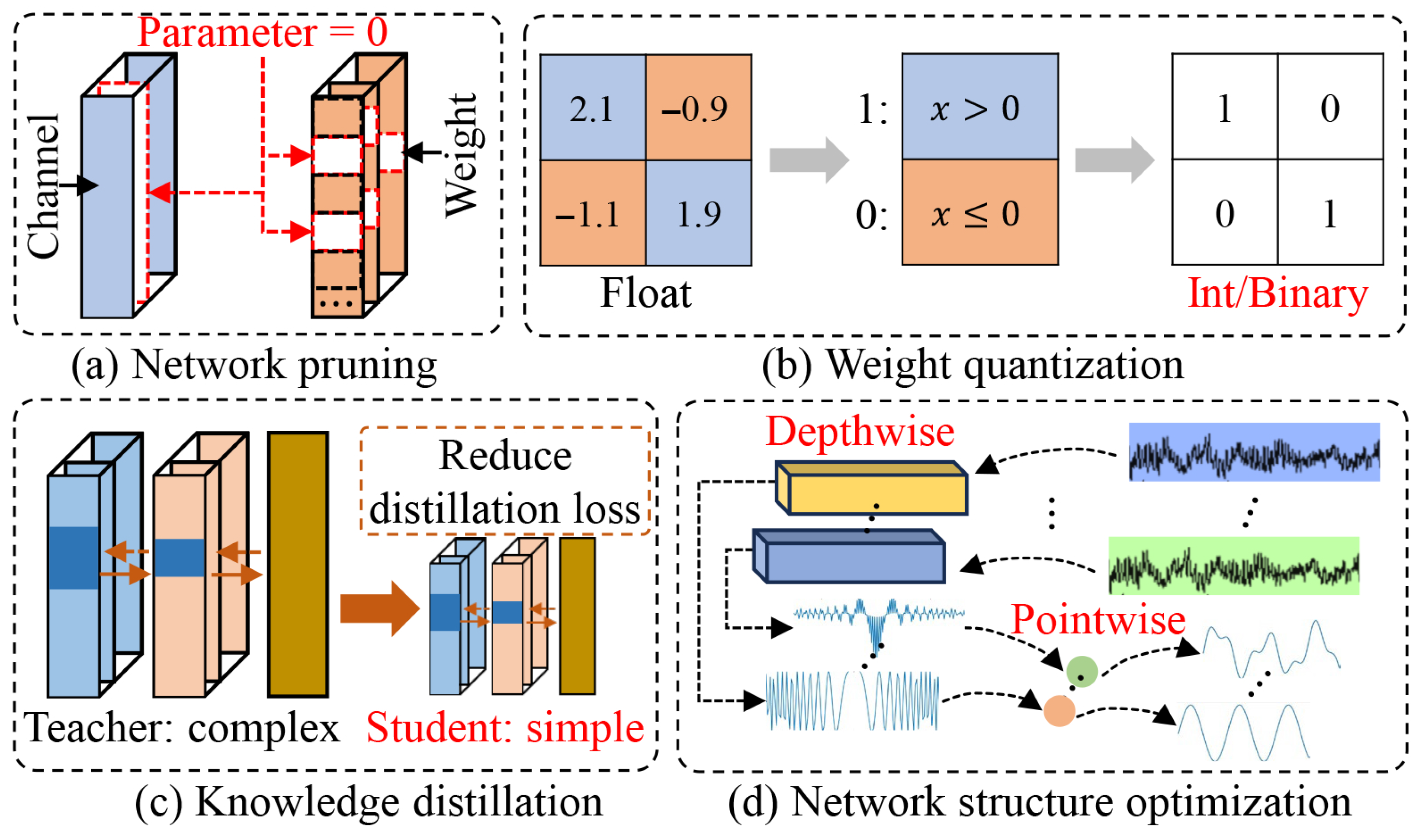
A suite of deep learning compression techniques can be adapted. For instance, the network pruning method aims to identify and eliminate redundant connections, thereby reducing storage requirements by removing unnecessary neurons or channels [
64]. The weight quantization method reduces the numerical precision of model weights (e.g., from 32-bit floating point to 8-bit integers), dramatically decreasing memory usage and accelerating computation on supported hardware [
65]. The knowledge distillation method trains a small, efficient “student” model to mimic the behavior of a larger, more accurate “teacher” model, preserving performance while reducing complexity [
66]. The efficient neural architecture design method employs inherently efficient layer designs, such as depthwise separable convolutions, which drastically reduce the number of parameters compared to standard convolutions.
Figure 6 provides a schematic overview of these lightweight design strategies [
44].
6.2.2. Hardware-Software Co-Design
Beyond algorithmic optimization, designing FD algorithms that leverage the specific strengths of low-power microcontrollers (e.g., efficient fixed-point arithmetic) and considering energy consumption as a primary optimization metric during model development are crucial.
6.3. Low-Cost Fault Modeling for Data-Scarce and Imbalanced Scenarios
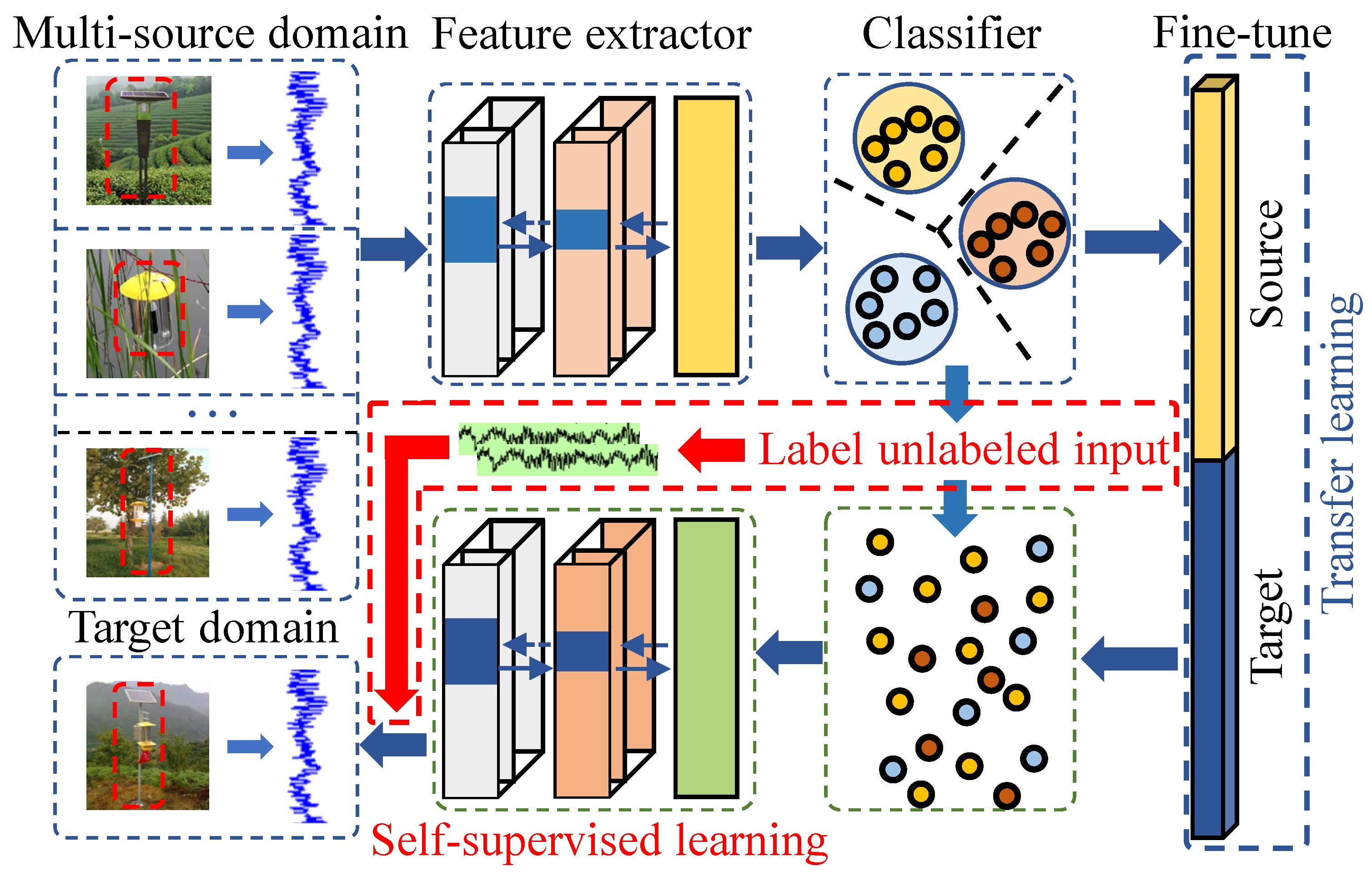
To overcome the scarcity of labeled fault data and the long-tail distribution problem, learning paradigms that reduce dependency on vast, balanced datasets are essential. For instance, Transfer Learning (TL) leverages knowledge learned from a source domain (e.g., laboratory fault data, simulated data, or data from a different but related device) to improve learning in the target domain (the actual SIL-IoT deployment) [
67]. The feature-based transfer strategy aligns the feature distributions of the source and target domains, enabling a model trained on source data to perform effectively on target data [
68]. The model-based transfer strategy uses a pre-trained model from a source domain as a starting point for fine-tuning on limited target domain data, significantly reducing training time and data requirements [
69].
Self-Supervised Learning (SSL) constructs supervisory signals automatically from the structure of unlabeled data. For instance, training a model to predict a masked section of a sensor time-series or to identify if two augmented views of a data sample originate from the same original sample. This allows the model to learn rich, general-purpose representations from the abundant unlabeled operational data, which can then be fine-tuned for specific FD tasks with only a few labels.
Figure 7 contrasts the paradigms of transfer learning and self-supervised learning.
Synthetic data generation techniques, e.g., Generative Adversarial Networks (GANs), can be used to generate realistic synthetic samples of rare fault classes, helping to balance the training dataset and improve model robustness against those faults [
26,
70].
6.4. Cybersecurity-Resilient Fault Detection Frameworks
FD systems must be designed to be trustworthy even in the presence of malicious actors. This requires integrating security considerations into the FD architecture. For instance, implementing lightweight anomaly-detection modules specifically designed to identify patterns indicative of data-injection or spoofing attacks. These modules can flag suspect data before it is fed into the primary FD model. Robust machine learning employs adversarial training techniques, where FD models are trained with intentionally perturbed (adversarial) examples, which can increase their resilience against malicious inputs designed to fool them [
71,
72]. Data integrity verification leverages lightweight cryptographic protocols or physical unclonable functions (PUFs) to authenticate data provenance at the device or network level, helping ensure that the data used for FD is genuine.
6.5. Network-Stability-Aware and Edge-Centric Fault Detection Architectures
To mitigate the impact of unreliable communication, the FD system architecture must prioritize local processing and graceful degradation. Hierarchical edge intelligence adopts a multi-tier architecture where the most time-critical and simple FD tasks are performed directly on the SIL-IoT node. More complex analyses that require broader context can be offloaded to local gateways or fog nodes, reducing reliance on the wide-area cloud link. This ensures basic FD functionality even during network outages.
Asynchronous and robust collaborative FD designs distributed FD algorithms that do not require perfect, synchronous communication. Techniques based on consensus algorithms or belief propagation that can tolerate packet loss and latency are needed for collaborative diagnosis among neighboring nodes. Edge caching and predictive preloading store critical model parameters and recent states locally on the device or gateway, enabling the FD system to continue operating for extended periods without cloud connectivity.
6.6. Summary of Related Countermeasures
Addressing the multifaceted challenges of SIL-IoT FD requires a synergistic combination of countermeasures. No single technique is sufficient. The path forward lies in integrating robust signal preprocessing with ultra-efficient model design, powered by learning strategies that thrive on limited data, within a security-hardened, network-resilient system architecture. These countermeasures collectively form a blueprint for transitioning from theoretical FD models to practical, deployable solutions that can sustain the reliability of SIL-IoT systems in real-world agriculture. The following case study will demonstrate the practical application and evaluation of several key countermeasures discussed in this section.
7. Case Study Based on Sensor Faults of SIL-IoT
To empirically validate the countermeasures discussed in the previous section and demonstrate their practical efficacy, we conducted a comprehensive case study focused on sensor fault diagnosis for SIL-IoT. This study uses a publicly available sensor-fault dataset from our prior work [
44], ensuring reproducibility and an objective comparison. The dataset and code used in the case study are available at
https://github.com/harryyangx/SIL-IoT-FD-CASE- (accessed on 10 June 2025).
7.1. Dataset and Experimental Setup
The dataset was originally constructed through controlled indoor experiments with SIL-IoT devices to establish a clean ground truth. Voltage and current sensor measurements were systematically recorded under six different high-voltage discharge frequencies (ranging from 0 to 10 pulses per second). Data was sampled at 10 Hz over 10-min intervals for each frequency, with environmental interference minimized through fixed sensor positions and stable energy supplies.
For this case study, the raw data were reprocessed into 99,449 samples, each constituting a 60-point temporal window of paired voltage and current readings. To emulate realistic sensor degradation, four synthetic fault types were injected into the baseline signals at multiple severity levels (10–50% deviation). For the present analysis, we selected the 50% severity level to represent pronounced faults. The fault types are generated via deterministic transformations. Each fault category was generated through deterministic transformations of the baseline signals, including randomized amplitude distortions for outliers fault (random amplitude distortion, ±35 V/±2500 mA was set in this paper), multiplicative gains fault (multiplicary scaling, 1×–2× was set in this paper), fixed-value substitutions for stuck fault, and offsets fault (bias addition, +3–6V/+300–600 mA was set in this paper).
A crucial aspect of the dataset is the inclusion of data captured both during and outside high-voltage discharge events, as the discharge significantly influences sensor readings through EMI. Consequently, the dataset encompasses ten distinct conditions, as defined in
Table 6: one normal condition (label 0), eight persistent fault conditions (labels 1–8, covering both voltage and current sensor faults under discharge and no-discharge scenarios), and one ‘normal under no-discharge’ condition (label 9). This structure allows evaluation of an FD model’s ability to distinguish genuine sensor faults from transient anomalies caused by operational EMI.
All experiments were implemented using PyTorch 2.6 and Python 3.10, and executed on a workstation equipped with an Intel Core i9-14900K CPU, an NVIDIA GeForce RTX 4090 D GPU, and 64 GB of RAM. A consistent training configuration was employed: the cross-entropy loss function, the Adam optimizer with a learning rate of 0.001, a batch size of 32, and a dropout rate of 0.5 applied before the final classification layer.
7.2. Evaluation of Signal Decomposition Countermeasures
We first assessed the effectiveness of signal preprocessing techniques for enhancing FD robustness, a key countermeasure from
Section 6. A 1D-CNN baseline model was established, comprising four convolutional layers (32→64→128→256 filters, kernel size 3) with batch normalization, followed by global average pooling and a 10-class output layer. Three signal decomposition methods were then integrated as a preprocessing step prior to this baseline model: EMD, Wavelet Transform, and Blind Deconvolution (BD).
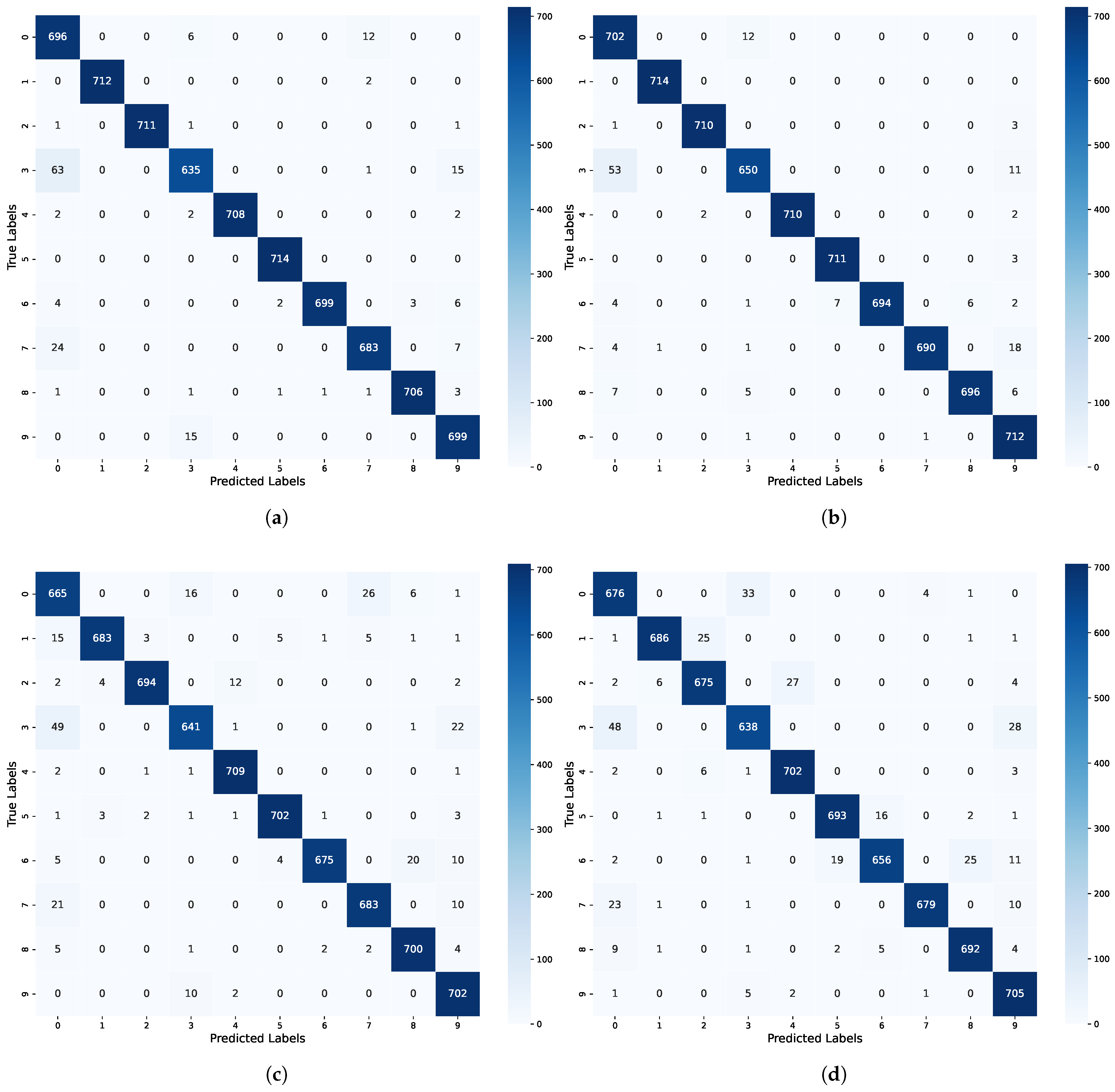
The results, summarized in
Table 7 and visualized via confusion matrices in
Figure 8, reveal significant performance differences. EMD emerged as the most effective preprocessing technique, elevating the baseline accuracy from 97.52% to 97.89% and the F1-score from 97.57% to 97.93%. This improvement corresponds to approximately 186 fewer misdiagnoses per 50,000 samples, a substantial gain for field deployment. The adaptive, data-driven decomposition of EMD appears well-suited to isolate fault features from the non-stationary noise and EMI present in the signals.
In contrast, the fixed-basis Wavelet Transform led to a slight performance degradation (95.99% accuracy), while Blind Deconvolution performed the poorest (95.27% accuracy).
Figure 8d indicates that BD struggled particularly with discriminating between adjacent fault classes, exacerbating confusion. This comparative analysis underscores a critical insight from
Section 6: the choice of signal decomposition method is not universal; it must be carefully matched to the signal characteristics of the target application. EMD’s adaptability makes it a promising candidate for the variable signals in SIL-IoT.
7.3. Evaluation of Lightweight Design Countermeasures
Addressing the computational constraints highlighted in
Section 5 and the countermeasures in
Section 6, we evaluated four model lightweighting techniques derived from the baseline 1D-CNN: Depthwise Separable Convolution (DWC), Grouped Convolution (GC), Network Pruning (NP), and Knowledge Distillation (KD).
The performance trade-offs are detailed in
Table 8 and
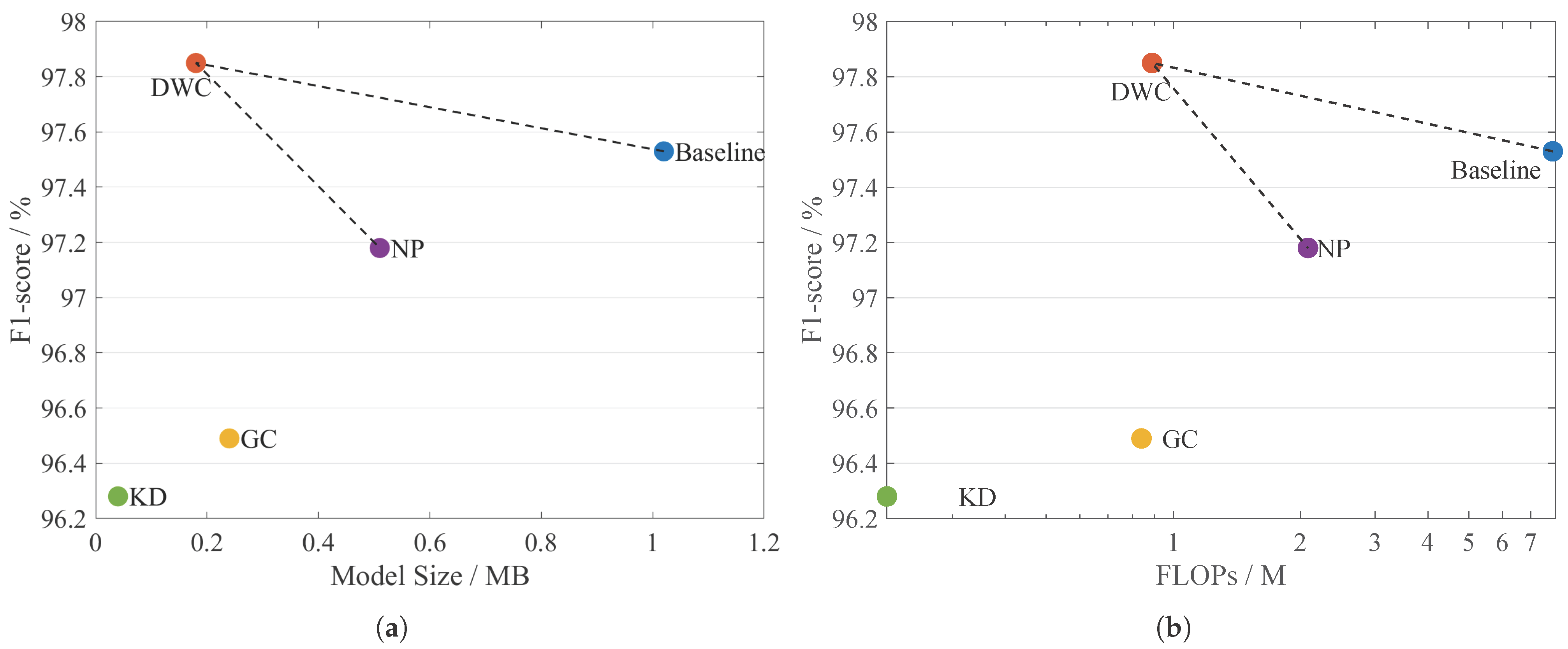
Figure 9. The baseline model achieved 97.52% accuracy with a size of 1.02 MB and a computational cost of 7.89 MFLOPs. Remarkably, the DWC variant not only reduced the model size by 64.2% (to 0.18 MB) and FLOPs by 88.7% (to 0.89 MFLOPs) but also slightly improved accuracy to 97.84%. This demonstrates that architectural efficiency can sometimes coincide with enhanced performance, likely due to reduced overfitting.
Other methods presented different trade-offs: GC achieved further FLOPs reduction (0.84 M) at the cost of lower accuracy (96.46%); NP maintained good accuracy (97.18%) but failed to reduce model size (0.51 MB, increased from a pruned base); KD achieved extreme compactness (0.04 MB, 0.21 MFLOPs) with a moderate accuracy drop (96.28%).
Figure 9 plots these models on a Pareto frontier of model size/FLOPs versus F1-score, clearly illustrating that DWC offers an optimal balance for deployment on resource-constrained SIL-IoT edge devices.
7.4. Evaluation of Low-Cost Fault Modeling Countermeasures
We evaluated strategies from
Section 6 to address data scarcity and imbalance. Three SSL pretext tasks against the supervised baseline were compared: an Autoencoder (AE) based on reconstruction, a Contrastive Learning (CL) framework, and a Generative Adversarial Network (GAN) variant for data generation. As shown in
Table 9, the AE approach demonstrated the most promise, achieving 96.89% accuracy (only 0.63% below the supervised baseline). This indicates that learning to reconstruct sensor signals forces the model to capture semantically meaningful representations that are useful for downstream fault classification. CL performed slightly worse (96.67% accuracy), potentially due to sensitivity in constructing positive/negative pairs in noisy data. The GAN-based method failed catastrophically (11.53% accuracy), highlighting the instability of adversarial training in this low-data regime.
To simulate a common scenario in which labeled data for one sensor type is scarce, we framed the voltage signal data as the source domain (with abundant labels) and the current signal data as the target domain (with scarce labels). We evaluated three TL strategies against a baseline trained only on current data. The results in
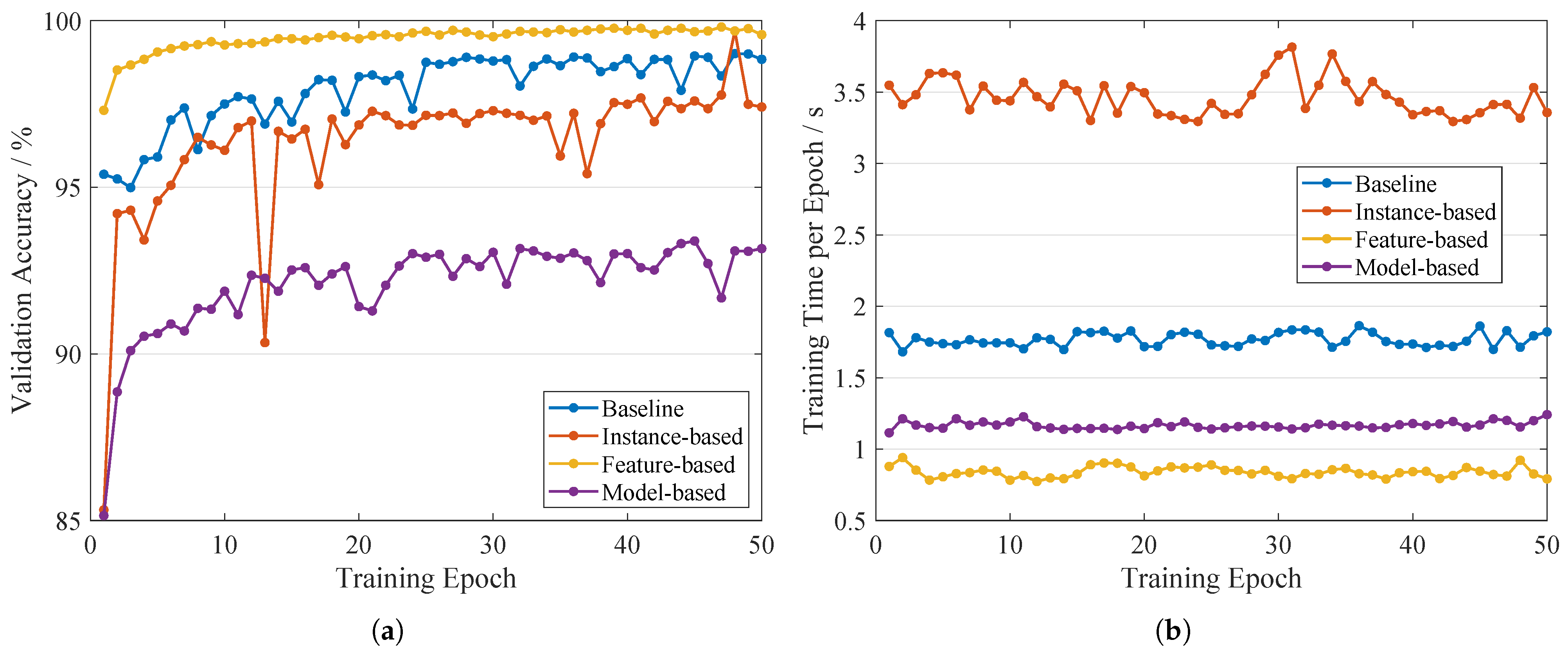
Table 10 are striking. The feature-based transfer method achieved exceptional performance (99.58% accuracy), significantly outperforming the current-only baseline (95.75%) and other TL methods. This method aligns the feature distributions of voltage and current data during training, enabling effective knowledge transfer. The instance-based method also showed solid improvement (97.41%), while the model-based approach suffered from negative transfer (93.16%).
Figure 10 shows that the feature-based method also converged faster, reducing training time by approximately 50% compared to the baseline. This confirms that TL, particularly feature-based alignment, is a powerful tool for leveraging existing labeled data to bootstrap FD in new or data-poor SIL-IoT deployments.
7.5. Summary and Case Study Findings
This case study provides concrete, quantitative validation for several key countermeasures proposed in this survey. Signal decomposition methods, e.g., EMD, can effectively enhance FD accuracy in noisy SIL-IoT environments, whereas inappropriate methods may degrade performance. Architectural innovations in lightweight model methods, e.g., DWC, can drastically reduce computational and memory costs while preserving or even improving accuracy, making advanced FD models deployable on the edge. Low-cost modeling, e.g., SSL (via autoencoders), can approach supervised performance with fewer labels, and transfer learning (especially feature-based) can powerfully leverage related data to overcome scarcity in a target domain, reducing both data collection and training costs.
The findings underscore that a combination of these techniques—for example, an EMD-preprocessed, DWC-based model pre-trained via SSL on unlabeled data and fine-tuned via TL—represents a highly promising pathway to building robust, efficient, and practical FD systems for real-world SIL-IoT deployments.
8. Conclusions
This survey contributes a structured framework for understanding and advancing fault detection in SIL-IoT. It consolidates scattered research, clarifies the unique problem dimensions, and evaluates modern AI and edge-computing solutions within the specific constraints of agricultural IoT. The findings underscore that future progress depends on an integrated, co-design approach that simultaneously addresses signal integrity, model efficiency, data efficiency, system security, and network resilience. While significant strides have been made, particularly in algorithmic adaptations, further work is needed to standardize evaluation benchmarks, develop cross-platform compatible FD modules, and conduct long-term, large-scale field trials to assess the true durability and operational impact of these solutions. By providing both a thorough synthesis of the state of the art and a clear roadmap for future research, this work aims to accelerate the development of dependable SIL-IoT systems, thereby strengthening the technological foundation for sustainable agriculture and global food security.
Author Contributions
Conceptualization, X.Y. and Z.W.; methodology, X.Y.; software, X.Y. and Z.W.; validation, L.S.; formal analysis, X.Y.; investigation, X.Y. and Z.W.; resources, X.Y.; data curation, X.Y.; writing—original draft preparation, X.Y.; writing—review and editing, Z.W., F.Y. and X.G.; visualization, X.Y.; supervision, L.S. and X.J.; project administration, X.Y. and L.S.; funding acquisition, X.Y. All authors have read and agreed to the published version of the manuscript.
Funding
This research was funded in part by the National Natural Science Foundation of China under Grant 62402003, in part by the Anhui Science and Technology University Talent Introduction Project under Grant RCYJ202402, and in part by the Research and development of intelligent fault diagnosis method for solar insecticidal lamp under Grant 20250009.
Data Availability Statement
The original contributions presented in the study are included in the article; further inquiries can be directed to the corresponding author.
Conflicts of Interest
The authors declare no conflicts of interest.
Abbreviations
The following abbreviations are used in this manuscript:
| AE | Autoencoder |
| AI | Artificial Intelligence |
| BSS | Blind Source Separation |
| BSW | Boolean Sliding Window |
| BD | Blind Deconvolution |
| CL | Contrastive Learning |
| CNN | Convolutional Neural Network |
| DWC | Depthwise Separable Convolution |
| EMD | Empirical Mode Decomposition |
| EMI | Electromagnetic Interference |
| FD | Fault Detection |
| FLOPs | Floating Point Operations |
| FPGA | Field-Programmable Gate Array |
| GC | Grouped Convolution |
| GAN | Generative Adversarial Network |
| GPS | Global Positioning System |
| ICA | Independent Component Analysis |
| IoT | Internet of Things |
| KD | Knowledge Distillation |
| KNN | K-Nearest Neighbors |
| LED | Light-Emitting Diode |
| NP | Network Pruning |
| PLC | Programmable Logic Controller |
| PUF | Physical Unclonable Function |
| SCA | Sparse Component Analysis |
| SCADA | Supervisory Control and Data Acquisition |
| SIL | Solar Insecticidal Lamp |
| SIL-IoT | Solar Insecticidal Lamp Internet of Things |
| SSL | Self-Supervised Learning |
| SPCA | Sparse Principal Component Analysis |
| SVM | Support Vector Machine |
| TL | Transfer Learning |
| UAV | Unmanned Aerial Vehicle |
| SA1D-CNN | Separable and Attention-based 1D-CNN |
References
- Muluneh, M.G. Impact of climate change on biodiversity and food security: A global perspective—A review article. Agric. Food Secur. 2021, 10, 36. [Google Scholar] [CrossRef]
- Bai, Z.; Chen, B.; Gao, S.; Liu, T.; Chen, Z. Current status of research on the application of agricultural UAV application technology. J. Chin. Agric. Mech. 2024, 45, 54–61, (In Chinese with English Abstract). [Google Scholar] [CrossRef]
- Klassen, D.; Lennox, M.D.; Dumont, M.J.; Chouinard, G.; Tavares, J.R. Dispensers for pheromonal pest control. J. Environ. Manag. 2023, 325, 116590. [Google Scholar] [CrossRef]
- Preti, M.; Verheggen, F.; Angeli, S. Insect pest monitoring with camera-equipped traps: Strengths and limitations. J. Pest Sci. 2021, 94, 203–217. [Google Scholar] [CrossRef]
- Li, K.; Shu, L.; Huang, K.; Sun, Y.; Yang, F.; Zhang, Y.; Huo, Z.; Wang, Y.; Wang, X.; Lu, Q.; et al. Research and prospect of solar insecticidal lamps Internet of Things. Smart Agric. 2019, 1, 13–28, (In Chinese with English Abstract). [Google Scholar] [CrossRef]
- Yang, X.; Shu, L.; Huang, K.; Li, K.; Huo, Z.; Wang, Y.; Wang, X.; Lu, Q.; Zhang, Y. Characteristics Analysis and Challenges for Fault Diagnosis in Solar Insecticidal Lamps Internet of Things. Smart Agric. 2020, 2, 11–27, (In Chinese with English Abstract). [Google Scholar] [CrossRef]
- Yang, X.; Shu, L.; Chen, J.; Ferrag, M.A.; Wu, J.; Nurellari, E.; Huang, K. A Survey on Smart Agriculture: Development Modes, Technologies, and Security and Privacy Challenges. IEEE/CAA J. Autom. Sin. 2021, 8, 273–302. [Google Scholar] [CrossRef]
- Huang, K.; Shu, L.; Li, K.; Yang, X.; Zhu, Y.; Wang, X.; Su, Q. Design and Prospect for Anti-theft and Anti-destruction of Nodes in Solar Insecticidal Lamps Internet of Things. Smart Agric. 2021, 3, 129–143. [Google Scholar] [CrossRef]
- Sun, Y.; Ding, W.; Shu, L.; Li, K.; Zhang, Y.; Zhou, Z.; Han, G. On Enabling Mobile Crowd Sensing for Data Collection in Smart Agriculture: A Vision. IEEE Syst. J. 2022, 16, 132–143. [Google Scholar] [CrossRef]
- Ramesh, D.; Chandrasekaran, M.; Soundararajan, R.P.; Subramanian, P.P.; Palled, V.; Kumar, D.P. Solar-Powered Plant Protection Equipment: Perspective and Prospects. Energies 2022, 15, 7379. [Google Scholar] [CrossRef]
- Huang, K.; Shu, L.; Li, K.; Chen, Y.; Zhu, Y.; Valluru, R. Sustainable and Intelligent Phytoprotection in Photovoltaic Agriculture: New Challenges and Opportunities. Electronics 2023, 12, 1221. [Google Scholar] [CrossRef]
- Zhao, Q.; Shu, L.; Li, K.; Ferrag, M.A.; Liu, X.; Li, Y. Security and Privacy in Solar Insecticidal Lamps Internet of Things: Requirements and Challenges. IEEE/CAA J. Autom. Sin. 2024, 11, 58–73. [Google Scholar] [CrossRef]
- Yang, F.; Shu, L.; Huang, K.; Li, K.; Han, G.; Liu, Y. A partition-based node deployment strategy in solar insecticidal lamps Internet of Things. IEEE Internet Things J. 2020, 7, 11223–11237. [Google Scholar] [CrossRef]
- Yang, F.; Shu, L.; Yang, Y.; Liu, Y.; Gordon, T. Improved coverage and connectivity via weighted node deployment in solar insecticidal lamp Internet of Things. IEEE Internet Things J. 2021, 8, 10170–10186. [Google Scholar] [CrossRef]
- Yang, X.; Shu, L.; Li, K.; Nurellari, E.; Huo, Z.; Zhang, Y. A Lightweight Fault-Detection Scheme for Resource-Constrained Solar Insecticidal Lamp IoTs. Sensors 2023, 23, 6672. [Google Scholar] [CrossRef]
- Yao, H.; Shu, L.; Lin, W.; Huang, K.; Martínez-García, M.; Zou, X. Pests Phototactic Rhythm Driven Solar Insecticidal Lamp Device Evolution: Mathematical Model Preliminary Result and Future Directions. IEEE Open J. Ind. Electron. Soc. 2024, 5, 236–250. [Google Scholar] [CrossRef]
- Eliopoulos, P.A.; Potamitis, I.; Kontodimas, D.C. Estimation of population density of stored grain pests via bioacoustic detection. Crop Prot. 2016, 85, 71–78. [Google Scholar] [CrossRef]
- Li, Y.; Du, B.; Luo, L.; Luo, Y.; Yang, X.; Liu, Y.; Shu, L. A Scheme for Pest-Dense Area Localization With Solar Insecticidal Lamps Internet of Things Under Asymmetric Links. IEEE Trans. Agrifood Electron. 2023, 1, 71–85. [Google Scholar] [CrossRef]
- Huang, K.; Li, K.; Shu, L.; Yang, X. Demo Abstract: High Voltage Discharge Exhibits Severe Effect on ZigBee-based Device in Solar Insecticidal Lamps Internet of Things. In Proceedings of the IEEE INFOCOM 2020—IEEE Conference on Computer Communications Workshops (INFOCOM WKSHPS), Toronto, ON, Canada, 6–9 July 2020; pp. 1266–1267. [Google Scholar] [CrossRef]
- Yang, X.; Shu, L.; Huang, K.; Li, K.; Yao, H. Poster Abstract: Insecticidal Performance Simulation of Solar Insecticidal Lamps Internet of Things Using the Number of Falling Edge Trigger. In Proceedings of the IEEE INFOCOM 2021—IEEE Conference on Computer Communications Workshops (INFOCOM WKSHPS), Vancouver, BC, Canada, 10–13 May 2021; pp. 1–2. [Google Scholar] [CrossRef]
- Sun, Y.; Nurellari, E.; Ding, W.; Shu, L.; Huo, Z. A Partition-Based Mobile-Crowdsensing-Enabled Task Allocation for Solar Insecticidal Lamp Internet of Things Maintenance. IEEE Internet Things J. 2022, 9, 20547–20560. [Google Scholar] [CrossRef]
- Moon, A.; Zhuo, X.; Zhang, J.; Son, S.W. AD2: Improving Quality of IoT Data through Compressive Anomaly Detection. In Proceedings of the 2019 IEEE International Conference on Big Data (Big Data), Los Angeles, CA, USA, 9–12 December 2019; pp. 1662–1668. [Google Scholar] [CrossRef]
- Su, B.; Chen, H.; Chen, P.; Bian, G.; Liu, K.; Liu, W. Deep Learning-Based Solar-Cell Manufacturing Defect Detection With Complementary Attention Network. IEEE Trans. Ind. Inform. 2021, 17, 4084–4095. [Google Scholar] [CrossRef]
- Liu, K.; Ma, Q.; Gong, W.; Miao, X.; Liu, Y. Self-Diagnosis for Detecting System Failures in Large-Scale Wireless Sensor Networks. IEEE Trans. Wirel. Commun. 2014, 13, 5535–5545. [Google Scholar] [CrossRef]
- He, S.; Chen, J.; Shu, Y.; Cui, X.; Shi, K.; Wei, C.; Shi, Z. Efficient Fault-Tolerant Information Barrier Coverage in Internet of Things. IEEE Trans. Wirel. Commun. 2021, 20, 7963–7976. [Google Scholar] [CrossRef]
- Kim, D.Y.; Kareem, A.B.; Domingo, D.; Shin, B.C.; Hur, J.W. Advanced Data Augmentation Techniques for Enhanced Fault Diagnosis in Industrial Centrifugal Pumps. J. Sens. Actuator Netw. 2024, 13, 60. [Google Scholar] [CrossRef]
- Wang, X.; McArthur, S.D.J.; Strachan, S.M.; Kirkwood, J.D.; Paisley, B. A Data Analytic Approach to Automatic Fault Diagnosis and Prognosis for Distribution Automation. IEEE Trans. Smart Grid 2018, 9, 6265–6273. [Google Scholar] [CrossRef]
- Shen, Y.; Liu, D.; Liang, W.; Zhang, X. Current Reconstruction of Three-Phase Voltage Source Inverters Considering Current Ripple. IEEE Trans. Transp. Electrif. 2023, 9, 1416–1427. [Google Scholar] [CrossRef]
- Wang, Y.; Yang, M.; Li, Y.; Xu, Z.; Wang, J.; Fang, X. A Multi-Input and Multi-Task Convolutional Neural Network for Fault Diagnosis Based on Bearing Vibration Signal. IEEE Sens. J. 2021, 21, 10946–10956. [Google Scholar] [CrossRef]
- Huang, T.; Bacher, P.; Møller, J.K.; D’Ettorre, F.; Markussen, W.B. A step towards digital operations—A novel grey-box approach for modelling the heat dynamics of ultra-low temperature freezing chambers. Appl. Energy 2023, 349, 121630. [Google Scholar] [CrossRef]
- Choi, K.; Kim, Y.; Kim, S.K.; Kim, K.S. Current and Position Sensor Fault Diagnosis Algorithm for PMSM Drives Based on Robust State Observer. IEEE Trans. Ind. Electron. 2021, 68, 5227–5236. [Google Scholar] [CrossRef]
- Doostmohammadian, M.; Meskin, N. Sensor Fault Detection and Isolation via Networked Estimation: Full-Rank Dynamical Systems. IEEE Trans. Control Netw. Syst. 2021, 8, 987–996. [Google Scholar] [CrossRef]
- Lascu, C.; Andreescu, G.D. PLL Position and Speed Observer With Integrated Current Observer for Sensorless PMSM Drives. IEEE Trans. Ind. Electron. 2020, 67, 5990–5999. [Google Scholar] [CrossRef]
- Wang, Q.; Jin, T.; Mohamed, M.A.; Chen, T. A Minimum Hitting Set Algorithm With Prejudging Mechanism for Model-Based Fault Diagnosis in Distribution Networks. IEEE Trans. Instrum. Meas. 2020, 69, 4702–4711. [Google Scholar] [CrossRef]
- Liang, J.; Zhang, K.; Al-Durra, A.; Zhou, D. A novel fault diagnostic method in power converters for wind power generation system. Appl. Energy 2020, 266, 114851. [Google Scholar] [CrossRef]
- Chen, H.; Jiang, B.; Ding, S.X.; Huang, B. Data-Driven Fault Diagnosis for Traction Systems in High-Speed Trains: A Survey, Challenges, and Perspectives. IEEE Trans. Intell. Transp. Syst. 2022, 23, 1700–1716. [Google Scholar] [CrossRef]
- Lee, J.H.; Okwuosa, C.N.; Shin, B.C.; Hur, J.W. A Spectral-Based Blade Fault Detection in Shot Blast Machines with XGBoost and Feature Importance. J. Sens. Actuator Netw. 2024, 13, 64. [Google Scholar] [CrossRef]
- Zhang, S.; Wang, R.; Si, Y.; Wang, L. An Improved Convolutional Neural Network for Three-Phase Inverter Fault Diagnosis. IEEE Trans. Instrum. Meas. 2022, 71, 3510915. [Google Scholar] [CrossRef]
- Dhibi, K.; Mansouri, M.; Bouzrara, K.; Nounou, H.; Nounou, M. An Enhanced Ensemble Learning-Based Fault Detection and Diagnosis for Grid-Connected PV Systems. IEEE Access 2021, 9, 155622–155633. [Google Scholar] [CrossRef]
- Xue, H.; Sun, Y.; Chen, J.; Tian, H.; Liu, Z.; Shen, M.; Liu, L. CAT-CBAM-Net: An Automatic Scoring Method for Sow Body Condition Based on CNN and Transformer. Sensors 2023, 23, 7919. [Google Scholar] [CrossRef]
- Fan, C.; Li, X.; Zhao, Y.; Wang, J. Quantitative assessments on advanced data synthesis strategies for enhancing imbalanced AHU fault diagnosis performance. Energy Build. 2021, 252, 111423. [Google Scholar] [CrossRef]
- Guo, Q.; Li, S.; Gong, Y.; Wang, F.; Yu, G. Application of qualitative trend analysis in fault diagnosis of entrained-flow coal-water slurry gasifier. Control Eng. Pract. 2021, 112, 104835. [Google Scholar] [CrossRef]
- Yang, X.; Shu, L.; Li, K.; Huo, Z.; Shu, S.; Nurellari, E. SILOS: An Intelligent Fault Detection Scheme for Solar Insecticidal Lamp IoT With Improved Energy Efficiency. IEEE Internet Things J. 2023, 10, 920–939. [Google Scholar] [CrossRef]
- Yang, X.; Shu, L.; Li, K.; Huo, Z.; Zhang, Y. SA1D-CNN: A Separable and Attention Based Lightweight Sensor Fault Diagnosis Method for Solar Insecticidal Lamp Internet of Things. IEEE Open J. Ind. Electron. Soc. 2022, 3, 291–303. [Google Scholar] [CrossRef]
- Liu, B.; Zhou, Y.; Fu, H.; Fu, P.; Feng, L. Lightweight Self-Detection and Self-Calibration Strategy for MEMS Gas Sensor Arrays. Sensors 2022, 22, 4315. [Google Scholar] [CrossRef]
- Fu, X.; Wang, Y.; Li, W.; Yang, Y.; Postolache, O. Lightweight Fault Detection Strategy for Wireless Sensor Networks Based on Trend Correlation. IEEE Access 2021, 9, 9073–9083. [Google Scholar] [CrossRef]
- Flynn, C.; Pengwah, A.B.; Razzaghi, R.; Andrew, L.L.H. An Improved Algorithm for Topology Identification of Distribution Networks Using Smart Meter Data and Its Application for Fault Detection. IEEE Trans. Smart Grid 2023, 14, 3850–3861. [Google Scholar] [CrossRef]
- Marathe, S.; Nambi, A.; Swaminathan, M.; Sutaria, R. CurrentSense: A novel approach for fault and drift detection in environmental IoT sensors. In Proceedings of the International Conference on Internet-of-Things Design and Implementation, New York, NY, USA, 18–21 May 2021; IoTDI ’21. pp. 93–105. [Google Scholar] [CrossRef]
- Kuei-Hsiang, C.; Chao-Ting, C. A remote supervision fault diagnosis meter for photovoltaic power generation systems. Measurement 2017, 104, 93–104. [Google Scholar] [CrossRef]
- Yan, H.; Xu, Y.; Cai, F.; Zhang, H.; Zhao, W.; Gerada, C. PWM-VSI Fault Diagnosis for a PMSM Drive Based on the Fuzzy Logic Approach. IEEE Trans. Power Electron. 2019, 34, 759–768. [Google Scholar] [CrossRef]
- Lu, S.; Ma, R.; Sirojan, T.; Phung, B.; Zhang, D. Lightweight transfer nets and adversarial data augmentation for photovoltaic series arc fault detection with limited fault data. Int. J. Electr. Power Energy Syst. 2021, 130, 107035. [Google Scholar] [CrossRef]
- Yaman, O.; Yol, F.; Altinors, A. A Fault Detection Method Based on Embedded Feature Extraction and SVM Classification for UAV Motors. Microprocess. Microsystems 2022, 94, 104683. [Google Scholar] [CrossRef]
- Huang, K.; Li, K.; Shu, L.; Yang, X.; Gordon, T.; Wang, X. High Voltage Discharge Exhibits Severe Effect on ZigBee-Based Device in Solar Insecticidal Lamps Internet of Things. IEEE Wirel. Commun. 2020, 27, 140–145. [Google Scholar] [CrossRef]
- Gao, Y.; Liu, X.; Xiang, J. Fault Detection in Gears Using Fault Samples Enlarged by a Combination of Numerical Simulation and a Generative Adversarial Network. IEEE/ASME Trans. Mechatronics 2022, 27, 3798–3805. [Google Scholar] [CrossRef]
- Xue, H.; Shen, M.; Sun, Y.; Tian, H.; Liu, Z.; Chen, J.; Xu, P. Instance Segmentation and Ensemble Learning for Automatic Temperature Detection in Multiparous Sows. Sensors 2023, 23, 9128. [Google Scholar] [CrossRef]
- Lakshmi Priya Palla, G.; Kumar Pani, A. Independent component analysis application for fault detection in process industries: Literature review and an application case study for fault detection in multiphase flow systems. Measurement 2023, 209, 112504. [Google Scholar] [CrossRef]
- Garcia-Bracamonte, J.E.; Ramirez-Cortes, J.M.; de Jesus Rangel-Magdaleno, J.; Gomez-Gil, P.; Peregrina-Barreto, H.; Alarcon-Aquino, V. An Approach on MCSA-Based Fault Detection Using Independent Component Analysis and Neural Networks. IEEE Trans. Instrum. Meas. 2019, 68, 1353–1361. [Google Scholar] [CrossRef]
- Geng, Z.; Duan, X.; Han, Y.; Liu, F.; Xu, W. Novel variation mode decomposition integrated adaptive sparse principal component analysis and it application in fault diagnosis. ISA Trans. 2022, 128, 21–31. [Google Scholar] [CrossRef] [PubMed]
- Li, Z.; Liu, Z.; Zuo, M. Homotypic multi-source mixed signal decomposition based on maximum time-shift kurtosis for drilling pump fault diagnosis. Mech. Syst. Signal Process. 2024, 221, 111724. [Google Scholar] [CrossRef]
- Wang, R.; Fang, H.; Yu, L.; Yu, L.; Chen, J. Sparse and low-rank decomposition of the time–frequency representation for bearing fault diagnosis under variable speed conditions. ISA Trans. 2022, 128, 579–598. [Google Scholar] [CrossRef] [PubMed]
- Miao, Y.; Zhang, B.; Lin, J.; Zhao, M.; Liu, H.; Liu, Z.; Li, H. A review on the application of blind deconvolution in machinery fault diagnosis. Mech. Syst. Signal Process. 2022, 163, 108202. [Google Scholar] [CrossRef]
- Wang, Z.; Zhou, J.; Du, W.; Lei, Y.; Wang, J. Bearing fault diagnosis method based on adaptive maximum cyclostationarity blind deconvolution. Mech. Syst. Signal Process. 2022, 162, 108018. [Google Scholar] [CrossRef]
- Ahmadi, M.; Samet, H.; Ghanbari, T. A New Method for Detecting Series Arc Fault in Photovoltaic Systems Based on the Blind-Source Separation. IEEE Trans. Ind. Electron. 2020, 67, 5041–5049. [Google Scholar] [CrossRef]
- Liu, L.; Cheng, Y.; Song, D.; Zhang, W.; Tang, G.; Luo, Y. A Lightweight Network with Adaptive Input and Adaptive Channel Pruning Strategy for Bearing Fault Diagnosis. IEEE Trans. Instrum. Meas. 2024, 73, 3510911. [Google Scholar] [CrossRef]
- Fu, L.; Yan, K.; Zhang, Y.; Chen, R.; Ma, Z.; Xu, F.; Zhu, T. EdgeCog: A Real-Time Bearing Fault Diagnosis System Based on Lightweight Edge Computing. IEEE Trans. Instrum. Meas. 2023, 72, 2521711. [Google Scholar] [CrossRef]
- Deng, J.; Jiang, W.; Zhang, Y.; Wang, G.; Li, S.; Fang, H. HS-KDNet: A Lightweight Network Based on Hierarchical-Split Block and Knowledge Distillation for Fault Diagnosis with Extremely Imbalanced Data. IEEE Trans. Instrum. Meas. 2021, 70, 3521109. [Google Scholar] [CrossRef]
- Liu, X.; Yu, W.; Liang, F.; Griffith, D.; Golmie, N. Toward Deep Transfer Learning in Industrial Internet of Things. IEEE Internet Things J. 2021, 8, 12163–12175. [Google Scholar] [CrossRef]
- Wan, L.; Li, Y.; Chen, K.; Gong, K.; Li, C. A novel deep convolution multi-adversarial domain adaptation model for rolling bearing fault diagnosis. Measurement 2022, 191, 110752. [Google Scholar] [CrossRef]
- Shao, S.; McAleer, S.; Yan, R.; Baldi, P. Highly Accurate Machine Fault Diagnosis Using Deep Transfer Learning. IEEE Trans. Ind. Inform. 2019, 15, 2446–2455. [Google Scholar] [CrossRef]
- Mao, W.; Feng, W.; Liu, Y.; Zhang, D.; Liang, X. A new deep auto-encoder method with fusing discriminant information for bearing fault diagnosis. Mech. Syst. Signal Process. 2021, 150, 107233. [Google Scholar] [CrossRef]
- Miao, J.; Wang, J.; Zhang, D.; Miao, Q. Improved Generative Adversarial Network for Rotating Component Fault Diagnosis in Scenarios With Extremely Limited Data. IEEE Trans. Instrum. Meas. 2022, 71, 3500213. [Google Scholar] [CrossRef]
- Zhang, T.; Chen, J.; He, S.; Zhou, Z. Prior Knowledge-Augmented Self-Supervised Feature Learning for Few-Shot Intelligent Fault Diagnosis of Machines. IEEE Trans. Ind. Electron. 2022, 69, 10573–10584. [Google Scholar] [CrossRef]
Figure 1.
Architecture of the multi-scale agricultural pest monitoring network integrating SIL-IoT systems with complementary monitoring technologies.
Figure 1.
Architecture of the multi-scale agricultural pest monitoring network integrating SIL-IoT systems with complementary monitoring technologies.
Figure 2.
Common SIL-IoT failure modes impacting pest control efficacy: (a) lure lamp degradation, (b) pest accumulation on high-voltage mesh, and (c) control board corrosion in humid environments.
Figure 2.
Common SIL-IoT failure modes impacting pest control efficacy: (a) lure lamp degradation, (b) pest accumulation on high-voltage mesh, and (c) control board corrosion in humid environments.
Figure 3.
Electromagnetic interference causing abnormal fluctuations of data acquired by sensors, where the horizontal axis represents time, measured in microseconds (µs).
Figure 3.
Electromagnetic interference causing abnormal fluctuations of data acquired by sensors, where the horizontal axis represents time, measured in microseconds (µs).
Figure 4.
SIL-IoT deployed in various outdoor wild scenarios.
Figure 4.
SIL-IoT deployed in various outdoor wild scenarios.
Figure 5.
Blind source separation method extracts independent signals from multi-source observation signals.
Figure 5.
Blind source separation method extracts independent signals from multi-source observation signals.
Figure 6.
Schematic diagrams of lightweight model design strategies: (a) Network pruning removes redundant parameters, (b) Weight quantization compresses model size, (c) Knowledge distillation transfers knowledge from teacher to student model, (d) Network structure optimization (e.g., depthwise separable convolution) reduces computational cost.
Figure 6.
Schematic diagrams of lightweight model design strategies: (a) Network pruning removes redundant parameters, (b) Weight quantization compresses model size, (c) Knowledge distillation transfers knowledge from teacher to student model, (d) Network structure optimization (e.g., depthwise separable convolution) reduces computational cost.
Figure 7.
Schematic diagram of transfer learning and self-supervised learning, where transfer learning is represented in blue font and self-supervised learning is represented in red font.
Figure 7.
Schematic diagram of transfer learning and self-supervised learning, where transfer learning is represented in blue font and self-supervised learning is represented in red font.
Figure 8.
Confusion matrices comparison: (a) Baseline model, (b) EMD, (c) Wavelet, and (d) BD methods.
Figure 8.
Confusion matrices comparison: (a) Baseline model, (b) EMD, (c) Wavelet, and (d) BD methods.
Figure 9.
Pareto Frontier: (a) Model size vs F1-score and (b) FLOPs vs F1-score.
Figure 9.
Pareto Frontier: (a) Model size vs F1-score and (b) FLOPs vs F1-score.
Figure 10.
Performance comparison of different transfer learning methods: (a) val accuracy and (b) train time.
Figure 10.
Performance comparison of different transfer learning methods: (a) val accuracy and (b) train time.
Table 1.
Recent surveys related to the FD of SIL-IoT.
Table 1.
Recent surveys related to the FD of SIL-IoT.
| Year | Reference | Related Topic | Recent Advance | Challenge | Countermeasure | Case Study |
|---|
| 2020 | Yang et al. [6] | FD of SIL-IoT from wireless sensor networks aspect | | | | |
| 2021 | Yang et al. [7] | Electromagnetic interference leading to abnormal data | ◐ | ◐ | ◐ | ◐ |
| 2021 | Huang et al. [8] | Anti-theft and anti-destruction of SIL-IoT node | ◐ | ◐ | ◐ | |
| 2022 | Sun et al. [9] | Mobile crowd sensing based SIL-IoT maintenance | ◐ | ◐ | | |
| 2022 | Ramesh et al. [10] | Monitoring of photovoltaic and battery in SIL-IoT | ◐ | ◐ | ◐ | |
| 2023 | Huang et al. [11] | Interference of solar panels on wireless communication of SIL nodes | ◐ | ◐ | ◐ | |
| 2024 | Zhao et al. [12] | Security and privacy in SIL-IoT | ◐ | ◐ | | |
| Our | FD of SIL-IoT Node from artificial intelligence, edge computing aspects | | | | |
Table 2.
Comparison of model-based, signal analysis-based and data-driven FD methods.
Table 2.
Comparison of model-based, signal analysis-based and data-driven FD methods.
| Feature | Model-Based | Signal Analysis-Based | Data-Driven |
|---|
| Principle | Establishing models based on expert knowledge, physical principles, and data parameter correlations [27] | Real-time status assessment of fault symptoms obtained through feature extraction [28] | Extracting fault related features for classification through training on a large amount of data [29] |
| Advantage | Strong practicality, low method complexity, and intuitive results | Good performance in detecting periodic signals | High accuracy, strong robustness, and strong generalization ability |
| Limitation | Highly dependent models and parameters, not applicable to complex systems | The results are not intuitive, the detection speed is slow, and the modeling is complex | Complex methods and requiring a large amount of data |
Table 3.
Comparison of quantitative and qualitative FD methods.
Table 3.
Comparison of quantitative and qualitative FD methods.
| Method | Accuracy | Robustness | Timeliness | Computation Cost | Prior Knowledge Dependence | Energy Consumption |
|---|
| Quantitative | High | Low | Low | High | High | High |
| Qualitative | High | High | High | Low | High | Low |
Table 4.
FD methods and strategies of outdoor IoT devices, where N/A and √ denote not mentioned and mentioned.
Table 4.
FD methods and strategies of outdoor IoT devices, where N/A and √ denote not mentioned and mentioned.
| Reference | Theme | FD Platform | Battery Powered | FD Strategy | FD Method | FD Description | Lightweight | Energy Saving |
|---|
| Moon et al. [22] | Detect faults of temperature, humidity, and sensors in IoT farms | Back-end | N/A | Centralized | Model-based | Quantitative | N/A | N/A |
| Liu et al. [45] | FD in gas sensor system | CC1350 |
√
| Distributed | Model-based | Qualitative |
√
|
√
|
| Fu et al. [46] | FD in wireless sensor network | Simulation |
√
| Distributed | Model-based | Qualitative |
√
| N/A |
| Flynn et al. [47] | FD in smart meter network | Simulation | N/A | Distributed | Model-based | Qualitative | N/A | N/A |
| Marathe et al. [48] | FD in PM2.5, CO2, and temperature sensors | STM32 |
√
| Distributed | Model-based | Qualitative |
√
| N/A |
| Liu et al. [24] | Detect over 330 CO2 sensors deployed in forests | MSP430 |
√
| Distributed | Model-based | Qualitative |
√
| N/A |
| He et al. [25] | Detect infrared sensor faults in island intrusion detection | Arduino UNO |
√
| Distributed | Model-based | Qualitative |
√
|
√
|
| Chao et al. [49] | Fault localization in photovoltaic power generation systems | PIC 18F8720 | √ | Distributed | Model-based | Qualitative |
√
|
√
|
| Yan et al. [50] | Fault localization in a three-phase voltage source inverter | DSP TMS320 F2812 | N/A | Distributed | Model-based | Qualitative | N/A | N/A |
| Liang et al. [35] | Fault diagnosis of power converters in wind power systems | Simulation | N/A | Centralized | Signal analysis-based | Quantitative |
√
| N/A |
| Shen et al. [28] | Current sensor fault tolerance for vector control in motor drives | Simulation | N/A | Centralized | Signal analysis-based | Quantitative |
√
| N/A |
| Lu et al. [51] | DC series arc fault location in photovoltaic arrays | FPGA | N/A | Distributed | Data-driven | Quantitative |
√
| N/A |
| Yaman et al. [52] | FD of drone motors, magnets, propellers, and bearings | Back-end |
√
| Centralized | Data-driven | Qualitative |
√
| N/A |
| Zheng et al. [23] | Hot spot of solar panels FD | Back-end | N/A | Centralized | Data-driven | Qualitative |
√
| N/A |
Table 5.
Components and their description of SIL-IoT.
Table 6.
Fault label of the dataset used in this case study where ✓ denotes the experimental conditions involved.
Table 6.
Fault label of the dataset used in this case study where ✓ denotes the experimental conditions involved.
| Fault Types | Discharge | No Discharge | Label |
|---|
| No fault | | ✓ | 0 |
| Voltage sensor outlier fault | ✓ | ✓ | 1 |
| Voltage sensor gain fault | ✓ | ✓ | 2 |
| Voltage sensor stuck fault | ✓ | ✓ | 3 |
| Voltage sensor offset fault | ✓ | ✓ | 4 |
| Current sensor outlier fault | ✓ | ✓ | 5 |
| Current sensor gain fault | ✓ | ✓ | 6 |
| Current sensor stuck fault | ✓ | ✓ | 7 |
| Current sensor offset fault | ✓ | ✓ | 8 |
| No fault | ✓ | | 9 |
Table 7.
Performance comparison of different signal decomposition methods.
Table 7.
Performance comparison of different signal decomposition methods.
| Method | Accuracy/% | F1-Score/% | Precision/% | Recall/% |
|---|
| EMD | 97.89 | 97.93 | 97.97 | 97.89 |
| Baseline | 97.52 | 97.57 | 97.63 | 97.52 |
| Wavelet | 95.99 | 96.05 | 96.11 | 95.99 |
| BD | 95.27 | 95.31 | 95.36 | 95.27 |
Table 8.
Performance comparison of different lightweight design methods.
Table 8.
Performance comparison of different lightweight design methods.
| Indicator | Baseline | DWC | GC | NP | KD |
|---|
| Accuracy/% | 97.52 | 97.84 | 96.46 | 97.18 | 96.28 |
| Precision/% | 97.63 | 97.94 | 96.98 | 97.51 | 96.79 |
| Recall/% | 97.52 | 97.84 | 96.46 | 97.18 | 96.28 |
| F1-score/% | 97.57 | 97.89 | 96.72 | 97.35 | 96.54 |
| Model size/MB | 1.02 | 0.18 | 0.24 | 0.51 | 0.04 |
| FLOPs/M | 7.89 | 0.89 | 0.84 | 2.08 | 0.21 |
Table 9.
Performance comparison of different self-supervised learning methods.
Table 9.
Performance comparison of different self-supervised learning methods.
| Method | Accuracy/% | F1-Score /% | Precision/% | Recall/% |
|---|
| Baseline | 97.52 | 97.57 | 97.63 | 97.52 |
| AE | 96.89 | 97.09 | 97.29 | 96.89 |
| CL | 96.67 | 96.87 | 97.08 | 96.67 |
| GAN | 11.53 | 9.45 | 8.00 | 11.53 |
Table 10.
Performance comparison of different transfer learning methods with voltage data as source domain and current data as target domain.
Table 10.
Performance comparison of different transfer learning methods with voltage data as source domain and current data as target domain.
| Method | Accuracy/% | F1-Score/% | Precision/% | Recall/% |
|---|
| Feature-based | 99.58 | 99.58 | 99.58 | 99.58 |
| Instance-based | 97.41 | 97.35 | 97.29 | 97.41 |
| Baseline | 95.75 | 96.09 | 96.42 | 95.75 |
| Model-based | 93.16 | 92.95 | 92.74 | 93.16 |
| Disclaimer/Publisher’s Note: The statements, opinions and data contained in all publications are solely those of the individual author(s) and contributor(s) and not of MDPI and/or the editor(s). MDPI and/or the editor(s) disclaim responsibility for any injury to people or property resulting from any ideas, methods, instructions or products referred to in the content. |