Evolutionary Repurposing of Cytokinin Signaling in Plant Development and Symbiosis


Abstract
1. Introduction
2. Evolutionary Assembly of Cytokinin Signaling
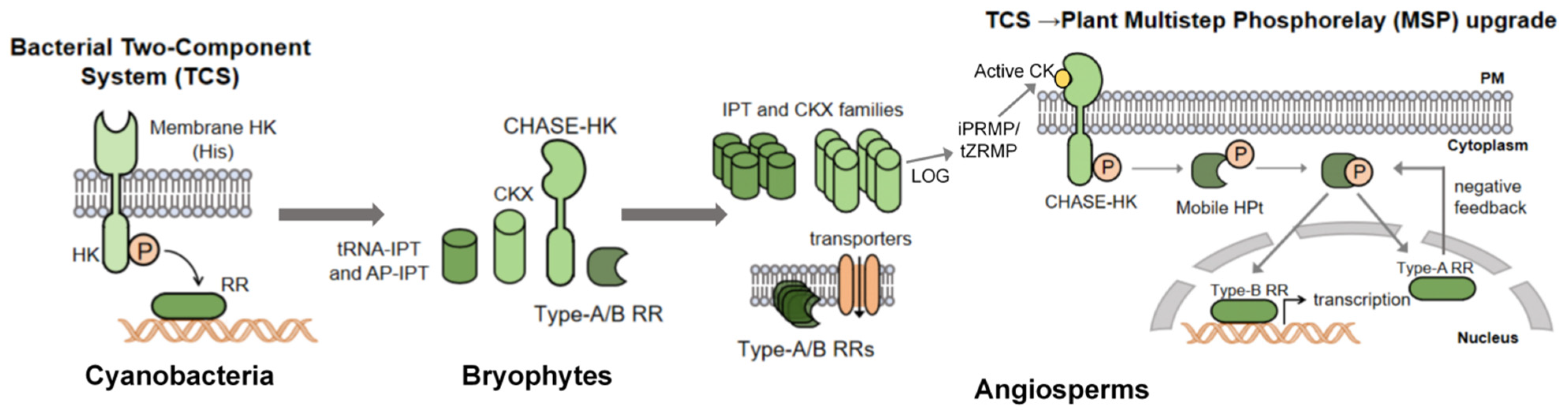
2.1. The Ancient Origins of the Plant Two-Component Signaling System
2.2. Assembly of the Cytokinin Toolkit
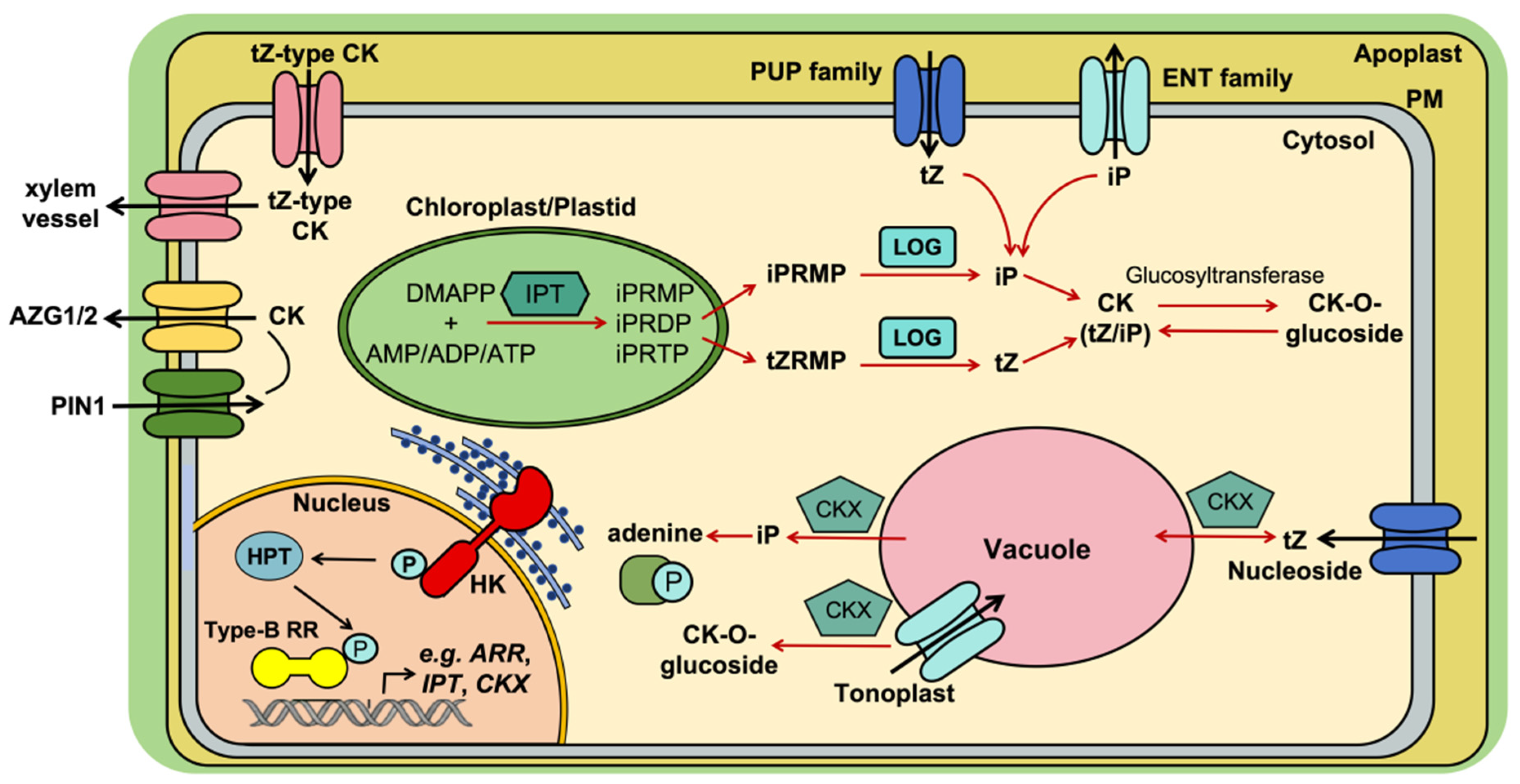
2.3. Biosynthesis and Activation: Divergent Routes, Convergent Function for IPT and LOG Gene Families
2.4. Homeostatic Control: The Emergence and Expansion of the CKX Degradation Pathway
2.5. Perception and Signaling Modules
2.6. A Glimpse into Ancestral Function: Cytokinin Signaling in Bryophytes (Physcomitrella, Marchantia)
2.7. The Modern Cytokinin Regulatory Framework in Angiosperms
3. The Core Framework for Cytokinin System Establishment: From Perception and Signal Transduction to Transport
3.1. Perception and Signal Transduction: A High-Fidelity Phosphorelay Network
- (1)
- Signal perception: The signal is initiated by the binding of a cytokinin molecule to the CHASE domain of a receptor dimer located on the endoplasmic reticulum or plasma membrane, as exemplified by AHK4/CRE1 in Arabidopsis [31].
- (2)
- Receptor activation and phosphate transfer: Ligand binding induces a conformational change in the receptor, prompting its kinase domain to undergo trans-autophosphorylation, whereby one monomer phosphorylates a conserved histidine (His) residue on the other monomer. Subsequently, the phosphate group is transferred intramolecularly to a conserved aspartate (Asp) residue within its own receiver (Rec) domain [32].
- (3)
- Cytoplasmic–nuclear shuttle: Phosphorylated receptors transfer phosphate groups to histidine phosphotransfer proteins (AHPs/HPts), which maintain a nucleo-cytosolic distribution and mediate phosphotransfer between the cytoplasm and nucleus [33].
- (4)
- (5)
- Transcriptional activation: Phosphorylation activates the Type-B RR, enabling it to bind cytokinin-responsive cis-elements that contain a core (A/G)GAT motif in the promoters of downstream target genes and thereby initiate transcription [34].
3.2. Establishing Spatiotemporal Gradients: The Cytokinin Transport Machinery
4. Integrated Signaling: Core Crosstalk Between Cytokinin and Other Plant Hormones
4.1. Cytokinin: A Central Coordinator of Plant Form and Function
4.2. The Auxin–Cytokinin Balance Is a Central Principle Governing Plant Morphogenesis
5. The Functional Landscape of Cytokinin: Orchestrating Plant Physiological Processes
5.1. Deciphering Cytokinin Heterogeneity at Single-Cell Resolution
5.2. Mediating Environmental Responses: The Dual Role of Cytokinin in Abiotic Stress Tolerance
5.3. Cytokinin in Plant–Microbe Symbiosis
5.4. Cytokinin in Arbuscular Mycorrhizal Symbiosis: Context-Dependent Regulation
6. Cytokinin in Legume–Rhizobium Symbiosis
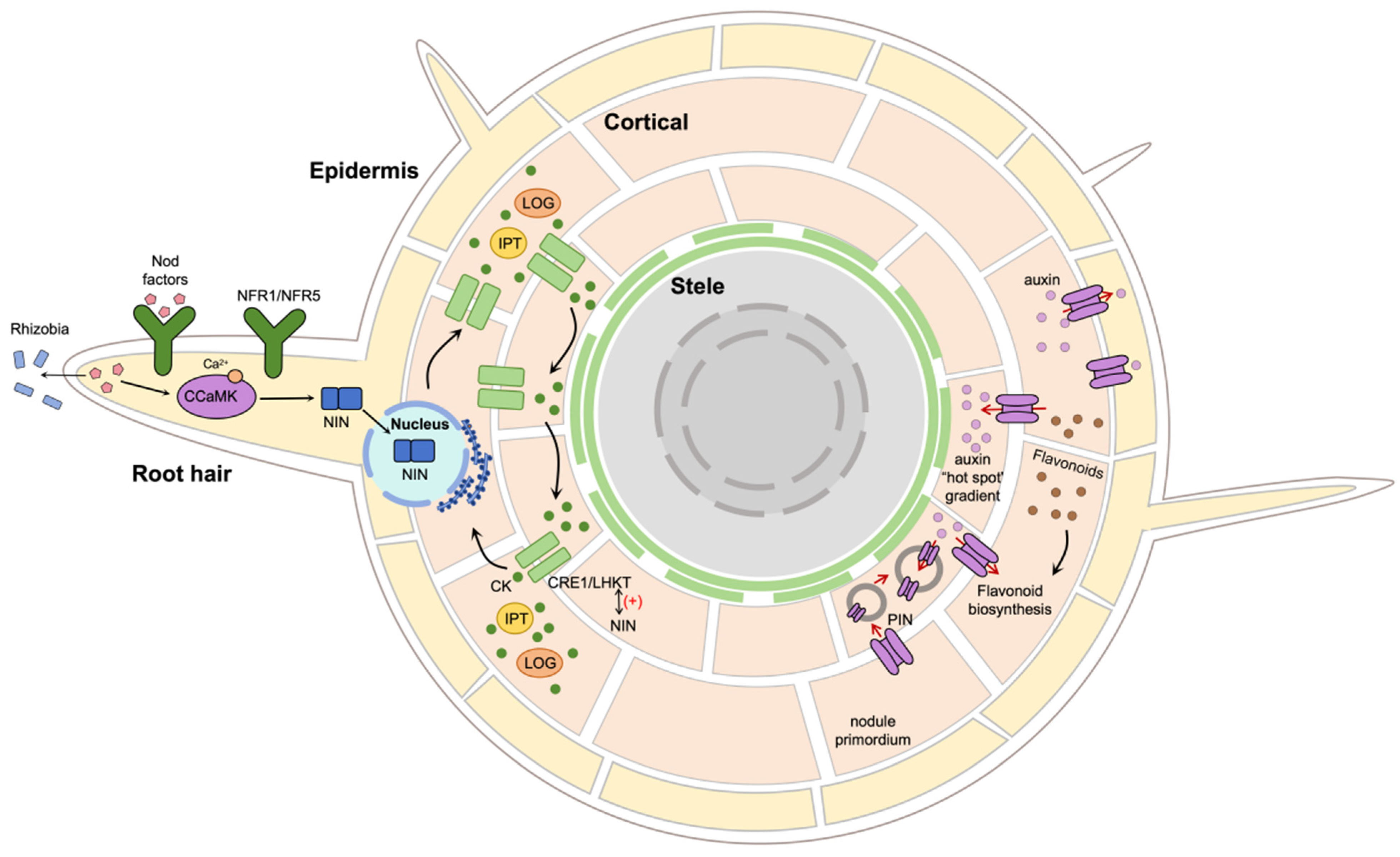
6.1. Nodule Organogenesis: The Unique Cortical Response to Cytokinin in Legumes
6.2. Working Model: Quantitative Gating Hypotheses and Their Current Limits
6.3. Established Versus Inferential Nodes in the Nodulation Cytokinin Network
6.4. Molecular Mechanisms of Nodule Initiation
6.4.1. Hormonal Interaction I: The Cytokinin–Flavonoid–PIN Axis and Local Auxin Maxima in the Nodule Primordium
6.4.2. Hormonal Interaction II: Fine-Tuning Infection and Nodulation Through Ethylene and ABA
6.5. Signal Supply: Local Biosynthesis, Transport, and Degradation During Nodule Development
6.6. Systemic Integration of Symbiosis with Whole-Plant Physiology
6.6.1. Cytokinin as a Shoot-Derived Component of Autoregulation of Nodulation
6.6.2. Cytokinin as a Systemic Integrator of Carbon, Nitrogen, and Symbiotic Investment
7. Translational Hypotheses and Synthetic Biology Perspectives
8. Conclusions
8.1. Conclusions and Future Directions
8.2. Priority Directions for the Field
Author Contributions
Funding
Data Availability Statement
Acknowledgments
Conflicts of Interest
Abbreviations
References
- Hill, K.; Mathews, D.E.; Kim, H.J.; Street, I.H.; Wildes, S.L.; Chiang, Y.H.; Mason, M.G.; Alonso, J.M.; Ecker, J.R.; Kieber, J.J.; et al. Functional Characterization of Type-B Response Regulators in the Arabidopsis Cytokinin Response. Plant Physiol. 2013, 162, 212–224. [Google Scholar] [CrossRef] [PubMed]
- Reid, D.; Nadzieja, M.; Novák, O.; Heckmann, A.B.; Sandal, N.; Stougaard, J. Cytokinin Biosynthesis Promotes Cortical Cell Responses During Nodule Development. Plant Physiol. 2017, 175, 361–375. [Google Scholar] [CrossRef] [PubMed]
- Pils, B.; Heyl, A. Unraveling the Evolution of Cytokinin Signaling. Plant Physiol. 2009, 149, 782–791. [Google Scholar] [CrossRef]
- Hwang, I.; Sheen, J.; Müller, B. Cytokinin signaling networks. Annu. Rev. Plant Biol. 2012, 63, 353–380. [Google Scholar] [CrossRef]
- Müller, B. Generic signal-specific responses: Cytokinin and context-dependent cellular responses. J. Exp. Bot. 2011, 62, 3273–3288. [Google Scholar]
- Pinto, S.; Tajeshwar, N.; Gordon, K. Cytokinin Response of the Streptophyte Alga Coleochaete scutata provides a clue to the evolution of cytokinin signaling. Front. Plant Physiol. 2023, 1, 1275205. [Google Scholar] [CrossRef]
- Powell, A.E.; Heyl, A. The origin and early evolution of cytokinin signaling. Front. Plant Sci. 2023, 14, 1142748. [Google Scholar] [CrossRef]
- Gruhn, N.; Heyl, A. Updates on the model and the evolution of cytokinin signaling. Curr. Opin. Plant Biol. 2013, 16, 569–574. [Google Scholar] [CrossRef]
- Stock, A.M.; Robinson, V.L.; Goudreau, P.N. Two-component signal transduction. Annu. Rev. Biochem. 2000, 69, 183–215. [Google Scholar] [CrossRef] [PubMed]
- Puthiyaveetil, S.; Kavanagh, T.A.; Cain, P.; Sullivan, J.A.; Newell, C.A.; Gray, J.C.; Robinson, C.; van der Giezen, M.; Rogers, M.B.; Allen, J.F. The ancestral symbiont sensor kinase CSK links photosynthesis with gene expression in chloroplasts. Proc. Natl. Acad. Sci. USA 2008, 105, 10061–10066. [Google Scholar] [CrossRef]
- Kirschner, G.K.; Stahl, Y.; Imani, J.; Korff, M.; Simon, R. Fluorescent reporter lines for auxin and cytokinin signalling in barley (Hordeum vulgare). PLoS ONE 2018, 13, e0196086. [Google Scholar]
- Werner, T.; Motyka, V.; Strnad, M.; Schmülling, T. Regulation of plant growth by cytokinin. Proc. Natl. Acad. Sci. USA 2001, 98, 10487–10492. [Google Scholar] [PubMed]
- Nishii, K.; Wright, F.; Chen, Y.Y.; Möller, M. Tangled history of a multigene family: The evolution of ISOPENTENYLTRANSFERASE genes. PLoS ONE 2018, 8, e0201198. [Google Scholar] [CrossRef]
- Kurakawa, T.; Ueda, N.; Maekawa, M.; Kobayashi, K.; Kojima, M.; Nagato, Y.; Sakakibara, H.; Kyozuka, J. Direct control of shoot meristem activity by a cytokinin-activating enzyme. Nature 2007, 445, 652–655. [Google Scholar] [CrossRef]
- Kuroha, T.; Tokunaga, H.; Kojima, M.; Ueda, N.; Ishida, T.; Nagawa, S.; Fukuda, H.; Sugimoto, K.; Sakakibara, H. Functional analyses of LONELY GUY cytokinin-activating enzymes reveal the importance of the direct activation pathway in Arabidopsis. Plant Cell 2009, 10, 3152–3169. [Google Scholar] [CrossRef]
- Chen, L.; Jameson, G.B.; Guo, Y.; Song, J.; Jameson, P.E. The LONELY GUY gene family: From mosses to wheat, the key to the formation of active cytokinins in plants. Plant Biotechnol. J. 2022, 20, 625–645. [Google Scholar] [CrossRef]
- Frébort, I.; Kowalska, M.; Hluska, T.; Frébortová, J.; Galuszka, P. Evolution of cytokinin biosynthesis and degradation. J. Exp. Bot. 2011, 8, 2431–2452. [Google Scholar] [CrossRef]
- Nayar, S.; Sharma, R.; Tyagi, A.K.; Kapoor, S. Exploring the role of a cytokinin-activating enzyme LONELY GUY in unicellular microalga Chlorella variabilis. Front. Plant Sci. 2021, 11, 611871. [Google Scholar] [CrossRef] [PubMed]
- Jain, P.; Singh, A.; Iquebal, M.A.; Jaiswal, S.; Kumar, S.; Kumar, D.; Rai, A. Genome-Wide Analysis and Evolutionary Perspective of the Cytokinin Dehydrogenase Gene Family in Wheat (Triticum aestivum L.). Front. Genet. 2022, 13, 931659. [Google Scholar] [CrossRef]
- Rong, C.; Liu, Y.; Chang, Z.; Liu, Z.; Ding, Y.; Ding, C. Cytokinin oxidase/dehydrogenase family genes exhibit functional divergence and overlap in rice growth and development, especially in control of tillering. J. Exp. Bot. 2022, 73, 3552–3568. [Google Scholar] [CrossRef]
- Rashid, A.; Achary, V.M.M.; Abdin, M.Z.; Karippadakam, S.; Parmar, H.; Panditi, V.; Prakash, G.; Bhatnagar-Mathur, P.; Reddy, M.K. Cytokinin oxidase2-deficient mutants improve panicle and grain architecture through cytokinin accumulation and enhance drought tolerance in indica rice. Plant Cell Rep. 2024, 43, 207. [Google Scholar] [CrossRef]
- Lomin, S.N.; Krivosheev, D.M.; Steklov, M.Y.; Arkhipov, D.V.; Osolodkin, D.I.; Schmülling, T.; Romanov, G.A. Plant membrane assays with cytokinin receptors underpin the unique role of free cytokinin bases as biologically active ligands. J. Exp. Bot. 2015, 66, 1851–1863. [Google Scholar] [CrossRef]
- Kieber, J.J.; Schaller, G.E. Cytokinin signaling in plant development. Development 2018, 145, 149344. [Google Scholar] [CrossRef]
- Vescovi, M.; Riefler, M.; Gessuti, M.; Novák, O.; Schmülling, T.; Schiavo, F.L. Programmed cell death induced by high levels of cytokinin in Arabidopsis cultured cells is mediated by the cytokinin receptor CRE1/AHK4. J. Exp. Bot. 2012, 63, 2825–2832. [Google Scholar] [CrossRef] [PubMed]
- Riefler, M.; Novak, O.; Strnad, M.; Schmülling, T. Arabidopsis cytokinin receptor mutants reveal functions in shoot growth, leaf senescence, seed size, germination, root development, and cytokinin metabolism. Plant Cell 2006, 18, 40–54. [Google Scholar] [CrossRef] [PubMed]
- Kurepa, J.; Shull, T.E.; Smalle, J.A. Friends in Arms: Flavonoids and the Auxin/Cytokinin Balance in Terrestrialization. Plants 2023, 12, 517. [Google Scholar] [CrossRef] [PubMed]
- Anantharaman, V.; Aravind, L. The CHASE domain: A predicted ligand-binding module in plant cytokinin receptors and other eukaryotic and bacterial receptors. Trends Biochem. Sci. 2001, 26, 579–582. [Google Scholar] [CrossRef]
- Battenberg, K.; Hayashi, M. Evolution of root nodule symbiosis: Focusing on the transcriptional regulation from the genomic point of view. Plant Biotechnol. 2022, 39, 79–83. [Google Scholar] [CrossRef]
- Gouran, M.; Brady, S.M. The transcriptional integration of environmental cues with root cell type development. Plant Physiol. 2024, 196, 2150–2161. [Google Scholar] [CrossRef]
- Aki, S.S.; Mikami, T.; Naramoto, S.; Nishihama, R.; Ishizaki, K.; Kojima, M.; Takebayashi, Y.; Sakakibara, H.; Kyozuka, J.; Kohchi, T.; et al. Cytokinin Signaling Is Essential for Organ Formation in Marchantia polymorpha. Plant Cell Physiol. 2019, 60, 1842–1854. [Google Scholar] [CrossRef]
- Hothorn, M.; Dabi, T.; Chory, J. Structural basis for cytokinin recognition by Arabidopsis thaliana histidine kinase 4. Nat. Chem. Biol. 2011, 7, 766–768. [Google Scholar] [CrossRef]
- Mähönen, A.P.; Higuchi, M.; Törmäkangas, K.; Miyawaki, K.; Pischke, M.S.; Sussman, M.R.; Helariutta, Y.; Kakimoto, T. Cytokinins regulate a bidirectional phosphorelay network in Arabidopsis. Curr. Biol. 2006, 16, 1116–1122. [Google Scholar] [CrossRef]
- Punwani, J.A.; Hutchison, C.E.; Schaller, G.E.; Kieber, J.J. The subcellular distribution of the Arabidopsis histidine phosphotransfer proteins is independent of cytokinin signaling. Plant J. 2010, 62, 473–482. [Google Scholar] [CrossRef]
- Zubo, Y.O.; Blakley, I.C.; Yamburenko, M.V.; Worthen, J.M.; Street, I.H.; Franco-Zorrilla, J.M.; Zhang, W.; Hill, K.; Raines, T.; Solano, R.; et al. Cytokinin induces genome-wide binding of the type-B response regulator ARR10 to regulate growth and development in Arabidopsis. Proc. Natl. Acad. Sci. USA 2017, 114, E5995–E6004. [Google Scholar] [CrossRef]
- To, J.P.C.; Deruère, J.; Maxwell, B.B.; Morris, V.F.; Hutchison, C.E.; Ferreira, F.J.; Schaller, G.E.; Kieber, J.J. Cytokinin regulates type-A Arabidopsis response regulator activity and protein stability via two-component phosphorelay. Plant Cell 2007, 19, 3901–3914. [Google Scholar] [PubMed]
- Sakakibara, H. Cytokinin biosynthesis and transport for systemic nitrogen signaling. Plant J. 2021, 105, 421–430. [Google Scholar] [CrossRef] [PubMed]
- Rashotte, A.M. The evolution of cytokinin signaling and its role in development before angiosperms. Semin. Cell Dev. Biol. 2021, 109, 31–38. [Google Scholar] [CrossRef]
- Hirose, N.; Takei, K.; Kuroha, T.; Kamada-Nobusada, T.; Hayashi, H.; Sakakibara, H. Regulation of cytokinin biosynthesis, compartmentalization and translocation. J. Exp. Bot. 2008, 59, 75–83. [Google Scholar] [PubMed]
- Ko, D.; Kang, J.; Kiba, T.; Park, J.; Kojima, M.; Do, J.; Kim, K.Y.; Kwon, M.; Endler, A.; Song, W.Y.; et al. Arabidopsis ABCG14 is essential for the root-to-shoot translocation of cytokinin. Proc. Natl. Acad. Sci. USA 2014, 111, 7150–7155. [Google Scholar]
- Zhang, K.; Novak, O.; Wei, Z.; Gou, M.; Zhang, X.; Yu, Y.; Yang, H.; Cai, Y.; Strnad, M.; Liu, C.J. Arabidopsis ABCG14 protein controls the acropetal translocation of root-synthesized cytokinins. Nat. Commun. 2014, 5, 3274. [Google Scholar] [CrossRef]
- Tessi, T.M.; Maurino, V.G.; Shahriari, M.; Meissner, E.; Novák, O.; Pasternak, T.; Duerr, J.; Flubacher, N.S.; Nautscher, M.; Williams, A.; et al. AZG1 is a cytokinin transporter that interacts with auxin transporter PIN1 and regulates the root stress response. New Phytol. 2023, 238, 1924–1941. [Google Scholar] [CrossRef] [PubMed]
- Suzaki, T.; Ito, M.; Kawaguchi, M. Genetic basis of cytokinin and auxin functions during root nodule development. Front. Plant Sci. 2013, 4, 42. [Google Scholar] [CrossRef] [PubMed]
- Li, S.M.; Zheng, H.X.; Zhang, X.S.; Sui, N. Cytokinins as central regulators during plant growth and stress response. Plant Cell Rep. 2021, 40, 271–282. [Google Scholar]
- Bedini, A.; Mercy, L.; Schneider, C.; Franken, P.; Lucic-Mercy, E. Unraveling the Initial Plant Hormone Signaling, Metabolic Mechanisms and Plant Defense Triggering the Endomycorrhizal Symbiosis Behavior. Front. Plant Sci. 2018, 9, 1800. [Google Scholar] [CrossRef]
- Liu, J.; Rowe, J.; Lindsey, K. Hormonal crosstalk for root development: A combined experimental and modeling perspective. Front. Plant Sci. 2014, 5, 116. [Google Scholar] [CrossRef] [PubMed]
- Gan, S.; Amasino, R.M. Inhibition of leaf senescence by autoregulated production of cytokinin. Science 1995, 270, 1986–1988. [Google Scholar] [CrossRef]
- Kant, S.; Burch, D.; Badenhorst, P.; Palanisamy, R.; Mason, J.; Spangenberg, G. Regulated expression of a cytokinin biosynthesis gene IPT delays leaf senescence and improves yield under rainfed and irrigated conditions in canola (Brassica napus L.). PLoS ONE 2015, 10, e0116349. [Google Scholar] [CrossRef]
- Joshi, S.; Choukimath, A.; Isenegger, D.; Panozzo, J.; Spangenberg, G.; Kant, S. Improved Wheat Growth and Yield by Delayed Leaf Senescence Using Developmentally Regulated Expression of a Cytokinin Biosynthesis Gene. Front. Plant Sci. 2019, 10, 1285. [Google Scholar] [CrossRef]
- Gala, H.P.; Lanctot, A.; Jean-Baptiste, K.; Guiziou, S.; Chu, J.C.; Zemke, J.E.; George, W.; Queitsch, C.; Cuperus, J.T.; Nemhauser, J.L. A single-cell view of the transcriptome during lateral root initiation in Arabidopsis thaliana. Plant Cell 2021, 33, 2197–2220. [Google Scholar]
- Su, Y.H.; Zhou, C.; Li, Y.J.; Yu, Y.; Tang, L.P.; Zhang, W.J.; Yao, W.J.; Huang, R.; Laux, T.; Zhang, X.S. Integration of pluripotency pathways regulates stem cell maintenance in the Arabidopsis shoot meristem. Proc. Natl. Acad. Sci. USA 2020, 117, 22561–22571. [Google Scholar]
- Lv, K.; Liu, N.; Niu, Y.; Song, X.; Liu, Y.; Yue, Z.; Ali, M.; Guo, Q.; Lv, C.; Lu, D.; et al. Spatial transcriptome analysis reveals de novo regeneration of poplar roots. Hortic. Res. 2024, 11, 237. [Google Scholar] [CrossRef] [PubMed]
- Aizezi, Y.; Shu, H.; Zhang, L.; Zhao, H.; Peng, Y.; Lan, H.; Xie, Y.; Li, J.; Wang, Y.; Guo, H. Cytokinin regulates apical hook development via the coordinated actions of EIN3/EIL1 and PIF transcription factors in Arabidopsis. J. Exp. Bot. 2022, 73, 213–227. [Google Scholar] [CrossRef]
- Polanská, L.; Vičánková, A.; Nováková, M.; Malbeck, J.; Dobrev, P.I.; Brzobohatý, B.; Vaňková, R.; Macháčková, I. Altered cytokinin metabolism affects cytokinin, auxin, and abscisic acid contents in leaves and chloroplasts, and chloroplast ultrastructure in transgenic tobacco. J. Exp. Bot. 2007, 58, 637–649. [Google Scholar] [CrossRef]
- Cortleven, A.; Nitschke, S.; Klaumünzer, M.; Abdelgawad, H.; Asard, H.; Grimm, B.; Riefler, M.; Schmülling, T. A novel protective function for cytokinin in the light stress response is mediated by the Arabidopsis histidine kinase 2 and Arabidopsis histidine kinase 3 receptors. Plant Physiol. 2014, 166, 1470–1483. [Google Scholar] [CrossRef] [PubMed]
- Deikman, J.; Hammer, P.E. Induction of anthocyanin accumulation by cytokinins in Arabidopsis thaliana. Plant Physiol. 1995, 1, 47–57. [Google Scholar] [CrossRef]
- Wang, D.; Dong, W.; Murray, J.; Wang, E. Innovation and appropriation in mycorrhizal and rhizobial Symbioses. Plant Cell 2022, 34, 1573–1599. [Google Scholar] [CrossRef] [PubMed]
- Laffont, C.; Rey, T.; André, O.; Novero, M.; Kazmierczak, T.; Debellé, F.; Bonfante, P.; Jacquet, C.; Frugier, F. The CRE1 cytokinin pathway is differentially recruited depending on Medicago truncatula root environments and negatively regulates resistance to a pathogen. PLoS ONE 2015, 10, e0116819. [Google Scholar] [CrossRef]
- Cosme, M.; Ramireddy, E.; Franken, P.; Schmülling, T.; Wurst, S. Shoot- and root-borne cytokinin influences arbuscular mycorrhizal symbiosis. Mycorrhiza 2016, 26, 709–720. [Google Scholar] [CrossRef]
- Balzergue, C.; Puech-Pagès, V.; Bécard, G.; Rochange, S.F. The regulation of arbuscular mycorrhizal symbiosis by phosphate in pea involves early and systemic signalling events. J. Exp. Bot. 2011, 62, 1049–1060. [Google Scholar] [CrossRef]
- Murray, J.D.; Karas, B.J.; Sato, S.; Tabata, S.; Amyot, L.; Szczyglowski, K. A cytokinin perception mutant colonized by Rhizobium in the absence of nodule organogenesis. Science 2007, 315, 101–104. [Google Scholar] [CrossRef]
- Tirichine, L.; Sandal, N.; Madsen, L.H.; Radutoiu, S.; Albrektsen, A.S.; Sato, S.; Asamizu, E.; Tabata, S.; Stougaard, J. A gain-of-function mutation in a cytokinin receptor triggers spontaneous root nodule organogenesis. Science 2007, 315, 104–107. [Google Scholar] [CrossRef]
- Tsikou, D.; Yan, Z.; Holt, D.B.; Abel, N.B.; Reid, D.E.; Madsen, L.H.; Bhasin, H.; Sexauer, M.; Stougaard, J.; Markmann, K. Systemic control of legume susceptibility to rhizobial infection by a mobile microRNA. Science 2018, 362, 233–236. [Google Scholar] [CrossRef]
- Okuma, N.; Soyano, T.; Suzaki, T.; Kawaguchi, M. MIR2111-5 locus and shoot-accumulated mature miR2111 systemically enhance nodulation depending on HAR1 in Lotus japonicus. Nat. Commun. 2020, 11, 5192. [Google Scholar] [CrossRef]
- Akhtar, S.S.; Mekureyaw, M.F.; Pandey, C.; Roitsch, T. Role of Cytokinins for Interactions of Plants with Microbial Pathogens and Pest Insects. Front. Plant Sci. 2020, 10, 1777. [Google Scholar] [CrossRef] [PubMed]
- Foo, E.; Ross, J.J.; Jones, W.T.; Reid, J.B. Plant hormones in arbuscular mycorrhizal symbioses. Ann. Bot. 2013, 111, 769–779. [Google Scholar] [CrossRef]
- Barker, S.; Tagu, D. The Roles of Auxins and Cytokinins in Mycorrhizal Symbioses. J. Plant Growth Regul. 2000, 19, 144–154. [Google Scholar] [CrossRef]
- Goh, D.; Vysotskaya, L.; Reid, J.B.; Foo, E. A stimulatory role for cytokinin in the arbuscular mycorrhizal symbiosis of pea. Front. Plant Sci. 2019, 10, 262. [Google Scholar] [CrossRef] [PubMed]
- Miri, M.; Janakirama, P.; Huebert, T.; Ross, L.; McDowell, T.; Orosz, K.; Markmann, K.; Szczyglowski, K. Inside out: Root cortex-localized LHK1 cytokinin receptor limits epidermal infection of Lotus japonicus roots by Mesorhizobium loti. New Phytol. 2019, 222, 1523–1537. [Google Scholar] [CrossRef]
- Soyano, T.; Akamatsu, A.; Takeda, N.; Watahiki, M.K.; Goh, T.; Okuma, N.; Suganuma, N.; Kojima, M.; Takebayashi, Y.; Sakakibara, H.; et al. Periodic cytokinin responses in Lotus japonicus rhizobium infection and nodule development. Science 2024, 385, 288–294. [Google Scholar] [CrossRef]
- Lin, J.; Roswanjaya, Y.P.; Kohlen, W.; Stougaard, J.; Reid, D. Nitrate restricts nodule organogenesis through inhibition of cytokinin biosynthesis in Lotus japonicus. Nat. Commun. 2021, 12, 6544. [Google Scholar] [CrossRef] [PubMed]
- Triozzi, P.M.; Irving, T.B.; Schmidt, H.W.; Keyser, Z.P.; Chakraborty, S.; Balmant, K.; Pereira, W.J.; Dervinis, C.; Mysore, K.S. Spatiotemporal cytokinin response imaging and ISOPENTENYLTRANSFERASE 3 function in Medicago nodule development. Plant Physiol. 2022, 188, 560–575. [Google Scholar] [CrossRef]
- Soyano, T.; Kouchi, H.; Hirota, A.; Hayashi, M. Nodule inception directly targets NF-Y subunit genes to regulate essential processes of root nodule development in Lotus japonicus. PLoS Genet. 2013, 9, e1003352. [Google Scholar] [CrossRef] [PubMed]
- Li, H.; Ou, Y.; Huang, K.; Zhang, Z.; Cao, Y.; Zhu, H. A pathogenesis-related protein, PRP1, negatively regulates root nodule symbiosis in Lotus japonicus. J. Exp. Bot. 2024, 75, 3542–3556. [Google Scholar] [CrossRef]
- Wang, T.; Guo, J.; Peng, Y.; Lyu, X.; Liu, B.; Sun, S.; Wang, X. Light-induced mobile factors from shoots regulate rhizobium-triggered soybean root nodulation. Science 2021, 374, 65–71. [Google Scholar] [CrossRef]
- Wasson, A.P.; Pellerone, F.I.; Mathesius, U. Silencing the flavonoid pathway in Medicago truncatula inhibits root nodule formation and prevents auxin transport regulation by rhizobia. Plant Cell 2006, 18, 1617–1629. [Google Scholar] [CrossRef]
- Gao, Z.; Chen, Z.; Cui, Y.; Ke, M.; Xu, H.; Xu, Q.; Chen, J.; Li, Y.; Huang, L.; Zhao, H.; et al. GmPIN-dependent polar auxin transport is involved in soybean nodule development. Plant Cell 2021, 3, 2981–3003. [Google Scholar] [CrossRef]
- Hansen, M.; Chae, H.S.; Kieber, J.J. Regulation of ACS protein stability by cytokinin and brassinosteroid. Plant J. 2009, 4, 606–614. [Google Scholar] [CrossRef] [PubMed]
- Ding, Y.; Kalo, P.; Yendrek, C.; Sun, J.; Liang, Y.; Marsh, J.F.; Harris, J.M.; Oldroyd, G.E.D. Abscisic acid coordinates nod factor and cytokinin signaling during the regulation of nodulation in Medicago truncatula. Plant Cell 2008, 10, 2681–2695. [Google Scholar] [CrossRef] [PubMed]
- Reid, D.E.; Heckmann, A.B.; Novák, O.; Kelly, S.; Stougaard, J. CYTOKININ OXIDASE/DEHYDROGENASE3 Maintains Cytokinin Homeostasis During Root and Nodule Development in Lotus japonicus. Plant Physiol. 2016, 170, 1060–1074. [Google Scholar] [CrossRef]
- Reid, D.E.; Ferguson, B.J.; Hayashi, S.; Lin, Y.H.; Gresshoff, P.M. Molecular mechanisms controlling legume autoregulation of nodulation. Ann. Bot. 2011, 108, 789–795. [Google Scholar] [CrossRef] [PubMed]
- Okamoto, S.; Shinohara, H.; Mori, T.; Matsubayashi, Y.; Kawaguchi, M. Root-derived CLE glycopeptides control nodulation by direct binding to HAR1 receptor kinase. Nat. Commun. 2013, 4, 2191. [Google Scholar] [CrossRef]
- Chaulagain, D.; Frugoli, J. The Regulation of Nodule Number in Legumes Is a Balance of Three Signal Transduction Pathways. Int. J. Mol. Sci. 2021, 22, 1117. [Google Scholar] [CrossRef]
- Sasaki, T.; Suzaki, T.; Soyano, T.; Kojima, M.; Sakakibara, H.; Kawaguchi, M. Shoot-derived cytokinins systemically regulate root nodulation. Nat. Commun. 2014, 5, 4983. [Google Scholar] [CrossRef]
- Tao, K.; Jensen, I.T.; Zhang, S.; Villa-Rodríguez, E.; Blahovska, Z.; Salomonsen, C.L.; Martyn, A.; Björgvinsdóttir, Þ.N.; Kelly, S.; Janss, L.; et al. Nitrogen and Nod factor signaling determine Lotus japonicus root exudate composition and bacterial assembly. Nat. Commun. 2024, 15, 3436. [Google Scholar] [CrossRef]
- Werner, T.; Nehnevajova, E.; Köllmer, I.; Novák, O.; Strnad, M.; Krämer, U.; Schmülling, T. Root-specific reduction of cytokinin causes enhanced root growth, drought tolerance, and leaf mineral enrichment in Arabidopsis and tobacco. Plant Cell 2010, 22, 3905–3920. [Google Scholar] [CrossRef]
- Kuppu, S.; Mishra, N.; Hu, R.; Sun, L.; Zhu, X.; Shen, G.; Blumwald, E. Water-deficit inducible expression of a cytokinin biosynthetic gene IPT improves drought tolerance in cotton. PLoS ONE 2013, 8, e64190. [Google Scholar] [CrossRef]
- Peleg, Z.; Reguera, M.; Tumimbang, E.; Walia, H.; Blumwald, E. Cytokinin-mediated source/sink modifications improve drought tolerance and increase grain yield in rice under water-stress. Plant Biotechnol. J. 2011, 9, 747–758. [Google Scholar] [CrossRef] [PubMed]
- Albrecht, T.; Argueso, C.T. Should I fight or should I grow now? The role of cytokinins in plant growth and immunity and in the growth-defence trade-off. Ann. Bot. 2017, 119, 725–735. [Google Scholar] [CrossRef] [PubMed]
- Ashikari, M.; Sakakibara, H.; Lin, S.; Yamamoto, T.; Takashi, T.; Nishimura, A.; Angeles, E.R.; Qian, Q.; Kitano, H.; Matsuoka, M. Cytokinin oxidase regulates rice grain production. Science 2005, 309, 741–745. [Google Scholar] [CrossRef]
- Khandal, H.; Gupta, S.K.; Dwivedi, V.; Mandal, D.; Sharma, N.K.; Vishwakarma, N.K.; Pal, L.; Choudhary, M.; Francis, A.; Malakar, P.; et al. Root-specific expression of chickpea cytokinin oxidase/dehydrogenase 6 leads to enhanced root growth, drought tolerance and yield without compromising nodulation. Plant Biotechnol. J. 2020, 18, 2225–2240. [Google Scholar] [CrossRef] [PubMed]
- Qin, H.; Gu, Q.; Zhang, J.; Sun, L.; Kuppu, S.; Zhang, Y.; Burow, M.; Payton, P.; Blumwald, E.; Zhang, H. Regulated expression of an isopentenyltransferase gene (IPT) in peanut significantly improves drought tolerance and increases yield under field conditions. Plant Cell Physiol. 2011, 52, 1904–1914. [Google Scholar] [CrossRef] [PubMed]
- Tsitsikli, M.; Simonsen, B.; Luu, T.B.; Larsen, M.M.; Andersen, C.G.; Gysel, K.; Lironi, D.; Krönauer, C.; Rübsam, H.; Hansen, S.B.; et al. Two residues reprogram immunity receptors for nitrogen-fixing symbiosis. Nature 2025, 648, 443–450. [Google Scholar] [CrossRef] [PubMed]



| Evolutionary Innovation Event. | Key Genes/Components | Functional Significance | Comparative Evolutionary Interpretation | Supporting Literature |
|---|---|---|---|---|
| Emergence of the core TCS module | Core histidine kinases (HKs) and response regulators (RRs) | Establishes a His–Asp phosphorelay signaling module | Provides a reusable ‘integrative layer’ for coupling environmental sensing to developmental regulation, later specialized for hormone control | [9] |
| Emergence of CHASE- containing HK receptors | CHASE-HK receptor | Confers cytokinin-specific perception via CHASE domain receptors | Links an ancestral phosphorelay to hormone-defined inputs, supporting context-specific developmental and symbiotic deployment | [27] |
| The emergence of AP-IPTs | Adenosine phosphate IPTs (AP-IPTs) | Activates efficient de novo synthesis of highly active CKs (tZ, iP) | Enables expansion of bioactive CK pools and tighter coupling of nutrient status to multicellular developmental programs | [28] |
| Differentiation of Type-A and Type-B RRs | Type-A and Type-B RRs | Establishes a positive activation and negative feedback loop | Ensures the transience, robustness, and precise control of signals | [7] |
| Expansion of the CKX gene family | CKX gene | Enables spatiotemporally specific degradation of CKs | Fine-tuned regulation of CK homeostasis, balancing growth and stress responses | [17] |
| Host | Fungus | Nutrient Context (P/N) | CK Chemistry | Route of Perturbation | Spatial Scale | Symbiotic Output Class | Outcome Direction | Primary Ref(s)/Inference Level |
|---|---|---|---|---|---|---|---|---|
| Pisum sativum (pea) | Glomus intraradices | Low Pi; early growth | BAP | Exogenous application | Root-local | Accommodation (arbuscule abundance) | Negative (reduced arbuscule incidence) | [59] |
| Medicago truncatula | Gigaspora margarita | Low Pi; colonization stage | Endogenous CK signaling (not chemically resolved) | Receptor mutant, cre1 (MtCRE1) | Root-local | Colonization, arbuscules, and host growth | Null/conditional (colonization largely maintained; root architecture altered) | [57] |
| Medicago truncatula | Rhizophagus irregularis | Low Pi; early colonization | Exogenous CK | Exogenous application | Root-local | Entry versus accommodation (separable readouts) | Context-dependent | [57,59] |
| Nicotiana tabacum (tobacco) | Rhizophagus irregularis | Moderate Pi | Reduced root CK | CKX overexpression | Root-local/systemic effect unresolved | Colonization rate and accommodation | Negative (decreased colonization) | [58] |
| Nicotiana tabacum (tobacco) | Rhizophagus irregularis | Moderate Pi | Increased root CK | IPT overexpression | Root-local/systemic effect unresolved | Colonization rate and early accommodation | Positive in early stages | [58] |
| Various hosts | Various AM fungi | High Pi/low nutrient demand | Not chemically resolved | Conceptual synthesis (not primary experimental perturbation) | Systemic/whole-plant | Carbon allocation and colonization tendency | Often negative/conditional; consistent with nutrient-sufficiency signaling | [23,36] |
| Gene/Family | Species | Evidence-Anchored Role in Nodulation | Network Context | Key Phenotype/Evidence | Primary/Supporting Ref(s) |
|---|---|---|---|---|---|
| CRE1/LHK1 | M. truncatula/L. japonicus | CK perception; initiates cortical cell division and nodule organogenesis | Upstream of NIN; intersects with ethylene/ABA constraints | Loss-of-function reduces nodulation and primordium development; gain-of-function LHK1 can trigger spontaneous nodules | [60,61,68] |
| Type-B RR module | M. truncatula | Transcriptional activation downstream of CK perception during nodule initiation | Links CK signaling to cell cycle and organogenic transcriptional programs | Reduced nodule number | [71,72] |
| NIN | M. truncatula/L. japonicus | Master regulator coordinating infection and organogenesis | Forms positive feedback with CRE1; activates CLE peptide genes in the AON module | Severely impaired or absent nodulation | [42,72] |
| NSP1/NSP2 | M. truncatula/L. japonicus | Core Nod factor signaling components required for nodulation | Functionally intersect with CK-triggered organogenic programs | Nodulation defective | [72,78] |
| MtIPT3 | M. truncatula | CK biosynthesis during nodule development | Supports local CK accumulation and downstream responses | Reduced nodule number and altered nodule development when perturbed | [2,71] |
| LjIpt2/LjLog4 | L. japonicus | Candidate CK biosynthesis/activation nodes during nodule initiation | Likely contribute to local CK supply; exact hierarchy remains context dependent | Reduced initiation efficiency reported in specific genetic backgrounds | [2,36] |
| LjCKX3 | L. japonicus | CK degradation and homeostatic buffering during root and nodule development | Buffers CK levels during root and nodule development | Reduced nodulation and altered infection when perturbed | [79] |
| MtABCG56 | M. truncatula | Candidate CK transport/distribution component during nodulation | May contribute to epidermis–cortex signal partitioning | Perturbation is associated with nodulation defects, but mechanistic resolution remains incomplete | [36] |
| Design Variable | Genetic Lever | Target Crop/Context | Expected Gain (Phenotype) | Major Constraints/Trade-Offs | Required Validation Assays | Key Ref(s) |
|---|---|---|---|---|---|---|
| Increase Yield | OsCKX2 (RNAi/ CRISPR) | Rice | Tiller number ↑, Grains per panicle ↑, 1000-grain weight ↑ | Promising for yield, but requires stage- and tissue-specific tuning; monitor growth–stress trade-offs. | Multi-site field trials; yield components; CK profiling; stress trade-off tests | [89] |
| Delay senescence | SAG12::IPT | Tobacco | Delayed leaf senescence, Biomass ↑ | Can delay senescence and improve biomass, but developmental timing and source–sink penalties must be checked. | Multi-site field trials | [46] |
| Context-specific trait optimization | AtMYB32xs::IPT | Canola | Delayed leaf senescence, Drought tolerance ↑ | Drought-associated gains depend on promoter behavior and environment; monitor pleiotropic effects. | Field trials; drought physiology; root imaging | [47] |
| Stress tolerance | W31:: CaCKX6 (Root- specific) | Chickpea | Root growth ↑, Drought tolerance ↑ | May enhance drought tolerance with limited nodulation penalty; co-evaluate root architecture and N fixation. | Field trials; drought physiology; root imaging; nodulation/N-fixation assays | [90] |
| Context-specific trait optimization | OsCKX2 (CRISPR) | Rice | Water retention capacity ↑, Photosynthetic function ↑ | Improved drought survival is promising, but effects on architecture and reproduction need validation. | Field trials; drought physiology; root imaging; recovery assays | [21] |
| Context-specific trait optimization | PSARK:: IPT | Peanut | Delayed leaf senescence, Drought tolerance ↑ | Reported drought-associated yield gains require validation across soils and seasons. | Field trials; drought physiology; root imaging; recovery assays | [91] |
| Context-specific trait optimization | AtMYB32xs::IPT | Wheat | Delayed leaf senescence, Drought tolerance ↑ | Water-stress gains are encouraging, but promoter behavior, phenology, and yield stability remain constraints. | Field trials; drought physiology; root imaging; recovery assays | [48] |
Disclaimer/Publisher’s Note: The statements, opinions and data contained in all publications are solely those of the individual author(s) and contributor(s) and not of MDPI and/or the editor(s). MDPI and/or the editor(s) disclaim responsibility for any injury to people or property resulting from any ideas, methods, instructions or products referred to in the content. |
© 2026 by the authors. Licensee MDPI, Basel, Switzerland. This article is an open access article distributed under the terms and conditions of the Creative Commons Attribution (CC BY) license.
Share and Cite
Zhang, S.; Jiang, Y.; Fang, J.; Wang, T. Evolutionary Repurposing of Cytokinin Signaling in Plant Development and Symbiosis. Plants 2026, 15, 1370. https://doi.org/10.3390/plants15091370
Zhang S, Jiang Y, Fang J, Wang T. Evolutionary Repurposing of Cytokinin Signaling in Plant Development and Symbiosis. Plants. 2026; 15(9):1370. https://doi.org/10.3390/plants15091370
Chicago/Turabian StyleZhang, Shiqi, Yanping Jiang, Jianing Fang, and Tao Wang. 2026. "Evolutionary Repurposing of Cytokinin Signaling in Plant Development and Symbiosis" Plants 15, no. 9: 1370. https://doi.org/10.3390/plants15091370
APA StyleZhang, S., Jiang, Y., Fang, J., & Wang, T. (2026). Evolutionary Repurposing of Cytokinin Signaling in Plant Development and Symbiosis. Plants, 15(9), 1370. https://doi.org/10.3390/plants15091370