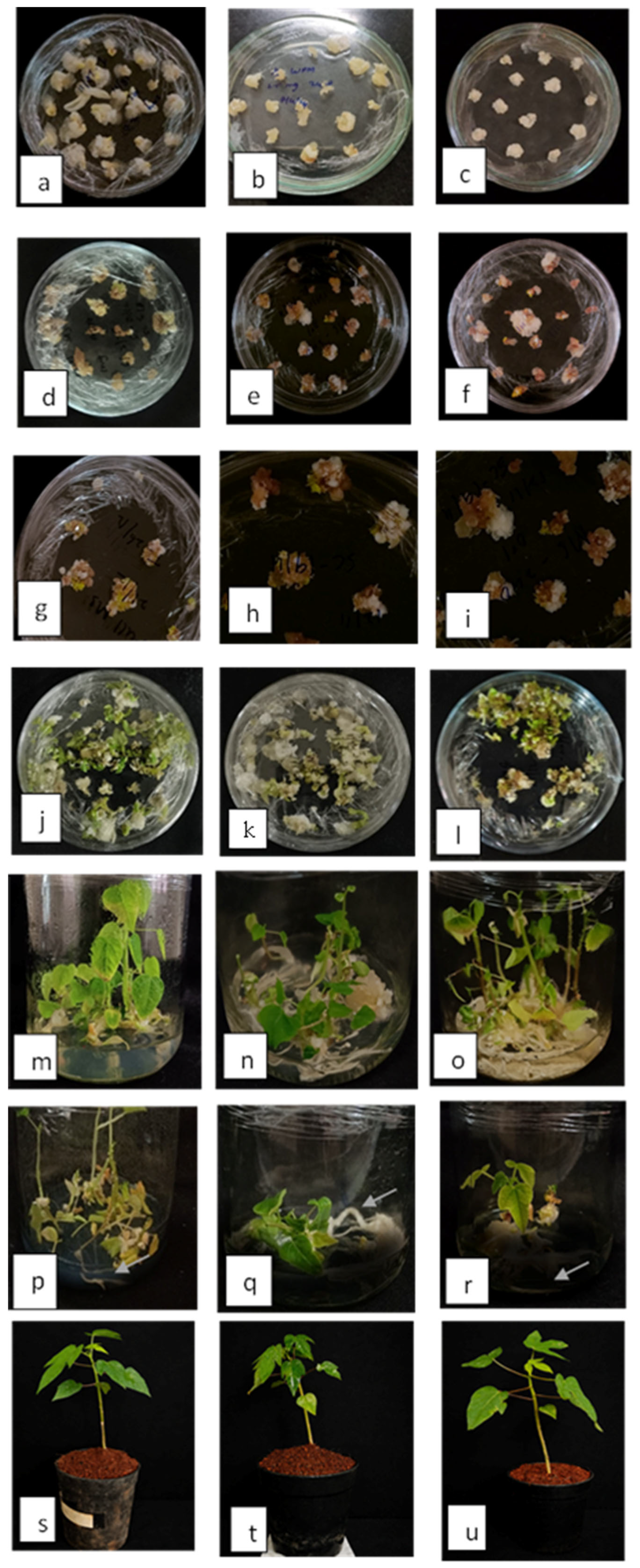
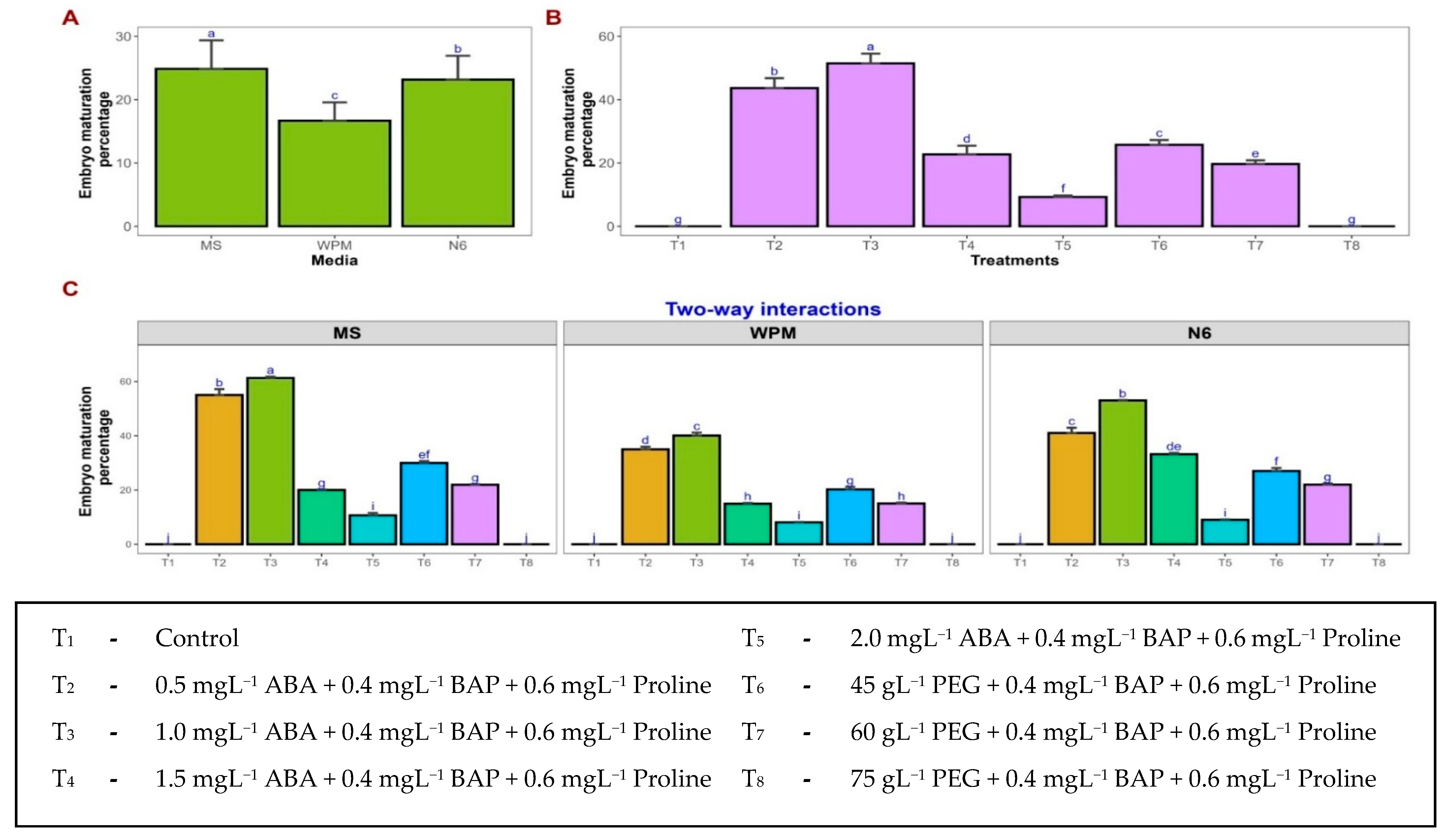
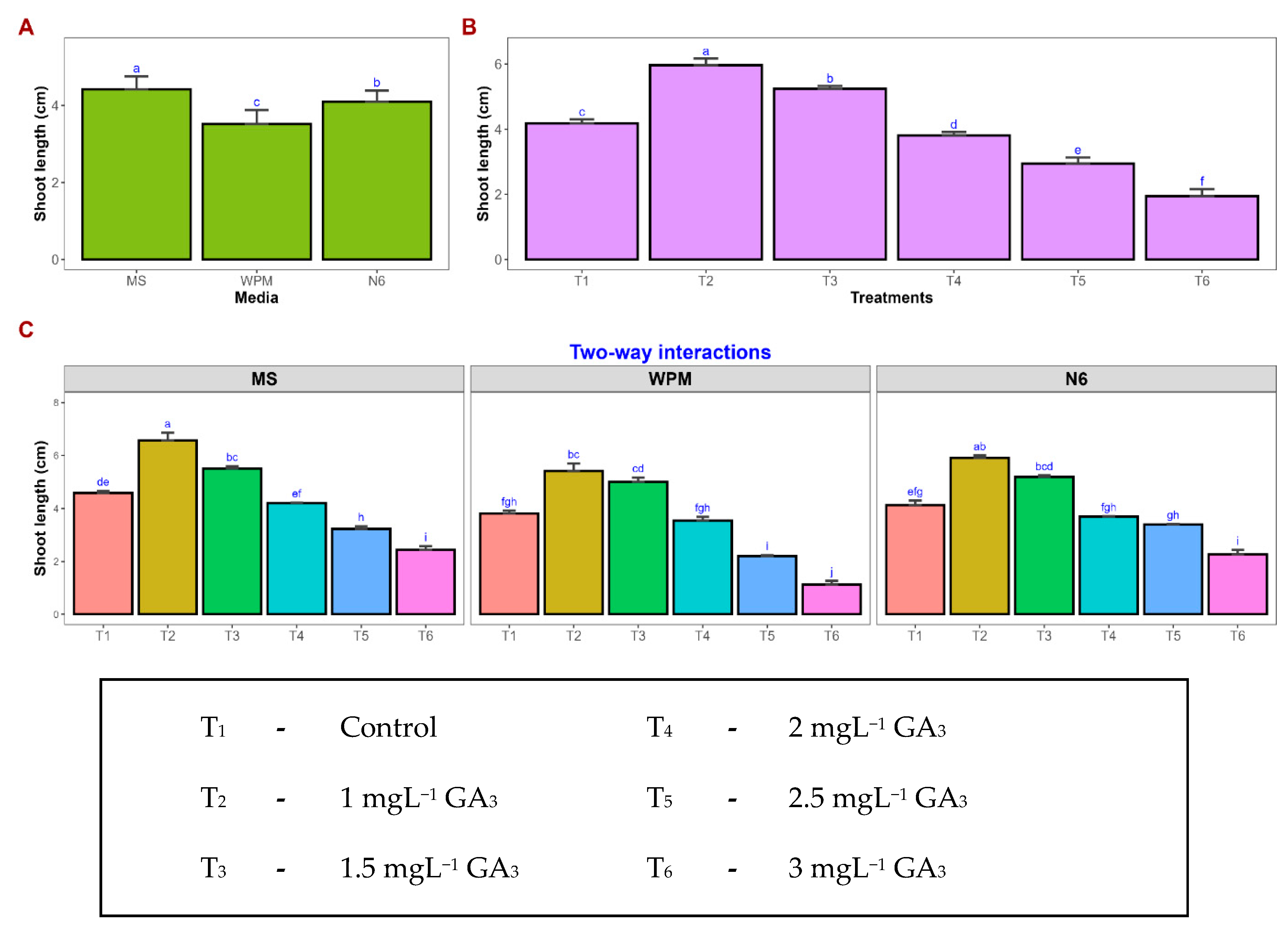
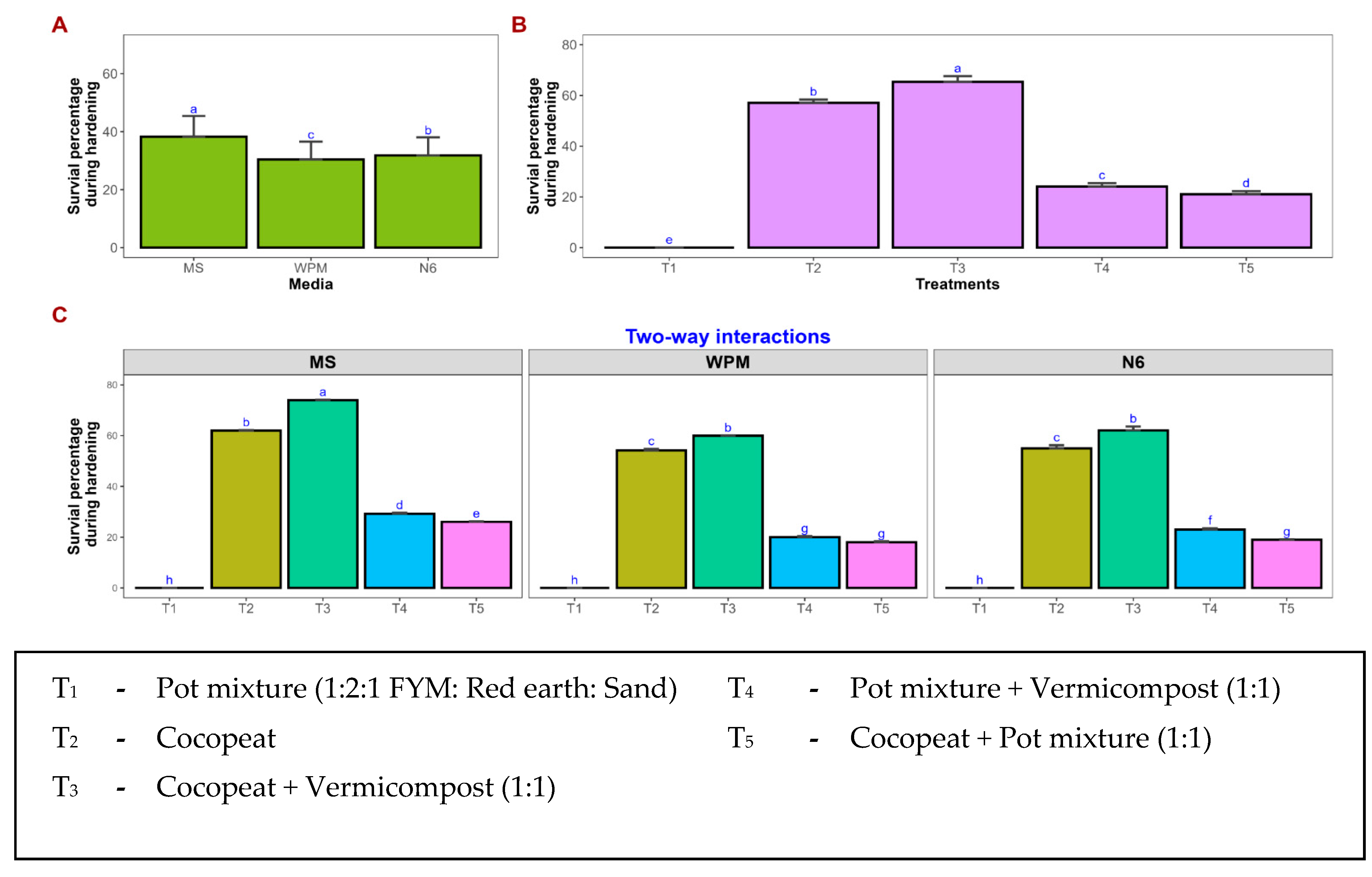
Development of an Efficient Somatic Embryogenesis Protocol for Carica papaya L. Var. TNAU Papaya CO 8 on Different Basal Media

 , , , and
Abstract
1. Introduction
2. Results
2.1. Callus Induction and Embryogenesis Percentage (%)
2.2. Maturation of Somatic Embryos
2.3. Somatic Embryo Regeneration and Shoot Elongation
2.4. Root Induction and Acclimatization
3. Discussion
4. Materials and Methods
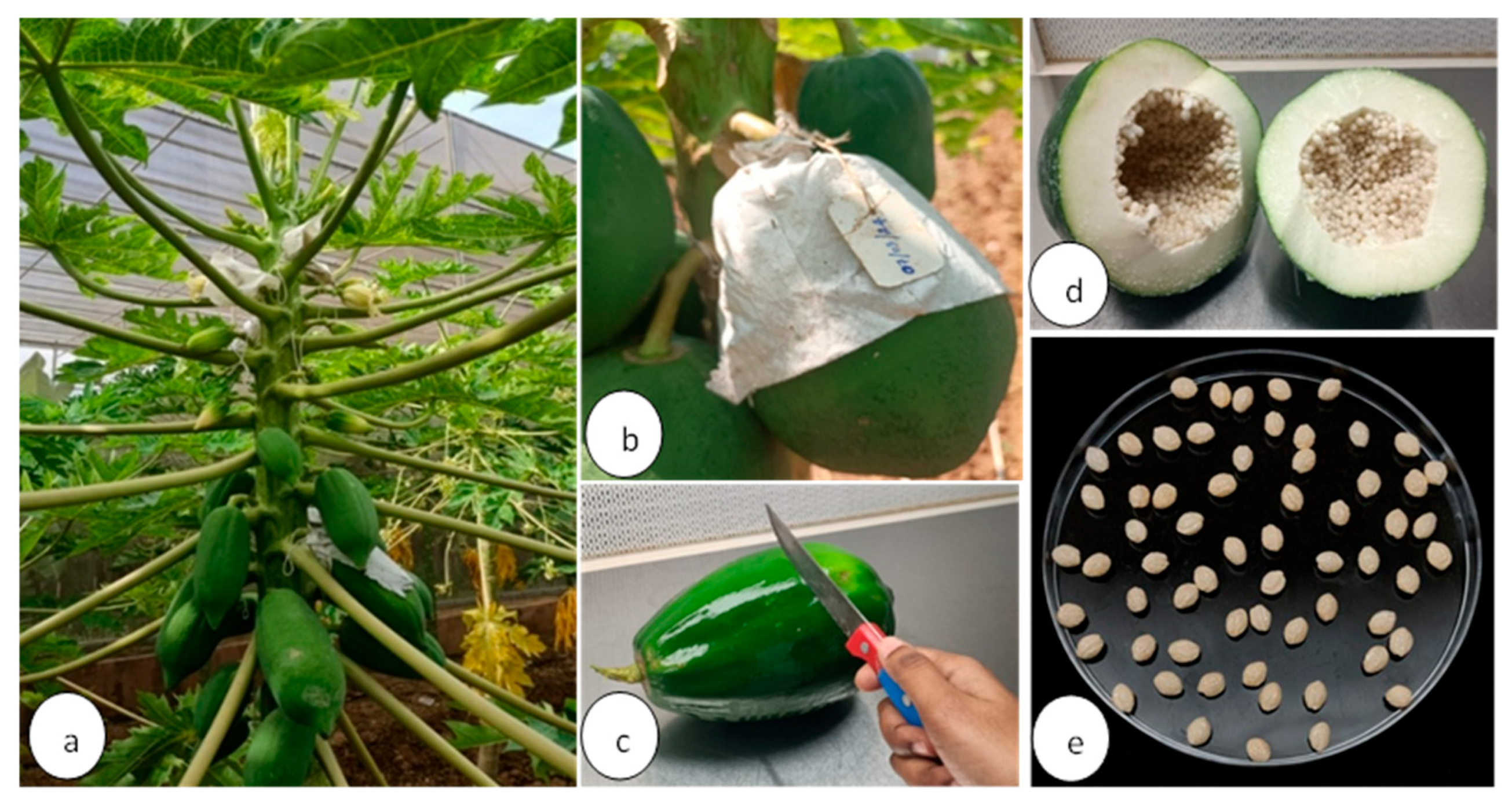
4.1. Planting Material and Disinfection
4.2. Preparation of Basal Nutrient Medium
4.3. Induction and Proliferation of Calli
4.4. Embryo Maturation
4.5. Plant Regeneration from Somatic Embryos and Shoot Elongation
4.6. Root Initiation and Acclimatization
4.7. Statistical Analysis
5. Conclusions
Author Contributions
Funding
Data Availability Statement
Acknowledgments
Conflicts of Interest
Abbreviations
| 2,4-D | 2,4-dichlorophenoxyacetic acid |
| ABA | Abscisic acid |
| BAP | 6-benzylaminopurine |
| GA3 | Gibberellic acid |
| PG | Phloroglucinol |
| IAA | Indole-3-Acetic Acid |
| IBA | Indole-3-butyric acid |
| NAA | Naphthalene Acetic Acid |
| MS | Murashige and Skoog |
| WPM | Woody Plant Medium |
| N6 | CHU |
| AC | Activated Charcoal |
| LEA | Late Embryogenesis Abundant |
| FYM | Farm Yard Manure |
References
- Encina, C.L.; Granero, M.L.; Regalado, J.J. In Vitro Long-Term Cultures of Papaya (Carica papaya L. cv. Solo). Horticulturae 2023, 9, 671. [Google Scholar] [CrossRef]
- Gonsalves, C.; Lee, D.R.; Gonsalves, D. The adoption of genetically modified papaya in Hawaii and its implications for developing countries 1. In Transgenics and the Poor; Routledge: Abingdon-on-Thames, UK, 2013; pp. 177–191. [Google Scholar] [CrossRef]
- Fuentes, G.; Santamaría, J.M. Papaya (Carica papaya L.): Origin, domestication, and production. In Genetics and Genomics of Papaya; Springer: Berlin/Heidelberg, Germany, 2013; pp. 3–15. [Google Scholar] [CrossRef]
- Koul, B.; Pudhuvai, B.; Sharma, C.; Kumar, A.; Sharma, V.; Yadav, D.; Jin, J.-O. Carica papaya L.: A tropical fruit with benefits beyond the tropics. Diversity 2022, 14, 683. [Google Scholar] [CrossRef]
- Babalola, B.A.; Akinwande, A.I.; Otunba, A.A.; Adebami, G.E.; Babalola, O.; Nwufo, C. Therapeutic benefits of Carica papaya: A review on its pharmacological activities and characterization of papain. Arab. J. Chem. 2024, 17, 105369. [Google Scholar] [CrossRef]
- Jiao, M.; Liu, C.; Prieto, M.; Lu, X.; Wu, W.; Sun, J.; García-Oliveira, P.; Tang, X.; Xiao, J.; Simal-Gandara, J. Biological functions and utilization of different part of the papaya: A review. Food Rev. Int. 2023, 39, 6781–6804. [Google Scholar] [CrossRef]
- Choudhary, R.; Kaushik, R.; Chawla, P.; Manna, S. Exploring the extraction, functional properties, and industrial applications of papain from Carica papaya. J. Sci. Food Agric. 2025, 105, 1533–1545. [Google Scholar] [CrossRef] [PubMed]
- Senthilkumar, S.; Kumar, N.; Soorianathasundaram, K.; Kumar, P.J. Aspects on asexual propagation in papaya (Carica papaya L.)-a review. Agric. Rev. 2014, 35, 307–313. [Google Scholar] [CrossRef]
- Kaluram; Vasugi, C.; Thomas, P.; Dinesh, M.; Nandeesha, P. A comparative evaluation of micro-propagated and seed derived plants of intergeneric papaya hybrids. Ind. J. Hortic. 2022, 79, 464–470. [Google Scholar] [CrossRef]
- Mishra, A.K.; Tiwari, K.N.; Mishra, P.; Mishra, S.K.; Tiwari, S.K. Germplasm conservation of economically important medicinal plant Nyctanthes arbortristis L. through encapsulation technique and maintenance under slow growth condition. Plant Cell Tissue Organ Cult. 2022, 149, 281–293. [Google Scholar] [CrossRef]
- Al-Shara, B.; Rosna, M.; Kamaludin, R. Biotechnological methods and limitations of micropropagation in papaya (Carica papaya L.) production: A review. J. Anim. Plant Sci. 2018, 28, 1208–1226. [Google Scholar]
- Mishra, M.; Shukla, N.; Chandra, R. Micropropagation of papaya (Carica papaya L.). In Protocols for Micropropagation of Woody Trees and Fruits; Springer: Berlin/Heidelberg, Germany, 2007; pp. 437–441. [Google Scholar] [CrossRef]
- Mishra, M.; Rajan, S.; Damodaran, T. New paradigm shifts in micropropagation of fruit crops through bioreactors-a review. Ind. J. Hort. 2024, 81, 1–10. [Google Scholar] [CrossRef]
- Shalini, C.; Kavitha, C.; Ganga, M.; Kumar, K.K.; Babu, R.P.; Manoranjitham, S.K.; Auxcilia, J. Clonal propagation for sustainable production in papaya: A review. Plant Sci. Today 2026, 13, 1–11. [Google Scholar] [CrossRef]
- Bindu, B.; Podikunju, B. Tissue culture protocol for in vitro propagation of papaya (Carica papaya L.). J. Krishi Vigyan 2017, 6, 205–212. [Google Scholar] [CrossRef]
- Kanth, N.; Singh, A.K.; Syamal, M. Effect of media pH on shoot proliferation of papaya (Carica papaya L.). Int. J. Curr. Microbiol. Appl. Sci. 2017, 6, 1633–1637. [Google Scholar] [CrossRef]
- Rajesh, C.; Sudhakar, D.; Kumar, K.; Kavitha, C.; Karthikeyan, G.; Soorianathasundaram, K. Somatic Embryogenesis in Papaya (Carica papaya L. cv. TNAU Papaya CO. 8). Curr. J. Appl. Sci. Technol. 2020, 39, 18–26. [Google Scholar] [CrossRef]
- Al-Shara, B.; Taha, R.M.; Mohamad, J.; Elias, H.; Khan, A. Somatic embryogenesis and plantlet regeneration in the Carica papaya L. cv. Eksotika. Plants 2020, 9, 360. [Google Scholar] [CrossRef] [PubMed]
- Rathi, U.; Gupta, A.; Pradhan, P.J.; Choudhury, A.; Patil, B.L.; Mazumdar-Leighton, S.; Rajam, M.V. An improved plant regeneration protocol for a popular Indian Madhubindu variety of papaya (Carica papaya L.) via somatic embryogenesis. Vegetos 2025, 38, 250–259. [Google Scholar] [CrossRef]
- Fernando, J.A.; Melo, M.; Soares, M.K.; Appezzato-da-Glória, B. Anatomy of somatic embryogenesis in Carica papaya L. Braz. Arch. Biol. Technol. 2001, 44, 247–255. [Google Scholar] [CrossRef]
- Girón-Ramírez, A.; Bautista-Bautista, Y.; Estrella-Maldonado, H.; Chan-León, A.; Turrent, E.; Talavera, C.; Solís, A.; Castillo, E.; Fuentes, G.; Santamaría, J.M. Direct Somatic Embryogenesis in Carica papaya L. Genotypes for Genetic Modification Purposes. In Plant Cell Culture Protocols; Springer: Berlin/Heidelberg, Germany, 2024; pp. 279–290. [Google Scholar] [CrossRef]
- Yan, R.; Sun, Y.; Sun, H. Current status and future perspectives of somatic embryogenesis in Lilium. Plant Cell Tissue Organ Cult. 2020, 143, 229–240. [Google Scholar] [CrossRef]
- Guan, Y.; Li, S.-G.; Fan, X.-F.; Su, Z.-H. Application of somatic embryogenesis in woody plants. Front. Plant Sci. 2016, 7, 938. [Google Scholar] [CrossRef]
- Deo, P.C.; Tyagi, A.P.; Taylor, M.; Harding, R.; Becker, D. Factors affecting somatic embryogenesis and transformation in modern plant breeding. South Pac. J. Nat. Appl. Sci. 2011, 28, 27–40. [Google Scholar] [CrossRef]
- Rajan, P.; Kang, J.H.; Natraj, P.; Lim, C.K.; Kim, H.B.; Kim, S.C. Advances, challenges, and future prospects of in vitro propagation in papaya (Carica papaya L.). Plant Cell Tissue Organ Cult. 2025, 161, 36. [Google Scholar] [CrossRef]
- Shukla, M.; Trivedi, M.; Tiwari, R.K. Factors Influencing Somatic Embryogenesis and Regeneration with Particular Reference to Carica papaya L. In Biotechnology and Crop Improvement; CRC Press: Boca Raton, FL, USA, 2022; pp. 79–92. [Google Scholar] [CrossRef]
- Tang, L.P.; Zhang, X.S.; Su, Y.H. Regulation of cell reprogramming by auxin during somatic embryogenesis. Abiotech 2020, 1, 185–193. [Google Scholar] [CrossRef] [PubMed]
- Koti, P.; Bill, T. Plant tissue culture and genetic transformation in crop improvement. J. Bacteriol Mycol Open Access 2025, 13, 61–69. [Google Scholar] [CrossRef]
- Malabadi, R. Histological changes associated with shoot regeneration in the leaf explants of Clitoria ternatea (Linn.) cultured in vitro. J. Phytol. Res. 2002, 15, 169–172. [Google Scholar]
- Murashige, T.; Skoog, F. A revised medium for rapid growth and bio assays with tobacco tissue cultures. Physiol. Plant. 1962, 15, 473. [Google Scholar] [CrossRef]
- Lloyd, G.; McCown, B. Commercially-feasible micropropagation of mountain laurel, Kalmia latifolia, by use of shoot-tip culture. In Proceedings of the International Plant Propagator’s Society; IPPS: Baltimore, MD, USA, 1980; pp. 421–427. [Google Scholar]
- Chu, C.-C. The N6 medium and its applications to anther culture of cereal crops. In Proceedings of Symposium on Plant Tissue Culture, Beijing, China, 25–30 May 1978; Science Press: Beijing, China, 1981; pp. 43–50. [Google Scholar]
- Syeed, R.; Mujib, A.; Malik, M.Q.; Gulzar, B.; Zafar, N.; Mamgain, J.; Ejaz, B. Direct somatic embryogenesis and flow cytometric assessment of ploidy stability in regenerants of Caladium× hortulanum ‘Fancy’. J. Appl. Genet. 2022, 63, 199–211. [Google Scholar] [CrossRef]
- Xiong, Y.; Wei, Z.; Yu, X.; Pang, J.; Zhang, T.; Wu, K.; Ren, H.; Jian, S.; Teixeira da Silva, J.A.; Ma, G. Shoot proliferation, embryogenic callus induction, and plant regeneration in Lepturus repens (G. Forst.) R. Br. Vitr. Cell. Dev. Biol. Plant 2021, 57, 1031–1039. [Google Scholar] [CrossRef]
- Gouvea, D.S.; Chagas, K.; Cipriano, J.L.; Lopes, J.C.; Schmildt, E.R.; Otoni, W.C.; Schmildt, O.; Araujo, C.P.D.; Alexandre, R.S. Somatic embryogenesis in the commercial papaya hybrid UENF/Caliman 01 relying on plantlet production from sexed adult hermaphrodite donor plants. An. Acad. Bras. Ciênc 2019, 91, e20180504. [Google Scholar] [CrossRef]
- Costa, A.d.F.S.d.; Abreu, E.F.M.; Schmildt, E.R.; Costa, A.N.d.; Schmildt, O. Advances observed in papaya tree propagation. Rev. Bras. Frutic. 2019, 41, e-036. [Google Scholar] [CrossRef]
- Chinnasamy, K.; Krishnan, N.K.; Balasubramaniam, M.; Balamurugan, R.; Lakshmanan, P.; Karuppasami, K.M.; Karuppannan, M.S.; Thiyagarajan, E.; Alagarswamy, S.; Muthusamy, S. Nutrient Formulation-A Sustainable Approach to Combat PRSV and Enhance Productivity in Papaya. Agriculture 2025, 15, 201. [Google Scholar] [CrossRef]
- Indarwati, I.; Suryaningsih, D.R.; Arijanti, S.; Qurotin, A.W. In vitro Study: The Potential for Papain Production from Papaya Leaf Callus. Agrotech. J. 2021, 6, 1–9. [Google Scholar] [CrossRef]
- Sidik, N.J.; Agha, H.M.; Alkamil, A.A.; Alsayadi, M.M.S.; Mohammed, A.A. A Mini review of plant tissue culture: The role of media optimization, growth regulators in modern agriculture, callus induction and the applications. AUIQ Complement. Biol. Syst. 2024, 1, 96–109. [Google Scholar] [CrossRef]
- Sugiura, A.; Tao, R.; Murayama, H.; Tomana, T. In vitro propagation of Japanese persimmon. HortScience 1986, 21, 1205–1207. [Google Scholar] [CrossRef]
- Al-Hamidi, A.O.A.; Bashi, A.Z.A.K.; Hadedy, S.H.A. The response of Moringa oleifera Lam. nodes to multiply on MS and WPM media supplemented with different concentrations of BA and Kin. In Proceedings of the IOP Conference Series: Earth and Environmental Science; IOP Publishing: Bristol, UK, 2023; p. 012120. [Google Scholar] [CrossRef]
- Ammirato, P.V. The regulation of somatic embryo development in plant cell cultures: Suspension culture techniques and hormone requirements. Nat. Biotechnol. 1983, 1, 68–73. [Google Scholar] [CrossRef]
- Guo, B.; Abbasi, B.H.; Zeb, A.; Xu, L.; Wei, Y. Thidiazuron: A multi-dimensional plant growth regulator. Afr. J. Biotechnol. 2011, 10, 8984–9000. [Google Scholar] [CrossRef]
- Fitch, M.M.; Manshardt, R.M. Somatic embryogenesis and plant regeneration from immature zygotic embryos of papaya (Carica papaya L.). Plant Cell Rep. 1990, 9, 320–324. [Google Scholar] [CrossRef]
- Anandan, R.; Sudhakar, D.; Balasubramanian, P.; Gutiérrez-Mora, A. In vitro somatic embryogenesis from suspension cultures of Carica papaya L. Sci. Hortic. 2012, 136, 43–49. [Google Scholar] [CrossRef]
- Rajesh, C.; Kumar, K.; Kavitha, C.; Karthikeyan, G.; Soorianathasundaram, K. Differential influence of growth regulators during somatic embryogenesis of gynodioecious Papaya Varieties “CO. 7” and’Red Lady’. Adv. Res 2020, 196, 10–18. [Google Scholar] [CrossRef][Green Version]
- Venkov, P.; Topashka-Ancheva, M.; Georgieva, M.; Alexieva, V.; Karanov, E. Genotoxic effect of substituted phenoxyacetic acids. Arch. Toxicol. 2000, 74, 560–566. [Google Scholar] [CrossRef] [PubMed]
- Chaudhary, K.; Prakash, J. Effect of 2, 4-D and Picloram on Somatic Embryogenesis in Carica papaya var. P-7-9. Plant Tissue Cult. Biotechnol. 2019, 29, 25–32. [Google Scholar] [CrossRef]
- Koehler, A.D.; Carvalho, C.R.; Abreu, I.S.; Clarindo, W.R. Somatic embryogenesis from leaf explants of hermaphrodite Carica papaya: A new approach for clonal propagation. Afr. J. Biotechnol. 2013, 12, 2386–2391. [Google Scholar]
- Litz, R.; Conover, R. High-frequency somatic embryogenesis from Carica suspension cultures. Ann. Bot. 1983, 51, 683–686. [Google Scholar] [CrossRef]
- Ascencio-Cabral, A.; Gutiérrez-Pulido, H.; Rodríguez-Garay, B.; Gutiérrez-Mora, A. Plant regeneration of Carica papaya L. through somatic embryogenesis in response to light quality, gelling agent and phloridzin. Sci. Hortic. 2008, 118, 155–160. [Google Scholar] [CrossRef]
- Finkelstein, R.R.; Tenbarge, K.M.; Shumway, J.E.; Crouch, M.L. Role of ABA in maturation of rapeseed embryos. Plant Physiol. 1985, 78, 630–636. [Google Scholar] [CrossRef]
- Gawronska, H.; Burza, W.; Bolesta, E.; Malepszy, S. Zygotic and somatic embryos of cucumber (Cucumis sativus L.) substantially differ in their levels of abscisic acid. Plant Sci. 2000, 157, 129–137. [Google Scholar] [CrossRef] [PubMed]
- Chawla, H. Introduction to Plant Biotechnology; CRC Press: Boca Raton, FL, USA, 2002. [Google Scholar]
- Roberts, D.R.; Flinn, B.S.; Webb, D.T.; Webster, F.B.; Sutton, B.C. Abscisic acid and indole-3-butyric acid regulation of maturation and accumulation of storage proteins in somatic embryos of interior spruce. Physiol. Plant. 1990, 78, 355–360. [Google Scholar] [CrossRef]
- Stasolla, C.; Yeung, E.C. Ascorbic acid metabolism during white spruce somatic embryo maturation and germination. Physiol. Plant. 2001, 111, 196–205. [Google Scholar] [CrossRef]
- Ashihara, H.; Stasolla, C.; Loukanina, N.; Thorpe, T.A. Purine metabolism during white spruce somatic embryo development: Salvage of adenine, adenosine, and inosine. Plant Sci. 2001, 160, 647–657. [Google Scholar] [CrossRef]
- Frame, B.R.; Shou, H.; Chikwamba, R.K.; Zhang, Z.; Xiang, C.; Fonger, T.M.; Pegg, S.E.K.; Li, B.; Nettleton, D.S.; Pei, D. Agrobacterium tumefaciens-mediated transformation of maize embryos using a standard binary vector system. Plant Physiol. 2002, 129, 13–22. [Google Scholar] [CrossRef] [PubMed]
- Dalton, S.J. Biotechnology of Miscanthus. In Biotechnology of Neglected and Underutilized Crops; Springer: Berlin/Heidelberg, Germany, 2013; pp. 243–294. [Google Scholar] [CrossRef]
- Hwang, O.-J.; Cho, M.-A.; Han, Y.-J.; Kim, Y.-M.; Lim, S.-H.; Kim, D.-S.; Hwang, I.; Kim, J.-I. Agrobacterium-mediated genetic transformation of Miscanthus sinensis. Plant Cell Tissue Organ Cult. 2014, 117, 51–63. [Google Scholar] [CrossRef]
- Alcázar, R.; Bueno, M.; Tiburcio, A.F. Polyamines: Small amines with large effects on plant abiotic stress tolerance. Cells 2020, 9, 2373. [Google Scholar] [CrossRef]
- Yariuchi, Y.; Okamoto, T.; Noutoshi, Y.; Takahashi, T. Responses of polyamine-metabolic genes to polyamines and plant stress hormones in Arabidopsis seedlings. Cells 2021, 10, 3283. [Google Scholar] [CrossRef] [PubMed]
- Chong-Pérez, B.; Reyes, M.; Rojas, L.; Ocaña, B.; Pérez, B.; Kosky, R.G.; Angenon, G. Establishment of embryogenic cell suspension cultures and Agrobacterium-mediated transformation in banana cv. ‘Dwarf Cavendish’ (Musa AAA): Effect of spermidine on transformation efficiency. Plant Cell Tissue Organ Cult. 2012, 111, 79–90. [Google Scholar] [CrossRef]
- Aydin, M.; POUR, A.H.; Haliloğlu, K.; Tosun, M. Effect of polyamines on somatic embryogenesis via mature embryo in wheat. Turk. J. Biol. 2016, 40, 1178–1184. [Google Scholar] [CrossRef]
- Heidari-Zefreh, A.A.; Shariatpanahi, M.E.; Mousavi, A.; Kalatejari, S. Enhancement of microspore embryogenesis induction and plantlet regeneration of sweet pepper (Capsicum annuum L.) using putrescine and ascorbic acid. Protoplasma 2019, 256, 13–24. [Google Scholar] [CrossRef]
- Ramesh, A.; Santhosh, D.; Suresh, D.; Radha, K.; Rashmi, K.; Hajira, K. In vitro regeneration of papaya (Carica papaya L.) Variety Surya. Int. J. Pure Appl. Biosci. 2018, 6, 456–461. [Google Scholar] [CrossRef]
- Suthamathi, S.; Haripriya, K.; Kamalakannan, S. Micropropagation in papaya cv. CO-5. Indian J. Hortic. 2002, 59, 13–15. [Google Scholar]
- Palei, S.; Dash, D.; Rout, G. Standardization of in vitro protocol for plant regeneration of Carica papayacv. Co 8 through indirect organogenesis. J. Pharmacogn. Phytochem. 2019, 8, 1954–1956. [Google Scholar] [CrossRef]
- Bhojwani, S.S.; Razdan, M.K. Plant Tissue Culture: Theory and Practice; Elsevier: Amsterdam, The Netherlands, 1986. [Google Scholar]
- Sekeli, R.; Abdullah, J.O.; Namasivayam, P.; Muda, P.; Abu Bakar, U.K. Better Rooting Procedure to Enhance Survival Rate of Field Grown Malaysian Eksotika Papaya Transformed with 1-Aminocyclopropane-1-Carboxylic Acid Oxidase Gene. Int. Sch. Res. Not. 2013, 2013, 958945. [Google Scholar] [CrossRef]
- Panjaitan, S.; Aziz, M.; Rashid, A.; Saleh, N. In vitro plantlet regeneration from shoot tip of field-grown hermaphrodite papaya (Carica papaya L. cv. Eksotika). Int. J. Agric. Biol 2007, 9, 827–832. [Google Scholar]
- Pérez, L.P.; Montesinos, Y.P.; Olmedo, J.G.; Rodriguez, R.B.; Sánchez, R.R.; Montenegro, O.N.; Escriba, R.C.R.; Daniels, D.; Gómez-Kosky, R. Effect of phloroglucinol on rooting and in vitro acclimatization of papaya (Carica papaya L. var. Maradol Roja). Vitr. Cell. Dev. Biol. Plant 2016, 52, 196–203. [Google Scholar] [CrossRef]
- Patel, B.; Gami, B.; Patel, N.; Bariya, V. One step pre-hardening micropropagation of Bambusa balcooa Roxb. J. Phytol. 2015, 7, 1–9. [Google Scholar] [CrossRef]
- Selvakumar, S.; Parasurama, D.S. Maximization of micropropagule production in banana cultivars Grand naine (AAA) and Elakki (AB). Vitr. Cell. Dev. Biol. Plant 2020, 56, 515–525. [Google Scholar] [CrossRef]
- Chabukswar, M.M.; Deodhar, M.A. Rooting and hardening of in vitro plantlets of Garcinia indica Chois. Indian J. Biotechnol. 2005, 4, 409. [Google Scholar] [CrossRef]
- Sukhatme, P. Statistical Methods for Agricultural Workers; Indian Council of Agricultural Research: New Delhi, India, 1957. [Google Scholar]



| Media Strength | Treatments | Days Taken for Callus Induction (Mean ± SE) | Callus Induction Percentage (%) (Mean ± SE) | Embryogenesis Percentage (%) (Mean ± SE) | Nature of Callus | |||
|---|---|---|---|---|---|---|---|---|
| ½ MS | T1—Control | 0.00 (±0.00) k | 0.00 (±0.00) j | 0.00 (±0.00) i | – | |||
| T2—1.0 mgL−1 2,4-D | 22.20 (±1.12) efghi | 62.91 (±3.03) cd | 38.28 (±0.28) gh | + | ||||
| T3—1.5 mgL−1 2,4-D | 20.98 (±0.95) hij | 65.01 (±0.46) bc | 45.02 (±2.26) efg | + | ||||
| T4—2.0 mgL−1 2,4-D | 20.13 (±0.67) ij | 81.96 (±2.96) a | 77.82 (±1.3) a | +++ | ||||
| T5—2.5 mgL−1 2,4-D | 18.00 (±0.82) j | 80.20 (±2.85) a | 72.11 (±3.73) ab | +++ | ||||
| T6—1.0 mgL−1 Picloram | 25.25 (±0.48) abcdef | 64.06 (±2.14) cd | 43.01 (±1.39) fgh | + | ||||
| T7—2.0 mgL−1 Picloram | 24.00 (±0.95) cdefghi | 74.09 (±3.22) ab | 58.07 (±0.65) d | + | ||||
| T8—3.0 mgL−1 Picloram | 22.07 (±0.32) efghi | 78.13 (±1.18) a | 61.00 (±1.84) cd | + | ||||
| ½ WPM | T1—Control | 0.00 (±0.00) k | 0.00 (±0.00) j | 0.00 (±0.00) i | – | |||
| T2—1.0 mgL−1 2,4-D | 28.15 (±1.09) ab | 39.91 (±0.88) i | 35.00 (±0.61) h | + | ||||
| T3—1.5 mgL−1 2,4-D | 26.05 (±1.27) abcde | 44.03 (±1.9) ghi | 38.05 (±1.45) gh | + | ||||
| T4—2.0 mgL−1 2,4-D | 24.26 (±0.48) bcdefgh | 54.26 (±1.85) def | 59.98 (±1.42) cd | ++ | ||||
| T5—2.5 mgL−1 2,4-D | 23.19 (±0.45) cdefghi | 58.02 (±1.21) cde | 68.01 (±1.12) bc | +++ | ||||
| T6—1.0 mgL−1 Picloram | 28.93 (±0.67) a | 39.93 (±1.17) hi | 40.27 (±1.65) gh | + | ||||
| T7—2.0 mgL−1 Picloram | 27.00 (±0.24) abc | 42.99 (±1.38) ghi | 54.01 (±1.51) de | + | ||||
| T8—3.0 mgL−1 Picloram | 26.23 (±1.12) abcd | 47.09 (±2.17) fghi | 58.08 (±2.62) d | + | ||||
| ½ N6 | T1—Control | 0.00 (±0.00) k | 0.00 (±0.00) j | 0.00 (±0.00) i | – | |||
| T2—1.0 mgL−1 2,4-D | 24.14 (±0.27) cdefgh | 41.93 (±1.06) hi | 36.07 (±0.54) gh | + | ||||
| T3—1.5 mgL−1 2,4-D | 22.95 (±1.05) defghi | 46.03 (±1.72) fghi | 42.85 (±2.23) gh | + | ||||
| T4—2.0 mgL−1 2,4-D | 21.92 (±0.63) fghij | 55.99 (±1.84) cdef | 72.15 (±2.22) ab | ++ | ||||
| T5—2.5 mgL−1 2,4-D | 21.26 (±0.54) ghij | 63.00 (±3.03) cd | 68.00 (±1.25) bc | +++ | ||||
| T6—1.0 mgL−1 Picloram | 27.09 (±1.08) abc | 48.02 (±1.27) fghi | 51.94 (±0.36) def | + | ||||
| T7—2.0 mgL−1 Picloram | 26.03 (±0.44) abcde | 49.92 (±1.23) efgh | 56.01 (±2.84) d | + | ||||
| T8—3.0 mgL−1 Picloram | 25.06 (±0.24) abcdefg | 52.00 (±1) efg | 61.01 (±1.54) cd | + | ||||
| SE (d) | 1.03 | 2.59 | 2.35 | |||||
| CD (p = 0.05) | 2.10 | 5.21 | 4.73 | |||||
| Media | Treatments | Embryo Regeneration Percentage (%) (Mean ± SE) | Days Taken for Leaf Emergence (Mean ± SE) | Shoot Length (cm) (Mean ± SE) | |||
|---|---|---|---|---|---|---|---|
| MS | T1—Control | 75.18 (±2.42) bcd | 18.01 (±0.27) ghi | 0.92 (±0.03) b | |||
| T2—1.0 mgL−1 Putrescine | 53.84 (±0.47) ghi | 32.02 (±0.65) abc | 0.31 (±0.01) ghi | ||||
| T3—1.5 mgL−1 Putrescine | 66.01 (±2.57) def | 30.00 (±1.32) bc | 0.50 (±0.01) ef | ||||
| T4—2.0 mgL−1 Putrescine | 85.02 (±4.41) a | 16.00 (±0.59) i | 1.31 (±0.03) a | ||||
| T5—2.5 mgL−1 Putrescine | 78.04 (±3.46) ab | 21.17 (±0.2) efgh | 0.70 (±0.02) cd | ||||
| T6—3.0 mgL−1 Putrescine | 41.98 (±0.14) jkl | 25.00 (±1.2) de | 0.40 (±0.02) fg | ||||
| T7—5.0 mgL−1 PG | 0.00 (±0.00) m | 0.00 (±0.00) j | 0.00 (±0.00) k | ||||
| T8—10.0 mgL−1 PG | 0.00 (±0.00) m | 0.00 (±0.00) j | 0.00 (±0.00) k | ||||
| WPM | T1—Control | 50.23 (±2.46) hij | 21.00 (±0.37) efgh | 0.60 (±0.00) de | |||
| T2—1.0 mgL−1 Putrescine | 38.00 (±0.56) l | 35.02 (±1.42) a | 0.10 (±0.01) jk | ||||
| T3—1.5 mgL−1 Putrescine | 45.05 (±0.28) ijkl | 33.01 (±0.84) ab | 0.32 (±0.03) gh | ||||
| T4—2.0 mgL−1 Putrescine | 57.97 (±1.01) fgh | 19.00 (±0.55) fghi | 0.70 (±0.03) cd | ||||
| T5—2.5 mgL−1 Putrescine | 52.02 (±1.9) ghi | 23.01 (±1.17) ef | 0.30 (±0.02) ghi | ||||
| T6—3.0 mgL−1 Putrescine | 37.01 (±0.48) l | 28.00 (±0.69) cd | 0.23 (±0.03) hi | ||||
| T7—5.0 mgL−1 PG | 0.00 (±0.00) m | 0.00 (±0.00) j | 0.00 (±0.00) k | ||||
| T8—10.0 mgL−1 PG | 0.00 (±0.00) m | 0.00 (±0.00) j | 0.00 (±0.00) k | ||||
| N6 | T1—Control | 60.00 (±0.48) efg | 20.00 (±0.19) fghi | 0.80 (±0.03) c | |||
| T2—1.0 mgL−1 Putrescine | 48.01 (±1.7) ijk | 33.01 (±1.49) ab | 0.20 (±0.01) ij | ||||
| T3—1.5 mgL−1 Putrescine | 60.00 (±0.14) efg | 31.00 (±1.29) abc | 0.40 (±0.02) fg | ||||
| T4—2.0 mgL−1 Putrescine | 75.99 (±2.32) abc | 17.02 (±0.81) hi | 1.00 (±0.05) b | ||||
| T5—2.5 mgL−1 Putrescine | 68.00 (±2.26) cde | 20.01 (±0.68) fghi | 0.63 (±0.04) d | ||||
| T6—3.0 mgL−1 Putrescine | 40.00 (±0.47) kl | 22.01 (±0.77) efg | 0.30 (±0.01) ghi | ||||
| T7—5.0 mgL−1 PG | 0.00 (±0.00) m | 0.00 (±0.00) j | 0.00 (±0.00) k | ||||
| T8—10.0 mgL−1 PG | 0.00 (±0.00) m | 0.00 (±0.00) j | 0.00 (±0.00) k | ||||
| SE (d) | 2.40 | 0.63 | 0.03 | ||||
| CD (p = 0.05) | 4.83 | 1.28 | 0.06 | ||||
| Media | Treatments | Rooting Percentage (%) (Mean ± SE) | Days Taken for Rooting (Mean ± SE) | Number of Roots (Mean ± SE) | Root Length (cm) (Mean ± SE) |
|---|---|---|---|---|---|
| ½ MS | T1—Control | 0.00 (±0.00) h | 0.00 (±0.00) g | 0.00 (±0.00) g | 0.00 (±0.00) h |
| T2—1.0 mgL−1 IAA + 0.5 mgL−1 NAA + 1.0 mgL−1 PG | 65.01 (±0.13) e | 22.99 (±0.07) abc | 4.14 (±0.17) e | 2.40 (±0.02) f | |
| T3—1.0 mgL−1 IBA + 0.5 mgL−1 NAA + 1.0 mgL−1 PG | 68.14 (±1.04) cde | 22.23 (±0.27) bcd | 5.00 (±0.11) d | 2.80 (±0.05) e | |
| T4—1.0 mgL−1 IAA + 0.5 mgL−1 NAA + 1.0 mgL−1 PG + 1.0 gL−1 AC | 72.04 (±0.27) ab | 20.01 (±0.25) ef | 6.00 (±0.12) b | 3.41 (±0.03) b | |
| T5—1.0 mgL−1 IBA + 0.5 mgL−1 NAA + 1.0 mgL−1 PG + 1.0 gL−1 AC | 75.01 (±0.46) a | 19.02 (±0.24) f | 6.99 (±0.12) a | 3.80 (±0.03) a | |
| ½ WPM | T1—Control | 0.00 (±0.00) h | 0.00 (±0.00) g | 0.00 (±0.00) g | 0.00 (±0.00) h |
| T2—1.0 mgL−1 IAA + 0.5 mgL−1 NAA + 1.0 mgL−1 PG | 54.04 (±1.04) g | 23.65 (±0.18) ab | 3.40 (±0.04) f | 2.10 (±0.02) g | |
| T3—1.0 mgL−1 IBA + 0.5 mgL−1 NAA + 1.0 mgL−1 PG | 59.17 (±1.02) f | 23.03 (±0.22) abc | 4.18 (±0.05) e | 2.42 (±0.08) f | |
| T4—1.0 mgL−1 IAA + 0.5 mgL−1 NAA + 1.0 mgL−1 PG + 1.0 gL−1 AC | 65.29 (±0.35) de | 22.01 (±0.22) cd | 5.02 (±0.11) d | 3.02 (±0.08) d | |
| T5—1.0 mgL−1 IBA + 0.5 mgL−1 NAA + 1.0 mgL−1 PG + 1.0 gL−1AC | 69.00 (±1.29) bcd | 21.02 (±0.32) de | 5.50 (±0.09) c | 3.19 (±0.06) cd | |
| ½ N6 | T1—Control | 0.00 (±0.00) h | 0.00 (±0.00) g | 0.00 (±0.00) g | 0.00 (±0.00) h |
| T2—1.0 mgL−1 IAA + 0.5 mgL−1 NAA + 1.0 mgL−1 PG | 60.12 (±1.18) f | 24.00 (±0.51) a | 3.01 (±0.01) f | 2.30 (±0.00) fg | |
| T3—1.0 mgL−1 IBA + 0.5 mgL−1 NAA + 1.0 mgL−1 PG | 65.29 (±0.4) de | 23.00 (±0.35) abc | 4.51 (±0.01) e | 2.50 (±0.03) f | |
| T4—1.0 mgL−1 IAA + 0.5 mgL−1 NAA + 1.0 mgL−1 PG + 1.0 gL−1 AC | 70.02 (±0.46) bc | 21.00 (±0.42) de | 5.50 (±0.1) c | 3.27 (±0.07) bc | |
| T5—1.0 mgL−1 IBA + 0.5 mgL−1 NAA + 1.0 mgL−1 PG + 1.0 gL−1 AC | 72.01 (±0.98) ab | 19.99 (±0.42) ef | 6.09 (±0.11) b | 3.40 (±0.03) bc | |
| SE (d) | 1.033 | 0.394 | 0.123 | 0.042 | |
| CD (p = 0.05) | 2.11 | 0.805 | 0.252 | 0.121 | |
| Ingredients | MS Medium (mgL−1) | WPM (mgL−1) | CHU (N6) Medium (mgL−1) |
|---|---|---|---|
| Major elements | |||
| Ammonium nitrate | 1650.00 | 400.00 | 463.00 |
| Potassium nitrate | 1900.00 | - | 2830.00 |
| Magnesium sulphate | 180.70 | 180.69 | 90.37 |
| Potassium phosphate monobasic | 170.00 | 170.00 | 400.00 |
| Calcium chloride | 332.20 | 72.50 | 125.34 |
| Calcium nitrate monohydrate | - | 386.34 | - |
| Potassium sulphate | - | 990.00 | - |
| Minor elements | |||
| Manganese sulphate | 16.90 | 22.30 | 3.33 |
| Zinc sulphate heptahydrate | 8.60 | 8.60 | 1.50 |
| Boric acid | 6.20 | 6.20 | 1.60 |
| Molybdic acid (sodium salt) | 0.25 | 0.213 | - |
| Copper sulphate pentahydrate | 0.025 | 0.025 | - |
| Cobalt chloride | 0.025 | - | - |
| Disodium EDTA dihydrate | 37.26 | 37.30 | 37.30 |
| Ferrous sulphate heptahydrate | 27.8 | 27.80 | 27.80 |
| Potassium Iodide | 0.83 | - | 0.80 |
| Vitamins | |||
| Myo-Inositol | 100.00 | 100.00 | - |
| Nicotinic acid (free acid) | 0.50 | 0.50 | 0.50 |
| Pyridoxine HCl | 0.50 | 0.50 | 0.50 |
| Thiamine hydrochloride | 0.10 | 1.00 | 1.00 |
| Amino acid | |||
| Glycine | 2.00 | 2.00 | 2.00 |
| Carbohydrate | |||
| Sucrose | 30.00 gL−1 | 20.00 gL−1 | 30.00 gL−1 |
| pH | 5.7 ± 0.1 | 5.75 ± 0.5 | 5.75 ± 0.5 |
Disclaimer/Publisher’s Note: The statements, opinions and data contained in all publications are solely those of the individual author(s) and contributor(s) and not of MDPI and/or the editor(s). MDPI and/or the editor(s) disclaim responsibility for any injury to people or property resulting from any ideas, methods, instructions or products referred to in the content. |
© 2026 by the authors. Licensee MDPI, Basel, Switzerland. This article is an open access article distributed under the terms and conditions of the Creative Commons Attribution (CC BY) license.
Share and Cite
Chandrasekar, S.; Chinnasamy, K.; Mathian, G.; Kumar, K.K.; Prasad, B.R.; Karuppannan, M.S.; Kanagarajan, S.; Muthusamy, S. Development of an Efficient Somatic Embryogenesis Protocol for Carica papaya L. Var. TNAU Papaya CO 8 on Different Basal Media. Plants 2026, 15, 893. https://doi.org/10.3390/plants15060893
Chandrasekar S, Chinnasamy K, Mathian G, Kumar KK, Prasad BR, Karuppannan MS, Kanagarajan S, Muthusamy S. Development of an Efficient Somatic Embryogenesis Protocol for Carica papaya L. Var. TNAU Papaya CO 8 on Different Basal Media. Plants. 2026; 15(6):893. https://doi.org/10.3390/plants15060893
Chicago/Turabian StyleChandrasekar, Shalini, Kavitha Chinnasamy, Ganga Mathian, Krish K Kumar, Babu Rajendra Prasad, Manoranjitham S. Karuppannan, Selvaraju Kanagarajan, and Saraladevi Muthusamy. 2026. "Development of an Efficient Somatic Embryogenesis Protocol for Carica papaya L. Var. TNAU Papaya CO 8 on Different Basal Media" Plants 15, no. 6: 893. https://doi.org/10.3390/plants15060893
APA StyleChandrasekar, S., Chinnasamy, K., Mathian, G., Kumar, K. K., Prasad, B. R., Karuppannan, M. S., Kanagarajan, S., & Muthusamy, S. (2026). Development of an Efficient Somatic Embryogenesis Protocol for Carica papaya L. Var. TNAU Papaya CO 8 on Different Basal Media. Plants, 15(6), 893. https://doi.org/10.3390/plants15060893