Article

ABA-Induced Transcriptomic Dynamics in Arabidopsis thaliana Anthers: Insights into Pollen Development and Fertility


1
College of Life and Environmental Science, Wenzhou University, Wenzhou 325035, China
2
Laboratory of Cell & Molecular Biology, Institute of Vegetable Science, Zhejiang University, Hangzhou 310058, China
*
Authors to whom correspondence should be addressed.
These authors contributed equally to this work.
Plants 2026, 15(6), 894; https://doi.org/10.3390/plants15060894
Submission received: 7 February 2026 / Revised: 5 March 2026 / Accepted: 11 March 2026 / Published: 13 March 2026

Abstract

Pollen development is a complex process that is highly sensitive to environmental stresses. Abscisic acid (ABA), a key hormone mediating plant growth and stress responses, has been implicated in the regulation of sexual reproduction, especially pollen development, yet its precise regulatory role remains unclear. This study investigated the effects of exogenous ABA on Arabidopsis thaliana pollen development and function through integrated phenotypic, cytological, and transcriptomic approaches. ABA treatment specifically impaired pollen function by reducing germination rates and inhibiting pollen tube elongation, which resulted in shortened siliques and decreased seed set, without affecting pollen morphology or viability. Transcriptome analysis of mature anthers revealed a transient and time-dependent transcriptional response, with the number of differentially expressed genes (DEGs) peaking at 8 h post-ABA treatment and markedly declining by 22 h. These DEGs were enriched in stress-response pathways (e.g., salt, cold, and dehydration), hormone signaling, and carbohydrate metabolism. Moreover, we identified 25 differentially expressed transcription factors and 16 pollen development and function-related genes, highlighting their key roles in ABA-mediated regulation. In parallel, 146 differentially expressed lncRNAs (DELs) were identified, which formed 144 cis-regulatory pairs with genes involved in ABA response and pollen tube growth, with their predicted targets enriched in pathways such as hormone and MAPK signaling, carbohydrate metabolism and stress response. Trans-regulatory analysis further revealed that these DELs co-expressed with DEGs in modules enriched for stress response, pollen development, and tube growth pathways. Notably, key pollen function genes showed strong co-expression with DELs, indicating that lncRNAs participate in ABA-induced transcriptional reprogramming that shifts metabolic resources from growth to defense, thereby suppressing pollen germination and tube elongation. Together, these findings elucidate a coordinated regulatory network involving mRNAs, lncRNAs and transcription factors roles in modulating ABA responses during pollen/anther development.

1. Introduction

In flowering plants, pollen possesses a sophisticated structure that not only protects the normal development of male gametes but also plays a crucial role in pollen-stigma recognition and fertilization processes [1,2]. Pollen development is a complex process, relying on the precise regulation of appropriate gene expression and function. It involves the dynamic, spatially and temporally coordination of diverse cells and tissues from both sporophytic and gametophytic origins [3,4,5]. This highly conserved process is initiated from anther cell division and differentiation, ultimately leading to male meiosis, germ cell formation, and pollen wall construction [6,7]. Within the anther, pollen mother cells undergo meiosis to produce tetrads of four haploid microspores enclosed by a callose wall. Following timely degradation of callose by tapetum-derived callase, the released microspores undergo asymmetric mitosis to form bicellular pollen grains containing a generative cell and a vegetative cell. The generative cell then undergoes a further mitotic division, yielding mature tricellular pollen grains composed of a vegetative cell and two sperm cells [3,8,9,10,11,12]. Concurrently, the pollen wall is elaborately constructed after microspore release, ensuring structural integrity and functional competence [13,14]. It is estimated that approximately 14,000 genes and 25,000 transcripts are expressed in the male gametophytes of the dicot plant model organism Arabidopsis thaliana and the monocot model rice (Oryza sativa), respectively [15,16,17]. Extensive genetic and transcriptomic studies have identified numerous protein-coding genes, especially transcription factors, involved in pollen/anther development, thereby laying the foundation for elucidating the regulatory mechanisms of male gametogenesis [15,18,19,20,21]
More recent investigations in model plants such as Arabidopsis and rice have pinpointed several non-coding RNAs (ncRNAs) that are vital for anther/pollen development and function [22]. Among ncRNAs, long non-coding RNAs (lncRNAs) are transcripts longer than 200 nucleotides (nt) that lack protein-coding potential [23]. They typically act as signaling molecules, decoys, guides, and scaffolds to regulate the expression of target genes, serving as key regulatory intermediates in complex biological networks [24]. An increasing number of studies have demonstrated that lncRNAs play important roles in pollen/anther development and male fertility [22,25,26,27]. For instance, in rice, the lncRNA LDMAR regulates photoperiod-sensitive nuclear male fertility. Elevated methylation in its promoter region suppresses transcription under long-day conditions, resulting in male sterility [28]. Another rice lncRNA, PMS1T, is preferentially expressed in young panicles and is processed by miR2118 to produce 21-nt phased secondary small interfering RNAs (phasiRNAs). These phasiRNAs accumulate preferentially in photoperiod-sensitive male sterile lines under long-day conditions, leading to male sterility [29]. In Brassica campestris, the pollen-specific lncRNA BcMF11 regulates fertility and pollen development by ensuring proper tapetum degradation. Antisense transgenic plants of BcMF11 exhibit aberrant tapetal degradation and microspore separation at the end of meiosis, ultimately resulting in the fusion of malformed microspores with tapetal remnants [30,31]. Two lncRNAs in B. rapa, bra-eTM160-1 and bra-eTM160-2, act as endogenous decoys for miR160, thereby modulating the expression of the auxin response factor ARF17 and contributing to pollen wall formation [32]. Overexpression of lncRNA57811 in rice reduces pollen fertility and seed set [33]. In maize (Zea mays), the lncRNA Zm401 activates ZmMADS2 expression, which in turn regulates anther tapetum and microspore development [34]. In wheat (Triticum aestivum), the lncRNA TaHTMAR affects pollen fertility by upregulating TaBBX25 and TaOBF1, both of which are expressed early during anther development [35]. Moreover, emerging evidence positions lncRNAs as key integrators of stress signals during pollen and anther development. The abundance of stress-induced lncRNAs in male reproductive organs, such as pollen, anthers, and tassels, suggests their involvement in mediating stress responses during male reproductive development [36,37,38]. In Arabidopsis, the heat shock factor HSFB2a, essential for both female and male gametophytic development, is regulated by a heat-inducible antisense lncRNA, asHSFB2a, revealing a feedback loop that links thermal stress response to reproductive fitness [39]. Similarly, overexpression of lncRNA77580 in soybean not only enhances salinity tolerance and drought resistance at the seedling stage but also increases seed yield under water deficit during reproduction, underscoring the potential of lncRNAs to coordinate stress adaptation with reproductive output [40]. These findings highlight lncRNAs as crucial nodes in the regulatory networks that integrate environmental cues and developmental programs, thereby ensuring reproductive success under fluctuating conditions.
Beyond its regulation by a highly complex gene network, pollen development has been long recognized as being high susceptible to environmental stressors, such as temperature fluctuations, water deficit or excess, light intensity changes, as well as subtle changes in hormonal homeostasis [41,42,43]. Multiple plant hormones coordinately and tightly regulate the entire process of pollen development, among which abscisic acid (ABA) plays a dual role in balancing reproductive development and stress adaptation [44,45]. On one hand, ABA acts as a positive regulator in plant stress adaptation [46,47]. For instance, ABA enhances plant tolerance to salinity, drought, and acquired thermotolerance by regulating the expression of the heat shock factor HSFA6b [48]. Under drought stress, elevated ABA levels activate ABI5 and other downstream transcription factors, orchestrating the expression of drought-responsive genes to strengthen drought resistance [49]. On the other hand, the intricate relationship between ABA and pollen/anther development has been increasingly recognized [50,51,52]. Fluctuations in ABA levels are sufficient to markedly impair pollen maturation, germination, and pollen tube growth [53,54,55]. SlNCED1, a key enzyme in ABA biosynthesis, is primarily present in ovules, stigmas, pollen/anthers, and vascular tissues, where it facilitates ABA formation. Both overexpression and suppression of SlNCED1 disrupt normal pollen development [56]. Additionally, ABA plays a crucial role in mediating responses to environmental challenges that impact pollen. In wheat, under drought stress, ABA levels in pollen grains correlate strongly with male sterility and yield reduction [57,58,59]. In rice florets subjected to high-temperature stress, the concentration of ABA rise markedly, indicating its negative regulatory effects on reproductive process [60]. During rice pollen meiosis, drought stress reprograms gibberellin signaling and ABA catabolism-related pathways [61]. This dual role underscores the complexity of ABA signaling in mediating the trade-off between stress adaptation and reproductive success. However, due to the short duration and high complexity of pollen development, coupled with its internal localization within floral organs and the consequent challenges in sampling, the majority of how ABA impact pollen development and the underlying response mechanisms of pollen to these stresses are still hiding somewhere outside our realm of cognition [62,63,64].
Exogenous ABA was hypothesized to induce transcriptional reprogramming in Arabidopsis anthers through the coordinated regulation of specific lncRNAs and mRNAs, thereby impairing pollen development and/or function. To test this hypothesis, we treated the inflorescences of Arabidopsis with exogenous ABA and examined morphological and cytological changes in pollen. Subsequently, RNA-sequencing (RNA-seq) analysis was conducted to comprehensively identify and characterize differentially expressed protein-coding genes and lncRNAs in mature pollen before and after exogenous ABA treatment. As a highly sensitive and high-resolution transcriptomic tool, RNA-seq enables genome-wide profiling of gene expression dynamics with exceptional temporal resolution, making it particularly well-suited for capturing the transient and dynamic transcriptional changes induced by rapid hormone signaling such as that of ABA [65,66]. Additionally, it allows for the simultaneous detection of both coding and non-coding transcripts, facilitating the construction of regulatory networks that integrate multiple layers of gene regulation [67]. Our focus was on elucidating the regulatory relationships between lncRNAs and mRNAs, as well as their roles and significance in the response of pollen to exogenous ABA treatment. This study aims to provide insights into the molecular regulatory network underlying pollen development in flowering plants and their responses to hormones.

2. Results

2.1. Exogenous ABA Treatment Impacts Silique Development and Seed Set in Arabidopsis thaliana

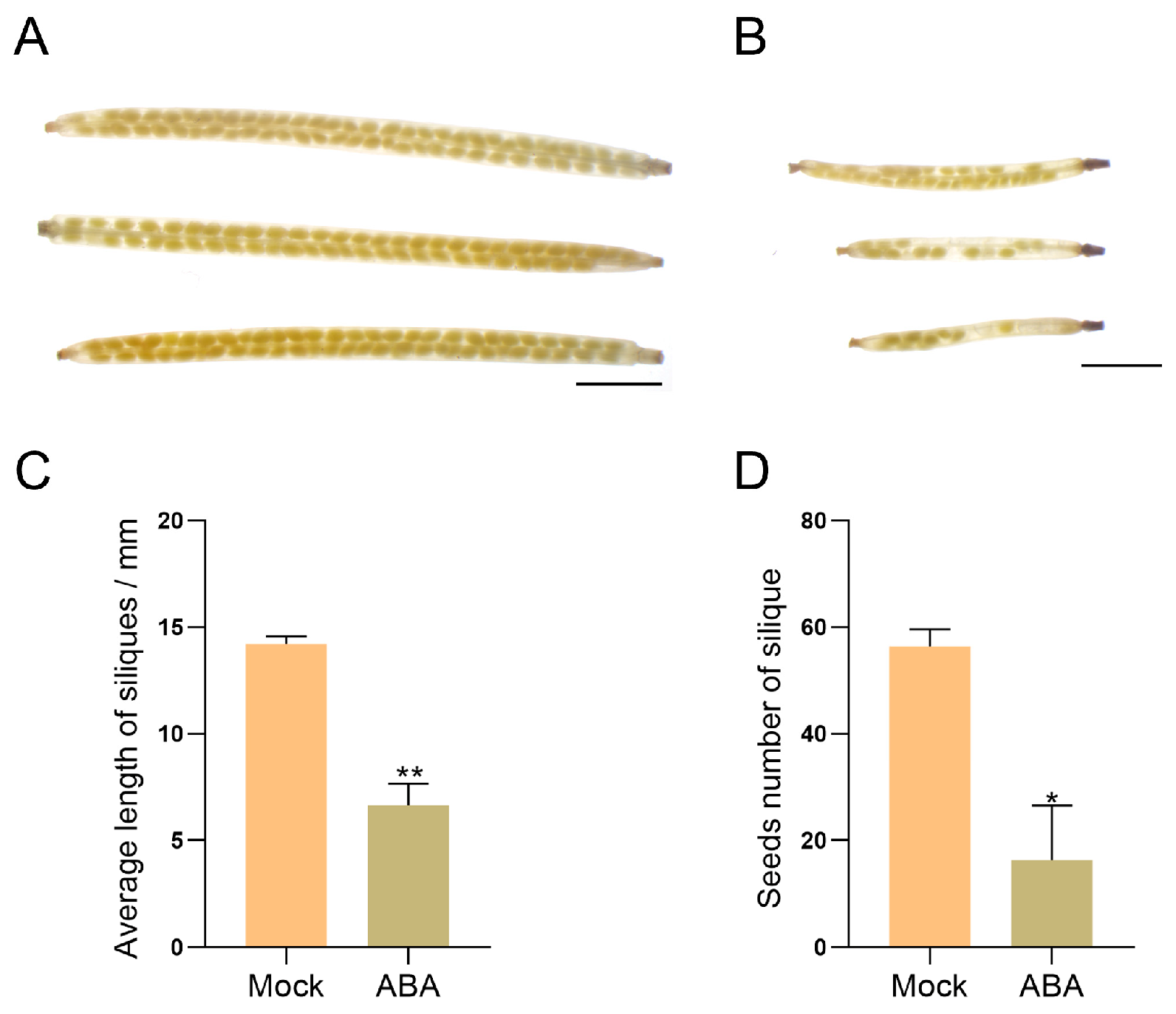
To investigate the effects of exogenous ABA treatment on pollen development in Arabidopsis, plants were treated with 100 μmol/L ABA or mock controls and then transferred to optimal growth conditions. Following silique formation and seed maturation, silique length and seed set were measured. The results showed that exogenous ABA treatment significantly reduced silique length and seed set in Arabidopsis (Figure 1).

2.2. Exogenous ABA Treatment Affects Pollen Function Without Altering Pollen Development in Arabidopsis thaliana

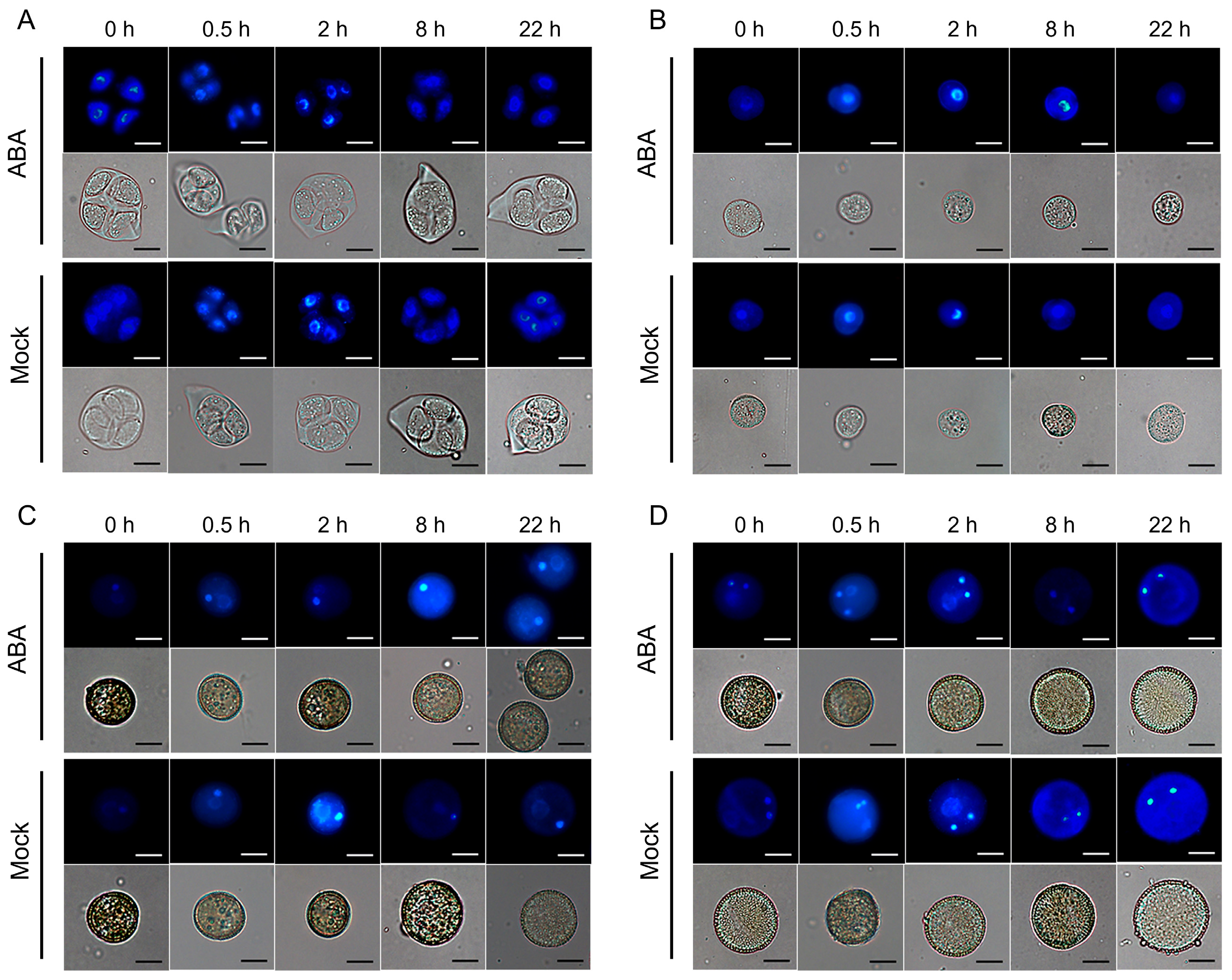
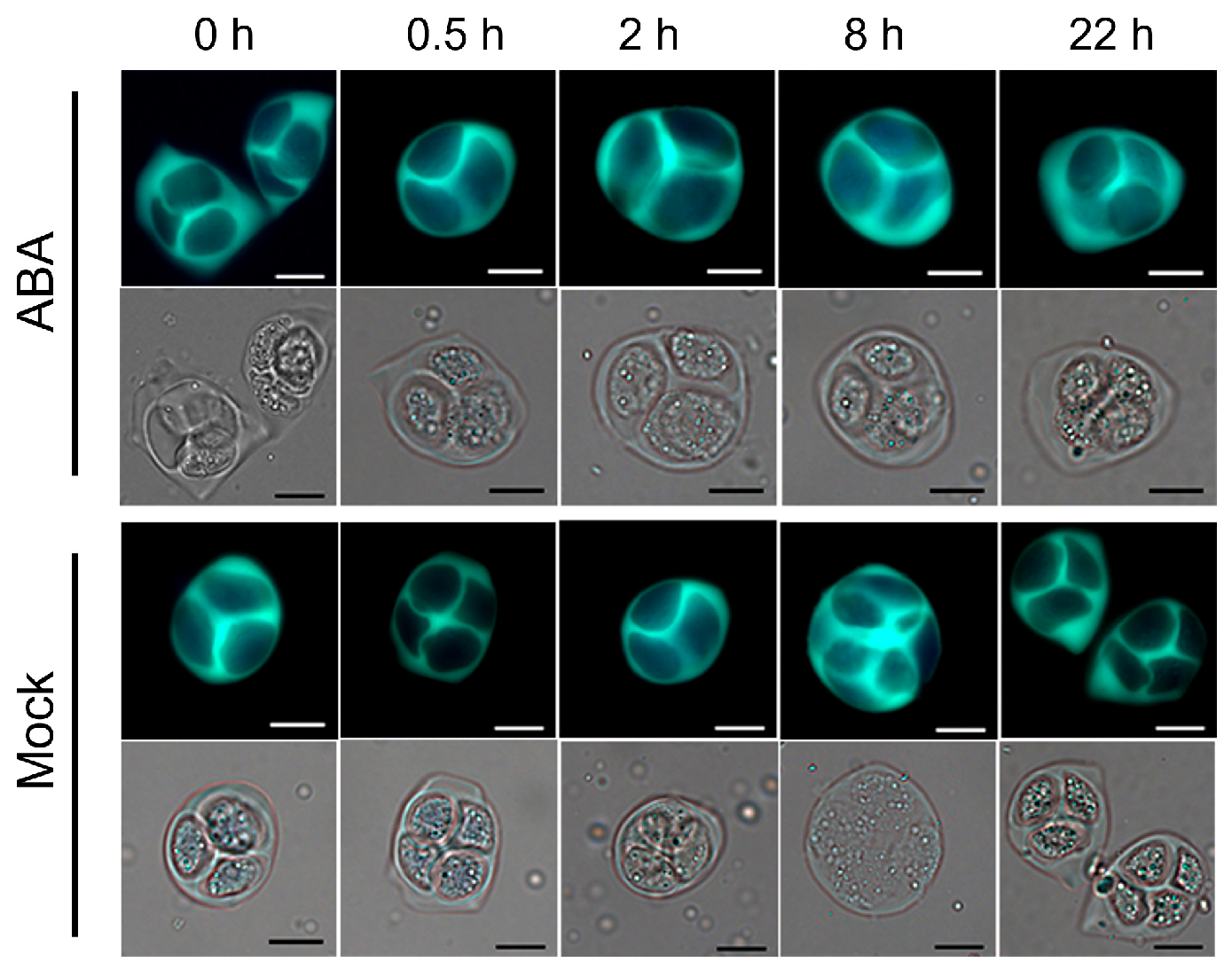
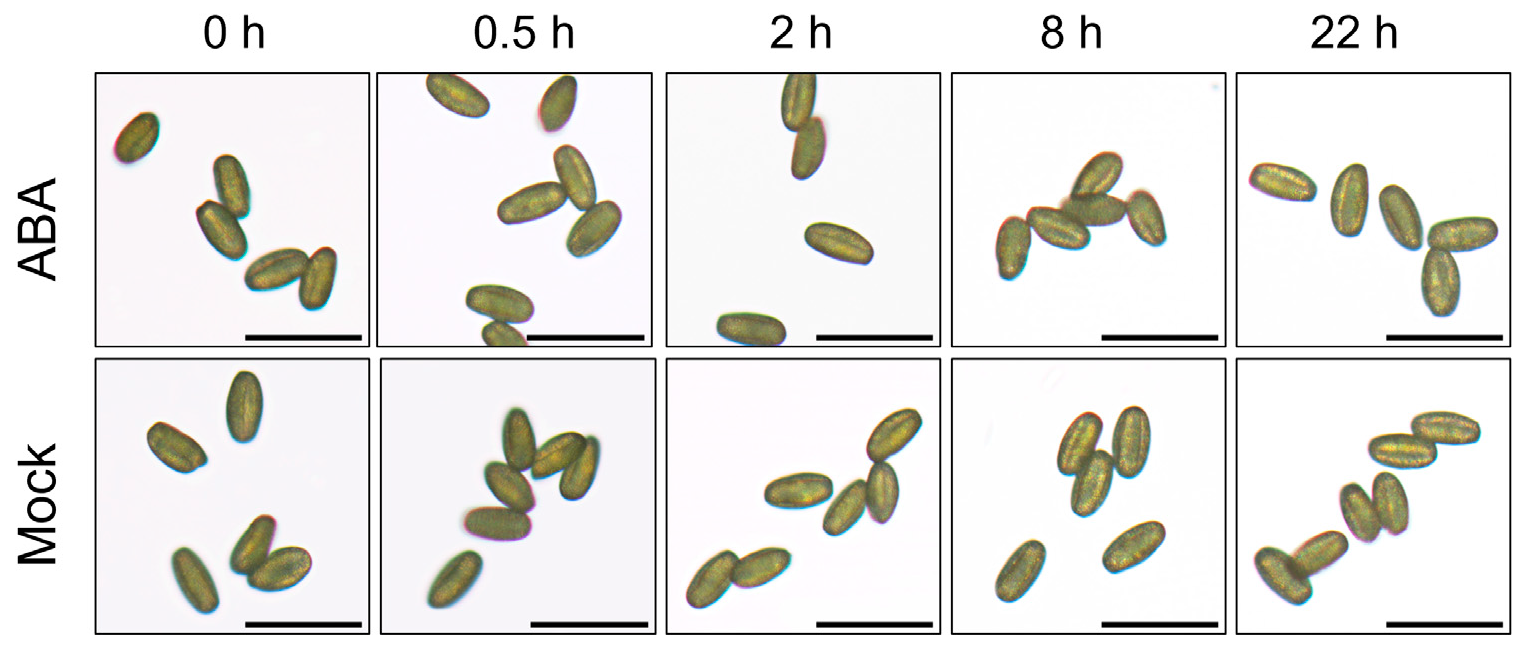
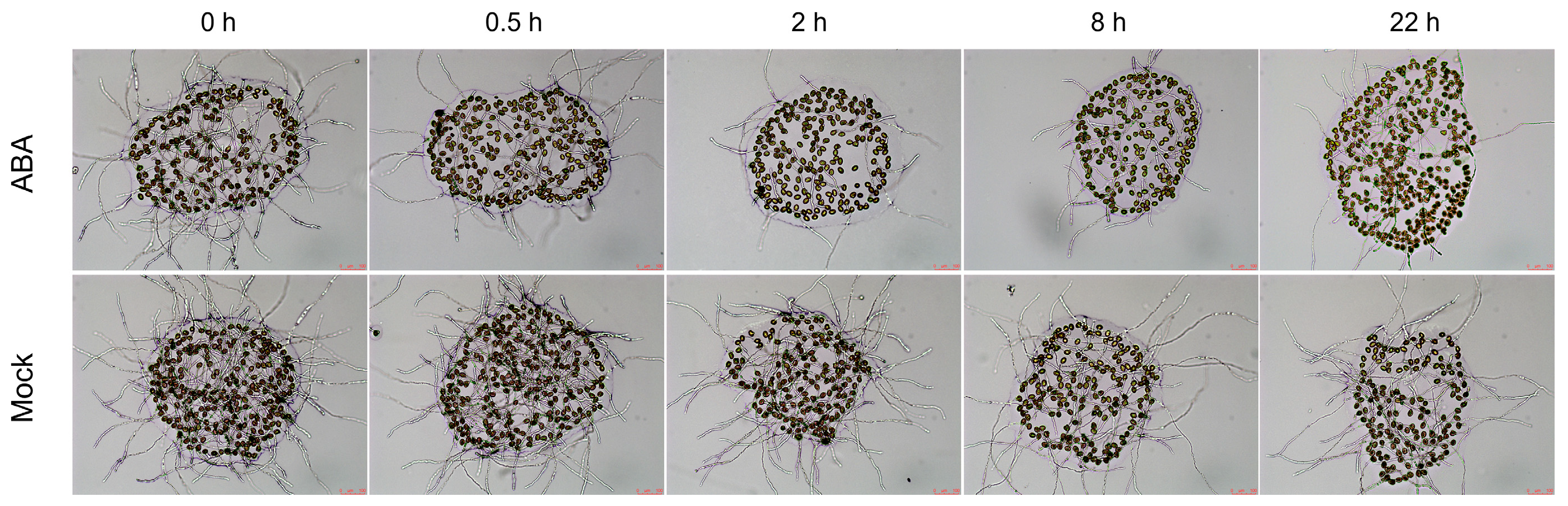
To elucidate how exogenous ABA treatment impacts silique development and seed set in Arabidopsis, instantaneous cytochemical staining was employed to observe pollen at different developmental stages. Staining with 4,6-diamidine-2-phenylindole (DAPI) revealed that ABA treatment failed to imprint on nuclei formation, as microspores observed at 0.5, 2, 8, and 22 h post-treatment at the tetrad, uninucleate, bicellular, and trinucleate stages showed no significant differences from the mock group (Figure 2). Furthermore, aniline blue staining of tetrads demonstrated consistent callose deposition in ABA-treated tetrads compared to the mock group (Figure 3). No obvious morphological differences were detected in mature pollen grains between ABA-treated and mock plants (Figure 4).
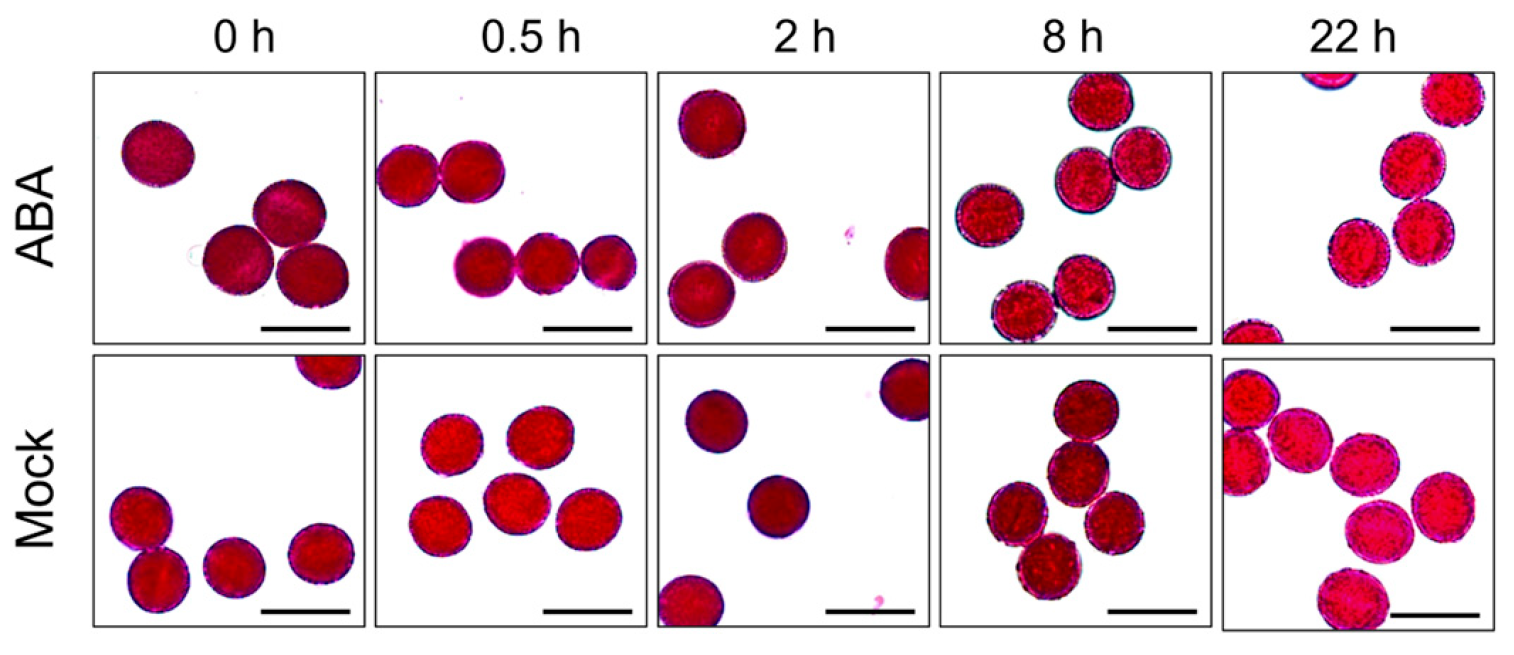
However, it is worth noting that in vitro pollen germination and elongation were determined to be altered following ABA exposure. A reduced germination rate and inhibited pollen tube growth were observed compared to pollen from mock plants (Figure 5). Moreover, pollen germination rates exhibited a progressive decline over the 22 h observation duration following ABA treatment (Figure 5). However, pollen vitality, as assessed by the Alexander dye staining assay, remained not compromised by ABA treatment (Figure 6). These results indicate that ABA, in the concentration test, does not induce immediate or subsequent morphological changes in Arabidopsis developing pollen but rather impairs its function. This functional deficit likely underlies the observed shortening of siliques and reduced seed sets.

2.3. ABA Initiates a Transcriptional Cascade in Arabidopsis thaliana Anthers

2.3.1. Differentially Expressed Protein-Coding RNAs

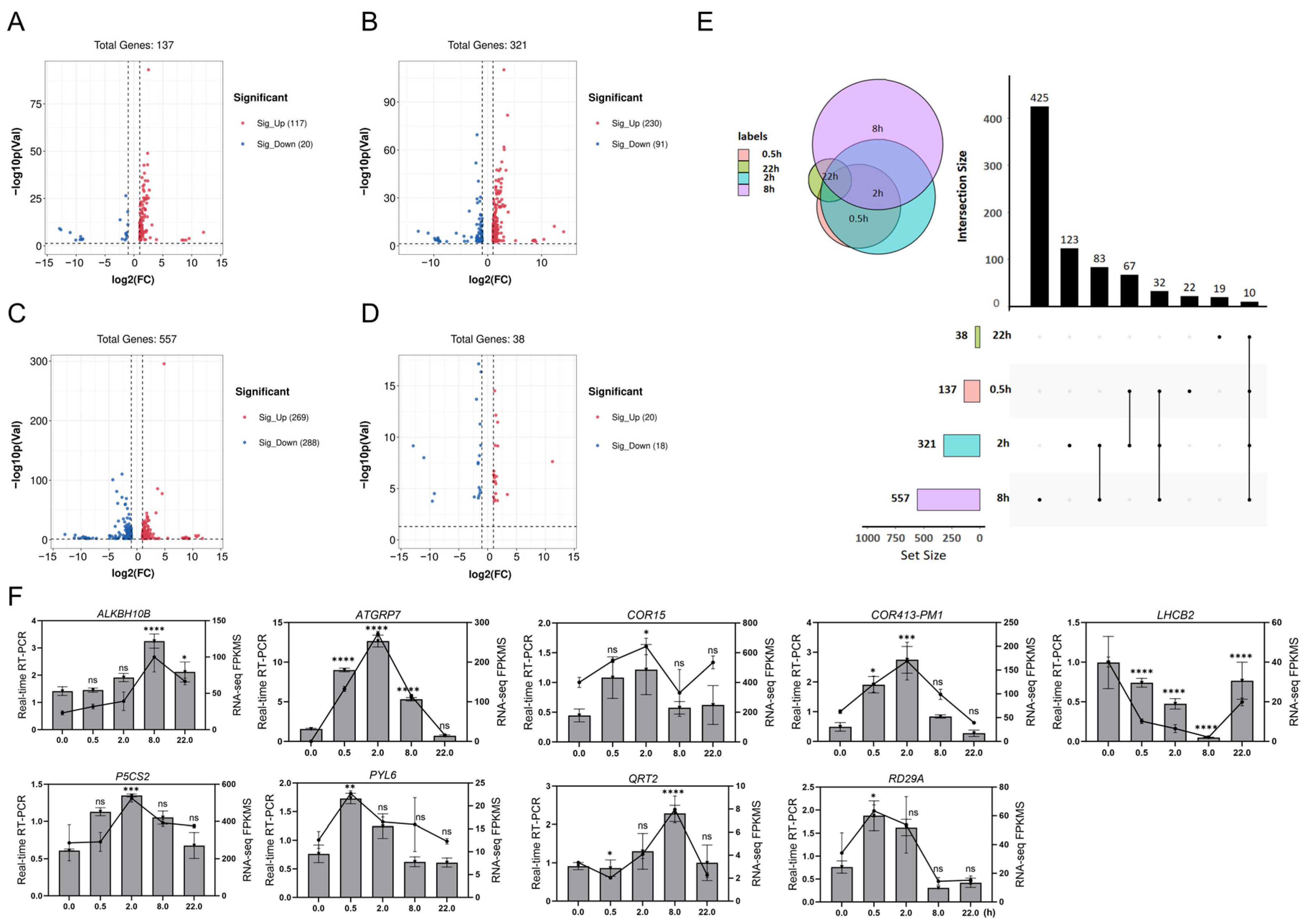
To elucidate the molecular mechanisms underlying the ABA-induced decline in pollen germination rate and subsequent reduction in seed set, RNA-seq was performed on mature Arabidopsis anthers. Based on previous studies demonstrating that jasmonate-induced transcriptional cascades during anther development can be effectively captured within a 22 h time course [10], We harvested anthers from untreated stage 12 floral buds (designated as UC_0 h) and at 0.5, 2, 8, and 22 h after a single ABA application (designated as ABA_0.5 h, ABA_2 h, ABA_8 h, and ABA_22 h, respectively). This time-series design allows us to comprehensively profile the dynamic and transient gene expression changes triggered by ABA, from early signaling events to downstream regulatory responses. In total, 793 genes displayed altered expression levels relative to UC_0 h within the 22 h period following ABA treatment (Table S1). Specifically, 137, 321, 557, and 38 differentially expressed genes (DEGs) were identified in the comparisons of ABA_0.5 h vs. UC_0 h, ABA_2 h vs. UC_0 h, ABA_8 h vs. UC_0 h, and ABA_22 h vs. UC_0, respectively (Figure 7A–E). To verify the accuracy of the RNA-seq results, quantitative real-time PCR (qRT-PCR) analysis was conducted on nine DEGs. The strong consistency between the RNA-seq data and qRT-PCR validation (Figure 7F) confirmed the reliability of the transcriptomic profiling.
Transcriptomic profiling indicated an initial rise in both up- and down-regulated DEGs, peaking at 8 h (269 up and 288 down) (Figure 7A–C). However, this response was markedly attenuated by 22 h, with only 20 genes up-regulated and 18 down-regulated, representing a sharp decline from earlier time points and the lowest DEG count overall (Figure 7D). Furthermore, we identified 10 genes that were differentially expressed at all time points following ABA treatment relative to UC_0 h, including CCR2, FKF1, JMJD5, AT4G30650, TSJT1, AT4G30660, ESL3.05, PUP8, UBQ5, and AT2G05812. These findings reveal a dynamic yet transient transcriptional reprogramming in anthers following ABA treatment, characterized by an early, broad gene expression shift that substantially resolves within 22 h.
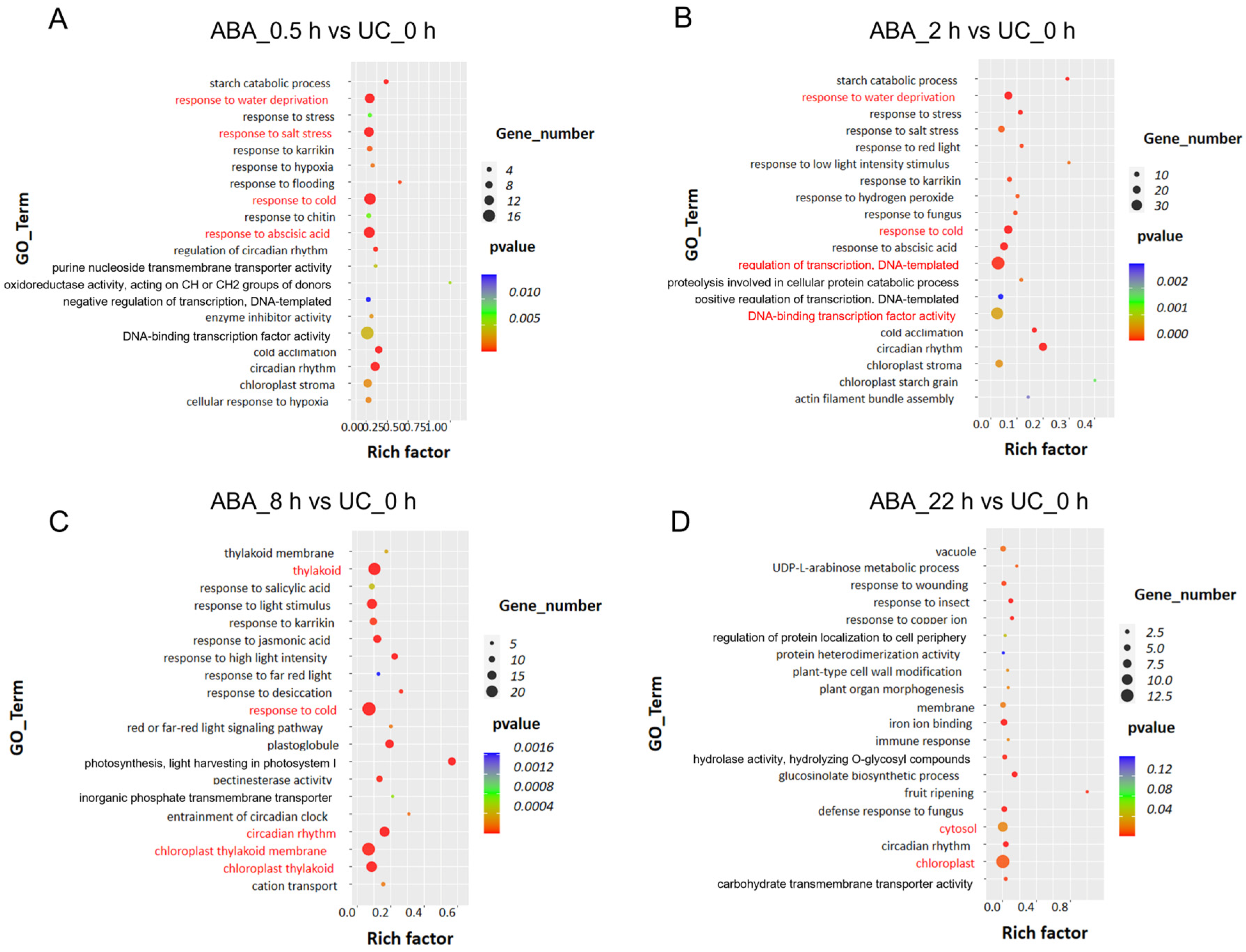
Gene Ontology (GO) and Kyoto Encyclopedia of Genes and Genomes (KEGG) enrichment analyses was subsequently performed to further characterize the functional dynamics of the observed transcriptional changes. GO analysis indicated that 94% of the DEGs (745 out of 793) were functionally annotated, with temporally distinct enrichment patterns across the treatment time course. At the early time following ABA treatment (0.5 and 2 h), genes associated with transcriptional regulation and DNA-binding factors were highly active (Figure 8A,B), indicating that transcriptional reprogramming represents an initial regulatory layer in response to external ABA. By 8 h post-ABA treatment, a sharp increase was observed in DEGs involved in stress responses, as well as in those related to chloroplasts, thylakoids, and thylakoid membranes (Figure 8C), suggesting that anthers initiated large-scale transcriptional regulation to cope with ABA signaling By 22 h, only 38 DEGs remained, reflecting that the transcriptional response had largely subsided; however, chloroplast-related genes continued to be highly expressed (Figure 8D), suggesting that this time point was not simply a decline in response but rather a shift toward adaptive or compensatory regulation centered on chloroplast function. Previous studies have reported that under water stress, chloroplast membrane disruption leads to ABA leakage and ABA level increase, underscoring a functional link between ABA and chloroplasts [68]. Long-term ABA exposure also suppresses thylakoid formation, chlorophyll biosynthesis, and the activities of RuBP carboxylase/oxygenase and PEP carboxylase [69,70,71]. Notably, the overarching theme of stress adaptation and defense activation persisted throughout the 22 h period (Figure 8). Among the top 20 most significantly enriched GO terms at 0.5 h, approximately 55% were concentrated in stress-response processes, such as salt stress, low-temperature stress, exogenous ABA stress, and dehydration stress (Figure 8A). Notably, low-temperature stress-related genes maintained high expression levels up to 8 h, suggesting potential crosstalk between ABA signaling and cold-response pathways (Figure 8). Together, these findings indicate that ABA treatment induces a temporally regulated, defense-oriented transcriptional program in anthers.
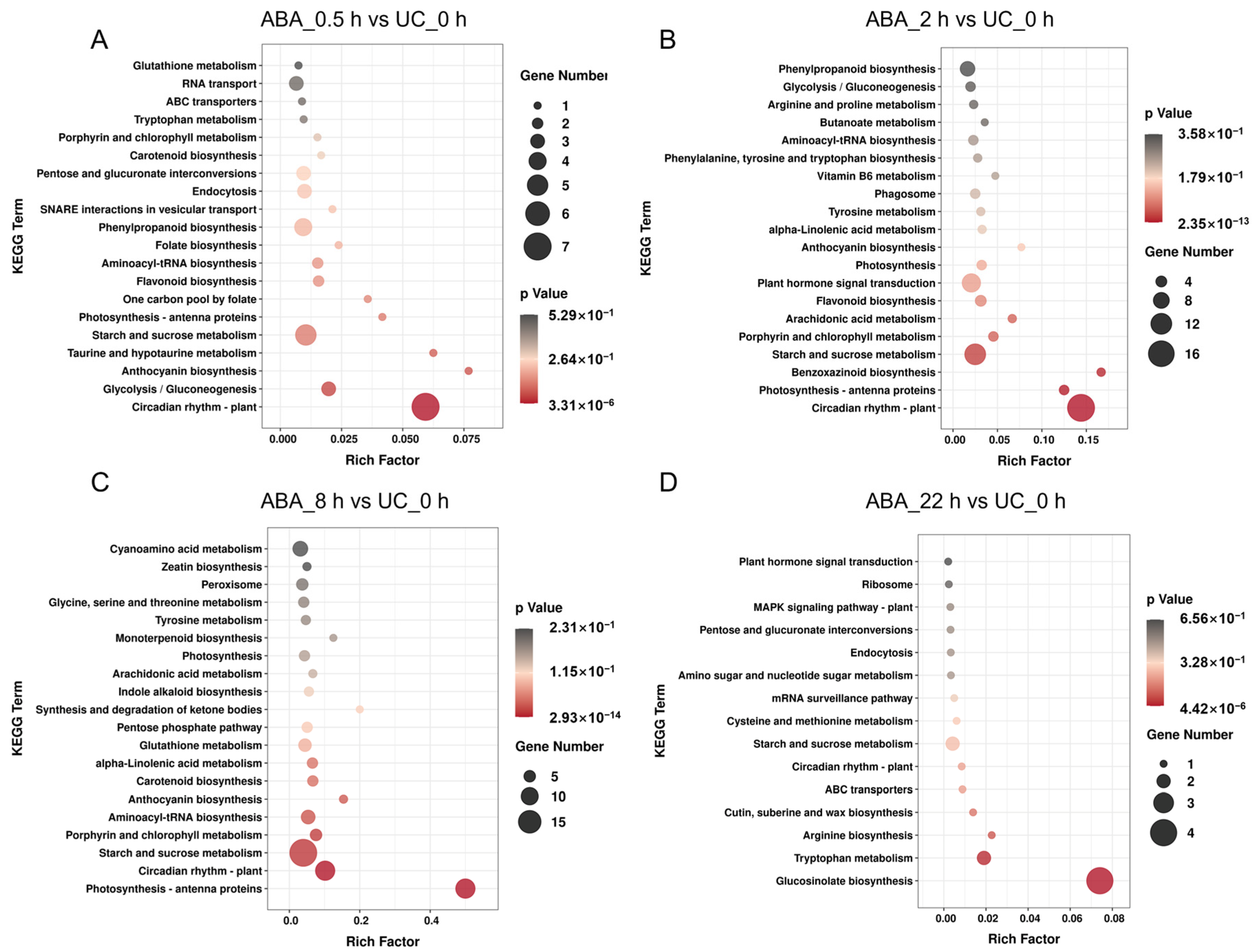
KEGG analysis further revealed time-specific reprogramming. During the early phase (0.5, and 2 h), DEGs were primarily enriched in pathways such as starch and sucrose metabolism and the plant circadian rhythm (Figure 9A,B). Beginning at 2 h, significant enrichment in plant hormone signaling pathways was observed (Figure 9B). By 8 h, the most diverse set of metabolic pathways was affected, including starch and sucrose metabolism, porphyrin and chlorophyll metabolism, photosynthesis-antenna proteins, anthocyanin biosynthesis, and several amino acid metabolic pathways (Figure 9C). In contrast, by 22 h, expression levels in most of these pathways had returned to near-baseline states, with only a limited number of pathways remaining deferentially expressed (Figure 9D). These findings highlight that ABA-induced transcriptional reprogramming follows a clear temporal progression, with the majority of metabolic adjustments occurring within the first 8 h and largely resolving by 22 h post-treatment.

2.3.2. ABA-Responsive Transcription Factors

Transcription factors (TFs) have been implicated in reproductive development, including pollen germination, pollen tube growth, and seed development, by orchestrating the expression of downstream target genes in response to environmental signals [72,73,74,75]. To delineate the ABA-mediated transcriptional network governing these processes in Arabidopsis anthers, we identified 25 differentially expressed TFs following exogenous ABA treatment, comprising 15 up-regulated and 10 down-regulated genes (Table 1). Notably, with the exception of ANAC029, which showed significant down-regulation only after 8 h, all other TFs exhibited significant dysregulation early in the response, consistently within the first 8 h. This early and coordinated TF response highlights how ABA rapidly reshapes the transcriptional hierarchy to fine-tune pollen function and stress adaptation.
Among the up-regulated TFs, MYB2, ANAC055, and ANAC075 are recognized for their roles in reproductive development and stress responses that impact pollen function. In Arabidopsis, MYB2, expressed in the tapetum during stages 5–11, is critical for tapetal programmed cell death and pollen viability. It directly regulates the expression of proteases CEP1 and βVPE, thereby coordinating tapetal degradation and pollen maturation, processes essential for pollen germination and tube growth [76]. Under stress conditions, MYB2 is upregulated and binds to the RAX1 promoter to suppress its expression, thereby inhibiting axillary meristem formation. This enables plants to undergo a shorter vegetative development phase under adverse conditions [77]. ANAC055 exhibits a co-expression with ATAF1, which has been shown to maintain high expression levels after heat stress and sustain elevated transcripts during prolonged recovery periods [78]. Under drought stress, ANAC055 is transcriptionally activated and epigenetically regulated by CAU1 via H4R3sme2 histone methylation, providing a novel pathway for enhancing drought tolerance [79]. ANAC075 acts as a floral repressor; its loss-of-function up-regulates floral integrator genes and accelerates flowering [80]. ANAC075 also contributes to secondary cell wall biosynthesis [81]. Collectively, these TF dynamics illustrate how ABA reprograms transcriptional networks to regulate pollen germination and pollen tube growth, with specific TFs exerting their effects through the coordinated regulation of downstream target genes, thereby integrating developmental control with adaptive responses to environmental signals.

2.3.3. DEGs Related to Pollen Development and Function

Drawing upon the published literature, we compiled a set of well-characterized genes involved in pollen development, germination and tube growth in Arabidopsis. Comparison with our RNA-seq data identified 16 DEGs involved in these processes following ABA treatment (Table 2). Among them, YUC6 encodes a flavin monooxygenase associated with local auxin biosynthesis in microspores and regulates male gametophyte development [82]. P5CS2 is expressed in developing microspores and mature pollen, participates in pollen development, and its homozygous mutant is lethal to microspore development [83]. NAS3 encodes a nicotianamine synthase, and its loss-of-function results in arrested pollen development and failure of pollen germination and tube growth [84]. For genes regulating tapetal function and pollen wall formation, MYB80 encodes a TF specifically expressed in the developing tapetum and microspores, regulating tapetal PCD [85]. QRT2 is a polygalacturonase family member, essential for normal pollen separation [86]. FST1 encodes a tapetum-specific flavonol sophoroside transporter involved in flavonol glycoside accumulation on the pollen surface; its loss-of-function leads to abnormal pollen wall composition [87]. GLP10, a DELLA-repressed stamen-enriched gene, encodes a germin-like protein that participates in stamen elongation and anther maturation, thereby supporting pollen development [88]. Regarding genes that regulate pollen germination and pollen tube growth, EXL4 encodes pollen coat extracellular lipase 4 and mediates pollen hydration on the stigma to initiate germination [89]. CSLA07 encodes a glycosyltransferase that catalyzes hemicellulose synthesis for the pollen tube wall; its heterozygous mutants exhibit pollen tube growth defects [90]. LRX11 encodes a pollen-specific LRR-Extensin family protein that cooperates with homologous genes to maintain pollen tube wall integrity [91,92]. Both PMEI1 and PMEI2 encode pectin methylesterase inhibitor proteins enriched at the pollen tube tip, which regulate the stability of the pollen tube wall [93,94]. Additionally, among genes related to signal transduction and intracellular trafficking, RABA4D encodes a Rab GTPase of the RabA4 subfamily that regulates vesicle trafficking and polar growth at the pollen tube tip, facilitating rapid elongation of pollen tubes [95]. CPK14 encodes a calcium-dependent protein kinase involved in calcium signaling at the pollen tube apex, and its activation induces depolarization of pollen tube growth [96]. PRK4 encodes a pollen receptor-like kinase that is functionally redundant with PRK5; together, they cooperatively regulate actin dynamics and polar growth of pollen tubes, with the double mutant exhibiting pollen tube growth defects [97].

2.4. ABA-Induced LncRNAs Modulate Transcriptional Reprogramming in Arabidopsis thaliana Anthers

Recent decades of research have established that despite their low abundance, lncRNAs play critical roles in gene regulation throughout pollen and anther development, male fertility establishment, and stress adaptation [22]. They exert these effects through diverse mechanisms at transcriptional and post-transcriptional levels [98]. However, the understanding of how lncRNAs respond to hormone signals such as ABA and mediate the balance between pollen development/function and stress adaptation remains limited. Based on this, we further examined the expression dynamics of ABA-induced lncRNAs in mature Arabidopsis anthers. This analysis aimed to uncover whether and how ABA signaling reprograms the lncRNA-mediated regulatory landscape to coordinate pollen function.

2.4.1. Identification and Characteristics of ABA-Responsive LncRNAs

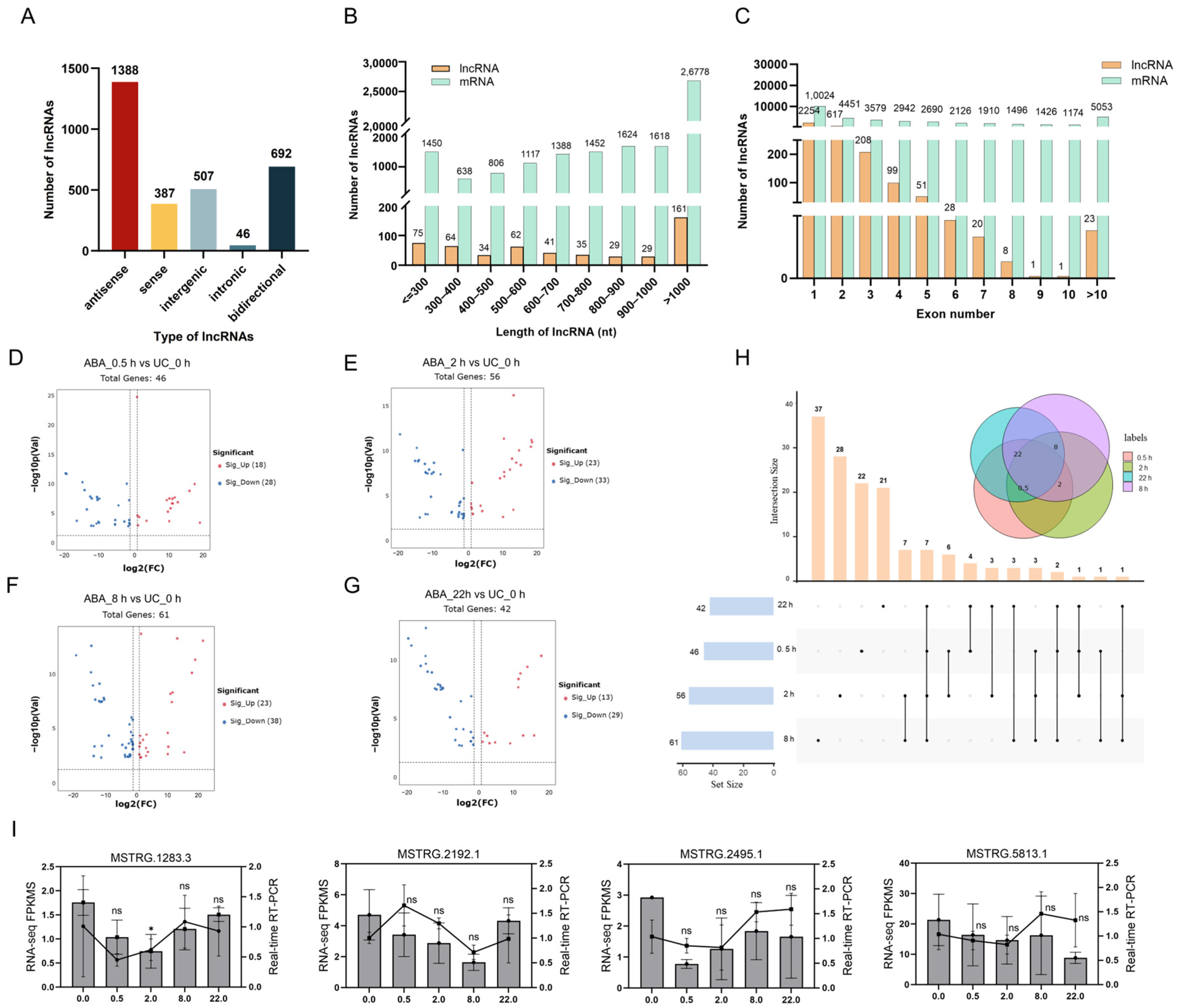
Our transcriptomic analysis revealed a total of 3310 lncRNAs expressed in mature Arabidopsis anthers (Table S2). Among them, 41.9% (1388) were antisense transcripts (NATs), 11.7% (387) were sense lncRNAs, 15.3% (507) were long intergenic lncRNAs (lincRNAs), 1.4% (46) were intronic lncRNAs (incRNAs), and 20.9% (692) were bidirectional lncRNA (Figure 10A). lncRNAs were notably shorter than protein-coding mRNAs, with lengths ranging from 201 to 9408; 79.9% (2646) fell to ≤ 1000 nt (Figure 10B). The exon number of lncRNAs was also lower than that of mRNAs, with 68.1% (2254) contained fewer than two exons, while the majority of mRNAs possessed more than five exons (Figure 10C).
Of the 3310 lncRNA identified, 146 were differentially expressed following ABA treatment (Table S3), of which 93 were previously annotated in the existing databases and 53 were novel. The number of differentially expressed lncRNAs (DELs) varied temporally, with 46, 56, 61, and 42 DELs detected at 0.5, 2, 8, and 22 h post-ABA treatment, respectively (Figure 10D–G, Table S3). qRT-PCR analysis of four DELs confirmed expression patterns consistent with the RNA-seq profiles (Figure 10I), further strengthens the reliability of our transcriptomic dataset. Venn analysis indicated that most DELs were specific to a single time point (Figure 10H). Among the altered transcripts, seven lncRNAs were differentially expressed across all four time points (Table S3). Four of these (MSTRG.19040, MSTRG.18558.4, MSTRG.2045.1, and MSTRG.13540.3) were specifically expressed in untreated anthers but became undetectable after ABA treatment, implying that ABA actively repress a subset of lncRNAs likely involved in maintaining basal pollen developmental programs. Their suppression by ABA may therefore facilitate the transition from developmental to stress-responsive states within anther. In contrast, the remaining three lncRNAs (MSTRG.231, MSTRG.6469, and MSTRG.18558.8) showed sustained up-regulation throughout the treatment period. Notably, MSTRG.231 and MSTRG.18558.8 exhibited particularly strong induction across all time points, suggesting they may represent core components of the ABA signaling pathway. Such lncRNAs could act as regulatory factors involved in establishing adaptive transcriptional programs in anthers under stress conditions.

2.4.2. Extensive cis-Regulatory Relationships Between DELs and DEGs Induced by ABA in Mature Arabidopsis thaliana Anther

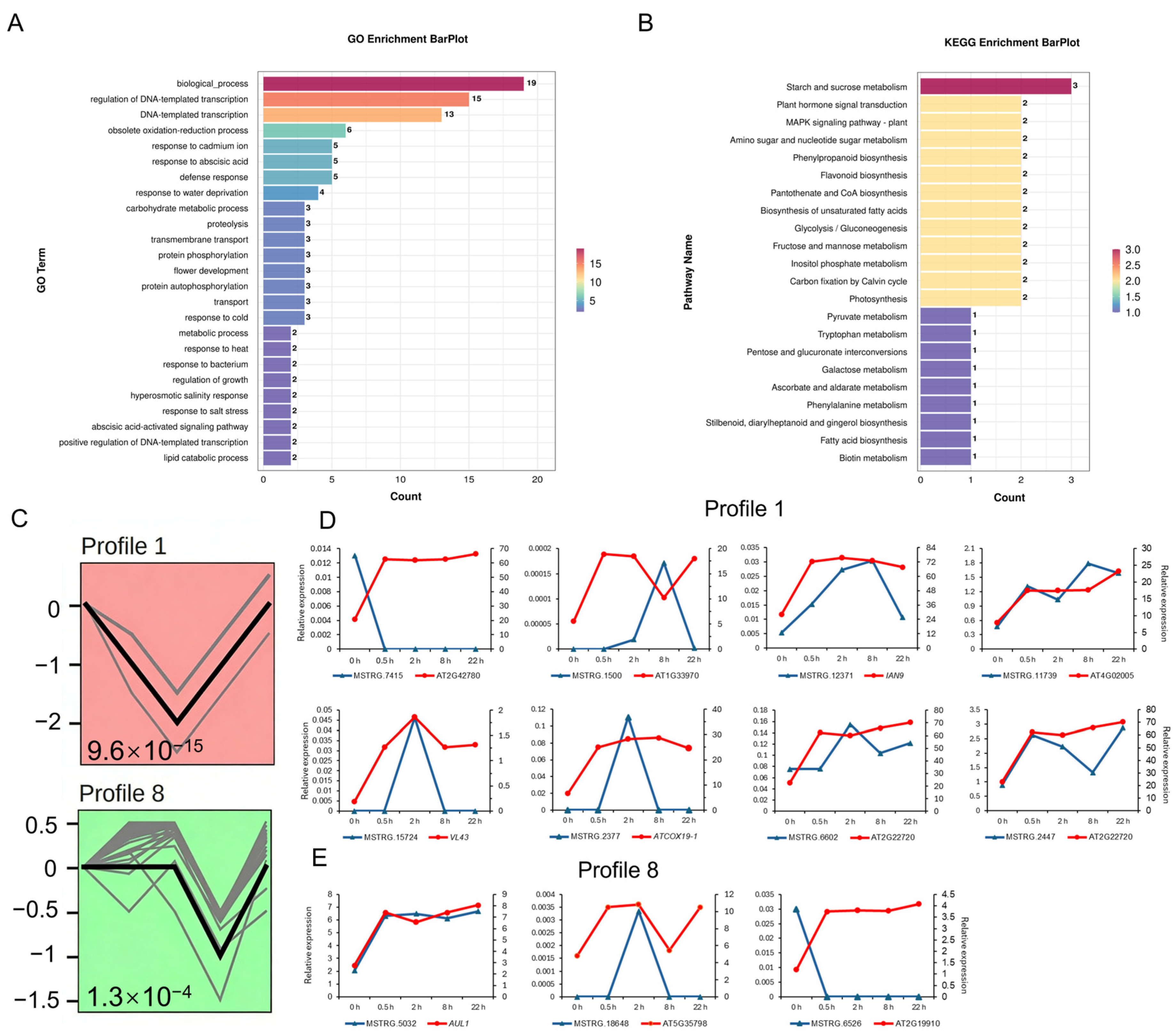
To further understand the involvement of lncRNAs during mature anther response to ABA treatment, we investigated potential cis-regulatory relationships by identifying target genes of DELs based on proximity. A total of 146 DELs were linked to 113 DEGs within a 100 kb window upstream and downstream on the chromosome. After consolidation, 144 unique DEL-DEG pairs were identified across four comparisons: ABA_0.5 h vs. UC_0 h (24 pairs), ABA_2 h vs. UC_0 h (48 pairs), ABA_8 h vs. UC_0 h (62 pairs), and ABA_22 h vs. UC_0 h (28 pairs) (Table S4). The majority of these lncRNA-target gene pairs (71.5%) were located within 100 kb of each other, while a smaller fraction (41 pairs) found within a 10 kb distance. GO enrichment analysis of these DEGs revealed a coherent molecular narrative centered on the induction of a potent abiotic stress response (Figure 11A), which directly explained the observed inhibition of pollen germination. The significant enrichment of GO terms related to ABA signaling and stress response indicates that DELs trigger a hormonal and physiological state antagonistic to pollen tube growth. This mechanistically supported by the concurrent dysregulation of growth-supportive processes, including carbohydrate metabolism, which are essential for pollen energy generation [99]. The KEGG pathway analysis further corroborates this shift, showing enrichment in ABA and mitogen-activated protein kinase (MAPK) signaling pathways alongside the central metabolic pathways like starch/sucrose metabolism and glycolysis (Figure 11B). Crucially, this stress reprogramming diverts resources toward defense-based secondary metabolism (e.g., phenylpropanoid biosynthesis) and away from the biosynthetic demands of rapid pollen tube elongation.
We further performed temporal expression profile clustering of all DELs using Short Time-series Expression Miner (STEM). A total of 20 expression profiles were generated (Table S5), and 2 profiles were identified as significantly enriched after filtration (Figure 11C and Table S6). Specifically, Profile 1 contained 99 DELs whose expression levels decreased to the minimum at 2 h post-ABA treatment and subsequently recovered gradually. In contrast, Profile 8 consisted of 38 DELs that maintained stable expression within the first 2 h after ABA treatment, followed by a gradual decline in expression abundance, reaching the lowest level at 8 h post-treatment before recovering. Target DEGs localized nearby DELs of these two profiles were analyzed for co-expression. Among the 13 DEL-DEG pairs identified, 9 and 2 showed positive and negative expression correlation, respectively (Figure 11D,E).

2.4.3. LncRNA-Regulated Transcription Factors in Anther Response to ABA

The identification of several cis-regulated TFs among the predicted lncRNA target genes suggests a significant role for lncRNAs in mediating anther response to ABA by regulating the expression of these critical TFs (Table 3). Among these TF targets, SCL15 has been implicated as part of the HDA19 complex, where it represses the expression of embryonic-type genes in seedlings and contributes to the developmental transition from embryo to seedling. Notably, SCL15 transcript levels surge under ABA and sucrose treatment [100]. Its homolog in rapeseed, BnSCL1, functions as an auxin-responsive protein known to interact with HDA19 [101]. WRKY57 directly targets the promoter sequence of NCED3; its overexpression demonstrably enhances drought tolerance and increases ABA content in Arabidopsis [102]. Similar benefits extend to rice, where WRKY57 overexpression also improves salt and PEG tolerance [103]. Arabidopsis ANAC029 has been found to be involved in cell division and expansion in anthers and petals, as well as in the regulation of leaf senescence [104,105]. Its homolog in tobacco, NaNAC29, participates in the defense response against tobacco brown spot disease by influencing the expression of NaDLP1 and promoting leaf senescence [106]. bHLH49 is associated with hormone signaling and cell elongation [107]. AP1 is a floral meristem identity gene that integrates induction signals to initiate morphogenesis and coordinate floral organ development in conjunction with MADS-box TFs [108].

2.4.4. ABA-Responsive and Flower Development-Related lncRNA–Target Gene Pairs

Two DEL-DEG pairs associated with ABA response were identified, involving the target DEGs RCI2A and ABF1 (Table 3). RCI2A is induced not only by ABA but also by low temperature, dehydration, and salt stress [109]. ABF1, which is also induced by temperature fluctuations, is essential for winter seedling growth in Arabidopsis and plays a role in regulating seed dormancy and germination [110]. Furthermore, we identified three DEL-DEG pairs related to flower organ development (Table 3). Notably, we found that RPOTM a critical gene for pollen tube growth, female gametophyte development, and embryogenesis, was predicted to be dysregulated by lncRNA MSTRG.4503. RPOTM deficiency is known to cause delayed pollen tube growth and developmental abnormalities in ovules and embryos [111]. This dysregulation of RPOTM, targeted by lncRNA MSTRG.4503, provides a plausible mechanistic explanation for the observed disruption of pollen germination following ABA treatment, although further experimental validation is required.

2.4.5. Trans-Regulatory Roles of DELs in Mature Anther Response to ABA

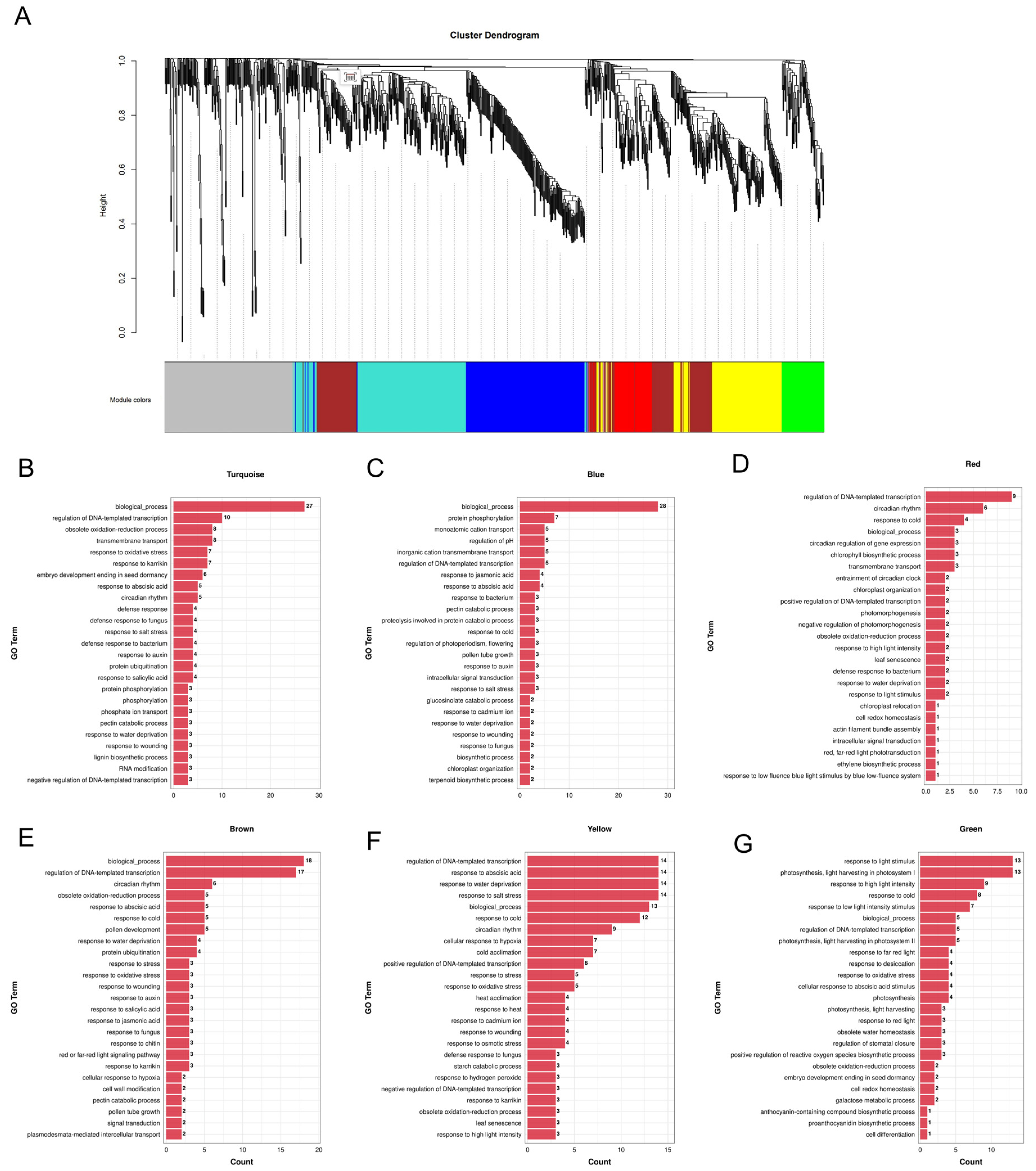
Beyond their known cis-regulatory roles, lncRNAs have also been demonstrated to influence protein-coding gene expression through trans-acting mechanisms [112,113]. To further investigate the function of these DELs in anther response to ABA, a weighted gene co-expression network analysis (WGCNA) integrating both DEGs and DELs was performed. Ultimately, six distinct co-expression modules were identified, each assigned a unique color (Figure 12A and Table S7). Based on the GO annotation results across all six modules, DEGs are consistently and significantly enriched in transcriptional regulation processes (e.g., regulation of DNA-templated transcription), hormone responses (e.g., response to ABA and jasmonic acid), and stress responses (e.g., response to cold and salt stress) (Figure 12B–G). These enrichments collectively reinforced that ABA treatment rapidly elicits a lncRNA-mediated genome-wide transcriptional reprogramming in anthers, characterized by enhanced regulation of gene expression, hormone signaling, and stress adaptation pathways.

2.4.6. Trans-Regulated Genes Essential for Pollen Development and Tube Growth

Notably, DEGs in the MEblue module were specifically annotated to pollen tube growth, while the MEbrown module contained 135 DEGs enriched in pathways related to pollen development and pollen tube growth (Figure 12C–E). These modules encompassed several core genes with well-characterized roles in regulating pollen development and pollen tube growth in Arabidopsis (Table S7). FST1, a tapetum-specific transporter, is essential for the translocation and accumulation of flavonol sophorosides from the tapetum to the pollen surface [87]. AtSTP11 is a high-affinity H+-monosaccharide transporter specifically expressed in the pollen tube plasma membrane, furnishing monosaccharides essential for rapid pollen tube elongation and sustaining carbon nutrient homeostasis [114]. PPME1 and PMEI2 act synergistically to maintain the highly esterified and extensible state of pectin at the pollen tube tip, ensuring rapid polar growth [93]. CHX21 and CHX23, functionally redundant K+/H+ exchangers in pollen tubes, mediate pistil signal perception and polar reorientation by regulating intracellular local cation balance and pH homeostasis [115]. PRK4 encodes a receptor-like kinase that, in conjunction with pollen-specific NET2A (a member of the NET family), regulates polar growth and pistil signal response in pollen tubes [97]. P5CS2, a rate-limiting enzyme in proline synthesis, is required for pollen development and male fertility, driving de novo proline synthesis in microspores and mature pollen, a process irreplaceable by exogenous proline transport [83]. UGE3, a UDP-glucose 4-epimerase 3, is markedly upregulated during pollen germination and tube growth. It catalyzes the conversion of UDP-glucose to UDP-galactose to provide key precursors for pollen tube cell wall biosynthesis, and acts synergistically with UGE2 to ensure pollen development and plant fertility [83]. NAS3 mediates the chelation and translocation of metal ions via nicotianamine synthesis, maintaining metal homeostasis during pollen development and tube growth. It also collaborates with other family members to promote efficient iron unloading from the phloem to floral reproductive sinks such as anthers, acting as a key gene for nicotianamine-modulated male fertility in Arabidopsis [84].

3. Discussion

3.1. Exogenous ABA Specifically Impairs Pollen Function in Arabidopsis thaliana

ABA is a multifunctional phytohormone that regulates diverse aspects of plant growth and development [58,116]. Its role in reproductive development has been extensively documented, particularly in pollen and anther maturation. In cereals, disrupted ABA homeostasis within pollen grains is strongly correlated with male sterility and yield reduction [51,57,58,59,61,117]. The central role of ABA is corroborated by experimental perturbation, where exogenous ABA application during microspore development induces pollen abortion, reduces seed set, and alters the expression of cell wall invertase and monosaccharide transporter genes [51]. Despite these advances, the precise molecular mechanisms through which ABA influences pollen/anther development and the full scope of its downstream regulatory networks remain to be fully elucidated.
Previous studies have established that ABA exerts dose-dependent effects on plant growth and fertility. For instance, lower concentrations (e.g., 50 μmol/L) promote the somatic embryo development in soybean [118,119], whereas higher concentrations (e.g., 100 μmol/L) significantly inhibit plant growth and reproductive development in Arabidopsis [120]. Similarly, in rice, 100 μmol/L ABA markedly increases the proportion of spikelets with non-closed glumes [121]. Exogenous ABA has also been reported to reduce pollen viability dose-dependently, with notable inhibitory effects at 100 μmol/L and higher concentrations [117]. Moreover, this concentration effectively mimics ABA levels observed under abiotic stresses, enabling the exploration of ABA-mediated stress responses in reproductive tissues [122]. Therefore, 100 μmol/L ABA was used for exogenous treatment in this study. Phenotypic analysis in this study revealed that exogenous ABA treatment led to abnormal silique development and a significant decrease in seed set in Arabidopsis (Figure 1), consistent with previous reports [123]. However, cytological examinations showed that callose wall deposition during tetrad stage and nuclear development across all stages remained unaffected (Figure 2 and Figure 3), and mature pollen morphology was normal (Figure 4). Notably, in vitro pollen germination assays demonstrated that both pollen germination rate and pollen tube elongation were significantly inhibited in ABA-treated plants, whereas pollen morphology and viability remined unaffected (Figure 4, Figure 5 and Figure 6). This specific impairment of pollen function likely constitutes the direct cause of the observed silique malformation and reduced seed set in Arabidopsis following ABA treatment. It is worth noting that the effects of ABA on pollen are not universally inhibitory. Several studies have reported that ABA can stimulate pollen tube growth both in vitro and in vivo [124,125]. For instance, exogenous ABA at concentrations ranging from 0.1 to 100 μmol/L stimulated pollen germination and tube growth in Petunia hybrida [125]. In barley (Hordeum vulgare) anther cultures, ABA application enhanced microspore viability and reduced apoptosis-like features [126]. These seemingly divergent outcomes underscore that ABA can exert both stimulatory and inhibitory effects on pollen depending on concentration, developmental stage, and species.

3.2. ABA Induces a Transient Transcriptional Reprogramming That Disrupts Pollen Function

RNA-seq analysis further elucidated the molecular dynamic of Arabidopsis anthers in response to exogenous ABA treatment. The number of DEGs peaked at 8 h post-treatment and declined markedly by 22 h, indicating a transient transcriptional reprogramming characterized by rapid induction followed by gradual attenuation (Figure 7A–E). This temporal pattern contrasts with that observed in jasmonate-treated anthers, where induced genes increased progressively from 31 at 0.5 h to 1577 at 22 h [10]. The distinct kinetics suggest different regulatory mechanisms underlying these two hormone signaling pathways during anther development. Jasmonate triggers a sustained transcriptional cascade that continues to expand through 22 h, likely driving progressive developmental processes such as anther dehiscence and filament elongation [10]. In contrast, ABA elicits a more transient response, peaking at 8 h followed by rapid attenuation by 22 h. This transient pattern may reflect ABA’s role as a rapid stress signal triggering immediate adaptive responses, rather than a sustained developmental program. Interestingly, despite the overall decline in DEGs by 22 h, chloroplast-related genes among the ABA-responsive DEGs remained highly expressed. This sustained expression suggests a shift to an adaptive and compensatory response centered on chloroplast function, which is critical for maintaining cellular homeostasis under stress conditions [127,128].
GO and KEGG enrichment analyses showed that early DEGs (0.5–2 h) were enriched in transcriptional regulation and DNA-binding functions. By 8 h, DEGs involved in stress response and chloroplast-related processes became prominent (Figure 8 and Figure 9). Notably, genes related to cold stress response maintained highly expressed until 8 h, suggesting potential crosstalk between ABA and cold response signaling. This observation aligns with previous reports where the fry1 mutant exhibits enhanced sensitivity to both ABA and cold stress [129]. Prior studies in rice and chickpea anthers have established that low-temperature stress triggers a marked accumulation of ABA [51,130]. ABA accumulation under cold stress plays a dual role, enhancing stress tolerance while simultaneously impairing pollen development and leading to male sterility. This process is regulated by a balance between ABA biosynthesis (via NCED/ZEP) and catabolism (via ABA8′OH), with tolerant varieties often maintaining lower ABA levels through efficient inactivation [92,93]. By 22 h, most metabolic pathways returned to near-baseline levels, while the MAPK cascade signaling pathway became significantly enriched (Figure 9). MAPKs are known to function as convergence nodes for oxidative stress signals [131]. Concurrently, we observed differential expression of genes associated with oxidative stress response in our transcriptomic data (Table S1). These findings collectively corroborated previous studies demonstrating that ABA, through modulation of ROS levels, participates in the regulation of tapetal programmed cell death, pollen development, and pollen germination [117,132]. Together, the temporal dynamic of DEGs reflect the time-specific nature of the anther’s transcriptional response to ABA. Notably, among the DEGs, 16 genes directly related to pollen development were identified, spanning key processes such as pollen morphogenesis, pollen tube growth, and signal transduction (Table 2), including YUC6 [82], P5CS2 [83], and NAS3 [83]. The differential expression provided a molecular basis for the observed pollen germination defects.

3.3. Transcription Factors as Key Hubs in ABA-Mediated Pollen Function Disruption

TFs serve as key hubs in ABA signal transduction. In this study, 25 TFs were differentially expressed upon ABA treatment, among which MYB2, ANAC055, and ANAC075 have previously been implicated in reproductive development and stress responses (Table 1). Here, ABA-induced upregulated of MYB2 may accelerate tapetal PCD, thereby indirectly impairing pollen function. Additionally, MYB2 represses RAX1 to modulate the transition from vegetative to reproductive growth; its mis-expression could therefore disturb the balance of reproductive development [77]. ANAC055 and ANAC075 are involved in drought response and flowering-time regulation, respectively [78]. Their differential expression implies that ABA may coordinate stress adaptation with reproductive development through the modulation of NAC-family TFs.

3.4. LncRNAs as Emerging Regulators in Anther Response to ABA

Beyond TFs, lncRNAs are emerging as important regulators. While lncRNAs have been partially characterized for their functions in ABA responses during vegetative growth [17,133], their roles in reproductive organs remain less defined. Transcriptomic profiling in this study identified 3310 lncRNAs expressed in mature anthers of Arabidopsis. The majority of these lncRNAs were shorter than 2 kb and harbored fewer than five exons, consistent with the typical structural features of plant lncRNAs. Notably, the abundance of lncRNAs was lower in mature anthers compare to earlier developmental stages, such as the uninucleate, bicellular and tricellular pollen stages [134], mirroring the general transcriptional downregulation trend observed for protein-coding genes as anther mature [134,135].
Cis-target gene prediction identified 144 DEL-DEG pairs (Table S4), with target genes enriched in stress response, floral organ development, and hormone signaling (Figure 11A,B). Notably, specific DEL-DEG pairs directly related to ABA signaling (RCI2A and ABF1) and floral development (RPOTM, AP1, and ANAC029) were identified (Table 3) [109,110,111]. The discovery of these lncRNA–target gene pairs, particularly the cis-regulation of RPOTM by lncRNA MSTRG.4503, provides a plausible mechanistic link for the observed ABA-induced inhibition of pollen germination, although this requires further experimental validation. Collectively, these findings offer direct molecular clues for the role of lncRNAs in ABA-regulated reproductive development. Furthermore, the identification of several TFs (e.g., SCL15, WRKY57, ANAC029, bHLH49) among the predicted lncRNA target genes (Table 3) indicates that lncRNAs may exert their influence by cis-regulating key transcriptional regulators [136], thereby participating in the complex transcriptional reprogramming of anthers in response to ABA.
Temporal clustering of DELs using STEM revealed two significantly enriched expression profiles (Profile 1 and Profile 8) (Figure 11C). The distinct temporal expression characteristics of DELs in these profiles are consistent with the established concept that plant ncRNAs display time-dependent expression profiles in response to environmental signals. For instance, drought-responsive lncRNAs in rice exhibit distinct temporal expression features under abiotic stresses including drought and ABA [137], reinforcing the time-dependent nature of lncRNA-mediated stress responses. WGCNA further identified six co-expression modules containing both DELs and DEGs, which directly confirms their extensive co-expression under ABA treatment. Studies on waterlogging tolerance in Secale cereale L. have demonstrated that lncRNAs and mRNAs form co-expression modules to mediate abiotic stress responses [138], while research on pollen development in Arabidopsis has revealed that such co-expression network exerts key regulatory functions [134]. These findings indicate that lncRNA–mRNA co-expression represents a conserved regulatory strategy in plants. Our results suggest that DELs and DEGs co-expressed within the same module may have direct or indirect regulatory relationships, providing valuable insights for future dissection of the molecular network underlying ABA-regulated pollen function.
Based on these findings, we propose an integrated model for ABA-mediated pollen dysfunction in Arabidopsis. Upon ABA treatment, a transient transcriptional reprogramming is initiated, characterized by the rapid activation of stress-responsive transcription factors (e.g., MYB2, ANAC055, ANAC075), which serve as key hubs linking ABA signaling to downstream regulatory cascades. These TFs orchestrate the differential expression of genes involved in metabolic reprogramming, including hormone signaling, sugar metabolism, and chloroplast function, redirecting cellular resources toward stress adaptation. Concurrently, lncRNAs act as fine-tuners of this response through cis- and trans-regulatory networks, modulating the expression of ABA signaling components (e.g., RCI2A, ABF1) and pollen development-related genes (e.g., RPOTM). The co-expression patterns revealed by WGCNA further support that lncRNAs and mRNAs function coordinately to mediate the anther’s response to ABA. Ultimately, these multi-layered regulatory events converge on the disruption of core pollen developmental processes, including pollen germination and tube growth, leading to reduced seed set. This model advances our understanding of stress response in flowering plants and provides potential targets for breeding stress-resilient crops.

3.5. Future Perspectives

Future studies should prioritize the functional validation of core lncRNAs and their target genes implicated in ABA-mediated pollen dysfunction. This can be accomplished through the generation of knockout or overexpression lines of key lncRNAs, coupled with molecular assays such as EMSA, dual-luciferase reporter assay, and ChIP-qPCR to delineate their cis- and trans-regulatory mechanisms. qRT-PCR validation and in situ hybridization of candidate gene expression patterns will further substantiate the link between transcriptomic changes and phenotypic outcomes. Moreover, integrating multi-omics approaches (e.g., proteomics, metabolomics) alongside genetic crosses with ABA signaling mutants will facilitate a comprehensive dissection of the regulatory cascades underlying ABA-mediated pollen development inhibition. These efforts will systematically improve our understanding of the molecular basis underlying the trade-off between reproductive development and stress adaptation in plants, and will inform the breeding of stress-tolerant, high-yielding crop varieties.

4. Materials and Methods

4.1. Plant Material and Growth Conditions

Arabidopsis thaliana (Columbia-0, Col-0) plants were cultivated in a substrate mixture of peat, vermiculite, and perlite (3:2:1, v/v) under controlled environmental conditions: 22 °C, light intensity of 24,000 lx, 16 h light/8 h dark photoperiod, and 60% relative humidity.

4.2. ABA Treatment

For ABA treatment, 35-day-old Arabidopsis plants with uniform growth were selected one day prior to treatment. Lateral branches were removed, and all open flowers and whitish buds on the main inflorescence were excised. On the day of treatment, inflorescences bearing floral buds from stage 5 (pollen mother cell stage) to stage 12 (trinucleate stage) were submerged for 1 min in 100 μmol/L ABA solution, using 0.01% Silwet L-77 as the corresponding mock control and surfactant. Inflorescences were submerged in each solution for 1 min. Following treatment, all plants were returned to standard growth conditions.

4.3. Pollen Extraction

At each time point (0, 0.5, 2, 8, and 22 h post-ABA or mock treatment), approximately 300 unopened floral buds were collected in triplicate for each condition. Developing microspores at the tetrad, uninucleate, bicellular, and trinucleate stages were extracted by adding 0.3 mol/L mannitol solution and 5 mm grinding beads (Jingxin, Shanghai, China, Cat. No. JX-YG0117) to the floral buds in 2 mL centrifuge tubes. The samples were then ground at 20 Hz for 60 s using an automatic grinding mill (Jingxin, Shanghai, China, JXFSTPRP-24L). The resulting suspension was sequentially filtered through 100 µm and 41 µm nylon membranes. The filtered pollen was pelleted by centrifugation at 7000 rpm for 5 min.

4.4. Microscopic Staining Observation

To investigate callose deposition, microspores at the tetrad stage were harvested and mounted on a glass slide. A 20 μL volume of 0.1% aniline blue solution was applied to the tetrads. After a 5 min incubation, a coverslip was affixed. Stained tetrads were observed and imaged using a fluorescence microscope (DM3000 LED, Leica, Wetzlar, Germany) under UV filter with excitation at 340–380 nm and emission at 420–485 nm.
For assessing nuclear development, DAPI staining was performed. Extracted microspores at the tetrad, uninucleate, bicellular, and trinucleate stages were gently dispersed into 20 μL of DAPI staining solution. After a 5 min incubation in the dark, the stained nuclei were visualized and documented under a fluorescence microscope (DM3000 LED, Leica, Wetzlar, Germany) under UV filter with excitation at 340–380 nm and emission at 420–485 nm.
Pollen viability was assessed using Alexander’s staining. Mature pollen grains were mixed with 20 μL of Alexander’s staining solution (1 mL 75% ethanol, 100 μL 1% malachite green, 500 μL 1% acid fuchsin, 50 μL 1% Orange G, 400 μL glacial acetic acid, and 2.5 mL glycerol). After a 5 min incubation, the stained pollen grains were examined and photographed under a bright-filed microscope (DM3000 LED, Leica, Wetzlar, Germany).

4.5. In Vitro Pollen Germination Assay

A solid pollen germination medium was prepared by combining 400 μL of pollen germination solution (0.01% boric acid, 5 mmol/L CaCl2, 5 mmol/L KCl, and 1 mmol/L MgSO4, each at 100 μL), 1 g sucrose, 7.5 mL distilled water, and 0.05 g agarose. The pH was adjusted to 7.5 using 0.1 mol/L NaOH. The mixture was heated in a microwave to dissolve the agarose, and 200 μL was aliquoted and spread evenly onto glass slides to solidify. For in vitro germination assay, mature anthers were pressed onto the solidified medium. Slides were placed in a Petri dish lined with moistened cheesecloth and incubated in a growth chamber used for 5 h. Pollen germination and pollen tube growth were then observed and imaged under a fluorescence microscope (DM3000 LED, Leica, Germany).

4.6. Silique Observation

Following ABA treatment, Arabidopsis plants were transferred to optimal growth conditions. Once siliques had developed and seeds matured, at least 10 siliques per plant were randomly selected for observation. The siliques were decolorized by fixation overnight in a solution of acetic acid: ethanol (1:9, v/v), following by immersion in 90% ethanol for 1 h at room temperature, then 70% ethanol and storage at 4 °C overnight. The siliques were then observed and photographed under a stereomicroscope (SMZ800N, Nikon, Tokyo, Japan). Silique length and seed set rate were statistically analyzed.

4.7. RNA-Seq and Data Analysis

Following ABA treatment, mature anthers on the main inflorescences were collected at 0, 0.5, 2, 8, and 22 h for RNA-Seq library construction. Total RNA was extracted using Trizol reagent (Invitrogen, Carlsbad, CA, USA), with three biological replicates. Strand-specific RNA-seq libraries (fr-firstrand) were constructed using NEBNext® Magnesium RNA Fragmentation Module (New England Biolabs, Ipswich, MA, USA, Cat. No. E6150S) followed by ribosomal RNA depletion with the Ribo-Zero Gold rRNA Removal Kit (Illumina, San Diego, CA, USA, Cat. No. MRZG12324). Subsequently, sequencing was performed on the Illumina Novaseq™ 6000 platform by Hangzhou Lianchuan Biotechnology Co., Ltd. (Hangzhou, China), with a read length of 2 × 150 bp (PE150). Raw reads were quality-checked and filtered using Cutadapt (v1.9) to remove low-quality sequences. Clean reads were aligned to the Arabidopsis reference genome using Hisat2 (v2.2.1). Gene expression levels were quantified using fragments per kilobase of transcript per million mapped reads (FPKMs) for visualization of expression patterns. Differential expression analysis was conducted using the edgeR package (v3.22.5) based on raw read counts. Meanwhile, StringTie (v2.1.6) was used to assemble reads aligned to the genome, and known mRNAs and transcripts shorter than 200 bp were excluded. The remaining transcripts were analyzed for coding potential using CPC (Coding Potential Calculator, v0.9-r2) and CNCI (Coding–Noncoding Index, v2.0) software. Transcripts with no coding potential were identified as lncRNAs. Genes and lncRNAs with an absolute log2 fold change (|log2FC)|) ≥ 1 and a q-value < 0.05 in at least one comparison (ABA_0.5 h vs. UC_0 h, ABA_2 h vs. UC_0 h, ABA_8 h vs. UC_0 h, or ABA_22 h vs. UC_0 h) were considered as differentially expressed. GO enrichment and KEGG pathway enrichment analyses were performed on the DEGs.

4.8. RNA-Seq Data Validation by qRT-PCR

To validate the reliability of RNA-seq data, the expression patterns of nine randomly selected DEGs and four DELs were assessed using qRT-PCR. Tubulin-4 (Tub4) was used as the reference gene. Primers for the candidate genes were designed using Primer Premier 5 software (Table S8). The qRT-PCR reaction was performed in a 20 µL system containing 10 µL of SYBR Green Master Mix (Monad, Wuhan, China, Cat. No. MQ10101), 1 µL of each forward and reverse primer, 1 µL of cDNA template, and 7 µL of ddH2O. Reactions were performed on a BioRad CFX Connect qRT-PCR Detection System (Bio-Rad, Hercules, CA, USA) with the following cycling conditions: initial denaturation at 95 °C for 30 s, followed by 40 cycles of 95 °C for 10 s, 60 °C for 30 s, and 72 °C for 30 s. The experiment was conducted with three biological replicates and three technical replicates. Relative expression levels were calculated using the 2−ΔΔCt method.

4.9. STEM Analysis

To characterize the dynamic expression patterns of DELs during mature anther response to ABA) treatment, expression profile clustering was conducted using STEM (v1.3.11). Expression profiles were grouped into 20 predefined clusters, and only those meeting a significance threshold of p < 0.05 were considered enriched.

4.10. WGCNA

The WGCNA was conducted using the R package to perform hierarchical clustering analysis on DEGs and DELs, thereby establishing a co-expression network between lncRNAs and mRNAs. DEGs and DELs exhibiting similar expression patterns were clustered into distinct co-expression modules. Each module was assigned a unique color label, and its module eigengene was defined as the first principal component of the expression matrix for each respective module.

4.11. Statistical Analysis

All experiments were performed with at least three biological replicates. Statistical differences between groups were assessed using t-test or one-way ANOVA with GraphPad Prism version 9.0. p-values < 0.05 were considered statistically significant.

Supplementary Materials

The following supporting information can be downloaded at https://www.mdpi.com/article/10.3390/plants15060894/s1, Table S1: Differentially expressed genes in mature anthers of Arabidopsis thaliana following ABA treatment; Table S2: Long non-coding RNAs (lncRNAs) identified in mature anthers of Arabidopsis thaliana before and after ABA treatment; Table S3: Differentially expressed lncRNAs in mature anthers of Arabidopsis thaliana following ABA treatment; Table S4: List of DEL–DEG pairs in mature anthers of Arabidopsis thaliana following ABA treatment; Table S5: Clustered expression profiles of DELs obtained by STEM based on the p-value significance; Table S6: DELs from significantly clustered expression profiles 1 and 8 obtained by STEM; Table S7: Weighted gene co-expression network analysis (WGCNA) of DELs and DEGs in mature anthers of Arabidopsis thaliana following ABA treatment; Table S8: Primers used for qRT-PCR analysis of DEGs and DELs.

Author Contributions

Conceptualization, L.H. and S.L.; methodology, L.H. and S.L.; software, L.L., H.H. and D.S.; validation, L.L. and H.H.; formal analysis, L.L. and H.H.; investigation, L.L., H.H., D.S., S.W., Z.L. and F.H.; resources, S.L.; data curation, L.L. and H.H.; writing—original draft preparation, L.L. and H.H.; writing—review and editing, L.L. and S.L.; visualization, L.L. and H.H.; supervision, L.H. and S.L.; project administration, L.H. and S.L.; funding acquisition, L.H. and S.L. All authors have read and agreed to the published version of the manuscript.

Funding

This research was funded by the Natural Science Foundation of Zhejiang Province (ZCLZ25C0201), the National Natural Science Foundation of China (32372728), and the Graduate Scientific Research Foundation of Wenzhou University (3162025003060, 3162025003071).

Data Availability Statement

Raw RNA-seq data from ABA-treated mature anthers of Arabidopsis have been deposited in the NCBI Sequence Read Archive (SRA) under Bioproject PRJNA1414170 (https://www.ncbi.nlm.nih.gov/bioproject/PRJNA1414170/, accessed on 26 January 2026).

Conflicts of Interest

The authors declare no conflicts of interest.

Abbreviations

The following abbreviations are used in this manuscript:
ABAAbscisic acid
CPCCoding Potential Calculator
CNCICoding–Noncoding Index
DEGsDifferentially Expressed Genes
DELsDifferentially expressed lncRNAs
FPKMsFragments Per Kilobase of transcript per Million mapped reads
TFTranscription factor
GOGene Ontology
KEGGKyoto Encyclopedia of Genes and Genomes
lncRNAsLong non-coding RNAs
phasiRNAsPhase secondary small interfering RNAs
lincRNAslong intergenic lncRNAs
incRNAsintronic lncRNAs
PEP carboxylasePhosphoenolpyruvate carboxylase
RuBP carboxylase/oxygenaseribulose-1,5-bisphosphate carboxylase/oxygenase
MAPKMitogen-activated Protein Kinase
STEMShort Time-series Expression Miner
WGCNAWeighted correlation network analysis
MEmodule eigengene

References

  1. Mondol, P.C.; Xu, D.; Duan, L.; Shi, J.; Wang, C.; Chen, X.; Chen, M.; Hu, J.; Liang, W.; Zhang, D. Defective Pollen Wall 3 (DPW3), a Novel Alpha Integrin-like Protein, Is Required for Pollen Wall Formation in Rice. New Phytol. 2020, 225, 807–822. [Google Scholar] [CrossRef]
  2. Song, Y.; Tang, Y.; Liu, L.; Xu, Y.; Wang, T. The Methyl-CpG-Binding Domain Family Member PEM1 Is Essential for Ubisch Body Formation and Pollen Exine Development in Rice. Plant J. 2022, 111, 1283–1295. [Google Scholar] [CrossRef]
  3. Hou, Q.; Zhang, T.; Qi, Y.; Dong, Z.; Wan, X. Epigenetic Dynamics and Regulation of Plant Male Reproduction. Int. J. Mol. Sci. 2022, 23, 10420. [Google Scholar] [CrossRef]
  4. Stintzi, A.; Schaller, A. Biogenesis of Post-Translationally Modified Peptide Signals for Plant Reproductive Development. Curr. Opin. Plant Biol. 2022, 69, 102274. [Google Scholar] [CrossRef]
  5. Çetinbaş-Genç, A.; Conti, V.; Cai, G. Let’s Shape Again: The Concerted Molecular Action That Builds the Pollen Tube. Plant Reprod. 2022, 35, 77–103. [Google Scholar] [CrossRef]
  6. Ma, X.; Wu, Y.; Zhang, G. Formation Pattern and Regulatory Mechanisms of Pollen Wall in Arabidopsis. J. Plant Physiol. 2021, 260, 153388. [Google Scholar] [CrossRef] [PubMed]
  7. Åstrand, J.; Knight, C.; Robson, J.; Talle, B.; Wilson, Z.A. Evolution and Diversity of the Angiosperm Anther: Trends in Function and Development. Plant Reprod. 2021, 34, 307–319. [Google Scholar] [CrossRef] [PubMed]
  8. Scott, R.J.; Spielman, M.; Dickinson, H.G. Stamen Structure and Function. Plant Cell 2004, 16, S46–S60. [Google Scholar] [CrossRef] [PubMed]
  9. Goldberg, R.B.; Beals, T.P.; Sanders, P.M. Anther Development: Basic Principles and Practical Applications. Plant Cell 1993, 5, 1217–1229. [Google Scholar] [CrossRef] [PubMed]
  10. Mandaokar, A.; Thines, B.; Shin, B.; Lange, B.M.; Choi, G.; Koo, Y.J.; Yoo, Y.J.; Choi, Y.D.; Choi, G.; Browse, J. Transcriptional Regulators of Stamen Development in Arabidopsis Identified by Transcriptional Profiling. Plant J. 2006, 46, 984–1008. [Google Scholar] [CrossRef]
  11. Zhou, Q.; Zhu, J.; Cui, Y.-L.; Yang, Z.-N. Ultrastructure Analysis Reveals Sporopollenin Deposition and Nexine Formation at Early Stage of Pollen Wall Development in Arabidopsis. Sci. Bull. 2015, 60, 273–276. [Google Scholar] [CrossRef]
  12. Kurusu, T.; Kuchitsu, K. Autophagy, Programmed Cell Death and Reactive Oxygen Species in Sexual Reproduction in Plants. J. Plant Res. 2017, 130, 491–499. [Google Scholar] [CrossRef]
  13. Shi, J.; Cui, M.; Yang, L.; Kim, Y.-J.; Zhang, D. Genetic and Biochemical Mechanisms of Pollen Wall Development. Trends Plant Sci. 2015, 20, 741–753. [Google Scholar] [CrossRef]
  14. Ariizumi, T.; Toriyama, K. Genetic Regulation of Sporopollenin Synthesis and Pollen Exine Development. Annu. Rev. Plant Biol. 2011, 62, 437–460. [Google Scholar] [CrossRef]
  15. Pua, E.C.; Davey, M.R. (Eds.) Plant Developmental Biology—Biotechnological Perspectives: Volume 1; Springer: Berlin/Heidelberg, Germany, 2010; ISBN 978-3-642-02300-2. [Google Scholar]
  16. Wei, L.Q.; Xu, W.Y.; Deng, Z.Y.; Su, Z.; Xue, Y.; Wang, T. Genome-Scale Analysis and Comparison of Gene Expression Profiles in Developing and Germinated Pollen in Oryza sativa. BMC Genom. 2010, 11, 338. [Google Scholar] [CrossRef]
  17. Honys, D.; Twell, D. Transcriptome Analysis of Haploid Male Gametophyte Development in Arabidopsis. Genome Biol. 2004, 5, R85. [Google Scholar] [CrossRef]
  18. Hafidh, S.; Fíla, J.; Honys, D. Male Gametophyte Development and Function in Angiosperms: A General Concept. Plant Reprod. 2016, 29, 31–51. [Google Scholar] [CrossRef]
  19. Gómez, J.F.; Talle, B.; Wilson, Z.A. Anther and Pollen Development: A Conserved Developmental Pathway. J. Integr. Plant Biol. 2015, 57, 876–891. [Google Scholar] [CrossRef]
  20. Khurana, R.; Kapoor, S.; Tyagi, A.K. Anthology of Anther/Pollen-Specific Promoters and Transcription Factors. Crit. Rev. Plant Sci. 2012, 31, 359–390. [Google Scholar] [CrossRef]
  21. Verma, N. Transcriptional Regulation of Anther Development in Arabidopsis. Gene 2019, 689, 202–209. [Google Scholar] [CrossRef]
  22. Shi, D.; Huang, H.; Zhang, Y.; Qian, Z.; Du, J.; Huang, L.; Yan, X.; Lin, S. The Roles of Non-Coding RNAs in Male Reproductive Development and Abiotic Stress Responses during This Unique Process in Flowering Plants. Plant Sci. 2024, 341, 111995. [Google Scholar] [CrossRef]
  23. Kim, J.Y.; Lee, J.; Kang, M.H.; Trang, T.T.M.; Lee, J.; Lee, H.; Jeong, H.; Lim, P.O. Dynamic Landscape of Long Noncoding RNAs during Leaf Aging in Arabidopsis. Front. Plant Sci. 2022, 13, 1068163. [Google Scholar] [CrossRef]
  24. Zhao, Z.; Yang, Y.; Iqbal, A.; Wu, Q.; Zhou, L. Biological Insights and Recent Advances in Plant Long Non-Coding RNA. Int. J. Mol. Sci. 2024, 25, 11964. [Google Scholar] [CrossRef]
  25. Contreras-Cubas, C.; Palomar, M.; Arteaga-Vázquez, M.; Reyes, J.L.; Covarrubias, A.A. Non-Coding RNAs in the Plant Response to Abiotic Stress. Planta 2012, 236, 943–958. [Google Scholar] [CrossRef]
  26. Datta, R.; Paul, S. Long Non-Coding RNAs: Fine-Tuning the Developmental Responses in Plants. J. Biosci. 2019, 44, 77. [Google Scholar] [CrossRef]
  27. Nie, H.; Cheng, C.; Kong, J.; Li, H.; Hua, J. Plant Non-Coding RNAs Function in Pollen Development and Male Sterility. Front. Plant Sci. 2023, 14, 1109941. [Google Scholar] [CrossRef]
  28. Ding, J.; Lu, Q.; Ouyang, Y.; Mao, H.; Zhang, P.; Yao, J.; Xu, C.; Li, X.; Xiao, J.; Zhang, Q. A Long Noncoding RNA Regulates Photoperiod-Sensitive Male Sterility, an Essential Component of Hybrid Rice. Proc. Natl. Acad. Sci. USA 2012, 109, 2654–2659. [Google Scholar] [CrossRef]
  29. Fan, Y.; Yang, J.; Mathioni, S.M.; Yu, J.; Shen, J.; Yang, X.; Wang, L.; Zhang, Q.; Cai, Z.; Xu, C.; et al. PMS1T, Producing Phased Small-Interfering RNAs, Regulates Photoperiod-Sensitive Male Sterility in Rice. Proc. Natl. Acad. Sci. USA 2016, 113, 15144–15149. [Google Scholar] [CrossRef]
  30. Song, J.-H.; Cao, J.-S.; Yu, X.-L.; Xiang, X. BcMF11, a Putative Pollen-Specific Non-Coding RNA from Brassica campestris ssp. Chinensis. J. Plant Physiol. 2007, 164, 1097–1100. [Google Scholar] [CrossRef]
  31. Song, J.-H.; Cao, J.-S.; Wang, C.-G. BcMF11, a Novel Non-Coding RNA Gene from Brassica Campestris, Is Required for Pollen Development and Male Fertility. Plant Cell Rep. 2013, 32, 21–30. [Google Scholar] [CrossRef]
  32. Huang, L.; Dong, H.; Zhou, D.; Li, M.; Liu, Y.; Zhang, F.; Feng, Y.; Yu, D.; Lin, S.; Cao, J. Systematic Identification of Long Non-Coding RNAs during Pollen Development and Fertilization in Brassica rapa. Plant J. 2018, 96, 203–222. [Google Scholar] [CrossRef]
  33. Li, X.; Shahid, M.Q.; Wen, M.; Chen, S.; Yu, H.; Jiao, Y.; Lu, Z.; Li, Y.; Liu, X. Global Identification and Analysis Revealed Differentially Expressed lncRNAs Associated with Meiosis and Low Fertility in Autotetraploid Rice. BMC Plant Biol. 2020, 20, 82. [Google Scholar] [CrossRef]
  34. Ma, J.; Yan, B.; Qu, Y.; Qin, F.; Yang, Y.; Hao, X.; Yu, J.; Zhao, Q.; Zhu, D.; Ao, G. Zm401, a Short-Open Reading-Frame mRNA or Noncoding RNA, Is Essential for Tapetum and Microspore Development and Can Regulate the Floret Formation in Maize. J. Cell. Biochem. 2008, 105, 136–146. [Google Scholar] [CrossRef]
  35. Ye, J.; Ge, L.; Geng, X.; He, M.; Yang, X.; Zhang, L.; Song, X. Identification and Validation of TCONS_00093333 for Regulating Fertility Conversion of Thermo-Sensitive Cytoplasmic Male-Sterility Wheat with Aegilops kotschyi Cytoplasm. Gene 2022, 838, 146707. [Google Scholar] [CrossRef]
  36. Bai, J.; Guo, H.; Yuan, S.; Li, T.; Duan, W.; Liu, Z.; Li, Y.; Zhang, T.; Zhang, F.; Liao, X.; et al. Uncovering ceRNA Integrated Networks That Associate with Fertility in a Photoperiod and Temperature Sensitive Male Sterile Wheat Line. Biotechnol. Biotechnol. Equip. 2021, 35, 1317–1330. [Google Scholar] [CrossRef]
  37. Bai, J.-F.; Wang, Y.-K.; Wang, P.; Duan, W.-J.; Yuan, S.-H.; Sun, H.; Yuan, G.-L.; Ma, J.-X.; Wang, N.; Zhang, F.-T.; et al. Uncovering Male Fertility Transition Responsive miRNA in a Wheat Photo-Thermosensitive Genic Male Sterile Line by Deep Sequencing and Degradome Analysis. Front. Plant Sci. 2017, 8, 1370. [Google Scholar] [CrossRef]
  38. Rutley, N.; Poidevin, L.; Doniger, T.; Tillett, R.L.; Rath, A.; Forment, J.; Luria, G.; Schlauch, K.A.; Ferrando, A.; Harper, J.F.; et al. Characterization of Novel Pollen-Expressed Transcripts Reveals Their Potential Roles in Pollen Heat Stress Response in Arabidopsis thaliana. Plant Reprod. 2021, 34, 61–78. [Google Scholar] [CrossRef]
  39. Wunderlich, M.; Gross-Hardt, R.; Schöffl, F. Heat Shock Factor HSFB2a Involved in Gametophyte Development of Arabidopsis Thaliana and Its Expression Is Controlled by a Heat-Inducible Long Non-Coding Antisense RNA. Plant Mol. Biol. 2014, 85, 541–550. [Google Scholar] [CrossRef]
  40. Chen, X.; Jiang, X.; Niu, F.; Sun, X.; Hu, Z.; Gao, F.; Zhang, H.; Jiang, Q. Overexpression of lncRNA77580 Regulates Drought and Salinity Stress Responses in Soybean. Plants 2023, 12, 181. [Google Scholar] [CrossRef]
  41. Naing, A.H.; Kim, C.K. Abiotic Stress-Induced Anthocyanins in Plants: Their Role in Tolerance to Abiotic Stresses. Physiol. Plant 2021, 172, 1711–1723. [Google Scholar] [CrossRef]
  42. Zhang, H.; Zhu, J.; Gong, Z.; Zhu, J.-K. Abiotic Stress Responses in Plants. Nat. Rev. Genet. 2022, 23, 104–119. [Google Scholar] [CrossRef]
  43. Zhang, Z.; Hu, M.; Xu, W.; Wang, Y.; Huang, K.; Zhang, C.; Wen, J. Understanding the Molecular Mechanism of Anther Development under Abiotic Stresses. Plant Mol. Biol. 2021, 105, 1–10. [Google Scholar] [CrossRef]
  44. Chen, K.; Li, G.-J.; Bressan, R.A.; Song, C.-P.; Zhu, J.-K.; Zhao, Y. Abscisic Acid Dynamics, Signaling, and Functions in Plants. J. Integr. Plant Biol. 2020, 62, 25–54. [Google Scholar] [CrossRef]
  45. Fartyal, D.; Crane, A.; Yasuor, H. Pollen Development under Control and High-Temperature Stress: The Role of Plant Hormones. Plant Stress. 2025, 17, 100914. [Google Scholar] [CrossRef]
  46. Finkelstein, R. Abscisic Acid Synthesis and Response. Arab. Book 2013, 11, e0166. [Google Scholar] [CrossRef]
  47. Cutler, S.R.; Rodriguez, P.L.; Finkelstein, R.R.; Abrams, S.R. Abscisic Acid: Emergence of a Core Signaling Network. Annu. Rev. Plant Biol. 2010, 61, 651–679. [Google Scholar] [CrossRef]
  48. Huang, Y.-C.; Niu, C.-Y.; Yang, C.-R.; Jinn, T.-L. The Heat Stress Factor HSFA6b Connects ABA Signaling and ABA-Mediated Heat Responses. Plant Physiol. 2016, 172, 1182–1199. [Google Scholar] [CrossRef]
  49. Luo, D.; Huang, Q.; Chen, M.; Li, H.; Lu, G.; Feng, H.; Lv, Y. ABA Enhances Drought Resistance During Rapeseed (Brassica napus L.) Seed Germination Through the Gene Regulatory Network Mediated by ABA Insensitive 5. Plants 2025, 14, 1276. [Google Scholar] [CrossRef]
  50. Chinnusamy, V.; Gong, Z.; Zhu, J.-K. Abscisic Acid-Mediated Epigenetic Processes in Plant Development and Stress Responses. J. Integr. Plant Biol. 2008, 50, 1187–1195. [Google Scholar] [CrossRef]
  51. Oliver, S.N.; Dennis, E.S.; Dolferus, R. ABA Regulates Apoplastic Sugar Transport and Is a Potential Signal for Cold-Induced Pollen Sterility in Rice. Plant Cell Physiol. 2007, 48, 1319–1330. [Google Scholar] [CrossRef]
  52. Sirko, A.; Wawrzyńska, A.; Brzywczy, J.; Sieńko, M. Control of ABA Signaling and Crosstalk with Other Hormones by the Selective Degradation of Pathway Components. Int. J. Mol. Sci. 2021, 22, 4638. [Google Scholar] [CrossRef]
  53. Wang, H.-H.; Qiu, Y.; Yu, Q.; Zhang, Q.; Li, X.; Wang, J.; Li, X.; Zhang, Y.; Yang, Y. Close Arrangement of CARK3 and PMEIL Affects ABA-Mediated Pollen Sterility in Arabidopsis thaliana. Plant Cell Environ. 2020, 43, 2699–2711. [Google Scholar] [CrossRef]
  54. Yu, J.; Jiang, M.; Guo, C. Crop Pollen Development under Drought: From the Phenotype to the Mechanism. Int. J. Mol. Sci. 2019, 20, 1550. [Google Scholar] [CrossRef]
  55. Finkelstein, R.R.; Rock, C.D. Abscisic Acid Biosynthesis and Response. Arab. Book 2002, 1, e0058. [Google Scholar] [CrossRef]
  56. Dai, S.; Kai, W.; Liang, B.; Wang, J.; Jiang, L.; Du, Y.; Sun, Y.; Leng, P. The Functional Analysis of SlNCED1 in Tomato Pollen Development. Cell. Mol. Life Sci. 2018, 75, 3457–3472. [Google Scholar] [CrossRef]
  57. Ji, X.; Dong, B.; Shiran, B.; Talbot, M.J.; Edlington, J.E.; Hughes, T.; White, R.G.; Gubler, F.; Dolferus, R. Control of Abscisic Acid Catabolism and Abscisic Acid Homeostasis Is Important for Reproductive Stage Stress Tolerance in Cereals. Plant Physiol. 2011, 156, 647–662. [Google Scholar] [CrossRef]
  58. Begcy, K.; Dresselhaus, T. Epigenetic Responses to Abiotic Stresses during Reproductive Development in Cereals. Plant Reprod. 2018, 31, 343–355. [Google Scholar] [CrossRef] [PubMed]
  59. Parish, R.W.; Phan, H.A.; Iacuone, S.; Li, S.F. Tapetal Development and Abiotic Stress: A Centre of Vulnerability. Funct. Plant Biol. 2012, 39, 553–559. [Google Scholar] [CrossRef] [PubMed]
  60. Tang, X.-M.; Tao, X.; Wang, Y.; Ma, D.-W.; Li, D.; Yang, H.; Ma, X.-R. Analysis of DNA Methylation of Perennial Ryegrass under Drought Using the Methylation-Sensitive Amplification Polymorphism (MSAP) Technique. Mol. Genet. Genom. 2014, 289, 1075–1084. [Google Scholar] [CrossRef] [PubMed]
  61. Jin, Y.; Yang, H.; Wei, Z.; Ma, H.; Ge, X. Rice Male Development under Drought Stress: Phenotypic Changes and Stage-Dependent Transcriptomic Reprogramming. Mol. Plant 2013, 6, 1630–1645. [Google Scholar] [CrossRef]
  62. Tateda, C.; Watanabe, K.; Kusano, T.; Takahashi, Y. Molecular and Genetic Characterization of the Gene Family Encoding the Voltage-Dependent Anion Channel in Arabidopsis. J. Exp. Bot. 2011, 62, 4773–4785. [Google Scholar] [CrossRef]
  63. Fernández-Gómez, J.; Talle, B.; Tidy, A.C.; Wilson, Z.A. Accurate Staging of Reproduction Development in Cadenza Wheat by Non-Destructive Spike Analysis. J. Exp. Bot. 2020, 71, 3475–3484. [Google Scholar] [CrossRef]
  64. Onyemaobi, I.; Liu, H.; Siddique, K.H.M.; Yan, G. Both Male and Female Malfunction Contributes to Yield Reduction under Water Stress during Meiosis in Bread Wheat. Front. Plant Sci. 2016, 7, 2071. [Google Scholar] [CrossRef]
  65. Zhang, J.; Xu, Y.; Xiao, J. Transcriptome and Translatome Profiling of Col-0 and Grp7grp8 under ABA Treatment in Arabidopsis. Sci. Data 2024, 11, 1447. [Google Scholar] [CrossRef]
  66. Aerts, N.; Hickman, R.; Van Dijken, A.J.H.; Kaufmann, M.; Snoek, B.L.; Pieterse, C.M.J.; Van Wees, S.C.M. Architecture and Dynamics of the Abscisic Acid Gene Regulatory Network. Plant J. 2024, 119, 2538–2563. [Google Scholar] [CrossRef]
  67. Zhao, X.; Li, J.; Lian, B.; Gu, H.; Li, Y.; Qi, Y. Global Identification of Arabidopsis lncRNAs Reveals the Regulation of MAF4 by a Natural Antisense RNA. Nat. Commun. 2018, 9, 5056. [Google Scholar] [CrossRef] [PubMed]
  68. Pastor, A.; López-Carbonell, M.; Alegre, L. Abscisic Acid Immunolocalization and Ultrastructural Changes in Water-Stressed Lavender (Lavandula stoechas L.) Plants. Physiol. Plant. 1999, 105, 272–279. [Google Scholar] [CrossRef]
  69. Lichtenthaler, H.K.; Becker, K. Inhibition of the Light-Induced Vitamin K1 and Pigment Synthesis by Abscisic Acid. Phytochemistry 1970, 9, 2109–2113. [Google Scholar] [CrossRef]
  70. Kusnetsov, V.; Herrmann, R.G.; Kulaeva, O.N.; Oelmüller, R. Cytokinin Stimulates and Abscisic Acid Inhibits Greening of Etiolated Lupinus luteus Cotyledons by Affecting the Expression of the Light-Sensitive Protochlorophyllide Oxidoreductase. Mol. Gen. Genet. 1998, 259, 21–28. [Google Scholar] [CrossRef]
  71. Yamburenko, M.V.; Zubo, Y.O.; Vanková, R.; Kusnetsov, V.V.; Kulaeva, O.N.; Börner, T. Abscisic Acid Represses the Transcription of Chloroplast Genes. J. Exp. Bot. 2013, 64, 4491–4502. [Google Scholar] [CrossRef]
  72. Virág, E.; Tóth, B.B.; Kutasy, B.; Nagy, Á.; Pákozdi, K.; Pallos, J.P.; Kardos, G.; Hegedűs, G. Promoter Motif Profiling and Binding Site Distribution Analysis of Transcription Factors Predict Auto- and Cross-Regulatory Mechanisms in Arabidopsis Flowering Genes. Int. J. Mol. Sci. 2025, 26, 11152. [Google Scholar] [CrossRef] [PubMed]
  73. Qian, Z.; Shi, D.; Zhang, H.; Li, Z.; Huang, L.; Yan, X.; Lin, S. Transcription Factors and Their Regulatory Roles in the Male Gametophyte Development of Flowering Plants. Int. J. Mol. Sci. 2024, 25, 566. [Google Scholar] [CrossRef] [PubMed]
  74. Nguyen, T.-H.; Kim, M.J.; Kim, J. The Transcription Factor LBD10 Sustains Pollen Tube Growth and Integrity by Modulating Reactive Oxygen Species Homeostasis via the Regulation of Flavonol Biosynthesis in Arabidopsis. New Phytol. 2024, 244, 131–146. [Google Scholar] [CrossRef]
  75. Liang, Y.; Tan, Z.-M.; Zhu, L.; Niu, Q.-K.; Zhou, J.-J.; Li, M.; Chen, L.-Q.; Zhang, X.-Q.; Ye, D. MYB97, MYB101 and MYB120 Function as Male Factors That Control Pollen Tube-Synergid Interaction in Arabidopsis thaliana Fertilization. PLoS Genet. 2013, 9, e1003933. [Google Scholar] [CrossRef] [PubMed]
  76. Guo, X.; Li, L.; Liu, X.; Zhang, C.; Yao, X.; Xun, Z.; Zhao, Z.; Yan, W.; Zou, Y.; Liu, D.; et al. MYB2 Is Important for Tapetal PCD and Pollen Development by Directly Activating Protease Expression in Arabidopsis. Int. J. Mol. Sci. 2022, 23, 3563. [Google Scholar] [CrossRef] [PubMed]
  77. Jia, T.; Zhang, K.; Li, F.; Huang, Y.; Fan, M.; Huang, T. The AtMYB2 Inhibits the Formation of Axillary Meristem in Arabidopsis by Repressing RAX1 Gene under Environmental Stresses. Plant Cell Rep. 2020, 39, 1755–1765. [Google Scholar] [CrossRef]
  78. Alshareef, N.O.; Otterbach, S.L.; Allu, A.D.; Woo, Y.H.; de Werk, T.; Kamranfar, I.; Mueller-Roeber, B.; Tester, M.; Balazadeh, S.; Schmöckel, S.M. NAC Transcription Factors ATAF1 and ANAC055 Affect the Heat Stress Response in Arabidopsis. Sci. Rep. 2022, 12, 11264. [Google Scholar] [CrossRef]
  79. Fu, Y.; Ma, H.; Chen, S.; Gu, T.; Gong, J. Control of Proline Accumulation under Drought via a Novel Pathway Comprising the Histone Methylase CAU1 and the Transcription Factor ANAC055. J. Exp. Bot. 2018, 69, 579–588. [Google Scholar] [CrossRef]
  80. Fujiwara, S.; Mitsuda, N. ANAC075, a Putative Regulator of VASCULAR-RELATED NAC-DOMAIN7, Is a Repressor of Flowering. Plant Biotechnol. 2016, 33, 255–265. [Google Scholar] [CrossRef]
  81. Zhong, R.; Lee, C.; Haghighat, M.; Ye, Z.-H. Xylem Vessel-Specific SND5 and Its Homologs Regulate Secondary Wall Biosynthesis through Activating Secondary Wall NAC Binding Elements. New Phytol. 2021, 231, 1496–1509. [Google Scholar] [CrossRef]
  82. Yao, X.; Tian, L.; Yang, J.; Zhao, Y.-N.; Zhu, Y.-X.; Dai, X.; Zhao, Y.; Yang, Z.-N. Auxin Production in Diploid Microsporocytes Is Necessary and Sufficient for Early Stages of Pollen Development. PLoS Genet. 2018, 14, e1007397. [Google Scholar] [CrossRef]
  83. Mattioli, R.; Biancucci, M.; El Shall, A.; Mosca, L.; Costantino, P.; Funck, D.; Trovato, M. Proline Synthesis in Developing Microspores Is Required for Pollen Development and Fertility. BMC Plant Biol. 2018, 18, 356. [Google Scholar] [CrossRef]
  84. Schuler, M.; Rellán-Álvarez, R.; Fink-Straube, C.; Abadía, J.; Bauer, P. Nicotianamine Functions in the Phloem-Based Transport of Iron to Sink Organs, in Pollen Development and Pollen Tube Growth in Arabidopsis. Plant Cell 2012, 24, 2380–2400. [Google Scholar] [CrossRef] [PubMed]
  85. Phan, H.A.; Li, S.F.; Parish, R.W. MYB80, a Regulator of Tapetal and Pollen Development, Is Functionally Conserved in Crops. Plant Mol. Biol. 2012, 78, 171–183. [Google Scholar] [CrossRef] [PubMed]
  86. Ogawa, M.; Kay, P.; Wilson, S.; Swain, S.M. ARABIDOPSIS DEHISCENCE ZONE POLYGALACTURONASE1 (ADPG1), ADPG2, and QUARTET2 Are Polygalacturonases Required for Cell Separation during Reproductive Development in Arabidopsis. Plant Cell 2009, 21, 216–233. [Google Scholar] [CrossRef] [PubMed]
  87. Grunewald, S.; Marillonnet, S.; Hause, G.; Haferkamp, I.; Neuhaus, H.E.; Veß, A.; Hollemann, T.; Vogt, T. The Tapetal Major Facilitator NPF2.8 Is Required for Accumulation of Flavonol Glycosides on the Pollen Surface in Arabidopsis thaliana. Plant Cell 2020, 32, 1727–1748. [Google Scholar] [CrossRef]
  88. Cheng, H.; Song, S.; Xiao, L.; Soo, H.M.; Cheng, Z.; Xie, D.; Peng, J. Gibberellin Acts through Jasmonate to Control the Expression of MYB21, MYB24, and MYB57 to Promote Stamen Filament Growth in Arabidopsis. PLoS Genet. 2009, 5, e1000440. [Google Scholar] [CrossRef]
  89. Updegraff, E.P.; Zhao, F.; Preuss, D. The Extracellular Lipase EXL4 Is Required for Efficient Hydration of Arabidopsis Pollen. Sex. Plant Reprod. 2009, 22, 197–204. [Google Scholar] [CrossRef]
  90. Goubet, F.; Misrahi, A.; Park, S.K.; Zhang, Z.; Twell, D.; Dupree, P. AtCSLA7, a Cellulose Synthase-Like Putative Glycosyltransferase, Is Important for Pollen Tube Growth and Embryogenesis in Arabidopsis. Plant Physiol. 2003, 131, 547–557. [Google Scholar] [CrossRef]
  91. Sede, A.R.; Borassi, C.; Wengier, D.L.; Mecchia, M.A.; Estevez, J.M.; Muschietti, J.P. Arabidopsis Pollen Extensins LRX Are Required for Cell Wall Integrity during Pollen Tube Growth. FEBS Lett. 2018, 592, 233–243. [Google Scholar] [CrossRef]
  92. Sede, A.R.; Wengier, D.L.; Borassi, C.; Ricardi, M.; Somoza, S.C.; Aguiló, R.; Estevez, J.M.; Muschietti, J.P. Arabidopsis Pollen Prolyl-Hydroxylases P4H4/6 Are Relevant for Correct Hydroxylation and Secretion of LRX11 in Pollen Tubes. J. Exp. Bot. 2024, 75, 4415–4427. [Google Scholar] [CrossRef]
  93. Röckel, N.; Wolf, S.; Kost, B.; Rausch, T.; Greiner, S. Elaborate Spatial Patterning of Cell-Wall PME and PMEI at the Pollen Tube Tip Involves PMEI Endocytosis, and Reflects the Distribution of Esterified and de-Esterified Pectins. Plant J. 2008, 53, 133–143. [Google Scholar] [CrossRef]
  94. Woriedh, M.; Wolf, S.; Márton, M.L.; Hinze, A.; Gahrtz, M.; Becker, D.; Dresselhaus, T. External Application of Gametophyte-Specific ZmPMEI1 Induces Pollen Tube Burst in Maize. Plant Reprod. 2013, 26, 255–266. [Google Scholar] [CrossRef] [PubMed]
  95. Szumlanski, A.L.; Nielsen, E. The Rab GTPase RabA4d Regulates Pollen Tube Tip Growth in Arabidopsis thaliana. Plant Cell 2009, 21, 526–544. [Google Scholar] [CrossRef] [PubMed]
  96. Zhou, L.; Fu, Y.; Yang, Z. A Genome-Wide Functional Characterization of Arabidopsis Regulatory Calcium Sensors in Pollen Tubes. J. Integr. Plant Biol. 2009, 51, 751–761. [Google Scholar] [CrossRef]
  97. Duckney, P.; Deeks, M.J.; Dixon, M.R.; Kroon, J.; Hawkins, T.J.; Hussey, P.J. Actin–Membrane Interactions Mediated by NETWORKED2 in Arabidopsis Pollen Tubes through Associations with Pollen Receptor-Like Kinase 4 and 5. New Phytol. 2017, 216, 1170–1180. [Google Scholar] [CrossRef] [PubMed]
  98. Zhang, Y.-C.; He, R.-Q.; Cheng, Y.; Wang, D.; Ariel, F.; Chen, Y.-Q. Long Noncoding RNAs as Molecular Architects: Shaping Plant Functions and Physiological Plasticity. Mol. Plant 2025, 18, 1643–1671. [Google Scholar] [CrossRef]
  99. Liu, S.; Li, Z.; Wu, S.; Wan, X. The Essential Roles of Sugar Metabolism for Pollen Development and Male Fertility in Plants. Crop J. 2021, 9, 1223–1236. [Google Scholar] [CrossRef]
  100. Gao, M.-J.; Li, X.; Huang, J.; Gropp, G.M.; Gjetvaj, B.; Lindsay, D.L.; Wei, S.; Coutu, C.; Chen, Z.; Wan, X.-C.; et al. SCARECROW-LIKE15 Interacts with HISTONE DEACETYLASE19 and Is Essential for Repressing the Seed Maturation Programme. Nat. Commun. 2015, 6, 7243. [Google Scholar] [CrossRef]
  101. Pysh, L.D.; Wysocka-Diller, J.W.; Camilleri, C.; Bouchez, D.; Benfey, P.N. The GRAS Gene Family in Arabidopsis: Sequence Characterization and Basic Expression Analysis of the SCARECROW-LIKE Genes. Plant J. 1999, 18, 111–119. [Google Scholar] [CrossRef]
  102. Jiang, Y.; Liang, G.; Yu, D. Activated Expression of WRKY57 Confers Drought Tolerance in Arabidopsis. Mol. Plant 2012, 5, 1375–1388. [Google Scholar] [CrossRef] [PubMed]
  103. Jiang, Y.; Qiu, Y.; Hu, Y.; Yu, D. Heterologous Expression of AtWRKY57 Confers Drought Tolerance in Oryza sativa. Front. Plant Sci. 2016, 7, 145. [Google Scholar] [CrossRef]
  104. Guo, Y.; Gan, S. AtNAP, a NAC Family Transcription Factor, Has an Important Role in Leaf Senescence. Plant J. 2006, 46, 601–612. [Google Scholar] [CrossRef]
  105. Sablowski, R.W.; Meyerowitz, E.M. A Homolog of NO APICAL MERISTEM Is an Immediate Target of the Floral Homeotic Genes APETALA3/PISTILLATA. Cell 1998, 92, 93–103. [Google Scholar] [CrossRef] [PubMed]
  106. Ma, L.; Li, R.; Ma, L.; Song, N.; Xu, Z.; Wu, J. Involvement of NAC Transcription Factor NaNAC29 in Alternaria alternata Resistance and Leaf Senescence in Nicotiana attenuata. Plant Divers. 2021, 43, 502–509. [Google Scholar] [CrossRef]
  107. Li, L.; Wang, J.; Chen, J.; Wang, Z.; Qaseem, M.F.; Li, H.; Wu, A. Physiological and Transcriptomic Responses of Growth in Neolamarckia cadamba Stimulated by Exogenous Gibberellins. Int. J. Mol. Sci. 2022, 23, 11842. [Google Scholar] [CrossRef] [PubMed]
  108. Komeda, Y. Genetic Regulation of Time to Flower in Arabidopsis thaliana. Annu. Rev. Plant Biol. 2004, 55, 521–535. [Google Scholar] [CrossRef]
  109. Medina, J.; Rodríguez-Franco, M.; Peñalosa, A.; Carrascosa, M.J.; Neuhaus, G.; Salinas, J. Arabidopsis Mutants Deregulated in RCl2A Expression Reveal New Signaling Pathways in Abiotic Stress Responses. Plant J. 2005, 42, 586–597. [Google Scholar] [CrossRef]
  110. Sharma, P.D.; Singh, N.; Ahuja, P.S.; Reddy, T.V. Abscisic Acid Response Element Binding Factor 1 Is Required for Establishment of Arabidopsis Seedlings during Winter. Mol. Biol. Rep. 2011, 38, 5147–5159. [Google Scholar] [CrossRef]
  111. Tan, X.-Y.; Liu, X.-L.; Wang, W.; Jia, D.-J.; Chen, L.-Q.; Zhang, X.-Q.; Ye, D. Mutations in the Arabidopsis Nuclear-Encoded Mitochondrial Phage-Type RNA Polymerase Gene RPOTm Led to Defects in Pollen Tube Growth, Female Gametogenesis and Embryogenesis. Plant Cell Physiol. 2010, 51, 635–649. [Google Scholar] [CrossRef]
  112. Mercer, T.R.; Dinger, M.E.; Mattick, J.S. Long Non-Coding RNAs: Insights into Functions. Nat. Rev. Genet. 2009, 10, 155–159. [Google Scholar] [CrossRef]
  113. Deforges, J.; Reis, R.S.; Jacquet, P.; Vuarambon, D.J.; Poirier, Y. Prediction of Regulatory Long Intergenic Non-Coding RNAs Acting in Trans through Base-Pairing Interactions. BMC Genom. 2019, 20, 601. [Google Scholar] [CrossRef] [PubMed]
  114. Schneidereit, A.; Scholz-Starke, J.; Sauer, N.; Büttner, M. AtSTP11, a Pollen Tube-Specific Monosaccharide Transporter in Arabidopsis. Planta 2005, 221, 48–55. [Google Scholar] [CrossRef]
  115. Lu, Y.; Chanroj, S.; Zulkifli, L.; Johnson, M.A.; Uozumi, N.; Cheung, A.; Sze, H. Pollen Tubes Lacking a Pair of K+ Transporters Fail to Target Ovules in Arabidopsis. Plant Cell 2011, 23, 81–93. [Google Scholar] [CrossRef]
  116. Collin, A.; Daszkowska-Golec, A. Revising the Role of ABA as Regulator of Flowering and Seed Development. J. Plant Physiol. 2025, 312, 154565. [Google Scholar] [CrossRef] [PubMed]
  117. Zhao, Q.; Guan, X.; Zhou, L.; Asad, M.-A.-U.; Xu, Y.; Pan, G.; Cheng, F. ABA-Triggered ROS Burst in Rice Developing Anthers Is Critical for Tapetal Programmed Cell Death Induction and Heat Stress-Induced Pollen Abortion. Plant Cell Environ. 2023, 46, 1453–1471. [Google Scholar] [CrossRef]
  118. Tian, L.; Brown, D.C.W. Improvement of Soybean Somatic Embryo Development and Maturation by Abscisic Acid Treatment. Can. J. Plant Sci. 2000, 80, 271–276. [Google Scholar] [CrossRef]
  119. Droste, A.; da Silva, A.M.; de Souza, I.F.; Wiebke-Strohm, B.; Bücker-Neto, L.; Bencke, M.; Sauner, M.V.; Bodanese-Zanettini, M.H. Screening of Brazilian Soybean Genotypes with High Potential for Somatic Embryogenesis and Plant Regeneration. Pesq. Agropec. Bras. 2010, 45, 715–720. [Google Scholar] [CrossRef][Green Version]
  120. Wang, Y.; Li, L.; Ye, T.; Lu, Y.; Chen, X.; Wu, Y. The Inhibitory Effect of ABA on Floral Transition Is Mediated by ABI5 in Arabidopsis. J. Exp. Bot. 2013, 64, 675–684. [Google Scholar] [CrossRef] [PubMed]
  121. Chen, J.; Yang, S.; Xu, Z.; Jiang, S.; Li, F.; Ye, H.; Zhang, Y.; Zhao, X.; Yang, J. Decrease in Abscisic Acid (ABA) to Jasmonates (JAs) (ABA/JAs) Ratio in Lodicules Induces Glume Unclosing of Two-Line Hybrid Rice Grains under High Temperature Stress during Anthesis. J. Integr. Agric. 2025; in press. [Google Scholar] [CrossRef]
  122. Chao, L.M.; Liu, Y.Q.; Chen, D.Y.; Xue, X.Y.; Mao, Y.B.; Chen, X.Y. Arabidopsis Transcription Factors SPL1 and SPL12 Confer Plant Thermotolerance at Reproductive Stage. Mol. Plant 2017, 10, 735–748. [Google Scholar] [CrossRef]
  123. Chong, L.; Guo, P.; Zhu, Y. Mediator Complex: A Pivotal Regulator of ABA Signaling Pathway and Abiotic Stress Response in Plants. Int. J. Mol. Sci. 2020, 21, 7755. [Google Scholar] [CrossRef] [PubMed]
  124. Zakharova, E.V.; Khaliluev, M.R.; Kovaleva, L.V. Hormonal Signaling in the Progamic Phase of Fertilization in Plants. Horticulturae 2022, 8, 365. [Google Scholar] [CrossRef]
  125. Kovaleva, L.V.; Voronkov, A.S.; Zakharova, E.V.; Andreev, I.M. ABA and IAA Control Microsporogenesis in Petunia hybrida L. Protoplasma 2018, 255, 751–759. [Google Scholar] [CrossRef]
  126. Wang, M.; Hoekstra, S.; van Bergen, S.; Lamers, G.E.M.; Oppedijk, B.J.; van der Heijden, M.W.; de Priester, W.; Schilperoort, R.A. Apoptosis in Developing Anthers and the Role of ABA in This Process during Androgenesis in Hordeum vulgare L. Plant Mol. Biol. 1999, 39, 489–501. [Google Scholar] [CrossRef]
  127. Song, Y.; Feng, L.; Alyafei, M.A.M.; Jaleel, A.; Ren, M. Function of Chloroplasts in Plant Stress Responses. Int. J. Mol. Sci. 2021, 22, 13464. [Google Scholar] [CrossRef]
  128. Wang, Q.; Yue, J.; Yan, J. Research Progress on Maintaining Chloroplast Homeostasis under Stress Conditions: A Review. Acta Biochim. Biophys. Sin. 2023, 55, 173–182. [Google Scholar] [CrossRef]
  129. Zhu, J.K. Salt and Drought Stress Signal Transduction in Plants. Annu. Rev. Plant Biol. 2002, 53, 247–273. [Google Scholar] [CrossRef]
  130. Nayyar, H.; Bains, T.; Kumar, S. Low Temperature Induced Floral Abortion in Chickpea: Relationship to Abscisic Acid and Cryoprotectants in Reproductive Organs. Environ. Exp. Bot. 2005, 53, 39–47. [Google Scholar] [CrossRef]
  131. Chinnusamy, V.; Schumaker, K.; Zhu, J.-K. Molecular Genetic Perspectives on Cross-Talk and Specificity in Abiotic Stress Signalling in Plants. J. Exp. Bot. 2004, 55, 225–236. [Google Scholar] [CrossRef] [PubMed]
  132. Breygina, M.; Kochkin, D.V.; Podobedova, A.; Kushunina, M.; Afonin, D.; Klimenko, E. Detection of Abscisic Acid and Jasmonates in Stigma Exudates and Their Role in Pollen Germination. Horticulturae 2025, 11, 1146. [Google Scholar] [CrossRef]
  133. Boavida, L.C.; Borges, F.; Becker, J.D.; Feijó, J.A. Whole Genome Analysis of Gene Expression Reveals Coordinated Activation of Signaling and Metabolic Pathways during Pollen-Pistil Interactions in Arabidopsis. Plant Physiol. 2011, 155, 2066–2080. [Google Scholar] [CrossRef] [PubMed]
  134. Zhou, D.; Song, R.; Fang, Y.; Liu, R.; You, C.; Wang, Y.; Huang, L. Global Identification and Regulatory Network Analysis Reveal the Significant Roles of lncRNAs during Anther and Pollen Development in Arabidopsis. Plant Cell Rep. 2025, 44, 44. [Google Scholar] [CrossRef]
  135. da Costa-Nunes, J.A.; Grossniklaus, U. Unveiling the Gene-Expression Profile of Pollen. Genome Biol. 2003, 5, 205. [Google Scholar] [CrossRef][Green Version]
  136. Qin, T.; Zhao, H.; Cui, P.; Albesher, N.; Xiong, L. A Nucleus-Localized Long Non-Coding RNA Enhances Drought and Salt Stress Tolerance. Plant Physiol. 2017, 175, 1321–1336. [Google Scholar] [CrossRef]
  137. Pang, J.; Zhang, X.; Ma, X.; Zhao, J. Spatio-Temporal Transcriptional Dynamics of Maize Long Non-Coding RNAs Responsive to Drought Stress. Genes 2019, 10, 138. [Google Scholar] [CrossRef] [PubMed]
  138. Bimpong, D.; Zhao, L.; Ran, M.; Zhao, X.; Wu, C.; Li, Z.; Wang, X.; Cheng, L.; Fang, Z.; Hu, Z.; et al. Transcriptomic Analysis Reveals the Regulatory Mechanisms of Messenger RNA (mRNA) and Long Non-Coding RNA (lncRNA) in Response to Waterlogging Stress in Rye (Secale cereale L.). BMC Plant Biol. 2024, 24, 534. [Google Scholar] [CrossRef] [PubMed]
Figure 1. Observation of seed sets in siliques developed from ABA-treated Arabidopsis thaliana plants. (A) Siliques developed from mock control plants. (B) Siliques developed from 100 μmol/L ABA-treated plants. (C) Average length of siliques (n = 10). (D) Seed number of siliques (n = 10). Data were shown as mean ± SD. * p < 0.05 and ** p < 0.01. Scale bars = 2 mm.
Plants 15 00894 g001
Figure 2. DAPI staining observation of developing microspores in Arabidopsis thaliana following exogenous ABA treatment. Microspores at different developmental stages were observed at 0, 0.5, 2, 8, and 22 h after treatment with 100 μmol/L ABA or mock solution. (A) Tetrad stage. (B) Uninucleate stage. (C) Bicellular stage. (D) Trinucleate stage. Scale bars = 10 μm.
Plants 15 00894 g002
Figure 3. Aniline blue staining observation of tetrads in Arabidopsis thaliana following exogenous ABA treatment. Tetrads were observed at 0, 0.5, 2, 8 and 22 h after treatment with 100 μmol/L ABA or mock solution. Scale bars = 10 μm.
Plants 15 00894 g003
Figure 4. Morphological observation of mature pollen in Arabidopsis thaliana following exogenous ABA treatment. Mature pollen grains were observed at 0, 0.5, 2, 8, and 22 h after treatment with 100 μmol/L ABA or mock solution. Scale bars = 50 μm.
Plants 15 00894 g004
Figure 5. In vitro germination assay of mature pollen generated by ABA pre-treated Arabidopsis thaliana plants. Pollen germination were assessed at 0, 0.5, 2, 8, and 22 h after treatment with 100 μmol/L ABA or mock solution. Scale bars = 100 μm.
Plants 15 00894 g005
Figure 6. Alexander’s staining observation of mature pollen in Arabidopsis thaliana following exogenous ABA treatment. Mature pollen grains were stained at 0, 0.5, 2, 8, and 22 h after treatment with 100 mol/L ABA or mock solution. Scale bars = 20 μm.
Plants 15 00894 g006
Figure 7. Transcriptional profiling of Arabidopsis thaliana anthers following ABA treatment. (AD) Volcano plots illustrating differentially expressed genes (DEGs) in anthers at 0.5 (A), 2 (B), 8 (C), and 22 (D) h after ABA treatment, respectively, compared to the untreated control (UC_0 h). (E) Venn diagram showing overlap of DEGs across the four time points. (F) qRT-PCR validation of nine DEGs in ABA-treated anthers. Line graphs depict relative expression levels measured by qRT-PCR, while column graphs represent corresponding FPKM values from RNA-seq data. Data are presented as mean ± SD (n = 3). Statistical significance was determined by one-way ANOVA. * p < 0.05, ** p < 0.01, *** p < 0.001, and **** p < 0.0001.
Plants 15 00894 g007
Figure 8. GO enrichment analysis of differentially expressed genes in Arabidopsis thaliana anthers following ABA treatment. (AD) Enriched GO terms for differentially expressed genes identified at 0.5 (A), 2 (B), 8 (C), and 22 (D) h post-ABA treatment, compared to the untreated control (UC_0 h).
Plants 15 00894 g008
Figure 9. KEGG pathway enrichment analysis of differentially expressed genes in Arabidopsis thaliana anthers following ABA treatment. (AD) Pathways were ranked by enrichment significance for differentially expressed genes identified at 0.5 (A), 2 (B), 8 (C), and 22 (D) h post-ABA treatment, compared to the untreated control (UC_0 h).
Plants 15 00894 g009
Figure 10. Transcriptome-wide analysis of differentially expressed lncRNAs in Arabidopsis thaliana anthers following ABA treatment. (A) Classification of identified lncRNAs. (B) Length comparison between lncRNAs and mRNAs. (C) Exon number comparison between lncRNAs and mRNAs. (DH) Volcano plots of differentially expressed lncRNAs (DELs) in anthers at 0.5 (D), 2 (E), 8 (F), and 22 (G) h after ABA treatment, respectively, compared to the untreated control (UC_0 h). (G) Venn diagram showing overlap of DELs across the four time points. (I) qRT-PCR validation of four DELs in ABA-treated anthers. Line graphs depict relative expression levels measured by qRT-PCR, while column graphs represent corresponding FPKM values from RNA-seq data. Data are presented as mean ± SD (n = 3). * p < 0.05.
Plants 15 00894 g010
Figure 11. The cis-regulatory roles of lncRNAs during mature Arabidopsis thaliana anther response to ABA. (A,B) GO (A) and KEGG (B) enrichment analysis of targeted DEGs in DEL-DEG pairs. (C) Significantly clustered expression profiles of DELs obtained by STEM. Profile ordered based on the p-value significance. (D,E) Expression trends of DEL-DEG pairs from Profile 1 and Profile 8.
Plants 15 00894 g011
Figure 12. Weighted gene correlation network analysis (WGCNA) of differentially expressed lncRNAs and differentially expressed genes. (A) The cluster dendrogram constructed by WGCNA. (BG) The top 25 biological processes of GO annotation of differentially expressed genes in turquoise (B), blue (C) red (D), brown (E), yellow and (F) green (G) modules.
Plants 15 00894 g012
Table 1. Differentially expressed transcription factors in anthers following ABA treatment in Arabidopsis thaliana.
Gene NameGene IDlog2 FCDescription
ABA_0.5 h vs. UC_0 hABA_2 h vs. UC_0 hABA_8 h vs. UC_0 hABA_22 h vs. UC_0 h
NAC047AT3G040701.061.420.52−0.36NAC domain containing protein 47
PLATZ2AT1G765901.181.280.62−0.21PLATZ transcription factor family protein
AtPLATZ12AT5G467101.280.97−0.08−0.18PLATZ transcription factor family protein
PAP8AT1G216000.581.071.22−0.33Plastid transcriptionally active 6
PTF1AT3G02150−0.170.181.230.31Plastid transcription factor 1
NAC046AT3G040601.241.180.640.65NAC domain containing protein 46
WLIM2aAT2G399000.911.140.43−0.31GATA type zinc finger transcription factor family protein
AtPLATZ4AT1G430000.250.851.140.06PLATZ transcription factor family protein
ATWLIM1AT1G102000.931.090.76−0.23GATA type zinc finger transcription factor family protein
MYB2AT2G471900.671.080.200.43MYB domain protein 2
HRA1AT3G100401.070.36−0.280.39Sequence-specific DNA binding transcription factors
ANAC055AT3G155000.871.030.610.00NAC domain containing protein 3
ANAC075AT4G292300.450.911.02−0.41NAC domain containing protein 75
ANAC043AT2G467700.400.491.020.26NAC domain transcriptional regulator superfamily protein
WRKY17AT2G245700.160.291.010.25WRKY DNA-binding protein 17
ANAC029AT1G69490−0.94−0.95−1.54−9.57NAC-like, activated by AP3/PI
MYB74AT4G05100−9.32−1.27−0.27−0.12MYB domain protein 74
MYB59AT5G59780−0.50−1.64−1.930.19MYB domain protein 59
NAC096AT5G465900.00−0.96−1.61−0.91NAC domain containing protein 96
NAC069AT4G015500.340.11−1.260.04NAC domain containing protein 69
GPL3AT2G36340−0.23−0.52−1.14−0.09DNA-binding storekeeper protein related transcriptional regulator
AtbZIP63AT5G28770−0.03−0.19−1.09−0.38bZIP transcription factor family protein
-AT1G60240−0.36−0.52−1.020.32NAC domain transcriptional regulator superfamily protein
PTAC16AT3G46780−0.38−0.48−1.02−0.08Plastid transcriptionally active 16
WRKY49AT5G432900.230.04−1.00−0.01WRKY DNA-binding protein 49
Table 2. Differentially expressed genes related to pollen development and function in Arabidopsis thaliana anthers following ABA treatment.
Gene NameGene IDlog2 FCDescriptionExpressing
Localization
ABA_0.5 h vs. UC_0 hABA_2 h vs. UC_0 hABA_8 h vs. UC_0 hABA_22 h vs. UC_0 h
MYB2AT2G471900.671.080.200.43MYB domain protein 2Tapetum
YUC6AT5G256200.010.441.620.62Flavin-binding monooxygenase family proteinMicrospores
P5CS2AT3G556100.891.150.790.15Delta 1-pyrroline-5-carboxylate synthase 2Microspores and pollen
NAS3AT1G092400.591.021.40−0.73Nicotianamine synthase 3Pollen tube
MYB80AT5G56110−0.710.340.39−1.56MYB domain protein 80Anther wall tapetum
QRT2AT3G07970−0.090.511.320.13Pectin lyase-like superfamily proteinMicrospores and anther tapetum
FST1AT5G28470−0.38−0.59−1.24−0.45Flavonol sophoroside transporter 1Anther
GLP10AT3G620200.511.000.890.19Germin-like proteinPollen exine and pollen tube
EXL4AT5G094401.021.350.520.09Exordium-like 4Pollen tube
CSLA07AT2G356500.19−0.06−1.42−0.12Cellulose synthase-like protein A07Pollen tube
LRX11AT4G33970−0.33−0.49−1.11−0.43Leucine-rich repeat/extensin 11Pollen tube
PMEI1AT1G48020−0.33−0.45−1.04−0.28Pectin methylesterase inhibitor 1Pollen tube
PMEI2AT3G172200.680.561.661.54Pectin methylesterase inhibitor 2Pollen tube
RABA4DAT3G121600.330.571.040.37Rab gtpase homolog A4DPollen tube
CPK14AT2G41860−0.35−0.54−1.21−0.31Calcium-dependent protein kinase 14Pollen tube
PRK4AT3G20190−0.27−0.43−1.04−0.23Pollen receptor-like kinase 4Pollen tube
Table 3. Differentially expressed lncRNA-target gene pairs involved in stress response in anthers treated with ABA in Arabidopsis thaliana.
lncRNA IDTarget DEG IDTarget DEG NameDescription
lncRNA–TF gene pairs
MSTRG.4503AT1G69120AP1K-box region and MADS-box
MSTRG.4503AT1G68920bHLH49basic helix-loop-helix (bHLH) DNA-binding superfamily protein
MSTRG.16048AT4G36710ATHAM4/SCL15GRAS family transcription factor
MSTRG.4523AT1G69310WRKY57WRKY DNA-binding protein 57
MSTRG.4551AT1G69490ANAC029NAC-like, activated by AP3/PI
lncRNA–ABA-responsive gene pairs
MSTRG.3200AT1G49720RCI2Aabscisic acid-responsive element-binding factor 1
MSTRG.9370AT3G05880ABF1dehydration and salt stress and ABA protein family
lncRNA–floral development gene pairs
MSTRG.4503AT1G68990RPOTMmale gametophyte defective 3
MSTRG.4503AT1G69120AP1K-box region and MADS-box
MSTRG.4551AT1G69490.ANAC029NAC-like, activated by AP3/PI
Disclaimer/Publisher’s Note: The statements, opinions and data contained in all publications are solely those of the individual author(s) and contributor(s) and not of MDPI and/or the editor(s). MDPI and/or the editor(s) disclaim responsibility for any injury to people or property resulting from any ideas, methods, instructions or products referred to in the content.