Primary Stress Factors and Adaptive Mechanisms of Microalgae in Space Environments and Their Applications in Space Life Support Systems


 , ,
, ,  ,
,  and
and
Abstract
1. Introduction
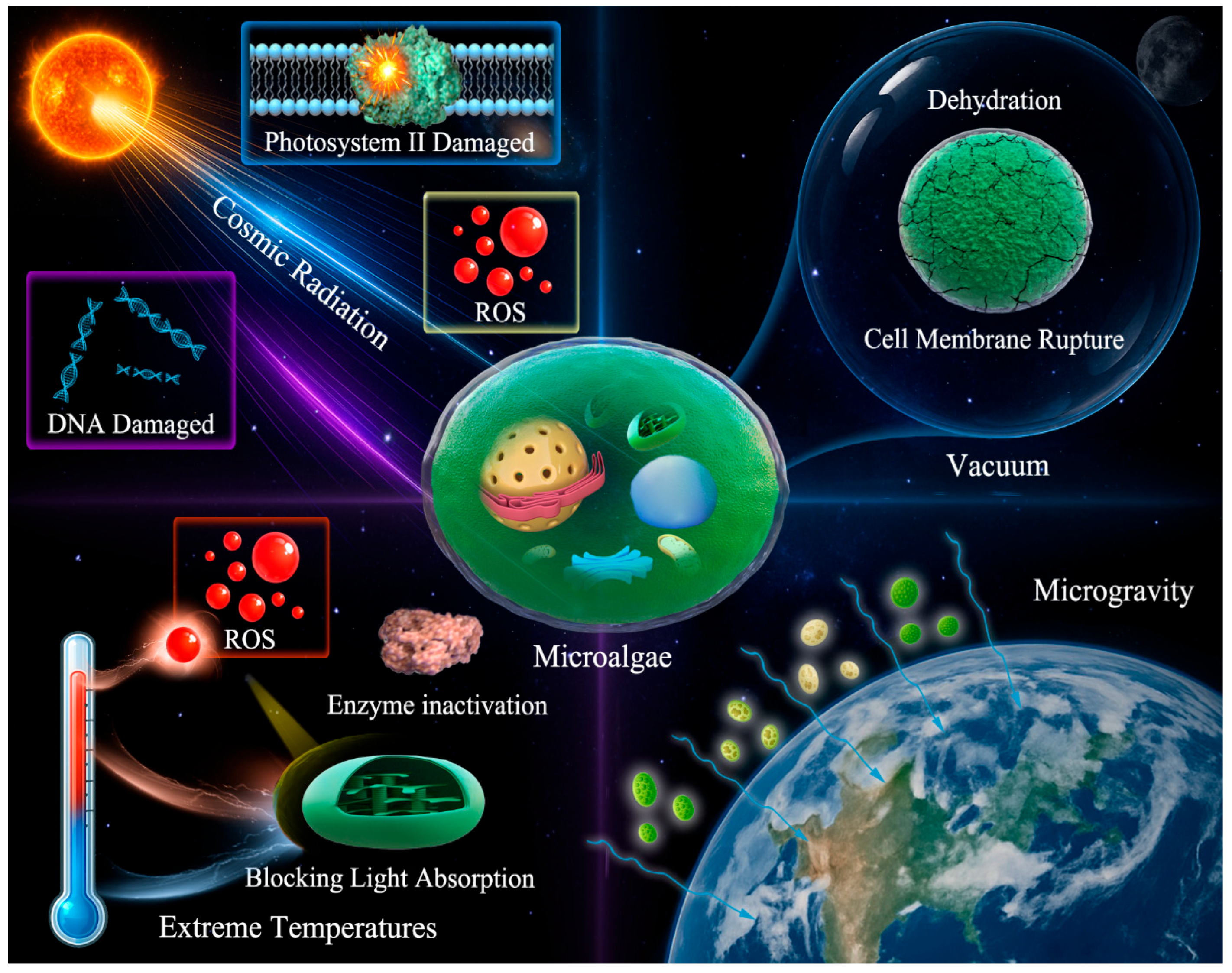
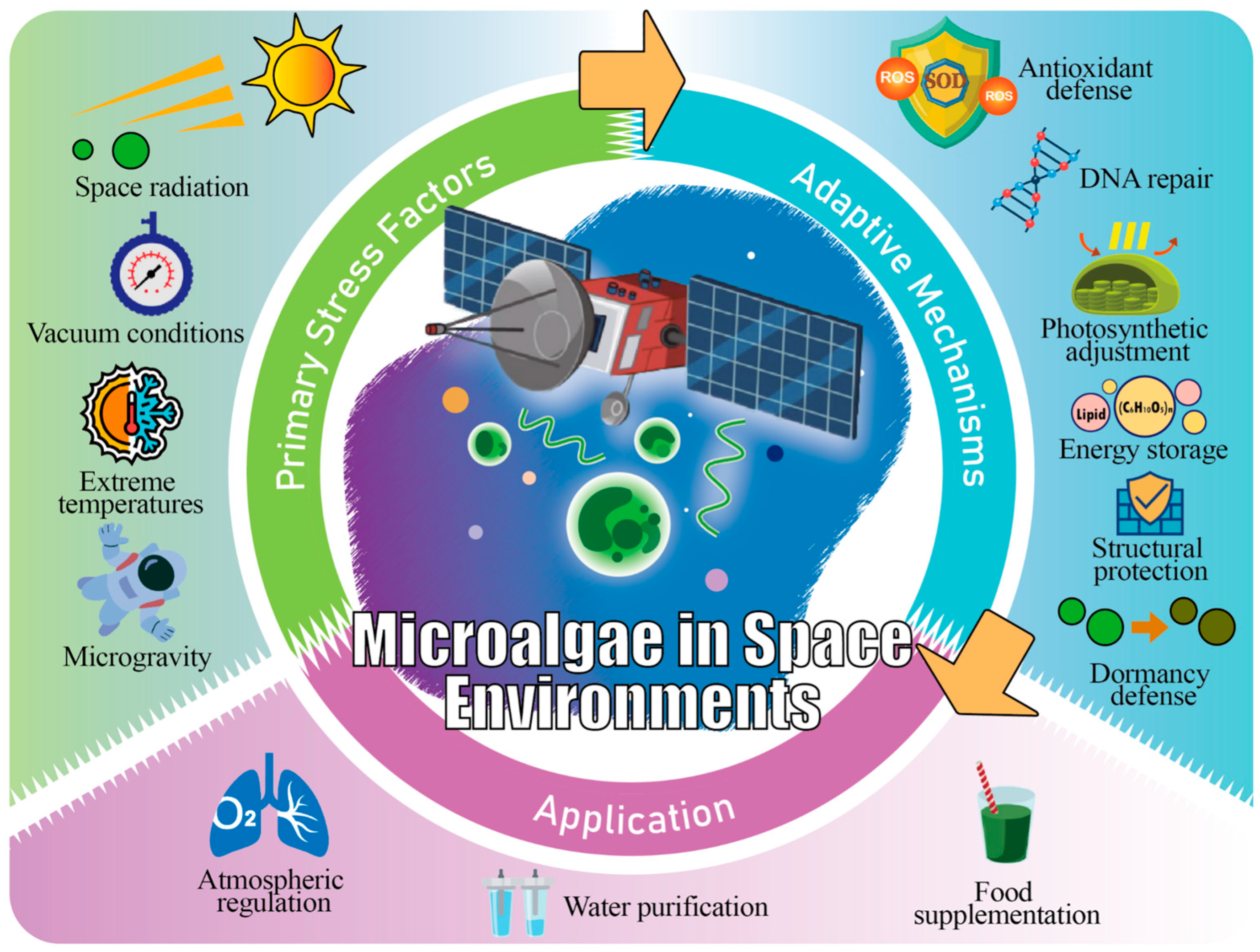
2. Primary Stress Factors of Space Environments on Microalgae
2.1. Influence of Space Radiation on Microalgae
2.2. Influence of Extreme Vacuum Conditions on Microalgae
2.3. Influence of Extreme Temperatures on Microalgae
2.4. Influence of Microgravity on Microalgae in the Extreme Space Environment
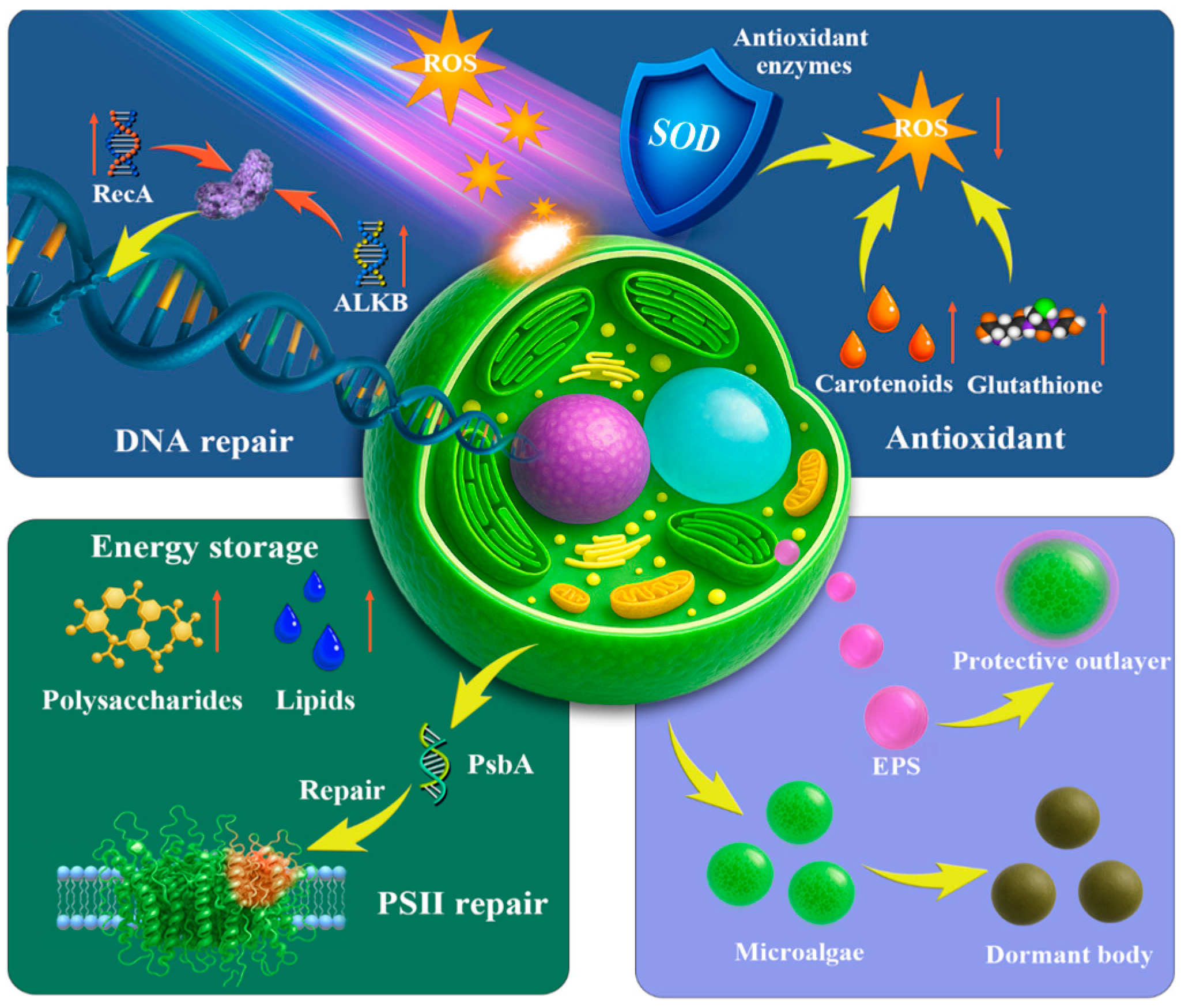
3. Adaptive Mechanisms of Microalgae in the Extreme Space Environment
3.1. Antioxidant Defense and DNA Repair
3.2. Photosynthetic Adjustment and Energy Storage
3.3. Structural Protection and Dormancy Defense
4. Application of Algae in Space Life Support Systems
4.1. Atmospheric Regulation
4.2. Food Supplementation
4.3. Water Purification
5. Research Prospects and Challenges
6. Conclusions
Author Contributions
Funding
Data Availability Statement
Conflicts of Interest
References
- Liu, G.; Dong, Y.; Xie, B.; Hu, D.; Fu, Y.; Dong, C.; Li, L.; Liu, H. The regulation of CO2 levels in a BLSS by controlling the solid waste treatment unit. Ecol. Eng. 2016, 90, 382–386. [Google Scholar] [CrossRef]
- de Vera, J.P.; Alawi, M.; Backhaus, T.; Baque, M.; Billi, D.; Bottger, U.; Berger, T.; Bohmeier, M.; Cockell, C.; Demets, R.; et al. Limits of Life and the Habitability of Mars: The ESA Space Experiment BIOMEX on the ISS. Astrobiology 2019, 19, 145–157. [Google Scholar] [CrossRef]
- Terentyev, V.V.; Shkuropatov, A.Y.; Shkuropatova, V.A.; Shuvalov, V.A.; Klimov, V.V. Investigation of the Redox interaction between Mn-bicarbonate complexes and reaction centers from Rhodobacter sphaeroides R-26, Chromatium minutissimum, and Chloroflexus aurantiacus. Biochemistry 2011, 76, 1360–1366. [Google Scholar] [CrossRef]
- Xie, X.; Jaleel, A.; Zhan, J.; Ren, M. Microalgae: Towards human health from urban areas to space missions. Front. Plant Sci. 2024, 15, 1419157. [Google Scholar] [CrossRef]
- Eckford-Soper, L.K.; Andersen, K.H.; Hansen, T.F.; Canfield, D.E. A case for an active eukaryotic marine biosphere during the Proterozoic era. Proc. Natl. Acad. Sci. USA 2022, 119, e2122042119. [Google Scholar] [CrossRef]
- Dai, S.; Feng, W.; Song, F.; Li, T.; Tao, Y.; Yang, F.; Miao, Q.; Duan, P.; Liao, H.; Shi, H.; et al. Review of biological algal fertilizer technology: Alleviating salinization, sequestering carbon, and improving crop productivity. Bioresour. Technol. 2025, 429, 132507. [Google Scholar] [CrossRef]
- Sukhinov, D.V.; Gotovtsev, P.M.; Sergeeva, Y.E. Phototrophic microorganisms in bioregenerative life support systems for long-term crewed expeditions: Prospects and challenges. Acta Astronaut. 2023, 211, 518–538. [Google Scholar] [CrossRef]
- Rabbow, E.; Rettberg, P.; Barczyk, S.; Bohmeier, M.; Parpart, A.; Panitz, C.; Horneck, G.; von Heise-Rotenburg, R.; Hoppenbrouwers, T.; Willnecker, R.; et al. EXPOSE-E: An ESA astrobiology mission 1.5 years in space. Astrobiology 2012, 12, 374–386. [Google Scholar] [CrossRef]
- Li, M.; Hu, D.; Liu, H.; Hu, E.; Xie, B.; Tong, L. Chlorella vulgaris culture as a regulator of CO2 in a bioregenerative life support system. Adv. Space Res. 2013, 52, 773–779. [Google Scholar] [CrossRef]
- Revellame, E.D.; Aguda, R.; Gatdula, K.M.; Holmes, W.; Fortela, D.L.; Sharp, W.; Gang, D.; Chistoserdov, A.; Hernandez, R.; Zappi, M.E. Microalgae in bioregenerative life support systems for space applications. Algal Res. 2024, 77, 103332. [Google Scholar] [CrossRef]
- Baqué, M.; de Vera, J.-P.; Rettberg, P.; Billi, D. The BOSS and BIOMEX space experiments on the EXPOSE-R2 mission: Endurance of the desert cyanobacterium Chroococcidiopsis under simulated space vacuum, Martian atmosphere, UVC radiation and temperature extremes. Acta Astronaut. 2013, 91, 180–186. [Google Scholar] [CrossRef]
- Macario, I.P.E.; Veloso, T.; Frankenbach, S.; Serodio, J.; Passos, H.; Sousa, C.; Goncalves, F.J.M.; Ventura, S.P.M.; Pereira, J.L. Cyanobacteria as Candidates to Support Mars Colonization: Growth and Biofertilization Potential Using Mars Regolith as a Resource. Front. Microbiol. 2022, 13, 840098. [Google Scholar] [CrossRef]
- Kakouridis, A.; Diamond, S.; Eng, T.; Mills, H.J.; Gamez Holzhaus, O.; Summers, M.L.; Garcia-Pichel, F.; Mukhopadhyay, A. Desiccated Cyanobacteria Serve As Efficient Plasmid DNA Carriers in Space Flight. ACS Synth. Biol. 2024, 13, 2733–2741. [Google Scholar] [CrossRef]
- Frossard, E.; Crain, G.; Gimenez de Azcarate Bordons, I.; Hirschvogel, C.; Oberson, A.; Paille, C.; Pellegri, G.; Udert, K.M. Recycling nutrients from organic waste for growing higher plants in the Micro Ecological Life Support System Alternative (MELiSSA) loop during long-term space missions. Life Sci. Space Res. 2024, 40, 176–185. [Google Scholar] [CrossRef]
- Wang, B.; Ye, T.; Li, X.; Bian, P.; Liu, Y.; Wang, G. Survival of desert algae Chlorella exposed to Mars-like near space environment. Life Sci. Space Res. 2021, 29, 22–29. [Google Scholar] [CrossRef] [PubMed]
- Hammond, T.G.; Panikkanvalappil, S.R.; Allen, P.L.; Gaikani, H.K.; Nislow, C.; Giaever, G.; Zhang, Y.; Levine, H.G.; Gaza, R.; Dimapilis, D.; et al. Programmed cell death and redox metabolism protect Chlamydomonas reinhardtii populations from the galactic cosmic environment on the Artemis-1 mission. Sci. Rep. 2025, 15, 23396. [Google Scholar] [CrossRef] [PubMed]
- Matula, E.E.; Nabity, J.A. Failure modes, causes, and effects of algal photobioreactors used to control a spacecraft environment. Life Sci. Space Res. 2019, 20, 35–52. [Google Scholar] [CrossRef] [PubMed]
- Wang, G.; Chen, L.; Hu, C.; Li, G.; Chen, K.; Li, D.; Liu, Y. Studies on effects of spaceflight and irradiation on photosyntheticsystem of microalgae. Space Med. Med. Eng. 2005, 18, 437–441. [Google Scholar] [CrossRef]
- Olsson, J.; Toth, G.B.; Oerbekke, A.; Cvijetinovic, S.; Wahlström, N.; Harrysson, H.; Steinhagen, S.; Kinnby, A.; White, J.; Edlund, U.; et al. Cultivation conditions affect the monosaccharide composition in Ulva fenestrata. J. Appl. Phycol. 2020, 32, 3255–3263. [Google Scholar] [CrossRef]
- Esteves, A.F.; Pardilhó, S.; Gonçalves, A.L.; Vilar, V.J.P.; Pires, J.C.M. Unravelling the impact of light spectra on microalgal growth and biochemical composition using principal component analysis and artificial neural network models. Algal Res. 2025, 85, 103820. [Google Scholar] [CrossRef]
- Fahrion, J.; Gupta, S.; Mastroleo, F.; Dussap, C.G.; Leys, N. Chronic low-dose rate irradiation induces transient hormesis effect on cyanobacterium Limnospira indica. iScience 2025, 28, 111891. [Google Scholar] [CrossRef]
- Wang, J.; Wang, J.; Li, W.; Luo, G.; Yang, S.; Du, Y.; Wei, W.; Jin, W.; Luo, S.; Li, X. Photosynthetic response of Scenedesmus quadricauda to carbon ions irradiation. Acta Astronaut. 2019, 159, 27–32. [Google Scholar] [CrossRef]
- Chia, K.F.; Wong, C.Y.; Koh, R.Y.; Lee, C.S.; Chye, S.M.; Kok, Y.Y.; Ahmad, S.A.; Convey, P.; Tavie, L.C.; Wang, W.; et al. Adaptations, cultivation and commercial prospects of polar microalgae. Adv. Polar Sci. 2025, 36, 36–40. [Google Scholar] [CrossRef]
- Wang, T.; Gao, M.; Song, H.; Wang, C.; He, M. Low temperature modulates the carbon allocation in different metabolic pathways to improve the tolerance of Arctic Chlorella to high light stress. Algal Res. 2024, 80, 103562. [Google Scholar] [CrossRef]
- Golz, A.-L.; Bradshaw, C. Gamma Radiation Induced Changes in the Biochemical Composition of Aquatic Primary Producers and Their Effect on Grazers. Front. Environ. Sci. 2019, 7, 100. [Google Scholar] [CrossRef]
- Imamura, S.; Yamada, K.; Takebe, H.; Kiuchi, R.; Iwashita, H.; Toyokawa, C.; Suzuki, K.; Sakurai, A.; Takaya, K. Optimal conditions of algal breeding using neutral beam and applying it to breed Euglena gracilis strains with improved lipid accumulation. Sci. Rep. 2024, 14, 14716. [Google Scholar] [CrossRef] [PubMed]
- Mroz, M.; Parchem, K.; Jozwik, J.; Domingues, M.R.; Kusznierewicz, B. The Impact of Different Drying Methods on the Metabolomic and Lipidomic Profiles of Arthrospira platensis. Molecules 2024, 29, 1747. [Google Scholar] [CrossRef]
- Kaur, M.; Saini, K.C.; Ojah, H.; Sahoo, R.; Gupta, K.; Kumar, A.; Bast, F. Abiotic stress in algae: Response, signaling and transgenic approaches. J. Appl. Phycol. 2022, 34, 1843–1869. [Google Scholar] [CrossRef]
- Muthert, L.W.F.; Izzo, L.G.; van Zanten, M.; Aronne, G. Root Tropisms: Investigations on Earth and in Space to Unravel Plant Growth Direction. Front. Plant Sci. 2019, 10, 1807. [Google Scholar] [CrossRef]
- Fais, G.; Manca, A.; Concas, A.; Pantaleo, A.; Cao, G. A novel process to grow edible microalgae on Mars by exploiting in situ-available resources: Experimental investigation. Acta Astronaut. 2022, 201, 454–463. [Google Scholar] [CrossRef]
- Mapstone, L.J.; Leite, M.N.; Purton, S.; Crawford, I.A.; Dartnell, L. Cyanobacteria and microalgae in supporting human habitation on Mars. Biotechnol. Adv. 2022, 59, 107946. [Google Scholar] [CrossRef]
- Helisch, H.; Keppler, J.; Detrell, G.; Belz, S.; Ewald, R.; Fasoulas, S.; Heyer, A.G. High density long-term cultivation of Chlorella vulgaris SAG 211-12 in a novel microgravity-capable membrane raceway photobioreactor for future bioregenerative life support in SPACE. Life Sci. Space Res. 2020, 24, 91–107. [Google Scholar] [CrossRef] [PubMed]
- Ellena, G.; Fahrion, J.; Gupta, S.; Dussap, C.-G.; Mazzoli, A.; Leys, N.; Mastroleo, F. Development and implementation of a simulated microgravity setup for edible cyanobacteria. npj Microgravity 2024, 10, 99. [Google Scholar] [CrossRef]
- Huang, B.; Li, D.-G.; Huang, Y.; Liu, C.-T. Effects of spaceflight and simulated microgravity on microbial growth and secondary metabolism. Mil. Med. Res. 2018, 5, 18. [Google Scholar] [CrossRef]
- Li, C.; Zhang, X.; Ye, T.; Li, X.; Wang, G. Protection and Damage Repair Mechanisms Contributed To the Survival of Chroococcidiopsis sp. Exposed To a Mars-Like Near Space Environment. Microbiol. Spectr. 2022, 10, e0344022. [Google Scholar] [CrossRef]
- Baque, M.; Scalzi, G.; Rabbow, E.; Rettberg, P.; Billi, D. Biofilm and planktonic lifestyles differently support the resistance of the desert cyanobacterium Chroococcidiopsis under space and Martian simulations. Orig. Life Evol. Biosph. 2013, 43, 377–389. [Google Scholar] [CrossRef]
- Billi, D.; Viaggiu, E.; Cockell, C.S.; Rabbow, E.; Horneck, G.; Onofri, S. Damage escape and repair in dried Chroococcidiopsis spp. from hot and cold deserts exposed to simulated space and martian conditions. Astrobiology 2011, 11, 65–73. [Google Scholar] [CrossRef] [PubMed]
- Singh, V.K.; Jha, S.; Rana, P.; Mishra, S.; Kumari, N.; Singh, S.C.; Anand, S.; Upadhye, V.; Sinha, R.P. Resilience and Mitigation Strategies of Cyanobacteria under Ultraviolet Radiation Stress. Int. J. Mol. Sci. 2023, 24, 12381. [Google Scholar] [CrossRef]
- Ye, T.; Gu, P.; Zhang, X.; Wang, G. The potential of cyanobacterium Nostoc sp. as the primary producer in the life-support system on Mars. Res. Sq. 2023, preprint. [Google Scholar] [CrossRef]
- Ohbayashi, R.; Nakamachi, A.; Hatakeyama, T.S.; Watanabe, S.; Kanesaki, Y.; Chibazakura, T.; Yoshikawa, H.; Miyagishima, S.Y. Coordination of Polyploid Chromosome Replication with Cell Size and Growth in a Cyanobacterium. mBio 2019, 10, 10–1128. [Google Scholar] [CrossRef] [PubMed]
- Watanabe, S. Cyanobacterial multi-copy chromosomes and their replication. Biosci. Biotechnol. Biochem. 2020, 84, 1309–1321. [Google Scholar] [CrossRef]
- Napoli, A.; Micheletti, D.; Pindo, M.; Larger, S.; Cestaro, A.; de Vera, J.P.; Billi, D. Absence of increased genomic variants in the cyanobacterium Chroococcidiopsis exposed to Mars-like conditions outside the space station. Sci. Rep. 2022, 12, 8437. [Google Scholar] [CrossRef]
- Araujo, R.G.; Alcantar-Rivera, B.; Melendez-Sanchez, E.R.; Martinez-Prado, M.A.; Sosa-Hernandez, J.E.; Iqbal, H.M.N.; Parra-Saldivar, R.; Martinez-Ruiz, M. Effects of UV and UV-vis Irradiation on the Production of Microalgae and Macroalgae: New Alternatives to Produce Photobioprotectors and Biomedical Compounds. Molecules 2022, 27, 5334. [Google Scholar] [CrossRef] [PubMed]
- Fisher, K.E.; Saban, K.E.; Broddrick, J.T.; Settles, A.M. Space Algae-2 Ground and Lunar Analog Studies in Preparation for Long-Duration Propagation of Cyanobacteria in Spaceflight. In Proceedings of the 53rd International Conference on Environmental Systems (ICES 2024), Louisville, KY, USA, 21 July 2024. [Google Scholar]
- Kumari, S.; Satapathy, S.; Datta, M.; Kumar, S. Adaptation of Microalgae to Temperature and Light Stress. In Plant Stress: Challenges and Management in the New Decade; Springer: Berlin/Heidelberg, Germany, 2022; pp. 123–134. [Google Scholar]
- Canonico, M.; Konert, G.; Kana, R. Plasticity of Cyanobacterial Thylakoid Microdomains Under Variable Light Conditions. Front. Plant Sci. 2020, 11, 586543. [Google Scholar] [CrossRef]
- Chouhan, N.; Yadav, R.M.; Pandey, J.; Subramanyam, R. High light-induced changes in thylakoid supercomplexes organization from cyclic electron transport mutants of Chlamydomonas reinhardtii. Biochim. Biophys. Acta Bioenerg. 2023, 1864, 148917. [Google Scholar] [CrossRef]
- Burnap, R.L.; Hagemann, M.; Kaplan, A. Regulation of CO2 Concentrating Mechanism in Cyanobacteria. Life 2015, 5, 348–371. [Google Scholar] [CrossRef] [PubMed]
- Brueggeman, A.J.; Gangadharaiah, D.S.; Cserhati, M.F.; Casero, D.; Weeks, D.P.; Ladunga, I. Activation of the carbon concentrating mechanism by CO2 deprivation coincides with massive transcriptional restructuring in Chlamydomonas reinhardtii. Plant Cell 2012, 24, 1860–1875. [Google Scholar] [CrossRef]
- Shah, M.M.; Liang, Y.; Cheng, J.J.; Daroch, M. Astaxanthin-Producing Green Microalga Haematococcus pluvialis: From Single Cell to High Value Commercial Products. Front. Plant Sci. 2016, 7, 531. [Google Scholar] [CrossRef] [PubMed]
- Rastogi, R.P.; Madamwar, D.; Nakamoto, H.; Incharoensakdi, A. Resilience and self-regulation processes of microalgae under UV radiation stress. J. Photochem. Photobiol. C Photochem. Rev. 2020, 43, 100322. [Google Scholar] [CrossRef]
- Shelake, R.M.; Khalid, M.A.; Kim, J.Y. Microalgal bioengineering for futuristic applications in synthetic and space biology. Biotechnol. Adv. 2025, 84, 108665. [Google Scholar] [CrossRef]
- Keller, R.; Goli, K.; Porter, W.; Alrabaa, A.; Jones, J.A. Cyanobacteria and Algal-Based Biological Life Support System (BLSS) and Planetary Surface Atmospheric Revitalizing Bioreactor Brief Concept Review. Life 2023, 13, 816. [Google Scholar] [CrossRef]
- Zhu, F.; Jiao, F.F.; Wang, F.; Li, S.; Wang, X.Z.; Wang, S.F. Critical operating conditions and water supply optimization of electrolytic oxygen generation system under microgravity environment. Chin. Space Sci. Technol. 2025, 45, 42–50. [Google Scholar] [CrossRef]
- Wang, W.; Jin, L.; Gao, N.; Wang, J.; Liu, M. The Oxygen Generation Performance of Hollow-Structured Oxygen Candle for Refuge Space. J. Chem. 2018, 2018, 7469783. [Google Scholar] [CrossRef]
- Yang, L.; Li, H.; Liu, T.; Zhong, Y.; Ji, C.; Lu, Q.; Fan, L.; Li, J.; Leng, L.; Li, K.; et al. Microalgae biotechnology as an attempt for bioregenerative life support systems: Problems and prospects. J. Chem. Technol. Biotechnol. 2019, 94, 3039–3048. [Google Scholar] [CrossRef]
- Hader, D.P. On the Way to Mars-Flagellated Algae in Bioregenerative Life Support Systems Under Microgravity Conditions. Front. Plant Sci. 2019, 10, 1621. [Google Scholar] [CrossRef]
- Lafarga, T. Effect of microalgal biomass incorporation into foods: Nutritional and sensorial attributes of the end products. Algal Res. 2019, 41, 101566. [Google Scholar] [CrossRef]
- Caporgno, M.P.; Mathys, A. Trends in Microalgae Incorporation Into Innovative Food Products With Potential Health Benefits. Front. Nutr. 2018, 5, 58. [Google Scholar] [CrossRef]
- Spinola, M.P.; Mendes, A.R.; Prates, J.A.M. Chemical Composition, Bioactivities, and Applications of Spirulina (Limnospira platensis) in Food, Feed, and Medicine. Foods 2024, 13, 3656. [Google Scholar] [CrossRef] [PubMed]
- Sinetova, M.A.; Kupriyanova, E.V.; Los, D.A. Spirulina/Arthrospira/Limnospira-Three Names of the Single Organism. Foods 2024, 13, 2762. [Google Scholar] [CrossRef]
- Lafarga, T.; Fernandez-Sevilla, J.M.; Gonzalez-Lopez, C.; Acien-Fernandez, F.G. Spirulina for the food and functional food industries. Food Res. Int. 2020, 137, 109356. [Google Scholar] [CrossRef]
- Villaró-Cos, S.; Guzmán Sánchez, J.L.; Acién, G.; Lafarga, T. Research trends and current requirements and challenges in the industrial production of spirulina as a food source. Trends Food Sci. Technol. 2024, 143, 104280. [Google Scholar] [CrossRef]
- Chen, C.; Tang, T.; Shi, Q.; Zhou, Z.; Fan, J. The potential and challenge of microalgae as promising future food sources. Trends Food Sci. Technol. 2022, 126, 99–112. [Google Scholar] [CrossRef]
- Zheng, X.; Chen, L.; Yin, L.; Rao, H.; Zheng, H.; Xun, C.; Hao, J. Application and prospect of microbial food Chlorella. Heliyon 2024, 10, e37025. [Google Scholar] [CrossRef]
- Machado Sierra, E.; Serrano, M.C.; Manares, A.; Guerra, A.; Aranguren Díaz, Y. Microalgae: Potential for Bioeconomy in Food Systems. Appl. Sci. 2021, 11, 11316. [Google Scholar] [CrossRef]
- Wang, C.; Onyeaka, H.; Miri, T.; Soltani, F. Chlorella vulgaris as a food substitute: Applications and benefits in the food industry. J. Food Sci. 2024, 89, 8231–8247. [Google Scholar] [CrossRef]
- Jannel, S.; Caro, Y.; Bermudes, M.; Petit, T. Novel Insights into the Biotechnological Production of Haematococcus pluvialis-Derived Astaxanthin: Advances and Key Challenges to Allow Its Industrial Use as Novel Food Ingredient. J. Mar. Sci. Eng. 2020, 8, 789. [Google Scholar] [CrossRef]
- Wang, Y.; Chen, L.; Zhao, J.; Xia, G.; Liu, Z.; Shi, H. Astaxanthin Esters as Functional Food: A Review of Their Nutrition, Phytochemical Structure, Biological Features, and Food Industry Prospects. J. Agric. Food Chem. 2024, 72, 13467–13475. [Google Scholar] [CrossRef]
- Baskar, G.; Muthulakshmi, M.; Pravin, R.; Patel, A.K. Expanding horizons: Harnessing Dunaliella microalgae for sustainable organic pigment production. Biomass Convers. Biorefinery 2024, 15, 13055–13078. [Google Scholar] [CrossRef]
- Pais, R.; Conde, T.; Neves, B.B.; Pinho, M.; Coelho, M.; Pereira, H.; Rodrigues, A.M.C.; Domingues, P.; Gomes, A.M.; Urbatzka, R.; et al. Bioactive Lipids in Dunaliella salina: Implications for Functional Foods and Health. Foods 2024, 13, 3321. [Google Scholar] [CrossRef]
- Wu, S.; Wu, X.; Wen, J.; Chen, Z.; Yang, X.; He, X.; Dai, C.; Zhao, C.; Chen, W. Biosynthesis and biological activities of 9-cis beta-carotene from green microalga Dunaliella. Algal Res. 2025, 91, 104270. [Google Scholar] [CrossRef]
- Carrillo, M.; Anchundia, M. Antimicrobial and antioxidant capacity of Dunaliella salina, Tetraselmis chuii and Isochrysis galbana and their potential use in food. A systematic review. CABI Agric. Biosci. 2024, 5, 108. [Google Scholar] [CrossRef]
- Qu, J.; Zhu, T.; Du, X.; Zhang, Y.; Tian, J.; Xia, Y.; Ke, X.; Fu, S.; Fan, B. Safety evaluation of Nannochloropsis gaditana oil as a novel food. Regul. Toxicol. Pharmacol. 2025, 162, 105901. [Google Scholar] [CrossRef]
- Uthaiah, N.M.; Venkataramareddy, S.R.; Sheikh, A.Y. Oleaginous microalgae Nannochloropsis sp. as a potential source of EPA and bioactive metabolites: Bottlenecks in the downstream processing and unravelling the challenges in its food, feed and therapeutic application. Algal Res. 2025, 86, 103897. [Google Scholar] [CrossRef]
- Matos, J.; Afonso, C.; Cardoso, C.; Serralheiro, M.L.; Bandarra, N.M. Yogurt Enriched with Isochrysis galbana: An Innovative Functional Food. Foods 2021, 10, 1458. [Google Scholar] [CrossRef]
- Kumar, V.; Kumar, A.; Nanda, M. Pretreated animal and human waste as a substantial nutrient source for cultivation of microalgae for biodiesel production. Environ. Sci. Pollut. Res. Int. 2018, 25, 22052–22059. [Google Scholar] [CrossRef]
- Siddiqui, S.A.; Wu, Y.S.; Saikia, T.; Ucak, İ.; Afreen, M.; Shah, M.A.; Ayivi, R.D. Production and growth of microalgae in urine and wastewater: A review. Environ. Chem. Lett. 2023, 21, 2789–2823. [Google Scholar] [CrossRef]
- Hong, Y.; Yang, L.; You, X.; Zhang, L.; Yang, Y.; Zhou, X.; Zhang, Y. Development and performance evaluation of a circulating fixed-bed photobioreactor (CFBP) with clinoptilolite fillers for enhanced microalgae cultivation in urine: Mechanistic insights. Environ. Res. 2025, 284, 122207. [Google Scholar] [CrossRef]
- You, X.; Yang, L.; Zhou, X.; Zhang, Y. Sustainability and carbon neutrality trends for microalgae-based wastewater treatment: A review. Environ. Res. 2022, 209, 112860. [Google Scholar] [CrossRef] [PubMed]
- Tao, Y.; Liu, Z.; Zheng, J.; Zhou, J.; He, D.; Ma, J. Microalgae production in human urine: Fundamentals, opportunities, and perspectives. Front. Microbiol. 2022, 13, 1067782. [Google Scholar] [CrossRef] [PubMed]
- Fahrion, J.; Mastroleo, F.; Dussap, C.G.; Leys, N. Use of Photobioreactors in Regenerative Life Support Systems for Human Space Exploration. Front. Microbiol. 2021, 12, 699525. [Google Scholar] [CrossRef]
- Cockell, C.S.; Horneck, G. The history of the UV radiation climate of the earth—theoretical and space-based observations. Photochem. Photobiol. 2001, 73, 447–451. [Google Scholar] [CrossRef] [PubMed]
- Liu, F.; Zheng, W.; Zheng, W.; Tong, G.; Yuan, Y.; Tian, Q.; Xu, D.; Jia, C.; Zhang, T.; Chu, J. Experimental system of life ecological science on China Space Station. In Proceedings of the Earth and Space: From Infrared to Terahertz (ESIT 2022), Nantong, China, 17–19 September 2022; SPIE: Bellingham, WA, USA, 2023. [Google Scholar]
- Novoa, A.F.; Vrouwenvelder, J.S.; Fortunato, L. Membrane Fouling in Algal Separation Processes: A Review of Influencing Factors and Mechanisms. Front. Chem. Eng. 2021, 3, 687422. [Google Scholar] [CrossRef]



| Algal Species | Sample Treatment | Habitat Environment | Survival Situation | References |
|---|---|---|---|---|
| Cyanobacterium Chroococcidiopsis sp. CCMEE 029 | Dried cells mixed with S-MRS Mars analog minerals; partially shielded with MgF2 filters simulating subsurface conditions | Simulated Mars-like conditions, low Earth orbit | Survived and recovered well, low DNA damage especially in shielded areas | [2] |
| Cyanobacterium Chroococcidiopsis sp. CCMEE 029 | Cells mixed with Mars regolith analogue (S-MRS), dried | Dried biofilms and planktonic cells exposed to simulated space vacuum, UVC, Martian atmosphere, and thermal cycling | Biofilms survived better than planktonic cells, retained DNA and pigments under high UVC | [11] |
| Anabaena cylindrica PCC 7122 | Grown in aqueous extract of MGS-1 (Mars regolith simulant) | Mars regolith extract (MGS-1), Earth-like atmosphere, low nutrients | Photosynthetic efficiency dropped after day 15; biomass turned brownish by 3rd week | [12] |
| Nostoc muscorum UTAD_N213 | Grown in aqueous extract of MGS-1 (Mars regolith simulant) | Mars regolith extract (MGS-1), Earth-like atmosphere, low nutrients | The survival condition was favorable; stable growth and PSII efficiency > 0.40 | [12] |
| Arthrospira platensis UTEX LB 2340 | Grown in aqueous extract of MGS-1 (Mars regolith simulant) | Mars regolith extract (MGS-1), Earth-like atmosphere, low nutrients | Survived; mild or no quantifiable growth; fluorescence signal unreliable due to clogging | [12] |
| Nostoc punctiforme | Filtered onto cellulose acetate membrane and dried | Stored at ambient temperature on the ISS for 34 days | The microalgal cells died, but the carried plasmids remained intact | [13] |
| Limnospira indica PCC 8005 | Cultured in a 50 mL membrane photobioreactor on the ISS | Algae cultivation chamber in the MELiSSA closed-loop system | Achieved CO2 fixation, O2 production, and primary food synthesis, but nutrient recovery from waste remained challenging | [14] |
| Chlorella vulgaris | Grown in aqueous extract of MGS-1 (Mars regolith simulant) | Mars regolith extract (MGS-1), Earth-like atmosphere, low nutrients | No growth observed; only thrived in diluted synthetic medium | [12] |
| Chlorella sp. (Tengger Desert isolate) | Drying treatment; exposure to ultraviolet light through a quartz glass window | Near space (~31 km altitude), exposed on high-altitude balloon for ~3 h | Most cells survived; reduced photosynthesis; increased mortality; damaged chloroplasts/mitochondria; 3292 differentially expressed genes (DEGs) were detected. | [15] |
| Chlamydomonas reinhardtii | The Dsup gene from tardigrades was inserted into the nucleus of Chlamydomonas reinhardtii, which was then inoculated onto agar plates | Exposed to deep space radiation during the Artemis-1 lunar flyby mission under 6 h of daily red and blue light | Survival rate was 46.9%; after returning to Earth, all algal cultures exhibited vigorous growth | [16] |
| Microalga | Applications | Functions (Health Benefits) | Key Nutritional Composition | References |
|---|---|---|---|---|
| Spirulina | Beverages, biscuits, dairy, bread, pasta, snacks | Antioxidant; regulates blood glucose/lipids; immune and probiotic support | Protein: ~60–70% DW; rich in essential amino acids, vitamins, minerals | [60,62,63,64] |
| Chlorella | Health supplements, bakery, meat analogues, beverages | Antioxidant; immune-enhancing; hypoglycemic; hypolipidemic | Protein: 50–60% DW; vitamins; pigments; lipids: up to 30% DW | [64,65,66,67] |
| Haematococcus | Supplements, beverages, vegan gels | Potent antioxidant; anti-inflammatory; supports eye and immune health | Astaxanthin: 3–5% DW (primarily as esters) | [68,69] |
| Dunaliella | Natural pigments, dietary supplements, feed | Antioxidant; immune regulation; eye protection | β-carotene: 10–13% DW (high in 9-cis isomer); ω-3 PUFAs | [70,71,72,73] |
| Nannochloropsis | Food ingredients, fortified dairy, EPA oil | Anti-inflammatory; antioxidant; supports cardiovascular health | Lipids: 20–60% DW; EPA: 20–30% of total fatty acids | [74,75] |
| Isochrysis | Fortified yogurt, fish products, additives | Antioxidant; antibacterial; supports cardiovascular and neural health | Rich in ω-3 PUFAs (DHA and EPA); fucoxanthin | [73,76] |
Disclaimer/Publisher’s Note: The statements, opinions and data contained in all publications are solely those of the individual author(s) and contributor(s) and not of MDPI and/or the editor(s). MDPI and/or the editor(s) disclaim responsibility for any injury to people or property resulting from any ideas, methods, instructions or products referred to in the content. |
© 2026 by the authors. Licensee MDPI, Basel, Switzerland. This article is an open access article distributed under the terms and conditions of the Creative Commons Attribution (CC BY) license.
Share and Cite
Dai, S.; Feng, W.; Lae, J.; Yu, X.; Ho, C.M.; Yang, F.; Miao, Q.; Duan, P. Primary Stress Factors and Adaptive Mechanisms of Microalgae in Space Environments and Their Applications in Space Life Support Systems. Plants 2026, 15, 697. https://doi.org/10.3390/plants15050697
Dai S, Feng W, Lae J, Yu X, Ho CM, Yang F, Miao Q, Duan P. Primary Stress Factors and Adaptive Mechanisms of Microalgae in Space Environments and Their Applications in Space Life Support Systems. Plants. 2026; 15(5):697. https://doi.org/10.3390/plants15050697
Chicago/Turabian StyleDai, Siyao, Weiying Feng, Jeffrey Lae, Xuezheng Yu, Chia Min Ho, Fang Yang, Qingfeng Miao, and Pengcheng Duan. 2026. "Primary Stress Factors and Adaptive Mechanisms of Microalgae in Space Environments and Their Applications in Space Life Support Systems" Plants 15, no. 5: 697. https://doi.org/10.3390/plants15050697
APA StyleDai, S., Feng, W., Lae, J., Yu, X., Ho, C. M., Yang, F., Miao, Q., & Duan, P. (2026). Primary Stress Factors and Adaptive Mechanisms of Microalgae in Space Environments and Their Applications in Space Life Support Systems. Plants, 15(5), 697. https://doi.org/10.3390/plants15050697