Herbivory on Banker Plants Enhances Resistance-Related Responses of Neighboring Tomato Plants to the Two-Spotted Spider Mite
 , and
, and
Abstract
1. Introduction
2. Results
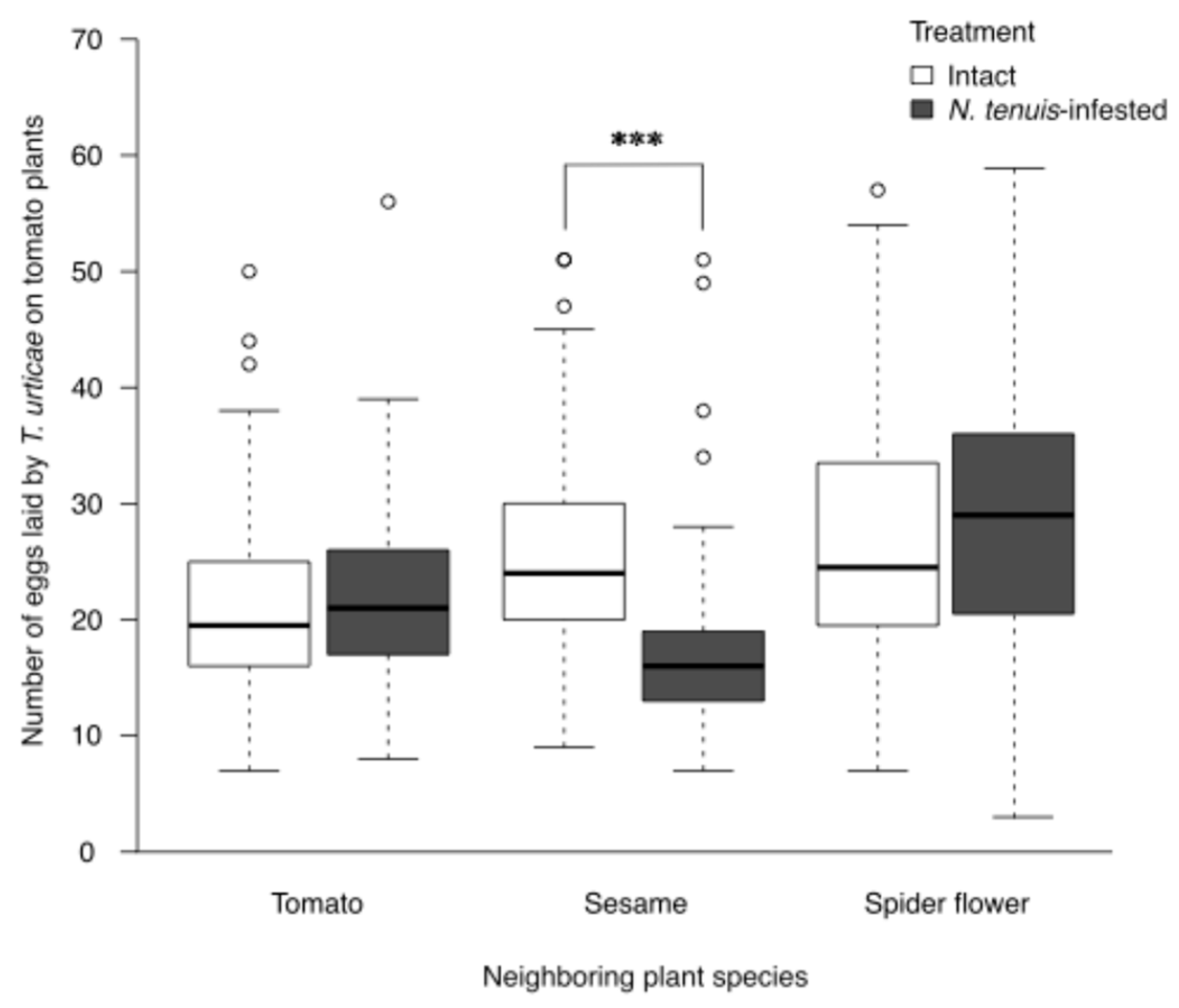
2.1. Effects of N. tenuis Herbivory on Banker Plants on T. urticae Oviposition in Neighboring Tomato Plants
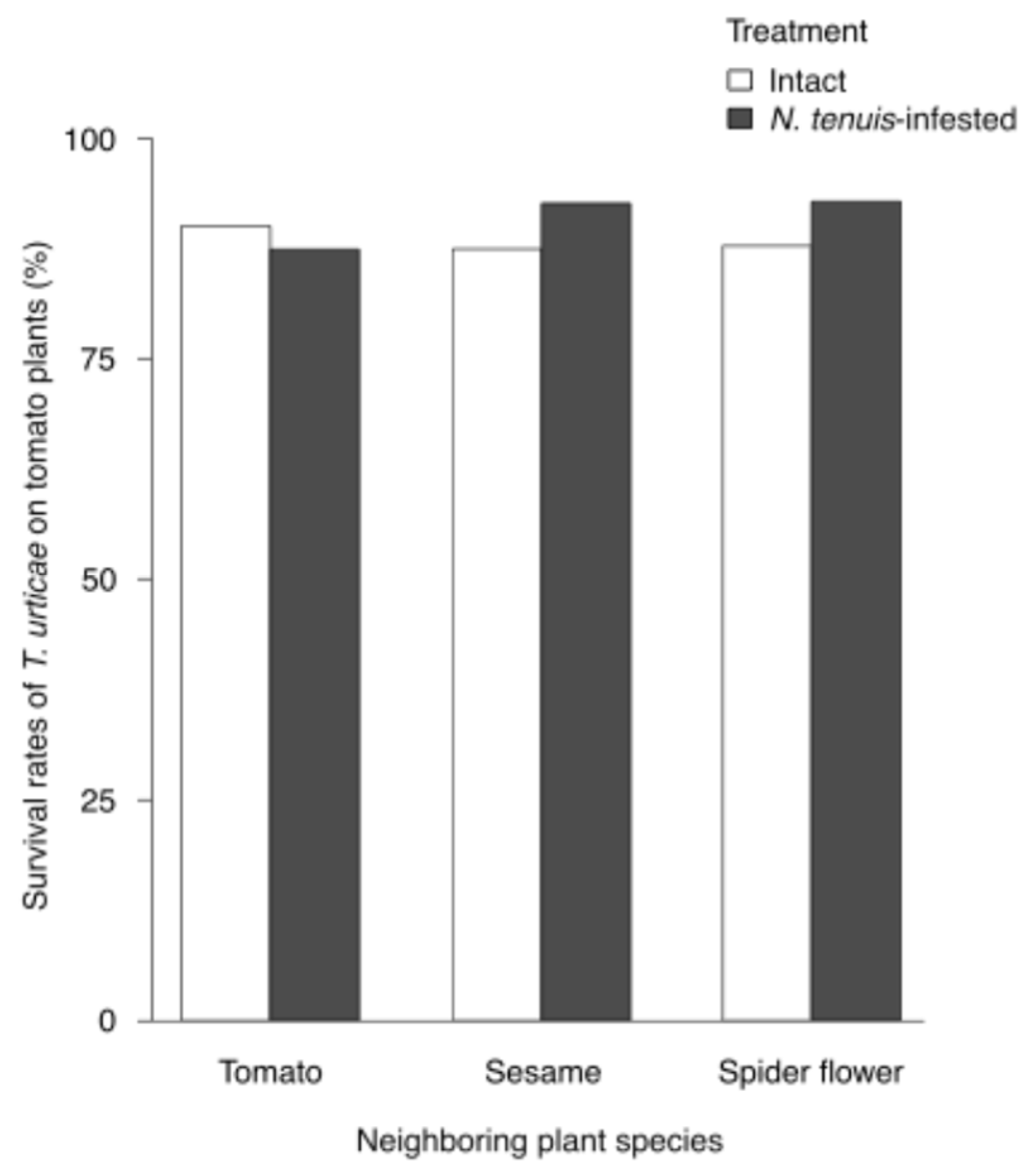
2.2. Effects of N. tenuis Herbivory on Banker Plants on T. urticae Survival in Neighboring Tomato Plants
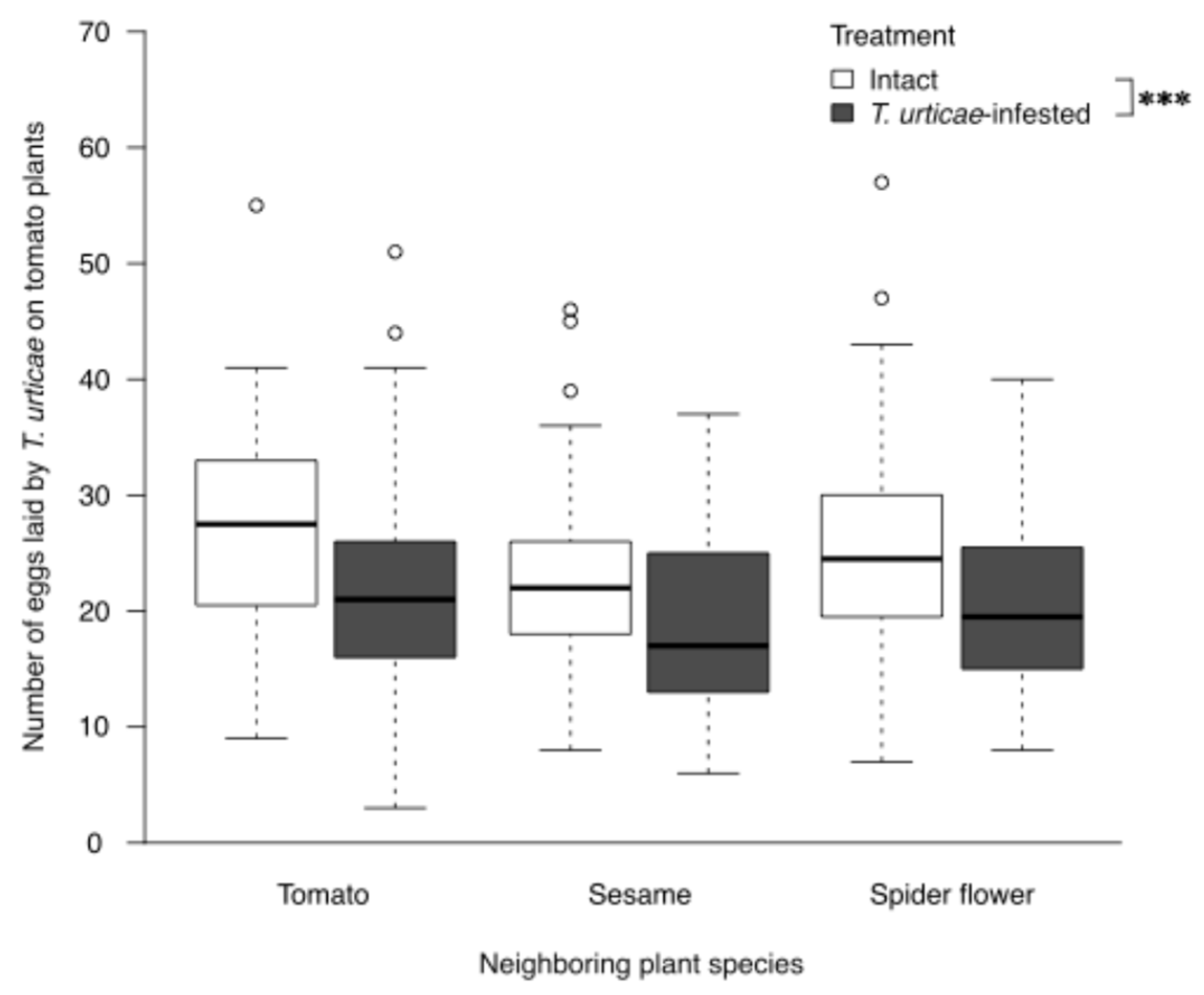
2.3. Effects of T. urticae Herbivory on Banker Plants on T. urticae Oviposition in Neighboring Tomato Plants
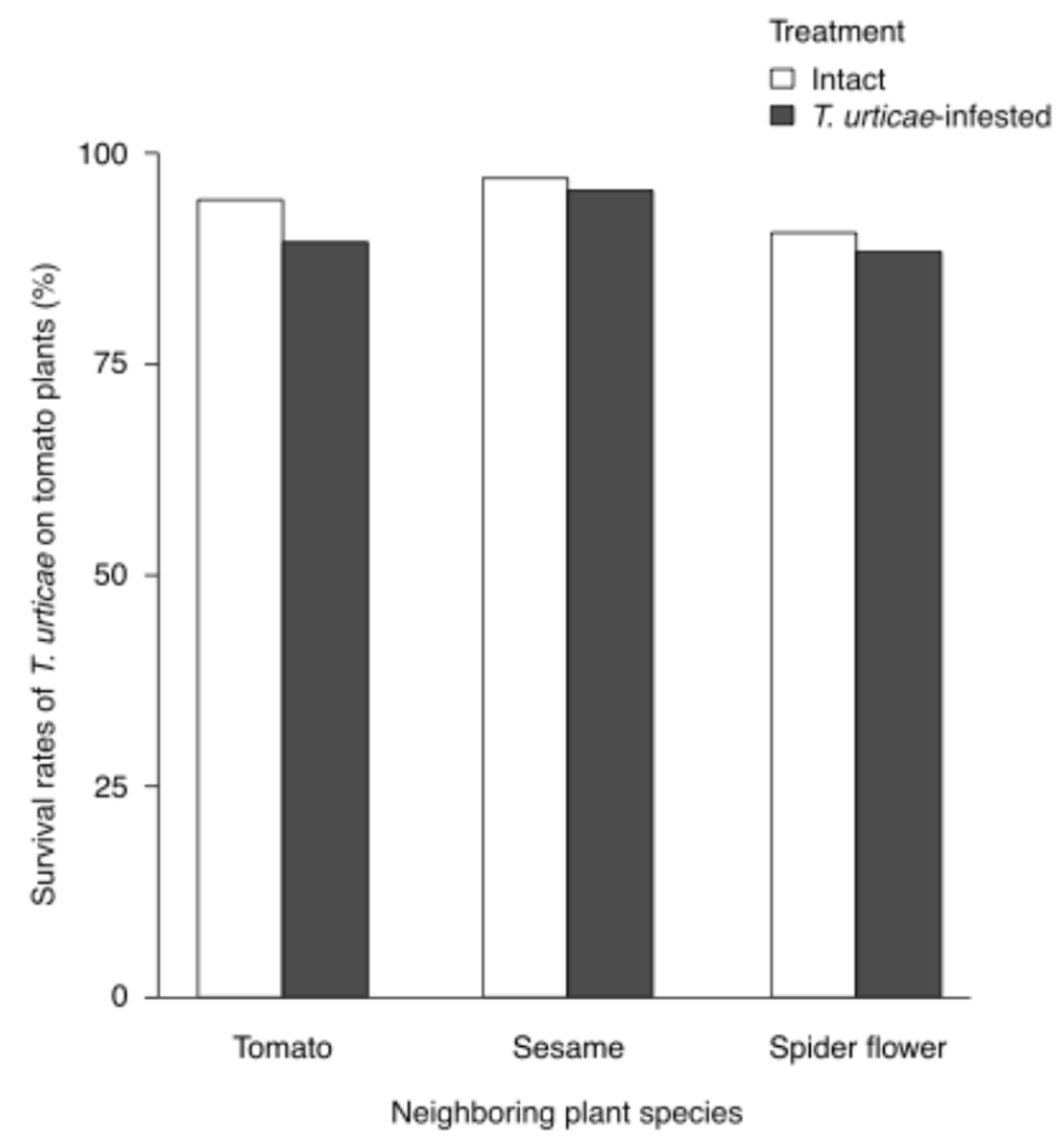
2.4. Effects of T. urticae Herbivory on Banker Plants on T. urticae Survival in Neighboring Tomato Plants
3. Discussion
4. Materials and Methods
4.1. Plants
4.2. Arthropods
4.3. Responses of Tomato Plants Adjacent to N. tenuis-Infested Banker Plants
4.4. Responses of Tomato Plants Neighboring T. urticae-Infested Banker Plants
4.5. Statistical Analysis
Author Contributions
Funding
Data Availability Statement
Conflicts of Interest
References
- Parolin, P.; Bresch, C.; Desneux, N.; Brun, R.; Bout, A.; Boll, R.; Poncet, C. Secondary plants used in biological control: A review. Int. J. Pest. Manag. 2012, 58, 91–100. [Google Scholar] [CrossRef]
- Gurr, G.M.; Wratten, S.D.; Landis, D.A.; You, M. Habitat management to suppress pest populations: Progress and prospects. Annu. Rev. Entomol. 2017, 62, 91–109. [Google Scholar] [CrossRef]
- Stacey, D.L. ‘Banker’ Plant production of Encarsia formosa Gahan and its use in the control of glasshouse whitefly on tomatoes. Plant Pathol. 1977, 26, 63–66. [Google Scholar] [CrossRef]
- Frank, S.D. Biological control of arthropod pests using banker plant systems: Past progress and future directions. Biol. Control 2010, 52, 8–16. [Google Scholar] [CrossRef]
- Huang, N.; Enkegaard, A.; Osborne, L.S.; Ramakers, P.M.J.; Messelink, G.J.; Pijnakker, J.; Murphy, G. The banker plant method in biological control. Crit. Rev. Plant Sci. 2011, 30, 259–278. [Google Scholar] [CrossRef]
- Pijnakker, J.; Vangansbeke, D.; Duarte, M.; Moerkens, R.; Wäckers, F.L. Predators and parasitoids-in-first: From inundative releases to preventative biological control in greenhouse crops. Front. Sustain. Food Syst. 2020, 4, 595630. [Google Scholar] [CrossRef]
- Xiao, Y.; Avery, P.; Chen, J.; McKenzie, C.; Osborne, L. Ornamental pepper as banker plants for establishment of Amblyseius swirskii (Acari: Phytoseiidae) for biological control of multiple pests in greenhouse vegetable production. Biol. Control 2012, 63, 279–286. [Google Scholar] [CrossRef]
- Wong, S.K.; Frank, S.D. Pollen increases fitness and abundance of Orius insidiosus Say (Heteroptera: Anthocoridae) on banker plants. Biol. Control 2013, 64, 45–50. [Google Scholar] [CrossRef]
- Kandori, I.; Miura, S.; Yano, E.; Yoneya, K.; Akino, T. Verbena × Hybrida and Scaevola aemula flowers provide nutrients for the reproduction of Nesidiocoris tenuis used for biological pest control in greenhouses. J. Pest. Sci. 2022, 95, 1567–1575. [Google Scholar] [CrossRef]
- Sanchez, J.A.; Gillespie, D.R.; McGregor, R.R. Plant preference in relation to life history traits in the zoophytophagous predator Dicyphus hesperus. Entomol. Exp. Appl. 2004, 112, 7–19. [Google Scholar] [CrossRef]
- Perdikis, D.C.; Lykouressis, D.P. Macrolophus pygmaeus (Hemiptera: Miridae) population parameters and biological characteristics when feeding on eggplant and tomato without prey. J. Econ. Entomol. 2004, 97, 1291–1298. [Google Scholar] [CrossRef] [PubMed]
- Nakaishi, K.; Fukui, Y.; Arakawa, R. Reproduction of Nesidiocoris tenuis (Reuter) on sesame. Jpn. J. Appl. Entomol. Zool. 2011, 55, 199–205. [Google Scholar] [CrossRef]
- Biondi, A.; Zappalà, L.; Di Mauro, A.; Tropea Garzia, G.; Russo, A.; Desneux, N.; Siscaro, G. Can alternative host plant and prey affect phytophagy and biological control by the zoophytophagous mirid Nesidiocoris tenuis? BioControl 2016, 61, 79–90. [Google Scholar] [CrossRef]
- Nakano, R.; Morita, T.; Okamoto, Y.; Fujiwara, A.; Yamanaka, T.; Adachi-Hagimori, T. Cleome hassleriana plants fully support the development and reproduction of Nesidiocoris tenuis. BioControl 2021, 66, 407–418. [Google Scholar] [CrossRef]
- Mori, S.; Eto, T.; Tokuda, M. Effectiveness of Nesidiocoris tenuis and banker plants on the control of thrips tabaci in greenhouse Asparagus. Kyushu Pl. Prot. Res. 2018, 64, 41–46. [Google Scholar] [CrossRef]
- Nakano, R.; Hinomoto, N. Tracking the movement of Nesidiocoris tenuis among banker plants and crops in a tomato greenhouse by DNA markers of host plants. BioControl 2021, 66, 659–671. [Google Scholar] [CrossRef]
- Karban, R.; Baldwin, I.T. Induced Responses to Herbivory; Interspecific Interactions Series; University of Chicago Press: Chicago, IL, USA, 1997; ISBN 978-0-226-42496-5. [Google Scholar]
- War, A.R.; Paulraj, M.G.; Ahmad, T.; Buhroo, A.A.; Hussain, B.; Ignacimuthu, S.; Sharma, H.C. Mechanisms of plant defense against insect herbivores. Plant Signal. Behav. 2012, 7, 1306–1320. [Google Scholar] [CrossRef]
- Heil, M. Extrafloral nectar at the plant-insect interface: A spotlight on chemical ecology, phenotypic plasticity, and food webs. Annu. Rev. Entomol. 2015, 60, 213–232. [Google Scholar] [CrossRef]
- Turlings, T.C.J.; Erb, M. Tritrophic Interactions mediated by herbivore-induced plant volatiles: Mechanisms, ecological relevance, and application potential. Annu. Rev. Entomol. 2018, 63, 433–452. [Google Scholar] [CrossRef]
- Dicke, M.; Baldwin, I.T. The evolutionary context for herbivore-induced plant volatiles: Beyond the ‘cry for help’. Trends Plant Sci. 2010, 15, 167–175. [Google Scholar] [CrossRef]
- Aartsma, Y.; Bianchi, F.J.J.A.; van der Werf, W.; Poelman, E.H.; Dicke, M. Herbivore-induced plant volatiles and tritrophic interactions across spatial scales. New Phytol. 2017, 216, 1054–1063. [Google Scholar] [CrossRef]
- Arimura, G.; Ozawa, R.; Shimoda, T.; Nishioka, T.; Boland, W.; Takabayashi, J. Herbivory-induced volatiles elicit defence genes in lima bean leaves. Nature 2000, 406, 512–515. [Google Scholar] [CrossRef]
- Yoneya, K.; Takabayashi, J. Plant–plant communication mediated by airborne signals: Ecological and plant physiological perspectives. Plant Biotechnol. 2014, 31, 409–416. [Google Scholar] [CrossRef]
- Kessler, A.; Mueller, M.B.; Kalske, A.; Chautá, A. Volatile-mediated plant–plant communication and higher-level ecological dynamics. Curr. Biol. 2023, 33, R519–R529. [Google Scholar] [CrossRef] [PubMed]
- Pappas, M.L.; Steppuhn, A.; Geuss, D.; Topalidou, N.; Zografou, A.; Sabelis, M.W.; Broufas, G.D. Beyond predation: The zoophytophagous predator macrolophus pygmaeus induces tomato resistance against spider mites. PLoS ONE 2015, 10, e0127251. [Google Scholar] [CrossRef]
- Pérez-Hedo, M.; Bouagga, S.; Zhang, N.X.; Moerkens, R.; Messelink, G.; Jaques, J.A.; Flors, V.; Broufas, G.; Urbaneja, A.; Pappas, M.L. Induction of plant defenses: The added value of zoophytophagous predators. J. Pest. Sci. 2022, 95, 1501–1517. [Google Scholar] [CrossRef]
- Cohen, A.C.; Wheeler, A.G., Jr. Role of saliva in the highly destructive fourlined plant bug (Hemiptera: Miridae: Mirinae). Ann. Entomol. Soc. Am. 1998, 91, 94–100. [Google Scholar] [CrossRef]
- Pérez-Hedo, M.; Arias-Sanguino, Á.M.; Urbaneja, A. Induced tomato plant resistance against Tetranychus urticae triggered by the phytophagy of Nesidiocoris tenuis. Front. Plant Sci. 2018, 9, 1419. [Google Scholar] [CrossRef] [PubMed]
- Sarmah, N.; Voloudakis, A.; Dervisoglou, S.; Fantinou, A.; Perdikis, D. Tomato plant defence activation by Nesidiocoris tenuis and persistence of its effects against Tuta absoluta. Bull. Insectology 2022, 75, 239–246. [Google Scholar]
- Pérez-Hedo, M.; Rambla, J.L.; Granell, A.; Urbaneja, A. Biological activity and specificity of Miridae-induced plant volatiles. BioControl 2018, 63, 203–213. [Google Scholar] [CrossRef]
- Bouagga, S.; Urbaneja, A.; Rambla, J.L.; Flors, V.; Granell, A.; Jaques, J.A.; Pérez-Hedo, M. Zoophytophagous mirids provide pest control by inducing direct defences, antixenosis and attraction to parasitoids in sweet pepper plants. Pest. Manag. Sci. 2018, 74, 1286–1296. [Google Scholar] [CrossRef]
- Rim, H.; Uefune, M.; Ozawa, R.; Takabayashi, J. An omnivorous arthropod, Nesidiocoris tenuis, induces gender-specific plant volatiles to which conspecific males and females respond differently. Arthropod-Plant Interact. 2018, 12, 495–503. [Google Scholar] [CrossRef]
- Yoneya, K.; Nishimori, S.; Yano, E.; Yamaguchi, K.; Tsumoto, M.; Ozawa, R.; Takabayashi, J.; Kandori, I. Olfactory responses of Nesidiocoris tenuis to uninfested or conspecific-infested banker plants and thrips palmi-infested eggplants. BioControl 2024, 69, 19–28. [Google Scholar] [CrossRef]
- Rim, H.; Uefune, M.; Ozawa, R.; Takabayashi, J. Uninfested eggplants exposed to volatiles from conspecific plants infested by omnivorous mirids exhibit jasmonic acid priming and enhanced defenses against herbivores. Arthropod-Plant Interact. 2024, 18, 205–210. [Google Scholar] [CrossRef]
- Pérez-Hedo, M.; Alonso-Valiente, M.; Vacas, S.; Gallego, C.; Pons, C.; Arbona, V.; Rambla, J.L.; Navarro-Llopis, V.; Granell, A.; Urbaneja, A. Plant exposure to herbivore-induced plant volatiles: A sustainable approach through eliciting plant defenses. J. Pest. Sci. 2021, 94, 1221–1235. [Google Scholar] [CrossRef]
- R Core Team. R: A Language and Environment for Statistical Computing; R Foundation for Statistical Computing: Vienna, Austria, 2021. [Google Scholar]
- Bates, D.; Mächler, M.; Bolker, B.; Walker, S. Fitting linear mixed-effects models using lme4. J. Stat. Softw. 2015, 67, 1–48. [Google Scholar] [CrossRef]
- Fox, J.; Weisberg, S. An R companion to Applied Regression, 3rd ed.; Sage: Thousand Oaks, CA, USA, 2019. [Google Scholar]


Disclaimer/Publisher’s Note: The statements, opinions and data contained in all publications are solely those of the individual author(s) and contributor(s) and not of MDPI and/or the editor(s). MDPI and/or the editor(s) disclaim responsibility for any injury to people or property resulting from any ideas, methods, instructions or products referred to in the content. |
© 2026 by the authors. Licensee MDPI, Basel, Switzerland. This article is an open access article distributed under the terms and conditions of the Creative Commons Attribution (CC BY) license.
Share and Cite
Tasaki, T.; Okemoto, Y.; Nakamura, K.; Hinomoto, N.; Uefune, M. Herbivory on Banker Plants Enhances Resistance-Related Responses of Neighboring Tomato Plants to the Two-Spotted Spider Mite. Plants 2026, 15, 665. https://doi.org/10.3390/plants15040665
Tasaki T, Okemoto Y, Nakamura K, Hinomoto N, Uefune M. Herbivory on Banker Plants Enhances Resistance-Related Responses of Neighboring Tomato Plants to the Two-Spotted Spider Mite. Plants. 2026; 15(4):665. https://doi.org/10.3390/plants15040665
Chicago/Turabian StyleTasaki, Tomoya, Yuka Okemoto, Karin Nakamura, Norihide Hinomoto, and Masayoshi Uefune. 2026. "Herbivory on Banker Plants Enhances Resistance-Related Responses of Neighboring Tomato Plants to the Two-Spotted Spider Mite" Plants 15, no. 4: 665. https://doi.org/10.3390/plants15040665
APA StyleTasaki, T., Okemoto, Y., Nakamura, K., Hinomoto, N., & Uefune, M. (2026). Herbivory on Banker Plants Enhances Resistance-Related Responses of Neighboring Tomato Plants to the Two-Spotted Spider Mite. Plants, 15(4), 665. https://doi.org/10.3390/plants15040665