Coexistence of Calliergonella cuspidata and Hamatocaulis vernicosus Under Different Fen Topography Types and Microhabitat Conditions


Abstract
1. Introduction
2. Results
2.1. Changes in the Transplanted Subplots
2.1.1. Hamatocalis vernicosus
2.1.2. Calliergonella cuspidata
2.2. Changes in the Surrounding Subplots after Transplantation
3. Discussion
4. Materials and Methods
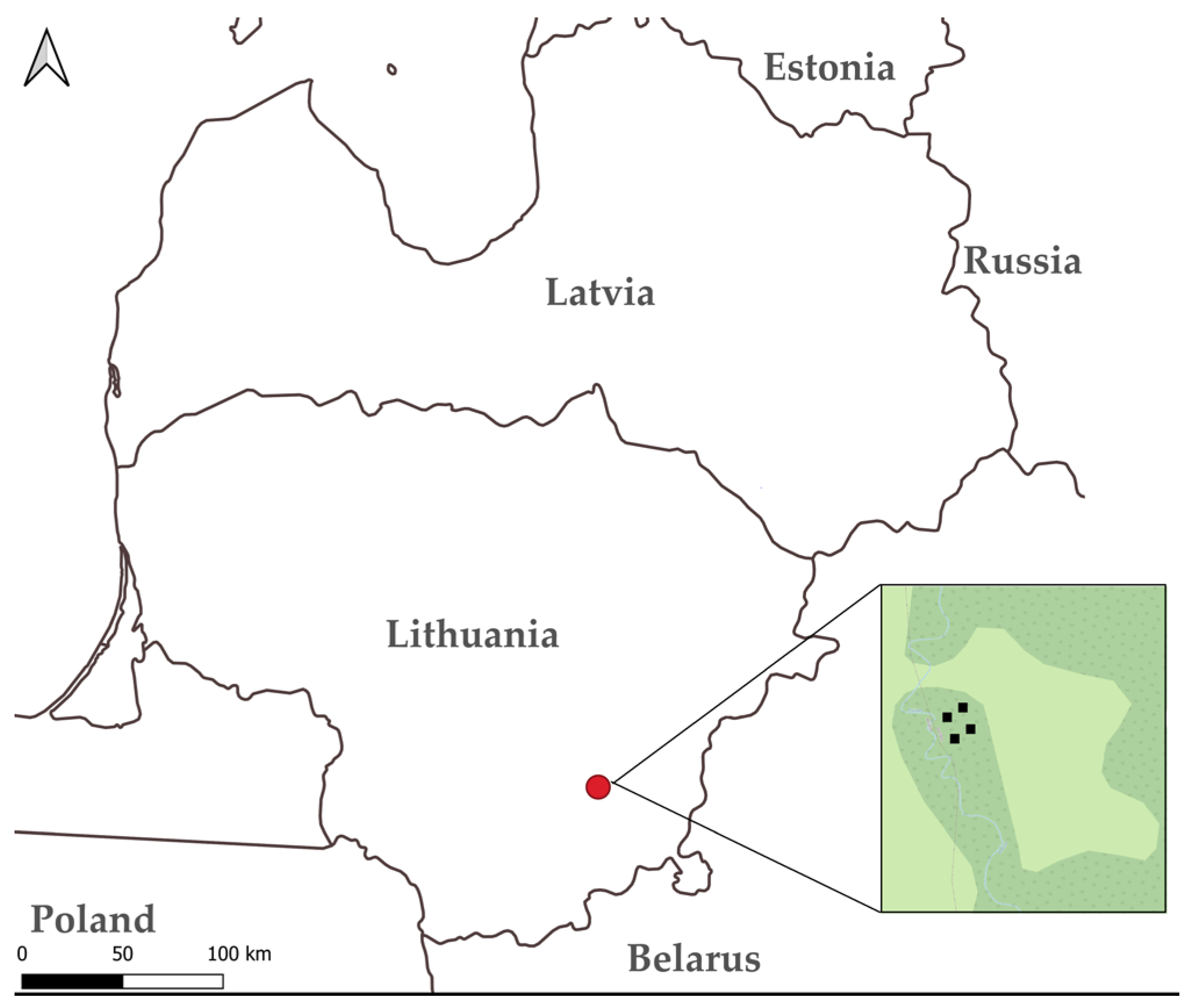
4.1. Study Site and Experimental Design
- (a)
- Total herb cover (%);
- (b)
- Surface water cover (%);
- (c)
- Total bryophyte cover (%);
- (d)
- Species composition of all bryophytes and their individual cover (%).

4.2. Data Analysis
5. Conclusions
Author Contributions
Funding
Data Availability Statement
Acknowledgments
Conflicts of Interest
Appendix A. Characteristics of the Study Areas
| Study Area | 1 | 2 | 3 | 4 |
| Open water (%) | 70 | 50 | 30 | 5 |
| Herb cover (%) | 25 | 30 | 70 | 80 |
| Hummock cover (%) | 30 | 50 | 60 | 70 |
| Bryophyte cover (%) | 30 | 50 | 80 | 90 |
| Herbs | ||||
| Carex rostrata | 3 | 2 | 3 | 3 |
| Cardamine palustris | 1 | 1 | 1 | 1 |
| Rumex acetosa | 1 | 1 | 1 | 2 |
| Eriophorum angustifolium | 1 | 2 | 2 | |
| Festuca rubra | 1 | 1 | 1 | |
| Silene flos-cuculi | + | 2 | 2 | |
| Calla palustris | + | 1 | ||
| Galium uliginosum | 1 | 1 | ||
| Carex diandra | 1 | |||
| Menyanthes palustris | 3 | |||
| Caltha palustris | 1 | |||
| Equisetum fluviatile | 1 | |||
| Lemna minor | 1 | |||
| Typha latifolia | 1 | |||
| Bryophytes | ||||
| Calliergonella cuspidata | 2 | 2 | 3 | 3 |
| Hamatocaulis vernicosus | 2 | 3 | 2 | 2 |
| Ptychostomum pseudotriquetrum | 1 | 1 | 1 | 2 |
| Aulacomnium palustre | 1 | 1 | 2 | |
| Plagiomnium ellipticum | 1 | 2 | 2 | |
| Tomentypnum nitens | 1 | 1 | 2 | |
| Brachythecium mildeanum | 2 | 2 | ||
| Marchantia polymorpha | 1 | 1 | ||
| Calliergon giganteum | 1 | |||
| Helodium blandowii | 2 | |||
| Water physical and chemical parameters: | ||||
| pH | 6.68 | 6.8 | 6.92 | 7.2 |
| Conductivity (µS/cm) | 370 | 332 | 313 | 327 |
| Ca2+ (mg/L) | 73.7 | 71.7 | 66.1 | 64.5 |
| Fe3+ (mg/L) | 4.86 | 8.11 | 7.26 | 3.93 |
| K+ (mg/L) | 4.49 | 3.33 | 1.31 | 0.80 |
| Mg2+ (mg/L) | 23.4 | 28.5 | 24.6 | 19.7 |
| NH4+ (mg/L) | 0.06 | 0.15 | 0.16 | 0.02 |
| NO3− (mg/L) | 0.04 | 0.06 | 0.01 | 0.1 |
| PO43− (mg/L) | 0.03 | 0.13 | 0.05 | 0.15 |
References
- Wochal, D.; Marcsz, K.; Barabach, J.; Bak, M.; Lementowicz, M. The hen that vanished: The untold story of drainage and peat extraction in Bagno Chlebowo peatland with implications for nature conservation. Glob. Ecol. Conserv. 2025, 61, e03647. [Google Scholar] [CrossRef] [Scilit]
- Ahmad, S.; Wang, M.; Bates, A.; Martini, F.; Regan, S.; Saunders, M.; Liu, H.; McElwain, J.; Gill, L. Flatlining fens? Small-scale variations in peat properties and microtopography as indicators of ecosystem homogenization. Ecol. Indic. 2025, 172, 113317. [Google Scholar] [CrossRef] [Scilit]
- van Diggelen, R.; Middleton, B.; Bakker, J.; Grootjans, A.; Wassen, M. Fens and floodplains of the temperate zone: Present status, threats, conservation and restoration. Appl. Veg. Sci. 2006, 9, 157–162. [Google Scholar] [CrossRef] [Scilit]
- Hájek, M.; Horsák, M.; Hájková, P.; Dítě, D. Habitat diversity of central European fens in relation to environmental gradients and an effort to standardise fen terminology in ecological studies. Perspect. Plant Ecol. Evol. Syst. 2006, 8, 97–114. [Google Scholar] [CrossRef] [Scilit]
- Andersen, D.K.; Nygaard, B.; Fredshavn, J.R.; Ejrnǽs, R. Cost-effective assessment of conservation status of fens. Appl. Veg. Sci. 2013, 16, 491–501. [Google Scholar] [CrossRef] [Scilit]
- Lamers, L.P.M.; Vile, M.A.; Grootjans, A.P.; Acreman, M.C.; van Diggelen, R.; Evans, M.G.; Richardson, C.J.; Rochefort, L.; Kooijman, A.M.; Roelofs, J.G.M.; et al. Ecological restoration of rich fens in Europe and North America: From trial and error to an evidence-based approach. Biol. Rev. 2015, 90, 182–203. [Google Scholar] [CrossRef] [Scilit]
- Jiménez-Alfaro, B.; Aunina, L.; Carbognani, M.; Dítě, D.; Fernández-Pascual, E.; Garbolino, E.; Hájek, O.; Hájková, P.; Ivchenko, T.; Jandt, U.; et al. Habitat-based biodiversity responses to macroclimate and edaphic factors in European fen ecosystems. Glob. Change Biol. 2023, 29, 6756–6771. [Google Scholar] [CrossRef] [Scilit]
- Kalvaitienė, M.; Jukonienė, I. The ecological drivers of the mosaic structure of bryophyte and vascular plant cover in the rich fens of Lithuania. Plants 2025, 14, 2662. [Google Scholar] [CrossRef] [Scilit]
- Council of Europe (Ed.) Convention on the Conservation of European Wildlife and Natural Habitats; Appendix I. European Treaty Series 104; Council of Europe: Bern, Switzerland, 1979. [Google Scholar]
- European Commission. Council Directive 92/43/EEC of 21 May 1992 on the conservation of natural habitats and of wild fauna and flora. Off. J. Eur. Union 1992, 206, 7–50. [Google Scholar]
- Campbell, C. Conservation of Selected Legally Protected and Red Listed Bryophytes in Ireland. Ph.D. Thesis, University of Dublin, Trinity College, Dublin, Ireland, 2013. [Google Scholar]
- Štechova, T.; Kučera, J. The requirements of the rare moss, Hamatocaulis vernicosus (Calliergonaceae, Musci), in the Czech Republic in relation to vegetation, water chemistry and management. Biol. Cons. 2007, 135, 443–449. [Google Scholar] [CrossRef] [Scilit]
- Cusell, C.; Lamers, L.P.; van Wirdum, G.; Kooijman, A. Impacts of water level fluctuation on mesotrophic rich fens: Acidification vs. eutrophication. J. Appl. Ecol. 2013, 50, 998–1009. [Google Scholar] [CrossRef] [Scilit]
- Kalvaitienė, M.; Jukonienė, I. Habitat preferences of Hamatocaulis vernicosus at the junction of continental and boreal phytogeographical regions (Lithuania). Boreal Environ. Res. 2022, 27, 81–96. [Google Scholar]
- Hájek, M.; Jiroušek, M.; Navrátilová, J.; Horodyská, E.; Peterka, T.; Plesková, Z.; Navrátil, J.; Hájková, P.; Hájek, T. Changes in the moss layer in Czech fens indicate early succession triggered by nutrient enrichment. Preslia 2015, 87, 279–301. [Google Scholar]
- Bergamini, A.; Peintinger, M. Effects of light and nitrogen on morphological plasticity of the moss Calliergonella cuspidata. Oikos 2002, 96, 355–363. [Google Scholar] [CrossRef] [Scilit]
- Kooijman, A.M. The decrease of rich fen bryophytes in The Netherlands. Biol. Conserv. 1992, 59, 139–143. [Google Scholar] [CrossRef] [Scilit]
- Kooijman, A.M. Causes of the replacements of Scorpidium scorpioides by Calliergonella cuspidata in eutrophicated rich fens I. Field studies. Lindbergia 1993, 18, 78–84. [Google Scholar]
- Kooijman, A.M. ‘Poor rich fen mosses’: Atmospheric N-deposition and P eutrophication in base-rich fens. Lindbergia 2012, 35, 42–52. [Google Scholar]
- Kooijman, A.M.; Paulissen, M.P.C.P. Higher acidification rates in fens with phosphorus enrichment. Appl. Veg. Sci. 2006, 9, 205–212. [Google Scholar] [CrossRef]
- Hedenäs, L. The European species of the Calliergon-Scorpidium-Drepanocladus complex, including some related or similar species. Meylania 2003, 28, 1–116. [Google Scholar]
- Štechová, T.; Hájek, M.; Hájková, P.; Navrátilová, J. Comparison of habitat requirements of the mosses Hamatocaulis vernicosus, Scorpidium cossonii and Warnstorfia exannulata in different parts of temperate Europe. Preslia 2008, 80, 399–410. [Google Scholar]
- Campbell, C.; Hodgetts, N.; Lockhart, N. Monitoring Methods for Hamatocaulis vernicosus Mitt. Hedenäs (Slender Green Feather-Moss) in the Republic of Ireland; Irish Wildlife Manuals; National Parks and Wildlife Service, Department of the Arts, Heritage and the Gaeltacht: Dublin, Ireland, 2015; p. 91. [Google Scholar]
- Vicherová, E.; Hájek, M.; Hájek, T. Calcium intolerance of fen mosses: Physiological evidence, effects of nutrient availability and successional drivers. Perspect. Plant Ecol. Evol. Syst. 2015, 17, 347–359. [Google Scholar] [CrossRef] [Scilit]
- Sabovljevic, M.; Szurdoki, E.; Sabovljevic, A.; Papp, B. Back to Hungary; a story of reontroduction of e European habitat dirrective moss species Hamatocaulis vernicous Visszatérés Magyarországra: Egy közösségi jelentőségű mohafaj, a Hamatocaulis vernicosus visszatelepítési kísérletei. Acta Biol. Plant. Agriensis 2017, 5, 60. [Google Scholar] [CrossRef] [Scilit]
- Sabovljević, M.S.; Ćosić, M.V.; Jadranin, B.Z.; Pantović, J.P.; Giba, Z.S.; Vujičić, M.M.; Sabovljević, A.D. The conservation physiology of bryophytes. Plants 2022, 11, 1282. [Google Scholar] [CrossRef] [Scilit]
- European Environment Agency (EEA). Hamatocaulis vernicosus. European Nature Information System (EUNIS). Available online: https://eunis.eea.europa.eu/species/14002 (accessed on 12 January 2026).
- Åberg, S.C.; Korkka-Niemi, K.; Rautio, A.; Åberg, A.K. The effect of river regulation on groundwater flow patterns and the hydrological conditions of an aapa mire in northern Finland. J. Hydrol. Reg. Stud. 2022, 40, 101044. [Google Scholar] [CrossRef] [Scilit]
- Samson, T.; Kaasik, A.; Ingerpuu, N.; Vellak, K. Is an infrequent moss species a weaker competitor? Experiment with three fen species. Nordic J. Bot. 2023, 8, e04038. [Google Scholar] [CrossRef] [Scilit]
- Jabłońska, E.; Kotowski, W.; Soudzilovskaia, N. Desiccation avoidance and hummock formation traits of rich fen bryophytes. Wetlands 2023, 43, 21. [Google Scholar] [CrossRef] [Scilit]
- Pintaldi, E.; D’Amico, M.E.; Siniscalco, C.; Cremonese, E.; Celi, L.; Filippa, G.; Prati, M.; Freppaz, M. Hummocks affect soil properties and soil-vegetation relationships in a subalpine grassland (North-Western Italian Alps). Catena 2016, 145, 214–226. [Google Scholar] [CrossRef] [Scilit]
- Hájková, P.; Wolf, P.; Hájek, M. Environmental factors and Carpathian spring fen vegetation: The importance of scale and temporal variation. Ann. Bot. Fenn. 2004, 41, 107–121. [Google Scholar]
- Udd, D.; Sundberg, S.; Rydin, H. Multi-species competition experiments with peatland bryophytes. J. Veg. Sci. 2016, 27, 165–175. [Google Scholar] [CrossRef] [Scilit]
- van der Hoeven, E.C.; Huynen, C.I.J.; During, H.J. Vertical profiles of biomass, light intercepting area and light intensity in chalk grassland mosses. J. Hattori Bot. Lab. 1993, 74, 261–270. [Google Scholar]
- Chapin, F.S.; Cleve, K.V.; Chapin, M.S. Soil temperature and nutrient cycling in the tussock growth form of Eriophorum vaginatum. J. Ecol. 1979, 67, 169–189. [Google Scholar] [CrossRef] [Scilit]
- Wang, M.; Han, Y.; Xu, Z.; Wang, S.; Jiang, M.; Wang, G. Hummock-hollow microtopography affects soil enzyme activity by creating environmental heterogeneity in the sedge-dominated peatlands of the Changbai Mountains, China. Ecol. Indic. 2021, 121, 107187. [Google Scholar] [CrossRef] [Scilit]
- Ștefănuț, S.; Biță-Nicolae, C.; Sahlean, T.; Bîrsan, C.-C.; Paica, I.C.; Nicoară, G.-R.; Helepciuc, F.-E.; Ștefănuț, M.-M.; Moroșanu, A.-M. Climate change projected effects on Hamatocaulis vernicosus occurrence in Romania. Plants 2025, 14, 3354. [Google Scholar] [CrossRef] [Scilit]
- Hammer, Ø.; Harper, D.A.T.; Ryan, P.D. PAST: Paleontological Statistics Software Package for Education and Data Analysis. Palaeontol. Electron. 2001, 4, 9. [Google Scholar]
- Hodgetts, N.G.; Söderström, L.; Blockeel, T.L.; Caspari, S.; Ignatov, M.S.; Konstantinova, N.A.; Lockhard, N.; Papp, B.; Schröck, C.; Sim-Sim, M.; et al. An annotated checklist of bryophytes of Europe, Macaronesia and Cyprus. J. Bryol. 2020, 42, 1–116. [Google Scholar] [CrossRef] [Scilit]
- Govaerts, R.; Nic Lughadha, E.; Black, N.; Turner, R.; Paton, A. The World Checklist of Vascular Plants, a continuously updated resource for exploring global plant diversity. Sci. Data 2021, 8, 215. [Google Scholar] [CrossRef] [Scilit]




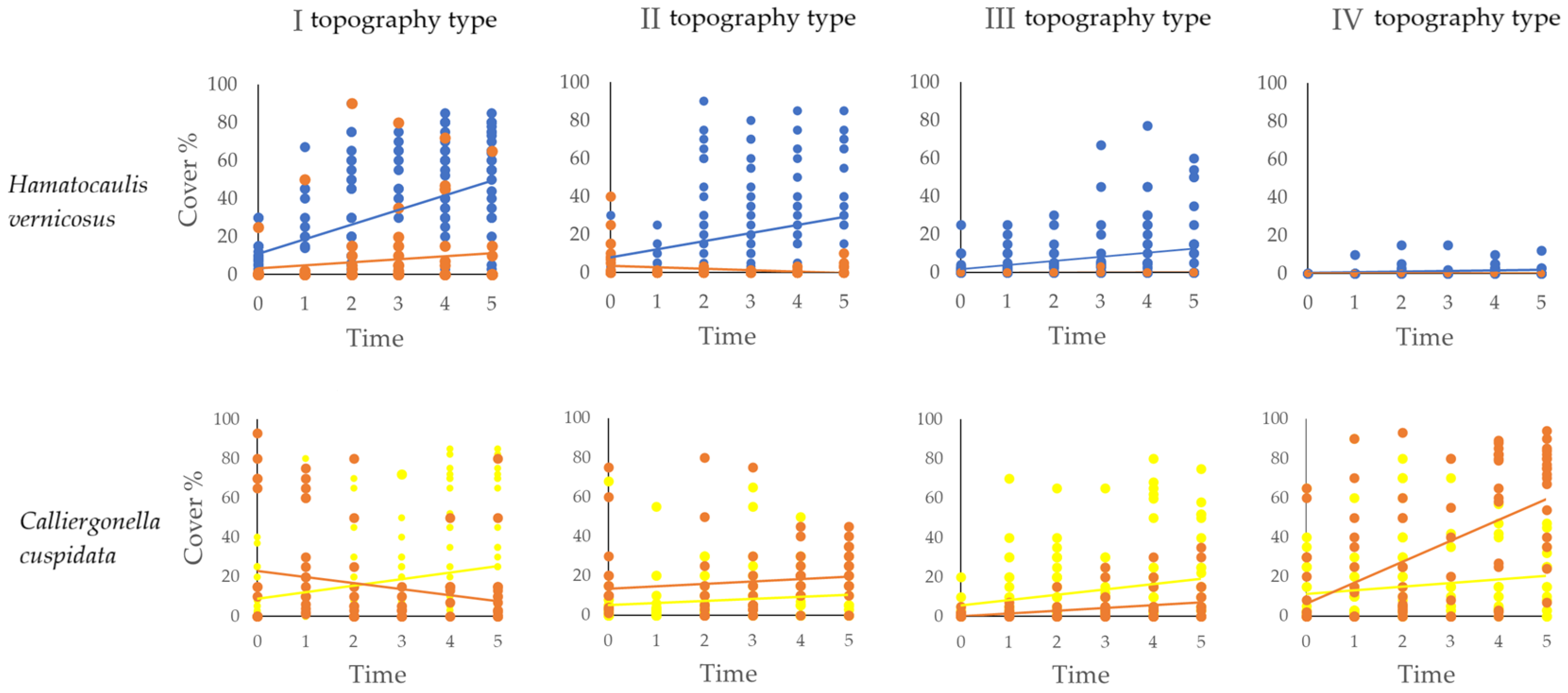
| Topography Type | Cover | Cumulative % | Initial Mean Cover % | Final Mean Cover % |
|---|---|---|---|---|
| I | H. vernicosus | 33.45 | 90 | 35.5 |
| Surface water | 56.49 | 2.5 | 25 | |
| C. cuspidata | 76.11 | 4 | 30 | |
| II | H. vernicosus | 42.95 | 88.8 | 40.8 |
| C. cuspidata | 61.27 | 1.75 | 22 | |
| Herb | 76.81 | 15 | 32 | |
| III | Herb | 32.41 | 5 | 50 |
| H. vernicosus | 61.76 | 74.8 | 36.3 | |
| C. cuspidata | 78.51 | 15.3 | 28 | |
| Surface water | 89.33 | 0 | 15 | |
| IV | H. vernicosus | 40.15 | 88.3 | 4.25 |
| C. cuspidata | 70.87 | 1 | 66 | |
| Herb | 89.54 | 4.75 | 44.5 |
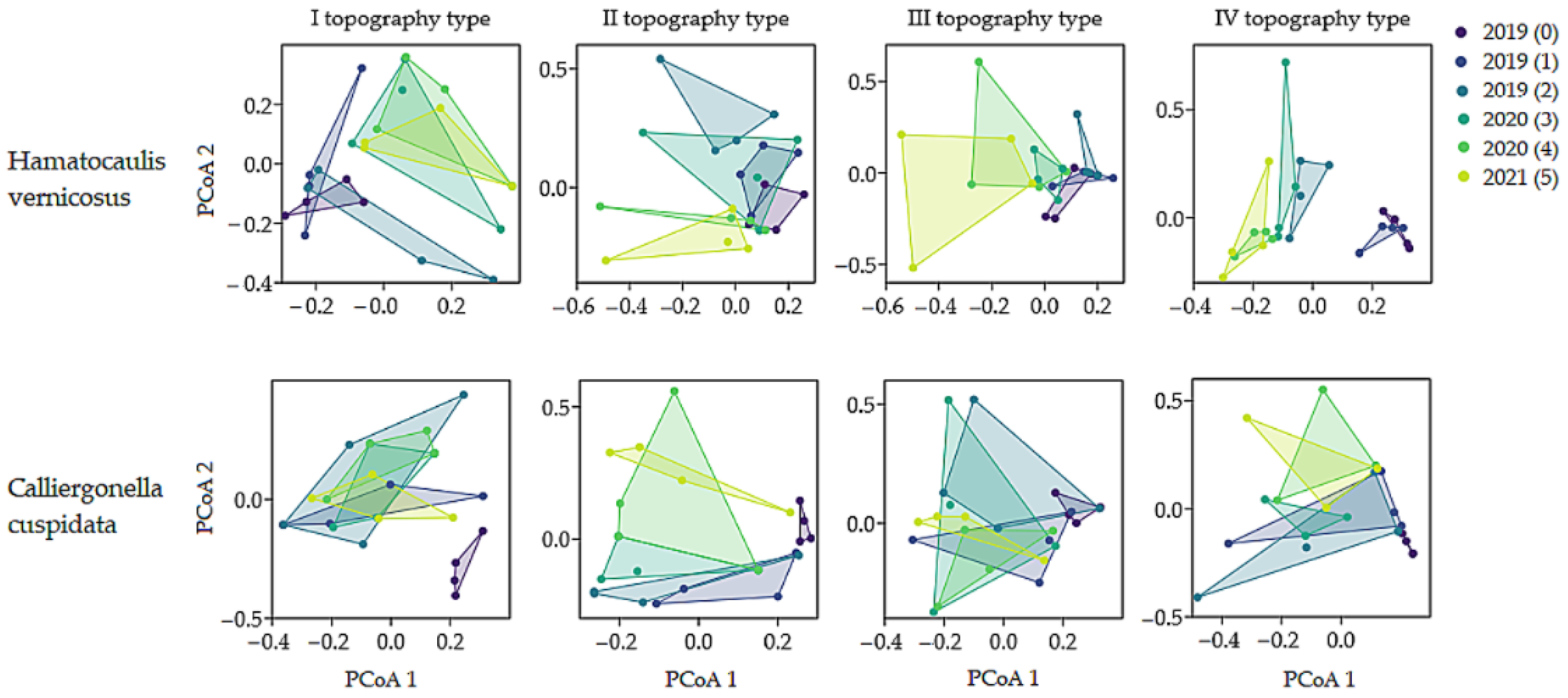
| Test | Topography Type | Hamatocaulis vernicosus | Calliergonella cuspidata | ||||
|---|---|---|---|---|---|---|---|
| F | R2 | p | F | R2 | p | ||
| Multivariate dispersion | I | 3.53 | - | 0.02 | 1.75 | - | 0.13 |
| II | 2.44 | - | 0.06 | 3.21 | - | 0.03 | |
| III | 17.45 | - | 0.00 | 3.74 | - | 0.02 | |
| IV | 5.57 | - | 0.00 | 4.67 | - | 0.00 | |
| PERMANOVA | I | 2.56 | 0.42 | 0.02 | 2.9 | 0.45 | 0.00 |
| II | 1.73 | 0.33 | 0.07 | 3.02 | 0.46 | 0.00 | |
| III | 3.23 | 0.47 | 0.00 | 1.88 | 0.34 | 0.06 | |
| IV | 3.23 | 0.47 | 0.00 | 1.79 | 0.35 | 0.10 | |
| Topography Type | Cover | Cumulative % | Initial Mean Cover % | Final Mean Cover % |
|---|---|---|---|---|
| I | C. cuspidata | 48.63 | 92 | 17.5 |
| Surface water | 77.69 | 0 | 47 | |
| Herb | 89.44 | 11.8 | 30 | |
| II | C. cuspidata | 43.28 | 97.3 | 36 |
| H. vernicosus | 63.87 | 2 | 31 | |
| Surface water | 83.37 | 0 | 27.5 | |
| III | C. cuspidata | 41.32 | 92.3 | 23.8 |
| H. vernicosus | 61.6 | 2.5 | 35 | |
| Herb | 80.42 | 7.5 | 38.8 | |
| IV | C. cuspidata | 44.22 | 99.5 | 49.5 |
| Herb | 76.03 | 2 | 41.3 | |
| Surface water | 85.87 | 0 | 11.3 |
| Introduced Species | Subplot Type | Statistical Parameters | Topography Type | |||
|---|---|---|---|---|---|---|
| I | II | III | IV | |||
| Hamatocaulis vernicosus | Treatment | S | 369 | 1995 | 1952 | 620 |
| Z | 2.13 | 2.78 | 2.36 | 2.83 | ||
| p | 0.03 | 0.00 | 0.01 | 0.00 | ||
| ΔP | 36.6 | 21.47 | 6.89 | 1.12 | ||
| Control | S | 260 | −291 | 16 | 0 | |
| Z | 0.97 | −1.10 | 0.16 | 0 | ||
| p | 0.32 | 0.27 | 0.87 | 1 | ||
| ΔP | 4.18 | −5.66 | 0 | 0 | ||
| Calliergonella cuspidata | Treatment | S | 1924 | 2706 | 3551 | 1700 |
| Z | 2.32 | 3.32 | 4.85 | 2.96 | ||
| p | 0.01 | 0.00 | 0.00 | 0.00 | ||
| ΔP | 10.96 | 2.93 | 15.31 | 22.66 | ||
| Control | S | −286 | 829 | 991 | 1438 | |
| Z | −0.96 | 3.05 | 3.04 | 4.22 | ||
| p | 0.33 | 0.00 | 0.00 | 0.00 | ||
| ΔP | −10.54 | 5.20 | 6.88 | 66.17 | ||
Disclaimer/Publisher’s Note: The statements, opinions and data contained in all publications are solely those of the individual author(s) and contributor(s) and not of MDPI and/or the editor(s). MDPI and/or the editor(s) disclaim responsibility for any injury to people or property resulting from any ideas, methods, instructions or products referred to in the content. |
© 2026 by the authors. Licensee MDPI, Basel, Switzerland. This article is an open access article distributed under the terms and conditions of the Creative Commons Attribution (CC BY) license.
Share and Cite
Kalvaitienė, M.; Jukonienė, I. Coexistence of Calliergonella cuspidata and Hamatocaulis vernicosus Under Different Fen Topography Types and Microhabitat Conditions. Plants 2026, 15, 651. https://doi.org/10.3390/plants15040651
Kalvaitienė M, Jukonienė I. Coexistence of Calliergonella cuspidata and Hamatocaulis vernicosus Under Different Fen Topography Types and Microhabitat Conditions. Plants. 2026; 15(4):651. https://doi.org/10.3390/plants15040651
Chicago/Turabian StyleKalvaitienė, Monika, and Ilona Jukonienė. 2026. "Coexistence of Calliergonella cuspidata and Hamatocaulis vernicosus Under Different Fen Topography Types and Microhabitat Conditions" Plants 15, no. 4: 651. https://doi.org/10.3390/plants15040651
APA StyleKalvaitienė, M., & Jukonienė, I. (2026). Coexistence of Calliergonella cuspidata and Hamatocaulis vernicosus Under Different Fen Topography Types and Microhabitat Conditions. Plants, 15(4), 651. https://doi.org/10.3390/plants15040651