Article

Seed Priming with Magnesium Nitrate Improves Mineral Nutrition and Early Growth of Bambara Groundnut Under Salinity Stress


by
Siyabonga Ntshalintshali
1,
Mbukeni Andrew Nkomo
2 and
Lungelo Given Buthelezi
1,*
1
Faculty of Science, Agriculture, and Engineering, Department of Agriculture, University of Zululand, Main Road, KwaDlangezwa Campus, Empangeni 3886, South Africa
2
School of Sciences and Agriculture, Westville Campus, University of KwaZulu-Natal, Durban 4000, South Africa
*
Author to whom correspondence should be addressed.
Plants 2026, 15(4), 626; https://doi.org/10.3390/plants15040626
Submission received: 7 January 2026 / Revised: 10 February 2026 / Accepted: 12 February 2026 / Published: 16 February 2026

Abstract

Seed priming studies commonly emphasize growth and physiological responses, yet ionomic regulation and tissue-specific nutrient allocation under salinity stress remain poorly explored, particularly in underutilized crops such as Bambara groundnut (Vigna subterranea L.). This study investigated whether Mg(NO3)2 seed priming, previously shown to enhance salt tolerance, is associated with consistent ionomic patterns in contrasting Bambara groundnut genotypes (BGN-14 and BGN-25). Seeds were primed with 0.03% Mg(NO3)2 and grown under control or saline conditions (200 mM NaCl) for five weeks. Shoot and root tissues were analyzed for macro- and micronutrient composition using ICP-OES. In BGN-14, salinity caused a marked reduction in shoot fresh weight (−49.5%, p < 0.05), whereas Mg(NO3)2 priming largely mitigated this effect under salinity (−0.4%, p > 0.05). Root fresh weight declined numerically under salt stress (−70.1%) and primed + salt conditions (−45.5%), but these changes were not statistically significant. Shoot dry weight increased significantly in primed plants (+83.5%, p < 0.05), while salinity reduced SDW (−58.4%); primed + salt plants maintained SDW near control levels (+2.6%). In BGN-25, root biomass was unaffected by treatments, whereas salinity significantly reduced shoot biomass relative to primed plants, with a consistent trend of primed > control > primed + salt > salt. Salinity increased the Na+/K+ ratio, particularly in roots. In BGN-14, the root Na+/K+ ratio increased significantly from 1.07 to 4.49 (p < 0.05), indicating enhanced Na+ accumulation, while shoot ratios increased non-significantly. BGN-25 showed a more moderate increase in shoot ratios and a pronounced rise in root ratios. Principal component analysis revealed distinct nutrient clustering, with Na, Fe, and Al loading strongly under salinity, while Ca, K, Mg, and Cu aligned with improved physiological performance. Although differences between salt and primed + salt treatments were often not statistically significant, several ion ratios and nutrient relationships were numerically enhanced under Mg(NO3)2 priming. This study builds upon earlier physiological findings (where BGN-14 consistently exhibited a stronger positive response to Mg(NO3)2 priming, outperforming BGN-25 under salt stress) and provides exploratory, hypothesis-generating evidence that Mg(NO3)2 priming may contribute to salinity tolerance through coordinated ionomic adjustments, including altered Na+ allocation and improved nutrient balance, rather than complete Na+ exclusion. These findings highlight the relevance of ionomic responses in understanding stress adaptation in underutilized legume crops.

1. Introduction

Bambara groundnut (Vigna subterranea (L.) Verdc.) is an indigenous African legume valued for its nutritional quality, resilience to marginal environments, and contribution to food security in semi-arid regions [1,2,3]. The crop produces protein-rich seeds with a balanced amino acid composition and is often cultivated by smallholder farmers under low-input conditions, where it plays a crucial role in sustaining their livelihoods [1,2,3,4]. Despite its agronomic and nutritional importance, Bambara groundnut remains under-researched compared to other grain legumes, particularly in relation to stress physiology and nutrient dynamics [5,6,7].
Salt stress is a major abiotic constraint limiting legume productivity worldwide, affecting one-fifth of the world’s irrigated land (≈60 million ha) and expanding rapidly due to climate change, poor irrigation practices, and soil degradation [8,9,10,11]. In legumes, salt stress disrupts growth and development through osmotic stress, ion toxicity, and nutrient imbalance, ultimately impairing biomass accumulation and yield [12,13,14,15,16,17,18]. Excessive accumulation of sodium (Na+) and chloride (Cl) ions interferes with the uptake, transport, and homeostasis of essential nutrients such as potassium (K+), calcium (Ca2+), magnesium (Mg2+), and phosphorus (P), making nutrient regulation a central component of salinity tolerance [19,20].
Seed priming is a practical and cost-effective strategy to enhance stress tolerance in crops. By partially hydrating seeds before sowing, priming improves germination performance, seedling establishment, and subsequent stress resilience [21]. Several priming approaches have been reported, including hydropriming, osmopriming, hormonal priming, and halo-priming. Among these, halo-priming using inorganic salts such as nitrates has shown particular promise in mitigating salinity-induced damage by improving ionic balance, nutrient uptake, and metabolic readiness [22]. Although potassium nitrate (KNO3) is widely used for seed priming under salinity stress, the effects of alternative nitrate sources such as magnesium nitrate (Mg(NO3)2) remain poorly explored. In particular, limited information exists on the role of Mg(NO3)2 in regulating growth, biomass, and ionomic responses under salt stress. This study addresses this gap by evaluating the effects of Mg(NO3)2 seed priming on two contrasting Bambara groundnut genotypes (BGN-14 and BGN-25) under salinity. Mg(NO3)2 may contribute Mg2+, which could support chlorophyll formation and enzyme activation, alongside nitrate (NO3), which is suggested to act not only as a nitrogen source but also as a signaling molecule during stress adaptation [23,24,25,26,27,28]. This foundational assumption, together with the well-documented effectiveness and predominant use of nitrate-based halo-priming agents such as potassium nitrate (KNO3), may have contributed to our decision to explore Mg(NO3)2 seed priming.
While many priming studies have examined growth, yield, and physiological or biochemical responses, few have explored nutrient allocation, ionomic patterns, or tissue-specific elemental relationships, particularly under salinity stress. This knowledge gap is critical, as nutrient uptake and translocation between roots and shoots highlights adaptive salt tolerance mechanisms. In Bambara groundnut, studies are especially limited, with most neglecting nutrient correlations or ion-omics changes, restricting our understanding of how priming modulates salinity responses at the elemental level.
This current study builds upon our previous work [29], which characterized the physiological and biochemical responses of Bambara groundnut subjected to salt stress and Mg(NO3)2 seed priming [29]. In our previous report, we noted that BGN-14 appeared to exhibit a more pronounced response to Mg(NO3)2 priming, leading to improved performance compared with BGN-25 under salt stress [29]. Here, we extend that investigation by focusing specifically on nutrient allocation, translocation, and multivariate ionomic relationships in roots and shoots. Through the integration of tissue-specific nutrient profiling and multivariate analyses, the study seeks to generate hypothesis-driven evidence that Mg(NO3)2 priming supports salinity tolerance in Bambara groundnut by promoting coordinated ionomic adjustments evident in modified Na+ allocation and optimized nutrient balance that may explain the physiological and biochemical responses observed previously [29]. This approach allows us to draw informed conclusions and propose potential mechanisms by which Mg(NO3)2 priming confers salt tolerance.

2. Materials and Methods

2.1. Study Site and Experimental Material

The study was conducted at the University of Zululand, KwaDlangezwa Campus, Empangeni, KwaZulu-Natal, South Africa (28°50′59.99″ S, 31°49′59.99″ E). The subtropical site experiences average temperatures of 20–30 °C and annual rainfall of ~908 mm. Bambara groundnut (Vigna subterranea L. Verdc.) seeds were obtained from uMvoti Industries CC, KwaZulu-Natal. Two genotypes (BGN-14 and BGN-25) were selected based on seed coat colour, size, and vigour. The growth medium was homogenized sandy loam soil from Port Dunford, air-dried, and sieved (2 mm).

2.2. Seed Priming and Salinity Screening

Seeds were firstly primed with four nitrate sources KNO3, Mg(NO3)2, NaNO3, and NH4NO3 at 0, 0.03, 0.2, 0.5, and 1%, and simultaneously exposed to salinity levels of 0 to 400 mM NaCl to identify the optimal priming treatment and salinity threshold. Mg(NO3)2 at 0.03% was selected as optimal, and 200 mM NaCl as the critical stress level which was used as salt stress throughout the study [29]. Seeds were soaked in the solution for 24 h, air-dried for 15 min, germinated in trays for 10 days, then transplanted into pots following method by Ogbuethi [30].

2.3. Experimental Design and Growth Conditions

The main experiment followed a randomized complete block design (RCBD) with four treatments, hydro-primed control, Mg(NO3)2-primed control, unprimed + 200 mM NaCl, and Mg(NO3)2-primed + 200 mM NaCl, each replicated six times. Plants were grown in 20 cm pots under natural daylight in a greenhouse. Seedlings were irrigated with water until the two-leaf stage, after which saline treatments received 400 mL of 200 mM NaCl twice weekly, corresponding to an estimated EC of 18–20 dS m−1. The pot-trial experiment lasted for 5 weeks to monitor the plants response from seedling and vegetative stages. Each treatment consisted of six replicate pots, with four plants per pot, and each pot was considered one experimental unit. For growth and biomass assessments, measurements were taken from all six replicate pots (n = 6). In contrast, due to limited plant material resulting from salinity stress, mineral nutrient analysis was conducted using three biological replicates per treatment (n = 3). This approach ensured sufficient material for accurate nutrient quantification while maintaining independent biological replication.

2.4. Measurement of Plant Growth and Sample Preparation

Fresh and dry biomass were determined using six replicates per treatment. Fresh weight was measured with a precision analytical balance (ADAM PGW 4502e; maximum capacity 4500 g; accuracy ±0.01 g, Milton Keynes, England). Dry weight was obtained after oven-drying the samples at 65 °C for 72 h.
At harvest, plants were carefully uprooted and gently rinsed with distilled water to remove adhering soil particles. Samples were separated into shoots and roots, which were subsequently oven-dried at 65 °C for 72 h using a laboratory incubator (Labcon Incubator, Model 5016LC, Labcon (Pty) Ltd., Krugersdorp, South Africa). The dried tissues were ground into a fine powder using a laboratory hammer mill (SMC) and sieved through a 0.84 mm mesh. Samples collected from each treatment were treated as biological replicates (n = 3).

2.5. Target Mineral Element Composition

Plant analyses were conducted at the Cedara Agricultural Research Station, KwaZulu-Natal Department of Agriculture and Rural Development (KZNDARD). Moisture content and ash were determined following modified method by Buthelezi [31].
Elemental analysis was conducted using inductively coupled plasma–optical emission spectrometry (ICP-OES) on an iCAP 7000 system (Thermo Fisher Scientific, Waltham, MA, USA), operated in axial mode. The instrument was set at a radio frequency power of 1350 W, with nebuliser, coolant, and auxiliary gas flow rates of 0.5, 12, and 0.5 L min−1, respectively, and a pump speed of 35 rpm. For each genotype, elemental concentrations in both shoots and roots were determined from the mean of three replicate measurements [32]. For sample preparation, approximately 1.0 g of oven-dried shoot or root material was weighed into 100 mL volumetric flasks. Ten millilitres of nitric acid (HNO3) was added, and the samples were left to pre-digest overnight. The following day, 8 mL of perchloric acid (HClO4) was added, and the contents were gently mixed. Samples were then digested on a heating block, starting at 100 °C and gradually increasing to 260 °C, until the evolution of red nitrogen dioxide (NO2) fumes ceased. Digestion was continued until the solution volume was reduced to approximately 3–5 mL, without reaching dryness, and completion was indicated by the solution becoming colourless. After cooling, 10 mL of distilled water was added, and the digest was filtered through Whatman No. 1 filter paper. The resulting filtrate was used for the determination of mineral elements by ICP-OES [33]. The ashes were dissolved in 25 mL of 1 M HCl and diluted four-fold with deionized water prior to the determination of P, K, Ca, Mg, Na, Cu, Zn, Fe, Mn, and Al using ICP-OES [34].

2.6. Statistical Analyses

The data collected was subjected to a Two-way Analysis of Variance (ANOVA) utilizing GenStat (23rd edition) software with the significant differences determined by honestly significant difference (HSD) according to Tukey’s test at a (p ≤ 0.05) level. Dunnett’s multiple comparisons test was used to compare the treatments (primed, salt, primed + salt) to the control group. Correlation analysis and principal component analysis (PCA) were conducted to evaluate multivariate nutrient patterns across treatments and plant tissues using Jamovi (version 2.6) software. GraphPad Prism (version 8.4.2, 679) software was used to generate the graphical representations of data.

3. Results

3.1. Mg(NO3)2 Priming Improves Bambara Groundnut Seedling Growth Under Salt Stress

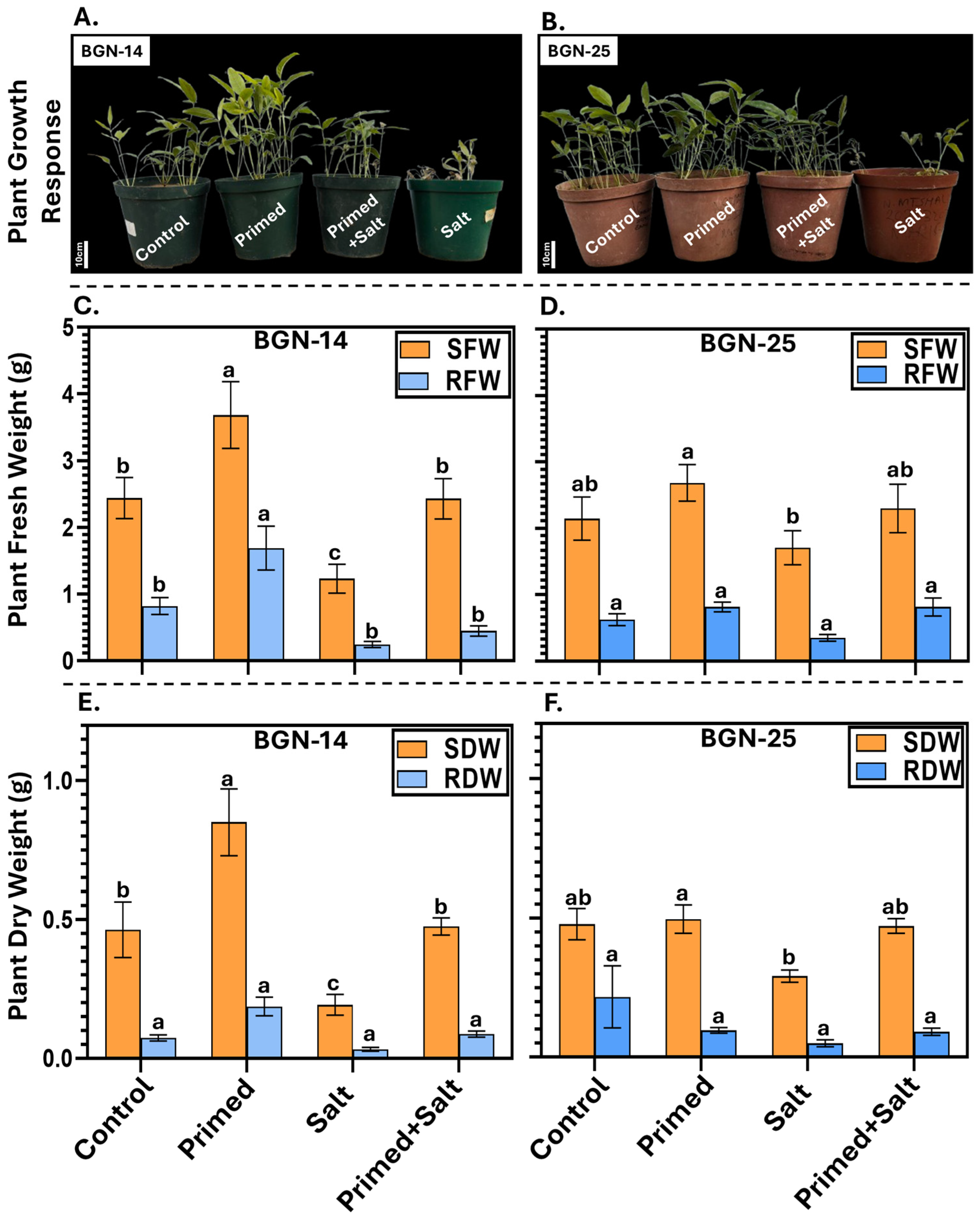
In this study, salt stress had a negative impact on plant growth, with the strongest effects observed in plants exposed to salt only without priming (Figure 1). Reductions in plant height, leaf number, and leaf size were evident under salt stress. These growth reductions were accompanied by changes in biomass allocation (Figure 1A,B). In the BGN-14 genotype, “salt” treatment resulted in significant (p < 0.05) reduction in shoot fresh weight (SFW) of approximately −49.52%, whereas only a marginal and non-significant reduction of −0.40% was observed under “primed + salt” treatment when compared to the control (Figure 1C). There were reductions in root fresh weight (RFW) observed for “salt; −70.12%” and “primed + salt; −45.53%” treatments, relative to the control (Figure 1C); however, these reductions where not significant (p > 0.05) when compared to the control. Similarly, shoot dry weight (SDW) significantly (p < 0.05) increased by +83.45% in “primed” plants, while a reduction of –58.42% and an increase of +2.59% were observed in “salt” and “primed + salt” treatments, respectively, compared with the control (Figure 1E).
In BGN-25 genotype, there were no significant differences observed in RFW and RDW, whilst the SFW and SDW for “salt” treatment was significantly (p < 0.05) lower compared to “primed” plants, respectively. The remaining treatments did not differ significantly (p > 0.05) (Figure 1).
We observed significant treatment effects on shoot fresh weight (SFW), root fresh weight (RFW), and shoot dry weight (SDW) (Table 1). For instance, for both shoot and root fresh weight, the mean square for treatment was markedly higher than the corresponding error mean square (SFW: MST = 5.90 vs. MSE = 0.66; RFW: MST = 1.88 vs. MSE = 0.13), indicating that treatment effects accounted for a substantial proportion of the observed variation. Genotype effects were not significant for any of the measured traits. We detected a significant genotype × treatment interaction for RFW and SDW, while no significant interaction effects were observed for SFW and RDW.

3.2. Ionomic Responses of Shoots and Roots to Salinity and Mg(NO3)2 Priming

There were significant differences (p < 0.05) observed in the mineral element composition of Bambara groundnut shoots and roots in genotype BGN-14. For instance, Na content was significantly (p < 0.05) higher in the roots of “salt” and “primed + salt” compared to the control. Interestingly, in BGN-25, most of the observed differences among treatments were not significant in either shoots or roots. An exception was Zn concentration, where significant differences were observed across the treatments. Table 2 summarizes the concentrations of major and trace nutrient elements in the shoots and roots of Bambara groundnut genotypes (BGN-14 and BGN-25) under priming, salinity, and combined treatments.

3.3. Ion Homeostasis Indicators (Na+/K+ and Ca2+/Na+ Ratios)

Salt stress significantly disrupted ionic equilibrium in both Bambara groundnut genotypes, with distinct differences observed between shoots and roots (Table 3). Although the Na+/K+ ratio increased under salt stress, rising from 0.12 to 0.63 in shoots, under BGN-14, this increase was not significant (p > 0.05). The same treatment significantly rose from 1.07 to 4.49 in the roots when compared to the control. Indicating excessive Na+ accumulation coupled with reduced K+ retention. Although BGN-25 exhibited a more moderate increase in this ratio from 0.24 to 0.32 in shoots and from 2.03 to 4.91 in roots, the changes in shoot ratios for all the treatments were not significant when compared to the control.
The Ca2+/Na+ ratio declined markedly in BGN-14 under “salt” stress, decreasing from 11.9 to 0.85 in shoots (Table 3). Although there were no significant differences observed in the roots of “primed”, “salt”, and “primed + salt” compared to “control” under BGN-25, this genotype seemed to have maintained relatively lower Ca2+/Na+ ratios under the “salt” conditions (3.18 to 1.77 in shoots; 0.37 to 0.22 in roots).

4. Discussion

4.1. Impact of Salinity on Plant Physiology

This study builds on our earlier work [29] to evaluate how Mg(NO3)2 seed priming influences early growth and shoot–root ionomic responses in Bambara groundnut under salinity stress, providing exploratory insight into coordinated elemental regulation and Na+ partitioning. For instance, although “salt” stress significantly reduced shoot fresh and dry biomass compared to “primed” plants, the “primed + salt” treatment partially mitigated these reductions, particularly in BGN-14, which may explain its enhanced performance relative to BGN-25 (Figure 1) [29]. This observation is consistent with numerous studies demonstrating that seed priming enhances stress tolerance and biomass accumulation under adverse conditions [8,22,35,36]. In contrast, the absence of significant differences in root fresh and dry weight between salt-treated and control plants may reflect adaptive root plasticity, whereby root growth is maintained or preferentially allocated under stress to enhance water and ion acquisition, even when shoot growth is compromised. Similar patterns have been reported in other crops, where salinity reduced overall biomass but did not significantly or had less on root mass, especially during early growth stages [37,38].
Notably, the consistent trend of biomass accumulation (primed > control > primed + salt > salt) indicates that Mg(NO3)2 priming contributed to improved growth performance under salinity. However, the incomplete recovery observed in the “primed + salt” treatment, particularly the lack of significant improvement over “salt-only” plants in SFW and SDW in BGN-25 (Figure 1D,F), suggests genotype-dependent priming efficacy. This limited response supports our earlier findings that BGN-25 is more salt-sensitive, indicating that Mg(NO3)2 priming was insufficient to fully counteract salinity-induced growth inhibition in this genotype [29].
Similarly, we found that biomass responses were largely driven by treatment effects, with shoot fresh weight showing limited genotypic influence (Table 1). Root fresh weight and shoot dry weight exhibited significant genotype × treatment interactions, indicating genotype-dependent responses to stress conditions. In contrast, root dry weight was less responsive to treatments than fresh weight traits (Table 1), suggesting a stronger influence of treatments on plant water status than on structural biomass. Overall, treatment effects dominated variation across all traits, while genotypic differences were mainly expressed through interaction effects. These findings indicate that priming and salinity primarily modulated biomass and complement our previous observations on physiological and biochemical adjustments [29].

4.2. Nutrient-Mediated Regulation of Growth and Stress Tolerance Under Salinity

4.2.1. Macronutrients and Ion Homeostasis Under Salinity Stress

The Na+ accumulation in roots under “salt” and “primed + salt” treatments (≈+309% and +267.9% in BGN-14, and +95% under “salt” but −48% under “primed + salt” in BGN-25 relative to control) indicates that salinity-induced toxicity was primarily root-centered (Table 2). Under saline conditions, Na+ competes with essential macronutrients such as Ca2+, Mg2+ and K+, which are critical for growth and metabolism [39,40,41], explaining the negative correlations observed between Na and K, Cu and Ca (Figure S1). Genotype-specific Na+ regulation was evident, with priming in BGN-14 markedly reducing shoot Na (−79.7%) and slightly lowering root Na (−10%), indicative of enhanced Na exclusion, whereas BGN-25 showed strong root Na reduction (−73.4%) but increased shoot Na (+27.3%) under “primed + salt,” (Table 2) suggesting altered Na compartmentalization or enhanced root-to-shoot translocation. Collectively, these contrasting patterns suggest inherent genetic differences in Na handling strategies under salinity stress.
Salt stress likely interfered with the uptake and internal balance of essential nutrients such as Ca, Mg, P and K, leading to nutrient deficiencies that were visually expressed as growth suppression, chlorosis, necrosis and poor root development under “salt” (Figure 1A,B). Calcium, which is crucial for cell wall stability, membrane integrity, enzyme regulation and signal transduction [42,43], commonly exhibits deficiency symptoms including stunted growth and tissue necrosis under saline conditions [44,45], consistent with the observed salt-stressed phenotype (Figure 1A,B). Similarly, magnesium deficiency, which compromises chlorophyll synthesis, enzyme activation and ATP utilization, leads to reduced chlorophyll content and impaired photosynthetic efficiency [46,47]. In this study, slightly higher Mg levels in “primed + salt” BGN-14 shoots, together with improved chlorophyll content as we observed in our previous study [29], suggest that Mg(NO3)2 priming partially alleviated salt-induced Mg limitation by supporting early chlorophyll formation and photosynthetic activity, even though genotype-specific differences were evident in BGN-25. Phosphorus deficiency, known to restrict growth through reduced ATP production, nucleic acid synthesis and membrane phospholipid formation [47,48], was also mitigated under “primed” treatments, particularly in BGN-14, where elevated P under “primed + salt” likely enhanced energy availability for stress defense and membrane stabilization, contributing to reduced ROS and lipid peroxidation, as we have observed in our previous study [29]. Potassium imbalance under salinity likely increased osmotic stress and stomatal dysfunction, leading to impaired leaf water status, reduced chlorophyll content, and elevated electrolyte leakage [48,49,50,51,52]. In our previous study we observed that seed-primed plants exhibited significantly higher carotenoid and chlorophyll retention compared with unprimed salt-stressed plants, suggesting that priming might have partially mitigated salinity-induced nutrient and physiological disruptions [29].

Ion Homeostasis Indicators (Na+/K+ and Ca2+/Na+ Ratios)

While there were no significant differences observed in the shoots of both genotypes in the Na+/K+ ratios compare to the control, we observed a consistent pattern revealing an increase from shoots to roots, particularly under “salt” and “primed + salt” treatments, with the highest ratio recorded in “salt-only” plants (Table 3). This trend confirms the antagonistic interaction between Na+ and K+, where excessive Na+ limits K+ availability and uptake [53,54]. The negative correlations between Na+ and K+, Ca2+ and Cu (Figure S1) further supports the observed antagonistic ion interactions under salinity. The higher Na+ concentration we observed in the roots compared with the shoots (see also Figure S2) can be attributed to two main factors: (1st) roots are the primary tissues directly exposed to salinity and therefore accumulate higher Na+ and Cl levels than aerial parts [55] and (2nd) this preferential root accumulation likely represents a protective strategy in Bambara groundnut, whereby excess Na+ is sequestered in roots to limit its translocation to shoots and protect photosynthetically active tissues from ionic toxicity [55]. Although Mg(NO3)2 priming partially alleviated Na+ accumulation, it did not fully prevent this effect. The pronounced Na+ retention in “primed + salt” roots of BGN-14, coupled with limited shoot translocation, is consistent with root-centered Na+ sequestration and restricted xylem loading as key salt-tolerance mechanisms reported in legumes and other crops [56,57].
However, despite previously identifying BGN-14 as the salt-tolerant genotype and BGN-25 as salt-sensitive, we observed unexpectedly more favorable Na+/K+ and Ca2+/Na+ ratios in BGN-25 than in BGN-14, particularly under the salt and primed + salt treatments, suggesting genotype-specific differences in ion regulation. This pattern might be explained by two possible mechanisms: (1) BGN-25 might have restricted excessive Na+ uptake at the root level, thereby showing lower tissue Na+ concentrations and consequently lower Na+/K+ and higher Ca2+/Na+ ratios [55]; or (2) these ratios may not accurately reflect the true ionic status at the cellular level, as BGN-14 likely accumulated and compartmentalized Na+ into vacuoles or root tissues, resulting in higher total Na+ values while still maintaining cytosolic ion homeostasis and functional tolerance. BGN-14 might have accumulated greater total Na+ in its tissues through efficient sequestration into vacuoles or root storage sites, thereby protecting the cytoplasm and maintaining metabolic activity [58,59,60,61]. Such compartmentalization would elevate bulk Na+/K+ ratios even though cytosolic K+ homeostasis remained stable. On the other hand, the relatively low Na+ content we observed in BGN-25 might be associated with reduced uptake linked with impaired growth and transpiration under stress. Our interpretation aligns with the enhanced physiological and biochemical responses of BGN-14, including higher chlorophyll content, relative water status, and lower superoxide levels, confirming that effective Na+ sequestration, rather than absolute ionic ratios, justifies its salt tolerance in our previous report [29].
It is crucial to understand that salinity tolerance is a complex, multigenic trait with differential expression across genotypes. Genotypes may differ in growth maintenance, ion homeostasis, osmotic adjustment, or antioxidant capacity, and these traits do not always align within a single genotype. The literature shows that one genotype can perform well in terms of growth metrics but not in ion regulation, while another mutant genotype may exhibit strong ion homeostasis without enhanced growth performance, reflecting distinct adaptive strategies rather than experimental inconsistency [61,62,63]. We further observed a preferential accumulation of Ca2+ and K+ in the shoots under both “salt-stressed” and “primed + salt” treatments (see clusters II and V under Figure S2), suggesting enhanced ion translocation from roots to shoots. This pattern likely reflects the roles of Ca2+ in maintaining membrane integrity and signaling, and K+ in osmotic adjustment and stomatal regulation under saline conditions, thereby supporting shoot physiological function despite ionic stress.

4.2.2. Micronutrients and Antioxidant Defense

Among micronutrients, iron (Fe) is essential for chlorophyll biosynthesis, electron transport within the photosystems, and numerous enzymatic functions [64,65]. Manganese (Mn) is vital for the functioning of photosystem II, enzyme activation, and lignin biosynthesis, with deficiency manifesting as chlorosis and structural weakness [65,66,67]. Similarly, copper (Cu) participates in photosynthetic electron transport, lignification, and antioxidant enzyme regulation, while zinc (Zn) is necessary for enzyme activation, protein synthesis, and auxin metabolism [67,68,69]. Zn deficiency typically results in reduced internode elongation, small leaves, and chlorosis [68,69,70,71]. The availability, deficiency, or toxicity of these micronutrients and their complex interactions, whether antagonistic or synergistic likely influenced how each genotype responded to the treatments.
Importantly, Cu, Zn, and Mn are not only vital micronutrients for general metabolism but also serve as cofactors for superoxide dismutase (SOD) enzymes [71,72,73]. SODs constitute the first line of defense against reactive oxygen species (ROS), catalyzing the dismutation of superoxide radicals (O2) into hydrogen peroxide and molecular oxygen. Each SOD isoform requires a specific metal cofactor to function optimally; therefore, the relative availability of these micronutrients is critical for efficient ROS detoxification [73,74,75]. Although we noted an increase in Zn, Cu, and Mn in BGN-14 shoots under “primed + salt” which was not statistically significant (p > 0.05) compared to “salt” treatment, there were significant compared to the control group (Table 2), also, the observed association in of Zn and Mn in cluster B (Figure S1) aligns with their shared role as SOD cofactors, supporting the enhanced antioxidant capacity previously observed in BGN-14 [29]. Aluminum (Al), on the other hand, is a non-essential element that becomes toxic in acidic conditions, where it inhibits root elongation and nutrient uptake by binding to phosphate and disrupting Ca and Mg availability. Such interactions may partly explain the separation of these nutrient variables in the PCA biplot (Figure S1).

4.3. Integrated Perspective

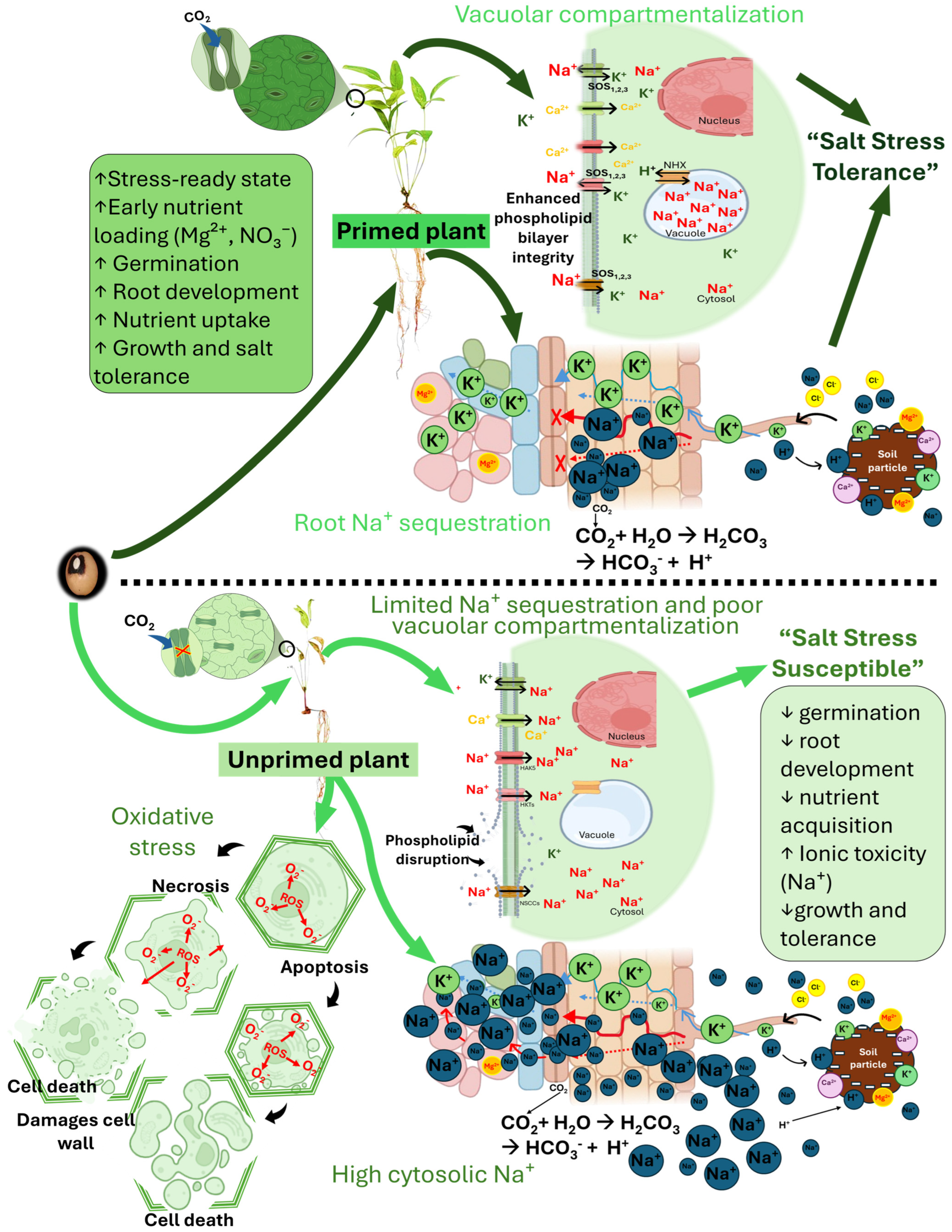
Building on our previous work, we consistently observed enhanced performance of “primed” plants compared with “control”, “primed + salt” and “salt-stressed” treatments across germination, growth, photosynthetic, water status, and stress-response parameters [29]. These physiological and biochemical responses closely complement the observed ionomic profiles, suggesting a coordinated nutrient-mediated tolerance mechanism. We therefore propose a hypothetical framework in which Mg(NO3)2 seed priming induces a physiological ‘state of readiness’ before stress exposure. Early nutrient loading with Mg2+ and NO3 during priming likely supports rapid metabolic activation and early photosynthetic establishment in seedlings exposed to salinity [26]. In addition to serving as a nitrogen source, NO3 may function as a signaling molecule, shortening the lag phase during germination and enhancing germination uniformity (higher GRI and SVI), which in turn promotes faster root system development and greater soil exploration [26,75,76,77]. The improved root system likely enhances the acquisition of essential nutrients (K, Mg, P, Zn, Mn), which collectively support growth through ATP production, photosynthesis and assimilate transport, while simultaneously strengthening defense via their roles as cofactors for antioxidant enzymes such as SOD [77,78]. Despite the absence of significant differences in root biomass (Figure 1), the consistently higher root mass in primed + salt plants suggests that Mg(NO3)2 priming may influence root development at the architectural or physiological level rather than through increased biomass accumulation. Seed priming has been reported to enhance early root vigor, lateral root formation, and nutrient uptake efficiency, traits that may improve plant performance under salinity without necessarily significantly increasing total root dry weight [28,37,38,79]. In this context, the observed improvements in nutrient retention and ion homeostasis may reflect more efficient root function rather than greater root size.
At the same time, priming may have enhanced root-based Na+ sequestration and vacuolar compartmentalization, thereby reducing cytosolic ion toxicity. Adequate K availability further supports stomatal regulation, CO2 influx, and sustained photosynthesis, contributing to improved biomass accumulation and water status under stress [39,40,41] (Figure 2). In contrast, these coordinated advantages appear compromised in unprimed seeds, where delayed germination, weaker root systems, disrupted ion homeostasis, and reduced antioxidant capacity collectively intensify growth inhibition caused by salt stress. Together, this hypothetical framework provides a mechanistic link between ionomic adjustments and the enhanced physiological and biochemical performance of Mg(NO3)2-primed Bambara groundnut genotypes under salt stress as depicted in Figure 2.
The proposed mechanistic framework is supported by several studies that investigated Mg(NO3)2 seed priming, predominantly in cereal crops, where there is broad agreement that Mg(NO3)2 priming enhances germination, early seedling growth, and vigor, often accompanied by increased enzymatic activity and soluble sugar accumulation [76,80,81,82,83,84,85]. These responses reflect improved metabolic activation during early seedling establishment. However, the underlying mechanisms may slightly differ in legumes due to distinct seed reserve composition and nitrogen metabolism. Furthermore, methodological differences in stress imposition complicate direct comparisons. For example, while Singh et al. [81,82] employed PEG-induced osmotic stress; the present study imposed NaCl-mediated salinity, which integrates both osmotic and ionic stress components. PEG treatments simulate water deficit without introducing toxic ions, whereas NaCl stress directly disrupts ion homeostasis through Na+ and Cl accumulation. As a result, enhanced germination and seedling vigor observed under PEG stress do not necessarily translate to improved Na+ exclusion or ionic regulation under true salinity. Our ionomic data therefore extend earlier findings by demonstrating that, under NaCl stress, Mg(NO3)2 priming likely assists plants to modulate Na+ toxicity and nutrient balance rather than making plants completely avoid Na+ ions.

5. Conclusions and Future Perspectives

In the current study salt stress significantly disrupted nutrient homeostasis in Bambara groundnut, particularly reducing Ca, K, Cu, and Mg while imposing strong Na+ toxicity, especially in roots. The genotypes adopted contrasting strategies: BGN-14 accumulated significantly higher root Na+, indicating effective sequestration and compartmentalization, which likely protected photosynthetic tissues despite elevated bulk Na+/K+ ratios, whereas BGN-25 more strongly restricted Na+ uptake but showed poorer physiological performance, suggesting that exclusion alone was insufficient for stress tolerance. Mg(NO3)2 priming partially mitigated these effects, improving K+ retention, P availability, and Ca2+/Na+ balance. It is important to acknowledge that while this study was conducted with methodological rigor, including the use of a conservative HSD post hoc test to minimize experimental error, certain constraints should be acknowledged. Specifically, the ionomic analysis was performed using a limited sample size (n = 3) due to restricted plant material availability under salt stress conditions. Although this conservative statistical approach enhances result reliability, it may reduce sensitivity to subtle treatment effects, particularly when variability is high. This likely contributed to the absence of statistically significant differences in some nutrient elements (Table 2), especially in BGN-25, despite the presence of consistent trends and differences in magnitude across treatments. Accordingly, interpretations were cautiously framed to propose plausible mechanisms rather than definitive conclusions. Future studies incorporating larger sample sizes (n > 3) would improve statistical resolution by reducing standard errors, thereby enabling more precise mean estimates and stronger inference of nutrient dynamics.
While the present study advances understanding of Mg(NO3)2 seed priming effects on ionomic regulation in Bambara groundnut under salinity, several other important research gaps remain. First, future studies should incorporate subcellular and transporter-level analyses to distinguish between bulk tissue Na+ accumulation and cytosolic ion homeostasis. Quantifying the expression or activity of key Na+ and K+ transporters (e.g., SOS1, NHX, HKT families) would help confirm whether the observed root-centered Na+ accumulation reflects active vacuolar sequestration or restricted xylem loading. Second, given the genotype-specific responses observed between BGN-14 and BGN-25, expanding the analysis to a broader panel of Bambara groundnut genotypes would clarify whether Mg(NO3)2 priming consistently enhances nutrient redistribution or whether its effectiveness is strongly genotype dependent. This would be particularly valuable for identifying priming-responsive traits that could be targeted in breeding or crop improvement programmes. Third, although our concentration screening identified an optimal Mg(NO3)2 level, future work should explore dose–response relationships under varying salinity intensities, as priming efficacy may shift under moderate versus severe stress. This would improve recommendations for practical application under heterogeneous field conditions. Fourth, integrating analyses of nutrient dynamics from germination till later developmental stages, such as flowering and yield, would help determine whether priming-induced ionomic adjustments persist beyond early growth or diminish as stress exposure continues. Such studies would bridge the gap between short-term laboratory experiments and long-term field relevance. Finally, combining ionomic profiling with physiological, biochemical, and molecular datasets, including antioxidant enzyme activity, nitrate signaling pathways, and hormonal regulation, would provide a more holistic understanding of how Mg(NO3)2 priming establishes a stress-resilient phenotype. Collectively, these approaches would strengthen mechanistic inference and support the development of Mg(NO3)2 priming as a robust, crop-specific strategy for improving salinity tolerance in underutilized legumes such as Bambara groundnut.

Supplementary Materials

The following supporting information can be downloaded at https://www.mdpi.com/article/10.3390/plants15040626/s1, Figure S1: Biplot (PCA1 = 66.2%, PCA2 = 21.2%) displaying nutrient loadings and the separation of treatments based on multivariate nutrient variation. Where CS14/CS25 = Control shoot (BGN-14/BGN-25), PS14/ PS25 = Primed shoot (BGN-14/BGN-25), SS14/SS25 = Salt-stressed shoot (BGN-14/BGN-25), PSS14/PSS25 = Primed + salt shoot (BGN-14/BGN-25), CR14/CR25 = Control root (BGN-14/BGN-25), PR14/PR25 = Primed root (BGN-14/BGN-25), SR14/SR25 = Salt-stressed root (BGN-14/BGN-25), PSR14/PSR25 = Primed + salt root (BGN-14/BGN-25). Nutrients include; Ca = calcium, Mg = magnesium, K = potassium, P = phosphorus, Na = sodium, Zn = zinc, Cu = copper, Mn = manganese, Fe = iron, and Al = aluminium; Figure S2: Heatmap illustrating the intensity patterns of nutrient concentrations and the hierarchical clustering of similarity-based grouping of mineral profiles across treatments, tissue types, and genotypes. Where CS14/CS25 = Control shoot (BGN-14/BGN-25), PS14/PS25 = Primed shoot (BGN-14/BGN-25), SS14/SS25 = Salt-stressed shoot (BGN-14/BGN-25), PSS14/PSS25 = Primed + salt shoot (BGN-14/BGN-25), CR14/CR25 = Control root (BGN-14/BGN-25), PR14/PR25 = Primed root (BGN-14/BGN-25), SR14/SR25 = Salt-stressed root (BGN-14/BGN-25), PSR14/PSR25 = Primed + salt root (BGN-14/BGN-25). Nutrients include; Ca = calcium, Mg = magnesium, K = potassium, P = phosphorus, Na = sodium, Zn = zinc, Cu = copper, Mn = manganese, Fe = iron, and Al = aluminium; Table S1: Correlation coefficients among micro and macro-nutrient elements in Bambara ground nut under salt stress; Table S2: Principal component loadings of mineral nutrients and trace elements on the first two principal components (PC1 and PC2).

Author Contributions

S.N. performed the physiological analysis; both S.N. and L.G.B. performed the treatments and measures essential macro elements. M.A.N. designed the research and performed the statistical analysis with S.N., and L.G.B. wrote the manuscript. All authors have read and agreed to the published version of the manuscript.

Funding

The National Research Foundation of South Africa (grant numbers: BAAP2204082813) funded this research, as did the School of Science and Agriculture (UKZN) and the University of Zululand.

Data Availability Statement

The authors confirm that the data that support the findings of this study are available within the article.

Acknowledgments

The authors would like to thank the University of Zululand, University of KwaZulu-Natal, and the Cedara Agricultural Research Station, KwaZulu-Natal Department of Agriculture and Rural Development (KZNDARD) for the infrastructure and administrative support.

Conflicts of Interest

The authors declare no conflicts of interest.

Correction Statement

This article has been republished with a minor correction to the supplemental data. This change does not affect the scientific content of the article.

Abbreviations

The following abbreviations are used in this manuscript:
AASAtomic Absorption Spectroscopy
AlAluminium
ANOVAAnalysis of Variance
BGNBambara Groundnut
BGN-14Bambara Groundnut genotype 14
BGN-25Bambara Groundnut genotype 25
CaCalcium
Ca2+Divalent calcium ion
ClChloride ion
CuCopper
DWDry Weight
ECElectrical Conductivity
FeIron
FWFresh Weight
HClHydrochloric acid
HClO4Perchloric acid
HNO3Nitric acid
HSDHonestly Significant Difference
HKTHigh-Affinity Potassium Transporter
ICP-OESInductively Coupled Plasma–Optical Emission Spectrometry
KPotassium
K+Potassium ion
KNO3Potassium nitrate
MgMagnesium
Mg2+Divalent magnesium ion
Mg(NO3)2Magnesium nitrate
MnManganese
NaSodium
Na+Sodium ion
NaClSodium chloride
NH4NO3Ammonium nitrate
NHXNa+/H+ Exchanger
NO2Nitrogen dioxide
NO3Nitrate ion
PPhosphorus
PCAPrincipal Component Analysis
RCBDRandomized Complete Block Design
RFWRoot Fresh Weight
SFWShoot Fresh Weight
SOS1Salt Overly Sensitive 1 transporter
SSSalt stress
ZnZinc

References

  1. Kay, D.E. Food Legumes; Crop and Product Digest No. 3; Tropical Products Institute: London, UK, 1979; pp. 17–22. [Google Scholar]
  2. Halimi, R.A.; Barkla, B.J.; Mayes, S.; King, G.J. The potential of the underutilized pulse Bambara groundnut (Vigna subterranea (L.) Verdc.) for nutritional food security. J. Food Compos. Anal. 2019, 77, 47–59. [Google Scholar] [CrossRef]
  3. Ramatsetse, K.E.; Ramashia, S.E.; Mashau, M.E. Health benefits, antimicrobial and antioxidant properties of Bambara groundnut (Vigna subterranean): A review. Int. J. Food Prop. 2023, 26, 91–107. [Google Scholar] [CrossRef]
  4. Xulu, S.E.; Gerrano, A.S.; Mavengahama, S. Assessment of morphological and chlorophyll content traits in Bambara groundnut (Vigna subterranea [verdc. L.]). J. Underutil. Crops Res. 2024, 3, 6. [Google Scholar]
  5. Heller, J.; Begemann, F.; Mushonga, J. Bambara groundnut (Vigna subterranea (L.) Verdc.). In Proceedings of the Workshop on the Conservation and Improvement of Bambara Groundnut, Harare, Zimbabwe, 14–16 November 1997. [Google Scholar]
  6. Amarteifio, J.O.; Tibe, O.; Njogu, R.M. The mineral composition of Bambara groundnut (Vigna subterranea (L.) Verdc.) grown in Southern Africa. Afr. J. Biotechnol. 2006, 5, 2408–2411. [Google Scholar]
  7. Okafor, J.N.C.; Ani, J.C.; Okafor, G.I. Effect of processing methods on qualities of Bambara groundnut flour and acceptability in extruded snacks. Am. J. Food Technol. 2014, 9, 350–359. [Google Scholar] [CrossRef]
  8. Nadeem, M.; Li, J.; Yahya, M.; Wang, M.; Ali, A.; Cheng, A.; Wang, X.; Ma, C. Grain legumes and fear of salt stress: Focus on mechanisms and management strategies. Int. J. Mol. Sci. 2019, 20, 799. [Google Scholar] [CrossRef]
  9. Askari-Khorasgani, O.; Rehmani, M.I.A.; Wani, S.H.; Kumar, A. Osmotic stress: An outcome of drought and salinity. In Handbook of Plant and Crop Physiology; CRC Press: Boca Raton, FL, USA, 2021; pp. 445–464. [Google Scholar] [CrossRef]
  10. Hafez, E.M.; Osman, H.S.; Abd El-Razek, U.A.; Elbagory, M.; Omara, A.E.; Eid, M.A.; Gowayed, S.M. Foliar-applied potassium silicate coupled with plant growth-promoting rhizobacteria improves growth, physiology, nutrient uptake, and productivity of faba bean under salinity. Plants 2021, 10, 894. [Google Scholar] [CrossRef] [PubMed]
  11. Farooq, M.; Gogoi, N.; Hussain, M.; Barthakur, S.; Paul, S.; Bharadwaj, N.; Migdadi, H.M.; Alghamdi, S.S.; Siddique, K.H.M. Effects, tolerance mechanisms and management of salt stress in grain legumes. Plant Physiol. Biochem. 2017, 118, 199–217. [Google Scholar] [CrossRef]
  12. Ambede, J.G.; Netondo, G.W.; Mwai, G.N.; Musyimi, D.M. NaCl salinity affects germination, growth, physiology, and biochemistry of Bambara groundnut. Braz. J. Plant Physiol. 2012, 24, 151–160. [Google Scholar] [CrossRef]
  13. Katerji, N.; van Hoorn, J.W.; Hamdy, A.; Mastrorilli, M. Salt tolerance classification of crops according to soil salinity and water stress day index. Agric. Water Manag. 2000, 43, 99–109. [Google Scholar] [CrossRef]
  14. van Hoorn, J.W.; Katerji, N.; Hamdy, A.; Mastrorilli, M. Effect of salinity on yield and nitrogen uptake of grain legumes. Agric. Water Manag. 2001, 51, 87–98. [Google Scholar] [CrossRef]
  15. Ahmed, S. Effect of soil salinity on yield and yield components of mungbean. Pak. J. Bot. 2009, 41, 263–280. [Google Scholar]
  16. Sehrawat, N.; Yadav, M.; Bhat, K.V.; Sairam, R.K.; Jaiwal, K. Effect of salinity stress on mungbean. J. Agric. Sci. 2015, 60, 23–32. [Google Scholar] [CrossRef]
  17. Khan, M.S.A.; Karim, M.A.; Haque, M.M.; Islam, M.M.; Karim, A.J.M.S.; Mian, M.A.K. Influence of salt and water stress on soybean genotypes. Pertanika J. Trop. Agric. Sci. 2016, 39, 167–180. [Google Scholar]
  18. Chaudhary, S.B.; Gujjar, D.; Singh, M.; Patel, S.; Simran, S. Salinity stress in legume crops: A comprehensive review. J. Sci. Res. Rep. 2024, 30, 783–799. [Google Scholar] [CrossRef]
  19. Bidalia, A.; Vikram, K.; Yamal, G.; Rao, K.S. Effect of salinity on soil nutrients and plant health. In Salt Stress, Microbes, and Plant Interactions; Springer: Singapore, 2019. [Google Scholar] [CrossRef]
  20. Balasubramaniam, T.; Shen, G.; Esmaeili, N.; Zhang, Y. Plants’ response mechanisms to salt stress. Plants 2023, 12, 2253. [Google Scholar] [CrossRef]
  21. Pawar, V.A.; Laware, S.L. Seed priming: A critical review. Int. J. Sci. Res. Biol. Sci. 2018, 5, 94–101. [Google Scholar] [CrossRef]
  22. Ntshalintshali, S.; Sibiya, S.G.P.; Mabuza, N.; Nkomo, M.A.; Buthelezi, L.G. Seed priming in legume crops: Mechanisms and future directions. J. Agron. Crop Sci. 2025, 221, e70115. [Google Scholar] [CrossRef]
  23. Alboresi, A.; Gestin, C.; Leydecker, M.T.; Bedu, M.; Meyer, C.; Truong, H.N. Nitrate, a signal relieving seed dormancy in Arabidopsis. Plant Cell Environ. 2005, 28, 500–512. [Google Scholar] [CrossRef]
  24. Yan, D.; Easwaran, V.; Chau, V.; Okamoto, M.; Ierullo, M.; Kimura, M.; Endo, A.; Yano, R.; Pasha, A.; Gong, Y.; et al. NIN-like protein 8 is a master regulator of nitrate-promoted seed germination in Arabidopsis. Nat. Commun. 2016, 7, 13179. [Google Scholar] [CrossRef] [PubMed]
  25. Kamble, N.U. Cracking the seed code: How nitrate directly breaks ABA signaling for germination. Plant Cell 2025, 37, koaf072. [Google Scholar] [CrossRef]
  26. da Rocha, L.G.; Rau, B.A.; da Silva, D.M.; de Araújo, R.M.; Masetto, T.E. Potassium nitrate (KNO3) seed priming enhances soybean seed performance. Sci. Rep. 2025, 15, 33640. [Google Scholar] [CrossRef]
  27. Rehman, B.; Zulfiqar, A.; Attia, H.; Sardar, R.; Saleh, M.A.; Alamer, K.H.; Alsudays, I.M.; Mehmood, F. Seed priming with potassium nitrate can enhance salt stress tolerance in maize. Phyton 2024, 93, 1819–1838. [Google Scholar] [CrossRef]
  28. Maphalaphathwa, M.; Nciizah, A.D. Nutrient seed priming effects on water stress tolerance and nutrient uptake of chilies (Capsicum annuum L.). Agronomy 2025, 15, 930. [Google Scholar] [CrossRef]
  29. Ntshalintshali, S.; Mngoma, M.; Mabuza, N.; Nkomo, M.; Buthelezi, L. Effect of Seed Priming on Bambara Groundnut under Salinity Stress. BMC Plant Biol. 2026, 26, 225. [Google Scholar] [CrossRef] [PubMed]
  30. Ogbuehi, H.; Madukwe, D.; Ashilonu, P. Assessment of hydro-priming on morphological performance of Bambara groundnut (Vigna subterranea L.) landrace. Glob. J. Biol. Agric. Health Sci. 2013, 2, 17–22. [Google Scholar]
  31. Buthelezi, L.G. Variation in Growth, Nutrition and Phytochemicals of Sequentially Harvested Shoots and Fruits, and Genetic Studies of Lagenaria siceraria Landraces in South Africa. Ph.D. Thesis, University of Zululand, Richards Bay, South Africa, 2024. [Google Scholar]
  32. Jung, M.Y.; Kang, J.H.; Choi, Y.S.; Lee, D.Y.; Lee, J.Y.; Park, J.S. Analytical features of microwave plasma–atomic emission spectrometry for quantification of manganese in wild grape (Vitis coignetiae) red wines: Comparison with ICP-OES. Food Chem. 2019, 274, 20–25. [Google Scholar] [CrossRef]
  33. Vijay, P.; Ramesh, K.V.; Rakesh, P. Analysis of Mineral Nutrients: Sampling Techniques and Methods for Digestion of Plant Samples; Indian Council of Agricultural Research: New Delhi, India, 2017; pp. 77–81. [Google Scholar]
  34. Manson, A.D.; Roberts, V.G. Analytical Methods Used by the Soil Fertility and Analytical Services Section; KwaZulu-Natal Department of Agriculture and Rural Development: Pietermaritzburg, South Africa, 2000. [Google Scholar]
  35. Adhikari, B.; Olorunwa, O.J.; Horgan, T.E.; Wilson, J.; Barickman, T.C.; Li, T.; Bheemanahalli, R. Seed priming attenuates the impact of salt stress and enhances lettuce yields. J. Agric. Food Res. 2024, 15, 100947. [Google Scholar] [CrossRef]
  36. Albacete, A.; Ghanem, M.E.; Martínez-Andújar, C.; Acosta, M.; Sánchez-Bravo, J.; Martínez, V.; Lutts, S.; Dodd, I.C.; Pérez-Alfocea, F. Hormonal changes in relation to biomass partitioning and shoot growth impairment in salinized tomato (Solanum lycopersicum L.) plants. J. Exp. Bot. 2008, 59, 4119–4131. [Google Scholar] [CrossRef]
  37. Azeem, M.; Pirjan, K.; Qasim, M.; Mahmood, A.; Javed, T.; Muhammad, H.; Yang, S.; Dong, R.; Ali, B.; Rahimi, M. Salinity stress improves antioxidant potential by modulating physio-biochemical responses in Moringa oleifera Lam. Sci. Rep. 2023, 13, 2895. [Google Scholar] [CrossRef]
  38. Castillo-González, J.; Ojeda-Barrios, D.; Hernández-Rodríguez, A.; González-Franco, A.C.; Robles-Hernández, L.; López-Ochoa, G.R. Zinc metalloenzymes in plants. Interciencia 2018, 43, 242–248. [Google Scholar]
  39. Adams, E.; Shin, R. Transport, signaling, and homeostasis of potassium and sodium in plants. J. Integr. Plant Biol. 2014, 56, 231–249. [Google Scholar] [CrossRef]
  40. Niste, M.; Vidican, R.; Rotar, I.; Stoian, V.; Pop, R.; Miclea, R. Plant nutrition affected by soil salinity. ProEnvironment 2014, 7, 226–230. [Google Scholar]
  41. Hepler, P.K. Calcium: A central regulator of plant growth and development. Plant Cell 2005, 17, 2142–2155. [Google Scholar] [CrossRef]
  42. Erdoğan, D.G. Influence of Calcium Deficiency on Antioxidant Defense in Bean Roots. Master’s Thesis, Sabancı University, Istanbul, Turkey, 2003. [Google Scholar]
  43. De Freitas, S.T.; Amarante, C.; Mitcham, E.J. Calcium deficiency disorders in plants. In Postharvest Ripening Physiology of Crops; CRC Press: Boca Raton, FL, USA, 2016. [Google Scholar]
  44. Jaghdani, S.J. Magnesium Deficiency-Induced Responses in Crop Physiology. Ph.D. Thesis, University of Göttingen, Göttingen, Germany, 2021. [Google Scholar]
  45. El-Mogy, M.M.; Hassan, H.A.; Aboelghar, M.; Morsy, N.; Mahmoud, A.W.M.; Abdeldaym, E.A.; Ali, A.M. Magnesium oxide nanoparticles enhance onion growth. Russ. J. Plant Physiol. 2025, 72, 124. [Google Scholar] [CrossRef]
  46. Dibattista, A. Growth and Phospholipid Analysis of Thellungiella salsuginea. Master’s Thesis, University of Alberta, Edmonton, AB, Canada, 2010. [Google Scholar]
  47. Malhotra, H.; Vandana; Sharma, S.; Pandey, R. Phosphorus nutrition and plant growth. In Plant Nutrients and Abiotic Stress Tolerance; Springer: Berlin/Heidelberg, Germany, 2018. [Google Scholar] [CrossRef]
  48. Hasanuzzaman, M.; Bhuyan, M.H.M.B.; Nahar, K.; Hossain, M.S.; Mahmud, J.A.; Hossen, M.S.; Masud, A.A.C.; Moumita; Fujita, M. Potassium as a regulator of abiotic stress tolerance. Agronomy 2018, 8, 31. [Google Scholar] [CrossRef]
  49. El Sayed, S.; Hellal, F.; El-Rab, N.G.; Zewainy, R. Ameliorative effects of potassium on salt stress in plants: A review. Asian J. Soil Sci. Plant Nutr. 2019, 4, 1–15. [Google Scholar] [CrossRef]
  50. Qi, D.; Le, X.; Wang, X.-G.; He, Y.; Wang, J.; Yang, H.-Q. Effects of potassium deficiency on photosynthesis, chloroplast ultrastructure, reactive oxygen species and antioxidant activities in maize (Zea mays L.). J. Integr. Agric. 2019, 18, 395–406. [Google Scholar] [CrossRef]
  51. Li, J.; Hu, W.; Lu, Z.; Meng, F.; Cong, R.; Li, X.; Ren, T.; Lu, J. Imbalance between nitrogen and potassium fertilization influences potassium deficiency symptoms in winter oilseed rape (Brassica napus L.) leaves. Crop J. 2022, 10, 565–576. [Google Scholar] [CrossRef]
  52. Krishnasamy, K. Sodium and Cultivar Effects on Potassium Nutrition of Wheat. Ph.D. Thesis, Murdoch University, Perth, Australia, 2015. [Google Scholar]
  53. Higuchi, K.; Hara, K. Common reed absorbs K+ more selectively than rice against high Na+/K+ ratio in nutrient solution. Soil Sci. Plant Nutr. 2017, 63, 483–487. [Google Scholar] [CrossRef]
  54. Wu, H. Plant salt tolerance and Na+ sensing and transport. Crop J. 2018, 6, 215–225. [Google Scholar] [CrossRef]
  55. Liu, C.; Jiang, X.; Yuan, Z. Plant responses and adaptations to salt stress: A review. Horticulturae 2024, 10, 1221. [Google Scholar] [CrossRef]
  56. Wang, M.; Qu, Y.; Lu, X.; Gillani, S.W.; Song, Y.; Bai, Y.; Li, Y.; Zhang, C.; Xu, Z.; Meng, C. Root-centered sodium sequestration and transcriptomic regulation under salt and alkali stress in wild soybean (Glycine soja). Front. Plant Sci. 2025, 16, 1675559. [Google Scholar] [CrossRef]
  57. Apse, M.; Aharon, G.S.; Snedden, W.A.; Blumwald, E. Salt tolerance conferred by overexpression of a vacuolar Na+/H+ antiport in Arabidopsis. Science 1999, 285, 1256–1258. [Google Scholar] [CrossRef] [PubMed]
  58. Mansour, M.M.F.; Salama, K.H.A.; Al-Mutawa, M.M. Transport proteins and salt tolerance in plants. Plant Sci. 2003, 164, 891–900. [Google Scholar] [CrossRef]
  59. Rahnama, A.; Poustini, K.; Tavakkol-Afshari, R.; Ahmadi, A.; Alizadeh, H. Growth properties and ion distribution in different tissues of bread wheat genotypes (Triticum aestivum L.) differing in salt tolerance. J. Agron. Crop Sci. 2011, 197, 21–30. [Google Scholar] [CrossRef]
  60. Rizk, M.S.; Assaha, D.V.; Mekawy, A.M.M.; Shalaby, N.E.; Ramadan, E.A.; El-Tahan, A.M.; Ibrahim, O.M.; Metwelly, H.I.; Okla, M.K.; Maridueña-Zavala, M.G.; et al. Comparative analysis of salinity tolerance mechanisms in two maize genotypes: Growth performance, ion regulation, and antioxidant responses. BMC Plant Biol. 2024, 24, 818. [Google Scholar] [CrossRef]
  61. Lazarus, B.E.; Richards, J.H.; Gordon, P.E.; Oki, L.R.; Barnes, C.S. Plasticity tradeoffs in salt tolerance mechanisms among desert Distichlis spicata genotypes. Funct. Plant Biol. 2011, 38, 187–198. [Google Scholar] [CrossRef] [PubMed]
  62. Patwa, N.; Pandey, V.; Gupta, O.P.; Yadav, A.; Meena, M.R.; Ram, S.; Singh, G. Unravelling wheat genotypic responses: Insights into salinity stress tolerance in relation to oxidative stress, antioxidant mechanisms, osmolyte accumulation and grain quality parameters. BMC Plant Biol. 2024, 24, 875. [Google Scholar] [CrossRef]
  63. Joshi, S.; Nath, J.; Singh, A.K.; Pareek, A.; Joshi, R. Ion transporters and their regulatory signal transduction mechanisms for salinity tolerance in plants. Physiol. Plant. 2022, 174, e13702. [Google Scholar] [CrossRef]
  64. Eskandari, H. The importance of iron (Fe) in plant products and mechanism of its uptake by plants. J. Appl. Environ. Biol. Sci. 2011, 1, 448–452. [Google Scholar]
  65. Çağ, S.; Cevahir, G.; Ünal, M.; Kaplan, E.; Çıngıl, Ç.; Kösesakal, T. The effect of Zn, Cu and Mn on senescence in excised cotyledons of Eruca sativa L. Fresenius Environ. Bull. 2004, 13, 733–739. [Google Scholar]
  66. Yruela, I. Transition metals in plant photosynthesis. Metallomics 2013, 5, 1090–1109. [Google Scholar] [CrossRef]
  67. Obata, H.; Shimoyama, A.; Umebayashi, M. Effect of shading on zinc deficiency symptoms in rice plants. Soil Sci. Plant Nutr. 1997, 43, 933–936. [Google Scholar] [CrossRef]
  68. Sugimoto, K.; Nakagawa, K.; Hayashi, S.; Amakura, Y.; Yoshimura, M.; Yoshida, T.; Yamaji, R.; Nakano, Y.; Inui, H. Hydrolyzable tannins as antioxidants in leaf extract of Eucalyptus globulus possessing tyrosinase and hyaluronidase inhibitory activities. Food Sci. Technol. Res. 2009, 15, 331–336. [Google Scholar] [CrossRef]
  69. Das, S.; Green, A. Zinc in crops and human health. In Biofortification of Food Crops; Singh, U., Praharaj, C., Singh, S., Singh, N., Eds.; Springer: New Delhi, India, 2016. [Google Scholar] [CrossRef]
  70. Yuvaraj, M.; Subramanian, K. Significance of zinc in plant nutrition. Biotica Res. Today 2020, 2, 823–825. [Google Scholar]
  71. Evans, P.; Halliwell, B. Micronutrients: Oxidant/antioxidant status. Br. J. Nutr. 2001, 85, 67–74. [Google Scholar] [CrossRef]
  72. Broxton, C.N.; Culotta, V.C. SOD enzymes and microbial pathogens: Surviving the oxidative storm of infection. PLoS Pathog. 2016, 12, e1005295. [Google Scholar] [CrossRef] [PubMed]
  73. Ramana-Gopavajhula, V.; Viswanatha Chaitanya, K.; Akbar Ali Khan, P.; Shaik, J.; Reddy, P.N.; Alanazi, M. Modeling and analysis of soybean (Glycine max L.) Cu/Zn-, Mn- and Fe-superoxide dismutases. Genet. Mol. Biol. 2013, 36, 225–236. [Google Scholar] [CrossRef]
  74. Berwal, M.K.; Ram, C. Superoxide dismutase: A stable biochemical marker for abiotic stress tolerance in higher plants. In Abiotic and Biotic Stress in Plants; IntechOpen: London, UK, 2018. [Google Scholar] [CrossRef]
  75. Finch-Savage, W.E.; Bassel, G.W. Seed vigour and crop establishment: Extending performance beyond adaptation. J. Exp. Bot. 2016, 67, 567–591. [Google Scholar] [CrossRef]
  76. Choudhary, S.K.; Kumar, V.; Singhal, R.K.; Bose, B.; Chauhan, J.; Alamri, S.; Siddiqui, M.H.; Javed, T.; Shabbir, R.; Rajendran, K.; et al. Seed priming with Mg(NO3)2 and ZnSO4 salts synergistically triggers germination and growth attributes in wheat varieties. Agronomy 2021, 11, 2110. [Google Scholar] [CrossRef]
  77. Lazarova, E.; Klimesova, J.; Streda, T. Seed vigour and root system size as attributes for drought escape and tolerance. In Proceedings of the International PhD Students Conference MendelNet; Mendel University in Brno: Brno, Czech Republic, 2016; pp. 102–105. [Google Scholar]
  78. Blunk, S.; de Heer, M.I.; Malik, A.H.; Fredlund, K.; Ekblad, T.; Sturrock, C.J.; Mooney, S.J. Seed priming enhances early growth and improves area of soil exploration by roots. Environ. Exp. Bot. 2019, 158, 1–11. [Google Scholar] [CrossRef]
  79. Yan, M.; Zhang, L.; Ren, Y.; Zhang, T.; Zhang, S.; Li, H.; Chen, Y.; Zhang, S. Higher water absorption capacity of a small root system improves yield and water-use efficiency of maize. Plants 2022, 11, 2300. [Google Scholar] [CrossRef] [PubMed]
  80. Chakraborty, P.; Bose, B. Effects of magnesium nitrate and boric acid on germination and seedling growth of wheat (Triticum aestivum L.) var. HUW-468. J. Pharmacogn. Phytochem. 2020, 9, 804–808. [Google Scholar]
  81. Singh, V.; Sharma, M.; Upadhyay, H.; Siddique, A. Ameliorative effect of seed priming on germination, vigour index and tolerance index under short-term moisture stress in maize (Zea mays L.). Indian J. Agric. Res. 2020, 54, 378–382. [Google Scholar] [CrossRef]
  82. Singh, V.; Siddique, A.; Krishna, V.; Singh, M. Effect of seed priming with nitrate salts on phytotoxicity and chlorophyll content under short-term moisture stress in maize (Zea mays L.). Nat. Environ. Pollut. Technol. 2020, 19, 1119–1123. [Google Scholar] [CrossRef]
  83. Kumar, V.; Bose, B.; Dwivedi, P. Seed priming with Mg(NO3)2 and Ca(NO3)2 salts influences the growth of tomato seedlings. Ecol. Environ. Conserv. 2023, 29, S378–S385. [Google Scholar] [CrossRef]
  84. Chakraborty, P. Role of magnesium nitrate and boric acid on germination and seedling growth in wheat (Triticum aestivum L.) genotype HUW-468. Plant Arch. 2025, 25, 943–949. [Google Scholar] [CrossRef]
  85. Sghayar, S.; Debez, A.; Lucchini, G.; Abruzzese, A.; Zorrig, W.; Negrini, N.; Morgutti, S.; Abdelly, C.; Sacchi, G.A.; Pecchioni, N.; et al. Seed priming mitigates high salinity impact on germination of bread wheat (Triticum aestivum L.) by improving carbohydrate and protein mobilization. Plant Direct 2023, 7, e497. [Google Scholar] [CrossRef]
Figure 1. Growth performance of two Bambara groundnut genotypes, BGN-14 and BGN-25, exposed to four treatment conditions: “Control”, “Primed”, “Primed + Salt”, and “Salt”. Representative plants are shown at the top (A,B). Bar graphs illustrate shoot fresh weight (SFW), root fresh weight (RFW), shoot dry weight (SDW) and root dry weight (RDW) (CF). The data are means ± SE (n = 6), whereby different letters indicate significant differences among treatments as determined by Tukey’s HSD (p < 0.05).
Plants 15 00626 g001
Figure 2. Proposed mechanistic model illustrating the role of Mg(NO3)2 seed priming in enhancing salt stress tolerance in Bambara groundnut. This figure presents a conceptual framework summarizing the contrasting responses of Mg(NO3)2-primed and non-primed Bambara groundnut seedlings under salinity stress. Mg(NO3)2 priming induces a stress-ready state characterized by early magnesium ion (Mg2+) and nitrate (NO3) nutrient loading, faster and more uniform germination expressed as increased germination percentage (G%), germination rate index (GRI), and seedling vigor index (SVI), enhanced root development, and improved nutrient uptake. Where ↑ = increase, ↓ = decrease. Under salt stress, primed plants exhibit efficient root sodium ion (Na+) sequestration and vacuolar compartmentalization mediated by Na+/H+ antiporters (NHX) and the Salt Overly Sensitive (SOS) pathway, leading to reduced cytosolic Na+ toxicity. This is accompanied by improved ion homeostasis, enhanced uptake of essential nutrients including potassium (K+), calcium (Ca2+), magnesium (Mg2+), manganese (Mn), zinc (Zn), and phosphorus (P), and reduced accumulation of reactive oxygen species (ROS). Collectively, these processes sustain photosynthesis, antioxidant defense through superoxide dismutase (SOD), and energy metabolism via adenosine triphosphate (ATP), resulting in improved growth and salt tolerance. In contrast, non-primed seedlings exhibit delayed germination, weak root structures, restricted t uptake of the essential nutrient, excessive cytosolic Na+ accumulation, elevated ROS production which can lead to necrosis or apoptosis (damaged cell wall) resulting to cell death, impaired physiological functions, and increased salt susceptibility. Solid arrows indicate the progression from seed priming to physiological outcomes, while cellular schematics illustrate ion transport, compartmentalization, and metabolic consequences under salt stress.
Plants 15 00626 g002
Table 1. Analysis of variance (ANOVA) showing mean squares (MS) for the effects of genotype and treatment on biomass traits of Bambara groundnut.
Source of VariationdfMS (SFW)MS (RFW)MS (SDW)MS (RDW)
Genotype (G)10.67 ns0.26 ns0.04 ns0.00 ns
Treatment (T)35.90 ***1.88 ***0.37 ***0.03 ns
G × T31.11 ns0.86 **0.12 **0.03 ns
Error (E)350.660.130.020.01
Genotype (G) refers to Bambara groundnut genotypes; Treatment (T) represents the applied priming and salinity conditions; G × T indicates the genotype × treatment interaction. SFW, shoot fresh weight; RFW, root fresh weight; SDW, shoot dry weight; RDW, root dry weight; df, degrees of freedom; Mean squares (MS) are presented. Significance levels are based on F-tests and indicated as: ** p ≤ 0.01, *** p ≤ 0.001; ns = not significant. Error represents residual variation.
Table 2. Mineral composition (mg kg−1 DW) of Bambara groundnut genotypes under control and salt stress in the roots and shoots.
Nutrient Composition (mg kg−1 DW)
TreatmentCaMgKNaZnCuMnFePAl
BGN-14
CS19,035 ± 6013648 ± 16312,847 ± 8431599 ± 140 24 ± 313 ± 349 ± 31502 ± 3621947 ± 102453 ± 30
PS11,106 ± 12803120 ± 6213,960 ± 464952 ± 12737 ± 512 ± 268 ± 7612 ± 2363749 ± 314164 ± 28
SS13,546 ± 3323562 ± 37725,551 ± 215016,005 ± 651632 ± 37 ± 237 ± 2765 ± 2003292 ± 494263 ± 41
PSS19,685 ± 5354622 ± 19934,731 ± 159011,133 ± 132055 ± 1211 ± 339 ± 6940 ± 3543654 ± 375251 ± 52
CR4554 ± 7375292 ± 8275204 ± 16485549 ± 957182 ± 816 ± 187 ± 1113,017 ± 25361679 ± 1412317 ± 363
PR5442 ± 1779086 ± 10249940 ± 10357463 ± 1249165 ± 625 ± 1101 ± 199404 ± 19601227 ± 382340 ± 495
SR4864 ± 4773902 ± 6885058 ± 110022,697 ± 257467 ± 375 ± 183 ± 610,607 ± 16492406 ± 661821 ± 286
PSR3791 ± 5813279 ± 4255319 ± 120120,417 ± 338931 ± 95 ± 185 ± 79854 ± 14041943 ± 2881884 ± 205
p-value<0.0010.002<0.0010.0060.122<0.001<0.001<0.001<0.0010.351
BGN-25
CS14,390 ± 6853103 ± 14318,598 ± 7194531 ± 232540 ± 910 ± 143 ± 3581 ± 313226 ± 109224 ± 20
PS19,035 ± 6013648 ± 16312,847 ± 8431599 ± 14024 ± 213 ± 349 ± 31502 ± 3621947 ± 102453 ± 30
SS19,684 ± 5354622 ± 19934,731 ± 159011,133 ± 132055 ± 1211 ± 339 ± 6941 ± 3543654 ± 375251 ± 52
PSS13,315 ± 22,5693643 ± 389726,854 ± 15,20214,172 ± 282132 ± 5410 ± 1237 ± 73863 ± 9853394 ± 2300236 ± 447
CR5316 ± 819.38502 ± 14097066 ± 126714,342 ± 469482 ± 8413 ± 285 ± 19484 ± 8094,835,430 ± 803,4142141 ± 174
PR26,733 ± 19,92335,765 ± 264944,156 ± 37,09731,793 ± 24,787835 ± 34229 ± 23318 ± 21124,583 ± 15,8172.46 × 108 ± 1.58 × 1086939 ± 4667
SR6103 ± 9765845 ± 3965702 ± 46028,019 ± 2251131 ± 3815 ± 188 ± 128532 ± 120685,317,611 ± 12,065,8291854 ± 264
PSR6059 ± 47416094 ± 7974163 ± 8667461 ± 3037211 ± 4210 ± 178 ± 128898 ± 139788,980,147 ± 13,971,0062338 ± 309
p-value0.3520.2790.2580.6800.0170.4050.2660.4670.4470.351
The table summarizes the nutrient content found in the shoots and roots of BGN-14 and BGN-25 across treatments during the seedling stage. Where CS = control shoots, PS = primed shoots, SS = salt shoot, PSS = primed + salt shoot, CR = control roots, PR = primed roots, SR = salt roots, PSR = primed + salt roots, DW = dry weight. The data are means ± SE (n = 3).
Table 3. Ion homeostasis indicator (Na+/K+ and Ca2+/Na+) ratios in shoots and roots of two Bambara groundnut genotypes (BGN-14 and BGN-25) under different treatments.
GenotypeTissueTreatmentNa+/K+Ca2+/Na+Interpretation
BGN-14Shoot“Control”0.1211.91Balanced ion status
Shoot“Primed”0.07 ns11.67 nsSlight K+ build-up, slight Ca2+ decline
Shoot“Salt”0.63 ns0.85 ***Higher Na+ build-up, higher Ca2+ decline
Shoot“Primed + salt”0.32 ns1.77 ***High Na+ build-up and Ca2+ decline
Root“Control”1.070.82Normal ionic distribution
Root“Primed”0.75 ns0.73 nsHigher K+ build-up, slight Ca2+ decline
Root“Salt”4.49 ***0.21 nsHigher Na+ accumulation, Ca2+ depletion
Root“Primed + salt”3.84 ***0.19 nsHigh Na+ uptake, higher Ca2+ depletion
BGN-25Shoot“Control”0.243.18Stable ionic balance
Shoot“Primed”0.12 ns11.91 *Slight K+ uptake, Ca2+ improvement
Shoot“Salt”0.32 ns1.77 nsModerate Na+ rise, and Ca2+ depletion
Shoot“Primed + salt”0.53 ns0.94 *Limited K+ restoration, Ca2+ depletion
Root“Control”2.030.37Baseline Na+ load
Root“Primed”0.72 ns0.84 nsSlight improvement
Root“Salt”4.91 ***0.22 nsSevere Na+ accumulation
Root“Primed + salt”1.79 ns0.81 nsPartial mitigation of ionic stress
Ratios were derived from the corresponding mineral concentrations across treatments and are statistically compared to the control group using Dunnett’s multiple comparisons test at a (p ≤ 0.05) level where * = p < 0.05, *** = p < 0.001, ns = not significant when comparing “primed”, “salt”, “primed + salt” to the control and = decrease in ratio compared to the control group, = increase in ratio compared to the control group. However, honestly significant difference (HSD) according to Tukey’s test (n = 3) was used to do comparison among all four treatments to each other. Lower Na+/K+ and higher Ca2+/Na+ ratios indicate more effective ionic regulation and greater membrane stability under salinity.
Disclaimer/Publisher’s Note: The statements, opinions and data contained in all publications are solely those of the individual author(s) and contributor(s) and not of MDPI and/or the editor(s). MDPI and/or the editor(s) disclaim responsibility for any injury to people or property resulting from any ideas, methods, instructions or products referred to in the content.