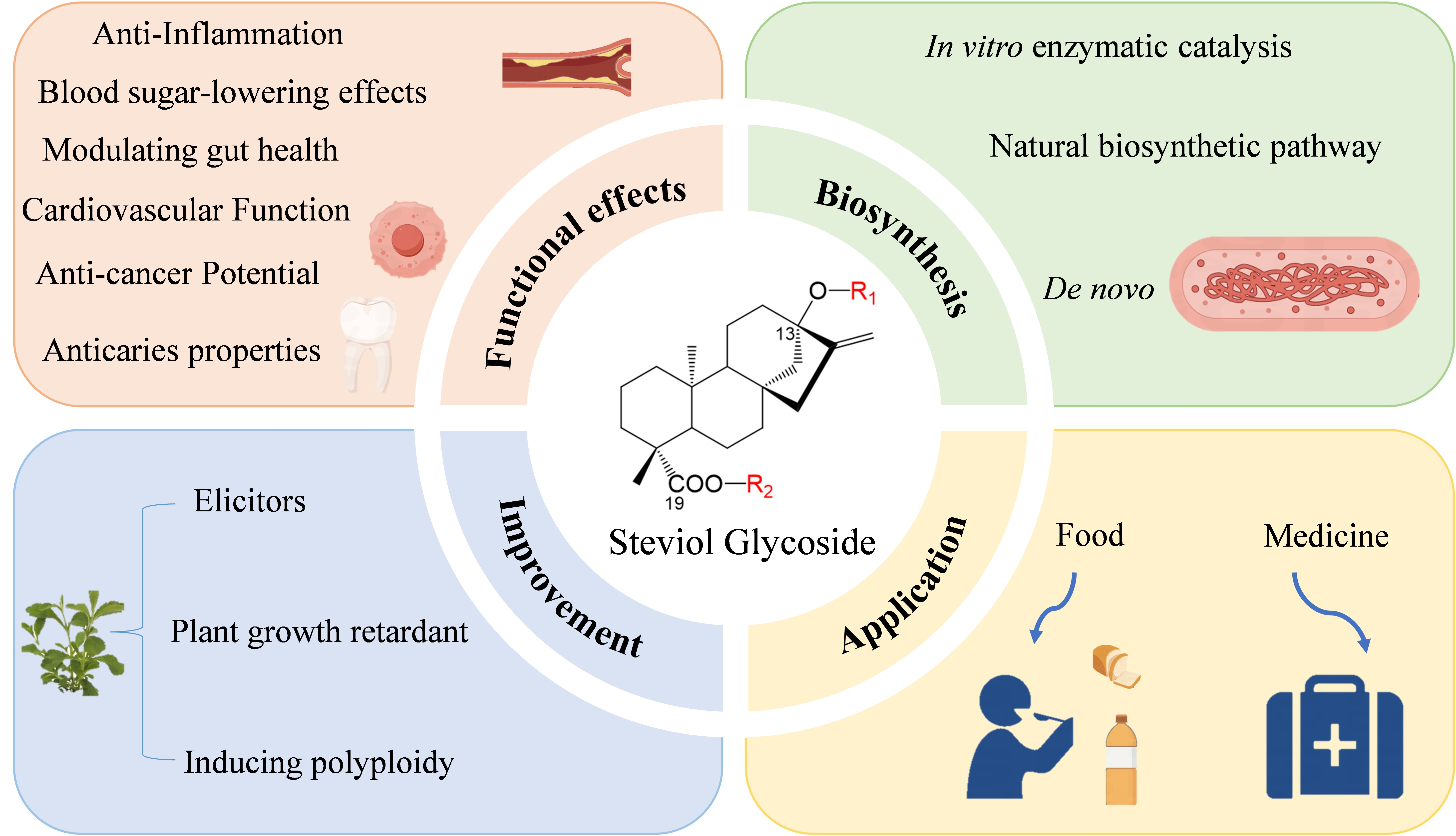
A Comprehensive Review on Steviol Glycosides: Sources, Properties, Bioactivities, Sensory-Functional Enhancement and Bioproduction Strategies
 ,
, 
Abstract
1. Introduction
2. The Natural Source of SGs
3. Structure and Properties of SGs
4. The Biosafety and Functional Effects of SGs
4.1. Toxicity and Safety
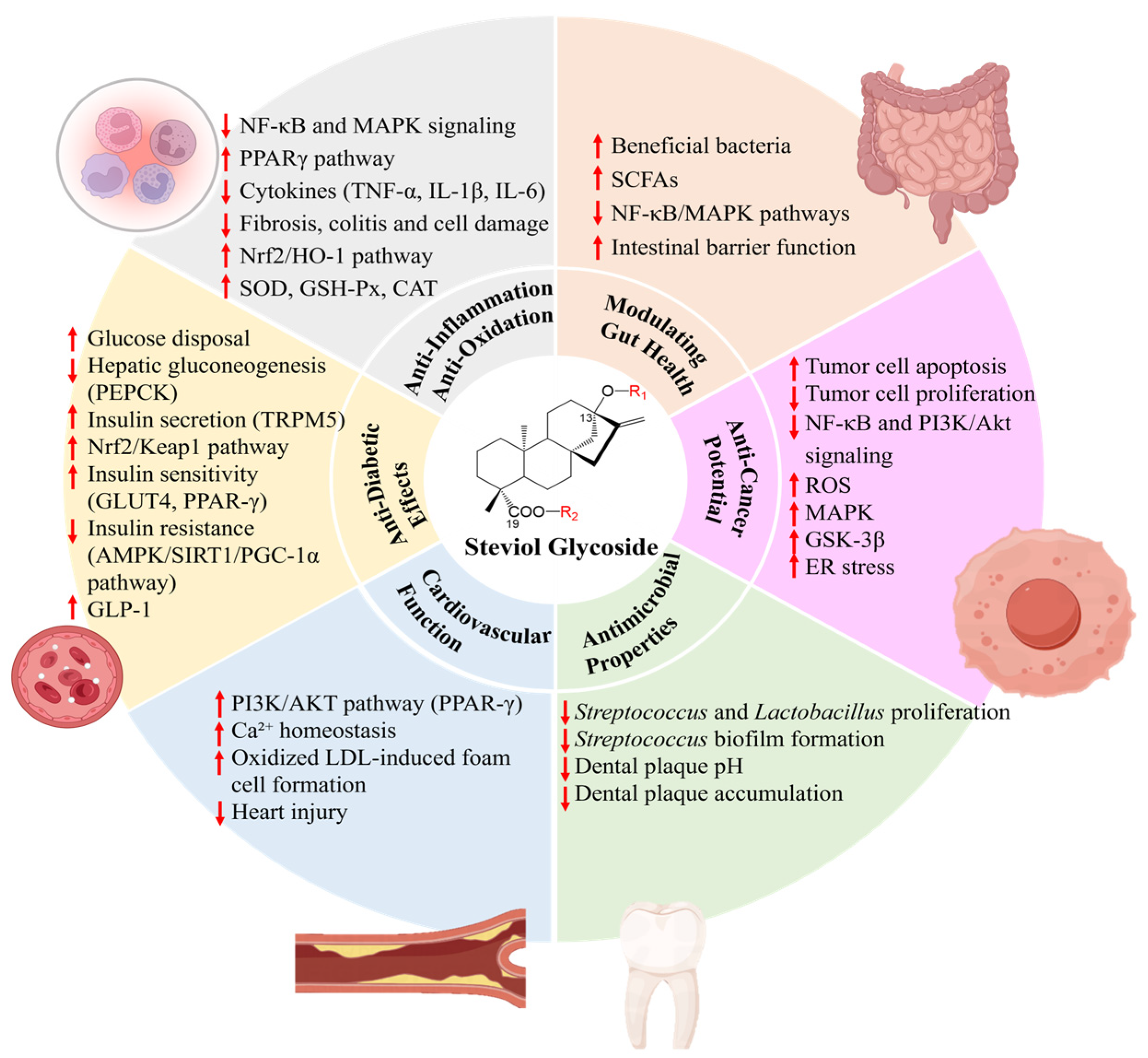
4.2. Anti-Diabetic Effects
4.3. Anti-Inflammation and Anti-Oxidation
4.4. Modulating Gut Health
4.5. Cardiovascular Function
4.6. Anti-Cancer Potential
4.7. Antimicrobial Properties
4.8. Summary on Limitations and Gaps in Clinical Validation of SG Activities
5. Natural Biosynthesis of SGs
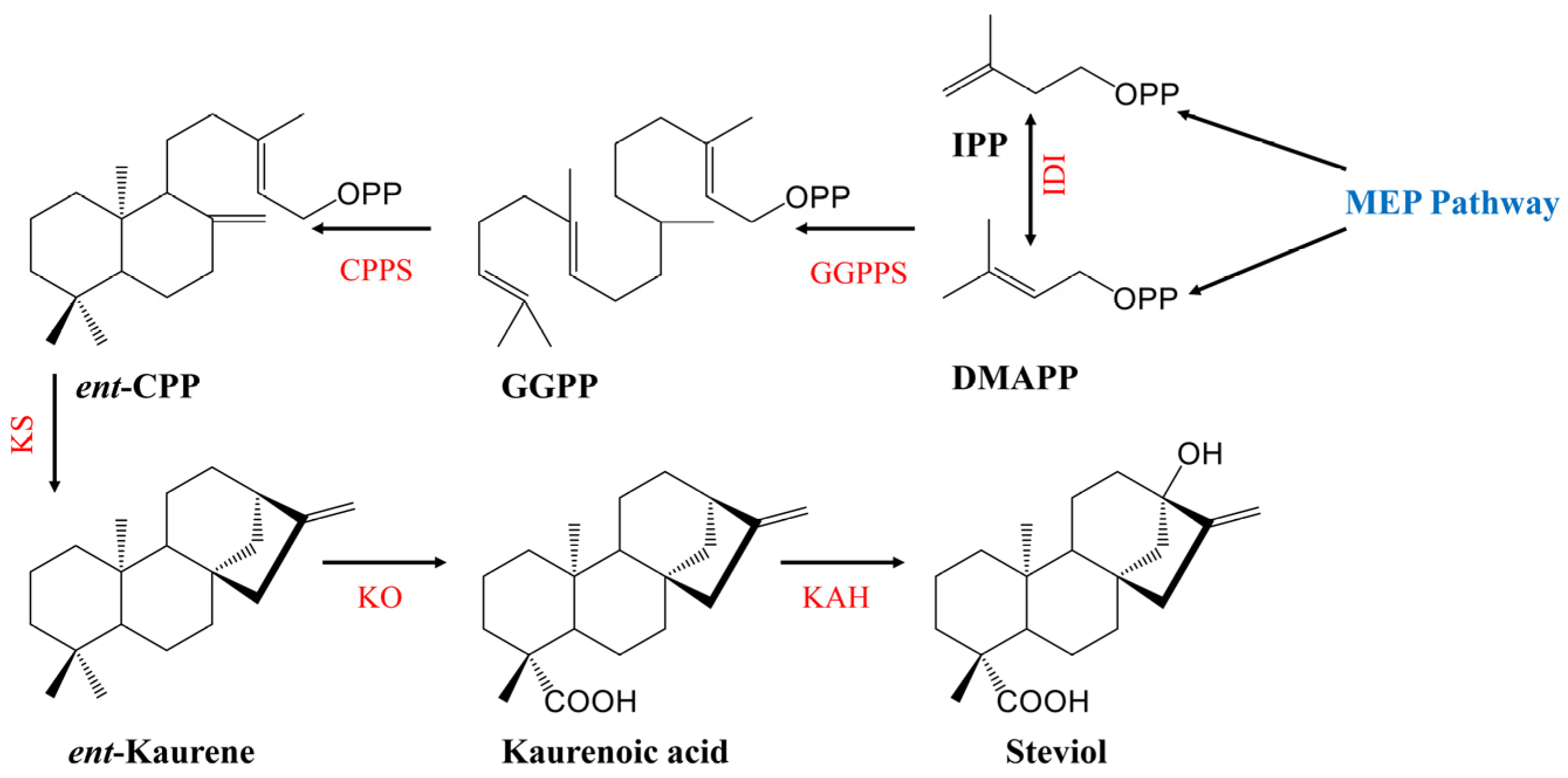
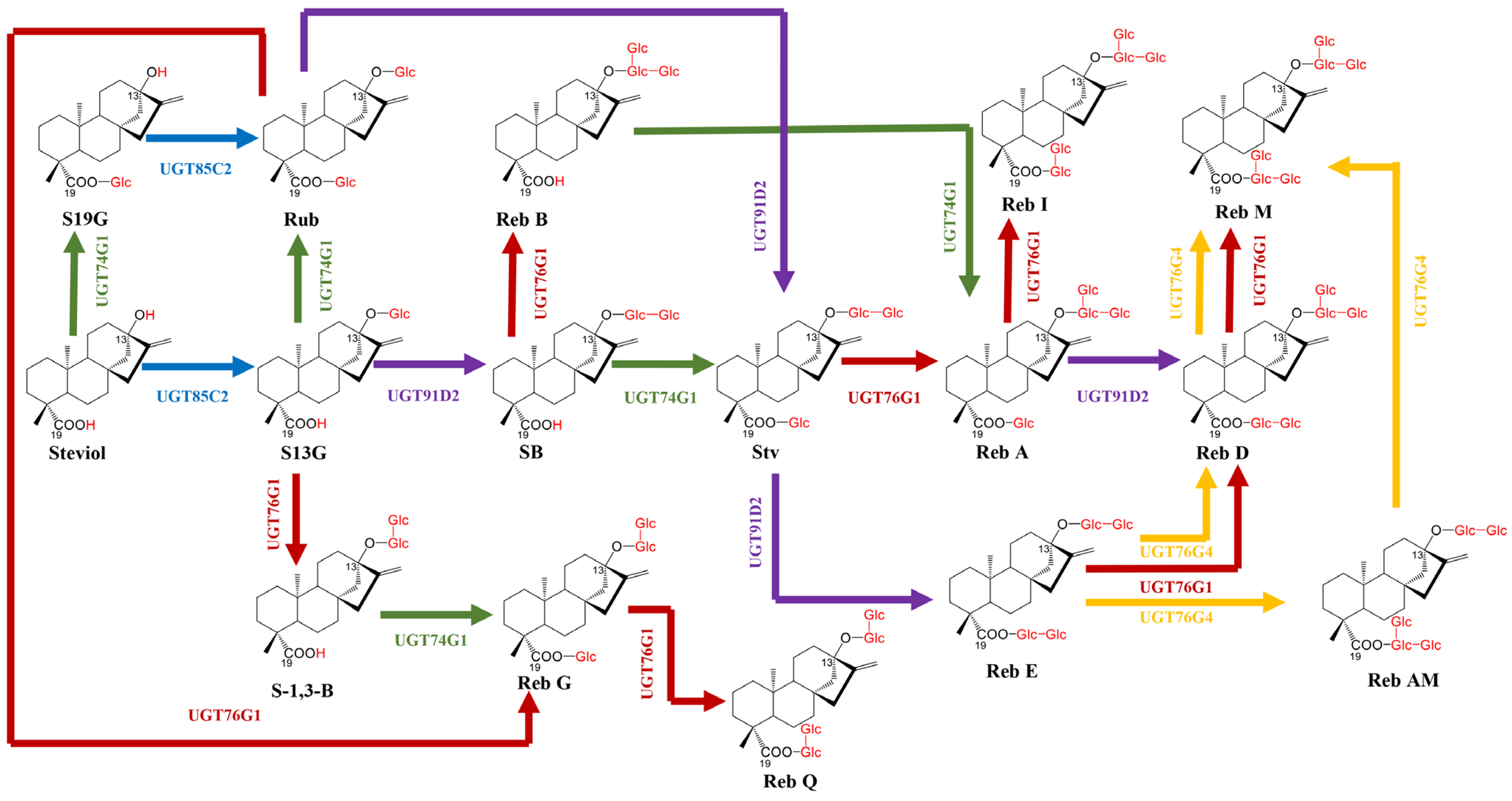
5.1. Natural Biosynthetic Pathway of SGs
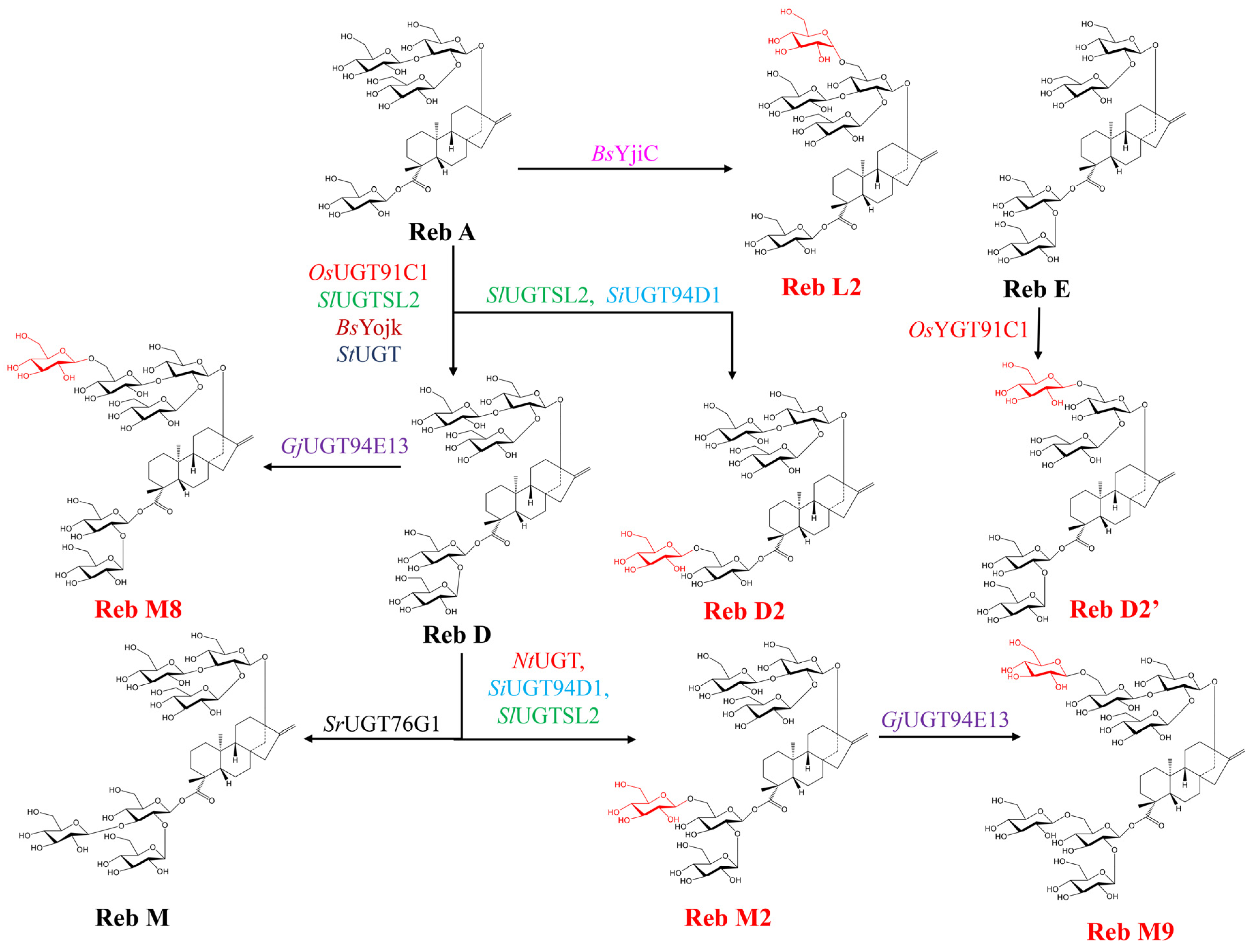
5.2. Glycosyltransferases Involved in the Biosynthesis of SGs

| Type | Enzymatic Reaction | Protein | Source Organism | Phylum | Substrate | Product | Reference |
|---|---|---|---|---|---|---|---|
| SG | β-1-glucosylation at the C-13 hydroxyl position | SrUGT85C2 | Stevia rebaudiana | Plant | Steviol, S19G | S13G, Rub | [3,144] |
| AtUGT73C1 | Arabidopsis thaliana | Plant | Steviol | S13G | [152] | ||
| RsUGT85A57 | Rubus suavissimus | Plant | S19G | Rub | [153] | ||
| AkUGT85A58 | Angelica keiskei | Plant | Steviol, S19G | S13G, Rub | [154] | ||
| SG | β-1-glucosylation at the C-19 carboxyl position | SrUGT74G1 | Stevia rebaudiana | Plant | Steviol, S13G, SB, S-1,3-B, Reb B | S19G, Rub, Stv, Reb G, Reb A | [3,144] |
| SrUGT73E1 | Stevia rebaudiana | Plant | S13G | Rub | [155] | ||
| RsUGT75L20 | Rubus suavissimus | Plant | Steviol, S13G | S19G, Rub | [153,154] | ||
| RsUGT75T4 | Rubus suavissimus | Plant | Steviol, S13G | S19G, Rub | [153] | ||
| AkUGT75L21 | Angelica keiskei | Plant | Steviol, S13G | S19G, Rub | [154] | ||
| AkUGT75W2 | Angelica keiskei | Plant | Steviol, S13G | S19G, Rub | [154] | ||
| SG | β-1,2-glucosylation of the C-13 or C-19 position | SrUGT91D2 | Stevia rebaudiana | Plant | Rub, S13G, Reb A, Stv | Stv, SB, Reb D, Reb E | [145,161,162] |
| β-1,2-glucosylation of the C-19 position | PgUGT | Panax ginseng | Plant | Reb A | Reb D | [158] | |
| SG or GSG | β-1,2 or β-1,6-glucosylation at the C-19 position | OsUGT91C1 | Oryza sativa | Plant | Reb A, Reb E | Reb D, Reb D2′ | [156,163,164] |
| SG or GSG | β-1,2 or β-1,6-glucosylation at the C-13 position | SlUGTSL2 | Solanum lycopersicum | Plant | Reb A, Reb D | Reb D, Reb M2 | [49,165] |
| SG | β-1,2-glucosylation at the C-19 position | BsYojk | Bacillus subtilus 168 | Bacteria | Reb A | Reb D | [160] |
| SG | StUGT | Solanum tuberosum | Plant | Reb A | Reb D | [159] | |
| SG | β-1,3-glucosylation at the C-13 or C-19 position | SrUGT76G1 | Stevia rebaudiana | Plant | Reb D | Reb M | [3,144] |
| SrUGT76G4 | Stevia rebaudiana | Plant | Reb D | Reb M | [151] | ||
| Reb E | Reb M | ||||||
| GSG | β-1,6-glucosylation at the C-13 position | GjUGT94E13 | Gardenia jasminoides | Plant | Reb D, Reb M2 | Reb M8, Reb M9 | [43,50,166] |
| BsYjiC | Bacillus subtilis 168 | Bacteria | Reb A | Reb L2 | [167] | ||
| β-1,6-glucosylation at the C-19 position | SiUGT94D1 | Sesamum indicum | Plant | Reb A, Reb D | Reb D2, Reb M2 | [168,169] | |
| NtUGT | Nicotiana tabacum | Plant | Reb D | Reb M2 | [170] |
6. Methods to Obtain SGs
6.1. Enhancement of SG Biosynthesis in Planta
6.1.1. Strategies for Enhanced In Vivo Production
6.1.2. Advances in Plant Extraction Methods
6.2. Biosynthesis of SGs In Vitro
6.2.1. Coupling Enzyme Reaction
| Sources | Enzyme | Protein Engineering | Engineering Effects | Key Strategies | Substrate | Product | Yield | Reference |
|---|---|---|---|---|---|---|---|---|
| stevia leaves | cellulase | - | - | cellulase/starch-mediated transglycosylation | Stv | Reb A | enriched Reb A content (66%) | [184] |
| Irpex lacteus | β-1,3-Glucanase | - | - | transglycosylation by Ilβ-1,3-Glucanase | Stv | Reb A | 62.5% conversion to Reb A | [184,185] |
| Stevia rebaudiana Acidithiobacillus caldus | UGT76G1 AcSusy | L637M-T640V | Enhanced affinity for UDP | Fusion of UGT76G1 and AcSusy by linker | Stv | Reb A | 18.8 ± 0.6 g/L | [197] |
| Stevia rebaudiana | UGT91D2 | V155T | Enhanced activity in budding yeast and Nicotiana benthamiana towards Reb A | - | Reb A | Reb D | [186] | |
| Oryza sativa | OsUGT91C1 (EUGT11) | F379A | 2.18-fold increased catalytic efficiency towards Reb A | - | Reb A | Reb D | [188] | |
| F379A/F208M | Enhance the desirable β (1–2) glucosylation, eliminate β (1–6) glucosylation; 4-fold increased catalytic efficiency towards Reb A | Biochemical and structural characterization of OsUGT91C1 | Reb A | Reb D | 4-fold increased catalytic efficiency towards Reb A | [156] | ||
| Solanum lycopersicum | SlUGTSL2 | N358F | Enhance the desirable β (1–2) glucosylation (Reb D), eliminate β (1–6) glucosylation (side-product Reb M2); 1.6-fold of enhanced activity towards Reb A | Multi-enzyme reaction system with UGT76G1, SlUGTSL2 and StSUS1 | Stv | Reb D | 14.4 g/L Reb D from 20 g/L Stv for 24 h | [157] |
| Panax ginseng | PgUGT | A11L/F39Y/S55P/N109K/A250E/I279L/V304L/T329I | 3.2-fold higher catalytic activity and enhanced thermostability (to 40 °C) | - | Reb A | Reb D | [158] | |
| Panax ginseng | UGT94B1 | I146G/P174V | Its catalytic efficiency toward Stv and Reb A is 4-fold and 3.1-fold that of the wild type, respectively | Cascade reaction with AtSuSy and UGT76G1-M3 | Stv, Reb A | Reb M | 38.8 g/L with a 85.5% yield | [194] |
| Bacillus subtilus 168 | BsYojK | I241T/G327N | 7.35-fold increase in catalytic activity | Cascade reaction with AtSuSy | Reb A | Reb D | 20.59 g/L with a 91.29% yield | [160] |
| S158E/A218H/I241T/G327N/A369K | Enhanced thermos-stability and 1.39-fold increased activity at 50 °C | - | Reb A | Reb D | 87.70% and up to 25 mM | [189] | ||
| I241T/G327N/Q251M or I241T/G327N/R366P | The optimal temperature is 55 °C and remarkably enhanced thermo-stability at 50 °C | - | Reb A | Reb D | 9.71 g/L | [190] | ||
| Stevia rebaudiana | UGT76G1 | T146G or H155L | increased enzymatic activity and diminished side-product production in Saccharomyces cerevisiae | - | - | Reb D and Reb M | - | [33] |
| UGT76G1 | S195Q | 1.2-fold and 2.0-fold increased catalytic efficiency toward Reb E and Reb D, respectively | Co-expressed E. coli cell lysate of UGT76G1 S195Q and McSuSy | Reb E | Reb D and Reb M | 10.5 g/L Reb D 12.8 g/L Reb M | [198] | |
| UGT76G1 | T284S | the crystal structures of SrUGT76G1 with multiple ligands; decrease the production of side product Reb I | Cascade reaction with OsUGT91C1 and AtSuSy | Reb A | Reb M | - | [148] | |
| UGT76G1 | T284S/M88L/L200A | reduce distances from Reb D to catalytic residues and UDPG; 2.38-fold increased activity compared with T284S mutant | - | Reb D | Reb M | 23.37 mg/mL with a 90.50% yield | [191] | |
| UGT76G1 | I30M/K53A/R141P/G349P/L200A/T284S/M88L | increased optimal temperature to 45 °C; 1.16-fold improvement of catalytic activity compared with T284S/M88L/L200A mutant | - | Reb D | Reb M | 22.65 mM with a yield of 90.60% at 45 °C | [193] | |
| UGT76G1 | L200A/L379M | 10-fold increased enzymatic activity at 50 °C | - | Reb D | Reb M | 45.05 g/L with a 96.85% yield at 50 °C | [192] | |
| UGT76G4 | Q199I/ G200Y | 1.46-fold increased enzymatic activity | - | Reb E | Reb M | 13.62 ± 0.55 mM with a 55% yield | [151] | |
| UGT76G4 | H155S/Q199I/G200Y | 23-fold increased enzymatic activity | - | Reb D | Reb M | 45.03 ± 1.92 mM with a 90% yield | [151] | |
| Oryza sativa Stevia rebaudiana | OsEUGT11 UGT76G1 | Co-immobilization on chitosan beads | higher activity (3.2-fold), stability | Purified protein from E. coli | Reb A | Reb M | 72.2% yield, 4.82 g/L | [195] |
| Oryza sativa Arabidopsis thaliana | OsEUGT11 AtSUS | Co-immobilization on Fe3O4@Uio-66 nanocomposites | high reusability and improved storage stability | Purified protein from E. coli | Reb A | Reb D | [196] | |
| Bacillus subtilus 168 | BsYjiC | - | - | Cascade reaction with AtSuSy | Reb A | Reb L2 | 30.94 mg/mL | [167] |
| Sesamum indicum | SiUGT94D1 | - | - | Cascade reaction with AtSuSy | Reb A | Reb D2 | 10.69 mg/mL | [168] |
| Oryza sativa | OsEUGT11 | - | - | Reb E | Reb D2′ | [199] | ||
| Sesamum indicum | SiUGT94D1 | F119I/D188P | 6.33-fold increased activity towards Reb D | Cascade reaction with AtSuSy | Reb D | Reb M2 | 29.79 mg/mL | [169] |
| Nicotiana tabacum | NtUGT | F72L/L123P/L157P | 5000-fold increased activity towards Reb D, enhanced thermostability | Cascade reaction with SlUGTSL2 N358F and AtSuSy | Reb A | Reb M2 | 78.8 g/L at 84.56% yield | [170] |
| Gardenia jasminoides | GjUGT94E13 | F169G/I185G | 13.9-fold higher activity towards Reb D | Cascade reaction with AtSuSy | Reb D | Reb M8 | 24.53 mM with 98% conversion | [166] |
| Gardenia jasminoides | GjUGT94E13 | F169A/I185A | 12-fold higher activity towards Reb M2 | Cascade reaction with AtSuSy | Reb M2 | Reb M9 | 42.8 g/L | [50] |
6.2.2. Microbial Synthesis
6.2.3. Technological and Regulatory Comparison: Enzymatic vs. Microbial Production
| Host | Key Strategies | Precursor | Product | Titer/Yield | Reference |
|---|---|---|---|---|---|
| Escherichia coli BL21 | Co-overexpression of key enzymes of the ent-kaurene module, and DXS, IDI, and IspA for isoprenoid precursor enhancing | Ent-kaurene | 578 mg/L | [161] | |
| Synechococcus elongatus | Optimization of the CYP-CPR and KO-KAH-CPR combinations, utilizing photosynthetic bacteria to produce enantiomeric abietic acid from CO2. | Ent-KA | 2.9 mg/L | [211] | |
| Escherichia coli BL21 | Modular expression of key enzymes of the ent-kaurene module, and overexpression of SrKAHn2 and SrUGT91D2w; N-terminal engineering of AtCYP714A2; Assembly of the UGT module and combination with the CYP module. | Ent-KA | 78.52 mg/L | [187] | |
| Steviol | 15.47 mg/L | ||||
| Reb A | 10.03 mg/L | ||||
| Escherichia coli BL21 | Over-expression of 5′UTR-engineered GGPPS, CPS, and KO; Enhancing the NADPH/NADP ratio and over-expression of N-terminal modified SrKO; Over-expressing the fusion protein of UtrCYP714A2 and AtCPR2. | Ent-kaurene | 623.6 ± 3.0 mg/L | [208] | |
| Ent-KA | 50.7 ± 9.8 mg/L | ||||
| Steviol | 38.4 ± 1.7 mg/L | ||||
| Escherichia coli BL21 | Fusion expression with Smt3 and co-expression of endogenous prpD and malK to enhance the solubility of UGT76G1 | Reb A | 4.8 g/L | [209] | |
| Reb M | 1.8 g/L | ||||
| Saccharomyces cerevisiae | Multiple species’ UDP-glycosyltransferases (RsUGT85A57, AkUGT75L21, SrUGT85C2, and SrUGT74G1) were coupled with sucrose synthase, and mutation of SrUGT74G1 increased the yield of Rub. | Stv | S13G | 0.45 ± 0.06 g/L | [201] |
| Rub | 1.92 ± 0.17 g/L | ||||
| Saccharomyces cerevisiae | Obtain the optimal combination of KO, KAH, and CPR enzymes, and express the recombinant pathway to produce steviol | Glucose | Ent-KA | <90 mg/L | [138] |
| Steviol | |||||
| Saccharomyces cerevisiae | Establishment of a de novo biosynthetic pathway for Rub and SGs | Glucose | Rub | 1368.6 mg/L | [200] |
| Reb A | 6.2 mg/L | ||||
| Reb D | 11.4 mg/L | ||||
| Reb M | 17.6 mg/L | ||||
| Saccharomyces cerevisiae | Whole cell bioreactor with constitutively over-expressed UGT76G1 | Stv | Reb A | 1.16 g/L | [203] |
| Saccharomyces cerevisiae YPH499 | Cascade reaction involving StUGT and GsSUS1, enhancing cell permeability | Reb A | Reb D | 5.27 g/L | [159] |
| Saccharomyces cerevisiae | Knock-out endogenous glycosyl hydrolase SCW2, silencing information regulator 2 (SIR2) to prolong the growth cycle, overexpressing UGP1, and co-expressing UGT91D2 and UGT76G1 | Stv | Reb M | 12.5 g/L; a 77.9% yield | [202] |
| Pichia pastoris | Optimizing the gene dose ratio of mbSUS and UGT76G1 in a 1 L batch | Stv | Reb A | 252.6 g/L (26h) | [207] |
| Pichia pastoris | Secretory expression of EUGT11 | Reb D | 95.31% | [163] | |
| Pichia pastoris | Surface display of PgUGTM8 with optimized copy number, and co-expressed with mbSUS | Reb A | Reb D | 48.2 g/L | [206] |
| Pichia pastoris | Construction of a fusion enzyme of UGT76G1 and UGT91C1 | Reb A | Reb M | ~0.24 mM | [205] |
7. Physicochemical and Sensory Improvement
7.1. The Structure–Property Relationship of SGs
7.2. Enzymatic and Regioselective Glucosylation for Property Improvement
7.3. Formulation and Assembly
8. Commercialization of SGs
9. Future Perspectives
9.1. Advancing Next-Generation Enzymes and Pathway Engineering
9.2. Enhancing Green and Scalable Bioprocessing
9.3. Driving Function-Driven Product Development and Market Adoption
9.4. Summary
Author Contributions
Funding
Data Availability Statement
Acknowledgments
Conflicts of Interest
Abbreviations
| Ent-KA | Ent-kaurenoic acid |
| SB | Steviolbioside |
| S-1,3-B | Steviol-1,3-bioside |
| S13G | Steviolmonoside |
| S19G | Steviol-19-O-β-D-glucoside |
| Rub | Rubusoside |
| Stv | Stevioside |
| Reb A | Rebaudioside A |
| Reb B | Rebaudioside B |
| Reb C | Rebaudioside C |
| Reb D | Rebaudioside D |
| Reb E | Rebaudioside E |
| Reb F | Rebaudioside F |
| Reb G | Rebaudioside G |
| Reb Q | Rebaudioside Q |
| Reb M | Rebaudioside M |
| Reb I | Rebaudioside I |
| Reb AM | Rebaudioside AM |
| GGPS | Geranylgeranyl Diphosphate Synthase |
| CPPS | Copalyl Diphosphate Synthase |
| KS | Ent-kaurene Synthase |
| KO | Kaurene Oxidase |
| Glc | Glucose |
| Xyl | Xylose |
| Rha | Rhamnose |
References
- Kim, J.Y.; Prescott, J.; Kim, K.O. Emotional responses to sweet foods according to sweet liker status. Food Qual. Prefer. 2017, 59, 1–7. [Google Scholar] [CrossRef]
- Solomon, S.; Vanichsriratana, W.; Duong, C.A.; Manimekalai, R.; Singh, P.; Misra, V.; Rao, G.P. Sustainability Issues and Opportunities for Sugar and Integrated Industries in ASEAN Region. Sugar Tech. 2024, 26, 932–950. [Google Scholar] [CrossRef]
- Ceunen, S.; Geuns, J.M. Steviol glycosides: Chemical diversity, metabolism, and function. J. Nat. Prod. 2013, 76, 1201–1228. [Google Scholar] [CrossRef]
- Pawar, R.S.; Krynitsky, A.J.; Rader, J.I. Sweeteners from plants—with emphasis on Stevia rebaudiana (Bertoni) and Siraitia grosvenorii (Swingle). Anal. Bioanal. Chem. 2013, 405, 4397–4407. [Google Scholar] [CrossRef]
- Plaza-Diaz, J.; Pastor-Villaescusa, B.; Rueda-Robles, A.; Abadia-Molina, F.; Ruiz-Ojeda, F.J. Plausible Biological Interactions of Low- and Non-Calorie Sweeteners with the Intestinal Microbiota: An Update of Recent Studies. Nutrients 2020, 12, 1153. [Google Scholar] [CrossRef]
- Wang, Q.P.; Lin, Y.Q.; Zhang, L.; Wilson, Y.A.; Oyston, L.J.; Cotterell, J.; Qi, Y.; Khuong, T.M.; Bakhshi, N.; Planchenault, Y.; et al. Sucralose Promotes Food Intake through NPY and a Neuronal Fasting Response. Cell Metab. 2016, 24, 75–90. [Google Scholar] [CrossRef]
- Çadirci, K.; Özdemir Tozlu, Ö.; Türkez, H.; Mardinoğlu, A. The in vitro cytotoxic, genotoxic, and oxidative damage potentials of the oral artificial sweetener aspartame on cultured human blood cells. Turk. J. Med. Sci. 2020, 50, 448–454. [Google Scholar] [CrossRef] [PubMed]
- Philippe, R.N.; De Mey, M.; Anderson, J.; Ajikumar, P.K. Biotechnological production of natural zero-calorie sweeteners. Curr. Opin. Biotechnol. 2014, 26, 155–161. [Google Scholar] [CrossRef]
- Chatsudthipong, V.; Muanprasat, C. Stevioside and related compounds: Therapeutic benefits beyond sweetness. Pharmacol. Ther. 2009, 121, 41–54. [Google Scholar] [CrossRef] [PubMed]
- Gerwig, G.J.; Te Poele, E.M.; Dijkhuizen, L.; Kamerling, J.P. Stevia Glycosides: Chemical and Enzymatic Modifications of Their Carbohydrate Moieties to Improve the Sweet-Tasting Quality. Adv. Carbohydr. Chem. Biochem. 2016, 73, 1–72. [Google Scholar]
- Chupeerach, C.; Yothakulsiri, C.; Chamchan, R.; Suttisansanee, U.; Sranacharoenpong, K.; Tungtrongchitr, A.; On-Nom, N. The Effect of Coconut Jelly with Stevia as a Natural Sweetener on Blood Glucose, Insulin and C-Peptide Responses in Twelve Healthy Subjects. Recent. Pat. Food Nutr. Agric. 2018, 9, 127–133. [Google Scholar] [CrossRef]
- Samuel, P.; Ayoob, K.T.; Magnuson, B.A.; Wölwer-Rieck, U.; Jeppesen, P.B.; Rogers, P.J.; Rowland, I.; Mathews, R. Stevia Leaf to Stevia Sweetener: Exploring Its Science, Benefits, and Future Potential. J. Nutr. 2018, 148, 1186s–1205s. [Google Scholar] [CrossRef]
- Shivanna, N.; Naika, M.; Khanum, F.; Kaul, V.K. Antioxidant, anti-diabetic and renal protective properties of Stevia rebaudiana. J. Diabetes Complicat. 2013, 27, 103–113. [Google Scholar] [CrossRef] [PubMed]
- Martínez-Rojo, E.; Cariño-Cortés, R.; Berumen, L.C.; García-Alcocer, G.; Escobar-Cabrera, J. Stevia eupatoria and Stevia pilosa Extracts Inhibit the Proliferation and Migration of Prostate Cancer Cells. Medicina 2020, 56, 90. [Google Scholar] [CrossRef] [PubMed]
- Mehravaran, L.; Omidi, M.; Naghavi, M.R.; Fakheri, B.A. Effect of Some Elicitors on Morphophysiological, Biochemical and Molecular Traits of Stevia. Russ. J. Plant Physiol. 2021, 68, 347–355. [Google Scholar] [CrossRef]
- Zhang, H.; An, S.; Hu, J.; Lin, Z.; Liu, X.; Bao, H.; Chen, R. Induction, identification and characterization of polyploidy in Stevia rebaudiana Bertoni. Plant Biotechnol. 2018, 35, 81–86. [Google Scholar] [CrossRef]
- Pang, C.; Yin, X.; Zhang, G.; Liu, S.; Zhou, J.; Li, J.; Du, G. Current progress and prospects of enzyme technologies in future foods. Syst. Microbiol. Biomanufacturing 2021, 1, 24–32. [Google Scholar] [CrossRef]
- Ko, Y.S.; Kim, J.W.; Lee, J.A.; Han, T.; Kim, G.B.; Park, J.E.; Lee, S.Y. Tools and strategies of systems metabolic engineering for the development of microbial cell factories for chemical production. Chem. Soc. Rev. 2020, 49, 4615–4636. [Google Scholar] [CrossRef]
- Libik-Konieczny, M.; Capecka, E.; Tuleja, M.; Konieczny, R. Synthesis and production of steviol glycosides: Recent research trends and perspectives. Appl. Microbiol. Biotechnol. 2021, 105, 3883–3900. [Google Scholar] [CrossRef] [PubMed]
- Brandle, J.E.; Telmer, P.G. Steviol glycoside biosynthesis. Phytochemistry 2007, 68, 1855–1863. [Google Scholar] [CrossRef]
- Lemus-Mondaca, R.; Vega-Gálvez, A.; Zura-Bravo, L.; Ah-Hen, K. Stevia rebaudiana Bertoni, source of a high-potency natural sweetener: A comprehensive review on the biochemical, nutritional and functional aspects. Food Chem. 2012, 132, 1121–1132. [Google Scholar] [CrossRef]
- Ciriminna, R.; Meneguzzo, F.; Pecoraino, M.; Pagliaro, M. A bioeconomy perspective for natural sweetener Stevia. Biofuels Bioprod. Biorefining 2019, 13, 445–452. [Google Scholar] [CrossRef]
- Reuß, F.; Zeller, K.P.; Siehl, H.U.; Berger, S.; Sicker, D. Steviosid aus Süßkraut. Chem. Unserer Zeit 2016, 50, 198–208. [Google Scholar] [CrossRef]
- Zhou, X.; Gong, M.; Lv, X.; Liu, Y.; Li, J.; Du, G.; Liu, L. Metabolic engineering for the synthesis of steviol glycosides: Current status and future prospects. Appl. Microbiol. Biotechnol. 2021, 105, 5367–5381. [Google Scholar] [CrossRef]
- Zhao, L.; Wang, Y.; Li, Z.; Wang, X.; Chen, Y.; Wu, X. Enzymatic Monoglucosylation of Rubusoside and the Structure-Sweetness/Taste Relationship of Monoglucosyl Derivatives. J. Agric. Food Chem. 2020, 68, 8702–8709. [Google Scholar] [CrossRef]
- Spohner, S.C.; Zahn, D.; Schaum, V.; Quitmann, H.; Czermak, P. Recombinant α-l-rhamnosidase from Aspergillus terreus in selective trimming of α-l-rhamnose from steviol glycosides. J. Mol. Catal. B Enzym. 2015, 122, 248–254. [Google Scholar] [CrossRef]
- Kohda, H.; Kasai, R.; Yamasaki, K.; Murakami, K.; Tanaka, O. New sweet diterpene glucosides from Stevia rebaudiana. Phytochemistry 1976, 15, 981–983. [Google Scholar] [CrossRef]
- Prakash, I.; Markosyan, A.; Bunders, C. Development of Next Generation Stevia Sweetener: Rebaudioside M. Foods 2014, 3, 162–175. [Google Scholar] [CrossRef] [PubMed]
- Puri, M.; Sharma, D.; Tiwari, A.K. Downstream processing of stevioside and its potential applications. Biotechnol. Adv. 2011, 29, 781–791. [Google Scholar] [CrossRef]
- Tian, X.; Zhong, F.; Xia, Y. Dynamic characteristics of sweetness and bitterness and their correlation with chemical structures for six steviol glycosides. Food Res. Int. 2022, 151, 110848. [Google Scholar] [CrossRef]
- Prakash, I.; Campbell, M.; Chaturvedula, V.S. Catalytic hydrogenation of the sweet principles of Stevia rebaudiana, Rebaudioside B, Rebaudioside C, and Rebaudioside D and sensory evaluation of their reduced derivatives. Int. J. Mol. Sci. 2012, 13, 15126–15136. [Google Scholar] [CrossRef] [PubMed]
- Hanson, J.R. From Caá-ehé to a commercial sweetener—The diterpenoid glycosides of Stevia rebaudiana. Sci. Prog. 2016, 99, 413–419. [Google Scholar] [CrossRef] [PubMed]
- Olsson, K.; Carlsen, S.; Semmler, A.; Simón, E.; Mikkelsen, M.D.; Møller, B.L. Microbial production of next-generation stevia sweeteners. Microb. Cell Factories 2016, 15, 207. [Google Scholar] [CrossRef]
- Purkayastha, S.; Bhusari, S.; Pugh, G., Jr.; Teng, X.; Kwok, D.; Tarka, S.M. In vitro metabolism of rebaudioside E under anaerobic conditions: Comparison with rebaudioside A. Regul. Toxicol. Pharmacol. 2015, 72, 646–657. [Google Scholar] [CrossRef]
- Ohta, M.; Sasa, S.; Inoue, A.; Tamai, T.; Fujita, I.; Morita, K.; Matsuura, F. Characterization of Novel Steviol Glycosides from Leaves of Stevia rebaudiana Morita. J. Appl. Glycosci. 2010, 57, 199–209. [Google Scholar] [CrossRef]
- Watanabe, T.; Fujikawa, K.; Urai, S.; Iwaki, K.; Hirai, T.; Miyagawa, K.; Uratani, H.; Yamagaki, T.; Nagao, K.; Yokoo, Y.; et al. Identification, Chemical Synthesis, and Sweetness Evaluation of Rhamnose or Xylose Containing Steviol Glycosides of Stevia (Stevia rebaudiana) Leaves. J. Agric. Food Chem. 2023, 71, 11158–11169. [Google Scholar] [CrossRef] [PubMed]
- Wu, J.; Li, H.; Hu, F.; Luo, P. Stevioside attenuates osteoarthritis via regulating Nrf2/HO-1/NF-κB pathway. J. Orthop. Transl. 2023, 38, 190–202. [Google Scholar] [CrossRef]
- Tao, R.; Cho, S. Consumer-Based Sensory Characterization of Steviol Glycosides (Rebaudioside A, D, and M). Foods 2020, 9, 1026. [Google Scholar] [CrossRef]
- Wu, X.; Qiao, T.; Huang, J.; Li, J.; Wei, S.; Yang, J.; Zhang, Y.; Li, Y. Rebaudioside B Attenuates Lung Ischemia-reperfusion Injury Associated Apoptosis and Inflammation. Recent. Adv. Inflamm. Allergy Drug Discov. 2024, 18, 156–166. [Google Scholar] [CrossRef]
- Brandle, J.; Starratt, A.; Gijzen, M. Stevia rebaudiana: Its agricultural, biological, and chemical properties. Can. J. Plant Sci. 1998, 78, 527–536. [Google Scholar] [CrossRef]
- Morissette, A.; de Wouters d’Oplinter, A.; Andre, D.M.; Lavoie, M.; Marcotte, B.; Varin, T.V.; Trottier, J.; Pilon, G.; Pelletier, M.; Cani, P.D.; et al. Rebaudioside D decreases adiposity and hepatic lipid accumulation in a mouse model of obesity. Sci. Rep. 2024, 14, 3077. [Google Scholar] [CrossRef]
- Zhang, S.; Yang, Y.; Lyu, C.; Chen, J.; Li, D.; Liu, Y.; Zhang, Z.; Liu, Y.; Wu, W. Identification of the Key Residues of the Uridine Diphosphate Glycosyltransferase 91D2 and its Effect on the Accumulation of Steviol Glycosides in Stevia rebaudiana. J. Agric. Food Chem. 2021, 69, 1852–1863. [Google Scholar] [CrossRef]
- Yang, L.; Yang, M.; Zheng, X.; Ping, Q.; Song, Y.; Xie, Y.; Rao, Y.; Shi, J.; Zhang, Y. Selective biosynthesis and evaluation of rebaudioside M8 with improved organoleptic property and significant inhibition on inflammatory factor TNF-α. Food Biosci. 2024, 59, 103898. [Google Scholar] [CrossRef]
- Chaturvedula, V.S.P.; Prakash, I. Structural characterization and hydrolysis studies of rebaudioside E, a minor sweet component of Stevia rebaudiana. Eur. Chem. Bull. 2013, 2, 298–302. [Google Scholar]
- Starratt, A.N.; Kirby, C.W.; Pocs, R.; Brandle, J. Rebaudioside F, a diterpene glycoside from Stevia rebaudiana. Phytochemistry 2002, 59, 367–370. [Google Scholar] [CrossRef] [PubMed]
- Rathaus, M.; Azem, L.; Livne, R.; Ron, S.; Ron, I.; Hadar, R.; Efroni, G.; Amir, A.; Braun, T.; Haberman, Y.; et al. Long-term metabolic effects of non-nutritive sweeteners. Mol. Metab. 2024, 88, 101985. [Google Scholar] [CrossRef] [PubMed]
- Prakash, I.; Bunders, C.; Devkota, K.P.; Charan, R.D.; Ramirez, C.; Snyder, T.M.; Priedemann, C.; Markosyan, A.; Jarrin, C.; Halle, R. Bioconversion of rebaudioside I from rebaudioside A. Molecules 2014, 19, 17345–17355. [Google Scholar] [CrossRef] [PubMed]
- Kobayashi, M.; Horikawa, S.; Degrandi, I.H.; Ueno, J.; Mitsuhashi, H. Dulcosides A and B, new diterpene glycosides from Stevia rebaudiana. Phytochemistry 1977, 16, 1405–1408. [Google Scholar] [CrossRef]
- Prakash, I.; Bunders, C.; Devkota, K.P.; Charan, R.D.; Ramirez, C.; Priedemann, C.; Markosyan, A. Isolation and characterization of a novel rebaudioside M isomer from a bioconversion reaction of rebaudioside A and NMR comparison studies of rebaudioside M isolated from Stevia rebaudiana Bertoni and Stevia rebaudiana Morita. Biomolecules 2014, 4, 374–389. [Google Scholar] [CrossRef]
- Guo, X.; Zhang, Y.; Deng, Z.; Chen, Y.; Yuan, Z.; Liu, C.; Rao, Y.; Luo, Z. Highly Efficient Biosynthesis of Rebaudioside M9 through Enzyme Screening and Structure-Guided Engineering. J. Agric. Food Chem. 2025, 73, 3559–3568. [Google Scholar] [CrossRef]
- Patel, S.; Navale, A. The Natural Sweetener Stevia: An Updated Review on its Phytochemistry, Health Benefits, and Anti-diabetic Study. Curr. Diabetes Rev. 2024, 20, e010523216398. [Google Scholar] [CrossRef]
- Malik, V.S.; Hu, F.B. The role of sugar-sweetened beverages in the global epidemics of obesity and chronic diseases. Nat. Rev. Endocrinol. 2022, 18, 205–218. [Google Scholar] [CrossRef]
- Lim, S.; Park, M.J.; Yoon, K.N.; Lee, J.; Matienzo, M.E.; Hong, S.J.; Kim, K.; Baek, Y.B.; Lee, C.M.; Kim, Y.M.; et al. Rebaudioside D and M, the next-generation sugar substitutes, do not exacerbate metabolic dysfunction in high-fat diet mice. Food Chem. X 2025, 29, 102679. [Google Scholar] [CrossRef]
- Purkayastha, S.; Kwok, D. Metabolic fate in adult and pediatric population of steviol glycosides produced from stevia leaf extract by different production technologies. Regul. Toxicol. Pharmacol. 2020, 116, 104727. [Google Scholar] [CrossRef]
- Nikiforov, A.I.; Rihner, M.O.; Eapen, A.K.; Thomas, J.A. Metabolism and toxicity studies supporting the safety of rebaudioside D. Int. J. Toxicol. 2013, 32, 261–273. [Google Scholar] [CrossRef] [PubMed]
- Purkayastha, S.; Pugh, G., Jr.; Lynch, B.; Roberts, A.; Kwok, D.; Tarka, S., Jr. In vitro metabolism of rebaudioside B, D, and M under anaerobic conditions: Comparison with rebaudioside A. Regul. Toxicol. Pharmacol. 2014, 68, 259–268. [Google Scholar] [CrossRef]
- Toyoda, K.; Matsui, H.; Shoda, T.; Uneyama, C.; Takada, K.; Takahashi, M. Assessment of the carcinogenicity of stevioside in F344 rats. Food Chem. Toxicol. 1997, 35, 597–603. [Google Scholar] [CrossRef] [PubMed]
- Marchitti, S.A.; Boon, D.; Jack, M.; Goodman, J.E. Lack of Genotoxic and Carcinogenic Potential for Nonsugar Sweeteners: A Review of Animal and Mechanistic Evidence. Adv. Nutr. 2025, 16, 100552. [Google Scholar] [CrossRef] [PubMed]
- Gupta, E.; Purwar, S.; Sundaram, S.; Tripathi, P.; Rai, G.J. Stevioside and rebaudioside A-predominant ent-kaurene diterpene glycosides of therapeutic potential: A review. Czech J. Food Sci. 2016, 34, 281–299. [Google Scholar] [CrossRef]
- Saeidnia, S.; Abdollahi, M. Toxicological and pharmacological concerns on oxidative stress and related diseases. Toxicol. Appl. Pharmacol. 2013, 273, 442–455. [Google Scholar] [CrossRef]
- Liu, Q.; Pan, Y.; Wu, W. Review on Chemical Compositions and Pharmacological Activities of Stevia rebaudiana (Bertoni) Hemsl. Nat. Product Res. Dev. 2018, 30, 1085. [Google Scholar]
- Elnaga, N.A.; Massoud, M.I.; Yousef, M.; Mohamed, H.H. Effect of stevia sweetener consumption as non-caloric sweetening on body weight gain and biochemical’s parameters in overweight female rats. Ann. Agric. Sci. 2016, 61, 155–163. [Google Scholar] [CrossRef]
- Barriocanal, L.A.; Palacios, M.; Benitez, G.; Benitez, S.; Jimenez, J.T.; Jimenez, N.; Rojas, V. Apparent lack of pharmacological effect of steviol glycosides used as sweeteners in humans. A pilot study of repeated exposures in some normotensive and hypotensive individuals and in Type 1 and Type 2 diabetics. Regul. Toxicol. Pharmacol. 2008, 51, 37–41. [Google Scholar] [CrossRef]
- Kwok, D.; Scott, C.; Strom, N.; Au-Yeung, F.; Lam, C.; Chakrabarti, A.; Hutton, T.; Wolever, T.M. Comparison of a daily steviol glycoside beverage compared with a sucrose beverage for four weeks on gut microbiome in healthy adults. J. Nutr. 2024, 154, 1298–1308. [Google Scholar] [CrossRef]
- Food and Drug Administration. GRAS Notice for Stevia Leaf Extract; FAO: Maryland, VI, USA, 14 March 2018.
- Panel, E.F.; Younes, M.; Aquilina, G.; Engel, K.H.; Fowler, P.J.; Frutos Fernandez, M.J.; Fürst, P.; Gürtler, R.; Gundert-Remy, U.; Husøy, T. Safety of the proposed amendment of the specifications for enzymatically produced steviol glycosides (E 960c): Rebaudioside D produced via enzymatic bioconversion of purified stevia leaf extract. EFSA J. 2022, 20, e07291. [Google Scholar] [CrossRef]
- EFSA Panel on Food Additives and Flavourings; Castle, L.; Andreassen, M.; Aquilina, G.; Bastos, M.L.; Boon, P.; Fallico, B.; FitzGerald, R.; Frutos Fernandez, M.J.; Grasl-Kraupp, B.; et al. Safety of the proposed amendment of the specifications of the food additive E960c (i) or E960c (ii). EFSA J. 2025, 23, e9396. [Google Scholar]
- EFSA Panel on Food Additives and Flavourings; Younes, M.; Aquilina, G.; Engel, K.H.; Fowler, P.; Frutos Fernandez, M.J.; Fürst, P.; Gürtler, R.; Gundert-Remy, U.; Husøy, T.; et al. Safety of a proposed amendment of the specifications for steviol glycosides (E 960) as a food additive: To expand the list of steviol glycosides to all those identified in the leaves of Stevia Rebaudiana Bertoni. EFSA J. 2020, 18, e06106. [Google Scholar] [CrossRef] [PubMed]
- EFSA Panel on Food Additives and Flavourings; Younes, M.; Aquilina, G.; Engel, K.H.; Fowler, P.J.; Frutos Fernandez, M.J.; Fürst, P.; Gürtler, R.; Gundert-Remy, U.; Husøy, T.; et al. Safety evaluation of glucosylated steviol glycosides as a food additive in different food categories. EFSA J. 2022, 20, e07066. [Google Scholar] [CrossRef]
- EFSA Panel on Food Additives and Flavourings; Younes, M.; Aquilina, G.; Degen, G.; Engel, K.H.; Fowler, P.; Frutos Fernandez, M.J.; Fürst, P.; Gundert-Remy, U.; Husøy, T.; et al. Safety evaluation of the food additive steviol glycosides, predominantly Rebaudioside M, produced by fermentation using Yarrowia lipolytica VRM. EFSA J. 2023, 21, e8387. [Google Scholar] [CrossRef] [PubMed]
- GB 2760-2020; National Food Safety Standard Standard for Uses of Food Additives. National Health Commission of the People’s Republic of China: Beijing, China, 2020.
- Koubaa, M.; Roselló-Soto, E.; Šic Žlabur, J.; Režek Jambrak, A.; Brnčić, M.; Grimi, N.; Boussetta, N.; Barba, F.J. Current and New Insights in the Sustainable and Green Recovery of Nutritionally Valuable Compounds from Stevia rebaudiana Bertoni. J. Agric. Food Chem. 2015, 63, 6835–6846. [Google Scholar] [CrossRef]
- Usami, M.; Sakemi, K.; Kawashima, K.; Tsuda, M.; Ohno, Y. Teratogenicity study of stevioside in rats. Eisei Shikenjo Hokoku Bull. Natl. Inst. Hyg. Sci. 1995, 113, 31–35. [Google Scholar]
- Kruse, M.S.; Coirini, H.; Rey, M. Early Consumption of Stevia rebaudiana Bertoni on Rat Females: Actions on Their Fertility, Progeny, and Behavior. J. Nutr. 2025, 155, 1839–1850. [Google Scholar] [CrossRef]
- MX, K.N.; Jiang, J.; Enayatullah, H.; Ennab, W.; Mustafa, S.; Rodeni, S.; Wei, Q.; Shi, F. Sweet taste receptor agonists alter ovarian functions and ovarian cycles in aged mice. Reprod. Biol. 2019, 19, 230–236. [Google Scholar] [CrossRef] [PubMed]
- Wang, Y.; Luo, X.; Zhou, C.; Zhou, M.; Chen, L.; Feng, Y.; Yang, Z.; Yu, X. Safety, health, and sustainable production of natural sugar substitutes: Emerging mechanistic insights. Food Biosci. 2025, 73, 107751. [Google Scholar] [CrossRef]
- Philippaert, K.; Pironet, A.; Mesuere, M.; Sones, W.; Vermeiren, L.; Kerselaers, S.; Pinto, S.; Segal, A.; Antoine, N.; Gysemans, C.; et al. Steviol glycosides enhance pancreatic beta-cell function and taste sensation by potentiation of TRPM5 channel activity. Nat. Commun. 2017, 8, 14733. [Google Scholar] [CrossRef]
- Chen, T.H.; Chen, S.C.; Chan, P.; Chu, Y.L.; Yang, H.Y.; Cheng, J.T. Mechanism of the hypoglycemic effect of stevioside, a glycoside of Stevia rebaudiana. Planta Med. 2005, 71, 108–113. [Google Scholar]
- Lailerd, N.; Saengsirisuwan, V.; Sloniger, J.A.; Toskulkao, C.; Henriksen, E.J. Effects of stevioside on glucose transport activity in insulin-sensitive and insulin-resistant rat skeletal muscle. Metabolism 2004, 53, 101–107. [Google Scholar] [CrossRef]
- Han, J.Y.; Park, M.; Lee, H.J. Stevia (Stevia rebaudiana) extract ameliorates insulin resistance by regulating mitochondrial function and oxidative stress in the skeletal muscle of db/db mice. BMC Complement. Med. Ther. 2023, 23, 264. [Google Scholar] [CrossRef] [PubMed]
- Kurek, J.M.; Mikołajczyk-Stecyna, J.; Krejpcio, Z. Pharmacotherapy. Steviol glycosides from Stevia rebaudiana Bertoni mitigate lipid metabolism abnormalities in diabetes by modulating selected gene expression–An in vivo study. Biomed. Pharmacother. 2023, 166, 115424. [Google Scholar] [CrossRef] [PubMed]
- Bayat, E.; Rahpeima, Z.; Dastghaib, S.; Gholizadeh, F.; Erfani, M.; Asadikaram, G.; Mokarram, P. Stevia rebaudiana extract attenuate metabolic disorders in diabetic rats via modulation of glucose transport and antioxidant signaling pathways and aquaporin-2 expression in two extrahepatic tissues. J. Food Biochem. 2020, 44, e13252. [Google Scholar] [CrossRef] [PubMed]
- Rajesh Kumar, K.; Veeraraghavan, V.P.; Jayaraman, S. Molecular Approach to Identify Anti-inflammatory Potential of Stevioside in HFD-induced Type 2 Diabetic Rats: Evidence From in Vivo Study. Texila Int. J. Public Health 2023, 1–12. [Google Scholar] [CrossRef]
- Noya-Leal, F.; van der Wielen, N.; Behrens, M.; Rouschop, S.; van Arkel, J.; Jongsma, M.; Witkamp, R.; Mes, J.J.; Bastiaan-Net, S.; Meijerink, J.J.; et al. Rebaudioside A from Stevia rebaudiana stimulates GLP-1 release by enteroendocrine cells via bitter taste signalling pathways. Food Funct. 2023, 14, 6914–6928. [Google Scholar] [CrossRef] [PubMed]
- Kang, L.; Zhang, C.; Wang, R.; Li, K.; Bai, X.; Qi, N.; Qu, H.; Li, G. Effects and Mechanisms of Steviol Glycosides on Glucose Metabolism: Evidence From Preclinical Studies. Mol. Nutr. Food Res. 2025, 69, e70014. [Google Scholar] [CrossRef] [PubMed]
- Gregersen, S.; Jeppesen, P.B.; Holst, J.J.; Hermansen, K. Antihyperglycemic effects of stevioside in type 2 diabetic subjects. Metabolism 2004, 53, 73–76. [Google Scholar] [CrossRef]
- Anker, C.C.B.; Rafiq, S.; Jeppesen, P.B. Effect of steviol glycosides on human health with emphasis on type 2 diabetic biomarkers: A systematic review and meta-analysis of randomized controlled trials. Nutrients 2019, 11, 1965. [Google Scholar] [CrossRef]
- Bai, X.; Qu, H.; Zhang, J.; Li, L.; Zhang, C.; Li, S.; Li, G. Effect of steviol glycosides as natural sweeteners on glucose metabolism in adult participants. Food Funct. 2024, 15, 12. [Google Scholar] [CrossRef]
- Anton, S.D.; Martin, C.K.; Han, H.; Coulon, S.; Cefalu, W.T.; Geiselman, P.; Williamson, D.A. Effects of stevia, aspartame, and sucrose on food intake, satiety, and postprandial glucose and insulin levels. Appetite 2010, 55, 37–43. [Google Scholar] [CrossRef]
- Choi, D.H.; Cho, U.M.; Hwang, H.S. Anti-inflammation effect of rebaudioside A by inhibition of the MAPK and NF-kB signal pathway in RAW264. 7 macrophage. J. Appl. Biol. Chem. 2018, 61, 205–211. [Google Scholar] [CrossRef]
- Wei, F.; Zhu, H.; Li, N.; Yu, C.; Song, Z.; Wang, S.; Sun, Y.; Zheng, L.; Wang, G.; Huang, Y.; et al. Stevioside activates AMPK to suppress inflammation in macrophages and protects mice from LPS-induced lethal shock. Molecules 2021, 26, 858. [Google Scholar] [CrossRef]
- Xu, Q.; Liu, M.; Chao, X.; Zhang, C.; Yang, H.; Chen, J.; Zhou, B. Stevioside Improves Antioxidant Capacity and Intestinal Barrier Function while Attenuating Inflammation and Apoptosis by Regulating the NF-κB/MAPK Pathways in Diquat-Induced Oxidative Stress of IPEC-J2 Cells. Antioxidants 2023, 12, 1070. [Google Scholar] [CrossRef]
- Boonkaewwan, C.; Burodom, A. Anti-inflammatory and immunomodulatory activities of stevioside and steviol on colonic epithelial cells. J. Sci. Food Agric. 2013, 93, 3820–3825. [Google Scholar] [CrossRef]
- Wang, J.; Shen, W.; Zhang, J.Y.; Jia, C.H.; Xie, M.L. Stevioside attenuates isoproterenol-induced mouse myocardial fibrosis through inhibition of the myocardial NF-κB/TGF-β1/Smad signaling pathway. Food Funct. 2019, 10, 1179–1190. [Google Scholar] [CrossRef]
- Zhang, X.; Gu, J.; Zhao, C.; Hu, Y.; Zhang, B.; Wang, J.; Lv, H.; Ji, X.; Wang, S. Sweeteners maintain epithelial barrier function through the mir-15b/RECK/MMP-9 axis, remodel microbial homeostasis, and attenuate dextran sodium sulfate-induced colitis in mice. J. Agric. Food Chem. 2021, 70, 171–183. [Google Scholar] [CrossRef] [PubMed]
- Wang, S.; Huang, J.; Liu, F.; Tan, K.S.; Deng, L.; Lin, Y.; Tan, W. Isosteviol sodium exerts anti-colitic effects on BALB/c mice with dextran sodium sulfate-induced colitis through metabolic reprogramming and immune response modulation. J. Inflamm. Res. 2021, 14, 7107–7130. [Google Scholar] [CrossRef]
- Alavala, S.; Sangaraju, R.; Nalban, N.; Sahu, B.D.; Jerald, M.K.; Kilari, E.K.; Sistla, R.J. Stevioside, a diterpenoid glycoside, shows anti-inflammatory property against Dextran Sulphate Sodium-induced ulcerative colitis in mice. Eur. J. Pharmacol. 2019, 855, 192–201. [Google Scholar] [CrossRef]
- Wang, S.; Tan, K.S.; Beng, H.; Liu, F.; Huang, J.; Kuai, Y.; Zhang, R.; Tan, W. Protective effect of isosteviol sodium against LPS-induced multiple organ injury by regulating of glycerophospholipid metabolism and reducing macrophage-driven inflammation. Pharmacol. Res. 2021, 172, 105781. [Google Scholar] [CrossRef]
- Wan, J.; Zhu, Z.; He, Z.; Wu, H.; Chen, A.; Zhu, W.; Cheng, P. Stevioside protects primary articular chondrocytes against IL-1β-induced inflammation and catabolism by targeting integrin. Int. Immunopharmacol. 2023, 119, 110261. [Google Scholar] [CrossRef]
- Cai, T.; Ye, H.; Jiang, H.; Lin, C.; Lou, C.; Wang, W.; Yan, Z.; Xue, X.; Pan, X.; Lin, J. Stevioside targets the NF-κB and MAPK pathways for inhibiting inflammation and apoptosis of chondrocytes and ameliorates osteoarthritis in vivo. Int. Immunopharmacol. 2023, 115, 109683. [Google Scholar] [CrossRef]
- Alavala, S.; Nalban, N.; Sangaraju, R.; Kuncha, M.; Jerald, M.K.; Kilari, E.K.; Sistla, R. Anti-inflammatory effect of stevioside abates Freund’s complete adjuvant (FCA)-induced adjuvant arthritis in rats. Inflammopharmacology 2020, 28, 1579–1597. [Google Scholar] [CrossRef] [PubMed]
- Meng, T.; Zhang, Y.; Huang, J.; Pandey, V.; Fu, S.; Ma, S. Rubusoside mitigates neuroinflammation and cellular apoptosis in Parkinson’s disease, and alters gut microbiota and metabolite composition. Phytomedicine 2024, 124, 155309. [Google Scholar] [CrossRef] [PubMed]
- Hao, W.; Yu, T.T.; Zuo, D.Z.; Hu, H.Z.; Zhou, P.P. Stevioside attenuates bleomycin-induced pulmonary fibrosis by activating the Nrf2 pathway and inhibiting the NF-κB and TGF-β1/Smad2/3 pathways. Exp. Lung Res. 2023, 49, 205–219. [Google Scholar] [CrossRef]
- Casas-Grajales, S.; Ramos-Tovar, E.; Chávez-Estrada, E.; Alvarez-Suarez, D.; Hernández-Aquino, E.; Reyes-Gordillo, K.; Cerda-García-Rojas, C.M.; Camacho, J.; Tsutsumi, V.; Lakshman, M.R.; et al. Antioxidant and immunomodulatory activity induced by stevioside in liver damage: In vivo, in vitro and in silico assays. Life Sci. 2019, 224, 187–196. [Google Scholar] [CrossRef]
- Gatea, F.; Sârbu, I.; Vamanu, E. In Vitro Modulatory Effect of Stevioside, as a Partial Sugar Replacer in Sweeteners, on Human Child Microbiota. Microorganisms 2021, 9, 590. [Google Scholar] [CrossRef]
- Liu, T.; Li, X.; Zhou, X.; Chen, W.; Wen, A.; Liu, M.; Ding, Y. PI3K/AKT signaling and neuroprotection in ischemic stroke: Molecular mechanisms and therapeutic perspectives. Neural Regen. Res. 2025, 20, 2758–2775. [Google Scholar] [CrossRef] [PubMed]
- Zhang, Y. Mechanism of neuroprotective effect of stevioside on cerebral ischemia-reperfusion injury via PPAR-γ activation. Immunopharmacol. Immunotoxicol. 2021, 43, 704–712. [Google Scholar] [CrossRef]
- Ragone, M.I.; Bonazzola, P.; Colareda, G.A.; Lazarte, M.L.; Bruno, F.; Consolini, A.E. Cardioprotection of stevioside on stunned rat hearts: A mechano-energetical study. Phytomedicine 2017, 35, 18–26. [Google Scholar] [CrossRef]
- Wang, J.; Jia, C.H.; Wang, F.; Xie, M.L. Stevioside inhibits transforming growth factor-β1-induced cardiac fibroblast differentiation and collagen synthesis by modulation of Smad signaling pathway. J. Funct. Foods 2018, 49, 384–390. [Google Scholar] [CrossRef]
- Chen, Y.; Beng, H.; Su, H.; Han, F.; Fan, Z.; Lv, N.; Jovanović, A.; Tan, W. Isosteviol prevents the development of isoprenaline-induced myocardial hypertrophy. Int. J. Mol. Med. 2019, 44, 1932–1942. [Google Scholar] [CrossRef] [PubMed]
- Cheng, B.; Fang, F.; Zhou, Q.T.; Li, Y.; Wu, X.W.; Zhao, X.R.; Bi, D.W.; Zhang, X.J.; Zhang, R.H.; Ji, X.; et al. Highly Oxygenated Labdane Diterpenoids from Stevia rebaudiana and Their Anti-Atherosclerosis Activities. Chem. Biodivers. 2023, 20, e202200999. [Google Scholar] [CrossRef]
- Melis, M.S. Renal excretion of stevioside in rats. J. Nat. Product. 1992, 55, 688–690. [Google Scholar] [CrossRef]
- Lee, C.N.; Wong, K.L.; Liu, J.C.; Chen, Y.J.; Cheng, J.T.; Chan, P. Inhibitory effect of stevioside on calcium influx to produce antihypertension. Planta Medica 2001, 67, 796–799. [Google Scholar] [CrossRef] [PubMed]
- Dyrskog, S.E.; Jeppesen, P.B.; Chen, J.; Christensen, L.P.; Hermansen, K.J. The diterpene glycoside, rebaudioside A, does not improve glycemic control or affect blood pressure after eight weeks treatment in the Goto-Kakizaki rat. Rev. Diabet. Stud. 2005, 2, 84–91. [Google Scholar] [CrossRef] [PubMed]
- Chan, P.; Tomlinson, B.; Chen, Y.J.; Liu, J.C.; Hsieh, M.H.; Cheng, J.T. A double-blind placebo-controlled study of the effectiveness and tolerability of oral stevioside in human hypertension. Br. J. Clin. Pharmacol. 2015, 50, 215–220. [Google Scholar] [CrossRef]
- Hsieh, M.H.; Chan, P.; Sue, Y.-M.; Liu, J.C.; Liang, T.H.; Huang, T.Y.; Tomlinson, B.; Chow, M.S.S.; Kao, P.F.; Chen, Y. Efficacy and tolerability of oral stevioside in patients with mild essential hypertension: A two-year, randomized, placebo-controlled study. Clin. Ther. 2003, 25, 2797–2808. [Google Scholar] [CrossRef] [PubMed]
- Ferri, L.A.; Alves-Do-Prado, W.; Yamada, S.S.; Gazola, S.; Batista, M.R.; Bazotte, R.B. Investigation of the antihypertensive effect of oral crude stevioside in patients with mild essential hypertension. Phytother. Res. 2006, 20, 732–736. [Google Scholar] [CrossRef]
- Guo, Y.; Wang, S.; Dong, Y.; Liu, Y. Attenuation of pro-tumorigenic senescent secretory phenotype by stn, a novel derivative of stevioside, potentiates its inhibitory activity on hepatocellular carcinoma. Food Chem. Toxicol. 2024, 184, 114371. [Google Scholar] [CrossRef]
- Paul, S.; Sengupta, S.; Bandyopadhyay, T.K.; Bhattacharyya, A. Stevioside induced ROS-mediated apoptosis through mitochondrial pathway in human breast cancer cell line MCF-7. Nutr. Cancer 2012, 64, 1087–1094. [Google Scholar] [CrossRef]
- Gupta, E.; Kaushik, S.; Purwar, S.; Sharma, R.; Balapure, A.K.; Sundaram, S. Anticancer Potential of Steviol in MCF-7 Human Breast Cancer Cells. Pharmacogn. Mag. 2017, 13, 345–350. [Google Scholar] [CrossRef]
- Chen, J.; Xia, Y.; Sui, X.; Peng, Q.; Zhang, T.; Li, J.; Zhang, J. Steviol, a natural product inhibits proliferation of the gastrointestinal cancer cells intensively. Oncotarget 2018, 9, 26299–26308. [Google Scholar] [CrossRef]
- Chen, C.; Na, X.; Wang, L.; Yu, R. High-throughput screening identifies stevioside as a potent agent to induce apoptosis in bladder cancer cells. Biochem. Pharmacol. 2022, 203, 115166. [Google Scholar] [CrossRef]
- Ren, H.P.; Yin, X.Y.; Yu, H.Y.; Xiao, H.F. Stevioside induced cytotoxicity in colon cancer cells via reactive oxygen species and mitogen-activated protein kinase signaling pathways-mediated apoptosis. Oncol. Lett. 2017, 13, 2337–2343. [Google Scholar] [CrossRef]
- Khare, N.; Chandra, S. Stevioside mediated chemosensitization studies and cytotoxicity assay on breast cancer cell lines MDA-MB-231 and SKBR3. Saudi J. Biol. Sci. 2019, 26, 1596–1601. [Google Scholar] [CrossRef]
- Mohamed, S.M.; Aljohani, A.K.; El-Morsy, A.; Al Haidari, R.A.; Alamri, M.A.; Maqnas, Y.A.; Alsibaee, A.M.; Mostafa, M.A.; Keshek, D.E.; Mohamed, M.G. Synthesis and characterization of sodium alginate/poly (N-vinylpyrrolidone) nano-carrier loaded with rebaudioside A and/or stevioside for anticancer drug delivery. Int. J. Biol. Macromol. 2025, 316 Pt 2, 144778. [Google Scholar] [CrossRef]
- Ukiya, M.; Sawada, S.; Kikuchi, T.; Kushi, Y.; Fukatsu, M.; Akihisa, T. Cytotoxic and apoptosis-inducing activities of steviol and isosteviol derivatives against human cancer cell lines. Chem. Biodivers. 2013, 10, 177–188. [Google Scholar] [CrossRef]
- Amaro-Luis, J.; Adrián, M.; Díaz, C. Isolation, identification and antimicrobial activity of ombuoside from Stevia triflora. Proc. Ann. Pharm. Françaises 1997, 55, 262–268. [Google Scholar]
- Deniņa, I.; Semjonovs, P.; Fomina, A.; Treimane, R.; Linde, R. The influence of stevia glycosides on the growth of Lactobacillus reuteri strains. Lett. Appl. Microbiol. 2014, 58, 278–284. [Google Scholar] [CrossRef]
- Gamboa, F.; Chaves, M. Antimicrobial potential of extracts from Stevia rebaudiana leaves against bacteria of importance in dental caries. Acta Odontol. Latinoam. 2012, 25, 171–175. [Google Scholar]
- Pandiyan, I.; Arumugham, M.I.; Doraikannan, S.S.; Rathinavelu, P.K.; Prabakar, J.; Rajeshkumar, S. Antimicrobial and Cytotoxic Activity of Ocimum tenuiflorum and Stevia rebaudiana-Mediated Silver Nanoparticles–An In vitro Study. Contemp. Clin. Dent. 2023, 14, 109–114. [Google Scholar] [CrossRef] [PubMed]
- Brambilla, E.; Cagetti, M.G.; Ionescu, A.; Campus, G.; Lingström, P. An in vitro and in vivo comparison of the effect of Stevia rebaudiana extracts on different caries-related variables: A randomized controlled trial pilot study. Caries Res. 2014, 48, 19–23. [Google Scholar] [CrossRef] [PubMed]
- de Slavutzky, S.M.B. Stevia and sucrose effect on plaque formation. J. Für Verbraucherschutz Leb. 2010, 5, 213–216. [Google Scholar] [CrossRef]
- Srihasam, S.; Thyagarajan, K.; Korivi, M.; Lebaka, V.R.; Mallem, S.P.R. Phytogenic generation of NiO nanoparticles using Stevia leaf extract and evaluation of their in-vitro antioxidant and antimicrobial properties. Biomolecules 2020, 10, 89. [Google Scholar] [CrossRef] [PubMed]
- Alshawwa, S.Z.; Mohammed, E.J.; Hashim, N.; Sharaf, M.; Selim, S.; Alhuthali, H.M.; Alzahrani, H.A.; Mekky, A.E.; Elharrif, M.G. In Situ biosynthesis of reduced alpha hematite (α-Fe2O3) nanoparticles by Stevia Rebaudiana L. leaf extract: Insights into antioxidant, antimicrobial, and anticancer properties. Antibiotics 2022, 11, 1252. [Google Scholar] [CrossRef] [PubMed]
- Rai, A.; Han, S.S. Critical Review on Key Approaches to Enhance Synthesis and Production of Steviol Glycosides: A Blueprint for Zero-Calorie Sweetener. Appl. Sci. 2022, 12, 8640. [Google Scholar] [CrossRef]
- Totté, N.; Charon, L.; Rohmer, M.; Compernolle, F.; Baboeuf, I.; Geuns, J.M.C. Biosynthesis of the diterpenoid steviol, an ent-kaurene derivative from Stevia rebaudiana Bertoni, via the methylerythritol phosphate pathway. Tetrahedron Lett. 2000, 41, 6407–6410. [Google Scholar] [CrossRef]
- Lichtenthaler, H.K. The 1-Deoxy-D-Xylulose-5-Phosphate Pathway of Isoprenoid Biosynthesis in Plants. Annu. Rev. Plant Physiol. Plant Mol. Biol. 1999, 50, 47–65. [Google Scholar] [CrossRef]
- Gold, N.D.; Fossati, E.; Hansen, C.C.; DiFalco, M.; Douchin, V.; Martin, V.J.J. A Combinatorial Approach To Study Cytochrome P450 Enzymes for De Novo Production of Steviol Glucosides in Baker’s Yeast. ACS Synth. Biol. 2018, 7, 2918–2929. [Google Scholar] [CrossRef]
- Zhang, S.; Liu, Q.; Lyu, C.; Chen, J.; Xiao, R.; Chen, J.; Yang, Y.; Zhang, H.; Hou, K.; Wu, W. Characterizing glycosyltransferases by a combination of sequencing platforms applied to the leaf tissues of Stevia rebaudiana. BMC Genom. 2020, 21, 794. [Google Scholar] [CrossRef]
- Gharabli, H.; Della Gala, V.; Welner, D.H. The function of UDP-glycosyltransferases in plants and their possible use in crop protection. Biotechnol. Adv. 2023, 67, 108182. [Google Scholar] [CrossRef]
- Hughes, J.; Hughes, M.A. Multiple secondary plant product UDP-glucose glucosyltransferase genes expressed in cassava (Manihot esculenta Crantz) cotyledons. DNA Seq. 1994, 5, 41–49. [Google Scholar] [CrossRef]
- Mohamed, A.A.; Ceunen, S.; Geuns, J.M.; Van den Ende, W.; De Ley, M. UDP-dependent glycosyltransferases involved in the biosynthesis of steviol glycosides. J. Plant Physiol. 2011, 168, 1136–1141. [Google Scholar] [CrossRef]
- Yang, T.; Zhang, J.; Ke, D.; Yang, W.; Tang, M.; Jiang, J.; Cheng, G.; Li, J.; Cheng, W.; Wei, Y.; et al. Hydrophobic recognition allows the glycosyltransferase UGT76G1 to catalyze its substrate in two orientations. Nat. Commun. 2019, 10, 3214. [Google Scholar] [CrossRef]
- Richman, A.; Swanson, A.; Humphrey, T.; Chapman, R.; McGarvey, B.; Pocs, R.; Brandle, J. Functional genomics uncovers three glucosyltransferases involved in the synthesis of the major sweet glucosides of Stevia rebaudiana. Plant J. 2005, 41, 56–67. [Google Scholar] [CrossRef]
- Zhang, T.; Peng, Q.; Xia, Y.; Zhang, Y.; Myint, K.Z.; Wu, J. Steviol glycosides, an edible sweet surfactant that can modulate the interfacial and emulsifying properties of soy protein isolate solution. J. Food Eng. 2021, 289, 110264. [Google Scholar] [CrossRef]
- Feng, Y.; Yao, M.; Wang, Y.; Ding, M.; Zha, J.; Xiao, W.; Yuan, Y. Advances in engineering UDP-sugar supply for recombinant biosynthesis of glycosides in microbes. Biotechnol. Adv. 2020, 41, 107538. [Google Scholar] [CrossRef]
- Wang, Z.; Li, J.; Wang, X.; Jin, B.; Zhou, L.; Zhao, Z.; Gu, M.; Song, X.; Wang, J.; Deng, Z.; et al. Efficient Synthesis of Glycodiversified Nucleoside Analogues by a Thermophilic Promiscuous Glycosyltransferase. ACS Catal. 2025, 15, 1217–1229. [Google Scholar] [CrossRef]
- Liu, Z.; Li, J.; Sun, Y.; Zhang, P.; Wang, Y. Structural Insights into the Catalytic Mechanism of a Plant Diterpene Glycosyltransferase SrUGT76G1. Plant Commun. 2020, 1, 100004. [Google Scholar] [CrossRef] [PubMed]
- Yang, Y.H.; Huang, S.Z.; Han, Y.L.; Yuan, H.Y.; Gu, C.S.; Zhao, Y.H. Base substitution mutations in uridinediphosphate-dependent glycosyltransferase 76G1 gene of Stevia rebaudiana causes the low levels of rebaudioside A: Mutations in UGT76G1, a key gene of steviol glycosides synthesis. Plant Physiol. Biochem. 2014, 80, 220–225. [Google Scholar] [CrossRef]
- Zhang, S.S.; Chen, H.; Xiao, J.Y.; Liu, Q.; Xiao, R.F.; Wu, W. Mutations in the uridine diphosphate glucosyltransferase 76G1 gene result in different contents of the major steviol glycosides in Stevia rebaudiana. Phytochemistry 2019, 162, 141–147. [Google Scholar] [CrossRef]
- Wang, Y.; Li, T.; Zheng, Y.; Guo, C.; Li, K.; Jia, X.; Zhu, L.; Chen, K.; Yin, H. Characterization of SrUGT76G4 reveals a key residue for regioselectivity and efficient Reb M synthesis. Proc. Natl. Acad. Sci. USA 2025, 122, e2504698122. [Google Scholar] [CrossRef] [PubMed]
- Zhou, Y.; Li, W.; You, W.; Di, Z.; Wang, M.; Zhou, H.; Yuan, S.; Wong, N.K.; Xiao, Y. Discovery of Arabidopsis UGT73C1 as a steviol-catalyzing UDP-glycosyltransferase with chemical probes. Chem. Commun. 2018, 54, 7179–7182. [Google Scholar] [CrossRef] [PubMed]
- Huang, J.; Lei, T.; Zhou, Q.; Fang, Z.; Ruan, H.; Wang, L.; Qian, W.; Lu, Y.; Wang, Q.; Gao, L.; et al. Comparative Metabolome and Transcriptome Analysis Revealed the Accumulative Mechanism of Rubusoside in Chinese Sweet Tea. J. Agric. Food Chem. 2024, 72, 24539–24551. [Google Scholar] [CrossRef]
- Sun, Y.; Chen, Z.; Li, J.; Li, J.; Lv, H.; Yang, J.; Li, W.; Xie, D.; Xiong, Z.; Zhang, P.; et al. Diterpenoid UDP-Glycosyltransferases from Chinese Sweet Tea and Ashitaba Complete the Biosynthesis of Rubusoside. Mol. Plant 2018, 11, 1308–1311. [Google Scholar] [CrossRef]
- Li, W.; Zhou, Y.; You, W.; Yang, M.; Ma, Y.; Wang, M.; Wang, Y.; Yuan, S.; Xiao, Y. Development of Photoaffinity Probe for the Discovery of Steviol Glycosides Biosynthesis Pathway in Stevia rebuadiana and Rapid Substrate Screening. ACS Chem. Biol. 2018, 13, 1944–1949. [Google Scholar] [CrossRef]
- Zhang, J.; Tang, M.; Chen, Y.; Ke, D.; Zhou, J.; Xu, X.; Yang, W.; He, J.; Dong, H.; Wei, Y.; et al. Catalytic flexibility of rice glycosyltransferase OsUGT91C1 for the production of palatable steviol glycosides. Nat. Commun. 2021, 12, 7030. [Google Scholar] [CrossRef] [PubMed]
- Chen, L.; Cai, R.; Weng, J.; Li, Y.; Jia, H.; Chen, K.; Yan, M.; Ouyang, P. Production of rebaudioside D from stevioside using a UGTSL2 Asn358Phe mutant in a multi-enzyme system. Microb. Biotechnol. 2020, 13, 974–983. [Google Scholar] [CrossRef] [PubMed]
- Chen, M.; Song, F.; Qin, Y.; Han, S.; Rao, Y.; Liang, S.; Lin, Y. Improving Thermostability and Catalytic Activity of Glycosyltransferase From Panax ginseng by Semi-Rational Design for Rebaudioside D Synthesis. Front. Bioeng. Biotechnol. 2022, 10, 884898. [Google Scholar] [CrossRef] [PubMed]
- Ma, S.; Ma, Y. A sustainable strategy for biosynthesis of Rebaudioside D using a novel glycosyltransferase of Solanum tuberosum. Biotechnol. J. 2024, 19, e2300628. [Google Scholar] [CrossRef]
- Guo, B.; Hou, X.; Zhang, Y.; Deng, Z.; Ping, Q.; Fu, K.; Yuan, Z.; Rao, Y. Highly efficient production of rebaudioside D enabled by structure-guided engineering of bacterial glycosyltransferase YojK. Front. Bioeng. Biotechnol. 2022, 10, 985826. [Google Scholar] [CrossRef]
- Kong, M.K.; Kang, H.J.; Kim, J.H.; Oh, S.H.; Lee, P.C. Metabolic engineering of the Stevia rebaudiana ent-kaurene biosynthetic pathway in recombinant Escherichia coli. J. Biotechnol. 2015, 214, 95–102. [Google Scholar] [CrossRef]
- Houghton-Larsen, J.; Hicks, P.; Naesby, M.; Ostergaard, T.T.; Hansen, J.; Dalgaard, M.M.; Halkjaer, E.H.; Simon, E.; Tavares, S.D.A.P. Recombinant Production of Steviol Glycosides. U.S. Patent US12428628 (B2), 25 April 2017. [Google Scholar]
- Wang, Z.; Hong, J.; Ma, S.; Huang, T.; Ma, Y.; Liu, W.; Liu, W.; Liu, Z.; Song, H. Heterologous expression of EUGT11 from Oryza sativa in Pichia pastoris for highly efficient one-pot production of rebaudioside D from rebaudioside A. Int. J. Biol. Macromol. 2020, 163, 1669–1676. [Google Scholar] [CrossRef]
- Lee, S.G.; Salomon, E.; Yu, O.; Jez, J.M. Molecular basis for branched steviol glucoside biosynthesis. Proc. Natl. Acad. Sci. USA 2019, 116, 13131–13136. [Google Scholar] [CrossRef]
- Chen, L.; Sun, P.; Zhou, F.; Li, Y.; Chen, K.; Jia, H.; Yan, M.; Gong, D.; Ouyang, P. Synthesis of rebaudioside D, using glycosyltransferase UGTSL2 and in situ UDP-glucose regeneration. Food Chem. 2018, 259, 286–291. [Google Scholar] [CrossRef]
- Yang, L.; Yang, M.; Deng, Z.; Luo, Z.; Yuan, Z.; Rao, Y.; Zhang, Y. Highly Efficient Biosynthesis of Rebaudioside M8 through Structure-Guided Engineering of Glycosyltransferase UGT94E13. J. Agric. Food Chem. 2024, 72, 15823–15831. [Google Scholar] [CrossRef]
- Yang, L.; Ping, Q.; Yuan, Z.; Jiang, J.; Guo, B.; Liu, C.; Rao, Y.; Shi, J.; Zhang, Y. Highly efficient synthesis of mono-β-1,6-Glucosylated Rebaudioside A derivative catalyzed by glycosyltransferase YjiC. Carbohydr. Res. 2023, 523, 108737. [Google Scholar] [CrossRef]
- Ping, Q.; Yang, L.; Jiang, J.; Yuan, J.; Ai, S.; Sun, S.; Ni, Z.; Yang, S.; Yuan, Z.; Rao, Y.; et al. Efficient synthesis of rebaudioside D2 through UGT94D1-catalyzed regio-selective glycosylation. Carbohydr. Res. 2022, 522, 108687. [Google Scholar] [CrossRef]
- Yang, L.; Yang, M.; Deng, Z.; Hou, X.; Zheng, X.; Ping, Q.; Rao, Y.; Shi, J.; Zhang, Y. Selective synthesis of rebaudioside M2 through structure-guided engineering of glycosyltransferase UGT94D1. Front. Bioeng. Biotechnol. 2024, 12, 1334427. [Google Scholar] [CrossRef]
- Chen, J.; Pan, H.; Xie, J.; Tang, K.; Li, Y.; Jia, H.; Zhu, L.; Yan, M.; Wei, P. Semirational Design of a UDP-Glycosyltransferase from Nicotiana tomentosiformis for Efficient Biosynthesis of Rebaudioside M2. J. Agric. Food Chem. 2024, 72, 27334–27345. [Google Scholar] [CrossRef] [PubMed]
- Wang, Y.; Xu, P.; Wang, W.; Jia, X.; Zhu, L.; Yin, H. Oligosaccharides increased both leaf biomass and steviol glycosides content of Stevia rebaudiana. Plant Physiol. Biochem. PPB 2023, 202, 107937. [Google Scholar] [CrossRef] [PubMed]
- Rasouli, D.; Werbrouck, S.; Maleki, B.; Jafary, H.; Schurdi-Levraud, V. Elicitor-induced in vitro shoot multiplication and steviol glycosides production in Stevia rebaudiana. S. Afr. J. Bot. 2021, 137, 265–271. [Google Scholar] [CrossRef]
- Abdelsattar, A.M.; Elsayed, A.; El-Esawi, M.A.; Heikal, Y.M. Enhancing Stevia rebaudiana growth and yield through exploring beneficial plant-microbe interactions and their impact on the underlying mechanisms and crop sustainability. Plant Physiol. Biochem. PPB 2023, 198, 107673. [Google Scholar] [CrossRef]
- Karimi, M.; Ahmadi, A.; Hashemi, J.; Abbasi, A.; Angelini, L.G. Effect of two plant growth retardants on steviol glycosides content and antioxidant capacity in Stevia (Stevia rebaudiana Bertoni). Acta Physiol. Plant. 2014, 36, 1211–1219. [Google Scholar] [CrossRef]
- Talei, D.; Nekouei, M.K.; Mardi, M.; Kadkhodaei, S. Improving productivity of steviol glycosides in Stevia rebaudiana via induced polyploidy. J. Crop Sci. Biotechnol. 2020, 23, 301–309. [Google Scholar] [CrossRef]
- Liu, J.; Wang, J.; Chen, M.; Meng, W.; Ding, A.; Chen, M.; Ding, R.; Tan, M.; Xiang, Z. Multi-Omics Analyses Uncover the Mechanism Underlying Polyploidization-Enhanced Steviol Glycosides Biosynthesis in Stevia rebaudiana. Plants 2024, 13, 2542. [Google Scholar] [CrossRef]
- Cui, J.; Sandahl, M.; Wendt, O.F.; Rodriguez-Meizoso, I. Extraction with Water-in-Carbon Dioxide Microemulsions: A Case Study on Steviol Glycosides. J. Surfactants Deterg. 2019, 22, 1505–1514. [Google Scholar] [CrossRef]
- Bursać Kovačević, D.; Barba, F.J.; Granato, D.; Galanakis, C.M.; Herceg, Z.; Dragović-Uzelac, V.; Putnik, P. Pressurized hot water extraction (PHWE) for the green recovery of bioactive compounds and steviol glycosides from Stevia rebaudiana Bertoni leaves. Food Chem. 2018, 254, 150–157. [Google Scholar] [CrossRef] [PubMed]
- Suresh, P.S.; Singh, P.P.; Sharma, M.; Sharma, U. Multicomponent natural deep eutectic solvents: Super solvents for the efficient extraction of steviol glycosides (rebaudioside A) from Stevia rebaudiana. J. Clean. Prod. 2023, 385, 135639. [Google Scholar] [CrossRef]
- Milani, G.; Vian, M.; Cavalluzzi, M.M.; Franchini, C.; Corbo, F.; Lentini, G.; Chemat, F. Ultrasound and deep eutectic solvents: An efficient combination to tune the mechanism of steviol glycosides extraction. Ultrason. Sonochemistry 2020, 69, 105255. [Google Scholar] [CrossRef]
- Yoda, H.; Nakaseko, Y.; Takabe, K. Studies toward a synthesis of trilobatin B, a lignan from the liverwort Bazzania trilobata: Asymmetric construction of the tetrahydrofuran segment. Tetrahedron Lett. 2004, 45, 4217–4220. [Google Scholar] [CrossRef]
- Bloom, J.D.; Arnold, F.H. In the light of directed evolution: Pathways of adaptive protein evolution. Proc. Natl. Acad. Sci. USA 2009, 106, 9995–10000. [Google Scholar] [CrossRef]
- Lutz, S. Beyond directed evolution—Semi-rational protein engineering and design. Curr. Opin. Biotechnol. 2010, 21, 734–743. [Google Scholar] [CrossRef]
- Adari, B.R.; Alavala, S.; George, S.A.; Meshram, H.M.; Tiwari, A.K.; Sarma, A.V. Synthesis of rebaudioside-A by enzymatic transglycosylation of stevioside present in the leaves of Stevia rebaudiana Bertoni. Food Chem. 2016, 200, 154–158. [Google Scholar] [CrossRef]
- Singla, R.; Jaitak, V. Synthesis of rebaudioside A from stevioside and their interaction model with hTAS2R4 bitter taste receptor. Phytochemistry 2016, 125, 106–111. [Google Scholar] [CrossRef]
- Shoji, T.; Tanaka, Y.; Nakashima, Y.; Mizohata, E.; Komaki, M.; Sugawara, S.; Takaya, J.; Yonekura-Sakakibara, K.; Morita, H.; Saito, K.; et al. Enhanced Production of Rebaudioside D and Rebaudioside M through V155T Substitution in the Glycosyltransferase UGT91D2 from Stevia rebaudiana. J. Agric. Food Chem. 2025, 73, 2019–2032. [Google Scholar] [CrossRef]
- Wang, J.; Li, S.; Xiong, Z.; Wang, Y. Pathway mining-based integration of critical enzyme parts for de novo biosynthesis of steviolglycosides sweetener in Escherichia coli. Cell Res. 2016, 26, 258–261. [Google Scholar] [CrossRef]
- Lin, M.; Wang, F.; Zhu, Y. Modeled structure-based computational redesign of a glycosyltransferase for the synthesis of rebaudioside D from rebaudioside A. Biochem. Eng. J. 2020, 159, 107626. [Google Scholar] [CrossRef]
- Yang, S.; Hou, X.; Deng, Z.; Yang, L.; Ping, Q.; Yuan, Z.; Zhang, Y.; Rao, Y. Improving the thermostability of glycosyltransferase YojK by targeting mutagenesis for highly efficient biosynthesis of rebaudioside D. Mol. Catal. 2023, 535, 112898. [Google Scholar] [CrossRef]
- Ge, Y.; Guo, R.; Wang, W.; Zheng, J.; Zhang, M.; Zhou, W. Enhancing the thermal stability of glycosyltransferase YojK through computation-based rational design for effective rebaudioside D biosynthesis. Mol. Catal. 2025, 574, 114878. [Google Scholar] [CrossRef]
- Guo, B.; Deng, Z.; Meng, F.; Wang, Q.; Zhang, Y.; Yuan, Z.; Rao, Y. Enhancement of Rebaudioside M Production by Structure-Guided Engineering of Glycosyltransferase UGT76G1. J. Agric. Food Chem. 2022, 70, 5088–5094. [Google Scholar] [CrossRef] [PubMed]
- Song, F.; Wang, S.; Mao, Y.; Chen, M.; Yuan, Q.; Zheng, S.; Liang, S.; Lin, Y. Enhancing Rebaudioside M Synthesis via Introducing Sulfur-Mediated Interactions between Glycosyltransferase UGT76G1 and Rebaudioside D. J. Agric. Food Chem. 2025, 73, 667–677. [Google Scholar] [CrossRef] [PubMed]
- Yang, M.; Yang, S.; Deng, Z.; Zhang, Y.; Yuan, Z.; Rao, Y. Improving the thermostability of glycosyltransferase UGT76G1 by computer-aided target analysis for highly efficient biosynthesis of rebaudioside M. Food Biosci. 2023, 56, 103119. [Google Scholar] [CrossRef]
- Luo, Z.; Guo, X.; Deng, Z.; Guo, D.; Zhang, Y.; Liu, C.; Yuan, Z.; Rao, Y.J. Design an artificially concise biocatalytic cascade for the manufacture of Rebaudioside M from a naturally derived steviol glycosides mixture. Green Chem. 2025, 27, 15694–15705. [Google Scholar] [CrossRef]
- Wang, Z.; Liu, W.; Liu, W.; Ma, Y.; Li, Y.; Wang, B.; Wei, X.; Liu, Z.; Song, H. Co-immobilized recombinant glycosyltransferases efficiently convert rebaudioside A to M in cascade. RSC Adv. 2021, 11, 15785–15794. [Google Scholar] [CrossRef]
- Liu, X.; Hu, Y.; Wei, B.; Liu, F.; Xu, H.; Liu, C.; Li, Y.; Liang, H. Immobilized glucosyltransferase and sucrose synthase on Fe3O4@Uio-66 in cascade catalysis for the one-pot conversion of rebaudioside D from rebaudioside A. Process Biochem. 2022, 118, 323–334. [Google Scholar] [CrossRef]
- Tao, Y.; Sun, P.; Cai, R.; Li, Y.; Jia, H. Exploring the Strategy of Fusing Sucrose Synthase to Glycosyltransferase UGT76G1 in Enzymatic Biotransformation. Appl. Sci. 2022, 12, 3911. [Google Scholar] [CrossRef]
- Yu, J.; Tao, Y.; Pan, H.; Lin, L.; Sun, J.; Ma, R.; Li, Y.; Jia, H. Mutation of Stevia glycosyltransferase UGT76G1 for efficient biotransformation of rebaudioside E into rebaudioside M. J. Funct. Foods 2022, 92, 105033. [Google Scholar] [CrossRef]
- Mao, G.; Chaturvedula, V.; Yu, X. Non-Caloric Sweetener. U.S. Patent US9765104, 19 September 2017. [Google Scholar]
- Xu, Y.; Wang, X.; Zhang, C.; Zhou, X.; Xu, X.; Han, L.; Lv, X.; Liu, Y.; Liu, S.; Li, J.; et al. De novo biosynthesis of rubusoside and rebaudiosides in engineered yeasts. Nat. Commun. 2022, 13, 3040. [Google Scholar] [CrossRef] [PubMed]
- Mao, Y.; Chen, Z.; Ren, Y.; Sun, Y.; Wang, Y. Whole-Cell Biocatalyst for Rubusoside Production in Saccharomyces cerevisiae. J. Agric. Food Chem. 2021, 69, 13155–13163. [Google Scholar] [CrossRef] [PubMed]
- Li, S.; Luo, S.; Zhao, X.; Gao, S.; Shan, X.; Lu, J.; Zhou, J. Efficient Conversion of Stevioside to Rebaudioside M in Saccharomyces cerevisiae by a Engineering Hydrolase System and Prolonging the Growth Cycle. J. Agric. Food Chem. 2024, 72, 8140–8148. [Google Scholar] [CrossRef]
- Li, Y.; Li, Y.; Wang, Y.; Chen, L.; Yan, M.; Chen, K.; Xu, L.; Ouyang, P. Production of Rebaudioside A from Stevioside Catalyzed by the Engineered Saccharomyces cerevisiae. Appl. Biochem. Biotechnol. 2016, 178, 1586–1598. [Google Scholar] [CrossRef]
- Vijayakumar, V.E.; Venkataraman, K. A Systematic Review of the Potential of Pichia pastoris (Komagataella phaffii) as an Alternative Host for Biologics Production. Mol. Biotechnol. 2024, 66, 1621–1639. [Google Scholar] [CrossRef]
- Wang, X.; Li, J.; Li, L.; Zhu, L.; Huang, F. Fusion glycosyltransferase design for enhanced conversion of rebaudioside A into rebaudioside M in cascade. Mol. Catal. 2023, 547, 113317. [Google Scholar] [CrossRef]
- Wang, S.; Mao, Y.; Song, F.; Liang, S.; Lin, Y. Surface display of glycosyltransferase PgM8 and whole-cell catalysis for efficient Rebaudioside D biosynthesis in Pichia pastoris. Biochem. Eng. J. 2024, 212, 109522. [Google Scholar] [CrossRef]
- Chen, M.; Zeng, X.; Zhu, Q.; Wang, D.; Han, S.; Liang, S.; Lin, Y. Effective synthesis of Rebaudioside A by whole-cell biocatalyst Pichia pastoris. Biochem. Eng. J. 2021, 175, 108117. [Google Scholar] [CrossRef]
- Moon, J.H.; Lee, K.; Lee, J.H.; Lee, P.C. Redesign and reconstruction of a steviol-biosynthetic pathway for enhanced production of steviol in Escherichia coli. Microb. Cell Factories 2020, 19, 20. [Google Scholar] [CrossRef] [PubMed]
- Shu, W.; Zheng, H.; Fu, X.; Zhen, J.; Tan, M.; Xu, J.; Zhao, X.; Yang, S.; Song, H.; Ma, Y. Enhanced Heterologous Production of Glycosyltransferase UGT76G1 by Co-Expression of Endogenous prpD and malK in Escherichia coli and Its Transglycosylation Application in Production of Rebaudioside. Int. J. Mol. Sci. 2020, 21, 5752. [Google Scholar] [PubMed]
- Panel, E.F.; Herman, L.J. Safety of the proposed amendment of the specifications for steviol glycosides (E 960) as a food additive: Rebaudioside M produced via enzyme-catalysed bioconversion of purified stevia leaf extract. EFSA J. 2019, 17, 5867. [Google Scholar]
- Ko, S.C.; Woo, H.M. Biosynthesis of the Calorie-Free Sweetener Precursor ent-Kaurenoic Acid from CO(2) Using Engineered Cyanobacteria. ACS Synth. Biol. 2020, 9, 2979–2985. [Google Scholar]
- Upreti, M.; Dubois, G.; Prakash, I. Synthetic study on the relationship between structure and sweet taste properties of steviol glycosides. Molecules 2012, 17, 4186–4196. [Google Scholar] [CrossRef]
- Zhou, Z.; Li, W.; Wang, H.; Xia, Y. A Computational Approach to Understanding and Predicting the Edulcorant Profile of Glucosyl Steviol Glycosides. Foods 2024, 13, 1798. [Google Scholar] [CrossRef]
- Acevedo, W.; González-Nilo, F.; Agosin, E. Docking and molecular dynamics of steviol glycoside–human bitter receptor interactions. J. Agric. Food Chem. 2016, 64, 7585–7596. [Google Scholar] [CrossRef]
- Acevedo, W.; Ramírez-Sarmiento, C.A.; Agosin, E. Identifying the interactions between natural, non-caloric sweeteners and the human sweet receptor by molecular docking. Food Chem. 2018, 264, 164–171. [Google Scholar] [CrossRef]
- Gonzalez-Alfonso, J.L.; Ubiparip, Z.; Jimenez-Ortega, E.; Poveda, A.; Alonso, C.; Coderch, L.; Jimenez-Barbero, J.; Sanz-Aparicio, J.; Ballesteros, A.O.; Desmet, T.; et al. Enzymatic Synthesis of Phloretin α-Glucosides Using a Sucrose Phosphorylase Mutant and its Effect on Solubility, Antioxidant Properties and Skin Absorption. Adv. Synth. Catal. 2021, 363, 3079–3089. [Google Scholar] [CrossRef]
- Kim, H.J.; Kim, O.C.; Hong, S.J.; Kang, H.J.; Jang, D.E.; Park, B.S.; Cho, J.Y.; Kim, Y.M. Bioconversion and characteristics of the rebaudioside D-like compound by glucosyltransferases combination. Food Chem. 2025, 492, 145391. [Google Scholar] [CrossRef]
- Zhou, Z.; Wang, W.; Guo, Q.; Wang, H.; Xia, Y. Structure–Property Relevance of Two Pairs of Isomeric Steviol Rebaudiosides and the Underlying Mechanism. Foods 2025, 14, 1917. [Google Scholar] [CrossRef]
- Wang, Z.; Yuan, Y.; Liu, Y.; Zhang, M.; Hua, X. Modification on the length of glucosyl chain in glucosyl steviol glycosides and its effect on product taste quality. Eur. Food Res. Technol. 2022, 248, 1703–1713. [Google Scholar] [CrossRef]
- Muñoz-Labrador, A.; Azcarate, S.; Lebrón-Aguilar, R.; Quintanilla-López, J.E.; Galindo-Iranzo, P.; Kolida, S.; Methven, L.; Rastall, R.A.; Moreno, F.J.; Hernandez-Hernandez, O. Transglycosylation of steviol glycosides and rebaudioside A: Synthesis optimization, structural analysis and sensory profiles. Foods 2020, 9, 1753. [Google Scholar] [CrossRef] [PubMed]
- Devlamynck, T.; Te Poele, E.M.; Quataert, K.; Gerwig, G.J.; Van de Walle, D.; Dewettinck, K.; Kamerling, J.P.; Soetaert, W.; Dijkhuizen, L. Trans-α-glucosylation of stevioside by the mutant glucansucrase enzyme Gtf180-ΔN-Q1140E improves its taste profile. Food Chem. 2019, 272, 653–662. [Google Scholar] [CrossRef]
- Park, Y.-L.; Lee, M.-S.; Park, S.-H. Biotechnology. In vitro metabolism study of α-1, 6-glucosylated steviol glycosides. Food Sci. Biotechnol. 2025, 34, 3729–3737. [Google Scholar] [CrossRef]
- Ko, J.-A.; Nam, S.-H.; Park, J.-Y.; Wee, Y.; Kim, D.; Lee, W.S.; Ryu, Y.B.; Kim, Y.-M. Synthesis and characterization of glucosyl stevioside using Leuconostoc dextransucrase. Food Chem. 2016, 211, 577–582. [Google Scholar] [CrossRef] [PubMed]
- Gerwig, G.J.; Te Poele, E.M.; Dijkhuizen, L.; Kamerling, J. Structural analysis of rebaudioside A derivatives obtained by Lactobacillus reuteri 180 glucansucrase-catalyzed trans-α-glucosylation. Carbohydr. Res. 2017, 440–441, 51–62. [Google Scholar] [CrossRef]
- Zhang, R.; Tang, R.; Wang, W.; Bi, J.; Xu, X.; Fan, Q.; Li, Y.; Chen, Q. Engineering of cyclodextrin glycosyltransferase improves the conversion efficiency of rebaudioside A to glucosylated steviol glycosides and increases the content of short-chain glycosylated steviol glycoside. Microb. Cell Factories 2023, 22, 113. [Google Scholar] [CrossRef]
- Zhang, R.; Tang, R.; Bi, J.; Shen, S.; Wu, Q.; Chen, Q.; Li, Y. Efficient Bioconversion of Stevioside and Rebaudioside A to Glucosylated Steviol Glycosides Using an Alkalihalobacillus oshimesis-Derived Cyclodextrin Glucanotransferase. Molecules 2023, 28, 1245. [Google Scholar] [CrossRef] [PubMed]
- Te Poele, E.M.; Devlamynck, T.; Jäger, M.; Gerwig, G.J.; Van de Walle, D.; Dewettinck, K.; Hirsch, A.K.; Kamerling, J.P.; Soetaert, W.; Dijkhuizen, L. Glucansucrase (mutant) enzymes from Lactobacillus reuteri 180 efficiently transglucosylate Stevia component rebaudioside A, resulting in a superior taste. Sci. Rep. 2018, 8, 1516. [Google Scholar] [CrossRef] [PubMed]
- Cui, S.; Zhang, S.; Wang, N.; Su, X.; Luo, Z.; Ma, X.; Li, M. Structural insights into the catalytic selectivity of glycosyltransferase SgUGT94-289-3 towards mogrosides. Nat. Commun. 2024, 15, 6423. [Google Scholar] [CrossRef]
- Prakash, I.; Bunders, C.; Devkota, K.P.; Charan, R.D.; Ramirez, C.; Parikh, M.; Markosyan, A. Isolation and structure elucidation of rebaudioside D2 from bioconversion reaction of rebaudioside A to rebaudioside D. Nat. Prod. Commun. 2014, 9, 1135–1138. [Google Scholar] [CrossRef] [PubMed]
- Schiffman, S.S.; Sattely-Miller, E.A.; Graham, B.G.; Booth, B.J.; Gibes, K.M. Synergism among ternary mixtures of fourteen sweeteners. Chem. Senses 2000, 25, 131–140. [Google Scholar] [CrossRef][Green Version]
- Jung, J.; Kim, S.; Park, S.; Hong, J.H. Sweetness profiles of glycosylated rebaudioside A and its binary mixtures with allulose and maltitol. Food Sci. Biotechnol. 2021, 30, 423–432. [Google Scholar] [CrossRef]
- Heikel, B.; Krebs, E.; Köhn, E.; Busch-Stockfisch, M. Optimizing synergism of binary mixtures of selected alternative sweeteners. J. Sens. Stud. 2012, 27, 295–303. [Google Scholar] [CrossRef]
- Gutmann, A.; Nidetzky, B. Unlocking the Potential of Leloir Glycosyltransferases for Applied Biocatalysis: Efficient Synthesis of Uridine 5′-Diphosphate-Glucose by Sucrose Synthase. Adv. Synth. Catal. 2016, 358, 3600–3609. [Google Scholar] [CrossRef]
- Mora, M.; Wijaya, F.; Jiang, G.; Gibney, P.; Dando, R. Sensory profiling of natural sweeteners and sucrose-sweetener binary mixtures. J. Food Sci. 2023, 88, 2984–2995. [Google Scholar] [CrossRef]
- Belloir, C.; Jeannin, M.; Karolkowski, A.; Scott, C.; Briand, L. A receptor-based assay to study the sweet and bitter tastes of sweeteners and binary sweet blends: The SWEET project. Chem. Senses 2024, 49, bjae041. [Google Scholar] [CrossRef] [PubMed]
- Hellfritsch, C.; Brockhoff, A.; Stähler, F.; Meyerhof, W.; Hofmann, T. Human psychometric and taste receptor responses to steviol glycosides. J. Agric. Food Chem. 2012, 60, 6782–6793. [Google Scholar] [CrossRef]
- Tian, L.; Song, J.; Li, J.; Wu, J.; Huang, H.; Lin, J.; Han, L.; Ma, H.; Zhang, D. Molecular engineering for bitterness masking of natural products: From decoding structure-taste relationships to structure-driven bitterness suppression. Crit. Rev. Food Sci. Nutr. 2025, 9, 1–18. [Google Scholar] [CrossRef] [PubMed]
- Yang, Y.; Xu, M.; Wan, Z.; Yang, X. Novel functional properties and applications of steviol glycosides in foods. Curr. Opin. Food Sci. 2022, 43, 91–98. [Google Scholar] [CrossRef]
- Yang, Y.; Zhang, J.; Liu, Y.; Wu, L.; Li, Q.; Xu, M.; Wan, Z.; Ngai, T.; Yang, X. pH-dependent micellar properties of edible biosurfactant steviol glycosides and their oil-water interfacial interactions with soy proteins. Food Hydrocoll. 2022, 126, 107476. [Google Scholar] [CrossRef]
- Yang, Y.; Liu, Y.; Xu, M.; Cai, J.; Li, Q.; Wan, Z.; Yang, X. Hierarchical self-aggregation of multifunctional steviol glycosides in aqueous solutions. J. Agric. Food Chem. 2024, 72, 16438–16448. [Google Scholar] [CrossRef] [PubMed]
- Yang, Y.; Liu, Y.; Cai, J.; Liu, S.; Wan, Z.; Yang, X. Self-Aggregation of Steviol Glycosides Modifies Sweetness Perception via Interactions with Oral Mucosa. J. Agric. Food Chem. 2025, 73, 32144–32156. [Google Scholar] [CrossRef]
- Srivastava, V.; Chaturvedi, R. An interdisciplinary approach towards sustainable and higher steviol glycoside production from in vitro cultures of Stevia rebaudiana. J. Biotechnol. 2022, 358, 76–91. [Google Scholar] [CrossRef]
- Li, M.; Wang, J.; Zhang, C.; Zhao, X.; Xiong, Y.; Cao, Y.; Wang, D.; Li, X.; Liang, X.; Qing, G. Single-molecule identification and quantification of steviol glycosides with a deep learning-powered nanopore sensor. ACS Nano 2024, 18, 25155–25169. [Google Scholar] [CrossRef]
- Mastropietro, A.; Pasculli, G.; Bajorath, J. Learning characteristics of graph neural networks predicting protein–ligand affinities. Nat. Mach. Intell. 2023, 5, 1427–1436. [Google Scholar] [CrossRef]
- Xie, X.; Gui, L.; Qiao, B.; Wang, G.; Huang, S.; Zhao, Y.; Sun, S. Deep learning in template-free de novo biosynthetic pathway design of natural products. Brief. Bioinform. 2024, 25, bbae495. [Google Scholar]


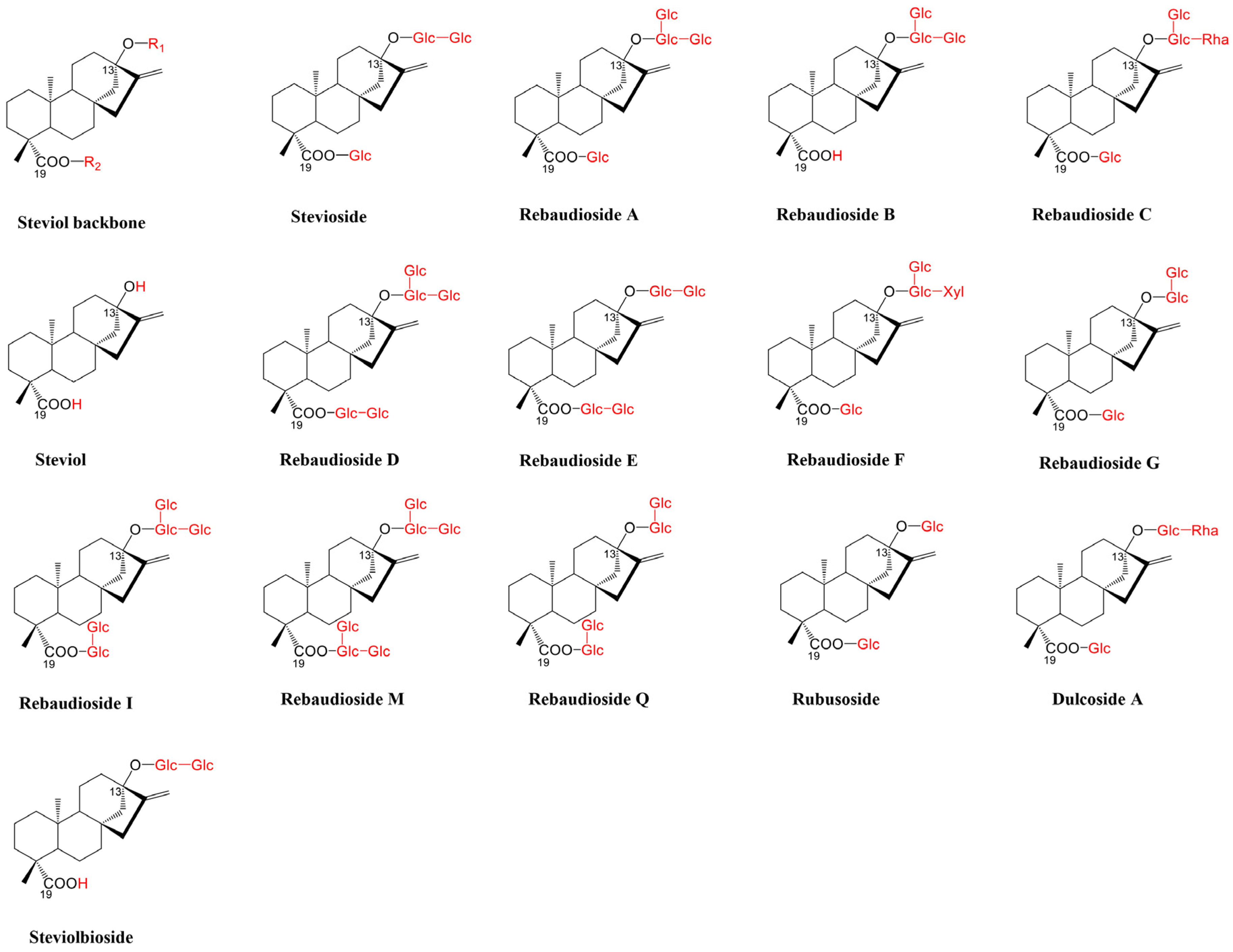
| Compound | Molecular Formula | R1 | R2 |
|---|---|---|---|
| Steviol | C20H30O3 | H | H |
| Stv | C38H60O18 | β-Glc-β-Glc(2→1) | β-Glc |
| SB | C32H50O13 | β-Glc-β-Glc(2→1) | H |
| Rub | C32H50O13 | β-Glc | β-Glc |
| Reb A | C44H70O23 | β-Glc-β-Glc(2→1) β-Glc(3→1) | β-Glc |
| Reb B | C38H60O18 | β-Glc-β-Glc(2→1) β-Glc(3→1) | H |
| Reb C | C44H70O22 | β-Glc-α-Rha(2→1) β-Glc(3→1) | β-Glc |
| Reb D | C50H80O28 | β-Glc-β-Glc(2→1) β-Glc(3→1) | β-Glc-β-Glc(2→1) |
| Reb E | C44H70O23 | β-Glc-β-Glc(2→1) | β-Glc-β-Glc(2→1) |
| Reb F | C43H68O22 | β-Glc-β-Xyl(2→1) β-Glc(3→1) | β-Glc |
| Reb G | C38H60O18 | β-Glc β-Glc(3→1) | H |
| Reb Q | C44H70O23 | β-Glc β-Glc(3→1) | β-Glc β-Glc(3→1) |
| Reb I | C50H80O28 | β-Glc-β-Glc(2→1) β-Glc(3→1) | β-Glc β-Glc(3→1) |
| Reb M | C56H90O33 | β-Glc-β-Glc(2→1) β-Glc(3→1) | β-Glc-β-Glc(2→1) β-Glc(3→1) |
| Dulcoside A | C38H60O17 | β-Glc-α-Rha(2→1) | β-Glc |
| SGs | Sweetness (Times of Sucrose) | Flavor Profile | Solubility | Content in S. rebaudiana | Bioactivity | Reference |
|---|---|---|---|---|---|---|
| Rub | 100–200 | A clean, comfortable sweetness, minimal bitter/astringent aftertaste at low use levels, intensified bitterness at high levels | Poor water solubility | <5% | Neuroprotection and anti-inflammation; modulating gut microbiota and blood glucose | [25] |
| Stv | 300 | Bitterness with an unpleasant metallic aftertaste | Soluble in water, ethanol, and methanol; insoluble in organic solvents such as benzene, ether, and chloroform | 5–10% | Anti-inflammatory, glycolipid metabolism regulation, and anti-cancer | [37] |
| Reb A | 450 | Rapid-onset sweetness, initial bitterness, lingering bitter-sweet aftertaste, clean, no off-flavor, non-grassy | Soluble in methanol, low solubility in water | 2–5% | Anti-inflammation, glycolipid metabolism regulation, and anti-cancer | [9,38] |
| Reb B | 150 | Slow-onset, deficient sweetness with a lingering bitter-sweet aftertaste, clean, no off-flavor, non-grassy | Relatively poor water solubility | 0.4–0.5% | Inhibiting cellular apoptosis and rebalancing the inflammatory response | [39] |
| Reb C | 40–60 | prolonged after-bitterness | N/A | <1% | N/A | [40] |
| Reb D | 200–350 | Rapid-onset, sucrose-like sweetness, long-lasting sweet aftertaste. Clean profile: non-bitter, no off-flavor, non-grassy | Poor water solubility | <0.2% | Anti-inflammation, increased glycolipid metabolism | [38,41,42,43] |
| Reb E | 150–300 | N/A | Slightly soluble in water | <1% | N/A | [44] |
| Reb F | 25 | N/A | N/A | <1% | N/A | [45] |
| Reb M | 200–350 | Fast-onset, sucrose-like sweetness, long sweet aftertaste, bitter-free, no off-flavor or grassiness | Slightly soluble in water. | <0.1% | improved insulin sensitivity, decreased weight gain | [3,38,42,46] |
| Reb I | 170 | N/A | N/A | N/A | N/A | [47] |
| Dulcoside A | 50 | A significant bitter aftertaste due to a rhamnose group | N/A | N/A | N/A | [48] |
| Reb M2 | 200 | Excellent initial burst, sucrose-like sweetness, short aftertaste, soft mouthfeel, and clean finish, no bitterness or licorice off-taste | Better solubility in water | N/A | N/A | [49] |
| Reb M8 | Comparable with Reb D | N/A | Better solubility in water | N/A | inhibitory effects on inflammatory factor TNF-α | [43] |
| Reb M9 | 300–450 | Pure sweetness, barely perceptible bitterness | Better solubility in water than Reb M2 | N/A | N/A | [50] |
Disclaimer/Publisher’s Note: The statements, opinions and data contained in all publications are solely those of the individual author(s) and contributor(s) and not of MDPI and/or the editor(s). MDPI and/or the editor(s) disclaim responsibility for any injury to people or property resulting from any ideas, methods, instructions or products referred to in the content. |
© 2026 by the authors. Licensee MDPI, Basel, Switzerland. This article is an open access article distributed under the terms and conditions of the Creative Commons Attribution (CC BY) license.
Share and Cite
Jiang, L.; Zhao, X.; Li, W.; Tang, G.; Yuan, Y.; Cheng, J.; Hua, J.; Zou, L. A Comprehensive Review on Steviol Glycosides: Sources, Properties, Bioactivities, Sensory-Functional Enhancement and Bioproduction Strategies. Plants 2026, 15, 324. https://doi.org/10.3390/plants15020324
Jiang L, Zhao X, Li W, Tang G, Yuan Y, Cheng J, Hua J, Zou L. A Comprehensive Review on Steviol Glycosides: Sources, Properties, Bioactivities, Sensory-Functional Enhancement and Bioproduction Strategies. Plants. 2026; 15(2):324. https://doi.org/10.3390/plants15020324
Chicago/Turabian StyleJiang, Liangzhen, Xun Zhao, Wei Li, Guiru Tang, Yiming Yuan, Jie Cheng, Jun Hua, and Liang Zou. 2026. "A Comprehensive Review on Steviol Glycosides: Sources, Properties, Bioactivities, Sensory-Functional Enhancement and Bioproduction Strategies" Plants 15, no. 2: 324. https://doi.org/10.3390/plants15020324
APA StyleJiang, L., Zhao, X., Li, W., Tang, G., Yuan, Y., Cheng, J., Hua, J., & Zou, L. (2026). A Comprehensive Review on Steviol Glycosides: Sources, Properties, Bioactivities, Sensory-Functional Enhancement and Bioproduction Strategies. Plants, 15(2), 324. https://doi.org/10.3390/plants15020324