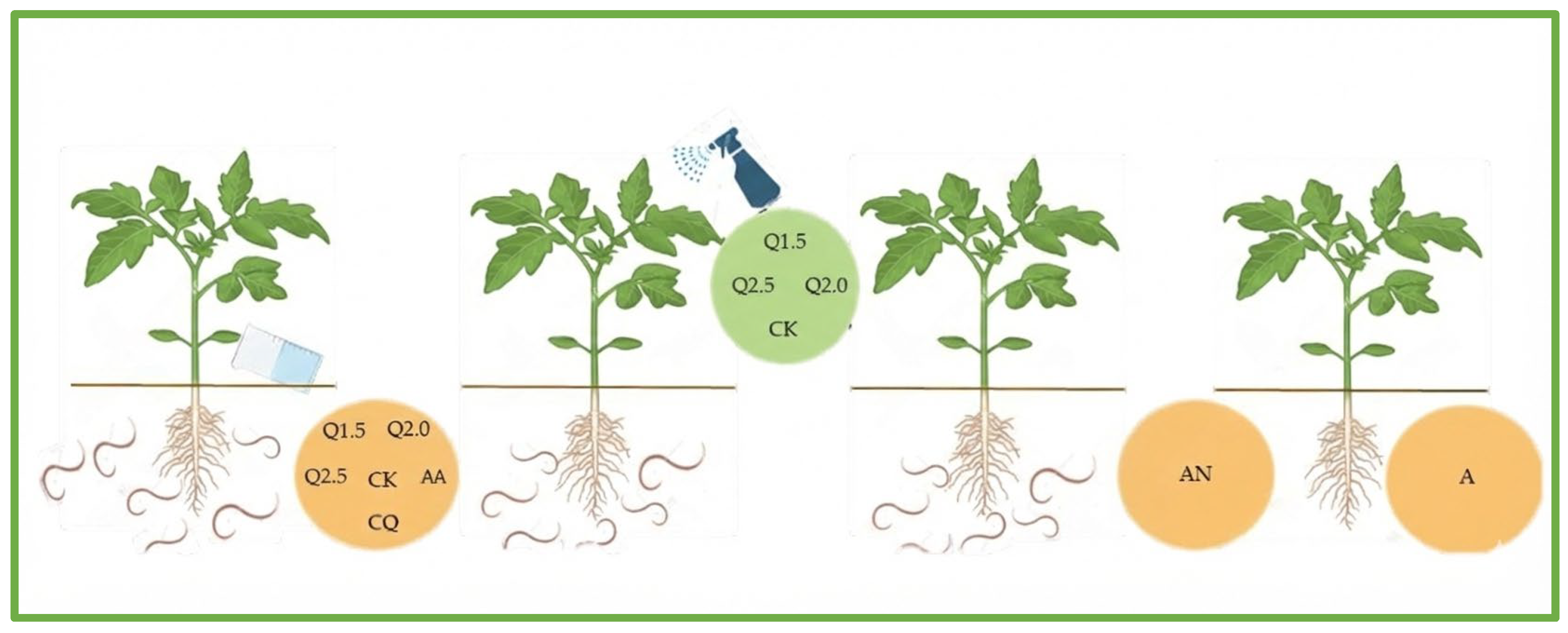
Chitosan Acts as a Sustainable Strategy for Integrated Management of Root-Knot Nematodes (Meloidogyne spp.) in Cherry Tomato

 , , , , ,
  , and
, and
Abstract
1. Introduction
2. Results
2.1. Chitosan Soil Application in Tomato Cherry Genotypes IAC1687 and LA2076
2.2. Chitosan Foliar Application in Tomato Cherry Genotypes IAC1687 and LA2076
3. Discussion
3.1. Chitosan Foliar and Edaphic Application in Tomato
3.2. Chitosan in the Formation of Galls and Reproduction Index of Nematodes
4. Materials and Methods
4.1. Location
4.2. Plant Material
4.3. Plant Distribution
4.4. Obtaining the Eggs and Juveniles of Meloidogyne spp.
4.5. Treatments with Chitosan
4.6. Experimental Design
4.7. Variables Evaluated
4.8. Statistical Analysis
5. Conclusions
Author Contributions
Funding
Data Availability Statement
Acknowledgments
Conflicts of Interest
References
- Perveen, R.; Suleria, H.A.R.; Anjum, F.M.; Butt, M.S.; Pasha, I.; Ahmad, S. Tomato (Solanum lycopersicum) carotenoids and lycopenes chemistry; metabolism, absorption, nutrition, and allied health claims-A comprehensive review. Crit. Rev. Food Sci. Nutr. 2015, 55, 919–929. [Google Scholar] [CrossRef] [Scilit]
- FAO. Faostat: Statistical Databases; Food & Agriculture Organization of the United Nations. Available online: https://www.fao.org/statistics/es (accessed on 6 August 2025).
- Singh, V.K.; Singh, A.K.; Kumar, A. Disease Management of Tomato through PGPB: Current Trends and Future Perspective. 3 Biotech 2017, 7, 255. [Google Scholar] [CrossRef] [Scilit] [PubMed]
- Salazar-Antón, W.; Guzmán-Hernández, T.D.J. Nematodos fitoparásitos asociados al tomate en la zona occidental de Nicaragua. Agron. Mesoam. 2013, 24, 27–36. [Google Scholar] [CrossRef] [Scilit]
- Collange, B.; Navarrete, M.; Peyre, G.; Mateille, T.; Tchamitchian, M. Root-Knot Nematode (Meloidogyne) Management in vegetable crop production: The challenge of an agronomic system analysis. Crop Prot. 2011, 30, 1251–1262. [Google Scholar] [CrossRef] [Scilit]
- Vidhyasekaran, P. Plant Innate Immunity Signals and Signaling Systems, 1st ed.; Springer: Dordrecht, The Netherlands, 2020; pp. 137–168. [Google Scholar] [CrossRef] [Scilit]
- Zhao, W.; Zhou, X.; Lei, H.; Fan, J.; Yang, R.; Li, Z.; Hu, C.; Li, M.; Zhao, F.; Wang, S. Transcriptional evidence for cross talk between ja and et or sa during root-knot nematode invasion in tomato. Physiol. Genom. 2018, 50, 197–207. [Google Scholar] [CrossRef] [Scilit]
- Yamaguchi, I.; Itoh, S.; Suzuki, M.; Sakane, M.; Osaka, A.; Tanaka, J. The chitosan prepared from crab tendon i: The characterization and the mechanical properties. Biomaterials 2003, 24, 2031–2036. [Google Scholar] [CrossRef] [Scilit]
- Orzali, L.; Corsi, B.; Forni, C.; Riccioni, L. Chitosan in Agriculture: A new challenge for managing plant disease. In Biological Activities and Application of Marine Polysaccharides, 1st ed.; Shalaby, E.A., Ed.; InTech: London, UK, 2017; pp. 17–36. [Google Scholar] [CrossRef] [Scilit]
- Bautista-Baños, S.; Hernández-Lauzardo, A.N.; Velázquez-del Valle, M.G.; Hernández-López, M.; Ait Barka, E.; Bosquez-Molina, E.; Wilson, C.L. Chitosan as a potential natural compound to control pre and postharvest diseases of horticultural commodities. Crop Prot. 2006, 25, 108–118. [Google Scholar] [CrossRef] [Scilit]
- Li, J.; Cai, J.; Fan, L. Effect of sonolysis on kinetics and physicochemical properties of treated chitosan. J. Appl. Polym. Sci. 2008, 109, 2417–2425. [Google Scholar] [CrossRef] [Scilit]
- Khalil, M.S.; Badawy, M.E.I. Nematicidal activity of a biopolymer chitosan at different molecular weights against root-knot nematode, Meloidogyne incognita. Plant Prot. Sci. 2012, 48, 170–178. [Google Scholar] [CrossRef] [Scilit]
- Khan, A.; Tariq, M.; Ahmad, F.; Mennan, S.; Khan, F.; Asif, M.; Nadeem, H.; Ansari, T.; Shariq, M.; Siddiqui, M.A. Assessment of nematicidal efficacy of chitosan in combination with botanicals against Meloidogyne incognita on carrot. Acta Agric. Scand. Sect. B Soil. Plant Sci. 2021, 71, 225–236. [Google Scholar] [CrossRef] [Scilit]
- Mouniga, R.; Anita, B.; Lakshmanan, A.; Shanthi, A.; Karthikeyan, G. Nematicidal properties of chitosan nanoformulation. J. Nematol. 2023, 55, 20230033. [Google Scholar] [CrossRef] [Scilit] [PubMed]
- Escudero, N.; Ferreira, S.R.; Lopez-Moya, F.; Naranjo-Ortiz, M.A.; Marin-Ortiz, A.I.; Thornton, C.R.; Lopez-Llorca, L.V. Chitosan enhances parasitism of Meloidogyne javanica eggs by the nematophagous fungus Pochonia chlamydosporia. Fungal Biol. 2016, 120, 572–585. [Google Scholar] [CrossRef] [Scilit] [PubMed]
- Khalil, M.S.; Abd El-Aziz, M.H.; Selim, R.E.-S. Physiological and morphological response of tomato plants to nano-chitosan used against bio-stress induced by root-knot nematode (Meloidogyne incognita) and Tobacco Mosaic Tobamovirus (TMV). Eur. J. Plant Pathol. 2022, 163, 799–812. [Google Scholar] [CrossRef] [Scilit]
- Mota, L.C.B.M.; dos Santos, M.A. Chitin and chitosan on Meloidogyne javanica management and on chitinase activity in tomato plants. Trop. Plant Pathol. 2016, 41, 84–90. [Google Scholar] [CrossRef] [Scilit]
- Yu, Z.; Zhang, J.; Jiang, L.; Wang, L.; Huang, Y.; Ding, R.; Yuan, J.; Shi, Y. Hormesis in Caenorhabditis elegans exposed to pollutants. Curr. Opin. Environ. Sci. Health 2022, 29, 100377. [Google Scholar] [CrossRef] [Scilit]
- El-Sayed, S.M.; Mahdy, M.E. Effect of chitosan on root-knot nematode, Meloidogyne javanica on tomato plants. Int. J. ChemTech Res. 2015, 7, 1985–1992. [Google Scholar]
- Göze Özdemïr, F.G.; Çevïk, H.; Ndayiragije, J.C.; Özek, T.; Karaca, İ. Nematicidal effect of chitosan on Meloidogyne incognita in vitro and on tomato in a pot experiment. Int. J. Agric. Environ. Food Sci. 2022, 6, 410–416. [Google Scholar] [CrossRef] [Scilit]
- Padilla-Hurtado, B.; Morillo-Coronado, Y.; Tarapues, S.; Burbano, S.; Soto-Suárez, M.; Urrea, R.; Ceballos-Aguirre, N. Evaluation of root-knot nematodes (Meloidogyne spp.) population density for disease resistance screening of tomato germplasm carrying the gene Mi-1. Chil. J. Agric. Res. 2022, 82, 157–166. [Google Scholar] [CrossRef] [Scilit]
- Jiménez-Aguirre, M.A.; Padilla-Hurtado, B.E.; Gonzalez-Cardona, C.; Ceballos-Aguirre, N.; Cardona-Agudelo, L.D.; Montoya-Estrada, C.N. Antagonist effect of native bacteria of the genus bacillus on the root-knot nematode (Meloidogyne spp.) in tomato germplasm. Chil. J. Agric. Res. 2023, 83, 565–576. [Google Scholar] [CrossRef] [Scilit]
- Oka, Y. Mechanisms of nematode suppression by organic soil amendments—A Review. Appl. Soil. Ecol. 2010, 44, 101–115. [Google Scholar] [CrossRef] [Scilit]
- Pujisiswanto, H.; Yudono, P.; Sulistyaningsih, E.; Sunarminto, B.H. Effect of acetic acid as pre-emergence herbicide on maize germination. JPPT 2017, 15, 2015. [Google Scholar] [CrossRef] [Scilit]
- Gettys, L.A.; Thayer, K.L.; Sigmon, J.W. Phytotoxic effects of acetic acid and d-limonene on four aquatic plants. Horttechnology 2022, 32, 110–118. [Google Scholar] [CrossRef] [Scilit]
- Masserano, G.; Moretti, B.; Bertora, C.; Vidotto, F.; Monaco, S.; Vocino, F.; Vamerali, T.; Sacco, D. Acetic acid disturbs rice germination and post-germination under controlled conditions mimicking green mulching in flooded paddy. Ital. J. Agronomy 2022, 17, 1926. [Google Scholar] [CrossRef] [Scilit]
- Seo, Y.; Kim, Y.H. Control of Meloidogyne incognita using mixtures of organic acids. Plant Pathol. J. 2014, 30, 450–455. [Google Scholar] [CrossRef] [Scilit]
- Yeon, J.; Park, A.R.; Kim, Y.J.; Seo, H.J.; Yu, N.H.; Ha, S.; Park, H.W.; Kim, J.-C. Control of root-knot nematodes by a mixture of maleic acid and copper sulfate. Appl. Soil. Ecol. 2019, 141, 61–68. [Google Scholar] [CrossRef] [Scilit]
- Mukarram, M.; Ali, J.; Dadkhah-Aghdash, H.; Kurjak, D.; Kačík, F.; Ďurkovič, J. Chitosan-induced biotic stress tolerance and crosstalk with phytohormones, antioxidants, and other signalling molecules. Front. Plant Sci. 2023, 14, 1217822. [Google Scholar] [CrossRef] [Scilit]
- Schleker, A.S.S.; Rist, M.; Matera, C.; Damijonaitis, A.; Collienne, U.; Matsuoka, K.; Habash, S.S.; Twelker, K.; Gutbrod, O.; Saalwächter, C. Mode of action of fluopyram in plant-parasitic nematodes. Sci. Rep. 2022, 12, 11954. [Google Scholar] [CrossRef] [Scilit]
- Lopez-Nuñez, R.; Suarez-Fernandez, M.; Lopez-Moya, F.; Lopez-Llorca, L.V. Chitosan and nematophagous fungi for sustainable management of nematode pests. Front. Fungal Biol. 2022, 3, 980341. [Google Scholar] [CrossRef] [Scilit]
- Salachna, P.; Zawadzińska, A. Effect of chitosan on plant growth, flowering and corms yield of potted. J. Ecol. Eng. 2014, 15, 97–102. [Google Scholar] [CrossRef] [Scilit]
- Escudero, N.; Lopez-Moya, F.; Ghahremani, Z.; Zavala-Gonzalez, E.A.; Alaguero-Cordovilla, A.; Ros-Ibañez, C.; Lacasa, A.; Sorribas, F.J.; Lopez-Llorca, L.V. Chitosan increases tomato root colonization by Pochonia chlamydosporia and their combination reduces root-knot nematode damage. Front. Plant Sci. 2017, 8, 1415. [Google Scholar] [CrossRef] [Scilit] [PubMed]
- Sharif, R.; Mujtaba, M.; Ur Rahman, M.; Shalmani, A.; Ahmad, H.; Anwar, T.; Tianchan, D.; Wang, X. The multifunctional role of chitosan in horticultural crops; A Review. Molecules 2018, 23, 872. [Google Scholar] [CrossRef] [Scilit]
- Momtaz Gad, M.; Ahmed Zagz, O.; Hafez, N.K. Effect of nano-chitosan on vegetative growth, fruiting and resistance of malformation of mango. Tren. Hortic. Res. 2017, 7, 11–18. [Google Scholar] [CrossRef] [Scilit]
- Pincay-Manzaba, D.F.; Cedeño-Loor, J.C.; Espinosa Cunuhay, K.A. Efecto del quitosano sobre el crecimiento y la productividad de Solanum lycopersicum. Cent. Agrícola 2021, 48, 25–31. [Google Scholar]
- Herrera, H.; Hurtado-Salazar, A.; Ceballos-Aguirre, N. Estudio técnico y económico del tomate tipo cereza élite (Solanum lycopersicum L. var. cerasiforme) bajo condiciones semicontroladas. Rev. Colomb. Cienc. Hortic. 2015, 9, 290–300. [Google Scholar] [CrossRef] [Scilit]
- Hussey, R.S.; Barker, K.R. A comparison of methods of collecting inocula of Meloidogyne spp., including a new technique. Plant Dis. Report. 1973, 57, 1025–1028. [Google Scholar]
- Whitehead, A.G.; Hemming, J.R. A comparison of some quantitative methods of extracting small vermiform nematodes from soil. Ann. Appl. Biol. 1965, 55, 25–38. [Google Scholar] [CrossRef] [Scilit]
- Neilson, A.P.; O’Keefe, S.F. Dilutions and concentrations. In Food Analysis Laboratory Manual; Nielsen, S.S., Ed.; Springer: Dordrecht, Netherland, 2017; pp. 33–47. [Google Scholar] [CrossRef] [Scilit]
- Cardona-Piedrahíta, L.F.; Castaño-Zapata, J.; Aguirre, N.C. Respuesta de quince introducciones de tomate cherry (Solanum lycopersicum L.) al nemátodo nodulador (Meloidogyne spp.) e identificación de las especies. Rev. Acad. Colomb. Cienc. Exact. Fís. Nat. 2016, 40, 450–460. [Google Scholar] [CrossRef] [Scilit]
- Carmona, S.L.; Villarreal-Navarrete, A.; Burbano-David, D.; Gómez-Marroquín, M.; Torres-Rojas, E.; Soto-Suárez, M. Protection of tomato plants against Fusarium oxysporum F. sp. lycopersici induced by chitosan. Rev. Colomb. Cienc. Hortic. 2021, 15, e12822. [Google Scholar] [CrossRef] [Scilit]
- Fan, Z.; Wang, L.; Qin, Y.; Li, P. Activity of chitin/chitosan/chitosan oligosaccharide against plant pathogenic nematodes and potential modes of application in agriculture: A review. Carbohydr. Polym. 2023, 306, 120592. [Google Scholar] [CrossRef] [Scilit] [PubMed]
- Ntalli, N.G.; Vargiu, S.; Menkissoglu-Spiroudi, U.; Caboni, P. Nematicidal carboxylic acids and aldehydes from melia azedarach fruits. J. Agric. Food Chem. 2010, 58, 11390–11394. [Google Scholar] [CrossRef] [Scilit]
- Ntalli, N.; Ratajczak, M.; Oplos, C.; Menkissoglu-Spiroudi, U.; Adamski, Z. Acetic acid, 2-undecanone, and (E)-2-decenal ultrastructural malformations on Meloidogyne incognita. J. Nematol. 2016, 48, 248–260. [Google Scholar] [CrossRef] [Scilit]
- Chen, J.-X.; Song, B.-A. Natural nematicidal active compounds: Recent research progress and outlook. J. Integr. Agric. 2021, 20, 2015–2031. [Google Scholar] [CrossRef] [Scilit]
- Ji, X.; Li, J.; Dong, B.; Zhang, H.; Zhang, S.; Qiao, K. Evaluation of fluopyram for southern root-knot nematode management in tomato production in China. Crop Prot. 2019, 122, 84–89. [Google Scholar] [CrossRef] [Scilit]
- Michalak, I.; Dmytryk, A.; Godlewska, K.; Wilk, R.; Chojnacka, K. Marine Polysaccharides as Biostimulants of Plant Growth, 1st ed.; Taylor and Francys Group: London, UK, 2016; pp. 293–309. [Google Scholar]
- Stucky, T.; Dahlin, P. Fluopyram: Optimal application time point and planting hole treatment to control Meloidogyne incognita. Agronomy 2022, 12, 1576. [Google Scholar] [CrossRef] [Scilit]
- Seo, H.J.; Park, A.R.; Kim, S.; Yeon, J.; Yu, N.H.; Ha, S.; Chang, J.Y.; Park, H.W.; Kim, J.-C. Biological control of root-knot nematodes by organic acid-producing Lactobacillus brevis wikim0069 isolated from kimchi. Plant Pathol. J. 2019, 35, 662–673. [Google Scholar] [CrossRef] [Scilit]
- Ntalli, N.; Menkissoglu-Spiroudi, U.; Doitsinis, K.; Kalomoiris, M.; Papadakis, E.-N.; Boutsis, G.; Dimou, M.; Monokrousos, N. Mode of action and ecotoxicity of hexanoic and acetic acids on Meloidogyne javanica. J. Pest. Sci. 2020, 93, 867–877. [Google Scholar] [CrossRef] [Scilit]
- Parađiković, N.; Vinković, T.; Vinković Vrček, I.; Žuntar, I.; Bojić, M.; Medić-Šarić, M. Effect of natural biostimulants on yield and nutritional quality: An example of sweet yellow pepper (Capsicum annuum L.) Plants. J. Sci. Food Agric. 2011, 91, 2146–2152. [Google Scholar] [CrossRef] [Scilit]
- Rodríguez Pedroso, A.T.; Ramírez Arrebato, M.Á.; Rodríguez, A.F.; Baños, S.B.; Zapata, E.V.; Fernández, Y.V. Efecto del Quitomax® en el rendimiento y sus componentes del cultivar de arroz (Oryza sativa L.) var. INCA LP 5. Cultiv. Trop. 2017, 38, 156–159. [Google Scholar]
- Bhavana, P.; Singh, A.K.; Kumar, R.; Prajapati, G.K.; Thamilarasi, K.; Manickam, R.; Maurya, S.; Choudhary, J.S. Identification of resistance in tomato against root knot nematode (Meloidogyne incognita) and comparison of molecular markers for Mi gene. Australas. Plant Pathol. 2019, 48, 93–100. [Google Scholar] [CrossRef] [Scilit]


| Genotypes | Treatment | Production /Plant (g) | Yield (kg/ha) | Nematode Population (N° of Eggs 100 g of Roots) | Nematode Population (N° of Eggs 1 g of Roots) | Reproduction Index IR |
|---|---|---|---|---|---|---|
| IAC1687 | Q1.5 | 635.2 c | 13,233.1 c | 10,670 b | 106.7 | 40.59 |
| Q2.0 | 1145.3 ab | 23,860.5 ab | 5384 b | 53.84 | 20.48 | |
| Q2.5 | 1179.6 ab | 24,575.8 ab | 3898 b | 38.98 | 14.83 | |
| CK | 1608.8 a | 33,517.1 a | 1842 b | 18.42 | 7.01 | |
| CQ | 718.5 b | 14,970.3 c | 513 b | 0.513 | 0.20 | |
| AA | 664.6 b | 13,846.2 c | 2647 b | 26.47 | 10.07 | |
| A | 878.0 b | 18,291.3 c | 555 b | 0.555 | 0.21 | |
| AN | 1093.8 b | 22,787.5 ab | 26,290 a | 262.9 | 100 | |
| LA2076 | Q1.5 | 917.9 b | 19,124.3 b | 9235 a | 92.35 | 39.78 |
| Q2.0 | 816.4 b | 17,010.1 b | 7461 a | 74.61 | 32.14 | |
| Q2.5 | 1130.1 ab | 23,545.0 ab | 6810 a | 68.1 | 29.33 | |
| CK | 1125.5 ab | 23,448.9 ab | 6163 a | 61.63 | 26.55 | |
| CQ | 1033.3 ab | 21,526.9 ab | 853 a | 0.853 | 0.37 | |
| AA | 821.1 b | 17,106.2 b | 3693 a | 36.93 | 15.91 | |
| A | 1314.7 a | 27,389.1 a | 587 b | 0.587 | 0.25 | |
| AN | 1397.7 a | 29,118.9 a | 23,215 a | 232.15 | 100 |
| Genotypes | Treatment | Production /Plant (g) | Yield (kg/ha) | Nematode Population (N° of Eggs 100 g of Roots) | Nematode Population (N° of Eggs 1 g of Roots) | Reproduction Index IR |
|---|---|---|---|---|---|---|
| IAC1687 | Q1.5 | 1192.2 ab | 24,837.7 ab | 2223 c | 22.23 | 8.46 |
| Q2.0 | 1287.7 a | 26,827.3 a | 3450 bc | 34.5 | 13.12 | |
| Q2.5 | 887.2 c | 18,483.9 b | 5269 ab | 52.69 | 20.04 | |
| CK | 1124.4 ab | 23,425.7 ab | 7391 a | 7391 | 28.11 | |
| LA2076 | Q1.5 | 1416.1 a | 29,503.3 a | 4049 c | 40.49 | 17.44 |
| Q2.0 | 1420.7 a | 29,599.4 a | 4524 bc | 45.24 | 19.49 | |
| Q2.5 | 977.9 b | 20,373.6 b | 7980 a | 79.8 | 34.37 | |
| CK | 1231.6 ab | 25,659.3 ab | 7516 ab | 75.16 | 32.38 |
Disclaimer/Publisher’s Note: The statements, opinions and data contained in all publications are solely those of the individual author(s) and contributor(s) and not of MDPI and/or the editor(s). MDPI and/or the editor(s) disclaim responsibility for any injury to people or property resulting from any ideas, methods, instructions or products referred to in the content. |
© 2026 by the authors. Licensee MDPI, Basel, Switzerland. This article is an open access article distributed under the terms and conditions of the Creative Commons Attribution (CC BY) license.
Share and Cite
González-Cardona, C.; Orrego-Cardona, J.C.; Ospina-Gutiérrez, A.; Montoya-Estrada, C.N.; Leguizamón-Caycedo, J.E.; Soto-Suárez, M.; Hurtado-Salazar, A.; Ceballos-Aguirre, N. Chitosan Acts as a Sustainable Strategy for Integrated Management of Root-Knot Nematodes (Meloidogyne spp.) in Cherry Tomato. Plants 2026, 15, 256. https://doi.org/10.3390/plants15020256
González-Cardona C, Orrego-Cardona JC, Ospina-Gutiérrez A, Montoya-Estrada CN, Leguizamón-Caycedo JE, Soto-Suárez M, Hurtado-Salazar A, Ceballos-Aguirre N. Chitosan Acts as a Sustainable Strategy for Integrated Management of Root-Knot Nematodes (Meloidogyne spp.) in Cherry Tomato. Plants. 2026; 15(2):256. https://doi.org/10.3390/plants15020256
Chicago/Turabian StyleGonzález-Cardona, Carolina, Juan Camilo Orrego-Cardona, Alejandro Ospina-Gutiérrez, Claudia Nohemy Montoya-Estrada, Jairo Eduardo Leguizamón-Caycedo, Mauricio Soto-Suárez, Alejandro Hurtado-Salazar, and Nelson Ceballos-Aguirre. 2026. "Chitosan Acts as a Sustainable Strategy for Integrated Management of Root-Knot Nematodes (Meloidogyne spp.) in Cherry Tomato" Plants 15, no. 2: 256. https://doi.org/10.3390/plants15020256
APA StyleGonzález-Cardona, C., Orrego-Cardona, J. C., Ospina-Gutiérrez, A., Montoya-Estrada, C. N., Leguizamón-Caycedo, J. E., Soto-Suárez, M., Hurtado-Salazar, A., & Ceballos-Aguirre, N. (2026). Chitosan Acts as a Sustainable Strategy for Integrated Management of Root-Knot Nematodes (Meloidogyne spp.) in Cherry Tomato. Plants, 15(2), 256. https://doi.org/10.3390/plants15020256