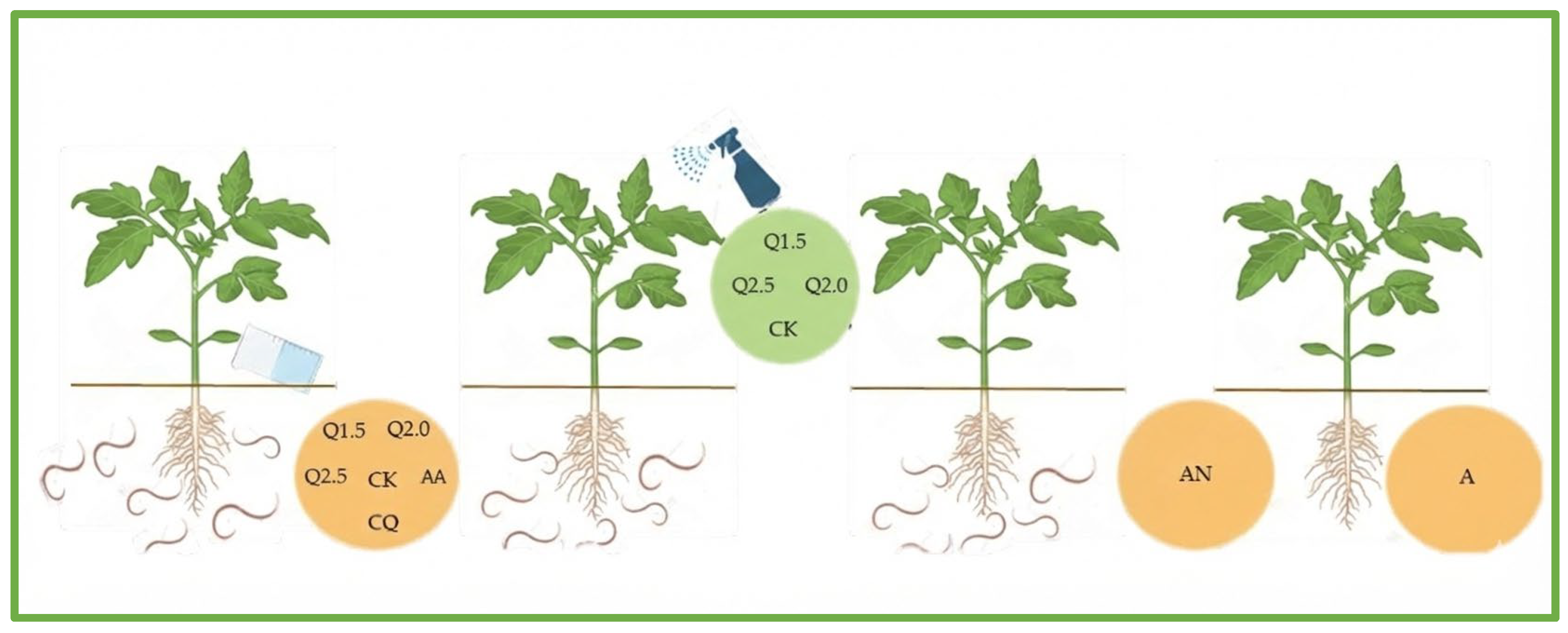
Chitosan Acts as a Sustainable Strategy for Integrated Management of Root-Knot Nematodes (Meloidogyne spp.) in Cherry Tomato

 , , , , ,
  , and
, and Abstract
Share and Cite
González-Cardona, C.; Orrego-Cardona, J.C.; Ospina-Gutiérrez, A.; Montoya-Estrada, C.N.; Leguizamón-Caycedo, J.E.; Soto-Suárez, M.; Hurtado-Salazar, A.; Ceballos-Aguirre, N. Chitosan Acts as a Sustainable Strategy for Integrated Management of Root-Knot Nematodes (Meloidogyne spp.) in Cherry Tomato. Plants 2026, 15, 256. https://doi.org/10.3390/plants15020256
González-Cardona C, Orrego-Cardona JC, Ospina-Gutiérrez A, Montoya-Estrada CN, Leguizamón-Caycedo JE, Soto-Suárez M, Hurtado-Salazar A, Ceballos-Aguirre N. Chitosan Acts as a Sustainable Strategy for Integrated Management of Root-Knot Nematodes (Meloidogyne spp.) in Cherry Tomato. Plants. 2026; 15(2):256. https://doi.org/10.3390/plants15020256
Chicago/Turabian StyleGonzález-Cardona, Carolina, Juan Camilo Orrego-Cardona, Alejandro Ospina-Gutiérrez, Claudia Nohemy Montoya-Estrada, Jairo Eduardo Leguizamón-Caycedo, Mauricio Soto-Suárez, Alejandro Hurtado-Salazar, and Nelson Ceballos-Aguirre. 2026. "Chitosan Acts as a Sustainable Strategy for Integrated Management of Root-Knot Nematodes (Meloidogyne spp.) in Cherry Tomato" Plants 15, no. 2: 256. https://doi.org/10.3390/plants15020256
APA StyleGonzález-Cardona, C., Orrego-Cardona, J. C., Ospina-Gutiérrez, A., Montoya-Estrada, C. N., Leguizamón-Caycedo, J. E., Soto-Suárez, M., Hurtado-Salazar, A., & Ceballos-Aguirre, N. (2026). Chitosan Acts as a Sustainable Strategy for Integrated Management of Root-Knot Nematodes (Meloidogyne spp.) in Cherry Tomato. Plants, 15(2), 256. https://doi.org/10.3390/plants15020256