Flavonoids as Antimicrobial Pesticides: Mechanisms of Action, Formulation Strategies, and Perspectives for Pre- and Postharvest Disease Management



Abstract
1. Introduction
2. Literature Search Methodology
3. Antifungal Agents

| Flavonoid | Target Organism | Type of Study | Main Results | Commercial Fungicide | Reference |
|---|---|---|---|---|---|
| Anthocyanin | |||||
| Callistephin | Botrytis cinerea | In vitro | Significant inhibitory effects on germ tube elongation. | n.a. | [35] |
| Chrysanthemin | Botrytis cinerea | In vitro | Significant inhibitory effects on germ tube elongation (9.76 µm after 24 h) and mycelial growth diameter (14.90 mm after 72 h). | n.a. | [35] |
| Flavan-3-ol | |||||
| Catechin | Botrytis cinerea | In vitro | Significant inhibitory effects on germ tube elongation (62.37 µm after 24 h) and mycelial growth diameter (6.24 mm after 72 h). | n.a. | [35] |
| Colletotrichum spp. | In vitro | All tested concentrations (5, 10, and 50 mM) had no effect on inhibiting Colletotrichum acutatum (6 isolated), Colletotrichum gloeosporioides (2 isolated), Colletotrichum fragariae, and Colletotrichum graminicola. | n.a. | [36] | |
| Flavanone | |||||
| Hesperetin | Phytophthora nicotianae | In vitro | IC50 value for inhibition of mycelial growth was 30.20 mg/L after 7 days. | n.a. | [37] |
| Homoeriodictyol | Fusarium graminearum | In vitro | IC50 value for inhibition of fungal radial growth was 274.78 mg/L after 72 h. | Carbendazim (IC50 = 2.17 mg/L) | [38] |
| Septoria zeicola | In vitro | IC50 value for inhibition of fungal radial growth was 240.31 mg/L after 72 h. | Carbendazim (IC50 = 3.10 mg/L) | ||
| Liquiritigenin | Phytophthora nicotianae | In vitro | IC50 value for inhibition of mycelial growth was 51.43 mg/L after 7 days. | n.a. | [37] |
| Naringenin | Botrytis cinerea | In vitro | Naringenin (200 mg/L) clustered with pterostilbene reduced the mycelial growth of the strains GBR, GBW, BGM and TGM by 41.2, 36.8, 37.3, and 37.7%, respectively. IC50 value for inhibition of fungal growth was 502 ± 7.3 mg/L after 72 h. | n.a. | [34] |
| Colletotrichum spp. | In vitro | All tested concentrations (5, 10, and 50 mM) had no effect on inhibiting C. acutatum (6 isolated), C. gloeosporioides (2 isolated), C. fragariae, and C. graminicola. | n.a. | [36] | |
| Magnaporthe oryzae | In vitro | MIC and IC50 values for inhibiting fungus growth were 200 and 102.4 µg/mL, respectively, after 24 h of incubation. | Cycloheximide (MIC = 1.6 μg/mL) | [39] | |
| Phytophthora capsici | In vitro | IC50 value for inhibition of mycelial growth was 50.11 mg/L after 7 days. | n.a. | [37] | |
| Phytophthora infestans | In vitro | MIC and IC50 values to inhibit fungus growth were 50 and 53.7 µg/mL, respectively, after 24 h. | Cycloheximide (MIC = 1.6 μg/mL) | [39] | |
| Phytophthora nicotianae | In vitro and In vivo | IC50 values for inhibition of sporangia production and mycelial growth were 2.01 and 22.01 mg/L, respectively, after 7 days of incubation. Plant treated with naringenin (20 mg/mL) induced the accumulation of H2O2 and O2− and the expression of salicylic acid biosynthesis-related genes. | n.a. | [37] | |
| Pyricularia oryzae | In vitro | Naringenin (7 and 14 µg) significantly inhibited spore germination after 5 h of incubation (9.60 and 1.73% of germinated spores, respectively). Absence of germ tube and appressorium formation. | n.a. | [33] | |
| Rhizoctonia solani | In vitro | No effect on the mycelial or sclerotial growth. | n.a. | ||
| Pinocembrin | Aspergillus niger | In vitro | MIC value for inhibition of fungal growth was 32 ± 0.02 µg/mL. | Ketoconazole (MIC = 8 ± 0.01 µg/mL) Clotrimazole (MIC = 3 ± 0.02 µg/mL) | [40] |
| Fusarium spp. | In vitro | MIC values for inhibition of fungal growth were 45 ± 0.02, 30 ± 0.01, and 30 ± 0.02 µg/mL for isolated from G. max, M. indica, and G. max, respectively. | Ketoconazole (MIC = 2 ± 0.02, 3 ± 0.02, and 3 ± 0.02 µg/mL) Clotrimazole (MIC = 6 ± 0.02, 3 ± 0.01, and 3 ± 0.02 µg/mL) | ||
| Phomopsis sp. | In vitro | MIC value for inhibition of fungal growth was 32 ± 0.01 µg/mL. | Ketoconazole (MIC = 3 ± 0.02 µg/mL) Clotrimazole (MIC = 3 ± 0.01 µg/mL) | ||
| Penicillium italicum | In vitro | Pinocembrin (400 mg/L) inhibited the mycelial growth and spore germination by 93 and 97%, respectively. | n.a. | [41] | |
| Pinocembroside | Alternaria citri | In vitro | MIC and MFC values for inhibiting mycelial growth equal to 0.8 g/L after 2 and 6 days of incubation, respectively. | n.a. | [42] |
| Colletotrichum gloeosporioides | In vitro | MIC and MFC values for inhibiting mycelial growth equal to 0.2 and 0.4 g/L, respectively, after 2 and 6 days of incubation, respectively. | n.a. | ||
| Diaporthe citri | In vitro | MIC and MFC values for inhibiting mycelial growth equal to 0.1 and 0.4 g/L, respectively, after 2 and 6 days of incubation, respectively. | n.a. | ||
| Geotrichum citri-aurantii | In vitro | MIC and MFC values for inhibiting mycelial growth equal to 0.2 and 0.8 g/L, respectively, after 2 and 6 days of incubation, respectively. | n.a. | ||
| Penicillium digitatum | In vitro | MIC and MFC values for inhibiting mycelial growth equal to 0.2 and 0.4 g/L, respectively, after 2 and 6 days of incubation, respectively. | n.a. | ||
| Penicillium italicum | In vitro and In vivo | MIC and MFC values for inhibiting mycelial growth equal to 0.2 and 0.8 g/L, respectively, after 2 and 6 days of incubation, respectively. In vivo test on “Newhall” navel oranges revealed that, in fruits treated with pinocembroside at 4 g/L, the lesion diameter decreased by 94.3% compared with the control. In vitro and in vivo results indicated a dose-dependent activity. | n.a. | ||
| Flavone | |||||
| Baicalein | Paecilomyces variotii Bainier | In vitro | IC50 value for inhibiting mycelium growth was 40.05 mg/mL. | n.a. | [43] |
| Poria vaporaria Cooke | In vitro | IC50 value for inhibiting mycelium growth was 12.40 mg/mL. | n.a. | ||
| Luteolin | Fusarium graminearum | In vitro | IC50 value for inhibition of fungal radial growth was 56.38 mg/L after 72 h of incubation. | Carbendazim (IC50 = 2.17 mg/L) | [38] |
| Fusarium oxysporum f. sp. lycopersici | In vitro | Luteolin (25, 50, and 100 µM) showed a low stimulating activity on microconidia germination. | n.a. | [44] | |
| Septoria zeicola | In vitro | IC50 value for inhibition of fungal radial growth was 81.48 mg/L after 72 h. | Carbendazim (IC50 = 3.10 mg/L) | [38] | |
| Tangeretin | Aspergillus parasiticus | In vitro | At 50 µg/mL, approximately 80% of radial mycelial growth was inhibited after 4 days. | Benomyl (100% inhibition at 50 µg/mL) | [45] |
| Colletotrichum gloeosporioides | In vitro | At 50 µg/mL, approximately 70% of radial mycelial growth was inhibited after 4 days. | Benomyl (100% inhibition at 50 µg/mL) | ||
| Fusarium culmorum | In vitro | At 50 µg/mL, approximately 30% of radial mycelial growth was inhibited after 4 days. | Benomyl (100% inhibition at 50 µg/mL) | ||
| Geotrichum candidum | In vitro | At 50 µg/mL, approximately 30% of radial mycelial growth was inhibited after 4 days. | Benomyl (0% inhibition at 50 µg/mL) | ||
| Penicillium italicum | In vitro | At 50 µg/mL, approximately 35% of radial mycelial growth was inhibited after 4 days. | Benomyl (100% inhibition at 50 µg/mL) | ||
| M. oryzae | In vivo | At 200 µmol/L and higher concentrations, blocked appressorium formation in a reversible mode, indicating that tangeretin interferes with appressorium formation but does not kill conidial cells at least after 8 h of treatment. Rice leaves treated with tangeretin prior to fungus inoculation led to smaller disease lesions. At 200 µmol/L, prevented disease lesions in rice seedlings inoculated with the fungus in the nursery, while some symptoms were verified in the experimental field plots. | Tricyclazole (at 2 g/L, absence of blast symptoms similar to tangeretin in the nursery but presence of symptoms in experimental field plots) | [46] | |
| Flavonol | |||||
| Galangin | Aspergillus niger | In vitro | MIC value for inhibition of fungal growth was 28 ± 0.01 µg/mL. | Ketoconazole (MIC = 8 ± 0.01 µg/mL) Clotrimazole (MIC = 3 ± 0.02 µg/mL) | [40] |
| Fusarium spp. | In vitro | MIC values for inhibition of fungal growth were 35 ± 0.02, 25 ± 0.02, and 27 ± 0.01 µg/mL for the fungus isolated from G. max, M. indica, and G. max, respectively. | Ketoconazole (MIC = 2 ± 0.02, 3 ± 0.02, and 3 ± 0.02 µg/mL) Clotrimazole (MIC = 6 ± 0.02, 3 ± 0.01, and 3 ± 0.02 µg/mL) | ||
| Phomopsis sp. | In vitro | MIC value for inhibition of fungal growth was 30 ± 0.03 µg/mL. | Ketoconazole (MIC = 3 ± 0.02 µg/mL) Clotrimazole (MIC = 3 ± 0.01 µg/mL) | ||
| Hyperoside | Botrytis cinerea | In vitro | Dose-dependent activity, with significant linear inhibitory effects on germ tube elongation (28.18 µm after 24 h) and mycelial growth diameter (9.74 mm after 72 h). | n.a. | [35] |
| Kaempferol | Fusarium oxysporum | In vitro | Higher activity of KAE-LC nanoparticles (300 ppm, 67%) than pure kaempferol (300 ppm, no inhibition) after a 60-day storage period. In nanoparticle-treated cultures, hyphae appeared distorted and fragmented. | n.a. | [47] |
| Pyricularia oryzae | In vitro | Kaempferol (7 and 14 µg) inhibited spore germination after 5 h of incubation (47 and 35% of germinated spores, respectively). | n.a. | [33] | |
| Rhizoctonia solani | In vitro | No effect on the mycelial or sclerotia growth. | n.a. | ||
| Quercetin | Colletotrichum spp. | In vitro | All tested concentrations (5, 10, and 50 mM) had no effect on inhibiting C. acutatum (6 isolated), C. gloeosporioides (2 isolated), C. fragariae, and C. graminicola. | n.a. | [36] |
| Fusarium solani | In vitro | Quercetin (15 mg/mL) completely inhibited mycelial growth after 5 days. | n.a. | [48] | |
| Fusarium oxysporum f. sp. vasinfectum | In vitro | IC50 value for inhibiting spore germination was 42.4 ± 2.6 µg/mL. | Carbendazim (IC50 = 29.5 ± 3.1 mg/L) | [49] | |
| Fusarium oxysporum f. sp. cucumerinum | In vitro | IC50 value for inhibiting spore germination was 32.9 ± 1.4 µg/mL. | Carbendazim (IC50 = 27.6 ± 3.1 mg/L) | ||
| Rutin | Alternaria alternata | In vitro | Stimulated the formation of germ tubes after 6 h of incubation. In all tested concentrations (1, 5, and 10 mM), stimulated conidium formation (from 36 h to 48 h of incubation). | n.a. | [31] |
| Botrytis cinerea | In vitro | At 10 mM, it greatly inhibited the prolongation of germ tubes, secondary hyphal branching, and radial growth after 6 and 24 h of incubation. | n.a. | [31] | |
| Fusarium solani | In vitro | Stimulated the formation of germ tubes but did not significantly affect their prolongation. At concentrations higher than 5 mM, rutin inhibited mycelial growth, while at concentrations lower than 0.1 mM, rutin could stimulate mycelial growth. | n.a. | [31] | |
| Fusarium oxysporum f. sp. vasinfectum | In vitro | IC50 value for inhibiting spore germination was 357.8 ± 15.5 µg/mL. | Carbendazim (IC50 = 29.5 ± 3.1 mg/L) | [49] | |
| Fusarium oxysporum f. sp. cucumerinum | In vitro | IC50 value for inhibiting spore germination was 257.3 ± 23.42 µg/mL. | Carbendazim (IC50 = 27.6 ± 3.1 mg/L) | ||
| Taxifolin | Fusarium graminearum | In vitro | IC50 value for inhibition of fungal radial growth was 124.27 mg/L after 72 h. | Carbendazim (IC50 = 2.17 mg/L) | [38] |
| Septoria zeicola | In vitro | IC50 value for inhibition of fungal radial growth was 160.32 mg/L after 72 h. | Carbendazim (IC50 = 3.10 mg/L) | ||
| Isoflavone | |||||
| Equol | Magnaporthe oryzae | In vitro and In vivo | Affected mycelial growth, conidial generation and germination, and appressorial formation Reduced fungal virulence on rice and barley leaves. | n.a. | [50] |
| Daidzein | Poria vaporaria Cooke | In vitro | IC50 value for inhibiting mycelium growth was 40.04 mg/mL. | n.a. | [43] |
3.1. Antifungal Modes of Action
3.1.1. Effects on Cell Wall
3.1.2. Effects on Membrane Integrity and Components
3.1.3. Effects on Respiration
3.1.4. Effects on Amino Acids and Proteins
3.1.5. Effects on DNA
3.1.6. Multisite Activity
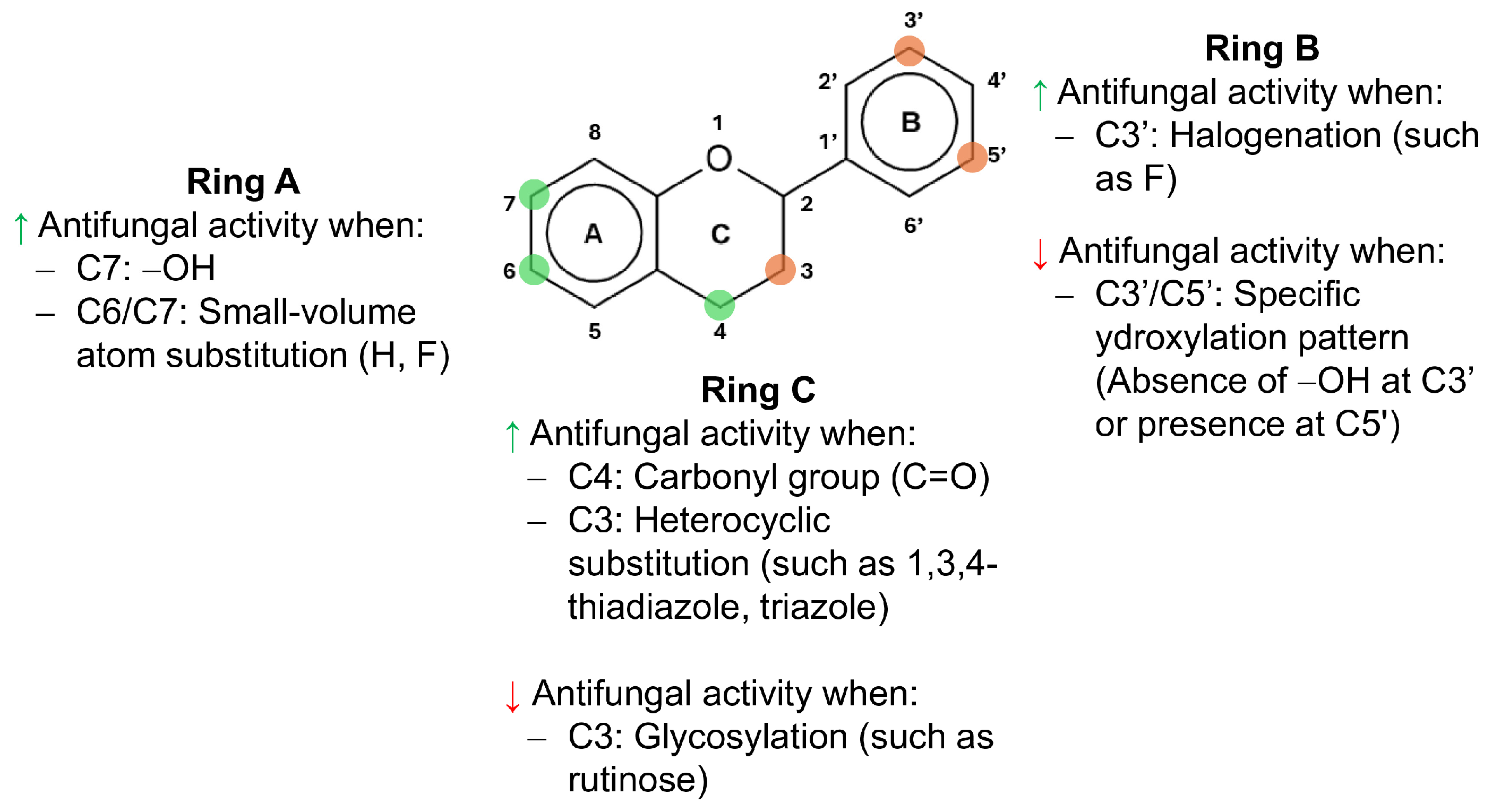
3.2. Structure–Activity Relationship
4. Antibacterial Agents
| Flavonoid | Target Organism | Type of Study | Main Results | Commercial Bactericide | Reference |
|---|---|---|---|---|---|
| Flavanones | |||||
| Carthamidin | Ralstonia solanacearum | In vitro | Showed an inhibition zone diameter of 8.34 ± 0.16 mm. | Streptomycin sulfate (16.80 ± 0.33 mm) | [82] |
| Hesperidin | Xylella fastidiosa | In vitro and In vivo | In vitro, cis-[Mg(hesp)2(phen)]OAc complex was more active (MIC = 1.4 μM) than hesperidin (MIC = 3.3 μM). In vivo, hesperidin reduced bacterial cells to 16.99% of initial abundance, showing moderate activity. | Azadirachtin (MIC = 2.1 μM and reduced bacterial cells to 1.83% in vivo) | [83] |
| Liquiritigenin | Ralstonia solanacearum | In vitro | Showed an inhibition zone diameter of 12.23 mm. | Streptomycin sulfate (16.80 ± 0.33 mm) | [82] |
| Naringenin | Xylella fastidiosa | In vitro and In vivo | In vitro, [Ru(narin)(phen)2]PF6 and cis-[Mg(narin)(phen)2]OAc were more active complexes(MIC 0.19 and 34 μM, respectively) than non-complexed naringenin (7.3 μM). In vivo, naringenin (15.63%) was less active than the respective ruthenium and magnesium complexes (0.12 and 0.65% of initial abundance). | Azadirachtin (MIC = 2.1 μM and reduced bacterial cells to 1.83% in vivo) | [83] |
| Sophoraflavanone G | Streptomyces scabiei | In vitro | At 100 µM, bacterial cell growth was inhibited by 93%. MIC and LD50 values of 6.8 ± 0.4 and 2.0 ± 0.1 µM, respectively. | Novobiocin (used to establish the 0% growth baseline) | [84] |
| Flavanonol | |||||
| Taxifolin | Clavibacter michiganensis subsp. sepedonicus | In vitro and In vivo | The diameter of the inhibition zone, MIC, protective efficiency and curative efficiency were 22.50 mm, 0.313 mg/mL, 84.49 and 79.63%, respectively. | Thiophanate-methyl (at 15 mg/mL, 15.17 mm inhibition zone, MIC = 0.313 mg/mL, protective and curative efficiency of 75.39 and 58.61%, respectively.) | [85] |
| Flavone | |||||
| Agathisflavone | Agrobacterium tumefaciens | In vitro | MIC value of 2 mg/mL. Antagonism was observed when combined with Kocide 3000. | Kocide 3000 (MIC = 0.13 mg/mL) | [86] |
| Erwinia carotovora var. carotovora | In vitro | MIC value of 2 mg/mL. Antagonism was observed when combined with Kocide 3000. | Kocide 3000 (MIC = 0.13 mg/mL) | [86] | |
| Pseudomonas corrugata | In vitro | MIC value of 2 mg/mL. Synergism was observed when combined with Kocide 3000. | Kocide 3000 (MIC = 0.13 mg/mL) | [86] | |
| Pseudomonas syringae pv. tomato | In vitro | MIC value of 2 mg/mL. Synergism was observed when combined with Kocide 3000. | Kocide 3000 (MIC = 0.13 mg/mL) | [86] | |
| Xanthomonas campestres pv. vesicatoria | In vitro | MIC value of 2 mg/mL. Synergism was observed when combined with Kocide 3000. | Kocide 3000 (MIC = 0.13 mg/mL) | [86] | |
| Baicalein | Streptomyces scabiei | In vitro | At 100 µM, bacterial cell growth was inhibited by 30%. MIC and LD50 values of 202.9 ± 5.3 and 52.9 ± 1.3 µM, respectively. | Novobiocin (used to establish the 0% growth baseline) | [84] |
| Jaceosidin | Streptomyces scabiei | In vitro | At 100 µM, bacterial cell growth was inhibited by 40%. MIC and LD50 values of 100.0 ± 2.1 and 22.6 ± 0.5 µM, respectively. | Novobiocin (used to establish the 0% growth baseline) | [84] |
| Isoorientin | Agrobacterium tumefaciens | In vitro | MIC value higher than 0.60 mg/mL. | Streptomycin sulfate (MIC = 0.04 mg/mL) | [49] |
| Pseudomonas syringae pv. lachrymans | In vitro | MIC value higher than 0.60 mg/mL. | Streptomycin sulfate (MIC = 0.04 mg/mL) | [49] | |
| Xanthomonas vesicatoria | In vitro | MIC value higher than 0.60 mg/mL. | Streptomycin sulfate (MIC = 0.04 mg/mL) | [49] | |
| Isovitexin | Agrobacterium tumefaciens | In vitro | MIC value higher than 0.60 mg/mL. | Streptomycin sulfate (MIC = 0.04 mg/mL) | [49] |
| Pseudomonas syringae pv. lachrymans | In vitro | MIC value higher than 0.60 mg/mL. | Streptomycin sulfate (MIC = 0.04 mg/mL) | [49] | |
| Xanthomonas vesicatoria | In vitro | MIC value higher than 0.60 mg/mL. | Streptomycin sulfate (MIC = 0.04 mg/mL) | [49] | |
| Vitexin | Agrobacterium tumefaciens | In vitro | MIC value higher than 0.60 mg/mL. | Streptomycin sulfate (MIC = 0.04 mg/mL) | [49] |
| Pseudomonas syringae pv. lachrymans | In vitro | MIC value higher than 0.60 mg/mL. | Streptomycin sulfate (MIC = 0.04 mg/mL) | [49] | |
| Xanthomonas vesicatoria | In vitro | MIC value higher than 0.60 mg/mL. | Streptomycin sulfate (MIC = 0.04 mg/mL) | [49] | |
| Flavonol | |||||
| Kaempferol | Agrobacterium tumefaciens | In vitro | MIC value of 0.25 mg/mL. Antagonism was observed when combined with Kocide 3000. | Kocide 3000 (MIC = 0.13 mg/mL) | [86] |
| In vitro | MIC value higher than 0.60 mg/mL. | Streptomycin sulfate (MIC = 0.04 mg/mL) | [49] | ||
| Erwinia carotovora var. carotovora | In vitro | MIC value of 2 mg/mL. Antagonism was observed when combined with Kocide 3000. | Kocide 3000 (MIC = 0.13 mg/mL) | [86] | |
| Pseudomonas corrugata | In vitro | MIC value of 0.25 mg/mL. Synergism was observed when combined with Kocide 3000. | Kocide 3000 (MIC = 0.13 mg/mL) | [86] | |
| Pseudomonas syringae pv. lachrymans | In vitro | MIC value higher than 0.60 mg/mL. | Streptomycin sulfate (MIC = 0.04 mg/mL) | [49] | |
| Pseudomonas syringae pv. tomato | In vitro | MIC value of 0.5 mg/mL. Synergism was observed when combined with Kocide 3000. | Kocide 3000 (MIC = 0.13 mg/mL) | [86] | |
| Xanthomonas campestres pv. vesicatoria | In vitro | MIC value of 0.5 mg/mL. Synergism was observed when combined with Kocide 3000. | Kocide 3000 (MIC = 0.13 mg/mL) | [86] | |
| Xanthomonas vesicatoria | In vitro | MIC value higher than 0.60 mg/mL. | Streptomycin sulfate (MIC = 0.04 mg/mL) | [49] | |
| Quercetin | Agrobacterium tumefaciens | In vitro | MIC value of 2 mg/mL. Antagonism was observed when combined with Kocide 3000. | Kocide 3000 (MIC = 0.13 mg/mL) | [86] |
| In vitro | MIC value of 0.2 mg/mL. | Streptomycin sulfate (MIC = 0.04 mg/mL) | [49] | ||
| Erwinia carotovora var. carotovora | In vitro | MIC value of 2 mg/mL. Antagonism was observed when combined with Kocide 3000. | Kocide 3000 (MIC = 0.13 mg/mL) | [86] | |
| Pseudomonas corrugata | In vitro | MIC value of 1 mg/mL. Synergism was observed when combined with Kocide 3000. | Kocide 3000 (MIC = 0.13 mg/mL) | [86] | |
| Pseudomonas syringae pv. lachrymans | In vitro | MIC value of 0.4 mg/mL. | Streptomycin sulfate (MIC = 0.04 mg/mL) | [49] | |
| Pseudomonas syringae pv. tomato | In vitro | MIC value of 1 mg/mL. Synergism was observed when combined with Kocide 3000. | Kocide 3000 (MIC = 0.13 mg/mL) | [86] | |
| Streptomyces scabiei | In vitro | At 100 µM, bacterial cell growth was inhibited by 45%. MIC and LD50 values of 285.2 ± 6.8 and 37.8 ± 1.0 µM, respectively. | Novobiocin (used to establish the 0% growth baseline) | [84] | |
| Xanthomonas campestres pv. vesicatoria | In vitro | MIC value of 1 mg/mL. Synergism was observed when combined with Kocide 3000. | Kocide 3000 (MIC = 0.13 mg/mL) | [86] | |
| Xanthomonas vesicatoria | In vitro | MIC value of 0.2 mg/mL. | Streptomycin sulfate (MIC = 0.04 mg/mL) | [49] | |
| Rutin | Agrobacterium tumefaciens | In vitro | MIC value higher than 0.6 mg/mL. | Streptomycin sulfate (MIC = 0.04 mg/mL) | [49] |
| Pseudomonas syringae pv. lachrymans | In vitro | MIC value higher than 0.6 mg/mL. | Streptomycin sulfate (MIC = 0.04 mg/mL) | [49] | |
| Xanthomonas perforans | In vitro and In vivo | At 2 mM, rutin had no effect on antibacterial activity in vitro but reduced the disease severity of bacterial spot. | n.a. | [87] | |
| Xanthomonas vesicatoria | In vitro | MIC value higher than 0.6 mg/mL. | Streptomycin sulfate (MIC = 0.04 mg/mL) | [49] | |
| Isoflavone | |||||
| Biochanin A | Acidovorax citrulli | In vitro | MIC value lower than 200 µg/mL. | n.a. | [81] |
| Clavibacter michiganensis | In vitro | MIC value lower than 200 µg/mL. | n.a. | [81] | |
| Erwinia amylovora | In vitro | MIC value lower than 200 µg/mL. | n.a. | [81] | |
| Xanthomonas axonopodis pv. glycines | In vitro and In vivo | MIC value lower than 100 µg/mL. Significantly reduced the number of lesions per soybean leaf at 100, 200, and 500 µg/mL (135.3 ± 18.2, 89.8 ± 30.1, and 27.8 ± 7.7). | Chloromycetin (500 μg/mL, the number of lesions per leaf was 62.4 ± 17.9) | [81] | |
| Genistein | Acidovorax citrulli | In vitro | MIC value lower than 500 µg/mL. | n.a. | [81] |
| Clavibacter michiganensis | In vitro | MIC value lower than 500 µg/mL. | n.a. | [81] | |
| Erwinia amylovora | In vitro | MIC value lower than 500 µg/mL. | n.a. | [81] | |
| Xanthomonas axonopodis pv. glycines | In vitro | MIC value lower than 500 µg/mL. | n.a. | [81] | |
| Others | |||||
| (3R)-2′,3′,7-trihydroxy-4′-methoxyisoflavanone | Ralstonia solanacearum | In vitro | Showed an inhibition zone diameter of 8.11 mm. | Streptomycin sulfate (16.80 ± 0.33 mm) | [82] |
| (3R)-4′-methoxy 2′,3,7-trihydroxyisoflavanone | Ralstonia solanacearum | In vitro | Showed an inhibition zone diameter of 9.99 mm. | Streptomycin sulfate (16.80 ± 0.33 mm) | [82] |
| (3R)-vestitol | Ralstonia solanacearum | In vitro | Showed an inhibition zone diameter of 16.62 mm. | Streptomycin sulfate (16.80 ± 0.33 mm) | [82] |
| (3R)-vestitone | Ralstonia solanacearum | In vitro | Showed an inhibition zone diameter of 11.19 mm. | Streptomycin sulfate (16.80 ± 0.33 mm) | [82] |
| Sativanone | Ralstonia solanacearum | In vitro | Showed an inhibition zone diameter of 6.53 mm. | Streptomycin sulfate (16.80 ± 0.33 mm) | [82] |
4.1. Modes of Action
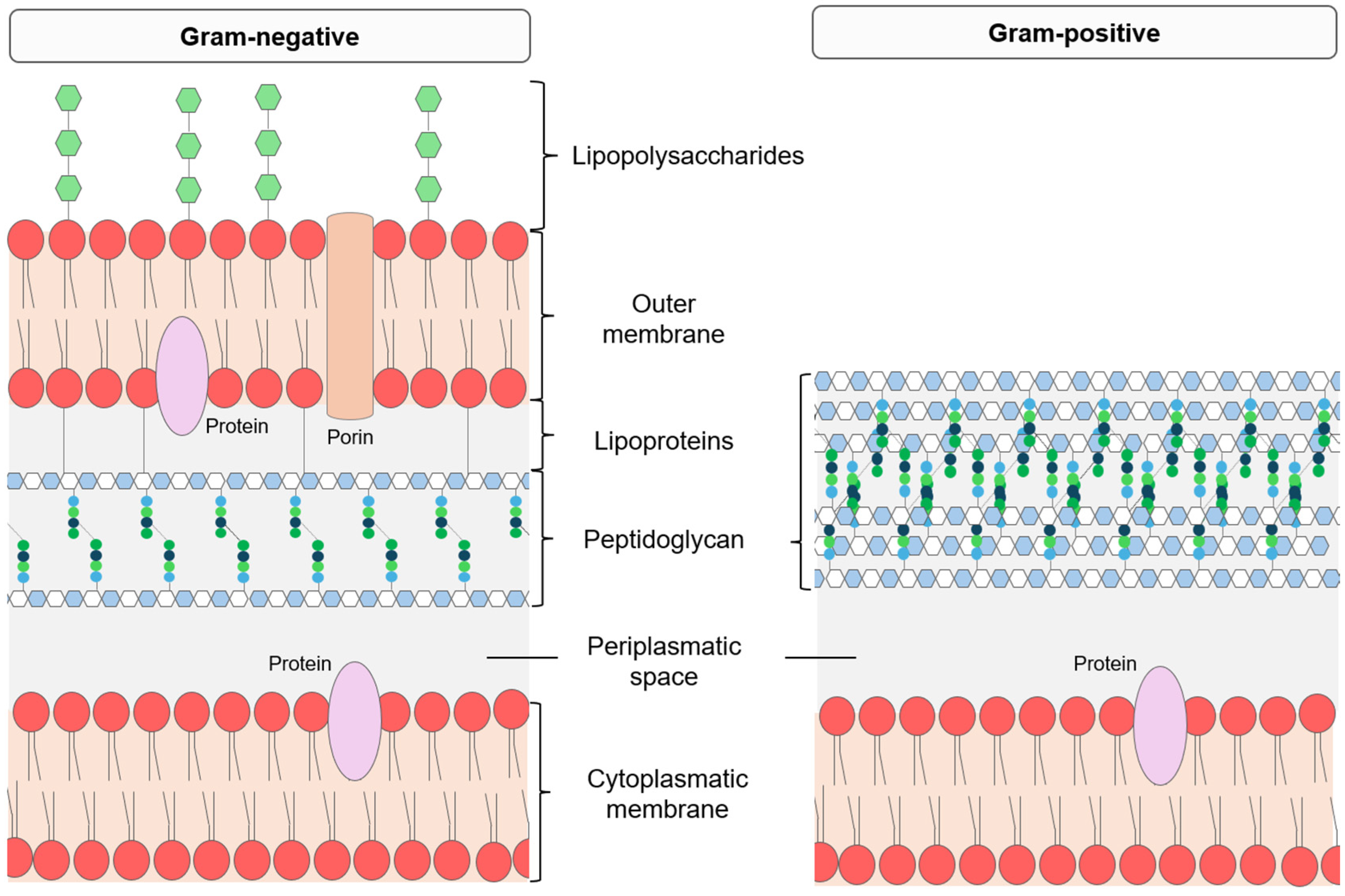
4.1.1. Effects on Cell Wall and Membrane Integrity
4.1.2. Effects on Biofilm Formation
4.1.3. Effects on Motility
4.1.4. Multisite Activity
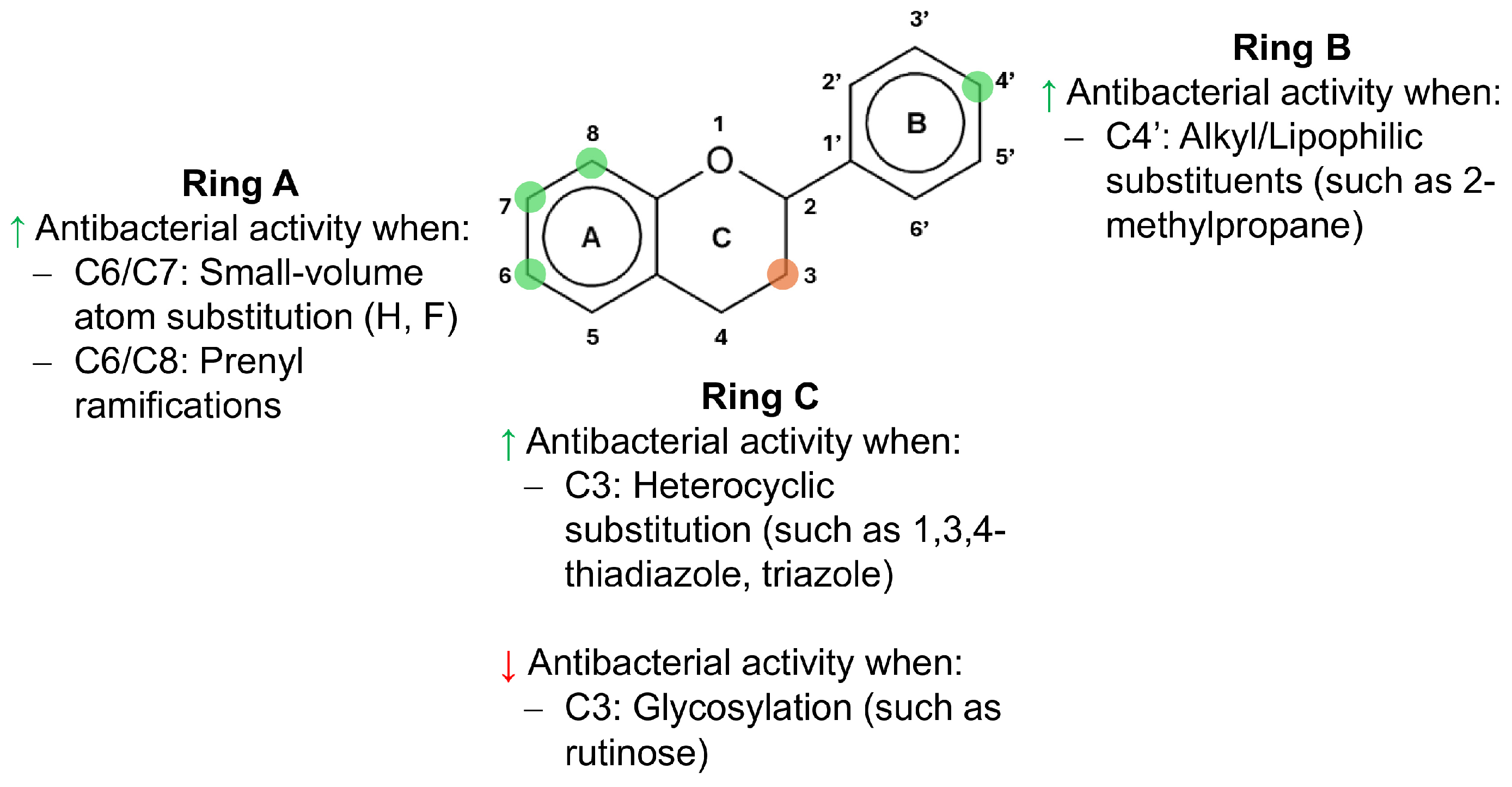
4.2. Structure–Activity Relationship
5. Flavonoid Formulation
6. Flavonoids Position Within the Biopesticide Sector
7. Conclusions and Future Perspectives
Author Contributions
Funding
Data Availability Statement
Conflicts of Interest
Abbreviations
| IC50 | Half maximal inhibitory concentration |
| MIC | Minimum inhibitory concentration |
| MFC | Minimum fungicidal concentration |
| LD50 | Mean lethal dose |
| ROS | Reactive oxygen species |
| MDA | Malondialdehyde |
| ATP | Adenosine triphosphate |
| ADP | Adenosine diphosphate |
| AMP | Adenosine monophosphate |
| DNA | Deoxyribonucleic acid |
References
- Singh, B.K.; Delgado-Baquerizo, M.; Egidi, E.; Guirado, E.; Leach, J.E.; Liu, H.; Trivedi, P. Climate Change Impacts on Plant Pathogens, Food Security and Paths Forward. Nat. Rev. Microbiol. 2023, 21, 640–656. [Google Scholar] [CrossRef] [Scilit] [PubMed]
- Aguilar-Marcelino, L.; Mendoza-de-Gives, P.; Al-Ani, L.K.T.; López-Arellano, M.E.; Gómez-Rodríguez, O.; Villar-Luna, E.; Reyes-Guerrero, D.E. Using Molecular Techniques Applied to Beneficial Microorganisms as Biotechnological Tools for Controlling Agricultural Plant Pathogens and Pest. In Molecular Aspects of Plant Beneficial Microbes in Agriculture; Elsevier: Amsterdam, The Netherlands, 2020; pp. 333–349. [Google Scholar]
- Ibáñez, A.; Garrido-Chamorro, S.; Barreiro, C. Microorganisms and Climate Change: A Not so Invisible Effect. Microbiol. Res. 2023, 14, 918–947. [Google Scholar] [CrossRef] [Scilit]
- Steinberg, G.; Gurr, S.J. Fungi, Fungicide Discovery and Global Food Security. Fungal Genet. Biol. 2020, 144, 103476. [Google Scholar] [CrossRef] [Scilit] [PubMed]
- Martins, L.C.; Monteiro, C.C.; Semedo, P.M.; Sá-Correia, I. Valorisation of Pectin-Rich Agro-Industrial Residues by Yeasts: Potential and Challenges. Appl. Microbiol. Biotechnol. 2020, 104, 6527–6547. [Google Scholar] [CrossRef] [Scilit] [PubMed]
- Maryani, N.; Lombard, L.; Poerba, Y.S.; Subandiyah, S.; Crous, P.W.; Kema, G.H.J. Phylogeny and Genetic Diversity of the Banana Fusarium Wilt Pathogen Fusarium oxysporum f. sp. cubense in the Indonesian Centre of Origin. Stud. Mycol. 2019, 92, 155–194. [Google Scholar] [CrossRef] [Scilit] [PubMed]
- Satyanarayana, P.; Guhan, T.; Ganesan, T.; Bhagyalakshmi, A.; Pallavi, L.; Koshariya, A.K.; Sabarimuthu, M.; Rajaram, A. Exploring the Impact of Pesticide Resistance in Agricultural Pest Management. Glob. NEST J. 2024, 26, 05931. [Google Scholar] [CrossRef] [Scilit]
- Hasan, G.M.M.A.; Das, A.K.; Satter, M.A. Multi Residue Analysis of Organochlorine Pesticides in Fish, Milk, Egg and Their Feed by GC-MS/MS and Their Impact Assessment on Consumers Health in Bangladesh. NFS J. 2022, 27, 28–35. [Google Scholar] [CrossRef] [Scilit]
- Cavalier, H.; Trasande, L.; Porta, M. Exposures to Pesticides and Risk of Cancer: Evaluation of Recent Epidemiological Evidence in Humans and Paths Forward. Int. J. Cancer 2023, 152, 879–912. [Google Scholar] [CrossRef] [Scilit] [PubMed]
- Höllerhage, M. Pesticides and Parkinson’s Disease: Causal Relationship at the Population and Individual Level? J. Neural Transm. 2026, 133, 229–264. [Google Scholar] [CrossRef] [Scilit] [PubMed]
- Medithi, S.; Kasa, Y.D.; Jee, B.; Venkaiah, K.; Jonnalagadda, P.R. Alterations in Reproductive Hormone Levels among Farm Women and Their Children Occupationally Exposed to Organophosphate Pesticides. Women Health 2022, 62, 454–464. [Google Scholar] [CrossRef] [Scilit] [PubMed]
- Lahimer, M.; Capelle, S.; Lefranc, E.; Cabry, R.; Montjean, D.; Bach, V.; Ajina, M.; Ali, H.B.; Benkhalifa, M.; Khorsi-Cauet, H. Effect of Pesticide Exposure on Human Sperm Characteristics, Genome Integrity, and Methylation Profile Analysis. Environ. Sci. Pollut. Res. 2023, 30, 77560–77567. [Google Scholar] [CrossRef] [Scilit] [PubMed]
- Faraj, T.K.; EL-Saeid, M.H.; Najim, M.M.M.; Chieb, M. The Impact of Pesticide Residues on Soil Health for Sustainable Vegetable Production in Arid Areas. Separations 2024, 11, 46. [Google Scholar] [CrossRef] [Scilit]
- Teklu, B.M.; Haileslassie, A.; Mekuria, W. Pesticides as Water Pollutants and Level of Risks to Environment and People: An Example from Central Rift. Environ. Dev. Sustain. 2022, 24, 5275–5294. [Google Scholar] [CrossRef] [Scilit]
- Egbe, C.C.; Oyetibo, O.G.; Ilori, O.M. Ecological Impact of Organochlorine Pesticides Consortium on Autochthonous Microbial Community in Agricultural Soil. Ecotoxicol. Environ. Saf. 2021, 207, 111319. [Google Scholar] [CrossRef] [Scilit] [PubMed]
- Tataridas, A.; Kanatas, P.; Chatzigeorgiou, A.; Zannopoulos, S.; Travlos, I. Sustainable Crop and Weed Management in the Era of the EU Green Deal: A Survival Guide. Agronomy 2022, 12, 589. [Google Scholar] [CrossRef] [Scilit]
- EPA What Are Biopesticides? Available online: https://www.epa.gov/ingredients-used-pesticide-products/what-are-biopesticides (accessed on 13 November 2025).
- Liu, X.; Cao, A.; Yan, D.; Ouyang, C.; Wang, Q.; Li, Y. Overview of Mechanisms and Uses of Biopesticides. Int. J. Pest Manag. 2021, 67, 65–72. [Google Scholar] [CrossRef] [Scilit]
- Al-Khayri, J.M.; Rashmi, R.; Toppo, V.; Chole, P.B.; Banadka, A.; Sudheer, W.N.; Nagella, P.; Shehata, W.F.; Al-Mssallem, M.Q.; Alessa, F.M.; et al. Plant Secondary Metabolites: The Weapons for Biotic Stress Management. Metabolites 2023, 13, 716. [Google Scholar] [CrossRef] [Scilit] [PubMed]
- Schnarr, L.; Segatto, M.L.; Olsson, O.; Zuin, V.G.; Kümmerer, K. Flavonoids as Biopesticides—Systematic Assessment of Sources, Structures, Activities and Environmental Fate. Sci. Total Environ. 2022, 824, 153781. [Google Scholar] [CrossRef] [Scilit] [PubMed]
- Jung, M.; Bang, S.-W.; Lee, J.-E.; Kim, J.-E.; Park, I.-K. Antibacterial Mode of Action of Thyme White (Thymus vulgaris L.) Essential Oil and Its Constituents, Thymol and Carvacrol against Agrobacterium tumefaciens via down-Regulation of Manganese Transport Genes, SitABCD and MntH. Pestic. Biochem. Physiol. 2025, 214, 106601. [Google Scholar] [CrossRef] [Scilit] [PubMed]
- Nikolova, M.; Lyubenova, A.; Yankova-Tsvetkova, E.; Georgiev, B.; Gavrilov, G.; Gavrilova, A. Satureja Kitaibelii Essential Oil and Extracts: Bioactive Compounds and Pesticide Properties. Agronomy 2025, 15, 357. [Google Scholar] [CrossRef] [Scilit]
- Saikumar, T.; Manideep, S.; Paschapur, A.U.; Thrilekha, D. Botanical Pesticides: Exploring Successes, Challenges, and Future Directions in Sustainable Pest Management. J. Plant Dis. Prot. 2025, 132, 175. [Google Scholar] [CrossRef] [Scilit]
- Sarmah, K.; Anbalagan, T.; Marimuthu, M.; Mariappan, P.; Angappan, S.; Vaithiyanathan, S. Innovative Formulation Strategies for Botanical- and Essential Oil-Based Insecticides. J. Pest Sci. 2025, 98, 1–30. [Google Scholar] [CrossRef] [Scilit]
- Ferraz, C.A.; Pastorinho, M.R.; Palmeira-de-Oliveira, A.; Sousa, A.C.A. Ecotoxicity of Plant Extracts and Essential Oils: A Review. Environ. Pollut. 2022, 292, 118319. [Google Scholar] [CrossRef] [Scilit] [PubMed]
- Sweet, R.; Kroon, P.A.; Webber, M.A. Activity of Antibacterial Phytochemicals and Their Potential Use as Natural Food Preservatives. Crit. Rev. Food Sci. Nutr. 2024, 64, 2076–2087. [Google Scholar] [CrossRef] [Scilit] [PubMed]
- De Rossi, L.; Rocchetti, G.; Lucini, L.; Rebecchi, A. Antimicrobial Potential of Polyphenols: Mechanisms of Action and Microbial Responses—A Narrative Review. Antioxidants 2025, 14, 200. [Google Scholar] [CrossRef] [Scilit] [PubMed]
- Davidova, S.; Galabov, A.S.; Satchanska, G. Antibacterial, Antifungal, Antiviral Activity, and Mechanisms of Action of Plant Polyphenols. Microorganisms 2024, 12, 2502. [Google Scholar] [CrossRef] [Scilit] [PubMed]
- Pereira, V.; Figueira, O.; Castilho, P.C. Flavonoids as Insecticides in Crop Protection—A Review of Current Research and Future Prospects. Plants 2024, 13, 776. [Google Scholar] [CrossRef] [Scilit] [PubMed]
- Al Aboody, M.S.; Mickymaray, S. Anti-Fungal Efficacy and Mechanisms of Flavonoids. Antibiotics 2020, 9, 45. [Google Scholar] [CrossRef] [Scilit] [PubMed]
- Kalinova, J.; Radova, S. Effects of Rutin on the Growth of Botrytis cinerea, Alternaria alternata and Fusarium solani. Acta Phytopathol. Entomol. Hung. 2009, 44, 39–47. [Google Scholar] [CrossRef] [Scilit]
- Agathokleous, E.; Calabrese, E.J. Fungicide-Induced Hormesis in Phytopathogenic Fungi: A Critical Determinant of Successful Agriculture and Environmental Sustainability. J. Agric. Food Chem. 2021, 69, 4561–4563. [Google Scholar] [CrossRef] [Scilit] [PubMed]
- Padmavati, M.; Sakthivel, N.; Thara, K.V.; Reddy, A.R. Differential Sensitivity of Rice Pathogens to Growth Inhibition by Flavonoids. Phytochemistry 1997, 46, 499–502. [Google Scholar] [CrossRef] [Scilit]
- Xu, D.; Deng, Y.; Han, T.; Jiang, L.; Xi, P.; Wang, Q.; Jiang, Z.; Gao, L. In Vitro and in Vivo Effectiveness of Phenolic Compounds for the Control of Postharvest Gray Mold of Table Grapes. Postharvest Biol. Technol. 2018, 139, 106–114. [Google Scholar] [CrossRef] [Scilit]
- Tao, S.; Zhang, S.; Tsao, R.; Charles, M.T.; Yang, R.; Khanizadeh, S. In Vitro Antifungal Activity and Mode of Action of Selected Polyphenolic Antioxidants on Botrytis cinerea. Arch. Phytopathol. Plant Prot. 2010, 43, 1564–1578. [Google Scholar] [CrossRef] [Scilit]
- Roy, S.; Nuckles, E.; Archbold, D.D. Effects of Phenolic Compounds on Growth of Colletotrichum spp. In Vitro. Curr. Microbiol. 2018, 75, 550–556. [Google Scholar] [CrossRef] [Scilit] [PubMed]
- Sun, M.; Li, L.; Wang, C.; Wang, L.; Lu, D.; Shen, D.; Wang, J.; Jiang, C.; Cheng, L.; Pan, X.; et al. Naringenin Confers Defence against Phytophthora cicotianae through Antimicrobial Activity and Induction of Pathogen Resistance in Tobacco. Mol. Plant Pathol. 2022, 23, 1737–1750. [Google Scholar] [CrossRef] [Scilit] [PubMed]
- Wang, X.; Wei, X.; Tian, Y.; Shen, L.; Xu, H. Antifungal Flavonoids from Ficus sarmentosa Var. Henryi (King) Corner. Agric. Sci. China 2010, 9, 690–694. [Google Scholar] [CrossRef] [Scilit]
- Nguyen-Ngoc, H.; Nguyen, C.Q.; Vo, K.A.T.; Nguyen, T.T.T.; Nghiem, D.T.; Ha, N.T.; Nguyen, V.M.; Choi, G.J.; Ardiansyah, A.G.; Nguyen, C.T.; et al. Insight into the Role of Phytoalexin Naringenin and Phytohormone Abscisic Acid in Defense against Phytopathogens Phytophthora infestans and Magnaporthe oryzae: In Vitro and in Silico Approaches. Physiol. Mol. Plant Pathol. 2023, 127, 102123. [Google Scholar] [CrossRef] [Scilit]
- Quiroga, E.N.; Sampietro, D.A.; Soberón, J.R.; Sgariglia, M.A.; Vattuone, M.A. Propolis from the Northwest of Argentina as a Source of Antifungal Principles. J. Appl. Microbiol. 2006, 101, 103–110. [Google Scholar] [CrossRef] [Scilit] [PubMed]
- Peng, L.; Yang, S.; Cheng, Y.J.; Chen, F.; Pan, S.; Fan, G. Antifungal Activity and Action Mode of Pinocembrin from Propolis against Penicillium italicum. Food Sci. Biotechnol. 2012, 21, 1533–1539. [Google Scholar] [CrossRef] [Scilit]
- Chen, C.; Chen, J.; Wan, C. Pinocembrin-7-Glucoside (P7G) Reduced Postharvest Blue Mold of Navel Orange by Suppressing Penicillium italicum Growth. Microorganisms 2020, 8, 536. [Google Scholar] [CrossRef] [Scilit] [PubMed]
- Ouyang, H.; Hou, K.; Ge, S.; Deng, H.; Peng, W. Antimicrobial Activities of Flavonoids against Bamboo-Destroying Fungi and Molds. Toxicol. Environ. Chem. 2017, 99, 892–899. [Google Scholar] [CrossRef] [Scilit]
- Steinkellner, S.; Mammerler, R. Effect of Flavonoids on the Development of Fusarium oxysporum f. sp. lycopersici. J. Plant Interact. 2007, 2, 17–23. [Google Scholar] [CrossRef] [Scilit]
- Vargas, I.; Sanz, I.; Moya, P.; Prima-Yúfera, E. Antimicrobial and Antioxidant Compounds in the Nonvolatile Fraction of Expressed Orange Essential Oil. J. Food Prot. 1999, 62, 929–932. [Google Scholar] [CrossRef] [Scilit] [PubMed]
- Liang, M.; Ye, H.; Shen, Q.; Jiang, X.; Cui, G.; Gu, W.; Zhang, L.; Naqvi, N.I.; Deng, Y.Z. Tangeretin Inhibits Fungal Ferroptosis to Suppress Rice Blast. J. Integr. Plant Biol. 2021, 63, 2136–2149. [Google Scholar] [CrossRef] [Scilit] [PubMed]
- Ilk, S.; Saglam, N.; Özgen, M. Kaempferol Loaded Lecithin/Chitosan Nanoparticles: Preparation, Characterization, and Their Potential Applications as a Sustainable Antifungal Agent. Artif. Cells Nanomed. Biotechnol. 2017, 45, 907–916. [Google Scholar] [CrossRef] [Scilit] [PubMed]
- Xi, K.-Y.; Xiong, S.-J.; Li, G.; Guo, C.-Q.; Zhou, J.; Ma, J.-W.; Yin, J.-L.; Liu, Y.-Q.; Zhu, Y.-X. Antifungal Activity of Ginger Rhizome Extract against Fusarium solani. Horticulturae 2022, 8, 983. [Google Scholar] [CrossRef] [Scilit]
- Zhong, L.; Lin, Y.; Wang, C.; Niu, B.; Xu, Y.; Zhao, G.; Zhao, J. Chemical Profile, Antimicrobial and Antioxidant Activity Assessment of the Crude Extract and Its Main Flavonoids from Tartary Buckwheat Sprouts. Molecules 2022, 27, 374. [Google Scholar] [CrossRef] [Scilit] [PubMed]
- Wang, J.; Li, L.; Yin, Y.; Gu, Z.; Chai, R.; Wang, Y.; Sun, G. Equol, a Clinically Important Metabolite, Inhibits the Development and Pathogenicity of Magnaporthe oryzae, the Causal Agent of Rice Blast Disease. Molecules 2017, 22, 1799. [Google Scholar] [CrossRef] [Scilit] [PubMed]
- Garcia-Rubio, R.; de Oliveira, H.C.; Rivera, J.; Trevijano-Contador, N. The Fungal Cell Wall: Candida, Cryptococcus, and Aspergillus Species. Front. Microbiol. 2020, 10, 2993. [Google Scholar] [CrossRef] [Scilit] [PubMed]
- Ost, K.J.; Student, M.; Cord-Landwehr, S.; Moerschbacher, B.M.; Ram, A.F.J.; Dirks-Hofmeister, M.E. Cell Walls of Filamentous Fungi—Challenges and Opportunities for Biotechnology. Appl. Microbiol. Biotechnol. 2025, 109, 125. [Google Scholar] [CrossRef] [Scilit] [PubMed]
- Plaza, V.; Silva-Moreno, E.; Castillo, L. Breakpoint: Cell Wall and Glycoproteins and Their Crucial Role in the Phytopathogenic Fungi Infection. Curr. Protein Pept. Sci. 2020, 21, 227–244. [Google Scholar] [CrossRef] [Scilit] [PubMed]
- Xu, Y.; Zhou, H.; Zhao, G.; Yang, J.; Luo, Y.; Sun, S.; Wang, Z.; Li, S.; Jin, C. Genetical and O-Glycoproteomic Analyses Reveal the Roles of Three Protein O-Mannosyltransferases in Phytopathogen Fusarium oxysporum f.sp. cucumerinum. Fungal Genet. Biol. 2020, 134, 103285. [Google Scholar] [CrossRef] [Scilit] [PubMed]
- Yang, D.; Luo, L.; Liu, Y.; Li, H. O-Mannosyltransferase CfPmt4 Regulates the Growth, Development and Pathogenicity of Colletotrichum fructicola. J. Fungi 2024, 10, 330. [Google Scholar] [CrossRef] [Scilit] [PubMed]
- Pan, Y.; Pan, R.; Tan, L.; Zhang, Z.; Guo, M. Pleiotropic Roles of O-Mannosyltransferase MoPmt4 in Development and Pathogenicity of Magnaporthe oryzae. Curr. Genet. 2019, 65, 223–239. [Google Scholar] [CrossRef] [Scilit] [PubMed]
- Zhang, S.; Wang, Y.; Hu, J.; Cui, X.; Kang, X.; Zhao, W.; Pan, Y. The N-Mannosyltransferase MoAlg9 Plays Important Roles in the Development and Pathogenicity of Magnaporthe oryzae. J. Integr. Agric. 2025, 24, 2266–2284. [Google Scholar] [CrossRef] [Scilit]
- Zhang, M.; Xu, L.; Zhang, L.; Guo, Y.; Qi, X.; He, L. Effects of Quercetin on Postharvest Blue Mold Control in Kiwifruit. Sci. Hortic. 2018, 228, 18–25. [Google Scholar] [CrossRef] [Scilit]
- Soleimani, H.; Mostowfizadeh-ghalamfarsa, R.; Ghanadian, S.M. Celery Flavonoid-Rich Extract Significantly Reduces Cucumber Powdery Mildew Severity and Enhances Plant Defense Responses. Sci. Rep. 2025, 15, 10589. [Google Scholar] [CrossRef] [Scilit] [PubMed]
- Nosanchuk, J.D.; Stark, R.E.; Casadevall, A. Fungal Melanin: What Do We Know About Structure? Front. Microbiol. 2015, 6, 1463. [Google Scholar] [CrossRef] [Scilit] [PubMed]
- Yang, C.; Hamel, C.; Vujanovic, V.; Gan, Y. Fungicide: Modes of Action and Possible Impact on Nontarget Microorganisms. ISRN Ecol. 2011, 2011, 130289. [Google Scholar] [CrossRef] [Scilit]
- Cheng, H.; Mou, Z.; Wang, W.; Zhang, W.; Wang, Z.; Zhang, M.; Yang, E.; Sun, D. Chitosan–Catechin Coating as an Antifungal and Preservable Agent for Postharvest Satsuma Oranges. J. Food Biochem. 2019, 43, e12779. [Google Scholar] [CrossRef] [Scilit] [PubMed]
- Wang, K.; Zhang, X.; Shao, X.; Wei, Y.; Xu, F.; Wang, H. Flavonoids from Sedum aizoon L. Inhibit Botrytis cinerea by Negatively Affecting Cell Membrane Lipid Metabolism. Appl. Microbiol. Biotechnol. 2022, 106, 7139–7151. [Google Scholar] [CrossRef] [Scilit] [PubMed]
- Li, A.; Zhao, Z.; Zhang, S.; Zhang, Z.; Shi, Y. Fungicidal Activity and Mechanism of Action of Glabridin from Glycyrrhiza glabra L. Int. J. Mol. Sci. 2021, 22, 10966. [Google Scholar] [CrossRef] [Scilit] [PubMed]
- Yang, C.; Xie, L.; Ma, Y.; Cai, X.; Yue, G.; Qin, G.; Zhang, M.; Gong, G.; Chang, X.; Qiu, X.; et al. Study on the Fungicidal Mechanism of Glabridin against Fusarium graminearum. Pestic. Biochem. Physiol. 2021, 179, 104963. [Google Scholar] [CrossRef] [Scilit] [PubMed]
- Duvenage, L.; Munro, C.A.; Gourlay, C.W. The Potential of Respiration Inhibition as a New Approach to Combat Human Fungal Pathogens. Curr. Genet. 2019, 65, 1347–1353. [Google Scholar] [CrossRef] [Scilit] [PubMed]
- Cotoras, M.; Mendoza, L.; Muñoz, A.; Yáñez, K.; Castro, P.; Aguirre, M. Fungitoxicity against Botrytis cinerea of a Flavonoid Isolated from Pseudognaphalium robustum. Molecules 2011, 16, 3885–3895. [Google Scholar] [CrossRef] [Scilit]
- Júnior, H.M.S.; Campos, V.A.C.; Alves, D.S.; Cavalheiro, A.J.; Souza, L.P.; Botelho, D.M.S.; Chalfoun, S.M.; Oliveira, D.F. Antifungal Activity of Flavonoids from Heteropterys byrsonimifolia and a Commercial Source against Aspergillus ochraceus: In Silico Interactions of These Compounds with a Protein Kinase. Crop Prot. 2014, 62, 107–114. [Google Scholar] [CrossRef] [Scilit]
- Ren, Z.; Liu, N.; Jia, H.; Sun, M.; Ma, S.; Zhao, B.; Chen, Y.; Miao, X.; Cao, Z.; Dong, J. Discovery of Aldehyde Dehydrogenase as a Potential Fungicide Target and Screening of Its Natural Inhibitors against Fusarium verticillioides. J. Agric. Food Chem. 2024, 72, 19424–19435. [Google Scholar] [CrossRef] [Scilit] [PubMed]
- Grosjean, H. DNA and RNA Modification Enzymes; CRC Press: Boca Raton, FL, USA, 2009. [Google Scholar]
- Andrade-Pavón, D.; Gómez-García, O.; Villa-Tanaca, L. Molecular Recognition of Citroflavonoids Naringin and Naringenin at the Active Site of the HMG-CoA Reductase and DNA Topoisomerase Type II Enzymes of Candida spp. and Ustilago maydis. Indian J. Microbiol. 2022, 62, 79–87. [Google Scholar] [CrossRef] [Scilit] [PubMed]
- Yan, Y.-F.; Wu, T.-L.; Du, S.-S.; Wu, Z.-R.; Hu, Y.-M.; Zhang, Z.-J.; Zhao, W.-B.; Yang, C.-J.; Liu, Y.-Q. The Antifungal Mechanism of Isoxanthohumol from Humulus lupulus Linn. Int. J. Mol. Sci. 2021, 22, 10853. [Google Scholar] [CrossRef] [Scilit] [PubMed]
- An, J.-X.; Wang, R.; Li, A.-P.; Zhang, W.; Nan, Z.; Jiang, W.-Q.; Zhang, S.-Y.; Zhang, Z.-J.; Luo, X.-F.; Liang, H.-J.; et al. Prenylated Flavonoids Isolated from the Root of Sophora flavescens as Potent Antifungal Agents against Botrytis cinerea. J. Agric. Food Chem. 2024, 72, 19618–19628. [Google Scholar] [CrossRef] [Scilit] [PubMed]
- Zhou, Y.; Gong, C.; Sun, Z.; Zeng, W.; Meng, K.; An, Y.; Hu, Y.; Xue, W. Novel Flavonol Derivatives Containing 1,3,4-Thiadiazole as Potential Antifungal Agents: Design, Synthesis, and Biological Evaluation. ACS Omega 2024, 9, 17297–17306. [Google Scholar] [CrossRef] [Scilit] [PubMed]
- Meng, K.; Deng, T.; Liu, M.; Pu, H.; Zhang, Y.; Zou, H.; Xing, Y.; Xue, W. Novel Containing 1,2,4-Triazole Schiff Bases as Potential Antifungal Agents: Design, Synthesis, and Biological Evaluation. Bioorg. Chem. 2024, 153, 107965. [Google Scholar] [CrossRef] [Scilit] [PubMed]
- Meng, F.; Yan, Z.; Lu, Y.; Wang, X. Design, Synthesis, and Antifungal Activity of Flavonoid Derivatives Containing Thiazole Moiety. Chem. Pap. 2023, 77, 877–885. [Google Scholar] [CrossRef] [Scilit]
- Chen, H.; Jiang, Z.; Tong, H.; Mai, Z.; Kong, R.; Zhang, W.; Zhang, M.-Z.; Chen, K.; Zhu, Y. Discovery of Novel Acethydrazide-Containing Flavonol Derivatives as Potential Antifungal Agents. J. Agric. Food Chem. 2024, 72, 17229–17239. [Google Scholar] [CrossRef] [Scilit] [PubMed]
- Lucas-Bautista, J.A.; Cárdenas-Valdovinos, J.G.; Mena-Violante, G.H.; Pacheco-Aguilar, J.R.; Mendoza, S. Antimicrobial Activity of Phytopathogenic Bacteria Berries Anthocyanin Extracts against Phytopathogenic Bacteria. J. Mex. Chem. Soc. 2025, 69, 542–554. [Google Scholar] [CrossRef] [Scilit]
- Lai, C.; Huang, M.; Xiong, Q.; Liang, Y.; Jiang, Y.; Zhang, J. Green and Efficient Approach to Extract Bioactive Flavonoids with Antioxidant, Antibacterial, Antiglycation, and Enzyme Inhibitory Activities from Navel Orange Peel. Sustain. Agric. Pharm. 2024, 38, 101479. [Google Scholar] [CrossRef] [Scilit]
- Hasegawa, T.; Kato, Y.; Okabe, A.; Itoi, C.; Ooshiro, A.; Kawaide, H.; Natsume, M. Effect of Secondary Metabolites of Tomato (Solanum lycopersicum) on Chemotaxis of Ralstonia solanacearum, Pathogen of Bacterial Wilt Disease. J. Agric. Food Chem. 2019, 67, 1807–1813. [Google Scholar] [CrossRef] [Scilit] [PubMed]
- Hu, K.; Shi, X.; Xu, D.; Laborda, P.; Wu, G.; Liu, F.; Laborda, P.; Wang, S. Antibacterial Mechanism of Biochanin A and Its Efficacy for the Control of Xanthomonas axonopodis pv. glycines in Soybean. Pest Manag. Sci. 2021, 77, 1668–1673. [Google Scholar] [CrossRef] [Scilit] [PubMed]
- Zhao, X.; Mei, W.; Gong, M.; Zuo, W.; Bai, H.; Dai, H. Antibacterial Activity of the Flavonoids from Dalbergia odorifera on Ralstonia solanacearum. Molecules 2011, 16, 9775–9782. [Google Scholar] [CrossRef] [Scilit] [PubMed]
- da Silva, D.F.; Amaral, J.C.; Carlos, R.M.; Ferreira, A.G.; Forim, M.R.; Fernandes, J.B.; da Silva, M.F.d.G.F.; Filho, H.D.C.; de Souza, A.A. Octahedral Ruthenium and Magnesium Naringenin 5-Alkoxide Complexes: NMR Analysis of Diastereoisomers and in-Vivo Antibacterial Activity against Xylella fastidiosa. Talanta 2021, 225, 122040. [Google Scholar] [CrossRef] [Scilit] [PubMed]
- Gutierrez, J.; Bakke, A.; Vatta, M.; Merrill, A.R. Plant Natural Products as Antimicrobials for Control of Streptomyces scabies: A Causative Agent of the Common Scab Disease. Front. Microbiol. 2022, 12, 833233. [Google Scholar] [CrossRef] [Scilit] [PubMed]
- Cai, J.; Wang, S.; Wang, Q. Antibacterial Activity of Dihydroquercetin Separated from Fructus Polygoni orientalis against Clavibacter michiganensis subsp. sepedonicus via Damaging Cell Membrane. Foods 2024, 13, 23. [Google Scholar] [CrossRef] [Scilit] [PubMed]
- Baptista, Z.P.T.; de los Angeles Gómez, A.; Kritsanida, M.; Grougnet, R.; Mandova, T.; Aredes Fernandez, P.A.; Sampietro, D.A. Antibacterial Activity of Native Plants from Northwest Argentina against Phytopathogenic Bacteria. Nat. Prod. Res. 2020, 34, 1782–1785. [Google Scholar] [CrossRef] [Scilit] [PubMed]
- Farahani, A.S.; Taghavi, S.M. Rutin Promoted Resistance of Tomato against Xanthomonas perforans. Eur. J. Plant Pathol. 2018, 151, 527–531. [Google Scholar] [CrossRef] [Scilit]
- Kuhn, A. (Ed.) Bacterial Cell Walls and Membranes, 1st ed.; Springer: Cham, Switzerland, 2019. [Google Scholar]
- Liu, X.; Yao, H.; Zhao, X.; Ge, C. Biofilm Formation and Control of Foodborne Pathogenic Bacteria. Molecules 2023, 28, 2432. [Google Scholar] [CrossRef] [Scilit] [PubMed]
- Carezzano, M.E.; Rovey, M.F.P.; Cappellari, L.d.R.; Gallarato, L.A.; Bogino, P.; Oliva, M.d.l.M.; Giordano, W. Biofilm-Forming Ability of Phytopathogenic Bacteria: A Review of Its Involvement in Plant Stress. Plants 2023, 12, 2207. [Google Scholar] [CrossRef] [Scilit] [PubMed]
- Fontana, R.; Caproni, A.; Sicurella, M.; Manfredini, S.; Baldisserotto, A.; Marconi, P. Effects of Flavonoids and Phenols from Moringa oleifera Leaf Extracts on Biofilm Processes in Xanthomonas campestris pv. campestris. Plants 2023, 12, 1508. [Google Scholar] [CrossRef] [Scilit] [PubMed]
- Wadhwa, N.; Berg, H.C. Bacterial Motility: Machinery and Mechanisms. Nat. Rev. Microbiol. 2022, 20, 161–173. [Google Scholar] [CrossRef] [Scilit] [PubMed]
- Jose, R.; Singh, V. Swarming in Bacteria: A Tale of Plasticity in Motility. J. Indian Inst. Sci. 2020, 100, 515–524. [Google Scholar] [CrossRef] [Scilit]
- Vargas, P.; Farias, G.A.; Nogales, J.; Prada, H.; Carvajal, V.; Barón, M.; Rivilla, R.; Martín, M.; Olmedilla, A.; Gallegos, M. Plant Flavonoids Target Pseudomonas syringae pv. tomato DC3000 Flagella and Type III Secretion System. Environ. Microbiol. Rep. 2013, 5, 841–850. [Google Scholar] [CrossRef] [Scilit] [PubMed]
- Li, A.-P.; He, Y.-H.; Zhang, S.-Y.; Shi, Y.-P. Antibacterial Activity and Action Mechanism of Flavonoids against Phytopathogenic Bacteria. Pestic. Biochem. Physiol. 2022, 188, 105221. [Google Scholar] [CrossRef] [Scilit] [PubMed]
- Huang, M.; Ruan, X.; Li, Q.; Zhang, J.; Zhong, X.; Wang, X.; Xie, Y.; Xiao, W.; Xue, W. Synthesis and Antibacterial Activity of Novel Phosphorylated Flavonoid Derivatives. Phosphorus Sulfur Silicon Relat. Elem. 2017, 192, 954–959. [Google Scholar] [CrossRef] [Scilit]
- Dai, P.; Jiao, J.; Li, Y.; Teng, P.; Wang, Q.; Zhu, Y.; Zhang, W. Novel 5-Sulfonyl-1,3,4-Thiadiazole-Substituted Flavonoids as Potential Bactericides and Fungicides: Design, Synthesis, Three- Dimensional Quantitative Structure−Activity Relationship Studies. J. Agric. Food Chem. 2024, 72, 6672–6683. [Google Scholar] [CrossRef] [Scilit] [PubMed]
- Chen, M.; Su, S.; Zhou, Q.; Tang, X.; Liu, T.; Peng, F.; He, M.; Luo, H.; Xue, W. Antibacterial and Antiviral Activities and Action Mechanism of Flavonoid Derivatives with a Benzimidazole Moiety. J. Saudi Chem. Soc. 2021, 25, 101194. [Google Scholar] [CrossRef] [Scilit]
- Osorio, M.; Carvajal, M.; Vergara, A.; Butassi, E.; Zacchino, S.; Mascayano, C.; Montoya, M.; Mejías, S.; Martín, M.C.-S.; Vásquez-Martínez, Y. Prenylated Flavonoids with Potential Antimicrobial Activity: Synthesis, Biological Activity, and In Silico Study. Int. J. Mol. Sci. 2021, 22, 5472. [Google Scholar] [CrossRef] [Scilit] [PubMed]
- Ohkouchi, T.; Tsuji, K. Basic Technology and Recent Trends in Agricultural Formulation and Application Technology. J. Pestic. Sci. 2022, 47, 155–171. [Google Scholar] [CrossRef] [Scilit] [PubMed]
- Campos, E.V.R.; Proença, P.L.F.; Oliveira, J.L.; Bakshi, M.; Abhilash, P.C.; Fraceto, L.F. Use of Botanical Insecticides for Sustainable Agriculture: Future Perspectives. Ecol. Indic. 2019, 105, 483–495. [Google Scholar] [CrossRef] [Scilit]
- Suo, C.; Zhang, L.; Liang, Q.; Chen, C.; Qiu, L.; Li, Z.; Zhang, X.; Xu, X.; Qi, X.; Chen, X.; et al. Discovery of Farnesal from a Wild Cucumber Landrace Enables Eco-Compatible Biopesticide Development against Aphids. Nat. Commun. 2026, 17, 5693. [Google Scholar] [CrossRef] [Scilit] [PubMed]
- Maria, S.B.; Krystyna, P.; Monika, L.; Aleksandra, J.; Patrycja, T.; Kornelia, K.; Aleksandra, B.B.; Joanna, Ś.; Piotr, J.; Katarzyna, P.; et al. Natural Compounds Derived from Brassicaceae Plants as an Alternative to Synthetic Fungicides and Their Influence on Soil Fungus Diversity. J. Sci. Food Agric. 2023, 103, 317–327. [Google Scholar] [CrossRef] [Scilit] [PubMed]
- Corteva AgriscienceTM Dassoil. Available online: https://www.corteva.lt/content/dam/dpagco/corteva/eu/lt/lt/files/sds/DF-Dassoil-SDS-Lietuvos_2023-04-03.pdf (accessed on 20 April 2026).
- Nagy, K.; Duca, R.C.; Lovas, S.; Creta, M.; Scheepers, P.T.J.; Godderis, L.; Ádám, B. Systematic Review of Comparative Studies Assessing the Toxicity of Pesticide Active Ingredients and Their Product Formulations. Environ. Res. 2020, 181, 108926. [Google Scholar] [CrossRef] [Scilit] [PubMed]
- Li, N.; Sun, C.; Jiang, J.; Wang, A.; Wang, C.; Shen, Y.; Huang, B.; An, C.; Cui, B.; Zhao, X.; et al. Advances in Controlled-Release Pesticide Formulations with Improved Efficacy and Targetability. J. Agric. Food Chem. 2021, 69, 12579–12597. [Google Scholar] [CrossRef] [Scilit] [PubMed]
- Singh, G.; Ramadass, K.; Sooriyakumar, P.; Hettithanthri, O.; Vithange, M.; Bolan, N.; Tavakkoli, E.; Van Zwieten, L.; Vinu, A. Nanoporous Materials for Pesticide Formulation and Delivery in the Agricultural Sector. J. Control. Release 2022, 343, 187–206. [Google Scholar] [CrossRef] [Scilit] [PubMed]
- Salah, M.; Gong, W.; Tu, T.; Sobhy, R.; Dabbour, M.; Fang, Y.; Walayat, N.; Wang, Y. Enhancing the Antifungal Efficiency of Chitosan Nanoparticle via Interacting with Didymin/Flavonoid and Its Bio-Based Approaches for Postharvest Preservation in Pear Fruit Models. Int. J. Biol. Macromol. 2025, 304, 140889. [Google Scholar] [CrossRef] [Scilit] [PubMed]
- Santás-Miguel, V.; Arias-Estévez, M.; Rodríguez-Seijo, A.; Arenas-Lago, D. Use of Metal Nanoparticles in Agriculture. A Review on the Effects on Plant Germination. Environ. Pollut. 2023, 334, 122222. [Google Scholar] [CrossRef] [Scilit] [PubMed]
- Shandila, P.; Mahatmanto, T.; Hsu, J.-L. Metal-Based Nanoparticles as Nanopesticides: Opportunities and Challenges for Sustainable Crop Protection. Processes 2025, 13, 1278. [Google Scholar] [CrossRef] [Scilit]
- Shan, S.; Tuo, R.; Xiao, Y.; Yang, G. Preparation and Antifungal Activity of Naringin Self-Assembled Silver Nanoparticles and Their Application in Mandarins Preservation. Postharvest Biol. Technol. 2025, 230, 113842. [Google Scholar] [CrossRef] [Scilit]
- Fenyvesi, F.; Klusóczki, Á.; Rusznyák, Á.; Zsebik, B.; Bácskay, I.; Váradi, J. Cyclodextrin-Based Delivery Systems for Flavonoids: Mechanisms, Advances, Formulation, and Application Opportunities. Antioxidants 2025, 14, 998. [Google Scholar] [CrossRef] [Scilit] [PubMed]
- Liu, Y.; Zhao, L.; Chen, H.; Ye, Z.; Guo, L.; Zhou, Z. Nobiletin Enhances the Antifungal Activity of Eugenol Nanoemulsion against Penicillium italicum in Both in Vitro and in Vivo Settings. Int. J. Food Microbiol. 2024, 420, 110769. [Google Scholar] [CrossRef] [Scilit] [PubMed]
- Guo, L.; Li, Y.; Mao, X.; Tao, R.; Tao, B.; Zhou, Z. Antifungal Activity of Polymethoxylated Flavonoids (PMFs)-Loaded Citral Nanoemulsion against Penicillium italicum by Causing Cell Membrane Damage. J. Fungi 2022, 8, 388. [Google Scholar] [CrossRef] [Scilit] [PubMed]
- Akbarzadeh, A.; Rezaei-Sadabady, R.; Davaran, S.; Joo, S.W.; Zarghami, N.; Hanifehpour, Y.; Samiei, M.; Kouhi, M.; Nejati-Koshki, K. Liposome: Classification, Preparation, and Applications. Nanoscale Res. Lett. 2013, 8, 102. [Google Scholar] [CrossRef] [Scilit] [PubMed]
- Verified Market Research. Global Biopesticides Market Size By Product Type (Bioinsecticides, Biofungicides), By Source (Microbials, Biochemicals), By Crop (Cereals, Oilseeds), By Geographic Scope And Forecast; Verified Market Research: Lewes, DE, USA, 2025; Available online: https://www.verifiedmarketresearch.com/product/biopesticides-market/ (accessed on 1 September 2026).
- Sanap, S. Global Botanical Native Pesticide Market Size, Growth Trends & Forecast 2026-2034; Verified Market Research: Lewes, DE, USA, 2026; Available online: https://www.verifiedmarketreports.com/product/botanical-native-pesticide-market/ (accessed on 1 September 2026).
- Narandži, T.; Šarac, V.; Rodic, V.; Vukelic, N.; Lukac-Bulatovic, M.; Bijelic, S.; Ljubojevic, M. Exploring the Known and Mapping Future Directions in Biopesticides Research: A Bibliometric Analysis. Horticulturae 2025, 11, 97. [Google Scholar] [CrossRef] [Scilit]
- Yang, S.; Sun, Z.; Yang, T.; Li, M.; Zheng, Z.; Zhou, X.; Liu, L.; Wu, Z.; Xue, W. Application of Flavonoid Natural Product as Agricultural Bactericide and Synergist in Plant Diseases. CN Patent 118285385A, 5 July 2024. [Google Scholar]
- Li, A.; Shi, Y. Application of Natural Flavonoid Compound as Antibacterial Agent in Inhibiting Plant Pathogenic Bacteria. CN Patent 113455507A, 1 October 2023. [Google Scholar]
- Li, S.; Zhang, Z. Methods for Inhibiting Fungal Pathogen Infestation and Propogation. U.S. Patent 20070134282A1, 14 June 2007. [Google Scholar]
- Pretorius, J.C. Extracts and Compounds from “Agapanthus Africanus” and Their Use as Biological Plant Protecting Agents. U.S. Patent 20090258097A1, 15 October 2009. [Google Scholar]
- Mansor, S.M.; Ramanathan, S.; Murugaiah, V.; Linggam, K. Antifungal Composition Derived from Clitoria Ternatea Flavonoid. WO Patent 2018048296A1, 15 March 2018. [Google Scholar]
- Manhas, K.; Rozek, A. Synergistic Pesticidal Compositions and Methods for Delivery of Active Ingredients. WO patent 2019064283A1, 23 May 2019. [Google Scholar]
- European Parliament; Council of the European Union. Regulation (EC) No 1107/2009 of the European Parliament and of the Council of 21 October 2009 Concerning the Placing of Plant Protection Products on the Market and Repealing Council Directives 79/117/EEC and 91/414/EEC. Off. J. Eur. Union 2009, L 309, 1–50. [Google Scholar]
- European Parliament; Council of the European Union. Directive 2009/128/EC of the European Parliament and of the Council of 21 October 2009 Establishing a Framework for Community Action to Achieve the Sustainable Use of Pesticides. Off. J. Eur. Union 2009, L 309, 71–86. [Google Scholar]
- Vekemans, M.-C.; Marchand, P.A. The Fate of Biocontrol Agents under the European Phytopharmaceutical Regulation: How This Regulation Hinders the Approval of Botanicals as New Active Substances. Environ. Sci. Pollut. Res. 2020, 27, 39879–39887. [Google Scholar] [CrossRef] [Scilit] [PubMed]
- Food and Agriculture Organization; World Health Organization. Guidelines for the Registration of Microbial, Botanical and Semiochemical Pest Control Agents; FAO: Rome, Italy, 2017; pp. 1–73. [Google Scholar]
- Kabir, M.H.; Biswas, S.; Rahman, M.S.; Islam, M.S.; Tan, M.L. Determinants of Vegetable Growers’ Knowledge and Willingness to Adopt Botanical Pesticides. Int. J. Pest Manag. 2024, 70, 1029–1038. [Google Scholar] [CrossRef] [Scilit]
- Fusar Poli, E.; Campos, J.M.; Martínez Ferrer, M.T.; Rahmouni, R.; Rouis, S.; Yurtkuran, Z.; Fontefrancesco, M.F. The Difficult Decision of Using Biopesticides: A Comparative Case-Study Analysis Concerning the Adoption of Biopesticides in the Mediterranean Region. Agriculture 2025, 15, 640. [Google Scholar] [CrossRef] [Scilit]
- Lu, C.; Yue, Y.; Liu, B.; Jiang, Y.; Li, Z.; Latif, M.Z.; Zhang, X.; Chen, D.; Dai, L.; Kong, L.; et al. A Multi-Omics Approach Reveals the Effects of Bio- and Chemical- Pesticides on Rice Yield and Quality under Disease Stress. Rice 2025, 18, 63. [Google Scholar] [CrossRef] [Scilit] [PubMed]
- Zhu, Z.; Jia, M.; Zhou, H.; Wang, F. PDAI: A Green Pesticide Molecule Design Technology Platform Driven by High-Performance Computing and Artificial Intelligence. Adv. Agrochem. 2025, 4, 157–167. [Google Scholar] [CrossRef] [Scilit]
- Zhao, W.; Huang, Y.; Hao, G.-F. Pesticide Informatics Expands the Opportunity for Structure-Based Molecular Design and Optimization. Adv. Agrochem. 2022, 1, 139–147. [Google Scholar] [CrossRef] [Scilit]
- Yoon, J.; Tak, J.-H. Utilization and Validation of the Polynomial Models to Predict Insecticidal Synergy in the Essential Oils of Thymus vulgaris L. and Thymus zygis L. against Musca domestica L. Ind. Crops Prod. 2025, 233, 121405. [Google Scholar] [CrossRef] [Scilit]
- Snow, O.; Kazemi, A.; Bhanshali, F.; Nasiri, A.; Rozek, A.; Ester, M. Identifying Synergistic Components of Botanical Fungicide Formulations Using Interpretable Graph Neural Networks. J. Chem. Inf. Model. 2024, 64, 5786–5795. [Google Scholar] [CrossRef] [Scilit] [PubMed]
- Anandhi, G.; Iyapparaja, M. Systematic Approaches to Machine Learning Models for Predicting Pesticide Toxicity. Heliyon 2024, 10, e28752. [Google Scholar] [CrossRef] [Scilit] [PubMed]


| Compounds | Phytopathogen | Application Patent Number |
|---|---|---|
| Bacteria | ||
| 5 flavonoids (7,8-dihydroxyflavone, baicalein, scutellarin, glycyrrhizin and naringenin) | Pseudomonas syringae pv. actinidiae Xanthomonas oryzae pv. oryzicola | CN 118285385A [119] |
| 44 flavonoids (including baicalein and scutellarein) | Xanthomonas oryzae Xanthomonas axonopodis pv. citri | CN 113455507A [120] |
| Fungi | ||
| Hyperoside Trifolin | Alternaria alternata Epicoccum nigrum Pestalotia quepinii Drechslera sp. Fusarium avenaceum | US 2007/0134282 [121] |
| 5,7,4′-tri-O-flavanone 5,7,3′4′-tetra-O-acetylflavanone | Fusarium oxysporum | US 2009/0258097 [122] |
| kaempferol-3-0-α-rhamnopyranosyl-(1-2)-β-glucopyranoside | Aspergillus niger | WO 2018/048296 [123] |
| Karanja Oil Flavonoid Extract + Saturated Aliphatic Acids | Botrytis cinerea | WO 2019/064283 [124] |
Disclaimer/Publisher’s Note: The statements, opinions and data contained in all publications are solely those of the individual author(s) and contributor(s) and not of MDPI and/or the editor(s). MDPI and/or the editor(s) disclaim responsibility for any injury to people or property resulting from any ideas, methods, instructions or products referred to in the content. |
© 2026 by the authors. Licensee MDPI, Basel, Switzerland. This article is an open access article distributed under the terms and conditions of the Creative Commons Attribution (CC BY) license.
Share and Cite
Pereira, V.; Santos, L.; Castilho, P.C. Flavonoids as Antimicrobial Pesticides: Mechanisms of Action, Formulation Strategies, and Perspectives for Pre- and Postharvest Disease Management. Plants 2026, 15, 2847. https://doi.org/10.3390/plants15182847
Pereira V, Santos L, Castilho PC. Flavonoids as Antimicrobial Pesticides: Mechanisms of Action, Formulation Strategies, and Perspectives for Pre- and Postharvest Disease Management. Plants. 2026; 15(18):2847. https://doi.org/10.3390/plants15182847
Chicago/Turabian StylePereira, Verónica, Lúcia Santos, and Paula C. Castilho. 2026. "Flavonoids as Antimicrobial Pesticides: Mechanisms of Action, Formulation Strategies, and Perspectives for Pre- and Postharvest Disease Management" Plants 15, no. 18: 2847. https://doi.org/10.3390/plants15182847
APA StylePereira, V., Santos, L., & Castilho, P. C. (2026). Flavonoids as Antimicrobial Pesticides: Mechanisms of Action, Formulation Strategies, and Perspectives for Pre- and Postharvest Disease Management. Plants, 15(18), 2847. https://doi.org/10.3390/plants15182847