Article

Vegetation Types and Plant Invasion Shape Pollination Interactions on a Tropical Island

by
Laura Gómez-Devia
1,*,
Christopher N. Kaiser-Bunbury
2,
Anna Traveset
1 and
Alba Costa
1
1
Mediterranean Institute for Advanced Studies (IMEDEA, CSIC-UIB), Mallorca, Illes Balears, 07190 Esporles, Spain
2
Centre for Ecology and Conservation, Faculty of Environment, Science and Economy, University of Exeter, Cornwall Campus, Penryn TR10 9FE, UK
*
Author to whom correspondence should be addressed.
Plants 2026, 15(18), 2845; https://doi.org/10.3390/plants15182845

Submission received: 1 July 2026 / Revised: 9 September 2026 / Accepted: 11 September 2026 / Published: 17 September 2026

Abstract

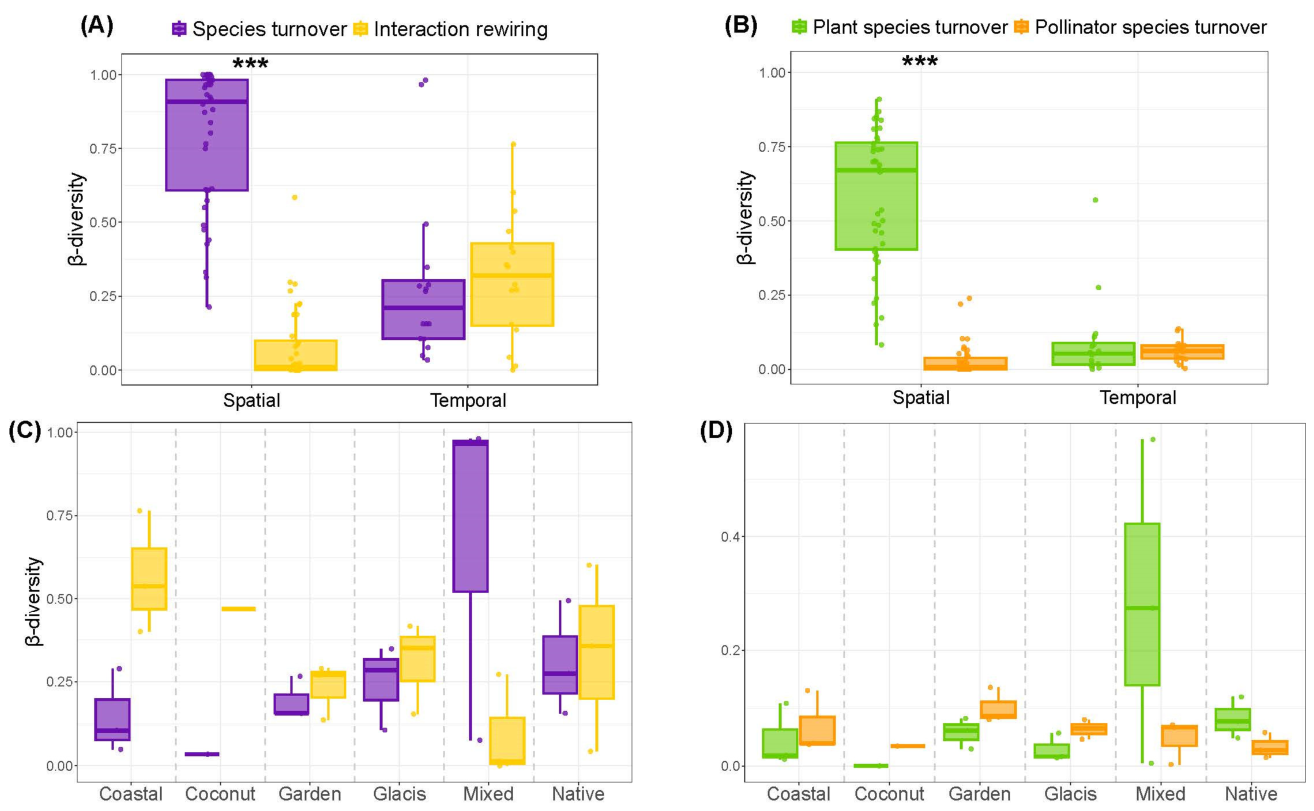
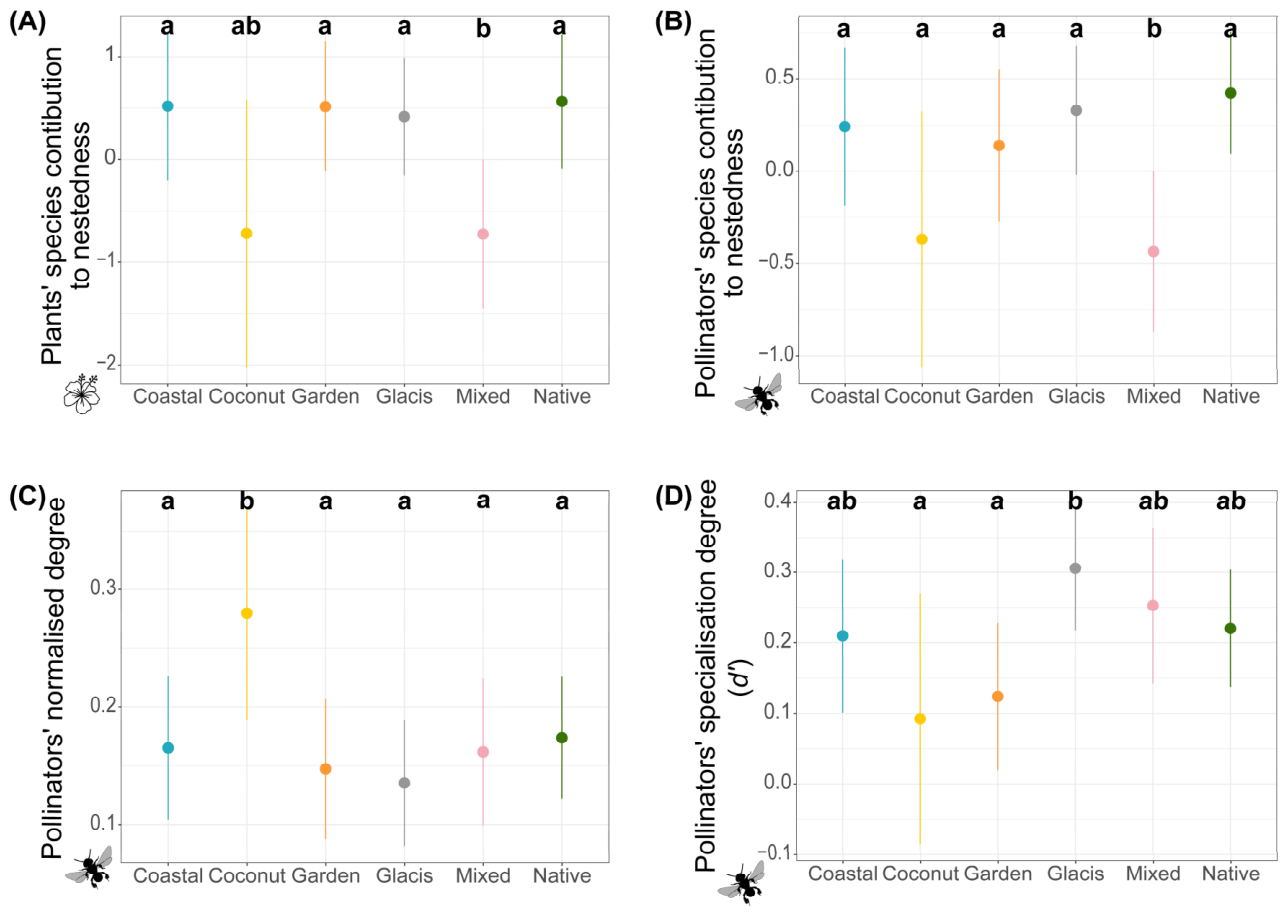
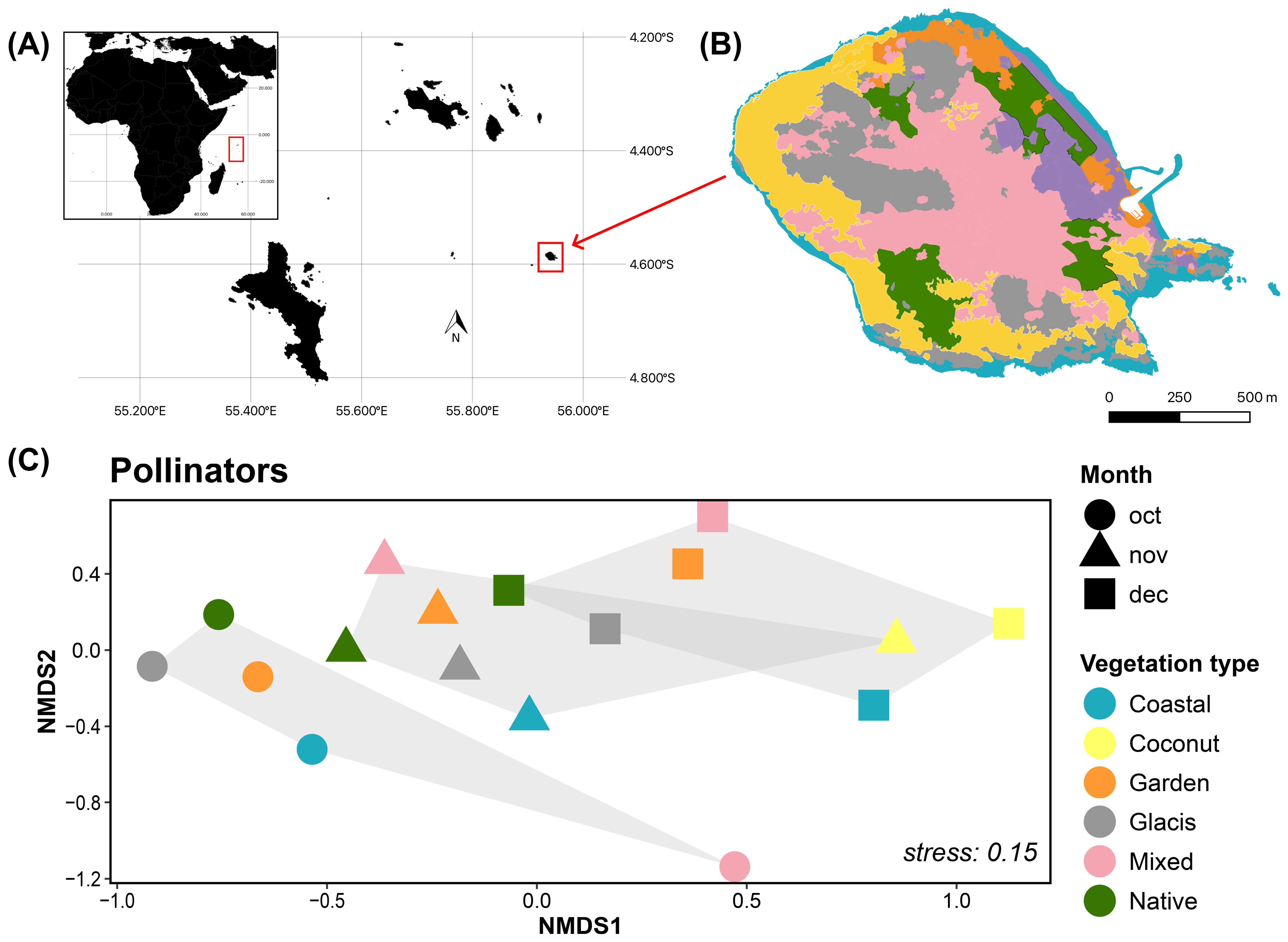
Understanding how habitat transformation and non-native species shape plant–pollinator interactions is important for conserving and restoring oceanic islands, where both disturbances are widespread yet rarely examined together. Here, we investigated pollination networks across six contrasting vegetation types spanning a temporal gradient of invasion by non-native flowering plants on a tropical island. We recorded 5263 visits involving 327 unique plant–pollinator interactions over a three-month sampling period. We found that vegetation type and plant invasion intensity jointly structure different components of plant–pollinator networks at fine spatial scales. Pollinator assemblage composition differed more substantially across vegetation types than across months, although pollinators did not form distinct vegetation-type-specific assemblages. Plant–pollinator interactions also differed among vegetation types, primarily due to plant species turnover. In parallel, increasing invasion intensity was associated with pollinators visiting fewer native plant species, reducing the proportion of visits received by native plants and their importance to pollinators within the network. Moreover, non-native pollinators became more specialized with increasing invasion intensity. Flower abundance was negatively related to the contribution of both plant and pollinator species to nestedness, a structural network property associated with robustness, possibly reflecting altered pollinator visitation patterns associated with honeybee dominance. Overall, our findings highlight the importance of considering both vegetation heterogeneity and invasion intensity for understanding and conserving island plant–pollinator networks.
Keywords: ecological networks; species turnover; biological invasions; mutualisms; island ecology ecological networks; species turnover; biological invasions; mutualisms; island ecology