Article

LcCOL7 and LcCOL8 Negatively Regulate Plant Flowering Independent of Day Length
1
Institute of Tropical Fruit Trees, Hainan Academy of Agricultural Sciences/Key Laboratory of Genetic Resources Evaluation and Utilization of Tropical Fruits and Vegetables (Co-Construction by Ministry and Province), Ministry of Agriculture and Rural Affairs/Key Laboratory of Tropical Fruit Tree Biology of Hainan Province, Haikou 571100, China
2
Sanya Institute of China Agricultural University, Sanya 572025, China
3
Sanya Research Institute, Hainan Academy of Agricultural Sciences, Sanya 572025, China
*
Author to whom correspondence should be addressed.
Plants 2026, 15(14), 2139; https://doi.org/10.3390/plants15142139
Submission received: 29 May 2026 / Revised: 25 June 2026 / Accepted: 7 July 2026 / Published: 10 July 2026

Abstract

CONSTANS-LIKE (COL) genes are pivotal regulatory components in the photoperiodic flowering pathway of plants. These genes can be regulated by both photoreceptors and the circadian clock, modulating plant flowering responses under specific day lengths by regulating florigen levels. However, the COL gene family in Litchi chinensis Sonn. has not yet been characterized. In this study, we identified eight COL family members in litchi and classified them into three subgroups based on phylogenetic analysis. The analysis of cis-regulatory elements within the promoters of LcCOLs revealed a wide distribution of elements associated with light, hormone, and stress responses. Transcript expression profiling indicated that most LcCOLs exhibited relatively high expression levels in leaf buds, leaves, and young fruits. Diurnal expression analysis under natural photoperiod conditions revealed that the expression peaks of all LcCOLs, with the exception of LcCOL1, occurred during the nighttime. The heterologous overexpression of LcCOL7 and LcCOL8, the closest homologs to AtCO, in Arabidopsis thaliana significantly delayed the flowering time under both long-day (LD) and short-day (SD) conditions, indicating that these genes act as repressors of flowering. This study provides a foundational basis for elucidating the molecular mechanisms underlying litchi flowering regulation and identifies promising candidate genes for the molecular breeding of litchi flowering-related agronomic traits.

1. Introduction

Floral transition is a critical developmental process for plant reproduction, which is co-regulated by multiple pathways including temperature, day length (photoperiod), gibberellins and plant age [1,2,3]. Within the photoperiodic flowering pathways, the CONSTANS (CO) protein serves as a central regulator and is ubiquitously present across diverse plant species. For instance, Arabidopsis thaliana contains 17 members of the CONSTANS-LIKE (COL) family, including CO, while 16 COL genes have been identified in Oryza sativa L., nine in Hordeum vulgare, 33 in Brassica napus, nine in Fragaria vesca L., 15 in Pyrus bretschneideri and 10 in Dimocarpus longan Lour [4,5,6,7,8]. COL family members in different plant species participate in the regulation of floral transition, with some promoting flowering [6,9,10,11], and others functioning as repressors [7,8,12,13]. This highlights the crucial role of COL family genes in plant floral development and their significant contribution to the precise regulation of flowering in response to varying environmental conditions.
Based on their flowering behaviors in response to varied photoperiods, plants can be categorized into three groups: long-day (LD), short-day (SD) and day-neutral (DN) plants. LD plants flower when the day length exceeds the critical day length, whereas SD plants flower when the photoperiod is shorter than the critical threshold [14,15]. Plants insensitive to photoperiod are defined as DN plants. As master regulators, COL proteins integrate photoperiod signals downstream of photoreceptors and the circadian clock [14,15,16], modulating the expression of florigen gene FLOWERING LOCUS T (FT) to govern photoperiod-dependent flowering. After being synthesized in leaves under flower-inductive conditions, florigen moves to the shoot apical meristem to initiate floral transition [17]. In Arabidopsis, the model LD plant, the diurnal transcription pattern of CO is governed by the phase and activity of FLAVIN-BINDING KELCH REPEAT F-BOX 1 (FKF1) and GIGANTEA (GI) [14,18]. At dusk under LD conditions, FKF1 is activated by blue light and interacts with GI [18]. This complex promotes the degradation of CYCLING DOF FACTORs (CDFs), which function as repressors of CO, and consequently facilitates CO transcription. In darkness, the CO protein is degraded by the ubiquitin ligase complex composed of CONSTITUTIVE PHOTOMORPHOGENIC1 (COP1) and SUPPRESSOR OF PHYTOCHROME A (SPA1), while CO protein remains stable in the presence of light [19,20]. Such multi-layered regulatory mechanisms enable CO to precisely perceive ambient photoperiod signals, ensuring timely flowering in Arabidopsis. Oryza sativa serves as a model SD plant, with its photoperiodic flowering also regulated by the CO-FT homologous pathway [14,15]. In rice, Heading date 3a (Hd3a), an ortholog of the FT gene, accelerates floral transition under inductive SD conditions, while RICE FLOWERING LOCUS T 1 (RFT1) is required for flowering under non-inductive LD conditions [21,22]. Heading date 1 (Hd1), the ortholog of CO, predominantly accumulates at night under SD conditions and activates Hd3a expression to trigger flowering [22,23]. Under non-inductive LD conditions, Hd1 expression persists from nighttime to dawn; upon light-dependent accumulation, Hd1 acts as a transcriptional repressor of Hd3a via PHYTOCHROME B (PHYB)-mediated red light signaling, consequently functioning as a flowering suppressor [14,24,25]. Collectively, these examples demonstrate that COL homologs mediate photoperiod perception to control flowering across diverse plant species, yet their underlying regulatory mechanisms differ markedly between taxa.
COL proteins feature two characteristic conserved domains: an N-terminal B-box domain and a C-terminal CONSTANS, CO-LIKE and TOC1 (CCT) motif [16,26,27,28]. The B-box domain is a zinc-finger module mainly responsible for mediating protein–protein interactions [16,27,28]. According to the copy number and sequence conservation of B-box domains, COL family proteins are divided into three subclades. Group I contains two canonical B-box domains; Group II harbors a single B-box; Group III carries one conserved B-box plus one divergent B-box variant [26]. The CCT domain contains a nuclear localization signal and also participates in protein–protein interactions [16,29]. For example, AtCO interacts with NUCLEAR FACTOR Y B SUBUNIT/NUCLEAR FACTOR Y C SUBUNIT (NF-YB2/NF-YC3) to form a trimeric complex, which promotes complex binding to the CORE regulatory motif in the promoter of FT [16,29]. Mutations disrupting conserved residues in either the B-box or CCT domain of AtCO result in late-flowering phenotypes, demonstrating that both domains are essential for CO-dependent flowering regulation [28].
Pioneering research exploring photoperiodic regulation of litchi (Litchi chinensis Sonn.) flowering can be traced to 1966. Using the litchi cultivar ‘Kwai Mi’ as plant material, Nakata et al. [30] observed no obvious difference in flowering onset between LD (16 h light/8 h darkness) and SD (8 h light/16 h darkness) treatments, leading them to classify litchi as a DN species. Even so, accumulating recent evidence implies that the photoperiod pathway participates in modulating litchi floral transition. Genomic screening of 72 litchi accessions with contrasting ripening seasons identified two LcCOL genes as candidate loci linked to fruit maturation date, a trait largely governed by flowering initiation time [31]. Furthermore, multiple litchi photoperiod/circadian clock genes such as FKF1, CO, COP1, PHYC and PSEUDORESPONSE REGULATOR 9 (PRR9) have been identified as chilling accumulation-associated candidate genes, whose expression differs between early- and late-flowering accessions [32]. These observations suggest that the photoperiod pathway works synergistically with low-temperature signaling to modulate litchi flowering induction.
As central regulators within the photoperiodic flowering pathway, the COL gene family has not been systematically characterized in litchi, and their roles in floral development remain poorly understood. In this study, we identified eight LcCOL family members in litchi and classified them into three distinct clades based on phylogenetic analysis. We subsequently characterized their conserved motifs and gene structures, and profiled their expression across various litchi tissues as well as under natural photoperiod conditions. Functional assays via heterologous overexpression in Arabidopsis further demonstrated that both LcCOL7 and LcCOL8 markedly repress flowering under both LD and SD conditions. Collectively, this study fills the research gap regarding the COL gene family in litchi, and provides theoretical insights into the molecular mechanisms controlling litchi flowering.

2. Results

2.1. Identification of LcCOL Family Genes in Litchi

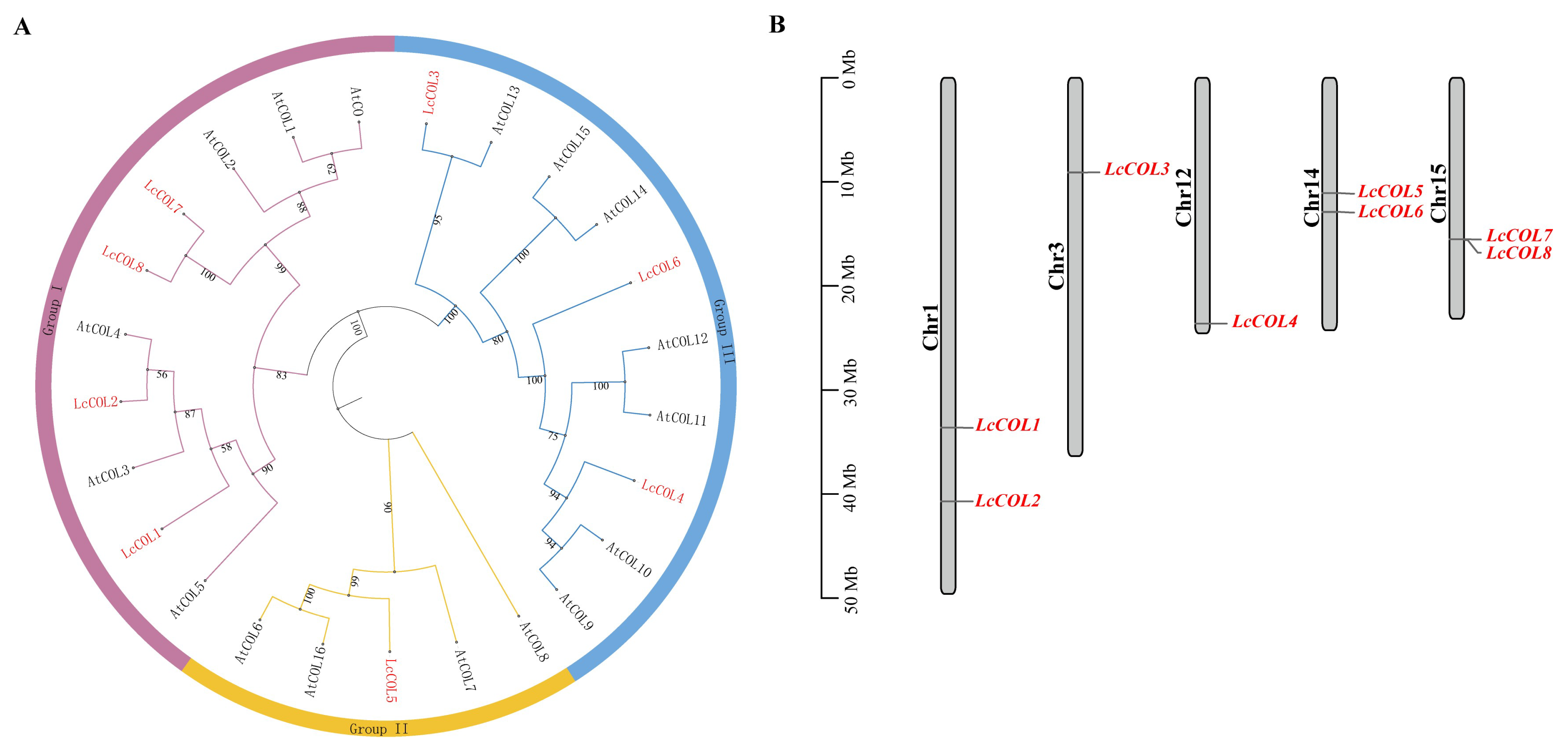
To systematically identify the members of the litchi LcCOL gene family, we adopted a two-step screening strategy combining BLASTp searches and InterPro database annotation. This screening pipeline yielded eight LcCOL genes, which were designated LcCOL1 to LcCOL8 based on their chromosomal distribution (Figure 1). Table 1 summarizes the key physicochemical properties of these eight LcCOL proteins. Their amino acid lengths vary from 347 to 499 residues, with molecular weights ranging from 37.6 kDa to 56.2 kDa. The isoelectric points (pIs) fall between 5.11 and 5.94, and their instability indices (IIs) range from 34.98 to 54.79. Their aliphatic indices (AIs) span from 56.02 to 65.99; most values are lower than 65, indicating generally low thermal stability for LcCOL proteins. Grand average of hydropathy (GRAVY) values were calculated to be between −0.838 and −0.307, demonstrating that all LcCOL proteins are hydrophilic.
Phylogenetic reconstruction utilizing AtCO and AtCOL protein sequences clustered the eight LcCOL members into three distinct subgroups (Figure 1A). Group I comprises LcCOL1, LcCOL2, LcCOL7, and LcCOL8, which form a clade that is closely related to AtCO and AtCOL1-AtCOL5. LcCOL5 falls into Group II together with AtCOL6-AtCOL8 and AtCOL16. The remaining three members, LcCOL3, LcCOL4, and LcCOL6 were assigned to Group III, alongside AtCOL9-AtCOL15.

2.2. Conserved Motifs and Gene Structure Analysis of LcCOL Members

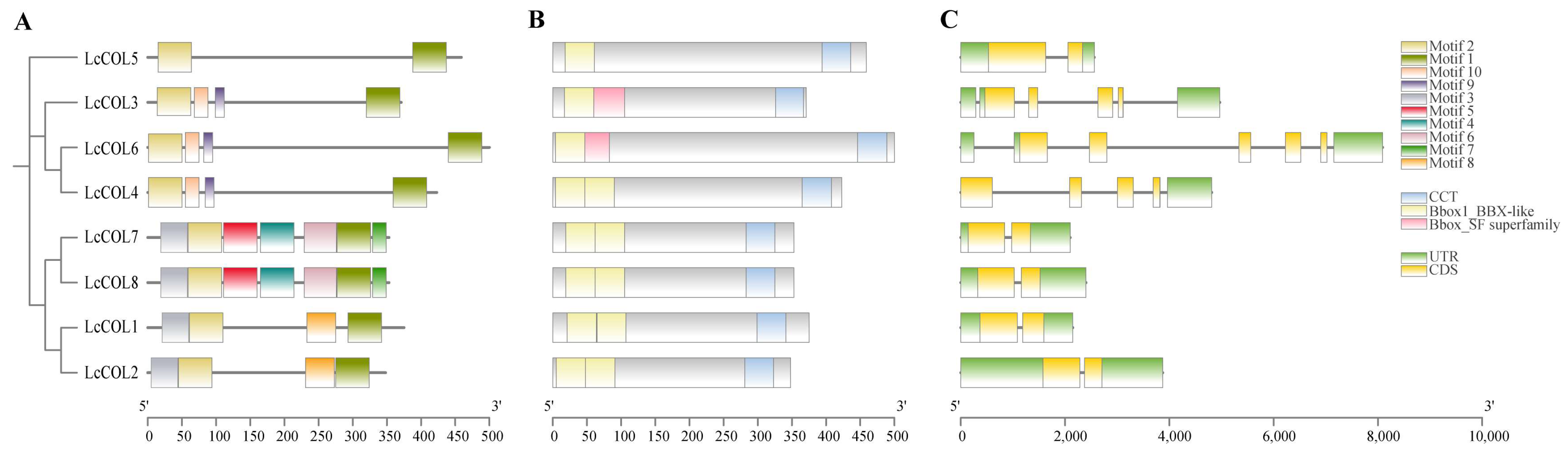
Conserved motif analysis of LcCOL proteins (Figure 2A) demonstrated that the Group I paralogs LcCOL7 and LcCOL8, the closest phylogenetic homologs of AtCO, possess the largest set of conserved motifs, namely motifs 1–5, 7, and 9. The other two Group I members, LcCOL1 and LcCOL2, contain motifs 1, 2, 3, and 8. All three Group III members (LcCOL3, LcCOL4, and LcCOL6) contain motifs 1, 2, 9, and 10. In contrast, the single Group II protein LcCOL5 only retains motifs 1 and 2. Protein domain analysis (Figure 2B) indicated that proteins from Groups I and III each carry two B-box domains and one CCT domain, while the Group II protein only contains one B-box domain plus one CCT domain. These structural features strongly validate our phylogenetic grouping results. Furthermore, gene structure characterization (Figure 2C) revealed that LcCOL1, LcCOL2, LcCOL5, LcCOL7, and LcCOL8 possess simple gene architectures composed of two exons separated by a single short intron. In contrast, LcCOL3, LcCOL4, and LcCOL6 harbor multiple relatively long introns.

2.3. Analysis of cis-Regulatory Elements in the Promoter Sequences of LcCOL Genes

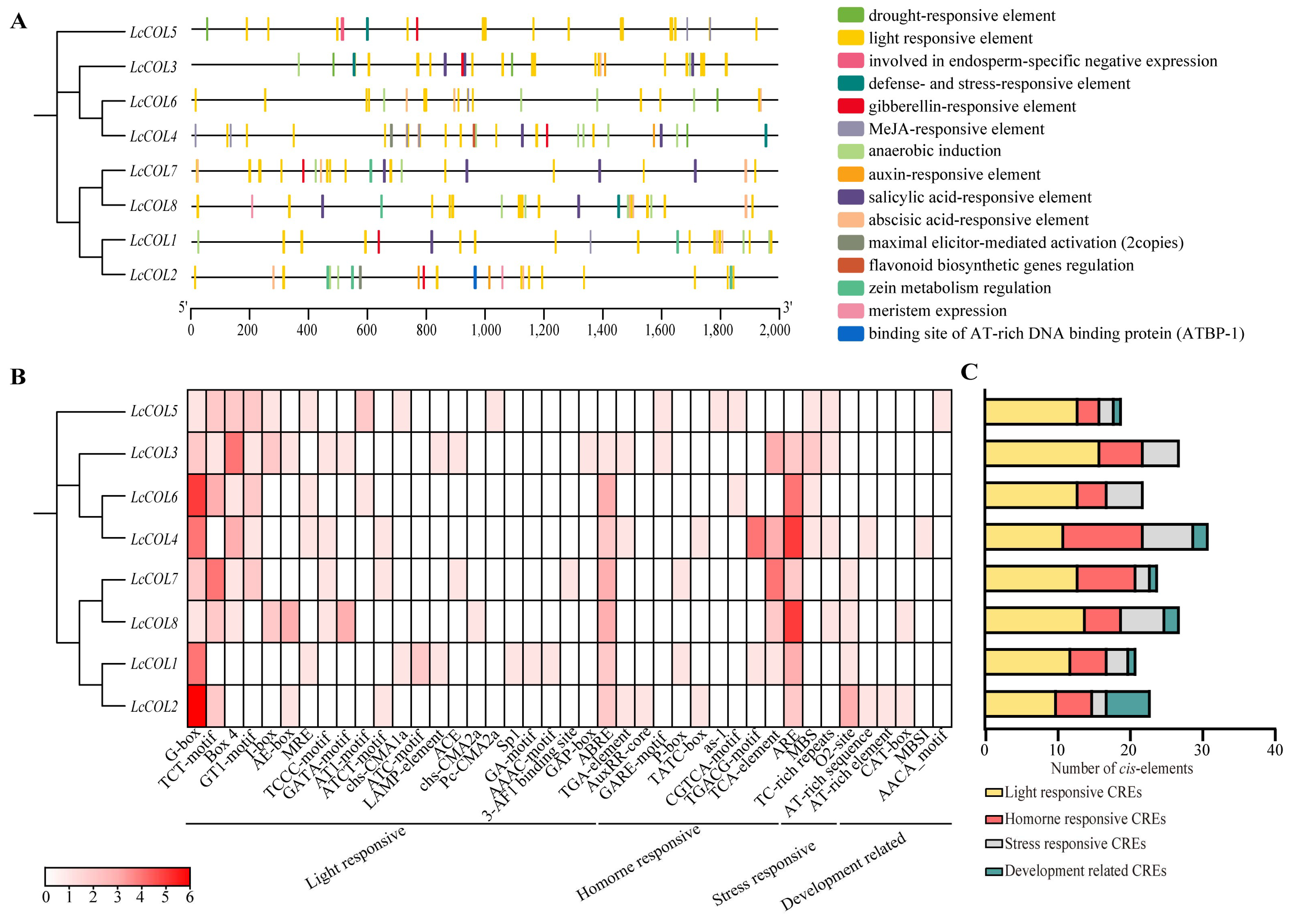
We systematically analyzed and statistically characterized cis-regulatory elements within the promoter sequences of the eight LcCOL family genes to decipher their transcriptional regulation patterns. As summarized in Figure 3 (detailed data listed in Supplementary Tables S2–S5), the promoters of all LcCOL members contain an abundance of light-responsive elements, among which the G-box appears most prevalent, followed by the TCT motif and Box 4. Multiple hormone-responsive cis-elements were also detected in these promoters, including those that respond to abscisic acid (ABA), gibberellin (GA), jasmonic acid (JA), auxin, and salicylic acid (SA). Of these hormone-related motifs, the ABA-responsive element (ABRE) and SA-responsive element (TCA-element) were present at the highest frequencies. With regard to stress-responsive cis-elements, the anaerobic responsive element (ARE) occurred most frequently. Collectively, these findings suggest that the transcription of LcCOL genes is coordinately modulated by crosstalk between environmental cues and endogenous phytohormone signaling pathways, which may participate in regulating litchi growth and development.

2.4. Analysis of the Expression Patterns of LcCOLs in Different Tissues of Litchi

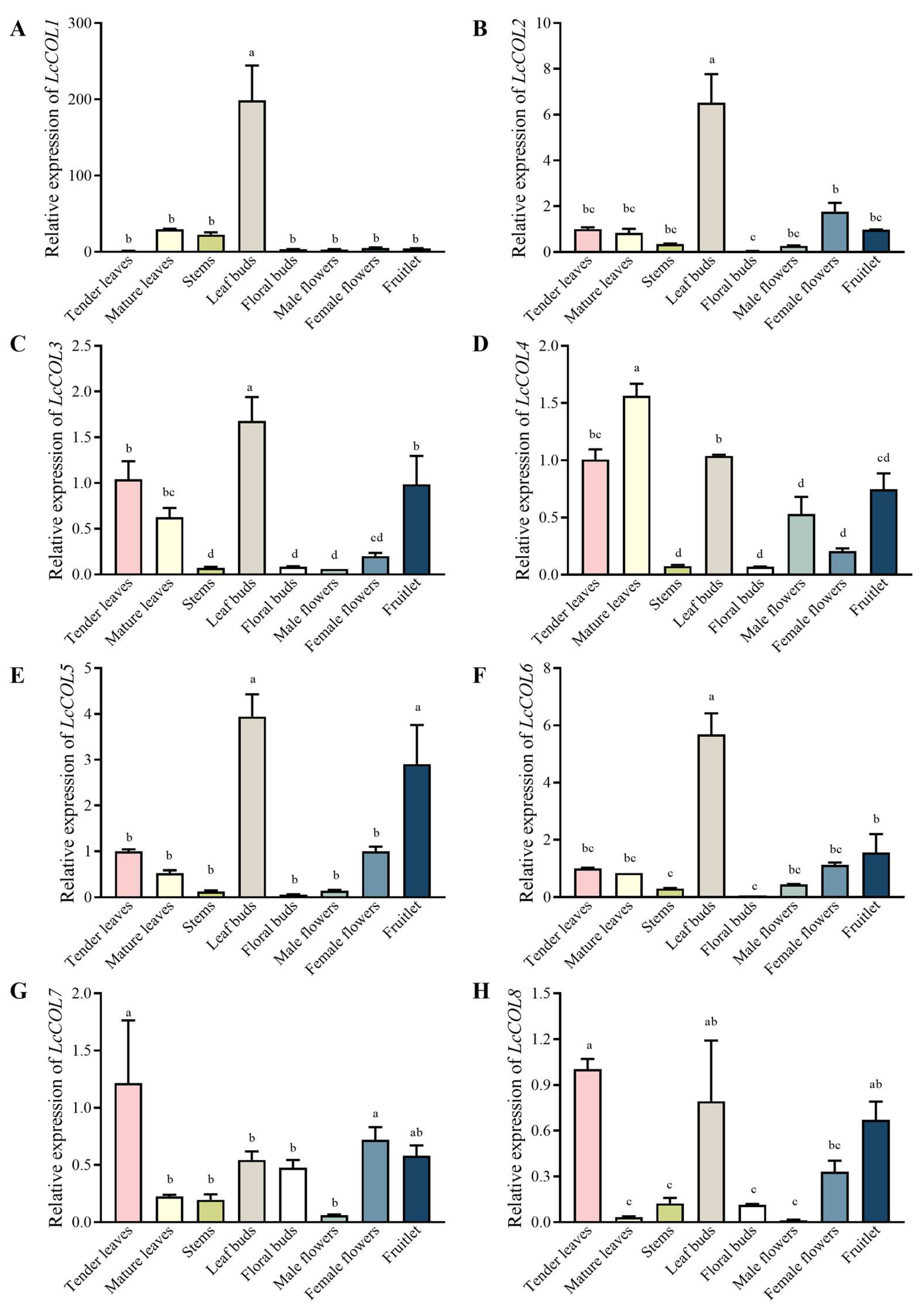
To characterize the tissue-specific expression profiles of LcCOL genes, we quantified their transcript abundance in eight tissues of the litchi cultivar ‘Feizixiao’, including tender leaves, mature leaves, stems, leaf buds, flower buds, male flowers, female flowers, and fruitlets (Figure 4). The tissue expression patterns revealed that five LcCOL members consistently displayed significantly higher expression levels in leaf buds than in other tissues (p < 0.05), with the exception of LcCOL4, LcCOL7, and LcCOL8, which exhibited the highest transcript levels in leaf tissues. Dramatic expression differences were also detected between tender and mature leaves. Specifically, LcCOL4 was significantly more highly expressed in mature leaves (p < 0.05), while LcCOL7 and LcCOL8 showed preferential expression in tender leaves. The remaining LcCOL genes exhibited no obvious expression differences between the two leaf types. All LcCOL genes showed relatively low expression levels in stems, another vegetative tissue. In reproductive tissues, moderate transcript levels of LcCOL7 and LcCOL8 were detected in floral buds, while other LcCOL members were barely detectable. In male flowers, only LcCOL4 showed weak expression. By contrast, moderate expression of LcCOL2, LcCOL5, LcCOL6, LcCOL7, and LcCOL8 were observed in female flowers. In young fruitlets, all LcCOL genes except LcCOL1 showed a certain degree of expression. Overall, LcCOL genes were predominantly expressed in leaf buds, leaves, and fruitlets, with generally low expression in floral tissues. Nevertheless, individual LcCOL members exhibited distinct tissue-specific expression patterns, implying divergent biological functions.

2.5. Expression Patterns of LcCOLs Under Natural Photoperiod During the Flowering Induction Period

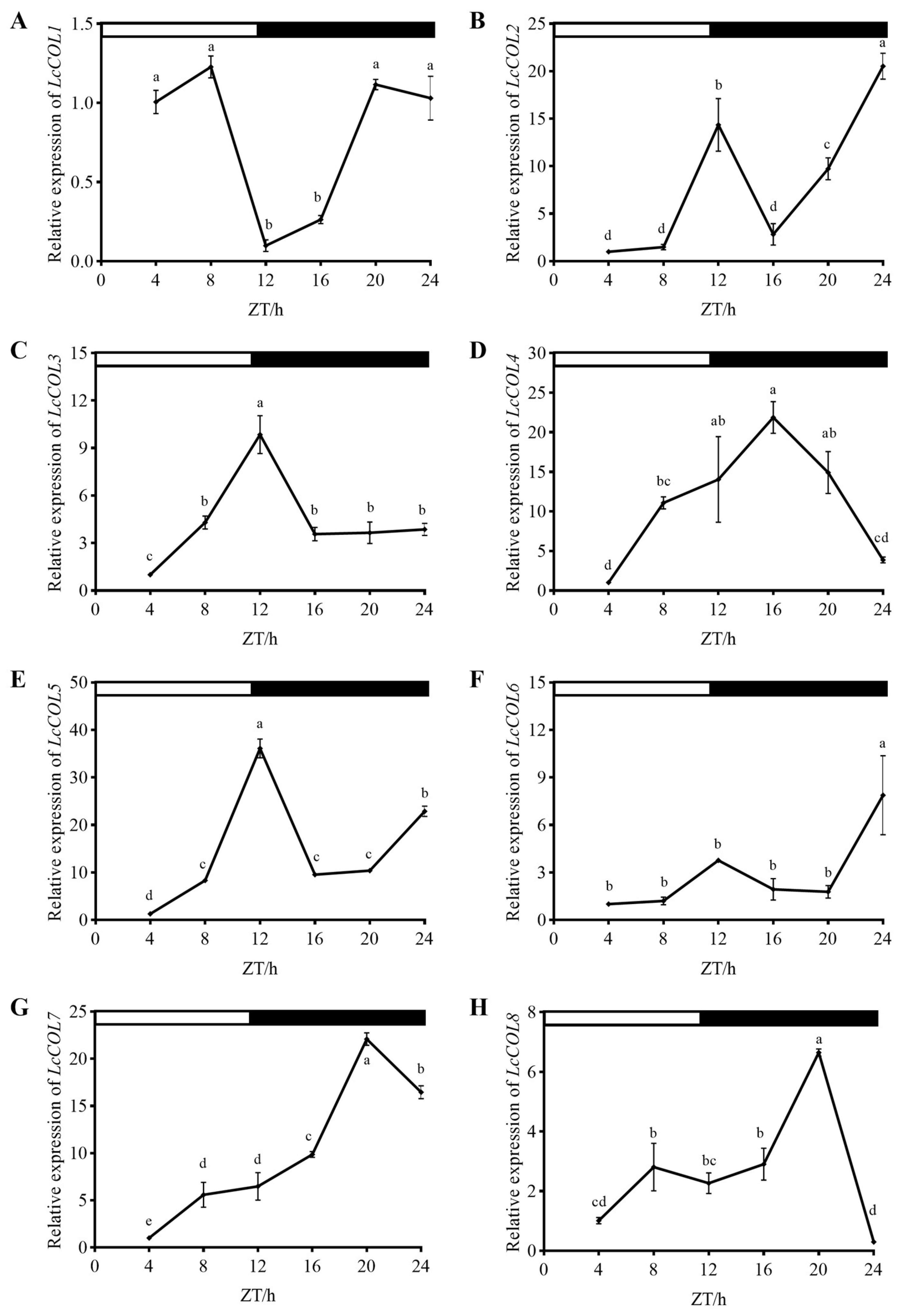
To explore the diurnal expression rhythms of LcCOL genes under natural photoperiod conditions, leaf samples were collected every 4 h over a 24 h cycle during the floral induction stage after autumn shoots maturation in litchi (Figure 5). Distinct diurnal expression patterns were observed among individual LcCOL family members. LcCOL1 maintains high transcript levels from late night to throughout the daytime. LcCOL2 showed dual expression peaks at dusk and dawn, with the dawn peak being significantly higher than the dusk one (p < 0.05). LcCOL3 showed a single expression peak exclusively at dusk. The expression of LcCOL4 peaked at approximately 4 h after nightfall and remained low near dawn and during the early morning (4 h after sunrise). LcCOL5 shared a dual-peak expression pattern similar to LcCOL2, but displayed a markedly higher expression level at dusk than at dawn (p < 0.05). LcCOL6 displayed elevated expression specifically at dawn and maintained low transcript abundance at all other time points. LcCOL7 peaked at 8 h after nightfall and retained a relatively high level at dawn. Although LcCOL8 shared the same peak time as LcCOL7, its expression declined sharply to an extremely low level by dawn. Collectively, these results reveal substantial divergence in the diurnal rhythmic expression of LcCOL genes, suggesting that these family members are subjected to distinct circadian clock-mediated regulatory mechanisms.

2.6. Overexpression of LcCOL7 and LcCOL8 Inhibits Flowering in Arabidopsis

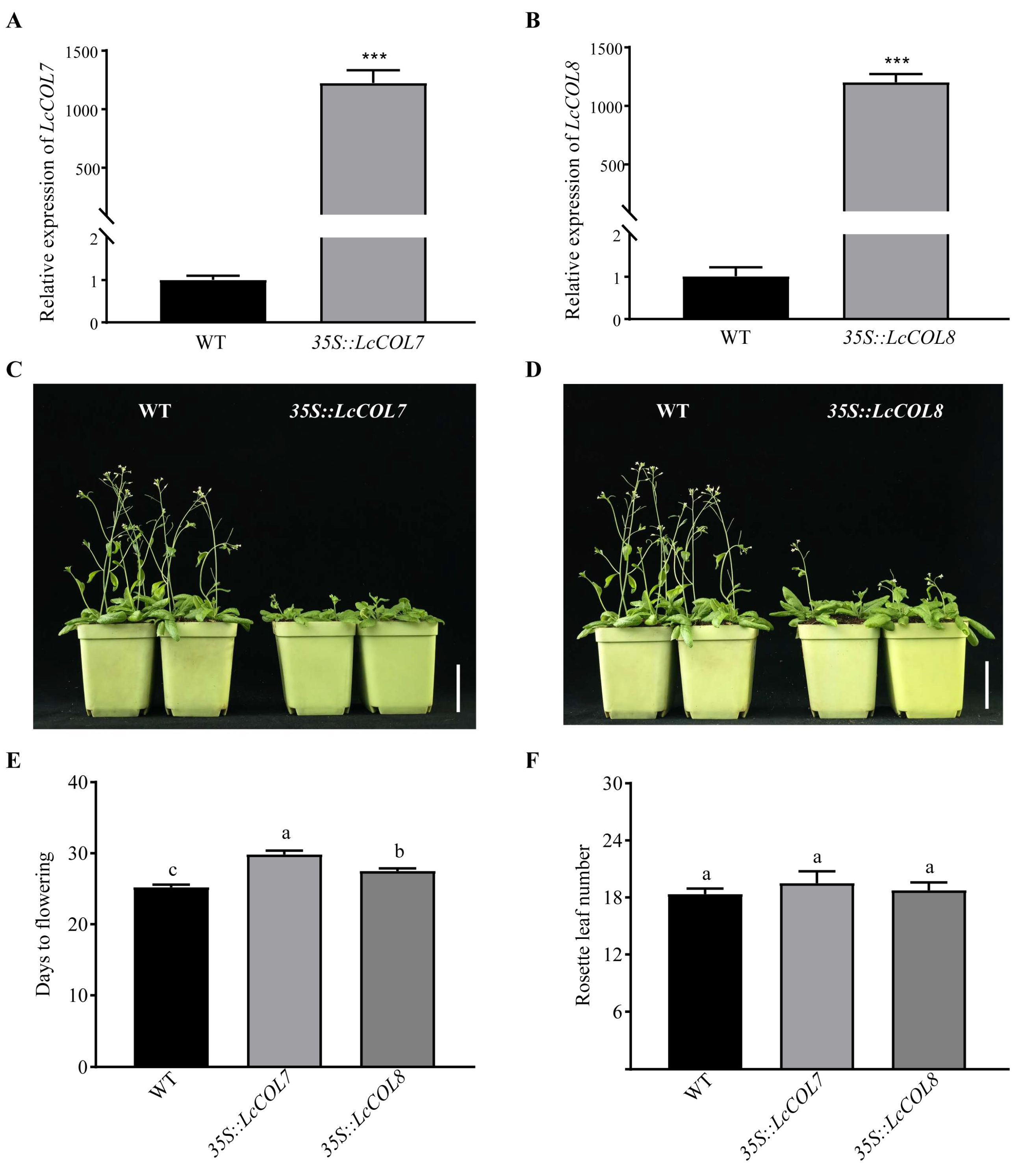
Among the eight LcCOL family members, LcCOL7 and LcCOL8 exhibit the closest phylogenetic relationship with AtCO. To further characterize their biological functions, we heterologously overexpressed LcCOL7 and LcCOL8 in Arabidopsis driven by the constitutive 35S promoter. Stable transgenic 35S::LcCOL7 and 35S::LcCOL8 lines were successfully generated via hygromycin resistance screening. Transcript levels of LcCOL7 and LcCOL8 were subsequently quantified in wild-type (WT) plants and the corresponding transgenic lines to verify line validity (Figure 6A,B). Quantitative analysis confirmed that the expression levels of LcCOL7 and LcCOL8 were significantly elevated in their respective transgenic lines relative to WT plants (p < 0.001), indicating that the obtained overexpression materials were reliable and suitable for subsequent phenotypic analysis.
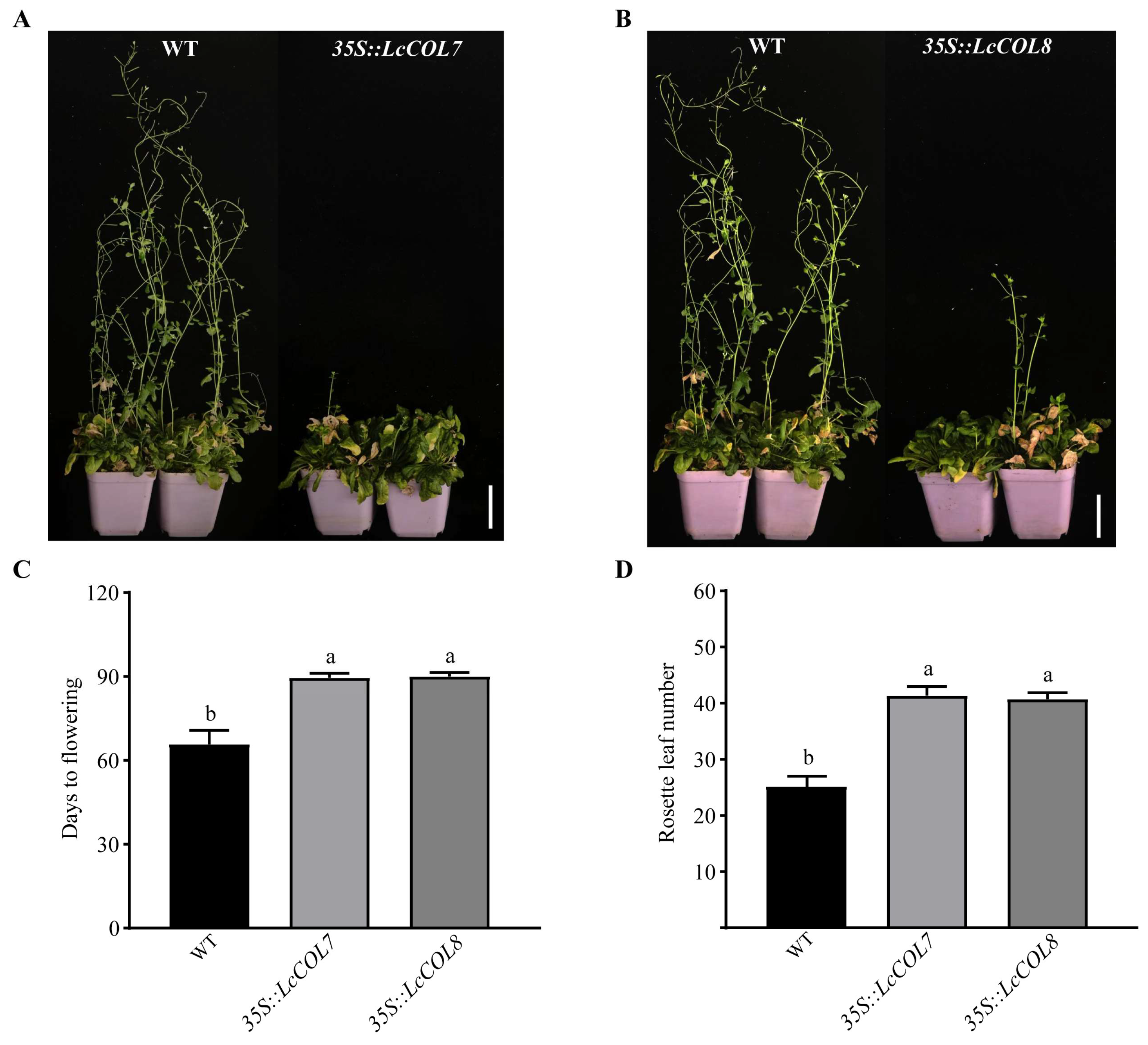
To clarify the roles of LcCOL7 and LcCOL8 in flowering regulation, we evaluated the flowering phenotypes of 35S::LcCOL7 and 35S::LcCOL8 transgenic Arabidopsis plants. Bolting time and the number of rosette leaves at bolting were adopted as key flowering indices. Under LD conditions (Figure 6C–F, Supplementary Table S6), both transgenic lines exhibited a significantly delayed bolting day compared with WT plants (p < 0.05), while no obvious difference was observed in the number of rosette leaves at bolting. Under SD conditions (Figure 7, data in Supplementary Table S7), the flowering of the 35S::LcCOL7 and 35S::LcCOL8 lines was also markedly delayed, with an average flowering delay of more than 20 days. Additionally, transgenic plants produced significantly more rosette leaves at bolting than the WT control (p < 0.05). Collectively, these results indicate that both LcCOL7 and LcCOL8 function as flowering repressors in Arabidopsis by inhibiting floral transition, and this inhibitory effect is considerably stronger under SD conditions.

3. Discussion

In the present study, we identified eight COL homologs in litchi. Phylogenetic clustering divided these LcCOL genes into three distinct subgroups: Group I contains LcCOL1, LcCOL2, LcCOL7, and LcCOL8; Group II only harbors LcCOL5; and Group III includes LcCOL3, LcCOL4, and LcCOL6. Subsequent characterization of conserved motifs and protein domains further validated the accuracy of this phylogenetic grouping. There are 17 COL gene family members in Arabidopsis, including the key flowering regulator CO. By comparison, 16, 9, 33, 9, 15 and 10 COL genes have been reported in rice, barley, rapeseed, strawberry, pear and longan, respectively [4,5,6,7,8]. Such variation in gene copy number suggests that the COL family is ubiquitous across the plant kingdom and subject to evolutionary conservation. At the functional level, the Arabidopsis AtCO protein promotes floral transition specifically under LD conditions [9,14,15,16]. By contrast, AtCOL3 and AtCOL4, which also fall into Group I, serve as flowering repressors regardless of photoperiod under both SD and LD regimes [33,34]. In the LD woodland strawberry (Fragaria vesca), overexpression of FvCO accelerates flowering under SD conditions, while FvCO silencing delays flowering under LD conditions, confirming that FvCO acts as a flowering activator [6]. In rice, Hd1 upregulates Hd3a expression under SD conditions but suppresses it under LD conditions [22,25]. Both RcCO and RcCOL4 promote flowering in Rosa chinensis; however, their divergent expression patterns (RcCO is preferentially expressed under LD and RcCOL4 is preferentially expressed under SD conditions) guarantee floral initiation under favorable growth conditions, enabling the day-neutral flowering habit of rose [10]. Taken together, these published findings reveal that COL proteins are deeply conserved central modulators of photoperiodic flowering pathway, yet their biological functions have undergone evolutionary diversification across plant lineages. Consistent with a previous report showing that overexpression of longan DlCOL4 delays flowering time in transgenic Arabidopsis under LD conditions [8], our results demonstrated that heterologous overexpression of litchi LcCOL7 and LcCOL8 significantly delayed flowering time under both LD and SD conditions (p < 0.05). Furthermore, it is noteworthy that the flowering time of LcCOL7-overexpressing lines was significantly later than that of LcCOL8-overexpressing lines under LD conditions (p < 0.05), while no obvious difference in flowering time was observed between the two transgenic lines under SD conditions. This discrepancy implies that LcCOL7 and LcCOL8 may rely on distinct regulatory interactors or interfere with different endogenous AtCOL proteins to modulate flowering in Arabidopsis in response to different photoperiods. As mentioned in previous studies, numerous COL genes execute their biological functions in a photoperiod-specific manner [22,25,33]. Consequently, future research into how COL genes regulate floral transition in litchi will provide valuable insights for molecular genetic research and targeted molecular breeding in this economically important fruit crop.
We systematically analyzed cis-acting elements within the promoter sequences of LcCOL genes. The results revealed that the LcCOL promoters harbor numerous light-responsive and hormone-responsive elements. Notably, all eight LcCOL genes contain at least one copy of the G-box motif, a canonical light-responsive element. Previous work has demonstrated that G-box acts as a crucial binding site for core circadian clock PRR proteins; this motif is also detected in the promoters of PRR9 and CIRCADIAN CLOCK ASSOCIATED 1 (CCA1) [35]. PRR proteins bind to G-box via their CCT domains to precisely fine-tune the transcription of target genes at dawn [35]. The prevalence of light-responsive cis-elements in LcCOL promoters may therefore underpin their divergent diurnal expression rhythms. Furthermore, hormone-responsive elements are widely distributed across LcCOL promoters, including ABA-responsive elements (ABREs), SA-responsive elements (TCA-element), methyl jasmonate-responsive elements (TGACG-motif and CGTCA-motif), GA-responsive elements (P-box, GARE-motif, and TATC-box), and auxin-responsive elements (TGA-element and AuxRR-core). Existing evidence shows that ABA signaling components known as ABRE-Binding Factors (ABFs) directly interact with ABRE sequences and upregulate CO expression to accelerate flowering under LD conditions with drought stress [16,36]. Moderate drought treatment during floral induction is recognized as a critical environmental cue promoting flowering in litchi, although drought alone cannot fully substitute for the low temperature requirements for floral initiation [37]. The abundant ABRE regulatory elements in the promoters of functional genes LcCOL7 and LcCOL8 suggests a potential link between these elements and drought-induced floral transition in litchi. Consistent with our findings, multiple light-responsive elements (including G-box), ABRE sites and methyl jasmonate-responsive TGACG/CGTCA-motifs, were also detected in the promoters of rapeseed BnCOL family genes [5]. This indicates that the crosstalk between COL proteins and environmental or hormonal responses is evolutionarily conserved across plant species. Future research will aim to dissect the interplay between phytohormonal signaling and LcCOL transcription, and further characterize the biological roles of LcCOL genes in litchi adaptation to variable environmental conditions.
Our tissue expression profiling revealed that most LcCOL genes displayed higher expression levels in leaf buds and leaves compared to other tissues, while their expression remained generally low in floral tissues. Interestingly, the expression levels of LcCOL7 and LcCOL8 were significantly higher in female flowers compared to male flowers (p < 0.05). Litchi, a monoecious plant with unisexual flowers, exhibits asynchronous opening of male and female flowers. In this study, the flowering sequence of ‘Feizixiao’ litchi demonstrated a pattern where male flowers bloomed prior to female flowers, aligning with the role of LcCOL7 and LcCOL8 as flowering repressors. These observations suggest that the differential expression of LcCOL7 and LcCOL8 between male and female flowers may play a regulatory role in the staggered blooming of male and female flowers in litchi. In addition, the transcript abundance of LcCOL7 and LcCOL8 was significantly higher in young leaves than in mature leaves (p < 0.05). Previous studies have demonstrated that mature leaves serve as the primary tissue sensing low-temperature floral-inductive signals in litchi [38,39]. We therefore hypothesize that the elevated expression of LcCOL7 and LcCOL8 in young leaves may inhibit litchi floral transition. Given that our functional characterization of LcCOL7 and LcCOL8 was only performed in Arabidopsis, further in planta functional assays are required to validate their biological roles within litchi itself. Diurnal expression analysis under the natural photoperiod revealed that LcCOL4, LcCOL7, and LcCOL8 share expression patterns similar to AtCO, with expression peaking at night under SD conditions [40]. Specifically, the transcript abundance of LcCOL7 was significantly higher at dawn than at 4 h after sunrise (p < 0.05), whereas no such difference was observed for LcCOL8. This implies that these two functionally homologous genes may be modulated by distinct sets of circadian clock regulators. Litchi is regarded as a DN plant, a classification largely derived from the study showing that the ‘Kwai Mi’ cultivar is capable of flowering under both LD and SD conditions [30]. Even so, genotypic variation in photoperiod responsiveness across different litchi cultivars cannot be excluded. Unlike its Sapindaceae relative longan, it is difficult to induce off-season flowering and fruiting in litchi. In the Northern Hemisphere, floral induction in litchi occurs strictly during autumn and winter, followed by floral bud differentiation and fruit development in spring, with fruit ripening concentrated in late spring and summer. Such a constrained seasonal window for floral induction strongly suggests that this developmental program is governed by circadian rhythmic pathways. Future investigations evaluating photoperiodic responses across multiple litchi cultivars will help unravel the contribution of the photoperiod pathway to litchi flowering with more conclusive evidence.

4. Materials and Methods

4.1. Identification of COL Gene Family Members in Litchi

To identify CONSTANS-LIKE (COL) family members in litchi (Litchi chinensis Sonn.), we first retrieved genome and proteome sequences of litchi from the Sapindanceae Genome Database, 2025 updated version (https://www.sapindaceae.com, accessed on 4 March 2025). COL protein sequences of Arabidopsis thaliana were obtained from the TAIR database, TAIR10 (https://www.arabidopsis.org/, accessed on 4 March 2025). The AtCO and 16 AtCOL protein sequences were used as queries to identify all putative COL homologs in the litchi genome using BLASTp with an e-value of ≤1 × 10⁻⁵. Subsequently, the IntoPro database Version 101.0 (https://www.ebi.ac.uk/interpro/, accessed on 4 March 2025) was used to verify these LcCOL protein candidates containing B-box-type zinc finger and CCT domains. The LcCOL proteins’ fundamental physicochemical properties, including number of amino acids, molecular weight, isoelectric point, instability index, aliphatic index and grand average of hydropathicity were analyzed using the ExPASy online tool (https://www.expasy.org/, accessed on 25 March 2026).

4.2. Phylogenetic Analysis of COL Family Genes and Chromosomal Distribution of LcCOL Genes

All AtCOL and LcCOL protein sequences were employed to construct a maximum likelihood (ML) phylogenetic tree with 1000 bootstrap replicates using TBtools v2.476 [41]. The generated phylogenetic tree was visualized utilizing the online tool iTOL v7.6 (https://itol.embl.de/, accessed on 10 March 2026). To determine the chromosomal distribution of LcCOL genes, genome annotation files were obtained from https://data.mendeley.com/datasets/kggzfwpdr9/1 (accessed on 27 March 2026). Subsequently, the positions of the LcCOL genes were mapped utilizing TBtools.

4.3. Analysis of the Conserved Motifs, Conserved Domains and Gene Structures of LcCOLs

The conserved motifs within the protein sequences were identified utilizing the MEME Suite v5.5.9 (http://meme-suite.org/, accessed on 31 March 2026) with a set parameter of a maximum of 10 motifs. The NCBI Conserved Domain Database was used to examine the conserved domain architecture of LcCOLs. Gene structure information for LcCOLs was extracted from the litchi genome annotation file. Finally, TBtools [41] was used to visualize the conserved motifs, protein domain structures, and gene structures.

4.4. Analysis of cis-Acting Regulatory Elements in the Promoters of LcCOLs

To determine the type and quantity of cis-regulatory elements within the LcCOL genes, the promoter region, specifically the 2000 base pairs upstream of these genes, were initially extracted from the genome. These promoter sequences were subsequently submitted to the Plant Cis-Acting Regulatory Element (PlantCARE) database (accessed on 1 April 2026) to identify potential cis-elements. TBtools software was employed to visualize the distribution of these cis-elements in the promoters and to generate a heatmap depicting the number of cis-elements present in the LcCOL promoters.

4.5. Sampling Procedures for Litchi Tissues

For the analysis of tissue expression patterns, the ‘Feizixiao’ litchi cultivar was used as the study material. Various litchi tissues were collected at different developmental stages. During the shoot growth phase, samples of young leaves, mature leaves, leaf buds, and stem segments were collected. In the flowering phase, both flower buds and fully opened male and female flowers were harvested. During the fruit development phase, small fruits were collected at one week after anthesis. All samples were promptly flash-frozen in liquid nitrogen and stored at −80 °C for subsequent analysis. Experiments were conducted in three independent biological replicates.

4.6. Expression Patterns of LcCOL Genes Under Natural Photoperiod Condition

During the flowering induction stage, sampling was conducted in Chengmai County, Hainan Province (19.72° N, 110.19° E) on sunny days, specifically 5 and 6 December. These days featured a natural photoperiod consisting of approximately 11 h of light and 13 h of darkness, with temperatures ranging from 18 °C to 29 °C and relative humidity ranging from 60% to 90%. The sampling process commenced at dawn, around 7:00 a.m. Four mature leaves were collected from each tree every four hours, culminating in a total of six sampling events. All samples were promptly flash-frozen in liquid nitrogen and stored at −80 °C for subsequent analysis. Experiments were conducted using three independent biological replicates.

4.7. RNA Extraction and Transcriptional Level Analysis

The collected samples were finely ground in liquid nitrogen, and total RNA was subsequently extracted utilizing the Plant Total RNA Extraction Kit (DP441, Tiangen, Beijing, China). The extracted RNA was reverse-transcribed into complementary DNA (cDNA) using the Reverse Transcription Kit (G592, ABM, Vancouver, BC, Canada) to facilitate further transcriptional analysis. Relative quantitative analysis was conducted employing the SYBR Green method (11184ES, Yeasen Biotechnology, Shanghai, China) and a LightCycler® 480 Real-Time PCR System (Roche, Basel, Switzerland). The LcACTIN/LITCHI007623 gene served as the internal reference gene, with all quantitative PCR primers detailed in Supplementary Table S1. A two-step amplification protocol was implemented: initial denaturation at 95 °C for 2 min, followed by 40 cycles of denaturation at 95 °C for 10 s and annealing/extension at 60 °C for 30 s. Relative expression levels were determined using the 2−△△Ct method with triplicate technical repeats.

4.8. Generation of Constructs and Transgenic Plants

To generate LcCOL overexpression constructs, the protein-coding sequences of LcCOL7 and LcCOL8 were amplified via PCR and subsequently cloned into the pCAMBIA1302 vector under the control of the Cauliflower mosaic virus (CaMV) 35S promoter. The resulting recombinant plasmid was introduced into Agrobacterium tumefaciens strain GV3101, and Arabidopsis plants were transformed using the floral dip method mediated by Agrobacterium. Transgenic plants were selected using 20 mg/L hygromycin B (No. A600230, Sangon Biotech, Shanghai, China) and successful Arabidopsis transformants were identified through quantitative real-time polymerase chain reaction (qRT-PCR) analysis. Homozygous T3 generation Arabidopsis plants were utilized for the observation of flowering phenotypes.

4.9. Flowering Phenotype Analyses

Sterilized homozygous T3 generation Arabidopsis seeds were sown on Murashige and Skoog (MS) medium and subjected to vernalization in darkness at 4 °C for 2 days. Subsequently, the seeds were cultivated at 22 °C under a photoperiod of 12 h of light and 12 h of darkness (12 h light/12 h darkness). After 7 days, the seedlings were transplanted into soil and grown under either long-day (LD, 16 h light/8 h darkness) or short-day (SD, 8 h light/16 h darkness) conditions. The number of days required for the primary inflorescence stem to reach 1 cm in height was recorded to determine the bolting or flowering time. Additionally, the number of rosette leaves present at the time of bolting was counted. Each experimental group consisted of twenty individual plants, and all experiments were conducted using three independent biological replicates.

4.10. Statistical Analyses

Statistical analyses were performed using IBM Statistics SPSS v 26.0. Differences in expression levels or phenotypes between samples were assessed using either Student’s t-test or one-way ANOVA followed by Dunnett’s multiple comparison test. Graphical representations were created using GraphPad Prism version 8.3.0 and Adobe Illustrator 26.0.

5. Conclusions

In this study, eight members of the LcCOL gene family were identified in litchi. Promoter sequence analysis revealed that LcCOL promoters contain abundant cis-elements related to light, hormone and stress responses, with G-box, ABRE and ARE motifs being the most highly enriched. Transcript profiling indicated that most LcCOL genes are predominantly expressed in leaf buds, leaves and young fruits. Under natural photoperiod conditions, LcCOL1 exhibited sustained high expression from late night to through the daytime, while the remaining LcCOL members displayed nighttime expression peaks. Heterologous overexpression of LcCOL7 and LcCOL8 significantly delayed flowering in transgenic Arabidopsis thaliana, suggesting that these two genes function as flowering repressors.

Supplementary Materials

The following supporting information can be downloaded at: https://www.mdpi.com/article/10.3390/plants15142139/s1, Table S1: Primers used in this study. Table S2: Statistics on the types and quantities of cis-elements associated with light response in LcCOLs promoters. Table S3: Statistics on the types and quantities of cis-elements associated with hormone response in LcCOLs promoters. Table S4: Statistics on the types and quantities of cis-elements associated with stress response in LcCOLs promoters. Table S5: Statistics on the types and quantities of cis-elements associated with plant development in LcCOLs promoters. Table S6: Statistical data of flowering phenotypes of LcCOL7 and LcCOL8 transgenic plants under LD conditions. Table S7: Statistical data of flowering phenotypes of LcCOL7 and LcCOL8 transgenic plants under SD conditions.

Author Contributions

Conceptualization, T.Y.; methodology, Y.H., H.D. and T.T.; software, F.A.; validation, T.Y., Y.H. and T.T.; formal analysis, T.Y.; investigation, D.C.; resources, D.C. and X.W.; data curation, Z.C. and M.Y.; writing—original draft preparation, T.Y.; writing—review and editing, T.Y. and F.H.; visualization, T.Y. and F.A.; supervision, F.H.; project administration, T.Y. and F.H.; funding acquisition, T.Y., X.W. and F.H. All authors have read and agreed to the published version of the manuscript.

Funding

This research was funded by the Hainan Provincial Natural Science Foundation of China (grant number 324QN350); Scientific Research Start-up Project for Introduced Talents, Hainan Academy of Agricultural Sciences (grant number HAAS2023RCQD23); China Agriculture Research System of Litchi and Longan Industry (grant number CARS-32); Hainan Agriculture Research System for Litchi Industry (grant number HNARS-08); and Hainan Provincial Science and Technology Talent Innovation Project (grant number KJRC2023C17). The APC was funded by grant number KJRC2023C17.

Data Availability Statement

The primers used in this study are provided in the Supplementary Materials (Table S1). The statistics on the types and quantities of cis-elements associated with light-responsive, hormone-responsive, stress-responsive and developmental processes in LcCOL promoters are provided in the Supplementary Materials (Tables S2–S5, respectively). Statistical data on the flowering phenotypes of the LcCOL7 and LcCOL8 transgenic plants under LD conditions are provided in the Supplementary Materials (Table S6), and the statistical data on the flowering phenotypes under SD conditions are provided in the Supplementary Materials (Table S7).

Acknowledgments

We thank Fan Zou for his assistance and valuable suggestions regarding the comparative structural analysis of LcCOL family proteins and AtCO protein. His contributions provided structural insights and guidance for explorations to obtain a better understanding of the functional differences in COL proteins between the two species. The authors have reviewed and edited the output and take full responsibility for the content of this publication.

Conflicts of Interest

The authors declare no conflicts of interest. The funders had no role in the design of the study; in the collection, analyses, or interpretation of data; in the writing of the manuscript; or in the decision to publish the results.

Abbreviations

The following abbreviations are used in this manuscript:
ABAAbscisic acid
ABREAbscisic acid-responsive element
AIAliphatic index
ANOVAAnalysis of variance
AREAnaerobic responsive element
CaMVCauliflower mosaic virus
CCA1CIRCADIAN CLOCK ASSOCIATED 1
CDFCYCLING DOF FACTOR
COCONSTANS
COLCONSTANS-LIKE
COP1CONSTITUTIVE PHOTOMORPHOGENIC 1
DNDay-neutral
FKF1FLAVIN-BINDING KELCH REPEAT F-BOX 1
FTFLOWERING LOCUS T
GAGibberellin
GAREGibberellin-responsive element
GIGIGANTEA
GRAVYGrand average of hydropathicity
Hd1Heading date 1
Hd3aHeading date 3a
IIInstability index
JAJasmonic acid
LDLong-day
MLMaximum likelihood
NF-YB/NF-YCNUCLEAR FACTOR Y B SUBUNIT/NUCLEAR FACTOR Y C SUBUNIT
PHYBPHYTOCHROME B
pIIsoelectric point
PRR9PSEUDORESPONSE REGULATOR 9
qRT-PCRQuantitative real-time polymerase chain reaction
RFT1RICE FLOWERING LOCUS T 1
SASalicylic acid
SDShort-day
SPA1SUPPRESSOR OF PHYTOCHROME A 1
WTWild-type

References

  1. Srikanth, A.; Schmid, M. Regulation of Flowering Time: All Roads Lead to Rome. Cell. Mol. Life Sci. 2011, 68, 2013–2037. [Google Scholar] [CrossRef] [PubMed]
  2. Cho, L.; Yoon, J.; An, G. The Control of Flowering Time by Environmental Factors. Plant J. 2017, 90, 708–719. [Google Scholar] [CrossRef] [PubMed]
  3. Kinoshita, A.; Richter, R. Genetic and Molecular Basis of Floral Induction in Arabidopsis thaliana. J. Exp. Bot. 2020, 71, 2490–2504. [Google Scholar] [CrossRef] [PubMed]
  4. Griffiths, S.; Dunford, R.P.; Coupland, G.; Laurie, D.A. The Evolution of CONSTANS-Like Gene Families in Barley, Rice, and Arabidopsis. Plant Physiol. 2003, 131, 1855–1867. [Google Scholar] [CrossRef] [PubMed]
  5. Chen, Y.; Zhou, R.; Hu, Q.; Wei, W.; Liu, J. Conservation and Divergence of the CONSTANS-Like (COL) Genes Related to Flowering and Circadian Rhythm in Brassica napus. Front. Plant Sci. 2021, 12, 760379. [Google Scholar] [CrossRef] [PubMed]
  6. Kurokura, T.; Samad, S.; Koskela, E.; Mouhu, K.; Hytönen, T. Fragaria vesca CONSTANS Controls Photoperiodic Flowering and Vegetative Development. J. Exp. Bot. 2017, 68, 4839–4850. [Google Scholar] [CrossRef] [PubMed]
  7. Wang, P.; Liu, Z.; Cao, P.; Liu, X.; Wu, X.; Qi, K.; Zhang, S.; Wu, J. PbCOL8 Is a Clock-Regulated Flowering Time Repressor in Pear. Tree Genet. Genomes 2017, 13, 107. [Google Scholar] [CrossRef]
  8. Gou, J.; Sang, X.; Liu, L.; Cao, J.; Liu, Y.; Ren, C.; Zhang, Z.; Jue, D.; Shi, S. Genome-Wide Identification and Functional Analysis of the Longan CONSTANS (CO) Family. BMC Plant Biol. 2025, 25, 418. [Google Scholar] [CrossRef] [PubMed]
  9. Putterill, J.; Robson, F.; Lee, K.; Simon, R.; Coupland, G. The CONSTANS Gene of Arabidopsis Promotes Flowering and Encodes a Protein Showing Similarities to Zinc Finger Transcription Factors. Cell 1995, 80, 847–857. [Google Scholar] [CrossRef] [PubMed]
  10. Lu, J.; Sun, J.; Jiang, A.; Bai, M.; Fan, C.; Liu, J.; Ning, G.; Wang, C. Alternate Expression of CONSTANS-LIKE 4 in Short Days and CONSTANS in Long Days Facilitates Day-Neutral Response in Rosa chinensis. J. Exp. Bot. 2020, 71, 4057–4068. [Google Scholar] [CrossRef] [PubMed]
  11. Chia, T.Y.P.; Müller, A.; Jung, C.; Mutasa-Göttgens, E.S. Sugar Beet Contains a Large CONSTANS-LIKE Gene Family Including a CO Homologue That Is Independent of the Early-Bolting (B) Gene Locus. J. Exp. Bot. 2008, 59, 2735–2748. [Google Scholar] [CrossRef] [PubMed]
  12. Cheng, X.; Wang, Z. Overexpression of COL9, a CONSTANS-LIKE Gene, Delays Flowering by Reducing Expression of CO and FT in Arabidopsis thaliana. Plant J. 2005, 43, 758–768. [Google Scholar] [CrossRef] [PubMed]
  13. Cao, D.; Li, Y.; Lu, S.; Wang, J.; Nan, H.; Li, X.; Shi, D.; Fang, C.; Zhai, H.; Yuan, X.; et al. GmCOL1a and GmCOL1b Function as Flowering Repressors in Soybean Under Long-Day Conditions. Plant Cell Physiol. 2015, 56, 2409–2422. [Google Scholar] [CrossRef] [PubMed]
  14. Gendron, J.M.; Staiger, D. New Horizons in Plant Photoperiodism. Annu. Rev. Plant Biol. 2023, 74, 481–509. [Google Scholar] [CrossRef] [PubMed]
  15. Song, Y.H.; Ito, S.; Imaizumi, T. Similarities in the Circadian Clock and Photoperiodism in Plants. Curr. Opin. Plant Biol. 2010, 13, 594–603. [Google Scholar] [CrossRef] [PubMed]
  16. Romero, J.M.; Serrano-Bueno, G.; Camacho-Fernández, C.; Vicente, M.H.; Ruiz, M.T.; Pérez-Castiñeira, J.R.; Pérez-Hormaeche, J.; Nogueira, F.T.S.; Valverde, F. CONSTANS, a Hub for All Seasons: How Photoperiod Pervades Plant Physiology Regulatory Circuits. Plant Cell 2024, 36, 2086–2102. [Google Scholar] [CrossRef] [PubMed]
  17. Song, Y.H.; Shim, J.S.; Kinmonth-Schultz, H.A.; Imaizumi, T. Photoperiodic Flowering: Time Measurement Mechanisms in Leaves. Annu. Rev. Plant Biol. 2015, 66, 441–464. [Google Scholar] [CrossRef] [PubMed]
  18. Sawa, M.; Nusinow, D.A.; Kay, S.A.; Imaizumi, T. FKF1 and GIGANTEA Complex Formation Is Required for Day-Length Measurement in Arabidopsis. Science 2007, 318, 261–265. [Google Scholar] [CrossRef] [PubMed]
  19. Laubinger, S.; Marchal, V.; Gentilhomme, J.; Wenkel, S.; Adrian, J.; Jang, S.; Kulajta, C.; Braun, H.; Coupland, G.; Hoecker, U. Arabidopsis SPA Proteins Regulate Photoperiodic Flowering and Interact with the Floral Inducer CONSTANS to Regulate Its Stability. Development 2006, 133, 3213–3222, Corrected in Development 2006, 133, 4608. https://doi.org/10.1242/dev.02691. [Google Scholar] [CrossRef]
  20. Valverde, F.; Mouradov, A.; Soppe, W.; Ravenscroft, D.; Samach, A.; Coupland, G. Photoreceptor Regulation of CONSTANS Protein in Photoperiodic Flowering. Science 2004, 303, 1003–1006. [Google Scholar] [CrossRef] [PubMed]
  21. Komiya, R.; Ikegami, A.; Tamaki, S.; Yokoi, S.; Shimamoto, K. Hd3a and RFT1 Are Essential for Flowering in Rice. Development 2008, 135, 767–774. [Google Scholar] [CrossRef] [PubMed]
  22. Kojima, S.; Takahashi, Y.; Kobayashi, Y.; Monna, L.; Sasaki, T.; Araki, T.; Yano, M. Hd3a, a Rice Ortholog of the Arabidopsis FT Gene, Promotes Transition to Flowering Downstream of Hd1 Under Short-Day Conditions. Plant Cell Physiol. 2002, 43, 1096–1105. [Google Scholar] [CrossRef] [PubMed]
  23. Itoh, H.; Nonoue, Y.; Yano, M.; Izawa, T. A Pair of Floral Regulators Sets Critical Day Length for Hd3a Florigen Expression in Rice. Nat. Genet. 2010, 42, 635–638. [Google Scholar] [CrossRef] [PubMed]
  24. Osugi, A.; Itoh, H.; Ikeda-Kawakatsu, K.; Takano, M.; Izawa, T. Molecular Dissection of the Roles of Phytochrome in Photoperiodic Flowering in Rice. Plant Physiol. 2011, 157, 1128–1137. [Google Scholar] [CrossRef] [PubMed]
  25. Izawa, T.; Oikawa, T.; Sugiyama, N.; Tanisaka, T.; Yano, M.; Shimamoto, K. Phytochrome Mediates the External Light Signal to Repress FT Orthologs in Photoperiodic Flowering of Rice. Genes Dev. 2002, 16, 2006–2020. [Google Scholar] [CrossRef] [PubMed]
  26. Khanna, R.; Kronmiller, B.; Maszle, D.R.; Coupland, G.; Holm, M.; Mizuno, T.; Wu, S.H. The Arabidopsis B-Box Zinc Finger Family. Plant Cell 2009, 21, 3416–3420. [Google Scholar] [CrossRef] [PubMed]
  27. Wenkel, S.; Turck, F.; Singer, K.; Gissot, L.; Le Gourrierec, J.; Samach, A.; Coupland, G. CONSTANS and the CCAAT Box Binding Complex Share a Functionally Important Domain and Interact to Regulate Flowering of Arabidopsis. Plant Cell 2006, 18, 2971–2984. [Google Scholar] [CrossRef] [PubMed]
  28. Robson, F.; Costa, M.M.R.; Hepworth, S.R.; Vizir, I.; Pineiro, M.; Reeves, P.H.; Putterill, J.; Coupland, G. Functional Importance of Conserved Domains in the Flowering-Time Gene CONSTANS Demonstrated by Analysis of Mutant Alleles and Transgenic Plants. Plant J. 2001, 28, 619–631. [Google Scholar] [CrossRef] [PubMed]
  29. Gnesutta, N.; Kumimoto, R.W.; Swain, S.; Chiara, M.; Siriwardana, C.; Horner, D.S.; Holt, B.F., III; Mantovani, R. CONSTANS Imparts DNA Sequence Specificity to the Histone Fold NF-YB/NF-YC Dimer. Plant Cell 2017, 29, 1516–1532. [Google Scholar] [CrossRef] [PubMed]
  30. Nakata, S.; Watanabe, Y. Effects of Photoperiod and Night Temperature on the Flowering of Litchi chinensis. Bot. Gaz. 1966, 127, 146–152. [Google Scholar] [CrossRef] [PubMed]
  31. Hu, G.; Feng, J.; Xiang, X.; Wang, J.; Salojärvi, J.; Liu, C.; Wu, Z.; Zhang, J.; Liang, X.; Jiang, Z.; et al. Two Divergent Haplotypes from a Highly Heterozygous Lychee Genome Suggest Independent Domestication Events for Early and Late-Maturing Cultivars. Nat. Genet. 2022, 54, 71–81. [Google Scholar] [CrossRef] [PubMed]
  32. Lu, X.; Lü, P.; Liu, H.; Chen, H.; Pan, X.; Liu, P.; Feng, L.; Zhong, S.; Zhou, B. Identification of Chilling Accumulation-Associated Genes for Litchi Flowering by Transcriptome-Based Genome-Wide Association Studies. Front. Plant Sci. 2022, 13, 819188. [Google Scholar] [CrossRef] [PubMed]
  33. Datta, S.; Hettiarachchi, G.H.C.M.; Deng, X.W.; Holm, M. Arabidopsis CONSTANS-LIKE3 Is a Positive Regulator of Red Light Signaling and Root Growth. Plant Cell 2006, 18, 70–84. [Google Scholar] [CrossRef] [PubMed]
  34. Steinbach, Y. The Arabidopsis thaliana CONSTANS-LIKE 4 (COL4)–A Modulator of Flowering Time. Front. Plant Sci. 2019, 10, 651. [Google Scholar] [CrossRef] [PubMed]
  35. Liu, T.L.; Newton, L.; Liu, M.J.; Shiu, S.H.; Farré, E.M. A G-Box-Like Motif Is Necessary for Transcriptional Regulation by Circadian Pseudo-Response Regulators in Arabidopsis. Plant Physiol. 2016, 170, 528–539. [Google Scholar] [CrossRef] [PubMed]
  36. Martignago, D.; Siemiatkowska, B.; Lombardi, A.; Conti, L. Abscisic Acid and Flowering Regulation: Many Targets, Different Places. Int. J. Mol. Sci. 2020, 21, 9700. [Google Scholar] [CrossRef] [PubMed]
  37. Shen, J.; Xiao, Q.; Qiu, H.; Chen, C.; Chen, H. Integrative Effect of Drought and Low Temperature on Litchi (Litchi chinensis Sonn.) Floral Initiation Revealed by Dynamic Genome-Wide Transcriptome Analysis. Sci. Rep. 2016, 6, 32005. [Google Scholar] [CrossRef] [PubMed]
  38. Xiao, Q.S.; Su, Z.X.; Chen, H.B.; Shen, J.Y. Genome-Wide Identification and Involvement of Litchi SPL Genes in Flowering in Response to Cold and Leaf Maturity. J. Hortic. Sci. Biotechnol. 2019, 94, 428–440. [Google Scholar] [CrossRef]
  39. Zhang, H.; Shen, J.; Wei, Y.; Chen, H. Transcriptome Profiling of Litchi Leaves in Response to Low Temperature Reveals Candidate Regulatory Genes and Key Metabolic Events During Floral Induction. BMC Genom. 2017, 18, 363. [Google Scholar] [CrossRef] [PubMed]
  40. Yanovsky, M.J.; Kay, S.A. Molecular Basis of Seasonal Time Measurement in Arabidopsis. Nature 2002, 419, 308–312. [Google Scholar] [CrossRef] [PubMed]
  41. Chen, C.; Chen, H.; Zhang, Y.; Thomas, H.R.; Frank, M.H.; He, Y.; Xia, R. TBtools: An Integrative Toolkit Developed for Interactive Analyses of Big Biological Data. Mol. Plant 2020, 13, 1194–1202. [Google Scholar] [CrossRef] [PubMed]
Figure 1. Phylogenetic analysis and chromosomal distribution of the CONSTANS-LIKE (COL) gene family in litchi. (A) Phylogenetic tree of COL proteins from Litchi chinensis Sonn. and Arabidopsis thaliana. Bootstrap values were inferred from 1000 replicates. (B) Chromosomal localization of eight LcCOL genes in the litchi genome.
Plants 15 02139 g001
Figure 2. Schematic illustration of conserved motifs, conserved protein domains and gene structures of LcCOL family members. (A) Distribution of conserved motifs across LcCOL proteins; (B) conserved domain architecture of LcCOL proteins; (C) exon–intron gene structure of individual LcCOL genes.
Plants 15 02139 g002
Figure 3. Analysis of cis-regulatory elements in the promoter regions of LcCOL genes. (A) Genomic distribution of diverse cis-regulatory elements identified in LcCOL promoters; (B) heatmap illustrating the abundance of distinct cis-elements across individual LcCOL gene promoters; (C) statistical quantification and classification of identified cis-elements in LcCOL gene promoters.
Plants 15 02139 g003
Figure 4. Tissue-specific expression patterns of LcCOL genes in litchi. (AH) Relative expression levels of individual LcCOL genes in different litchi tissues. Tender leaves, mature leaves, leaf buds and stem segments were collected during the vegetative shoot growth stage; flower buds and fully opened male and female flowers were sampled at the flowering stage and young fruitlets were harvested one week after female flowers anthesis. All experiments were performed with three independent biological replicates. Error bars represent standard error of the means (n = 3). Different letters above the columns indicate significant differences based on one-way analysis of variance (ANOVA, p < 0.05).
Plants 15 02139 g004
Figure 5. Diurnal expression patterns of LcCOL genes under a natural photoperiod. (AH) Relative transcript levels of individual LcCOL genes under a natural photoperiod with approximately 11 h of light and 13 h of darkness. Error bars represent standard error of the mean (n = 3). Different letters denote significant differences according to one-way ANOVA (p < 0.05).
Plants 15 02139 g005
Figure 6. Overexpression of LcCOL7 and LcCOL8 in Arabidopsis inhibits flowering under long-day (LD) conditions. (A,B) Transcript levels of LcCOL7 and LcCOL8 in wild-type (WT) and transgenic lines. Error bars represent the standard error of the mean (n = 3). Asterisks (***) indicate significant differences (p < 0.001, Student’s t-test). (C,D) Representative flowering phenotypes of WT and LcCOL7/LcCOL8 transgenic plants grown under LD conditions. Scale bar = 5 cm. (E,F) Statistical analysis of flowering time (days to flowering) and rosette leaf number at bolting of WT and transgenic plants. Error bars represent standard error of the mean (n = 20). Different letters above the columns denote significant differences (p < 0.05, one-way ANOVA).
Plants 15 02139 g006
Figure 7. Over-expression of LcCOL7 and LcCOL8 delays flowering in Arabidopsis under short-day (SD) conditions. (A,B) Representative flowering phenotypes of WT and LcCOL7/LcCOL8 transgenic plants grown under SD conditions. Scale bar = 5 cm. (C,D) Statistical quantification of flowering time (days to flowering) and rosette leaf number at bolting of WT and transgenic plants. Error bars represent standard error of the mean (n = 20). Different letters above the columns indicate significant differences (p < 0.05, one-way ANOVA).
Plants 15 02139 g007
Table 1. Physicochemical properties of LcCOL proteins.
Protein NameGene IDNumber of Amino AcidMolecular Weight/DaIsoelectric PointInstability IndexAliphatic IndexGrand Average of Hydropathicity
LcCOL1LITCHI01633337440,554.445.9442.8265.05−0.307
LcCOL2LITCHI01684134737,567.675.8842.3363.86−0.475
LcCOL3LITCHI02637037041,967.475.6454.7963.54−0.772
LcCOL4LITCHI02151642245,524.65.1153.5556.02−0.479
LcCOL5LITCHI00554245850,839.345.4250.1556.75−0.838
LcCOL6LITCHI00566149956,234.715.4452.0665.65−0.638
LcCOL7LITCHI01930535239,127.435.5642.5864.66−0.603
LcCOL8LITCHI01930735239,189.715.834.9865.99−0.574
Disclaimer/Publisher’s Note: The statements, opinions and data contained in all publications are solely those of the individual author(s) and contributor(s) and not of MDPI and/or the editor(s). MDPI and/or the editor(s) disclaim responsibility for any injury to people or property resulting from any ideas, methods, instructions or products referred to in the content.