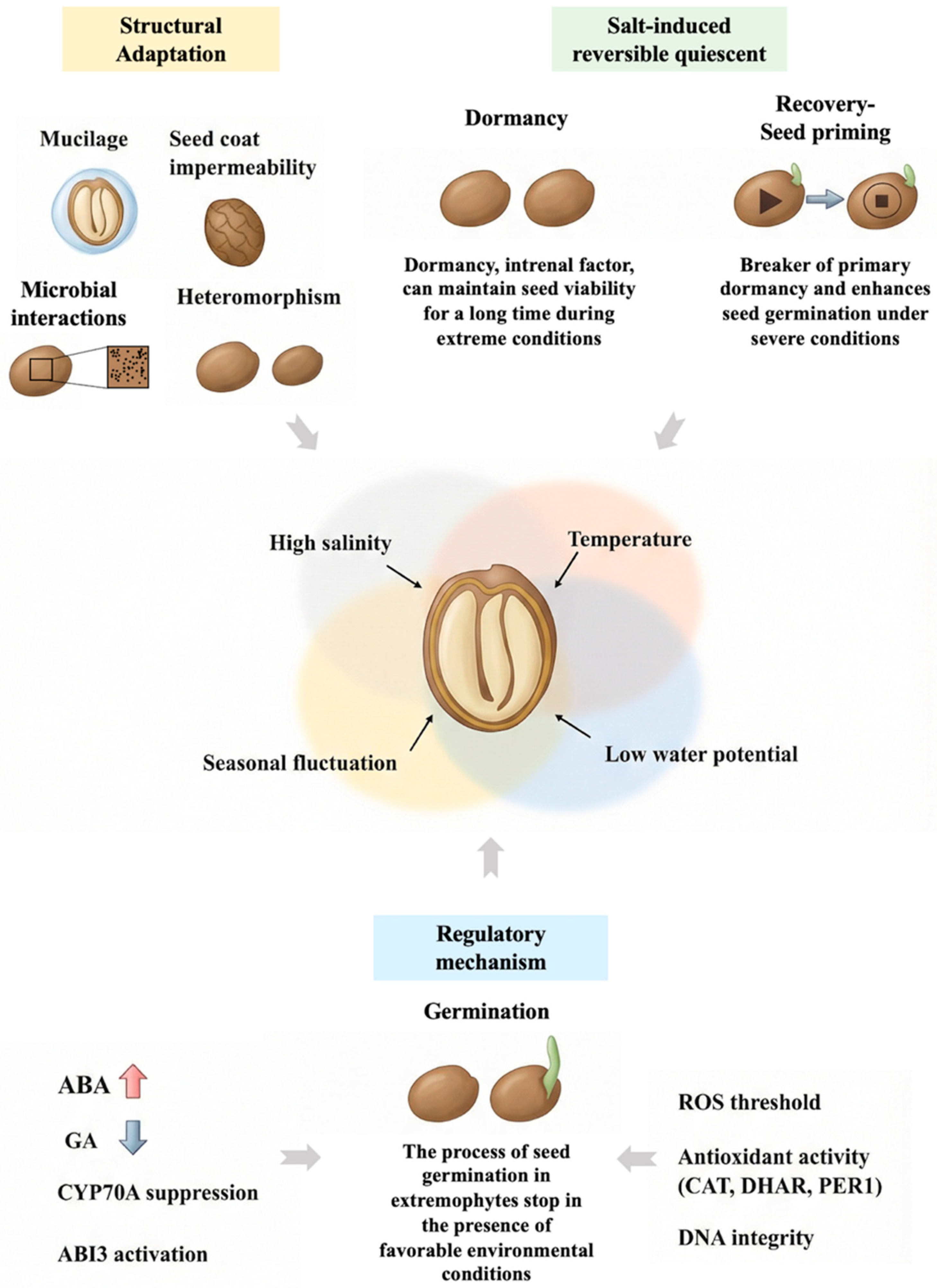
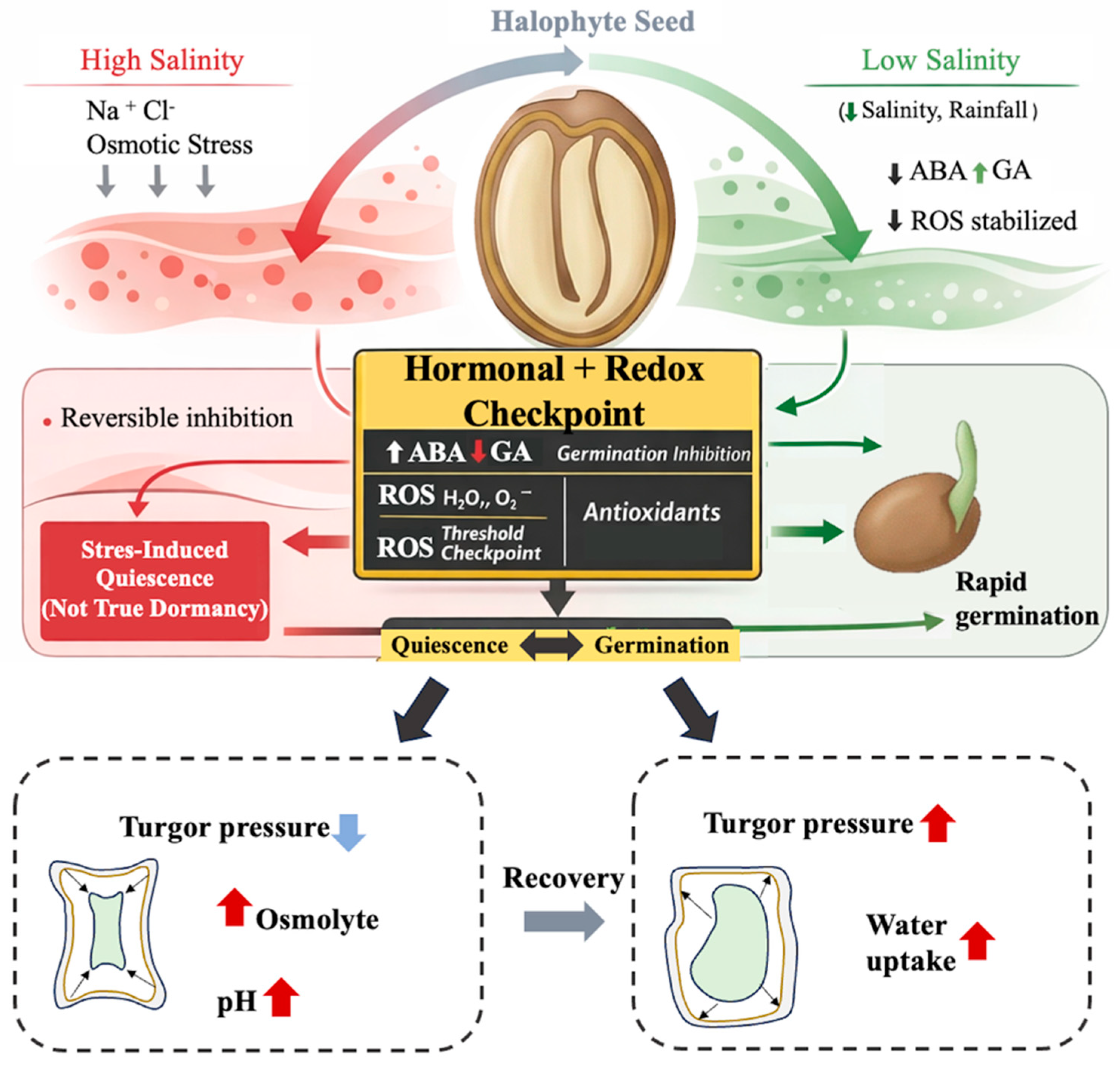
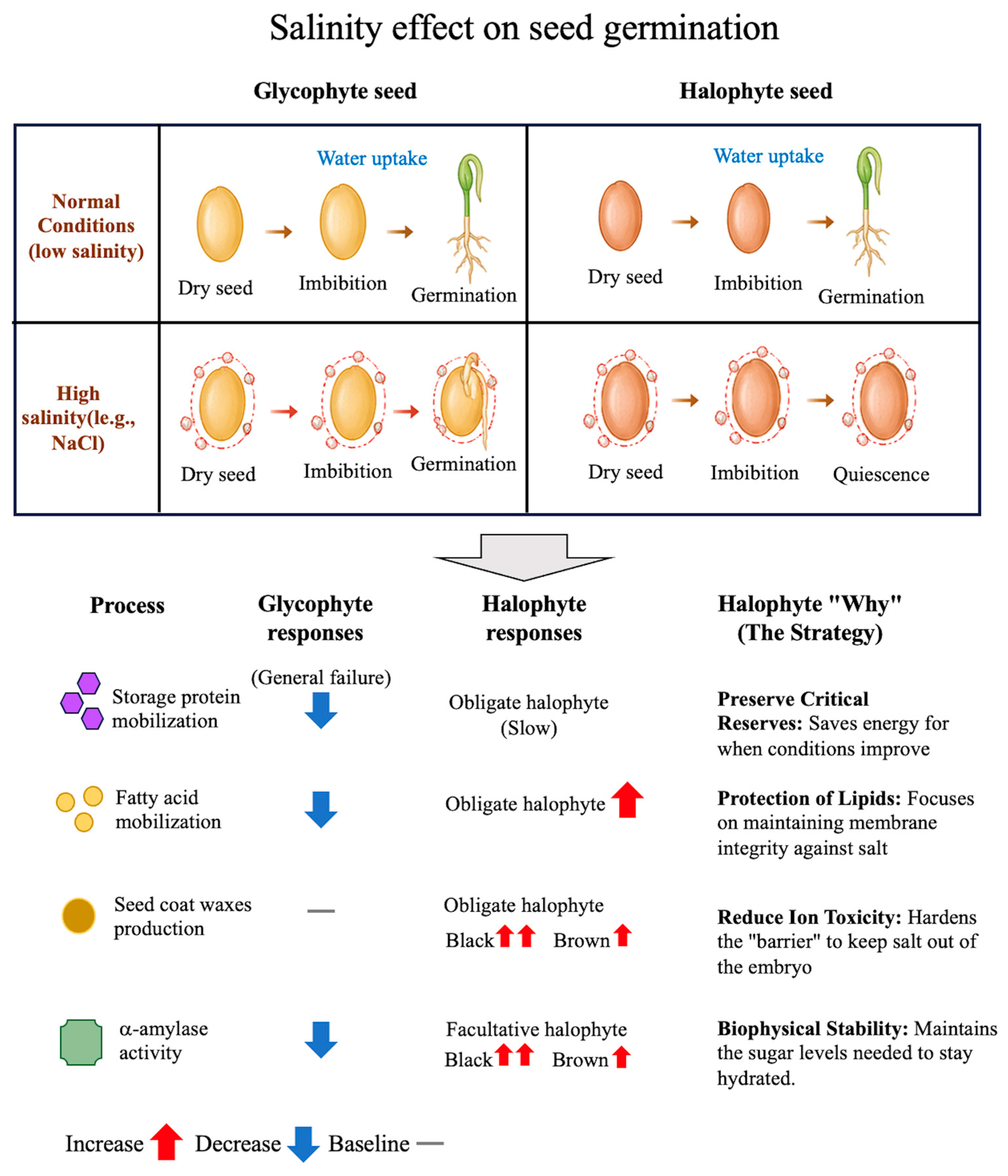
Seed Germination as an Adaptive Response in Halophytes

Abstract
1. Introduction

| Species Name | Family | Life Span | Adaptation Strategy | Germination Characteristics |
|---|---|---|---|---|
| Aegiceras corniculatum | Primulaceae | Perennial | Salt secretor | Lost the heme-binding ability of the DOG1 gene [11] |
| Anastatica hierochuntica | Brassicaceae | Annual | Salt excluder | Hygrochasy; seed dispersal triggered by moisture [12] |
| Anthrocnemum macrostachyum | Chenopodiaceae | Perennial | Salt accumulator | High recovery capacity after hypersaline exposure [13] |
| Anthrocnemum meridionale | Chenopodiaceae | Perennial | Salt accumulator | Nutrient-rich seeds (K, Ca, Mg) for early seedling vigor [14] |
| Artemisia sphaerocephala | Asteraceae | Perennial | Salt excluder | Seed mucilage enhances water retention and soil anchorage [15] |
| Cakile maritima | Brassicaceae | Annual | Salt accumulator | Sea-dispersed seeds; dimorphic fruits for long/short distance dispersal [16] |
| Carrichtera annua | Brassicaceae | Annual | Salt excluder | Opportunistic germination synchronized with rare rainfall [17] |
| Chenopodium album | Amaranthaceae | Annual | Salt excluder | Nitrophilous and salt-tolerant; high plasticity in germination [18] |
| Chenopodium quinoa | Amaranthaceae | Annual | Salt accumulator | Facultative halophyte; seed coat contains saponins for protection [19] |
| Colobanthus quitensis | Brassicaceae | Perennial | Salt excluder | Adapted to low temperatures; metabolic stability [20] |
| Diptychocarpus strictus | Brassicaceae | Annual | Salt excluder | Fruit and seed heteromorphism to spread risk [21] |
| Eutrema salsugineum | Brassicaceae | Perennial | Salt excluder | Coat-imposed dormancy and ABA-mediated control [22] |
| Gypsophila oblanceolata | Caryophyllaceae | Perennial | Salt excluder | Change antioxidant metabolism [23] |
| Haloxylon ammodendron | Amaranthaceae | Perennial | Salt accumulator | Rapid germination to exploit brief moisture [24] |
| Haloxylon persicum | Amaranthaceae | Perennial | Salt excluder | Specialized for sand stabilization; ultra-fast germination [25] |
| Kalidium caspicum | Amaranthaceae | Perennial | Salt accumulator | Highly succulent stems; seeds exhibit deep quiescence under salt [26] |
| Lasiurus scindicus | Poaceae | Perennial | Salt excluder | Synthesis of antimicrobial silver nanoparticles in seeds [27] |
| Lepidium perfoliatum | Brassicaceae | Annual | Salt excluder | Myxospermy; ecological role in sand stabilization [28] |
| Limonium bicolor | Plumbaginaceae | Perennial | Salt secretor | Salt effects seed protein and sugar [29] |
| Lobularia maritima | Brassicaceae | Annual/Perennial | Salt accumulator | Coastal adaptation, rapid recovery [30] |
| Panicum turgidum | Poaceae | Perennial | Salt excluder | Biogenic agent for the nanoparticles [27] |
| Plantago spp. | Plantaginaceae | Perennial | Salt accumulator | Seed mucilage facilitates soil attachment [31] |
| Prosopis koelziana | Fabaceae | Perennial | Salt accumulator | Physical dormancy; plasma-enhanced germination [32] |
| Salicornia spp. | Amaranthaceae | Annual/Perennial | Salt accumulator | Hypersaline coastal adaptation and high seed oil content [33] |
| Salsola ferganica | Amaranthaceae | Annual | Salt accumulator | Triple seed morphs with hierarchical germination [34] |
| Schrenkiella parvula | Brassicaceae | Annual | Salt accumulator | Reversible salt-induced quiescence via mucilage [35] |
| Spergularia salina | Caryophyllaceae | Annual/Perennial | Salt accumulator | Seed polymorphism (winged vs. wingless) for dispersal strategies [36] |
| Suaeda aralocaspica | Amaranthaceae | Annual | Salt accumulator | Non-centralized embryo; black/brown seed dimorphism [37] |
| Suaeda corniculata | Amaranthaceae | Annual | Salt accumulator | Melatonin-mediated antioxidant defense [38] |
| Suaeda glauca | Amaranthaceae | Annual | Salt accumulator | Dimorphic seeds (black/brown) with varying dormancy levels [39] |
| Suaeda liaotungensis | Amaranthaceae | Annual | Salt accumulator | Pigmentation genes (ANS, BAN) regulate seed types [40] |
| Suaeda physophora | Amaranthaceae | Perennial | Salt accumulator | Woody halophyte; perennial strategy to survive chronic salinity [25] |
| Reaumuria soongorica | Tamaricaceae | Perennial | Salt secretor | miRNA-mediated regulation (MIR4995) of ABA catabolism under salt stress [41] |
2. Factors Involved in Halophyte Seeds Under Saline Environments
2.1. Detailed Analysis of Halophyte Seed Coats
2.2. Seed Mucilage
2.3. Seed Heteromorphism and Its Effect on Halophyte Seed Adaptation to Saline Environments
2.4. The Role of Seed-Associated Microbiomes Under Salinity
3. Physiological Balance Mechanisms Regulating Seed Germination in Halophytes Under Salinity
3.1. Impact of Saline Environments on Seed Germination
3.2. Seed Germination Responses of Halophytes to Multiple Abiotic Stresses
3.3. Integrated Core Mechanisms Regulating Halophyte Seed Germination Under Salinity
- (1)
- Physiological checkpoints: hormonal and redox signals
- (2)
- Molecular adaptation and germination regulators
4. Salt-Induced Quiescence
4.1. Dormancy: A Controlled Survival Strategy in Halophyte Seeds
| Species Name | Family | Monocot/Dicot | Classification | Salt Concentration |
|---|---|---|---|---|
| Acacia tortilis | Fabaceae | Dicot | Facultative halophyte | 0–800 mM NaCl [88] |
| Aegiceras corniculatum | Primulaceae | Dicot | Facultative halophyte | 0–400 mM NaCl [87] |
| Aeluropus lagopoides | Poaceae | Monocot | Facultative halophyte | 0–800 mM NaCl [88] |
| Arthrocnemum indicum | Amaranthaceae | Dicot | Obligate halophyte | 0–1000 mM NaCl [2] |
| Arthrocnemum macrostachyum | Amaranthaceae | Dicot | Obligate halophyte | 0–1000 mM NaCl [2] |
| Arthrocnemum meridionale | Amaranthaceae | Dicot | Obligate halophyte | 0–200 mM NaCl [14] |
| Caroxylon imbricatum | Amaranthaceae | Dicot | Habitat-independent/ facultative | 0–800 mM NaCl [88] |
| Chenopodium album | Amaranthaceae | Dicot | Facultative halophyte | 0–400 mM NaCl [18] |
| Chenopodium quinoa | Amaranthaceae | Dicot | Facultative halophyte | 0–400 mM NaCl 0–10.2 mM CaCl2 0–10.2 mM KCl 0–53.5 mM MgCl2 [121] |
| Colobanthus quitensis | Caryophyllaceae | Dicot | Facultative halophyte | 0–200 mM NaCl [66] |
| Eutrema salsugineum | Brassicaceae | Dicot | Obligate halophyte | 0–200 mM NaCl 10 mM LiCl [22] |
| Glycyrrhiza uralensis | Fabaceae | Dicot | Facultative halophyte | 0–800 mM NaCl [88] |
| Gypsophila oblanceolata | Caryophyllaceae | Dicot | Facultative halophyte | 0–300 mM NaCl [23] |
| Halogeton glomeratus | Amaranthaceae | Dicot | Obligate/Facultative | 0–800 mM NaCl [88] |
| Halopeplis perfoliata | Chenopodiaceae | Dicot | Obligate halophyte | 0–800 mM NaCl [88] |
| Haloxylon ammodendron | Amaranthaceae | Dicot | Facultative halophyte | 1.3 M NaCl [122] |
| Haloxylon persicum | Amaranthaceae | Dicot | Facultative halophyte | 1.3 M NaCl [122] |
| Hordeum marinum | Poaceae | Monocot | Facultative halophyte | 40 mM NaCl [108] |
| Kochia scoparia | Chenopodiaceae | Dicot | Facultative halophyte | 1 M NaCl [122] |
| Limonium axillare | Plumbaginaceae | Dicot | Obligate halophyte | 0–800 mM NaCl [88] |
| Limonium bicolor | Plumbaginaceae | Dicot | Facultative halophyte | NaCl, Na2SO4 [29] |
| Limonium vulgare | Plumbaginaceae | Dicot | Facultative halophyte | 1.5 M NaCl [122] |
| Lobularia maritima | Brassicaceae | Dicot | Facultative halophyte | 50–300 mM NaCl [30] |
| Panicum antidotale | Poaceae | Monocot | Facultative halophyte | 0–150 mM NaCl [123] |
| Portulaca oleracea | Portulacaceae | Dicot | Facultative halophyte | 0–400 mM NaCl [123] |
| Prosopis koelziana | Fabaceae | Dicot | Facultative halophyte | 100–200 mM NaCl [32] |
| Reaumuria soongorica | Tamaricaceae | Dicot | Facultative halophyte | 43 mM NaCl [41] |
| Suaeda fruticosa | Amaranthaceae | Dicot | Obligate halophyte | 0–400 mM NaCl [123] |
| Salicornia rubra | Amaranthaceae | Dicot | Obligate halophyte | 1 M NaCl [122] |
| Salsola ferganica | Amaranthaceae | Dicot | Obligate halophyte | 0–1000 mM NaCl [34] |
| Salsola iberica | Amaranthaceae | Dicot | Facultative halophyte | 1 M NaCl [122] |
| Salsola setifera | Amaranthaceae | Dicot | Facultative halophyte | 0–800 mM NaCl [88] |
| Sarcocornia perennis | Amaranthaceae | Dicot | Obligate halophyte | 1.3 M NaCl [122] |
| Schrenkiella parvula | Brassicaceae | Dicot | Facultative extreme halophyte | 0–400 mM NaCl [35] |
| Suaeda aralocaspica | Amaranthaceae | Dicot | Obligate halophyte | 300 mM NaCl [37] |
| Suaeda liaotungensis | Amaranthaceae | Dicot | Obligate halophyte | 0–1400 mM NaCl [40] |
| Suaeda physophora | Amaranthaceae | Dicot | Obligate halophyte | −1·34, −2·24, −3·13 MPa [25] |
| Suaeda salsa | Amaranthaceae | Dicot | Obligate halophyte | 500 mM, 1500 mM NaCl [49] |
| Tamarix spp. | Tamaricaceae | Dicot | Facultative halophyte | 1 M NaCl [122] |
| Urochondra setulosa | Poaceae | Monocot | Obligate halophyte | 0–200 mM NaCl [123] |
| Zygophyllum simplex | Zygophyllaceae | Dicot | Facultative halophyte | 0–100 mM NaCl [123] |
4.2. Germination Recovery and Seed Priming: Convergent Pre-Germinative Checkpoints
5. Utilization of Halophyte Seeds in a Wide Range of Industrial Applications
6. Conclusions
Author Contributions
Funding
Data Availability Statement
Conflicts of Interest
References
- González, M.B. Adaptation of halophytes to different habitats. In Seed Dormancy Germination; IntechOpen: London, UK, 2020. [Google Scholar] [CrossRef]
- Nisar, F.; Gul, B.; Khan, M.A.; Hameed, A. Germination and recovery responses of heteromorphic seeds of two co-occurring Arthrocnemum species to salinity, temperature and light. S. Afr. J. Bot. 2019, 121, 143–151. [Google Scholar] [CrossRef]
- Ozfidan-Konakci, C.; Uzilday, B.; Ozgur, R.; Yildiztugay, E.; Sekmen, A.H.; Turkan, I. Halophytes as a source of salt tolerance genes and mechanisms: A case study for the Salt Lake area, Turkey. Funct. Plant Biol. 2016, 43, 575–589. [Google Scholar] [CrossRef]
- Fan, L.; Wang, G.; Hu, W.; Pantha, P.; Tran, K.N.; Zhang, H.; An, L.; Dassanayake, M.; Qiu, Q.S. Transcriptomic view of survival during early seedling growth of the extremophyte Haloxylon ammodendron. Plant Physiol. Biochem. 2018, 132, 475–489. [Google Scholar] [CrossRef]
- Tran, K.N.; Pantha, P.; Wang, G.; Kumar, N.; Wijesinghege, C.; Oh, D.H.; Wimalagunasekara, S.; Duppen, N.; Li, H.; Hong, H.; et al. Balancing growth amidst salt stress–lifestyle perspectives from the extremophyte model Schrenkiella parvula. Plant J. 2023, 116, 921–941. [Google Scholar] [CrossRef]
- Vandelook, F.; Newton, R.J.; Bobon, N.; Bohley, K.; Kadereit, G. Evolution and ecology of seed internal morphology in relation to germination characteristics in Amaranthaceae. Ann. Bot. 2021, 127, 799–811. [Google Scholar] [CrossRef]
- Akžigitova, N.I. Galofil’naâ Rastitel’nost’srednej Azii i ee Indikacionnye Svojstva; Izd. Fan Uzbekskoj SSR: Tashkent, Uzbekistan, 1982. [Google Scholar]
- Butnik, A.A.; Japakova, U.N.; Begbaeva, G.F. Halophytes: Structure and Adaptation. In Sustainable Land Use in Deserts; Breckle, S.W., Veste, M., Wucherer, W., Eds.; Springer: Berlin/Heidelberg, Germany, 2001. [Google Scholar] [CrossRef]
- Hameed, A.; Hussain, S.; Rasheed, A.; Ahmed, M.Z.; Abbas, S. Exploring the potentials of halophytes in addressing climate change-related issues: A synthesis of their biological, environmental, and socioeconomic aspects. World 2024, 5, 36–57. [Google Scholar] [CrossRef]
- Durmaz, A.; Korkmaz, H.; Boyraz, M. Halofitik Tohumlarda Adaptasyonlar. Türler Ve Habitatlar 2023, 4, 60–78. [Google Scholar] [CrossRef]
- Feng, X.; Li, G.; Xu, S.; Wu, W.; Chen, Q.; Shao, S.; Liu, M.; Wang, N.; Zhong, C.; He, Z.; et al. Genomic insights into molecular adaptation to intertidal environments in the mangrove Aegiceras corniculatum. New Phytol. 2021, 231, 2346–2358. [Google Scholar] [CrossRef] [PubMed]
- Hegazy, A.K.; Barakat, H.N.; Kabiel, H.F. Anatomical significance of the hygrochastic movement in Anastatica hierochuntica. Ann. Bot. 2006, 97, 47–55. [Google Scholar] [CrossRef]
- Rubio-Casal, A.E.; Castillo, J.M.; Luque, C.J.; Figueroa, M.E. Influence of salinity on germination and seeds viability of two primary colonizers of Mediterranean salt pans. J. Arid Environ. 2003, 53, 145–154. [Google Scholar] [CrossRef]
- Ramírez, E.; Chaâbene, Z.; Hernández-Apaolaza, L.; Rekik, M.; Elleuch, A.; de la Fuente, V. Seed priming to optimize germination in Arthrocnemum Moq. BMC Plant Biol. 2022, 22, 527. [Google Scholar] [CrossRef] [PubMed]
- Huang, Z.; Gutterman, Y. Germination of Artemisia sphaerocephala (Asteraceae), occurring in the sandy desert areas of Northwest China. S. Afr. J. Bot. 1999, 65, 187–196. [Google Scholar] [CrossRef]
- Cordazzo, C.V. Seed characteristics and dispersal of dimorphic fruit segments of Cakile maritima Scopoli (Brassicaceae) population of southern Brazilian coastal dunes. Braz. J. Bot. 2006, 29, 259–265. [Google Scholar] [CrossRef]
- Facelli, J.M.; Chesson, P. Cyclic dormancy, temperature and water availability control germination of Carrichtera annua, an invasive species in chenopod shrublands. Austral Ecol. 2008, 33, 324–328. [Google Scholar] [CrossRef]
- Yao, S.; Lan, H.; Zhang, F. Variation of seed heteromorphism in Chenopodium album and the effect of salinity stress on the descendants. Ann. Bot. 2010, 105, 1015–1025. [Google Scholar] [CrossRef]
- El Hazzam, K.; Hafsa, J.; Sobeh, M.; Mhada, M.; Taourirte, M.; El Kacimi, K.; Yasri, A. An insight into saponins from Quinoa (Chenopodium quinoa Willd): A review. Molecules 2020, 25, 1059. [Google Scholar] [CrossRef]
- Hereme, R.; Morales-Navarro, S.; Ballesteros, G.; Barrera, A.; Ramos, P.; Gundel, P.E.; Molina-Montenegro, M.A. Fungal endophytes exert positive effects on Colobanthus quitensis under water stress but neutral under a projected climate change scenario in Antarctica. Front. Microbiol. 2020, 11, 264. [Google Scholar] [CrossRef]
- Lu, J.; Tan, D.; Baskin, J.M.; Baskin, C.C. Fruit and seed heteromorphism in the cold desert annual ephemeral Diptychocarpus strictus (Brassicaceae) and possible adaptive significance. Ann. Bot. 2010, 105, 999–1014. [Google Scholar] [CrossRef]
- Kazachkova, Y.; Khan, A.; Acuña, T.; López-Díaz, I.; Carrera, E.; Khozin-Goldberg, I.; Fait, A.; Barak, S. Salt induces features of a dormancy-like state in seeds of Eutrema (Thellungiella) salsugineum, a halophytic relative of Arabidopsis. Front. Plant Sci. 2016, 7, 186254. [Google Scholar] [CrossRef] [PubMed]
- Sekmen, A.H.; Turkan, I.; Tanyolac, Z.O.; Ozfidan, C.; Dinc, A. Different antioxidant defense responses to salt stress during germination and vegetative stages of endemic halophyte Gypsophila oblanceolata Bark. Environ. Exp. Bot. 2012, 77, 63–76. [Google Scholar] [CrossRef]
- Zhu, Y.; Jia, Z.; Wang, G.; Ning, H.; Ji, X.; Luo, Q. Response of seed germination and seedling emergence of Haloxylon ammodendron to rain frequency and temperature change from four desert ecosystems, Northwest China. AoB Plants 2023, 15, plac048. [Google Scholar] [CrossRef]
- Song, J.I.E.; Feng, G.U.; Tian, C.; Zhang, F. Strategies for Adaptation of Suaeda physophora, Haloxylon ammodendron and Haloxylon persicum to a Saline Environment During Seed-Germination Stage. Ann. Bot. 2005, 96, 399–405. [Google Scholar] [CrossRef]
- Tobe, K.; Li, X.; Omasa, K. Seed germination and radicle growth of a halophyte, Kalidium caspicum (Chenopodiaceae). Ann. Bot. 2000, 85, 391–396. [Google Scholar] [CrossRef]
- Alburae, N.; Alshamrani, R.; Mohammed, A.E. Bioactive silver nanoparticles fabricated using Lasiurus scindicus and Panicum turgidum seed extracts: Anticancer and antibacterial efficiency. Sci. Rep. 2024, 14, 4162. [Google Scholar] [CrossRef]
- Zhou, Z.; Xing, J.; Zhao, J.; Liu, L.; Gu, L.; Lan, H. The ecological roles of seed mucilage on germination of Lepidium perfoliatum, a desert herb with typical myxospermy in Xinjiang. Plant Growth Regul. 2021, 97, 185–201. [Google Scholar] [CrossRef]
- Liu, Y.Y.; Wang, H.; Yu, F.M.; Li, S.J. Effects of salt stress on Limonium bicolor seed germination. Chin. J. Ecol. 2009, 9, 021. [Google Scholar]
- Zammali, I.; Dabbous, A.; Youssef, S.; Ben Hamed, K. Effects of chemical priming on the germination of the ornamental halophyte Lobularia maritima under NaCl salinity. Seeds 2022, 1, 99–109. [Google Scholar] [CrossRef]
- Cowley, J.M.; Burton, R.A. The good stuff: Plantago as a myxospermous model with modern utility. New Phytol. 2021, 229, 1917–1923. [Google Scholar] [CrossRef] [PubMed]
- Shahabi, Z.M.; Nasibi, F.; Noori, H. Cold plasma technology as a pre-treatment for seed priming enhances germination and reduces salinity stress in Prosopis Koelziana. Sci. Rep. 2025, 15, 26250. [Google Scholar] [CrossRef] [PubMed]
- AlYammahi, J.; Chelaifa, H.; Hasan, A.; Darwish, A.S.; Lemaoui, T.; Hernandez, H.H.; Galvan, A.R. Salicornia seed oil: A high-yielding and sustainable halophytic feedstock for biodiesel and energy in underutilized hypersaline coastal deserts. Energy Convers. Manag. 2024, 318, 118914. [Google Scholar] [CrossRef]
- Ma, Y.; Zhang, J.; Li, X.; Zhang, S.; Lan, H. Effects of environmental stress on seed germination and seedling growth of Salsola ferganica (Chenopodiaceae). Acta Ecol. Sin. 2016, 36, 456–463. [Google Scholar] [CrossRef]
- Şekerci, K.; Higashitani, N.; Ozgur, R.; Higashitani, A.; Turkan, I.; Uzilday, B. Gene expression and mucilage adaptations to salinity in germination of extreme halophyte Schrenkiella parvula seeds. Plant Physiol. Biochem. 2025, 220, 109517. [Google Scholar] [CrossRef]
- Telenius, A.; Torstensson, P. Seed type and seed size variation in the heteromorphic saltmarsh annual Spergularia salina along the coast of Sweden. Plant Biol. 1999, 1, 585–593. [Google Scholar] [CrossRef]
- Cao, J.; Chen, L.; Wang, J.; Xing, J.; Lv, X.; Maimaitijiang, T.; Lan, H. Effects of genetic and environmental factors on variations of seed heteromorphism in Suaeda aralocaspica. AoB Plants 2020, 12, plaa044. [Google Scholar] [CrossRef]
- Zhang, M.; Liu, S.; Tong, S.; Zhang, D.; Qi, Q.; Wang, Y.; Wang, X.; An, Y.; Lu, X. Effects of melatonin priming on Suaeda corniculata seed germination, antioxidant defense, and reserve mobilization: Implications for salinized wetland restoration. Front. Ecol. Evol. 2022, 10, 941032. [Google Scholar] [CrossRef]
- Wang, H.; Narsing Rao, M.; Gao, Y. Insights into the endophytic bacterial community comparison and their potential role in the dimorphic seeds of halophyte Suaeda glauca. BMC Microbiol. 2021, 21, 143. [Google Scholar] [CrossRef]
- Song, J.; Wang, H.; Chu, R.; Zhao, L.; Li, X.; An, S.; Qiang, M.; Du, W.; Li, Q. Differences in physiological characteristics, seed germination, and seedling establishment in response to salt stress between dimorphic seeds in the halophyte suaeda liaotungensis. Plants 2023, 12, 1408. [Google Scholar] [CrossRef] [PubMed]
- Zhang, H.; Liu, X.; Yang, X.; Wu, H.; Zhu, J.; Zhang, H. miRNA–mRNA integrated analysis reveals roles for miRNAs in a typical halophyte, Reaumuria soongorica, during seed germination under salt stress. Plants 2020, 9, 351. [Google Scholar] [CrossRef] [PubMed]
- Joint FAO. Challenges and Opportunities for Crop Production in Dry and Saline Environments in ARASIA Member States; IAEA: Vienna, Austria, 2018; pp. 1–138. ISBN 978-92-0-101918-9. [Google Scholar]
- Hernández Cortés, J.A. Seed science research: Global trends in seed biology and technology. Seeds 2022, 1, 1. [Google Scholar] [CrossRef]
- Ramírez, E.; Rodríguez, N.; de la Fuente, V. Arthrocnemum Moq.: Unlocking Opportunities for Biosaline Agriculture and Improved Human Nutrition. Plants 2024, 13, 496. [Google Scholar] [CrossRef]
- Noodén, L.D.; Blakley, K.A.; Grzybowski, J.M. Control of seed coat thickness and permeability in soybean: A possible adaptation to stress. Plant Physiol. 1985, 79, 543–545. [Google Scholar] [CrossRef]
- Windsor, J.B.; Symonds, V.V.; Mendenhall, J.; Lloyd, A.M. Arabidopsis seed coat development: Morphological differentiation of the outer integument. Plant J. 2000, 22, 483–493. [Google Scholar] [CrossRef] [PubMed]
- Song, J.; Feng, G.; Li, Z.K.; Chen, A.D.; Chen, X.M.; Zhang, F.S. Effects of salinity and scarifying seed coat on ion content of embryos and seed germination for Suaeda physophora and Haloxylon ammodendron. Seed Sci. Technol. 2007, 35, 615–623. [Google Scholar] [CrossRef]
- Lamont, B.B.; Barreiro, P.G.; Newton, R.J. Seed-coat thickness explains contrasting germination responses to smoke and heat in Leucadendron. Seed Sci. Res. 2022, 32, 70–77. [Google Scholar] [CrossRef]
- Song, J.; Shi, W.; Liu, R.; Xu, Y.; Sui, N.; Zhou, J.; Feng, G. The role of the seed coat in adaptation of dimorphic seeds of the euhalophyte Suaeda salsa to salinity. Plant Species Biol. 2017, 32, 107–114. [Google Scholar] [CrossRef]
- Hayder, Z.; Boughalleb, F.; Abdellaoui, R.; Hashem, A.; Avila-Quezada, G.D.; Abd_Allah, E.F.; Tarhouni, M. Comparative Floral and Seed Anatomy of Newly Identified Sarcocornia and Salicornia Species in Tunisia: Insights into Anther Development, Megasporogenesis, and Embryological Characteristics. Res. Sq. 2023. [Google Scholar] [CrossRef]
- Raviv, B.; Aghajanyan, L.; Granot, G.; Makover, V.; Frenkel, O.; Gutterman, Y.; Grafi, G. The dead seed coat functions as a long-term storage for active hydrolytic enzymes. PLoS ONE 2017, 12, e0181102. [Google Scholar] [CrossRef] [PubMed]
- Eshel, G.; Duppen, N.; Wang, G.; Oh, D.H.; Kazachkova, Y.; Herzyk, P.; Amtmann, A.; Gordon, M.; Chalifa-Caspi, V.; Oscar, M.A.; et al. Positive selection and heat-response transcriptomes reveal adaptive features of the Brassicaceae desert model, Anastatica hierochuntica. New Phytol. 2022, 236, 1006–1026. [Google Scholar] [CrossRef]
- Han, X.; Zhang, L.; Miao, X.; Hu, X.; Nan, S.; Fu, H. Transcriptome analysis reveals the molecular mechanisms of mucilage biosynthesis during Artemisia sphaerocephala seed development. Ind. Crops Prod. 2020, 145, 111991. [Google Scholar] [CrossRef]
- Kreitschitz, A.; Kovalev, A.; Gorb, S.N. Plant seed mucilage as a glue: Adhesive properties of hydrated and dried-in-contact seed mucilage of five plant species. Int. J. Mol. Sci. 2021, 22, 1443. [Google Scholar] [CrossRef]
- Zhang, C.P.; Wu, C.X.; Song, Y.C.; Tian, C.Y.; Feng, G. Effects of mucilage on seed germination of the desert ephemeral plant Plantago minuta Pall. under osmotic stress and cycles of wet and dry conditions. Plant Species Biol. 2014, 29, 109–116. [Google Scholar] [CrossRef]
- Yang, X.; Baskin, C.C.; Baskin, J.M.; Liu, G.; Huang, Z. Seed mucilage improves seedling emergence of a sand desert shrub. PLoS ONE 2012, 7, e34597. [Google Scholar] [CrossRef] [PubMed]
- Tsai, A.Y.L.; McGee, R.; Dean, G.H.; Haughn, G.W.; Sawa, S. Seed mucilage: Biological functions and potential applications in biotechnology. Plant Cell Physiol. 2021, 62, 1847–1857. [Google Scholar] [CrossRef] [PubMed]
- Bhatt, A.; Santo, A.; Gallacher, D. Seed mucilage effect on water uptake and germination in five species from the hyper arid Arabian desert. J. Arid Environ. 2016, 128, 73–79. [Google Scholar] [CrossRef]
- Gutterman, Y.; Shem-Tov, S. Mucilaginous seed coat structure of Carrichtera annua and Anastatica hierochunticafrom the Negev Desert highlands of Israel, and its adhesion to the soil crust. J. Arid Environ. 1997, 35, 695–705. [Google Scholar] [CrossRef]
- LoPresti, E.F.; Stessman, M.E.; Warren, S.E.; Toll, K. Drying conditions alter the defensive function of seed mucilage against granivores. J. Ecol. 2023, 111, 525–536. [Google Scholar] [CrossRef]
- Engelbrecht, M.; García-Fayos, P. Mucilage secretion by seeds doubles the chance to escape removal by ants. Plant Ecol. 2012, 213, 1167–1175. [Google Scholar] [CrossRef]
- Pan, V.S.; McMunn, M.; Karban, R.; Goidell, J.; Weber, M.G.; LoPresti, E.F. Mucilage binding to ground protects seeds of many plants from harvester ants: A functional investigation. Funct. Ecol. 2021, 35, 2448–2460. [Google Scholar] [CrossRef]
- Kong, Y.; Zhou, G.; Abdeen, A.A.; Schafhauser, J.; Richardson, B.; Atmodjo, M.A.; Jung, J.; Wicker, L.; Mohnen, D.; Western, T.; et al. GALACTURONOSYLTRANSFERASE-LIKE5 is involved in the production of Arabidopsis seed coat mucilage. Plant Physiol. 2013, 163, 1203–1217. [Google Scholar] [CrossRef]
- Hughes, P.W. Minimal-risk seed heteromorphism: Proportions of seed morphs for optimal risk-averse heteromorphic strategies. Front. Plant Sci. 2018, 9, 1412. [Google Scholar] [CrossRef] [PubMed]
- Liu, R.; Wang, L.; Tanveer, M.; Song, J. Seed heteromorphism: An important adaptation of halophytes for habitat heterogeneity. Front. Plant Sci. 2018, 9, 1515. [Google Scholar] [CrossRef] [PubMed]
- Ontivero, Y.; Fuentes-Lillo, E.; Navarrete-Campos, D.; Vázquez-Villa, D.; Cabreras-Barjas, G.; Arroyo-Marín, F.B.; Cuba-Díaz, M. Preliminary assessment of seed heteromorfism as an adaptive strategy of Colobanthus quitensis under saline conditions. Sci. Rep. 2024, 14, 31120. [Google Scholar] [CrossRef]
- Graeber, K.; Nakabayashi, K.; Miatton, E.; Leubner-Metzger, G.; Soppe, W.J. Molecular mechanisms of seed dormancy. Plant Cell Environ. 2012, 35, 1769–1786. [Google Scholar] [CrossRef]
- Čalasan, A.Ž.; Kadereit, G. Evolutionary seed ecology of heteromorphic Amaranthaceae. Perspect. Plant Ecol. Evol. Syst. 2023, 61, 125759. [Google Scholar] [CrossRef]
- Guzzon, F.; Orsenigo, S.; Gianella, M.; Müller, J.V.; Vagge, I.; Rossi, G.; Mondoni, A. Seed heteromorphy influences seed longevity in Aegilops. Seed Sci. Res. 2018, 28, 277–285. [Google Scholar] [CrossRef]
- Le, T.H.; Shin, S.C.; Song, J.E.; Bo, A.B.; Jia, W.; Cho, K.M.; Park, K.W. Influence of environmental factors on germination and emergence of Chenopodium album seed heteromorphism. WeedTurfgrass Sci. 2021, 10, 97–108. [Google Scholar] [CrossRef]
- Zhao, X.; Wang, Y.; Cao, F.; Wang, X.; Zhang, F.; Anwar, S.; Sun, Z.; He, H. Understanding the Impact of Sheep Digestion on Seed Germination in the Cold Desert Annual Diptychocarpus strictus with Emphasis on Fruit and Seed Heteromorphism. Life 2024, 14, 235. [Google Scholar] [CrossRef]
- Ma, Y.; Wang, J.; Zhang, J.; Zhang, S.; Liu, Y.; Lan, H. Seed heteromorphism and effects of light and abiotic stress on germination of a typical annual halophyte Salsola ferganica in cold desert. Front. Plant Sci. 2018, 8, 2257. [Google Scholar] [CrossRef]
- Song, Y.G.; Li, L.; Zhang, X.M.; Pan, X.L.; Zeng, X.H. Differences of seed coat structure and ions content between dimorphic seeds of Borszczowia aralocaspica. Bull. Bot. Res. 2012, 32, 290–295. [Google Scholar] [CrossRef]
- MacGregor, D.R.; Kendall, S.L.; Florance, H.; Fedi, F.; Moore, K.; Paszkiewicz, K.; Smirnoff, N.; Penfield, S. Seed production temperature regulation of primary dormancy occurs through control of seed coat phenylpropanoid metabolism. New Phytol. 2015, 205, 642–652. [Google Scholar] [CrossRef]
- Yu, C.Y. Molecular mechanism of manipulating seed coat coloration in oilseed Brassica species. J. Appl. Genet. 2013, 54, 135–145. [Google Scholar] [CrossRef] [PubMed]
- Liu, L.; Xia, W.; Li, H.; Zeng, H.; Wei, B.; Han, S.; Yin, C. Salinity inhibits rice seed germination by reducing α-amylase activity via decreased bioactive gibberellin content. Front. Plant Sci. 2018, 9, 275. [Google Scholar] [CrossRef]
- Shu, K.; Qi, Y.; Chen, F.; Meng, Y.; Luo, X.; Shuai, H.; Zhou, W.; Ding, J.; Du, J.; Liu, J.; et al. Salt stress represses soybean seed germination by negatively regulating GA biosynthesis while positively mediating ABA biosynthesis. Front. Plant Sci. 2017, 8, 1372. [Google Scholar] [CrossRef]
- Siddiqui, Z.S.; Khan, M.A. Some physiological attributes of dimorphic seeds of Halopyrum mucronatum (L.) Stapf. Pak. J. Bot. 2013, 45, 1975–1979. Available online: https://api.semanticscholar.org/CorpusID:54764575 (accessed on 18 May 2026).
- Yang, X.; Yu, H.; Guo, J. Arbuscular mycorrhizal fungi improve the antioxidative response and the seed production of Suaedoideae species Suaeda physophora Pall under salt stress. Not. Bot. Horti Agrobot. Cluj.-Napoca 2016, 44, 533–540. [Google Scholar] [CrossRef]
- AbuQamar, S.F.; El-Saadony, M.T.; Saad, A.M.; Desoky, E.S.M.; Elrys, A.S.; Abd El-Mageed, T.A.; Semida, W.M.; Abdelkhalik, A.; Mosa, W.F.; Al Kafaas, S.S.; et al. Halotolerant plant growth-promoting rhizobacteria improve soil fertility and plant salinity tolerance for sustainable agriculture—A review. Plant Stress 2024, 12, 100482. [Google Scholar] [CrossRef]
- Kumar, V.; Raghuvanshi, N.; Pandey, A.K.; Kumar, A.; Thoday-Kennedy, E.; Kant, S. Role of halotolerant plant growth-promoting rhizobacteria in mitigating salinity stress: Recent advances and possibilities. Agriculture 2023, 13, 168. [Google Scholar] [CrossRef]
- Ma, Y.; Liao, K.; Zhu, Y.; Lu, X.; Wang, K.; Zhang, X.R. Effects of drought stress on seed germination and early seeding growth in Ferula ferulaeoides (Steud.) Korov. Braz. J. Bot. 2024, 47, 857–863. [Google Scholar] [CrossRef]
- Makhaye, G.; Mofokeng, M.M.; Tesfay, S.; Aremu, A.O.; Van Staden, J.; Amoo, S.O. Influence of plant biostimulant application on seed germination. In Biostimulants for Crops from Seed Germination to Plant Development; Elsevier: Amsterdam, The Netherlands, 2021; pp. 109–135. [Google Scholar] [CrossRef]
- Pirasteh-Anosheh, H.; Samadi, M.; Kazemeini, S.A.; Ozturk, M.; Ludwiczak, A.; Piernik, A. ROS homeostasis and antioxidants in the halophytic plants and seeds. Plants 2023, 12, 3023. [Google Scholar] [CrossRef]
- Meychik, N.R.; Nikolaeva, J.I.; Yermakov, I.P. Ion exchange properties of the root cell walls isolated from the halophyte plants (Suaeda altissima L.) grown under conditions of different salinity. Plant Soil 2005, 277, 163–174. [Google Scholar] [CrossRef]
- Sanadhya, P.; Agarwal, P.; Agarwal, P.K. Ion homeostasis in a salt-secreting halophytic grass. AoB Plants 2015, 7, plv055. [Google Scholar] [CrossRef] [PubMed]
- Chi, B.J.; Guo, Z.J.; Wei, M.Y.; Song, S.W.; Zhong, Y.H.; Liu, J.W.; Zhang, Y.C.; Li, J.; Xu, C.Q.; Zhu, X.Y.; et al. Structural, developmental and functional analyses of leaf salt glands of mangrove recretohalophyte Aegiceras corniculatum. Tree Physiol. 2024, 44, tpad123. [Google Scholar] [CrossRef] [PubMed]
- Alhaddad, F.A.; Abu-Dieyeh, M.H.; ElAzazi, E.S.M.; Ahmed, T.A. Salt tolerance of selected halophytes at the two initial growth stages for future management options. Sci. Rep. 2021, 11, 10194. [Google Scholar] [CrossRef]
- Qu, X.; Baskin, J.M.; Wang, L.; Huang, Z. Effects of cold stratification, temperature, light and salinity on seed germination and radicle growth of the desert halophyte shrub, Kalidium caspicum (Chenopodiaceae). Plant Growth Regul. 2008, 54, 241–248. [Google Scholar] [CrossRef]
- Vicente, O.; Boscaiu, M.; Naranjo, M.Á.; Estrelles, E.; Bellés, J.M.; Soriano, P. Responses to salt stress in the halophyte Plantago crassifolia (Plantaginaceae). J. Arid Environ. 2004, 58, 463–481. [Google Scholar] [CrossRef]
- Loades, E.; Pérez, M.; Turečková, V.; Tarkowská, D.; Strnad, M.; Seville, A.; Nakabayashi, K.; Leubner-Metzger, G. Distinct hormonal and morphological control of dormancy and germination in Chenopodium album dimorphic seeds. Front. Plant Sci. 2023, 14, 1156794. [Google Scholar] [CrossRef]
- Kushiro, T.; Okamoto, M.; Nakabayashi, K.; Yamagishi, K.; Kitamura, S.; Asami, T.; Hirai, N.; Koshiba, T.; Kamiya, Y.; Nambara, E. The Arabidopsis cytochrome P450 CYP707A encodes ABA 8′-hydroxylases: Key enzymes in ABA catabolism. EMBO J. 2004, 23, 1647–1656. [Google Scholar] [CrossRef]
- Okamoto, M.; Kuwahara, A.; Seo, M.; Kushiro, T.; Asami, T.; Hirai, N.; Kamiya, Y.; Koshiba, T.; Nambara, E. CYP707A1 and CYP707A2, which encode abscisic acid 8′-hydroxylases, are indispensable for proper control of seed dormancy and germination in Arabidopsis. Plant Physiol. 2006, 141, 97–107. [Google Scholar] [CrossRef]
- Xu, T.; Zhang, L.; Yang, Z.; Wei, Y.; Dong, T. Identification and functional characterization of plant MiRNA under salt stress shed light on salinity resistance improvement through MiRNA manipulation in crops. Front. Plant Sci. 2021, 12, 665439. [Google Scholar] [CrossRef] [PubMed]
- Islam, W.; Waheed, A.; Naveed, H.; Zeng, F. MicroRNAs mediated plant responses to salt stress. Cells 2022, 11, 2806. [Google Scholar] [CrossRef]
- Soppe, W.J.; Bentsink, L. Dormancy in plants. Encycl. Life Sci. 2016, 1–7. [Google Scholar] [CrossRef]
- Seal, C.E.; Barwell, L.J.; Flowers, T.J.; Wade, E.M.; Pritchard, H.W. Seed germination niche of the halophyte Suaeda maritima to combined salinity and temperature is characterised by a halothermal time model. Environ. Exp. Bot. 2018, 155, 177–184. [Google Scholar] [CrossRef]
- Schopfer, P.; Plachy, C. Control of seed germination by abscisic acid: III. Effect on embryo growth potential (minimum turgor pressure) and growth coefficient (cell wall extensibility) in Brassica napus L. Plant Physiol. 1985, 77, 676–686. [Google Scholar] [CrossRef]
- Zhang, R.; Zhang, H.; Wang, L.; Zeng, Y. Effect of salt-alkali stress on seed germination of the halophyte Halostachys caspica. Sci. Rep. 2024, 14, 13199. [Google Scholar] [CrossRef] [PubMed]
- Azeem, M.; Waseem Abbasi, M.; Adnan, Y.M.; Yu, A.; Alamri, S.; Alfagham, A.T. Eruca sativa oil yields potential, fatty acids profiling, and physiological adaptations at the seed-filling stage with low-quality saline water irrigation. Sci. Rep. 2025, 15, 34674. [Google Scholar] [CrossRef]
- Yeilaghi, H.; Arzani, A.; Ghaderian, M.; Fotovat, R.; Feizi, M.; Pourdad, S.S. Effect of salinity on seed oil content and fatty acid composition of safflower (Carthamus tinctorius L.) genotypes. Food Chem. 2012, 130, 618–625. [Google Scholar] [CrossRef]
- Reiahisamani, N.; Esmaeili, M.; Khoshkholgh Sima, N.A.; Zaefarian, F.; Zeinalabedini, M. Assessment of the oil content of the seed produced by Salicornia L., along with its ability to produce forage in saline soils. Genet. Resour. Crop Evol. 2018, 65, 1879–1891. Available online: https://api.semanticscholar.org/CorpusID:254505825 (accessed on 18 May 2026). [CrossRef]
- Zhao, Y.Q.; Ma, Y.C.; Duan, H.M.; Liu, R.R.; Song, J. Traits of fatty acid accumulation in dimorphic seeds of the euhalophyte Suaeda salsa in saline conditions. Plant Biosyst. 2019, 153, 514–520. [Google Scholar] [CrossRef]
- Patel, M.K.; Pandey, S.; Brahmbhatt, H.R.; Mishra, A.; Jha, B. Lipid content and fatty acid profile of selected halophytic plants reveal a promising source of renewable energy. Biomass Bioenergy 2019, 124, 25–32. [Google Scholar] [CrossRef]
- Müntz, K.; Belozersky, M.A.; Dunaevsky, Y.E.; Schlereth, A.; Tiedemann, J. Stored proteinases and the initiation of storage protein mobilization in seeds during germination and seedling growth. J. Exp. Bot. 2001, 52, 1741–1752. [Google Scholar] [CrossRef] [PubMed]
- Debez, A.; Belghith, I.; Pich, A.; Taamalli, W.; Abdelly, C.; Braun, H.P. High salinity impacts germination of the halophyte Cakile maritima but primes seeds for rapid germination upon stress release. Physiol. Plant. 2018, 164, 134–144. [Google Scholar] [CrossRef] [PubMed]
- Çirka, M.; Kaya, A.; Eryigit, T. Influence of temperature and salinity stress on seed germination and seedling growth of soybean (Glycine max L.). Legume Res. 2021, 44, 1053–1059. [Google Scholar] [CrossRef]
- Taheri, M.; Gherekhloo, J.; Sohrabi, S.; Siahmarguee, A.; Hassanpour-bourkheili, S. Sea barley (Hordeum Marinum) seed germination ecology and seedling emergence. Acta Bot. Hung. 2024, 66, 119–134. [Google Scholar] [CrossRef]
- Zhang, H.; Hu, M.; Ma, H.; Jiang, L.; Zhao, Z.; Ma, J.; Wang, L. Differential responses of dimorphic seeds and seedlings to abiotic stresses in the halophyte Suaeda salsa. Front. Plant Sci. 2021, 12, 630338. [Google Scholar] [CrossRef]
- Dong, Q.; Huang, T.; Zhou, C.; Wan, X.; He, X.; Miao, P.; Cheng, H.; Wang, X.; Yu, H.; Hu, M.; et al. Nano-priming with selenium nanoparticles reprograms seed germination, antioxidant defense, and phenylpropanoid metabolism to enhance Fusarium graminearum resistance in maize seedlings. J. Adv. Res. 2025, 81, 13–25. [Google Scholar] [CrossRef]
- Coughlan, J.M.; Saha, A.; Donohue, K. Effects of pre-and post-dispersal temperatures on primary and secondary dormancy dynamics in contrasting genotypes of Arabidopsis thaliana (Brassicaceae). Plant Species Biol. 2017, 32, 210–222. [Google Scholar] [CrossRef]
- Guo, R.; Shi, L.; Yang, Y. Germination, growth, osmotic adjustment, and ionic balance of wheat in response to saline and alkaline stresses. Soil Sci. Plant Nutr. 2009, 55, 667–679. [Google Scholar] [CrossRef]
- Bassel, G.W. To grow or not to grow? Trends Plant Sci. 2016, 21, 498–505. [Google Scholar] [CrossRef]
- Liu, Y.F.; Wei, Y.; Yan, C. Germination characteristics and ecological adaptation of dimorphic seeds of Borszczowia aralocaspica. Acta Ecol. Sin. 2009, 29, 6609–6614. [Google Scholar]
- Cuba-Díaz, M.; Cerda, G.; Rivera, C.; Gómez, A. Genome size comparison in Colobanthus quitensis populations show differences in species ploidy. Polar Biol. 2017, 40, 1475–1480. [Google Scholar] [CrossRef]
- Ontivero, Y.; Cuba-Díaz, M.; Fuentes-Lillo, E.; Convey, P. Germination Strategies and Seed Quality of Colobanthus quitensis: Implications for Sustainable Antarctic Ecosystems and Ex Situ Plant Conservation. Sustainability 2024, 16, 10726. [Google Scholar] [CrossRef]
- Suleiman, M.K.; Bhatt, A.; Jacob, S.; Thomas, R.R.; Sivadasan, M.T. Seed Longevity in Desert Species and the Possibility of Forming a Persistent Soil Seed Bank. Sustainability 2023, 15, 15904. [Google Scholar] [CrossRef]
- Wen, Z.; Lu, X.; Wen, J.; Wang, Z.; Chai, M. Physical seed dormancy in legumes: Molecular advances and perspectives. Plants 2024, 13, 1473. [Google Scholar] [CrossRef]
- Zhang, H.; Irving, L.J.; McGill, C.; Matthew, C.; Zhou, D.; Kemp, P. The effects of salinity and osmotic stress on barley germination rate: Sodium as an osmotic regulator. Ann. Bot. 2010, 106, 1027–1035. [Google Scholar] [CrossRef] [PubMed]
- El-Maarouf-Bouteau, H. The seed and the metabolism regulation. Biology 2022, 11, 168. [Google Scholar] [CrossRef]
- Panuccio, M.R.; Jacobsen, S.E.; Akhtar, S.S.; Muscolo, A. Effect of saline water on seed germination and early seedling growth of the halophyte quinoa. AoB Plants 2014, 6, plu047. [Google Scholar] [CrossRef]
- Gul, B.; Ansari, R.; Flowers, T.J.; Khan, M.A. Germination strategies of halophyte seeds under salinity. Environ. Exp. Bot. 2013, 92, 4–18. [Google Scholar] [CrossRef]
- Hussain, S.; Nisar, F.; Gul, B.; Hameed, A. Seed priming with melatonin improved salinity tolerance of halophytes during early life cycle stages. Plant Growth Regul. 2024, 103, 351–368. [Google Scholar] [CrossRef]
- Gu, J.; Yao, S.; Ma, M. Maternal effects of habitats induce stronger salt tolerance in early-stage offspring of Glycyrrhiza uralensis from salinized habitats compared with those from non-salinized habitats. Biology 2024, 13, 52. [Google Scholar] [CrossRef]
- Hameed, A.; Hussain, S.; Nisar, F.; Rasheed, A.; Shah, S.Z. Seed priming as an effective technique for enhancing salinity tolerance in plants: Mechanistic insights and prospects for saline agriculture with a special emphasis on halophytes. Seeds 2025, 4, 14. [Google Scholar] [CrossRef]
- Devika, O.S.; Singh, S.; Sarkar, D.; Barnwal, P.; Suman, J.; Rakshit, A. Seed priming: A potential supplement in integrated resource management under fragile intensive ecosystems. Front. Sustain. Food Syst. 2021, 5, 654001. [Google Scholar] [CrossRef]
- Moreno, C.; Seal, C.E.; Papenbrock, J. Seed priming improves germination in saline conditions for Chenopodium quinoa and Amaranthus caudatus. J. Agron. Crop Sci. 2018, 204, 40–48. [Google Scholar] [CrossRef]
- Francis, D.V.; Subhan, A.I.; Mourad, A.H.; Abdalla, A.K.; Ahmed, Z.F.R. Optimizing germination conditions of Ghaf seed using ZnO nanoparticle priming through Taguchi method analysis. Sci. Rep. 2024, 14, 15946. [Google Scholar] [CrossRef] [PubMed]
- MacDonald, M.T.; Mohan, V.R. Chemical seed priming: Molecules and mechanisms for enhancing plant germination, growth, and stress tolerance. Curr. Issues Mol. Biol. 2025, 47, 177. [Google Scholar] [CrossRef] [PubMed]
- Messedi, D.; Hmidi, D.; Farhani, F.; Zribi, F.; Zorrig, W.; Abdelly, C.; Debez, A. Proline priming: An efficient strategy to mitigate salinity impact at early developmental stages of the oilseed halophyte Cakile maritima. Not. Bot. Horti Agrobot. Cluj.-Napoca 2024, 52, 13458. [Google Scholar] [CrossRef]
- Tolrà, R.; González-Cobo, C.; Corrales, I.; Padilla, R.; Llugany, M. Seed Halopriming as an Effective Strategy to Enhance Salt Tolerance in Cakile maritima: Activation of Antioxidant and Genetic Responses. Antioxidants 2025, 14, 353. [Google Scholar] [CrossRef]
- Li, J.; Zhao, C.; Zhang, M.; Yuan, F.; Chen, M. Exogenous melatonin improves seed germination in Limonium bicolor under salt stress. Plant Signal. Behav. 2019, 14, 1659705. [Google Scholar] [CrossRef]
- Rasooli, Z.; Barzin, G.; Mahabadi, T.D.; Entezari, M. Stimulating effects of cold plasma seed priming on germination and seedling growth of cumin plant. S. Afr. J. Bot. 2021, 142, 106–113. [Google Scholar] [CrossRef]
- Glenn, E.P.; Anday, T.; Chaturvedi, R.; Martinez-Garcia, R.; Pearlstein, S.; Soliz, D.; Nelson, S.G.; Felger, R.S. Three halophytes for saline-water agriculture: An oilseed, a forage and a grain crop. Environ. Exp. Bot. 2013, 92, 110–121. [Google Scholar] [CrossRef]
- Byers, E.N.; Hutchinson, S.L.; Schmitz, E.; Hettiarachchi, G.; Almutari, M.M.; de Oliveira Demarco, J. Productive Reuse of Industrial Wastewater for the Cultivation of a Biofuel Feedstock Using Salicornia. J. Nat. Resour. Agric. Ecosyst. 2025, 3, 69–80. [Google Scholar] [CrossRef]
- Kumar, A.; Abraham, E.; Gupta, A. Alternative biomass from saline and semiarid and arid conditions as a source of biofuels: Salicornia. In Biofuels: Greenhouse Gas Mitigation and Global Warming: Next Generation Biofuels and Role of Biotechnology; Springer: New Delhi, India, 2018; pp. 229–240. [Google Scholar] [CrossRef]
- Sharma, R.; Wungrampha, S.; Singh, V.; Pareek, A.; Sharma, M.K. Halophytes as bioenergy crops. Front. Plant Sci. 2016, 7, 1372. [Google Scholar] [CrossRef]
- ShenavaeiZare, T.; Khoshsima, A.; ZareNezhad, B. Development of surfactant-free microemulsion hybrid biofuels employing halophytic salicornia oil/ethanol and oxygenated additives. Fuel 2021, 292, 120249. [Google Scholar] [CrossRef]
- Rameshbabu, S.; Messaoudi, S.A.; Alehaideb, Z.I.; Ali, M.S.; Venktraman, A.; Alajmi, H.; Al-Eidi, H.; Matou-Nasri, S. Anastatica hierochuntica (L.) methanolic and aqueous extracts exert antiproliferative effects through the induction of apoptosis in MCF-7 breast cancer cells. Saudi Pharm. J. 2020, 28, 985–993. [Google Scholar] [CrossRef] [PubMed]
- Eshel, G.; Shaked, R.; Kazachkova, Y.; Khan, A.; Eppel, A.; Cisneros, A.; Acuna, T.; Gutterman, Y.; Tel-Zur, N.; Rachmilevitch, S.; et al. Anastatica hierochuntica, an Arabidopsis desert relative, is tolerant to multiple abiotic stresses and exhibits species-specific and common stress tolerance strategies with its halophytic relative, Eutrema (Thellungiella) salsugineum. Front. Plant Sci. 2017, 7, 1992. [Google Scholar] [CrossRef]
- Oh, D.H.; Hong, H.; Lee, S.Y.; Yun, D.J.; Bohnert, H.J.; Dassanayake, M. Genome structures and transcriptomes signify niche adaptation for the multiple-ion-tolerant extremophyte Schrenkiella parvula. Plant Physiol. 2014, 164, 2123–2138. [Google Scholar] [CrossRef] [PubMed]
- Shamsutdinov, N.; Shamsutdinov, Z. Halophyte utilization for biodiversity and productivity of degraded pasture restoration in arid regions of Central Asia and Russia. In Biosaline Agriculture and High Salinity Tolerance; Abdelly, C., Öztürk, M., Ashraf, M., Grignon, C., Eds.; Birkhäuser: Basel, Switzerland, 2008; pp. 233–240. [Google Scholar] [CrossRef]


Disclaimer/Publisher’s Note: The statements, opinions and data contained in all publications are solely those of the individual author(s) and contributor(s) and not of MDPI and/or the editor(s). MDPI and/or the editor(s) disclaim responsibility for any injury to people or property resulting from any ideas, methods, instructions or products referred to in the content. |
© 2026 by the authors. Licensee MDPI, Basel, Switzerland. This article is an open access article distributed under the terms and conditions of the Creative Commons Attribution (CC BY) license.
Share and Cite
Şekerci, K.; Higashitani, N.; Higashitani, A.; Turkan, I. Seed Germination as an Adaptive Response in Halophytes. Plants 2026, 15, 1723. https://doi.org/10.3390/plants15111723
Şekerci K, Higashitani N, Higashitani A, Turkan I. Seed Germination as an Adaptive Response in Halophytes. Plants. 2026; 15(11):1723. https://doi.org/10.3390/plants15111723
Chicago/Turabian StyleŞekerci, Keriman, Nahoko Higashitani, Atsushi Higashitani, and Ismail Turkan. 2026. "Seed Germination as an Adaptive Response in Halophytes" Plants 15, no. 11: 1723. https://doi.org/10.3390/plants15111723
APA StyleŞekerci, K., Higashitani, N., Higashitani, A., & Turkan, I. (2026). Seed Germination as an Adaptive Response in Halophytes. Plants, 15(11), 1723. https://doi.org/10.3390/plants15111723