First EST-SSRs of Helichrysum italicum (Roth) G. Don (Asteraceae) Revealed Insights into the Genetic Diversity and Population Structure in Corsica

 , ,
, ,  ,
,  , ,
, ,  , , and
Abstract
1. Introduction
2. Results
2.1. Transcriptome Sequencing and De Novo Assembly
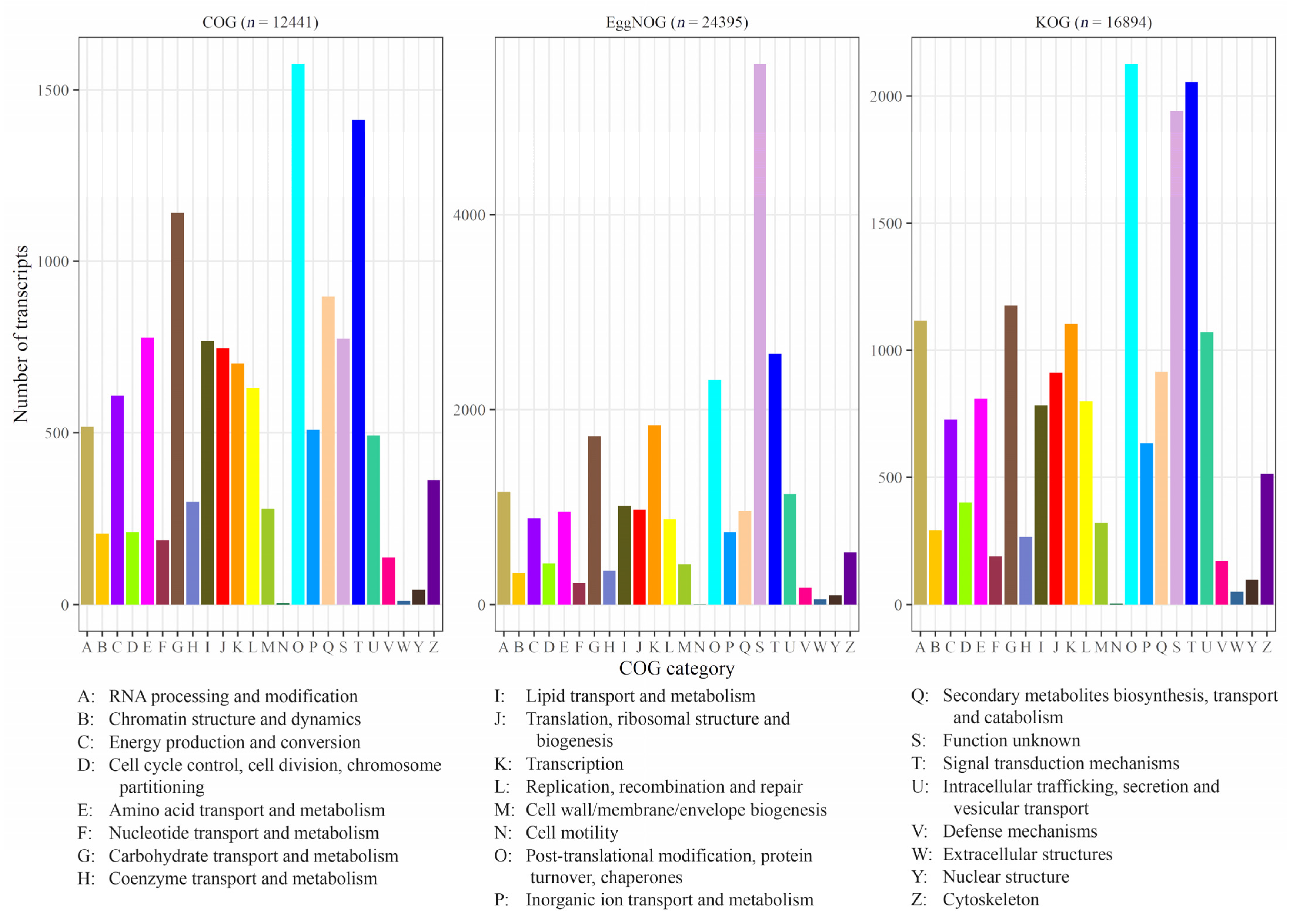
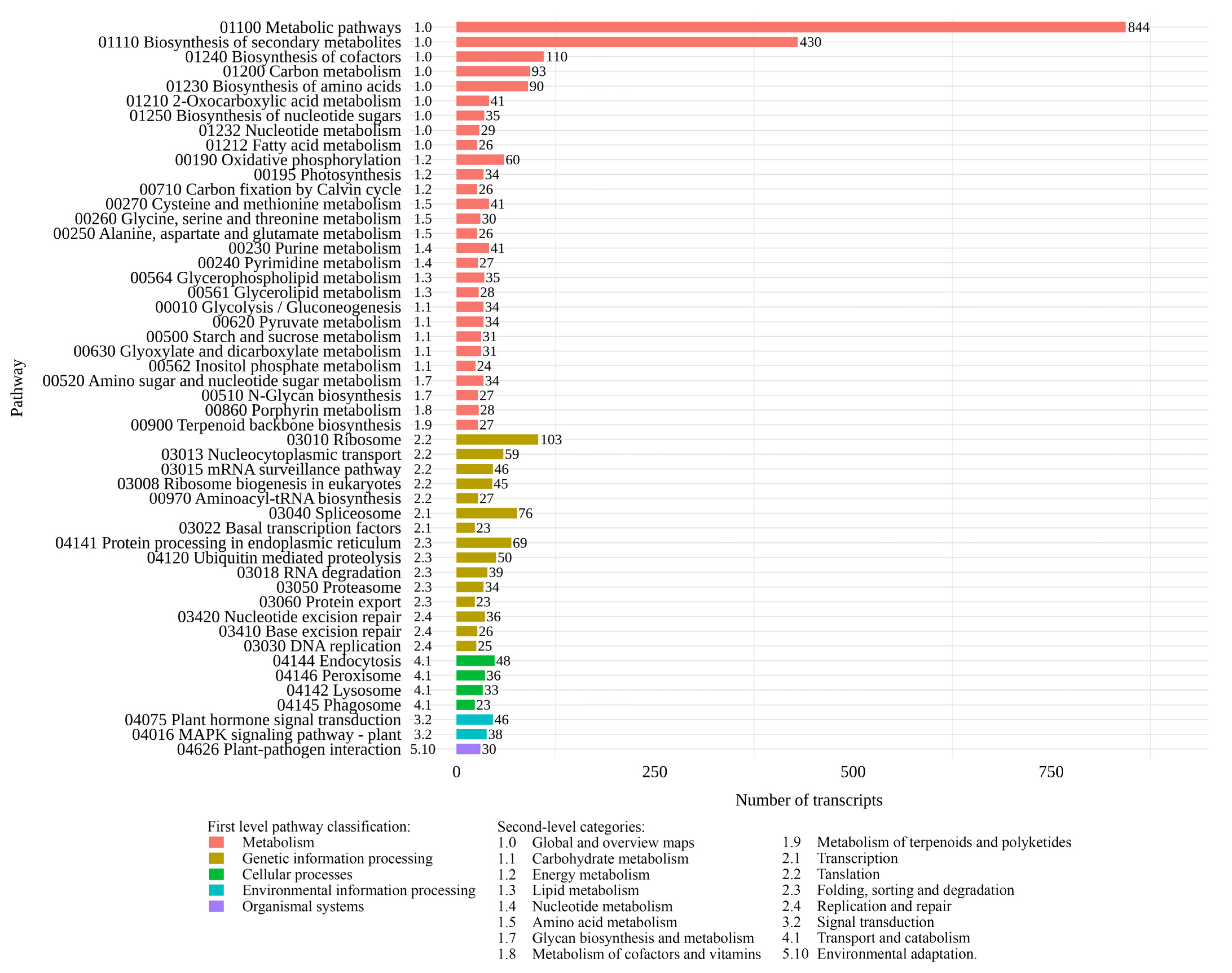
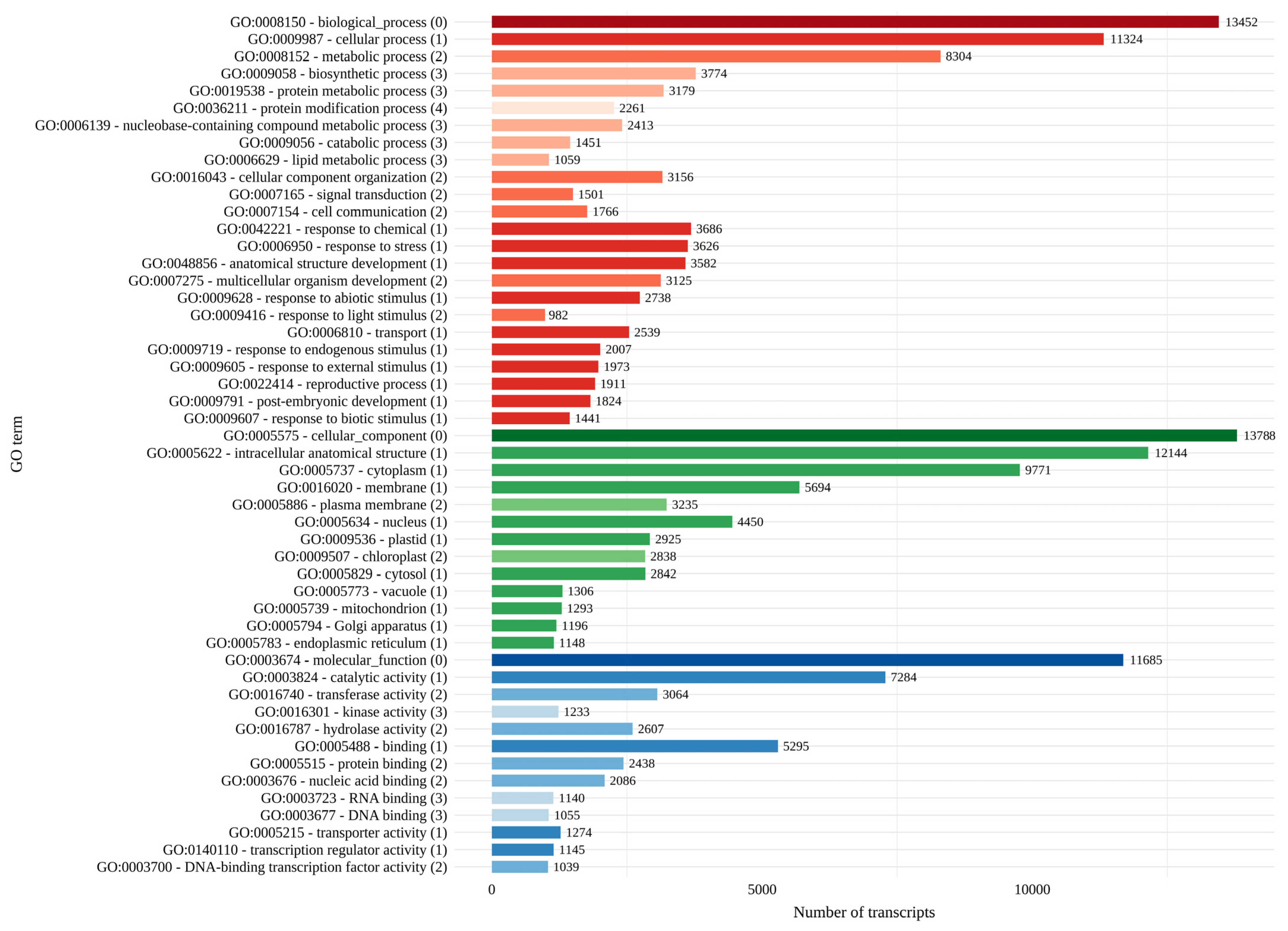
2.2. Functional Annotation and Biological Classification
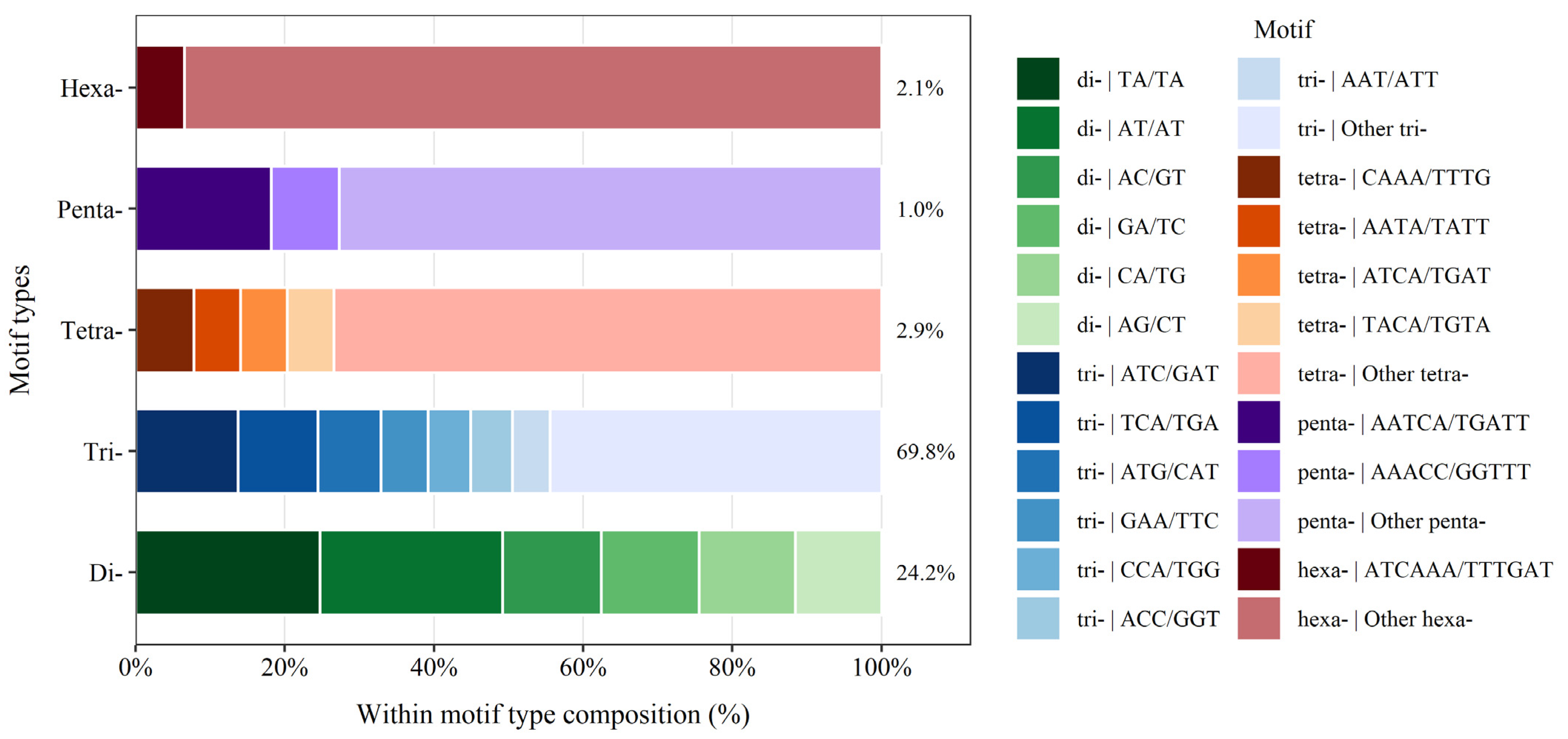
2.3. Frequency, Characterization, and Distribution of Microsatellite Repeats in H. italicum Transcriptome
2.4. EST-SSR Marker Development and Cross-Amplification in Helichrysum Species
2.5. EST-SSR Marker Characterization and Genetic Diversity Study of H. italicum Populations
3. Discussion
4. Materials and Methods
4.1. Plant Material
4.2. RNA Extraction and cDNA Library Preparation for Transcriptomic Sequencing
4.3. De Novo Transcriptome Assembly and Data Analysis
4.4. Functional Annotation
4.5. Identification of Microsatellite Repeats (SSRs) and Primer Development
4.6. EST-SSR Preliminary Amplification and Cross-Species Transferability
4.7. Characterization of EST-SSR Markers and Population Analysis of H. italicum
5. Conclusions
Supplementary Materials
Author Contributions
Funding
Data Availability Statement
Conflicts of Interest
References
- Viegas, D.A.; Palmeira-de-Oliveira, A.; Salgueiro, L.; Martinez-de-Oliveira, J.; Plameira-de-Oliveira, R. Helichrysum italicum: From traditional use to scientific data. J. Ethnopharmacol. 2014, 151, 54–65. [Google Scholar] [CrossRef]
- Akaberi, M.; Sahebkar, A.; Azizi, N.; Emami, S.A. Everlasting flower: Phytochemistry and pharmacology of the genus Helichrysum. Ind. Crops Prod. 2019, 138, 111471. [Google Scholar] [CrossRef]
- Di Pietro, R. New dry grassland associations from the Ausoni-Aurunci mountains (central Italy)—Syntaxonomical updating and discussion on the higher rank syntaxa. Hacquetia 2011, 10, 183–231. [Google Scholar] [CrossRef]
- Jasprica, N.; Dolina, K.; Milović, M. Plant taxa and communities on three islets in south Croatia, NE Mediterranean. Nat. Croat. 2015, 24, 191–213. [Google Scholar] [CrossRef]
- Terzi, M.; Jasprica, N. Changes in grassland vegetation on the island of Plavnik (Croatia) over 100 years. Acta Bot. Croat. 2024, 83, 119–134. [Google Scholar] [CrossRef]
- Terzi, M.; Jasprica, N.; Pesaresi, S. Syntaxonomic diversity of rocky dry grasslands for the Chrysopogono grylli-Koelerion splendentis along the east Adriatic. Diversity 2024, 16, 718. [Google Scholar] [CrossRef]
- Tomaselli, V.; Sciandrello, S.; Minissale, P.; Forte, L.; Costanzo, E.; Giusso del Galdo, G.; Carruggio, F.; Pazienza, G.; Brullo, S. Syntaxonomical remarks on the Garrigues from Apulia (S Italy) and neighboring territories. Plants 2024, 13, 1800. [Google Scholar] [CrossRef] [PubMed]
- Frédéric, M. The specific vulnerability of plant biodiversity and vegetation on Mediterranean islands in the face of global change. Reg. Environ. Change 2017, 17, 1775–1790. [Google Scholar] [CrossRef]
- Perrini, R.; Morone-Fortunato, I.; Lorusso, E.; Avato, P. Glands, essential oils and in vitro establishment of Helichrysum italicum (Roth) G. Don ssp. microphyllum (Willd.) Nyman. Ind. Crops Prod. 2009, 29, 395–403. [Google Scholar] [CrossRef]
- Maksimović, S.; Tadic, V.; Skala, D.; Žižović, I. Separation of phytochemicals from Helichrysum italicum: Ananalysis of different isolation techniques and biological activity of prepared extracts. Phytochemistry 2017, 138, 9–28. [Google Scholar] [CrossRef]
- Andreani, S.; Uehara, A.; Blagojević, P.; Radulovič, N.; Muselli, A.; Baldovini, N. Key odorants of industrially-produced Helichrysum italicum subsp. italicum essential oil. Ind. Crops Prod. 2019, 132, 275–282. [Google Scholar] [CrossRef]
- Glumac, M.; Jažo, Z.; Paštar, V.; Golemac, A.; Čikeš Čulić, V.; Bektić, S.; Radan, M.; Carev, I. Chemical profiling and bioactivity assessment of Helichrysum italicum (Roth) G. Don. essential oil: Exploring pure compounds and synergistic combinations. Molecules 2023, 28, 5299. [Google Scholar] [CrossRef]
- Lemaire, G.; Olivero, M.; Rouquet, V.; Moga, A.; Pagnon, A.; Cenizo, V.; Portes, P. Neryl acetate, the major component of Corsican Helichrysum italicum essential oil, mediates its biological activities on skin barrier. PLoS ONE 2023, 18, e0268384. [Google Scholar] [CrossRef]
- Baker, P.; Huang, C.; Radi, R.; Moll, S.B.; Jules, E.; Arbiser, J.L. Skin barrier function: The interplay of physical, chemical, and immunologic properties. Cells 2023, 12, 2745. [Google Scholar] [CrossRef]
- Fraternale, D.; Flamini, G.; Ascrizzi, R. In vitro anticollagenase and antielastase activities of essential oil of Helichrysum italicum subsp. italicum (Roth) G. Don. J. Med. Food 2019, 22, 1041–1046. [Google Scholar] [CrossRef] [PubMed]
- Combes, C.; Legrix, M.; Rouquet, V.; Rivoire, S.; Grasset, S.; Cenizo, V.; Moga, A.; Portes, P. 166 Helichrysum italicum essential oil prevents skin lipids peroxidation caused by pollution and UV. J. Investig. Dermatol. 2017, 137, S221. [Google Scholar] [CrossRef]
- Angioni, A.; Barra, A.; Arlorio, M.; Coisson, J.D.; Russo, M.T.; Pirisi, F.M.; Satta, M.; Cabras, P. Chemical composition, plant genetic differences, and antifungal activity of the essential oil of Helichrysum italicum G. Don ssp. microphyllum (Willd) Nym. J. Agric. Food Chem. 2003, 51, 1030–1034. [Google Scholar] [CrossRef] [PubMed]
- Mastelic, J.; Politeo, O.; Jerkovic, I.; Radosevic, N. Composition and antimicrobial activity of Helichrysum italicum essential oil and its terpene and terpenoid fractions. Chem. Nat. Compd. 2005, 41, 35–40. [Google Scholar] [CrossRef]
- Stupar, M.; Grbić, M.L.J.; Džamić, A.; Unković, N.; Ristić, M.; Jelikić, A.; Vukojević, J. Antifungal activity of selected essential oils and biocide benzalkonium chloride against the fungi isolated from cultural heritage objects. S. Afr. J. Bot. 2014, 93, 118–124. [Google Scholar] [CrossRef]
- Cui, H.; Zhang, X.; Zhou, H.; Zhao, C.; Lin, L. Antimicrobial activity and mechanisms of Salvia sclarea essential oil. Bot. Stud. 2015, 56, 16. [Google Scholar] [CrossRef]
- Djihane, B.; Wafa, N.; Elkhamssa, S.; Pedro, H.J.; Maria, A.E.; Mohamed Mihoub, Z. Chemical constituents of Helichrysum italicum (Roth) G. Don essential oil and their antimicrobial activity against Gram-positive and Gram-negative bacteria, filamentous fungi and Candida albicans. Saudi Pharm. J. 2017, 25, 780–787. [Google Scholar] [CrossRef]
- Staver, M.M.; Gobin, I.; Ratkaj, I.; Petrovic, M.; Vulinovic, A.; Dinarina-Sablic, M.; Broznic, D. In vitro antiproliferative and antimicrobial activity of the essential oil from the flowers and leaves of Helichrysum italicum (Roth) G. Don growing in Central Dalmatia (Croatia). J. Essent. Oil-Bear. Plants 2018, 21, 77–91. [Google Scholar] [CrossRef]
- Mollova, S.; Fidan, H.; Antonova, D.; Bozhilov, D.; Stanev, S.; Kostova, I.; Stoyanova, A. Chemical composition and antimicrobial and antioxidant activity of Helichrysum italicum (Roth) G. Don subspecies essential oils. Turk. J. Agric. For. 2020, 44, 371–378. [Google Scholar] [CrossRef]
- Šovljanski, O.; Aćimović, M.; Tomić, A.; Lončar, B.; Miljković, A.; Čabarkapa, I.; Pezo, L. Antibacterial and antifungal potential of Helichrysum italicum (Roth) G. Don essential oil. Antibiotics 2024, 13, 722. [Google Scholar] [CrossRef]
- Appendino, G.; Ottino, M.; Marquez, N.; Bianchi, F.; Giana, A.; Ballero, M.; Sterner, O.; Fiebich, B.L.; Munoz, E. Arzanol, an anti-inflammatory and anti-HIV-1 phloroglucinol alpha-pyrone from Helichrysum italicum ssp. microphyllum. J. Nat. Prod. 2007, 70, 608–612. [Google Scholar] [CrossRef] [PubMed]
- Rosa, A.; Atzeri, A.; Nieddu, M.; Appendino, G. New insights into the antioxidant activity and cytotoxicity of arzanol and effect of methylation on its biological properties. Chem. Phys. Lipids 2017, 205, 55–64. [Google Scholar] [CrossRef]
- Sala, A.; del Carmen Recio, M.; Giner, R.M.; Máñez, S.; Tournier, H.; Schinella, G.; Ríos, J.L. Anti-inflammatory and antioxidant properties of Helichrysum italicum. J. Pharm. Pharmacol. 2002, 54, 365–371. [Google Scholar] [CrossRef] [PubMed]
- Sala, A.; Recio, M.C.; Schinella, G.R.; Máñez, S.; Giner, R.M.; Cerdá-Nicolás, M.; Rosí, J.L. Assessment of the anti-inflammatory activity and free radical scavenger activity of tiliroside. Eur. J. Pharmacol. 2003, 461, 53–61. [Google Scholar] [CrossRef]
- Conti, B.; Canale, A.; Bertoli, A.; Gozzini, F.; Pistelli, L. Essential oil composition and larvicidal activity of six Mediterranean aromatic plants against the mosquito Aedes albopictus (Diptera: Culicidae). Parasitol. Res. 2010, 107, 1455–1461. [Google Scholar] [CrossRef]
- Bertoli, A.; Conti, B.; Mazzoni, V.; Meini, L.; Pistelli, L. Volatile chemical composition and bioactivity of six essential oils against the stored food insect Sitophilus zeamais Motsch. (Coleoptera Dryophthoridae). Nat. Prod. Res. 2012, 26, 2063–2071. [Google Scholar] [CrossRef]
- Benelli, G.; Canale, A.; Conti, B. Eco-friendly control strategies against the Asian Tiger Mosquito, Aedes albopictus (Diptera: Culicidae): Repellency and toxic activity of plant essential oils and extracts. Pharmacologyonline 2014, 1, 44–50. [Google Scholar]
- Benelli, G.; Pavela, R.; Rakotosaona, R.; Randrianarivo, E.; Nicoletti, M.; Maggi, F. Chemical composition and insecticidal activity of the essential oil from Helichrysum faradifani endemic to Madagascar. Nat. Prod. Res. 2018, 32, 1690–1698. [Google Scholar] [CrossRef] [PubMed]
- Mucsi, I.; Gyulai, Z.; Béládi, I. Combined effects of flavonoids and acyclovir against herpesviruses in cell cultures. Acta Microbiol. Hung. 1992, 39, 137–147. [Google Scholar] [PubMed]
- Nostro, A.; Cannatelli, M.A.; Marino, A.; Picerno, I.; Pizzimenti, F.C.; Scoglio, M.E.; Spataro, P. Evaluation of antiherpesvirus-1and genotoxic activities of Helichrysum italicum extract. New Microbiol. 2003, 26, 125–128. [Google Scholar] [PubMed]
- Ornano, L.; Venditti, A.; Sanna, C.; Baller, M.; Maggi, F.; Lupidi, G.; Bramucci, M.; Quassinti, L.; Bianco, A. Chemical composition and biological activity of the essential oil from Helichrysum microphyllum Cambess. ssp. tyrrhenicum Bacch., Brullo e Giusso growing in La Maddalena Archipelago, Sardinia. J. Oleo. Sci. 2015, 64, 19–26. [Google Scholar] [CrossRef]
- Contini, A.; Di Bello, D.; Azzara, A.; Giovanelli, S.; D’Urso, G.; Piaggi, S.; Pinto, B.; Pistelli, L.; Scarpato, R.; Testi, S. Assessing the cytotoxic/genotoxic activity and estrogenic/antiestrogenic potential of essential oils from seven aromatic plants. Food Chem. Toxicol. 2020, 138, 111205. [Google Scholar] [CrossRef]
- Ninčević, T.; Grdiša, M.; Šatović, Z.; Jug-Dujaković, M. Helichrysum italicum (Roth) G. Don: Taxonomy, biological activity, biochemical and genetic diversity. Ind. Crops Prod. 2019, 138, 111487. [Google Scholar] [CrossRef]
- Yuan, Q.J.; Zhang, Z.Y.; Hu, J.; Guo, L.-P.; Shao, A.-J.; Huang, L.-Q. Impacts of recent cultivation on genetic diversity pattern of a medicinal plant, Scutellaria baicalensis (Lamiaceae). BMC Genet. 2010, 11, 29. [Google Scholar] [CrossRef]
- Ninčević, T.; Jug-Dujaković, M.; Grdiša, M.; Liber, Z.; Varga, F.; Pljevljakušić, D.; Šatović, Z. Population structure and adaptive variation of Helichrysum italicum (Roth) G. Don along eastern Adriatic temperature and precipitation gradient. Sci. Rep. 2021, 11, 24333. [Google Scholar] [CrossRef]
- Diot, C. Le défi de la mise en culture bio d’une plante aromatique et médicinale dans un context pharmaceutique: Produire l’immortelle d’Italie (Helichrysum italicum subsp. italicum) dans le respect de la politique qualité du groupe Pierre Fabre. Université de Rennes, Université d’Angers, France, 2014, HAL id: dumas-01084029. Available online: https://dumas.ccsd.cnrs.fr/dumas-01084029v1 (accessed on 7 December 2025).
- Appendino, G.; Taglialatela-Scafati, O.; Minassi, A.; Pollastro, F.; Ballero, M.; Maxia, A.; Sanna, C. Helichrysum italicum: The sleeping giant of mediterranean herbal medicine. HerbalGram 2015, 105, 36–47. [Google Scholar]
- DRAAF Corse. Direction régionale de l’alimentation, de l’agriculture et de la forêt de Corse. Available online: https://draaf.corse.agriculture.gouv.fr/IMG/pdf/2023_02_02_agriculture_corse_en_2020-vf-2.pdf (accessed on 15 October 2025).
- Bianchini, A.; Tomi, P.; Costa, J.; Bernardini, A.F. Composition of Helichrysum italicum (Roth) G. Don fil. subsp. italicum essential oils from Corsica (France). Flavour Fragr. J. 2001, 16, 30–34. [Google Scholar] [CrossRef]
- Bianchini, A.; Tomi, P.; Bernandini, A.F.; Morelli, I.; Flamini, G.; Cioni, P.L.; Usai, M.; Marchetti, M. A comparative study of volatile constituents of two Helichrysum italicum (Roth) Guss. Don Fil subspecies growing in Corsica (France), Tuscany and Sardinia (Italy). Flavour Fragr. J. 2003, 18, 487–491. [Google Scholar] [CrossRef]
- Herrando-Moraira, S.; Blanco-Moreno, J.M.; Galbany-Casals, M. Re-evaluation of the Helichrysum italicum complex (Compositae: Gnaphalieae): A new species from Majorca (Balearic Islands). Collect. Bot. 2016, 35, e009. [Google Scholar] [CrossRef]
- Galbany-Casals, M.; Blanco-Moreno, J.M.; Garcia-Jacas, N.; Breitwieser, I.; Smissen, R.D. Genetic variation in Mediterranean Helichrysum italicum (Asteraceae; Gnaphalieae): Do disjunct populations of subsp. microphyllum have a common origin? Plant Biol. 2011, 13, 678–687. [Google Scholar] [CrossRef] [PubMed]
- Melito, S.; Sias, A.; Petretto, G.L.; Chessa, M.; Pintore, G.; Porceddu, A. Genetic and metabolite diversity of Sardinian populations of Helichrysum italicum. PLoS ONE 2013, 8, e79043. [Google Scholar] [CrossRef] [PubMed]
- Baruca Arbeiter, A.; Hladnik, M.; Jakše, J.; Bandelj, D. First set of microsatellite markers for immortelle (Helichrysum italicum (Roth) G. Don): A step towards the selection of the most promising genotypes for cultivation. Ind. Crops Prod. 2021, 162, 113298. [Google Scholar] [CrossRef]
- Hladnik, M.; Baruca-Arbeiter, A.; Gabrovšek, P.; Tomi, F.; Gibernau, M.; Brana, S.; Bandelj, D. New chloroplast microsatellites in Helichrysum italicum (Roth) G. Don: Their characterization and application for the evaluation of genetic resources. Plants 2024, 13, 2740. [Google Scholar] [CrossRef]
- Hladnik, M.; Baruca-Arbeiter, A.; Knap, T.; Jakše, J.; Bandelj, D. The complete chloroplast genome of Helichrysum italicum (Roth) G. Don (Asteraceae). Mitochondrial. DNA B Resour. 2019, 4, 1036–1037. [Google Scholar] [CrossRef]
- Van Rossum, F.; Gode, C.; Baruca-Arbeiter, A.; Raspe, O.; Simsek, M.; Barigard, B.; Hardy, O.J.; Bandelj, D. Genetic diversity assessment of Helichrysum arenarium (Asteraceae) for the genetic restoration of declining populations. Ecol. Evol. 2023, 14, e10953. [Google Scholar] [CrossRef] [PubMed]
- Zhan, X.; Chen, Z.; Chen, R.; Shen, C. Environmental and Genetic Factors Involved in Plant Protection-Associated Secondary Metabolite Biosynthesis Pathways. Front. Plant Sci. 2022, 13, 877304. [Google Scholar] [CrossRef]
- Rai, A.; Saito, K.; Yamazaki, M. Integrated omics analysis of specialized metabolism in medicinal plants. Plant J. 2017, 90, 764–787. [Google Scholar] [CrossRef] [PubMed]
- Liu, H.; Shi, J.; Wu, M.; Xu, D. The application and future prospect of RNA-Seq technology in Chinese medicinal plants. J. Appl. Res. Med. Aromat. Plants 2021, 24, 100318. [Google Scholar] [CrossRef]
- Singh, R.; Kumar, R. Genomic resource generation in medicinal and aromatic plants. Indian J. Plant Genet. Resour. 2022, 35, 204–212. [Google Scholar] [CrossRef]
- Wang, L.-Y.; Li, S.-S.; Wang, T.-Y.; He, C.-Y.; Luo, H.-M.; Zhang, J.-G.; Zeng, Y.-F. Genomic SSR and EST-SSR markers for phylogenetic and pedigree reconstructions—A comparison in sea buckthorn. Plant Breed. 2021, 140, 167–183. [Google Scholar] [CrossRef]
- Xu, G.; Liu, C.; Huang, L.; Wang, X.; Zhang, Y.; Liu, S.; Liao, C.; Yuanm, Q.; Zhou, X. Development of new EST-derived SSRs in Salvia miltiorrhiza (Labiatae) in China and preliminary analysis of genetic diversity and population structure. Biochem. Syst. Ecol. 2013, 51, 308–313. [Google Scholar] [CrossRef]
- Mahajan, V.; Rather, I.A.; Awasthi, P.; Anand, R.; Gairola, S.; Meena, S.R.; Bedi, Y.S.; Gandhi, S.G. Development of chemical and EST-SSR markers for Ocimum genus. Ind. Crops Prod. 2015, 63, 65–70. [Google Scholar] [CrossRef]
- Kumar, B.; Kumar, U.; Kumar-Yadav, H. Identification of EST-SSRs and molecular diversity analysis of Mentha piperita. Crop J. 2015, 3, 335–342. [Google Scholar] [CrossRef]
- Lai, C.P.; Huang, L.M.; Chen, L.F.O.; Chan, M.T.; Shaw, J.F. Genome-wide analysis of GDSL-type esterases/lipases in Arabidopsis. Plant Mol. Biol. 2017, 95, 181–197. [Google Scholar] [CrossRef]
- Chen, Y.F.; Li, L.Q.; Xu, Q.; Kong, Y.H.; Wu, W.H. The WRKY6 transcription factor modulates PHOSPHATE1 expression in response to low Pi stress in Arabidopsis. Plant Cell 2009, 21, 3554–3566. [Google Scholar] [CrossRef]
- Obermeyer, S.; Kapoor, H.; Markusch, H.; Grasser, K.D. Transcription elongation by RNA polymerase II in plants: Factors, regulation and impact on gene expression. Plant J. 2024, 118, 645–656. [Google Scholar] [CrossRef]
- Wang, C.; Du, X.; Mou, Z. The Mediator Complex Subunits MED14, MED15, and MED16 Are Involved in Defense Signaling Crosstalk in Arabidopsis. Front. Plant Sci. 2016, 7, 1947. [Google Scholar] [CrossRef]
- Wang, Z.; Zhao, X.; Wang, B.; Liu, E.; Chen, N.; Zhang, W.; Liu, H. Overexpression of an Arabidopsis heterogeneous nuclear ribonucleoprotein gene, AtRNP1, affects plant growth and reduces plant tolerance to drought and salt stresses. Biochem. Biophys. Res. Commun. 2016, 472, 353–359. [Google Scholar] [CrossRef]
- Ren, Z.; Bai, F.; Xu, J.; Wang, L.; Wang, X.; Zhang, Q.; Feng, C.; Niu, Q.; Zhang, L.; Song, J.; et al. A chloride efflux transporter, BIG RICE GRAIN 1, is involved in mediating grain size and salt tolerance in rice. J. Integr. Plant Biol. 2021, 63, 2150–2163. [Google Scholar] [CrossRef]
- Von Numers, N.; Mantas, S.; Markku, A.; Martine, B.; Pekka, H.; Tapio, P.E.; Jing, L. Requirement of a homolog of glucosidase II β-subunit for EFR-mediated defense signaling in Arabidopsis thaliana. Mol. Plant 2010, 3, 740–750. [Google Scholar] [CrossRef] [PubMed]
- Piisilä, M.; Keceli, M.A.; Brader, G.; Jakobson, L.; Jõesaar, I.; Sipari, N.; Kollist, H.; Pavla, E.T.; Kariola, T. The F-box protein MAX2 contributes to resistance to bacterial phytopathogens in Arabidopsis thaliana. BMC Plant Biol. 2015, 15, 53. [Google Scholar] [CrossRef] [PubMed]
- Noh, Y.S.; Bizzell, C.M.; Noh, B.; Schomburg, F.M.; Amasino, R.M. EARLY FLOWERING 5 acts as a floral repressor in Arabidopsis. Plant J. 2004, 38, 664–672. [Google Scholar] [CrossRef] [PubMed]
- Chakraborty, S.; Pan, H.; Tang, Q.; Woolard, C.; Xu, G. The extracellular domain of pollen receptor kinase 3 is structurally similar to the SERK family of co-receptors. Sci. Rep. 2018, 8, 2796. [Google Scholar] [CrossRef]
- Zhong, S.; Qu, L.J. Peptide/receptor-like kinase-mediated signaling involved in male-female interactions. Curr. Opin. Plant Biol. 2019, 51, 7–14. [Google Scholar] [CrossRef]
- Li, X.C.; Zhu, J.; Yang, J.; Zhang, G.R.; Xing, W.F.; Zhang, S.; Yang, Z.N. Glycerol-3-phosphate acyltransferase 6 (GPAT6) is important for tapetum development in Arabidopsis and plays multiple roles in plant fertility. Mol. Plant 2012, 5, 131–142. [Google Scholar] [CrossRef]
- Wang, Y.; Coomey, J.; Miller, K.; Jensen, G.S.; Haswell, E.S. Interactions between a mechanosensitive channel and cell wall integrity signaling influence pollen germination in Arabidopsis thaliana. J. Exp. Bot. 2022, 73, 1533–1545. [Google Scholar] [CrossRef]
- Zheng, X.; Lan, J.; Yu, H.; Zhang, J.; Zhang, Y.; Qin, Y.; Su, X.D.; Qin, G. Arabidopsis transcription factor TCP4 represses chlorophyll biosynthesis to prevent petal greening. Plant Commun. 2022, 3, 100309. [Google Scholar] [CrossRef]
- Lan, J.; Wang, N.; Wang, Y.; Jiang, Y.; Yu, H.; Cao, X.; Qin, G. Arabidopsis TCP4 transcription factor inhibits high temperature-induced homeotic conversion of ovules. Nat. Commun. 2023, 14, 5673. [Google Scholar] [CrossRef]
- Parvin, S.; Reza, A.; Das, S.; Uddih Miah, M.M.; Karim, S. Potential role and international trade of medicinal and aromatic plants in the world. Eur. J. Agric. Food Sci. 2023, 5, 89–99. [Google Scholar] [CrossRef]
- Ward, J.A.; Ponnala, L.; Weber, C.A. Strategies for transcriptome analysis in nonmodel plants. Am. J. Bot. 2012, 99, 267–276. [Google Scholar] [CrossRef] [PubMed]
- Guo, J.; Huang, Z.; Sun, J.; Cui, X.; Liu, Y. Research progress and future development trends in medicinal plant transcriptomics. Front. Plant Sci. 2021, 12, 691838. [Google Scholar] [CrossRef] [PubMed]
- Fu, S.; Lei, M.; Zhang, Y.; Deng, Z.; Shi, J.; Hao, D. De novo transcriptome analysis of Tibetan medicinal plant Dysphania schraderiana. Genet. Mol. Biol. 2019, 42, 480–487. [Google Scholar] [CrossRef]
- Sheikh-Assadi, M.; Naderi, R.; Salami, S.A.; Kafi, M.; Fatahi, R.; Shariati, V.; Martinelli, F.; Cicatelli, A.; Triassi, M.; Guarino, F.; et al. Normalized workflow to optimize hybrid de novo transcriptome assembly for non-model species: A case study in Lilium ledebourii (Baker) Boiss. Plants 2022, 11, 2365. [Google Scholar] [CrossRef]
- Ma, M.; Meng, H.; Lei, E.; Wang, T.; Zhang, W.; Lu, B. De novo transcriptome assembly, gene annotation, and EST-SSR marker development of an important medicinal and edible crop, Amomum tsaoko (Zingiberaceae). BMC Plant Biol. 2022, 22, 467. [Google Scholar] [CrossRef]
- Zhang, X.; Sun, Y.; Landis, J.B.; Shen, J.; Zhang, H.; Kuang, T.; Sun, W.; Sun, J.; Tiamiyu, B.B.; Deng, T.; et al. Transcriptomes of Saussurea (Asteraceae) provide insights into high-altitude adaptation. Plants 2021, 10, 1715. [Google Scholar] [CrossRef]
- Chen, D.; Yan, P.-C.; Guo, Y.-P. Imprints of independent allopolyploid formations on patterns of gene expression in two sibling yarrow species (Achillea, Asteraceae). BMC Genomics 2021, 22, 264. [Google Scholar] [CrossRef] [PubMed]
- Samarth, R.L.; Kelly, D.; Turnball, M.H.; Macknight, R.C.; Poole, A.M.; Jameson, P.E. Molecular control of the floral transition in the mast seeding plant Celmisia lyallii (Asteraceae). Mol. Ecol. 2021, 30, 1846–1863. [Google Scholar] [CrossRef]
- Tribhuvan, K.U.; Singh, D.K.; Pradhan, B.; Bishi, S.K.; Pandey, A.; Kumar, S.; Bhati, J.; Mishra, D.C.; Das, A.; Sharma, T.R.; et al. Sequencing and de novo transcriptome assembly for discovering regulators of gene expression in Jack (Artocarpus heterophyllus). Genomics 2022, 114, 110356. [Google Scholar] [CrossRef]
- Claude, S.J.; Park, S.J. Aster spathulifolius Maxim. a leaf transcriptome provides an overall functional characterization, discovery of SSR marker and phylogeny analysis. PLoS ONE 2020, 15, e0244132. [Google Scholar] [CrossRef]
- Shi, G.; Li, S.; Wang, Z.; Sun, D.; Zhang, S.; Guo, J.; Ai, J. EST-SSR marker development and application in an important medicinal plant, Schisandra chinensis (Schisandraceae). Biotechnol. Biotechnol. Equip. 2020, 34, 1114–1121. [Google Scholar] [CrossRef]
- Gadissa, F.; Tesfaye, K.; Dagne, K.; Geleta, M. Genetic diversity and population structure analyses of Plectranthus edulis (Vatke) Agnew collections from diverse agro-ecologies in Ethiopia using newly developed EST-SSRs marker system. BMC Genet. 2018, 19, 92. [Google Scholar] [CrossRef]
- Dwivedi, A.; Suthar, K.K.P.; Hamid, R.; Lakhani, K.G.; Singh, D.; Kumar, S.; Rajkumar, B.K.; Vekariya, V.; Prajapat, P. Exploitation of novel drought responsive EST-SSR markers in tetraploid cotton (Gossypium hirsutum L.). Gene Rep. 2025, 38, 102097. [Google Scholar] [CrossRef]
- Lu, J.-J.; Zhao, H.-Y.; Suo, N.-N.; Wang, S.; Shen, B.; Wang, H.-Z.; Liu, J.-J. Genetic linkage maps of Dendrobium moniliforme and D. officinale based on EST-SSR, SRAP, ISSR and RAPD markers. Sci. Hortic. 2012, 137, 1–10. [Google Scholar] [CrossRef]
- Varshney, R.K.; Graner, A.; Sorrells, M.E. Genic microsatellite markers in plants: Features and applications. Trends Biotechnol. 2005, 23, 48–55. [Google Scholar] [CrossRef] [PubMed]
- Zeng, S.; Xiao, G.; Guo, J.; Fei, Z.; Xu, Y.; Roe, B.A.; Wang, Y. Development of a EST dataset and characterization of EST-SSRs in a traditional Chinese medicinal plant, Epimedium sagittatum (Sieb. Et Zucc.) Maxim. BMC Genomics 2010, 11, 94. [Google Scholar] [CrossRef] [PubMed]
- Xu, L.; Li, P.; Su, J.; Wang, D.; Kuang, Y.; Ye, Z.; Chen, M. EST-SSR development and genetic diversity in the medicinal plant Pseudostellaria heterophylla (Miq.) Pax. J. Appl. Res. Med. Aromat. Plants 2023, 33, 100450. [Google Scholar] [CrossRef]
- Thakur, K.; Sharma, R.; Sharma, P.; Thakur, A.; Zadokar, A.; Kumar, V.; Dutt, B. De novo transcriptome assemnly, novel EST-SSR development, and preliminary genetic analysis in Saussurea costus (Falc.) Lipsch, an industrially important endangered medicinal herb of the North-Western Himalayas. Plant Mol. Biol. Rep. 2025, 43, 1232–1248. [Google Scholar] [CrossRef]
- Fan, M.; Gao, Y.; Gao, Y.; Wu, Z.; Liu, H.; Zhang, Q. Characterization and development of EST-SSR markers from transcriptome sequences of chrysanthemum (Chrysanthemum × morifolium Ramat.). HortScience 2019, 54, 772–778. [Google Scholar] [CrossRef]
- Scaglione, D.; Acquadro, A.; Portis, E.; Taylor, C.A.; Lanteri, S.; Knapp, S.J. Onthology and diversity of transcript-associated microsatellites mined from a globe artichoke EST database. BMC Genom. 2009, 10, 454. [Google Scholar] [CrossRef]
- Li, J.; Li, S.; Kong, L.; Wang, L.; Wei, A.; Liz, Y. Genome survey of Zanthoxylum bungeanum and development of genomic-SSR markers in congeneric species. Biosci. Rep. 2020, 40, BSR20201101. [Google Scholar] [CrossRef]
- Dănăilă-Guidea, S.M.; Eremia, M.C.; Dinu, L.D.; Miu, D.M. Helichrysum arenarium: From Cultivation to Application. Appl. Sci. 2022, 12, 10241. [Google Scholar] [CrossRef]
- Galbany-Casals, M.; Sáez, L.; Benedí, C. A taxonomic revision of Helichrysum Sect. Stoechadina (Asteraceae, Gnaphalieae). Can. J. Bot. 2006, 84, 1203–1232. [Google Scholar] [CrossRef]
- Marini, L.; Bini, L.; Gori, M.; Biricolti, S.; Galbany-Casals, M.; Foggi, B.; Palchetti, E.; Bruschi, P. Genetic and morphological assessment of Helichrysum Mill. from Tuscan Archipelago (Italy). Sci. Hortic. 2023, 321, 112360. [Google Scholar] [CrossRef]
- Botstein, D.; White, R.L.; Skolnick, M.; Davis, R.W. Construction of a genetic linkage map in man using restriction fragment length polymorphism. Am. J. Hum. Genet. 1980, 32, 314–331. [Google Scholar]
- Pinto, L.R.; Oliveira, K.M.; Marconi, T.; Garcia, A.A.F.; Ulian, E.C.; De Souza, A.P. Characterization of novel sugarcane expressed sequence tag microsatellites and their comparison with genomic SSRs. Plant Breed. 2006, 125, 378–384. [Google Scholar] [CrossRef]
- Missio, R.F.; Caixeta, E.T.; Zambolim, E.M.; Pena, G.F.; Zambolim, L.; Dias, L.A.S.; Sakiyama, N.S. Genetic characterization of an elite coffee germplasm assessed by gSSR and EST-SSR markers. Genet. Mol. Res. 2011, 10, 2366–2381. [Google Scholar] [CrossRef] [PubMed]
- Mayo, O. A century of Hardy-Weinberg equilibrium. Twin Res. Hum. Genet. 2008, 11, 249–256. [Google Scholar] [CrossRef]
- Sha, Q.; Zhang, S. A test of Hardy-Weinberg equilibrium in structured populations. Genet Epidemiol. 2011, 35, 671–678. [Google Scholar] [CrossRef]
- Bala, M.; Rehana, S.; Singh, M.P. Self-incompatibility: A targeted, unexplored pre-fertilization barrier in flower crops of Asteraceae. J. Plant Res. 2023, 136, 587–612. [Google Scholar] [CrossRef]
- Dakin, E.E.; Avise, J.C. Microsatellite null alleles in parentage analysis. Heredity 2004, 93, 504–509. [Google Scholar] [CrossRef] [PubMed]
- Barrett, S.C. Understanding plant reproductive diversity. Philos. Trans. R. Soc. Lond. B Biol. Sci. 2010, 365, 99–109. [Google Scholar] [CrossRef] [PubMed]
- Médail, F.; Diadema, K. Glacial refugia influence plant diversity patterns in the Mediterranean Basin. J. Biogeogr. 2009, 36, 1333–1345. [Google Scholar] [CrossRef]
- Farris, E.; Filigheddu, R.; Mameli, G.; Falanga, V.; Vanetti, I.; Rosati, L.; Binelli, G. Is population genetic structure of vascular plants shaped more by ecological or geographic factors? A study case on the Mediterranean endemic Centaurea filiformis (Asteraceae). Plant Biol. 2018, 20, 936–947. [Google Scholar] [CrossRef]
- Jombart, T.; Devillard, S.; Balloux, F. Discriminant analysis of principal components: A new method for the analysis of genetically structured populations. BMC Genet. 2010, 11, 94. [Google Scholar] [CrossRef]
- Paradis, G.; Piazza, C.; Lorenzoni, C. Chorologie et synécologie en Corse d’une endémique cyrno-sarde rare, Linaria flava subsp. sardoa (Scrophulariaceae). Estimation des menaces pesant sur elle. Acta Bot. Gall. 1995, 142, 795–810. [Google Scholar] [CrossRef][Green Version]
- Paradis, G.; Piazza, C. Végétation et flore de l’archipel des Sanguinaires et de la presqu’île de la Parata (Ajaccio, Corse). Bull. Soc. Bot. Cent.-Quest. 2003, 34, 65–136. Available online: https://www.sbco.fr/pdf/ArtBull/Bull34/SBCO-Bull34-p65-136-Paradis_Piazza-Vegetation_flore_Sanguinaires_Parata.pdf (accessed on 7 December 2025).
- Jeanmonod, D. Xanthium subg. Xanthium et Helichrysum italicum, deux cas taxonomiques ardus. Candollea 1998, 53, 435–457. [Google Scholar]
- Tison, J.M. Compte-rendu de la session botanique de la Société Linnéenne de Lyon en Corse-du-Sud (du 19 avril au 2 mai 2017). Bull. Mens. Soc. Linn. Lyon 2018, 87, 149–175. Available online: https://www.persee.fr/doc/linly_2554-5280_2018_num_87_5_17875 (accessed on 7 December 2025).
- Paradis, G.; Piazza, C. Observations sur la synécologie d’Ornithogalum corsicum Jord. & Fourr. (Hyacinthaceae) en Corse: Stations de Pertusato (SE de Bonifacio) et de la presqu’île de la Revellata (O de Calvi). Bull. Soc. Bot. Centre-Ouest. 2009, 40, 7–28. Available online: https://www.sbco.fr/pdf/ArtBull/Bull40/SBCO-Bull40-p7-28-Paradis_Piazza-Synecologie_Ornithogalum_corsicum.pdf (accessed on 7 December 2025).
- Cesaraccio, C.; Pellizzaro, G.; Duce, P.; Spano, D. Analysis of phenological behaviour of some Mediterranean shrub species in responses to warming and drought conditions. In Proceedings of the 16th Conference on Biometeorology and Aerobiology, Vancouver, BC, Canada, 22–26 August 2004. [Google Scholar]
- Rogstad, H.S. Saturated NaCl-CTAB solution as a means of field preservation of leaves for DNA analyses. Taxon 1992, 41, 701–708. [Google Scholar] [CrossRef]
- Andrews, S. FastQC: A Quality Control Tool for High Throughput Sequence Data, version 0.11.9; Babraham Bioinformatics: Cambridge, UK, 2010. Available online: http://www.bioinformatics.babraham.ac.uk/projects/fastqc/ (accessed on 2 July 2022).
- Bushmanova, E.; Antipov, D.; Lapidus, A.; Prjibelski, A.D. rnaSPAdes: A de novo transcriptome assembler and its application to RNA-Seq data. Gigascience 2019, 8, giz100. [Google Scholar] [CrossRef] [PubMed]
- Chevreux, B.; Wetter, T.; Suhai, S. Genome sequence assembly using trace signals and additional sequence information. In Computer Science and Biology, Proceedings of the German Conference on Bioinformatics (GCB), Hannover, Germany, 4–6 October 1999; 1999; pp. 45–56. Available online: https://citeseerx.ist.psu.edu/viewdoc/download?doi=10.1.1.23.7465&rep=rep1&type=pdf (accessed on 7 December 2025).
- Chevreux, B.; Pfisterer, T.; Drescher, B.; Driesel, A.J.; Müller, W.E.G.; Wetter, T.; Suhai, S. Using the miraEST Assembler for Reliable and Automated mRNA Transcript Assembly and SNP Detection in Sequenced ESTs. Genome Res. 2004, 14, 1147–1159. [Google Scholar] [CrossRef]
- Simão, F.A.; Waterhouse, R.M.; Ioannidis, P.; Kriventseva, E.V.; Zdobnov, E.M. BUSCO: Assessing genome assembly and annotation completeness with single-copy orthologs. Bioinformatics 2015, 31, 3210–3212. [Google Scholar] [CrossRef] [PubMed]
- Bushmanova, E.; Antipov, D.; Lapidus, A.; Suvorov, V.; Prjibelski, A.D. rnaQUAST: A quality assessment tool for de novo transcriptome assemblies. Bioinformatics 2016, 32, 2210–2221. [Google Scholar] [CrossRef]
- Patro, R.; Duggal, G.; Love, M.I.; Irizarry, R.A.; Kingsford, C. Salmon provides fast and bias-aware quantification of transcript expression. Nat. Methods 2017, 14, 417–419. [Google Scholar] [CrossRef]
- Steinegger, M.; Söding, J. Mmseqs2 enables sensitive protein sequence searching for the analysis of massive data sets. Nat. Biotechnol. 2017, 35, 1026–1028. [Google Scholar] [CrossRef]
- Mirdita, M.; Steinegger, M.; Breitwieser, F.; Söding, J.; Karin, E.L. Fast and sensitive taxonomic assignment to metagenomic contigs. Bioinformatics 2021, 37, 3029–3031. [Google Scholar] [CrossRef]
- Klopfenstein, D.V.; Zhang, L.; Pedersen, B.S.; Ramirez, F.; Warwick Vesztrocy, A.; Naldi, A.; Mungall, C.J.; Yunes, J.M.; Botvinnik, O.; Weigel, M.; et al. GOATOOLS: A Python library for Gene Ontology analyses. Sci. Rep. 2018, 8, 10872. Available online: https://www.nature.com/articles/s41598-018-28948-z (accessed on 7 December 2025).
- Milne, I.; Bayer, M.; Cardle, L.; Shaw, P.; Stephen, G.; Wright, F.; Marshall, D. Tablet—Next generation sequence assembly visualization. Bioinformatics 2010, 26, 401–402. [Google Scholar] [CrossRef]
- Koressaar, T.; Remm, M. Enhancements and modifications of primer design program Primer3. Bioinformatics 2007, 23, 1289–9121. [Google Scholar] [CrossRef]
- Untergasser, A.; Cutcutache, I.; Koressaar, T.; Ye, J.; Faircloth, B.C.; Remm, M.; Rozen, S.G. Primer3-new capabilities and interfaces. Nucleic Acids Res. 2012, 40, e115. [Google Scholar] [CrossRef]
- Katoh, K.; Standley, D.M. MAFFT multiple sequence alignment software version 7: Improvements in performance and usability. Mol. Biol. Evol. 2013, 30, 772–780. [Google Scholar] [CrossRef]
- Japelaghi, R.H.; Haddad, R.; Garoosi, G.A. Rapid and efficient isolation of high quality nucleic acids from plant tissues rich in polyphenols and polysaccharides. Mol. Biotechnol. 2011, 49, 129–137. [Google Scholar] [CrossRef]
- Schuelke, M. An economic method for the fluorescent labeling of PCR fragments. Nat. Biotechnol. 2000, 18, 233–234. [Google Scholar] [CrossRef]
- Peakall, R.; Smouse, P.E. GenAlEx 6.5: Genetic analysis in Excel. Population genetic software for teaching and research—An update. Bioinformatics 2012, 28, 2537–2539. [Google Scholar] [CrossRef] [PubMed]
- Van Oosterhout, C.; Hutchinson, W.F.; Wills, D.P.M.; Shipley, P. MICRO-CHECKER: Software for identifying and correcting genotyping errors in microsatellite data. Mol. Ecol. Notes 2004, 4, 535–538. [Google Scholar] [CrossRef]
- Kalinowski, S.T.; Taper, M.L.; Marshall, T.C. Revising how the computer program CERVUS accommodates genotyping error increases success in paternity assignment. Mol. Ecol. 2007, 16, 1099–1106. [Google Scholar] [CrossRef] [PubMed]
- Luikart, G.; Cornuet, J.M. Empirical evaluation of a test for identifying recently bottlenecked populations from allele frequency data. Conserv. Biol. 1998, 12, 228–237. [Google Scholar] [CrossRef]
- Piry, S.; Luikart, G.; Cornuet, J.M. BOTTLENECK: A program for detecting recent effective population size reductions from allele data frequencies. J. Hered. 1999, 90, 502–503. [Google Scholar] [CrossRef]
- Jombart, T. adegenets: A R package for the multivariate analysis of genetic markers. Bioinformatics 2008, 24, 1403–1405. [Google Scholar] [CrossRef] [PubMed]
- Thia, J.A. Guidelines for standardizing the application of discriminant analysis of principal components to genotype data. Mol. Ecol. Resour. 2022, 23, 523–538. [Google Scholar] [CrossRef] [PubMed]
- Pritchard, J.K.; Stephens, M.; Donnelly, P. Inference of population structure using multilocus genotype data. Genetics 2000, 155, 945–959. [Google Scholar] [CrossRef] [PubMed]
- Francis, R.M. POPHELPER: An R package and web app to analyse and visualize population structure. Mol. Ecol. Resour. 2017, 17, 27–32. [Google Scholar] [CrossRef] [PubMed]
- Evanno, G.; Regnaut, S.; Goudet, J. Detecting the number of clusters of individuals using the software structure: A simulation study. Mol. Ecol. 2005, 14, 2611–2620. [Google Scholar] [CrossRef]
- Kalinowski, S.T. HP-RARE 1.0: A computer program for performing rarefaction on measures of allelic richness. Mol. Ecol. Notes 2005, 5, 187–189. [Google Scholar] [CrossRef]



| Category | rnaSPAdes (77) | rnaSPAades (127) | MIRA |
|---|---|---|---|
| Total assembled transcripts | 43,359 | 24,806 | 233,132 |
| Assembled transcripts > 1000 bp | 33,383 | 21,284 | 9340 |
| Average length of assembled transcripts (bp) | 1498 | 1832 | 273 |
| N50 (bp) | 1572 | 2030 | 358 |
| Complete BUSCOs (%) | 49.2 | 48.6 | 43.6 |
| Taxonomical Classification | Proportion (%) | ||||||
|---|---|---|---|---|---|---|---|
| Kingdom | Phylum | Class | Order | Family | Genus | Species | |
| Viridiplantae | Streptophyta | Magnoliopsida | Asterales | Asteraceae | Erigeron | E. canadensis | 14.9 |
| Cynara | C. cardunculus | 5.5 | |||||
| Helianthus | H. annuus | 3.6 | |||||
| Artemisia | A. annua | 2.5 | |||||
| Tanacetum | T. cinerariifolium | 1.1 | |||||
| Mikania | M. micrantha | 1.0 | |||||
| Lactuca | nd | 1.8 | |||||
| nd | nd | 54.4 | |||||
| nd | nd | nd | nd | 11.3 | |||
| nd | nd | nd | nd | nd | 1.3 | ||
| nd | nd | nd | nd | nd | nd | nd | 2.5 |
| Database | Number/Proportion (%) of Annotated Transcripts (n = 24,738) |
|---|---|
| NCBI Nr annotated | 24,621/99.5 |
| RefSeq Protein | 24,588/99.1 |
| UniProtKB/Swiss-Prot | 22,036/89.0 |
| EggNOG | 24,395/98.6 |
| COG (EggNOG database) | 12,441/50.0 |
| KOG (EggNOG database) | 16,894/68.3 |
| GO (EggNOG database) | 15,453/62.5 |
| KEGG Orthology (KO) | 13,711/55.4 |
| Item | Number |
|---|---|
| Total number of examined unigenes | 19,921 |
| Total size of examined unigenes (bp) | 34,836,960 |
| Total number of identified SSRs | 2107 |
| Number of SSR-containing unigenes | 1958 |
| GenBank Accession Number | Locus | Primer Sequence (5′-3′) * | Repeat Motif | SSR Location | Size Range (bp) | Ta (°C) | Putative Function; Accession Code |
|---|---|---|---|---|---|---|---|
| PX219824 | EST-HiUP-01 | F: CGTTGAACACGGAGGTAGTGA R: ACCGTGTATGCATGCTCCAA | (TGA)6 | CDS | 204–213 | 56, 60 ** | ABC transporter B family member 2-like [Cynara cardunculus var. scolymus]; XP_024993859.1 |
| PX219825 | EST-HiUP-02 | F: TTCCGGATATGGTGGTGCTG R: CCAACAGCACCATACCCAGT | (TGG)5 | CDS | 204–210 | 56, 60 ** | heterogeneous nuclear ribonucleoprotein 1 [Cynara cardunculus var. scolymus]; XP_024984907.1 |
| PX219826 | EST-HiUP-03 | F: AGAATTGTGGCGGATGACGT R: AGGGGGCAAAACAGAAGTGT | (GGT)6 | CDS | 262–279 | 56, 58 ** | mediator of RNA polymerase II transcription subunit 14 [Erigeron canadensis]; XP_043627804.1 |
| PX219827 | EST-HiUP-04 | F: TGGGATTGGGATTAATTGGCGA R: ATCGAGGGGTCGGTTATGGT | (CAA)5 | CDS | 187–190 | 56 | protein TWIN LOV 1 [Cynara cardunculus var. scolymus]; XP_024989500.1 |
| PX219828 | EST-HiUP-05 | F: CGGACGCGGTAGAACATGAT R: CGCAACTGTAAGGCCTCTGA | (ACCAAT)5 | CDS | 117–142 | 56 | heparan-alpha-glucosaminide N-acetyltransferase [Lactuca sativa]; XP_023765509.1 |
| PX219829 | EST-HiUP-06 | F: CACTCCATTTGTGATGTCAACCA R: TGAAACCGGGAAGAAGCGAA | (CGC)5 | CDS | 168–177 | 56 | 3-deoxy-manno-octulosonate cytidylyltransferase, mitochondrial [Erigeron canadensis]; XP_043632357.1 |
| PX219830 | EST-HiUP-07 | F: GGCGAGTACTCCGTACAACC R: ACAGTAATGGAAGCCAAACAACT | (AT)6 | 3′ UTR | 246–252 | 56 | serine acetyltransferase 2-like [Erigeron canadensis]; XP_043632354.1 |
| PX219831 | EST-HiUP-08 | F: ACCAATCAGGATTTGCGGGT R: GGCTGCCGTGAAGTTAGGAT | (CAC)5 | CDS | 177–180 | 56 | WRKY transcription factor 6 [Helianthus annuus]; XP_022036883.1 |
| PX219832 | EST-HiUP-09 | F: CGACATCCCGTGTATCCCAG R: TGCTCCTTTGACAGAAACCCA | (AT)11 | 3′ UTR | 249–251 | 56 | GDSL esterase/lipase At5g55050 [Erigeron canadensis]; XP_043606389.1 |
| PX219833 | EST-HiUP-10 | F: CAAACGGCACCATTTCAGCA R: TGGGCCGGATAGAAAAACCC | (AAT)5 | CDS | 215–221 | 56 | transcription factor TCP4-like [Erigeron canadensis]; XP_043628991.1 |
| PX219834 | EST-HiUP-11 | F: GCGGATTGATGTCCATGCAC R: GTCGACCATGATGATCGCCT | (ATC)7 | CDS | 155–158 | 56 | transcription factor MYB46 [Helianthus annuus]; XP_022026403.1 |
| PX219835 | EST-HiUP-12 | F: TCGAAGAAGCTGCGAGGAAT R: TCTCCATGTTTCCCCATTCCA | (GAT)14 | CDS | 181–211 | 62, 64 ** | protein BIG GRAIN 1-like B [Lactuca sativa]; XP_023761934.1 |
| PX219836 | EST-HiUP-13 | F: ACCTCCTTTGCCACTTGGAG R: GGAGGCAACATGGTACCCAA | (CCT)5 | CDS | 131–137 | 60 | protein EARLY FLOWERING 5 [Erigeron canadensis]; XP_043614864.1 |
| PX219837 | EST-HiUP-14 | F: AAGTATCCCTCAACAGCGCG R: ACCGCAATAGCCTTTCCCTC | (TGA)7 | CDS | 147–156 | 62 | AAA-ATPase ASD, mitochondrial-like [Erigeron canadensis]; XP_043628871.1 |
| PX219838 | EST-HiUP-15 | F: AAGCGATGTCTACTGCGTGG R: TTCGGTACAAGCAGCTCCAA | (ATC)6 | CDS | 231–237 | 56 | pollen receptor-like kinase 3 [Cynara cardunculus var. scolymus]; XP_024978884.1 |
| PX219839 | EST-HiUP-16 | F: TGGAGCCAATTCAAGATCGGA R: TGCTCGAGTTTCTCCCATGT | (ATG)5 | CDS | 187–190 | 56 | F-box/LRR-repeat MAX2 homolog A [Erigeron canadensis]; XP_043632012.1 |
| PX219840 | EST-HiUP-17 | F: CCTACTCTGCAGATGAGGCC R: CCATATCACTGCAGCGCCTA | (AGA)6 | CDS | 133–136 | 56 | metal tolerance protein 1 [Helianthus annuus]; XP_022025519.1 |
| PX219841 | EST-HiUP-18 | F: GGTCGTTTCGTTCAAAGGCC R: GCGTACCATGACTTTGGCCT | (TCC)5 | CDS | 214–220 | 56, 58 ** | glycerol-3-phosphate 2-O-acyltransferase 6 [Cynara cardunculus var. scolymus]; XP_024981596.1 |
| PX219842 | EST-HiUP-19 | F: GAAGACGTGATTGAGCCCCA R: AACTCCCGATTTCGACACCC | (GGT)6 | CDS | 190–208 | 60 | mechanosensitive ion channel protein 8-like isoform X3 [Cynara cardunculus var. scolymus]; XP_024961283.1 |
| PX219843 | EST-HiUP-20 | F: AAACGGAGCAGCCAGATGAA R: CATCAGTTCCATCCCCAGCA | (TGA)6 | CDS | 208–211 | 56 | glucosidase 2 subunit beta isoform X3 [Helianthus annuus]; XP_022009304.1 |
| PX219844 | EST-HiUP-21 | F: CGTGTGGCACAAGAGTTAGC R: ATTCCCTTCGCCAATCCTGG | (TGA)7 | CDS | 236–245 | 56, 60 ** | transcription elongation factor SPT6-like [Erigeron canadensis]; XP_043635655.1 |
| PX219845 | EST-HiUP-22 | F: AACTTGTGACGGGGAGAAGG R: CTCATGCTCGGCCGTAGATT | (ATG)5 | CDS | 225–228 | 56 | receptor protein-tyrosine kinase CEPR2 [Cynara cardunculus var. scolymus]; XP_024994229.1 |
| PX219846 | EST-HiUP-23 | F: ATTGTCAGAGCACCAGCCTC R: GGTGGAGGAGGAGCTACAGA | (CCG)5 | CDS | 116–126 | 56 | protein CHUP1, chloroplastic [Cynara cardunculus var. scolymus]; XP_024988773.1 |
| Locus | Na | Ne | Ho | He | PIC | I | HWE | F(null) |
|---|---|---|---|---|---|---|---|---|
| EST-HiUP-01 | 8 | 3.66 | 0.619 | 0.727 | 0.690 | 1.529 | ** | 0.0759 |
| EST-HiUP-02 | 5 | 2.11 | 0.944 | 0.525 | 0.415 | 0.820 | *** | −0.2947 |
| EST-HiUP-03 | 10 | 5.57 | 0.759 | 0.820 | 0.796 | 1.843 | NS | 0.0391 |
| EST-HiUP-06 | 6 | 1.35 | 0.256 | 0.261 | 0.250 | 0.588 | NS | 0.0068 |
| EST-HiUP-07 | 7 | 1.85 | 0.430 | 0.460 | 0.442 | 1.022 | NS | 0.0231 |
| EST-HiUP-10 | 5 | 1.46 | 0.296 | 0.317 | 0.296 | 0.633 | NS | 0.0363 |
| EST-HiUP-12 | 10 | 4.76 | 0.767 | 0.790 | 0.761 | 1.770 | NS | 0.0149 |
| EST-HiUP-13 | 5 | 2.60 | 0.970 | 0.615 | 0.546 | 1.092 | *** | −0.2591 |
| EST-HiUP-14 | 6 | 2.38 | 1.000 | 0.580 | 0.494 | 1.043 | *** | −0.2906 |
| EST-HiUP-18 | 7 | 2.18 | 0.548 | 0.542 | 0.515 | 1.159 | NS | −0.0081 |
| EST-HiUP-19 | 8 | 4.90 | 0.789 | 0.796 | 0.766 | 1.744 | NS | 0.0044 |
| EST-HiUP-21 | 6 | 1.72 | 0.478 | 0.419 | 0.393 | 0.868 | * | −0.0828 |
| Mean | 6.92 | 2.88 | 0.655 | 0.571 | 0.530 | 1.176 |
| Population | N | Na | Ne | Ho | He | I | F | No. of Private Alleles * |
|---|---|---|---|---|---|---|---|---|
| Capo Pertusato | 45 | 3.75 | 2.29 | 0.601 | 0.490 | 0.901 | −0.217 | 0 |
| Plage de l’Ovu Santu | 51 | 4.25 | 2.22 | 0.604 | 0.493 | 0.930 | −0.227 | 3 |
| Conca | 55 | 4.58 | 2.73 | 0.700 | 0.562 | 1.072 | −0.277 | 1 |
| Punta di a Vacca Morta | 46 | 3.83 | 2.63 | 0.708 | 0.548 | 1.005 | −0.279 | 0 |
| Col de Bavella | 50 | 4.17 | 2.71 | 0.694 | 0.555 | 1.041 | −0.243 | 0 |
| Col de Saint-Eustache | 56 | 4.67 | 2.82 | 0.742 | 0.598 | 1.129 | −0.260 | 1 |
| Ajaccio | 45 | 3.75 | 2.54 | 0.656 | 0.518 | 0.947 | −0.223 | 0 |
| Corte | 50 | 4.17 | 2.35 | 0.592 | 0.477 | 0.909 | −0.206 | 0 |
| Sagone | 52 | 4.33 | 2.61 | 0.663 | 0.550 | 1.043 | −0.225 | 0 |
| Piana | 52 | 4.33 | 2.63 | 0.692 | 0.549 | 1.047 | −0.270 | 2 |
| Pianottoli | 44 | 3.67 | 2.19 | 0.650 | 0.490 | 0.878 | −0.297 | 0 |
| Tonnara | 49 | 4.08 | 2.42 | 0.567 | 0.501 | 0.948 | −0.104 | 2 |
| Cape Kamenjak | 48 | 4.00 | 2.50 | 0.641 | 0.519 | 0.976 | −0.243 | 1 |
| Source | df | SS | MS | Est. Var. | % |
|---|---|---|---|---|---|
| Among populations | 12 | 285.650 | 23.804 | 0.904 | 15% |
| Within populations | 257 | 1294.131 | 5.036 | 5.036 | 85% |
| Total | 269 | 1579.781 | 5.940 | 100% |
| Genetic Cluster (K) | Npop | Ho | He | Npr | Nar | Npar |
|---|---|---|---|---|---|---|
| 1 | 1 | 0.583 | 0.492 | 1 | 3.010 | 0.330 |
| 2 | 3 | 0.684 | 0.555 | 4 | 3.360 | 0.330 |
| 3 | 5 | 0.669 | 0.576 | 3 | 3.560 | 0.390 |
| 4 | 4 | 0.637 | 0.552 | 7 | 3.470 | 0.420 |
| Sampling Location | Species | Number of Samples |
|---|---|---|
| France, Corsica, Capo Pertusato | H. italicum | 19 |
| France, Corsica, Col de Bavella | H. italicum | 21 |
| France, Corsica, Col de Saint-Eustache | H. italicum | 20 |
| France, Corsica, Conca | H. italicum | 20 |
| France, Corsica, Plage de l’Ovu Santu | H. italicum | 20 |
| France, Corsica, Punta di a Vacca Morta | H. italicum | 20 |
| France, Corsica, Corte | H. italicum | 20 |
| France, Corsica, Ajaccio | H. italicum | 23 |
| France, Corsica, Sagone | H. italicum | 21 |
| France, Corsica, Piana | H. italicum | 20 |
| France, Corsica, Pianottoli | H. italicum | 20 |
| France, Corsica, Tonnara | H. italicum | 20 |
| Croatia, Istria, Cape Kamenjak | H. italicum | 26 |
| Slovenia, commercially available H. arenarium tea (Flora Ltd., Rogatec, Slovenia) | H. arenarium | 6 bulk samples |
| Slovenia, plants from purchased seeds, grown in an ex situ collection of UP FAMNIT | H. litoreum | 6 |
Disclaimer/Publisher’s Note: The statements, opinions and data contained in all publications are solely those of the individual author(s) and contributor(s) and not of MDPI and/or the editor(s). MDPI and/or the editor(s) disclaim responsibility for any injury to people or property resulting from any ideas, methods, instructions or products referred to in the content. |
© 2025 by the authors. Licensee MDPI, Basel, Switzerland. This article is an open access article distributed under the terms and conditions of the Creative Commons Attribution (CC BY) license (https://creativecommons.org/licenses/by/4.0/).
Share and Cite
Gabrovšek, P.; Hladnik, M.; Bandelj, D.; Jenko Pražnikar, Z.; Kenig, S.; Tomi, F.; Gibernau, M.; Brana, S.; Arbeiter, A.B. First EST-SSRs of Helichrysum italicum (Roth) G. Don (Asteraceae) Revealed Insights into the Genetic Diversity and Population Structure in Corsica. Plants 2025, 14, 3794. https://doi.org/10.3390/plants14243794
Gabrovšek P, Hladnik M, Bandelj D, Jenko Pražnikar Z, Kenig S, Tomi F, Gibernau M, Brana S, Arbeiter AB. First EST-SSRs of Helichrysum italicum (Roth) G. Don (Asteraceae) Revealed Insights into the Genetic Diversity and Population Structure in Corsica. Plants. 2025; 14(24):3794. https://doi.org/10.3390/plants14243794
Chicago/Turabian StyleGabrovšek, Petra, Matjaž Hladnik, Dunja Bandelj, Zala Jenko Pražnikar, Saša Kenig, Félix Tomi, Marc Gibernau, Slavko Brana, and Alenka Baruca Arbeiter. 2025. "First EST-SSRs of Helichrysum italicum (Roth) G. Don (Asteraceae) Revealed Insights into the Genetic Diversity and Population Structure in Corsica" Plants 14, no. 24: 3794. https://doi.org/10.3390/plants14243794
APA StyleGabrovšek, P., Hladnik, M., Bandelj, D., Jenko Pražnikar, Z., Kenig, S., Tomi, F., Gibernau, M., Brana, S., & Arbeiter, A. B. (2025). First EST-SSRs of Helichrysum italicum (Roth) G. Don (Asteraceae) Revealed Insights into the Genetic Diversity and Population Structure in Corsica. Plants, 14(24), 3794. https://doi.org/10.3390/plants14243794