


Abstract
As a pulse crop, mung beans are associated with nitrogen-fixing bacteria, which can improve soil fertility, lower the need for nitrogen fertilizers, and increase yield and soil quality for subsequent harvests. This study aimed to identify effective rhizobial inoculants for mung beans (Vigna radiata L.) by evaluating selected strains for cowpea (Vigna unguiculata L.), soybean (Glycine max L.), and common bean (Phaseolus vulgaris L.) under controlled (axenic) conditions. Cowpea, soybean, and common bean strains were tested as mung beans inoculants under axenic conditions. Promising strains were then tested in the field to assess grain yield and to quantify nitrogen fixation using the 15N natural abundance method. The cowpea strain BR 3302 (Bradyrhizobium viridifuturi) increased mung bean yield by 18%, achieving results similar to a 240 kg N ha−1 fertilizer application. The soybean strain BR 96 (B. elkanii) facilitated the highest nitrogen fixation (35.3 kg N ha−1), significantly surpassing the contribution of indigenous diazotrophic bacteria (18.5 kg N ha−1). Interestingly, BR 3302 appeared to primarily enhance nitrogen uptake from the soil (65% of plant N), indicating the presence of other potential plant growth-promoting mechanisms beyond nitrogen fixation. This research demonstrates that Bradyrhizobium strains can benefit mung beans through both enhanced nitrogen fixation and additional growth-promoting mechanisms, offering a sustainable approach to improve mung beans production.
1. Introduction
Pulses comprise a group of crops consumed as dry beans, rich in protein and fiber, that play an essential role in human nutrition and thus represent a valuable global resource for food security [1]. Most pulses are well-suited to stress. In part, this ability to thrive in low-fertility soils is given by biological nitrogen fixation (BNF) carried out by rhizobia that inhabit the root nodules of these plants, as well as by pulse plant growth promoting rhizobacteria (PGPR) [2].
Native to the India-Burma region, mung beans (Vigna radiata L.) are widely grown across Asia, making up nearly 90% of the world’s production [3]. While India is the top producer, with an average annual output of 1.48 million tons, its grain yield is still low at about 470 kg per hectare [1].
In Brazil, mung beans have become popular among medium- and large-scale farmers due to their high productivity (averaging 2000 kg ha−1), resistance to water stress, and ability to withstand high temperatures [4]. In 2021, mung beans were the pulse with the highest export volume, generating over 67.6 million dollars in revenues for Brazil. They have significant potential to expand cultivation areas [5] and face high export demand in Asian countries.
The predominant mung bean symbiont in Brazilian agriculture is Bradyrhizobium. Among the species, B. yuanmingense shows the most significant increase in shoot biomass [6]. This genus significantly improves nodulation, root, and shoot biomass, while strains from the B. japonicum superclade strains perform better than those from the B. elkanii superclade [7]. Bradyrhizobium also nodulates mung beans in Ethiopia, a hotspot for rhizobial diversity [8]. Other rhizobia (Rhizobium, Mesorhizobium, Ensifer) and non-rhizobial endophytes (Leifsonia, Bacillus, Agrobacterium) have been isolated from mung bean nodules [6]. Fast-growing species such as E. aridi, E. meliloti, and R. pusense can also form effective associations with mung beans [9].
Research shows that mung bean nodulation with native rhizobia is generally lower in the Brazilian Cerrado (tropical savanna) compared to the Atlantic Forest [6]. Without a specific inoculant, producers have used inoculants recommended for other crops to enhance BNF. Therefore, studies evaluating the performance of strains already registered for other legumes can speed up the availability of inoculation technology for mung beans. In this context, it is important to assess how cross-inoculation affects grain yield under specific soil and climate conditions. The objective of this study is to select inoculants for mung beans from commercial strains already recommended for cowpea, common bean, and soybean.
2. Materials and Methods
2.1. Selection of Rhizobial Strains for Mung Bean Under Controlled Conditions
An assay was conducted in a greenhouse under axenic conditions at Embrapa Agrobiologia, in the municipality of Seropédica-RJ, using Leonard jars, with two compartments [10]. A randomized block experimental design was used with 12 treatments (11 strains and a non-inoculated control) and five replicates, in a total of 60 jars.
The following strains registered at MAPA (Normative Instruction No 13, 25 March 2011; MAPA, 2013) were evaluated: four from cowpea-SEMIA 6463, SEMIA 6461, SEMIA 6462, and SEMIA 6464; four from soybean-SEMIA 5080, SEMIA 5079, SEMIA 587, and SEMIA 5019; and three from common bean-SEMIA 4077, SEMIA 4088, and SEMIA 4080 (Table 1). All strains were provided by the Johanna Döbereiner Biological Resources Center, Embrapa Agrobiologia, Seropédica, Brazil, registered with the World Federation for Culture Collections (WFCC, 364).
Table 1.
List of rhizobial strains registered with MAPA *, other taxonomic designations, bacterial species, and references.
The Camaleão mung bean cultivar (MAPA registry 36829) was developed by the Minas Gerais Agricultural Research Agency, Belo Horizonte, Brazil (asagro@epamig.br) and released in 2018. Seeds were disinfected with 70% alcohol (for 60 s), hydrogen peroxide (for 3 min), and washed several times in autoclaved distilled water. Five seeds were used per jar.
Rhizobial isolates were inoculated into YM liquid culture medium (containing yeast extract and mannitol) and incubated on an orbital shaker (New Brunswick Scientific Company, Inc., Edson, NJ, USA) at 30 °C and 150 rpm [18]. Strains were grown for three to seven days, reaching a concentration of 108 CFU mL−1. After growth, 1 mL of the bacterial suspension, which results in an approximate concentration of 108 CFU per seedling, was placed at the collar of each seedling using an automatic pipette. Five days after emergence (DAE), one plant was left per jar.
Norris’s solution (N-free), prepared according to the instructions in the Supplementary S2, was added weekly by adding 300 mL to the lower compartment of the Leonard jar [10,19]. The upper compartment was filled with a substrate made of sterilized gravel and vermiculite (2:1 v/v), and seeds were then sown.
Plants were collected at 60 DAE. The shoot was cut at the height of the cotyledon node, the roots were washed, and the nodules were detached and counted. Shoot, root, and nodule biomasses were dried in a forced-air oven at 60 °C until reaching constant mass. Nodule number and the dry masses of nodule, root, and shoot were evaluated.
2.2. Field Evaluation of Bradyrhizobium Strains as Inoculants for Mung Bean
The assay was conducted from February to April 2020 in the experimental area of the Federal Rural University of Rio de Janeiro, located in the municipality of Campos dos Goytacazes, RJ (21°48′10.81” S, 41°17′43.14” W), at an altitude of 10 m above sea level in the Southeast region of Brazil within the Atlantic Forest Biome. The region’s climate is classified as tropical (Aw) according to the Köppen–Geiger classification [20], characterized by dry winters and hot summers with rainfall occurring from October to March. Total precipitation during the experiment was 363 mm, and the average maximum and minimum temperatures were 30 and 21 °C, respectively. The soil is a Haplic Cambisol [21] and its chemical properties determined from a composite sample collected at a depth of 0–20 cm, were: 28.1 g dm−3 of organic matter, 27 mg dm−3 of P, 105 mg dm−3 of K+, 897.7 mg dm−3 of Ca2+, 340.3 mg dm−3 of Mg2+, and a pH in water of 5.9.
The experiment was conducted in a randomized block design with 6 treatments and 4 replications, yielding 24 plots. Each plot measured 4.0 m wide and 6.0 m long, with 1.0 m spacing between plots, and eight rows spaced 0.50 m apart. The treatments included four strains selected from the greenhouse experiment: three from cowpea SEMIA 6461 (=BR 3302) of Bradyrhizobium viridifuturi [12], SEMIA 6463 (=BR 3301) of B. amazonense [11], and SEMIA 6462 (=BR 3267) of B. yuanmingense [13]; one from soybean SEMIA 587 (=BR 96) of B. elkanii [14,15]; and two controls: a nitrogen control receiving 240 kg N ha−1 (without inoculation) and a non-inoculated control (without inoculation and nitrogen fertilization).
The inoculants were prepared under controlled laboratory conditions to ensure cell viability and uniformity, following the Standard Operating Procedure titled “Cell Culture for the Production of Inoculants,” Embrapa Agrobiologia: Seropédica, Brazil, 2004 [22] Each bacterial strain was initially grown in test tubes with 5 mL of YM medium [18], supplemented with 500 μL of a stock suspension stored at −80 °C. The cultures were incubated on a rotary shaker at 150 rpm and 30 °C for 24 h. Subsequently, the entire content of each tube was transferred to a 500 mL Erlenmeyer flask containing 50 mL of YM medium and incubated again under the same conditions for an additional 24 h. After incubation, 25 mL of the culture was aseptically mixed with 40 g of autoclaved, sterilized peat that had been previously autoclaved at 121 °C for 30 min and stored in sealed containers. The cell concentration of the inoculant was approximately 108 CFU mL−1.
Fertilizer was applied along the sowing row at planting: 50 kg P2O5 per hectare, 50 kg K2O per hectare, and 240 kg N per hectare. The nutrients were divided: one-third applied at 7 DAE and two-thirds at the start of flowering (23 DAE) on the surface. The soil’s pH did not require adjustment. Only the nitrogen control plots received urea fertilizer.
Seeds from a local mung bean variety, known as “Duque,” have been selected after several years of continuous cultivation since its introduction at Embrapa Agrobiologia in the 1980s. Seeds are available at the Integrated Agroecological Production System-“Fazendinha Km 47,” located at Rua B, 1048, Ecologia, Seropédica-RJ (Rodovia BR 465, CEP 23890-000, telephone +55-(21)-2682-1082).
Seeds were pre-inoculated with 104 CFU per seed, and planting was performed manually with 15 seeds per linear meter, resulting in a population density of 300,000 plants per hectare. Sprinkler irrigation was applied every three days during a drought.
The variables analyzed at 23 DAE included nodule number and the dry masses of nodules, roots, and shoots. Five plants were collected from each plot at the height of the cotyledonary node, in the second row from the edge, 1.0 m from the boundary. Roots were washed, and nodules were detached, counted, and dried in a forced-circulation oven at 60 °C along with roots and shoots until reaching a constant mass. At 44 DAE, between flowering and the start of grain filling, the following variables were evaluated: shoot dry mass, N content, total N accumulated in the shoot, N content derived from air (Ndfa), accumulated N derived from BNF (N-fixed), accumulated N derived from soil (soil N-uptake), and the partition of shoot N derived from air and soil. Five plants were collected from each plot in the second row, 2.50 m from the edge. The shoot biomass was cut at the height of the cotyledon node. Non-N2-fixing species shoots were collected from each block: Cyperus haspan (papyrus sedge), Eleusine indica (goosegrass), and Eragrostis plana (tough lovegrass). Shoot biomasses of both mung bean and the non-N2-fixing species were placed in a forced circulation oven at 60 °C until reaching a constant mass.
The shoot N content for the six treatments was measured using the Kjeldahl method, while the Dumas method was employed for five treatments, except for the nitrogen control. The N content derived from BNF activity was determined using the 15N natural abundance technique. The following equation is used to calculate the BNF estimate:
In Equation (1), δ15Nreference plant indicates the soil δ15N obtained through non-fixing plants; δ15Nlegume represents the δ15N of the N2-fixing plant. The B value, −2.5, represents the isotopic discrimination of 15N, where the proportion of 15N of the fixing plant is grown dependent only on BNF [23].
Grain yield was measured at 71 DAE when approximately 99% of the pods had reached the harvest stage. A 1.0 m2 section was marked within each experimental plot, including the third and fourth rows. Shoots were cut at the cotyledon node height and placed on benches to reduce leaf moisture. Then, the pods were detached and threshed. The constant mass of 100 grains was obtained in a forced circulation oven at 60 °C and corrected to 13% moisture.
2.3. Statistical Analysis
Normality of residuals and homogeneity of variance were assessed using the Shapiro–Wilk and Bartlett tests, respectively (p > 0.05). The nodule number variable was log-transformed. Data were analyzed with ANOVA using the F-test, and the means were compared with the Tukey test at the 5% significance level in R (v2020) [24]. Raw data are presented at Supplementary Data.
3. Results and Discussion
3.1. Selection of Rhizobial Strains for Mung Bean Under Controlled Conditions
Plant roots inoculated with the BR 3302, BR 96, or BR 3301 strains under axenic conditions showed a significantly higher nodule number, as analyzed by log (nodule number + 1), than the other ten strains and the non-inoculated control (Table 2; Supplementary S3). Inoculation with the BR 3302 strain resulted in significant increases in mung bean nodule, root, and shoot dry mass compared to other treatments (Table 2). Inoculation with the BR 96 and BR 3301 strains resulted in significantly lower nodule and shoot dry masses than inoculation with the BR 3302 strain, but still performed better than the other treatments.
Table 2.
Mung bean inoculated with rhizobial strains registered at MAPA * for various leguminous plant species after 60 days of emergence under axenic conditions in a greenhouse: Nodule number (NN) analyzed from log (NN + 1), nodule dry mass (NDM), root dry mass (RDM), and shoot dry mass (SDM).
Plants inoculated with the BR 3302 strain showed approximately five times higher shoot dry mass and 2.5 times higher root dry mass compared to the non-inoculated control. Meanwhile, the BR 96 and BR 3301 strains resulted in about three times higher shoot dry mass than the non-inoculated control.
Results obtained under axenic conditions demonstrate the viability of associations between mung beans and various rhizobial species, suggesting that the plant shows low selectivity toward the microsymbiont [7,25,26,27]. Experiments conducted in pots filled with soil from Ethiopia confirmed that Vigna species, such as mung beans and cowpeas, can be nodulated by several Bradyrhizobium groups [8]. Despite the low specificity toward microsymbionts, BNF in mung bean nodules has been recognized as highly efficient, accounting for a significant portion of the crop’s nitrogen [23,28].
The isolation and characterization of 101 bacterial strains from nodules of two mung bean cultivars grown in different Brazilian soils revealed that the Bradyrhizobium genus is involved in nodulation [6]. Biological nitrogen fixation (BNF) efficiency was influenced by the strain’s phylogenetic group and soil type [6]. This specificity may be related to the nif, nod, and ysc genes of Bradyrhizobium strains, which are involved in BNF, including nodulation, nitrogen (N) fixation, and secretion systems [29]. More specific genes, such as NopE (B. diazoefficiens) and NopP2 (B. elkanii), can affect the success of symbiosis between the microorganism and specific mung bean cultivars [30,31].
In our study, three of the eight slow-growing Bradyrhizobium strains successfully nodulated mung beans. Meanwhile, none of the three fast-growing Rhizobium strains induced nodulation.
Mung bean inoculation with strains isolated from cowpea nodules characteristic of the Amazon region (BR 3301 and BR 3302) and from soybean (BR 96) showed the best results in terms of nodulation and biomass accumulation (Table 2).
Favero et al. (2022a) [32] observed similar results in a pot experiment using soil, comparing mung bean inoculation with eight commercial inoculant strains (used for cowpea and soybean) and 13 Bradyrhizobium isolates from mung bean nodules. Among the tested strains, BR 3302, BR 3301, BR 96, and BR 3267 nodulated and promoted mung bean growth.
Similarly, the CB 1015 strain recommended for cowpea also effectively nodulates mung beans [23]. In addition to nodulating mung beans, the BR 96 strain can also nodulate cowpea, as observed by [33] under controlled conditions. The authors found that the BR 96 strain exhibited nodule efficiency, shoot dry matter, and total N levels comparable to those of the BR 3262 and BR 3267 strains, which are known to be efficient for cowpea.
Besides the mung bean’s ability to form significant nodulation with the BR 96 strain, the species can also nodulate with Type I Bradyrhizobium strains of the peanut group and some Type II strains [26]. The authors suggest that mung beans belong to the peanut cross-nodulation group.
Our results show that two Bradyrhizobium strains recommended for cowpea inoculation (BR 3267 and BR 3262) and one for soybean (BR 29) induced only a few nodules on mung bean roots, resulting in no significant increase in shoot biomass (Table 2).
3.2. Field Evaluation of Bradyrhizobium Strains as Inoculants for Mung Bean
The top nodulating strains from the previous experiment under axenic conditions (BR 3302, BR 3301, BR 3267, and BR 96) were selected as inoculants for a field trial. There were no significant differences in nodule numbers in response to seed inoculation with these strains (Table 3). Both inoculated and non-inoculated control plants had approximately 45 nodules per plant. The number of nodules produced by the indigenous community (non-inoculated control) in the present experiment was 4 and 10 times higher than those observed under field conditions reported by Hakim et al. (2020) and Bhuiyan and Mian (2007) [34,35], respectively, suggesting the presence of a high concentration of nodulating bacteria in the experimental area. According to Santos et al. (2020) [36], in a trial evaluating the growth of mung bean as a function of different nitrogen doses, a better response was observed at the dose of 240 kg N ha−1. Based on this result, we adopted a dose of 240 kg N ha−1 in the nitrogen control. It was observed that nodulation was reduced to around 25 nodules per plant in the nitrogen control.
Table 3.
Nodule number (NN) was calculated using log (NN + 1) and nodule dry mass (NDM) of mung bean plants at 23 days after emergence under field conditions.
Treatments inoculated with BR 96 and BR 3302 strains showed nodule dry masses more than 200% greater than the nitrogen control; however, there were no significant differences with BR 3267 and BR 3301 strains or the non-inoculated control. Data indicate the suppressive effect of N-fertilizer on mung bean nodulation (Table 3; Supplementary S4).
Since there has been no recent history of legume cultivation in this area, the abundant nodulation in non-inoculated plants was likely caused by an indigenous rhizobial population capable of nodulating mung beans (Table 3). It has been reported that mung beans tend to form nodules with various species of the Bradyrhizobium and Ensifer genera, and to a lesser extent with species of the Mesorhizobium and Rhizobium genera. Additionally, non-rhizobial endophytic species from Proteobacteria, Actinobacteria, Bacteroidetes, and Firmicutes have been found inside mung bean nodules [25,37,38,39,40].
Root nodules from the nitrogen control plot were noticeably smaller than those from other treatments, with a dry mass of about 1.2 mg each, while the nodules from the inoculated treatments and the non-inoculated control had a dry mass of approximately 2.0 mg. Smaller nodules indicate lower efficiency because fewer cells are infected with nitrogen-fixing bacteria.
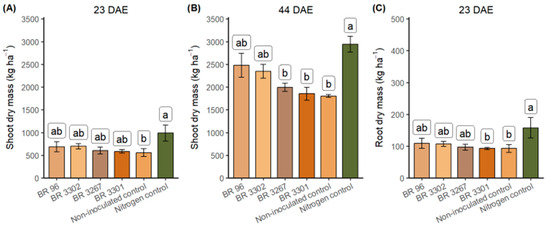
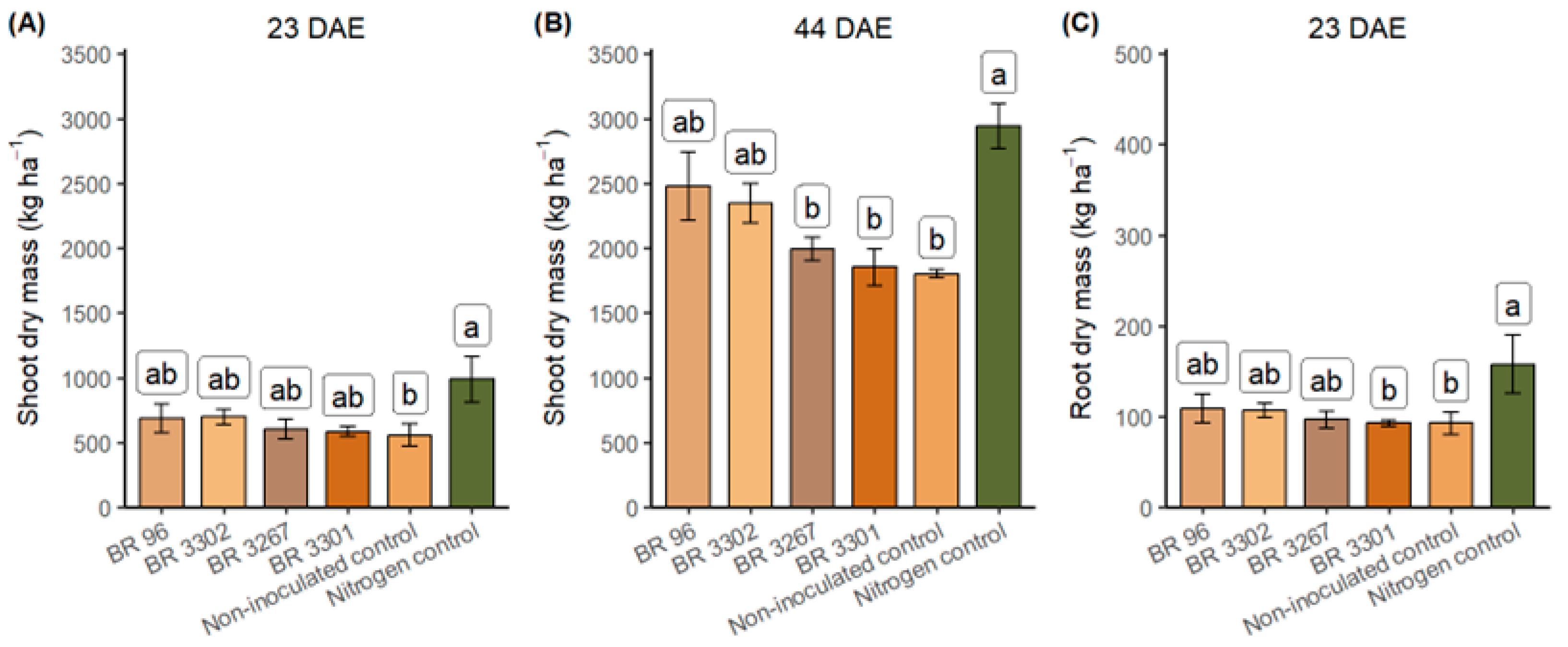
Nitrogen application was significantly associated with higher shoot dry mass at 23 and 44 days after emergence (DAE), with increases of approximately 77% and 63%, respectively, compared to non-inoculated plants (Figure 1A,B; Supplementary S5). The shoot dry mass of plants inoculated with the BR 96 and BR 3302 strains did not significantly differ from that of the nitrogen control. Bhuiyan and Mian (2007) [35] evaluated five mung bean varieties in a field with good natural soil fertility. The authors found that inoculation with a Bradyrhizobium strain increased nodulation and shoot biomass by 55% and 27%, respectively, compared to non-inoculated plants. In contrast to the substantial nodulation observed in the roots of non-inoculated plants in our experiment, the results reported by Bhuiyan and Mian (2007) [35] suggest a low concentration of nodulating cells in the experimental area, despite its soil fertility.
Figure 1.
Shoot dry mass (SDM) (A) at 23 days after emergence (DAE) and (B) at 44 days after emergence; and root dry mass (RDM) (C) at 23 DAE of mung bean inoculated with Bradyrhizobium strains, alongside the non-inoculated and nitrogen (240 kg N ha−1) controls under field conditions. Shoot dry mass means (23 and 44 DAE) followed by different letters differ significantly from each other by the Tukey test at p < 0.05; and root dry mass means (23 DAE) followed by different letters vary considerably from each other by the Tukey test at p < 0.07.
Significant differences, identified by the Tukey test at a 7% probability level, were observed in root dry mass between the inoculated treatments and the non-inoculated and nitrogen controls, with values ranging from 90 to 160 kg ha−1 (Figure 1C; Supplementary S5). It should be noted that the fresh and dry root masses, as well as nodulation parameters, may have been underestimated, since both the clay texture and soil compaction make it difficult to remove the root system. These conditions typically result in only partial root and nodule recoveries [41], especially in clay soils like those in the experimental area. Depending on soil conditions, legumes such as mung beans develop deep roots tolerant of low humidity, which can contribute to greater data variability.
Nodulation in plants grown in soil-filled pots tends to produce more nodules. This is evident in the experiment described by Christopher et al. (2018) [23], where up to 85 nodules per root were observed in inoculated plants. Such high nodule numbers are rarely seen in field experiments, where the maximum was around 50 nodules per root. In a pot experiment, the number of nodules per gram of root was 345 [23]. In comparison, 86 nodules were obtained in the present field experiment, suggesting that evaluating nodulation under these conditions may be limited and should be interpreted carefully.
The nitrogen content of plants at 44 DAE, measured by the Kjeldahl digestion method, did not significantly differ among the inoculated treatments, the non-inoculated control, or the nitrogen control. However, the highest shoot N value was observed in plants receiving nitrogen, which was significantly different from treatments inoculated with BR 3267 and BR 3301 strains or from the non-inoculated control plants (Table 4; Supplementary S6). The total shoot N difference between the nitrogen control and the non-inoculated control was 45.7 kg ha−1. Plants inoculated with BR 96 and BR 3302 strains, which did not differ significantly from the nitrogen control, accumulated an average of 17.6 kg ha−1 of total N compared to the non-inoculated plants. Based on preliminary data, we estimated that the mung bean growth potential was reached at a dose of 240 kg N ha−1. Inoculation with the BR 96 and BR 3302 strains accounted for approximately 40% of the total N accumulated in the shoot, even with a high rate of nodulating bacteria in a clay soil with good natural fertility and organic matter.
Table 4.
Shoot dry mass (SDM) and nitrogen (N) content measured by Kjeldahl and Dumas methods, total N (TN), N from biological nitrogen fixation (Ndfa), N sourced from the atmosphere (N-fixed), and N from soil (Soil N-uptake) in the shoot dry mass of mung beans at 44 days after emergence under field conditions.
Table 4 shows that the N content values obtained by the Dumas method did not reveal significant differences among the treatments, unlike those obtained by the Kjeldahl digestion method. The total N accumulated in the shoot indicated that inoculation with the BR 96 strain was 54% higher than with the BR 3301 strain. There were no significant differences between the other treatments. Mathu et al. (2012) [42] also did not observe significant differences in total N accumulation in mung bean shoots, whether promoted by inoculation with four commercial inoculants or by the non-inoculated control, in 10 soil samples from Kenya with a history of legume cultivation. Conversely, without prior legume cultivation, three mung bean genotypes inoculated with three Bradyrhizobium strains resulted in greater nodulation and higher N accumulation in plant biomass than non-inoculated plants [23]. The BR 96 strain also resulted in total N accumulation in cowpea shoots, similar to the BR 3267 and BR 3262 strains recommended for this crop [33].
The BR 3301 strain inoculation resulted in significantly higher nitrogen content derived from BNF, approximately twice that of the BR 3302 strain. No significant differences were observed among the other treatments or the non-inoculated control. The nitrogen levels in the air, measured after inoculation, ranged from 35.7% to 66.1%. In contrast, the indigenous soil population responsible for root nodulation in the non-inoculated control plants accounted for about 45% of the shoot N derived from the air. In experiments conducted in mung bean production areas, Herridge et al. (2005) [43] demonstrated that inoculation with Bradyrhizobium strains contributed to a 9% increase in air N2 content in the shoot compared to non-inoculated plants.
In a previous study by Mathu et al. (2012) [42], the N values obtained from the air ranged from 30% to 95% across soils with different textures: clay loam, sandy clay loam, sandy loam, and sand. The authors concluded that the highest N content was associated with sand. In our experiment, conducted in clay soil, a 45% N content derived from the air was observed in non-inoculated plants, which is close to the values reported by Mathu et al. (2012) [42] for plants grown in soil with a similar texture, such as clay loam. These authors also determined that the N levels derived from air in cowpea shoot dry mass ranged from 80 to 95% across textural classes, suggesting that V. unguiculata showed more uniform BNF activity than mung beans.
When evaluating shoot N derived from air in plants inoculated with the BR 96 strain, we observed increases of approximately 90% and 68%, respectively, compared to non-inoculated control plants and those inoculated with the BR 3302 strain. A similar trend was noted in the study by Christopher et al. (2018) [23], where the N fixed in the shoots of the two mung bean cultivars that were more responsive to inoculation was about 4.5 times higher than in the non-inoculated control.
Conversely, inoculation with the BR 3302 strain increases soil-derived shoot N values, ranging from 29.3% to 63.1% compared to the non-inoculated control or strains other than BR 3302. Although its efficiency in BNF was limited, the BR 3302 strain significantly enhances the plant’s ability to extract N from the soil.
Diatta et al. (2020) [28] determined shoot N fixed from the air and extracted from the soil of five mung bean genotypes grown in pots with soil from two textural classes, all receiving a single inoculant. The authors found that shoot N from the soil accounted for about 75% of the total N, regardless of the textural class or plant genotype. In our experiment, shoot N derived from the soil in plants inoculated with the BR 3302 strain was approximately 64% of the total N, while the percentage of N from the soil was around 40% for the other strains, which showed higher BNF efficiency. These results suggest that the difference in soil N uptake relative to total N is not due to soil texture or plant genotype. Instead, the response depends on strain traits related to BNF activity or the presence of a plant growth-promoting mechanism, as appears to be the case with the BR 3302 strain.
The studies cited above [23,28,42] used pots filled with soil to determine the N content derived from the atmosphere, but it should be noted that, under these conditions, the soil volume explored by the roots may be limited. Field experiments offer a better understanding of the physiological aspects of the symbiosis established between nodulating bacteria and mung beans. To our knowledge, so far, there is only the current field trial that has evaluated the fixation rates of atmospheric N2 by the 15N method in mung beans conducted in the American continent.
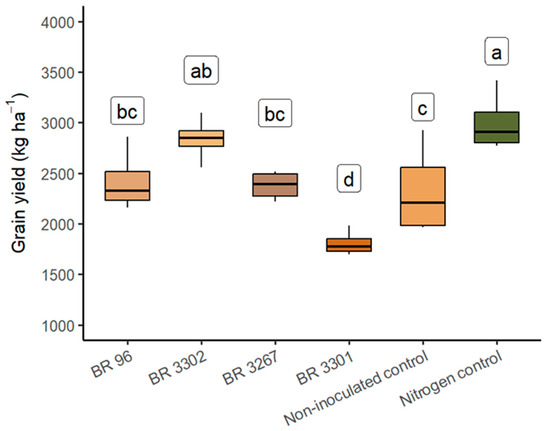
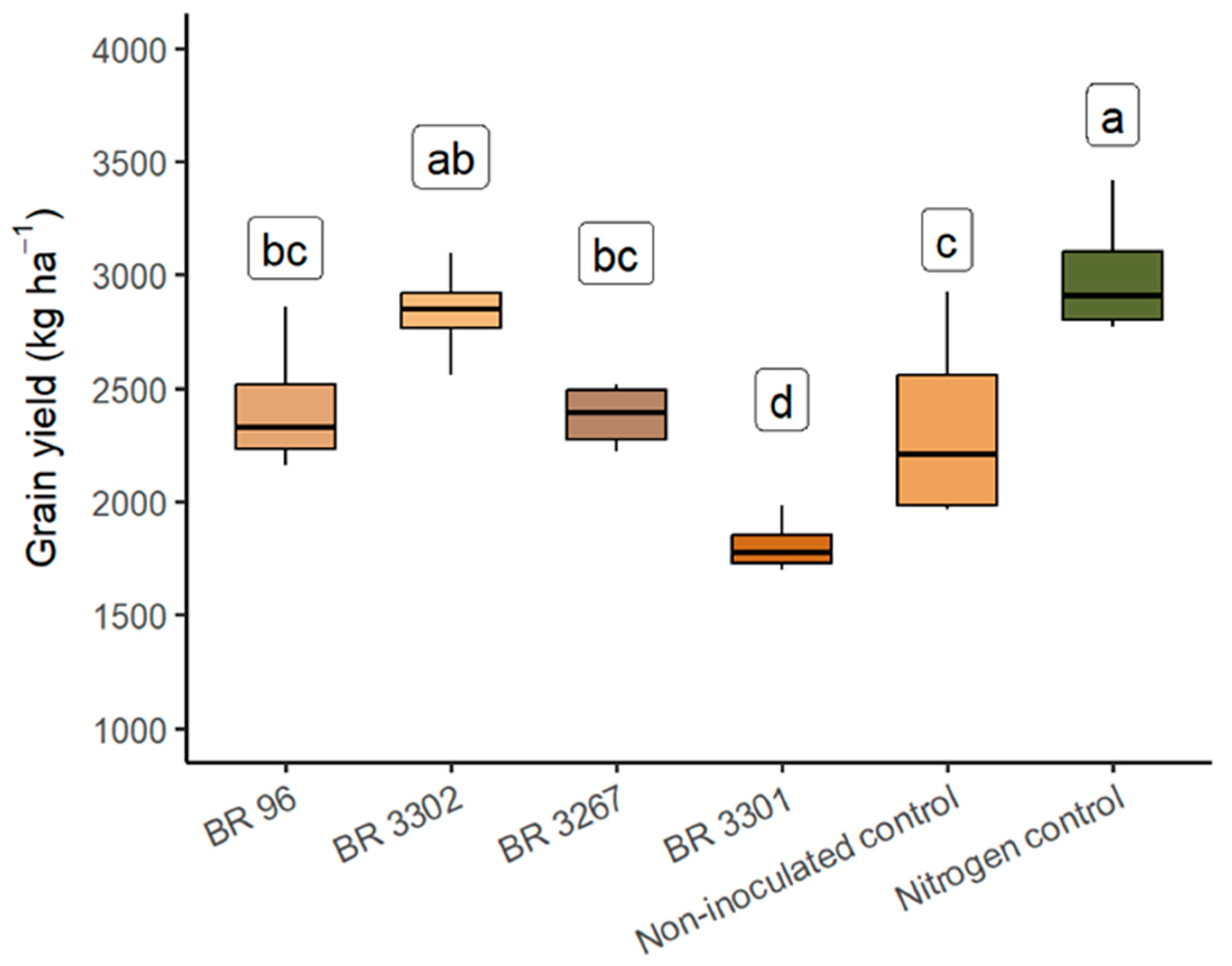
The higher grain yield of mung bean resulted from inoculation with the BR 3302 strain, which reached about 2840 kg ha−1, 18% higher than the non-inoculated control and 36% higher than the BR 3301 strain inoculation. It did not differ significantly from the nitrogen control (3000 kg ha−1) (Figure 2; Supplementary S7). Inoculating mung bean seeds with the BR 3302 strain led to a grain yield increase of approximately 500 kg ha−1 compared to non-inoculated seeds. Furthermore, inoculation with the BR 96 and BR 3267 strains produced a grain yield roughly 25% higher than inoculation with the BR 3301 strain but did not significantly differ from the non-inoculated control.
Figure 2.
Grain yield of mung beans at 72 DAE, inoculated with Bradyrhizobium strains, non-inoculated, and nitrogen (240 kg N ha−1) controls under field conditions. Letters indicate mean values, and different letters show significant differences according to the Tukey test at p < 0.05.
Similar field results were reported by Bhuiyan and Mian (2007) [35], who demonstrated that inoculating mung beans with Bradyrhizobium strains led to an average increase in grain yield of 28% over two growing seasons. Hakim et al. (2020) [34] found a 25% increase in grain yield for plants co-inoculated with Ensifer sp. and Acinetobacter sp. compared to non-inoculated plants. The observed increases were independent of the productivity measured in the three experiments, which ranged from 0.6 to 2.8 Mg h−1. Alternatively, Herridge et al. (2005) [43] found that inoculating mung beans in field conditions resulted in smaller yield increases, approximately 6%, compared to non-inoculated plants. They concluded that seed inoculation might not be necessary under these conditions.
The BR 96 strain contributed the most to BNF until the start of the grain filling stage (44 DAE) (Table 4). However, grain yield in plants inoculated with BR 96 was about 15% lower than in those inoculated with BR 3302. We suggested that the results were due either to N2 fixation from the atmosphere or N uptake from the soil. Additionally, we calculated the BNF efficiency by subtracting the N fixed in each inoculated treatment from that in the non-inoculated plants, which showed that the indigenous population fixed 44.3% of atmospheric N. The BNF efficiency value reflects the strain’s behavior in relation to the specific edaphoclimatic conditions and the nodulating indigenous populations. From this calculation, we obtained 16.7 and 2.3 kg N ha−1 derived from BNF for BR 96 and BR 3302 strains, respectively, indicating that the BR 3302 strain had activity similar to the indigenous population. Despite the BR 3302 strain showing lower BNF efficiency compared to BR 96, the presence of plant growth-promoting mechanisms likely contributed to the higher grain yield promoted by the former.
Zilli et al. (2011) [33] calculated the nodular efficiency of the BR 96 strain in cowpea and observed similar values to the BR 3267 strain, which was selected for the crop. According to Neves and Hungria (1987) [44], the efficiency of the strain responsible for nodulation is reflected in increased grain yield. However, in this study, strain efficiency on mung bean grain yield did not necessarily follow this pattern, as seen with the BR 96 strain, which showed the best BNF activity but did not correspond to the one that led to the greatest grain yield (Figure 2).
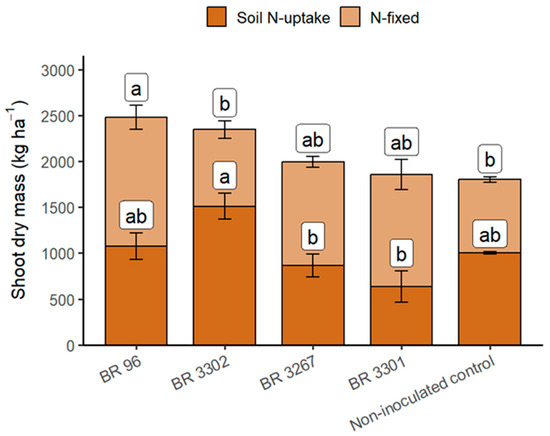
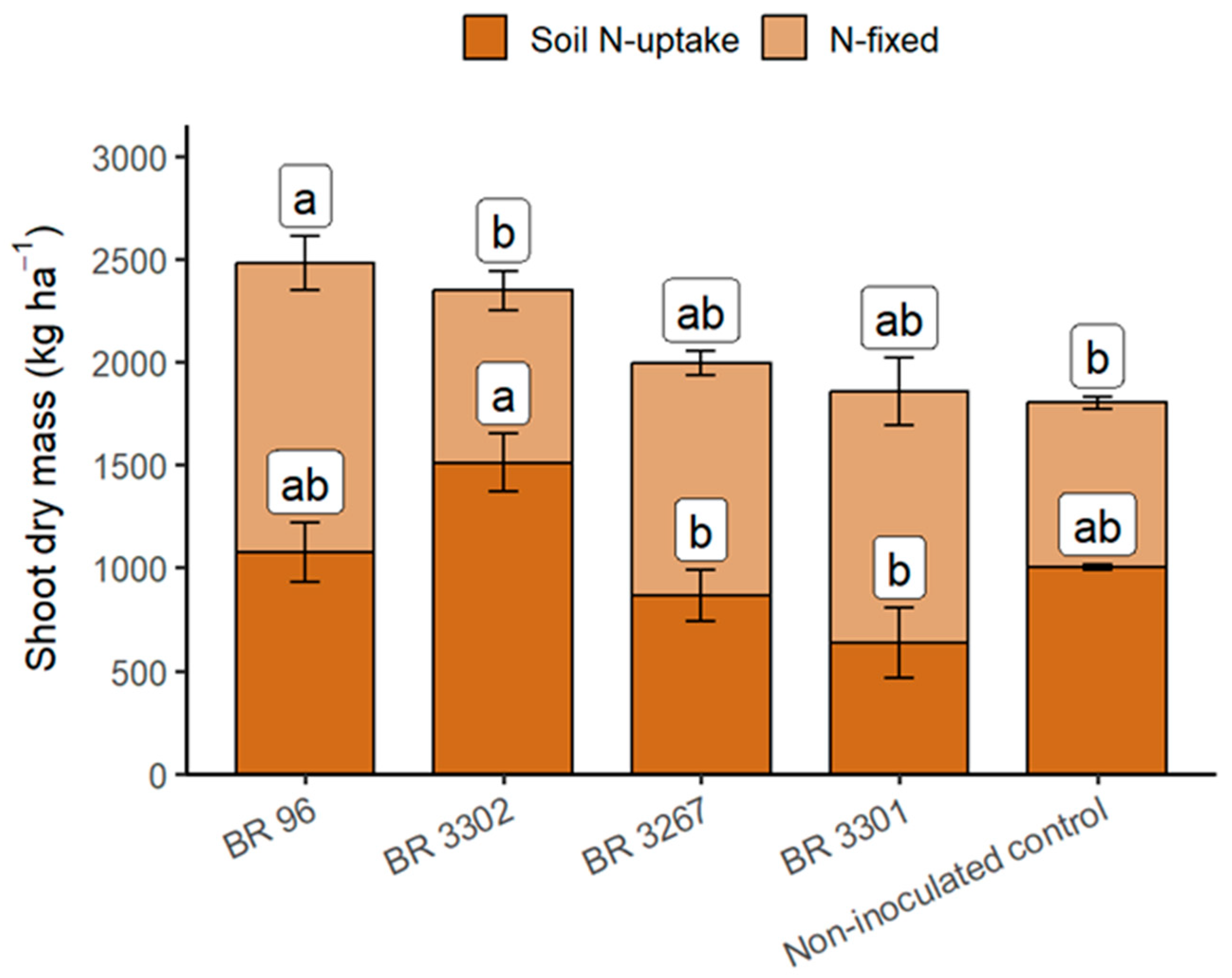
Figure 3 (Supplementary S8) displays the shoot biomass partition data related to N-fixed and soil N-uptake at 44 DAE. The highest shoot dry mass associated with N-fixed is from inoculation with the BR 96 strain, about 75% higher than non-inoculated plants, representing an increase of 612 kg ha−1. Meanwhile, the shoot proportion related to N-fixation in plants inoculated with the BR 3302 strain was similar to that of the non-inoculated control plants. However, BR 3302 inoculation resulted in approximately 50% higher shoot-associated soil N uptake than in non-inoculated plants, corresponding to an increase of 507 kg ha−1, which may have contributed to the increased grain yield (Figure 2).
Figure 3.
Distribution of dry shoot matter between nitrogen from BNF (N-fixed) and nitrogen from soil (Soil N-uptake) in mung beans at 44 DAE, inoculated with Bradyrhizobium strains and the non-inoculated control under field conditions. Means followed by different letters differ significantly based on the Tukey test at p < 0.05.
Like other tropical legumes, mung beans mainly export N-fixed compounds through the xylem as ureides, although this compound decreases in the presence of soil nitrate [44]. Seed N accumulation is quite complex, involving compounds that arrive directly via the xylem and those that originate from protein turnover or mobilize leaf reserves, which are translocated by the phloem. According to Neves and Hungria (1987) [44], the increase in legume yield is linked to the ability to maintain BNF activity during the grain filling period, which can be achieved by selecting cultivars and/or strains. In this case, none of the inoculated mung beans seem to have maintained BNF during this period. Therefore, the N-extracting capacity of the BR 3302 strain may have significantly contributed to the results.
An estimated value of about 2.8 Mg N ha−1 is derived from soil organic matter, and a small part of this total is accessible to meet the crop’s low N needs. The results show that plants inoculated with the BR 3302 strain used the soil N reserve more efficiently.
Argawa and Tsigie (2017) [45] evaluated the BNF activity in common bean. They discovered that naturally high-fertility soils result in greater nodule production, which corresponds with higher grain yields compared to low-fertility soils. Therefore, it can be concluded that other legumes, including mung beans, can also benefit from soil fertility to improve BNF activity and soil nitrogen uptake.
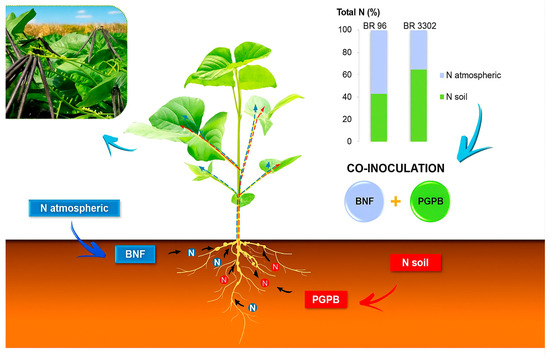
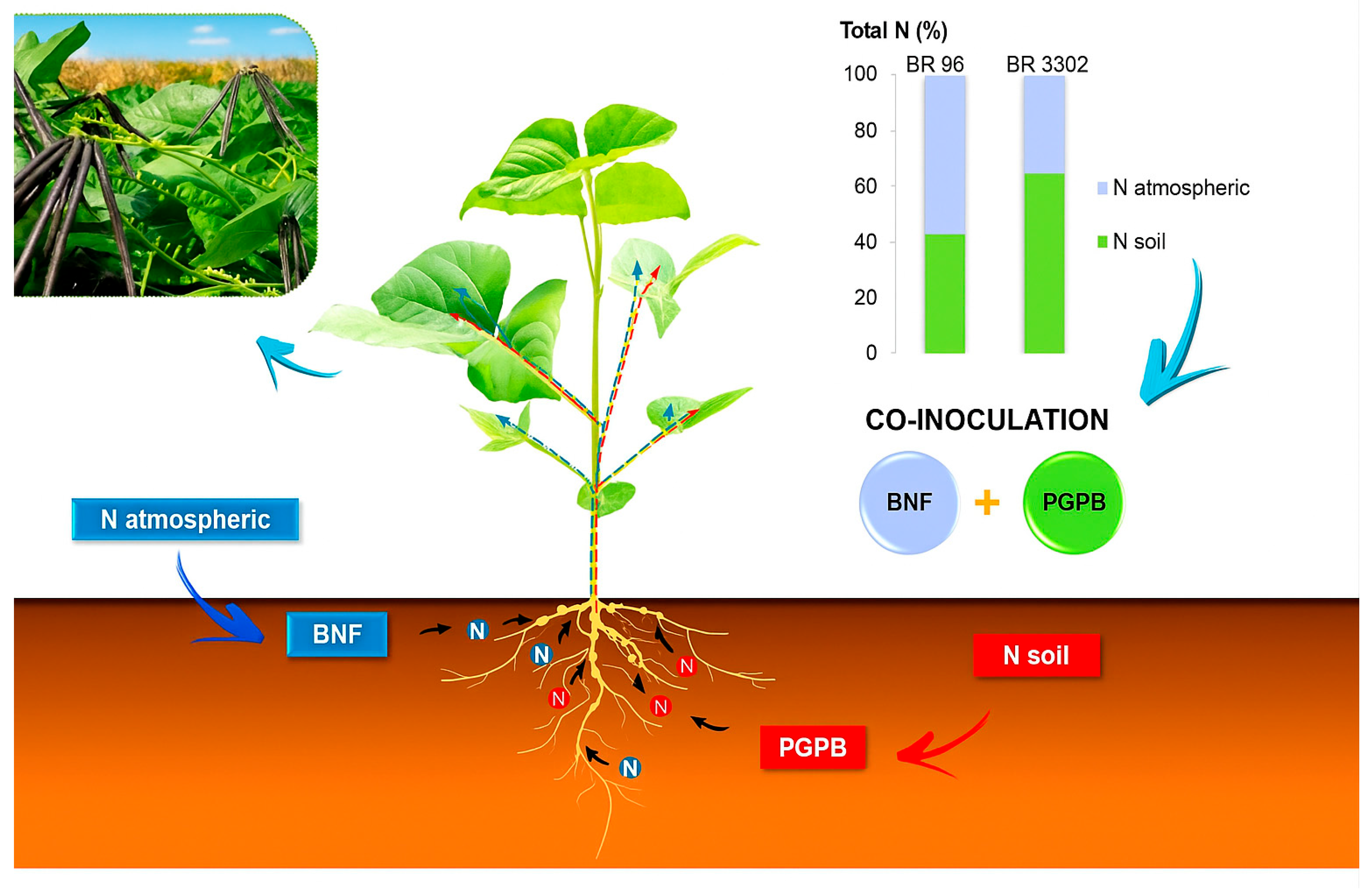
Based on the results from this experiment on predominantly clay soil with organic matter, we identified two main behaviors related to the microsymbiont: 1. A dominance of BNF activity, as observed with the BR 96 strain, which produced the highest shoot biomass until the grain filling stage; and 2. A dominance of plant growth promotion activity focused on soil N-uptake, linked to the BR 3302 strain, which increases grain yield. Given these points, it can be hypothesized that co-inoculation with both strains may enhance plant/microorganism efficiency regarding N availability (Figure 4; Supplementary S9).
Figure 4.
Typical diagram of biological nitrogen fixation (BNF) and plant growth-promoting bacteria (PGPB) activities in mung beans.
In addition to the BNF contribution, Velázquez et al. (2019) [46], reported that bacteria from the rhizobium group also exhibited several plant growth-promoting activities, such as phosphate solubilization and the production of indole-3-acetic acid and ACC deaminase when studied in oilseeds, cereals, and vegetables. These authors show that PGPB activities may also be expressed in legumes, perhaps alongside atmospheric nitrogen fixation, and suggest that using rhizobia as a PGPB, considered safe for human, animal, and plant health, may be a good option for developing biofertilizer formulations.
Studies with cowpeas have shown that the BR 3302 strain’s benefits may extend beyond its ability to fix N2 from the air. The strain also demonstrates the capacity to perform additional functions, such as promoting plant growth by inducing phytohormone synthesis and conferring antibiotic resistance, which increases competitiveness against indigenous microbiota [47]. P and Ca solubilization traits are also features of the BR 3302 strain, potentially enhancing plant nutrition and improving plant performance across various edaphoclimatic conditions [48].
Therefore, further studies are needed to investigate the role of the BR 3302 strain in plant growth-promoting mechanisms and to evaluate the combined effect of BR 3302 and BR 96 strains on mung bean grain yield. New experiments involving inoculation with BR 3302 and BR 96 strains, as well as co-inoculation of both strains, could reveal a complementary relationship in the PGPR mechanisms between the two strains.
The results from the non-inoculated plants indicate that mung beans show low selectivity toward the microsymbiont, as they are well nodulated. These findings suggest that the native rhizobial population capable of nodulating mung beans is not very efficient at fixing atmospheric N2, implying that seed inoculation was beneficial under the experimental conditions.
4. Conclusions
This study demonstrates that Bradyrhizobium strains BR 3301, BR 3302, and BR 3267, recommended for cowpea, and BR 96 for soybean, can nodulate mung beans. Inoculation with the BR 96 strain (B. elkanii) increases shoot nitrogen content from atmospheric N2 fixation. Despite the high efficiency of the BR 96 strain, inoculation with BR 3302 (B. viridifuturi) resulted in an 18% increase in grain yield compared to the non-inoculated control, without significantly differing from the treatment that received 240 kg N ha−1. We suggest that the observed response may stem from a dual mechanism: biological nitrogen fixation and plant growth promotion.
Supplementary Materials
The following supporting information can be downloaded at: https://www.mdpi.com/article/10.3390/plants14233695/s1, S1. Genomic identification of rhizobial strains used in the experiments, including GenBank accession numbers and coordinates for 16S rRNA and symbiotic genes (nodC and nifH); S2. How to prepare Norri’s nutrient Solution for Leonard’s jars; S3. Mung bean inoculated with rhizobial strains registered at MAPA for different legumionous plant species at 60 days after emergence under axenic conditions in a greenhouse: Nodule number (NN) analyzed from log (NN + 1), nodule dry mass (NDM), root dry mass (RDM) and shoot dry mass (SDM); S4. Nodule number (NN) analyzed from log NN and nodule dry mass (NDM) of mung bean plants at 23 days after emergence under field conditions; S5. Shoot dry mass (SDM) (a) in the 1st sampling day at 23 days after emergence and (b) in the 2nd sampling day at 44 days after emergence; and root dry mass (RDM) (c) in the 1st sampling day at 23 days after emergence of mung bean inoculated with Bradyrhizobium strains and the absolute (non-inoculated) and nitrogen (240 kg N ha−1) controls under field conditions; S6. Shoot dry mass (SDM) and N content by Kjeldahl and Dumas methods, total N (TN), N content derived from BNF (Ndfa), N derived from the atmosphere (N-fixed) and N derived from soil (Soil N-uptake) in the shoot dry mass of mung bean at 44 days after emergence under field conditions; S7. Grain yield of mung bean at 72 days after emergence inoculated with Bradyrhizobium strains and absolute (non-inoculated) and nitrogen (240 kg N ha−1) controls under field conditions; S8. Shoot dry matter partition corresponding to nitrogen derived from BNF (N-fixed) and nitrogen derived from soil (Soil N-uptake) in mung bean at 44 days after emergence, inoculated with Bradyrhizobium strains and absolute control (non-inoculated) under field conditions; S9. Representative scheme of biological nitrogen fixation (BNF) and plant growth-promoting bacteria (PGPB) activities in mung bean.
Author Contributions
Literature search, D.M.T.d.S., E.Z., S.U., N.G.R. and G.R.X.; conceptualization, D.M.T.d.S., S.U., N.G.R. and G.R.X.; methodology, D.M.T.d.S., A.B.C.L., J.C.d.A., G.d.C.R.d.S., E.Z., S.U., N.G.R. and G.R.X.; validation, D.M.T.d.S., V.O.F., A.B.C.L., W.P. and J.N.B.; formal analysis, D.M.T.d.S., E.Z. and N.G.R.; data interpretation, D.M.T.d.S., V.O.F., E.Z., S.U., N.G.R. and G.R.X.; figures, D.M.T.d.S. and N.G.R.; writing—original draft preparation, D.M.T.d.S. and N.G.R.; writing—review & editing, D.M.T.d.S., N.G.R., S.U. and V.O.F.; supervision, N.G.R. and G.R.X. All authors have read and agreed to the published version of the manuscript.
Funding
The study was supported by the Brazilian Agricultural Research Corporation, (EMBRAPA); Graduate Program in Soil Sciences at the Federal Rural University of Rio de Janeiro (UFRRJ); Carlos Chagas Filho Research Foundation of the State of Rio de Janeiro (FAPERJ) project: E-26/202. 546/2019 (G.R.X.) and E-26/202.820/2017 (S.U.); Coordination for the Improvement of Higher Education Personnel (CAPES) grant number 88887.613720/2021-00 (D.M.T.S), 1585319 (V.O.F.) and 88882.157.192/2017-01 (J.C.A.).
Data Availability Statement
The raw data presented in this study are available as Supplementary Materials.
Acknowledgments
We thank João Luís Bastos and Karine Moura de Freitas for their technical support throughout the experiment, Altiberto Moreira Baeta for the analysis of the N content and Renato Moutinho da Rocha for the analysis of total N and isotopic ratio. We also thank the Universidade Estadual do Norte Fluminense Darcy Ribeiro (UENF).
Conflicts of Interest
Authors Jaqueline Carvalho de Almeida, Segundo Urquiaga, Norma Gouvêa Rumjanek and Gustavo Ribeiro Xavier were employed by the company Embrapa. The remaining authors declare that the research was conducted in the absence of any commercial or financial relationships that could be construed as a potential conflict of interest. The authors declare that this study received funding from Embrapa. The funder was not involved in the study design, collection, analysis, interpretation of data, the writing of this article or the decision to submit it for publication.
References
- Rawal, V.; Navarro, D.K. The Global Economy of Pulses; Food and Agriculture Organization of the United Nations (FAO): Rome, Italy, 2019; p. 174. [Google Scholar] [CrossRef] [Scilit]
- Xavier, G.R.; Jesus, E.d.C.; Dias, A.; Coelho, M.R.R.; Molina, Y.C.; Rumjanek, N.G. Contribution of Biofertilizers to Pulse Crops: From Single-Strain Inoculants to New Technologies Based on Microbiomes Strategies. Plants 2023, 12, 954. [Google Scholar] [CrossRef] [Scilit] [PubMed]
- Nair, R.M.; Yang, R.; Easdown, W.J.; Thavarajah, D.; Thavarajah, P.; Hughes, J.D.; Keatinge, J. Biofortification of Mungbean (Vigna radiata) as a Whole Food to Enhance Human Health. J. Sci. Food Agric. 2013, 93, 1805–1813. [Google Scholar] [CrossRef] [Scilit]
- Vieira, R.F.; Oliveira, V.R.; Vieira, C. Cultivo do feijão-mungo-verde no verão em Viçosa e em Prudente de Morais. Hortic. Bras. 2003, 21, 37–43. [Google Scholar] [CrossRef] [Scilit]
- COMEXSTAT. Ministério da Indústria, Comércio Exterior e Serviços. 2021. Available online: http://comexstat.mdic.gov.br (accessed on 1 July 2024).
- Favero, V.O.; de Carvalho, R.H.; Leite, A.B.C.; de Freitas, K.M.; Zilli, J.É.; Xavier, G.R.; Rumjanek, N.G.; Urquiaga, S. Characterization and Nodulation Capacity of Native Bacteria Isolated from Mung Bean Nodules Used as a Trap Plant in Brazilian Tropical Soils. Appl. Soil Ecol. 2021, 167, 104041. [Google Scholar] [CrossRef] [Scilit]
- Favero, V.O.; Carvalho, R.H.; Leite, A.B.C.; Santos, D.M.T.; Freitas, K.M.; Boddey, R.M.; Xavier, G.R.; Rumjanek, N.G. Bradyrhizobium strains from Brazilian tropical soils promote increases in nodulation, growth and nitrogen fixation in mung bean. Appl. Soil Ecol. 2022, 175, 104461. [Google Scholar] [CrossRef] [Scilit]
- Degefu, T.; Wolde-Meskel, E.; Rasche, F. Genetic Diversity and Symbiotic Effectiveness of Bradyrhizobium Strains Nodulating Selected Annual Grain Legumes Growing in Ethiopia. Int. J. Syst. Evol. Microbiol. 2018, 68, 449–460. [Google Scholar] [CrossRef] [Scilit]
- Hakim, S.; Imran, A.; Mirza, M.S. Phylogenetic Diversity Analysis Reveals Bradyrhizobium Yuanmingense and Ensifer Aridi as Major Symbionts of Mung Bean (Vigna radiata L.) in Pakistan. Braz. J. Microbiol. Publ. Braz. Soc. Microbiol. 2021, 52, 311–324. [Google Scholar] [CrossRef] [Scilit] [PubMed]
- Vincent, J.M. A Manual for the Practical Study of the Root-Nodule Bacteria; International Biological Programme Handbook No. 15; Blackwell Scientific Publications: Oxford, UK, 1970. [Google Scholar]
- Moreira, F.M.d.S.; Michel, D.C.; Cardoso, R.M. The Elite Strain INPA03-11B Approved as a Cowpea Inoculant in Brazil Represents a New Bradyrhizobium Species and It Has High Adaptability to Stressful Soil Conditions. Braz. J. Microbiol. Publ. Braz. Soc. Microbiol. 2024, 55, 1853–1862. [Google Scholar] [CrossRef] [Scilit]
- da Costa, E.M.; de Carvalho, T.S.; Guimaraes manda, A.; Ribas Leao, A.C.; Cruz, L.M.; de Baura, V.A.; Lebbe, L.; Willems, A.; de Souza Moreira, F.M. Classification of the Inoculant Strain of Cowpea UFLA03-84 and of Other Strains from Soils of the Amazon Region as Bradyrhizobium Viridifuturi (Symbiovar Tropici). Braz. J. Microbiol. 2019, 50, 335–345. [Google Scholar] [CrossRef] [Scilit]
- Simões-Araújo, J.L.; Leite, J.; Marie Rouws, L.F.; Passos, S.R.; Xavier, G.R.; Rumjanek, N.G. Zilli JÉ Draft Genome Sequence of Bradyrhizobium Sp Strain BR3262, an Effective Microsymbiont Recommended for Cowpea Inoculation in Brazil. Braz. J. Microbiol. Publ. Braz. Soc. Microbiol. 2016, 47, 783–784. [Google Scholar] [CrossRef] [Scilit] [PubMed]
- Menna, P.; Barcellos, F.G.; Hungria, M. Phylogeny and Taxonomy of a Diverse Collection of Bradyrhizobium Strains Based on Multilocus Sequence Analysis of the 16S rRNA Gene, ITS Region and glnII, recA, atpD and dnaK Genes. Int. J. Syst. Evol. Microbiol. 2009, 59, 2934–2950. [Google Scholar] [CrossRef] [Scilit] [PubMed]
- Klepa, M.S.; diCenzo, G.C.; Hungria, M. Comparative Genomic Analysis of Bradyrhizobium Strains with Natural Variability in the Efficiency of Nitrogen Fixation, Competitiveness, and Adaptation to Stressful Edaphoclimatic Conditions. Microbiol. Spectr. 2024, 12, e0026024. [Google Scholar] [CrossRef] [Scilit] [PubMed]
- Dall’Agnol, R.F.; Ribeiro, R.A.; Ormeño-Orrillo, E.; Rogel, M.A.; Delamuta, J.R.M.; Andrade, D.S.; Martínez-Romero, E.; Hungria, M. Rhizobium Freirei Sp. Nov., a Symbiont of Phaseolus Vulgaris That Is Very Effective at Fixing Nitrogen. Int. J. Syst. Evol. Microbiol. 2013, 63, 4167–4173. [Google Scholar] [CrossRef] [Scilit]
- Mostasso, L.; Mostasso, F.L.; Dias, B.G.; Vargas, M.A.T.; Hungria, M. Seleção de Estirpes de Rizóbio de Feijão (Phaseolus vulgaris L.) Para o Cerrado Brasileiro. Field Crops Res. 2002, 73, 121–132. [Google Scholar] [CrossRef] [Scilit]
- Weaver, R.W.; Frederick, L.R. Rhizobium. In Methods of Soil Analysis: Chemical and Microbiological Properties, 2nd ed.; Page, A.L., Miller, R.H., Keeney, D.R., Eds.; American Society of Agronomy: Madison, WI, USA, 1982; Part 2; pp. 1043–1070. [Google Scholar]
- Norris, D.O.; Date, R.A. Legume Bacteriology. In Tropical Pasture Research: Principles and Methods; Shaw, N.H., Bryan, W.W., Eds.; CAB Publisher: Brisbane, Australia, 1976. [Google Scholar]
- Köppen, W. Climatologia: Com um Estudo dos Climas da Terra; Fondo de Cultura Económica: Mexico City, Mexico, 1948. [Google Scholar]
- Dos Santos, H.G.; Jacomine, P.K.T.; Dos Anjos, L.H.; De Oliveira, V.A.; Lumbreras, J.F.; Coelho, M.R.; De Almeida, J.A.; De Araujo Filho, J.C.; De Oliveira, J.B.; Cunha, T.J.F. Sistema Brasileiro de Classificação de Solos, 5th ed.; Embrapa: Brasília, Brazil, 2018; ISBN 978-85-7035-817-2. [Google Scholar]
- Döbereiner, J.; Andrade, V.d.O.; Baldani, V.L.D. Cell Culture for the Production of Inoculants; Embrapa-CNPAB. Documentos, 110; Embrapa Agrobiologia: Seropédica, Brazil, 1999; 38p, Available online: https://www.infoteca.cnptia.embrapa.br/infoteca/handle/doc/624371 (accessed on 23 November 2025).
- Christopher, M.; Macdonald, B.; Yeates, S.; Seymour, N. Wild bradyrhizobia that occur in the Burdekin region of Queensland are as effective as commercial inoculum for mungbean (Vigna radiata (L.)) and black gram (Vigna mungo (L.)) in fixing nitrogen and dry matter production. Appl. Soil Ecol. 2018, 124, 88–94. [Google Scholar] [CrossRef] [Scilit]
- R Development Core Team. R: A Language and Environment for Statistical Computing; R Foundation for Statistical Computing: Vienna, Austria, 2020; Available online: https://cran.r-project.org (accessed on 10 January 2020).
- Risal, C.P.; Djedidi, S.; Dhakal, D.; Ohkama-Ohtsu, N.; Sekimoto, H.; Yokoyama, T. Diversidade Filogenética e Funcionamento Simbiótico Em Bradyrhizobia de Feijão-Mungo (Vigna Radiata L. Wilczek) de Regiões Agroecológicas Contrastantes Do Nepal. Syst. Appl. Microbiol. 2012, 35, 45–53. [Google Scholar] [CrossRef] [Scilit]
- Wu, Y.; Li, Y.H.; Shang, J.Y.; Wang, E.T.; Chen, L.; Huo, B.; Sui, X.H.; Tian, C.F.; Chen, W.F.; Chen, W.X. Multiple Genes of Symbiotic Plasmid and Chromosome in Type II Peanut Bradyrhizobium Strains Corresponding to the Incompatible Symbiosis with Vigna Radiata. Front. Microbiol. 2020, 11, 1175. [Google Scholar] [CrossRef] [Scilit]
- Htwe, A.Z.; Yamakawa, T.; Ishibashi, M.; Tsurumaru, H. Isolation and Characterization of Mung Bean (Vigna radiata L.) Rhizobia in Myanmar. Symbiosis 2024, 94, 51–63. [Google Scholar] [CrossRef] [Scilit]
- Diatta, A.A.; Thomason, W.E.; Abaye, O.; Thompson, T.L.; Battaglia, M.L.; Vaughan, L.J.; Lo, M. Assessment of Nitrogen Fixation by Mung Bean Genotypes in Different Soil Textures Using 15N Natural Abundance Method. J. Soil Sci. Plant Nutr. 2020, 20, 2230–2240. [Google Scholar] [CrossRef] [Scilit]
- Zhong, C.; Hu, G.; Hu, C.; Xu, C.; Zhang, Z.; Ning, K. Comparative Genomics Analysis Reveals Genetic Characteristics and Nitrogen Fixation Profile of Bradyrhizobium. iScience 2024, 27, 108948. [Google Scholar] [CrossRef] [Scilit]
- Piromyou, P.; Nguyen, H.P.; Songwattana, P.; Boonchuen, P.; Teamtisong, K.; Tittabutr, P.; Boonkerd, N.; Alisha Tantasawat, P.; Göttfert, M.; Okazaki, S.; et al. The Bradyrhizobium Diazoefficiens Type III Effector NopE Modulates the Regulation of Plant Hormones towards Nodulation in Vigna Radiata. Sci. Rep. 2021, 11, 16604. [Google Scholar] [CrossRef] [Scilit] [PubMed]
- Piromyou, P.; Pruksametanan, N.; Nguyen, H.P.; Songwattana, P.; Wongdee, J.; Nareephot, P.; Greetatorn, T.; Teamtisong, K.; Tittabutr, P.; Boonkerd, N.; et al. NopP2 Effector of Bradyrhizobium Elkanii USDA61 Is a Determinant of Nodulation in Vigna radiata Cultivars. Sci. Rep. 2024, 14, 24541. [Google Scholar] [CrossRef] [Scilit]
- Favero, V.O.; Carvalho, R.H.; Leite, A.B.C.; Santos, D.M.T.; Freitas, K.M.; Zilli, J.É.; Xavier, G.R.; Rumjanek, N.G. Cross-Inoculation of Elite Commercial Bradyrhizobium Strains from Cowpea and Soybean in Mung Bean and Comparison with Mung Bean Isolates. J. Soil Sci. Plant Nutr. 2022, 22, 4356–4364. [Google Scholar] [CrossRef] [Scilit]
- Zilli, J.É.; Neto, M.L.d.S.; Júnior, I.F.; Perin, L.; de Melo, A.R. Resposta do feijão-caupi à inoculação com estirpes de Bradyrhizobium recomendadas para a soja. Rev. Bras. Ciênc. Solo 2011, 35, 739–742. [Google Scholar] [CrossRef] [Scilit]
- Hakim, S.; Mirza, B.S.; Imran, A.; Zaheer, A.; Yasmin, S.; Mubeen, F.; Mclean, J.E.; Mirza, M.S. Illumina Sequencing of 16S rRNA Tag Shows Disparity in Rhizobial and Non-Rhizobial Diversity Associated with Root Nodules of Mung Bean (Vigna radiata L.) Growing in Different Habitats in Pakistan. Microbiol. Res. 2020, 231, 126356. [Google Scholar] [CrossRef] [Scilit]
- Bhuiyan, M.A.H.; Mian, M.H. Effect of Bradyrhizobium Inoculation on Nodulation, Biomass Production and Yield of Mung Bean. Bangladesh Journal of Microbiology. Bangladesh J. Microbiol. 2007, 24, 95–99. [Google Scholar] [CrossRef] [Scilit]
- Dos Santos, D.M.T.; Leite, A.B.C.; Favero, V.O.; Zonta, E.; Rumjanek, N.G.; Xavier, G.R. Desempenho de Feijão-Mungo Em Função de Diferentes Níveis de Nitrogênio. In Proceedings of the 5th ABC Symposium on Soils and Environmental Health, Brasília, Brazil, 30–31 July 2020. [Google Scholar] [CrossRef] [Scilit]
- Favero, V.O.; Carvalho, R.H.; Motta, V.M.; Leite, A.B.C.; Coelho, M.R.R.; Xavier, G.R.; Rumjanek, N.G.; Urquiaga, S. Bradyrhizobium as the Only Rhizobial Inhabitant of Mung Bean (Vigna Radiata) Nodules in Tropical Soils: A Strategy Based on Microbiome for Improving Biological Nitrogen Fixation Using Bio-Products. Front. Plant Sci. 2020, 11, 602645. [Google Scholar] [CrossRef] [Scilit]
- Hakim, S.; Mirza, B.S.; Zaheer, A.; Mclean, J.E.; Imran, A.; Yasmin, S.; Sajjad Mirza, M. Retrieved 16S rRNA and nifH Sequences Reveal Co-Dominance of Bradyrhizobium and Ensifer (Sinorhizobium) Strains in Field-Collected Root Nodules of the Promiscuous Host Vigna radiata (L.) R. Wilczek. Appl. Microbiol. Biotechnol. 2018, 102, 485–497. [Google Scholar] [CrossRef] [Scilit]
- Nguyen, T.H.N.; Vo, T.M.T.; Nguyen, M.K.; Pham, C.D.; Phung, T.T.; Doan, T.M.T.; Le, T.P.T.; Nguyen, N.A.V.; Ta, N.M.P.; Tran, T.K.X.; et al. Isolation and Characterization of Rhizobium Spp. and Bradyrhizobium Spp. from Legume Nodules. Eng. Technol. 2023, 12, 70–98. [Google Scholar] [CrossRef] [Scilit]
- Hakim, S.; Imran, A.; Hussain, M.S.; Mirza, M.S. RNA-Seq Analysis of Mung Bean (Vigna radiata L.) Roots Shows Differential Gene Expression and Predicts Regulatory Pathways Responding to Taxonomically Different Rhizobia. Microbiol. Res. 2023, 275, 127451. [Google Scholar] [CrossRef] [Scilit]
- Araujo, K.E.C.; Júnior, C.V.T.; Guimarães, A.P.; da Silva, M.A.; Alves, B.J.R.; Urquiaga, S.; Boddey, R.M. Natural Abundance of 15N of N Derived from the Atmosphere by Different Strains of Bradyrhizobium in Symbiosis with Soybean Plants. Ciênc. Rural 2019, 49, e20180265. [Google Scholar] [CrossRef] [Scilit]
- Mathu, S.; Herrmann, L.; Pypers, P.; Matiru, V.; Mwirichia, R.; Lesueur, D. Potential of Indigenous Bradyrhizobia versus Commercial Inoculants to Improve Cowpea (Vigna unguiculata L. Walp.) and Green Gram (Vigna radiata L. Wilczek.) Yields in Kenya. Soil Sci. Plant Nutr. 2012, 58, 750–763. [Google Scholar] [CrossRef] [Scilit]
- Herridge, D.F.; Robertson, M.J.; Cocks, B.; Peoples, M.B.; Holland, J.F.; Heuke, L. Low Nodulation and Nitrogen Fixation of Mungbean Reduce Biomass and Grain Yields. Aust. J. Exp. Agric. 2005, 45, 269–277. [Google Scholar] [CrossRef] [Scilit]
- Neves, M.C.P.; Hungria, M.; Sprent, J.I. The Physiology of Nitrogen Fixation in Tropical Grain Legumes. Plant Sci. 1987, 6, 267–321. [Google Scholar] [CrossRef] [Scilit]
- Argaw, A.; Tsigie, A. The inorganic N requirement, nodulation and yield of common bean (Phaseolus vulgaris L.) as influenced by inherent soil fertility of eastern Ethiopia. J. Plant Nutr. 2017, 40, 1842–1855. [Google Scholar] [CrossRef] [Scilit]
- Velazquez, E.; Carro, L.; Flores-Felix, J.D.; Menendez, E.; Ramirez-Bahena, M.H.; Peix, A. Bacteria-Inducing Legume Nodules Involved in the Improvement of Plant Growth, Health and Nutrition. In Microbiome in Plant Health and Disease; Springer: Berlin/Heidelberg, Germany, 2019; pp. 79–103. [Google Scholar] [CrossRef] [Scilit]
- de Oliveira-Longatti, S.M.; Marra, L.M.; Lima Soares, B.; Bomfeti, C.A.; da Silva, K.; Avelar Ferreira, P.A.; de Souza Moreira, F.M. Bacteria Isolated from Soils of the Western Amazon and from Rehabilitated Bauxite-Mining Areas Have Potential as Plant Growth Promoters. World J. Microbiol. Biotechnol. 2014, 30, 1239–1250. [Google Scholar] [CrossRef] [Scilit] [PubMed]
- Marra, L.M.; de Oliveira, S.M.; Soares, C.R.F.S.; Moreira, F.M.d.S. Solubilisation of Inorganic Phosphates by Inoculant Strains from Tropical Legumes. Sci. Agric. 2011, 68, 603–609. [Google Scholar] [CrossRef] [Scilit]

Disclaimer/Publisher’s Note: The statements, opinions and data contained in all publications are solely those of the individual author(s) and contributor(s) and not of MDPI and/or the editor(s). MDPI and/or the editor(s) disclaim responsibility for any injury to people or property resulting from any ideas, methods, instructions or products referred to in the content. |
© 2025 by the authors. Licensee MDPI, Basel, Switzerland. This article is an open access article distributed under the terms and conditions of the Creative Commons Attribution (CC BY) license (https://creativecommons.org/licenses/by/4.0/).