Traditional Use of Medicinal Plants for Symptom Relief During the COVID-19 Pandemic in Bulgaria


 , , and
Abstract
1. Introduction
2. Results and Discussion
2.1. Plant Parts, Form of Application, and Procurement Method
2.1.1. Plant Parts
2.1.2. Forms of Application
2.1.3. Procurement Method
2.2. Sources of Information Regarding Medicinal Plant Use Specified in the Survey
2.3. Ethnobotanical Analysis of the Medicinal Plants Reported in the Survey
2.3.1. Relative Frequency of Citation (RFC) and Use Value (UV) Analysis of the Medicinal Plants
2.3.2. Use Categories and Informant Consensus Factor (FIC)
- Category “Cough”—Tilia sp. (34 reports), Thymus vulgaris L. (32 reports), Matricaria chamomilla L. (28 reports);
- Category “Prevention of complications”—Tilia sp. (34 reports), Thymus vulgaris L. (21 reports), Zingiber officinale Roscoe (18 reports);
- Category “Sore throat”—Tilia sp. (28 reports), Matricaria chamomilla L. (23 reports), Thymus vulgaris L. (14 reports);
- Category “Antiviral agent”—Thymus vulgaris L. (8 reports), Tilia sp. (7 reports), Zingiber officinale Roscoe (6 reports), Matricaria chamomilla L. (6 reports);
- Category “Immunostimulant”—Zingiber officinale Roscoe (12 reports), Citrus x limon (L.) Osbeck (9 reports), Rosa canina L. (9 reports), Tilia sp. (9 reports), Thymus vugaris L. (7 reports), Matricaria chamomilla L. (6 reports), Mentha sp. (6 reports);
- Category “Prophylaxis”—Zingiber officinale Roscoe (2 reports), Thymus vulgaris L. (7 reports), Citrus x limon (L.) Osbeck (6 reports), Mentha sp. (6), Matricaria chamomilla L. (5 reports), Sideritis scardica Griseb (5 reports);
- Category “Treatment of overall symptoms”—Matricaria chamomilla L. (15 reports), Mentha sp. (9 reports), Thymus vulgaris L. (8 reports), Tilia sp. (7 reports), Zingiber officinale Roscoe (5 reports), Sideritis scardica Griseb (5 reports), Clinopodium vulgare L. (2 reports), Plantago sp. (2 reports);
- Category “Respiratory problems”—Thymus vulgaris L. (8 reports), Matricaria chamomilla L. (6 reports), Mentha sp. (5 reports), Zingiber officinale Roscoe (5 reports), Sideritis scardica Griseb (4 reports), Tilia sp. (3 reports);
- Category “Runny nose and loss of smell”—Matricaria chamomilla L. (9 reports), Mehtha sp. (4 reports), Thymus vulgaris L. (3 reports), Tilia sp. (3 reports);
- Category “Headache”—Mehtha sp. (4 reports), Matricaria chamomilla L. (3 reports);
- Category “Fever”—Tilia sp. (5 reports), Matricaria chamomilla L. (4 reports);
- Category “Sedative”—Matricaria chamomilla L., (3 reports), Tilia sp. (2 reports);
- Category “Fatigue”—Rosa canina L. (3 reports), Tilia sp. (3 reports), Matricaria chamomilla L., (2 reports), Hypericum perforatum L. (2 reports).
2.3.3. Fidelity Level Index (FL)—Culturally Significant Species by Use Categories
2.4. Comparison of Results from the Ethnobotanical Survey in Bulgaria with Similar Studies Worldwide
2.4.1. Similarity Analysis by Use Categories
2.4.2. Culturally Significant Plants
3. Materials and Methods
3.1. Ethnobotanical Study and Data Collection
3.2. Socio-Demographic Characteristics of Survey Respondents
3.3. Quantitative Processing and Analysis of Collected Ethnobotanical Information
3.3.1. Relative Frequency of Citation (RFC)
3.3.2. Use Value Index by Species (UV) [27,41,49]
3.3.3. Informant Consensus Factor (FIC)
3.3.4. Fidelity Level Index (FL)
3.3.5. Jaccard Coefficient (JC) [54]
4. Conclusions
Author Contributions
Funding
Informed Consent Statement
Data Availability Statement
Acknowledgments
Conflicts of Interest
References
- Hadi, A.G.; Kadhom, M.; Hairunisa, N.; Yousif, E.; Mohammed, S.A. A Review on COVID-19: Origin, Spread, Symptoms, Treatment, and Prevention. Biointerface Res. Appl. Chem. 2020, 10, 7234–7242. [Google Scholar] [CrossRef]
- Ivancheva, S.; Stantcheva, B. Ethnobotanical Inventory of Medicinal Plants in Bulgaria. J. Ethnopharmacol. 2000, 69, 165–167. [Google Scholar] [CrossRef]
- Dimitrova, D.; Raycheva, T. Ethnobotany and Modern Agrarian Education in Bulgaria. Sci. Works Agric. Univ. Plovdiv 2010, 55, 333–338. [Google Scholar]
- Kozuharova, E.; Benbassat, N.; Napier, J. New Records of the Remedial Properties of Vascular Plants, Some Traditionally Accepted as Medicinal Plants and Some Less Familiar to Ethnobotanists. Phytol. Balc. 2012, 18, 323–332. [Google Scholar]
- Cherneva, D. Biodiversity and Application of Medicinal Plants from the Northern Black Sea Wetlands in Ethnobotany. Ph.D. Thesis, Medical University “Prof. Dr. Paraskev Stoyanov”, Varna, Bulgaria, 2017. [Google Scholar]
- Fabricant, D.S.; Farnsworth, N.R. The Value of Plants Used in Traditional Medicine for Drug Discovery. Environ. Health Perspect. 2001, 109 (Suppl. S1), 69–75. [Google Scholar] [PubMed]
- Ahmed, N.; Hughes, K. Role of Ethno-Phytomedicine Knowledge in Healthcare of COVID-19: Advances in Traditional Phytomedicine Perspective. Beni-Suef Univ. J. Basic Appl. Sci. 2022, 11, 96. [Google Scholar] [CrossRef] [PubMed]
- Alvarez-Suarez, J.M.; Tulipani, S.; Romandini, S.; Bertoli, E.; Battino, M. Contribution of Honey in Nutrition and Human Health: A Review. Med. J. Nutr. Metab. 2010, 3, 15–23. [Google Scholar] [CrossRef]
- Samarghandian, S.; Farkhondeh, T.; Samini, F. Honey and Health: A Review of Recent Clinical Research. Pharmacogn. Res. 2017, 9, 121–127. [Google Scholar]
- Koleva, V.; Dragoeva, A.; Nanova, Z.; Koynova, T.; Dashev, G. An Ethnobotanical Study on Current Status of Some Medicinal Plants Used in Bulgaria. Int. J. Curr. Microbiol. App. Sci. 2015, 4, 297–305. [Google Scholar]
- Vitalini, S.; Iriti, M.; Puricelli, C.; Ciuchi, D.; Segale, A.; Fico, G. Traditional Knowledge on Medicinal and Food Plants Used in Val San Giacomo (Sondrio, Italy): An Alpine Ethnobotanical Study. J. Ethnopharmacol. 2013, 145, 517–529. [Google Scholar] [CrossRef]
- Yaseen, G.; Ahmad, M.; Sultana, S.; Alharrasi, A.S.; Hussain, J.; Zafar, M. Ethnobotany of Medicinal Plants in the Thar Desert (Sindh) of Pakistan. J. Ethnopharmacol. 2015, 163, 43–59. [Google Scholar] [CrossRef]
- Cherneva, D. Ethnobotanical Study of Traditional Knowledge and Use of Medicinal Plants during the COVID-19 Pandemic among the Population of the Republic of Bulgaria. Department of Biology, Faculty of Pharmacy, Medical University, Varna, Bulagaria. 2025, manuscript in preparation.
- Cherneva, D.; Ivanov, D.; Filipova-Marinova, M. Study of the Current Status of Traditional Knowledge about Herbs and Their Use among the Population of the Northern Bulgarian Black Sea Coast. Scr. Sci. Pharm. 2015, 2, 31–37. [Google Scholar]
- Cherneva, D.; Yaneva, G.; Ivanov, D. Koi sa nai-populyarnite lekarstveni rasteniya sred naselenieto v rayona na Severnoto Chernomorie? Varna Med. Forum 2017, 6, 110–115. (In Bulgarian) [Google Scholar]
- Zahariev, D.; Boycheva, P.; Kosev, K. Review on the Medicinal Plants of the North Black Sea Coast (Bulgaria). In Annual of Sofia University St. Kliment Ohridski; Faculty of Biology: Sofia, Bulgaria, 2016; Volume 99, pp. 100–114. [Google Scholar]
- Boycheva, P. Top 10 among the Most Used Medicinal Plants of the Local Population along the North Black Sea Coast (Bulgaria). Ecol. Environ. 2018, 5, 136–147. [Google Scholar]
- Butnariu, M.; Coradini, C.Z. Evaluation of Biologically Active Compounds from Calendula officinalis Flowers Using Spectrophotometry. Chem. Cent. J. 2012, 6, 35. [Google Scholar] [CrossRef] [PubMed]
- Patrakar, R.; Mansuriya, M.; Patil, P. Phytochemical and Pharmacological Review on Laurus nobilis. Int. J. Pharm. Chem. Sci. 2012, 1, 595–602. [Google Scholar]
- Nguyen, N.M.; Gonda, S.; Vasas, G. A Review on the Phytochemical Composition and Potential Medicinal Uses of Horseradish (Armoracia rusticana) Root. Food Rev. Int. 2013, 29, 261–275. [Google Scholar] [CrossRef]
- Binyane, M.E.; Mfengwana, P.M.A.H. Traditional Medicinal Plants as the Potential Adjuvant, Prophylactic and Treatment Therapy for COVID-19 Disease: A Review. In Echinacea purpurea (L.) Moench; IntechOpen: London, UK, 2022. [Google Scholar]
- Ochnik, M.; Franz, D.; Sobczyński, M.; Naporowski, P.; Banach, M.; Orzechowska, B.; Sochocka, M. Inhibition of Human Respiratory Influenza A Virus and Human Betacoronavirus-1 by the Blend of Double-Standardized Extracts of Aronia melanocarpa (Michx.) Elliot and Sambucus nigra L. Pharmaceuticals 2022, 15, 619. [Google Scholar] [CrossRef] [PubMed]
- Ren, Y.; Frank, T.; Meyer, G.; Lei, J.; Grebenc, J.R.; Slaughter, R.; Gao, Y.G.; Kinghorn, A.D. Potential Benefits of Black Chokeberry (Aronia melanocarpa) Fruits and Their Constituents in Improving Human Health. Molecules 2022, 27, 7823. [Google Scholar] [CrossRef]
- Akbaba, E.; Karataş, D. Phytochemicals of Hibiscus sabdariffa with Therapeutic Potential against SARS-CoV-2: A Molecular Docking Study. J. Inst. Sci. Technol. 2023, 13, 872–888. [Google Scholar] [CrossRef]
- Albuquerque, U.P.; Lucena, R.F.; Monteiro, J.M.; Florentino, A.T.; Almeida, C.D.F.C. Evaluating Two Quantitative Ethnobotanical Techniques. Ethnobot. Res. Appl. 2006, 4, 51–60. [Google Scholar] [CrossRef]
- Napagoda, M.T.; Sundarapperuma, T.; Fonseka, D.; Amarasiri, S.; Gunaratna, P. An Ethnobotanical Study of the Medicinal Plants Used as Anti-Inflammatory Remedies in Gampaha District, Western Province, Sri Lanka. Scientifica 2018, 2018, 9395052. [Google Scholar] [CrossRef] [PubMed]
- Phillips, O.; Gentry, A.H. The Useful Plants of Tambopata, Peru: I. Statistical Hypotheses Tests with a New Quantitative Technique. Econ. Bot. 1993, 47, 15–32. [Google Scholar] [CrossRef]
- Ploetz, K.L. An Ethnobotanical Study of Wild Herb Use in Bulgaria. Master’s Thesis, Michigan Technological University, Houghton, MI, USA, 2000. [Google Scholar]
- Kültür, S. An Ethnobotanical Study of Kirklareli (Turkey). Phytol. Balc. 2008, 14, 279–289. [Google Scholar]
- Kültür, Ş.; Sami, S.N. Medicinal Plants Used in Isperih (Razgrad-Bulgaria) District. Turk. J. Pharm. Sci. 2009, 6, 107–124. [Google Scholar]
- Koleva, V.; Dragoeva, A.; Stoyanova, Z.; Koynova, T. A Study on Current Status of Herbal Utilization in Bulgaria. Part 2: Safety Concerns. J. Ethnopharmacol. 2016, 183, 123–127. [Google Scholar] [CrossRef]
- Akbulut, S. Medicinal Plants Preferences for the Treatment of COVID-19 Symptoms in Central and Eastern Anatolia. Kastamonu Univ. J. For. Fac. 2021, 21, 196–207. [Google Scholar] [CrossRef]
- Heinrich, M.; Ankli, A.; Frei, B.; Weimann, C.; Sticher, O. Medicinal Plants in Mexico: Healers’ Consensus and Cultural Importance. Soc. Sci. Med. 1998, 47, 1859–1871. [Google Scholar] [CrossRef]
- Tilkat, E.; Jahan, I.; Hoşer, A.; Kaplan, A.; Özdemir, O.; Onay, A. Anatolian Medicinal Plants as Potential Antiviral Agents: Bridging Traditional Knowledge and Modern Science in the Fight against COVID-19 and Related Viral Infections. Turk. J. Biol. 2024, 48, 218–241. [Google Scholar] [CrossRef] [PubMed]
- Pranskuniene, Z.; Balciunaite, R.; Simaitiene, Z.; Bernatoniene, J. Herbal Medicine Uses for Respiratory System Disorders and Possible Trends in New Herbal Medicinal Recipes during COVID-19 in Pasvalys District, Lithuania. Int. J. Environ. Res. Public Health 2022, 19, 8905. [Google Scholar] [CrossRef] [PubMed]
- Kristoffersen, A.E.; Jong, M.C.; Nordberg, J.H.; van der Werf, E.T.; Stub, T. Safety and Use of Complementary and Alternative Medicine in Norway during the First Wave of the COVID-19 Pandemic Using an Adapted Version of the I-CAM-Q; a Cross-Sectional Survey. BMC Complement. Med. Ther. 2022, 22, 234. [Google Scholar] [CrossRef]
- Khadka, D.; Dhamala, M.K.; Li, F.; Aryal, P.C.; Magar, P.R.; Bhatta, S.; Shi, S. The Use of Medicinal Plants to Prevent COVID-19 in Nepal. J. Ethnobiol. Ethnomed. 2021, 17, 26. [Google Scholar] [CrossRef]
- Nguyen, P.H.; De Tran, V.; Pham, D.T.; Dao, T.N.P.; Dewey, R.S. Use of and Attitudes towards Herbal Medicine during the COVID-19 Pandemic: A Cross-Sectional Study in Vietnam. Eur. J. Integr. Med. 2021, 44, 101328. [Google Scholar] [CrossRef]
- Singh, T.; Nigam, A.; Kapila, R. Analyzing the Use of Medicinal Herbs during the First Wave and Second Wave of COVID-19. Proc. Natl. Acad. Sci. India Sect. B Biol. Sci. 2022, 92, 219–222. [Google Scholar] [CrossRef] [PubMed]
- Phumthum, M.; Nguanchoo, V.; Balslev, H. Medicinal Plants Used for Treating Mild COVID-19 Symptoms among Thai Karen and Hmong. Front. Pharmacol. 2021, 12, 699897. [Google Scholar] [CrossRef] [PubMed]
- Cordoba-Tovar, L.; Ríos-Geovo, V.; Largacha-Viveros, M.F.; Salas-Moreno, M.; Marrugo-Negrete, J.L.; Ramos, P.A.; Jonathan, M.P. Cultural Belief and Medicinal Plants in Treating COVID-19 Patients of Western Colombia. Acta Ecol. Sin. 2022, 42, 476–484. [Google Scholar] [CrossRef]
- Villena-Tejada, M.; Vera-Ferchau, I.; Cardona-Rivero, A.; Zamalloa-Cornejo, R.; Quispe-Florez, M.; Frisancho-Triveño, Z.; Yañez, J.A. Use of Medicinal Plants for COVID-19 Prevention and Respiratory Symptom Treatment during the Pandemic in Cusco, Peru: A Cross-Sectional Survey. PLoS ONE 2021, 16, 0257165. [Google Scholar] [CrossRef] [PubMed]
- Belmouhoub, M.; Boubekeur, A.; Tacherfiout, M.; Boukhalfa, F.; Khodja, Y.K. Ethnobotanical Survey of Medicinal Plants Used by People Cured of SARS-CoV-2 in the Center of Algeria. Ethnobot. Res. Appl. 2024, 28, 1–26. [Google Scholar] [CrossRef]
- El Alami, A.; Fattah, A.; Chait, A. Medicinal Plants Used for the Prevention Purposes during the COVID-19 Pandemic in Morocco. J. Anal. Sci. Appl. Biotechnol. 2020, 2, 4–11. [Google Scholar]
- Umeta Chali, B.; Melaku, T.; Berhanu, N.; Mengistu, B.; Milkessa, G.; Mamo, G.; Mulugeta, T. Traditional Medicine Practice in the Context of COVID-19 Pandemic: Community Claim in Jimma Zone, Oromia, Ethiopia. Infect. Drug Resist. 2021, 14, 3773–3783. [Google Scholar] [CrossRef] [PubMed]
- Odebunmi, C.A.; Adetunji, T.L.; Adetunji, A.E.; Olatunde, A.; Oluwole, O.E.; Adewale, I.A.; Aremu, T.O. Ethnobotanical Survey of Medicinal Plants Used in the Treatment of COVID-19 and Related Respiratory Infections in Ogbomosho South and North Local Government Areas, Oyo State, Nigeria. Plants 2022, 11, 2667. [Google Scholar] [CrossRef]
- Wannes, W.A.; Tounsi, M.S. Can Medicinal Plants Contribute to the Cure of Tunisian COVID-19 Patients? J. Med. Plants Stud. 2020, 8, 218. [Google Scholar] [CrossRef]
- Reyes-García, V.; Huanca, T.; Vadez, V.; Leonard, W.; Wilkie, D. Cultural, Practical, and Economic Value of Wild Plants: A Quantitative Study in the Bolivian Amazon. Econ. Bot. 2006, 60, 62–74. [Google Scholar] [CrossRef]
- Tardío, J.; Pardo-de-Santayana, M. Cultural Importance Indices: A Comparative Analysis Based on the Useful Wild Plants of Southern Cantabria (Northern Spain). Econ. Bot. 2008, 62, 24–39. [Google Scholar] [CrossRef]
- Šavikin, K.; Zdunić, G.; Menković, N.; Živković, J.; Ćujić, N.; Tereščenko, M.; Bigović, D. Ethnobotanical Study on Traditional Use of Medicinal Plants in South-Western Serbia, Zlatibor District. J. Ethnopharmacol. 2013, 146, 803–810. [Google Scholar] [CrossRef] [PubMed]
- Cheikhyoussef, A.; Shapi, M.; Matengu, K.; Mu Ashekele, H. Ethnobotanical Study of Indigenous Knowledge on Medicinal Plant Use by Traditional Healers in Oshikoto Region, Namibia. J. Ethnobiol. Ethnomed. 2011, 7, 10. [Google Scholar] [CrossRef] [PubMed]
- Canales, M.; Hernández, T.; Caballero, J.; De Vivar, A.R.; Avila, G.; Duran, A.; Lira, R. Informant Consensus Factor and Antibacterial Activity of the Medicinal Plants Used by the People of San Rafael Coxcatlán, Puebla, México. J. Ethnopharmacol. 2005, 97, 429–439. [Google Scholar] [CrossRef] [PubMed]
- Friedman, J.; Yaniv, Z.; Dafni, A.; Palewitch, D. A Preliminary Classification of the Healing Potential of Medicinal Plants, Based on the Rational Analysis of an Ethnopharmacological Field Survey among Bedouins in the Negev Desert, Israel. J. Ethnopharmacol. 1986, 16, 275–287. [Google Scholar] [CrossRef] [PubMed]
- Real, R.; Vargas, J.M. The Probabilistic Basis of Jaccard’s Index of Similarity. Syst. Biol. 1996, 45, 380–385. [Google Scholar] [CrossRef]


| Plant Part | Number of Reports | Percentages % |
|---|---|---|
| Flowers | 312 | 38.05 |
| Herb | 200 | 24.39 |
| Leaves | 119 | 14.51 |
| Root | 90 | 10.98 |
| Fruit | 71 | 8.66 |
| Seeds | 16 | 1.95 |
| Bulbs | 10 | 1.22 |
| Bark | 2 | 0.24 |
| Total | 820 | 100 |
| Forms of Application | Number of Reports | Percentages % |
|---|---|---|
| Decoction | 394 | 48.05 |
| Infusion | 212 | 25.85 |
| Fresh plant material | 122 | 14.88 |
| Tincture | 44 | 5.36 |
| Syrup | 24 | 2.93 |
| Essential oil | 24 | 2.93 |
| Total | 820 | 100 |
| Method of Procurement | Number of Reports | Percentages % |
|---|---|---|
| Nature | 340 | 41.46 |
| Market | 301 | 36.71 |
| Pharmacy | 159 | 19.39 |
| Garden | 20 | 2.44 |
| Total | 820 | 100 |
| Sources of Ethnobotanical Information | Number of Reports | Percentages % |
|---|---|---|
| Elderly people | 275 | 33.54 |
| Relatives and acquaintances | 224 | 27.32 |
| Specialized literature | 139 | 16.95 |
| Internet and media | 130 | 15.85 |
| Health professionals | 37 | 4.51 |
| Personal experience | 15 | 1.83 |
| Total | 820 | 100 |
| Family | Scientific Name | Local Name (in English) | Local Name (in Bugaria) | Plant Part | Form of Use | Number of Respondents Mentioning the Plant | RFC | UV |
|---|---|---|---|---|---|---|---|---|
| Adoxaceae | Sambucus ebulus L. | Dwarf elder | Trevist baz | Flower | Infusion Syrup | 5 | 0.2512 | 0.0258 |
| Adoxaceae | Sambucus nigra L. | Elder | Darvesen baz | Fruit Leaves | Infusion Decoction | 3 | 0.0154 | 0.0515 |
| Amaryllidaceae | Allium cepa L. | Onion | Kromid luk | Bulbs | Decoction | 1 | 0.0052 | 0.103 |
| Amaryllidaceae | Allium sativum L. | Garlic | Chesan | Bulbs | In statu recenti | 3 | 0.0154 | 0.0412 |
| Anacardiaceae | Cotinus coggygria Scop. | Smoke tree | Smradlika | Leaves | Decoction | 4 | 0.0206 | 0.0309 |
| Apiaceae | Pimpinella anisum L. | Anise | Anason | Fruit | Aetheroleum | 1 | 0.0052 | 0.0052 |
| Apiaceae | Apium graveolens L. | Celery | Tselina | Seeds | In statu recent | 1 | 0.0052 | 0.0052 |
| Asteraceae | Matricaria chamomilla L. | Chamomile | Laika | Flower | Infusion Syrup | 80 | 0.4124 | 0.7526 |
| Asteraceae | Tagetes erecta L. * | Marigold | Turta | Flower | Infusion Syrup | 2 | 0.0104 | 0.0155 |
| Asteraceae | Tussilago farfara L. | Coltsfoot | Podbel | Leaves | Infusion Decoction | 5 | 0.0258 | 0.0464 |
| Asteraceae | Echinacea purpurea (L.) Moench* | Echinacea | Ehinatseya | Flower | Infusion Syrup | 4 | 0.0206 | 0.0309 |
| Asteraceae | Achillea millefolium L. | Yarrow | Byal ravnets | Flower | Infusion Syrup | 1 | 0.0104 | 0.0309 |
| Asteraceae | Calendula officinalis L. | Calendula | Neven | Flower | Infusion Syrup | 1 | 0.0052 | 0.0052 |
| Brassicaceae | Sinapis nigra L. | Black mustard | Cheren sinap | Seeds | In statu recenti | 5 | 0.0258 | 0.0361 |
| Brassicaceae | Armoracia rusticana G. Gaertn., B. Mey. & Scherb. * | Horseradish | Hryan | Root | In statu recenti | 1 | 0.0052 | 0.0052 |
| Brassicaceae | Sinapis alba L. | White mustard | Byal sinap | Seeds | Decoction | 3 | 0.0154 | 0.0206 |
| Clusiaceae | Hypericum perforatum L. | St. John’s wort | Zhalt kantarion | Herb | Infusion Decoction | 7 | 0.0360 | 0.1031 |
| Fabaceae | Glycyrrhiza glabra L. | Licorice | Sladak koren | Root | Infusion | 2 | 0.0104 | 0.0206 |
| Juglandaceae | Juglans regia L. | Walnut | Oreh | Fruit | Decoction In statu recenti | 2 | 0.0104 | 0.0206 |
| Lamiacea | Clinopodium vulgare L. | Wild basil | Koteshka stapka | Leaves | Tincture | 3 | 0.0154 | 0.0258 |
| Lamiaceae | Mentha sp. | Mint | Menta | Leaves | Decoction Infusion Tincture | 39 | 0.2011 | 0.3660 |
| Lamiaceae | Thymus vulgaris L. | Thyme | Mashterka | Herb | Decoction Infusion Tincture | 59 | 0.3041 | 0.5670 |
| Lamiaceae | Sideritis scardica Griseb. | Mountain tea | Mursalski chai | Flower | Infusion Syrup | 24 | 0.1237 | 0.2010 |
| Lamiaceae | Salvia officinalis L. | Sage | Gradinski chai | Leaves | Infusion Infusion | 6 | 0.0310 | 0.0464 |
| Lamiaceae | Melissa officinalis L. | Lemon balm | Matochina | Leaves | Infusion | 8 | 0.0412 | 0.0619 |
| Lamiaceae | Origanum vulgare L. | Oregano | Rigan | Leaves | Decoction | 9 | 0.0464 | 0.0876 |
| Lamiaceae | Rosmarinus officinalis L. | Rosemary | Rozmarin | Leaves | Infusion | 1 | 0.0052 | 0.0052 |
| Lauraceae | Laurus nobilis L. | Bay laurel | Dafinovo darvo | Leaves | Infusion | 2 | 0.0104 | 0.0103 |
| Lauraceae | Cinnamomum verum J.Presl * | Cinnamon | Kanela | Bark | In statu recenti | 2 | 0.0104 | 0.0103 |
| Linaceae | Linum usitatissimum L. | Flax | Kulturnen len | Seeds | In statu recenti | 1 | 0.0052 | 0.0052 |
| Malvaceae | Tilia sp. | Linden | Lipa | Flower | Infusion Syrup | 72 | 0.3711 | 0.7165 |
| Malvaceae | Hibiscus sabdariffa L. * | Hibiscus | Hibiskus | Flower | Infusion Syrup | 1 | 0.0052 | 0.0103 |
| Moraceae | Ficus carica L. | Fig | Smokinya | Leaves | Decoction | 2 | 0.0104 | 0.0103 |
| Pinaceae | Pinus sylvestris L. | Pine | Bor | Leaves | Decoction | 1 | 0.0052 | 0.0103 |
| Plantaginaceae | Plantago sp. | Plantain | Zhivovlek | Leaves | Decoction | 2 | 0.0104 | 0.0108 |
| Ranunculaceae | Nigella sativa L. | Black cumin | Cheren kimon | Seeds | Aetheroleum | 1 | 0.0052 | 0.0155 |
| Rosaceae | Filipendula ulmaria (L.) Maxim. | Meadowsweet | Blaten tazhnik | Flower | Infusion Syrup | 1 | 0.0052 | 0.0206 |
| Rosaceae | Aronia melanocarpa (Mich.) Elliott * | Chokeberry | Aronia | Fruit | Infusion | 1 | 0.0052 | 0,.052 |
| Rosaceae | Rosa canina L. | Dog rose | Shipka | Fruit | Decoction Infusion | 25 | 0.1289 | 0.1392 |
| Rosaceae | Prunus spinosa L. | Blackthorn | Tranka | Fruit | Infusion | 4 | 0.0206 | 0.0206 |
| Rutaceae | Citrus x limon (L.) Obeck * | Lemon | Limon | Fruit | In statu recent | 29 | 0.1495 | 0.1289 |
| Solanaceae | Atropa belladona L. | Belladonna | Beladona | Fruit | Decoction | 1 | 0.0052 | 0.0052 |
| Urticaceae | Urtica dioica L. | Nettle | Kopriva | Leaves | Decoction | 2 | 0.0104 | 0.0155 |
| Zingiberaceae | Zingiber officinale Roscoe * | Ginger | Dzhindzhifil | Radix | Decoction In statu recenti | 48 | 0.2475 | 0.4381 |
| Zygophyllaceae | Tribulus terrestris L. | Puncture vine | Babini zabi | Herb | Decoction | 1 | 0.0052 | 0.0052 |
| Use Category | Number of Taxa (n) | Number of Use Reports (n) | FIC |
|---|---|---|---|
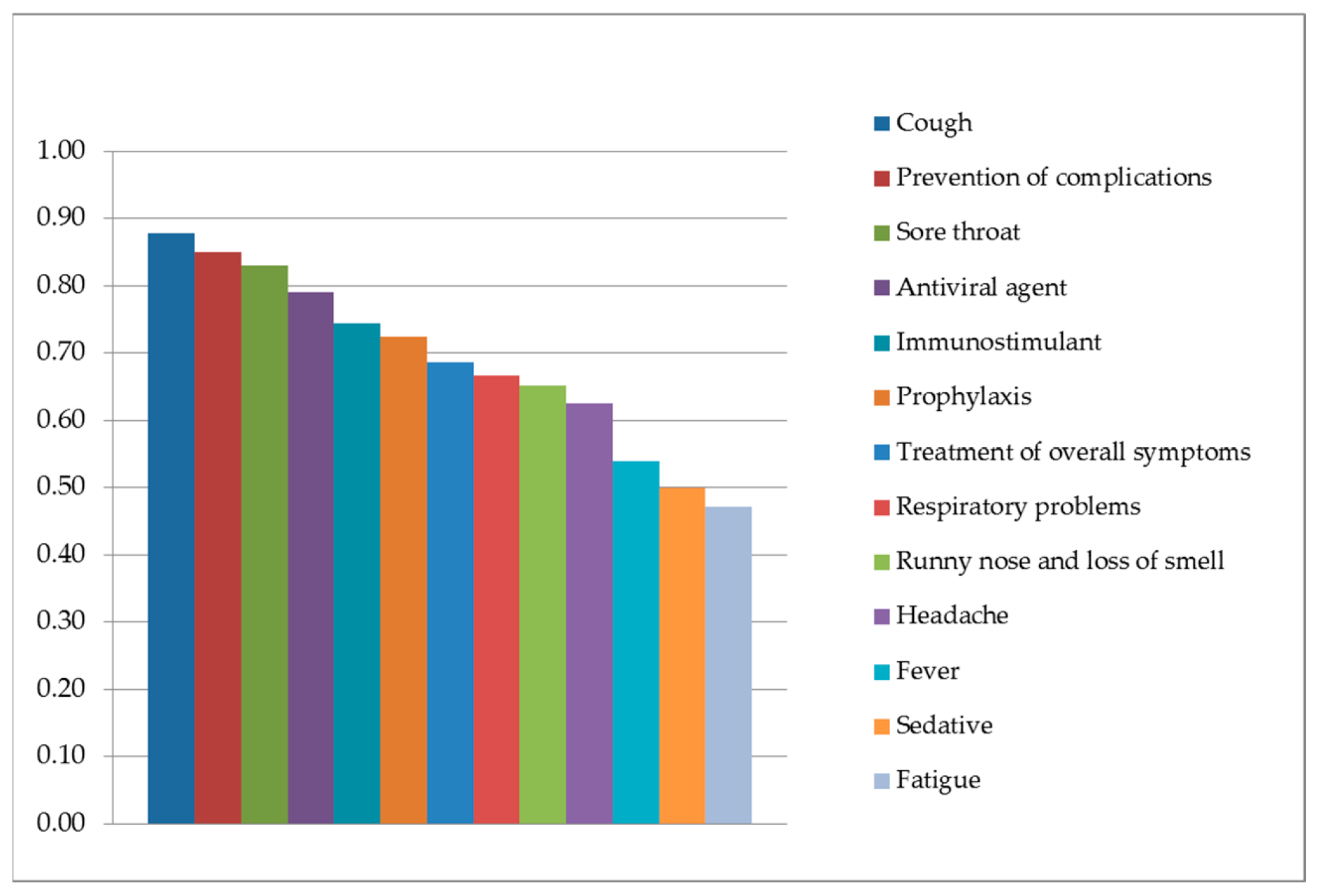
| Cough | 24 | 189 | 0.8777 |
| Prevention of complications | 26 | 168 | 0.8503 |
| Sore throat | 18 | 101 | 0.8300 |
| Antiviral agent | 9 | 39 | 0.7895 |
| Immunostimulant | 21 | 79 | 0.7436 |
| Prophylaxis | 17 | 59 | 0.7241 |
| Treatment of overall symptoms | 22 | 68 | 0.6866 |
| Respiratory problems | 15 | 43 | 0.6667 |
| Runny nose and loss of smell | 9 | 24 | 0.6522 |
| Headache | 4 | 9 | 0.6250 |
| Fever | 7 | 14 | 0.5384 |
| Sedative | 4 | 6 | 0.5000 |
| Fatigue | 10 | 18 | 0.4706 |
| Medicinal Plant | Number of Reports | FL % | RFC | Cultural Significance |
|---|---|---|---|---|
| Category “Cough” | ||||
| Thymus vulgaris L. | 32 | 54 | 0.30 | High cultural significance |
| Tilia sp. | 34 | 47 | 0.37 | High cultural significance |
| Sideritis scardica Griseb. | 10 | 42 | 0.12 | Specific cultural significance |
| Zingiber officinale Roscoe | 18 | 37 | 0.25 | Universal cultural significance |
| Matricaria chamomilla L. | 28 | 35 | 0.41 | Universal cultural significance |
| Mentha sp. | 13 | 33 | 0.20 | Universal cultural significance |
| Category “Prevention of complications” | ||||
| Tilia sp. | 34 | 47 | 0.37 | High cultural significance |
| Sideritis scardica Griseb. | 11 | 46 | 0.12 | Specific cultural significance |
| Matricaria chamomilla L. | 36 | 45 | 0.41 | Moderate cultural significance |
| Thymus vulgaris L. | 21 | 36 | 0.30 | Moderate cultural significance |
| Zingiber officinale Roscoe | 18 | 37 | 0.25 | Established foreign species with specific local use |
| Mentha sp. | 10 | 26 | 0.20 | Universal cultural significance |
| Category “Sore throat” | ||||
| Tilia sp. | 28 | 39 | 0.37 | High cultural significance |
| Matricaria chamomilla L. | 23 | 29 | 0.41 | Universal cultural significance |
| Category “Immunostimulant” | ||||
| Zingiber officinale Roscoe | 12 | 25 | 0.25 | Moderate cultural significance |
| Citrus x limon (L.) Osbeck | 9 | 31 | 0.15 | Specific cultural significance |
| Tilia sp. | 9 | 13 | 0.37 | Universal cultural significance |
| Thymus vulgaris L. | 7 | 12 | 0.64 | Universal cultural significance |
| Category “Prophylaxis” | ||||
| Zingiber officinale Roscoe | 12 | 25 | 0.25 | Moderate cultural significance |
| Thymus vulgaris L. | 7 | 12 | 0.64 | Universal cultural significance |
| Mentha sp. | 6 | 15 | 0.20 | Moderate cultural significance |
| Citrus x limon (L.) Osbeck | 6 | 21 | 0.15 | Specific cultural significance |
| Category “Antiviral agent” | ||||
| Tilia sp. | 7 | 10 | 0.37 | Universal cultural significance |
| Matricaria chamomilla L. | 6 | 8 | 0.41 | Universal cultural significance |
| Thymus vulgaris L. | 8 | 14 | 0.64 | Universal cultural significance |
| Zingiber officinale Roscoe | 6 | 13 | 0.25 | Moderate cultural significance |
| Country | Number of Reported Medicinal Plants | Number of Common Medicinal Plants | References |
|---|---|---|---|
| Nepal | 63 | 9 | [37] |
| Thailand | 60 | 2 | [40] |
| Turkey | 35 | 15 | [32,34] |
| Columbia | 33 | 13 | [41] |
| Nigeria | 27 | 3 | [46] |
| Algeria | 22 | 14 | [43] |
| Morocco | 22 | 8 | [44] |
| India | 18 | 5 | [39] |
| Peru | 17 | 9 | [42] |
| Tunisia | 15 | 7 | [47] |
| Lithuania | 14 | 11 | [35] |
| Vietnam | 13 | 3 | [38] |
| Ethiopia | 12 | 6 | [45] |
| Norway | 8 | 3 | [36] |
| Category | Country | Jaccard Index | Shared Species |
|---|---|---|---|
| Cough | Lithuania [35] | 0.19 | Matricaria chamomilla L., Mentha sp., Thymus vulgaris L., Salvia officinalis L., Tilia sp., Urtica dioica L. |
| Peru [42] | 0.18 | Matricaria chamomilla L., Thymus vulgaris L., Salvia officinalis L., Melissa officinalis L., Origanum vulgare L., Zingiber officinale Roscoe | |
| Immunostimulant | Nepal [37] | 0.12 | Allium cepa L., Ocimum tenuiflorum L., Nigella sativa L., Citrus aurantifolia (Christ.) Swingle, Zingiber officinale Roscoe |
| Prevention of complications | Algeria [43] | 0.19 | Mentha sp., Thymus vulgaris L., Citrus x limon (L.) Osbeck., Zingiber officinale Roscoe |
| Peru [42] | 0.17 | Matricaria chamomilla L., Allium cepa L., Origanum vulgare L., Zingiber officinale Roscoe | |
| Antiviral agent | Algeria [43] | 0.29 | Mentha sp., Thymus vulgaris L., Matricaria chamomilla L., Allium sativum L., Origanum vulgare L., Salvia officinalis L., Zingiber officinale Roscoe |
| Nepal [37] | 0.13 | Mentha sp., Zingiber officinale Roscoe | |
| Tunisia [47] | 0.11 | Allium sativum L., Zingiber officinale Roscoe | |
| India [39] | 0.09 | Mentha sp., Zingiber officinale Roscoe | |
| Sore throat | Turkey [32,34] | 0.23, | Mentha sp., Melissa officinalis L., Rosa canina L., Salvia officinalis L., Sideritis scardica Griseb., Thymus vulgaris L., Tilia sp. |
| Lithuania [35] | 0.24 | Matricaria chamomilla L., Mentha sp., Salvia officinalis L., Thymus vulgaris L., Tilia sp., Urtica dioica L. | |
| Peru [42] | 0.24 | Matricaria chamomilla L., Mentha sp., Salvia officinalis L., Thymus vulgaris L., Tilia sp., Urtica dioica L. | |
| Prevention | Algeria [43] | 0.20 | Mentha sp., Thymus vulgaris L., Citrus x limon (L.) Osbeck., Zingiber officinale Roscoe |
| Runny nose and loss of smell | Lithuania [35] | 0.16 | Matricaria chamomilla L., Mentha sp. L., Thymus vulgaris L., Tilia sp. |
| Tunisia [47] | 0.13 | Eucalyptus tereticornis L’Hér., Cinnamomum sp., Mentha sp. | |
| Fatigue | Lithuania [35] | 0.28 | Allium sativum L., Matricaria chamomilla L., Mentha sp., Thymus vulgaris L., Tilia sp. |
| Fever | Peru [42] | 0.17 | Allium sativum L., Matricaria chamomilla L. |
| Tunisia [47] | 0.10 | Allium sativum L., Mentha sp. | |
| Respiratory problems | Lithuania [35] | 0.24 | Allium sativum L., Matricaria chamomilla L., Mentha sp., Salvia officinalis L., Thymus vulgaris L., Tilia sp. |
| Turkey [32,34] | 0.22 | Echinacea sp., Rosa canina L., Salvia officinalis L., Thymus vulgaris L., Zingiber officinale Roscoe | |
| Tunisia [47] | 0.13 | Mentha sp., Nigella sativa L. Zingiber officinale Roscoe | |
| Overall improvement | Lithuania [35] | 0.20 | Calendula officinalis L., Matricaria chamomilla L., Mentha sp., Salvia officinalis L., Thymus vulgaris L., Tilia sp. |
| Headache | Turkey [32,34] | 0.40 | Mentha sp., Tilia sp. |
| Tunisia [47] | 0.13 | Mentha sp., Nigella sativa L. |
| Socio-Demographic Characteristics | Categories | Frequency % |
|---|---|---|
| Gender | Women | 32.3 |
| Men | 67.7 | |
| Age | 18–30 | 46.8 |
| 31–40 | 8.6 | |
| 41–50 | 22.1 | |
| 51–65 | 12.9 | |
| 65+ | 9.6 | |
| Education | Primary | 2.3 |
| Secondary | 49.3 | |
| Higher | 47 | |
| Social employment | Student | 37.8 |
| Employed | 48.3 | |
| Unemployed | 2 | |
| Pensioner | 10.2 |
Disclaimer/Publisher’s Note: The statements, opinions and data contained in all publications are solely those of the individual author(s) and contributor(s) and not of MDPI and/or the editor(s). MDPI and/or the editor(s) disclaim responsibility for any injury to people or property resulting from any ideas, methods, instructions or products referred to in the content. |
© 2025 by the authors. Licensee MDPI, Basel, Switzerland. This article is an open access article distributed under the terms and conditions of the Creative Commons Attribution (CC BY) license (https://creativecommons.org/licenses/by/4.0/).
Share and Cite
Cherneva, D.; Nikolova, N.; Dimitrova, T.; Ivanov, D.; Iliev, I.; Georgieva, S.; Yaneva, G. Traditional Use of Medicinal Plants for Symptom Relief During the COVID-19 Pandemic in Bulgaria. Plants 2025, 14, 3692. https://doi.org/10.3390/plants14233692
Cherneva D, Nikolova N, Dimitrova T, Ivanov D, Iliev I, Georgieva S, Yaneva G. Traditional Use of Medicinal Plants for Symptom Relief During the COVID-19 Pandemic in Bulgaria. Plants. 2025; 14(23):3692. https://doi.org/10.3390/plants14233692
Chicago/Turabian StyleCherneva, Djeni, Nadezhda Nikolova, Tsonka Dimitrova, Dobri Ivanov, Ivelin Iliev, Svetlana Georgieva, and Galina Yaneva. 2025. "Traditional Use of Medicinal Plants for Symptom Relief During the COVID-19 Pandemic in Bulgaria" Plants 14, no. 23: 3692. https://doi.org/10.3390/plants14233692
APA StyleCherneva, D., Nikolova, N., Dimitrova, T., Ivanov, D., Iliev, I., Georgieva, S., & Yaneva, G. (2025). Traditional Use of Medicinal Plants for Symptom Relief During the COVID-19 Pandemic in Bulgaria. Plants, 14(23), 3692. https://doi.org/10.3390/plants14233692