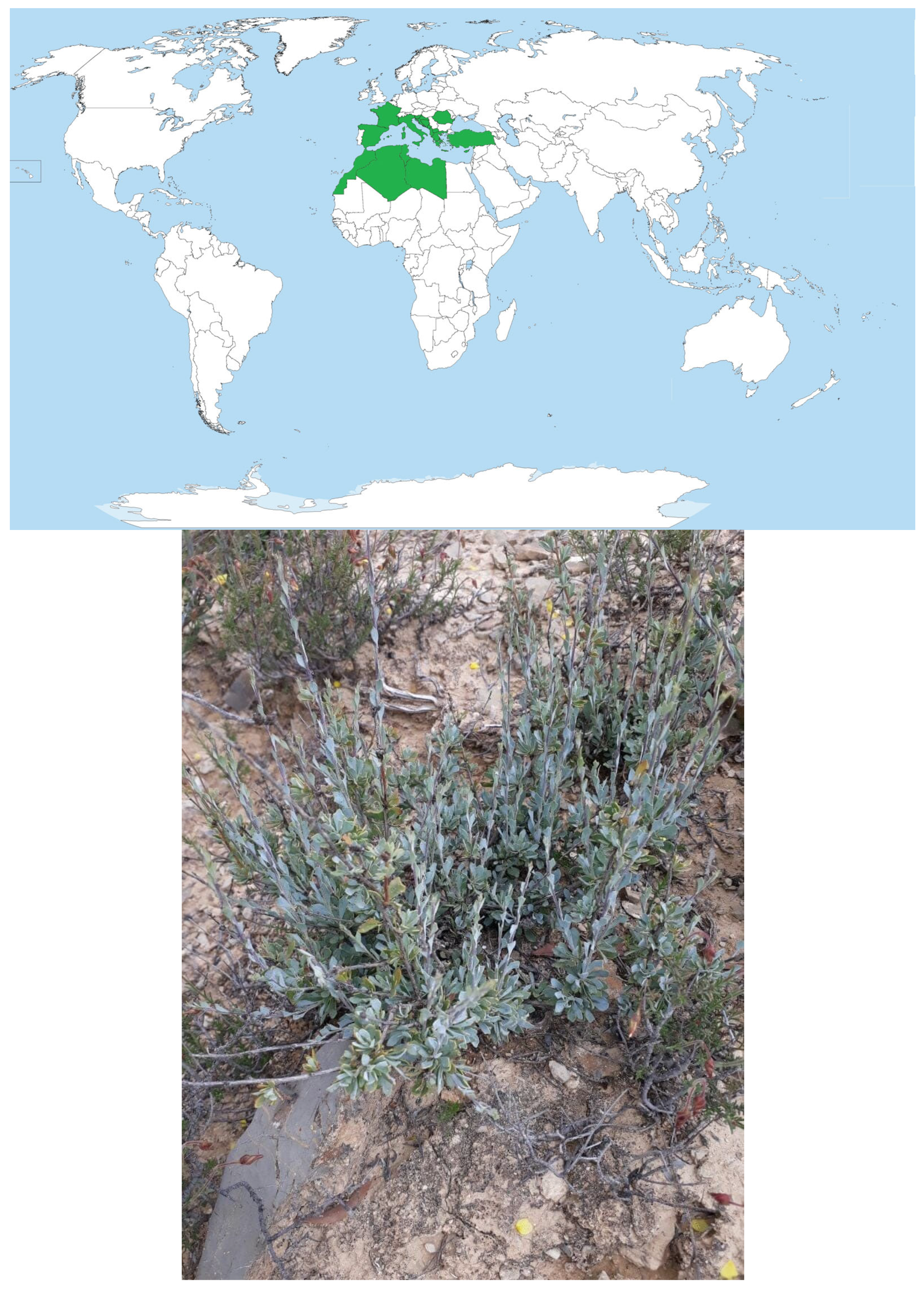
Phytochemical, Ethnobotanical, Pharmacological, and Toxicological Profile of Globularia alypum L.: A Comprehensive Review

 , , ,
, , ,  , ,
, , 
Abstract
1. Introduction
2. Literature Search Methodology
3. Taxonomy, Botanical Description, and Distribution
4. Ethnomedicinal Uses
5. Phytoconstituents of G. alypum

| Plant Part | Region | Chemical Composition of Organic Extracts/Essential Oil (Major Components) | References |
|---|---|---|---|
| Leaves, flowers, woody stems, and underground parts of four G. alypum L. species | Croatia and Bosnia and Herzegovina | Aucubin (0.58–0.92 mg/g DM) in ME Catalpol (1.79–12.85 mg/g DM) in ME | [129] |
| Leaves | Algeria (Bajaia) | Hydroxyluteolin 7-Olaminaribioside, Gallocatechin/ Epigallocatechin, Eriodictiol 7-O-sophoroside, Quercetin glucoside, Luteolin sophoroside, Cynaroside, Amurensin, Nepitrin, Phellamurin. | [130] |
| Aerial parts | Morocco (Taza) | Syringin, four phenylethanoids, four flavonoids and six iridoids | [45] |
| Aerial parts | Morocco (Taza) | Iridoids globularin, globularicisin, globularidin, globularinin, globularimin, chlorinated iridoid glucoside (globularioside) | [37] |
| Leaves | Tunisia (Gafsa) | Decaffeoylverbascoside, Caffeoyl hexoside 1, 6-O-caffeoyl-b-D-glucopyranosyl-(1-6)-glucitol (hebitol II), Caffeoyl hexoside 2, Syringin, Caffeoyl hexoside, Coumaroyl hexosyl glucitol, 6-O-caffeoyl-3,4-dihydrocatalpol, (dihydroverminoside), 6-O-feruloyl-b-D-glucopyranosyl-(1-6)-glucitol (globularitol), 6-O-Caffeoylcatalpol, 6-Hydroxyluteolin 7-O-laminaribioside, Specioside, 6-Hydroxyluteolin 7-O-glucoside, Luteolin di-hexoside, Globularinin, Globularimin, Calceolarioside A/calceolarioside B, Rossicaside A, Luteolin 7-O-glucoside (cynaroside), Verbascoside or acteoside isomer 1, Calceolarioside A/calceolarioside B, Caffeoyl hexoside derivative, 6-Methoxyluteolin-7-O-glucoside (nepitrin), Globularicisin, Methylcaffeoyl derivative, Verbascoside or acteoside isomer 2, Globularidin, Hydroxyphenylethyl-caffeoyl-hexoside, Diydroxyphenylethyl-coumaroyl-hexoside, Globularin, Dihydroxyphenylethyl-methylcaffeoyl-hexoside, 6-Methoxyluteolin (nepetin), Martynoside, Globularioside, Hydroxyphenylethyl-methylcaffeoyl-hexoside, 6-O-caffeoylverbascoside, Galypumoside A, Galypumoside B, Galypumoside C | [131] |
| Aerial parts | Croatia (Konavle cliffs, Grobnik field, Baške Oštarije, Velebit, Alan, Velebit) | Leaves extracts TPC = 130.46 ± 5.99–131.39 ± 2.89 mg GAE/g dry extract (DE, ME) using ultrasound-assisted extraction (UAE) TFC = 30.43 ± 0.29- 32.26 ± 1.37 mg QE/g DE (ME) using UAE Iridoids 12.07 ± 0.18–27.49 ± 3.08 mg aucubin equivalents (AE)/g DE (ME) using UAE Condensed tannins: 2.66 ± 0.09–3.00 ± 0.06 mg catechin equivalents (CE)/g DE using UAE Aerial parts (flowers and stems) extracts TPC = 112.34 ± 2.17 mg GAE/g DE ME using Soxhlet extraction. TFC = 26.85 ± 0.46 mg QE/g DE ME using Soxhlet extraction. LC-MS profile for Methanolic leaf extracts (UAE) from G. alypum Mannitol, sucrose, catalpol, aucubin, 1′-O-Hydroxytyrosol glucoside, Caffeoylglucoside isomer, Hebitol II (6′ -O-Caffeoyl-β-D-glucopyranosyl-(1→6)-mannitol), Globularitol (6′ -O-Feruloyl-β-D-glucopyranosyl-(1→6)-mannitol), Verminoside (6-O-Caffeoylcatalpol), Geniposide, Vicenin-2 (Apigenin-6,8-di-C-glucoside), Specioside (6-O-(p-Coumaroyl)-catalpol), 6-Hydroxyluteolin 7-O-sophoroside, 6-Hydroxyluteolin 7-O-glucoside, Alpinoside, Globularinin, Globularimin, Liriodendrin ((+)-Syringaresinol di-O-β-glucopyranoside), Isoquercitrin (Quercetin 3-O-glucoside), Calceolarioside A, Calceolarioside B, Nepetin 7-O-glucoside, Rossicaside A, Verbascoside, Globularidin, Isoverbascoside, Forsythoside A, Globularin (10-O-trans-Cinnamoylcatalpol), Leucosceptoside A, 6′ -O-Feruloyl-10 -O-hydroxytyrosol glucoside, Globularioside, Alpinoside-alpinoside dimer, Globusintenoside isomer, Desrhamnosyl 6′ -O-caffeoylverbascoside, 6′ -O-Caffeoylverbascoside, Globuloside A (Alpinoside-globularin dimer), Galypumoside B (6′ -O-Feruloylverbascoside), Desrhamnosyl galypumoside B, Oxo-dihydroxy-octadecenoic acid, Galypumoside C, Trihydroxy-octadecenoic acid LC-MS profile for Methanolic aerial parts extracts (Soxhlet) from G. alypum Mannitol, sucrose, catalpol, Caffeoylglucoside isomer, Gardoside, Verminoside (6-O-Caffeoylcatalpol), Geniposide, Specioside, 6-Hydroxyluteolin 7-O-sophoroside, 6-Hydroxyluteolin 7-O-glucoside, Alpinoside, Globularinin, Globularimin, Liriodendrin ((+)-Syringaresinol di-O-β-glucopyranoside), Calceolarioside A (Desrhamnosyl verbascoside), Calceolarioside B, Rossicaside A, Verbascoside, Isoverbascoside, Forsythoside A, Globularin (10-O-trans-Cinnamoylcatalpol), Leucosceptoside A, 6′ -O-Feruloyl-10 -O-hydroxytyrosol glucoside, Globularioside, Globusintenoside isomer, 6′ -O-Caffeoylverbascoside, Apigenin, Globuloside A, Galypumoside B | [125] |
| Fresh leaves | Tunisia (Beja region) | Yield (%) 14.20 ± 0.28, total sugars (%) 71.56 ± 0.64, Sulfate (%) 13.29 ± 0.84 Proteins (%) 0.74 ± 0.02, Lipids 1.45 ± 0.08, Moisture (%) 7.53 ± 0.35, Ash (%) 6.8 ± 0.62 | [132] |
| Fresh leaves | Tunisia (Beja region) | Methanolic extracts: Glycerol, tris (TMS) ether (2.65%), Cinnamic acid, TMS ester (1.53%), Cinnamic acid (1.32%), Cinnamic acid, (E) (0.32%), Cinnamic acid, TMS ester (23.21%), 4-Hydroxyphenylethanol, di-TMS (4.70%), Ethanol, (2-(3,4-dihydroxyphenyl)-, tris(TMS) (6.61%), D-Fructose, 1,3,4,5,6-pentakis-O- (TMS) (12.24%), 3,4-Heptadien-2-one, 3,5-dicyclopentyl-6-methyl- (12.46%), Bicyclo [4.4.0]dec-2-ene-4-ol, 2-methyl-9-(prop-1-en-3-ol-2-yl) (30.96%), Talose, 2,3,4,5,6-pentakis-O-(TMS)- (0.62%), Palmitic acid, TMS ester (6.07%), Silane, [(3,7,11,15-tetramethyl-2-hexadecenyl)oxy] TMS (0.47%), Linoleic acid, TMS ester (0.40%), Oleic acid, TMS ester (1.48%), Stearic acid, TMS ester (0.75%), 1-(3′, 5′ -dichlorophenyl)-5-oxo-4,4-diphenyl-2-imidazolin-2-yl] guanidine (0.3%) | [40] |
| Dried aerial parts | Croatia | α-himachalene (35.34%), β-himachalene (13.62%), γ-himachalene (12.6%), cedrol (10.32%), isocedranol (5.52%) and α-pinene (5.5%) | [128] |
| Aerial part (flowers, leaves and stems) | Algeria (Batna) | Diethyl ether (TPC = 331.88 ± 17.80 µg GAE/mg DE), TFC = 223.46 ± 2.37 µg CE/mg DE) Ethyl acetate (TPC = 103.62 ± 1.09 µg GAE/mg DE), TFC = 139.58 ± 4.08 µg CE/mg DE) n-butanol (TPC = 127.70 ± 0.82 µg GAE/mg DE), TFC = 173.5 ± 4.71 µg CE/mg DE) Gallic acid, p-coumaric acid, rutin, naringenin and quercitin (diethyl ether fraction) Gallic acid, quercetin, rutin, and ferulic acid (ethyl acetate fraction) | [42] |
| Aerial (flowers, leaves, and woody stems) and underground parts | Croatia, Bosnia and Herzegovina | Methanolic extracts (ultrasonic extraction) Aucubin (mg/g DE): Leaves 0.58 ± 0.01, Flowers 0.92 ± 0.00, Woody stems 0.58 ± 0.01 Catalpol (mg/g DE): Leaves 1.79 ± 0.03, Flowers 12.58 ± 0.03, Woody stems 1.47 ± 0.02 | [129] |
| Fresh aerial parts | Morocco (Taza) | Aqueous MeOH extract: Phenolics: 6-hydroxyluteolin 7-O-laminaribioside, eriodictyol 7-O-sophoroside, and 6′- O-coumaroyl-1′-O-[2-(3,4-dihydroxyphenyl) ethyl]-β-D-glucopyranoside, Phenylethanoid glycosides: acteoside, isoacteoside, and forsythiaside Flavonoid glycosides: 6-hydroxyluteolin 7-O-β-D-glucopyranoside and luteolin 7-O-sophoroside | [13] |
| Fresh leaves | Morocco (Taza) | Ethyl acetate: TPC = 56.5 ± 0.61 µg GAE/mg of extract, TFC = 30.2 ± 0.55 µg CE/mg of extract Chloroform: TPC = 18.9 ± 0.48 µg GAE/mg of extract, TFC = 18.0 ± 0.36 µg CE/mg of extract n-hexane fraction (CG-MS): A total of 73 compounds: the major compounds were n-hexadecanoic acid (13.5%), oleic acid (12.98%), and linoleic acid (11.58%) Ethyl acetate extract (HPLC-DAD-ESI/MS): Gallic acid (4.3 ± 0.12 mg/100 g), Gallic acid ethyl ester (4.2 ± 0.20 mg/100 g), Quercetin glucoside (4.7 ± 0.20 mg/100 g), Quercetin rhamnoside (14.5 ± 1.20 mg/100 g), Kaempferol derivative (10.8 ± 0.50 mg/100 g), Quercetin acetyl hexoside (0.3 ± 0.01 mg/100 g), Quercetin glucoside (7.8 ± 0.30 mg/100 g) | [3] |
| Aerial parts | Tunisia (Seliana) | Ethanolic extracts TPC = 23.95 ± 0.24 (mg GAE/g DE), TFC = 11.93 ± 0.05 (mg CE/g DE) and TCT = 21.43 ± 0.38 (mg CE/g DE) RP-HPLC/UV of ethanolic extracts: Phenolic acids: p-coumaric acid (15.02 ± 1.55 mg/g DE), Sinapic acid (3.62 ± 0.03 mg/g DE), Trans-hydroxycinnamic acid (34.21 ± 3.24 mg/g DE) Flavonoids: Quercetin (0.11 ± 0.00 mg/g DE), Catechin hydrate (16.01 ± 1.87 mg/g DE) | [133] |
| Dried whole plant | Switzerland | Methanolic/aqueous extracts: globularicisin, globularidin, globularimin, globularinin, lignan diglucoside liriodendrin, syringin, globularin, catalpol | [134] |
| Fresh leaves | Algeria (Souk Ahras) | Petroleum ether extract (GC-MS): Ethylbenzene, Xylene, D-Fenchone, Camphor, alpha-Terpineol, Neohexane, alpha-Fenchyl acetate, n-Tetradecane, Sabinyl acetate, 1-Ethyl-1,5-cyclooctadiene, Eugenol, Isoeugenol, Diethylmethyl-borane, Eicosane, 17-Pentatriacontene, Nonadecane, Pentadecane, n-Octadecyl chloride, Bicyclopentyl-2′-en-2-yl-dimethylamine, 3-Cyclopentyl-pentane, Lignocerol, Viridiflorol, Cetane, alpha-Cadinol, Aromadendrene, 2,2-Dimethyl-6,10-dithiaspiro [4.5] decan-1-ol, Hexatriacontane, Neoclovene, Dehydroionone Amphetamine oxime acetate, Phthalic acid | [135] |
| Dried leaves | Tunisia (Boussalem) | Aqueous extract: Catalpol, Shanzhizide, Hebitol, Globuralitol, Varminoside, Gallocatechin, Quercetin-glucoside, Verbascoside, Isoverbascoside, Decumbeside, Phellamurin, Serratoside, Globularioside | [46] |
| Leaves | Tunisia (Zaghouan) | Ethanolic extracts: TPC 25.33 ± 1.52 mg GAE/g DW, TFC 4.71 ± 0.50 mg CE/g DW, tannins 4.30 ± 0.35 mg CE/g DW HPLC-PDA-ESI-MS/MS: p-coumaroyl sugar ester, Apigenin acetoxydeoxyhexose, Tetragalloyl hexoside, HHDP-hexose, Sinapic acid derivative, Apigenin glucuronide, Amentoflavone, I3, II8-Biapigenin, Myricetin, Kaempfreol glucoside, Naringenin diglucoside | [136] |
| Leaves | Greece (Athens) | UHPLC- (-) ESI/HRMS: Gardoside/Geniposidic Acid, Cornoside, Mussaenosidic acid, (epi)loganic acid, Secoxyloganin methylester, Acetylbarlerin, Globularitol, Hydroxyluteolin diglucoside, Eriodictiol diglycoside, Luteolin diglycoside, Quercetin glucoside, Alpinoside, Verbascoside, Agnuside, Globularinin, Calceolarioside B, Isoverbascoside, Nepitrin, Gallocatechin/Epigallo- catechin, (Z)-Globularicisin, Globularidin, (E)-Globularicisin, Globularioside/Baldac-cioside, Verminoside | [48] |
| Compound Name | 2D Structure | 3D Structure |
|---|---|---|
| Globularin |  |  |
| Globularifolin |  |  |
| Catalpol |  |  |
| Aucubin |  |  |
| Verbascoside |  |  |
6. Pharmacological Activities
6.1. Antioxidant Activity
6.2. Antimicrobial Activity
6.3. Anti-Hyperglycemic Activity
6.4. Anti-Inflammatory Activity
| Part Used | Extracts | Experimental Approach | Key Results | References |
|---|---|---|---|---|
| Aerial part | Flavonic extract (Butanolic fraction) | Carrageenan-induced inflammation | Reduction in paw oedema volume by 8.55% at a concentration of 0.1 g/mL 27.15% at a concentration of 0.2 g/mL 33.01% at a concentration of 0.3 g/mL | [57] |
| Aerial part | Methanol extract | Carrageenan-induced inflammation | Inhibition by 56.2% | [171] |
| Leaves | Methanol extract | Carrageenan-induced inflammation. and Determination of C-reactive protein | Reduction in paw oedema volume by 40% A significant decrease in the inflammatory cells and C-reactive protein (CRP) level in serum samples | [40] |
| Leaves and flowers | Methanol extract | Cyclooxygenase inhibition | Flower: Cox-1 IC50 = 0.122 Cox-1 inhibition by 61.05% at a concentration of 0.033 mg/mL Leaves: Cox-1 inhibition by 5.33% at a concentration of 0.033 mg/mL | [35] |
| Leaves | Ethanol extract | Nitric oxide (NO) production | Decreases the cellular nitric oxide (NO) generation by 29% at 200 mg/mL Decreases the ulcer index (UI) from 2.66 mm to 1.66 mm | [133] |
| Leaves | Methanol extract | Lipoprotein peroxidation assay | Reduction in VLDL-LDL peroxidation up to 47% | [169] |
| Leaves | Methanol extract | Cyclooxygenase inhibition (TMPD and PGE2 assays) | COX-1 inhibition by 51.3% in TMPD assay COX-1 inhibition by 40.6% in PGE2 assay | [125] |
| Leaves | Aqueous extract | Cyclooxygenase inhibition and proinflammatory markers expression | Decrease in the COX-2 expression and EC-LPS effect on colon proinflammatory proteins | [170] |
| Leaves | Methanol extract | 5-lipoxygenase assay and nitric oxide (NO) production | Inhibition of 5-lipoxygenase: IC50 = 79 ± 0.8 mg/L NO production by 66% at 600 mg/L | [56] |
| Aerial part | Aqueous extract | Dosage of tumor necrosis factor (TNF-α) and interleukin-6 (IL-6) | Decrease in lipid peroxidation and pro-inflammatory cytokines (IL-6 and TNF-α) levels | [169] |
6.5. Antiproliferative and Cytotoxic Activities
6.6. Other Activities
6.7. Toxicology and Safety
7. Conclusions
Author Contributions
Funding
Data Availability Statement
Acknowledgments
Conflicts of Interest
References
- Soumia, K.; Tahar, D.; Lynda, L.; Saida, B.; Chabane, C.; Hafidha, M. Antioxidant and antimicrobial activities of selected medicinal plants from Algeria. J. Coast. Life Med. 2014, 2, 478–483. [Google Scholar]
- Elachouri, M. Ethnobotany/ethnopharmacology, and bioprospecting: Issues on knowledge and uses of medicinal plants by Moroccan people. Chapter 5. In Natural Products and Drug Discovery; Elsevier: Amsterdam, The Netherlands, 2018; pp. 105–118. [Google Scholar]
- Asraoui, F.; Kounnoun, A.; Cadi, H.E.; Cacciola, F.; Majdoub, Y.O.E.; Alibrando, F.; Mandolfino, F.; Dugo, P.; Mondello, L.; Louajri, A. Phytochemical investigation and antioxidant activity of Globularia alypum L. Molecules 2021, 26, 759. [Google Scholar] [CrossRef]
- Djellouli, F.; Krouf, D.; Bouchenak, M.; Lacaille-Dubois, M.A. Favorable Effects of Globularia alypum L. Lyophilized Methanolic Extract on the Reverse Cholesterol Transport and Lipoprotein Peroxidation in Streptozotocin–Induced Diabetic Rats. Int. J. Pharmacogn. Phytochem. Res. 2014, 6, 758–765. [Google Scholar]
- El Guiche, R.; Tahrouch, S.; Amri, O.; El Mehrach, K.; Hatimie, A. Antioxidant activity and total phenolic and flavonoid contents of 30 medicinal and aromatic plants located in the South of Morocco. Int. J. New Technol. Res. 2015, 1, 263695. [Google Scholar]
- Djeridane, A.; Yousfi, M.; Nadjemi, B.; Boutassouna, D.; Stocker, P.; Vidal, N. Antioxidant activity of some Algerian medicinal plant’s extracts containing phenolic compounds. Food Chem. 2006, 97, 654–660. [Google Scholar] [CrossRef]
- Athmouni, K.; Belghith, T.; El Fek, A.; Ayadi, H. Phytochemical composition and antioxidant activity of extracts of some medicinal plants in Tunisia. Int. J. Pharmacol. Toxicol. 2016, 4, 159–168. [Google Scholar] [CrossRef]
- Jouad, H.; Haloui, M.; Rhiouani, H.; El Hilaly, J.; Eddouks, M. Ethnobotanical survey of medicinal plants used for the treatment of diabetes, cardiac and renal diseases in the North centre region of Morocco (Fez–Boulemane). J. Ethnopharmacol. 2001, 77, 175–182. [Google Scholar] [CrossRef]
- Fennane, M.; Tattou, M.I.; Valdés, B. Catalogue des plantes vasculaires rares, menacées ou endémiques du Maroc. Bocconea 1998, 8, 1–243. [Google Scholar]
- Benabid, A. Flore et Écosystèmes du Maroc. Evaluation et présentation de la Biodiversité; Ed. Ibis Press: Paris, France, 2000. [Google Scholar]
- Rankou, H.; Culham, A.; Jury, S.L.; Christenhusz, M.J. The endemic flora of Morocco. Phytotaxa 2013, 78, 1–69. [Google Scholar] [CrossRef]
- Quézel, P.; Santa, S. Nouvelle Flore de l’Algérie et des Régions Désertiques Méridionales; CNRS: Paris, France, 1962; Volume 1, pp. 11–12. [Google Scholar]
- Es-Safi, N.-E.; Khlifi, S.; Kerhoas, L.; Kollmann, A.; El Abbouyi, A.; Ducrot, P.-H. Antioxidant constituents of the aerial parts of Globularia alypum growing in Morocco. J. Nat. Prod. 2005, 68, 1293–1296. [Google Scholar] [CrossRef]
- Chograni, H.; Riahi, L.; Zaouali, Y.; Boussaid, M. Polyphenols, flavonoids, antioxidant activity in leaves and flowers of Tunisian Globularia alypum L. (Globulariaceae). Afr. J. Ecol. 2013, 51, 343–347. [Google Scholar] [CrossRef]
- Benabid, A.; Bellakhdar, J. Relevés floristiques et catalogue des plantes médicinales dans le Rif occidental. Biruniya 1987, 3, 87–120. [Google Scholar]
- Hammiche, V.; Merad, R.; Azzouz, M. Phytothérapie Traditionnelle en Algérie. Plantes Toxiques à Usage Médicinal du Pourtour Méditerranéen; Springer: Paris, France, 2013; pp. 18–20. [Google Scholar]
- Boudjelal, A.; Henchiri, C.; Sari, M.; Sarri, D.; Hendel, N.; Benkhaled, A.; Ruberto, G. Herbalists and wild medicinal plants in M’Sila (North Algeria): An ethnopharmacology survey. J. Ethnopharmacol. 2013, 148, 395–402. [Google Scholar] [CrossRef] [PubMed]
- Telli, A.; Esnault, M.-A.; Khelil, A.O.E.H. An ethnopharmacological survey of plants used in traditional diabetes treatment in south-eastern Algeria (Ouargla province). J. Arid Environ. 2016, 127, 82–92. [Google Scholar] [CrossRef]
- Harzallah, H.J.; Neffati, A.; Skandrani, I.; Maaloul, E.; Chekir-Ghedira, L.; Mahjoub, T. Antioxidant and antigenotoxic activities of Globularia alypum leaves extracts. J. Med. Plants Res. 2010, 4, 2048–2053. [Google Scholar] [CrossRef]
- Mansour, R.B.; Gargouri, B.; Gargouri, B.; Elloumi, N.; Jilani, I.B.; Ghrabi-Gammar, Z.; Lassoued, S. Investigation of antioxidant activity of alcoholic extract of Globularia alypum L. J. Med. Plants Res. 2012, 6, 4193–4199. [Google Scholar]
- Ziyyat, A.; Legssyer, A.; Mekhfi, H.; Dassouli, A.; Serhrouchni, M.; Benjelloun, W. Phytotherapy of hypertension and diabetes in oriental Morocco. J. Ethnopharmacol. 1997, 58, 45–54. [Google Scholar] [CrossRef]
- Alami, Z.; Aynaou, H.; Alami, B.; Hdidou, Y.; Latrech, H. Herbal medicines use among diabetic patients in Oriental Morocco. J. Pharmacogn. Phytother. 2015, 7, 9. [Google Scholar]
- Amrani, F.; Rhallab, A.; Alaoui, T.; Badaoui, K.; Chakir, S. Étude ethnopharmacologique de quelques plantes utilisées dans le traitement du diabète dans la région de Meknès-Tafilalet (Maroc). Phytothérapie 2010, 3, 161–165. [Google Scholar] [CrossRef]
- Benkhnigue, O.; Akka, F.B.; Salhi, S.; Fadli, M.; Douira, A.; Zidane, L. Catalogue des plantes médicinales utilisées dans le traitement du diabète dans la région d’Al Haouz-Rhamna (Maroc). J. Anim. Plant. Sci. 2014, 23, 3539–3568. [Google Scholar]
- Bousta, D.; Boukhira, S.; Aafi, A.; Ghanmi, M.; El-Mansouri, L. Ethnopharmacological Study of anti-diabetic medicinal plants used in the Middle-Atlas region of Morocco (Sefrou region). Int. J. Pharm. Res. Health Sci. 2014, 2, 75–79. [Google Scholar]
- Hachi, M.; Hachi, T.; Essabiri, H.; El Yaakoubi, A.; Zidane, L. Ethnobotanical study of medicinal plants in the Central Middle Atlas region (Morocco). IOP Conf. Ser. Earth Environ. Sci. 2022, 1090, 012027. [Google Scholar] [CrossRef]
- Eddouks, M.; Maghrani, M.; Lemhadri, A.; Ouahidi, M.L.; Jouad, H. Ethnopharmacological survey of medicinal plants used for the treatment of diabetes mellitus, hypertension and cardiac diseases in the south-east region of Morocco (Tafilalet). J. Ethnopharmacol. 2002, 82, 97–103. [Google Scholar] [CrossRef]
- Katiri, A.; Barkaoui, M.; Msanda, F.; Boubaker, H. Ethnobotanical survey of medicinal plants used for the treatment of diabetes in the Tizi n’Test region (Taroudant Province, Morocco). J. Pharmacogn. Nat. Prod. 2017, 3, 2472-0992. [Google Scholar] [CrossRef]
- Ghourri, M.; Zidane, L.; Douira, A. Usage des plantes médicinales dans le traitement du Diabète Au Sahara marocain (Tan-Tan). J. Anim. Plant Sci. 2013, 17, 2388–2411. [Google Scholar]
- Balansard, J.; Delphant, J. La globulaire: Un purgatif oublié. Rev. De Phytothérapie 1948, 12, 213–234. [Google Scholar]
- Bellakhdar, J.; Claisse, R.; Fleurentin, J.; Younos, C. Repertory of standard herbal drugs in the Moroccan pharmacopoeia. J. Ethnopharmacol. 1991, 35, 123–143. [Google Scholar] [CrossRef] [PubMed]
- Sijelmassi, A. Les Plantes Médicinales du Maroc, 3rd ed.; Fennec: Casablanca, Morocco, 1993. [Google Scholar]
- Allali, H.; Benmehdi, H.; Dib, M.A.; Tabti, B.; Ghalem, S.; Benabadji, N. Phytotherapy of diabetes in west Algeria. Asian J. Chem. 2008, 20, 2701. [Google Scholar]
- Zennaki, S.; Krouf, D.; Taleb-Senouci, D.; Bouchenak, M. Globularia alypum L. lyophilized methanolic extract decreases hyperglycemia and improves antioxidant status in various tissues of streptozotocin-induced diabetic rats. J. Complement. Integr. Med. 2009, 6, 34. [Google Scholar] [CrossRef]
- Amessis-Ouchemoukh, N.; Abu-Reidah, I.M.; Quirantes-Piné, R.; Rodríguez-Pérez, C.; Madani, K.; Fernández-Gutiérrez, A.; Segura-Carretero, A. Tentative characterisation of iridoids, phenylethanoid glycosides and flavonoid derivatives from Globularia alypum L. (Globulariaceae) leaves by LC-ESI-QTOF-MS. Phytochem. Anal. 2014, 25, 389–398. [Google Scholar] [CrossRef]
- Miara, M.D.; Bendif, H.; Rebbas, K.; Rabah, B.; Hammou, M.A.; Maggi, F. Medicinal plants and their traditional uses in the highland region of Bordj Bou Arreridj (Northeast Algeria). J. Herb. Med. 2019, 16, 100262. [Google Scholar] [CrossRef]
- Es-Safi, N.-E.; Khlifi, S.; Kollmann, A.; Kerhoas, L.; El Abbouyi, A.; Ducrot, P.-H. Iridoid glucosides from the aerial parts of Globularia alypum L. (Globulariaceae). Chem. Pharm. Bull. 2006, 54, 85–88. [Google Scholar] [CrossRef][Green Version]
- Khantouche, L.; Motri, S.; Mejri, M.; BenAbderabba, M. Evaluation of polyphenols and antioxidant properties of extracts Globularia alypum leaves. J. New Sci. Agric. Biotechnol. 2015, 24, 1086–1090. [Google Scholar]
- Boussoualim, N.; Krache, I.; Baghiani, A.; Trabsa, H.; Aouachria, S.; Arrar, L. Human xanthine oxidase inhibitory effect, antioxidant in vivo of Algerian extracts (Globularia alypum L.). Int. J. Pharmacogn. Phytochem. Res. 2016, 8, 645–650. [Google Scholar]
- Ghlissi, Z.; Kallel, R.; Sila, A.; Harrabi, B.; Atheymen, R.; Zeghal, K.; Bougatef, A.; Sahnoun, Z. Globularia alypum methanolic extract improves burn wound healing process and inflammation in rats and possesses antibacterial and antioxidant activities. Biomed. Pharmacother. 2016, 84, 1488–1495. [Google Scholar] [CrossRef] [PubMed]
- Kraza, L.; Mourad, S.M.; Halis, Y. investigation of the antioxidant and antimicrobial effects of hydro-alcoholic and aqueous extracts of Globularia alypum L. Acta Sci. Nat. 2020, 7, 46–58. [Google Scholar]
- Ouffai, K.; Azzi, R.; Abbou, F.; Mahdi, S.; El Haci, I.A.; Belyagoubi-Benhammou, N.; Bekkara, F.A.; Lahfa, F.B. Phenolics compounds, evaluation of Alpha-amylase, alpha-glucosidase inhibitory capacity and antioxidant effect from Globularia alypum L. Vegetos 2021, 34, 477–484. [Google Scholar] [CrossRef]
- Khlifi, D.; Hamdi, M.; Hayouni, A.E.; Cazaux, S.; Souchard, J.P.; Couderc, F.; Bouajila, J. Global chemical composition and antioxidant and anti-tuberculosis activities of various extracts of Globularia alypum L. (Globulariaceae) leaves. Molecules 2011, 16, 10592–10603. [Google Scholar] [CrossRef]
- Touaibia, M.; Chaouch, F. ZGlobal chemical composition and antioxidative effect of the ethanol extracts prepared from Globularia alypum leaves. Nat. Technol. 2016, 2, 2–6. [Google Scholar]
- Es-Safi, N.-E.; Kerhoas, L.; Ducrot, P.H. Fragmentation study of globularin through positive and negative ESI/MS, CID/MS, and tandem MS/MS. Spectrosc. Lett. 2007, 40, 695–714. [Google Scholar] [CrossRef]
- Hajji, N.; Jabri, M.-A.; Tounsi, H.; Wanes, D.; Ali, I.B.E.H.; Boulila, A.; Marzouki, L.; Sebai, H. Phytochemical analysis by HPLC-PDA/ESI-MS of Globularia alypum aqueous extract and mechanism of its protective effect on experimental colitis induced by acetic acid in rat. J. Funct. Foods 2018, 47, 220–228. [Google Scholar] [CrossRef]
- Kırmızıbekmez, H.; Bassarello, C.; Piacente, S.; Çalış, İ. Phenylethyl glycosides from Globularia alypum growing in Turkey. Helv. Chim. Acta 2008, 91, 1525–1532. [Google Scholar] [CrossRef]
- Mamoucha, S.; Tsafantakis, N.; Fokialakis, N.; Christodoulakis, N.S. A two-season impact study on Globularia alypum: Adaptive leaf structures and secondary metabolite variations. Plant Biosyst. 2018, 152, 1118–1127. [Google Scholar] [CrossRef]
- Boutiti, A.; Benguerba, A.; Kitouni, R.; Bouhroum, M.; Benayache, S.; Benayache, F. Secondary metabolites from Globularia alypum. Chem. Nat. Compd. 2008, 44, 543–544. [Google Scholar] [CrossRef]
- Hassine, B.B.; Bui, A.M.; Mighri, Z.; Cave, A. Flavonoids and anthocyanins from Globularia alypum L. Plantes Med. Phytother. 1982, 16, 197–205. [Google Scholar]
- Merghache, S.; Zerriouh, M.; Merghache, D.; Tabti, B.; Djaziri, R.; Ghalem, S. Evaluation of hypoglycaemic and hypolipidemic activities of globularin isolated from Globularia alypum L. in normal and streptozotocin-induced diabetic rats. J. Appl. Pharm. Sci. 2013, 3, 1–7. [Google Scholar]
- Oran, A.S.; Kochkar, N.; Raies, A. Biosystematics of two species of the genus Globularia L. in Jordan and Tunisia (Research Note). Dirasat Pure Sci. 1999, 26, 203–210. [Google Scholar]
- Khlifi, S.; El Hachimi, Y.; Khalil, A.; Es-Safi, N.; El Abbouyi, A. In vitro antioxidant effect of Globularia alypum L. hydromethanolic extract. Indian J. Pharmacol. 2005, 37, 227–231. [Google Scholar] [CrossRef]
- Skim, F.; Lazrek, H.B.; Kaaya, A.; El Amri, H.; Jana, M. Pharmacological studies of two antidiabetic plants: Globularia alypum and Zygophyllum gaetulum. Therapie 1999, 54, 711–715. [Google Scholar]
- Ramdani, M.; Lograda, T.; Ounoughi, A.; Chalard, P.; Figueredo, G.; Laidoudi, H.; El Kolli, M. Chemical composition, antimicrobial activity and chromosome number of Globularia alypum from Algeria. Int. J. Curr. Microbiol. Appl. Sci. 2014, 3, 306–318. [Google Scholar]
- Khlifi, D.; Sghaier, R.M.; Laouni, D.; Hayouni, A.A.; Hamdi, M.; Bouajila, J. Anti-inflammatory and acetylcholinesterase inhibition activities of Globularia alypum. J. Med. Bioeng. 2013, 2, 232–237. [Google Scholar] [CrossRef]
- Boutemak, K.; Safta, B.; Ayachi, N. Study of the anti-inflammatory activity of flavonic extract of Globularia alypum L. Acta Phys. Pol. A 2015, 128, 238. [Google Scholar]
- Taleb-Dida, N.; Krouf, D.; Bouchenak, M. Globularia alypum aqueous extract decreases hypertriglyceridemia and ameliorates oxidative status of the muscle, kidney, and heart in rats fed a high-fructose diet. Nutr. Res. 2011, 31, 488–495. [Google Scholar] [CrossRef]
- Fehri, B.; Aiache, J.M. Effects of Globularia alypum L. on the gastrointestinal tract. J. Nat. Prod. 2010, 3, 141–146. [Google Scholar]
- Soltan, M.M.; Zaki, A.K. Antiviral screening of forty-two Egyptian medicinal plants. J. Ethnopharmacol. 2009, 126, 102–107. [Google Scholar] [CrossRef]
- Chokri, A.; El Abida, K.; Zegzouti, Y.F.; Ben Cheikh, R. Endothelium-dependent vascular relaxation induced by Globularia alypum extract is mediated by EDHF in perfused rat mesenteric arterial bed. Can. J. Physiol. Pharmacol. 2012, 90, 607–616. [Google Scholar] [CrossRef]
- Caldes, G.; Prescott, B.; King, J.R. A potential antileukemic substance present in Globularia alypum. Planta Med. 1975, 27, 72–76. [Google Scholar] [CrossRef]
- Fehri, B.; Aiache, J.M.; Ahmed, K.M. Active spermatogenesis induced by a reiterated administration of Globularia alypum L. aqueous leaf extract. Pharmacogn. Res. 2012, 4, 138. [Google Scholar] [CrossRef]
- Bello, R.; Moreno, L.; Primo-Yúfera, E.; Esplugues, J. Globularia alypum L. extracts reduced histamine and serotonin contraction in vitro. Phytother. Res. 2002, 16, 389–392. [Google Scholar] [CrossRef] [PubMed]
- Fehri, B.; Tebbett, I.R.; Freiburger, B.; Karlix, J. The immunosuppressive effects of Globularia alypum extracts. Phytother. Res. 1996, 10, 539–540. [Google Scholar] [CrossRef]
- Hajji, N.; Wannes, D.; Jabri, M.A.; Rtibi, K.; Tounsi, H.; Abdellaoui, A.; Sebai, H. Purgative/laxative actions of Globularia alypum aqueous extract on gastrointestinal physiological function and against loperamide-induced constipation coupled to oxidative stress and inflammation in rats. Neurogastroenterol. Motil. 2020, 32, e13858. [Google Scholar] [CrossRef]
- Taskova, R.M.; Gotfredsen, C.H.; Jensen, S.R. Chemotaxonomy of Veroniceae and its allies in the Plantaginaceae. Phytochemistry 2006, 67, 286–301. [Google Scholar] [CrossRef]
- El Hachlafi, N.; Chebat, A.; Fikri-Benbrahim, K. Ethnopharmacology, phytochemistry, and pharmacological properties of Thymus satureioides Coss. Evid. Based Complement. Alternat. Med. 2021, 27, 6673838. [Google Scholar] [CrossRef]
- El Mihyaoui, A.; Esteves da Silva, J.C.; Charfi, S.; Candela Castillo, M.E.; Lamarti, A.; Arnao, M.B. Chamomile (Matricaria chamomilla L.): A review of ethnomedicinal use, phytochemistry and pharmacological uses. Life 2022, 12, 479. [Google Scholar] [CrossRef] [PubMed]
- El Menyiy, N.; Guaouguaou, F.-E.; El Baaboua, A.; El Omari, N.; Taha, D.; Salhi, N.; Shariati, M.A.; Aanniz, T.; Benali, T.; Zengin, G.; et al. Phytochemical properties, biological activities and medicinal use of Centaurium erythraea Rafn. J. Ethnopharmacol. 2021, 276, 114171. [Google Scholar] [CrossRef] [PubMed]
- Khouchlaa, A.; El Menyiy, N.; Guaouguaou, F.-E.; El Baaboua, A.; Charfi, S.; Lakhdar, F.; El Omari, N.; Taha, D.; Shariati, M.A.; Rebezov, M.; et al. Ethnomedicinal use, phytochemistry, pharmacology, and toxicology of Daphne gnidium: A review. J. Ethnopharmacol. 2021, 275, 114124. [Google Scholar] [CrossRef] [PubMed]
- Chamkhi, I.; Charfi, S.; El Hachlafi, N.; Mechchate, H.; Guaouguaou, F.-E.; El Omari, N.; Bakrim, S.; Balahbib, A.; Zengin, G.; Bouyahya, A. Genetic diversity, antimicrobial, nutritional, and phytochemical properties of Chenopodium album: A comprehensive review. Food Res. Int. 2022, 154, 110979. [Google Scholar] [CrossRef]
- Sharifi-Rad, J.; Quispe, C.; Bouyahya, A.; El Menyiy, N.; El Omari, N.; Shahinozzaman; Ovey, M.A.H.; Koirala, N.; Panthi, M.; Ertani, A.; et al. Ethnobotany, phytochemistry, biological activities, and health-promoting effects of the genus Bulbophyllum. Evid. Based Complement. Alternat. Med. 2022, 2022, 6727609. [Google Scholar] [CrossRef]
- Khouchlaa, A. Ethnomedicinal use, phytochemistry, pharmacology, and toxicology of Chamaerops humilis: A review. Not. Sci. Biol. 2023, 15, 11630. [Google Scholar] [CrossRef]
- Butnariu, M.; Quispe, C.; Herrera-Bravo, J.; Sharifi-Rad, J.; Singh, L.; Aborehab, N.M.; Bouyahya, A.; Venditti, A.; Sen, S.; Acharya, K.; et al. The pharmacological activities of Crocus sativus L.: A review based on the mechanisms and therapeutic opportunities of its phytoconstituents. Oxidative Med. Cell. Longev. 2022, 2022, 8214821. [Google Scholar] [CrossRef] [PubMed]
- Lorens, L.; Penuelas, J.; Estiarte, M.; Bruna, P. Contrasting growth changes in two dominant species of a Mediterranean shrubland submitted to experimental drought and warming. Ann. Bot. 2004, 94, 843–853. [Google Scholar] [CrossRef] [PubMed]
- Senouci, F.; Ababou, A.; Chouieb, M. Ethnobotanical survey of the medicinal plants used in the Southern Mediterranean. Case study: The region of Bissa (Northeastern Dahra Mountains, Algeria). Pharmacogn. J. 2019, 11, 647–659. [Google Scholar] [CrossRef]
- Abouri, M.; El Mousadik, A.; Msanda, F.; Boubaker, H.; Saadi, B.; Cherifi, K. An ethnobotanical survey of medicinal plants used in the Tata Province, Morocco. Int. J. Med. Plants Res. 2012, 1, 99–123. [Google Scholar]
- Fouad, Z.; Lahcen, Z. Antidiabetic medicinal plants in Morocco: Ethnobotanical survey of the population of Béni Mellal. Plant Arch. 2020, 20, 37–343. [Google Scholar]
- Ouhaddou, H.; Boubaker, H.; Msanda, F.; El Mousadik, A. An ethnobotanical study of medicinal plants of the Agadir Ida Ou Tanane province (southwest Morocco). J. Appl. Biosci. 2014, 84, 7707–7722. [Google Scholar] [CrossRef]
- Benali, T.; Khabbach, A.; Ennabili, A.; Hammani, K. Ethnopharmacological prospecting of medicinal plants from the Province of Guercif (NE of Morocco). Moroc. J. Biol. 2017, 14, 1–14. [Google Scholar]
- Bencheikh, N.; Elbouzidi, A.; Kharchoufa, L.; Ouassou, H.; Alami Merrouni, I.; Mechchate, H.; Elachouri, M. Inventory of medicinal plants used traditionally to manage kidney diseases in north-eastern Morocco: Ethnobotanical fieldwork and pharmacological evidence. Plants 2021, 10, 1966. [Google Scholar] [CrossRef]
- Jamila, F.; Mostafa, E. Ethnobotanical survey of medicinal plants used by people in Oriental Morocco to manage various ailments. J. Ethnopharmacol. 2014, 154, 76–87. [Google Scholar] [CrossRef]
- El-Ghazouani, F.; El-Ouahmani, N.; Teixidor-Toneu, I.; Yacoubi, B.; Zekhnini, A. A survey of medicinal plants used in traditional medicine by women and herbalists from the city of Agadir, southwest Morocco. Eur. J. Integr. Med. 2021, 42, 101284. [Google Scholar] [CrossRef]
- Bouasla, A.; Bouasla, I. Ethnobotanical survey of medicinal plants in northeastern Algeria. Phytomedicine 2017, 36, 68–81. [Google Scholar] [CrossRef] [PubMed]
- Chermat, S.; Gharzouli, R. Ethnobotanical study of medicinal flora in the Northeast of Algeria: Empirical knowledge in Djebel Zdimm (Setif). J. Mater. Sci. Eng. 2015, 5, 50–59. [Google Scholar]
- Sari, M.; Sarri, D.; Hendel, N.; Boudjelal, A. Ethnobotanical study of therapeutic plants used to treat arterial hypertension in the Hodna region of Algeria. Glob. J. Res. Med. Plants Indig. Med. 2012, 1, 411. [Google Scholar]
- Benderradji, L.; Rebbas, K.; Ghadbane, M.; Bounar, R.; Brini, F.; Bouzerzour, H. Ethnobotanical study of medicinal plants in Djebel Messaad region (M’sila, Algeria). Glob. J. Res. Med. Plants Indig. Med. 2014, 3, 445. [Google Scholar]
- Chohra, D.; Ferchichi, L. Ethnobotanical study of Belezma National Park (BNP) plants in Batna, East Algeria. Acta Sci. Nat. 2019, 6, 40–54. [Google Scholar] [CrossRef]
- Khabbach, A.; Libiad, M.; Ennabili, A.; Bousta, D. Medicinal and cosmetic use of plants from the province of Taza, Northern Morocco. Bol. Latinoam. Caribe Plantas Med. Aromat. 2012, 11, 46–60. [Google Scholar]
- Merzouki, A.; Ed-Derfoufi, F.; Mesa, J.M. Contribution to the knowledge of Rifian traditional medicine. II: Folk medicine in Ksar Lakbir district (NW Morocco). Fitoterapia 2000, 71, 278–307. [Google Scholar] [CrossRef]
- Youbi, A.E.; Ouahidi, I.; Mansouri, L.E.; Daoudi, A.; Bousta, D. Ethnopharmacological survey of plants used for immunological diseases in four regions of Morocco. Eur. J. Med. Plants 2016, 13, 1–24. [Google Scholar] [CrossRef]
- El Abbouyi, P.A.; Ansari, N.F.; Khyari, P.S.E.; Loukili, H. Inventory of medicinal plants prescribed by traditional healers in El Jadida city and suburbs (Morocco). Int. J. Green Pharm. 2014, 8, 242. [Google Scholar] [CrossRef]
- Ouhaddou, H.; Alaoui, A.; Sezgin, A.Y. Ethnobotanical survey of medicinal plants used for treating diabetes in Agadir Ida Outanane region, Southwestern Morocco. Arab. J. Med. Aromat. Plants 2020, 6, 72–86. [Google Scholar]
- Merzouki, A.; Ed-Derfoufi, F.; Molero Mesa, J. Contribution to the Knowledge of Rifian traditional medicine III: Phytotherapy of Diabetes in Chefchaouen province (North of Morocco). Ars. Pharm. 2003, 44, 59–67. [Google Scholar]
- Nazım, B.; Houari, T.; Ismail, B. Ethnobotanical survey of some plants used in Tessala Region, Algeria. Curr. Perspect. Med. Aromat. Plants 2020, 3, 25–30. [Google Scholar] [CrossRef]
- Kefifa, A.; Saidi, A.; Hachem, K.; Mehalhal, O. An ethnobotanical survey and quantitative study of indigenous medicinal plants used in the Algerian semi-arid region. Phytothérapie 2020, 18, 204. [Google Scholar] [CrossRef]
- El-Mokasabi, F.M.; Al-Sanousi, M.F.; El-Mabrouk, R.M. Taxonomy and ethnobotany of medicinal plants in eastern region of Libya. J. Environ. Sci. Toxicol. Food Technol. 2018, 12, 14–23. [Google Scholar]
- Hayat, J.; Mustapha, A.; Abdelmajid, M.; Mourad, B.; Ali, S.; Said, E.; Saadia, B. Ethnobotanical survey of medicinal plants growing in the region of Oulad Daoud Zkhanine (Nador Province), Northeastern Morocco. Ethnobot. Res. Appl. 2020, 19, 1–12. [Google Scholar] [CrossRef]
- Souilah, N.; Miara, M.D.; Bendif, H.; Medjroubi, K.; Snorek, J. Traditional ethnobotanical knowledge on medicinal plants used by populations in Central Russikada (Northeastern Algeria). J. Herbs Spices Med. Plants 2022, 28, 15–35. [Google Scholar] [CrossRef]
- Fatiha, B.A.; Souad, S.; Ouafae, B.; Jamila, D.; Allal, D.; Lahcen, Z. Ethnobotanical study of medicinal plants used in the region of Middle Oum Rbia (Morocco). Plant Arch. 2019, 19, 2005–2017. [Google Scholar]
- Fouad, Z.; Fatiha, E.A.; Larbi, E.G.; Lahcen, Z. Ethnobotanical survey of medicinal plants used in the traditional treatment of diabetes and gout in northern Morocco (Tangier, Tetouan and Chefchaouen cities). Plant Arch. 2019, 19, 2731–2737. [Google Scholar]
- Mechaala, S.; Bouatrous, Y.; Adouane, S. Traditional knowledge and diversity of wild medicinal plants in El Kantara’s area (Algerian Sahara gate): An ethnobotany survey. Acta Ecol. Sin. 2022, 42, 33–45. [Google Scholar] [CrossRef]
- Belhaj, S.; Zidane, L. Ethnobotanical and ethnopharmacological study of medicinal plants used for the treatment of diseases of the digestive tract in the High Atlas Central of Morocco (North Africa). J. Anal. Sci. Appl. Biotechnol. 2021, 3, 3–11. [Google Scholar]
- Ouelbani, R.; Bensari, S.; Mouas, T.N.; Khelifi, D. Ethnobotanical investigations on plants used in folk medicine in the regions of Constantine and Mila (Northeast Algeria). J. Ethnopharmacol. 2016, 194, 196–218. [Google Scholar] [CrossRef]
- Hammiche, V.; Maiza, K. Traditional medicine in Central Sahara: Pharmacopoeia of Tassili N’Ajjer. J. Ethnopharmacol. 2006, 105, 358–367. [Google Scholar] [CrossRef] [PubMed]
- Carrió, E.; Vallès, J. Ethnobotany of medicinal plants used in eastern Mallorca (Balearic Islands, Mediterranean Sea). J. Ethnopharmacol. 2012, 141, 1021–1040. [Google Scholar] [CrossRef]
- Zatout, F.; Benarba, B.; Bouazza, A.; Babali, B.; Bey, N.N.; Morsli, A. Ethnobotanical investigation on medicinal plants used by local populations in Tlemcen National Park (extreme Northwest Algeria). Mediterr. Bot. 2021, 15, 12. [Google Scholar]
- Miara, M.D.; Hammou, M.A.; Aoul, S.H. Phytothérapie et taxonomie des plantes médicinales spontanées dans la région de Tiaret (Algérie). Phytothérapie 2013, 11, 206–218. [Google Scholar] [CrossRef]
- Senouci, F.; Ababou, A.; Senouci, S.; Bouzada, N. Traditional medicinal plants applied for the treatment of gastrointestinal diseases in Chlef, Algeria. Egypt. J. Bot. 2023, 63, 419–429. [Google Scholar] [CrossRef]
- Meddour, R.; Sahar, O.; Abdoune, N.; Dermouche, M. Quantitative ethnobotanical investigation of medicinal plants used by local populations in the rural municipalities of Haizer and El Asnam, province of Bouira, Northern Algeria. Mediterr. Bot. 2022, 43, e71190. [Google Scholar] [CrossRef]
- Sekkoum, K.; Cheriti, A.; Taleb, S.; Bourmita, Y.; Belboukhari, N. Traditional phytotherapy for urinary diseases in Bechar district (southwest Algeria). Glob. J. Res. Med. Plants Indig. Med. 2011, 1, 1–7. [Google Scholar]
- Belgacem, N.; Okkacha, H.; Benchohra, M.; Elhadj, T. Inventory, diversity and therapeutic uses of medicinal plants in the Tiaret Mountains (western Algeria). Biodivers. J. 2021, 12, 129–138. [Google Scholar] [CrossRef]
- Hacini, N.; Djelloul, R.; Boutabia, L.; Magdoud, B. The medicinal plants of the region of El Oued (southeastern Algeria): Inventory and traditional therapeutic uses. Ukr. J. Ecol. 2022, 12, 1–16. [Google Scholar]
- Adli, B.; Touati, M.; Yabrir, B.B.; Bezini, E.; Hachi, M.; Yousfi, I.; Dahia, M. Consensus level and knowledge of spontaneous medicinal plants used in Algerian central steppe region (Djelfa). Agric. Conspect. Sci. 2021, 86, 139–152. [Google Scholar]
- Kahouadji, M.S.; Hseini, S.; Zaid, Y.; Jaafar, B.; Zidane, L.; Kahouadji, A. Floristic and ethnobotanical study of the flora used in traditional medicine: Case of the Bigoudine Watershed region (Western High Atlas). J. Appl. Bot. Res. 2019, 15, 33–45. [Google Scholar]
- Baziz, K.; Maougal, R.T.; Amroune, A. An ethnobotanical survey of spontaneous plants used in traditional medicine in the region of Aures, Algeria. Eur. J. Ecol. 2020, 6, 49–69. [Google Scholar] [CrossRef]
- Karous, O.; Ben Haj Jilani, I.; Ghrabi-Gammar, Z. Ethnobotanical study on plants used by semi-nomad descendants’ community in Ouled Dabbeb, southern Tunisia. Plants 2021, 10, 642. [Google Scholar] [CrossRef]
- Teixidor-Toneu, I.; Martin, G.J.; Ouhammou, A.; Puri, R.K.; Hawkins, J.A. An ethnomedicinal survey of a Tashelhit-speaking community in the High Atlas, Morocco. J. Ethnopharmacol. 2016, 188, 96–110. [Google Scholar] [CrossRef] [PubMed]
- Soad, K.L.; Halima, I.; Oufae, B.; Hajar, L.; Abdellatif, B.; Fadli, M. Overview of traditional aromatic medicinal plants for diabetes in the city and proximal area of Khemisset (Morocco). Indian J. Public Health Res. Dev. 2021, 12, 456–462. [Google Scholar] [CrossRef]
- El-Mokasabi, F.M. Floristic composition and traditional uses of plant species at Wadi Alkuf, Al-Jabal Al-Akhder, Libya. Am.-Eur. J. Agric. Environ. Sci. 2014, 14, 685–697. [Google Scholar]
- Fakchich, J.; Kharchoufa, L.; Bencheikh, N.; Zerkani, H.; Ouassou, H.; Bouhrim, M.; Elachouri, M. Assessment of indigenous plant knowledge among traditional healers in eastern Morocco: Quali-quantitative approach (part I). Appl. Sci. 2022, 12, 12773. [Google Scholar] [CrossRef]
- Tuttolomondo, T.; Licata, M.; Leto, C.; Savo, V.; Bonsangue, G.; Gargano, M.L.; La Bella, S. Ethnobotanical investigation on wild medicinal plants in the Monti Sicani Regional Park (Sicily, Italy). J. Ethnopharmacol. 2014, 153, 568–586. [Google Scholar] [CrossRef]
- Miara, M.D.; Bendif, H.; Ouabed, A.; Rebbas, K.; Hammou, M.A.; Amirat, M.; Teixidor-Toneu, I. Ethnoveterinary remedies used in the Algerian steppe: Exploring the relationship with traditional human herbal medicine. J. Ethnopharmacol. 2019, 244, 112164. [Google Scholar] [CrossRef]
- Friščić, M.; Petlevski, R.; Kosalec, I.; Madunić, J.; Matulić, M.; Bucar, F.; Maleš, Ž. Globularia alypum L. and related species: LC-MS profiles and antidiabetic, antioxidant, anti-inflammatory, antibacterial and anticancer potential. Pharmaceuticals 2022, 15, 506. [Google Scholar] [CrossRef]
- Friščić, M.; Maslo, S.; Garić, R.; Maleš, Ž.; Hazler Pilepić, K. Comparative analysis of specialized metabolites and antioxidant capacity in vitro of different natural populations of Globularia spp. Acta Bot. Croat. 2018, 77, 1–9. [Google Scholar]
- Ben Hassine, B.; Bui, A.; Mighri, Z. Contribution à l’étude des plantes médicinales tunisiennes. Identification des acides phénols de Globularia alypum L. par C.C.M. bidimensionnelle et H.P.L.C. J. Soc. Chim. Tunisie 1982, 1, 3–10. [Google Scholar]
- Friščić, M.; Bucar, F.; Hazler Pilepić, K. LC-PDA-ESI-MSn analysis of phenolic and iridoid compounds from Globularia spp. J. Mass Spectrom. 2016, 51, 1211–1236. [Google Scholar] [CrossRef]
- Sertić, M.; Crkvenčić, M.; Mornar, A.; Pilepić, K.H.; Nigović, B.; Maleš, Ž. Analysis of aucubin and catalpol content in different plant parts of four Globularia species. J. Appl. Bot. Food Qual. 2015, 88, 209–214. [Google Scholar]
- Abu-Reidah, I.M.; Amessis-Ouchemoukh, N.; Quirantes-Piné, R.; Rodríguez-Pérez, C.; Madani, K.; Segura-Carretero, A. Characterization of phenolic compounds from Globularia alypum L. (Globulariaceae) leaves by LC-QTOF-MS2. Phytochem. Anal. 2016, 27, 353–363. [Google Scholar]
- Feriani, A.; del Mar Contreras, M.; Talhaoui, N.; Gómez-Caravaca, A.M.; Taamalli, A.; Segura-Carretero, A.; Allagui, M.S. Protective effect of Globularia alypum leaves against deltamethrin-induced nephrotoxicity in rats and determination of bioactive compounds by HPLC-ESI-QTOF-MS. J. Funct. Foods 2017, 32, 139–148. [Google Scholar] [CrossRef]
- Ghlissi, Z.; Krichen, F.; Kallel, R.; Amor, I.B.; Boudawara, T.; Gargouri, J.; Sahnoun, Z. Sulfated polysaccharide isolated from Globularia alypum L.: Structural characterization, anticoagulant activity, and toxicological profile. Int. J. Biol. Macromol. 2019, 123, 335–342. [Google Scholar] [CrossRef] [PubMed]
- Ben Mansour, R.; Wasli, H.; Serairi-Beji, R.; Bourgou, S.; Dakhlaoui, S.; Selmi, S.; Megdiche-Ksouri, W. In vivo gastroprotective effect and biological potentialities of six Tunisian medicinal plants using multivariate data treatment. Plant Biosyst. 2022, 156, 152–163. [Google Scholar] [CrossRef]
- Chaudhuri, R.K.; Sticher, O. New iridoid glucosides and a lignan diglucoside from Globularia alypum L. Helv. Chim. Acta 1981, 64, 3–15. [Google Scholar] [CrossRef]
- Barhouchi, B.; Aouadi, S.; Abdi, A. Determination of eugenol and isoeugenol in Globularia alypum using solvent extraction and comparison of antioxidant activity. J. Chem. Pharm. Res. 2014, 6, 776–784. [Google Scholar]
- Nefzi, K.; Charfi, K.; Maaroufi, A.; Hosni, K.; Msaada, K.; Baraket, M.; Nasr, Z. Biological activities and mode of action of Tunisian Globularia alypum and Cistus monspeliensis ethanolic extracts. Int. J. Environ. Health Res. 2022, 32, 1340–1350. [Google Scholar] [CrossRef]
- Kurutas, E.B. The importance of antioxidants in cellular response against oxidative/nitrosative stress: Current state. Nutr. J. 2015, 15, 71. [Google Scholar] [CrossRef]
- Finkel, T.; Holbrook, N.J. Oxidants, oxidative stress and the biology of ageing. Nature 2000, 408, 239–247. [Google Scholar] [CrossRef]
- Reuter, S.; Gupta, S.C.; Chaturvedi, M.M.; Aggarwal, B.B. Oxidative stress, inflammation, and cancer: How are they linked? Free Radic. Biol. Med. 2010, 49, 1603–1616. [Google Scholar] [CrossRef]
- Aminjan, H.H.; Abtahi, S.R.; Hazrati, E.; Chamanara, M.; Jalili, M.; Paknejad, B. Targeting oxidative stress and inflammation through ROS/NF-κB pathway in phosphine-induced hepatotoxicity mitigation. Life Sci. 2019, 232, 116607. [Google Scholar] [CrossRef]
- Liu, Z.Q. Bridging free radical chemistry with drug discovery: A promising way for finding novel drugs efficiently. Eur. J. Med. Chem. 2019, 189, 112020. [Google Scholar] [CrossRef] [PubMed]
- Pereira, L.R.; Cabette, H.S.R.; Juen, L. Trichoptera as bioindicators of habitat integrity in the Pindaiba river basin, Mato Grosso (Central Brazil). Ann. Limnol. Int. J. Lim. 2012, 48, 295–302. [Google Scholar] [CrossRef]
- Khantouche, L.; Guesmi, F.; Motri, S.; Abderabb, M. Nutritional composition, secondary metabolites, and antioxidative effects of Globularia alypum leaves. Indian J. Pharm. Sci. 2018, 80, 275–281. [Google Scholar] [CrossRef]
- Taghzouti, O.K.; Balouiri, M.; Ouedrhiri, W.; Chahad, A.E.; Romane, A. In vitro evaluation of antioxidant and antimicrobial effects of Globularia alypum extracts. J. Mater. Environ. Sci. 2016, 7, 1988–1995. [Google Scholar]
- Ouffai, K.; Azzi, R.A.Z.; Abbou, F.; Lahfa, F.B. Antihemolytic and antioxidant activities of aerial parts of Zygophyllum album L. and Globularia alypum L. from Algeria. J. Nat. Prod. Res. Appl. 2022, 1, 41–55. [Google Scholar] [CrossRef]
- Gadouche, L.; Alsoufi, A.S.M.; Pacholska, D.; Skotarek, A.; Paczkowski, C.; Szakiel, A. Triterpenoid and steroid content of lipophilic extracts of selected Mediterranean medicinal plants. Molecules 2023, 28, 697. [Google Scholar] [CrossRef]
- Hajji, N.; Bayar, S.; Zouari, N.; Altayb, H.; Sebai, H.; Chaieb, K. Molecular docking, composition, antioxidant, cytotoxic, antibacterial, and antifungal activities of Globularia alypum extract. Curr. Bioact. Compd. 2022, 18, 51–64. [Google Scholar] [CrossRef]
- Nouir, S.; Dbeibia, A.; Bouhajeb, R.; Haddad, H.; Khélifa, A.; Achour, L.; Zaïri, A. Phytochemical analysis and evaluation of antioxidant, antiproliferative, antibacterial, and antibiofilm effects of Globularia alypum leaves. Molecules 2023, 28, 4019. [Google Scholar] [CrossRef] [PubMed]
- Vaou, N.; Stavropoulou, E.; Voidarou, C.; Tsigalou, C.; Bezirtzoglou, E. Advances in medicinal plant antimicrobial activity: Challenges and future perspectives. Microorganisms 2021, 9, 2041. [Google Scholar] [CrossRef]
- Boussoualim, N.; Trabsa, H.; Krache, I.; Arrar, L.; Khennouf, S.; Baghiani, A. Antibacterial and β-lactamase inhibitory effects of Anchusa azurea and Globularia alypum extracts. J. Herb. Med. 2014, 4, 239–245. [Google Scholar]
- Bouabdelli, F.; Djelloul, A.; Kaid-Omar, Z.; Semmoud, A.; Addou, A. Antimicrobial activity of 22 plants used in urolithiasis medicine in western Algeria. Asian Pac. J. Trop. Dis. 2012, 2, S530–S535. [Google Scholar] [CrossRef]
- Asraoui, F.; El Mansouri, F.; Cacciola, F.; Brigui, J.; Louajri, A.; Simonetti, G. Biofilm inhibition of Inula viscosa and Globularia alypum extracts against Candida pathogens and in vivo action on Galleria mellonella. Adv. Biol. 2023, 7, 2300081. [Google Scholar] [CrossRef]
- Ajdi, F.; Khabbal, Y.; Amazian, K. Profil épidémiologique des effets indésirables des antidiabétiques oraux. Rev. Epidemiol. Santé Publique. 2009, 57, S7. [Google Scholar] [CrossRef]
- Bellakhdar, J. Contribution à l’étude de la pharmacopée traditionnelle au Maroc: La situation actuelle, les produits, les sources du savoir. Doctoral Dissertation, Université Paul Verlaine-Metz, Metz, France, 1997. [Google Scholar]
- El Rhaffari, L.; Zaid, A. Pratique de la phytothérapie dans le sud-est du Maroc (Tafilalet): Un savoir empirique pour une pharmacopée rénovée. Des Sources Du Savoir Aux Médicaments Du Futur. 2002, 1, 293–318. [Google Scholar]
- Mohamed, T.; Souiy, Z.; Achour, L.; Hamden, K. Anti-obesity, anti-hyperglycaemic, antipyretic, and analgesic activities of Globularia alypum extracts. Arch. Physiol. Biochem. 2022, 128, 1453–1460. [Google Scholar] [CrossRef]
- Jouad, H.; Maghrani, M.; Eddouks, M. Hypoglycaemic effect of Rubus fructicosus L. and Globularia alypum L. in diabetic rats. J. Ethnopharmacol. 2002, 81, 351–356. [Google Scholar] [CrossRef] [PubMed]
- Tiss, M.; Hamden, K. Globularia alypum extracts attenuate hyperglycemia and protect against organ toxicities in diabetic rats. Evid.-Based Complement. Altern. Med. 2022, 2022, 1–9. [Google Scholar] [CrossRef]
- Taub, D.D.; Oppenheim, J.J. Chemokines, inflammation and the immune system. Ther. Immunol. 1994, 1, 229–246. [Google Scholar]
- Murakami, M.; Hirano, T. Molecular mechanisms of chronic inflammation development. Front. Immunol. 2012, 3, 323. [Google Scholar] [CrossRef]
- Czura, C.J.; Friedman, S.G.; Tracey, K.J. Neural inhibition of inflammation: The cholinergic anti-inflammatory pathway. J. Endotoxin. Res. 2003, 9, 409–413. [Google Scholar] [CrossRef] [PubMed]
- Fujiwara, N.; Kobayashi, K. Macrophages in inflammation. Curr. Drug Targets Inflamm. Allergy 2005, 4, 281–286. [Google Scholar] [CrossRef]
- Zhu, F.; Du, B.; Xu, B. Anti-inflammatory effects of phytochemicals from fruits, vegetables, and food legumes: A review. Crit. Rev. Food Sci. Nutr. 2018, 58, 1260–1270. [Google Scholar] [CrossRef]
- Lichota, A.; Gwozdzinski, L.; Gwozdzinski, K. Therapeutic potential of natural compounds in inflammation and chronic venous insufficiency. Eur. J. Med. Chem. 2019, 176, 68–91. [Google Scholar] [CrossRef]
- Jiménez, N.; Carrillo-Hormaza, L.; Pujol, A.; Álzate, F.; Osorio, E.; Lara-Guzman, O. Antioxidant capacity and phenolic content of anti-inflammatory medicinal plants in Colombia. Ind. Crops Prod. 2015, 70, 272–279. [Google Scholar] [CrossRef]
- Nworu, C.S.; Akah, P.A. Anti-inflammatory medicinal plants and molecular mechanisms underlying their activities. Afr. J. Tradit. Complement. Altern. Med. 2015, 12, 52–61. [Google Scholar] [CrossRef]
- Saber, M.; Menyiy, N.E.; Charfi, S.; Mrabti, H.N.; Belmehdi, O.; El Moudden, H.; Bouyahya, A. Comprehensive overview on nutritional, phytochemical, and pharmacological properties of Tetraclinis articulata Masters. Food Rev. Int. 2022, 38, 1–62. [Google Scholar]
- Le Floc’h, E. Contribution à Une Étude Ethnobotanique de la Flore Tunisienne; Ministère de l’Enseignement Supérieur et de la Recherche Scientifique: Tunis, Tunisia, 1983.
- Djellouli, F.; Kaddour, A.; Krouf, D. Antioxidant and anti-inflammatory effect of Globularia alypum aqueous extract in hypercholesterolemic rats. South Asian J. Exp. Biol. 2021, 11, 492–502. [Google Scholar] [CrossRef]
- Hajji, N.; Hudik, E.; Iovino, P.; Zouari, N.; Sebai, H.; Nusse, O.; Ciacci, C. Globularia alypum L. modulates inflammatory markers in the human colon and shows antioxidant potential in myeloid leukemic cells. Transl. Med. UniSa 2021, 24, 4–10. [Google Scholar] [CrossRef]
- Elmezogi, J.S.; Elzetrini, A.A.; Mohamed, S.B.; Ibrahem, A.A.; Benhusein, G.M. Evaluation of anti-inflammatory activity of Libyan traditional plants. Libyan J. Med. Res. 2020, 14, 32–34. [Google Scholar]
- Hadjipavlou-Litina, D.; Pontiki, E. Aryl-acetic and cinnamic acids as lipoxygenase inhibitors with antioxidant, anti-inflammatory, and anticancer activity. Adv. Protoc. Oxid. Stress III 2015, 3, 361–377. [Google Scholar]
- Chen, Y.; Liu, Q.; Shan, Z.; Zhao, Y.; Li, M.; Wang, B.; Feng, W. Protective effect and mechanism of catalpol on high glucose-induced podocyte injury. BMC Complement. Altern. Med. 2019, 19, 1–10. [Google Scholar] [CrossRef]
- Li, J.; Zheng, X.; Li, X.; Yang, J.; Liu, W.; Yang, L.; Liu, B. Protective effect and mechanism of liriodendrin on radiation enteritis in mice. J. Radiat. Res. 2022, 63, 213–220. [Google Scholar] [CrossRef]
- Hsieh, P.F.; Yu, C.C.; Chu, P.M.; Hsieh, P.L. Verbascoside protects gingival cells against high glucose-induced oxidative stress via PKC/HMGB1/RAGE/NFκB pathway. Antioxidants 2021, 10, 1445. [Google Scholar] [CrossRef]
- Jemal, A.; Bray, F.; Center, M.M.; Ferlay, J.; Ward, E.; Forman, D. Global cancer statistics. CA Cancer J. Clin. 2011, 61, 69–90. [Google Scholar] [CrossRef]
- Shanab, S.; Auzi, A. Evaluation of acute toxicity of aqueous extract of Libyan Globularia alypum in albino mice. Khalij-Libya J. Dent. Med. Res. 2022, 2, 78–80. [Google Scholar] [CrossRef]

| Region | Part Used | Mode of Preparation | Traditional Use | References |
|---|---|---|---|---|
| Tafilalet (Southeast Morocco) | Not reported | Not reported | Diabetes | [27] |
| Regions of Fez-Boulemane, Meknes-Tafilalet, and Marrakech-Tensift-Al Haouz (Morocco) | Leaves | Decoction | Skin cancer | [92] |
| Guercif province (Northeastern Morocco) | Leaves | Decoction | Diabetes | [81] |
| Tata province (Morocco) | Leaves | Decoction, infusion | Hypoglycemic, digestive, choleretic, laxative, purgative, stimulant, depurative, antiseptic, antimycotic, constipation, gastric ulcer, abscesses, cutaneous neoplasms | [78] |
| El Jadida city (Morocco) | Leaves | Decoction | Appetite stimulant, bladder ailment, burns healing, diabetes, skin boutons, tuberculosis, wounds | [93] |
| Ksar lakbir district (Northwest of Morocco) | Leaves | Decoction | Hypoglycemic, digestive, helminthiasis and bilious, stimulation | [91] |
| Taza province (Northern Morocco) | Leaves | Decoction, powder | Stomachic, purgative, carminative, anti-rheum, anxiolytic, antidiabetic, menstrual pain, analgesic | [90] |
| Agadir Ida Ou Tanane Province (Southwest Morocco) | Leaves, steam, whole plant | Infusion, decoction, powder, friction | respiratory, digestive, dermatological, circulatory, neurological, and urinary disorders, and diabetes | [80,94] |
| Fez-Boulmane region (Morocco) | Leaves | Decoction | Diabetes | [8] |
| Djebel Zdimm (Setif, East of Algeria) | Leaves, seeds | Nd | Anti-jaundice, anti-anemic, and anti-nervousness activities | [86] |
| Oriental region (Morocco) | Leaves, whole plant | Decoction, infusion, powder | Diabetes, digestive system pathologies, allergy | [83] |
| Chefchaouen province (Morocco) | Leaves | Infusion | Diabetes | [95] |
| Northeastern Morocco | Leaves | Decoction | Kidney stones, pyelonephritis | [82] |
| Agadir (Southwest of Morocco) | Not reported | Not reported | Intestine disorders, burns and wounds healing | [84] |
| Tizi n’ Test (Taroudant province, Morocco) | Leaves | Decoction | Diabetes | [28] |
| Bordj Bou Arreridj (Northeast Algeria) | Inflorescences | Infusion, decoction | Depurative, diuretic, laxative, purgative, stomachic, and diaphoretic | [36] |
| Beni Mellal province (Morocco) | Leaves | Decoction, infusion | Diabetes | [79] |
| Northeastern Algeria | Leaves | Decoction | Diabetes | [85] |
| Djebel Messaad region (M’Sila, Algeria) | Leaves | Infusion, powder | Stomach problems, diarrhea, menstrual pain, eczema, burns and wounds | [88] |
| Bissa region (Northeastern, Algeria) | Leaves | Decoction | Diabetes, influenza, gases, jaundice | [77] |
| Tessala region (Algeria) | Not reported | Infusion | Constipation | [96] |
| Semi-arid region of Algeria | Not reported | Not reported | Constipation, diarrhea, gastritis | [97] |
| Hodna region (Algeria) | Aerial parts, whole plant | Decoction | Hypertension, eczema | [87] |
| Batna region (East of Algeria) | Leaves, flowers | Decoction | Digestive disorders | [89] |
| Eastern region of Libya | Not reported | Not reported | Diuretic, gastritis, hypertension, abortion miscarriage, metritis, ovary stimulant, stroke, vaginal diseases, diarrhea, ulcer, colic, eczema, psoriasis, dermatitis, vaginitis, hemostatic, premenstrual syndrome, delayed menses | [98] |
| Oulad Daoud Zkhanine (Nador province, Northeastern Morocco) | Leaves, fruits | Decoction, infusion | Vomiting, constipation, antidiabetic, eczema, wounds and injuries | [99] |
| Central Russikada (Northeastern Algeria) | Not reported | Not reported | Constipation | [100] |
| Middle Oum Rbia (Morocco) | Leaves | Not reported | Digestives disorders | [101] |
| Tangier, Tetouan, and Chefchaouen cities (Northern Morocco) | Leaves | Decoction, infusion | Diabetes | [102] |
| Kantara (Algeria) | Aerial parts | Infusion | Headache, antipyretic, stomach-ache, poisoning, indigestion, gallbladder pains | [103] |
| Central High Atlas (Morocco) | Flower | Infusion | Anti-ulcer | [104] |
| Oriental region (Morocco) | Leaves | Decoction | Antidiabetic, laxative, cholagogue, stomachic, sudorific, purgative | [21] |
| Constantine and Mila (Northeastern Algeria) | Not reported | Not reported | Gynecological diseases, blood purification, antiseptic, excitant, antifungal, wounds, respiratory system diseases | [105] |
| Tassili N’ajjer (Central Sahara, Algeria) | Aerial parts | Decoction | Constipation, diabetes, fever, mycosis | [106] |
| M’Sila (North Algeria) | Flowered tops | Infusion, decoction | Antidiabetic, digestive disorders, leishmanicidal, eczema | [17] |
| Eastern Mallorca (Balearic Islands) | Leaves | Infusion | Antihypertensive | [107] |
| Sefrou (Middle Atlas, Morocco | Flower | Decoction | Diabetes | [25] |
| Tlemcen National Park (Northwest Algeria) | Leaves | Infusion | Menstrual cramp, diabetes | [108] |
| Tiaret (Algeria) | Not reported | Not reported | Diabetes, colonic disorders, parasitic infections, and stomachic disorders | [109] |
| Ouargla province (Southeastern Algeria) | Leaves | Decoction, cataplasme | Diabetes | [18] |
| Chlef (Algeria) | Leaves | Decoction | Flatulence | [110] |
| Rural municipalities of Haizer and El Asnam (Bouira province, northern Algeria) | Leaves | Infusion, decoction | Diabetes, dizziness, colic | [111] |
| Bechar district (Southwest Algeria) | Leaves, flowers | Infusion | Urinary incontinence | [112] |
| Tiaret Mountains (Western Algeria) | Not reported | Not reported | Antiparasitic, stomachic, diabetes and colon | [113] |
| El Oued region (Southeastern Algeria) | Leaves, flowers | Decoction | Antifungal, stomach cramp | [114] |
| Djelfa (Central Steppe region, Algeria) | Leaves, aerial parts | Decoction, maceration, powder, compress | Joint pain, influenza, diabetes, gales, injuries, constipation, hypertension | [115] |
| Bigoudine watershed (Western High Atlas, Moroccan) | Leaves | Decoction | Hypoglycemics, anti-rheumatics, stomachics, purgatives, and laxatives | [116] |
| Aures (Algeria) | Whole plant | Infusion | Fever, stomach-ache, weakness | [117] |
| Ouled Dabbeb (Southern Tunisia) | Leaves | Decoction | Furunculosis, urinary incontinence | [118] |
| High Atlas (Morocco) | Leaves | Infusion | General health, pediatric | [119] |
| Khemisset (Morocco) | Leaves | Infusion | Diabetes | [120] |
| Coastal region of Libya | Shoot | Decoction, infusion | Gastritis | [121] |
| Eastern Morocco | Leaves | Decoction | Digestive problems | [122] |
| Etna Regional Park (Eastern Sicily, Italy) | Leaves, aerial parts | Decoction | Renal stones | [123] |
| Algerian steppe | Whole plant | Paste | Wounds and fractures for animals | [124] |
| Meknes-Tafilalet region (Morocco) | Leaves | Decoction | Diabetes | [23] |
| Part Used | Extracts | Used Methods | Key Results | References |
|---|---|---|---|---|
| Leaves | EtOAc | DPPH | IC50 = 12.3 ± 3.83 µg/mL | [3] |
| ABTS | IC50 = 37.0 ± 2.45 µg/mL | |||
| FRAP | 531.1 ± 1.08 mgAAE/g DW | |||
| Chloroform | DPPH | IC50 = 69.8 ± 1.89 | ||
| ABTS | IC50 = 114.6 ± 0.63 µg/mL | |||
| FRAP | 473.2 ± 1.88 mgAAE/g DW | |||
| Aerial part | Methanol–water | DPPH | EC50 = 08.77 ± 0.04 mg/L | [6] |
| Leaves | Ethanol | DPPH | IC50 = 29.8 ± 0.20 µg/mL | [139] |
| β-carotene | IC50 = 42.53 ± 0.24 µg/mL | |||
| ABTS | 89.5 ± 0.32 mg EVC/g DW | |||
| Leaves | Methanol–water | DPPH | IC50 = 39.30 ± 1.50 µg/mL | [1] |
| β-carotene | 54.20 ± 3.47% | |||
| Leaves | Ethanol–water | DPPH | IC50 = 6.40 ± 0.19 µg/mL | [20] |
| ABTS | 3.02 ± 0.09 TEAC | |||
| Flowers | Methanol | DPPH | IC50 = 0.004 ± 0.001 mg/mL | [35] |
| β-carotene | IC50 = 0.26 ± 0.02 mg/mL | |||
| Leaves | Methanol | DPPH | IC50 = 0.031 ± 0.004 mg/mL | |
| β-carotene | IC50 = 0.51 ± 0.03 mg/mL | |||
| Flowers | Methanol–water | FRAP | 24.27 ± 1.57 mmol Fe2+/L | [14] |
| DPPH | 230 ± 7.26 µmol TEAC g−1 | |||
| FRAP | 21.81 ± 1.4 mmol Fe2+/L | |||
| Aerial parts | Diethyl ether | DPPH | IC50 = 20.54 ± 0.48 µg/mL | [42] |
| FRAP | EC50 = 283.7 ± 82.59 µg/mL | |||
| Leaves | Ethanol | DPPH | IC50 = 4.95 ± 0.94 mg/mL | [44] |
| Leaves | Petroleum ether | DPPH | IC50 = 285.22 mg/mL | [53] |
| Dichloromethane | IC50 = 512.06 mg/mL | |||
| Acetone | IC50 = 20.33 mg/mL | |||
| Water | IC50 = 15.58 mg/mL | |||
| Methanol–water | IC50 = 512.06 mg/mL | |||
| Leaves | Ethanol–water | ABTS | 0.172 mmol TE/g DW | [6] |
| Leaves | Methanol | DPPH | IC50 = 112.32 ± 1.42 µg/mL | [7] |
| ABTS | IC50 = 18.65 ± 1.21 µg/mL | |||
| Leaves | Methanol | DPPH | IC50 = 25.65 µg/mL | [144] |
| EtOAc | IC550 = 48.28 µg/mL | |||
| Steams | Methanol | DPPH | IC50 = 22.11 µg/mL | |
| EtOAc | IC50 = 33.67 µg/mL | |||
| Roots | Methanol | DPPH | IC50 = 10.01 µg/mL | |
| EtOAc | IC50 = 18.85 µg/mL | |||
| Leaves | Water | FRAP | 8.9 ± 0.006 mM TE | [19] |
| Methanol | 8.5 ± 0.004 mM TE | |||
| EtOAc | 5.8 ± 0.005 mM TE | |||
| Petroleum ether | 1.1 ± 0.005 mM TE | |||
| Water | Reducing power | 4.5 ± 0.006 mM TE | ||
| Methanol | 4.2 ± 0.004 mM TE | |||
| EtOAc | 3.2 ± 0.005 mM TE | |||
| Petroleum ether | 1.3 ± 0.005 mM TE | |||
| Leaves | Ethanol–water | DPPH | IC50 = 8.31 ± 0.2 µg/mL | [20] |
| ABTS | 3.02 ± 0.09 TE | |||
| Leaves | Methanol | DPPH | IC50 = 203 ± 1.83 µg/mL | [131] |
| ABTS | IC50 = 168.85 ± 2.05 µg/mL | |||
| Reducing power | EC50 = 15.25 ± 0.49 mg/mL | |||
| Aerial parts | Methanol | DPPH | IC50 = 17.25 µg/mL | [125] |
| Leaves | Aqueous | DPPH | IC50 = 60.24 ± 0.33 µg/mL | [41] |
| EtOAc | IC50 = 10.58 ± 0.08 µg/mL | |||
| Butanol | IC50 = 10.54 ± 0.02 µg/mL | |||
| Leaves | Ethanol | DPPH | IC50 = 15.00 ± 1.22 µg/mL | [136] |
| TAC | 26.23 ± 1.65 (GAE/g DW) | |||
| Whole plant | Methanol–water | DPPH | 88.34% | [5] |
| Aerial part | Decoction | DPPH | IC50 = 25.62 ± 0.48 µg/mL | [145] |
| Aqueous | FRAP | EC50 = 0.33 ± 0.01 mg/mL | ||
| Infusion | DPPH | IC50 = 23.04 ± 0.73 µg/mL | ||
| Aqueous | FRAP | EC50 = 0.31 ± 0.01 mg/mL | ||
| Maceration | DPPH | IC50 = 85.37 ± 1.48 µg/mL | ||
| Aqueous | FRAP | EC50 = 0.68 ± 0.19 mg/mL | ||
| Leaves | Diethyl ether | DPPH | 84.1 ± 3.05% | [146] |
| Leaves | Methanol | DPPH | IC50 = 16.1 ± 1.1 µg/mL | [147] |
| ABTS | IC50 = 49.5 ± 2.5 µg/mL | |||
| β-carotene | IC50 = 288.6 ± 7.2 µg/mL | |||
| FRAP | IC50 = 50.1 ± 4.5 µg/mL | |||
| Leaves | Soxhlet | ABTS | IC50 = 0.25 ± 0.01 mg/mL | [148] |
| Methanol | β-carotene | IC50 = 0.65 ± 0.05 mg/mL | ||
| Sonication | ABTS | IC50 = 0.18 ± 0.00 mg/mL | ||
| Methanol | β-carotene | IC50 = 0.28 ± 0.09 mg/mL | ||
| Maceration | ABTS | IC50 = 0.04 ± 0.01 mg/mL | ||
| Methanol | β-carotene | IC50 = 0.15 ± 0.00 mg/mL |
| Used Part | Extracts | Tested Strains | Key Results | References |
|---|---|---|---|---|
| Leaves | Methanol–water | Bacillus subtilis | Φ = 9.0 mm | [1] |
| Staphylococcus aureus | Φ = 8.0 mm | |||
| Pseudomonas aeruginosa | No inhibition | |||
| Escherichia coli | No inhibition | |||
| Candida. albicans | Φ = 11.0 mm | |||
| Leaves | Methanol | Listeria monocytogenes | Φ = 15.0 ± 0.3 mm | [40] |
| Staphylococcus aureus | Φ = 16.0 ± 0.2 mm | |||
| Micrococcus luteus | Φ = 16.0 ± 0.1 mm | |||
| Escherichia coli | Φ = 19.0 ± 0.1 mm | |||
| Salmonella enterica | Φ = 20.0 ± 0.1 mm | |||
| Klebsiella pneumoniae | Φ = 18.0 ± 0.1 mm | |||
| Leaves and flowers | Aqueous | Staphylococcus aureus | Infused: Φ = 15.0 mm | [151] |
| Decocted: Φ = 10.0 mm | ||||
| Percolated: Φ = 14.0 mm | ||||
| Macerated: Φ = 12.0 mm | ||||
| Escherichia coli | Infused: Φ = 13.0 mm | |||
| Decocted: Φ = 10.0 mm | ||||
| Percolated: Φ = 10.0 mm | ||||
| Macerated: Φ = 12.0 mm | ||||
| Pseudomonas aeruginosa | Infused: Φ = 7.0 mm | |||
| Decocted: Φ = 13.0 mm | ||||
| Percolated: Φ = 10.0 mm | ||||
| Macerated: Φ = 10.0 mm | ||||
| Proteus Mirabilis | Infused: Φ = 12.0 mm | |||
| Decocted: Φ = 10.5 mm | ||||
| Percolated: Φ = 10.0 mm | ||||
| Macerated: Φ = 10.5 mm | ||||
| Leaves | Methanol | S. aureus ATCC 29213 | Metoh: Φ = 6.67 ± 0.33 mm | [144] |
| Ethyl acetate | MIC = 2 mg/mL | |||
| MBC = 2 mg/mL | ||||
| EtOAc: Φ = 07.0 ± 0.00 mm | ||||
| MIC = 4 mg/mL | ||||
| MBC = 4 mg/mL | ||||
| Stems | Methanol | B. subtilis ATCC 3366 | Metoh: Φ = 8.33 ± 0.67 mm | |
| Ethyl acetate | MIC = 16 mg/mL | |||
| MBC = 16 mg/mL | ||||
| EtOAc: Φ = 10.83 ± 0.17 mm | ||||
| MIC = 2 mg/mL | ||||
| MBC = 2 mg/mL | ||||
| Roots | Methanol | Micrococcus luteus | Metoh: Φ = 9.00 ± 0.00 mm | |
| Ethyl acetate | EtOAc: Φ = 12.17 ± 0.17 mm | |||
| Leaves | Methanol | P. aeruginosa ATCC 27853 | Metoh: Φ = No inhibition | |
| Steams | Ethyl acetate | EtOAc: Φ = No inhibition | ||
| Roots | ||||
| Leaves | Methanol | E.coli ATCC 25922 | Metoh: Φ = No inhibition | |
| Steams | Ethyl acetate | EtOAc: Φ = No inhibition | ||
| Roots | ||||
| Leaves | Methanol | C.albicans ATCC 10231 | Metoh: Φ = No inhibition | |
| Steams | Ethyl acetate | EtOAc: Φ = No inhibition | ||
| Aerial parts | E.O | S. typhimurium ATCC 13311 | B: Φ = 33 mm | [55] |
| K: Φ = 36 mm | ||||
| K. pneumoniae ATCC 700603 | B: Φ = 14 mm | |||
| K: Φ = 11 mm | ||||
| P. mirabilis ATCC 35659 | B: Φ = 15 mm | |||
| K: Φ = No inhibition | ||||
| P. aeruginosa ATCC 27853 | B: Φ = 25 mm | |||
| K: Φ = 36 mm | ||||
| B. cereus ATCC 10876 | B: Φ = 11 mm | |||
| K: Φ = 12 mm | ||||
| B. subtilus ATCC 663313 | B: Φ = 20 mm | |||
| K: Φ = 22 mm | ||||
| E. faecalis ATCC 49452 | B: Φ = 23 mm | |||
| k: Φ = 25 mm | ||||
| L. monocytogenes ATCC 15313 | B: Φ = 24 mm | |||
| K: Φ = 40 mm | ||||
| S. aureus ATCC 25923 | B: Φ = 8 mm | |||
| K: Φ = No inhibition | ||||
| A. baumanii ATCC19606 | B: Φ = 21 mm | |||
| K: Φ = 22 mm | ||||
| C. freundii ATCC 8090 | B: Φ = 50 mm | |||
| k: Φ = 18 mm | ||||
| E. coli ATCC 25922 | B: Φ = 42 mm | |||
| K: Φ = 40 mm | ||||
| Leaves | Aqueous | Staphylococcus aureus | Aqueous: Φ = 12.5 ± 0.5 mm | [41] |
| Butanol | Butanol: Φ = 15.33 ± 0.76 mm | |||
| EtOAc | EtOAc: Φ = 18 ± 0.46 mm | |||
| Enterococcus faecalis | Aqueous: Φ = 9.66 ± 0.5 mm | |||
| Butanol: Φ = 11.5 ± 0.35 mm | ||||
| EtOAc: Φ = 13.5 ± 0.91 mm | ||||
| Pseudomonas aeruginosa | Aqueous: Φ = 10.66 ± 0.76 mm | |||
| Butanol: Φ = 12.16 ± 0.61 mm | ||||
| EtOAc: Φ = 15.5 ± 0.42 mm | ||||
| Escherichia coli | Aqueous: No inhibition | |||
| Butanol: Φ = 9.33 ± 0.23 mm | ||||
| EtOAc: Φ = 13 ± 0.36 mm | ||||
| Salmonella typhi | Aqueous: Φ = 10 ± 0.4 mm | |||
| Butanol: Φ = 10.66 ± 0.47 mm | ||||
| EtOAc: Φ = 11.05 ± 0.3 mm | ||||
| Aspergillus flavus | Aqueous: Inhibition = No inhibition | |||
| Butanol: Inhibition = 37.87% | ||||
| EtOAc: Inhibition = 43.93% | ||||
| Penicillium spp. | Aqueous: Inhibition = No inhibition | |||
| Butanol: Inhibition = 47.82% | ||||
| EtOAc: Inhibition = 58.69% | ||||
| F. oxysporum | Aqueous: Inhibition = 19.69% | |||
| Butanol: Inhibition = 51.38% | ||||
| EtOAc: Inhibition = 66.66% | ||||
| Leaves | Ethanol | E. coli | Φ = 14 mm | [136] |
| MIC = 6.25 mg/mL | ||||
| MBC = 12.5 mg/mL | ||||
| S. aureus | Φ = 14 mm | |||
| MIC = 6.25 mg/mL | ||||
| MBC = 12.5 mg/mL | ||||
| Leaves | Methanol | S. mutans ATCC 25175 | Φ = 13 mm | |
| MIC = 2560 µg/mL | ||||
| MBC = 10,240 µg/mL | ||||
| S. oralis ATCC 6249 | Φ = 17 mm | |||
| MIC = 5120 µg/mL | ||||
| MBC = 10,240 µg/mL | ||||
| P. gingivalis ATCC 33277 | Φ = 16 mm | |||
| MIC = 5120 µg/mL | ||||
| MBC = 20,480 µg/mL | ||||
| S. salivarius ATCC 13419 | Φ = 9 mm | |||
| MIC = 5120 µg/mL | ||||
| MBC = 10,240 µg/mL | ||||
| S. thermophilusATCC 19258 | Φ = 9 mm | |||
| MIC = 5120 µg/mL | ||||
| MBC = 10,240 µg/mL | ||||
| L. plantarum ATCC 8014 | Φ = 10 mm | |||
| MIC = 5120 µg/mL | ||||
| MBC = 20,480 µg/mL | ||||
| E. feacalis ATCC 29212 | Φ = 12 mm | |||
| MIC = 10,240 µg/mL | ||||
| MBC = 20,480 µg/mL | ||||
| S. aureus ATCC 25923 | Φ = 9 mm | |||
| MIC = 5120 µg/mL | ||||
| MBC = 10,240 µg/mL | ||||
| M. luteus ATCC 10240 | Φ = 12 mm | |||
| MIC = 5120 µg/mL | ||||
| MBC = 20,480 µg/mL | ||||
| E. coli ATCC 25922 | Φ = 10 mm | |||
| MIC = 10,240 µg/mL | ||||
| MBC = 10,240 µg/mL | ||||
| C. albicans ATCC 90028 | Φ = 11 mm | |||
| MIC = 2560 µg/mL | ||||
| MBC = 5120 µg/mL | ||||
| C.creusi ATCC 6258 | Φ = 7 mm | |||
| MIC = 10,240 µg/mL | ||||
| MBC = 10,240 µg/mL | ||||
| A.brasiliensisATCC 16404 | Φ = 8 mm | |||
| MIC = 10,240 µg/mL | ||||
| MBC ≥ 20,480 µg/mL | ||||
| A. sfumigatusATCC 204305 | Φ = 14 mm | |||
| MIC = 10,240 µg/mL | ||||
| MBC ≥ 20,480 µg/mL | ||||
| C. neoformansATCC 14116 | Φ = 19 mm | |||
| MIC = 5120 µg/mL | ||||
| MBC ≥ 20,480 µg/mL | ||||
| Whole plant | Methanol | P.aeruginosa ATCC 27853 | Methanol: Φ = 15 mm | [150] |
| Ethyl acetate | Chloroform: Φ = 9 mm | |||
| Chloroform | EtOAc: Φ = 16 mm | |||
| Aqueous | Aqueous: Φ = 10 mm | |||
| E. coli ATCC 25922 | Methanol: Φ = No inhibition | |||
| Chloroform: Φ = 9 mm | ||||
| EtOAc: Φ = 10 mm | ||||
| Aqueous: Φ = No inhibition | ||||
| S.typhimurium ATCC 13311 | Methanol: Φ = 11 mm | |||
| Chloroform: Φ = 11 mm | ||||
| EtOAc: Φ = 12 mm | ||||
| Aqueous: Φ = 9 mm | ||||
| A. baumanii ATCC 19606 | Methanol: Φ = 9 mm | |||
| Chloroform: Φ = 12 mm | ||||
| EtOAc: Φ = 9 mm | ||||
| Aqueous: Φ = 11 mm | ||||
| C. freundii ATCC 8090 | Methanol: Φ = 9 mm | |||
| Chloroform: Φ = 8 mm | ||||
| EtOAc: Φ = 8 mm | ||||
| Aqueous: Φ = 9 mm | ||||
| P. mirabilis ATCC 35659 | Methanol: Φ = 9 mm | |||
| Chloroform: Φ = 8 mm | ||||
| EtOAc: Φ = 8 mm | ||||
| Aqueous: Φ = 9 mm | ||||
| K. pneumoniae ATCC 700603 | Methanol: Φ = No inhibition | |||
| Chloroform: Φ = No inhibition | ||||
| EtOAc: Φ = No inhibition | ||||
| Aqueous: Φ = 15 mm | ||||
| S.aureus ATCC 25923 | Methanol: Φ = 16 mm | |||
| Chloroform: Φ = 13 mm | ||||
| EtOAc: Φ = 20 mm | ||||
| Aqueous: Φ = 12 mm | ||||
| B. cereus ATCC 10876 | Methanol: Φ = 8 mm | |||
| Chloroform: Φ = 11 mm | ||||
| EtOAc: Φ = 9 mm | ||||
| Aqueous: Φ = No inhibition | ||||
| E.faecalis ATCC 49452 | Methanol: Φ = No inhibition | |||
| Chloroform: Φ = 9 mm | ||||
| EtOAc: Φ = 10 mm | ||||
| Aqueous: Φ = No inhibition | ||||
| L. monocytogenes ATCC 15313 | Methanol: Φ = No inhibition | |||
| Chloroform: Φ = 0.7 mm | ||||
| EtOAc: Φ = 0.9 mm | ||||
| Aqueous: Φ = No inhibition | ||||
| Aerial parts | Methanol | B. cereus ATCC 11778 | Φ = 8.3 ± 0.6 mm | [125] |
| B. subtilis ATCC 6633 | Φ = 7.7 ± 0.6 mm | |||
| E. faecalis ATCC 29212 | Φ = No inhibition | |||
| S. aureus ATCC 6538 | Φ = 25 ± 0.0 mm | |||
| E. coli ATCC 10536 | Φ = No inhibition | |||
| K. pneumoniae MFBF 10402 | Φ = No inhibition | |||
| P. aeruginosa ATCC 27853 | Φ = 9.7 ± 0.6 mm | |||
| Leaves | Methanol | S. mutans ATCC 25175 | Φ = 13 mm | [147] |
| CMI = 2560 µg/mL | ||||
| CMB = 10,240 µg/mL | ||||
| S. oralis ATCC 6249 | Φ = 17 mm | |||
| CMI = 5120 µg/mL | ||||
| CMB = 10,240 µg/mL | ||||
| P. ingivalis ATCC 33277 | Φ = 16 mm | |||
| CMI = 5120 µg/mL | ||||
| CMB = 20,480 µg/mL | ||||
| S. salivarius ATCC 13419 | Φ = 9 mm | |||
| CMI = 5120 µg/mL | ||||
| CMB = 10,240 µg/mL | ||||
| S. thermophilusATCC 19258 | Φ = 17 mm | |||
| CMI = 2560 µg/mL | ||||
| CMB = 10,240 µg/mL | ||||
| L. plantarum ATCC 8014 | Φ = 10 mm | |||
| CMI = 5120 µg/mL | ||||
| CMB = 20,480 µg/mL | ||||
| E.feacalis ATCC 29212 | Φ = 12 mm | |||
| CMI = 10,240 µg/mL | ||||
| CMB = 20,480 µg/mL | ||||
| S. aureus ATCC 25923 | Φ = 9 mm | |||
| CMI = 5120 µg/mL | ||||
| CMB = 10,240 µg/mL | ||||
| M. luteus ATCC 10240 | Φ = 12 mm | |||
| CMI = 5120 µg/mL | ||||
| CMB = 20,480 µg/mL | ||||
| E. coli ATCC 25922 | Φ = 8 mm | |||
| CMI = 10,240 µg/mL | ||||
| CMB = 10,240 µg/mL | ||||
| C. albicans ATCC 90028 | Φ = 11 mm | |||
| MIC = 2560 µg/mL | ||||
| MFC = 5120 µg/mL | ||||
| C. creusi ATCC 6258 | Φ = 7 mm | |||
| MIC = 10,240 µg/mL | ||||
| MFC = 10,240 µg/mL | ||||
| A. brasiliensis ATCC 16404 | Φ = 8 mm | |||
| MIC = 10,240 µg/mL | ||||
| MFC ≥ 20,480 µg/mL | ||||
| A. fumigatus ATCC 204305 | Φ = 14 mm | |||
| MIC = 10,240 µg/mL | ||||
| MFC ≥ 20,480 µg/mL | ||||
| C. neoformans ATCC 14116 | Φ = 19 mm | |||
| MIC = 5120 µg/mL | ||||
| MFC ≥ 20,480 µg/mL |
Disclaimer/Publisher’s Note: The statements, opinions and data contained in all publications are solely those of the individual author(s) and contributor(s) and not of MDPI and/or the editor(s). MDPI and/or the editor(s) disclaim responsibility for any injury to people or property resulting from any ideas, methods, instructions or products referred to in the content. |
© 2025 by the authors. Licensee MDPI, Basel, Switzerland. This article is an open access article distributed under the terms and conditions of the Creative Commons Attribution (CC BY) license (https://creativecommons.org/licenses/by/4.0/).
Share and Cite
Asraoui, F.; Ben-Said, M.; Mansouri, N.E.; Bakkali, I.; Sakar, E.H.; Bakha, M.; Ortiz-Liébana, N.; Cacciola, F.; Louajri, A.; Lovillo, M.P.; et al. Phytochemical, Ethnobotanical, Pharmacological, and Toxicological Profile of Globularia alypum L.: A Comprehensive Review. Plants 2025, 14, 3641. https://doi.org/10.3390/plants14233641
Asraoui F, Ben-Said M, Mansouri NE, Bakkali I, Sakar EH, Bakha M, Ortiz-Liébana N, Cacciola F, Louajri A, Lovillo MP, et al. Phytochemical, Ethnobotanical, Pharmacological, and Toxicological Profile of Globularia alypum L.: A Comprehensive Review. Plants. 2025; 14(23):3641. https://doi.org/10.3390/plants14233641
Chicago/Turabian StyleAsraoui, Fadoua, Mariem Ben-Said, Nabila El Mansouri, Imane Bakkali, El Hassan Sakar, Mohamed Bakha, Noemí Ortiz-Liébana, Francesco Cacciola, Adnane Louajri, Miguel Palma Lovillo, and et al. 2025. "Phytochemical, Ethnobotanical, Pharmacological, and Toxicological Profile of Globularia alypum L.: A Comprehensive Review" Plants 14, no. 23: 3641. https://doi.org/10.3390/plants14233641
APA StyleAsraoui, F., Ben-Said, M., Mansouri, N. E., Bakkali, I., Sakar, E. H., Bakha, M., Ortiz-Liébana, N., Cacciola, F., Louajri, A., Lovillo, M. P., Brigui, J., & Mansouri, F. E. (2025). Phytochemical, Ethnobotanical, Pharmacological, and Toxicological Profile of Globularia alypum L.: A Comprehensive Review. Plants, 14(23), 3641. https://doi.org/10.3390/plants14233641