Cytological and Ploidy Analyses Revealing Fertility Defects of Cultivar Cyperus esculentus L. in China

Abstract
1. Introduction
2. Results
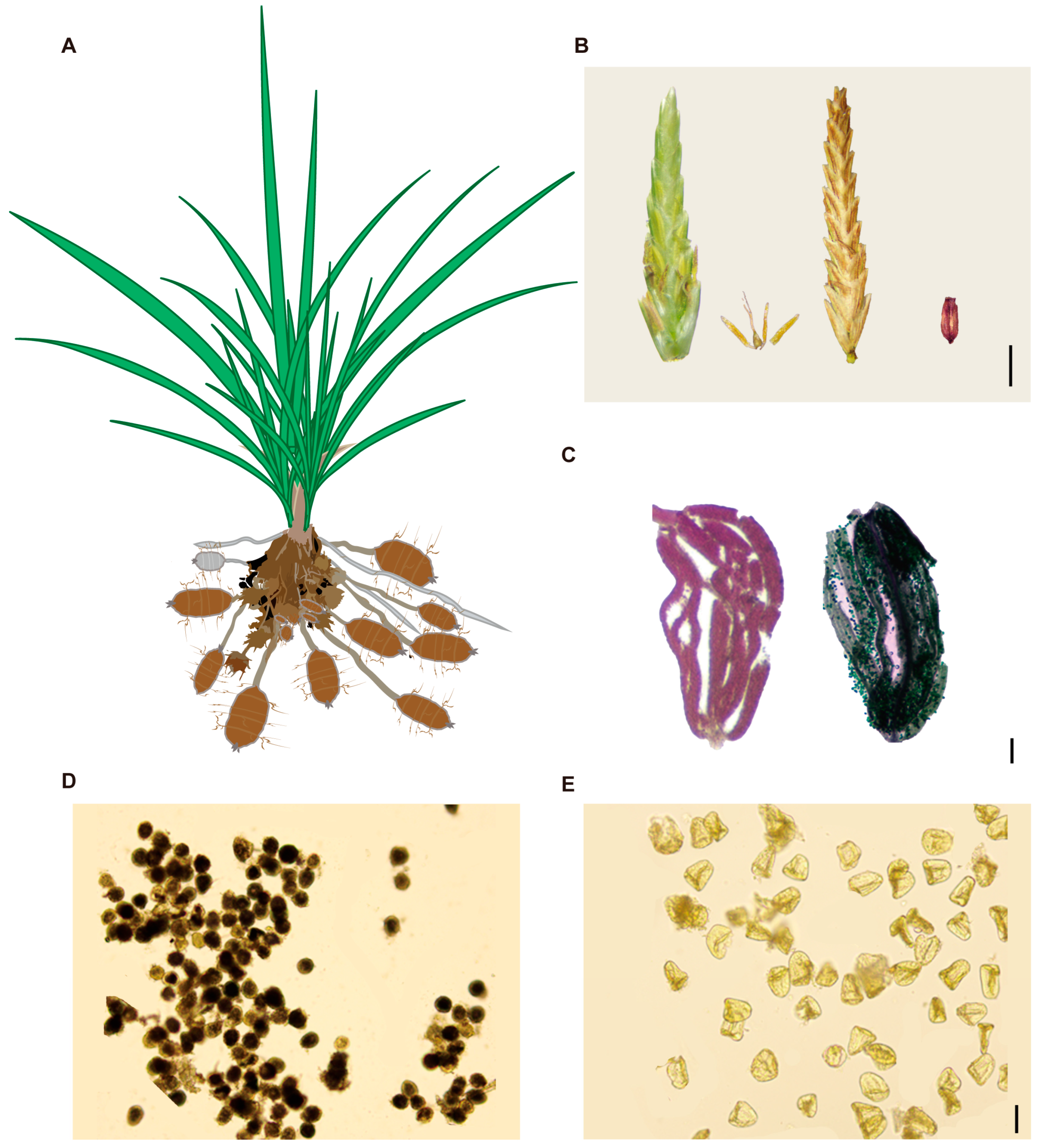
2.1. Seed Set and Fertility of C. esculentus
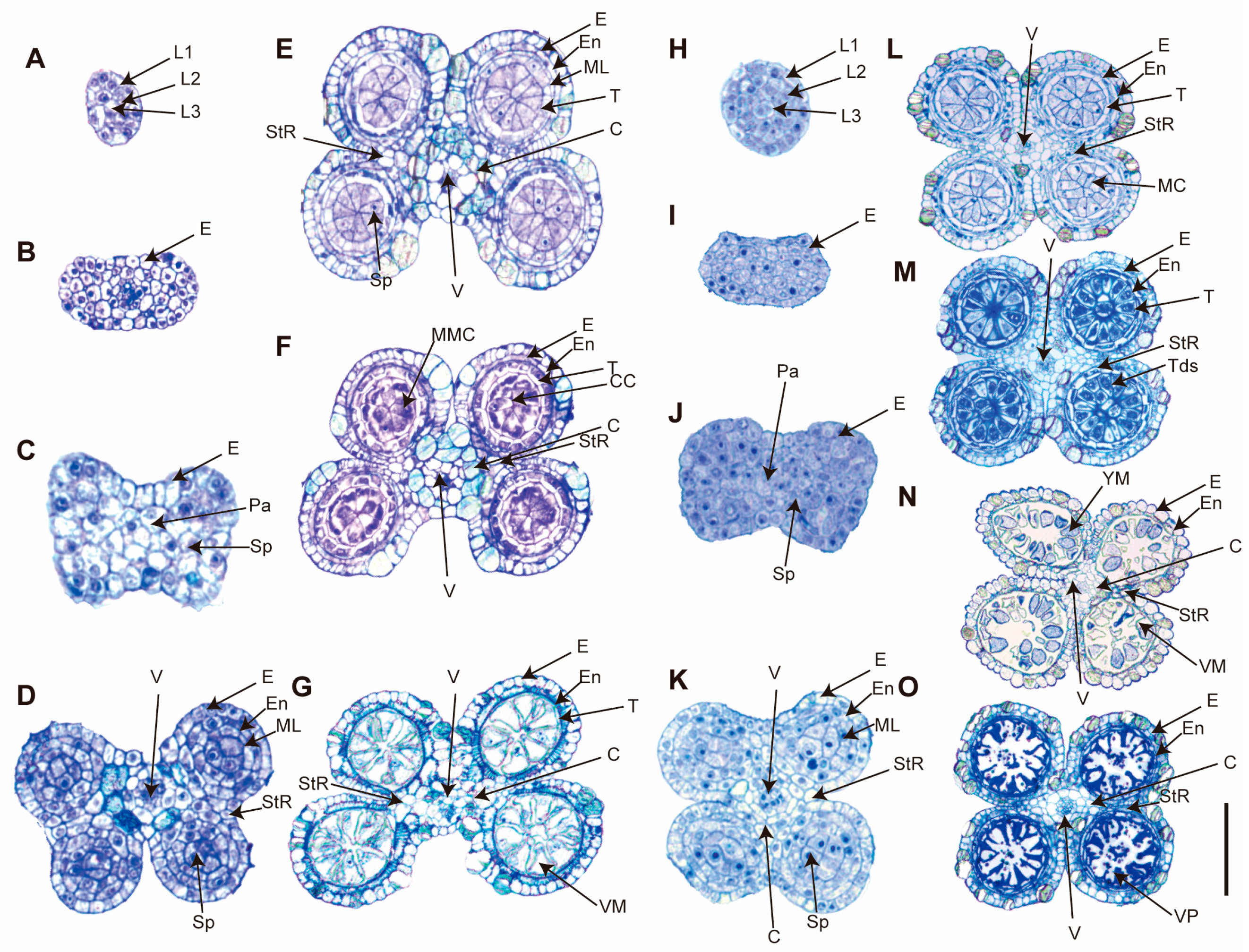
2.2. Semi-Thin Section Analysis of Anther Development in C. esculentus and C. rotundus
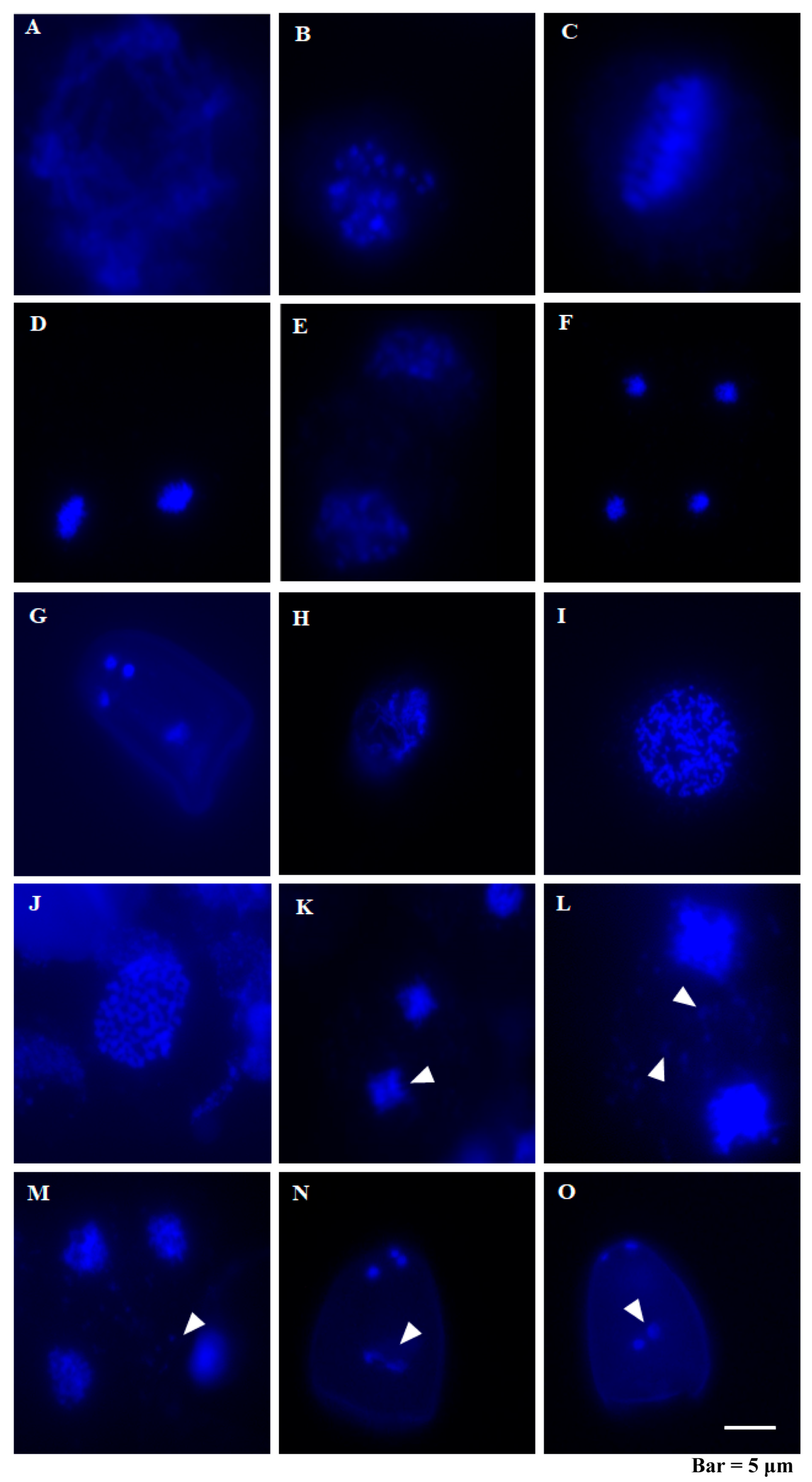
2.3. Meiotic Chromosomal Behavior in C. esculentus and C. rotundus
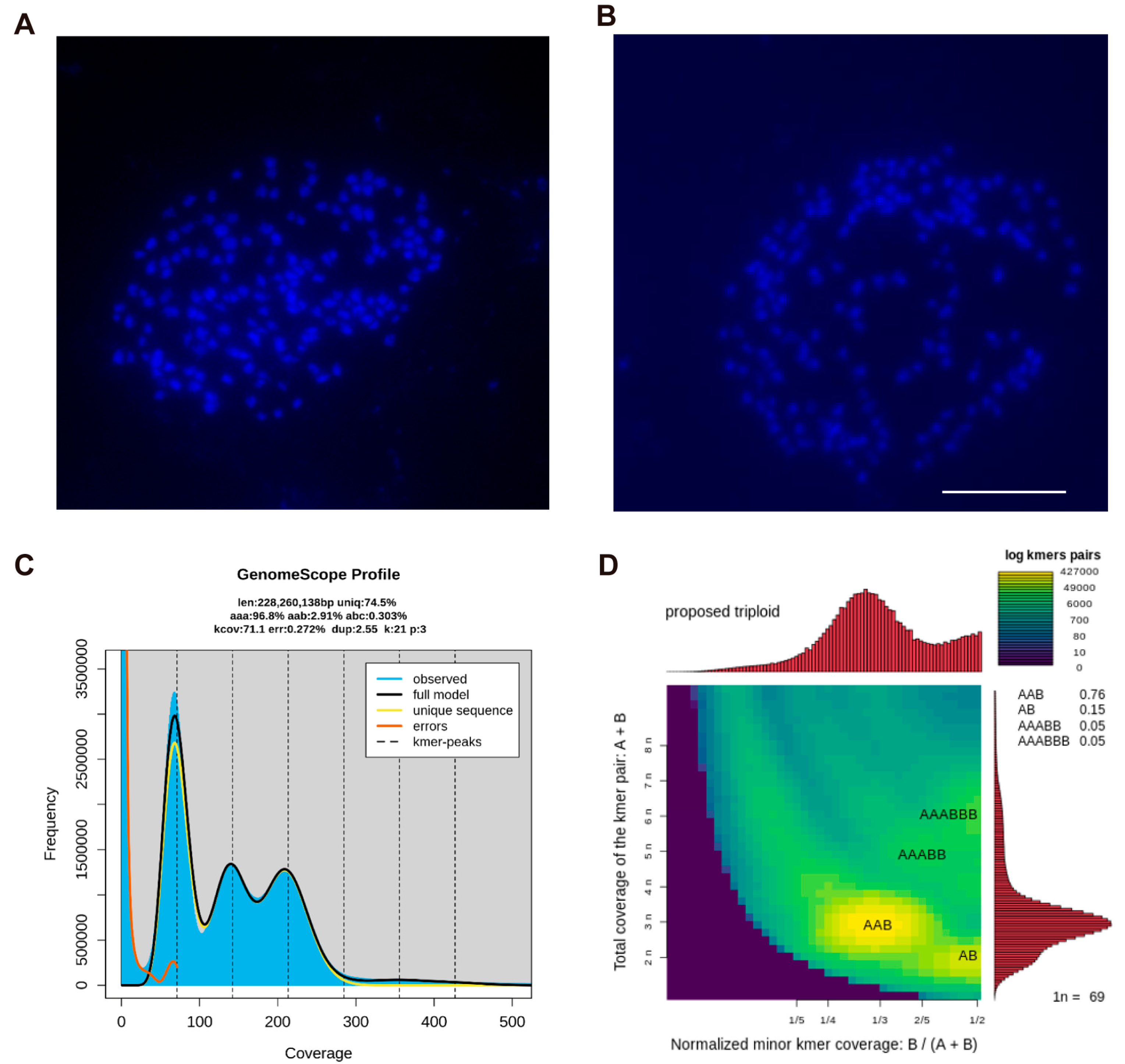
2.4. Chromosome Number and Ploidy Analysis of C. esculentus
3. Discussion
4. Materials and Methods
4.1. Plant Material
4.2. Alexander Staining of Anthers
4.3. Starch-Potassium Iodide Staining
4.4. Meiotic Chromosome Spreading Experiment in C. esculentus and C. rotundus
4.5. Semi-Thin Section Experiment in C. esculentus and C. rotundus
4.6. Karyotype and Ploidy Analysis of C. esculentus
5. Conclusions
Author Contributions
Funding
Data Availability Statement
Conflicts of Interest
References
- Rocha, D.M.; Nogueira, F.M.; Andre, T.; de Araujo Mariath, J.E.; Vanzela, A.L.L. Evolutionary features of microspore and pollen grain development in Cyperaceae. Plant Reprod. 2023, 36, 333–342. [Google Scholar] [CrossRef] [PubMed]
- De Castro, O.; Gargiulo, R.; Del Guacchio, E.; Caputo, P.; De Luca, P. A molecular survey concerning the origin of Cyperus esculentus (Cyperaceae, Poales): Two sides of the same coin (weed vs. crop). Ann. Bot. 2015, 115, 733–745. [Google Scholar] [CrossRef] [PubMed]
- Asare, P.A.; Kpankpari, R.; Adu, M.O.; Afutu, E.; Adewumi, A.S. Phenotypic Characterization of Tiger Nuts (Cyperus esculentus L.) from Major Growing Areas in Ghana. Sci. World J. 2020, 2020, 7232591. [Google Scholar] [CrossRef]
- Moral-Anter, D.; Campo-Sabariz, J.; Ferrer, R.; Martin-Venegas, R. Cyperus esculentus L. Tubers (Tiger Nuts) Protect Epithelial Barrier Function in Caco-2 Cells Infected by Salmonella Enteritidis and Promote Lactobacillus plantarum Growth. Nutrients 2020, 13, 71. [Google Scholar] [CrossRef]
- Twumasi, P.; Asare, P.A.; Afutu, E.; Amenorpe, G.; Addy, S. Chemosensitivity analysis of tiger nuts (Cyperus esculentus L.) using ethyl methanesulfonate (EMS) and colchicine mutagens. Heliyon 2023, 9, e22619. [Google Scholar] [CrossRef]
- Adel, A.A.M.; Awad, A.M.; Mohamed, H.H.; Iryna, S. Chemical composition, physicochemical properties and fatty acid profile of Tiger Nut (Cyperus esculentus L.) seed oil as affected by different preparation methods. Int. Food Res. J. 2015, 22, 1931–1938. [Google Scholar]
- Yu, Y.; Lu, X.; Zhang, T.; Zhao, C.; Guan, S.; Pu, Y.; Gao, F. Tiger nut (Cyperus esculentus L.) nutrition, processing, function and applications. Foods 2021, 11, 601. [Google Scholar] [CrossRef]
- Sanchez-Zapata, E.; Fuentes-Zaragoza, E.; Fernandez-Lopez, J.; Sendra, E.; Sayas, E.; Navarro, C.; Perez-Alvarez, J.A. Preparation of dietary fiber powder from tiger nut (Cyperus esculentus) milk (“Horchata”) byproducts and its physicochemical properties. J. Agric. Food Chem. 2009, 57, 7719–7725. [Google Scholar] [CrossRef]
- Adekiya, A.O.; Olaniran, A.F.; Adenusi, T.T.; Aremu, C.; Ejue, W.S.; Iranloye, Y.M.; Gbadamosi, A.; Olayanju, A. Effects of cow dung and wood biochars and green manure on soil fertility and tiger nut (Cyperus esculentus L.) performance on a savanna Alfisol. Sci. Rep. 2020, 10, 21021. [Google Scholar] [CrossRef]
- Ormeño-Núñez, J.; Pino-Rojas, G.; Garfe-Vergara, F. Inhibiton of yellow nutsedge (Cyperus esculentus L.) and bermudagrass (Cynodon dactylon (L.) pers) by a mulch derived from rye (Secale cereale L.) in grapevines. Chil. J. Agric. Res. 2008, 68, 238–247. [Google Scholar] [CrossRef]
- Sánchez-Zapata, E.; Fernández-López, J.; Angel Pérez-Alvarez, J. Tiger Nut (Cyperus esculentus) Commercialization: Health Aspects, Composition, Properties, and Food Applications. Compr. Rev. Food Sci. Food Saf. 2012, 11, 366–377. [Google Scholar] [CrossRef]
- Pascual, B.; Maroto, J.V.; LóPez-Galarza, S.; Sanbautista, A.; Alagarda, J. Chufa (Cyperus esculentus L. var. sativus boeck.): An unconventional crop. studies related to applications and cultivation. Econ. Bot. 2000, 54, 427–436. [Google Scholar] [CrossRef]
- Bai, X.; Tang, M.; Hu, X.; Huang, P.; Wu, Y.; Chen, T.; He, H.; Xu, Z.F. Comparative transcriptome analysis of Cyperus esculentus and C. rotundus with contrasting oil contents in tubers defines genes and regulatory networks involved in oil accumulation. Plant Sci. 2024, 348, 112230. [Google Scholar] [CrossRef]
- Ji, H.; Liu, D.; Yang, Z. High oil accumulation in tuber of yellow nutsedge compared to purple nutsedge is associated with more abundant expression of genes involved in fatty acid synthesis and triacylglycerol storage. Biotechnol. Biofuels 2021, 14, 54. [Google Scholar] [CrossRef]
- Zhang, S.; Li, P.; Wei, Z.; Cheng, Y.; Liu, J.; Yang, Y.; Wang, Y.; Mu, Z. Cyperus (Cyperus esculentus L.): A Review of Its Compositions, Medical Efficacy, Antibacterial Activity and Allelopathic Potentials. Plants 2022, 11, 1127. [Google Scholar] [CrossRef]
- Ezeh, O.; Gordon, M.H.; Niranjan, K. Tiger nut oil (Cyperus esculentus L.): A review of its composition and physico-chemical properties. Eur. J. Lipid Sci. Technol. 2014, 116, 783–794. [Google Scholar] [CrossRef]
- Roselló-Soto, E.; Poojary, M.M.; Barba, F.J.; Lorenzo, J.M.; Mañes, J.; Moltó, J.C. Tiger nut and its by-products valorization: From extraction of oil and valuable compounds to development of new healthy products. Innov. Food Sci. Emerg. Technol. 2018, 45, 306–312. [Google Scholar] [CrossRef]
- Ramu, P.; Esuma, W.; Kawuki, R.; Rabbi, I.Y.; Egesi, C.; Bredeson, J.V.; Bart, R.S.; Verma, J.; Buckler, E.S.; Lu, F. Cassava haplotype map highlights fixation of deleterious mutations during clonal propagation. Nat. Genet. 2017, 49, 959–963. [Google Scholar] [CrossRef]
- Semmouri, I.; Bauters, K.; Léveillé-Bourret, É.; Starr, J.R.; Goetghebeur, P.; Larridon, I. Phylogeny and Systematics of Cyperaceae, the Evolution and Importance of Embryo Morphology. Bot. Rev. 2018, 85, 1–39. [Google Scholar] [CrossRef]
- Williams, R.D. Growth and reproduction of Cyperus esculentus L. and Cyperus rotundus L. Weed Res. 1982, 22, 149–154. [Google Scholar]
- Bedinger, P. The remarkable biology of pollen. Patricia Bedinge 1992, 4, 879–887. [Google Scholar]
- Wang, H.; Liu, Y.; Bruffett, K.; Lee, J.; Hause, G.; Walker, J.C.; Zhang, S. Haplo-insufficiency of MPK3 in MPK6 mutant background uncovers a novel function of these two MAPKs in Arabidopsis ovule development. Plant Cell 2008, 20, 602–613. [Google Scholar] [CrossRef]
- McCormick, S. Control of male gametophyte development. Plant Cell 2004, 16 (Suppl. 1), S142–S153. [Google Scholar] [CrossRef] [PubMed]
- Sharma, A.; Singh, M.B.; Bhalla, P.L. Anther ontogeny in Brachypodium distachyon. Protoplasma 2015, 252, 439–450. [Google Scholar] [CrossRef] [PubMed]
- Browne, R.G.; Iacuone, S.; Li, S.F.; Dolferus, R.; Parish, R.W. Anther Morphological Development and Stage Determination in Triticum aestivum. Front. Plant Sci. 2018, 9, 228. [Google Scholar] [CrossRef]
- Sanders, P.M.; Bui, A.Q.; Weterings, K.; N.McIntire, K.; Hsu, Y.-C.; Lee, P.Y.; Truong, M.T.; Beals, T.P.; Goldberg, R.B. Anther developmental defects in Arabidopsis thaliana male-sterile. Sex. Plant Reprod. 1998, 11, 297–322. [Google Scholar] [CrossRef]
- Zhang, D.; Wilson, Z.A. Stamen specification and anther development in rice. Chin. Sci. Bull. 2009, 54, 2342–2353. [Google Scholar] [CrossRef]
- Brown, R.C.; Lemmon, B.E. The cytoskeleton and polarization during pollen development in Carex blanda (Cyperaceae). Am. J. Bot. 2000, 87, 1–11. [Google Scholar] [CrossRef]
- Roha, D.M.; Vanzela, A.L.L.; Mariath, J.E.A. Comparative study of microgametogenesis in members of Cyperaceae and Juncaceae: A shift from permanent pollen tetrads to pseudomonads. Bot. J. Linn. Soc. 2018, 188, 59–73. [Google Scholar] [CrossRef]
- San Martin, J.A.; de Jesus Andrade, C.G.; Mastroberti, A.A.; de Araujo Mariath, J.E.; Vanzela, A.L. Asymmetric cytokinesis guide the development of pseudomonads in Rhynchospora pubera (Cyperaceae). Cell Biol. Int. 2013, 37, 203–212. [Google Scholar] [CrossRef]
- Larridon, I.; Zuntini, A.R.; Léveillé-Bourret, E.; Barrett, R.L.; Starr, J.R.; Muasya, A.M.; Villaverde, T.; Bauters, K.; Brewer, G.E.; Bruhl, J.J.; et al. A new classification of Cyperaceae (Poales) supported by phylogenomic data. J. Syst. Evol. 2021, 59, 852–895. [Google Scholar] [CrossRef]
- Roalson, E.H. A Synopsis of Chromosome Number Variation in the Cyperaceae. Bot. Rev. 2008, 74, 209–393. [Google Scholar] [CrossRef]
- Wieclaw, H.; Kalinka, A.; Koopman, J. Chromosome numbers of Carex (Cyperaceae) and their taxonomic implications. PLoS ONE 2020, 15, e0228353. [Google Scholar] [CrossRef]
- Zhao, X.; Yi, L.; Ren, Y.; Li, J.; Ren, W.; Hou, Z.; Su, S.; Wang, J.; Zhang, Y.; Dong, Q.; et al. Chromosome-scale Genome Assembly of the Yellow Nutsedge (Cyperus esculentus). Genome Biol. Evol. 2023, 15, evad027. [Google Scholar] [CrossRef] [PubMed]
- Ranallo-Benavidez, T.R.; Jaron, K.S.; Schatz, M.C. GenomeScope 2.0 and Smudgeplot for reference-free profiling of polyploid genomes. Nat. Commun. 2020, 11, 1432. [Google Scholar] [CrossRef] [PubMed]
- An, X.; Ma, B.; Duan, M.; Dong, Z.; Liu, R.; Yuan, D.; Hou, Q.; Wu, S.; Zhang, D.; Liu, D.; et al. Molecular regulation of ZmMs7 required for maize male fertility and development of a dominant male-sterility system in multiple species. Proc. Natl. Acad. Sci. USA 2020, 117, 23499–23509. [Google Scholar] [CrossRef] [PubMed]
- Niedziela, A.; Brukwinski, W.; Bednarek, P.T. Genetic mapping of pollen fertility restoration QTLs in rye (Secale cereale L.) with CMS Pampa. J. Appl. Genet. 2021, 62, 185–198. [Google Scholar] [CrossRef]
- Ding, X.; Guo, J.; Lv, M.; Wang, H.; Sheng, Y.; Liu, Y.; Gai, J.; Yang, S. The miR156b-GmSPL2b module mediates male fertility regulation of cytoplasmic male sterility-based restorer line under high-temperature stress in soybean. Plant Biotechnol. J. 2023, 21, 1542–1559. [Google Scholar] [CrossRef]
- Zhu, J.; Lou, Y.; Xu, X.; Yang, Z.N. A genetic pathway for tapetum development and function in Arabidopsis. J. Integr. Plant Biol. 2011, 53, 892–900. [Google Scholar] [CrossRef]
- Gu, J.N.; Zhu, J.; Yu, Y.; Teng, X.D.; Lou, Y.; Xu, X.F.; Liu, J.L.; Yang, Z.N. DYT1 directly regulates the expression of TDF1 for tapetum development and pollen wall formation in Arabidopsis. Plant J. 2014, 80, 1005–1013. [Google Scholar] [CrossRef]
- Xu, C.; Xu, Y.; Wang, Z.; Zhang, X.; Wu, Y.; Lu, X.; Sun, H.; Wang, L.; Zhang, Q.; Zhang, Q.; et al. Spontaneous movement of a retrotransposon generated genic dominant male sterility providing a useful tool for rice breeding. Natl. Sci. Rev. 2023, 10, nwad210. [Google Scholar] [CrossRef]
- Mao, B.; Zheng, W.; Huang, Z.; Peng, Y.; Shao, Y.; Liu, C.; Tang, L.; Hu, Y.; Li, Y.; Hu, L.; et al. Rice MutLgamma, the MLH1-MLH3 heterodimer, participates in the formation of type I crossovers and regulation of embryo sac fertility. Plant Biotechnol. J. 2021, 19, 1443–1455. [Google Scholar] [CrossRef]
- Cheng, Z.; Song, X.; Liu, X.; Yan, S.; Song, W.; Wang, Z.; Han, L.; Zhao, J.; Yan, L.; Zhou, Z.; et al. SPATULA and ALCATRAZ confer female sterility and fruit cavity via mediating pistil development in cucumber. Plant Physiol. 2022, 189, 1553–1569. [Google Scholar] [CrossRef]
- Li, H.; You, C.; Yoshikawa, M.; Yang, X.; Gu, H.; Li, C.; Cui, J.; Chen, X.; Ye, N.; Zhang, J.; et al. A spontaneous thermo-sensitive female sterility mutation in rice enables fully mechanized hybrid breeding. Cell Res. 2022, 32, 931–945. [Google Scholar] [CrossRef]
- Fang, X.; Sun, Y.; Li, J.; Li, M.; Zhang, C. Male sterility and hybrid breeding in soybean. Mol. Breed. 2023, 43, 47. [Google Scholar] [CrossRef]
- Fujii, S.; Kubo, K.; Takayama, S. Non-self- and self-recognition models in plant self-incompatibility. Nat. Plants 2016, 2, 16130. [Google Scholar] [CrossRef] [PubMed]
- Huu, C.N.; Plaschil, S.; Himmelbach, A.; Kappel, C.; Lenhard, M. Female self-incompatibility type in heterostylous Primula is determined by the brassinosteroid-inactivating cytochrome P450 CYP734A50. Curr. Biol. 2022, 32, 671–676.E5. [Google Scholar] [CrossRef] [PubMed]
- Goring, D.R.; Bosch, M.; Franklin-Tong, V.E. Contrasting self-recognition rejection systems for self-incompatibility in Brassica and Papaver. Curr. Biol. 2023, 33, R530–R542. [Google Scholar] [CrossRef] [PubMed]
- Li, Z.; Jiao, Y.; Zhang, C.; Dou, M.; Weng, K.; Wang, Y.; Xu, Y. VvHDZ28 positively regulate salicylic acid biosynthesis during seed abortion in Thompson Seedless. Plant Biotechnol. J. 2021, 19, 1824–1838. [Google Scholar] [CrossRef]
- Xu, S.; Wu, Z.; Hou, H.; Zhao, J.; Zhang, F.; Teng, R.; Ding, L.; Chen, F.; Teng, N. The transcription factor CmLEC1 positively regulates the seed-setting rate in hybridization breeding of chrysanthemum. Hortic. Res. 2021, 8, 191. [Google Scholar] [CrossRef]
- Szeluga, N.; Baldrich, P.; DelPercio, R.; Meyers, B.C.; Frank, M.H. Introduction of barnase/barstar in soybean produces a rescuable male sterility system for hybrid breeding. Plant Biotechnol. J. 2023, 21, 2585–2596. [Google Scholar] [CrossRef] [PubMed]
- Xiong, X.; Wang, D.; Guo, C.; Fan, G.; Zhang, Y.; Song, B.; Hou, B.; Yan, Y.; Xie, C.; Lu, X.; et al. Generation of humidity-sensitive genic male sterility in maize and wheat for hybrid seed production. J. Integr. Plant Biol. 2024, 66, 2317–2320. [Google Scholar] [CrossRef]
- Abbas, A.; Yu, P.; Sun, L.; Yang, Z.; Chen, D.; Cheng, S.; Cao, L. Exploiting Genic Male Sterility in Rice: From Molecular Dissection to Breeding Applications. Front. Plant Sci. 2021, 12, 629314. [Google Scholar] [CrossRef]
- Furness, C.A.; Rudall, P.J. Selective microspore abortion correlated with aneuploidy: An indication of meiotic drive. Sex. Plant Reprod. 2011, 24, 1–8. [Google Scholar] [CrossRef]
- Hofstatter, P.G.; Thangavel, G.; Lux, T.; Neumann, P.; Vondrak, T.; Novak, P.; Zhang, M.; Costa, L.; Castellani, M.; Scott, A.; et al. Repeat-based holocentromeres influence genome architecture and karyotype evolution. Cell 2022, 185, 3153–3168.E18. [Google Scholar] [CrossRef]
- Liu, H.; Zhao, H.; Zhang, Y.; Li, X.; Zuo, Y.; Wu, Z.; Jin, K.; Xian, W.; Wang, W.; Ning, W.; et al. The genome of Eleocharis vivipara elucidates the genetics of C(3)-C(4) photosynthetic plasticity and karyotype evolution in the Cyperaceae. J. Integr. Plant Biol. 2024, 66, 2505–2527. [Google Scholar] [CrossRef]
- Cabral, G.; Marques, A.; Schubert, V.; Pedrosa-Harand, A.; Schlogelhofer, P. Chiasmatic and achiasmatic inverted meiosis of plants with holocentric chromosomes. Nat. Commun. 2014, 5, 5070. [Google Scholar] [CrossRef]
- Rocha, D.M.; Neumann, U.; Nogueira, F.M.; Tsipas, G.; Vanzela, A.L.L.; Marques, A. Cryoimmobilized anther analysis reveals new ultrastructural insights into Rhynchospora (Cyperaceae) asymmetrical microsporogenesis. Front. Plant Sci. 2024, 15, 1518369. [Google Scholar] [CrossRef]
- Luo, Y.; Wang, R.; Zhang, Y.; Liu, J.; Wang, Y. The telomere-to-telomere genome of Cyperus rotundus L. provides new insights into the molecular mechanisms of herbicide resistance and α-cyperone biosynthesis. Ind. Crops Prod. 2025, 233, 121258. [Google Scholar] [CrossRef]
- Wang, J.; Huo, B.; Liu, W.; Li, D.; Liao, L. Abnormal meiosis in an intersectional allotriploid of Populus L. and segregation of ploidy levels in 2x × 3x progeny. PLoS ONE 2017, 12, e0181767. [Google Scholar] [CrossRef] [PubMed]
- Zhang, X.; Cao, Q.; Zhou, P.; Jia, G. Meiotic chromosome behavior of the male-fertile allotriploid lily cultivar ‘Cocossa’. Plant Cell Rep. 2017, 36, 1641–1653. [Google Scholar] [CrossRef]
- Kovalsky, I.E.; Roggero Luque, J.M.; Elias, G.; Fernandez, S.A.; Solis Neffa, V.G. The role of triploids in the origin and evolution of polyploids of Turnera sidoides complex (Passifloraceae, Turneroideae). J. Plant Res. 2018, 131, 77–89. [Google Scholar] [CrossRef]
- Cheng, L.; Bao, Z.; Kong, Q.; Lassois, L.; Stein, N.; Huang, S.; Zhou, Q. Genome analyses and breeding of polyploid crops. Nat. Plants 2025, 11, 1714–1728. [Google Scholar] [CrossRef] [PubMed]
- Healey, A.L.; Garsmeur, O.; Lovell, J.T.; Shengquiang, S.; Sreedasyam, A.; Jenkins, J.; Plott, C.B.; Piperidis, N.; Pompidor, N.; Llaca, V.; et al. The complex polyploid genome architecture of sugarcane. Nature 2024, 628, 804–810. [Google Scholar] [CrossRef]
- The International Wheat Genome Sequencing Consortium (IWGSC). A chromosome-based draft sequence of the hexaploid bread wheat (Triticum aestivum) genome. Science 2014, 345, 1251788. [Google Scholar] [CrossRef] [PubMed]
- Stokstad, E. The new potato. Science 2019, 363, 574–577. [Google Scholar] [CrossRef]
- Qu, Y.; Fernie, A.R.; Liu, J.; Yan, J. Doubled haploid technology and synthetic apomixis: Recent advances and applications in future crop breeding. Mol. Plant 2024, 17, 1005–1018. [Google Scholar] [CrossRef]
- Gyani, P.C.; Mahato, R.; Yadav, P.; Patidar, O.P.; Kushwaha, N.; Prajapat, R.K.; Roy, A.; Gayan, P.; Maity, A.; Pakhira, R. Applications of Artificial Polyploid Induction for Genetic Improvement of Plants. Asian J. Curr. Res. 2025, 10, 114–130. [Google Scholar] [CrossRef]
- Atlagić, J.; Terzić, S.; Marjanović-Jeromela, A. Staining and fluorescent microscopy methods for pollen viability determination in sunflower and other plant species. Ind. Crops Prod. 2012, 35, 88–91. [Google Scholar] [CrossRef]
- Alexander, M.P. Differential staining of aborted and nonaborted pollen. Stain. Technol. 1969, 44, 117–122. [Google Scholar] [CrossRef] [PubMed]
- Song, S.; Li, Y.; Qiu, M.; Xu, N.; Li, B.; Zhang, L.; Li, L.; Chen, W.; Li, J.; Wang, T.; et al. Structural variations of a new fertility restorer gene, Rf20, underlie the restoration of wild abortive-type cytoplasmic male sterility in rice. Mol. Plant 2024, 17, 1272–1288. [Google Scholar] [CrossRef] [PubMed]
- Jiang, L.; Guo, T.; Song, X.; Jiang, H.; Lu, M.; Luo, J.; Rossi, V.; He, Y. MSH7 confers quantitative variation in pollen fertility and boosts grain yield in maize. Plant Biotechnol. J. 2024, 22, 1372–1386. [Google Scholar] [CrossRef] [PubMed]
- Li, S.F.; Iacuone, S.; Parish, R.W. Suppression and restoration of male fertility using a transcription factor. Plant Biotechnol. J. 2007, 5, 297–312. [Google Scholar] [CrossRef] [PubMed]
- Marko, J.F. Micromechanical studies of mitotic chromosomes. Chromosome Res. 2008, 16, 469–497. [Google Scholar] [CrossRef]



| Anther Stage | Stage Name | Range (mm) |
|---|---|---|
| H | Stamen primordia | 0.1–0.15 |
| I | Archesporial | 0.2–0.4 |
| J | Sporogenous tissue | 0.3–0.45 |
| K | Lobe formation | 0.4–0.6 |
| L | Pre-callose | 0.5–0.75 |
| M | Meiotic | 0.6–0.9 |
| N | Pseudopollen | 0.9–1.1 |
| O | Bilocular | 1.0–1.3 |
Disclaimer/Publisher’s Note: The statements, opinions and data contained in all publications are solely those of the individual author(s) and contributor(s) and not of MDPI and/or the editor(s). MDPI and/or the editor(s) disclaim responsibility for any injury to people or property resulting from any ideas, methods, instructions or products referred to in the content. |
© 2025 by the authors. Licensee MDPI, Basel, Switzerland. This article is an open access article distributed under the terms and conditions of the Creative Commons Attribution (CC BY) license (https://creativecommons.org/licenses/by/4.0/).
Share and Cite
Wang, M.; Hu, K.; Wang, Y.; Tian, Y.; Du, X.; Zhu, J.; Wang, H.; Li, C.; Lu, P. Cytological and Ploidy Analyses Revealing Fertility Defects of Cultivar Cyperus esculentus L. in China. Plants 2025, 14, 3431. https://doi.org/10.3390/plants14223431
Wang M, Hu K, Wang Y, Tian Y, Du X, Zhu J, Wang H, Li C, Lu P. Cytological and Ploidy Analyses Revealing Fertility Defects of Cultivar Cyperus esculentus L. in China. Plants. 2025; 14(22):3431. https://doi.org/10.3390/plants14223431
Chicago/Turabian StyleWang, Meng, Ke Hu, Yan Wang, Yilin Tian, Xiaoying Du, Jiaying Zhu, Huiwei Wang, Chunxin Li, and Pingli Lu. 2025. "Cytological and Ploidy Analyses Revealing Fertility Defects of Cultivar Cyperus esculentus L. in China" Plants 14, no. 22: 3431. https://doi.org/10.3390/plants14223431
APA StyleWang, M., Hu, K., Wang, Y., Tian, Y., Du, X., Zhu, J., Wang, H., Li, C., & Lu, P. (2025). Cytological and Ploidy Analyses Revealing Fertility Defects of Cultivar Cyperus esculentus L. in China. Plants, 14(22), 3431. https://doi.org/10.3390/plants14223431