Article

Predicting Heterosis and Selecting Superior Families and Individuals in Fraxinus spp. Based on Growth Traits and Genetic Distance Coupling


1
Shandong Provincial Academy of Forestry, Jinan 250014, China
2
State Key Laboratory of Tree Genetics and Breeding, Research Institute of Forestry, Chinese Academy of Forestry, Beijing 100091, China
3
UGent-Woodlab (Laboratory of Wood Technology), Department of Environment, Ghent University, 9000 Ghent, Belgium
*
Authors to whom correspondence should be addressed.
These authors contributed equally to this work.
Plants 2025, 14(16), 2601; https://doi.org/10.3390/plants14162601

Submission received: 17 July 2025 / Revised: 17 August 2025 / Accepted: 19 August 2025 / Published: 21 August 2025
(This article belongs to the Special Issue Research on Genetic Breeding and Biotechnology of Forest Trees)

Abstract

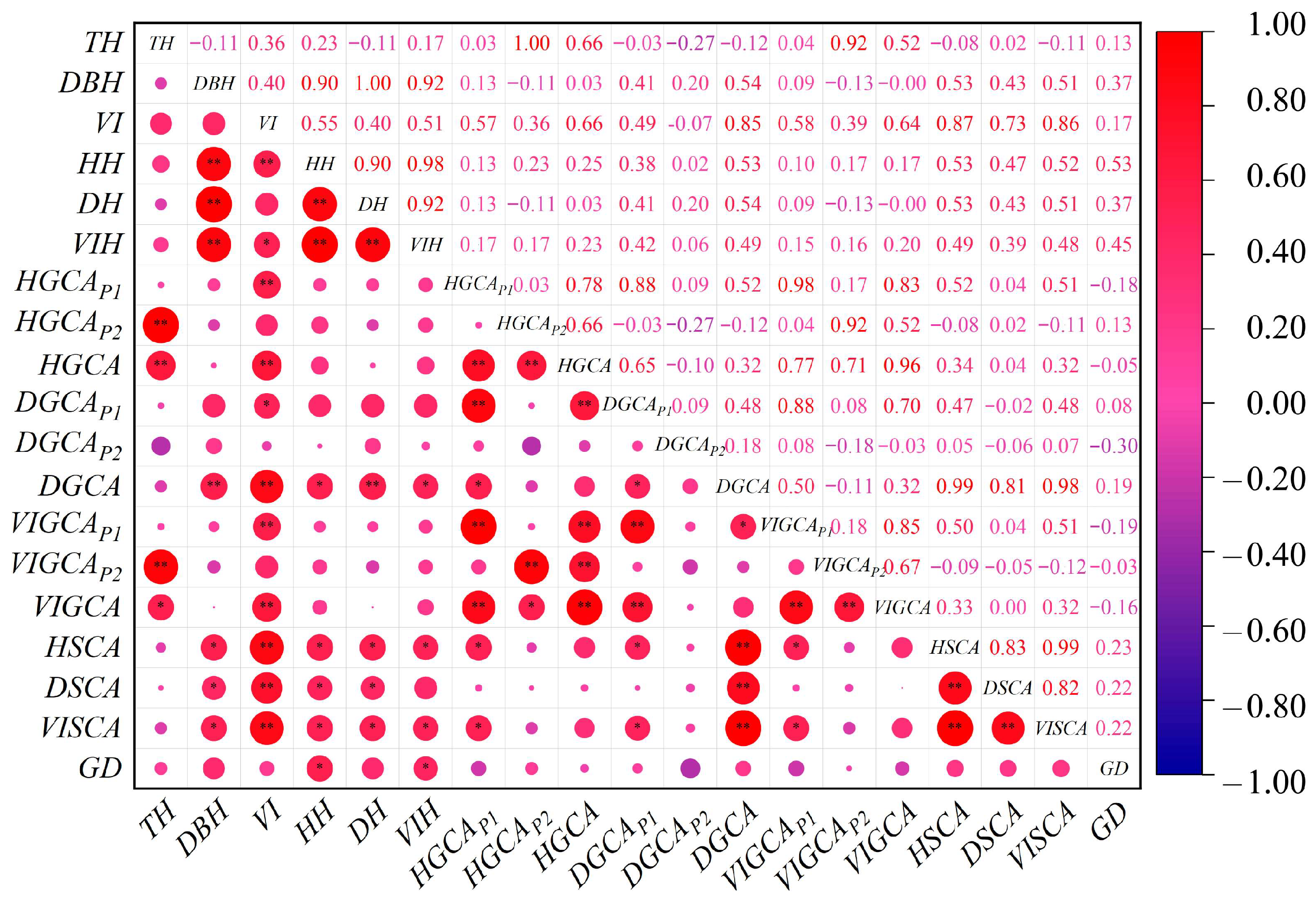
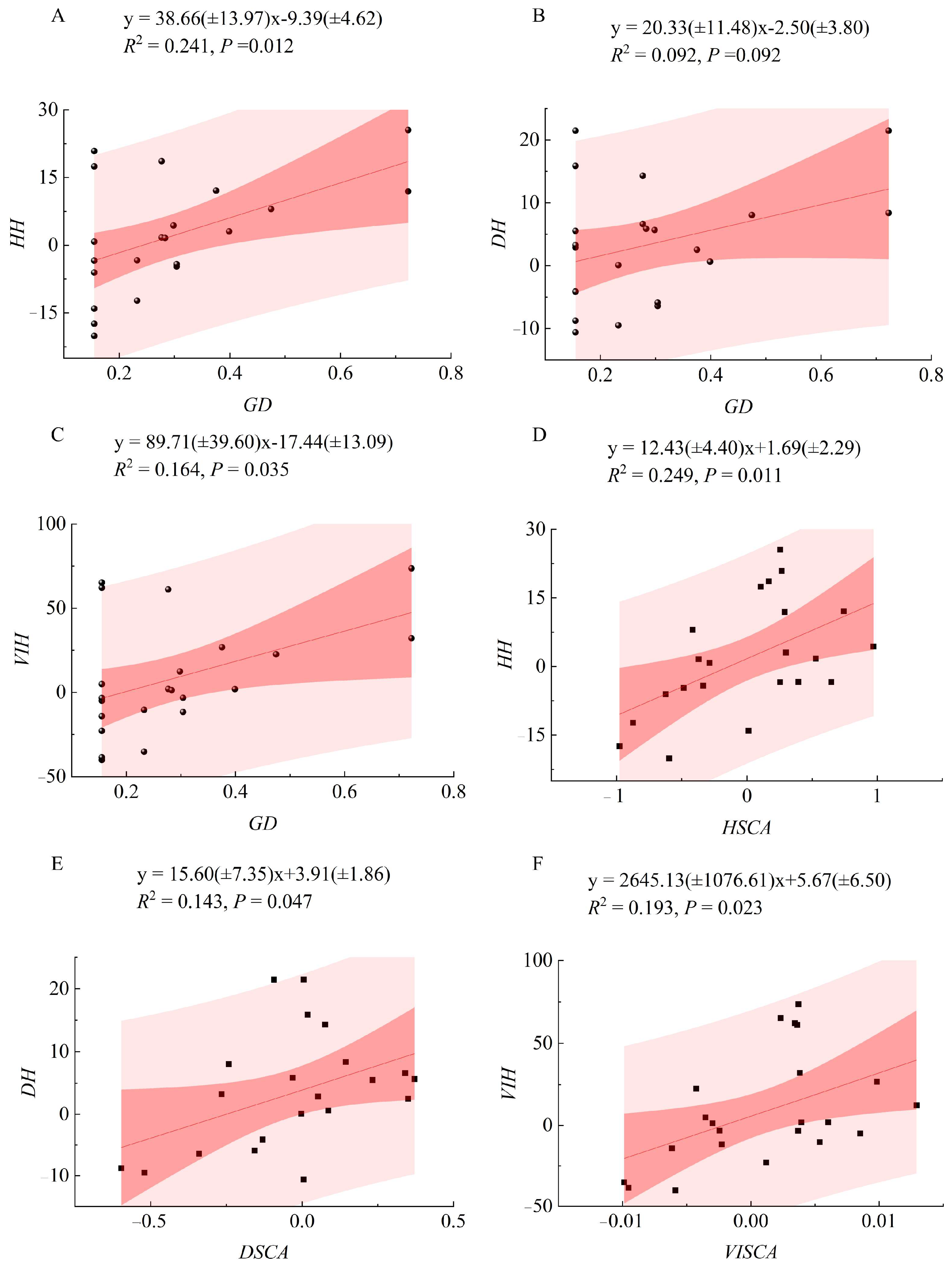
Fraxinus spp. is one of the most important salt-alkali resistant tree species in the Yellow River region of China. However, the limited number of superior families and individuals, as well as the lack of a well-established parent selection system for hybrid breeding, have seriously constrained the improvement of seed orchards and the construction of advanced breeding populations. To address these issues, this study investigated 22 full-sib families of Fraxinus spp., using SSR molecular markers to calculate the genetic distance (GD) between parents. Combined with combining ability analysis, the study aimed to predict heterosis in offspring growth traits and select superior families and individuals through multi-trait comprehensive evaluation. The results showed the following: (1) Tree height (TH), diameter at breast height (DBH), and volume index (VI) exhibited extremely significant differences among families, indicating rich variation and strong selection potential. (2) The phenotypic and genotypic coefficients of variation for TH, DBH, and VI ranged from 4.34% to 16.04% and 5.10% to 17.73%, respectively. Family heritability was relatively high, ranging from 0.724 to 0.818, suggesting that growth is under strong genetic control. (3) The observed and expected heterozygosity of 15 parents were 0.557 and 0.410, respectively, indicating a moderate level of heterozygosity. Nei’s genetic diversity index and Shannon’s information index were 0.488 and 0.670, respectively, indicating relatively high genetic diversity. GD between parents ranged from 0.155 to 0.723. (4) Correlation analysis revealed significant or highly significant positive correlations between family heterosis and growth traits, combining ability, and GD, with specific combining ability (SCA) showing the strongest predictive power. Regression analysis further demonstrated significant linear correlations between GD and heterosis of TH and VI, and between SCA and heterosis of TH, DBH, and VI, establishing a GD threshold (≤0.723) and SCA-based co-selection strategy. In addition, four superior Fraxinus families and 11 elite individuals were selected. Their genetic gains for TH, DBH, and VI reached 2.28%, 3.30%, and 9.96% (family selection), and 1.98%, 2.11%, and 4.00% (individual selection), respectively. By integrating genetic distance (GD) and quantitative genetic combining ability (SCA), this study established a quantifiable prediction model and proposed the “GDSCA dual-index parent selection method”, offering a new paradigm for genetic improvement in tree breeding.
Keywords: Fraxinus spp.; tree breeding; hybrids; genetic diversity; combining ability; molecular markers Fraxinus spp.; tree breeding; hybrids; genetic diversity; combining ability; molecular markers